Art Fundamentals Chapter 2 Form Part 1 TERMS Part 2 Part 3
Art Fundamentals Chapter 2 Form Part 3
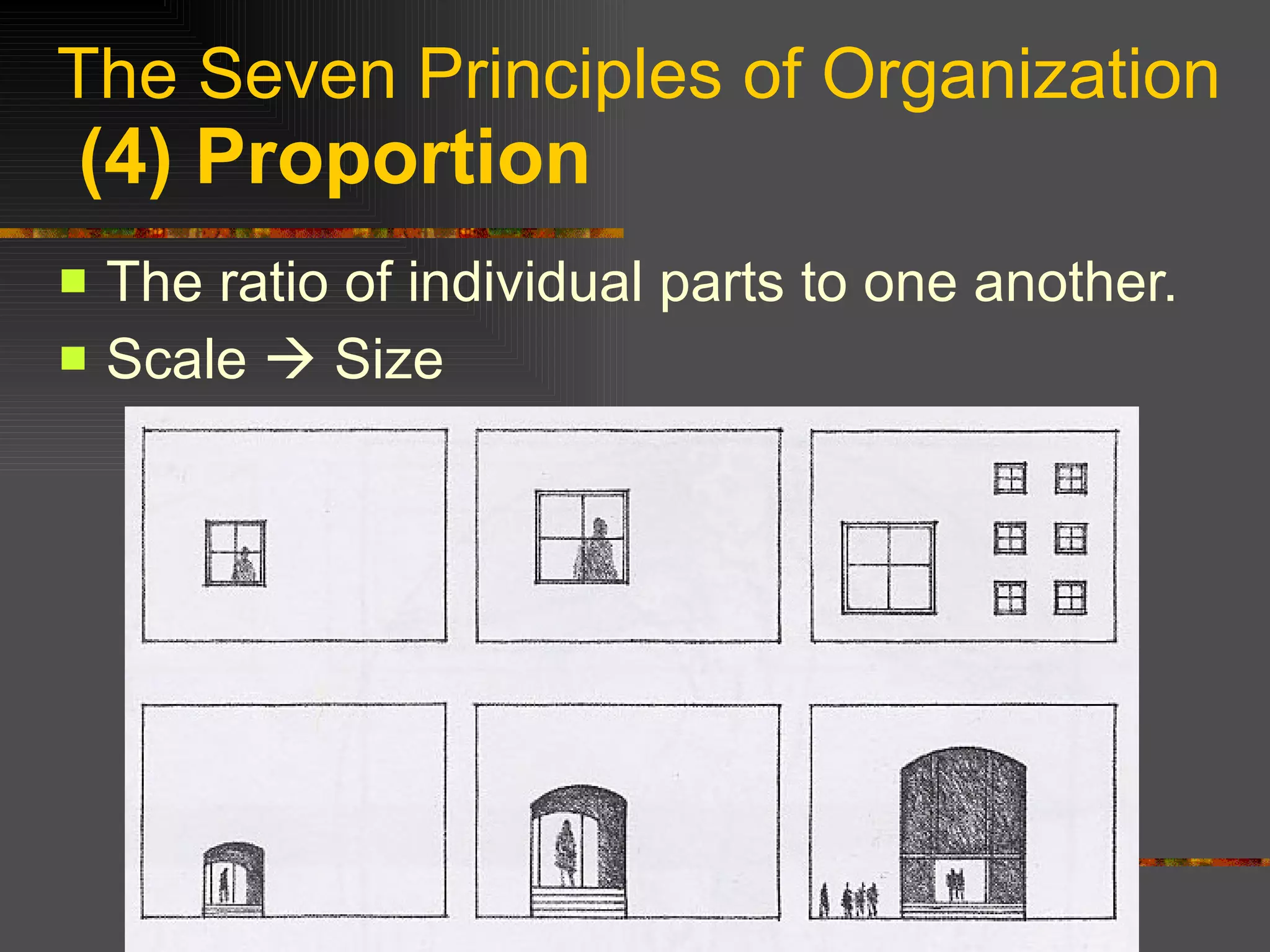
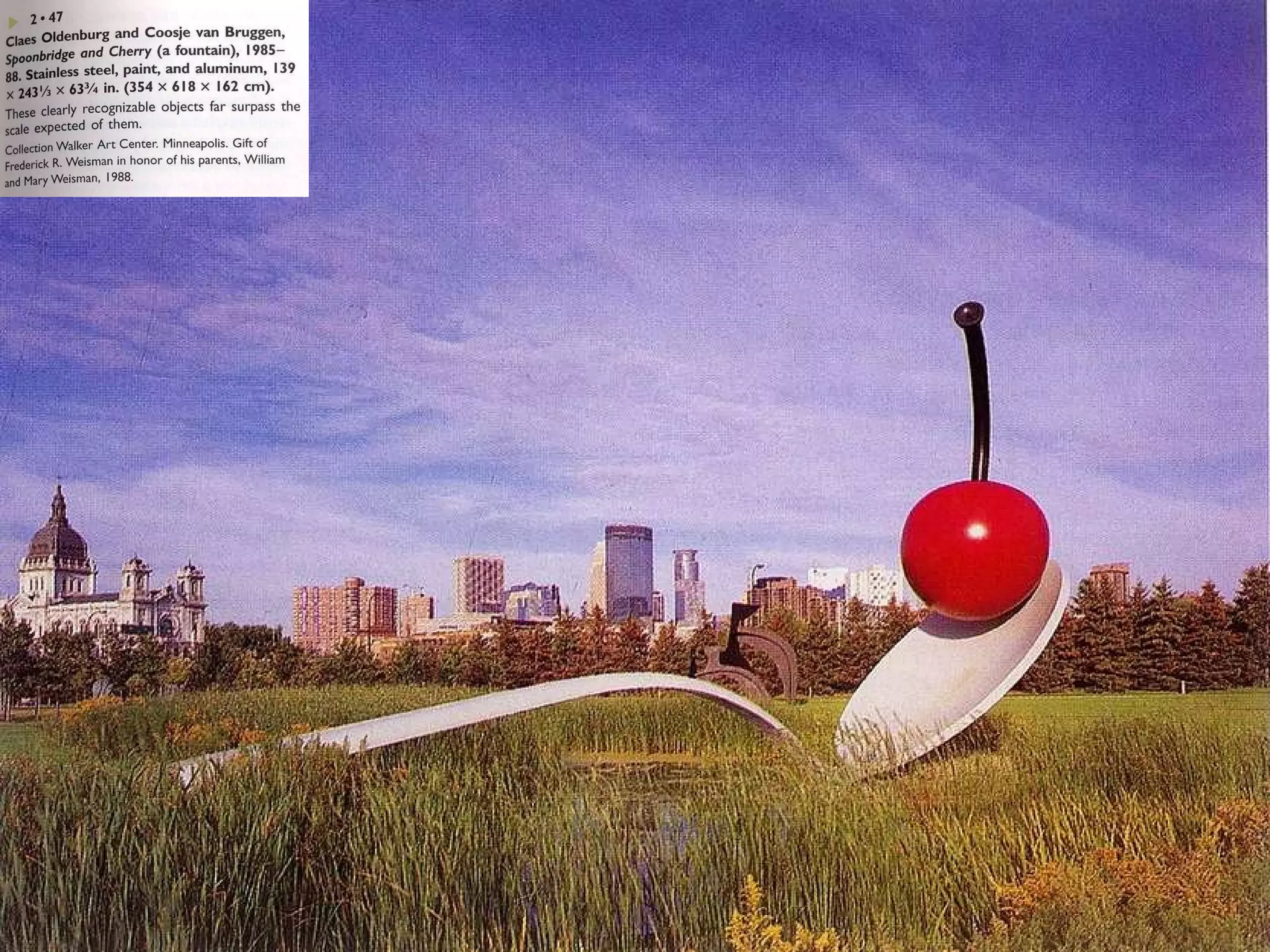
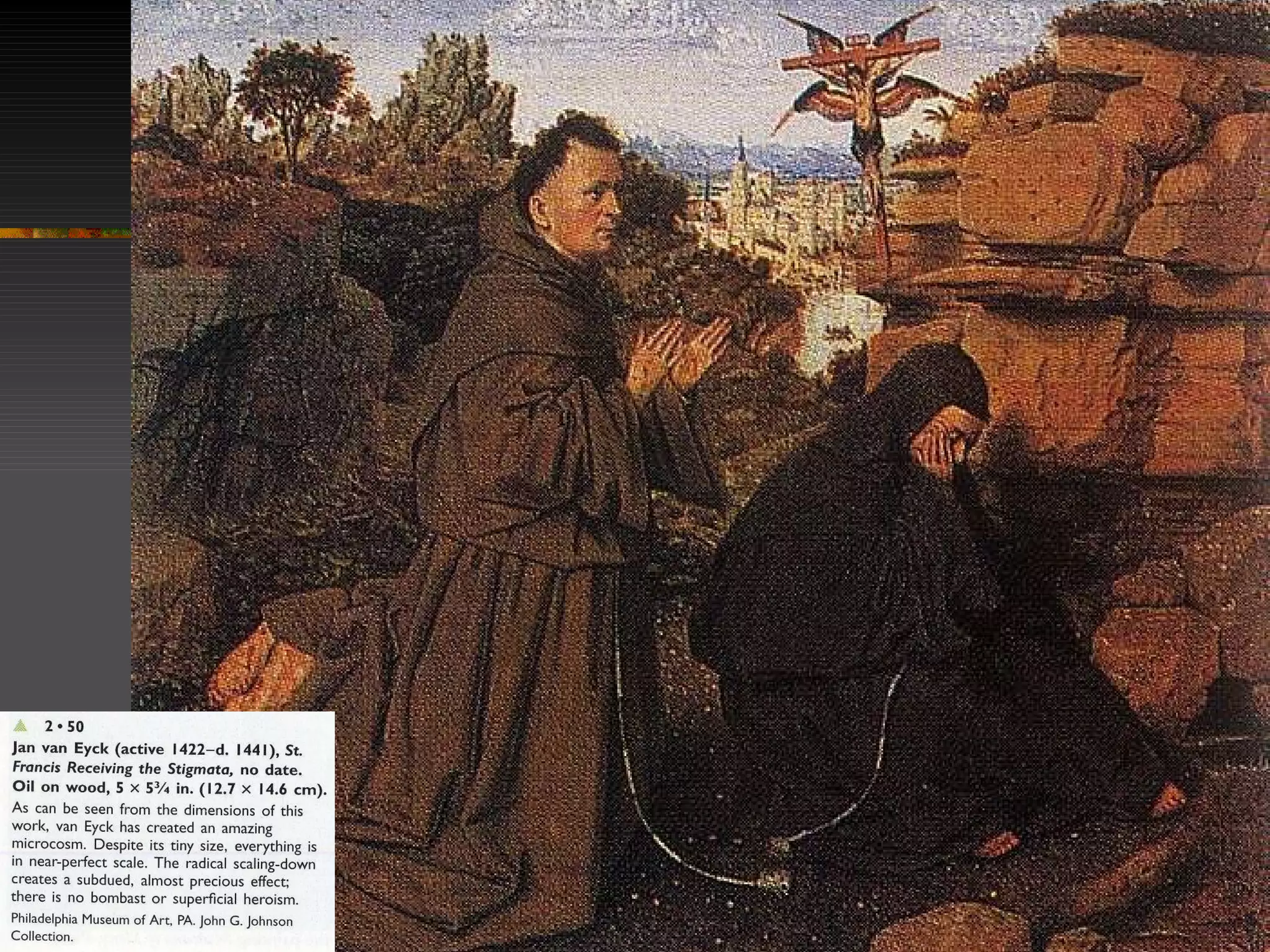
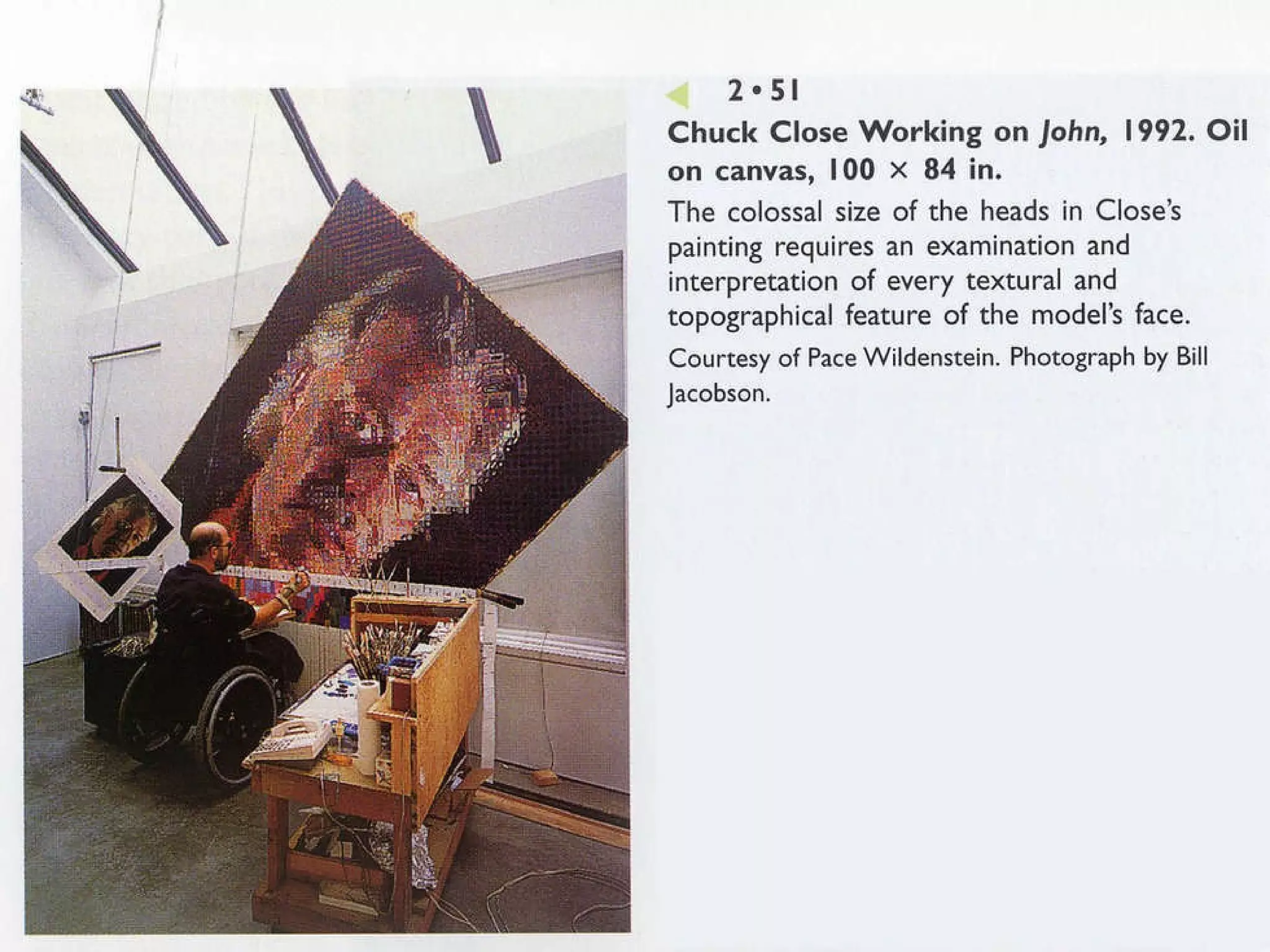
The Seven Principles of Organization   (4) Proportion The ratio of individual parts to one another. Scale    Size
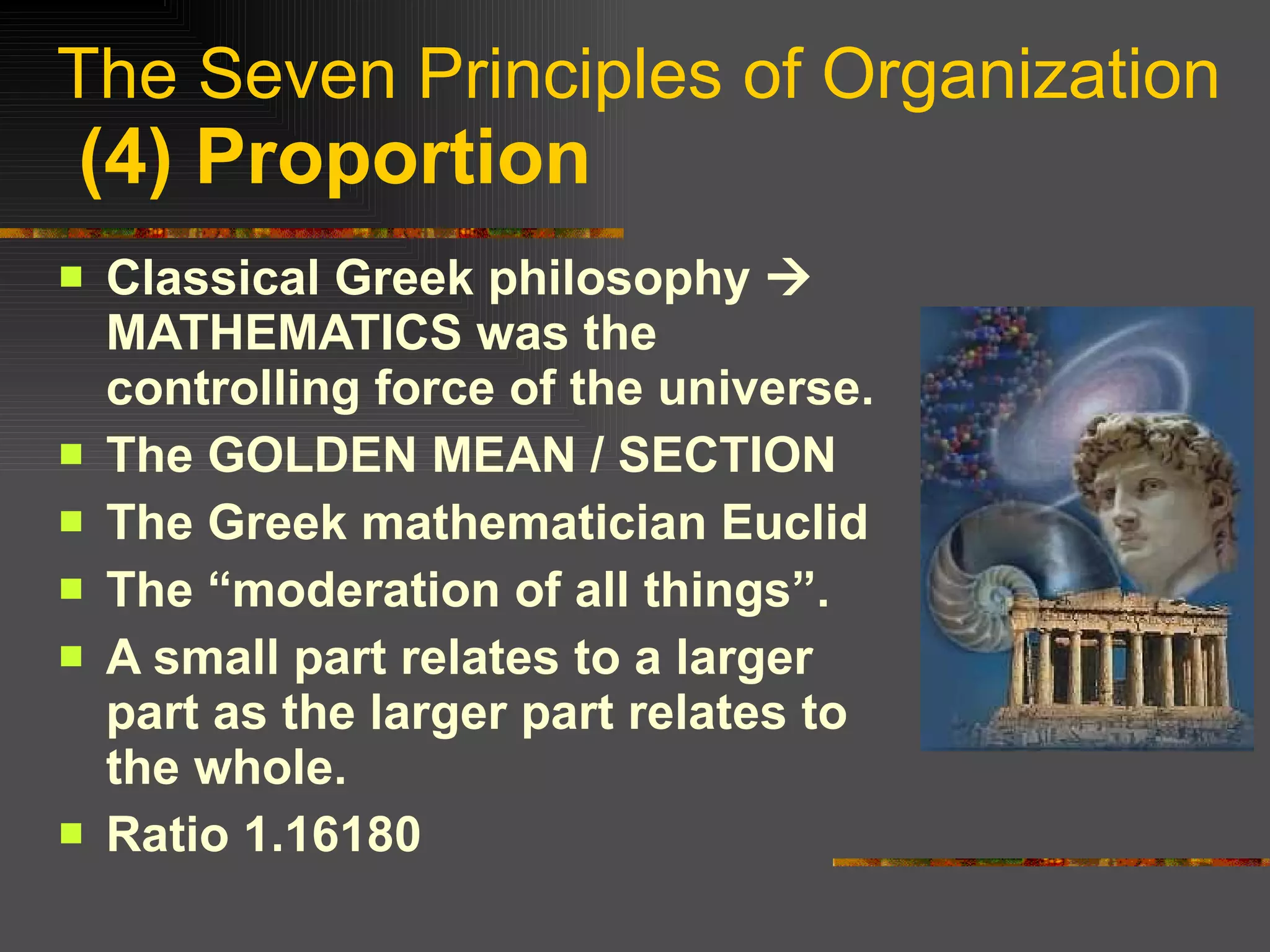
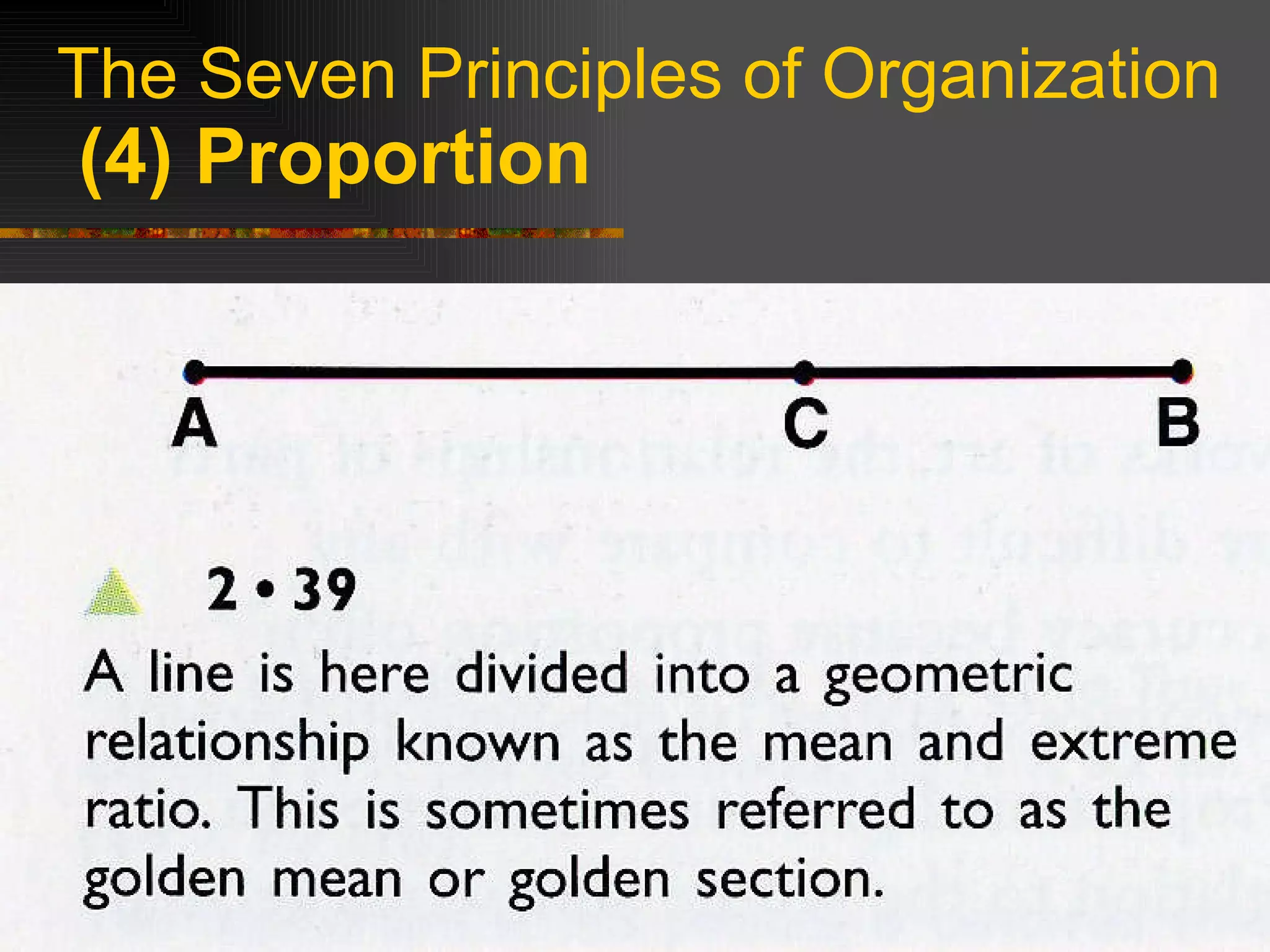
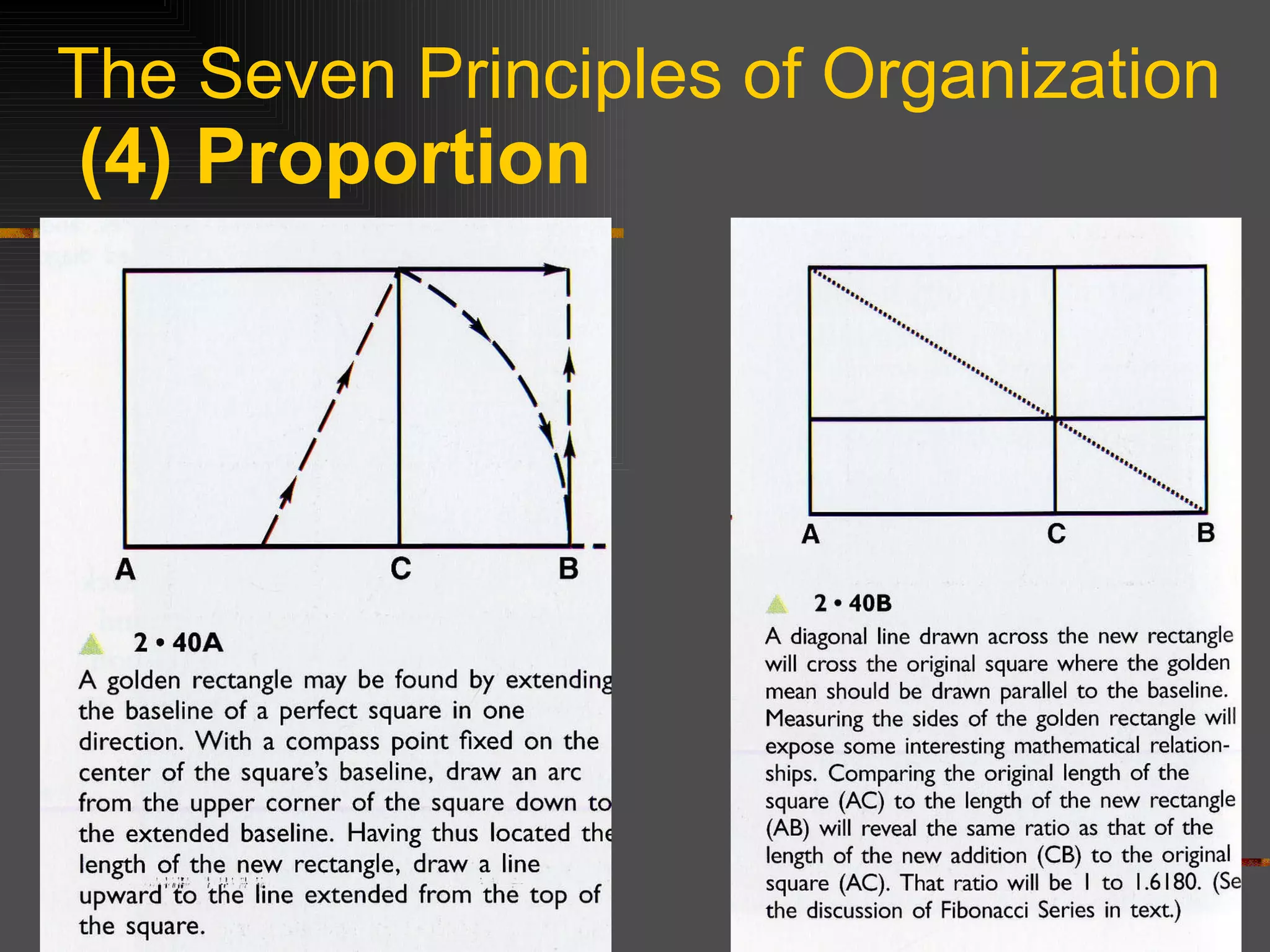
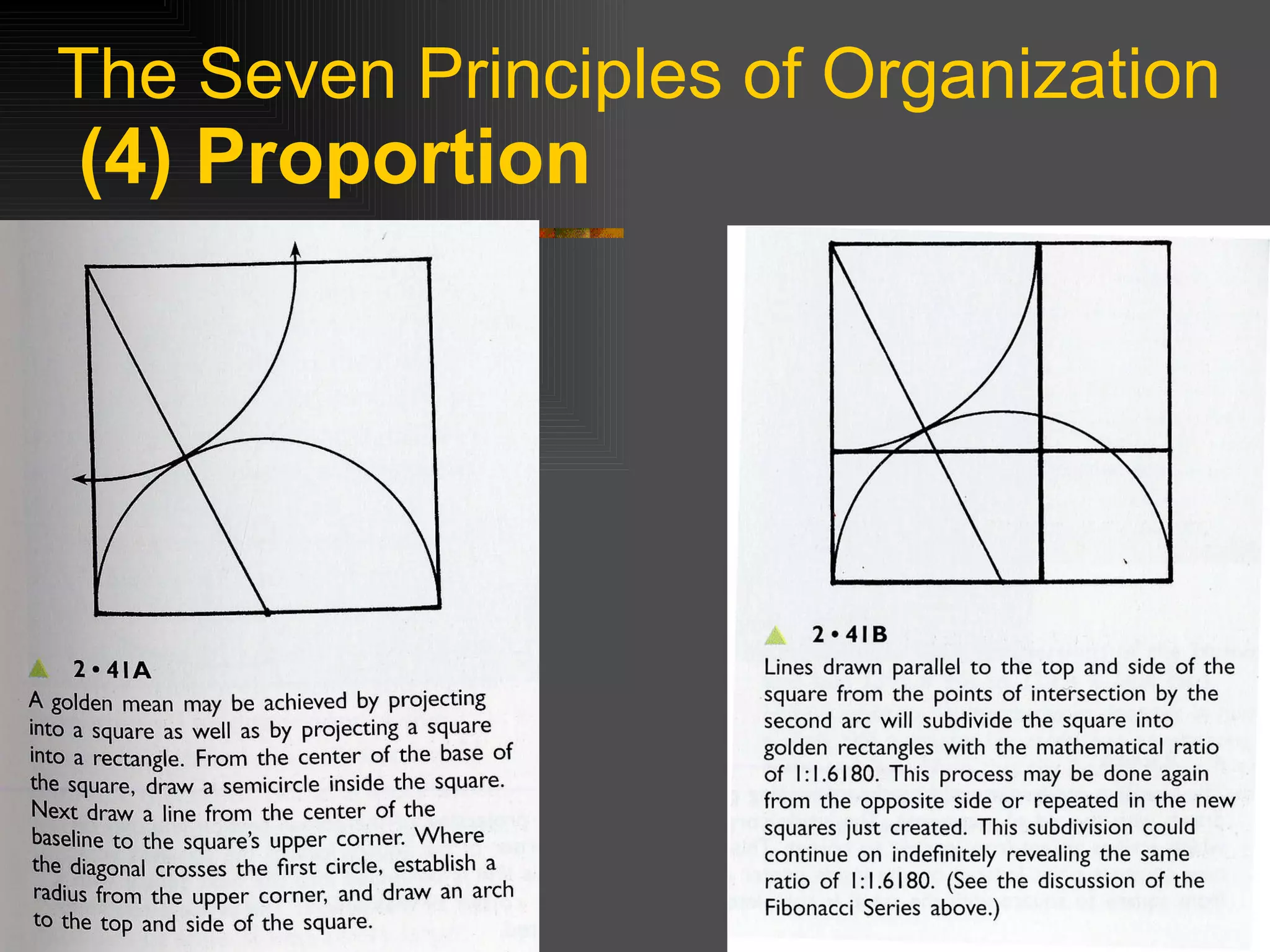
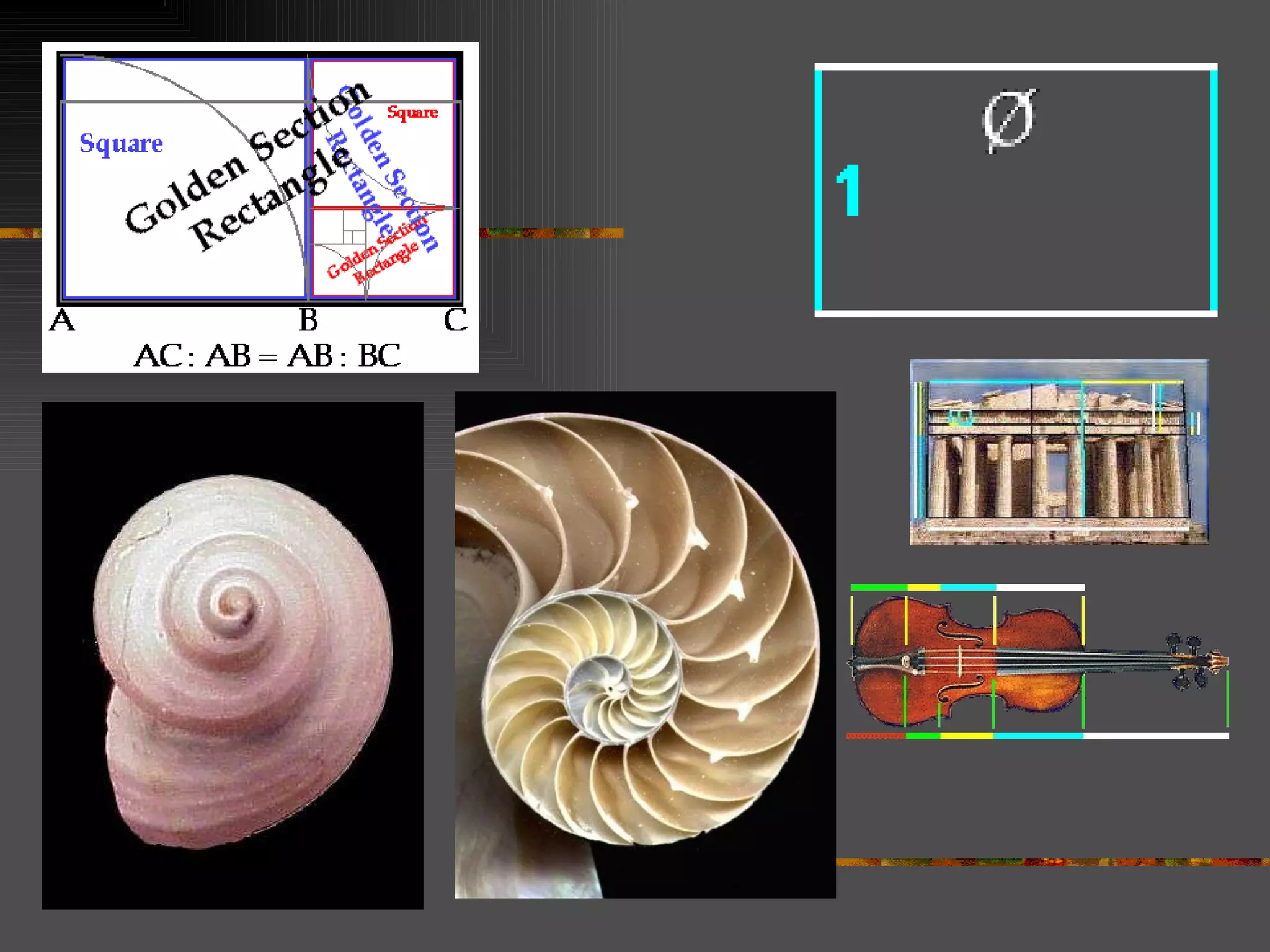
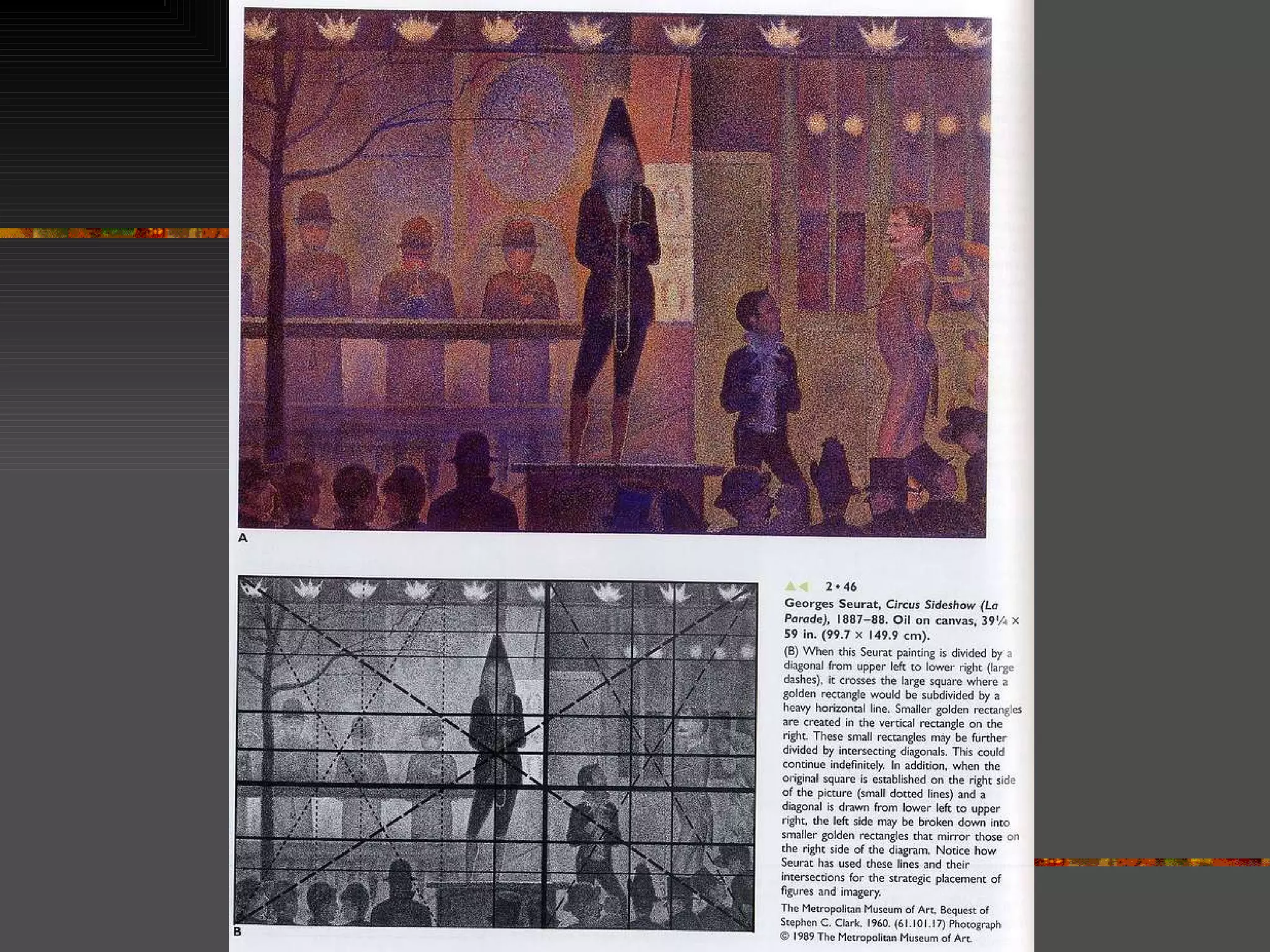
The Seven Principles of Organization   (4) Proportion Classical Greek philosophy    MATHEMATICS was the controlling force of the universe. The GOLDEN MEAN / SECTION The Greek mathematician Euclid  The “moderation of all things”. A small part relates to a larger part as the larger part relates to the whole. Ratio 1.16180
The Seven Principles of Organization   (4) Proportion
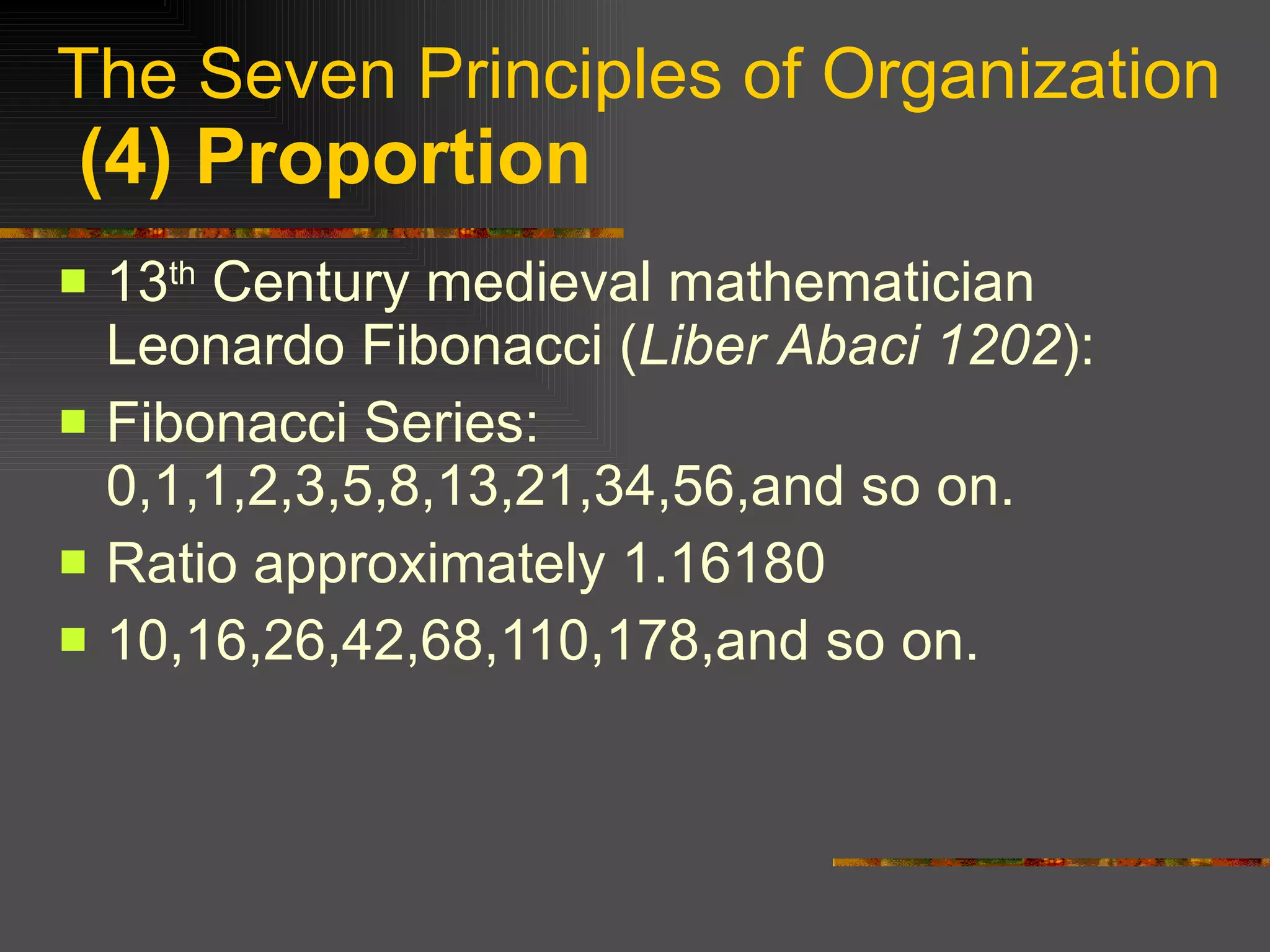
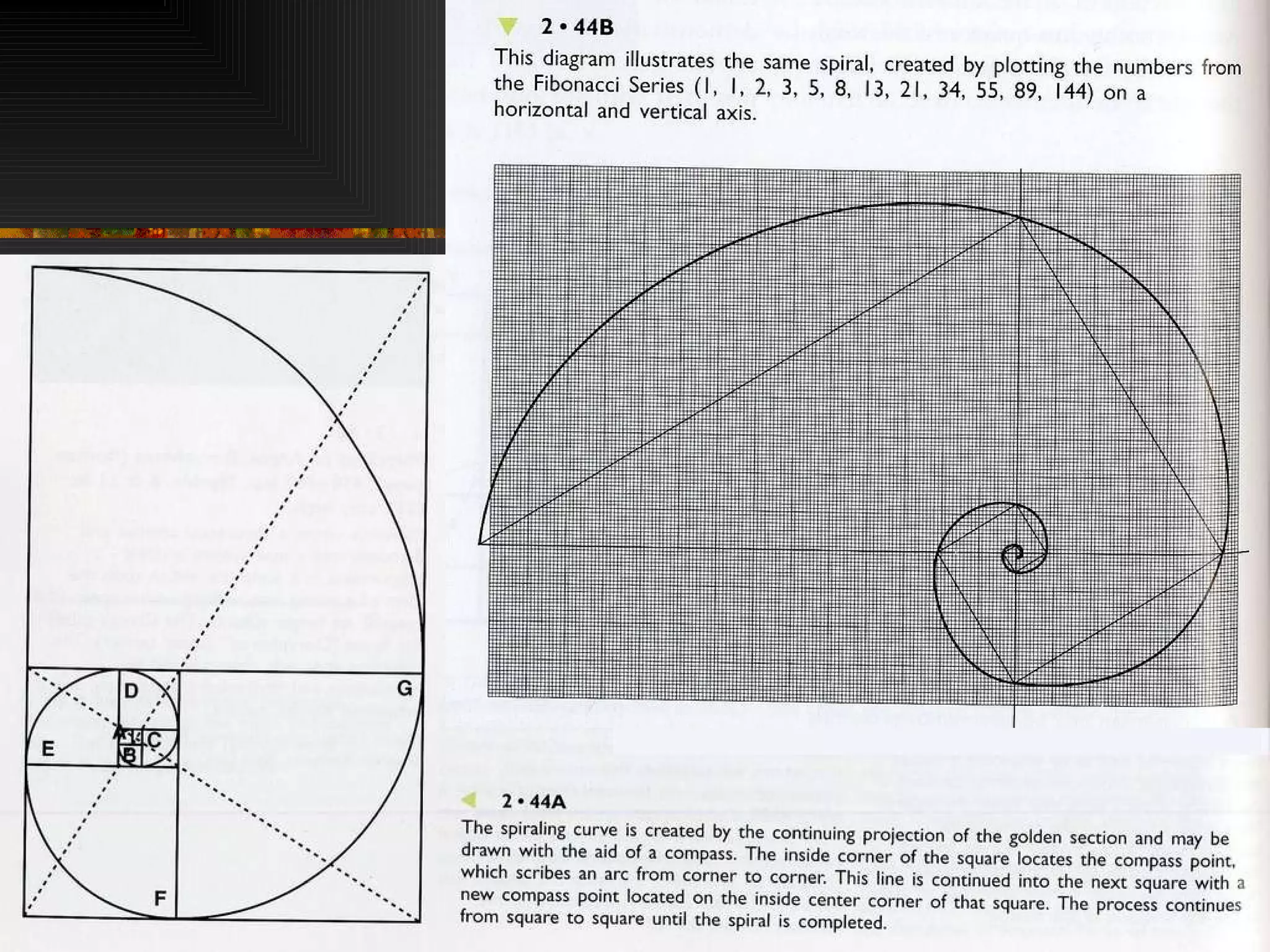
The Seven Principles of Organization   (4) Proportion 13 th  Century medieval mathematician Leonardo Fibonacci ( Liber Abaci 1202 ): Fibonacci Series: 0,1,1,2,3,5,8,13,21,34,56,and so on. Ratio approximately 1.16180 10,16,26,42,68,110,178,and so on.


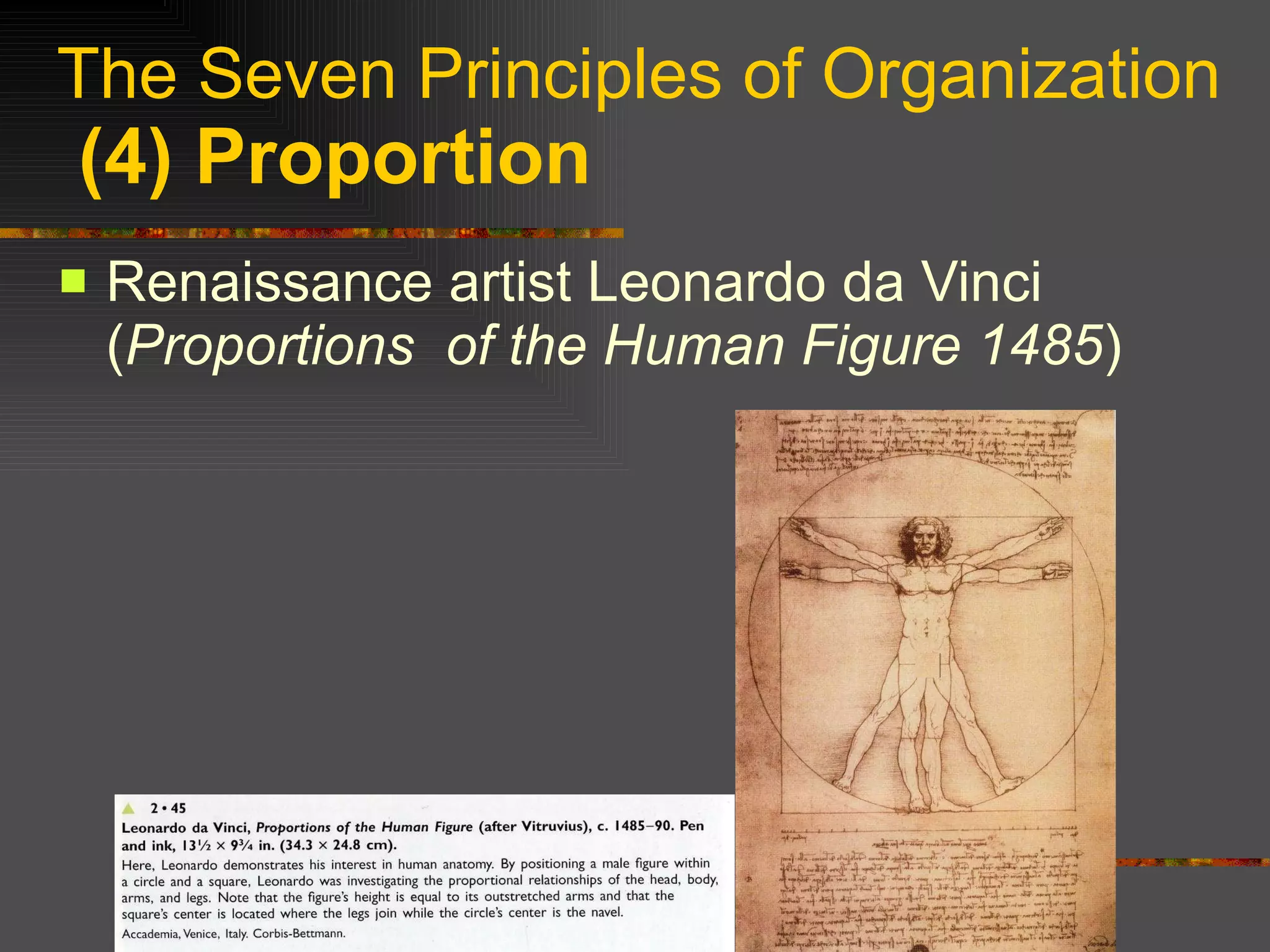
The Seven Principles of Organization   (4) Proportion Renaissance artist Leonardo da Vinci  ( Proportions  of the Human Figure 1485 )


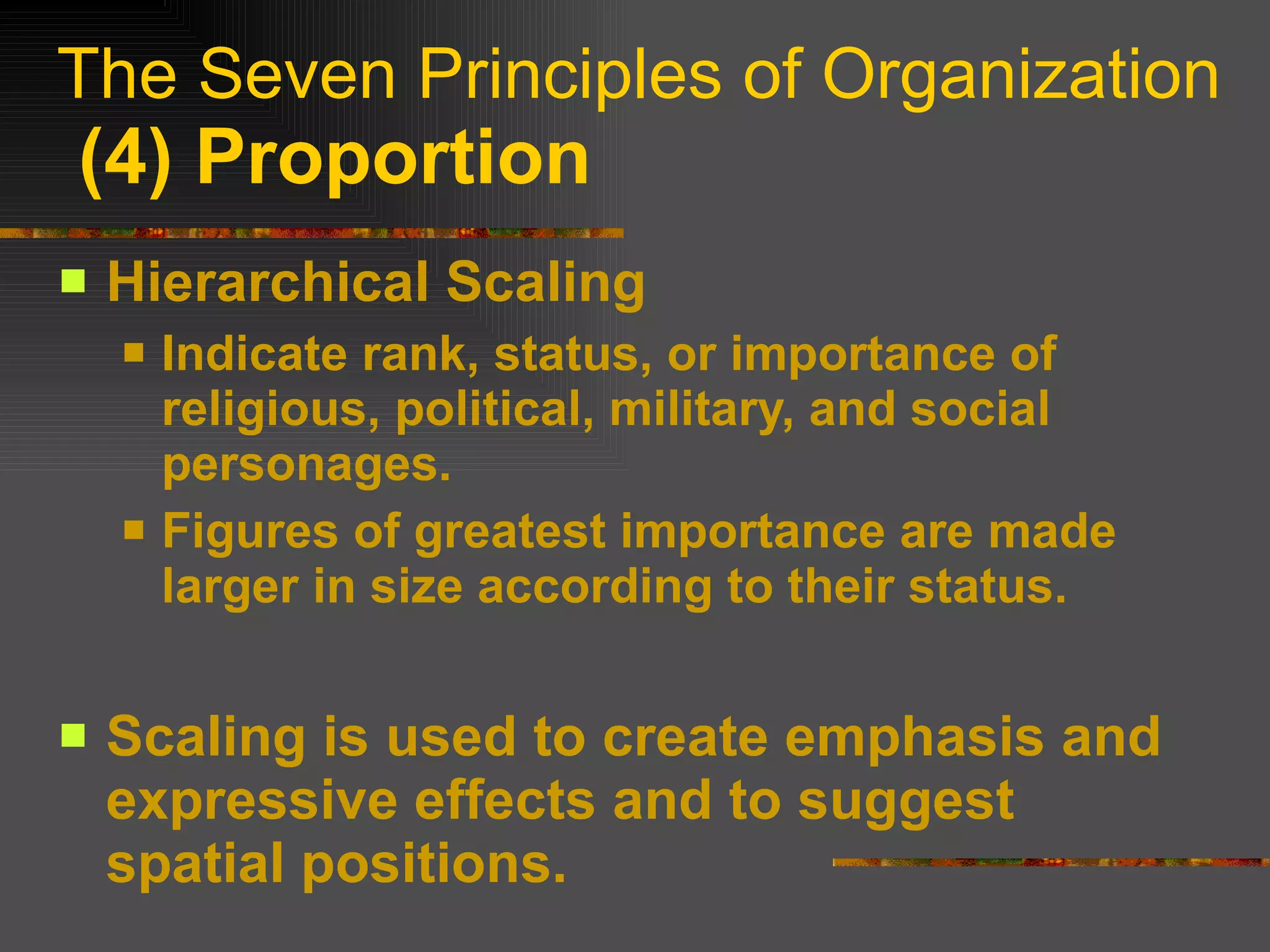
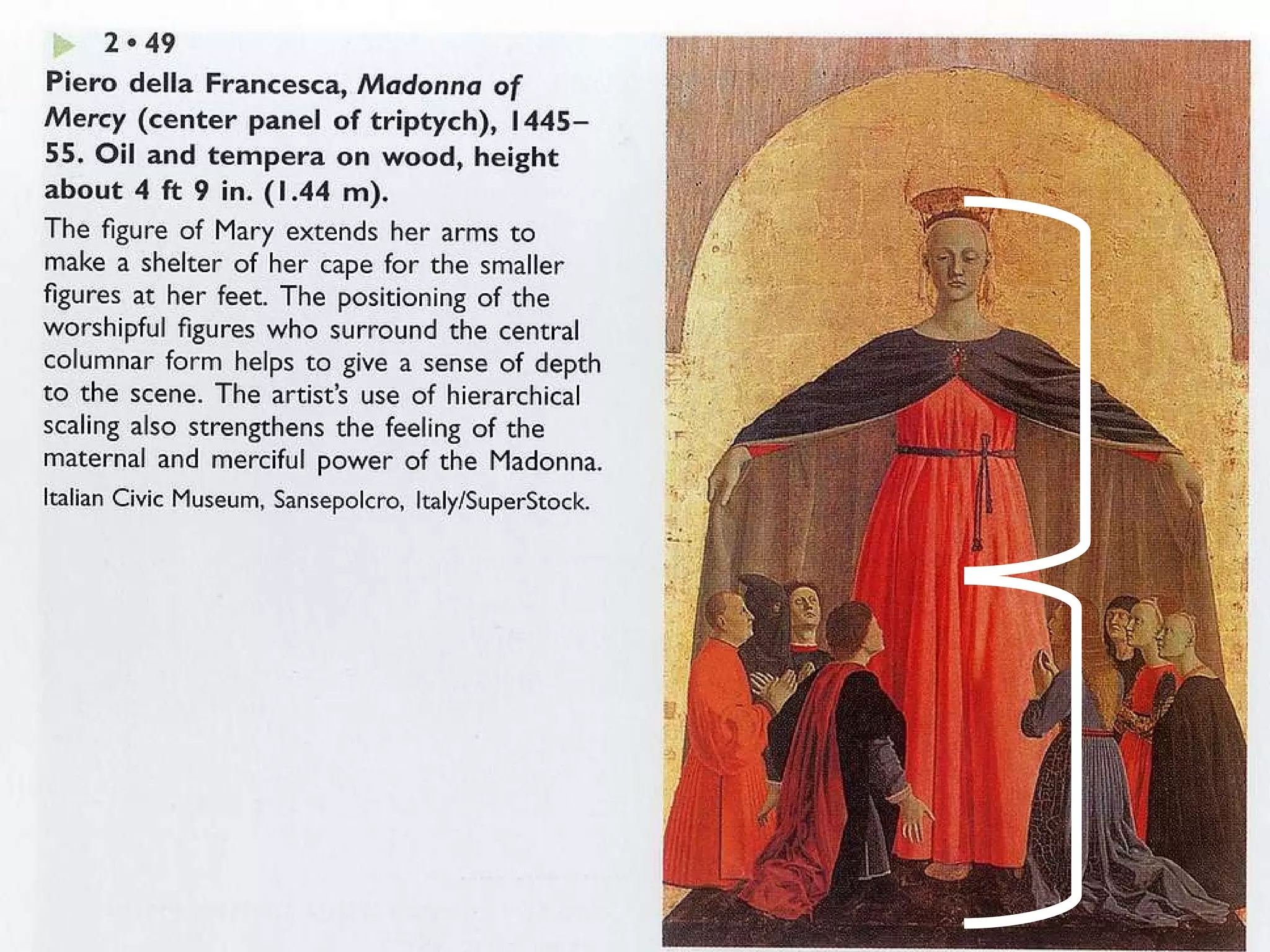
The Seven Principles of Organization   (4) Proportion Hierarchical Scaling Indicate rank, status, or importance of religious, political, military, and social personages. Figures of greatest importance are made larger in size according to their status. Scaling is used to create emphasis and expressive effects and to suggest spatial positions.


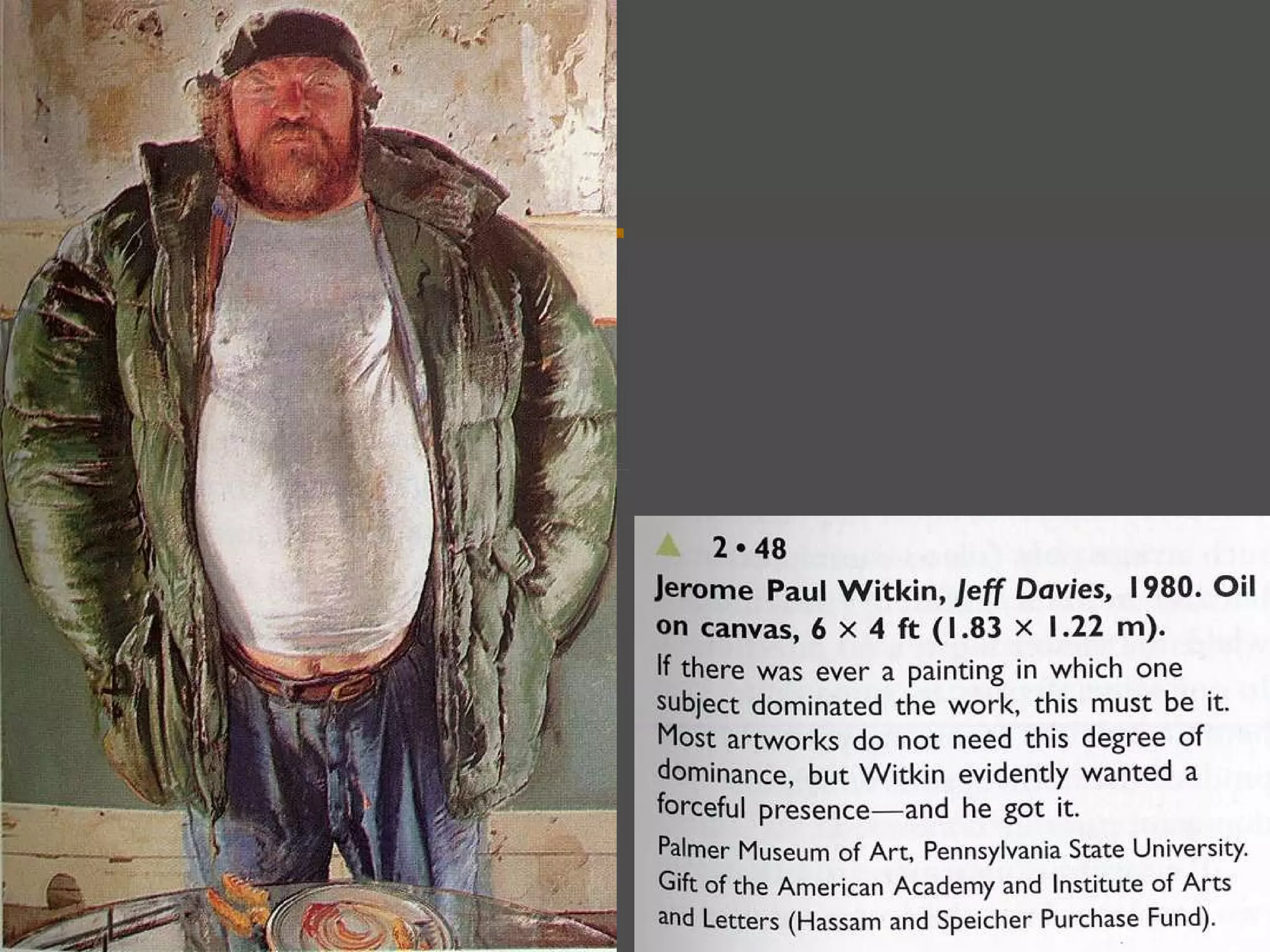
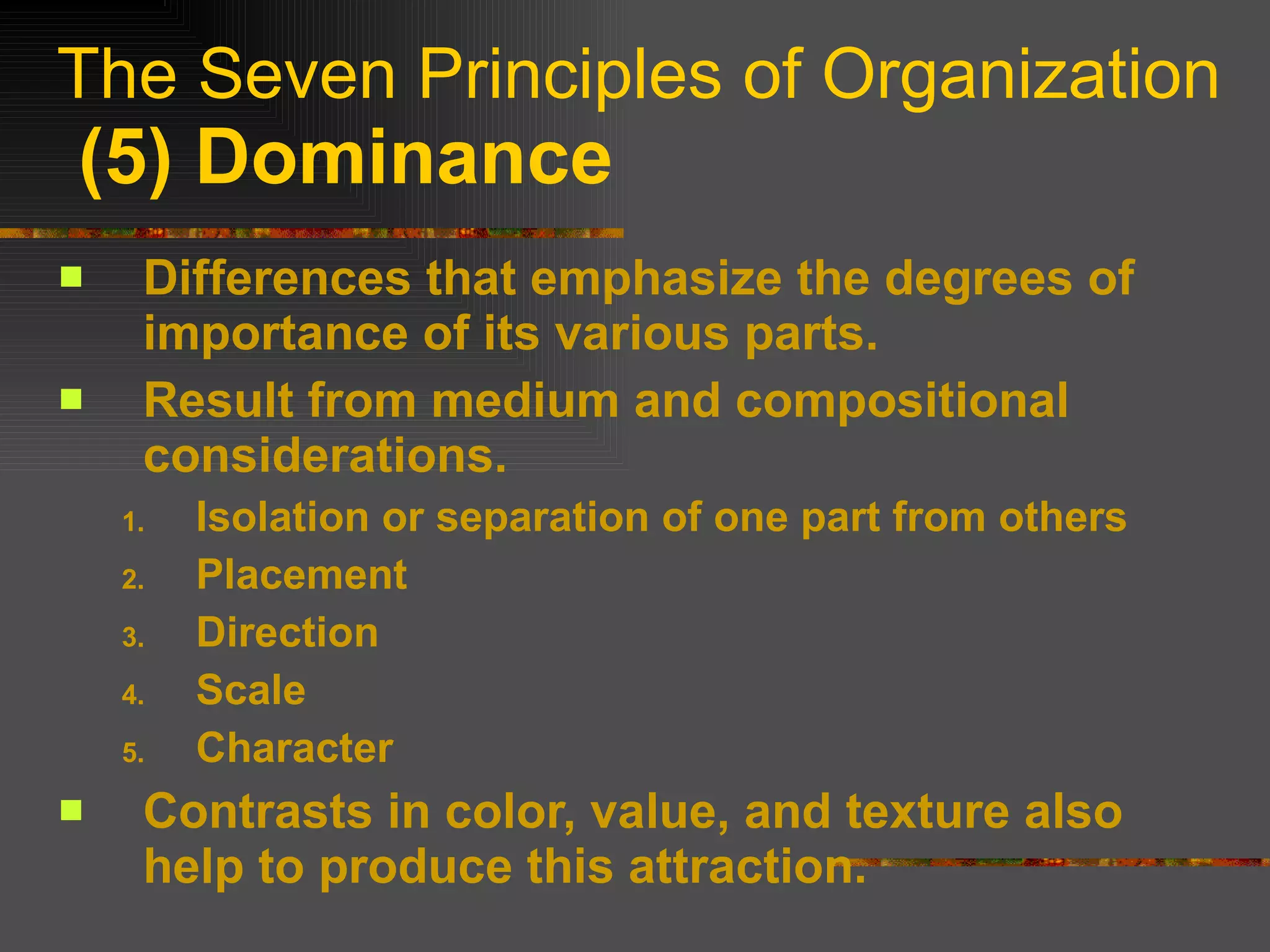
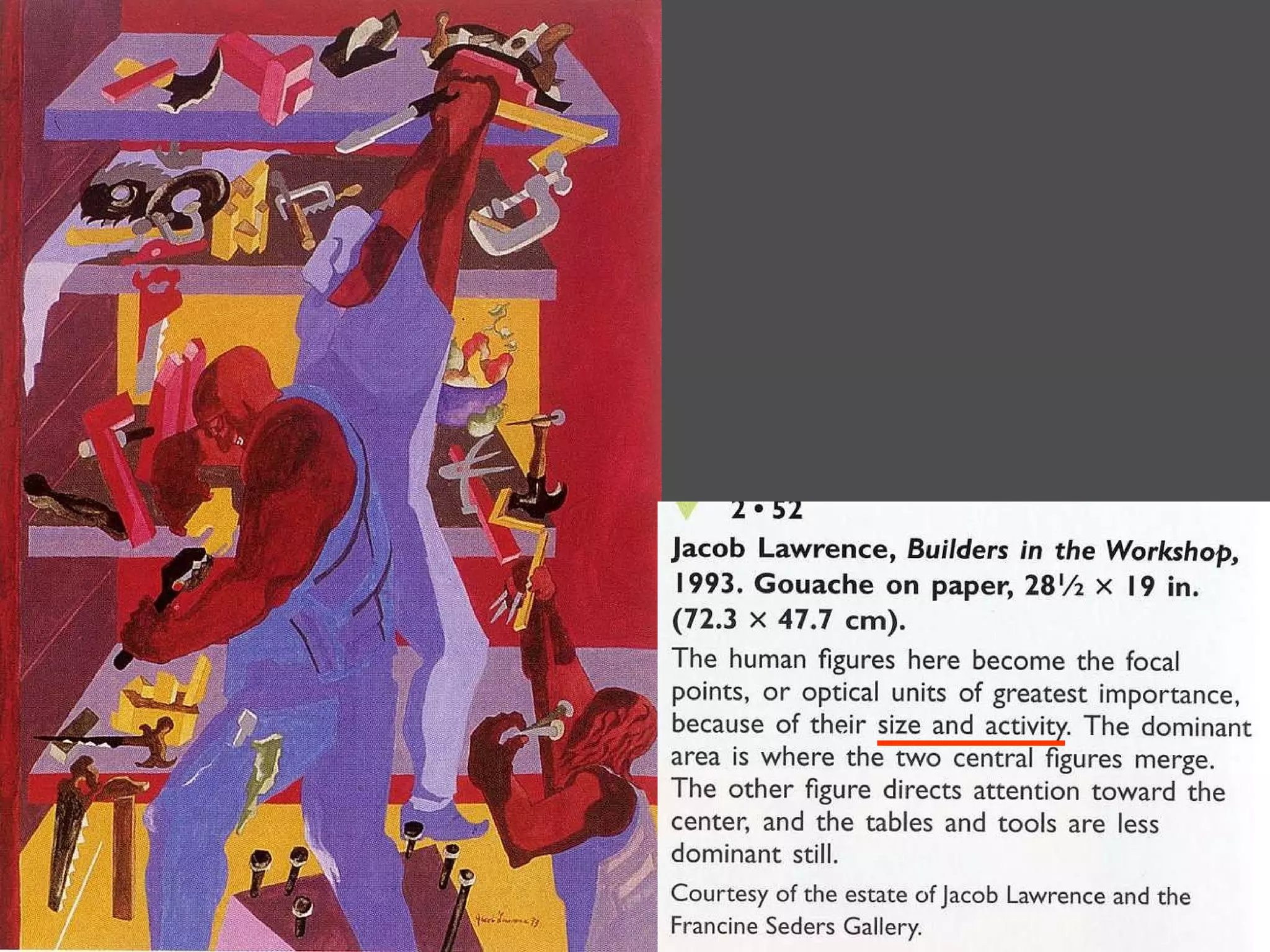
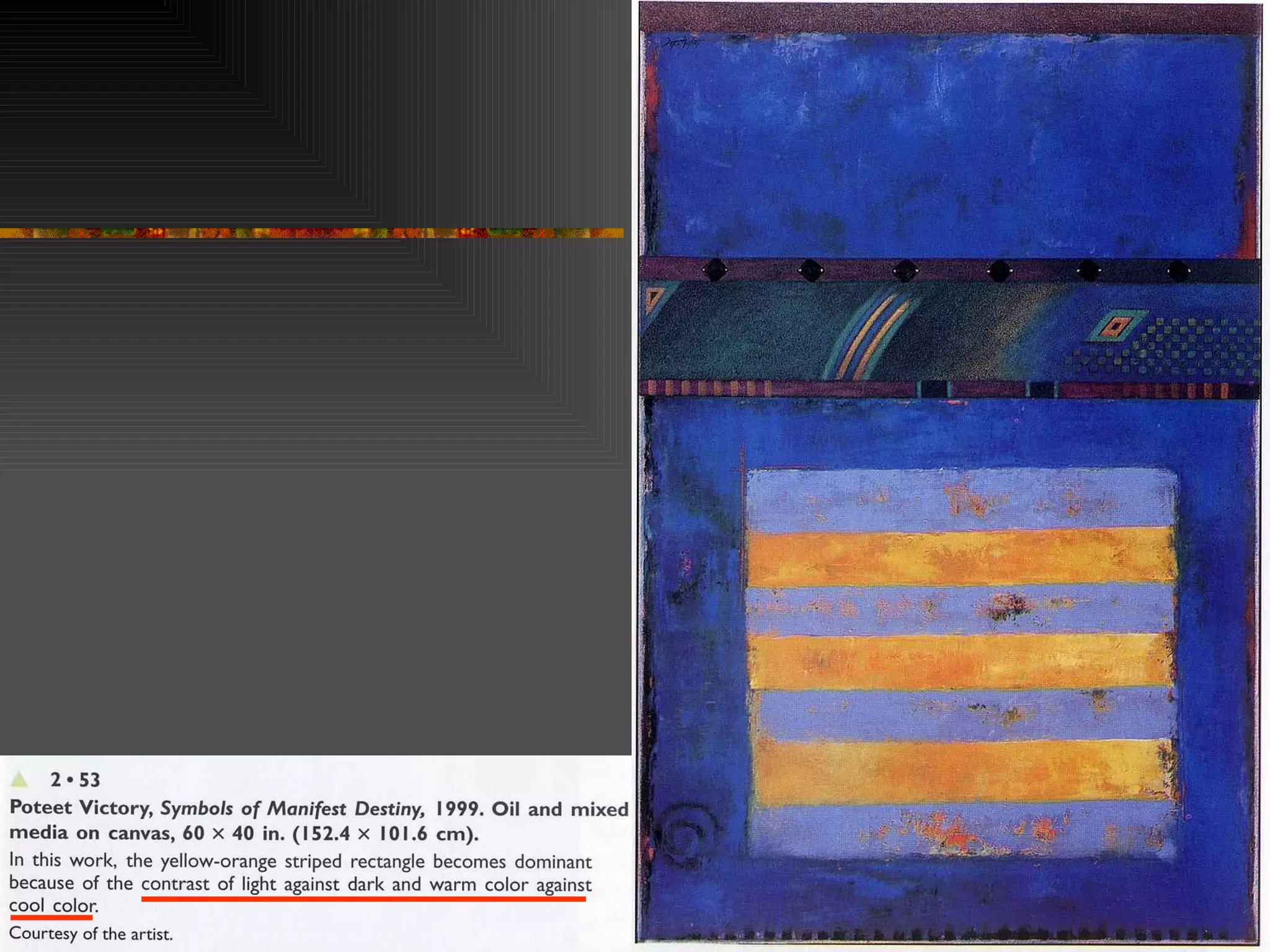
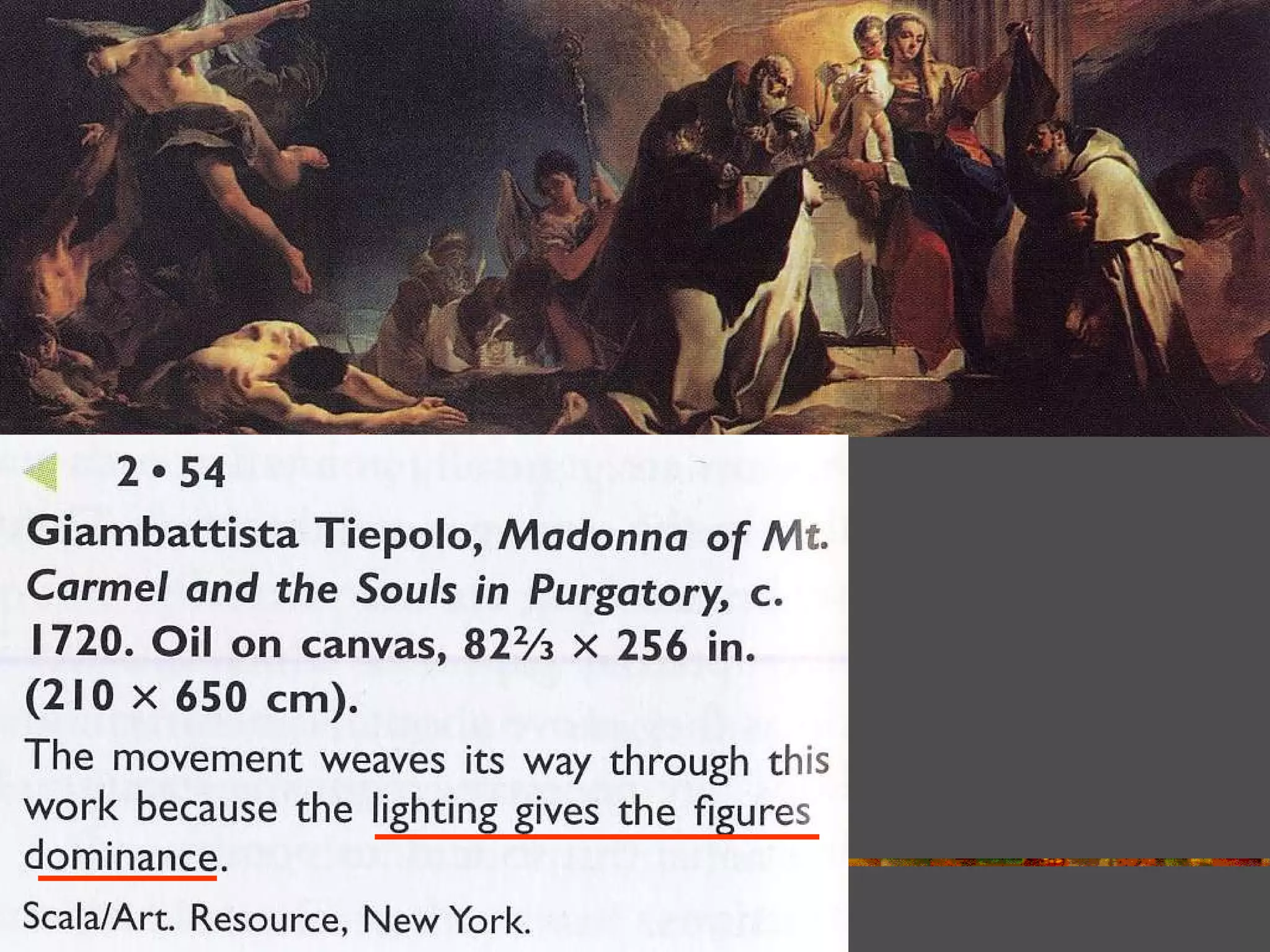
The Seven Principles of Organization   (5) Dominance Differences that emphasize the degrees of importance of its various parts. Result from medium and compositional considerations. Isolation or separation of one part from others Placement Direction Scale Character Contrasts in color, value, and texture also help to produce this attraction.
 
The Seven Principles of Organization   (5) Dominance Two problems with dominance: Must see that each part has the necessary degree of importance. Must incorporate these parts, with their varying degrees of importance, into the rhythmic movement and balance of the work.
 
 
The Seven Principles of Organization   (6) Movement “ A ride” – “A tour” The artist makes the eyes travel comfortable and informative. Direction of lines, shapes, and motifs.
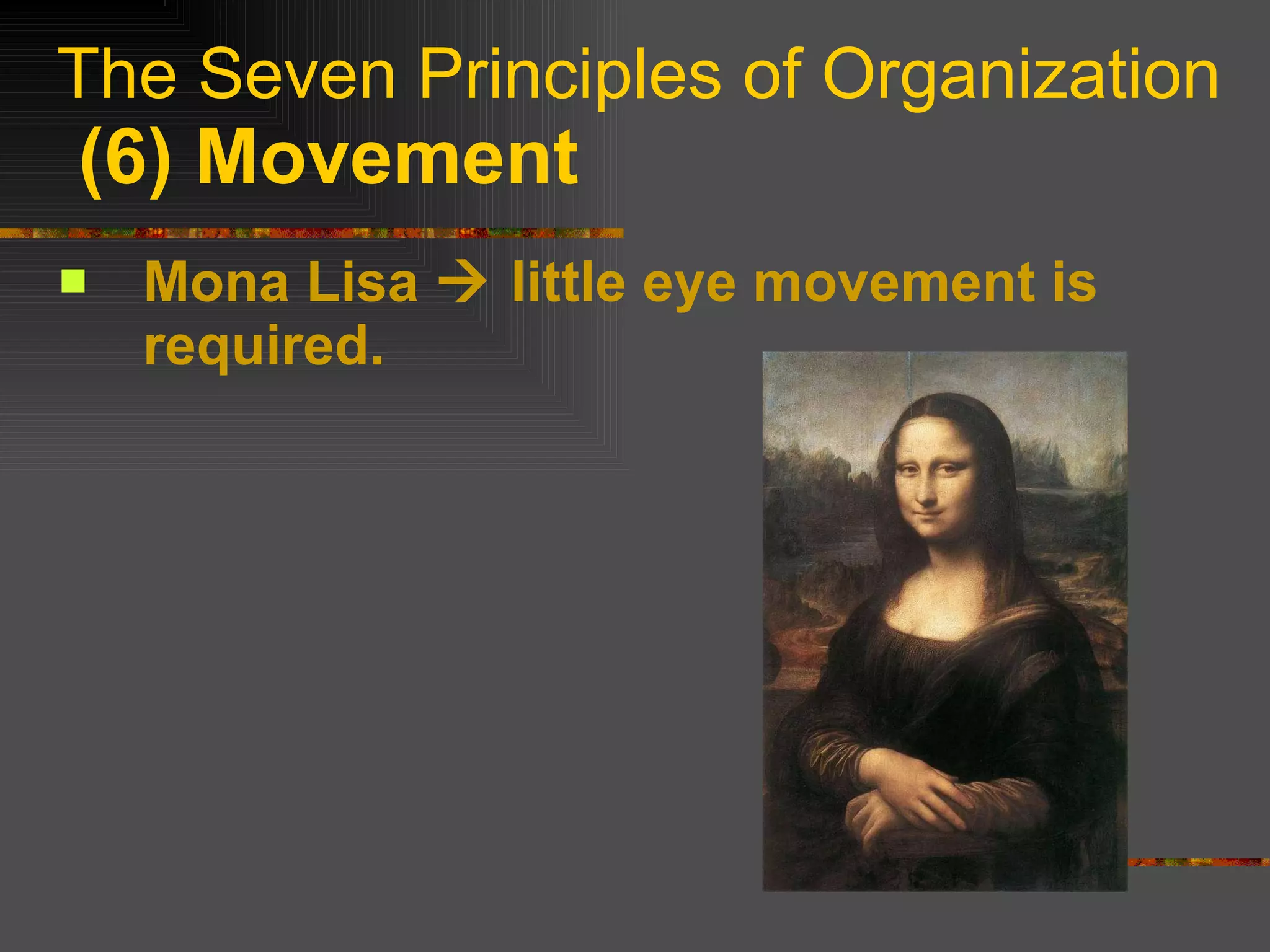
The Seven Principles of Organization   (6) Movement Mona Lisa    little eye movement is required.
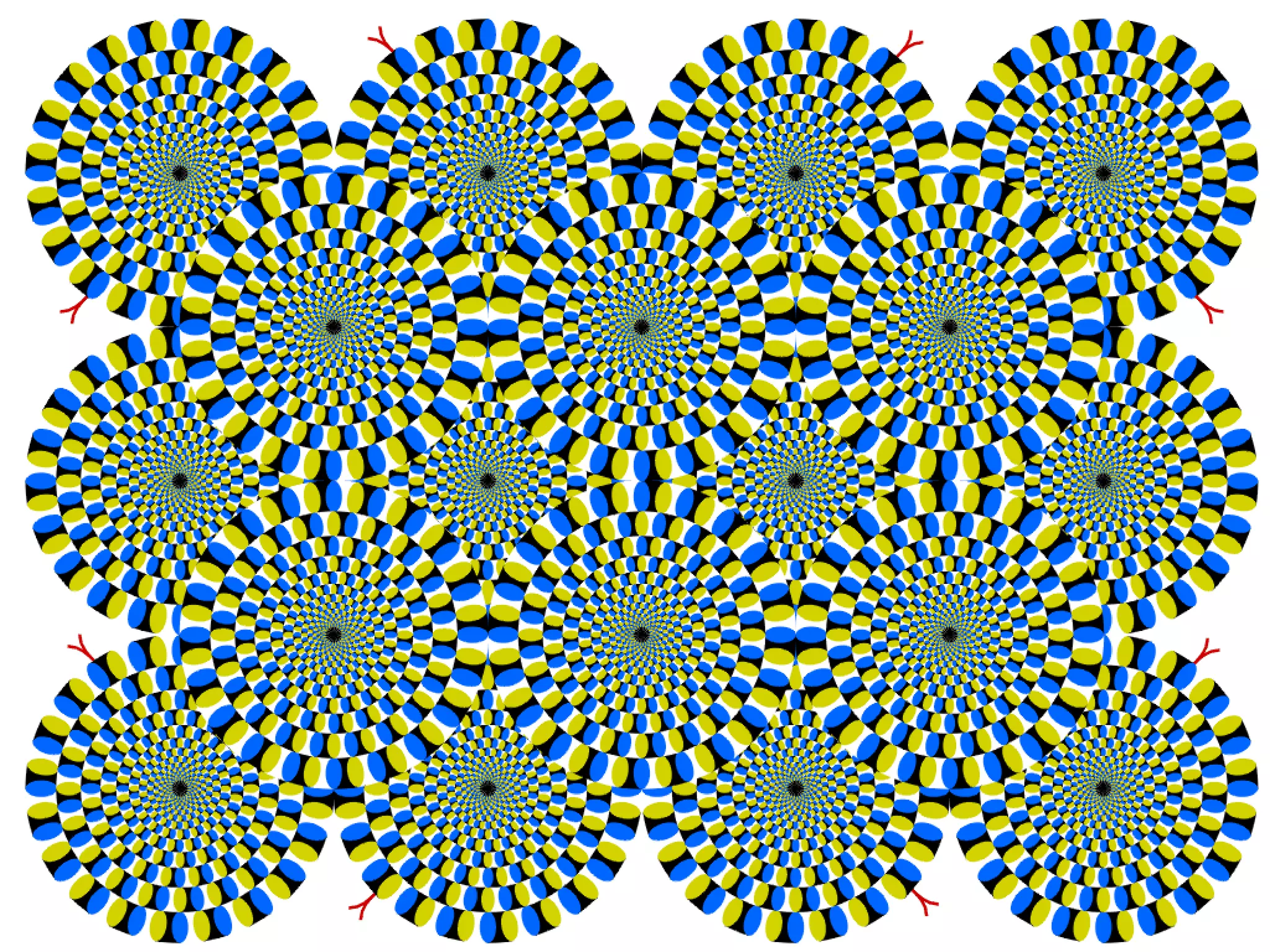
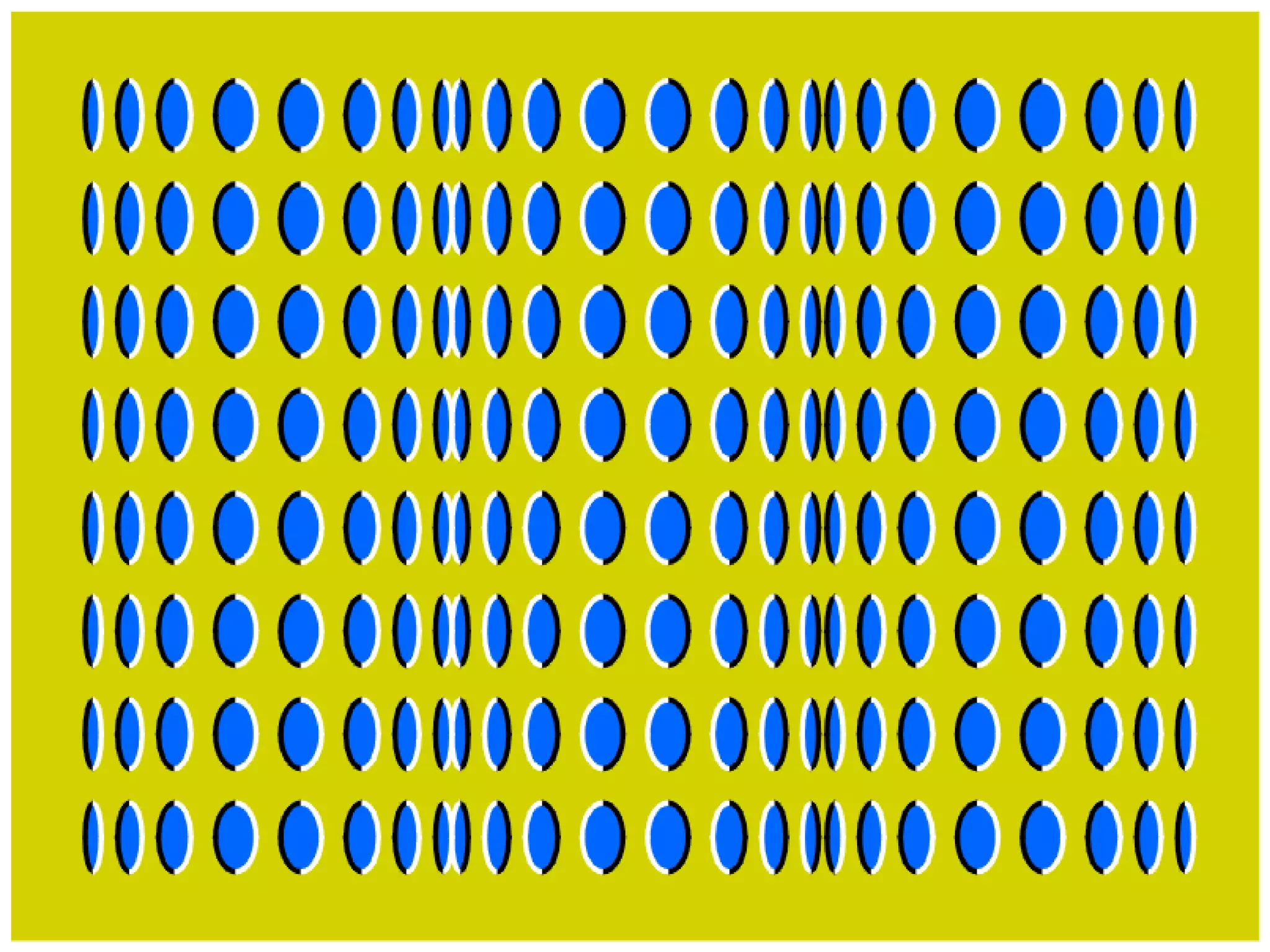
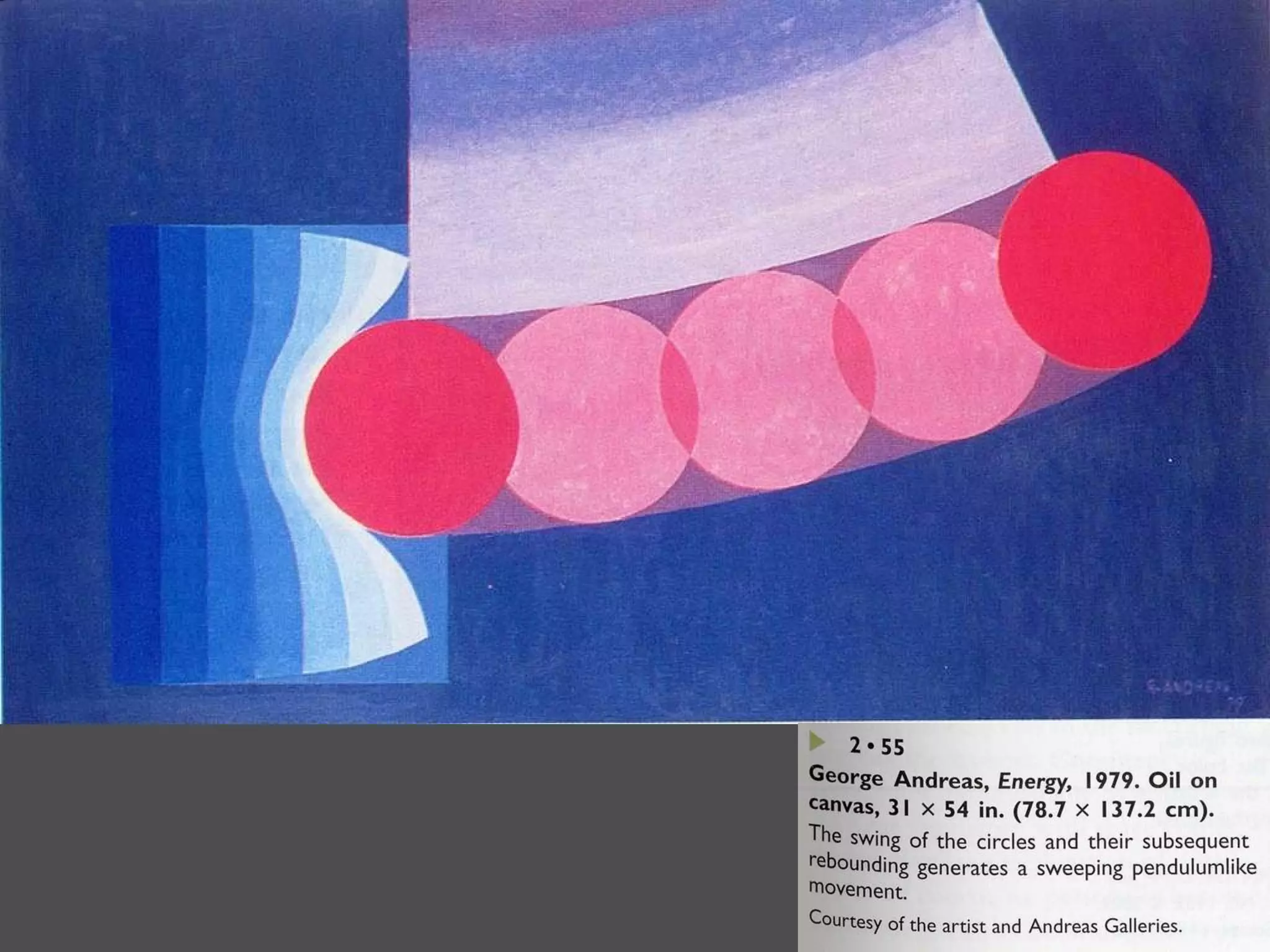
The Seven Principles of Organization   (6) Movement Kinetic (moving) sculpture vs Static sculpture and picture. An illusion of movement created by the artist through the configuration of their parts. The work of art can be read in a variety of directions.


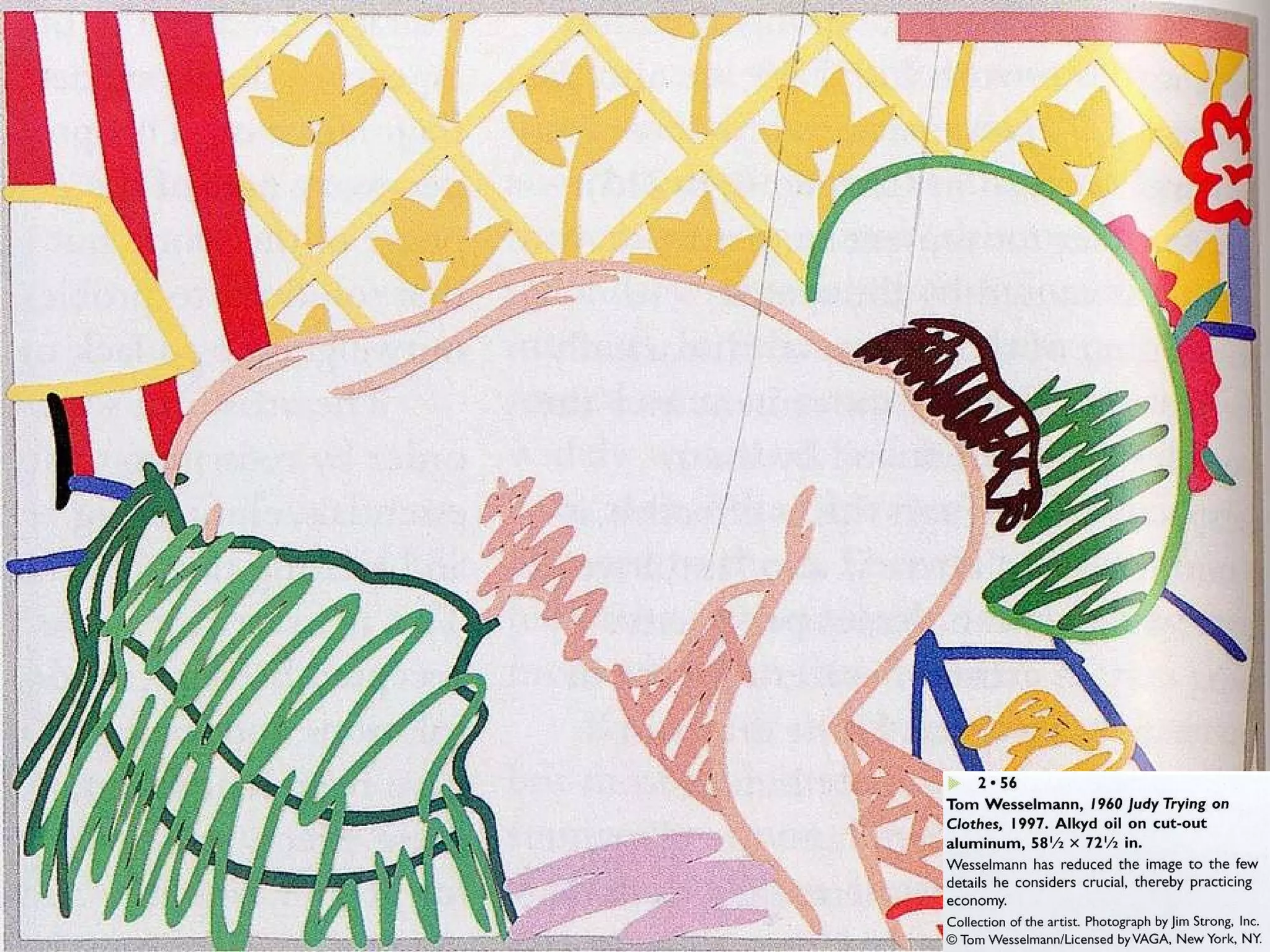
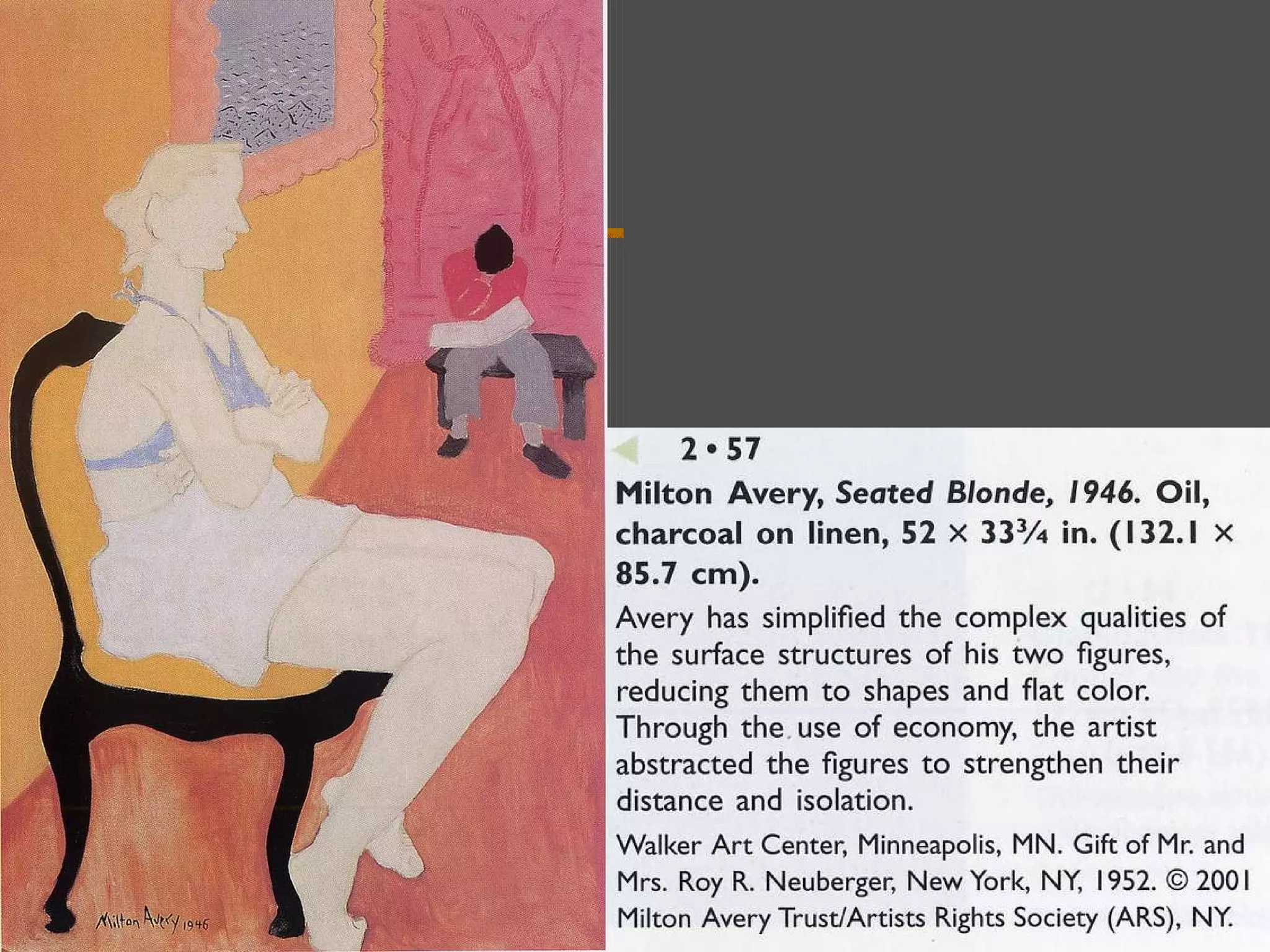
The Seven Principles of Organization   (7) Economy Unnecessary complexity. The work deteriorating into fragmentation. Lack of unity. Returning to significant essentials. Eliminating elaborate details. Relating the particulars to the whole.
The Seven Principles of Organization   (7) Economy If something works with respect to the whole, it is kept; if disruptive, it may be reworked or rejected. Economy    Abstraction Parting things down to the essentials necessary to the artist’s style of expression. The style dictates the degree of abstraction, though all artists abstract to some extent.
 
 
Space: Result of Elements/Principles Space is not an element. A by-product of the elements as they are put into action and altered by the various principles of organization.
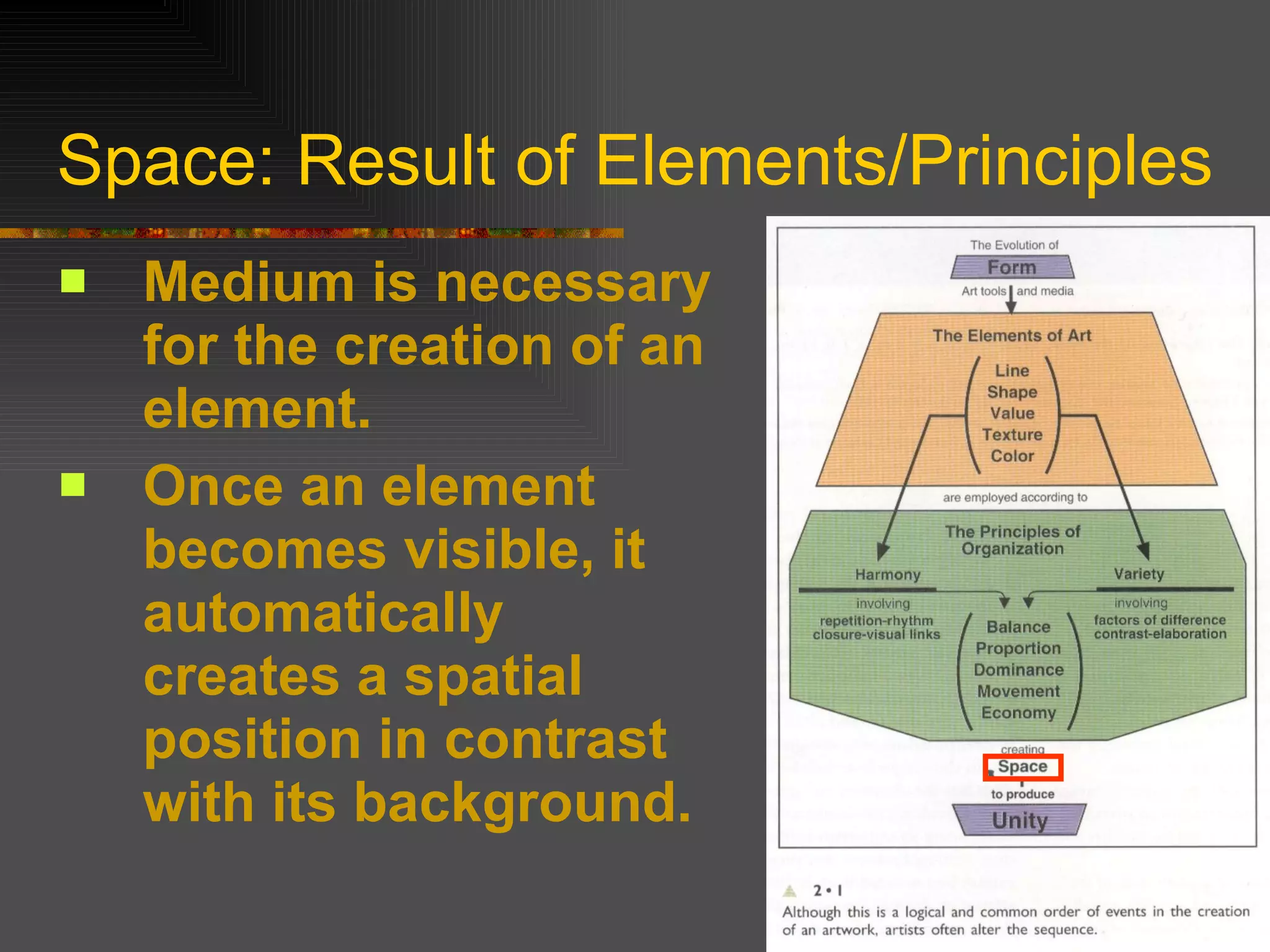
Space: Result of Elements/Principles Medium is necessary for the creation of an element. Once an element becomes visible, it automatically creates a spatial position in contrast with its background.
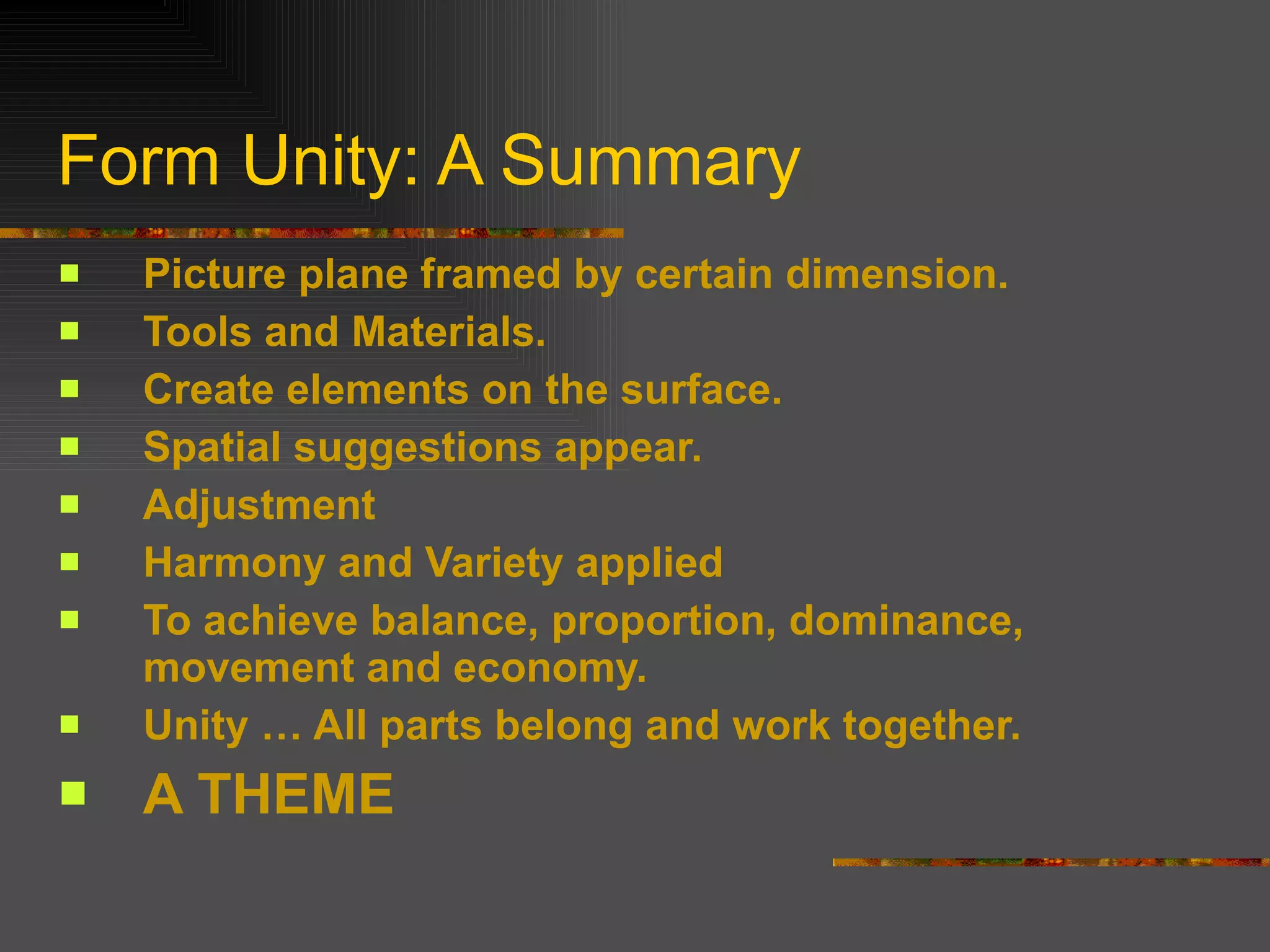
Form Unity: A Summary Picture plane framed by certain dimension. Tools and Materials. Create elements on the surface. Spatial suggestions appear. Adjustment Harmony and Variety applied To achieve balance, proportion, dominance, movement and economy. Unity … All parts belong and work together. A THEME
Art Fundamentals Chapter 2 Form End

Art Fundamentals Ch02

  • 1.
    Art Fundamentals Chapter2 Form Part 1 TERMS Part 2 Part 3
  • 2.
  • 3.
    The Seven Principlesof Organization (4) Proportion The ratio of individual parts to one another. Scale  Size
  • 4.
    The Seven Principlesof Organization (4) Proportion Classical Greek philosophy  MATHEMATICS was the controlling force of the universe. The GOLDEN MEAN / SECTION The Greek mathematician Euclid The “moderation of all things”. A small part relates to a larger part as the larger part relates to the whole. Ratio 1.16180
  • 5.
    The Seven Principlesof Organization (4) Proportion
  • 6.
    The Seven Principlesof Organization (4) Proportion
  • 7.
    The Seven Principlesof Organization (4) Proportion
  • 8.
    The Seven Principlesof Organization (4) Proportion 13 th Century medieval mathematician Leonardo Fibonacci ( Liber Abaci 1202 ): Fibonacci Series: 0,1,1,2,3,5,8,13,21,34,56,and so on. Ratio approximately 1.16180 10,16,26,42,68,110,178,and so on.
  • 9.
  • 10.
  • 11.
  • 12.
    The Seven Principlesof Organization (4) Proportion Renaissance artist Leonardo da Vinci ( Proportions of the Human Figure 1485 )
  • 13.
  • 14.
  • 15.
  • 16.
    The Seven Principlesof Organization (4) Proportion Hierarchical Scaling Indicate rank, status, or importance of religious, political, military, and social personages. Figures of greatest importance are made larger in size according to their status. Scaling is used to create emphasis and expressive effects and to suggest spatial positions.
  • 17.
  • 18.
  • 19.
  • 20.
    The Seven Principlesof Organization (5) Dominance Differences that emphasize the degrees of importance of its various parts. Result from medium and compositional considerations. Isolation or separation of one part from others Placement Direction Scale Character Contrasts in color, value, and texture also help to produce this attraction.
  • 21.
  • 22.
    The Seven Principlesof Organization (5) Dominance Two problems with dominance: Must see that each part has the necessary degree of importance. Must incorporate these parts, with their varying degrees of importance, into the rhythmic movement and balance of the work.
  • 23.
  • 24.
  • 25.
    The Seven Principlesof Organization (6) Movement “ A ride” – “A tour” The artist makes the eyes travel comfortable and informative. Direction of lines, shapes, and motifs.
  • 26.
    The Seven Principlesof Organization (6) Movement Mona Lisa  little eye movement is required.
  • 27.
    The Seven Principlesof Organization (6) Movement Kinetic (moving) sculpture vs Static sculpture and picture. An illusion of movement created by the artist through the configuration of their parts. The work of art can be read in a variety of directions.
  • 28.
  • 29.
  • 30.
  • 31.
    The Seven Principlesof Organization (7) Economy Unnecessary complexity. The work deteriorating into fragmentation. Lack of unity. Returning to significant essentials. Eliminating elaborate details. Relating the particulars to the whole.
  • 32.
    The Seven Principlesof Organization (7) Economy If something works with respect to the whole, it is kept; if disruptive, it may be reworked or rejected. Economy  Abstraction Parting things down to the essentials necessary to the artist’s style of expression. The style dictates the degree of abstraction, though all artists abstract to some extent.
  • 33.
  • 34.
  • 35.
    Space: Result ofElements/Principles Space is not an element. A by-product of the elements as they are put into action and altered by the various principles of organization.
  • 36.
    Space: Result ofElements/Principles Medium is necessary for the creation of an element. Once an element becomes visible, it automatically creates a spatial position in contrast with its background.
  • 37.
    Form Unity: ASummary Picture plane framed by certain dimension. Tools and Materials. Create elements on the surface. Spatial suggestions appear. Adjustment Harmony and Variety applied To achieve balance, proportion, dominance, movement and economy. Unity … All parts belong and work together. A THEME
  • 38.