1
2
• Address Resolution Protocol
• ARP works by broadcasting packets to all hosts
attached to the LAN
• ARP packet contains IP address in which sender is
interested in communicating with hosts keep a list of
ARP responses in an ARP table
• ARP is propagated through Bridges/Switches but not
through Routers
ARP
3
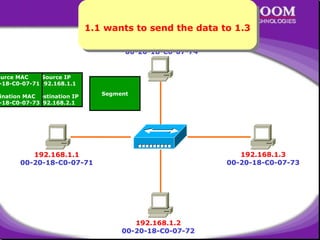
192.168.1.1
00-20-18-C0-07-71
192.168.1.3
00-20-18-C0-07-73
192.168.1.2
00-20-18-C0-07-72
192.168.1.4
00-20-18-C0-07-74
1.1 wants to send the data to 1.31.1 wants to send the data to 1.3
Source IP
192.168.1.1
Destination IP
192.168.2.1
Segment
ource MAC
-18-C0-07-71
ination MAC
-18-C0-07-73
4
192.168.1.1
00-20-18-C0-07-71
Packet
Data
Data
Data
Bits
Data
Segment
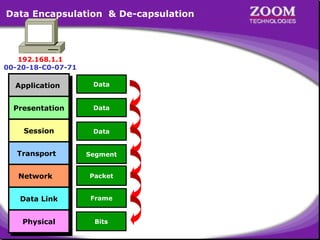
Data Encapsulation & De-capsulation
Packet
ApplicationApplication
PresentationPresentation
SessionSession
TransportTransport
NetworkNetwork
Data LinkData Link
PhysicalPhysical
DH DT
NH
THSegment
Packet
Frame
5
192.168.1.1
00-20-18-C0-07-71
Data
Data
Data
Data
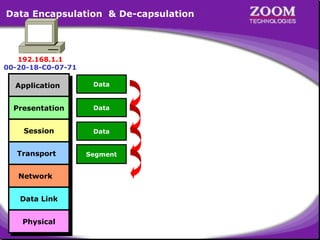
Data Encapsulation & De-capsulation
ApplicationApplication
PresentationPresentation
SessionSession
TransportTransport
NetworkNetwork
Data LinkData Link
PhysicalPhysical
THSegment
6
• It is a Physical layer device (Layer 1)
• It is Dummy Device
• It works with 0’s and 1’s (Bits)
• It works with broadcasting
• It works with shared bandwidth
• It is has 1 Broadcast Domain and 1 Collision Domain
• Collisions are identified using Access Methods called
CSMA/CD and CSMA/CA
Hub
7
Broadcast Domain & Collision Domain
• Broadcast Domain
Set of all devices that receive broadcast frames
originating from any device within the set.
• Collision domain
In Ethernet, the network area within which frames that
have collided are propagated is called a collision
domain.
Repeaters and hubs propagate collisions, LAN switches,
bridges, and routers do not.
8
• Active Hubs uses power supply and
regenerates the data (i.e.) strengthens the
signals in case of disturbances.
• Passive Hubs doesn’t use power supply and it will not
not regenerates the data (i.e.) strengthens the signals in
case of disturbances. It is used only to share the physical
media
• Intelligent Hubs are sometimes called as smart hubs.
These devices basically function as active hubs, but also
include a microprocessor chip and diagnostic capabilities
and are useful in troubleshooting situations.
Types of Hubs
9
• It is Datalink layer device (Layer 2)
• Its is An Intelligent device
• It works with Physical addresses (i.e. MAC addresses)
• It works with fixed bandwidth
• It works with Flooding and Unicast
• It has 1 Broadcast domain and Number of Collision
domains depends upon the number of ports.
• It maintains a MAC address table
Switch
10
Types of Switches
• Manageable switches
On a Manageable switch an IP address can be assigned
and configurations can be made. It has a console port .
• Unmanageable switches
On an Unmanageable switch configurations cannot be
made, an IP address cannot be assigned as there is no
console port.

Arp

  • 1.
  • 2.
    2 • Address ResolutionProtocol • ARP works by broadcasting packets to all hosts attached to the LAN • ARP packet contains IP address in which sender is interested in communicating with hosts keep a list of ARP responses in an ARP table • ARP is propagated through Bridges/Switches but not through Routers ARP
  • 3.
    3 192.168.1.1 00-20-18-C0-07-71 192.168.1.3 00-20-18-C0-07-73 192.168.1.2 00-20-18-C0-07-72 192.168.1.4 00-20-18-C0-07-74 1.1 wants tosend the data to 1.31.1 wants to send the data to 1.3 Source IP 192.168.1.1 Destination IP 192.168.2.1 Segment ource MAC -18-C0-07-71 ination MAC -18-C0-07-73
  • 4.
    4 192.168.1.1 00-20-18-C0-07-71 Packet Data Data Data Bits Data Segment Data Encapsulation &De-capsulation Packet ApplicationApplication PresentationPresentation SessionSession TransportTransport NetworkNetwork Data LinkData Link PhysicalPhysical DH DT NH THSegment Packet Frame
  • 5.
    5 192.168.1.1 00-20-18-C0-07-71 Data Data Data Data Data Encapsulation &De-capsulation ApplicationApplication PresentationPresentation SessionSession TransportTransport NetworkNetwork Data LinkData Link PhysicalPhysical THSegment
  • 6.
    6 • It isa Physical layer device (Layer 1) • It is Dummy Device • It works with 0’s and 1’s (Bits) • It works with broadcasting • It works with shared bandwidth • It is has 1 Broadcast Domain and 1 Collision Domain • Collisions are identified using Access Methods called CSMA/CD and CSMA/CA Hub
  • 7.
    7 Broadcast Domain &Collision Domain • Broadcast Domain Set of all devices that receive broadcast frames originating from any device within the set. • Collision domain In Ethernet, the network area within which frames that have collided are propagated is called a collision domain. Repeaters and hubs propagate collisions, LAN switches, bridges, and routers do not.
  • 8.
    8 • Active Hubsuses power supply and regenerates the data (i.e.) strengthens the signals in case of disturbances. • Passive Hubs doesn’t use power supply and it will not not regenerates the data (i.e.) strengthens the signals in case of disturbances. It is used only to share the physical media • Intelligent Hubs are sometimes called as smart hubs. These devices basically function as active hubs, but also include a microprocessor chip and diagnostic capabilities and are useful in troubleshooting situations. Types of Hubs
  • 9.
    9 • It isDatalink layer device (Layer 2) • Its is An Intelligent device • It works with Physical addresses (i.e. MAC addresses) • It works with fixed bandwidth • It works with Flooding and Unicast • It has 1 Broadcast domain and Number of Collision domains depends upon the number of ports. • It maintains a MAC address table Switch
  • 10.
    10 Types of Switches •Manageable switches On a Manageable switch an IP address can be assigned and configurations can be made. It has a console port . • Unmanageable switches On an Unmanageable switch configurations cannot be made, an IP address cannot be assigned as there is no console port.