



Questions for future e-learning
research: can we plug the gaps?


 Alejandro Armellini
    11 June 2012
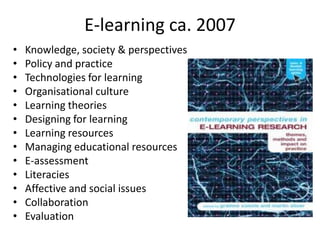
E-learning ca. 2007
•   Knowledge, society & perspectives
•   Policy and practice
•   Technologies for learning
•   Organisational culture
•   Learning theories
•   Designing for learning
•   Learning resources
•   Managing educational resources
•   E-assessment
•   Literacies
•   Affective and social issues
•   Collaboration
•   Evaluation
Recent research questions
• Use of social & participatory media
• Learning design & pedagogical patterns
• Open Educational Resources &MOOCs
• Virtual worlds, games & mobile learning
• Collaboration &affective issues
• E-pedagogies and digital literacies
• Computer Supported Collaborative
  Learning
• Learner experience research
Student experience

The learner voice
(Lisa, Leicester student, 2011)

I’m not impressed with lecture-free learning. I like Blackboard –
   it’s vital – but I don’t like not having lectures and having to find
   out everything myself. I am not motivated enough for that even if
   it does come up in the exam.
I don’t believe we are getting enough feedback from the lecturers
   online - and some people are just reading everything we put up
   and not contributing anything of their own. And I can’t stand the
   way Anya responds to every posting in that patronising way!
                                                                     4
Student experience


The tutor voice
(Stuart, Leicester tutor, 2012)


“Excellence in teaching is at the heart of our learners’
experiences. But views on excellent teaching are as diverse
as our students and staff: excellent to whom and against
what criteria?”

                                                        5
UK context

 Technology needs to enhance student choice and meet or exceed
  learners’ expectations
 Institutions need to take a strategic approach to realign structures
  and processes in order to embed online learning
 Training and development should be realigned to enable the
  academic community to play a leading role in online learning
 Investment is needed for the development and exploitation of
  open educational resources to enhance efficiency and quality


                         Source: Collaborate to Compete, OLTF, 2011
                                                                   6
US context

 31% of all HE students take at least one online course

 67% of academic leaders rate LOs in online education as
  the same or superior to those in f2f education

 Online learning is a critical part of the long-term
  strategies of 65% of HEIs

        Source: Going the Distance: Online Education in the United States, 2011
                                                                           7
Key strategies (1)

1. Capacity and capability building in learning
   design and assessment practices
2. Enabling innovation, adoption and evaluation:
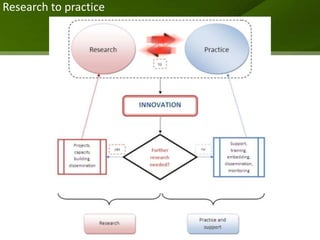
  - Research to practice to research
  - A pipeline for innovation to mainstream
  - Avoid what is not scalable or ‘cascadable’
3. Evidence-based integration of L&T and digital
   technologies
                                                 8
9
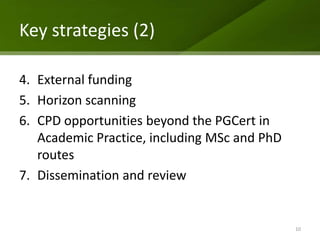
Key strategies (2)

4. External funding
5. Horizon scanning
6. CPD opportunities beyond the PGCert in
   Academic Practice, including MSc and PhD
   routes
7. Dissemination and review


                                              10
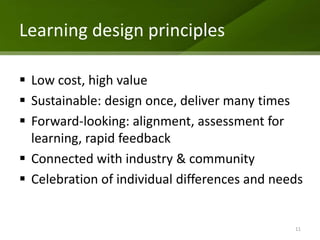
Learning design principles

 Low cost, high value
 Sustainable: design once, deliver many times
 Forward-looking: alignment, assessment for
  learning, rapid feedback
 Connected with industry & community
 Celebration of individual differences and needs


                                               11
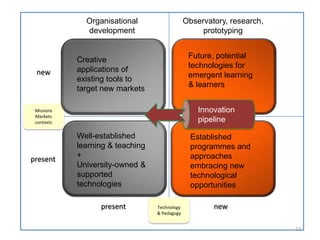
Organisational                   Observatory, research,
              development                           prototyping


                                                Future, potential
            Creative
                                                technologies for
 new        applications of
                                                emergent learning
            existing tools to
                                                & learners
            target new markets

 Missions                                          Innovation
 Markets
 contexts                                          pipeline

            Well-established                     Established
            learning & teaching                  programmes and
present     +                                    approaches
            University-owned &                   embracing new
            supported                            technological
            technologies                         opportunities

                  present         Technology           new
                                  & Pedagogy


                                                                        12
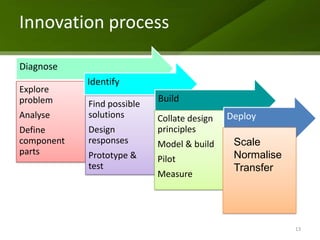
Innovation process

Diagnose
            Identify
Explore
problem                     Build
            Find possible
Analyse     solutions       Collate design   Deploy
Define      Design          principles
component   responses       Model & build     Scale
parts       Prototype &                       Normalise
                            Pilot
            test                              Transfer
                            Measure


                                                          13
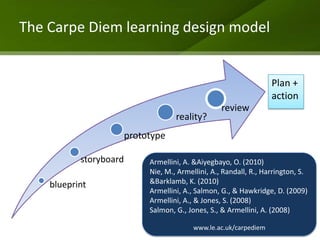
The Carpe Diem learning design model


                                                                    Plan +
                                                                    action
                                                    review
                                     reality?
                        prototype

           storyboard        Armellini, A. &Aiyegbayo, O. (2010)
                             Nie, M., Armellini, A., Randall, R., Harrington, S.
    blueprint                &Barklamb, K. (2010)
                             Armellini, A., Salmon, G., & Hawkridge, D. (2009)
                             Armellini, A., & Jones, S. (2008)
                             Salmon, G., Jones, S., & Armellini, A. (2008)

                                           www.le.ac.uk/carpediem           14
Research to practice
Themes for research

 Knowledge and learning as open, mobile, connected
  and scalable
 Models for effective learning design & capability
  building
 Assessment and feedback in technology-rich
  environments
 Learning innovation for social enterprise
 Learning for employability and to generate future
  employers
                                                      16
Example: knowledge & learning as open (1)


                                        17
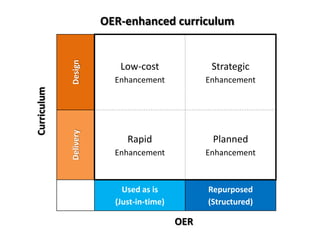
OER-enhanced curriculum


             Design
                           Low-cost               Strategic
                          Enhancement            Enhancement
Curriculum


             Delivery


                             Rapid                Planned
                          Enhancement            Enhancement


                            Used as is           Repurposed
                          (Just-in-time)         (Structured)

                                           OER
Example: knowledge & learning as open (2)


 How do academics’ practices map onto the
  ‘OER-enhanced curriculum’ grid?

  - Should institutions do more to support a shift to
    the top-right quadrant?


                                                        19
Example: knowledge & learning as connected


 Do we build valuable networks by making
  clever use of, for example, LinkedIn and
  Twitter?

  - What does ‘valuable’ mean?
  - What does ‘clever use’ mean?
  - How do I and others benefit?
  - What are the risks?
                                             20
Example: knowledge & learning as scalable

 What is an efficient strategy to enable
  academic staff to benefit from good practice
  in learning design?

For example:
the ‘army of support staff’ approach
vs
the capacity building approach
                                                 21
Example: assessment & feedback in
technology-rich environments

Despite huge investment and research, the UK
 National Student Survey still shows that
 students are dissatisfied with feedback.

 How can technology help us to address this
  dissatisfaction?


                                               22
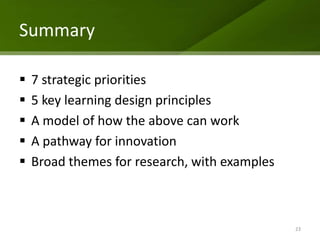
Summary

   7 strategic priorities
   5 key learning design principles
   A model of how the above can work
   A pathway for innovation
   Broad themes for research, with examples


                                               23
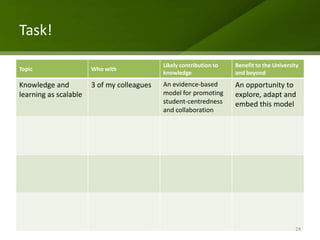
Task!

                                            Likely contribution to   Benefit to the University
Topic                  Who with
                                            knowledge                and beyond

Knowledge and          3 of my colleagues   An evidence-based        An opportunity to
learning as scalable                        model for promoting      explore, adapt and
                                            student-centredness      embed this model
                                            and collaboration


                                                                                            24
Alejandro Armellini
                                                 University of Leicester
                                                     11 June 2012
                                                                           25
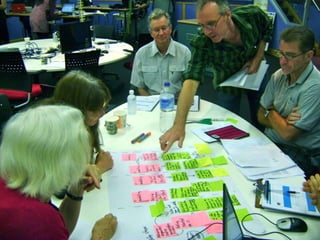
Image by http://www.flickr.com/photos/wwworks/

Armellini Future Research Questions elearning

  • 1.
    Questions for futuree-learning research: can we plug the gaps? Alejandro Armellini 11 June 2012
  • 2.
    E-learning ca. 2007 • Knowledge, society & perspectives • Policy and practice • Technologies for learning • Organisational culture • Learning theories • Designing for learning • Learning resources • Managing educational resources • E-assessment • Literacies • Affective and social issues • Collaboration • Evaluation
  • 3.
    Recent research questions •Use of social & participatory media • Learning design & pedagogical patterns • Open Educational Resources &MOOCs • Virtual worlds, games & mobile learning • Collaboration &affective issues • E-pedagogies and digital literacies • Computer Supported Collaborative Learning • Learner experience research
  • 4.
    Student experience The learnervoice (Lisa, Leicester student, 2011) I’m not impressed with lecture-free learning. I like Blackboard – it’s vital – but I don’t like not having lectures and having to find out everything myself. I am not motivated enough for that even if it does come up in the exam. I don’t believe we are getting enough feedback from the lecturers online - and some people are just reading everything we put up and not contributing anything of their own. And I can’t stand the way Anya responds to every posting in that patronising way! 4
  • 5.
    Student experience The tutorvoice (Stuart, Leicester tutor, 2012) “Excellence in teaching is at the heart of our learners’ experiences. But views on excellent teaching are as diverse as our students and staff: excellent to whom and against what criteria?” 5
  • 6.
    UK context  Technologyneeds to enhance student choice and meet or exceed learners’ expectations  Institutions need to take a strategic approach to realign structures and processes in order to embed online learning  Training and development should be realigned to enable the academic community to play a leading role in online learning  Investment is needed for the development and exploitation of open educational resources to enhance efficiency and quality Source: Collaborate to Compete, OLTF, 2011 6
  • 7.
    US context  31%of all HE students take at least one online course  67% of academic leaders rate LOs in online education as the same or superior to those in f2f education  Online learning is a critical part of the long-term strategies of 65% of HEIs Source: Going the Distance: Online Education in the United States, 2011 7
  • 8.
    Key strategies (1) 1.Capacity and capability building in learning design and assessment practices 2. Enabling innovation, adoption and evaluation: - Research to practice to research - A pipeline for innovation to mainstream - Avoid what is not scalable or ‘cascadable’ 3. Evidence-based integration of L&T and digital technologies 8
  • 9.
  • 10.
    Key strategies (2) 4.External funding 5. Horizon scanning 6. CPD opportunities beyond the PGCert in Academic Practice, including MSc and PhD routes 7. Dissemination and review 10
  • 11.
    Learning design principles Low cost, high value  Sustainable: design once, deliver many times  Forward-looking: alignment, assessment for learning, rapid feedback  Connected with industry & community  Celebration of individual differences and needs 11
  • 12.
    Organisational Observatory, research, development prototyping Future, potential Creative technologies for new applications of emergent learning existing tools to & learners target new markets Missions Innovation Markets contexts pipeline Well-established Established learning & teaching programmes and present + approaches University-owned & embracing new supported technological technologies opportunities present Technology new & Pedagogy 12
  • 13.
    Innovation process Diagnose Identify Explore problem Build Find possible Analyse solutions Collate design Deploy Define Design principles component responses Model & build Scale parts Prototype & Normalise Pilot test Transfer Measure 13
  • 14.
    The Carpe Diemlearning design model Plan + action review reality? prototype storyboard Armellini, A. &Aiyegbayo, O. (2010) Nie, M., Armellini, A., Randall, R., Harrington, S. blueprint &Barklamb, K. (2010) Armellini, A., Salmon, G., & Hawkridge, D. (2009) Armellini, A., & Jones, S. (2008) Salmon, G., Jones, S., & Armellini, A. (2008) www.le.ac.uk/carpediem 14
  • 15.
  • 16.
    Themes for research Knowledge and learning as open, mobile, connected and scalable  Models for effective learning design & capability building  Assessment and feedback in technology-rich environments  Learning innovation for social enterprise  Learning for employability and to generate future employers 16
  • 17.
    Example: knowledge &learning as open (1) 17
  • 18.
    OER-enhanced curriculum Design Low-cost Strategic Enhancement Enhancement Curriculum Delivery Rapid Planned Enhancement Enhancement Used as is Repurposed (Just-in-time) (Structured) OER
  • 19.
    Example: knowledge &learning as open (2)  How do academics’ practices map onto the ‘OER-enhanced curriculum’ grid? - Should institutions do more to support a shift to the top-right quadrant? 19
  • 20.
    Example: knowledge &learning as connected  Do we build valuable networks by making clever use of, for example, LinkedIn and Twitter? - What does ‘valuable’ mean? - What does ‘clever use’ mean? - How do I and others benefit? - What are the risks? 20
  • 21.
    Example: knowledge &learning as scalable  What is an efficient strategy to enable academic staff to benefit from good practice in learning design? For example: the ‘army of support staff’ approach vs the capacity building approach 21
  • 22.
    Example: assessment &feedback in technology-rich environments Despite huge investment and research, the UK National Student Survey still shows that students are dissatisfied with feedback.  How can technology help us to address this dissatisfaction? 22
  • 23.
    Summary  7 strategic priorities  5 key learning design principles  A model of how the above can work  A pathway for innovation  Broad themes for research, with examples 23
  • 24.
    Task! Likely contribution to Benefit to the University Topic Who with knowledge and beyond Knowledge and 3 of my colleagues An evidence-based An opportunity to learning as scalable model for promoting explore, adapt and student-centredness embed this model and collaboration 24
  • 25.
    Alejandro Armellini University of Leicester 11 June 2012 25 Image by http://www.flickr.com/photos/wwworks/