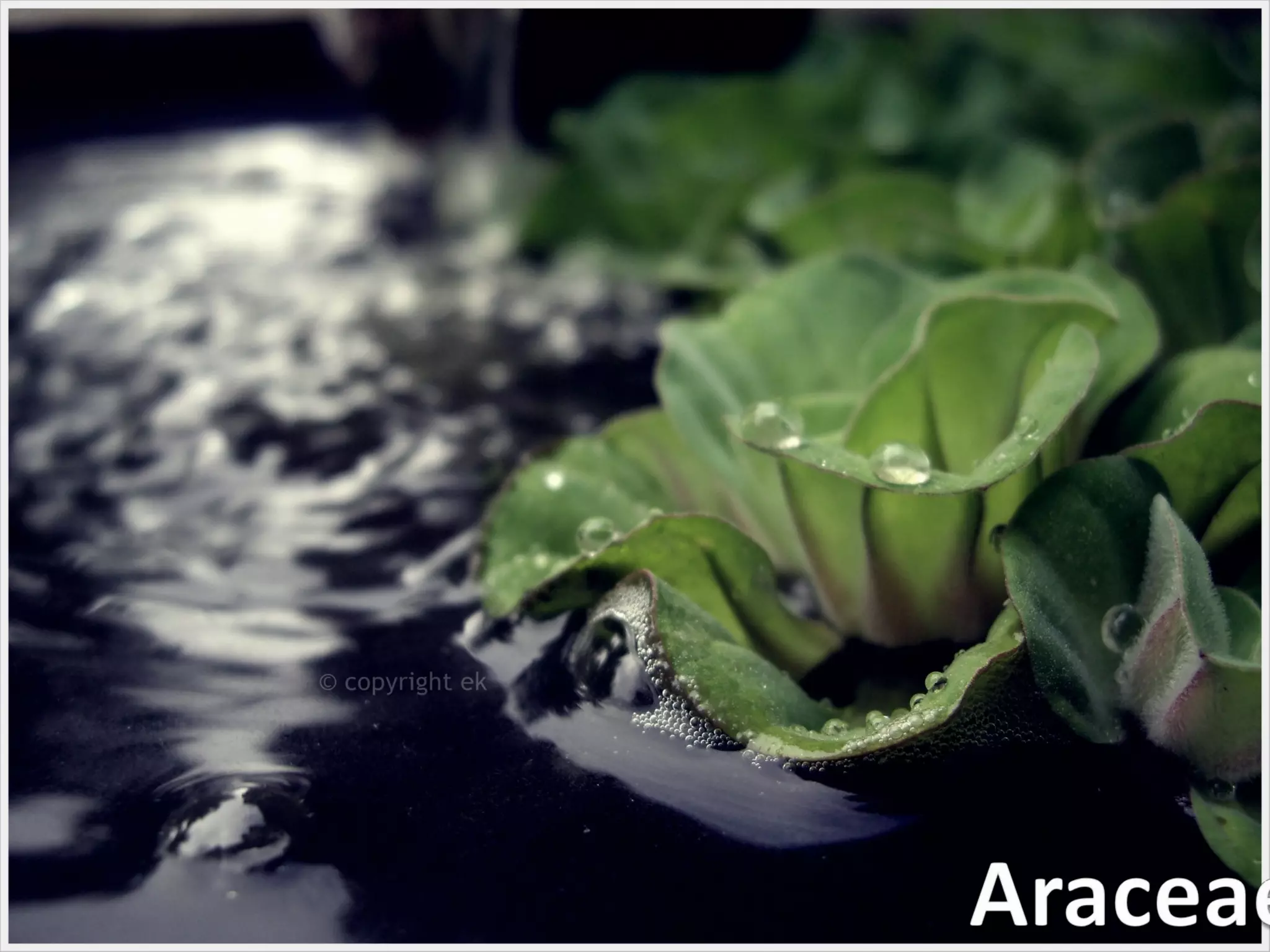
Description
 Araceae is a family of monocotyledonous flowering
plants
 The family also goes by the name of Arum family and
species in this family are often colloquially known as
aroids
 Many plants in this family are thermogenic (heat-
producing).
1. to attract insects (usually beetles) to pollinate the
plant
2. to prevent tissue damage in cold regions
4.Kingdom: Plantae
Order: Alismatales
Family: Araceae
Subfamily: Monsteroideae
Tribe: Monstereae
Genus: Epipremnum
Species: E. aureum
Binomial name : Epipremnum aureum
Local Name : The Devil’s Ivy, Silver Vine,
Money Plant, Centipede tongavine and
Solomon Islands' Ivy
Malay name : Kelampayang
Besar / Pokok Duit
Size : 1000 cm
 commonly known as Pothos
(once classified under the
genus Pothos), Silver Vine,
and Devil's Ivy is an aroid
native to southeastern Asia
(Malaysia, Indonesia) and New
Guinea. It is sometimes
mistakenly called philodendron
at plant stores.
Brief Description
It is a liana growing to 20 m tall, with stems up to
4 cm diameter, climbing by means of aerial roots
which hook over tree branches.
 Leaves : evergreen, alternate, heart-shaped, entire on
juvenile plants, but irregularly pinnatifid (comb like
arrangement of parts ,arising from one side of an axis)
Flowers : produced in a spathe up to 23 cm long. This
plant produces trailing stems when it climbs up trees
and these take root when they reach the ground and
grow along it. The leaves on these trailing stems grow
up to 10cm long and are the one normally seen is this
plant when it is cultivated as a pot plant.
Continue.....
A climbing plant that
climbs with the help of
aerial and clasping roots
The plant can become
large depending on
growing conditions
It can survive in low
light conditions like
florescent lights, and
basements.
USES
It is a popular houseplant with numerous cultivars
selected for leaves with white, yellow, or light green
variegation. It is often used in decorative displays in
shopping centres, offices, and other public locations
largely because it is a very hardy plant that requires
little care and is also attractively leafy.
 It is also efficient at removing indoor pollutants such
as formaldehyde, xylene, and benzene.
Other names include Centipede tongavine and Devil's
Ivy. It is also popularly known as "money plant" in
certain parts of the world (particularly in India).
5.The red caladium
Originated from the
tropical regions of South
America.
All or parts of the
caladium plant may be
poisonous
Contact with sap may
irritate skin
Malay name : Keladi
merah
Scientific name :
Caladium bicolour
Size : 45cm
Other Names : Red
Caladium, elephant ear
Uses
Several species are grown as ornamental plants for
their large, arrowhead-shaped leaves marked in
varying patterns in white, pink, and red and have
been in cultivation in Europe since the late 1700s.
 The two forms most widely cultivated are called
"fancy-leaved" and "lance-leaved". Most Caladiums
in cultivation grow to about 24 inches (60 cm) high
and 24 inches (60 cm) wide, although dwarf varieties
are now in cultivation
All parts of the plant are poisonous. They should not
be ingested and may irritate sensitive skin.
Caladiums are used in shady beds and borders.
They often are planted along the north or east side of
a building or wall. Caladiums are striking in dense
plantings.
They provide warm colour in areas too shady for most
flowers. Use caladiums to provide some colour
amongst lacy ferns and stately gingers. Caladium
leaves will last for several days in fresh flower
arrangements.
6.Giant YamCan grow to be a two
meter giant plant,
common near limestone
outcrops and
abandoned grounds
Often planted as a
decorative leafy plant
because of its beautiful
heart shaped foliage.
Malay name : Keladi
Gajah / Birah
Scientific name :
Colocasia gigantea /
Alocasia macrorrhiza
(L.) Schott
Size : 200 cm
Other name : Giant
Yam / Ape Plant,Giant
Elephant Ear
7.Yam / Taro
Tropical plant grown
primarily as a vegetable
food for its edible
corm, and secondarily
as a leaf vegetable.
It is considered a
staple in oceanic
cultures
It is sometimes loosely
called elephant ear
Taro leaves are rich in vitamins and minerals.
They are a good source of thiamine, riboflavin, iron,
phosphorus, and zinc, and a very good source of
vitamin B6, vitamin C, niacin, potassium, copper,
and manganese.
Taro corms are very high in starch, and are a good
source of dietary fiber.
Malay name :
(Pokok) Ubi Keladi
Scientific name :
Colocasia esculenta
Size : 60cm
Other names : Yam /
Taro, eddo, and
dasheen
Taro tubers for sale in market
Taro corms for sale
Taro stems for sale at a market
The Dumb CaneA large herbaceous plant
that can reach the height of
1 meter.
The sap of the plant is
caustic.
Temperatures below about
5˚C (40˚F) can kill the
plant.
The cells of the plant contain needle-
shaped calcium oxalate crystals called
raphides
If a leaf is chewed, these crystals can
cause a temporary burning sensation
and erythema. (may include temporary numbness
of the tongue and vocal cords)
Malay name :
Dieffenbachia Putih
Kehijauan / Batang
Bisu
Scientific name :
Dieffenbachia maculata
Size : 100cm
Other name : The
Dumb Cane
Black Kris yamAn average size yam
plant, and is from the
Philippines
The Kris plant is grown
for the very attractive
foliage.
It needs warm, humid,
shady conditions and
plenty of water during
the summer
Malay name : Keladi
Keris Hitam / Pokok
Senteh Keris Hitam
Scientific name :
Alocasia sanderiana
Bull.
Size : 50 cm
Other name : Black Kris
yam
Corpse Flower
Amorphophallus Paeoniifolius (Campanulatum)
The family is characterised
by its inflorescence,
consisting of a fleshy spike
of small flowers (spadix)
usually subtended by a
large bract (spathe).
Produces a single
inflorescence followed by a
solitary leaf.
Only blooms when
mature.
Flowers last only about 5
days.
The fresh inflorescence
emits a stink odour
reminiscent of rotting flesh
to attract pollinating
The foul odour only last for a
few hours after the flower
opens.
The corms of some varieties
are edible and grown as food
crops in several Asian
countries, especially
Indonesia.
It grows in wild form in the
Philippines, Malaysia,
Indonesia, and other
Southeast Asian countries.
one of the ugliest flowers (inflorescence) in the world
Aglaonema commutatum Schott
HERBACEOUS PERENNIALS
PLANTS
Scientific name: Aglaonema commutatum Schott
 Common name: Chinese evergreen
Origin: Philippines, eastern Indonesia, Malaysia
Classification:
    Kingdom: Plantae
    Subkingdom: Tracheobionta
    Division: Magnoliophyta
    Class: Liliopsidaa
    Subclass: Arecidae
    Order: Alismatales
    Family: Araceae
    Genus: Aglaonemaa
    Species: Aglaonema commutatum Schott
Leaves
•Simple, alternate;
• Blade elliptic to
lanceolate;
• Usually 12-35 ×
3-8cm;
• Spotted,striped ,or
blotched with light
green.
Leaves of Chinese Evergreen
Flowers
•Creamy-white or
slightly greenish
spathes that come in
summer;
•Intermittently during
the year;
•Many flowers , tightly
packed in one to six
axillary spadices 2-6 cm
long with a pale green
ovate spathe attached
at the base, 3.5-6 cm
long.
The Inflorescence
Fruits
• Berries ellipsoidal,
green but turning
yellow and finally
bright red.
Fruits of Chinese Evergreen
Seeds
•Every fruit contains
only one seed.
• Erect (having a
vertical position)
•Almost as large as
the fruit, without
endosperm
Seed of Chinese Evergreen
Uses
Popular as ornamental foliage plants (indoor
plants)
They are fleshy tropical Asian herbs of slow growth
with leathery leaves often bearing silvery or colourful
patterns.
- Important products in plant industry.
EXAMPLES OF THE CHINESE
EVERGREEN
Emerald Beauty Silver Queen
BY
Yangrae Cho and Jeffrey D. Palmer
Department of Biology, Indiana
University at Bloomington
A group I intron has recently been shown to have
invaded mitochondrial cox1 genes by horizontal
transfer many times during the broad course of
angiosperm evolution.
To investigate the frequency of acquisition of this
intron within a more closely related group of plants,
they determined its distribution and inferred its
evolutionary history among 14 genera of the monocot
family Araceae.

Araceae

  • 2.
    Description  Araceae isa family of monocotyledonous flowering plants  The family also goes by the name of Arum family and species in this family are often colloquially known as aroids  Many plants in this family are thermogenic (heat- producing). 1. to attract insects (usually beetles) to pollinate the plant 2. to prevent tissue damage in cold regions
  • 10.
    4.Kingdom: Plantae Order: Alismatales Family:Araceae Subfamily: Monsteroideae Tribe: Monstereae Genus: Epipremnum Species: E. aureum Binomial name : Epipremnum aureum Local Name : The Devil’s Ivy, Silver Vine, Money Plant, Centipede tongavine and Solomon Islands' Ivy
  • 11.
    Malay name :Kelampayang Besar / Pokok Duit Size : 1000 cm  commonly known as Pothos (once classified under the genus Pothos), Silver Vine, and Devil's Ivy is an aroid native to southeastern Asia (Malaysia, Indonesia) and New Guinea. It is sometimes mistakenly called philodendron at plant stores.
  • 12.
    Brief Description It isa liana growing to 20 m tall, with stems up to 4 cm diameter, climbing by means of aerial roots which hook over tree branches.  Leaves : evergreen, alternate, heart-shaped, entire on juvenile plants, but irregularly pinnatifid (comb like arrangement of parts ,arising from one side of an axis) Flowers : produced in a spathe up to 23 cm long. This plant produces trailing stems when it climbs up trees and these take root when they reach the ground and grow along it. The leaves on these trailing stems grow up to 10cm long and are the one normally seen is this plant when it is cultivated as a pot plant.
  • 13.
    Continue..... A climbing plantthat climbs with the help of aerial and clasping roots The plant can become large depending on growing conditions It can survive in low light conditions like florescent lights, and basements.
  • 14.
    USES It is apopular houseplant with numerous cultivars selected for leaves with white, yellow, or light green variegation. It is often used in decorative displays in shopping centres, offices, and other public locations largely because it is a very hardy plant that requires little care and is also attractively leafy.  It is also efficient at removing indoor pollutants such as formaldehyde, xylene, and benzene. Other names include Centipede tongavine and Devil's Ivy. It is also popularly known as "money plant" in certain parts of the world (particularly in India).
  • 15.
    5.The red caladium Originatedfrom the tropical regions of South America. All or parts of the caladium plant may be poisonous Contact with sap may irritate skin
  • 16.
    Malay name :Keladi merah Scientific name : Caladium bicolour Size : 45cm Other Names : Red Caladium, elephant ear
  • 17.
    Uses Several species aregrown as ornamental plants for their large, arrowhead-shaped leaves marked in varying patterns in white, pink, and red and have been in cultivation in Europe since the late 1700s.  The two forms most widely cultivated are called "fancy-leaved" and "lance-leaved". Most Caladiums in cultivation grow to about 24 inches (60 cm) high and 24 inches (60 cm) wide, although dwarf varieties are now in cultivation All parts of the plant are poisonous. They should not be ingested and may irritate sensitive skin.
  • 18.
    Caladiums are usedin shady beds and borders. They often are planted along the north or east side of a building or wall. Caladiums are striking in dense plantings. They provide warm colour in areas too shady for most flowers. Use caladiums to provide some colour amongst lacy ferns and stately gingers. Caladium leaves will last for several days in fresh flower arrangements.
  • 19.
    6.Giant YamCan growto be a two meter giant plant, common near limestone outcrops and abandoned grounds Often planted as a decorative leafy plant because of its beautiful heart shaped foliage.
  • 20.
    Malay name :Keladi Gajah / Birah Scientific name : Colocasia gigantea / Alocasia macrorrhiza (L.) Schott Size : 200 cm Other name : Giant Yam / Ape Plant,Giant Elephant Ear
  • 21.
    7.Yam / Taro Tropicalplant grown primarily as a vegetable food for its edible corm, and secondarily as a leaf vegetable. It is considered a staple in oceanic cultures It is sometimes loosely called elephant ear
  • 22.
    Taro leaves arerich in vitamins and minerals. They are a good source of thiamine, riboflavin, iron, phosphorus, and zinc, and a very good source of vitamin B6, vitamin C, niacin, potassium, copper, and manganese. Taro corms are very high in starch, and are a good source of dietary fiber.
  • 23.
    Malay name : (Pokok)Ubi Keladi Scientific name : Colocasia esculenta Size : 60cm Other names : Yam / Taro, eddo, and dasheen
  • 24.
    Taro tubers forsale in market
  • 25.
  • 26.
    Taro stems forsale at a market
  • 27.
    The Dumb CaneAlarge herbaceous plant that can reach the height of 1 meter. The sap of the plant is caustic. Temperatures below about 5˚C (40˚F) can kill the plant.
  • 28.
    The cells ofthe plant contain needle- shaped calcium oxalate crystals called raphides If a leaf is chewed, these crystals can cause a temporary burning sensation and erythema. (may include temporary numbness of the tongue and vocal cords)
  • 29.
    Malay name : DieffenbachiaPutih Kehijauan / Batang Bisu Scientific name : Dieffenbachia maculata Size : 100cm Other name : The Dumb Cane
  • 30.
    Black Kris yamAnaverage size yam plant, and is from the Philippines The Kris plant is grown for the very attractive foliage. It needs warm, humid, shady conditions and plenty of water during the summer
  • 31.
    Malay name :Keladi Keris Hitam / Pokok Senteh Keris Hitam Scientific name : Alocasia sanderiana Bull. Size : 50 cm Other name : Black Kris yam
  • 32.
    Corpse Flower Amorphophallus Paeoniifolius(Campanulatum) The family is characterised by its inflorescence, consisting of a fleshy spike of small flowers (spadix) usually subtended by a large bract (spathe). Produces a single inflorescence followed by a solitary leaf. Only blooms when mature. Flowers last only about 5 days.
  • 33.
    The fresh inflorescence emitsa stink odour reminiscent of rotting flesh to attract pollinating The foul odour only last for a few hours after the flower opens. The corms of some varieties are edible and grown as food crops in several Asian countries, especially Indonesia. It grows in wild form in the Philippines, Malaysia, Indonesia, and other Southeast Asian countries.
  • 34.
    one of theugliest flowers (inflorescence) in the world
  • 35.
  • 36.
    HERBACEOUS PERENNIALS PLANTS Scientific name:Aglaonema commutatum Schott  Common name: Chinese evergreen Origin: Philippines, eastern Indonesia, Malaysia Classification:     Kingdom: Plantae     Subkingdom: Tracheobionta     Division: Magnoliophyta     Class: Liliopsidaa     Subclass: Arecidae     Order: Alismatales     Family: Araceae     Genus: Aglaonemaa     Species: Aglaonema commutatum Schott
  • 37.
    Leaves •Simple, alternate; • Bladeelliptic to lanceolate; • Usually 12-35 × 3-8cm; • Spotted,striped ,or blotched with light green. Leaves of Chinese Evergreen
  • 38.
    Flowers •Creamy-white or slightly greenish spathesthat come in summer; •Intermittently during the year; •Many flowers , tightly packed in one to six axillary spadices 2-6 cm long with a pale green ovate spathe attached at the base, 3.5-6 cm long. The Inflorescence
  • 39.
    Fruits • Berries ellipsoidal, greenbut turning yellow and finally bright red. Fruits of Chinese Evergreen
  • 40.
    Seeds •Every fruit contains onlyone seed. • Erect (having a vertical position) •Almost as large as the fruit, without endosperm Seed of Chinese Evergreen
  • 41.
    Uses Popular as ornamentalfoliage plants (indoor plants) They are fleshy tropical Asian herbs of slow growth with leathery leaves often bearing silvery or colourful patterns. - Important products in plant industry.
  • 42.
    EXAMPLES OF THECHINESE EVERGREEN Emerald Beauty Silver Queen
  • 44.
    BY Yangrae Cho andJeffrey D. Palmer Department of Biology, Indiana University at Bloomington
  • 45.
    A group Iintron has recently been shown to have invaded mitochondrial cox1 genes by horizontal transfer many times during the broad course of angiosperm evolution. To investigate the frequency of acquisition of this intron within a more closely related group of plants, they determined its distribution and inferred its evolutionary history among 14 genera of the monocot family Araceae.