
APUSH REVIEW: KEY
CONCEPT 8.2, REVISED
Everything You Need To Know About Key Concept
8.2 To Succeed In APUSH
KEY CONCEPT 8.2
“New movements for civil rights and liberal efforts to expand the role of
government generated a range of political and cultural responses.”
Page 79 of the Curriculum Framework
Big Idea Questions:
What were some examples of successes during the Civil Rights
Movement? How did the federal government contribute to this?
How did awareness for groups such as Latinos, American Indians, Asian
Americans, women, and gays and lesbians change during this time?
Why were some people on the left and right assailing liberalism?
KEY CONCEPT 8.2, I
“Seeking to fulfill Reconstruction-era promises, civil rights activists and political leaders
achieved some legal and political successes in ending segregation, although the progress
toward equality was slow and halting.” - page 74
A: After WWII, civil rights activists used a variety of strategies to challenge racial segregation
Legal challenges: NAACP cases, led by attorney Thurgood Marshall, future Supreme Court
Justice
Direct action: Fannie Lou Hamer and Freedom Summer
Sought to increase the number of African Americans registered to vote in Mississippi
Nonviolent Protest tactics - Martin Luther King:
Montgomery Bus Boycott
Sit-ins - Greensboro, NC -> sit-ins across the country
KEY CONCEPT 8.2, I
B: All 3 branches helped promote greater racial justice:
Executive - Harry Truman’s Executive Order 9981 desegregated the
US military in 1948
Judicial - Brown v. Board - ruled that segregation was inherently
unequal, overturned Plessy v. Ferguson (1896 - period 6)
Legislative - Civil Rights Act of 1964 - part of LBJ’s Great Society,
which was an extension of the New Deal, and focused on Civil Rights
Discrimination in the workplace became illegal
Guaranteed equal access to public accommodations
KEY CONCEPT 8.2, I
C: White resistance slowed efforts at desegregation
“Massive Resistance” - Southern schools would shut down before desegregating
Southern Manifesto - 101 Congressmen that believed the Supreme Court
overstepped its power
Little Rock Nine - Governor Orville Faubus refused to integrate schools,
Eisenhower sent troops to enforce integration
Post-1965 (riots in cities, increased involvement in Vietnam) debates emerged
among activists over tactics and philosophy:
MLK - still urged nonviolence, but some urban protestors were frustrated
Black Panthers - advocated armed self-defense to violence
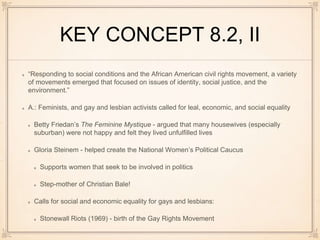
KEY CONCEPT 8.2, II
“Responding to social conditions and the African American civil rights movement, a variety
of movements emerged that focused on issues of identity, social justice, and the
environment.”
A.: Feminists, and gay and lesbian activists called for leal, economic, and social equality
Betty Friedan’s The Feminine Mystique - argued that many housewives (especially
suburban) were not happy and felt they lived unfulfilled lives
Gloria Steinem - helped create the National Women’s Political Caucus
Supports women that seek to be involved in politics
Step-mother of Christian Bale!
Calls for social and economic equality for gays and lesbians:
Stonewall Riots (1969) - birth of the Gay Rights Movement
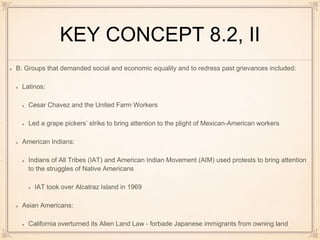
KEY CONCEPT 8.2, II
B: Groups that demanded social and economic equality and to redress past grievances included:
Latinos:
Cesar Chavez and the United Farm Workers
Led a grape pickers’ strike to bring attention to the plight of Mexican-American workers
American Indians:
Indians of All Tribes (IAT) and American Indian Movement (AIM) used protests to bring attention
to the struggles of Native Americans
IAT took over Alcatraz Island in 1969
Asian Americans:
California overturned its Alien Land Law - forbade Japanese immigrants from owning land
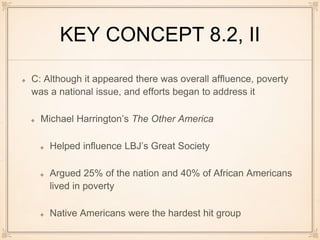
KEY CONCEPT 8.2, II
C: Although it appeared there was overall affluence, poverty
was a national issue, and efforts began to address it
Michael Harrington’s The Other America
Helped influence LBJ’s Great Society
Argued 25% of the nation and 40% of African Americans
lived in poverty
Native Americans were the hardest hit group
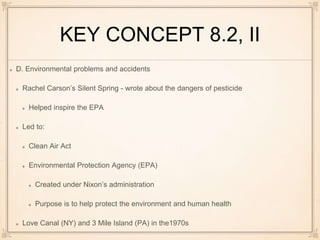
KEY CONCEPT 8.2, II
D. Environmental problems and accidents
Rachel Carson’s Silent Spring - wrote about the dangers of pesticide
Helped inspire the EPA
Led to:
Clean Air Act
Environmental Protection Agency (EPA)
Created under Nixon’s administration
Purpose is to help protect the environment and human health
Love Canal (NY) and 3 Mile Island (PA) in the1970s
KEY CONCEPT 8.2, III
“Liberalism influenced postwar politics and court decisions,
but it came under increasing attack from the left as well as
from a resurgent conservative movement”
A; What is liberalism?
Limiting communism abroad
Belief in the power of the government to achieve goals at
home
Reached its zenith (high point) in the mid 1960s - LBJ
KEY CONCEPT 8.2, III
B: LBJ’s Great Society sought to:
Use federal power to end racial discrimination:
Civil Rights Act of 1964 - banned discrimination in public facilities
Voting Rights Act of 1965 - eliminated literacy tests, federal government could register voters
24th Amendment - eliminated poll taxes
Eliminate poverty and address other social issues:
Head Start Program, HUD
Foodstamps, Medicare, and Medicaid
Education - provided $ for primary and secondary education
Supreme Court Decisions that expanded democracy and individual freedoms
Miranda v. Arizona - those arrested must be made aware of their rights
Griswold v. Connecticut - struck down a law forbidding contraception; determined the Constitution established a “right to
privacy”
KEY CONCEPT 8.2, III
C: 1960s - conservatives challenged liberal laws, court decisions,
and perceived moral culture decline
Conservatives hoped to:
Limit the role of the federal government
Be more assertive with foreign policy
Barry Goldwater (1964 election) - more militant that LBJ and
called for smaller government
Ronald Reagan’s “A Time For Choosing”
KEY CONCEPT 8.2, III
D: Groups on the left assailed liberals because they believed:
Liberals did not transform the racial and economic status quo at home
Black Panthers - urged arming of African Americans for self
defense; created free breakfast programs in urban areas
Liberals pursued immoral policies abroad (Vietnam War)
Students for a Democratic Society (SDS) - protested the Vietnam
War as the US increased involvement; criticized the gap between
the rich and poor
Inspired march-ins, sit-ins, and teach-ins
KEY CONCEPT 8.2, III
E. Public trust in government decreased due to:
Economic challenges:
Staglation of the 1970s (High inflation and unemployment)
Political scandals:
Watergate Scandal - led to Nixon resigning
Foreign policy crises:
Oil Embargo - 1973
Vietnam War
Iran Hostage Crisis (1979)
KEY CONCEPT 8.2, III
F. Conservatives and Liberals clashed over:
Social and Cultural issues:
Changes to the American family - divorce rate increased, more women worked outside the home
Power of the federal government:
Conservatives wanted a smaller government (against the “Great Society”)
Race:
Bakke v. University of CA - Supreme Court upheld affirmative action, however it ruled that quotas were
not allowed
Movement for greater individual rights:
Phyllis Schlafly - Critic of the ERA
Argued that the ERA would take away certain benefits
Her campaign helped lead to the defeat of the ERA
TEST TIPS
Multiple-Choice and Short Answer:
Examples of strategies used by Civil Rights Activists - direct action, legal challenges,
and nonviolent protest
How all three branches contributed to the Civil Rights Movement
Great Society - EVERYTHING
Criticisms of liberalism on the left and right
Essay and DBQ:
Comparing the Civil Rights movement with earlier time periods (1890s - 1920s - Booker
T., W.E.B., etc.)
Comparing the Women’s Rights movement with earlier time periods (1840s, 1920s, etc.)

Apush review-key-concept-8.2-revised-edition

  • 1.
    APUSH REVIEW: KEY CONCEPT8.2, REVISED Everything You Need To Know About Key Concept 8.2 To Succeed In APUSH
  • 2.
    KEY CONCEPT 8.2 “Newmovements for civil rights and liberal efforts to expand the role of government generated a range of political and cultural responses.” Page 79 of the Curriculum Framework Big Idea Questions: What were some examples of successes during the Civil Rights Movement? How did the federal government contribute to this? How did awareness for groups such as Latinos, American Indians, Asian Americans, women, and gays and lesbians change during this time? Why were some people on the left and right assailing liberalism?
  • 3.
    KEY CONCEPT 8.2,I “Seeking to fulfill Reconstruction-era promises, civil rights activists and political leaders achieved some legal and political successes in ending segregation, although the progress toward equality was slow and halting.” - page 74 A: After WWII, civil rights activists used a variety of strategies to challenge racial segregation Legal challenges: NAACP cases, led by attorney Thurgood Marshall, future Supreme Court Justice Direct action: Fannie Lou Hamer and Freedom Summer Sought to increase the number of African Americans registered to vote in Mississippi Nonviolent Protest tactics - Martin Luther King: Montgomery Bus Boycott Sit-ins - Greensboro, NC -> sit-ins across the country
  • 4.
    KEY CONCEPT 8.2,I B: All 3 branches helped promote greater racial justice: Executive - Harry Truman’s Executive Order 9981 desegregated the US military in 1948 Judicial - Brown v. Board - ruled that segregation was inherently unequal, overturned Plessy v. Ferguson (1896 - period 6) Legislative - Civil Rights Act of 1964 - part of LBJ’s Great Society, which was an extension of the New Deal, and focused on Civil Rights Discrimination in the workplace became illegal Guaranteed equal access to public accommodations
  • 5.
    KEY CONCEPT 8.2,I C: White resistance slowed efforts at desegregation “Massive Resistance” - Southern schools would shut down before desegregating Southern Manifesto - 101 Congressmen that believed the Supreme Court overstepped its power Little Rock Nine - Governor Orville Faubus refused to integrate schools, Eisenhower sent troops to enforce integration Post-1965 (riots in cities, increased involvement in Vietnam) debates emerged among activists over tactics and philosophy: MLK - still urged nonviolence, but some urban protestors were frustrated Black Panthers - advocated armed self-defense to violence
  • 6.
    KEY CONCEPT 8.2,II “Responding to social conditions and the African American civil rights movement, a variety of movements emerged that focused on issues of identity, social justice, and the environment.” A.: Feminists, and gay and lesbian activists called for leal, economic, and social equality Betty Friedan’s The Feminine Mystique - argued that many housewives (especially suburban) were not happy and felt they lived unfulfilled lives Gloria Steinem - helped create the National Women’s Political Caucus Supports women that seek to be involved in politics Step-mother of Christian Bale! Calls for social and economic equality for gays and lesbians: Stonewall Riots (1969) - birth of the Gay Rights Movement
  • 7.
    KEY CONCEPT 8.2,II B: Groups that demanded social and economic equality and to redress past grievances included: Latinos: Cesar Chavez and the United Farm Workers Led a grape pickers’ strike to bring attention to the plight of Mexican-American workers American Indians: Indians of All Tribes (IAT) and American Indian Movement (AIM) used protests to bring attention to the struggles of Native Americans IAT took over Alcatraz Island in 1969 Asian Americans: California overturned its Alien Land Law - forbade Japanese immigrants from owning land
  • 8.
    KEY CONCEPT 8.2,II C: Although it appeared there was overall affluence, poverty was a national issue, and efforts began to address it Michael Harrington’s The Other America Helped influence LBJ’s Great Society Argued 25% of the nation and 40% of African Americans lived in poverty Native Americans were the hardest hit group
  • 9.
    KEY CONCEPT 8.2,II D. Environmental problems and accidents Rachel Carson’s Silent Spring - wrote about the dangers of pesticide Helped inspire the EPA Led to: Clean Air Act Environmental Protection Agency (EPA) Created under Nixon’s administration Purpose is to help protect the environment and human health Love Canal (NY) and 3 Mile Island (PA) in the1970s
  • 10.
    KEY CONCEPT 8.2,III “Liberalism influenced postwar politics and court decisions, but it came under increasing attack from the left as well as from a resurgent conservative movement” A; What is liberalism? Limiting communism abroad Belief in the power of the government to achieve goals at home Reached its zenith (high point) in the mid 1960s - LBJ
  • 11.
    KEY CONCEPT 8.2,III B: LBJ’s Great Society sought to: Use federal power to end racial discrimination: Civil Rights Act of 1964 - banned discrimination in public facilities Voting Rights Act of 1965 - eliminated literacy tests, federal government could register voters 24th Amendment - eliminated poll taxes Eliminate poverty and address other social issues: Head Start Program, HUD Foodstamps, Medicare, and Medicaid Education - provided $ for primary and secondary education Supreme Court Decisions that expanded democracy and individual freedoms Miranda v. Arizona - those arrested must be made aware of their rights Griswold v. Connecticut - struck down a law forbidding contraception; determined the Constitution established a “right to privacy”
  • 12.
    KEY CONCEPT 8.2,III C: 1960s - conservatives challenged liberal laws, court decisions, and perceived moral culture decline Conservatives hoped to: Limit the role of the federal government Be more assertive with foreign policy Barry Goldwater (1964 election) - more militant that LBJ and called for smaller government Ronald Reagan’s “A Time For Choosing”
  • 13.
    KEY CONCEPT 8.2,III D: Groups on the left assailed liberals because they believed: Liberals did not transform the racial and economic status quo at home Black Panthers - urged arming of African Americans for self defense; created free breakfast programs in urban areas Liberals pursued immoral policies abroad (Vietnam War) Students for a Democratic Society (SDS) - protested the Vietnam War as the US increased involvement; criticized the gap between the rich and poor Inspired march-ins, sit-ins, and teach-ins
  • 14.
    KEY CONCEPT 8.2,III E. Public trust in government decreased due to: Economic challenges: Staglation of the 1970s (High inflation and unemployment) Political scandals: Watergate Scandal - led to Nixon resigning Foreign policy crises: Oil Embargo - 1973 Vietnam War Iran Hostage Crisis (1979)
  • 15.
    KEY CONCEPT 8.2,III F. Conservatives and Liberals clashed over: Social and Cultural issues: Changes to the American family - divorce rate increased, more women worked outside the home Power of the federal government: Conservatives wanted a smaller government (against the “Great Society”) Race: Bakke v. University of CA - Supreme Court upheld affirmative action, however it ruled that quotas were not allowed Movement for greater individual rights: Phyllis Schlafly - Critic of the ERA Argued that the ERA would take away certain benefits Her campaign helped lead to the defeat of the ERA
  • 16.
    TEST TIPS Multiple-Choice andShort Answer: Examples of strategies used by Civil Rights Activists - direct action, legal challenges, and nonviolent protest How all three branches contributed to the Civil Rights Movement Great Society - EVERYTHING Criticisms of liberalism on the left and right Essay and DBQ: Comparing the Civil Rights movement with earlier time periods (1890s - 1920s - Booker T., W.E.B., etc.) Comparing the Women’s Rights movement with earlier time periods (1840s, 1920s, etc.)