Apprenticeships now and the proposed plans
going forward
Apprenticeships being Delivered
More than half (55%) of all apprenticeship starts in 2014/15 were in two sectors:
Business, Administration & Law and Health, Public service & Care. Including Retail
& Commercial Enterprises, the top three sectors made up almost three-quarters
(73%) of apprenticeship starts
Key Facts
• There were 499,900 apprenticeship starts in the 2014/15
academic year, 59,500 (14%) more than the previous year.
• The Top 3 Frameworks being:
• Health and Social Care 85,000
• Business Administration 49,000
• Management 43,000
• In 2014/15, 21,500 (4.3% of all starters) apprenticeship
starters were Asian/Asian British; 17,200 (3.5%) were
Black/African/Caribbean/Black British; and 10,900
(2.2%) were of mixed/multiple ethnic background.
So What Next for Apprenticeships?
The Government Requires
The boosting our nation’s productivity to maintain and consolidate our economic recovery
by:
• Raising skill levels through apprenticeships – reaching 3 million starts in 2020.
• That is equivalent to more than one apprentice every minute over the next four
years
• Putting employers in the driving seat of creating apprenticeships that fully meet their
business needs.
• This means we NEED to develop opportunities for Engaging Employers
At Every Opportunity
• Making sure that apprenticeships are open to all, with a 20% increase in BME
apprentice starts in 2020.
• Continue and Build on our BME
• To increase sector coverage with an emphasis in Science, Technology, Engineering, and
Mathematics (STEM) apprenticeships- this being reflected in their funding model
WHY? Rationale for Reforms
Rationale for Reforms
Employer Driven
Employers designing
apprenticeships to make
them more responsive to
their needs and the future
economy, and controlling
funding
Simplicity
Simplifying apprenticeship
standards so that they are
shorter and more accessible
Quality
Improving the quality of
apprenticeships so that
they are viewed with the
same esteem as University
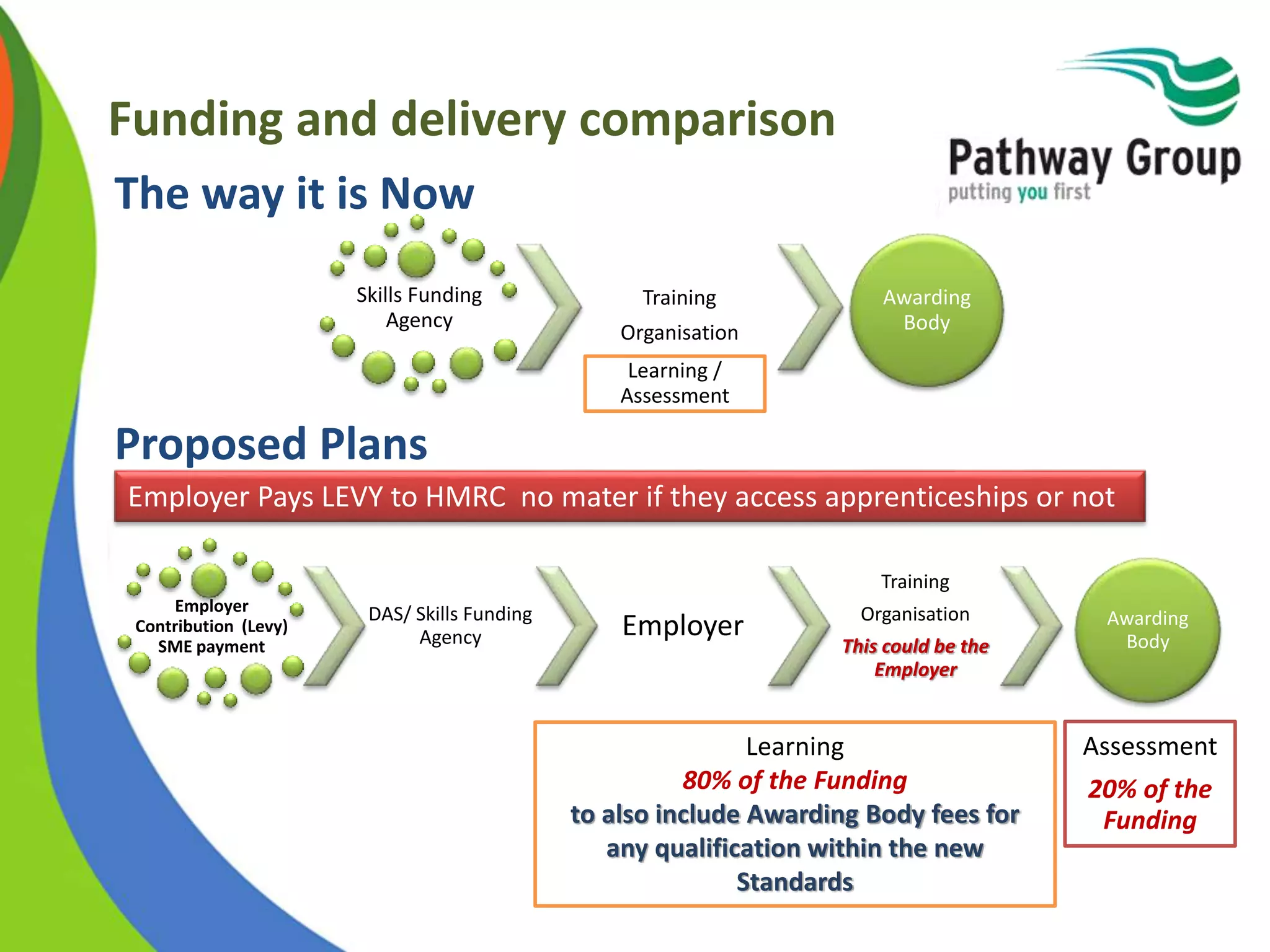
Funding and delivery comparison
The way it is Now
Proposed Plans
Skills Funding
Agency
Training
Organisation
Learning /
Assessment
Awarding
Body
Employer
Contribution (Levy)
SME payment
DAS/ Skills Funding
Agency Employer
Training
Organisation
This could be the
Employer
Awarding
Body
Assessment
20% of the
Funding
Learning
80% of the Funding
to also include Awarding Body fees for
any qualification within the new
Standards
Employer Pays LEVY to HMRC no mater if they access apprenticeships or not
Funding Example - The way it is Now
Skills Funding
Agency
Training
Organisation
Learning /
Assessment
Awarding
Body
Apprenticeship Business Administration Level 2 16-18 19-23 24+
Drawdown (Per Learner)
Pearson Edexcel FS English Level 1 £776.35 £362.00 £289.60
Pearson Edexcel Functional Skills qualification in Mathematics at Level 1 £776.35 £362.00 £289.60
Pearson BTEC Level 2 Diploma in Business Administration (​QCF) £4,270.97 £1,991.50 £1,593.20
Drawdown £5,823.66 £2,715.50 £2,172.40
Total Drawdown (Inc. Avg Uplift of 10%) £6,406.03 £2,987.05 £2,389.64
Apprenticeship Customer Service Level 2 16-18 19-23 24+
Drawdown (Per Learner)
Pearson Edexcel FS English Level 1 £776.35 £362.00 £289.60
Pearson Edexcel Functional Skills qualification in Mathematics at Level 1 £776.35 £362.00 £289.60
Pearson BTEC Level 2 Diploma in Customer Service (​QCF) £3,594.35 £1,676.00 £1,340.80
Drawdown £5,147.04 £2,400.00 £1,920.00
Total Drawdown (Inc. Avg Uplift of 10%) £5,661.74 £2,640.00 £2,112.00
Funding Drown Down by the Provider from the Skills Funding Agency
Awarding Body
Registration and
Certification Fee
£175
Awarding Body
Registration and
Certification Fee
£175
English Mathematics
Main
Learning Aim
Area and
Disadvantage
Uplift
Multipliers
= Total
Funding
Drawn Down
Funding Example
Proposed Plans
Employer
Contribution (Levy)
SME payment
DAS/ Skills
Funding
Agency
Employer
Training
Organisation
This could be
the Employer
Awarding
Body
Learning
£1,200 of the Funding
to also include Awarding Body fees for
the embedded qualification which is
anticipated to be Circa £150 leaving
£1,050 for Training
Employer Pays LEVY to HMRC no mater if they access apprenticeships or not
Learning
£1,600 of the Funding
to also include Awarding Body fees for
the embedded qualification which is
anticipated to be Circa £150 leaving
£1,400 for Training
End Point
Assessment
c£400 of the
Funding (this will
have to be paid out
before you can draw
down funding
Customer Service Level 2 £1,500
there is no additional uplifts for
learner age or being within London
Note: Fees dependant on individual awarding body and assessment organisation fees
End Point
Assessment
c£300 of the
Funding (this will
have to be paid out
before you can draw
down funding
Administration Level 2 £2,000
there is no additional uplifts for
learner age or being within London
Maths and English Additional Funding
Outside of employer contribution £471
for each
Maths and English Additional Funding
Outside of employer contribution £471
for each
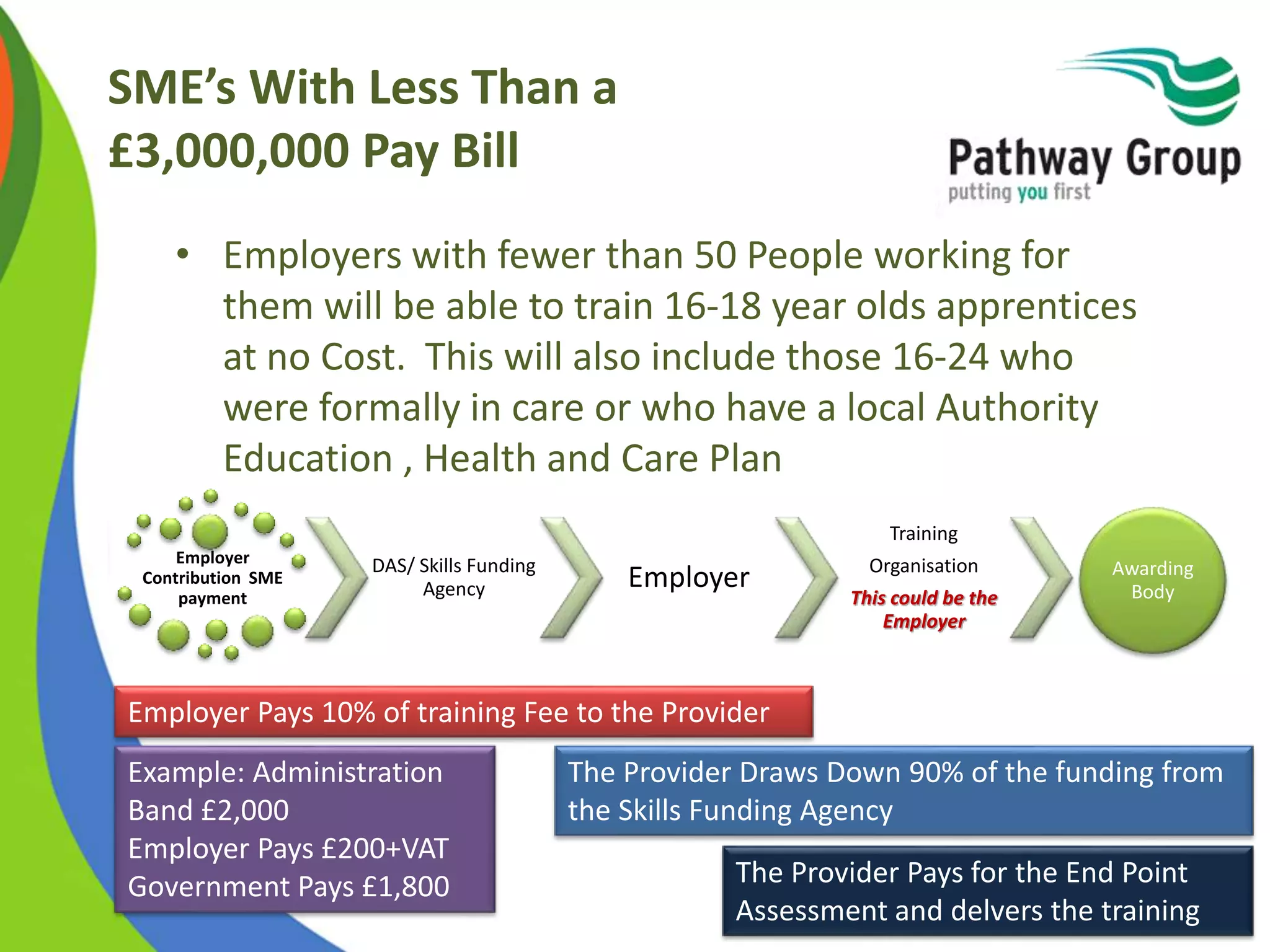
SME’s With Less Than a
£3,000,000 Pay Bill
• Employers with fewer than 50 People working for
them will be able to train 16-18 year olds apprentices
at no Cost. This will also include those 16-24 who
were formally in care or who have a local Authority
Education , Health and Care Plan
Employer
Contribution SME
payment
DAS/ Skills Funding
Agency Employer
Training
Organisation
This could be the
Employer
Awarding
Body
Employer Pays 10% of training Fee to the Provider
The Provider Draws Down 90% of the funding from
the Skills Funding Agency
The Provider Pays for the End Point
Assessment and delvers the training
Example: Administration
Band £2,000
Employer Pays £200+VAT
Government Pays £1,800
Funding Comparison
The Hard Facts
Business Administration Level 2
How it is
Now
Post April
2017
English £475.98 £471.00
Maths £475.98 £471.00
Diploma in Administration £2,618.56 £2,000.00
Uplift (Average) £357.05 £0.00
Drawdown £3,927.57 £2,942.00
Loss of Funding £985.57
Income Reduction 25%
Awarding Body Fee -£175.00 -£150.00
End Point Assessment £400.00
Left for Delivery of Training £4,102.57 £2,692.00
Loss of Funding Going into Training £1,410.57
Drop in Funding
Available for Training
(average)
34%
Customer Service Level 2
How it is
Now
Post April
2017
English £475.98 £471.00
Maths £475.98 £471.00
Diploma in Customer Service £2,203.72 £1,500.00
Uplift (Average) £315.57 £0.00
Drawdown £3,471.25 £2,442.00
Loss of Funding £1,029.25
Income Reduction 30%
Awarding Body Fee -£175.00 -£150.00
End Point Assessment £300.00
Left for Delivery of Training £3,646.25 £2,292.00
Loss of Funding Going into Training £1,354.25
Drop in Funding
Available for Training
(average)
37%
For 16-18 year olds the position is worse however, this is offset by
Employer and Training Providers each being paid £1,000 in the form
off an age grant for this group (SMEs Only) . (Although we can not confirm all
the eligibility criteria at this stage)
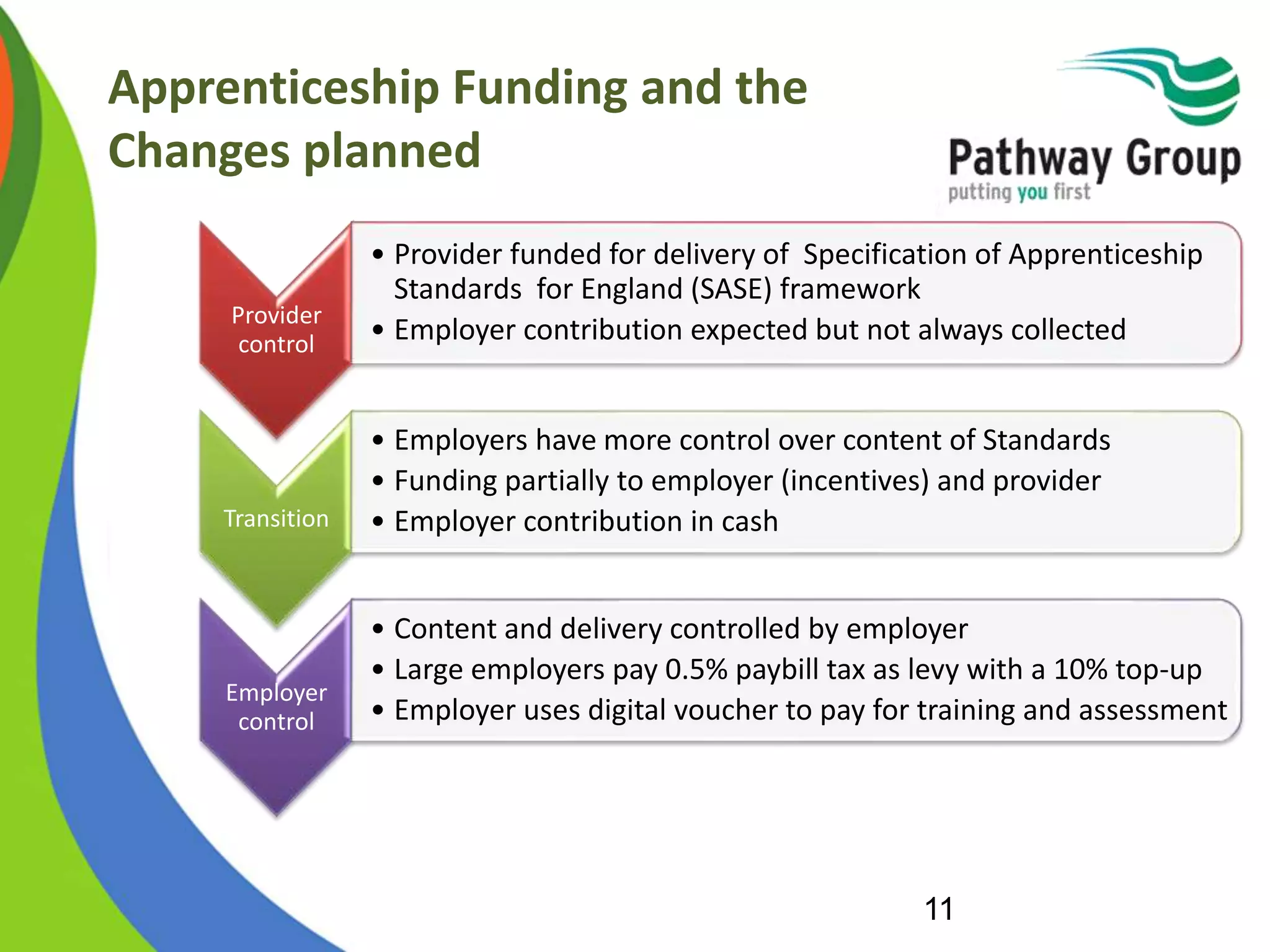
Apprenticeship Funding and the
Changes planned
Provider
control
• Provider funded for delivery of Specification of Apprenticeship
Standards for England (SASE) framework
• Employer contribution expected but not always collected
Transition
• Employers have more control over content of Standards
• Funding partially to employer (incentives) and provider
• Employer contribution in cash
Employer
control
• Content and delivery controlled by employer
• Large employers pay 0.5% paybill tax as levy with a 10% top-up
• Employer uses digital voucher to pay for training and assessment
11
Current Position
Employer AGE Grants
Current Position
• AGE Grants
• Apprenticeship grant for employers of 16 to 24 year olds £1,500
• However,
• Employer have to employ fewer that 50 employees
• Is issued on a first-come, first-served basis within a training
organisation’s allocation of Grants
• You can only claim up to 5 Grants during the time the Grant is
available.
• commit to employ your apprentice(s) for a minimum of 12
months on the apprenticeship programme or the time it takes
them to complete their apprenticeship, whichever is the greater
Current Position
Employer Grants
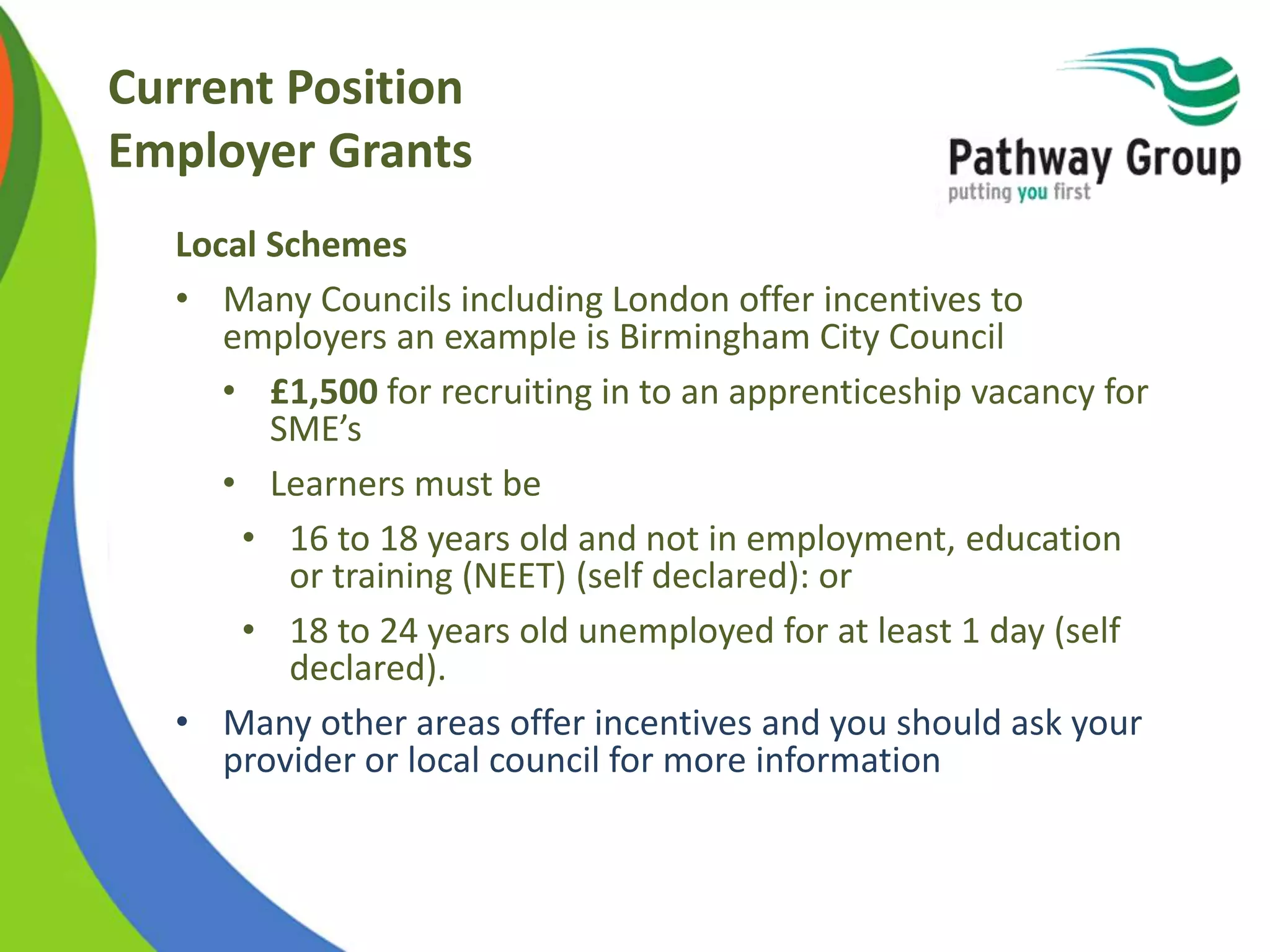
Local Schemes
• Many Councils including London offer incentives to
employers an example is Birmingham City Council
• £1,500 for recruiting in to an apprenticeship vacancy for
SME’s
• Learners must be
• 16 to 18 years old and not in employment, education
or training (NEET) (self declared): or
• 18 to 24 years old unemployed for at least 1 day (self
declared).
• Many other areas offer incentives and you should ask your
provider or local council for more information
• Choosing a Provider
• You will be committing to a business relationship lasting at least 12 Months
therefore like any other business transaction:
• Focus on Due Diligence
• Use Social media such as LinkedIn to investigate their staff
• High turnover of staff could indicate a problem
• Access Employer and Learner Voice - this is free to access and gives you
the views of both learners and employers views for a training provider
https://learnerview.ofsted.gov.uk/results
https://employerview.ofsted.gov.uk/results
• Do a credit check using a site such as Creditsafe – you need to know that
the training provider has a solid track record and is financially sustainable
• Ask for References from current employers they deal with
• Check Companies House – Directors backgrounds; have they been
involved in insolvent companies
• Choosing a Provider
• Ask for Performance Data you should also ask how this
compares to the national average for the subject area
• This is measured as the
• Success Rate and
• Timely Success Rate (how many learners achieved
their qualification within the timeframe of the
apprenticeships)
How will they delver the qualification how will this be
assessed and how this fits in to your business needs
Keep in Touch:
• https://uk.linkedin.com/in/safaraz
• https://www.linkedin.com/company/pathwaygroup
• https://www.facebook.com/pathwaygroup/
• @pathwaygroup @SafarazAli
Safaraz Ali (Saf)
Safaraz@pathwaygroup.co.uk
Telephone: 0121 707 0550

Apprenticeships changes staff update

  • 1.
    Apprenticeships now andthe proposed plans going forward
  • 2.
    Apprenticeships being Delivered Morethan half (55%) of all apprenticeship starts in 2014/15 were in two sectors: Business, Administration & Law and Health, Public service & Care. Including Retail & Commercial Enterprises, the top three sectors made up almost three-quarters (73%) of apprenticeship starts
  • 3.
    Key Facts • Therewere 499,900 apprenticeship starts in the 2014/15 academic year, 59,500 (14%) more than the previous year. • The Top 3 Frameworks being: • Health and Social Care 85,000 • Business Administration 49,000 • Management 43,000 • In 2014/15, 21,500 (4.3% of all starters) apprenticeship starters were Asian/Asian British; 17,200 (3.5%) were Black/African/Caribbean/Black British; and 10,900 (2.2%) were of mixed/multiple ethnic background.
  • 4.
    So What Nextfor Apprenticeships? The Government Requires The boosting our nation’s productivity to maintain and consolidate our economic recovery by: • Raising skill levels through apprenticeships – reaching 3 million starts in 2020. • That is equivalent to more than one apprentice every minute over the next four years • Putting employers in the driving seat of creating apprenticeships that fully meet their business needs. • This means we NEED to develop opportunities for Engaging Employers At Every Opportunity • Making sure that apprenticeships are open to all, with a 20% increase in BME apprentice starts in 2020. • Continue and Build on our BME • To increase sector coverage with an emphasis in Science, Technology, Engineering, and Mathematics (STEM) apprenticeships- this being reflected in their funding model
  • 5.
    WHY? Rationale forReforms Rationale for Reforms Employer Driven Employers designing apprenticeships to make them more responsive to their needs and the future economy, and controlling funding Simplicity Simplifying apprenticeship standards so that they are shorter and more accessible Quality Improving the quality of apprenticeships so that they are viewed with the same esteem as University
  • 6.
    Funding and deliverycomparison The way it is Now Proposed Plans Skills Funding Agency Training Organisation Learning / Assessment Awarding Body Employer Contribution (Levy) SME payment DAS/ Skills Funding Agency Employer Training Organisation This could be the Employer Awarding Body Assessment 20% of the Funding Learning 80% of the Funding to also include Awarding Body fees for any qualification within the new Standards Employer Pays LEVY to HMRC no mater if they access apprenticeships or not
  • 7.
    Funding Example -The way it is Now Skills Funding Agency Training Organisation Learning / Assessment Awarding Body Apprenticeship Business Administration Level 2 16-18 19-23 24+ Drawdown (Per Learner) Pearson Edexcel FS English Level 1 £776.35 £362.00 £289.60 Pearson Edexcel Functional Skills qualification in Mathematics at Level 1 £776.35 £362.00 £289.60 Pearson BTEC Level 2 Diploma in Business Administration (​QCF) £4,270.97 £1,991.50 £1,593.20 Drawdown £5,823.66 £2,715.50 £2,172.40 Total Drawdown (Inc. Avg Uplift of 10%) £6,406.03 £2,987.05 £2,389.64 Apprenticeship Customer Service Level 2 16-18 19-23 24+ Drawdown (Per Learner) Pearson Edexcel FS English Level 1 £776.35 £362.00 £289.60 Pearson Edexcel Functional Skills qualification in Mathematics at Level 1 £776.35 £362.00 £289.60 Pearson BTEC Level 2 Diploma in Customer Service (​QCF) £3,594.35 £1,676.00 £1,340.80 Drawdown £5,147.04 £2,400.00 £1,920.00 Total Drawdown (Inc. Avg Uplift of 10%) £5,661.74 £2,640.00 £2,112.00 Funding Drown Down by the Provider from the Skills Funding Agency Awarding Body Registration and Certification Fee £175 Awarding Body Registration and Certification Fee £175 English Mathematics Main Learning Aim Area and Disadvantage Uplift Multipliers = Total Funding Drawn Down
  • 8.
    Funding Example Proposed Plans Employer Contribution(Levy) SME payment DAS/ Skills Funding Agency Employer Training Organisation This could be the Employer Awarding Body Learning £1,200 of the Funding to also include Awarding Body fees for the embedded qualification which is anticipated to be Circa £150 leaving £1,050 for Training Employer Pays LEVY to HMRC no mater if they access apprenticeships or not Learning £1,600 of the Funding to also include Awarding Body fees for the embedded qualification which is anticipated to be Circa £150 leaving £1,400 for Training End Point Assessment c£400 of the Funding (this will have to be paid out before you can draw down funding Customer Service Level 2 £1,500 there is no additional uplifts for learner age or being within London Note: Fees dependant on individual awarding body and assessment organisation fees End Point Assessment c£300 of the Funding (this will have to be paid out before you can draw down funding Administration Level 2 £2,000 there is no additional uplifts for learner age or being within London Maths and English Additional Funding Outside of employer contribution £471 for each Maths and English Additional Funding Outside of employer contribution £471 for each
  • 9.
    SME’s With LessThan a £3,000,000 Pay Bill • Employers with fewer than 50 People working for them will be able to train 16-18 year olds apprentices at no Cost. This will also include those 16-24 who were formally in care or who have a local Authority Education , Health and Care Plan Employer Contribution SME payment DAS/ Skills Funding Agency Employer Training Organisation This could be the Employer Awarding Body Employer Pays 10% of training Fee to the Provider The Provider Draws Down 90% of the funding from the Skills Funding Agency The Provider Pays for the End Point Assessment and delvers the training Example: Administration Band £2,000 Employer Pays £200+VAT Government Pays £1,800
  • 10.
    Funding Comparison The HardFacts Business Administration Level 2 How it is Now Post April 2017 English £475.98 £471.00 Maths £475.98 £471.00 Diploma in Administration £2,618.56 £2,000.00 Uplift (Average) £357.05 £0.00 Drawdown £3,927.57 £2,942.00 Loss of Funding £985.57 Income Reduction 25% Awarding Body Fee -£175.00 -£150.00 End Point Assessment £400.00 Left for Delivery of Training £4,102.57 £2,692.00 Loss of Funding Going into Training £1,410.57 Drop in Funding Available for Training (average) 34% Customer Service Level 2 How it is Now Post April 2017 English £475.98 £471.00 Maths £475.98 £471.00 Diploma in Customer Service £2,203.72 £1,500.00 Uplift (Average) £315.57 £0.00 Drawdown £3,471.25 £2,442.00 Loss of Funding £1,029.25 Income Reduction 30% Awarding Body Fee -£175.00 -£150.00 End Point Assessment £300.00 Left for Delivery of Training £3,646.25 £2,292.00 Loss of Funding Going into Training £1,354.25 Drop in Funding Available for Training (average) 37% For 16-18 year olds the position is worse however, this is offset by Employer and Training Providers each being paid £1,000 in the form off an age grant for this group (SMEs Only) . (Although we can not confirm all the eligibility criteria at this stage)
  • 11.
    Apprenticeship Funding andthe Changes planned Provider control • Provider funded for delivery of Specification of Apprenticeship Standards for England (SASE) framework • Employer contribution expected but not always collected Transition • Employers have more control over content of Standards • Funding partially to employer (incentives) and provider • Employer contribution in cash Employer control • Content and delivery controlled by employer • Large employers pay 0.5% paybill tax as levy with a 10% top-up • Employer uses digital voucher to pay for training and assessment 11
  • 12.
    Current Position Employer AGEGrants Current Position • AGE Grants • Apprenticeship grant for employers of 16 to 24 year olds £1,500 • However, • Employer have to employ fewer that 50 employees • Is issued on a first-come, first-served basis within a training organisation’s allocation of Grants • You can only claim up to 5 Grants during the time the Grant is available. • commit to employ your apprentice(s) for a minimum of 12 months on the apprenticeship programme or the time it takes them to complete their apprenticeship, whichever is the greater
  • 13.
    Current Position Employer Grants LocalSchemes • Many Councils including London offer incentives to employers an example is Birmingham City Council • £1,500 for recruiting in to an apprenticeship vacancy for SME’s • Learners must be • 16 to 18 years old and not in employment, education or training (NEET) (self declared): or • 18 to 24 years old unemployed for at least 1 day (self declared). • Many other areas offer incentives and you should ask your provider or local council for more information
  • 14.
    • Choosing aProvider • You will be committing to a business relationship lasting at least 12 Months therefore like any other business transaction: • Focus on Due Diligence • Use Social media such as LinkedIn to investigate their staff • High turnover of staff could indicate a problem • Access Employer and Learner Voice - this is free to access and gives you the views of both learners and employers views for a training provider https://learnerview.ofsted.gov.uk/results https://employerview.ofsted.gov.uk/results • Do a credit check using a site such as Creditsafe – you need to know that the training provider has a solid track record and is financially sustainable • Ask for References from current employers they deal with • Check Companies House – Directors backgrounds; have they been involved in insolvent companies
  • 15.
    • Choosing aProvider • Ask for Performance Data you should also ask how this compares to the national average for the subject area • This is measured as the • Success Rate and • Timely Success Rate (how many learners achieved their qualification within the timeframe of the apprenticeships) How will they delver the qualification how will this be assessed and how this fits in to your business needs
  • 16.
    Keep in Touch: •https://uk.linkedin.com/in/safaraz • https://www.linkedin.com/company/pathwaygroup • https://www.facebook.com/pathwaygroup/ • @pathwaygroup @SafarazAli Safaraz Ali (Saf) Safaraz@pathwaygroup.co.uk Telephone: 0121 707 0550

Editor's Notes

  • #6 To ensure apprenticeships are more rigorous and responsive to the needs of employers following Richard Review. The Reform programme is set out in The Future of Apprenticeships in England; Implementation Plan, published in October 2013. The main aims: Put employers in the driving seat. Apprenticeships will be based on standards designed by employers. Increase the quality of apprenticeships. An apprentice will need to demonstrate their competence through rigorous and synoptic assessment. This will focus on the end of the apprenticeship to ensure that the apprentice is ready to progress. Simplify the system. The new employer-designed standards will be short and easy to understand. They will describe the skills and knowledge that an individual needs to be fully competent in an occupation.