21CE210- Hydraulics and
Hydraulic machinery
Unit-1
Uniform flow
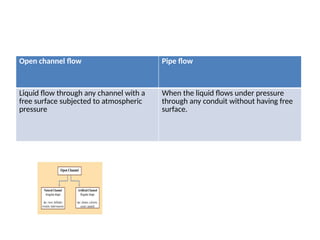
Open channel flow Pipe flow
Liquid flow through any channel with a
free surface subjected to atmospheric
pressure
When the liquid flows under pressure
through any conduit without having free
surface.
Types of Flows
1. Steady and Unsteady Flow
2. Uniform and Non-uniform Flow
3. Laminar and Turbulent Flow
4. Sub-critical, Critical and Super-critical
Flow
1. Steady and Unsteady Flow
Steady flow happens if the conditions (flow
rate, velocity, depth etc) do not change with time.
The flow is unsteady if the depth is changes
with time
2. Uniform and Non-uniform
Flow
If for a given length of channel, the velocity of flow,
depth of flow, slope of the channel and cross section
remain constant, the flow is said to be Uniform
The flow is Non-uniform, if velocity, depth, slope and
cross section is not constant
2. Non-uniform Flow
• 1. Steady and Unsteady Flow
• 2. Uniform and Non-uniform Flow
Types of Non-uniform Flow
1. Gradually Varied Flow (GVF)
If the depth of the flow in a channel changes gradually over a
length of the channel.
2. Rapidly Varied Flow (RVF)
If the depth of the flow in a channel changes abruptly over a
small length of channel
3. Laminar and Turbulent
Flow
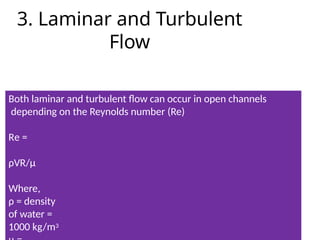
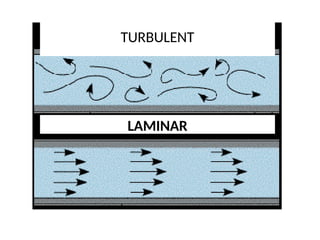
Both laminar and turbulent flow can occur in open channels
depending on the Reynolds number (Re)
Re =
ρVR/µ
Where,
ρ = density
of water =
1000 kg/m3
TURBULENT
LAMINAR
Properties of open channel
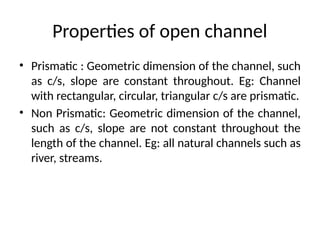
• Prismatic : Geometric dimension of the channel, such
as c/s, slope are constant throughout. Eg: Channel
with rectangular, circular, triangular c/s are prismatic.
• Non Prismatic: Geometric dimension of the channel,
such as c/s, slope are not constant throughout the
length of the channel. Eg: all natural channels such as
river, streams.
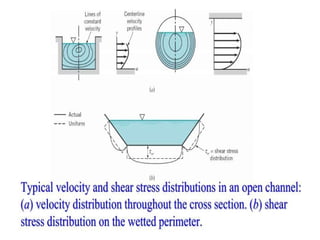
Velocity Distribution
Velocity is always vary across
channel because of friction along the
boundary
The maximum velocity usually found
just below the surface
Velocity Distribution
Velocity is always vary across
channel because of friction along the
boundary
The maximum velocity usually found
just below the surface
Discharge through Open Channels
1. Chezy’s C
2. Manning’s N
3. Bazin’s Formula
4. Kutter’s
Formula
Discharge through Open Channels
1. Chezy’s C
2. Manning’s N
3. Bazin’s Formula
4. Kutter’s Formula
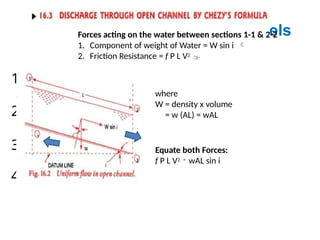
Forces acting on the water between sections 1-1 & 2-2
1. Component of weight of Water = W sin i 
2. Friction Resistance = f P L V2 
where
W = density x volume
= w (AL) = wAL
Equate both Forces:
f P L V2 = wAL sin i
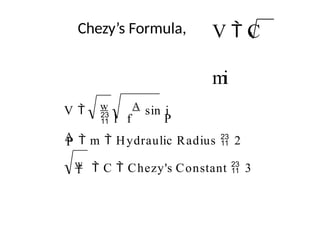
Chezy’s Formula, V  C
m
i
f
w  C  Chezy's Constant  3
P
A  m  Hydraulic Radius  2
V  w A sin i
 1 f P
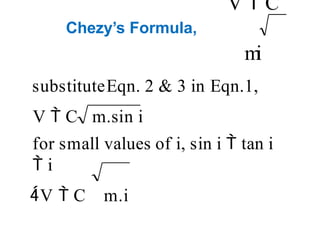
Chezy’s Formula,
V  C
m
i
substituteEqn. 2 & 3 in Eqn.1,
V  C m.sin i
for small values of i, sin i  tan i
 i
V  C m.i
1. Manning’s
N
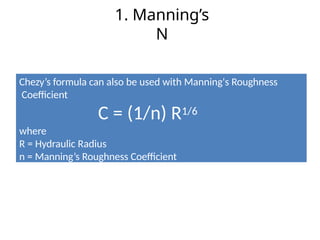
Chezy’s formula can also be used with Manning's Roughness
Coefficient
C = (1/n) R1/6
where
R = Hydraulic Radius
n = Manning’s Roughness Coefficient
Most Economical Sections
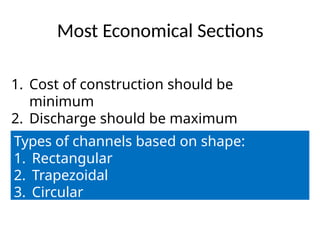
1. Cost of construction should be
minimum
2. Discharge should be maximum
Types of channels based on shape:
1. Rectangular
2. Trapezoidal
3. Circular
Wide open channel
• Channel with large aspect ratio (breadth/depth)
is wide open channel.
• If the breadth of the channel is greater than the
flow depth by 10 times of the channel is wide
channel.
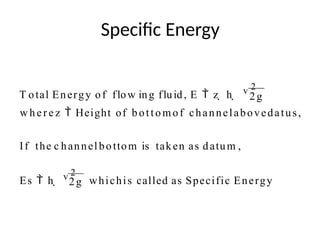
Specific Energy
2g
If the c hannelbottom is taken as datum ,
Es  h  v 2
whichis called as Specific Energy
2g
whe rez  Height of bottomof channelabovedatus,
T otal Energy of flow ing fluid, E  z  h  v 2
Specific force
• Specific force is the sum of the pressure force
and momentum force due to the flow per unit
weight of the liquid at a section.
Critical flow
• It is defined as the flow at which the specific
energy is minimum or the flow corresponding
to the critical depth (depth of flow at which
the specific energy is minimum).
Unit 2
GRADUALLY VARIED FLOW
Dynamic equation of GVF
1. The channel is prismatic and the flow is steady.
2. The bed slope, So, is relatively small.
3. The velocity distribution in the vertical section is uniform and the
kinetic energy correction factor is close to unity.
4. Streamlines are parallel and the pressure distribution is
hydrostatic.
5. The channel roughness is constant along its length and does not
depend on the depth of flow.
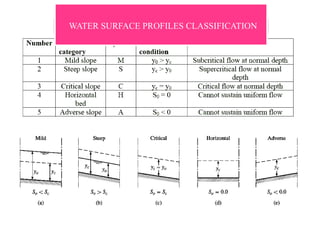
WATER SURFACE PROFILES CLASSIFICATION
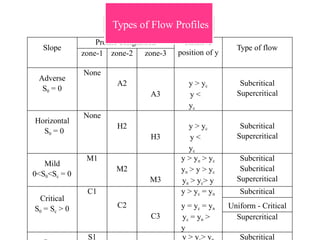
Slope
Profile designation Relative
position of y
Type of flow
zone-1 zone-2 zone-3
Adverse
S0 = 0
None
A2
A3
y > yc
y <
yc
Subcritical
Supercritical
Horizontal
S0 = 0
None
H2
H3
y > yc
y <
yc
Subcritical
Supercritical
Mild
0<S0<Sc = 0
M1
M2
M3
y > yn > yc
yn > y > yc
yn > yc> y
Subcritical
Subcritical
Supercritical
Critical
S0 = Sc > 0
C1
C2
C3
y > yc = yn
y = yc = yn
yc = yn >
y
Subcritical
Uniform - Critical
Supercritical
S1 y > y > y Subcritical
Types of Flow Profiles
METHODS OF SOLUTIONS OF THE GRADUALLY VARIED FLOW
1. Direct Integration
2. Graphical Integration
3. Numerical Integration
i. The direct step method (distance from depth
for regular channels)
ii. The standard step method, regular
channels (distance from depth for regular
channels)
iii. The standard step method, natural
channels (distance from depth for natural
channels)
Control section
• A section in which a fixed relationship exists
between the discharge and the depth of flow.
• Weirs, spillways, sluice gate are some eg of
structure which give rise to control scetions.
Break in grade
• Simple situations of a series of combination of
two channel section with different bed slopes
are considered, such as mild to milder, steep
to steeper, milder to mild, steeper to steep,
steep to mild, mild to steep and hz to steep.
Applied hydraulics and airport engineering notes

  • 1.
    21CE210- Hydraulics and Hydraulicmachinery Unit-1 Uniform flow
  • 2.
    Open channel flowPipe flow Liquid flow through any channel with a free surface subjected to atmospheric pressure When the liquid flows under pressure through any conduit without having free surface.
  • 3.
    Types of Flows 1.Steady and Unsteady Flow 2. Uniform and Non-uniform Flow 3. Laminar and Turbulent Flow 4. Sub-critical, Critical and Super-critical Flow
  • 4.
    1. Steady andUnsteady Flow Steady flow happens if the conditions (flow rate, velocity, depth etc) do not change with time. The flow is unsteady if the depth is changes with time
  • 5.
    2. Uniform andNon-uniform Flow If for a given length of channel, the velocity of flow, depth of flow, slope of the channel and cross section remain constant, the flow is said to be Uniform The flow is Non-uniform, if velocity, depth, slope and cross section is not constant
  • 6.
    2. Non-uniform Flow •1. Steady and Unsteady Flow • 2. Uniform and Non-uniform Flow Types of Non-uniform Flow 1. Gradually Varied Flow (GVF) If the depth of the flow in a channel changes gradually over a length of the channel. 2. Rapidly Varied Flow (RVF) If the depth of the flow in a channel changes abruptly over a small length of channel
  • 7.
    3. Laminar andTurbulent Flow Both laminar and turbulent flow can occur in open channels depending on the Reynolds number (Re) Re = ρVR/µ Where, ρ = density of water = 1000 kg/m3
  • 8.
  • 9.
    Properties of openchannel • Prismatic : Geometric dimension of the channel, such as c/s, slope are constant throughout. Eg: Channel with rectangular, circular, triangular c/s are prismatic. • Non Prismatic: Geometric dimension of the channel, such as c/s, slope are not constant throughout the length of the channel. Eg: all natural channels such as river, streams.
  • 10.
    Velocity Distribution Velocity isalways vary across channel because of friction along the boundary The maximum velocity usually found just below the surface
  • 11.
    Velocity Distribution Velocity isalways vary across channel because of friction along the boundary The maximum velocity usually found just below the surface
  • 12.
    Discharge through OpenChannels 1. Chezy’s C 2. Manning’s N 3. Bazin’s Formula 4. Kutter’s Formula
  • 13.
    Discharge through OpenChannels 1. Chezy’s C 2. Manning’s N 3. Bazin’s Formula 4. Kutter’s Formula Forces acting on the water between sections 1-1 & 2-2 1. Component of weight of Water = W sin i  2. Friction Resistance = f P L V2  where W = density x volume = w (AL) = wAL Equate both Forces: f P L V2 = wAL sin i
  • 14.
    Chezy’s Formula, V C m i f w  C  Chezy's Constant  3 P A  m  Hydraulic Radius  2 V  w A sin i  1 f P
  • 15.
    Chezy’s Formula, V C m i substituteEqn. 2 & 3 in Eqn.1, V  C m.sin i for small values of i, sin i  tan i  i V  C m.i
  • 16.
    1. Manning’s N Chezy’s formulacan also be used with Manning's Roughness Coefficient C = (1/n) R1/6 where R = Hydraulic Radius n = Manning’s Roughness Coefficient
  • 17.
    Most Economical Sections 1.Cost of construction should be minimum 2. Discharge should be maximum Types of channels based on shape: 1. Rectangular 2. Trapezoidal 3. Circular
  • 18.
    Wide open channel •Channel with large aspect ratio (breadth/depth) is wide open channel. • If the breadth of the channel is greater than the flow depth by 10 times of the channel is wide channel.
  • 19.
    Specific Energy 2g If thec hannelbottom is taken as datum , Es  h  v 2 whichis called as Specific Energy 2g whe rez  Height of bottomof channelabovedatus, T otal Energy of flow ing fluid, E  z  h  v 2
  • 20.
    Specific force • Specificforce is the sum of the pressure force and momentum force due to the flow per unit weight of the liquid at a section.
  • 21.
    Critical flow • Itis defined as the flow at which the specific energy is minimum or the flow corresponding to the critical depth (depth of flow at which the specific energy is minimum).
  • 22.
  • 23.
    Dynamic equation ofGVF 1. The channel is prismatic and the flow is steady. 2. The bed slope, So, is relatively small. 3. The velocity distribution in the vertical section is uniform and the kinetic energy correction factor is close to unity. 4. Streamlines are parallel and the pressure distribution is hydrostatic. 5. The channel roughness is constant along its length and does not depend on the depth of flow.
  • 24.
    WATER SURFACE PROFILESCLASSIFICATION
  • 25.
    Slope Profile designation Relative positionof y Type of flow zone-1 zone-2 zone-3 Adverse S0 = 0 None A2 A3 y > yc y < yc Subcritical Supercritical Horizontal S0 = 0 None H2 H3 y > yc y < yc Subcritical Supercritical Mild 0<S0<Sc = 0 M1 M2 M3 y > yn > yc yn > y > yc yn > yc> y Subcritical Subcritical Supercritical Critical S0 = Sc > 0 C1 C2 C3 y > yc = yn y = yc = yn yc = yn > y Subcritical Uniform - Critical Supercritical S1 y > y > y Subcritical Types of Flow Profiles
  • 26.
    METHODS OF SOLUTIONSOF THE GRADUALLY VARIED FLOW 1. Direct Integration 2. Graphical Integration 3. Numerical Integration i. The direct step method (distance from depth for regular channels) ii. The standard step method, regular channels (distance from depth for regular channels) iii. The standard step method, natural channels (distance from depth for natural channels)
  • 27.
    Control section • Asection in which a fixed relationship exists between the discharge and the depth of flow. • Weirs, spillways, sluice gate are some eg of structure which give rise to control scetions.
  • 28.
    Break in grade •Simple situations of a series of combination of two channel section with different bed slopes are considered, such as mild to milder, steep to steeper, milder to mild, steeper to steep, steep to mild, mild to steep and hz to steep.