APPENDICULAR SKELETON
Prepared By:
Miss.Renuka Sunagad
Assistant Professor,
Department of Pharmacology
BLDEA’s SSM College of Pharmacy &
Research Centre Vijayapur-586103
APPENDICULAR SKELETON
• The appendicular skeleton consist of:
• 126 bones
Allows us to move and manipulate objects
Includes all bones besides axial skeleton
• The limbs
• The supportive girdles
Pectorial girdle with the upper limbs and the
Pelvic girdle with lower limb.
Pectorial Girdle
The human body has two pectorial girdles that
attach the bones of the upper limbs to the axial
skeleton
• 2 Scapula[Shoulder blade]
• 2 Clavicle[Collar bone]
Scapula
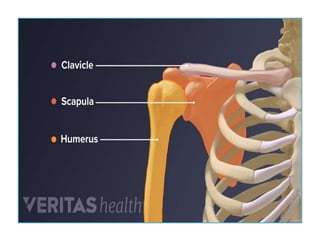
• It is a large,irregular and triangular flat bone
overlapping the posterior part of transverse
process from 2nd to 7th vertebra of thorax
region.
• It acts as a point of attachment for various
muscles which from the connecting link
between the trunk and the upper limb.
• Also called the shoulder girdle.
Clavicle
• The clavicle is an S-shaped subcutanious bone
having a long and narrow structure.
• It is present on both the sides of neck and
connects the upper limbs with the trunk just above
the first pairs of ribs.
• The inner and outer end of the clavicle articulate
with the superior end of sternum.
• There is no medullary cavity in the clavicle bone
the inner surface of the lateral end shows an
elevation known as conoid tubercle and ridge
known as trapezoid ridge.
Functions of Pectorial Girdle
• Support and Suspension:It acts as a support as
well as a suspension system for the upper
extremities.
• Shock Absorber:It acts as a shock absorber of the
body during the acts like jumping or leaping.
• Maintainance:It maintaince the shape of the
thorax and provides space for the insertion of
muscles of the back.
• Locomotor Movement:It forms the site of
attachment for musclesof the upperlimb and helps
in their locomotive actions.
Structure and functions of upper
limb
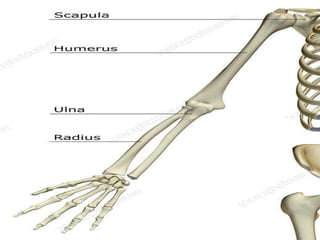
• Upper limb consists of 30 bones which are
devided into:
• Humerus or Arm bone
• Ulna and Radius
• Carpals and metacarpals
• Phalanges
Humerus or Arm bone
• It is the longest bone of the forelimb.
• The head of the humerus articulates within the
glenoid cavity of the scapuls.
• It is joined with radius and ulna at the elbow
joint.
• This bone enables the upper extremity to
perform physical activities like pull,push,lift
and rotation of the objects within the arm’s
length.
Ulna and Radius
• These bones together form the bones of the
forearm
• Ulna:It forms the medial bone of the forelimb.
• It consists of the fallowing notches and processes:
• Olecranon process
• Coronoid process
• Radial notch
• Trochlear notch
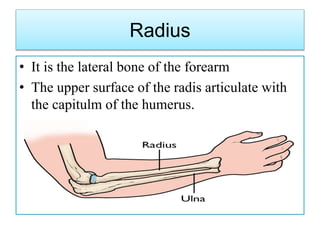
Radius
• It is the lateral bone of the forearm
• The upper surface of the radis articulate with
the capitulm of the humerus.
Carpals and metacarpals
• 8 irregularly shaped bones known as carpals
are arranged in proximal and distal rows.
• The proximal carpals include
scaphoid,lunate,triquetral and pisiform.
• The distal carpals include
trapezium,trapezoid,capitate and hamate.
• There are 5 metacarpals which are numbered
from lateral to the medial side and have the
head,shaft and the base.
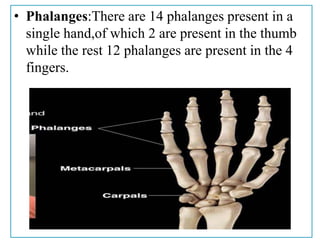
• Phalanges:There are 14 phalanges present in a
single hand,of which 2 are present in the thumb
while the rest 12 phalanges are present in the 4
fingers.
Structure & functions of pelvic
girdle
• Pelvic girlde is an irregular,arch shaped
structure made up of coxae or innominate
bones.
• The arch of the pelvic girdle is articulated by a
highly flexible structure called symphysis
pubis.
• The sacrum and coccyx complete this arch
behind forming a ring like structure called
pelvis.
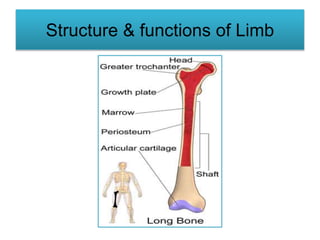
Structure & functions of Limb
Appendicular SkeletonSystem PPT.....pptx

Appendicular SkeletonSystem PPT.....pptx

  • 1.
    APPENDICULAR SKELETON Prepared By: Miss.RenukaSunagad Assistant Professor, Department of Pharmacology BLDEA’s SSM College of Pharmacy & Research Centre Vijayapur-586103
  • 2.
    APPENDICULAR SKELETON • Theappendicular skeleton consist of: • 126 bones Allows us to move and manipulate objects Includes all bones besides axial skeleton • The limbs • The supportive girdles Pectorial girdle with the upper limbs and the Pelvic girdle with lower limb.
  • 3.
    Pectorial Girdle The humanbody has two pectorial girdles that attach the bones of the upper limbs to the axial skeleton • 2 Scapula[Shoulder blade] • 2 Clavicle[Collar bone]
  • 4.
    Scapula • It isa large,irregular and triangular flat bone overlapping the posterior part of transverse process from 2nd to 7th vertebra of thorax region. • It acts as a point of attachment for various muscles which from the connecting link between the trunk and the upper limb. • Also called the shoulder girdle.
  • 6.
    Clavicle • The clavicleis an S-shaped subcutanious bone having a long and narrow structure. • It is present on both the sides of neck and connects the upper limbs with the trunk just above the first pairs of ribs. • The inner and outer end of the clavicle articulate with the superior end of sternum. • There is no medullary cavity in the clavicle bone the inner surface of the lateral end shows an elevation known as conoid tubercle and ridge known as trapezoid ridge.
  • 7.
    Functions of PectorialGirdle • Support and Suspension:It acts as a support as well as a suspension system for the upper extremities. • Shock Absorber:It acts as a shock absorber of the body during the acts like jumping or leaping. • Maintainance:It maintaince the shape of the thorax and provides space for the insertion of muscles of the back. • Locomotor Movement:It forms the site of attachment for musclesof the upperlimb and helps in their locomotive actions.
  • 8.
    Structure and functionsof upper limb • Upper limb consists of 30 bones which are devided into: • Humerus or Arm bone • Ulna and Radius • Carpals and metacarpals • Phalanges
  • 9.
    Humerus or Armbone • It is the longest bone of the forelimb. • The head of the humerus articulates within the glenoid cavity of the scapuls. • It is joined with radius and ulna at the elbow joint. • This bone enables the upper extremity to perform physical activities like pull,push,lift and rotation of the objects within the arm’s length.
  • 11.
    Ulna and Radius •These bones together form the bones of the forearm • Ulna:It forms the medial bone of the forelimb. • It consists of the fallowing notches and processes: • Olecranon process • Coronoid process • Radial notch • Trochlear notch
  • 12.
    Radius • It isthe lateral bone of the forearm • The upper surface of the radis articulate with the capitulm of the humerus.
  • 13.
    Carpals and metacarpals •8 irregularly shaped bones known as carpals are arranged in proximal and distal rows. • The proximal carpals include scaphoid,lunate,triquetral and pisiform. • The distal carpals include trapezium,trapezoid,capitate and hamate. • There are 5 metacarpals which are numbered from lateral to the medial side and have the head,shaft and the base.
  • 14.
    • Phalanges:There are14 phalanges present in a single hand,of which 2 are present in the thumb while the rest 12 phalanges are present in the 4 fingers.
  • 15.
    Structure & functionsof pelvic girdle • Pelvic girlde is an irregular,arch shaped structure made up of coxae or innominate bones. • The arch of the pelvic girdle is articulated by a highly flexible structure called symphysis pubis. • The sacrum and coccyx complete this arch behind forming a ring like structure called pelvis.
  • 16.