AGILE PLANNING
PROCESS
John Derrico
www.linkedin.com/in/johnaderrico
Scope and Questions on Agile
 Planning
                      • At the end of this presentation you
Agile and Waterfall
                       will be able to answer these
Agile Framework        questions about Agile Planning:
                        • Where is the planning executed?
Release Planning        • Who is part of the planning?
                        • When is the planning executed? (E.g. 1
Sprint Planning           time?)
                        • How is the planning performed?
                        • What is required for the planning
                          meetings and what is expected as an
                          outcome from the meetings?
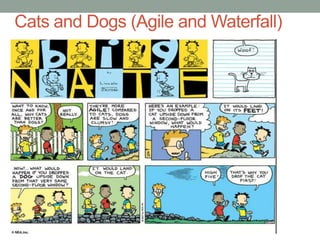
Cats and Dogs (Agile and Waterfall)
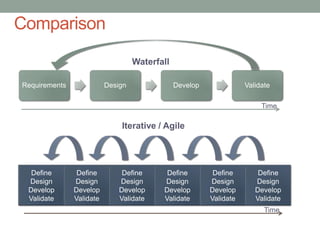
Comparison
                                   Waterfall

Requirements              Design               Develop              Validate

                                                                         Time

                              Iterative / Agile


  Define        Define         Define      Define         Define        Define
 Design        Design         Design      Design         Design        Design
 Develop       Develop        Develop     Develop        Develop       Develop
 Validate      Validate       Validate    Validate       Validate      Validate
                                                                          Time
                                                                                  4
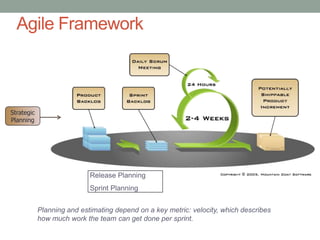
Agile Framework


Strategic
Planning


                            Release Planning
                            Sprint Planning


            Planning and estimating depend on a key metric: velocity, which describes
            how much work the team can get done per sprint.

                                                                                        5
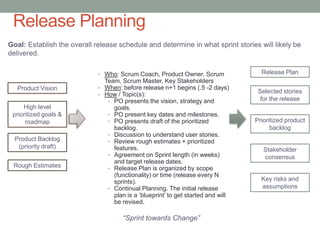
Release Planning
Goal: Establish the overall release schedule and determine in what sprint stories will likely be
delivered.

                             • Who: Scrum Coach, Product Owner, Scrum               Release Plan
                               Team, Scrum Master, Key Stakeholders
   Product Vision            • When: before release n+1 begins (.5 -2 days)
                             • How / Topic(s):
                                                                                   Selected stories
                                • PO presents the vision, strategy and              for the release
     High level                   goals.
 prioritized goals &            • PO present key dates and milestones.
      roadmap                   • PO presents draft of the prioritized            Prioritized product
                                  backlog.                                              backlog
                                • Discussion to understand user stories.
  Product Backlog               • Review rough estimates + prioritized
   (priority draft)               features.                                          Stakeholder
                                • Agreement on Sprint length (in weeks)              consensus
                                  and target release dates.
 Rough Estimates                • Release Plan is organized by scope
                                  (functionality) or time (release every N
                                  sprints).                                         Key risks and
                                • Continual Planning. The initial release           assumptions
                                  plan is a ‘blueprint’ to get started and will
                                  be revised.

                                      “Sprint towards Change”

                                                                                                        6
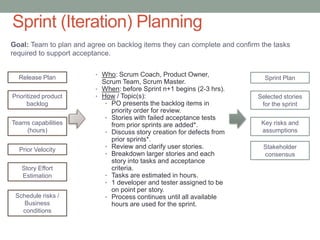
Sprint (Iteration) Planning
Goal: Team to plan and agree on backlog items they can complete and confirm the tasks
required to support acceptance.

                         • Who: Scrum Coach, Product Owner,
  Release Plan                                                               Sprint Plan
                           Scrum Team, Scrum Master.
                         • When: before Sprint n+1 begins (2-3 hrs).
Prioritized product      • How / Topic(s):                                 Selected stories
      backlog               • PO presents the backlog items in              for the sprint
                              priority order for review.
                            • Stories with failed acceptance tests
Teams capabilities            from prior sprints are added*.                Key risks and
    (hours)                 • Discuss story creation for defects from       assumptions
                              prior sprints*.
  Prior Velocity            • Review and clarify user stories.              Stakeholder
                            • Breakdown larger stories and each             consensus
                              story into tasks and acceptance
   Story Effort               criteria.
   Estimation               • Tasks are estimated in hours.
                            • 1 developer and tester assigned to be
                              on point per story.
 Schedule risks /           • Process continues until all available
    Business                  hours are used for the sprint.
   conditions


                                                                                              7
Note on Experience Challenges
 Problem: The team does not have past experience of Sprint planning,
 capacity is not known and story points may be inaccurate.
 Over time estimation of capacity and story sizing will improve.


Tactics, look at variation:
 Determine the Sprint variation (Estimated Capacity in Story Points Vs.. Actual Completed
  Story Points) at the end of each sprint.

 Determine Story Point variation for each story (No of hours expected Vs.. No of Hours
  used to complete).


                                                                                             8
Agile Planning Recap
For both Release and Sprint planning sessions we addressed
• Where in the framework the planning is executed.
• Who is part of the planning sessions.
• When the planning sessions are executed.
• How is the planning performed.
• What is required for the planning session and what is expected as an
outcome.


                                                                         9

Understanding the Agile Release and Sprint Planning Process

  • 1.
  • 2.
    Scope and Questionson Agile Planning • At the end of this presentation you Agile and Waterfall will be able to answer these Agile Framework questions about Agile Planning: • Where is the planning executed? Release Planning • Who is part of the planning? • When is the planning executed? (E.g. 1 Sprint Planning time?) • How is the planning performed? • What is required for the planning meetings and what is expected as an outcome from the meetings?
  • 3.
    Cats and Dogs(Agile and Waterfall)
  • 4.
    Comparison Waterfall Requirements Design Develop Validate Time Iterative / Agile Define Define Define Define Define Define Design Design Design Design Design Design Develop Develop Develop Develop Develop Develop Validate Validate Validate Validate Validate Validate Time 4
  • 5.
    Agile Framework Strategic Planning Release Planning Sprint Planning Planning and estimating depend on a key metric: velocity, which describes how much work the team can get done per sprint. 5
  • 6.
    Release Planning Goal: Establishthe overall release schedule and determine in what sprint stories will likely be delivered. • Who: Scrum Coach, Product Owner, Scrum Release Plan Team, Scrum Master, Key Stakeholders Product Vision • When: before release n+1 begins (.5 -2 days) • How / Topic(s): Selected stories • PO presents the vision, strategy and for the release High level goals. prioritized goals & • PO present key dates and milestones. roadmap • PO presents draft of the prioritized Prioritized product backlog. backlog • Discussion to understand user stories. Product Backlog • Review rough estimates + prioritized (priority draft) features. Stakeholder • Agreement on Sprint length (in weeks) consensus and target release dates. Rough Estimates • Release Plan is organized by scope (functionality) or time (release every N sprints). Key risks and • Continual Planning. The initial release assumptions plan is a ‘blueprint’ to get started and will be revised. “Sprint towards Change” 6
  • 7.
    Sprint (Iteration) Planning Goal:Team to plan and agree on backlog items they can complete and confirm the tasks required to support acceptance. • Who: Scrum Coach, Product Owner, Release Plan Sprint Plan Scrum Team, Scrum Master. • When: before Sprint n+1 begins (2-3 hrs). Prioritized product • How / Topic(s): Selected stories backlog • PO presents the backlog items in for the sprint priority order for review. • Stories with failed acceptance tests Teams capabilities from prior sprints are added*. Key risks and (hours) • Discuss story creation for defects from assumptions prior sprints*. Prior Velocity • Review and clarify user stories. Stakeholder • Breakdown larger stories and each consensus story into tasks and acceptance Story Effort criteria. Estimation • Tasks are estimated in hours. • 1 developer and tester assigned to be on point per story. Schedule risks / • Process continues until all available Business hours are used for the sprint. conditions 7
  • 8.
    Note on ExperienceChallenges Problem: The team does not have past experience of Sprint planning, capacity is not known and story points may be inaccurate. Over time estimation of capacity and story sizing will improve. Tactics, look at variation:  Determine the Sprint variation (Estimated Capacity in Story Points Vs.. Actual Completed Story Points) at the end of each sprint.  Determine Story Point variation for each story (No of hours expected Vs.. No of Hours used to complete). 8
  • 9.
    Agile Planning Recap Forboth Release and Sprint planning sessions we addressed • Where in the framework the planning is executed. • Who is part of the planning sessions. • When the planning sessions are executed. • How is the planning performed. • What is required for the planning session and what is expected as an outcome. 9

Editor's Notes

  • #9 Variation is expected … Importance of the retrospective