
Uploaded byILRI
Promoting agro-enterprises in the Highlands of Ethiopia through improved institutional support services: Experiences of market-oriented dairy and fattening development
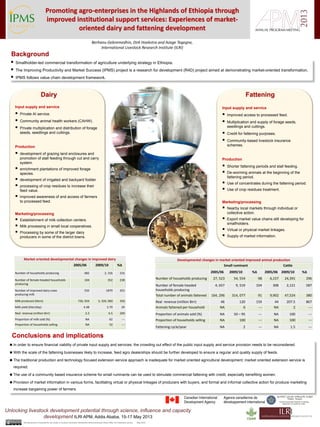
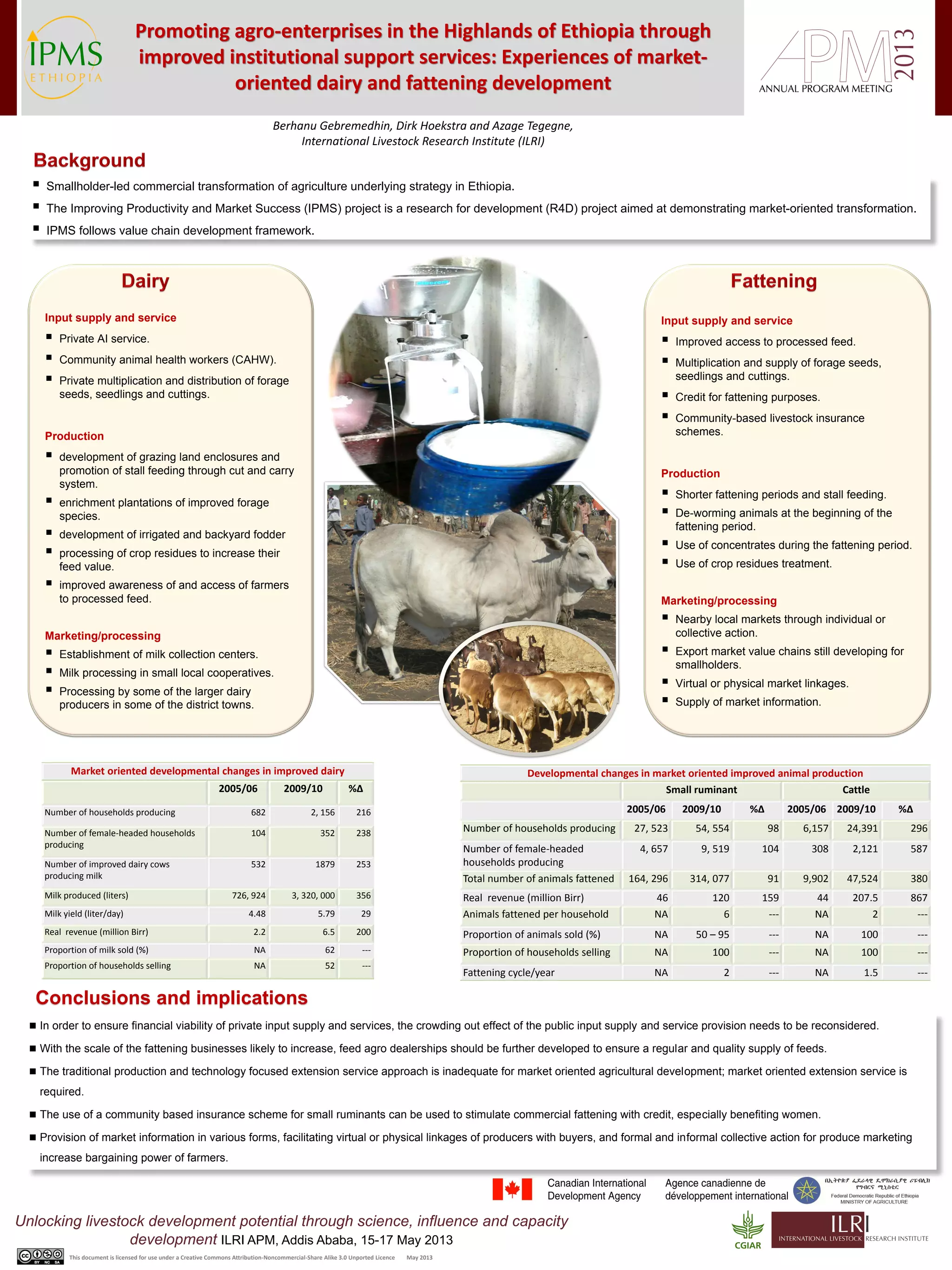
The document discusses the development of agro-enterprises in Ethiopia's highlands through improved access to input supplies, enhanced livestock production, and better marketing strategies. It highlights significant increases in dairy and fattening production among households, especially female-headed ones, as well as the need for market-oriented extension services and community-based livestock insurance. Key findings include improved productivity, revenue growth, and the importance of market information and linkages for smallholder farmers.
More Related Content


Similar to Promoting agro-enterprises in the Highlands of Ethiopia through improved institutional support services: Experiences of market-oriented dairy and fattening development


Promoting agro-enterprises in the Highlands of Ethiopia through improved institutional support services: Experiences of market-oriented dairy and fattening development
- 1. Input supply andservice Improved access to processed feed. Multiplication and supply of forage seeds, seedlings and cuttings. Credit for fattening purposes. Community-based livestock insurance schemes. Production Shorter fattening periods and stall feeding. De-worming animals at the beginning of the fattening period. Use of concentrates during the fattening period. Use of crop residues treatment. Marketing/processing Nearby local markets through individual or collective action. Export market value chains still developing for smallholders. Virtual or physical market linkages. Supply of market information. Unlocking livestock development potential through science, influence and capacity development ILRI APM, Addis Ababa, 15-17 May 2013 Promoting agro-enterprises in the Highlands of Ethiopia through improved institutional support services: Experiences of market- oriented dairy and fattening development This document is licensed for use under a Creative Commons Attribution-Noncommercial-Share Alike 3.0 Unported Licence May 2013 Berhanu Gebremedhin, Dirk Hoekstra and Azage Tegegne, International Livestock Research Institute (ILRI) Smallholder-led commercial transformation of agriculture underlying strategy in Ethiopia. The Improving Productivity and Market Success (IPMS) project is a research for development (R4D) project aimed at demonstrating market-oriented transformation. IPMS follows value chain development framework. Market oriented developmental changes in improved dairy 2005/06 2009/10 %∆ Number of households producing 682 2, 156 216 Number of female-headed households producing 104 352 238 Number of improved dairy cows producing milk 532 1879 253 Milk produced (liters) 726, 924 3, 320, 000 356 Milk yield (liter/day) 4.48 5.79 29 Real revenue (million Birr) 2.2 6.5 200 Proportion of milk sold (%) NA 62 --- Proportion of households selling NA 52 --- In order to ensure financial viability of private input supply and services, the crowding out effect of the public input supply and service provision needs to be reconsidered. With the scale of the fattening businesses likely to increase, feed agro dealerships should be further developed to ensure a regular and quality supply of feeds. The traditional production and technology focused extension service approach is inadequate for market oriented agricultural development; market oriented extension service is required. The use of a community based insurance scheme for small ruminants can be used to stimulate commercial fattening with credit, especially benefiting women. Provision of market information in various forms, facilitating virtual or physical linkages of producers with buyers, and formal and informal collective action for produce marketing increase bargaining power of farmers. Conclusions and implications Input supply and service Private AI service. Community animal health workers (CAHW). Private multiplication and distribution of forage seeds, seedlings and cuttings. Production development of grazing land enclosures and promotion of stall feeding through cut and carry system. enrichment plantations of improved forage species. development of irrigated and backyard fodder processing of crop residues to increase their feed value. improved awareness of and access of farmers to processed feed. Marketing/processing Establishment of milk collection centers. Milk processing in small local cooperatives. Processing by some of the larger dairy producers in some of the district towns. Developmental changes in market oriented improved animal production Small ruminant Cattle 2005/06 2009/10 %∆ 2005/06 2009/10 %∆ Number of households producing 27, 523 54, 554 98 6,157 24,391 296 Number of female-headed households producing 4, 657 9, 519 104 308 2,121 587 Total number of animals fattened 164, 296 314, 077 91 9,902 47,524 380 Real revenue (million Birr) 46 120 159 44 207.5 867 Animals fattened per household NA 6 --- NA 2 --- Proportion of animals sold (%) NA 50 – 95 --- NA 100 --- Proportion of households selling NA 100 --- NA 100 --- Fattening cycle/year NA 2 --- NA 1.5 ---