IT COMPANY
www.ficode.co.uk
API
INTEGRATION
SERVICES
01
02
03
Title: API Integration Services
Subtitle: Enabling Seamless
Connectivity Across Systems
Presented by: FICODE
Introduction to
API Integration
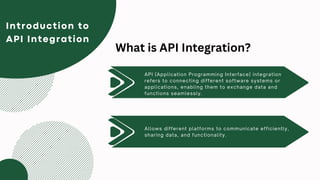
API (Application Programming
Interface) integration refers to
connecting different software
systems or applications, enabling
them to exchange data and
functions seamlessly.
API (Application Programming Interface) integration
refers to connecting different software systems or
applications, enabling them to exchange data and
functions seamlessly.
What is API Integration?
API (Application Programming
Interface) integration refers to
connecting different software
Allows different platforms to communicate efficiently,
sharing data, and functionality.
Importance of API Integration
API
INTEGRATION
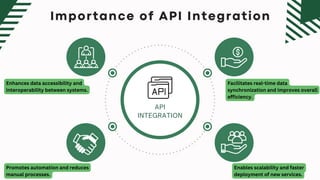
Enhances data accessibility and
interoperability between systems.
Promotes automation and reduces
manual processes.
Enables scalability and faster
deployment of new services.
Facilitates real-time data
synchronization and improves overall
efficiency.
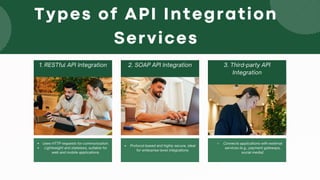
1. RESTful API Integration
Types of API Integration
Services
Uses HTTP requests for communication.
Lightweight and stateless, suitable for
web and mobile applications.
2. SOAP API Integration
Protocol-based and highly secure, ideal
for enterprise-level integrations.
3. Third-party API
Integration
Connects applications with external
services (e.g., payment gateways,
social media).
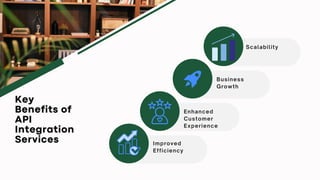
Improved
Efficiency
Enhanced
Customer
Experience
Business
Growth
Scalability
Key
Benefits of
API
Integration
Services
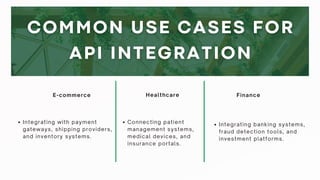
Healthcare
E-commerce Finance
Integrating with payment
gateways, shipping providers,
and inventory systems.
Connecting patient
management systems,
medical devices, and
insurance portals.
Integrating banking systems,
fraud detection tools, and
investment platforms.
Challenges in
API
Integration
Security Concerns
Ensuring data privacy and protection during data
exchange.
Compatibility Issues
Ensuring that different APIs work together
without conflicts.
Versioning and Updates
Managing changes and updates in APIs without
breaking existing integrations.
Performance Optimization
Balancing load and latency to ensure efficient
API performance.
Best Practices
for API
Integration
Adopting REST, SOAP, JSON, XML standards to ensure
compatibility.
01 Use Standard Protocols and Formats
Use encryption, authentication, and monitoring to
safeguard data.
02 Implement Robust Security Measures
Ensure that APIs are well-documented for easier integration
and maintenance.
03 Maintain Comprehensive Documentation
Continuously monitor performance and test for vulnerabilities.
04 Monitor and Test Regularly
www.ficode.co.uk
API integration services are essential for modern businesses
to enhance connectivity, improve operational efficiency, and
unlock new growth opportunities.
Choose a reliable API integration service provider to
leverage full potential.
Conclusion
Wrap-up

API integration services | Ficode Technology

  • 1.
  • 2.
    01 02 03 Title: API IntegrationServices Subtitle: Enabling Seamless Connectivity Across Systems Presented by: FICODE
  • 3.
    Introduction to API Integration API(Application Programming Interface) integration refers to connecting different software systems or applications, enabling them to exchange data and functions seamlessly. API (Application Programming Interface) integration refers to connecting different software systems or applications, enabling them to exchange data and functions seamlessly. What is API Integration? API (Application Programming Interface) integration refers to connecting different software Allows different platforms to communicate efficiently, sharing data, and functionality.
  • 4.
    Importance of APIIntegration API INTEGRATION Enhances data accessibility and interoperability between systems. Promotes automation and reduces manual processes. Enables scalability and faster deployment of new services. Facilitates real-time data synchronization and improves overall efficiency.
  • 5.
    1. RESTful APIIntegration Types of API Integration Services Uses HTTP requests for communication. Lightweight and stateless, suitable for web and mobile applications. 2. SOAP API Integration Protocol-based and highly secure, ideal for enterprise-level integrations. 3. Third-party API Integration Connects applications with external services (e.g., payment gateways, social media).
  • 6.
  • 7.
    Healthcare E-commerce Finance Integrating withpayment gateways, shipping providers, and inventory systems. Connecting patient management systems, medical devices, and insurance portals. Integrating banking systems, fraud detection tools, and investment platforms.
  • 8.
    Challenges in API Integration Security Concerns Ensuringdata privacy and protection during data exchange. Compatibility Issues Ensuring that different APIs work together without conflicts. Versioning and Updates Managing changes and updates in APIs without breaking existing integrations. Performance Optimization Balancing load and latency to ensure efficient API performance.
  • 9.
    Best Practices for API Integration AdoptingREST, SOAP, JSON, XML standards to ensure compatibility. 01 Use Standard Protocols and Formats Use encryption, authentication, and monitoring to safeguard data. 02 Implement Robust Security Measures Ensure that APIs are well-documented for easier integration and maintenance. 03 Maintain Comprehensive Documentation Continuously monitor performance and test for vulnerabilities. 04 Monitor and Test Regularly
  • 10.
    www.ficode.co.uk API integration servicesare essential for modern businesses to enhance connectivity, improve operational efficiency, and unlock new growth opportunities. Choose a reliable API integration service provider to leverage full potential. Conclusion Wrap-up