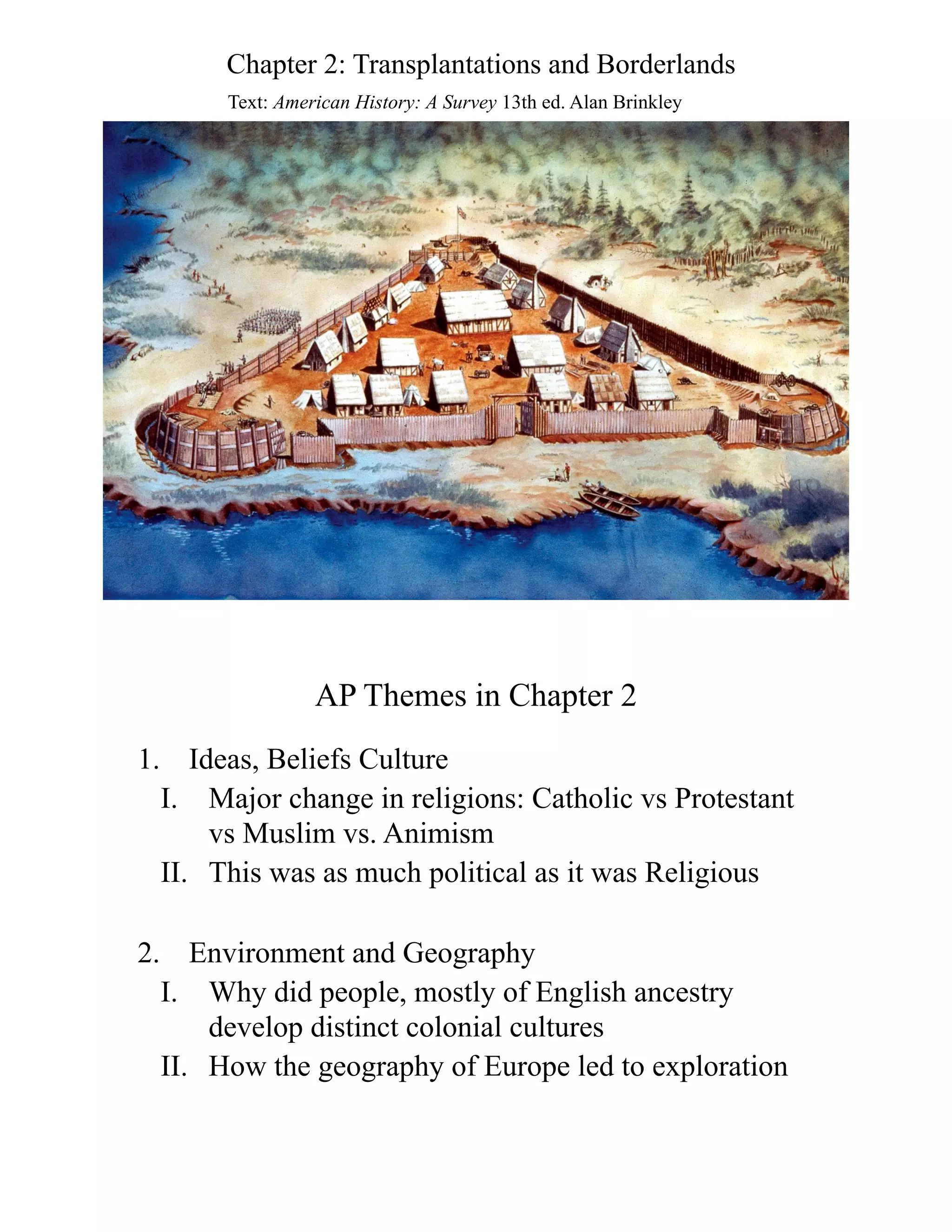
Chapter 2: Transplantations and Borderlands
Text: American History: A Survey 13th ed. Alan Brinkley
AP Themes in Chapter 2
1. Ideas, Beliefs Culture
I. Major change in religions: Catholic vs Protestant
vs Muslim vs. Animism
II. This was as much political as it was Religious
2. Environment and Geography
I. Why did people, mostly of English ancestry
develop distinct colonial cultures
II. How the geography of Europe led to exploration
AP Skills in Chapter 2
1. Continuity and Change Over Time
I. How long and why did a distinctly different
American culture arise
II. But, they were still more English than anything
else
III. Africans were forced to change the most, but
they did continue stories, songs, etc.
AP Skills in Chapter 2
1. Historical Argumentations
I. There is an ongoing debate among historians
as to WHEN did an American Identity arise
(i) Ex: Some argue when they first
Englishman stepped foot on American soil
(ii) Ex: Others argue 1753 with the French
and Indian War.
The Beginnings of Colonial America
• The 3 types of colonies created
• Tribute: Meso-America and
Andes
• Plantation: Portuguese Brazil
(SILVER), most Caribbean
Islands, English Chesapeake/
Southern (SUGAR)
• Neo-European: English
Northern and Middle colonies
– Major problems faced in
BOTH areas including
Natives
• Timeframe: the 17th century
(mostly)
Europeans
colonize North
America
• In the 16th
and 17th
centuries, the main
focus of European
colonization was
the Caribbean
(West Indies), East
Indies, South, and
Central America.
• Spain conquered
the largest
American empire.
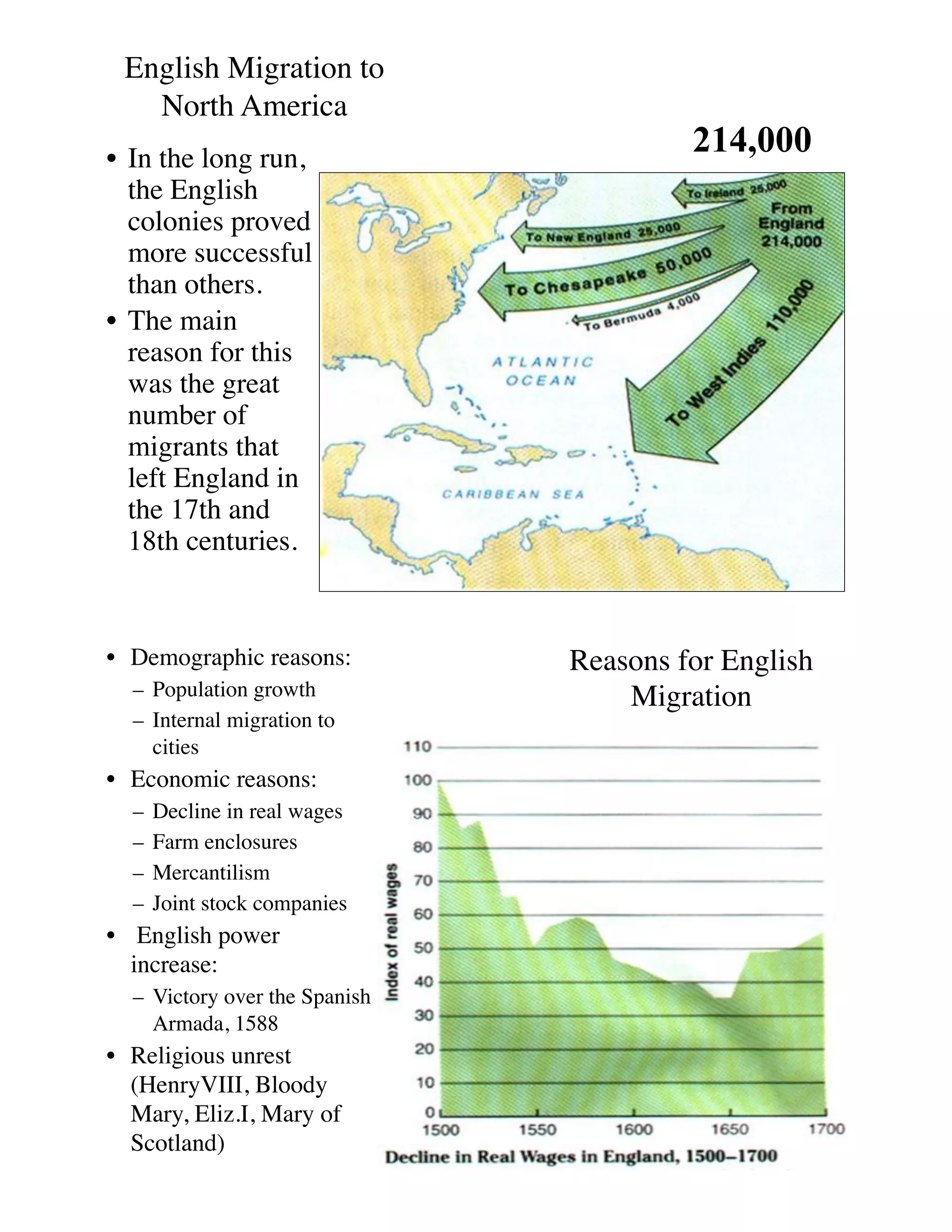
English Migration to
North America
• In the long run,
the English
colonies proved
more successful
than others.
• The main
reason for this
was the great
number of
migrants that
left England in
the 17th and
18th centuries.
214,000
• Demographic reasons:
– Population growth
– Internal migration to
cities
• Economic reasons:
– Decline in real wages
– Farm enclosures
– Mercantilism
– Joint stock companies
• English power
increase:
– Victory over the Spanish
Armada, 1588
• Religious unrest
(HenryVIII, Bloody
Mary, Eliz.I, Mary of
Scotland)
Reasons for English
Migration
The Chesapeake Colonies
• In 1606, King James I granted
overlapping land grants in
Virginia to two joint-stock
companies, the Virginia company
of London and the Virginia
company of Plymouth.
• The Plymouth company‘s attempt
in modern-day Maine was a
failure.
• In 1607, the Virginia Company
of London sent 144 colonists to
Virginia. Only 104 survived the
journey.
• The survivors founded
Jamestown, in modern-day
Virginia in 1607
Jamestown: “Starving
Times”
• The Jamestown colony had
trouble with sustainability.
• Early colonists did not want to
work in agriculture, hoping to
find precious metals instead.
• Vast majority of early
colonists were ‘gentlemen’
and not used to self-reliance
• Many expected the local
Indians to feed and serve
them.
• Bad hygienic conditions,
(swampy land) led to various
illnesses.
The Pocahontas Myth
• Pocahontas was the
daughter of
Powhatan.
• She “saved“ John
Smith in a mock
execution ritual.
• During the first
Anglo-Powhatan war
(1610-12), the settlers
kidnapped her and
held her captive for
several years.
• During this time she
agreed to marry John
Rolfe, (not Smith) one
of the leading settlers.
• So why is this
important?
• Of the original 104
settlers, only 38 survived
the first winter.

John Smith, a soldier of
fortune, took over the
colony‘s leadership in
1608, imposing military
discipline and improving
conditions. After he left
the colony in 1609,
discipline collapsed again.
• In the second “starving
time,” of 1609, 400 of
500 died.
Virginia: Native American
Relations
• The Jamestown
colonists had landed in
a Native American
power struggle.
• Powhatan, the leader of
a powerful confederacy,
hoped to get the
English on his side.
• The English could
provide various
militarily and
economically useful
goods.
a drawing of a 17th century
Virginia Native American
Virginia: Economic
Development
• Since Virginia was conceived as a
mercantilist venture, it needed to
make a profit.
• John Rolfe found a profitable
staple crop: tobacco.
• Initially, tobacco was hugely
successful. The crop shaped
Virginia‘s way of life.
• Tobacco was land and labor
intensive. Dispersed plantations,
not compact villages, and slavery
was the resulted from its growth.
1618 — Virginia produces 20,000
pounds of tobacco.
1629 — Virginia produces 1,500,000
pounds of tobacco.
Virginia: Labor
• Tobacco cultivation was very
labor intensive, but labor was
in short supply. Planters
therefore turned to indentured
servants as a solution.
- Indentured servants were
single young men and
women who came to
America, especially
Virginia, mainly in the 17th
century.
• Instead of paying their
passage, they agreed to work
for a fixed term, usually seven
years. Their contracts could be
bought and sold.
• For every servant a planter
brought to Virginia, he received
extra land. This was called the
“headright” system.
• However, hard work, harsh
treatment, and disease resulted
in a devastating mortality rate of
more than 40% in the first year.
• So why after 1660, were
indentured servants increasingly
replaced by African slaves?
• The tobacco boom did not
last.
• After 1660, only the so-
called “First Families“ did
well.
• Limited economic growth
meant costs needed to be
trimmed and cheaper labor
sources were valued.
Maryland
• In 1634, Maryland was
founded by Lord Baltimore
(Cecil Calvert) after he was
given charter by Charles I
• Intended as a haven for
Catholics and Protestants
urged to move there to
increase population.
• Ironically, Protestants soon
outnumbered Catholics and
the 1649 Religious Toleration
Act was passed to protect
Catholics from growing
Protestant influence.
Carolina
• Carolina was granted to a group
of proprietors in 1663.
• Named after Charles II
• North Carolina was settled in a
similar manner to Virginia
(subsistence farming)
• South Carolina was settled in
larger plantations by colonists
from Barbados (high
dependency on slave labor)
• The split into North and South
was formalized in 1729.
Georgia
• Founded in 1732, Georgia
was not a Restoration
colony.
• Proprietor James Oglethorpe
intended it to act as a debtor
colony and military outpost
against Spanish Florida.
• Savannah was designed with
a military purpose in mind.
• Strict rules stifled economic
development
a sketch of Savannah
Bacon’s Rebellion
• 1646 Governor Berkeley
agreed to a border with
Susquehanna Indian
chiefs but was unable to
enforce it.
• Illegal English squatters
led to Indian complaints
of encroachment on their
land (Consider the irony
given current opinions
regarding immigrants)
• Because of how the Royal
Governors were paid,
Berkeley relied on his
trade monopoly with the
Indians for his wealth
• Constant conflict between
Natives and squatters
(mostly former indentured
servants) disrupted trade.
• Therefore, Berkeley
always sided with the
Indians
Nathaniel Bacon and Bacon’s
Rebellion
• Son of wealthy nobleman
• Given position by Berkeley
– Treated like “new” rich
• Sided with Rebels when war broke
out
◦ Upset with the “old wealth” elites in the
East
Bacon’s rebellion
– causes
Backcountry settlement and Protection
Power of “eastern” elites and Taxation
significance
First large rebellion in colonies
(political & social)
Social/political conflict:
“eastern” elites vs. backcountry
Catalyst in transition from
indentured servitude to slavery
Aftermath
• English send troops to stop rebellion
• Berkeley is officially recalled (removed from office)
• For Indians the frontier was again pushed back (renegotiated)
Emergence of slavery
•In 1650 there were only 300 slaves in the Chesapeake
•Existing slave trade from Africa and their lifetime of servitude make them
attractive
‣No need to give slaves land
‣1672 African Royal Company broke monopoly on slave trade thus
lowering prices
•Decrease in indentured servants as the English birthrate declined
•Fears of growing number of landless freemen
•By 1750 there were 150,000 slaves in the Chesapeake alone (575,000 total)
•11 million slaves transported across Atlantic
33
African
Population of
British Colonies,
1620-1780
34
• 1619 – First Africans arrive
– Viewed as indentured
servants
• 1660s- Slave Codes Emerge
• New Slavery:
– Permanent
– Inherited
– Race-based (by mother’s
race) Meaning children born
to slave mothers (often due
to instances of rape) were not
given elevated status.
– Harsh
• Slavery was too expensive for
all but the wealthiest of settlers.
It expanded the economic
influence of the “old money”
families in the South
# Slavocracy
American
Colonies at the
End of the
Seventeenth
Century
Matthew 5 Build on the Rock

"Therefore whoever hears these sayings of Mine, and does them, I
will liken him to a wise man who built his house on the rock: and the
rain descended, the floods came, and the winds blew and beat on that
house; and it did not fall, for it was founded on the rock. 

"But everyone who hears these sayings of Mine, and does not do
them, will be like a foolish man who built his house on the sand: and
the rain descended, the floods came, and the winds blew and beat on
that house; and it fell. And great was its fall." 


Puritans and the smaller Pilgrims came over for:

Puritanism: The English
Reformation
• In the 16th century, Henry VIII
had separated the Church of
England from Rome.
• Elizabeth I consolidated the
Church of England along
moderate lines.
• Some members of the Church of
England, the Puritans,
demanded more radical
Calvinist reforms.
• They opposed church
government through bishops,
and came into conflict with the
absolutist ambitions of the
Stuart kings in the 17th century.
a portrait of Henry VIII
Puritanism: Central Beliefs
• Puritans were inspired by the theology of John
Calvin.
‣ Predestination
‣ They engaged in constant soul-searching and
study of scripture.
‣ Focus on more pure form of Christianity
(removed from European corruption)
‣ They opposed many church rituals, including
Christmas.
• Puritans were often persecuted by the English state in
the early 17th century because they were so difficult
to get along with. (Bloody Mary had 250 burned)
Plymouth Plantation: The Pilgrims
• In 1620, a group of separatist
Puritans (“Pilgrims”) traveled to
North America aboard the ship
Mayflower.
• The Mayflower Compact established
a “civil body politic“ for themselves
and their non-Pilgrim companions.
• The plan was to establish a
spiritually pure colony in the New
World, away from the corruption of
England.
• On their second landing site, they
established a settlement they called
Plymouth after the hometown of
some of the colonists.
Pilgrims = Puritans
who wanted to separate
from the church of
England completely and
start a new church in
the New World
Puritans = Calvinists
who simply wish to
purify the existing
church of England in the
New World.
Plymouth: Survival Problems
+The Pilgrims had arrived
as family groups, ready to
farm.
+The Native American
population had been
decimated by an epidemic
introduced by European
traders, so land was
available.
−However, The Pilgrims
arrived in December,
giving them no time to
farm, just to build some
shelter.
−A starving time resulted.
+Native’s, (decimated by
disease, and civil war),
helped the Pilgrims
survive in order to win
over these strange
“allies”.
• The good cooperation between local Indians and the Pilgrims was short
lived.
• The idea of a single Thanksgiving event is untrue and much of the food
depicted in idealized imagery was not possible given the conditions.
American Mythology: Thanksgiving
• Pilgrims were
absorbed by
neighboring
Puritan societies
by 1690.
• However, Pilgrims
are viewed as a
founding people
and the Mayflower
Compact and
‘Thanksgiving’
are valued as
examples of
democracy and
Christian values
Massachusetts Bay
Colony
• While Plymouth (Pilgrims)
remained small, a second
colony, Massachusetts
Bay, (Puritan) prospered.
• Not quite a Theocracy but
close.
• In the “Great English
Migration” 1630-1642
over 20,000 came to New
Eng.
• The colony was relatively
well-prepared and profited
from a large # of settlers.
“A City Upon A Hill“
• Massachusetts was
founded as a Christian
utopia, outlined by
John Winthrop
in his sermon
“A Model of Christian
Charity.”
• The colony was to be based
on strict Puritan theology, as
an example to the old world.
• The earliest example of
“American Exceptionalism”
or that America is inherently
different from other
countries.
• It was supposed to be
a model of brotherly
love and economic
cooperation.
• Emphasis on
education (Harvard
1636)
• These ideals were
reflected in the New
England village
settlement patterns.
• The focus on
subsistence
agriculture and family
coherence led to a
rapid increase in
population.
• Ironically, while the
Puritans came to the
New World because
they were not tolerated
in England, their
enforced laws were
often intolerant of
religious dissent.
• New colonies of
Connecticut, Rhode
Island, and New
Hampshire were formed
by Puritan dissenters
kicked out of the
Commonwealth.
Forms of
punishment for sins
under Puritan law.
Branded with an ‘F’
for fornicator
Religious Dissent and Secularization
• Three famous dissenters were exiled in the
1630s: Roger Williams, Anne Hutchinson
and Mary Dyer.
• Anne Hutchinson was a midwife and an
outspoken antinomian or someone who
emphasized faith over doctrine.
• Anti = against Nomian = Law
• In 1637, Hutchinson, whom John Winthrop
described as the "American Jezebel," was
tried for teaching without authority.
Hutchinson believed anyone could be an
‘elect’ and therefore teach. She was banished
from Massachusetts Bay and in a separate
trial, excommunicated from her church.
• Hutchinson is one of the earliest examples of
feminism and the resistance it was met with.
Religious Dissent
and Secularization
• Mary Dyer came to New England in 1635 and quickly
befriended Anne Hutchinson
• In 1637 Dyer gave birth to a stillborn child which was
described as "monstrous" in a letter by William Bradford to
John Winthrop.
• Hutchinson (who would later have her own stillborn birth)
was Dyer’s midwife and helped to conceal the child's birth to
protect her friend from accusations.
• Finding out, Winthrop ordered the baby exhumed and available
for public inspection which he described as: … the ears stood
upon the shoulders and were like an ape's; it had no forehead,
but over the eyes four horns, hard and sharp; two of them were
above one inch long, the other two shorter; the eyes standing
out, and the mouth also; the nose hooked upward; all over the
breast and back full of sharp pricks and scales, like a
thornback…it had two mouths, and in each of them a piece of
red flesh sticking out; it had arms and legs as other children;
but, instead of toes, it had on each foot three claws, like a young
fowl, with sharp talons.
• When Hutchinson was banished in 1638, Mary Dyer and her
family joined Hutchinson in exile in Rhode Island.
• Dyer later returned to England and became a Quaker. She was
jailed for refusing to conform to the established church when
she returned to Boston in 1657, and executed when she
returned to Boston yet again to bear witness against religious
oppression in 1660.
King Philip’s War
• Indian – White relations at low ebb by
1670s.
• Treaties with Indians not kept; nefarious
tactics to get land.
• Metacomet – named ‘King Philip’ by
whites, chief of Wampanoags
• Specific grievances over loss of tribal
lands, effect of alcohol and guns on
people, also Puritan treatment of
‘praying Indians’
• Wampanoags have early success which
leads to other tribes joining in a general
Indian war against the English settlers.
• But as the war drags into 1676, Indians
were unable to continue a long war. The
English re-group and counter-attack
killing King Phillip.
Consequences of King Phillip’s War
• 3000 Indians killed (50% of pop), loss of
tribal leaders, exile of many Indians to
west, captives sold into slavery, remaining
tribes confined to praying villages. End of
threat in New England
• Came close to bankrupting many colonies.
• 2500 white settlers killed, (10% of white
men of fighting age), damaged 52 of the
90 settlements in New England, totally
destroying 12 of them.
• Psychological - the war was viewed as a
warning from God for straying from the
path.
• Growth of religiousness that morphs
into the First Great Awakening in the
1730s and 1740s
-Most people did not consider
themselves religious during the
colonial period- only about 1/5

-Most colonists arrived for
nonreligious reasons

-Church membership never
surpassed 20% during the
colonial period

-Approximately 80% of
Americans, slaves excluded,
were WASPS (White Anglo-
Saxon Protestants)

-Other forms of Christianity
were opposed by the Protestants
Religious Prevalence in Colonial America
Concluding Thoughts
• Overall process of colonial maturity. In only 100 years from
desperate settlers fighting for survival to full-blown complex
societies, economically dynamic and with a tradition of
considerable self-government.
• Despite many initial problems, the English colonies in the
Chesapeake, New England, and Middle colonies endured and
sometimes prospered.
• They were greatly aided by the large numbers of migrants from
England in the early 17th century.
• All regions faced similar problems most notable was securing
the frontier.
• At same time, a mother-child metaphor was widely used for
colonial-imperial relationship. Trouble is built-in: what happens
when the child grows up?

AP US History Chapter 2

  • 1.
    Chapter 2: Transplantationsand Borderlands Text: American History: A Survey 13th ed. Alan Brinkley AP Themes in Chapter 2 1. Ideas, Beliefs Culture I. Major change in religions: Catholic vs Protestant vs Muslim vs. Animism II. This was as much political as it was Religious 2. Environment and Geography I. Why did people, mostly of English ancestry develop distinct colonial cultures II. How the geography of Europe led to exploration
  • 2.
    AP Skills inChapter 2 1. Continuity and Change Over Time I. How long and why did a distinctly different American culture arise II. But, they were still more English than anything else III. Africans were forced to change the most, but they did continue stories, songs, etc. AP Skills in Chapter 2 1. Historical Argumentations I. There is an ongoing debate among historians as to WHEN did an American Identity arise (i) Ex: Some argue when they first Englishman stepped foot on American soil (ii) Ex: Others argue 1753 with the French and Indian War.
  • 3.
    The Beginnings ofColonial America • The 3 types of colonies created • Tribute: Meso-America and Andes • Plantation: Portuguese Brazil (SILVER), most Caribbean Islands, English Chesapeake/ Southern (SUGAR) • Neo-European: English Northern and Middle colonies – Major problems faced in BOTH areas including Natives • Timeframe: the 17th century (mostly) Europeans colonize North America • In the 16th and 17th centuries, the main focus of European colonization was the Caribbean (West Indies), East Indies, South, and Central America. • Spain conquered the largest American empire.
  • 4.
    English Migration to NorthAmerica • In the long run, the English colonies proved more successful than others. • The main reason for this was the great number of migrants that left England in the 17th and 18th centuries. 214,000 • Demographic reasons: – Population growth – Internal migration to cities • Economic reasons: – Decline in real wages – Farm enclosures – Mercantilism – Joint stock companies • English power increase: – Victory over the Spanish Armada, 1588 • Religious unrest (HenryVIII, Bloody Mary, Eliz.I, Mary of Scotland) Reasons for English Migration
  • 5.
    The Chesapeake Colonies •In 1606, King James I granted overlapping land grants in Virginia to two joint-stock companies, the Virginia company of London and the Virginia company of Plymouth. • The Plymouth company‘s attempt in modern-day Maine was a failure. • In 1607, the Virginia Company of London sent 144 colonists to Virginia. Only 104 survived the journey. • The survivors founded Jamestown, in modern-day Virginia in 1607 Jamestown: “Starving Times” • The Jamestown colony had trouble with sustainability. • Early colonists did not want to work in agriculture, hoping to find precious metals instead. • Vast majority of early colonists were ‘gentlemen’ and not used to self-reliance • Many expected the local Indians to feed and serve them. • Bad hygienic conditions, (swampy land) led to various illnesses.
  • 6.
    The Pocahontas Myth •Pocahontas was the daughter of Powhatan. • She “saved“ John Smith in a mock execution ritual. • During the first Anglo-Powhatan war (1610-12), the settlers kidnapped her and held her captive for several years. • During this time she agreed to marry John Rolfe, (not Smith) one of the leading settlers. • So why is this important?
  • 7.
    • Of theoriginal 104 settlers, only 38 survived the first winter.
 John Smith, a soldier of fortune, took over the colony‘s leadership in 1608, imposing military discipline and improving conditions. After he left the colony in 1609, discipline collapsed again. • In the second “starving time,” of 1609, 400 of 500 died. Virginia: Native American Relations • The Jamestown colonists had landed in a Native American power struggle. • Powhatan, the leader of a powerful confederacy, hoped to get the English on his side. • The English could provide various militarily and economically useful goods. a drawing of a 17th century Virginia Native American
  • 8.
    Virginia: Economic Development • SinceVirginia was conceived as a mercantilist venture, it needed to make a profit. • John Rolfe found a profitable staple crop: tobacco. • Initially, tobacco was hugely successful. The crop shaped Virginia‘s way of life. • Tobacco was land and labor intensive. Dispersed plantations, not compact villages, and slavery was the resulted from its growth. 1618 — Virginia produces 20,000 pounds of tobacco. 1629 — Virginia produces 1,500,000 pounds of tobacco. Virginia: Labor • Tobacco cultivation was very labor intensive, but labor was in short supply. Planters therefore turned to indentured servants as a solution. - Indentured servants were single young men and women who came to America, especially Virginia, mainly in the 17th century. • Instead of paying their passage, they agreed to work for a fixed term, usually seven years. Their contracts could be bought and sold.
  • 9.
    • For everyservant a planter brought to Virginia, he received extra land. This was called the “headright” system. • However, hard work, harsh treatment, and disease resulted in a devastating mortality rate of more than 40% in the first year. • So why after 1660, were indentured servants increasingly replaced by African slaves? • The tobacco boom did not last. • After 1660, only the so- called “First Families“ did well. • Limited economic growth meant costs needed to be trimmed and cheaper labor sources were valued. Maryland • In 1634, Maryland was founded by Lord Baltimore (Cecil Calvert) after he was given charter by Charles I • Intended as a haven for Catholics and Protestants urged to move there to increase population. • Ironically, Protestants soon outnumbered Catholics and the 1649 Religious Toleration Act was passed to protect Catholics from growing Protestant influence.
  • 10.
    Carolina • Carolina wasgranted to a group of proprietors in 1663. • Named after Charles II • North Carolina was settled in a similar manner to Virginia (subsistence farming) • South Carolina was settled in larger plantations by colonists from Barbados (high dependency on slave labor) • The split into North and South was formalized in 1729. Georgia • Founded in 1732, Georgia was not a Restoration colony. • Proprietor James Oglethorpe intended it to act as a debtor colony and military outpost against Spanish Florida. • Savannah was designed with a military purpose in mind. • Strict rules stifled economic development a sketch of Savannah
  • 11.
    Bacon’s Rebellion • 1646Governor Berkeley agreed to a border with Susquehanna Indian chiefs but was unable to enforce it. • Illegal English squatters led to Indian complaints of encroachment on their land (Consider the irony given current opinions regarding immigrants) • Because of how the Royal Governors were paid, Berkeley relied on his trade monopoly with the Indians for his wealth • Constant conflict between Natives and squatters (mostly former indentured servants) disrupted trade. • Therefore, Berkeley always sided with the Indians Nathaniel Bacon and Bacon’s Rebellion • Son of wealthy nobleman • Given position by Berkeley – Treated like “new” rich • Sided with Rebels when war broke out ◦ Upset with the “old wealth” elites in the East Bacon’s rebellion – causes Backcountry settlement and Protection Power of “eastern” elites and Taxation significance First large rebellion in colonies (political & social) Social/political conflict: “eastern” elites vs. backcountry Catalyst in transition from indentured servitude to slavery
  • 12.
    Aftermath • English sendtroops to stop rebellion • Berkeley is officially recalled (removed from office) • For Indians the frontier was again pushed back (renegotiated) Emergence of slavery •In 1650 there were only 300 slaves in the Chesapeake •Existing slave trade from Africa and their lifetime of servitude make them attractive ‣No need to give slaves land ‣1672 African Royal Company broke monopoly on slave trade thus lowering prices •Decrease in indentured servants as the English birthrate declined •Fears of growing number of landless freemen •By 1750 there were 150,000 slaves in the Chesapeake alone (575,000 total) •11 million slaves transported across Atlantic 33 African Population of British Colonies, 1620-1780
  • 13.
    34 • 1619 –First Africans arrive – Viewed as indentured servants • 1660s- Slave Codes Emerge • New Slavery: – Permanent – Inherited – Race-based (by mother’s race) Meaning children born to slave mothers (often due to instances of rape) were not given elevated status. – Harsh • Slavery was too expensive for all but the wealthiest of settlers. It expanded the economic influence of the “old money” families in the South # Slavocracy
  • 14.
    American Colonies at the Endof the Seventeenth Century Matthew 5 Build on the Rock
 "Therefore whoever hears these sayings of Mine, and does them, I will liken him to a wise man who built his house on the rock: and the rain descended, the floods came, and the winds blew and beat on that house; and it did not fall, for it was founded on the rock. 
 "But everyone who hears these sayings of Mine, and does not do them, will be like a foolish man who built his house on the sand: and the rain descended, the floods came, and the winds blew and beat on that house; and it fell. And great was its fall." 
 
 Puritans and the smaller Pilgrims came over for:

  • 15.
    Puritanism: The English Reformation •In the 16th century, Henry VIII had separated the Church of England from Rome. • Elizabeth I consolidated the Church of England along moderate lines. • Some members of the Church of England, the Puritans, demanded more radical Calvinist reforms. • They opposed church government through bishops, and came into conflict with the absolutist ambitions of the Stuart kings in the 17th century. a portrait of Henry VIII Puritanism: Central Beliefs • Puritans were inspired by the theology of John Calvin. ‣ Predestination ‣ They engaged in constant soul-searching and study of scripture. ‣ Focus on more pure form of Christianity (removed from European corruption) ‣ They opposed many church rituals, including Christmas. • Puritans were often persecuted by the English state in the early 17th century because they were so difficult to get along with. (Bloody Mary had 250 burned)
  • 16.
    Plymouth Plantation: ThePilgrims • In 1620, a group of separatist Puritans (“Pilgrims”) traveled to North America aboard the ship Mayflower. • The Mayflower Compact established a “civil body politic“ for themselves and their non-Pilgrim companions. • The plan was to establish a spiritually pure colony in the New World, away from the corruption of England. • On their second landing site, they established a settlement they called Plymouth after the hometown of some of the colonists. Pilgrims = Puritans who wanted to separate from the church of England completely and start a new church in the New World Puritans = Calvinists who simply wish to purify the existing church of England in the New World. Plymouth: Survival Problems +The Pilgrims had arrived as family groups, ready to farm. +The Native American population had been decimated by an epidemic introduced by European traders, so land was available. −However, The Pilgrims arrived in December, giving them no time to farm, just to build some shelter. −A starving time resulted. +Native’s, (decimated by disease, and civil war), helped the Pilgrims survive in order to win over these strange “allies”.
  • 17.
    • The goodcooperation between local Indians and the Pilgrims was short lived. • The idea of a single Thanksgiving event is untrue and much of the food depicted in idealized imagery was not possible given the conditions. American Mythology: Thanksgiving • Pilgrims were absorbed by neighboring Puritan societies by 1690. • However, Pilgrims are viewed as a founding people and the Mayflower Compact and ‘Thanksgiving’ are valued as examples of democracy and Christian values Massachusetts Bay Colony • While Plymouth (Pilgrims) remained small, a second colony, Massachusetts Bay, (Puritan) prospered. • Not quite a Theocracy but close. • In the “Great English Migration” 1630-1642 over 20,000 came to New Eng. • The colony was relatively well-prepared and profited from a large # of settlers.
  • 18.
    “A City UponA Hill“ • Massachusetts was founded as a Christian utopia, outlined by John Winthrop in his sermon “A Model of Christian Charity.” • The colony was to be based on strict Puritan theology, as an example to the old world. • The earliest example of “American Exceptionalism” or that America is inherently different from other countries.
  • 19.
    • It wassupposed to be a model of brotherly love and economic cooperation. • Emphasis on education (Harvard 1636) • These ideals were reflected in the New England village settlement patterns. • The focus on subsistence agriculture and family coherence led to a rapid increase in population. • Ironically, while the Puritans came to the New World because they were not tolerated in England, their enforced laws were often intolerant of religious dissent. • New colonies of Connecticut, Rhode Island, and New Hampshire were formed by Puritan dissenters kicked out of the Commonwealth.
  • 20.
    Forms of punishment forsins under Puritan law. Branded with an ‘F’ for fornicator
  • 23.
    Religious Dissent andSecularization • Three famous dissenters were exiled in the 1630s: Roger Williams, Anne Hutchinson and Mary Dyer. • Anne Hutchinson was a midwife and an outspoken antinomian or someone who emphasized faith over doctrine. • Anti = against Nomian = Law • In 1637, Hutchinson, whom John Winthrop described as the "American Jezebel," was tried for teaching without authority. Hutchinson believed anyone could be an ‘elect’ and therefore teach. She was banished from Massachusetts Bay and in a separate trial, excommunicated from her church. • Hutchinson is one of the earliest examples of feminism and the resistance it was met with. Religious Dissent and Secularization • Mary Dyer came to New England in 1635 and quickly befriended Anne Hutchinson • In 1637 Dyer gave birth to a stillborn child which was described as "monstrous" in a letter by William Bradford to John Winthrop. • Hutchinson (who would later have her own stillborn birth) was Dyer’s midwife and helped to conceal the child's birth to protect her friend from accusations. • Finding out, Winthrop ordered the baby exhumed and available for public inspection which he described as: … the ears stood upon the shoulders and were like an ape's; it had no forehead, but over the eyes four horns, hard and sharp; two of them were above one inch long, the other two shorter; the eyes standing out, and the mouth also; the nose hooked upward; all over the breast and back full of sharp pricks and scales, like a thornback…it had two mouths, and in each of them a piece of red flesh sticking out; it had arms and legs as other children; but, instead of toes, it had on each foot three claws, like a young fowl, with sharp talons. • When Hutchinson was banished in 1638, Mary Dyer and her family joined Hutchinson in exile in Rhode Island. • Dyer later returned to England and became a Quaker. She was jailed for refusing to conform to the established church when she returned to Boston in 1657, and executed when she returned to Boston yet again to bear witness against religious oppression in 1660.
  • 24.
    King Philip’s War •Indian – White relations at low ebb by 1670s. • Treaties with Indians not kept; nefarious tactics to get land. • Metacomet – named ‘King Philip’ by whites, chief of Wampanoags • Specific grievances over loss of tribal lands, effect of alcohol and guns on people, also Puritan treatment of ‘praying Indians’ • Wampanoags have early success which leads to other tribes joining in a general Indian war against the English settlers. • But as the war drags into 1676, Indians were unable to continue a long war. The English re-group and counter-attack killing King Phillip. Consequences of King Phillip’s War • 3000 Indians killed (50% of pop), loss of tribal leaders, exile of many Indians to west, captives sold into slavery, remaining tribes confined to praying villages. End of threat in New England • Came close to bankrupting many colonies. • 2500 white settlers killed, (10% of white men of fighting age), damaged 52 of the 90 settlements in New England, totally destroying 12 of them. • Psychological - the war was viewed as a warning from God for straying from the path. • Growth of religiousness that morphs into the First Great Awakening in the 1730s and 1740s
  • 25.
    -Most people didnot consider themselves religious during the colonial period- only about 1/5
 -Most colonists arrived for nonreligious reasons
 -Church membership never surpassed 20% during the colonial period
 -Approximately 80% of Americans, slaves excluded, were WASPS (White Anglo- Saxon Protestants)
 -Other forms of Christianity were opposed by the Protestants Religious Prevalence in Colonial America Concluding Thoughts • Overall process of colonial maturity. In only 100 years from desperate settlers fighting for survival to full-blown complex societies, economically dynamic and with a tradition of considerable self-government. • Despite many initial problems, the English colonies in the Chesapeake, New England, and Middle colonies endured and sometimes prospered. • They were greatly aided by the large numbers of migrants from England in the early 17th century. • All regions faced similar problems most notable was securing the frontier. • At same time, a mother-child metaphor was widely used for colonial-imperial relationship. Trouble is built-in: what happens when the child grows up?