A) 0% B) 20% C) 50% D) 80% E) 100%
1. Naturally occurring boron consists of two isotopes,
boron–10 and boron–11. If the atomic mass of natural
boron is 10.8, what is the percentage that is boron–10?
A)
B)
C)
D)
2. Which mass spectrometer graph represents naturally
occurring magnesium?
A) Mass spectrometer beam distribution
B) Emission spectra of gaseous elements
C) Cathode ray deflection by a magnetic field
D) Scattering of alpha particles by metal foil
E) Radioactive transmutation of elements
3. Which supports the conclusion that the energy of
electrons in atoms are quantized?
A) Rn B) Ra C) Fm D) Md E) No
4. An ion which has the electron configuration [[Rn] 5f14]
2– has the symbol
A) Barium B) Sodium
C) Potassium D) Lithium
E) Calcium
5. When a chloride solution of an element is vaporized in a
flame, the color of the flame is purple. What element
could be in the solution?
A) [Ar]4s23d3 B) [Ar]3d3
C) [Ar]4s23d1 D) [Ar]4s13d2
E) [Ar]3d5
6. What would be the most likely electron configuration for
a Vanadium 2+ ion?
7. Base your answer to the following question on the
following atomic orbitals.
(A) 1s2 2s1 2p
1
(B) 1s2 2s2 2p
1
(C) 1s2 2s2 2p
6
(D) [Ar] 4s2
(E) [Ar] 4s2 3d4
A) A B) B C) C D) D E) E
This atom is in an excited state.
Base your answers to questions 8 through 11 on the
following electron configurations
(A) [Xe] 4f145d106s
2
(B) [Kr] 4d105s
1
(C)
[Ar] 3d104s24p
5
(D) [Ar]
(E) [Ne] 3s23p2
A) A B) B C) C D) D E) E
8. The configuration of a metallic diatomic element
A) A B) B C) C D) D E) E
9. The configuration of a metalloid
A) A B) B C) C D) D E) E
10. A common ion of an alkali metal
A) A B) B C) C D) D E) E
11. The ground state of a halogen
A) Zinc B) Cadmium
C) Calcium D) Cobalt
E) Magnesium
12. Which of the following elements will present a
paramagnetic electron configuration?
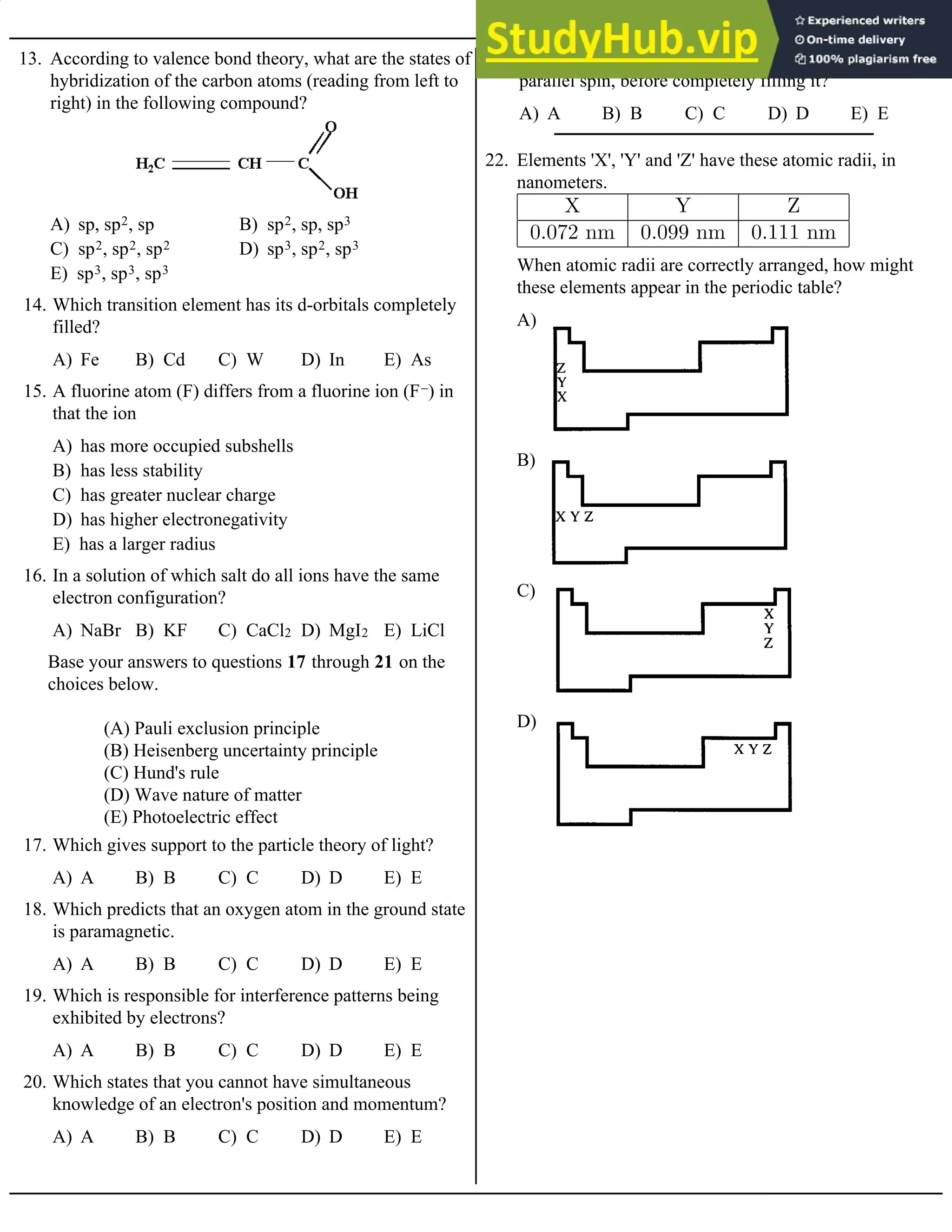
13. According to valence bond theory, what are the states of
hybridization of the carbon atoms (reading from left to
right) in the following compound?
A) sp, sp2, sp B) sp2, sp, sp3
C) sp2, sp2, sp2 D) sp3, sp2, sp3
E) sp3, sp3, sp3
A) Fe B) Cd C) W D) In E) As
14. Which transition element has its d-orbitals completely
filled?
A) has more occupied subshells
B) has less stability
C) has greater nuclear charge
D) has higher electronegativity
E) has a larger radius
15. A fluorine atom (F) differs from a fluorine ion (F–) in
that the ion
A) NaBr B) KF C) CaCl2 D) MgI2 E) LiCl
16. In a solution of which salt do all ions have the same
electron configuration?
Base your answers to questions 17 through 21 on the
choices below.
(A) Pauli exclusion principle
(B) Heisenberg uncertainty principle
(C) Hund's rule
(D) Wave nature of matter
(E) Photoelectric effect
A) A B) B C) C D) D E) E
17. Which gives support to the particle theory of light?
A) A B) B C) C D) D E) E
18. Which predicts that an oxygen atom in the ground state
is paramagnetic.
A) A B) B C) C D) D E) E
19. Which is responsible for interference patterns being
exhibited by electrons?
A) A B) B C) C D) D E) E
20. Which states that you cannot have simultaneous
knowledge of an electron's position and momentum?
A) A B) B C) C D) D E) E
21. Which states that electrons half fill an orbital with
parallel spin, before completely filling it?
22. Elements 'X', 'Y' and 'Z' have these atomic radii, in
nanometers.
A)
B)
C)
D)
When atomic radii are correctly arranged, how might
these elements appear in the periodic table?
23.
A) Sr B) K C) F D) Mg E) O
Based on the ionization potentials for element above, which of the following would most likely be
element ?
A) Moseley B) John Dalton
C) Ernest Rutherford D) J. J. Thompson
E) Niels Bohr
24. Whose theory of the atom is best supported by the
experimental evidence shown in a graph of first
ionization energy of the elements versus atomic
number?
A) B)
C) D)
25. Which graph best depicts the relationship between the
ionization energy and atomic number from left to right
in a period?
26.
A) Ii B) Jj C) Kk D) Mm E) Nn
Which element would have this sequence of ionization energies?
27.
A) Sb B) Ca C) Si D) Ga E) Se
Based on the ionization energies listed above, the
element is most likely
28.
A) Magnesium B) Potassium
C) Boron D) Silicon
E) Nitrogen
Based on the ionization energies listed above, the
element is most likely
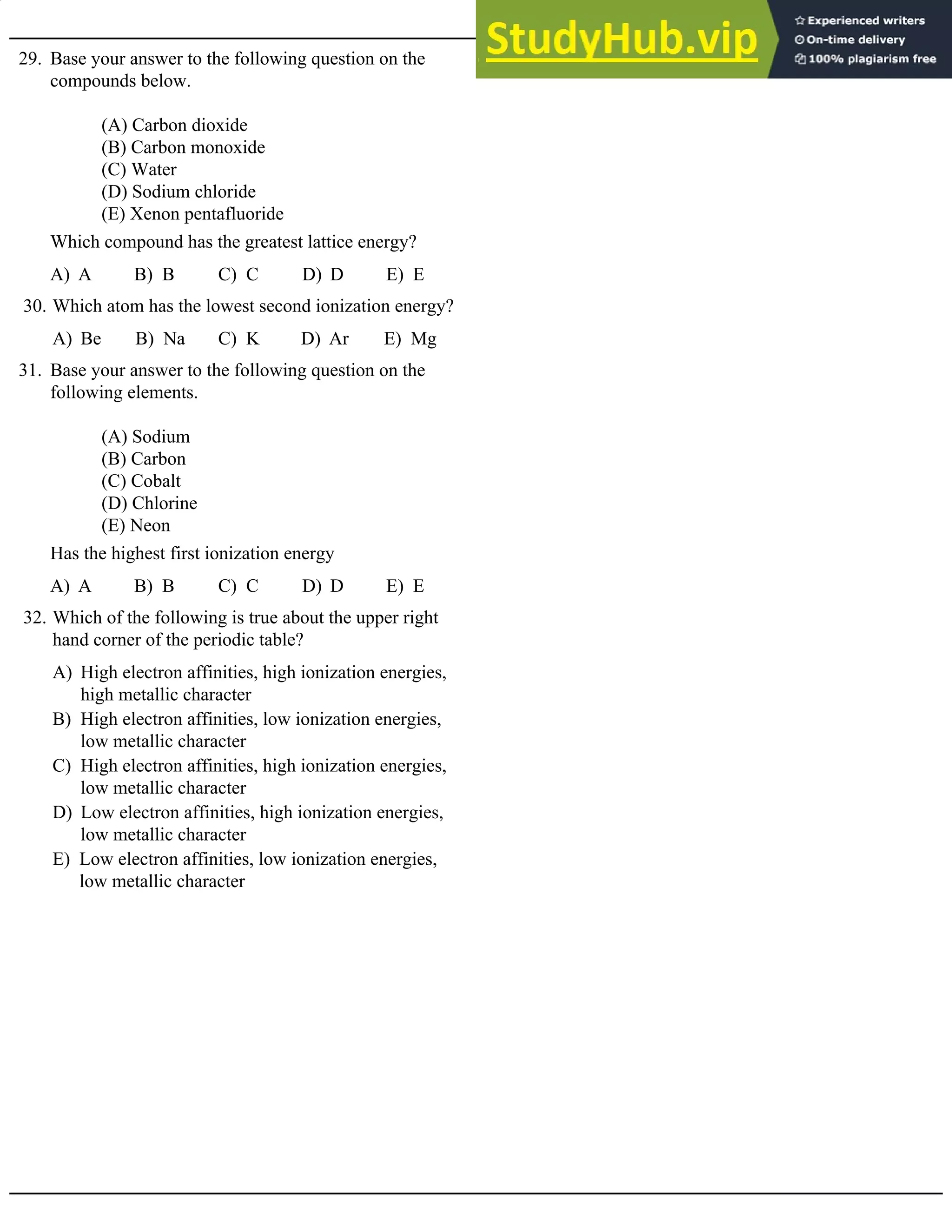
29. Base your answer to the following question on the
compounds below.
(A) Carbon dioxide
(B) Carbon monoxide
(C) Water
(D) Sodium chloride
(E) Xenon pentafluoride
A) A B) B C) C D) D E) E
Which compound has the greatest lattice energy?
A) Be B) Na C) K D) Ar E) Mg
30. Which atom has the lowest second ionization energy?
31. Base your answer to the following question on the
following elements.
(A) Sodium
(B) Carbon
(C) Cobalt
(D) Chlorine
(E) Neon
A) A B) B C) C D) D E) E
Has the highest first ionization energy
A) High electron affinities, high ionization energies,
high metallic character
B) High electron affinities, low ionization energies,
low metallic character
C) High electron affinities, high ionization energies,
low metallic character
D) Low electron affinities, high ionization energies,
low metallic character
E) Low electron affinities, low ionization energies,
low metallic character
32. Which of the following is true about the upper right
hand corner of the periodic table?
33.
A) L - group I M - transition elements
Q - group VII R - group VIII
B) L - group VII M - group I
Q - group VIII R - transition elements
C) L - group VII M - transition elements
Q - group VIII R - group I
D) L - transition elements M - group I
Q - group VII R - group VIII
E) L - transition elements M - group VIII
Q - group I R - group VII
Based on the above table, match these elements, in the order L, M, Q and R, to their respective groups in
the periodic table.
A) CuO B) CuBr
C) CuS D) CuC2O4
E) Cu(CH3COO)2
34. Copper has an oxidation number of +1 in
A) 7 B) 8 C) 14 D) 15 E) 27
35. How many atoms are in 1 molecule of calcium
hexacyanoferrate (II)?
36. Base your answer to the following question on the
elements below.
(A) Fr
(B) Sr
(C) Br
(D) Sb
(E) H
A) A B) B C) C D) D E) E
Which forms monatomic ions of charge 2+ in solution?
A) 0.12 L B) 0.15 L
C) 0.25 L D) 0.27 L
E) 0.30 L
37. A balloon filled with 0.01 mol of hydrogen gas is kept
constant at 25 degrees Celcius. If the pressure is
changed from 1 atm to 1.5 atm, what is the resulting
volume of the balloon?
38. C3H8(g) + 5 O2(g) ®3 CO2(g) + 4 H2O(g)
A) 5.0 B) 0.5 C) 0.1 D) 0.25 E) 0.05
A 0.03 mol sample of C3H8 is reacted with just enough
O2 to use up both reactants in a 1 L flask at 300 K. The
total pressure in the flask after the reaction is complete
is closest to which of the following?
( Use R = 0.082 L atm mol–1 K–1 )
A) 4 grams B) 8 grams
C) 16 grams D) 32 grams
E) 64 grams
39. A CH4 (molar mass 16 grams) effuses at 0.080 mole
per minute at 289 K. At that temperature, a gas that
effuses at approximately double that rate has what
molar mass?
A) 3 hours B) 8 hours
C) 72 hours D) 192 hours
E) 288 hours
40. A certain first order reaction between two gases occurs
at 389 K with a half-life of 24 hours. How much time is
required to drop the pressure of one of the gases from
2.0 atm to 0.25 atm at 389 K?
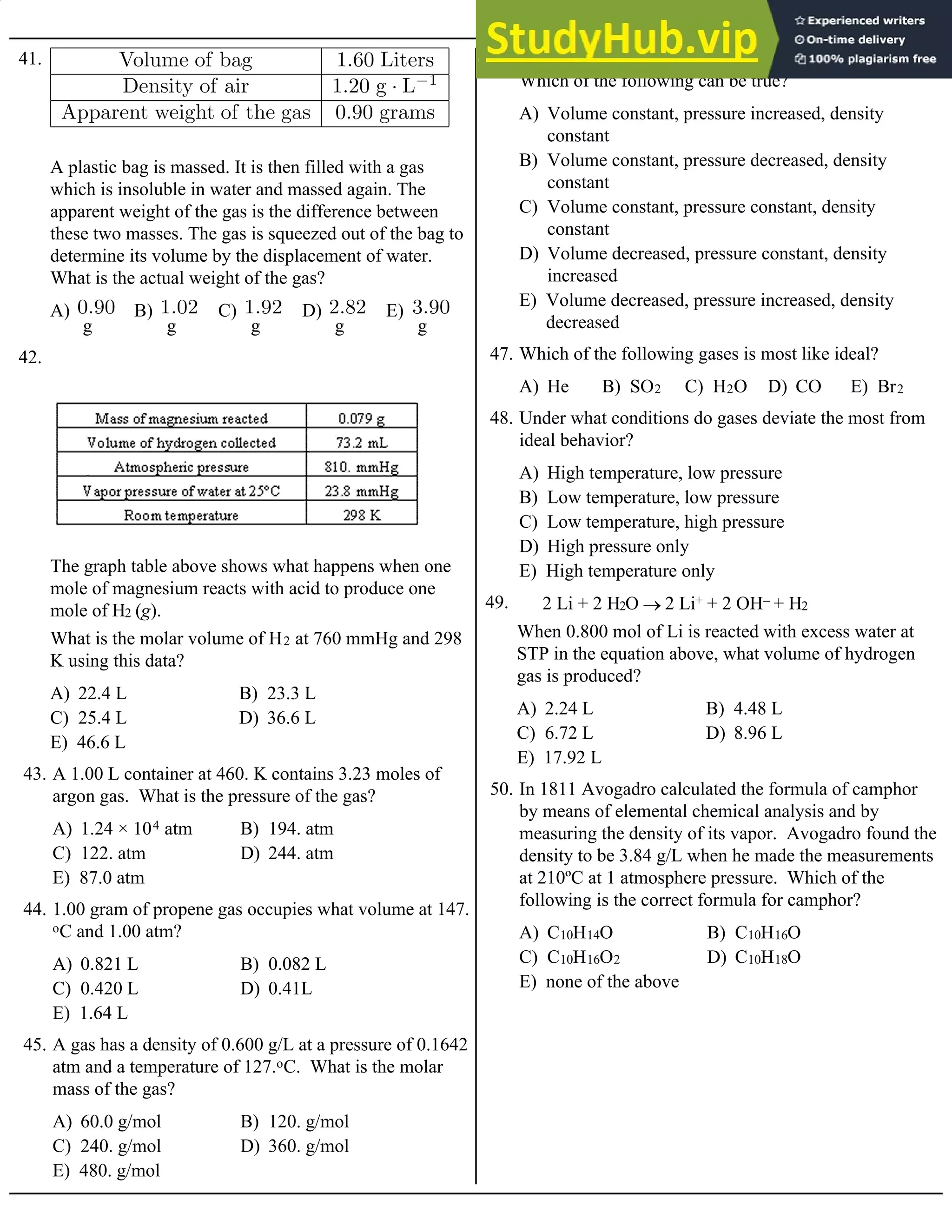
41.
A)
g
B)
g
C)
g
D)
g
E)
g
A plastic bag is massed. It is then filled with a gas
which is insoluble in water and massed again. The
apparent weight of the gas is the difference between
these two masses. The gas is squeezed out of the bag to
determine its volume by the displacement of water.
What is the actual weight of the gas?
42.
The graph table above shows what happens when one
mole of magnesium reacts with acid to produce one
mole of H2 (g).
A) 22.4 L B) 23.3 L
C) 25.4 L D) 36.6 L
E) 46.6 L
What is the molar volume of H2 at 760 mmHg and 298
K using this data?
A) 1.24 × 10⁴ atm B) 194. atm
C) 122. atm D) 244. atm
E) 87.0 atm
43. A 1.00 L container at 460. K contains 3.23 moles of
argon gas. What is the pressure of the gas?
A) 0.821 L B) 0.082 L
C) 0.420 L D) 0.41L
E) 1.64 L
44. 1.00 gram of propene gas occupies what volume at 147.
oC and 1.00 atm?
A) 60.0 g/mol B) 120. g/mol
C) 240. g/mol D) 360. g/mol
E) 480. g/mol
45. A gas has a density of 0.600 g/L at a pressure of 0.1642
atm and a temperature of 127.oC. What is the molar
mass of the gas?
A) Volume constant, pressure increased, density
constant
B) Volume constant, pressure decreased, density
constant
C) Volume constant, pressure constant, density
constant
D) Volume decreased, pressure constant, density
increased
E) Volume decreased, pressure increased, density
decreased
46. The temperature of a sample of H2O is decreased.
Which of the following can be true?
A) He B) SO2 C) H2O D) CO E) Br2
47. Which of the following gases is most like ideal?
A) High temperature, low pressure
B) Low temperature, low pressure
C) Low temperature, high pressure
D) High pressure only
E) High temperature only
48. Under what conditions do gases deviate the most from
ideal behavior?
49. 2 Li + 2 H2O ® 2 Li+ + 2 OH– + H2
A) 2.24 L B) 4.48 L
C) 6.72 L D) 8.96 L
E) 17.92 L
When 0.800 mol of Li is reacted with excess water at
STP in the equation above, what volume of hydrogen
gas is produced?
A) C10H14O B) C10H16O
C) C10H16O2 D) C10H18O
E) none of the above
50. In 1811 Avogadro calculated the formula of camphor
by means of elemental chemical analysis and by
measuring the density of its vapor. Avogadro found the
density to be 3.84 g/L when he made the measurements
at 210ºC at 1 atmosphere pressure. Which of the
following is the correct formula for camphor?
A) I only B) III only
C) I and III only D) I and II only
E) I, II, and III
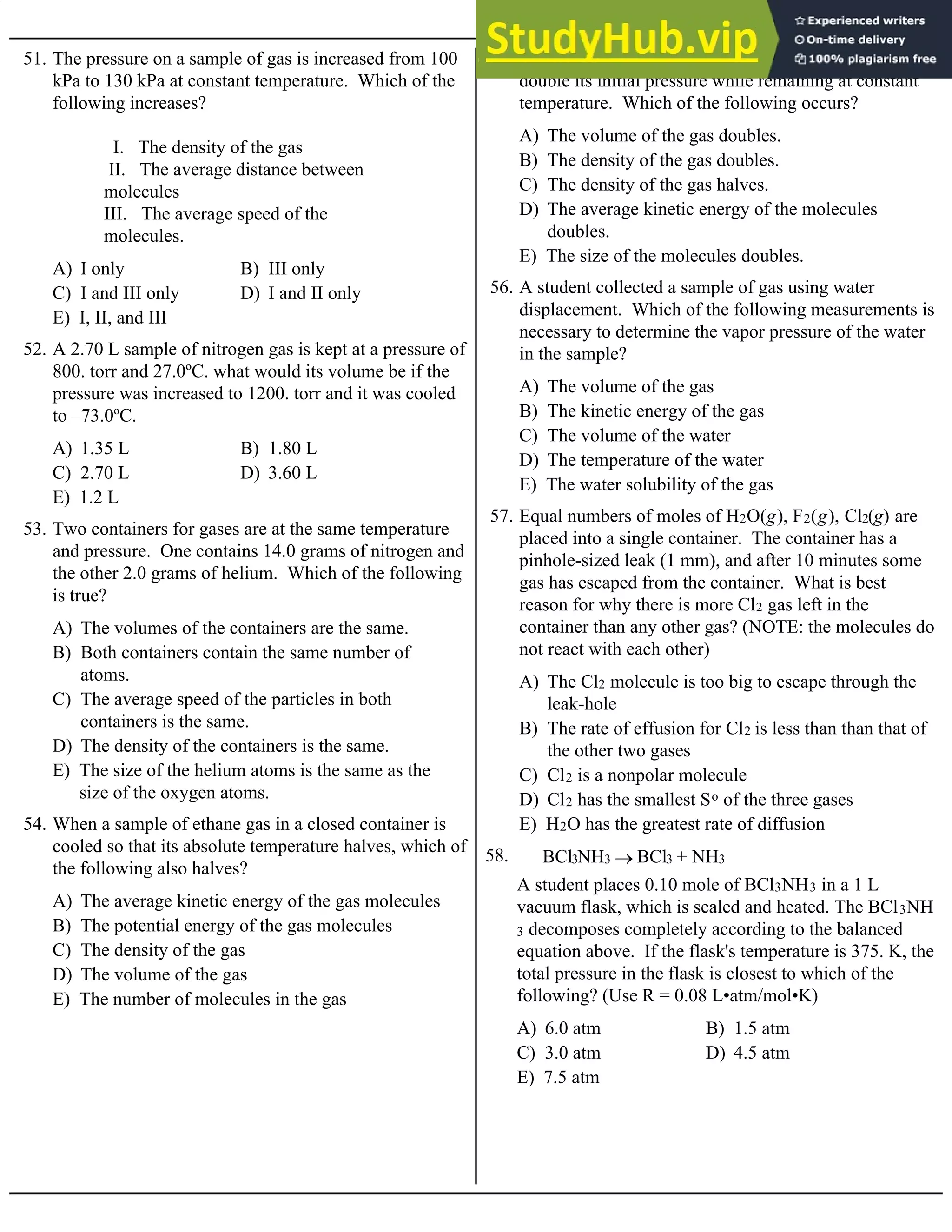
51. The pressure on a sample of gas is increased from 100
kPa to 130 kPa at constant temperature. Which of the
following increases?
I. The density of the gas
II. The average distance between
molecules
III. The average speed of the
molecules.
A) 1.35 L B) 1.80 L
C) 2.70 L D) 3.60 L
E) 1.2 L
52. A 2.70 L sample of nitrogen gas is kept at a pressure of
800. torr and 27.0ºC. what would its volume be if the
pressure was increased to 1200. torr and it was cooled
to –73.0ºC.
A) The volumes of the containers are the same.
B) Both containers contain the same number of
atoms.
C) The average speed of the particles in both
containers is the same.
D) The density of the containers is the same.
E) The size of the helium atoms is the same as the
size of the oxygen atoms.
53. Two containers for gases are at the same temperature
and pressure. One contains 14.0 grams of nitrogen and
the other 2.0 grams of helium. Which of the following
is true?
A) The average kinetic energy of the gas molecules
B) The potential energy of the gas molecules
C) The density of the gas
D) The volume of the gas
E) The number of molecules in the gas
54. When a sample of ethane gas in a closed container is
cooled so that its absolute temperature halves, which of
the following also halves?
A) The volume of the gas doubles.
B) The density of the gas doubles.
C) The density of the gas halves.
D) The average kinetic energy of the molecules
doubles.
E) The size of the molecules doubles.
55. A sample of gas in a closed container is raised to
double its initial pressure while remaining at constant
temperature. Which of the following occurs?
A) The volume of the gas
B) The kinetic energy of the gas
C) The volume of the water
D) The temperature of the water
E) The water solubility of the gas
56. A student collected a sample of gas using water
displacement. Which of the following measurements is
necessary to determine the vapor pressure of the water
in the sample?
A) The Cl2 molecule is too big to escape through the
leak-hole
B) The rate of effusion for Cl2 is less than than that of
the other two gases
C) Cl2 is a nonpolar molecule
D) Cl2 has the smallest So of the three gases
E) H2O has the greatest rate of diffusion
57. Equal numbers of moles of H2O(g), F2(g), Cl2(g) are
placed into a single container. The container has a
pinhole-sized leak (1 mm), and after 10 minutes some
gas has escaped from the container. What is best
reason for why there is more Cl2 gas left in the
container than any other gas? (NOTE: the molecules do
not react with each other)
58. BCl3NH3 ® BCl3 + NH3
A) 6.0 atm B) 1.5 atm
C) 3.0 atm D) 4.5 atm
E) 7.5 atm
A student places 0.10 mole of BCl3NH3 in a 1 L
vacuum flask, which is sealed and heated. The BCl3NH
3 decomposes completely according to the balanced
equation above. If the flask's temperature is 375. K, the
total pressure in the flask is closest to which of the
following? (Use R = 0.08 L•atm/mol•K)
59. Base your answer to the following question on
C3H7OH (s) ® H2O(g) + C3H6 (g)
A) 8.0 atm B) 50. atm
C) 25. atm D) 2.0 atm
E) 4.0 atm
A student places 0.05 mole of C3H7OH (s) in a 1 L
vacuum flask, which is sealed and heated. The propanol
decomposes completely according to the balanced
equation above. If the flask's temperature is 500. K, the
total pressure in the flask is closest to which of the
following? (Use R = 0.08 L•atm/mol•K)
A) The average speed of the neon atoms remains the
same.
B) The density of neon gas inside the tank increases.
C) The average distance between molecules
decreases.
D) The volume of the gas decreases.
E) The pressure inside the tank increases.
60. A sealed metal tank is filled with neon gas. Which of
the following does NOT occur when neon gas is
pumped into the tank at a constant temperature?
A) 760.5 torr B) 745.0 torr
C) 15.5 torr D) 727.0 torr
E) 729.5 torr
61. Find the partial pressure of Hydrogen gas collected over
water at 18oC if the the vapor pressure of water at 18oC
is 15.5 torr, and the total pressure of the sample is 745
torr.
A) 803 torr B) 30 torr
C) 743 torr D) 753 torr
E) 773 torr
62. Hydrogen gas is collected over water at 29oC. The total
pressure of the system is 773 torr. If the vapor pressure
of water at 29oC is 30 torr, what is the partial pressure
of the hydrogen gas?
63. Base your answer to the following question on the
following types of energy.
(A) Lattice energy
(B) Potential energy
(C) Kinetic energy
(D) Electromagnetic energy
(E) Vaporization energy
A) A B) B C) C D) D E) E
Energy that is measured by mv2
A) The average kinetic energy of the gas particles
increases.
B) The pressure of the gas increases.
C) The volume of the gas decreases.
D) The total number of gas molecules stays constant.
E) The total force of the gas molecules hitting the
side of the container decreases.
64. A rigid cylinder is filled with gas. At constant
temperature, which of the following applies to the gas
in the cylinder when gas is released?
A) The average kinetic energy does not change.
B) The average kinetic energy of the sample
increased by a factor of 363/323.
C) The average kinetic energy of the sample
increased by a factor of 9/5.
D) The average kinetic energy increased by a factor
of 81/25.
E) More information is needed to know whether the
average kinetic energy changed.
65. The temperature of a sample of xenon atoms is raised
from 50oC to 90oC. Which of the following statements
is true about the average kinetic energy of the atoms?
A) mass of molecules
B) shape of molecules
C) intermolecular forces
D) size of molecules
E) energy of molecules
66. The pressure of a real gas is sometimes less than that
predicted by the ideal gas law because the ideal gas law
does not include the factor of
A) Low pressure and low temperature
B) Low pressure and high temperature
C) High pressure and high temperature
D) High pressure and low density
E) Low temperature and high density
67. Under which conditions does a real gas most closely
approximate an ideal gas?
68. _I2 + _F2 ®_IFx
A) 1 B) 2 C) 3 D) 5 E) 7
The above reaction occurs in a closed container. The
container is rigid and temperature is constant
throughout the reaction. The container starts out with 10
atm of iodine gas and 1 atm of fluorine gas. Five atm of
iodine gas is left at the end of the reaction. What is x?
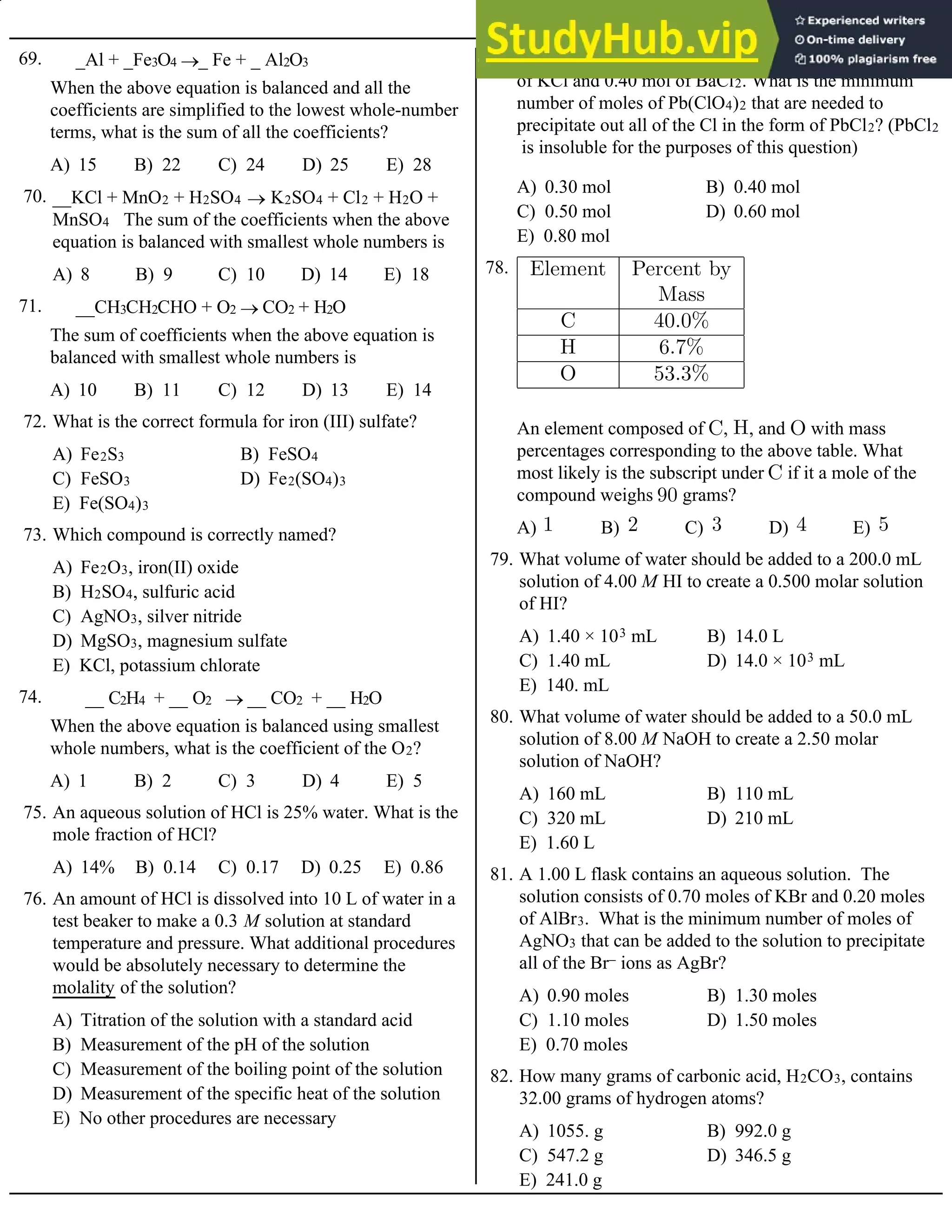
69. _Al + _Fe3O4 ®_ Fe + _ Al2O3
A) 15 B) 22 C) 24 D) 25 E) 28
When the above equation is balanced and all the
coefficients are simplified to the lowest whole-number
terms, what is the sum of all the coefficients?
A) 8 B) 9 C) 10 D) 14 E) 18
70. __KCl + MnO2 + H2SO4 ® K2SO4 + Cl2 + H2O +
MnSO4 The sum of the coefficients when the above
equation is balanced with smallest whole numbers is
71. __CH3CH2CHO + O2 ® CO2 + H2O
A) 10 B) 11 C) 12 D) 13 E) 14
The sum of coefficients when the above equation is
balanced with smallest whole numbers is
A) Fe2S3 B) FeSO4
C) FeSO3 D) Fe2(SO4)3
E) Fe(SO4)3
72. What is the correct formula for iron (III) sulfate?
A) Fe2O3, iron(II) oxide
B) H2SO4, sulfuric acid
C) AgNO3, silver nitride
D) MgSO3, magnesium sulfate
E) KCl, potassium chlorate
73. Which compound is correctly named?
74. __ C2H4 + __ O2 ® __ CO2 + __ H2O
A) 1 B) 2 C) 3 D) 4 E) 5
When the above equation is balanced using smallest
whole numbers, what is the coefficient of the O2?
A) 14% B) 0.14 C) 0.17 D) 0.25 E) 0.86
75. An aqueous solution of HCl is 25% water. What is the
mole fraction of HCl?
A) Titration of the solution with a standard acid
B) Measurement of the pH of the solution
C) Measurement of the boiling point of the solution
D) Measurement of the specific heat of the solution
E) No other procedures are necessary
76. An amount of HCl is dissolved into 10 L of water in a
test beaker to make a 0.3 M solution at standard
temperature and pressure. What additional procedures
would be absolutely necessary to determine the
molality of the solution?
77. A 1.0 L test beaker is filled to the mark with 0.20 mol
of KCl and 0.40 mol of BaCl2. What is the minimum
number of moles of Pb(ClO4)2 that are needed to
precipitate out all of the Cl in the form of PbCl2? (PbCl2
is insoluble for the purposes of this question)
A) 0.30 mol B) 0.40 mol
C) 0.50 mol D) 0.60 mol
E) 0.80 mol
78.
A) B) C) D) E)
An element composed of , , and with mass
percentages corresponding to the above table. What
most likely is the subscript under if it a mole of the
compound weighs grams?
A) 1.40 × 10³ mL B) 14.0 L
C) 1.40 mL D) 14.0 × 10³ mL
E) 140. mL
79. What volume of water should be added to a 200.0 mL
solution of 4.00 M HI to create a 0.500 molar solution
of HI?
A) 160 mL B) 110 mL
C) 320 mL D) 210 mL
E) 1.60 L
80. What volume of water should be added to a 50.0 mL
solution of 8.00 M NaOH to create a 2.50 molar
solution of NaOH?
A) 0.90 moles B) 1.30 moles
C) 1.10 moles D) 1.50 moles
E) 0.70 moles
81. A 1.00 L flask contains an aqueous solution. The
solution consists of 0.70 moles of KBr and 0.20 moles
of AlBr3. What is the minimum number of moles of
AgNO3 that can be added to the solution to precipitate
all of the Br– ions as AgBr?
A) 1055. g B) 992.0 g
C) 547.2 g D) 346.5 g
E) 241.0 g
82. How many grams of carbonic acid, H2CO3, contains
32.00 grams of hydrogen atoms?
A) 170. B) 165. C) 140. D) 125. E) 115.
83. How many grams of sodium nitrate, NaNO3, contains
96.0 grams of oxygen atoms?
84. The Mond process produces pure nickel metal via the
thermal decomposition of nickel tetracarbonyl as shown
in the equation below.
Ni(CO)4(l) ® Ni(s) + 4CO(g)
A) 0.356 L B) 63.7 L
C) 255 L D) 20.2 L
E) 11.0 L
How many liters of CO would be formed from 444 g of
Ni(CO)4 at 752 mm Hg and 22ºC?
A) WBr2 B) WBr3 C) WBr4 D) WBr5 E) WBr6
85. A compound of bromine combined with tungsten is
found to contain 68.5 % bromine and 31.5% tungsten.
What is the empirical formula for this compound?
86.
A) B) C) D) E)
Above is a table of possible mass percentages for a
compound made of , , and . Which set of
percentages matches the compound ?
A) CuSO4 B) CuSO4•3H2O
C) CuSO4•2H2O D) CuSO4•6H2O
E) CuSO4•5H2O
87. The formula of copper (II) sulfate pentahydrate is
A) BaO B) BaO2
C) Ba2O D) Ba2O2
E) BaO4
88. The formula of barium peroxide is
A) FeS, CuCl, CuCl3
B) H2O, HClO, CaS2
C) Pb2O5, HBr, K3NO3
D) FeCl3, MgS, NaHCO3
E) CaBr, CaSO4, AlPO3
89. The set of formulas that are all correct is
A) Mn4O B) MnO2
C) MnO4 D) Mn2O
E) MnO
90. The correct formula for manganese (IV) oxide is
A) Ag3(PO4)4 B) Ag3PO4
C) Ag3(PO3)2 D) Ag3(PO4)2
E) Ag3PO3
91. Which is the correct formula for silver phosphite?
A) Na2SO3 B) Na2SO4
C) Na2S3O2 D) Na2S2O3
92. The formula for sodium thiosulfate is
A) Al2(SO4)3, MgI, KCl
B) Ag(OH)2, NaOH, ZnO3
C) MgBr2, Na2SO4, Zn(OH)2
D) Ca3(PO4)2, Al2(SO4)3, Ag(OH)3
E) CaI, NaNO3, BaSO4
93. The set which contains three correct formulas is
A) LiClO4, NaCN, Ca3(PO4)2
B) KClO, H2SO4, PbCl2
C) Fe2(CO3)3, H2O2, AgI
D) Ca(HCO3)2, CuBr, CuBr2
E) HCl, NaCO3, Br2
94. Which set of formula contains an incorrect formula?
A) acidic B) basic
C) binary D) an oxide
E) a solid
95. The name of a chemical compound ends in “ide”; the
compound is
A) sodium carbonate hydrate
B) sodium carbonate decahydrate
C) disodium carbonite decahydrate
D) disodium carbonate heptahydrate
E) sodium carbonite decahydrate
96. The name of Na2CO3•10H2O is
A) iron (II) biphosphite
B) iron (II) biphosphate
C) iron (III) biphosphite
D) iron (III) dihydrogen phosphate
E) iron (III) biphosphate
97. The name corresponding to the formula Fe(H2PO3)2 is
A) chlorous acid ® chlorite
B) sulfurous acid ® sulfate
C) nitrous acid ® nitrate
D) carbonic acid ® carbide
E) sulfuric acid ® sulfite
98. Which acid is followed by the correct name of the salt it
forms?
A) PbCO3 ® lead (IV) carbonate
B) Cu2SO4 ® copper (I) bisulfate
C) Fe(ClO2)3 ® iron (III) chlorite
D) Mn2S4 ® manganese (II) sulfide
E) TiO2 ® titanium (III) oxide ® titanium
99. Which compound is correctly named?
100. MN2 M2P QP
A) QN B) QN2 C) Q2N3 D) QN4 E) Q2N
Determine the formula expected for a compound of
hypothetical elements Q and N, using only the
formulas above.
A) PtF4 B) PtF6 C) PtF2 D) Pt2F8 E) Pt2F10
101. Platinum metal is reacted with fluorine gas. The
resulting compound is found to be 83.7% Pt, and and
16.3% F by mass. What is the empirical formula of
this compound?
A) XeO2 B) XeO3
C) XeO4 D) XeO5
E) Xe2O5
102. The first chemical compound of a noble gas element
was prepared in 1962. Since then several such
compounds have been prepared and characterized.
What is the empirical formula of a compound of Xe
which is 67.2% Xe and 32.8 % O by mass?
A) Empirical, 1; molecular, 3
B) Empirical, 2; molecular, 2
C) Empirical, 2; molecular, 6
D) Empirical, 3; molecular, 2
E) Empirical, 2; molecular, 3
103. Analysis of a quantity of a compound shows that it
contains 0.110 mol of C, 0.055 mol of N, and
0.165 mol of O. Its molecular weight is about 270.
How many atoms of carbon are there in the empirical
formula for the compound and how many in the
molecular formula?
104. Base your answer to the following question on
2 C6H6 + 15 O2 ®12 CO2 + 6 H2O
A) 15 B) 30 C) 37.5 D) 45 E) 60
Based on the above equation, how many moles of O2
are needed to produce 18 moles of water and 30
moles of carbon dioxide?
A) 27.93 B) 55.85
C) 83.76 D) 167.55
E) 111.70
105. _Fe2O3 + _C ®_Fe + _CO2
Using a balanced equation, find the mass of Fe
produced with excess carbon and 1.5 moles of Fe2O3.
106. 2 MnO4 + 5 H2C2O4 + 3 H2SO4 ®
2 MnSO4 + 10 CO2 + 8 H2O + K2SO4
A) 4.00 moles B) 25.0 moles
C) 20.0 moles D) 2.00 moles
E) 8.00 moles
According to the equation above, how many moles of
MnO4 would be necessary to produce 20.0 moles of
CO2, starting with 25.0 moles of H2C2O4?
107. K2Cr2O7 + 14HCl ® 3Cl2 + 7H2O + 2CrCl3 + 2KCl
A) 6.0 moles B) 42. moles
C) 14. moles D) 2.0 moles
E) 28. moles
According to the equation above, how many moles of
HCl would be necessary to produce 6.0 moles of CrCl3
, starting with 4.0 moles of K2Cr2O7?
108. C8H18 + O2 ® CO2 + H2O
A) 0.079 g B) 1.4 g
C) 18 g D) 162 g
E) 0.158 g
Based on the above unbalanced chemical equation, one
gram of octane will yield what mass of water?
109. 2 NO (g) + O2 (g) ® 2 NO2 (g)
A) (0.60)(0.082)(293) atm
B) (0.45)(0.082)(293) atm
C) (0.30)(0.082)(293) atm
D) (0.60)(0.082)(20) atm
E) (0.45)(0.082)(20) atm
A mixture containing 0.30 mol NO and 0.30 mol O2
reacts in a 1.0 L flask at a constant temperature of
20ºC. What is the pressure in the flask when the
reaction is complete?
110. 4 HF (g) + SiO2 (s) ® SiF4 (g) +2 H2O (l)
A) 2.3 g B) 4.5 g C) 9.0 g D) 18. g E) 36. g
If 10. g of HF (formula mass 20. g/mol) reacts with
15. g of SiO2 (formula mass 60. g/mol), how much
water is produced?
111. An experiment was conducted to determine the rate
law of the reaction 2 A + 2 B ® C + D. The data
collected is shown below.
A) k = [A][B] B) k = [A]2[B]
C) k = [A][B]2 D) k = [A]2[B]2
E) k = [A][B]2
What is the rate law for this equation?
A) 7.9 × 10⁻³ h–1 B) 8.77 × 10⁻³ h–1
C) 79 h D) 39.5 h
E) 4.39 × 10⁻³ h–1
112. A first order reaction goes to half completion in 79
hours. What is the rate constant for this reaction?
113. Base your answer to the following question on the
possible rate laws below for the reaction:
A + B C
A) A B) B C) C D) D E) E
When [A] is tripled and [B] is constant then the initial
rate of reaction remains constant.
114. A + 2 B ®2 C + 4 D
A) [C]2[D]4
B) k[C]2[D]4
C) second order
D) first order
E) impossible to find without experimental data
The rate law for the above reaction is
115.
A) Rate = k[H2]/[ICl]
B) Rate = k[H2][ICl]
C) Rate = k[H2][ICl]2
D) Rate = k[H2]2[ICl]2
E) Rate = k[H2]2[ICl]
The above chart contains experimental data obtained
from the following reaction:
H2 + 2 ICl ® I2 + 2 HCl
What is the experimental rate law for this reaction?
A) cooling the system
B) adding more sodium, Na
C) increasing the volume of the system
D) removing sodium chloride, NaCl
E) using gaseous chlorine, Cl2
116. Given the reaction:
Cl2(l) + 2 Na(s) ® 2 NaCl(s)
The reaction rate can be significantly increased by:
A) the Drake equation
B) the Clausius-Claperon Equation
C) the Arrhenius equation
D) the Nernst equation
E) Avogadro's equation
117. The temperature of a reaction is increased from 350 K
to 400 K. The reaction rate is tripled. Which of the
following equations can be used to find the activation
energy of the reaction?
Base your answers to questions 118 and 119 on on the table below, for the following reaction:
2 SO2 + O2 ® 2 SO3
A) 4.0 × 10⁻⁸ B) 2.0 × 10⁻⁸ C) 1.0 × 10⁻⁸ D) 4.0 × 10⁻⁹ E) 2.0 × 10⁻⁹
118. The value of the rate constant, k, for this reaction is
A) Rate = k[SO2][O2]3 B) Rate = k[SO2]3[O2]2
C) Rate = k[SO2][O2] D) Rate = k[SO2]3[O2]
E) Rate = k[SO2]3
119. What is the experimental rate law for the reaction above?
Base your answers to questions 120 and 121 on the table of data for the following reaction:
CO(g) + O2(g) ® CO2(g)
A) 1.6 × 10⁻⁴ M/s B) 8.0 × 10⁻⁵ M/s C) 4.0 × 10⁻⁵ M/s D) 1.0 × 10⁻⁵ M/s E) 3.2 × 10⁻⁴ M/s
120. The value of the rate constant, k, is
A) 2.0 × 10⁻⁵ M/s B) 1.6 × 10⁻⁴ M/s C) 1.0 × 10⁻⁵ M/s D) 0.50 × 10⁻⁵ M/s E) 8.0 × 10⁻⁵ M/s
121. When [CO] = [O2] = 1.0 M, the rate of reaction will be
A) rate = k [XO]2[O2]–1
B) rate = k [XO][O2]–1
C) rate = k [XO]2 [O2]
D) rate = k [XO] [O2]2
E) rate = k [XO]2 [O2]2
122. A student collected the initial-rate data in the chart
below.
What is the experimental rate law for this reaction?
A) rate = k B) rate = k [Z]
C) rate = k [Z]2 D) rate = [Z]
E) rate = [Z]2
123. For which of the following rate laws would the graph
of ln [Z] versus time be a straight line?
A) I only B) II and III only
C) I and III only D) I, II, III and IV
E) I, II and III only
124. Consider the following factors:
I. Reactant particles collide
II. Sufficient kinetic energy is present
III. A favorable geometry exists
IV. Catalysts are present
Which combination of the above factors is required
for all successful collisions?
A) rate of dissolving increases; rate of crystallization
increases
B) rate of dissolving decreases; rate of
crystallization increases
C) rate of dissolving increases; rate of crystallization
decreases
D) rate of dissolving decreases; rate of
crystallization decreases
E) rate of dissolving remains constant; rate of
crystallization decreases
125. When solid AgBr is added to saturated solution of
AgBr, the reaction rates can be described as
Base your answers to questions 126 through 128 on the
rate law given below for the reaction A + B + C ® D.
Rate = k[A]2[B][C]
A) 1 B) 2 C) 3 D) 4 E) 0
126. What is the order of the reaction with respect to A?
A) Both [A] and [C] will increase.
B) Both [A] and [C] will decrease.
C) [A] will decrease and [C] will increase.
D) [A] will increase and [C] will decrease.
E) Both [A] and [C] will stay the same.
127. If the concentration of B is decreased, what will
happen?
A) The rate of the reaction increases
B) The rate of the reaction decreases
C) The value of the equilibrium constant increases
D) The value of the equilibrium constant decreases
E) Neither the equilibrium constant nor the rate
would change.
128. If the concentration of C is doubled what will happen?
A) Rate = k[A]2 B) Rate = k[B]2
C) Rate = k[A][B] D) Rate = k[A]2[B]
E) Rate = k[A][B]2
129. Base your answer to the following question on the
table below which was obtained for the reaction A + B
C.
What is the rate law for this reaction?
130. I. Ag+(aq) + I–(aq) ® AgI(s)
II. 4 Fe(s) + 3 O2(g) ® 2 Fe2O3(s)
A) I is faster than II
B) II is faster than I
C) I and II are both fast
D) I and II are both slow
E) The relative rates of reaction cannot be
determined
Which statement best describes the relative rates of the
above two reactions?
131. I. 4 Al(s) + 3 O2(g) ® 2 Al2O3(s)
II. Ag+(aq) + Cl–(aq) ® AgCl(s)
A) I is faster than II
B) II is faster than I
C) I and II are both fast
D) I and II are both slow
E) The relative rates of reaction cannot be
determined
Which statement best describes the relative rates of the
above two reactions?
A) I and II only
B) I, II, and IV only
C) III, IV, and V only
D) IV and V only
E) They are all correlated with a fast reaction rate
132. Which of the following is not correlated with a fast
reaction rate?
I. Catalysts
II. High temperature
III. High concentration of reactants
IV. Strong bonds in the products
V. Low level of activation energy
133. Base your answer to the following question on the
graph below which shows the number of molecules
with a given kinetic energy plotted as a function of
kinetic energy. Four catalysts are available, A, B, C
and D, which have associated reaction activation
energies EA, EB, EC, and ED respectively.
A) Catalyst 'A' associated with energy Ea
B) Catalyst 'B' associated with energy Eb
C) Catalyst 'C' associated with energy Ec
D) Catalyst 'D' associated with energy Ed
E) The activation energies of catalysts A, B, C and D
all result in the same reaction rate.
Which catalyst will have an activation energy which
will result in the slowest reaction rate ?
134. Base your answer to the following question on the
graph below showing the energy during a catalyzed
reaction.
A) Curve T1 B) Curve T2
C) Curve T3 D) Can’t tell
Which is the curve for the lowest temperature?
A) concentration of the reactants
B) average kinetic energy of the molecules
C) number of intermolecular collisions per unit of
time
D) number of particles with an energy above a
minimum activation energy
E) voulume of the reactants
135. Generally an increase of ten degrees centigrade
doubles the rate of reaction between gases. The
explanation for this increase in reaction rate is the
doubling of the
136. Base your answer to the following question on the
following reaction.
H2(g) + I2(g) « 2 HI(g)
A) [H2] will increase. B) [I2] will increase.
C) [HI] will decrease. D) 1 and 2
E) None of these
The reaction above is allowed to reach equilibrium.
The pressure on the system is doubled. Which of the
following is true?
A) Zn(s) + S(s) ® ZnS(s)
B) Ba2+(aq) + SO42–(aq) ® BaSO4(s)
C) NH3(g) + HCl(g) ® NH4Cl(s)
D) 2 Ag+(aq) + CO32–(aq) ® Ag2CO3(s)
E) NaCl(aq) ® Na+(aq) + Cl–(aq)
137. Which of the following reactions is slowest at room
temperature?
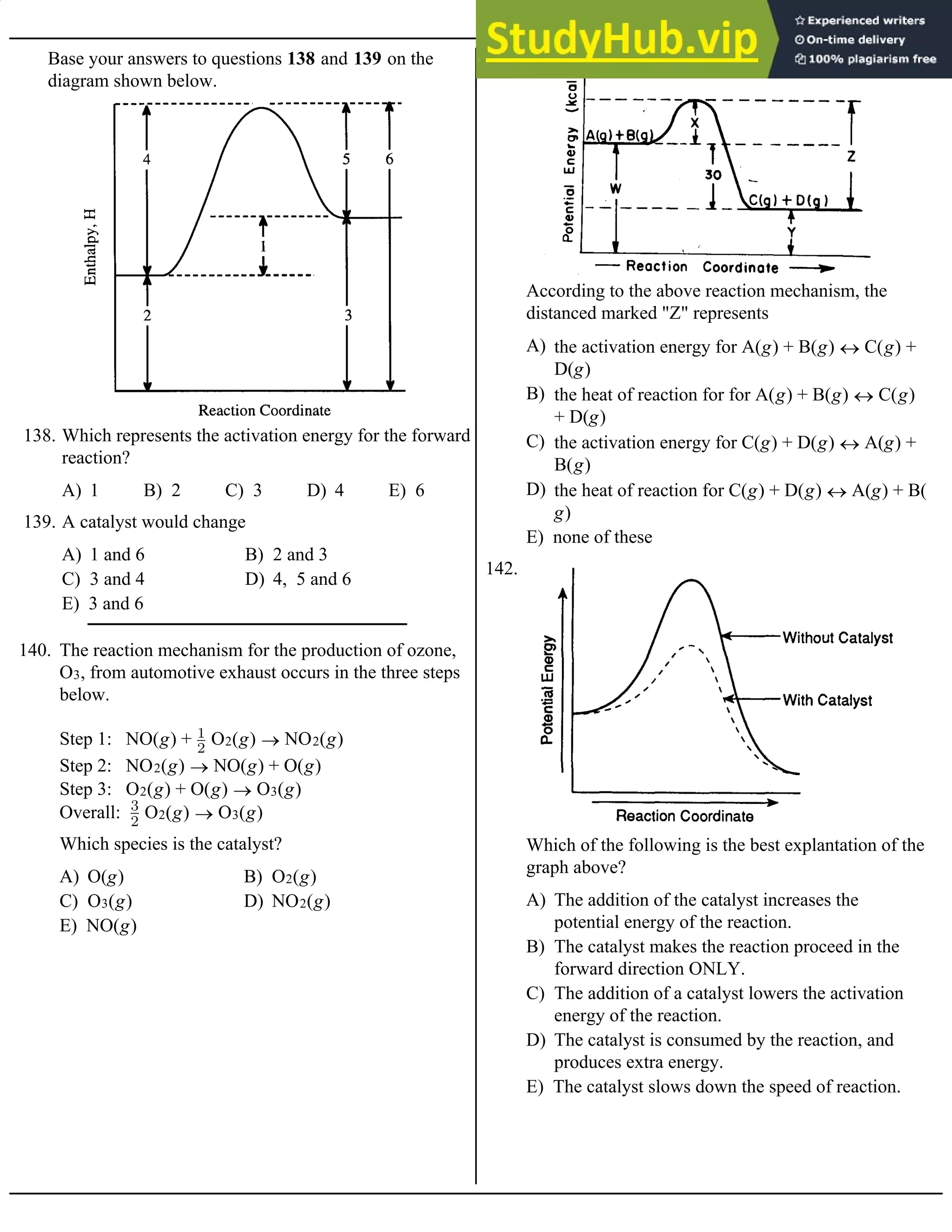
Base your answers to questions 138 and 139 on the
diagram shown below.
A) 1 B) 2 C) 3 D) 4 E) 6
138. Which represents the activation energy for the forward
reaction?
A) 1 and 6 B) 2 and 3
C) 3 and 4 D) 4, 5 and 6
E) 3 and 6
139. A catalyst would change
140. The reaction mechanism for the production of ozone,
O3, from automotive exhaust occurs in the three steps
below.
Step 1: NO(g) + O2(g) ® NO2(g)
Step 2: NO2(g) ® NO(g) + O(g)
Step 3: O2(g) + O(g) ® O3(g)
Overall: O2(g) ® O3(g)
A) O(g) B) O2(g)
C) O3(g) D) NO2(g)
E) NO(g)
Which species is the catalyst?
141.
A) the activation energy for A(g) + B(g) « C(g) +
D(g)
B) the heat of reaction for for A(g) + B(g) « C(g)
+ D(g)
C) the activation energy for C(g) + D(g) « A(g) +
B(g)
D) the heat of reaction for C(g) + D(g) « A(g) + B(
g)
E) none of these
According to the above reaction mechanism, the
distanced marked "Z" represents
142.
A) The addition of the catalyst increases the
potential energy of the reaction.
B) The catalyst makes the reaction proceed in the
forward direction ONLY.
C) The addition of a catalyst lowers the activation
energy of the reaction.
D) The catalyst is consumed by the reaction, and
produces extra energy.
E) The catalyst slows down the speed of reaction.
Which of the following is the best explantation of the
graph above?
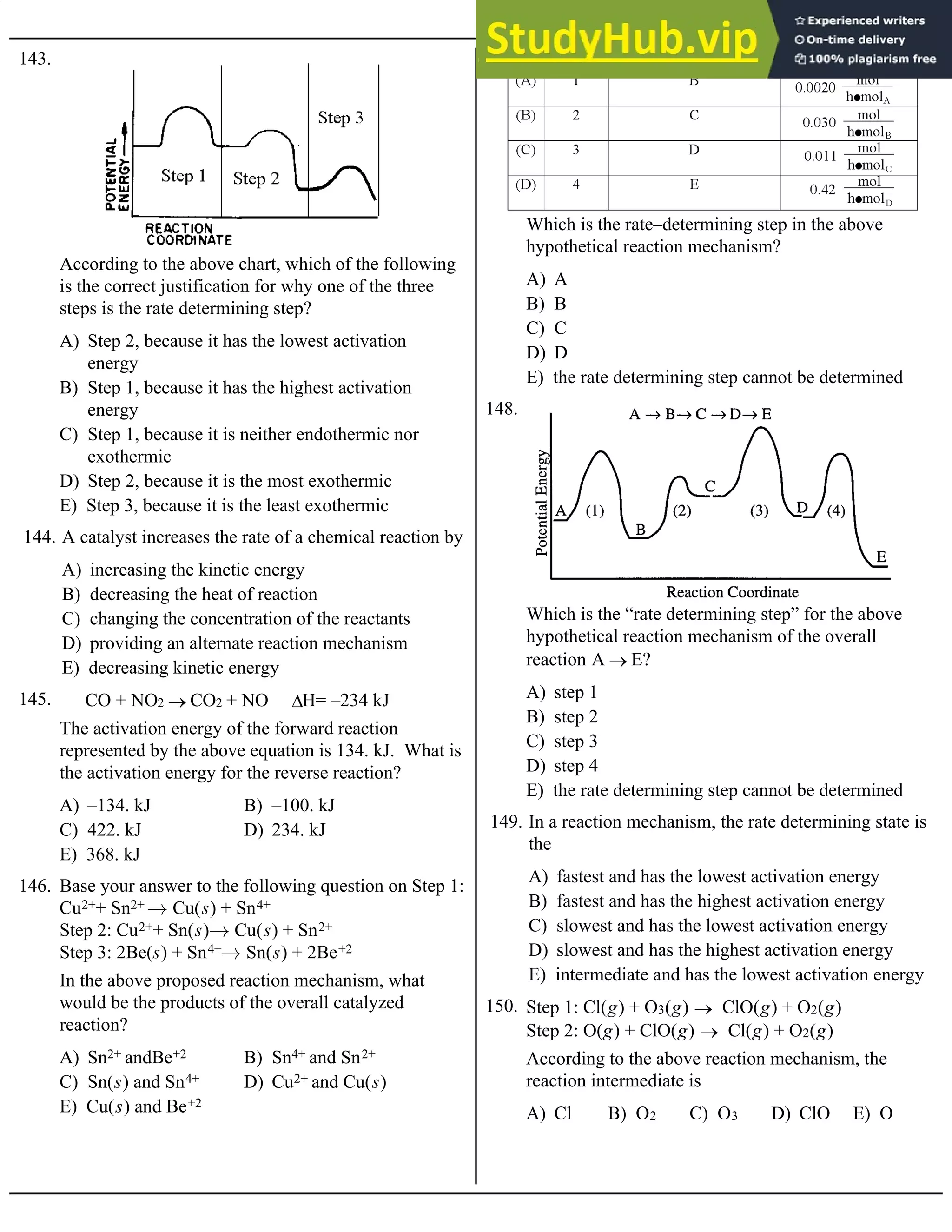
143.
A) Step 2, because it has the lowest activation
energy
B) Step 1, because it has the highest activation
energy
C) Step 1, because it is neither endothermic nor
exothermic
D) Step 2, because it is the most exothermic
E) Step 3, because it is the least exothermic
According to the above chart, which of the following
is the correct justification for why one of the three
steps is the rate determining step?
A) increasing the kinetic energy
B) decreasing the heat of reaction
C) changing the concentration of the reactants
D) providing an alternate reaction mechanism
E) decreasing kinetic energy
144. A catalyst increases the rate of a chemical reaction by
145. CO + NO2 ® CO2 + NO DH= –234 kJ
A) –134. kJ B) –100. kJ
C) 422. kJ D) 234. kJ
E) 368. kJ
The activation energy of the forward reaction
represented by the above equation is 134. kJ. What is
the activation energy for the reverse reaction?
146. Base your answer to the following question on Step 1:
Cu2++ Sn2+ Cu(s) + Sn4+
Step 2: Cu2++ Sn(s) Cu(s) + Sn2+
Step 3: 2Be(s) + Sn4+ Sn(s) + 2Be+2
A) Sn2+ andBe+2 B) Sn4+ and Sn2+
C) Sn(s) and Sn4+ D) Cu2+ and Cu(s)
E) Cu(s) and Be+2
In the above proposed reaction mechanism, what
would be the products of the overall catalyzed
reaction?
147.
A) A
B) B
C) C
D) D
E) the rate determining step cannot be determined
Which is the rate–determining step in the above
hypothetical reaction mechanism?
148.
A) step 1
B) step 2
C) step 3
D) step 4
E) the rate determining step cannot be determined
Which is the “rate determining step” for the above
hypothetical reaction mechanism of the overall
reaction A ® E?
A) fastest and has the lowest activation energy
B) fastest and has the highest activation energy
C) slowest and has the lowest activation energy
D) slowest and has the highest activation energy
E) intermediate and has the lowest activation energy
149. In a reaction mechanism, the rate determining state is
the
150. Step 1: Cl(g) + O3(g) ® ClO(g) + O2(g)
Step 2: O(g) + ClO(g) ® Cl(g) + O2(g)
A) Cl B) O2 C) O3 D) ClO E) O
According to the above reaction mechanism, the
reaction intermediate is
151. Base your answer to the following question on the
reaction below.
A) B is not involved in any steps in this reaction.
B) B is not involved in the rate determining step, but
may be involved in other steps in the reaction.
C) The coefficient of B is 1, therefore it does not
affect the rate of the reaction.
D) B is a solid, therefore does not appear in the rate
expression.
E) The order of the reaction with respect to B is 1.
If the rate expression for this reaction does not depend
on B, what could be the cause of this?
A) CrCl2 B) LiCl
C) FeCl3 D) CoCl2
E) NiCl2
152. Which compound dissolves in water to form a clear
solution?
153. Base your answer to the following question on the
elements below.
(A) Fluorine
(B) Copper
(C) Phosphorous
(D) Neon
(E) Francium
A) A B) B C) C D) D E) E
Which element is a highly reactive metal?
A) Francium is the least electronegative.
B) They form ions with 1+ charge.
C) Lithium has the smallest atomic radius.
D) First ionization energy increases with atomic
number.
E) They are not found in pure form in nature.
154. All the following statements concerning the alkali
metals are true EXCEPT:
A) blue B) orange
C) purple D) red
E) green
155. When a solution of strontium chloride is ignited, the
color of the flame is
156. An element has lst, 2nd and 3rd ionization energies
given in kJ mol-1.
A) Alkali metals.
B) Transition elements.
C) Noble gases.
D) Halogens.
E) Alkaline earth metals.
This element is a member of which group?
Base your answers to questions 157 through 160 on the
electron configurations below.
(A) 2s1
(B) [Ar] 3d104s24p1
(C) [Kr] 4d105s25p3
(D) [Ne] 3s2
(E) [Kr] 4d105s25p6
A) A B) B C) C D) D E) E
157. An atom with three valence electrons
A) A B) B C) C D) D E) E
158. An atom in an excited state
A) A B) B C) C D) D E) E
159. Represents a noble gas
A) A B) B C) C D) D E) E
160. An alkaline earth metal
A) MgSO3 B) MgCO3
C) Mg(OH)2 D) Mg(NO3)2
E) Mg3(PO4)2
161. A soluble magnesium salt is
162. Base your answer to the following question on the
elements below.
(A) Boron
(B) Rubidium
(C) Nitrogen
(D) Mercury
(E) Plutonium
A) A B) B C) C D) D E) E
Usually exists as a diatomic gaseous element
A) Fluorine is the least electronegative element.
B) Bromine liberates free chlorine from a solution of
chloride ions.
C) Ionization energy increases with increasing
atomic number.
D) Fluorine has the smallest atomic radius.
E) They combine with Group I metals to form
compounds of the form XY2.
163. Which of the following is true about the halogens?
A) Its valence electrons are of the form ns2np4.
B) Atomic radius decreases with increasing atomic
number.
C) It combines with group IIA metals in binary
compounds of the form XY.
D) It contains members that naturally exist in each
of the 3 states of matter.
E) All its members are monatomic.
164. Which of the following is true about the halogen
family?
165. Base your answer to the following question on the
atomic orbitals below.
(A) 1s2 2s1 2p
1
(B) 1s2 2s2 2p
1
(C) 1s2 2s2
2p
6
(D) [Ar] 4s2
(E) [Ar] 4s2 3d4
A) A B) B C) C D) D E) E
This element dissolves to become a colored solution.
A) iodides B) bromides
C) chromates D) phosphates
E) sulfides
166. The colored solids are formed from
A) NaCl B) MgCl2
C) AlCl3 D) NiCl2
E) ZnCl2
167. Which of the following forms a colored solution in
water?
168. Base your answer to the following question on the
chemicals below.
(A) Sulfur dioxide
(B) Hydrochloric acid
(C) Water
(D) Potassium phosphate
(E) Copper chloride
A) A B) B C) C D) D E) E
Which forms a colored solution in water?
A) Carbon has oxides that can be acid anhydrides.
B) Diamond is an example of elemental carbon in
the solid state.
C) Nearly all organic compounds contain carbon.
D) The AMU is defined as 1/12 of the weight of a
carbon-12 atom.
E) Since carbon is located between a metal and a
nonmetal, it is classified as metalloid.
169. Which of the following is FALSE about elemental
carbon?
A)
B)
C) D)
E)
170. Which of the following is an acid?
A) B)
C) D)
171. Which of the following organic compounds is an
ether?
172.
A) Ester B) Ether
C) Ketone D) Aldehyde
E) Alcohol
The hydrocarbon above is an example of which of the
following?
A) CH2=C=CH2 and CH C–CH3
B) CH2=CH2 and CH CH
C) HO–CH2–CH2–OH and CH3–CH2–OH
D) CH3–CH2–CH2–CH2–CH3 and CH3–CH2–CH3
E) CH3–O–CH3 and CH3–C–CH3 ||
O
173. Which of the following pairs of compounds are
isomers?
174. Base your answer to the following question on the
chemicals below.
(A) Carbon dioxide
(B) Hydrofluoric acid
(C) Magnesium sulfate
(D) Potassium chromate
(E) Calcium carbonate
A) A B) B C) C D) D E) E
Which is a product of the complete combustion of
propane?
A) a piece of copper.
B) a piece of magnesium.
C) phenolphthalein indicator.
D) a piece of red litmus paper.
E) a piece of gold
175. One beaker contains 1.0 M HCl and another contains
tap water. The acid solution can be distinguished from
the tap water by using
A) Determining which ions are present in a solution
that contains metallic ions
B) Determining the visible light spectra of an
element.
C) Finding the concentration of a solution of
Mg(C2H3O2)2
D) Measuring the conductivity of CaCrO4
E) None of the above choices are proper usages of a
visible-light spectrophotometer.
176. A visible-light spectrophotometer can be used for
which of the following tasks?
A) 19.0 g of MgCl2 and 1.00 kg of water.
B) 19.0 g of MgCl2 and 989. g of water.
C) 19.0 g of MgCl2 and add water until final
solution is approximately 1.00 liter.
D) 95.0 g of MgCl2 and 915. g of water.
E) 95.0 g of MgCl2 and 1.00 kg of water.
177. A student wishes to prepare approximately 1.00 liter
of a 0.200 m MgCl2 solution (formula mass 95.0 g).
The proper procedure would be to weigh out
A) 10.8 g of HCl and 1.00 kg of water.
B) 10.8 g of HCl and add water until the final
solution has a volume of 3.00 liters
C) 36.0 g of HCl and add water until the final
solution has a volume of 3.00 liter.
D) 10.8 g of HCl and add 3.00 liter of water.
E) 36.0 g of HCl and add 3.00 liter of water.
178. A student wishes to prepare 3.00 liters of a 0.100 M
HCl solution (formula mass 36.0 g). The proper
procedure is to weigh out
Base your answers to questions 179 and 180 on the
following information.
312 grams of benzene gas (C6H6) is burned to
completion with O2 in a flame resistant giant balloon at
298 K. The balloon is held at a constant pressure of 5
atm. All liquid is allowed to flow out without the loss of
any gas.
179. Determine the final volume of the balloon after the
reaction is complete.
180. Write the balanced equation for the reaction.
181. Water is added to a 8.23 g sample of TaCl5. The only products are 5.71g of a solid containing only
tantalum, chlorine and oxygen and 3.35 g of a gas which is 97.2% chlorine and the remainder is hydrogen.
(a) Determine the empirical formula of the gas.
(b) What fraction of the chlorine of the original compound is in the solid?
(c) Determine the empirical formula for the solid produced.
(d) Write a balanced equation for the reaction between tantalum pentachloride and water.
182. Consider the data collected for the reaction 2 A + B ® C + D.
(a) Write down the rate law for the formation of C.
(b) Calculate the rate constant for the reaction, including the proper units.
(c) The following mechanism was proposed for the reaction. Show if it leads to the correct rate law.
Step 1: A + B « X (fast equilibrium)
Step 2: X + A ® C + Y (slow)
Step 3: Y + B ® D (fast)
(d) If the rate increases threefold as the temperature increases from 300. to 350. Kelvin,
what is the activation energy for the reaction?
183. 2 A + 3 B ® C + D
The following results were obtained by studying the reaction above at 40ºC.
(a) Determine the order of the reaction with respect to A and B. Justify your answer.
(b) Write the rate law for the reaction, and calculate the rate constant, specifying units.
(c) What is the inital rate of disappearance of B in trial 1?
(d) What is the initial concentration of A in trial 4?
(e) Write a possible 3 step reaction mechanism that is consistant with both the rate law and the
stoichiometry of the reaction. Indicate which step is the rate determining step.
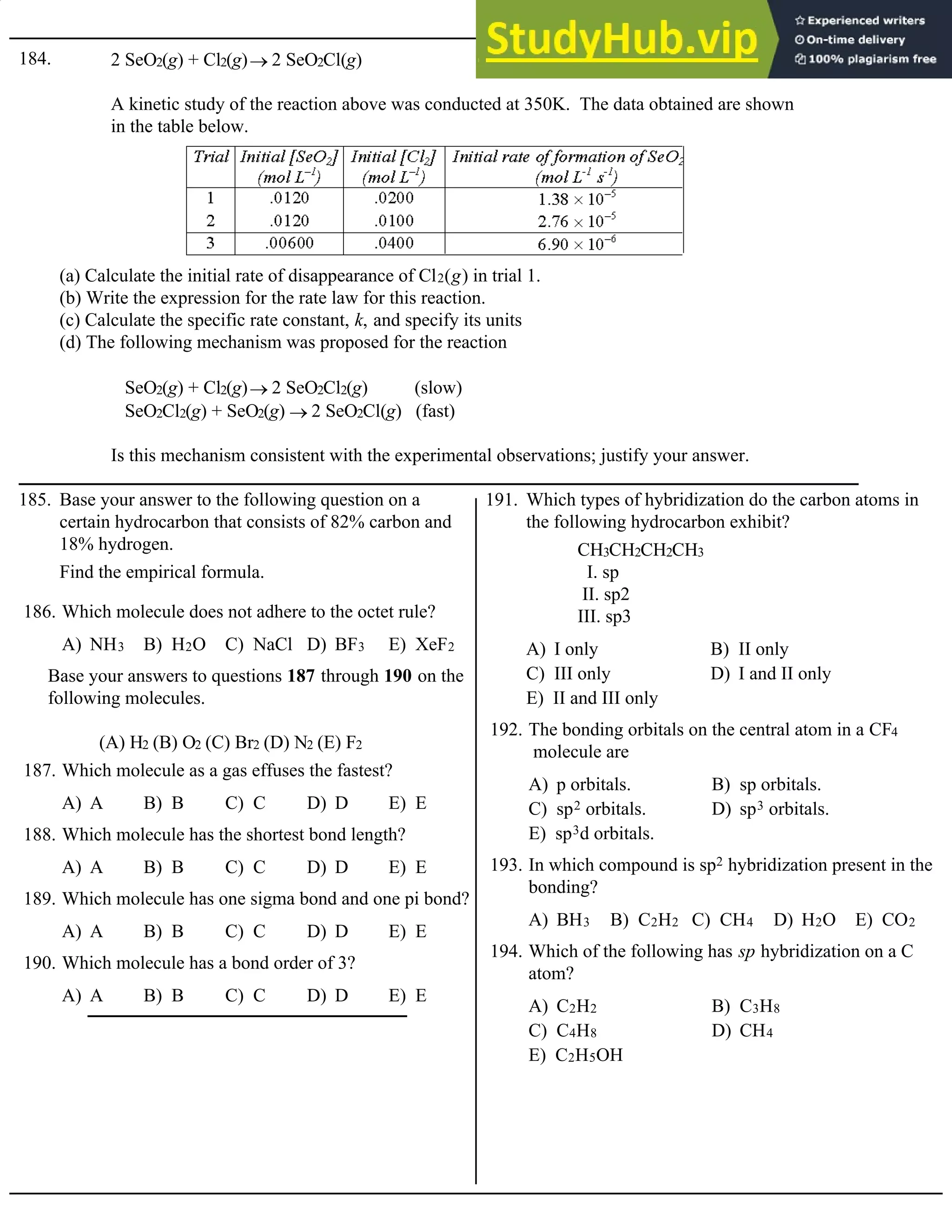
184. 2 SeO2(g) + Cl2(g)® 2 SeO2Cl(g)
A kinetic study of the reaction above was conducted at 350K. The data obtained are shown
in the table below.
(a) Calculate the initial rate of disappearance of Cl2(g) in trial 1.
(b) Write the expression for the rate law for this reaction.
(c) Calculate the specific rate constant, k, and specify its units
(d) The following mechanism was proposed for the reaction
SeO2(g) + Cl2(g)® 2 SeO2Cl2(g) (slow)
SeO2Cl2(g) + SeO2(g) ® 2 SeO2Cl(g) (fast)
Is this mechanism consistent with the experimental observations; justify your answer.
185. Base your answer to the following question on a
certain hydrocarbon that consists of 82% carbon and
18% hydrogen.
Find the empirical formula.
A) NH3 B) H2O C) NaCl D) BF3 E) XeF2
186. Which molecule does not adhere to the octet rule?
Base your answers to questions 187 through 190 on the
following molecules.
(A) H2 (B) O2 (C) Br2 (D) N2 (E) F2
A) A B) B C) C D) D E) E
187. Which molecule as a gas effuses the fastest?
A) A B) B C) C D) D E) E
188. Which molecule has the shortest bond length?
A) A B) B C) C D) D E) E
189. Which molecule has one sigma bond and one pi bond?
A) A B) B C) C D) D E) E
190. Which molecule has a bond order of 3?
191. Which types of hybridization do the carbon atoms in
the following hydrocarbon exhibit?
A) I only B) II only
C) III only D) I and II only
E) II and III only
CH3CH2CH2CH3
I. sp
II. sp2
III. sp3
A) p orbitals. B) sp orbitals.
C) sp2 orbitals. D) sp3 orbitals.
E) sp3d orbitals.
192. The bonding orbitals on the central atom in a CF4
molecule are
A) BH3 B) C2H2 C) CH4 D) H2O E) CO2
193. In which compound is sp2 hybridization present in the
bonding?
A) C2H2 B) C3H8
C) C4H8 D) CH4
E) C2H5OH
194. Which of the following has sp hybridization on a C
atom?
A) sp and sp2 B) sp3 and dsp3
C) sp2 and sp3 D) sp and sp3
E) sp2 and dsp3
195. What types of hybridization are found on the C atoms
of butene (C4H8)?
196.
A) I only B) II and IVonly
C) I and III only D) II and III only
E) III and IV only
What type(s) of sp hybridization are found on the C
atoms in the above compound ?
I. sp
II. sp
2
III. sp
3
IV. dsp3
Base your answers to questions 197 and 198 on the
following hybridizations.
(A) sp
(B) sp
2
(C) sp
3
(D) dsp
3
(E) d2sp3
A) A B) B C) C D) D E) E
197. What type of sp hybridization is exhibited by XeF6?
A) A B) B C) C D) D E) E
198. Which type of sp hybridization is exhibited by PCl5?
A) CO2 B) CH4 C) H2O D) NH3 E) TiF4
199. Which of the following does NOT have sp3
hybridization?
A) 11 sigma bonds, 0 pi bonds
B) 9 sigma bonds, 2 pi bonds
C) 7 sigma bonds, 4 pi bonds
D) 7 sigma bonds, 2 pi bonds
E) 5 sigma bonds, 4 pi bonds
200. In butadiene (C4H6), how many sigma and pi bonds
are present?
A) KCN is a molecular compound.
B) KCN produces a strong acid when dissolved in
water.
C) KCN is an ionic compound that contains sigma
and pi covalent bonds.
D) KCN is an example of a network covalent
compound.
E) KCN is not classified as an ionic OR covalent
compound.
201. Which of the following statements is true about KCN?
202. How many sigma bonds and pi bonds are in the
following compound?
A) 5 sigma and 4 pi B) 6 sigma and 3 pi
C) 7 sigma and 2 pi D) 8 sigma and 1 pi
E) 9 sigma and 0 pi
Base your answers to questions 203 through 205 on the
shape of the following molecules
(A) Square planar
(B) Octahedral
(C) Trigonal Planar
(D) Linear
(E) Tetrahedral
A) A B) B C) C D) D E) E
203. What is the shape of the CCl4 molecule?
A) A B) B C) C D) D E) E
204. What is the shape of the SF6 molecule?
A) A B) B C) C D) D E) E
205. What is the shape of the XeF4 molecule?
A) Octahedral B) Linear
C) Square pyramidal D) Tetrahedral
E) Triangular planar
206. The shape of a BF3 molecule is
A) linear B) pyramidal
C) trigonal planar D) tetrahedral
E) octahedral
207. The shape of the carbonate ion, CO32–, is
A) Bent B) Linear
C) Tetrahedral D) Trigonal pyramidal
E) Planar triangular
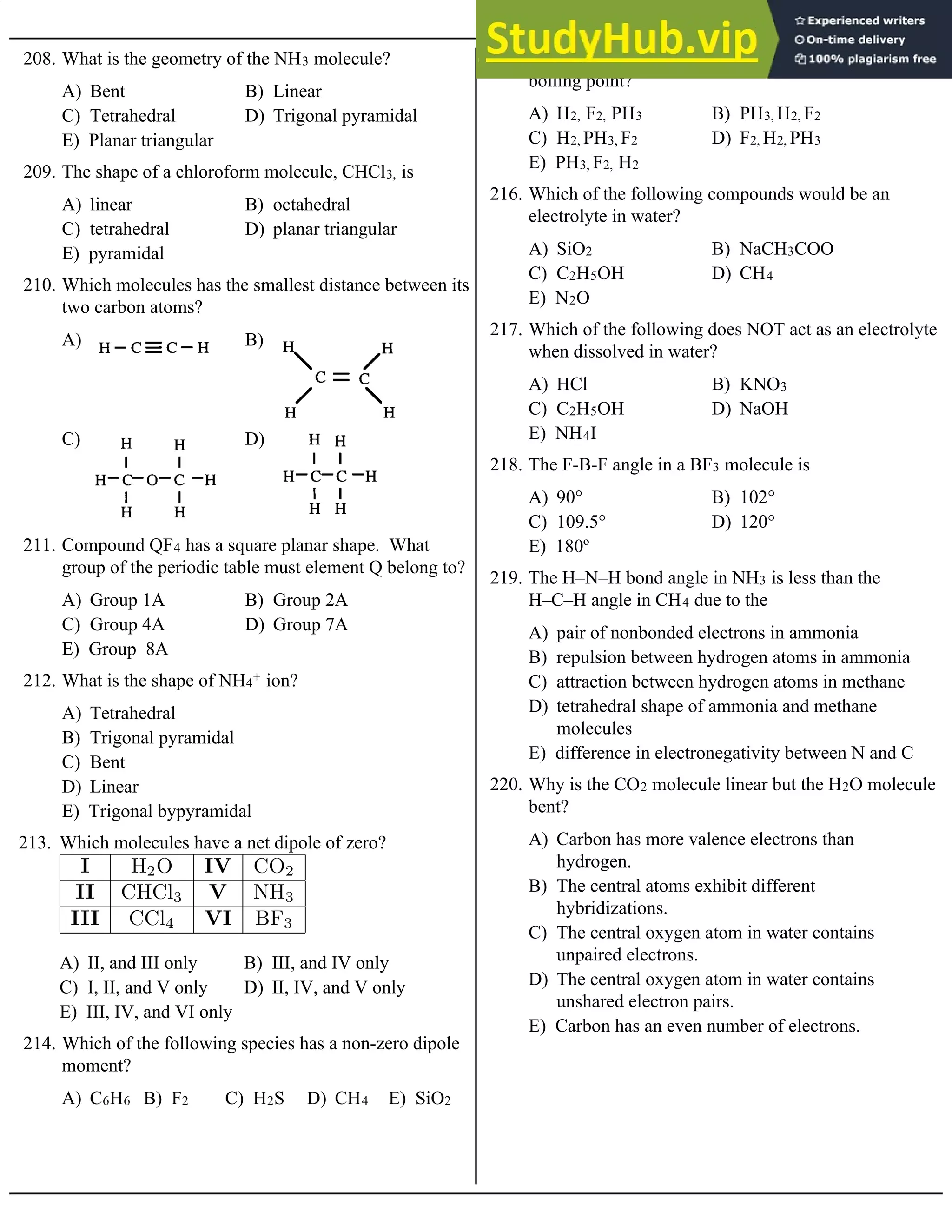
208. What is the geometry of the NH3 molecule?
A) linear B) octahedral
C) tetrahedral D) planar triangular
E) pyramidal
209. The shape of a chloroform molecule, CHCl3, is
A) B)
C) D)
210. Which molecules has the smallest distance between its
two carbon atoms?
A) Group 1A B) Group 2A
C) Group 4A D) Group 7A
E) Group 8A
211. Compound QF4 has a square planar shape. What
group of the periodic table must element Q belong to?
A) Tetrahedral
B) Trigonal pyramidal
C) Bent
D) Linear
E) Trigonal bypyramidal
212. What is the shape of NH4+ ion?
213. Which molecules have a net dipole of zero?
A) II, and III only B) III, and IV only
C) I, II, and V only D) II, IV, and V only
E) III, IV, and VI only
A) C6H6 B) F2 C) H2S D) CH4 E) SiO2
214. Which of the following species has a non-zero dipole
moment?
A) H2, F2, PH3 B) PH3, H2, F2
C) H2, PH3, F2 D) F2, H2, PH3
E) PH3, F2, H2
215. Which list of molecules is in order of decreasing
boiling point?
A) SiO2 B) NaCH3COO
C) C2H5OH D) CH4
E) N2O
216. Which of the following compounds would be an
electrolyte in water?
A) HCl B) KNO3
C) C2H5OH D) NaOH
E) NH4I
217. Which of the following does NOT act as an electrolyte
when dissolved in water?
A) 90° B) 102°
C) 109.5° D) 120°
E) 180º
218. The F-B-F angle in a BF3 molecule is
A) pair of nonbonded electrons in ammonia
B) repulsion between hydrogen atoms in ammonia
C) attraction between hydrogen atoms in methane
D) tetrahedral shape of ammonia and methane
molecules
E) difference in electronegativity between N and C
219. The H–N–H bond angle in NH3 is less than the
H–C–H angle in CH4 due to the
A) Carbon has more valence electrons than
hydrogen.
B) The central atoms exhibit different
hybridizations.
C) The central oxygen atom in water contains
unpaired electrons.
D) The central oxygen atom in water contains
unshared electron pairs.
E) Carbon has an even number of electrons.
220. Why is the CO2 molecule linear but the H2O molecule
bent?
221.
A) I, II, and VI only
B) II, III, and IX only
C) III, V, and IX only
D) III, VII, and VIII only
E) IV, V II, and VIII only
Based on the above table, which substances are
molecular?
222.
A) I and V only
B) I, IV, and V only
C) I, II, III, and V only
D) II, III, and VII
E) IV, VI, and VII only
Based on the above table, which substances are ionic?
A) There are no ions in metallic crystals.
B) There are fewer electrons per atom in metals than
in ionic crystals.
C) Atoms are less tightly packed in ionic crystals
than metals, leading to lower coordination
numbers for ionic crystals.
D) The attractive forces in metallic crystals are
unaffected by movement of layers of atoms; the
attractive forces in ionic crystals are greatly
affected if layers move.
E) The forces between atoms in ionic crystals are
much stronger than those in metal crystals.
223. Metallic crystals tend to be hard but not brittle, and
ionic crystals tend to be hard and brittle. Which model
explains this difference?
A) Si–Si bonds are stronger than C–C bonds.
B) CO2 molecules are nonpolar; SiO2 molecules are
polar.
C) CO2 is a molecular solid; SiO2 is a network
covalent solid.
D) The Si–O bonds in SiO2 molecules are many
times stronger than the C=O bonds in CO2
molecules.
E) Si has a larger atomic radius than C.
224. CO2 is a gas at room temperature and pressure, while
SiO2 melts at about 1700°C. What accounts for this
large difference in melting points?
A) melt at lower temperatures than ionic solids
B) cannot sublime
C) contain at least one hydrogen bond
D) always contain multiple covalent bonds
E) are packed tightly into a crystal lattice
225. Molecular solids
A) N2 B) O2 C) F2 D) I2 E) Hg22+
226. Which of the following substances has the strongest
bonds?
A) CH3OCH3 B) C6H6
C) C4H10 D) C2H5OH
E) CH4
227. Which of the following substances has the highest
boiling point?
A) Methanol is a molecular compound.
B) Methanol undergoes hydrogen bonding.
C) Methane contains hydrogen bonding.
D) Alcohols are always liquids at room
temperatures.
E) Methanol contains an oxygen atom.
228. What is main reason the boiling point of methanol
higher than the boiling point of methane?
A) H2 B) NaCl C) I2 D) C2H2 E) MgO
229. Which has the smallest force of attraction between its
molecules?
A) The O2– is more negatively charged than the Cl–
ion.
B) The Cl– ion is larger than the O2– ion.
C) The Mg2+ is more positively charged than the Na
+ ion.
D) Choices A and C are correct.
E) Choices B and C are correct.
230. Why is the melting point of potassium chloride lower
than that of magnesium oxide?
A) NH3 B) NH4+ C) NO3– D) N2O E) CN–
231. Which of the following exhibits coordinate covalent
bonding?
232.
A) B) C) D) E)
According the the above electronegativities, which of the following bonds has the most ionic character?
A) C(graphite) ® C(g) B) H2O(s) ® H2O(l)
C) Ne(g) ® Ne(s) D) Co(l) ® Co(s)
E) Ti(l) ® Ti(s)
233. Which of the following involves the breaking of
covalent bonds?
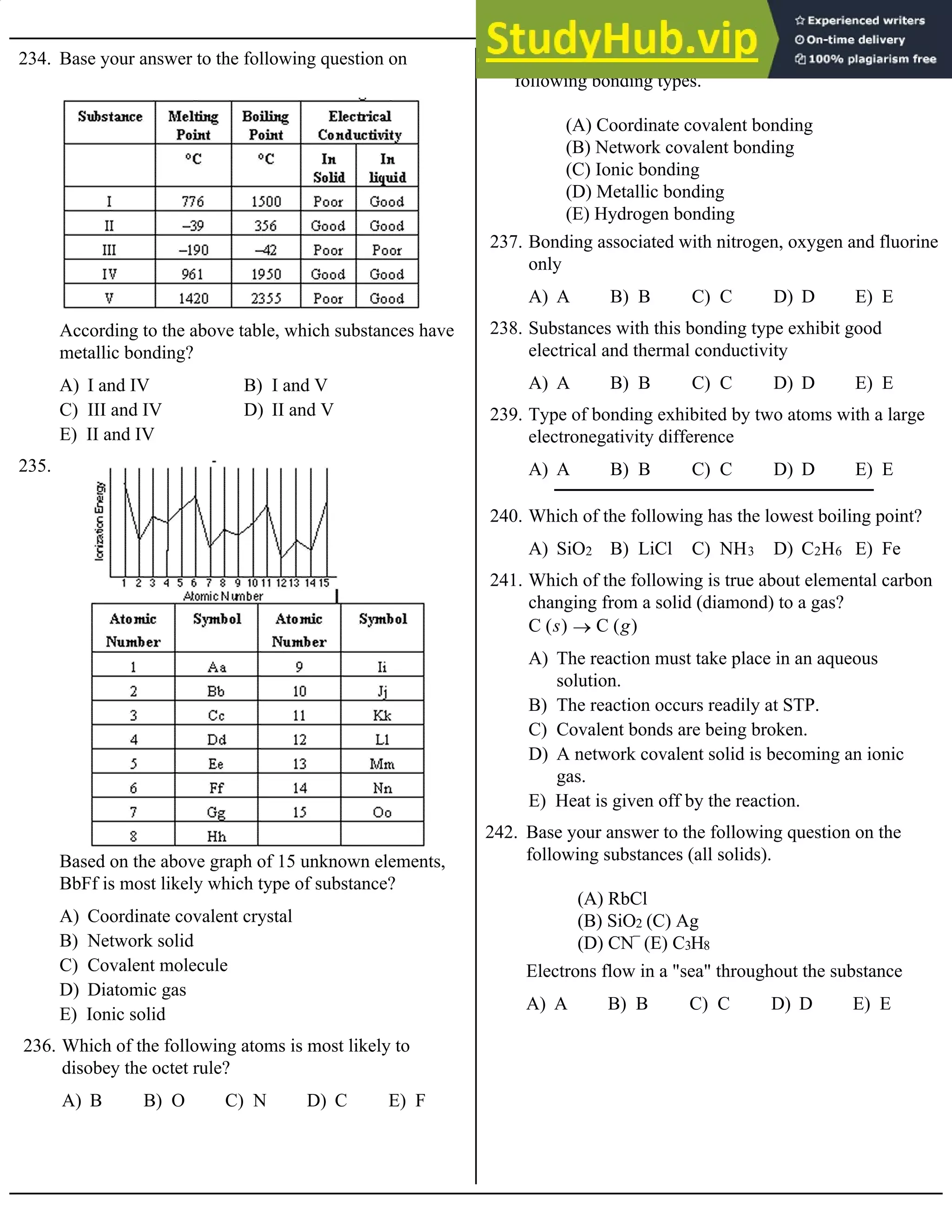
234. Base your answer to the following question on
A) I and IV B) I and V
C) III and IV D) II and V
E) II and IV
According to the above table, which substances have
metallic bonding?
235.
A) Coordinate covalent crystal
B) Network solid
C) Covalent molecule
D) Diatomic gas
E) Ionic solid
Based on the above graph of 15 unknown elements,
BbFf is most likely which type of substance?
A) B B) O C) N D) C E) F
236. Which of the following atoms is most likely to
disobey the octet rule?
Base your answers to questions 237 through 239 on the
following bonding types.
(A) Coordinate covalent bonding
(B) Network covalent bonding
(C) Ionic bonding
(D) Metallic bonding
(E) Hydrogen bonding
A) A B) B C) C D) D E) E
237. Bonding associated with nitrogen, oxygen and fluorine
only
A) A B) B C) C D) D E) E
238. Substances with this bonding type exhibit good
electrical and thermal conductivity
A) A B) B C) C D) D E) E
239. Type of bonding exhibited by two atoms with a large
electronegativity difference
A) SiO2 B) LiCl C) NH3 D) C2H6 E) Fe
240. Which of the following has the lowest boiling point?
A) The reaction must take place in an aqueous
solution.
B) The reaction occurs readily at STP.
C) Covalent bonds are being broken.
D) A network covalent solid is becoming an ionic
gas.
E) Heat is given off by the reaction.
241. Which of the following is true about elemental carbon
changing from a solid (diamond) to a gas?
C (s) ® C (g)
242. Base your answer to the following question on the
following substances (all solids).
(A) RbCl
(B) SiO2 (C) Ag
(D) CN
–
(E) C3H8
A) A B) B C) C D) D E) E
Electrons flow in a "sea" throughout the substance
Base your answers to questions 243 through 246 on the
following types of energy.
(A) Potential energy
(B) Ionization energy
(C) Activation energy
(D) Hydration energy
(E) Lattice energy
A) A B) B C) C D) D E) E
243. Amount of energy that must be absorbed by reactants
in their ground states to reach the transition state so
that a reaction can occur
A) A B) B C) C D) D E) E
244. The minimum amount of energy required to remove
the most loosely held electron of an isolated gaseous
atom.
A) A B) B C) C D) D E) E
245. The energy change when a crystalline solid is formed
from its atoms, ions or molecules in the gas phase
A) A B) B C) C D) D E) E
246. Energy change associated with a mole of gas and ions
reacting with water
Base your answers to questions 247 through 249 on the
diatomic species below.
(A) Br2 (B) O2 (C) N2 (D) Li2 (E) F2
A) A B) B C) C D) D E) E
247. Which is not the natural state for its element
A) A B) B C) C D) D E) E
248. Which has the largest bond-dissociation energy?
A) A B) B C) C D) D E) E
249. Which contains a triple bond?
A) C6H6 B) SO2
C) O3 D) NO3–
E) all of the above
250. Which of the following molecules contain a resonance
structure?
A) SiO2 B) CO2 C) H2O D) NO2 E) SO2
251. Which of the following has the strongest bonds?
Base your answers to questions 252 through 257 on the
types of solids given below.
(A) A metallic solid
(B) A molecular solid with hydrogen bonds
(C) A molecular solid with non-polar molecules
(D) A network solid
(E) An ionic solid
A) A B) B C) C D) D E) E
252. Which generally has the lowest boiling point?
A) A B) B C) C D) D E) E
253. Which describes solid benzene (C6H6)?
A) A B) B C) C D) D E) E
254. Which is described as a lattice of positive ions in a sea
of mobile electrons?
A) A B) B C) C D) D E) E
255. Which best describes pure tungsten?
A) A B) B C) C D) D E) E
256. Which best describes solid water?
A) A B) B C) C D) D E) E
257. Which describes diamond (C)?

AP CHEM MIDTERM REVIEW

  • 1.
    A) 0% B)20% C) 50% D) 80% E) 100% 1. Naturally occurring boron consists of two isotopes, boron–10 and boron–11. If the atomic mass of natural boron is 10.8, what is the percentage that is boron–10? A) B) C) D) 2. Which mass spectrometer graph represents naturally occurring magnesium? A) Mass spectrometer beam distribution B) Emission spectra of gaseous elements C) Cathode ray deflection by a magnetic field D) Scattering of alpha particles by metal foil E) Radioactive transmutation of elements 3. Which supports the conclusion that the energy of electrons in atoms are quantized? A) Rn B) Ra C) Fm D) Md E) No 4. An ion which has the electron configuration [[Rn] 5f14] 2– has the symbol A) Barium B) Sodium C) Potassium D) Lithium E) Calcium 5. When a chloride solution of an element is vaporized in a flame, the color of the flame is purple. What element could be in the solution? A) [Ar]4s23d3 B) [Ar]3d3 C) [Ar]4s23d1 D) [Ar]4s13d2 E) [Ar]3d5 6. What would be the most likely electron configuration for a Vanadium 2+ ion? 7. Base your answer to the following question on the following atomic orbitals. (A) 1s2 2s1 2p 1 (B) 1s2 2s2 2p 1 (C) 1s2 2s2 2p 6 (D) [Ar] 4s2 (E) [Ar] 4s2 3d4 A) A B) B C) C D) D E) E This atom is in an excited state. Base your answers to questions 8 through 11 on the following electron configurations (A) [Xe] 4f145d106s 2 (B) [Kr] 4d105s 1 (C) [Ar] 3d104s24p 5 (D) [Ar] (E) [Ne] 3s23p2 A) A B) B C) C D) D E) E 8. The configuration of a metallic diatomic element A) A B) B C) C D) D E) E 9. The configuration of a metalloid A) A B) B C) C D) D E) E 10. A common ion of an alkali metal A) A B) B C) C D) D E) E 11. The ground state of a halogen A) Zinc B) Cadmium C) Calcium D) Cobalt E) Magnesium 12. Which of the following elements will present a paramagnetic electron configuration?
  • 2.
    13. According tovalence bond theory, what are the states of hybridization of the carbon atoms (reading from left to right) in the following compound? A) sp, sp2, sp B) sp2, sp, sp3 C) sp2, sp2, sp2 D) sp3, sp2, sp3 E) sp3, sp3, sp3 A) Fe B) Cd C) W D) In E) As 14. Which transition element has its d-orbitals completely filled? A) has more occupied subshells B) has less stability C) has greater nuclear charge D) has higher electronegativity E) has a larger radius 15. A fluorine atom (F) differs from a fluorine ion (F–) in that the ion A) NaBr B) KF C) CaCl2 D) MgI2 E) LiCl 16. In a solution of which salt do all ions have the same electron configuration? Base your answers to questions 17 through 21 on the choices below. (A) Pauli exclusion principle (B) Heisenberg uncertainty principle (C) Hund's rule (D) Wave nature of matter (E) Photoelectric effect A) A B) B C) C D) D E) E 17. Which gives support to the particle theory of light? A) A B) B C) C D) D E) E 18. Which predicts that an oxygen atom in the ground state is paramagnetic. A) A B) B C) C D) D E) E 19. Which is responsible for interference patterns being exhibited by electrons? A) A B) B C) C D) D E) E 20. Which states that you cannot have simultaneous knowledge of an electron's position and momentum? A) A B) B C) C D) D E) E 21. Which states that electrons half fill an orbital with parallel spin, before completely filling it? 22. Elements 'X', 'Y' and 'Z' have these atomic radii, in nanometers. A) B) C) D) When atomic radii are correctly arranged, how might these elements appear in the periodic table?
  • 3.
    23. A) Sr B)K C) F D) Mg E) O Based on the ionization potentials for element above, which of the following would most likely be element ? A) Moseley B) John Dalton C) Ernest Rutherford D) J. J. Thompson E) Niels Bohr 24. Whose theory of the atom is best supported by the experimental evidence shown in a graph of first ionization energy of the elements versus atomic number? A) B) C) D) 25. Which graph best depicts the relationship between the ionization energy and atomic number from left to right in a period? 26. A) Ii B) Jj C) Kk D) Mm E) Nn Which element would have this sequence of ionization energies? 27. A) Sb B) Ca C) Si D) Ga E) Se Based on the ionization energies listed above, the element is most likely 28. A) Magnesium B) Potassium C) Boron D) Silicon E) Nitrogen Based on the ionization energies listed above, the element is most likely
  • 4.
    29. Base youranswer to the following question on the compounds below. (A) Carbon dioxide (B) Carbon monoxide (C) Water (D) Sodium chloride (E) Xenon pentafluoride A) A B) B C) C D) D E) E Which compound has the greatest lattice energy? A) Be B) Na C) K D) Ar E) Mg 30. Which atom has the lowest second ionization energy? 31. Base your answer to the following question on the following elements. (A) Sodium (B) Carbon (C) Cobalt (D) Chlorine (E) Neon A) A B) B C) C D) D E) E Has the highest first ionization energy A) High electron affinities, high ionization energies, high metallic character B) High electron affinities, low ionization energies, low metallic character C) High electron affinities, high ionization energies, low metallic character D) Low electron affinities, high ionization energies, low metallic character E) Low electron affinities, low ionization energies, low metallic character 32. Which of the following is true about the upper right hand corner of the periodic table?
  • 5.
    33. A) L -group I M - transition elements Q - group VII R - group VIII B) L - group VII M - group I Q - group VIII R - transition elements C) L - group VII M - transition elements Q - group VIII R - group I D) L - transition elements M - group I Q - group VII R - group VIII E) L - transition elements M - group VIII Q - group I R - group VII Based on the above table, match these elements, in the order L, M, Q and R, to their respective groups in the periodic table. A) CuO B) CuBr C) CuS D) CuC2O4 E) Cu(CH3COO)2 34. Copper has an oxidation number of +1 in A) 7 B) 8 C) 14 D) 15 E) 27 35. How many atoms are in 1 molecule of calcium hexacyanoferrate (II)? 36. Base your answer to the following question on the elements below. (A) Fr (B) Sr (C) Br (D) Sb (E) H A) A B) B C) C D) D E) E Which forms monatomic ions of charge 2+ in solution? A) 0.12 L B) 0.15 L C) 0.25 L D) 0.27 L E) 0.30 L 37. A balloon filled with 0.01 mol of hydrogen gas is kept constant at 25 degrees Celcius. If the pressure is changed from 1 atm to 1.5 atm, what is the resulting volume of the balloon? 38. C3H8(g) + 5 O2(g) ®3 CO2(g) + 4 H2O(g) A) 5.0 B) 0.5 C) 0.1 D) 0.25 E) 0.05 A 0.03 mol sample of C3H8 is reacted with just enough O2 to use up both reactants in a 1 L flask at 300 K. The total pressure in the flask after the reaction is complete is closest to which of the following? ( Use R = 0.082 L atm mol–1 K–1 ) A) 4 grams B) 8 grams C) 16 grams D) 32 grams E) 64 grams 39. A CH4 (molar mass 16 grams) effuses at 0.080 mole per minute at 289 K. At that temperature, a gas that effuses at approximately double that rate has what molar mass? A) 3 hours B) 8 hours C) 72 hours D) 192 hours E) 288 hours 40. A certain first order reaction between two gases occurs at 389 K with a half-life of 24 hours. How much time is required to drop the pressure of one of the gases from 2.0 atm to 0.25 atm at 389 K?
  • 6.
    41. A) g B) g C) g D) g E) g A plastic bagis massed. It is then filled with a gas which is insoluble in water and massed again. The apparent weight of the gas is the difference between these two masses. The gas is squeezed out of the bag to determine its volume by the displacement of water. What is the actual weight of the gas? 42. The graph table above shows what happens when one mole of magnesium reacts with acid to produce one mole of H2 (g). A) 22.4 L B) 23.3 L C) 25.4 L D) 36.6 L E) 46.6 L What is the molar volume of H2 at 760 mmHg and 298 K using this data? A) 1.24 × 10⁴ atm B) 194. atm C) 122. atm D) 244. atm E) 87.0 atm 43. A 1.00 L container at 460. K contains 3.23 moles of argon gas. What is the pressure of the gas? A) 0.821 L B) 0.082 L C) 0.420 L D) 0.41L E) 1.64 L 44. 1.00 gram of propene gas occupies what volume at 147. oC and 1.00 atm? A) 60.0 g/mol B) 120. g/mol C) 240. g/mol D) 360. g/mol E) 480. g/mol 45. A gas has a density of 0.600 g/L at a pressure of 0.1642 atm and a temperature of 127.oC. What is the molar mass of the gas? A) Volume constant, pressure increased, density constant B) Volume constant, pressure decreased, density constant C) Volume constant, pressure constant, density constant D) Volume decreased, pressure constant, density increased E) Volume decreased, pressure increased, density decreased 46. The temperature of a sample of H2O is decreased. Which of the following can be true? A) He B) SO2 C) H2O D) CO E) Br2 47. Which of the following gases is most like ideal? A) High temperature, low pressure B) Low temperature, low pressure C) Low temperature, high pressure D) High pressure only E) High temperature only 48. Under what conditions do gases deviate the most from ideal behavior? 49. 2 Li + 2 H2O ® 2 Li+ + 2 OH– + H2 A) 2.24 L B) 4.48 L C) 6.72 L D) 8.96 L E) 17.92 L When 0.800 mol of Li is reacted with excess water at STP in the equation above, what volume of hydrogen gas is produced? A) C10H14O B) C10H16O C) C10H16O2 D) C10H18O E) none of the above 50. In 1811 Avogadro calculated the formula of camphor by means of elemental chemical analysis and by measuring the density of its vapor. Avogadro found the density to be 3.84 g/L when he made the measurements at 210ºC at 1 atmosphere pressure. Which of the following is the correct formula for camphor?
  • 7.
    A) I onlyB) III only C) I and III only D) I and II only E) I, II, and III 51. The pressure on a sample of gas is increased from 100 kPa to 130 kPa at constant temperature. Which of the following increases? I. The density of the gas II. The average distance between molecules III. The average speed of the molecules. A) 1.35 L B) 1.80 L C) 2.70 L D) 3.60 L E) 1.2 L 52. A 2.70 L sample of nitrogen gas is kept at a pressure of 800. torr and 27.0ºC. what would its volume be if the pressure was increased to 1200. torr and it was cooled to –73.0ºC. A) The volumes of the containers are the same. B) Both containers contain the same number of atoms. C) The average speed of the particles in both containers is the same. D) The density of the containers is the same. E) The size of the helium atoms is the same as the size of the oxygen atoms. 53. Two containers for gases are at the same temperature and pressure. One contains 14.0 grams of nitrogen and the other 2.0 grams of helium. Which of the following is true? A) The average kinetic energy of the gas molecules B) The potential energy of the gas molecules C) The density of the gas D) The volume of the gas E) The number of molecules in the gas 54. When a sample of ethane gas in a closed container is cooled so that its absolute temperature halves, which of the following also halves? A) The volume of the gas doubles. B) The density of the gas doubles. C) The density of the gas halves. D) The average kinetic energy of the molecules doubles. E) The size of the molecules doubles. 55. A sample of gas in a closed container is raised to double its initial pressure while remaining at constant temperature. Which of the following occurs? A) The volume of the gas B) The kinetic energy of the gas C) The volume of the water D) The temperature of the water E) The water solubility of the gas 56. A student collected a sample of gas using water displacement. Which of the following measurements is necessary to determine the vapor pressure of the water in the sample? A) The Cl2 molecule is too big to escape through the leak-hole B) The rate of effusion for Cl2 is less than than that of the other two gases C) Cl2 is a nonpolar molecule D) Cl2 has the smallest So of the three gases E) H2O has the greatest rate of diffusion 57. Equal numbers of moles of H2O(g), F2(g), Cl2(g) are placed into a single container. The container has a pinhole-sized leak (1 mm), and after 10 minutes some gas has escaped from the container. What is best reason for why there is more Cl2 gas left in the container than any other gas? (NOTE: the molecules do not react with each other) 58. BCl3NH3 ® BCl3 + NH3 A) 6.0 atm B) 1.5 atm C) 3.0 atm D) 4.5 atm E) 7.5 atm A student places 0.10 mole of BCl3NH3 in a 1 L vacuum flask, which is sealed and heated. The BCl3NH 3 decomposes completely according to the balanced equation above. If the flask's temperature is 375. K, the total pressure in the flask is closest to which of the following? (Use R = 0.08 L•atm/mol•K)
  • 8.
    59. Base youranswer to the following question on C3H7OH (s) ® H2O(g) + C3H6 (g) A) 8.0 atm B) 50. atm C) 25. atm D) 2.0 atm E) 4.0 atm A student places 0.05 mole of C3H7OH (s) in a 1 L vacuum flask, which is sealed and heated. The propanol decomposes completely according to the balanced equation above. If the flask's temperature is 500. K, the total pressure in the flask is closest to which of the following? (Use R = 0.08 L•atm/mol•K) A) The average speed of the neon atoms remains the same. B) The density of neon gas inside the tank increases. C) The average distance between molecules decreases. D) The volume of the gas decreases. E) The pressure inside the tank increases. 60. A sealed metal tank is filled with neon gas. Which of the following does NOT occur when neon gas is pumped into the tank at a constant temperature? A) 760.5 torr B) 745.0 torr C) 15.5 torr D) 727.0 torr E) 729.5 torr 61. Find the partial pressure of Hydrogen gas collected over water at 18oC if the the vapor pressure of water at 18oC is 15.5 torr, and the total pressure of the sample is 745 torr. A) 803 torr B) 30 torr C) 743 torr D) 753 torr E) 773 torr 62. Hydrogen gas is collected over water at 29oC. The total pressure of the system is 773 torr. If the vapor pressure of water at 29oC is 30 torr, what is the partial pressure of the hydrogen gas? 63. Base your answer to the following question on the following types of energy. (A) Lattice energy (B) Potential energy (C) Kinetic energy (D) Electromagnetic energy (E) Vaporization energy A) A B) B C) C D) D E) E Energy that is measured by mv2 A) The average kinetic energy of the gas particles increases. B) The pressure of the gas increases. C) The volume of the gas decreases. D) The total number of gas molecules stays constant. E) The total force of the gas molecules hitting the side of the container decreases. 64. A rigid cylinder is filled with gas. At constant temperature, which of the following applies to the gas in the cylinder when gas is released? A) The average kinetic energy does not change. B) The average kinetic energy of the sample increased by a factor of 363/323. C) The average kinetic energy of the sample increased by a factor of 9/5. D) The average kinetic energy increased by a factor of 81/25. E) More information is needed to know whether the average kinetic energy changed. 65. The temperature of a sample of xenon atoms is raised from 50oC to 90oC. Which of the following statements is true about the average kinetic energy of the atoms? A) mass of molecules B) shape of molecules C) intermolecular forces D) size of molecules E) energy of molecules 66. The pressure of a real gas is sometimes less than that predicted by the ideal gas law because the ideal gas law does not include the factor of A) Low pressure and low temperature B) Low pressure and high temperature C) High pressure and high temperature D) High pressure and low density E) Low temperature and high density 67. Under which conditions does a real gas most closely approximate an ideal gas? 68. _I2 + _F2 ®_IFx A) 1 B) 2 C) 3 D) 5 E) 7 The above reaction occurs in a closed container. The container is rigid and temperature is constant throughout the reaction. The container starts out with 10 atm of iodine gas and 1 atm of fluorine gas. Five atm of iodine gas is left at the end of the reaction. What is x?
  • 9.
    69. _Al +_Fe3O4 ®_ Fe + _ Al2O3 A) 15 B) 22 C) 24 D) 25 E) 28 When the above equation is balanced and all the coefficients are simplified to the lowest whole-number terms, what is the sum of all the coefficients? A) 8 B) 9 C) 10 D) 14 E) 18 70. __KCl + MnO2 + H2SO4 ® K2SO4 + Cl2 + H2O + MnSO4 The sum of the coefficients when the above equation is balanced with smallest whole numbers is 71. __CH3CH2CHO + O2 ® CO2 + H2O A) 10 B) 11 C) 12 D) 13 E) 14 The sum of coefficients when the above equation is balanced with smallest whole numbers is A) Fe2S3 B) FeSO4 C) FeSO3 D) Fe2(SO4)3 E) Fe(SO4)3 72. What is the correct formula for iron (III) sulfate? A) Fe2O3, iron(II) oxide B) H2SO4, sulfuric acid C) AgNO3, silver nitride D) MgSO3, magnesium sulfate E) KCl, potassium chlorate 73. Which compound is correctly named? 74. __ C2H4 + __ O2 ® __ CO2 + __ H2O A) 1 B) 2 C) 3 D) 4 E) 5 When the above equation is balanced using smallest whole numbers, what is the coefficient of the O2? A) 14% B) 0.14 C) 0.17 D) 0.25 E) 0.86 75. An aqueous solution of HCl is 25% water. What is the mole fraction of HCl? A) Titration of the solution with a standard acid B) Measurement of the pH of the solution C) Measurement of the boiling point of the solution D) Measurement of the specific heat of the solution E) No other procedures are necessary 76. An amount of HCl is dissolved into 10 L of water in a test beaker to make a 0.3 M solution at standard temperature and pressure. What additional procedures would be absolutely necessary to determine the molality of the solution? 77. A 1.0 L test beaker is filled to the mark with 0.20 mol of KCl and 0.40 mol of BaCl2. What is the minimum number of moles of Pb(ClO4)2 that are needed to precipitate out all of the Cl in the form of PbCl2? (PbCl2 is insoluble for the purposes of this question) A) 0.30 mol B) 0.40 mol C) 0.50 mol D) 0.60 mol E) 0.80 mol 78. A) B) C) D) E) An element composed of , , and with mass percentages corresponding to the above table. What most likely is the subscript under if it a mole of the compound weighs grams? A) 1.40 × 10³ mL B) 14.0 L C) 1.40 mL D) 14.0 × 10³ mL E) 140. mL 79. What volume of water should be added to a 200.0 mL solution of 4.00 M HI to create a 0.500 molar solution of HI? A) 160 mL B) 110 mL C) 320 mL D) 210 mL E) 1.60 L 80. What volume of water should be added to a 50.0 mL solution of 8.00 M NaOH to create a 2.50 molar solution of NaOH? A) 0.90 moles B) 1.30 moles C) 1.10 moles D) 1.50 moles E) 0.70 moles 81. A 1.00 L flask contains an aqueous solution. The solution consists of 0.70 moles of KBr and 0.20 moles of AlBr3. What is the minimum number of moles of AgNO3 that can be added to the solution to precipitate all of the Br– ions as AgBr? A) 1055. g B) 992.0 g C) 547.2 g D) 346.5 g E) 241.0 g 82. How many grams of carbonic acid, H2CO3, contains 32.00 grams of hydrogen atoms?
  • 10.
    A) 170. B)165. C) 140. D) 125. E) 115. 83. How many grams of sodium nitrate, NaNO3, contains 96.0 grams of oxygen atoms? 84. The Mond process produces pure nickel metal via the thermal decomposition of nickel tetracarbonyl as shown in the equation below. Ni(CO)4(l) ® Ni(s) + 4CO(g) A) 0.356 L B) 63.7 L C) 255 L D) 20.2 L E) 11.0 L How many liters of CO would be formed from 444 g of Ni(CO)4 at 752 mm Hg and 22ºC? A) WBr2 B) WBr3 C) WBr4 D) WBr5 E) WBr6 85. A compound of bromine combined with tungsten is found to contain 68.5 % bromine and 31.5% tungsten. What is the empirical formula for this compound? 86. A) B) C) D) E) Above is a table of possible mass percentages for a compound made of , , and . Which set of percentages matches the compound ? A) CuSO4 B) CuSO4•3H2O C) CuSO4•2H2O D) CuSO4•6H2O E) CuSO4•5H2O 87. The formula of copper (II) sulfate pentahydrate is A) BaO B) BaO2 C) Ba2O D) Ba2O2 E) BaO4 88. The formula of barium peroxide is A) FeS, CuCl, CuCl3 B) H2O, HClO, CaS2 C) Pb2O5, HBr, K3NO3 D) FeCl3, MgS, NaHCO3 E) CaBr, CaSO4, AlPO3 89. The set of formulas that are all correct is A) Mn4O B) MnO2 C) MnO4 D) Mn2O E) MnO 90. The correct formula for manganese (IV) oxide is A) Ag3(PO4)4 B) Ag3PO4 C) Ag3(PO3)2 D) Ag3(PO4)2 E) Ag3PO3 91. Which is the correct formula for silver phosphite? A) Na2SO3 B) Na2SO4 C) Na2S3O2 D) Na2S2O3 92. The formula for sodium thiosulfate is A) Al2(SO4)3, MgI, KCl B) Ag(OH)2, NaOH, ZnO3 C) MgBr2, Na2SO4, Zn(OH)2 D) Ca3(PO4)2, Al2(SO4)3, Ag(OH)3 E) CaI, NaNO3, BaSO4 93. The set which contains three correct formulas is A) LiClO4, NaCN, Ca3(PO4)2 B) KClO, H2SO4, PbCl2 C) Fe2(CO3)3, H2O2, AgI D) Ca(HCO3)2, CuBr, CuBr2 E) HCl, NaCO3, Br2 94. Which set of formula contains an incorrect formula? A) acidic B) basic C) binary D) an oxide E) a solid 95. The name of a chemical compound ends in “ide”; the compound is A) sodium carbonate hydrate B) sodium carbonate decahydrate C) disodium carbonite decahydrate D) disodium carbonate heptahydrate E) sodium carbonite decahydrate 96. The name of Na2CO3•10H2O is A) iron (II) biphosphite B) iron (II) biphosphate C) iron (III) biphosphite D) iron (III) dihydrogen phosphate E) iron (III) biphosphate 97. The name corresponding to the formula Fe(H2PO3)2 is
  • 11.
    A) chlorous acid® chlorite B) sulfurous acid ® sulfate C) nitrous acid ® nitrate D) carbonic acid ® carbide E) sulfuric acid ® sulfite 98. Which acid is followed by the correct name of the salt it forms? A) PbCO3 ® lead (IV) carbonate B) Cu2SO4 ® copper (I) bisulfate C) Fe(ClO2)3 ® iron (III) chlorite D) Mn2S4 ® manganese (II) sulfide E) TiO2 ® titanium (III) oxide ® titanium 99. Which compound is correctly named? 100. MN2 M2P QP A) QN B) QN2 C) Q2N3 D) QN4 E) Q2N Determine the formula expected for a compound of hypothetical elements Q and N, using only the formulas above. A) PtF4 B) PtF6 C) PtF2 D) Pt2F8 E) Pt2F10 101. Platinum metal is reacted with fluorine gas. The resulting compound is found to be 83.7% Pt, and and 16.3% F by mass. What is the empirical formula of this compound? A) XeO2 B) XeO3 C) XeO4 D) XeO5 E) Xe2O5 102. The first chemical compound of a noble gas element was prepared in 1962. Since then several such compounds have been prepared and characterized. What is the empirical formula of a compound of Xe which is 67.2% Xe and 32.8 % O by mass? A) Empirical, 1; molecular, 3 B) Empirical, 2; molecular, 2 C) Empirical, 2; molecular, 6 D) Empirical, 3; molecular, 2 E) Empirical, 2; molecular, 3 103. Analysis of a quantity of a compound shows that it contains 0.110 mol of C, 0.055 mol of N, and 0.165 mol of O. Its molecular weight is about 270. How many atoms of carbon are there in the empirical formula for the compound and how many in the molecular formula? 104. Base your answer to the following question on 2 C6H6 + 15 O2 ®12 CO2 + 6 H2O A) 15 B) 30 C) 37.5 D) 45 E) 60 Based on the above equation, how many moles of O2 are needed to produce 18 moles of water and 30 moles of carbon dioxide? A) 27.93 B) 55.85 C) 83.76 D) 167.55 E) 111.70 105. _Fe2O3 + _C ®_Fe + _CO2 Using a balanced equation, find the mass of Fe produced with excess carbon and 1.5 moles of Fe2O3. 106. 2 MnO4 + 5 H2C2O4 + 3 H2SO4 ® 2 MnSO4 + 10 CO2 + 8 H2O + K2SO4 A) 4.00 moles B) 25.0 moles C) 20.0 moles D) 2.00 moles E) 8.00 moles According to the equation above, how many moles of MnO4 would be necessary to produce 20.0 moles of CO2, starting with 25.0 moles of H2C2O4? 107. K2Cr2O7 + 14HCl ® 3Cl2 + 7H2O + 2CrCl3 + 2KCl A) 6.0 moles B) 42. moles C) 14. moles D) 2.0 moles E) 28. moles According to the equation above, how many moles of HCl would be necessary to produce 6.0 moles of CrCl3 , starting with 4.0 moles of K2Cr2O7? 108. C8H18 + O2 ® CO2 + H2O A) 0.079 g B) 1.4 g C) 18 g D) 162 g E) 0.158 g Based on the above unbalanced chemical equation, one gram of octane will yield what mass of water?
  • 12.
    109. 2 NO(g) + O2 (g) ® 2 NO2 (g) A) (0.60)(0.082)(293) atm B) (0.45)(0.082)(293) atm C) (0.30)(0.082)(293) atm D) (0.60)(0.082)(20) atm E) (0.45)(0.082)(20) atm A mixture containing 0.30 mol NO and 0.30 mol O2 reacts in a 1.0 L flask at a constant temperature of 20ºC. What is the pressure in the flask when the reaction is complete? 110. 4 HF (g) + SiO2 (s) ® SiF4 (g) +2 H2O (l) A) 2.3 g B) 4.5 g C) 9.0 g D) 18. g E) 36. g If 10. g of HF (formula mass 20. g/mol) reacts with 15. g of SiO2 (formula mass 60. g/mol), how much water is produced? 111. An experiment was conducted to determine the rate law of the reaction 2 A + 2 B ® C + D. The data collected is shown below. A) k = [A][B] B) k = [A]2[B] C) k = [A][B]2 D) k = [A]2[B]2 E) k = [A][B]2 What is the rate law for this equation? A) 7.9 × 10⁻³ h–1 B) 8.77 × 10⁻³ h–1 C) 79 h D) 39.5 h E) 4.39 × 10⁻³ h–1 112. A first order reaction goes to half completion in 79 hours. What is the rate constant for this reaction? 113. Base your answer to the following question on the possible rate laws below for the reaction: A + B C A) A B) B C) C D) D E) E When [A] is tripled and [B] is constant then the initial rate of reaction remains constant. 114. A + 2 B ®2 C + 4 D A) [C]2[D]4 B) k[C]2[D]4 C) second order D) first order E) impossible to find without experimental data The rate law for the above reaction is 115. A) Rate = k[H2]/[ICl] B) Rate = k[H2][ICl] C) Rate = k[H2][ICl]2 D) Rate = k[H2]2[ICl]2 E) Rate = k[H2]2[ICl] The above chart contains experimental data obtained from the following reaction: H2 + 2 ICl ® I2 + 2 HCl What is the experimental rate law for this reaction? A) cooling the system B) adding more sodium, Na C) increasing the volume of the system D) removing sodium chloride, NaCl E) using gaseous chlorine, Cl2 116. Given the reaction: Cl2(l) + 2 Na(s) ® 2 NaCl(s) The reaction rate can be significantly increased by: A) the Drake equation B) the Clausius-Claperon Equation C) the Arrhenius equation D) the Nernst equation E) Avogadro's equation 117. The temperature of a reaction is increased from 350 K to 400 K. The reaction rate is tripled. Which of the following equations can be used to find the activation energy of the reaction?
  • 13.
    Base your answersto questions 118 and 119 on on the table below, for the following reaction: 2 SO2 + O2 ® 2 SO3 A) 4.0 × 10⁻⁸ B) 2.0 × 10⁻⁸ C) 1.0 × 10⁻⁸ D) 4.0 × 10⁻⁹ E) 2.0 × 10⁻⁹ 118. The value of the rate constant, k, for this reaction is A) Rate = k[SO2][O2]3 B) Rate = k[SO2]3[O2]2 C) Rate = k[SO2][O2] D) Rate = k[SO2]3[O2] E) Rate = k[SO2]3 119. What is the experimental rate law for the reaction above? Base your answers to questions 120 and 121 on the table of data for the following reaction: CO(g) + O2(g) ® CO2(g) A) 1.6 × 10⁻⁴ M/s B) 8.0 × 10⁻⁵ M/s C) 4.0 × 10⁻⁵ M/s D) 1.0 × 10⁻⁵ M/s E) 3.2 × 10⁻⁴ M/s 120. The value of the rate constant, k, is A) 2.0 × 10⁻⁵ M/s B) 1.6 × 10⁻⁴ M/s C) 1.0 × 10⁻⁵ M/s D) 0.50 × 10⁻⁵ M/s E) 8.0 × 10⁻⁵ M/s 121. When [CO] = [O2] = 1.0 M, the rate of reaction will be A) rate = k [XO]2[O2]–1 B) rate = k [XO][O2]–1 C) rate = k [XO]2 [O2] D) rate = k [XO] [O2]2 E) rate = k [XO]2 [O2]2 122. A student collected the initial-rate data in the chart below. What is the experimental rate law for this reaction? A) rate = k B) rate = k [Z] C) rate = k [Z]2 D) rate = [Z] E) rate = [Z]2 123. For which of the following rate laws would the graph of ln [Z] versus time be a straight line?
  • 14.
    A) I onlyB) II and III only C) I and III only D) I, II, III and IV E) I, II and III only 124. Consider the following factors: I. Reactant particles collide II. Sufficient kinetic energy is present III. A favorable geometry exists IV. Catalysts are present Which combination of the above factors is required for all successful collisions? A) rate of dissolving increases; rate of crystallization increases B) rate of dissolving decreases; rate of crystallization increases C) rate of dissolving increases; rate of crystallization decreases D) rate of dissolving decreases; rate of crystallization decreases E) rate of dissolving remains constant; rate of crystallization decreases 125. When solid AgBr is added to saturated solution of AgBr, the reaction rates can be described as Base your answers to questions 126 through 128 on the rate law given below for the reaction A + B + C ® D. Rate = k[A]2[B][C] A) 1 B) 2 C) 3 D) 4 E) 0 126. What is the order of the reaction with respect to A? A) Both [A] and [C] will increase. B) Both [A] and [C] will decrease. C) [A] will decrease and [C] will increase. D) [A] will increase and [C] will decrease. E) Both [A] and [C] will stay the same. 127. If the concentration of B is decreased, what will happen? A) The rate of the reaction increases B) The rate of the reaction decreases C) The value of the equilibrium constant increases D) The value of the equilibrium constant decreases E) Neither the equilibrium constant nor the rate would change. 128. If the concentration of C is doubled what will happen? A) Rate = k[A]2 B) Rate = k[B]2 C) Rate = k[A][B] D) Rate = k[A]2[B] E) Rate = k[A][B]2 129. Base your answer to the following question on the table below which was obtained for the reaction A + B C. What is the rate law for this reaction? 130. I. Ag+(aq) + I–(aq) ® AgI(s) II. 4 Fe(s) + 3 O2(g) ® 2 Fe2O3(s) A) I is faster than II B) II is faster than I C) I and II are both fast D) I and II are both slow E) The relative rates of reaction cannot be determined Which statement best describes the relative rates of the above two reactions? 131. I. 4 Al(s) + 3 O2(g) ® 2 Al2O3(s) II. Ag+(aq) + Cl–(aq) ® AgCl(s) A) I is faster than II B) II is faster than I C) I and II are both fast D) I and II are both slow E) The relative rates of reaction cannot be determined Which statement best describes the relative rates of the above two reactions?
  • 15.
    A) I andII only B) I, II, and IV only C) III, IV, and V only D) IV and V only E) They are all correlated with a fast reaction rate 132. Which of the following is not correlated with a fast reaction rate? I. Catalysts II. High temperature III. High concentration of reactants IV. Strong bonds in the products V. Low level of activation energy 133. Base your answer to the following question on the graph below which shows the number of molecules with a given kinetic energy plotted as a function of kinetic energy. Four catalysts are available, A, B, C and D, which have associated reaction activation energies EA, EB, EC, and ED respectively. A) Catalyst 'A' associated with energy Ea B) Catalyst 'B' associated with energy Eb C) Catalyst 'C' associated with energy Ec D) Catalyst 'D' associated with energy Ed E) The activation energies of catalysts A, B, C and D all result in the same reaction rate. Which catalyst will have an activation energy which will result in the slowest reaction rate ? 134. Base your answer to the following question on the graph below showing the energy during a catalyzed reaction. A) Curve T1 B) Curve T2 C) Curve T3 D) Can’t tell Which is the curve for the lowest temperature? A) concentration of the reactants B) average kinetic energy of the molecules C) number of intermolecular collisions per unit of time D) number of particles with an energy above a minimum activation energy E) voulume of the reactants 135. Generally an increase of ten degrees centigrade doubles the rate of reaction between gases. The explanation for this increase in reaction rate is the doubling of the 136. Base your answer to the following question on the following reaction. H2(g) + I2(g) « 2 HI(g) A) [H2] will increase. B) [I2] will increase. C) [HI] will decrease. D) 1 and 2 E) None of these The reaction above is allowed to reach equilibrium. The pressure on the system is doubled. Which of the following is true? A) Zn(s) + S(s) ® ZnS(s) B) Ba2+(aq) + SO42–(aq) ® BaSO4(s) C) NH3(g) + HCl(g) ® NH4Cl(s) D) 2 Ag+(aq) + CO32–(aq) ® Ag2CO3(s) E) NaCl(aq) ® Na+(aq) + Cl–(aq) 137. Which of the following reactions is slowest at room temperature?
  • 16.
    Base your answersto questions 138 and 139 on the diagram shown below. A) 1 B) 2 C) 3 D) 4 E) 6 138. Which represents the activation energy for the forward reaction? A) 1 and 6 B) 2 and 3 C) 3 and 4 D) 4, 5 and 6 E) 3 and 6 139. A catalyst would change 140. The reaction mechanism for the production of ozone, O3, from automotive exhaust occurs in the three steps below. Step 1: NO(g) + O2(g) ® NO2(g) Step 2: NO2(g) ® NO(g) + O(g) Step 3: O2(g) + O(g) ® O3(g) Overall: O2(g) ® O3(g) A) O(g) B) O2(g) C) O3(g) D) NO2(g) E) NO(g) Which species is the catalyst? 141. A) the activation energy for A(g) + B(g) « C(g) + D(g) B) the heat of reaction for for A(g) + B(g) « C(g) + D(g) C) the activation energy for C(g) + D(g) « A(g) + B(g) D) the heat of reaction for C(g) + D(g) « A(g) + B( g) E) none of these According to the above reaction mechanism, the distanced marked "Z" represents 142. A) The addition of the catalyst increases the potential energy of the reaction. B) The catalyst makes the reaction proceed in the forward direction ONLY. C) The addition of a catalyst lowers the activation energy of the reaction. D) The catalyst is consumed by the reaction, and produces extra energy. E) The catalyst slows down the speed of reaction. Which of the following is the best explantation of the graph above?
  • 17.
    143. A) Step 2,because it has the lowest activation energy B) Step 1, because it has the highest activation energy C) Step 1, because it is neither endothermic nor exothermic D) Step 2, because it is the most exothermic E) Step 3, because it is the least exothermic According to the above chart, which of the following is the correct justification for why one of the three steps is the rate determining step? A) increasing the kinetic energy B) decreasing the heat of reaction C) changing the concentration of the reactants D) providing an alternate reaction mechanism E) decreasing kinetic energy 144. A catalyst increases the rate of a chemical reaction by 145. CO + NO2 ® CO2 + NO DH= –234 kJ A) –134. kJ B) –100. kJ C) 422. kJ D) 234. kJ E) 368. kJ The activation energy of the forward reaction represented by the above equation is 134. kJ. What is the activation energy for the reverse reaction? 146. Base your answer to the following question on Step 1: Cu2++ Sn2+ Cu(s) + Sn4+ Step 2: Cu2++ Sn(s) Cu(s) + Sn2+ Step 3: 2Be(s) + Sn4+ Sn(s) + 2Be+2 A) Sn2+ andBe+2 B) Sn4+ and Sn2+ C) Sn(s) and Sn4+ D) Cu2+ and Cu(s) E) Cu(s) and Be+2 In the above proposed reaction mechanism, what would be the products of the overall catalyzed reaction? 147. A) A B) B C) C D) D E) the rate determining step cannot be determined Which is the rate–determining step in the above hypothetical reaction mechanism? 148. A) step 1 B) step 2 C) step 3 D) step 4 E) the rate determining step cannot be determined Which is the “rate determining step” for the above hypothetical reaction mechanism of the overall reaction A ® E? A) fastest and has the lowest activation energy B) fastest and has the highest activation energy C) slowest and has the lowest activation energy D) slowest and has the highest activation energy E) intermediate and has the lowest activation energy 149. In a reaction mechanism, the rate determining state is the 150. Step 1: Cl(g) + O3(g) ® ClO(g) + O2(g) Step 2: O(g) + ClO(g) ® Cl(g) + O2(g) A) Cl B) O2 C) O3 D) ClO E) O According to the above reaction mechanism, the reaction intermediate is
  • 18.
    151. Base youranswer to the following question on the reaction below. A) B is not involved in any steps in this reaction. B) B is not involved in the rate determining step, but may be involved in other steps in the reaction. C) The coefficient of B is 1, therefore it does not affect the rate of the reaction. D) B is a solid, therefore does not appear in the rate expression. E) The order of the reaction with respect to B is 1. If the rate expression for this reaction does not depend on B, what could be the cause of this? A) CrCl2 B) LiCl C) FeCl3 D) CoCl2 E) NiCl2 152. Which compound dissolves in water to form a clear solution? 153. Base your answer to the following question on the elements below. (A) Fluorine (B) Copper (C) Phosphorous (D) Neon (E) Francium A) A B) B C) C D) D E) E Which element is a highly reactive metal? A) Francium is the least electronegative. B) They form ions with 1+ charge. C) Lithium has the smallest atomic radius. D) First ionization energy increases with atomic number. E) They are not found in pure form in nature. 154. All the following statements concerning the alkali metals are true EXCEPT: A) blue B) orange C) purple D) red E) green 155. When a solution of strontium chloride is ignited, the color of the flame is 156. An element has lst, 2nd and 3rd ionization energies given in kJ mol-1. A) Alkali metals. B) Transition elements. C) Noble gases. D) Halogens. E) Alkaline earth metals. This element is a member of which group? Base your answers to questions 157 through 160 on the electron configurations below. (A) 2s1 (B) [Ar] 3d104s24p1 (C) [Kr] 4d105s25p3 (D) [Ne] 3s2 (E) [Kr] 4d105s25p6 A) A B) B C) C D) D E) E 157. An atom with three valence electrons A) A B) B C) C D) D E) E 158. An atom in an excited state A) A B) B C) C D) D E) E 159. Represents a noble gas A) A B) B C) C D) D E) E 160. An alkaline earth metal A) MgSO3 B) MgCO3 C) Mg(OH)2 D) Mg(NO3)2 E) Mg3(PO4)2 161. A soluble magnesium salt is 162. Base your answer to the following question on the elements below. (A) Boron (B) Rubidium (C) Nitrogen (D) Mercury (E) Plutonium A) A B) B C) C D) D E) E Usually exists as a diatomic gaseous element
  • 19.
    A) Fluorine isthe least electronegative element. B) Bromine liberates free chlorine from a solution of chloride ions. C) Ionization energy increases with increasing atomic number. D) Fluorine has the smallest atomic radius. E) They combine with Group I metals to form compounds of the form XY2. 163. Which of the following is true about the halogens? A) Its valence electrons are of the form ns2np4. B) Atomic radius decreases with increasing atomic number. C) It combines with group IIA metals in binary compounds of the form XY. D) It contains members that naturally exist in each of the 3 states of matter. E) All its members are monatomic. 164. Which of the following is true about the halogen family? 165. Base your answer to the following question on the atomic orbitals below. (A) 1s2 2s1 2p 1 (B) 1s2 2s2 2p 1 (C) 1s2 2s2 2p 6 (D) [Ar] 4s2 (E) [Ar] 4s2 3d4 A) A B) B C) C D) D E) E This element dissolves to become a colored solution. A) iodides B) bromides C) chromates D) phosphates E) sulfides 166. The colored solids are formed from A) NaCl B) MgCl2 C) AlCl3 D) NiCl2 E) ZnCl2 167. Which of the following forms a colored solution in water? 168. Base your answer to the following question on the chemicals below. (A) Sulfur dioxide (B) Hydrochloric acid (C) Water (D) Potassium phosphate (E) Copper chloride A) A B) B C) C D) D E) E Which forms a colored solution in water? A) Carbon has oxides that can be acid anhydrides. B) Diamond is an example of elemental carbon in the solid state. C) Nearly all organic compounds contain carbon. D) The AMU is defined as 1/12 of the weight of a carbon-12 atom. E) Since carbon is located between a metal and a nonmetal, it is classified as metalloid. 169. Which of the following is FALSE about elemental carbon? A) B) C) D) E) 170. Which of the following is an acid?
  • 20.
    A) B) C) D) 171.Which of the following organic compounds is an ether? 172. A) Ester B) Ether C) Ketone D) Aldehyde E) Alcohol The hydrocarbon above is an example of which of the following? A) CH2=C=CH2 and CH C–CH3 B) CH2=CH2 and CH CH C) HO–CH2–CH2–OH and CH3–CH2–OH D) CH3–CH2–CH2–CH2–CH3 and CH3–CH2–CH3 E) CH3–O–CH3 and CH3–C–CH3 || O 173. Which of the following pairs of compounds are isomers? 174. Base your answer to the following question on the chemicals below. (A) Carbon dioxide (B) Hydrofluoric acid (C) Magnesium sulfate (D) Potassium chromate (E) Calcium carbonate A) A B) B C) C D) D E) E Which is a product of the complete combustion of propane? A) a piece of copper. B) a piece of magnesium. C) phenolphthalein indicator. D) a piece of red litmus paper. E) a piece of gold 175. One beaker contains 1.0 M HCl and another contains tap water. The acid solution can be distinguished from the tap water by using A) Determining which ions are present in a solution that contains metallic ions B) Determining the visible light spectra of an element. C) Finding the concentration of a solution of Mg(C2H3O2)2 D) Measuring the conductivity of CaCrO4 E) None of the above choices are proper usages of a visible-light spectrophotometer. 176. A visible-light spectrophotometer can be used for which of the following tasks? A) 19.0 g of MgCl2 and 1.00 kg of water. B) 19.0 g of MgCl2 and 989. g of water. C) 19.0 g of MgCl2 and add water until final solution is approximately 1.00 liter. D) 95.0 g of MgCl2 and 915. g of water. E) 95.0 g of MgCl2 and 1.00 kg of water. 177. A student wishes to prepare approximately 1.00 liter of a 0.200 m MgCl2 solution (formula mass 95.0 g). The proper procedure would be to weigh out A) 10.8 g of HCl and 1.00 kg of water. B) 10.8 g of HCl and add water until the final solution has a volume of 3.00 liters C) 36.0 g of HCl and add water until the final solution has a volume of 3.00 liter. D) 10.8 g of HCl and add 3.00 liter of water. E) 36.0 g of HCl and add 3.00 liter of water. 178. A student wishes to prepare 3.00 liters of a 0.100 M HCl solution (formula mass 36.0 g). The proper procedure is to weigh out Base your answers to questions 179 and 180 on the following information. 312 grams of benzene gas (C6H6) is burned to completion with O2 in a flame resistant giant balloon at 298 K. The balloon is held at a constant pressure of 5 atm. All liquid is allowed to flow out without the loss of any gas. 179. Determine the final volume of the balloon after the reaction is complete. 180. Write the balanced equation for the reaction.
  • 21.
    181. Water isadded to a 8.23 g sample of TaCl5. The only products are 5.71g of a solid containing only tantalum, chlorine and oxygen and 3.35 g of a gas which is 97.2% chlorine and the remainder is hydrogen. (a) Determine the empirical formula of the gas. (b) What fraction of the chlorine of the original compound is in the solid? (c) Determine the empirical formula for the solid produced. (d) Write a balanced equation for the reaction between tantalum pentachloride and water. 182. Consider the data collected for the reaction 2 A + B ® C + D. (a) Write down the rate law for the formation of C. (b) Calculate the rate constant for the reaction, including the proper units. (c) The following mechanism was proposed for the reaction. Show if it leads to the correct rate law. Step 1: A + B « X (fast equilibrium) Step 2: X + A ® C + Y (slow) Step 3: Y + B ® D (fast) (d) If the rate increases threefold as the temperature increases from 300. to 350. Kelvin, what is the activation energy for the reaction? 183. 2 A + 3 B ® C + D The following results were obtained by studying the reaction above at 40ºC. (a) Determine the order of the reaction with respect to A and B. Justify your answer. (b) Write the rate law for the reaction, and calculate the rate constant, specifying units. (c) What is the inital rate of disappearance of B in trial 1? (d) What is the initial concentration of A in trial 4? (e) Write a possible 3 step reaction mechanism that is consistant with both the rate law and the stoichiometry of the reaction. Indicate which step is the rate determining step.
  • 22.
    184. 2 SeO2(g)+ Cl2(g)® 2 SeO2Cl(g) A kinetic study of the reaction above was conducted at 350K. The data obtained are shown in the table below. (a) Calculate the initial rate of disappearance of Cl2(g) in trial 1. (b) Write the expression for the rate law for this reaction. (c) Calculate the specific rate constant, k, and specify its units (d) The following mechanism was proposed for the reaction SeO2(g) + Cl2(g)® 2 SeO2Cl2(g) (slow) SeO2Cl2(g) + SeO2(g) ® 2 SeO2Cl(g) (fast) Is this mechanism consistent with the experimental observations; justify your answer. 185. Base your answer to the following question on a certain hydrocarbon that consists of 82% carbon and 18% hydrogen. Find the empirical formula. A) NH3 B) H2O C) NaCl D) BF3 E) XeF2 186. Which molecule does not adhere to the octet rule? Base your answers to questions 187 through 190 on the following molecules. (A) H2 (B) O2 (C) Br2 (D) N2 (E) F2 A) A B) B C) C D) D E) E 187. Which molecule as a gas effuses the fastest? A) A B) B C) C D) D E) E 188. Which molecule has the shortest bond length? A) A B) B C) C D) D E) E 189. Which molecule has one sigma bond and one pi bond? A) A B) B C) C D) D E) E 190. Which molecule has a bond order of 3? 191. Which types of hybridization do the carbon atoms in the following hydrocarbon exhibit? A) I only B) II only C) III only D) I and II only E) II and III only CH3CH2CH2CH3 I. sp II. sp2 III. sp3 A) p orbitals. B) sp orbitals. C) sp2 orbitals. D) sp3 orbitals. E) sp3d orbitals. 192. The bonding orbitals on the central atom in a CF4 molecule are A) BH3 B) C2H2 C) CH4 D) H2O E) CO2 193. In which compound is sp2 hybridization present in the bonding? A) C2H2 B) C3H8 C) C4H8 D) CH4 E) C2H5OH 194. Which of the following has sp hybridization on a C atom?
  • 23.
    A) sp andsp2 B) sp3 and dsp3 C) sp2 and sp3 D) sp and sp3 E) sp2 and dsp3 195. What types of hybridization are found on the C atoms of butene (C4H8)? 196. A) I only B) II and IVonly C) I and III only D) II and III only E) III and IV only What type(s) of sp hybridization are found on the C atoms in the above compound ? I. sp II. sp 2 III. sp 3 IV. dsp3 Base your answers to questions 197 and 198 on the following hybridizations. (A) sp (B) sp 2 (C) sp 3 (D) dsp 3 (E) d2sp3 A) A B) B C) C D) D E) E 197. What type of sp hybridization is exhibited by XeF6? A) A B) B C) C D) D E) E 198. Which type of sp hybridization is exhibited by PCl5? A) CO2 B) CH4 C) H2O D) NH3 E) TiF4 199. Which of the following does NOT have sp3 hybridization? A) 11 sigma bonds, 0 pi bonds B) 9 sigma bonds, 2 pi bonds C) 7 sigma bonds, 4 pi bonds D) 7 sigma bonds, 2 pi bonds E) 5 sigma bonds, 4 pi bonds 200. In butadiene (C4H6), how many sigma and pi bonds are present? A) KCN is a molecular compound. B) KCN produces a strong acid when dissolved in water. C) KCN is an ionic compound that contains sigma and pi covalent bonds. D) KCN is an example of a network covalent compound. E) KCN is not classified as an ionic OR covalent compound. 201. Which of the following statements is true about KCN? 202. How many sigma bonds and pi bonds are in the following compound? A) 5 sigma and 4 pi B) 6 sigma and 3 pi C) 7 sigma and 2 pi D) 8 sigma and 1 pi E) 9 sigma and 0 pi Base your answers to questions 203 through 205 on the shape of the following molecules (A) Square planar (B) Octahedral (C) Trigonal Planar (D) Linear (E) Tetrahedral A) A B) B C) C D) D E) E 203. What is the shape of the CCl4 molecule? A) A B) B C) C D) D E) E 204. What is the shape of the SF6 molecule? A) A B) B C) C D) D E) E 205. What is the shape of the XeF4 molecule? A) Octahedral B) Linear C) Square pyramidal D) Tetrahedral E) Triangular planar 206. The shape of a BF3 molecule is A) linear B) pyramidal C) trigonal planar D) tetrahedral E) octahedral 207. The shape of the carbonate ion, CO32–, is
  • 24.
    A) Bent B)Linear C) Tetrahedral D) Trigonal pyramidal E) Planar triangular 208. What is the geometry of the NH3 molecule? A) linear B) octahedral C) tetrahedral D) planar triangular E) pyramidal 209. The shape of a chloroform molecule, CHCl3, is A) B) C) D) 210. Which molecules has the smallest distance between its two carbon atoms? A) Group 1A B) Group 2A C) Group 4A D) Group 7A E) Group 8A 211. Compound QF4 has a square planar shape. What group of the periodic table must element Q belong to? A) Tetrahedral B) Trigonal pyramidal C) Bent D) Linear E) Trigonal bypyramidal 212. What is the shape of NH4+ ion? 213. Which molecules have a net dipole of zero? A) II, and III only B) III, and IV only C) I, II, and V only D) II, IV, and V only E) III, IV, and VI only A) C6H6 B) F2 C) H2S D) CH4 E) SiO2 214. Which of the following species has a non-zero dipole moment? A) H2, F2, PH3 B) PH3, H2, F2 C) H2, PH3, F2 D) F2, H2, PH3 E) PH3, F2, H2 215. Which list of molecules is in order of decreasing boiling point? A) SiO2 B) NaCH3COO C) C2H5OH D) CH4 E) N2O 216. Which of the following compounds would be an electrolyte in water? A) HCl B) KNO3 C) C2H5OH D) NaOH E) NH4I 217. Which of the following does NOT act as an electrolyte when dissolved in water? A) 90° B) 102° C) 109.5° D) 120° E) 180º 218. The F-B-F angle in a BF3 molecule is A) pair of nonbonded electrons in ammonia B) repulsion between hydrogen atoms in ammonia C) attraction between hydrogen atoms in methane D) tetrahedral shape of ammonia and methane molecules E) difference in electronegativity between N and C 219. The H–N–H bond angle in NH3 is less than the H–C–H angle in CH4 due to the A) Carbon has more valence electrons than hydrogen. B) The central atoms exhibit different hybridizations. C) The central oxygen atom in water contains unpaired electrons. D) The central oxygen atom in water contains unshared electron pairs. E) Carbon has an even number of electrons. 220. Why is the CO2 molecule linear but the H2O molecule bent?
  • 25.
    221. A) I, II,and VI only B) II, III, and IX only C) III, V, and IX only D) III, VII, and VIII only E) IV, V II, and VIII only Based on the above table, which substances are molecular? 222. A) I and V only B) I, IV, and V only C) I, II, III, and V only D) II, III, and VII E) IV, VI, and VII only Based on the above table, which substances are ionic? A) There are no ions in metallic crystals. B) There are fewer electrons per atom in metals than in ionic crystals. C) Atoms are less tightly packed in ionic crystals than metals, leading to lower coordination numbers for ionic crystals. D) The attractive forces in metallic crystals are unaffected by movement of layers of atoms; the attractive forces in ionic crystals are greatly affected if layers move. E) The forces between atoms in ionic crystals are much stronger than those in metal crystals. 223. Metallic crystals tend to be hard but not brittle, and ionic crystals tend to be hard and brittle. Which model explains this difference? A) Si–Si bonds are stronger than C–C bonds. B) CO2 molecules are nonpolar; SiO2 molecules are polar. C) CO2 is a molecular solid; SiO2 is a network covalent solid. D) The Si–O bonds in SiO2 molecules are many times stronger than the C=O bonds in CO2 molecules. E) Si has a larger atomic radius than C. 224. CO2 is a gas at room temperature and pressure, while SiO2 melts at about 1700°C. What accounts for this large difference in melting points? A) melt at lower temperatures than ionic solids B) cannot sublime C) contain at least one hydrogen bond D) always contain multiple covalent bonds E) are packed tightly into a crystal lattice 225. Molecular solids A) N2 B) O2 C) F2 D) I2 E) Hg22+ 226. Which of the following substances has the strongest bonds? A) CH3OCH3 B) C6H6 C) C4H10 D) C2H5OH E) CH4 227. Which of the following substances has the highest boiling point?
  • 26.
    A) Methanol isa molecular compound. B) Methanol undergoes hydrogen bonding. C) Methane contains hydrogen bonding. D) Alcohols are always liquids at room temperatures. E) Methanol contains an oxygen atom. 228. What is main reason the boiling point of methanol higher than the boiling point of methane? A) H2 B) NaCl C) I2 D) C2H2 E) MgO 229. Which has the smallest force of attraction between its molecules? A) The O2– is more negatively charged than the Cl– ion. B) The Cl– ion is larger than the O2– ion. C) The Mg2+ is more positively charged than the Na + ion. D) Choices A and C are correct. E) Choices B and C are correct. 230. Why is the melting point of potassium chloride lower than that of magnesium oxide? A) NH3 B) NH4+ C) NO3– D) N2O E) CN– 231. Which of the following exhibits coordinate covalent bonding? 232. A) B) C) D) E) According the the above electronegativities, which of the following bonds has the most ionic character? A) C(graphite) ® C(g) B) H2O(s) ® H2O(l) C) Ne(g) ® Ne(s) D) Co(l) ® Co(s) E) Ti(l) ® Ti(s) 233. Which of the following involves the breaking of covalent bonds?
  • 27.
    234. Base youranswer to the following question on A) I and IV B) I and V C) III and IV D) II and V E) II and IV According to the above table, which substances have metallic bonding? 235. A) Coordinate covalent crystal B) Network solid C) Covalent molecule D) Diatomic gas E) Ionic solid Based on the above graph of 15 unknown elements, BbFf is most likely which type of substance? A) B B) O C) N D) C E) F 236. Which of the following atoms is most likely to disobey the octet rule? Base your answers to questions 237 through 239 on the following bonding types. (A) Coordinate covalent bonding (B) Network covalent bonding (C) Ionic bonding (D) Metallic bonding (E) Hydrogen bonding A) A B) B C) C D) D E) E 237. Bonding associated with nitrogen, oxygen and fluorine only A) A B) B C) C D) D E) E 238. Substances with this bonding type exhibit good electrical and thermal conductivity A) A B) B C) C D) D E) E 239. Type of bonding exhibited by two atoms with a large electronegativity difference A) SiO2 B) LiCl C) NH3 D) C2H6 E) Fe 240. Which of the following has the lowest boiling point? A) The reaction must take place in an aqueous solution. B) The reaction occurs readily at STP. C) Covalent bonds are being broken. D) A network covalent solid is becoming an ionic gas. E) Heat is given off by the reaction. 241. Which of the following is true about elemental carbon changing from a solid (diamond) to a gas? C (s) ® C (g) 242. Base your answer to the following question on the following substances (all solids). (A) RbCl (B) SiO2 (C) Ag (D) CN – (E) C3H8 A) A B) B C) C D) D E) E Electrons flow in a "sea" throughout the substance
  • 28.
    Base your answersto questions 243 through 246 on the following types of energy. (A) Potential energy (B) Ionization energy (C) Activation energy (D) Hydration energy (E) Lattice energy A) A B) B C) C D) D E) E 243. Amount of energy that must be absorbed by reactants in their ground states to reach the transition state so that a reaction can occur A) A B) B C) C D) D E) E 244. The minimum amount of energy required to remove the most loosely held electron of an isolated gaseous atom. A) A B) B C) C D) D E) E 245. The energy change when a crystalline solid is formed from its atoms, ions or molecules in the gas phase A) A B) B C) C D) D E) E 246. Energy change associated with a mole of gas and ions reacting with water Base your answers to questions 247 through 249 on the diatomic species below. (A) Br2 (B) O2 (C) N2 (D) Li2 (E) F2 A) A B) B C) C D) D E) E 247. Which is not the natural state for its element A) A B) B C) C D) D E) E 248. Which has the largest bond-dissociation energy? A) A B) B C) C D) D E) E 249. Which contains a triple bond? A) C6H6 B) SO2 C) O3 D) NO3– E) all of the above 250. Which of the following molecules contain a resonance structure? A) SiO2 B) CO2 C) H2O D) NO2 E) SO2 251. Which of the following has the strongest bonds? Base your answers to questions 252 through 257 on the types of solids given below. (A) A metallic solid (B) A molecular solid with hydrogen bonds (C) A molecular solid with non-polar molecules (D) A network solid (E) An ionic solid A) A B) B C) C D) D E) E 252. Which generally has the lowest boiling point? A) A B) B C) C D) D E) E 253. Which describes solid benzene (C6H6)? A) A B) B C) C D) D E) E 254. Which is described as a lattice of positive ions in a sea of mobile electrons? A) A B) B C) C D) D E) E 255. Which best describes pure tungsten? A) A B) B C) C D) D E) E 256. Which best describes solid water? A) A B) B C) C D) D E) E 257. Which describes diamond (C)?