Antimicrobial peptides in the management of plant diseases.pptx
1.
“UNLOCKING THE USE
OFFUNCTIONAL
PEPTIDES IN PLANT
DISEASE CONTROL”
Master’s
Seminar
on
CSK Himachal Pradesh Krishi
Vishvavidyalaya PalFunctional
Peptidesur, H.P., India, 176062
Seminar In charge:
Dr. Deepika Sud
SMS(Plant
Pathology)
Speaker:
Tanish Dhiman
(A-2023-30-091)
Msc. 2nd
Year
2.
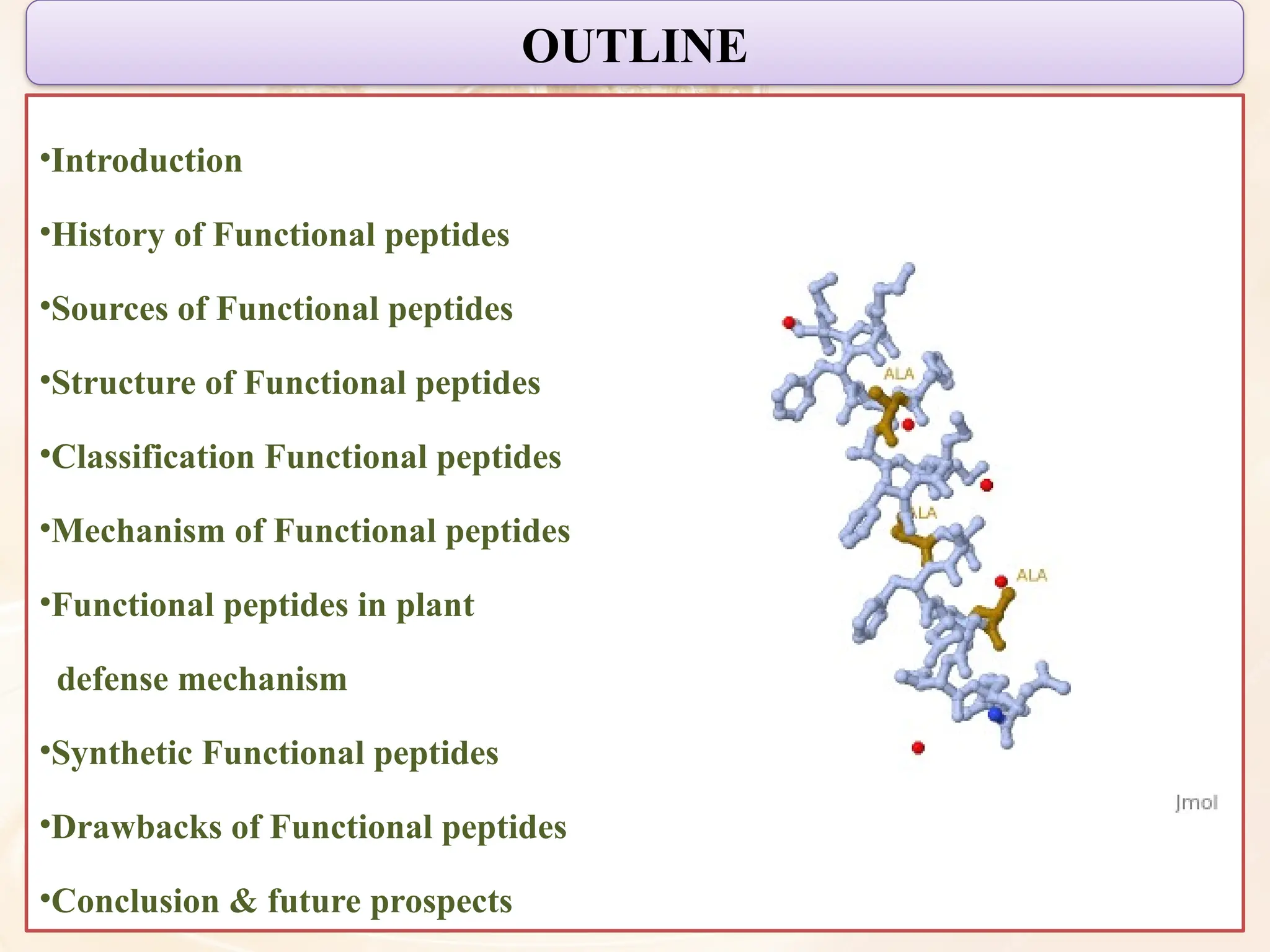
OUTLINE
•Introduction
•History of Functionalpeptides
•Sources of Functional peptides
•Structure of Functional peptides
•Classification Functional peptides
•Mechanism of Functional peptides
•Functional peptides in plant
defense mechanism
•Synthetic Functional peptides
•Drawbacks of Functional peptides
•Conclusion & future prospects
3.
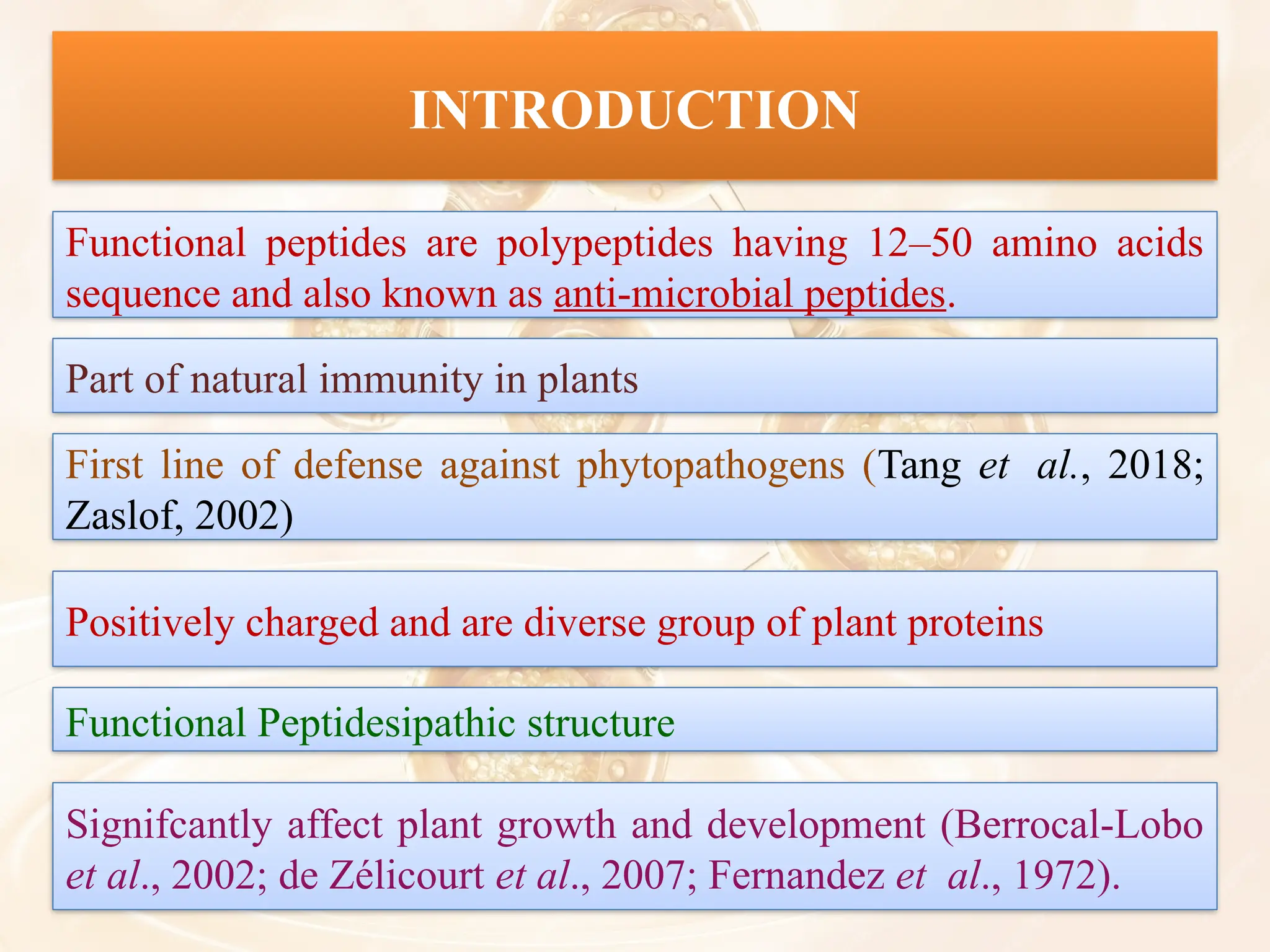
INTRODUCTION
Functional peptides arepolypeptides having 12–50 amino acids
sequence and also known as anti-microbial peptides.
Part of natural immunity in plants
First line of defense against phytopathogens (Tang et al., 2018;
Zaslof, 2002)
Positively charged and are diverse group of plant proteins
Functional Peptidesipathic structure
Signifcantly affect plant growth and development (Berrocal-Lobo
et al., 2002; de Zélicourt et al., 2007; Fernandez et al., 1972).
4.
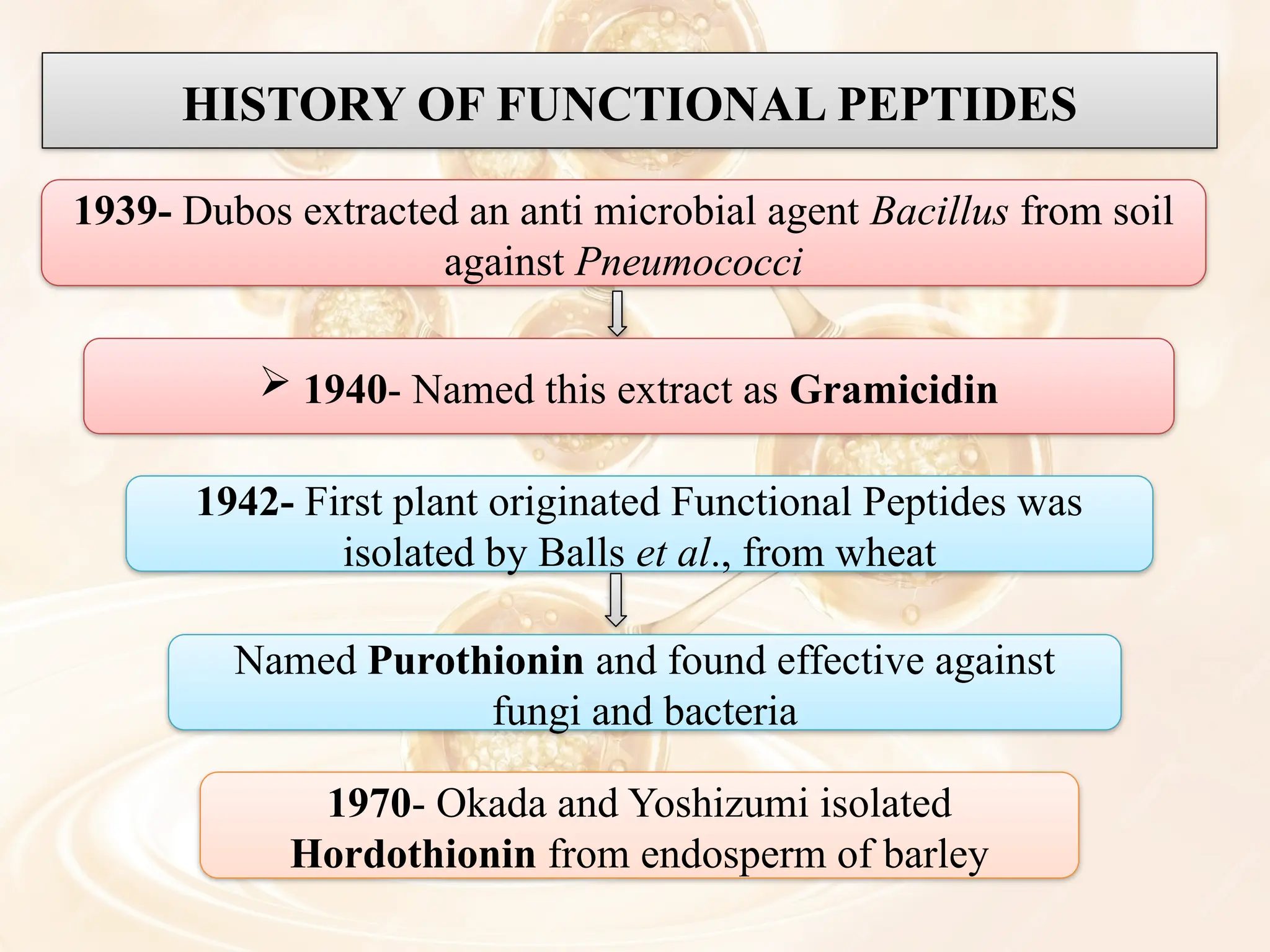
HISTORY OF FUNCTIONALPEPTIDES
1939- Dubos extracted an anti microbial agent Bacillus from soil
against Pneumococci
1940- Named this extract as Gramicidin
1942- First plant originated Functional Peptides was
isolated by Balls et al., from wheat
Named Purothionin and found effective against
fungi and bacteria
1970- Okada and Yoshizumi isolated
Hordothionin from endosperm of barley
CLASSIFICATION OF FUNCTIONALPEPTIDES
• Non disulfide bridged peptide
• Peptides with disulfide group
1. Based on their
structure
• Synthetic non ribosomal peptides
• Synthetic ribosomal/ Natural peptides
2. Based on their
nature
• Cationic peptides
• Non cationic peptides
3. Based on their
electrostatic charge
4. Based on their
target
microorganism
• Antifungal
• Antibacterial
• Antiviral
• Antiparasitic
Antiviral
Surface target
1.Interaction aminoglycanswith
virus
2.Blocking of viral entry into the
cell
3.Suppression of cell fusion by
interfering with the activity of
ATPase protein.
Intracellular target
4.Suppression viral gene
expression
5.Inhibition of peptide chain
elongation by inactivating the
ribosome.
Viral protein targets:
7.Binding of peptides to viral
proteins causing inhibition of
adsorption.
TMV
Mulder et al., 2013
1. THIONIS
Balls etal. (1942) identified thionins
for the first time in cereals and classified
as plant toxins due to their toxic effect
towards microbes.
Thionins consist of 45-48 amino acids,
6 or 8 cysteine and 3 or 4 disulfde bonds
(Stec 2006).
Around 100 individual thionin
sequences have been identified in more
than 15 different plant species
Hydrophobic
Mostly Cationic
Anti fungal and Antibacterial
17.
CLASSIFICATION OF THIONINS
Sixcysteine residue
Three disulphide bridges
Crambin
Viscotoxins
Phoratoxins
Eight cysteine residue
Four disulphide bridges
/- purothionins
/
hordothionins
Hellethionin-D
18.
MODE OF INTERACTIONOF
THIONINS
thionins mechanism of action, by using glucosylceramides as receptors for fungi cell
membrane insertion.
Glucosylceramides
SUPPORTIVE ARTICLE
When flowersare inoculated with F. graminearum, the Thi2.4 protein had an
antifungal effect on F. graminearum.
They purified the Thi2.4 protein, conjugated it with glutathione-S-transferase
(GST) . Total protein from F. graminearum was applied to GST-Thi2.4 and the
fungal fruit body lectin (FFBL) of F. graminearum was identified as a Thi2.4-
interacting protein.
By contrast, FFBL-induced host cell death was effectively suppressed in
transgenic plants that over expressed Thi2.4.
Asano et al., 2013
21.
Thi2.4 protein waspresent in flowers
and flower buds, but not leaves or
inflorescence stems.
The molecular mass of the Thi2.4
protein was about 15 kD.
1.
2.
4.
3.
F – FFBL
M-
Control
22.
2. DEFENSIN
•In 1990,Mendez et al. isolated from
barley and wheat and named as Defensin.
•Small, cystine rich Functional peptides
ranging from 45-54 amino acids.
•Defensins consist of 3-5 disulfide bonds.
•Abundantly present in the stomatal and
peripheral cells.
• Expression of plant defensins are also
induced by abiotic stress and signalling
molecules.
23.
Based on theireffect on pathogenic fungi
Morphogenic plant
defensins
Inhibit the growth
and branching of
hyphae
Non- morphogenic
plant defensins
Inhibit only hyphal
growth
24.
MODE OF ACTIONOF DEFENSIN
Khan et al., 2019
The membrane permeabilization
and ion leakage from the membrane
occurs due to the interaction of
serine residue with glycosyl part of
the fungal cell membrane (de Paula
et al. 2011).
Antifungal activity of NAD1
involves in the membrane
permeabilization of hyphae of the
pathogen Fusarium oxysporum.
Dimer formation was observed in
NaD1 defensin.
25.
Ex-DEFENSINS
Functional
Peptides
Source Transgenic
plant
Pathogen testedReferences
BrD1 Brassica
rapa
Rice Fusarium
graminearum
Choi et al.,
(2009)
RsAFP2 Raphanus
sativus
Wheat/Rice Magnaporthe
oryzae
Rhizoctonia solani
Jha and
Chattoo et al.,
(2010)
MsDef1 Medicago
sativa
Tomato Fusarium
oxysporum
Phytophthora
parasitica
Abdallah et
al., (2010)
NmDef02 N.
megalosipho
n
Tobacco/
Potato
Phytophthora
infestans
Alternaria solani
Portieles et al.,
(2010)
DEF2 Capsicum
annum
Tomato Botrytis cinerea Stoz et al.,
(2009)
26.
SUPPORTIVE ARTICLE
•Transgenic rice(Oryza sativa L. cv. Pusa basmati 1), overexpressing the Rs-
AFP2 defensin gene from the Raphanus sativus was generated by
Agrobacterium tumefaciens-mediated transformation.
• It was observed that constitutive expression of Rs-AFP2 suppresses the
growth of Magnaporthe oryzae and Rhizoctonia solani by 77 and 45%,
respectively.
Jha and Chattoo
(2009)
27.
ELISA of T2-transgenicrice plants expressing
RsAFP2
Sub-cellular localization of Rs-AFP2
was determined by treating the
transgenic leaf and root sFunctional
Peptidesle with anti-Rs-AFP2
Leaf tissue
Root tissue
Transgenic Control
28.
Significant changes inthe hyphal morphology
Effects of the overexpression of RsAFP2 on
resistance of transgenic plants to fungal pathogens.
DLA : Diseased leaf
area
M. oryzae
R. solani
Rs-AFP2
Transgenic
line
Control
29.
3. LIPID TRANSFERPROTEINS (LTP)
• Small cysteine rich peptides having
molecular masses of lower than
10KDa.
• It consists of 70-100 amino acid
• Cationic peptides with a conserved
pattern of four to five disulfide
bridges having eight to ten cys-cys
bonds.
• LTPs having synergistic activity with
thionins against Clavibacter spp.
•Expression of lipid transfer proteins
can be induced by abiotic stress.
30.
Possible mechanisms behindthe roles of non-specific lipid-transfer proteins (nsLTPs) during plant–pathogen
interactions
Mode of action of LTP
31.
Lipid transfer
proteins
Source Targetpathogen Reference
Ca-LTP Capsicum annum Canida albicans,
Saccaromyces
cerevisiae
Cruz et al., (2010)
Ps-LTP1-3 Pisum sativum Fusarium solani,
Fusarium oxysporum
Bogdanov et al., (2016)
Gt-LTP2 Gentiana triflora Botrytis cinerea Akinori kiba et al.,
(2011)
Ace-Functional
Peptides1
Allium cepa Fusarium oxysporum Cammue et al., (1995)
Cc-LTP-1 Coffea canephora
seeds
Candida albicans Zottich et al., (2011)
Ex- LIPID TRANSFER PROTEINS
32.
4. HEVEIN likepeptides
•Archer isolated hevein like plant
Functional Peptides from rubber tree
latex.
•Heveins are small Functional
proteins of 42-45 amino acids and of
4.7 Kda with conserved residues of
glycine and aromatic acids.
•They are cationic proteins having 3-
5 disulfide bonds.
•The N-terminal region contains a
chitinbinding hevein domain
33.
Based on thenumber of cysteine residues
Three disulfide bridge
Six cysteine residue
6C- hevein
Four disufide bridge
Eight cysteine residue
8C- hevein
Five disulfide bridge
Ten cysteine residue
10C- hevein
Hevein Source Againstpathogen Reference
M-hevein Mulberry Trichoderma viride Zhao et al., (2011)
GAFP G. biloba Fusarium graminearum
Alternaria alternata
Huang et al., (2000)
WjFunctional
Peptides1
Wasabia japonica Fungi: Botrytis cinerea
Fusarium solani
Magnaporthe grisea
Alternaria alternata
Bacteria: Escherichia coli
Agrobacterium
tumefaciens
Kiba et al., (2003)
Ex- HEVEIN like peptides
36.
5. KNOTTIN typepeptides
‑
• Nguyen et al. (1990) isolated it from
Mirabilis jalapa.
• The typical structure of knottins involves
conserved disulfde bonds between
multiple cysteine pairs, forming a cystine
knot.
• Generally, knottin-type peptides are the
smallest in size among plant Functional
Peptidess.
• Promote resistance to biotic and abiotic
stresses, stimulating root growth, acting as
signaling molecules, and enhancing
symbiotic interactions
OTHER FUNCTIONAL PEPTIDES
PuroindolinesSnakins Cyclopeptides
• Contain a unique
tryptophan-rich domain
• These proteins were
isolated from wheat
endosperm.
• PIN-1 is able to form ion
channels in membrane.
Ca2+ ions modulate
channels formation and/or
opening (Charnet et al.
2003)
• Membranotoxin
• Isolated from potato tubers.
They comprise the cell wall-
associated peptide snakin-1
(StSN1) and snakin-2 (StSN2).
• Do not interact with artificial
lipid membranes.
• StSN1 gene does not
respond to abiotic stress.
•Most of Snakin genes are
regulated by plant hormones
(Nahirñak et al., 2012).
•Cyclic proteins of about
28-37 aminoacids.
• Composed of amino
acid residues arranged in
a cyclic ring, usually
without disulphide
bridges.
• Lipidic cyclopeptides
(LCPs) are produced by
several plant-associated
and soil-inhabiting
bacteria.
39.
Puroindoline Susceptible speciesReferences
PINA and PINB
from wheat
Fungi:
Alternaria brassicicola
Marino et al., (2009)
Botrytis cinerea
Verticillium dahliae
Cochliobolus
heterostrophus
Zhang et al., (2011)
PINA from wheat Bacteria:
Erwinia amylovora
Jing et al., (2003)
Staphyllococcus aureus Dhaliwal et al,. (2009)
40.
•Pina and Pinbwere introduced into corn.
•Pina⁄Pinb expression–positive transgenic events were evaluated for
resistance to Cochliobolus heterostrophus, the corn southern leaf blight (SLB)
pathogen.
SUPPORTIVE ARTICLE
Zhang et
al., (2010)
Snakins Susceptible speciesReferences
StSN1 and StSN2 from
Solanum tuberosum
Fungi:
Botrytis cinerea
Fusarium solani
Fusarium oxysporum
F sp conglutinans
Bacteria
Clavibacter
michiganensis
Ralstonia solanacrarum
Berrocal Lobo et al.,
(2002)
Ex- SNAKINS
43.
Cyclopeptides Origin Target
pathogen
Reference
Syringomycins
andsyringopeptins
Pseudomonas sp Botrytis cinerea Lavermicocca et
al., (1997)
Pseudomonas
syringae
Venturia
inaequalis
Burr et al., (1996)
Tolaasins Pseudomonas sp Rhizoctonia
solani,
Rhodococcus
fascians
Bassarello et al.,
(2004)
Pseudophomins Pseudomonas
fluorescens
BRG100
Sclerotinia
sclerotiorum
Pedras et al.,
(2003)
Massetolide Pseudomonas
fluorescens SS101
Phytium
intermedium
de Souza et al.,
(2003)
Ex-Functional Peptides of CYCLOPEPTIDES
44.
PSEUDOPEPTIDES
Amide of anamino acid that does not occur in natural
peptides.
Having few peptide bonds and complex amino acid
modification.
Produced by bacteria.
SUPPORTIVE ARTICLE
The bioactivityof MIL-C against powdery mildew disease in vivo and in vitro
were examined systematically and compared to MIL and triadimefon.
Huang et al., (2010)
47.
MIL-
C
Tridiamefon
Eradicating effect of
MIL,MIL-C and
triadimofon against
powdery mildew
(Sphaerotheca fuliginea)
on leaves of greenhouse
grown cucumber. (MIL:
150 mg/L; MIL-C: 50
mg/L; Triadimefon: 200
mg/L)
1 week after first spray; 1 week after
second spray; 2 weeks after second
spray
1.
2.
3.
48.
BACTERIOCINS
• Ribosomal synthesized
Functionalpeptides.
• Produced by bacteria.
• Kill or inhibit closely
related bacterial strains.
PEPTAIBOLS
• Non ribosomal
synthesized Functional
linear peptides.
• Produced by fungi
• Affect fungi and plant
pathogenic gram positive
bacteria.
SYNTHETIC FUNCTIONAL PEPTIDES
Resistance toFunctional Peptidess by pathogens such as
Pectobacterium carotovorum, Dickeya dadantii (PhoH, PhoP, PhoS
genes)
In vitro testing of the leaf extracts from the plants expressing
cationic peptides shows that the expressed peptides are unstable or
degraded by proteases (Cary et al., 2000; Li et al., 2001).
Lack of the strategies needed to optimize expression and stability
of expressed peptides in transgenic plants.
High extraction cost
DRAWBACKS
52.
•The best strategyfor providing enhanced and broad-spectrum resistance
using cationic peptides is the expression of different molecules at different
stages of disease development.
•Combinations of potential peptides may be a successful strategy for
generating broad-spectrum disease resistance, including resistance against
viruses in plants.
•Strategies for a regulated and/or inducible, and tissue-specific expression of
peptides, may prove to be effective for better performance in the greenhouse
as well as in the field
•Successful applications of a transgenic approach using these peptides to
control plant diseases, particularly viruses, will likely help eradicate certain
plant diseases, reduce the environmental impact of intensive agricultural
practices.
Conclusion and Future Prospects