ANTI VIRAL AGENTS
PREPARED BY
PRANJAL SAXENA
B.PHARMACY 6TH
SEM.
ORIENTAL UNIVERSITY
INTRODUCTION
• Anti viral drugs are a class of medication used specifically for treating viral
infections.
• Viruses are obligate intracellular parasites,smallest of all self replicating
organisms,able to pass through filter that retain the smallest bacteria.Virus conduct
no metabolic process on their own.
• They invade the host cell which may be bacteria,animal or plant cell.
• Like antibiotics for bacteria, specific antivirals are used for specific viruses. Unlike
most antibiotics, antivirals do not destroy their target pathogen; instead they inhibit
their development.
STRUCTURE OF VIRUS
• Virus doesn't possess cell
wall.It consists of one or more
of linear or helical strands pf
either DNA or RNA,enclosed in
the shell of protein known as
capsid.
• The capsid is composed of
several sub units known as
capsomers.In certain
cases,capsid may be
surrounded by an outer protein
or lipoprotein envelop.
LIFE CYCLE OF VIRUS
• Viral life cycle varies with species but they all share a general pattern.
• 1. Adsorption:-Attachment of virus to the host cell.
• 2. Penetration:-Penetration of virus into the host cell.
• 3. Uncoating:-The genetic material of viral genome(DNA/RNA)passes into the host
cell, leaving the capsid covering outside the cell.
• 4. Transcription: -Production of viral m-RNA from viral genome.
• 5. Translation:-Viral genome enters the cytoplasm or nucleoplasm and utilises the
host nucleic acid for the synthesis of new viral protein and also for the production
of more viral genome.The viral protein modifies the host cell and allows the viral
genome to replicate by using host and viral enzyme.In this stage, the cell is
irreversibly modified and eventually killed.
• 6.Assembly:-New viral coat protein assembles into capsid and viral
genomes.
• 7.Release:-Release of the mature virus from the cells by budding
process or by rupture of the cell and the process is repeated in
fresh host cell.Since the host cell machinery is totally utilised for
the production of new virions, the normal cell function ceases at
the time of production.
LIFE CYCLE OF
HIV VIRUS
CLASSIFICATION OF ANTI VIRAL DRUGS:-
• The anti viral agents may be divided into the following categories based on
their chemical structure:-
• 1.Admantane derivatives:- Amantadine,
Rimantadine,Somantadine,Tromantadine
• 2.Purine nucleotides:- Acyclovir,Ganciclovir,Vidarabine,Valaciclovir,
Penciclovir
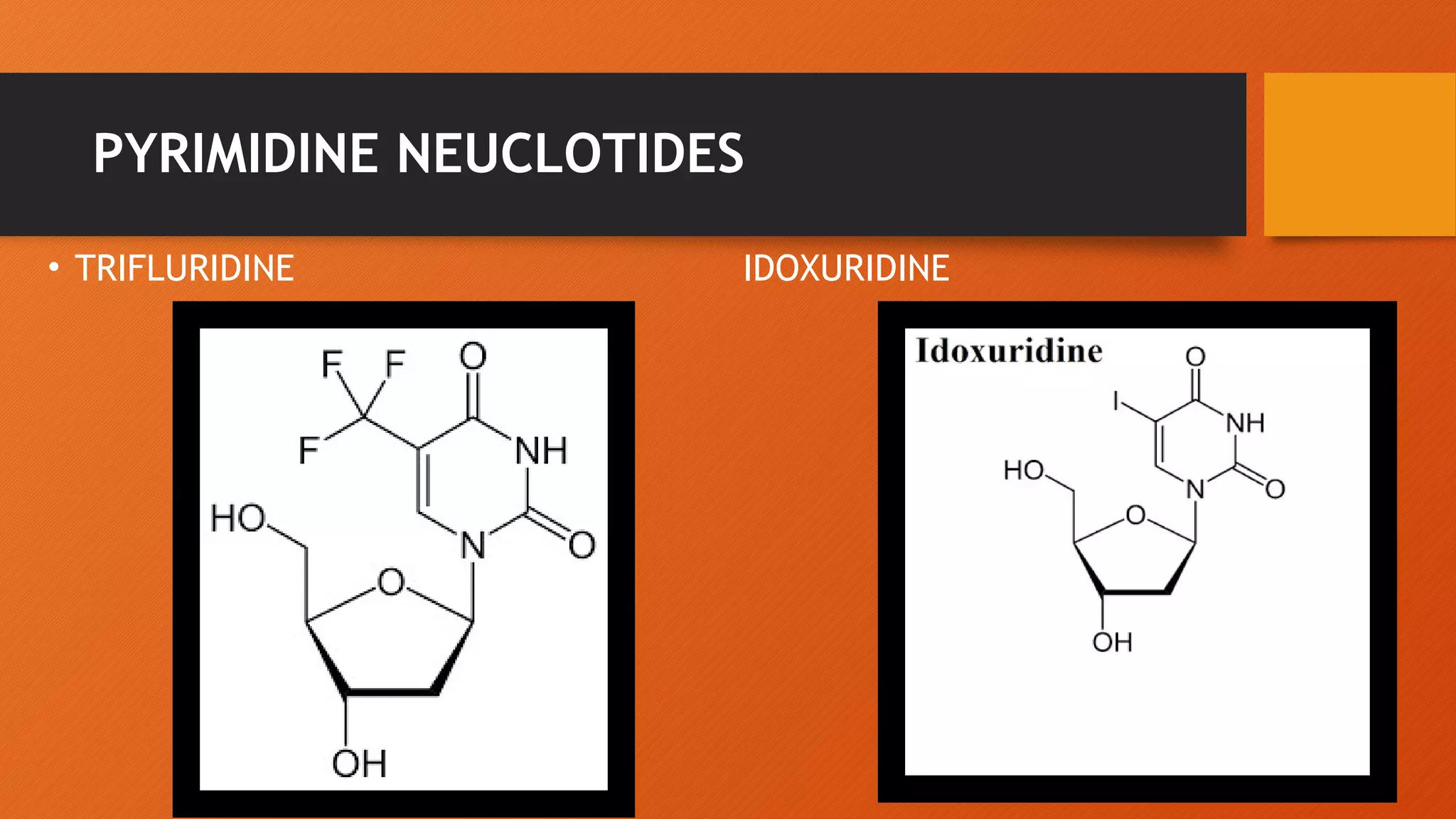
• 3.Pyrimidine nucleotides:- Trifluridine,Idoxuridine
• 4.Phosphorus derivatives:- Foscarnet
ADMANTANE DERIVATIVES:-
• AMANTADINE RIMANTADINE
• SOMANTADINE TORMANTADINE
PURINE NEUCLOTIDES:-
ACYCLOVIR GANCICLOVIR
VALACICLOVIR
PYRIMIDINE NEUCLOTIDES
• TRIFLURIDINE IDOXURIDINE
ADMANTADINE
• PROPERTIES AND USES:- Amantadine is a
white,odourless,crystalline powder with
a bitter taste, freely soluble in water.
• It is effective in the prophylaxis and
therapy of infection caused by
influenza-A and is active against a
number of DNA and RNA virus in vitro.lt
may block either the assembly of
influenza-A virus or the release of viral
nucleic acid in the host cell.
• The drug is well absorbed from the GIT
is not metabolised and is excreted by
the kidney. Dose related adverse effects
include confusion,hallucinations,seizures
& coma.
SYNTHESIS OF ACYCLOVIR
MECHANISM OF ACTION
• Acyclovir gets activated after
three phosphorylation steps
by viral specific enzymes
termed thymidine kinases.
• These active metabolites
accumulate in the infected
cells and exerts their action
by two mechanisms.
1.Competitive inhibition of
herpes virus DNA polymerases.
2.Incorporation of Acyclovir
into viral DNA.
SAR OF ACYCLOVIR
• 1.The length of acyclic side chain attached at N-9 is essential for the anti viral
activity.
• 2.When the acyclic side chain containing hydroxy methylene group was replaced
by other substituents, inactive analogues are obtained.This implies that -CH,OH
group is essential for anti viral activity.
• 3.The 9-alkoxy derivative was obtained when a slight modification was brought
in the acyl side chain which is highly active against herpes simplex and varicella
zoster viruses.
• 4.Several structural modifications have been brought to acyclovir to obtain high
potent drugs.
USES OF ACYCLOVIR:-
• USES OF ACYCLOVIR:- It is a drug of choice in both
prophylaxis and treatment of herpes simplex
virus,particularly type-1 including chronic and
recurrent mucocutaneous herpes in the
immunologically impaired host,primary and secondary
genital herpes and herpes simplex encephalitis.Cells
infected with herpex simplex phosphorylate the drug
to yield a cycloguanosine triphosphate,which
preferentially inhibits viral DNA polymerase.
SYNTHESIS OF IDOXURIDINE:-
MOA AND USES:-
• 1.ldoxuridine acts as a anti viral agent against DNA virus.
• 2.lt is phosphorylated by thymidine kinase to active triphosphate.
• 3.This phosphorylated drug inhibits HSV DNA polymerase enzyme which is
necessary for the synthesis of viral DNA.
• 4.The ability of idoxuridylic acid substitute for deoxythymidic acid in the
synthesis of viral DNA may be due to the similar vander waal's radii of iodine
and the thymidine methyl group.
• USES:-
• Idoxuridine is mainly used for the topical treatment of HSV infection of
eyelid,conjuctiva & cornea and approved as opthalmic ointment or
solution.Epithelial infections respond much better than stromal infections.
SUMMARY MOA OF ANTI VIRAL AGENTS
THANK YOU

Anti viral drugs of medicinal chemistry

  • 1.
    ANTI VIRAL AGENTS PREPAREDBY PRANJAL SAXENA B.PHARMACY 6TH SEM. ORIENTAL UNIVERSITY
  • 2.
    INTRODUCTION • Anti viraldrugs are a class of medication used specifically for treating viral infections. • Viruses are obligate intracellular parasites,smallest of all self replicating organisms,able to pass through filter that retain the smallest bacteria.Virus conduct no metabolic process on their own. • They invade the host cell which may be bacteria,animal or plant cell. • Like antibiotics for bacteria, specific antivirals are used for specific viruses. Unlike most antibiotics, antivirals do not destroy their target pathogen; instead they inhibit their development.
  • 3.
    STRUCTURE OF VIRUS •Virus doesn't possess cell wall.It consists of one or more of linear or helical strands pf either DNA or RNA,enclosed in the shell of protein known as capsid. • The capsid is composed of several sub units known as capsomers.In certain cases,capsid may be surrounded by an outer protein or lipoprotein envelop.
  • 4.
    LIFE CYCLE OFVIRUS • Viral life cycle varies with species but they all share a general pattern. • 1. Adsorption:-Attachment of virus to the host cell. • 2. Penetration:-Penetration of virus into the host cell. • 3. Uncoating:-The genetic material of viral genome(DNA/RNA)passes into the host cell, leaving the capsid covering outside the cell. • 4. Transcription: -Production of viral m-RNA from viral genome. • 5. Translation:-Viral genome enters the cytoplasm or nucleoplasm and utilises the host nucleic acid for the synthesis of new viral protein and also for the production of more viral genome.The viral protein modifies the host cell and allows the viral genome to replicate by using host and viral enzyme.In this stage, the cell is irreversibly modified and eventually killed.
  • 5.
    • 6.Assembly:-New viralcoat protein assembles into capsid and viral genomes. • 7.Release:-Release of the mature virus from the cells by budding process or by rupture of the cell and the process is repeated in fresh host cell.Since the host cell machinery is totally utilised for the production of new virions, the normal cell function ceases at the time of production.
  • 7.
  • 8.
    CLASSIFICATION OF ANTIVIRAL DRUGS:- • The anti viral agents may be divided into the following categories based on their chemical structure:- • 1.Admantane derivatives:- Amantadine, Rimantadine,Somantadine,Tromantadine • 2.Purine nucleotides:- Acyclovir,Ganciclovir,Vidarabine,Valaciclovir, Penciclovir • 3.Pyrimidine nucleotides:- Trifluridine,Idoxuridine • 4.Phosphorus derivatives:- Foscarnet
  • 9.
  • 10.
  • 11.
  • 12.
  • 13.
    ADMANTADINE • PROPERTIES ANDUSES:- Amantadine is a white,odourless,crystalline powder with a bitter taste, freely soluble in water. • It is effective in the prophylaxis and therapy of infection caused by influenza-A and is active against a number of DNA and RNA virus in vitro.lt may block either the assembly of influenza-A virus or the release of viral nucleic acid in the host cell. • The drug is well absorbed from the GIT is not metabolised and is excreted by the kidney. Dose related adverse effects include confusion,hallucinations,seizures & coma.
  • 14.
    SYNTHESIS OF ACYCLOVIR MECHANISMOF ACTION • Acyclovir gets activated after three phosphorylation steps by viral specific enzymes termed thymidine kinases. • These active metabolites accumulate in the infected cells and exerts their action by two mechanisms. 1.Competitive inhibition of herpes virus DNA polymerases. 2.Incorporation of Acyclovir into viral DNA.
  • 16.
    SAR OF ACYCLOVIR •1.The length of acyclic side chain attached at N-9 is essential for the anti viral activity. • 2.When the acyclic side chain containing hydroxy methylene group was replaced by other substituents, inactive analogues are obtained.This implies that -CH,OH group is essential for anti viral activity. • 3.The 9-alkoxy derivative was obtained when a slight modification was brought in the acyl side chain which is highly active against herpes simplex and varicella zoster viruses. • 4.Several structural modifications have been brought to acyclovir to obtain high potent drugs.
  • 17.
    USES OF ACYCLOVIR:- •USES OF ACYCLOVIR:- It is a drug of choice in both prophylaxis and treatment of herpes simplex virus,particularly type-1 including chronic and recurrent mucocutaneous herpes in the immunologically impaired host,primary and secondary genital herpes and herpes simplex encephalitis.Cells infected with herpex simplex phosphorylate the drug to yield a cycloguanosine triphosphate,which preferentially inhibits viral DNA polymerase.
  • 18.
  • 19.
    MOA AND USES:- •1.ldoxuridine acts as a anti viral agent against DNA virus. • 2.lt is phosphorylated by thymidine kinase to active triphosphate. • 3.This phosphorylated drug inhibits HSV DNA polymerase enzyme which is necessary for the synthesis of viral DNA. • 4.The ability of idoxuridylic acid substitute for deoxythymidic acid in the synthesis of viral DNA may be due to the similar vander waal's radii of iodine and the thymidine methyl group. • USES:- • Idoxuridine is mainly used for the topical treatment of HSV infection of eyelid,conjuctiva & cornea and approved as opthalmic ointment or solution.Epithelial infections respond much better than stromal infections.
  • 20.
    SUMMARY MOA OFANTI VIRAL AGENTS
  • 21.