
Anti-Psychotic Mood Stabilizing Agents Definitions Pharmacology
Definitions Anti-psychotics  Neuroleptics Psychosis Schizophrenia
Antipsychotics’ Indications Psychiatric Schizophrenia Manic episodes Bipolar Tourette’s Syndrome Senile Dementia  Non-psychiatric Anti-emetic Anesthesia
Anti-Psychotics MOA Systems Effects Dopaminergic Psychologic Neurophysiologic Endocrine Cardiovascular Minimize with Diphenhydramine
Anti-Psychotics Fluphenazine Haloperidol * (Haldol) Olanzapine * (Zyprexa) Perphenazine Prochlorperazine Quetiapine* (Seroquel) Risperidone *(Risperdol) Thioridazine Thiothixene
Drug Choice  Toxicity No basis to selection Best guide patient response  History of past agents Dosing Compliance Behavioral/Neurologic Autonomic Nervous System Endocrine Allergic reactions Ocular/Cardiac Pregnancy Neuroleptic Malignant Syndrome
Antipsychotics’ Dispensing Issues Minimize Side Effects with: Dimenhydrinate Benztropine Diphenhydramine Trihexyphenidyl Benzodiazepines Atypical Risperidol Clozaril Zyprexa Confused with Clinoril Zyrtec
Symptoms Related to Schizophrenia Hallucinations, delusions Disorganized behaviors, speech, thinking Catatonic behaviors Apathy, lack of drive, initiative, pleasure Impaired memory, attention, verbal fluency, visual processing Neologisms (meaningless words)
 
 
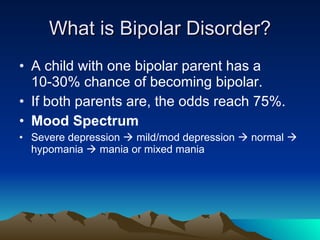
What is Bipolar Disorder? A child with one bipolar parent has a 10-30% chance of becoming bipolar.  If both parents are, the odds reach 75%. Mood Spectrum Severe depression    mild/mod depression    normal    hypomania    mania or mixed mania
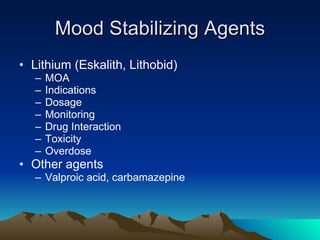
Mood Stabilizing Agents Lithium (Eskalith, Lithobid) MOA Indications Dosage Monitoring Drug Interaction Toxicity Overdose Other agents Valproic acid, carbamazepine
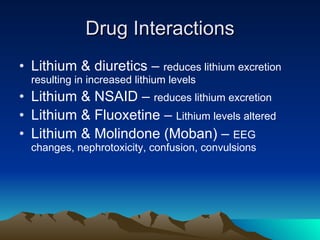
Drug Interactions Lithium & diuretics –  reduces lithium excretion resulting in increased lithium levels Lithium & NSAID –  reduces lithium excretion Lithium & Fluoxetine –  Lithium levels altered Lithium & Molindone (Moban) –  EEG changes, nephrotoxicity, confusion, convulsions
Drug Selection &  Toxicity No basis to selection Best guide patient response  History of past agents Dosing/Compliance Anticholinergic Cardiovascular Dermatological Endocrine Hematologic Ophthalmologic Neurological
Treatment Schedules Find the right drug for the right patient Empirical Determination Patient acceptance Adverse effects Tolerance Labs do not rule over clinical judgment LOOK AT PATIENT!
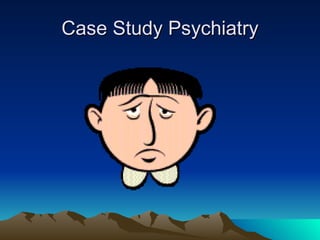
Case Study Psychiatry
JB is a 43-year-old male brought to the ER by SRPD for bizarre behavior.  He was found wandering in the park dressed in his army fatigues trying to prevent Argentina from undermining the United States government. He states that he is employed by the CIA and is receiving secret communication from the US satellite and will not reveal the nature of his mission.  The patient was noted to be smacking his lips and chewing his tongue. He is also coughing up large amounts of yellow greenish sputum. He exhibits poor eyesight, delusional thinking and is becoming progressively agitated.  His backpack contains cigarettes, a flask of alcohol and medications—last doses are unknown. MEDS:  Fluphenazine 20 mg/day  Benztropine 2 mg bid Propranolol 40 mg bid  Maalox  Albuterol MDI 2 puffs qid & prn  Azmacort MDI 4 puff BID Lithium Carbonate 300mg BID
Points to Ponder List symptoms related to mental status. Is antibiotic therapy warranted? Why or why not? Discuss patient’s medication list. This patient is admitted to the hospital. Develop a drug treatment plan for his conditions.

Anti psychotics

  • 1.
    Anti-Psychotic Mood StabilizingAgents Definitions Pharmacology
  • 2.
    Definitions Anti-psychotics Neuroleptics Psychosis Schizophrenia
  • 3.
    Antipsychotics’ Indications PsychiatricSchizophrenia Manic episodes Bipolar Tourette’s Syndrome Senile Dementia Non-psychiatric Anti-emetic Anesthesia
  • 4.
    Anti-Psychotics MOA SystemsEffects Dopaminergic Psychologic Neurophysiologic Endocrine Cardiovascular Minimize with Diphenhydramine
  • 5.
    Anti-Psychotics Fluphenazine Haloperidol* (Haldol) Olanzapine * (Zyprexa) Perphenazine Prochlorperazine Quetiapine* (Seroquel) Risperidone *(Risperdol) Thioridazine Thiothixene
  • 6.
    Drug Choice Toxicity No basis to selection Best guide patient response History of past agents Dosing Compliance Behavioral/Neurologic Autonomic Nervous System Endocrine Allergic reactions Ocular/Cardiac Pregnancy Neuroleptic Malignant Syndrome
  • 7.
    Antipsychotics’ Dispensing IssuesMinimize Side Effects with: Dimenhydrinate Benztropine Diphenhydramine Trihexyphenidyl Benzodiazepines Atypical Risperidol Clozaril Zyprexa Confused with Clinoril Zyrtec
  • 8.
    Symptoms Related toSchizophrenia Hallucinations, delusions Disorganized behaviors, speech, thinking Catatonic behaviors Apathy, lack of drive, initiative, pleasure Impaired memory, attention, verbal fluency, visual processing Neologisms (meaningless words)
  • 9.
  • 10.
  • 11.
    What is BipolarDisorder? A child with one bipolar parent has a 10-30% chance of becoming bipolar. If both parents are, the odds reach 75%. Mood Spectrum Severe depression  mild/mod depression  normal  hypomania  mania or mixed mania
  • 12.
    Mood Stabilizing AgentsLithium (Eskalith, Lithobid) MOA Indications Dosage Monitoring Drug Interaction Toxicity Overdose Other agents Valproic acid, carbamazepine
  • 13.
    Drug Interactions Lithium& diuretics – reduces lithium excretion resulting in increased lithium levels Lithium & NSAID – reduces lithium excretion Lithium & Fluoxetine – Lithium levels altered Lithium & Molindone (Moban) – EEG changes, nephrotoxicity, confusion, convulsions
  • 14.
    Drug Selection & Toxicity No basis to selection Best guide patient response History of past agents Dosing/Compliance Anticholinergic Cardiovascular Dermatological Endocrine Hematologic Ophthalmologic Neurological
  • 15.
    Treatment Schedules Findthe right drug for the right patient Empirical Determination Patient acceptance Adverse effects Tolerance Labs do not rule over clinical judgment LOOK AT PATIENT!
  • 16.
  • 17.
    JB is a43-year-old male brought to the ER by SRPD for bizarre behavior. He was found wandering in the park dressed in his army fatigues trying to prevent Argentina from undermining the United States government. He states that he is employed by the CIA and is receiving secret communication from the US satellite and will not reveal the nature of his mission. The patient was noted to be smacking his lips and chewing his tongue. He is also coughing up large amounts of yellow greenish sputum. He exhibits poor eyesight, delusional thinking and is becoming progressively agitated. His backpack contains cigarettes, a flask of alcohol and medications—last doses are unknown. MEDS: Fluphenazine 20 mg/day Benztropine 2 mg bid Propranolol 40 mg bid Maalox Albuterol MDI 2 puffs qid & prn Azmacort MDI 4 puff BID Lithium Carbonate 300mg BID
  • 18.
    Points to PonderList symptoms related to mental status. Is antibiotic therapy warranted? Why or why not? Discuss patient’s medication list. This patient is admitted to the hospital. Develop a drug treatment plan for his conditions.