DRIVERLESS CARS
THE ETHICS OF AUTONOMOUS VEHICLES
SUBMITTED BY:
ANSHAL KUMAR
16BCON376
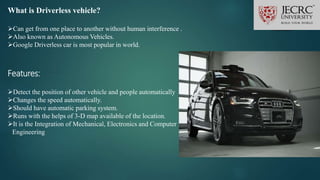
What is Driverless vehicle?
Can get from one place to another without human interference .
Also known as Autonomous Vehicles.
Google Driverless car is most popular in world.
Features:
Detect the position of other vehicle and people automatically
Changes the speed automatically.
Should have automatic parking system.
Runs with the helps of 3-D map available of the location.
It is the Integration of Mechanical, Electronics and Computer
Engineering
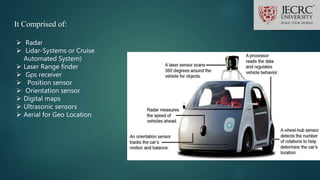
It Comprised of:
 Radar
 Lidar-Systems or Cruise
Automated System)
 Laser Range finder
 Gps receiver
 Position sensor
 Orientation sensor
 Digital maps
 Ultrasonic sensors
 Aerial for Geo Location
The Technology of the Car
 Anti-Lock Brakes
 Electronic Stability control
 Adaptive cruise control
 Lane-departure warning system
 Self parking
 Automated guided vehicle systems
 Lidar-Systems(with google cars) or
Cruise Automated Systems(Audi)
 Infrared cameras.
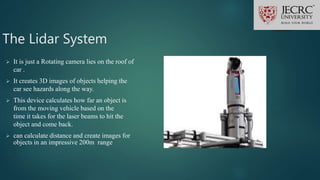
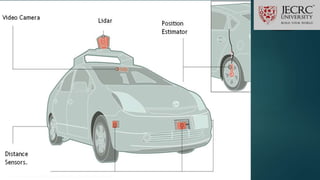
The Lidar System
 It is just a Rotating camera lies on the roof of
car .
 It creates 3D images of objects helping the
car see hazards along the way.
 This device calculates how far an object is
from the moving vehicle based on the
time it takes for the laser beams to hit the
object and come back.
 can calculate distance and create images for
objects in an impressive 200m range
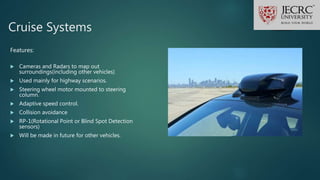
Cruise Systems
Features:
 Cameras and Radars to map out
surroundings(including other vehicles)
 Used mainly for highway scenarios.
 Steering wheel motor mounted to steering
column.
 Adaptive speed control.
 Collision avoidance
 RP-1(Rotational Point or Blind Spot Detection
sensors)
 Will be made in future for other vehicles.
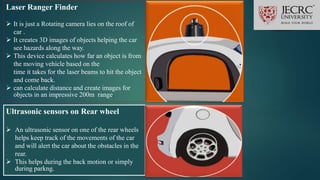
Laser Ranger Finder
 It is just a Rotating camera lies on the roof of
car .
 It creates 3D images of objects helping the car
see hazards along the way.
 This device calculates how far an object is from
the moving vehicle based on the
time it takes for the laser beams to hit the object
and come back.
 can calculate distance and create images for
objects in an impressive 200m range.
Ultrasonic sensors on Rear wheel
 An ultrasonic sensor on one of the rear wheels
helps keep track of the movements of the car
and will alert the car about the obstacles in the
rear.
 This helps during the back motion or simply
during parkng.
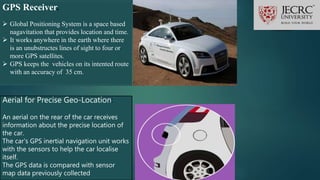
GPS Receiver.
 Global Positioning System is a space based
nagavitation that provides location and time.
 It works anywhere in the earth where there
is an unubstructes lines of sight to four or
more GPS satellites.
 GPS keeps the vehicles on its intented route
with an accuracy of 35 cm.
Aerial for Precise Geo-Location:
An aerial on the rear of the car receives
information about the precise location of
the car.
The car’s GPS inertial navigation unit works
with the sensors to help the car localise
itself.
The GPS data is compared with sensor
map data previously collected
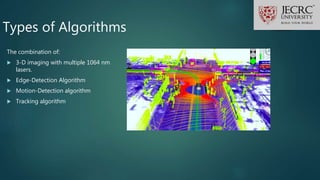
Types of Algorithms
The combination of:
 3-D imaging with multiple 1064 nm
lasers.
 Edge-Detection Algorithm
 Motion-Detection algorithm
 Tracking algorithm
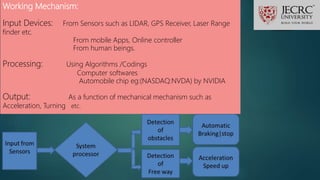
Working Mechanism:
Input Devices: From Sensors such as LIDAR, GPS Receiver, Laser Range
finder etc.
From mobile Apps, Online controller
From human beings.
Processing: Using Algorithms /Codings
Computer softwares
Automobile chip eg:(NASDAQ:NVDA) by NVIDIA
Output: As a function of mechanical mechanism such as
Acceleration, Turning etc.
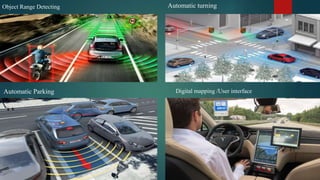
Object Range Detecting Automatic turning
Automatic Parking Digital mapping /User interface
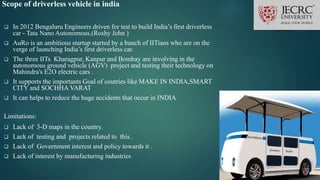
Scope of driverless vehicle in india
 In 2012 Bengaluru Engineers driven for test to build India’s first driverless
car - Tata Nano Autonomous.(Roshy John )
 AuRo is an ambitious startup started by a bunch of IITians who are on the
verge of launching India’s first driverless car.
 The three IITs Kharagpur, Kanpur and Bombay are involving in the
autonomous ground vehicle (AGV) project and testing their technology on
Mahindra's E2O electric cars .
 It supports the importants Goal of coutries like MAKE IN INDIA,SMART
CITY and SOCHHA VARAT
 It can helps to reduce the huge accidents that occur in INDIA
Limitations:
 Lack of 3-D maps in the country.
 Lack of testing and projects related to this .
 Lack of Government interest and policy towards it .
 Lack of interest by manufacturing industries
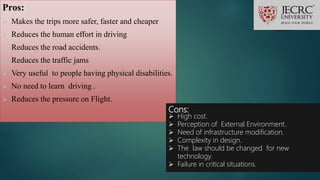
Pros:
 Makes the trips more safer, faster and cheaper
 Reduces the human effort in driving
 Reduces the road accidents.
 Reduces the traffic jams
 Very useful to people having physical disabilities.
 No need to learn driving .
 Reduces the pressure on Flight.
Cons:
 High cost.
 Perception of External Environment.
 Need of infrastructure modification.
 Complexity in design.
 The law should be changed for new
technology.
 Failure in critical situations.
THANK YOU

Anshal ppt

  • 1.
    DRIVERLESS CARS THE ETHICSOF AUTONOMOUS VEHICLES SUBMITTED BY: ANSHAL KUMAR 16BCON376
  • 2.
    What is Driverlessvehicle? Can get from one place to another without human interference . Also known as Autonomous Vehicles. Google Driverless car is most popular in world. Features: Detect the position of other vehicle and people automatically Changes the speed automatically. Should have automatic parking system. Runs with the helps of 3-D map available of the location. It is the Integration of Mechanical, Electronics and Computer Engineering
  • 3.
    It Comprised of: Radar  Lidar-Systems or Cruise Automated System)  Laser Range finder  Gps receiver  Position sensor  Orientation sensor  Digital maps  Ultrasonic sensors  Aerial for Geo Location
  • 4.
    The Technology ofthe Car  Anti-Lock Brakes  Electronic Stability control  Adaptive cruise control  Lane-departure warning system  Self parking  Automated guided vehicle systems  Lidar-Systems(with google cars) or Cruise Automated Systems(Audi)  Infrared cameras.
  • 5.
    The Lidar System It is just a Rotating camera lies on the roof of car .  It creates 3D images of objects helping the car see hazards along the way.  This device calculates how far an object is from the moving vehicle based on the time it takes for the laser beams to hit the object and come back.  can calculate distance and create images for objects in an impressive 200m range
  • 6.
    Cruise Systems Features:  Camerasand Radars to map out surroundings(including other vehicles)  Used mainly for highway scenarios.  Steering wheel motor mounted to steering column.  Adaptive speed control.  Collision avoidance  RP-1(Rotational Point or Blind Spot Detection sensors)  Will be made in future for other vehicles.
  • 7.
    Laser Ranger Finder It is just a Rotating camera lies on the roof of car .  It creates 3D images of objects helping the car see hazards along the way.  This device calculates how far an object is from the moving vehicle based on the time it takes for the laser beams to hit the object and come back.  can calculate distance and create images for objects in an impressive 200m range. Ultrasonic sensors on Rear wheel  An ultrasonic sensor on one of the rear wheels helps keep track of the movements of the car and will alert the car about the obstacles in the rear.  This helps during the back motion or simply during parkng.
  • 8.
    GPS Receiver.  GlobalPositioning System is a space based nagavitation that provides location and time.  It works anywhere in the earth where there is an unubstructes lines of sight to four or more GPS satellites.  GPS keeps the vehicles on its intented route with an accuracy of 35 cm. Aerial for Precise Geo-Location: An aerial on the rear of the car receives information about the precise location of the car. The car’s GPS inertial navigation unit works with the sensors to help the car localise itself. The GPS data is compared with sensor map data previously collected
  • 9.
    Types of Algorithms Thecombination of:  3-D imaging with multiple 1064 nm lasers.  Edge-Detection Algorithm  Motion-Detection algorithm  Tracking algorithm
  • 11.
    Working Mechanism: Input Devices:From Sensors such as LIDAR, GPS Receiver, Laser Range finder etc. From mobile Apps, Online controller From human beings. Processing: Using Algorithms /Codings Computer softwares Automobile chip eg:(NASDAQ:NVDA) by NVIDIA Output: As a function of mechanical mechanism such as Acceleration, Turning etc.
  • 12.
    Object Range DetectingAutomatic turning Automatic Parking Digital mapping /User interface
  • 13.
    Scope of driverlessvehicle in india  In 2012 Bengaluru Engineers driven for test to build India’s first driverless car - Tata Nano Autonomous.(Roshy John )  AuRo is an ambitious startup started by a bunch of IITians who are on the verge of launching India’s first driverless car.  The three IITs Kharagpur, Kanpur and Bombay are involving in the autonomous ground vehicle (AGV) project and testing their technology on Mahindra's E2O electric cars .  It supports the importants Goal of coutries like MAKE IN INDIA,SMART CITY and SOCHHA VARAT  It can helps to reduce the huge accidents that occur in INDIA Limitations:  Lack of 3-D maps in the country.  Lack of testing and projects related to this .  Lack of Government interest and policy towards it .  Lack of interest by manufacturing industries
  • 14.
    Pros:  Makes thetrips more safer, faster and cheaper  Reduces the human effort in driving  Reduces the road accidents.  Reduces the traffic jams  Very useful to people having physical disabilities.  No need to learn driving .  Reduces the pressure on Flight. Cons:  High cost.  Perception of External Environment.  Need of infrastructure modification.  Complexity in design.  The law should be changed for new technology.  Failure in critical situations.
  • 15.