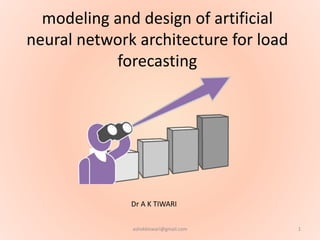
modeling and design of artificial
neural network architecture for load
forecasting
Dr A K TIWARI
1ashokktiwari@gmail.com
objective
• a load-forecasting model is proposed using a
multilayer neural network with an appropriately
modified back propagation learning algorithm.
• Once the neural network model is designed and
trained, it can forecast the load of the power
system 24 hours ahead on daily basis and can
also forecast the cumulative load on daily basis.
• The real load data that is used for the Artificial
Neural Network training was taken from LDC
2ashokktiwari@gmail.com
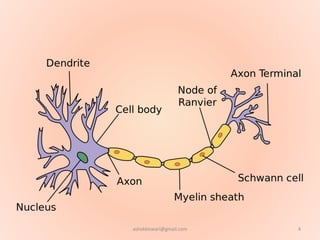
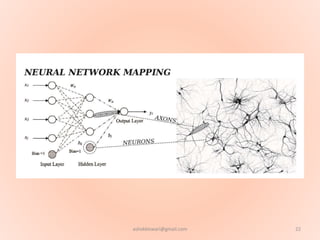
neuron
• The basic building block of all biological brains is a
nerve cell, or a neuron.
• Each neuron acts as a simplified numerical processing
unit. In essence, the brain is a bundle of many billions
of these biological processing units, all heavily
interconnected and operating in parallel.
• In the brain, each neuron takes input values from other
neurons, applies a transfer function and sends its
output on to the next layer of Neurons.
• These neurons, in turns, send their output to the other
layers of neurons in a cascading fashion.
3ashokktiwari@gmail.com
4ashokktiwari@gmail.com
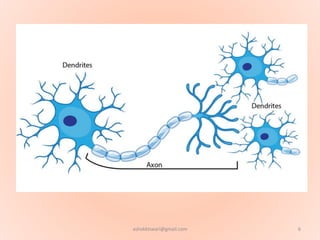
• A neuron (or cell or a unit) is an autonomous
processing element. Neuron can be thought of a
very simple computer.
• The purpose of each neuron is to receive
information from other neurons, perform
relatively simple processing of the combined
information, and send the results to one or more
other neurons.
• In many of the illustrations shown in various
literatures, the neurons are generally indicated by
circles or squares.
5ashokktiwari@gmail.com
6ashokktiwari@gmail.com
7ashokktiwari@gmail.com
Artificial Neural Networks (ANN)
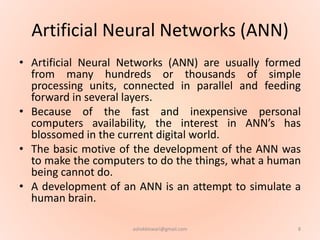
• Artificial Neural Networks (ANN) are usually formed
from many hundreds or thousands of simple
processing units, connected in parallel and feeding
forward in several layers.
• Because of the fast and inexpensive personal
computers availability, the interest in ANN’s has
blossomed in the current digital world.
• The basic motive of the development of the ANN was
to make the computers to do the things, what a human
being cannot do.
• A development of an ANN is an attempt to simulate a
human brain.
8ashokktiwari@gmail.com
9ashokktiwari@gmail.com
ANN
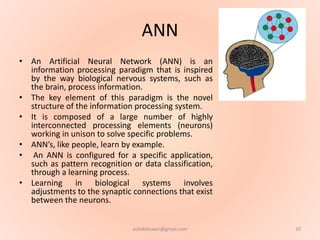
• An Artificial Neural Network (ANN) is an
information processing paradigm that is inspired
by the way biological nervous systems, such as
the brain, process information.
• The key element of this paradigm is the novel
structure of the information processing system.
• It is composed of a large number of highly
interconnected processing elements (neurons)
working in unison to solve specific problems.
• ANN’s, like people, learn by example.
• An ANN is configured for a specific application,
such as pattern recognition or data classification,
through a learning process.
• Learning in biological systems involves
adjustments to the synaptic connections that exist
between the neurons.
10ashokktiwari@gmail.com
• In a similar manner, ANN’s are usually formed from many hundreds or thousands
of simple processing units, connected in parallel and feeding forward in several
layers.
• In a biological neural network, the memory is believed to be stored in the strength
of interconnections between the layers of neurons.
• Using neural network terminology, the strength or influence of an interconnection
is known as its weight.
• ANN borrows from this theory and utilizes variable interconnections weights
between layers of simulated neurons.
• ANN’s were proposed early in 1960’s, but they received little attention until mid
80’s.
• Prior to that time, it was not generally possible to train networks having more than
two layers. These early two layers networks were usually limited to expressing
linear relationships between binary input and output characters.
• Unfortunately, the real world is analog and doesn’t lend itself to a simple binary
model.
• The real break through in ANN research came with the discovery of the back
propagation method.
11ashokktiwari@gmail.com
• Because of fast and inexpensive
personal computers availability, the
interest in ANN’s has blossomed.
• The basic motive of the development of
the neural network was to make the
computers to do the things, which a
human being cannot do. Therefore,
ANN is an attempt to simulate a human
brain.
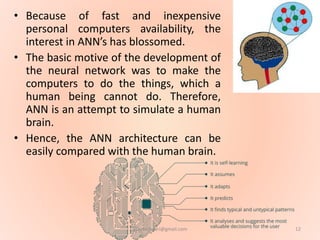
• Hence, the ANN architecture can be
easily compared with the human brain.
12ashokktiwari@gmail.com
Load or Demand Forecast.
• The primary pre-requisite for
system planning is to arrive at
realistic estimates for future
demand of power, which is
known as Load or Demand
Forecast.
• Power system planning is done
to ensure adequate and reliable
power supply to meet the
estimated load demand both
nearer and in the distant future.
• This must be done at minimum
possible cost, keeping the quality
of supply satisfactory.
• Basically, the load forecasting is
not more than an intelligent
projection of past and present
patterns to determine future load
with sufficient reliability.
13ashokktiwari@gmail.com
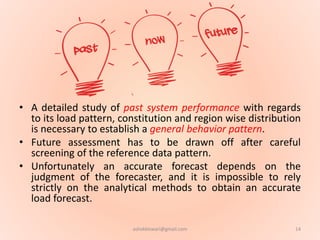
• A detailed study of past system performance with regards
to its load pattern, constitution and region wise distribution
is necessary to establish a general behavior pattern.
• Future assessment has to be drawn off after careful
screening of the reference data pattern.
• Unfortunately an accurate forecast depends on the
judgment of the forecaster, and it is impossible to rely
strictly on the analytical methods to obtain an accurate
load forecast.
14ashokktiwari@gmail.com
forecasting software
General forecasting software
• Forecastpro
• Demandcaster
• JustEnough
Power demand
forecasting software
Teslaforecast
Enercast
Escoware
Terratechnology
Etap
Itron
Synergi Forecaster
Nnergix
Neuralpower
Aiolosforecaststudio
AleaSoft
Thrivetech
Enerdata
DEMELEC-PRO
Matrica
15ashokktiwari@gmail.com
ANN based forecasting
• a load-forecasting model is developed using a multilayer
neural network with an appropriately modified back
propagation-learning algorithm.
• The model is created to produce a short term load
forecasting of the load in the 24 hours of the forecast day
concerned or average daily load according to requirement.
• The real load data that used for the ANN training was taken
from Load Dispatch Centre.
• Data for the month of January for three calendar years
(1997, 1998, 1999) was taken for training the proposed
ANN model and the data for calendar year 2000 was use to
compare the forecasted data.
16ashokktiwari@gmail.com
• The training is done in a supervised manner that is for
every input vector, the desired output is given and
weights are adapted to minimize an error function that
measures the discrepancy between the desired output
and the actual output computed by the network.
• For training the network, the back propagation-
training algorithm is used where data of previous two
years are used as inputs.
• In a series of experiments, the time series of daily load
is presented to the network and the network is than
made to predict the next value in the time sequence.
17ashokktiwari@gmail.com
18ashokktiwari@gmail.com
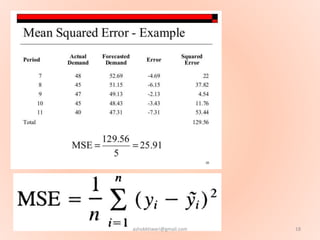
• The comparison of the predicted value and the actual
known value for the processed time slot resulted in a value
of the calculated mean square error (MSE), which is then
propagated back through the feed forward links.
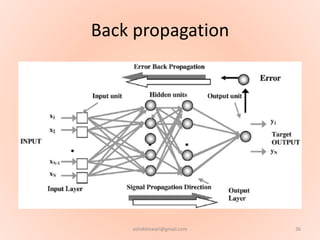
• The back-propagation algorithm globally modifies the
weights of all internal links to minimize the error. If the
error gradient still exceeded a predefined small value, a
new epoch is initiated.
• Finally, after the training phase has processed all epochs, its
performance could be judge in terms of the globally
calculated MSE.
• After all epochs of the training phase were processed the
network was ready for prediction and generalization
19ashokktiwari@gmail.com
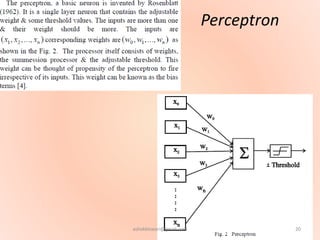
Perceptron
20ashokktiwari@gmail.com
21ashokktiwari@gmail.com
22ashokktiwari@gmail.com
Basic Model of ANN
• Serious efforts to create a model of a neuron
have been underway during the last 100 years,
and remarkable progress has been made.
• Neural connections are significantly fewer and
similar than the connections in the brains.
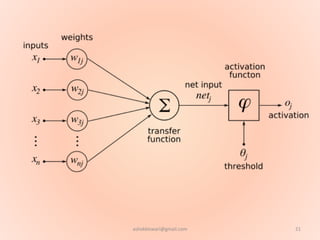
• The basic model of ANN is as shown in Fig. 3.
• This is the combination of perceptron as
iscussed earlier which forms the Artificial
Neural Network which is actually practiced.
23ashokktiwari@gmail.com
24ashokktiwari@gmail.com
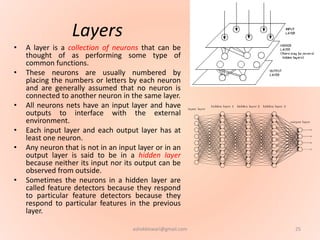
Layers
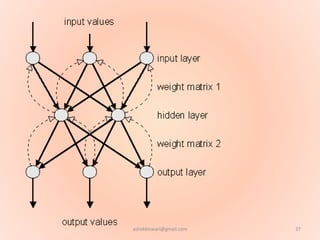
• A layer is a collection of neurons that can be
thought of as performing some type of
common functions.
• These neurons are usually numbered by
placing the numbers or letters by each neuron
and are generally assumed that no neuron is
connected to another neuron in the same layer.
• All neurons nets have an input layer and have
outputs to interface with the external
environment.
• Each input layer and each output layer has at
least one neuron.
• Any neuron that is not in an input layer or in an
output layer is said to be in a hidden layer
because neither its input nor its output can be
observed from outside.
• Sometimes the neurons in a hidden layer are
called feature detectors because they respond
to particular feature detectors because they
respond to particular features in the previous
layer.
25ashokktiwari@gmail.com
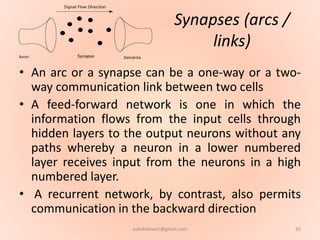
Synapses (arcs /
links)
• An arc or a synapse can be a one-way or a two-
way communication link between two cells
• A feed-forward network is one in which the
information flows from the input cells through
hidden layers to the output neurons without any
paths whereby a neuron in a lower numbered
layer receives input from the neurons in a high
numbered layer.
• A recurrent network, by contrast, also permits
communication in the backward direction
26ashokktiwari@gmail.com
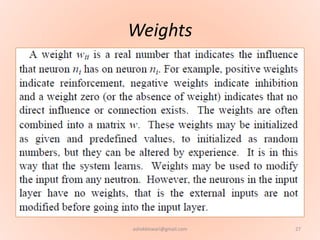
Weights
27ashokktiwari@gmail.com
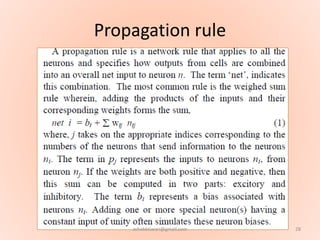
Propagation rule
28ashokktiwari@gmail.com
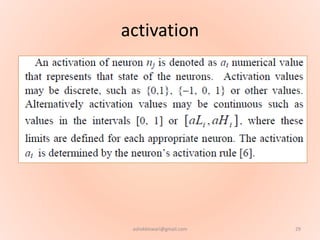
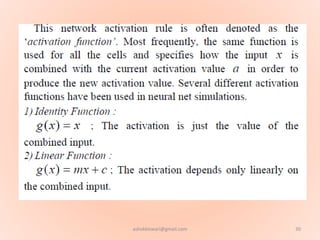
activation
29ashokktiwari@gmail.com
30ashokktiwari@gmail.com
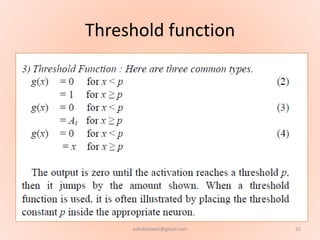
Threshold function
31ashokktiwari@gmail.com
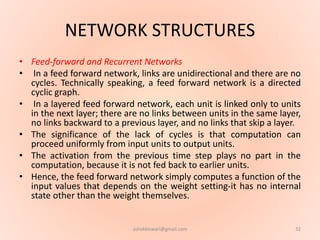
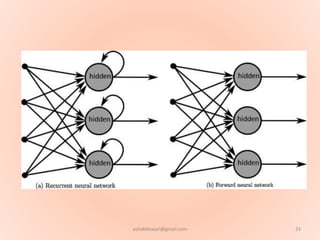
NETWORK STRUCTURES
• Feed-forward and Recurrent Networks
• In a feed forward network, links are unidirectional and there are no
cycles. Technically speaking, a feed forward network is a directed
cyclic graph.
• In a layered feed forward network, each unit is linked only to units
in the next layer; there are no links between units in the same layer,
no links backward to a previous layer, and no links that skip a layer.
• The significance of the lack of cycles is that computation can
proceed uniformly from input units to output units.
• The activation from the previous time step plays no part in the
computation, because it is not fed back to earlier units.
• Hence, the feed forward network simply computes a function of the
input values that depends on the weight setting-it has no internal
state other than the weight themselves.
32ashokktiwari@gmail.com
33ashokktiwari@gmail.com
• The brain cannot be a feed forward network, it have no short-term
memory. Brain is recurrent network.
• Because activation is fed back to the units that cause it, recurrent
have internal states stores in the activation level of the units.
• This also means that the computation is much less orderly than in
feed forward networks. Recurrent can becomes unstable, or
oscillate, or exhibit chaotic behavior.
• Given some input value, it can’t take long time to compute a stable
output, and learning is made more difficult.
• Recurrent networks can implement more complex agent designs
and can model system with state.
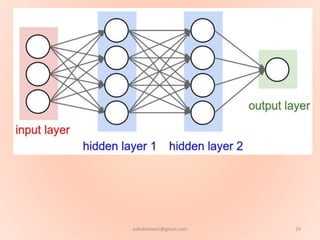
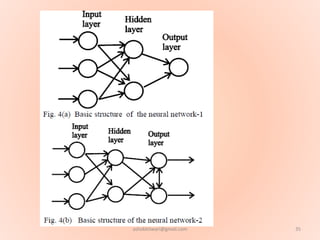
• The basic structure of the neural network consisting of the input,
hidden and the output layers is shown in the Figs. 4(a) and 4(b)
respectively
34ashokktiwari@gmail.com
35ashokktiwari@gmail.com
Back propagation
36ashokktiwari@gmail.com
37ashokktiwari@gmail.com
Learning in ANN
• Learning is the process by which the neural network adapts itself to
a stimulus, and eventually, it produces a desired response.
• Learning is also a continuous classification process of input stimuli
when a stimulus appears at the network; the network either
recognizes it or develops a new classification.
• In actuality, during the process of learning, the network adjusts its
parameters the synaptic weights, in response to an input stimulus
so that its actual output response is the same as the desired one,
the network has completed the learning phase in other words, it
has ‘acquired knowledge’.
• Mathematical expressions, learning equations describe the learning
process for the paradigm, which in actuality is the process for self
adjusting its synaptic weights.
38ashokktiwari@gmail.com
Supervised Learning
• During the training session of a neural network, an input stimulus is
applied that results in an output response.
• The response is compared with a prior desired output signal, the target
response, if the actual response differs from the target response; the
neural network generates an error signal, which is then used to calculate
the adjustment that should be made to the network’s synaptic weights so
that the actual output matches the target output. In other words, the
error is minimized, possibly to zero.
• The error minimization process requires a special circuit known as
supervisor; hence, the name, ‘supervised learning’.
• With ANN the amount of calculation required to minimize the error
depends on the algorithm used; Some parameters to watch, are the time
required per iteration, the number of iterations per input pattern for the
error to reach minimum during the training session, whether the neural
network has reached a global minimum or a local one, and, if a local one,
whether the network can escape from it or it remains trapped.
39ashokktiwari@gmail.com
Unsupervised Learning
• Unsupervised learning does not require a teacher, that is, there is no
target output. During the training session, the neural net receives at its
input many different excitations, or input patterns and it arbitrarily
organizes the patterns in categories.
• When a stimulus is later applied, the neural net provides an output
response indicating the class to which the stimulus belongs. If a class
cannot be found for the input stimulus, a new class is generated.
• Example, show a person a set of different objects. Then ask him/her to
separate object out into groups or classifications such that objects in a
group have one or more common features that distinguishes them form
another group.
• When this is done, show the same person another object and ask him/her
to place the object is one of the groups.
• Grouping may be based on shape, color, or material consistency or on
some other property of the object. If no guidelines have been given as to
what type of features should be used for grouping the objects, the
grouping may or may not be successful.
40ashokktiwari@gmail.com
Reinforced Learning
• Here, we requires one or more neurons at the output layer and a teacher
that, unlike supervised learning, does not indicate how close the actual
output is to the desired output but whether the actual output is the same
with the target output response is obtained.
• The teacher does not present the target output to the network, but
presents only a pass/fail indication. Thus, the error signal generated
during the training session is binary: pass or fail.
• If the teacher’s indication is ‘bad’ the network readjusts its parameters
and tries again and again until it get output response right. Process of
correcting synaptic weight follows a different strategy than the supervised
learning process .
• Some parameters to watch are the following: the time per iteration and
the number of iteration per pattern to reach the desired output during
the training session, whether the neural network reaches a global
minimum or a local minimum.
• Certain boundaries should be established so that the trainee should not
keep trying to get the correct response at infinitum.
41ashokktiwari@gmail.com
Competitive Learning
• Competitive learning is another form of supervised learning that is
distinctive because of its characteristic operation and architecture
and several neurons are at the output layer.
• When an input stimulus is applied, each output neuron competes
with the others to produce the closest output signal to the target.
• This output then becomes the dominant one, and the other outputs
cease producing an output signal for that stimulus. For another
stimulus, another output neuron becomes the dominant one, and
so on.
• When an ANN with competitive learning is part of greater ANN
system then, because of connectivity issues, these random
specializations may not always be desirable.
• Competitive learning is frequently encountered in groups of people
where each member of the group was selected and trained to
perform specific tasks based on the principle of the right person at
the right time at the right place.
42ashokktiwari@gmail.com
BACK-PROPAGATION LEARNING
ALGORITHM
• LEARNING RATE :
• The learning rate governs the rate at which the
weights are allowed to change at any given
presentation.
• Higher learning rates speed the convergence
process, but can result in overshooting or non-
convergence.
• Slower learning rates produce more reliable
results at the expense of increased training time.
43ashokktiwari@gmail.com
MOMENTUM FACTOR
• During the learning process of neural network, the
speed of convergence can be increased by modifying
the weight modification steps by including the
momentum term, ‘a’.
• The momentum term technique can be recommended
for a problem with convergence that occurs too slowly
or for cases when learning is difficult to achieve.
• By varying ‘a’, it is possible to shape the error surface.
Values of ‘a’ that are close to unity ensuring circular
error contours in contrast to small values, which
produce a narrow valley
44ashokktiwari@gmail.com
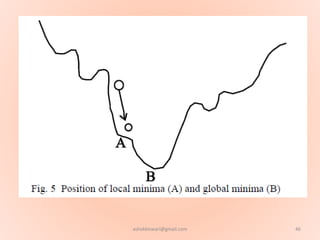
LOCAL MINIMA:
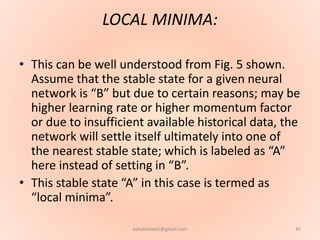
• This can be well understood from Fig. 5 shown.
Assume that the stable state for a given neural
network is “B” but due to certain reasons; may be
higher learning rate or higher momentum factor
or due to insufficient available historical data, the
network will settle itself ultimately into one of
the nearest stable state; which is labeled as “A”
here instead of setting in “B”.
• This stable state “A” in this case is termed as
“local minima”.
45ashokktiwari@gmail.com
46ashokktiwari@gmail.com
GENERALIZATION AND
MEMORIZATION
• If all possible inputs and outputs are shown to a back
propagation network, the network will probably find a set
of weights that maps the inputs onto the outputs.
• For many Al problems, however it is impossible to give all
possible inputs. e.g., Face recognition problem.
• ANN should promise a generalization mechanism.
• If it works in a domain where similar inputs get mapped
onto similar outputs, network will interpolate when given
inputs it has never seen before that means that network’s
input-output pattern is no more generalized, but it has
memorized it.
• Memorization can adversely affect the testing of the ANN.
47ashokktiwari@gmail.com
48ashokktiwari@gmail.com
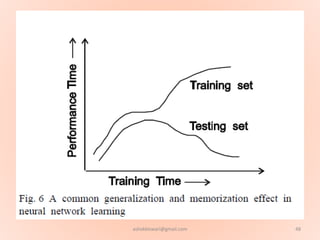
• The Fig. 6 shows the common generalization effect during a
long training period. During the first part of the training,
performance on the training set improves as the network
adjusts its weights through the back propagation.
• Performance on the test set also improves, although it is
never quite as good as the training set. After a while,
network performance reaches a plateau as the weights
shift around, looking for a path to further improvement.
Ultimately, it is found and the performance on the training
set improves again. But the performance on the test set
gets worse.
• Because the network has begun to memorize the individual
input-output pairs rather than setting for weights that
generally describe the mapping for all cases
49ashokktiwari@gmail.com
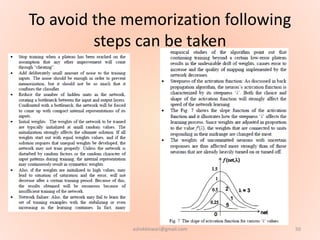
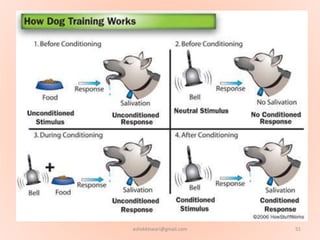
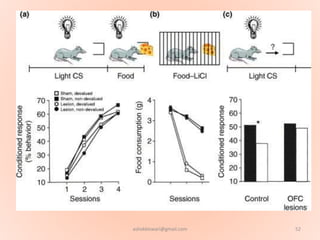
To avoid the memorization following
steps can be taken
50ashokktiwari@gmail.com
51ashokktiwari@gmail.com
52ashokktiwari@gmail.com
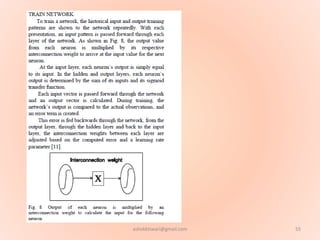
TRAINING OF ANN
53ashokktiwari@gmail.com
54ashokktiwari@gmail.com
55ashokktiwari@gmail.com
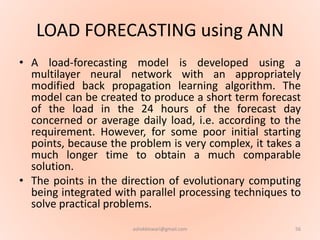
LOAD FORECASTING using ANN
• A load-forecasting model is developed using a
multilayer neural network with an appropriately
modified back propagation learning algorithm. The
model can be created to produce a short term forecast
of the load in the 24 hours of the forecast day
concerned or average daily load, i.e. according to the
requirement. However, for some poor initial starting
points, because the problem is very complex, it takes a
much longer time to obtain a much comparable
solution.
• The points in the direction of evolutionary computing
being integrated with parallel processing techniques to
solve practical problems.
56ashokktiwari@gmail.com
57ashokktiwari@gmail.com
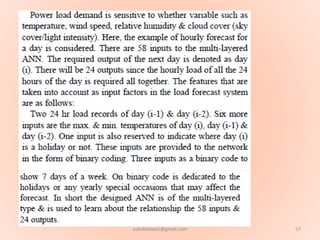
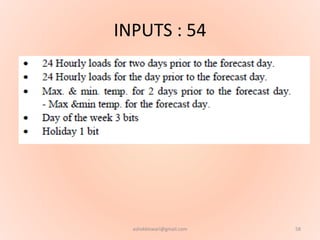
INPUTS : 54
58ashokktiwari@gmail.com
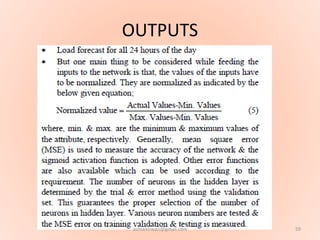
OUTPUTS
59ashokktiwari@gmail.com
60ashokktiwari@gmail.com
61ashokktiwari@gmail.com
LOADS
62ashokktiwari@gmail.com
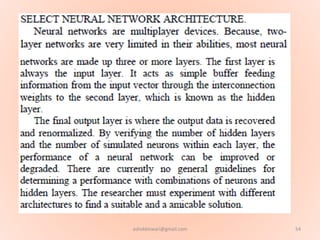
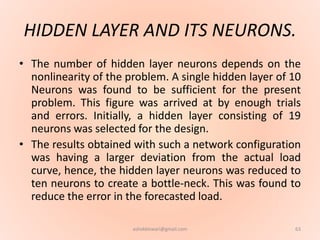
HIDDEN LAYER AND ITS NEURONS.
• The number of hidden layer neurons depends on the
nonlinearity of the problem. A single hidden layer of 10
Neurons was found to be sufficient for the present
problem. This figure was arrived at by enough trials
and errors. Initially, a hidden layer consisting of 19
neurons was selected for the design.
• The results obtained with such a network configuration
was having a larger deviation from the actual load
curve, hence, the hidden layer neurons was reduced to
ten neurons to create a bottle-neck. This was found to
reduce the error in the forecasted load.
63ashokktiwari@gmail.com
64ashokktiwari@gmail.com
65ashokktiwari@gmail.com
OVERALL ARCHITECTURE
• The sum of the total number of inputs to represent day
type, month type, date, relevant load comes to 19.
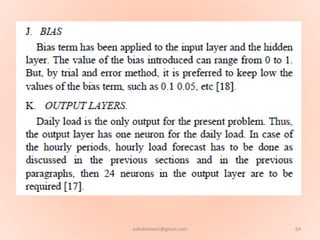
• Neurons in the hidden layer were chosen by a trial and
error method. Too many numbers of neurons increase the
error and too less make the network inefficient to train
itself to the given variable inputs. The optimum number of
neurons in the hidden layer was found to be 10.
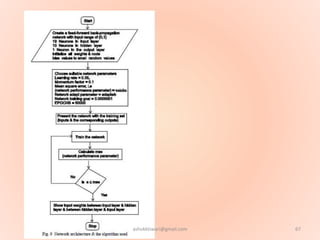
• Finally, the architecture of 19-10-1 feedforward three-
layered network was found suitable, i.e., 19 neurons in the
input layer; 10 neurons in the hidden layer; 1 neurons in
the output layer. Algorithm for network training is as shown
in Fig. 9.
66ashokktiwari@gmail.com
67ashokktiwari@gmail.com
NETOWRK TRAINING
• The training was done in a supervised manner that is for
every input vector, the desired output is given and weights
are adapted to minimize an error function that measures
the discrepancy between the desired output and the
output computed by the network.
• The mean squared error (MSE) is employed as the error
function. Input of previous two years was used for training
the network.
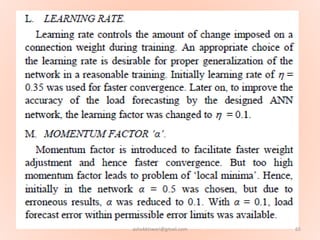
• The back propagation training algorithm using momentum
factor = 0.1 and learning rate = 0.1 was used.
• In a series of experiments, the time series of daily load was
presented to the network and the network was than made
to “predict” the next value in the time sequence
68ashokktiwari@gmail.com
• The comparison of the just “predicted” value and the known value for the
processed time-slot resulted in a value of the calculated mean square error (MSE)
which was than propagated back through the feed forward links.
• The back propagation algorithm globally modified the weights of all internal links
to minimize the error. If the error gradient still exceeded a pre-defined-small value,
a new epoch was started.
• Finally, after the training phase has processed all epochs, its performance could be
judge in terms of the globally calculated MSE. After all epochs of the training
phase were processed the network was ready for prediction and generalization.
• The back-propagation learning algorithm is characterized by two parameters, the
learning rate and the momentum factor. These were used by the process of
progressive refining weights based on the RMS error minimization. One of the
objectives was to find the optimal number of the training cycles performing on the
training data. To do this, a network was subjected to a number of training sessions
with varying number of training cycles.
• After each experiment the network was tested for its ability to correctly classify
the test data. The experiments included training sessions of 1000 to 5000 training
cycles
69ashokktiwari@gmail.com
• With the increased number of the applied cycles,
the results gradually showed improvement in the
network ability to “predict” the input parameter
used in training.
• However, such better performance also indicated
the network’s symptoms of over-fitting cycles and
has been elected as not to compromise the
network ability and to correctly generalize on the
new (previously unseen) input parameters.
70ashokktiwari@gmail.com
• The neural network was trained in the neural network
toolbox available in MatlabR12. The function “trainlm”
was used with learning rate η = 0.1 and momentum
factor α = 0.1 is implemented. Initially the synaptic
weights were randomly allotted to train the network.
• The network was trained first for 5000 iterations. Once,
trained the network returned the synaptic weights,
which were then fed to the network.
• Therefore, instead of random weights, now predefined
values of synaptic weights were allotted Also, the
momentum factor and learning rate were too high
initially, which led the network to the condition of
LOCAL MINIMA and erroneous results were obtained.
Later on, the learning rate and momentum factor were
reduced to a value of 0.1.
71ashokktiwari@gmail.com
72ashokktiwari@gmail.com
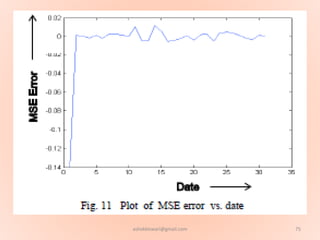
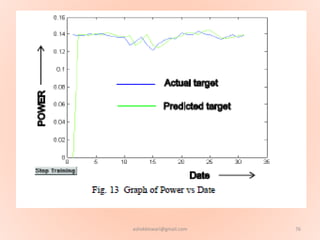
SIMULATION RESULTS
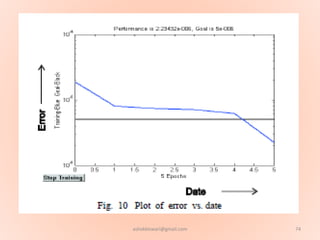
• The input data of January for calendar year 2000 was provided on daily basis and
forecasted value is compared with that of the actual load. As can be seen, the ANN
model’s forecasts followed the actual load pattern more accurately and, on the
average throughout the forecasted period (only 2 times it exceeds 5000 MWHr).
This high level of performance is mainly due to the more accurate weather
modeling, and the ability of the ANN model to respond rapidly to sudden changes.
• Rapid model response was one of the main objectives of this development from its
conception and it is certainly one of the main contributions of this work The
results are presented in this section to demonstrate the performance of the
developed neural network.
• The average error is taken as the performance measure. The forecast was based as
said earlier from the historical data collected from LDC. The errors at certain points
are more due to abnormal load behavior during those particular days.
• This means that the network was not trained for such a situation and the results
are unexpected.
• It is also observed that the error is generally more on those hours of steep fall or
rise in the load compared to smooth transition in load from one day to another.
73ashokktiwari@gmail.com
74ashokktiwari@gmail.com
75ashokktiwari@gmail.com
76ashokktiwari@gmail.com

ANN load forecasting

  • 1.
    modeling and designof artificial neural network architecture for load forecasting Dr A K TIWARI 1ashokktiwari@gmail.com
  • 2.
    objective • a load-forecastingmodel is proposed using a multilayer neural network with an appropriately modified back propagation learning algorithm. • Once the neural network model is designed and trained, it can forecast the load of the power system 24 hours ahead on daily basis and can also forecast the cumulative load on daily basis. • The real load data that is used for the Artificial Neural Network training was taken from LDC 2ashokktiwari@gmail.com
  • 3.
    neuron • The basicbuilding block of all biological brains is a nerve cell, or a neuron. • Each neuron acts as a simplified numerical processing unit. In essence, the brain is a bundle of many billions of these biological processing units, all heavily interconnected and operating in parallel. • In the brain, each neuron takes input values from other neurons, applies a transfer function and sends its output on to the next layer of Neurons. • These neurons, in turns, send their output to the other layers of neurons in a cascading fashion. 3ashokktiwari@gmail.com
  • 4.
  • 5.
    • A neuron(or cell or a unit) is an autonomous processing element. Neuron can be thought of a very simple computer. • The purpose of each neuron is to receive information from other neurons, perform relatively simple processing of the combined information, and send the results to one or more other neurons. • In many of the illustrations shown in various literatures, the neurons are generally indicated by circles or squares. 5ashokktiwari@gmail.com
  • 6.
  • 7.
  • 8.
    Artificial Neural Networks(ANN) • Artificial Neural Networks (ANN) are usually formed from many hundreds or thousands of simple processing units, connected in parallel and feeding forward in several layers. • Because of the fast and inexpensive personal computers availability, the interest in ANN’s has blossomed in the current digital world. • The basic motive of the development of the ANN was to make the computers to do the things, what a human being cannot do. • A development of an ANN is an attempt to simulate a human brain. 8ashokktiwari@gmail.com
  • 9.
  • 10.
    ANN • An ArtificialNeural Network (ANN) is an information processing paradigm that is inspired by the way biological nervous systems, such as the brain, process information. • The key element of this paradigm is the novel structure of the information processing system. • It is composed of a large number of highly interconnected processing elements (neurons) working in unison to solve specific problems. • ANN’s, like people, learn by example. • An ANN is configured for a specific application, such as pattern recognition or data classification, through a learning process. • Learning in biological systems involves adjustments to the synaptic connections that exist between the neurons. 10ashokktiwari@gmail.com
  • 11.
    • In asimilar manner, ANN’s are usually formed from many hundreds or thousands of simple processing units, connected in parallel and feeding forward in several layers. • In a biological neural network, the memory is believed to be stored in the strength of interconnections between the layers of neurons. • Using neural network terminology, the strength or influence of an interconnection is known as its weight. • ANN borrows from this theory and utilizes variable interconnections weights between layers of simulated neurons. • ANN’s were proposed early in 1960’s, but they received little attention until mid 80’s. • Prior to that time, it was not generally possible to train networks having more than two layers. These early two layers networks were usually limited to expressing linear relationships between binary input and output characters. • Unfortunately, the real world is analog and doesn’t lend itself to a simple binary model. • The real break through in ANN research came with the discovery of the back propagation method. 11ashokktiwari@gmail.com
  • 12.
    • Because offast and inexpensive personal computers availability, the interest in ANN’s has blossomed. • The basic motive of the development of the neural network was to make the computers to do the things, which a human being cannot do. Therefore, ANN is an attempt to simulate a human brain. • Hence, the ANN architecture can be easily compared with the human brain. 12ashokktiwari@gmail.com
  • 13.
    Load or DemandForecast. • The primary pre-requisite for system planning is to arrive at realistic estimates for future demand of power, which is known as Load or Demand Forecast. • Power system planning is done to ensure adequate and reliable power supply to meet the estimated load demand both nearer and in the distant future. • This must be done at minimum possible cost, keeping the quality of supply satisfactory. • Basically, the load forecasting is not more than an intelligent projection of past and present patterns to determine future load with sufficient reliability. 13ashokktiwari@gmail.com
  • 14.
    • A detailedstudy of past system performance with regards to its load pattern, constitution and region wise distribution is necessary to establish a general behavior pattern. • Future assessment has to be drawn off after careful screening of the reference data pattern. • Unfortunately an accurate forecast depends on the judgment of the forecaster, and it is impossible to rely strictly on the analytical methods to obtain an accurate load forecast. 14ashokktiwari@gmail.com
  • 15.
    forecasting software General forecastingsoftware • Forecastpro • Demandcaster • JustEnough Power demand forecasting software Teslaforecast Enercast Escoware Terratechnology Etap Itron Synergi Forecaster Nnergix Neuralpower Aiolosforecaststudio AleaSoft Thrivetech Enerdata DEMELEC-PRO Matrica 15ashokktiwari@gmail.com
  • 16.
    ANN based forecasting •a load-forecasting model is developed using a multilayer neural network with an appropriately modified back propagation-learning algorithm. • The model is created to produce a short term load forecasting of the load in the 24 hours of the forecast day concerned or average daily load according to requirement. • The real load data that used for the ANN training was taken from Load Dispatch Centre. • Data for the month of January for three calendar years (1997, 1998, 1999) was taken for training the proposed ANN model and the data for calendar year 2000 was use to compare the forecasted data. 16ashokktiwari@gmail.com
  • 17.
    • The trainingis done in a supervised manner that is for every input vector, the desired output is given and weights are adapted to minimize an error function that measures the discrepancy between the desired output and the actual output computed by the network. • For training the network, the back propagation- training algorithm is used where data of previous two years are used as inputs. • In a series of experiments, the time series of daily load is presented to the network and the network is than made to predict the next value in the time sequence. 17ashokktiwari@gmail.com
  • 18.
  • 19.
    • The comparisonof the predicted value and the actual known value for the processed time slot resulted in a value of the calculated mean square error (MSE), which is then propagated back through the feed forward links. • The back-propagation algorithm globally modifies the weights of all internal links to minimize the error. If the error gradient still exceeded a predefined small value, a new epoch is initiated. • Finally, after the training phase has processed all epochs, its performance could be judge in terms of the globally calculated MSE. • After all epochs of the training phase were processed the network was ready for prediction and generalization 19ashokktiwari@gmail.com
  • 20.
  • 21.
  • 22.
  • 23.
    Basic Model ofANN • Serious efforts to create a model of a neuron have been underway during the last 100 years, and remarkable progress has been made. • Neural connections are significantly fewer and similar than the connections in the brains. • The basic model of ANN is as shown in Fig. 3. • This is the combination of perceptron as iscussed earlier which forms the Artificial Neural Network which is actually practiced. 23ashokktiwari@gmail.com
  • 24.
  • 25.
    Layers • A layeris a collection of neurons that can be thought of as performing some type of common functions. • These neurons are usually numbered by placing the numbers or letters by each neuron and are generally assumed that no neuron is connected to another neuron in the same layer. • All neurons nets have an input layer and have outputs to interface with the external environment. • Each input layer and each output layer has at least one neuron. • Any neuron that is not in an input layer or in an output layer is said to be in a hidden layer because neither its input nor its output can be observed from outside. • Sometimes the neurons in a hidden layer are called feature detectors because they respond to particular feature detectors because they respond to particular features in the previous layer. 25ashokktiwari@gmail.com
  • 26.
    Synapses (arcs / links) •An arc or a synapse can be a one-way or a two- way communication link between two cells • A feed-forward network is one in which the information flows from the input cells through hidden layers to the output neurons without any paths whereby a neuron in a lower numbered layer receives input from the neurons in a high numbered layer. • A recurrent network, by contrast, also permits communication in the backward direction 26ashokktiwari@gmail.com
  • 27.
  • 28.
  • 29.
  • 30.
  • 31.
  • 32.
    NETWORK STRUCTURES • Feed-forwardand Recurrent Networks • In a feed forward network, links are unidirectional and there are no cycles. Technically speaking, a feed forward network is a directed cyclic graph. • In a layered feed forward network, each unit is linked only to units in the next layer; there are no links between units in the same layer, no links backward to a previous layer, and no links that skip a layer. • The significance of the lack of cycles is that computation can proceed uniformly from input units to output units. • The activation from the previous time step plays no part in the computation, because it is not fed back to earlier units. • Hence, the feed forward network simply computes a function of the input values that depends on the weight setting-it has no internal state other than the weight themselves. 32ashokktiwari@gmail.com
  • 33.
  • 34.
    • The braincannot be a feed forward network, it have no short-term memory. Brain is recurrent network. • Because activation is fed back to the units that cause it, recurrent have internal states stores in the activation level of the units. • This also means that the computation is much less orderly than in feed forward networks. Recurrent can becomes unstable, or oscillate, or exhibit chaotic behavior. • Given some input value, it can’t take long time to compute a stable output, and learning is made more difficult. • Recurrent networks can implement more complex agent designs and can model system with state. • The basic structure of the neural network consisting of the input, hidden and the output layers is shown in the Figs. 4(a) and 4(b) respectively 34ashokktiwari@gmail.com
  • 35.
  • 36.
  • 37.
  • 38.
    Learning in ANN •Learning is the process by which the neural network adapts itself to a stimulus, and eventually, it produces a desired response. • Learning is also a continuous classification process of input stimuli when a stimulus appears at the network; the network either recognizes it or develops a new classification. • In actuality, during the process of learning, the network adjusts its parameters the synaptic weights, in response to an input stimulus so that its actual output response is the same as the desired one, the network has completed the learning phase in other words, it has ‘acquired knowledge’. • Mathematical expressions, learning equations describe the learning process for the paradigm, which in actuality is the process for self adjusting its synaptic weights. 38ashokktiwari@gmail.com
  • 39.
    Supervised Learning • Duringthe training session of a neural network, an input stimulus is applied that results in an output response. • The response is compared with a prior desired output signal, the target response, if the actual response differs from the target response; the neural network generates an error signal, which is then used to calculate the adjustment that should be made to the network’s synaptic weights so that the actual output matches the target output. In other words, the error is minimized, possibly to zero. • The error minimization process requires a special circuit known as supervisor; hence, the name, ‘supervised learning’. • With ANN the amount of calculation required to minimize the error depends on the algorithm used; Some parameters to watch, are the time required per iteration, the number of iterations per input pattern for the error to reach minimum during the training session, whether the neural network has reached a global minimum or a local one, and, if a local one, whether the network can escape from it or it remains trapped. 39ashokktiwari@gmail.com
  • 40.
    Unsupervised Learning • Unsupervisedlearning does not require a teacher, that is, there is no target output. During the training session, the neural net receives at its input many different excitations, or input patterns and it arbitrarily organizes the patterns in categories. • When a stimulus is later applied, the neural net provides an output response indicating the class to which the stimulus belongs. If a class cannot be found for the input stimulus, a new class is generated. • Example, show a person a set of different objects. Then ask him/her to separate object out into groups or classifications such that objects in a group have one or more common features that distinguishes them form another group. • When this is done, show the same person another object and ask him/her to place the object is one of the groups. • Grouping may be based on shape, color, or material consistency or on some other property of the object. If no guidelines have been given as to what type of features should be used for grouping the objects, the grouping may or may not be successful. 40ashokktiwari@gmail.com
  • 41.
    Reinforced Learning • Here,we requires one or more neurons at the output layer and a teacher that, unlike supervised learning, does not indicate how close the actual output is to the desired output but whether the actual output is the same with the target output response is obtained. • The teacher does not present the target output to the network, but presents only a pass/fail indication. Thus, the error signal generated during the training session is binary: pass or fail. • If the teacher’s indication is ‘bad’ the network readjusts its parameters and tries again and again until it get output response right. Process of correcting synaptic weight follows a different strategy than the supervised learning process . • Some parameters to watch are the following: the time per iteration and the number of iteration per pattern to reach the desired output during the training session, whether the neural network reaches a global minimum or a local minimum. • Certain boundaries should be established so that the trainee should not keep trying to get the correct response at infinitum. 41ashokktiwari@gmail.com
  • 42.
    Competitive Learning • Competitivelearning is another form of supervised learning that is distinctive because of its characteristic operation and architecture and several neurons are at the output layer. • When an input stimulus is applied, each output neuron competes with the others to produce the closest output signal to the target. • This output then becomes the dominant one, and the other outputs cease producing an output signal for that stimulus. For another stimulus, another output neuron becomes the dominant one, and so on. • When an ANN with competitive learning is part of greater ANN system then, because of connectivity issues, these random specializations may not always be desirable. • Competitive learning is frequently encountered in groups of people where each member of the group was selected and trained to perform specific tasks based on the principle of the right person at the right time at the right place. 42ashokktiwari@gmail.com
  • 43.
    BACK-PROPAGATION LEARNING ALGORITHM • LEARNINGRATE : • The learning rate governs the rate at which the weights are allowed to change at any given presentation. • Higher learning rates speed the convergence process, but can result in overshooting or non- convergence. • Slower learning rates produce more reliable results at the expense of increased training time. 43ashokktiwari@gmail.com
  • 44.
    MOMENTUM FACTOR • Duringthe learning process of neural network, the speed of convergence can be increased by modifying the weight modification steps by including the momentum term, ‘a’. • The momentum term technique can be recommended for a problem with convergence that occurs too slowly or for cases when learning is difficult to achieve. • By varying ‘a’, it is possible to shape the error surface. Values of ‘a’ that are close to unity ensuring circular error contours in contrast to small values, which produce a narrow valley 44ashokktiwari@gmail.com
  • 45.
    LOCAL MINIMA: • Thiscan be well understood from Fig. 5 shown. Assume that the stable state for a given neural network is “B” but due to certain reasons; may be higher learning rate or higher momentum factor or due to insufficient available historical data, the network will settle itself ultimately into one of the nearest stable state; which is labeled as “A” here instead of setting in “B”. • This stable state “A” in this case is termed as “local minima”. 45ashokktiwari@gmail.com
  • 46.
  • 47.
    GENERALIZATION AND MEMORIZATION • Ifall possible inputs and outputs are shown to a back propagation network, the network will probably find a set of weights that maps the inputs onto the outputs. • For many Al problems, however it is impossible to give all possible inputs. e.g., Face recognition problem. • ANN should promise a generalization mechanism. • If it works in a domain where similar inputs get mapped onto similar outputs, network will interpolate when given inputs it has never seen before that means that network’s input-output pattern is no more generalized, but it has memorized it. • Memorization can adversely affect the testing of the ANN. 47ashokktiwari@gmail.com
  • 48.
  • 49.
    • The Fig.6 shows the common generalization effect during a long training period. During the first part of the training, performance on the training set improves as the network adjusts its weights through the back propagation. • Performance on the test set also improves, although it is never quite as good as the training set. After a while, network performance reaches a plateau as the weights shift around, looking for a path to further improvement. Ultimately, it is found and the performance on the training set improves again. But the performance on the test set gets worse. • Because the network has begun to memorize the individual input-output pairs rather than setting for weights that generally describe the mapping for all cases 49ashokktiwari@gmail.com
  • 50.
    To avoid thememorization following steps can be taken 50ashokktiwari@gmail.com
  • 51.
  • 52.
  • 53.
  • 54.
  • 55.
  • 56.
    LOAD FORECASTING usingANN • A load-forecasting model is developed using a multilayer neural network with an appropriately modified back propagation learning algorithm. The model can be created to produce a short term forecast of the load in the 24 hours of the forecast day concerned or average daily load, i.e. according to the requirement. However, for some poor initial starting points, because the problem is very complex, it takes a much longer time to obtain a much comparable solution. • The points in the direction of evolutionary computing being integrated with parallel processing techniques to solve practical problems. 56ashokktiwari@gmail.com
  • 57.
  • 58.
  • 59.
  • 60.
  • 61.
  • 62.
  • 63.
    HIDDEN LAYER ANDITS NEURONS. • The number of hidden layer neurons depends on the nonlinearity of the problem. A single hidden layer of 10 Neurons was found to be sufficient for the present problem. This figure was arrived at by enough trials and errors. Initially, a hidden layer consisting of 19 neurons was selected for the design. • The results obtained with such a network configuration was having a larger deviation from the actual load curve, hence, the hidden layer neurons was reduced to ten neurons to create a bottle-neck. This was found to reduce the error in the forecasted load. 63ashokktiwari@gmail.com
  • 64.
  • 65.
  • 66.
    OVERALL ARCHITECTURE • Thesum of the total number of inputs to represent day type, month type, date, relevant load comes to 19. • Neurons in the hidden layer were chosen by a trial and error method. Too many numbers of neurons increase the error and too less make the network inefficient to train itself to the given variable inputs. The optimum number of neurons in the hidden layer was found to be 10. • Finally, the architecture of 19-10-1 feedforward three- layered network was found suitable, i.e., 19 neurons in the input layer; 10 neurons in the hidden layer; 1 neurons in the output layer. Algorithm for network training is as shown in Fig. 9. 66ashokktiwari@gmail.com
  • 67.
  • 68.
    NETOWRK TRAINING • Thetraining was done in a supervised manner that is for every input vector, the desired output is given and weights are adapted to minimize an error function that measures the discrepancy between the desired output and the output computed by the network. • The mean squared error (MSE) is employed as the error function. Input of previous two years was used for training the network. • The back propagation training algorithm using momentum factor = 0.1 and learning rate = 0.1 was used. • In a series of experiments, the time series of daily load was presented to the network and the network was than made to “predict” the next value in the time sequence 68ashokktiwari@gmail.com
  • 69.
    • The comparisonof the just “predicted” value and the known value for the processed time-slot resulted in a value of the calculated mean square error (MSE) which was than propagated back through the feed forward links. • The back propagation algorithm globally modified the weights of all internal links to minimize the error. If the error gradient still exceeded a pre-defined-small value, a new epoch was started. • Finally, after the training phase has processed all epochs, its performance could be judge in terms of the globally calculated MSE. After all epochs of the training phase were processed the network was ready for prediction and generalization. • The back-propagation learning algorithm is characterized by two parameters, the learning rate and the momentum factor. These were used by the process of progressive refining weights based on the RMS error minimization. One of the objectives was to find the optimal number of the training cycles performing on the training data. To do this, a network was subjected to a number of training sessions with varying number of training cycles. • After each experiment the network was tested for its ability to correctly classify the test data. The experiments included training sessions of 1000 to 5000 training cycles 69ashokktiwari@gmail.com
  • 70.
    • With theincreased number of the applied cycles, the results gradually showed improvement in the network ability to “predict” the input parameter used in training. • However, such better performance also indicated the network’s symptoms of over-fitting cycles and has been elected as not to compromise the network ability and to correctly generalize on the new (previously unseen) input parameters. 70ashokktiwari@gmail.com
  • 71.
    • The neuralnetwork was trained in the neural network toolbox available in MatlabR12. The function “trainlm” was used with learning rate η = 0.1 and momentum factor α = 0.1 is implemented. Initially the synaptic weights were randomly allotted to train the network. • The network was trained first for 5000 iterations. Once, trained the network returned the synaptic weights, which were then fed to the network. • Therefore, instead of random weights, now predefined values of synaptic weights were allotted Also, the momentum factor and learning rate were too high initially, which led the network to the condition of LOCAL MINIMA and erroneous results were obtained. Later on, the learning rate and momentum factor were reduced to a value of 0.1. 71ashokktiwari@gmail.com
  • 72.
  • 73.
    SIMULATION RESULTS • Theinput data of January for calendar year 2000 was provided on daily basis and forecasted value is compared with that of the actual load. As can be seen, the ANN model’s forecasts followed the actual load pattern more accurately and, on the average throughout the forecasted period (only 2 times it exceeds 5000 MWHr). This high level of performance is mainly due to the more accurate weather modeling, and the ability of the ANN model to respond rapidly to sudden changes. • Rapid model response was one of the main objectives of this development from its conception and it is certainly one of the main contributions of this work The results are presented in this section to demonstrate the performance of the developed neural network. • The average error is taken as the performance measure. The forecast was based as said earlier from the historical data collected from LDC. The errors at certain points are more due to abnormal load behavior during those particular days. • This means that the network was not trained for such a situation and the results are unexpected. • It is also observed that the error is generally more on those hours of steep fall or rise in the load compared to smooth transition in load from one day to another. 73ashokktiwari@gmail.com
  • 74.
  • 75.
  • 76.