© A. Weinberg
SOL 3.4
By Ms. Weinberg
toad
© A. Weinberg
Have you ever wondered how animals
are able to survive in the wild?
Animals have certain
adaptations that help them to
survive.
© A. Weinberg
Think about the way you dress in the
winter.
You don’t wear your shorts and bathing suit when
it’s snowing outside!
You wear warm clothes, and
maybe even a hat and
mittens to protect yourself
from the weather.
© A. Weinberg
And what if you are having a snowball fight?
You probably run away from the
person throwing at you, and
maybe even try to sneak up on
that person and throw some
snowballs!
© A. Weinberg
The way you dress in the winter, as well as the
way that you run and hide from someone
throwing snow at you are kinds of …
Adaptations.
© A. Weinberg
We can separate adaptations into two
categories:
Physical
AND
Behavioral
A
D
A
P
T
A
T
I
O
N
S
© A. Weinberg
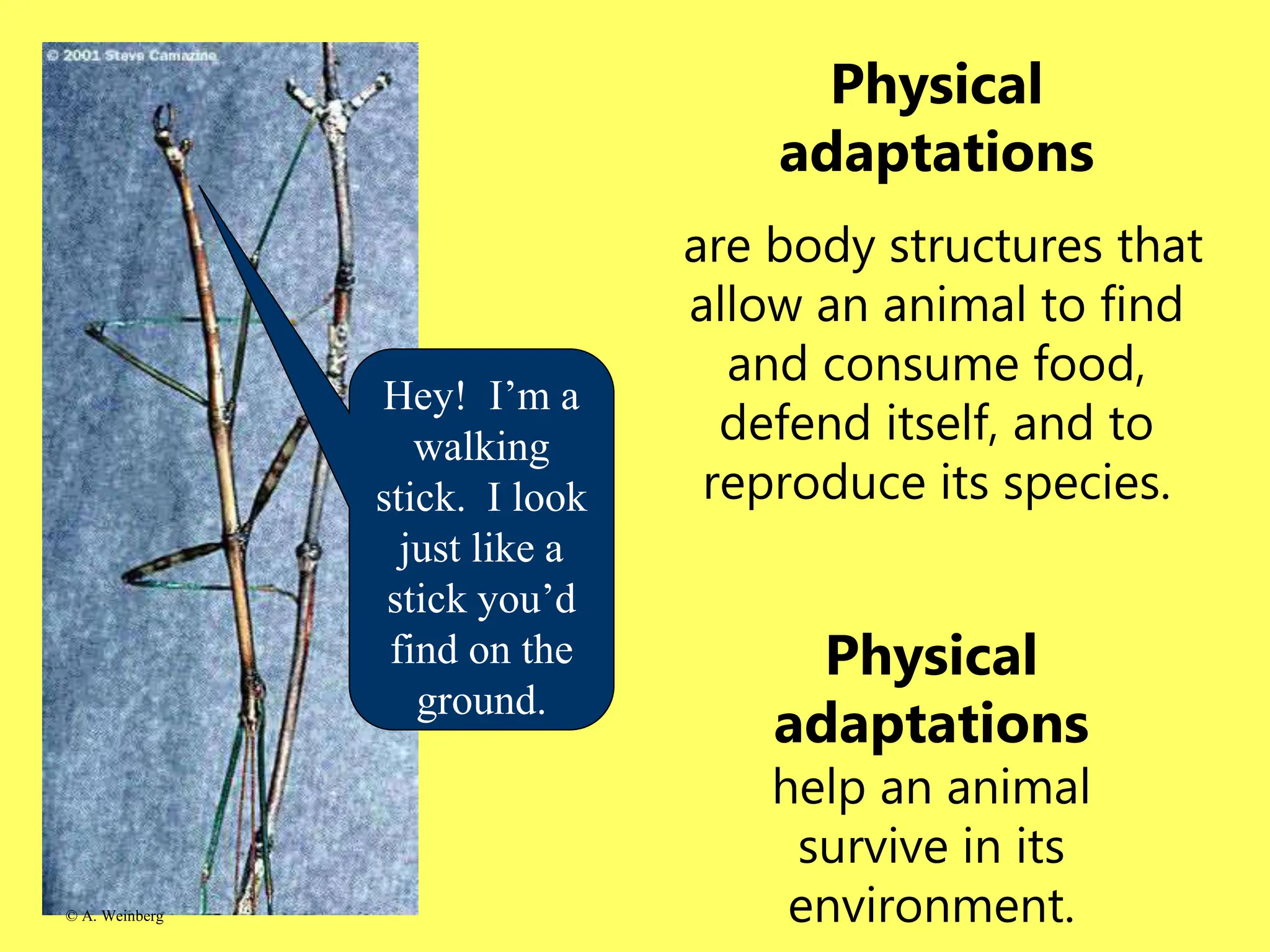
Physical
adaptations
are body structures that
allow an animal to find
and consume food,
defend itself, and to
reproduce its species.
Physical
adaptations
help an animal
survive in its
environment.
© A. Weinberg
© A. Weinberg
Physical adaptation
Camouflage (use of color in a surrounding)
The chameleon can change its color to match its
surroundings. Can you do that?
© A. Weinberg
Mimicry
(looking or sounding like another living organism)
The Viceroy butterfly uses mimicry to look like the
Monarch butterfly. Can you tell them apart?
Poisonous
Not poisonous
Physical adaptation
I’m the
Monarch!
I’m the
Viceroy!
© A. Weinberg
Chemical defenses (like venom, ink,
sprays)
Physical adaptation
© A. Weinberg
Body coverings & parts (claws, beaks, feet,
armor plates, skulls, teeth)
Physical adaptations
The elephant’s trunk is a physical adaptation that
helps it to clean itself, eat, drink, and to pick things
up.
© A. Weinberg
Now let’s learn about
Behavioral Adaptations…
Behavioral Adaptations allow
animals to respond to life
needs.
© A. Weinberg
Each organism has unique
methods of adapting to its
environment by means of
different actions.
Behavioral Adaptations are
animals’ actions.
Remember that Physical
Adaptations are body structures.
© A. Weinberg
We can divide Behavioral Adaptations
into two groups:
Instinctive Learned
These behaviors
happen naturally &
don’t have to be
learned.
These behaviors
must be taught.
© A. Weinberg
Instinctive
behaviors happen naturally
& don’t need to
be learned
=
Finding shelter
Methods of
gathering & storing
food
Defending oneself
Raising young
Hibernating
Migrating
© A. Weinberg
Learned
behaviors
Obtained by
interacting with the
environment and
cannot be passed
on to the next
generation except
by teaching.
=
© A. Weinberg
In this lesson, we have learned about
animal adaptations.
There are 2 ways to describe adaptations:
Physical and Behavioral
© A. Weinberg
Physical adaptations are body structures.
Some examples of physical adaptations are:
Camouflage
Mimicry
Body coverings & parts
Chemical defenses
© A. Weinberg
Behavioral Adaptations are animals’ actions.
Behavioral Adaptations can be
Instinctive or Learned.
© A. Weinberg
The next time
you read about
an animal in the
wild, or when
you see one on
television, think
about its
adaptations….

animal_adaptations.ppt

  • 1.
    © A. Weinberg SOL3.4 By Ms. Weinberg toad
  • 2.
    © A. Weinberg Haveyou ever wondered how animals are able to survive in the wild? Animals have certain adaptations that help them to survive.
  • 3.
    © A. Weinberg Thinkabout the way you dress in the winter. You don’t wear your shorts and bathing suit when it’s snowing outside! You wear warm clothes, and maybe even a hat and mittens to protect yourself from the weather.
  • 4.
    © A. Weinberg Andwhat if you are having a snowball fight? You probably run away from the person throwing at you, and maybe even try to sneak up on that person and throw some snowballs!
  • 5.
    © A. Weinberg Theway you dress in the winter, as well as the way that you run and hide from someone throwing snow at you are kinds of … Adaptations.
  • 6.
    © A. Weinberg Wecan separate adaptations into two categories: Physical AND Behavioral A D A P T A T I O N S
  • 7.
    © A. Weinberg Physical adaptations arebody structures that allow an animal to find and consume food, defend itself, and to reproduce its species. Physical adaptations help an animal survive in its environment. © A. Weinberg
  • 8.
    © A. Weinberg Physicaladaptation Camouflage (use of color in a surrounding) The chameleon can change its color to match its surroundings. Can you do that?
  • 9.
    © A. Weinberg Mimicry (lookingor sounding like another living organism) The Viceroy butterfly uses mimicry to look like the Monarch butterfly. Can you tell them apart? Poisonous Not poisonous Physical adaptation I’m the Monarch! I’m the Viceroy!
  • 10.
    © A. Weinberg Chemicaldefenses (like venom, ink, sprays) Physical adaptation
  • 11.
    © A. Weinberg Bodycoverings & parts (claws, beaks, feet, armor plates, skulls, teeth) Physical adaptations The elephant’s trunk is a physical adaptation that helps it to clean itself, eat, drink, and to pick things up.
  • 12.
    © A. Weinberg Nowlet’s learn about Behavioral Adaptations… Behavioral Adaptations allow animals to respond to life needs.
  • 13.
    © A. Weinberg Eachorganism has unique methods of adapting to its environment by means of different actions. Behavioral Adaptations are animals’ actions. Remember that Physical Adaptations are body structures.
  • 14.
    © A. Weinberg Wecan divide Behavioral Adaptations into two groups: Instinctive Learned These behaviors happen naturally & don’t have to be learned. These behaviors must be taught.
  • 15.
    © A. Weinberg Instinctive behaviorshappen naturally & don’t need to be learned = Finding shelter Methods of gathering & storing food Defending oneself Raising young Hibernating Migrating
  • 16.
    © A. Weinberg Learned behaviors Obtainedby interacting with the environment and cannot be passed on to the next generation except by teaching. =
  • 17.
    © A. Weinberg Inthis lesson, we have learned about animal adaptations. There are 2 ways to describe adaptations: Physical and Behavioral
  • 18.
    © A. Weinberg Physicaladaptations are body structures. Some examples of physical adaptations are: Camouflage Mimicry Body coverings & parts Chemical defenses
  • 19.
    © A. Weinberg BehavioralAdaptations are animals’ actions. Behavioral Adaptations can be Instinctive or Learned.
  • 20.
    © A. Weinberg Thenext time you read about an animal in the wild, or when you see one on television, think about its adaptations….