Animal Transformation
GMOs, Biosafety and Bioethics
10th
November 2014
Presented by:
Bhagea Ritesh - 1210886
Cécile Christabelle - 1214458
Buctowar Rouksaar - 1242569
Ghoorbin Keshavi - 1216886
Nazeer Huda - 1214039
Contents
➔ Objectives of this presentation
➔ Browsing through history
➔ An introduction to transformation
➔ Methods of transfection
➔ Transgenic animals
➔ Transgenic animals: DNA microinjection
➔ The application of transgenic organisms in
agriculture
➔ Case study: The genetic transformation of
HeLa cells by Agrobacterium
➔ Conclusion
➔ References
Objectives of our Presentation
● To shed light on the subject of “Animal Transformation”
Browsing through History
+ 1928: First demonstration of transformation by Frederick Griffith.
○ He found that a strain of Streptococcus pneumoniae could be made
virulent when exposed to heat-killed virulent strains.
○ He then hypothesized the “transforming principle”.
+ 1944: Oswald Avery and colleagues discovered that this principle was
genetic.
○ After isolation of DNA from a virulent strain of S. pneumoniae and
inserting it into a harmless strain to successfully make it virulent, they
called the process “transformation”.
+ 1947 & 1953: After much dispute about the experiment of Avery et al., the
results were finally accepted.
○ The development of genetic markers and discovery of other methods
of transformation greatly helped to clear the doubts.
Browsing through History
+ 1970: Acknowledgement by Morton Mandel and Akiko Higa that
Escherichia coli may be used to take up DNA.
+ 1972: Stanley Cohen et al., showed that CaCl2
may also be used to
transform plasmid DNA.
+ Late 1980s: Development of the electroporation method for
transformation and invention of the Biolistic Particle Delivery
System (gene gun) by John Sanford.
+ 1982: First transgenic mouse created.
○ A gene for a rat growth hormone was inserted into a mouse
embryo.
An Introduction to Transformation
● Process whereby an exogenous DNA is directly taken up and
incorporated into a cell causing genetic alteration of that cell.
○ Exogenous DNA comes from the surrounding and
○ Is taken up through the cell membrane.
● Can occur naturally in some species of bacteria.
○ But can also be induced artificially in other cells.
○ Other means to introduce exogenous genetic material into
bacteria: conjugation and transduction.
● Concerning animal transformation, the term most often used is
“transfection”.
○ As “transformation” refers to the progression of animal cells
into a cancerous state.
Methods of Transfection
There are different methods of transfection. Each method has a
different approach to be considered, depending on cell type and
purpose.
The ideal method must have:
❏ high transfection efficiency,
❏ low cell toxicity,
❏ minimal effects on normal physiology,
❏ be easy to use,
❏ reproducible.
The methods are divided into 3 categories:
1. Chemical methods
- Calcium Phosphate
- Lipids
- Cationic polymer
2. Physical methods
- Electroporation
- Microinjection
- Laserfection
- Sonoporation
- Biolistic particle delivery
Methods of Transfection
3. Biological method
- Virus-based
Methods of Transfection
● Advantages:
1. Deliver nucleic acids to cells in a
culture dish with high efficiency
2. Easy to use, minimal steps required;
adaptable to high-throughput systems
3. Using a highly active lipid will reduce
the cost of lipid and nucleic acid, and
achieve effective results
● Disadvantage:
1. Not applicable to all cell types
1. Lipid-Mediated Gene Delivery
● Also referred as lipofection or liposome-based gene transfection.
● Mode: Uses lipids to cause a cell to absorb exogenous DNA.
Methods of Transfection
2. Electroporation
● Cell exposed to a high-intensity electric field
(destabilizes the mbr)
● Mbr is highly permeable to exogenous molecules
present in the surrounding media
● DNA moves into the cell through these holes
● When the field is turned off, the pores in the
membrane reseal, enclosing the DNA inside.
● Advantages:
1. Easy to perform
2. High efficiency
3. Don’t alter biological structure/ function of cells
4. Can be used for wide range of cell types
● Disadvantages:
1. Cell mortality (if using sub-optimal conditions)
Methods of Transfection
3. Viral-Based method
● Most commonly used method in clinical research
● Also known as transduction
● Example: Retrovirus murine leukemia virus (MLV)
● Mode:
● Establish sustainable transgene expression in humans.
● Integrates its DNA into the host genome which is expressed in
the host.
● The integrated MLV DNA replicates as the host genome does.
● Segregates into daughter cells, which enables sustainable
transgene expression (Kim and Eberwine, 2010).
Methods of Transfection
Viral-Based method (ctd)
● Advantages:
1. Very high gene delivery efficiency, 95–100%
2. Simplicity of infection
● Disadvantages:
1. Strong immune reactions against viral proteins
prohibit multiple administrations
2. Possibility of chromosomal insertion and proto-
oncogene Activation
3. Complicated synthesis process
4. Limitation on gene size
5. Toxicity, contamination of live virus
Transgenic Animals
● “Transgenic” is a genetically modified
organism with DNA from other source
inserted into its genome.
● To date, there are three methods for
producing transgenic animals:
1. DNA microinjection
2. Retrovirus-mediated gene
transfer
3. Embryonic stem-cell mediated
gene transfer
Transgenic Animals: DNA Microinjection
● Desired gene construct (single genes
or combination of genes recombined
and cloned) from another member of
the same/different species into the
pronucleus of the reproductive cell.
● Manipulated cell (first cultured in vitro)
to develop embryonic phase, is then
transferred to female recipient.
● First transgenic mammal Herman, the
bull (Lelystad, 16 Dec 1990).
The Application of Transgenic Organisms in
Agriculture
● Possibility of producing new strains or breeds of animals that carry new
beneficial, or improved genetic information.
● Examples of strains that have been developed:
○ Swine: leaner, more feed-efficient and faster-growing (have
additional copies of the growth hormone gene)
○ Mice: having the regulatory elements of the human
immunodeficiency virus (HIV) genome which are used as non-
infectious models for the study of AIDS
The Application of Transgenic Organisms in
Agriculture
● Knowledge gained in their studies is important in many fields
including:
○ cancer research; immunology; developmental biology; gene
expression and regulation; and models for human genetic
diseases such as muscular dystrophy, Lou Gehring's disease,
and sickle cell anemia.
● Potential applications for transgenic animals include:
○ manipulation of milk composition, growth, disease resistance,
reproductive performance, and production of pharmaceutical
products by livestock (known as pharming).
Case Study: Genetic transformation of HeLa
cells by Agrobacterium
● Transforming cells by Agrobacterium tumefaciens is a way to
transfer DNA.
● A. tumefaciens transfers oncogenes to host plant causing
tumours.
● A. tumefaciens needs a Ti-plasmid and a virulence region to
function.
● It can transform human cells by integrating its T-DNA into the
cellular genome.
● In this study, human HeLa R19 cells were used as host.
● A. tumefaciens C58C1 with Ti plasmid pGV3850 was used.
Case Study: Genetic transformation of HeLa
cells by Agrobacterium
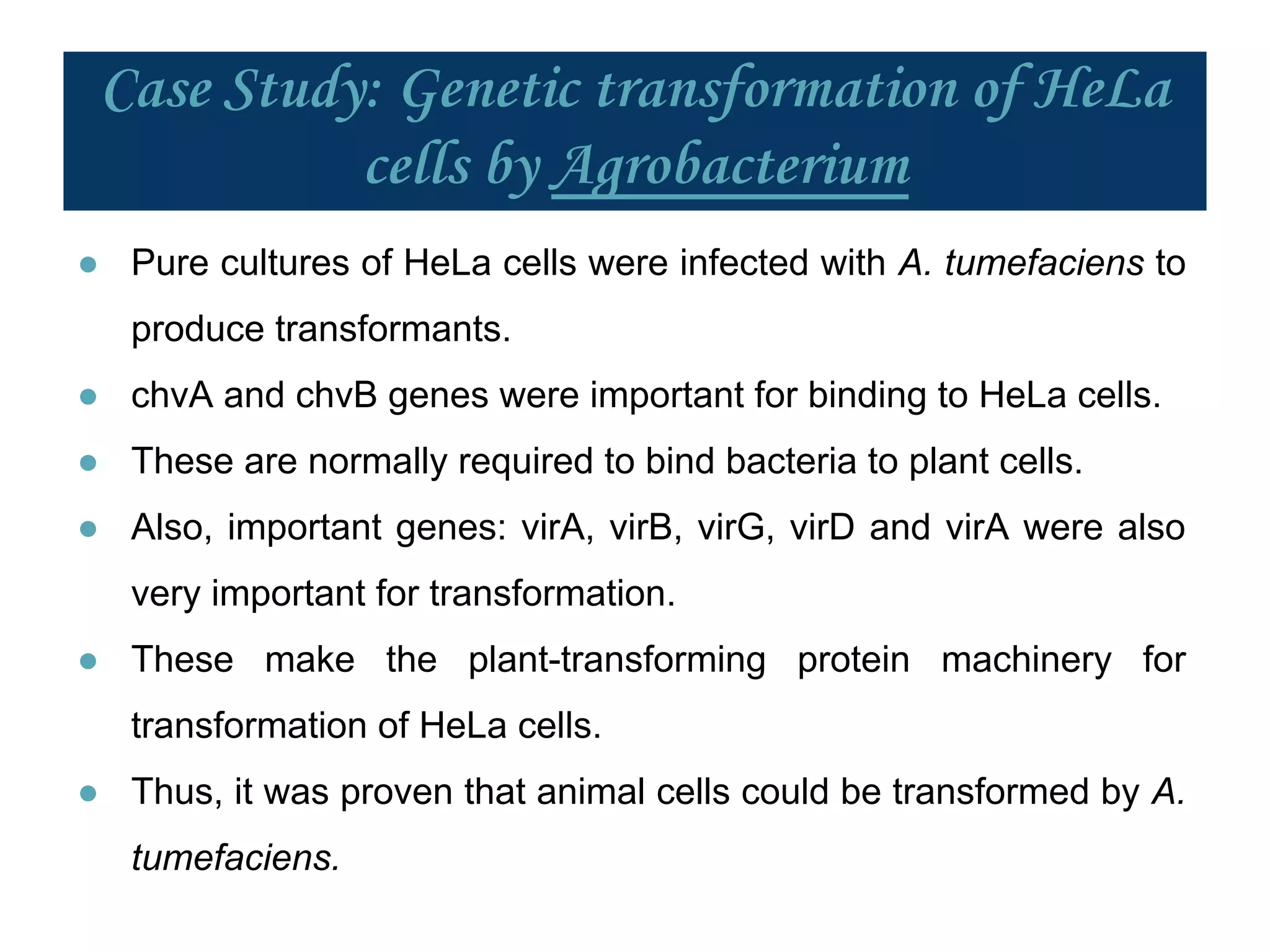
● Pure cultures of HeLa cells were infected with A. tumefaciens to
produce transformants.
● chvA and chvB genes were important for binding to HeLa cells.
● These are normally required to bind bacteria to plant cells.
● Also, important genes: virA, virB, virG, virD and virA were also
very important for transformation.
● These make the plant-transforming protein machinery for
transformation of HeLa cells.
● Thus, it was proven that animal cells could be transformed by A.
tumefaciens.
Conclusion
● Transformation or transfection is one way of modifying
organisms for the betterment of humans.
● Many methods are present and some animals have already
been subjected to it.
● A lot of medical research could be based on application of
transfection on alarming diseases such as cancer, HIV, and
diabetes.
On the overall, transfection would be a valuable tool for the
development of humans.
References
● Mammalian and Plant Cell Culture http://web.mnstate.
edu/provost/biotech/Transfection%20and%20Infection%20of%
20Mammalian%20Cells%20Handout.pdf [ Date accessed: 5th Nov
2014]
● Transfection Methods Overview
http://www.bio-rad.com/webroot/web/pdf/lsr/literature/10-
0826_transfection_tutorial_interactive.pdf [ Date accessed: 5th Nov
2014]
● Kim, T.K. and Eberwine, J.H. (2010). Mammalian cell transfection: the
present and the future. Analytical and Bioanalytical Chemistry 397(8),
3173-3178.
● Kunik, T., Tzfira, T., Kapulnik, Y., Gafni, Y., Dingwall, C., and Citovsky,
V. (2001). Genetic transformation of HeLa cells by Agrobacterium.
Proceedings of the National Academy of Sciences 98(4), 1871–1876.
Thank you!

Animal transformation

  • 1.
    Animal Transformation GMOs, Biosafetyand Bioethics 10th November 2014 Presented by: Bhagea Ritesh - 1210886 Cécile Christabelle - 1214458 Buctowar Rouksaar - 1242569 Ghoorbin Keshavi - 1216886 Nazeer Huda - 1214039
  • 2.
    Contents ➔ Objectives ofthis presentation ➔ Browsing through history ➔ An introduction to transformation ➔ Methods of transfection ➔ Transgenic animals ➔ Transgenic animals: DNA microinjection ➔ The application of transgenic organisms in agriculture ➔ Case study: The genetic transformation of HeLa cells by Agrobacterium ➔ Conclusion ➔ References
  • 3.
    Objectives of ourPresentation ● To shed light on the subject of “Animal Transformation”
  • 4.
    Browsing through History +1928: First demonstration of transformation by Frederick Griffith. ○ He found that a strain of Streptococcus pneumoniae could be made virulent when exposed to heat-killed virulent strains. ○ He then hypothesized the “transforming principle”. + 1944: Oswald Avery and colleagues discovered that this principle was genetic. ○ After isolation of DNA from a virulent strain of S. pneumoniae and inserting it into a harmless strain to successfully make it virulent, they called the process “transformation”. + 1947 & 1953: After much dispute about the experiment of Avery et al., the results were finally accepted. ○ The development of genetic markers and discovery of other methods of transformation greatly helped to clear the doubts.
  • 5.
    Browsing through History +1970: Acknowledgement by Morton Mandel and Akiko Higa that Escherichia coli may be used to take up DNA. + 1972: Stanley Cohen et al., showed that CaCl2 may also be used to transform plasmid DNA. + Late 1980s: Development of the electroporation method for transformation and invention of the Biolistic Particle Delivery System (gene gun) by John Sanford. + 1982: First transgenic mouse created. ○ A gene for a rat growth hormone was inserted into a mouse embryo.
  • 6.
    An Introduction toTransformation ● Process whereby an exogenous DNA is directly taken up and incorporated into a cell causing genetic alteration of that cell. ○ Exogenous DNA comes from the surrounding and ○ Is taken up through the cell membrane. ● Can occur naturally in some species of bacteria. ○ But can also be induced artificially in other cells. ○ Other means to introduce exogenous genetic material into bacteria: conjugation and transduction. ● Concerning animal transformation, the term most often used is “transfection”. ○ As “transformation” refers to the progression of animal cells into a cancerous state.
  • 7.
    Methods of Transfection Thereare different methods of transfection. Each method has a different approach to be considered, depending on cell type and purpose. The ideal method must have: ❏ high transfection efficiency, ❏ low cell toxicity, ❏ minimal effects on normal physiology, ❏ be easy to use, ❏ reproducible.
  • 8.
    The methods aredivided into 3 categories: 1. Chemical methods - Calcium Phosphate - Lipids - Cationic polymer 2. Physical methods - Electroporation - Microinjection - Laserfection - Sonoporation - Biolistic particle delivery Methods of Transfection 3. Biological method - Virus-based
  • 9.
    Methods of Transfection ●Advantages: 1. Deliver nucleic acids to cells in a culture dish with high efficiency 2. Easy to use, minimal steps required; adaptable to high-throughput systems 3. Using a highly active lipid will reduce the cost of lipid and nucleic acid, and achieve effective results ● Disadvantage: 1. Not applicable to all cell types 1. Lipid-Mediated Gene Delivery ● Also referred as lipofection or liposome-based gene transfection. ● Mode: Uses lipids to cause a cell to absorb exogenous DNA.
  • 10.
    Methods of Transfection 2.Electroporation ● Cell exposed to a high-intensity electric field (destabilizes the mbr) ● Mbr is highly permeable to exogenous molecules present in the surrounding media ● DNA moves into the cell through these holes ● When the field is turned off, the pores in the membrane reseal, enclosing the DNA inside. ● Advantages: 1. Easy to perform 2. High efficiency 3. Don’t alter biological structure/ function of cells 4. Can be used for wide range of cell types ● Disadvantages: 1. Cell mortality (if using sub-optimal conditions)
  • 11.
    Methods of Transfection 3.Viral-Based method ● Most commonly used method in clinical research ● Also known as transduction ● Example: Retrovirus murine leukemia virus (MLV) ● Mode: ● Establish sustainable transgene expression in humans. ● Integrates its DNA into the host genome which is expressed in the host. ● The integrated MLV DNA replicates as the host genome does. ● Segregates into daughter cells, which enables sustainable transgene expression (Kim and Eberwine, 2010).
  • 12.
    Methods of Transfection Viral-Basedmethod (ctd) ● Advantages: 1. Very high gene delivery efficiency, 95–100% 2. Simplicity of infection ● Disadvantages: 1. Strong immune reactions against viral proteins prohibit multiple administrations 2. Possibility of chromosomal insertion and proto- oncogene Activation 3. Complicated synthesis process 4. Limitation on gene size 5. Toxicity, contamination of live virus
  • 13.
    Transgenic Animals ● “Transgenic”is a genetically modified organism with DNA from other source inserted into its genome. ● To date, there are three methods for producing transgenic animals: 1. DNA microinjection 2. Retrovirus-mediated gene transfer 3. Embryonic stem-cell mediated gene transfer
  • 14.
    Transgenic Animals: DNAMicroinjection ● Desired gene construct (single genes or combination of genes recombined and cloned) from another member of the same/different species into the pronucleus of the reproductive cell. ● Manipulated cell (first cultured in vitro) to develop embryonic phase, is then transferred to female recipient. ● First transgenic mammal Herman, the bull (Lelystad, 16 Dec 1990).
  • 15.
    The Application ofTransgenic Organisms in Agriculture ● Possibility of producing new strains or breeds of animals that carry new beneficial, or improved genetic information. ● Examples of strains that have been developed: ○ Swine: leaner, more feed-efficient and faster-growing (have additional copies of the growth hormone gene) ○ Mice: having the regulatory elements of the human immunodeficiency virus (HIV) genome which are used as non- infectious models for the study of AIDS
  • 16.
    The Application ofTransgenic Organisms in Agriculture ● Knowledge gained in their studies is important in many fields including: ○ cancer research; immunology; developmental biology; gene expression and regulation; and models for human genetic diseases such as muscular dystrophy, Lou Gehring's disease, and sickle cell anemia. ● Potential applications for transgenic animals include: ○ manipulation of milk composition, growth, disease resistance, reproductive performance, and production of pharmaceutical products by livestock (known as pharming).
  • 17.
    Case Study: Genetictransformation of HeLa cells by Agrobacterium ● Transforming cells by Agrobacterium tumefaciens is a way to transfer DNA. ● A. tumefaciens transfers oncogenes to host plant causing tumours. ● A. tumefaciens needs a Ti-plasmid and a virulence region to function. ● It can transform human cells by integrating its T-DNA into the cellular genome. ● In this study, human HeLa R19 cells were used as host. ● A. tumefaciens C58C1 with Ti plasmid pGV3850 was used.
  • 18.
    Case Study: Genetictransformation of HeLa cells by Agrobacterium ● Pure cultures of HeLa cells were infected with A. tumefaciens to produce transformants. ● chvA and chvB genes were important for binding to HeLa cells. ● These are normally required to bind bacteria to plant cells. ● Also, important genes: virA, virB, virG, virD and virA were also very important for transformation. ● These make the plant-transforming protein machinery for transformation of HeLa cells. ● Thus, it was proven that animal cells could be transformed by A. tumefaciens.
  • 19.
    Conclusion ● Transformation ortransfection is one way of modifying organisms for the betterment of humans. ● Many methods are present and some animals have already been subjected to it. ● A lot of medical research could be based on application of transfection on alarming diseases such as cancer, HIV, and diabetes. On the overall, transfection would be a valuable tool for the development of humans.
  • 20.
    References ● Mammalian andPlant Cell Culture http://web.mnstate. edu/provost/biotech/Transfection%20and%20Infection%20of% 20Mammalian%20Cells%20Handout.pdf [ Date accessed: 5th Nov 2014] ● Transfection Methods Overview http://www.bio-rad.com/webroot/web/pdf/lsr/literature/10- 0826_transfection_tutorial_interactive.pdf [ Date accessed: 5th Nov 2014] ● Kim, T.K. and Eberwine, J.H. (2010). Mammalian cell transfection: the present and the future. Analytical and Bioanalytical Chemistry 397(8), 3173-3178. ● Kunik, T., Tzfira, T., Kapulnik, Y., Gafni, Y., Dingwall, C., and Citovsky, V. (2001). Genetic transformation of HeLa cells by Agrobacterium. Proceedings of the National Academy of Sciences 98(4), 1871–1876.
  • 21.