PSYCHOLINGUISTICS
ANIMAL LANGUAGE
FACILITATOR: MSc. BORIS CADENA
STUDENTS: ESPERANZA ANDRADE
MILTON CÁCERES
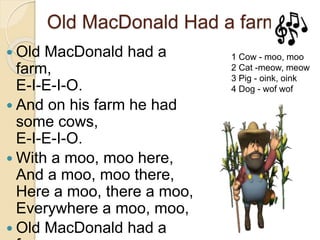
Old MacDonald Had a farm
 Old MacDonald had a
farm,
E-I-E-I-O.
 And on his farm he had
some cows,
E-I-E-I-O.
 With a moo, moo here,
And a moo, moo there,
Here a moo, there a moo,
Everywhere a moo, moo,
 Old MacDonald had a
1 Cow - moo, moo
2 Cat -meow, meow
3 Pig - oink, oink
4 Dog - wof wof
INTRODUCTION
 Animal communication is the passage of
information b/w two animals.
 The animal which sends is called signaller and the
animal that recieves signal is called reciever.
 Animal communication is also known as Biological
communication.
 The study of animal communication is called
Zoosemiotics
Animal communication is "the
transmission of a signal from one animal
to another such that the sender benefits,
on average, from the response of the
recipient".
"communication" to be applied to a very large
range of animals, including some very simple
animals.
BASIC COMPONENTS
 Signaller : An individual which emits signal.
 Reciever : An individual which recieves signal
 Signal : The behaviour emitted by the signaller
 Channels : A pathway through which normally a signal
travels. (ie means of communication)
 Visual
 Auditory
 Chemical
 Tactile
 Electrical
 Surface vibration
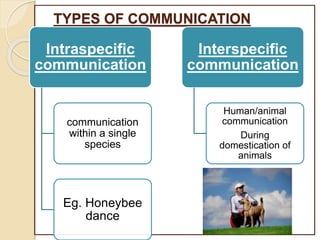
TYPES OF COMMUNICATION
Intraspecific
communication
communication
within a single
species
Eg. Honeybee
dance
Interspecific
communication
Human/animal
communication
During
domestication of
animals
Natural animal
communication
can include:-
Chemical signals
(used by some
very simple
creatures,
including
protozoa)
Smell (related to
chemical signals,
eg. pheromones
attract, skunk
secretions repel)
Touch
Movement
Posture (eg.
dogs, geese)
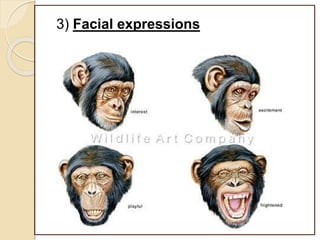
Facial gestures
(eg. dogs
snarling)
Visual signals
(eg. feathers)
Sound (eg. very
many vertebrate
and invertebrate
calls)
VISUAL COMMUNICATION
 Information transmitted by visual means is
called visual communication.
 The visual signals may be given by various
means like
◦ movement
◦ posture or shape of the body
◦ Facial expressions.
◦ colour identification
◦ light etc.
 Visual signals are used most often by species
that are active during day.
EXAMPLES
1) Visual communication in Bees
 The worker bees communicate about food mainly by a
dance language.
 It was decoded by Karl von Frisch in 1965.
 Bees mainly perform 2 types of dances.
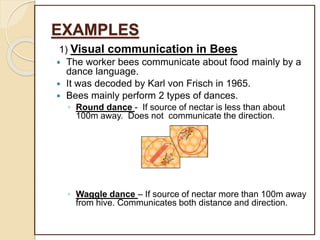
◦ Round dance - If source of nectar is less than about
100m away. Does not communicate the direction.
◦ Waggle dance – If source of nectar more than 100m away
from hive. Communicates both distance and direction.
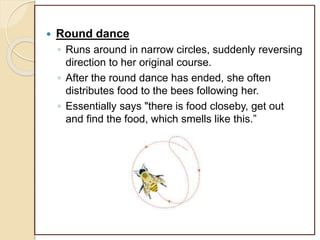
 Round dance
◦ Runs around in narrow circles, suddenly reversing
direction to her original course.
◦ After the round dance has ended, she often
distributes food to the bees following her.
◦ Essentially says "there is food closeby, get out
and find the food, which smells like this.”
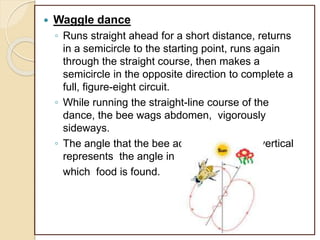
 Waggle dance
◦ Runs straight ahead for a short distance, returns
in a semicircle to the starting point, runs again
through the straight course, then makes a
semicircle in the opposite direction to complete a
full, figure-eight circuit.
◦ While running the straight-line course of the
dance, the bee wags abdomen, vigorously
sideways.
◦ The angle that the bee adopts, relative to vertical
represents the angle in
which food is found.
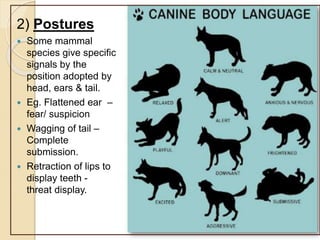
2) Postures
 Some mammal
species give specific
signals by the
position adopted by
head, ears & tail.
 Eg. Flattened ear –
fear/ suspicion
 Wagging of tail –
Complete
submission.
 Retraction of lips to
display teeth -
threat display.
3) Facial expressions
ODOUR OR CHEMICAL
COMMUNICATION
 Molecules used for chemical communication between
individual animals are called pheromones.
 Pheromones are involved in mate identification,
marking territory, alarm spreading etc.
 Odour signals can transmit informations in dark, can
travel long distances, can last for hours or number of
days.
 Usually the message causes an immediate response.
 Chemical messages that pass between animals of the
same species.
 Chemical communication is the most primitive type of
communication.
EXAMPLES
 Alarm pheromones are produced in ants in the
form of formic acid to protect themselves from
enemies.
 Ants lay down an initial trail of pheromones as they
return to the nest with food.
 Dogs and some other animals of dog family use
urine to mark the boundaries of their
territories.
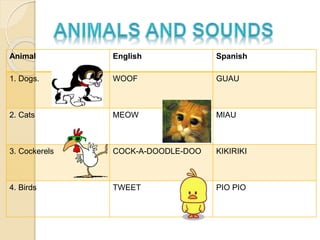
Animal English Spanish
1. Dogs. WOOF GUAU
2. Cats MEOW MIAU
3. Cockerels COCK-A-DOODLE-DOO KIKIRIKI
4. Birds TWEET PIO PIO
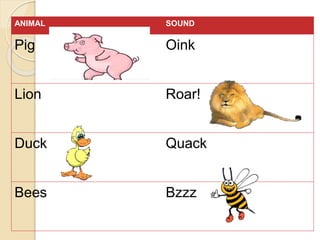
ANIMAL SOUND
Pig Oink
Lion Roar!
Duck Quack
Bees Bzzz
CONCLUSION
 Animals do communicate which involves information
transfer from the sender to a receiver.
 They can convey their needs, desires and reactions to
the environment via some sophisticated signaling of
their own.
 The understanding of animal communication is
essential for understanding the animal world in general.
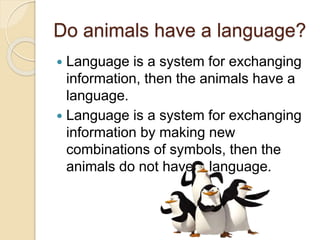
Do animals have a language?
 Language is a system for exchanging
information, then the animals have a
language.
 Language is a system for exchanging
information by making new
combinations of symbols, then the
animals do not have a language.
TWO THEORIES ABOUT
LANGUAGE
 Christians/idealists consider language
a gift given by God to please the
creator.
 Evolutionist/materialists they claim
language is the man’s invention.

Animal language exposition

  • 1.
    PSYCHOLINGUISTICS ANIMAL LANGUAGE FACILITATOR: MSc.BORIS CADENA STUDENTS: ESPERANZA ANDRADE MILTON CÁCERES
  • 2.
    Old MacDonald Hada farm  Old MacDonald had a farm, E-I-E-I-O.  And on his farm he had some cows, E-I-E-I-O.  With a moo, moo here, And a moo, moo there, Here a moo, there a moo, Everywhere a moo, moo,  Old MacDonald had a 1 Cow - moo, moo 2 Cat -meow, meow 3 Pig - oink, oink 4 Dog - wof wof
  • 3.
    INTRODUCTION  Animal communicationis the passage of information b/w two animals.  The animal which sends is called signaller and the animal that recieves signal is called reciever.  Animal communication is also known as Biological communication.  The study of animal communication is called Zoosemiotics
  • 4.
    Animal communication is"the transmission of a signal from one animal to another such that the sender benefits, on average, from the response of the recipient". "communication" to be applied to a very large range of animals, including some very simple animals.
  • 5.
    BASIC COMPONENTS  Signaller: An individual which emits signal.  Reciever : An individual which recieves signal  Signal : The behaviour emitted by the signaller  Channels : A pathway through which normally a signal travels. (ie means of communication)  Visual  Auditory  Chemical  Tactile  Electrical  Surface vibration
  • 6.
    TYPES OF COMMUNICATION Intraspecific communication communication withina single species Eg. Honeybee dance Interspecific communication Human/animal communication During domestication of animals
  • 7.
    Natural animal communication can include:- Chemicalsignals (used by some very simple creatures, including protozoa) Smell (related to chemical signals, eg. pheromones attract, skunk secretions repel) Touch Movement Posture (eg. dogs, geese) Facial gestures (eg. dogs snarling) Visual signals (eg. feathers) Sound (eg. very many vertebrate and invertebrate calls)
  • 8.
    VISUAL COMMUNICATION  Informationtransmitted by visual means is called visual communication.  The visual signals may be given by various means like ◦ movement ◦ posture or shape of the body ◦ Facial expressions. ◦ colour identification ◦ light etc.  Visual signals are used most often by species that are active during day.
  • 9.
    EXAMPLES 1) Visual communicationin Bees  The worker bees communicate about food mainly by a dance language.  It was decoded by Karl von Frisch in 1965.  Bees mainly perform 2 types of dances. ◦ Round dance - If source of nectar is less than about 100m away. Does not communicate the direction. ◦ Waggle dance – If source of nectar more than 100m away from hive. Communicates both distance and direction.
  • 10.
     Round dance ◦Runs around in narrow circles, suddenly reversing direction to her original course. ◦ After the round dance has ended, she often distributes food to the bees following her. ◦ Essentially says "there is food closeby, get out and find the food, which smells like this.”
  • 11.
     Waggle dance ◦Runs straight ahead for a short distance, returns in a semicircle to the starting point, runs again through the straight course, then makes a semicircle in the opposite direction to complete a full, figure-eight circuit. ◦ While running the straight-line course of the dance, the bee wags abdomen, vigorously sideways. ◦ The angle that the bee adopts, relative to vertical represents the angle in which food is found.
  • 12.
    2) Postures  Somemammal species give specific signals by the position adopted by head, ears & tail.  Eg. Flattened ear – fear/ suspicion  Wagging of tail – Complete submission.  Retraction of lips to display teeth - threat display.
  • 13.
  • 14.
    ODOUR OR CHEMICAL COMMUNICATION Molecules used for chemical communication between individual animals are called pheromones.  Pheromones are involved in mate identification, marking territory, alarm spreading etc.  Odour signals can transmit informations in dark, can travel long distances, can last for hours or number of days.  Usually the message causes an immediate response.  Chemical messages that pass between animals of the same species.  Chemical communication is the most primitive type of communication.
  • 15.
    EXAMPLES  Alarm pheromonesare produced in ants in the form of formic acid to protect themselves from enemies.  Ants lay down an initial trail of pheromones as they return to the nest with food.  Dogs and some other animals of dog family use urine to mark the boundaries of their territories.
  • 16.
    Animal English Spanish 1.Dogs. WOOF GUAU 2. Cats MEOW MIAU 3. Cockerels COCK-A-DOODLE-DOO KIKIRIKI 4. Birds TWEET PIO PIO
  • 17.
    ANIMAL SOUND Pig Oink LionRoar! Duck Quack Bees Bzzz
  • 18.
    CONCLUSION  Animals docommunicate which involves information transfer from the sender to a receiver.  They can convey their needs, desires and reactions to the environment via some sophisticated signaling of their own.  The understanding of animal communication is essential for understanding the animal world in general.
  • 19.
    Do animals havea language?  Language is a system for exchanging information, then the animals have a language.  Language is a system for exchanging information by making new combinations of symbols, then the animals do not have a language.
  • 20.
    TWO THEORIES ABOUT LANGUAGE Christians/idealists consider language a gift given by God to please the creator.  Evolutionist/materialists they claim language is the man’s invention.