A N G L E S
A n g l e s
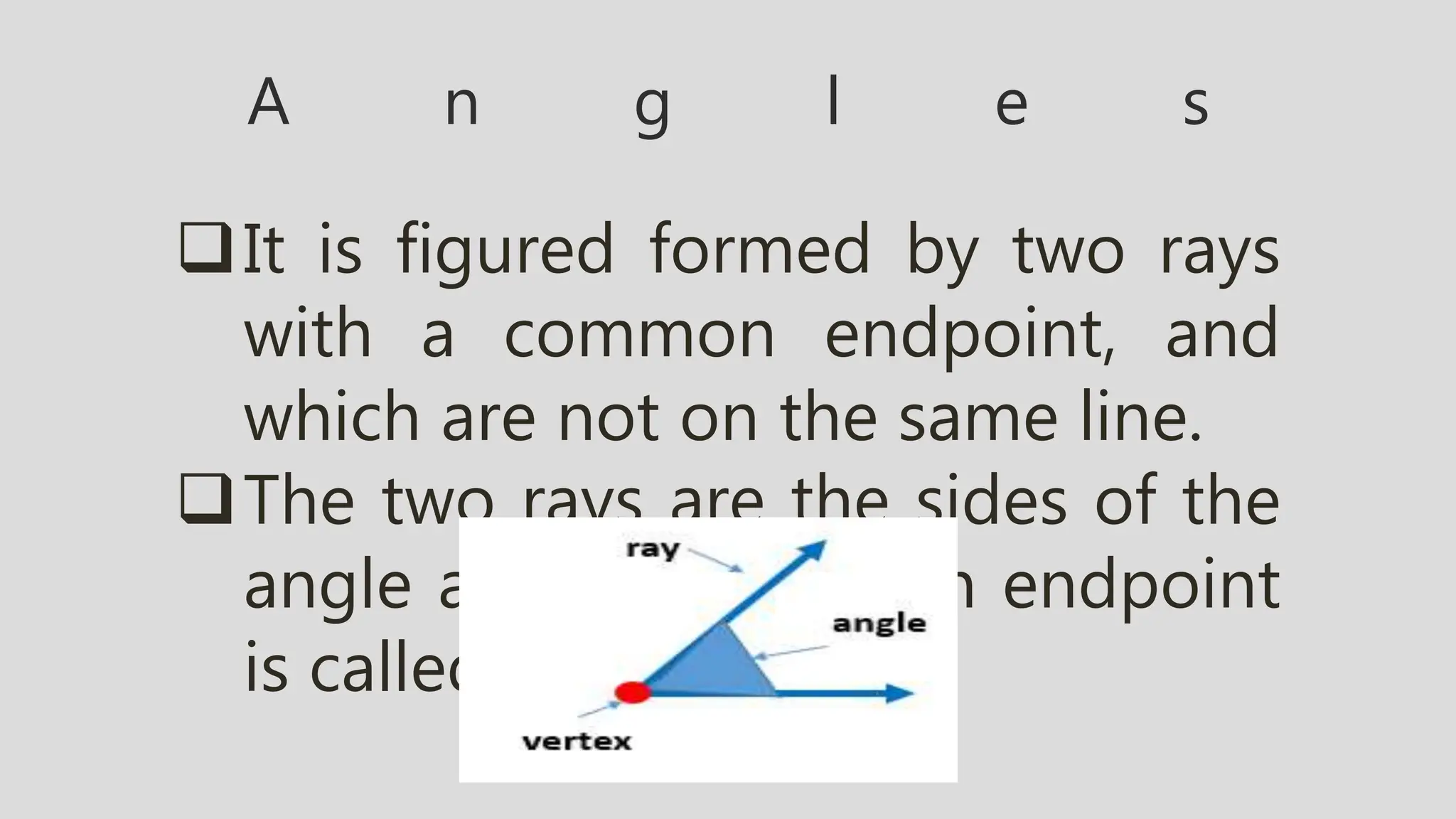
It is figured formed by two rays
with a common endpoint, and
which are not on the same line.
The two rays are the sides of the
angle and the common endpoint
is called the vertex.
A n g l e s
An angle is named using a number, vertex
or a vertex and points on each side.
• If three letters are used to name an
angle, the middle letter should be the
vertex.
• If one letter is used, it should be the
vertex.
A n g l e s
Angles are measured using a
protractor and the unit of
measurement is degrees (°).
A n g l e s
Types of Angles
ACUTE ANGLE
OBTUSE ANGLE
RIGHT ANGLE
STRAIGHT ANGLE
A c u t e A n g l e s
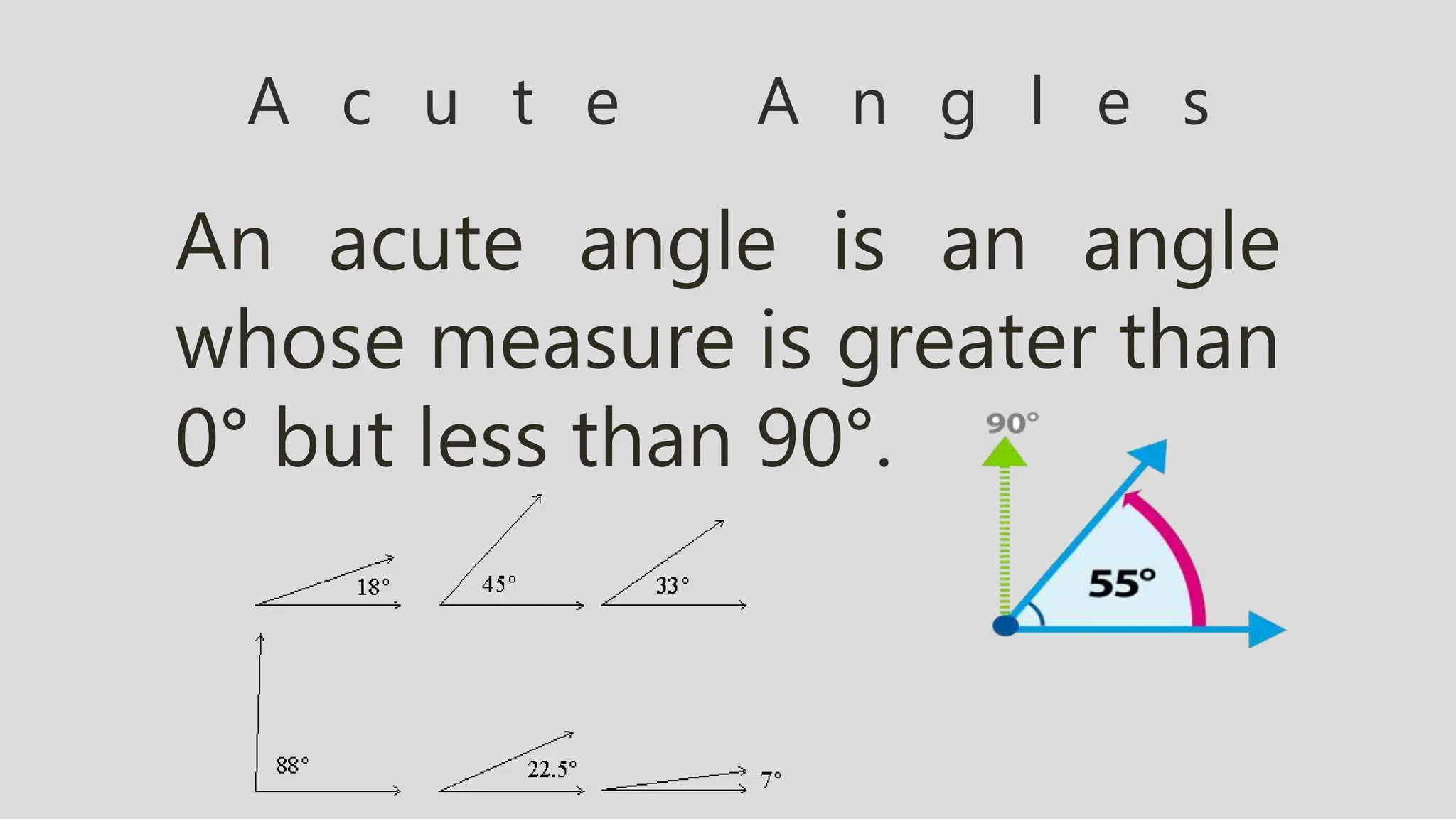
An acute angle is an angle
whose measure is greater than
0° but less than 90°.
R i g h t A n g l e s
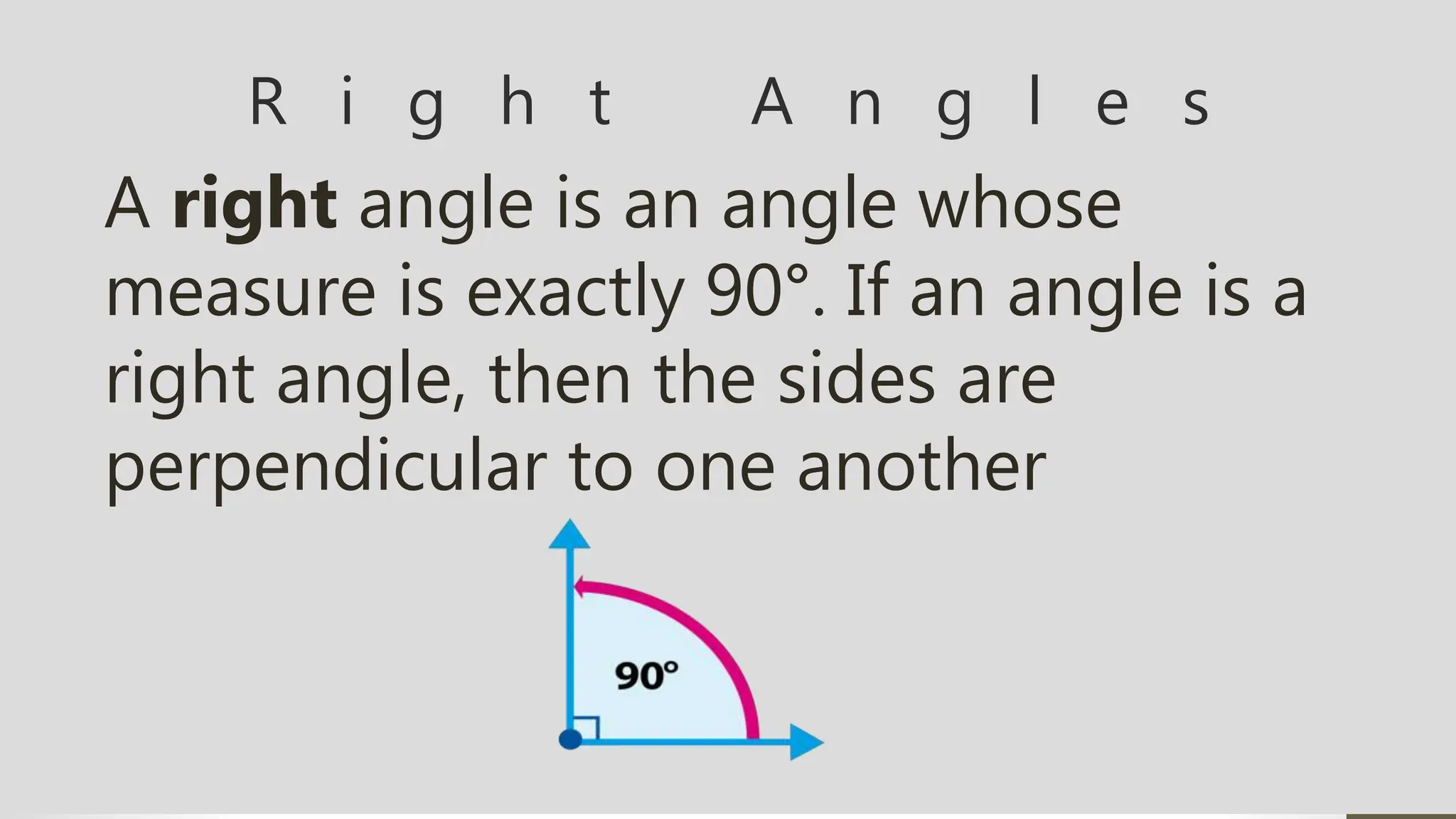
A right angle is an angle whose
measure is exactly 90°. If an angle is a
right angle, then the sides are
perpendicular to one another
O b t u s e A n g l e s
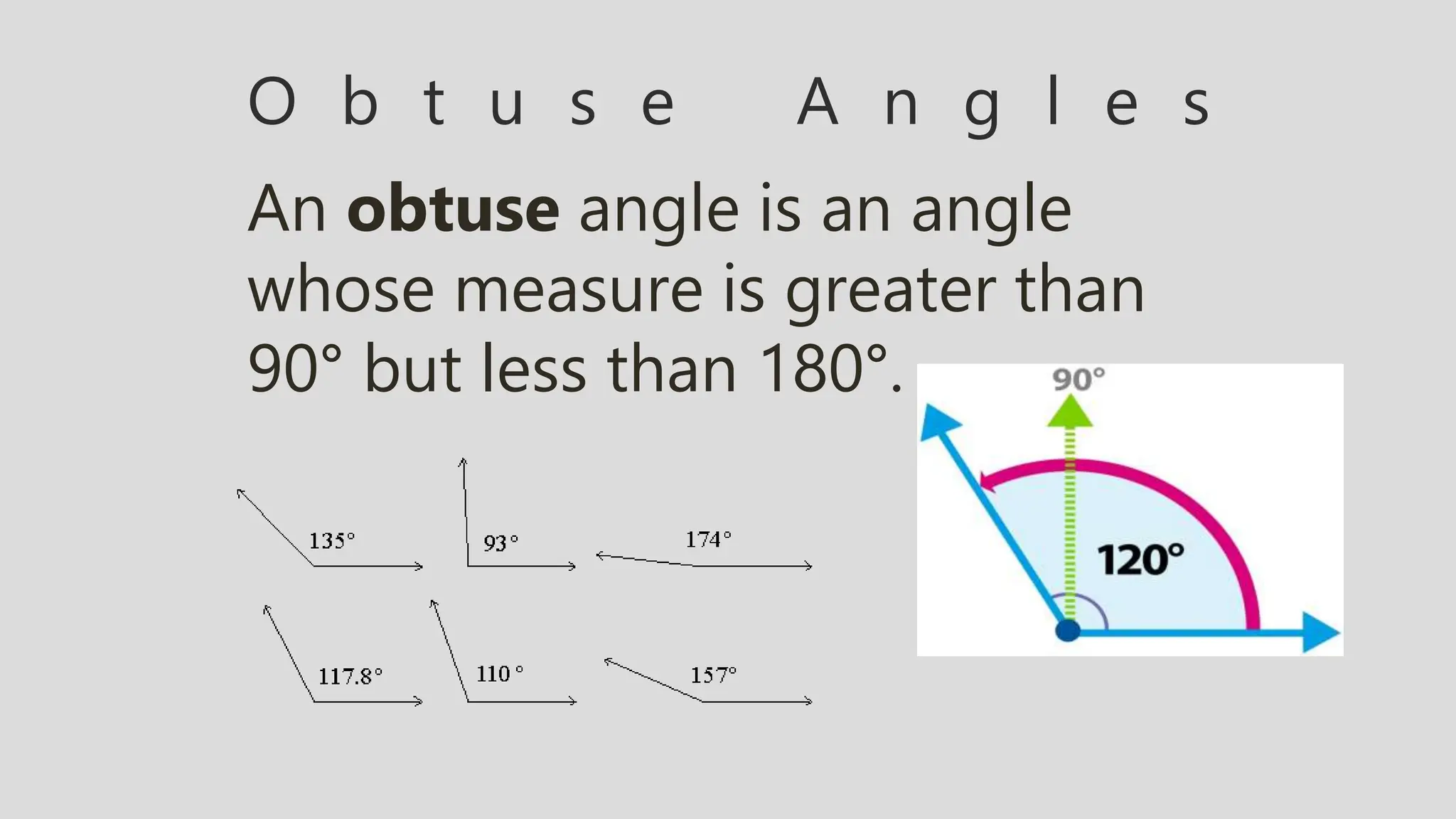
An obtuse angle is an angle
whose measure is greater than
90° but less than 180°.
Relationships Between Angles
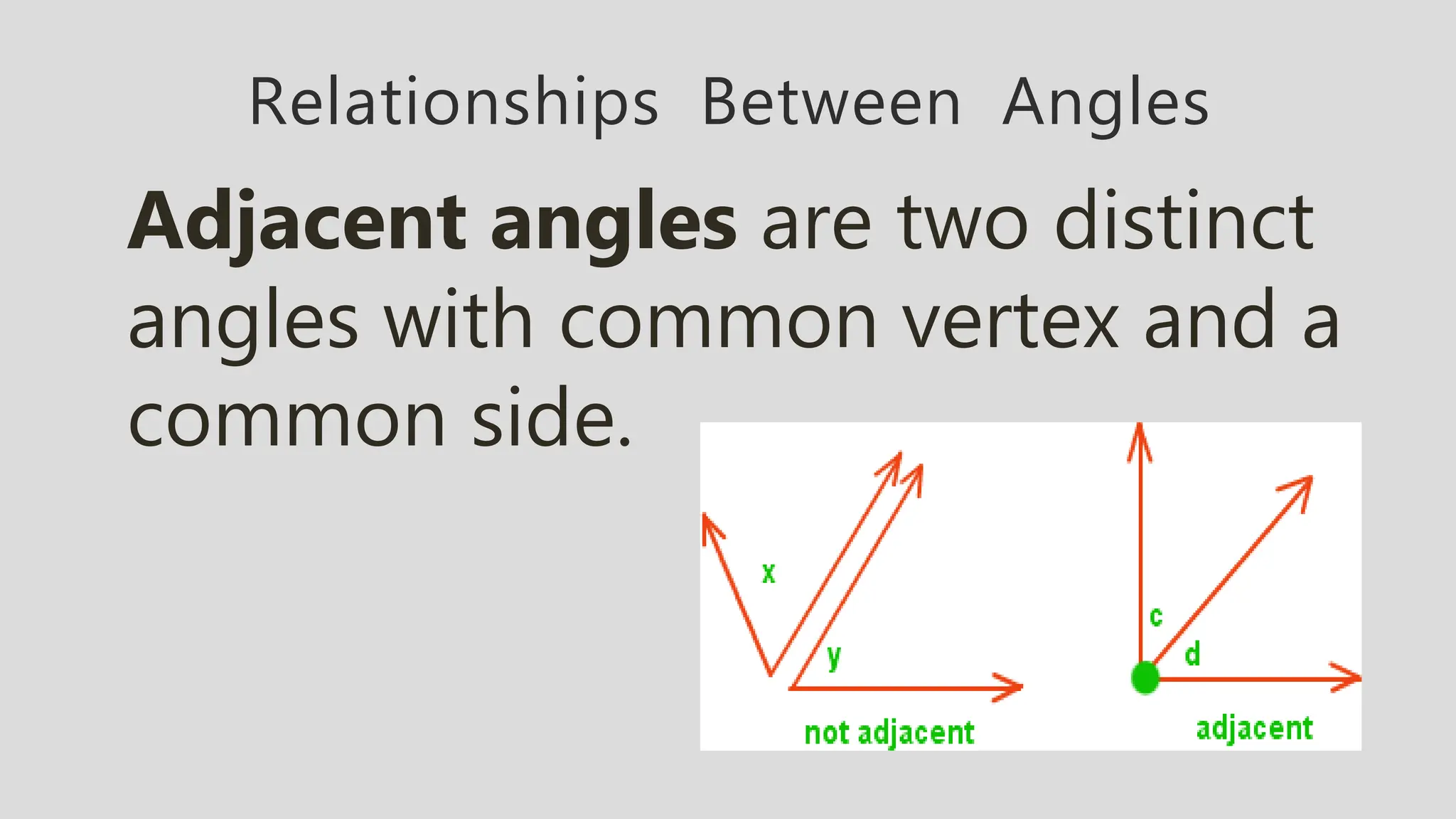
Adjacent angles are two distinct
angles with common vertex and a
common side.
Complementary Angles
Supplementary Angles
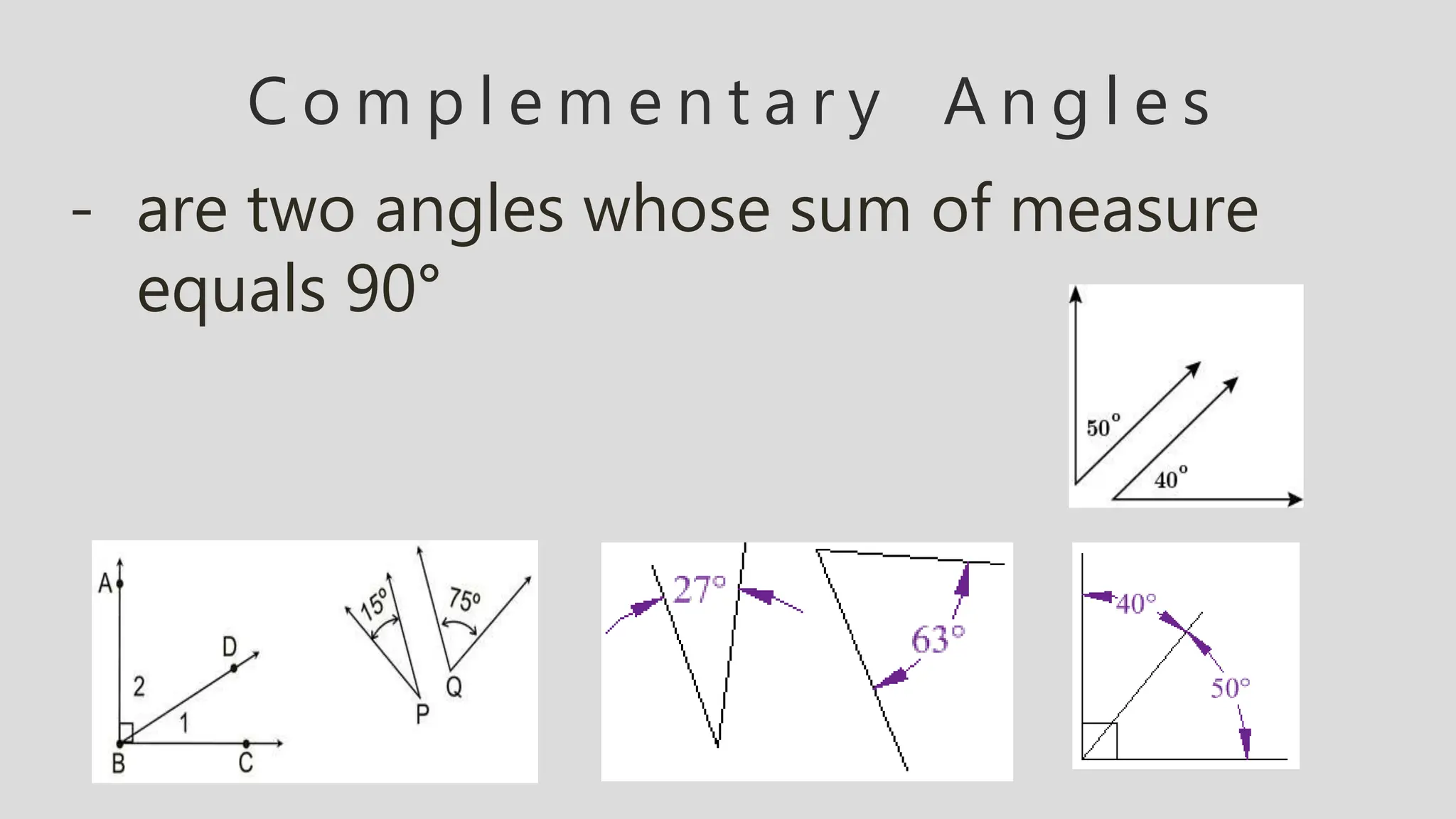
C o m p l e m e n t a r y A n g l e s
- are two angles whose sum of measure
equals 90°
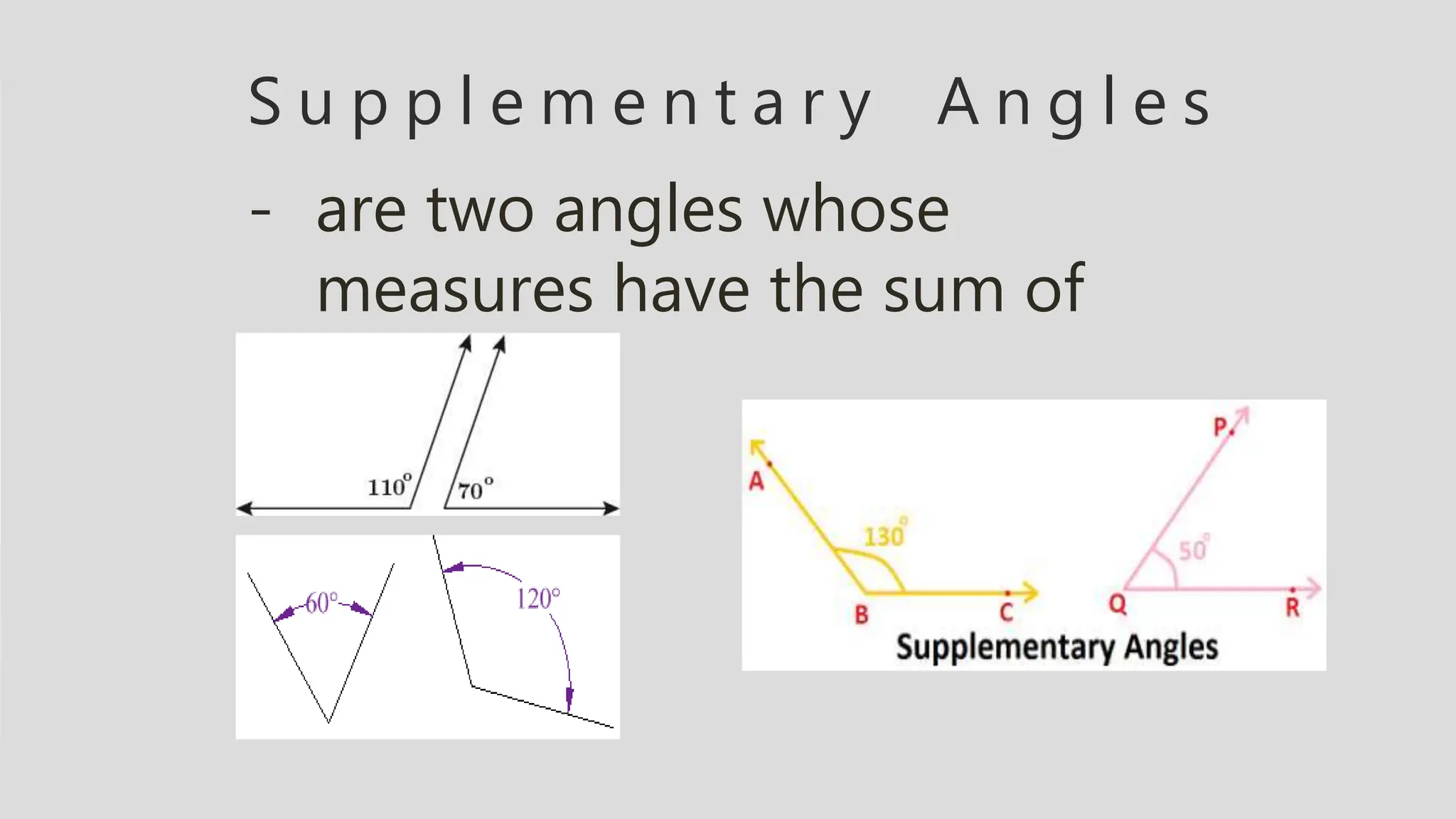
S u p p l e m e n t a r y A n g l e s
- are two angles whose
measures have the sum of
180°
E x a m p l e 1
Two angles are adjacent if they have
common vertex and a common side.
In the figure, are adjacent angles
since their vertex is at point 0 and
their common side is ray.
E x a m p l e 2
What must be the measure of
K to complement J?
72°
J
K
Solution: Sum of
complementary angles
is 90°.
J = 72° ; K = x°
J + K = 90°
72° + x° = 90°
x = 90° - 72°
x = 18°
Checking: 72° + 18° = 90°
Answer: Angle K measures 18°
E x a m p l e 2
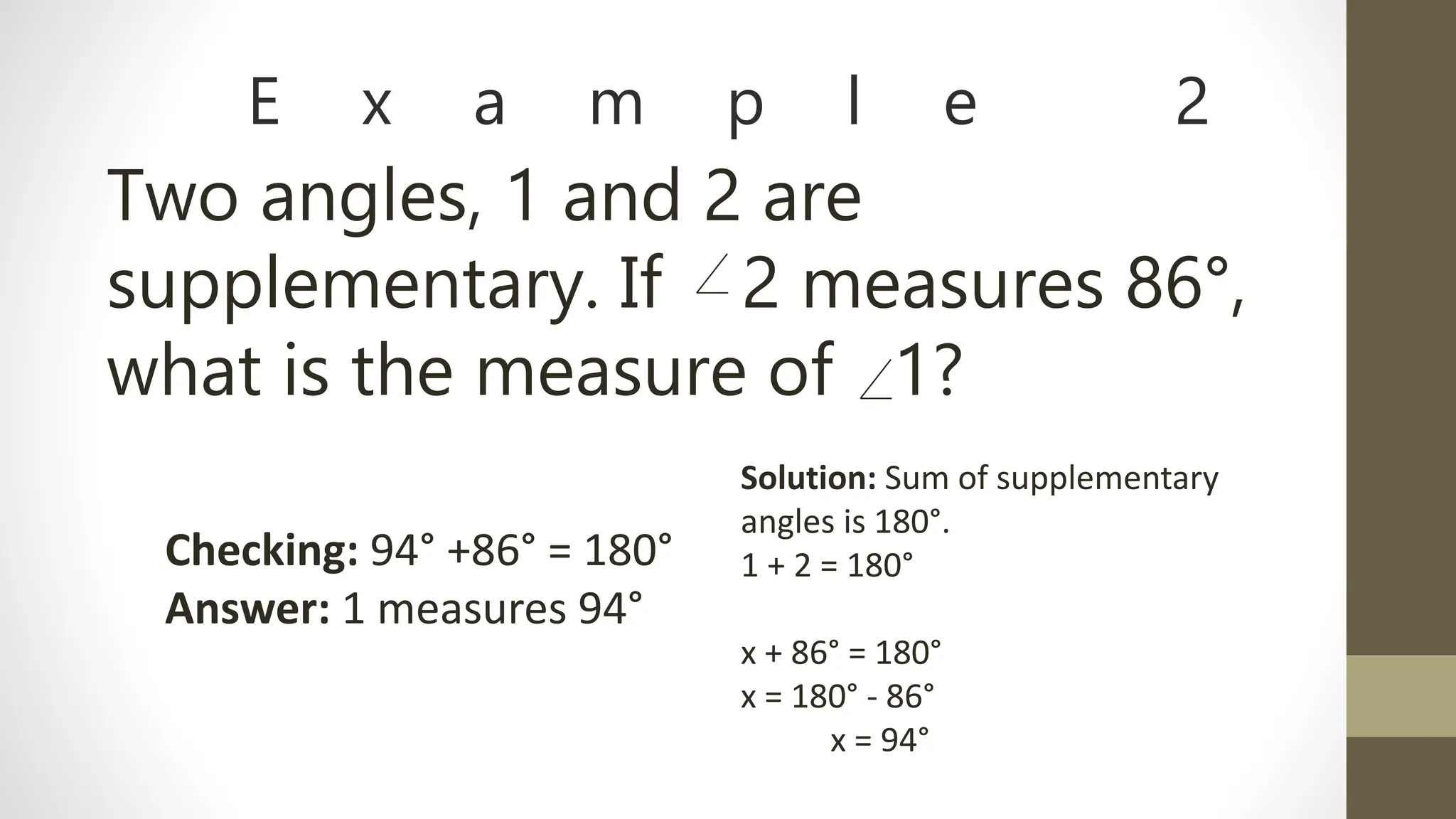
Two angles, 1 and 2 are
supplementary. If 2 measures 86°,
what is the measure of 1?
Solution: Sum of supplementary
angles is 180°.
1 + 2 = 180°
x + 86° = 180°
x = 180° - 86°
x = 94°
Checking: 94° +86° = 180°
Answer: 1 measures 94°
L i n e a r P a i r
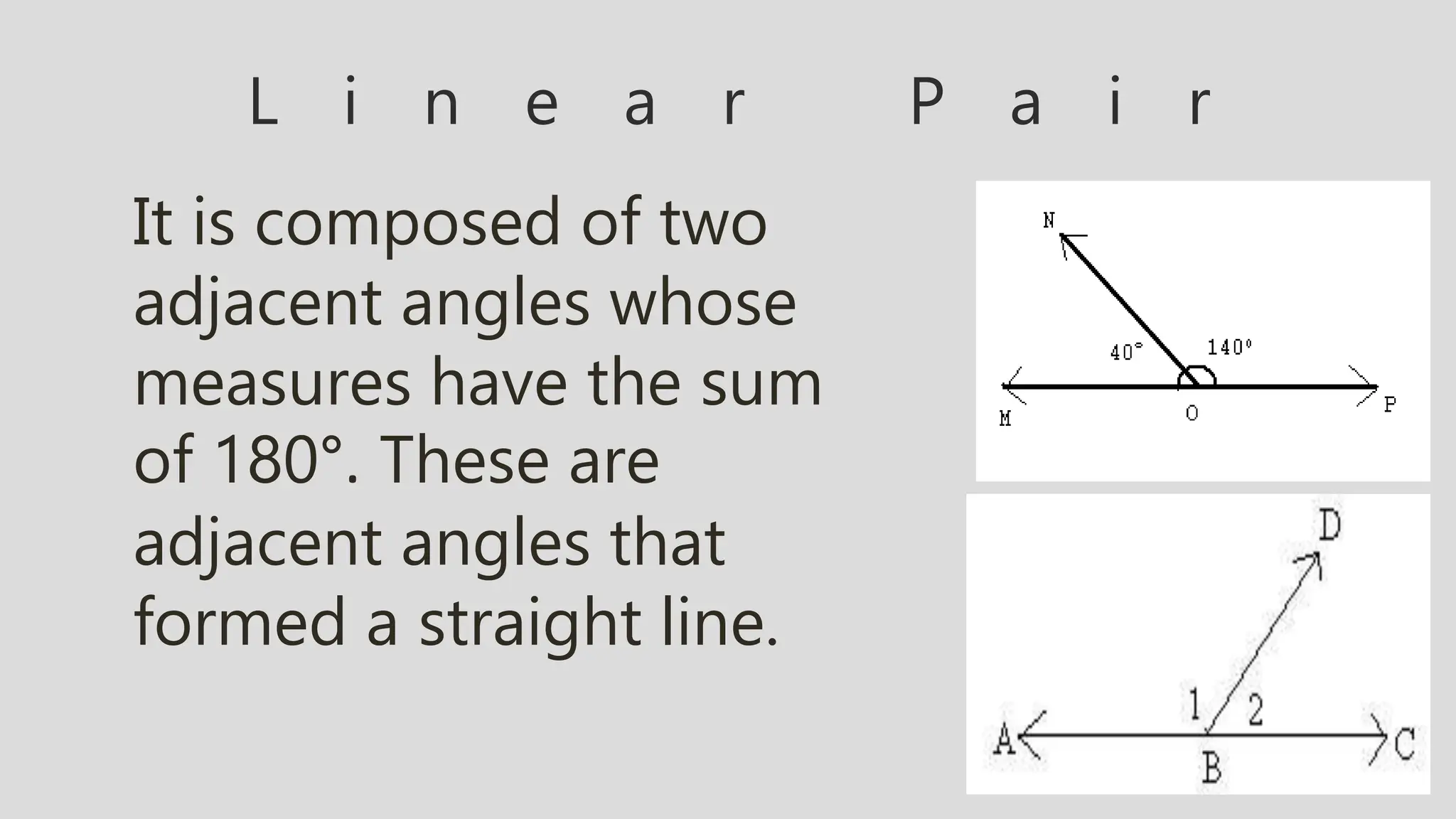
It is composed of two
adjacent angles whose
measures have the sum
of 180°. These are
adjacent angles that
formed a straight line.
V e r t i c a l A n g l e s
- are two nonadjacent angles
formed by two intersecting
lines. Vertical angles are
congruent.
Q u i c k S e a t w o r k
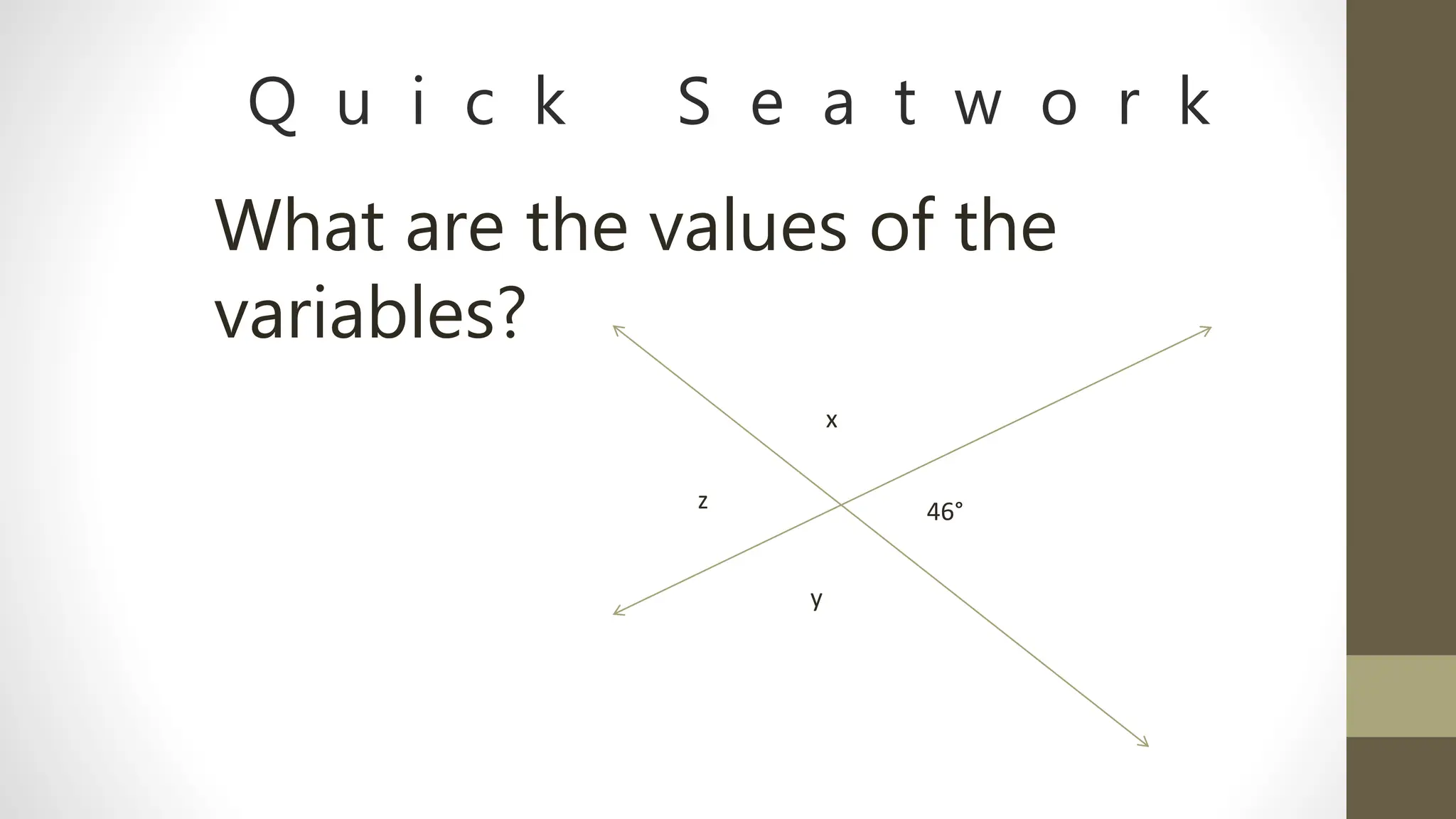
What are the values of the
variables?
z
y
x
46°
Parallel Cut by a Transversal
Given 𝑙1is parallel to 𝑙2 and 𝑙3
is a transversal line.
𝑙2
𝑙1
𝑙3
e
f g
h
b
a
c
d
Parallel Cut by a Transversal
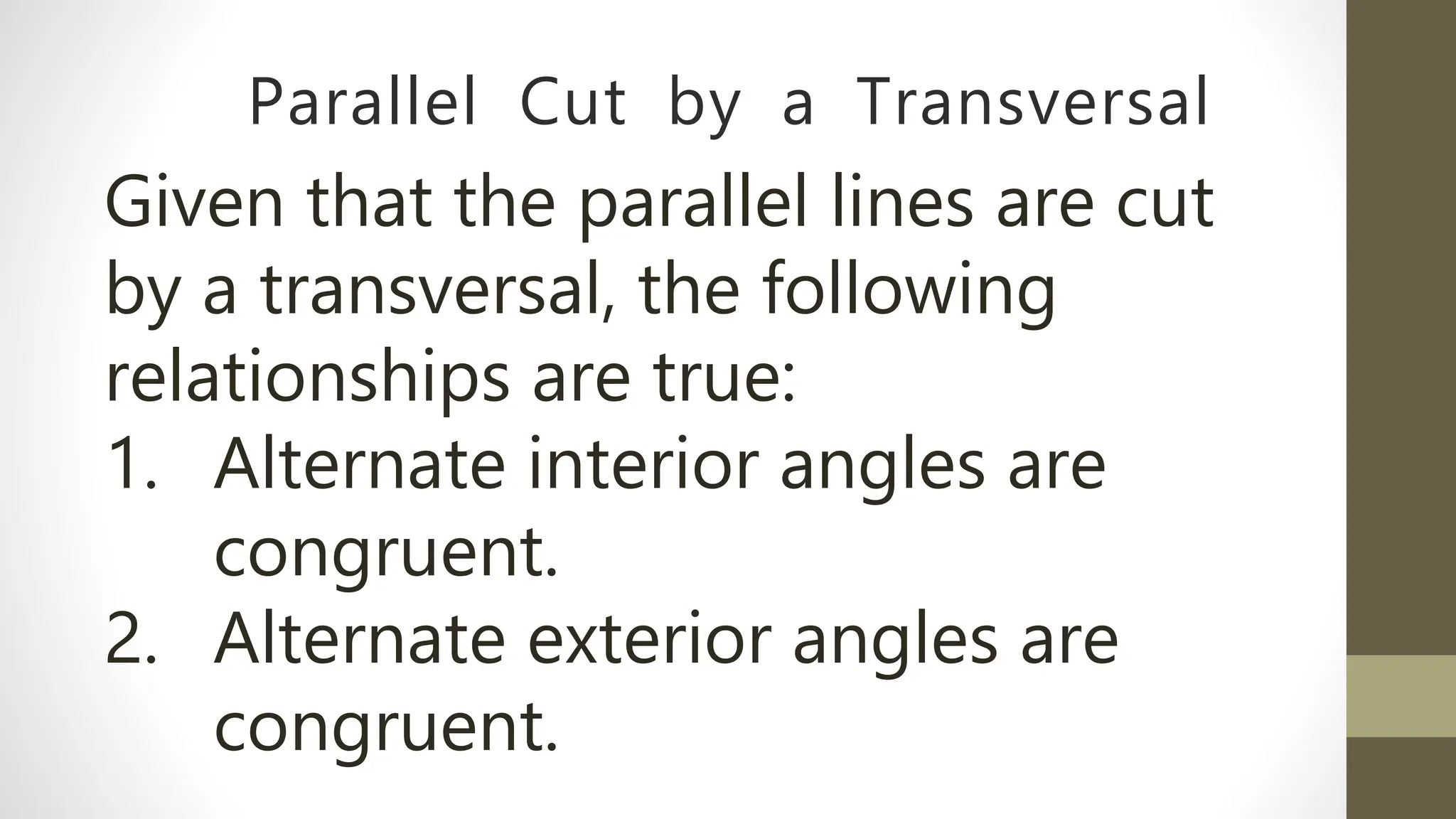
Given that the parallel lines are cut
by a transversal, the following
relationships are true:
1. Alternate interior angles are
congruent.
2. Alternate exterior angles are
congruent.

ANGLES-LESSON- ACUTE, RIGHT, AND OBTUSE ANGLES

  • 1.
    A N GL E S
  • 2.
    A n gl e s It is figured formed by two rays with a common endpoint, and which are not on the same line. The two rays are the sides of the angle and the common endpoint is called the vertex.
  • 3.
    A n gl e s An angle is named using a number, vertex or a vertex and points on each side. • If three letters are used to name an angle, the middle letter should be the vertex. • If one letter is used, it should be the vertex.
  • 4.
    A n gl e s Angles are measured using a protractor and the unit of measurement is degrees (°).
  • 5.
    A n gl e s Types of Angles
  • 6.
    ACUTE ANGLE OBTUSE ANGLE RIGHTANGLE STRAIGHT ANGLE
  • 7.
    A c ut e A n g l e s An acute angle is an angle whose measure is greater than 0° but less than 90°.
  • 8.
    R i gh t A n g l e s A right angle is an angle whose measure is exactly 90°. If an angle is a right angle, then the sides are perpendicular to one another
  • 9.
    O b tu s e A n g l e s An obtuse angle is an angle whose measure is greater than 90° but less than 180°.
  • 10.
    Relationships Between Angles Adjacentangles are two distinct angles with common vertex and a common side.
  • 11.
  • 12.
    C o mp l e m e n t a r y A n g l e s - are two angles whose sum of measure equals 90°
  • 13.
    S u pp l e m e n t a r y A n g l e s - are two angles whose measures have the sum of 180°
  • 14.
    E x am p l e 1 Two angles are adjacent if they have common vertex and a common side. In the figure, are adjacent angles since their vertex is at point 0 and their common side is ray.
  • 16.
    E x am p l e 2 What must be the measure of K to complement J? 72° J K Solution: Sum of complementary angles is 90°. J = 72° ; K = x° J + K = 90° 72° + x° = 90° x = 90° - 72° x = 18° Checking: 72° + 18° = 90° Answer: Angle K measures 18°
  • 17.
    E x am p l e 2 Two angles, 1 and 2 are supplementary. If 2 measures 86°, what is the measure of 1? Solution: Sum of supplementary angles is 180°. 1 + 2 = 180° x + 86° = 180° x = 180° - 86° x = 94° Checking: 94° +86° = 180° Answer: 1 measures 94°
  • 18.
    L i ne a r P a i r It is composed of two adjacent angles whose measures have the sum of 180°. These are adjacent angles that formed a straight line.
  • 19.
    V e rt i c a l A n g l e s - are two nonadjacent angles formed by two intersecting lines. Vertical angles are congruent.
  • 20.
    Q u ic k S e a t w o r k What are the values of the variables? z y x 46°
  • 21.
    Parallel Cut bya Transversal Given 𝑙1is parallel to 𝑙2 and 𝑙3 is a transversal line. 𝑙2 𝑙1 𝑙3 e f g h b a c d
  • 22.
    Parallel Cut bya Transversal Given that the parallel lines are cut by a transversal, the following relationships are true: 1. Alternate interior angles are congruent. 2. Alternate exterior angles are congruent.

Editor's Notes

  • #3 a solid figure with many plane faces -
  • #4 a solid figure with many plane faces -
  • #5 a solid figure with many plane faces -
  • #6 a solid figure with many plane faces -
  • #7 a solid figure with many plane faces -
  • #8 a solid figure with many plane faces -
  • #9 a solid figure with many plane faces -
  • #10 a solid figure with many plane faces -
  • #11 a solid figure with many plane faces -
  • #12 a solid figure with many plane faces -
  • #13 a solid figure with many plane faces -
  • #14 a solid figure with many plane faces -
  • #15 a solid figure with many plane faces -
  • #17 a solid figure with many plane faces -
  • #18 a solid figure with many plane faces -
  • #20 a solid figure with many plane faces -
  • #21 a solid figure with many plane faces -
  • #22 a solid figure with many plane faces -
  • #23 a solid figure with many plane faces -