From 3000 BCE
to 30 BCE
Important Artistic Periods:
Old Kingdom 2575 – 2134 BCE
Middle Kingdom2040 – 1640 BCE
New Kingdom 1550 – 1070 BCE
Egyptian Key Ideas
• Egyptian art spans 3000 years
• Elaborate funerary practices = built MASTABAS,
PYRAMIDS, and rock-cut TOMBS in sacred imperial
areas of Egypt
• Egyptian figures: broad frontal shoulders with head,
torso, and legs in profile
• Old Kingdom figures: rigid stance and little facial
expression
• Middle Kingdom figures: more relaxed body and
emotional faces
• New Kingdom figures: rounded and elongated figures
Key ideas continued…
• Order and Stability – a conservative formula of
representation.
• Worship the Pharaoh as a divine being who
establishes Ma’at (balance) between the
human world and the gods (a polytheistic
religion- multiple gods).
• Egyptians have methods of transmitting
knowledge and ideas through centuries and
millennia.
• Media: stone, paint, gold + gems, and papyrus
(a tall aquatic plant whose fiber is used as a
writing surface)
• Most of our resources come from tombs
where the treasures were held as items for
passage of the dead.
• Egyptians established the temple format with
columns that will be copied and transformed
by the Greeks and Romans.
Key ideas continued…
Old Kingdom
(begins with the unification of the
country under King Narmer)
c. 2575 – 2134 BCE
Information and Major Works to follow…..
So how did they
celebrate the
unification of the
country under the rule
of King Narmer?
Palette of Narmer
c. 3000 – 2920 BCE
Ringing any bells?
Palette of Narmer
c. 3000 – 2920 BCESimilarities? Differences?
NAME!
Nar – fish
Mer – chisel
Narmer
Perhaps the King
Menes?
(close-up of the palette top)
• Relief sculpture showing King Narmer uniting Upper and Lower Egypt
• Figures stand on ground line
• Hierarchy of scale
• Palette used to prepare eye makeup for the blinding sun, but this one was
probably commemorative or ceremonial
• Hieroglyphics explain and add to the meaning. It’s a NARRATIVE
Use of REGISTERSto
relate and separate
information
IDEALIZEDdepiction of
figures and events
Low Relief sculpture
FRONT:
• Narmer is largest (hierarchy of scale)
• Wears cobra crown of lower Egypt
• Reviewing beheaded enemies
• Bodies seen from above with heads
between legs
• Narmer preceded by four standard
bearers and a priest and followed by his
foot washer and sandal bearer
• Harnessed lionesses w/ long necks
(symbolizes unification)
• Bull knocking down city fortress
(symbolizes Narmer knocking over his
enemies)
Close-up of Narmer and his servants.
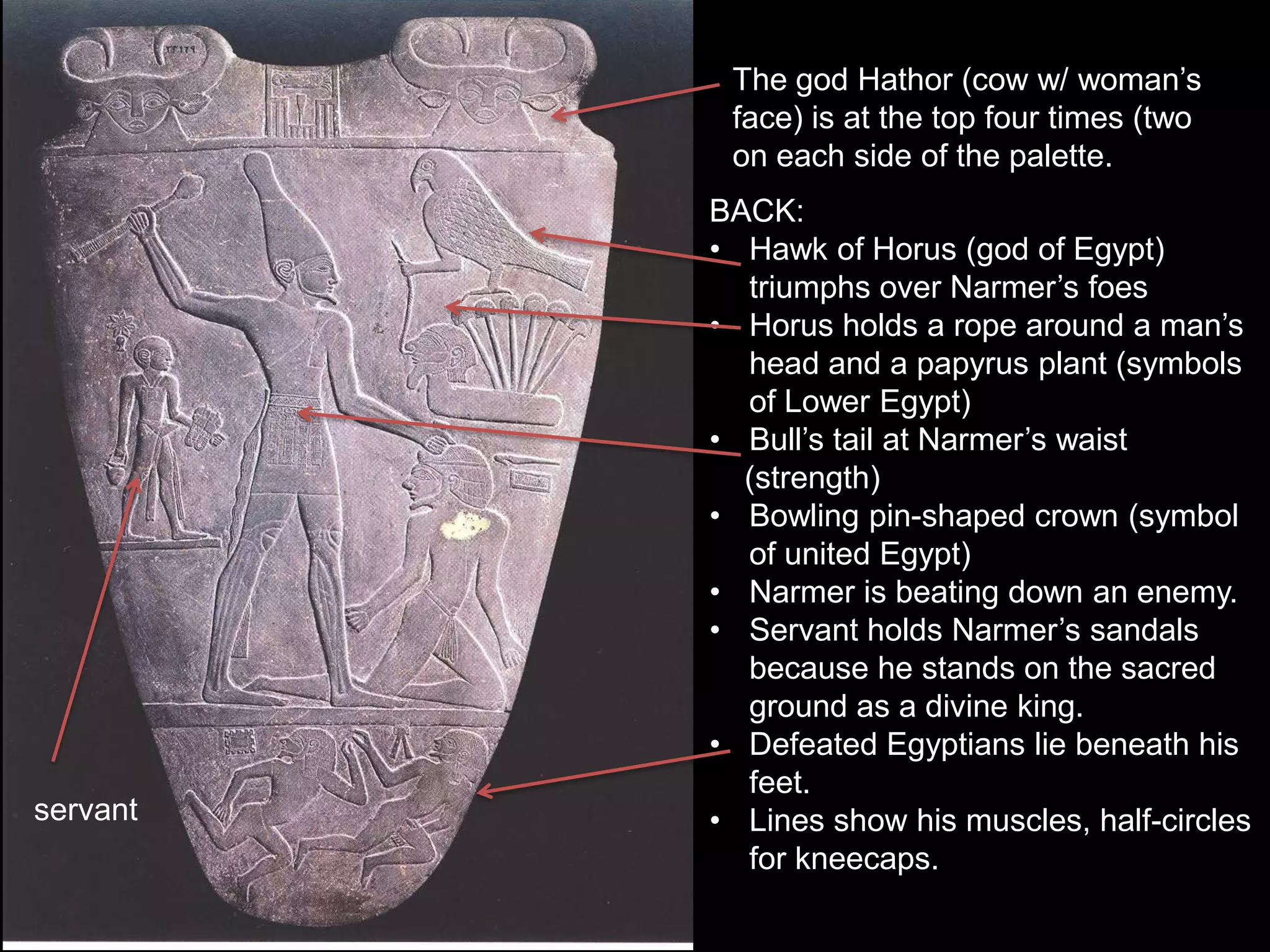
BACK:
• Hawk of Horus (god of Egypt)
triumphs over Narmer’s foes
• Horus holds a rope around a man’s
head and a papyrus plant (symbols
of Lower Egypt)
• Bull’s tail at Narmer’s waist
(strength)
• Bowling pin-shaped crown (symbol
of united Egypt)
• Narmer is beating down an enemy.
• Servant holds Narmer’s sandals
because he stands on the sacred
ground as a divine king.
• Defeated Egyptians lie beneath his
feet.
• Lines show his muscles, half-circles
for kneecaps.
The god Hathor (cow w/ woman’s
face) is at the top four times (two
on each side of the palette.
servant
Close-up look at Narmer being powerful!
Maybe this drawing makes it easier to see?
PYRAMIDS OF THE OLD
KINGDOM
-massive monuments to the dead
At first, the dead were buried in MASTABAS
(Arabic for “bench”, a low, flat-roofed tomb
with sloping sides down to the ground and
an entrance for mourners to bring offerings
to the deceased). The body was buried in
an inaccessible area that only the spirit
could enter.
Later, larger monuments were built –
MASTABAS stacked on top of each other
like a wedding cake until a pyramid was
achieved.
Mastaba Structure
Mastaba to Pyramid.
Step Pyramid of Djoser, built by Imhotep (first known artist in history!)
c. 2630 BCE, Saqqara, Egypt
Remind you of anything?
• Constructed entirely of stone (the whole complex of buildings)
• Six unequal steps, like a giant staircase to the heavens
• Looks like a stack of MASTABAS
• Burial is below ground. Pyramid is solid.
• PYRAMID is part of a large burial area called a NECROPOLIS (“City of the
dead”)
• PYRAMIDS were never built alone-always part of a NECROPOLIS
• NECROPOLISES were dedicated to the worship of the spirits of the dead
and the preservation of a person’s soul (ka)
Must have been cool in person!
people
Collasped Meidum Pyramid, First Trial by Snefru
in 2600 B.C. 306 ft
Another pyramid attempt….
Sneferu’s Bent Pyramid, c. 2596 BCE
Yet another pyramid attempt
Sneferu’s Red Pyramid, c. 2590 BCE
Getting closer….
Great Pyramids at Giza – from c. 2500 BCE, granite and limestone
They got it right!
• Giant monuments to dead pharaohs (kings of ancient Egypt)
• Each pyramid has a mortuary temple attached
• Minimal interior for the dead
• Pharaoh buried within (unlike stepped pyramid, in which they are buried
underneath)
• Each side is oriented toward a point on the compass
• The site was planned to follow the sun’s east-west path
• Huge labor force to build these (big workers’ burial ground discovered)
• Each block weighs about 2.5 tons (quarried on site or nearby)
• Used sheer muscle power, small logs as rollers, poured water on sand to make it
slippery and drag blocks
• Angled sides may represent
slanting rays of sun
• Inscriptions on walls say dead
kings climbed up the rays to
join the sun god Ra
• Built by kings in this order:
Khufu, Khafre, and Menkaure
• These kings wanted to
commemorate themselves as
divine beings
• All three used to have an
outer layer of white limestone
How did they build these?
Theories:
• They built a temporary, gently sloping ramp
around the pyramid as it got higher
• They took apart the ramp after the stones
were smoothed and the limestone veneer was
added.
• Architects- sophisticated mathematics
• Huge foundation layer had to be totally level
and the angle of each side had to be perfect so
the stones would meet precisely in the center
at the top.
Menkaure
Khafre
Khufu
In the southern sky during
the Forth Dynasty, a
vertical alignment due
south of three stars and the
Orion nebula in the large
distinctive constellation of
Orion may have been
noticed and generated
sufficient interest that the
ancient Egyptians aligned
their pyramids to it,
perhaps to create a link
with this constellation, or
they recognized this
vertical alignment as a
useful and accurate marker
for due south.
Great Sphinx, c. 2500 BCE, Giza, Egypt, limestone
Digging up the Sphinx in the 1870’s
• Very generalized features, but
might be a portrait of Khafre
• Carved from one huge rock
• Symbol of the sun god
• Body of a lion, head of pharaoh
and/or god
• Seems to protect pyramids behind
it
• Originally brightly painted
Cats are royal animals in ancient Egypt,
probably because they saved the grain
supply from mice!
Head of Sphinx badly damaged in Middle
Ages
Beard of Sphinx is separate (at the British
Museum)
241 ftlong, 63 ftwide, 6.34 ft high
Largest MONOLITH statue in the world
Guess what’s across the street?
Smolinski tip: go to Giza!
Egyptian Architecture Main Points:
•Sleek, solid surfaces of pyramids
•Monumental scale
•Pyramids built without mortar
•No one went in once the dead were put in (sealed the
pyramids)
•Believed that the dead could be reenergized after death and
ascent to the heavens
•Temples have astronomical orientation
Egyptian Sculpture Main Points:
•Range in size- tiny jewelry to massive stone sculptures
•Sculptures of pharaohs are meant to impress and
overwhelm
•Individualization and sophistication are sacrificed for
monumentality and grandeur
•Limestone, sandstone, gypsum used (easy to carve)
•Wooden sculptures are painted
•Copper and iron also used
•Sculpture carved on site = “in situ”- carved from local
available rock (Great Sphinx)
•Relief sculptures follow a formula.
•Outdoor relief: Cut into rocks to show shadows dramatically
•Indoor relief: relief is raised from surface for visibility in a
dark interior
KHAFRE
c. 2500 BCE, anorthosite gneiss (similar
to diorite), height 5'6 1/8"
•One of many portraits he commissioned of himself
•Elegant but simple throne
•Idealized body and features
•Falcon god Horus is behind Khafre’s head,
protecting him
•Khafre is an incarnation of Horus
•Pharaoh divinely appointed
•Symbol of a united Egypt in the interlocking of lotus
and papyrus plants at the base
•Lions (regal authority) form the throne’s legs
•In traditional royal costume (pleated kilt, linen
headdress, cobra symbol of Ra, false beard (royalty)
•Frontal, symmetrical, rigid, motionless, cubic
•Dignity, calm, and permanence
•Figure not cut away from the stone- arms and legs
attached, no negative space
•Strict adherence to Egyptian canon of proportions.
•Stone glows deep blue in sunlight
MENKAURE AND A QUEEN, PROBABLY
KHAMERERNEBTY II
From Giza. Fourth Dynasty, 2490-2472 BCE.
Graywacke with traces of red and black paint, height 54
1/2“, Museum of Fine Arts, Boston.
-Dignity, calm, permanence
-Discovered in Menkaure’s valley temple
-Single unit- figures attached to block of stone,
arms and legs not cut free
-United by queen’s symbolic gesture of embrace
-Figures stare out into space
-Menkaure’s powerful physique and stride = kingship
-His fists are clenched over cylindrical objects.
-Queen takes a small step forward = mimics his pose
-Society’s view of women: Her sheer, tight clothes
reveal shape of her body
-Men and women the same height = indicated equality
-Unfinished in some areas (done right before his
death?)
-Red paint remains (male statues usually painted red)
King Mycerinus (Menkaure)
C 2500 BCE
•Sculpted triad (3-person statue) shows
King Menkaure between two women
•Goddess Hathor is on the left
•Personification of Cynopolis, nome of
Upper Egypt, is on the right
•He wears crown of Upper Egypt
•False beard
•Short pleated kilt
•Holds two cylindrical objects
•Women wear tight dresses and wigs
•Hathor has her typical crown with sun disk
and cow horns
•Nome has jakal, symbol of her nome
•Nome= an administrative division within
ancient Egypt.
Representations of the Pharaoh
• Order and Stability – a conservative formula of
representation
• Worship of the Pharaoh as a divine being who
establishes Ma’at or (balance) between the
human world and that of the gods
• An effective formula for transmitting
knowledge and ideas through centuries and
millenia
SEATED SCRIBE
Found near the tomb of Kai, Saqqara.
2400 BCE.
Painted limestone with inlaid eyes of
rock crystal, calcite, and magnesite
mounted in copper, height 21"
See him
at the Louvre
in Paris!
Hello!
How is he different than the other male statues?
Seated Scribe
• Created for a tomb at
Saqqara as a provision for
the ka
• Not a pharaoh: sagging
chest and realistic rather
than idealistic features
• Sedentary job = flabby
• Flabby = no physical labor!
• Color remains!
• Amazingly lifelike, but not a
portrait (a conventional
image of a scribe)
• Attentive expression, thin,
angular face
• Contrasts with ideally
portrayed pharoah
• Less formal than royal
portraits
• Cap of close-cropped hair
• Holds papyrus paper scroll
and pen (lost)
Rahotep and Nofret
painted limestone, Old
Kingdom, c. 2620 BCE
•Idealized portraits
•Faces of the statues
express solemness and
self-assuredness
•Found in fancy mastaba =
high rank
•Portraits of the two
deceased in the mastaba
(husband and wife)
part of her real hair is painted on forehead
to show she’s wearing a wig
• Well preserved- mastabas
sealed until discovery
• Look freshly painted today
• Rahotep has short black hair,
trimmed moustache, necklace
with heart amulet
• Short white kilt, horizontal arm
• Hieroglyphics on chair give
his name and titles
• Nofret: shoulder-length wig
• Circlet with flower decoration
around her head
• Elegant long white gown,
elaborate collar
• Arms folded across chest
• Rahotep: reddish-brown, Nofret: creamy white
• Color difference between husband and wife is “canonical” in Egyptian art
• CANONICAL = scholars don’t understand it, but it’s true
• Painted colors aren’t their true colors in real life
• Both have lifelike inlaid eyes of crystal (scared people who discovered them!)
TI WATCHING A HIPPOPOTAMUS HUNT
Tomb of Ti, Saqqara, Egypt c. 2400 BCE.
Painted limestone relief, height approx. 45“
• Painted relief in the mastaba of Ti, a
government official
• Boat glides through gigantic papyri,
which flower into a fan of birds and
foxes (papyrus = symbol of rebirth)
• Hunt takes place as a memorial to the
deceased
• Success in the hunt = fight against evil
• Servants hunt as a tribute to deceased
Ti, and also to destroy animals like
hippos, which damaged crops and
were considered agents of the god of
darkness (Seth)
• Ti stands on (not in) boat, he’s double
anyone else’s size = shows status
• Boat symbolizes journey to afterlife
• River as if seen from above- band of
parallel wavy lines below boat.
• Fish, hippo, crocodile seen in profile
• Egyptians believed that superhuman
forces were always at work and
needed constant worship
• Funerary art- things that were buried
last forever and this life must continue
uninterrupted into the next world =
artists represented the human figure
as completely as possible
• Egyptian CANON OF PROPORTIONS
– little individuality
• Let’s take a look….
Twisted Perspective and
The Canon of Proportions
based on a grid
TWISTED PERSPECTIVE
• Poses impossible in real life
• Memory images (generic
forms)
• Represent each part of the
body from its most
characteristic angel
• Heads in profile
• Eyes frontal
• Profile head, hips, and legs
with frontal torso in between
• Usually striding to show both
legs
• People of lower rank
depicted more realistically
Canon of Proportions
• Ratios between height and
components were clearly
prescribed
• Calculated das multiples of a
specific measure, such as the
width of the closed fist
• This unit became the basis of
a square grid- OLD
KINGDOM STANDARD
GRID
• Every body part had a
designated place
• Example- the knees are X
number of squares below the
waist, etc.
• Figures rest on horizon line
• If they are above the line,
they are thought to be
receding into the distance
• Artists placed a grid over
the areas to be painted and
outlined the figures
accordingly
• Unfinished figure =
incomplete existence in
afterlife, oh no!
• Even animals drawn as
completely as possible
• These rules change a bit in
the AMARNA PERIOD
(more about that later)
Old Kingdom Summary:
• Age of Pyramids
• Canon of Proportions established
• Twisted Perspective
• Relationship between artworks and
afterlife established
• Role and status of the Pharaoh
established
Middle Kingdom
c. 2040 – 1640 BCE
• Collapse of Old Kingdom
• 150 years of political turmoil
• After a period of anarchy, Mentihotep II unified
Egypt for a second time in a period called the
MIDDLE KINGDOM
• Arts and writing flourished – reflected awareness
of political problems
• Pyramids abandoned in favor of smaller and less
expensive rock-cut tombs
ROCK-CUT TOMBS, BENI HASAN
Twelfth Dynasty, 1950-1900 BCE
• Cliff walls hollowed out to
reveal small burial
chambers
• Reserve columns cut
away from the rock to
create the look of
conventional columns,
but don’t add support
• Columns are not round
but fluted
• Façade shows shallow
columned porch
• Included an entrance
portico, main hall, and
shrine with burial
chamber under the
offering chapel
• Tombs had practical stuff
(food, clothing, furniture)
and reliefs, paintings,
and other objects to
ensure safety and well
being in afterlife
-Rock-cut tombs excavated in the faces of cliffs
-Chambers, ornamental columns, lintels, false doors,
and niches all carved out of solid rock
STELE OF AMENEMHAT
From Assasif. Middle
Kingdom, c. 2000 BCE.
Painted limestone, 11" ×
15"
• Shoulders seen frontally
• Rest of body, except the eye, is turned in profile
• Sometimes heads and legs face different directions
• Men are taller than women and are pained ruddy brown or red
• Women are shorter and painted yellowish. Shading is rare.
• Represent successful men and women acting calm and rational
• Violence and disorder- only in scenes of animal slaughtering/sacrifices, or
overthrowing the forces of evil
• Contentment and stability
Twisted perspective and grids were still used in the Middle Kingdom….
Middle Kingdom Tomb Painting
SENUSRET III
c. 1860 BCE
• Moody look in the eyes
and mouth
• Depressed, rather than
heroic figures seen in
Old Kingdom
• Figures in Middle
Kingdom reflect period
of unrest
• Introspective
• Firm chin
• Carefully delineated
lines and folds of flesh
between the brows and
at the corners of the
nose and mouth
“When thou liest down
have care for thy very life,
since friends exist not for
a man in the day of
misfortunes.”
-advice from Amenemhat I (great-
great-grandfather of Senusret III)
SenusretIII. Middle Kingdom,
circa 1836-1818 BCE
Black granite
Sphinx of SenrusretIII, c. 1878–1841 B.C.E.; Middle Kingdom
Connection with Old Kingdom
Sphinx is popular throughout Egyptian art history
Winged sphinx from the palace of
Darius the Great during Persian
Empire at Susa (480 BC).
Ancient Greek sphinx from Delphi
Faience Hippo, Middle Kingdom c. 1900 BCE
• Has all characteristics of a
real hippo
• Rotund body on stubby
legs
• Massive head with
protruding eyes, tiny ears,
big nostrils
• Example of FAIENCE:
glass paste is fired to
produce a smooth and
shiny opaque finish
• Watery blue like habitat
• Lotus blossom decoration
• Decoration = he’s standing
in a tangle of water plants
• Could be a symbol of
fertility (goddess Taweret
had a hippo head) in a
woman’s tomb
• Could be a symbol of evil
in a man’s tomb (like in the
hippo hunt imagery)
NEW KINGDOM
1550-1070 BCE
• Anarchy after Middle Kingdom breakdown
• Invaders from Asia brought new ideas/technology
• Eventually, Egypt got back on track politically, kicked out the invaders, and
began the New Kingdom
• New Kingdom = a period of unparalleled splendor!
• New Kingdom art is characterized by rounded and elongated figures
• New Kingdom pharaoh, AKHENATON, changed Egypt by abandoning
worship of many gods to just ONE god, “Aton”
• AKHENATON = Aton’s representative on earth
• Aton is represented as a sun disk emanating rays (instead of gods that
were human and/or animal symbols)
• New religion brought about new artistic style: AMARNA PERIOD
• Temples continued to be built into the sides of rock formations…
Mortuary Temple of Queen Hatshepsut, Deir al-Bahrric 1473-1458 BCE,
Deir el-Bahri, Egypt
• 3 colonnaded terraces and
2 ramps
• Visually coordinated with
the natural setting
• Long horizontals and
verticals of the terraces and
colonnades repeat the
patterns of the cliffs behind
• Patterns of dark and light in
the colonnade are reflected
in the cliffs
• Terraces were originally
planted as gardens with
exotic trees
• First time achievements of
a woman are celebrated in
art history!
• Hatshepsut is buried
elsewhere (in the Valley of
the Kings)
• Open garden spaces and grand architecture
• Imposing image of authority
• Union of nature and architecture
• Different levels of contrasting textures (water,
stone columns, trees, cliffs = impressive!
Queen Hatshepsut
c. 1473-1458 BCE
Granite
At the Met Museum in NYC!
• Queen represented in male costume of
a pharaoh, yet slender proportions and
slight breasts indicate femininity
• She’s often portrayed as a sphinx
• Headdress, false beard, and traces of
the cobra on the crown show her affinity
with male pharaoh role
• Represented in all the ways a male ruler
would be
• About 200 sculptures of her exist, but
many were damaged (smashed by her
successor Thutmose III maybe?)
• Bull’s tail hanging from her waist (you
can see it between her legs)
• Mother = Queen Ahmose
• Father = the god Amun
Queen (Pharoah)
Hatsepshut (c. 1495 BCE)
Sphinx of Hatshepsut c. 1479-1458, Granite
One of two obelisks to escape
her stepson's plan to obliterate
her memory, this obelisk was
built by Queen Hatshepsut.
(1473 -1458 BCE).
• 97 feet tall
• Inscription at base indicates that
the work of cutting the monolith
out of the quarry required seven
months of labor.
The Egyptian obelisks were always
carved from single pieces of stone,
usually pink granite from the distant
quarries at Aswan, but exactly how
they were transported hundreds of
miles and then erected remains a
mystery.
One of two obelisks to escape
her stepson's plan to obliterate
her memory, this obelisk was
built by Queen Hatshepsut.
Obelisks of Hatshepsut
The use of the obelisks is even more of a mystery
than their carving and construction. While the
obelisks are usually covered with inscriptions,
these offer no clue to their function, but are
instead commemorative notations indicating when
and by whom the obelisk was carved.
TEMPLE OF RAMSES II
Abu Simbel, Egypt. c. 1290-1224 BCE.
• Resembles a PYLON(monumental gateway to a temple marked by two flat,
sloping walls between which is a smaller entrance)
• Huge seated quartet of statues of Ramses on the façade (front), carved “in situ”
• Sun god placed over the entrance
• Façade used to be brightly painted
• Interior sculptures of Ramses too
• Interior stretches 200 feet into mountain
Sun god
PYLON EXAMPLE ILLUSTRATION
what a location!
This relief is a listing
of Ramses II’s
various names.
SCHEMATIC DRAWING OF THE TEMPLE OF
RAMSES II
Temple of Ramses II Nefertari’s Temple
(Ramses’s wife)
• Standing statues of Nefertari are about the same size as Ramses.
• She’s holding a sistrum(musical instrument)
• Wears long sheet dress, very thin to show her body
• Has long wig
• Solar disk and tall feathers on her head dress.
• Interior scenes show Nefertari making offerings to the gods.
Nefertari’s Temple
Detail of picture on right
• The two temples together honor the official gods of Egypt and Ramses II dynasty
• Oriented so their axis crossed in the middle of the Nile (associated with annual life-
giving flood?)
Egyptian Temples
Established the temple format with columns
that will be copied and transformed by the
Greeks and Romans.
Great Temple of Amen-Re (Amun)
at Karnak, Egypt. 1290-1224 BCE
1914
•Amun temple renovated and
expanded over 500 years of
the New Kingdom
•About 60 acres!
•Huge columns, tightly packed
together, admitting little light
into the sanctuary
•Columns were elaborately
painted
•Massive lintels bind columns
together
•Columns in New Kingdom
were based on plant shapes:
lotus, palm, and papyrus
Papyrus
Lotus
Palm
top of the column is a “CAPITAL”
LOTUS
PAPYRUS
ENGAGED COLUMN: a column
that is not freestanding. It is
attached to a wall
Freestanding Columns
Flower and bud columns,
Hypostyle Hall, Great Temple
of Amun at Karnak
•HYPOSTYLE = a hall in an
Egyptian temple that has a roof
supported by a dense thicket of
columns
•This hall may have been used for
royal coronation ceremonies.
•Ramses II called it “the place
where the common people extol
the name of his majesty”
•134 closely-spaced columns
supported roof of flat stones in
steps (top step is 30 feet above
bottom step)
•Massive columns (66 feet)
•Long row of window openings in
center section (clerestory).
Provided air flow through hall
•Most surfaces covered in relief
carvings
After the Temple fell into disuse
with the end of the Pharonic
period, it was reused during the
Christian period as a church.
Those circular smudg-y things
with halos are saints painted
during the 4th century.
The interesting part of this picture is
the screen in the middle. It's part of
the original architecture of the
Temple and was built to allow light
and air into what would otherwise be
an oppresive place.
•Huge statues inside
•Huge stone statue of the god
Khepri (scarab beetle)
•Priests washed and clothed the
statue every morning.
•Gave it meals (then at the meals
themselves)
•Inscriptions and images of kings
and god on columns and walls
Khepri statue: symbolic of rising sun,
rebirth, and everlasting life
A very large statue (as in, I come up to
half way up the base) of Ramses II
with Nefertiti perched on his feet.Ramses II with Nefertari
Luxor
Luxor Templecomplex
East bank of Nile River
1400 BCE
Six great temples in the complex
Used by Romans in the future (government homes and fortresses
Luxor
What is AMARNA STYLE?
•Flourished during reign of King Akhenaten and his wife Nefertiti
•Akhenaten believed in MAAT (divine truth)- “living the maat”
•Concern for truth = new artistic conventions
•Portraits of the king emphasize his unusual physical characteristics
•Told artists to portray his family in informal situations
Akhenaton, c. 1353-1335 BCE
sandstone, Egyptian Museum, Cairo
•Body has same pose as in Old Kingdom
sculptures, but features are smoother and more
relaxed = new image of a pharaoh
•Curving contours
•Long face, relaxed mouth
•Heavy-lidded eyes
•Tight clothes accentuate
big hips
•Stomach protrudes over
elastic, hanging waistline
•Thin arms
•AMARNA STYLE
Akhenaten Nefertiti, 1353-1335 BCE, limestone
Queen Nefertit 1365 BCE -- Berlin
•Long elegant neck
•Realistic face
•Soft, delicate New
Kingdom features
•Might have been a
demonstration
model for copying
•Wife of Akhenaton
•AMARNA STYLE
How is the AMARNA STYLE
different than the style in the Old
and Middle Kingdoms?
AKHENATEN AND HIS FAMILY
From Akhetaten (present-day Tell el-Amarna).
c. 1353-1336 BCE. Painted limestone relief, 12-
1/4" × 15-1/4”
•painted relief sculpture
•Akhenaten, Nefertiti, and
three of their daughters
•example of new openness
and new figural style
•sunken relief (outlines of
figures are carved into
surface instead of carving
out background to make
figures pop out)
•King and queen on
cushioned thrones playing
with their kids
•Base of queen’s throne has
plant symbols of unified
Egypt. This might mean she
was a co-ruler.
•Royal couple gets blessings
from Aten- rays end in hands
and give them “breath of life”
•Hieroglyphics around them
•Children are nude, shaved heads (custom of the time)
•Oldest (on lap) has side-lock of youth (patch of hair on side of head in braid)
•Engaging behavior of kids, loving concern of parents, awww.
Family Sacrifice to Aten 1360
Monotheism with the sole god
Aten – a radical change in
religious worship and practice
Radical change in sculptural
representation
Queen Tiy, New Kingdom,
c. 1352 BCE, ArmanaStyle
• Tiy = Akhenaten’s mother
• Personality captured
• Exquisite bone structure, dark
skin, arched brows, pouting lips
Pectoral of Senusrut II, New Kingdom,
c. 1938-1755 BCE, gold and
semiprecious stones
• Pectoral = chest ornament
• Horus falcons perch at base
• Coiled cobras = symbols of Ra
• Ankh (symbol of life)
• CARTOUCHE (oval formed by a loop
of rope) with hieroglyphics of the king’s
name
• Sun disk of Ra, scarab beetle
• “May the sun god give eternal life to
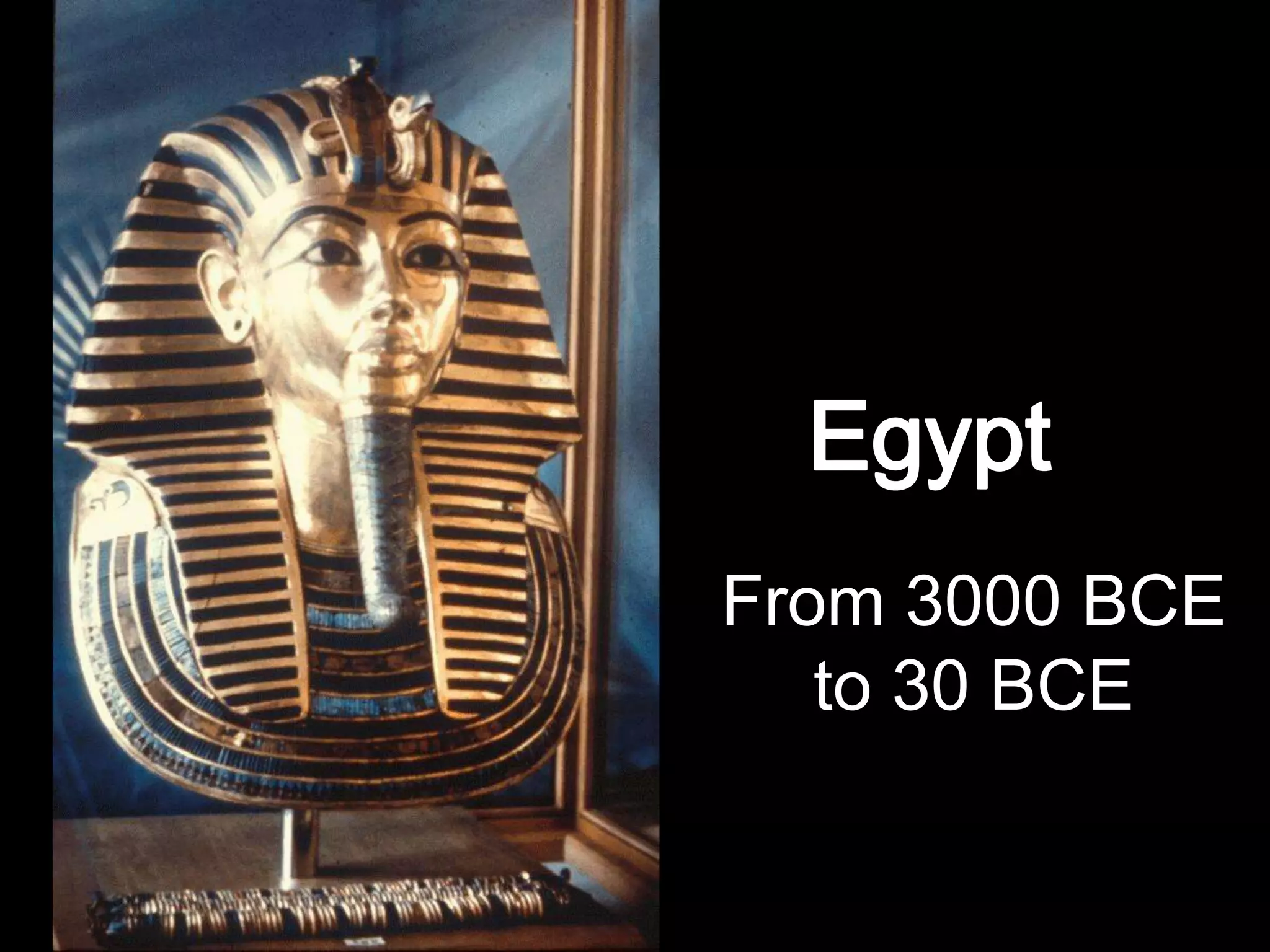
Mask of King Tutankhamen,
Valley of the Kings 1323 BCE
gold, enamel, semiprecious stones
cool and creepy
•Famous tomb discovered by Howard
Carter in 1922
•Mummified body of King Tutankhamen
buried with 143 objects on his head,
neck, abdomen, and limbs
•Gold mask placed over head
•Gold coffin 6’7” long containing body of
the King
•Golden mask has smoothly idealized
features of the boy-king
INNER COFFIN from TUTANKHAMUN'S SARCOPHAGUS
From the tomb of Tutankhamun, Valley of the Kings.
c. 1323 BCE.
Gold inlaid with glass and semiprecious stones
•SARCOPHAGUS: a stone coffin
•His tomb was never plundered = stuff in good condition
•Body inside three nested coffins
•Over 240 pounds of gold
•Decorated with colored glass and semiprecious stones
•linear designs and hieroglyphic inscriptions
•Headcloth with cobra and vulture on his forehead
•Blue braided beard
•Necklace indicates military valor
•King’s features reproduced – full lips and thin-bridged nose = continued AMARNA
•Realistic portraiture
•Became king at age 9, died at age 18 from genetic defects maybe (from incest)
JUDGMENT OF HUNEFER BEFORE OSIRIS
from a Book of the Dead. New Kingdom, c. 1285 BCE. Painted papyrus
• From Book of the Dead, an Egyptian book of spells and charms
• The god of embalming, ANUBIS, has a jackal’s head.
• Anubis leads Hu-Nefer(dead) into a hall where his soul is being weighed against a feather
• If the sin weighs more than the feather, he is condemned
• Hippo/lion figure between scales will eat the heart of an evil soul
• The god Toth has the head of a bird- the stenographer writing down these events in the
hieroglyphics he invented (Egyptian writing using symbols or pictures as characters)
• Osiris, god of underworld, appears enthroned- will put Hu-Nefer through a day of judgement
Weighing of the deceased’s heart against Maat’s
Feather of Truth
Anubis Thoth Ammit the Devourer
Same story, just another painting…
The Book
of the
Dead
We will see many more images
of souls’ judgment throughout art
history. The afterlife is a major art
theme.
16th – 11th centuries BCE,
Valley of the Kings
Initiated by Thutmose II
Valley of the Kings
• From 16th to 11th century BCE (about 500
years), tombs were constructed for the
Pharaohs and powerful nobles of the NEW
KINGDOM
• On the west bank of the Nile near Luxor
Tomb
Tomb of a Nobleman
“FAYUM Portraits”
• Very late Egyptian art
• Mummifying the dead continued into Egypt’s Roman
period
• Mummy is a “soft sculpture” with Roman-style portrait
painted on wood panel in ENCAUSTIC (hot colored
wax)
• Link Egyptian art with ancient Roman art (coming
soon!)
Mummy Wrapping of a Young Boy
Roman period 100-120 CE
Ancient Egyptian
(hieratic)
Demotic
(simplified
form of
hieratic)
Greek
ROSETTA STONE
• Created in 196 BCE, discovered in 1799 in Rosetta, Egypt deciphered in 1822
• A stele made of diorite
• Inscribed with a degree issued at Memphis in 196 BCE on behalf of King
Ptolemy V
• How it was figured out: linked some hieroglyphs to specific names in Greek
version, located the names of Ptolemy and Cleopatra in Egyptian scripts, built
an alphabet of hieroglyphs
Major Points of Egyptian Art
• Modeled to promote ideas of Stability and
Order (little variation in 3,000 years) – highly
tied to religious practice
• Monumental Architecture with Pyramids and
massive sculpture (Sphinx, Ramses II, etc.)
• Meant for Permanency – note use of stone,
mummification, tombs
• Distinctive Representation with Twisted
Perspective and Canon of Proportions for
figures in painting and relief sculpture
• Architecture designed and executed by highly
skilled craftsmen and artisans (not slaves)
• Mummification became a national industry,
handled by embalming experts who were paid
well
• Imhotep = history’s first artist on record
• He supervised work under his direction
• Artists were likely ordained high priests of Ptah,
the god who created the world in Egyptian
mythology
Egypt Test Material:
• General understanding of Egyptian art styles, methods, purposes, and
subject matter
• General understanding of styles and themes from each kingdom
ART:
-Palette of Narmer
-Ti Watching a Hippopotamus Hunt
-Seated Scribe
-Menkaure and a Queen
Vocabulary:
• Sarcophagus
• In Situ
• Mastaba
• Necropolis
• Reserve Column
• Amarna Style
• Engaged Column
• Pharaoh
• Papyrus
• Hieroglyphics
• Hierarchy of Scale
• Hypostyle
• Ka
• Pylon

Ancient Egypt: Chapter 3 PowerPoint

  • 1.
  • 2.
    Important Artistic Periods: OldKingdom 2575 – 2134 BCE Middle Kingdom2040 – 1640 BCE New Kingdom 1550 – 1070 BCE
  • 7.
    Egyptian Key Ideas •Egyptian art spans 3000 years • Elaborate funerary practices = built MASTABAS, PYRAMIDS, and rock-cut TOMBS in sacred imperial areas of Egypt • Egyptian figures: broad frontal shoulders with head, torso, and legs in profile • Old Kingdom figures: rigid stance and little facial expression • Middle Kingdom figures: more relaxed body and emotional faces • New Kingdom figures: rounded and elongated figures
  • 8.
    Key ideas continued… •Order and Stability – a conservative formula of representation. • Worship the Pharaoh as a divine being who establishes Ma’at (balance) between the human world and the gods (a polytheistic religion- multiple gods). • Egyptians have methods of transmitting knowledge and ideas through centuries and millennia.
  • 9.
    • Media: stone,paint, gold + gems, and papyrus (a tall aquatic plant whose fiber is used as a writing surface) • Most of our resources come from tombs where the treasures were held as items for passage of the dead. • Egyptians established the temple format with columns that will be copied and transformed by the Greeks and Romans. Key ideas continued…
  • 10.
    Old Kingdom (begins withthe unification of the country under King Narmer) c. 2575 – 2134 BCE Information and Major Works to follow…..
  • 11.
    So how didthey celebrate the unification of the country under the rule of King Narmer?
  • 13.
    Palette of Narmer c.3000 – 2920 BCE Ringing any bells?
  • 14.
    Palette of Narmer c.3000 – 2920 BCESimilarities? Differences?
  • 15.
  • 16.
    Nar – fish Mer– chisel Narmer Perhaps the King Menes? (close-up of the palette top)
  • 17.
    • Relief sculptureshowing King Narmer uniting Upper and Lower Egypt • Figures stand on ground line • Hierarchy of scale • Palette used to prepare eye makeup for the blinding sun, but this one was probably commemorative or ceremonial • Hieroglyphics explain and add to the meaning. It’s a NARRATIVE Use of REGISTERSto relate and separate information IDEALIZEDdepiction of figures and events Low Relief sculpture
  • 18.
    FRONT: • Narmer islargest (hierarchy of scale) • Wears cobra crown of lower Egypt • Reviewing beheaded enemies • Bodies seen from above with heads between legs • Narmer preceded by four standard bearers and a priest and followed by his foot washer and sandal bearer • Harnessed lionesses w/ long necks (symbolizes unification) • Bull knocking down city fortress (symbolizes Narmer knocking over his enemies)
  • 19.
    Close-up of Narmerand his servants.
  • 20.
    BACK: • Hawk ofHorus (god of Egypt) triumphs over Narmer’s foes • Horus holds a rope around a man’s head and a papyrus plant (symbols of Lower Egypt) • Bull’s tail at Narmer’s waist (strength) • Bowling pin-shaped crown (symbol of united Egypt) • Narmer is beating down an enemy. • Servant holds Narmer’s sandals because he stands on the sacred ground as a divine king. • Defeated Egyptians lie beneath his feet. • Lines show his muscles, half-circles for kneecaps. The god Hathor (cow w/ woman’s face) is at the top four times (two on each side of the palette. servant
  • 21.
    Close-up look atNarmer being powerful!
  • 22.
    Maybe this drawingmakes it easier to see?
  • 23.
    PYRAMIDS OF THEOLD KINGDOM -massive monuments to the dead
  • 24.
    At first, thedead were buried in MASTABAS (Arabic for “bench”, a low, flat-roofed tomb with sloping sides down to the ground and an entrance for mourners to bring offerings to the deceased). The body was buried in an inaccessible area that only the spirit could enter. Later, larger monuments were built – MASTABAS stacked on top of each other like a wedding cake until a pyramid was achieved.
  • 25.
  • 26.
  • 27.
    Step Pyramid ofDjoser, built by Imhotep (first known artist in history!) c. 2630 BCE, Saqqara, Egypt
  • 28.
    Remind you ofanything?
  • 30.
    • Constructed entirelyof stone (the whole complex of buildings) • Six unequal steps, like a giant staircase to the heavens • Looks like a stack of MASTABAS • Burial is below ground. Pyramid is solid. • PYRAMID is part of a large burial area called a NECROPOLIS (“City of the dead”) • PYRAMIDS were never built alone-always part of a NECROPOLIS • NECROPOLISES were dedicated to the worship of the spirits of the dead and the preservation of a person’s soul (ka)
  • 31.
    Must have beencool in person!
  • 33.
  • 35.
    Collasped Meidum Pyramid,First Trial by Snefru in 2600 B.C. 306 ft Another pyramid attempt….
  • 36.
    Sneferu’s Bent Pyramid,c. 2596 BCE Yet another pyramid attempt
  • 37.
    Sneferu’s Red Pyramid,c. 2590 BCE Getting closer….
  • 38.
    Great Pyramids atGiza – from c. 2500 BCE, granite and limestone They got it right!
  • 39.
    • Giant monumentsto dead pharaohs (kings of ancient Egypt) • Each pyramid has a mortuary temple attached • Minimal interior for the dead • Pharaoh buried within (unlike stepped pyramid, in which they are buried underneath) • Each side is oriented toward a point on the compass • The site was planned to follow the sun’s east-west path • Huge labor force to build these (big workers’ burial ground discovered) • Each block weighs about 2.5 tons (quarried on site or nearby) • Used sheer muscle power, small logs as rollers, poured water on sand to make it slippery and drag blocks • Angled sides may represent slanting rays of sun • Inscriptions on walls say dead kings climbed up the rays to join the sun god Ra • Built by kings in this order: Khufu, Khafre, and Menkaure • These kings wanted to commemorate themselves as divine beings • All three used to have an outer layer of white limestone
  • 41.
    How did theybuild these? Theories: • They built a temporary, gently sloping ramp around the pyramid as it got higher • They took apart the ramp after the stones were smoothed and the limestone veneer was added. • Architects- sophisticated mathematics • Huge foundation layer had to be totally level and the angle of each side had to be perfect so the stones would meet precisely in the center at the top.
  • 43.
  • 46.
    In the southernsky during the Forth Dynasty, a vertical alignment due south of three stars and the Orion nebula in the large distinctive constellation of Orion may have been noticed and generated sufficient interest that the ancient Egyptians aligned their pyramids to it, perhaps to create a link with this constellation, or they recognized this vertical alignment as a useful and accurate marker for due south.
  • 47.
    Great Sphinx, c.2500 BCE, Giza, Egypt, limestone
  • 49.
    Digging up theSphinx in the 1870’s
  • 50.
    • Very generalizedfeatures, but might be a portrait of Khafre • Carved from one huge rock • Symbol of the sun god • Body of a lion, head of pharaoh and/or god • Seems to protect pyramids behind it • Originally brightly painted Cats are royal animals in ancient Egypt, probably because they saved the grain supply from mice! Head of Sphinx badly damaged in Middle Ages Beard of Sphinx is separate (at the British Museum) 241 ftlong, 63 ftwide, 6.34 ft high Largest MONOLITH statue in the world
  • 51.
    Guess what’s acrossthe street? Smolinski tip: go to Giza!
  • 52.
    Egyptian Architecture MainPoints: •Sleek, solid surfaces of pyramids •Monumental scale •Pyramids built without mortar •No one went in once the dead were put in (sealed the pyramids) •Believed that the dead could be reenergized after death and ascent to the heavens •Temples have astronomical orientation
  • 53.
    Egyptian Sculpture MainPoints: •Range in size- tiny jewelry to massive stone sculptures •Sculptures of pharaohs are meant to impress and overwhelm •Individualization and sophistication are sacrificed for monumentality and grandeur •Limestone, sandstone, gypsum used (easy to carve) •Wooden sculptures are painted •Copper and iron also used •Sculpture carved on site = “in situ”- carved from local available rock (Great Sphinx) •Relief sculptures follow a formula. •Outdoor relief: Cut into rocks to show shadows dramatically •Indoor relief: relief is raised from surface for visibility in a dark interior
  • 54.
    KHAFRE c. 2500 BCE,anorthosite gneiss (similar to diorite), height 5'6 1/8" •One of many portraits he commissioned of himself •Elegant but simple throne •Idealized body and features •Falcon god Horus is behind Khafre’s head, protecting him •Khafre is an incarnation of Horus •Pharaoh divinely appointed •Symbol of a united Egypt in the interlocking of lotus and papyrus plants at the base •Lions (regal authority) form the throne’s legs •In traditional royal costume (pleated kilt, linen headdress, cobra symbol of Ra, false beard (royalty) •Frontal, symmetrical, rigid, motionless, cubic •Dignity, calm, and permanence •Figure not cut away from the stone- arms and legs attached, no negative space •Strict adherence to Egyptian canon of proportions. •Stone glows deep blue in sunlight
  • 55.
    MENKAURE AND AQUEEN, PROBABLY KHAMERERNEBTY II From Giza. Fourth Dynasty, 2490-2472 BCE. Graywacke with traces of red and black paint, height 54 1/2“, Museum of Fine Arts, Boston. -Dignity, calm, permanence -Discovered in Menkaure’s valley temple -Single unit- figures attached to block of stone, arms and legs not cut free -United by queen’s symbolic gesture of embrace -Figures stare out into space -Menkaure’s powerful physique and stride = kingship -His fists are clenched over cylindrical objects. -Queen takes a small step forward = mimics his pose -Society’s view of women: Her sheer, tight clothes reveal shape of her body -Men and women the same height = indicated equality -Unfinished in some areas (done right before his death?) -Red paint remains (male statues usually painted red)
  • 56.
    King Mycerinus (Menkaure) C2500 BCE •Sculpted triad (3-person statue) shows King Menkaure between two women •Goddess Hathor is on the left •Personification of Cynopolis, nome of Upper Egypt, is on the right •He wears crown of Upper Egypt •False beard •Short pleated kilt •Holds two cylindrical objects •Women wear tight dresses and wigs •Hathor has her typical crown with sun disk and cow horns •Nome has jakal, symbol of her nome •Nome= an administrative division within ancient Egypt.
  • 57.
    Representations of thePharaoh • Order and Stability – a conservative formula of representation • Worship of the Pharaoh as a divine being who establishes Ma’at or (balance) between the human world and that of the gods • An effective formula for transmitting knowledge and ideas through centuries and millenia
  • 58.
    SEATED SCRIBE Found nearthe tomb of Kai, Saqqara. 2400 BCE. Painted limestone with inlaid eyes of rock crystal, calcite, and magnesite mounted in copper, height 21" See him at the Louvre in Paris!
  • 59.
  • 60.
    How is hedifferent than the other male statues?
  • 61.
    Seated Scribe • Createdfor a tomb at Saqqara as a provision for the ka • Not a pharaoh: sagging chest and realistic rather than idealistic features • Sedentary job = flabby • Flabby = no physical labor! • Color remains! • Amazingly lifelike, but not a portrait (a conventional image of a scribe) • Attentive expression, thin, angular face • Contrasts with ideally portrayed pharoah • Less formal than royal portraits • Cap of close-cropped hair • Holds papyrus paper scroll and pen (lost)
  • 62.
    Rahotep and Nofret paintedlimestone, Old Kingdom, c. 2620 BCE •Idealized portraits •Faces of the statues express solemness and self-assuredness •Found in fancy mastaba = high rank •Portraits of the two deceased in the mastaba (husband and wife)
  • 63.
    part of herreal hair is painted on forehead to show she’s wearing a wig
  • 64.
    • Well preserved-mastabas sealed until discovery • Look freshly painted today • Rahotep has short black hair, trimmed moustache, necklace with heart amulet • Short white kilt, horizontal arm • Hieroglyphics on chair give his name and titles • Nofret: shoulder-length wig • Circlet with flower decoration around her head • Elegant long white gown, elaborate collar • Arms folded across chest
  • 65.
    • Rahotep: reddish-brown,Nofret: creamy white • Color difference between husband and wife is “canonical” in Egyptian art • CANONICAL = scholars don’t understand it, but it’s true • Painted colors aren’t their true colors in real life • Both have lifelike inlaid eyes of crystal (scared people who discovered them!)
  • 66.
    TI WATCHING AHIPPOPOTAMUS HUNT Tomb of Ti, Saqqara, Egypt c. 2400 BCE. Painted limestone relief, height approx. 45“ • Painted relief in the mastaba of Ti, a government official • Boat glides through gigantic papyri, which flower into a fan of birds and foxes (papyrus = symbol of rebirth) • Hunt takes place as a memorial to the deceased • Success in the hunt = fight against evil • Servants hunt as a tribute to deceased Ti, and also to destroy animals like hippos, which damaged crops and were considered agents of the god of darkness (Seth) • Ti stands on (not in) boat, he’s double anyone else’s size = shows status • Boat symbolizes journey to afterlife • River as if seen from above- band of parallel wavy lines below boat. • Fish, hippo, crocodile seen in profile
  • 67.
    • Egyptians believedthat superhuman forces were always at work and needed constant worship • Funerary art- things that were buried last forever and this life must continue uninterrupted into the next world = artists represented the human figure as completely as possible • Egyptian CANON OF PROPORTIONS – little individuality • Let’s take a look….
  • 68.
    Twisted Perspective and TheCanon of Proportions based on a grid
  • 69.
    TWISTED PERSPECTIVE • Posesimpossible in real life • Memory images (generic forms) • Represent each part of the body from its most characteristic angel • Heads in profile • Eyes frontal • Profile head, hips, and legs with frontal torso in between • Usually striding to show both legs • People of lower rank depicted more realistically
  • 71.
    Canon of Proportions •Ratios between height and components were clearly prescribed • Calculated das multiples of a specific measure, such as the width of the closed fist • This unit became the basis of a square grid- OLD KINGDOM STANDARD GRID • Every body part had a designated place • Example- the knees are X number of squares below the waist, etc.
  • 74.
    • Figures reston horizon line • If they are above the line, they are thought to be receding into the distance • Artists placed a grid over the areas to be painted and outlined the figures accordingly • Unfinished figure = incomplete existence in afterlife, oh no! • Even animals drawn as completely as possible • These rules change a bit in the AMARNA PERIOD (more about that later)
  • 76.
    Old Kingdom Summary: •Age of Pyramids • Canon of Proportions established • Twisted Perspective • Relationship between artworks and afterlife established • Role and status of the Pharaoh established
  • 77.
    Middle Kingdom c. 2040– 1640 BCE • Collapse of Old Kingdom • 150 years of political turmoil • After a period of anarchy, Mentihotep II unified Egypt for a second time in a period called the MIDDLE KINGDOM • Arts and writing flourished – reflected awareness of political problems • Pyramids abandoned in favor of smaller and less expensive rock-cut tombs
  • 78.
    ROCK-CUT TOMBS, BENIHASAN Twelfth Dynasty, 1950-1900 BCE • Cliff walls hollowed out to reveal small burial chambers • Reserve columns cut away from the rock to create the look of conventional columns, but don’t add support • Columns are not round but fluted • Façade shows shallow columned porch • Included an entrance portico, main hall, and shrine with burial chamber under the offering chapel • Tombs had practical stuff (food, clothing, furniture) and reliefs, paintings, and other objects to ensure safety and well being in afterlife -Rock-cut tombs excavated in the faces of cliffs -Chambers, ornamental columns, lintels, false doors, and niches all carved out of solid rock
  • 80.
    STELE OF AMENEMHAT FromAssasif. Middle Kingdom, c. 2000 BCE. Painted limestone, 11" × 15" • Shoulders seen frontally • Rest of body, except the eye, is turned in profile • Sometimes heads and legs face different directions • Men are taller than women and are pained ruddy brown or red • Women are shorter and painted yellowish. Shading is rare. • Represent successful men and women acting calm and rational • Violence and disorder- only in scenes of animal slaughtering/sacrifices, or overthrowing the forces of evil • Contentment and stability Twisted perspective and grids were still used in the Middle Kingdom….
  • 81.
  • 82.
    SENUSRET III c. 1860BCE • Moody look in the eyes and mouth • Depressed, rather than heroic figures seen in Old Kingdom • Figures in Middle Kingdom reflect period of unrest • Introspective • Firm chin • Carefully delineated lines and folds of flesh between the brows and at the corners of the nose and mouth
  • 83.
    “When thou liestdown have care for thy very life, since friends exist not for a man in the day of misfortunes.” -advice from Amenemhat I (great- great-grandfather of Senusret III)
  • 84.
    SenusretIII. Middle Kingdom, circa1836-1818 BCE Black granite
  • 85.
    Sphinx of SenrusretIII,c. 1878–1841 B.C.E.; Middle Kingdom
  • 86.
    Connection with OldKingdom Sphinx is popular throughout Egyptian art history
  • 87.
    Winged sphinx fromthe palace of Darius the Great during Persian Empire at Susa (480 BC). Ancient Greek sphinx from Delphi
  • 88.
    Faience Hippo, MiddleKingdom c. 1900 BCE • Has all characteristics of a real hippo • Rotund body on stubby legs • Massive head with protruding eyes, tiny ears, big nostrils • Example of FAIENCE: glass paste is fired to produce a smooth and shiny opaque finish • Watery blue like habitat • Lotus blossom decoration • Decoration = he’s standing in a tangle of water plants • Could be a symbol of fertility (goddess Taweret had a hippo head) in a woman’s tomb • Could be a symbol of evil in a man’s tomb (like in the hippo hunt imagery)
  • 89.
    NEW KINGDOM 1550-1070 BCE •Anarchy after Middle Kingdom breakdown • Invaders from Asia brought new ideas/technology • Eventually, Egypt got back on track politically, kicked out the invaders, and began the New Kingdom • New Kingdom = a period of unparalleled splendor! • New Kingdom art is characterized by rounded and elongated figures • New Kingdom pharaoh, AKHENATON, changed Egypt by abandoning worship of many gods to just ONE god, “Aton” • AKHENATON = Aton’s representative on earth • Aton is represented as a sun disk emanating rays (instead of gods that were human and/or animal symbols) • New religion brought about new artistic style: AMARNA PERIOD • Temples continued to be built into the sides of rock formations…
  • 90.
    Mortuary Temple ofQueen Hatshepsut, Deir al-Bahrric 1473-1458 BCE, Deir el-Bahri, Egypt
  • 93.
    • 3 colonnadedterraces and 2 ramps • Visually coordinated with the natural setting • Long horizontals and verticals of the terraces and colonnades repeat the patterns of the cliffs behind • Patterns of dark and light in the colonnade are reflected in the cliffs • Terraces were originally planted as gardens with exotic trees • First time achievements of a woman are celebrated in art history! • Hatshepsut is buried elsewhere (in the Valley of the Kings) • Open garden spaces and grand architecture • Imposing image of authority • Union of nature and architecture • Different levels of contrasting textures (water, stone columns, trees, cliffs = impressive!
  • 94.
    Queen Hatshepsut c. 1473-1458BCE Granite At the Met Museum in NYC! • Queen represented in male costume of a pharaoh, yet slender proportions and slight breasts indicate femininity • She’s often portrayed as a sphinx • Headdress, false beard, and traces of the cobra on the crown show her affinity with male pharaoh role • Represented in all the ways a male ruler would be • About 200 sculptures of her exist, but many were damaged (smashed by her successor Thutmose III maybe?) • Bull’s tail hanging from her waist (you can see it between her legs) • Mother = Queen Ahmose • Father = the god Amun
  • 95.
  • 96.
    Sphinx of Hatshepsutc. 1479-1458, Granite
  • 97.
    One of twoobelisks to escape her stepson's plan to obliterate her memory, this obelisk was built by Queen Hatshepsut. (1473 -1458 BCE). • 97 feet tall • Inscription at base indicates that the work of cutting the monolith out of the quarry required seven months of labor. The Egyptian obelisks were always carved from single pieces of stone, usually pink granite from the distant quarries at Aswan, but exactly how they were transported hundreds of miles and then erected remains a mystery.
  • 98.
    One of twoobelisks to escape her stepson's plan to obliterate her memory, this obelisk was built by Queen Hatshepsut. Obelisks of Hatshepsut The use of the obelisks is even more of a mystery than their carving and construction. While the obelisks are usually covered with inscriptions, these offer no clue to their function, but are instead commemorative notations indicating when and by whom the obelisk was carved.
  • 99.
    TEMPLE OF RAMSESII Abu Simbel, Egypt. c. 1290-1224 BCE.
  • 100.
    • Resembles aPYLON(monumental gateway to a temple marked by two flat, sloping walls between which is a smaller entrance) • Huge seated quartet of statues of Ramses on the façade (front), carved “in situ” • Sun god placed over the entrance • Façade used to be brightly painted • Interior sculptures of Ramses too • Interior stretches 200 feet into mountain Sun god
  • 101.
  • 103.
  • 104.
    This relief isa listing of Ramses II’s various names.
  • 105.
    SCHEMATIC DRAWING OFTHE TEMPLE OF RAMSES II
  • 106.
    Temple of RamsesII Nefertari’s Temple (Ramses’s wife)
  • 107.
    • Standing statuesof Nefertari are about the same size as Ramses. • She’s holding a sistrum(musical instrument) • Wears long sheet dress, very thin to show her body • Has long wig • Solar disk and tall feathers on her head dress. • Interior scenes show Nefertari making offerings to the gods. Nefertari’s Temple Detail of picture on right
  • 108.
    • The twotemples together honor the official gods of Egypt and Ramses II dynasty • Oriented so their axis crossed in the middle of the Nile (associated with annual life- giving flood?)
  • 109.
    Egyptian Temples Established thetemple format with columns that will be copied and transformed by the Greeks and Romans.
  • 110.
    Great Temple ofAmen-Re (Amun) at Karnak, Egypt. 1290-1224 BCE
  • 113.
  • 114.
    •Amun temple renovatedand expanded over 500 years of the New Kingdom •About 60 acres! •Huge columns, tightly packed together, admitting little light into the sanctuary •Columns were elaborately painted •Massive lintels bind columns together •Columns in New Kingdom were based on plant shapes: lotus, palm, and papyrus
  • 115.
    Papyrus Lotus Palm top of thecolumn is a “CAPITAL” LOTUS PAPYRUS ENGAGED COLUMN: a column that is not freestanding. It is attached to a wall Freestanding Columns
  • 118.
    Flower and budcolumns, Hypostyle Hall, Great Temple of Amun at Karnak •HYPOSTYLE = a hall in an Egyptian temple that has a roof supported by a dense thicket of columns •This hall may have been used for royal coronation ceremonies. •Ramses II called it “the place where the common people extol the name of his majesty” •134 closely-spaced columns supported roof of flat stones in steps (top step is 30 feet above bottom step) •Massive columns (66 feet) •Long row of window openings in center section (clerestory). Provided air flow through hall •Most surfaces covered in relief carvings
  • 119.
    After the Templefell into disuse with the end of the Pharonic period, it was reused during the Christian period as a church. Those circular smudg-y things with halos are saints painted during the 4th century.
  • 121.
    The interesting partof this picture is the screen in the middle. It's part of the original architecture of the Temple and was built to allow light and air into what would otherwise be an oppresive place.
  • 123.
    •Huge statues inside •Hugestone statue of the god Khepri (scarab beetle) •Priests washed and clothed the statue every morning. •Gave it meals (then at the meals themselves) •Inscriptions and images of kings and god on columns and walls Khepri statue: symbolic of rising sun, rebirth, and everlasting life
  • 124.
    A very largestatue (as in, I come up to half way up the base) of Ramses II with Nefertiti perched on his feet.Ramses II with Nefertari
  • 126.
    Luxor Luxor Templecomplex East bankof Nile River 1400 BCE Six great temples in the complex Used by Romans in the future (government homes and fortresses
  • 127.
  • 131.
  • 132.
    What is AMARNASTYLE? •Flourished during reign of King Akhenaten and his wife Nefertiti •Akhenaten believed in MAAT (divine truth)- “living the maat” •Concern for truth = new artistic conventions •Portraits of the king emphasize his unusual physical characteristics •Told artists to portray his family in informal situations
  • 133.
    Akhenaton, c. 1353-1335BCE sandstone, Egyptian Museum, Cairo •Body has same pose as in Old Kingdom sculptures, but features are smoother and more relaxed = new image of a pharaoh •Curving contours •Long face, relaxed mouth •Heavy-lidded eyes •Tight clothes accentuate big hips •Stomach protrudes over elastic, hanging waistline •Thin arms •AMARNA STYLE
  • 134.
  • 135.
    Queen Nefertit 1365BCE -- Berlin
  • 136.
    •Long elegant neck •Realisticface •Soft, delicate New Kingdom features •Might have been a demonstration model for copying •Wife of Akhenaton •AMARNA STYLE
  • 137.
    How is theAMARNA STYLE different than the style in the Old and Middle Kingdoms?
  • 139.
    AKHENATEN AND HISFAMILY From Akhetaten (present-day Tell el-Amarna). c. 1353-1336 BCE. Painted limestone relief, 12- 1/4" × 15-1/4” •painted relief sculpture •Akhenaten, Nefertiti, and three of their daughters •example of new openness and new figural style •sunken relief (outlines of figures are carved into surface instead of carving out background to make figures pop out) •King and queen on cushioned thrones playing with their kids •Base of queen’s throne has plant symbols of unified Egypt. This might mean she was a co-ruler. •Royal couple gets blessings from Aten- rays end in hands and give them “breath of life” •Hieroglyphics around them
  • 140.
    •Children are nude,shaved heads (custom of the time) •Oldest (on lap) has side-lock of youth (patch of hair on side of head in braid) •Engaging behavior of kids, loving concern of parents, awww.
  • 141.
  • 142.
    Monotheism with thesole god Aten – a radical change in religious worship and practice Radical change in sculptural representation
  • 143.
    Queen Tiy, NewKingdom, c. 1352 BCE, ArmanaStyle • Tiy = Akhenaten’s mother • Personality captured • Exquisite bone structure, dark skin, arched brows, pouting lips Pectoral of Senusrut II, New Kingdom, c. 1938-1755 BCE, gold and semiprecious stones • Pectoral = chest ornament • Horus falcons perch at base • Coiled cobras = symbols of Ra • Ankh (symbol of life) • CARTOUCHE (oval formed by a loop of rope) with hieroglyphics of the king’s name • Sun disk of Ra, scarab beetle • “May the sun god give eternal life to
  • 144.
    Mask of KingTutankhamen, Valley of the Kings 1323 BCE gold, enamel, semiprecious stones
  • 145.
    cool and creepy •Famoustomb discovered by Howard Carter in 1922 •Mummified body of King Tutankhamen buried with 143 objects on his head, neck, abdomen, and limbs •Gold mask placed over head •Gold coffin 6’7” long containing body of the King •Golden mask has smoothly idealized features of the boy-king
  • 146.
    INNER COFFIN fromTUTANKHAMUN'S SARCOPHAGUS From the tomb of Tutankhamun, Valley of the Kings. c. 1323 BCE. Gold inlaid with glass and semiprecious stones •SARCOPHAGUS: a stone coffin •His tomb was never plundered = stuff in good condition •Body inside three nested coffins •Over 240 pounds of gold •Decorated with colored glass and semiprecious stones •linear designs and hieroglyphic inscriptions •Headcloth with cobra and vulture on his forehead •Blue braided beard •Necklace indicates military valor •King’s features reproduced – full lips and thin-bridged nose = continued AMARNA •Realistic portraiture •Became king at age 9, died at age 18 from genetic defects maybe (from incest)
  • 147.
    JUDGMENT OF HUNEFERBEFORE OSIRIS from a Book of the Dead. New Kingdom, c. 1285 BCE. Painted papyrus • From Book of the Dead, an Egyptian book of spells and charms • The god of embalming, ANUBIS, has a jackal’s head. • Anubis leads Hu-Nefer(dead) into a hall where his soul is being weighed against a feather • If the sin weighs more than the feather, he is condemned • Hippo/lion figure between scales will eat the heart of an evil soul • The god Toth has the head of a bird- the stenographer writing down these events in the hieroglyphics he invented (Egyptian writing using symbols or pictures as characters) • Osiris, god of underworld, appears enthroned- will put Hu-Nefer through a day of judgement
  • 148.
    Weighing of thedeceased’s heart against Maat’s Feather of Truth Anubis Thoth Ammit the Devourer Same story, just another painting…
  • 149.
  • 151.
    We will seemany more images of souls’ judgment throughout art history. The afterlife is a major art theme.
  • 153.
    16th – 11thcenturies BCE, Valley of the Kings Initiated by Thutmose II
  • 154.
    Valley of theKings • From 16th to 11th century BCE (about 500 years), tombs were constructed for the Pharaohs and powerful nobles of the NEW KINGDOM • On the west bank of the Nile near Luxor
  • 158.
  • 160.
    Tomb of aNobleman
  • 161.
    “FAYUM Portraits” • Verylate Egyptian art • Mummifying the dead continued into Egypt’s Roman period • Mummy is a “soft sculpture” with Roman-style portrait painted on wood panel in ENCAUSTIC (hot colored wax) • Link Egyptian art with ancient Roman art (coming soon!) Mummy Wrapping of a Young Boy Roman period 100-120 CE
  • 162.
    Ancient Egyptian (hieratic) Demotic (simplified form of hieratic) Greek ROSETTASTONE • Created in 196 BCE, discovered in 1799 in Rosetta, Egypt deciphered in 1822 • A stele made of diorite • Inscribed with a degree issued at Memphis in 196 BCE on behalf of King Ptolemy V • How it was figured out: linked some hieroglyphs to specific names in Greek version, located the names of Ptolemy and Cleopatra in Egyptian scripts, built an alphabet of hieroglyphs
  • 163.
    Major Points ofEgyptian Art • Modeled to promote ideas of Stability and Order (little variation in 3,000 years) – highly tied to religious practice • Monumental Architecture with Pyramids and massive sculpture (Sphinx, Ramses II, etc.) • Meant for Permanency – note use of stone, mummification, tombs • Distinctive Representation with Twisted Perspective and Canon of Proportions for figures in painting and relief sculpture
  • 164.
    • Architecture designedand executed by highly skilled craftsmen and artisans (not slaves) • Mummification became a national industry, handled by embalming experts who were paid well • Imhotep = history’s first artist on record • He supervised work under his direction • Artists were likely ordained high priests of Ptah, the god who created the world in Egyptian mythology
  • 165.
    Egypt Test Material: •General understanding of Egyptian art styles, methods, purposes, and subject matter • General understanding of styles and themes from each kingdom ART: -Palette of Narmer -Ti Watching a Hippopotamus Hunt -Seated Scribe -Menkaure and a Queen Vocabulary: • Sarcophagus • In Situ • Mastaba • Necropolis • Reserve Column • Amarna Style • Engaged Column • Pharaoh • Papyrus • Hieroglyphics • Hierarchy of Scale • Hypostyle • Ka • Pylon

Editor's Notes

  • #26 ELEMENTS OF ARCHITECTURE: Mastaba to Pyramid.
  • #27 ELEMENTS OF ARCHITECTURE: Mastaba to Pyramid.
  • #41 ELEMENTS OF ARCHITECTURE: Mastaba to Pyramid.
  • #55 KHAFREGiza, valley temple of Khafre. Fourth Dynasty, c. 2520-2494 BCE.Diorite-gabbro gneiss, height 5'6 1/8" (1.68 m).Egyptian Museum, Cairo. (JE 10062 = CG 14). [Fig. 03-08]
  • #56 MENKAURE AND A QUEEN, PROBABLY KHAMERERNEBTY IIFrom Giza. Fourth Dynasty, 2490-2472 BCE.Graywacke with traces of red and black paint, height 54 1/2" (142.3 cm).Museum of Fine Arts, Boston. Harvard University-Museum of Fine Arts Expedition. (11.1738). [Fig. 03-09]
  • #59 SEATED SCRIBEFound near the tomb of Kai, Saqqara. Fifth Dynasty, c. 2450-2325 BCE.Painted limestone with inlaid eyes of rock crystal, calcite, and magnesite mounted in copper, height 21" (53 cm). Mus√©e du Louvre, Paris. (N 2290 = E 3023). [Fig. 03-10]
  • #67 TI WATCHING A HIPPOPOTAMUS HUNTTomb of Ti, Saqqara. Fifth Dynasty, c. 2450-2325 BCE.Painted limestone relief, height approx. 45" (114.3 cm). [Fig. 03-12]
  • #79 ROCK-CUT TOMBS, BENI HASANTwelfth Dynasty, 1938-1756 BCE. [Fig. 03-14]
  • #81 STELE OF AMENEMHATFrom Assasif. Late Eleventh Dynasty, c. 2000 BCE.Painted limestone, 11" × 15" (30 × 50 cm).Egyptian Museum, Cairo. (JE 45626). [Fig. 03-17]
  • #100 TEMPLE OF RAMSES IIAbu Simbel. Nineteenth Dynasty, c. 1279-1213 BCE. [Fig. 03-30]
  • #106 SCHEMATIC DRAWING OF THE TEMPLE OF RAMSES IIAbu Simbel. [Fig. 03-31]
  • #140 AKHENATEN AND HIS FAMILYFrom Akhetaten (present-day Tell el-Amarna). Eighteenth Dynasty, c. 1353-1336 BCE. Painted limestone relief, 12-1/4" × 15-1/4" (31.1 × 38.7 cm).Staatliche Museen zu Berlin, Preussischer Kulturbesitz, Ăgyptisches Museum. (14145). [Fig. 03-26]
  • #147 INNER COFFIN from TUTANKHAMUN'S SARCOPHAGUSFrom the tomb of Tutankhamun, Valley of the Kings.Eighteenth Dynasty, c. 1332-1322 BCE.Gold inlaid with glass and semiprecious stones, height 6' 7/8" (1.85 m), weight nearly 243 pounds (110.4 kg). Egyptian Museum, Cairo. (JE 60671) [Fig. 03-29]
  • #148 JUDGMENT OF HUNEFER BEFORE OSIRISIllustration from a Book of the Dead. Nineteenth Dynasty, c. 1285 BCE.Painted papyrus, height 15-5/8" (39.8 cm).British Museum, London. (EA 9901). [Fig. 03-35]