Analysis of Biogas
Production from
Food Waste
TURNING TRASH TO TREASURE
Turning Trash into Treasure:
Biogas Production from Food
Waste
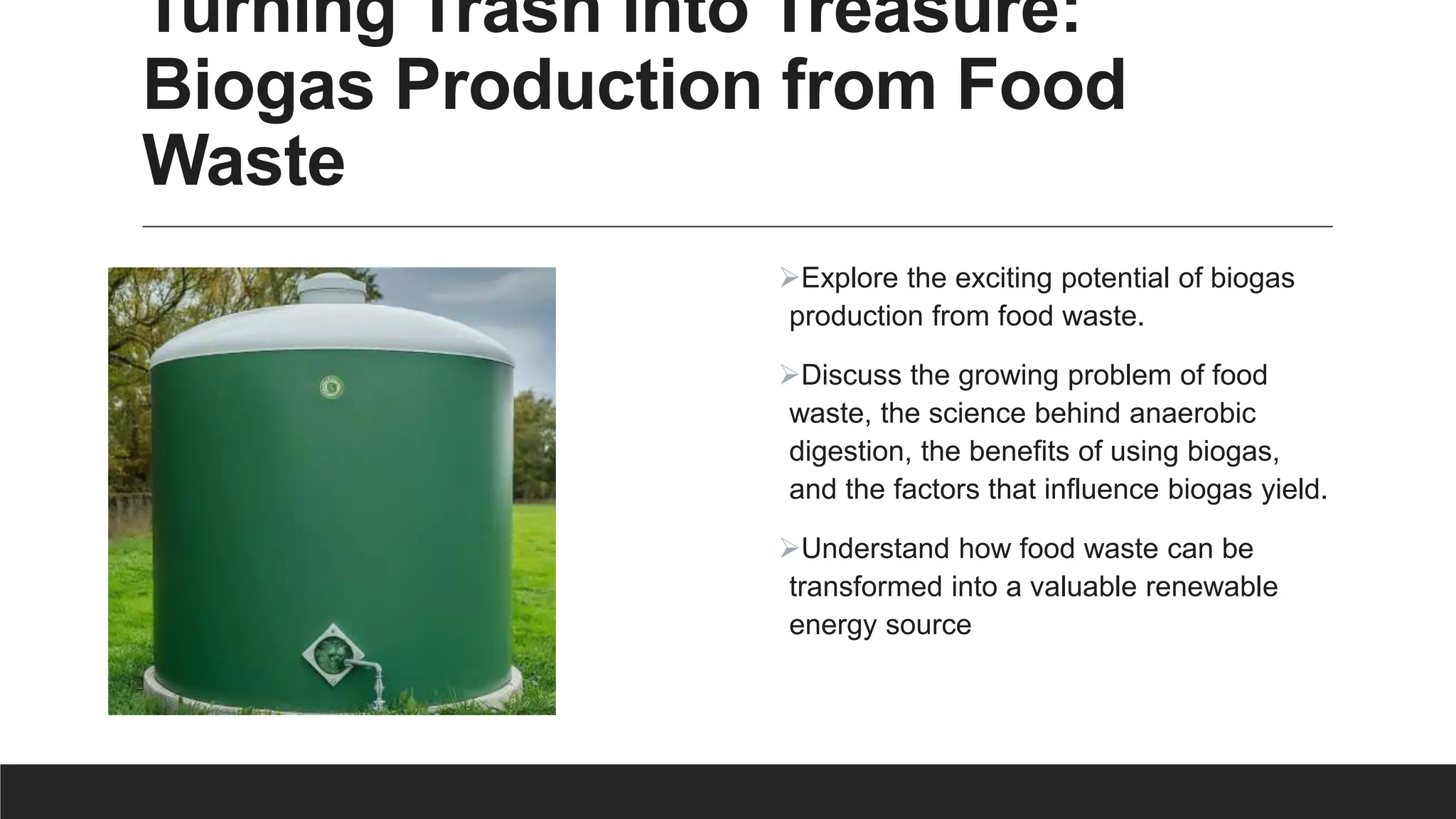
Explore the exciting potential of biogas
production from food waste.
Discuss the growing problem of food
waste, the science behind anaerobic
digestion, the benefits of using biogas,
and the factors that influence biogas yield.
Understand how food waste can be
transformed into a valuable renewable
energy source
The Global Food Waste Crisis
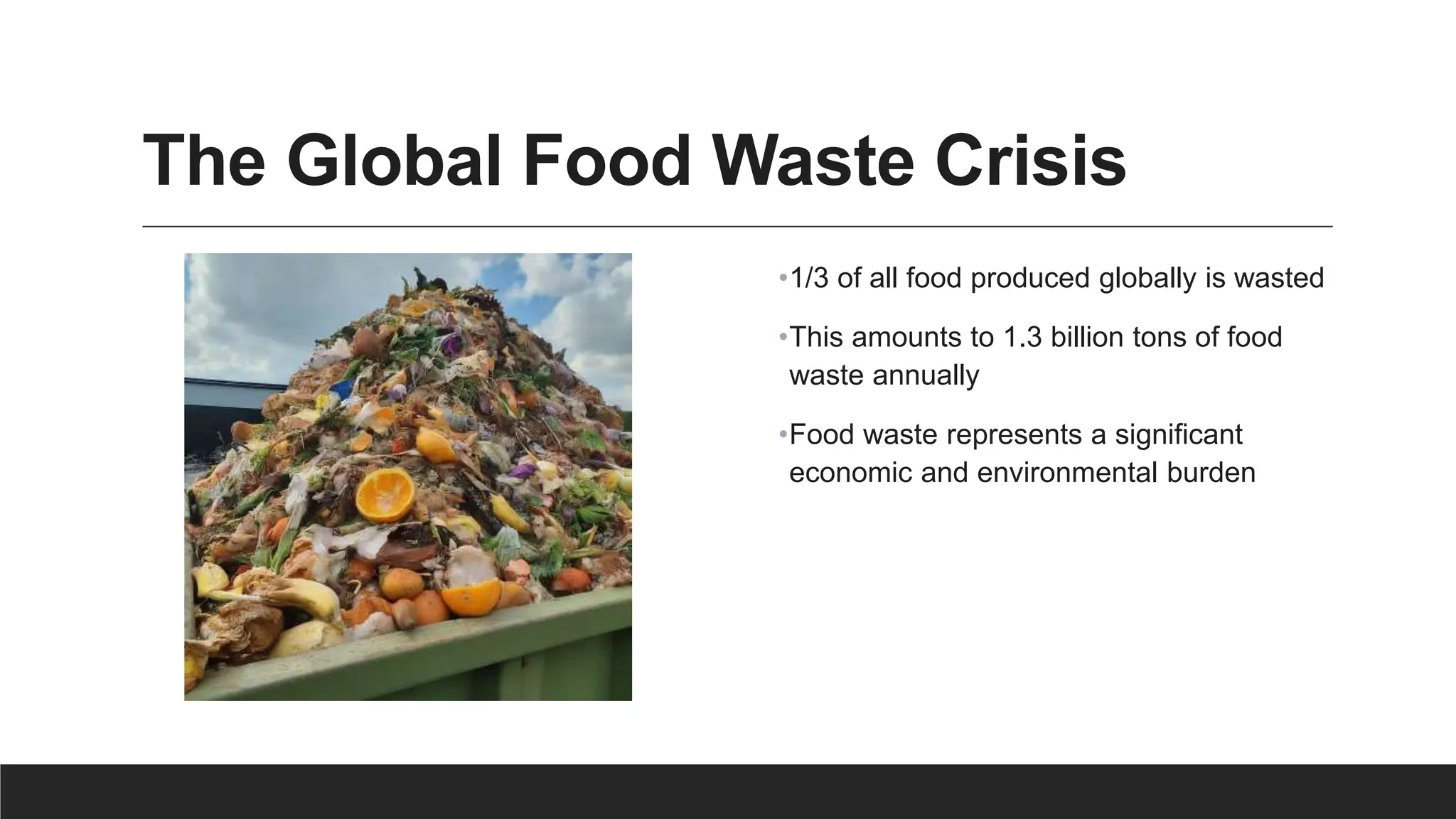
•1/3 of all food produced globally is wasted
•This amounts to 1.3 billion tons of food
waste annually
•Food waste represents a significant
economic and environmental burden
What is Biogas?
•Biogas is a renewable fuel produced from
the anaerobic digestion of organic matter
•It is a mixture of gases, primarily methane
(CH4) and carbon dioxide (CO2)
•Biogas can be used for electricity
generation, cooking, heating, and
transportation
The Science Behind Anaerobic
Digestion
•Anaerobic digestion is a multi-stage process involving different
microbial communities
•Microbes break down organic matter into simpler compounds
•Methane-producing bacteria (methanogens) convert these
compounds into biogas
The Four Stages of Anaerobic
Digestion
1. HYDROLYSIS
•Imagine this stage as the shredding phase.
Here, complex organic molecules like
carbohydrates, proteins, and fats in the food
waste are broken down into simpler forms
by extracellular enzymes secreted by
bacteria.
•These enzymes act like tiny scissors,
chopping up large molecules into smaller
ones like sugars, amino acids, and fatty
acids.
•This stage is crucial because the simpler
molecules are more readily accessible for
the microbes in the subsequent stages.
2. ACIDOGENESIS:
•Now that we have smaller, more
manageable pieces, acid-forming bacteria
(acidogens) take center stage.
•These bacteria convert the sugars and
amino acids produced in hydrolysis into
fermentation products like volatile fatty acids
(VFAs), alcohols, and carbon dioxide (CO2).
•Think of this stage as a fermentation
process similar to what happens when you
make yogurt or beer.
Digestion
3. ACETOGENESIS:
•Acetogens, another group of bacteria, take
over the baton in this stage.
•They consume some of the VFAs
produced by the acidogens and convert
them into acetic acid, hydrogen (H2), and
CO2.
•Acetic acid is a key intermediate that
serves as a building block for the final
stage
4. METHANOGENESIS:
•Finally, the superstars of the show, the
methanogenic archaea (sometimes referred
to as methanogens), enter the scene.
•These fascinating single-celled organisms
are responsible for the actual biogas
production.
•They utilize the remaining VFAs, acetic acid,
and H2 from the previous stages and
convert them into methane (CH4) and CO2,
which make up the bulk of biogas.
Environmental Conditions
It's important to note that throughout these stages, maintaining optimal environmental
conditions is crucial for efficient biogas production. Key factors include:
•Temperature: Most anaerobic digesters operate in a mesophilic range (around 30-37°C) or a
thermophilic range (around 55-60°C).
•pH: A slightly acidic environment (pH 6.5-7.5) is preferred for most methanogens.
•Nutrients: Microbial communities require a balanced diet of nutrients like nitrogen, phosphorus,
and trace elements for optimal growth and biogas production.
By understanding the intricate dance between these microbial communities and the importance
of environmental factors, we can optimize the anaerobic digestion process to maximize biogas
yield from food waste.
Benefits of Biogas Production from
Food Waste
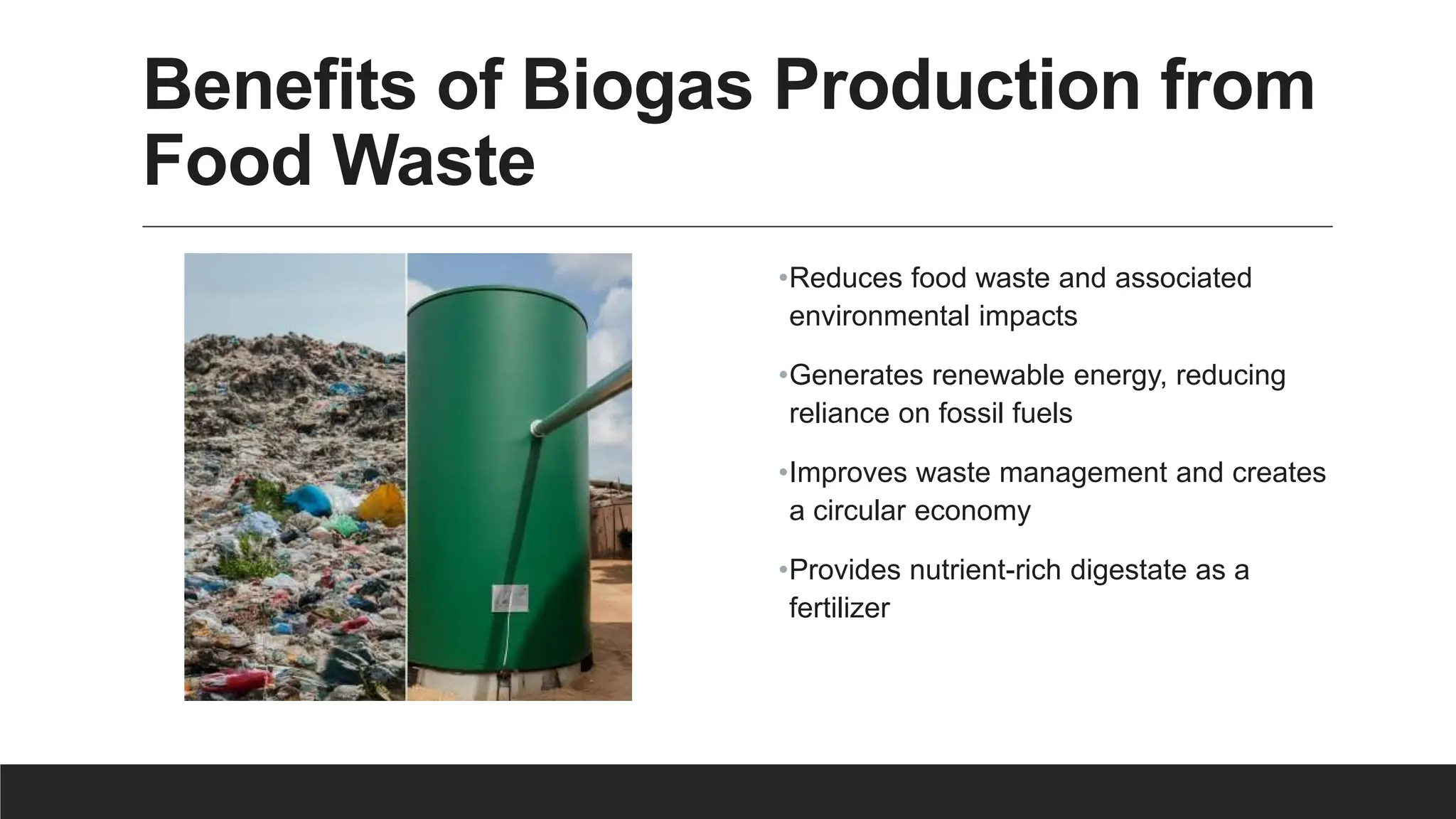
•Reduces food waste and associated
environmental impacts
•Generates renewable energy, reducing
reliance on fossil fuels
•Improves waste management and creates
a circular economy
•Provides nutrient-rich digestate as a
fertilizer
Factors Affecting Biogas Yield
•Composition of food waste: Fruits and vegetables generally produce more biogas than meat
and dairy products
•Pre-treatment methods: Size reduction and mixing with other organic matter can improve
biogas yield
•Operating conditions: Temperature, pH, and organic loading rate play a crucial role in biogas
production
THANK YOU

Analysis of Biogas Production from Food Waste (2).pptx

  • 1.
    Analysis of Biogas Productionfrom Food Waste TURNING TRASH TO TREASURE
  • 2.
    Turning Trash intoTreasure: Biogas Production from Food Waste Explore the exciting potential of biogas production from food waste. Discuss the growing problem of food waste, the science behind anaerobic digestion, the benefits of using biogas, and the factors that influence biogas yield. Understand how food waste can be transformed into a valuable renewable energy source
  • 3.
    The Global FoodWaste Crisis •1/3 of all food produced globally is wasted •This amounts to 1.3 billion tons of food waste annually •Food waste represents a significant economic and environmental burden
  • 4.
    What is Biogas? •Biogasis a renewable fuel produced from the anaerobic digestion of organic matter •It is a mixture of gases, primarily methane (CH4) and carbon dioxide (CO2) •Biogas can be used for electricity generation, cooking, heating, and transportation
  • 5.
    The Science BehindAnaerobic Digestion •Anaerobic digestion is a multi-stage process involving different microbial communities •Microbes break down organic matter into simpler compounds •Methane-producing bacteria (methanogens) convert these compounds into biogas
  • 6.
    The Four Stagesof Anaerobic Digestion 1. HYDROLYSIS •Imagine this stage as the shredding phase. Here, complex organic molecules like carbohydrates, proteins, and fats in the food waste are broken down into simpler forms by extracellular enzymes secreted by bacteria. •These enzymes act like tiny scissors, chopping up large molecules into smaller ones like sugars, amino acids, and fatty acids. •This stage is crucial because the simpler molecules are more readily accessible for the microbes in the subsequent stages. 2. ACIDOGENESIS: •Now that we have smaller, more manageable pieces, acid-forming bacteria (acidogens) take center stage. •These bacteria convert the sugars and amino acids produced in hydrolysis into fermentation products like volatile fatty acids (VFAs), alcohols, and carbon dioxide (CO2). •Think of this stage as a fermentation process similar to what happens when you make yogurt or beer.
  • 7.
    Digestion 3. ACETOGENESIS: •Acetogens, anothergroup of bacteria, take over the baton in this stage. •They consume some of the VFAs produced by the acidogens and convert them into acetic acid, hydrogen (H2), and CO2. •Acetic acid is a key intermediate that serves as a building block for the final stage 4. METHANOGENESIS: •Finally, the superstars of the show, the methanogenic archaea (sometimes referred to as methanogens), enter the scene. •These fascinating single-celled organisms are responsible for the actual biogas production. •They utilize the remaining VFAs, acetic acid, and H2 from the previous stages and convert them into methane (CH4) and CO2, which make up the bulk of biogas.
  • 8.
    Environmental Conditions It's importantto note that throughout these stages, maintaining optimal environmental conditions is crucial for efficient biogas production. Key factors include: •Temperature: Most anaerobic digesters operate in a mesophilic range (around 30-37°C) or a thermophilic range (around 55-60°C). •pH: A slightly acidic environment (pH 6.5-7.5) is preferred for most methanogens. •Nutrients: Microbial communities require a balanced diet of nutrients like nitrogen, phosphorus, and trace elements for optimal growth and biogas production. By understanding the intricate dance between these microbial communities and the importance of environmental factors, we can optimize the anaerobic digestion process to maximize biogas yield from food waste.
  • 9.
    Benefits of BiogasProduction from Food Waste •Reduces food waste and associated environmental impacts •Generates renewable energy, reducing reliance on fossil fuels •Improves waste management and creates a circular economy •Provides nutrient-rich digestate as a fertilizer
  • 10.
    Factors Affecting BiogasYield •Composition of food waste: Fruits and vegetables generally produce more biogas than meat and dairy products •Pre-treatment methods: Size reduction and mixing with other organic matter can improve biogas yield •Operating conditions: Temperature, pH, and organic loading rate play a crucial role in biogas production
  • 11.