ANAESTHESIA FOR
CATHLAB PROCEDURES
Dr.Veena
(MD), Anaesthesia
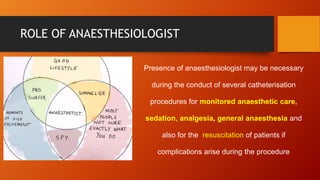
ROLE OF ANAESTHESIOLOGIST
Presence of anaesthesiologist may be necessary
during the conduct of several catheterisation
procedures for monitored anaesthetic care,
sedation, analgesia, general anaesthesia and
also for the resuscitation of patients if
complications arise during the procedure
TYPES OF ANAESTHESIA
MONITORED ANESTHESIA CARE
GENERAL ANESTHESIA
REGIONAL
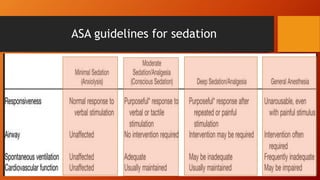
ASA guidelines for sedation
DEPTH OF SEDATION
Minimal Sedation (Anxiolysis)
๏ƒ˜Is a drug induced state during which patients respond normally to verbal
commands.
๏ƒ˜Although cognitive function and coordination may be impaired,
ventilatory and cardiovascular functions are unaffected
DEPTH OF SEDATION
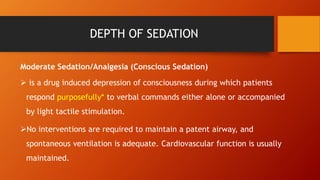
Moderate Sedation/Analgesia (Conscious Sedation)
๏ƒ˜ is a drug induced depression of consciousness during which patients
respond purposefully* to verbal commands either alone or accompanied
by light tactile stimulation.
๏ƒ˜No interventions are required to maintain a patent airway, and
spontaneous ventilation is adequate. Cardiovascular function is usually
maintained.
DEPTH OF SEDATION
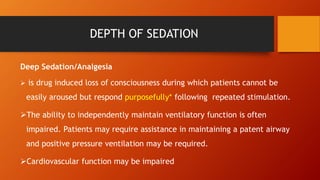
Deep Sedation/Analgesia
๏ƒ˜ is drug induced loss of consciousness during which patients cannot be
easily aroused but respond purposefully* following repeated stimulation.
๏ƒ˜The ability to independently maintain ventilatory function is often
impaired. Patients may require assistance in maintaining a patent airway
and positive pressure ventilation may be required.
๏ƒ˜Cardiovascular function may be impaired
DEPTH OF SEDATION
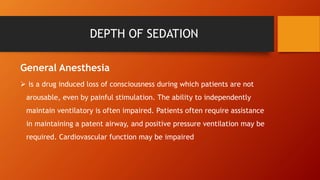
General Anesthesia
๏ƒ˜ is a drug induced loss of consciousness during which patients are not
arousable, even by painful stimulation. The ability to independently
maintain ventilatory is often impaired. Patients often require assistance
in maintaining a patent airway, and positive pressure ventilation may be
required. Cardiovascular function may be impaired
Emergency Equipment for Sedation
[American Society of Anesthesiologists - 2002; 96:1004โ€“17]
โ€ข Intravenous equipment
โ€ข Basic airway management equipment
โ€ข Source of compressed oxygen (tank with regulator or pipeline supply with flowmeter)
โ€ข Source of suction
โ€ข Suction catheters [pediatric suction catheters]
โ€ข Yankauer-type suction
โ€ข Face masks [infant/child]
โ€ข Self-inflating breathing bag-valve set [pediatric]
โ€ข Oral and nasal airways [infant/child-sized]
โ€ข Lubricant
Emergency Equipment for Sedation
[American Society of Anesthesiologists - 2002; 96:1004โ€“17]
โ€ข Advanced airway management
equipment
โ€ข Laryngeal mask airways [pediatric]
โ€ข Laryngoscope handles (tested)
โ€ข Laryngoscope blades [pediatric]
โ€ข Endotracheal tubes
โ€ข Cuffed 6.0, 7.0, 8.0 mm ID
โ€ข [Uncuffed 2.5, 3.0, 3.5, 4.0, 4.5, 5.0, 5.5,
6.0 mm ID]
โ€ข Stylet (appropriately sized for endotracheal
tubes)
โ€ข Pharmacologic Antagonists
โ€ข Naloxone
โ€ข Flumazenil
โ€ข Emergency medications
โ€ข Epinephrine
โ€ข Ephedrine
โ€ข Vasopressin
โ€ข Atropine
โ€ข Nitroglycerin (tablets or spray)
โ€ข Amiodarone
โ€ข Lidocaine
โ€ข Glucose, 50% [10 or 25%]
โ€ข Diphenhydramine
โ€ข Hydrocortisone, methylprednisolone, or
dexamethasone
โ€ข Diazepam or midazolam
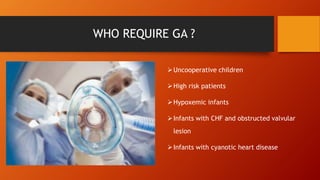
WHO REQUIRE GA ?
๏ƒ˜Uncooperative children
๏ƒ˜High risk patients
๏ƒ˜Hypoxemic infants
๏ƒ˜Infants with CHF and obstructed valvular
lesion
๏ƒ˜Infants with cyanotic heart disease
DIFFICULTIES IN CATHLAB
โ€ข Access to the patient is difficult due to fluoroscopy equipment all around
the patient with dimmed light and movable tables.
โ€ข Patients are mostly far away during the procedure therefore long
monitoring lines,long breathing circuits, long intravenous tubings including
enttidal co2 tubing is also required.
โ€ข Anaesthesiologist must be assured easy access to the patient and in
particular to the patientโ€™s airway.
DIFFICULTIES IN CATHLAB
โ€ข Interaction between the cardiologist and anaethesiologist is
necessary
โ€ข During induction and intubation one must ensure cathlab
technician moves fluoroscope from patients head so that airway
can be secured
FUNCTIONS OF ANESTHESIOLOGIST
๏ƒ˜Should always try to minimize the effects of anesthesia on cardiovascular
system.
๏ƒ˜Oxygenation and ventilatory management should be done according to the
diagnostic procedure as it can also influence the diagnosis particularly in
pediatric cath procedures.
๏ƒ˜Need to be well aware of access point and related complications.
๏ƒ˜Gas outlet, anesthesia machine, available medications,drugs for intubation
resuscitation should be prepared
EVALUATION OF THE PATIENT
โ€ข Complete diagnosis and details
regarding procedure
โ€ข Any comorbidities
โ€ข Preop vitals and physical examination
โ€ข Recent upper respiratory tract infection
โ€ข Patients level of activity
โ€ข Medication list
โ€ข Airway examination
โ€ข Investigations
โ€ข Consent
โ€ข NPO should be explained to the patient
MONITORING
โ€ข Standard monitoring includes ECG, noninvasive blood pressure,
pulse oximetry, and temperature
โ€ข End-tidal carbon dioxide (EtCO2) for the patients decided to be
mechanically ventilated.
MEDICATIONS USED
๏ƒ˜Benzodiazepenes - Midazolam, Diazepam
๏ƒ˜Narcotics - Fentanyl, Morphine
๏ƒ˜Naloxone And Flumazenil should also be available to rescue the
effects of Narcotics And Benzodiazepines.
๏ƒ˜Induction Agents - Ketamine, Propofol, Etomidate
๏ƒ˜Dexmedatomidine
MIDAZOLAM
โ€ข Average Dose: 1-5 mg
โ€ข Incremental Dose: 0.5-1 mg
โ€ข Time Between Doses: 3-5 min
โ€ข Onset Time: 3-5 min
โ€ข Duration of Effect: 0.5-2 hrs
โ€ข Water and lipid soluble
โ€ข Active metabolites, which are less potent
โ€ข Elimination tยฝ; 2-4 hrs
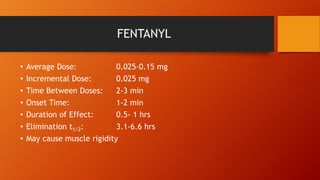
FENTANYL
โ€ข Average Dose: 0.025-0.15 mg
โ€ข Incremental Dose: 0.025 mg
โ€ข Time Between Doses: 2-3 min
โ€ข Onset Time: 1-2 min
โ€ข Duration of Effect: 0.5- 1 hrs
โ€ข Elimination t1/2: 3.1-6.6 hrs
โ€ข May cause muscle rigidity
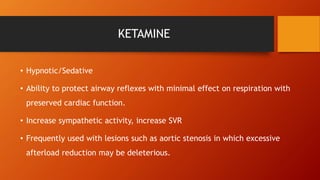
KETAMINE
โ€ข Hypnotic/Sedative
โ€ข Ability to protect airway reflexes with minimal effect on respiration with
preserved cardiac function.
โ€ข Increase sympathetic activity, increase SVR
โ€ข Frequently used with lesions such as aortic stenosis in which excessive
afterload reduction may be deleterious.
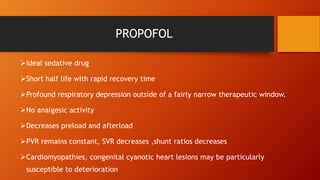
PROPOFOL
๏ƒ˜Ideal sedative drug
๏ƒ˜Short half life with rapid recovery time
๏ƒ˜Profound respiratory depression outside of a fairly narrow therapeutic window.
๏ƒ˜No analgesic activity
๏ƒ˜Decreases preload and afterload
๏ƒ˜PVR remains constant, SVR decreases ,shunt ratios decreases
๏ƒ˜Cardiomyopathies, congenital cyanotic heart lesions may be particularly
susceptible to deterioration
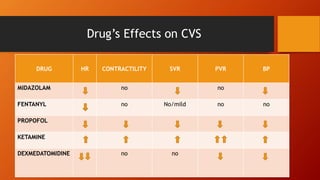
Drugโ€™s Effects on CVS
DRUG HR CONTRACTILITY SVR PVR BP
MIDAZOLAM no no
FENTANYL no No/mild no no
PROPOFOL
KETAMINE
DEXMEDATOMIDINE no no
PROCEDURES IN CATHLAB
๏ƒ˜Percutaneous interventions(angiogram, angioplasty) ๏ƒ  sedation, if any comlications
like hemodynamically unstable,respiratory distress then airway management)
๏ƒ˜Percutaneous closure of septal defect ๏ƒ  TEE with endotracheal intubation is best for
these procedures
๏ƒ˜Trans catheter cardiac valve stents ๏ƒ  Although general anesthesia is commonly used,
noninvasive positive pressure ventilation and deep sedation have also been tried
successfully.
๏ƒ˜Cath study ๏ƒ  Balanced anesthesia with controlled ventilation
PROCEDURES IN CATHLAB
๏ƒ˜Electrophysiological studies
๏ƒผMost procedures under moderate sedation
๏ƒผ If cardioversion, deep sedation
๏ƒผOpioids and barbiturates have been safely used in WPW syndrome
๏ƒผDexmedetomidine may also interfere with electrophysiological studies as it
has shown to suppress supraventricular arrhythmias after congenital heart
surgery
๏ƒผHigh frequency jet ventilation (HFJV) has been used for atrial fibrillation
ablation to reduce chest wall and lung movements, along with reduction in
left atrial volume changes. TIVA is used for this technique
๏ƒ˜Interventional radiology ๏ƒ  TACE, biliary stenting
PROCEDURE CONCERNS
1. Vascular access by cardiologist: If neck approach is planned you will have
better control of the airway using LMA or ETT.
2. FiO2 concerns
3. Specifics of the procedure: diagnostic vs. invasive. if invasive, there is
always possibility of vessel rupture and uncontrolled bleeding. So have
volume expanders available and blood typed, screened and crossmatched
PROCEDURE CONCERNS
4. If a neck approach is used: there is possibility of hemo and
pneumothorax. If suspected these can be easily diagnosed via
chest fluoroscopy
5. Ectopy: always possible with wires and catheters in the heart
chambers. Development of the heart block is also a possibility
PROCEDURE CONCERNS
6. Coil embolization of the PDA: more distal embolization of the
pulmonary arteries is always a possibility
7. Balloon dilatation: rupture of the balloon is always a
possibility.
8. Coronary angiogram: thrombosis or dissection of coronary
arteries is always a possibility.
SUMMARY
๏ƒ˜Communication and planning in consultation with the cardiology department
can facilitate patient care in this remote location.
๏ƒ˜Always need to be alert during the procedure and should be aware of the
progress of the case all the time.
๏ƒ˜Be prepared with crash cart for all the procedures.
We Care When Patient is Unaware โ€ฆ..

role of anesthesiologist in cathlab

  • 1.
  • 2.
    ROLE OF ANAESTHESIOLOGIST Presenceof anaesthesiologist may be necessary during the conduct of several catheterisation procedures for monitored anaesthetic care, sedation, analgesia, general anaesthesia and also for the resuscitation of patients if complications arise during the procedure
  • 3.
    TYPES OF ANAESTHESIA MONITOREDANESTHESIA CARE GENERAL ANESTHESIA REGIONAL
  • 4.
  • 5.
    DEPTH OF SEDATION MinimalSedation (Anxiolysis) ๏ƒ˜Is a drug induced state during which patients respond normally to verbal commands. ๏ƒ˜Although cognitive function and coordination may be impaired, ventilatory and cardiovascular functions are unaffected
  • 6.
    DEPTH OF SEDATION ModerateSedation/Analgesia (Conscious Sedation) ๏ƒ˜ is a drug induced depression of consciousness during which patients respond purposefully* to verbal commands either alone or accompanied by light tactile stimulation. ๏ƒ˜No interventions are required to maintain a patent airway, and spontaneous ventilation is adequate. Cardiovascular function is usually maintained.
  • 7.
    DEPTH OF SEDATION DeepSedation/Analgesia ๏ƒ˜ is drug induced loss of consciousness during which patients cannot be easily aroused but respond purposefully* following repeated stimulation. ๏ƒ˜The ability to independently maintain ventilatory function is often impaired. Patients may require assistance in maintaining a patent airway and positive pressure ventilation may be required. ๏ƒ˜Cardiovascular function may be impaired
  • 8.
    DEPTH OF SEDATION GeneralAnesthesia ๏ƒ˜ is a drug induced loss of consciousness during which patients are not arousable, even by painful stimulation. The ability to independently maintain ventilatory is often impaired. Patients often require assistance in maintaining a patent airway, and positive pressure ventilation may be required. Cardiovascular function may be impaired
  • 9.
    Emergency Equipment forSedation [American Society of Anesthesiologists - 2002; 96:1004โ€“17] โ€ข Intravenous equipment โ€ข Basic airway management equipment โ€ข Source of compressed oxygen (tank with regulator or pipeline supply with flowmeter) โ€ข Source of suction โ€ข Suction catheters [pediatric suction catheters] โ€ข Yankauer-type suction โ€ข Face masks [infant/child] โ€ข Self-inflating breathing bag-valve set [pediatric] โ€ข Oral and nasal airways [infant/child-sized] โ€ข Lubricant
  • 10.
    Emergency Equipment forSedation [American Society of Anesthesiologists - 2002; 96:1004โ€“17] โ€ข Advanced airway management equipment โ€ข Laryngeal mask airways [pediatric] โ€ข Laryngoscope handles (tested) โ€ข Laryngoscope blades [pediatric] โ€ข Endotracheal tubes โ€ข Cuffed 6.0, 7.0, 8.0 mm ID โ€ข [Uncuffed 2.5, 3.0, 3.5, 4.0, 4.5, 5.0, 5.5, 6.0 mm ID] โ€ข Stylet (appropriately sized for endotracheal tubes) โ€ข Pharmacologic Antagonists โ€ข Naloxone โ€ข Flumazenil โ€ข Emergency medications โ€ข Epinephrine โ€ข Ephedrine โ€ข Vasopressin โ€ข Atropine โ€ข Nitroglycerin (tablets or spray) โ€ข Amiodarone โ€ข Lidocaine โ€ข Glucose, 50% [10 or 25%] โ€ข Diphenhydramine โ€ข Hydrocortisone, methylprednisolone, or dexamethasone โ€ข Diazepam or midazolam
  • 11.
    WHO REQUIRE GA? ๏ƒ˜Uncooperative children ๏ƒ˜High risk patients ๏ƒ˜Hypoxemic infants ๏ƒ˜Infants with CHF and obstructed valvular lesion ๏ƒ˜Infants with cyanotic heart disease
  • 12.
    DIFFICULTIES IN CATHLAB โ€ขAccess to the patient is difficult due to fluoroscopy equipment all around the patient with dimmed light and movable tables. โ€ข Patients are mostly far away during the procedure therefore long monitoring lines,long breathing circuits, long intravenous tubings including enttidal co2 tubing is also required. โ€ข Anaesthesiologist must be assured easy access to the patient and in particular to the patientโ€™s airway.
  • 13.
    DIFFICULTIES IN CATHLAB โ€ขInteraction between the cardiologist and anaethesiologist is necessary โ€ข During induction and intubation one must ensure cathlab technician moves fluoroscope from patients head so that airway can be secured
  • 14.
    FUNCTIONS OF ANESTHESIOLOGIST ๏ƒ˜Shouldalways try to minimize the effects of anesthesia on cardiovascular system. ๏ƒ˜Oxygenation and ventilatory management should be done according to the diagnostic procedure as it can also influence the diagnosis particularly in pediatric cath procedures. ๏ƒ˜Need to be well aware of access point and related complications. ๏ƒ˜Gas outlet, anesthesia machine, available medications,drugs for intubation resuscitation should be prepared
  • 15.
    EVALUATION OF THEPATIENT โ€ข Complete diagnosis and details regarding procedure โ€ข Any comorbidities โ€ข Preop vitals and physical examination โ€ข Recent upper respiratory tract infection โ€ข Patients level of activity โ€ข Medication list โ€ข Airway examination โ€ข Investigations โ€ข Consent โ€ข NPO should be explained to the patient
  • 16.
    MONITORING โ€ข Standard monitoringincludes ECG, noninvasive blood pressure, pulse oximetry, and temperature โ€ข End-tidal carbon dioxide (EtCO2) for the patients decided to be mechanically ventilated.
  • 17.
    MEDICATIONS USED ๏ƒ˜Benzodiazepenes -Midazolam, Diazepam ๏ƒ˜Narcotics - Fentanyl, Morphine ๏ƒ˜Naloxone And Flumazenil should also be available to rescue the effects of Narcotics And Benzodiazepines. ๏ƒ˜Induction Agents - Ketamine, Propofol, Etomidate ๏ƒ˜Dexmedatomidine
  • 18.
    MIDAZOLAM โ€ข Average Dose:1-5 mg โ€ข Incremental Dose: 0.5-1 mg โ€ข Time Between Doses: 3-5 min โ€ข Onset Time: 3-5 min โ€ข Duration of Effect: 0.5-2 hrs โ€ข Water and lipid soluble โ€ข Active metabolites, which are less potent โ€ข Elimination tยฝ; 2-4 hrs
  • 19.
    FENTANYL โ€ข Average Dose:0.025-0.15 mg โ€ข Incremental Dose: 0.025 mg โ€ข Time Between Doses: 2-3 min โ€ข Onset Time: 1-2 min โ€ข Duration of Effect: 0.5- 1 hrs โ€ข Elimination t1/2: 3.1-6.6 hrs โ€ข May cause muscle rigidity
  • 20.
    KETAMINE โ€ข Hypnotic/Sedative โ€ข Abilityto protect airway reflexes with minimal effect on respiration with preserved cardiac function. โ€ข Increase sympathetic activity, increase SVR โ€ข Frequently used with lesions such as aortic stenosis in which excessive afterload reduction may be deleterious.
  • 21.
    PROPOFOL ๏ƒ˜Ideal sedative drug ๏ƒ˜Shorthalf life with rapid recovery time ๏ƒ˜Profound respiratory depression outside of a fairly narrow therapeutic window. ๏ƒ˜No analgesic activity ๏ƒ˜Decreases preload and afterload ๏ƒ˜PVR remains constant, SVR decreases ,shunt ratios decreases ๏ƒ˜Cardiomyopathies, congenital cyanotic heart lesions may be particularly susceptible to deterioration
  • 22.
    Drugโ€™s Effects onCVS DRUG HR CONTRACTILITY SVR PVR BP MIDAZOLAM no no FENTANYL no No/mild no no PROPOFOL KETAMINE DEXMEDATOMIDINE no no
  • 23.
    PROCEDURES IN CATHLAB ๏ƒ˜Percutaneousinterventions(angiogram, angioplasty) ๏ƒ  sedation, if any comlications like hemodynamically unstable,respiratory distress then airway management) ๏ƒ˜Percutaneous closure of septal defect ๏ƒ  TEE with endotracheal intubation is best for these procedures ๏ƒ˜Trans catheter cardiac valve stents ๏ƒ  Although general anesthesia is commonly used, noninvasive positive pressure ventilation and deep sedation have also been tried successfully. ๏ƒ˜Cath study ๏ƒ  Balanced anesthesia with controlled ventilation
  • 24.
    PROCEDURES IN CATHLAB ๏ƒ˜Electrophysiologicalstudies ๏ƒผMost procedures under moderate sedation ๏ƒผ If cardioversion, deep sedation ๏ƒผOpioids and barbiturates have been safely used in WPW syndrome ๏ƒผDexmedetomidine may also interfere with electrophysiological studies as it has shown to suppress supraventricular arrhythmias after congenital heart surgery ๏ƒผHigh frequency jet ventilation (HFJV) has been used for atrial fibrillation ablation to reduce chest wall and lung movements, along with reduction in left atrial volume changes. TIVA is used for this technique ๏ƒ˜Interventional radiology ๏ƒ  TACE, biliary stenting
  • 25.
    PROCEDURE CONCERNS 1. Vascularaccess by cardiologist: If neck approach is planned you will have better control of the airway using LMA or ETT. 2. FiO2 concerns 3. Specifics of the procedure: diagnostic vs. invasive. if invasive, there is always possibility of vessel rupture and uncontrolled bleeding. So have volume expanders available and blood typed, screened and crossmatched
  • 26.
    PROCEDURE CONCERNS 4. Ifa neck approach is used: there is possibility of hemo and pneumothorax. If suspected these can be easily diagnosed via chest fluoroscopy 5. Ectopy: always possible with wires and catheters in the heart chambers. Development of the heart block is also a possibility
  • 27.
    PROCEDURE CONCERNS 6. Coilembolization of the PDA: more distal embolization of the pulmonary arteries is always a possibility 7. Balloon dilatation: rupture of the balloon is always a possibility. 8. Coronary angiogram: thrombosis or dissection of coronary arteries is always a possibility.
  • 28.
    SUMMARY ๏ƒ˜Communication and planningin consultation with the cardiology department can facilitate patient care in this remote location. ๏ƒ˜Always need to be alert during the procedure and should be aware of the progress of the case all the time. ๏ƒ˜Be prepared with crash cart for all the procedures.
  • 29.
    We Care WhenPatient is Unaware โ€ฆ..

Editor's Notes

  • #5ย Minimal Sedation (Anxiolysis) Is a drug induced state during which patients respond normally to verbal commands. Although cognitive function and coordination may be impaired, ventilatory and cardiovascular functions are unaffected