Module 1:-
An Introduction
to Python
Covered by:
Bhavesh Rathod
bhavesh3194@gmail.com
Topics to be covered:
• What is Python?
• What can Python do?
 Why Python?
 Python Syntax compared to other
programming languages
 Python Install
What is
python?
Python is an interpreted,
object-oriented, high-level
programming language
It was created by Guido
van Rossum, and released
in 1991.
What can python do?
(Applications)
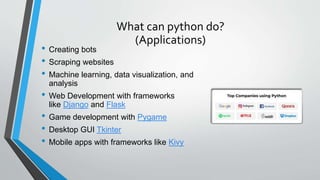
• Creating bots
• Scraping websites
• Machine learning, data visualization, and
analysis
• Web Development with frameworks
like Django and Flask
• Game development with Pygame
• Desktop GUI Tkinter
• Mobile apps with frameworks like Kivy
Why
Python?
Portability: PythonWorks on different plateforms like windows, mac,
linux,etc.
Simple and easy to learn: Simple syntax similar to the english
language. Python syntax that allows developers to write programs
with fewer lines than some other programming languages.
Popularity & High salary: Python became very popular in the last two
years, and python programmers get the highest salary.Google who is
actually using python for web searches, then we haveYouTube, which
is largely written in python, and many other companies such as
Instagram, Drobox, Facebook and many more companies use Python.
Python Syntax compared to other
programming languages
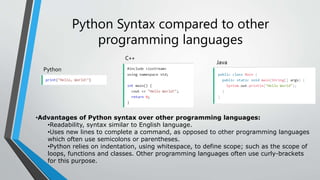
Python
C++
Java
•Advantages of Python syntax over other programming languages:
•Readability, syntax similar to English language.
•Uses new lines to complete a command, as opposed to other programming languages
which often use semicolons or parentheses.
•Python relies on indentation, using whitespace, to define scope; such as the scope of
loops, functions and classes. Other programming languages often use curly-brackets
for this purpose.
Python Installation
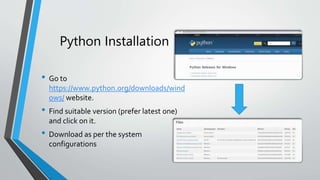
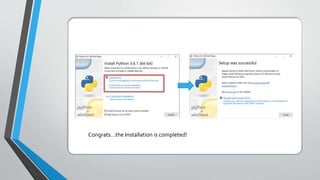
• Go to
https://www.python.org/downloads/wind
ows/ website.
• Find suitable version (prefer latest one)
and click on it.
• Download as per the system
configurations
Congrats…the Installation is completed!
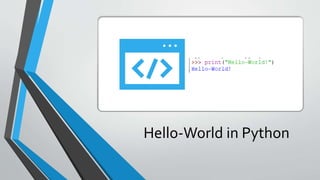
Hello-World in Python
Any questions?
ThankYou!

An Introduction to Python.pptx

  • 1.
    Module 1:- An Introduction toPython Covered by: Bhavesh Rathod bhavesh3194@gmail.com
  • 2.
    Topics to becovered: • What is Python? • What can Python do?  Why Python?  Python Syntax compared to other programming languages  Python Install
  • 3.
    What is python? Python isan interpreted, object-oriented, high-level programming language It was created by Guido van Rossum, and released in 1991.
  • 4.
    What can pythondo? (Applications) • Creating bots • Scraping websites • Machine learning, data visualization, and analysis • Web Development with frameworks like Django and Flask • Game development with Pygame • Desktop GUI Tkinter • Mobile apps with frameworks like Kivy
  • 5.
    Why Python? Portability: PythonWorks ondifferent plateforms like windows, mac, linux,etc. Simple and easy to learn: Simple syntax similar to the english language. Python syntax that allows developers to write programs with fewer lines than some other programming languages. Popularity & High salary: Python became very popular in the last two years, and python programmers get the highest salary.Google who is actually using python for web searches, then we haveYouTube, which is largely written in python, and many other companies such as Instagram, Drobox, Facebook and many more companies use Python.
  • 6.
    Python Syntax comparedto other programming languages Python C++ Java •Advantages of Python syntax over other programming languages: •Readability, syntax similar to English language. •Uses new lines to complete a command, as opposed to other programming languages which often use semicolons or parentheses. •Python relies on indentation, using whitespace, to define scope; such as the scope of loops, functions and classes. Other programming languages often use curly-brackets for this purpose.
  • 7.
    Python Installation • Goto https://www.python.org/downloads/wind ows/ website. • Find suitable version (prefer latest one) and click on it. • Download as per the system configurations
  • 8.
  • 9.
  • 10.
  • 11.