AMONIA MANUFACTURING
PROCESS
BY
ASHVANI SHUKLA
C&I
RELIANCE
THE AMMONIA MANUFACTURING
PROCESS
• Ammonia is produced in a process known as the Haber
process, in which nitrogen and hydrogen react in the presence
of an iron catalyst to form ammonia. The hydrogen is formed
by reacting natural gas and steam at high temperatures and
the nitrogen is supplied from the air1 . Other gases (such as
water and carbon dioxide) are removed from the gas stream
and the nitrogen and hydrogen passed over an iron catalyst at
high temperature and pressure to form the ammonia. The
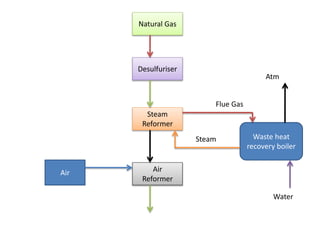
process is shown schematically in Figure 1.
• Step 1 - Hydrogen production Hydrogen is produced by the
reaction of methane with water. However, before this can be
carried out, all sulfurous compounds must be removed from
the natural gas to prevent catalyst poisoning. These are
removed by heating the gas to 400o C and reacting it with zinc
oxide:
• ZnO + H2S → ZnS + H2O
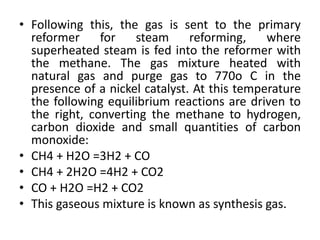
• Following this, the gas is sent to the primary
reformer for steam reforming, where
superheated steam is fed into the reformer with
the methane. The gas mixture heated with
natural gas and purge gas to 770o C in the
presence of a nickel catalyst. At this temperature
the following equilibrium reactions are driven to
the right, converting the methane to hydrogen,
carbon dioxide and small quantities of carbon
monoxide:
• CH4 + H2O =3H2 + CO
• CH4 + 2H2O =4H2 + CO2
• CO + H2O =H2 + CO2
• This gaseous mixture is known as synthesis gas.
Step 2
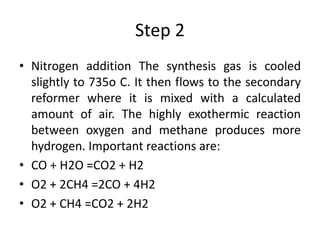
• Nitrogen addition The synthesis gas is cooled
slightly to 735o C. It then flows to the secondary
reformer where it is mixed with a calculated
amount of air. The highly exothermic reaction
between oxygen and methane produces more
hydrogen. Important reactions are:
• CO + H2O =CO2 + H2
• O2 + 2CH4 =2CO + 4H2
• O2 + CH4 =CO2 + 2H2
Natural Gas
Desulfuriser
Steam
Reformer
Air
Reformer
Air
Waste heat
recovery boiler
Flue Gas
Steam
Water
Atm
Waste heat
recovery boiler
Steam Water
Shift converter
2CO-CO2
Water
CO2 Removal UCARSOL
CO2
Stripper
CO2
UREA PLANT
UCARSOL
Methanation Water
Compression &
Cooling
Mixer
NH3
Converter
Cool at 30
Deg
Decompression
NH3
NH3 Recovery
PURGE
GAS
UNREACTED GAS
AND NH3
NH3
• 2O2 + CH4 = 2H2O + CO2
• In addition, the necessary nitrogen is added in the
secondary reformer. As the catalyst that is used to form the
ammonia is pure iron, water, carbon dioxide and carbon
monoxide must be removed from the gas stream to prevent
oxidation of the iron. This is carried out in the next three
steps.
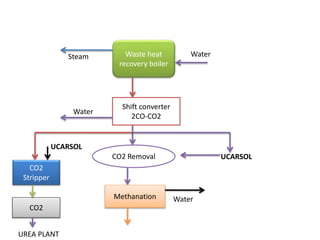
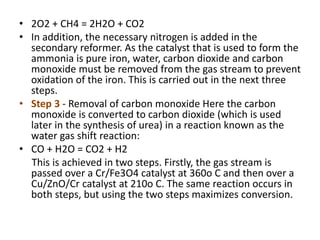
• Step 3 - Removal of carbon monoxide Here the carbon
monoxide is converted to carbon dioxide (which is used
later in the synthesis of urea) in a reaction known as the
water gas shift reaction:
• CO + H2O = CO2 + H2
This is achieved in two steps. Firstly, the gas stream is
passed over a Cr/Fe3O4 catalyst at 360o C and then over a
Cu/ZnO/Cr catalyst at 210o C. The same reaction occurs in
both steps, but using the two steps maximizes conversion.
• Step 4 - Water removal The gas mixture is further cooled to
40o C, at which temperature the water condenses out and
is removed. Step 5 - Removal of carbon oxides The gases
are then pumped up through a counter-current of
UCARSOL solution (an MDEA solution, see article). Carbon
dioxide is highly soluble in UCARSOL, and more than 99.9%
of the CO2 in the mixture dissolves in it. The remaining CO2
(as well as any CO that was not converted to CO2 in Step 3)
is converted to methane (methanation) using a Ni/Al2O3
catalyst at 325 Deg C
• 2 CO + 3H2 = CH4 + H2O
• CO2 + 4H2 =CH4 + 2H2O The water which is produced in
these reactions is removed by condensation at 40o C as
above. The carbon dioxide is stripped from the UCARSOL
and used in urea manufacture. The UCARSOL is cooled and
reused for carbon dioxide removal.
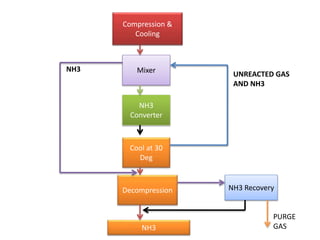
• Step 6 - Synthesis of ammonia
• The gas mixture is now cooled, compressed and
fed into the ammonia synthesis loop (see Figure
1). A mixture of ammonia and unreacted gases
which have already been around the loop are
mixed with the incoming gas stream and cooled
to 5o C. The ammonia present is removed and
the unreacted gases heated to 400o C at a
pressure of 330 bar g and passed over an iron
catalyst. Under these conditions 26% of the
hydrogen and nitrogen are converted to
ammonia. The outlet gas from the ammonia
converter is cooled from 220o C to 30o C. This
cooling process condenses more the half the
ammonia, which is then separated out. The
• remaining gas is mixed with more cooled, compressed
incoming gas. The reaction occurring in the ammonia
converter is:
• N2 + 3H2 = 2NH3 The ammonia is rapidly
decompressed to 24 bar g. At this pressure, impurities
such as methane and hydrogen become gases. The gas
mixture above the liquid ammonia (which also contains
significant levels of ammonia) is removed and sent to
the ammonia recovery unit. This is an absorber-
stripper system using water as solvent. The remaining
gas (purge gas) is used as fuel for the heating of the
primary reformer. The pure ammonia remaining is
mixed with the pure ammonia from the initial
condensation above and is ready for use in urea
production, for storage or for direct sale.

Amonia manufacturing process

  • 1.
  • 2.
    THE AMMONIA MANUFACTURING PROCESS •Ammonia is produced in a process known as the Haber process, in which nitrogen and hydrogen react in the presence of an iron catalyst to form ammonia. The hydrogen is formed by reacting natural gas and steam at high temperatures and the nitrogen is supplied from the air1 . Other gases (such as water and carbon dioxide) are removed from the gas stream and the nitrogen and hydrogen passed over an iron catalyst at high temperature and pressure to form the ammonia. The process is shown schematically in Figure 1. • Step 1 - Hydrogen production Hydrogen is produced by the reaction of methane with water. However, before this can be carried out, all sulfurous compounds must be removed from the natural gas to prevent catalyst poisoning. These are removed by heating the gas to 400o C and reacting it with zinc oxide: • ZnO + H2S → ZnS + H2O
  • 3.
    • Following this,the gas is sent to the primary reformer for steam reforming, where superheated steam is fed into the reformer with the methane. The gas mixture heated with natural gas and purge gas to 770o C in the presence of a nickel catalyst. At this temperature the following equilibrium reactions are driven to the right, converting the methane to hydrogen, carbon dioxide and small quantities of carbon monoxide: • CH4 + H2O =3H2 + CO • CH4 + 2H2O =4H2 + CO2 • CO + H2O =H2 + CO2 • This gaseous mixture is known as synthesis gas.
  • 4.
    Step 2 • Nitrogenaddition The synthesis gas is cooled slightly to 735o C. It then flows to the secondary reformer where it is mixed with a calculated amount of air. The highly exothermic reaction between oxygen and methane produces more hydrogen. Important reactions are: • CO + H2O =CO2 + H2 • O2 + 2CH4 =2CO + 4H2 • O2 + CH4 =CO2 + 2H2
  • 5.
  • 6.
    Waste heat recovery boiler SteamWater Shift converter 2CO-CO2 Water CO2 Removal UCARSOL CO2 Stripper CO2 UREA PLANT UCARSOL Methanation Water
  • 7.
    Compression & Cooling Mixer NH3 Converter Cool at30 Deg Decompression NH3 NH3 Recovery PURGE GAS UNREACTED GAS AND NH3 NH3
  • 8.
    • 2O2 +CH4 = 2H2O + CO2 • In addition, the necessary nitrogen is added in the secondary reformer. As the catalyst that is used to form the ammonia is pure iron, water, carbon dioxide and carbon monoxide must be removed from the gas stream to prevent oxidation of the iron. This is carried out in the next three steps. • Step 3 - Removal of carbon monoxide Here the carbon monoxide is converted to carbon dioxide (which is used later in the synthesis of urea) in a reaction known as the water gas shift reaction: • CO + H2O = CO2 + H2 This is achieved in two steps. Firstly, the gas stream is passed over a Cr/Fe3O4 catalyst at 360o C and then over a Cu/ZnO/Cr catalyst at 210o C. The same reaction occurs in both steps, but using the two steps maximizes conversion.
  • 9.
    • Step 4- Water removal The gas mixture is further cooled to 40o C, at which temperature the water condenses out and is removed. Step 5 - Removal of carbon oxides The gases are then pumped up through a counter-current of UCARSOL solution (an MDEA solution, see article). Carbon dioxide is highly soluble in UCARSOL, and more than 99.9% of the CO2 in the mixture dissolves in it. The remaining CO2 (as well as any CO that was not converted to CO2 in Step 3) is converted to methane (methanation) using a Ni/Al2O3 catalyst at 325 Deg C • 2 CO + 3H2 = CH4 + H2O • CO2 + 4H2 =CH4 + 2H2O The water which is produced in these reactions is removed by condensation at 40o C as above. The carbon dioxide is stripped from the UCARSOL and used in urea manufacture. The UCARSOL is cooled and reused for carbon dioxide removal.
  • 10.
    • Step 6- Synthesis of ammonia • The gas mixture is now cooled, compressed and fed into the ammonia synthesis loop (see Figure 1). A mixture of ammonia and unreacted gases which have already been around the loop are mixed with the incoming gas stream and cooled to 5o C. The ammonia present is removed and the unreacted gases heated to 400o C at a pressure of 330 bar g and passed over an iron catalyst. Under these conditions 26% of the hydrogen and nitrogen are converted to ammonia. The outlet gas from the ammonia converter is cooled from 220o C to 30o C. This cooling process condenses more the half the ammonia, which is then separated out. The
  • 11.
    • remaining gasis mixed with more cooled, compressed incoming gas. The reaction occurring in the ammonia converter is: • N2 + 3H2 = 2NH3 The ammonia is rapidly decompressed to 24 bar g. At this pressure, impurities such as methane and hydrogen become gases. The gas mixture above the liquid ammonia (which also contains significant levels of ammonia) is removed and sent to the ammonia recovery unit. This is an absorber- stripper system using water as solvent. The remaining gas (purge gas) is used as fuel for the heating of the primary reformer. The pure ammonia remaining is mixed with the pure ammonia from the initial condensation above and is ready for use in urea production, for storage or for direct sale.