WELCOME TO MY SEMINAR

.PREPARED BY : Amiya Bisoi
UNDER THE GUIDANCE OF
PROF.Ambika prasad hota
TOPIC:MICRO FUEL CELL
THE BATTERY OF FUTURE
INDEX:1.Introduction
 2.History
 3.Need For Using MFC
 4.Components
 5.Mechanism of MFC
 6.Adavantages
 7.Disadvantages
 7.Application
 8.A look in to the future
 9.Conclusion

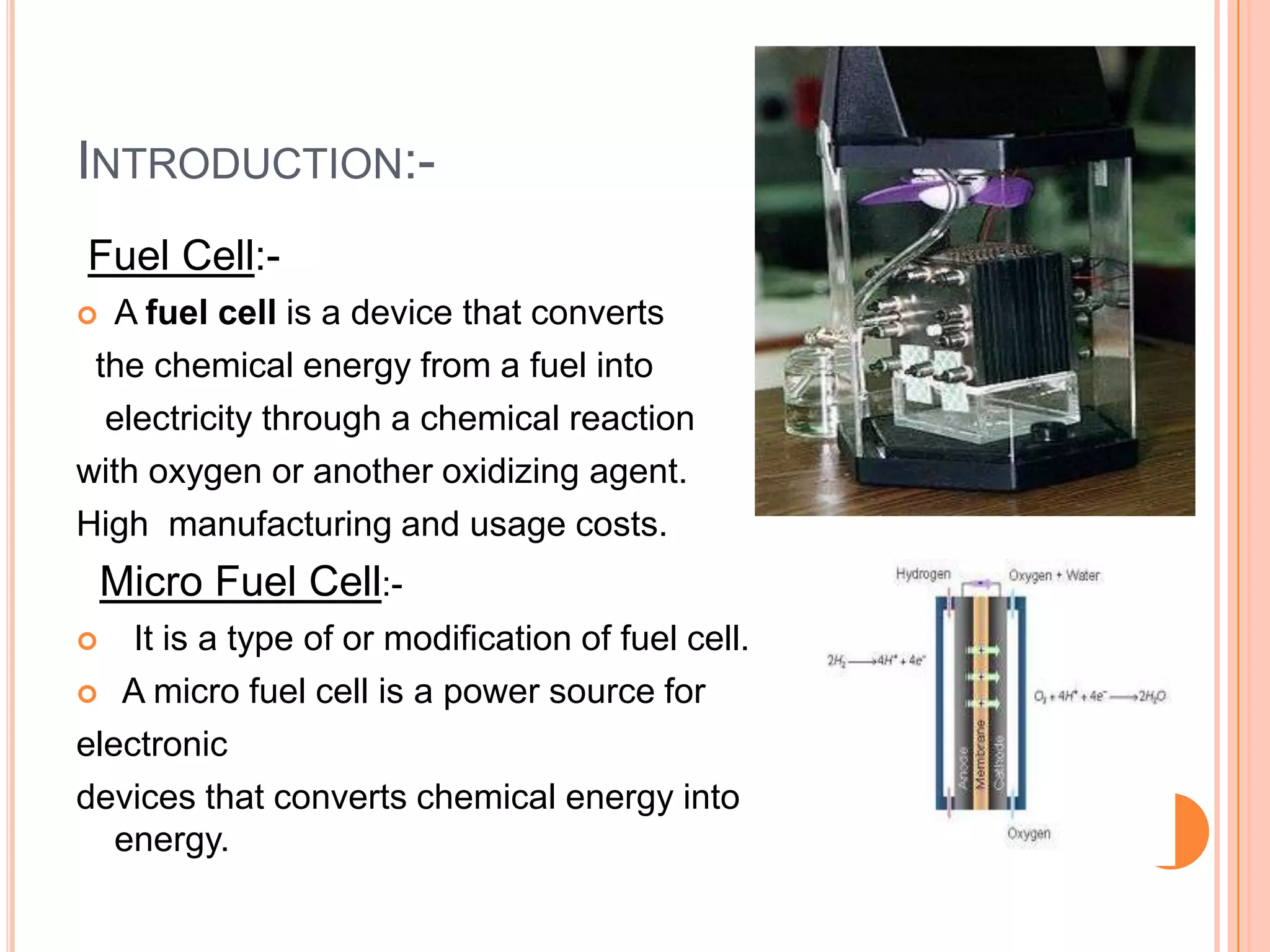
INTRODUCTION:Fuel Cell:A fuel cell is a device that converts
the chemical energy from a fuel into
electricity through a chemical reaction
with oxygen or another oxidizing agent.
High manufacturing and usage costs.


Micro Fuel Cell:It is a type of or modification of fuel cell.
 A micro fuel cell is a power source for
electronic
devices that converts chemical energy into
energy.


 electrical
HISTORY:In 1838, German Physicist Christian Friedrich
Schönbein invented the first crude fuel cell.
 The first commercial use of fuel cells was
in NASA space programs to generate power for
probes, satellites and space capsules.
 Since then, fuel cells have been used in many other
applications.




It is a technology from the early 1800s.
The major country making progress is Japan with
united states both making positive strides on micro
fuel cell search.
 Major companies developing the technology
include HITACHI,NEC and TOSHIBA.
 MTI Fuel cell: Back up power for cell phone
 Smart fuel cell: cameras and laptop
 Toshiba: fuel cell powered PDA
 Casio: laptop powered by fuel cell

NEED OF MICRO FUEL CELL
Some conventional cells and batteries can be
recharged by connection to an external source of
current.
 Others must be discarded when they are spent.
 A micro fuel cell, in contrast, is replenished merely
be refilling its reservoir, or by removing the spent
fuel cartridge and replacing it with a fresh one.
 While the recharging process for a conventional cell
or battery can take hours, replacing a fuel cartridge
takes only seconds.

COMPONENTS:
Micro fuel cells have many similarities to conventionally
sized fuel cells.
 The basic components needed for operation of
micro fuel cells, such as electrodes, membranes, current
collectors, and gas distribution, parallel those needed for
conventional fuel cells, but in a miniaturized form.
 Micro fuel cells are often not self-contained, since
elements such as fuel tanks lie outside of the cell and
are connected to it separately.
 For this reason, some types of micro fuel cells alone
are unable to replace batteries in portable electronic
devices.

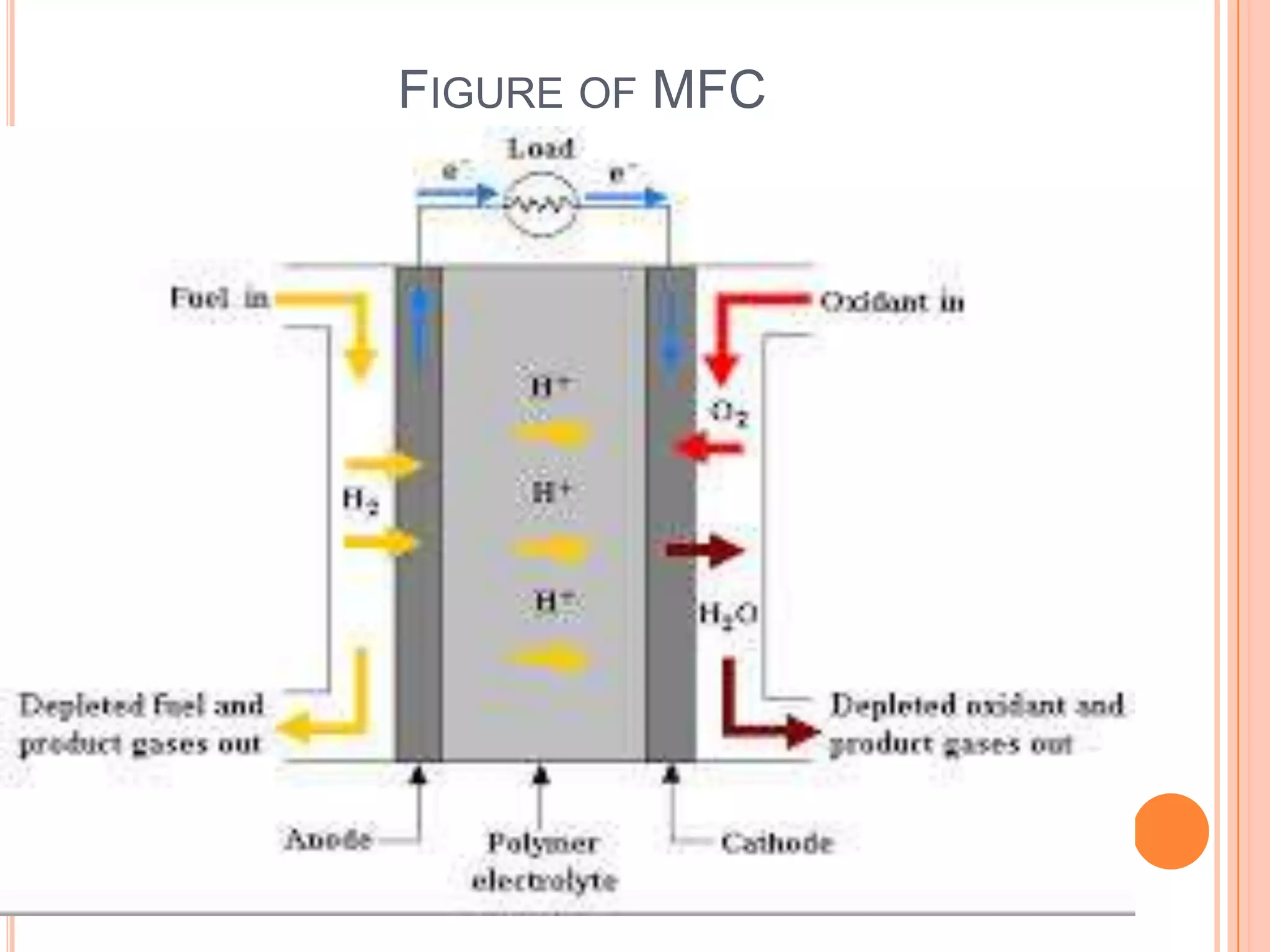
FIGURE OF MFC
MECHANISM OF MICROFUEL CELL
A micro fuel cell is a portable power source for low
power electronic devices that converts chemical
energy into useable electrical energy.
 It generates power through the electrochemical
reaction of a fuel in the presence of a catalyst.
 The Company's micro fuel cell uses methanol as
fuel. Methanol, a common alcohol, has the
advantage of high energy density offering the
consumer the potential for longer use time and
products with increased functionality.

The heart of a micro fuel cell comprises a central
membrane coated on each side by a catalyst layer,
one for reacting the fuel and the other for reacting
oxygen from air.
 The micro fuel cell produces electrical power when
the fuel is introduced to the anode catalyst layer.
 At the anode catalyst, the fuel reacts with water to
produce protons, electrons and carbon dioxide.
 The membrane allows protons to pass through to
the cathode catalyst layer.
 Electrons are forced to take an alternate path and
flow through the wires of the electronic device,
providing electrical power.
 At the cathode catalyst layer, the protons and
electrons recombine and react with oxygen to form
water vapour.

The overall process in the methanol/air fuel cell
is thus the direct conversion of the energy of
methanol fuel to electric power, with carbon
dioxide and water vapour as the only two byproducts
ADVANTAGES :
Flexibility
 Higher quality of power
 Energy efficient
 Safe, quiet and reliable
 Run continuously for long period of time
 Environment benefit because of no combustion
 Relives on existing natural resources

DISADVANTAGES:

Micro fuel cells are often not self-contained, since
elements such as fuel tanks lie outside of the cell
and are connected to it separately.
 For this reason, some types of micro fuel cells
alone are unable to replace batteries in portable
electronic devices.

APPLICATIONS
One use of these micro fuel cells is as a power
source for everyday electronic devices such as cell
phones, personal digital assistants, and even laptop
computers, hearing aids.
 For military and space application.
 For stationary application.
 For electric utility.

EXAMPLES OF ELECTRONICS
APPLICATION:
A LOOK IN TO FUTURE:
This type of fuel cell or micro fuel cell can be used
 For cell miniaturisation
and refuelling
infrastructure can be overcome by 3 to 4 years.
 It may be more efficient than other fuel cells.

CONCLUSIONLet we stay connected longer and more
economically
 Conventional batteries like Lithium ion
rechargeable cells are replaced.
 Cell miniaturization and refuelling infrastructure
 Can be overcome next 3 to 4 years.
 It is a direct conversion of methanol fuel to electric
power.
 Carbon dioxide and water vapours are by-products.

micro fuel cell

micro fuel cell

  • 1.
    WELCOME TO MYSEMINAR .PREPARED BY : Amiya Bisoi UNDER THE GUIDANCE OF PROF.Ambika prasad hota
  • 2.
    TOPIC:MICRO FUEL CELL THEBATTERY OF FUTURE
  • 3.
    INDEX:1.Introduction  2.History  3.NeedFor Using MFC  4.Components  5.Mechanism of MFC  6.Adavantages  7.Disadvantages  7.Application  8.A look in to the future  9.Conclusion 
  • 4.
    INTRODUCTION:Fuel Cell:A fuelcell is a device that converts the chemical energy from a fuel into electricity through a chemical reaction with oxygen or another oxidizing agent. High manufacturing and usage costs.  Micro Fuel Cell:It is a type of or modification of fuel cell.  A micro fuel cell is a power source for electronic devices that converts chemical energy into energy.  electrical
  • 5.
    HISTORY:In 1838, GermanPhysicist Christian Friedrich Schönbein invented the first crude fuel cell.  The first commercial use of fuel cells was in NASA space programs to generate power for probes, satellites and space capsules.  Since then, fuel cells have been used in many other applications.   It is a technology from the early 1800s.
  • 6.
    The major countrymaking progress is Japan with united states both making positive strides on micro fuel cell search.  Major companies developing the technology include HITACHI,NEC and TOSHIBA.  MTI Fuel cell: Back up power for cell phone  Smart fuel cell: cameras and laptop  Toshiba: fuel cell powered PDA  Casio: laptop powered by fuel cell 
  • 7.
    NEED OF MICROFUEL CELL Some conventional cells and batteries can be recharged by connection to an external source of current.  Others must be discarded when they are spent.  A micro fuel cell, in contrast, is replenished merely be refilling its reservoir, or by removing the spent fuel cartridge and replacing it with a fresh one.  While the recharging process for a conventional cell or battery can take hours, replacing a fuel cartridge takes only seconds. 
  • 8.
    COMPONENTS: Micro fuel cellshave many similarities to conventionally sized fuel cells.  The basic components needed for operation of micro fuel cells, such as electrodes, membranes, current collectors, and gas distribution, parallel those needed for conventional fuel cells, but in a miniaturized form.  Micro fuel cells are often not self-contained, since elements such as fuel tanks lie outside of the cell and are connected to it separately.  For this reason, some types of micro fuel cells alone are unable to replace batteries in portable electronic devices. 
  • 9.
  • 10.
    MECHANISM OF MICROFUELCELL A micro fuel cell is a portable power source for low power electronic devices that converts chemical energy into useable electrical energy.  It generates power through the electrochemical reaction of a fuel in the presence of a catalyst.  The Company's micro fuel cell uses methanol as fuel. Methanol, a common alcohol, has the advantage of high energy density offering the consumer the potential for longer use time and products with increased functionality. 
  • 12.
    The heart ofa micro fuel cell comprises a central membrane coated on each side by a catalyst layer, one for reacting the fuel and the other for reacting oxygen from air.  The micro fuel cell produces electrical power when the fuel is introduced to the anode catalyst layer.  At the anode catalyst, the fuel reacts with water to produce protons, electrons and carbon dioxide.  The membrane allows protons to pass through to the cathode catalyst layer.  Electrons are forced to take an alternate path and flow through the wires of the electronic device, providing electrical power.  At the cathode catalyst layer, the protons and electrons recombine and react with oxygen to form water vapour. 
  • 13.
    The overall processin the methanol/air fuel cell is thus the direct conversion of the energy of methanol fuel to electric power, with carbon dioxide and water vapour as the only two byproducts
  • 14.
    ADVANTAGES : Flexibility  Higherquality of power  Energy efficient  Safe, quiet and reliable  Run continuously for long period of time  Environment benefit because of no combustion  Relives on existing natural resources 
  • 15.
    DISADVANTAGES: Micro fuel cellsare often not self-contained, since elements such as fuel tanks lie outside of the cell and are connected to it separately.  For this reason, some types of micro fuel cells alone are unable to replace batteries in portable electronic devices. 
  • 17.
    APPLICATIONS One use ofthese micro fuel cells is as a power source for everyday electronic devices such as cell phones, personal digital assistants, and even laptop computers, hearing aids.  For military and space application.  For stationary application.  For electric utility. 
  • 19.
  • 20.
    A LOOK INTO FUTURE: This type of fuel cell or micro fuel cell can be used  For cell miniaturisation and refuelling infrastructure can be overcome by 3 to 4 years.  It may be more efficient than other fuel cells. 
  • 21.
    CONCLUSIONLet we stayconnected longer and more economically  Conventional batteries like Lithium ion rechargeable cells are replaced.  Cell miniaturization and refuelling infrastructure  Can be overcome next 3 to 4 years.  It is a direct conversion of methanol fuel to electric power.  Carbon dioxide and water vapours are by-products. 