International Marketing Plan
DavidsTea
Amit Patel
INB 337: International Marketing Management
Fall 2015
2
Table of Contents
Executive Summary………………………………………………………………………………3
1. Company Analysis………………………………………………………………………........4
1.1. The Company…………………………………………………………………………….4
1.2. Company Analysis…………………………………………………………………….....4
1.2.1. Internal Analysis……………………………………………………………….....4
1.2.2. Financial Information…………………………………………………………….5
1.2.3. Domestic Business Activities………….…………………………………………6
1.2.4. Value Chain Analysis…………………………………………………………….6
1.3 Industry Analysis…………………………………………………………………………7
2. Global Market Search………………………………………………………………………...8
2.1. Country Selection………………………………………………………………………..8
2.1.1. Criteria Selection…………………………………………………………………8
2.1.2. Country Comparison………………………………………………………….....11
3. Market Analysis……...……………….……………………………………………………..12
3.1. PEST Analysis………………………………………………………………………….12
3.1.1. United Kingdom………………………………………………………………....12
3.1.2. Japan……………………………………………………………………………..12
3.1.3. Russia…………………………………………………………………………….13
3.2. Competitive Analysis of UK, Japan, & Russia…………………………………………14
3.3. Country Comparison: Primary and Secondary Factors……………………………...….14
4. Marketing Plan……………………………………………………………………………….18
4.1. Market Entry Mode……………………………………………………………………...18
4.2. Marketing Mix………………………………………………………………………......19
4.2.1. Product…………………………………………………………………………...19
4.2.2. Promotion………………………………………………………………………...19
4.2.3. Placement………………………………………………………………………...19
4.2.4. Price……………………………………………………………………………...20
4.3. STP Process……………………………………………………………………………..21
4.3.1. Segmentation…………………………………………………………………….21
4.3.2. Targeting…………………………………………………………………………21
4.3.3. Positioning……………………………………………………………………….21
4.4. Conclusion and Recommendation………………………………………………………21
3
Executive Summary
DavidsTea is a Canadian tea retailer based in Montreal, Quebec. It is the largest Canadian-based
specialty tea boutique in the country, and competes directly with Teavana in many markets.
DavidsTea was founded in 2008 by David Segal and Herschel Segal, his cousin and opened their
first store in Toronto. Currently, DavidsTea has 173 shops that are located in Canada, primarily,
and in the United States. As of January 31, 2015, DavidsTea has 340 full-time employees and
2,000 part-time employees.1
DavidsTea is interested in expanding into other countries, thus this report will discuss the
potential markets it could enter and further analyze the feasibility of doing business in those
possible countries.
1
https://www.davidstea.com/
4
1. Company Analysis
1.1 The Company
DavidsTea is a tea company that offers over 150 varieties of tea, including exclusive blends,
exotic blends, seasonal collections, and traditional teas. It is the largest Canadian-based specialty
tea boutique in the country. The company was founded in 2008 with stores in both Canada and
the United States. The vision of David and Herschel Segal was to create “great tea, a friendly
environment and a colorful, modern store”.2
The founders believe that tea is healthy and
brings people together. DavidsTea went public on the New York Stock Exchange on June
5, 2015.3
DavidsTea’s logo (Figure 1) shown below is rather simplistic, but a lively brand
nonetheless with such a color as turquoise.
Sylvain Toutant, the CEO of DavidsTea focus is to create new products, focus more on customer
service, generate a greater sense of brand awareness and grow the chain to over 550 stores in
North America.4
Figure 1: DavidsTea logo
1.2 Organizational Structure
1.2.1 Internal Analysis
DavidsTea offers a wide variety of teas to satisfy every taste. The company also sells tea
accessories, such as spoons, travelers’ mugs, tea sets, and more. DavidsTea offers the following
tea types: White Tea, Green Tea, Oolong Tea, Black Tea, Pu’erh tea, Mate Tea, Rooibos Tea,
and Herbal Tea.5
They also offer hot tea, iced tea, tea latte, and tea pop. DavidsTea also has a
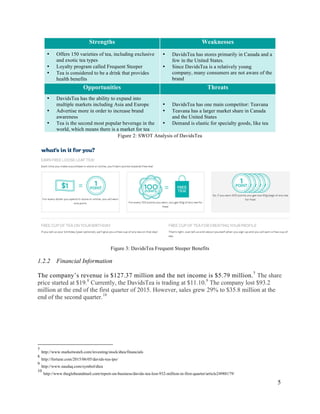
loyalty program called Frequent Steeper, on the next page is an outline of the benefits (Figure
3).6
Creating a relationship with the customer was the main focus of the company from the
beginning. DavidsTea in-store experience and loyalty program are ways in which the company
keeps customers coming back.
2
Ibid.
3
http://fortune.com/2015/06/05/davids-tea-ipo/
4
http://www.retail-insider.com/retail-insider/2015/10/davids-tea
5
https://www.davidstea.com/
6
Ibid.
5
Strengths Weaknesses
• Offers 150 varieties of tea, including exclusive
and exotic tea types
• Loyalty program called Frequent Steeper
• Tea is considered to be a drink that provides
health benefits
• DavidsTea has stores primarily in Canada and a
few in the United States.
• Since DavidsTea is a relatively young
company, many consumers are not aware of the
brand
Opportunities Threats
• DavidsTea has the ability to expand into
multiple markets including Asia and Europe
• Advertise more in order to increase brand
awareness
• Tea is the second most popular beverage in the
world, which means there is a market for tea
• DavidsTea has one main competitor: Teavana
• Teavana has a larger market share in Canada
and the United States
• Demand is elastic for specialty goods, like tea
Figure 2: SWOT Analysis of DavidsTea
Figure 3: DavidsTea Frequent Steeper Benefits
1.2.2 Financial Information
The company’s revenue is $127.37 million and the net income is $5.79 million.7
The share
price started at $19.8
Currently, the DavidsTea is trading at $11.10.9
The company lost $93.2
million at the end of the first quarter of 2015. However, sales grew 29% to $35.8 million at the
end of the second quarter.10
7
http://www.marketwatch.com/investing/stock/dtea/financials
8
http://fortune.com/2015/06/05/davids-tea-ipo/
9
http://www.nasdaq.com/symbol/dtea
10
http://www.theglobeandmail.com/report-on-business/davids-tea-lost-932-million-in-first-quarter/article24988179/
6
1.2.3 Domestic Business Activities
Currently, the company only has stores in Canada and the United States, below is a map showing
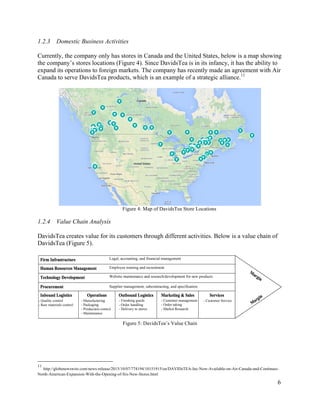
the company’s stores locations (Figure 4). Since DavidsTea is in its infancy, it has the ability to
expand its operations to foreign markets. The company has recently made an agreement with Air
Canada to serve DavidsTea products, which is an example of a strategic alliance.11
Figure 4: Map of DavidsTea Store Locations
1.2.4 Value Chain Analysis
DavidsTea creates value for its customers through different activities. Below is a value chain of
DavidsTea (Figure 5).
Figure 5: DavidsTea’s Value Chain
11
http://globenewswire.com/news-release/2015/10/07/774194/10151915/en/DAVIDsTEA-Inc-Now-Available-on-Air-Canada-and-Continues-
North-American-Expansion-With-the-Opening-of-Six-New-Stores.html
Legal, accounting, and financial management
Employee training and recruitment
Website maintenance and research/development for new products
Supplier management, subcontracting, and specification
- Quality control
- Raw materials control
- Manufacturing
- Packaging
- Production control
- Maintenance
- Finishing goods
- Order handling
- Delivery to stores
- Customer management
- Order taking
- Market Research
- Customer Service
7
1.3 Industry Analysis
Tea is the second most consumed beverage in the world and a multibillion dollar market,
approximately worth $45 billion.12
In Canada and the United States, the direct competitor of
DavidsTea is Teavana. Teavana is an American tea company that was founded in 1997 and was
acquired by Starbucks in 2012.13
Teavana has stores in United States, Canada, Mexico and
Puerto Rico. Teavana, however, offers all tea varieties except Pu’erh tea and Mate tea, but does
offer Chai tea, which is not a type of tea sold by DavidsTea.14
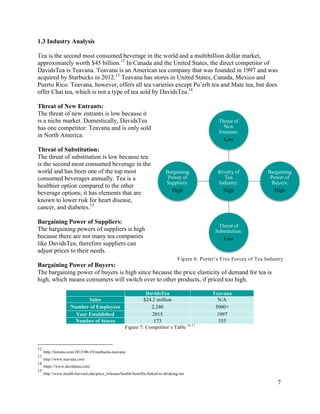
Threat of New Entrants:
The threat of new entrants is low because it
is a niche market. Domestically, DavidsTea
has one competitor: Teavana and is only sold
in North America.
Threat of Substitution:
The threat of substitution is low because tea
is the second most consumed beverage in the
world and has been one of the top most
consumed beverages annually. Tea is a
healthier option compared to the other
beverage options; it has elements that are
known to lower risk for heart disease,
cancer, and diabetes.15
Bargaining Power of Suppliers:
The bargaining powers of suppliers is high
because there are not many tea companies
like DavidsTea, therefore suppliers can
adjust prices to their needs.
Bargaining Power of Buyers:
The bargaining power of buyers is high since because the price elasticity of demand for tea is
high, which means consumers will switch over to other products, if priced too high.
DavidsTea Teavana
Sales $24.2 million N/A
Number of Employees 2,340 5000+
Year Established 2015 1997
Number of Stores 173 355
Figure 7: Competitor’s Table 16 17
12
http://fortune.com/2015/06/19/starbucks-teavana/
13
http://www.teavana.com
14
https://www.davidstea.com/
15
http://www.health.harvard.edu/press_releases/health-benefits-linked-to-drinking-tea
Rivalry of
Tea
Industry:
High
Threat of
New
Entrants:
Low
Bargaining
Power of
Buyers:
High
Threat of
Substitution:
Low
Bargaining
Power of
Suppliers:
High
Figure 6: Porter’s Five Forces of Tea Industry
8
2. Global Market Search16 17
2.1 Country Selection
2.1.1 Criteria Selection
Since DavidsTea is only sold in Canada and in the United States, I will focus my search on
potentially expanding into European and Asian countries. European countries are relevant
because it is a relatively wealthy continent. Asian countries are relevant because they have large
populations and are experiencing economic growth. The factors I will be using to determine
which countries DavidsTea will be most successful in include tea consumption per capita, annual
disposable income, population size, and ease of doing business. Countries that had a population
of less than 30 million people were removed from the list of the world’s largest tea consumers
created by Euromonitor.18
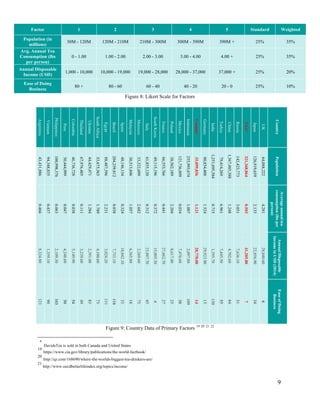
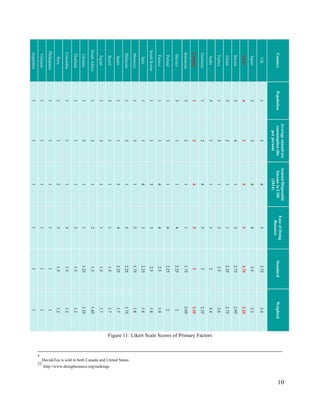
Based on these factors, we can narrow down the selection to 28 countries:
Population Size:
It is key for DavidsTea to expand into countries that are densely populated because it
means potentially larger sales within those particular countries.
Tea Consumption per Capita:
It is important for DavidsTea to expand into countries where tea is the most consumed
because this could also potentially lead to higher sales.
Annual Disposable Income:
It is essential for DavidsTea to expand into countries where annual disposable income is
the highest because it means that the country’s population is well-off economically. Also,
tea is considered is a nonessential good.
Ease of Doing Business:
It is critical for DavidsTea to expand into countries that are easier to do business in order
to be financially successful.
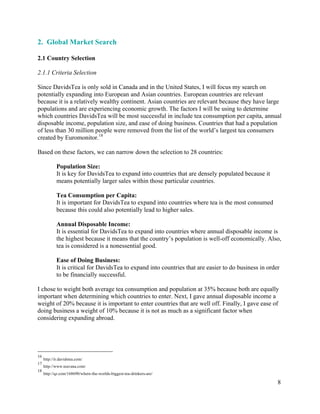
I chose to weight both average tea consumption and population at 35% because both are equally
important when determining which countries to enter. Next, I gave annual disposable income a
weight of 20% because it is important to enter countries that are well off. Finally, I gave ease of
doing business a weight of 10% because it is not as much as a significant factor when
considering expanding abroad.
16
http://ir.davidstea.com/
17
http://www.teavana.com/
18
http://qz.com/168690/where-the-worlds-biggest-tea-drinkers-are/
9
Figure 8: Likert Scale for Factors
Figure 9: Country Data of Primary Factors 19 20 21 22
*
DavidsTea is sold in both Canada and United States
19
https://www.cia.gov/library/publications/the-world-factbook/
20
http://qz.com/168690/where-the-worlds-biggest-tea-drinkers-are/
21
http://www.oecdbetterlifeindex.org/topics/income/
Factor 1 2 3 4 5 Standard Weighted
Population (in
millions)
30M - 120M 120M - 210M 210M - 300M 300M - 390M 390M + 25% 35%
Avg. Annual Tea
Consumption (lbs
per person)
0 - 1.00 1.00 - 2.00 2.00 - 3.00 3.00 - 4.00 4.00 + 25% 35%
Annual Disposable
Income (USD)
1,000 - 10,000 10,000 - 19,000 19,000 - 28,000 28,000 - 37,000 37,000 + 25% 20%
Ease of Doing
Business
80 + 80 - 60 60 - 40 40 - 20 20 - 0 25% 10%
CountryPopulation
Averageannualtea
consumption(lbsper
person)
AnnualDisposable
IncomeinUSD(2014)
EaseofDoing
Business
UK64,088,2224.28128,840.606
Japan126,919,6592.13322,856.9034
USA*321,368,8640.50341,205.807
Russia142,423,7733.0517,636.1051
China1,367,485,3881.2484,702.6084
Turkey79,414,2696.9617,445.5055
India1,251,695,5840.7151,395.70130
Germany80,854,4081.52429,923.9015
Canada*35,099,8361.12128,770.0014
Indonesia255,993,6741.0072,097.80109
Mexico121,736,8090.0347,476.6038
Poland38,562,1892.2048,617.4025
France66,553,7660.44127,662.7027
SouthKorea49,115,1960.37215,005.304
Italy61,855,1200.31223,887.7045
Morocco33,322,6992.6822,269.6075
Malaysia30,513,8481.0576,365.8018
Spain48,146,1340.32418,842.1033
Brazil204,259,8120.0387,733.10116
Egypt88,487,3962.2313,024.20131
SouthAfrica53,675,5631.7894,100.6073
Ukraine44,429,4711.2842,391.0083
Thailand67,976,4050.1113,239.6049
Colombia46,736,7280.0385,149.9054
Peru30,444,9990.0474,248.6050
Philippines100,998,3760.0632,109.30103
Vietnam94,348,8350.4371,359.1090
Argentina43,431,8860.4668,324.80121
10
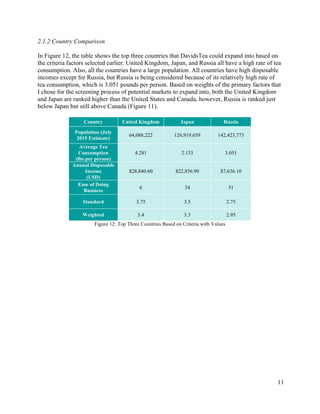
Figure 11: Likert Scale Scores of Primary Factors
*
DavidsTea is sold in both Canada and United States
22
http://www.doingbusiness.org/rankings
CountryPopulation
Averageannualtea
consumption(lbs
perperson)
AnnualDisposable
IncomeinUSD
(2014)
EaseofDoing
Business
StandardWeighted
UK15453.753.4
Japan33443.53.3
USA*41553.753.25
Russia34132.752.95
China52112.252.75
Turkey15132.52.6
India511122.4
Germany124532.35
Canada*124532.35
Indonesia32111.752.05
Mexico31142.252
Poland13142.252
France11442.51.9
SouthKorea11352.51.8
Italy11432.251.8
Morocco13121.751.8
Malaysia12152.251.75
Spain11342.251.7
Brazil31111.51.7
Egypt13111.51.7
SouthAfrica12121.51.45
Ukraine12111.251.35
Thailand11131.51.2
Colombia11131.51.2
Peru11231.51.2
Philippines111111
Vietnam111111
Argentina111111
11
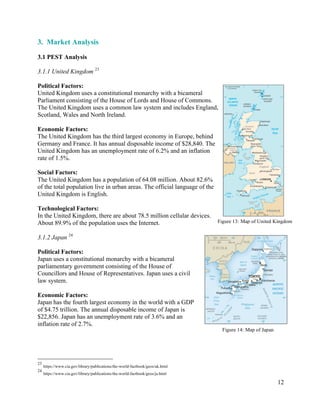
2.1.2 Country Comparison
In Figure 12, the table shows the top three countries that DavidsTea could expand into based on
the criteria factors selected earlier. United Kingdom, Japan, and Russia all have a high rate of tea
consumption. Also, all the countries have a large population. All countries have high disposable
incomes except for Russia, but Russia is being considered because of its relatively high rate of
tea consumption, which is 3.051 pounds per person. Based on weights of the primary factors that
I chose for the screening process of potential markets to expand into, both the United Kingdom
and Japan are ranked higher than the United States and Canada, however, Russia is ranked just
below Japan but still above Canada (Figure 11).
Country United Kingdom Japan Russia
Population (July
2015 Estimate)
64,088,222 126,919,659 142,423,773
Average Tea
Consumption
(lbs per person)
4.281 2.133 3.051
Annual Disposable
Income
(USD)
$28,840.60 $22,856.90 $7,636.10
Ease of Doing
Business
6 34 51
Standard 3.75 3.5 2.75
Weighted 3.4 3.3 2.95
Figure 12: Top Three Countries Based on Criteria with Values
12
3. Market Analysis
3.1 PEST Analysis
3.1.1 United Kingdom 23
Political Factors:
United Kingdom uses a constitutional monarchy with a bicameral
Parliament consisting of the House of Lords and House of Commons.
The United Kingdom uses a common law system and includes England,
Scotland, Wales and North Ireland.
Economic Factors:
The United Kingdom has the third largest economy in Europe, behind
Germany and France. It has annual disposable income of $28,840. The
United Kingdom has an unemployment rate of 6.2% and an inflation
rate of 1.5%.
Social Factors:
The United Kingdom has a population of 64.08 million. About 82.6%
of the total population live in urban areas. The official language of the
United Kingdom is English.
Technological Factors:
In the United Kingdom, there are about 78.5 million cellular devices.
About 89.9% of the population uses the Internet.
3.1.2 Japan 24
Political Factors:
Japan uses a constitutional monarchy with a bicameral
parliamentary government consisting of the House of
Councillors and House of Representatives. Japan uses a civil
law system.
Economic Factors:
Japan has the fourth largest economy in the world with a GDP
of $4.75 trillion. The annual disposable income of Japan is
$22,856. Japan has an unemployment rate of 3.6% and an
inflation rate of 2.7%.
23
https://www.cia.gov/library/publications/the-world-factbook/geos/uk.html
24
https://www.cia.gov/library/publications/the-world-factbook/geos/ja.html
Figure 13: Map of United Kingdom
Figure 14: Map of Japan
13
Social Factors:
Japan has a population of 126.91 million. About 93.5% of the total population live in urban
areas. The official language is Japanese.
Technological Factors:
In Japan, there are about 152.7 million cellular devices and about 86% of the population use
internet.
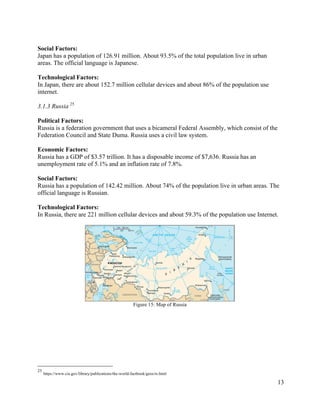
3.1.3 Russia 25
Political Factors:
Russia is a federation government that uses a bicameral Federal Assembly, which consist of the
Federation Council and State Duma. Russia uses a civil law system.
Economic Factors:
Russia has a GDP of $3.57 trillion. It has a disposable income of $7,636. Russia has an
unemployment rate of 5.1% and an inflation rate of 7.8%.
Social Factors:
Russia has a population of 142.42 million. About 74% of the population live in urban areas. The
official language is Russian.
Technological Factors:
In Russia, there are 221 million cellular devices and about 59.3% of the population use Internet.
Figure 15: Map of Russia
25
https://www.cia.gov/library/publications/the-world-factbook/geos/rs.html
14
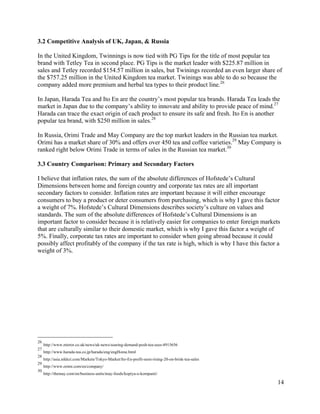
3.2 Competitive Analysis of UK, Japan, & Russia
In the United Kingdom, Twinnings is now tied with PG Tips for the title of most popular tea
brand with Tetley Tea in second place. PG Tips is the market leader with $225.87 million in
sales and Tetley recorded $154.57 million in sales, but Twinings recorded an even larger share of
the $757.25 million in the United Kingdom tea market. Twinings was able to do so because the
company added more premium and herbal tea types to their product line.26
In Japan, Harada Tea and Ito En are the country’s most popular tea brands. Harada Tea leads the
market in Japan due to the company’s ability to innovate and ability to provide peace of mind.27
Harada can trace the exact origin of each product to ensure its safe and fresh. Ito En is another
popular tea brand, with $250 million in sales.28
In Russia, Orimi Trade and May Company are the top market leaders in the Russian tea market.
Orimi has a market share of 30% and offers over 450 tea and coffee varieties.29
May Company is
ranked right below Orimi Trade in terms of sales in the Russian tea market.30
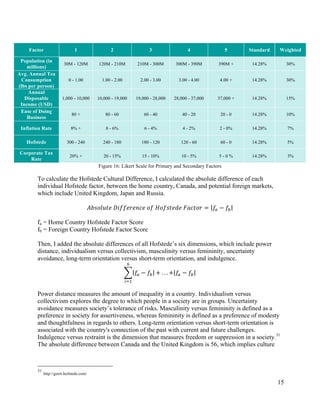
3.3 Country Comparison: Primary and Secondary Factors
I believe that inflation rates, the sum of the absolute differences of Hofstede’s Cultural
Dimensions between home and foreign country and corporate tax rates are all important
secondary factors to consider. Inflation rates are important because it will either encourage
consumers to buy a product or deter consumers from purchasing, which is why I gave this factor
a weight of 7%. Hofstede’s Cultural Dimensions describes society’s culture on values and
standards. The sum of the absolute differences of Hofstede’s Cultural Dimensions is an
important factor to consider because it is relatively easier for companies to enter foreign markets
that are culturally similar to their domestic market, which is why I gave this factor a weight of
5%. Finally, corporate tax rates are important to consider when going abroad because it could
possibly affect profitably of the company if the tax rate is high, which is why I have this factor a
weight of 3%.
26
http://www.mirror.co.uk/news/uk-news/soaring-demand-posh-tea-sees-4915656
27
http://www.harada-tea.co.jp/harada/eng/engHome.html
28
http://asia.nikkei.com/Markets/Tokyo-Market/Ito-En-profit-seen-rising-20-on-brisk-tea-sales
29
http://www.orimi.com/en/company/
30
http://themay.com/en/business-units/may-foods/kopiya-o-kompanii/
15
Figure 16: Likert Scale for Primary and Secondary Factors
To calculate the Hofstede Cultural Difference, I calculated the absolute difference of each
individual Hofstede factor, between the home country, Canada, and potential foreign markets,
which include United Kingdom, Japan and Russia.
𝐴𝑏𝑠𝑜𝑙𝑢𝑡𝑒	𝐷𝑖𝑓𝑓𝑒𝑟𝑒𝑛𝑐𝑒	𝑜𝑓	𝐻𝑜𝑓𝑠𝑡𝑒𝑑𝑒	𝐹𝑎𝑐𝑡𝑜𝑟 = 𝑓5 − 𝑓7
fa = Home Country Hofstede Factor Score
fb = Foreign Country Hofstede Factor Score
Then, I added the absolute differences of all Hofstede’s six dimensions, which include power
distance, individualism versus collectivism, masculinity versus femininity, uncertainty
avoidance, long-term orientation versus short-term orientation, and indulgence.
𝑓5 − 𝑓7
8
9:;
+	. . . + 𝑓5 − 𝑓7
Power distance measures the amount of inequality in a country. Individualism versus
collectivism explores the degree to which people in a society are in groups. Uncertainty
avoidance measures society’s tolerance of risks. Masculinity versus femininity is defined as a
preference in society for assertiveness, whereas femininity is defined as a preference of modesty
and thoughtfulness in regards to others. Long-term orientation versus short-term orientation is
associated with the country's connection of the past with current and future challenges.
Indulgence versus restraint is the dimension that measures freedom or suppression in a society.31
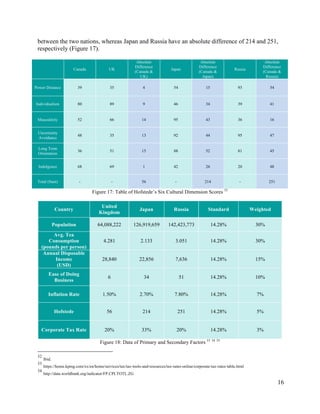
The absolute difference between Canada and the United Kingdom is 56, which implies culture
31
http://geert-hofstede.com/
Factor 1 2 3 4 5 Standard Weighted
Population (in
millions)
30M - 120M 120M - 210M 210M - 300M 300M - 390M 390M + 14.28% 30%
Avg. Annual Tea
Consumption
(lbs per person)
0 - 1.00 1.00 - 2.00 2.00 - 3.00 3.00 - 4.00 4.00 + 14.28% 30%
Annual
Disposable
Income (USD)
1,000 - 10,000 10,000 - 19,000 19,000 - 28,000 28,000 - 37,000 37,000 + 14.28% 15%
Ease of Doing
Business
80 + 80 - 60 60 - 40 40 - 20 20 - 0 14.28% 10%
Inflation Rate 8% + 8 - 6% 6 - 4% 4 - 2% 2 - 0% 14.28% 7%
Hofstede 300 - 240 240 - 180 180 - 120 120 - 60 60 - 0 14.28% 5%
Corporate Tax
Rate
20% + 20 - 15% 15 - 10% 10 - 5% 5 - 0 % 14.28% 3%
16
between the two nations, whereas Japan and Russia have an absolute difference of 214 and 251,
respectively (Figure 17).
Canada UK
Absolute
Difference
(Canada &
UK)
Japan
Absolute
Difference
(Canada &
Japan)
Russia
Absolute
Difference
(Canada &
Russia)
Power Distance 39 35 4 54 15 93 54
Individualism 80 89 9 46 34 39 41
Masculinity 52 66 14 95 43 36 16
Uncertainty
Avoidance
48 35 13 92 44 95 47
Long Term
Orientation
36 51 15 88 52 81 45
Indulgence 68 69 1 42 26 20 48
Total (Sum) - - 56 - 214 - 251
Figure 17: Table of Hofstede’s Six Cultural Dimension Scores 32
Country
United
Kingdom
Japan Russia Standard Weighted
Population 64,088,222 126,919,659 142,423,773 14.28% 30%
Avg. Tea
Consumption
(pounds per person)
4.281 2.133 3.051 14.28% 30%
Annual Disposable
Income
(USD)
28,840 22,856 7,636 14.28% 15%
Ease of Doing
Business
6 34 51 14.28% 10%
Inflation Rate 1.50% 2.70% 7.80% 14.28% 7%
Hofstede 56 214 251 14.28% 5%
Corporate Tax Rate 20% 33% 20% 14.28% 3%
Figure 18: Data of Primary and Secondary Factors 33 34 35
32
Ibid.
33
https://home.kpmg.com/xx/en/home/services/tax/tax-tools-and-resources/tax-rates-online/corporate-tax-rates-table.html
34
http://data.worldbank.org/indicator/FP.CPI.TOTL.ZG
17
Country United Kingdom Japan Russia
Population 1 3 3
Avg. Tea
Consumption
5 3 4
Annual Disposable
Income
4 4 1
Ease of Doing
Business
5 4 3
Corporate Tax
Rate
2 1 2
Inflation Rate 5 4 2
Hofstede 5 2 2
Standard 3.85 2.99 2.28
Weighted 3.56 3.21 2.8
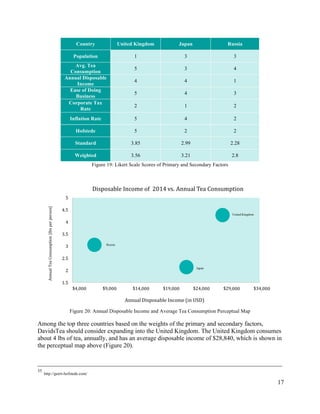
Figure 19: Likert Scale Scores of Primary and Secondary Factors
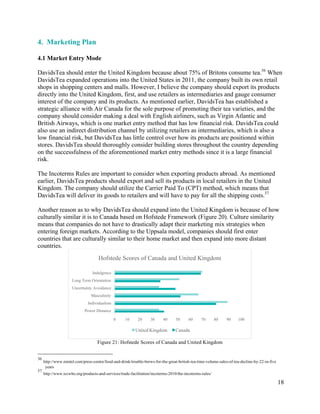
Figure 20: Annual Disposable Income and Average Tea Consumption Perceptual Map
Among the top three countries based on the weights of the primary and secondary factors,
DavidsTea should consider expanding into the United Kingdom. The United Kingdom consumes
about 4 lbs of tea, annually, and has an average disposable income of $28,840, which is shown in
the perceptual map above (Figure 20).
35
http://geert-hofstede.com/
1.5
2
2.5
3
3.5
4
4.5
5
Annual	Tea	Consumption	(lbs	per	person)
Annual	Disposable	Income	(in	USD)
Disposable	Income	of		2014	vs.	Annual	Tea	Consumption	
Japan
United Kingdom
Russia
18
4. Marketing Plan
4.1 Market Entry Mode
DavidsTea should enter the United Kingdom because about 75% of Britons consume tea.36
When
DavidsTea expanded operations into the United States in 2011, the company built its own retail
shops in shopping centers and malls. However, I believe the company should export its products
directly into the United Kingdom, first, and use retailers as intermediaries and gauge consumer
interest of the company and its products. As mentioned earlier, DavidsTea has established a
strategic alliance with Air Canada for the sole purpose of promoting their tea varieties, and the
company should consider making a deal with English airliners, such as Virgin Atlantic and
British Airways, which is one market entry method that has low financial risk. DavidsTea could
also use an indirect distribution channel by utilizing retailers as intermediaries, which is also a
low financial risk, but DavidsTea has little control over how its products are positioned within
stores. DavidsTea should thoroughly consider building stores throughout the country depending
on the successfulness of the aforementioned market entry methods since it is a large financial
risk.
The Incoterms Rules are important to consider when exporting products abroad. As mentioned
earlier, DavidsTea products should export and sell its products in local retailers in the United
Kingdom. The company should utilize the Carrier Paid To (CPT) method, which means that
DavidsTea will deliver its goods to retailers and will have to pay for all the shipping costs.37
Another reason as to why DavidsTea should expand into the United Kingdom is because of how
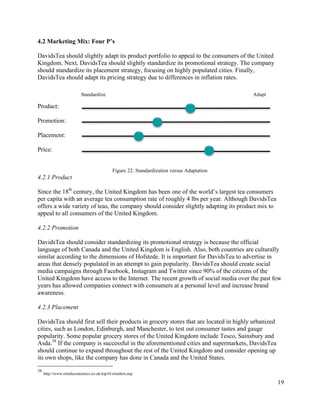
culturally similar it is to Canada based on Hofstede Framework (Figure 20). Culture similarity
means that companies do not have to drastically adapt their marketing mix strategies when
entering foreign markets. According to the Uppsala model, companies should first enter
countries that are culturally similar to their home market and then expand into more distant
countries.
Figure 21: Hofstede Scores of Canada and United Kingdom
36
http://www.mintel.com/press-centre/food-and-drink/trouble-brews-for-the-great-british-tea-time-volume-sales-of-tea-decline-by-22-in-five
years
37
http://www.iccwbo.org/products-and-services/trade-facilitation/incoterms-2010/the-incoterms-rules/
0 10 20 30 40 50 60 70 80 90 100
Power Distance
Individualism
Masculinity
Uncertainty Avoidance
Long Term Orientation
Indulgence
Hofstede Scores of Canada and United Kingdom
United Kingdom Canada
19
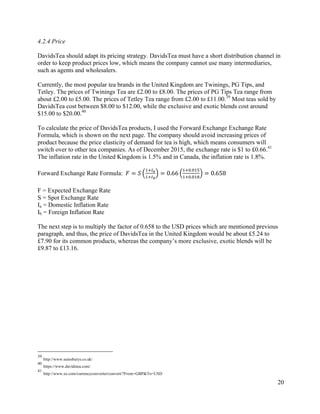
4.2 Marketing Mix: Four P’s
DavidsTea should slightly adapt its product portfolio to appeal to the consumers of the United
Kingdom. Next, DavidsTea should slightly standardize its promotional strategy. The company
should standardize its placement strategy, focusing on highly populated cities. Finally,
DavidsTea should adapt its pricing strategy due to differences in inflation rates.
Product:
Promotion:
Placement:
Price:
Figure 22: Standardization versus Adaptation
4.2.1 Product
Since the 18th
century, the United Kingdom has been one of the world’s largest tea consumers
per capita with an average tea consumption rate of roughly 4 lbs per year. Although DavidsTea
offers a wide variety of teas, the company should consider slightly adapting its product mix to
appeal to all consumers of the United Kingdom.
4.2.2 Promotion
DavidsTea should consider standardizing its promotional strategy is because the official
language of both Canada and the United Kingdom is English. Also, both countries are culturally
similar according to the dimensions of Hofstede. It is important for DavidsTea to advertise in
areas that densely populated in an attempt to gain popularity. DavidsTea should create social
media campaigns through Facebook, Instagram and Twitter since 90% of the citizens of the
United Kingdom have access to the Internet. The recent growth of social media over the past few
years has allowed companies connect with consumers at a personal level and increase brand
awareness.
4.2.3 Placement
DavidsTea should first sell their products in grocery stores that are located in highly urbanized
cities, such as London, Edinburgh, and Manchester, to test out consumer tastes and gauge
popularity. Some popular grocery stores of the United Kingdom include Tesco, Sainsbury and
Asda.38
If the company is successful in the aforementioned cities and supermarkets, DavidsTea
should continue to expand throughout the rest of the United Kingdom and consider opening up
its own shops, like the company has done in Canada and the United States.
38
http://www.retaileconomics.co.uk/top10-retailers.asp
Standardize Adapt
20
4.2.4 Price
DavidsTea should adapt its pricing strategy. DavidsTea must have a short distribution channel in
order to keep product prices low, which means the company cannot use many intermediaries,
such as agents and wholesalers.
Currently, the most popular tea brands in the United Kingdom are Twinings, PG Tips, and
Tetley. The prices of Twinings Tea are £2.00 to £8.00. The prices of PG Tips Tea range from
about £2.00 to £5.00. The prices of Tetley Tea range from £2.00 to £11.00.39
Most teas sold by
DavidsTea cost between $8.00 to $12.00, while the exclusive and exotic blends cost around
$15.00 to $20.00.40
To calculate the price of DavidsTea products, I used the Forward Exchange Exchange Rate
Formula, which is shown on the next page. The company should avoid increasing prices of
product because the price elasticity of demand for tea is high, which means consumers will
switch over to other tea companies. As of December 2015, the exchange rate is $1 to £0.66.41
The inflation rate in the United Kingdom is 1.5% and in Canada, the inflation rate is 1.8%.
Forward Exchange Rate Formula:		𝐹 = 𝑆
;?@A
;?@B
= 0.66
;?E.E;F
;?E.E;G
= 0.658
F = Expected Exchange Rate
S = Spot Exchange Rate
Ia = Domestic Inflation Rate
Ib = Foreign Inflation Rate
The next step is to multiply the factor of 0.658 to the USD prices which are mentioned previous
paragraph, and thus, the price of DavidsTea in the United Kingdom would be about £5.24 to
£7.90 for its common products, whereas the company’s more exclusive, exotic blends will be
£9.87 to £13.16.
39
http://www.sainsburys.co.uk/
40
https://www.davidstea.com/
41
http://www.xe.com/currencyconverter/convert/?From=GBP&To=USD
21
4.3 STP Process
4.3.1 Segmentation
In United Kingdom, tea appeals to people of all ages and since DavidsTea offers a large variety
of tea types, it appeals to the tastes of all consumers. Black tea is the most consumed tea type in
the United Kingdom, followed by green tea, but the sales of fruit and herbal tea have been on the
rise since 2012. Between 2012 and and 2014, sales of these tea types have rose 31%, from
$87.25 million to $114.35 million.42
Thus, DavidsTea should focus more on creating a larger
selection of black, green teas, herbal teas and fruit teas. By doing so, the company is using the
individual consumer preferences as the basis for its segmentation.
4.3.2 Targeting
It is important that DavidsTea focuses on areas that have a slightly higher disposable income
since tea is not considered a necessity. Men aged between 16 and 44 are United Kingdom’s
largest tea consumer. 43
DavidsTea should use a mass marketing strategy, since roughly 75% of
Britons drink tea.
4.3.3 Positioning
DavidsTea should position itself as a premium tea brand in the United Kingdom. The tea
industry in United Kingdom is highly competitive with Twinings, PG Tips, and Tetley as the
most popular brands, but none of these companies have created its own independent stores.
DavidsTea should open up shops in the United Kingdom to differentiate itself from other brands.
4.4 Conclusion
In summation, I believe DavidsTea will be quite successful in the United Kingdom. The United
Kingdom has a relatively high disposable income than most countries, which means that
consumers have the ability to buy non-essentials. Annually, the United Kingdom is one of the
top consumers of tea, globally. In addition, the United Kingdom is culturally similar to Canada,
which implies that DavidsTea does not have to adapt its products and marketing strategies all too
much.
42
http://www.mintel.com/press-centre/food-and-drink/trouble-brews-for-the-great-british-tea-time-volume-sales-of-tea-decline-by-22-in-five-
years
43
Ibid.
22
Works Cited
Budak, Jasmine. "Steeped in Success." Canadian Business. N.p., 08 June 2011. Web. 9 Dec.
2015.
"CIA's World Factbook." Central Intelligence Agency. N.p., n.d. Web. 9 Dec. 2015.
"Corporate Tax Rates Table | KPMG | GLOBAL." KPMG. N.p., n.d. Web. 9 Dec. 2015.
"DavidsTea Inc Financials." MarketWatch. N.p., n.d. Web.
"DAVIDsTEA Inc. (DTEA)." NASDAQ.com. N.p., n.d. Web. 09 Dec. 2015.
"David's Tea Reveals Substantial Expansion Plans." Retail Insider. N.p., n.d. Web. 9 Dec. 2015.
"DAVIDsTEA." DAVIDsTEA. N.p., n.d. Web. 09 Dec. 2015.
"Harada Tea." Harada Tea. N.p., n.d. Web. 09 Dec. 2015.
"The Hofstede Centre." The Hofstede Centre. N.p., n.d. Web. 9 Dec. 2015.
"Economy Rankings." World Bank Group. N.p., n.d. Web. 9 Dec. 2015.
Ferdman, Roberto. "Where the World’s Biggest Tea Drinkers Are." Quartz. N.p., 20 Jan. 2014.
Web. 9 Dec. 2015.
Hayward, Stephen. "Soaring Demand for Posh Tea Sees Twinings Challenge PG Tips for Title
of UK's Most Popular Cuppa." Mirror. N.p., 04 Jan. 2015. Web. 9 Dec. 2015.
"Health Benefits Linked to Drinking Tea." Harvard Health Publications. N.p., Sept. 2014. Web.
9 Dec. 2015.
"Income." OECD Better Life Index. N.p., n.d. Web. 9 Dec. 2015.
"Incoterms Rules." International Chamber of Commerce. N.p., n.d. Web. 9 Dec. 2015.
"Inflation, Consumer Prices (annual %)." The World Bank. N.p., n.d. Web. 9 Dec. 2015.
Infrantry, Ashante. "DavidsTea Looks to Get out Front in Tea Wars." Toronto Star. N.p., 19 May
2015. Web. 9 Dec. 2015.
23
"Ito En Profit Seen Rising 20% on Brisk Tea Sales." Nikkei Asian Review. N.p., n.d. Web. 09
Dec. 15.
Kell, John. "David's Tea Brews a Successful IPO." Fortune. N.p., 05 June 2015. Web. 9 Dec.
2015.
Marowits, Ross. "DavidsTea Lost $93.2-million in First Quarter." The Globe and Mail. N.p., 16
June 2015. Web. 9 Dec. 2015.
"May Tea." May Tea. N.p., n.d. Web. 09 Dec. 2015.
McDougald, Kelly. "DAVIDsTEA Inc. Now Available on Air Canada, and Continues North
American Expansion With the Opening of Six New Stores." NASDAQ Global Newswire.
N.p., n.d. Web.
"Most Popular Tea Types in the United Kingdom." Statista. N.p., n.d. Web. 9 Dec. 2015.
"Orimi Trade." Orimi Trade. N.p., n.d. Web. 9 Dec. 2015.
"Sainsbury's." Sainsbury's. N.p., n.d. Web. 9 Dec. 2015.
Swystun, Jeff. "David's Tea: The Brand and Business - Sparksheet." Sparksheet. N.p., 28 July
2015. Web. 9 Dec. 2015.
"Teavana." Teavana. N.p., n.d. Web. 09 Dec. 2015.
"Top 10 UK Retailers." Retail Economics. N.p., n.d. Web. 9 Dec. 2015.
"Trouble Brews for the Great British Tea Time: Volume Sales of Tea Decline by 22% in Five
Years." Mintel. N.p., n.d. Web. 9 Dec. 2015.
Ungar, Laura. "Tea's Health Benefits Boost Its Popularity." Washington Post. N.p., 1 Apr. 2013.
Web. 9 Dec. 2015.
Wahba, Phil. "Starbucks to Use Its Own Stores in Big Teavana Global Push." Fortune. N.p., 19
June 2015. Web. 9 Dec. 2015.
24
"XE Currency Converter." XE. N.p., n.d. Web. 9 Dec. 2015.

Amit Patel- DavidsTea IMP

  • 1.
    International Marketing Plan DavidsTea AmitPatel INB 337: International Marketing Management Fall 2015
  • 2.
    2 Table of Contents ExecutiveSummary………………………………………………………………………………3 1. Company Analysis………………………………………………………………………........4 1.1. The Company…………………………………………………………………………….4 1.2. Company Analysis…………………………………………………………………….....4 1.2.1. Internal Analysis……………………………………………………………….....4 1.2.2. Financial Information…………………………………………………………….5 1.2.3. Domestic Business Activities………….…………………………………………6 1.2.4. Value Chain Analysis…………………………………………………………….6 1.3 Industry Analysis…………………………………………………………………………7 2. Global Market Search………………………………………………………………………...8 2.1. Country Selection………………………………………………………………………..8 2.1.1. Criteria Selection…………………………………………………………………8 2.1.2. Country Comparison………………………………………………………….....11 3. Market Analysis……...……………….……………………………………………………..12 3.1. PEST Analysis………………………………………………………………………….12 3.1.1. United Kingdom………………………………………………………………....12 3.1.2. Japan……………………………………………………………………………..12 3.1.3. Russia…………………………………………………………………………….13 3.2. Competitive Analysis of UK, Japan, & Russia…………………………………………14 3.3. Country Comparison: Primary and Secondary Factors……………………………...….14 4. Marketing Plan……………………………………………………………………………….18 4.1. Market Entry Mode……………………………………………………………………...18 4.2. Marketing Mix………………………………………………………………………......19 4.2.1. Product…………………………………………………………………………...19 4.2.2. Promotion………………………………………………………………………...19 4.2.3. Placement………………………………………………………………………...19 4.2.4. Price……………………………………………………………………………...20 4.3. STP Process……………………………………………………………………………..21 4.3.1. Segmentation…………………………………………………………………….21 4.3.2. Targeting…………………………………………………………………………21 4.3.3. Positioning……………………………………………………………………….21 4.4. Conclusion and Recommendation………………………………………………………21
  • 3.
    3 Executive Summary DavidsTea isa Canadian tea retailer based in Montreal, Quebec. It is the largest Canadian-based specialty tea boutique in the country, and competes directly with Teavana in many markets. DavidsTea was founded in 2008 by David Segal and Herschel Segal, his cousin and opened their first store in Toronto. Currently, DavidsTea has 173 shops that are located in Canada, primarily, and in the United States. As of January 31, 2015, DavidsTea has 340 full-time employees and 2,000 part-time employees.1 DavidsTea is interested in expanding into other countries, thus this report will discuss the potential markets it could enter and further analyze the feasibility of doing business in those possible countries. 1 https://www.davidstea.com/
  • 4.
    4 1. Company Analysis 1.1The Company DavidsTea is a tea company that offers over 150 varieties of tea, including exclusive blends, exotic blends, seasonal collections, and traditional teas. It is the largest Canadian-based specialty tea boutique in the country. The company was founded in 2008 with stores in both Canada and the United States. The vision of David and Herschel Segal was to create “great tea, a friendly environment and a colorful, modern store”.2 The founders believe that tea is healthy and brings people together. DavidsTea went public on the New York Stock Exchange on June 5, 2015.3 DavidsTea’s logo (Figure 1) shown below is rather simplistic, but a lively brand nonetheless with such a color as turquoise. Sylvain Toutant, the CEO of DavidsTea focus is to create new products, focus more on customer service, generate a greater sense of brand awareness and grow the chain to over 550 stores in North America.4 Figure 1: DavidsTea logo 1.2 Organizational Structure 1.2.1 Internal Analysis DavidsTea offers a wide variety of teas to satisfy every taste. The company also sells tea accessories, such as spoons, travelers’ mugs, tea sets, and more. DavidsTea offers the following tea types: White Tea, Green Tea, Oolong Tea, Black Tea, Pu’erh tea, Mate Tea, Rooibos Tea, and Herbal Tea.5 They also offer hot tea, iced tea, tea latte, and tea pop. DavidsTea also has a loyalty program called Frequent Steeper, on the next page is an outline of the benefits (Figure 3).6 Creating a relationship with the customer was the main focus of the company from the beginning. DavidsTea in-store experience and loyalty program are ways in which the company keeps customers coming back. 2 Ibid. 3 http://fortune.com/2015/06/05/davids-tea-ipo/ 4 http://www.retail-insider.com/retail-insider/2015/10/davids-tea 5 https://www.davidstea.com/ 6 Ibid.
  • 5.
    5 Strengths Weaknesses • Offers150 varieties of tea, including exclusive and exotic tea types • Loyalty program called Frequent Steeper • Tea is considered to be a drink that provides health benefits • DavidsTea has stores primarily in Canada and a few in the United States. • Since DavidsTea is a relatively young company, many consumers are not aware of the brand Opportunities Threats • DavidsTea has the ability to expand into multiple markets including Asia and Europe • Advertise more in order to increase brand awareness • Tea is the second most popular beverage in the world, which means there is a market for tea • DavidsTea has one main competitor: Teavana • Teavana has a larger market share in Canada and the United States • Demand is elastic for specialty goods, like tea Figure 2: SWOT Analysis of DavidsTea Figure 3: DavidsTea Frequent Steeper Benefits 1.2.2 Financial Information The company’s revenue is $127.37 million and the net income is $5.79 million.7 The share price started at $19.8 Currently, the DavidsTea is trading at $11.10.9 The company lost $93.2 million at the end of the first quarter of 2015. However, sales grew 29% to $35.8 million at the end of the second quarter.10 7 http://www.marketwatch.com/investing/stock/dtea/financials 8 http://fortune.com/2015/06/05/davids-tea-ipo/ 9 http://www.nasdaq.com/symbol/dtea 10 http://www.theglobeandmail.com/report-on-business/davids-tea-lost-932-million-in-first-quarter/article24988179/
  • 6.
    6 1.2.3 Domestic BusinessActivities Currently, the company only has stores in Canada and the United States, below is a map showing the company’s stores locations (Figure 4). Since DavidsTea is in its infancy, it has the ability to expand its operations to foreign markets. The company has recently made an agreement with Air Canada to serve DavidsTea products, which is an example of a strategic alliance.11 Figure 4: Map of DavidsTea Store Locations 1.2.4 Value Chain Analysis DavidsTea creates value for its customers through different activities. Below is a value chain of DavidsTea (Figure 5). Figure 5: DavidsTea’s Value Chain 11 http://globenewswire.com/news-release/2015/10/07/774194/10151915/en/DAVIDsTEA-Inc-Now-Available-on-Air-Canada-and-Continues- North-American-Expansion-With-the-Opening-of-Six-New-Stores.html Legal, accounting, and financial management Employee training and recruitment Website maintenance and research/development for new products Supplier management, subcontracting, and specification - Quality control - Raw materials control - Manufacturing - Packaging - Production control - Maintenance - Finishing goods - Order handling - Delivery to stores - Customer management - Order taking - Market Research - Customer Service
  • 7.
    7 1.3 Industry Analysis Teais the second most consumed beverage in the world and a multibillion dollar market, approximately worth $45 billion.12 In Canada and the United States, the direct competitor of DavidsTea is Teavana. Teavana is an American tea company that was founded in 1997 and was acquired by Starbucks in 2012.13 Teavana has stores in United States, Canada, Mexico and Puerto Rico. Teavana, however, offers all tea varieties except Pu’erh tea and Mate tea, but does offer Chai tea, which is not a type of tea sold by DavidsTea.14 Threat of New Entrants: The threat of new entrants is low because it is a niche market. Domestically, DavidsTea has one competitor: Teavana and is only sold in North America. Threat of Substitution: The threat of substitution is low because tea is the second most consumed beverage in the world and has been one of the top most consumed beverages annually. Tea is a healthier option compared to the other beverage options; it has elements that are known to lower risk for heart disease, cancer, and diabetes.15 Bargaining Power of Suppliers: The bargaining powers of suppliers is high because there are not many tea companies like DavidsTea, therefore suppliers can adjust prices to their needs. Bargaining Power of Buyers: The bargaining power of buyers is high since because the price elasticity of demand for tea is high, which means consumers will switch over to other products, if priced too high. DavidsTea Teavana Sales $24.2 million N/A Number of Employees 2,340 5000+ Year Established 2015 1997 Number of Stores 173 355 Figure 7: Competitor’s Table 16 17 12 http://fortune.com/2015/06/19/starbucks-teavana/ 13 http://www.teavana.com 14 https://www.davidstea.com/ 15 http://www.health.harvard.edu/press_releases/health-benefits-linked-to-drinking-tea Rivalry of Tea Industry: High Threat of New Entrants: Low Bargaining Power of Buyers: High Threat of Substitution: Low Bargaining Power of Suppliers: High Figure 6: Porter’s Five Forces of Tea Industry
  • 8.
    8 2. Global MarketSearch16 17 2.1 Country Selection 2.1.1 Criteria Selection Since DavidsTea is only sold in Canada and in the United States, I will focus my search on potentially expanding into European and Asian countries. European countries are relevant because it is a relatively wealthy continent. Asian countries are relevant because they have large populations and are experiencing economic growth. The factors I will be using to determine which countries DavidsTea will be most successful in include tea consumption per capita, annual disposable income, population size, and ease of doing business. Countries that had a population of less than 30 million people were removed from the list of the world’s largest tea consumers created by Euromonitor.18 Based on these factors, we can narrow down the selection to 28 countries: Population Size: It is key for DavidsTea to expand into countries that are densely populated because it means potentially larger sales within those particular countries. Tea Consumption per Capita: It is important for DavidsTea to expand into countries where tea is the most consumed because this could also potentially lead to higher sales. Annual Disposable Income: It is essential for DavidsTea to expand into countries where annual disposable income is the highest because it means that the country’s population is well-off economically. Also, tea is considered is a nonessential good. Ease of Doing Business: It is critical for DavidsTea to expand into countries that are easier to do business in order to be financially successful. I chose to weight both average tea consumption and population at 35% because both are equally important when determining which countries to enter. Next, I gave annual disposable income a weight of 20% because it is important to enter countries that are well off. Finally, I gave ease of doing business a weight of 10% because it is not as much as a significant factor when considering expanding abroad. 16 http://ir.davidstea.com/ 17 http://www.teavana.com/ 18 http://qz.com/168690/where-the-worlds-biggest-tea-drinkers-are/
  • 9.
    9 Figure 8: LikertScale for Factors Figure 9: Country Data of Primary Factors 19 20 21 22 * DavidsTea is sold in both Canada and United States 19 https://www.cia.gov/library/publications/the-world-factbook/ 20 http://qz.com/168690/where-the-worlds-biggest-tea-drinkers-are/ 21 http://www.oecdbetterlifeindex.org/topics/income/ Factor 1 2 3 4 5 Standard Weighted Population (in millions) 30M - 120M 120M - 210M 210M - 300M 300M - 390M 390M + 25% 35% Avg. Annual Tea Consumption (lbs per person) 0 - 1.00 1.00 - 2.00 2.00 - 3.00 3.00 - 4.00 4.00 + 25% 35% Annual Disposable Income (USD) 1,000 - 10,000 10,000 - 19,000 19,000 - 28,000 28,000 - 37,000 37,000 + 25% 20% Ease of Doing Business 80 + 80 - 60 60 - 40 40 - 20 20 - 0 25% 10% CountryPopulation Averageannualtea consumption(lbsper person) AnnualDisposable IncomeinUSD(2014) EaseofDoing Business UK64,088,2224.28128,840.606 Japan126,919,6592.13322,856.9034 USA*321,368,8640.50341,205.807 Russia142,423,7733.0517,636.1051 China1,367,485,3881.2484,702.6084 Turkey79,414,2696.9617,445.5055 India1,251,695,5840.7151,395.70130 Germany80,854,4081.52429,923.9015 Canada*35,099,8361.12128,770.0014 Indonesia255,993,6741.0072,097.80109 Mexico121,736,8090.0347,476.6038 Poland38,562,1892.2048,617.4025 France66,553,7660.44127,662.7027 SouthKorea49,115,1960.37215,005.304 Italy61,855,1200.31223,887.7045 Morocco33,322,6992.6822,269.6075 Malaysia30,513,8481.0576,365.8018 Spain48,146,1340.32418,842.1033 Brazil204,259,8120.0387,733.10116 Egypt88,487,3962.2313,024.20131 SouthAfrica53,675,5631.7894,100.6073 Ukraine44,429,4711.2842,391.0083 Thailand67,976,4050.1113,239.6049 Colombia46,736,7280.0385,149.9054 Peru30,444,9990.0474,248.6050 Philippines100,998,3760.0632,109.30103 Vietnam94,348,8350.4371,359.1090 Argentina43,431,8860.4668,324.80121
  • 10.
    10 Figure 11: LikertScale Scores of Primary Factors * DavidsTea is sold in both Canada and United States 22 http://www.doingbusiness.org/rankings CountryPopulation Averageannualtea consumption(lbs perperson) AnnualDisposable IncomeinUSD (2014) EaseofDoing Business StandardWeighted UK15453.753.4 Japan33443.53.3 USA*41553.753.25 Russia34132.752.95 China52112.252.75 Turkey15132.52.6 India511122.4 Germany124532.35 Canada*124532.35 Indonesia32111.752.05 Mexico31142.252 Poland13142.252 France11442.51.9 SouthKorea11352.51.8 Italy11432.251.8 Morocco13121.751.8 Malaysia12152.251.75 Spain11342.251.7 Brazil31111.51.7 Egypt13111.51.7 SouthAfrica12121.51.45 Ukraine12111.251.35 Thailand11131.51.2 Colombia11131.51.2 Peru11231.51.2 Philippines111111 Vietnam111111 Argentina111111
  • 11.
    11 2.1.2 Country Comparison InFigure 12, the table shows the top three countries that DavidsTea could expand into based on the criteria factors selected earlier. United Kingdom, Japan, and Russia all have a high rate of tea consumption. Also, all the countries have a large population. All countries have high disposable incomes except for Russia, but Russia is being considered because of its relatively high rate of tea consumption, which is 3.051 pounds per person. Based on weights of the primary factors that I chose for the screening process of potential markets to expand into, both the United Kingdom and Japan are ranked higher than the United States and Canada, however, Russia is ranked just below Japan but still above Canada (Figure 11). Country United Kingdom Japan Russia Population (July 2015 Estimate) 64,088,222 126,919,659 142,423,773 Average Tea Consumption (lbs per person) 4.281 2.133 3.051 Annual Disposable Income (USD) $28,840.60 $22,856.90 $7,636.10 Ease of Doing Business 6 34 51 Standard 3.75 3.5 2.75 Weighted 3.4 3.3 2.95 Figure 12: Top Three Countries Based on Criteria with Values
  • 12.
    12 3. Market Analysis 3.1PEST Analysis 3.1.1 United Kingdom 23 Political Factors: United Kingdom uses a constitutional monarchy with a bicameral Parliament consisting of the House of Lords and House of Commons. The United Kingdom uses a common law system and includes England, Scotland, Wales and North Ireland. Economic Factors: The United Kingdom has the third largest economy in Europe, behind Germany and France. It has annual disposable income of $28,840. The United Kingdom has an unemployment rate of 6.2% and an inflation rate of 1.5%. Social Factors: The United Kingdom has a population of 64.08 million. About 82.6% of the total population live in urban areas. The official language of the United Kingdom is English. Technological Factors: In the United Kingdom, there are about 78.5 million cellular devices. About 89.9% of the population uses the Internet. 3.1.2 Japan 24 Political Factors: Japan uses a constitutional monarchy with a bicameral parliamentary government consisting of the House of Councillors and House of Representatives. Japan uses a civil law system. Economic Factors: Japan has the fourth largest economy in the world with a GDP of $4.75 trillion. The annual disposable income of Japan is $22,856. Japan has an unemployment rate of 3.6% and an inflation rate of 2.7%. 23 https://www.cia.gov/library/publications/the-world-factbook/geos/uk.html 24 https://www.cia.gov/library/publications/the-world-factbook/geos/ja.html Figure 13: Map of United Kingdom Figure 14: Map of Japan
  • 13.
    13 Social Factors: Japan hasa population of 126.91 million. About 93.5% of the total population live in urban areas. The official language is Japanese. Technological Factors: In Japan, there are about 152.7 million cellular devices and about 86% of the population use internet. 3.1.3 Russia 25 Political Factors: Russia is a federation government that uses a bicameral Federal Assembly, which consist of the Federation Council and State Duma. Russia uses a civil law system. Economic Factors: Russia has a GDP of $3.57 trillion. It has a disposable income of $7,636. Russia has an unemployment rate of 5.1% and an inflation rate of 7.8%. Social Factors: Russia has a population of 142.42 million. About 74% of the population live in urban areas. The official language is Russian. Technological Factors: In Russia, there are 221 million cellular devices and about 59.3% of the population use Internet. Figure 15: Map of Russia 25 https://www.cia.gov/library/publications/the-world-factbook/geos/rs.html
  • 14.
    14 3.2 Competitive Analysisof UK, Japan, & Russia In the United Kingdom, Twinnings is now tied with PG Tips for the title of most popular tea brand with Tetley Tea in second place. PG Tips is the market leader with $225.87 million in sales and Tetley recorded $154.57 million in sales, but Twinings recorded an even larger share of the $757.25 million in the United Kingdom tea market. Twinings was able to do so because the company added more premium and herbal tea types to their product line.26 In Japan, Harada Tea and Ito En are the country’s most popular tea brands. Harada Tea leads the market in Japan due to the company’s ability to innovate and ability to provide peace of mind.27 Harada can trace the exact origin of each product to ensure its safe and fresh. Ito En is another popular tea brand, with $250 million in sales.28 In Russia, Orimi Trade and May Company are the top market leaders in the Russian tea market. Orimi has a market share of 30% and offers over 450 tea and coffee varieties.29 May Company is ranked right below Orimi Trade in terms of sales in the Russian tea market.30 3.3 Country Comparison: Primary and Secondary Factors I believe that inflation rates, the sum of the absolute differences of Hofstede’s Cultural Dimensions between home and foreign country and corporate tax rates are all important secondary factors to consider. Inflation rates are important because it will either encourage consumers to buy a product or deter consumers from purchasing, which is why I gave this factor a weight of 7%. Hofstede’s Cultural Dimensions describes society’s culture on values and standards. The sum of the absolute differences of Hofstede’s Cultural Dimensions is an important factor to consider because it is relatively easier for companies to enter foreign markets that are culturally similar to their domestic market, which is why I gave this factor a weight of 5%. Finally, corporate tax rates are important to consider when going abroad because it could possibly affect profitably of the company if the tax rate is high, which is why I have this factor a weight of 3%. 26 http://www.mirror.co.uk/news/uk-news/soaring-demand-posh-tea-sees-4915656 27 http://www.harada-tea.co.jp/harada/eng/engHome.html 28 http://asia.nikkei.com/Markets/Tokyo-Market/Ito-En-profit-seen-rising-20-on-brisk-tea-sales 29 http://www.orimi.com/en/company/ 30 http://themay.com/en/business-units/may-foods/kopiya-o-kompanii/
  • 15.
    15 Figure 16: LikertScale for Primary and Secondary Factors To calculate the Hofstede Cultural Difference, I calculated the absolute difference of each individual Hofstede factor, between the home country, Canada, and potential foreign markets, which include United Kingdom, Japan and Russia. 𝐴𝑏𝑠𝑜𝑙𝑢𝑡𝑒 𝐷𝑖𝑓𝑓𝑒𝑟𝑒𝑛𝑐𝑒 𝑜𝑓 𝐻𝑜𝑓𝑠𝑡𝑒𝑑𝑒 𝐹𝑎𝑐𝑡𝑜𝑟 = 𝑓5 − 𝑓7 fa = Home Country Hofstede Factor Score fb = Foreign Country Hofstede Factor Score Then, I added the absolute differences of all Hofstede’s six dimensions, which include power distance, individualism versus collectivism, masculinity versus femininity, uncertainty avoidance, long-term orientation versus short-term orientation, and indulgence. 𝑓5 − 𝑓7 8 9:; + . . . + 𝑓5 − 𝑓7 Power distance measures the amount of inequality in a country. Individualism versus collectivism explores the degree to which people in a society are in groups. Uncertainty avoidance measures society’s tolerance of risks. Masculinity versus femininity is defined as a preference in society for assertiveness, whereas femininity is defined as a preference of modesty and thoughtfulness in regards to others. Long-term orientation versus short-term orientation is associated with the country's connection of the past with current and future challenges. Indulgence versus restraint is the dimension that measures freedom or suppression in a society.31 The absolute difference between Canada and the United Kingdom is 56, which implies culture 31 http://geert-hofstede.com/ Factor 1 2 3 4 5 Standard Weighted Population (in millions) 30M - 120M 120M - 210M 210M - 300M 300M - 390M 390M + 14.28% 30% Avg. Annual Tea Consumption (lbs per person) 0 - 1.00 1.00 - 2.00 2.00 - 3.00 3.00 - 4.00 4.00 + 14.28% 30% Annual Disposable Income (USD) 1,000 - 10,000 10,000 - 19,000 19,000 - 28,000 28,000 - 37,000 37,000 + 14.28% 15% Ease of Doing Business 80 + 80 - 60 60 - 40 40 - 20 20 - 0 14.28% 10% Inflation Rate 8% + 8 - 6% 6 - 4% 4 - 2% 2 - 0% 14.28% 7% Hofstede 300 - 240 240 - 180 180 - 120 120 - 60 60 - 0 14.28% 5% Corporate Tax Rate 20% + 20 - 15% 15 - 10% 10 - 5% 5 - 0 % 14.28% 3%
  • 16.
    16 between the twonations, whereas Japan and Russia have an absolute difference of 214 and 251, respectively (Figure 17). Canada UK Absolute Difference (Canada & UK) Japan Absolute Difference (Canada & Japan) Russia Absolute Difference (Canada & Russia) Power Distance 39 35 4 54 15 93 54 Individualism 80 89 9 46 34 39 41 Masculinity 52 66 14 95 43 36 16 Uncertainty Avoidance 48 35 13 92 44 95 47 Long Term Orientation 36 51 15 88 52 81 45 Indulgence 68 69 1 42 26 20 48 Total (Sum) - - 56 - 214 - 251 Figure 17: Table of Hofstede’s Six Cultural Dimension Scores 32 Country United Kingdom Japan Russia Standard Weighted Population 64,088,222 126,919,659 142,423,773 14.28% 30% Avg. Tea Consumption (pounds per person) 4.281 2.133 3.051 14.28% 30% Annual Disposable Income (USD) 28,840 22,856 7,636 14.28% 15% Ease of Doing Business 6 34 51 14.28% 10% Inflation Rate 1.50% 2.70% 7.80% 14.28% 7% Hofstede 56 214 251 14.28% 5% Corporate Tax Rate 20% 33% 20% 14.28% 3% Figure 18: Data of Primary and Secondary Factors 33 34 35 32 Ibid. 33 https://home.kpmg.com/xx/en/home/services/tax/tax-tools-and-resources/tax-rates-online/corporate-tax-rates-table.html 34 http://data.worldbank.org/indicator/FP.CPI.TOTL.ZG
  • 17.
    17 Country United KingdomJapan Russia Population 1 3 3 Avg. Tea Consumption 5 3 4 Annual Disposable Income 4 4 1 Ease of Doing Business 5 4 3 Corporate Tax Rate 2 1 2 Inflation Rate 5 4 2 Hofstede 5 2 2 Standard 3.85 2.99 2.28 Weighted 3.56 3.21 2.8 Figure 19: Likert Scale Scores of Primary and Secondary Factors Figure 20: Annual Disposable Income and Average Tea Consumption Perceptual Map Among the top three countries based on the weights of the primary and secondary factors, DavidsTea should consider expanding into the United Kingdom. The United Kingdom consumes about 4 lbs of tea, annually, and has an average disposable income of $28,840, which is shown in the perceptual map above (Figure 20). 35 http://geert-hofstede.com/ 1.5 2 2.5 3 3.5 4 4.5 5 Annual Tea Consumption (lbs per person) Annual Disposable Income (in USD) Disposable Income of 2014 vs. Annual Tea Consumption Japan United Kingdom Russia
  • 18.
    18 4. Marketing Plan 4.1Market Entry Mode DavidsTea should enter the United Kingdom because about 75% of Britons consume tea.36 When DavidsTea expanded operations into the United States in 2011, the company built its own retail shops in shopping centers and malls. However, I believe the company should export its products directly into the United Kingdom, first, and use retailers as intermediaries and gauge consumer interest of the company and its products. As mentioned earlier, DavidsTea has established a strategic alliance with Air Canada for the sole purpose of promoting their tea varieties, and the company should consider making a deal with English airliners, such as Virgin Atlantic and British Airways, which is one market entry method that has low financial risk. DavidsTea could also use an indirect distribution channel by utilizing retailers as intermediaries, which is also a low financial risk, but DavidsTea has little control over how its products are positioned within stores. DavidsTea should thoroughly consider building stores throughout the country depending on the successfulness of the aforementioned market entry methods since it is a large financial risk. The Incoterms Rules are important to consider when exporting products abroad. As mentioned earlier, DavidsTea products should export and sell its products in local retailers in the United Kingdom. The company should utilize the Carrier Paid To (CPT) method, which means that DavidsTea will deliver its goods to retailers and will have to pay for all the shipping costs.37 Another reason as to why DavidsTea should expand into the United Kingdom is because of how culturally similar it is to Canada based on Hofstede Framework (Figure 20). Culture similarity means that companies do not have to drastically adapt their marketing mix strategies when entering foreign markets. According to the Uppsala model, companies should first enter countries that are culturally similar to their home market and then expand into more distant countries. Figure 21: Hofstede Scores of Canada and United Kingdom 36 http://www.mintel.com/press-centre/food-and-drink/trouble-brews-for-the-great-british-tea-time-volume-sales-of-tea-decline-by-22-in-five years 37 http://www.iccwbo.org/products-and-services/trade-facilitation/incoterms-2010/the-incoterms-rules/ 0 10 20 30 40 50 60 70 80 90 100 Power Distance Individualism Masculinity Uncertainty Avoidance Long Term Orientation Indulgence Hofstede Scores of Canada and United Kingdom United Kingdom Canada
  • 19.
    19 4.2 Marketing Mix:Four P’s DavidsTea should slightly adapt its product portfolio to appeal to the consumers of the United Kingdom. Next, DavidsTea should slightly standardize its promotional strategy. The company should standardize its placement strategy, focusing on highly populated cities. Finally, DavidsTea should adapt its pricing strategy due to differences in inflation rates. Product: Promotion: Placement: Price: Figure 22: Standardization versus Adaptation 4.2.1 Product Since the 18th century, the United Kingdom has been one of the world’s largest tea consumers per capita with an average tea consumption rate of roughly 4 lbs per year. Although DavidsTea offers a wide variety of teas, the company should consider slightly adapting its product mix to appeal to all consumers of the United Kingdom. 4.2.2 Promotion DavidsTea should consider standardizing its promotional strategy is because the official language of both Canada and the United Kingdom is English. Also, both countries are culturally similar according to the dimensions of Hofstede. It is important for DavidsTea to advertise in areas that densely populated in an attempt to gain popularity. DavidsTea should create social media campaigns through Facebook, Instagram and Twitter since 90% of the citizens of the United Kingdom have access to the Internet. The recent growth of social media over the past few years has allowed companies connect with consumers at a personal level and increase brand awareness. 4.2.3 Placement DavidsTea should first sell their products in grocery stores that are located in highly urbanized cities, such as London, Edinburgh, and Manchester, to test out consumer tastes and gauge popularity. Some popular grocery stores of the United Kingdom include Tesco, Sainsbury and Asda.38 If the company is successful in the aforementioned cities and supermarkets, DavidsTea should continue to expand throughout the rest of the United Kingdom and consider opening up its own shops, like the company has done in Canada and the United States. 38 http://www.retaileconomics.co.uk/top10-retailers.asp Standardize Adapt
  • 20.
    20 4.2.4 Price DavidsTea shouldadapt its pricing strategy. DavidsTea must have a short distribution channel in order to keep product prices low, which means the company cannot use many intermediaries, such as agents and wholesalers. Currently, the most popular tea brands in the United Kingdom are Twinings, PG Tips, and Tetley. The prices of Twinings Tea are £2.00 to £8.00. The prices of PG Tips Tea range from about £2.00 to £5.00. The prices of Tetley Tea range from £2.00 to £11.00.39 Most teas sold by DavidsTea cost between $8.00 to $12.00, while the exclusive and exotic blends cost around $15.00 to $20.00.40 To calculate the price of DavidsTea products, I used the Forward Exchange Exchange Rate Formula, which is shown on the next page. The company should avoid increasing prices of product because the price elasticity of demand for tea is high, which means consumers will switch over to other tea companies. As of December 2015, the exchange rate is $1 to £0.66.41 The inflation rate in the United Kingdom is 1.5% and in Canada, the inflation rate is 1.8%. Forward Exchange Rate Formula: 𝐹 = 𝑆 ;?@A ;?@B = 0.66 ;?E.E;F ;?E.E;G = 0.658 F = Expected Exchange Rate S = Spot Exchange Rate Ia = Domestic Inflation Rate Ib = Foreign Inflation Rate The next step is to multiply the factor of 0.658 to the USD prices which are mentioned previous paragraph, and thus, the price of DavidsTea in the United Kingdom would be about £5.24 to £7.90 for its common products, whereas the company’s more exclusive, exotic blends will be £9.87 to £13.16. 39 http://www.sainsburys.co.uk/ 40 https://www.davidstea.com/ 41 http://www.xe.com/currencyconverter/convert/?From=GBP&To=USD
  • 21.
    21 4.3 STP Process 4.3.1Segmentation In United Kingdom, tea appeals to people of all ages and since DavidsTea offers a large variety of tea types, it appeals to the tastes of all consumers. Black tea is the most consumed tea type in the United Kingdom, followed by green tea, but the sales of fruit and herbal tea have been on the rise since 2012. Between 2012 and and 2014, sales of these tea types have rose 31%, from $87.25 million to $114.35 million.42 Thus, DavidsTea should focus more on creating a larger selection of black, green teas, herbal teas and fruit teas. By doing so, the company is using the individual consumer preferences as the basis for its segmentation. 4.3.2 Targeting It is important that DavidsTea focuses on areas that have a slightly higher disposable income since tea is not considered a necessity. Men aged between 16 and 44 are United Kingdom’s largest tea consumer. 43 DavidsTea should use a mass marketing strategy, since roughly 75% of Britons drink tea. 4.3.3 Positioning DavidsTea should position itself as a premium tea brand in the United Kingdom. The tea industry in United Kingdom is highly competitive with Twinings, PG Tips, and Tetley as the most popular brands, but none of these companies have created its own independent stores. DavidsTea should open up shops in the United Kingdom to differentiate itself from other brands. 4.4 Conclusion In summation, I believe DavidsTea will be quite successful in the United Kingdom. The United Kingdom has a relatively high disposable income than most countries, which means that consumers have the ability to buy non-essentials. Annually, the United Kingdom is one of the top consumers of tea, globally. In addition, the United Kingdom is culturally similar to Canada, which implies that DavidsTea does not have to adapt its products and marketing strategies all too much. 42 http://www.mintel.com/press-centre/food-and-drink/trouble-brews-for-the-great-british-tea-time-volume-sales-of-tea-decline-by-22-in-five- years 43 Ibid.
  • 22.
    22 Works Cited Budak, Jasmine."Steeped in Success." Canadian Business. N.p., 08 June 2011. Web. 9 Dec. 2015. "CIA's World Factbook." Central Intelligence Agency. N.p., n.d. Web. 9 Dec. 2015. "Corporate Tax Rates Table | KPMG | GLOBAL." KPMG. N.p., n.d. Web. 9 Dec. 2015. "DavidsTea Inc Financials." MarketWatch. N.p., n.d. Web. "DAVIDsTEA Inc. (DTEA)." NASDAQ.com. N.p., n.d. Web. 09 Dec. 2015. "David's Tea Reveals Substantial Expansion Plans." Retail Insider. N.p., n.d. Web. 9 Dec. 2015. "DAVIDsTEA." DAVIDsTEA. N.p., n.d. Web. 09 Dec. 2015. "Harada Tea." Harada Tea. N.p., n.d. Web. 09 Dec. 2015. "The Hofstede Centre." The Hofstede Centre. N.p., n.d. Web. 9 Dec. 2015. "Economy Rankings." World Bank Group. N.p., n.d. Web. 9 Dec. 2015. Ferdman, Roberto. "Where the World’s Biggest Tea Drinkers Are." Quartz. N.p., 20 Jan. 2014. Web. 9 Dec. 2015. Hayward, Stephen. "Soaring Demand for Posh Tea Sees Twinings Challenge PG Tips for Title of UK's Most Popular Cuppa." Mirror. N.p., 04 Jan. 2015. Web. 9 Dec. 2015. "Health Benefits Linked to Drinking Tea." Harvard Health Publications. N.p., Sept. 2014. Web. 9 Dec. 2015. "Income." OECD Better Life Index. N.p., n.d. Web. 9 Dec. 2015. "Incoterms Rules." International Chamber of Commerce. N.p., n.d. Web. 9 Dec. 2015. "Inflation, Consumer Prices (annual %)." The World Bank. N.p., n.d. Web. 9 Dec. 2015. Infrantry, Ashante. "DavidsTea Looks to Get out Front in Tea Wars." Toronto Star. N.p., 19 May 2015. Web. 9 Dec. 2015.
  • 23.
    23 "Ito En ProfitSeen Rising 20% on Brisk Tea Sales." Nikkei Asian Review. N.p., n.d. Web. 09 Dec. 15. Kell, John. "David's Tea Brews a Successful IPO." Fortune. N.p., 05 June 2015. Web. 9 Dec. 2015. Marowits, Ross. "DavidsTea Lost $93.2-million in First Quarter." The Globe and Mail. N.p., 16 June 2015. Web. 9 Dec. 2015. "May Tea." May Tea. N.p., n.d. Web. 09 Dec. 2015. McDougald, Kelly. "DAVIDsTEA Inc. Now Available on Air Canada, and Continues North American Expansion With the Opening of Six New Stores." NASDAQ Global Newswire. N.p., n.d. Web. "Most Popular Tea Types in the United Kingdom." Statista. N.p., n.d. Web. 9 Dec. 2015. "Orimi Trade." Orimi Trade. N.p., n.d. Web. 9 Dec. 2015. "Sainsbury's." Sainsbury's. N.p., n.d. Web. 9 Dec. 2015. Swystun, Jeff. "David's Tea: The Brand and Business - Sparksheet." Sparksheet. N.p., 28 July 2015. Web. 9 Dec. 2015. "Teavana." Teavana. N.p., n.d. Web. 09 Dec. 2015. "Top 10 UK Retailers." Retail Economics. N.p., n.d. Web. 9 Dec. 2015. "Trouble Brews for the Great British Tea Time: Volume Sales of Tea Decline by 22% in Five Years." Mintel. N.p., n.d. Web. 9 Dec. 2015. Ungar, Laura. "Tea's Health Benefits Boost Its Popularity." Washington Post. N.p., 1 Apr. 2013. Web. 9 Dec. 2015. Wahba, Phil. "Starbucks to Use Its Own Stores in Big Teavana Global Push." Fortune. N.p., 19 June 2015. Web. 9 Dec. 2015.
  • 24.
    24 "XE Currency Converter."XE. N.p., n.d. Web. 9 Dec. 2015.