Amino Acid chemistry
1st Year biochemistry
1st Module (FOUNDATION)
Classification
• a) polarity and charge on R groups,
• (b) structure of side chains,
• (c) catabolic fate of the amino acid,
• (d) body’s ability to synthesize the amino acid
Amino acids with nonpolar side chains
• Each of the amino acids in this category has a side chain that does not
• gain or lose protons or participate in hydrogen or ionic bonds
• In proteins found in polar environments such as aqueous solutions, the
side chains of nonpolar amino acids tend to cluster together in the interior
of the protein.
• This phenomenon is known as the hydrophobic effect and is the result of
the hydrophobicity of the nonpolar R groups, which act much like droplets
of oil that coalesce in an aqueous environment.
• nonpolar R groups are found on the outside surface of the protein,
interacting
• with the lipid environment
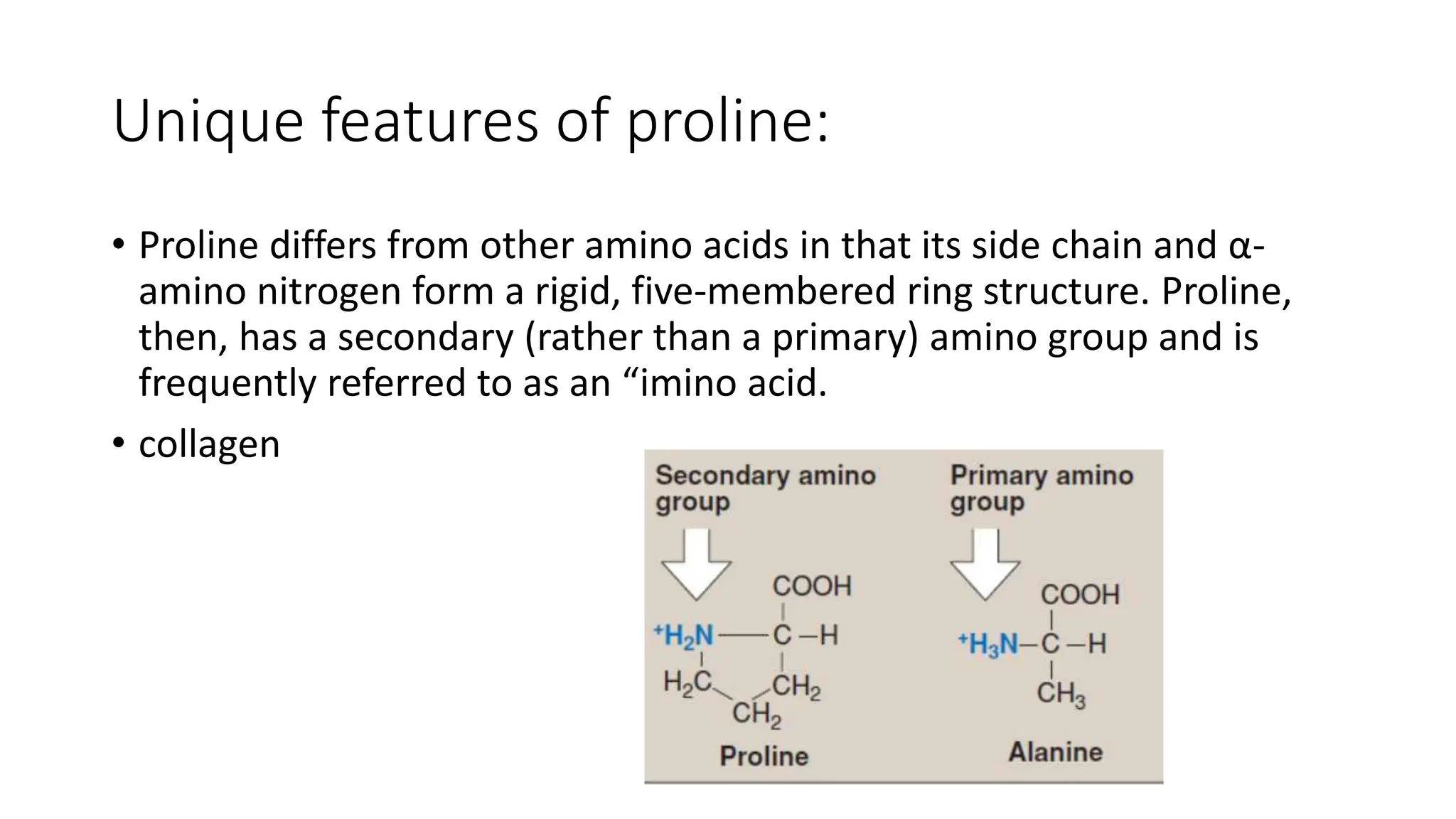
Unique features of proline:
• Proline differs from other amino acids in that its side chain and α-
amino nitrogen form a rigid, five-membered ring structure. Proline,
then, has a secondary (rather than a primary) amino group and is
frequently referred to as an “imino acid.
• collagen
Amino acids with uncharged polar side chains
• These amino acids have zero net charge at physiologic pH of approximately
7.4
• Serine, threonine, and tyrosine each contain a polar hydroxyl group that
can participate in hydrogen bond formation .
• The side chains of asparagine and glutamine each contain a carbonyl group
and an amide group, both of which can also participate in hydrogen bonds
• 1. Disulfide bond formation: The side chain of cysteine contains a sulfhydryl
(thiol) group (−SH), which is an important component within the active site
of many enzymes.
• Side chains as attachment sites for other compounds: The polar
• hydroxyl group of serine, threonine, and tyrosine can serve as a site of
attachment for phosphate groups
Amino acids with acidic side chains
• The amino acids aspartic acid and glutamic acid are proton donors. At
physiologic pH, the side chains of these amino acids are fully ionized,
containing a negatively charged carboxylate group (−COO−).
AA with basic side chains
• The side chains of the basic amino acids accept
protons
• At physiologic pH, the R groups of lysine and arginine
are fully ionized and positively charged.
• In contrast, the free amino acid histidine is weakly
basic and largely uncharged at physiologic pH.
However, when histidine is incorporated into a
protein, its R group can be either positively charged
(protonated) or neutral, depending on the ionic
environment provided by the protein.
• This important property of histidine contributes to the
buffering role it plays in the functioning of proteins
including hemoglobin. Histidine is the only amino acid
with a side chain that can ionize within the physiologic
pH range (7.35 to 7.45)
Based on Structure of Side Chain
Based on Catabolic Fate of the Amino Acid
• From the viewpoint of their catabolic fate, amino acids may be
divided into three categories: those that can give rise to glucose and
glycogen, those that can give rise to ketone bodies and those that can
give rise to both.
• They are called the glucogenic, the ketogenic, and both glucogenic
and ketogenic amino acids,
Based on Body’s Ability to Synthesize the
Amino Acid
• Essential amino acids: leucine, isoleucine, methionine, phenylalanine,
lysine, tryptophan, valine and threonine
• nonessential amino acids: alanine, aspartate, asparagine, glutamate,
glutamine, tyrosine, serine, proline, glycine, and cysteine.
• semi-essential amino acids: histidine and arginine
amino acid structure and chemistry   .pptx

amino acid structure and chemistry .pptx

  • 1.
    Amino Acid chemistry 1stYear biochemistry 1st Module (FOUNDATION)
  • 3.
    Classification • a) polarityand charge on R groups, • (b) structure of side chains, • (c) catabolic fate of the amino acid, • (d) body’s ability to synthesize the amino acid
  • 4.
    Amino acids withnonpolar side chains • Each of the amino acids in this category has a side chain that does not • gain or lose protons or participate in hydrogen or ionic bonds • In proteins found in polar environments such as aqueous solutions, the side chains of nonpolar amino acids tend to cluster together in the interior of the protein. • This phenomenon is known as the hydrophobic effect and is the result of the hydrophobicity of the nonpolar R groups, which act much like droplets of oil that coalesce in an aqueous environment. • nonpolar R groups are found on the outside surface of the protein, interacting • with the lipid environment
  • 7.
    Unique features ofproline: • Proline differs from other amino acids in that its side chain and α- amino nitrogen form a rigid, five-membered ring structure. Proline, then, has a secondary (rather than a primary) amino group and is frequently referred to as an “imino acid. • collagen
  • 8.
    Amino acids withuncharged polar side chains • These amino acids have zero net charge at physiologic pH of approximately 7.4 • Serine, threonine, and tyrosine each contain a polar hydroxyl group that can participate in hydrogen bond formation . • The side chains of asparagine and glutamine each contain a carbonyl group and an amide group, both of which can also participate in hydrogen bonds • 1. Disulfide bond formation: The side chain of cysteine contains a sulfhydryl (thiol) group (−SH), which is an important component within the active site of many enzymes. • Side chains as attachment sites for other compounds: The polar • hydroxyl group of serine, threonine, and tyrosine can serve as a site of attachment for phosphate groups
  • 10.
    Amino acids withacidic side chains • The amino acids aspartic acid and glutamic acid are proton donors. At physiologic pH, the side chains of these amino acids are fully ionized, containing a negatively charged carboxylate group (−COO−).
  • 11.
    AA with basicside chains • The side chains of the basic amino acids accept protons • At physiologic pH, the R groups of lysine and arginine are fully ionized and positively charged. • In contrast, the free amino acid histidine is weakly basic and largely uncharged at physiologic pH. However, when histidine is incorporated into a protein, its R group can be either positively charged (protonated) or neutral, depending on the ionic environment provided by the protein. • This important property of histidine contributes to the buffering role it plays in the functioning of proteins including hemoglobin. Histidine is the only amino acid with a side chain that can ionize within the physiologic pH range (7.35 to 7.45)
  • 14.
    Based on Structureof Side Chain
  • 15.
    Based on CatabolicFate of the Amino Acid • From the viewpoint of their catabolic fate, amino acids may be divided into three categories: those that can give rise to glucose and glycogen, those that can give rise to ketone bodies and those that can give rise to both. • They are called the glucogenic, the ketogenic, and both glucogenic and ketogenic amino acids,
  • 16.
    Based on Body’sAbility to Synthesize the Amino Acid • Essential amino acids: leucine, isoleucine, methionine, phenylalanine, lysine, tryptophan, valine and threonine • nonessential amino acids: alanine, aspartate, asparagine, glutamate, glutamine, tyrosine, serine, proline, glycine, and cysteine. • semi-essential amino acids: histidine and arginine