PRESENTATION
ON
Amavata
Rhumatoid Arthritis
ALLPPT.com _ Free PowerPoint Templates, Diagrams and Charts
Presented by:-
Dr. Narendra Prasad Giri
MD, Kayachikitsa,
IOM, TU
Nepal
2074/05/02
cfdjft
• Amavata is a conditon explained in Laghu
thrayees, but not in Brihat Thrayees.
• First explained in Madhava Nidana, by
Madhavakara who lived between 600-
700AD, that is one century after Vagbhata
• Later books like Yoga Ratnakara, Bhaishajya
Ratnavali etc quoted the slokas of Madhava
Nidana to explain the disease Amavata
without much change.
Nirukti
cfd+ r jft+cfdjftd. -laho/lIft_
cfd]g;lxtf]jftM cfdjftM.-laho/lIft_
Corelation with modern disease
• Most of the Ayurvedic scholars correlate Aamvata
with Rhumatism especially Rhumatoid Arthritis.
• Some scholars correlate it with fibromayalgia.
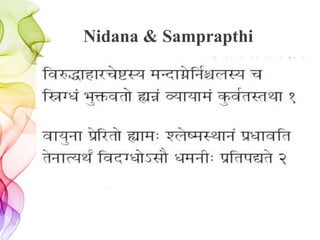
Nidana & Samprapthi
ETIOLOGY & PATHOPHYSIOLOGY
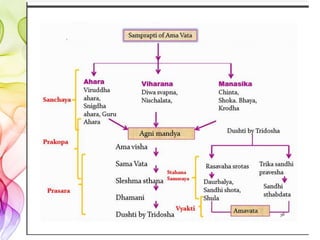
– Viruddahara- means unwholesome foods or
combination of foods which effects adversely.
– Poor digestion power, defective metabolism
– Sedentary life style and also too much exercise
– So affected defective metabolism with the influence
of Vata also affects the normal functioning, and the
products of this reaches Dhamanis (blood vessels)
and circulates all over the body especially to the sites
of Kafa and produces symptoms.
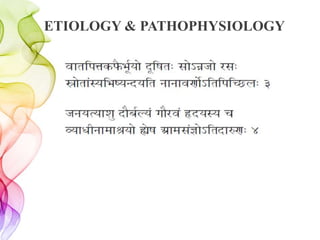
ETIOLOGY & PATHOPHYSIOLOGY
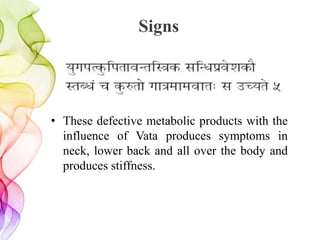
Signs
• These defective metabolic products with the
influence of Vata produces symptoms in
neck, lower back and all over the body and
produces stiffness.
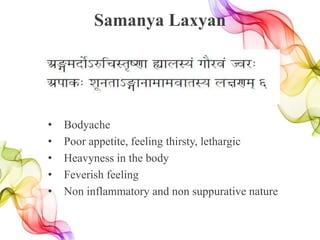
Samanya Laxyan
• Bodyache
• Poor appetite, feeling thirsty, lethargic
• Heavyness in the body
• Feverish feeling
• Non inflammatory and non suppurative nature
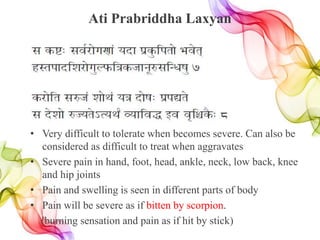
Ati Prabriddha Laxyan
• Very difficult to tolerate when becomes severe. Can also be
considered as difficult to treat when aggravates
• Severe pain in hand, foot, head, ankle, neck, low back, knee
and hip joints
• Pain and swelling is seen in different parts of body
• Pain will be severe as if bitten by scorpion.
(burning sensation and pain as if hit by stick)
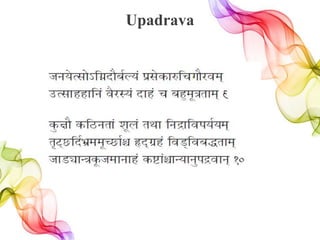
Upadrava
Complications
• Anorexia and feeling of
heaviness over the body
• Loss of interest/drive
• Bad taste in the mouth
• Polyurea and burning
micturition
• Hardness in the abdomen
• Colicky pain
• Reversal of normal
sleeping habbit
• Thirst
• Vomitting
• Giddiness
• Fainting
• Pericardial discomfort
• Constipation
• Stiffness
• Gurgling intestinal sounds
• Other complications
Complications
Yogaratnakar added Grahani as a complication
Hfgo]T;f]˜lUgbf}a{No+k|;]sf?lruf}/jd.
pT;fxxflg{ j}/:o+ bfx+ r ax'd'qtfd.
s/f]ltu|x0fLbf]if+ ljz]iffbfd;+1sd .
cjSj+;ht] rfZr+ s]jn+rfdd]j r ..
Doshik involvement and Sadhyasadhyatha
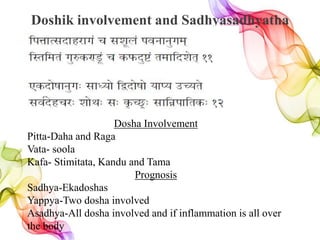
Dosha Involvement
Pitta-Daha and Raga
Vata- soola
Kafa- Stimitata, Kandu and Tama
Prognosis
Sadhya-Ekadoshas
Yappya-Two dosha involved
Asadhya-All dosha involved and if inflammation is all over
the body
Line of Management
1. Apatarpan
1. Langhan-Upabasa
2. Langhan Pachan-with Dipan Pachana Medicines
3. Dosabasechan- with Virechan and Vasti
2. Swedan
1. Rukshya Sweda
2. Snigdha Sweda
3. Upanaha Sweda
3. Rasayan Chikitsa (Naimittik Rasayan)
4. Pathya Aahar Bihar
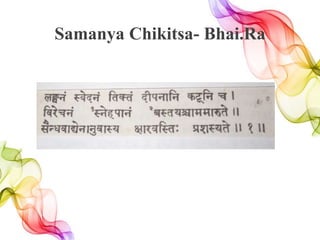
Samanya Chikitsa- Bhai.Ra
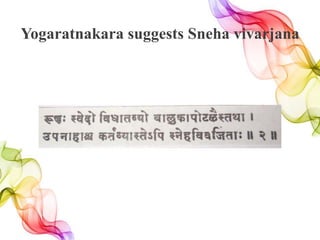
Yogaratnakara suggests Sneha vivarjana
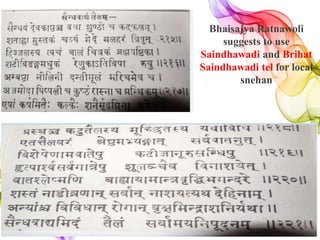
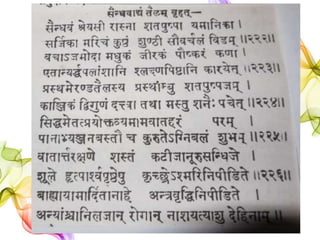
Bhaisajya Ratnawoli
suggests to use
Saindhawadi and Brihat
Saindhawadi tel for local
snehan
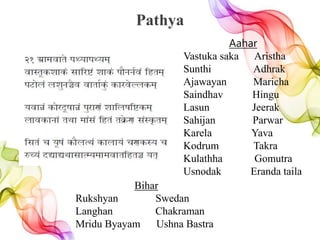
Pathya
Aahar
Vastuka saka Aristha
Sunthi Adhrak
Ajawayan Maricha
Saindhav Hingu
Lasun Jeerak
Sahijan Parwar
Karela Yava
Kodrum Takra
Kulathha Gomutra
Usnodak Eranda taila
Bihar
Rukshyan Swedan
Langhan Chakraman
Mridu Byayam Ushna Bastra
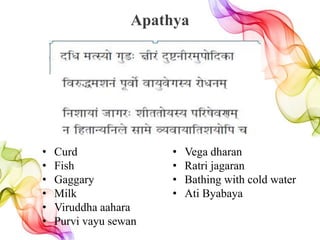
Apathya
• Curd
• Fish
• Gaggary
• Milk
• Viruddha aahara
• Purvi vayu sewan
• Vega dharan
• Ratri jagaran
• Bathing with cold water
• Ati Byabaya
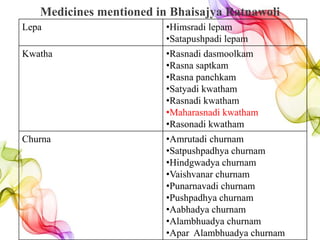
Medicines mentioned in Bhaisajya Ratnawoli
Lepa •Himsradi lepam
•Satapushpadi lepam
Kwatha •Rasnadi dasmoolkam
•Rasna saptkam
•Rasna panchkam
•Satyadi kwatham
•Rasnadi kwatham
•Maharasnadi kwatham
•Rasonadi kwatham
Churna •Amrutadi churnam
•Satpushpadhya churnam
•Hindgwadya churnam
•Vaishvanar churnam
•Punarnavadi churnam
•Pushpadhya churnam
•Aabhadya churnam
•Alambhuadya churnam
•Apar Alambhuadya churnam
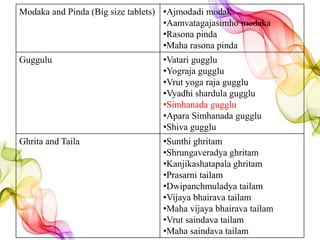
Modaka and Pinda (Big size tablets) •Ajmodadi modak
•Aamvatagajasimho modaka
•Rasona pinda
•Maha rasona pinda
Guggulu •Vatari gugglu
•Yograja gugglu
•Vrut yoga raja gugglu
•Vyadhi shardula gugglu
•Simhanada gugglu
•Apara Simhanada gugglu
•Shiva gugglu
Ghrita and Taila •Sunthi ghritam
•Shrungaveradya ghritam
•Kanjikashatapala ghritam
•Prasarni tailam
•Dwipanchmuladya tailam
•Vijaya bhairava tailam
•Maha vijaya bhairava tailam
•Vrut saindava tailam
•Maha saindava tailam
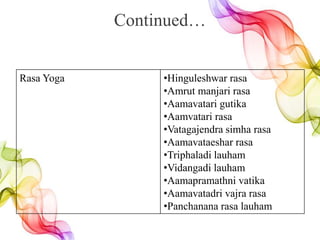
Continued…
Rasa Yoga •Hinguleshwar rasa
•Amrut manjari rasa
•Aamavatari gutika
•Aamvatari rasa
•Vatagajendra simha rasa
•Aamavataeshar rasa
•Triphaladi lauham
•Vidangadi lauham
•Aamapramathni vatika
•Aamavatadri vajra rasa
•Panchanana rasa lauham
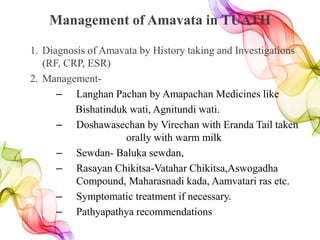
Management of Amavata in TUATH
1. Diagnosis of Amavata by History taking and Investigations
(RF, CRP, ESR)
2. Management-
– Langhan Pachan by Amapachan Medicines like
Bishatinduk wati, Agnitundi wati.
– Doshawasechan by Virechan with Eranda Tail taken
orally with warm milk
– Sewdan- Baluka sewdan,
– Rasayan Chikitsa-Vatahar Chikitsa,Aswogadha
Compound, Maharasnadi kada, Aamvatari ras etc.
– Symptomatic treatment if necessary.
– Pathyapathya recommendations
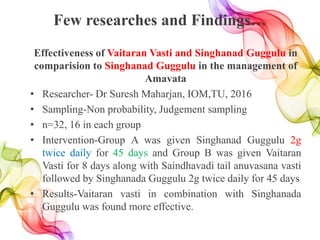
Few researches and Findings…
Effectiveness of Vaitaran Vasti and Singhanad Guggulu in
comparision to Singhanad Guggulu in the management of
Amavata
• Researcher- Dr Suresh Maharjan, IOM,TU, 2016
• Sampling-Non probability, Judgement sampling
• n=32, 16 in each group
• Intervention-Group A was given Singhanad Guggulu 2g
twice daily for 45 days and Group B was given Vaitaran
Vasti for 8 days along with Saindhavadi tail anuvasana vasti
followed by Singhanada Guggulu 2g twice daily for 45 days
• Results-Vaitaran vasti in combination with Singhanada
Guggulu was found more effective.
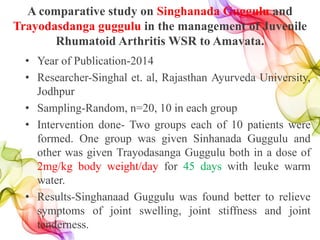
A comparative study on Singhanada Guggulu and
Trayodasdanga guggulu in the management of Juvenile
Rhumatoid Arthritis WSR to Amavata.
• Year of Publication-2014
• Researcher-Singhal et. al, Rajasthan Ayurveda University,
Jodhpur
• Sampling-Random, n=20, 10 in each group
• Intervention done- Two groups each of 10 patients were
formed. One group was given Sinhanada Guggulu and
other was given Trayodasanga Guggulu both in a dose of
2mg/kg body weight/day for 45 days with leuke warm
water.
• Results-Singhanaad Guggulu was found better to relieve
symptoms of joint swelling, joint stiffness and joint
tenderness.
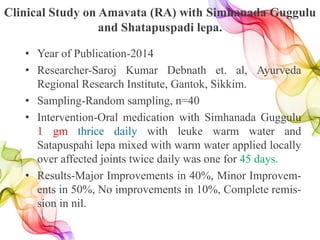
Clinical Study on Amavata (RA) with Simhanada Guggulu
and Shatapuspadi lepa.
• Year of Publication-2014
• Researcher-Saroj Kumar Debnath et. al, Ayurveda
Regional Research Institute, Gantok, Sikkim.
• Sampling-Random sampling, n=40
• Intervention-Oral medication with Simhanada Guggulu
1 gm thrice daily with leuke warm water and
Satapuspahi lepa mixed with warm water applied locally
over affected joints twice daily was one for 45 days.
• Results-Major Improvements in 40%, Minor Improvem-
ents in 50%, No improvements in 10%, Complete remis-
sion in nil.
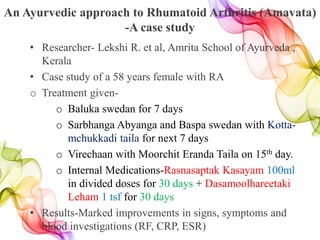
An Ayurvedic approach to Rhumatoid Arthritis (Amavata)
-A case study
• Researcher- Lekshi R. et al, Amrita School of Ayurveda ,
Kerala
• Case study of a 58 years female with RA
o Treatment given-
o Baluka swedan for 7 days
o Sarbhanga Abyanga and Baspa swedan with Kotta-
mchukkadi taila for next 7 days
o Virechaan with Moorchit Eranda Taila on 15th day.
o Internal Medications-Rasnasaptak Kasayam 100ml
in divided doses for 30 days + Dasamoolhareetaki
Leham 1 tsf for 30 days
• Results-Marked improvements in signs, symptoms and
blood investigations (RF, CRP, ESR)
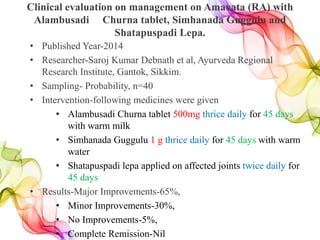
Clinical evaluation on management on Amavata (RA) with
Alambusadi Churna tablet, Simhanada Guggulu and
Shatapuspadi Lepa.
• Published Year-2014
• Researcher-Saroj Kumar Debnath et al, Ayurveda Regional
Research Institute, Gantok, Sikkim.
• Sampling- Probability, n=40
• Intervention-following medicines were given
• Alambusadi Churna tablet 500mg thrice daily for 45 days
with warm milk
• Simhanada Guggulu 1 g thrice daily for 45 days with warm
water
• Shatapuspadi lepa applied on affected joints twice daily for
45 days
• Results-Major Improvements-65%,
• Minor Improvements-30%,
• No Improvements-5%,
• Complete Remission-Nil
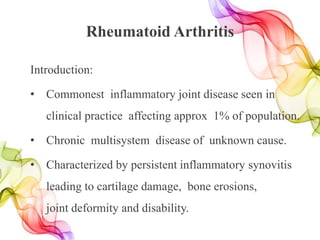
Rheumatoid Arthritis
Introduction:
• Commonest inflammatory joint disease seen in
clinical practice affecting approx 1% of population.
• Chronic multisystem disease of unknown cause.
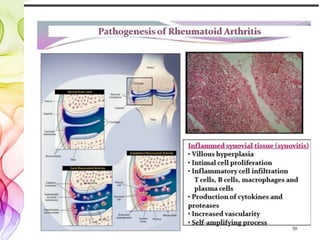
• Characterized by persistent inflammatory synovitis
leading to cartilage damage, bone erosions,
joint deformity and disability.
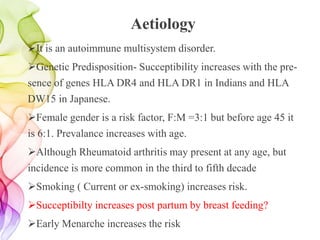
Aetiology
It is an autoimmune multisystem disorder.
Genetic Predisposition- Succeptibility increases with the pre-
sence of genes HLA DR4 and HLA DR1 in Indians and HLA
DW15 in Japanese.
Female gender is a risk factor, F:M =3:1 but before age 45 it
is 6:1. Prevalance increases with age.
Although Rheumatoid arthritis may present at any age, but
incidence is more common in the third to fifth decade
Smoking ( Current or ex-smoking) increases risk.
Succeptibilty increases post partum by breast feeding?
Early Menarche increases the risk
Relative incidence of joint involvement in RA
MCP and PIP joints of hands & MTP of feet 90%
Knees, ankles & wrists- 80%
Shoulders- 60%
Elbows- 50%
TM, Acromio - clavicular & SC joints- 30%
Don’t forget the cervical spine!! Instability at cervical spine
can lead to impingement of the spinal cord.
Thoracolumbar, sacroilliac, and distal interphalangeal joints
(DIP)of the hand are NOT involved.
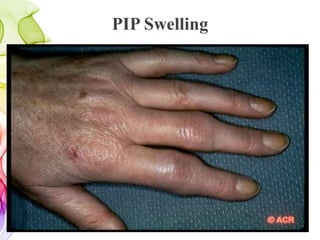
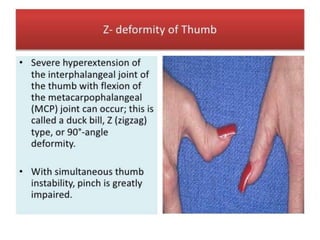
PIP Swelling
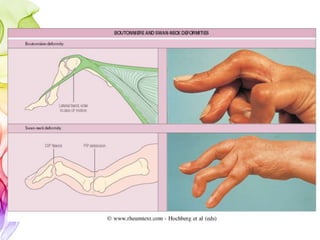
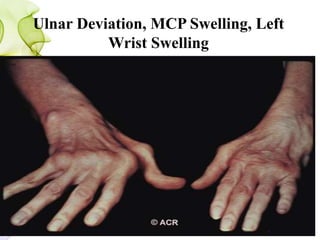
Ulnar Deviation, MCP Swelling, Left
Wrist Swelling
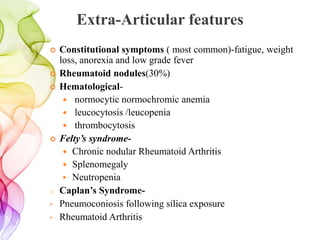
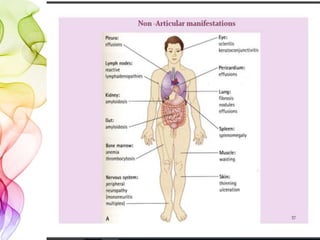
Extra-Articular features
 Constitutional symptoms ( most common)-fatigue, weight
loss, anorexia and low grade fever
 Rheumatoid nodules(30%)
 Hematological-
 normocytic normochromic anemia
 leucocytosis /leucopenia
 thrombocytosis
 Felty’s syndrome-
 Chronic nodular Rheumatoid Arthritis
 Splenomegaly
 Neutropenia
o Caplan’s Syndrome-
• Pneumoconiosis following silica exposure
• Rheumatoid Arthritis
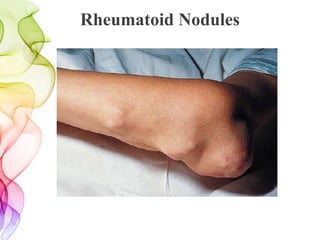
Rheumatoid Nodules
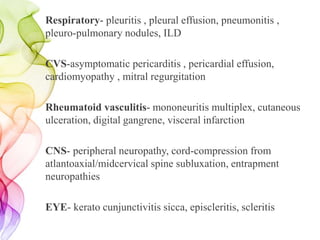
Respiratory- pleuritis , pleural effusion, pneumonitis ,
pleuro-pulmonary nodules, ILD
CVS-asymptomatic pericarditis , pericardial effusion,
cardiomyopathy , mitral regurgitation
Rheumatoid vasculitis- mononeuritis multiplex, cutaneous
ulceration, digital gangrene, visceral infarction
CNS- peripheral neuropathy, cord-compression from
atlantoaxial/midcervical spine subluxation, entrapment
neuropathies
EYE- kerato cunjunctivitis sicca, episcleritis, scleritis
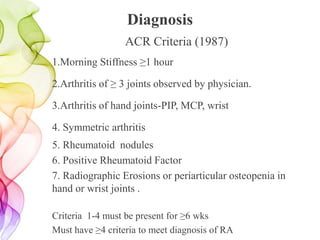
Diagnosis
ACR Criteria (1987)
1.Morning Stiffness ≥1 hour
2.Arthritis of ≥ 3 joints observed by physician.
3.Arthritis of hand joints-PIP, MCP, wrist
4. Symmetric arthritis
5. Rheumatoid nodules
6. Positive Rheumatoid Factor
7. Radiographic Erosions or periarticular osteopenia in
hand or wrist joints .
Criteria 1-4 must be present for ≥6 wks
Must have ≥4 criteria to meet diagnosis of RA
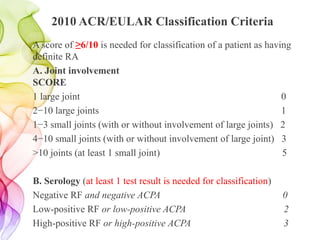
2010 ACR/EULAR Classification Criteria
A score of ≥6/10 is needed for classification of a patient as having
definite RA
A. Joint involvement
SCORE
1 large joint 0
2−10 large joints 1
1−3 small joints (with or without involvement of large joints) 2
4−10 small joints (with or without involvement of large joint) 3
>10 joints (at least 1 small joint) 5
B. Serology (at least 1 test result is needed for classification)
Negative RF and negative ACPA 0
Low-positive RF or low-positive ACPA 2
High-positive RF or high-positive ACPA 3
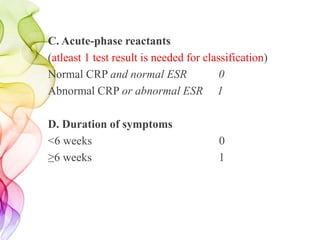
C. Acute-phase reactants
(atleast 1 test result is needed for classification)
Normal CRP and normal ESR 0
Abnormal CRP or abnormal ESR 1
D. Duration of symptoms
<6 weeks 0
≥6 weeks 1
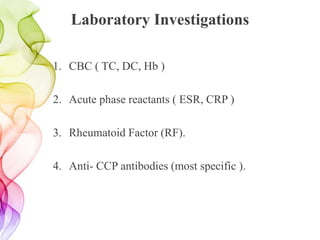
Laboratory Investigations
1. CBC ( TC, DC, Hb )
2. Acute phase reactants ( ESR, CRP )
3. Rheumatoid Factor (RF).
4. Anti- CCP antibodies (most specific ).
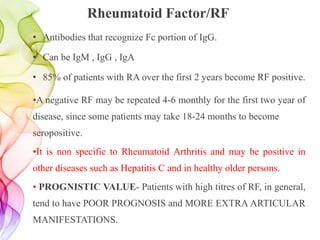
Rheumatoid Factor/RF
• Antibodies that recognize Fc portion of IgG.
• Can be IgM , IgG , IgA
• 85% of patients with RA over the first 2 years become RF positive.
•A negative RF may be repeated 4-6 monthly for the first two year of
disease, since some patients may take 18-24 months to become
seropositive.
•It is non specific to Rheumatoid Arthritis and may be positive in
other diseases such as Hepatitis C and in healthy older persons.
• PROGNISTIC VALUE- Patients with high titres of RF, in general,
tend to have POOR PROGNOSIS and MORE EXTRA ARTICULAR
MANIFESTATIONS.
Serum Anti Cyclic Citrullinated Peptide Antibody
• Sensitivity of Anti-CCPA is similar to RF but Specificity is
about 95% in the diagnosis of RA.
• A positive test for anti-CCP antibodies in the setting of an
early inflammatory arthritis is useful for distinguishing RA
from other forms of arthritis.
• There is some incremental value in testing for the presence of
both RF and anti-CCP, as some patients with RA are positive
for RF but negative for anti-CCP and vice versa.
• The presence of RF or anti-CCP antibodies also has
prognostic significance, with anti-CCP antibodies showing the
most value for predicting worse outcomes.
Other Investigations
• Elevated Acute Phase Reactants( ESR, CRP )
• Thrombocytosis
• Leukocytosis
• ANA in 30-40%
• Inflammatory synovial fluid Analysis
• Hypoalbuminemia
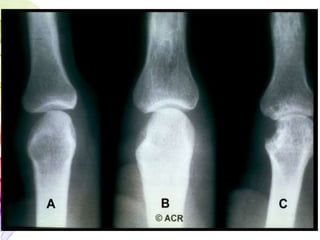
oRadiographic Features
 Peri-articular osteopenia
Uniform symmetric joint space narrowing
Marginal subchondral erosions
 Joint Subluxations
Joint destruction
Collapse
Ultrasound detects early soft tissue lesions.
MRI has greatest sensitivity to detect synovitis and
marrow changes.
Management
Goals of Management
• Focused on relieving pain
• Preventing damage/disability
• Patient education about the disease
• Physical Therapy for stretching and range of motion
exercises
• Occupational Therapy for splints and adaptive devices
• Treatment should be started early and should be
individualised .
• EARLY AGGRESSIVE TREATMENT
Treatment modalities
NSAIDs
Steroids
DMARDs
Biological therapies
Surgery
NSAIDs
Non-Steroidal anti-inflammatory Drugs
(NSAIDs) for symptom control :
1) Reduce pain and swelling by inhibiting COX
2) Do not alter course of the disease.
3) Chronic use should be minimised.
4) Most common side effect related to GI tract.
Corticosteriods in RA
Corticosteroids , both systemic and intra-articular are
important adjuncts in management of RA.
Indications for systemic steroids are:-
 For treatment of rheumatoid flares.
 For extra-articular RA like rheumatoid vasculitis and
interstitial lung disease.
 As bridge therapy for 6-8 weeks before the action of
DMARDs begin.
 Maintainence dose of 10mg or less of predinisolone
daily in patients with active RA.
 Sometimes in pregnancy when other DMARDs
cannot be used.
Disease Modifying Anti Rhuematic Drugs (DMARDs)
• Drugs that actually alter the disease course .
• Should be used as soon as diagnosis is made.
• Appearance of benefit delayed for weeks to months.
• NSAIDS must be continued with them until true
remission is achieved .
• Induction of true remission is unusual .
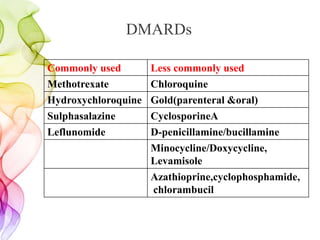
DMARDs
Commonly used Less commonly used
Methotrexate Chloroquine
Hydroxychloroquine Gold(parenteral &oral)
Sulphasalazine CyclosporineA
Leflunomide D-penicillamine/bucillamine
Minocycline/Doxycycline,
Levamisole
Azathioprine,cyclophosphamide,
chlorambucil
Limitations of DMARDs
1) The onset of action takes several months.
2) The remission induced in many cases is partial.
3) There may be substantial toxicity which requires
careful monitoring.
4) DMARDs have a tendency to lose effectiveness with
time-(slip out).
 These drawbacks have made researchers look for
alternative treatment strategies for RA- The Biologic
Response Modifiers.
Biologics in RA
Cytokines such as TNF-α ,IL-1,IL-10 etc. are key mediators
of immune function in RA and have been major targets of
therapeutic manipulations in RA.
Of the various cytokines,TNF-α has attaracted maximum
attention.
Various biologicals approved in RA are:-
1) Anti TNF agents : Infliximab Etanercept Adalimumab
2) IL-1 receptor antagonist : Anakinra
3) IL-6 receptor antagonist : Tocilizumab
4) Anti CD20 antibody : Rituximab
5) T cell costimulatory inhibitor : Abatacept
Surgical Approaches
• Synovectomy is ordinarily not recommended,
primarily because relief is only transient.
• However, an exception is synovectomy of the wrist,
which is recommended if intense synovitis is
persistent despite medical treatment over 6 to 12
months.
• Total joint arthroplasties, particularly of the knee,
hip, wrist, and elbow, are highly successful.
• Other operations include release of nerve
entrapments (e.g, carpal tunnel syndrome),
arthroscopic procedures, and, occasionally, removal
of a symptomatic rheumatoid nodule.
Amavata
Amavata
Amavata

Amavata

  • 1.
    PRESENTATION ON Amavata Rhumatoid Arthritis ALLPPT.com _Free PowerPoint Templates, Diagrams and Charts Presented by:- Dr. Narendra Prasad Giri MD, Kayachikitsa, IOM, TU Nepal 2074/05/02
  • 2.
    cfdjft • Amavata isa conditon explained in Laghu thrayees, but not in Brihat Thrayees. • First explained in Madhava Nidana, by Madhavakara who lived between 600- 700AD, that is one century after Vagbhata • Later books like Yoga Ratnakara, Bhaishajya Ratnavali etc quoted the slokas of Madhava Nidana to explain the disease Amavata without much change.
  • 3.
    Nirukti cfd+ r jft+cfdjftd.-laho/lIft_ cfd]g;lxtf]jftM cfdjftM.-laho/lIft_
  • 4.
    Corelation with moderndisease • Most of the Ayurvedic scholars correlate Aamvata with Rhumatism especially Rhumatoid Arthritis. • Some scholars correlate it with fibromayalgia.
  • 5.
  • 6.
    ETIOLOGY & PATHOPHYSIOLOGY –Viruddahara- means unwholesome foods or combination of foods which effects adversely. – Poor digestion power, defective metabolism – Sedentary life style and also too much exercise – So affected defective metabolism with the influence of Vata also affects the normal functioning, and the products of this reaches Dhamanis (blood vessels) and circulates all over the body especially to the sites of Kafa and produces symptoms.
  • 7.
  • 9.
    Signs • These defectivemetabolic products with the influence of Vata produces symptoms in neck, lower back and all over the body and produces stiffness.
  • 10.
    Samanya Laxyan • Bodyache •Poor appetite, feeling thirsty, lethargic • Heavyness in the body • Feverish feeling • Non inflammatory and non suppurative nature
  • 11.
    Ati Prabriddha Laxyan •Very difficult to tolerate when becomes severe. Can also be considered as difficult to treat when aggravates • Severe pain in hand, foot, head, ankle, neck, low back, knee and hip joints • Pain and swelling is seen in different parts of body • Pain will be severe as if bitten by scorpion. (burning sensation and pain as if hit by stick)
  • 12.
  • 13.
    Complications • Anorexia andfeeling of heaviness over the body • Loss of interest/drive • Bad taste in the mouth • Polyurea and burning micturition • Hardness in the abdomen • Colicky pain • Reversal of normal sleeping habbit • Thirst • Vomitting • Giddiness • Fainting • Pericardial discomfort • Constipation • Stiffness • Gurgling intestinal sounds • Other complications
  • 14.
    Complications Yogaratnakar added Grahanias a complication Hfgo]T;f]˜lUgbf}a{No+k|;]sf?lruf}/jd. pT;fxxflg{ j}/:o+ bfx+ r ax'd'qtfd. s/f]ltu|x0fLbf]if+ ljz]iffbfd;+1sd . cjSj+;ht] rfZr+ s]jn+rfdd]j r ..
  • 15.
    Doshik involvement andSadhyasadhyatha Dosha Involvement Pitta-Daha and Raga Vata- soola Kafa- Stimitata, Kandu and Tama Prognosis Sadhya-Ekadoshas Yappya-Two dosha involved Asadhya-All dosha involved and if inflammation is all over the body
  • 16.
    Line of Management 1.Apatarpan 1. Langhan-Upabasa 2. Langhan Pachan-with Dipan Pachana Medicines 3. Dosabasechan- with Virechan and Vasti 2. Swedan 1. Rukshya Sweda 2. Snigdha Sweda 3. Upanaha Sweda 3. Rasayan Chikitsa (Naimittik Rasayan) 4. Pathya Aahar Bihar
  • 17.
  • 18.
  • 19.
    Bhaisajya Ratnawoli suggests touse Saindhawadi and Brihat Saindhawadi tel for local snehan
  • 21.
    Pathya Aahar Vastuka saka Aristha SunthiAdhrak Ajawayan Maricha Saindhav Hingu Lasun Jeerak Sahijan Parwar Karela Yava Kodrum Takra Kulathha Gomutra Usnodak Eranda taila Bihar Rukshyan Swedan Langhan Chakraman Mridu Byayam Ushna Bastra
  • 22.
    Apathya • Curd • Fish •Gaggary • Milk • Viruddha aahara • Purvi vayu sewan • Vega dharan • Ratri jagaran • Bathing with cold water • Ati Byabaya
  • 23.
    Medicines mentioned inBhaisajya Ratnawoli Lepa •Himsradi lepam •Satapushpadi lepam Kwatha •Rasnadi dasmoolkam •Rasna saptkam •Rasna panchkam •Satyadi kwatham •Rasnadi kwatham •Maharasnadi kwatham •Rasonadi kwatham Churna •Amrutadi churnam •Satpushpadhya churnam •Hindgwadya churnam •Vaishvanar churnam •Punarnavadi churnam •Pushpadhya churnam •Aabhadya churnam •Alambhuadya churnam •Apar Alambhuadya churnam
  • 24.
    Modaka and Pinda(Big size tablets) •Ajmodadi modak •Aamvatagajasimho modaka •Rasona pinda •Maha rasona pinda Guggulu •Vatari gugglu •Yograja gugglu •Vrut yoga raja gugglu •Vyadhi shardula gugglu •Simhanada gugglu •Apara Simhanada gugglu •Shiva gugglu Ghrita and Taila •Sunthi ghritam •Shrungaveradya ghritam •Kanjikashatapala ghritam •Prasarni tailam •Dwipanchmuladya tailam •Vijaya bhairava tailam •Maha vijaya bhairava tailam •Vrut saindava tailam •Maha saindava tailam
  • 25.
    Continued… Rasa Yoga •Hinguleshwarrasa •Amrut manjari rasa •Aamavatari gutika •Aamvatari rasa •Vatagajendra simha rasa •Aamavataeshar rasa •Triphaladi lauham •Vidangadi lauham •Aamapramathni vatika •Aamavatadri vajra rasa •Panchanana rasa lauham
  • 26.
    Management of Amavatain TUATH 1. Diagnosis of Amavata by History taking and Investigations (RF, CRP, ESR) 2. Management- – Langhan Pachan by Amapachan Medicines like Bishatinduk wati, Agnitundi wati. – Doshawasechan by Virechan with Eranda Tail taken orally with warm milk – Sewdan- Baluka sewdan, – Rasayan Chikitsa-Vatahar Chikitsa,Aswogadha Compound, Maharasnadi kada, Aamvatari ras etc. – Symptomatic treatment if necessary. – Pathyapathya recommendations
  • 27.
    Few researches andFindings… Effectiveness of Vaitaran Vasti and Singhanad Guggulu in comparision to Singhanad Guggulu in the management of Amavata • Researcher- Dr Suresh Maharjan, IOM,TU, 2016 • Sampling-Non probability, Judgement sampling • n=32, 16 in each group • Intervention-Group A was given Singhanad Guggulu 2g twice daily for 45 days and Group B was given Vaitaran Vasti for 8 days along with Saindhavadi tail anuvasana vasti followed by Singhanada Guggulu 2g twice daily for 45 days • Results-Vaitaran vasti in combination with Singhanada Guggulu was found more effective.
  • 28.
    A comparative studyon Singhanada Guggulu and Trayodasdanga guggulu in the management of Juvenile Rhumatoid Arthritis WSR to Amavata. • Year of Publication-2014 • Researcher-Singhal et. al, Rajasthan Ayurveda University, Jodhpur • Sampling-Random, n=20, 10 in each group • Intervention done- Two groups each of 10 patients were formed. One group was given Sinhanada Guggulu and other was given Trayodasanga Guggulu both in a dose of 2mg/kg body weight/day for 45 days with leuke warm water. • Results-Singhanaad Guggulu was found better to relieve symptoms of joint swelling, joint stiffness and joint tenderness.
  • 29.
    Clinical Study onAmavata (RA) with Simhanada Guggulu and Shatapuspadi lepa. • Year of Publication-2014 • Researcher-Saroj Kumar Debnath et. al, Ayurveda Regional Research Institute, Gantok, Sikkim. • Sampling-Random sampling, n=40 • Intervention-Oral medication with Simhanada Guggulu 1 gm thrice daily with leuke warm water and Satapuspahi lepa mixed with warm water applied locally over affected joints twice daily was one for 45 days. • Results-Major Improvements in 40%, Minor Improvem- ents in 50%, No improvements in 10%, Complete remis- sion in nil.
  • 30.
    An Ayurvedic approachto Rhumatoid Arthritis (Amavata) -A case study • Researcher- Lekshi R. et al, Amrita School of Ayurveda , Kerala • Case study of a 58 years female with RA o Treatment given- o Baluka swedan for 7 days o Sarbhanga Abyanga and Baspa swedan with Kotta- mchukkadi taila for next 7 days o Virechaan with Moorchit Eranda Taila on 15th day. o Internal Medications-Rasnasaptak Kasayam 100ml in divided doses for 30 days + Dasamoolhareetaki Leham 1 tsf for 30 days • Results-Marked improvements in signs, symptoms and blood investigations (RF, CRP, ESR)
  • 31.
    Clinical evaluation onmanagement on Amavata (RA) with Alambusadi Churna tablet, Simhanada Guggulu and Shatapuspadi Lepa. • Published Year-2014 • Researcher-Saroj Kumar Debnath et al, Ayurveda Regional Research Institute, Gantok, Sikkim. • Sampling- Probability, n=40 • Intervention-following medicines were given • Alambusadi Churna tablet 500mg thrice daily for 45 days with warm milk • Simhanada Guggulu 1 g thrice daily for 45 days with warm water • Shatapuspadi lepa applied on affected joints twice daily for 45 days • Results-Major Improvements-65%, • Minor Improvements-30%, • No Improvements-5%, • Complete Remission-Nil
  • 32.
    Rheumatoid Arthritis Introduction: • Commonestinflammatory joint disease seen in clinical practice affecting approx 1% of population. • Chronic multisystem disease of unknown cause. • Characterized by persistent inflammatory synovitis leading to cartilage damage, bone erosions, joint deformity and disability.
  • 33.
    Aetiology It is anautoimmune multisystem disorder. Genetic Predisposition- Succeptibility increases with the pre- sence of genes HLA DR4 and HLA DR1 in Indians and HLA DW15 in Japanese. Female gender is a risk factor, F:M =3:1 but before age 45 it is 6:1. Prevalance increases with age. Although Rheumatoid arthritis may present at any age, but incidence is more common in the third to fifth decade Smoking ( Current or ex-smoking) increases risk. Succeptibilty increases post partum by breast feeding? Early Menarche increases the risk
  • 34.
    Relative incidence ofjoint involvement in RA MCP and PIP joints of hands & MTP of feet 90% Knees, ankles & wrists- 80% Shoulders- 60% Elbows- 50% TM, Acromio - clavicular & SC joints- 30% Don’t forget the cervical spine!! Instability at cervical spine can lead to impingement of the spinal cord. Thoracolumbar, sacroilliac, and distal interphalangeal joints (DIP)of the hand are NOT involved.
  • 36.
  • 39.
    Ulnar Deviation, MCPSwelling, Left Wrist Swelling
  • 41.
    Extra-Articular features  Constitutionalsymptoms ( most common)-fatigue, weight loss, anorexia and low grade fever  Rheumatoid nodules(30%)  Hematological-  normocytic normochromic anemia  leucocytosis /leucopenia  thrombocytosis  Felty’s syndrome-  Chronic nodular Rheumatoid Arthritis  Splenomegaly  Neutropenia o Caplan’s Syndrome- • Pneumoconiosis following silica exposure • Rheumatoid Arthritis
  • 42.
  • 43.
    Respiratory- pleuritis ,pleural effusion, pneumonitis , pleuro-pulmonary nodules, ILD CVS-asymptomatic pericarditis , pericardial effusion, cardiomyopathy , mitral regurgitation Rheumatoid vasculitis- mononeuritis multiplex, cutaneous ulceration, digital gangrene, visceral infarction CNS- peripheral neuropathy, cord-compression from atlantoaxial/midcervical spine subluxation, entrapment neuropathies EYE- kerato cunjunctivitis sicca, episcleritis, scleritis
  • 45.
    Diagnosis ACR Criteria (1987) 1.MorningStiffness ≥1 hour 2.Arthritis of ≥ 3 joints observed by physician. 3.Arthritis of hand joints-PIP, MCP, wrist 4. Symmetric arthritis 5. Rheumatoid nodules 6. Positive Rheumatoid Factor 7. Radiographic Erosions or periarticular osteopenia in hand or wrist joints . Criteria 1-4 must be present for ≥6 wks Must have ≥4 criteria to meet diagnosis of RA
  • 46.
    2010 ACR/EULAR ClassificationCriteria A score of ≥6/10 is needed for classification of a patient as having definite RA A. Joint involvement SCORE 1 large joint 0 2−10 large joints 1 1−3 small joints (with or without involvement of large joints) 2 4−10 small joints (with or without involvement of large joint) 3 >10 joints (at least 1 small joint) 5 B. Serology (at least 1 test result is needed for classification) Negative RF and negative ACPA 0 Low-positive RF or low-positive ACPA 2 High-positive RF or high-positive ACPA 3
  • 47.
    C. Acute-phase reactants (atleast1 test result is needed for classification) Normal CRP and normal ESR 0 Abnormal CRP or abnormal ESR 1 D. Duration of symptoms <6 weeks 0 ≥6 weeks 1
  • 48.
    Laboratory Investigations 1. CBC( TC, DC, Hb ) 2. Acute phase reactants ( ESR, CRP ) 3. Rheumatoid Factor (RF). 4. Anti- CCP antibodies (most specific ).
  • 49.
    Rheumatoid Factor/RF • Antibodiesthat recognize Fc portion of IgG. • Can be IgM , IgG , IgA • 85% of patients with RA over the first 2 years become RF positive. •A negative RF may be repeated 4-6 monthly for the first two year of disease, since some patients may take 18-24 months to become seropositive. •It is non specific to Rheumatoid Arthritis and may be positive in other diseases such as Hepatitis C and in healthy older persons. • PROGNISTIC VALUE- Patients with high titres of RF, in general, tend to have POOR PROGNOSIS and MORE EXTRA ARTICULAR MANIFESTATIONS.
  • 50.
    Serum Anti CyclicCitrullinated Peptide Antibody • Sensitivity of Anti-CCPA is similar to RF but Specificity is about 95% in the diagnosis of RA. • A positive test for anti-CCP antibodies in the setting of an early inflammatory arthritis is useful for distinguishing RA from other forms of arthritis. • There is some incremental value in testing for the presence of both RF and anti-CCP, as some patients with RA are positive for RF but negative for anti-CCP and vice versa. • The presence of RF or anti-CCP antibodies also has prognostic significance, with anti-CCP antibodies showing the most value for predicting worse outcomes.
  • 51.
    Other Investigations • ElevatedAcute Phase Reactants( ESR, CRP ) • Thrombocytosis • Leukocytosis • ANA in 30-40% • Inflammatory synovial fluid Analysis • Hypoalbuminemia
  • 52.
    oRadiographic Features  Peri-articularosteopenia Uniform symmetric joint space narrowing Marginal subchondral erosions  Joint Subluxations Joint destruction Collapse Ultrasound detects early soft tissue lesions. MRI has greatest sensitivity to detect synovitis and marrow changes.
  • 54.
    Management Goals of Management •Focused on relieving pain • Preventing damage/disability • Patient education about the disease • Physical Therapy for stretching and range of motion exercises • Occupational Therapy for splints and adaptive devices • Treatment should be started early and should be individualised . • EARLY AGGRESSIVE TREATMENT
  • 55.
  • 56.
    NSAIDs Non-Steroidal anti-inflammatory Drugs (NSAIDs)for symptom control : 1) Reduce pain and swelling by inhibiting COX 2) Do not alter course of the disease. 3) Chronic use should be minimised. 4) Most common side effect related to GI tract.
  • 57.
    Corticosteriods in RA Corticosteroids, both systemic and intra-articular are important adjuncts in management of RA. Indications for systemic steroids are:-  For treatment of rheumatoid flares.  For extra-articular RA like rheumatoid vasculitis and interstitial lung disease.  As bridge therapy for 6-8 weeks before the action of DMARDs begin.  Maintainence dose of 10mg or less of predinisolone daily in patients with active RA.  Sometimes in pregnancy when other DMARDs cannot be used.
  • 58.
    Disease Modifying AntiRhuematic Drugs (DMARDs) • Drugs that actually alter the disease course . • Should be used as soon as diagnosis is made. • Appearance of benefit delayed for weeks to months. • NSAIDS must be continued with them until true remission is achieved . • Induction of true remission is unusual .
  • 59.
    DMARDs Commonly used Lesscommonly used Methotrexate Chloroquine Hydroxychloroquine Gold(parenteral &oral) Sulphasalazine CyclosporineA Leflunomide D-penicillamine/bucillamine Minocycline/Doxycycline, Levamisole Azathioprine,cyclophosphamide, chlorambucil
  • 60.
    Limitations of DMARDs 1)The onset of action takes several months. 2) The remission induced in many cases is partial. 3) There may be substantial toxicity which requires careful monitoring. 4) DMARDs have a tendency to lose effectiveness with time-(slip out).  These drawbacks have made researchers look for alternative treatment strategies for RA- The Biologic Response Modifiers.
  • 61.
    Biologics in RA Cytokinessuch as TNF-α ,IL-1,IL-10 etc. are key mediators of immune function in RA and have been major targets of therapeutic manipulations in RA. Of the various cytokines,TNF-α has attaracted maximum attention. Various biologicals approved in RA are:- 1) Anti TNF agents : Infliximab Etanercept Adalimumab 2) IL-1 receptor antagonist : Anakinra 3) IL-6 receptor antagonist : Tocilizumab 4) Anti CD20 antibody : Rituximab 5) T cell costimulatory inhibitor : Abatacept
  • 62.
    Surgical Approaches • Synovectomyis ordinarily not recommended, primarily because relief is only transient. • However, an exception is synovectomy of the wrist, which is recommended if intense synovitis is persistent despite medical treatment over 6 to 12 months. • Total joint arthroplasties, particularly of the knee, hip, wrist, and elbow, are highly successful. • Other operations include release of nerve entrapments (e.g, carpal tunnel syndrome), arthroscopic procedures, and, occasionally, removal of a symptomatic rheumatoid nodule.