Learning outcomes 11 & 12 Synchronous motors
Jenneson  chpt. 11. 5 p 259  and 11.6 p 262 3 phase and 1 phase synchronous motors
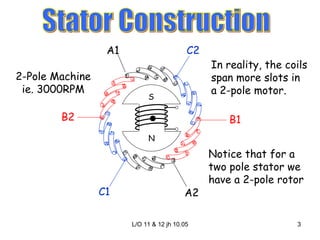
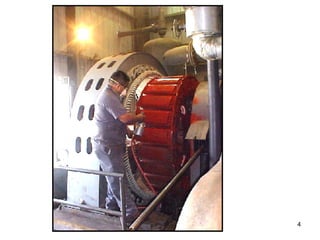
2-Pole Machine ie. 3000RPM In reality, the coils span more slots in  a 2-pole motor. Stator Construction Notice that for a two pole stator we have a 2-pole rotor A1 A2 B1 B2 C1 C2 N S
 
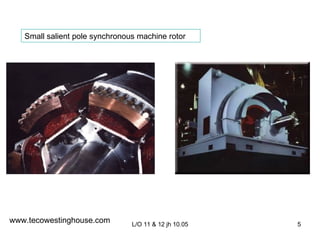
www.tecowestinghouse.com Small salient pole synchronous machine rotor
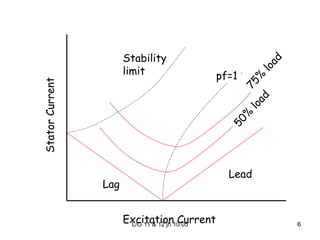
Excitation Current Stator Current 50% load Lag Lead 75% load Stability limit pf=1
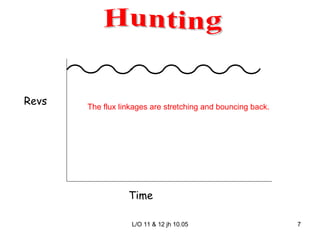
Revs Time Hunting The flux linkages are stretching and bouncing back.
Points: At a set load there is a value of excitation that will give minimum line current. Reducing OR increasing excitation from this value will only increase line current. At any other value of line current, there are two values of excitation current that can produce this. If a synchronous motor is heavily loaded, supply current may not be able to be driven highly leading. If a synchronous motor is lightly loaded, supply current can be driven highly leading.
Single Phase Synchronous Motors Used when constant speed is critical,  with low torque requirements. They have low efficiency, hence made in small sizes. Application: clocks record players timers recorders communications servo installations Two main types: Reluctance motor Hysteresis motor
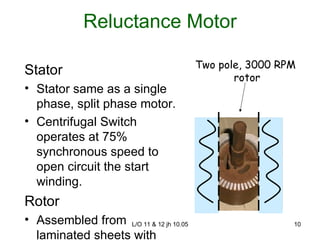
Reluctance Motor Stator Stator same as a single phase, split phase motor. Centrifugal Switch operates at 75% synchronous speed to open circuit the start winding. Rotor Assembled from laminated sheets with defined teeth cut away. This forms salient poles. Windings are of the squirrel-cage type. Number of rotor poles equals the number of stator poles. Two pole, 3000 RPM  rotor
Reluctance Motor Operation Starts as an induction motor, with slip. A single phase stator has a “Start” and “Run” winding.  At 75% centrifugal the centrifugal switch operates. As the load is light there is small slip The salient poles become permanently magnetised by the stator field The salient poles will then lock to the stator field. Once locked into synchronism the motor will continue to operate at synchronous speed. Not as much power output as a similar physical size 1-phase motor.

Alternating Current Machines 11&12

  • 1.
    Learning outcomes 11& 12 Synchronous motors
  • 2.
    Jenneson chpt.11. 5 p 259 and 11.6 p 262 3 phase and 1 phase synchronous motors
  • 3.
    2-Pole Machine ie.3000RPM In reality, the coils span more slots in a 2-pole motor. Stator Construction Notice that for a two pole stator we have a 2-pole rotor A1 A2 B1 B2 C1 C2 N S
  • 4.
  • 5.
    www.tecowestinghouse.com Small salientpole synchronous machine rotor
  • 6.
    Excitation Current StatorCurrent 50% load Lag Lead 75% load Stability limit pf=1
  • 7.
    Revs Time HuntingThe flux linkages are stretching and bouncing back.
  • 8.
    Points: At aset load there is a value of excitation that will give minimum line current. Reducing OR increasing excitation from this value will only increase line current. At any other value of line current, there are two values of excitation current that can produce this. If a synchronous motor is heavily loaded, supply current may not be able to be driven highly leading. If a synchronous motor is lightly loaded, supply current can be driven highly leading.
  • 9.
    Single Phase SynchronousMotors Used when constant speed is critical, with low torque requirements. They have low efficiency, hence made in small sizes. Application: clocks record players timers recorders communications servo installations Two main types: Reluctance motor Hysteresis motor
  • 10.
    Reluctance Motor StatorStator same as a single phase, split phase motor. Centrifugal Switch operates at 75% synchronous speed to open circuit the start winding. Rotor Assembled from laminated sheets with defined teeth cut away. This forms salient poles. Windings are of the squirrel-cage type. Number of rotor poles equals the number of stator poles. Two pole, 3000 RPM rotor
  • 11.
    Reluctance Motor OperationStarts as an induction motor, with slip. A single phase stator has a “Start” and “Run” winding. At 75% centrifugal the centrifugal switch operates. As the load is light there is small slip The salient poles become permanently magnetised by the stator field The salient poles will then lock to the stator field. Once locked into synchronism the motor will continue to operate at synchronous speed. Not as much power output as a similar physical size 1-phase motor.