AGRICULTURE KNOWLEDGE AND
INFORMATION SYSTEM
SOWJANYA SEETHARAMA
I Ph.D
Dept of Agricultural Extension
University Of Agricultural Sciences, GKVK, Bangalore-
560065
According to FAO and the World Bank (2000)
“An Agricultural Knowledge and Information System links people
and institutions to promote mutual learning and generate, share
and utilize agriculture-related technology, knowledge and
information.
The system integrates farmers, agricultural educators, researchers
and extensionists to harness knowledge and information from
various sources for better farming and improved livelihoods.“
Purpose of AKIS
 To develop technologies in a given situation
 Increase agricultural production
 To solve on-farm practical problems
 Improve delivery system service
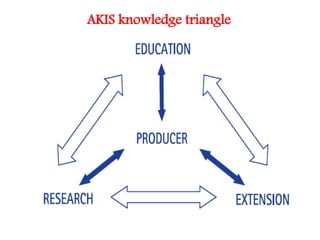
AKIS knowledge triangle
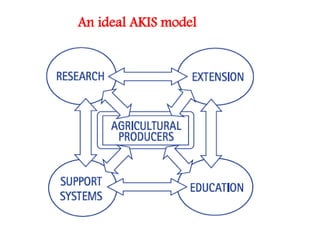
An ideal AKIS model
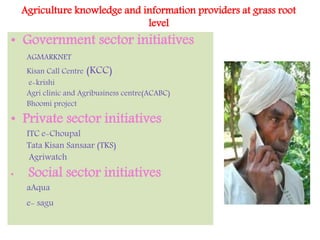
Agriculture knowledge and information providers at grass root
level
• Government sector initiatives
AGMARKNET
Kisan Call Centre (KCC)
e-krishi
Agri clinic and Agribusiness centre(ACABC)
Bhoomi project
• Private sector initiatives
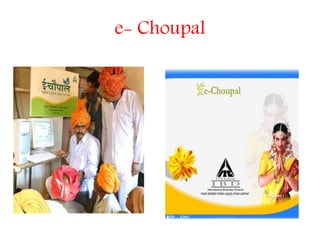
ITC e-Choupal
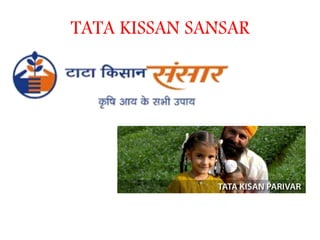
Tata Kisan Sansaar (TKS)
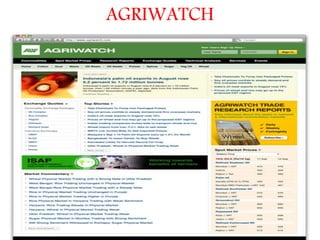
Agriwatch
• Social sector initiatives
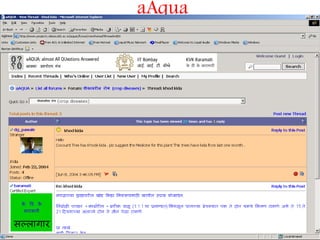
aAqua
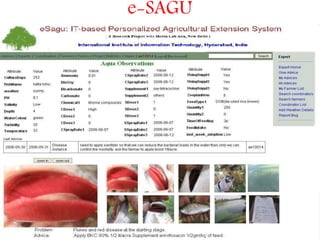
e- sagu
AGMARKNET
 Crops Directorates (8) [Wheat,
Jute, Cotton, Rice, Sugarcane,
Millets, Pulses, Tobacco]
 Technology Mission on
Horticulture
 Coconut Development Board
IFFCO
Network
Area
Office
Area
Office Kiosk
DMI
Hqs.
AGMAKRNET
http://agmarknet.ni
c.in
Area
Office Farmers
Markets
DMI State
Offices
IFFCO
Local
News
papers
Notice
Board /
Electroni
c Board
CDB
Farmer
s
Call Centres
Agri-clinics
Mobile
Operators
farmers
State Mkts./
Directorates
Regional
Portals
Public Access
Mobil
e
users
http://agmarknet.nic.in
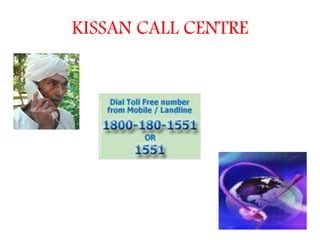
KISSAN CALL CENTRE
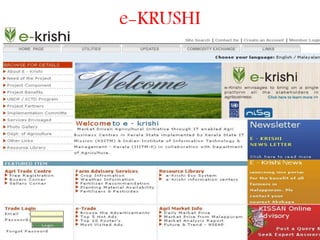
e-KRUSHI
AGRI CLINICS AND AGRI BUSINESS CENTRES
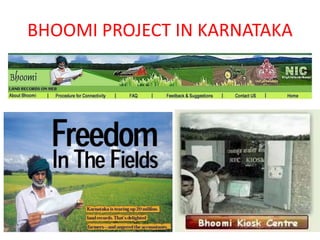
BHOOMI PROJECT IN KARNATAKA
e- Choupal
TATA KISSAN SANSAR
AGRIWATCH
aAqua
e-SAGU
Advantages of AKIS
 AKIS respond to technology, knowledge and information
needs of farmers helping them in decision making and
management of their problem.
 AKIS providing farmers with more opportunities and help
them to choose the right opportunity for their situation.
 Gap between technology generation and technology use at
field level is fulfilled.
 Participation, Collaboration and joint learning between
farmer and other agents contributing to the development
and diffusion of knowledge beyond the traditional farmer –
extension link.
Training of stake holders
• Stakeholders are all those people who have a stake
(or share) in a particular issue or system.
Stakeholders can be groups of people, organizations,
institutions and sometimes even individuals.
• stakeholders are “actors” and “interest groups”.
• The word “actors” stresses that stakeholders are
active and interact with each other.
• The use of the words “interest groups” indicates that
people can be grouped according to a common
interest.
Why is a stakeholder perspective important?
• stakeholder analysis is frequently used for:
 policy formulation,
 project formulation,
 implementation and evaluation
 for understanding and analysing complex situations
in natural resource management.
Types of stakeholders
1. Key stakeholders
2. Primary stakeholders
3. Secondary stakeholders
4. Active stakeholders
5. Passive stakeholders
1.Key stakeholders : are those actors who are considered to
have significant influence on the success of a project.
2.Primary stakeholders : are the intended beneficiaries of
the project.
3.Secondary stakeholders: are those who perform as
intermediaries within a project.
4.Active stakeholders : are those who affect or determine a
decision or action in the system or project.
5.Passive stakeholders: are those who are affected by
decisions or actions of others.
Conclusion
22
Akis

Akis

  • 1.
    AGRICULTURE KNOWLEDGE AND INFORMATIONSYSTEM SOWJANYA SEETHARAMA I Ph.D Dept of Agricultural Extension University Of Agricultural Sciences, GKVK, Bangalore- 560065
  • 2.
    According to FAOand the World Bank (2000) “An Agricultural Knowledge and Information System links people and institutions to promote mutual learning and generate, share and utilize agriculture-related technology, knowledge and information. The system integrates farmers, agricultural educators, researchers and extensionists to harness knowledge and information from various sources for better farming and improved livelihoods.“
  • 3.
    Purpose of AKIS To develop technologies in a given situation  Increase agricultural production  To solve on-farm practical problems  Improve delivery system service
  • 4.
  • 5.
  • 6.
    Agriculture knowledge andinformation providers at grass root level • Government sector initiatives AGMARKNET Kisan Call Centre (KCC) e-krishi Agri clinic and Agribusiness centre(ACABC) Bhoomi project • Private sector initiatives ITC e-Choupal Tata Kisan Sansaar (TKS) Agriwatch • Social sector initiatives aAqua e- sagu
  • 7.
    AGMARKNET  Crops Directorates(8) [Wheat, Jute, Cotton, Rice, Sugarcane, Millets, Pulses, Tobacco]  Technology Mission on Horticulture  Coconut Development Board IFFCO Network Area Office Area Office Kiosk DMI Hqs. AGMAKRNET http://agmarknet.ni c.in Area Office Farmers Markets DMI State Offices IFFCO Local News papers Notice Board / Electroni c Board CDB Farmer s Call Centres Agri-clinics Mobile Operators farmers State Mkts./ Directorates Regional Portals Public Access Mobil e users http://agmarknet.nic.in
  • 8.
  • 9.
  • 10.
    AGRI CLINICS ANDAGRI BUSINESS CENTRES
  • 11.
  • 12.
  • 13.
  • 14.
  • 15.
  • 16.
  • 17.
    Advantages of AKIS AKIS respond to technology, knowledge and information needs of farmers helping them in decision making and management of their problem.  AKIS providing farmers with more opportunities and help them to choose the right opportunity for their situation.  Gap between technology generation and technology use at field level is fulfilled.  Participation, Collaboration and joint learning between farmer and other agents contributing to the development and diffusion of knowledge beyond the traditional farmer – extension link.
  • 18.
    Training of stakeholders • Stakeholders are all those people who have a stake (or share) in a particular issue or system. Stakeholders can be groups of people, organizations, institutions and sometimes even individuals. • stakeholders are “actors” and “interest groups”. • The word “actors” stresses that stakeholders are active and interact with each other. • The use of the words “interest groups” indicates that people can be grouped according to a common interest.
  • 19.
    Why is astakeholder perspective important? • stakeholder analysis is frequently used for:  policy formulation,  project formulation,  implementation and evaluation  for understanding and analysing complex situations in natural resource management.
  • 20.
    Types of stakeholders 1.Key stakeholders 2. Primary stakeholders 3. Secondary stakeholders 4. Active stakeholders 5. Passive stakeholders
  • 21.
    1.Key stakeholders :are those actors who are considered to have significant influence on the success of a project. 2.Primary stakeholders : are the intended beneficiaries of the project. 3.Secondary stakeholders: are those who perform as intermediaries within a project. 4.Active stakeholders : are those who affect or determine a decision or action in the system or project. 5.Passive stakeholders: are those who are affected by decisions or actions of others.
  • 22.