AJM Sheet: Digital
Deformity Work-Up
Subjective
CC: Pt can complain of generalized “corns,
calluses and hammertoes.”
HPI:
• Nature: “Sharp, aching and/or sore” type pain.
May have a “tired feeling” in the feet.
• Location: Usually dorsal PIPJ/DIPJ of the toes or
submetatarsal
• Course: Progressive onset and course.
• Aggravating factors: WB, shoe gear (especially
tight shoes)
• Alleviating factors: NWB, wide shoebox, sandals
PMH/PSH/Meds/Allergies/SH/FH/ROS:
Usually non-contributory
Objective
Derm:
• Hyperkeratotic lesions can be seen sub metatarsal, dorsal PIPJ or DIPJ of the
lesser digits, distal tuft of the lesser digits, or interdigitally. All can have
erythema, calor and associated bursitis. 5th digit is usually dorsolateral at the
PIPJ, DIPJ or lateral nail fold (Lister’s corn). Hyperkeratotic lesion of the
adjuvant 4th interspace may also be present (heloma molle).
Vasc/Neuro: Usually non-contributory
Ortho:
• Positive Coughlin test: Vertical shift of >50% of the proximal phalanx base on
the met head. Also called the “draw sign” or Lachman’s test.
• Kelikian push-up test: Differentiate between a soft-tissue and osseous
deformity
• Specific to the 5th digit:
• Toe usually has a unique triplanar deformity (dorsiflexion, adduction and
varus).
• Bunionette, splay foot and equinus may be present
• The 5th digit is in the most susceptible position in terms of a muscular
imbalance deformity because the FDL has such an oblique pull on the 5th
digit as opposed to the relatively axial pull of the other digits.
Imaging
Plain film radiograph: “Gun
barrel” sign
• Positional deformity
• Radiographic sign of
Sagittal plane deformity
of lesser phalange.
test.
ush-up test: Differentiate between a soft-tissue and
eformity
the 5th
digit:
usually has a unique triplanar deformity (dorsifle xion,
uction and varus).
onette, splay foot and equinus may be present
5th
digit is in the most susceptible position in terms of a
cular imbalance deformity because the FDL has such an
que pull on the 5th
digit as opposed to the relatively axial
of the other digits.
aph: “Gun barrel” sign
deformity
hic sign of Sagittal plane deformity of lesser phalange.
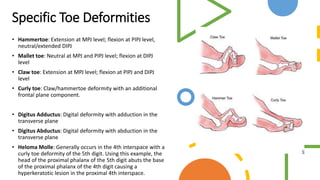
Specific Toe Deformities
• Hammertoe: Extension at MPJ level; flexion at PIPJ level,
neutral/extended DIPJ
• Mallet toe: Neutral at MPJ and PIPJ level; flexion at DIPJ
level
• Claw toe: Extension at MPJ level; flexion at PIPJ and DIPJ
level
• Curly toe: Claw/hammertoe deformity with an additional
frontal plane component.
• Digitus Adductus: Digital deformity with adduction in the
transverse plane
• Digitus Abductus: Digital deformity with abduction in the
transverse plane
• Heloma Molle: Generally occurs in the 4th interspace with a
curly toe deformity of the 5th digit. Using this example, the
head of the proximal phalanx of the 5th digit abuts the base
of the proximal phalanx of the 4th digit causing a
hyperkeratotic lesion in the proximal 4th interspace.
AJM Sheet: Patho-mechanics of Toe Deformities
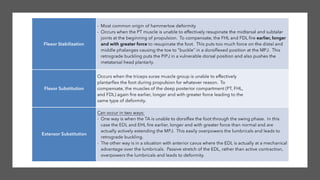
Digital deformities are thought to occur via one of three potential mechanisms. Each
involves a muscular imbalance at the digital level.
The way AJM thinks of digits is from distal to proximal. During weight-bearing, the
toes cannot function in propulsive gait to aid in load transfer if the most distal
segment is not stabilized. The distal phalanx is stabilized by the long flexor tendons
holding it solidly against the weight-bearing surface. With the distal phalanx
stabilized, the short flexor tendon can hold the middle phalanx against the weight-
bearing surface. With the middle phalanx stabilized, the lumbrical muscles hold the
proximal phalanx against the ground. The lumbrical muscles must work against the
extensor tendon complex, but this complex is usually not actively firing to extend the
MPJ during propulsion. The interosseous muscles also stabilize the proximal phalanx
in the transverse plane. When the proximal phalanx has been effectively stabilized
against the weight-bearing surface, the head of the metatarsal can effectively move
through its range of motion and transfer load across the metatarsal parabola. Any
disruption in the stabilization process will lead to abnormal biomechanics and
deformity.
AJM Sheet:
Digital
Anatomy
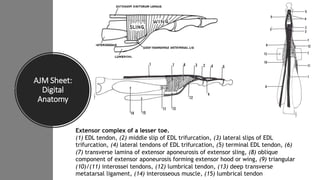
Extensor complex of a lesser toe.
(1) EDL tendon, (2) middle slip of EDL trifurcation, (3) lateral slips of EDL
trifurcation, (4) lateral tendons of EDL trifurcation, (5) terminal EDL tendon, (6)
(7) transverse lamina of extensor aponeurosis of extensor sling, (8) oblique
component of extensor aponeurosis forming extensor hood or wing, (9) triangular
(10)/(11) interossei tendons, (12) lumbrical tendon, (13) deep transverse
metatarsal ligament, (14) interosseous muscle, (15) lumbrical tendon
Surgical
Options
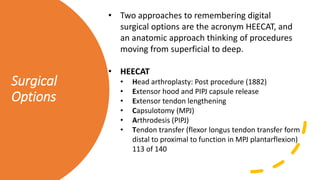
• Two approaches to remembering digital
surgical options are the acronym HEECAT, and
an anatomic approach thinking of procedures
moving from superficial to deep.
• HEECAT
• Head arthroplasty: Post procedure (1882)
• Extensor hood and PIPJ capsule release
• Extensor tendon lengthening
• Capsulotomy (MPJ)
• Arthrodesis (PIPJ)
• Tendon transfer (flexor longus tendon transfer form
distal to proximal to function in MPJ plantarflexion)
113 of 140
Surgical
Options
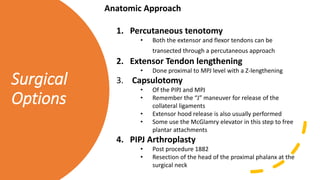
Anatomic Approach
1. Percutaneous tenotomy
• Both the extensor and flexor tendons can be
transected through a percutaneous approach
2. Extensor Tendon lengthening
• Done proximal to MPJ level with a Z-lengthening
3. Capsulotomy
• Of the PIPJ and MPJ
• Remember the “J” maneuver for release of the
collateral ligaments
• Extensor hood release is also usually performed
• Some use the McGlamry elevator in this step to free
plantar attachments
4. PIPJ Arthroplasty
• Post procedure 1882
• Resection of the head of the proximal phalanx at the
surgical neck
Surgical
Options
5. PIPJ Arthrodesis
• Fusion of the PIPJ using a variety of techniques: table-top, V,
peg-in- hole, etc.
• Fusion maintained with K-wire crossing the MPJ extending into
the distal 1/3 of the metatarsal
6. Flexor Tendon Transfer
• Transfer of the FDL tendon dorsally to act as a more effective
plantarflexor of the proximal phalanx
• Girdlestone-Taylor technique: Tendon is bisected, crossed and
sutured on the dorsal aspect.
• Kuwada/Dockery technique: Tendon is re-routed through a
distal drill hole
• Schuberth technique: Tendon is transferred through a proximal
drill hole
7. Syndactyly
• Soft tissue fusion of one digit to a normal adjacent digit to help
“bring it down”
• Interposing skin is removed and the digits are sutured together
5th Digit Incision
• It is possible to alter your skin incision to
incorporate a de-rotational element to your
skin closure. While the osseous work can be
accomplished using a longitudinal or lazy “s”
incision (proximal medial to distal lateral),
those are really best for uniplanar
deformities. 5th digit HT is usually a
triplanar deformity.
• Two semi-elliptical incisions directed
proximal lateral to distal medial.
• The more oblique the incision is, the
greater transverse plane correction.
• The more longitudinal the incision is,
the greater the frontal plane
correction.
AJM Sheet: Lesser
Metatarsal Deformity
Work-up
Subjective
CC: Pt presents complaining of “pain in the ball of my
foot.”
HPI:
• Nature: Generalized pain (aching, sharp, sore, etc.)
• Location: Submetatarsal. Can usually be localized to
an exact metatarsal.
• Course: Gradual and progressive onset. “Has
bothered me for years.”
• Aggravating factors: WB for long periods, shoe
gear, etc.
PMH/PSH/Meds/All/SH/FH/ROS: Usually non-
contributory
Objective
Physical Exam
• Derm: Diffuse or focal hyperkeratotic lesions
submetatarsal
• Vasc/Neuro: Usually non-contributory
• Ortho: Many of the same signs/symptoms as
HT digital deformity. HT often present.
• Anterior displacement of the fat pad
• Anterior Cavus foot type
• Equinus
• Hypermobility of the first ray
• Hypermobility of the fifth ray
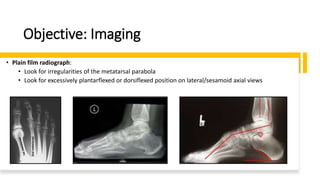
Objective: Imaging
• Plain film radiograph:
• Look for irregularities of the metatarsal parabola
• Look for excessively plantarflexed or dorsiflexed position on lateral/sesamoid axial views
General
Information
Lesser metatarsalgia has several possible etiologies:
1. Retrograde force from hammertoes. Please see AJM
Sheet: Digital Deformities.
2. An excessively long and/or plantarflexed metatarsal
leads to increased load bearing under that
particular metatarsal.
3. An excessively short and/or dorsiflexed metatarsal
can lead to increased load bearing on the adjacent
metatarsals.
4. Hypermobility of the first ray leads to increased
load bearing under at least the second metatarsal.
5. Hypermobility of the fifth ray leads to increased
load bearing under at least the fourth metatarsal.
6. Anterior cavus and equinus deformities lead to
increased pressures across the forefoot.
AJM Sheet:
Lesser
Metatarsal
Treatment
Before a surgical option is considered, it is extremely important to understand where the
increased load is coming from. The goal of treatment should be to restore a normal
parabola and weight-bearing function to the foot. Failure to correct the underlying
deformity will dramatically increase the rate of recurrence and transfer lesions.
Treatment: Conservative
1. Do nothing: Lesser metatarsal deformities are not a
life-threatening condition.
2. Palliative care: Periodic sharp debridement of
hyperkeratotic lesions
3. Splints/Supports:
1. Metatarsal sling pads
2. Toe crests
3. Silicone devices
4. Orthotics:
1. Cut-outs of high pressure areas
2. Metatarsal pads to elevate the metatarsal heads
3. Correction of the underlying deformity
AJM Sheet:
Lesser
Metatarsal
Treatment
Treatment: Surgical
Structural correction of lesser metatarsals
Distal metatarsal procedures
1. Duvries: plantar condylectomy on both sides of the MPJ
2. Jacoby: “V” shaped cut in the metatarsal neck to allow for
dorsiflexion of the head
3. Chevron: “V” shaped cut similar to a Jacoby, but with removal of a
wedge of bone to obtain metatarsal shortening as well.
4. Dorsiflexory wedge osteotomy: similar to a Watermann of the
first metatarsal
5. Weil: Distal dorsal to proximal plantar oblique cut to allow for
distal metatarsal dorsiflexion and shortening. Can be made in
several planes to obtain desired dorsiflexory/ shortening effects.
6. Osteoclasis: Through and through cut through the metatarsal neck
allowing the distal head to find its own plane.
AJM Sheet:
Lesser
Metatarsal
Treatment
Treatment: Surgical
Metatarsal shaft procedures
• Cylindrical shortening
• Giannestras step-down procedure: Z-shaped cut
which can allow for shortening and distal dorsiflexion.
• Metatarsal base procedures
• Dorsiflexory wedge: (1mm of proximal dorsal
shortening equivalent to ~10 degrees of dorsiflexion)
• Buckholtz: Oblique dorsiflexory wedge which allows
for insertion of a 2.7mm cortical screw
Complications
• By far, the most common complications are floating
toe, recurrence and transfer lesions caused by
undercorrection and overcorrection. While you can
evaluate the parabola and transverse plane in the
OR with a C-arm, you really can’t appreciate the
sagittal plane.
• Studies have demonstrated that osteoclastic
procedures allowing the distal segment to find their
own plane without internal fixation have the least
occurrence of recurrence and transfer lesions, but
they also have a higher rate of malunion, delayed
union and non-union.
[Derner and Meyr. Complications and Salvage of
Elective Central Metatarsal Osteotomies. Clinics Pod
Med Surg. Jan 2009.]
AJM Sheet: 5th Metatarsal
Deformity Work-up
Also called: Tailor’s Bunion or
Bunionette Deformity
Subjective/Objective
• Very similar to work-ups for
lesser metatarsal deformities and
digital deformities. Pts may
complain of pain related to the
lateral column in general, 5th
digit, plantar 5th met head,
lateral 5th met head or 4th
interspace heloma molle.
Imaging
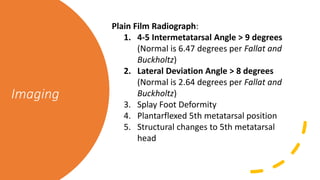
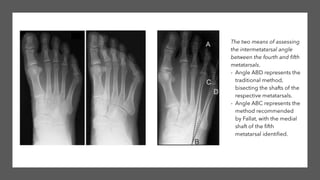
Plain Film Radiograph:
1. 4-5 Intermetatarsal Angle > 9 degrees
(Normal is 6.47 degrees per Fallat and
Buckholtz)
2. Lateral Deviation Angle > 8 degrees
(Normal is 2.64 degrees per Fallat and
Buckholtz)
3. Splay Foot Deformity
4. Plantarflexed 5th metatarsal position
5. Structural changes to 5th metatarsal
head
AJM Sheet: 5th
Metatarsal
Deformity
Etiology
Numerous authors have chimed in to the etiology
of 5th Metatarsal deformity
• Davies: incomplete development of deep
transverse metatarsal ligament
• Gray: malinsertion of adductor hallucis muscle
• Lelievre: forefoot splay
• Yancey: congenital bowing of metatarsal shaft
• Root: abnormal STJ pronation
• CMINT, etc, etc, etc.
AJM Sheet: 5th
Metatarsal
Deformity
Treatment
Conservative
• Do nothing: 5th metatarsal deformities are not a
life-threatening condition.
• Palliative care: Periodic sharp debridement of
hyperkeratotic lesions
• Splints/Supports:
• Shoe gear modification with large toe box
• Derotational tapings
• Orthotics:
• Cut-outs of high pressure areas
• Metatarsal pads to elevate the metatarsal
heads
• Correction of the underlying deformity
AJM Sheet: 5th
Metatarsal
Deformity
Treatment
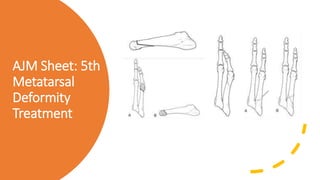
Surgical
• Exostectomy: Removal of prominent lateral eminence
from 5th met head
• Arthroplasty: Removal of part/whole of 5th met head
• Distal Metatarsal Osteotomies:
• Reverse Hohmann
• Reverse Wilson
• Reverse Austin
• Crawford: “L” shaped osteotomy allows for insertion of cortical
screws
• LODO (Long Oblique Distal Osteotomy): similar to Crawford but
simply oblique
• Read [London BP, Stern SF, et al. Long oblique distal osteotomy of the
fifth metatarsal for correction of tailor's bunion: a retrospective review.
J Foot Ankle Surg. 2003 Jan- Feb;42(1):36-42.] Especially if externing at
Inova!
• Medially-based wedge
• Proximal Osteotomies:
• Transverse cuts
• Oblique cuts
• Medially based wedges
AJM Sheet: 5th
Metatarsal
Deformity
Treatment

AJM Sheet: Digital Deformity Work-up

  • 1.
  • 2.
    Subjective CC: Pt cancomplain of generalized “corns, calluses and hammertoes.” HPI: • Nature: “Sharp, aching and/or sore” type pain. May have a “tired feeling” in the feet. • Location: Usually dorsal PIPJ/DIPJ of the toes or submetatarsal • Course: Progressive onset and course. • Aggravating factors: WB, shoe gear (especially tight shoes) • Alleviating factors: NWB, wide shoebox, sandals PMH/PSH/Meds/Allergies/SH/FH/ROS: Usually non-contributory
  • 3.
    Objective Derm: • Hyperkeratotic lesionscan be seen sub metatarsal, dorsal PIPJ or DIPJ of the lesser digits, distal tuft of the lesser digits, or interdigitally. All can have erythema, calor and associated bursitis. 5th digit is usually dorsolateral at the PIPJ, DIPJ or lateral nail fold (Lister’s corn). Hyperkeratotic lesion of the adjuvant 4th interspace may also be present (heloma molle). Vasc/Neuro: Usually non-contributory Ortho: • Positive Coughlin test: Vertical shift of >50% of the proximal phalanx base on the met head. Also called the “draw sign” or Lachman’s test. • Kelikian push-up test: Differentiate between a soft-tissue and osseous deformity • Specific to the 5th digit: • Toe usually has a unique triplanar deformity (dorsiflexion, adduction and varus). • Bunionette, splay foot and equinus may be present • The 5th digit is in the most susceptible position in terms of a muscular imbalance deformity because the FDL has such an oblique pull on the 5th digit as opposed to the relatively axial pull of the other digits.
  • 4.
    Imaging Plain film radiograph:“Gun barrel” sign • Positional deformity • Radiographic sign of Sagittal plane deformity of lesser phalange. test. ush-up test: Differentiate between a soft-tissue and eformity the 5th digit: usually has a unique triplanar deformity (dorsifle xion, uction and varus). onette, splay foot and equinus may be present 5th digit is in the most susceptible position in terms of a cular imbalance deformity because the FDL has such an que pull on the 5th digit as opposed to the relatively axial of the other digits. aph: “Gun barrel” sign deformity hic sign of Sagittal plane deformity of lesser phalange.
  • 5.
    Specific Toe Deformities •Hammertoe: Extension at MPJ level; flexion at PIPJ level, neutral/extended DIPJ • Mallet toe: Neutral at MPJ and PIPJ level; flexion at DIPJ level • Claw toe: Extension at MPJ level; flexion at PIPJ and DIPJ level • Curly toe: Claw/hammertoe deformity with an additional frontal plane component. • Digitus Adductus: Digital deformity with adduction in the transverse plane • Digitus Abductus: Digital deformity with abduction in the transverse plane • Heloma Molle: Generally occurs in the 4th interspace with a curly toe deformity of the 5th digit. Using this example, the head of the proximal phalanx of the 5th digit abuts the base of the proximal phalanx of the 4th digit causing a hyperkeratotic lesion in the proximal 4th interspace.
  • 6.
    AJM Sheet: Patho-mechanicsof Toe Deformities Digital deformities are thought to occur via one of three potential mechanisms. Each involves a muscular imbalance at the digital level. The way AJM thinks of digits is from distal to proximal. During weight-bearing, the toes cannot function in propulsive gait to aid in load transfer if the most distal segment is not stabilized. The distal phalanx is stabilized by the long flexor tendons holding it solidly against the weight-bearing surface. With the distal phalanx stabilized, the short flexor tendon can hold the middle phalanx against the weight- bearing surface. With the middle phalanx stabilized, the lumbrical muscles hold the proximal phalanx against the ground. The lumbrical muscles must work against the extensor tendon complex, but this complex is usually not actively firing to extend the MPJ during propulsion. The interosseous muscles also stabilize the proximal phalanx in the transverse plane. When the proximal phalanx has been effectively stabilized against the weight-bearing surface, the head of the metatarsal can effectively move through its range of motion and transfer load across the metatarsal parabola. Any disruption in the stabilization process will lead to abnormal biomechanics and deformity.
  • 8.
    AJM Sheet: Digital Anatomy Extensor complexof a lesser toe. (1) EDL tendon, (2) middle slip of EDL trifurcation, (3) lateral slips of EDL trifurcation, (4) lateral tendons of EDL trifurcation, (5) terminal EDL tendon, (6) (7) transverse lamina of extensor aponeurosis of extensor sling, (8) oblique component of extensor aponeurosis forming extensor hood or wing, (9) triangular (10)/(11) interossei tendons, (12) lumbrical tendon, (13) deep transverse metatarsal ligament, (14) interosseous muscle, (15) lumbrical tendon
  • 9.
    Surgical Options • Two approachesto remembering digital surgical options are the acronym HEECAT, and an anatomic approach thinking of procedures moving from superficial to deep. • HEECAT • Head arthroplasty: Post procedure (1882) • Extensor hood and PIPJ capsule release • Extensor tendon lengthening • Capsulotomy (MPJ) • Arthrodesis (PIPJ) • Tendon transfer (flexor longus tendon transfer form distal to proximal to function in MPJ plantarflexion) 113 of 140
  • 10.
    Surgical Options Anatomic Approach 1. Percutaneoustenotomy • Both the extensor and flexor tendons can be transected through a percutaneous approach 2. Extensor Tendon lengthening • Done proximal to MPJ level with a Z-lengthening 3. Capsulotomy • Of the PIPJ and MPJ • Remember the “J” maneuver for release of the collateral ligaments • Extensor hood release is also usually performed • Some use the McGlamry elevator in this step to free plantar attachments 4. PIPJ Arthroplasty • Post procedure 1882 • Resection of the head of the proximal phalanx at the surgical neck
  • 11.
    Surgical Options 5. PIPJ Arthrodesis •Fusion of the PIPJ using a variety of techniques: table-top, V, peg-in- hole, etc. • Fusion maintained with K-wire crossing the MPJ extending into the distal 1/3 of the metatarsal 6. Flexor Tendon Transfer • Transfer of the FDL tendon dorsally to act as a more effective plantarflexor of the proximal phalanx • Girdlestone-Taylor technique: Tendon is bisected, crossed and sutured on the dorsal aspect. • Kuwada/Dockery technique: Tendon is re-routed through a distal drill hole • Schuberth technique: Tendon is transferred through a proximal drill hole 7. Syndactyly • Soft tissue fusion of one digit to a normal adjacent digit to help “bring it down” • Interposing skin is removed and the digits are sutured together
  • 12.
    5th Digit Incision •It is possible to alter your skin incision to incorporate a de-rotational element to your skin closure. While the osseous work can be accomplished using a longitudinal or lazy “s” incision (proximal medial to distal lateral), those are really best for uniplanar deformities. 5th digit HT is usually a triplanar deformity. • Two semi-elliptical incisions directed proximal lateral to distal medial. • The more oblique the incision is, the greater transverse plane correction. • The more longitudinal the incision is, the greater the frontal plane correction.
  • 13.
  • 14.
    Subjective CC: Pt presentscomplaining of “pain in the ball of my foot.” HPI: • Nature: Generalized pain (aching, sharp, sore, etc.) • Location: Submetatarsal. Can usually be localized to an exact metatarsal. • Course: Gradual and progressive onset. “Has bothered me for years.” • Aggravating factors: WB for long periods, shoe gear, etc. PMH/PSH/Meds/All/SH/FH/ROS: Usually non- contributory
  • 15.
    Objective Physical Exam • Derm:Diffuse or focal hyperkeratotic lesions submetatarsal • Vasc/Neuro: Usually non-contributory • Ortho: Many of the same signs/symptoms as HT digital deformity. HT often present. • Anterior displacement of the fat pad • Anterior Cavus foot type • Equinus • Hypermobility of the first ray • Hypermobility of the fifth ray
  • 16.
    Objective: Imaging • Plainfilm radiograph: • Look for irregularities of the metatarsal parabola • Look for excessively plantarflexed or dorsiflexed position on lateral/sesamoid axial views
  • 17.
    General Information Lesser metatarsalgia hasseveral possible etiologies: 1. Retrograde force from hammertoes. Please see AJM Sheet: Digital Deformities. 2. An excessively long and/or plantarflexed metatarsal leads to increased load bearing under that particular metatarsal. 3. An excessively short and/or dorsiflexed metatarsal can lead to increased load bearing on the adjacent metatarsals. 4. Hypermobility of the first ray leads to increased load bearing under at least the second metatarsal. 5. Hypermobility of the fifth ray leads to increased load bearing under at least the fourth metatarsal. 6. Anterior cavus and equinus deformities lead to increased pressures across the forefoot.
  • 18.
    AJM Sheet: Lesser Metatarsal Treatment Before asurgical option is considered, it is extremely important to understand where the increased load is coming from. The goal of treatment should be to restore a normal parabola and weight-bearing function to the foot. Failure to correct the underlying deformity will dramatically increase the rate of recurrence and transfer lesions. Treatment: Conservative 1. Do nothing: Lesser metatarsal deformities are not a life-threatening condition. 2. Palliative care: Periodic sharp debridement of hyperkeratotic lesions 3. Splints/Supports: 1. Metatarsal sling pads 2. Toe crests 3. Silicone devices 4. Orthotics: 1. Cut-outs of high pressure areas 2. Metatarsal pads to elevate the metatarsal heads 3. Correction of the underlying deformity
  • 19.
    AJM Sheet: Lesser Metatarsal Treatment Treatment: Surgical Structuralcorrection of lesser metatarsals Distal metatarsal procedures 1. Duvries: plantar condylectomy on both sides of the MPJ 2. Jacoby: “V” shaped cut in the metatarsal neck to allow for dorsiflexion of the head 3. Chevron: “V” shaped cut similar to a Jacoby, but with removal of a wedge of bone to obtain metatarsal shortening as well. 4. Dorsiflexory wedge osteotomy: similar to a Watermann of the first metatarsal 5. Weil: Distal dorsal to proximal plantar oblique cut to allow for distal metatarsal dorsiflexion and shortening. Can be made in several planes to obtain desired dorsiflexory/ shortening effects. 6. Osteoclasis: Through and through cut through the metatarsal neck allowing the distal head to find its own plane.
  • 20.
    AJM Sheet: Lesser Metatarsal Treatment Treatment: Surgical Metatarsalshaft procedures • Cylindrical shortening • Giannestras step-down procedure: Z-shaped cut which can allow for shortening and distal dorsiflexion. • Metatarsal base procedures • Dorsiflexory wedge: (1mm of proximal dorsal shortening equivalent to ~10 degrees of dorsiflexion) • Buckholtz: Oblique dorsiflexory wedge which allows for insertion of a 2.7mm cortical screw
  • 21.
    Complications • By far,the most common complications are floating toe, recurrence and transfer lesions caused by undercorrection and overcorrection. While you can evaluate the parabola and transverse plane in the OR with a C-arm, you really can’t appreciate the sagittal plane. • Studies have demonstrated that osteoclastic procedures allowing the distal segment to find their own plane without internal fixation have the least occurrence of recurrence and transfer lesions, but they also have a higher rate of malunion, delayed union and non-union. [Derner and Meyr. Complications and Salvage of Elective Central Metatarsal Osteotomies. Clinics Pod Med Surg. Jan 2009.]
  • 22.
    AJM Sheet: 5thMetatarsal Deformity Work-up Also called: Tailor’s Bunion or Bunionette Deformity
  • 23.
    Subjective/Objective • Very similarto work-ups for lesser metatarsal deformities and digital deformities. Pts may complain of pain related to the lateral column in general, 5th digit, plantar 5th met head, lateral 5th met head or 4th interspace heloma molle.
  • 24.
    Imaging Plain Film Radiograph: 1.4-5 Intermetatarsal Angle > 9 degrees (Normal is 6.47 degrees per Fallat and Buckholtz) 2. Lateral Deviation Angle > 8 degrees (Normal is 2.64 degrees per Fallat and Buckholtz) 3. Splay Foot Deformity 4. Plantarflexed 5th metatarsal position 5. Structural changes to 5th metatarsal head
  • 26.
    AJM Sheet: 5th Metatarsal Deformity Etiology Numerousauthors have chimed in to the etiology of 5th Metatarsal deformity • Davies: incomplete development of deep transverse metatarsal ligament • Gray: malinsertion of adductor hallucis muscle • Lelievre: forefoot splay • Yancey: congenital bowing of metatarsal shaft • Root: abnormal STJ pronation • CMINT, etc, etc, etc.
  • 27.
    AJM Sheet: 5th Metatarsal Deformity Treatment Conservative •Do nothing: 5th metatarsal deformities are not a life-threatening condition. • Palliative care: Periodic sharp debridement of hyperkeratotic lesions • Splints/Supports: • Shoe gear modification with large toe box • Derotational tapings • Orthotics: • Cut-outs of high pressure areas • Metatarsal pads to elevate the metatarsal heads • Correction of the underlying deformity
  • 28.
    AJM Sheet: 5th Metatarsal Deformity Treatment Surgical •Exostectomy: Removal of prominent lateral eminence from 5th met head • Arthroplasty: Removal of part/whole of 5th met head • Distal Metatarsal Osteotomies: • Reverse Hohmann • Reverse Wilson • Reverse Austin • Crawford: “L” shaped osteotomy allows for insertion of cortical screws • LODO (Long Oblique Distal Osteotomy): similar to Crawford but simply oblique • Read [London BP, Stern SF, et al. Long oblique distal osteotomy of the fifth metatarsal for correction of tailor's bunion: a retrospective review. J Foot Ankle Surg. 2003 Jan- Feb;42(1):36-42.] Especially if externing at Inova! • Medially-based wedge • Proximal Osteotomies: • Transverse cuts • Oblique cuts • Medially based wedges
  • 29.

Editor's Notes

  • #12 • You should be able to go through the steps of a Post procedure for an interview. • Please also review the neurovascular elements for each digit and be able to recite which cutaneous nerves supply which corner of each digit.