AIR CONDITIONINGBCDUNIT-VProf S S JAHAGIRDARBE (CIVIL), ME(ENV.),PhD(persuing)NK Orchid college of Engg. and Tech. , Solapur
DefinitionProcess of treating the air so as to control simultaneously its temperature, humidity, purity and distribution to meet the requirements of controlled space.
Requirements of a conditioned spaceComfort and health of occupantsNeeds of certain industrial processesEfficient working of commercial premises/offices
Functional classificationComfort air conditioning : - Aim at giving max human comfort to occupants/users of conditioned spaceIndustrial air conditioning : -  The coditioning creates, controls and maintains such an environment inside the conditioned space, that it would suit best to the needs of industry.
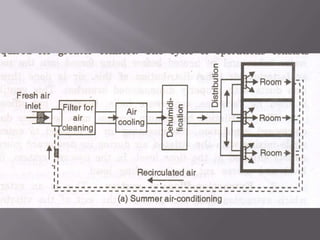
Classification based on season/Temperature1) Summer air conditioning In summer outside temp is more and hence cooling of air is requiredConsists of Air cleaningAir coolingDehumidificationAir distribution/circulation
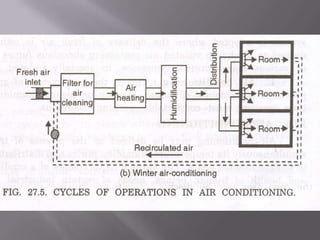
2) Winter air conditioningIn winter outside temperature is low hence heating of air is needed for comfort.Cycle of operations consists of Air cleaningAir heatingHumidificationAir distribution/circulation
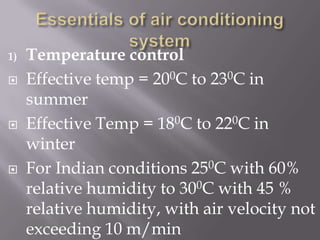
Essentials of air conditioning systemTemperature control Effective temp = 200C to 230C in summerEffective Temp = 180C to 220C in winterFor Indian conditions 250C with 60% relative humidity to 300C with 45 % relative humidity, with air velocity not exceeding 10 m/min
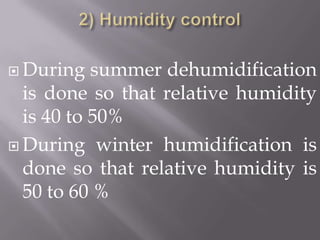
2) Humidity controlDuring summer dehumidification is done so that relative humidity is 40 to 50%During winter humidification is done so that relative humidity is 50 to 60 %
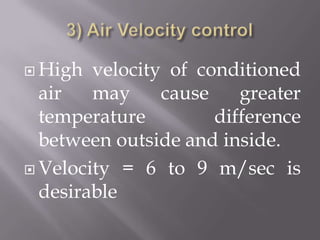
3) Air Velocity controlHigh velocity of conditioned air may cause greater temperature difference between outside and inside.Velocity = 6 to 9 m/sec is desirable
4) Air Quality controlAir should be free from odour, toxic gases, bacteria and other micro-organisms
Essentials of air conditioning systemFiltrationHeating (in winter)Cooling (in summer)HumidificationDehumidificationAir circulation or distribution
1) filtrationShould be capable of removing dust, ash, smoke, bacteria etcShould be capable of holding moderate amount of dust without affecting the efficiencyShould offer low resistance to flow of airWorkable  under sufficient range of velocities.Should afford easy cleaning manually or mechanically
2)  HeatingHeating is necessary in winter so as to compensate heat loss from room.Pre heating of incoming air may be done by passing over air furnaces or coils through which hot water is circulated.
3) CoolingCooling of incoming air is necessary in summer.Principle of mechanical refrigeration is used.
4) HumidificationHumidification or addition of water is necessary in winter when air because of low temp has less humidity.Incoming air is passed through pans of water or wet cloth strips
5) DehumidificationIn this process certain amount of water is extracted from air.This is done in summer where incoming air is cooled.Adsorbents can be used to adsorb excess moisture from air
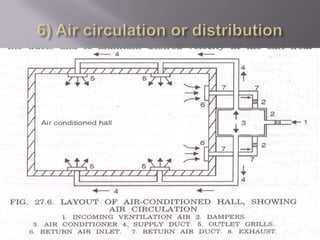
6) Air circulation or distribution
END

Air conditioning

  • 1.
    AIR CONDITIONINGBCDUNIT-VProf SS JAHAGIRDARBE (CIVIL), ME(ENV.),PhD(persuing)NK Orchid college of Engg. and Tech. , Solapur
  • 2.
    DefinitionProcess of treatingthe air so as to control simultaneously its temperature, humidity, purity and distribution to meet the requirements of controlled space.
  • 3.
    Requirements of aconditioned spaceComfort and health of occupantsNeeds of certain industrial processesEfficient working of commercial premises/offices
  • 4.
    Functional classificationComfort airconditioning : - Aim at giving max human comfort to occupants/users of conditioned spaceIndustrial air conditioning : - The coditioning creates, controls and maintains such an environment inside the conditioned space, that it would suit best to the needs of industry.
  • 5.
    Classification based onseason/Temperature1) Summer air conditioning In summer outside temp is more and hence cooling of air is requiredConsists of Air cleaningAir coolingDehumidificationAir distribution/circulation
  • 7.
    2) Winter airconditioningIn winter outside temperature is low hence heating of air is needed for comfort.Cycle of operations consists of Air cleaningAir heatingHumidificationAir distribution/circulation
  • 9.
    Essentials of airconditioning systemTemperature control Effective temp = 200C to 230C in summerEffective Temp = 180C to 220C in winterFor Indian conditions 250C with 60% relative humidity to 300C with 45 % relative humidity, with air velocity not exceeding 10 m/min
  • 10.
    2) Humidity controlDuringsummer dehumidification is done so that relative humidity is 40 to 50%During winter humidification is done so that relative humidity is 50 to 60 %
  • 11.
    3) Air VelocitycontrolHigh velocity of conditioned air may cause greater temperature difference between outside and inside.Velocity = 6 to 9 m/sec is desirable
  • 12.
    4) Air QualitycontrolAir should be free from odour, toxic gases, bacteria and other micro-organisms
  • 13.
    Essentials of airconditioning systemFiltrationHeating (in winter)Cooling (in summer)HumidificationDehumidificationAir circulation or distribution
  • 14.
    1) filtrationShould becapable of removing dust, ash, smoke, bacteria etcShould be capable of holding moderate amount of dust without affecting the efficiencyShould offer low resistance to flow of airWorkable under sufficient range of velocities.Should afford easy cleaning manually or mechanically
  • 15.
    2) HeatingHeatingis necessary in winter so as to compensate heat loss from room.Pre heating of incoming air may be done by passing over air furnaces or coils through which hot water is circulated.
  • 16.
    3) CoolingCooling ofincoming air is necessary in summer.Principle of mechanical refrigeration is used.
  • 17.
    4) HumidificationHumidification oraddition of water is necessary in winter when air because of low temp has less humidity.Incoming air is passed through pans of water or wet cloth strips
  • 18.
    5) DehumidificationIn thisprocess certain amount of water is extracted from air.This is done in summer where incoming air is cooled.Adsorbents can be used to adsorb excess moisture from air
  • 19.
    6) Air circulationor distribution
  • 20.