AI Resume Analyzer using NLP &
Deep Learning
A Smart Solution for Resume
Screening & Analysis
Objective
• To develop an AI-powered Resume Analyzer
that helps recruiters and job seekers by
analyzing resumes, providing
recommendations, and ranking resumes based
on job descriptions.
Technologies Used
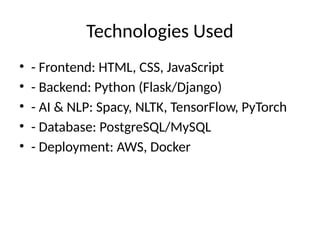
• - Frontend: HTML, CSS, JavaScript
• - Backend: Python (Flask/Django)
• - AI & NLP: Spacy, NLTK, TensorFlow, PyTorch
• - Database: PostgreSQL/MySQL
• - Deployment: AWS, Docker
Dataset Used (Kaggle)
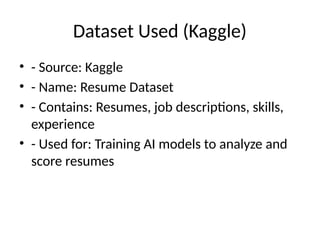
• - Source: Kaggle
• - Name: Resume Dataset
• - Contains: Resumes, job descriptions, skills,
experience
• - Used for: Training AI models to analyze and
score resumes
Deep Learning Models Used
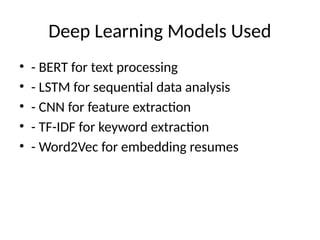
• - BERT for text processing
• - LSTM for sequential data analysis
• - CNN for feature extraction
• - TF-IDF for keyword extraction
• - Word2Vec for embedding resumes
Methodology
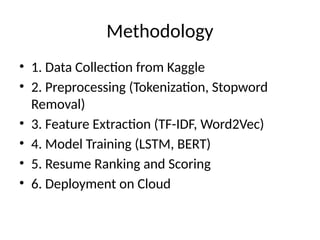
• 1. Data Collection from Kaggle
• 2. Preprocessing (Tokenization, Stopword
Removal)
• 3. Feature Extraction (TF-IDF, Word2Vec)
• 4. Model Training (LSTM, BERT)
• 5. Resume Ranking and Scoring
• 6. Deployment on Cloud
Features of the Application
• - HR can upload multiple resumes at once
• - AI ranks resumes based on job descriptions
• - Users get personalized resume feedback
• - Provides improvement suggestions
• - Secure and scalable cloud deployment
Future Enhancements
• - Integration with LinkedIn & Indeed
• - AI-based interview preparation
• - More datasets for training
• - Automated job matching
• - Multi-language resume analysis
AI_Resume_Analyzer_Presentation (1).pptx

  • 1.
    AI Resume Analyzerusing NLP & Deep Learning A Smart Solution for Resume Screening & Analysis
  • 2.
    Objective • To developan AI-powered Resume Analyzer that helps recruiters and job seekers by analyzing resumes, providing recommendations, and ranking resumes based on job descriptions.
  • 3.
    Technologies Used • -Frontend: HTML, CSS, JavaScript • - Backend: Python (Flask/Django) • - AI & NLP: Spacy, NLTK, TensorFlow, PyTorch • - Database: PostgreSQL/MySQL • - Deployment: AWS, Docker
  • 4.
    Dataset Used (Kaggle) •- Source: Kaggle • - Name: Resume Dataset • - Contains: Resumes, job descriptions, skills, experience • - Used for: Training AI models to analyze and score resumes
  • 5.
    Deep Learning ModelsUsed • - BERT for text processing • - LSTM for sequential data analysis • - CNN for feature extraction • - TF-IDF for keyword extraction • - Word2Vec for embedding resumes
  • 6.
    Methodology • 1. DataCollection from Kaggle • 2. Preprocessing (Tokenization, Stopword Removal) • 3. Feature Extraction (TF-IDF, Word2Vec) • 4. Model Training (LSTM, BERT) • 5. Resume Ranking and Scoring • 6. Deployment on Cloud
  • 7.
    Features of theApplication • - HR can upload multiple resumes at once • - AI ranks resumes based on job descriptions • - Users get personalized resume feedback • - Provides improvement suggestions • - Secure and scalable cloud deployment
  • 8.
    Future Enhancements • -Integration with LinkedIn & Indeed • - AI-based interview preparation • - More datasets for training • - Automated job matching • - Multi-language resume analysis