AI, parliamentary procedures & decision-making process
LUISS School of Government
14th edition of the Summer program in Parliamentary Democracy in Europe
Dr. Fotis Fitsilis
Hellenic Parliament
15 July 2025
Outline
• Background.
• Motivation.
• State of the art.
• Examples.
• Guidelines and frameworks.
• Future steps.
2
Technological Background
Artificial Intelligence is a bundle of technologies, methods and system architectures aimed
at replicating aspects of human intelligence using computational power.
This includes learning methods like machine learning and deep learning; pattern
recognition algorithms and natural language processing; and architectures such as neural
networks, agent systems and hybrid models.
The goal is to create systems that autonomously or when instructed perform specific tasks,
e.g., through analysis of large datasets, natural language interaction and support decision-
making in complex environments.
3
Utilize AI to support human activities and processes,
particularly in administration, business, research or
everyday life
Motivation and Current Topics
The use of tools such as LLAMA, Claude, Mistral, ChatGPT and other Large Language
Models is gaining importance in the public sector, including parliaments.
There is a broad demand for rules regarding AI use in parliaments to protect democratic
values.
Ethical questions, data protection (especially personal data), algorithmic biases and
upholding democratic principles are at the center of the debate.
The aim is to create a legal and operational framework that promotes innovation while
minimizing risks and ensuring parliamentary sovereignty.
4
AI governance in legislatures refers to the structures
and rules that ensure the responsible, transparent and
ethical use of AI systems in parliamentary processes.
What Defines an AI Expert Today?
An AI expert is more than just a data scientist or programmer.
It is an interdisciplinary profile combining technical, analytical, social science and strategic
competencies. A typical AI profile includes:
Technical know-how: Proficiency in data handling, capable of programming (e.g. in Python),
understanding algorithms, statistics and machine learning.
Linguistic competence: Knowledge of LLMs and natural language modeling by linguists or
computational linguists.
Social sciences insight: Analysis of AI's impact on people, organizational culture and ethical
implications.
Strategic thinking: Understanding digital transformation, HR, leadership culture, project and
change management.
Engineering & infrastructure: Integration into systems, hardware selection and ensuring security
and privacy.
5
AI in Organizational Change
AI takes over specific tasks, not entire professions. This allows staff to focus more on
creative, strategic or social aspects of their work.
Targeted use of AI can significantly accelerate workflows and improve precision, e.g.,
through automated analysis or intelligent decision-support systems.
Rather than replacing, AI extends existing roles. New skill profiles emerge and up- or
reskilling become essential.
Technological and economic benefits of AI are unevenly distributed.
Without proper measures, social and economic divides may deepen.
6
The Global AI Investment Race
Examples of major current AI infrastructure investments: US “Stargate” project (Jan 2025):
$500B investment.
EU’s response (planned budget: €200B).
Co-funded infrastructure projects.
Public and private access under clear legal frameworks.
7
Goal: Build sovereign EU infrastructure for generative
AI (13 AI factories; 5 gigafactories)
Greece
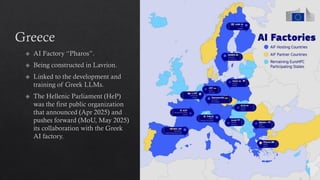
AI Factory “Pharos”.
Being constructed in Lavrion.
Linked to the development and
training of Greek LLMs.
The Hellenic Parliament (HeP)
was the first public organization
that announced (Apr 2025) and
pushes forward (MoU, May 2025)
its collaboration with the Greek
AI factory.
8
State of the Art in AI Technologies
Several documented AI solutions already exist in parliaments, including text analysis,
speech-to-text and predictive analytics.
Besides LLMs like ChatGPT, other tools include OCR, NLP and ML techniques.
Cloud-based AI services (SaaS) and hybrid architectures (local + cloud) are increasingly
used.
Challenges:
Data security (especially when outsourcing).
Bias in training data.
Lack of transparency (black-box problem).
Ethical trade-offs between efficiency and democratic oversight.
European specificities: multilingualism and multiple legal traditions.
9
LLM Deployment Options
Buy end-to-end app (no LLM control).
Buy app with limited LLM control.
Build own app, integrate controllable LLM via APIs.
Develop app + fine-tune LLM.
Build both app and LLM from scratch (pre-training).
(Source: Chang/Pflugfelder 2023)
10
Use of Generative AI
Example: LLMs as legal assistants.
Well-defined legal corpora and case law.
Retrieval Augmented Generation (RAG).
LLMs interact with customized datasets.
Use cases:
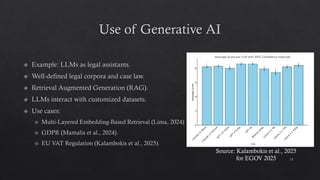
Multi-Layered Embedding-Based Retrieval (Lima, 2024)
GDPR (Mamalis et al., 2024).
EU VAT Regulation (Kalambokis et al., 2025).
11
Source: Kalambokis et al., 2025
for EGOV 2025
AI in Parliaments – Timeline
Early Phase (2001–2023): Research & conceptual work in various national parliaments
(e.g., Greece, Canada, Argentina).
2022: Focus on supportive tools like machine translation, document digitization, speech-to-
text.
2024: Growing AI use in core processes: briefings, legislative drafting, summarization,
classification and others.
Current: Heterogeneous progress globally; growing role for generative AI.
12
Global Use of Parliamentary AI
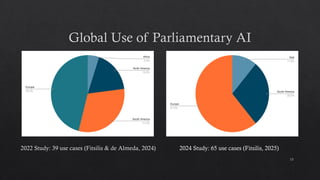
2022 Study: 39 use cases (Fitsilis & de Almeda, 2024)
13
2024 Study: 65 use cases (Fitsilis, 2025)
European parliamentary examples
• Greece: 'Demosthenes' transcription system.
• Finland: AI hearings on UN 2030 Agenda.
• Netherlands: Automated reporting.
• Italy: Law classification.
• European Parliament: “Archibot” public access tool.
14
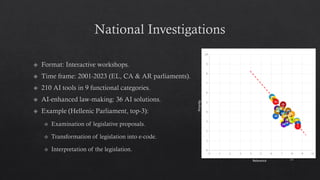
National Investigations
Format: Interactive workshops.
Time frame: 2001-2023 (EL, CA & AR parliaments).
210 AI tools in 9 functional categories.
AI-enhanced law-making: 36 AI solutions.
Example (Hellenic Parliament, top-3):
Examination of legislative proposals.
Transformation of legislation into e-code.
Interpretation of the legislation.
15
Relevance
Priority
Motivation for Guidelines
Ensure AI supports, not replaces democratic processes.
Promote unified practices and interoperable systems for better
cooperation.
Guarantee transparency (explainable AI), fairness (bias
reduction) and rights protection.
AI should strengthen representative democracy, especially via
public engagement.
EU AI Act will regulate AI in public sector & parliaments
(starting August 2024 / 2026).
Translated in 8 languages, with 2 more under preparation.
16
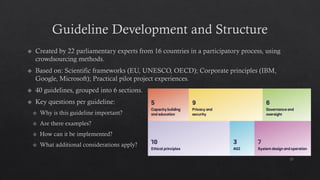
Guideline Development and Structure
Created by 22 parliamentary experts from 16 countries in a participatory process, using
crowdsourcing methods.
Based on: Scientific frameworks (EU, UNESCO, OECD); Corporate principles (IBM,
Google, Microsoft); Practical pilot project experiences.
40 guidelines, grouped into 6 sections.
Key questions per guideline:
Why is this guideline important?
Are there examples?
How can it be implemented?
What additional considerations apply?
17
Ethical Principles
Accountability and transparency.
Respect for human dignity, rights, & privacy.
Fairness, equity, and non-discrimination.
Addressing biases in data and algorithms.
Upholding intellectual property rights.
Preservation of human values and cultural diversity.
Evaluation and mitigation of unintended consequences.
Public participation and engagement.
Respect for the rule of law & democratic values.
Promotion of policy goals.
18
AGI and Human Autonomy
Promotion of human autonomy.
Ethical requirements for designers and developers.
Recognition of AGI as a real prospect.
19
Privacy and Security
Embedding safety and robust security features.
Including privacy-by-design concepts.
Secure processing of personally identifiable information.
Outsourcing considerations.
Consideration of data sovereignty issues.
Ensuring the integrity of source material.
Risk of overreliance on AI.
Securing training and testing data.
Human oversight in security decisions.
20
Governance and Oversight
Integration into a broader digital parliamentary strategy.
Efficient data governance and management protocols.
Establishing a parliamentary ethical oversight body.
Assessing the effects of parliamentary AI.
Securing access to and control over the data.
Cooperation with stakeholders.
21
System Design and Operation
Implementing standardised data schemes and processes.
Emphasising AI algorithms' explainability.
Building robust and reliable AI systems.
Regulating the use and deployment of AI systems.
Assessing risk.
Monitoring and evaluating AI systems.
Agreeing minimum accuracy levels.
22
Capacity Building and Education
Establishing expert teams.
Organising training programmes.
Supporting knowledge exchange and cooperation.
Documenting AI-related activities.
Public education about the use and limits of AI in parliament.
23
Strategic Integration
Need for holistic understanding of AI integration in parliamentary institutions.
Five-step approach (Fitsilis, Mikros and von Lucke, 2024):
Strategy (vision and objectives).
Prioritization (method and evaluation).
Training (TNA, material, adaptive life-long approach).
Implementation (priorities, specs, agility, quick wins).
Governance (political process, parliamentary body, link to administration).
Yet to be practically implemented.
24
Design & Implementation Challenges
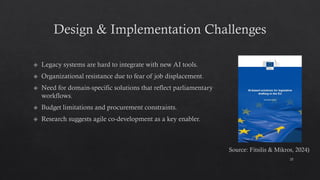
Legacy systems are hard to integrate with new AI tools.
Organizational resistance due to fear of job displacement.
Need for domain-specific solutions that reflect parliamentary
workflows.
Budget limitations and procurement constraints.
Research suggests agile co-development as a key enabler.
25
Source: Fitsilis & Mikros, 2024)
Future Steps and Developments
Next version of the guidelines will focus on aspects of implementation.
Apply AI technologies in parliamentary apps in-line with the guidelines.
Expand language availability.
Create training programs for public administrators on AI skills and usage ethics.
Public awareness campaigns on AI in parliaments.
Develop metrics to measure effectiveness and compliance.
Enable a feedback-loop.
26
Summary and Conclusion
With responsible use, AI can make parliaments more efficient, transparent and citizen-
focused.
Harmonization among national parliaments and EU institutions is necessary (see also
Interoperability Act).
A trade-off between ParlTech progress, operational efficiency and democratic control must
be determined.
Guidelines and frameworks must evolve with technology (e.g., generative/agentic AI) and
social expectations.
Parliaments have the opportunity to set standards for other state institutions through
exemplary AI governance.
27
Contact and Resources
Thank you for your attention!
Contact: fotis@fitsilis.gr
Guidelines: https://www.wfd.org/ai-guidelines-parliaments
Hellenic OCR Team: https://hellenicocrteam.gr
Disclaimer: This presentation reflects the author's personal views and not necessarily those of
the Hellenic Parliament.
28

AI, parliamentary procedures and decision-making process

  • 1.
    AI, parliamentary procedures& decision-making process LUISS School of Government 14th edition of the Summer program in Parliamentary Democracy in Europe Dr. Fotis Fitsilis Hellenic Parliament 15 July 2025
  • 2.
    Outline • Background. • Motivation. •State of the art. • Examples. • Guidelines and frameworks. • Future steps. 2
  • 3.
    Technological Background Artificial Intelligenceis a bundle of technologies, methods and system architectures aimed at replicating aspects of human intelligence using computational power. This includes learning methods like machine learning and deep learning; pattern recognition algorithms and natural language processing; and architectures such as neural networks, agent systems and hybrid models. The goal is to create systems that autonomously or when instructed perform specific tasks, e.g., through analysis of large datasets, natural language interaction and support decision- making in complex environments. 3 Utilize AI to support human activities and processes, particularly in administration, business, research or everyday life
  • 4.
    Motivation and CurrentTopics The use of tools such as LLAMA, Claude, Mistral, ChatGPT and other Large Language Models is gaining importance in the public sector, including parliaments. There is a broad demand for rules regarding AI use in parliaments to protect democratic values. Ethical questions, data protection (especially personal data), algorithmic biases and upholding democratic principles are at the center of the debate. The aim is to create a legal and operational framework that promotes innovation while minimizing risks and ensuring parliamentary sovereignty. 4 AI governance in legislatures refers to the structures and rules that ensure the responsible, transparent and ethical use of AI systems in parliamentary processes.
  • 5.
    What Defines anAI Expert Today? An AI expert is more than just a data scientist or programmer. It is an interdisciplinary profile combining technical, analytical, social science and strategic competencies. A typical AI profile includes: Technical know-how: Proficiency in data handling, capable of programming (e.g. in Python), understanding algorithms, statistics and machine learning. Linguistic competence: Knowledge of LLMs and natural language modeling by linguists or computational linguists. Social sciences insight: Analysis of AI's impact on people, organizational culture and ethical implications. Strategic thinking: Understanding digital transformation, HR, leadership culture, project and change management. Engineering & infrastructure: Integration into systems, hardware selection and ensuring security and privacy. 5
  • 6.
    AI in OrganizationalChange AI takes over specific tasks, not entire professions. This allows staff to focus more on creative, strategic or social aspects of their work. Targeted use of AI can significantly accelerate workflows and improve precision, e.g., through automated analysis or intelligent decision-support systems. Rather than replacing, AI extends existing roles. New skill profiles emerge and up- or reskilling become essential. Technological and economic benefits of AI are unevenly distributed. Without proper measures, social and economic divides may deepen. 6
  • 7.
    The Global AIInvestment Race Examples of major current AI infrastructure investments: US “Stargate” project (Jan 2025): $500B investment. EU’s response (planned budget: €200B). Co-funded infrastructure projects. Public and private access under clear legal frameworks. 7 Goal: Build sovereign EU infrastructure for generative AI (13 AI factories; 5 gigafactories)
  • 8.
    Greece AI Factory “Pharos”. Beingconstructed in Lavrion. Linked to the development and training of Greek LLMs. The Hellenic Parliament (HeP) was the first public organization that announced (Apr 2025) and pushes forward (MoU, May 2025) its collaboration with the Greek AI factory. 8
  • 9.
    State of theArt in AI Technologies Several documented AI solutions already exist in parliaments, including text analysis, speech-to-text and predictive analytics. Besides LLMs like ChatGPT, other tools include OCR, NLP and ML techniques. Cloud-based AI services (SaaS) and hybrid architectures (local + cloud) are increasingly used. Challenges: Data security (especially when outsourcing). Bias in training data. Lack of transparency (black-box problem). Ethical trade-offs between efficiency and democratic oversight. European specificities: multilingualism and multiple legal traditions. 9
  • 10.
    LLM Deployment Options Buyend-to-end app (no LLM control). Buy app with limited LLM control. Build own app, integrate controllable LLM via APIs. Develop app + fine-tune LLM. Build both app and LLM from scratch (pre-training). (Source: Chang/Pflugfelder 2023) 10
  • 11.
    Use of GenerativeAI Example: LLMs as legal assistants. Well-defined legal corpora and case law. Retrieval Augmented Generation (RAG). LLMs interact with customized datasets. Use cases: Multi-Layered Embedding-Based Retrieval (Lima, 2024) GDPR (Mamalis et al., 2024). EU VAT Regulation (Kalambokis et al., 2025). 11 Source: Kalambokis et al., 2025 for EGOV 2025
  • 12.
    AI in Parliaments– Timeline Early Phase (2001–2023): Research & conceptual work in various national parliaments (e.g., Greece, Canada, Argentina). 2022: Focus on supportive tools like machine translation, document digitization, speech-to- text. 2024: Growing AI use in core processes: briefings, legislative drafting, summarization, classification and others. Current: Heterogeneous progress globally; growing role for generative AI. 12
  • 13.
    Global Use ofParliamentary AI 2022 Study: 39 use cases (Fitsilis & de Almeda, 2024) 13 2024 Study: 65 use cases (Fitsilis, 2025)
  • 14.
    European parliamentary examples •Greece: 'Demosthenes' transcription system. • Finland: AI hearings on UN 2030 Agenda. • Netherlands: Automated reporting. • Italy: Law classification. • European Parliament: “Archibot” public access tool. 14
  • 15.
    National Investigations Format: Interactiveworkshops. Time frame: 2001-2023 (EL, CA & AR parliaments). 210 AI tools in 9 functional categories. AI-enhanced law-making: 36 AI solutions. Example (Hellenic Parliament, top-3): Examination of legislative proposals. Transformation of legislation into e-code. Interpretation of the legislation. 15 Relevance Priority
  • 16.
    Motivation for Guidelines EnsureAI supports, not replaces democratic processes. Promote unified practices and interoperable systems for better cooperation. Guarantee transparency (explainable AI), fairness (bias reduction) and rights protection. AI should strengthen representative democracy, especially via public engagement. EU AI Act will regulate AI in public sector & parliaments (starting August 2024 / 2026). Translated in 8 languages, with 2 more under preparation. 16
  • 17.
    Guideline Development andStructure Created by 22 parliamentary experts from 16 countries in a participatory process, using crowdsourcing methods. Based on: Scientific frameworks (EU, UNESCO, OECD); Corporate principles (IBM, Google, Microsoft); Practical pilot project experiences. 40 guidelines, grouped into 6 sections. Key questions per guideline: Why is this guideline important? Are there examples? How can it be implemented? What additional considerations apply? 17
  • 18.
    Ethical Principles Accountability andtransparency. Respect for human dignity, rights, & privacy. Fairness, equity, and non-discrimination. Addressing biases in data and algorithms. Upholding intellectual property rights. Preservation of human values and cultural diversity. Evaluation and mitigation of unintended consequences. Public participation and engagement. Respect for the rule of law & democratic values. Promotion of policy goals. 18
  • 19.
    AGI and HumanAutonomy Promotion of human autonomy. Ethical requirements for designers and developers. Recognition of AGI as a real prospect. 19
  • 20.
    Privacy and Security Embeddingsafety and robust security features. Including privacy-by-design concepts. Secure processing of personally identifiable information. Outsourcing considerations. Consideration of data sovereignty issues. Ensuring the integrity of source material. Risk of overreliance on AI. Securing training and testing data. Human oversight in security decisions. 20
  • 21.
    Governance and Oversight Integrationinto a broader digital parliamentary strategy. Efficient data governance and management protocols. Establishing a parliamentary ethical oversight body. Assessing the effects of parliamentary AI. Securing access to and control over the data. Cooperation with stakeholders. 21
  • 22.
    System Design andOperation Implementing standardised data schemes and processes. Emphasising AI algorithms' explainability. Building robust and reliable AI systems. Regulating the use and deployment of AI systems. Assessing risk. Monitoring and evaluating AI systems. Agreeing minimum accuracy levels. 22
  • 23.
    Capacity Building andEducation Establishing expert teams. Organising training programmes. Supporting knowledge exchange and cooperation. Documenting AI-related activities. Public education about the use and limits of AI in parliament. 23
  • 24.
    Strategic Integration Need forholistic understanding of AI integration in parliamentary institutions. Five-step approach (Fitsilis, Mikros and von Lucke, 2024): Strategy (vision and objectives). Prioritization (method and evaluation). Training (TNA, material, adaptive life-long approach). Implementation (priorities, specs, agility, quick wins). Governance (political process, parliamentary body, link to administration). Yet to be practically implemented. 24
  • 25.
    Design & ImplementationChallenges Legacy systems are hard to integrate with new AI tools. Organizational resistance due to fear of job displacement. Need for domain-specific solutions that reflect parliamentary workflows. Budget limitations and procurement constraints. Research suggests agile co-development as a key enabler. 25 Source: Fitsilis & Mikros, 2024)
  • 26.
    Future Steps andDevelopments Next version of the guidelines will focus on aspects of implementation. Apply AI technologies in parliamentary apps in-line with the guidelines. Expand language availability. Create training programs for public administrators on AI skills and usage ethics. Public awareness campaigns on AI in parliaments. Develop metrics to measure effectiveness and compliance. Enable a feedback-loop. 26
  • 27.
    Summary and Conclusion Withresponsible use, AI can make parliaments more efficient, transparent and citizen- focused. Harmonization among national parliaments and EU institutions is necessary (see also Interoperability Act). A trade-off between ParlTech progress, operational efficiency and democratic control must be determined. Guidelines and frameworks must evolve with technology (e.g., generative/agentic AI) and social expectations. Parliaments have the opportunity to set standards for other state institutions through exemplary AI governance. 27
  • 28.
    Contact and Resources Thankyou for your attention! Contact: fotis@fitsilis.gr Guidelines: https://www.wfd.org/ai-guidelines-parliaments Hellenic OCR Team: https://hellenicocrteam.gr Disclaimer: This presentation reflects the author's personal views and not necessarily those of the Hellenic Parliament. 28