AI Innovations in Entrepreneurial Opportunities.pptx
The different types of sectors are explained and differentiation of sectoral entrepreneurial opportunities in association with artificial intelligence is very well presented concerning from agriculture up to education.
AI Innovations in Entrepreneurial Opportunities.pptx
1.
INTERNATIONAL CONFERENCE ONAI – DRIVEN
INNOVATIONS IN COMMERCE, MANAGEMENT AND
ENTREPRENEURSHIP
ARTIFICIAL INTELLIGENCE INNOVATIONS IN
ENTREPRENEURSHIP
Dr. LUBNA SURAIYA
27th
September 2024
BEGINNING OF TRADE
NewGuinea - 17,000 BCE - Locals exchanged
obsidian - Nomadic tribes - Hunting and
gathering foods. As agricultural methods
improved - First towns and cities were seen –
Human settlements took place - Two separate
human civilizations existed – Discovered in 15th
Century.
Marco Polo: Regarded as the earliest entrepreneur, in
establishing trade routes to the Far East. To sell his
goods, a contract was signed loan of 22.5% rate
including insurance.
HISTORY OF ENTREPRENEURSHIP
EARLY TRADE
4.
MIDDLE AGES
Project Managers: Entrepreneurs those who
managed large projects without bearing risks
but utilized all the resources provided. An
entrepreneur in charge of great architectural
works used to build castles, abbeys,
cathedrals and public buildings
17th
CENTURY
Richard Cantillon was first to apply
“Entrepreneur" in a business
context who identified the
willingness to bear the personal
financial risk of a business venture.
19th
CENTURY
Joseph Alois Schumpeter is best known for business cycles,
development of capitalist economies, and introducing the
concept of entrepreneurship. The entrepreneur was the
cornerstone of capitalism as a source of innovation.
5.
21st
CENTURY
Steve Blank, the"FATHER OF MODERN
ENTREPRENEURSHIP," who has shaped startups,
success strategies, and funding approaches.
Dr. V. G Patel is the Founder Director of
the
Entrepreneurship Development Institute
of India
. He was awarded Padma Shri in 2017.
FATHER OF INDIAN
ENTREPRENURSHIP
Primary Sector -Directly uses natural resources. It forms the base for all other products. E.g. Agriculture, Mining, Fishing,
Forestry, Dairy etc. People engaged in primary activities are called Red-collar workers.
Secondary Sector - It is also called industrial sector because it involves industries where finished products are made such as
Oil refinery, steel, chemicals, plastic, food production, textiles and artisan works. People are called Blue collar workers.
Tertiary Sector - Does not produce goods but support in terms of services such as banking, insurance, finance, transportation
etc. This sector jobs are called White collar jobs.
Quaternary Sector - Specialized in the Knowledge Sector which demands a separate classification.
Quinary Sector - Top-level decisions are made. This includes the government which passes legislation. Profession under this
category often referred as ‘Gold collar'. They include senior business executives, government officials, research scientists,
financial and legal consultants, etc.
Organized Sector - Employment terms are fixed and regular which is registered with the government.
Unorganized Sector - Marked by low incomes, unstable and irregular employment and lack of protection either from
legislation or trade unions.
Public Sector - Government owns most of the assets and raise money through taxes and other ways to meet expenses on the
services rendered by it.
Private Sector - Ownership of assets and delivery of services is in the hands of private individuals or companies.
8.
ARTIFICIAL INTELLIGENCE INSECTORAL ENTREPRENEURSHIP
1. Agriculture
Agriculture is the practice of cultivating plants and livestock. In the rise of the sedentary human lifestyle,
agriculture was the key development. The cultivation of plant and food grains began years ago in order to provide
food to the city population and source of livelihood contributing significantly to a country’s GDP. India has
witnessed a number of revolutions in agriculture such as - the Green Revolution, Yellow Revolution and Blue
Revolution. Agriculture affects the biodiversity of a country depending upon agricultural activities.
1. Commercial Farming is when farmers grow crops or rear animals on a large scale for an economic activity.
2. Primitive Farming is the oldest form of agriculture, where farmers grow limited crops for themselves and
their families.
3. Intensive Subsistence agriculture is the type of agriculture which is characterized by high output per unit of
land and low output per worker.
4. Smart Farming uses new technologies in agriculture and cattle production so as to increase production
quantity and quality, by making maximum use of resources and minimizing the environmental impact.
9.
ENTREPRENEURIAL OPPORTUNITIES INAGRICULTURE
Cuniculture (Rabbit Cultivation) - Cuniculture is the agricultural practice of breeding and raising domestic
rabbits as livestock for their meat, fur or wool. Rabbit fur is prized for its softness. E.g. Angora breed can be found in
a broad range of coat colours and patterns, baby booties, fur hats, leggings, shirts, socks, and sweaters, pillow covers.
blanket covers, bedding and a full rabbit fur coat.
Hydroponics - Hydroponics is a type of horticulture which involves growing of medicinal plants without soil by
using water-based mineral nutrient solutions in an artificial environment. Hydroponic Farming serves multiple benefits
such as water efficiency, increased crop yields, space utilization and year round production.
Aquaponics - Aquaponics is a sustainable farming method that combines aquaculture (fish farming) with hydroponics
(soil-less plant cultivation). This system creates a symbiotic relationship between plants and fish, where the plants
filter the water for the fish while the fish waste provides nutrients for the plants.
Turf Grass Business - A turf grass business involves cultivating, installing, and maintaining high-quality turf grass for
residential, commercial, and recreational spaces. Turf grass is widely used for creating lawns, sports fields, parks, golf
courses, and landscaping projects.
10.
Mulching Business- Mulching is a method where a material is placed on the soil surface to maintain moisture, reduce
weed growth, mitigate soil erosion, regulate soil temperature and improve soil conditions. Grass clippings, dry leaves, hay,
straw, kitchen scraps, comfrey, shredded bark, sawdust, shells, woodchips, newspapers, cardboards, wool, animal manure,
mosses, comfrey, pine needles, banana or coconut leaves, compost materials and other products derived from plants and
inorganically used lava rock, pulverized rubber and geotextile fabrics.
Dry Flower Business - India is the largest exporter of dry flowers due to their varieties. Not only flowers come under this
business, dry stems, seeds, and buds are also used in it. In this business fresh flowers are collected from the garden and then
dried in such a way so that they don’t lose much color and fragrance and after that, they should be packed and sold in the
market according to the demand.
Beekeeping - Maintenance of bee colonies, commonly in artificial beehives is Beekeeping. Apiarists keep bees to collect
honey and other products of the hive: beeswax, propolis, bee pollen and royal jelly. Other sources of beekeeping income
include pollination of crops, raising queens and production of package bees for sale. Bee hives are kept in "bee yard".
Fodder Business - Fodder is a type of food made from farming or other agricultural processes for feeding domesticated
animals like cattle, cow, bull, buffalo, rabbit, horses etc. Such as grass, dried hay, straw etc.
11.
Value AddedProducts - Value added products are raw agricultural products that have been modified or enhanced to have a
higher market value and/or a longer shelf life. Some examples include fruits made into pies or jams, meats made into jerky,
and tomatoes and peppers made into salsa.
Aromatic Plants - Aromatic plants are a special class of plants mainly used for their aroma and flavor. Aromatic plants –
Lemon Grass, E. citridora, Patchouli, Jamarosa etc. Aromatic Flowers – Rose, Tube-rose, Gladiolus, Gerbera,
Chrysanthemum, Marigold, Gaillardia etc. Aromatic Crops - Dhavana, Geranium, Mints and Vettiver.
Floriculture - Cultivation of flowering and ornamental plants for direct sale or for use as raw materials in cosmetic and
perfume industry and in the pharmaceutical sector.
Seed Marketing - It provides farmers access to a wide range of reliable seed varieties of superior quality at reasonable
prices.
Vermi Business - Vermiculture is scientific process of cultivating worms to decompose organic food wastes into a nutrient-
rich material. The output of vermiculture is called vermicompost (usually hummus and excreta of earthworm) .
12.
Agro BloggingConsultancy - It is relatively new agricultural business idea. Blogs can disseminate agri-knowledge to
farmers and other stakeholders in terms of agri startup ideas or many farmers and landowners seek professional guidance
to improve their operations, provide services such as soil analysis, crop selection, farm management strategies, and
sustainable practices.
Organic Farming - An agricultural process that uses biological fertilizers and pest control acquired from animal or plant
waste.
Rental of Farm Equipments - Agricultural equipment is any kind of machinery used on a farm to help with farming.
1. Tractors
2. Harvesters
3. Fertilizer Spreaders
4. Seeders
5. Balers
6. Excavator
7. Grinder Mixer (Animal Feeding)
13.
Soil Sensors
AI INAGRICULTURE
Farming Apps Drone Spraying
Crop Selection Automated Farming Livestock Monitoring
Weather Forecasting
Robot Fruit Picking System
14.
DO YOU KNOW
♪Barrick Gold Corporation one of the world's largest gold mining company that has been implementing AI technologies
for mine exploration for several years. The company uses AI geological and geophysical data to identify potential mining
locations and optimize drilling operations.
♪ The Wye Foundation uses AI such as Computer Vision and Image Processing, Machine Learning and Sensors and Real-
Time Monitoring to assess classification of fish species, fish behavior, predict fish populations, hunger in real-time,
feeding schedules, swimming, optimization of fishing routes, fish tracking activity, identifying optimal fishing areas,
estimating catches, crop health in aquaculture, monitoring water conditions, detecting anomalous events, other signs of
stress, reduce accidental catches of unwanted or endangered species and illegal catches according to the UN Food and
Agriculture Organization,
♪ NCX Company that provides precision forestry data, carbon sequestration, detect illegal logging threats, analytics for
climate risks, restore forest ecosystems, mitigate wildfires, thermal-infrared camera to measure the temperature, aerial site
view, drone-mapping forests, pinpoint areas of deforestation, forest resource information (species) and Nano satellite
early warning system.
♪ Gavyam Gentech, an agro-tech firm based in Gujarat, was founded by Dipen Parmar and Tejas Vaghela. It uses AI-
driven sensors and smart devices to track health and well-being, robotic milking systems, disease detection, drones
detecting any abnormal behavior, biosensors, 3D Printing (fabricate the dairy products with customized shape, color,
flavour and tailored- made nutritional needs), Block chain technology, Screening of sick cattle, cold chain infrastructure
(contamination and spoilage), waste handling, animal feeding and fodder, temperature governance, breeding cycle,
lactation cycle, vaccination schedule, sustainable practices, manure management systems.
15.
ENTREPRENEURIAL OPPORTUNTIES INFOOD INDUSTRY
Food Truck - Due to the rise in corporate culture, people are always looking for new food varieties. Food trucks also have
lower operating costs than cafes and restaurants. And their mobility expands their reach to more and more customers.
Personal Chefs - Clients may hire to cook at their home meals with special dietary preferences and needs. They may also
call for special events like birthday parties, kitty parties, family get-togethers, etc.
Menu / Recipe Development - Menu Development focuses primarily on the dish selection and design of a menu. Recipe
development means creating new dishes for different uses, such as a restaurant menu, cookbook, or food product.
Jain Food Service - Jain food refers to food prepared without adding onion or garlic. Some Jains avoid eating onion and
garlic during festivals and fasts. Others prefer eating Jain food as a regular practice.
Homemade Food - Prepared in household especially for those who say in hostel, far away from homes.
Coffee House - Cafes allow visitors to sit and enjoy coffee and snacks without any time restrictions. That is why
metro/railway stations, airports, markets, and shopping complexes have coffee houses.
Cooking Classes - Cooking is an essential life skill for all ages. People who love cooking and creating new dishes get a
chance to follow their passion while earning. Culinary classes can open doors for you to becoming a chef for hotels and
restaurants.
16.
Pet FoodManufacturing - Keeping the animal in focus for pet lovers is a low to medium-range competition business
venture.
Diet Food Business - Due to hectic metropolitan lifestyles, full-time workers find it hard to prepare healthy food daily.
Instead, they prefer to buy ready-to-eat diet food. Diseases like diabetes, many follow special and restrictive diets. Such
individuals look for gluten-free and vegan food options.
Chopped Fruit and Vegetable Business - In general, people find it easier to consume chopped and diced vegetables. One
can start this business independently.
Dry Fruit - Dry fruit processing is one of the bankable food business ideas that provide a variety of dry fruits or any
particular one, either way.
Ginger / Garlic Paste - Ginger and garlic paste is the most common cooking ingredient in Indian households. The ginger
garlic paste business has significant market potential and profit margin scope.
Herb Farms - The demand for herbs and medicinal plants has seen a sudden surge.
Food Catering - Provide food services to the people during their special events like marriages, business meetings, social
gatherings, etc. Food caterers give various types of food choices to their customers fulfilling their needs and satisfying their
taste buds.
Tea Bag Making - India is one of the largest tea-consuming nations in the world. It is estimated that each Indian consumes
about 750 grams of tea annually.
17.
Cloud Kitchen- Customers can order food through website or app, and you must deliver it to their homes.
YouTube Channel/ Blogs - This platform allows people to showcase their talents. Those interested can cook and upload
videos. These kinds of food business ideas are a great means of passive income and require minimal investment. Food
blogs can feature restaurant reviews, recipes, and other food business-related content.
Other Food Business
1. Chocolate Making
2. Ice- Cream Parlour
3. Milk and Dairy Products
4. Sweet Shop
5. Farsan Business (Salty snacks/ Namkeen)
6. Meat Cooking
7. Juice Corner
8. Fast Food Shops
9. Organic Business
18.
AI IN FOODINDUSTRY
Gastro graph Sensor
Consumer’s sensory predictions
on flavours.
Arla Foods Software
This software will determine
how much milk can a cow be
able to produce in future.
Product Packing
Product Sorting
Nutrition Calculator Index
Six Sigma Concept
AI Powered Safety System
19.
ENTREPRENEURIAL OPPORTUNTIES INRETAIL INDUSTRY
Kirana Store - India's vast population necessitates a grocery store. Basic household supplies, such as soaps, spices, and
food items have good scope.
Thrift Store - Thrift stores offer secondhand goods like furniture, clothing, and home decor at significantly discounted
prices.
Vending Machines - Vending machines can be placed in high-traffic locations offering a variety of products.
Dollar Stores - Purchasing inexpensive products in bulk can maximize profits. They are particularly successful in
communities looking for bargain buys, making them a viable business option in a variety of locations.
Altering Shop - Starting a tailoring business can be set up from home. Offering a range of services such as alterations,
repairs, and custom-made clothing can attract a diverse customer base.
Tea Stall - Setting up a stall outside colleges or offices can attract a steady stream of customers. To increase profits,
partnering with offices by tea deliveries will establish long-term partnerships with businesses.
Stationery and Book Store - Offering a range of unique and educational gadgets including storybooks, DVDs, school
books, and stationery items, for all students' educational needs.
Fruit Store - The demand for fresh high-quality fruits to customers.
20.
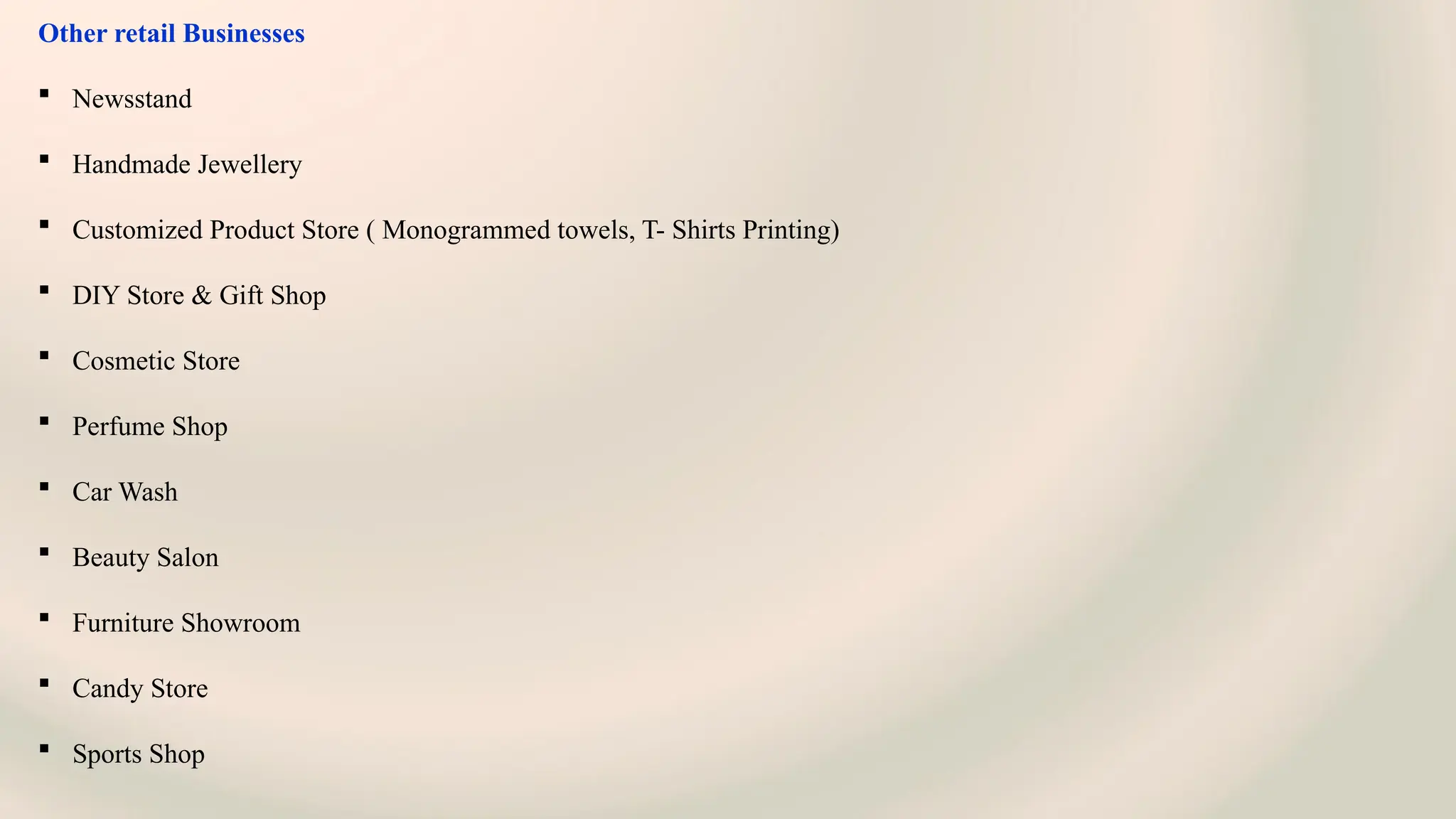
Other retail Businesses
Newsstand
Handmade Jewellery
Customized Product Store ( Monogrammed towels, T- Shirts Printing)
DIY Store & Gift Shop
Cosmetic Store
Perfume Shop
Car Wash
Beauty Salon
Furniture Showroom
Candy Store
Sports Shop
21.
AI IN RETAILINDUSTRY
OYO is an Indian
multinational hospitality
chain of leased and
franchised hotels, homes,
and living spaces founded
in 2012 by Ritesh
Agarwal.
Launched in May 2022, by
Pravas Chandragiri, Soptle is a
micro SaaS-led B2B retail
commerce platform that helps
consumer goods companies
distribute products by using its
network of over 15,000
retailers across the country.
Zepto founded in 2021 is India's ultra fastest-
growing e-grocery company that offers a 10-minute
grocery delivery service.
AI IN HEALTHCARE INDUSTRY
1. Medical Imaging Data, such as X-rays, MRIs, and CT scans
2. IBM Watson Health (Holistic Health Data Management)
3. Electronic Health Records
4. Automatic Speech Recognition (ASR) Technology
5. PACS systems
6. Natural Language Processing
7. Accurate Cancer Diagnosis
8. Nano medicine
9. Customer Service Chatbots / Virtual Health Assistants
10. Automated Disease Detection
11. Comprehensive Digital-Led Care
12. Telemedicine and Remote Patient Monitoring
The 5 top AI healthcare companies include:
1. Merative (Formerly IBM Watson Health)
2. Viz.ai
3. Enlitic
4. Regard
5. Twill
24.
ENTREPRENEURIAL OPPORTUNTIES INEDUCATION
1. Opening a play school
2. Educative Carton Series
3. School uniform making
4. Online e-library such as Project Gutenberg, Questia and Open Library
5. YouTube channel as an Education instructor
6. Thesis Writing
7. Customized education material
8. Printing press
9. Career counselor
10. Home Tuitions
11. Foreign language classes
12. Education Day camps
13. Photocopying Business
14. Digital Skill Development Center
25.
AI IN EDUCATION
In2020, the World Economic Forum identified eight pivotal transformations needed to enhance education quality in
the age of the Fourth Industrial Revolution – Education 4.0 Framework.
GENERAL BASED EDUCATION
Automating Administrative Task and Feedback Systems
Gamified Learning
Intelligent Tutoring System ( Duolingo app and Khan Academy’s Khanmigo )
Classroom/Behavior Management
Lesson Planning
Parent-Teacher Communication
Test Assessment
Staff Scheduling and Substitute Management
Professional Development
26.
HIGHER EUCATION
PlagiarismDetection
Exam Integrity
Chatbots for Enrollment and Retention
Learning Management Systems
Transcription of Faculty Lectures
Enhanced Online Discussion Boards
Analyzing Student Success Metrics
Academic Research
Connected Campuses
1) Thinkster Math : A math tutoring program leverages human interaction
and groundbreaking artificial intelligence to create personalized learning
programs”
2) Jill Watson : An AI-enabled virtual teaching assistant introduced by the
Georgia Institute of Technology in 2016.
3) Brainly :A social media site for classroom questions.
4) Nuance : Speech recognition software used by students and faculty;
capable of transcribing up to 160 words per minute; especially helpful for
students who struggle with writing or have accessibility needs.
5) Cognii : AI-based virtual training assistant platform for corporate training
organizations.
6) Kid Sense : AI educational solutions designed for children, including a
voice-to-text tool with algorithms built to translate speech for young
learners
28.
S.No Sector EntrepreneurshipArtificial Intelligence
1. Aviation Engineering
1. Networking Forums
2. Ariel Imagery Business
3. Air Cargo Business
4. Aviation Magazine Business
5. Airplane Washing Services
1. Predix empowers GE Aviation Fleet
Support
2. Delta Airlines employs AI Powered
Revenue Management to set fares.
3. Automated Neural Intelligence Engine
(ANIE) for Collision avoidance.
4. Air Asia uses Opti Climb, a fuel efficiency
solution.
2. Construction
1. Disaster Reconstruction
2. Building Information Modeling
3. Movers & Packers
4. Specialized Contracts
5. Real Estate
6. Urban Development
1. Automated Quality Control.
2. Construction site safety monitoring.
3. Predictive Maintenance of Machinery.
4. 3D Construction Modeling from 2D images.
5. Material and Equipment Recognition.
6. Environmental Compliance Monitoring.
7. Document and Plan Digitization and
Analysis.
3. Tourism
1. Trip Advisor
2. Travel Guide
3. Luggage Delivery System
4. Souvenir shops (clothing, crafts)
5. Language Translators
1. Automated Travel Insurance
2. Accounting Software for restaurants
3. Voice based Assistants
OTHER SETORAL ENTREPRENEURSHIPAND ARITFICIAL INTELLIGENCE
29.
S.No Sector EntrepreneurshipArtificial Intelligence
4. Sports/ Fitness
1. Online Fitness Coach
2. Athletic Clothing Brand
3. Dietician
4. Massage Therapist
5. Sports Journalist
6. Sports Psychologist
1. AI Referees
2. Smart Wearables
3. AI Player Injury tracking
4. Fan Interaction using Chabot's
5. Electromyography (EMG) sensors measure
muscle activation
6. Inertial Measurement Units
7. AI Diet Plans
5. Textiles/ Apparels
1. Sewing Machine or Equipment
2. Textile Screen Printing
3. Fabric Guide
4. Carpet Making
5. Jute / Gunny Bags
6. Embroidery Units
7. Designer Sari Making
1. CAD – Compute Aided Designs
2. Robotic Recognition Wear
3. JAZA Software (Fashion industry for models)
6.
Information Technology
1. 3D Animation Developers
2. Data Mining
3. Internet Dhabas
4. Innovative Programmers
5. App Developers
1. Machine Learning
2. Programmme Coding
3. Advanced Infrastructural Devices
CONCLUISON
Entrepreneurship is oneof the driving forces behind the growth and development of our society. From creating
jobs to generating innovative ideas and products, entrepreneurs have the power to change the world and shape the future.
Their impact can be felt in all aspects of life, from the economy to culture and even politics. To be successful in
sustainable business practices often requires entrepreneurship and innovation. Entrepreneurship and innovation are
relevant in for-profit and nonprofit ventures. It can be viewed as recognizing change, pursuing opportunity, taking on risk
and responsibility, innovating, making better use of resources, creating new value that is meaningful to customers, and
doing it all over again and again. Being an entrepreneur requires taking on significant responsibility and comes with
significant challenges and potential rewards irrespective of any field. The motivation for becoming an entrepreneur are
diverse and can include the potential for financial reward, the pursuit of personal values and interests, and the interest in
social change. For innovation to be relevant for sustainable businesses, it has to be meaningful and affect a large number
of stakeholders.