AI-Driven Software
Releases in 2026
As 2026 kicks off, the biggest change in software engineering isn’t
about shipping faster or showing off the latest AI feature. It’s about
how teams get changes out to real users. The days when quality
assurance meant long nights, manual checks, and endless test scripts
are quietly fading away. Today, innovations like codeless test
automation are reshaping not only how tests are written but also how
software releases are planned, executed, and improved.
This isn’t theoretical hype. The data shows that AI isn’t just speeding
up processes, it’s redefining what it means to ship reliable software in
a world where speed and quality both matter. Let’s break down why
this matters, how it’s happening, and what developers and engineering
leaders can realistically expect this year.
AI Adoption Is Exploding — And So Are Expectations
By 2025, nearly every company building software was already
experimenting with AI. According to a recent industry report:
70% of software companies say AI has improved their product delivery
speed, and 50% of software testing processes are now assisted or
fully automated with AI. (ZipDo)
These numbers tell a clear story: AI isn’t just an add-on tool anymore;
it’s embedded in the core workflows of how teams develop and deliver
software.
At the same time, AI adoption in DevOps, testing, and deployment
practices has grown sharply. In some studies, 56%–70% of
organizations reported that AI tools help them automate testing,
deploy faster, and detect more bugs earlier in the lifecycle.
What’s remarkable isn’t just adoption, it’s the impact on velocity and
risk management. Teams are shipping more, yet also shipping safer.
What Software Release Management Looks Like in 2026
A decade ago, well-managed software release management was
about spreadsheets, manual checklists, and lots of meetings. Now, it’s
an intelligent system driven by data and prediction.
Modern release managers are watching dashboards where:
●​ AI predicts whether a release candidate is likely to introduce
errors
●​ Automated tests run in parallel and self-heal when UI elements
change
●​ Deploys dynamically adjust based on real-time performance
Even DevOps teams report that AI-enhanced pipelines can deploy
code up to 37% more frequently while reducing failure rates by more
than 20%. (calanceus.com)
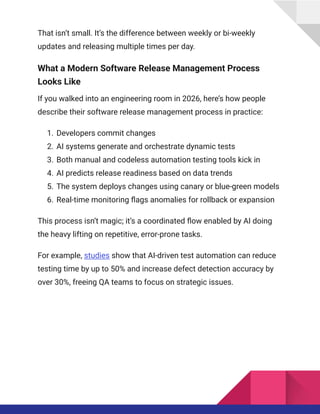
That isn’t small. It’s the difference between weekly or bi-weekly
updates and releasing multiple times per day.
What a Modern Software Release Management Process
Looks Like
If you walked into an engineering room in 2026, here’s how people
describe their software release management process in practice:
1.​Developers commit changes
2.​AI systems generate and orchestrate dynamic tests
3.​Both manual and codeless automation testing tools kick in
4.​AI predicts release readiness based on data trends
5.​The system deploys changes using canary or blue-green models
6.​Real-time monitoring flags anomalies for rollback or expansion
This process isn’t magic; it’s a coordinated flow enabled by AI doing
the heavy lifting on repetitive, error-prone tasks.
For example, studies show that AI-driven test automation can reduce
testing time by up to 50% and increase defect detection accuracy by
over 30%, freeing QA teams to focus on strategic issues.
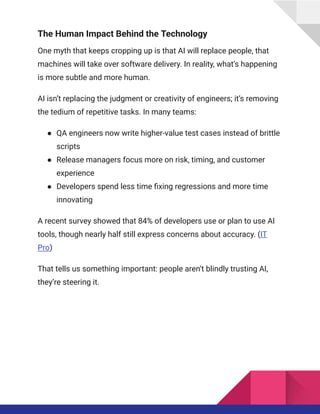
The Human Impact Behind the Technology
One myth that keeps cropping up is that AI will replace people, that
machines will take over software delivery. In reality, what’s happening
is more subtle and more human.
AI isn’t replacing the judgment or creativity of engineers; it’s removing
the tedium of repetitive tasks. In many teams:
●​ QA engineers now write higher-value test cases instead of brittle
scripts
●​ Release managers focus more on risk, timing, and customer
experience
●​ Developers spend less time fixing regressions and more time
innovating
A recent survey showed that 84% of developers use or plan to use AI
tools, though nearly half still express concerns about accuracy. (IT
Pro)
That tells us something important: people aren’t blindly trusting AI,
they’re steering it.
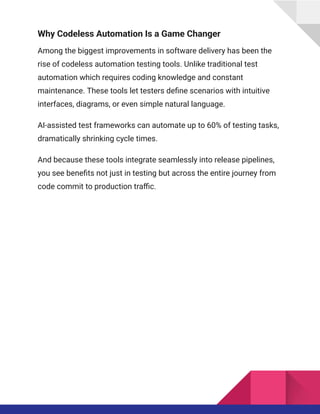
Why Codeless Automation Is a Game Changer
Among the biggest improvements in software delivery has been the
rise of codeless automation testing tools. Unlike traditional test
automation which requires coding knowledge and constant
maintenance. These tools let testers define scenarios with intuitive
interfaces, diagrams, or even simple natural language.
AI-assisted test frameworks can automate up to 60% of testing tasks,
dramatically shrinking cycle times.
And because these tools integrate seamlessly into release pipelines,
you see benefits not just in testing but across the entire journey from
code commit to production traffic.
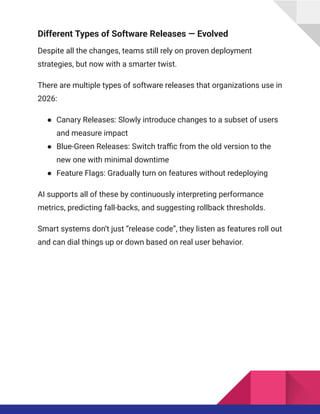
Different Types of Software Releases — Evolved
Despite all the changes, teams still rely on proven deployment
strategies, but now with a smarter twist.
There are multiple types of software releases that organizations use in
2026:
●​ Canary Releases: Slowly introduce changes to a subset of users
and measure impact
●​ Blue-Green Releases: Switch traffic from the old version to the
new one with minimal downtime
●​ Feature Flags: Gradually turn on features without redeploying
AI supports all of these by continuously interpreting performance
metrics, predicting fall-backs, and suggesting rollback thresholds.
Smart systems don’t just “release code”, they listen as features roll out
and can dial things up or down based on real user behavior.
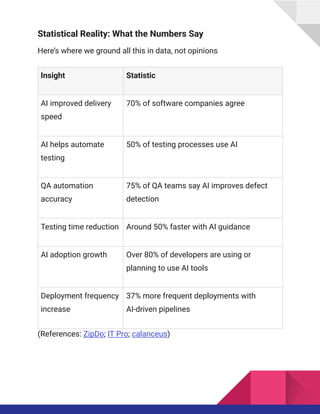
Statistical Reality: What the Numbers Say
Here’s where we ground all this in data, not opinions
Insight Statistic
AI improved delivery
speed
70% of software companies agree
AI helps automate
testing
50% of testing processes use AI
QA automation
accuracy
75% of QA teams say AI improves defect
detection
Testing time reduction Around 50% faster with AI guidance
AI adoption growth Over 80% of developers are using or
planning to use AI tools
Deployment frequency
increase
37% more frequent deployments with
AI-driven pipelines
(References: ZipDo; IT Pro; calanceus)
These numbers show real workplace impact, faster delivery, and
more reliable outcomes, not just theory.
Where Teams Struggle — And How They Adapt
Not every team sees immediate benefits. A few consistent challenges
remain:
●​ Trusting AI outputs: Developers still verify AI-generated results
manually.
●​ Balancing speed with security: Rapid deploys can outpace
security checks if not integrated thoughtfully.
●​ Tool overload: Too many point solutions without centralized
workflows can create noise instead of clarity.
But teams that build transparent pipelines where AI suggestions are
explainable and monitored see the best results.
Looking Ahead: Trends in 2026 and Beyond
As AI becomes part of the standard toolkit for software engineering, a
few trends stand out:
●​ Continuous Learning Models: AI doesn’t just test, it also learns
from every cycle, improving predictions about possible failures.
●​ Release Intelligence Dashboards: Teams are now using
dashboards that highlight risks, patterns, and release readiness
scores driven by historical and live data.
●​ Human-AI Collaboration: Developers and testers increasingly
act as curators and critics of AI suggestions rather than
passive users.
In other words, the role of the engineer is becoming more strategic,
not less.
Conclusion: Smarter Releases, Smarter Engineers
As we settle into 2026, AI-driven software releases are defined by
balance, automated workflows powered by data, and human judgment
honed by experience.
Tools like AI-assisted testing and codeless automation aren’t
replacing engineers. They’re empowering them to release more often,
catch more issues earlier, and build better software with less grunt
work.
The future isn’t autonomous software delivery. It’s collaborative
software delivery, where humans and AI augment each other to create
smarter, safer, and more frequent software releases.
If you’re part of a delivery team today, you’re not being replaced. You’re
being reinvented.

AI-Driven Software Releases: Accelerating Delivery Without Compromising Quality

  • 1.
  • 2.
    As 2026 kicksoff, the biggest change in software engineering isn’t about shipping faster or showing off the latest AI feature. It’s about how teams get changes out to real users. The days when quality assurance meant long nights, manual checks, and endless test scripts are quietly fading away. Today, innovations like codeless test automation are reshaping not only how tests are written but also how software releases are planned, executed, and improved. This isn’t theoretical hype. The data shows that AI isn’t just speeding up processes, it’s redefining what it means to ship reliable software in a world where speed and quality both matter. Let’s break down why this matters, how it’s happening, and what developers and engineering leaders can realistically expect this year. AI Adoption Is Exploding — And So Are Expectations By 2025, nearly every company building software was already experimenting with AI. According to a recent industry report: 70% of software companies say AI has improved their product delivery speed, and 50% of software testing processes are now assisted or fully automated with AI. (ZipDo) These numbers tell a clear story: AI isn’t just an add-on tool anymore; it’s embedded in the core workflows of how teams develop and deliver software.
  • 3.
    At the sametime, AI adoption in DevOps, testing, and deployment practices has grown sharply. In some studies, 56%–70% of organizations reported that AI tools help them automate testing, deploy faster, and detect more bugs earlier in the lifecycle. What’s remarkable isn’t just adoption, it’s the impact on velocity and risk management. Teams are shipping more, yet also shipping safer. What Software Release Management Looks Like in 2026 A decade ago, well-managed software release management was about spreadsheets, manual checklists, and lots of meetings. Now, it’s an intelligent system driven by data and prediction. Modern release managers are watching dashboards where: ●​ AI predicts whether a release candidate is likely to introduce errors ●​ Automated tests run in parallel and self-heal when UI elements change ●​ Deploys dynamically adjust based on real-time performance Even DevOps teams report that AI-enhanced pipelines can deploy code up to 37% more frequently while reducing failure rates by more than 20%. (calanceus.com)
  • 4.
    That isn’t small.It’s the difference between weekly or bi-weekly updates and releasing multiple times per day. What a Modern Software Release Management Process Looks Like If you walked into an engineering room in 2026, here’s how people describe their software release management process in practice: 1.​Developers commit changes 2.​AI systems generate and orchestrate dynamic tests 3.​Both manual and codeless automation testing tools kick in 4.​AI predicts release readiness based on data trends 5.​The system deploys changes using canary or blue-green models 6.​Real-time monitoring flags anomalies for rollback or expansion This process isn’t magic; it’s a coordinated flow enabled by AI doing the heavy lifting on repetitive, error-prone tasks. For example, studies show that AI-driven test automation can reduce testing time by up to 50% and increase defect detection accuracy by over 30%, freeing QA teams to focus on strategic issues.
  • 5.
    The Human ImpactBehind the Technology One myth that keeps cropping up is that AI will replace people, that machines will take over software delivery. In reality, what’s happening is more subtle and more human. AI isn’t replacing the judgment or creativity of engineers; it’s removing the tedium of repetitive tasks. In many teams: ●​ QA engineers now write higher-value test cases instead of brittle scripts ●​ Release managers focus more on risk, timing, and customer experience ●​ Developers spend less time fixing regressions and more time innovating A recent survey showed that 84% of developers use or plan to use AI tools, though nearly half still express concerns about accuracy. (IT Pro) That tells us something important: people aren’t blindly trusting AI, they’re steering it.
  • 6.
    Why Codeless AutomationIs a Game Changer Among the biggest improvements in software delivery has been the rise of codeless automation testing tools. Unlike traditional test automation which requires coding knowledge and constant maintenance. These tools let testers define scenarios with intuitive interfaces, diagrams, or even simple natural language. AI-assisted test frameworks can automate up to 60% of testing tasks, dramatically shrinking cycle times. And because these tools integrate seamlessly into release pipelines, you see benefits not just in testing but across the entire journey from code commit to production traffic.
  • 7.
    Different Types ofSoftware Releases — Evolved Despite all the changes, teams still rely on proven deployment strategies, but now with a smarter twist. There are multiple types of software releases that organizations use in 2026: ●​ Canary Releases: Slowly introduce changes to a subset of users and measure impact ●​ Blue-Green Releases: Switch traffic from the old version to the new one with minimal downtime ●​ Feature Flags: Gradually turn on features without redeploying AI supports all of these by continuously interpreting performance metrics, predicting fall-backs, and suggesting rollback thresholds. Smart systems don’t just “release code”, they listen as features roll out and can dial things up or down based on real user behavior.
  • 8.
    Statistical Reality: Whatthe Numbers Say Here’s where we ground all this in data, not opinions Insight Statistic AI improved delivery speed 70% of software companies agree AI helps automate testing 50% of testing processes use AI QA automation accuracy 75% of QA teams say AI improves defect detection Testing time reduction Around 50% faster with AI guidance AI adoption growth Over 80% of developers are using or planning to use AI tools Deployment frequency increase 37% more frequent deployments with AI-driven pipelines (References: ZipDo; IT Pro; calanceus)
  • 9.
    These numbers showreal workplace impact, faster delivery, and more reliable outcomes, not just theory. Where Teams Struggle — And How They Adapt Not every team sees immediate benefits. A few consistent challenges remain: ●​ Trusting AI outputs: Developers still verify AI-generated results manually. ●​ Balancing speed with security: Rapid deploys can outpace security checks if not integrated thoughtfully. ●​ Tool overload: Too many point solutions without centralized workflows can create noise instead of clarity. But teams that build transparent pipelines where AI suggestions are explainable and monitored see the best results. Looking Ahead: Trends in 2026 and Beyond As AI becomes part of the standard toolkit for software engineering, a few trends stand out: ●​ Continuous Learning Models: AI doesn’t just test, it also learns from every cycle, improving predictions about possible failures. ●​ Release Intelligence Dashboards: Teams are now using dashboards that highlight risks, patterns, and release readiness scores driven by historical and live data.
  • 10.
    ●​ Human-AI Collaboration:Developers and testers increasingly act as curators and critics of AI suggestions rather than passive users. In other words, the role of the engineer is becoming more strategic, not less. Conclusion: Smarter Releases, Smarter Engineers As we settle into 2026, AI-driven software releases are defined by balance, automated workflows powered by data, and human judgment honed by experience. Tools like AI-assisted testing and codeless automation aren’t replacing engineers. They’re empowering them to release more often, catch more issues earlier, and build better software with less grunt work. The future isn’t autonomous software delivery. It’s collaborative software delivery, where humans and AI augment each other to create smarter, safer, and more frequent software releases. If you’re part of a delivery team today, you’re not being replaced. You’re being reinvented.