Thursday, 9 May 2013
Agos Itafinco securitises loans in old-style deal
Robert Galbraith
26 Nov 2001
Agos Itafinco, the latest Italian consumer credit card company to issue asset-backed securities (ABS), could
be seen as a maverick. The company and its adviser Credit Agricole Indosuez (CAI) recently chose to
structure a securitisation using an old securitisation law.
The ABS deal uses rules that predate the all-important Law 130, of 1999, which introduced standardised procedures
for securitisation. Ironically, Law 130 is credited with having generated much of the recent strong growth in Italian
ABS.
However, Agos Itafinco and CAI claim that, far from being redundant, the old method may be a better one for
structuring certain types of securitisation transaction in Italy. Agos Itafinco has securitised &euro516m ($453m) of
consumer loans through the issue of commercial paper by the French bank's multi-seller vehicle, Hexagon.
The Italian company, which is 70% owned by Caisse Nationale de Crédit Agricole, has seen lending volumes rise
four-fold since 1997, making it Italy's third largest consumer credit operator. Its need for increasing liquidity is behind
the desire to find new funding sources.
Franco Casiraghi, finance director at Agos Itafinco, says: 'We had already prepared the ground for a securitisation
transaction when the new law was introduced in 1999. We had the choice of changing direction and doing an ABS
deal under the new law or staying the course. We decided on the latter because there were distinct advantages to be
had by using the old rules.'
The most important considerations were that an old-style deal costs less than a new one and the structure of the
transaction allows the company to offload the loans without effecting its capital coefficient. Fabio Stupazzini, head of
Credit Agricole's securitisation team in Italy, says that there was greater flexibility within the earlier framework than
under the new law.
The decision to issue commercial paper, which was taken at the outset, proved to be particularly appropriate in the
current financial climate, according to Stupazzini. He says: 'There has been a lot of Italian paper recently and,
especially since September 11, this has translated into much higher spreads. Commercial paper has been largely
unaffected.'
The issue was sold at the equivalent of three-month Euribor flat, he added.
Agos Itafinco's finance director says that his company was also keen to tap into foreign markets. 'It is very difficult to
find finance in Italy and where you do find it comes at too high a cost. That means we have to look for resources
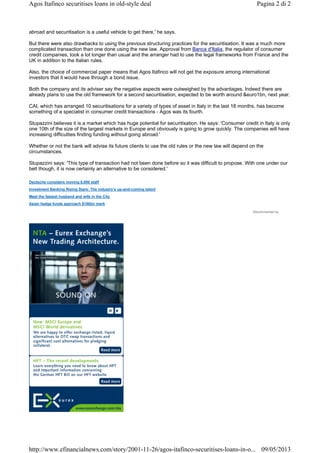
Casiraghi: advantages
Pagina 1 di 2Agos Itafinco securitises loans in old-style deal
09/05/2013http://www.efinancialnews.com/story/2001-11-26/agos-itafinco-securitises-loans-in-o...
abroad and securitisation is a useful vehicle to get there,' he says.
But there were also drawbacks to using the previous structuring practices for the securitisation. It was a much more
complicated transaction than one done using the new law. Approval from Banca d'Italia, the regulator of consumer
credit companies, took a lot longer than usual and the arranger had to use the legal frameworks from France and the
UK in addition to the Italian rules.
Also, the choice of commercial paper means that Agos Itafinco will not get the exposure among international
investors that it would have through a bond issue.
Both the company and its adviser say the negative aspects were outweighed by the advantages. Indeed there are
already plans to use the old framework for a second securitisation, expected to be worth around &euro1bn, next year.
CAI, which has arranged 10 securitisations for a variety of types of asset in Italy in the last 18 months, has become
something of a specialist in consumer credit transactions - Agos was its fourth.
Stupazzini believes it is a market which has huge potential for securitisation. He says: 'Consumer credit in Italy is only
one 10th of the size of the largest markets in Europe and obviously is going to grow quickly. The companies will have
increasing difficulties finding funding without going abroad.'
Whether or not the bank will advise its future clients to use the old rules or the new law will depend on the
circumstances.
Stupazzini says: 'This type of transaction had not been done before so it was difficult to propose. With one under our
belt though, it is now certainly an alternative to be considered.'
Deutsche considers moving 8,000 staff
Investment Banking Rising Stars: The industry’s up-and-coming talent
Meet the fastest husband and wife in the City
Asian hedge funds approach $100bn mark
Recommended by
Pagina 2 di 2Agos Itafinco securitises loans in old-style deal
09/05/2013http://www.efinancialnews.com/story/2001-11-26/agos-itafinco-securitises-loans-in-o...

agos-itafinco-se1

  • 1.
    Thursday, 9 May2013 Agos Itafinco securitises loans in old-style deal Robert Galbraith 26 Nov 2001 Agos Itafinco, the latest Italian consumer credit card company to issue asset-backed securities (ABS), could be seen as a maverick. The company and its adviser Credit Agricole Indosuez (CAI) recently chose to structure a securitisation using an old securitisation law. The ABS deal uses rules that predate the all-important Law 130, of 1999, which introduced standardised procedures for securitisation. Ironically, Law 130 is credited with having generated much of the recent strong growth in Italian ABS. However, Agos Itafinco and CAI claim that, far from being redundant, the old method may be a better one for structuring certain types of securitisation transaction in Italy. Agos Itafinco has securitised &euro516m ($453m) of consumer loans through the issue of commercial paper by the French bank's multi-seller vehicle, Hexagon. The Italian company, which is 70% owned by Caisse Nationale de Crédit Agricole, has seen lending volumes rise four-fold since 1997, making it Italy's third largest consumer credit operator. Its need for increasing liquidity is behind the desire to find new funding sources. Franco Casiraghi, finance director at Agos Itafinco, says: 'We had already prepared the ground for a securitisation transaction when the new law was introduced in 1999. We had the choice of changing direction and doing an ABS deal under the new law or staying the course. We decided on the latter because there were distinct advantages to be had by using the old rules.' The most important considerations were that an old-style deal costs less than a new one and the structure of the transaction allows the company to offload the loans without effecting its capital coefficient. Fabio Stupazzini, head of Credit Agricole's securitisation team in Italy, says that there was greater flexibility within the earlier framework than under the new law. The decision to issue commercial paper, which was taken at the outset, proved to be particularly appropriate in the current financial climate, according to Stupazzini. He says: 'There has been a lot of Italian paper recently and, especially since September 11, this has translated into much higher spreads. Commercial paper has been largely unaffected.' The issue was sold at the equivalent of three-month Euribor flat, he added. Agos Itafinco's finance director says that his company was also keen to tap into foreign markets. 'It is very difficult to find finance in Italy and where you do find it comes at too high a cost. That means we have to look for resources Casiraghi: advantages Pagina 1 di 2Agos Itafinco securitises loans in old-style deal 09/05/2013http://www.efinancialnews.com/story/2001-11-26/agos-itafinco-securitises-loans-in-o...
  • 2.
    abroad and securitisationis a useful vehicle to get there,' he says. But there were also drawbacks to using the previous structuring practices for the securitisation. It was a much more complicated transaction than one done using the new law. Approval from Banca d'Italia, the regulator of consumer credit companies, took a lot longer than usual and the arranger had to use the legal frameworks from France and the UK in addition to the Italian rules. Also, the choice of commercial paper means that Agos Itafinco will not get the exposure among international investors that it would have through a bond issue. Both the company and its adviser say the negative aspects were outweighed by the advantages. Indeed there are already plans to use the old framework for a second securitisation, expected to be worth around &euro1bn, next year. CAI, which has arranged 10 securitisations for a variety of types of asset in Italy in the last 18 months, has become something of a specialist in consumer credit transactions - Agos was its fourth. Stupazzini believes it is a market which has huge potential for securitisation. He says: 'Consumer credit in Italy is only one 10th of the size of the largest markets in Europe and obviously is going to grow quickly. The companies will have increasing difficulties finding funding without going abroad.' Whether or not the bank will advise its future clients to use the old rules or the new law will depend on the circumstances. Stupazzini says: 'This type of transaction had not been done before so it was difficult to propose. With one under our belt though, it is now certainly an alternative to be considered.' Deutsche considers moving 8,000 staff Investment Banking Rising Stars: The industry’s up-and-coming talent Meet the fastest husband and wife in the City Asian hedge funds approach $100bn mark Recommended by Pagina 2 di 2Agos Itafinco securitises loans in old-style deal 09/05/2013http://www.efinancialnews.com/story/2001-11-26/agos-itafinco-securitises-loans-in-o...