Dave Neuman
Strategy Mapping:
Clear path to a successful Agile strategy
Twitter: @daveneuman
LinkedIn: https://www.linkedin.com/in/daveneuman
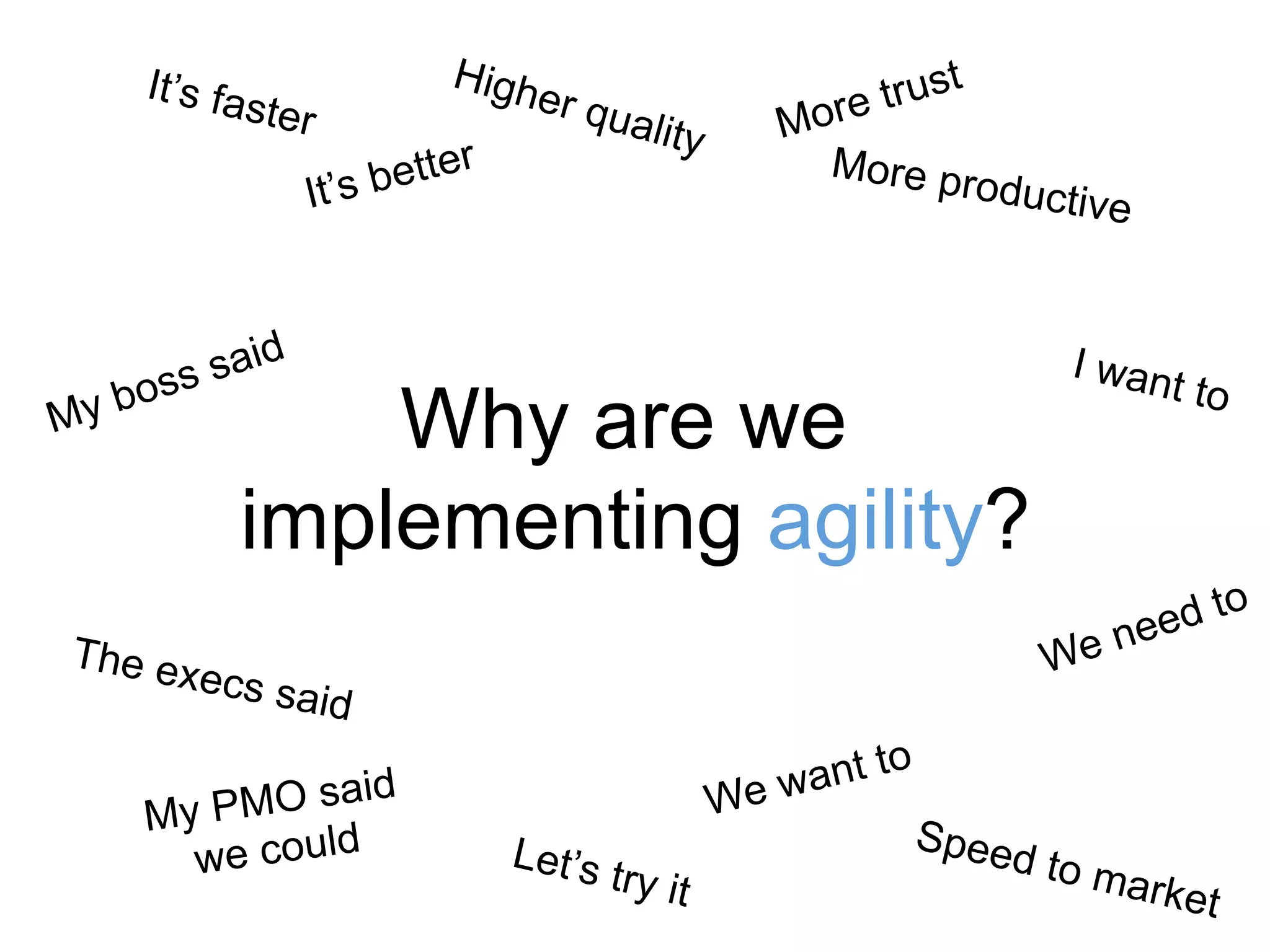
Why are we
implementing agility?
My boss said
The execs said
My PMO said
we could
I want to
We want to
We need to
Speed to market
Let’s try it
It’s faster
It’s better
Higher quality More trust
More productive
BUT
What’s in it for me?
And them?
And us?
AND
What’s it going to take?
We need a strategy!
A strategy describes how an
organization intends to create
value for shareholders,
customers, and employees.
I still don’t get it!
Why are we going Agile?
Where are we starting?
We need a map!
How about a strategy map?
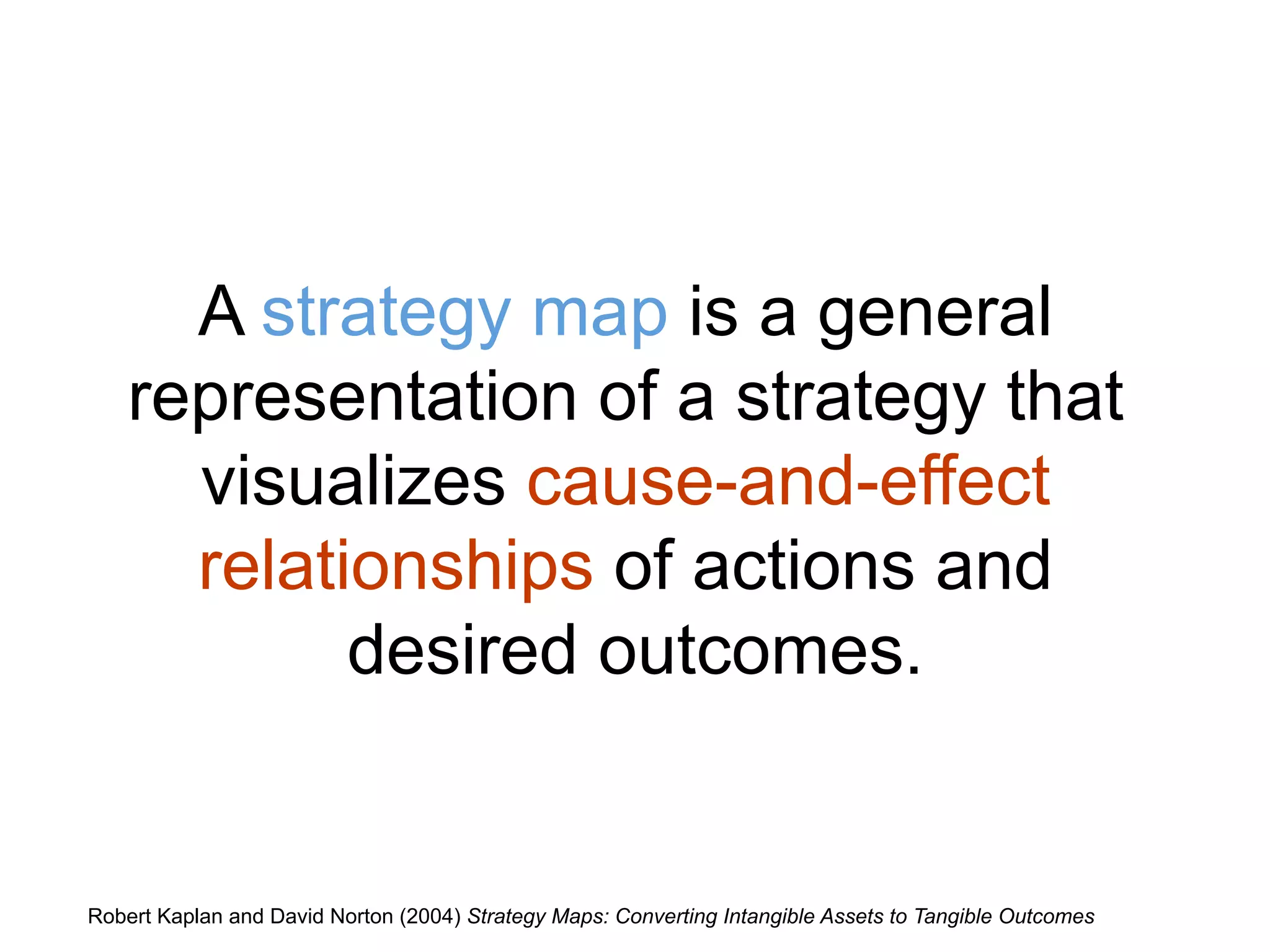
A strategy map is a general
representation of a strategy that
visualizes cause-and-effect
relationships of actions and
desired outcomes.
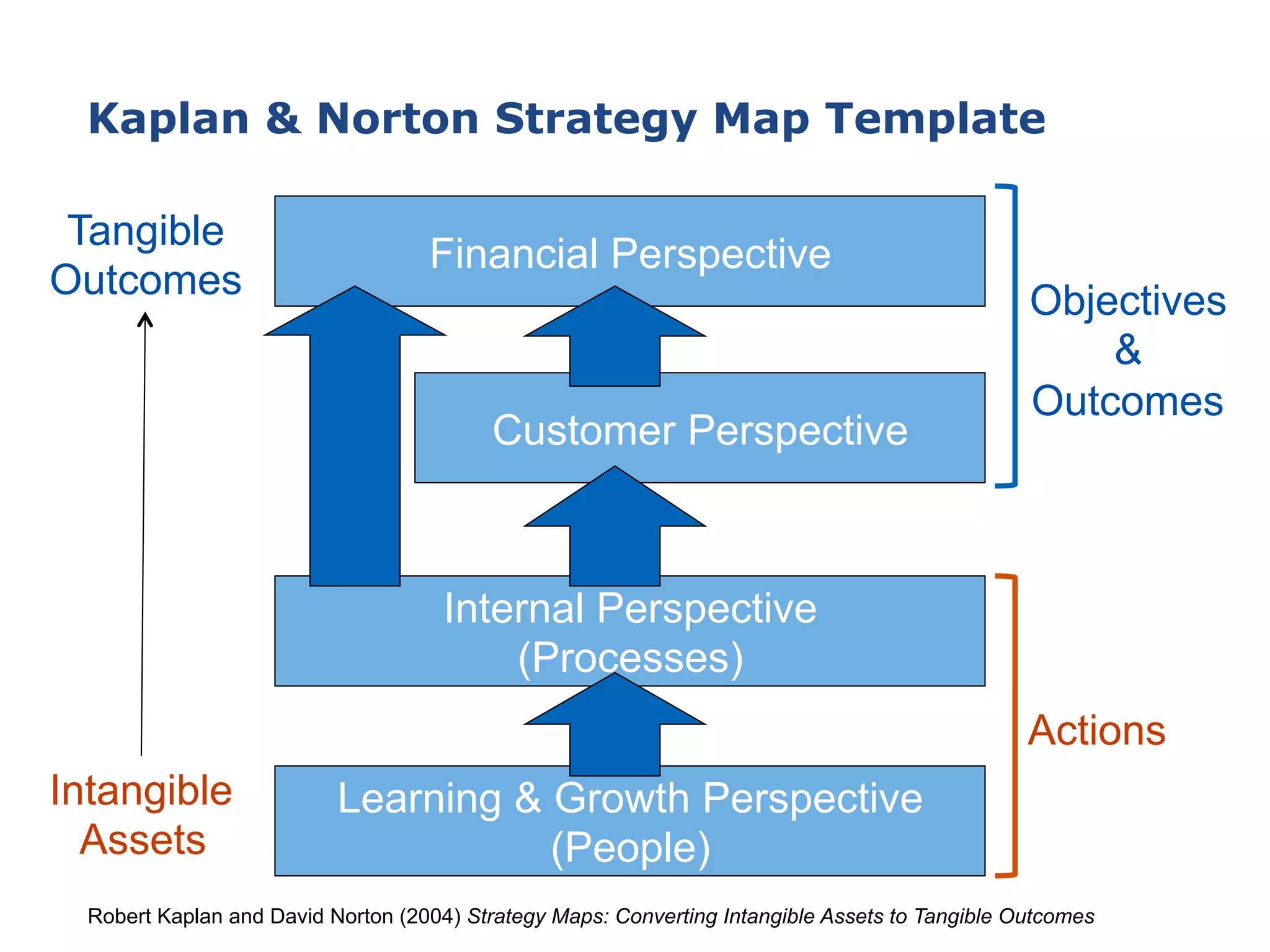
Robert Kaplan and David Norton (2004) Strategy Maps: Converting Intangible Assets to Tangible Outcomes
Kaplan & Norton Strategy Map Template
Robert Kaplan and David Norton (2004) Strategy Maps: Converting Intangible Assets to Tangible Outcomes
Financial Perspective
Customer Perspective
Internal Perspective
(Processes)
Learning & Growth Perspective
(People)
Objectives
&
Outcomes
Actions
Intangible
Assets
Tangible
Outcomes
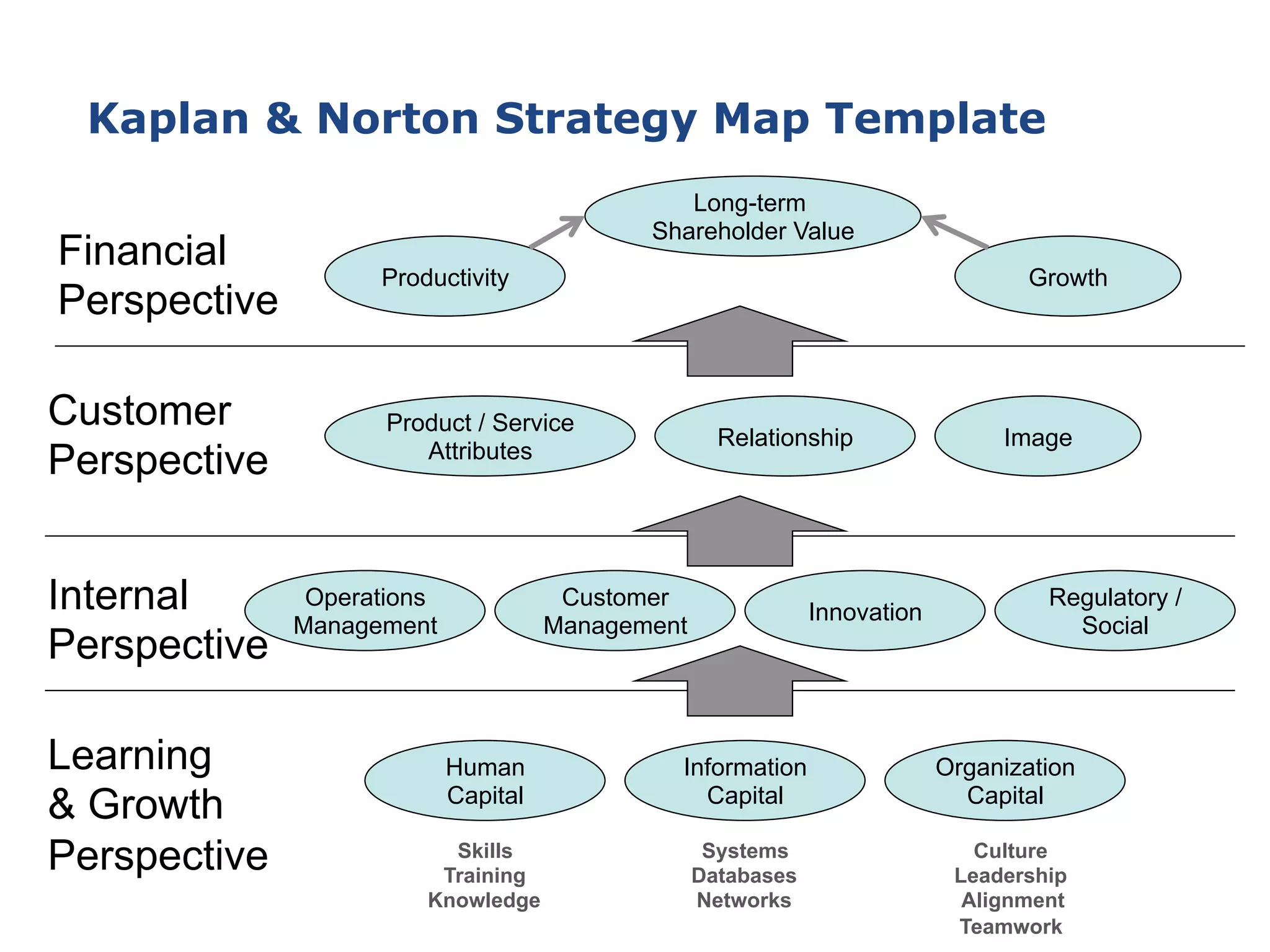
Kaplan & Norton Strategy Map Template
Financial
Perspective
Long-term
Shareholder Value
Productivity Growth
Customer
Perspective
Relationship
Product / Service
Attributes
Image
Internal
Perspective
Customer
Management
Operations
Management
Innovation
Regulatory /
Social
Learning
& Growth
Perspective
Information
Capital
Human
Capital
Organization
Capital
Skills
Training
Knowledge
Systems
Databases
Networks
Culture
Leadership
Alignment
Teamwork
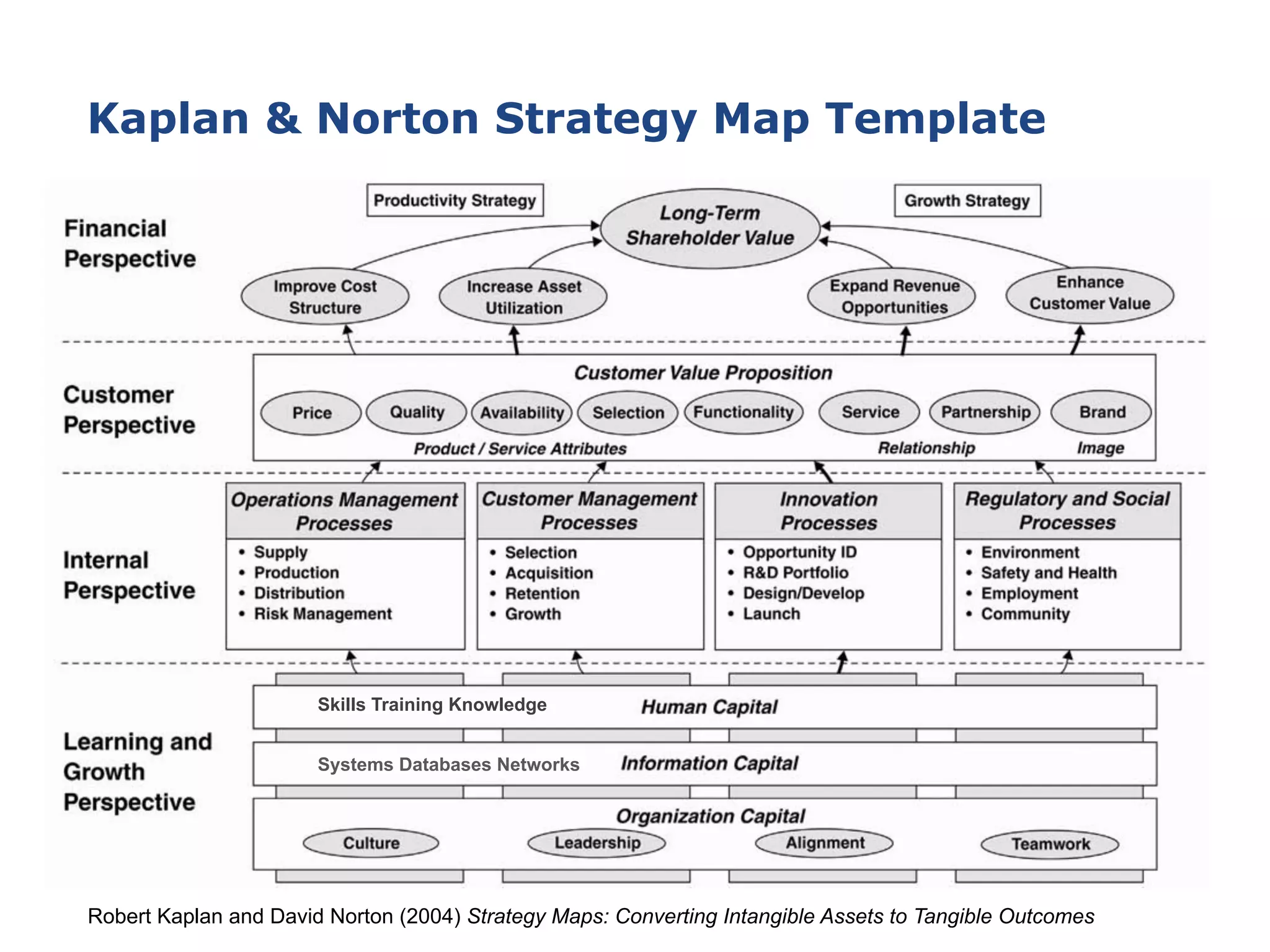
Kaplan & Norton Strategy Map Template
Robert Kaplan and David Norton (2004) Strategy Maps: Converting Intangible Assets to Tangible Outcomes
Skills Training Knowledge
Systems Databases Networks
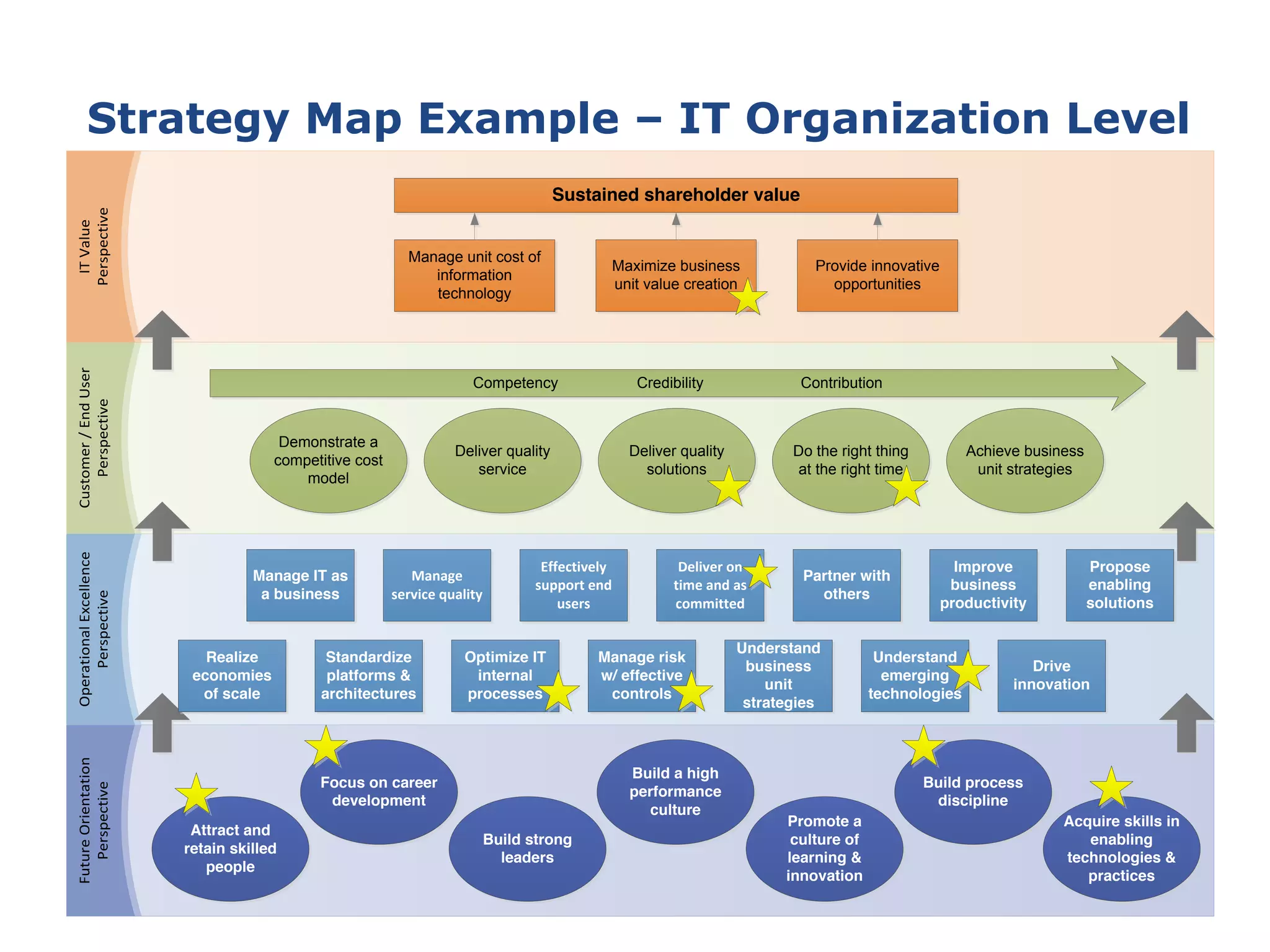
Strategy Map Example – IT Organization Level
FutureOrientation
Perspective
OperationalExcellence
Perspective
Customer/EndUser
Perspective
ITValue
Perspective
MIC-MAIC IT 2012 Strategy Map
“Our  mission  in  Specialty  IT  is  to  enable  Markel  to  grow  and  sustain  its  specialty  insurance  market  leadership  through  effective development, delivery, and operation of
technology platforms and services that meet the needs of customers and partners today and provide innovative opportunities for Markel in the future.”
Sustained shareholder value
Manage unit cost of
information
technology
Maximize business
unit value creation
Provide innovative
opportunities
Attract and
retain skilled
people
Focus on career
development
Acquire skills in
enabling
technologies &
practices
Build strong
leaders
Build process
discipline
Build a high
performance
culture
Promote a
culture of
learning &
innovation
Manage IT as
a business
Realize
economies
of scale
Manage
service quality
Standardize
platforms &
architectures
Effectively
support end
users
Optimize IT
internal
processes
Improve
business
productivity
Understand
business
unit
strategies
Understand
emerging
technologies
Propose
enabling
solutions
Manage risk
w/ effective
controls
Drive
innovation
Deliver on
time and as
committed
Partner with
others
Deliver quality
solutions
Demonstrate a
competitive cost
model
Deliver quality
service
Achieve business
unit strategies
Do the right thing
at the right time
Competency Credibility Contribution
Focus for
this year
I see strategy mapping working at
the organizational level,
but how does it apply to agility?
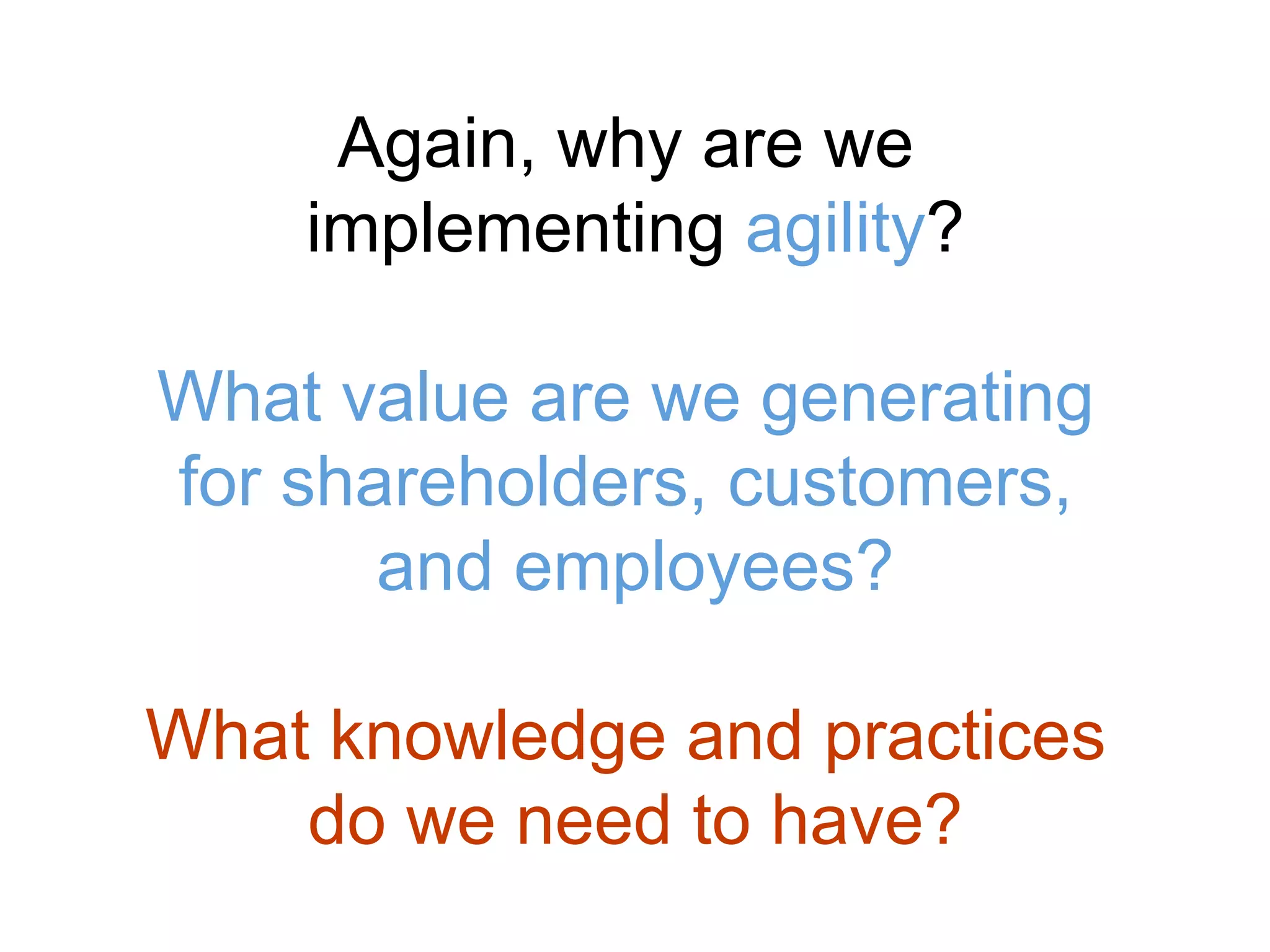
Again, why are we
implementing agility?
What value are we generating
for shareholders, customers,
and employees?
What knowledge and practices
do we need to have?
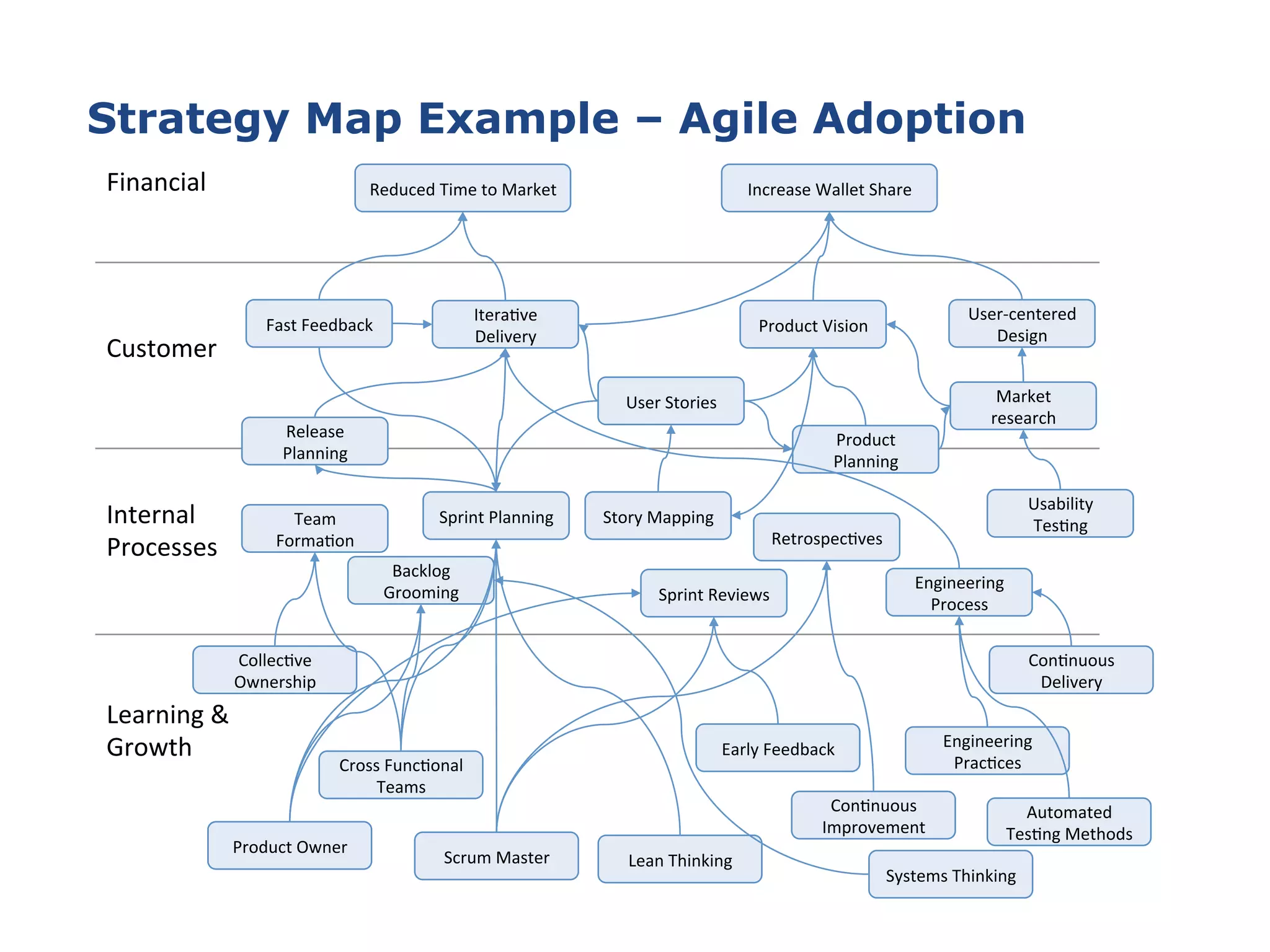
Strategy Map Example – Agile Adoption
Reduced&Time&to&Market& Increase&Wallet&Share&Financial&
Customer&
Internal&
Processes&
Learning&&&
Growth&
Backlog&
Grooming&
Market&
research&
Usability&
TesCng&
Cross&FuncConal&
Teams&
Lean&Thinking&
Systems&Thinking&
CollecCve&
Ownership&
Product&
Planning&
Product&Vision&
UserHcentered&
Design&
Story&Mapping&Sprint&Planning&
Engineering&
Process&
Sprint&Reviews&
RetrospecCves&
User&Stories&
ConCnuous&
Improvement&
Engineering&
PracCces&
Team&
FormaCon&
IteraCve&
Delivery&
Early&Feedback&
ConCnuous&
Delivery&
Release&
Planning&
Automated&
TesCng&Methods&
Product&Owner&
Scrum&Master&
Fast&Feedback&
Now its YOUR turn :)
Let’s map an
Agile Adoption Strategy
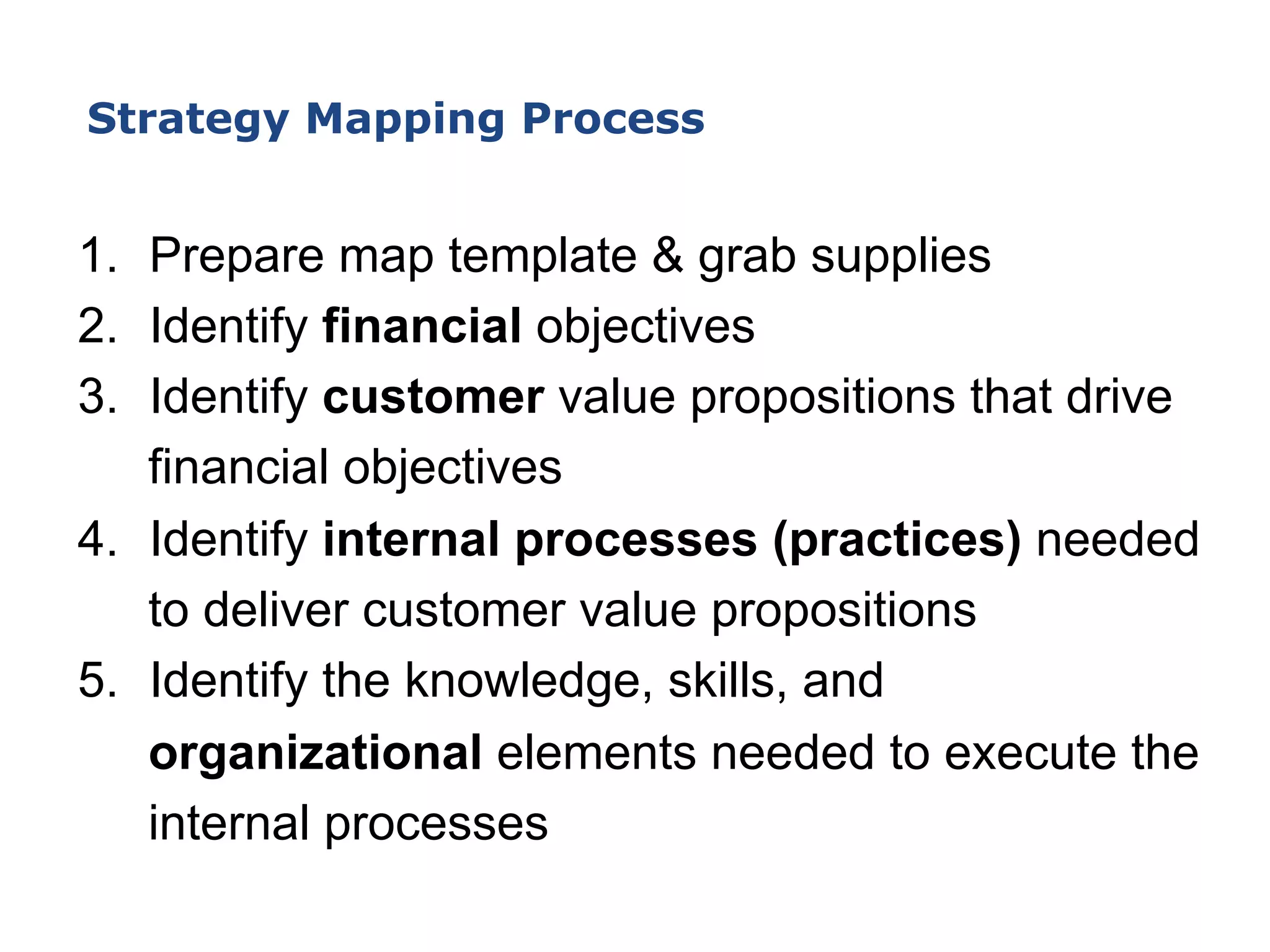
1.  Prepare map template & grab supplies
2.  Identify financial objectives
3.  Identify customer value propositions that drive
financial objectives
4.  Identify internal processes (practices) needed
to deliver customer value propositions
5.  Identify the knowledge, skills, and
organizational elements needed to execute the
internal processes
Strategy Mapping Process
With a strategy map in hand…
now what???
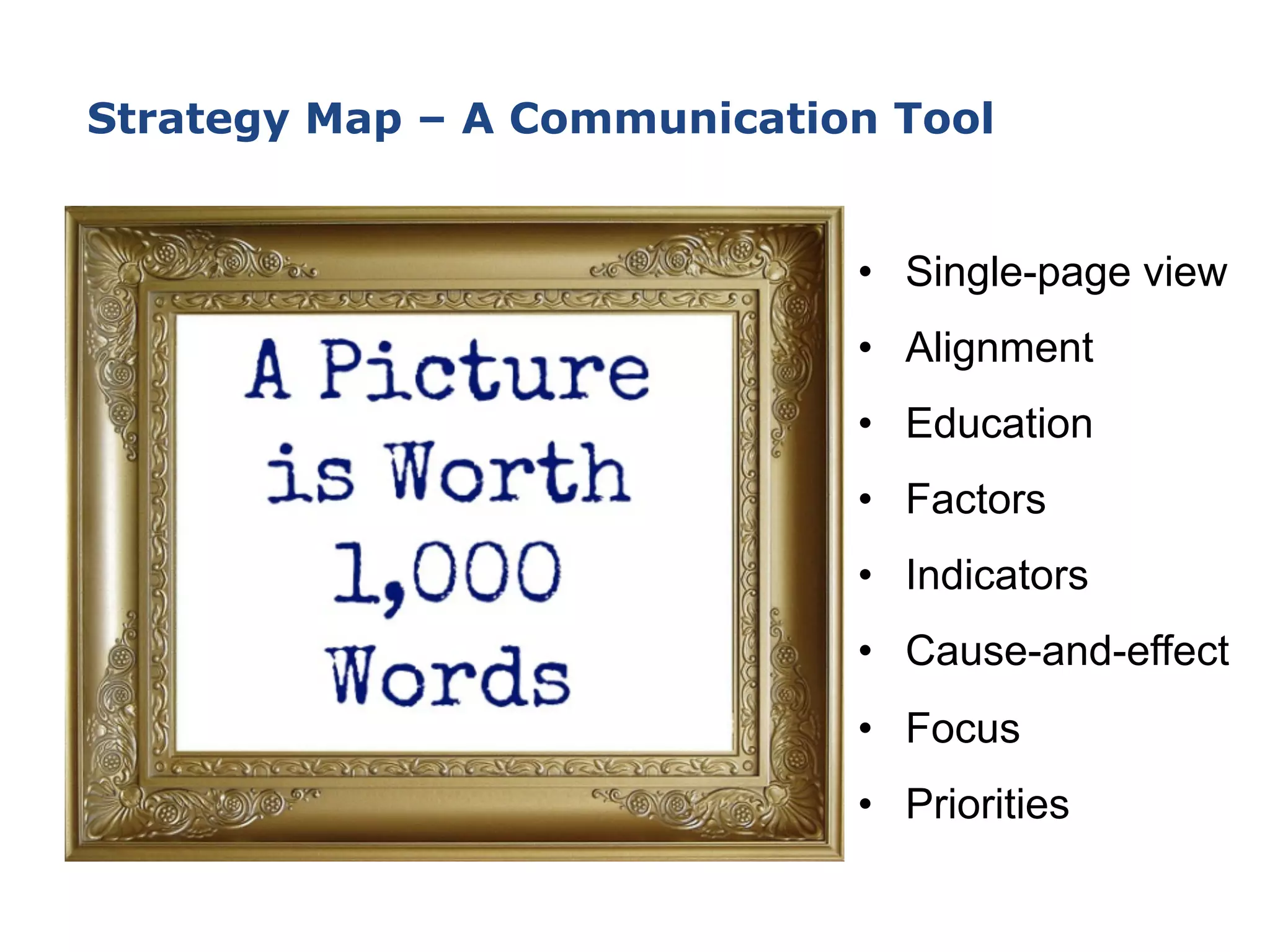
Strategy Map – A Communication Tool
•  Single-page view
•  Alignment
•  Education
•  Factors
•  Indicators
•  Cause-and-effect
•  Focus
•  Priorities
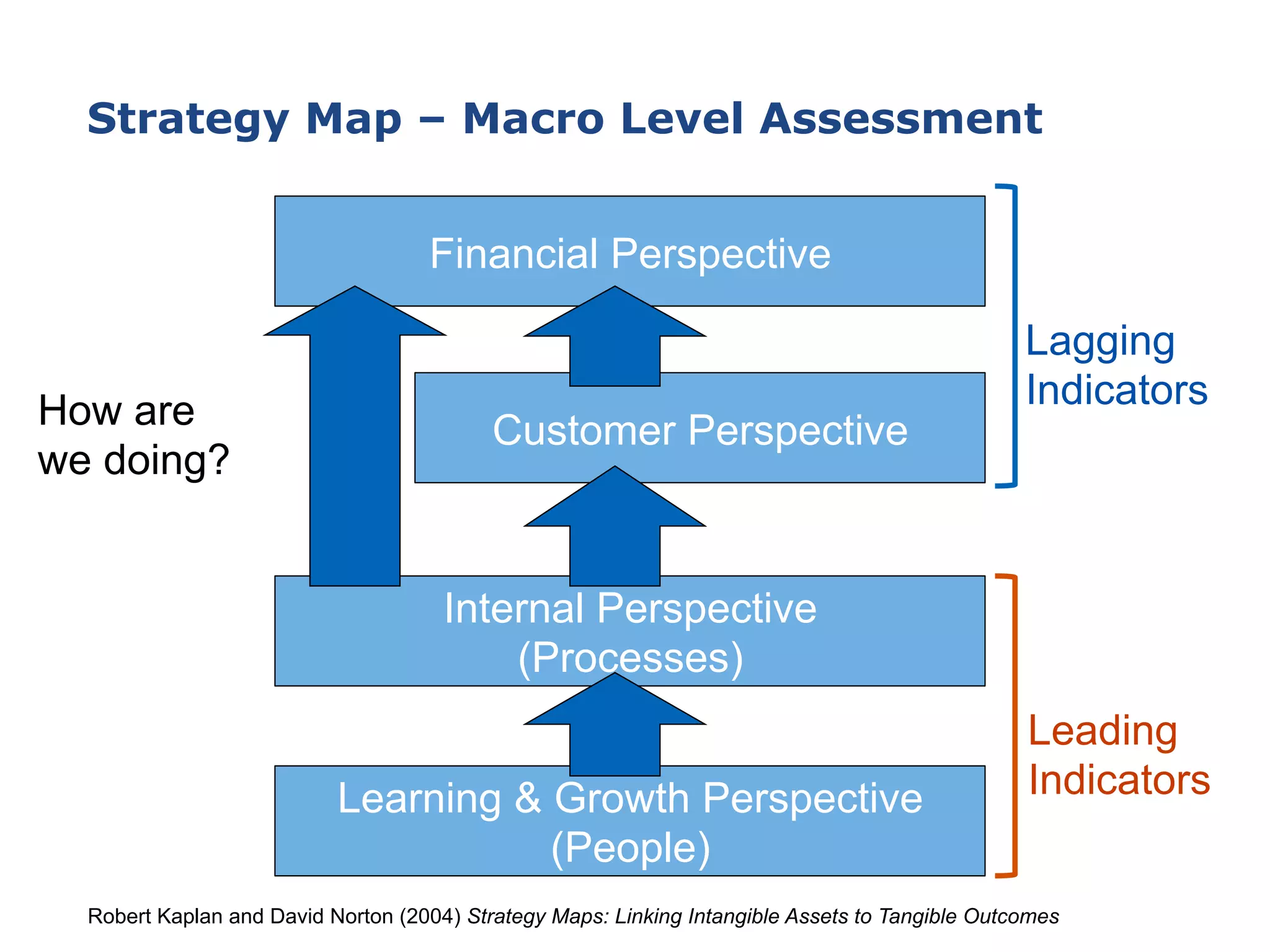
Strategy Map – Macro Level Assessment
Robert Kaplan and David Norton (2004) Strategy Maps: Linking Intangible Assets to Tangible Outcomes
Financial Perspective
Customer Perspective
Internal Perspective
(Processes)
Learning & Growth Perspective
(People)
Lagging
Indicators
Leading
Indicators
How are
we doing?
Reduced&Time&to&Market& Increase&Wallet&Share&Financial&
Customer&
Internal&
Processes&
Learning&&&
Growth&
Backlog&
Grooming&
Market&
research&
Usability&
TesCng&
Cross&FuncConal&
Teams&
Lean&Thinking&
Systems&Thinking&
CollecCve&
Ownership&
Product&
Planning&
Product&Vision&
UserHcentered&
Design&
Story&Mapping&Sprint&Planning&
Engineering&
Process&
Sprint&Reviews&
RetrospecCves&
User&Stories&
ConCnuous&
Improvement&
Engineering&
PracCces&
Team&
FormaCon&
IteraCve&
Delivery&
Early&Feedback&
ConCnuous&
Delivery&
Release&
Planning&
Automated&
TesCng&Methods&
Product&Owner&
Scrum&Master&
Fast&Feedback&
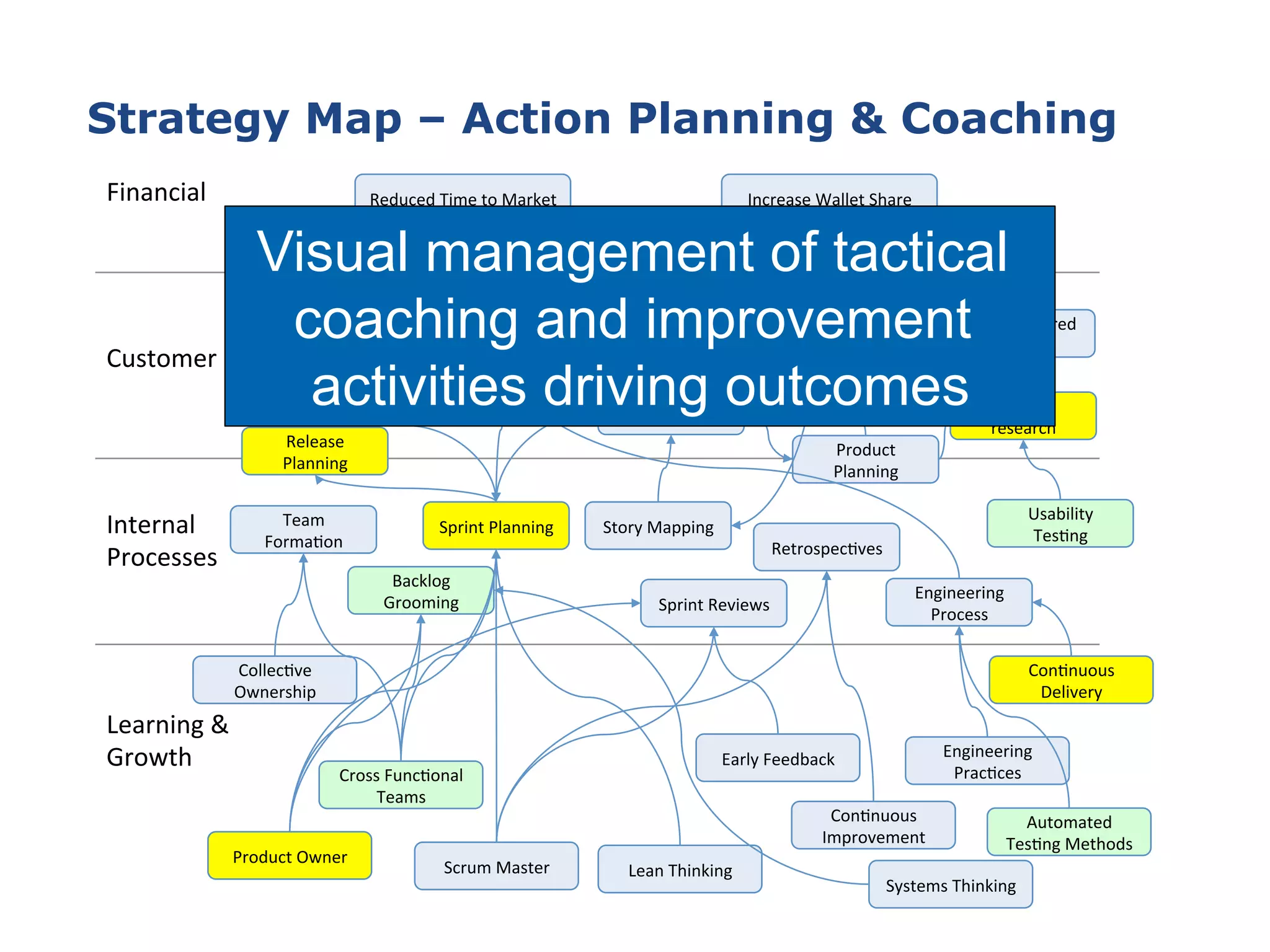
Strategy Map – Action Planning & Coaching
Visual management of tactical
coaching and improvement
activities driving outcomes
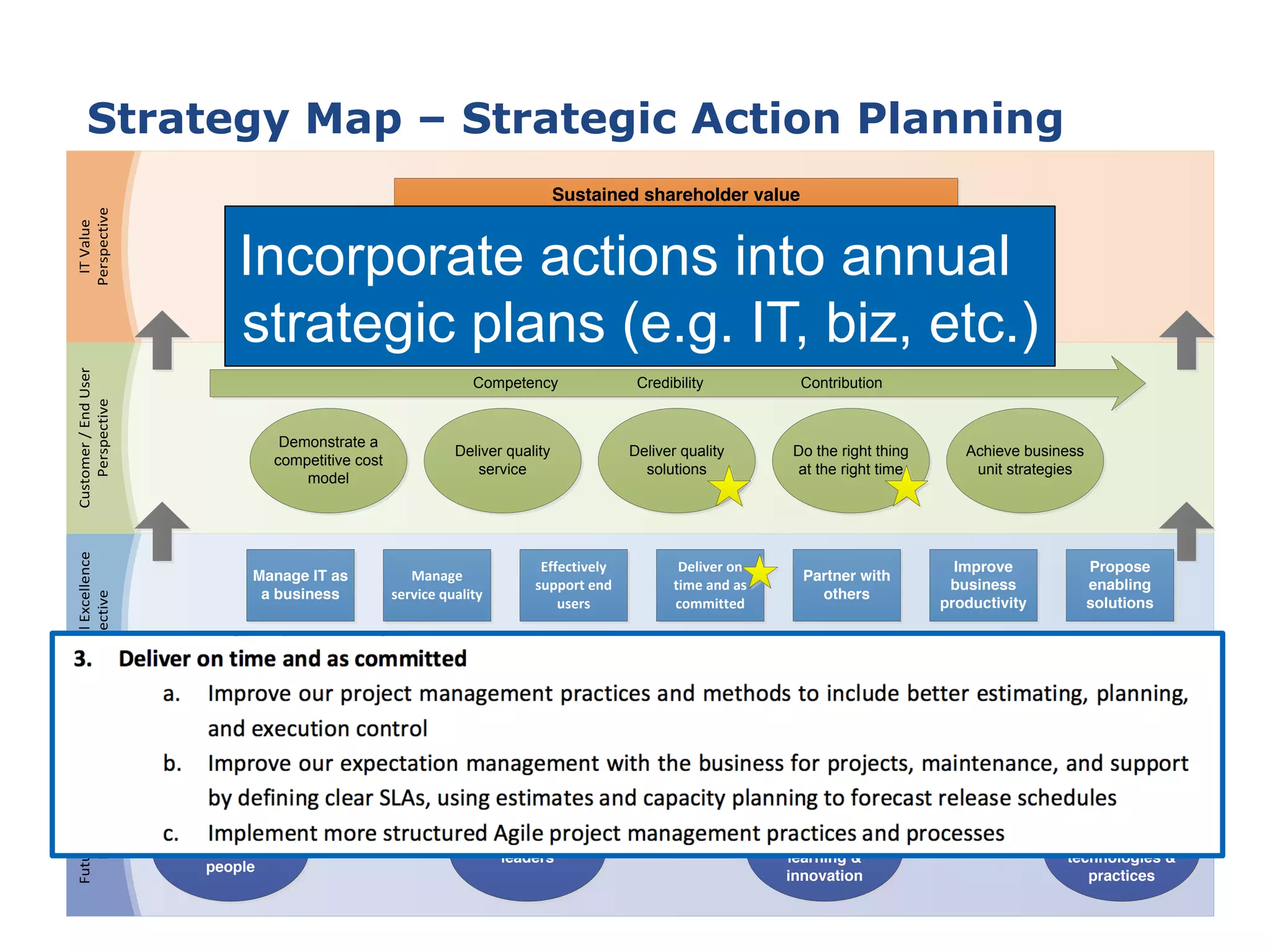
Strategy Map – Strategic Action Planning
FutureOrientation
Perspective
OperationalExcellence
Perspective
Customer/EndUser
Perspective
ITValue
Perspective
MIC-MAIC IT 2012 Strategy Map
“Our  mission  in  Specialty  IT  is  to  enable  Markel  to  grow  and  sustain  its  specialty  insurance  market  leadership  through  effective development, delivery, and operation of
technology platforms and services that meet the needs of customers and partners today and provide innovative opportunities for Markel in the future.”
Sustained shareholder value
Manage unit cost of
information
technology
Maximize business
unit value creation
Provide innovative
opportunities
Attract and
retain skilled
people
Focus on career
development
Acquire skills in
enabling
technologies &
practices
Build strong
leaders
Build process
discipline
Build a high
performance
culture
Promote a
culture of
learning &
innovation
Manage IT as
a business
Realize
economies
of scale
Manage
service quality
Standardize
platforms &
architectures
Effectively
support end
users
Optimize IT
internal
processes
Improve
business
productivity
Understand
business
unit
strategies
Understand
emerging
technologies
Propose
enabling
solutions
Manage risk
w/ effective
controls
Drive
innovation
Deliver on
time and as
committed
Partner with
others
Deliver quality
solutions
Demonstrate a
competitive cost
model
Deliver quality
service
Achieve business
unit strategies
Do the right thing
at the right time
Competency Credibility Contribution
Focus for
this year
Incorporate actions into annual
strategic plans (e.g. IT, biz, etc.)
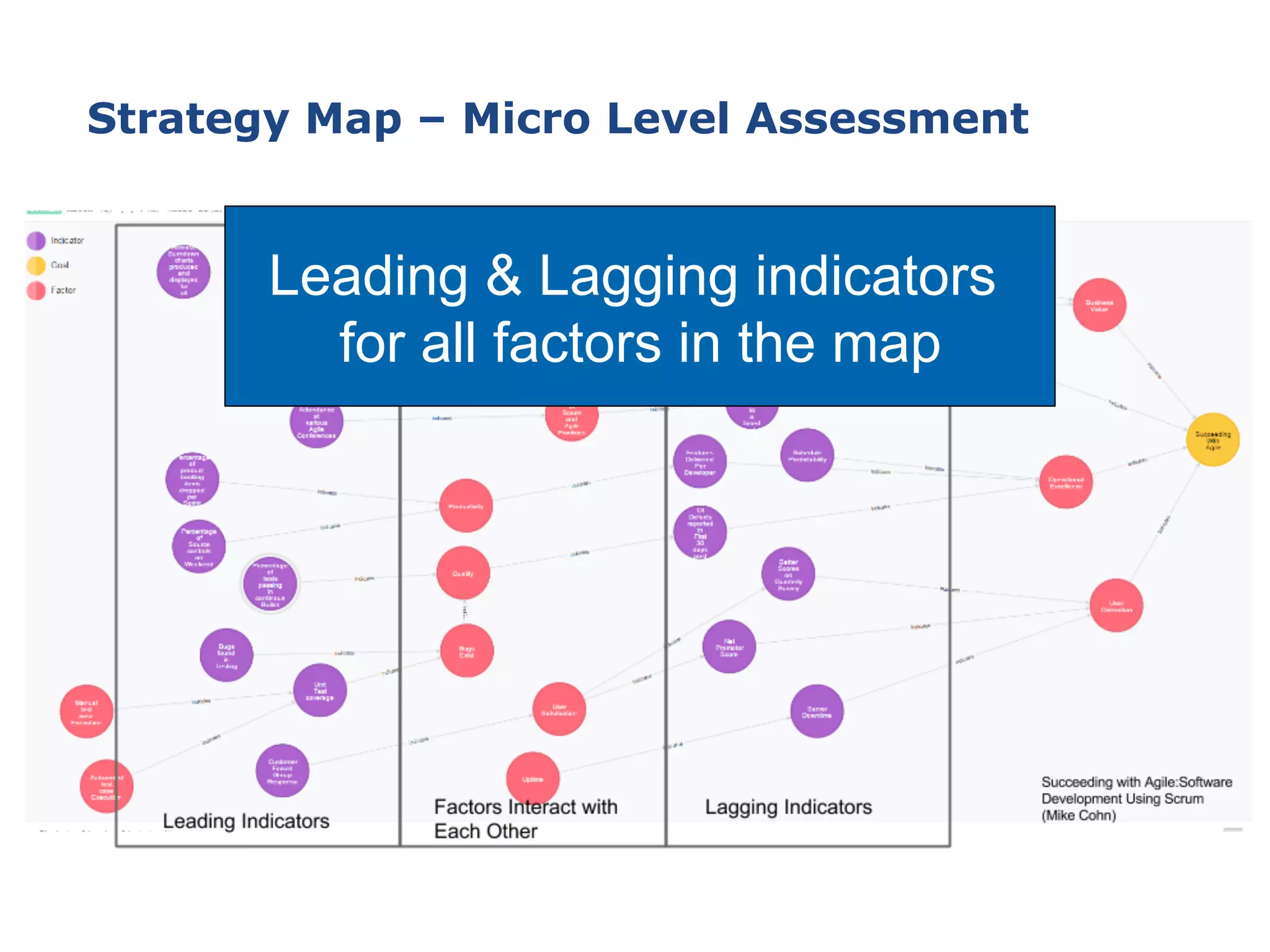
Strategy Map – Micro Level Assessment
Leading & Lagging indicators
for all factors in the map
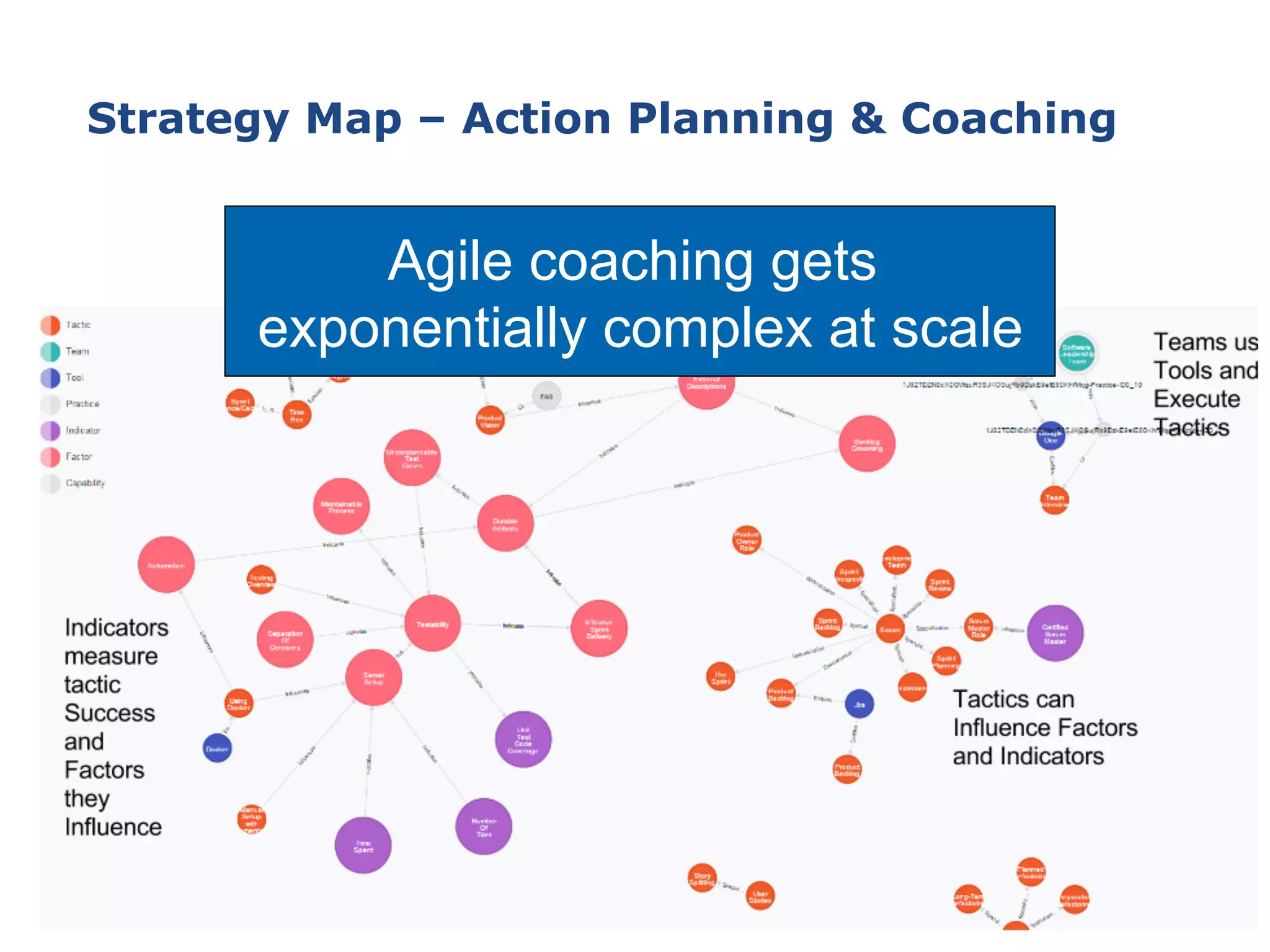
Strategy Map – Action Planning & Coaching
Agile coaching gets
exponentially complex at scale
Strategy Mapping Summary
•  Developed by Kaplan and Norton after the Balanced Scorecard
to tie actions with outcomes being measured
•  Simple model incorporates four perspectives: financial,
customer, internal processes, and learning & growth
•  Visualizes cause-and-effect relationships between actions and
outcomes
•  Applies at organizational (macro) levels and with sub-
strategies (micro)
•  Enhances communication, education, assessment, action
planning and coaching
Done.
Happy mapping!
Questions?

Agile2015 Strategy Mapping: Clear path to a successful Agile strategy

  • 1.
    Dave Neuman Strategy Mapping: Clearpath to a successful Agile strategy Twitter: @daveneuman LinkedIn: https://www.linkedin.com/in/daveneuman
  • 2.
    Why are we implementingagility? My boss said The execs said My PMO said we could I want to We want to We need to Speed to market Let’s try it It’s faster It’s better Higher quality More trust More productive
  • 3.
    BUT What’s in itfor me? And them? And us? AND What’s it going to take?
  • 4.
    We need astrategy!
  • 5.
    A strategy describeshow an organization intends to create value for shareholders, customers, and employees.
  • 6.
    I still don’tget it! Why are we going Agile? Where are we starting?
  • 7.
    We need amap! How about a strategy map?
  • 8.
    A strategy mapis a general representation of a strategy that visualizes cause-and-effect relationships of actions and desired outcomes. Robert Kaplan and David Norton (2004) Strategy Maps: Converting Intangible Assets to Tangible Outcomes
  • 9.
    Kaplan & NortonStrategy Map Template Robert Kaplan and David Norton (2004) Strategy Maps: Converting Intangible Assets to Tangible Outcomes Financial Perspective Customer Perspective Internal Perspective (Processes) Learning & Growth Perspective (People) Objectives & Outcomes Actions Intangible Assets Tangible Outcomes
  • 10.
    Kaplan & NortonStrategy Map Template Financial Perspective Long-term Shareholder Value Productivity Growth Customer Perspective Relationship Product / Service Attributes Image Internal Perspective Customer Management Operations Management Innovation Regulatory / Social Learning & Growth Perspective Information Capital Human Capital Organization Capital Skills Training Knowledge Systems Databases Networks Culture Leadership Alignment Teamwork
  • 11.
    Kaplan & NortonStrategy Map Template Robert Kaplan and David Norton (2004) Strategy Maps: Converting Intangible Assets to Tangible Outcomes Skills Training Knowledge Systems Databases Networks
  • 12.
    Strategy Map Example– IT Organization Level FutureOrientation Perspective OperationalExcellence Perspective Customer/EndUser Perspective ITValue Perspective MIC-MAIC IT 2012 Strategy Map “Our  mission  in  Specialty  IT  is  to  enable  Markel  to  grow  and  sustain  its  specialty  insurance  market  leadership  through  effective development, delivery, and operation of technology platforms and services that meet the needs of customers and partners today and provide innovative opportunities for Markel in the future.” Sustained shareholder value Manage unit cost of information technology Maximize business unit value creation Provide innovative opportunities Attract and retain skilled people Focus on career development Acquire skills in enabling technologies & practices Build strong leaders Build process discipline Build a high performance culture Promote a culture of learning & innovation Manage IT as a business Realize economies of scale Manage service quality Standardize platforms & architectures Effectively support end users Optimize IT internal processes Improve business productivity Understand business unit strategies Understand emerging technologies Propose enabling solutions Manage risk w/ effective controls Drive innovation Deliver on time and as committed Partner with others Deliver quality solutions Demonstrate a competitive cost model Deliver quality service Achieve business unit strategies Do the right thing at the right time Competency Credibility Contribution Focus for this year
  • 13.
    I see strategymapping working at the organizational level, but how does it apply to agility?
  • 14.
    Again, why arewe implementing agility? What value are we generating for shareholders, customers, and employees? What knowledge and practices do we need to have?
  • 15.
    Strategy Map Example– Agile Adoption Reduced&Time&to&Market& Increase&Wallet&Share&Financial& Customer& Internal& Processes& Learning&&& Growth& Backlog& Grooming& Market& research& Usability& TesCng& Cross&FuncConal& Teams& Lean&Thinking& Systems&Thinking& CollecCve& Ownership& Product& Planning& Product&Vision& UserHcentered& Design& Story&Mapping&Sprint&Planning& Engineering& Process& Sprint&Reviews& RetrospecCves& User&Stories& ConCnuous& Improvement& Engineering& PracCces& Team& FormaCon& IteraCve& Delivery& Early&Feedback& ConCnuous& Delivery& Release& Planning& Automated& TesCng&Methods& Product&Owner& Scrum&Master& Fast&Feedback&
  • 16.
    Now its YOURturn :) Let’s map an Agile Adoption Strategy
  • 17.
    1.  Prepare maptemplate & grab supplies 2.  Identify financial objectives 3.  Identify customer value propositions that drive financial objectives 4.  Identify internal processes (practices) needed to deliver customer value propositions 5.  Identify the knowledge, skills, and organizational elements needed to execute the internal processes Strategy Mapping Process
  • 18.
    With a strategymap in hand… now what???
  • 19.
    Strategy Map –A Communication Tool •  Single-page view •  Alignment •  Education •  Factors •  Indicators •  Cause-and-effect •  Focus •  Priorities
  • 20.
    Strategy Map –Macro Level Assessment Robert Kaplan and David Norton (2004) Strategy Maps: Linking Intangible Assets to Tangible Outcomes Financial Perspective Customer Perspective Internal Perspective (Processes) Learning & Growth Perspective (People) Lagging Indicators Leading Indicators How are we doing?
  • 21.
  • 22.
    Strategy Map –Strategic Action Planning FutureOrientation Perspective OperationalExcellence Perspective Customer/EndUser Perspective ITValue Perspective MIC-MAIC IT 2012 Strategy Map “Our  mission  in  Specialty  IT  is  to  enable  Markel  to  grow  and  sustain  its  specialty  insurance  market  leadership  through  effective development, delivery, and operation of technology platforms and services that meet the needs of customers and partners today and provide innovative opportunities for Markel in the future.” Sustained shareholder value Manage unit cost of information technology Maximize business unit value creation Provide innovative opportunities Attract and retain skilled people Focus on career development Acquire skills in enabling technologies & practices Build strong leaders Build process discipline Build a high performance culture Promote a culture of learning & innovation Manage IT as a business Realize economies of scale Manage service quality Standardize platforms & architectures Effectively support end users Optimize IT internal processes Improve business productivity Understand business unit strategies Understand emerging technologies Propose enabling solutions Manage risk w/ effective controls Drive innovation Deliver on time and as committed Partner with others Deliver quality solutions Demonstrate a competitive cost model Deliver quality service Achieve business unit strategies Do the right thing at the right time Competency Credibility Contribution Focus for this year Incorporate actions into annual strategic plans (e.g. IT, biz, etc.)
  • 23.
    Strategy Map –Micro Level Assessment Leading & Lagging indicators for all factors in the map
  • 24.
    Strategy Map –Action Planning & Coaching Agile coaching gets exponentially complex at scale
  • 25.
    Strategy Mapping Summary • Developed by Kaplan and Norton after the Balanced Scorecard to tie actions with outcomes being measured •  Simple model incorporates four perspectives: financial, customer, internal processes, and learning & growth •  Visualizes cause-and-effect relationships between actions and outcomes •  Applies at organizational (macro) levels and with sub- strategies (micro) •  Enhances communication, education, assessment, action planning and coaching
  • 26.