Portugal 
Agile Risk Management 
Rita Cunha 
Strongstep 
2014-10-24 
Carla Pereira CIICESI – ESTGF INESC TEC
2 
© 2014 CMMI Portugal Conference Series – All Rights reserved. 
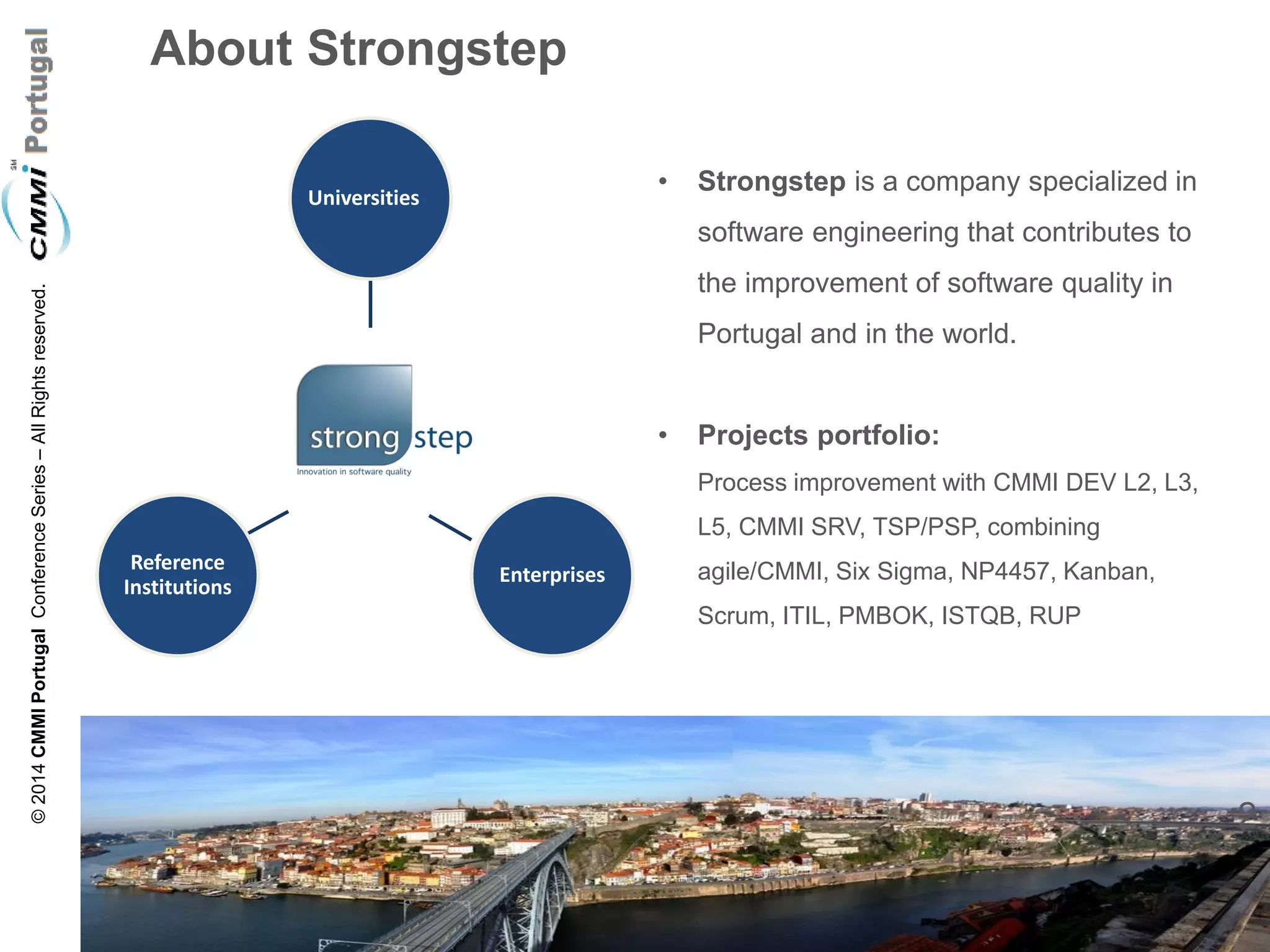
About Strongstep 
•Strongstep is a company specialized in software engineering that contributes to the improvement of software quality in Portugal and in the world. 
•Projects portfolio: 
Process improvement with CMMI DEV L2, L3, L5, CMMI SRV, TSP/PSP, combining agile/CMMI, Six Sigma, NP4457, Kanban, Scrum, ITIL, PMBOK, ISTQB, RUP 
Universities 
Enterprises 
Reference Institutions
3 
© 2014 CMMI Portugal Conference Series – All Rights reserved. 
Expected outcomes 
•Understand the importance of risk management 
•Present an approach to manage risks aligned with the best practices
4 
© 2014 CMMI Portugal Conference Series – All Rights reserved. 
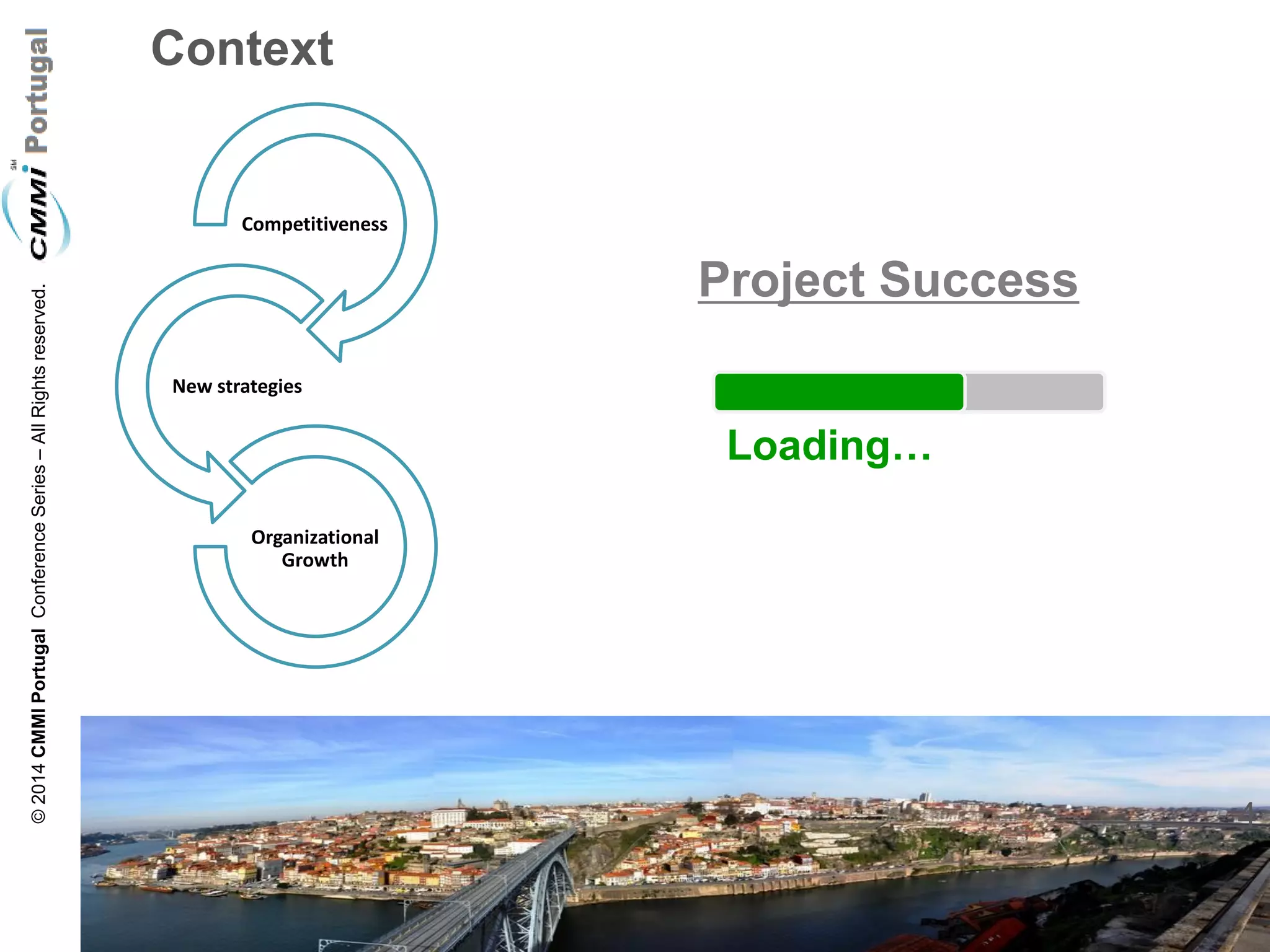
Context 
Loading… 
Project Success 
Competitiveness 
New strategies 
Organizational Growth
5 
© 2014 CMMI Portugal Conference Series – All Rights reserved. 
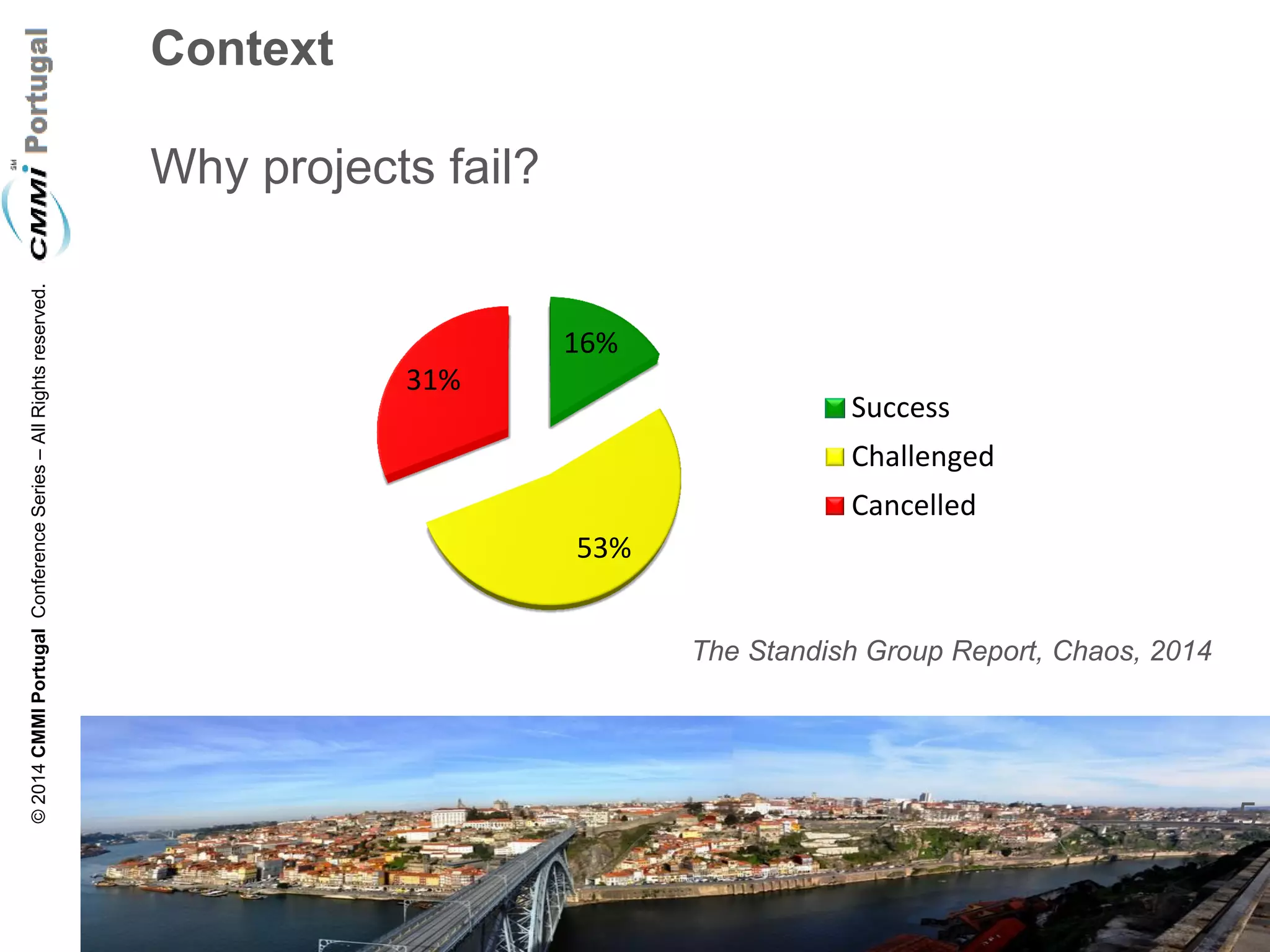
Context Why projects fail? 
16% 
53% 
31% 
Success 
Challenged 
Cancelled 
The Standish Group Report, Chaos, 2014
6 
© 2014 CMMI Portugal Conference Series – All Rights reserved. 
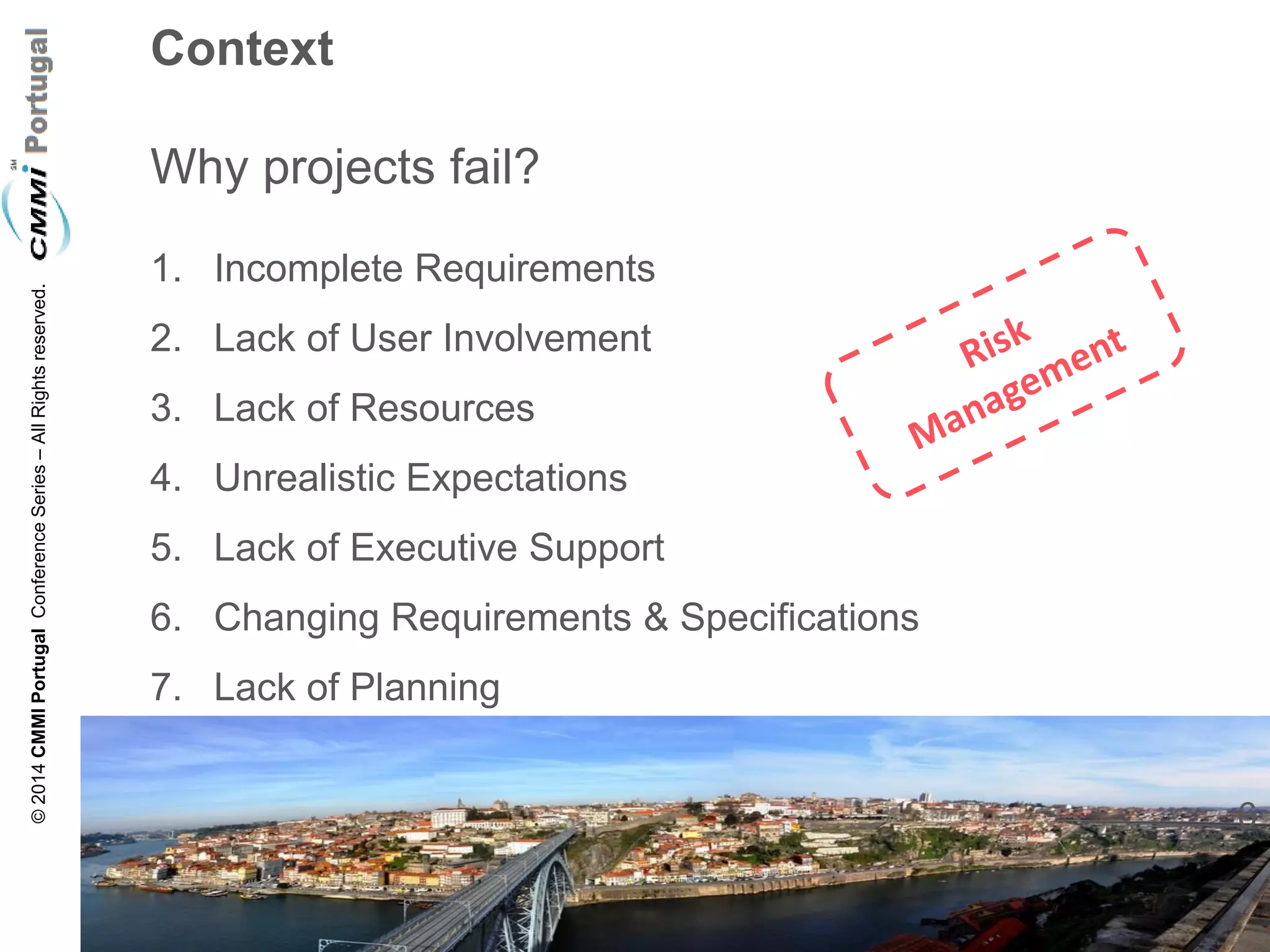
Context Why projects fail? 
1.Incomplete Requirements 
2.Lack of User Involvement 
3.Lack of Resources 
4.Unrealistic Expectations 
5.Lack of Executive Support 
6.Changing Requirements & Specifications 
7.Lack of Planning
7 
© 2014 CMMI Portugal Conference Series – All Rights reserved. 
Context What is a Risk? 
Risk is an uncertain event or condition that, if occurs, has an effect on at least one project objective. 
PMBOK Guide®, 4th Edition
8 
© 2014 CMMI Portugal Conference Series – All Rights reserved. 
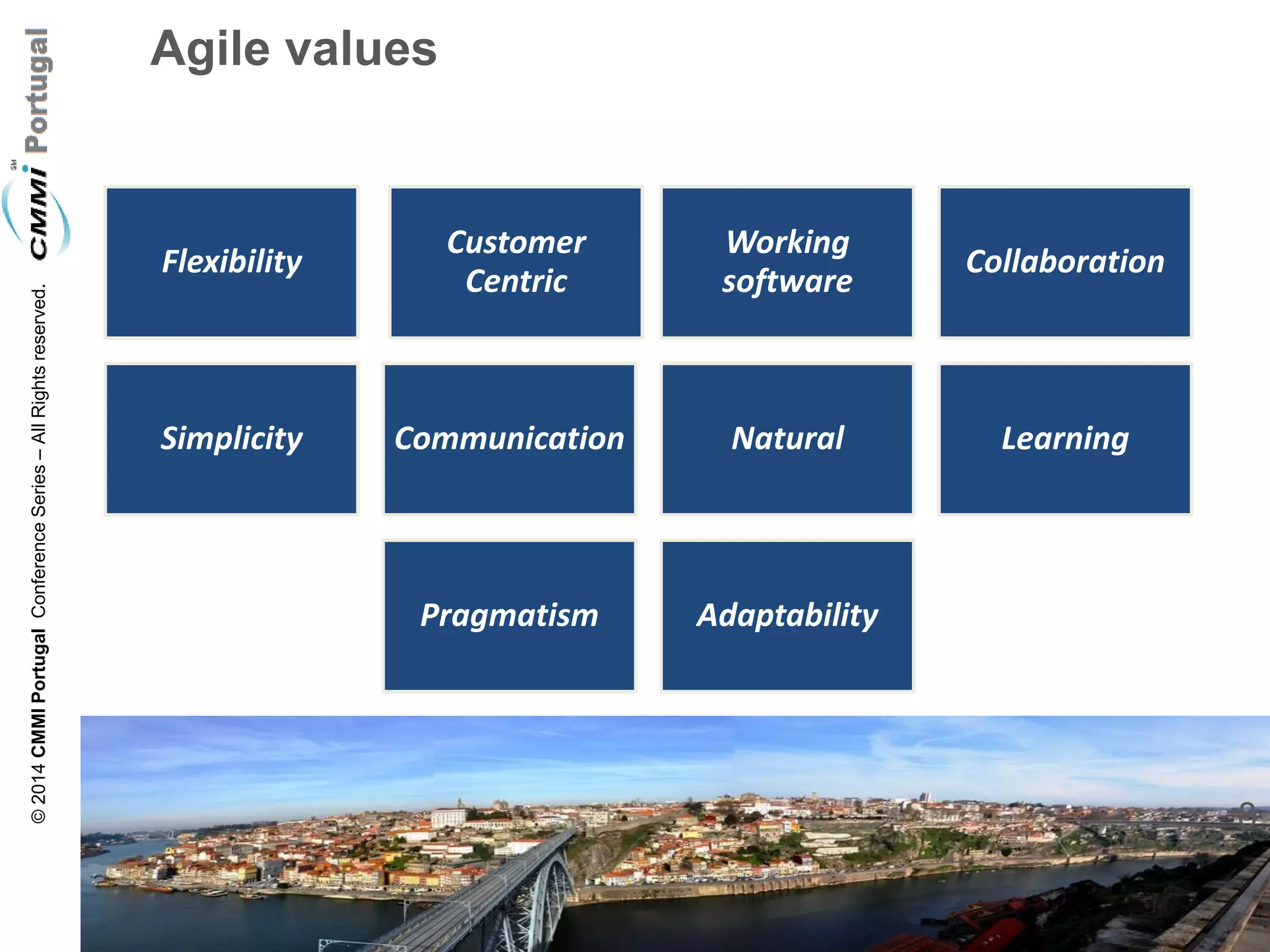
Agile values 
Flexibility 
Customer Centric 
Working software 
Collaboration 
Simplicity 
Communication 
Natural 
Learning 
Pragmatism 
Adaptability
10 
© 2014 CMMI Portugal Conference Series – All Rights reserved. 
How can we manage risks in agile projects aligned with the best practices?
11 
© 2014 CMMI Portugal Conference Series – All Rights reserved. 
Risk management 
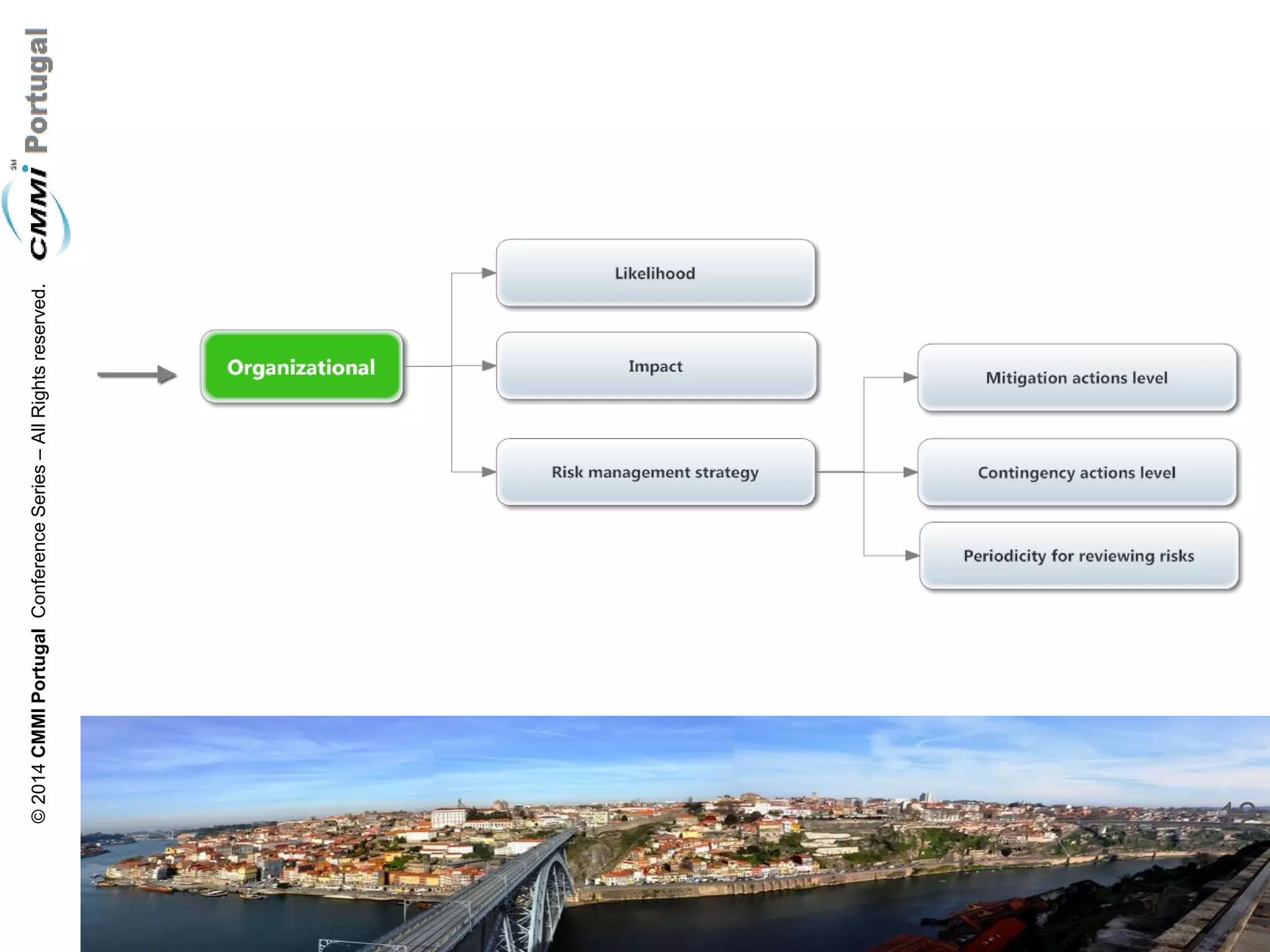
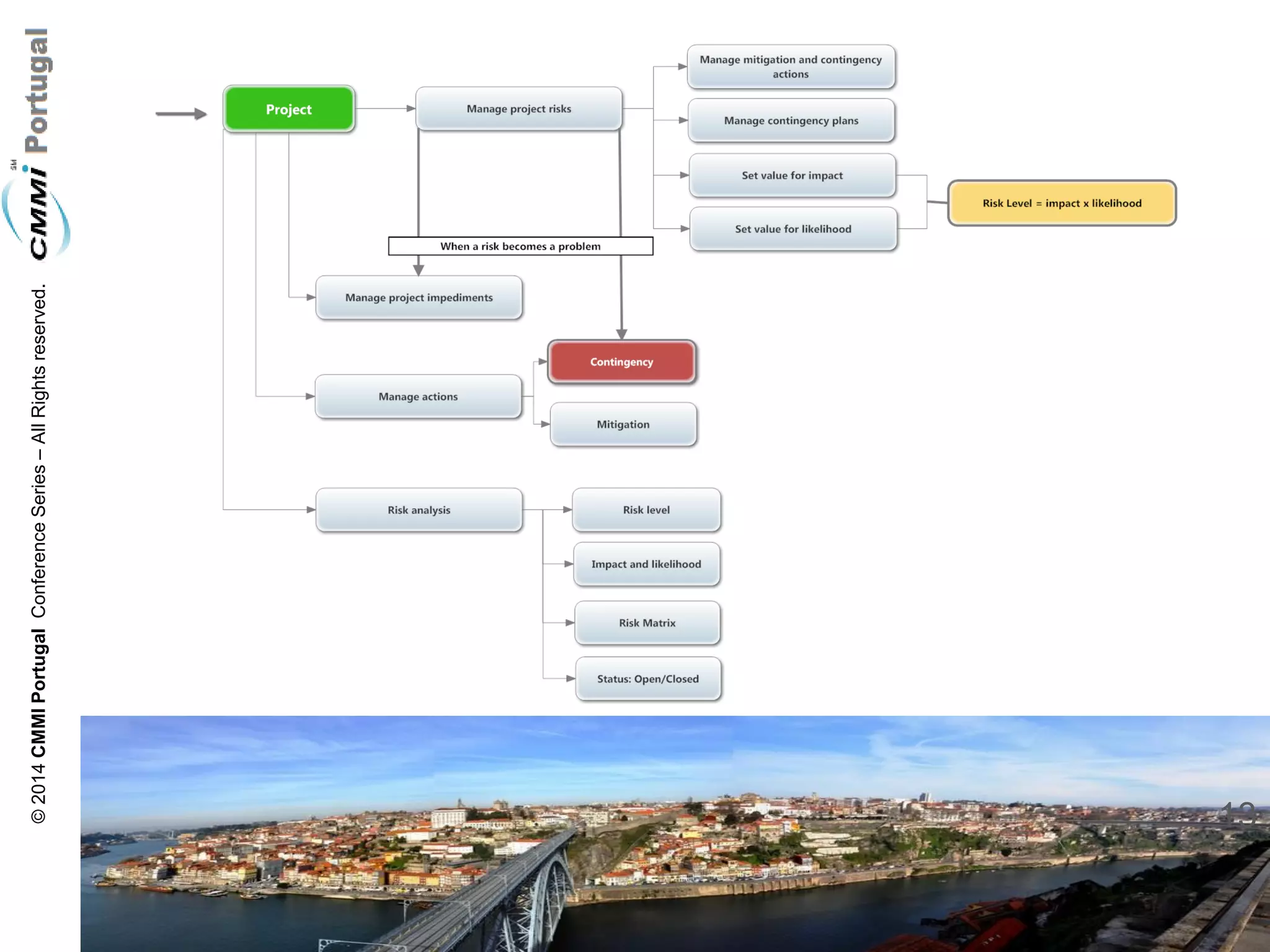
•Organizational level 
•Project level
12 
© 2014 CMMI Portugal Conference Series – All Rights reserved.
13 
© 2014 CMMI Portugal Conference Series – All Rights reserved.
14 
© 2014 CMMI Portugal Conference Series – All Rights reserved. 
Risk Management (RSKM) (CMMI-DEV) 
“The purpose of Risk Management (RSKM) (CMMI-DEV) is to identify potential problems before they occur so that risk handling activities can be planned and invoked as needed across the life of the product or project to mitigate adverse impacts on achieving objectives.”
15 
© 2014 CMMI Portugal Conference Series – All Rights reserved. 
Risk management and CMMI 
SG 1 Prepare for Risk Management 
SP 1.1 Determine Risk Sources and Categories 
SP 1.2 Define Risk Parameters 
SP 1.3 Establish a Risk Management Strategy 
SG 2 Identify and Analyze Risks 
SP 2.1 Identify Risks 
SP 2.2 Evaluate, Categorize, and Prioritize Risks 
SG 3 Mitigate Risks 
 SP 3.1 Develop Risk Mitigation Plans 
 SP 3.2 Implement Risk Mitigation Plans
16 
© 2014 CMMI Portugal Conference Series – All Rights reserved. 
“The only thing harder than predicting the future is changing the past”
17 
© 2014 CMMI Portugal Conference Series – All Rights reserved. 
Thank You! 
Rita Cunha 
rita.cunha@strongstep.pt 
Strongstep 
Carla Pereira 
csp@inescporto.pt 
ESTGF - IPP 
INESC Porto

Agile Risk Management

  • 1.
    Portugal Agile RiskManagement Rita Cunha Strongstep 2014-10-24 Carla Pereira CIICESI – ESTGF INESC TEC
  • 2.
    2 © 2014CMMI Portugal Conference Series – All Rights reserved. About Strongstep •Strongstep is a company specialized in software engineering that contributes to the improvement of software quality in Portugal and in the world. •Projects portfolio: Process improvement with CMMI DEV L2, L3, L5, CMMI SRV, TSP/PSP, combining agile/CMMI, Six Sigma, NP4457, Kanban, Scrum, ITIL, PMBOK, ISTQB, RUP Universities Enterprises Reference Institutions
  • 3.
    3 © 2014CMMI Portugal Conference Series – All Rights reserved. Expected outcomes •Understand the importance of risk management •Present an approach to manage risks aligned with the best practices
  • 4.
    4 © 2014CMMI Portugal Conference Series – All Rights reserved. Context Loading… Project Success Competitiveness New strategies Organizational Growth
  • 5.
    5 © 2014CMMI Portugal Conference Series – All Rights reserved. Context Why projects fail? 16% 53% 31% Success Challenged Cancelled The Standish Group Report, Chaos, 2014
  • 6.
    6 © 2014CMMI Portugal Conference Series – All Rights reserved. Context Why projects fail? 1.Incomplete Requirements 2.Lack of User Involvement 3.Lack of Resources 4.Unrealistic Expectations 5.Lack of Executive Support 6.Changing Requirements & Specifications 7.Lack of Planning
  • 7.
    7 © 2014CMMI Portugal Conference Series – All Rights reserved. Context What is a Risk? Risk is an uncertain event or condition that, if occurs, has an effect on at least one project objective. PMBOK Guide®, 4th Edition
  • 8.
    8 © 2014CMMI Portugal Conference Series – All Rights reserved. Agile values Flexibility Customer Centric Working software Collaboration Simplicity Communication Natural Learning Pragmatism Adaptability
  • 9.
    10 © 2014CMMI Portugal Conference Series – All Rights reserved. How can we manage risks in agile projects aligned with the best practices?
  • 10.
    11 © 2014CMMI Portugal Conference Series – All Rights reserved. Risk management •Organizational level •Project level
  • 11.
    12 © 2014CMMI Portugal Conference Series – All Rights reserved.
  • 12.
    13 © 2014CMMI Portugal Conference Series – All Rights reserved.
  • 13.
    14 © 2014CMMI Portugal Conference Series – All Rights reserved. Risk Management (RSKM) (CMMI-DEV) “The purpose of Risk Management (RSKM) (CMMI-DEV) is to identify potential problems before they occur so that risk handling activities can be planned and invoked as needed across the life of the product or project to mitigate adverse impacts on achieving objectives.”
  • 14.
    15 © 2014CMMI Portugal Conference Series – All Rights reserved. Risk management and CMMI SG 1 Prepare for Risk Management SP 1.1 Determine Risk Sources and Categories SP 1.2 Define Risk Parameters SP 1.3 Establish a Risk Management Strategy SG 2 Identify and Analyze Risks SP 2.1 Identify Risks SP 2.2 Evaluate, Categorize, and Prioritize Risks SG 3 Mitigate Risks  SP 3.1 Develop Risk Mitigation Plans  SP 3.2 Implement Risk Mitigation Plans
  • 15.
    16 © 2014CMMI Portugal Conference Series – All Rights reserved. “The only thing harder than predicting the future is changing the past”
  • 16.
    17 © 2014CMMI Portugal Conference Series – All Rights reserved. Thank You! Rita Cunha rita.cunha@strongstep.pt Strongstep Carla Pereira csp@inescporto.pt ESTGF - IPP INESC Porto