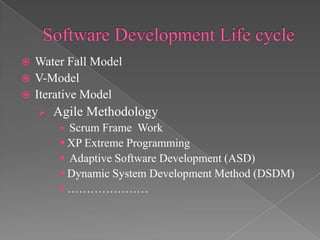
Water Fall Model
 V-Model
 Iterative Model




Agile Methodology


Scrum Frame Work
 XP Extreme Programming
 Adaptive Software Development (ASD)
 Dynamic System Development Method (DSDM)
 …………………




It is a Disciplined project management with
frequent inspection and adaptation. That
encourages team work, self-organization and
accountability.
Testers will need to have an understanding of
agile as a whole, but will also need to learn how
to adapt their current approach to work within
agile efforts.











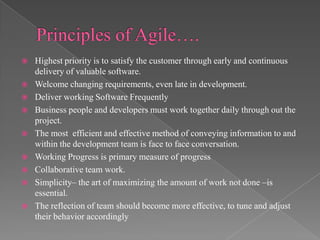
Highest priority is to satisfy the customer through early and continuous
delivery of valuable software.
Welcome changing requirements, even late in development.
Deliver working Software Frequently
Business people and developers must work together daily through out the
project.
The most efficient and effective method of conveying information to and
within the development team is face to face conversation.
Working Progress is primary measure of progress
Collaborative team work.
Simplicity– the art of maximizing the amount of work not done –is
essential.
The reflection of team should become more effective, to tune and adjust
their behavior accordingly







Introduction
What is Agile Methodology?
What is Scrum?
History of Scrum
Functionality of Scrum
Components of Scrum
 Scrum Roles
 The Process
 Scrum Artifacts
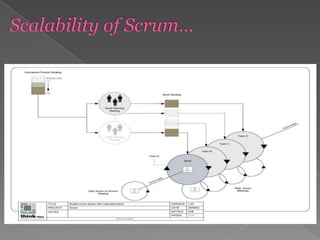
 Scaling Scrum
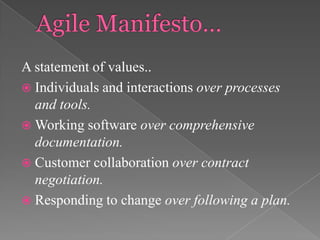
A statement of values..
 Individuals and interactions over processes
and tools.
 Working software over comprehensive
documentation.
 Customer collaboration over contract
negotiation.
 Responding to change over following a plan.
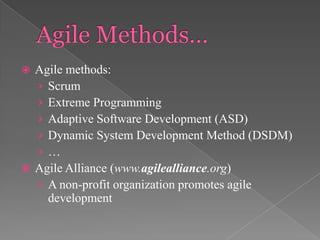
Agile methods:
› Scrum
› Extreme Programming
› Adaptive Software Development (ASD)
› Dynamic System Development Method (DSDM)
›…
 Agile Alliance (www.agilealliance.org)
› A non-profit organization promotes agile
development



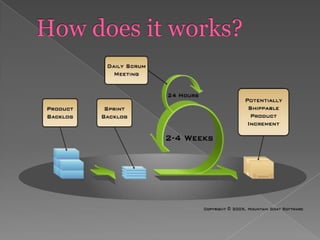
Scrum is an agile process that allows us to focus on
delivering the highest business value in the shortest
time.



It allows us to rapidly and repeatedly inspect actual
working software (every two weeks to one month).



The business sets the priorities. Our teams self-manage
to determine the best way to deliver the highest
priority features.



Every two weeks to a month anyone can see real
working software and decide to release it as is or
continue to enhance for another iteration.


1995:
› analysis of common software development processes  not suitable
for empirical, unpredictable and non-repeatable processes
› Design of a new method: Scrum by Jeff Sutherland & Ken Schwaber
Enhancement of Scrum by Mike Beedle & combination of Scrum with
Extreme Programming



1996:
introduction of Scrum at OOPSLA conference



2001:
publication “Agile Software Development with Scrum” by
Ken Schwaber & Mike Beedle



Successful appliance of Scrum in over 50 companies
Founders are members in the Agile Alliance
Self-organizing teams
 Product progresses in a series of month-long
“sprints”
 Requirements are captured as items in a list of
“product backlog”
 No specific engineering practices prescribed
 Uses generative rules to create an agile
environment for delivering projects
 One of the “agile processes”

 Focus

is on team’s work and team’s work only
 Daily communication of status occurs
 Enables low-overhead empirical management
 Makes impediments visible
 Someone is willing to make decisions and
 remove impediments real-time
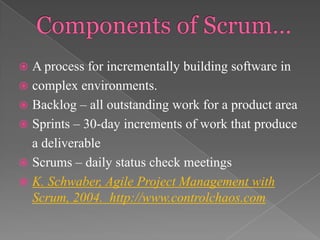
A process for incrementally building software in
 complex environments.
 Backlog – all outstanding work for a product area
 Sprints – 30-day increments of work that produce
a deliverable
 Scrums – daily status check meetings
 K. Schwaber, Agile Project Management with
Scrum, 2004. http://www.controlchaos.com

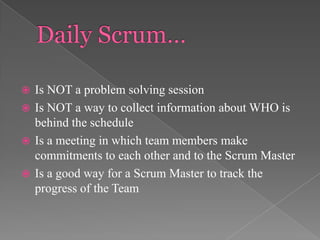
Is NOT a problem solving session
 Is NOT a way to collect information about WHO is
behind the schedule
 Is a meeting in which team members make
commitments to each other and to the Scrum Master
 Is a good way for a Scrum Master to track the
progress of the Team

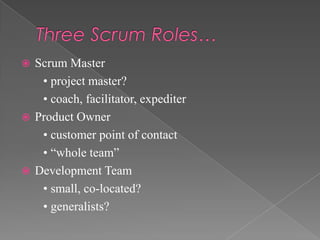
Scrum Master
• project master?
• coach, facilitator, expediter
 Product Owner
• customer point of contact
• “whole team”
 Development Team
• small, co-located?
• generalists?









Define the features of the product
Decide on release date and content
Be responsible for the profitability of the product
(ROI)
Prioritize features according to market value
Adjust features and priority every iteration, as
needed
Accept or reject work results.
Represents management to the project
 Responsible for enacting Scrum values and
practices
 Removes impediments
 Ensure that the team is fully functional and
productive
 Enable close cooperation across all roles and
functions
 Shield the team from external interferences



Sprint Planning Meeting



Sprint



Daily Scrum



Sprint Review Meeting









Typically 5-10 people
Cross-functional
› QA, Programmers, UI Designers, etc.
Members should be full-time
› May be exceptions (e.g., System Admin, etc.)
Teams are self-organizing
› What to do if a team self-organizes someone off the
team??
› Ideally, no titles but rarely a possibility
Membership can change only between sprints
Use small interdisciplinary teams
 Build clean interface software
 Intelligent management required
 Solid systems architecture and framework
upfront
 Prototype all new tools and technology
 Develop infrastructure first
 Each Sprint results in an executable
 Develop, document, and test in parallel

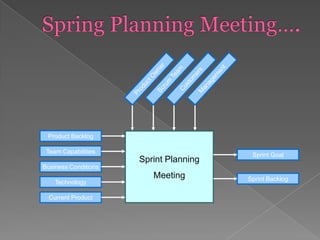
Product Backlog
Team Capabilities

Sprint Planning

Sprint Goal

Business Conditions
Technology
Current Product

Meeting

Sprint Backlog
1st Part:
› Creating Product Backlog
› Determining the Sprint Goal.
› Participants: Product Owner, Scrum Master,
Scrum Team
 2nd Part:
› Participants: Scrum Master, Scrum Team
› Creating Sprint Backlog

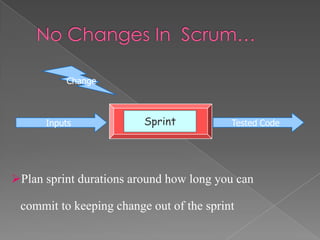
Change

Inputs

Sprint

Tested Code

Plan sprint durations around how long you can
commit to keeping change out of the sprint
 What

did you do since the last Scrum?
 What got in your way?
 What are you going to do before the next
Scrum?
Daily, same place and time, 15 minutes
 Only three questions
 All pigs (committed) must respond
 Chickens (involved) can attend, but must be
 silent
 No new backlog can be introduced externally
 Backlog can be added internally






Team presents what it accomplished during the sprint
Typically takes the form of a demo of new features or
underlying architecture
Informal
› 2-hour prep time rule
Participants
› Customers
› Management
› Product Owner
› Other engineers



Product Backlog, Release Plan
Sprint Planning Meeting (4+4 hr), Sprint
Backlog



Backlog/Release Burn down Charts



Sprint Review Meeting (4 hr)



Sprint Retrospective Meeting (3 hr)
Scrum team takes the Sprint Goal and decides what
tasks are necessary
 Team self-organizes around how they’ll meet the
Sprint Goal
› Manager doesn’t assign tasks to individuals
 Managers don’t make decisions for the team
 Sprint Backlog is created



Changes
› Team adds new tasks whenever they need to in order

to meet the Sprint Goal
› Team can remove unnecessary tasks
› But: Sprint Backlog can only be updated by the team


Estimates are updated whenever there’s new
information









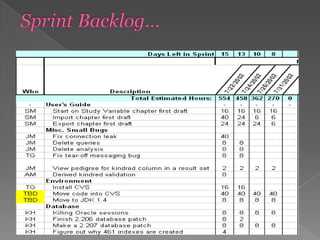
A subset of Product Backlog Items, which define the
work for a Sprint
Is created ONLY by Team members
Each Item has it’s own status
Should be updated every day
No more than 300 tasks in the list
If a task requires more than 16 hours, it should be
broken down
Team can add or subtract items from the list. Product
Owner is not allowed to do it
A list of all desired work on the project
› Usually a combination of
 story-based work (“let user search and replace”)
 task-based work (“improve exception
handling”)
 List is prioritized by the Product Owner
› Typically a Product Manager, Marketing, Internal
Customer, etc.







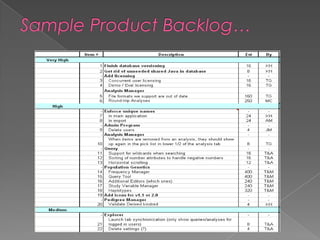
Requirements for a system, expressed as a prioritized
list of Backlog Items
Is managed and owned by a Product Owner
Spreadsheet (typically)
Usually is created during the Sprint Planning
Meeting
Can be changed and re-prioritized before each PM


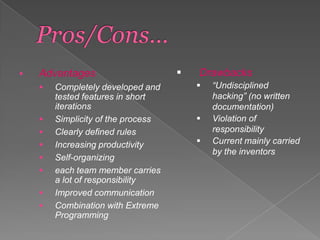
Advantages










Completely developed and
tested features in short
iterations
Simplicity of the process
Clearly defined rules
Increasing productivity
Self-organizing
each team member carries
a lot of responsibility
Improved communication
Combination with Extreme
Programming



Drawbacks





“Undisciplined
hacking” (no written
documentation)
Violation of
responsibility
Current mainly carried
by the inventors
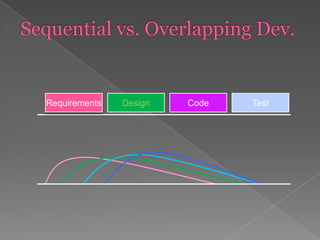
Requirements

Design

Code

Test
Agile Methodology in Software Development

Agile Methodology in Software Development

  • 2.
    Water Fall Model V-Model  Iterative Model   Agile Methodology  Scrum Frame Work  XP Extreme Programming  Adaptive Software Development (ASD)  Dynamic System Development Method (DSDM)  …………………
  • 3.
      It is aDisciplined project management with frequent inspection and adaptation. That encourages team work, self-organization and accountability. Testers will need to have an understanding of agile as a whole, but will also need to learn how to adapt their current approach to work within agile efforts.
  • 4.
             Highest priority isto satisfy the customer through early and continuous delivery of valuable software. Welcome changing requirements, even late in development. Deliver working Software Frequently Business people and developers must work together daily through out the project. The most efficient and effective method of conveying information to and within the development team is face to face conversation. Working Progress is primary measure of progress Collaborative team work. Simplicity– the art of maximizing the amount of work not done –is essential. The reflection of team should become more effective, to tune and adjust their behavior accordingly
  • 5.
          Introduction What is AgileMethodology? What is Scrum? History of Scrum Functionality of Scrum Components of Scrum  Scrum Roles  The Process  Scrum Artifacts  Scaling Scrum
  • 6.
    A statement ofvalues..  Individuals and interactions over processes and tools.  Working software over comprehensive documentation.  Customer collaboration over contract negotiation.  Responding to change over following a plan.
  • 7.
    Agile methods: › Scrum ›Extreme Programming › Adaptive Software Development (ASD) › Dynamic System Development Method (DSDM) ›…  Agile Alliance (www.agilealliance.org) › A non-profit organization promotes agile development 
  • 8.
     Scrum is anagile process that allows us to focus on delivering the highest business value in the shortest time.  It allows us to rapidly and repeatedly inspect actual working software (every two weeks to one month).  The business sets the priorities. Our teams self-manage to determine the best way to deliver the highest priority features.  Every two weeks to a month anyone can see real working software and decide to release it as is or continue to enhance for another iteration.
  • 9.
     1995: › analysis ofcommon software development processes  not suitable for empirical, unpredictable and non-repeatable processes › Design of a new method: Scrum by Jeff Sutherland & Ken Schwaber Enhancement of Scrum by Mike Beedle & combination of Scrum with Extreme Programming  1996: introduction of Scrum at OOPSLA conference  2001: publication “Agile Software Development with Scrum” by Ken Schwaber & Mike Beedle  Successful appliance of Scrum in over 50 companies Founders are members in the Agile Alliance
  • 10.
    Self-organizing teams  Productprogresses in a series of month-long “sprints”  Requirements are captured as items in a list of “product backlog”  No specific engineering practices prescribed  Uses generative rules to create an agile environment for delivering projects  One of the “agile processes” 
  • 11.
     Focus is onteam’s work and team’s work only  Daily communication of status occurs  Enables low-overhead empirical management  Makes impediments visible  Someone is willing to make decisions and  remove impediments real-time
  • 13.
    A process forincrementally building software in  complex environments.  Backlog – all outstanding work for a product area  Sprints – 30-day increments of work that produce a deliverable  Scrums – daily status check meetings  K. Schwaber, Agile Project Management with Scrum, 2004. http://www.controlchaos.com 
  • 14.
    Is NOT aproblem solving session  Is NOT a way to collect information about WHO is behind the schedule  Is a meeting in which team members make commitments to each other and to the Scrum Master  Is a good way for a Scrum Master to track the progress of the Team 
  • 15.
    Scrum Master • projectmaster? • coach, facilitator, expediter  Product Owner • customer point of contact • “whole team”  Development Team • small, co-located? • generalists? 
  • 16.
          Define the featuresof the product Decide on release date and content Be responsible for the profitability of the product (ROI) Prioritize features according to market value Adjust features and priority every iteration, as needed Accept or reject work results.
  • 17.
    Represents management tothe project  Responsible for enacting Scrum values and practices  Removes impediments  Ensure that the team is fully functional and productive  Enable close cooperation across all roles and functions  Shield the team from external interferences 
  • 18.
     Sprint Planning Meeting  Sprint  DailyScrum  Sprint Review Meeting
  • 19.
         Typically 5-10 people Cross-functional ›QA, Programmers, UI Designers, etc. Members should be full-time › May be exceptions (e.g., System Admin, etc.) Teams are self-organizing › What to do if a team self-organizes someone off the team?? › Ideally, no titles but rarely a possibility Membership can change only between sprints
  • 20.
    Use small interdisciplinaryteams  Build clean interface software  Intelligent management required  Solid systems architecture and framework upfront  Prototype all new tools and technology  Develop infrastructure first  Each Sprint results in an executable  Develop, document, and test in parallel 
  • 21.
    Product Backlog Team Capabilities SprintPlanning Sprint Goal Business Conditions Technology Current Product Meeting Sprint Backlog
  • 22.
    1st Part: › CreatingProduct Backlog › Determining the Sprint Goal. › Participants: Product Owner, Scrum Master, Scrum Team  2nd Part: › Participants: Scrum Master, Scrum Team › Creating Sprint Backlog 
  • 23.
    Change Inputs Sprint Tested Code Plan sprintdurations around how long you can commit to keeping change out of the sprint
  • 24.
     What did youdo since the last Scrum?  What got in your way?  What are you going to do before the next Scrum?
  • 25.
    Daily, same placeand time, 15 minutes  Only three questions  All pigs (committed) must respond  Chickens (involved) can attend, but must be  silent  No new backlog can be introduced externally  Backlog can be added internally 
  • 26.
        Team presents whatit accomplished during the sprint Typically takes the form of a demo of new features or underlying architecture Informal › 2-hour prep time rule Participants › Customers › Management › Product Owner › Other engineers
  • 27.
      Product Backlog, ReleasePlan Sprint Planning Meeting (4+4 hr), Sprint Backlog  Backlog/Release Burn down Charts  Sprint Review Meeting (4 hr)  Sprint Retrospective Meeting (3 hr)
  • 28.
    Scrum team takesthe Sprint Goal and decides what tasks are necessary  Team self-organizes around how they’ll meet the Sprint Goal › Manager doesn’t assign tasks to individuals  Managers don’t make decisions for the team  Sprint Backlog is created 
  • 29.
     Changes › Team addsnew tasks whenever they need to in order to meet the Sprint Goal › Team can remove unnecessary tasks › But: Sprint Backlog can only be updated by the team  Estimates are updated whenever there’s new information
  • 30.
           A subset ofProduct Backlog Items, which define the work for a Sprint Is created ONLY by Team members Each Item has it’s own status Should be updated every day No more than 300 tasks in the list If a task requires more than 16 hours, it should be broken down Team can add or subtract items from the list. Product Owner is not allowed to do it
  • 33.
    A list ofall desired work on the project › Usually a combination of  story-based work (“let user search and replace”)  task-based work (“improve exception handling”)  List is prioritized by the Product Owner › Typically a Product Manager, Marketing, Internal Customer, etc. 
  • 34.
         Requirements for asystem, expressed as a prioritized list of Backlog Items Is managed and owned by a Product Owner Spreadsheet (typically) Usually is created during the Sprint Planning Meeting Can be changed and re-prioritized before each PM
  • 36.
     Advantages         Completely developed and testedfeatures in short iterations Simplicity of the process Clearly defined rules Increasing productivity Self-organizing each team member carries a lot of responsibility Improved communication Combination with Extreme Programming  Drawbacks    “Undisciplined hacking” (no written documentation) Violation of responsibility Current mainly carried by the inventors
  • 37.