Intelligent Agent
Technology and Application
What is intelligent agent
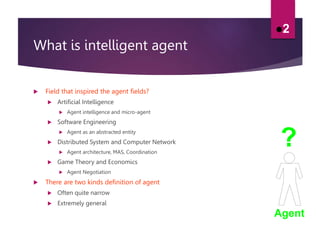
 Field that inspired the agent fields?
 Artificial Intelligence
 Agent intelligence and micro-agent
 Software Engineering
 Agent as an abstracted entity
 Distributed System and Computer Network
 Agent architecture, MAS, Coordination
 Game Theory and Economics
 Agent Negotiation
 There are two kinds definition of agent
 Often quite narrow
 Extremely general
2
Agent
?
General definitions
 American Heritage Dictionary
 ”... One that acts or has the power or authority to act ... or represent
another”
 Russel and Norvig
 ”An agent is anything that can be viewed as perceiving its
environment through sensors and acting upon that environment
through effectors.”
 Maes, Parrie
 ”Autonomous agents are computational systems that inhabit some
complex dynamic environment, sense and act autonomously in this
environment, and by doing so realize a set of goals or tasks for which
they are designed”.
3
Agent: more specific definitions
 Smith, Cypher and Spohrer
 ”Let us define an agent as a persistent software entity dedicated to a
specific purpose. ’Persistent’ distinguishes agents from subroutines;
agents have their own ideas about how to accomplish tasks, their
own agendas. ’Special purpose’ distinguishes them from
multifunction applications; agents are typically much smaller.
 Hayes-Roth
 ”Intelligent Agents continuously perform three functions: perception
of dynamic conditions in the environment; action to affect conditions
in the environment; and reasoning to interpret perceptions, solve
problems, draw inferences, and determine actions.
4
Agent: industrial definitions
 IBM
 ”Intelligent agents are software entities that
carry out some set of operations on behalf of a
user or another program with some degree of
independence or autonomy, and in doing so,
employ some knowledge or representations of
the user’s goals or desires”
5
Agent: weak notions
 Wooldridge and Jennings
 An Agent is a piece of hardware or (more commonly) software-based
computer system that enjoys the following properties
 Autonomy: agents operate without the direct intervention of humans
or others, and have some kind of control over their actions and internal
state;
 Pro-activeness: agents do not simply act in response to their
environment, they are able to exhibit goal-directed behavior by taking
the initiative.
 Reactivity: agents perceive their environment and respond to it in
timely fashion to changes that occur in it.
 Social Ability: agents interact with other agents (and possibly humans)
via some kind of agent-communication language.”
6
Agent: strong notions
 Wooldridge and Jennings
 Weak notion in addition to
 Mobility: the ability of an agent to move around a network
 Veracity: agent will not knowingly communicate false information
 Benevolence: agents do not have conflicting goals and always try
to do what is asked of it.
 Rationality: an agent will act in order to achieve its goals and will
not act in such a way as to prevent its goals being achieved
7
Summary of agent definitions
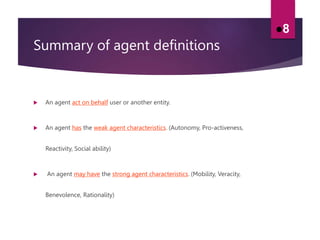
 An agent act on behalf user or another entity.
 An agent has the weak agent characteristics. (Autonomy, Pro-activeness,
Reactivity, Social ability)
 An agent may have the strong agent characteristics. (Mobility, Veracity,
Benevolence, Rationality)
8
Dear child gets many names…
 Many synonyms of the term “Intelligent agent”
 Robots
 Software agent or softbots
 Knowbots
 Taskbots
 Userbots
 ……
9
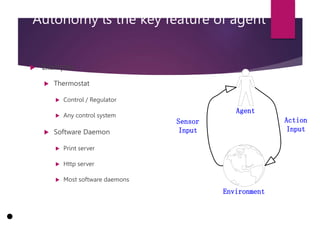
Autonomy is the key feature of agent
 Examples
 Thermostat
 Control / Regulator
 Any control system
 Software Daemon
 Print server
 Http server
 Most software daemons
Agent
Environment
Action
Input
Sensor
Input
1
0
Type of environment
 An agent will not have complete control over its environment, but have
partial control, in that it can influence it.
 Scientific computing or MIS in traditonal computing.
 Classification of environment properties [Russell 1995, p49]
 Accessible vs. inaccessible
 Deterministic vs. non-deterministic
 Episodic vs. non-episodic
 Static vs. dynamic
 Discrete vs. continuous
11
Accessible vs. inaccessible
 Accessible vs. inaccessible
 An accessible environment is one in which the agent can
obtain complete, accurate, up-to-date information about the
environment’s state. (also complete observable vs. partial
observable)
 Accessible: sensor give complete state of the environment.
 In an accessible environment, agent needn’t keep track of
the world through its internal state.
12
Deterministic vs. non-deterministic
 Deterministic vs. non-deterministic
 A deterministic environment is one in which any action has a
single guaranteed effect , there is no uncertainty about the
state that will result from performing an action.
 That is, next state of the environment is completely
determined by the current state and the action select by the
agent.
 Non-deterministic: a probabilistic model could be available.
13
Episodic vs. non-episodic
 Episodic vs. non-episodic
 In an episodic environment, the performance of an agent is
dependent on a number of discrete episodes, with no link
between the performance of an agent in different scenarios.
It need not reason about the interaction between this and
future episodes. (such as a game of chess)
 In an episodic environment, agent doesn’t need to
remember the past, and doesn’t have to think the next
episodic ahead.
14
Static vs. dynamic
 Static vs. dynamic
 A static environment is one that can assumed to remain
unchanged expect by the performance of actions by the
agents.
 A dynamic environment is one that has other processes
operating on it which hence changes in ways beyond the
agent’s control.
15
Discrete vs. continuous
 Discrete vs. continuous
 An environment is discrete if there are a fixed, finite number
of actions and percepts in it.
16
Why classify environments
 The type of environment largely determines the design of
agent.
 Classifying environment can help guide the agent’s
design process (like system analysis in software
engineering).
 Most complex general class of environments
 Are inaccessible, non-deterministic, non-episodic, dynamic,
and continuous.
17
Discuss about environment: Gripper
 Gripper is a standard example for probabilistic planning
model
 Robot has three possible actions: paint (P), dry (W) and
pickup (U)
 State has four binary features: block painted, gripper dry,
holding block, gripper clean
 Initial state:
 Goal state:
18
Intelligent agent vs. agent
 An intelligent agent is one that is capable of flexible
autonomous action in order to meet its design objectives,
where flexibility means three things:
 Pro-activeness: the ability of exhibit goal-directed behavior
by taking the initiative.
 Reactivity: the ability of percept the environment, and
respond in a timely fashion to changes that occur in it.
 Social ability: the ability of interaction with other agents
(include human).
19
Pro-activeness
 Pro-activeness
 In functional system, apply pre-condition and post-condition
to realize goal directed behavior.
 But for non-functional system (dynamic system), goal must
remain valid at least until the action complete.
 agent blindly executing a procedure without regard to
whether the assumptions underpinning the procedure are
valid is a poor strategy.
 Observe incompletely
 Environment is non-deterministic
 Other agent can affect the environment
20
Reactivity
 Reactivity
 Agent must be responsive to events that occur in its
environment.
 Building a system that achieves an effective balance between
goal-directed and reactive behavior is hard.
21
Social ability
 Social ability
Must negotiate and cooperate
with others.
22
Agent vs. object
 Object
 Are defined as computational entities that encapsulate some
state, are able to perform actions, or methods on this state,
and communicate by message passing.
 Are computational entities.
 Encapsulate some internal state.
 Are able to perform actions, or methods, to change this state.
 Communicate by message passing.
23
Agent and object
 Differences between agent and object
 An object can be thought of as exhibiting autonomy over its
state: it has control over it. But an object does not exhibit
control over it’s behavior.
 Other objects invoke their public method. Agent can only
request other agents to perform actions.
 “Objects do it for free, agents do it for money.”
 (implement agents using object-oriented
technology)……Thinking it.
24
Agent and object
 In standard object model has nothing whatsoever to say
about how to build systems that integrate reactive, pro-
active, social behavior.
 Each has their own thread of control. In the standard object
model, there is a single thread of control in the system.
 (agent is similar with an active object.)
 Summary,
 Agent embody stronger notion of autonomy than object
 Agent are capable of flexible behavior
 Multi-agent system is inherently multi-threaded
25
Agent and expert system
 Expert system
 Is one that is capable of solving problems or giving advice in
some knowledge-rich domain.
 The most important distinction
 Expert system is disembodied, rather than being situated.
 It do not interact with any environment. Give feedback or
advice to a third part.
 Are not required to interact with other agents.
26
Example of agents
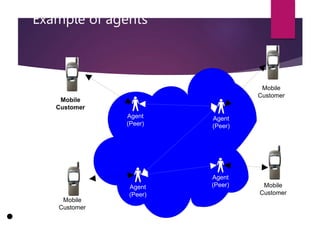
Mobile
Customer
Agent
(Peer)
Agent
(Peer)
Agent
(Peer)
Agent
(Peer)
Mobile
Customer
Mobile
Customer
Mobile
Customer
2
7
Distributed Artificial Intelligence (DAI)
 DAI is a sub-field of AI
 DAI is concerned with problem solving where agents solve
(sub-) tasks (macro level)
 Main area of DAI
 Distributed problem solving (DPS)
 Centralized Control and Distributed Data (Massively Parallel Processing)
 Multi-agent system (MAS)
 Distributed Control and Distributed Data (coordination crucial)
28
Some histories
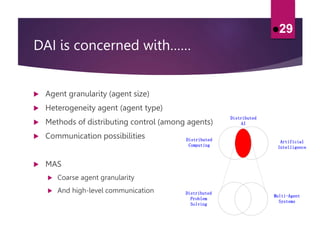
DAI is concerned with……
 Agent granularity (agent size)
 Heterogeneity agent (agent type)
 Methods of distributing control (among agents)
 Communication possibilities
 MAS
 Coarse agent granularity
 And high-level communication
29
Distributed
Computing
Artificial
Intelligence
Distributed
AI
Multi-Agent
Systems
Distributed
Problem
Solving
DAI is not concerned with……
 Issues of coordination of concurrent processes at the
problem solving and representational level.
 Parallel computer architecture, parallel programming
languages or distributed operation system.
 No semaphores, monitors or threads etc.
 Higher semantics of communication (speech-act level)
30
Motivation behind MAS
 To solve problems too large for a centralized agent
 E.g. Financial system
 To allow interconnection and interoperation of multiple
legacy system
 E.g. Web crawling
 To provide a solution to inherently distributed system
 To provide a solution where expertise is distributed
 To provide conceptual clarity and simplicity of design
31
Benefits of MAS
 Faster problem solving
 Decreasing communication
 Higher semantics of communication (speech-act level)
 Flexibility
 Increasing reliability
32
Heterogeneity degrees in MAS
 Low
 Identical agents, different resources
 Medium
 Different agent expertise
 High
 Share only interaction protocol (e.g. FIPA or KQML)
33
Cooperative and self-interested MAS
 Cooperative
 Agents designed by interdependent designers
 Agents act for increased good of the system (i.e. MAS)
 Concerned with increasing the systems performance and not the individual
agents
 Self-interested
 Agents designed by independent designer
 Agents have their own agenda and motivation
 Concerned with the benefit of each agent (’individualistic’)
 The latter more realistic in an Internet-setting?
34
Our categories about MAS
 Cooperation
 Both has a common object
 Competitive
 Each have different objects which are contradictory.
 Semi-competitive
 Each have different objects which are conflictive, but the
total system has one explicit (or implicit) object
The first now is known as TEAMWORK.
35
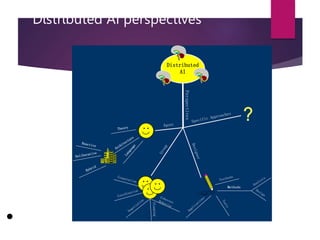
Distributed AI perspectives
Perspectives
Agent
G
r
o
u
p
D
e
s
i
g
n
e
r
Specific Approaches
Cooperation
Coordination
Negotiation
Coherent
Behavior
Pl
an
ni
ng
Distributed
AI
Methods
Analysis
Design
T
o
o
l
s
Applications
Testbeds
Architecture
Reactive
Deliberative
Hybrid
Theory
L
a
n
g
u
a
g
e
3
6
Our Thinking in MAS
 Single benefit vs. collective benefit
 No need central control
 Social intelligence vs. single intelligence
 Self-organize system
 Self-form, self-evolve
 Intelligence is emergence, not innative
 …..
37
Conclusions of lecture
 Agent has general definition, weak definition and strong
definition
 Classification of the environment
 Differences between agent and intelligent agent, agent
and object, agent and expert system
 Multi-agent system is macro issues of agent systems
38
Coursework
 1. Give other examples of agents (not necessarily
intelligent) that you know of. For each, define as precisely
as possible:
 (a). the environment that the agent occupies, the states that
this environment can be in, and the type of environment.
 (b). The action repertoire available to the agent, and any pre-
conditions associated with these actions;
 (c). The goal, or design objectives of the agent – what it is
intended to achieve.
39
Coursework
 2. If a traffic light (together with its control system) is
considered as intelligent agent, which of agent’s
properties should be employ? Illustrate your answer by
examples.
40
Coursework
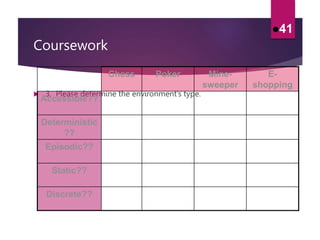
 3. Please determine the environment’s type.
41
Chess Poker Mine-
sweeper
E-
shopping
Accessible??
Deterministic
??
Episodic??
Static??
Discrete??

Agents(1).ppt

  • 1.
  • 2.
    What is intelligentagent  Field that inspired the agent fields?  Artificial Intelligence  Agent intelligence and micro-agent  Software Engineering  Agent as an abstracted entity  Distributed System and Computer Network  Agent architecture, MAS, Coordination  Game Theory and Economics  Agent Negotiation  There are two kinds definition of agent  Often quite narrow  Extremely general 2 Agent ?
  • 3.
    General definitions  AmericanHeritage Dictionary  ”... One that acts or has the power or authority to act ... or represent another”  Russel and Norvig  ”An agent is anything that can be viewed as perceiving its environment through sensors and acting upon that environment through effectors.”  Maes, Parrie  ”Autonomous agents are computational systems that inhabit some complex dynamic environment, sense and act autonomously in this environment, and by doing so realize a set of goals or tasks for which they are designed”. 3
  • 4.
    Agent: more specificdefinitions  Smith, Cypher and Spohrer  ”Let us define an agent as a persistent software entity dedicated to a specific purpose. ’Persistent’ distinguishes agents from subroutines; agents have their own ideas about how to accomplish tasks, their own agendas. ’Special purpose’ distinguishes them from multifunction applications; agents are typically much smaller.  Hayes-Roth  ”Intelligent Agents continuously perform three functions: perception of dynamic conditions in the environment; action to affect conditions in the environment; and reasoning to interpret perceptions, solve problems, draw inferences, and determine actions. 4
  • 5.
    Agent: industrial definitions IBM  ”Intelligent agents are software entities that carry out some set of operations on behalf of a user or another program with some degree of independence or autonomy, and in doing so, employ some knowledge or representations of the user’s goals or desires” 5
  • 6.
    Agent: weak notions Wooldridge and Jennings  An Agent is a piece of hardware or (more commonly) software-based computer system that enjoys the following properties  Autonomy: agents operate without the direct intervention of humans or others, and have some kind of control over their actions and internal state;  Pro-activeness: agents do not simply act in response to their environment, they are able to exhibit goal-directed behavior by taking the initiative.  Reactivity: agents perceive their environment and respond to it in timely fashion to changes that occur in it.  Social Ability: agents interact with other agents (and possibly humans) via some kind of agent-communication language.” 6
  • 7.
    Agent: strong notions Wooldridge and Jennings  Weak notion in addition to  Mobility: the ability of an agent to move around a network  Veracity: agent will not knowingly communicate false information  Benevolence: agents do not have conflicting goals and always try to do what is asked of it.  Rationality: an agent will act in order to achieve its goals and will not act in such a way as to prevent its goals being achieved 7
  • 8.
    Summary of agentdefinitions  An agent act on behalf user or another entity.  An agent has the weak agent characteristics. (Autonomy, Pro-activeness, Reactivity, Social ability)  An agent may have the strong agent characteristics. (Mobility, Veracity, Benevolence, Rationality) 8
  • 9.
    Dear child getsmany names…  Many synonyms of the term “Intelligent agent”  Robots  Software agent or softbots  Knowbots  Taskbots  Userbots  …… 9
  • 10.
    Autonomy is thekey feature of agent  Examples  Thermostat  Control / Regulator  Any control system  Software Daemon  Print server  Http server  Most software daemons Agent Environment Action Input Sensor Input 1 0
  • 11.
    Type of environment An agent will not have complete control over its environment, but have partial control, in that it can influence it.  Scientific computing or MIS in traditonal computing.  Classification of environment properties [Russell 1995, p49]  Accessible vs. inaccessible  Deterministic vs. non-deterministic  Episodic vs. non-episodic  Static vs. dynamic  Discrete vs. continuous 11
  • 12.
    Accessible vs. inaccessible Accessible vs. inaccessible  An accessible environment is one in which the agent can obtain complete, accurate, up-to-date information about the environment’s state. (also complete observable vs. partial observable)  Accessible: sensor give complete state of the environment.  In an accessible environment, agent needn’t keep track of the world through its internal state. 12
  • 13.
    Deterministic vs. non-deterministic Deterministic vs. non-deterministic  A deterministic environment is one in which any action has a single guaranteed effect , there is no uncertainty about the state that will result from performing an action.  That is, next state of the environment is completely determined by the current state and the action select by the agent.  Non-deterministic: a probabilistic model could be available. 13
  • 14.
    Episodic vs. non-episodic Episodic vs. non-episodic  In an episodic environment, the performance of an agent is dependent on a number of discrete episodes, with no link between the performance of an agent in different scenarios. It need not reason about the interaction between this and future episodes. (such as a game of chess)  In an episodic environment, agent doesn’t need to remember the past, and doesn’t have to think the next episodic ahead. 14
  • 15.
    Static vs. dynamic Static vs. dynamic  A static environment is one that can assumed to remain unchanged expect by the performance of actions by the agents.  A dynamic environment is one that has other processes operating on it which hence changes in ways beyond the agent’s control. 15
  • 16.
    Discrete vs. continuous Discrete vs. continuous  An environment is discrete if there are a fixed, finite number of actions and percepts in it. 16
  • 17.
    Why classify environments The type of environment largely determines the design of agent.  Classifying environment can help guide the agent’s design process (like system analysis in software engineering).  Most complex general class of environments  Are inaccessible, non-deterministic, non-episodic, dynamic, and continuous. 17
  • 18.
    Discuss about environment:Gripper  Gripper is a standard example for probabilistic planning model  Robot has three possible actions: paint (P), dry (W) and pickup (U)  State has four binary features: block painted, gripper dry, holding block, gripper clean  Initial state:  Goal state: 18
  • 19.
    Intelligent agent vs.agent  An intelligent agent is one that is capable of flexible autonomous action in order to meet its design objectives, where flexibility means three things:  Pro-activeness: the ability of exhibit goal-directed behavior by taking the initiative.  Reactivity: the ability of percept the environment, and respond in a timely fashion to changes that occur in it.  Social ability: the ability of interaction with other agents (include human). 19
  • 20.
    Pro-activeness  Pro-activeness  Infunctional system, apply pre-condition and post-condition to realize goal directed behavior.  But for non-functional system (dynamic system), goal must remain valid at least until the action complete.  agent blindly executing a procedure without regard to whether the assumptions underpinning the procedure are valid is a poor strategy.  Observe incompletely  Environment is non-deterministic  Other agent can affect the environment 20
  • 21.
    Reactivity  Reactivity  Agentmust be responsive to events that occur in its environment.  Building a system that achieves an effective balance between goal-directed and reactive behavior is hard. 21
  • 22.
    Social ability  Socialability Must negotiate and cooperate with others. 22
  • 23.
    Agent vs. object Object  Are defined as computational entities that encapsulate some state, are able to perform actions, or methods on this state, and communicate by message passing.  Are computational entities.  Encapsulate some internal state.  Are able to perform actions, or methods, to change this state.  Communicate by message passing. 23
  • 24.
    Agent and object Differences between agent and object  An object can be thought of as exhibiting autonomy over its state: it has control over it. But an object does not exhibit control over it’s behavior.  Other objects invoke their public method. Agent can only request other agents to perform actions.  “Objects do it for free, agents do it for money.”  (implement agents using object-oriented technology)……Thinking it. 24
  • 25.
    Agent and object In standard object model has nothing whatsoever to say about how to build systems that integrate reactive, pro- active, social behavior.  Each has their own thread of control. In the standard object model, there is a single thread of control in the system.  (agent is similar with an active object.)  Summary,  Agent embody stronger notion of autonomy than object  Agent are capable of flexible behavior  Multi-agent system is inherently multi-threaded 25
  • 26.
    Agent and expertsystem  Expert system  Is one that is capable of solving problems or giving advice in some knowledge-rich domain.  The most important distinction  Expert system is disembodied, rather than being situated.  It do not interact with any environment. Give feedback or advice to a third part.  Are not required to interact with other agents. 26
  • 27.
  • 28.
    Distributed Artificial Intelligence(DAI)  DAI is a sub-field of AI  DAI is concerned with problem solving where agents solve (sub-) tasks (macro level)  Main area of DAI  Distributed problem solving (DPS)  Centralized Control and Distributed Data (Massively Parallel Processing)  Multi-agent system (MAS)  Distributed Control and Distributed Data (coordination crucial) 28 Some histories
  • 29.
    DAI is concernedwith……  Agent granularity (agent size)  Heterogeneity agent (agent type)  Methods of distributing control (among agents)  Communication possibilities  MAS  Coarse agent granularity  And high-level communication 29 Distributed Computing Artificial Intelligence Distributed AI Multi-Agent Systems Distributed Problem Solving
  • 30.
    DAI is notconcerned with……  Issues of coordination of concurrent processes at the problem solving and representational level.  Parallel computer architecture, parallel programming languages or distributed operation system.  No semaphores, monitors or threads etc.  Higher semantics of communication (speech-act level) 30
  • 31.
    Motivation behind MAS To solve problems too large for a centralized agent  E.g. Financial system  To allow interconnection and interoperation of multiple legacy system  E.g. Web crawling  To provide a solution to inherently distributed system  To provide a solution where expertise is distributed  To provide conceptual clarity and simplicity of design 31
  • 32.
    Benefits of MAS Faster problem solving  Decreasing communication  Higher semantics of communication (speech-act level)  Flexibility  Increasing reliability 32
  • 33.
    Heterogeneity degrees inMAS  Low  Identical agents, different resources  Medium  Different agent expertise  High  Share only interaction protocol (e.g. FIPA or KQML) 33
  • 34.
    Cooperative and self-interestedMAS  Cooperative  Agents designed by interdependent designers  Agents act for increased good of the system (i.e. MAS)  Concerned with increasing the systems performance and not the individual agents  Self-interested  Agents designed by independent designer  Agents have their own agenda and motivation  Concerned with the benefit of each agent (’individualistic’)  The latter more realistic in an Internet-setting? 34
  • 35.
    Our categories aboutMAS  Cooperation  Both has a common object  Competitive  Each have different objects which are contradictory.  Semi-competitive  Each have different objects which are conflictive, but the total system has one explicit (or implicit) object The first now is known as TEAMWORK. 35
  • 36.
    Distributed AI perspectives Perspectives Agent G r o u p D e s i g n e r SpecificApproaches Cooperation Coordination Negotiation Coherent Behavior Pl an ni ng Distributed AI Methods Analysis Design T o o l s Applications Testbeds Architecture Reactive Deliberative Hybrid Theory L a n g u a g e 3 6
  • 37.
    Our Thinking inMAS  Single benefit vs. collective benefit  No need central control  Social intelligence vs. single intelligence  Self-organize system  Self-form, self-evolve  Intelligence is emergence, not innative  ….. 37
  • 38.
    Conclusions of lecture Agent has general definition, weak definition and strong definition  Classification of the environment  Differences between agent and intelligent agent, agent and object, agent and expert system  Multi-agent system is macro issues of agent systems 38
  • 39.
    Coursework  1. Giveother examples of agents (not necessarily intelligent) that you know of. For each, define as precisely as possible:  (a). the environment that the agent occupies, the states that this environment can be in, and the type of environment.  (b). The action repertoire available to the agent, and any pre- conditions associated with these actions;  (c). The goal, or design objectives of the agent – what it is intended to achieve. 39
  • 40.
    Coursework  2. Ifa traffic light (together with its control system) is considered as intelligent agent, which of agent’s properties should be employ? Illustrate your answer by examples. 40
  • 41.
    Coursework  3. Pleasedetermine the environment’s type. 41 Chess Poker Mine- sweeper E- shopping Accessible?? Deterministic ?? Episodic?? Static?? Discrete??