BLOOM'S TAXONOMY:
AFFECTIVE DOMAIN
By
Monojit Gope
Research Scholar
INTRODUCTION
The Affective Domain is one of three domains of learning
identified by Benjamin Bloom and his colleagues in 1956. The
Affective Domain focuses on the development of feelings,
attitudes, values, and appreciations. It is concerned with how
learners feel about what they are learning and how they are
motivated to learn.
CONTINUE…
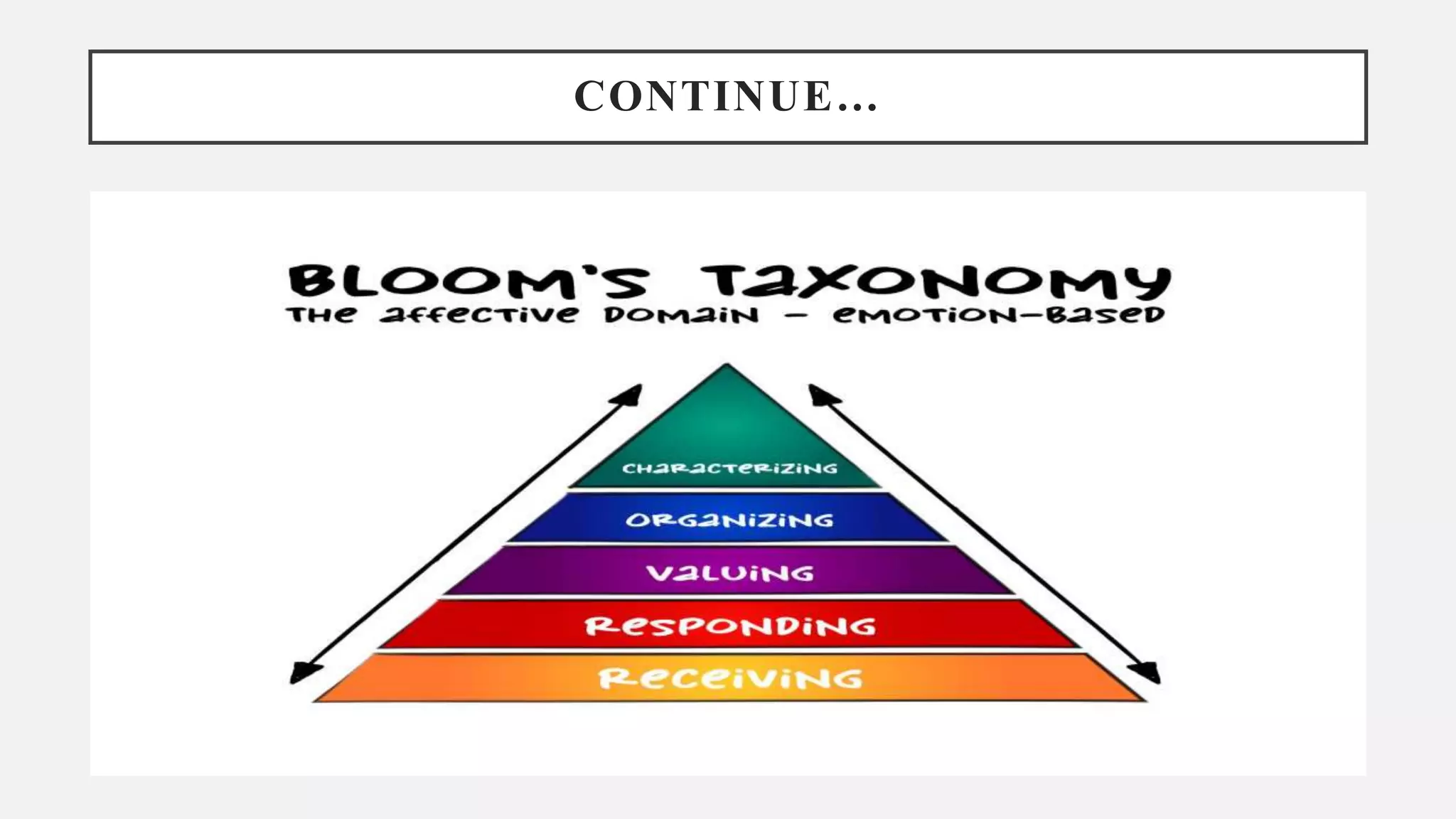
THE FIVE LEVELS OF THE AFFECTIVE DOMAIN
• The Affective Domain is divided into five levels, each of which represents a more
complex level of learning. The five levels are:
Receiving.
Responding.
Valuing.
Organizing.
Characterizing.
RECEIVING
• At the receiving level, learners are aware of and willing to attend to new
information. They may not necessarily agree with the information, but they are
open to learning about it.
• Examples:
Ask open-ended questions to stimulate thinking.
Provide opportunities for learners to explore new ideas.
Present information in a variety of formats.
RESPONDING
• At the responding level, learners actively participate in learning activities. They
may volunteer to answer questions, participate in discussions, or complete
assignments.
• Examples:
Invite learners to share their thoughts and feelings.
Provide opportunities for learners to participate in hands-on activities.
Create a safe and supportive learning environment.
VALUING
• At the valuing level, learners develop a commitment to certain ideas or
beliefs. They may express their values through their words or actions.
• Examples:
Encourage learners to discuss their values and beliefs.
Provide opportunities for learners to make choices that reflect their values.
Model the values that you want learners to adopt.
ORGANIZING
• At the organizing level, learners begin to relate their values to other values
and beliefs. They may develop a personal philosophy or set of principles.
• Examples:
Help learners to see the connections between their values and other values
and beliefs.
Encourage learners to develop a personal philosophy or set of principles.
Provide opportunities for learners to debate and discuss controversial issues.
CHARACTERIZING
• At the characterizing level, learners internalize their values and beliefs. They
act consistently with their values, even in the face of challenges.
• Examples:
Provide opportunities for learners to practice acting consistently with their
values.
Provide feedback on learners' behavior.
Celebrate learners' accomplishments.
IMPORTANCE OF THE AFFECTIVE DOMAIN
• The affective domain is important for learning because it helps learners develop the
following:
Attitudes: Positive attitudes towards learning and towards other people can lead to
increased motivation and engagement.
Values: A strong set of values can help learners make good decisions and live a fulfilling
life.
Appreciations: An appreciation for beauty, culture, and other aspects of life can enrich the
learner's experience.
CONCLUSION
The Affective Domain is an important part of learning. By
understanding the different levels of the Affective Domain and
using appropriate activities, educators can help learners
develop the attitudes, values, and appreciations that they need
to be successful in life.
THANK YOU

Affective Domain.pptx

  • 1.
  • 2.
    INTRODUCTION The Affective Domainis one of three domains of learning identified by Benjamin Bloom and his colleagues in 1956. The Affective Domain focuses on the development of feelings, attitudes, values, and appreciations. It is concerned with how learners feel about what they are learning and how they are motivated to learn.
  • 3.
  • 4.
    THE FIVE LEVELSOF THE AFFECTIVE DOMAIN • The Affective Domain is divided into five levels, each of which represents a more complex level of learning. The five levels are: Receiving. Responding. Valuing. Organizing. Characterizing.
  • 5.
    RECEIVING • At thereceiving level, learners are aware of and willing to attend to new information. They may not necessarily agree with the information, but they are open to learning about it. • Examples: Ask open-ended questions to stimulate thinking. Provide opportunities for learners to explore new ideas. Present information in a variety of formats.
  • 6.
    RESPONDING • At theresponding level, learners actively participate in learning activities. They may volunteer to answer questions, participate in discussions, or complete assignments. • Examples: Invite learners to share their thoughts and feelings. Provide opportunities for learners to participate in hands-on activities. Create a safe and supportive learning environment.
  • 7.
    VALUING • At thevaluing level, learners develop a commitment to certain ideas or beliefs. They may express their values through their words or actions. • Examples: Encourage learners to discuss their values and beliefs. Provide opportunities for learners to make choices that reflect their values. Model the values that you want learners to adopt.
  • 8.
    ORGANIZING • At theorganizing level, learners begin to relate their values to other values and beliefs. They may develop a personal philosophy or set of principles. • Examples: Help learners to see the connections between their values and other values and beliefs. Encourage learners to develop a personal philosophy or set of principles. Provide opportunities for learners to debate and discuss controversial issues.
  • 9.
    CHARACTERIZING • At thecharacterizing level, learners internalize their values and beliefs. They act consistently with their values, even in the face of challenges. • Examples: Provide opportunities for learners to practice acting consistently with their values. Provide feedback on learners' behavior. Celebrate learners' accomplishments.
  • 10.
    IMPORTANCE OF THEAFFECTIVE DOMAIN • The affective domain is important for learning because it helps learners develop the following: Attitudes: Positive attitudes towards learning and towards other people can lead to increased motivation and engagement. Values: A strong set of values can help learners make good decisions and live a fulfilling life. Appreciations: An appreciation for beauty, culture, and other aspects of life can enrich the learner's experience.
  • 11.
    CONCLUSION The Affective Domainis an important part of learning. By understanding the different levels of the Affective Domain and using appropriate activities, educators can help learners develop the attitudes, values, and appreciations that they need to be successful in life.
  • 12.