Advanced Chemistry
Types of Chemical
Reactions and Solution
Stoichiometry
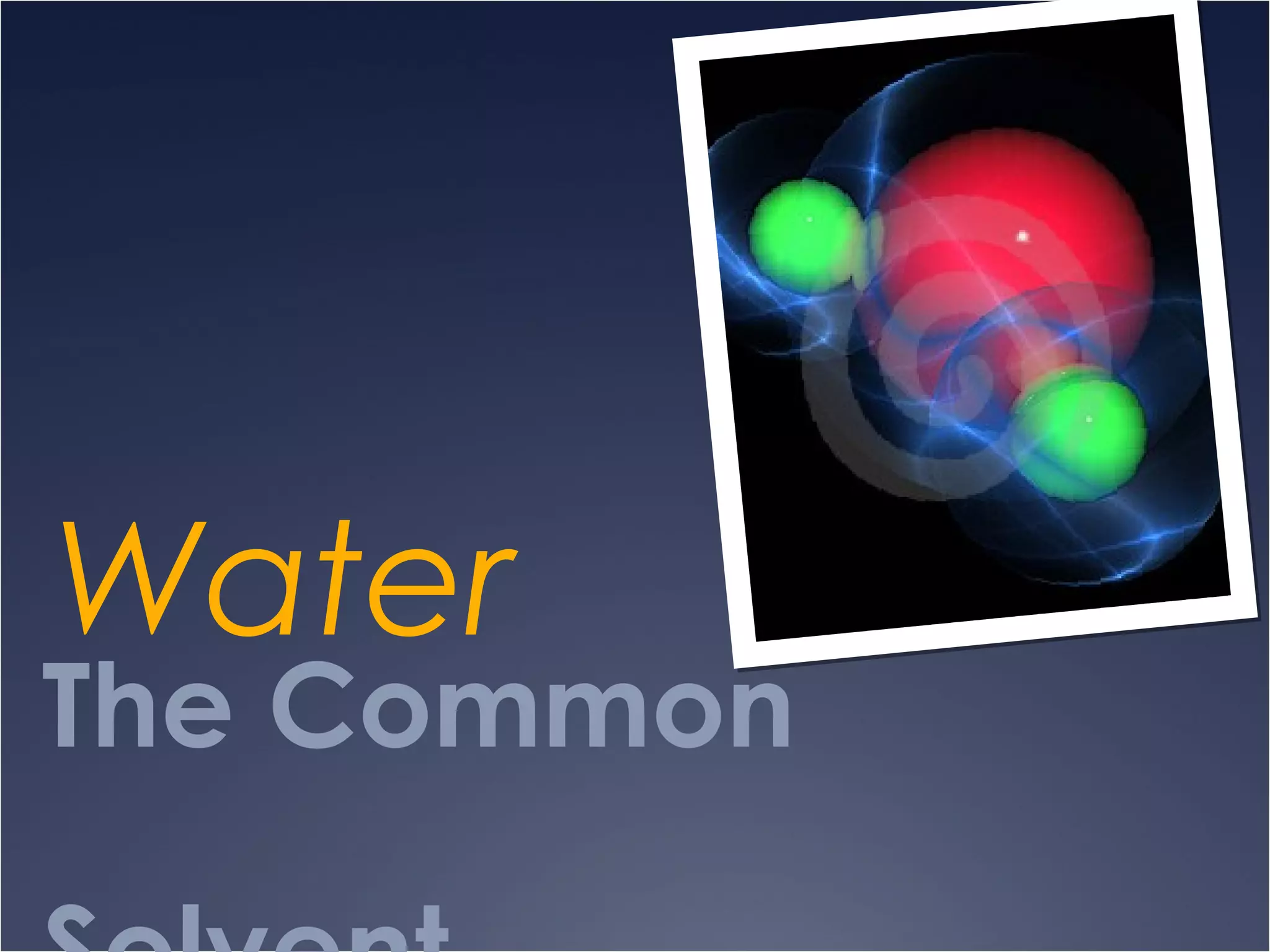
The Common
Water
Water as a Solvent
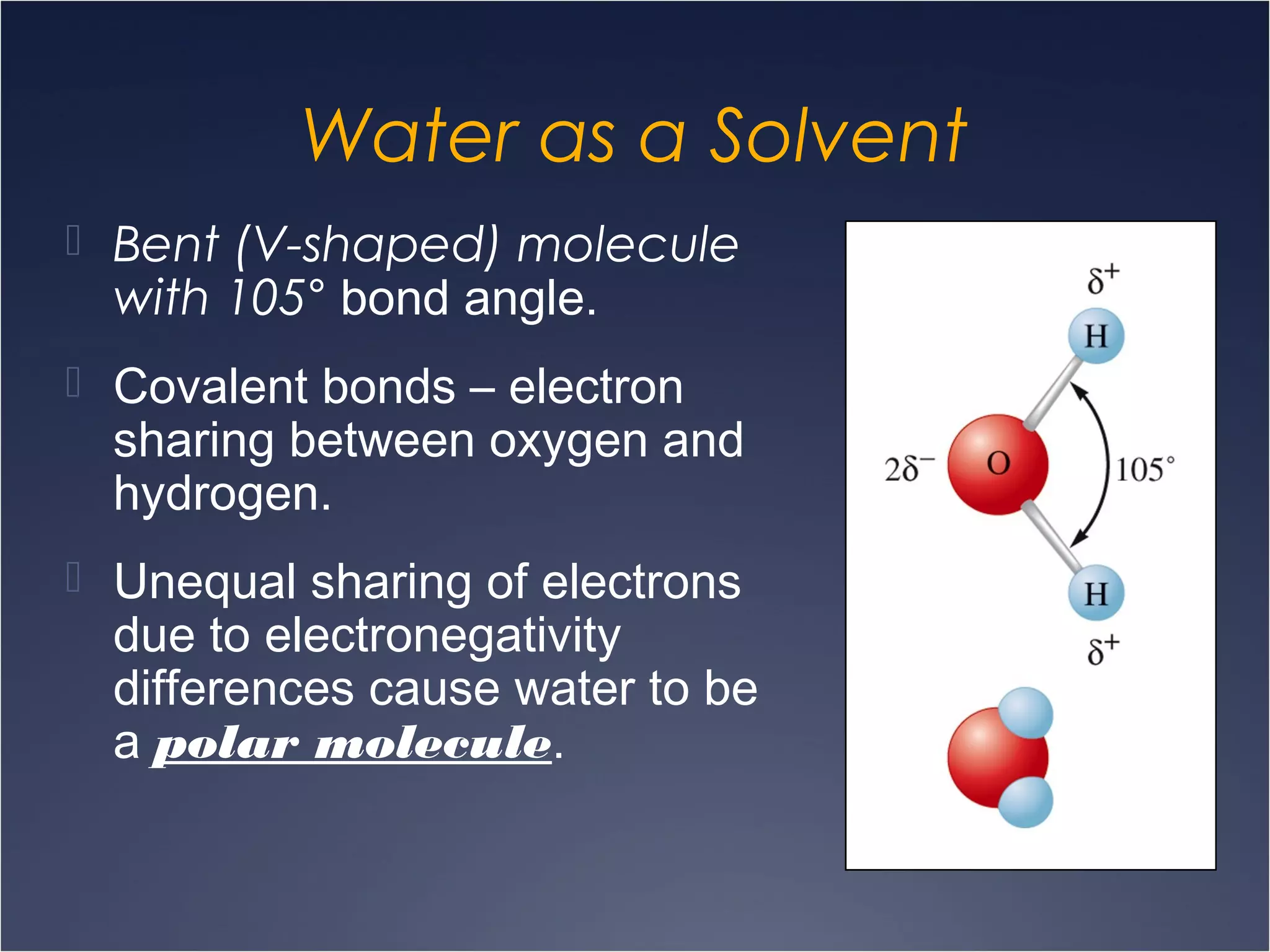
 Bent (V-shaped) molecule
with 105° bond angle.
 Covalent bonds – electron
sharing between oxygen and
hydrogen.
 Unequal sharing of electrons
due to electronegativity
differences cause water to be
a polar molecule.
Water as a Solvent
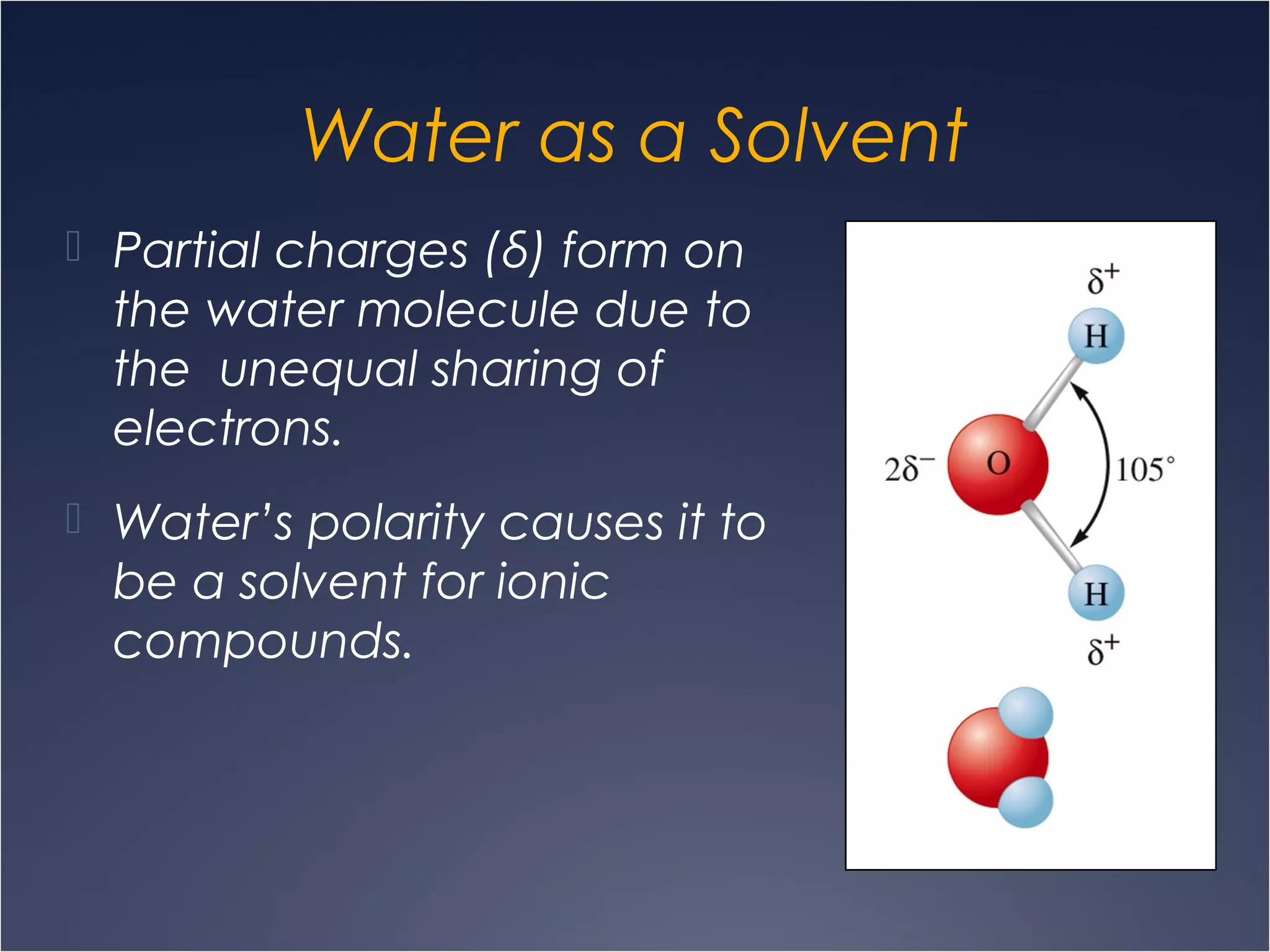
 Partial charges (δ) form on
the water molecule due to
the unequal sharing of
electrons.
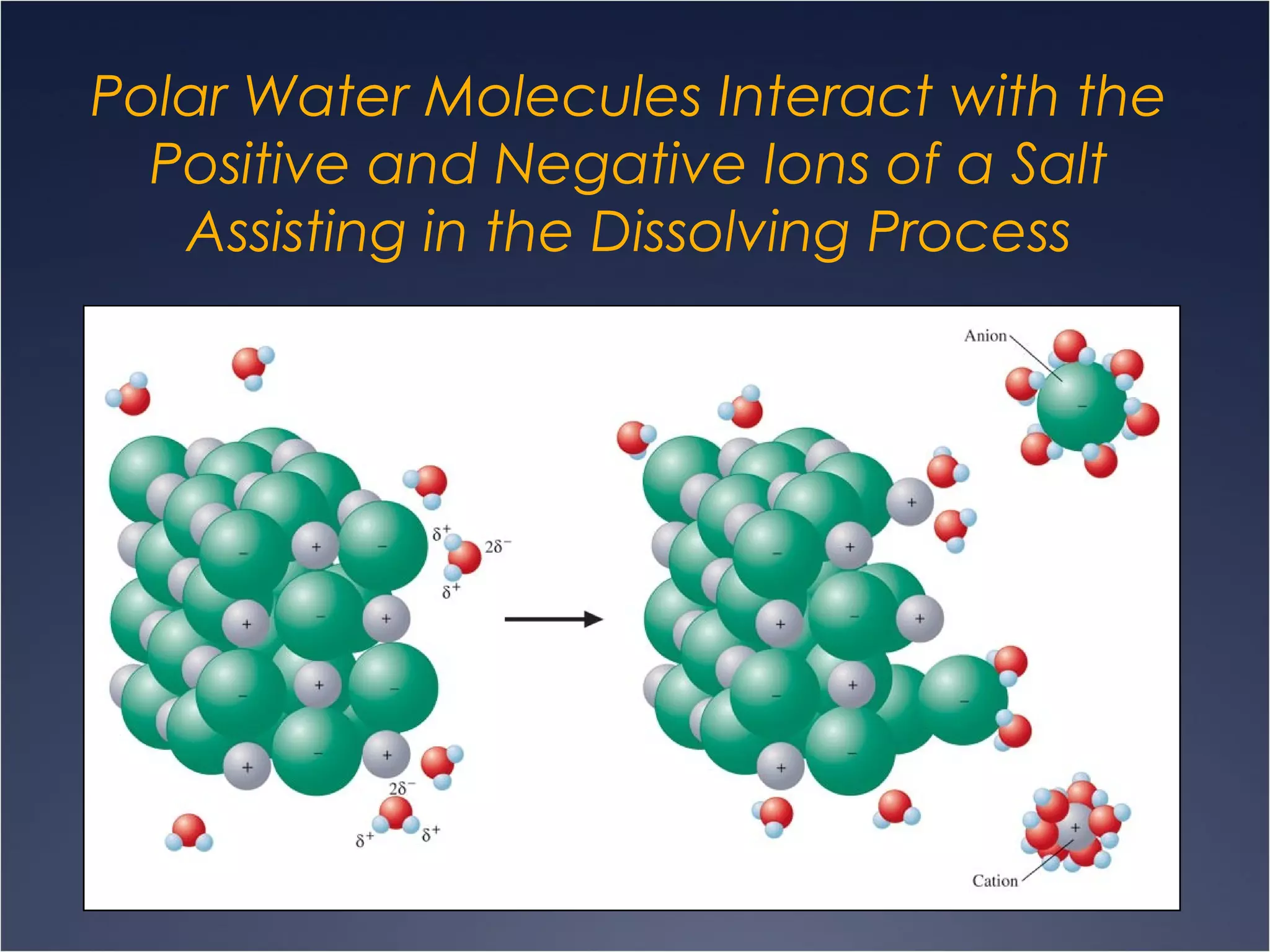
 Water’s polarity causes it to
be a solvent for ionic
compounds.
Polar Water Molecules Interact with the
Positive and Negative Ions of a Salt
Assisting in the Dissolving Process
Solubility
 Solubility of ionic substances in water varies
greatly.
 Solubility depends on the relative
attractions of the ions and water molecules
for each other.
 Once dissolved, an ionic compound
becomes hydrated, therefore ions disperse
independent of one another.
Solubility
 Water will dissolve non-ionic substances
depending upon their structure.
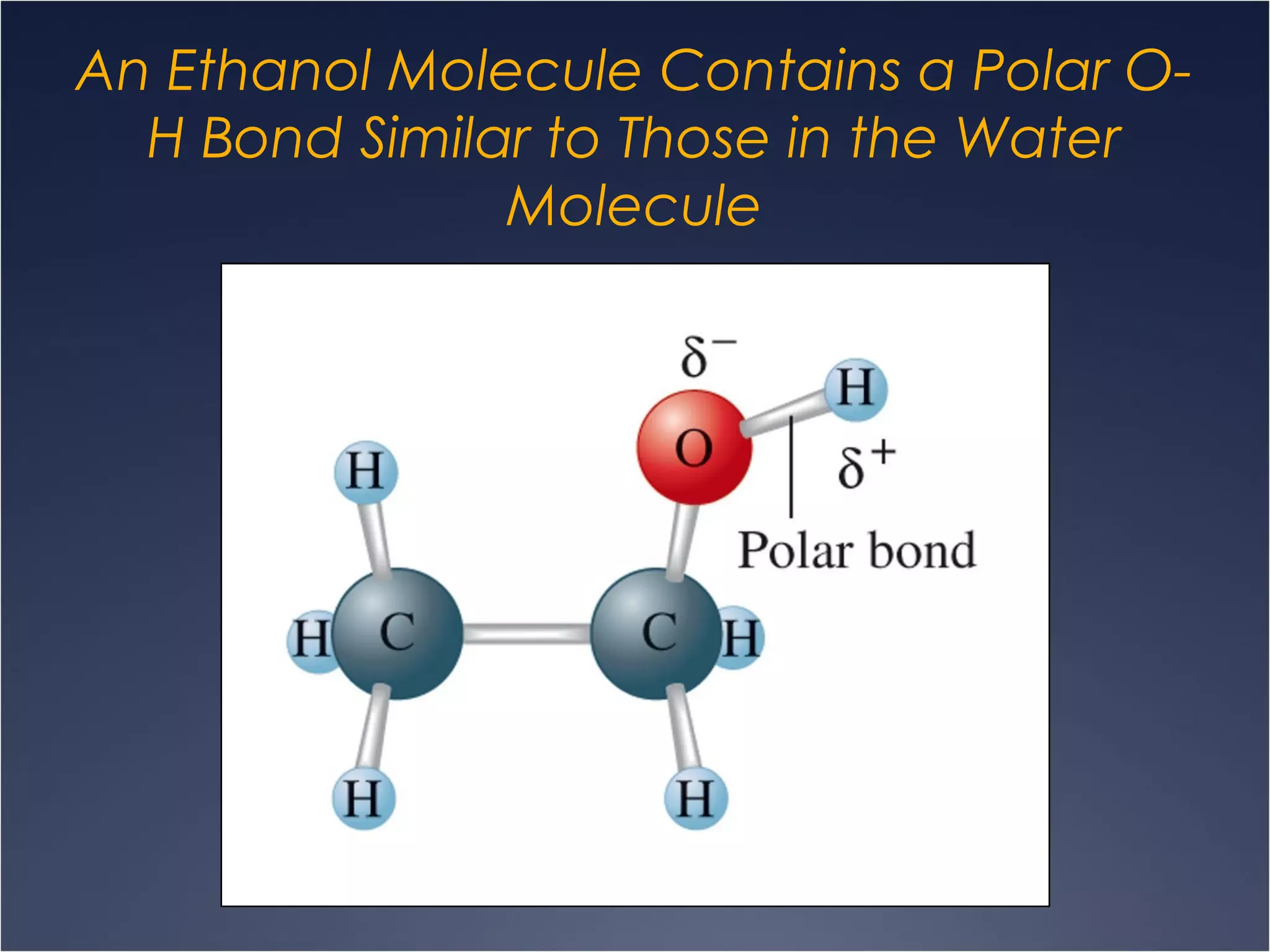
 If a polar bond exists within the
structure, the molecule can be subject
to being water soluble.
 In general, polar substances dissolve in
polar solvents and nonpolar substances
dissolve in nonpolar solvents.
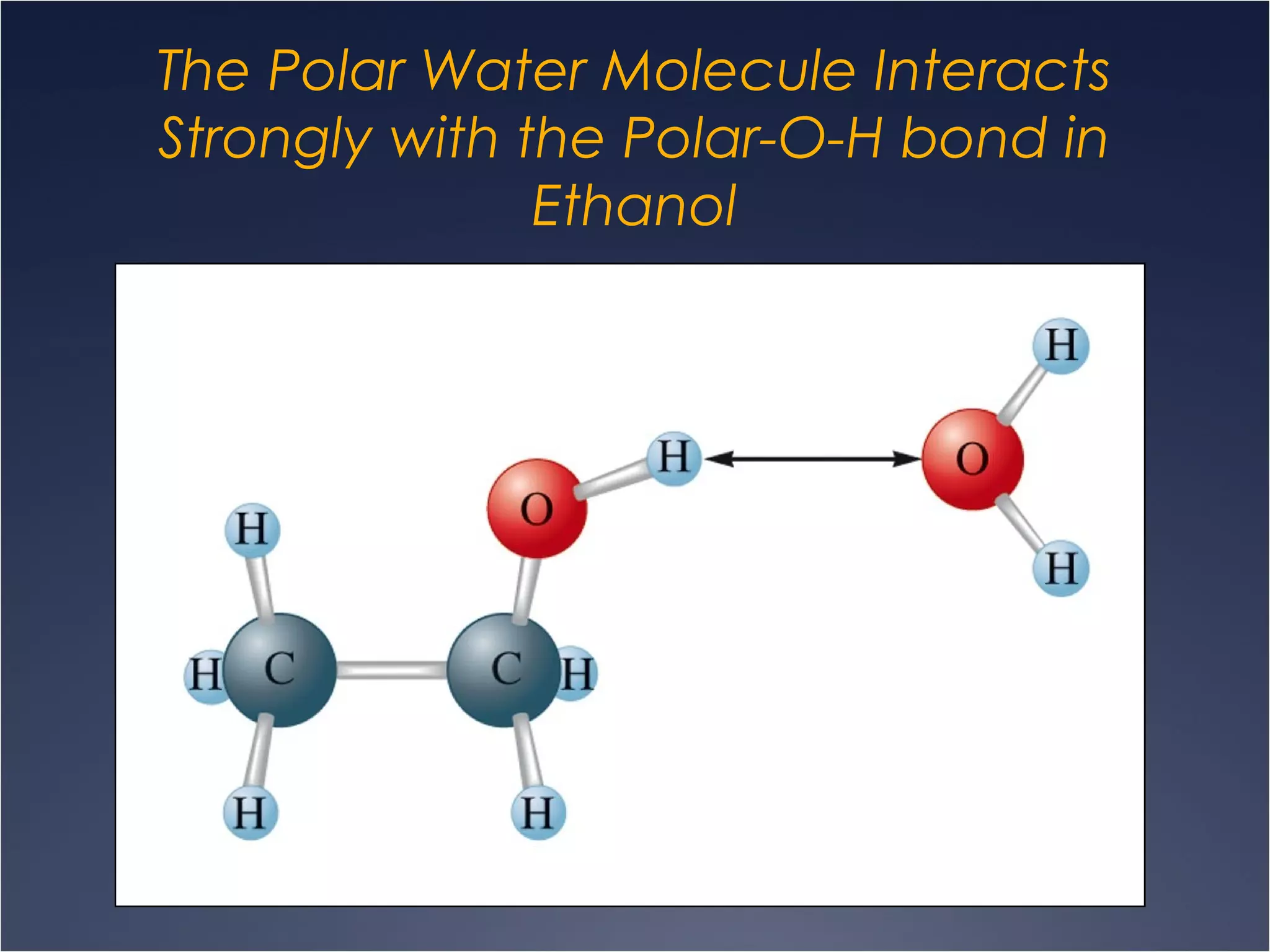
An Ethanol Molecule Contains a Polar O-
H Bond Similar to Those in the Water
Molecule
The Polar Water Molecule Interacts
Strongly with the Polar-O-H bond in
Ethanol
Strong and Weak
Nature of
Aqueous Solutions
Strong and Weak Electrolytes
 A solution in which a substance is
dissolved in water; the substance is the
solute and the solvent is the water.
 A common property for a solution is
electrical conductivity.
 Its ability to conduct an electric
current.
Strong and Weak Electrolytes
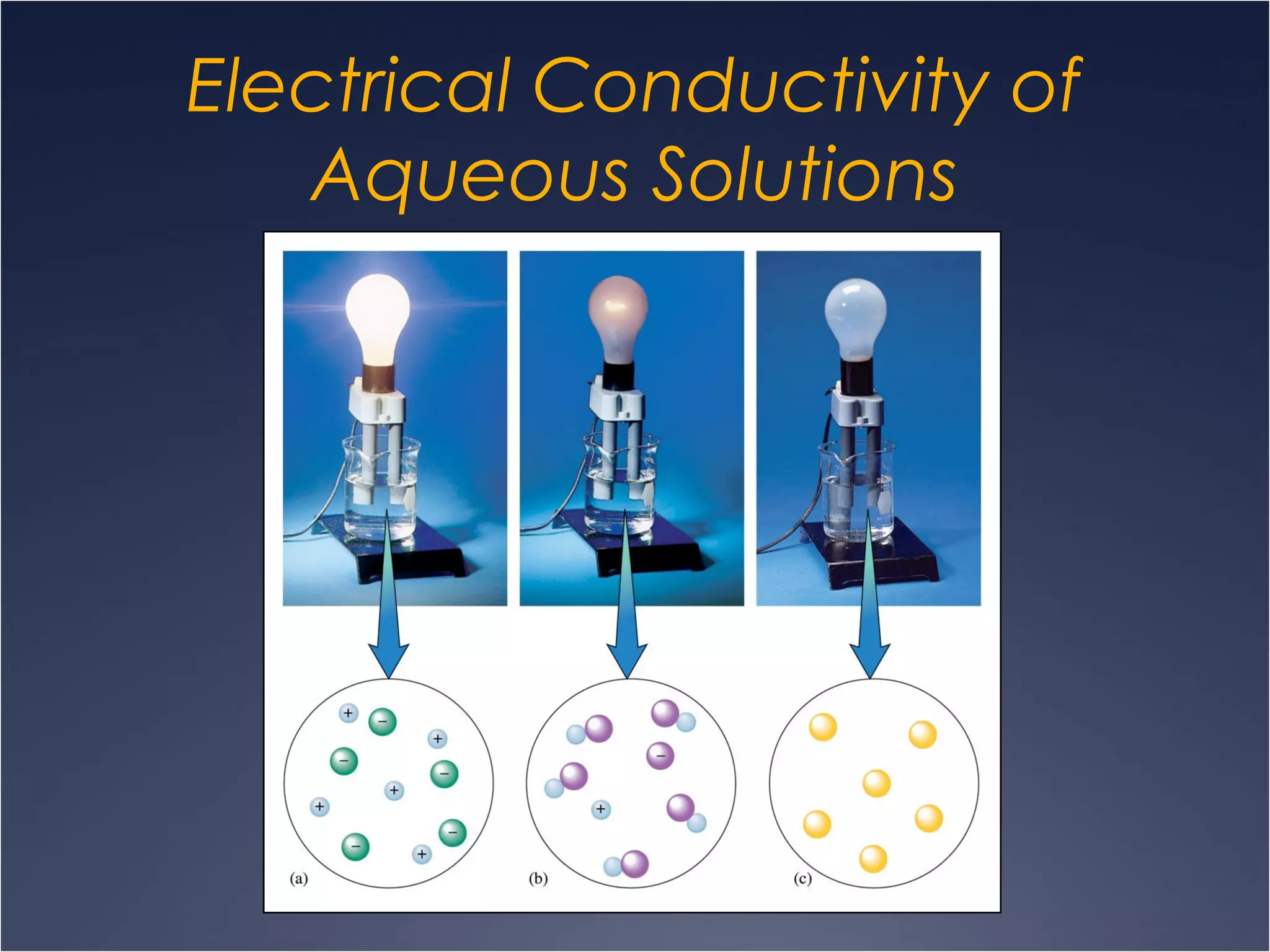
 Pure water is not an electrical conductor.
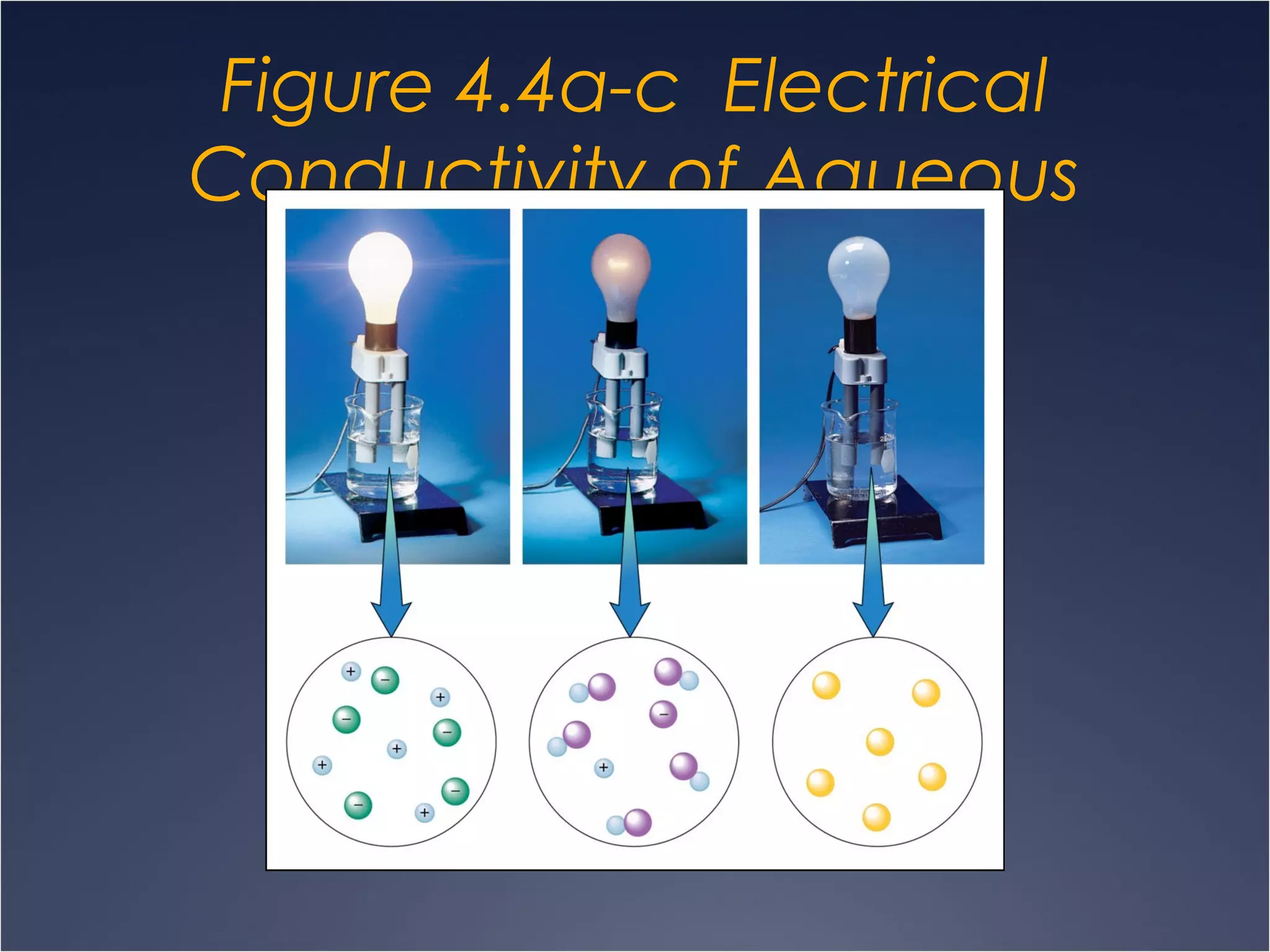
 Strong electrolytes conduct current very
efficiently.
 Weak electrolytes conduct only a small
current.
 Nonelectrolytes do not allow current to
flow.
Electrical Conductivity of
Aqueous Solutions
Svante Arrhenius
 1859-1927
 Studied the nature of solutions and
theorized that conductivity of solutions
arose from the presence of ions.
 Proved that the strength of
conductivity is directly related to the
number of ions present in solution.
Strong Electrolytes
 Strong electrolytes are substances
that are completely ionized when
they are dissolved in water.
 Soluble salts
 Strong acids
 Strong bases
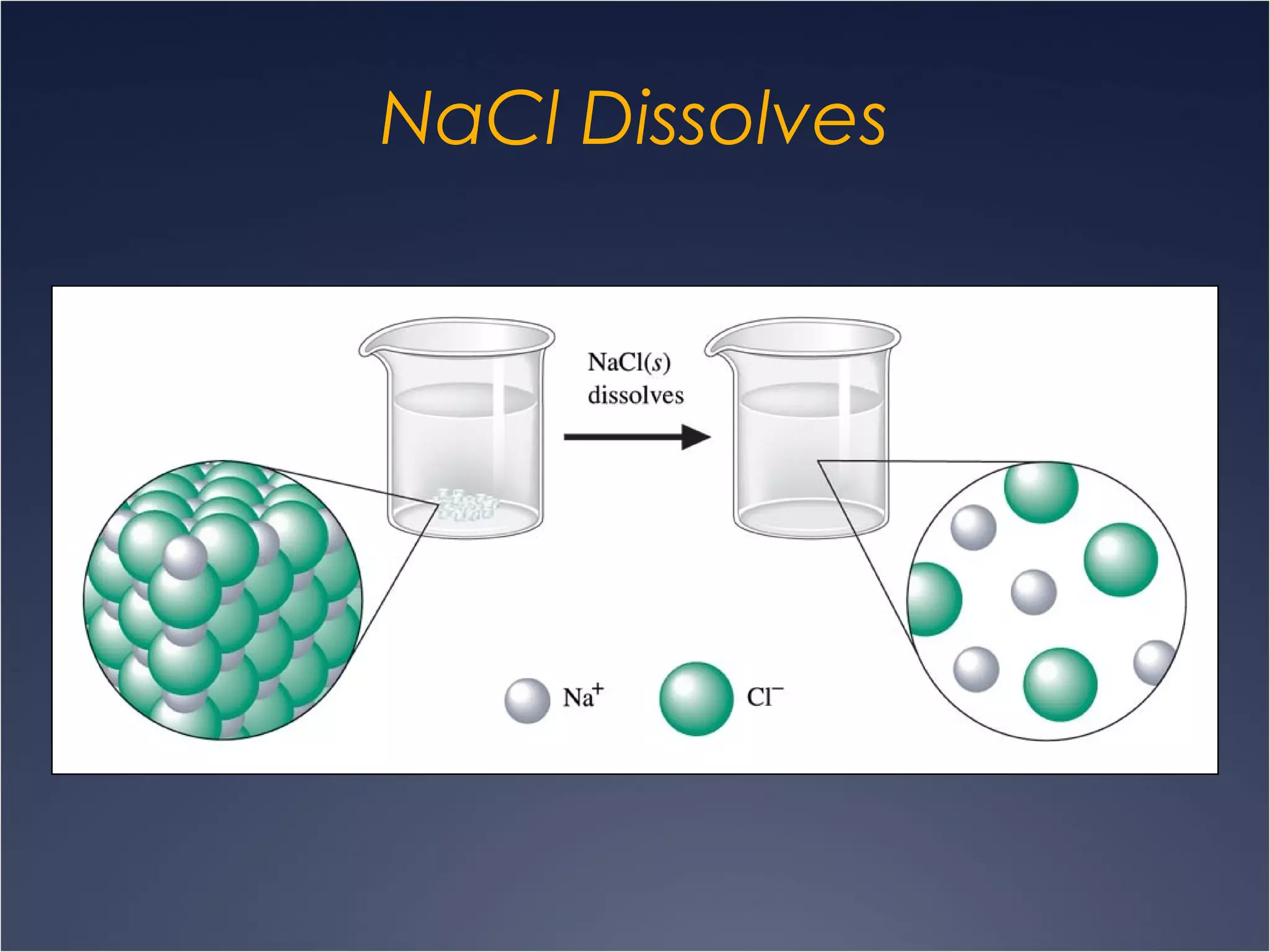
NaCl Dissolves
Acids
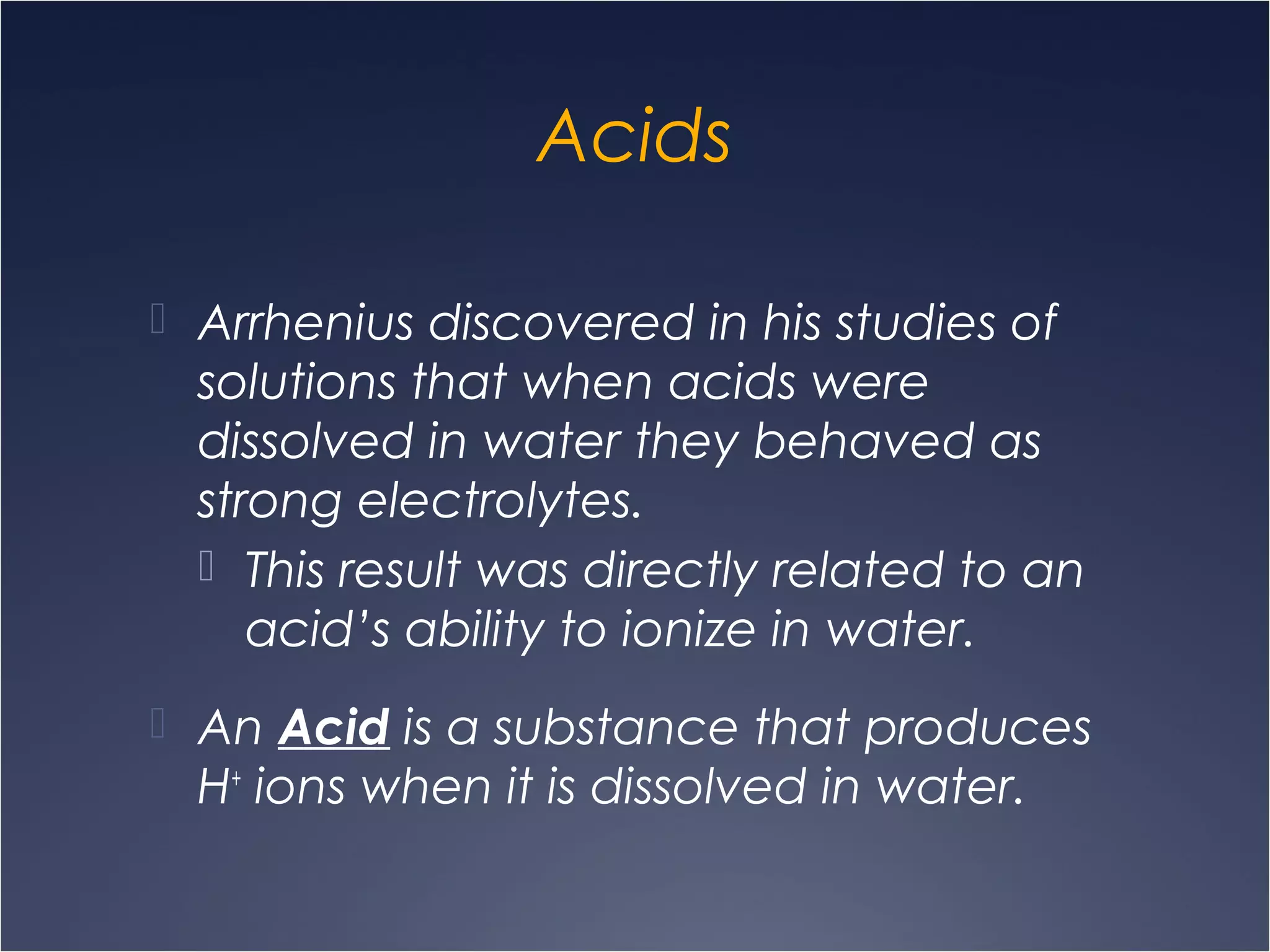
 Arrhenius discovered in his studies of
solutions that when acids were
dissolved in water they behaved as
strong electrolytes.
 This result was directly related to an
acid’s ability to ionize in water.
 An Acid is a substance that produces
H+
ions when it is dissolved in water.
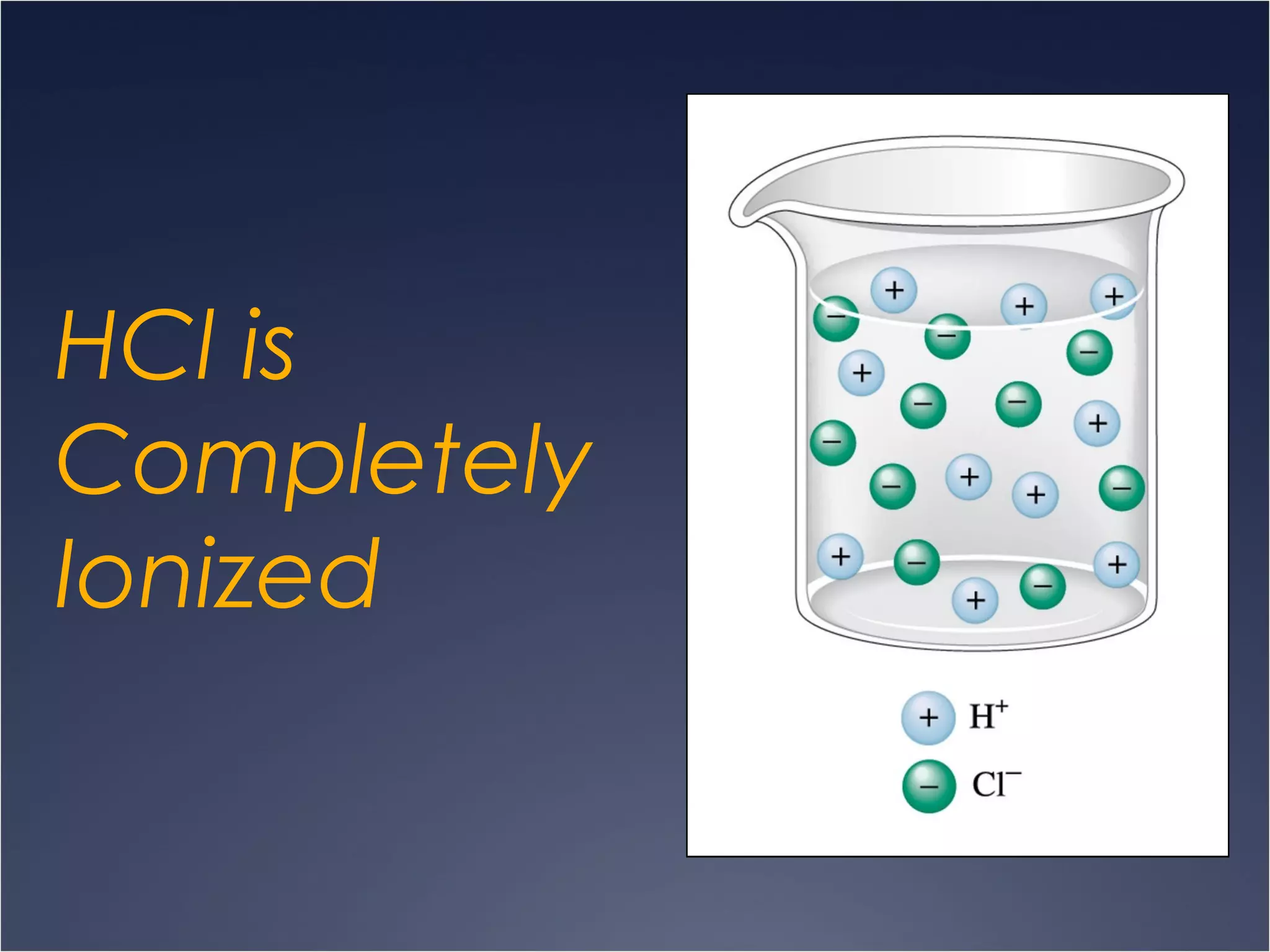
HCl is
Completely
Ionized
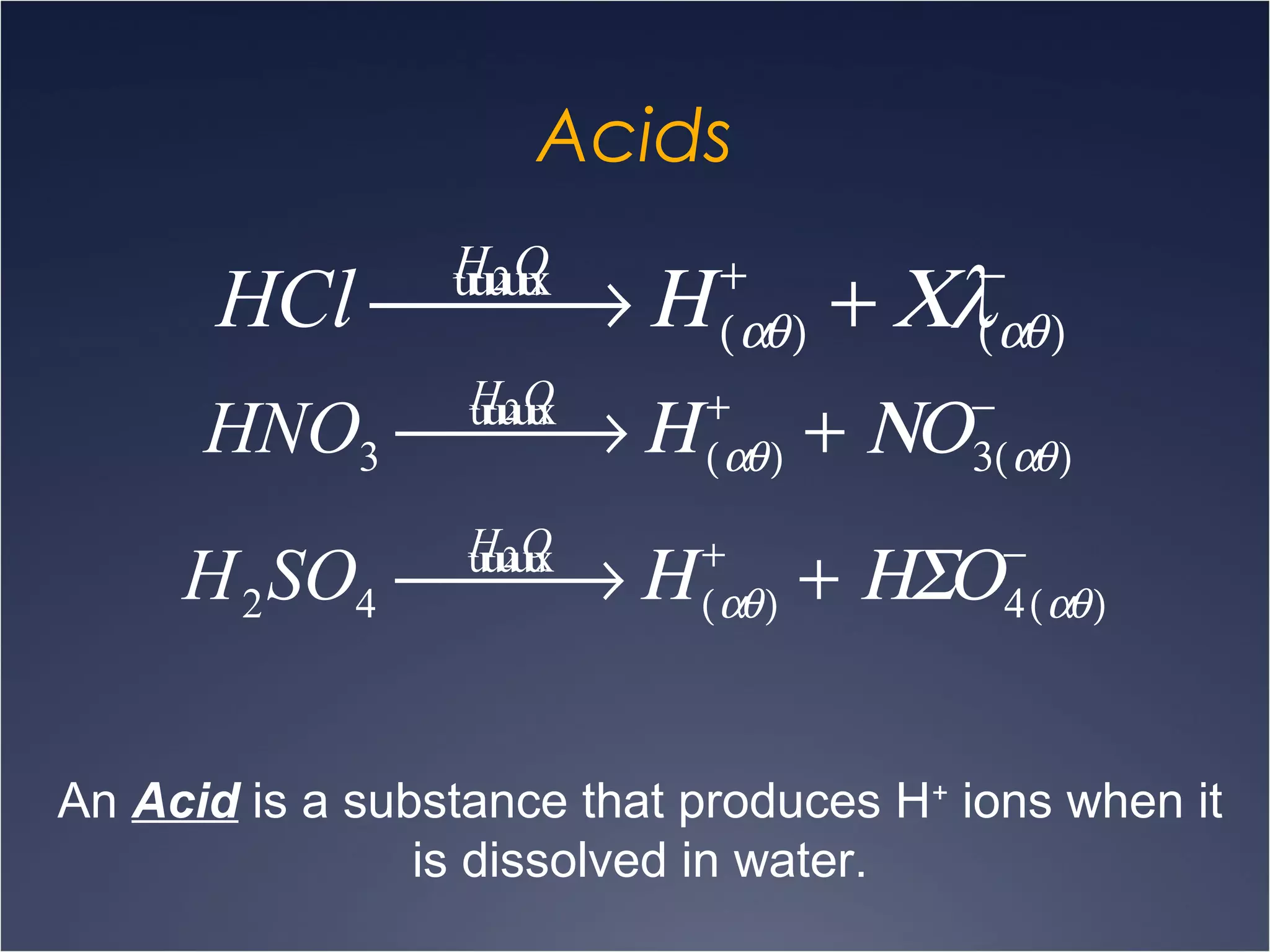
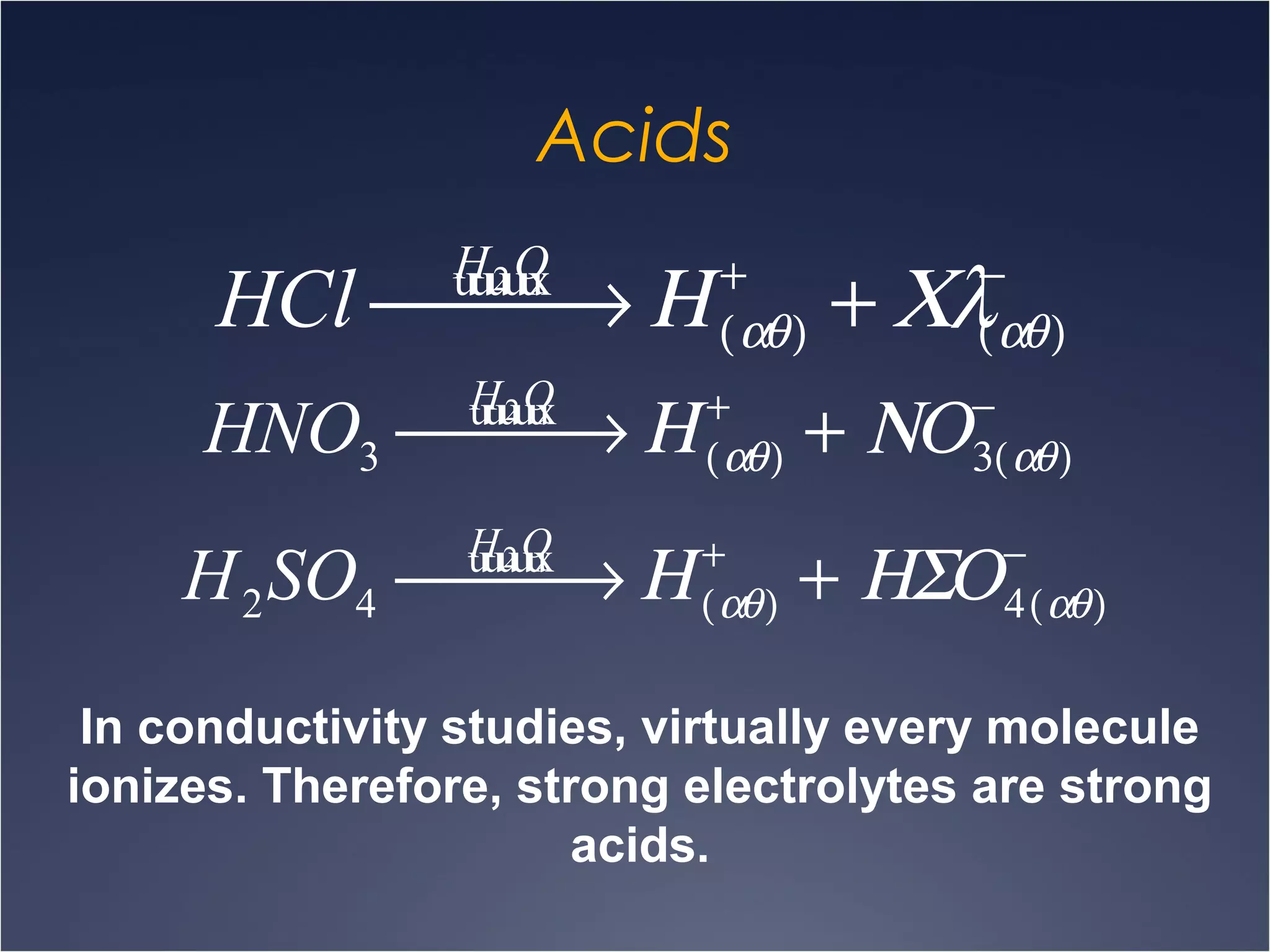
Acids
HCl
H2Ou xuuuu
 → Η +
(αθ) + Χλ−
(αθ)
HNO3
H2Ou xuuuu
 → Η +
(αθ) + ΝΟ−
3(αθ)
H2SO4
H2Ou xuuuu
 → Η +
(αθ) + ΗΣΟ−
4(αθ)
An Acid is a substance that produces H+
ions when it
is dissolved in water.
Acids
HCl
H2Ou xuuuu
 → Η +
(αθ) + Χλ−
(αθ)
HNO3
H2Ou xuuuu
 → Η +
(αθ) + ΝΟ−
3(αθ)
H2SO4
H2Ou xuuuu
 → Η +
(αθ) + ΗΣΟ−
4(αθ)
In conductivity studies, virtually every molecule
ionizes. Therefore, strong electrolytes are strong
acids.
Strong Acids
 Sulfuric acid, nitric acid and hydrochloric
acid are aqueous solutions and should be
written in chemical equations as such.
 A strong acid is one that completely
dissociates into its ions. In aqueous solutions,
the HCl molecule does not exist.
 Sulfuric acid can produce two H+
ions per
molecule. Only the first H+
ion completely
dissociates. The anion HSO4
-
remains partially
intact.
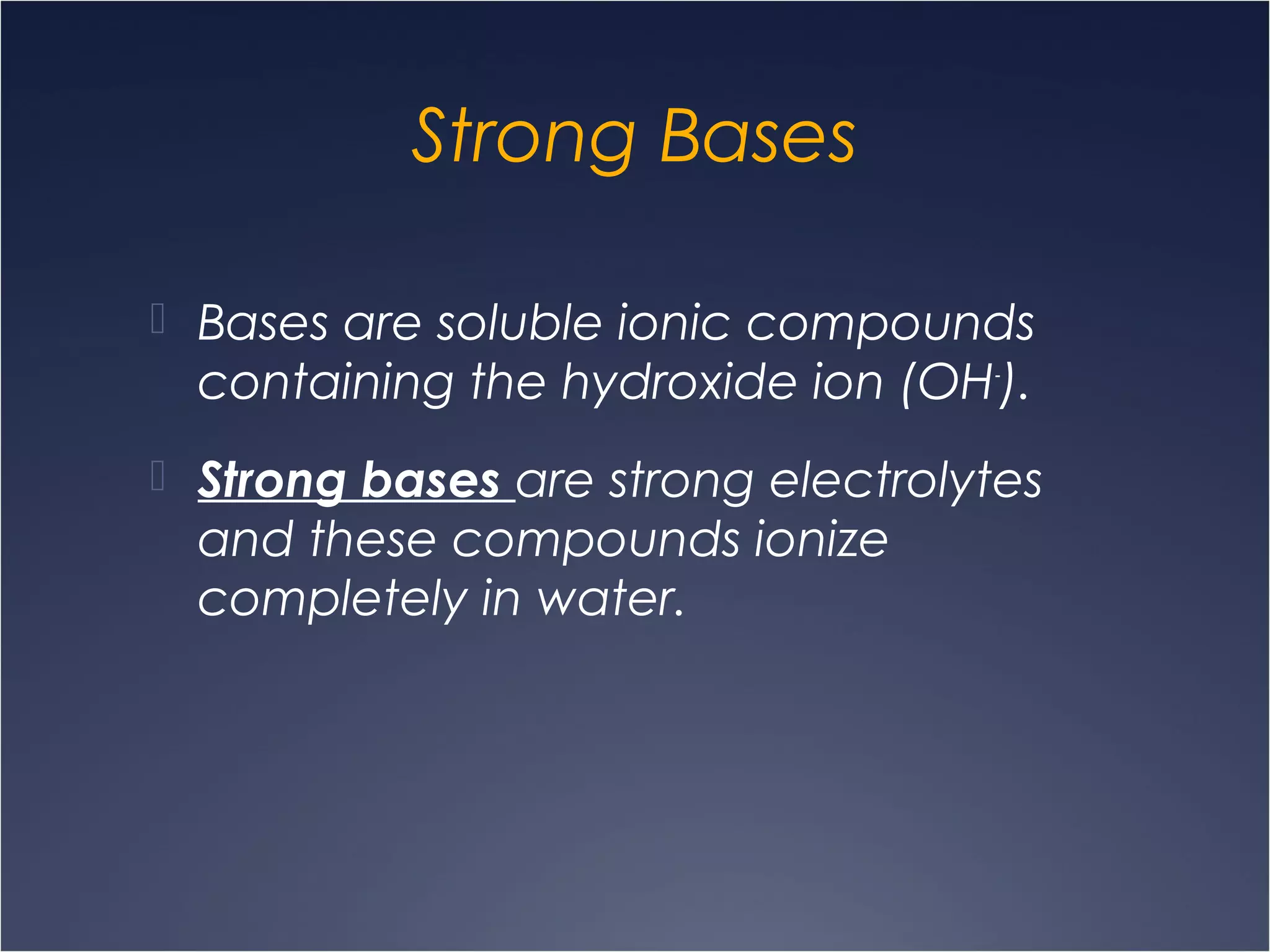
Strong Bases
 Bases are soluble ionic compounds
containing the hydroxide ion (OH-
).
 Strong bases are strong electrolytes
and these compounds ionize
completely in water.
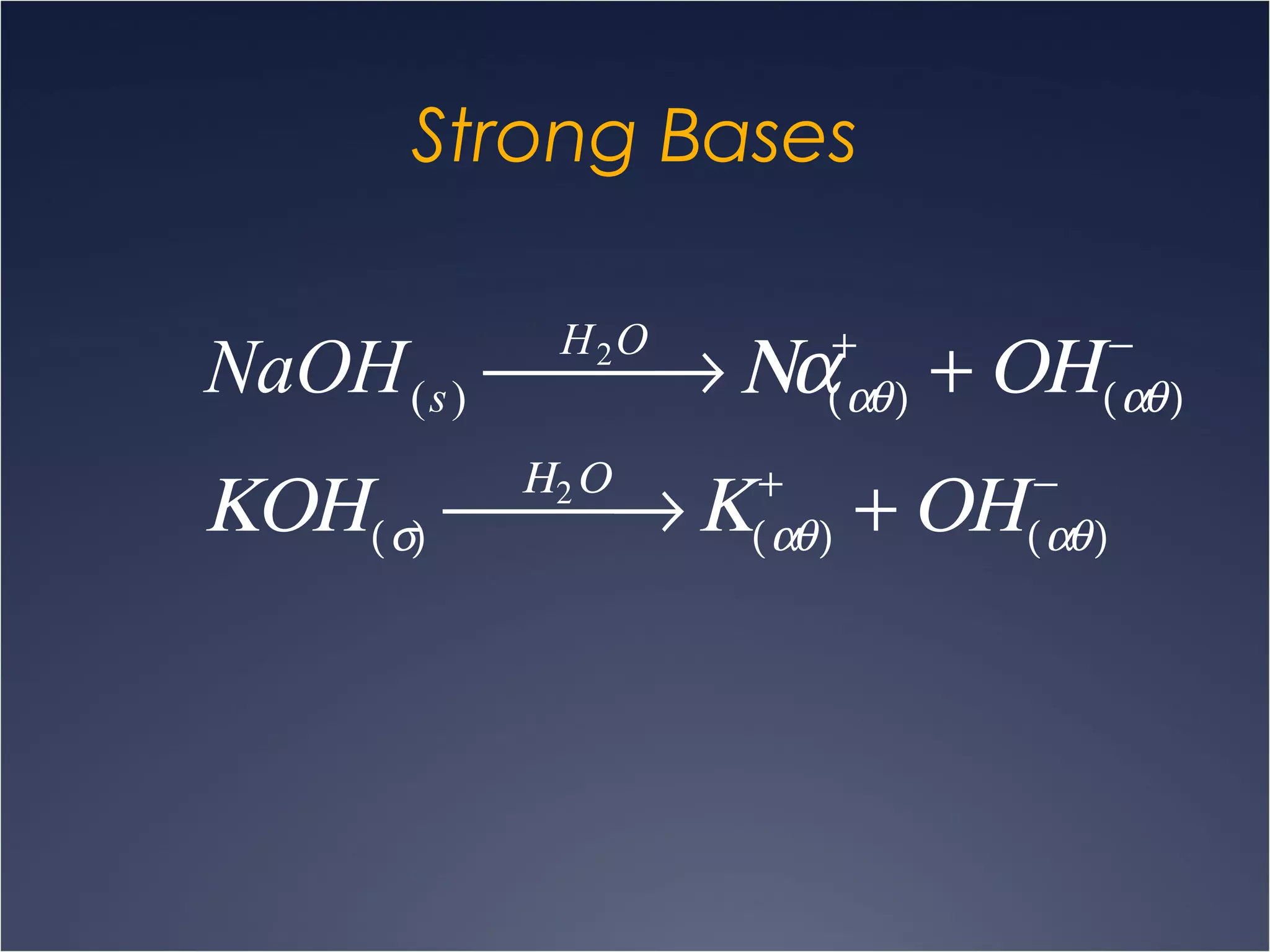
Strong Bases
NaOH(s)
H2O
 → Να(αθ)
+
+ ΟΗ(αθ)
−
ΚΟΗ(σ)
Η2Ο
 → Κ(αθ)
+
+ ΟΗ(αθ)
−
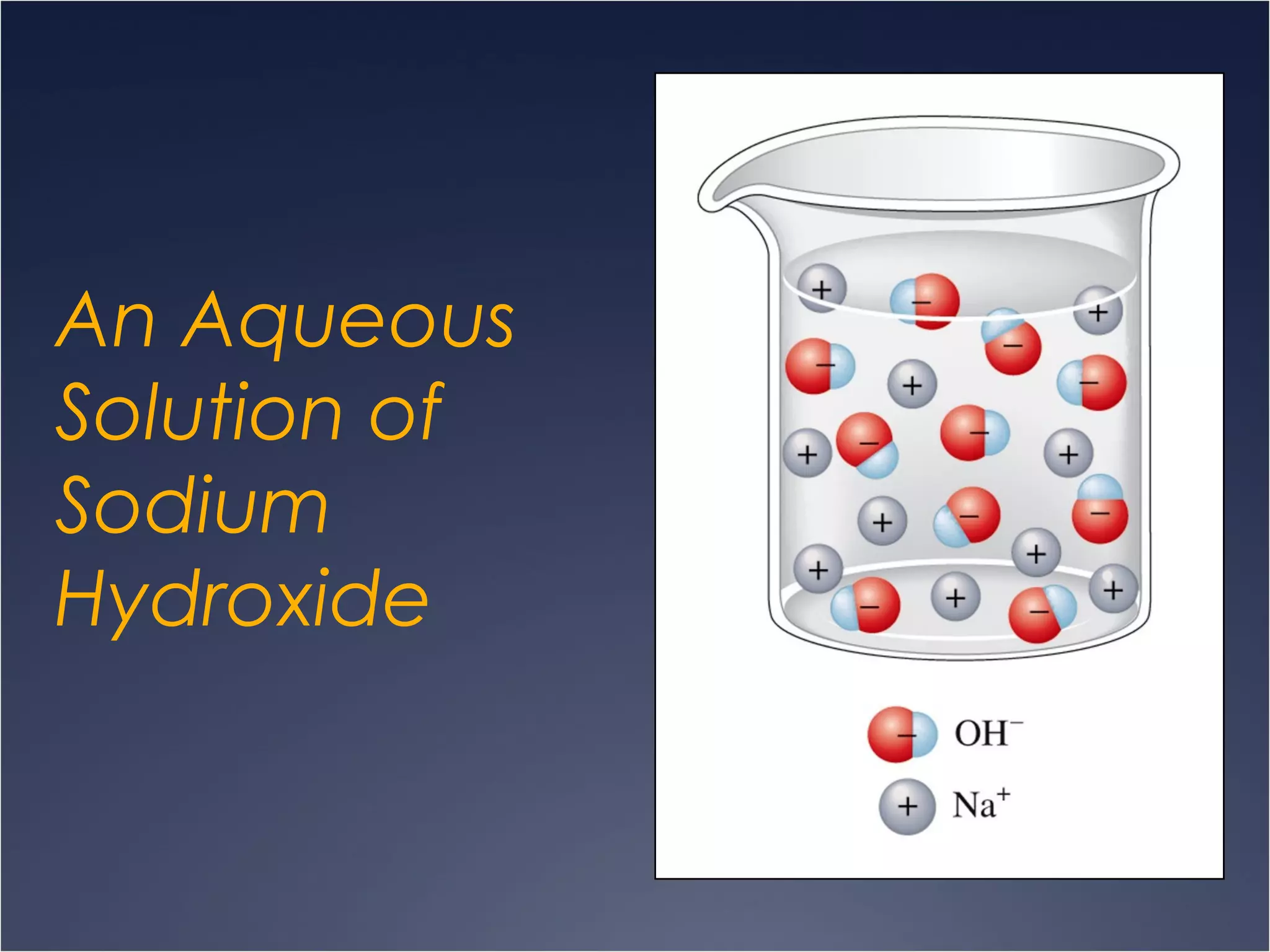
An Aqueous
Solution of
Sodium
Hydroxide
Weak Electrolytes
 Weak electrolytes are substances that
exhibit a small degree of ionization in
water.
 They produce relatively few ions when
dissolved in water
 Most common weak electrolytes are
weak acids and weak bases.
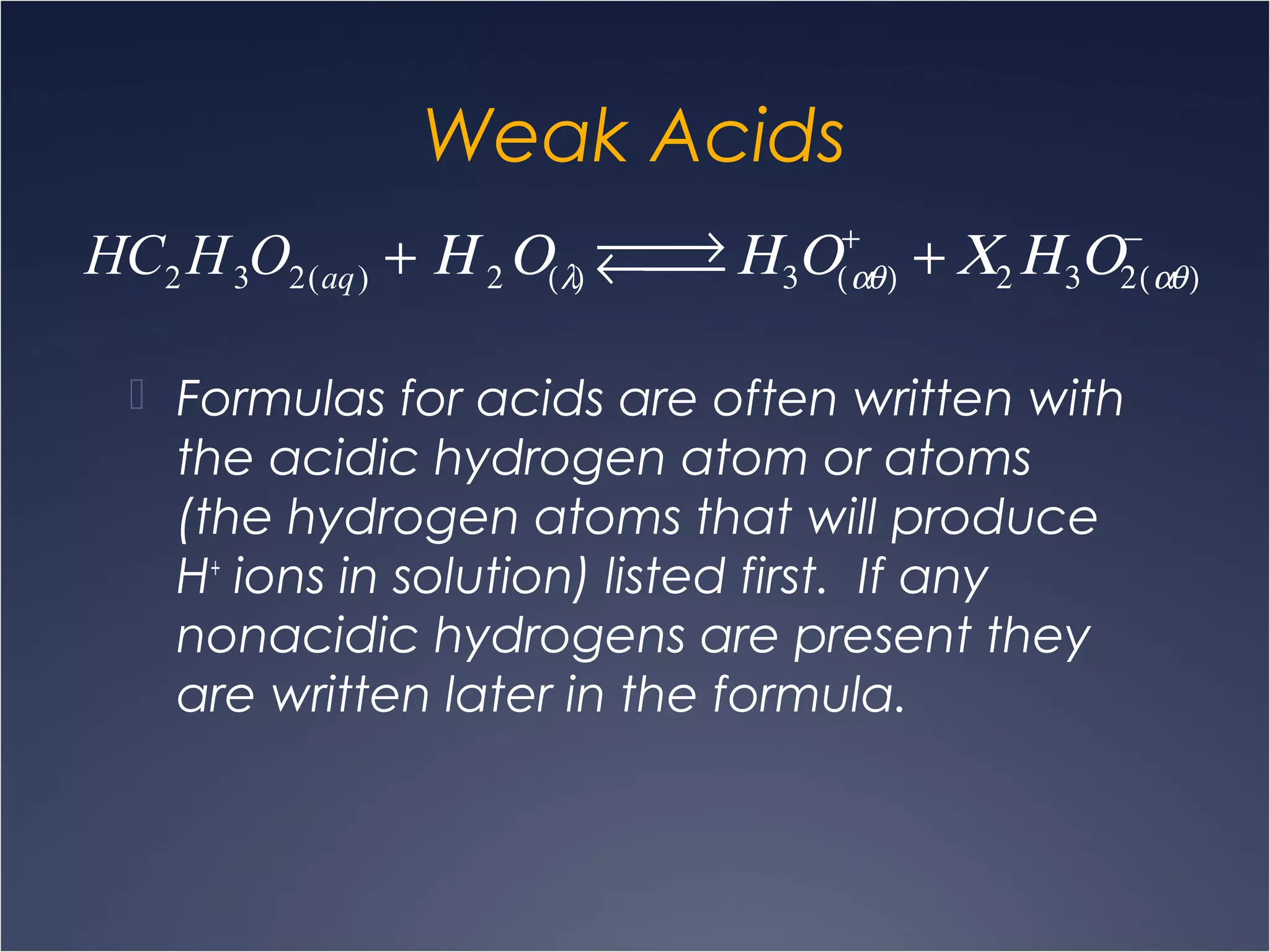
Weak Acids
 Formulas for acids are often written with
the acidic hydrogen atom or atoms
(the hydrogen atoms that will produce
H+
ions in solution) listed first. If any
nonacidic hydrogens are present they
are written later in the formula.
HC2 H3O2(aq) + Η 2Ο(λ)
 →←  Η3Ο(αθ)
+
+ Χ2 Η3Ο2(αθ)
−
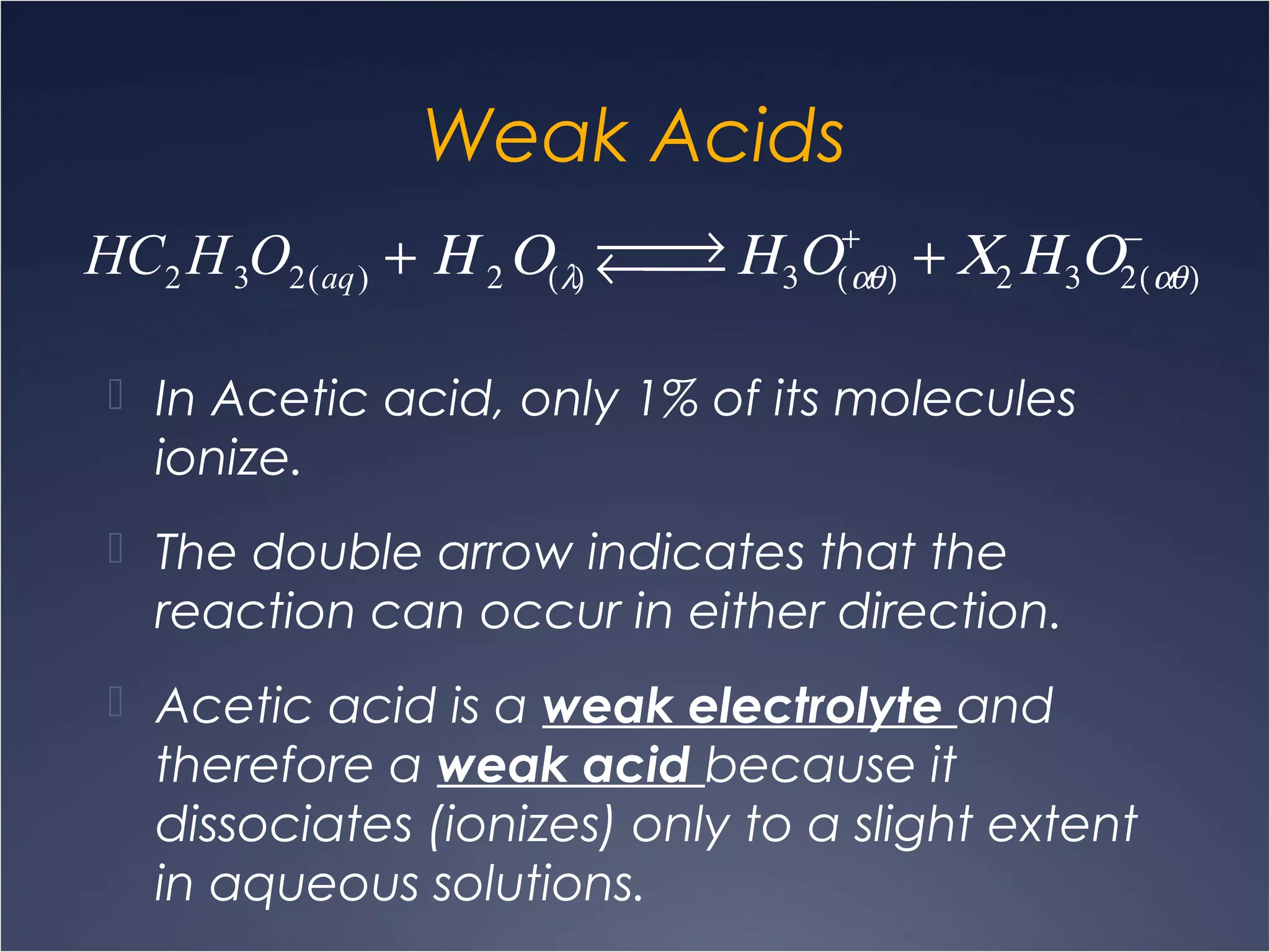
Weak Acids
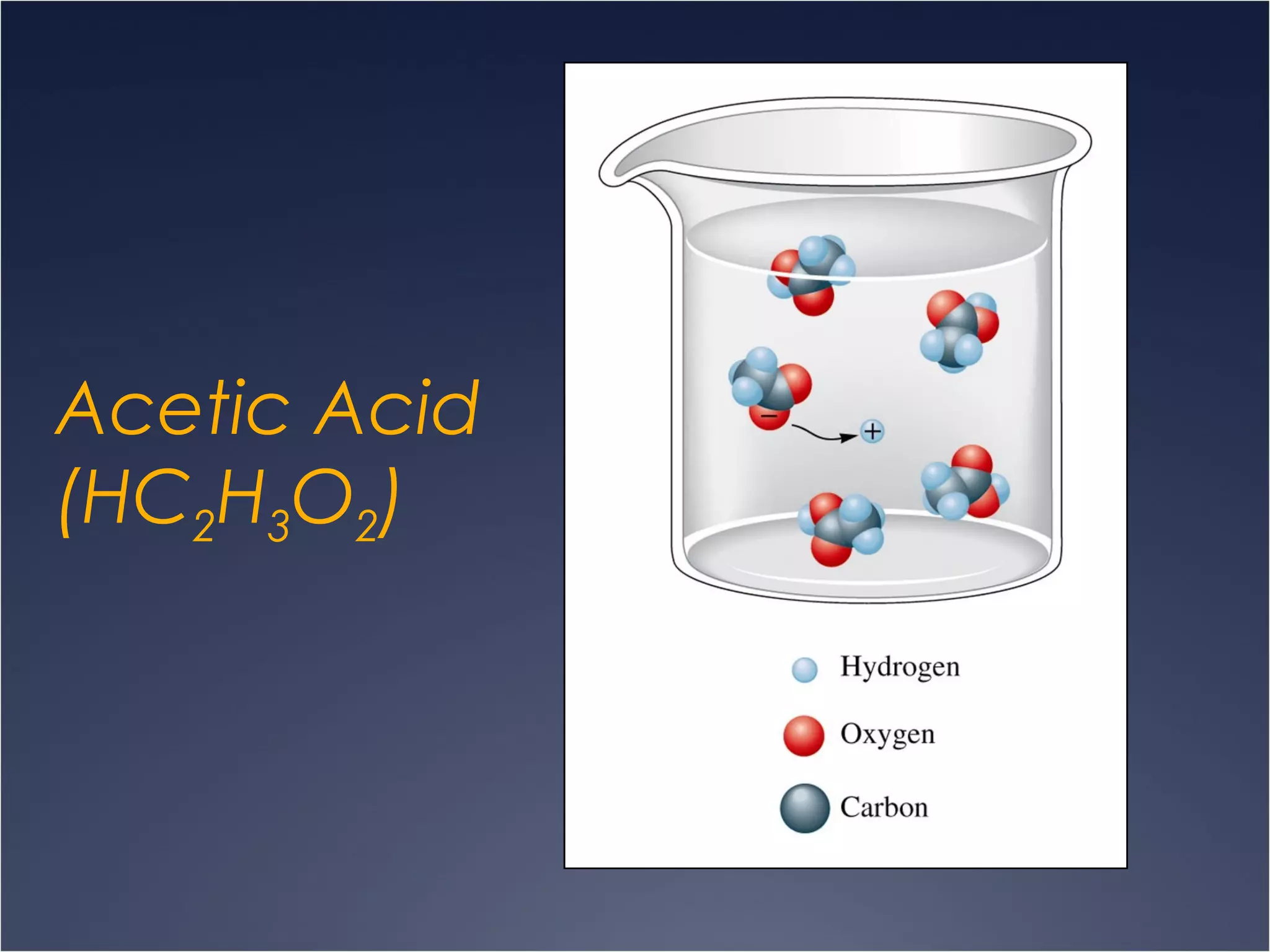
 In Acetic acid, only 1% of its molecules
ionize.
 The double arrow indicates that the
reaction can occur in either direction.
 Acetic acid is a weak electrolyte and
therefore a weak acid because it
dissociates (ionizes) only to a slight extent
in aqueous solutions.
HC2 H3O2(aq) + Η 2Ο(λ)
 →←  Η3Ο(αθ)
+
+ Χ2 Η3Ο2(αθ)
−
Acetic Acid
(HC2H3O2)
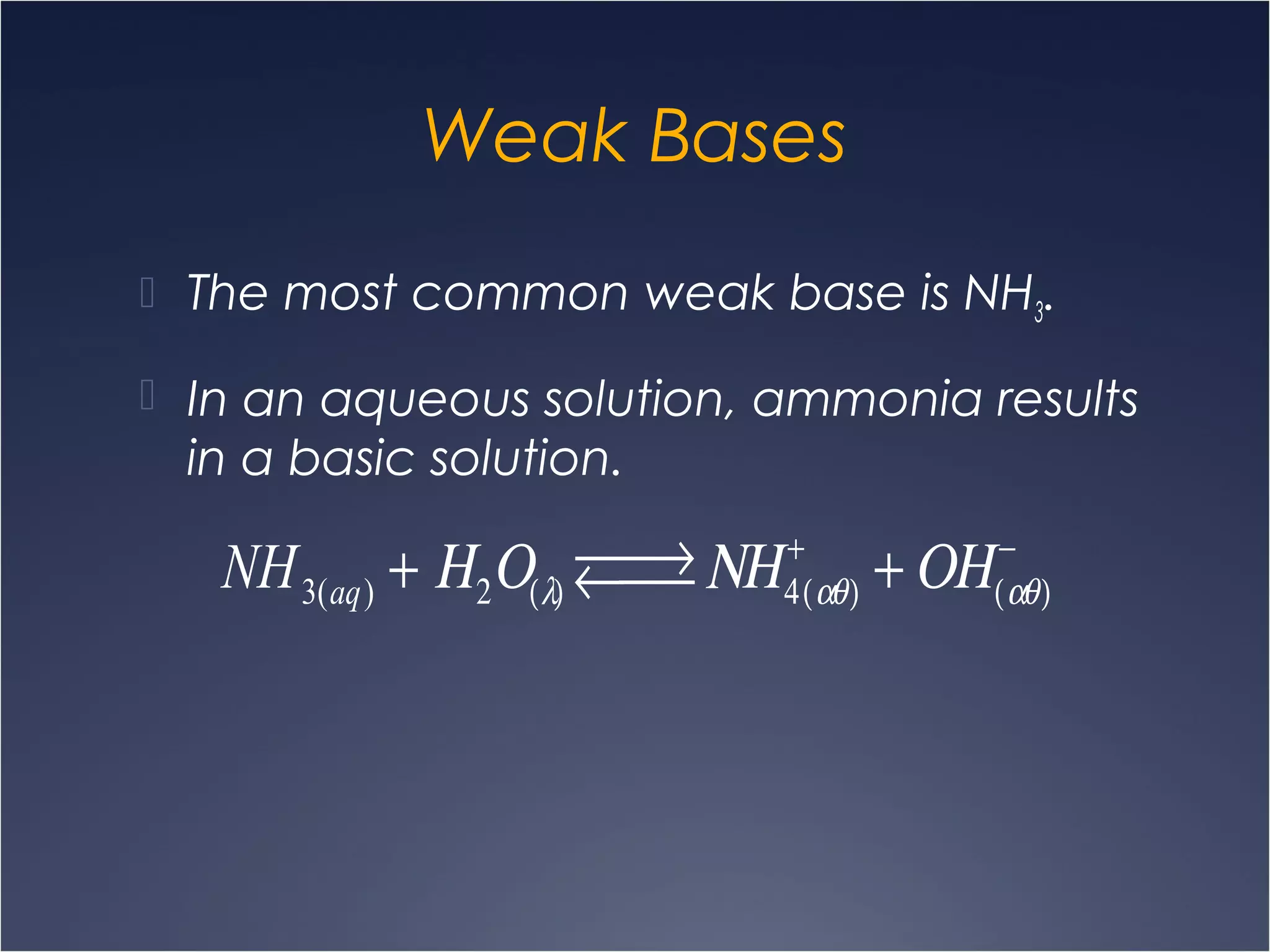
Weak Bases
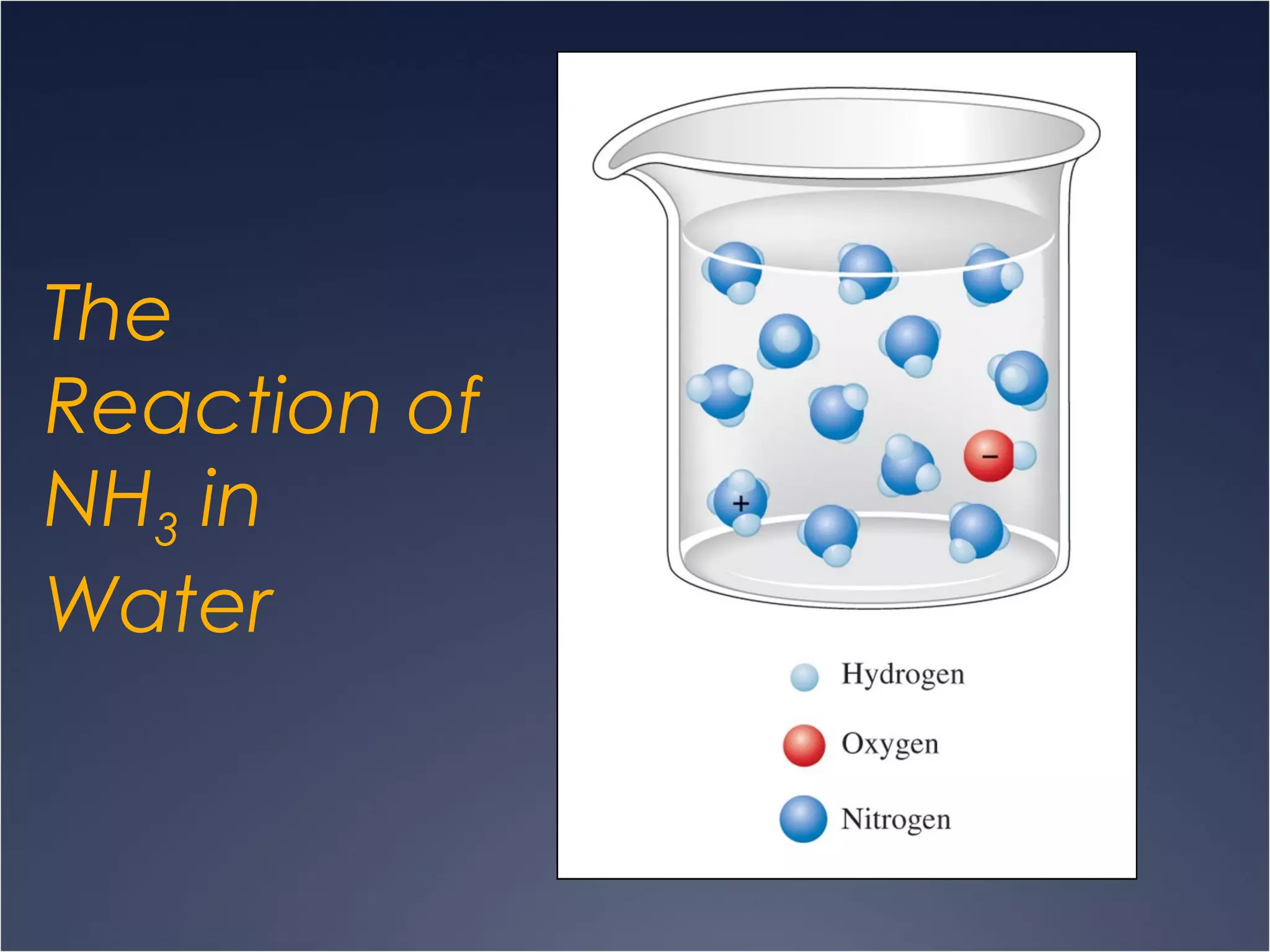
 The most common weak base is NH3.
 In an aqueous solution, ammonia results
in a basic solution.
NH3(aq) + Η2Ο(λ)
 →←  ΝΗ4(αθ)
+
+ ΟΗ(αθ)
−
The
Reaction of
NH3 in
Water
Nonelectrolytes
 Nonelectrolytes are substances that
dissolve in water but do not produce
any ions.
The Composition of Solutions
Concentration:
Solutions
 Most chemical reactions take place in the
environment of solutions. In order to perform
stoichiometric calculations in solutions, one
must know two things.
 The nature of the reaction; which depends
on the exact forms the chemicals take
when dissolved.
 The amounts of the chemicals present in
the solutions, usually expressed as
concentrations.
Concentration
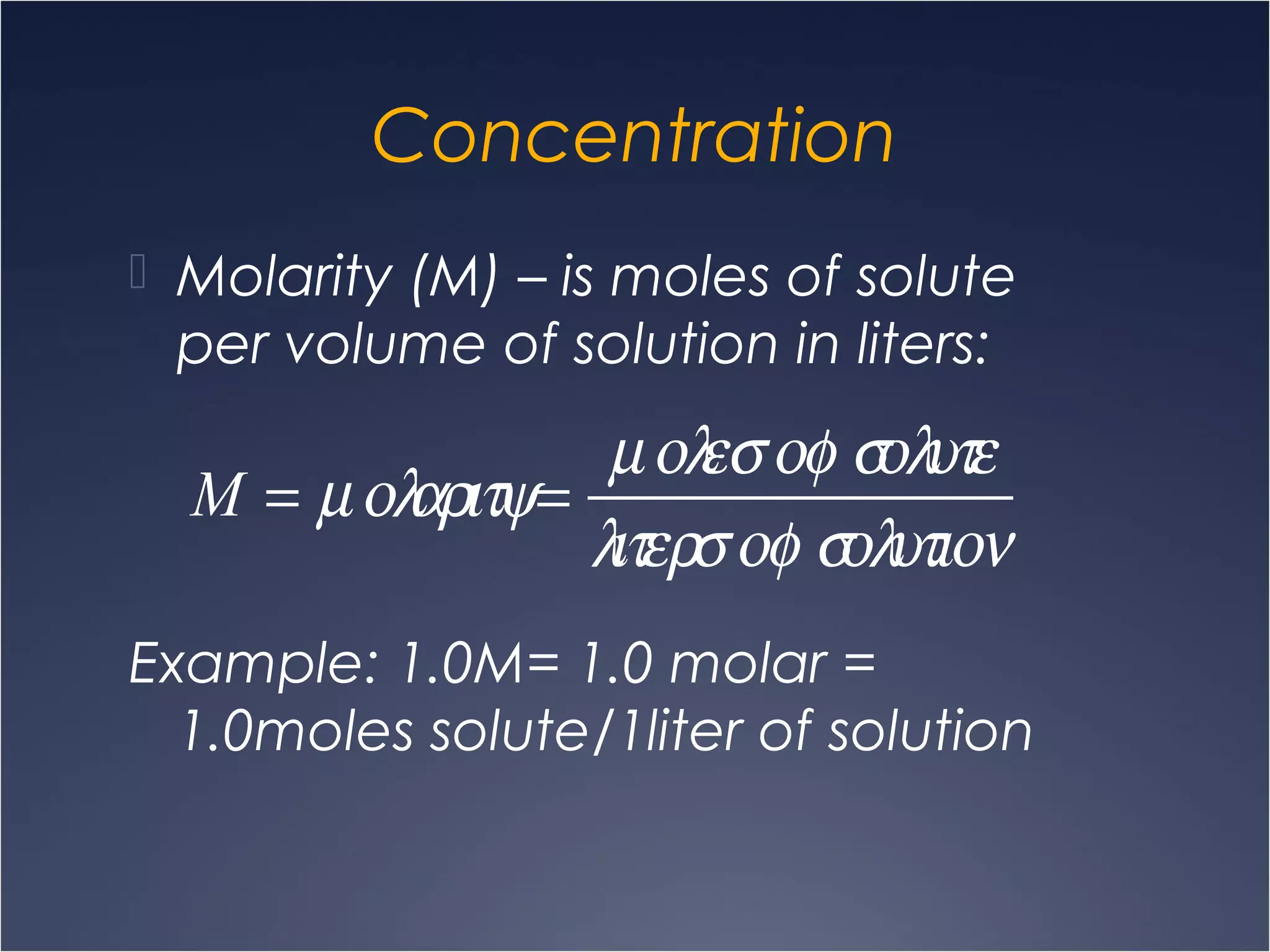
 Molarity (M) – is moles of solute
per volume of solution in liters:
Example: 1.0M= 1.0 molar =
1.0moles solute/1liter of solution
M = µολαριτψ=
µολεσοφ σολυτε
λιτερσοφ σολυτιον
Example
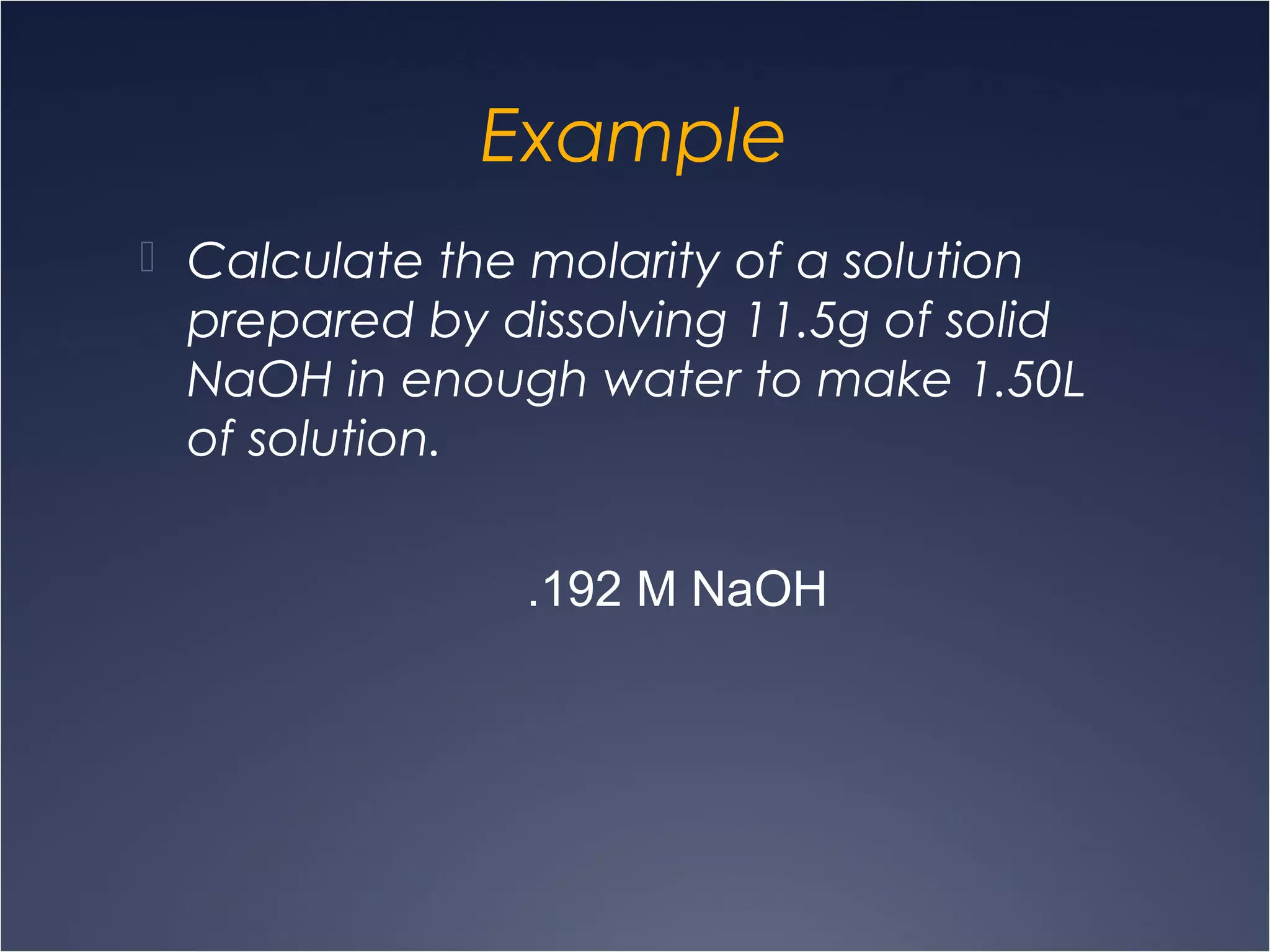
 Calculate the molarity of a solution
prepared by dissolving 11.5g of solid
NaOH in enough water to make 1.50L
of solution.
.192 M NaOH
Example
 Calculate the molarity of a solution
prepared by dissolving 1.56g of
gaseous HCl in enough water to make
26.8 ml of solution.
1.60M HCl
Example
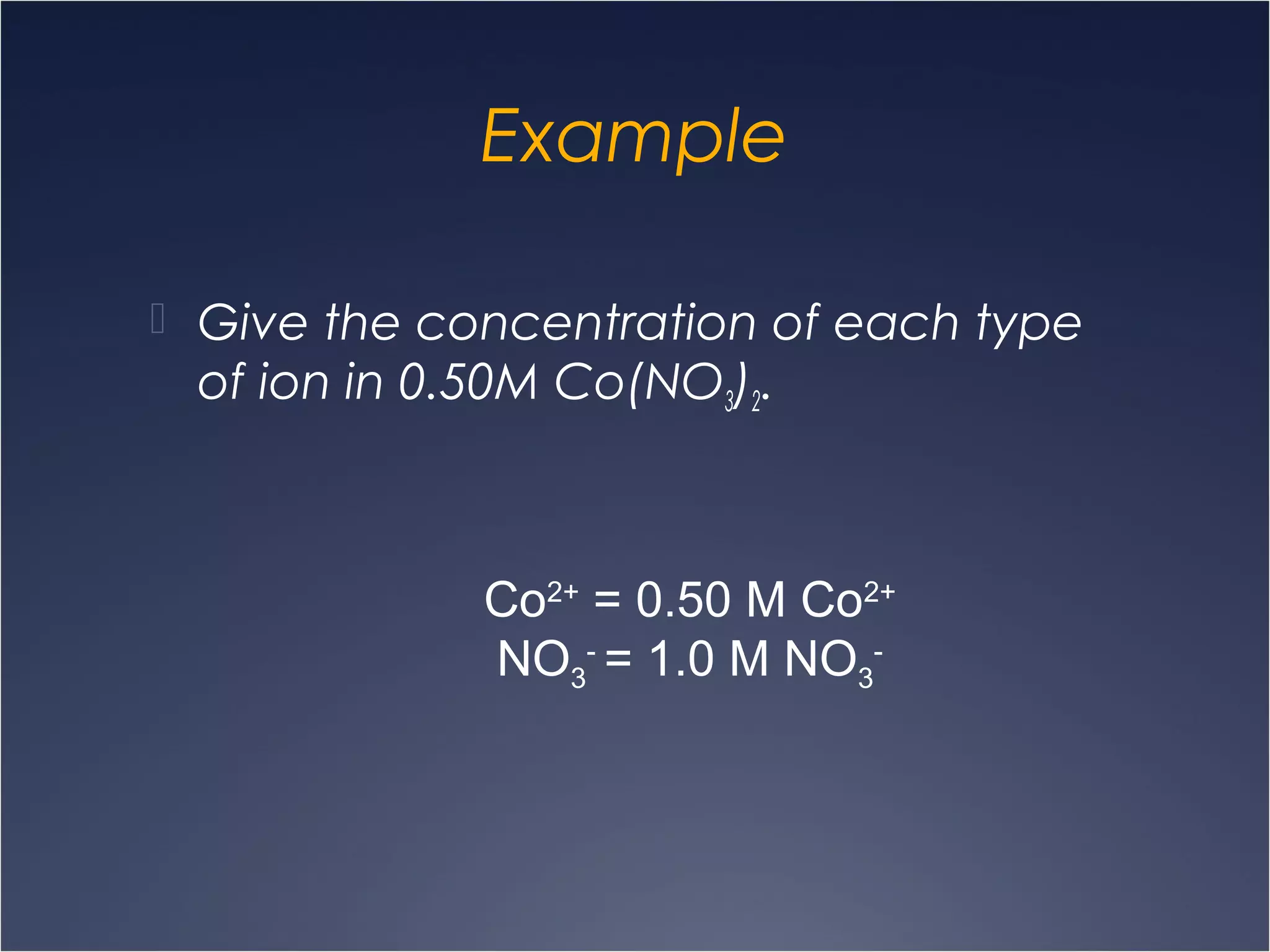
 Give the concentration of each type
of ion in 0.50M Co(NO3)2.
Co2+
= 0.50 M Co2+
NO3
-
= 1.0 M NO3
-
Example
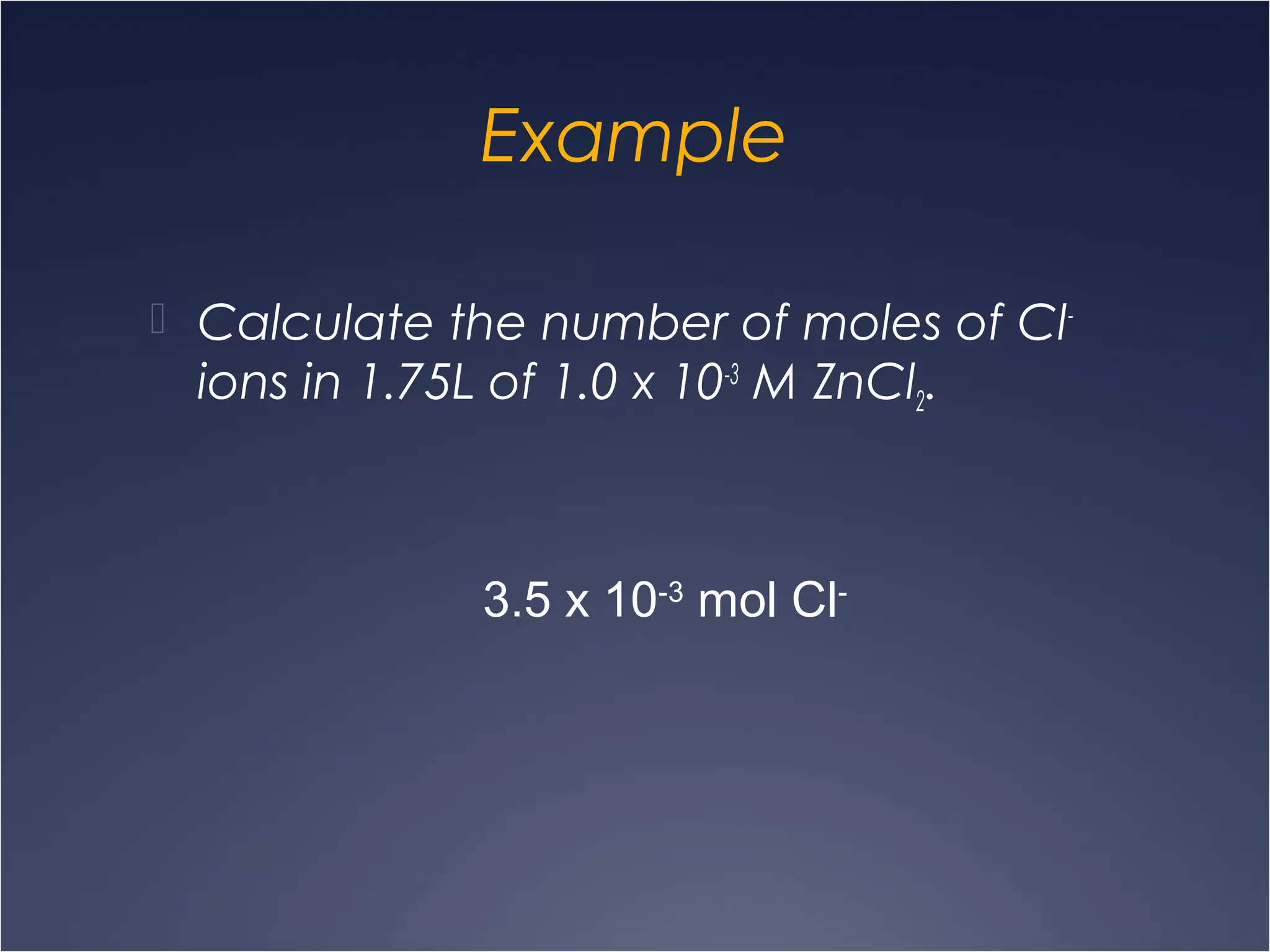
 Calculate the number of moles of Cl-
ions in 1.75L of 1.0 x 10⁻³
M ZnCl2.
3.5 x 10⁻³
mol Cl-
Dilution
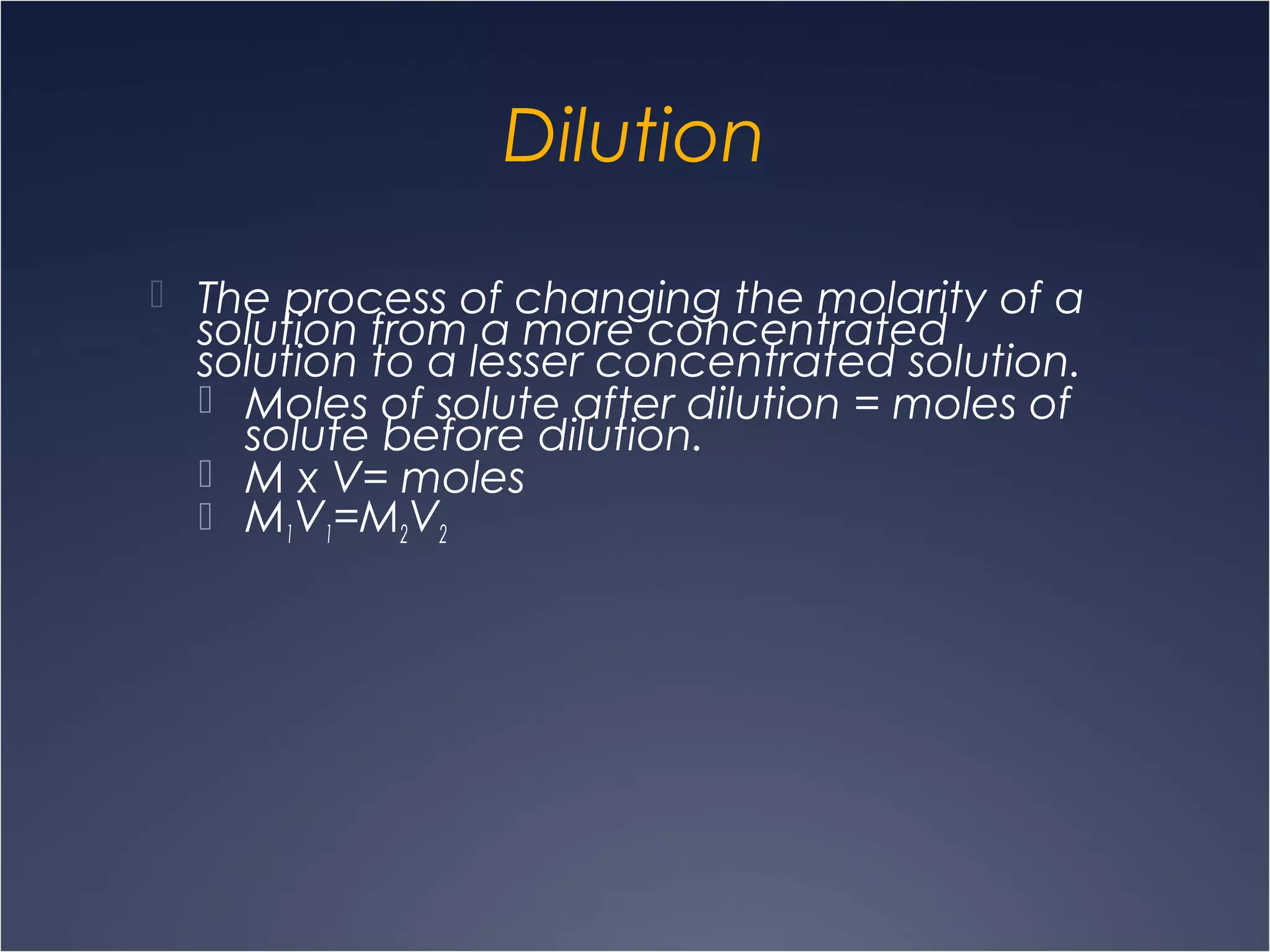
 The process of changing the molarity of a
solution from a more concentrated
solution to a lesser concentrated solution.
 Moles of solute after dilution = moles of
solute before dilution.
 M x V= moles
 M1V1=M2V2
Example
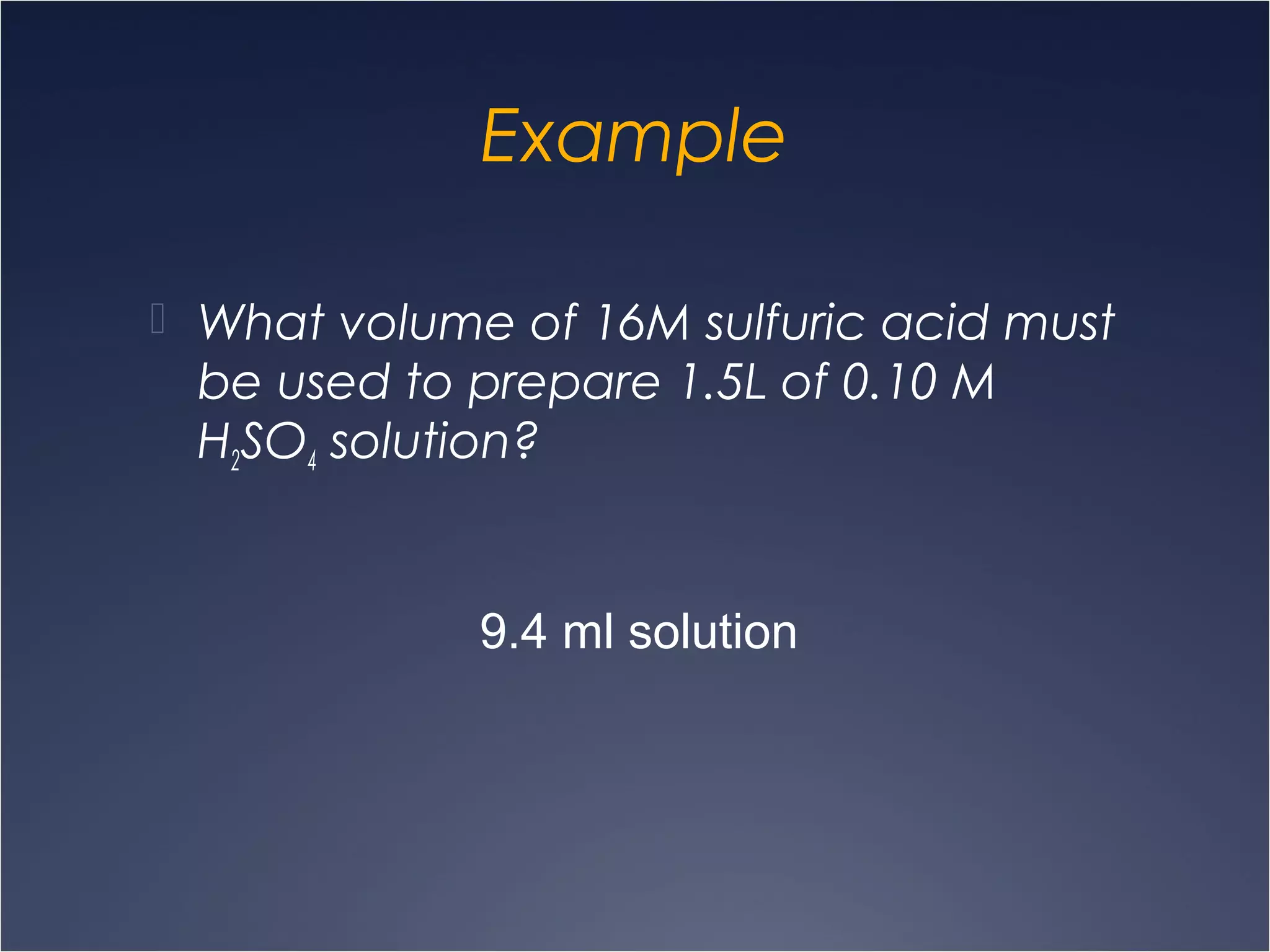
 What volume of 16M sulfuric acid must
be used to prepare 1.5L of 0.10 M
H2SO4 solution?
9.4 ml solution
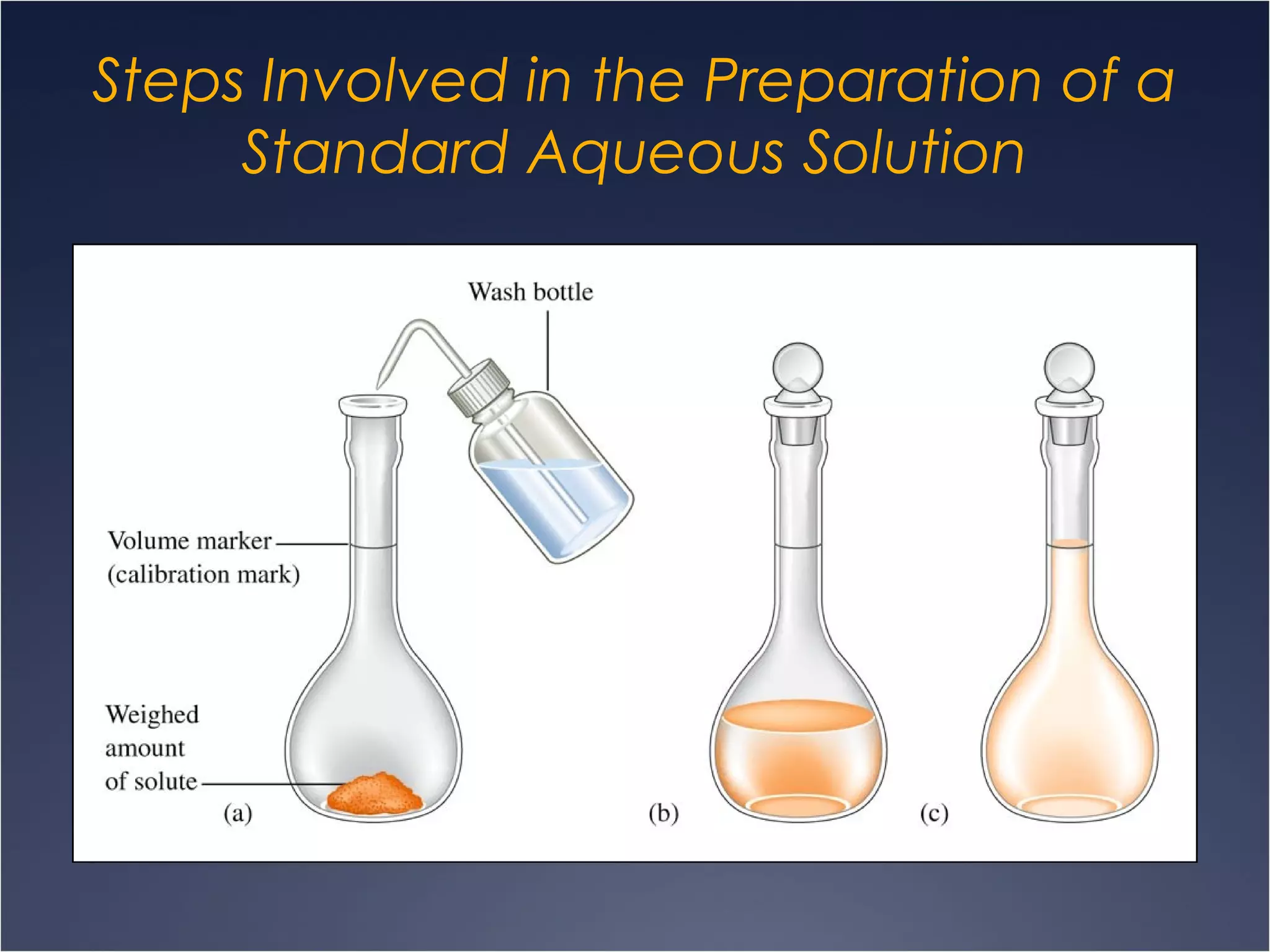
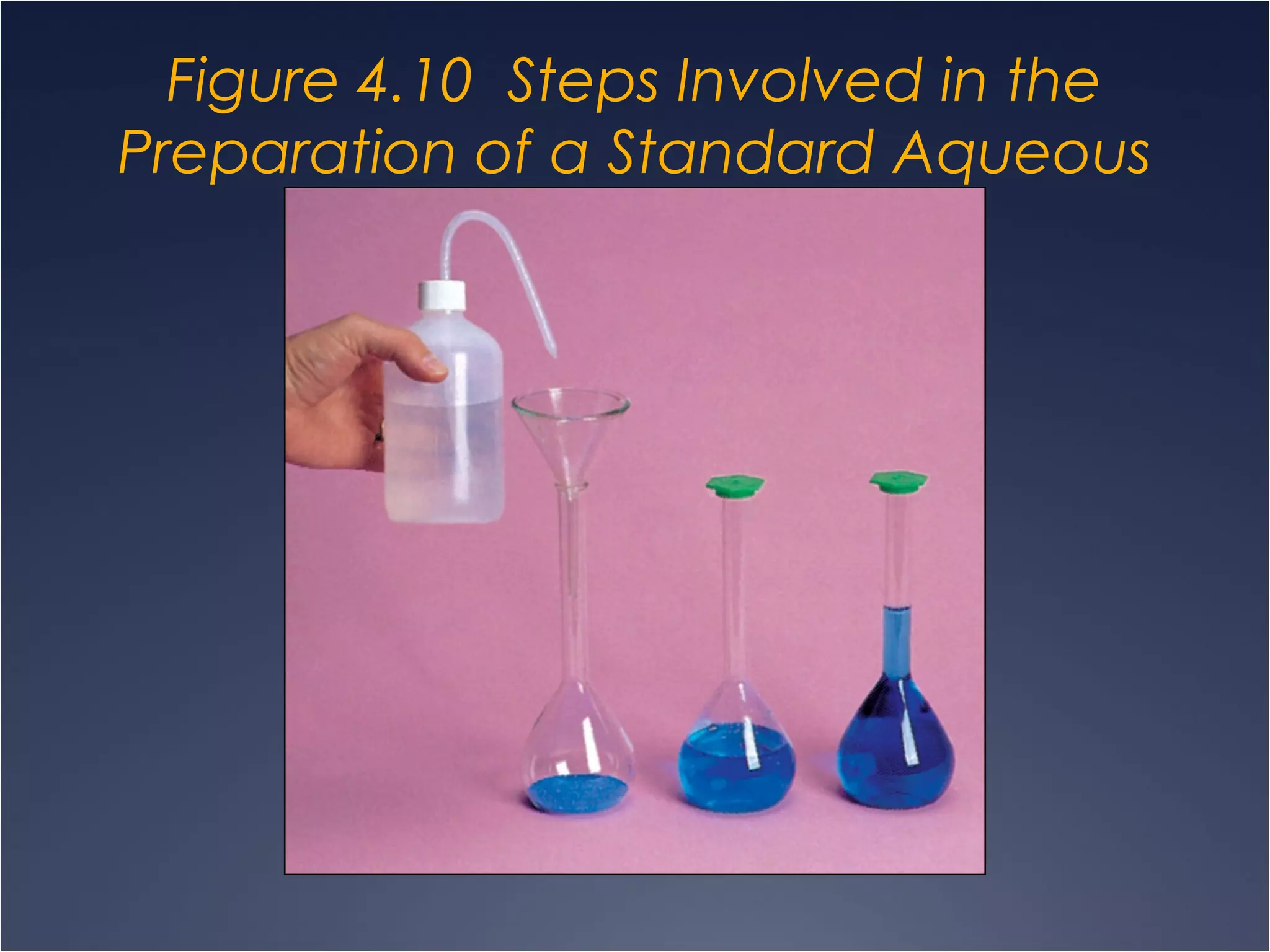
Steps Involved in the Preparation of a
Standard Aqueous Solution
Types of Chemical
Types of Solution Reactions
 Most solution reactions can be
put into three types of reactions:
 Precipitation Reactions
 Acid-Base Reactions
 Oxidation-Reduction Reactions
Precipitation Reactions
 When two solutions are mixed, an
insoluble substance sometimes forms;
that is, a solid forms and separates
from the solution.
 The solid that forms is called a
precipitate.
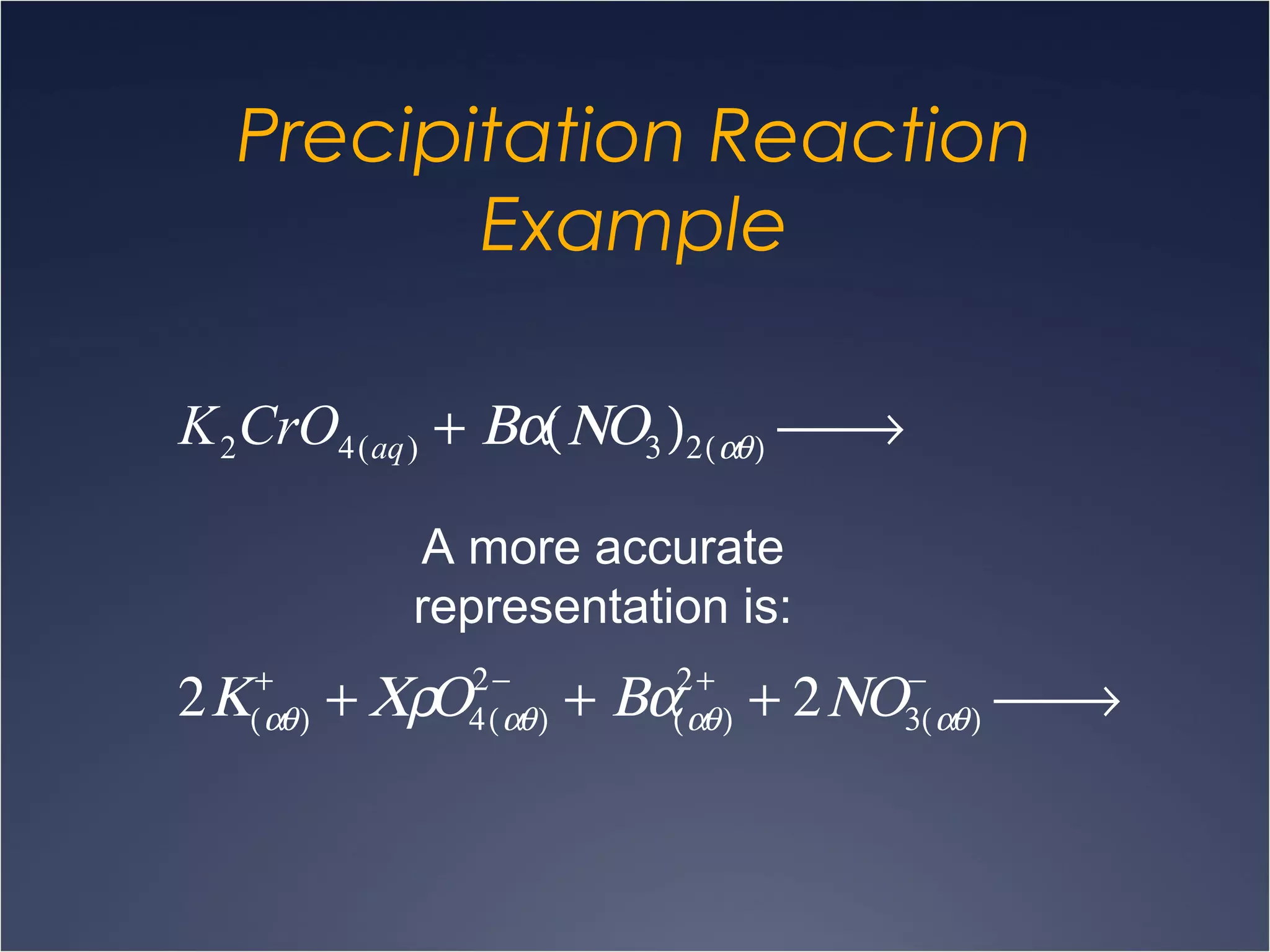
Precipitation Reaction
Example
K2CrO4(aq) + Βα(ΝΟ3 )2(αθ)  →
2Κ(αθ)
+
+ ΧρΟ4(αθ)
2−
+ Βα(αθ)
2+
+ 2ΝΟ3(αθ)
−
 →
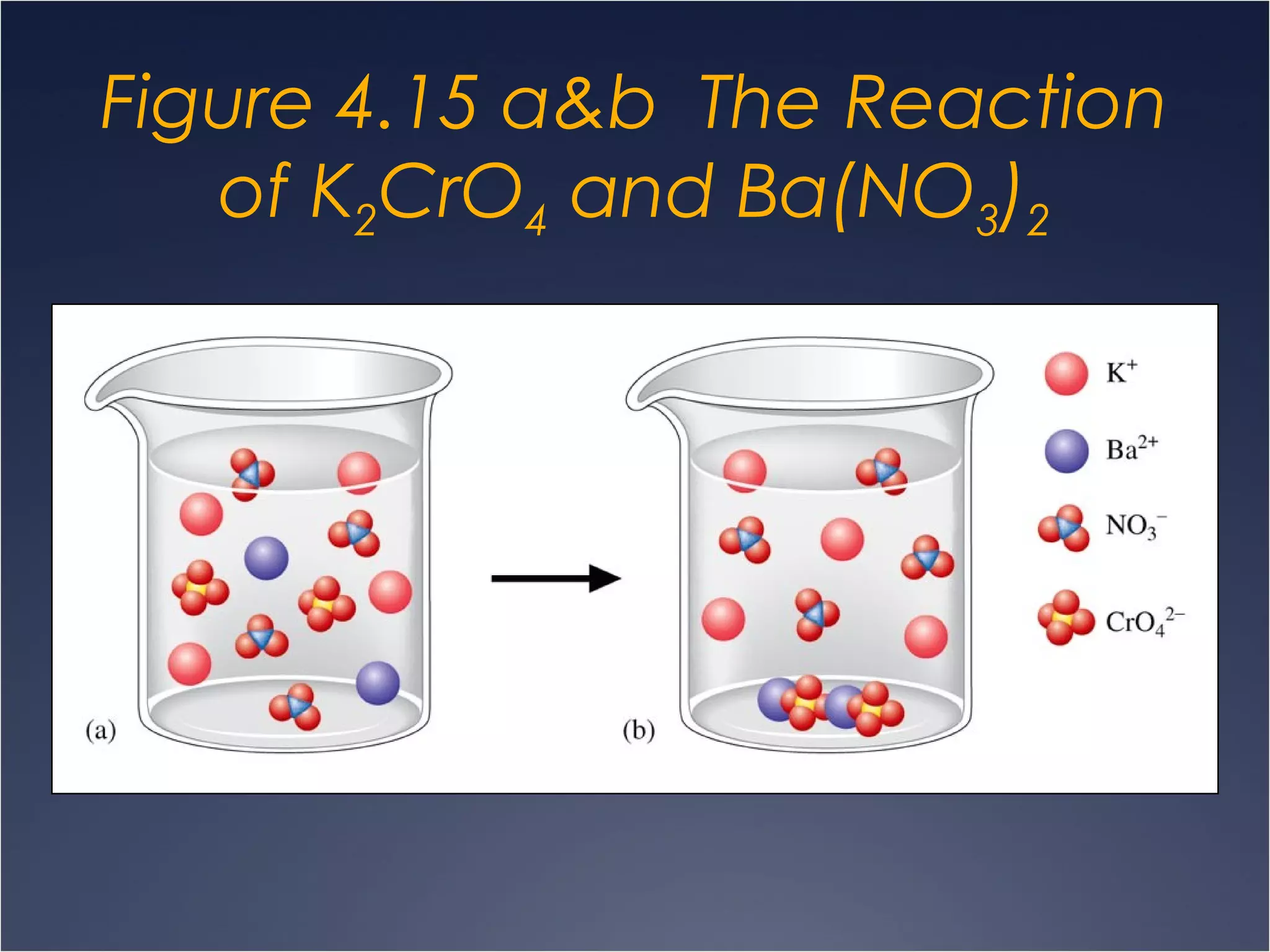
A more accurate
representation is:
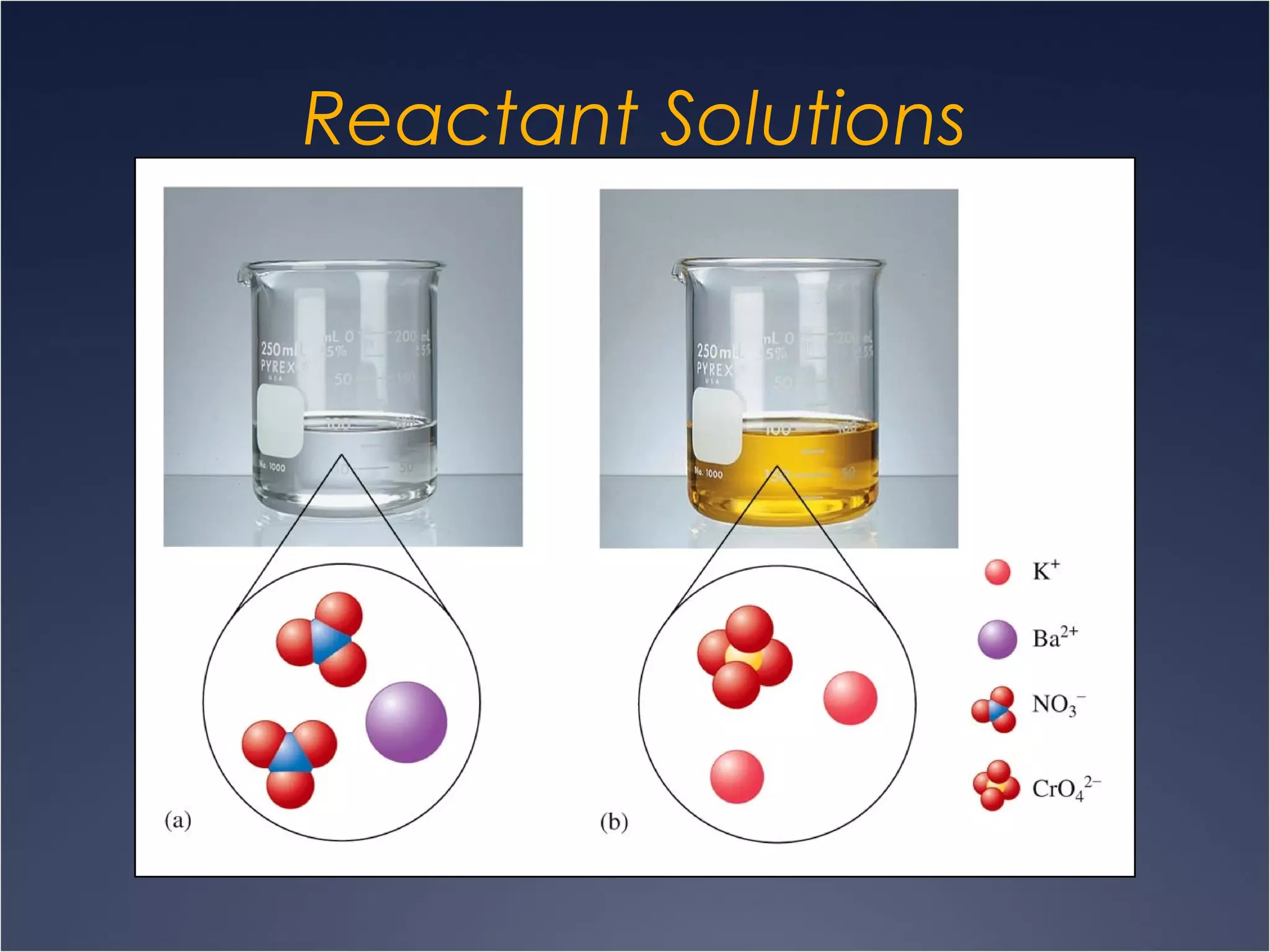
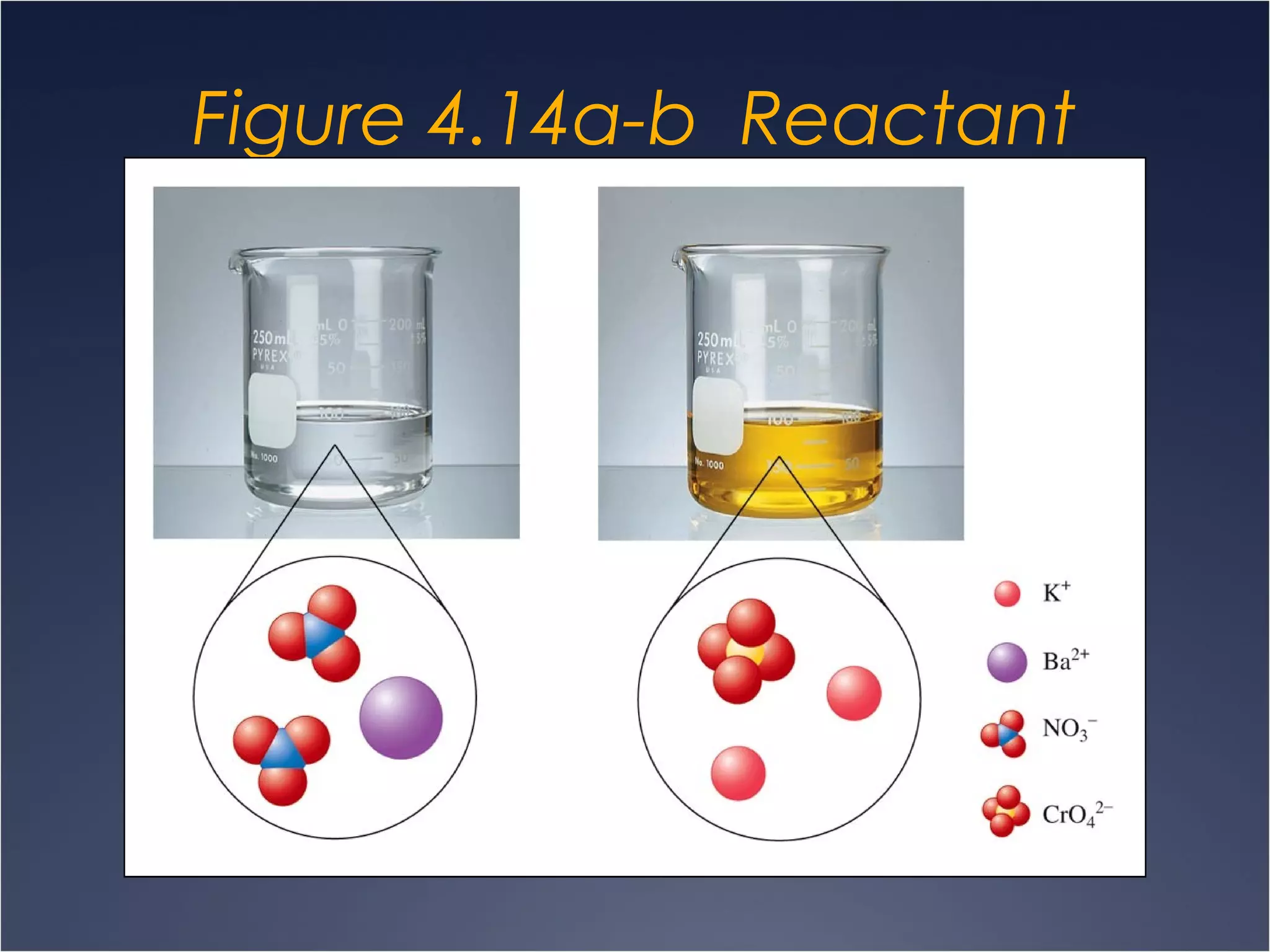
Reactant Solutions
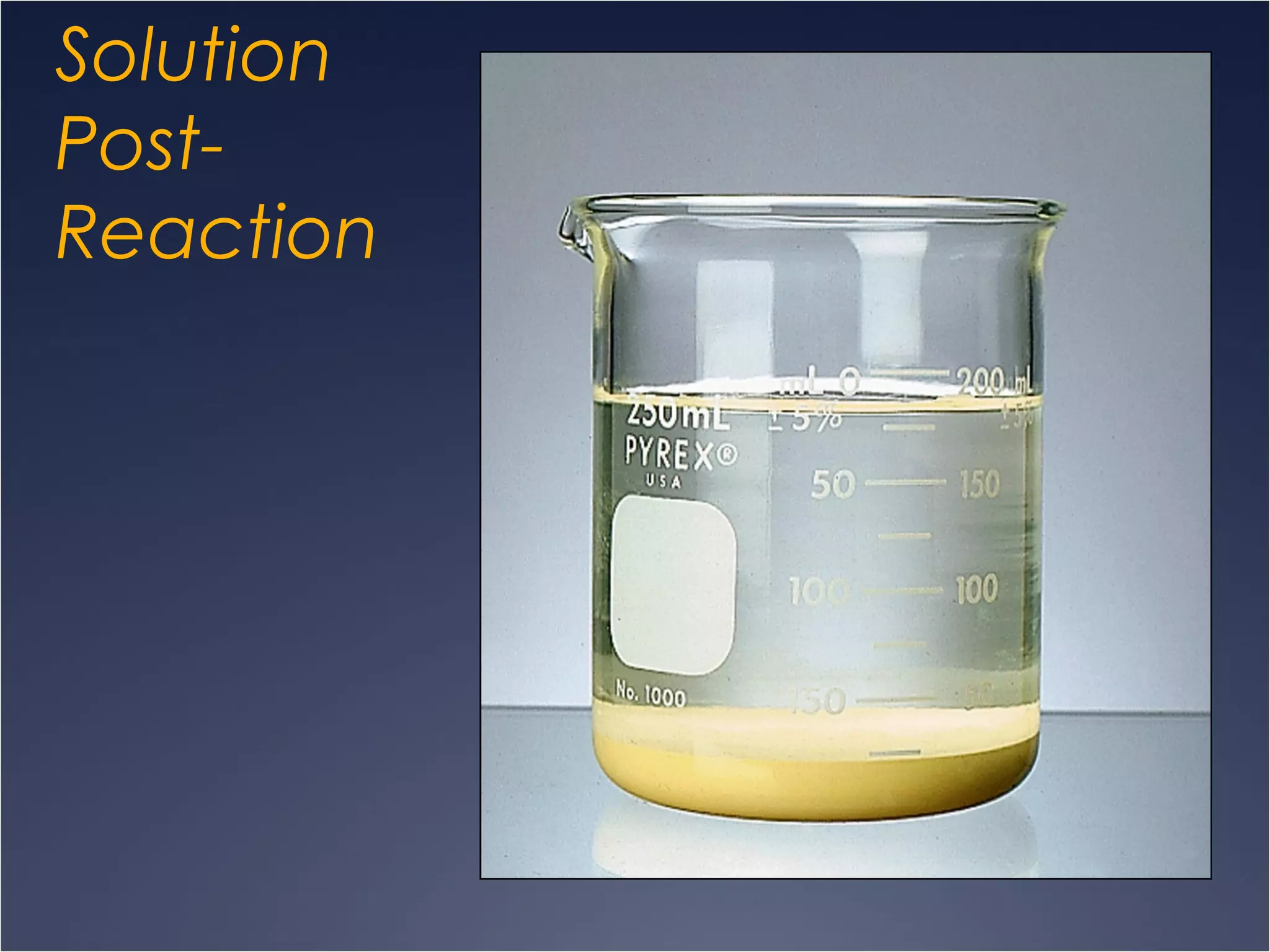
Solution
Post-
Reaction
Precipitation Reaction
Example
2K(aq)
+
+ ΧρΟ4(αθ)
2−
+ Βα(αθ)
2+
+ 2ΝΟ3(αθ)
−
 →
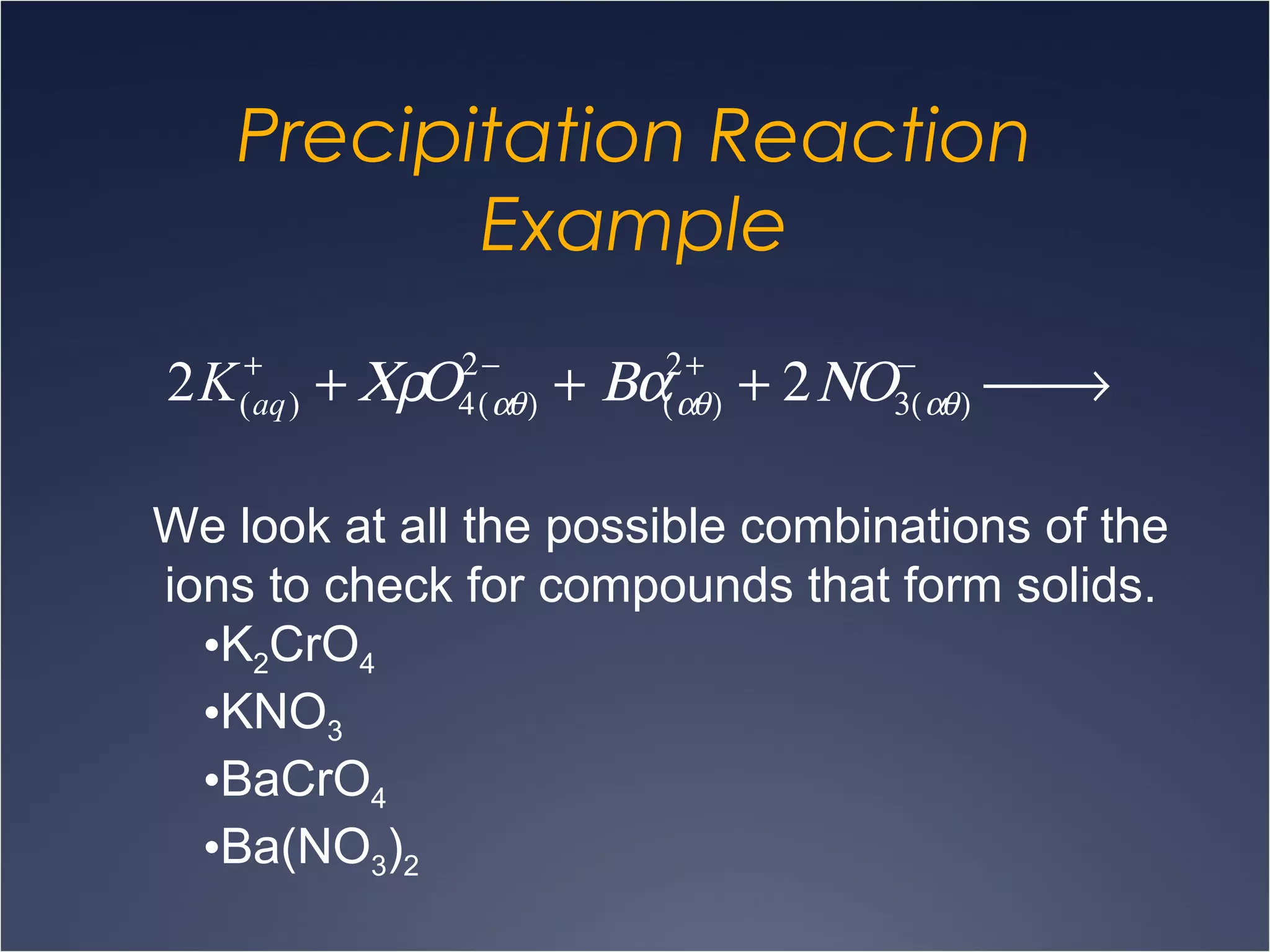
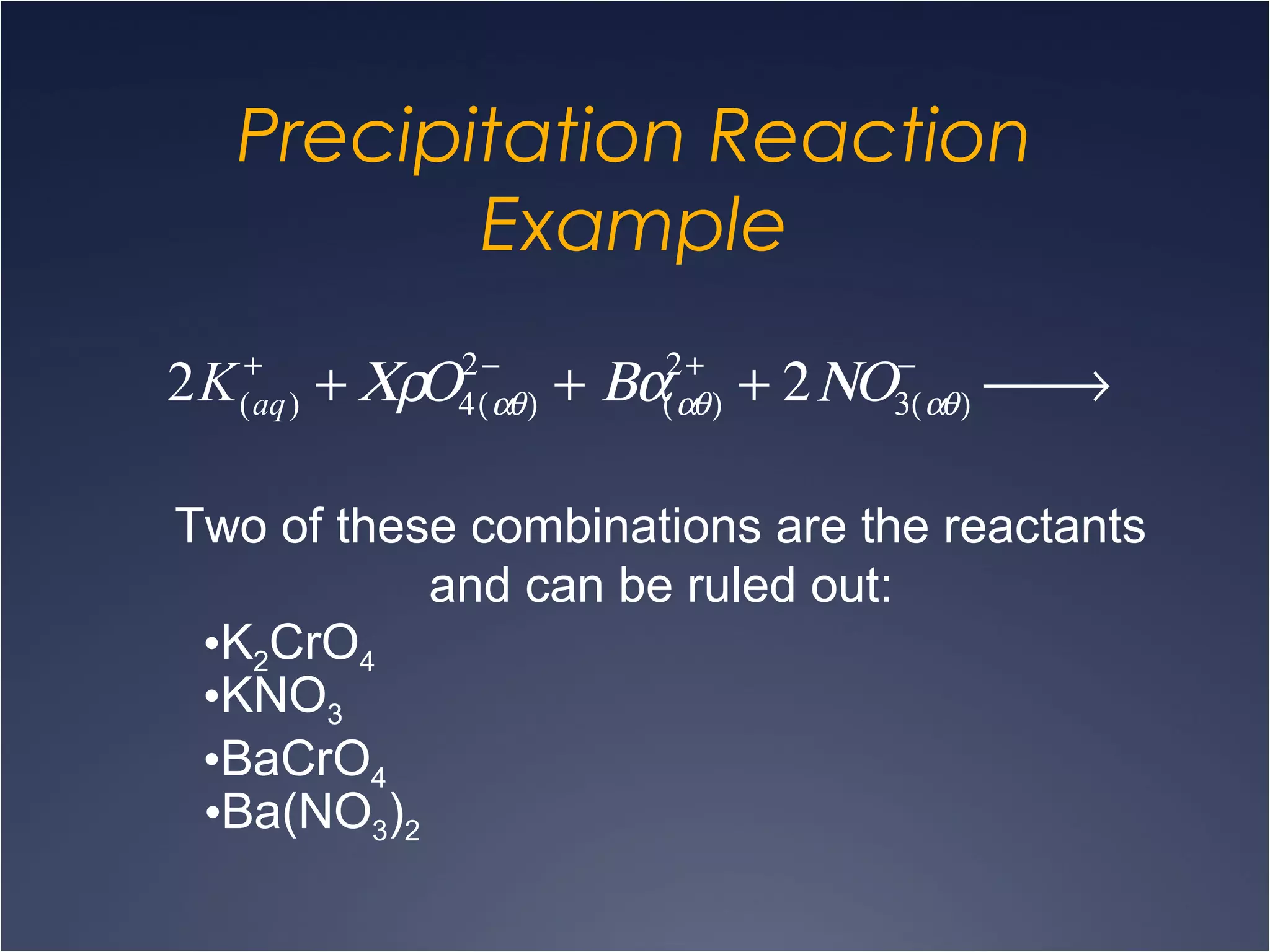
We look at all the possible combinations of the
ions to check for compounds that form solids.
•K2CrO4
•KNO3
•BaCrO4
•Ba(NO3)2
Precipitation Reaction
Example
2K(aq)
+
+ ΧρΟ4(αθ)
2−
+ Βα(αθ)
2+
+ 2ΝΟ3(αθ)
−
 →
Two of these combinations are the reactants
and can be ruled out:
•K2CrO4
•KNO3
•BaCrO4
•Ba(NO3)2
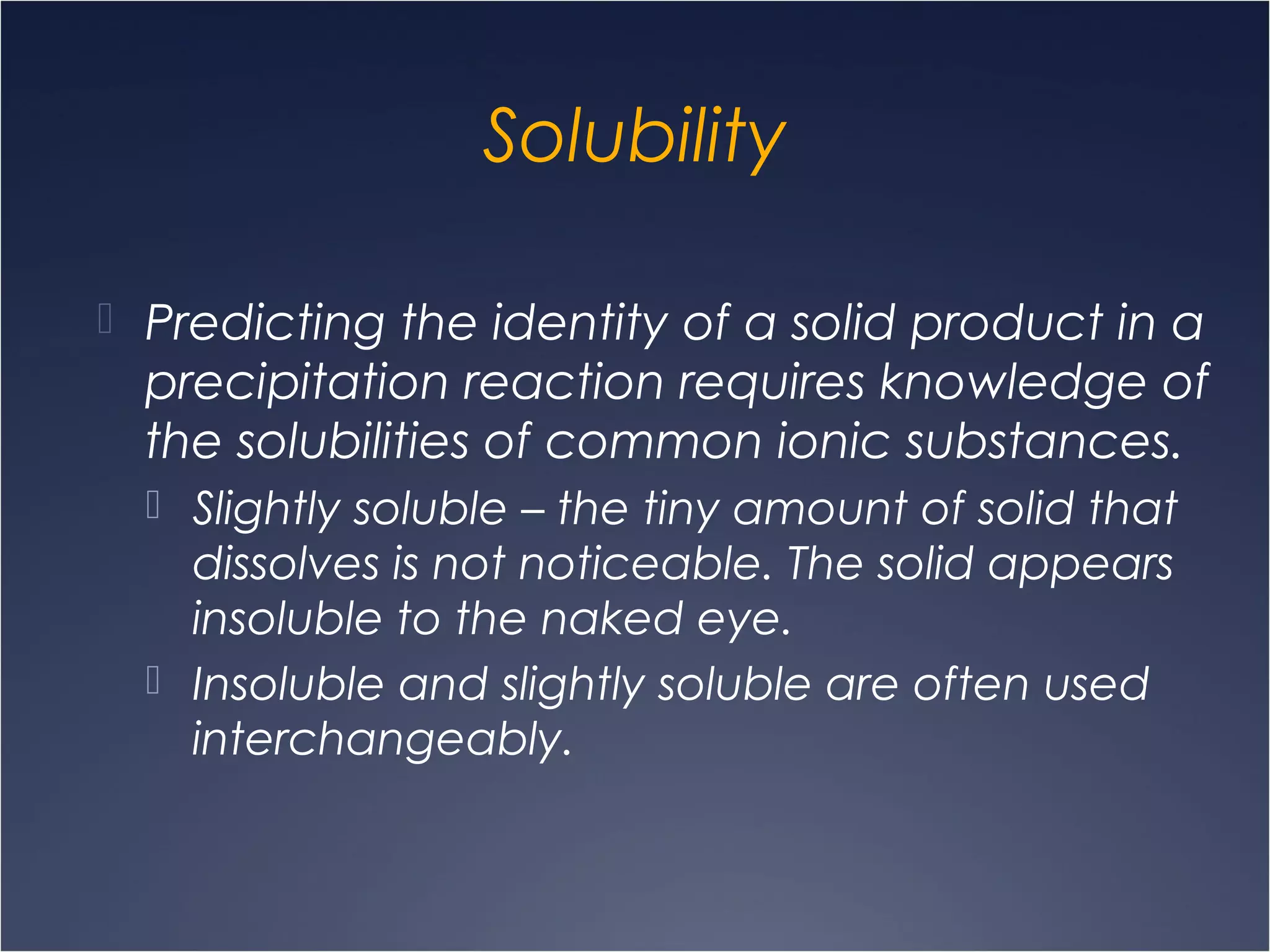
Solubility
 Predicting the identity of a solid product in a
precipitation reaction requires knowledge of
the solubilities of common ionic substances.
 Slightly soluble – the tiny amount of solid that
dissolves is not noticeable. The solid appears
insoluble to the naked eye.
 Insoluble and slightly soluble are often used
interchangeably.
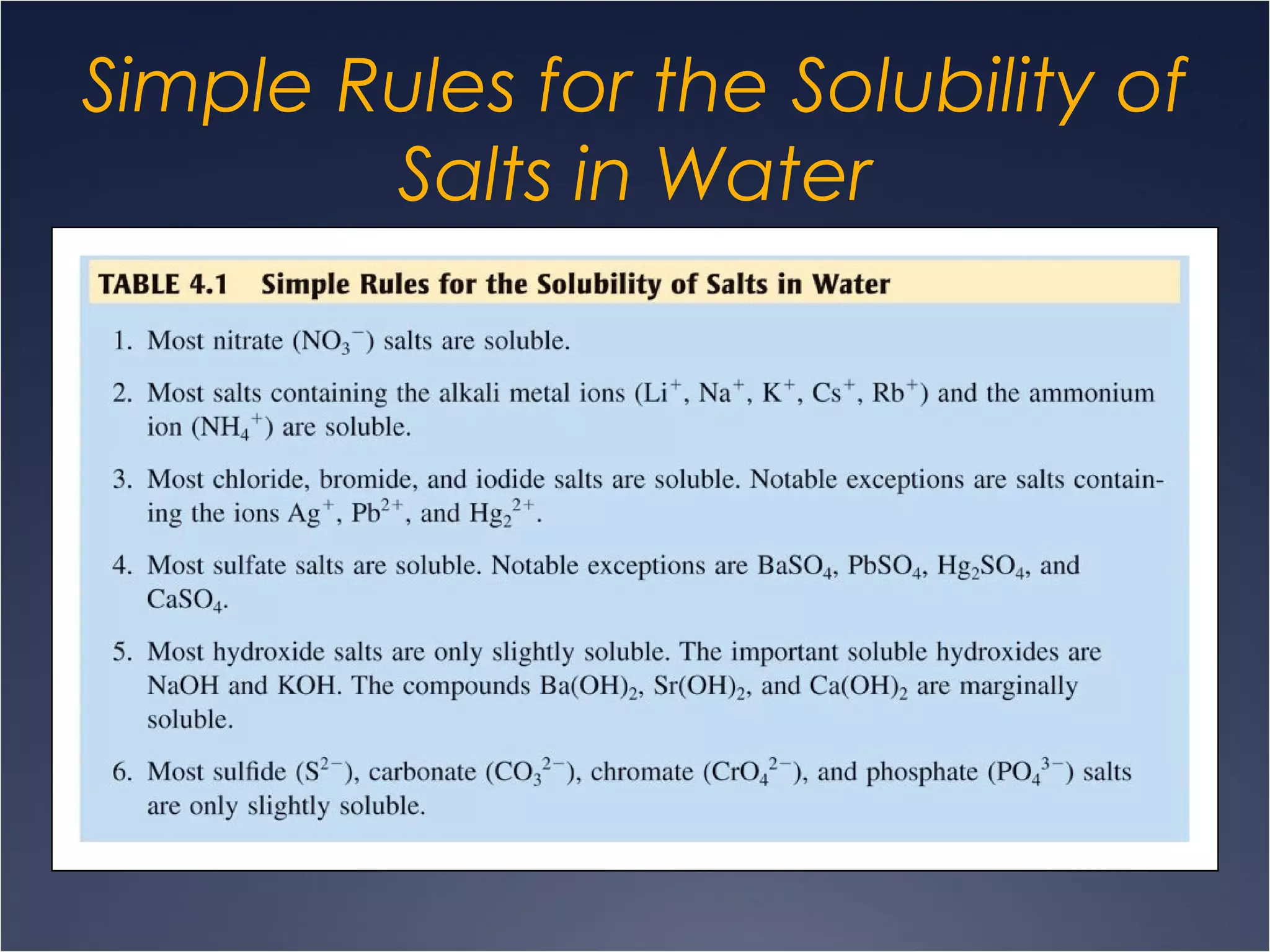
Simple Rules for the Solubility of
Salts in Water
Precipitation Reaction
Example
2K(aq)
+
+ ΧρΟ4(αθ)
2−
+ Βα(αθ)
2+
+ 2ΝΟ3(αθ)
−
 →
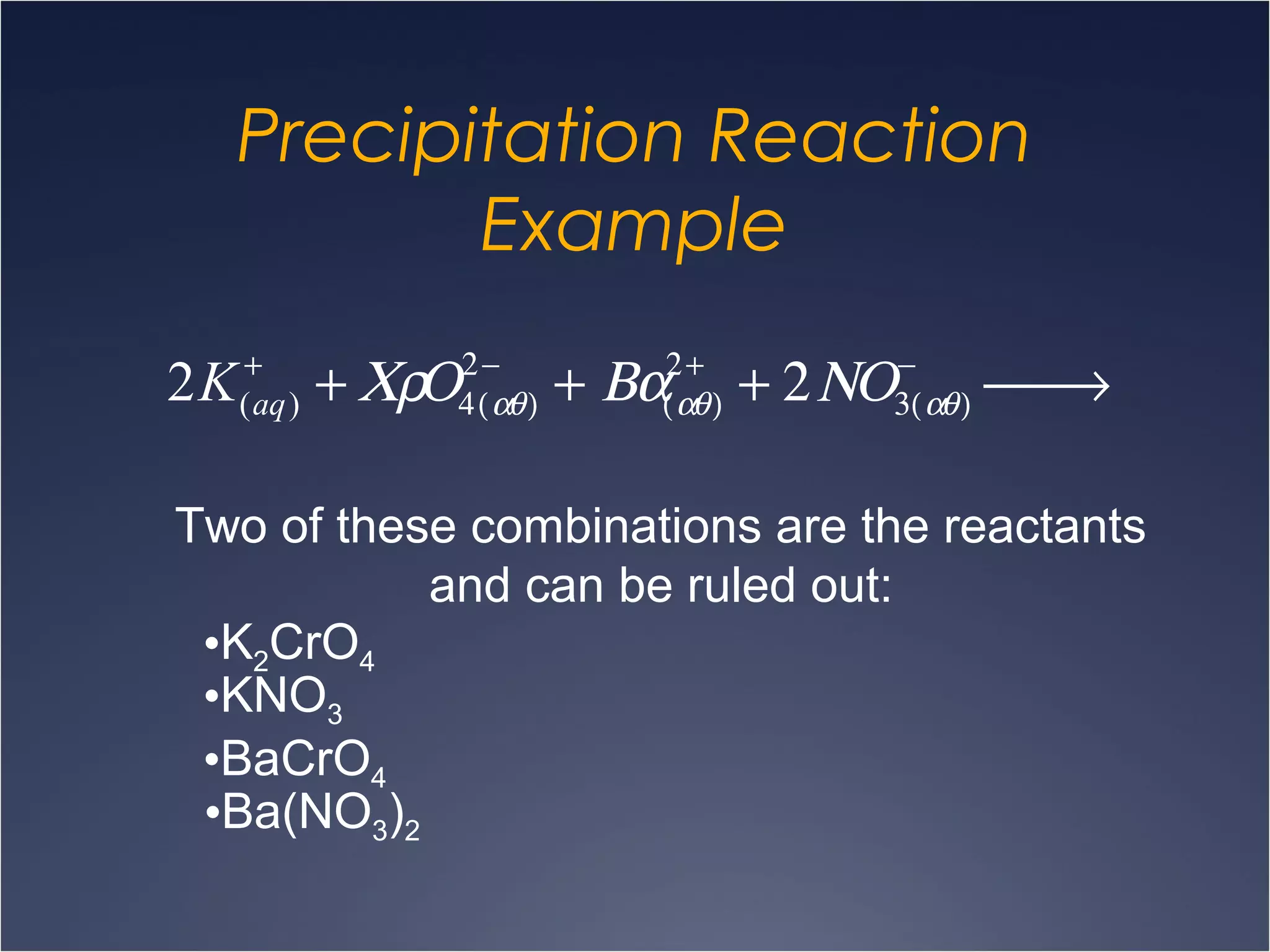
Two of these combinations are the reactants
and can be ruled out:
•K2CrO4
•KNO3
•BaCrO4
•Ba(NO3)2
Precipitation Reactions
 Precipitation reactions move forward
due to the decrease in energy state
of the compound. Bonds forming in
the compound increase stability and
push the reaction forward.
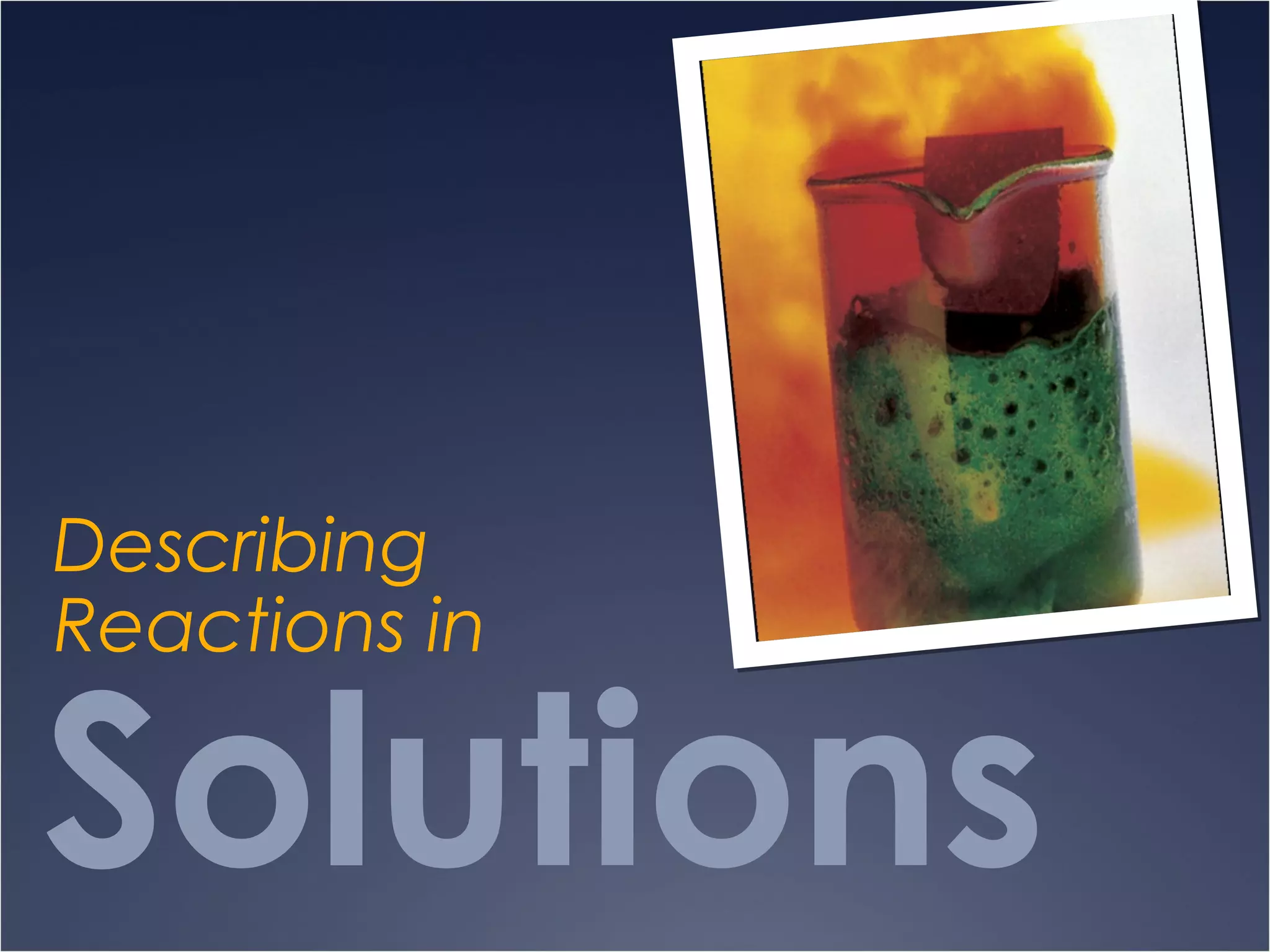
Solutions
Describing
Reactions in
Formula Equation
 Although the formula equation shows
the reactants and products of the
reaction, it does not give a correct
picture of what actually occurs in
solution.
 Gives the overall reaction
stoichiometry but not necessarily the
actual forms of the reactants and
products.
Complete Ionic Equation
 The complete ionic equation better
represents the actual forms of the
reactants and products in solution. All
substances that are strong electrolytes
are represented as ions.
 Complete ionic equation shows all
ions in a reaction, even those that
do not participate in the reaction.
These ions are called spectator ions.
Net Ionic Equation
 The net ionic equation includes only
those solution components that are
directly involved in the reaction.
 Commonly used because it gives
the actual forms of the reactants
and products and includes only the
species that undergo a change.
Spectator ions are not included.
Example Problem
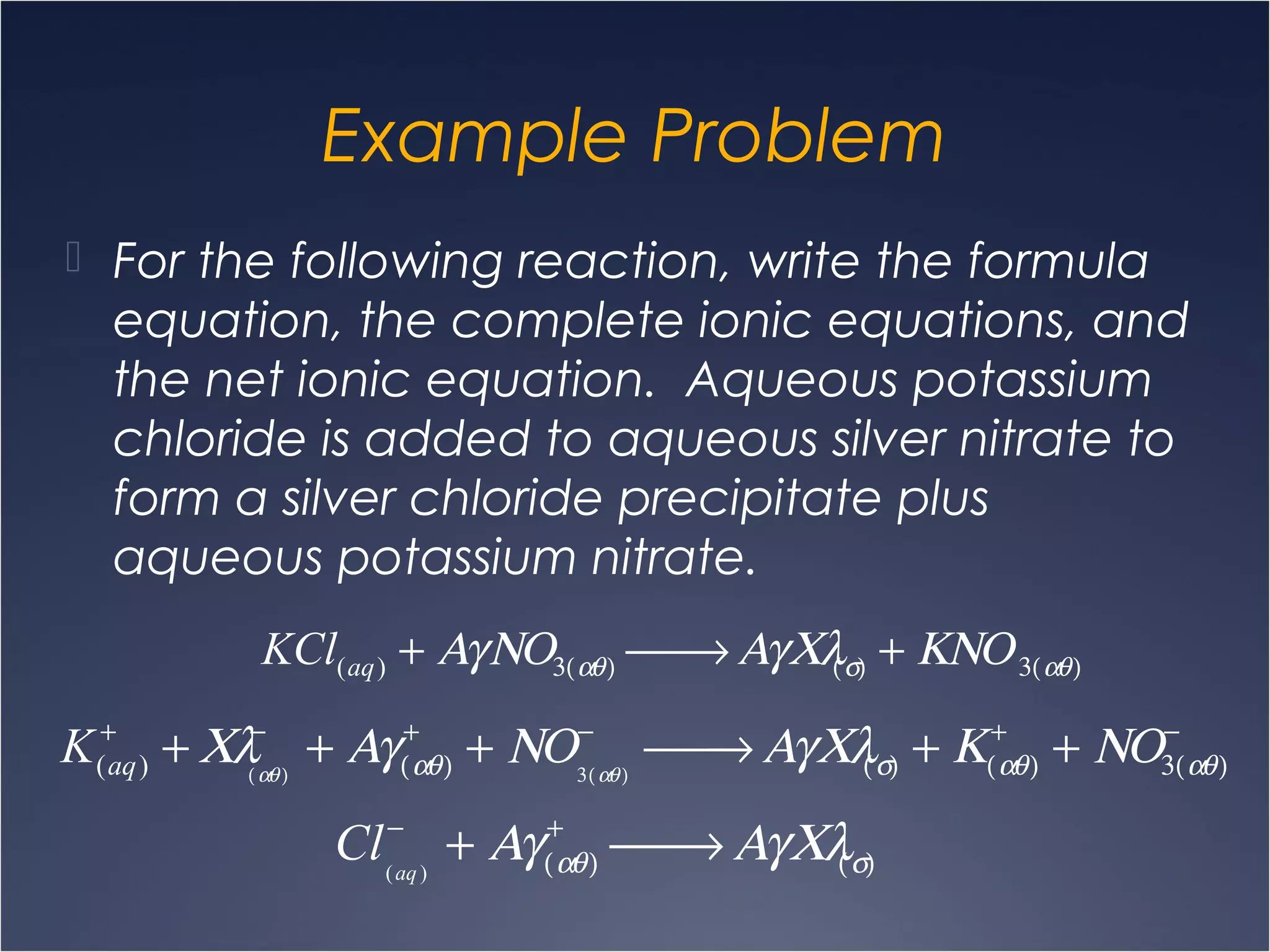
 For the following reaction, write the formula
equation, the complete ionic equations, and
the net ionic equation. Aqueous potassium
chloride is added to aqueous silver nitrate to
form a silver chloride precipitate plus
aqueous potassium nitrate.
KCl(aq) + ΑγΝΟ3(αθ)  → ΑγΧλ(σ) + ΚΝΟ3(αθ)
K(aq)
+
+ Χλ(αθ)
−
+ Αγ(αθ)
+
+ ΝΟ3(αθ)
−
 → ΑγΧλ(σ) + Κ(αθ)
+
+ ΝΟ3(αθ)
−
Cl(aq)
−
+ Αγ(αθ)
+
 → ΑγΧλ(σ)
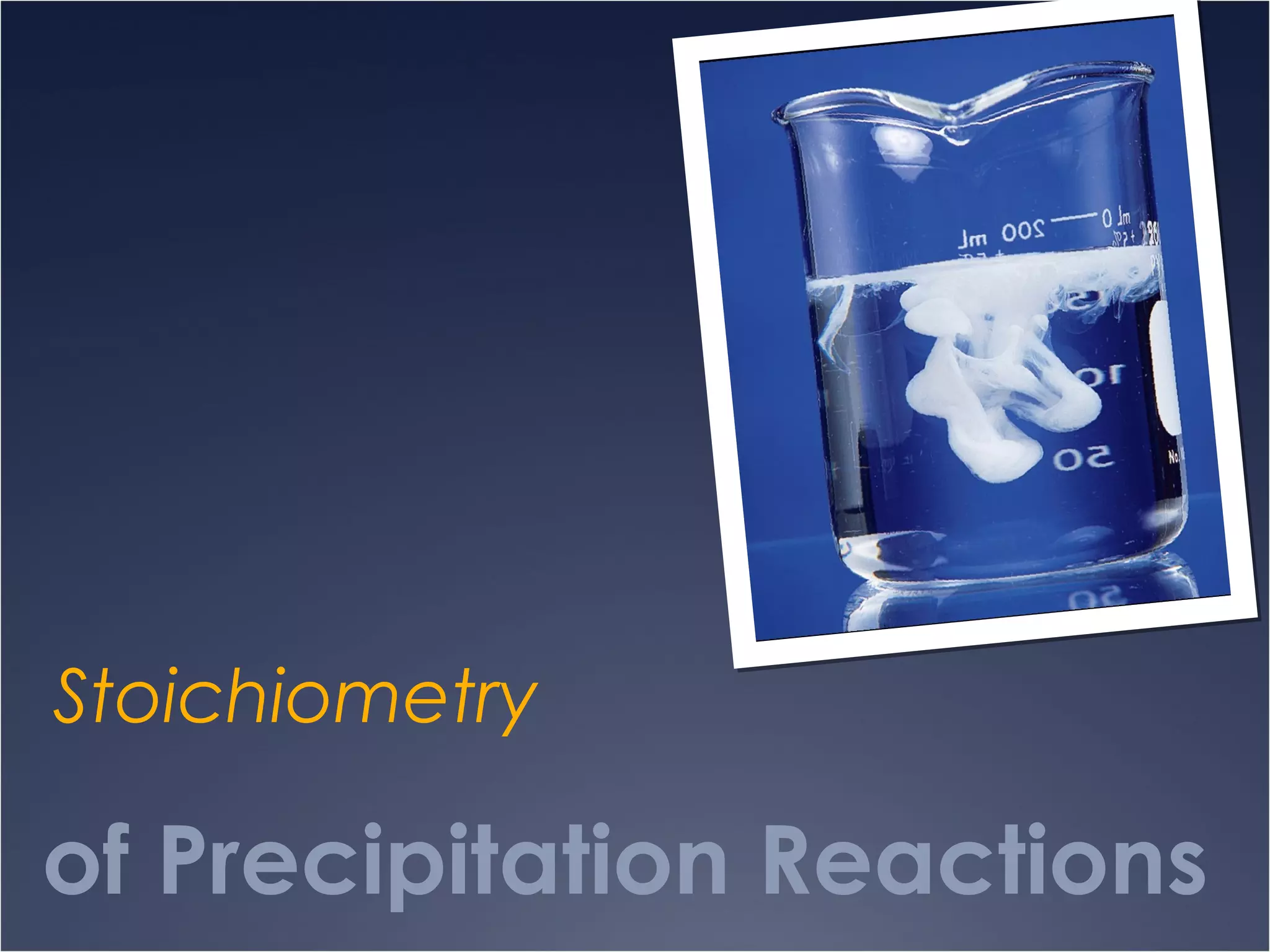
of Precipitation Reactions
Stoichiometry
Solution Stoichiometry
 The rules of stoichiometry and limiting
reactant apply to chemical reactions in
solutions. But two rules need special
emphasis.
 Always write a balanced equation of the
reaction and give special attention to the
products that are formed and the true
form of the ions in solution.
 Moles must still be calculated, but molarity
and volume must be used in the
calculation.
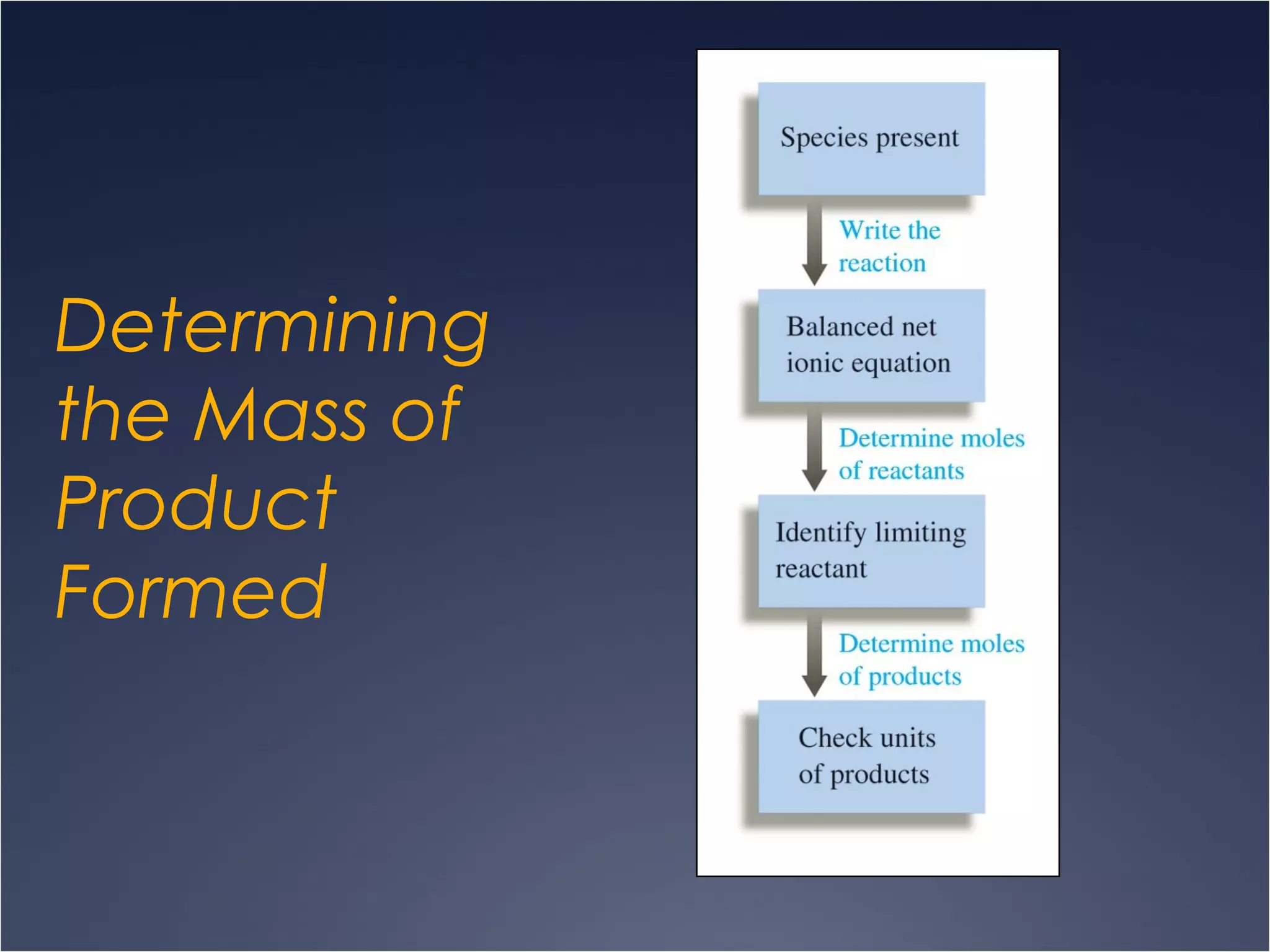
Determining
the Mass of
Product
Formed
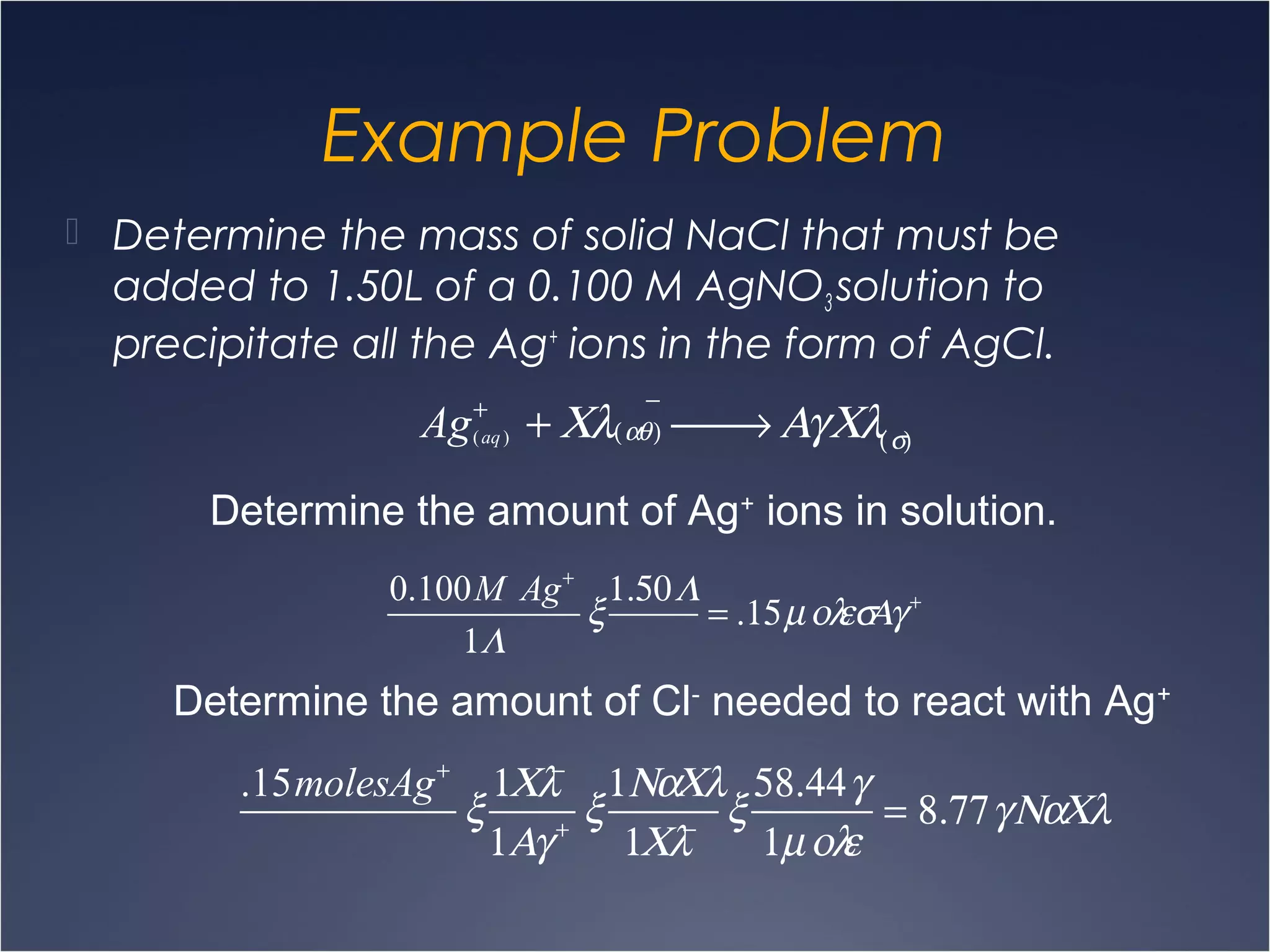
Example Problem
 Determine the mass of solid NaCl that must be
added to 1.50L of a 0.100 M AgNO3 solution to
precipitate all the Ag+
ions in the form of AgCl.
Ag(aq)
+
+ Χλ(αθ)
−
 → ΑγΧλ(σ)
Determine the amount of Ag+
ions in solution.
0.100M Ag+
1Λ
ξ
1.50Λ
= .15µολεσΑγ+
Determine the amount of Cl-
needed to react with Ag+
.15molesAg+
ξ
1Χλ−
1Αγ+
ξ
1ΝαΧλ
1Χλ−
ξ
58.44γ
1µολε
= 8.77γΝαΧλ
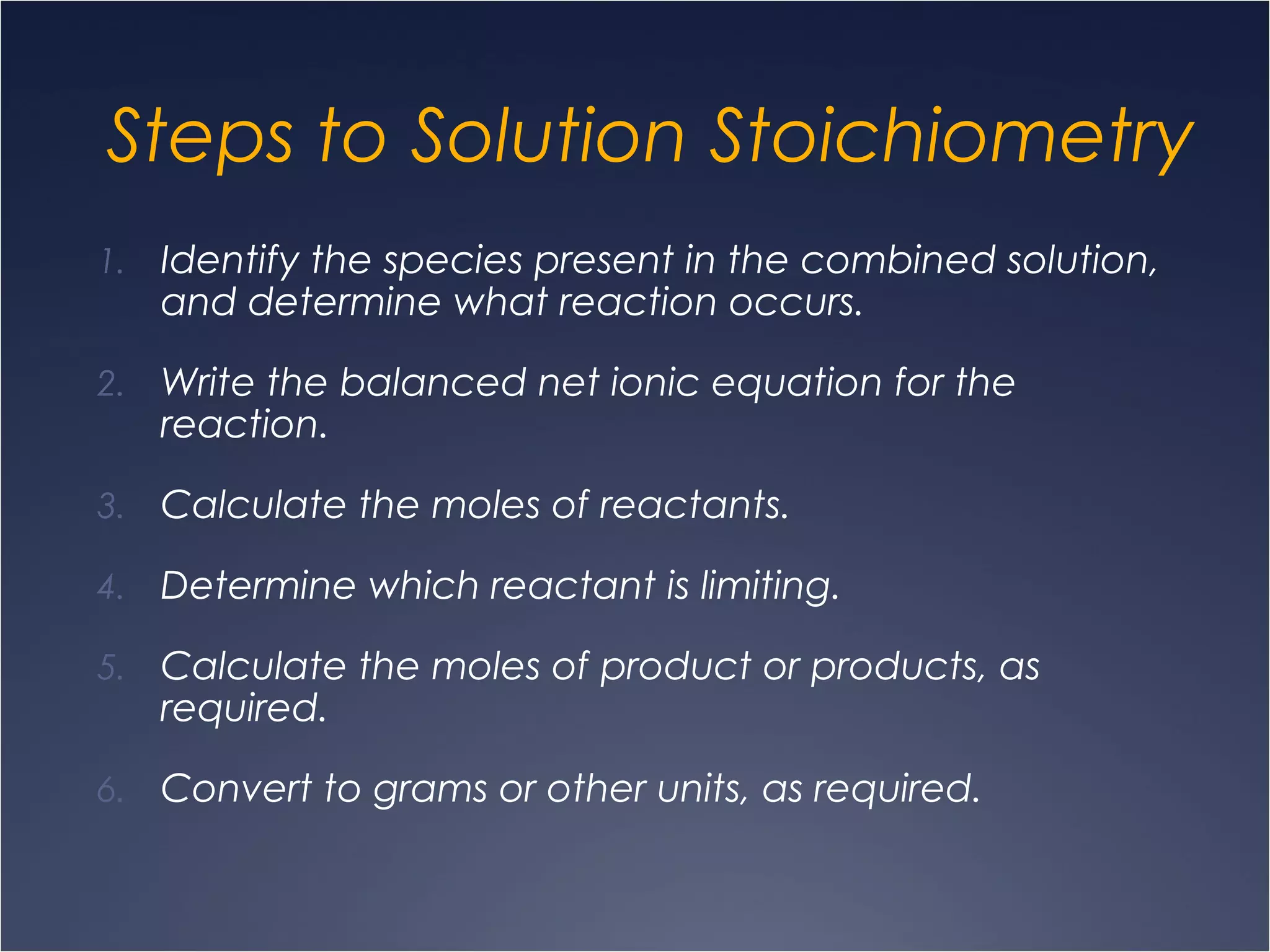
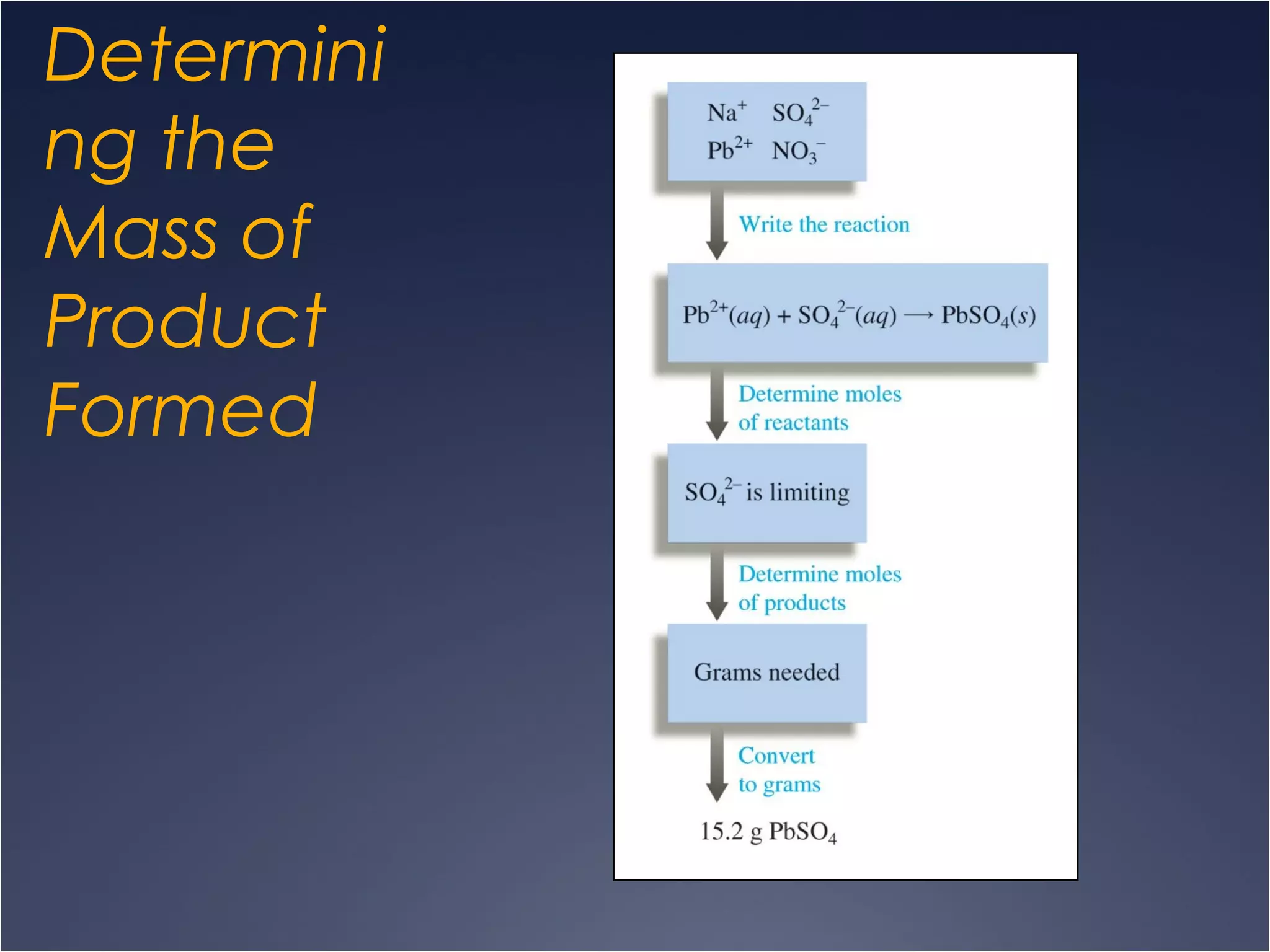
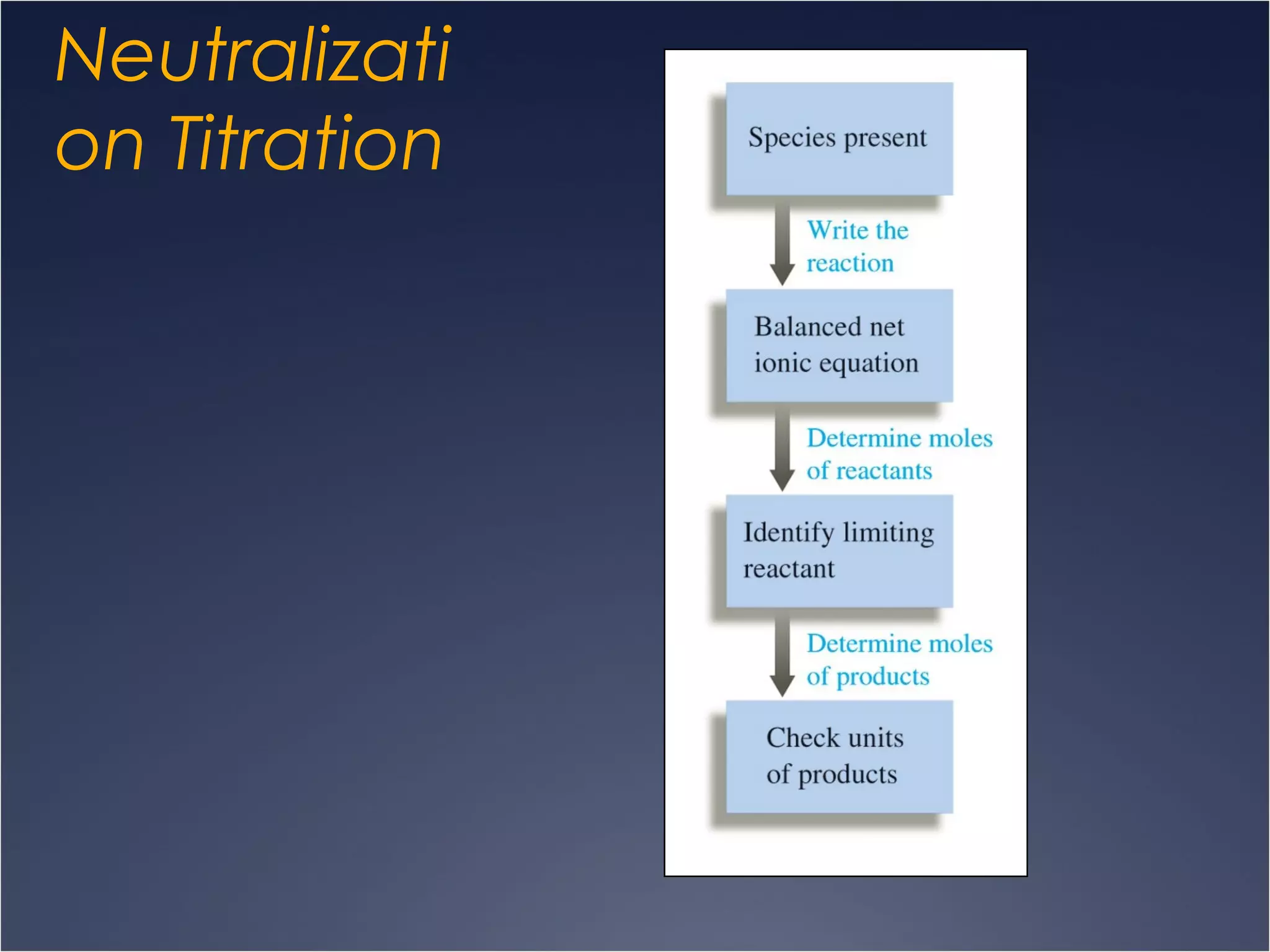
Steps to Solution Stoichiometry
1. Identify the species present in the combined solution,
and determine what reaction occurs.
2. Write the balanced net ionic equation for the
reaction.
3. Calculate the moles of reactants.
4. Determine which reactant is limiting.
5. Calculate the moles of product or products, as
required.
6. Convert to grams or other units, as required.
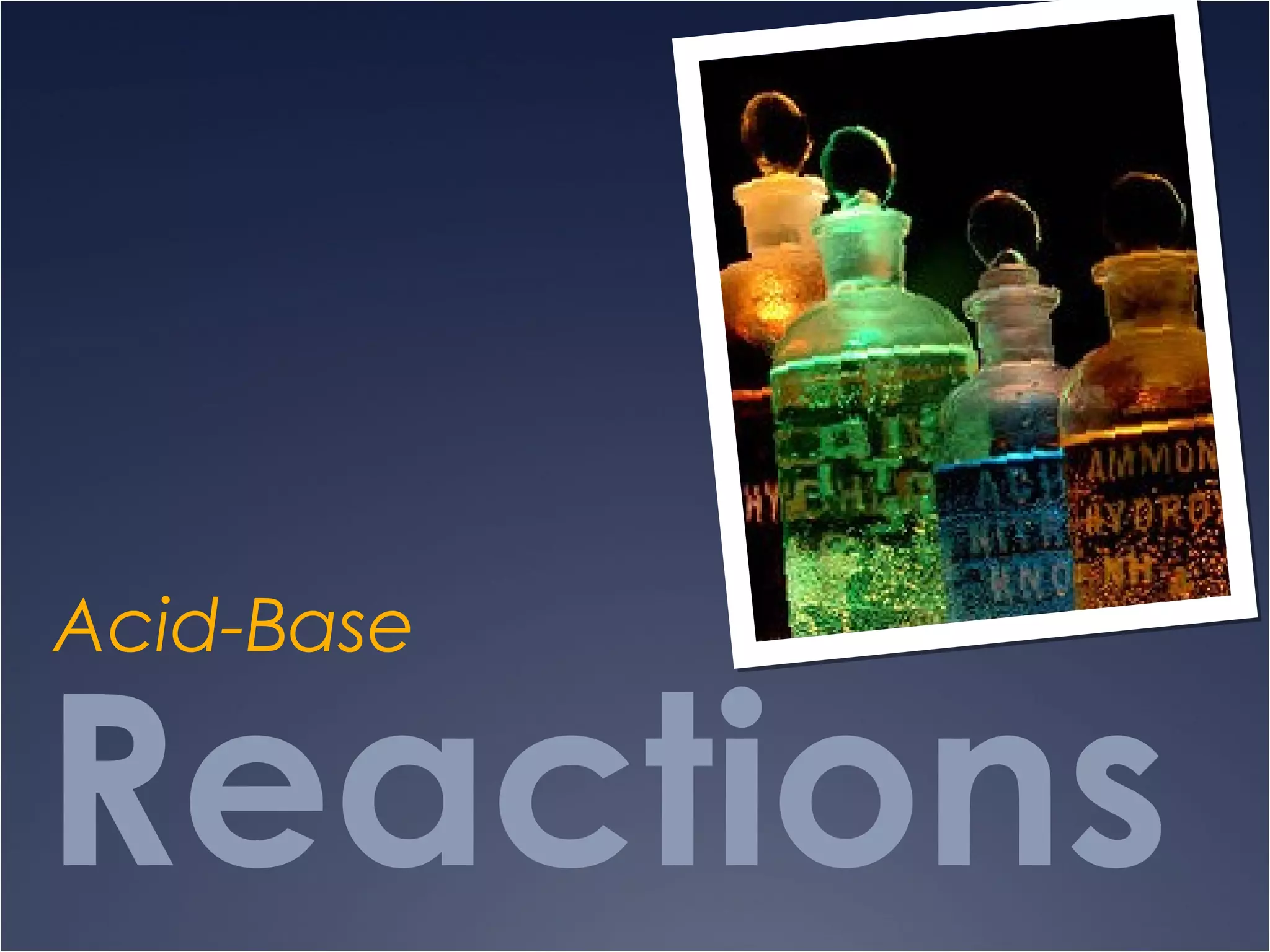
Reactions
Acid-Base
Acids
 Arrhenius’s concept of acids and bases:
An acid is a substance that produces H+
ions when dissolved in water and a base
is a substance that produces OH-
ions.
 Fundamentally correct but doesn’t
include all bases.
Brønsted-Lowry Acids
 Johannes BrØnsted (1879-1947) and
Lowry (1874-1936) gives a more
general definition of a base that
includes substances that do not
contain OH-
.
 An acid is a proton donor.
 A base is a proton acceptor.
Acid-Base Reactions
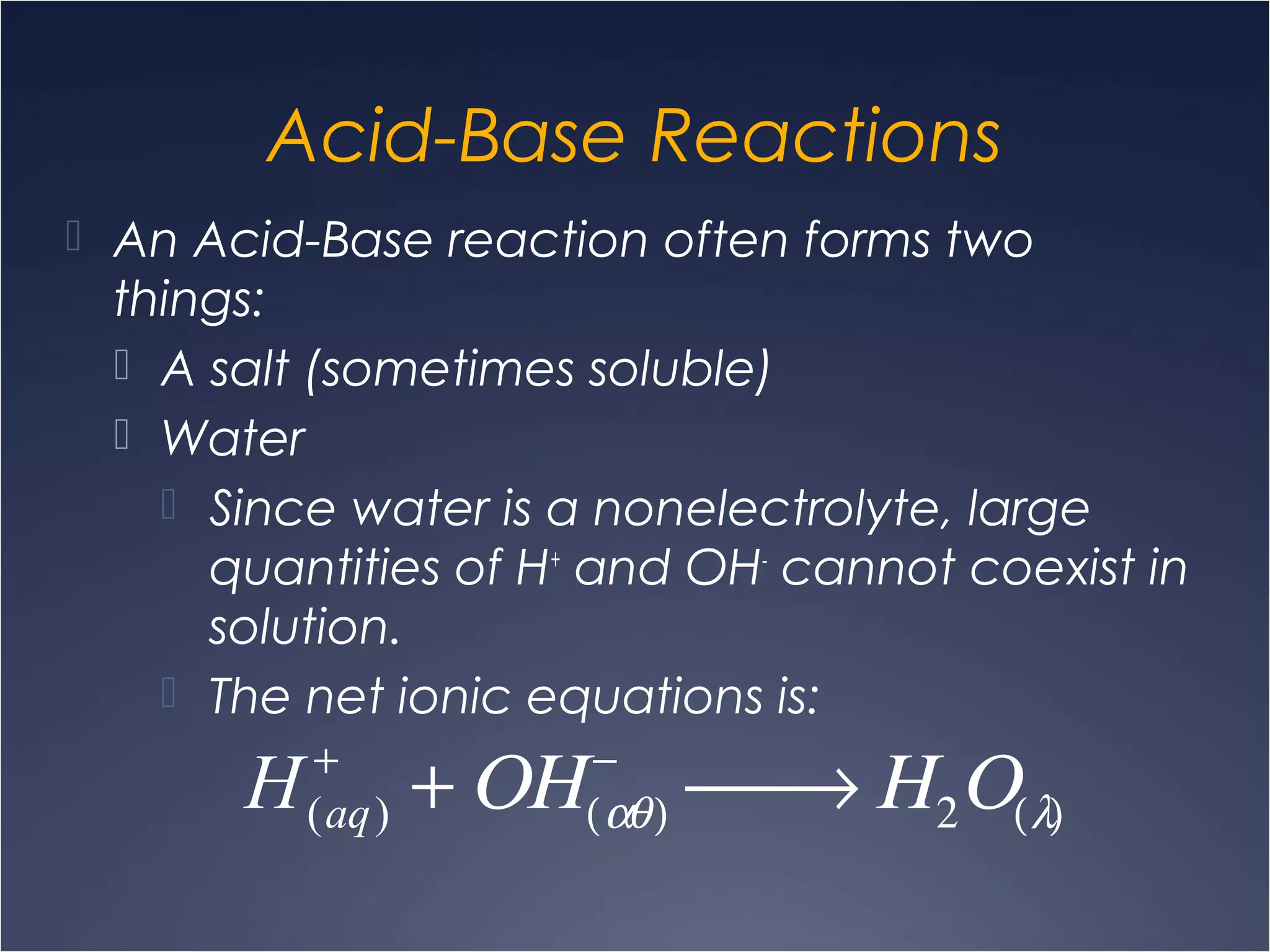
 An Acid-Base reaction often forms two
things:
 A salt (sometimes soluble)
 Water
 Since water is a nonelectrolyte, large
quantities of H+
and OH-
cannot coexist in
solution.
 The net ionic equations is:
H(aq)
+
+ ΟΗ(αθ)
−
 → Η2Ο(λ)
Acid-Base Reactions
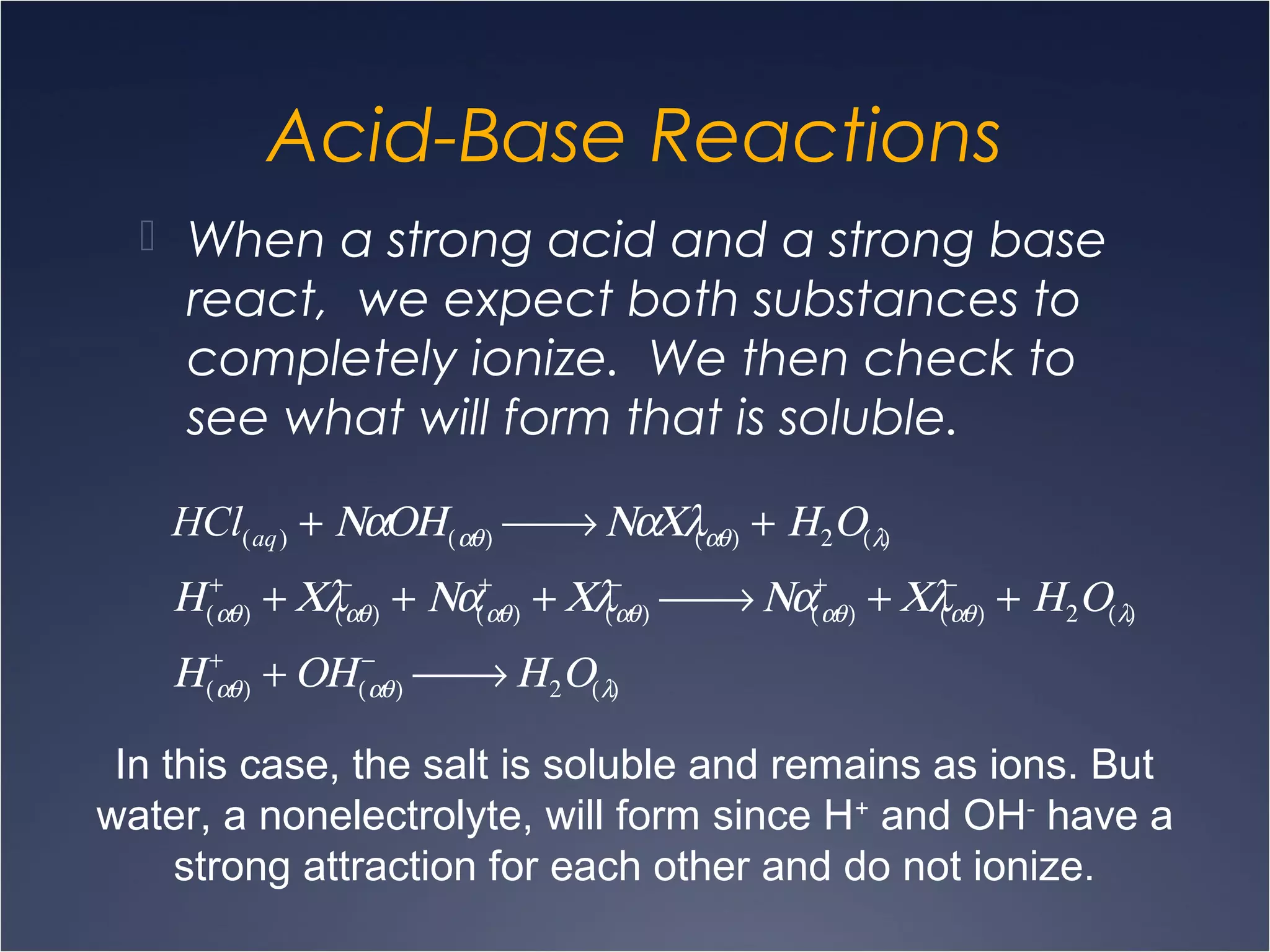
HCl(aq) + ΝαΟΗ(αθ)  → ΝαΧλ(αθ) + Η2Ο(λ)
Η(αθ)
+
+ Χλ(αθ)
−
+ Να(αθ)
+
+ Χλ(αθ)
−
 → Να(αθ)
+
+ Χλ(αθ)
−
+ Η2Ο(λ)
Η(αθ)
+
+ ΟΗ(αθ)
−
 → Η2Ο(λ)
 When a strong acid and a strong base
react, we expect both substances to
completely ionize. We then check to
see what will form that is soluble.
In this case, the salt is soluble and remains as ions. But
water, a nonelectrolyte, will form since H+
and OH-
have a
strong attraction for each other and do not ionize.
Acid-Base Reactions
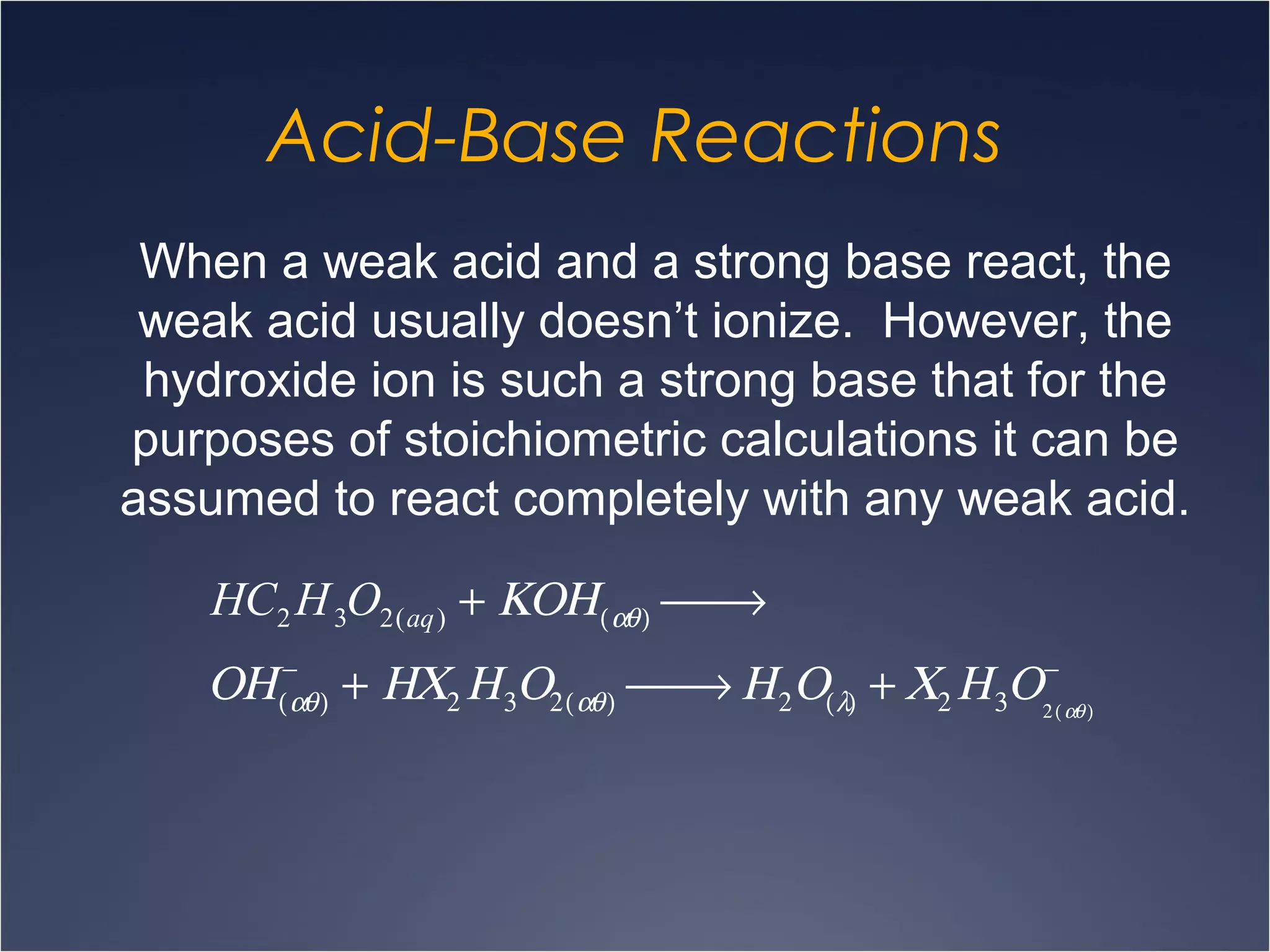
HC2 H3O2(aq) + ΚΟΗ(αθ)  →
ΟΗ(αθ)
−
+ ΗΧ2 Η3Ο2(αθ)  → Η2Ο(λ) + Χ2 Η3Ο2(αθ)
−
When a weak acid and a strong base react, the
weak acid usually doesn’t ionize. However, the
hydroxide ion is such a strong base that for the
purposes of stoichiometric calculations it can be
assumed to react completely with any weak acid.
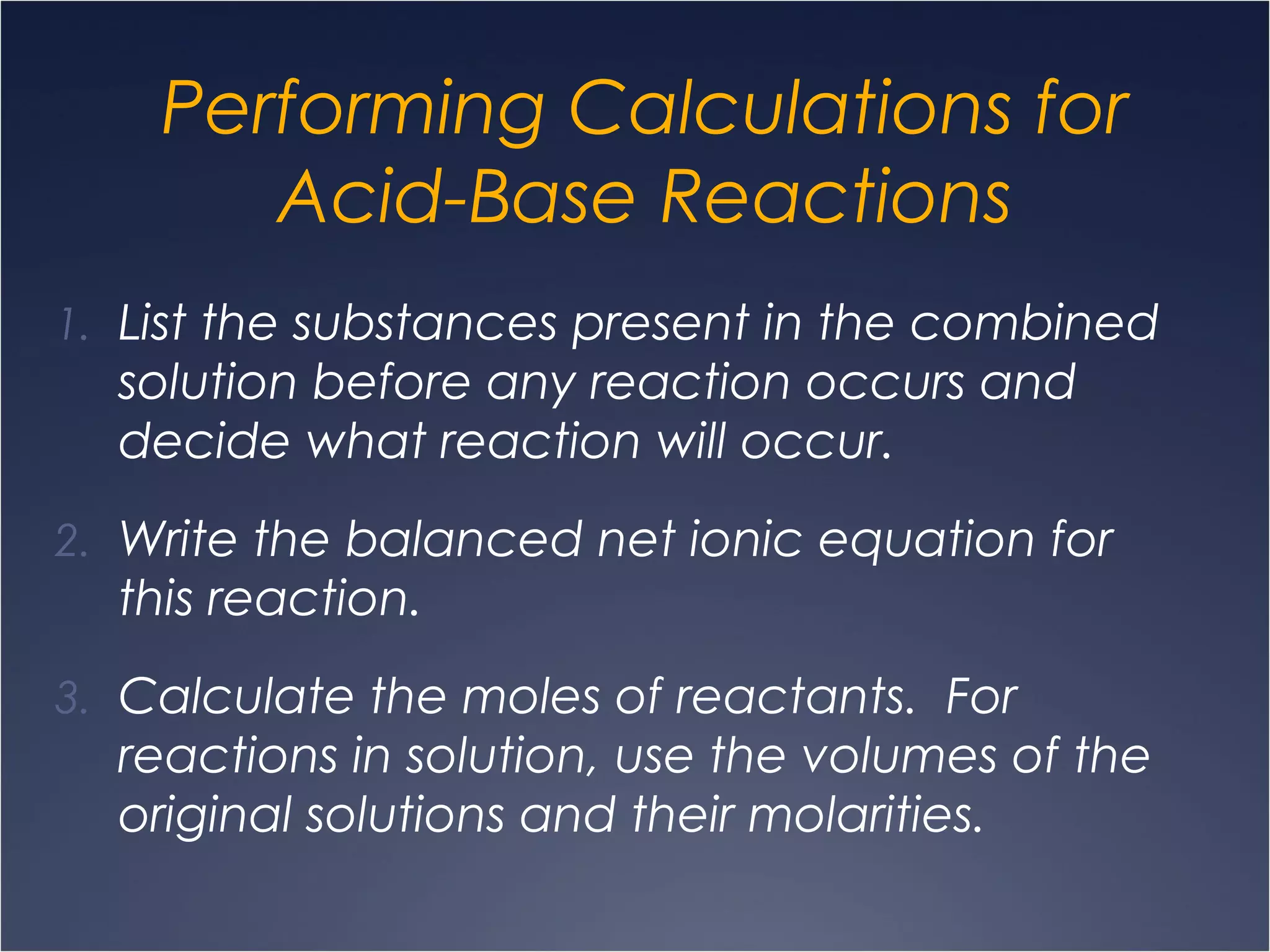
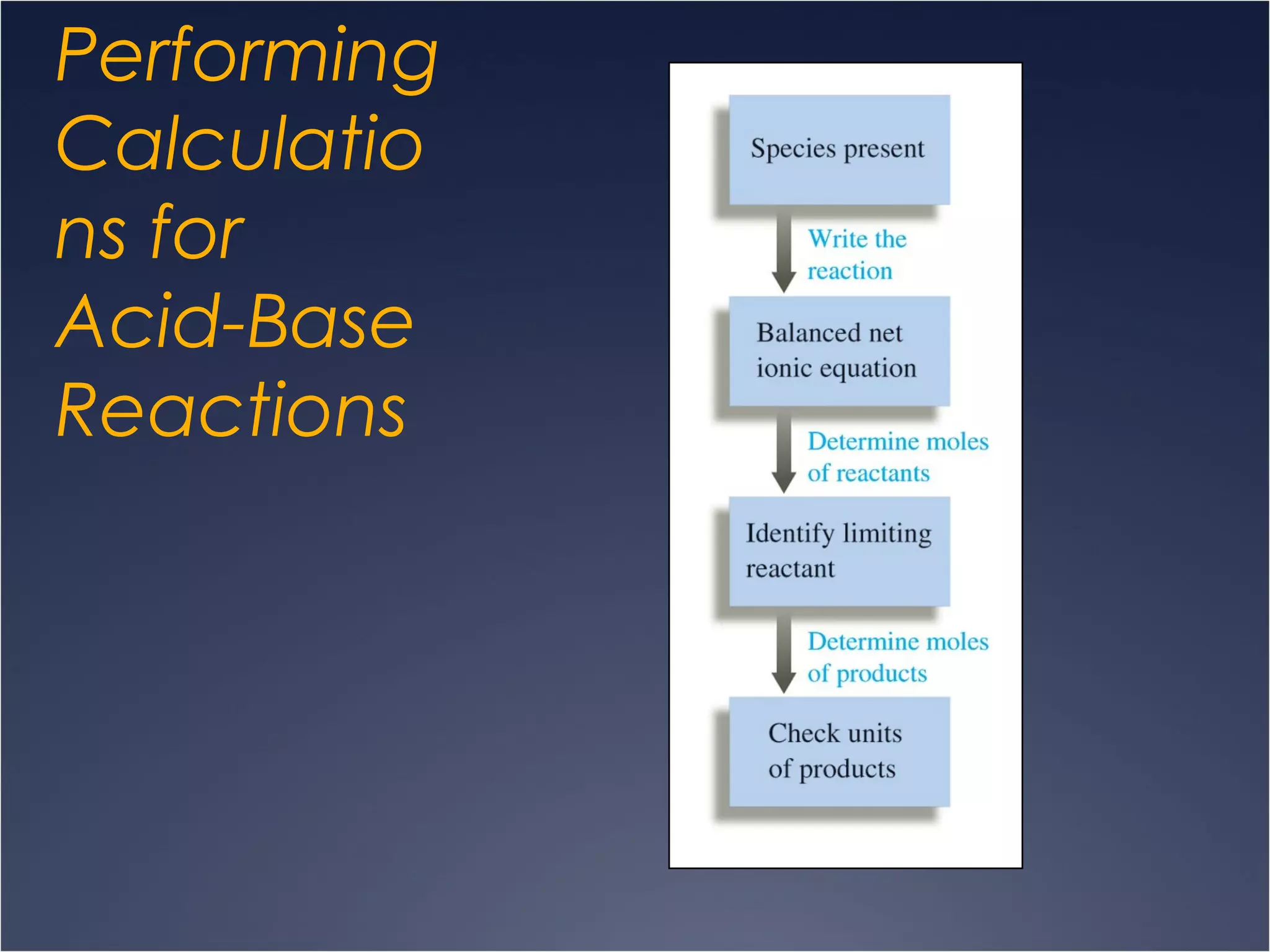
Performing Calculations for
Acid-Base Reactions
1. List the substances present in the combined
solution before any reaction occurs and
decide what reaction will occur.
2. Write the balanced net ionic equation for
this reaction.
3. Calculate the moles of reactants. For
reactions in solution, use the volumes of the
original solutions and their molarities.
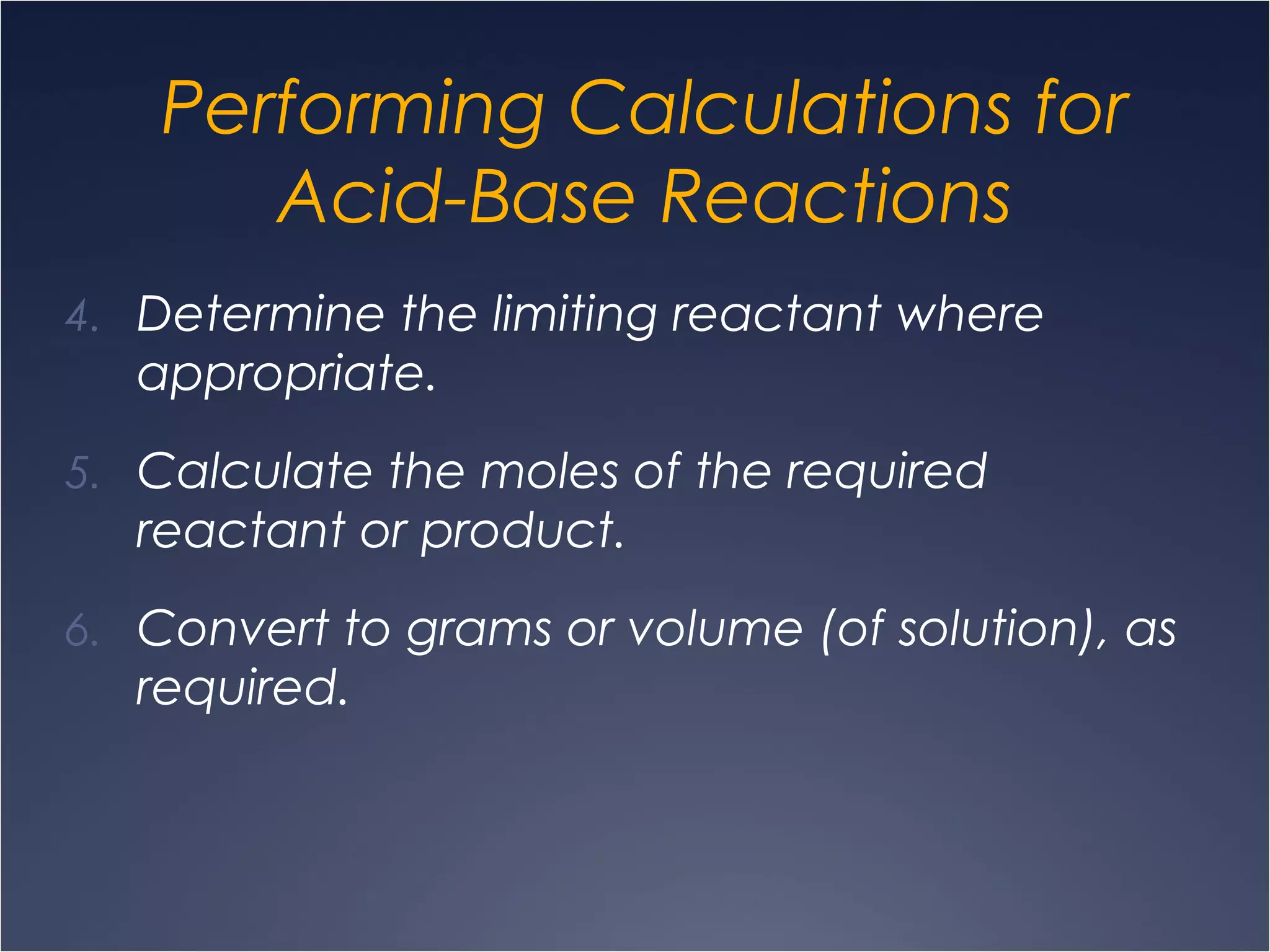
Performing Calculations for
Acid-Base Reactions
4. Determine the limiting reactant where
appropriate.
5. Calculate the moles of the required
reactant or product.
6. Convert to grams or volume (of solution), as
required.
Acid-Base Reaction
 An acid-base reaction is often called
a neutralization reaction.
 When just enough base is added to
react exactly with the acid in a
solution, we say the acid has been
neutralized.
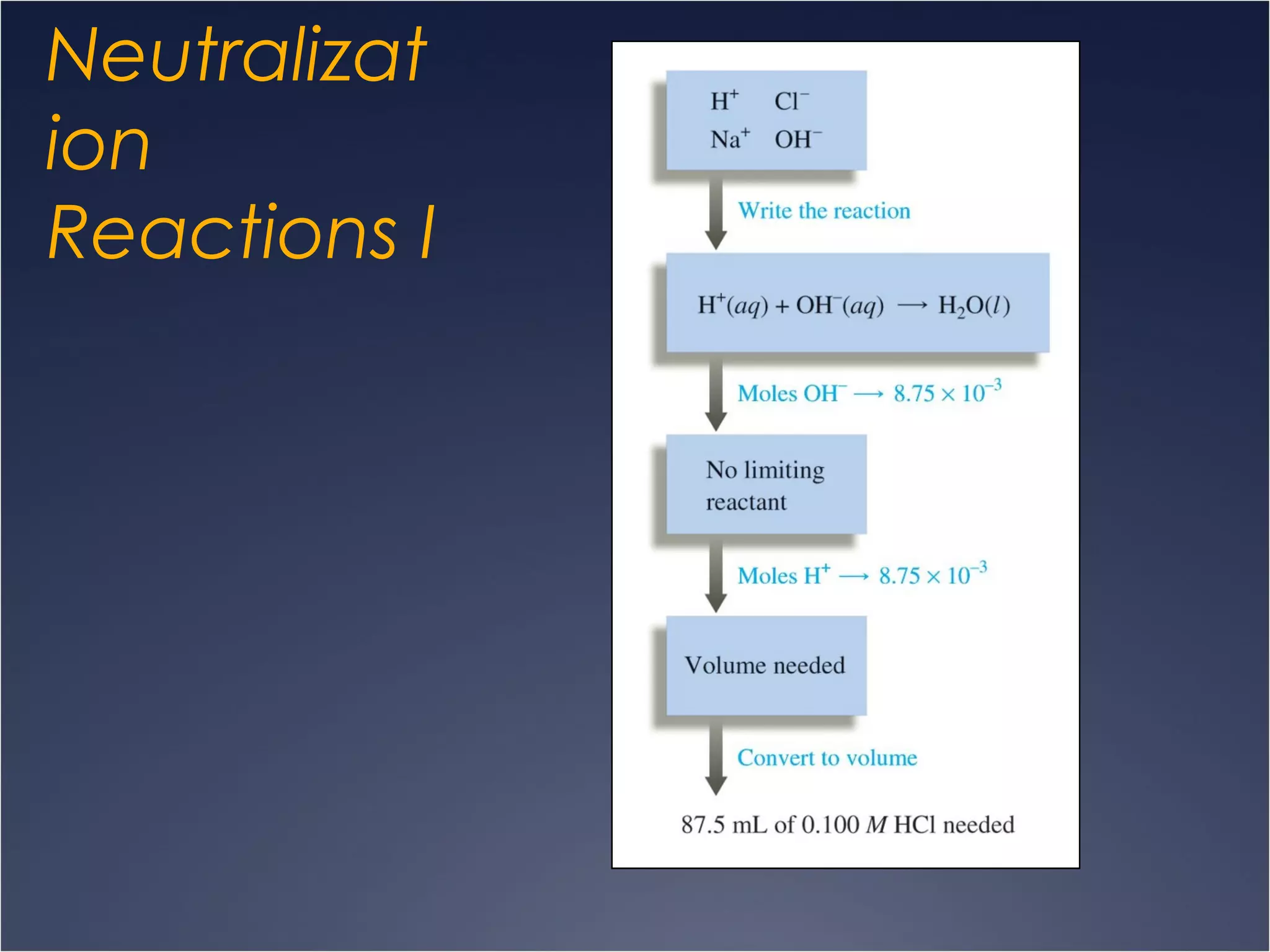
Step by Step Example
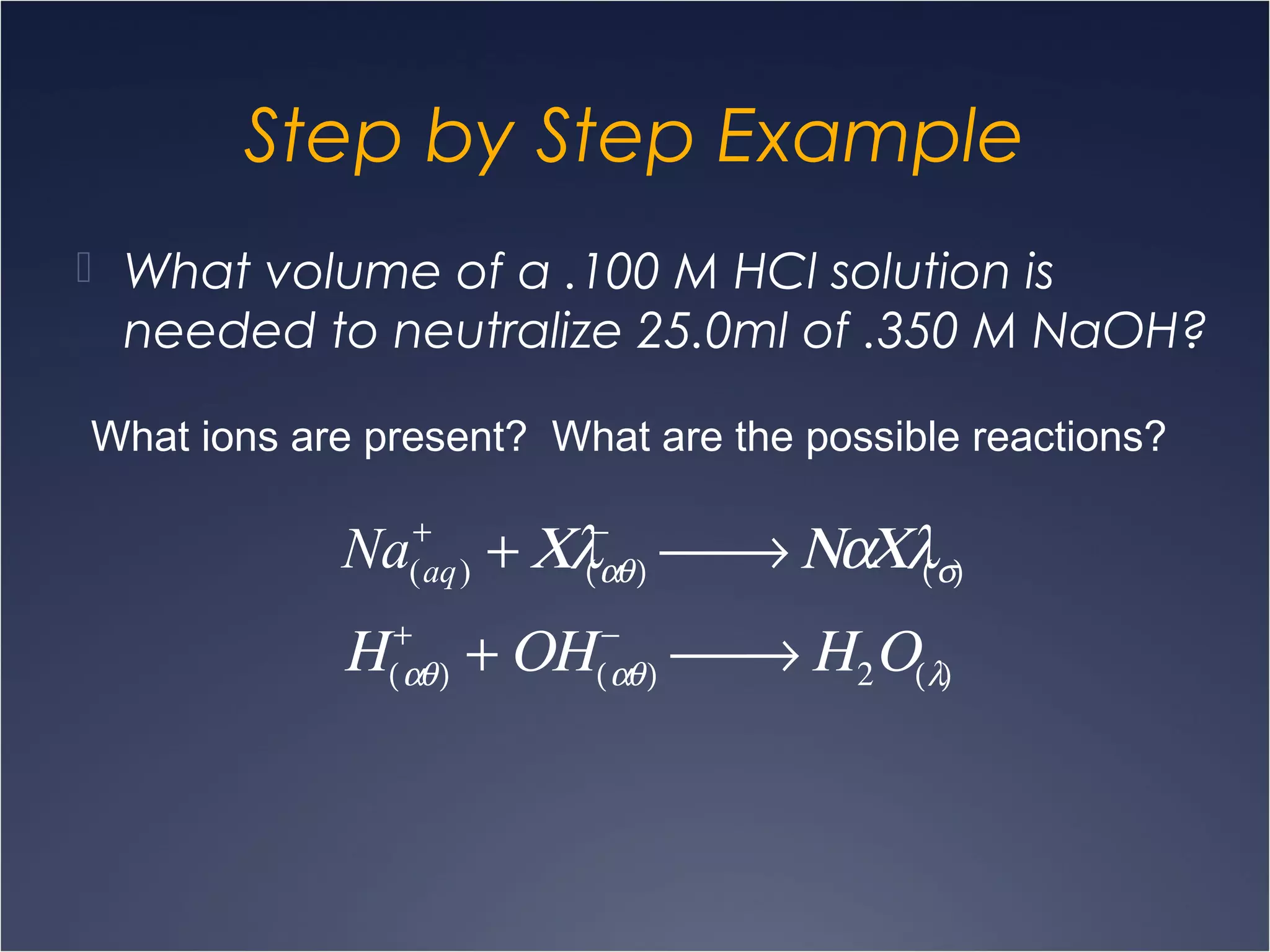
 What volume of a .100 M HCl solution is
needed to neutralize 25.0ml of .350 M NaOH?
What ions are present? What are the possible reactions?
Na(aq)
+
+ Χλ(αθ)
−
 → ΝαΧλ(σ)
Η(αθ)
+
+ ΟΗ(αθ)
−
 → Η2Ο(λ)
Example
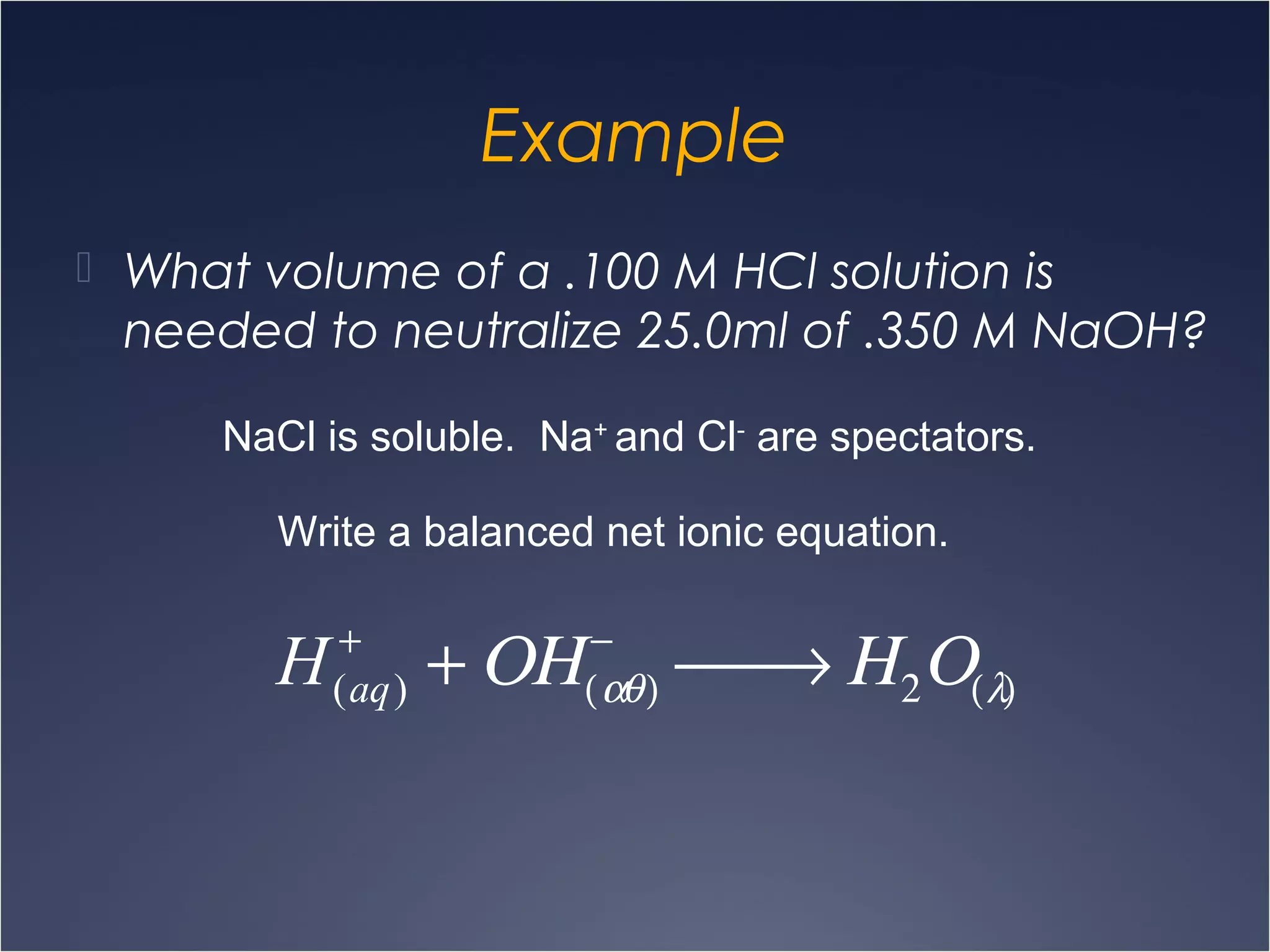
 What volume of a .100 M HCl solution is
needed to neutralize 25.0ml of .350 M NaOH?
NaCl is soluble. Na+
and Cl-
are spectators.
Write a balanced net ionic equation.
H(aq)
+
+ ΟΗ(αθ)
−
 → Η2Ο(λ)
Example
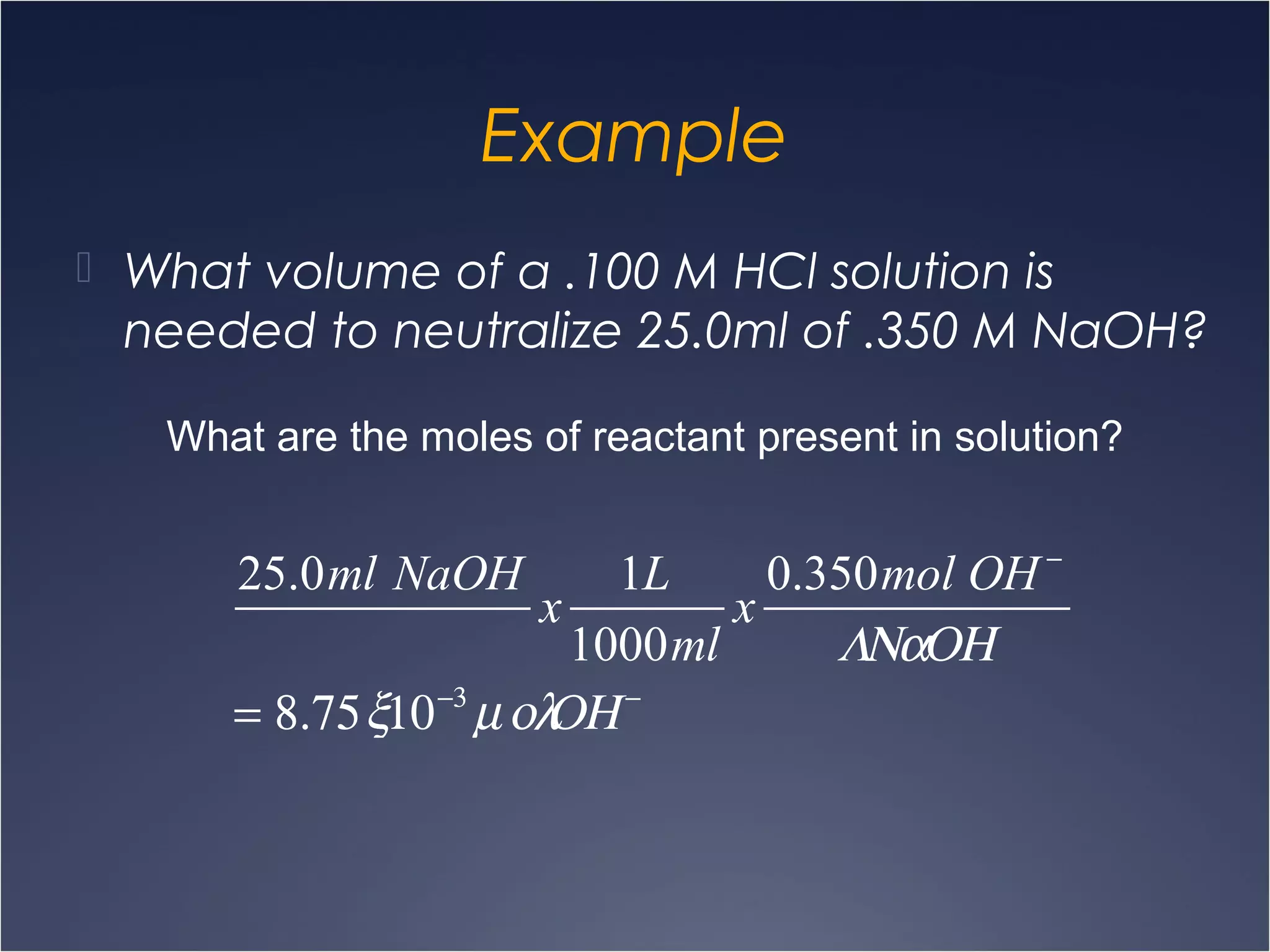
 What volume of a .100 M HCl solution is
needed to neutralize 25.0ml of .350 M NaOH?
What are the moles of reactant present in solution?
25.0ml NaOH
x
1L
1000ml
x
0.350mol OH −
ΛΝαΟΗ
= 8.75ξ10−3
µολΟΗ −
Example
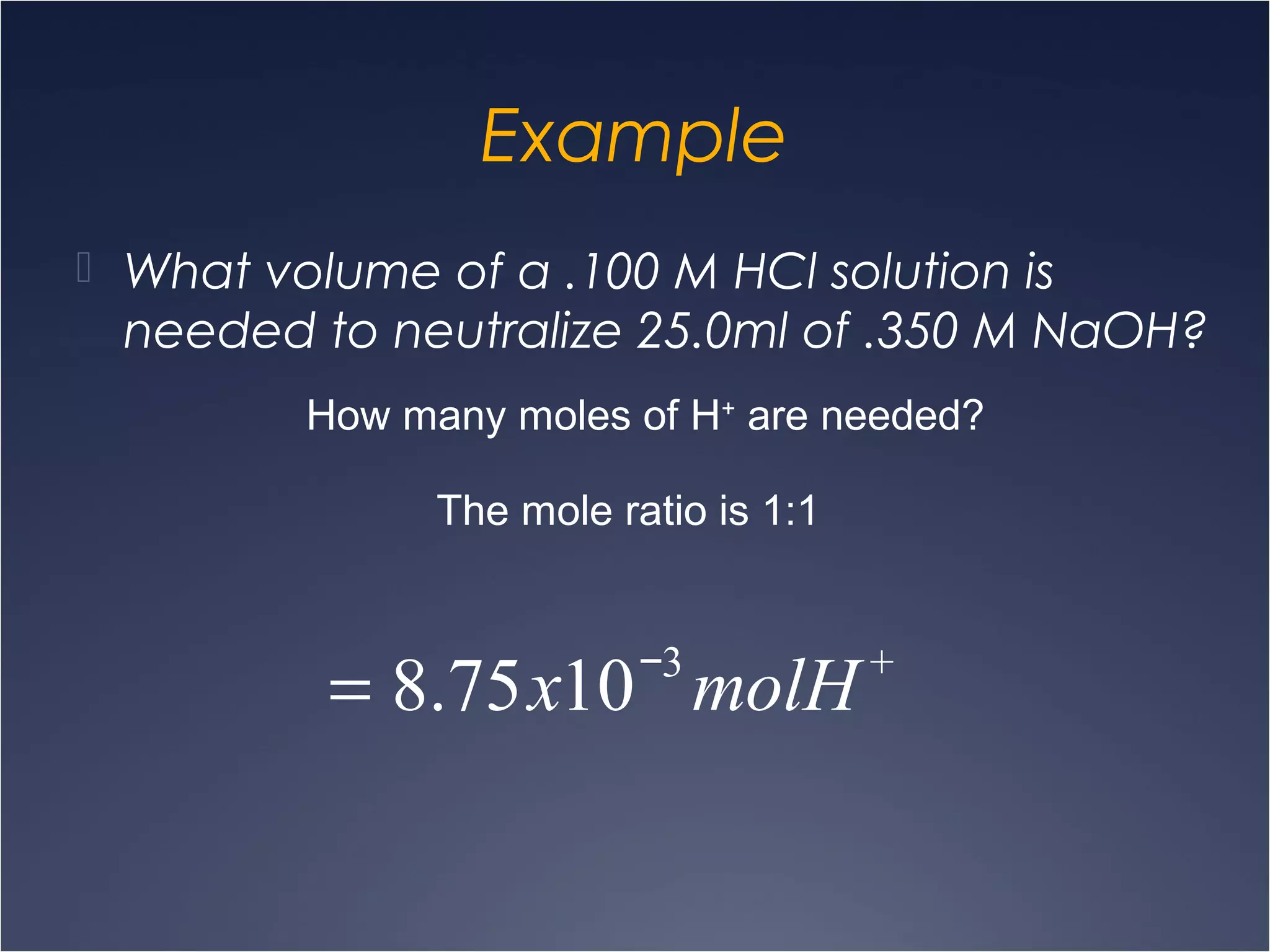
 What volume of a .100 M HCl solution is
needed to neutralize 25.0ml of .350 M NaOH?
How many moles of H+
are needed?
= 8.75x10⁻³
molH +
The mole ratio is 1:1
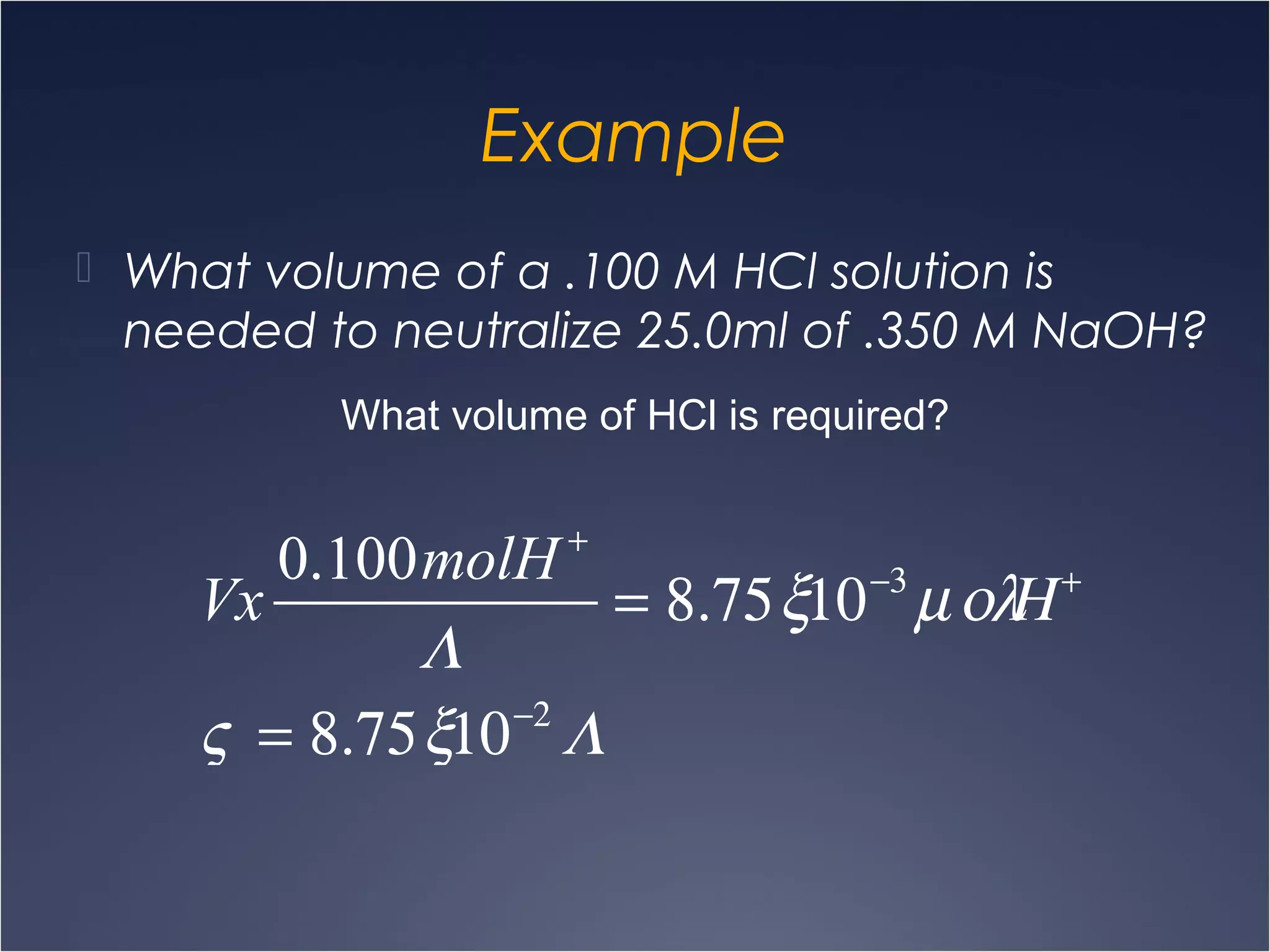
Example
 What volume of a .100 M HCl solution is
needed to neutralize 25.0ml of .350 M NaOH?
What volume of HCl is required?
Vx
0.100molH +
Λ
= 8.75ξ10−3
µολΗ +
ς = 8.75ξ10−2
Λ
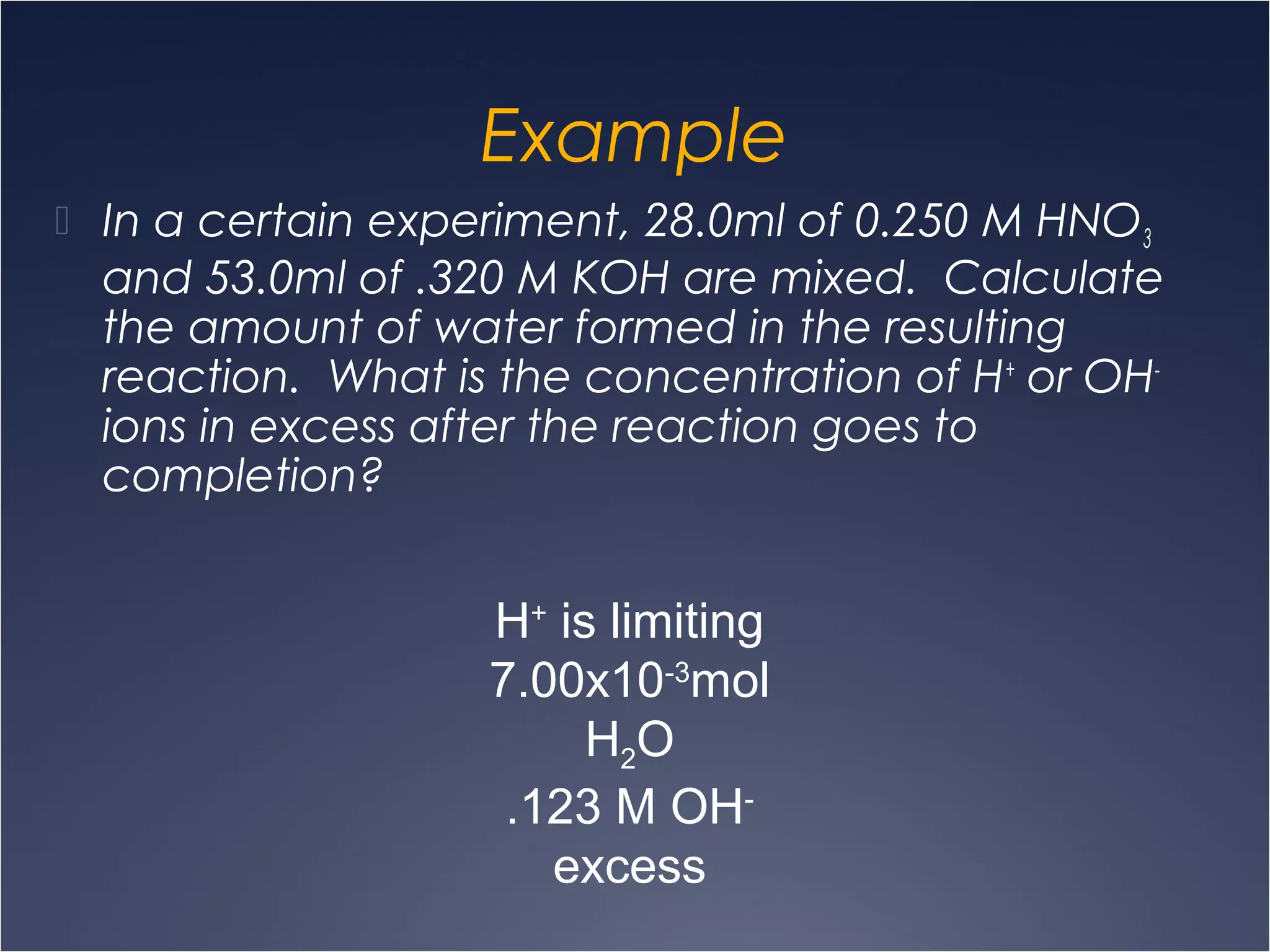
Example
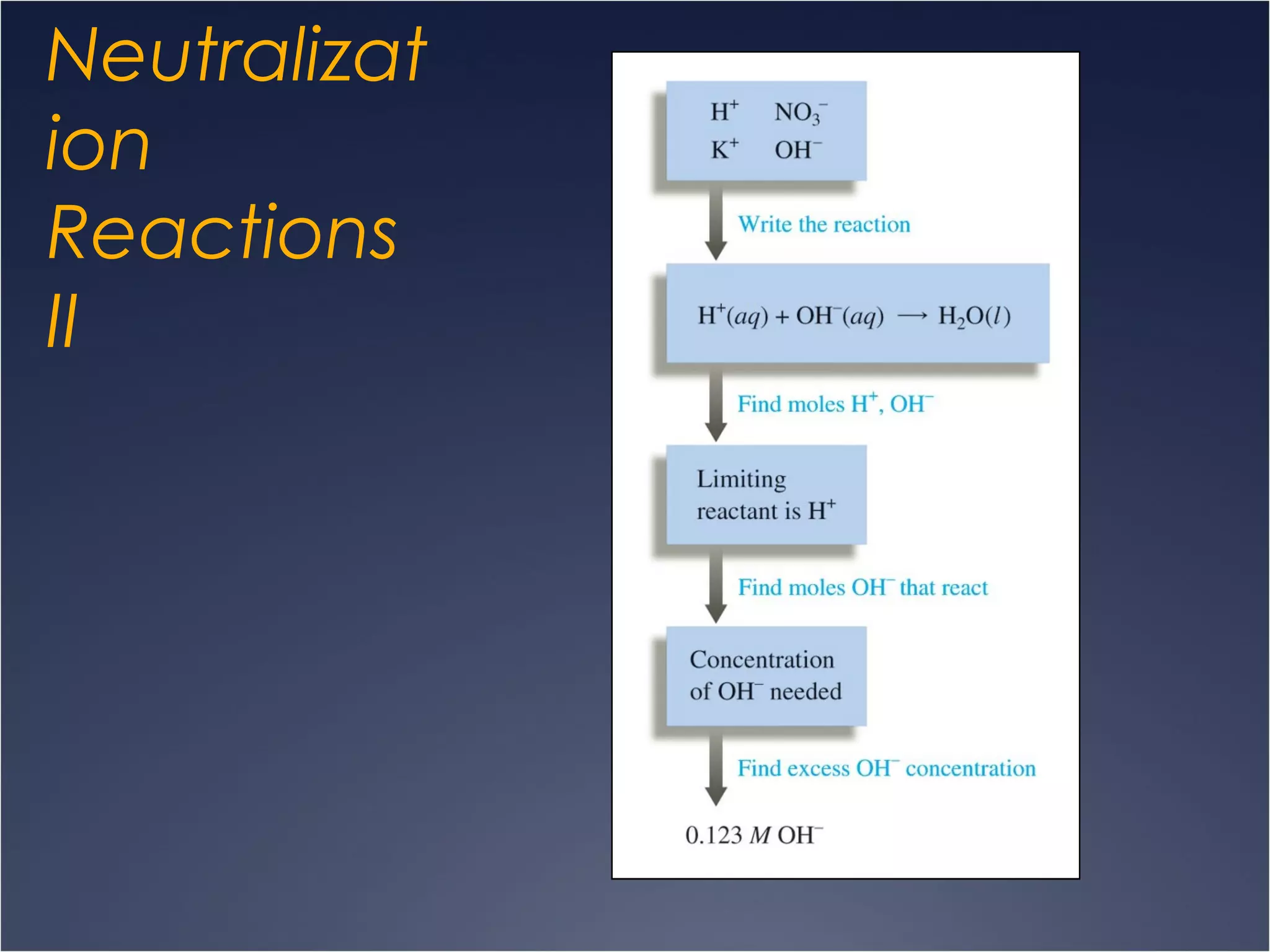
 In a certain experiment, 28.0ml of 0.250 M HNO3
and 53.0ml of .320 M KOH are mixed. Calculate
the amount of water formed in the resulting
reaction. What is the concentration of H+
or OH-
ions in excess after the reaction goes to
completion?
H+
is limiting
7.00x10⁻³
mol
H2O
.123 M OH-
excess
Acid-Base Titrations
 Volumetric analysis is a technique for
determining the amount of a certain
substance by doing a titration.
 A titration involves delivery (from a buret)
of a measured volume of a solution of
known concentration (the titrant) into a
solution containing the substance being
analyzed (the analyte).
Acid-Base Titrations
 The point in the titration where enough
titrant has been added to react exactly
with the analyte is called the equivalence
point or the stoichiometric point.
 This point is often marked with an indicator,
a substance added at the beginning of the
titration that changes color at the
equivalence point.
Acid-Base Titrations
 The point at which the indicator actually
changes color is called the endpoint of
the titration.
 The procedure for determining
accurately the concentration of a
solution is called standardizing the
solution.
Indicators
 A common indicator for acid-base
titrations is phenolphthalein, which is
colorless in an acidic solution and pink
in a basic solution.
Example
 A student carries out an experiment to standardize a
sodium hydroxide solution. To do this, the student weighs
out a 1.3009g sample of potassium hydrogen phthalate
(KHC8H4O4 or KHP). KHP (molar mass 204.22g/mol) has one
acidic hydrogen. The student dissolves the KHP is distilled
water, add phenolphthalein as an indicator, and titrates
the resulting solution with the sodium hydroxide solution to
the phenolphthalein endpoint. The difference between
the final and initial buret readings indicate that 41.20 ml of
the sodium hydroxide solution is required to react exactly
with the 1.3009g KHP. Calculate the concentration of the
sodium hydroxide solution.
Example
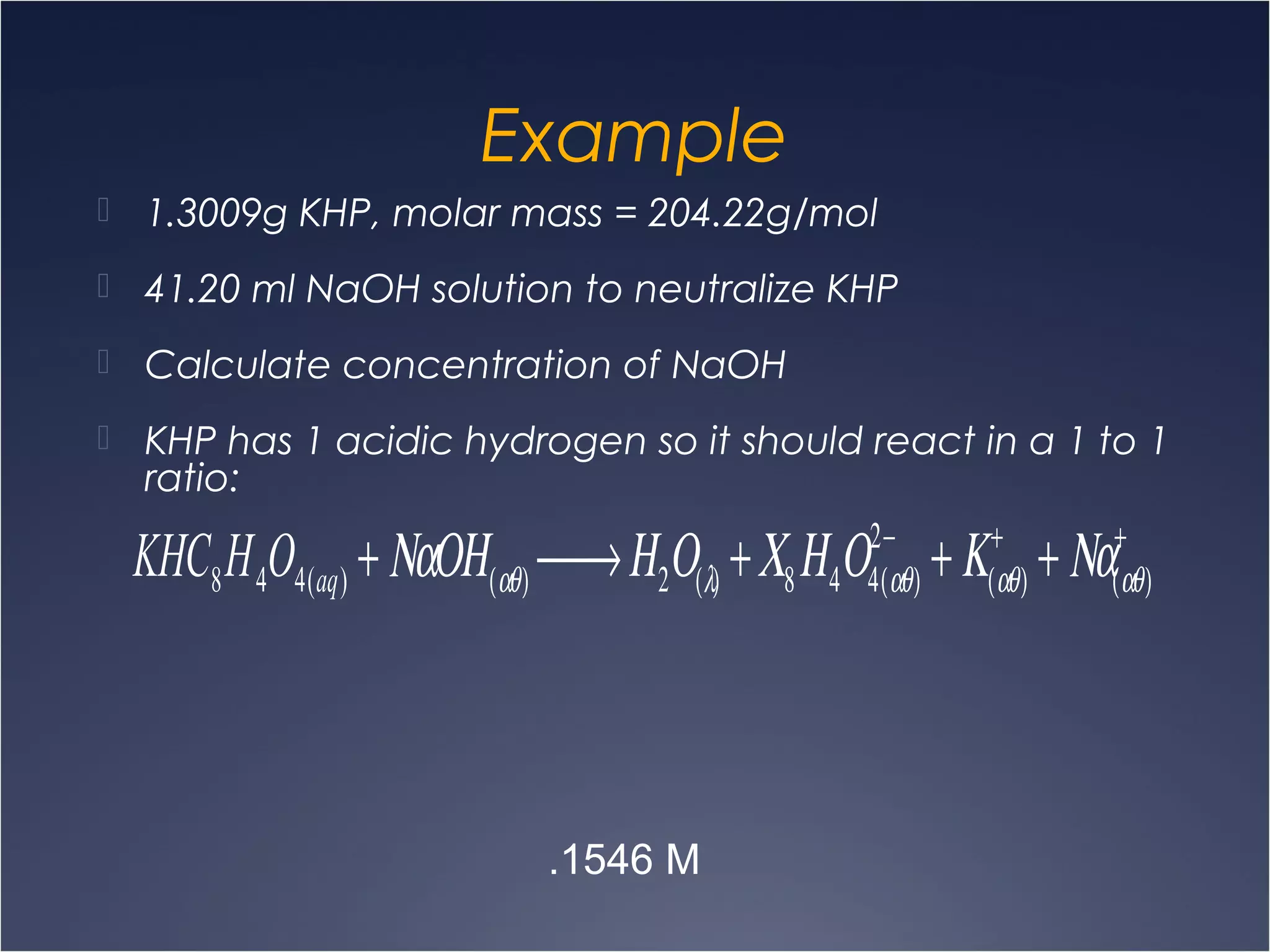
 1.3009g KHP, molar mass = 204.22g/mol
 41.20 ml NaOH solution to neutralize KHP
 Calculate concentration of NaOH
 KHP has 1 acidic hydrogen so it should react in a 1 to 1
ratio:
KHC8H4O4(aq) + ΝαΟΗ(αθ) → Η2Ο(λ) +Χ8Η4Ο4(αθ)
2−
+Κ(αθ)
+
+ Να(αθ)
+
.1546 M
Reactions
Oxidation-
Reduction
Oxidation and Reduction
 Oxidation Reduction reactions transfer
one or more electrons from one
species to another.
 Called Redox reactions.
 Common and important type of
reaction: photosynthesis, energy
production and combustion
Oxidation States
 Also called oxidation numbers provides a
way to keep track of electrons in oxidation-
reduction reactions.
 In a covalent compound when electrons
are shared, oxidation numbers are based
on the relative electron affinity of the
elements involved.
Oxidation States
 In a covalent compound:
 If the bond is between two identical
atoms, the electrons are divided
equally.
 If the bond is between different
atoms, the electrons are divided
based on electron attraction.
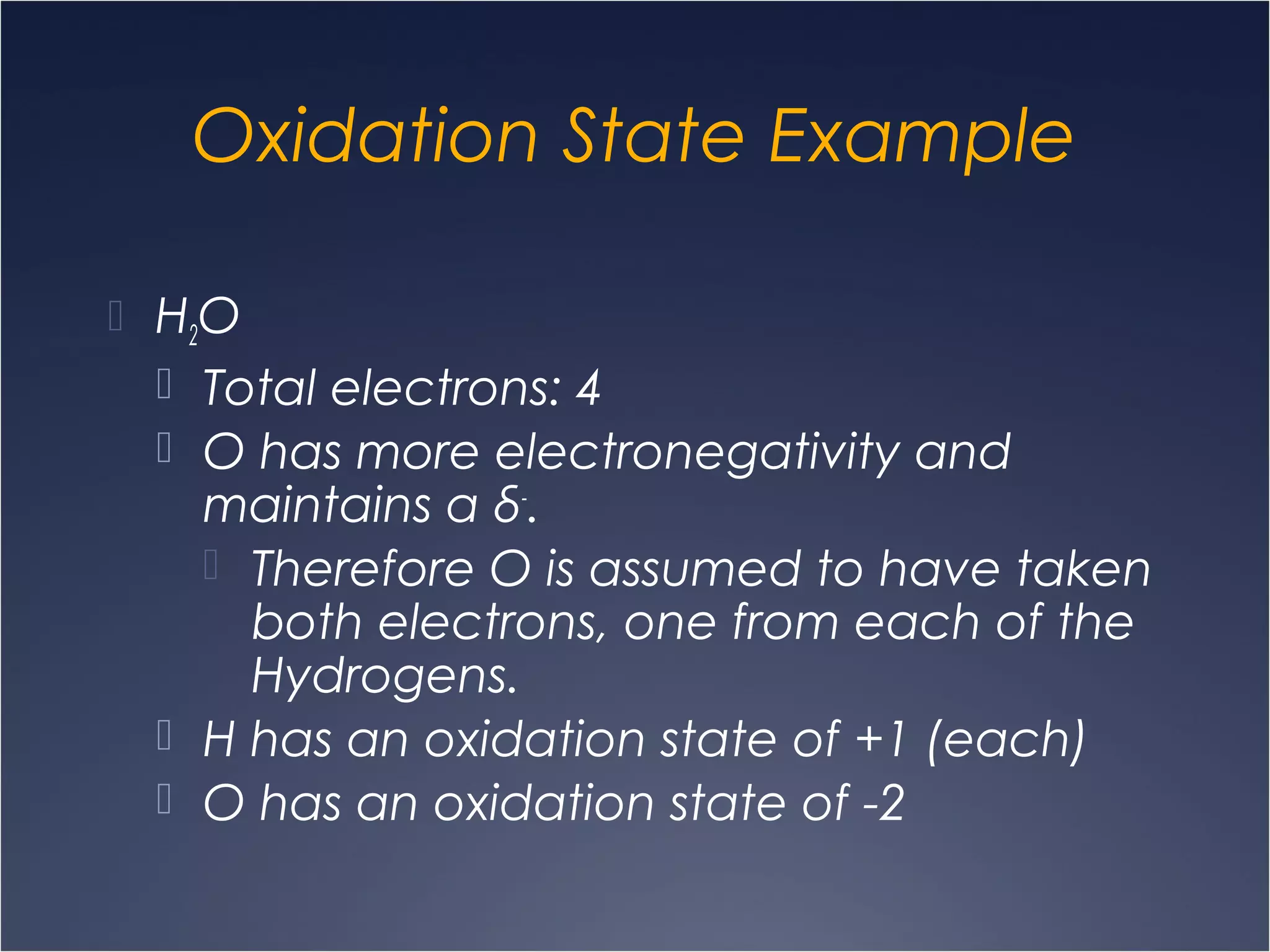
Oxidation State Example
 H2O
 Total electrons: 4
 O has more electronegativity and
maintains a δ-
.
 Therefore O is assumed to have taken
both electrons, one from each of the
Hydrogens.
 H has an oxidation state of +1 (each)
 O has an oxidation state of -2
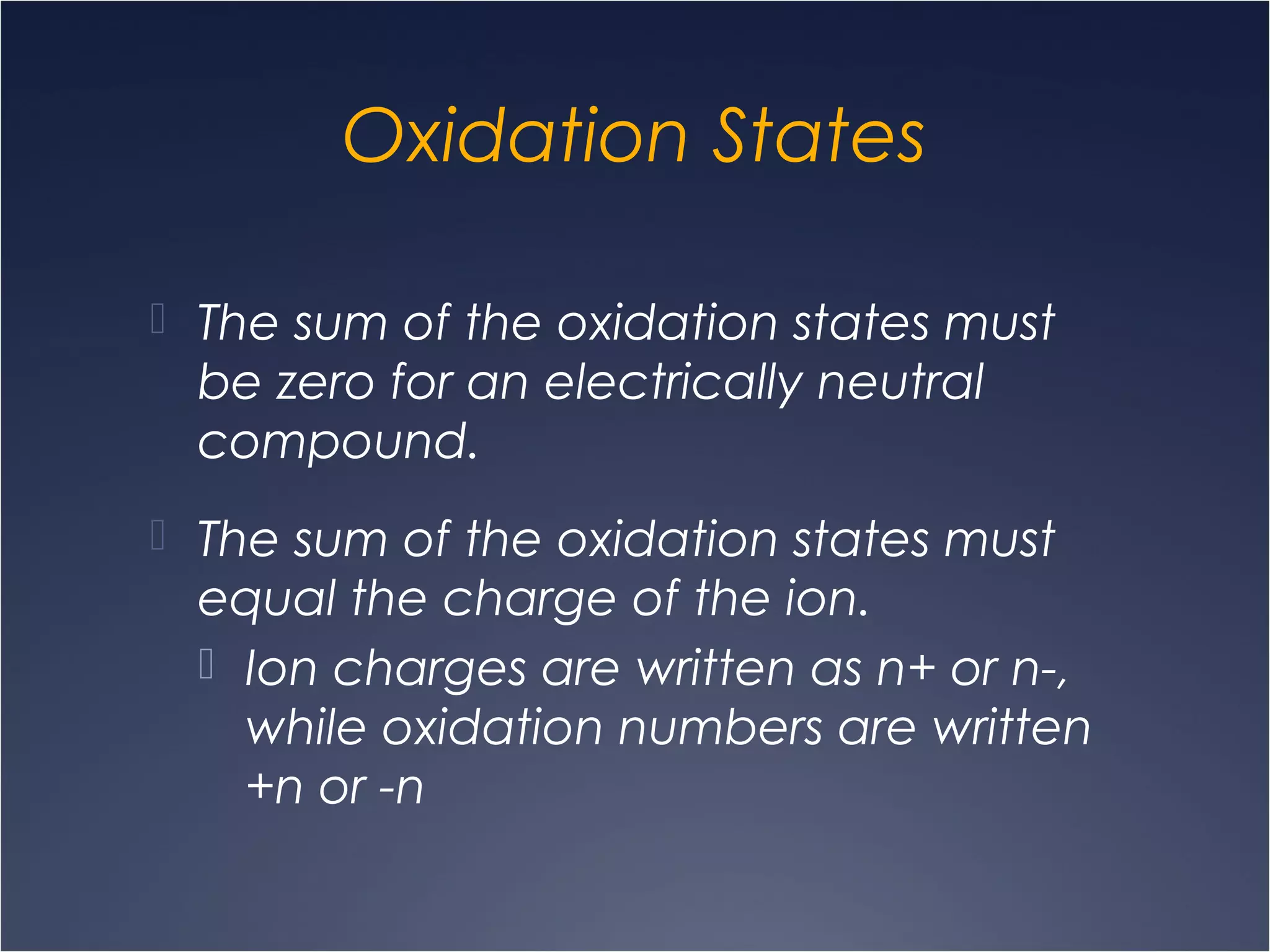
Oxidation States
 The sum of the oxidation states must
be zero for an electrically neutral
compound.
 The sum of the oxidation states must
equal the charge of the ion.
 Ion charges are written as n+ or n-,
while oxidation numbers are written
+n or -n
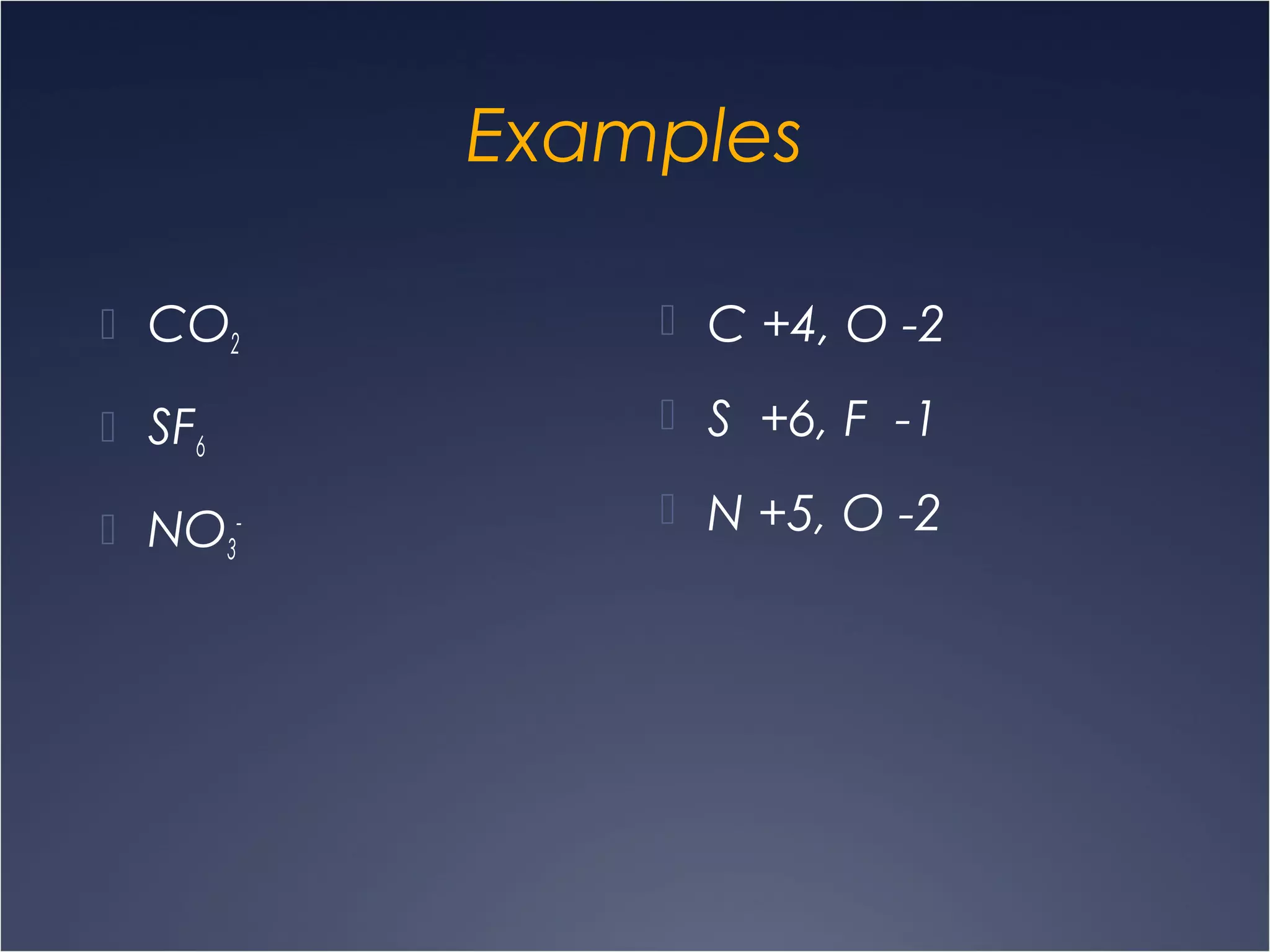
Examples
 CO2
 SF6
 NO3
-
 C +4, O -2
 S +6, F -1
 N +5, O -2
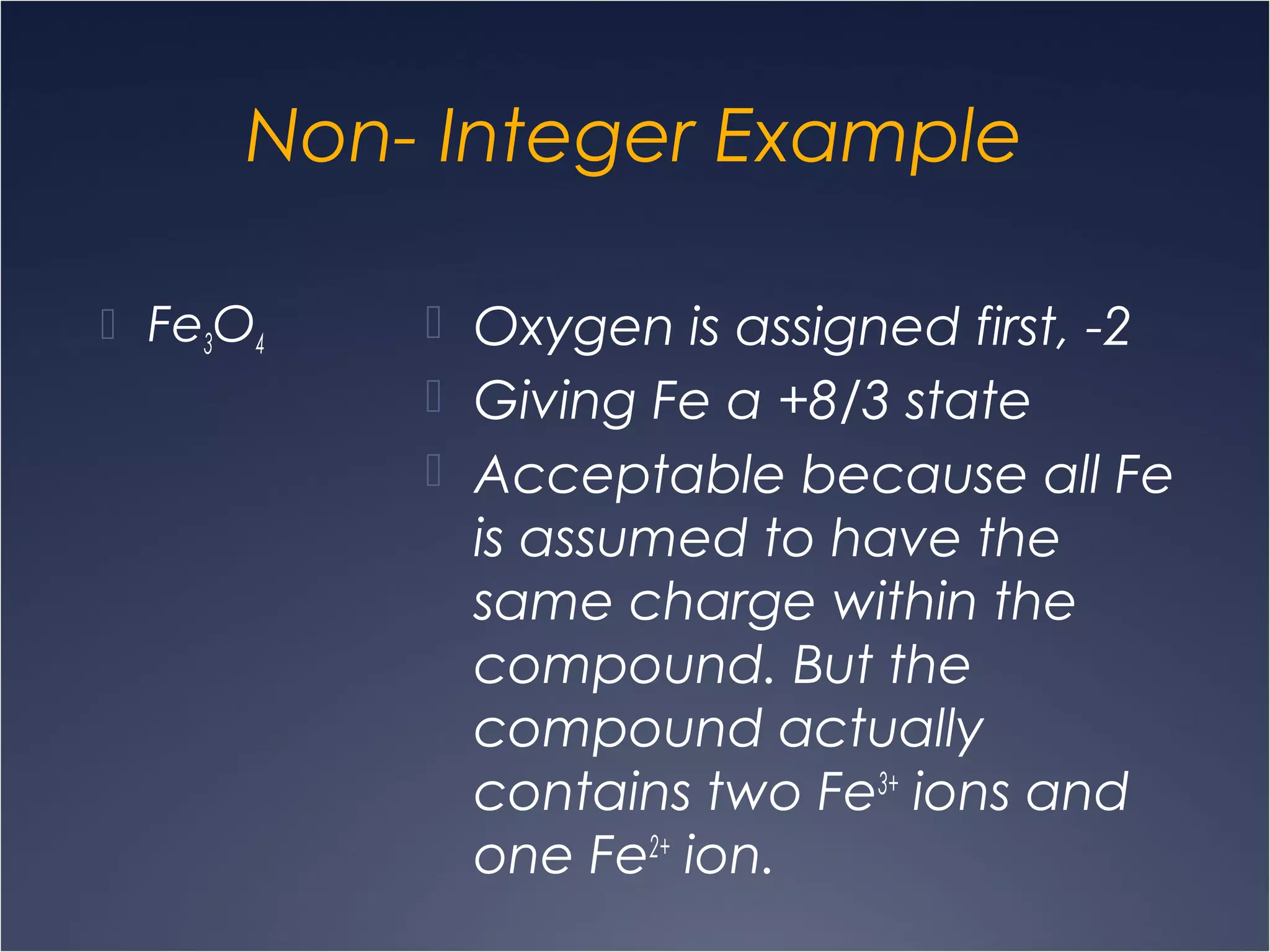
Non- Integer Example
 Fe3O4
 Oxygen is assigned first, -2
 Giving Fe a +8/3 state
 Acceptable because all Fe
is assumed to have the
same charge within the
compound. But the
compound actually
contains two Fe3+
ions and
one Fe2+
ion.
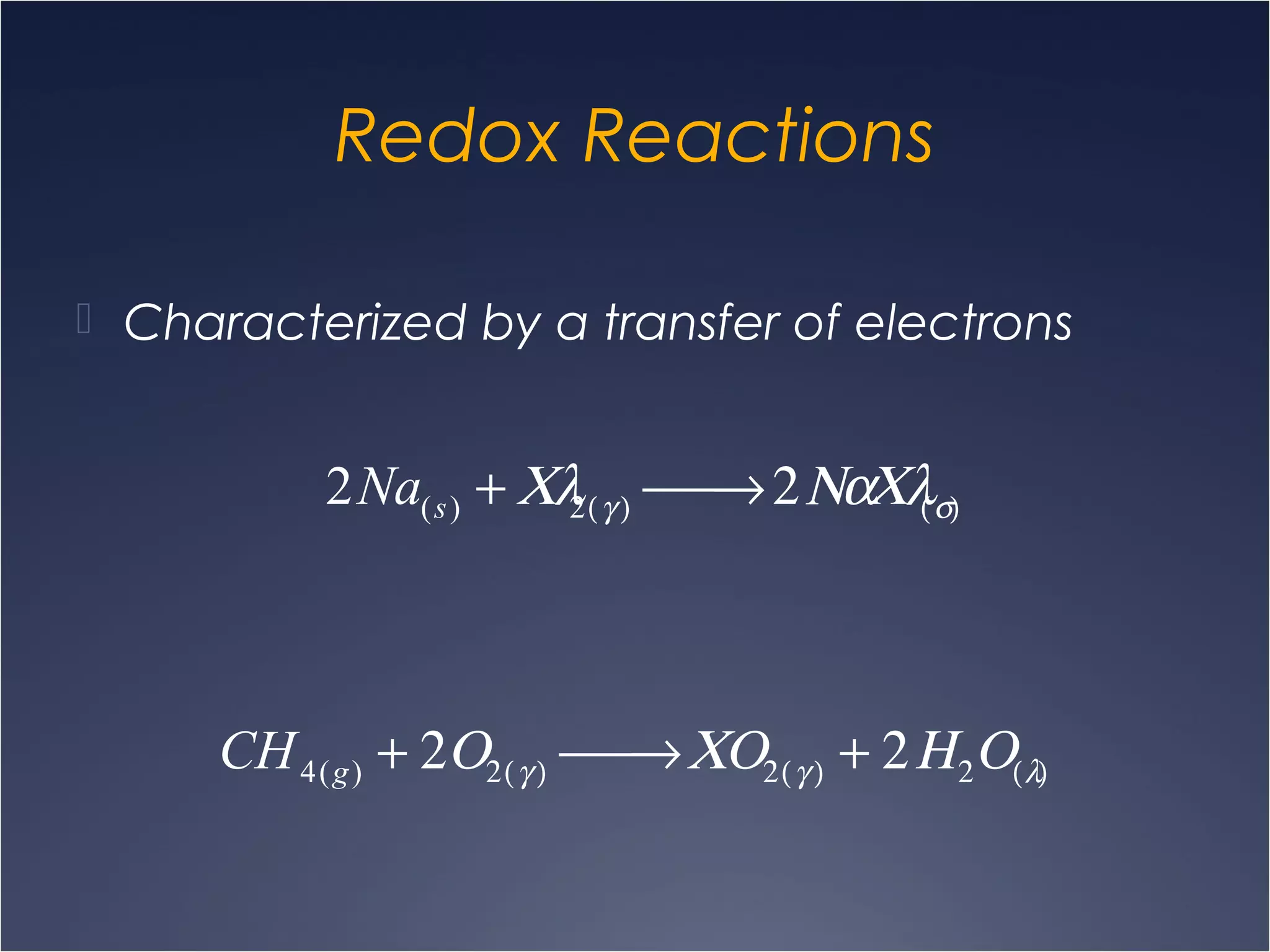
Redox Reactions
 Characterized by a transfer of electrons
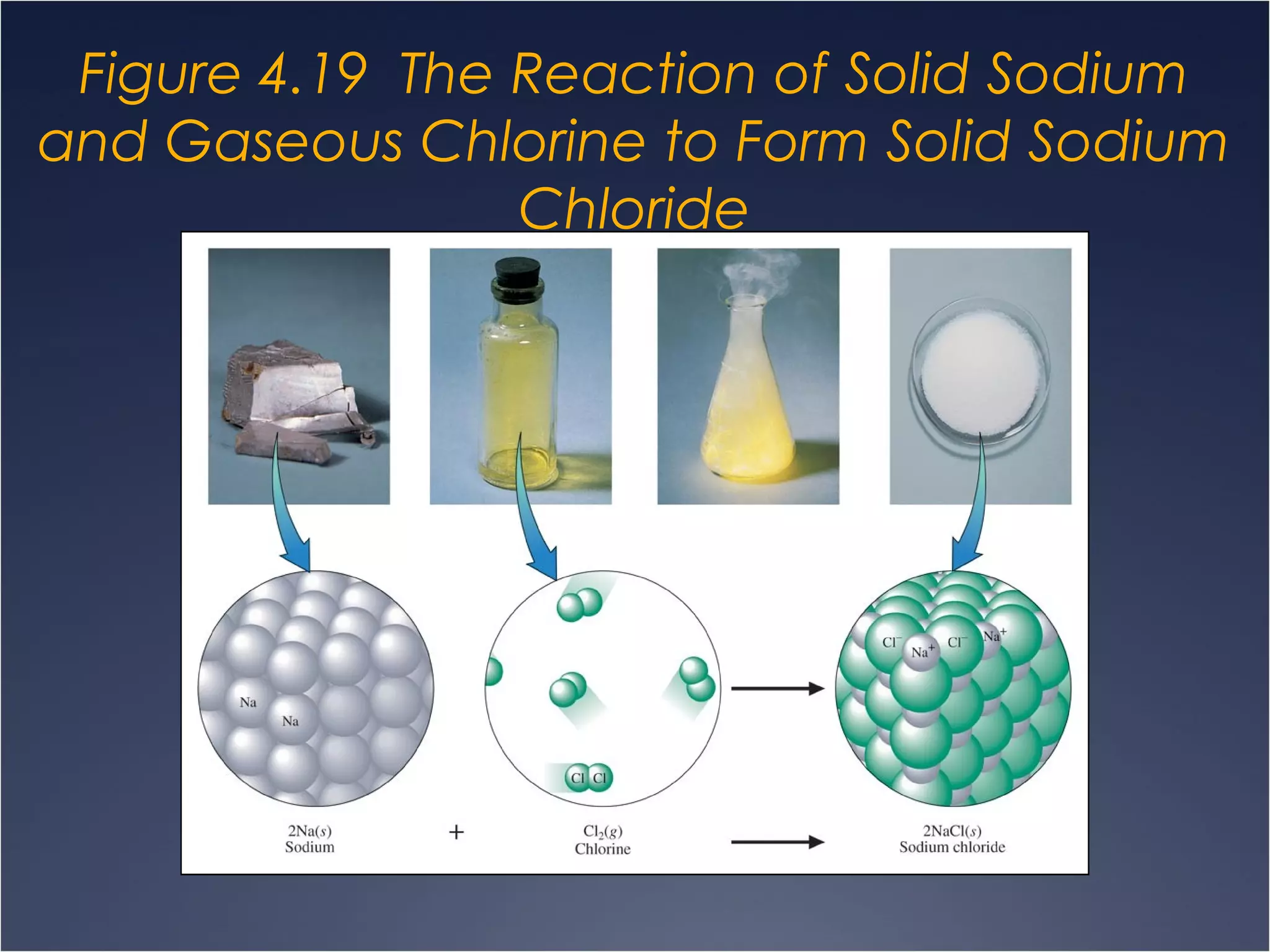
2Na(s) + Χλ2(γ )  → 2ΝαΧλ(σ)
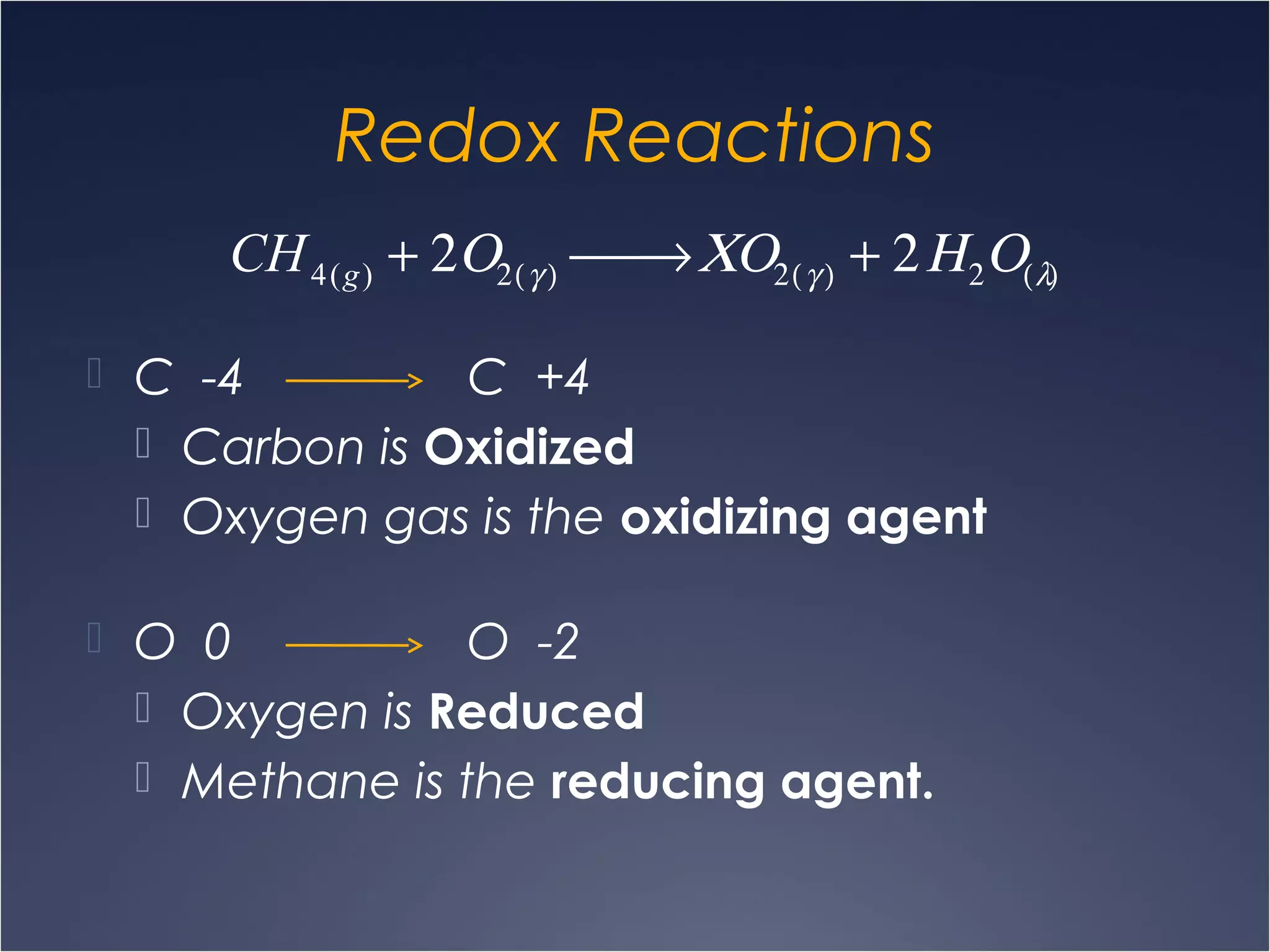
CH4(g) + 2Ο2(γ )  → ΧΟ2(γ ) + 2Η2Ο(λ)
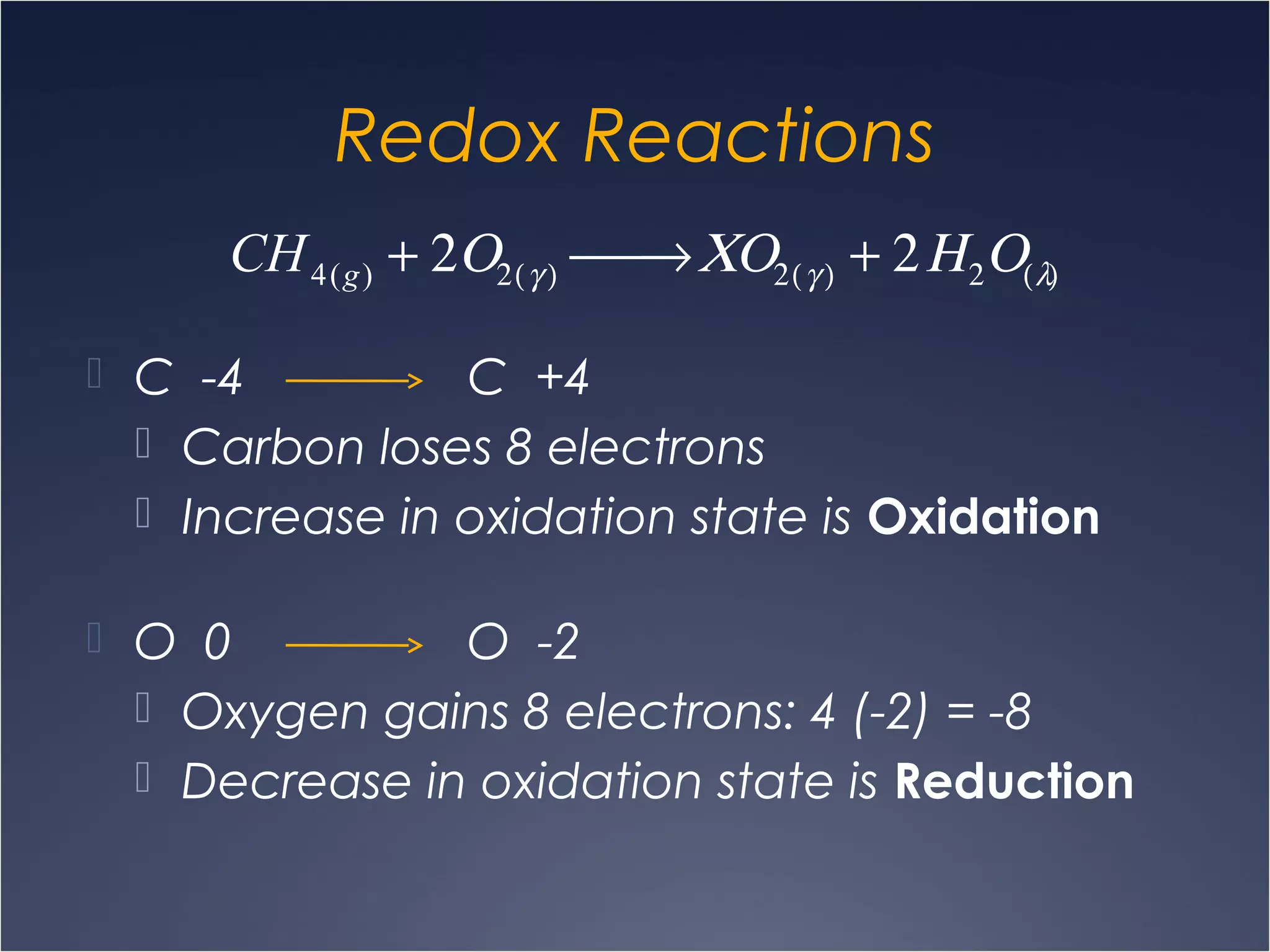
Redox Reactions
 C -4 C +4
 Carbon loses 8 electrons
 Increase in oxidation state is Oxidation
CH4(g) + 2Ο2(γ )  → ΧΟ2(γ ) + 2Η2Ο(λ)
 O 0 O -2
 Oxygen gains 8 electrons: 4 (-2) = -8
 Decrease in oxidation state is Reduction
Redox Reactions
 C -4 C +4
 Carbon is Oxidized
 Oxygen gas is the oxidizing agent
CH4(g) + 2Ο2(γ )  → ΧΟ2(γ ) + 2Η2Ο(λ)
 O 0 O -2
 Oxygen is Reduced
 Methane is the reducing agent.
Example
 Metallurgy, the process of producing a metal from its
ore, always involves oxidation-reduction reactions. In
the metallurgy of galena (PbS), the principal lead-
containing ore, the first step is the conversion of lead
sulfide to its oxide (a process called roasting):
 The oxide is then treated with carbon monoxide to
produce the free metal:
 For each reaction, identify the atoms that are oxidized
and reduced, and specify the oxidizing and reducing
agents.
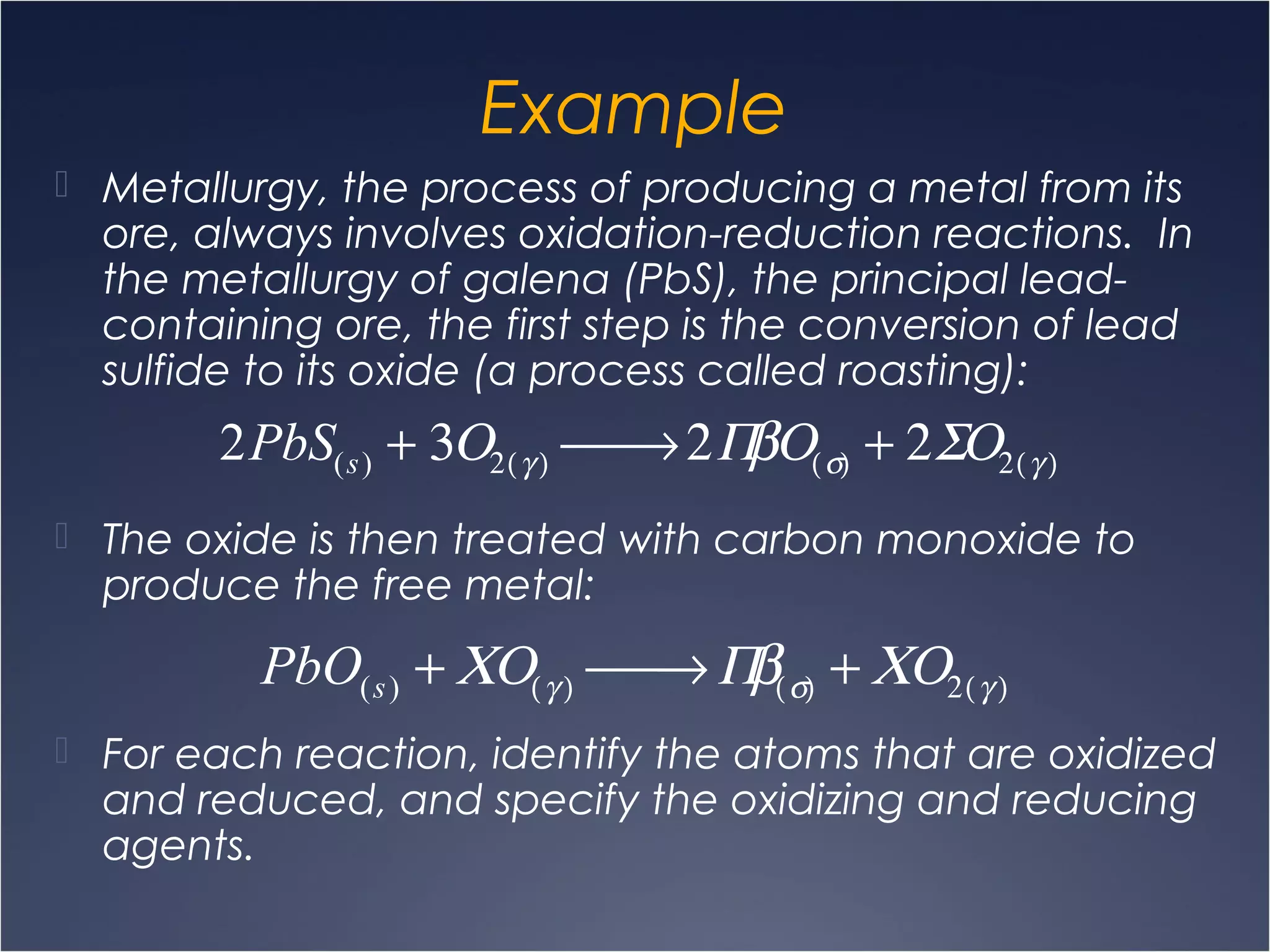
2PbS(s) + 3Ο2(γ )  → 2ΠβΟ(σ) + 2ΣΟ2(γ )
PbO(s) + ΧΟ(γ )  → Πβ(σ) + ΧΟ2(γ )
Example
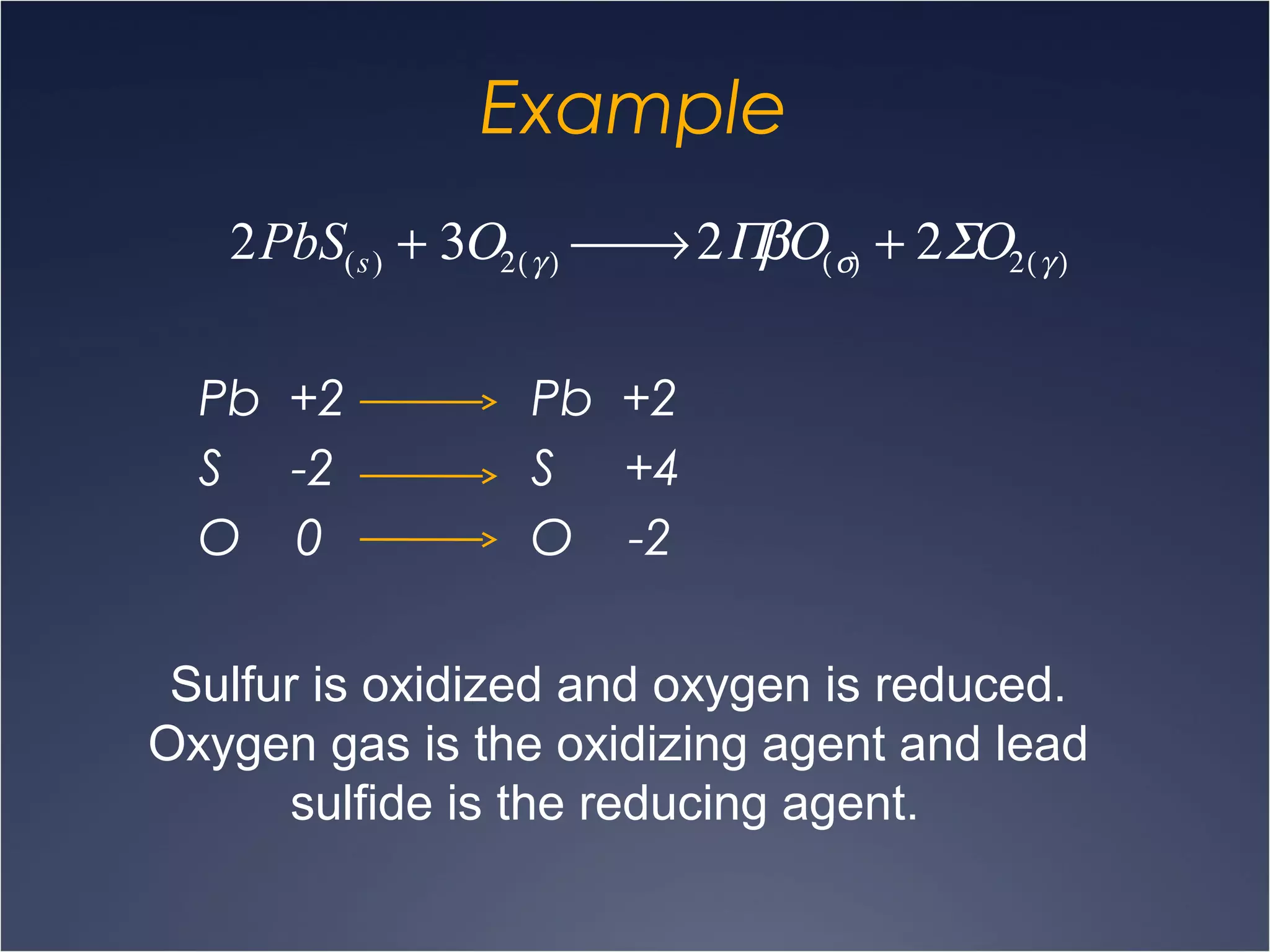
Pb +2 Pb +2
S -2 S +4
O 0 O -2
2PbS(s) + 3Ο2(γ )  → 2ΠβΟ(σ) + 2ΣΟ2(γ )
Sulfur is oxidized and oxygen is reduced.
Oxygen gas is the oxidizing agent and lead
sulfide is the reducing agent.
Example
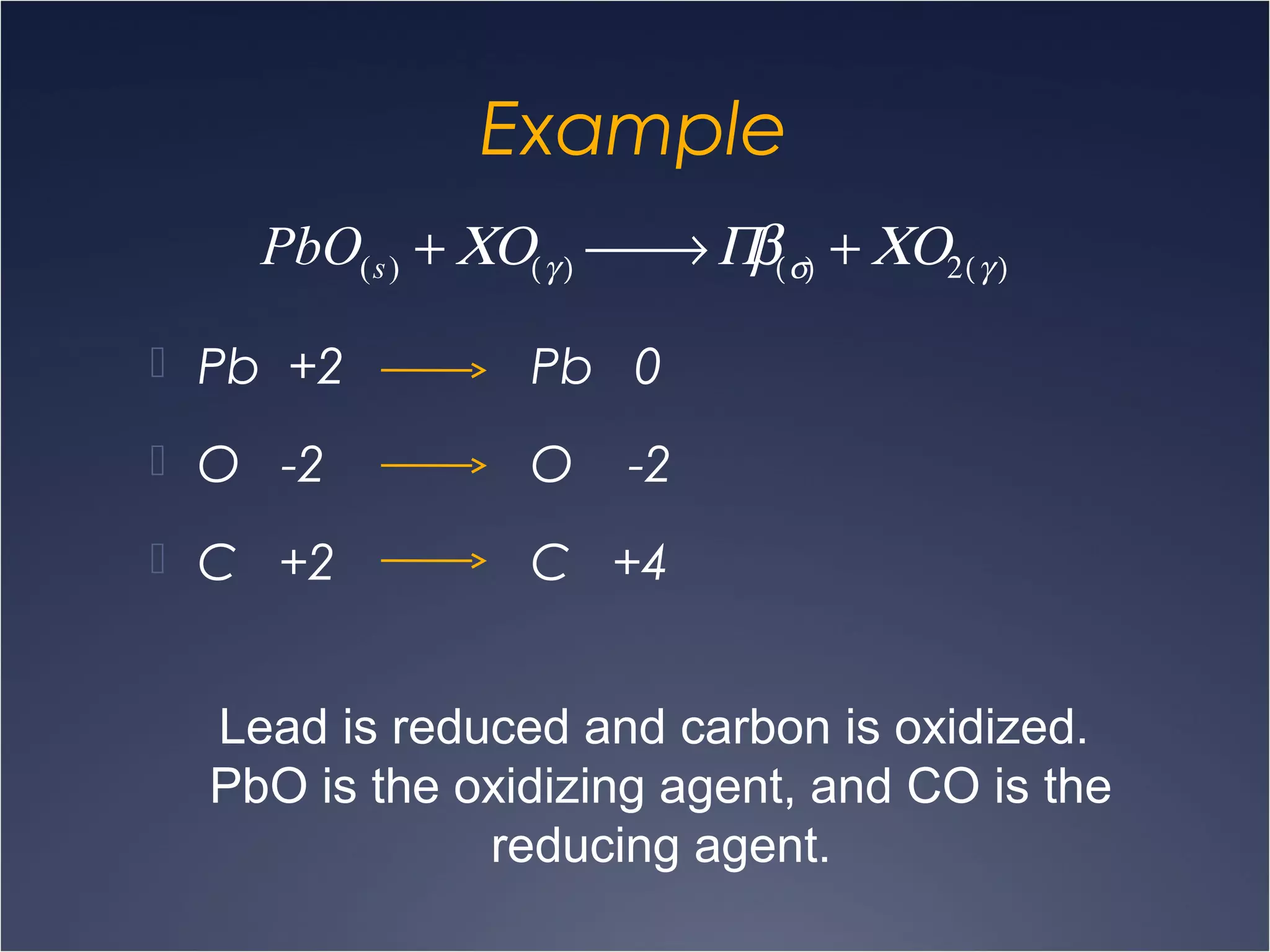
 Pb +2 Pb 0
 O -2 O -2
 C +2 C +4
PbO(s) + ΧΟ(γ )  → Πβ(σ) + ΧΟ2(γ )
Lead is reduced and carbon is oxidized.
PbO is the oxidizing agent, and CO is the
reducing agent.
Oxidation-Reduction
Balancing
Balancing Redox Reactions
Two methods are normally used:
1. Balancing of Oxidation states
2. Separation of the reaction into two half-
reactions
 Normally used for more complex
reactions
Oxidation States Balancing
Method
 We know that in a redox reaction we
must ultimately have equal numbers
of electrons gained and lost, and we
can use this principle to balance
redox equations.
Balancing Redox Steps
1. Write the unbalanced equation.
2. Determine the oxidation states of all atoms.
3. Show electrons gained and lost.
4. Use coefficients to equalize the electrons
gained and lost.
5. Balance the rest of the equations by inspection.
6. Add appropriate states.
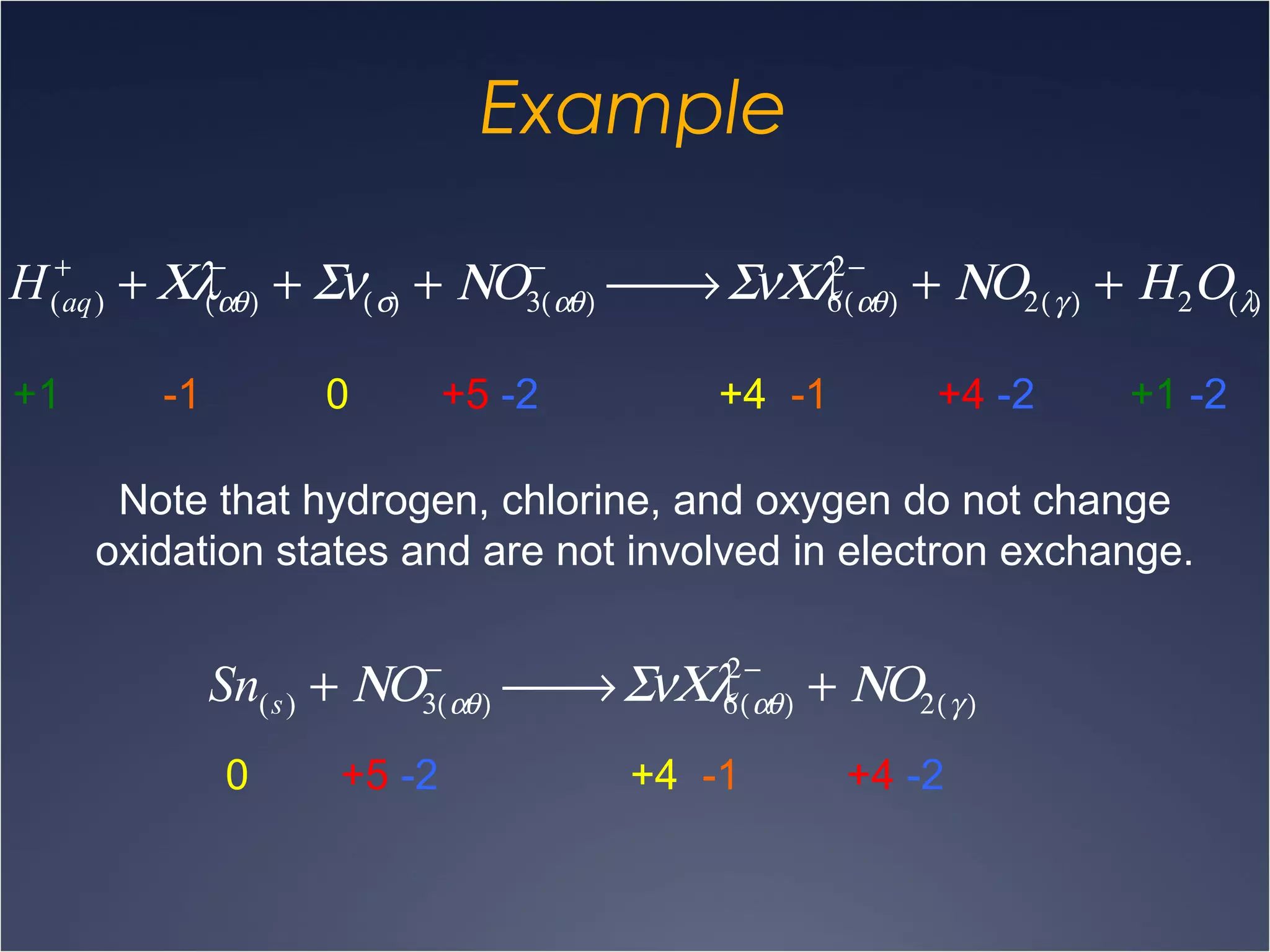
Example
H(aq)
+
+ Χλ(αθ)
−
+ Σν(σ) + ΝΟ3(αθ)
−
 → ΣνΧλ6(αθ)
2−
+ ΝΟ2(γ ) + Η2Ο(λ)
+1 -1 0 +5 -2 +4 -1 +4 -2 +1 -2
Note that hydrogen, chlorine, and oxygen do not change
oxidation states and are not involved in electron exchange.
Sn(s) + ΝΟ3(αθ)
−
 → ΣνΧλ6(αθ)
2−
+ ΝΟ2(γ )
0 +5 -2 +4 -1 +4 -2
Example
Sn(s) + ΝΟ3(αθ)
−
 → ΣνΧλ6(αθ)
2−
+ ΝΟ2(γ )
0 +5 -2 +4 -1 +4 -2
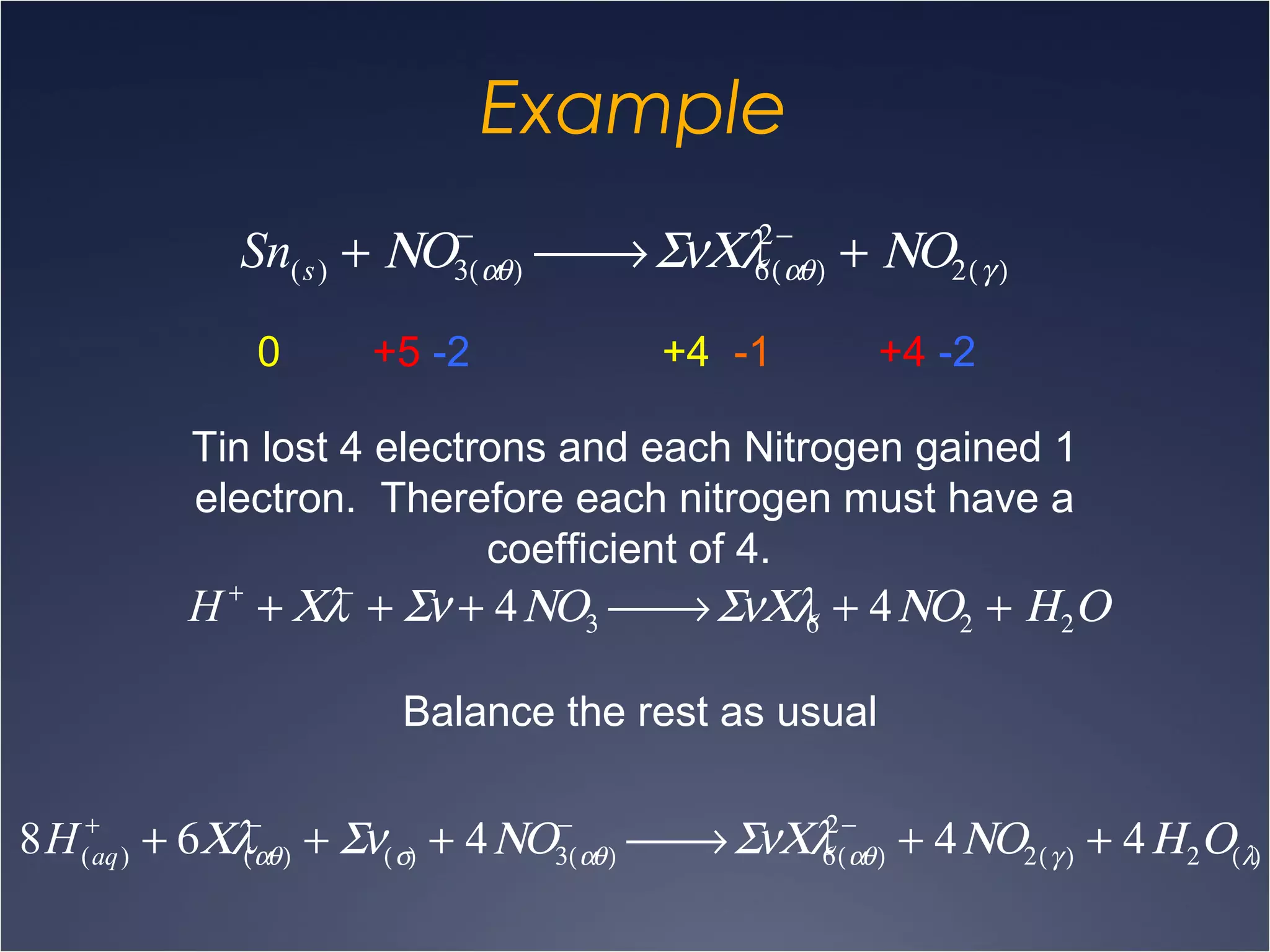
Tin lost 4 electrons and each Nitrogen gained 1
electron. Therefore each nitrogen must have a
coefficient of 4.
H +
+ Χλ−
+ Σν + 4ΝΟ3  → ΣνΧλ6 + 4ΝΟ2 + Η2Ο
Balance the rest as usual
8H(aq)
+
+ 6Χλ(αθ)
−
+ Σν(σ) + 4ΝΟ3(αθ)
−
 → ΣνΧλ6(αθ)
2−
+ 4ΝΟ2(γ ) + 4Η2Ο(λ)
END
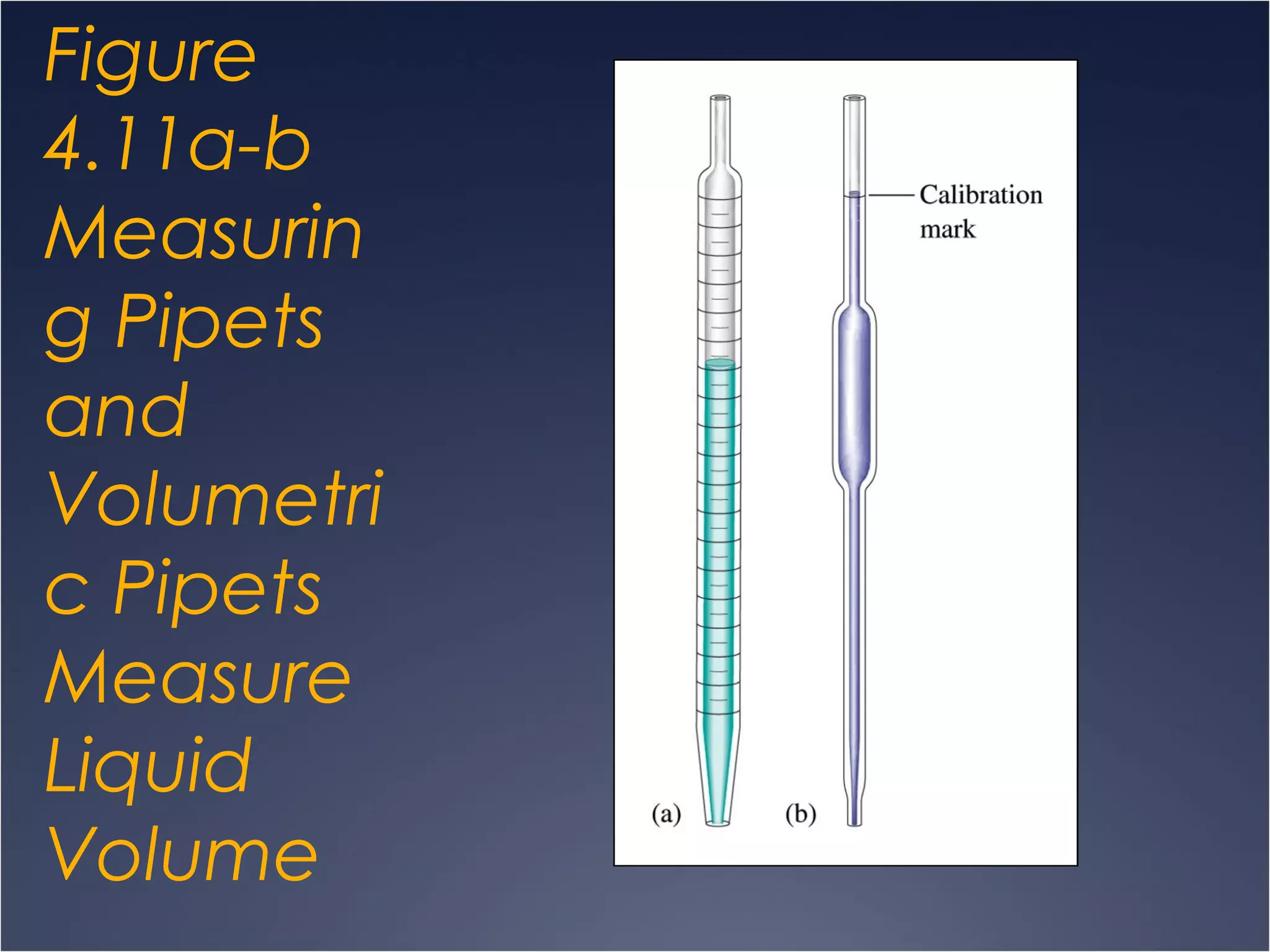
The
Figure
4.11a-b
Measurin
g Pipets
and
Volumetri
c Pipets
Measure
Liquid
Volume
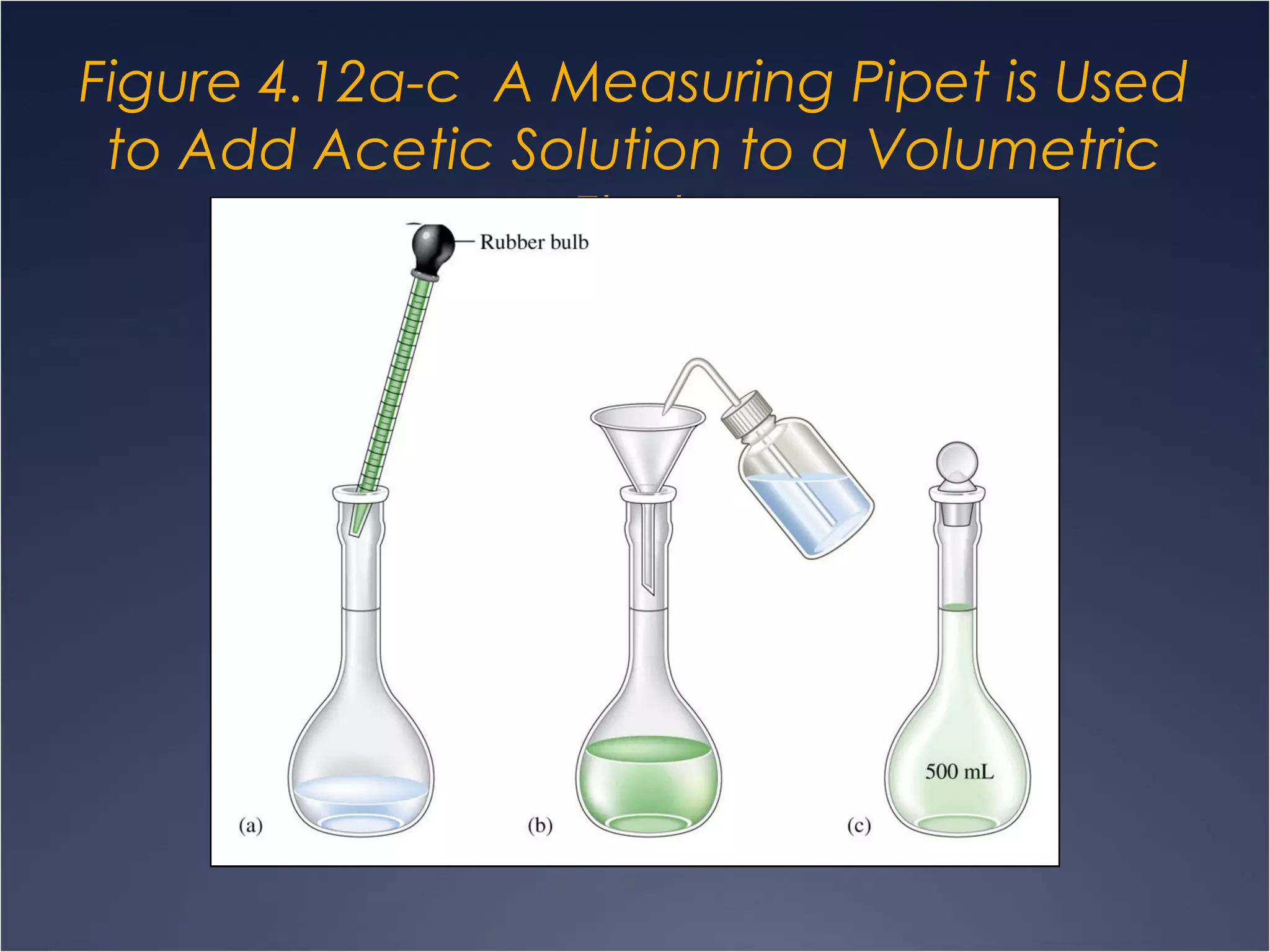
Figure 4.12a-c A Measuring Pipet is Used
to Add Acetic Solution to a Volumetric
Flask
Figure 4.15 a&b The Reaction
of K2CrO4 and Ba(NO3)2
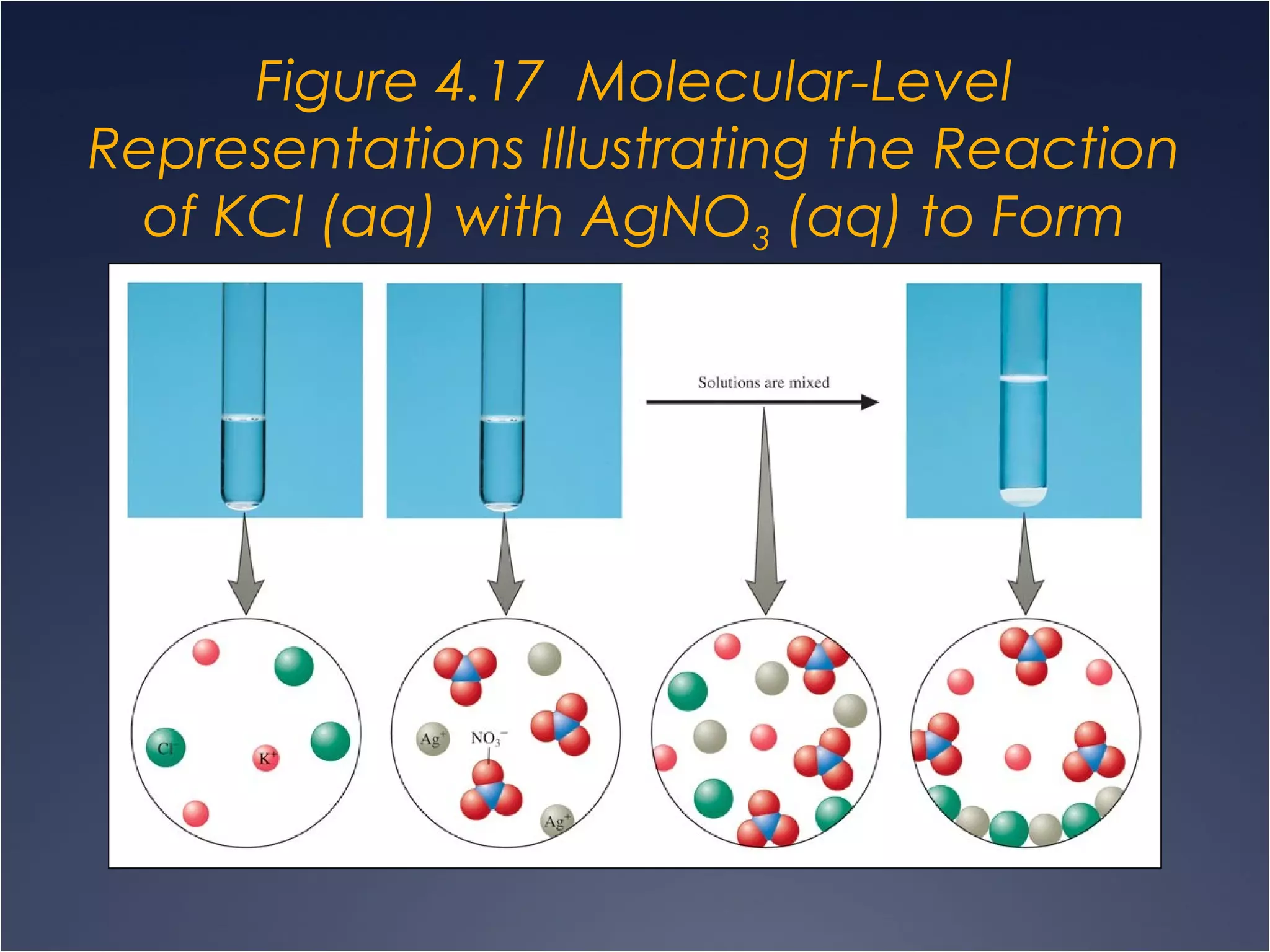
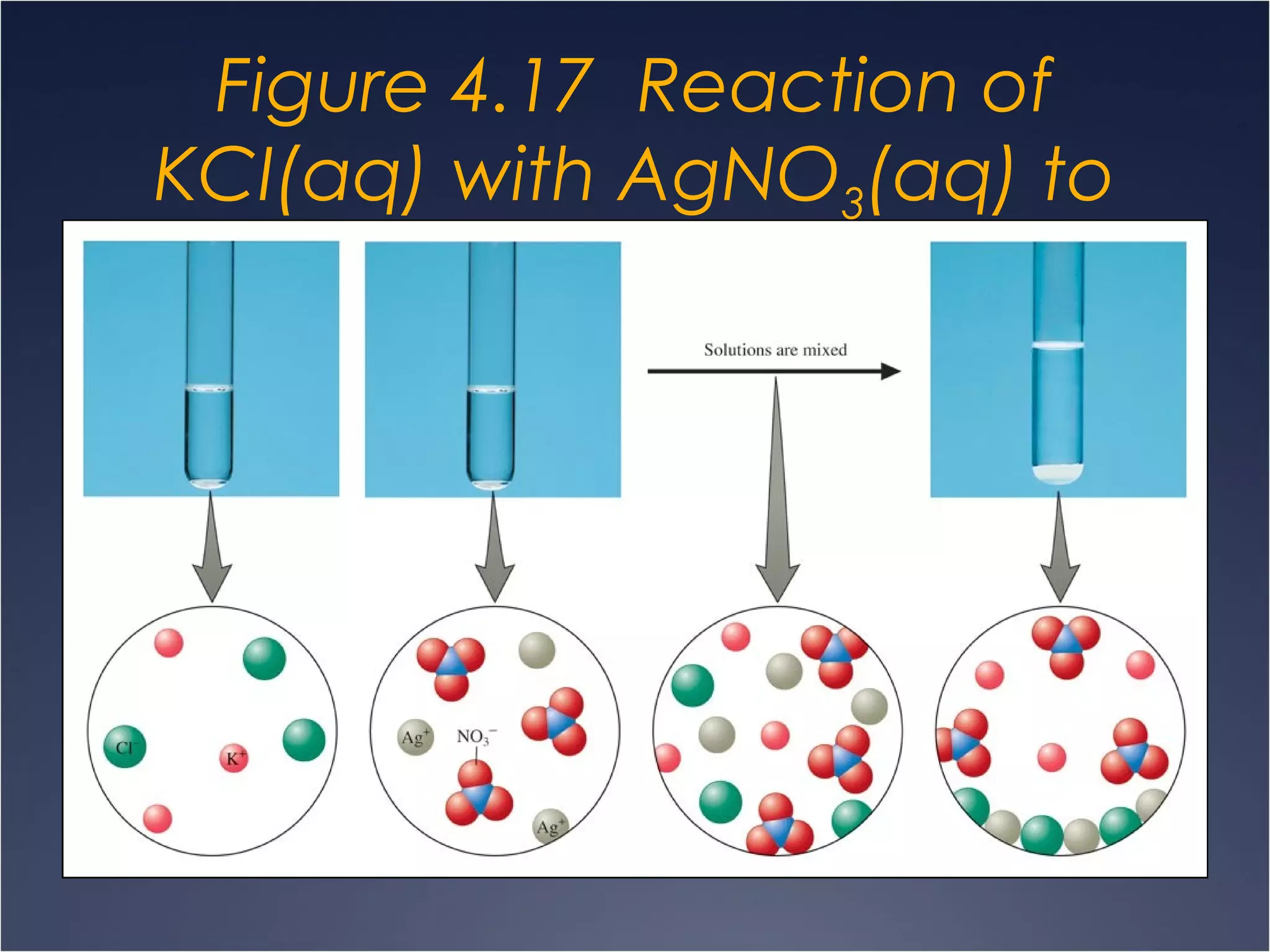
Figure 4.17 Molecular-Level
Representations Illustrating the Reaction
of KCl (aq) with AgNO3 (aq) to Form
AgCl (s)
Determini
ng the
Mass of
Product
Formed
Performing
Calculatio
ns for
Acid-Base
Reactions
Neutralizat
ion
Reactions I
Neutralizat
ion
Reactions
II
Neutralizati
on Titration
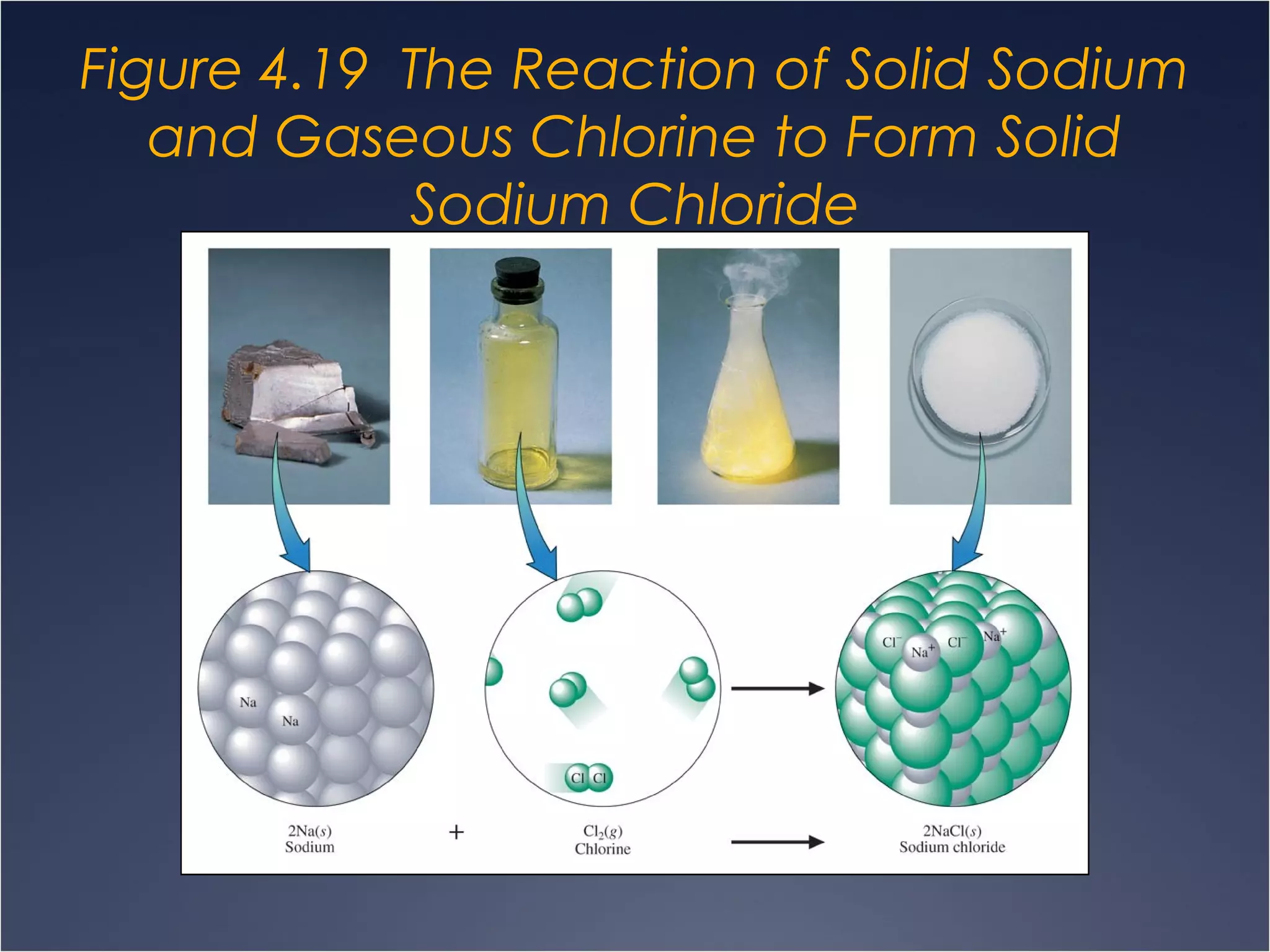
Figure 4.19 The Reaction of Solid Sodium
and Gaseous Chlorine to Form Solid
Sodium Chloride
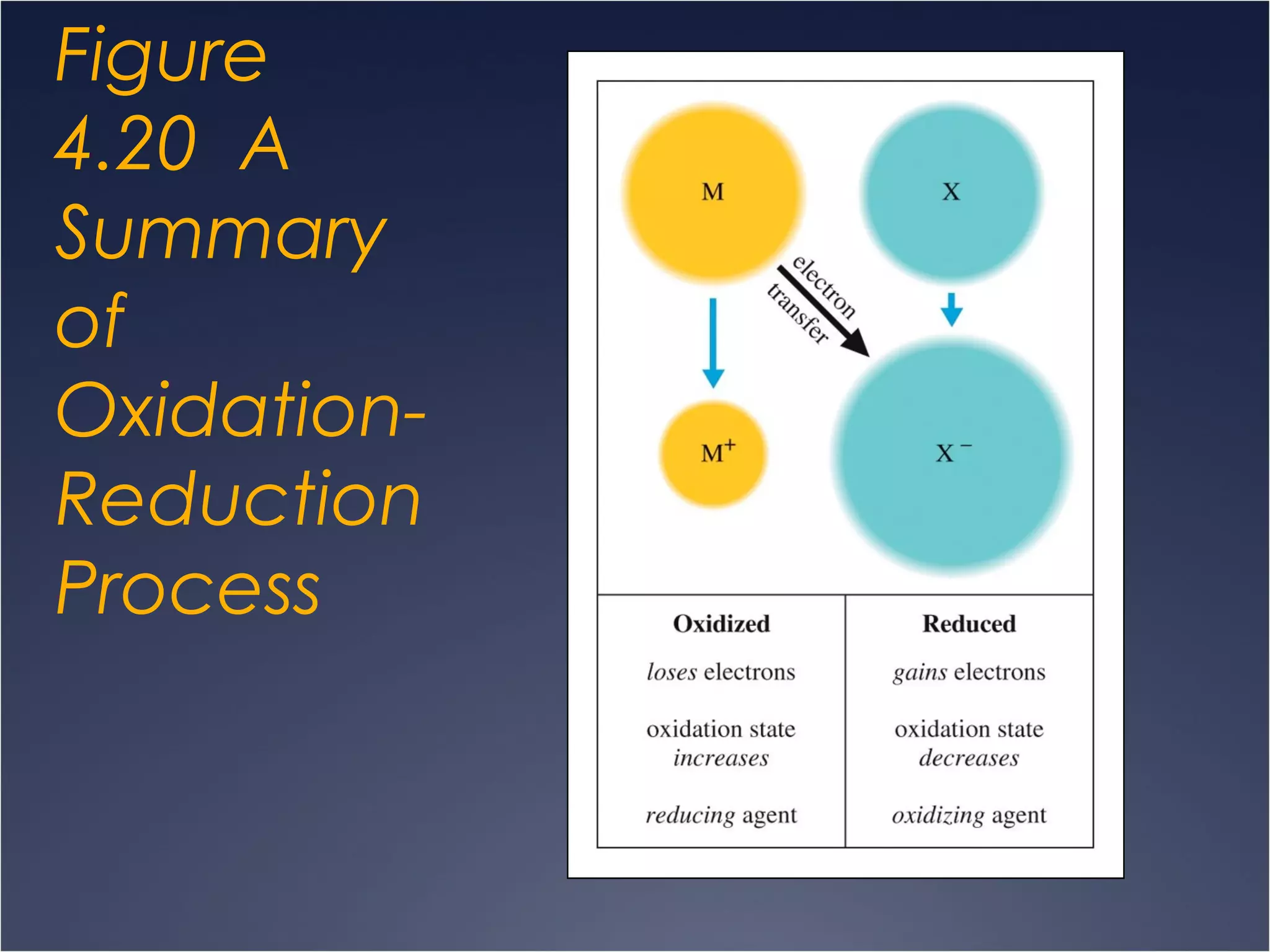
Figure
4.20 A
Summary
of
Oxidation-
Reduction
Process
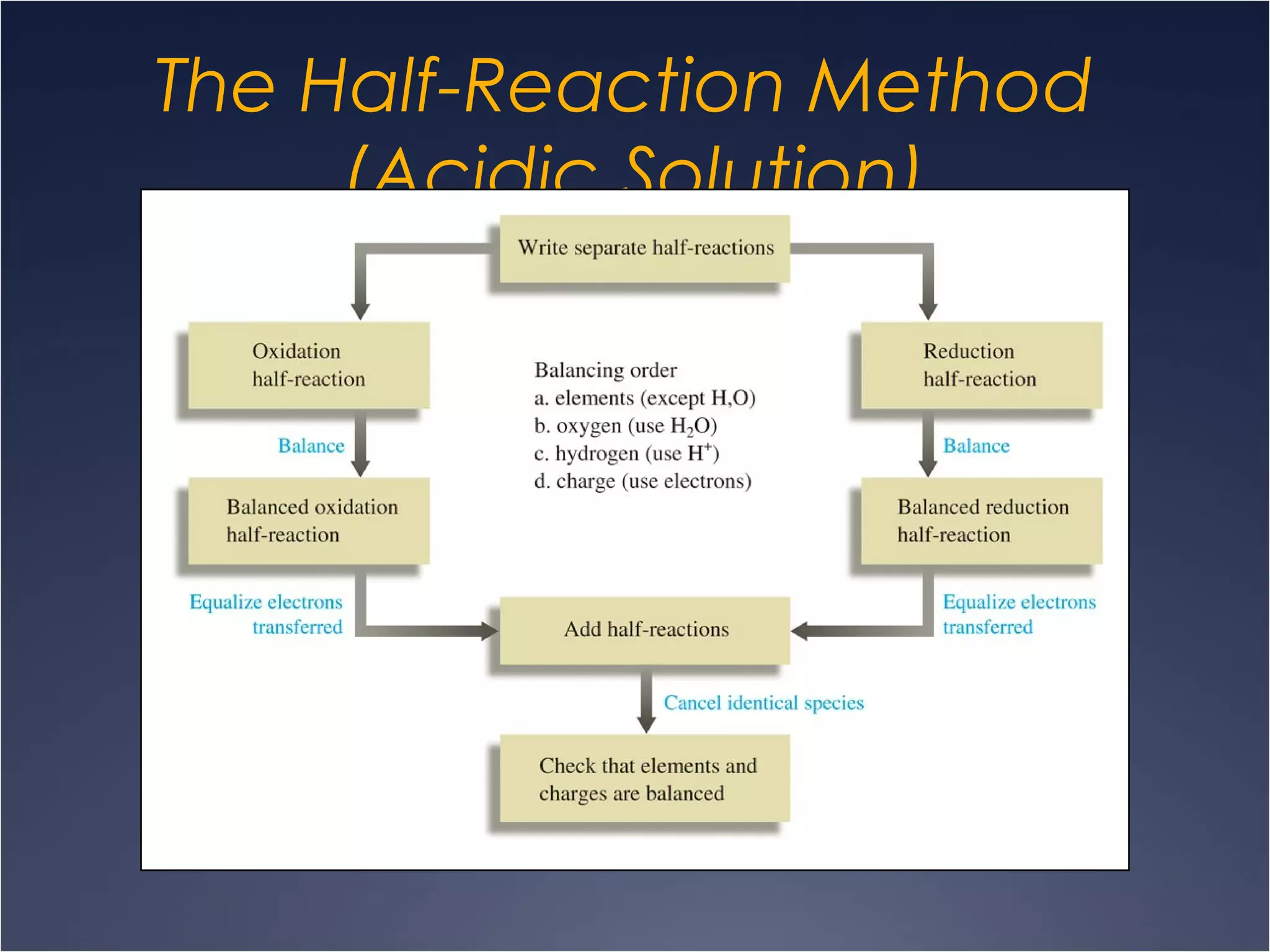
The Half-Reaction Method
(Acidic Solution)
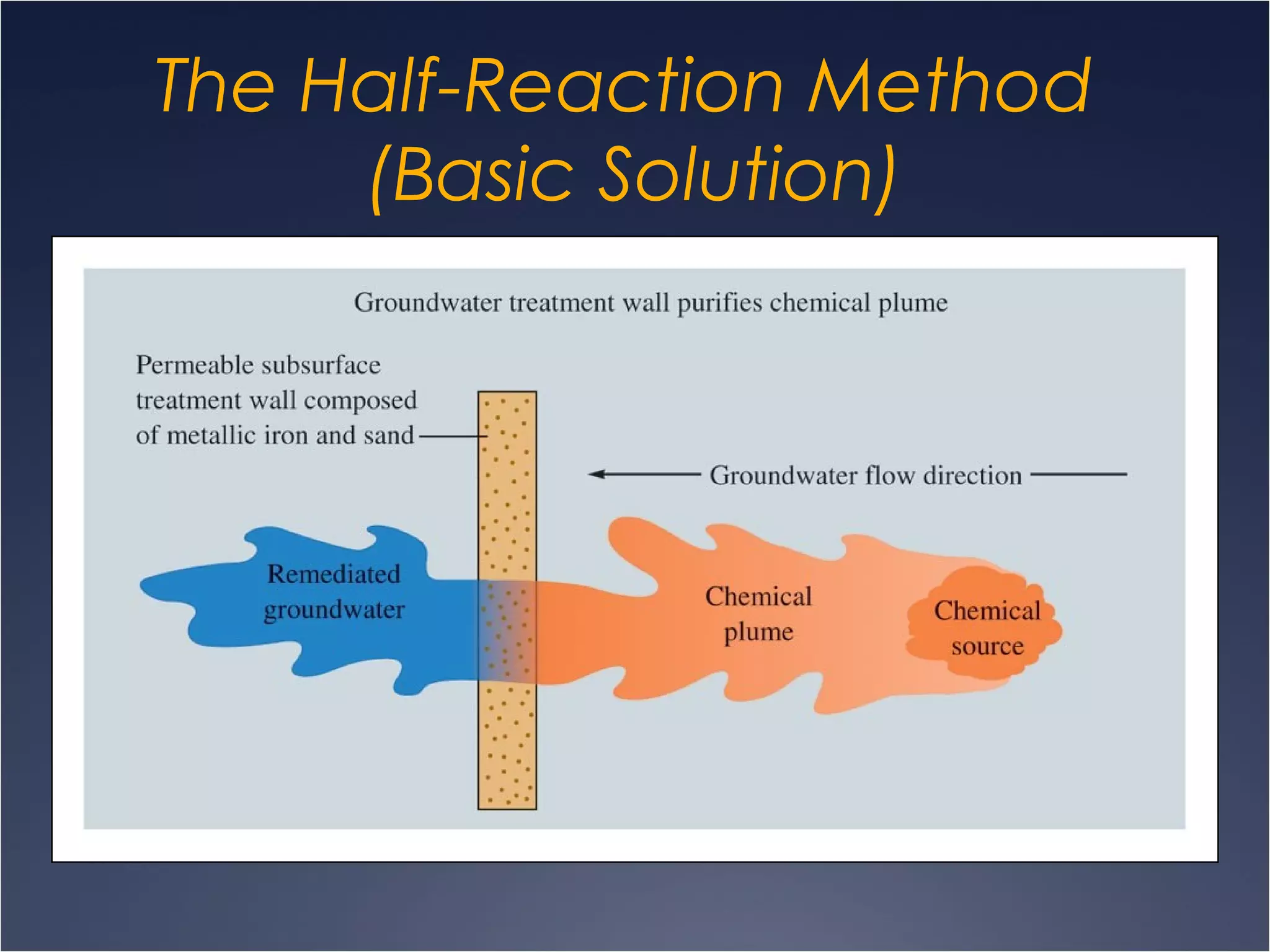
The Half-Reaction Method
(Basic Solution)
Figure 4.4a-c Electrical
Conductivity of Aqueous
Solutions
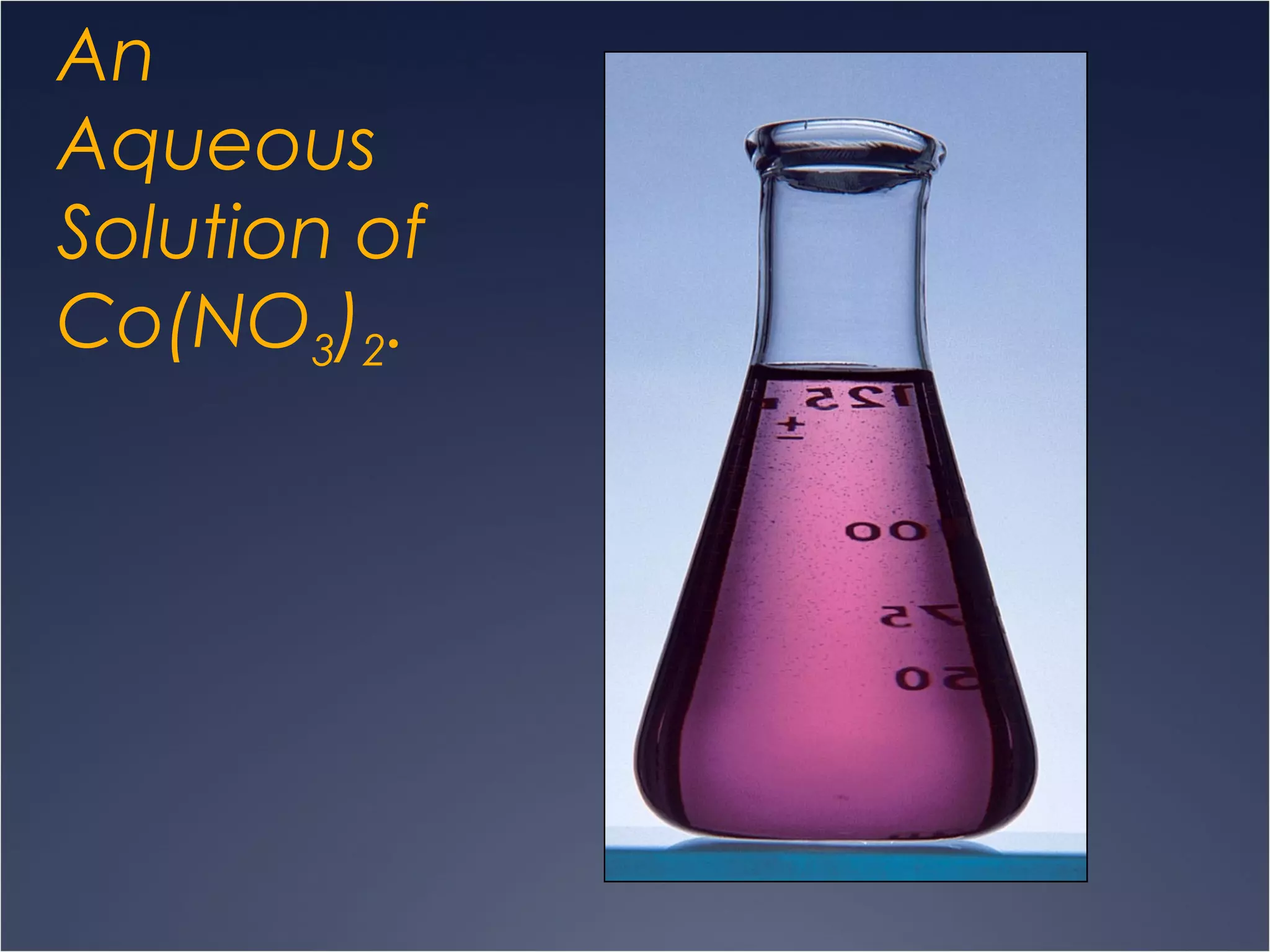
An
Aqueous
Solution of
Co(NO3)2.
Figure 4.10 Steps Involved in the
Preparation of a Standard Aqueous
Solution
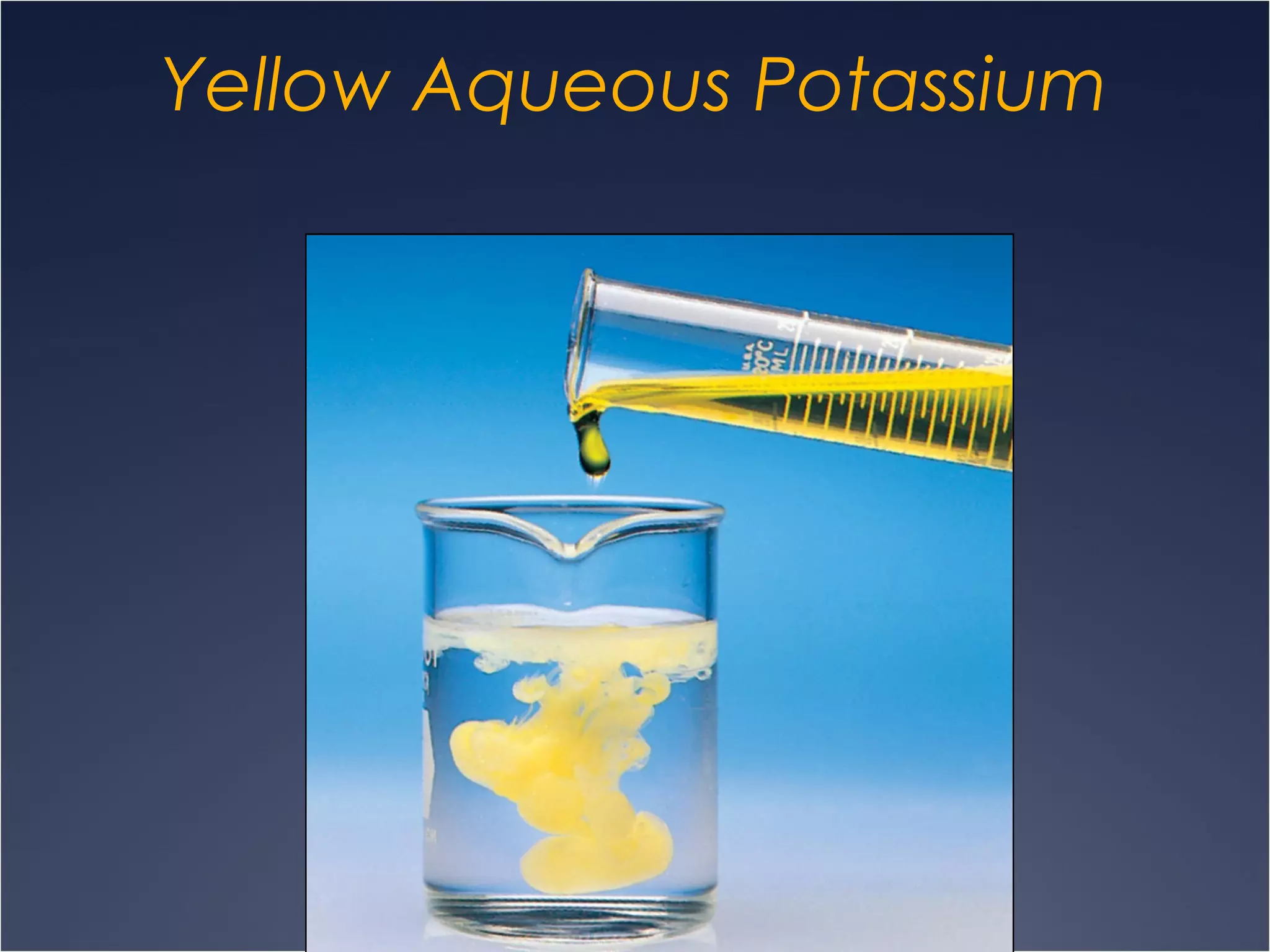
Yellow Aqueous Potassium
Figure 4.14a-b Reactant
Solutions
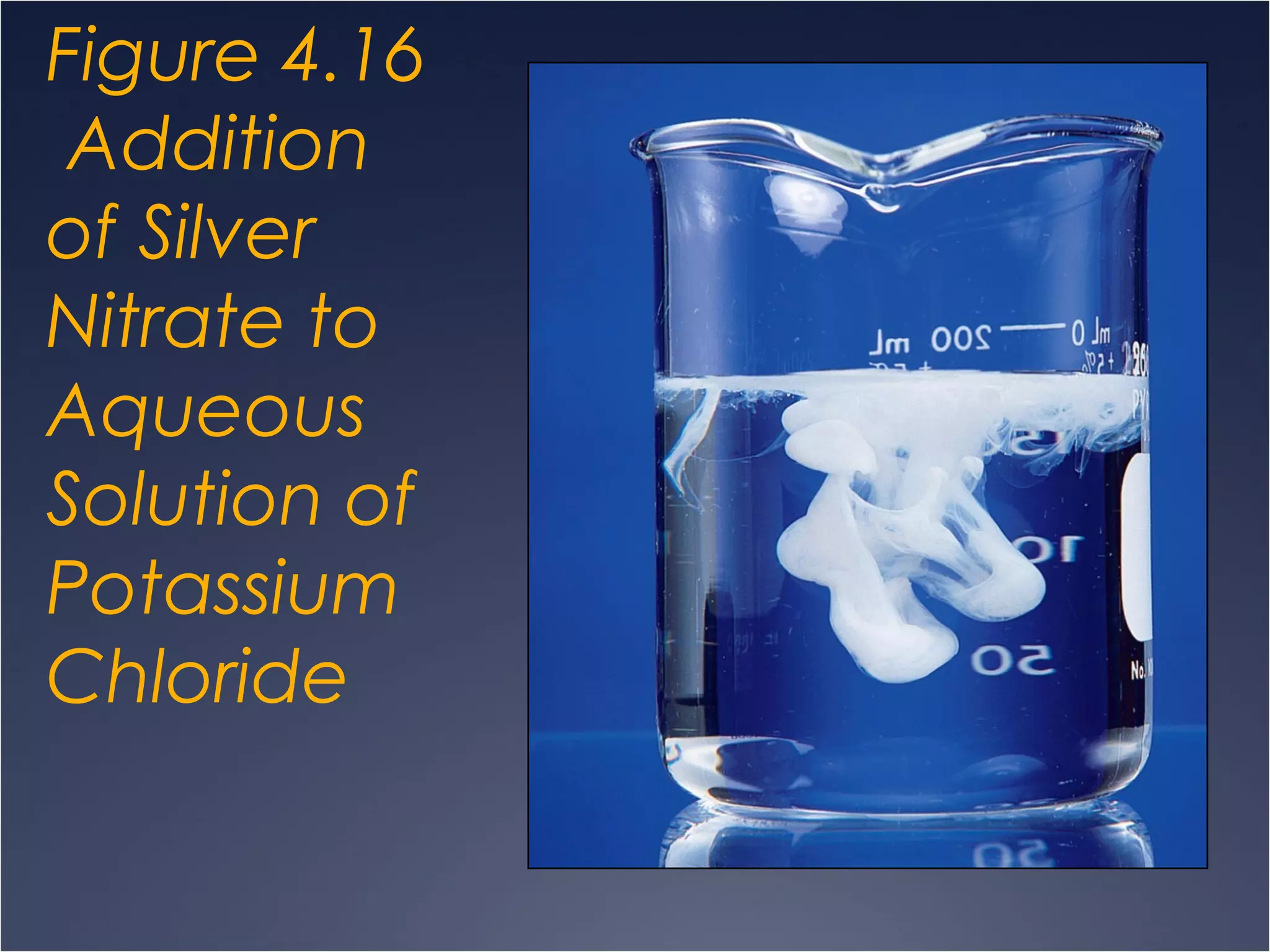
Figure 4.16
Addition
of Silver
Nitrate to
Aqueous
Solution of
Potassium
Chloride
Figure 4.17 Reaction of
KCI(aq) with AgNO3(aq) to
form AgCI(s).
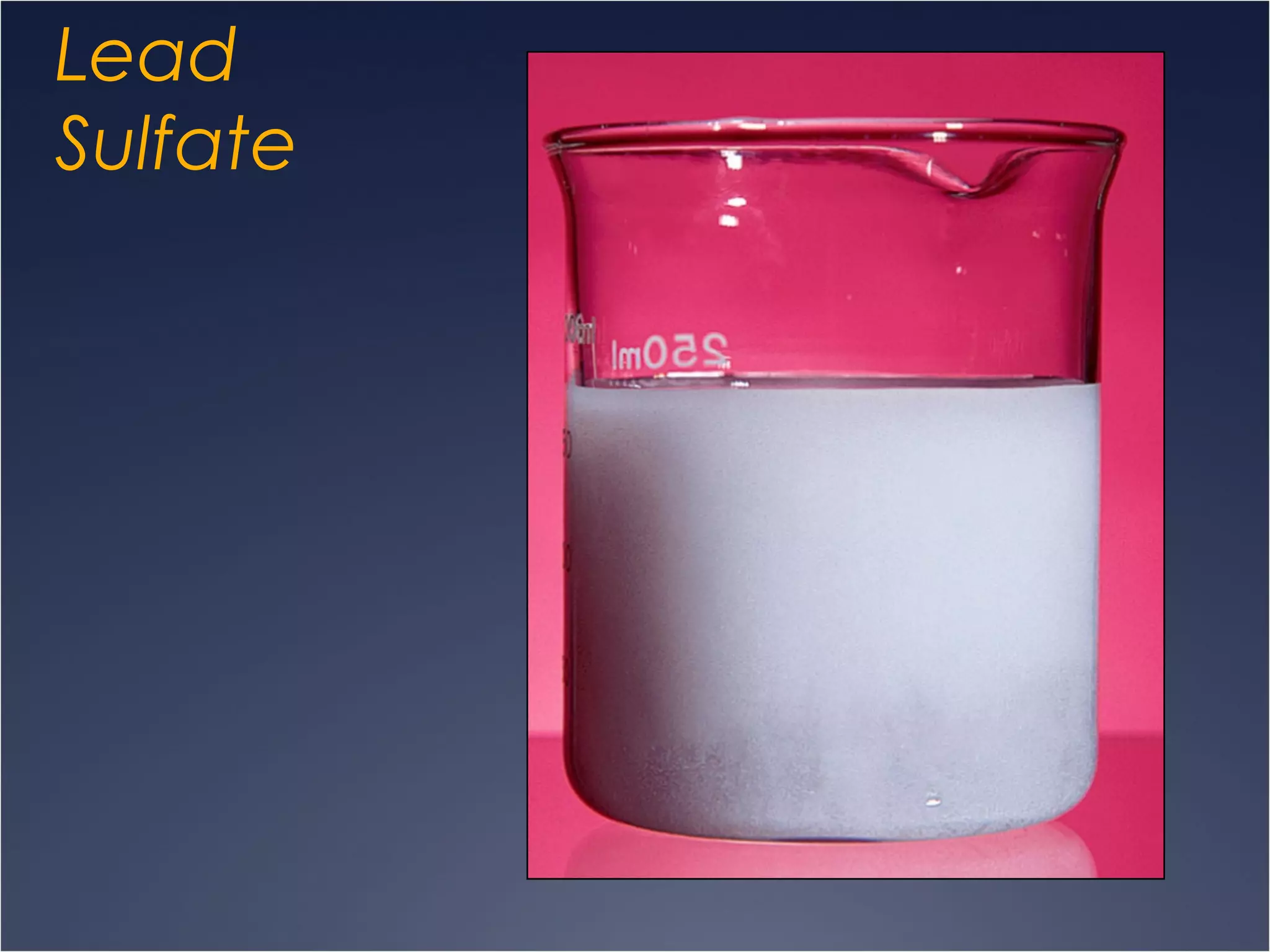
Lead
Sulfate
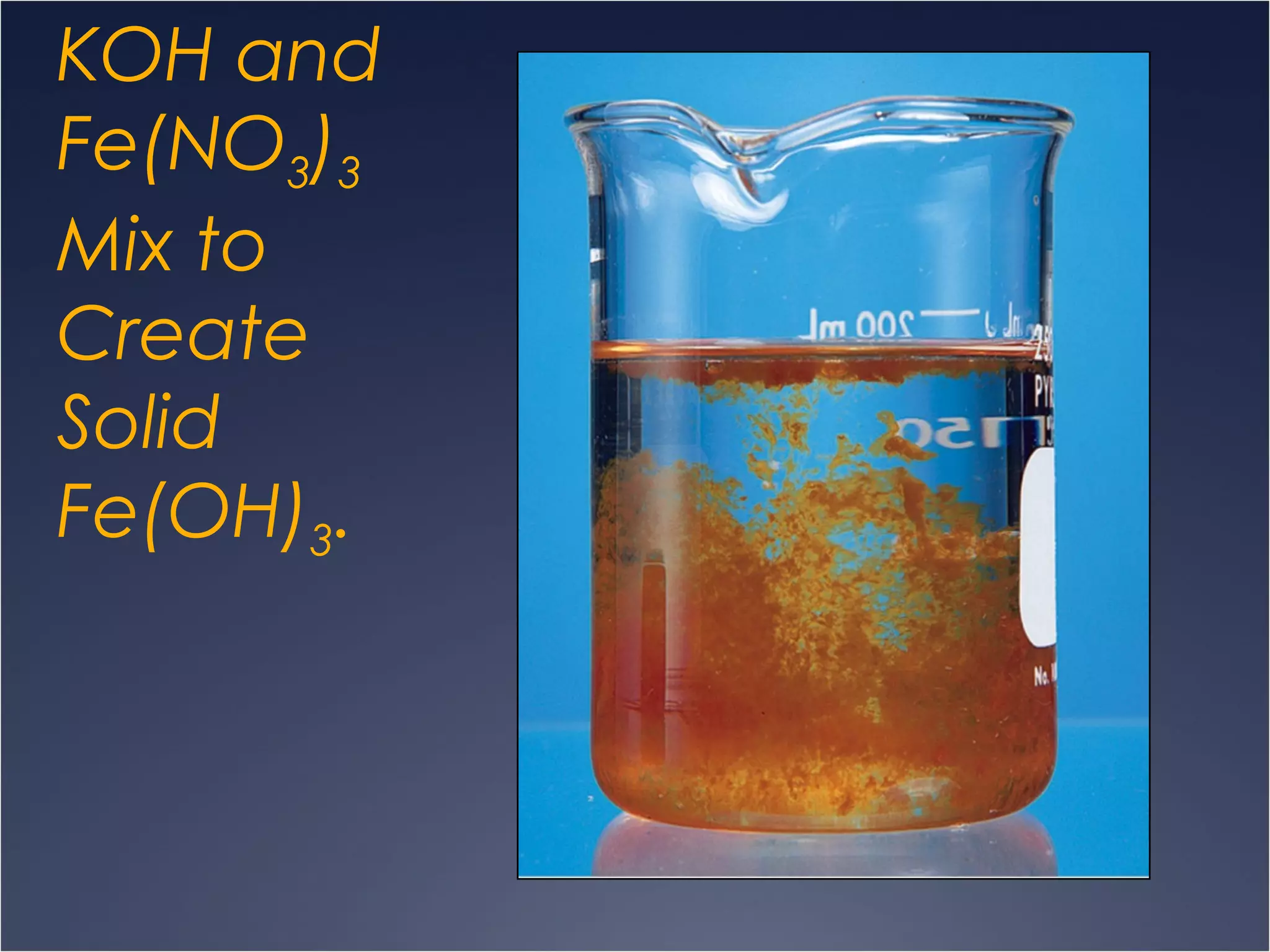
KOH and
Fe(NO3)3
Mix to
Create
Solid
Fe(OH)3.
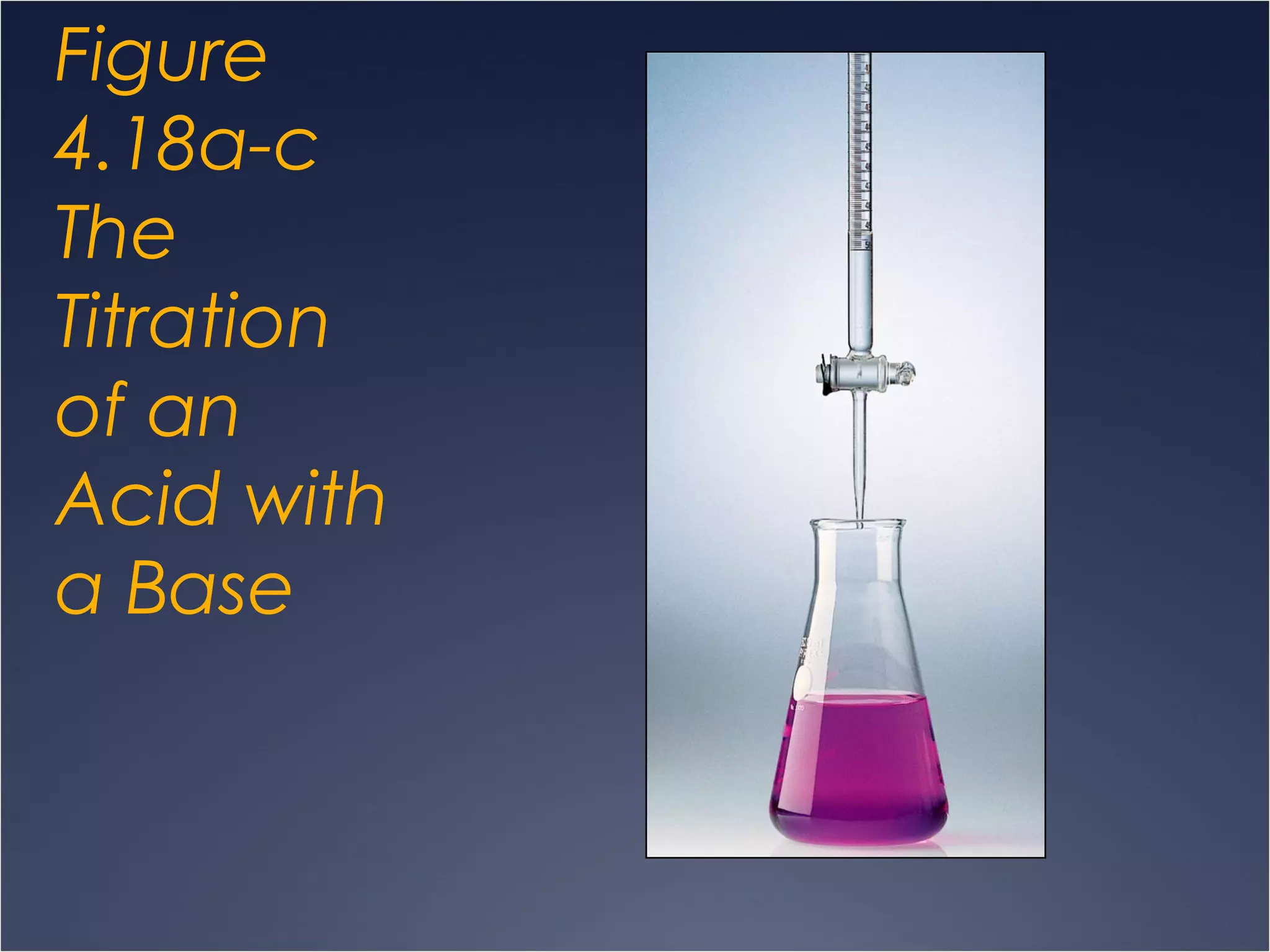
Figure
4.18a-c
The
Titration
of an
Acid with
a Base
Figure 4.19 The Reaction of Solid Sodium
and Gaseous Chlorine to Form Solid Sodium
Chloride
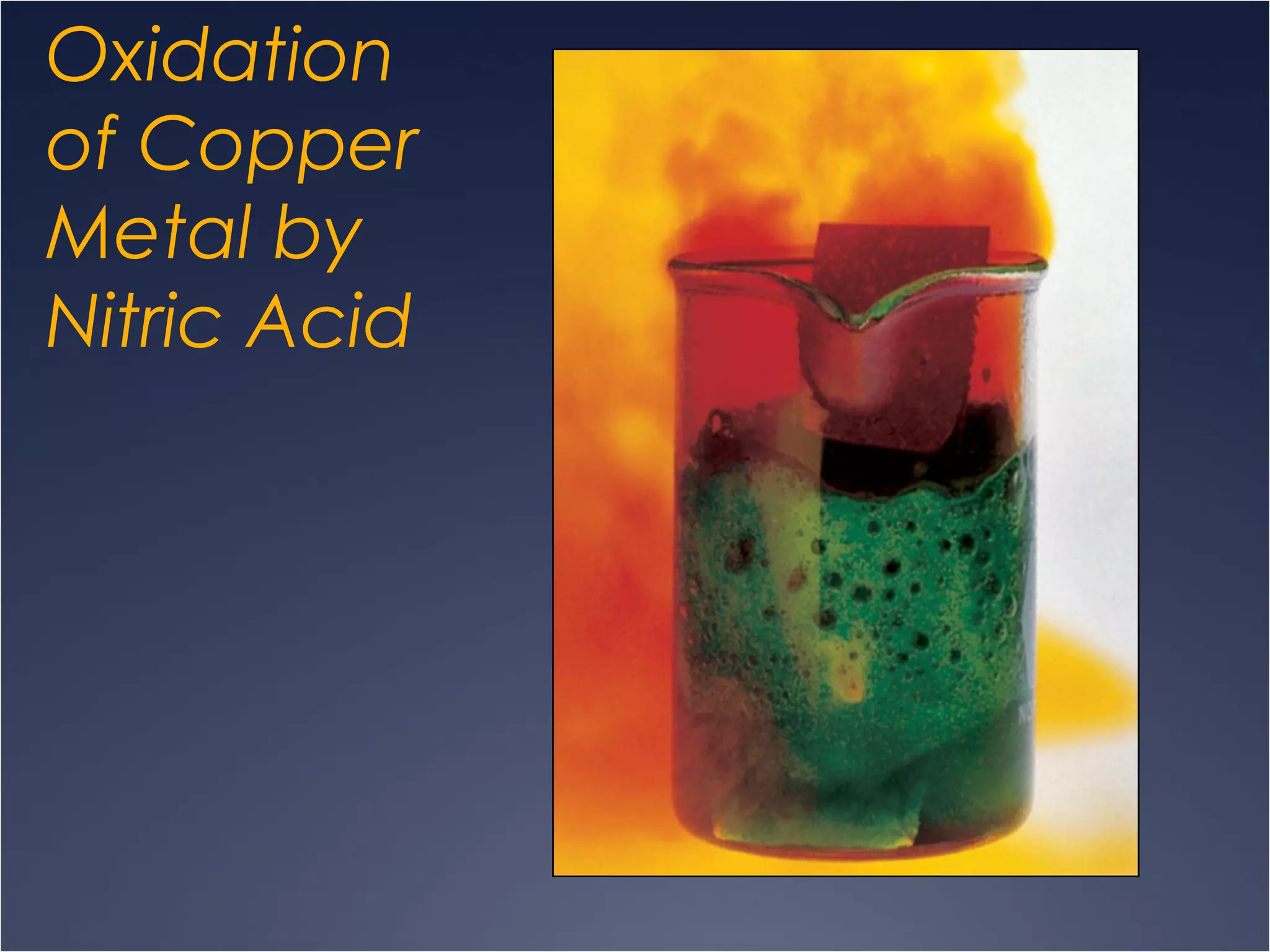
Oxidation
of Copper
Metal by
Nitric Acid
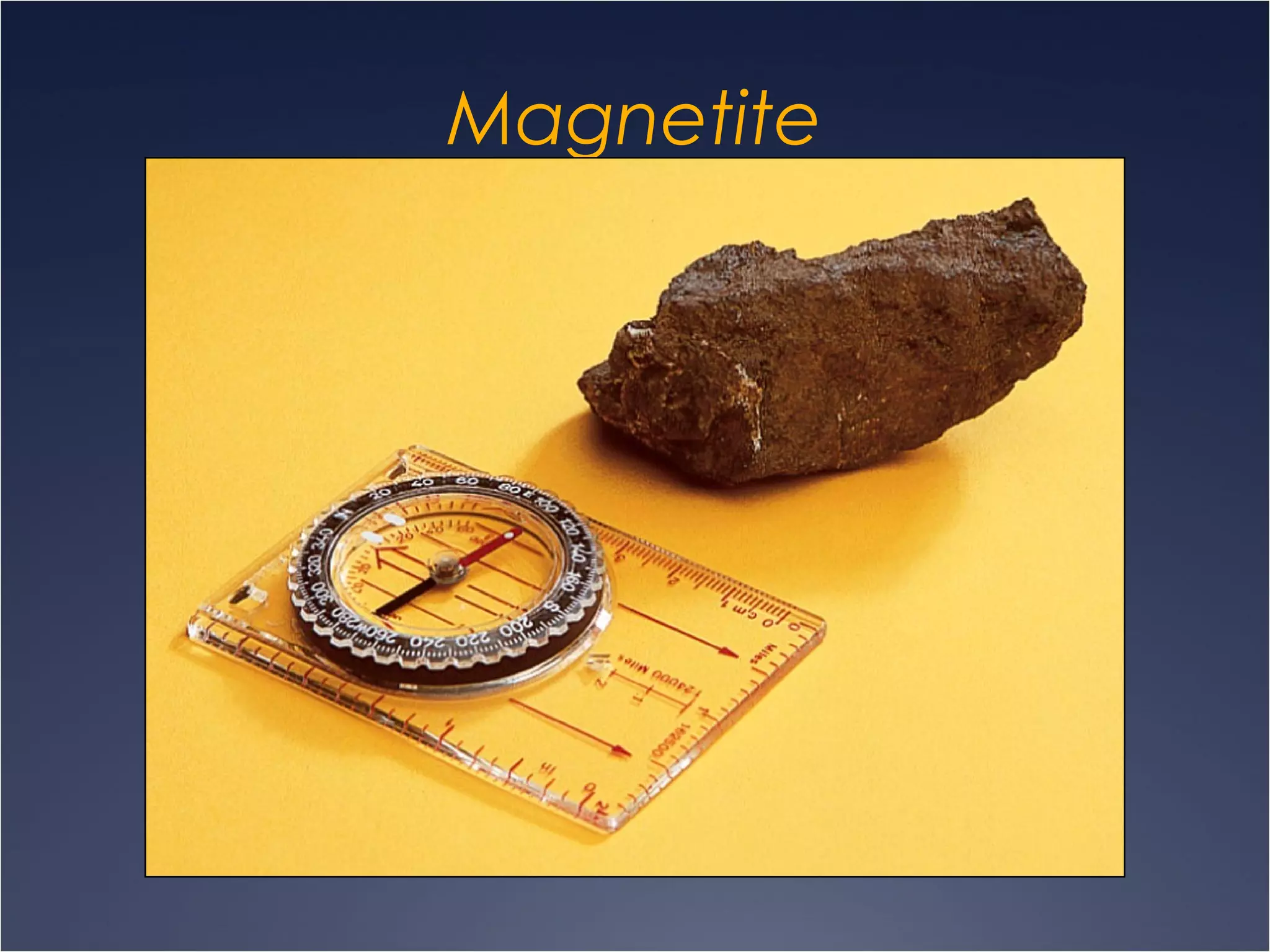
Magnetite
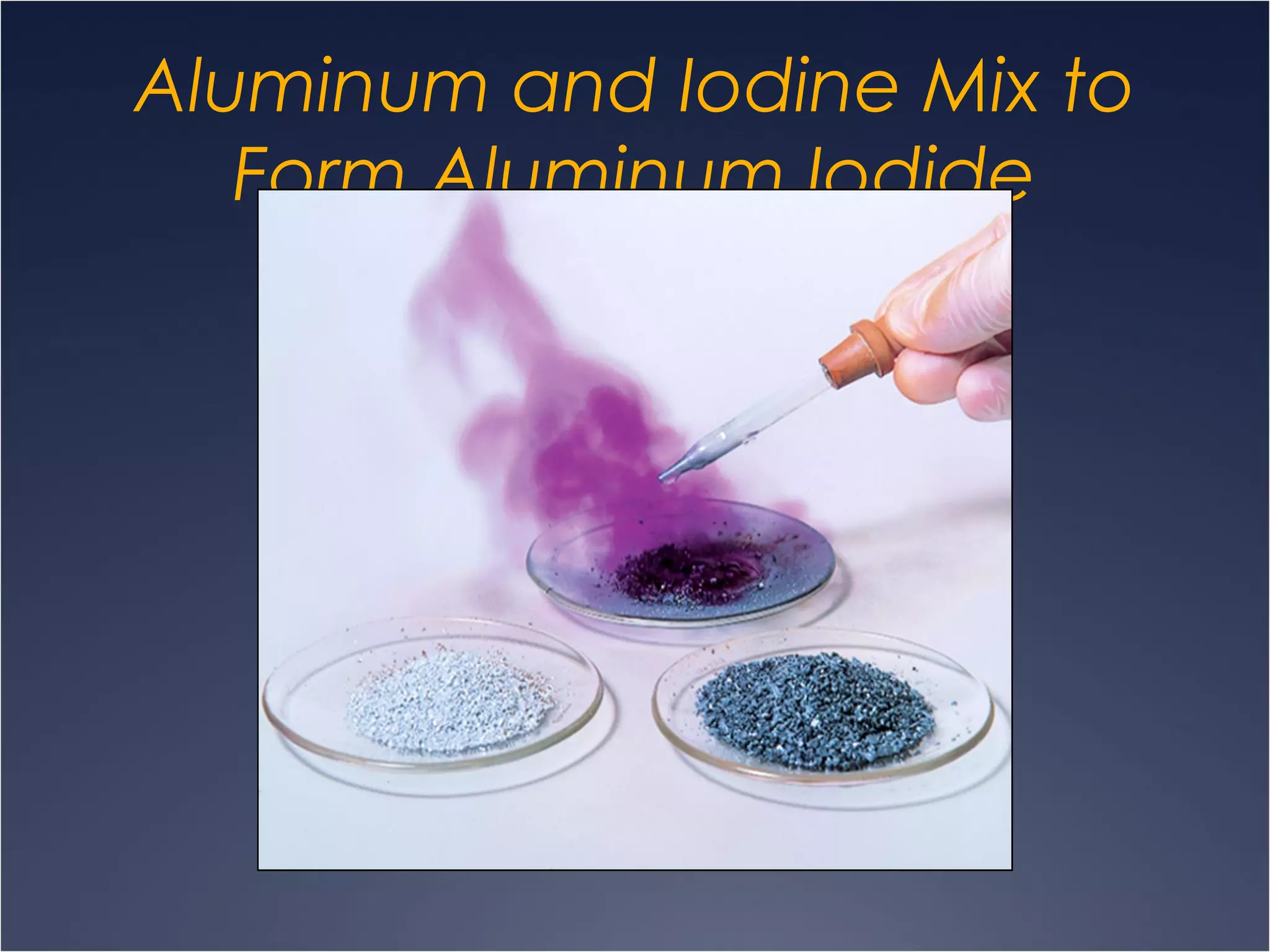
Aluminum and Iodine Mix to
Form Aluminum Iodide
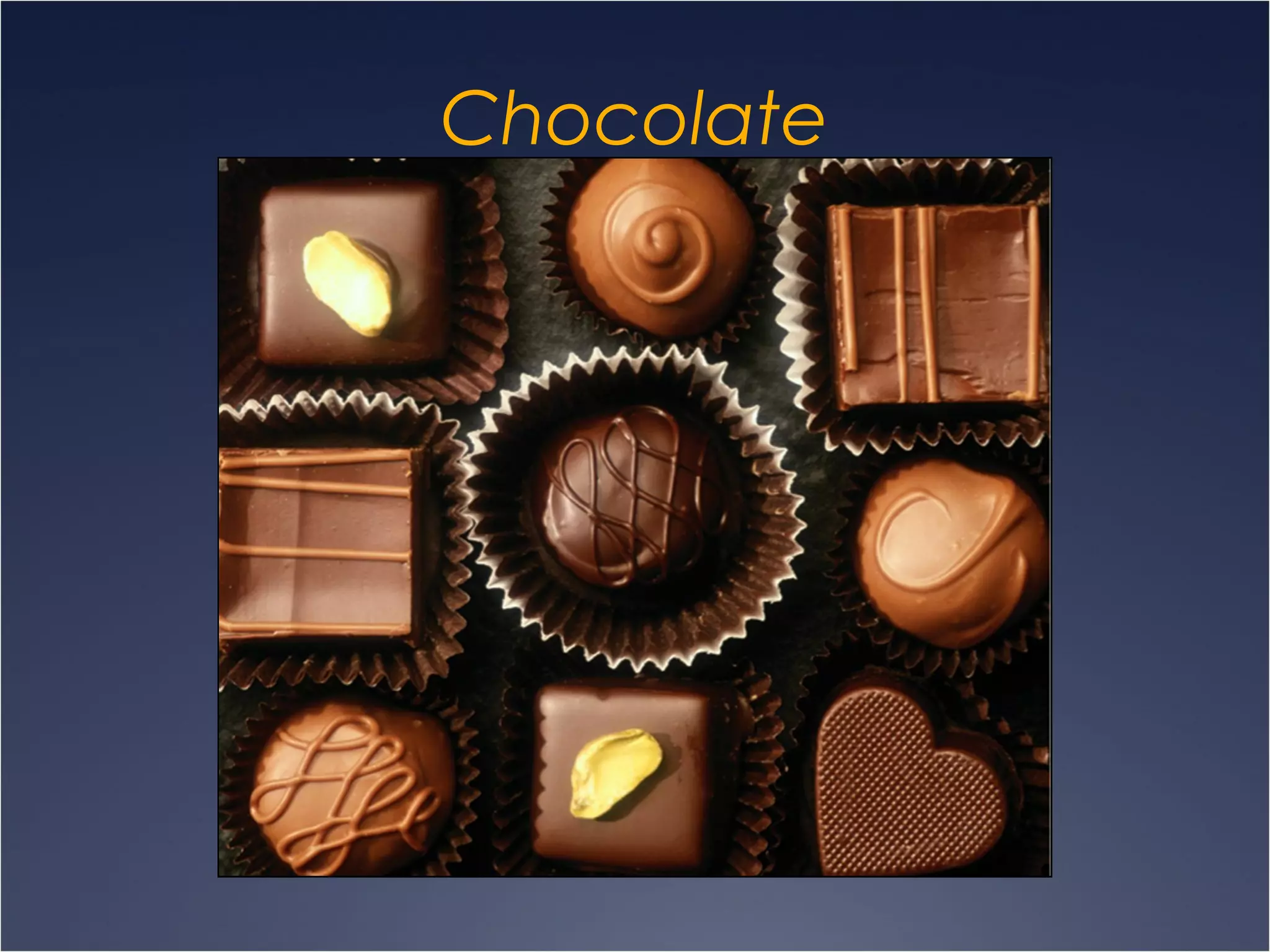
Chocolate
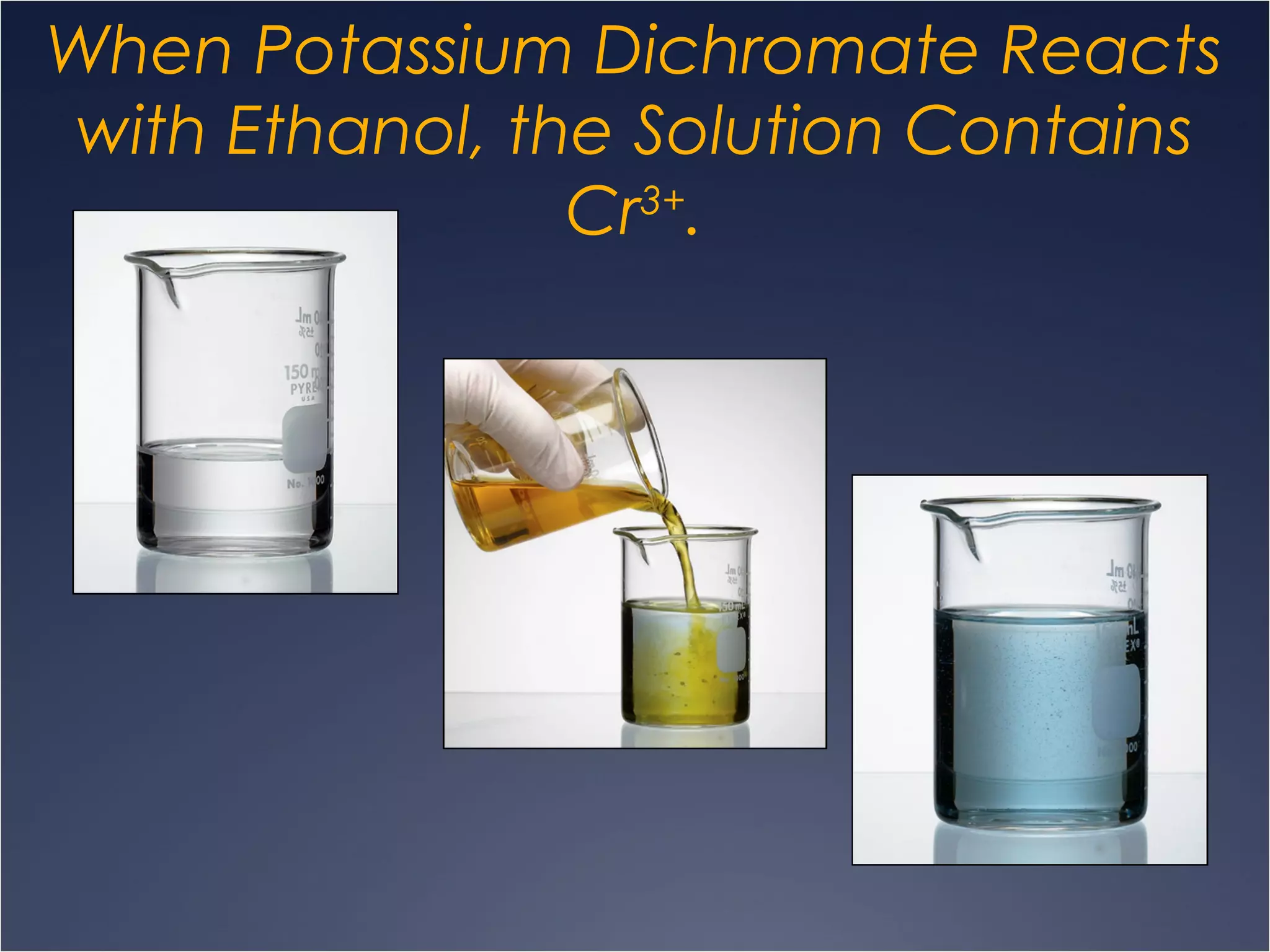
When Potassium Dichromate Reacts
with Ethanol, the Solution Contains
Cr3+
.
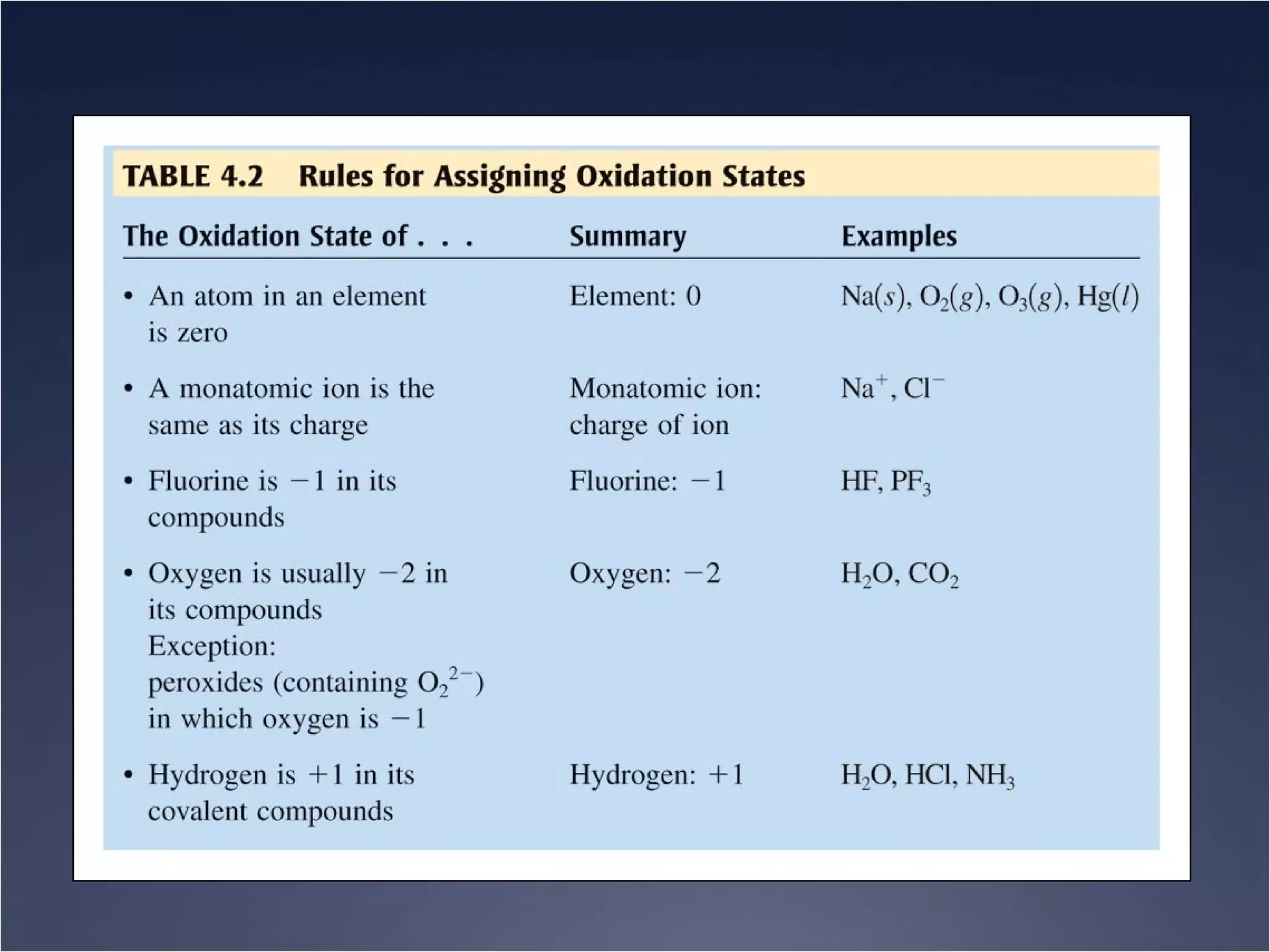
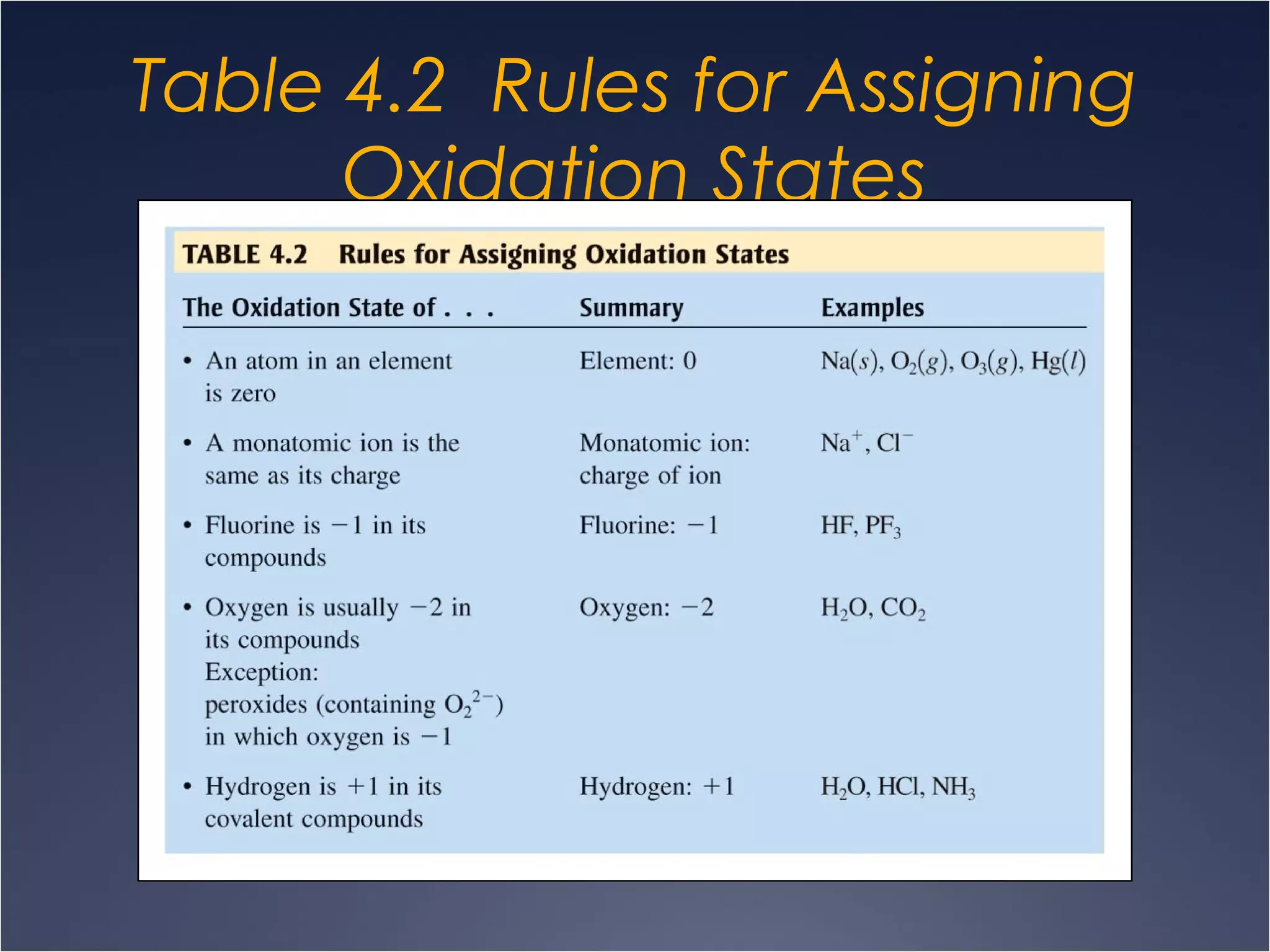
Table 4.2 Rules for Assigning
Oxidation States
The End

Advchemchapt4 101015123318-phpapp02

  • 1.
    Advanced Chemistry Types ofChemical Reactions and Solution Stoichiometry
  • 2.
  • 3.
    Water as aSolvent  Bent (V-shaped) molecule with 105° bond angle.  Covalent bonds – electron sharing between oxygen and hydrogen.  Unequal sharing of electrons due to electronegativity differences cause water to be a polar molecule.
  • 4.
    Water as aSolvent  Partial charges (δ) form on the water molecule due to the unequal sharing of electrons.  Water’s polarity causes it to be a solvent for ionic compounds.
  • 5.
    Polar Water MoleculesInteract with the Positive and Negative Ions of a Salt Assisting in the Dissolving Process
  • 6.
    Solubility  Solubility ofionic substances in water varies greatly.  Solubility depends on the relative attractions of the ions and water molecules for each other.  Once dissolved, an ionic compound becomes hydrated, therefore ions disperse independent of one another.
  • 7.
    Solubility  Water willdissolve non-ionic substances depending upon their structure.  If a polar bond exists within the structure, the molecule can be subject to being water soluble.  In general, polar substances dissolve in polar solvents and nonpolar substances dissolve in nonpolar solvents.
  • 8.
    An Ethanol MoleculeContains a Polar O- H Bond Similar to Those in the Water Molecule
  • 9.
    The Polar WaterMolecule Interacts Strongly with the Polar-O-H bond in Ethanol
  • 10.
    Strong and Weak Natureof Aqueous Solutions
  • 11.
    Strong and WeakElectrolytes  A solution in which a substance is dissolved in water; the substance is the solute and the solvent is the water.  A common property for a solution is electrical conductivity.  Its ability to conduct an electric current.
  • 12.
    Strong and WeakElectrolytes  Pure water is not an electrical conductor.  Strong electrolytes conduct current very efficiently.  Weak electrolytes conduct only a small current.  Nonelectrolytes do not allow current to flow.
  • 13.
  • 14.
    Svante Arrhenius  1859-1927 Studied the nature of solutions and theorized that conductivity of solutions arose from the presence of ions.  Proved that the strength of conductivity is directly related to the number of ions present in solution.
  • 15.
    Strong Electrolytes  Strongelectrolytes are substances that are completely ionized when they are dissolved in water.  Soluble salts  Strong acids  Strong bases
  • 16.
  • 17.
    Acids  Arrhenius discoveredin his studies of solutions that when acids were dissolved in water they behaved as strong electrolytes.  This result was directly related to an acid’s ability to ionize in water.  An Acid is a substance that produces H+ ions when it is dissolved in water.
  • 18.
  • 19.
    Acids HCl H2Ou xuuuu  →Η + (αθ) + Χλ− (αθ) HNO3 H2Ou xuuuu  → Η + (αθ) + ΝΟ− 3(αθ) H2SO4 H2Ou xuuuu  → Η + (αθ) + ΗΣΟ− 4(αθ) An Acid is a substance that produces H+ ions when it is dissolved in water.
  • 20.
    Acids HCl H2Ou xuuuu  →Η + (αθ) + Χλ− (αθ) HNO3 H2Ou xuuuu  → Η + (αθ) + ΝΟ− 3(αθ) H2SO4 H2Ou xuuuu  → Η + (αθ) + ΗΣΟ− 4(αθ) In conductivity studies, virtually every molecule ionizes. Therefore, strong electrolytes are strong acids.
  • 21.
    Strong Acids  Sulfuricacid, nitric acid and hydrochloric acid are aqueous solutions and should be written in chemical equations as such.  A strong acid is one that completely dissociates into its ions. In aqueous solutions, the HCl molecule does not exist.  Sulfuric acid can produce two H+ ions per molecule. Only the first H+ ion completely dissociates. The anion HSO4 - remains partially intact.
  • 22.
    Strong Bases  Basesare soluble ionic compounds containing the hydroxide ion (OH- ).  Strong bases are strong electrolytes and these compounds ionize completely in water.
  • 23.
    Strong Bases NaOH(s) H2O  →Να(αθ) + + ΟΗ(αθ) − ΚΟΗ(σ) Η2Ο  → Κ(αθ) + + ΟΗ(αθ) −
  • 24.
  • 25.
    Weak Electrolytes  Weakelectrolytes are substances that exhibit a small degree of ionization in water.  They produce relatively few ions when dissolved in water  Most common weak electrolytes are weak acids and weak bases.
  • 26.
    Weak Acids  Formulasfor acids are often written with the acidic hydrogen atom or atoms (the hydrogen atoms that will produce H+ ions in solution) listed first. If any nonacidic hydrogens are present they are written later in the formula. HC2 H3O2(aq) + Η 2Ο(λ)  →←  Η3Ο(αθ) + + Χ2 Η3Ο2(αθ) −
  • 27.
    Weak Acids  InAcetic acid, only 1% of its molecules ionize.  The double arrow indicates that the reaction can occur in either direction.  Acetic acid is a weak electrolyte and therefore a weak acid because it dissociates (ionizes) only to a slight extent in aqueous solutions. HC2 H3O2(aq) + Η 2Ο(λ)  →←  Η3Ο(αθ) + + Χ2 Η3Ο2(αθ) −
  • 28.
  • 29.
    Weak Bases  Themost common weak base is NH3.  In an aqueous solution, ammonia results in a basic solution. NH3(aq) + Η2Ο(λ)  →←  ΝΗ4(αθ) + + ΟΗ(αθ) −
  • 30.
  • 31.
    Nonelectrolytes  Nonelectrolytes aresubstances that dissolve in water but do not produce any ions.
  • 32.
    The Composition ofSolutions Concentration:
  • 33.
    Solutions  Most chemicalreactions take place in the environment of solutions. In order to perform stoichiometric calculations in solutions, one must know two things.  The nature of the reaction; which depends on the exact forms the chemicals take when dissolved.  The amounts of the chemicals present in the solutions, usually expressed as concentrations.
  • 34.
    Concentration  Molarity (M)– is moles of solute per volume of solution in liters: Example: 1.0M= 1.0 molar = 1.0moles solute/1liter of solution M = µολαριτψ= µολεσοφ σολυτε λιτερσοφ σολυτιον
  • 35.
    Example  Calculate themolarity of a solution prepared by dissolving 11.5g of solid NaOH in enough water to make 1.50L of solution. .192 M NaOH
  • 36.
    Example  Calculate themolarity of a solution prepared by dissolving 1.56g of gaseous HCl in enough water to make 26.8 ml of solution. 1.60M HCl
  • 37.
    Example  Give theconcentration of each type of ion in 0.50M Co(NO3)2. Co2+ = 0.50 M Co2+ NO3 - = 1.0 M NO3 -
  • 38.
    Example  Calculate thenumber of moles of Cl- ions in 1.75L of 1.0 x 10⁻³ M ZnCl2. 3.5 x 10⁻³ mol Cl-
  • 39.
    Dilution  The processof changing the molarity of a solution from a more concentrated solution to a lesser concentrated solution.  Moles of solute after dilution = moles of solute before dilution.  M x V= moles  M1V1=M2V2
  • 40.
    Example  What volumeof 16M sulfuric acid must be used to prepare 1.5L of 0.10 M H2SO4 solution? 9.4 ml solution
  • 41.
    Steps Involved inthe Preparation of a Standard Aqueous Solution
  • 42.
  • 43.
    Types of SolutionReactions  Most solution reactions can be put into three types of reactions:  Precipitation Reactions  Acid-Base Reactions  Oxidation-Reduction Reactions
  • 44.
    Precipitation Reactions  Whentwo solutions are mixed, an insoluble substance sometimes forms; that is, a solid forms and separates from the solution.  The solid that forms is called a precipitate.
  • 45.
    Precipitation Reaction Example K2CrO4(aq) +Βα(ΝΟ3 )2(αθ)  → 2Κ(αθ) + + ΧρΟ4(αθ) 2− + Βα(αθ) 2+ + 2ΝΟ3(αθ) −  → A more accurate representation is:
  • 46.
  • 47.
  • 48.
    Precipitation Reaction Example 2K(aq) + + ΧρΟ4(αθ) 2− +Βα(αθ) 2+ + 2ΝΟ3(αθ) −  → We look at all the possible combinations of the ions to check for compounds that form solids. •K2CrO4 •KNO3 •BaCrO4 •Ba(NO3)2
  • 49.
    Precipitation Reaction Example 2K(aq) + + ΧρΟ4(αθ) 2− +Βα(αθ) 2+ + 2ΝΟ3(αθ) −  → Two of these combinations are the reactants and can be ruled out: •K2CrO4 •KNO3 •BaCrO4 •Ba(NO3)2
  • 50.
    Solubility  Predicting theidentity of a solid product in a precipitation reaction requires knowledge of the solubilities of common ionic substances.  Slightly soluble – the tiny amount of solid that dissolves is not noticeable. The solid appears insoluble to the naked eye.  Insoluble and slightly soluble are often used interchangeably.
  • 51.
    Simple Rules forthe Solubility of Salts in Water
  • 52.
    Precipitation Reaction Example 2K(aq) + + ΧρΟ4(αθ) 2− +Βα(αθ) 2+ + 2ΝΟ3(αθ) −  → Two of these combinations are the reactants and can be ruled out: •K2CrO4 •KNO3 •BaCrO4 •Ba(NO3)2
  • 53.
    Precipitation Reactions  Precipitationreactions move forward due to the decrease in energy state of the compound. Bonds forming in the compound increase stability and push the reaction forward.
  • 54.
  • 55.
    Formula Equation  Althoughthe formula equation shows the reactants and products of the reaction, it does not give a correct picture of what actually occurs in solution.  Gives the overall reaction stoichiometry but not necessarily the actual forms of the reactants and products.
  • 56.
    Complete Ionic Equation The complete ionic equation better represents the actual forms of the reactants and products in solution. All substances that are strong electrolytes are represented as ions.  Complete ionic equation shows all ions in a reaction, even those that do not participate in the reaction. These ions are called spectator ions.
  • 57.
    Net Ionic Equation The net ionic equation includes only those solution components that are directly involved in the reaction.  Commonly used because it gives the actual forms of the reactants and products and includes only the species that undergo a change. Spectator ions are not included.
  • 58.
    Example Problem  Forthe following reaction, write the formula equation, the complete ionic equations, and the net ionic equation. Aqueous potassium chloride is added to aqueous silver nitrate to form a silver chloride precipitate plus aqueous potassium nitrate. KCl(aq) + ΑγΝΟ3(αθ)  → ΑγΧλ(σ) + ΚΝΟ3(αθ) K(aq) + + Χλ(αθ) − + Αγ(αθ) + + ΝΟ3(αθ) −  → ΑγΧλ(σ) + Κ(αθ) + + ΝΟ3(αθ) − Cl(aq) − + Αγ(αθ) +  → ΑγΧλ(σ)
  • 59.
  • 60.
    Solution Stoichiometry  Therules of stoichiometry and limiting reactant apply to chemical reactions in solutions. But two rules need special emphasis.  Always write a balanced equation of the reaction and give special attention to the products that are formed and the true form of the ions in solution.  Moles must still be calculated, but molarity and volume must be used in the calculation.
  • 61.
  • 62.
    Example Problem  Determinethe mass of solid NaCl that must be added to 1.50L of a 0.100 M AgNO3 solution to precipitate all the Ag+ ions in the form of AgCl. Ag(aq) + + Χλ(αθ) −  → ΑγΧλ(σ) Determine the amount of Ag+ ions in solution. 0.100M Ag+ 1Λ ξ 1.50Λ = .15µολεσΑγ+ Determine the amount of Cl- needed to react with Ag+ .15molesAg+ ξ 1Χλ− 1Αγ+ ξ 1ΝαΧλ 1Χλ− ξ 58.44γ 1µολε = 8.77γΝαΧλ
  • 63.
    Steps to SolutionStoichiometry 1. Identify the species present in the combined solution, and determine what reaction occurs. 2. Write the balanced net ionic equation for the reaction. 3. Calculate the moles of reactants. 4. Determine which reactant is limiting. 5. Calculate the moles of product or products, as required. 6. Convert to grams or other units, as required.
  • 64.
  • 65.
    Acids  Arrhenius’s conceptof acids and bases: An acid is a substance that produces H+ ions when dissolved in water and a base is a substance that produces OH- ions.  Fundamentally correct but doesn’t include all bases.
  • 66.
    Brønsted-Lowry Acids  JohannesBrØnsted (1879-1947) and Lowry (1874-1936) gives a more general definition of a base that includes substances that do not contain OH- .  An acid is a proton donor.  A base is a proton acceptor.
  • 67.
    Acid-Base Reactions  AnAcid-Base reaction often forms two things:  A salt (sometimes soluble)  Water  Since water is a nonelectrolyte, large quantities of H+ and OH- cannot coexist in solution.  The net ionic equations is: H(aq) + + ΟΗ(αθ) −  → Η2Ο(λ)
  • 68.
    Acid-Base Reactions HCl(aq) +ΝαΟΗ(αθ)  → ΝαΧλ(αθ) + Η2Ο(λ) Η(αθ) + + Χλ(αθ) − + Να(αθ) + + Χλ(αθ) −  → Να(αθ) + + Χλ(αθ) − + Η2Ο(λ) Η(αθ) + + ΟΗ(αθ) −  → Η2Ο(λ)  When a strong acid and a strong base react, we expect both substances to completely ionize. We then check to see what will form that is soluble. In this case, the salt is soluble and remains as ions. But water, a nonelectrolyte, will form since H+ and OH- have a strong attraction for each other and do not ionize.
  • 69.
    Acid-Base Reactions HC2 H3O2(aq)+ ΚΟΗ(αθ)  → ΟΗ(αθ) − + ΗΧ2 Η3Ο2(αθ)  → Η2Ο(λ) + Χ2 Η3Ο2(αθ) − When a weak acid and a strong base react, the weak acid usually doesn’t ionize. However, the hydroxide ion is such a strong base that for the purposes of stoichiometric calculations it can be assumed to react completely with any weak acid.
  • 70.
    Performing Calculations for Acid-BaseReactions 1. List the substances present in the combined solution before any reaction occurs and decide what reaction will occur. 2. Write the balanced net ionic equation for this reaction. 3. Calculate the moles of reactants. For reactions in solution, use the volumes of the original solutions and their molarities.
  • 71.
    Performing Calculations for Acid-BaseReactions 4. Determine the limiting reactant where appropriate. 5. Calculate the moles of the required reactant or product. 6. Convert to grams or volume (of solution), as required.
  • 72.
    Acid-Base Reaction  Anacid-base reaction is often called a neutralization reaction.  When just enough base is added to react exactly with the acid in a solution, we say the acid has been neutralized.
  • 73.
    Step by StepExample  What volume of a .100 M HCl solution is needed to neutralize 25.0ml of .350 M NaOH? What ions are present? What are the possible reactions? Na(aq) + + Χλ(αθ) −  → ΝαΧλ(σ) Η(αθ) + + ΟΗ(αθ) −  → Η2Ο(λ)
  • 74.
    Example  What volumeof a .100 M HCl solution is needed to neutralize 25.0ml of .350 M NaOH? NaCl is soluble. Na+ and Cl- are spectators. Write a balanced net ionic equation. H(aq) + + ΟΗ(αθ) −  → Η2Ο(λ)
  • 75.
    Example  What volumeof a .100 M HCl solution is needed to neutralize 25.0ml of .350 M NaOH? What are the moles of reactant present in solution? 25.0ml NaOH x 1L 1000ml x 0.350mol OH − ΛΝαΟΗ = 8.75ξ10−3 µολΟΗ −
  • 76.
    Example  What volumeof a .100 M HCl solution is needed to neutralize 25.0ml of .350 M NaOH? How many moles of H+ are needed? = 8.75x10⁻³ molH + The mole ratio is 1:1
  • 77.
    Example  What volumeof a .100 M HCl solution is needed to neutralize 25.0ml of .350 M NaOH? What volume of HCl is required? Vx 0.100molH + Λ = 8.75ξ10−3 µολΗ + ς = 8.75ξ10−2 Λ
  • 78.
    Example  In acertain experiment, 28.0ml of 0.250 M HNO3 and 53.0ml of .320 M KOH are mixed. Calculate the amount of water formed in the resulting reaction. What is the concentration of H+ or OH- ions in excess after the reaction goes to completion? H+ is limiting 7.00x10⁻³ mol H2O .123 M OH- excess
  • 79.
    Acid-Base Titrations  Volumetricanalysis is a technique for determining the amount of a certain substance by doing a titration.  A titration involves delivery (from a buret) of a measured volume of a solution of known concentration (the titrant) into a solution containing the substance being analyzed (the analyte).
  • 80.
    Acid-Base Titrations  Thepoint in the titration where enough titrant has been added to react exactly with the analyte is called the equivalence point or the stoichiometric point.  This point is often marked with an indicator, a substance added at the beginning of the titration that changes color at the equivalence point.
  • 81.
    Acid-Base Titrations  Thepoint at which the indicator actually changes color is called the endpoint of the titration.  The procedure for determining accurately the concentration of a solution is called standardizing the solution.
  • 82.
    Indicators  A commonindicator for acid-base titrations is phenolphthalein, which is colorless in an acidic solution and pink in a basic solution.
  • 83.
    Example  A studentcarries out an experiment to standardize a sodium hydroxide solution. To do this, the student weighs out a 1.3009g sample of potassium hydrogen phthalate (KHC8H4O4 or KHP). KHP (molar mass 204.22g/mol) has one acidic hydrogen. The student dissolves the KHP is distilled water, add phenolphthalein as an indicator, and titrates the resulting solution with the sodium hydroxide solution to the phenolphthalein endpoint. The difference between the final and initial buret readings indicate that 41.20 ml of the sodium hydroxide solution is required to react exactly with the 1.3009g KHP. Calculate the concentration of the sodium hydroxide solution.
  • 84.
    Example  1.3009g KHP,molar mass = 204.22g/mol  41.20 ml NaOH solution to neutralize KHP  Calculate concentration of NaOH  KHP has 1 acidic hydrogen so it should react in a 1 to 1 ratio: KHC8H4O4(aq) + ΝαΟΗ(αθ) → Η2Ο(λ) +Χ8Η4Ο4(αθ) 2− +Κ(αθ) + + Να(αθ) + .1546 M
  • 85.
  • 86.
    Oxidation and Reduction Oxidation Reduction reactions transfer one or more electrons from one species to another.  Called Redox reactions.  Common and important type of reaction: photosynthesis, energy production and combustion
  • 87.
    Oxidation States  Alsocalled oxidation numbers provides a way to keep track of electrons in oxidation- reduction reactions.  In a covalent compound when electrons are shared, oxidation numbers are based on the relative electron affinity of the elements involved.
  • 88.
    Oxidation States  Ina covalent compound:  If the bond is between two identical atoms, the electrons are divided equally.  If the bond is between different atoms, the electrons are divided based on electron attraction.
  • 89.
    Oxidation State Example H2O  Total electrons: 4  O has more electronegativity and maintains a δ- .  Therefore O is assumed to have taken both electrons, one from each of the Hydrogens.  H has an oxidation state of +1 (each)  O has an oxidation state of -2
  • 90.
    Oxidation States  Thesum of the oxidation states must be zero for an electrically neutral compound.  The sum of the oxidation states must equal the charge of the ion.  Ion charges are written as n+ or n-, while oxidation numbers are written +n or -n
  • 92.
    Examples  CO2  SF6 NO3 -  C +4, O -2  S +6, F -1  N +5, O -2
  • 93.
    Non- Integer Example Fe3O4  Oxygen is assigned first, -2  Giving Fe a +8/3 state  Acceptable because all Fe is assumed to have the same charge within the compound. But the compound actually contains two Fe3+ ions and one Fe2+ ion.
  • 94.
    Redox Reactions  Characterizedby a transfer of electrons 2Na(s) + Χλ2(γ )  → 2ΝαΧλ(σ) CH4(g) + 2Ο2(γ )  → ΧΟ2(γ ) + 2Η2Ο(λ)
  • 95.
    Redox Reactions  C-4 C +4  Carbon loses 8 electrons  Increase in oxidation state is Oxidation CH4(g) + 2Ο2(γ )  → ΧΟ2(γ ) + 2Η2Ο(λ)  O 0 O -2  Oxygen gains 8 electrons: 4 (-2) = -8  Decrease in oxidation state is Reduction
  • 96.
    Redox Reactions  C-4 C +4  Carbon is Oxidized  Oxygen gas is the oxidizing agent CH4(g) + 2Ο2(γ )  → ΧΟ2(γ ) + 2Η2Ο(λ)  O 0 O -2  Oxygen is Reduced  Methane is the reducing agent.
  • 97.
    Example  Metallurgy, theprocess of producing a metal from its ore, always involves oxidation-reduction reactions. In the metallurgy of galena (PbS), the principal lead- containing ore, the first step is the conversion of lead sulfide to its oxide (a process called roasting):  The oxide is then treated with carbon monoxide to produce the free metal:  For each reaction, identify the atoms that are oxidized and reduced, and specify the oxidizing and reducing agents. 2PbS(s) + 3Ο2(γ )  → 2ΠβΟ(σ) + 2ΣΟ2(γ ) PbO(s) + ΧΟ(γ )  → Πβ(σ) + ΧΟ2(γ )
  • 98.
    Example Pb +2 Pb+2 S -2 S +4 O 0 O -2 2PbS(s) + 3Ο2(γ )  → 2ΠβΟ(σ) + 2ΣΟ2(γ ) Sulfur is oxidized and oxygen is reduced. Oxygen gas is the oxidizing agent and lead sulfide is the reducing agent.
  • 99.
    Example  Pb +2Pb 0  O -2 O -2  C +2 C +4 PbO(s) + ΧΟ(γ )  → Πβ(σ) + ΧΟ2(γ ) Lead is reduced and carbon is oxidized. PbO is the oxidizing agent, and CO is the reducing agent.
  • 100.
  • 101.
    Balancing Redox Reactions Twomethods are normally used: 1. Balancing of Oxidation states 2. Separation of the reaction into two half- reactions  Normally used for more complex reactions
  • 102.
    Oxidation States Balancing Method We know that in a redox reaction we must ultimately have equal numbers of electrons gained and lost, and we can use this principle to balance redox equations.
  • 103.
    Balancing Redox Steps 1.Write the unbalanced equation. 2. Determine the oxidation states of all atoms. 3. Show electrons gained and lost. 4. Use coefficients to equalize the electrons gained and lost. 5. Balance the rest of the equations by inspection. 6. Add appropriate states.
  • 104.
    Example H(aq) + + Χλ(αθ) − + Σν(σ)+ ΝΟ3(αθ) −  → ΣνΧλ6(αθ) 2− + ΝΟ2(γ ) + Η2Ο(λ) +1 -1 0 +5 -2 +4 -1 +4 -2 +1 -2 Note that hydrogen, chlorine, and oxygen do not change oxidation states and are not involved in electron exchange. Sn(s) + ΝΟ3(αθ) −  → ΣνΧλ6(αθ) 2− + ΝΟ2(γ ) 0 +5 -2 +4 -1 +4 -2
  • 105.
    Example Sn(s) + ΝΟ3(αθ) − → ΣνΧλ6(αθ) 2− + ΝΟ2(γ ) 0 +5 -2 +4 -1 +4 -2 Tin lost 4 electrons and each Nitrogen gained 1 electron. Therefore each nitrogen must have a coefficient of 4. H + + Χλ− + Σν + 4ΝΟ3  → ΣνΧλ6 + 4ΝΟ2 + Η2Ο Balance the rest as usual 8H(aq) + + 6Χλ(αθ) − + Σν(σ) + 4ΝΟ3(αθ) −  → ΣνΧλ6(αθ) 2− + 4ΝΟ2(γ ) + 4Η2Ο(λ)
  • 106.
  • 107.
  • 108.
    Figure 4.12a-c AMeasuring Pipet is Used to Add Acetic Solution to a Volumetric Flask
  • 109.
    Figure 4.15 a&bThe Reaction of K2CrO4 and Ba(NO3)2
  • 110.
    Figure 4.17 Molecular-Level RepresentationsIllustrating the Reaction of KCl (aq) with AgNO3 (aq) to Form AgCl (s)
  • 111.
  • 112.
  • 113.
  • 114.
  • 115.
  • 116.
    Figure 4.19 TheReaction of Solid Sodium and Gaseous Chlorine to Form Solid Sodium Chloride
  • 117.
  • 118.
  • 119.
  • 120.
  • 121.
  • 122.
    Figure 4.10 StepsInvolved in the Preparation of a Standard Aqueous Solution
  • 123.
  • 124.
  • 125.
    Figure 4.16 Addition of Silver Nitrateto Aqueous Solution of Potassium Chloride
  • 126.
    Figure 4.17 Reactionof KCI(aq) with AgNO3(aq) to form AgCI(s).
  • 127.
  • 128.
  • 129.
  • 130.
    Figure 4.19 TheReaction of Solid Sodium and Gaseous Chlorine to Form Solid Sodium Chloride
  • 131.
  • 132.
  • 133.
    Aluminum and IodineMix to Form Aluminum Iodide
  • 134.
  • 135.
    When Potassium DichromateReacts with Ethanol, the Solution Contains Cr3+ .
  • 136.
    Table 4.2 Rulesfor Assigning Oxidation States
  • 137.