Advances in CT Technology
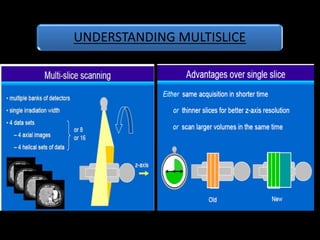
UNDERSTANDING MULTISLICE
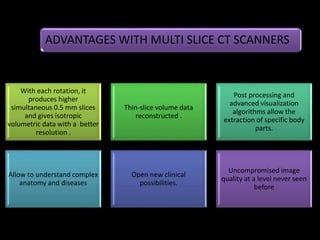
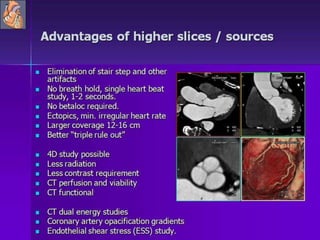
With each rotation, it
produces higher
simultaneous 0.5 mm slices
and gives isotropic
volumetric data with a better
resolution .
Thin-slice volume data
reconstructed .
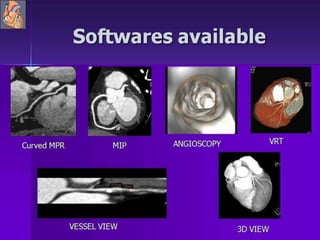
Post processing and
advanced visualization
algorithms allow the
extraction of specific body
parts.
Allow to understand complex
anatomy and diseases
Open new clinical
possibilities.
Uncompromised image
quality at a level never seen
before
ADVANTAGES WITH MULTI SLICE CT SCANNERS
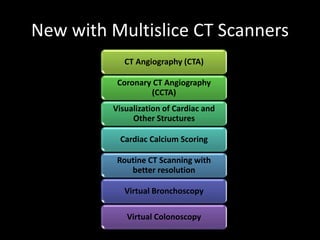
New with Multislice CT Scanners
CT Angiography (CTA)
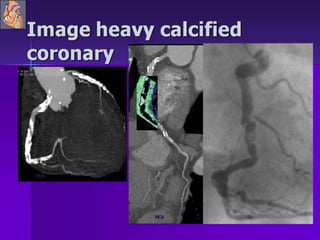
Coronary CT Angiography
(CCTA)
Visualization of Cardiac and
Other Structures
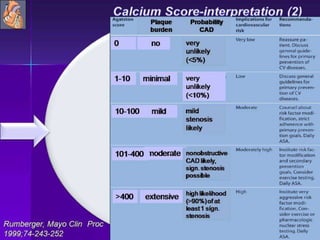
Cardiac Calcium Scoring
Routine CT Scanning with
better resolution
Virtual Bronchoscopy
Virtual Colonoscopy
CT Angiography (CTA)
With ultra fast scanning, arteries serving the
brain ,lungs, kidneys, arms and legs can be
evaluated non-invasively.
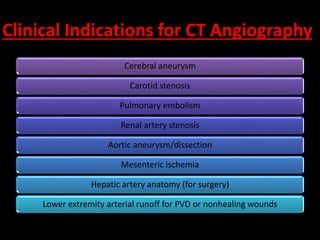
Clinical Indications for CT Angiography
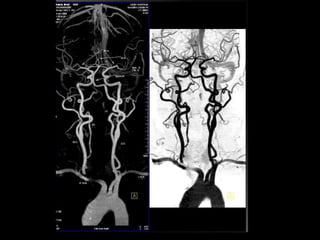
Cerebral aneurysm
Carotid stenosis
Pulmonary embolism
Renal artery stenosis
Aortic aneurysm/dissection
Mesenteric ischemia
Hepatic artery anatomy (for surgery)
Lower extremity arterial runoff for PVD or nonhealing wounds
CTAngiography - technique
• BOLUS TRACKING
• Amount and rate of contrast injection
• Exposure factors
• Pitch/collimation
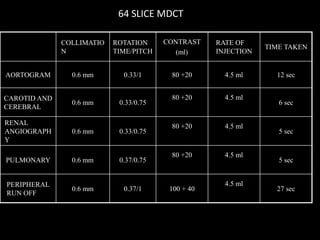
COLLIMATIO
N
ROTATION
TIME/PITCH
CONTRAST
(ml)
RATE OF
INJECTION
TIME TAKEN
AORTOGRAM 0.6 mm 0.33/1 80 +20 4.5 ml 12 sec
CAROTID AND
CEREBRAL
0.6 mm 0.33/0.75
80 +20 4.5 ml
6 sec
RENAL
ANGIOGRAPH
Y
0.6 mm 0.33/0.75
80 +20 4.5 ml
5 sec
PULMONARY 0.6 mm 0.37/0.75
80 +20 4.5 ml
5 sec
PERIPHERAL
RUN OFF
0.6 mm 0.37/1 100 + 40
4.5 ml
27 sec
64 SLICE MDCT
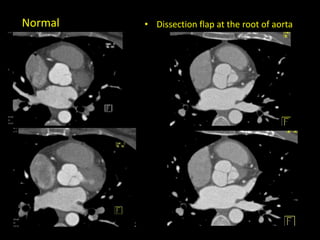
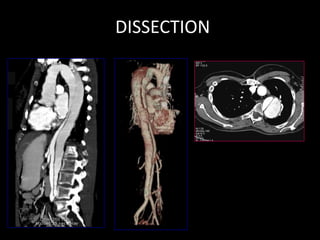
• Dissection flap at the root of aortaNormal
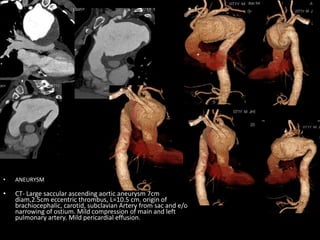
• ANEURYSM
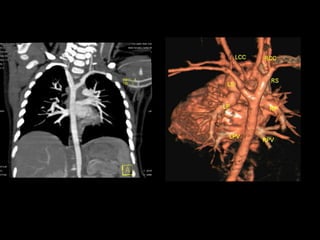
• CT- Large saccular ascending aortic aneurysm 7cm
diam,2.5cm eccentric thrombus, L=10.5 cm. origin of
brachiocephalic, carotid, subclavian Artery from sac and e/o
narrowing of ostium. Mild compression of main and left
pulmonary artery. Mild pericardial effusion.
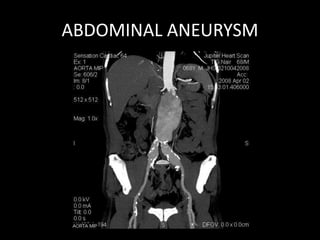
ABDOMINAL ANEURYSM
DISSECTION
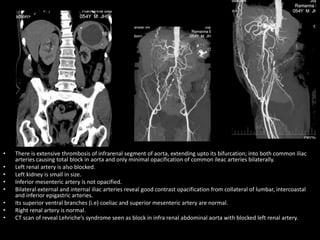
• There is extensive thrombosis of infrarenal segment of aorta, extending upto its bifurcation; into both common iliac
arteries causing total block in aorta and only minimal opacification of common ileac arteries bilaterally.
• Left renal artery is also blocked.
• Left kidney is small in size.
• Inferior mesenteric artery is not opacified.
• Bilateral external and internal iliac arteries reveal good contrast opacification from collateral of lumbar, intercoastal
and inferior epigastric arteries.
• Its superior ventral branches (i.e) coeliac and superior mesenteric artery are normal.
• Right renal artery is normal.
• CT scan of reveal Lehriche’s syndrome seen as block in infra renal abdominal aorta with blocked left renal artery.
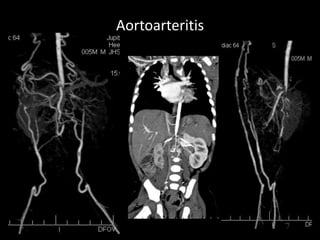
Aortoarteritis
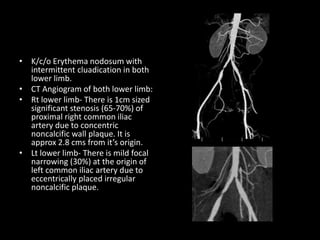
• K/c/o Erythema nodosum with
intermittent cluadication in both
lower limb.
• CT Angiogram of both lower limb:
• Rt lower limb- There is 1cm sized
significant stenosis (65-70%) of
proximal right common iliac
artery due to concentric
noncalcific wall plaque. It is
approx 2.8 cms from it’s origin.
• Lt lower limb- There is mild focal
narrowing (30%) at the origin of
left common iliac artery due to
eccentrically placed irregular
noncalcific plaque.
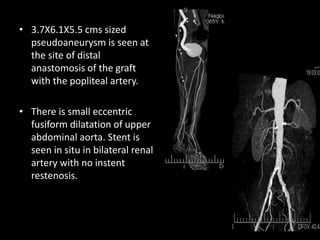
• 3.7X6.1X5.5 cms sized
pseudoaneurysm is seen at
the site of distal
anastomosis of the graft
with the popliteal artery.
• There is small eccentric
fusiform dilatation of upper
abdominal aorta. Stent is
seen in situ in bilateral renal
artery with no instent
restenosis.
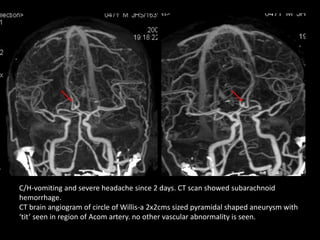
C/H-vomiting and severe headache since 2 days. CT scan showed subarachnoid
hemorrhage.
CT brain angiogram of circle of Willis-a 2x2cms sized pyramidal shaped aneurysm with
‘tit’ seen in region of Acom artery. no other vascular abnormality is seen.
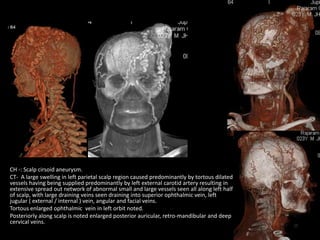
• CH -: Scalp cirsoid aneurysm.
• CT- A large swelling in left parietal scalp region caused predominantly by tortous dilated
vessels having being supplied predominantly by left external carotid artery resulting in
extensive spread out network of abnormal small and large vessels seen all along left half
of scalp, with large draining veins seen draining into superior ophthalmic vein, left
jugular ( external / internal ) vein, angular and facial veins.
• Tortous enlarged ophthalmic vein in left orbit noted.
• Posteriorly along scalp is noted enlarged posterior auricular, retro-mandibular and deep
cervical veins.
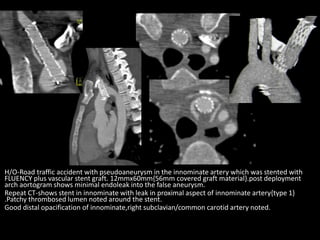
H/O-Road traffic accident with pseudoaneurysm in the innominate artery which was stented with
FLUENCY plus vascular stent graft. 12mmx60mm{56mm covered graft material}.post deployment
arch aortogram shows minimal endoleak into the false aneurysm.
Repeat CT-shows stent in innominate with leak in proximal aspect of innominate artery{type 1}
.Patchy thrombosed lumen noted around the stent.
Good distal opacification of innominate,right subclavian/common carotid artery noted.
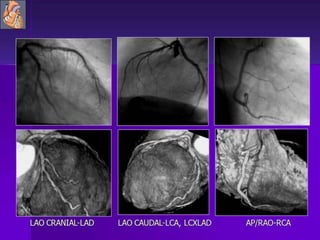
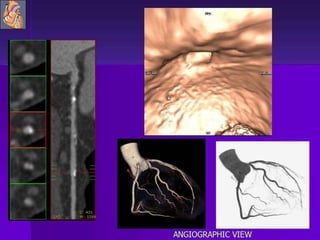
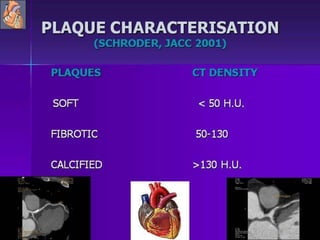
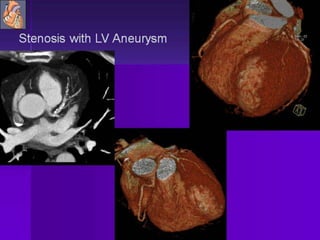
Coronary Angiography
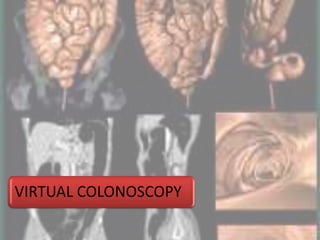
VIRTUAL COLONOSCOPY
Virtual Colonoscopy
• Emerging noninvasive imaging technology for
detecting colon polyps and cancer.
• Trends towards using this as screening gold
standards as it permits complete visualization of
the entire colon, hence providing the opportunity
to identify precancerous polyps and cancer.
• Accepted applications include incomplete
colonoscopy.
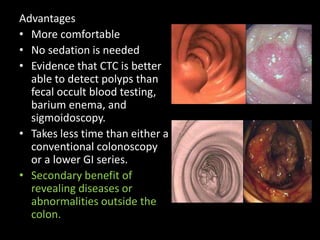
Advantages
• More comfortable
• No sedation is needed
• Evidence that CTC is better
able to detect polyps than
fecal occult blood testing,
barium enema, and
sigmoidoscopy.
• Takes less time than either a
conventional colonoscopy
or a lower GI series.
• Secondary benefit of
revealing diseases or
abnormalities outside the
colon.
• Disadvantages-
• Inability to take tissue samples or remove polyps
• Polyps smaller than between 2-10 mm may not
be seen.
• Ionizing radiation.
BUT It should be remembered than between 10%
and 20% of all polyps and up to 5% of colon
cancers are missed even on conventional
colonoscopy.
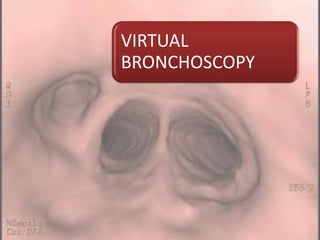
VIRTUAL
BRONCHOSCOPY
Virtual Bronchoscopy
• Virtual bronchoscopy produces high- resolution images of the tracheobronchial
tree and endobronchial views that simulate the findings at conventional
bronchoscopy.
APPLICATIONS
Normal Anatomic Features & Varients
Tracheobronchial Stenosis
Bronchogenic Carcinoma
Endoluminal Lesions
Foreign Body Aspiration
Imaging Guidance
Tracheoesophageal Fistula
Burn Injuries
Stent Planning and Follow-up
Trauma
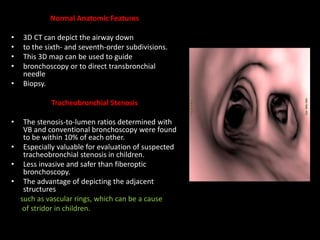
Normal Anatomic Features
• 3D CT can depict the airway down
• to the sixth- and seventh-order subdivisions.
• This 3D map can be used to guide
• bronchoscopy or to direct transbronchial
needle
• Biopsy.
Tracheobronchial Stenosis
• The stenosis-to-lumen ratios determined with
VB and conventional bronchoscopy were found
to be within 10% of each other.
• Especially valuable for evaluation of suspected
tracheobronchial stenosis in children.
• Less invasive and safer than fiberoptic
bronchoscopy.
• The advantage of depicting the adjacent
structures
such as vascular rings, which can be a cause
of stridor in children.
Bronchogenic Carcinoma
• CT is the primary imaging technique for the detection, staging, and
follow-up of primary malignant tumors of the lung.
• CT with VB
• Sensitivity -100% for obstructive lesions
16% for mucosal lesions
90% for endoluminal lesions.
• Specificity for malignant tumours - 100%.
Advantage of VB over fiberoptic bronchoscopy
• Can image beyond the site of obstruction
• Visualization of the smaller airways, which are not accessible with
fiberoptic bronchoscopy.
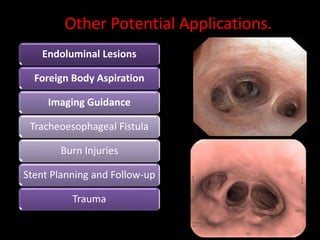
Endoluminal Lesions
Foreign Body Aspiration
Imaging Guidance
Tracheoesophageal Fistula
Burn Injuries
Stent Planning and Follow-up
Trauma
Other Potential Applications.
TO CONCLUDE…
New technology proving its worth:
In routine scanning
In more specialised fields
CT scanning procedure may:
– be more comfortable for the patient
– carry fewer risks of complications
– sometimes replace more invasive procedures
• CT doses:
– higher for some exams but could be lower for others
– thin slice doses multi- slice lower than on 4-slice
– are being addressed by dose reduction features
DISCLAIMER
Thank you…

Advances in ct technology

  • 1.
    Advances in CTTechnology
  • 2.
  • 3.
    With each rotation,it produces higher simultaneous 0.5 mm slices and gives isotropic volumetric data with a better resolution . Thin-slice volume data reconstructed . Post processing and advanced visualization algorithms allow the extraction of specific body parts. Allow to understand complex anatomy and diseases Open new clinical possibilities. Uncompromised image quality at a level never seen before ADVANTAGES WITH MULTI SLICE CT SCANNERS
  • 4.
    New with MultisliceCT Scanners CT Angiography (CTA) Coronary CT Angiography (CCTA) Visualization of Cardiac and Other Structures Cardiac Calcium Scoring Routine CT Scanning with better resolution Virtual Bronchoscopy Virtual Colonoscopy
  • 5.
    CT Angiography (CTA) Withultra fast scanning, arteries serving the brain ,lungs, kidneys, arms and legs can be evaluated non-invasively.
  • 6.
    Clinical Indications forCT Angiography Cerebral aneurysm Carotid stenosis Pulmonary embolism Renal artery stenosis Aortic aneurysm/dissection Mesenteric ischemia Hepatic artery anatomy (for surgery) Lower extremity arterial runoff for PVD or nonhealing wounds
  • 7.
    CTAngiography - technique •BOLUS TRACKING • Amount and rate of contrast injection • Exposure factors • Pitch/collimation
  • 8.
    COLLIMATIO N ROTATION TIME/PITCH CONTRAST (ml) RATE OF INJECTION TIME TAKEN AORTOGRAM0.6 mm 0.33/1 80 +20 4.5 ml 12 sec CAROTID AND CEREBRAL 0.6 mm 0.33/0.75 80 +20 4.5 ml 6 sec RENAL ANGIOGRAPH Y 0.6 mm 0.33/0.75 80 +20 4.5 ml 5 sec PULMONARY 0.6 mm 0.37/0.75 80 +20 4.5 ml 5 sec PERIPHERAL RUN OFF 0.6 mm 0.37/1 100 + 40 4.5 ml 27 sec 64 SLICE MDCT
  • 9.
    • Dissection flapat the root of aortaNormal
  • 11.
    • ANEURYSM • CT-Large saccular ascending aortic aneurysm 7cm diam,2.5cm eccentric thrombus, L=10.5 cm. origin of brachiocephalic, carotid, subclavian Artery from sac and e/o narrowing of ostium. Mild compression of main and left pulmonary artery. Mild pericardial effusion.
  • 12.
  • 13.
  • 15.
    • There isextensive thrombosis of infrarenal segment of aorta, extending upto its bifurcation; into both common iliac arteries causing total block in aorta and only minimal opacification of common ileac arteries bilaterally. • Left renal artery is also blocked. • Left kidney is small in size. • Inferior mesenteric artery is not opacified. • Bilateral external and internal iliac arteries reveal good contrast opacification from collateral of lumbar, intercoastal and inferior epigastric arteries. • Its superior ventral branches (i.e) coeliac and superior mesenteric artery are normal. • Right renal artery is normal. • CT scan of reveal Lehriche’s syndrome seen as block in infra renal abdominal aorta with blocked left renal artery.
  • 16.
  • 17.
    • K/c/o Erythemanodosum with intermittent cluadication in both lower limb. • CT Angiogram of both lower limb: • Rt lower limb- There is 1cm sized significant stenosis (65-70%) of proximal right common iliac artery due to concentric noncalcific wall plaque. It is approx 2.8 cms from it’s origin. • Lt lower limb- There is mild focal narrowing (30%) at the origin of left common iliac artery due to eccentrically placed irregular noncalcific plaque.
  • 18.
    • 3.7X6.1X5.5 cmssized pseudoaneurysm is seen at the site of distal anastomosis of the graft with the popliteal artery. • There is small eccentric fusiform dilatation of upper abdominal aorta. Stent is seen in situ in bilateral renal artery with no instent restenosis.
  • 20.
    C/H-vomiting and severeheadache since 2 days. CT scan showed subarachnoid hemorrhage. CT brain angiogram of circle of Willis-a 2x2cms sized pyramidal shaped aneurysm with ‘tit’ seen in region of Acom artery. no other vascular abnormality is seen.
  • 21.
    • CH -:Scalp cirsoid aneurysm. • CT- A large swelling in left parietal scalp region caused predominantly by tortous dilated vessels having being supplied predominantly by left external carotid artery resulting in extensive spread out network of abnormal small and large vessels seen all along left half of scalp, with large draining veins seen draining into superior ophthalmic vein, left jugular ( external / internal ) vein, angular and facial veins. • Tortous enlarged ophthalmic vein in left orbit noted. • Posteriorly along scalp is noted enlarged posterior auricular, retro-mandibular and deep cervical veins.
  • 22.
    H/O-Road traffic accidentwith pseudoaneurysm in the innominate artery which was stented with FLUENCY plus vascular stent graft. 12mmx60mm{56mm covered graft material}.post deployment arch aortogram shows minimal endoleak into the false aneurysm. Repeat CT-shows stent in innominate with leak in proximal aspect of innominate artery{type 1} .Patchy thrombosed lumen noted around the stent. Good distal opacification of innominate,right subclavian/common carotid artery noted.
  • 24.
  • 51.
  • 52.
    Virtual Colonoscopy • Emergingnoninvasive imaging technology for detecting colon polyps and cancer. • Trends towards using this as screening gold standards as it permits complete visualization of the entire colon, hence providing the opportunity to identify precancerous polyps and cancer. • Accepted applications include incomplete colonoscopy.
  • 53.
    Advantages • More comfortable •No sedation is needed • Evidence that CTC is better able to detect polyps than fecal occult blood testing, barium enema, and sigmoidoscopy. • Takes less time than either a conventional colonoscopy or a lower GI series. • Secondary benefit of revealing diseases or abnormalities outside the colon.
  • 54.
    • Disadvantages- • Inabilityto take tissue samples or remove polyps • Polyps smaller than between 2-10 mm may not be seen. • Ionizing radiation. BUT It should be remembered than between 10% and 20% of all polyps and up to 5% of colon cancers are missed even on conventional colonoscopy.
  • 55.
  • 56.
    Virtual Bronchoscopy • Virtualbronchoscopy produces high- resolution images of the tracheobronchial tree and endobronchial views that simulate the findings at conventional bronchoscopy. APPLICATIONS Normal Anatomic Features & Varients Tracheobronchial Stenosis Bronchogenic Carcinoma Endoluminal Lesions Foreign Body Aspiration Imaging Guidance Tracheoesophageal Fistula Burn Injuries Stent Planning and Follow-up Trauma
  • 57.
    Normal Anatomic Features •3D CT can depict the airway down • to the sixth- and seventh-order subdivisions. • This 3D map can be used to guide • bronchoscopy or to direct transbronchial needle • Biopsy. Tracheobronchial Stenosis • The stenosis-to-lumen ratios determined with VB and conventional bronchoscopy were found to be within 10% of each other. • Especially valuable for evaluation of suspected tracheobronchial stenosis in children. • Less invasive and safer than fiberoptic bronchoscopy. • The advantage of depicting the adjacent structures such as vascular rings, which can be a cause of stridor in children.
  • 58.
    Bronchogenic Carcinoma • CTis the primary imaging technique for the detection, staging, and follow-up of primary malignant tumors of the lung. • CT with VB • Sensitivity -100% for obstructive lesions 16% for mucosal lesions 90% for endoluminal lesions. • Specificity for malignant tumours - 100%. Advantage of VB over fiberoptic bronchoscopy • Can image beyond the site of obstruction • Visualization of the smaller airways, which are not accessible with fiberoptic bronchoscopy.
  • 59.
    Endoluminal Lesions Foreign BodyAspiration Imaging Guidance Tracheoesophageal Fistula Burn Injuries Stent Planning and Follow-up Trauma Other Potential Applications.
  • 60.
    TO CONCLUDE… New technologyproving its worth: In routine scanning In more specialised fields CT scanning procedure may: – be more comfortable for the patient – carry fewer risks of complications – sometimes replace more invasive procedures • CT doses: – higher for some exams but could be lower for others – thin slice doses multi- slice lower than on 4-slice – are being addressed by dose reduction features
  • 61.