Stephan Ewen
@stephanewen
Streaming Analytics
with Apache Flink
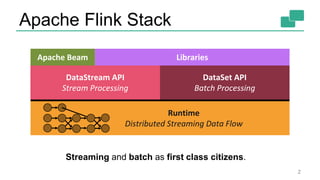
Apache Flink Stack
2
DataStream API
Stream Processing
DataSet API
Batch Processing
Runtime
Distributed Streaming Data Flow
LibrariesApache Beam
Streaming and batch as first class citizens.
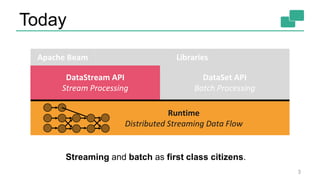
Today
3
Streaming and batch as first class citizens.
DataStream API
Stream Processing
DataSet API
Batch Processing
Runtime
Distributed Streaming Data Flow
LibrariesApache Beam
4
Streaming technology is enabling the obvious:
continuous processing on data that is
continuously produced
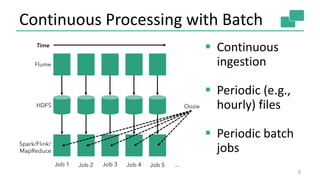
Continuous Processing with Batch
 Continuous
ingestion
 Periodic (e.g.,
hourly) files
 Periodic batch
jobs
5
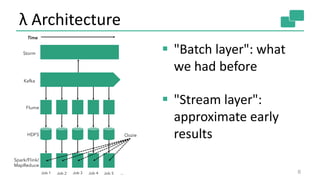
λ Architecture
 "Batch layer": what
we had before
 "Stream layer":
approximate early
results
6
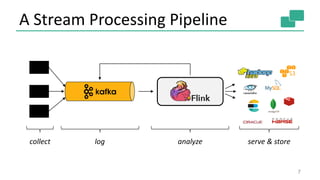
A Stream Processing Pipeline
7
collect log analyze serve & store
Programs and Dataflows
8
Source
Transformation
Transformation
Sink
val lines: DataStream[String] = env.addSource(new FlinkKafkaConsumer09(…))
val events: DataStream[Event] = lines.map((line) => parse(line))
val stats: DataStream[Statistic] = stream
.keyBy("sensor")
.timeWindow(Time.seconds(5))
.sum(new MyAggregationFunction())
stats.addSink(new RollingSink(path))
Source
[1]
map()
[1]
keyBy()/
window()/
apply()
[1]
Sink
[1]
Source
[2]
map()
[2]
keyBy()/
window()/
apply()
[2]
Streaming
Dataflow
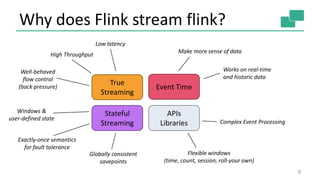
Why does Flink stream flink?
9
Low latency
High Throughput
Well-behaved
flow control
(back pressure)
Make more sense of data
Works on real-time
and historic data
True
Streaming
Event Time
APIs
Libraries
Stateful
Streaming
Globally consistent
savepoints
Exactly-once semantics
for fault tolerance
Windows &
user-defined state
Flexible windows
(time, count, session, roll-your own)
Complex Event Processing
Streaming Analytics by Example
10
Time-Windowed Aggregations
11
case class Event(sensor: String, measure: Double)
val env = StreamExecutionEnvironment.getExecutionEnvironment
val stream: DataStream[Event] = env.addSource(…)
stream
.keyBy("sensor")
.timeWindow(Time.seconds(5))
.sum("measure")
Time-Windowed Aggregations
12
case class Event(sensor: String, measure: Double)
val env = StreamExecutionEnvironment.getExecutionEnvironment
val stream: DataStream[Event] = env.addSource(…)
stream
.keyBy("sensor")
.timeWindow(Time.seconds(60), Time.seconds(5))
.sum("measure")
Session-Windowed Aggregations
13
case class Event(sensor: String, measure: Double)
val env = StreamExecutionEnvironment.getExecutionEnvironment
val stream: DataStream[Event] = env.addSource(…)
stream
.keyBy("sensor")
.window(EventTimeSessionWindows.withGap(Time.seconds(60)))
.max("measure")
Pattern Detection
14
case class Event(producer: String, evtType: Int, msg: String)
case class Alert(msg: String)
val stream: DataStream[Event] = env.addSource(…)
stream
.keyBy("producer")
.flatMap(new RichFlatMapFuncion[Event, Alert]() {
lazy val state: ValueState[Int] = getRuntimeContext.getState(…)
def flatMap(event: Event, out: Collector[Alert]) = {
val newState = state.value() match {
case 0 if (event.evtType == 0) => 1
case 1 if (event.evtType == 1) => 0
case x => out.collect(Alert(event.msg, x)); 0
}
state.update(newState)
}
})
Pattern Detection
15
case class Event(producer: String, evtType: Int, msg: String)
case class Alert(msg: String)
val stream: DataStream[Event] = env.addSource(…)
stream
.keyBy("producer")
.flatMap(new RichFlatMapFuncion[Event, Alert]() {
lazy val state: ValueState[Int] = getRuntimeContext.getState(…)
def flatMap(event: Event, out: Collector[Alert]) = {
val newState = state.value() match {
case 0 if (event.evtType == 0) => 1
case 1 if (event.evtType == 1) => 0
case x => out.collect(Alert(event.msg, x)); 0
}
state.update(newState)
}
})
Embedded key/value
state store
Many more
 Joining streams (e.g. combine readings from sensor)
 Detecting Patterns (CEP)
 Applying (changing) rules or models to events
 Training and applying online machine learning
models
 …
16
(It's) About Time
17
18
The biggest change in moving from
batch to streaming is
handling time explicitly
Example: Windowing by Time
19
case class Event(id: String, measure: Double, timestamp: Long)
val env = StreamExecutionEnvironment.getExecutionEnvironment
val stream: DataStream[Event] = env.addSource(…)
stream
.keyBy("id")
.timeWindow(Time.seconds(15), Time.seconds(5))
.sum("measure")
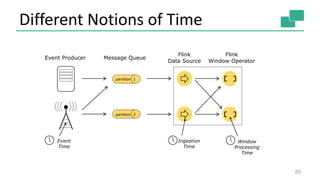
Different Notions of Time
20
Event Producer Message Queue
Flink
Data Source
Flink
Window Operator
partition 1
partition 2
Event
Time
Ingestion
Time
Window
Processing
Time
Time and the Dataflow Model
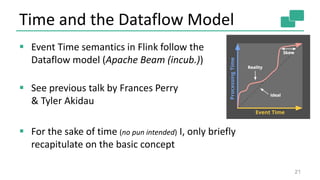
 Event Time semantics in Flink follow the
Dataflow model (Apache Beam (incub.))
 See previous talk by Frances Perry
& Tyler Akidau
 For the sake of time (no pun intended) I, only briefly
recapitulate on the basic concept
21
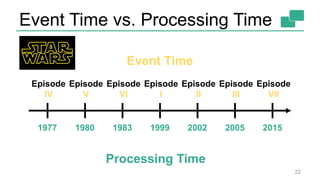
1977 1980 1983 1999 2002 2005 2015
Processing Time
Episode
IV
Episode
V
Episode
VI
Episode
I
Episode
II
Episode
III
Episode
VII
Event Time
Event Time vs. Processing Time
22
Processing Time
23
case class Event(id: String, measure: Double, timestamp: Long)
val env = StreamExecutionEnvironment.getExecutionEnvironment
env.setStreamTimeCharacteristic(ProcessingTime)
val stream: DataStream[Event] = env.addSource(…)
stream
.keyBy("id")
.timeWindow(Time.seconds(15), Time.seconds(5))
.sum("measure")
Ingestion Time
24
case class Event(id: String, measure: Double, timestamp: Long)
val env = StreamExecutionEnvironment.getExecutionEnvironment
env.setStreamTimeCharacteristic(IngestionTime)
val stream: DataStream[Event] = env.addSource(…)
stream
.keyBy("id")
.timeWindow(Time.seconds(15), Time.seconds(5))
.sum("measure")
Event Time
25
case class Event(id: String, measure: Double, timestamp: Long)
val env = StreamExecutionEnvironment.getExecutionEnvironment
env.setStreamTimeCharacteristic(EventTime)
val stream: DataStream[Event] = env.addSource(…)
stream
.keyBy("id")
.timeWindow(Time.seconds(15), Time.seconds(5))
.sum("measure")
Event Time
26
case class Event(id: String, measure: Double, timestamp: Long)
val env = StreamExecutionEnvironment.getExecutionEnvironment
env.setStreamTimeCharacteristic(EventTime)
val stream: DataStream[Event] = env.addSource(…)
val tsStream = stream.assignTimestampsAndWatermarks(
new MyTimestampsAndWatermarkGenerator())
tsStream
.keyBy("id")
.timeWindow(Time.seconds(15), Time.seconds(5))
.sum("measure")
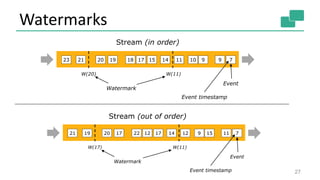
Watermarks
27
7
W(11)W(17)
11159121417122220 171921
Watermark
Event
Event timestamp
Stream (in order)
7
W(11)W(20)
Watermark
991011141517
Event
Event timestamp
1820 192123
Stream (out of order)
Watermarks in Parallel
28
Source
(1)
Source
(2)
map
(1)
map
(2)
window
(1)
window
(2)
29
29
17
14
14
29
14
14
W(33)
W(17)
W(17)
A|30B|31
C|30
D|15
E|30
F|15G|18H|20
K|35
Watermark
Event Time
at the operator
Event
[id|timestamp]
Event Time
at input streams
Watermark
Generation
M|39N|39Q|44
L|22O|23R|37
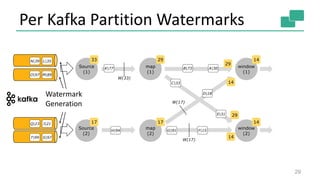
Per Kafka Partition Watermarks
29
Source
(1)
Source
(2)
map
(1)
map
(2)
window
(1)
window
(2)
33
17
29
29
17
14
14
29
14
14
W(33)
W(17)
W(17)
A|30B|73
C|33
D|18
E|31
F|15G|91H|94
K|77
Watermark
Generation
L|35N|39
O|97 M|89
I|21Q|23
T|99 S|97
Matters of State
(Fault Tolerance, Reinstatements, etc)
30
Back to the Aggregation Example
31
case class Event(id: String, measure: Double, timestamp: Long)
val env = StreamExecutionEnvironment.getExecutionEnvironment
val stream: DataStream[Event] = env.addSource(
new FlinkKafkaConsumer09(topic, schema, properties))
stream
.keyBy("id")
.timeWindow(Time.seconds(15), Time.seconds(5))
.sum("measure")
Stateful
Fault Tolerance
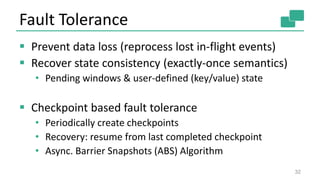
 Prevent data loss (reprocess lost in-flight events)
 Recover state consistency (exactly-once semantics)
• Pending windows & user-defined (key/value) state
 Checkpoint based fault tolerance
• Periodically create checkpoints
• Recovery: resume from last completed checkpoint
• Async. Barrier Snapshots (ABS) Algorithm
32
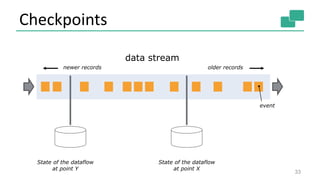
Checkpoints
33
data stream
event
newer records older records
State of the dataflow
at point Y
State of the dataflow
at point X
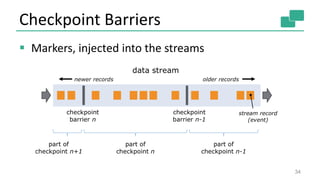
Checkpoint Barriers
 Markers, injected into the streams
34
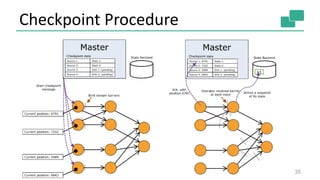
Checkpoint Procedure
35
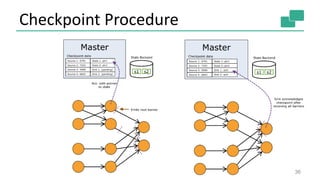
Checkpoint Procedure
36
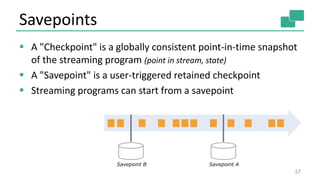
Savepoints
 A "Checkpoint" is a globally consistent point-in-time snapshot
of the streaming program (point in stream, state)
 A "Savepoint" is a user-triggered retained checkpoint
 Streaming programs can start from a savepoint
37
Savepoint B Savepoint A
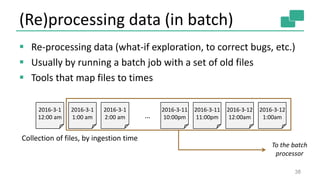
(Re)processing data (in batch)
 Re-processing data (what-if exploration, to correct bugs, etc.)
 Usually by running a batch job with a set of old files
 Tools that map files to times
38
2016-3-1
12:00 am
2016-3-1
1:00 am
2016-3-1
2:00 am
2016-3-11
11:00pm
2016-3-12
12:00am
2016-3-12
1:00am…
Collection of files, by ingestion time
2016-3-11
10:00pm
To the batch
processor
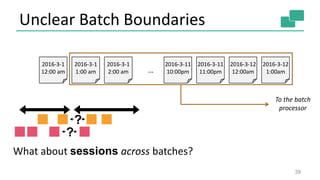
Unclear Batch Boundaries
39
2016-3-1
12:00 am
2016-3-1
1:00 am
2016-3-1
2:00 am
2016-3-11
11:00pm
2016-3-12
12:00am
2016-3-12
1:00am…
2016-3-11
10:00pm
To the batch
processor
?
?
What about sessions across batches?
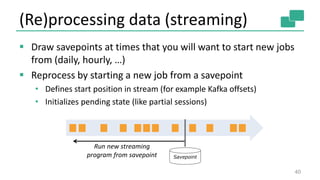
(Re)processing data (streaming)
 Draw savepoints at times that you will want to start new jobs
from (daily, hourly, …)
 Reprocess by starting a new job from a savepoint
• Defines start position in stream (for example Kafka offsets)
• Initializes pending state (like partial sessions)
40
Savepoint
Run new streaming
program from savepoint
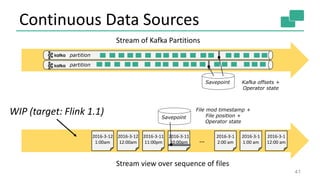
Continuous Data Sources
41
2016-3-1
12:00 am
2016-3-1
1:00 am
2016-3-1
2:00 am
2016-3-11
11:00pm
2016-3-12
12:00am
2016-3-12
1:00am
2016-3-11
10:00pm …
partition
partition
Savepoint
Savepoint
Stream of Kafka Partitions
Stream view over sequence of files
Kafka offsets +
Operator state
File mod timestamp +
File position +
Operator state
WIP (target: Flink 1.1)
Complex Event Processing Primer
Demo Time
42
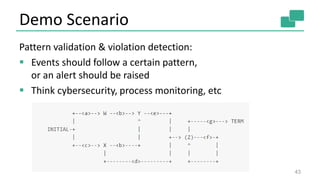
Demo Scenario
Pattern validation & violation detection:
 Events should follow a certain pattern,
or an alert should be raised
 Think cybersecurity, process monitoring, etc
43
An Outlook on Things to Come
44
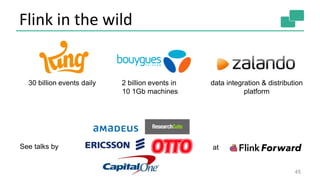
Flink in the wild
45
30 billion events daily 2 billion events in
10 1Gb machines
data integration & distribution
platform
See talks by at
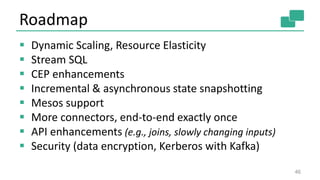
Roadmap
 Dynamic Scaling, Resource Elasticity
 Stream SQL
 CEP enhancements
 Incremental & asynchronous state snapshotting
 Mesos support
 More connectors, end-to-end exactly once
 API enhancements (e.g., joins, slowly changing inputs)
 Security (data encryption, Kerberos with Kafka)
46
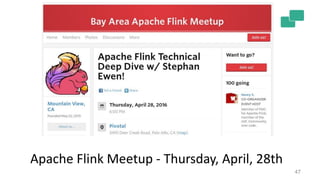
47
Apache Flink Meetup - Thursday, April, 28th
Flink Forward 2016, Berlin
Submission deadline: June 30, 2016
Early bird deadline: July 15, 2016
www.flink-forward.org
We are hiring!
data-artisans.com/careers
50
I stream, do you?

Advanced Streaming Analytics with Apache Flink and Apache Kafka, Stephan Ewen

  • 1.
  • 2.
    Apache Flink Stack 2 DataStreamAPI Stream Processing DataSet API Batch Processing Runtime Distributed Streaming Data Flow LibrariesApache Beam Streaming and batch as first class citizens.
  • 3.
    Today 3 Streaming and batchas first class citizens. DataStream API Stream Processing DataSet API Batch Processing Runtime Distributed Streaming Data Flow LibrariesApache Beam
  • 4.
    4 Streaming technology isenabling the obvious: continuous processing on data that is continuously produced
  • 5.
    Continuous Processing withBatch  Continuous ingestion  Periodic (e.g., hourly) files  Periodic batch jobs 5
  • 6.
    λ Architecture  "Batchlayer": what we had before  "Stream layer": approximate early results 6
  • 7.
    A Stream ProcessingPipeline 7 collect log analyze serve & store
  • 8.
    Programs and Dataflows 8 Source Transformation Transformation Sink vallines: DataStream[String] = env.addSource(new FlinkKafkaConsumer09(…)) val events: DataStream[Event] = lines.map((line) => parse(line)) val stats: DataStream[Statistic] = stream .keyBy("sensor") .timeWindow(Time.seconds(5)) .sum(new MyAggregationFunction()) stats.addSink(new RollingSink(path)) Source [1] map() [1] keyBy()/ window()/ apply() [1] Sink [1] Source [2] map() [2] keyBy()/ window()/ apply() [2] Streaming Dataflow
  • 9.
    Why does Flinkstream flink? 9 Low latency High Throughput Well-behaved flow control (back pressure) Make more sense of data Works on real-time and historic data True Streaming Event Time APIs Libraries Stateful Streaming Globally consistent savepoints Exactly-once semantics for fault tolerance Windows & user-defined state Flexible windows (time, count, session, roll-your own) Complex Event Processing
  • 10.
  • 11.
    Time-Windowed Aggregations 11 case classEvent(sensor: String, measure: Double) val env = StreamExecutionEnvironment.getExecutionEnvironment val stream: DataStream[Event] = env.addSource(…) stream .keyBy("sensor") .timeWindow(Time.seconds(5)) .sum("measure")
  • 12.
    Time-Windowed Aggregations 12 case classEvent(sensor: String, measure: Double) val env = StreamExecutionEnvironment.getExecutionEnvironment val stream: DataStream[Event] = env.addSource(…) stream .keyBy("sensor") .timeWindow(Time.seconds(60), Time.seconds(5)) .sum("measure")
  • 13.
    Session-Windowed Aggregations 13 case classEvent(sensor: String, measure: Double) val env = StreamExecutionEnvironment.getExecutionEnvironment val stream: DataStream[Event] = env.addSource(…) stream .keyBy("sensor") .window(EventTimeSessionWindows.withGap(Time.seconds(60))) .max("measure")
  • 14.
    Pattern Detection 14 case classEvent(producer: String, evtType: Int, msg: String) case class Alert(msg: String) val stream: DataStream[Event] = env.addSource(…) stream .keyBy("producer") .flatMap(new RichFlatMapFuncion[Event, Alert]() { lazy val state: ValueState[Int] = getRuntimeContext.getState(…) def flatMap(event: Event, out: Collector[Alert]) = { val newState = state.value() match { case 0 if (event.evtType == 0) => 1 case 1 if (event.evtType == 1) => 0 case x => out.collect(Alert(event.msg, x)); 0 } state.update(newState) } })
  • 15.
    Pattern Detection 15 case classEvent(producer: String, evtType: Int, msg: String) case class Alert(msg: String) val stream: DataStream[Event] = env.addSource(…) stream .keyBy("producer") .flatMap(new RichFlatMapFuncion[Event, Alert]() { lazy val state: ValueState[Int] = getRuntimeContext.getState(…) def flatMap(event: Event, out: Collector[Alert]) = { val newState = state.value() match { case 0 if (event.evtType == 0) => 1 case 1 if (event.evtType == 1) => 0 case x => out.collect(Alert(event.msg, x)); 0 } state.update(newState) } }) Embedded key/value state store
  • 16.
    Many more  Joiningstreams (e.g. combine readings from sensor)  Detecting Patterns (CEP)  Applying (changing) rules or models to events  Training and applying online machine learning models  … 16
  • 17.
  • 18.
    18 The biggest changein moving from batch to streaming is handling time explicitly
  • 19.
    Example: Windowing byTime 19 case class Event(id: String, measure: Double, timestamp: Long) val env = StreamExecutionEnvironment.getExecutionEnvironment val stream: DataStream[Event] = env.addSource(…) stream .keyBy("id") .timeWindow(Time.seconds(15), Time.seconds(5)) .sum("measure")
  • 20.
    Different Notions ofTime 20 Event Producer Message Queue Flink Data Source Flink Window Operator partition 1 partition 2 Event Time Ingestion Time Window Processing Time
  • 21.
    Time and theDataflow Model  Event Time semantics in Flink follow the Dataflow model (Apache Beam (incub.))  See previous talk by Frances Perry & Tyler Akidau  For the sake of time (no pun intended) I, only briefly recapitulate on the basic concept 21
  • 22.
    1977 1980 19831999 2002 2005 2015 Processing Time Episode IV Episode V Episode VI Episode I Episode II Episode III Episode VII Event Time Event Time vs. Processing Time 22
  • 23.
    Processing Time 23 case classEvent(id: String, measure: Double, timestamp: Long) val env = StreamExecutionEnvironment.getExecutionEnvironment env.setStreamTimeCharacteristic(ProcessingTime) val stream: DataStream[Event] = env.addSource(…) stream .keyBy("id") .timeWindow(Time.seconds(15), Time.seconds(5)) .sum("measure")
  • 24.
    Ingestion Time 24 case classEvent(id: String, measure: Double, timestamp: Long) val env = StreamExecutionEnvironment.getExecutionEnvironment env.setStreamTimeCharacteristic(IngestionTime) val stream: DataStream[Event] = env.addSource(…) stream .keyBy("id") .timeWindow(Time.seconds(15), Time.seconds(5)) .sum("measure")
  • 25.
    Event Time 25 case classEvent(id: String, measure: Double, timestamp: Long) val env = StreamExecutionEnvironment.getExecutionEnvironment env.setStreamTimeCharacteristic(EventTime) val stream: DataStream[Event] = env.addSource(…) stream .keyBy("id") .timeWindow(Time.seconds(15), Time.seconds(5)) .sum("measure")
  • 26.
    Event Time 26 case classEvent(id: String, measure: Double, timestamp: Long) val env = StreamExecutionEnvironment.getExecutionEnvironment env.setStreamTimeCharacteristic(EventTime) val stream: DataStream[Event] = env.addSource(…) val tsStream = stream.assignTimestampsAndWatermarks( new MyTimestampsAndWatermarkGenerator()) tsStream .keyBy("id") .timeWindow(Time.seconds(15), Time.seconds(5)) .sum("measure")
  • 27.
    Watermarks 27 7 W(11)W(17) 11159121417122220 171921 Watermark Event Event timestamp Stream(in order) 7 W(11)W(20) Watermark 991011141517 Event Event timestamp 1820 192123 Stream (out of order)
  • 28.
  • 29.
    Per Kafka PartitionWatermarks 29 Source (1) Source (2) map (1) map (2) window (1) window (2) 33 17 29 29 17 14 14 29 14 14 W(33) W(17) W(17) A|30B|73 C|33 D|18 E|31 F|15G|91H|94 K|77 Watermark Generation L|35N|39 O|97 M|89 I|21Q|23 T|99 S|97
  • 30.
    Matters of State (FaultTolerance, Reinstatements, etc) 30
  • 31.
    Back to theAggregation Example 31 case class Event(id: String, measure: Double, timestamp: Long) val env = StreamExecutionEnvironment.getExecutionEnvironment val stream: DataStream[Event] = env.addSource( new FlinkKafkaConsumer09(topic, schema, properties)) stream .keyBy("id") .timeWindow(Time.seconds(15), Time.seconds(5)) .sum("measure") Stateful
  • 32.
    Fault Tolerance  Preventdata loss (reprocess lost in-flight events)  Recover state consistency (exactly-once semantics) • Pending windows & user-defined (key/value) state  Checkpoint based fault tolerance • Periodically create checkpoints • Recovery: resume from last completed checkpoint • Async. Barrier Snapshots (ABS) Algorithm 32
  • 33.
    Checkpoints 33 data stream event newer recordsolder records State of the dataflow at point Y State of the dataflow at point X
  • 34.
    Checkpoint Barriers  Markers,injected into the streams 34
  • 35.
  • 36.
  • 37.
    Savepoints  A "Checkpoint"is a globally consistent point-in-time snapshot of the streaming program (point in stream, state)  A "Savepoint" is a user-triggered retained checkpoint  Streaming programs can start from a savepoint 37 Savepoint B Savepoint A
  • 38.
    (Re)processing data (inbatch)  Re-processing data (what-if exploration, to correct bugs, etc.)  Usually by running a batch job with a set of old files  Tools that map files to times 38 2016-3-1 12:00 am 2016-3-1 1:00 am 2016-3-1 2:00 am 2016-3-11 11:00pm 2016-3-12 12:00am 2016-3-12 1:00am… Collection of files, by ingestion time 2016-3-11 10:00pm To the batch processor
  • 39.
    Unclear Batch Boundaries 39 2016-3-1 12:00am 2016-3-1 1:00 am 2016-3-1 2:00 am 2016-3-11 11:00pm 2016-3-12 12:00am 2016-3-12 1:00am… 2016-3-11 10:00pm To the batch processor ? ? What about sessions across batches?
  • 40.
    (Re)processing data (streaming) Draw savepoints at times that you will want to start new jobs from (daily, hourly, …)  Reprocess by starting a new job from a savepoint • Defines start position in stream (for example Kafka offsets) • Initializes pending state (like partial sessions) 40 Savepoint Run new streaming program from savepoint
  • 41.
    Continuous Data Sources 41 2016-3-1 12:00am 2016-3-1 1:00 am 2016-3-1 2:00 am 2016-3-11 11:00pm 2016-3-12 12:00am 2016-3-12 1:00am 2016-3-11 10:00pm … partition partition Savepoint Savepoint Stream of Kafka Partitions Stream view over sequence of files Kafka offsets + Operator state File mod timestamp + File position + Operator state WIP (target: Flink 1.1)
  • 42.
    Complex Event ProcessingPrimer Demo Time 42
  • 43.
    Demo Scenario Pattern validation& violation detection:  Events should follow a certain pattern, or an alert should be raised  Think cybersecurity, process monitoring, etc 43
  • 44.
    An Outlook onThings to Come 44
  • 45.
    Flink in thewild 45 30 billion events daily 2 billion events in 10 1Gb machines data integration & distribution platform See talks by at
  • 46.
    Roadmap  Dynamic Scaling,Resource Elasticity  Stream SQL  CEP enhancements  Incremental & asynchronous state snapshotting  Mesos support  More connectors, end-to-end exactly once  API enhancements (e.g., joins, slowly changing inputs)  Security (data encryption, Kerberos with Kafka) 46
  • 47.
    47 Apache Flink Meetup- Thursday, April, 28th
  • 48.
    Flink Forward 2016,Berlin Submission deadline: June 30, 2016 Early bird deadline: July 15, 2016 www.flink-forward.org
  • 49.
  • 50.