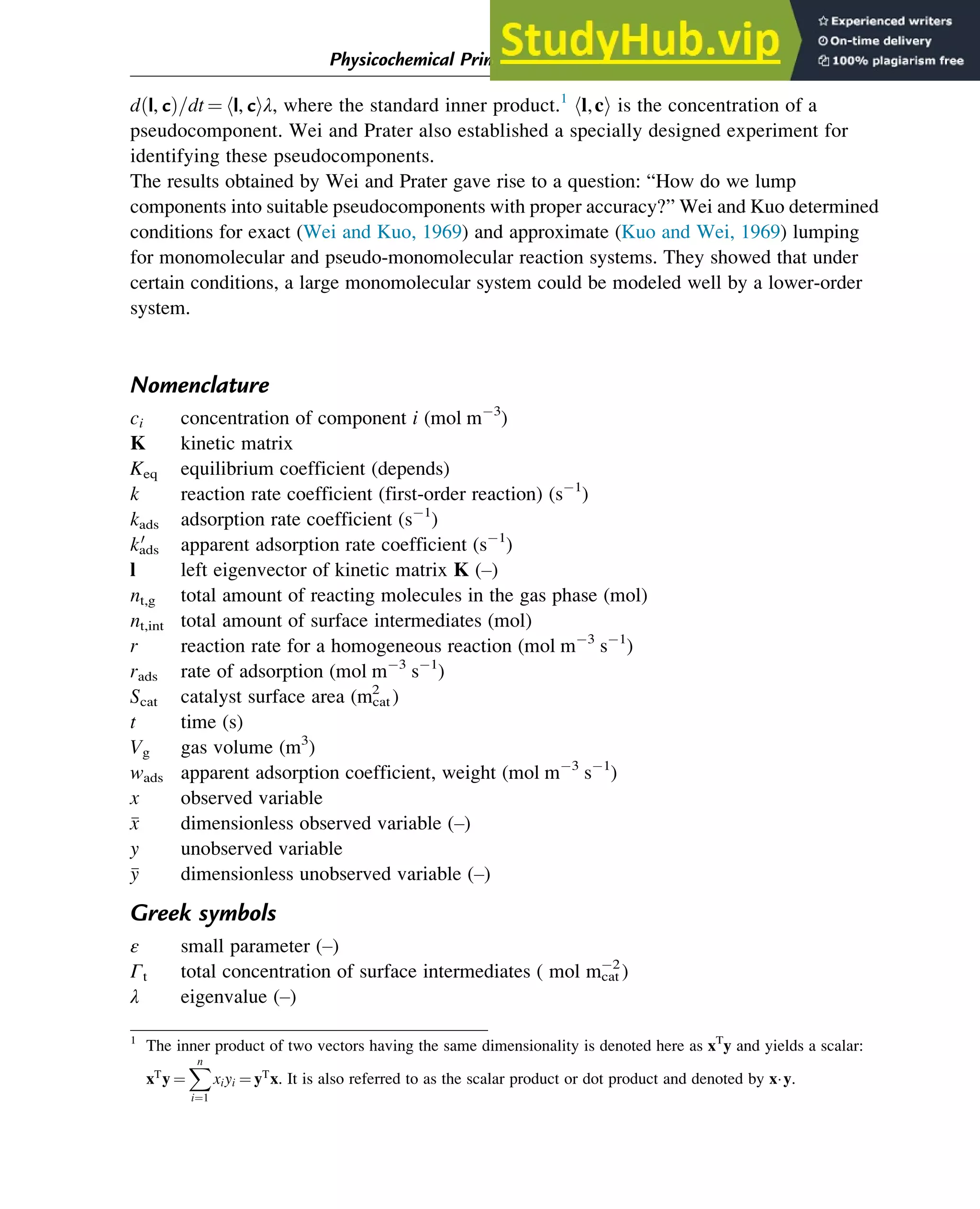
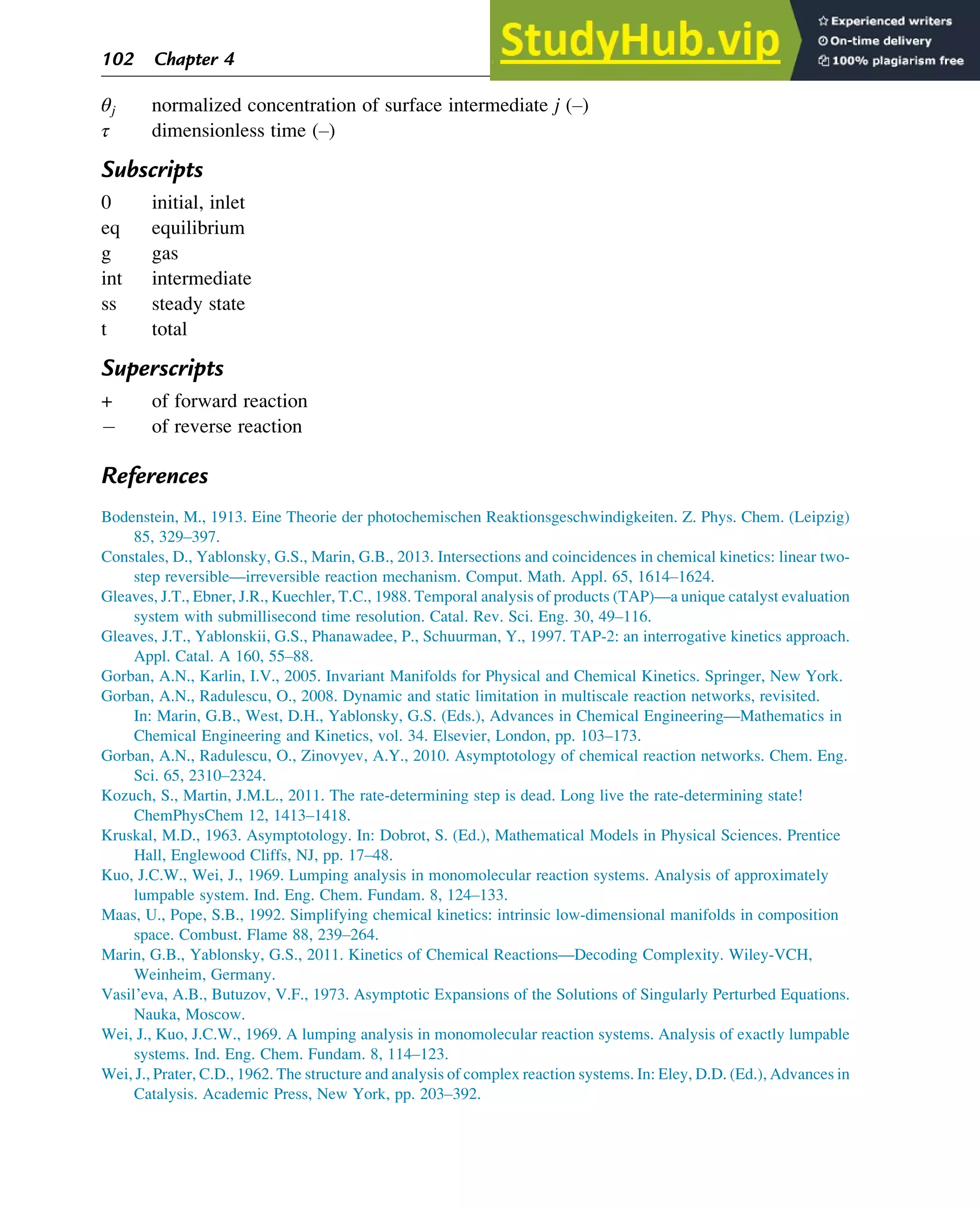
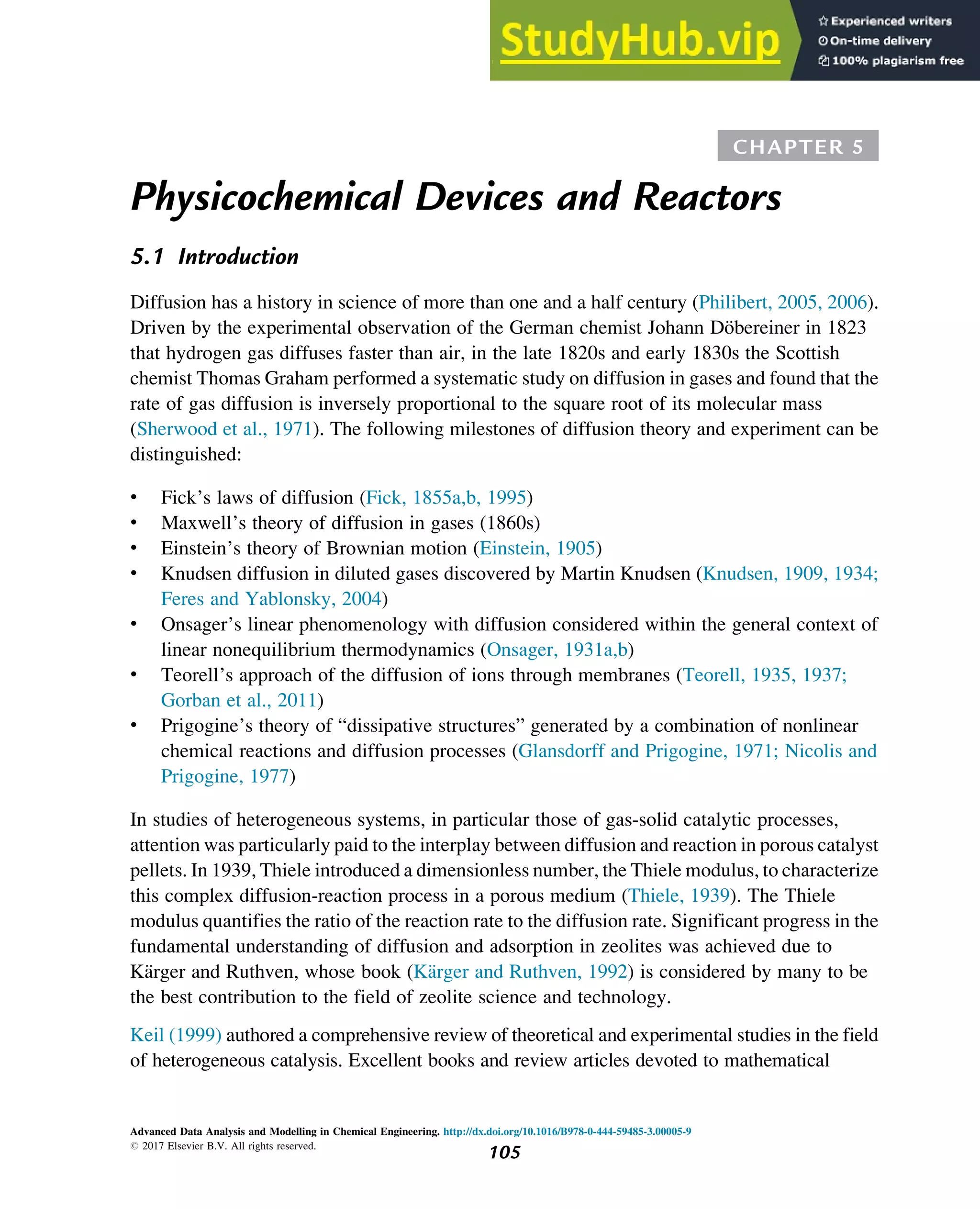
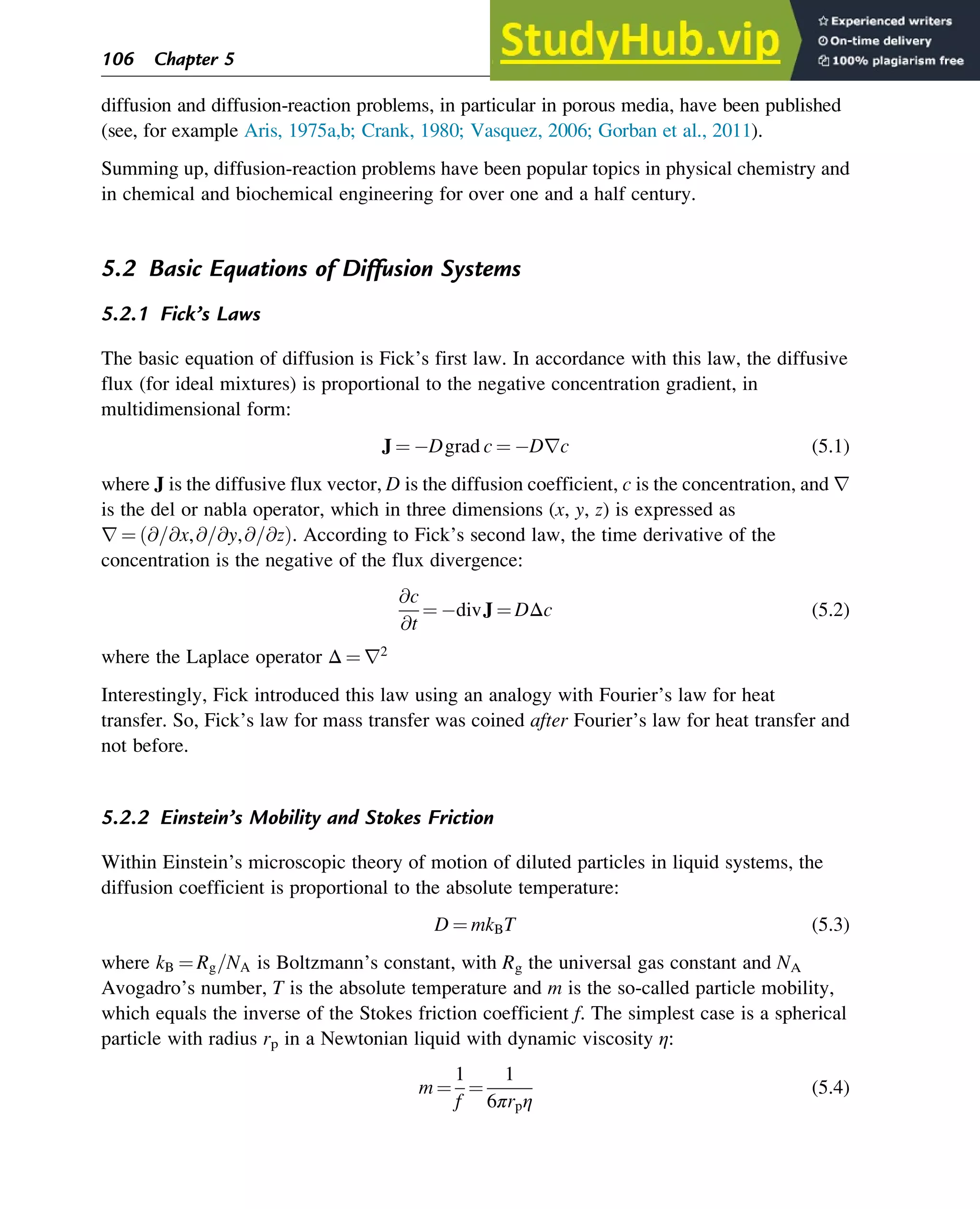
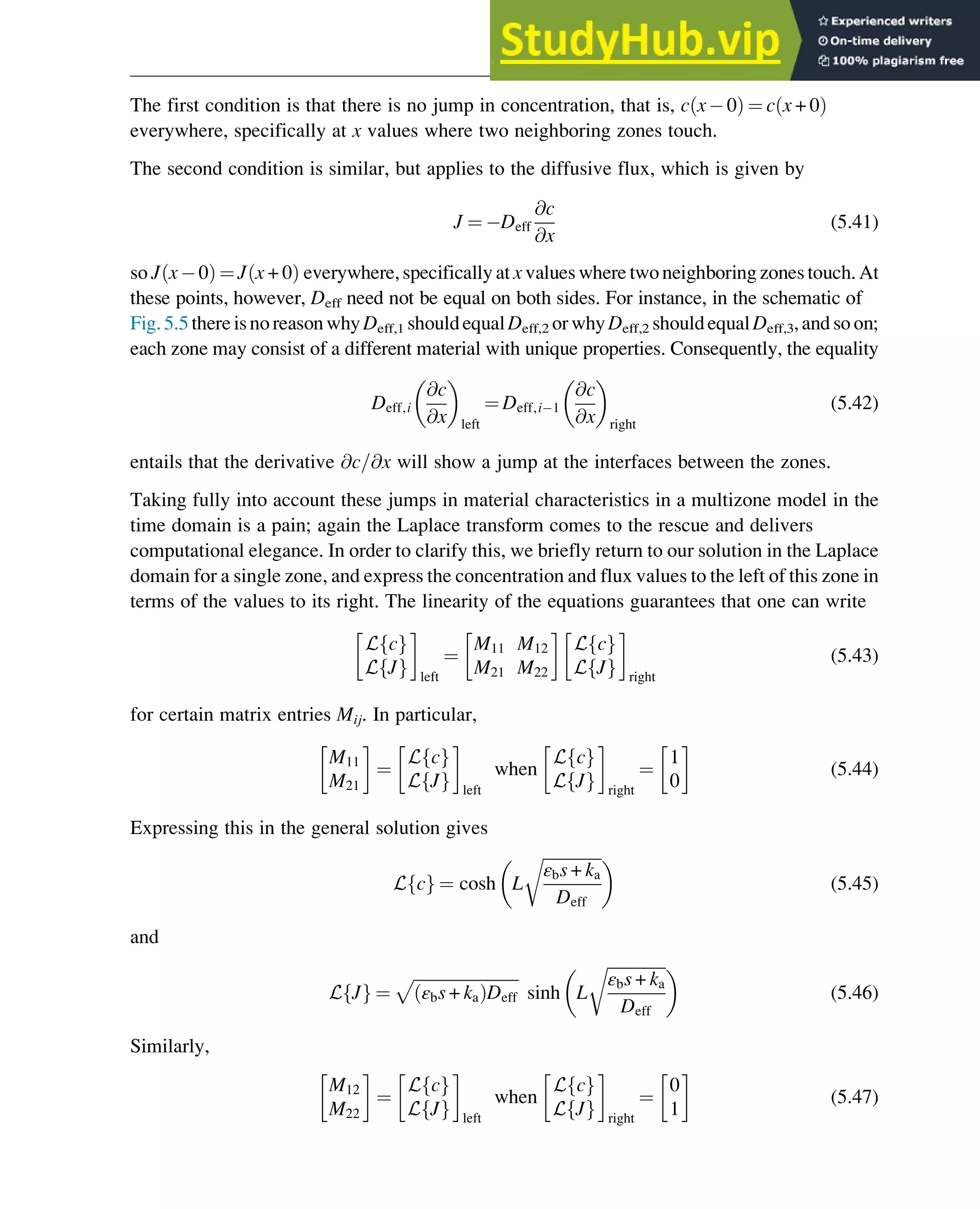
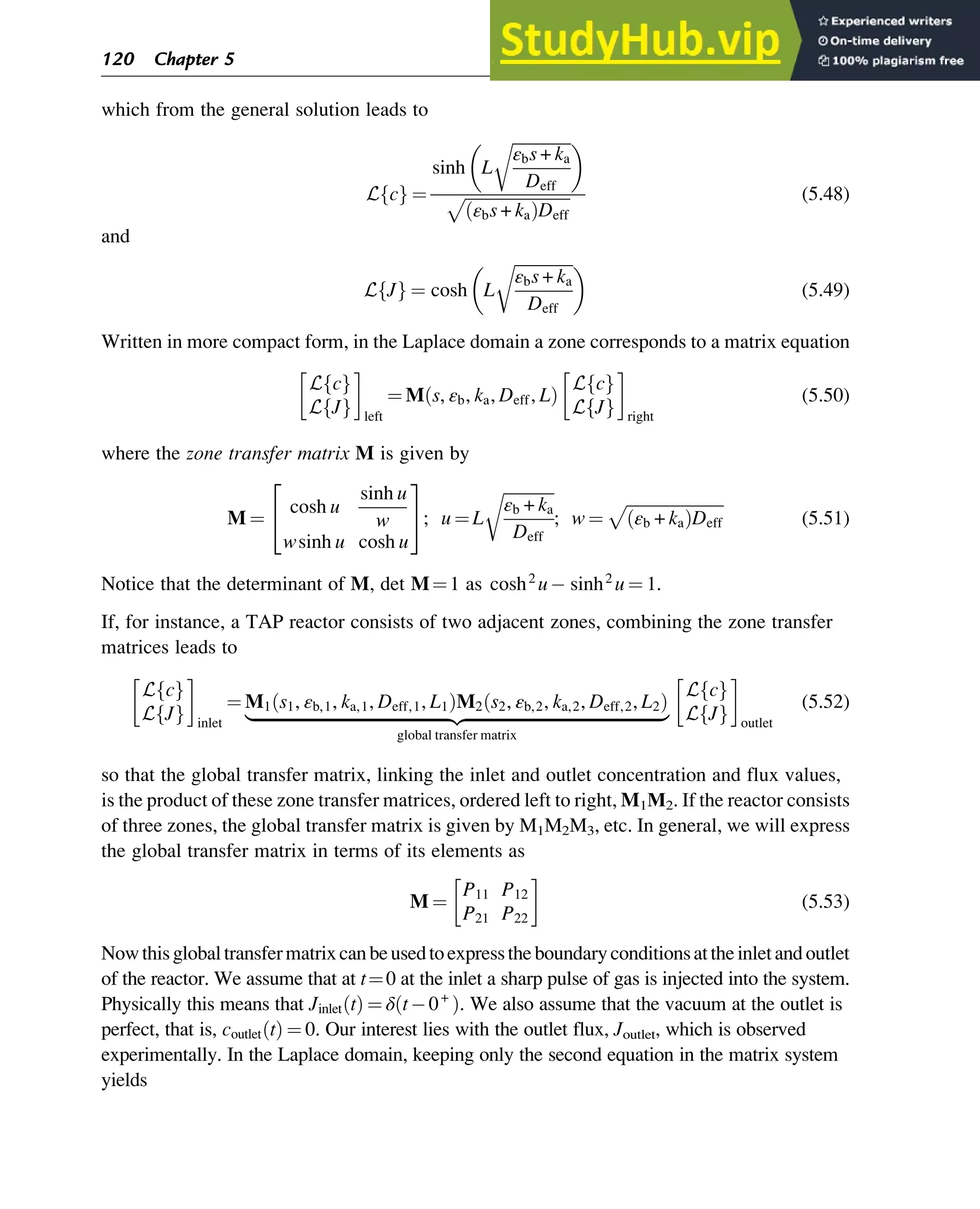
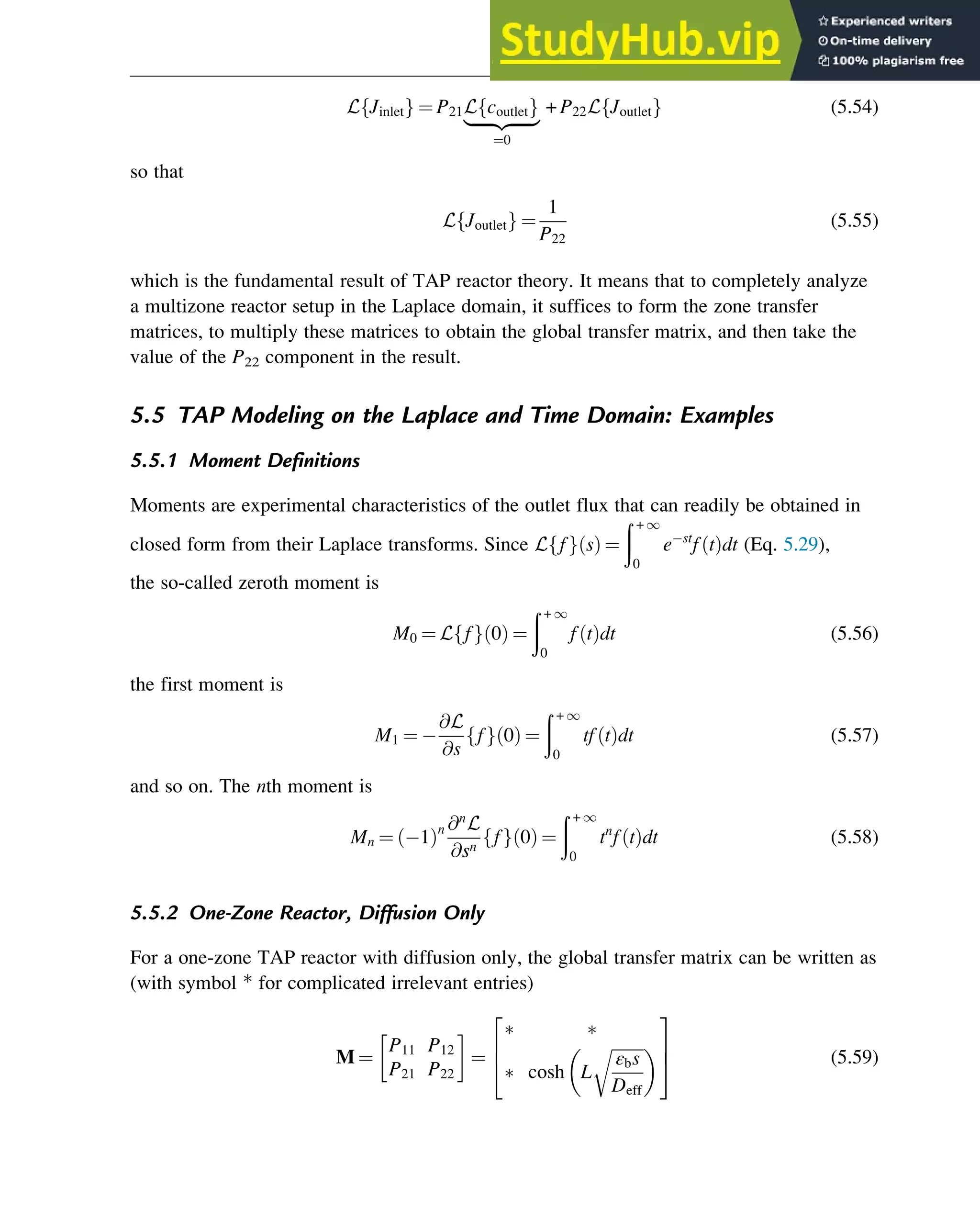
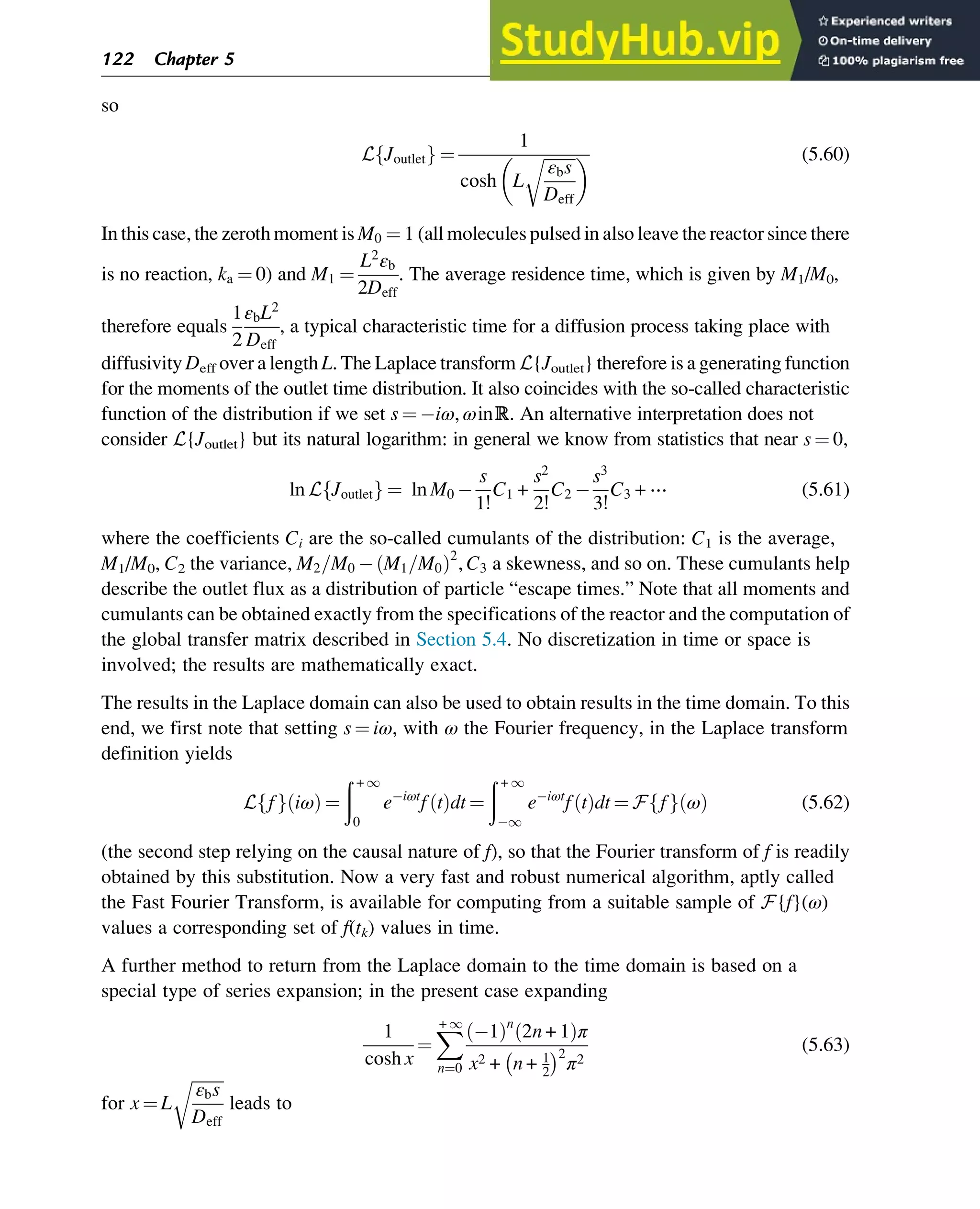
Advanced Data Analysis and
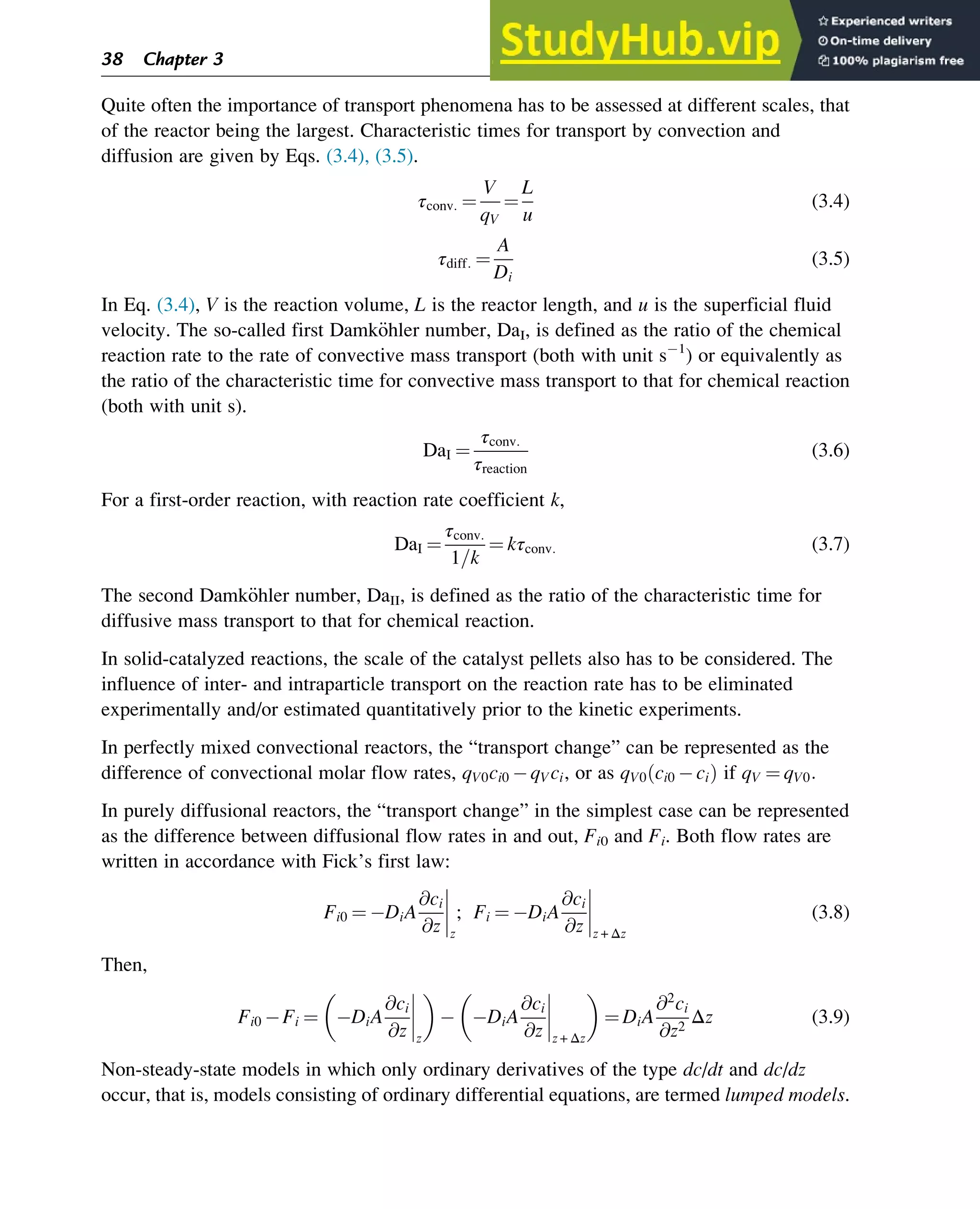
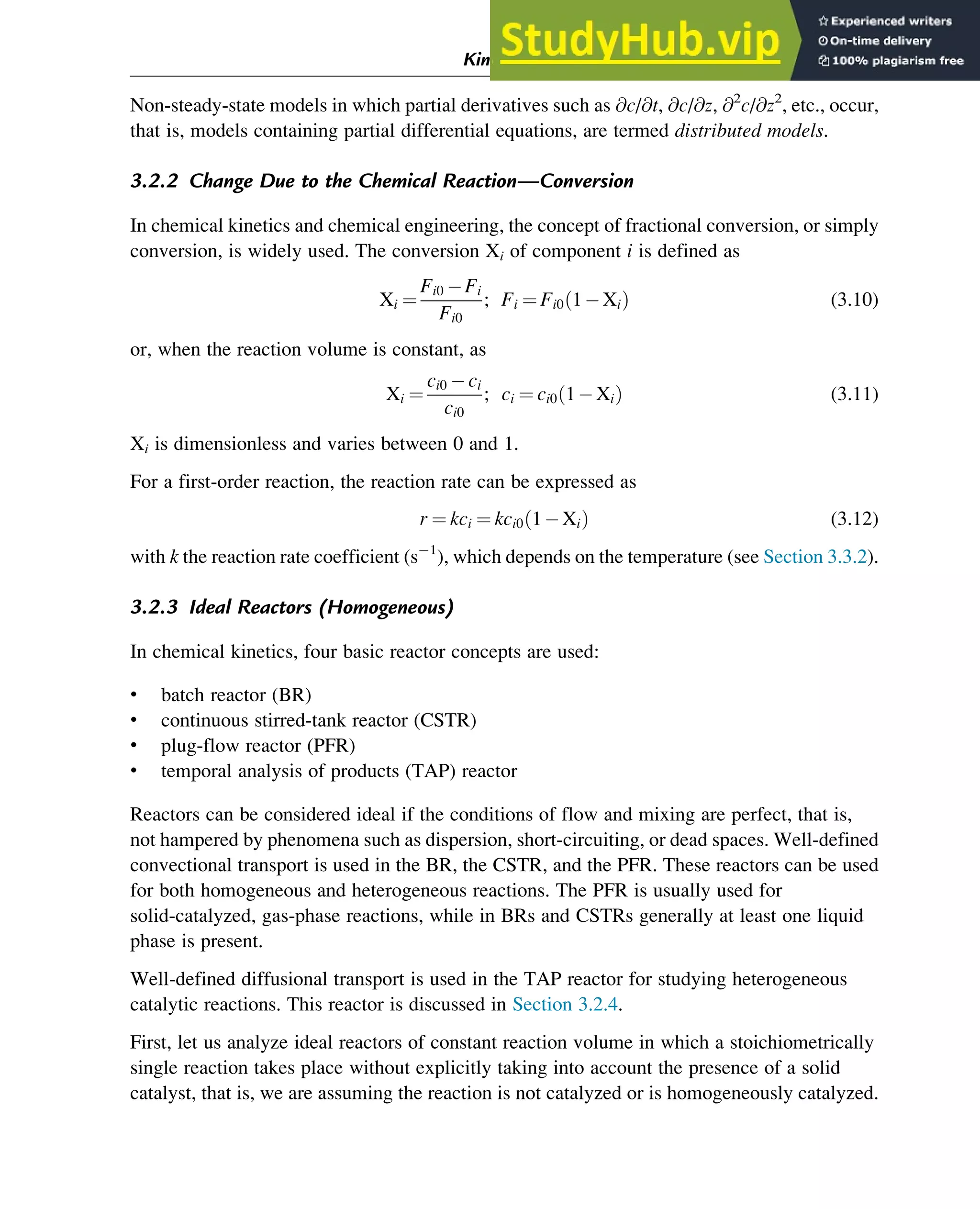
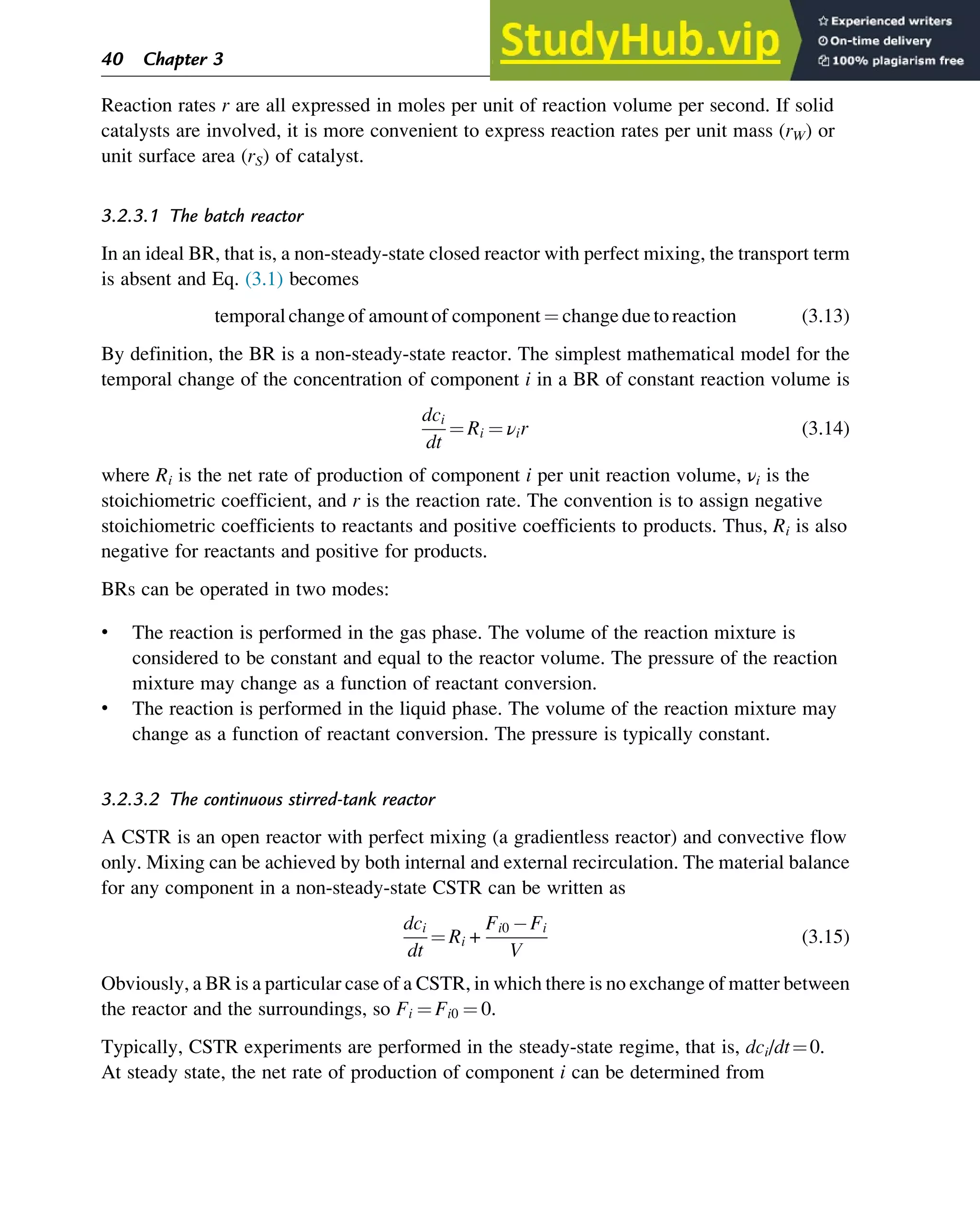
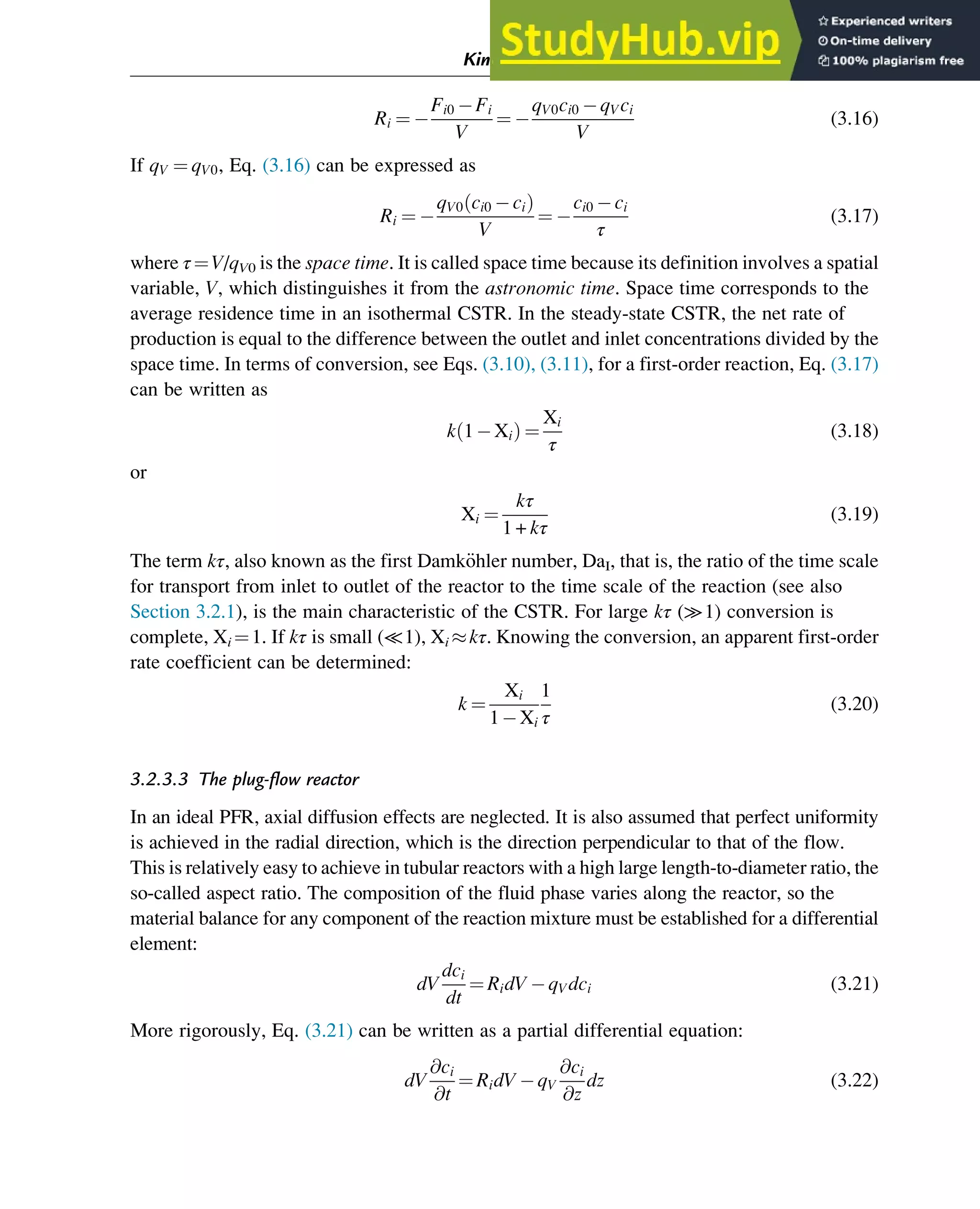
Modelling in Chemical Engineering
Advanced Data Analysis and
Modelling in Chemical Engineering
Denis Constales
Gregory S. Yablonsky
Dagmar R. D’hooge
Joris W. Thybaut
Guy B. Marin
AMSTERDAM • BOSTON • HEIDELBERG • LONDON • NEW YORK • OXFORD
PARIS • SAN DIEGO • SAN FRANCISCO • SINGAPORE • SYDNEY • TOKYO
Elsevier
Radarweg 29, PO Box 211, 1000 AE Amsterdam, Netherlands
The Boulevard, Langford Lane, Kidlington, Oxford OX5 1GB, United Kingdom
50 Hampshire Street, 5th Floor, Cambridge, MA 02139, United States
# 2017 Elsevier B.V. All rights reserved.
No part of this publication may be reproduced or transmitted in any form or by any means, electronic or
mechanical, including photocopying, recording, or any information storage and retrieval system, without
permission in writing from the publisher. Details on how to seek permission, further information about the
Publisher’s permissions policies and our arrangements with organizations such as the Copyright Clearance
Center and the Copyright Licensing Agency, can be found at our website: www.elsevier.com/permissions.
This book and the individual contributions contained in it are protected under copyright by the Publisher (other
than as may be noted herein).
Notices
Knowledge and best practice in this field are constantly changing. As new research and experience broaden
our understanding, changes in research methods, professional practices, or medical treatment may become
necessary.
Practitioners and researchers must always rely on their own experience and knowledge in evaluating and using
any information, methods, compounds, or experiments described herein. In using such information or methods
they should be mindful of their own safety and the safety of others, including parties for whom they have a
professional responsibility.
To the fullest extent of the law, neither the Publisher nor the authors, contributors, or editors, assume any liability
for any injury and/or damage to persons or property as a matter of products liability, negligence or otherwise, or
from any use or operation of any methods, products, instructions, or ideas contained in the material herein.
Library of Congress Cataloging-in-Publication Data
A catalog record for this book is available from the Library of Congress
British Library Cataloguing-in-Publication Data
A catalogue record for this book is available from the British Library
ISBN: 978-0-444-59485-3
For information on all Elsevier publications
visit our website at https://www.elsevier.com/
Publisher: John Fedor
Acquisition Editor: Kostas Marinakis
Editorial Project Manager: Sarah Watson
Production Project Manager: Anitha Sivaraj
Cover Designer: Maia Cruz Ines
Typeset by SPi Global, India
Preface
This book is written by Denis Constales, Dagmar D’hooge, Joris Thybaut, and Guy Marin
from Ghent University (Belgium) and Gregory Yablonsky from St. Louis University (United
States), who has been affiliated with Ghent University as a visiting professor for more than
15 years. During that period, we have been working toward the development of a center
of chemico-mathematical collaboration, organizing, among other things, the workshops
and conferences related to “Mathematics in Chemical Kinetics and Chemical (Bio)
Engineering” (MACKiE). More generally, we have attempted to contribute to the integration
of “Science-Technology-Engineering-Mathematics” (STEM).
Our book is a first consolidation of our efforts in this respect. It is about advanced data analysis
and modeling in chemical engineering. We dare to use the term “advanced,” as we aim to help
the reader to increase the level of understanding of the physicochemical phenomena relevant
for the field of chemical engineering using effective mathematical models and tools. This does
not mean that these models have to be complex, but rather that the complexity of a
mathematical model and the corresponding tools have to be optimal. Also, we would like to
stress that, in our opinion, the role of mathematics is not limited to that of servant of all masters,
a tireless and beautiful Cinderella, but that it provides an inexhaustible source of powerful
concepts, both theoretical and experimental.
Our Team
Denis Constales is associate professor at the Department of Mathematical Analysis in the
faculty of Engineering and Architecture of Ghent University. He obtained his doctorate there
and specialized in applied mathematics, with specific research interest in special functions,
integral transforms, and the application of computer algebra techniques.
Gregory S. Yablonsky is professor at St. Louis University. He is a representative of the
Soviet-Russian catalytic school, being a postdoctoral student of Mikhail Slin’ko and
having collaborated with Georgii Boreskov. He also was a member of the Siberian
chemico-mathematical team together with Valerii Bykov, Alexander Gorban, and Vladimir
Elokhin. He gained international experience working in many universities of the world,
xiii
including St. Louis, United States; Ghent, Belgium; Singapore; Belfast, N. Ireland, United
Kingdom.
Dagmar R. D’hooge is assistant professor in Polymer Reaction Engineering and Industrial
Processing of Polymers at Ghent University. He is a member of the Laboratory for Chemical
Technology and associate member of the Department of Textiles. He was a visiting researcher
in the Matyjaszewski Polymer Group at Carnegie Mellon University (Pittsburgh, United States)
and the Macromolecular Chemistry Group at Karlsruhe Institute of Technology (Germany).
His research focuses on the development and application of multiscale modeling platforms for
designing industrial-scale polymerization processes and polymer processing units for both
conventional and high-tech polymeric materials.
Joris W. Thybaut is full professor in Catalytic Reaction Engineering at the Laboratory for
Chemical Technology at Ghent University. After obtaining his PhD on single-event
microkinetic modeling of hydrocracking and hydrogenation, he went to the Institut des
Recherches sur la Catalyse (Lyon, France) for a postdoc on high throughput experimentation.
Today, he investigates rational catalyst and reactor design for the processing of conventional
and, more particularly, alternative feedstocks.
Guy B. Marin is senior full professor in Catalytic Reaction Engineering and is head of the
Laboratory for Chemical Technology at Ghent University. He was educated in the tradition
of the thermodynamic and kinetic school of the Low Countries as well as of the American
school, with Michel Boudart as a postdoctoral adviser, and benefited from the Dutch school
of catalysis. The investigation of chemical kinetics, aimed at the modeling and design of
chemical processes and products all the way from molecule up to full scale, constitutes the core
of his research.
The authors abbreviated the title of this book to ADAMICE, which can suggest several
phonetic associations, the most primordial of which refers to Adam. It is quite symbolic
that Adam’s name in Hebrew shares an etymology with clay and blood, both of which are
catalytic substrates in chemistry and biochemistry. Maybe we can think of Adam as the
first ever model, and a very advanced model, too.
We gratefully acknowledge the outstanding skills, tireless activity, patience, and understanding
of our editing aide, Mrs Annelies van Diepen.
xiv Preface
CHAPTER 1
Introduction
1.1 Chemistry and Mathematics: Why They Need Each Other
Chemistry needs mathematics. Mathematics needs chemistry. Since the Dark Ages, in
chemistry, or alchemy as it was called then, the so-called cross rule was well known for
answering questions regarding the preparation of solutions of a certain desired concentration.
This rule is not needed to answer simple questions, like which ratio of 100% alcohol and
pure water must be mixed to prepare a 50% alcohol solution: 50:50. For more complicated
questions, however, such as how to prepare a 30% alcohol solution from two solutions with
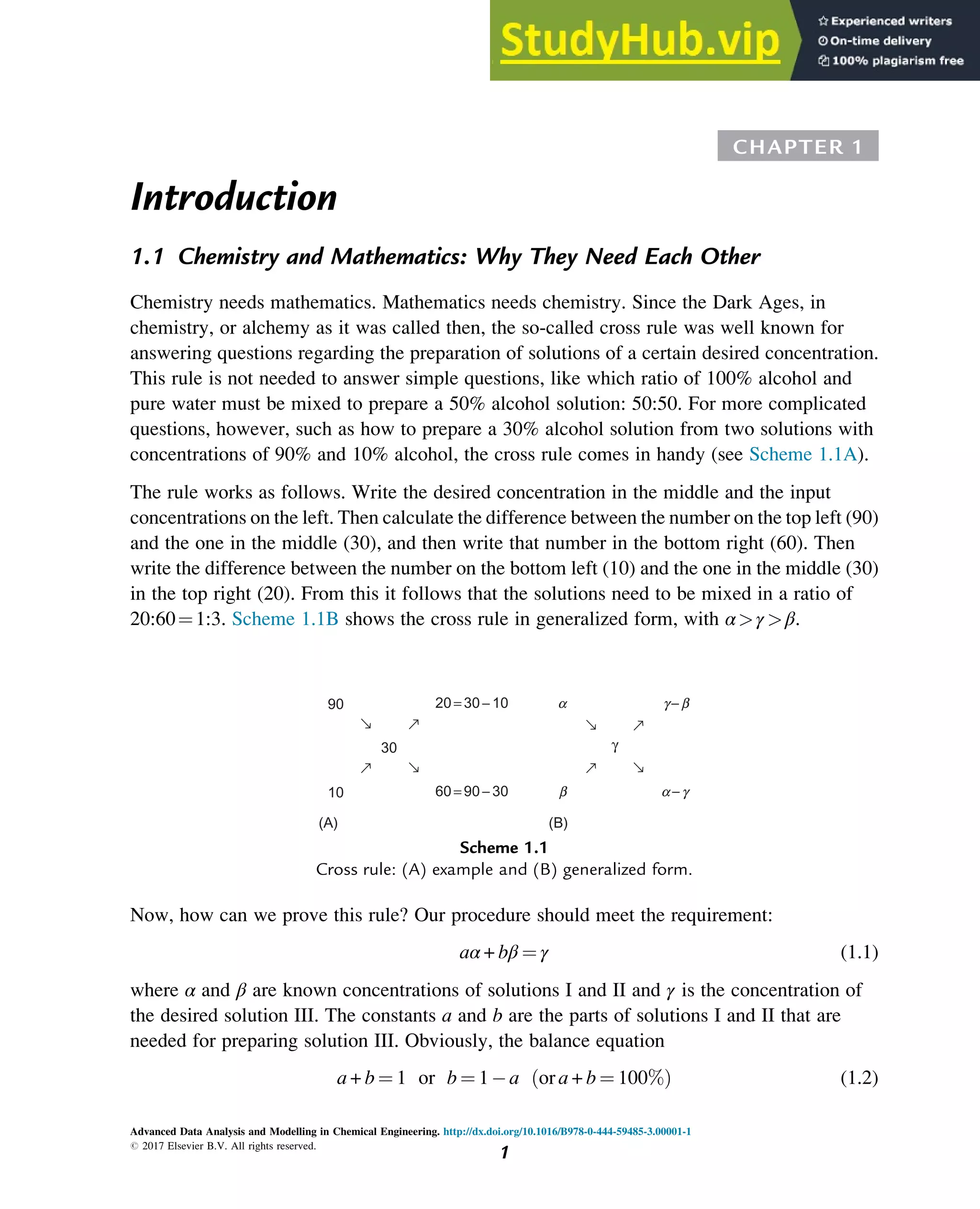
concentrations of 90% and 10% alcohol, the cross rule comes in handy (see Scheme 1.1A).
The rule works as follows. Write the desired concentration in the middle and the input
concentrations on the left. Then calculate the difference between the number on the top left (90)
and the one in the middle (30), and then write that number in the bottom right (60). Then
write the difference between the number on the bottom left (10) and the one in the middle (30)
in the top right (20). From this it follows that the solutions need to be mixed in a ratio of
20:60¼1:3. Scheme 1.1B shows the cross rule in generalized form, with α>γ >β.
Now, how can we prove this rule? Our procedure should meet the requirement:
aα + bβ ¼ γ (1.1)
where α and β are known concentrations of solutions I and II and γ is the concentration of
the desired solution III. The constants a and b are the parts of solutions I and II that are
needed for preparing solution III. Obviously, the balance equation
a + b ¼ 1 or b ¼ 1 a or a + b ¼ 100%
ð Þ (1.2)
90 20 =30 −10 g−b
a−g
60 =90 −30
30
10
(B)
(A)
a
b
γ
→
→
→
→
→
→
→
→
Scheme 1.1
Cross rule: (A) example and (B) generalized form.
Advanced Data Analysis and Modelling in Chemical Engineering. http://dx.doi.org/10.1016/B978-0-444-59485-3.00001-1
# 2017 Elsevier B.V. All rights reserved.
1
must hold. Substituting Eq. (1.2) into Eq. (1.1) yields
aα + 1 a
ð Þβ ¼ γ (1.3)
from which follows that
a ¼
γ β
α β
(1.4)
Consequently,
b ¼ 1 a ¼ 1
γ β
α β
¼
α γ
α β
(1.5)
and the ratio is given by
a : b ¼
γ β
α β
 
:
α γ
α β
 
¼ γ β
ð Þ : α γ
ð Þ (1.6)
which is the cross rule.
Thus, mathematics is needed for solving typical problems of chemistry. Such problems are
solved in every chemical laboratory, every pharmacy, and even in most kitchens. To do so, in
this case we are using what is known as linear algebra.
Mathematics needs chemistry too, not only for demonstrating its power and usefulness but also
for formulating new mathematical problems.
1.2 Chemistry and Mathematics: Historical Aspects
A mutual attraction between mathematics and chemistry was growing gradually during the 18th,
19th, and 20th centuries. Antoine Lavoisier’s law of the conservation of mass and John Dalton’s
law of multiple proportions could not have been discovered without precise weight
measurements. Chemistry transformed into a quantitative science, and Lavoisier and Dalton
became pioneers of chemical stoichiometry. From another side, Arthur Cayley, the creator of the
theory of matrices, applied his theory to the study of chemical isomers in the 1860s and 1870s.
Since the mid-19th century, various new concepts of physical chemistry, in particular laws of
chemical kinetics, have been developed. A few examples are
• the mass-action law by Guldberg and Waage.
• the “normal classification of reactions” by van’t Hoff.
• the temperature dependence of the reaction rate by Arrhenius.
• electrochemical relationships by Nernst.
• quasi-steady-state principle by Chapman and Bodenstein.
• theory of chain reactions by Semenov and Hinshelwood.
• model for the growth of microorganisms by Monod.
2 Chapter 1
All these principles have been proposed based on the solid mathematical foundation of
algebraic and differential equations. Moreover, the greatest chemical achievement,
Mendeleev’s periodic table, was created using a detailed critical review of quantitative data,
first of all, the atomic masses of known elements. A legend says that after the presentation of his
table in 1869, Mendeleev was asked, “Why did you categorize the elements based on their
mass and not on their first letter?” In fact, the mass of an element is not a chemical property; it is
not its ability to react with other substances, nor its likeliness to explode, and it is not even
a smell. So the number of an element in Mendeleev’s periodic table remained very formal—just
a number, the element’s place in the table—until, in 1913, Moseley discovered a mathematical
relationship between the wavelength of X-rays emitted by an element and its atom number.
This discovery was a great step in the understanding that the number of the element in the
periodic table is equal to the number of electrons (and the number of protons) belonging to a
single atom of this element.
During the “Sturm-und-Drang” quantum period of the 1920s, Heisenberg’s matrix mechanics
and Schrödinger’s equation have been established as “very mathematized” cornerstones
of the rigorous theory of elementary chemical processes, which changed the field of chemistry
dramatically.
Finally, in the 20th century, researchers discovered many critical chemical phenomena.
In the first half of the century, these were mainly of a nonisothermal nature (Semenov,
Bodenstein, Hinshelwood), while in the second half they concerned isothermal phenomena, in
particular oscillating reactions (Belousov, Zhabotinsky, Prigogine, Ertl). In the 1950–60s
special attention was paid to studying very fast reactions by the relaxation technique (Eigen).
All reaction and reaction-diffusion nonsteady-state data have been interpreted based on the
dynamic theories proposed by prominent mathematicians of this century, including Poincaré
and Lyapunov, Andronov, Hopf, and Lorenz.
1.3 Chemistry and Mathematics: New Trends
A new period of the interaction between chemistry and mathematics was shaped out by the
computer revolution of the 1950–60s. Making a general statement about the difference between
the classical and contemporary scientific situations, one can carefully say that
• The classical situation was characterized by a search for general scientific laws.
Albert Einstein described the discovery of these new laws as “a flight from the miracle”:
“The development of this world of thoughts is in a certain sense a continuous flight
from the miracle.”
• The focus of the contemporary scientific situation has changed. From the epoch of the great
scientific revolutions we have moved to the epoch of the intellectual devices, mostly
computers, from the Divine Plan to a collection of models.
Introduction 3
This type of division had to be made carefully: never say “never” and a period of great scientific
discoveries may still lie ahead. Nevertheless, chemistry and chemical engineering have
been much influenced by the computer revolution, which is still ongoing. Apparently, this has
been a strong additional factor for the shaping of the new discipline “mathematical chemistry.”
Although this term was used previously by Lomenosov in the 18th century, the systematic
development of this area only started in the 1950s. At this time, Neal Amundson and Rutherford
Aris published the first papers and books describing the corresponding mathematical
models in much detail and creating the foundation of the discipline (Aris, 1965, 1969, 1975;
Aris and Amundson, 1958a,b,c).
Presently, a whole battery of efficient computational methods has been developed for modeling
chemical systems at different levels (nano-, micro-, meso-, and macrolevel). We are now able
to cover a variety of chemical aspects using an enormous number of available methods, such as
• computational chemistry, in particular methods based on density functional theory.
• computational chemical kinetics, in particular CHEMKIN software and various “stiff”
methods of solving sets of ordinary and partial differential equations.
• computational fluid dynamics.
• sophisticated statistical methods.
From the other side, during this period many rigorous theoretical results in mathematical
chemistry have been obtained, especially in the area of chemical dynamics. Wei and Prater (1962)
developed a concept of “lumping,” presenting a general result for first-order mass action-law
systems. Many results have been obtained at the boundary between chemical thermodynamics
and chemical kinetics. In 1972, Horn and Jackson (1972) posed the problem of searching the
relationships between the structure of the detailed mechanism and its kinetic behavior. This
theory was developed further in the 1970s and 1980s by Yablonsky et al. (Gorban et al.,
1986; Yablonskii et al., 1983, 1991) and independently by Feinberg (1987, 1989), Clarke (1974),
and Ivanova (1979). Horn (1964) was the first to pose the problem of attainable regions for
chemical processes. In the 1970s, Gorban constructed a theory of “thermodynamically
unattainable” regions, that is, regions that are impossible to reach from certain initial conditions
(Glansdorff and Prigogine, 1971; Gorban, 1984). For more details on this chenucogeometric
theory based on thermodynamic Lyapunov functions (see Gorban, 1984; Yablonsky et al., 1991).
Theoretical breakthroughs in the understanding of chemical critical phenomena (multiplicity,
oscillations, waves) were achieved by different groups of chemists. The Belgian school of
irreversible thermodynamics (Prigogine and Nicolis) provided insight into the origin of these
phenomena based on the concepts of the “thermodynamic stability criterion” and “dissipative
structure” (Glansdorff and Prigogine, 1971; Nicolis and Prigogine, 1977; Prigogine, 1967).
The group led by Aris (Minneapolis, Minnesota, USA) presented a uniquely scrupulous study
of the dynamic properties of the nonisothermal continuous stirred-tank reactor (CSTR)
based on bifurcation theory (Farr and Aris, 1986). The first part of this paper’s title, “Yet who
4 Chapter 1
would have thought the old man to have had so much blood in him?” is a quotation from
Shakespeare’s Macbeth. Finally, Ertl and coworkers (Berlin, Germany) constructed a
theoretical model of kinetic oscillations in the oxidation of carbon monoxide over platinum
(Ertl et al., 1982; Ertl, 2007), which may be called the “Mona Lisa of heterogeneous catalysis”
as it has been an attractive object of catalysis studies for a long time. The model developed by
Ertl et al. (1982) describes many peculiarities of this reaction, including surface waves.
Two recent trends in mathematical chemistry are model reduction and chemical calculus.
In model reduction, two approaches are popular: manifold analysis (Maas and Pope, 1992) and
so-called asymptotology of chemical reaction networks (Gorban et al., 2010), which is a
generalization of the concept of a rate-limiting step. The chemical calculus approach, which
was created in collaboration between Washington University in St. Louis, Missouri (USA) and
Ghent University (Belgium), is focused on precise catalyst characterization using
pulse-response data generated in a temporal analysis of products (TAP) reactor (Constales
et al., 2001; Gleaves et al., 1988, 1997; Yablonsky et al., 2007). With the TAP method, during
an experiment the change of the catalyst composition as a result of a gas pulse is
insignificant. At present, chemical calculus can be considered as a mathematical basis for
precise nonsteady-state characterization of the chemical activity of solid materials. For
a critical review of theoretical results, see Marin and Yablonsky (2011).
Despite evident progress in the development of both computational and theoretical areas, there
still are only a few achievements that can be considered as fruits of synergy between the
essential physicochemical understanding, a rigorous mathematical analysis and efficient
computing. When we talk about “advanced data analysis,” the adjective “advanced” means
an attempt to achieve this unachievable ideal. From this point of view, our book is such an
attempt. In every chapter, we try to present different constituents of the modeling of
chemical systems, such as a physicochemical model framework, some aspects of data analysis
including primary data analysis, and rigorous results obtained by mathematical analysis.
The term “advanced” may also relate to a new, high level of physicochemical
understanding and it does not necessarily entail a more complex model. In many situations, “to
understand” means “to simplify” and we are not afraid to present simple but essential
knowledge. Finally, to be “advanced” means to be able to pose new practical and theoretical
questions and answer them. Formulating new questions is extremely important for the
progress of our science, which is still, as chemists say, “in statu nascendi.”
1.4 Structure of This Book and Its Building Blocks
Now we are going to briefly discuss the contents of this book, explaining its logic and
reasoning. Chapters 2–8 are organized as a sequence of building blocks: “chemical
composition”—“complex chemical reaction”—“chemical reactor.” Chapter 9 complements
Introduction 5
these chapters, providing information about model discrimination and parameter estimation
methods. Chapter 10 deals with specific problems of modeling polymerization processes and
Chapter 11 describes advanced theoretical analysis focusing on computer algebra. Next, a more
detailed, chapter-by-chapter description of the book follows.
In Chapter 2, a new original approach is presented based on a new unified C-matrix, which
generates three main matrices of chemical systems representing both chemical composition and
complex chemical transformation. These three matrices are the molecular matrix, the
stoichiometric matrix, and the matrix of Horiuti numbers, and the original algorithm is derived
in this chapter.
In Chapter 3, the theoretical “minimum minimarum” is explained. This toolbox serves the
primary analysis of data of chemical transformations and the construction of typical kinetic
models, both steady-state and nonsteady-state. In the course of the primary analysis, the
reaction rate is extracted from the observed net rate of production of a chemical component.
Although the procedure is rather simple, its understanding is not trivial.
Using methods from graph theory, it is explained which part of the kinetic description is
influenced by the complexity of the detailed reaction mechanism and which part is not. This is
an important step in the so-called “gray-box” approach, which is widely applied in chemical
engineering modeling.
As the title of Chapter 4 suggests, this chapter lays out physicochemical principles of
simplifications of complex models, that is, assumptions on quasi-equilibrium and quasi-steady-
state, assumptions on the abundance of some chemical components, and the assumption of a rate-
limiting step. These principles are systematically used in the primary analysis of complex models.
Chapter 5 is devoted to the basic reactor models used in chemical engineering: the batch
reactor, the CSTR, the plug-flow reactor, and the TAP reactor with its modification, the
thin-zone TAP reactor. Special attention is paid to the reaction-diffusion reactor, the detailed
analysis of which opens up wide perspectives for the understanding of different types of
reactors, such as catalytic, membrane and biological reactors.
Chapter 6 reflects on new areas and problems at the boundary of chemical thermodynamics and
chemical kinetics, that is, estimating features of kinetic behavior based on thermodynamic
characteristics. New methods of chemico-geometric analysis are described. Recently found,
original, equilibrium relationships between nonequilibrium data, which can be observed in
special experiments with symmetrical initial conditions, are theoretically analyzed in detail for
different types of chemical reactors. The known problem of kinetic control versus
thermodynamic control is explained in a new way.
Chapter 7 is about stability and bifurcations. Typical catalytic mechanisms and corresponding
models for the interpretation of complex dynamic behavior, in particular multiplicity of
steady states and oscillations, are presented.
6 Chapter 1
Chapter 8 provides original results for optimal configurations of multizone reaction-diffusion
reactors, and compares these with results for a cascade of reactors known from the literature.
Chapter 9 offers a classical toolbox of model discrimination and parameter identification
methods. Such methods are constantly modified and they are a “golden treasure” to every
modeler.
Chapter 10 provides a formal apparatus, in particular integrodifferential equations, for
describing the physicochemical properties of polymers and their complex transformations.
Finally, the focus of Chapter 11 is on advanced methods of theoretical analysis, especially
computer algebra. Most of the results presented in this chapter, that is, critical simplification,
the analytical criteria for distinguishing nonlinear from linear behavior, are original.
Summarizing, the building of mathematical chemistry has not been completed. This book
covers only a number of selected rooms of this structure. It is not easy to live in a building that
has been only partly completed, but there is no alternative, and generally in science this is a
typical story. In addition, in many countries of the Near East where rainfall is scarce, it is
customary for families to move into new houses long before all rooms have been prepared. So,
we are moving…
References
Aris, R., 1965. Introduction to the Analysis of Chemical Reactors. Prentice-Hall, Englewood Cliffs, NJ.
Aris, R., 1969. Elementary Chemical Reactor Analysis. Prentice-Hall, Englewood Cliffs, NJ.
Aris, R., 1975. The Mathematical Theory of Diffusion and Reaction in Permeable Catalysts. Clarendon Press,
Oxford.
Aris, R., Amundson, N.R., 1958a. An analysis of chemical reactor stability and control-I: the possibility of local
control, with perfect or imperfect control mechanisms. Chem. Eng. Sci. 7, 121–131.
Aris, R., Amundson, N.R., 1958b. An analysis of chemical reactor stability and control-II: the evolution of
proportional control. Chem. Eng. Sci. 7, 132–147.
Aris, R., Amundson, N.R., 1958c. An analysis of chemical reactor stability and control-III: the principles of
programming reactor calculations. Some extensions. Chem. Eng. Sci. 7, 148–155.
Clarke, B.L., 1974. Stability analysis of a model reaction network using graph theory. J. Chem. Phys. 60, 1493–1501.
Constales, D., Yablonsky, G.S., Marin, G.B., Gleaves, J.T., 2001. Multi-zone TAP-reactors theory and application: I.
The global transfer matrix equation. Chem. Eng. Sci. 56, 133–149.
Ertl, G., (2007). Reactions at surfaces: from atoms to complexity, Nobel Lecture, December 8.
Ertl, G., Norton, P.R., Rüstig, J., 1982. Kinetic oscillations in the platinum-catalyzed oxidation of CO. Phys. Rev.
Lett. 49, 177–180.
Farr, W.W., Aris, R., 1986. Yet who would have thought the old man to have had so much blood in him?
Reflections on the multiplicity of steady states of the stirred tank reactor. Chem. Eng. Sci. 41, 1385–1402.
Feinberg, M., 1987. Chemical reaction network structure and the stability of complex isothermal reactors—I. The
deficiency zero and deficiency one theorems. Chem. Eng. Sci. 42, 2229–2268.
Feinberg, M., 1989. Necessary and sufficient conditions for detailed balancing in mass action systems of arbitrary
complexity. Chem. Eng. Sci. 44, 1819–1827.
Glansdorff, P., Prigogine, I., 1971. Thermodynamic Theory of Structure, Stability, and Fluctuations. Wiley, London.
Gleaves, J.T., Ebner, J.R., Kuechler, T.C., 1988. Temporal analysis of products (TAP)—a unique catalyst
evaluation system with submillisecond time resolution. Catal. Rev. Sci. Eng. 30, 49–116.
Introduction 7
Gleaves, J.T., Yablonskii, G.S., Phanawadee, P., Schuurman, Y., 1997. TAP-2: an interrogative kinetics approach.
Appl. Catal. A 160, 55–88.
Gorban, A.N., 1984. Equilibrium Encircling: Equations of Chemical Kinetics and Their Thermodynamic Analysis.
Nauka, Novosibirsk.
Gorban, A.N., Bykov, V.I., Yablonskii, G.S., 1986. Thermodynamic function analogue for reactions proceeding
without interaction of various substances. Chem. Eng. Sci. 41, 2739–2745.
Gorban, A.N., Radulescu, O., Zinovyev, A.Y., 2010. Asymptotology of chemical reaction networks. Chem. Eng.
Sci. 65, 2310–2324.
Horn, F.J.M., 1964. Attainable and Non-Attainable Regions in Chemical Reaction Technique. In: Proceedings of the
third European Symposium on Chemical Reaction Engineering. Pergamon Press, London, pp. 1–10.
Horn, F., Jackson, R., 1972. General mass action kinetics. Arch. Rat. Mech. Anal. 47, 81–116.
Ivanova, A.N., 1979. Conditions of uniqueness of steady state related to the structure of the reaction mechanism.
Kinet. Katal. 20, 1019–1023 (in Russian).
Maas, U., Pope, S.B., 1992. Simplifying chemical kinetics: intrinsic low-dimensional manifolds in composition
space. Combust. Flame 88, 239–264.
Marin, G.B., Yablonsky, G.S., 2011. Kinetics of Chemical Reactions—Decoding Complexity. Wiley-VCH,
Weinheim.
Nicolis, G., Prigogine, I., 1977. Self-Organization in Non-Equilibrium Systems: From Dissipative Structures to
Order Through Fluctuations. Wiley, New York, NY.
Prigogine, I., 1967. Introduction to Thermodynamics of Irreversible Processes, third ed. Wiley-Interscience,
New York, NY.
Wei, J., Prater, C.D., 1962. The structure and analysis of complex reaction systems. In: Eley, D.D. (Ed.), Advances in
Catalysis. Academic Press, New York, NY, pp. 203–392.
Yablonskii, G.S., Bykov, V.I., Gorban, A.N., 1983. Kinetic Models of Catalytic Reactions. Nauka, Novosibirsk.
Yablonskii, G.S., Bykov, V.I., Gorban, A.N., Elokhin, V.I., 1991. Kinetic Models of Catalytic Reactions.
Comprehensive Chemical Kinetics, vol. 32. Elsevier, Amsterdam.
Yablonsky, G.S., Constales, D., Shekhtman, S.O., Gleaves, J.T., 2007. The Y-procedure: how to extract the
chemical transformation rate from reaction-diffusion data with no assumption on the kinetic model. Chem. Eng.
Sci. 62, 6754–6767.
8 Chapter 1
CHAPTER 2
Chemical Composition and
Structure: Linear Algebra
2.1 Introduction
The following questions often arise in the practice of chemical engineering:
• Given a set of components of known atomic composition, establish which of them are
key to determine, together with the element balances, the amounts of all others.
Furthermore, find a way of generating all possible reactions involving these components.
This will be addressed by the augmented molecular matrix, introduced in Section 2.2.
• Given a set of reactions, determine which of these are key to describing all other reactions
as combinations of this set and how to do this. Also determine which additional balances
appear and which thermodynamic characteristics (enthalpy change, equilibrium
coefficient) are dependent. This will be addressed by the augmented stoichiometric matrix,
introduced in Section 2.3.
• For a set of reactions involving intermediates, which typically cannot be measured,
determine the overall reactions, that is, the ones not involving such intermediates, and find
the numbers by which these can be written as combinations of the given reactions (the
so-called Horiuti numbers). This will be addressed by augmenting a specially crafted
stoichiometric matrix, as explained in Section 2.4.
What is a matrix? It is a square or rectangular array of numbers or expressions, placed
between parentheses, for example:
1 3 7
2 4 3
 
(2.1)
In this case there are two rows and three columns, and we call this a 23 matrix, mentioning
first the number of rows and then the number of columns. There can be no empty spaces left in
the matrix. Matrices are widely used in engineering to represent a variety of mathematical
objects and relationships. We will gradually introduce them, in close connection with the
requirements from chemistry and engineering that justify their use.
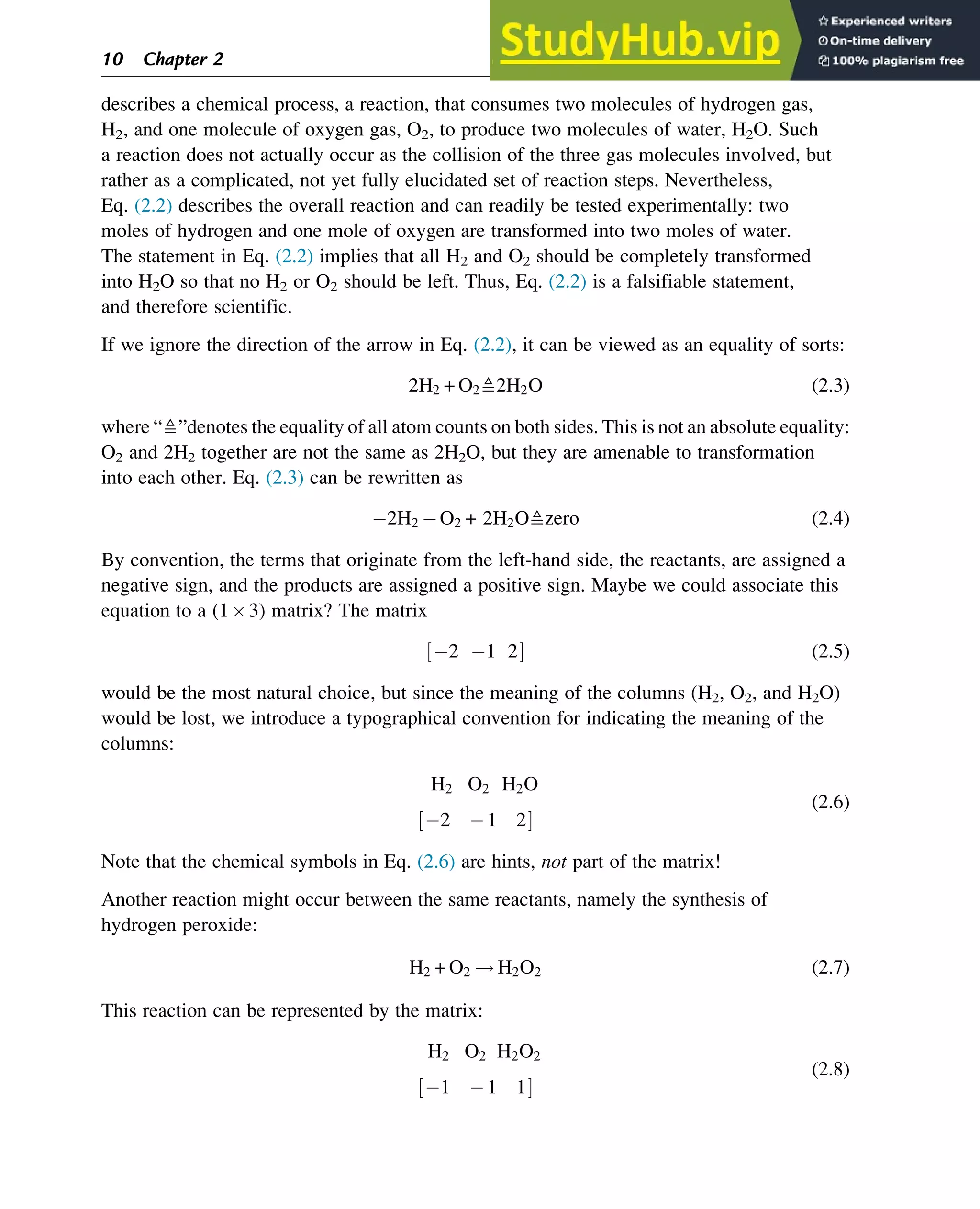
Let us start with chemical reactions. A statement such as
2H2 + O2 ! 2H2O (2.2)
Advanced Data Analysis and Modelling in Chemical Engineering. http://dx.doi.org/10.1016/B978-0-444-59485-3.00002-3
# 2017 Elsevier B.V. All rights reserved.
9
describes a chemical process, a reaction, that consumes two molecules of hydrogen gas,
H2, and one molecule of oxygen gas, O2, to produce two molecules of water, H2O. Such
a reaction does not actually occur as the collision of the three gas molecules involved, but
rather as a complicated, not yet fully elucidated set of reaction steps. Nevertheless,
Eq. (2.2) describes the overall reaction and can readily be tested experimentally: two
moles of hydrogen and one mole of oxygen are transformed into two moles of water.
The statement in Eq. (2.2) implies that all H2 and O2 should be completely transformed
into H2O so that no H2 or O2 should be left. Thus, Eq. (2.2) is a falsifiable statement,
and therefore scientific.
If we ignore the direction of the arrow in Eq. (2.2), it can be viewed as an equality of sorts:
2H2 + O2≜2H2O (2.3)
where “≜”denotes the equality of all atom counts on both sides. This is not an absolute equality:
O2 and 2H2 together are not the same as 2H2O, but they are amenable to transformation
into each other. Eq. (2.3) can be rewritten as
2H2 O2 + 2H2O≜zero (2.4)
By convention, the terms that originate from the left-hand side, the reactants, are assigned a
negative sign, and the products are assigned a positive sign. Maybe we could associate this
equation to a (13) matrix? The matrix
2 1 2
½ Š (2.5)
would be the most natural choice, but since the meaning of the columns (H2, O2, and H2O)
would be lost, we introduce a typographical convention for indicating the meaning of the
columns:
H2 O2 H2O
2 1 2
½ Š
(2.6)
Note that the chemical symbols in Eq. (2.6) are hints, not part of the matrix!
Another reaction might occur between the same reactants, namely the synthesis of
hydrogen peroxide:
H2 + O2 ! H2O2 (2.7)
This reaction can be represented by the matrix:
H2 O2 H2O2
1 1 1
½ Š
(2.8)
10 Chapter 2
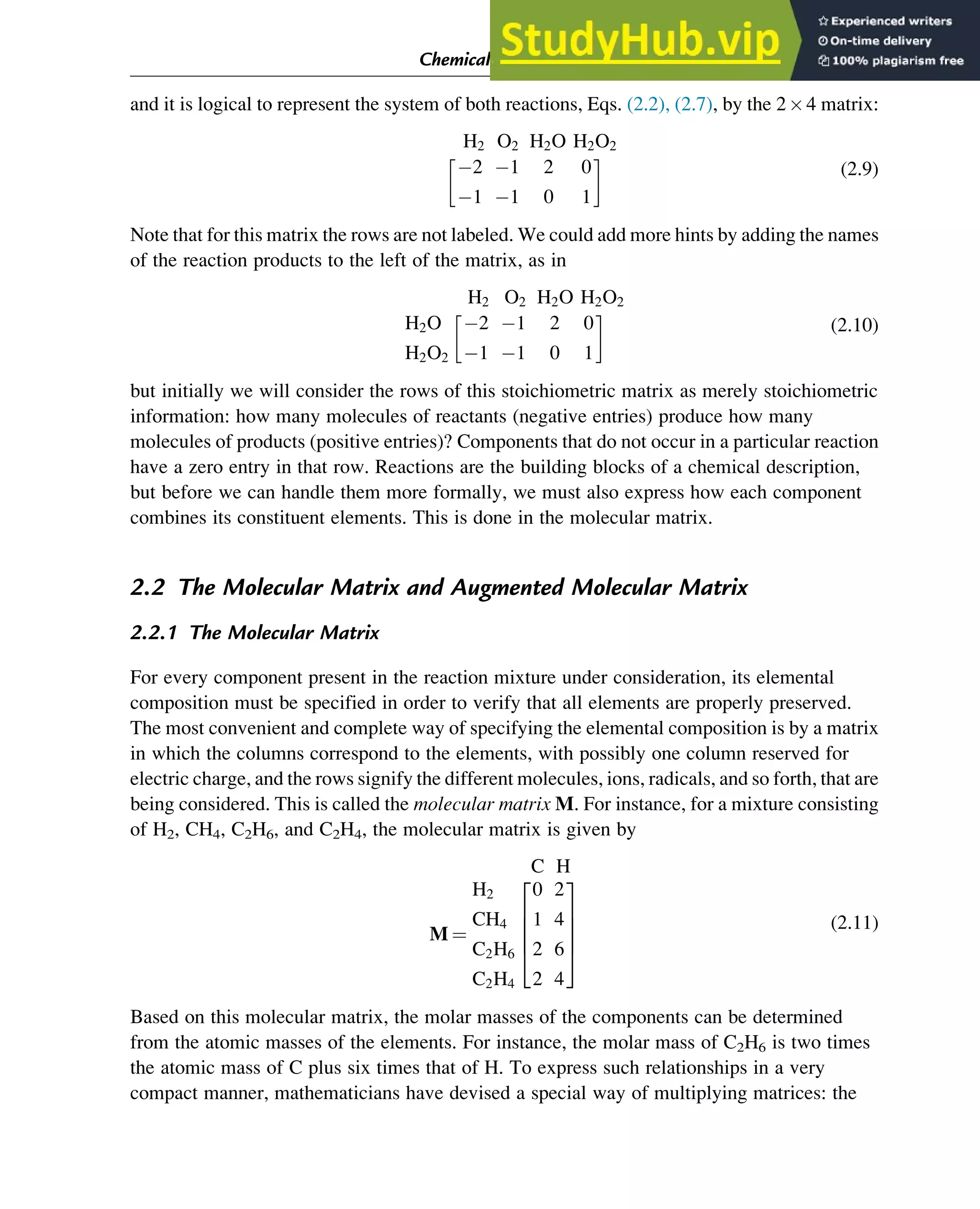
and it is logical to represent the system of both reactions, Eqs. (2.2), (2.7), by the 24 matrix:
H2 O2 H2O H2O2
2 1 2 0
1 1 0 1
 
(2.9)
Note that for this matrix the rows are not labeled. We could add more hints by adding the names
of the reaction products to the left of the matrix, as in
H2 O2 H2O H2O2
H2O
H2O2
2 1 2 0
1 1 0 1
 
(2.10)
but initially we will consider the rows of this stoichiometric matrix as merely stoichiometric
information: how many molecules of reactants (negative entries) produce how many
molecules of products (positive entries)? Components that do not occur in a particular reaction
have a zero entry in that row. Reactions are the building blocks of a chemical description,
but before we can handle them more formally, we must also express how each component
combines its constituent elements. This is done in the molecular matrix.
2.2 The Molecular Matrix and Augmented Molecular Matrix
2.2.1 The Molecular Matrix
For every component present in the reaction mixture under consideration, its elemental
composition must be specified in order to verify that all elements are properly preserved.
The most convenient and complete way of specifying the elemental composition is by a matrix
in which the columns correspond to the elements, with possibly one column reserved for
electric charge, and the rows signify the different molecules, ions, radicals, and so forth, that are
being considered. This is called the molecular matrix M. For instance, for a mixture consisting
of H2, CH4, C2H6, and C2H4, the molecular matrix is given by
C H
M ¼
H2
CH4
C2H6
C2H4
0 2
1 4
2 6
2 4
2
6
6
6
4
3
7
7
7
5
(2.11)
Based on this molecular matrix, the molar masses of the components can be determined
from the atomic masses of the elements. For instance, the molar mass of C2H6 is two times
the atomic mass of C plus six times that of H. To express such relationships in a very
compact manner, mathematicians have devised a special way of multiplying matrices: the
Chemical Composition and Structure: Linear Algebra 11
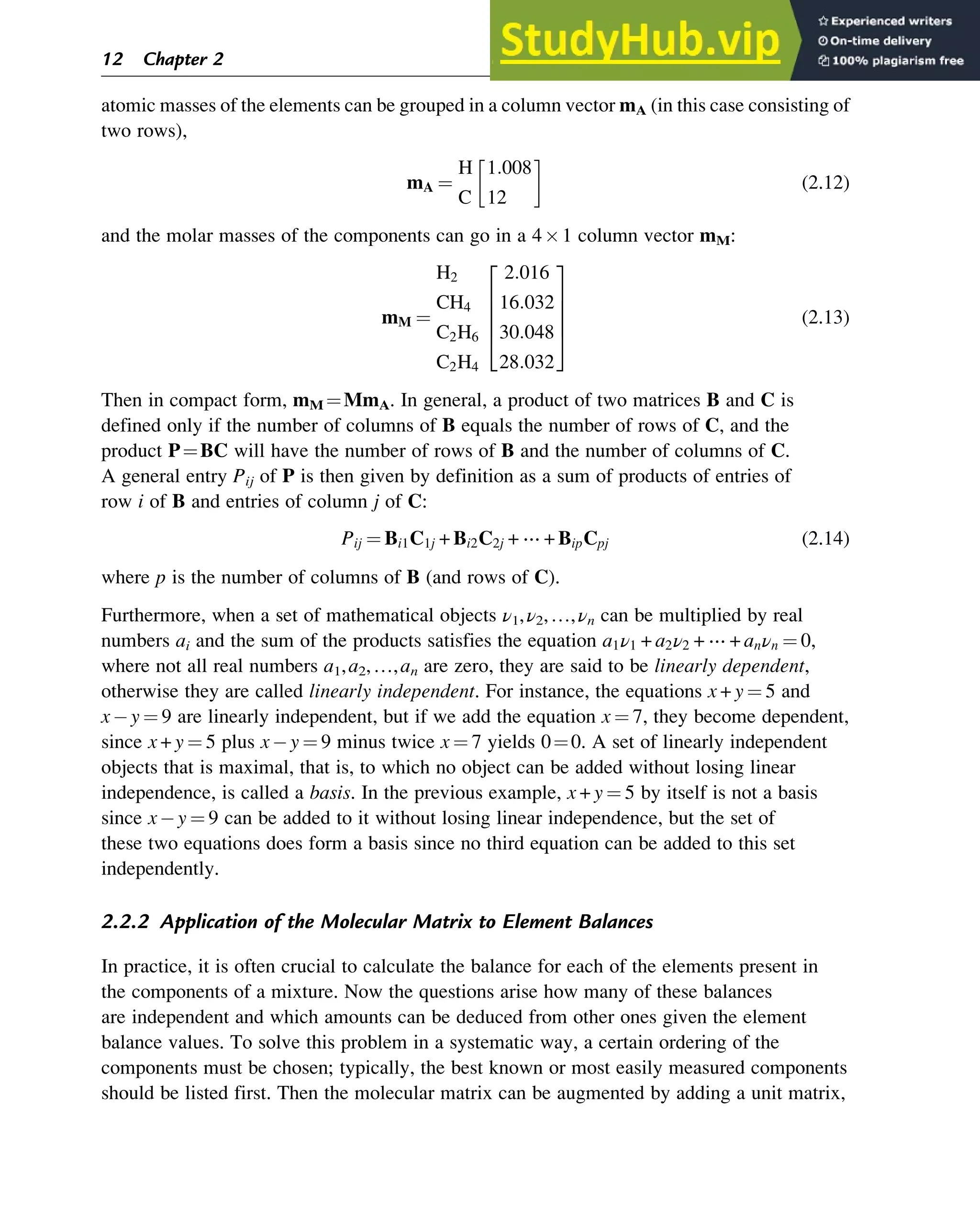
atomic masses of the elements can be grouped in a column vector mA (in this case consisting of
two rows),
mA ¼
H
C
1:008
12
 
(2.12)
and the molar masses of the components can go in a 41 column vector mM:
mM ¼
H2
CH4
C2H6
C2H4
2:016
16:032
30:048
28:032
2
6
6
6
4
3
7
7
7
5
(2.13)
Then in compact form, mM ¼MmA. In general, a product of two matrices B and C is
defined only if the number of columns of B equals the number of rows of C, and the
product P¼BC will have the number of rows of B and the number of columns of C.
A general entry Pij of P is then given by definition as a sum of products of entries of
row i of B and entries of column j of C:
Pij ¼ Bi1C1j + Bi2C2j + ⋯ + BipCpj (2.14)
where p is the number of columns of B (and rows of C).
Furthermore, when a set of mathematical objects ν1,ν2,…,νn can be multiplied by real
numbers ai and the sum of the products satisfies the equation a1ν1 + a2ν2 + ⋯ + anνn ¼ 0,
where not all real numbers a1,a2,…,an are zero, they are said to be linearly dependent,
otherwise they are called linearly independent. For instance, the equations x + y ¼ 5 and
x y ¼ 9 are linearly independent, but if we add the equation x ¼ 7, they become dependent,
since x + y ¼ 5 plus x y ¼ 9 minus twice x ¼ 7 yields 0¼0. A set of linearly independent
objects that is maximal, that is, to which no object can be added without losing linear
independence, is called a basis. In the previous example, x + y ¼ 5 by itself is not a basis
since x y ¼ 9 can be added to it without losing linear independence, but the set of
these two equations does form a basis since no third equation can be added to this set
independently.
2.2.2 Application of the Molecular Matrix to Element Balances
In practice, it is often crucial to calculate the balance for each of the elements present in
the components of a mixture. Now the questions arise how many of these balances
are independent and which amounts can be deduced from other ones given the element
balance values. To solve this problem in a systematic way, a certain ordering of the
components must be chosen; typically, the best known or most easily measured components
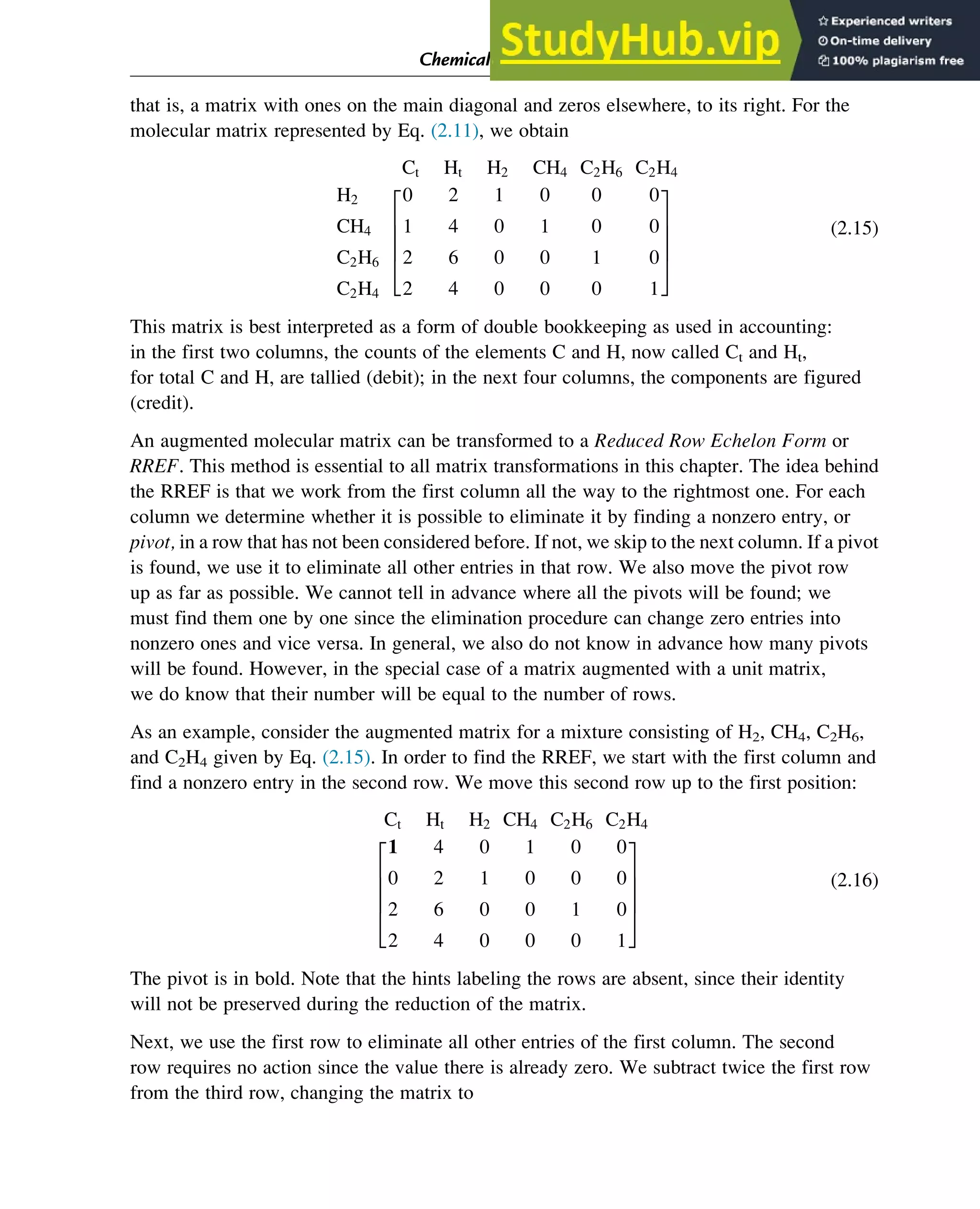
should be listed first. Then the molecular matrix can be augmented by adding a unit matrix,
12 Chapter 2
that is, a matrix with ones on the main diagonal and zeros elsewhere, to its right. For the
molecular matrix represented by Eq. (2.11), we obtain
Ct Ht H2 CH4 C2H6 C2H4
H2
CH4
C2H6
C2H4
0 2 1 0 0 0
1 4 0 1 0 0
2 6 0 0 1 0
2 4 0 0 0 1
2
6
6
6
4
3
7
7
7
5
(2.15)
This matrix is best interpreted as a form of double bookkeeping as used in accounting:
in the first two columns, the counts of the elements C and H, now called Ct and Ht,
for total C and H, are tallied (debit); in the next four columns, the components are figured
(credit).
An augmented molecular matrix can be transformed to a Reduced Row Echelon Form or
RREF. This method is essential to all matrix transformations in this chapter. The idea behind
the RREF is that we work from the first column all the way to the rightmost one. For each
column we determine whether it is possible to eliminate it by finding a nonzero entry, or
pivot, in a row that has not been considered before. If not, we skip to the next column. If a pivot
is found, we use it to eliminate all other entries in that row. We also move the pivot row
up as far as possible. We cannot tell in advance where all the pivots will be found; we
must find them one by one since the elimination procedure can change zero entries into
nonzero ones and vice versa. In general, we also do not know in advance how many pivots
will be found. However, in the special case of a matrix augmented with a unit matrix,
we do know that their number will be equal to the number of rows.
As an example, consider the augmented matrix for a mixture consisting of H2, CH4, C2H6,
and C2H4 given by Eq. (2.15). In order to find the RREF, we start with the first column and
find a nonzero entry in the second row. We move this second row up to the first position:
Ct Ht H2 CH4 C2H6 C2H4
1 4 0 1 0 0
0 2 1 0 0 0
2 6 0 0 1 0
2 4 0 0 0 1
2
6
6
6
4
3
7
7
7
5
(2.16)
The pivot is in bold. Note that the hints labeling the rows are absent, since their identity
will not be preserved during the reduction of the matrix.
Next, we use the first row to eliminate all other entries of the first column. The second
row requires no action since the value there is already zero. We subtract twice the first row
from the third row, changing the matrix to
Chemical Composition and Structure: Linear Algebra 13
Ct Ht H2 CH4 C2H6 C2H4
1 4 0 1 0 0
0 2 1 0 0 0
0 2 0 2 1 0
2 4 0 0 0 1
2
6
6
6
4
3
7
7
7
5
(2.17)
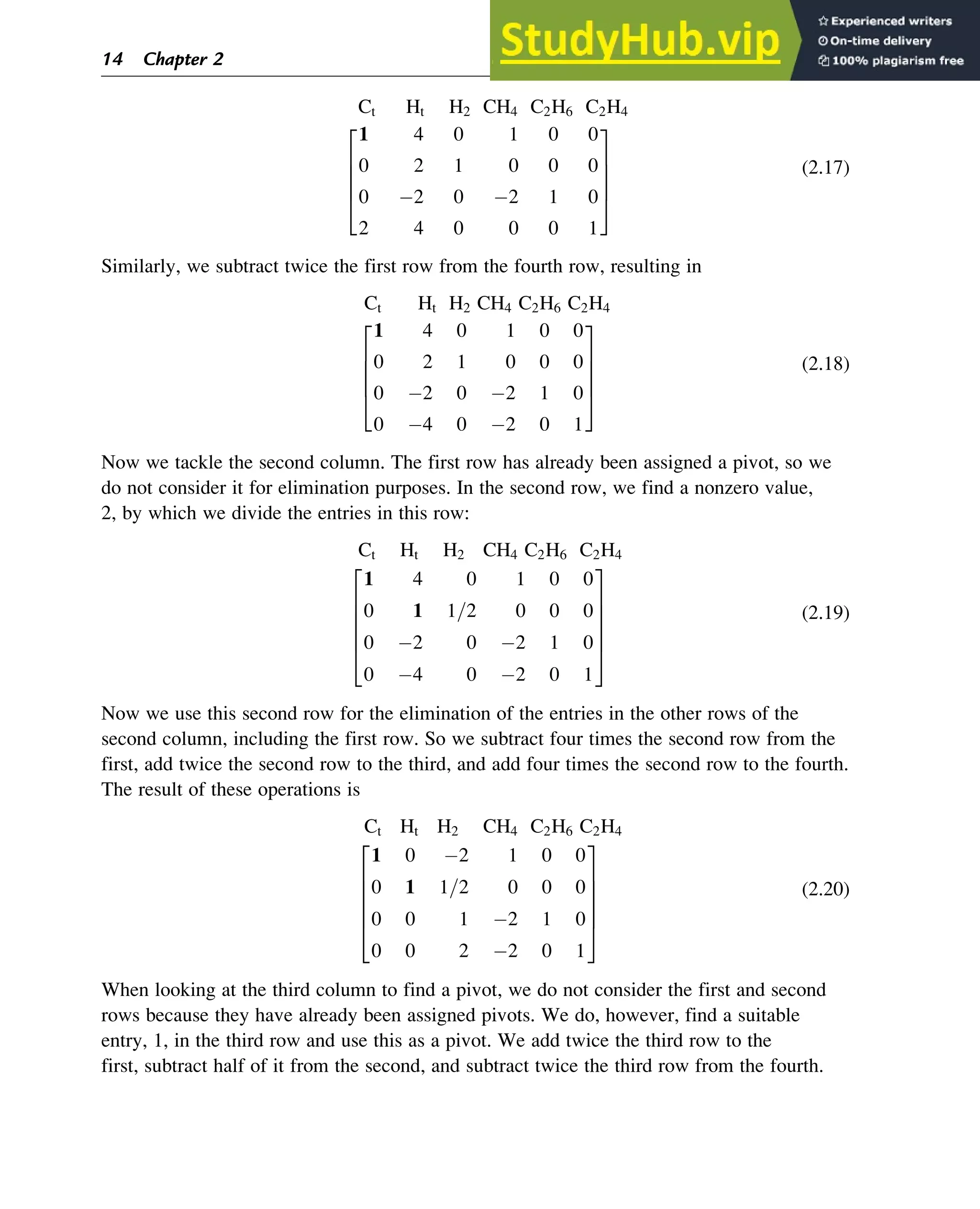
Similarly, we subtract twice the first row from the fourth row, resulting in
Ct Ht H2 CH4 C2H6 C2H4
1 4 0 1 0 0
0 2 1 0 0 0
0 2 0 2 1 0
0 4 0 2 0 1
2
6
6
6
4
3
7
7
7
5
(2.18)
Now we tackle the second column. The first row has already been assigned a pivot, so we
do not consider it for elimination purposes. In the second row, we find a nonzero value,
2, by which we divide the entries in this row:
Ct Ht H2 CH4 C2H6 C2H4
1 4 0 1 0 0
0 1 1=2 0 0 0
0 2 0 2 1 0
0 4 0 2 0 1
2
6
6
6
6
4
3
7
7
7
7
5
(2.19)
Now we use this second row for the elimination of the entries in the other rows of the
second column, including the first row. So we subtract four times the second row from the
first, add twice the second row to the third, and add four times the second row to the fourth.
The result of these operations is
Ct Ht H2 CH4 C2H6 C2H4
1 0 2 1 0 0
0 1 1=2 0 0 0
0 0 1 2 1 0
0 0 2 2 0 1
2
6
6
6
6
4
3
7
7
7
7
5
(2.20)
When looking at the third column to find a pivot, we do not consider the first and second
rows because they have already been assigned pivots. We do, however, find a suitable
entry, 1, in the third row and use this as a pivot. We add twice the third row to the
first, subtract half of it from the second, and subtract twice the third row from the fourth.
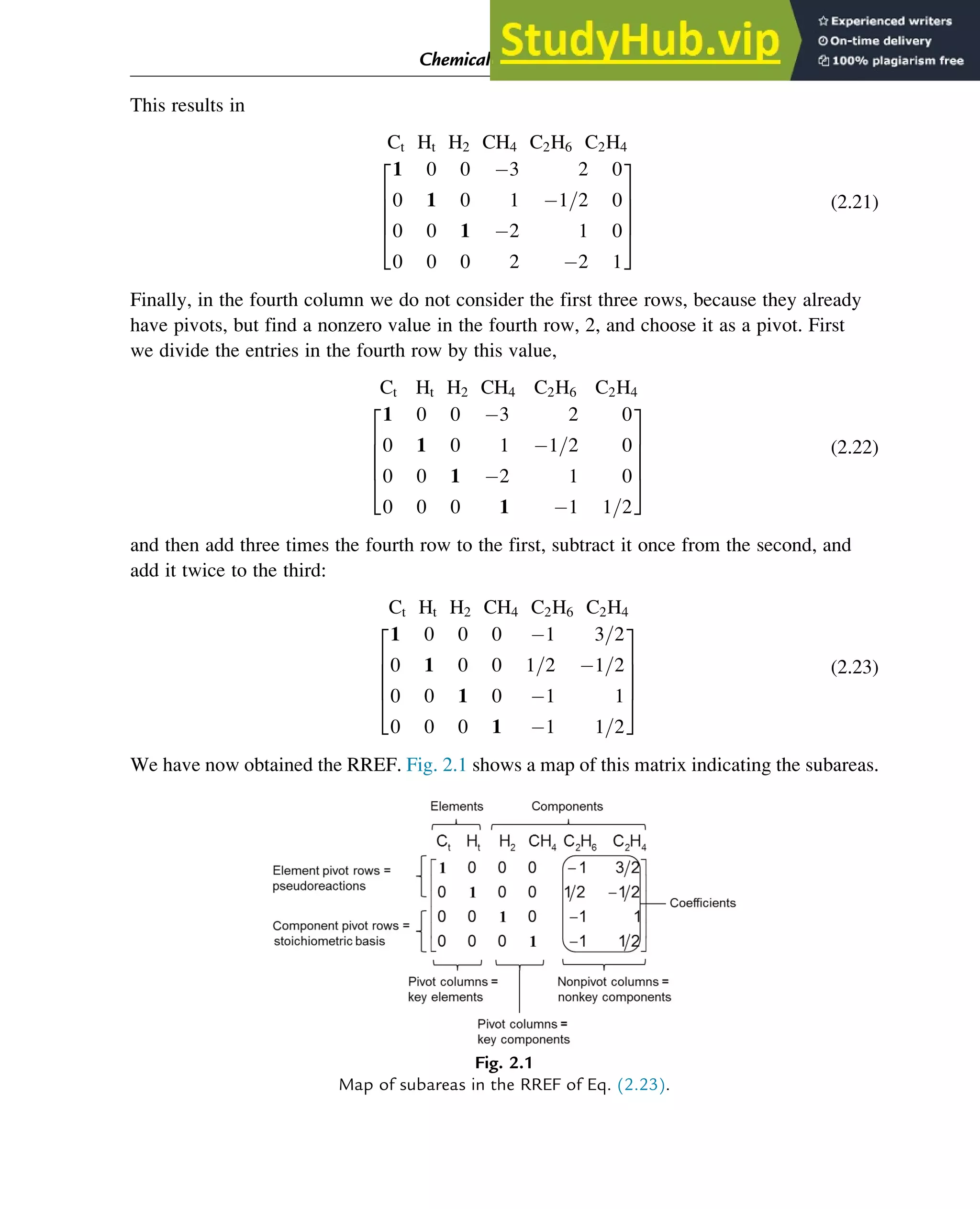
14 Chapter 2
This results in
Ct Ht H2 CH4 C2H6 C2H4
1 0 0 3 2 0
0 1 0 1 1=2 0
0 0 1 2 1 0
0 0 0 2 2 1
2
6
6
6
4
3
7
7
7
5
(2.21)
Finally, in the fourth column we do not consider the first three rows, because they already
have pivots, but find a nonzero value in the fourth row, 2, and choose it as a pivot. First
we divide the entries in the fourth row by this value,
Ct Ht H2 CH4 C2H6 C2H4
1 0 0 3 2 0
0 1 0 1 1=2 0
0 0 1 2 1 0
0 0 0 1 1 1=2
2
6
6
6
4
3
7
7
7
5
(2.22)
and then add three times the fourth row to the first, subtract it once from the second, and
add it twice to the third:
Ct Ht H2 CH4 C2H6 C2H4
1 0 0 0 1 3=2
0 1 0 0 1=2 1=2
0 0 1 0 1 1
0 0 0 1 1 1=2
2
6
6
6
4
3
7
7
7
5
(2.23)
We have now obtained the RREF. Fig. 2.1 shows a map of this matrix indicating the subareas.
Fig. 2.1
Map of subareas in the RREF of Eq. (2.23).
Chemical Composition and Structure: Linear Algebra 15
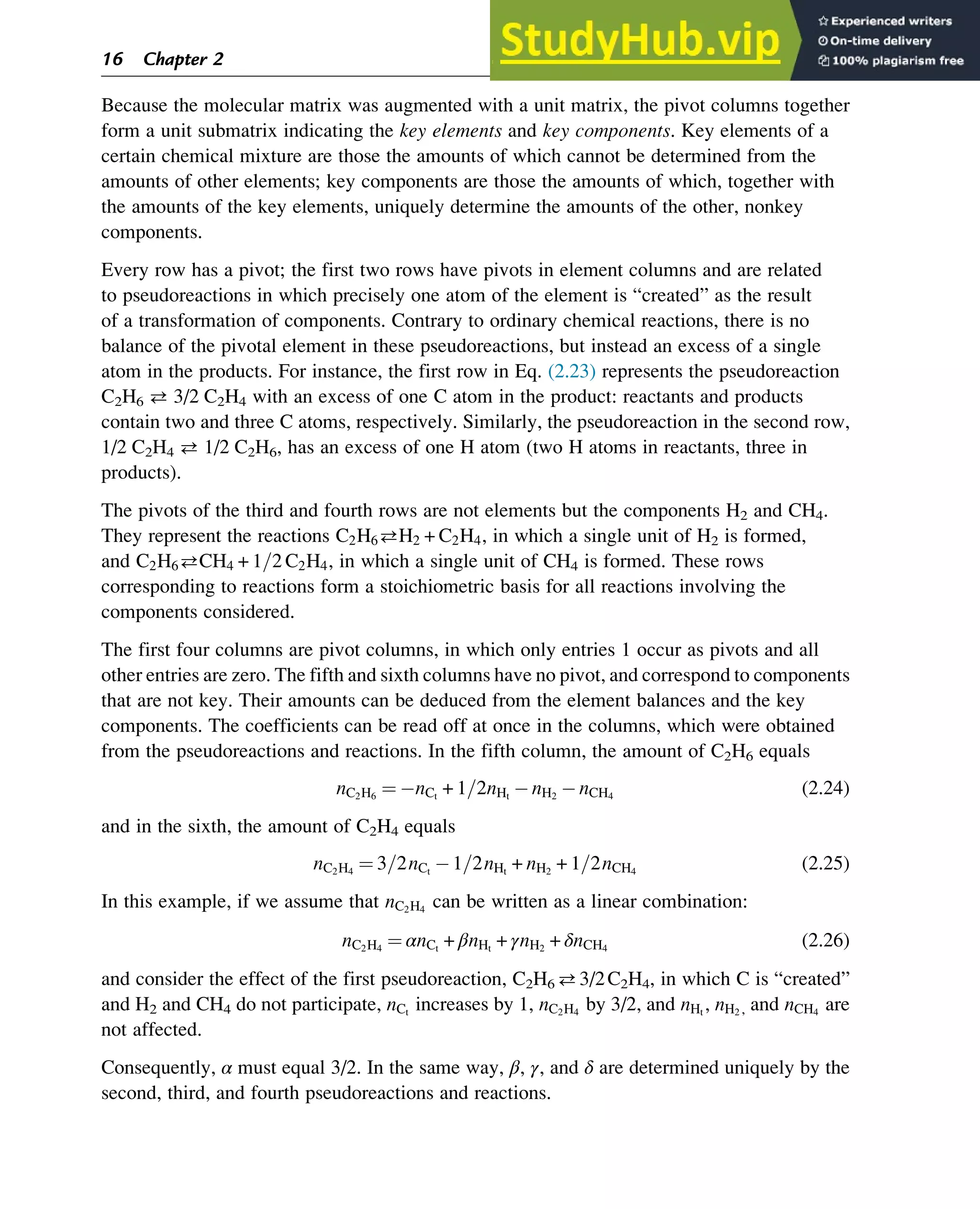
Because the molecular matrix was augmented with a unit matrix, the pivot columns together
form a unit submatrix indicating the key elements and key components. Key elements of a
certain chemical mixture are those the amounts of which cannot be determined from the
amounts of other elements; key components are those the amounts of which, together with
the amounts of the key elements, uniquely determine the amounts of the other, nonkey
components.
Every row has a pivot; the first two rows have pivots in element columns and are related
to pseudoreactions in which precisely one atom of the element is “created” as the result
of a transformation of components. Contrary to ordinary chemical reactions, there is no
balance of the pivotal element in these pseudoreactions, but instead an excess of a single
atom in the products. For instance, the first row in Eq. (2.23) represents the pseudoreaction
C2H6  3/2 C2H4 with an excess of one C atom in the product: reactants and products
contain two and three C atoms, respectively. Similarly, the pseudoreaction in the second row,
1/2 C2H4  1/2 C2H6, has an excess of one H atom (two H atoms in reactants, three in
products).
The pivots of the third and fourth rows are not elements but the components H2 and CH4.
They represent the reactions C2H6H2 + C2H4, in which a single unit of H2 is formed,
and C2H6CH4 + 1=2 C2H4, in which a single unit of CH4 is formed. These rows
corresponding to reactions form a stoichiometric basis for all reactions involving the
components considered.
The first four columns are pivot columns, in which only entries 1 occur as pivots and all
other entries are zero. The fifth and sixth columns have no pivot, and correspond to components
that are not key. Their amounts can be deduced from the element balances and the key
components. The coefficients can be read off at once in the columns, which were obtained
from the pseudoreactions and reactions. In the fifth column, the amount of C2H6 equals
nC2H6
¼ nCt
+ 1=2nHt
nH2
nCH4
(2.24)
and in the sixth, the amount of C2H4 equals
nC2H4
¼ 3=2nCt
1=2nHt
+ nH2
+ 1=2nCH4
(2.25)
In this example, if we assume that nC2H4
can be written as a linear combination:
nC2H4
¼ αnCt
+ βnHt
+ γnH2
+ δnCH4
(2.26)
and consider the effect of the first pseudoreaction, C2H6 3/2C2H4, in which C is “created”
and H2 and CH4 do not participate, nCt
increases by 1, nC2H4
by 3/2, and nHt
, nH2 , and nCH4
are
not affected.
Consequently, α must equal 3/2. In the same way, β, γ, and δ are determined uniquely by the
second, third, and fourth pseudoreactions and reactions.
16 Chapter 2
Summarizing, to analyze the element balances
(1) list the elements and components present in the order of decreasing ease of
measurement.
(2) form the molecular matrix by entering the number of atoms of an element for each
component in its own row.
(3) augment this matrix by adding a unit matrix to its right.
(4) perform the operations resulting in the RREF.
Then, in the result:
(1) every row is still stoichiometrically valid.
(2) every pivot column corresponds to a value that must be known, either that of an
element balance or of a key component.
(3) every nonpivot column corresponds to an unknown value that can be deduced from the
pivots using the matrix coefficients in that column.
(4) the rows for which all elemental entries are zero form the basis of stoichiometrically
possible reactions.
Because the matrix is augmented with a unit matrix, the total number of pivot columns
always equals the number of rows, which is also the number of components. It also equals
the number of key elements plus the number of key components. The number of key
elements can be less than the total number of elements, when some element columns
have no pivot.
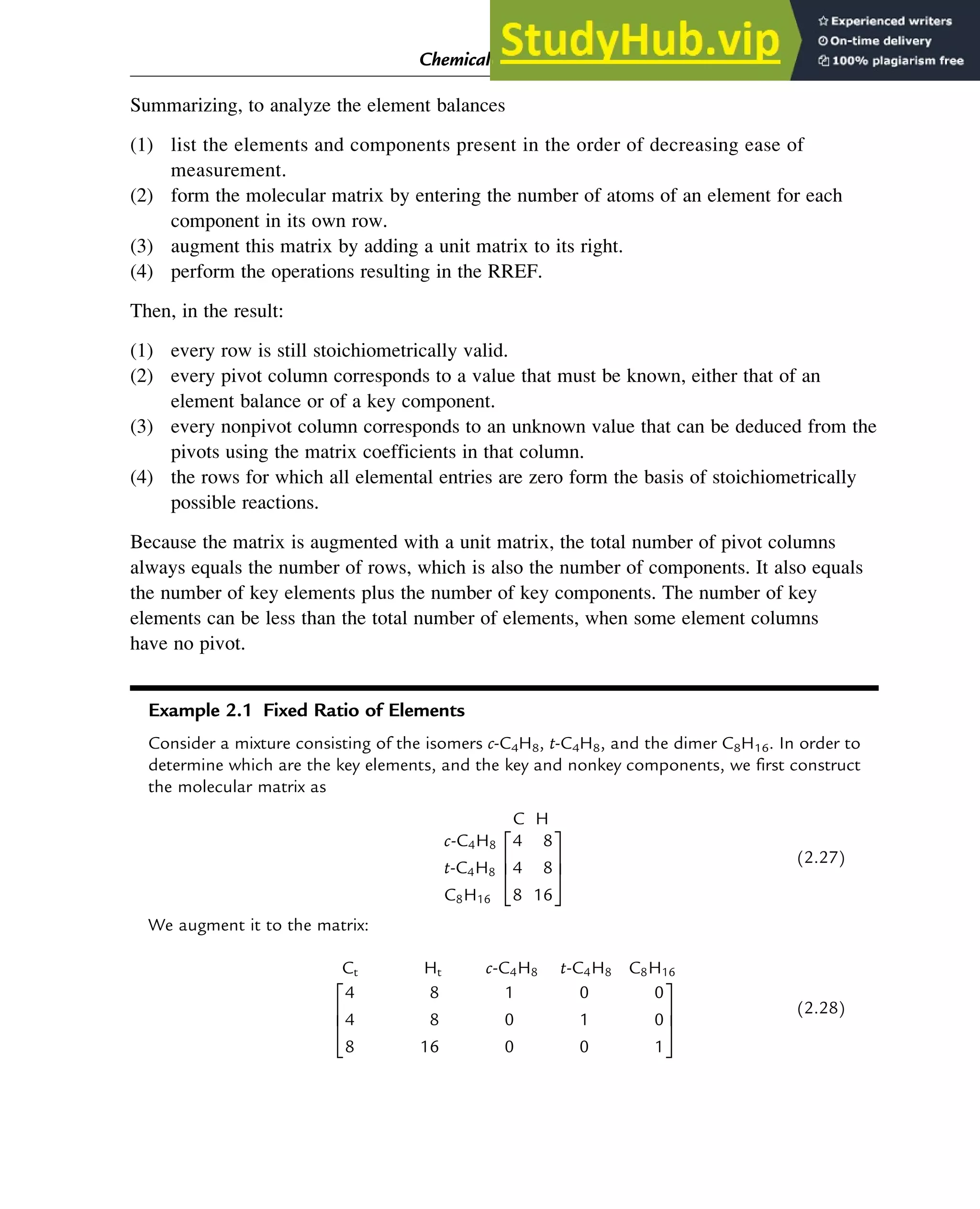
Example 2.1 Fixed Ratio of Elements
Consider a mixture consisting of the isomers c-C4H8, t-C4H8, and the dimer C8H16. In order to
determine which are the key elements, and the key and nonkey components, we first construct
the molecular matrix as
C H
c-C4H8
t-C4H8
C8H16
4 8
4 8
8 16
2
6
4
3
7
5
(2.27)
We augment it to the matrix:
Ct Ht c-C4H8 t-C4H8 C8H16
4 8 1 0 0
4 8 0 1 0
8 16 0 0 1
2
6
4
3
7
5
(2.28)
Chemical Composition and Structure: Linear Algebra 17
with RREF
Ct Ht c-C4H8 t-C4H8 C8H16
1 2 0 0 1=8
0 0 1 0 1=2
0 0 0 1 1=2
2
6
4
3
7
5
(2.29)
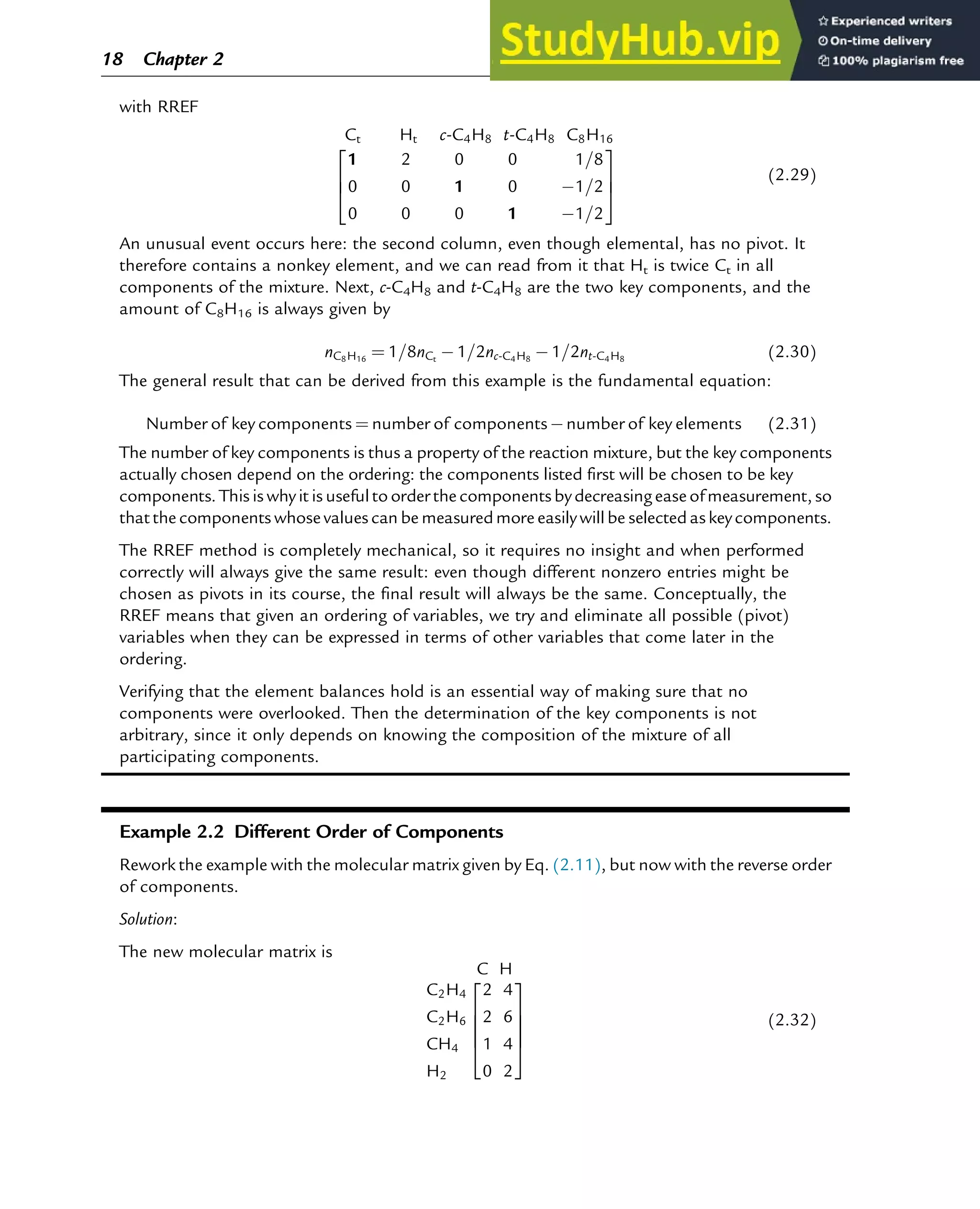
An unusual event occurs here: the second column, even though elemental, has no pivot. It
therefore contains a nonkey element, and we can read from it that Ht is twice Ct in all
components of the mixture. Next, c-C4H8 and t-C4H8 are the two key components, and the
amount of C8H16 is always given by
nC8H16
¼ 1=8nCt
1=2nc-C4H8
1=2nt-C4H8
(2.30)
The general result that can be derived from this example is the fundamental equation:
Number of key components ¼ number of components number of key elements (2.31)
The number of key components is thus a property of the reaction mixture, but the key components
actually chosen depend on the ordering: the components listed first will be chosen to be key
components. This is why it is useful to orderthe components by decreasing easeof measurement, so
that the components whose values can be measuredmore easily will be selected as key components.
The RREF method is completely mechanical, so it requires no insight and when performed
correctly will always give the same result: even though different nonzero entries might be
chosen as pivots in its course, the final result will always be the same. Conceptually, the
RREF means that given an ordering of variables, we try and eliminate all possible (pivot)
variables when they can be expressed in terms of other variables that come later in the
ordering.
Verifying that the element balances hold is an essential way of making sure that no
components were overlooked. Then the determination of the key components is not
arbitrary, since it only depends on knowing the composition of the mixture of all
participating components.
Example 2.2 Different Order of Components
Rework the example with the molecular matrix given by Eq. (2.11), but now with the reverse order
of components.
Solution:
The new molecular matrix is
C H
C2H4
C2H6
CH4
H2
2 4
2 6
1 4
0 2
2
6
6
6
4
3
7
7
7
5
(2.32)
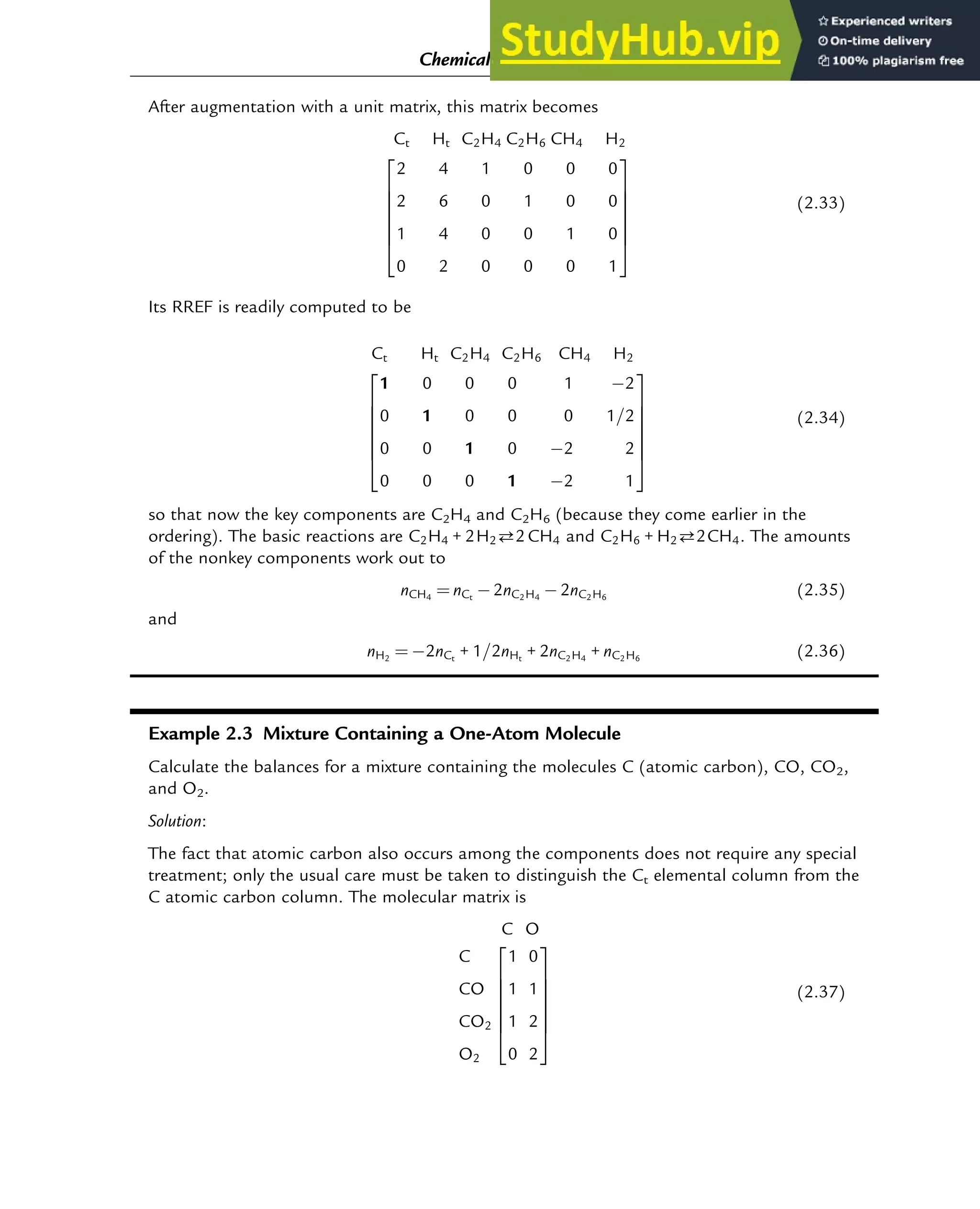
18 Chapter 2
After augmentation with a unit matrix, this matrix becomes
Ct Ht C2H4 C2H6 CH4 H2
2 4 1 0 0 0
2 6 0 1 0 0
1 4 0 0 1 0
0 2 0 0 0 1
2
6
6
6
6
6
4
3
7
7
7
7
7
5
(2.33)
Its RREF is readily computed to be
Ct Ht C2H4 C2H6 CH4 H2
1 0 0 0 1 2
0 1 0 0 0 1=2
0 0 1 0 2 2
0 0 0 1 2 1
2
6
6
6
6
6
4
3
7
7
7
7
7
5
(2.34)
so that now the key components are C2H4 and C2H6 (because they come earlier in the
ordering). The basic reactions are C2H4 + 2H22CH4 and C2H6 + H22CH4. The amounts
of the nonkey components work out to
nCH4
¼ nCt
2nC2H4
2nC2H6
(2.35)
and
nH2
¼ 2nCt
+ 1=2nHt
+ 2nC2H4
+ nC2H6
(2.36)
Example 2.3 Mixture Containing a One-Atom Molecule
Calculate the balances for a mixture containing the molecules C (atomic carbon), CO, CO2,
and O2.
Solution:
The fact that atomic carbon also occurs among the components does not require any special
treatment; only the usual care must be taken to distinguish the Ct elemental column from the
C atomic carbon column. The molecular matrix is
C O
C
CO
CO2
O2
1 0
1 1
1 2
0 2
2
6
6
6
6
6
4
3
7
7
7
7
7
5
(2.37)
Chemical Composition and Structure: Linear Algebra 19
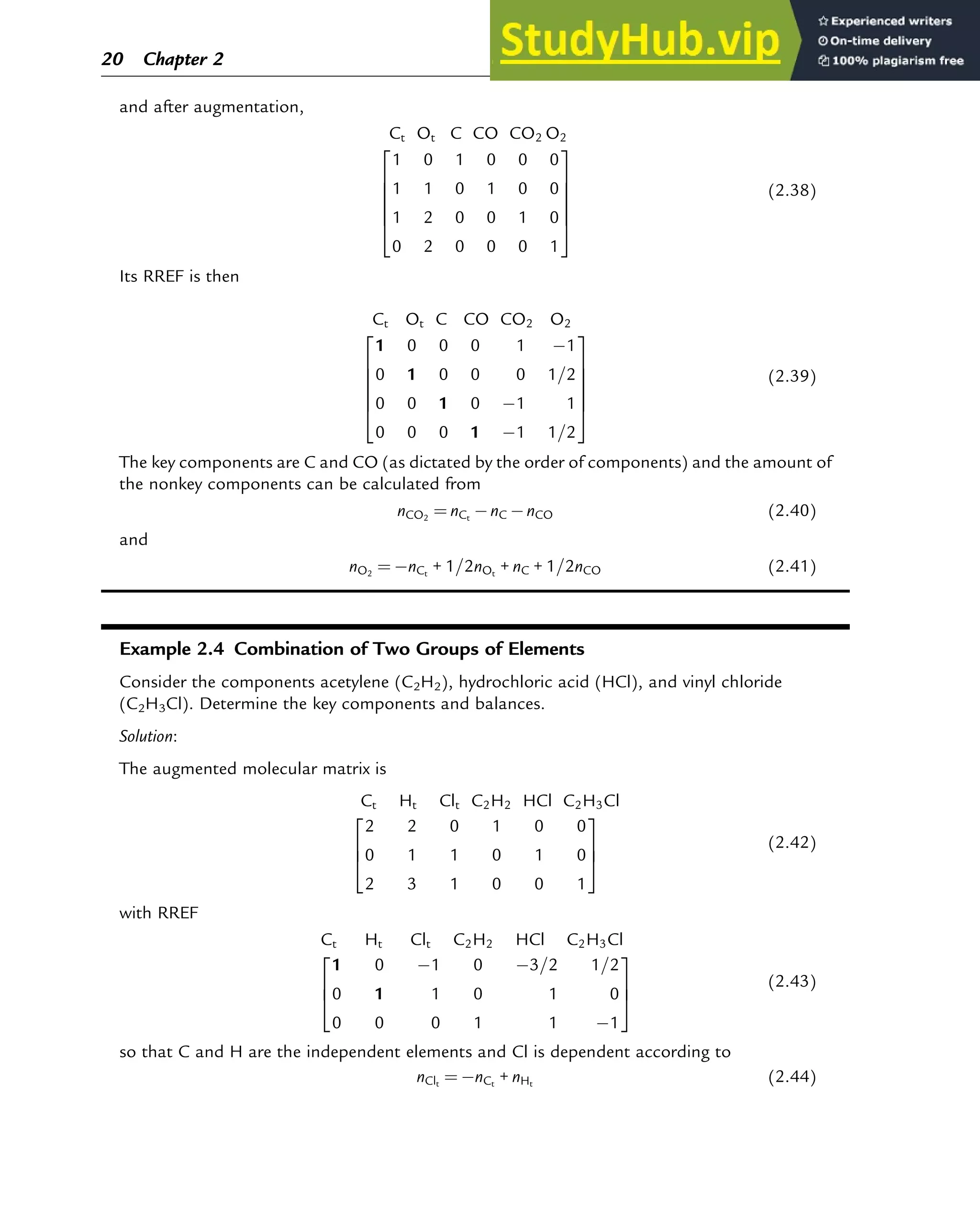
and after augmentation,
Ct Ot C CO CO2 O2
1 0 1 0 0 0
1 1 0 1 0 0
1 2 0 0 1 0
0 2 0 0 0 1
2
6
6
6
6
4
3
7
7
7
7
5
(2.38)
Its RREF is then
Ct Ot C CO CO2 O2
1 0 0 0 1 1
0 1 0 0 0 1=2
0 0 1 0 1 1
0 0 0 1 1 1=2
2
6
6
6
6
4
3
7
7
7
7
5
(2.39)
The key components are C and CO (as dictated by the order of components) and the amount of
the nonkey components can be calculated from
nCO2
¼ nCt
nC nCO (2.40)
and
nO2
¼ nCt
+ 1=2nOt
+ nC + 1=2nCO (2.41)
Example 2.4 Combination of Two Groups of Elements
Consider the components acetylene (C2H2), hydrochloric acid (HCl), and vinyl chloride
(C2H3Cl). Determine the key components and balances.
Solution:
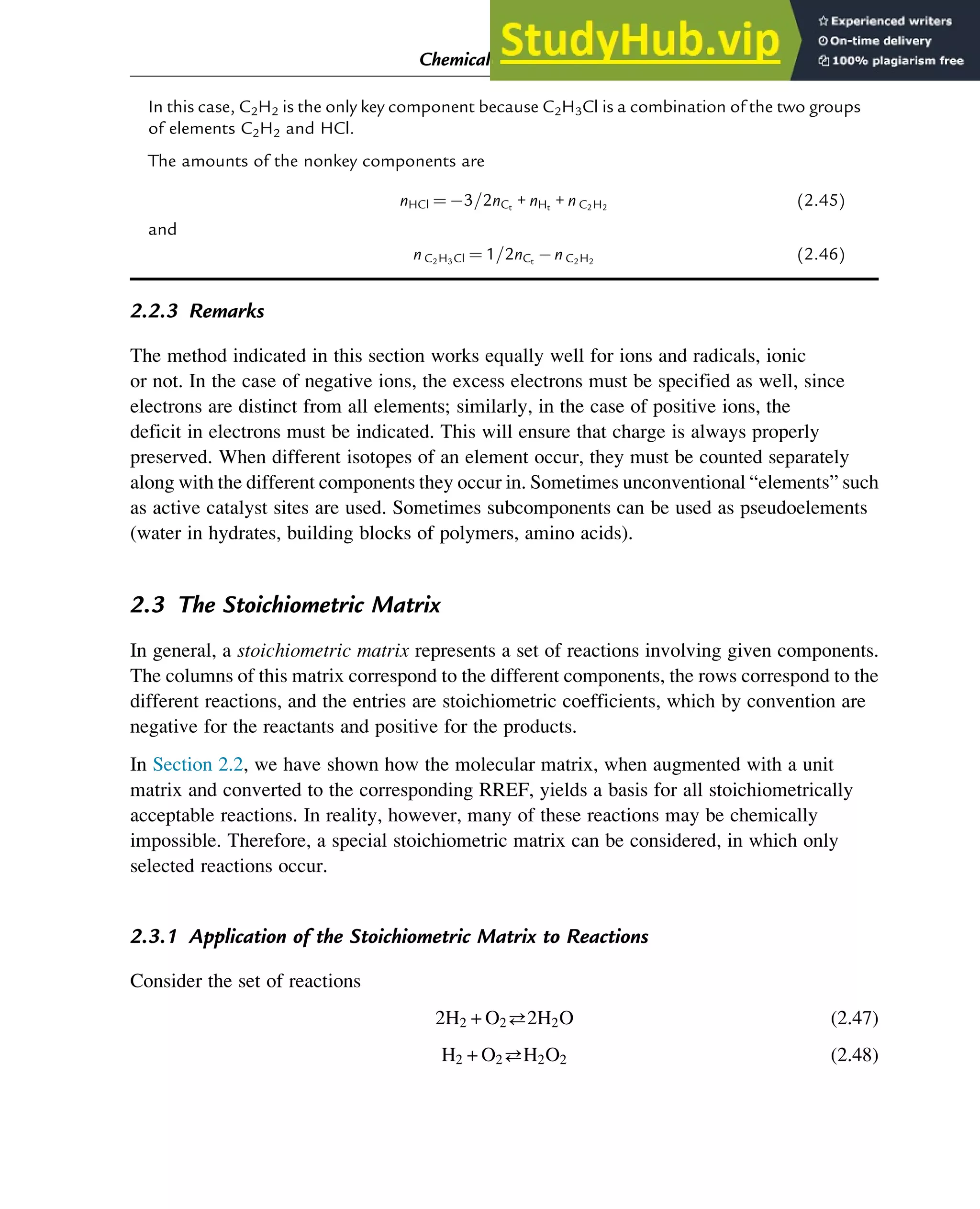
The augmented molecular matrix is
Ct Ht Clt C2H2 HCl C2H3Cl
2 2 0 1 0 0
0 1 1 0 1 0
2 3 1 0 0 1
2
6
4
3
7
5
(2.42)
with RREF
Ct Ht Clt C2H2 HCl C2H3Cl
1 0 1 0 3=2 1=2
0 1 1 0 1 0
0 0 0 1 1 1
2
6
4
3
7
5
(2.43)
so that C and H are the independent elements and Cl is dependent according to
nClt
¼ nCt
+ nHt
(2.44)
20 Chapter 2
In this case, C2H2 is the only key component because C2H3Cl is a combination of the two groups
of elements C2H2 and HCl.
The amounts of the nonkey components are
nHCl ¼ 3=2nCt
+ nHt
+ n C2H2
(2.45)
and
n C2H3Cl ¼ 1=2nCt
n C2H2
(2.46)
2.2.3 Remarks
The method indicated in this section works equally well for ions and radicals, ionic
or not. In the case of negative ions, the excess electrons must be specified as well, since
electrons are distinct from all elements; similarly, in the case of positive ions, the
deficit in electrons must be indicated. This will ensure that charge is always properly
preserved. When different isotopes of an element occur, they must be counted separately
along with the different components they occur in. Sometimes unconventional “elements” such
as active catalyst sites are used. Sometimes subcomponents can be used as pseudoelements
(water in hydrates, building blocks of polymers, amino acids).
2.3 The Stoichiometric Matrix
In general, a stoichiometric matrix represents a set of reactions involving given components.
The columns of this matrix correspond to the different components, the rows correspond to the
different reactions, and the entries are stoichiometric coefficients, which by convention are
negative for the reactants and positive for the products.
In Section 2.2, we have shown how the molecular matrix, when augmented with a unit
matrix and converted to the corresponding RREF, yields a basis for all stoichiometrically
acceptable reactions. In reality, however, many of these reactions may be chemically
impossible. Therefore, a special stoichiometric matrix can be considered, in which only
selected reactions occur.
2.3.1 Application of the Stoichiometric Matrix to Reactions
Consider the set of reactions
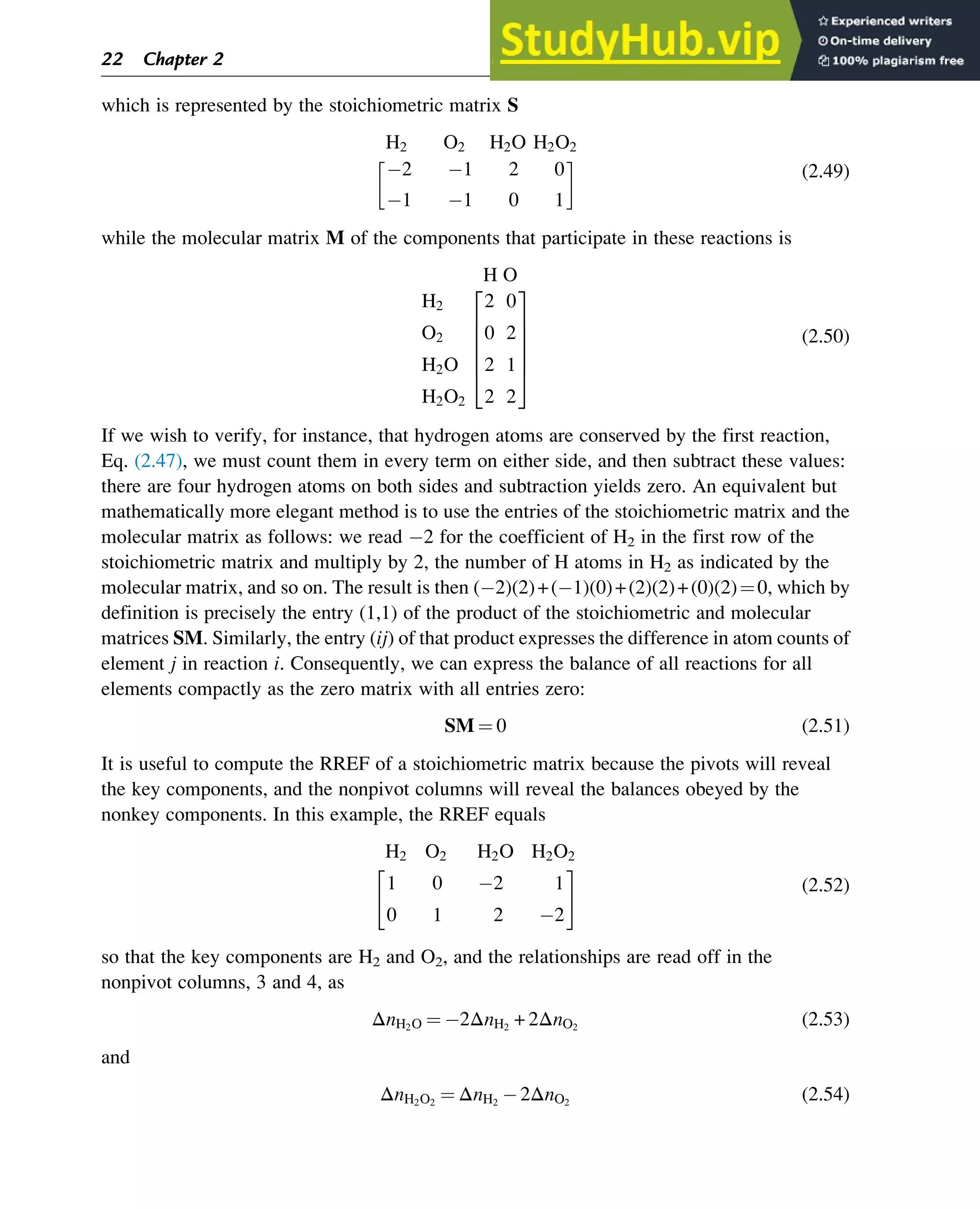
2H2 + O22H2O (2.47)
H2 + O2H2O2 (2.48)
Chemical Composition and Structure: Linear Algebra 21
which is represented by the stoichiometric matrix S
H2 O2 H2O H2O2
2 1 2 0
1 1 0 1
 
(2.49)
while the molecular matrix M of the components that participate in these reactions is
H O
H2
O2
H2O
H2O2
2 0
0 2
2 1
2 2
2
6
6
6
6
4
3
7
7
7
7
5
(2.50)
If we wish to verify, for instance, that hydrogen atoms are conserved by the first reaction,
Eq. (2.47), we must count them in every term on either side, and then subtract these values:
there are four hydrogen atoms on both sides and subtraction yields zero. An equivalent but
mathematically more elegant method is to use the entries of the stoichiometric matrix and the
molecular matrix as follows: we read 2 for the coefficient of H2 in the first row of the
stoichiometric matrix and multiply by 2, the number of H atoms in H2 as indicated by the
molecular matrix, and so on. The result is then ( 2)(2)+( 1)(0)+(2)(2)+(0)(2)¼0, which by
definition is precisely the entry (1,1) of the product of the stoichiometric and molecular
matrices SM. Similarly, the entry (ij) of that product expresses the difference in atom counts of
element j in reaction i. Consequently, we can express the balance of all reactions for all
elements compactly as the zero matrix with all entries zero:
SM ¼ 0 (2.51)
It is useful to compute the RREF of a stoichiometric matrix because the pivots will reveal
the key components, and the nonpivot columns will reveal the balances obeyed by the
nonkey components. In this example, the RREF equals
H2 O2 H2O H2O2
1 0 2 1
0 1 2 2
 #
(2.52)
so that the key components are H2 and O2, and the relationships are read off in the
nonpivot columns, 3 and 4, as
ΔnH2O ¼ 2ΔnH2
+ 2ΔnO2
(2.53)
and
ΔnH2O2
¼ ΔnH2
2ΔnO2
(2.54)
22 Chapter 2
where Δ indicates that we are expressing the changes in amounts that are caused by these
reactions.
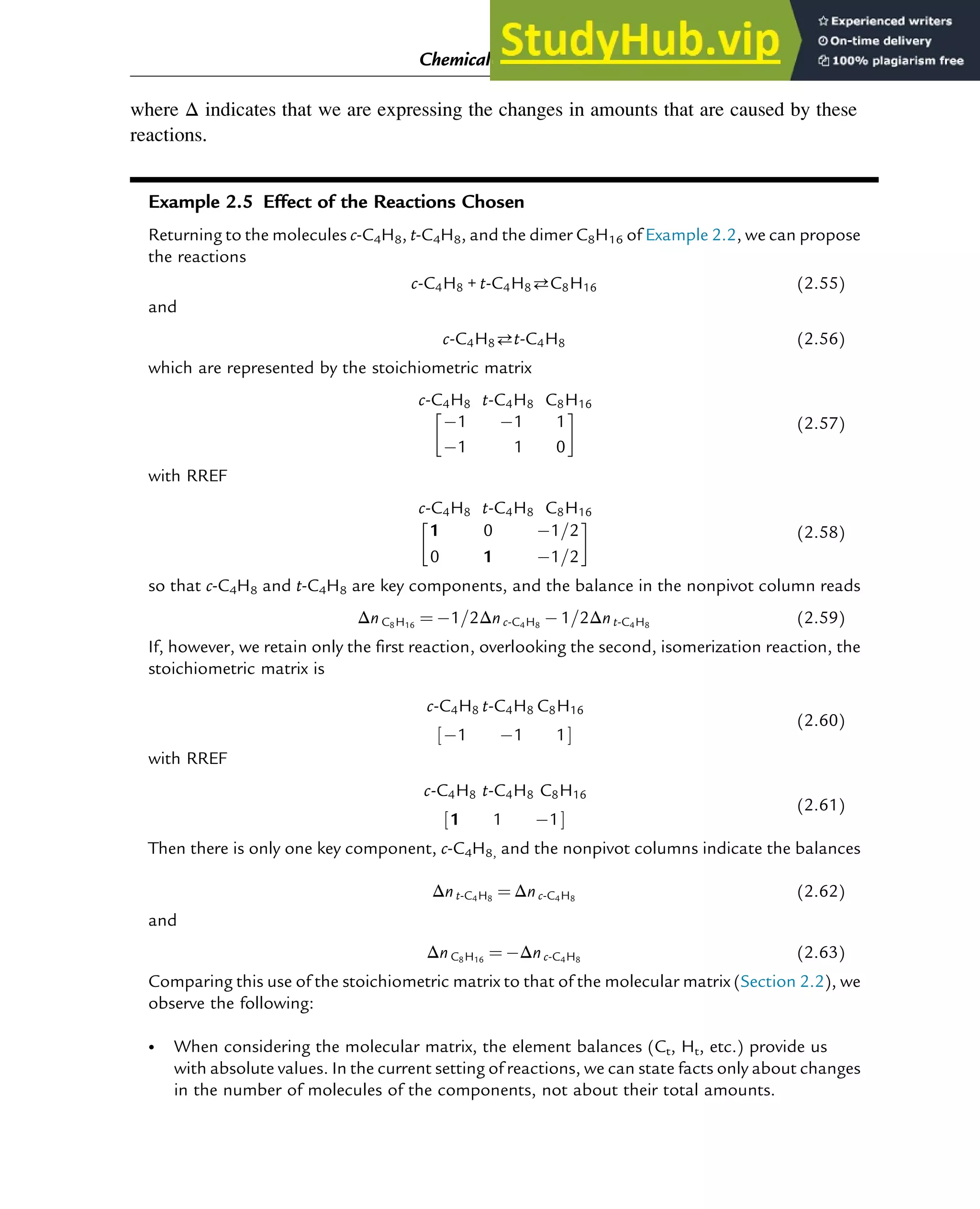
Example 2.5 Effect of the Reactions Chosen
Returning to the molecules c-C4H8, t-C4H8, and the dimer C8H16 of Example 2.2, we can propose
the reactions
c-C4H8 + t-C4H8C8H16 (2.55)
and
c-C4H8t-C4H8 (2.56)
which are represented by the stoichiometric matrix
c-C4H8 t-C4H8 C8H16
1 1 1
1 1 0
 
(2.57)
with RREF
c-C4H8 t-C4H8 C8H16
1 0 1=2
0 1 1=2
 
(2.58)
so that c-C4H8 and t-C4H8 are key components, and the balance in the nonpivot column reads
Δn C8H16
¼ 1=2Δn c-C4H8
1=2Δn t-C4H8
(2.59)
If, however, we retain only the first reaction, overlooking the second, isomerization reaction, the
stoichiometric matrix is
c-C4H8 t-C4H8 C8H16
1 1 1
½ Š
(2.60)
with RREF
c-C4H8 t-C4H8 C8H16
1 1 1
½ Š
(2.61)
Then there is only one key component, c-C4H8, and the nonpivot columns indicate the balances
Δn t-C4H8
¼ Δn c-C4H8
(2.62)
and
Δn C8H16
¼ Δn c-C4H8
(2.63)
Comparing this use of the stoichiometric matrix to that of the molecular matrix (Section 2.2), we
observe the following:
• When considering the molecular matrix, the element balances (Ct, Ht, etc.) provide us
with absolute values. In the current setting of reactions, we can state facts only about changes
in the number of molecules of the components, not about their total amounts.
Chemical Composition and Structure: Linear Algebra 23
• Because the stoichiometric matrix may contain fewer reactions than the ones generated by
the molecular matrix, there may be more balances and fewer key components in the
stoichiometric matrix than in the molecular matrix.
• The determination of key components from the stoichiometric matrix depends on more
choices than in the case of the molecular matrix, since it involves selecting specific reactions.
Therefore, the result of this procedure may be different.
• Again, since the components listed later tend to be expressed in terms of the ones listed
earlier, the order of listing should be according to decreasing ease of measurement.
In this application, the stoichiometric matrix was not augmented, and we cannot tell by
which linear combination of the original reactions the final result was obtained. Sometimes it is
useful to keep track of the original reactions, for example when thermodynamic data such as
enthalpy changes are required or for the calculation of equilibrium coefficients.
2.3.2 The Augmented Stoichiometric Matrix
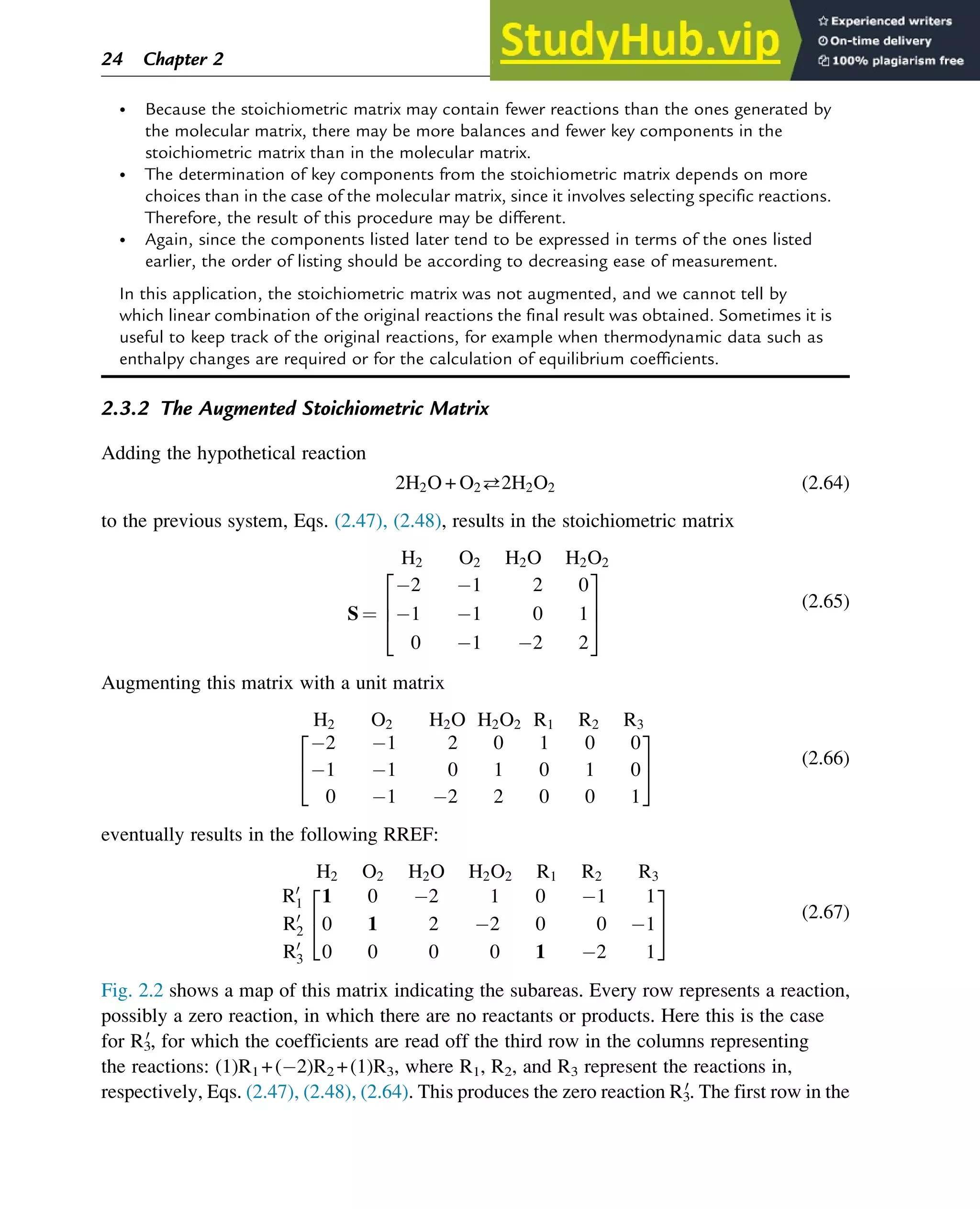
Adding the hypothetical reaction
2H2O + O22H2O2 (2.64)
to the previous system, Eqs. (2.47), (2.48), results in the stoichiometric matrix
H2 O2 H2O H2O2
S ¼
2 1 2 0
1 1 0 1
0 1 2 2
2
6
4
3
7
5
(2.65)
Augmenting this matrix with a unit matrix
H2 O2 H2O H2O2 R1 R2 R3
2 1 2 0 1 0 0
1 1 0 1 0 1 0
0 1 2 2 0 0 1
2
4
3
5 (2.66)
eventually results in the following RREF:
H2 O2 H2O H2O2 R1 R2 R3
R0
1
R0
2
R0
3
1 0 2 1 0 1 1
0 1 2 2 0 0 1
0 0 0 0 1 2 1
2
4
3
5 (2.67)
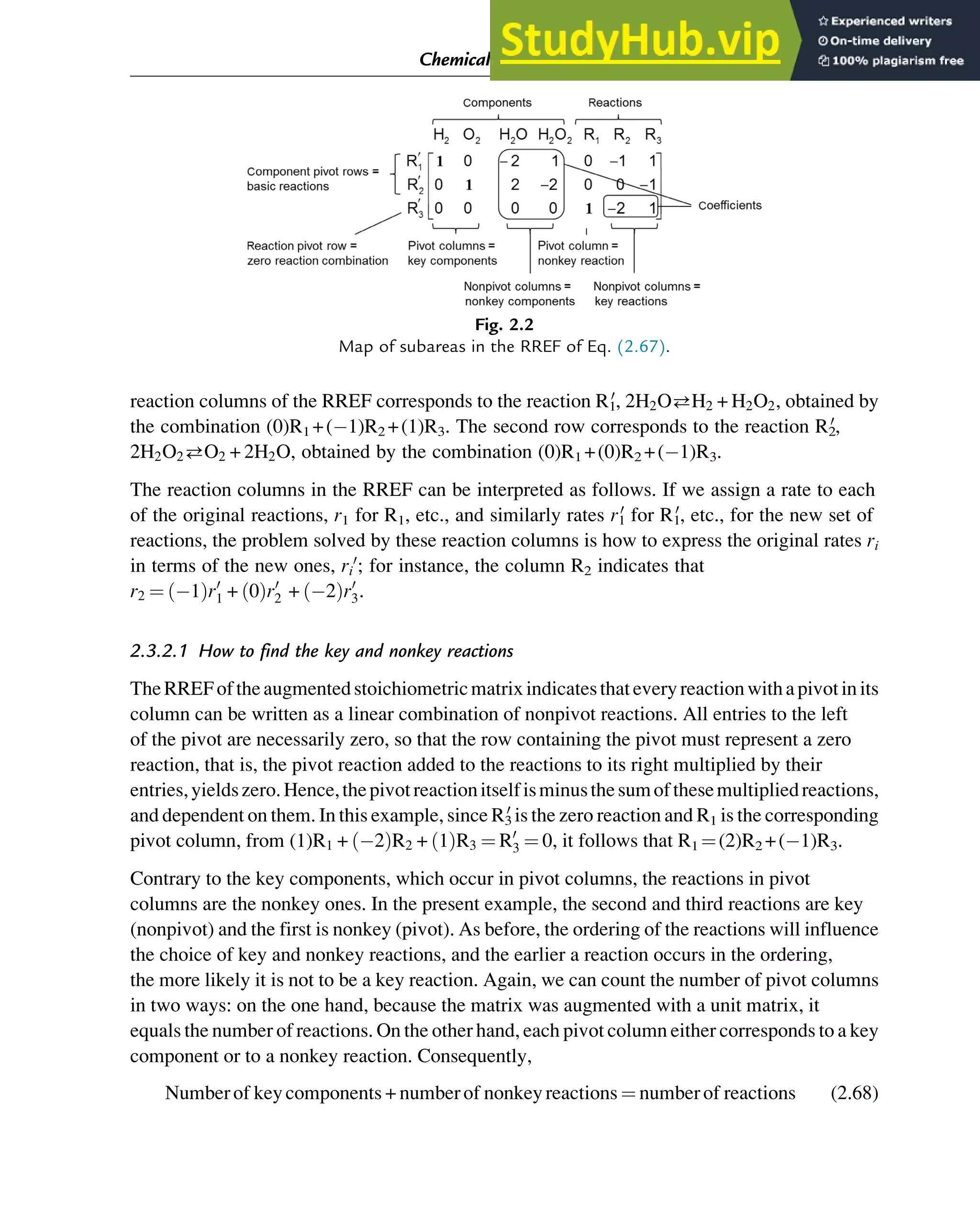
Fig. 2.2 shows a map of this matrix indicating the subareas. Every row represents a reaction,
possibly a zero reaction, in which there are no reactants or products. Here this is the case
for R3
0
, for which the coefficients are read off the third row in the columns representing
the reactions: (1)R1 +( 2)R2 +(1)R3, where R1, R2, and R3 represent the reactions in,
respectively, Eqs. (2.47), (2.48), (2.64). This produces the zero reaction R3
0
. The first row in the
24 Chapter 2
reaction columns of the RREF corresponds to the reaction R1
0
, 2H2OH2 + H2O2, obtained by
the combination (0)R1 +( 1)R2 +(1)R3. The second row corresponds to the reaction R2
0
,
2H2O2O2 + 2H2O, obtained by the combination (0)R1 +(0)R2 +( 1)R3.
The reaction columns in the RREF can be interpreted as follows. If we assign a rate to each
of the original reactions, r1 for R1, etc., and similarly rates r1
0
for R1
0
, etc., for the new set of
reactions, the problem solved by these reaction columns is how to express the original rates ri
in terms of the new ones, ri
0
; for instance, the column R2 indicates that
r2 ¼ 1
ð Þr0
1 + 0
ð Þr0
2 + 2
ð Þr0
3.
2.3.2.1 How to find the key and nonkey reactions
TheRREFoftheaugmentedstoichiometricmatrixindicatesthateveryreactionwithapivotinits
column can be written as a linear combination of nonpivot reactions. All entries to the left
of the pivot are necessarily zero, so that the row containing the pivot must represent a zero
reaction, that is, the pivot reaction added to the reactions to its right multiplied by their
entries,yieldszero.Hence,thepivotreactionitselfisminusthesumofthesemultipliedreactions,
and dependent on them. In this example, since R3
0
is the zero reaction and R1 is the corresponding
pivot column, from (1)R1 + 2
ð ÞR2 + 1
ð ÞR3 ¼ R0
3 ¼ 0, it follows that R1 ¼(2)R2 +( 1)R3.
Contrary to the key components, which occur in pivot columns, the reactions in pivot
columns are the nonkey ones. In the present example, the second and third reactions are key
(nonpivot) and the first is nonkey (pivot). As before, the ordering of the reactions will influence
the choice of key and nonkey reactions, and the earlier a reaction occurs in the ordering,
the more likely it is not to be a key reaction. Again, we can count the number of pivot columns
in two ways: on the one hand, because the matrix was augmented with a unit matrix, it
equals the number of reactions. On the other hand, each pivot column either corresponds to a key
component or to a nonkey reaction. Consequently,
Numberof keycomponents + numberof nonkeyreactions ¼ numberof reactions (2.68)
Fig. 2.2
Map of subareas in the RREF of Eq. (2.67).
Chemical Composition and Structure: Linear Algebra 25
Subtracting the number of nonkey reactions from both sides yields the fundamental equality
Number of keycomponents ¼ number of keyreactions (2.69)
In this example, these numbers are both equal to two; H2 and O2 are the key components, and R2
and R3 are the key reactions.
The number of balances equals the number of nonkey components as indicated before. They are
caused by the reactions, not by element balances. The coefficients by which to multiply the
change of the amounts of the key components are read off on the column as before.
2.3.2.2 Enthalpy change and equilibrium coefficients
The RREF can also be used to find the enthalpy change of the reactions given in the rows: if
ΔrH1 is the enthalpy change of reaction R1, etc., then the enthalpy change of the reaction in
the first row of the RREF, 2H2OH2 + 2H2O2, is ΔrH2 +ΔrH3 and that of the reaction in
the second row, 2H2O2O2 + 2H2O, is ΔrH3. The last row, which represents a zero reaction,
must have an enthalpy change of zero, so that 0¼ΔrH1 2ΔrH2 +ΔrH3. The latter is an
example of how the value of the enthalpy change of a reaction in a pivot column can be written
in terms of the values of subsequent columns, in this case ΔrH1 ¼2ΔrH2 ΔrH3. This example
also illustrates that it is useful to list the reactions with lesser-known thermodynamic
properties first.
A similar reasoning can be applied to the logarithms of the equilibrium coefficients Keq,1, etc.
The equilibrium coefficient of the first reduced reaction must equal Keq,3/Keq,2, that of the
second 1/Keq,3, and that of the third, zero reaction leads to 1 ¼ Keq,1Keq,3=K2
eq,2, or in
solved-for form, Keq,1 ¼ K2
eq,2=Keq,3. In general, the entries in a nonpivot reaction row are (with
changed sign) the exponents in the product expression for the corresponding equilibrium
coefficient.
2.4 Horiuti Numbers
During modeling of catalytic reactions, often unmeasured quantities enter the equations, for
example when surface intermediates are considered. In such cases, one would like to know
which are the overall reactions and how many of these reactions are independent.
The overall reaction is obtained by multiplying the reactions with certain coefficients, the
so-called Horiuti numbers σ, and then adding the results.
Consider the following set of reactions:
Z + H2OZO + H2 (2.70)
26 Chapter 2
ZO + COZ + CO2 (2.71)
where Z is a symbolic element denoting an active catalyst site. What is/are the overall
reaction(s)? Again, this problem can be readily solved by using the RREF. Until now, we have
stressed that in choosing the order of components occurring in the molecular matrix and in
the stoichiometric matrix, it is advisable to list them in order of decreasing ease of measure,
so that the components that are difficult to measure can then be expressed in terms of those
that are easier to measure.
However, in the Horiuti setting, the purpose is not to express the short-lived intermediates (in
this case ZO and Z), which are difficult or even impossible to measure, in terms of the long-
lived components (H2, H2O, CO, and CO2), but to find relations between the long-lived
components that do not involve the intermediates at all. That is why, in this setting, in
order to eliminate the intermediates using an RREF of the stoichiometric matrix, the
intermediates must be listed first, not last:
Z ZO H2 H2O CO CO2
1 1 1 1 0 0
1 1 0 0 1 1
 
(2.72)
Again we augment this matrix with a unit matrix to keep track of the original reactions:
Z ZO H2 H2O CO CO2 R1 R2
1 1 1 1 0 0 1 0
1 1 0 0 1 1 0 1
 
(2.73)
The RREF of this matrix is
Z ZO H2 H2O CO CO2 R1 R2
1 1 0 0 1 1 0 1
0 0 1 1 1 1 1 1
 
(2.74)
The rows in which all intermediates have zero entries provide a basis of the overall
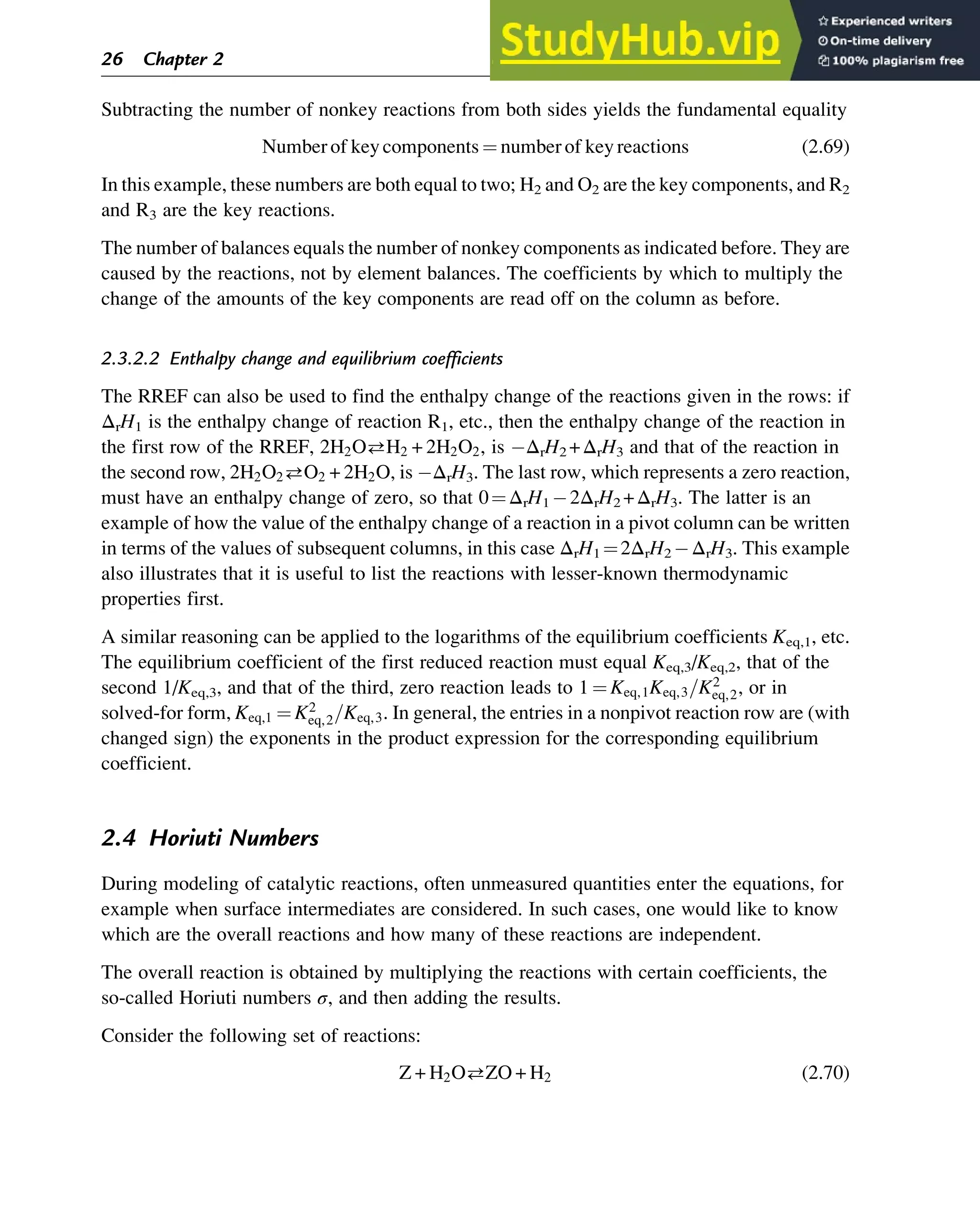
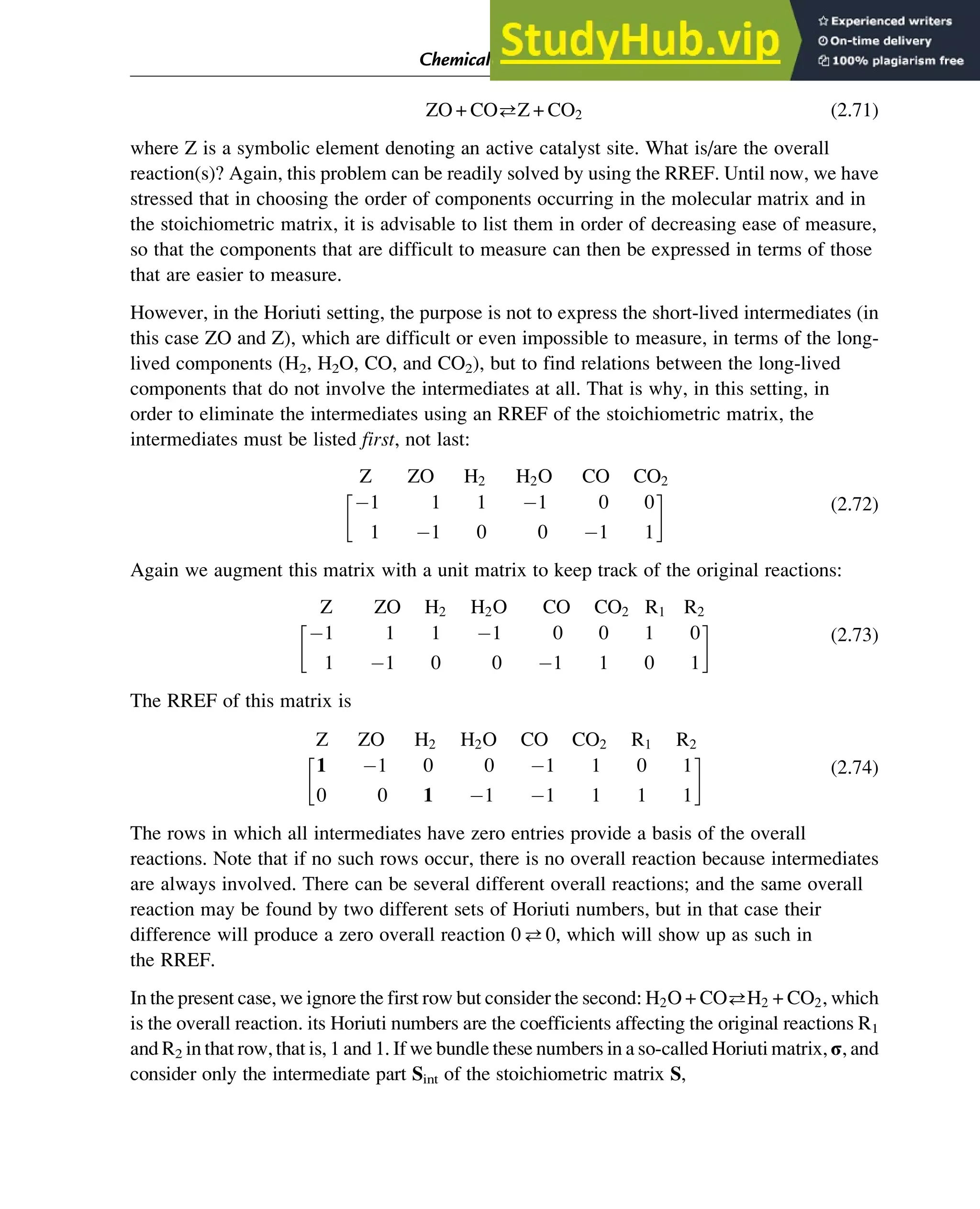
reactions. Note that if no such rows occur, there is no overall reaction because intermediates
are always involved. There can be several different overall reactions; and the same overall
reaction may be found by two different sets of Horiuti numbers, but in that case their
difference will produce a zero overall reaction 00, which will show up as such in
the RREF.
In the present case, we ignore the first row but consider the second: H2O + COH2 + CO2, which
is the overall reaction. its Horiuti numbers are the coefficients affecting the original reactions R1
and R2 in that row, that is, 1 and 1. If we bundle these numbers in a so-called Horiuti matrix, σ, and
consider only the intermediate part Sint of the stoichiometric matrix S,
Chemical Composition and Structure: Linear Algebra 27
Z ZO
σ ¼
R1
R2
1
1
 
; Sint ¼
R1
R2
1 1
1 1
 
(2.75)
then we have the remarkable matrix product property that σT
Sint ¼0. Here σT
denotes the
transpose of σ, that is, the matrix obtained by interchanging the rows and columns of σ, so
that here
R1 R2
σT
¼ 1 1
½ Š
(2.76)
Example 2.6 Reaction With Three Intermediates
Consider the set of reactions:
2Z + O22ZO (2.77)
Z + COZCO (2.78)
ZO + COZ + CO2 (2.79)
ZO + ZCO2Z + CO2 (2.80)
Determine the overall reaction(s) and Horiuti numbers.
Solution:
The augmented matrix is
Z ZO ZCO O2 CO CO2 R1 R2 R3 R4
2 2 0 1 0 0 1 0 0 0
1 0 1 0 1 0 0 1 0 0
1 1 0 0 1 1 0 0 1 0
2 1 1 0 0 1 0 0 0 1
2
6
6
6
4
3
7
7
7
5
(2.81)
with RREF
Z ZO ZCO O2 CO CO2 R1 R2 R3 R4
1 0 1 0 1 0 0 0 1 1
0 1 1 0 2 1 0 0 2 1
0 0 0 1 2 2 1 0 2 0
0 0 0 0 0 0 0 1 1 1
2
6
6
6
4
3
7
7
7
5
(2.82)
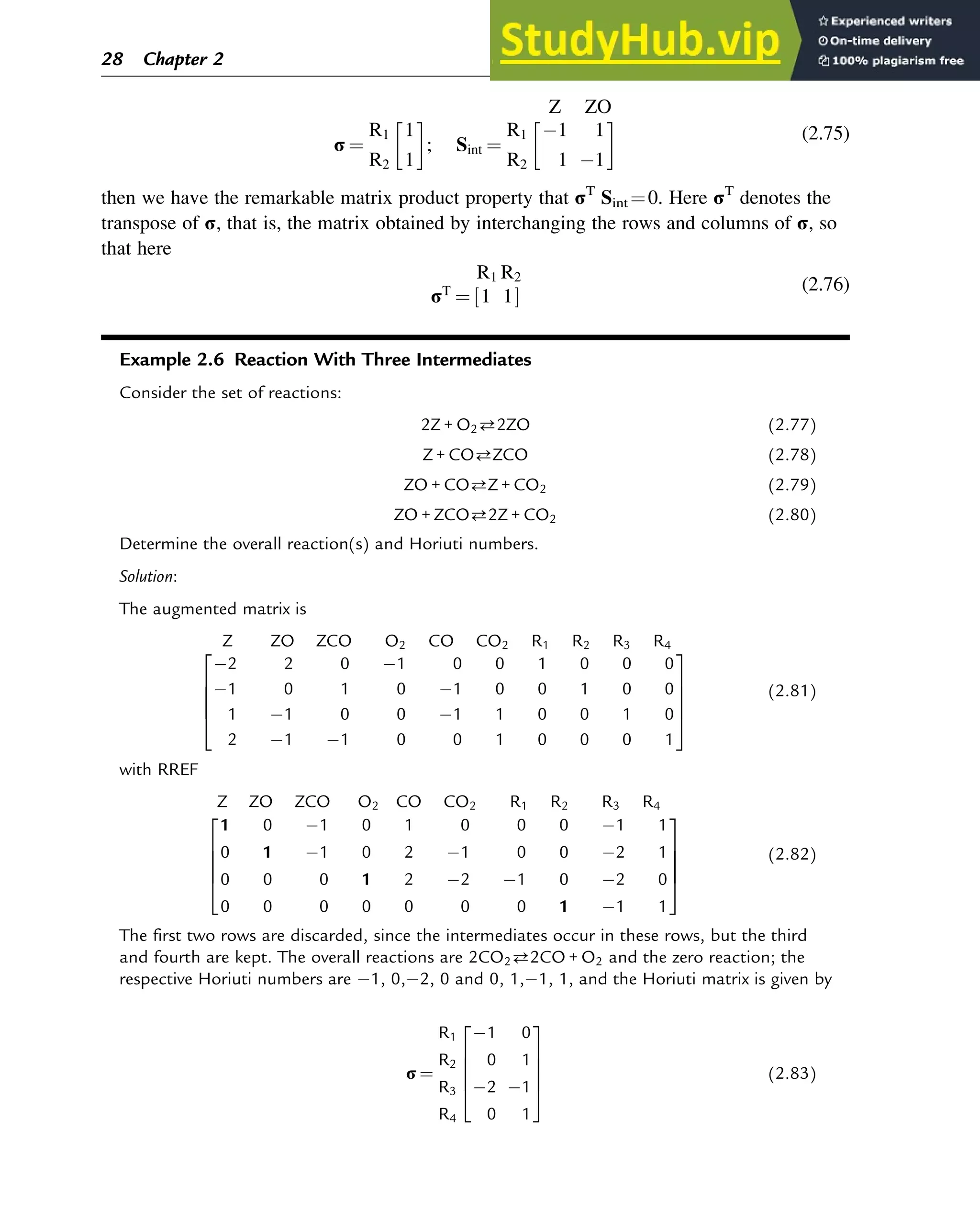
The first two rows are discarded, since the intermediates occur in these rows, but the third
and fourth are kept. The overall reactions are 2CO22CO + O2 and the zero reaction; the
respective Horiuti numbers are 1, 0, 2, 0 and 0, 1, 1, 1, and the Horiuti matrix is given by
σ ¼
R1
R2
R3
R4
1 0
0 1
2 1
0 1
2
6
6
6
4
3
7
7
7
5
(2.83)
28 Chapter 2
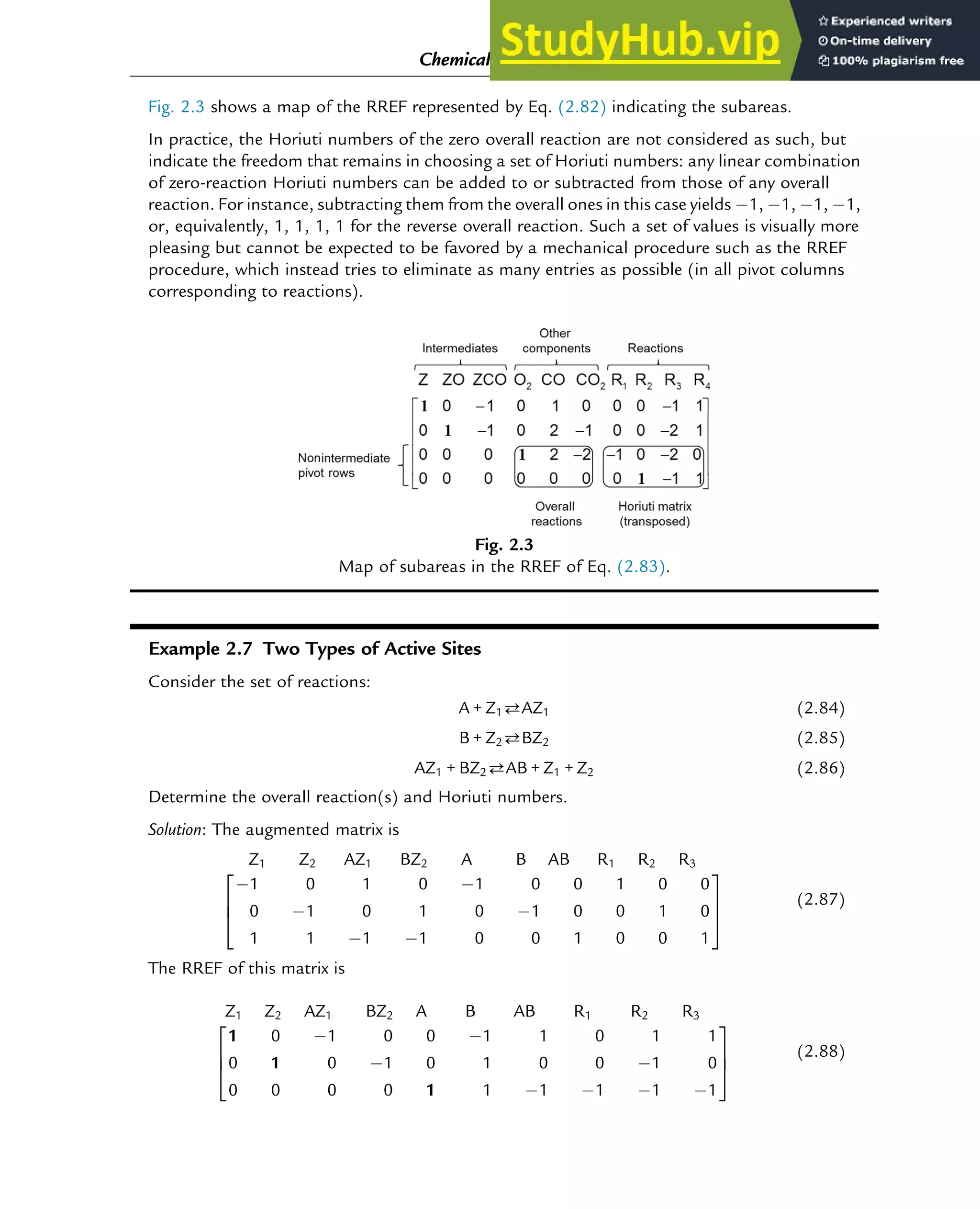
Fig. 2.3 shows a map of the RREF represented by Eq. (2.82) indicating the subareas.
In practice, the Horiuti numbers of the zero overall reaction are not considered as such, but
indicate the freedom that remains in choosing a set of Horiuti numbers: any linear combination
of zero-reaction Horiuti numbers can be added to or subtracted from those of any overall
reaction. For instance, subtracting them from the overall ones in this case yields 1, 1, 1, 1,
or, equivalently, 1, 1, 1, 1 for the reverse overall reaction. Such a set of values is visually more
pleasing but cannot be expected to be favored by a mechanical procedure such as the RREF
procedure, which instead tries to eliminate as many entries as possible (in all pivot columns
corresponding to reactions).
Example 2.7 Two Types of Active Sites
Consider the set of reactions:
A + Z1AZ1 (2.84)
B + Z2BZ2 (2.85)
AZ1 + BZ2AB + Z1 + Z2 (2.86)
Determine the overall reaction(s) and Horiuti numbers.
Solution: The augmented matrix is
Z1 Z2 AZ1 BZ2 A B AB R1 R2 R3
1 0 1 0 1 0 0 1 0 0
0 1 0 1 0 1 0 0 1 0
1 1 1 1 0 0 1 0 0 1
2
6
4
3
7
5
(2.87)
The RREF of this matrix is
Z1 Z2 AZ1 BZ2 A B AB R1 R2 R3
1 0 1 0 0 1 1 0 1 1
0 1 0 1 0 1 0 0 1 0
0 0 0 0 1 1 1 1 1 1
2
6
4
3
7
5
(2.88)
Fig. 2.3
Map of subareas in the RREF of Eq. (2.83).
Chemical Composition and Structure: Linear Algebra 29
We consider only the third row, and read out the overall reaction as ABA + B with Horiuti
numbers 1, 1, 1. In practice, these numbers would be more likely reported equivalently as 1,
1, 1 for the reverse reaction, A + BAB. This is also the form that would have been obtained if the
component AB had been listed before A and B instead of after them.
2.5 Summary
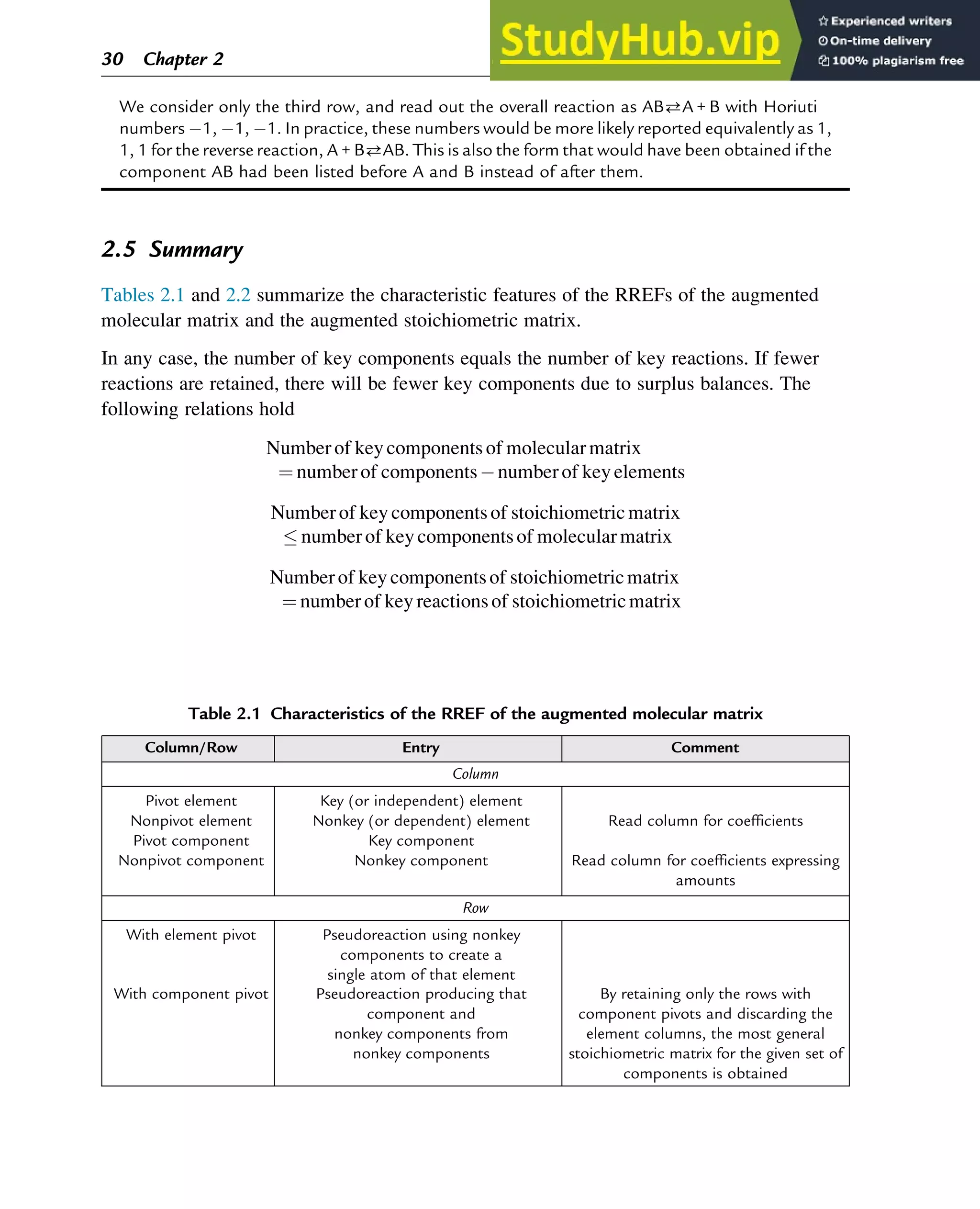
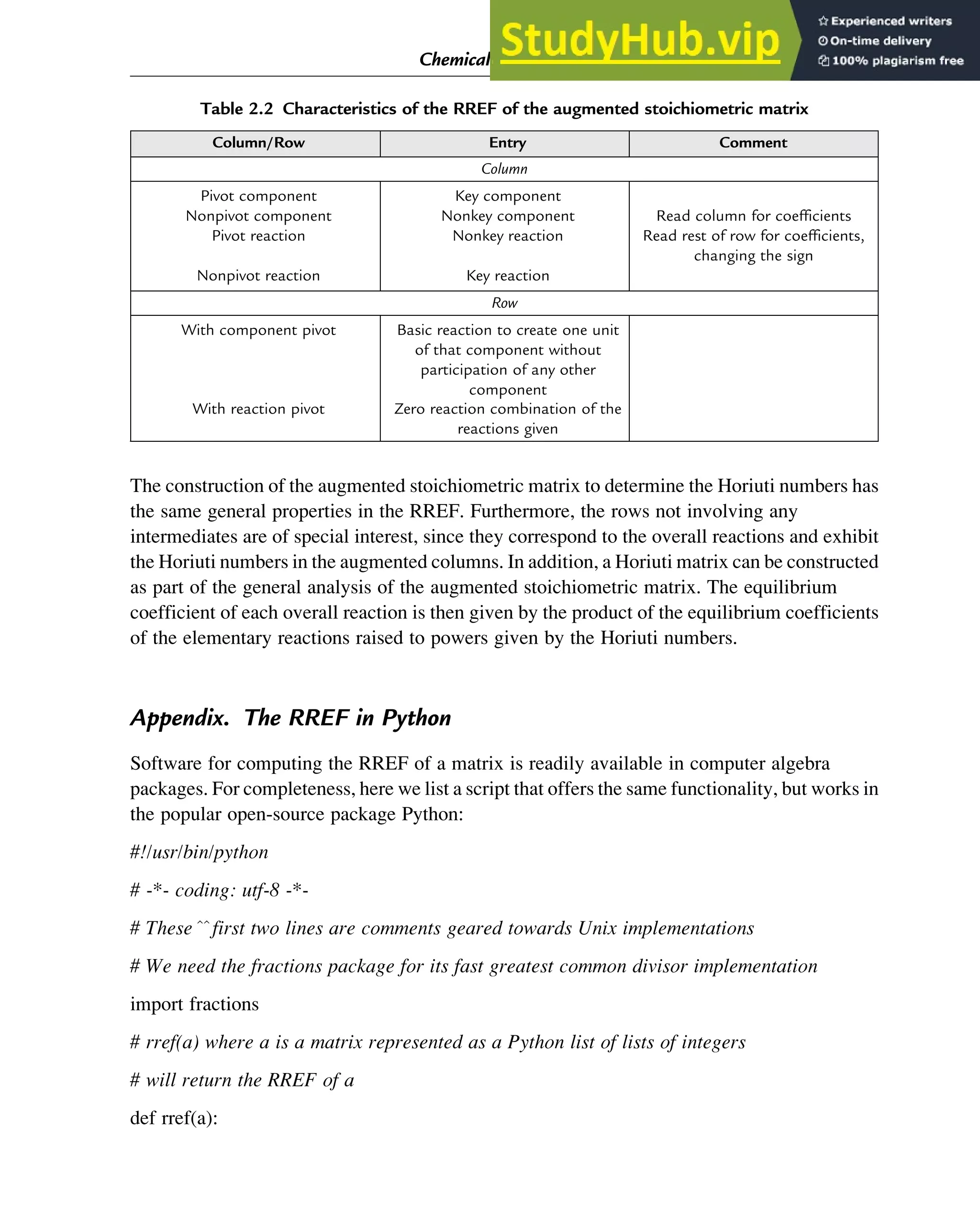
Tables 2.1 and 2.2 summarize the characteristic features of the RREFs of the augmented
molecular matrix and the augmented stoichiometric matrix.
In any case, the number of key components equals the number of key reactions. If fewer
reactions are retained, there will be fewer key components due to surplus balances. The
following relations hold
Numberof keycomponents of molecular matrix
¼ numberof components numberof key elements
Numberof key componentsof stoichiometric matrix
 numberof keycomponentsof molecular matrix
Numberof key componentsof stoichiometricmatrix
¼ numberof key reactionsof stoichiometricmatrix
Table 2.1 Characteristics of the RREF of the augmented molecular matrix
Column/Row Entry Comment
Column
Pivot element Key (or independent) element
Nonpivot element Nonkey (or dependent) element Read column for coefficients
Pivot component Key component
Nonpivot component Nonkey component Read column for coefficients expressing
amounts
Row
With element pivot Pseudoreaction using nonkey
components to create a
single atom of that element
With component pivot Pseudoreaction producing that
component and
nonkey components from
nonkey components
By retaining only the rows with
component pivots and discarding the
element columns, the most general
stoichiometric matrix for the given set of
components is obtained
30 Chapter 2
The construction of the augmented stoichiometric matrix to determine the Horiuti numbers has
the same general properties in the RREF. Furthermore, the rows not involving any
intermediates are of special interest, since they correspond to the overall reactions and exhibit
the Horiuti numbers in the augmented columns. In addition, a Horiuti matrix can be constructed
as part of the general analysis of the augmented stoichiometric matrix. The equilibrium
coefficient of each overall reaction is then given by the product of the equilibrium coefficients
of the elementary reactions raised to powers given by the Horiuti numbers.
Appendix. The RREF in Python
Software for computing the RREF of a matrix is readily available in computer algebra
packages. For completeness, here we list a script that offers the same functionality, but works in
the popular open-source package Python:
#!/usr/bin/python
# -*- coding: utf-8 -*-
# These^^first two lines are comments geared towards Unix implementations
# We need the fractions package for its fast greatest common divisor implementation
import fractions
# rref(a) where a is a matrix represented as a Python list of lists of integers
# will return the RREF of a
def rref(a):
Table 2.2 Characteristics of the RREF of the augmented stoichiometric matrix
Column/Row Entry Comment
Column
Pivot component Key component
Nonpivot component Nonkey component Read column for coefficients
Pivot reaction Nonkey reaction Read rest of row for coefficients,
changing the sign
Nonpivot reaction Key reaction
Row
With component pivot Basic reaction to create one unit
of that component without
participation of any other
component
With reaction pivot Zero reaction combination of the
reactions given
Chemical Composition and Structure: Linear Algebra 31
# The number of rows m is the number of lists in the list
m ¼ len(a)
# The number of columns n is obtained from the first list; we assume but do not check
# that all lists in a have this same length
n ¼ len(a[1])
# Initially, no rows have been completed in the sense of having a pivot
rowsdone ¼ 0
# And no columns have been done either; but we traverse the n columns to work on them
# in this for loop
for columnsdone in range(n):
# Ignoring the rows that were done, we look for a nonzero entry in column i
i ¼ rowsdone
while i  m and a[i][columnsdone] ¼¼ 0:
i ¼ i + 1
# Did we find one?
if i  m:
# Yes, we found a nonzero entry; if it is not yet in uppermost position…
if i ! ¼ rowsdone:
# … we move it up to there
for j in range(n):
t ¼ a[i][j]
a[i][j] ¼ a[rowsdone][j]
a[rowsdone][j] ¼ t
# Now the nonzero entry is in pivot position we use it to zero all other entries in its column:
for i in range(m):
# … we do not zero the pivot itself
if i ! ¼ rowsdone:
# … but all other entries in its column by multiplying with these coefficients f and g
32 Chapter 2
f ¼ a[rowsdone][columnsdone]
g ¼ a[i][columnsdone]
# … this loop handles the linear combination
for j in range(n):
a[i][j] ¼ a[i][j] * f - a[rowsdone][j] * g
# … now we normalize the results by calculating their greatest common divisor, h
h ¼ 0
for j in range(n):
h ¼ fractions.gcd(h, a[i][j])
# … and if it is nonzero, divide by it
if h ! ¼ 0:
for j in range(n):
a[i][j] ¼ a[i][j] / h
# … this completes the work and we register the new row as being completed
rowsdone ¼ rowsdone + 1
Summarizing: the matrix is assumed to be given as a list of lists of integers. Its dimensions
m and n are obtained from this representation, and then the code successively inspects each
of the columns to see if it contains a pivot. Because all arithmetic is exact using the built-in
unlimited precision integers of Python, the greatest common divisor of every new row is
eliminated along the way. Whenever a pivot is found in a column, a new pivot row has
been found and the number of rows done is increased accordingly. Finally, the matrix a
has been modified to be in RREF form.
Nomenclature
Symbols
ai real number
ΔrHi enthalpy change of reaction i (J mol 1
)
Keq,i equilibrium coefficient of reaction i
M molecular matrix
mA column vector of atomic masses (kg mol 1
)
mM column of molar masses (kg mol 1
)
ni amount of component i (mol)
Chemical Composition and Structure: Linear Algebra 33
Pi,j entry of matrix P
Ri referring to reaction i
R0
i referring to “new” reaction i
ri rate of reaction i (depends)
r0
i rate of “new” reaction i (depends)
S stoichiometric matrix
Sint stoichiometric matrix of intermediates
x variable
y variable
Greek symbols
Δ change
νi mathematical object
σ Horiuti matrix
σ Horiuti number
Subscripts
t total
Superscripts
T transpose
Further Reading
Aris, R., 1965. Introduction to the Analysis of Chemical Reactors. Prentice-Hall, Englewood Cliffs, NJ, 317 p.
Aris, R., 1969. Elementary Chemical Reactor Analysis. Prentice-Hall, Englewood Cliffs, NJ, 352 p.
Erdi, P., Toth, J., 1989. Mathematical Models of Chemical Reactions: Theory and Application of Deterministic and
Stochastic Models. Manchester University Press, Manchester, UK, 267 p.
Smith, W.R., Missen, R.W., 1997. Using Mathematica and Maple to obtain chemical equations. J. Chem. Educ.
74, 1369–1371.
34 Chapter 2
CHAPTER 3
Complex Reactions: Kinetics
and Mechanisms – Ordinary Differential
Equations – Graph Theory
3.1 Primary Analysis of Kinetic Data
3.1.1 Introduction
Kinetic experiments are experiments in which the change of chemical composition of the
reacting mixture is monitored in time and/or as a function of the various parameters of the
system, in particular the inlet or initial chemical composition, temperature, catalyst state, and
so on. The main paradigm of contemporary chemical kinetics is the following: a chemical
reaction is complex and consists of a set of elementary reactions for which the kinetic laws
are assumed to be known. Kinetic analysis focuses on revealing this set of reactions and
developing the corresponding mathematical model, that, is the kinetic model.
The goals of the primary analysis of kinetic data are
• extracting the rates (rates of change of reacting components, rates of reactions, etc.) based
on the data obtained from kinetic experiments, especially concentration measurements.
• determining the coherency or incoherency between the observed kinetic dependences, and
categorizing the dependences of the “rate parameters”.
• proposing primary assumptions on the kinetic model and its mathematical description.
The procedures for pursuing these goals depend on the type of kinetic experiments.
3.1.2 Types of Reactors for Kinetic Experiments
Kinetic experiments are performed in various types of chemical reactors, which can be
classified as either open or closed, depending on whether or not there is exchange of matter with
the surroundings. This classification was taken from classical thermodynamics. Closed reactors
can exchange energy with the surroundings, but they cannot exchange matter, while open
reactors can exchange either matter and energy or only matter. In chemical kinetics and
engineering, a closed reactor is better known as a batch reactor; an open reactor as a
Advanced Data Analysis and Modelling in Chemical Engineering. http://dx.doi.org/10.1016/B978-0-444-59485-3.00003-5
# 2017 Elsevier B.V. All rights reserved.
35
continuous-flow reactor. There also exist semiopen (or semiclosed) reactors, commonly known
as semibatch reactors. In these reactors only some type of material is exchanged with the
surroundings. Another type of reactor is the pulse reactor. In this type of reactor a small
quantity of a chemical substance is injected into the reactor.
3.1.3 Requirements of the Experimental Information
The primary information about chemical transformations is obtained by the measurement of
the chemical composition, that is, concentration measurements. The chemical processes
occurring are complex and do not consist only of chemical reactions but also of physical
phenomena, such as mass and heat transport. The major goal of chemical kinetic studies is to
extract intrinsic kinetic information related to complex chemical reactions. Therefore, the
transport regime in the reactor has to be well defined and its mathematical description has
to be reliable. A typical strategy in kinetic experiments is the minimization of the effects of
mass and heat transport on the rate of change of the chemical composition. In accordance
with this, a kinetic experiment ideally has to fulfill two main requirements: isothermicity of
the active zone and uniformity of the chemical composition, which can be accomplished by,
for example, perfect mixing within the reaction zone.
A kinetic experiment should usually be performed under (near) isothermal conditions.
However, the temperature may be changed between two experiments. Temperature gradients
across the reactor can be minimized in various ways, for example by intensive heat exchange
between the reactor and the surroundings, by dilution of the reactive medium, or by its
rapid recirculation. Uniformity of the chemical composition at reactor scale is achieved by
intensive mixing using special mixing devices. Internal mixing can be achieved by using
impellers, external mixing by the use of recirculation pumps. Both isothermicity of the active
zone and uniformity of the chemical composition can also be attained in reactors in which
the reaction zone is very small, for example in differential plug-flow reactors (PFRs), shallow
beds, and so on.
3.2 Material Balances: Extracting the Net Rate of Production
For any chemical component in any chemical reactor, the material balance can be presented
qualitatively as follows:
temporalchangeof amountof component ¼ transportchange + changeduetoreaction (3.1)
in which the temporal change of the amount of a component, often termed accumulation, is its
change with respect to time at a fixed position; the transport change is the change caused
by flow through the reactor; and the reaction change is the change caused by chemical reaction.
Eq. (3.1) can be used as a basis for the classification and qualitative description of
36 Chapter 3
different types of reactors for kinetic studies. Fig. 3.1 shows schematic representations of a
number of reactor types.
In reactors operating at steady state, the temporal change of the concentration of component
i is zero, dci/dt¼0, while in non-steady-state operation, dci/dt6¼0. Equations with a zero
derivative dci/dt are algebraic models and equations with a nonzero derivative are differential
models of chemical processes.
3.2.1 Transport in Reactors
In laboratory reactors, a well-defined transport regime can be used as a “measuring stick”
for extracting the intrinsic kinetic dependences. Examples of well-defined transport regimes
are pure convection and pure diffusion. For convection, the molar flow rate Fi of component
i is determined as the product of its concentration ci and the total volumetric flow rate qV:
Fi ¼ qVci (3.2)
For diffusion, in the simplest case, the molar flow rate is determined in accordance with Fick’s
first law, which in one spatial dimension is:
Fi ¼ DiA
@ci
@z
(3.3)
where Di is the diffusion coefficient, A is the cross-sectional area of the reactor available for
fluid flow, and z is the axial reactor coordinate.
(A) (B) (C)
(D)
(E)
(F) (G) (H)
Feed Product Feed Product
Recycle
Feed Product
Feed Product
Catalyst zone
Catalyst zone
Inert
zone
Fig. 3.1
Reactors for kinetic experiments: (A) batch reactor; (B) continuous stirred-tank reactor;
(C) continuous-flow reactor with recirculation; (D) plug-flow reactor; (E) differential plug-flow
reactor; (F) convectional pulse reactor; (G) diffusional pulse reactor or TAP reactor; and
(H) thin-zone TAP reactor.
Kinetics and Mechanisms of Complex Reactions 37
Quite often the importance of transport phenomena has to be assessed at different scales, that
of the reactor being the largest. Characteristic times for transport by convection and
diffusion are given by Eqs. (3.4), (3.5).
τconv: ¼
V
qV
¼
L
u
(3.4)
τdiff: ¼
A
Di
(3.5)
In Eq. (3.4), V is the reaction volume, L is the reactor length, and u is the superficial fluid
velocity. The so-called first Damk€
ohler number, DaI, is defined as the ratio of the chemical
reaction rate to the rate of convective mass transport (both with unit s 1
) or equivalently as
the ratio of the characteristic time for convective mass transport to that for chemical reaction
(both with unit s).
DaI ¼
τconv:
τreaction
(3.6)
For a first-order reaction, with reaction rate coefficient k,
DaI ¼
τconv:
1=k
¼ kτconv: (3.7)
The second Damk€
ohler number, DaII, is defined as the ratio of the characteristic time for
diffusive mass transport to that for chemical reaction.
In solid-catalyzed reactions, the scale of the catalyst pellets also has to be considered. The
influence of inter- and intraparticle transport on the reaction rate has to be eliminated
experimentally and/or estimated quantitatively prior to the kinetic experiments.
In perfectly mixed convectional reactors, the “transport change” can be represented as the
difference of convectional molar flow rates, qV0ci0 qVci, or as qV0 ci0 ci
ð Þ if qV ¼ qV0:
In purely diffusional reactors, the “transport change” in the simplest case can be represented
as the difference between diffusional flow rates in and out, Fi0 and Fi. Both flow rates are
written in accordance with Fick’s first law:
Fi0 ¼ DiA
@ci
@z z
; Fi ¼ DiA
@ci
@z z + Δz
(3.8)
Then,
Fi0 Fi ¼ DiA
@ci
@z z
 
DiA
@ci
@z z + Δz
 
¼ DiA
@2
ci
@z2
Δz (3.9)
Non-steady-state models in which only ordinary derivatives of the type dc/dt and dc/dz
occur, that is, models consisting of ordinary differential equations, are termed lumped models.
38 Chapter 3
Non-steady-state models in which partial derivatives such as @c/@t, @c/@z, @2
c/@z2
, etc., occur,
that is, models containing partial differential equations, are termed distributed models.
3.2.2 Change Due to the Chemical Reaction—Conversion
In chemical kinetics and chemical engineering, the concept of fractional conversion, or simply
conversion, is widely used. The conversion Xi of component i is defined as
Xi ¼
Fi0 Fi
Fi0
; Fi ¼ Fi0 1 Xi
ð Þ (3.10)
or, when the reaction volume is constant, as
Xi ¼
ci0 ci
ci0
; ci ¼ ci0 1 Xi
ð Þ (3.11)
Xi is dimensionless and varies between 0 and 1.
For a first-order reaction, the reaction rate can be expressed as
r ¼ kci ¼ kci0 1 Xi
ð Þ (3.12)
with k the reaction rate coefficient (s 1
), which depends on the temperature (see Section 3.3.2).
3.2.3 Ideal Reactors (Homogeneous)
In chemical kinetics, four basic reactor concepts are used:
• batch reactor (BR)
• continuous stirred-tank reactor (CSTR)
• plug-flow reactor (PFR)
• temporal analysis of products (TAP) reactor
Reactors can be considered ideal if the conditions of flow and mixing are perfect, that is,
not hampered by phenomena such as dispersion, short-circuiting, or dead spaces. Well-defined
convectional transport is used in the BR, the CSTR, and the PFR. These reactors can be used
for both homogeneous and heterogeneous reactions. The PFR is usually used for
solid-catalyzed, gas-phase reactions, while in BRs and CSTRs generally at least one liquid
phase is present.
Well-defined diffusional transport is used in the TAP reactor for studying heterogeneous
catalytic reactions. This reactor is discussed in Section 3.2.4.
First, let us analyze ideal reactors of constant reaction volume in which a stoichiometrically
single reaction takes place without explicitly taking into account the presence of a solid
catalyst, that is, we are assuming the reaction is not catalyzed or is homogeneously catalyzed.
Kinetics and Mechanisms of Complex Reactions 39
Reaction rates r are all expressed in moles per unit of reaction volume per second. If solid
catalysts are involved, it is more convenient to express reaction rates per unit mass (rW) or
unit surface area (rS) of catalyst.
3.2.3.1 The batch reactor
In an ideal BR, that is, a non-steady-state closed reactor with perfect mixing, the transport term
is absent and Eq. (3.1) becomes
temporal changeof amountof component ¼ changedue toreaction (3.13)
By definition, the BR is a non-steady-state reactor. The simplest mathematical model for the
temporal change of the concentration of component i in a BR of constant reaction volume is
dci
dt
¼ Ri ¼ νir (3.14)
where Ri is the net rate of production of component i per unit reaction volume, νi is the
stoichiometric coefficient, and r is the reaction rate. The convention is to assign negative
stoichiometric coefficients to reactants and positive coefficients to products. Thus, Ri is also
negative for reactants and positive for products.
BRs can be operated in two modes:
• The reaction is performed in the gas phase. The volume of the reaction mixture is
considered to be constant and equal to the reactor volume. The pressure of the reaction
mixture may change as a function of reactant conversion.
• The reaction is performed in the liquid phase. The volume of the reaction mixture may
change as a function of reactant conversion. The pressure is typically constant.
3.2.3.2 The continuous stirred-tank reactor
A CSTR is an open reactor with perfect mixing (a gradientless reactor) and convective flow
only. Mixing can be achieved by both internal and external recirculation. The material balance
for any component in a non-steady-state CSTR can be written as
dci
dt
¼ Ri +
Fi0 Fi
V
(3.15)
Obviously, a BR is a particular case of a CSTR, in which there is no exchange of matter between
the reactor and the surroundings, so Fi ¼ Fi0 ¼ 0.
Typically, CSTR experiments are performed in the steady-state regime, that is, dci/dt¼0.
At steady state, the net rate of production of component i can be determined from
40 Chapter 3
Ri ¼
Fi0 Fi
V
¼
qV0ci0 qVci
V
(3.16)
If qV ¼ qV0, Eq. (3.16) can be expressed as
Ri ¼
qV0 ci0 ci
ð Þ
V
¼
ci0 ci
τ
(3.17)
where τ¼V/qV0 is the space time. It is called space time because its definition involves a spatial
variable, V, which distinguishes it from the astronomic time. Space time corresponds to the
average residence time in an isothermal CSTR. In the steady-state CSTR, the net rate of
production is equal to the difference between the outlet and inlet concentrations divided by the
space time. In terms of conversion, see Eqs. (3.10), (3.11), for a first-order reaction, Eq. (3.17)
can be written as
k 1 Xi
ð Þ ¼
Xi
τ
(3.18)
or
Xi ¼
kτ
1 + kτ
(3.19)
The term kτ, also known as the first Damk€
ohler number, DaI, that is, the ratio of the time scale
for transport from inlet to outlet of the reactor to the time scale of the reaction (see also
Section 3.2.1), is the main characteristic of the CSTR. For large kτ (≫1) conversion is
complete, Xi ¼1. If kτ is small (≪1), Xi kτ. Knowing the conversion, an apparent first-order
rate coefficient can be determined:
k ¼
Xi
1 Xi
1
τ
(3.20)
3.2.3.3 The plug-flow reactor
In an ideal PFR, axial diffusion effects are neglected. It is also assumed that perfect uniformity
is achieved in the radial direction, which is the direction perpendicular to that of the flow.
This is relatively easy to achieve in tubular reactors with a high large length-to-diameter ratio, the
so-called aspect ratio. The composition of the fluid phase varies along the reactor, so the
material balance for any component of the reaction mixture must be established for a differential
element:
dV
dci
dt
¼ RidV qVdci (3.21)
More rigorously, Eq. (3.21) can be written as a partial differential equation:
dV
@ci
@t
¼ RidV qV
@ci
@z
dz (3.22)
Kinetics and Mechanisms of Complex Reactions 41
Using qV ¼uA and dV¼Adz, Eq. (3.22) can be written as
@ci
@t
¼ Ri u
@ci
@z
(3.23)
or
@ci
@t
+
@ci
@τ
¼ Ri (3.24)
with τ¼z/u.
At steady state, when @ci/@t¼0, the model equation for an ideal PFR can be expressed by the
ordinary differential equation
dci
dτ
¼ Ri (3.25)
which remarkably is almost identical to the expression for a BR, Eq. (3.14). The only difference
is the meaning of the term “time” used. In the model for the BR, the time is the time of the
experimental observation or “astronomic time,” whereas the time in the model for the PFR is
the space time, τ.
To obtain the net rate of production, we have to find the derivative in Eq. (3.25) based on
experimental data. For a steady-state PFR, the longitudinal concentration profile is usually
difficult to measure, and the measured characteristic is the gas-phase concentration at the reactor
exit. For any given reactor length, the space time will change by systematically increasing or
decreasing the flow rate. This is the so-called differential method of analyzing PFR data. In
practice, however, the experimental error is rather large because net rates of production of
components cannot be measured directly, in contrast with the CSTR data analysis.
In some cases, a so-called differential PFR model is used. The differential PFR can be considered
as a hybrid between a CSTR and an ordinary PFR, with conversions sufficiently small not to
affect the reaction rate. This model can be applied to reactors with a thin active zone or a high
feed flow rate or both. In a differential PFR, the reaction zone can be assumed to be perfectly
mixed. The concentrations inside the reaction zone can be taken as the inlet or outlet concentration
or as the average of these two concentrations. For a differential PFR, Eq. (3.25) is reduced to
Eq. (3.17).
3.2.4 Ideal Reactors With Solid Catalyst
3.2.4.1 The batch reactor
The equivalent of Eq. (3.14) for a BR containing a solid catalyst is
1
ρcat
εb
1 εb
dci
dt
¼ RW,i ¼ νirW (3.26)
42 Chapter 3
where RW,i is the net rate of production of component i per unit mass of catalyst, rW is the
reaction rate per unit mass of catalyst, ρcat is the density of the catalyst pellet, and εb is the
void fraction of the catalyst bed. The void fraction is the ratio of the fluid volume to that of the
total reactor volume, Vf/V¼Vf/(Vf +Vcat). Typical values are between 0.4 and 0.46
(Ergun, 1952).
3.2.4.2 The continuous stirred-tank reactor
In the case of a CSTR with a solid catalyst, the material balance for component i, Eq. (3.15), can
be written as
1
ρcat
εb
1 εb
dci
dt
¼ RW,i +
Fi0 Fi
Wcat
(3.27)
with Wcat the mass of catalyst in the reactor. The net rate of production of component i at steady
state, that is, dci/dt¼0, can be determined from
RW,i ¼
Fi0 Fi
Wcat
(3.28)
With
Xi ¼
Fi0 Fi
Fi0
(3.29)
we obtain
RW,i ¼
Fi0Xi
Wcat
(3.30)
where Wcat/Fi0 is also often referred to as the space time.
3.2.4.3 The plug-flow reactor
For the PFR with a solid catalyst, the equivalent of Eq. (3.21) is
1
ρcat
εb
1 εb
dWcat
dci
dt
¼ RW,idWcat dFi (3.31)
At steady state, that is, dci/dt¼0,
RW,i ¼
dFi
dWcat
¼ qV
dci
dWcat
(3.32)
or
RW,i ¼
Fi0dXi
dWcat
¼
dXi
d Wcat=Fi0
ð Þ
(3.33)
Kinetics and Mechanisms of Complex Reactions 43
3.2.4.4 The temporal analysis of products reactor
The TAP reactor, created by John Gleaves in 1988, typically contains a fixed catalyst bed.
A small amount of a chemical substance is injected into the reactor during a small time interval.
In a conventional pulse reactor, the substance is pulsed into an inert steady carrier-gas stream.
The relaxation of the outlet composition following the perturbation by this pulse provides
information about the reaction kinetics. In the TAP reactor, no carrier-gas stream is used and the
substance is pulsed directly into the reactor. Transport occurs by diffusion only, in particular by
well-defined Knudsen diffusion. The Knudsen diffusion coefficient does not depend on the
composition of the reacting gas mixture. In a thin-zone TAP reactor (TZTR), the catalyst is
located within a narrow zone only, similar to the differential PFR.
The net rate of production of component i in the catalyst zone of the TZTR is the difference
between two diffusional flow rates at the boundaries of the thin active zone divided by the
mass of catalyst in the reactor:
RW,i ¼
Fi0 t
ð Þ Fi t
ð Þ
Wcat
(3.34)
To some extent this is analogous to the case of the steady-state differential PFR and the steady-
state CSTR, but in these reactors the net rate of production is given by the difference between
convectional flow rates.
In industry, pulse regimes are used in a number of adsorption/desorption processes, in particular
in swing adsorption processes in which gaseous components are separated from a mixture
of gases under pressure based on a difference in affinity for the adsorbent material.
3.2.5 Summary
The conceptual material balance equation, Eq. (3.1), is often written as
temporal changeof amountof component ¼ flow in flowout + reactionchange (3.35)
In a BR, the “flow in” and “flow out” terms are absent, while in a CSTR, both flow terms are
present. In a PFR, both flow terms are present too, but “flow in flow out” is presented in
differential form. In pulse reactors, initially there is only the “flow in” term, while later there is
only the “flow out” term.
The conceptual difference between the different methods of measuring the net rate of
production is presented in Table 3.1. Experimentally, these three types of rate measurement
differ regarding both the reactor construction and the extraction of the value of Ri. Technically,
the PFR is the simplest reactor for measuring steady-state data, but the differential method of
analyzing PFR data is a quite complicated experimental procedure. The CSTR has an
advantage over the BR and PFR regarding the accuracy of the estimated rate: the rate in a CSTR
44 Chapter 3
can be determined directly from the difference between the inlet and outlet concentrations,
see Eq. (3.16), whereas the rate in a BR or PFR must be determined from the concentration
derivative, leading to a larger experimental error. The TZTR has great potential for extracting
detailed non-steady-state kinetic information. Statistical problems in kinetic analysis will be
discussed in Chapter 9.
3.3 Stoichiometry: Extracting the Reaction Rate From the Net Rate
of Production
3.3.1 Complexity and Mechanism: Definition of Elementary Reactions
Most chemical reactions are complex in nature. They proceed through a so-called reaction
mechanism or, equivalently, detailed mechanism, or just mechanism that consists of a number
of steps, referred to as elementary steps. Each elementary step comprises a forward and a
reverse elementary reaction. Rigorously, every step and every overall reaction is reversible but
in reality many steps and overall reactions can be considered to be irreversible. An elementary
reaction takes place exactly as written and elementary reaction is characterized by one energetic
barrier. The rate of an elementary reaction can be defined as the number of elementary acts of
chemical transformation per unit volume of the reaction mixture (or per unit catalyst surface
area, etc.) per unit time.
Ifanelementary reactioninvolves one reactantmolecule (A!B), it isclassified as a unimolecular
reaction or a first-order reaction. If two molecules take part in the reaction (eg, 2A!B or
A+B!C), the reaction is called bimolecular or second order. With the participation of three
molecules (3A!B, or 2A+B!C), the reaction is said to be termolecular or third order.
The simultaneous interaction of more than three reactant molecules in one elementary reaction
is believed to be highly improbable and even termolecular reactions are very rare.
Table 3.1 Determining the net rate of production in ideal reactors
Reactor Homogeneous Heterogeneous
BR (non-steady-state)
Ri ¼
dci
dt
RW,i∝
dci
dt
CSTR (steady state)
Ri ¼
Fi0 Fi
V
¼
qV0ci0 qV ci
V
At constant qV:
Ri ¼
ci0 ci
τ
;τ ¼
V
qV0
RW,i ¼
Fi0 Fi
Wcat
PFR (steady state)
Ri ¼
dci
dτ
;τ ¼
z
u
RW,i ¼
dFi
dWcat
TZTR Not applicable
RW,i ¼
Fi0 t
ð Þ Fi t
ð Þ
Wcat
Kinetics and Mechanisms of Complex Reactions 45
Examples of monomolecular or first-order reactions are
OH ! O + H (3.36)
and
HO2 ! OH + O (3.37)
The rates of these reactions are r ¼ kcOH and r ¼ kcHO2, respectively.
The reactions
2OH ! H2O2 (3.38)
and
H2 + O2 ! 2OH (3.39)
are bimolecular or second order with rates r ¼ kc2
OH and r ¼ kcH2
cO2
, respectively.
The reaction
2NO + O2 ! 2NO2 (3.40)
is one of the few examples of a termolecular or third order reaction, with r ¼ kc2
NOcO2
.
As a rule, in elementary reactions, reactants and products are different. An example of an
exception to this rule is one of the steps in the thermal dissociation of hydrogen:
H + H2 ! 3H (3.41)
In the forward reaction of this step, one of the reactants (radical H) is also the product of the
reaction. This is an example of a so-called autocatalytic reaction.
3.3.2 Homogeneous Reactions: Mass-Action Law
The rate of an elementary step is determined by the difference between the rates of the forward
and the reverse reactions:
r ¼ r+
r (3.42)
where r, r+
, and r are the rate of the step, the rate of the forward reaction and the rate of the
reverse reaction, respectively.
An elementary step can be described by
X
αiAi ƒ
ƒ!
ƒ
ƒ
k+
k
X
βiBi (3.43)
where Ai and Bi are reactants and products with αi and βi the absolute values of their
stoichiometric coefficients, and k+
and k are the rate coefficients for the forward and reverse
46 Chapter 3
reactions. In addition to the mentioned limitations on the values of αi and βi (for elementary
reactions these coefficients equal one, or two, or, rarely three), the sums of the coefficients αi
and βi must also not be larger than three. The dependence of the rates of the forward and reverse
reactions on the concentrations of reactants is expressed in terms of the mass-action law as
r+
¼ k+
cα1
A1
cα2
A2
⋯ ¼ k+
Πcαi
Ai
(3.44)
r ¼ k c
β1
B1
c
β2
B2
⋯ ¼ k Πc
βi
Bi
(3.45)
where cAi and cBi are the concentrations of reactants and products. Mass-action-law equations
for elementary reactions can be considered as particular cases of power-law relationships.
These semiempirical equations characterize actual experimental kinetic dependences for many
reactions. Unlike for elementary reactions, the coefficients αi and βi in power-law equations
may have values other than one, two, or three, including zero and fractional values, and
may be positive or negative. The rate coefficients determine the reaction rates of the forward
and the reverse reaction at unitary values of reactant concentrations. They are governed by the
Arrhenius dependences and increase exponentially with inverse absolute temperature:
k+
¼ k+
0 exp
E+
a
RgT
 
(3.46)
k ¼ k0 exp
Ea
RgT
 
(3.47)
Here k+
0 and k0 are the pre-exponential factors, E+
a and Ea are the activation energies, Rg is the
universal gas constant, and T is the absolute temperature. The ratio of the rate coefficients of the
forward and reverse reaction determines the equilibrium coefficient Keq:
k+
k
¼ Keq (3.48)
At constant pressure, the difference between the activation energies for the forward and reverse
reaction determines the reaction enthalpy:
ΔrH ¼ E+
a Ea (3.49)
For an exothermic reaction, that is, a reaction in which heat is released, ΔrH0. For an
endothermic reaction, in which heat is consumed, ΔrH0.
Table 3.2 shows orders of magnitude of the kinetic parameters for first-order reactions. The
pre-exponential factor for a monomolecular reaction is about 1013
s 1
.
3.3.3 Heterogeneous Reactions
In the case of solid-catalyzed gas-phase reactions, reactants in elementary steps can be
gaseous components or surface intermediates. Any chemical step that involves a catalyst can
be written as
Kinetics and Mechanisms of Complex Reactions 47
X
αiAi +
X
αjXj ƒƒ!
ƒƒ
k+
k
X
βiBi +
X
βjYj (3.50)
where Ai and Bi are reactants and products in the gas phase with αi and βi the absolute values of
their stoichiometric coefficients and Xj and Yj are surface intermediates with αj and βj the
absolute values of their stoichiometric coefficients. Typically, Eq. (3.50) is of the form
αA +
X
αjXj ƒƒ!
ƒƒ
k+
k
βB +
X
βjYj (3.51)
Moreover, α and β are either one or zero, because in an elementary catalytic reaction only one
molecule from the gas phase reacts (eg, CH4 +Z!CH2Z+H2) or none at all
(eg, CHOHZ!COZ+H2). The rates of the forward and reverse reactions can be written
analogously to Eqs. (3.44), (3.45):
r+
S ¼ k+
Πcαi
Ai
Πθ
αj
Xj
(3.52)
rS ¼ k Πc
βi
Bi
Πθ
βj
Yj
(3.53)
in which αi and βi are either zero or one and αj 2 if αi ¼1, αj 3 if αi ¼0, βj 2 if βi ¼1 and
βj 3 if βi ¼0. r+
S and rS are the forward and reverse reaction rates per unit catalyst surface
area. The θXj
and θYj
are the normalized surface concentrations or fractional surface coverages
of surface intermediates Xj and Yj:
θXj
¼
ΓXj
Γt
; θYj
¼
ΓYj
Γt
(3.54)
with ΓXj
and ΓYj
the surface concentrations of intermediates Xj and Yj and Γt the total
concentration of surface intermediates, including free active sites. The total concentration of
active sites can be determined in separate experiments such as adsorption experiments or
multipulse response experiments under high-vacuum conditions. In the case of solid-catalyzed
liquid-phase reactions, reactants in elementary steps can be bulk liquid components or
intermediates on the catalyst surface. The reaction may occur within a thin liquid film on the
catalyst surface.
Table 3.2 Orders of magnitude of the kinetic parameters for first-order homogeneous reactions
Reaction Type Rate Coefficient k (s21
) Reaction Type
Activation Energy Ea
(kJ mol21
)
Slow 10 3
–10 2
Low 20
Moderate 10 2
–10 Moderate 20–130
Fast 10 High 130
48 Chapter 3
3.3.4 Rate Expressions for Single Reactions: Stoichiometry
For a homogeneous reaction system without exchange of matter with the surrounding medium,
the rate of a stoichiometrically single reaction, either elementary or complex, can be
expressed as
r ¼
1
αiV
dnAi
dt
¼
1
βiV
dnBi
dt
(3.55)
Here nAi and nBi are the number of moles of reactants and products. For a heterogeneously
catalyzed reaction in a closed system, the reaction rate can be expressed as, for instance,
rS ¼
1
αiScat
dnAi
dt
¼
1
βiScat
dnBi
dt
(3.56)
Here Scat is the catalyst surface area and the rate rS is the rate per unit catalyst surface area.
The reaction rate can also be expressed per unit volume of catalyst, rV, or per unit mass of
catalyst rW. These rates can be transformed easily into each other:
rS ¼
Vcat
Scat
rV ¼
Vcatρcat
Scat
rW ¼
Wcat
Scat
rW (3.57)
For chemical processes without a change in the number of moles during the course of the
reaction, the reaction rate takes the traditional form:
r ¼
1
αi
dcAi
dt
¼
1
βi
dcBi
dt
(3.58)
Similarly, the rate of a solid-catalyzed reaction can then be written as
rS ¼
Vf
αiScat
dcAi
dt
¼
Vf
βiScat
dcBi
dt
(3.59)
3.3.5 Relationships Between Reaction Rate and Net Rate of Production
When interpreting information from kinetic measurements one should take into account
that there is a difference between the measured value of the net rate of production of component
i, Ri, and the reaction rate, r. For a single stoichiometric reaction step, the relationship
between r and Ri can be expressed as follows:
r ¼
Ri
νi
or Ri ¼ νir (3.60)
where νi is the stoichiometric coefficient of component i.
For example, the reaction rate for the elementary step AB is given by
Kinetics and Mechanisms of Complex Reactions 49
r ¼ r+
r ¼ k+
cA k cB (3.61)
Now,
r ¼
RA
νA
¼
RB
νB
¼
RA
1
¼
RB
1
) r ¼ RA ¼ RB (3.62)
For the elementary step 2A + B3C,
r ¼ r+
r ¼ k+
c2
AcB k c3
C (3.63)
and
r ¼
RA
2
¼ RB ¼
RC
3
or RA ¼ 2r, RB ¼ r, RC ¼ 3r (3.64)
In the case that a component is participating in multiple reactions, Ri is a linear combination of
the rates in which this component is consumed or formed in the steps taking place, rs. The
coefficients in this linear combination are the stoichiometric coefficients νis of the component
in each of the steps:
Ri ¼
X
s
ris ¼
X
s
νisrs (3.65)
Both the net rate of production and the reaction rate are used in many further data processing
procedures, such as the determination of rate coefficients k, pre-exponential factors k0,
activation energies Ea, kinetic orders, and so on. The definitions of these rates have to be
carefully distinguished. The net rate of production of a component is an experimentally
observed characteristic. It is the change of the number of moles of a component per unit volume
of reactor (or catalyst surface, volume, or mass) per unit time. The reaction rate r can be
introduced only after a reaction equation has been assumed with the corresponding
stoichiometric coefficients. Then, the value of the reaction rate can be calculated based on
the assumed stoichiometric reaction equation. This is an important conceptual difference
between the experimentally observed net rate of production and the calculated reaction rate,
which is a result of our interpretation. The main methodological lesson is: Do not mix
experimental measurements and their interpretation.
3.4 Distinguishing Kinetic Dependences Based on Patterns
and Fingerprints
3.4.1 Single Reactions
3.4.1.1 Irreversible reaction
Consider a BR in which a single irreversible reaction A!B takes place. The mathematical
model for this reaction is the ordinary differential equation
50 Chapter 3
dcA
dt
¼ RA ¼ r (3.66)
An obvious fingerprint of the irreversible reaction is that given sufficient time the final
conversion of the reactants is complete.
The kinetic expression can be written as
r ¼ kcn
A ¼ kcn
A0 1 XA
ð Þn
(3.67)
where n is an apparent reaction order. One can distinguish the apparent order n based on
the change of concentration in time. A useful concept here is the “half-life,” the time during
which the reactant concentration is reduced to half its initial value.
(1) First-order reaction, r¼kcA.
Solving the differential equation (3.66) with the first-order rate expression leads to
ln cA ¼ ln cA0 kt or ln
cA0
cA
 
¼ kt (3.68)
The result is a linear dependence “ln cA versus t.” A plot of ln cA as a function of time t gives as
straight line with slope k. The half-life, t1/2, at which cA ¼cA0/2, is then given by
t1=2 ¼
ln 2
k

0:693
k
(3.69)
The half-life for this reaction does not depend on the initial concentration of A.
(2) Second-order reaction, r¼kcA
2
.
Solving Eq. (3.66) gives
1
cA
¼
1
cA0
+ kt (3.70)
A linear dependence “(1/cA) versus t” is obtained. The slope of the straight line obtained is k. In
this case, the half-life is inversely proportional to the initial concentration:
t1=2 ¼
1
kcA0
(3.71)
(3) Zero-order reaction, r¼k.
A linear dependence “cA versus t” is observed:
cA ¼ cA0 kt (3.72)
Kinetics and Mechanisms of Complex Reactions 51
The slope of the resulting straight line is k. In this case, the half-life is proportional to the
initial concentration:
t1=2 ¼
cA0
2k
(3.73)
(4) nth order reaction, r ¼ kcn
A, 0n1
A linear dependence “(1/cA)(n 1)
versus t” is obtained:
1
cA
  n 1
ð Þ
¼
1
cA0
  n 1
ð Þ
+ n 1
ð Þkt (3.74)
Fig. 3.2 illustrates the dependence of the reaction rate on the reactant concentration for zero-,
first-, and second-order reactions.
3.4.1.2 Reversible reaction
For a first-order reversible reaction AB, r¼r+
r ¼k+
cA k cB, where k+
and k are
the rate coefficients of the forward and reverse reaction. In accordance with the law of mass
conservation, assuming the reactor initially only contains A, cA +cB ¼cA0.
At equilibrium, the solution of Eq. (3.66) is
cA cA,eq ¼ cA0 cA,eq

exp k+
+ k
ð Þt
ð Þ (3.75)
where the equilibrium concentration of A is given by
cA,eq ¼
k
k+ + k
cA0 ¼
1
Keq + 1
cA0 (3.76)
Fig. 3.2
Typical dependences of the reaction rate on the reactant concentration: (A) zero order;
(B) first order; and (C) second order. In all cases the rate coefficient equals one.
52 Chapter 3
with equilibrium coefficient Keq ¼k+
/k . At t1/2, substitution of the first part of Eq. (3.76) in
Eq. (3.75) with cA ¼cA0/2 leads to
k+
k
2 k+ + k
ð Þ
¼
k+
k+ + k
exp k+
+ k
ð Þt1=2

(3.77)
or, after rearrangement,
2k+
k+ k
¼ exp k+
+ k
ð Þt1=2

(3.78)
from which the half-life can be determined to be
t1=2 ¼
1
k+ + k
ln
2Keq
Keq 1
(3.79)
An obvious fingerprint of a reversible reaction is that the final conversion of the reactants is not
complete, cA,final ¼cA,eq 6¼0.
It is interesting to note that for both the irreversible reaction A!B and the reversible reaction
AB, at the point of intersection of the concentrations of reactant A and product B as a
function of time, cA ¼cB ¼cA0/2. This is the simple consequence of the material balance
cA +cB ¼cA0. The intersection point is at the half-time point t1/2.
3.4.1.3 Reversible reaction with Langmuir-Hinshelwood-Hougen-Watson kinetics
In many cases, kinetic data are characterized by a well-distinguished plateau, see Fig. 3.3.
Such data are described by an equation of the Langmuir-Hinshelwood-Hougen-Watson
(LHHW) type:
r ¼
k+
f +
cr
ð Þ k f cp

X
l
kl
Y
i
cpli
i
¼
k+
f +
cr
ð Þ
f cp

Keq
 
X
l
kl
Y
i
cpli
i
(3.80)
or,
Fig. 3.3
Typical dependences of the reaction rate on the reactant concentration for LHHW kinetics.
Kinetics and Mechanisms of Complex Reactions 53
r ¼
f +
cr
ð Þ
f cp

Keq
X
l

kl
Y
i
cpli
i
(3.81)
Here, cr and cp are sets of reactant and product concentrations; kl are apparent kinetic
parameters of the steady-state kinetic description, 
kl (¼ kl/k+
) are modified kinetic parameters,
and pli is a positive integer. The numerator in these equations is often referred to as the driving
force, while the denominator may be termed the “kinetic resistance.”
For an irreversible overall reaction, Eq. (3.80) becomes:
r ¼
f +
cr
ð Þ
X
l

kl
Y
i
cpli
i
(3.82)
This equation, the Langmuir-Hinshelwood equation, was first proposed by Langmuir and
Hinshelwood in the 1920–30s for solid-catalyzed gas-phase reactions under the assumption
that adsorption and desorption rates are high compared with rates of other chemical
transformations on the catalyst surface. In this model, adsorption-desorption steps are
considered to be at equilibrium. Later, Hougen, and Watson proposed a similar equation, the
Hougen-Watson equation, for a reversible catalytic reaction, again under the assumption that
the adsorption-desorption steps are at equilibrium.
In the 1970–80s, Yablonsky et al. demonstrated that the LHHW equation can be used far
beyond the equilibrium assumption. For details see Yablonskii et al. (1991) and Marin and
Yablonsky (2011). It was shown that the typical kinetic descriptions of Eqs. (3.80), (3.81) have
interesting properties related to the level of the detailed mechanism:
• The numerator can be constructed based on the overall reaction only. This numerator does
not depend on the complexity of the reaction mechanism.
• The denominator, that is, the kinetic resistance, reflects the complexity of the reaction
mechanism.
• In the denominator, every term is a monomial of concentrations. Every such term
corresponds to some path for producing a particular intermediate. The reactions of this path
involve gaseous reactants and products, the concentrations of which are incorporated in
this term.
• The kinetic parameters of the kinetic description, kl and 
kl, are exponential functions of the
temperature or a sum of such functions.
It was also shown (Lazman and Yablonsky, 2008) that the LHHW equation can even be applied
to problems “far from equilibrium” as a “thermodynamic branch” of a more complicated
54 Chapter 3
description. In fact, the LHHW equation is a particular case of the so-called kinetic polynomial,
which is an implicit representation, f(r,c,T)¼0, and not the traditional explicit one, r¼f(c,T)
(see Chapter 9 in Marin and Yablonsky, 2011).
In some situations, the kinetic descriptions of Eqs. (3.80), (3.81) can be even more simplified.
Considering that the reaction rate can be determined from experimental data and that for
an irreversible reaction the value of f +
(cr) is known and that for a reversible reaction the value
of f +
(cr) f (cp)/Keq, is known, the kinetic resistance can be determined. Using this resistance
in a description of steady-state kinetic data can be advantageous because in contrast with
the original LHHW equation, this equation is linear regarding the estimated coefficients 
kl.
3.4.2 Distinguishing Between Single and Multiple Reactions
In a single reaction (elementary or complex), the relation between the net rates of production
of the reactants and products is given by the stoichiometric coefficients of the reaction, which
are integers. Stoichiometric equations for “real” complex reactions are free of this limitation.
For example, for the oxidation reaction of ethylene oxide, the stoichiometric equation is
2C2H4O + 5O2 ! 4CO2 + 4H2O (3.83)
and the ratios of the net rates of production of C2H4O, O2, CO2, and H2O are 2: 5:4:4. This
reaction is a single one but not an elementary one. If measured net rates of production do
not correspond to a single stoichiometric relationship, there is not a single reaction, but multiple
reactions occur. For example, the oxidation of ethylene to ethylene oxide involves three
reactions:
2C2H4 + O2 ! 2C2H4O (3.84)
C2H4 + 3O2 ! 2CO2 + 2H2O (3.85)
and oxidation of the formed ethylene oxide, reaction (3.83). Proportional relationships between
the net rates of production of all participating reactants and products, that is, C2H4, O2, C2H4O,
CO2, and H2O, are not observed.
3.4.3 Distinguishing Between Elementary and Complex Reactions
There are two fingerprints of complex reactions in comparison with elementary ones:
• Integer stoichiometric coefficients
As mentioned above, for complex reactions the stoichiometric coefficients may be larger
than three, in contrast with those for elementary reactions.
Kinetics and Mechanisms of Complex Reactions 55
The limitation that the sum of these coefficients in each reaction, forward or reverse, must
not be larger than three, is also absent for complex reactions.
• Kinetic orders
For complex reactions, the reaction rate cannot be described by mass-action law
dependences, see Eqs. (3.44), (3.45), with stoichiometric coefficients αi and βi and their
sum  3. Furthermore, if the rate coefficients of Eqs. (3.44), (3.45) are not governed by
Arrhenius exponential dependences on the temperature, Eqs. (3.46), (3.47), this can also be
considered as a fingerprint of a complex reaction.
A reaction is not necessarily elementary if only one of the limitations mentioned above is
true. For example, many reactions in which one, two, or three molecules are participating are
not elementary. Furthermore, in some cases the kinetic law of a complex reaction may be
approximated by the kinetic mass-action law of an elementary reaction. Kinetic orders of
single reactions, apparent or true, can be found based on patterns presented by Eqs. (3.68),
(3.70), (3.72).
3.4.4 Summary of Strategy
A typical strategy of distinguishing the kinetic dependences based on kinetic fingerprints and
patterns is presented in Figs. 3.4–3.6.
Fig. 3.4
Distinguishing between single and multiple reactions and between irreversible and reversible
reactions.
56 Chapter 3
Fig. 3.5
Power-law test for single reactions.
Fig. 3.6
Distinguishing between irreversible and reversible multiple reactions and power-law test.
Kinetics and Mechanisms of Complex Reactions 57
3.5 Ordinary Differential Equations
The non-steady-state (dynamic) behavior of chemical reactions is described in terms of
differential equations of the type
dc
dt
¼ f c, k
ð Þ (3.86)
in which c is a vector of concentrations and k is a vector of kinetic parameters. The space of vectors
c is the phase space of Eq. (3.86). Its points are specified by coordinates c1,c2,…,cNc
. The set of
points in the phase space is the set of all possible states of the chemical reaction mixture. The phase
space can be the complete vector space but also only a certain part. In chemical kinetics, variables
are either concentrations or quantities of chemical components in the mixture. Their values cannot
be negative. Eq. (3.86) describes the temporal evolution of a chemical reaction mixture. Typically,
this evolution occurs from an initial state to a final state, which may be stable or unstable. In
physical chemistry, such a state is termed the equilibrium state or just equilibrium for a closed
chemical system, that is, a system that does not exchange matter with its surroundings. For an open
chemical system, which is characterized by the exchange of matter with the surroundings, this state
is termed the steady state. Since a closed system is a particular case of an open system, the
equilibrium state is a particular case of the steady state.
Usually the right-hand side of Eq. (3.89) does not explicitly contain the time variable t. In that
case, we refer to the chemical reaction mixture as autonomous.
Three methods exist for studying non-steady-state behavior:
• change in time t
• change of parameters k
• change of a concentration with respect to others
These methods correspond to changes of position in the dynamic space (c, t), the parametric
space (c, k), and the phase space, respectively.
We will now analyze the dynamics of a catalytic isomerization reaction, AB, for which
the detailed mechanism is the following:
1
ð Þ A + ZAZ
2
ð Þ AZBZ
3
ð Þ BZB + Z
(3.87)
For this reaction mechanism, Eq. (3.86) can be written out for the reactant, product, and
intermediates:
dcA
dt
¼
Scat
Vf
1  r1 1  r1cA + 0  r2 + 0  r3
ð Þ +
qV0 cA0 cA
ð Þ
Vf
(3.88)
58 Chapter 3
dcB
dt
¼
Scat
Vf
0  r1 + 0  r2 + 1  r3 + 1  r3cB
ð Þ +
qV0 cB0 cB
ð Þ
Vf
(3.89)
where r1, r2, and r3 are the rates of steps 1, 2, and 3.
dθZ
dt
¼ 1  r1 + 0  r2 + 1  r3 ¼ r1 + r3 (3.90)
dθBZ
dt
¼ 0  r1 + 1  r2 1  r3 ¼ r2 r3 (3.91)
Also,
X
i
ci ¼ cA + cB ¼ ct ¼ constant and
X
j
θj ¼ θZ + θAZ + θBZ ¼ 1.
The rates of the steps can be expressed as
r1 ¼ r+
1 r1 ¼ k+
1 cA

θZ k1 θAZ (3.92)
r2 ¼ r+
2 r2 ¼ k+
2 θAZ k2 θBZ (3.93)
r3 ¼ r+
3 r3 ¼ k+
3 θBZ k3 cB

θZ (3.94)
where r+
1 , r+
2 , and r+
3 are the reaction rates of the forward reactions with rate coefficients k+
1 ,
k+
2 , and k+
3 and r1 , r2 , and r3 are the reaction rates of the reverse reactions with rate
coefficients k1 , k2 , and k3 .
Assuming that the concentrations of the gaseous components are constant, the non-steady-state
model of surface transformations can be written as
dθZ
dt
¼ k+
1 cA

θZ + k1 θAZ + k+
3 θBZ k3 cB

θZ (3.95)
dθAZ
dt
¼ k+
1 cA

θZ k1 θAZ k+
2 θAZ + k2 θBZ (3.96)
dθBZ
dt
¼ k+
2 θAZ k2 θBZ k+
3 θBZ + k3 cB

θZ (3.97)
The solution to this model is of the exponential form:
θZ ¼ αeλt
(3.98)
θAZ ¼ βeλt
(3.99)
θBZ ¼ γeλt
(3.100)
where λ is a set of characteristic roots, or eigenvalues.
We then obtain:
λαeλt
¼ k+
1 cA

αeλt
+ k1 βeλt
+ k+
3 γeλt
k3 cB

αeλt
(3.101)
Kinetics and Mechanisms of Complex Reactions 59
λβeλt
¼ k+
1 cA

αeλt
k1 βeλt
k+
2 βeλt
+ k2 γeλt
(3.102)
λγeλt
¼ k+
2 βeλt
k2 γeλt
k+
3 γeλt
+ k3 cB

αeλt
(3.103)
Dividing by eλt
and rearranging, yields
α k+
1 cA

+ k3 cB

+ λ
 
+ βk1 + γk+
3 ¼ 0 (3.104)
α k+
1 cA

β k1 + k+
2 + λ

+ γk2 ¼ 0 (3.105)
α k3 cB

+ βk+
2 γ k+
3 + k2 + λ

¼ 0 (3.106)
The set of Eqs. (3.104)–(3.106) can be represented as a matrix. Elements of its columns
have factors α, β, and γ, respectively. Dividing the elements by these factors we obtain
k+
1 cA + k3 cB + λ

k1 k+
3
k+
1 cA k1 + k+
2 + λ

k2
k3 cB k+
2 k+
3 + k2 + λ

2
6
6
4
3
7
7
5 ¼ 0 (3.107)
This is the characteristic equation for this isomerization mechanism and its corresponding
model. The determinant of the matrix of Eq. (3.107) is
k+
1 cA + k3 cB + λ
 k1 + k+
2 + λ

k2
k+
2 k+
3 + k2 + λ

k1
k+
1 cA k2
k3 cB k+
3 + k2 + λ
 + k+
3
k+
1 cA k1 + k+
2 + λ

k3 cB k+
2
¼ 0
(3.108)
from which it follows that
0 ¼ λ2
+ λ k+
1 cA + k+
2 + k+
3 + k1 + k2 + k3 cB

+ k+
1 k+
2 + k+
1 k+
3 + k+
1 k2

cA

+ k+
2 k3 + k1 k3 + k2 k3

cB + k+
2 k+
3 + k+
3 k1 + k1 k2 g (3.109)
From Eq. (3.109) we obtain three characteristic roots, λ0, λ1, and λ2:
λ0 ¼ 0
λ1 + λ2 ¼ k+
1 cA + k+
2 + k+
3 + k1 + k2 + k3 cB

λ1λ2 ¼ k+
1 k+
2 + k+
1 k+
3 + k+
1 k2

cA + k+
2 k3 + k1 k3 + k2 k3

cB + k+
2 k+
3 + k+
3 k1 + k1 k2
8


:
(3.110)
Since one of the characteristic roots is zero, a solution of the set of equations (3.95)–(3.97)
can be written as
θZ t
ð Þ ¼ θZ,ss + α1 eλ1t
+ α2 eλ2t
(3.111)
60 Chapter 3
θAZ t
ð Þ ¼ θAZ,ss + β1 eλ1t
+ β2 eλ2t
(3.112)
θBZ t
ð Þ ¼ θBZ,ss + γ1 eλ1t
+ γ2 eλ2t
(3.113)
where θZ,ss, θAZ,ss, and θBZ,ss are the steady-state normalized concentrations of free active sites
and surface intermediates. At t!1, the concentrations of the surface intermediates reach
these steady-state values.
If all steps of the mechanism would be irreversible, this would yield the following characteristic
roots:
λ1 + λ2 ¼ k+
1 cA + k+
2 + k+
3

λ1λ2 ¼ k+
1 cA k+
2 + k+
3

+ k+
2 k+
3
(
(3.114)
It has to be stressed that the characteristic roots determining the relaxation to the steady state are
not rate coefficients but rather complicated functions of rate coefficients.
The linear model has a unique positive solution. It is possible to show (see, eg, Yablonskii et al.,
1991, p. 126), that the roots have negative real values or complex values with a negative real
part (λ0). Complex roots are related to damped oscillations. Therefore, the relaxation process
may lead to a single steady state with possibly damped oscillations. However, in reality the
influence of the imaginary part of the roots will be insignificant and the damped oscillations
will not be observable.
3.6 Graph Theory in Chemical Kinetics and Chemical Engineering
3.6.1 Introduction
Methods of mathematical graph theory have found wide applications in different areas of
chemistry and chemical engineering. A graph is a set of points, nodes, connected by lines,
edges. A graph can include cycles, which are finite sequences of graph edges with the same
beginning and end node. It can correspond to, for instance, an electrical diagram, a
representation of a railway network, a sequence of events, or, most relevant here, the
mechanism of a complex chemical reaction.
Since the 1950s, graph methods have been widely used for representing complex networks of
chemical reactions and deriving rate equations of complex reactions. King and Altman (1956)
were the first to use these methods for representing enzyme-catalyzed reactions. In such
reactions, typically all elementary reactions, forward and reverse, involve only one
molecule of any intermediate. Therefore, mechanisms for enzyme-catalyzed reactions belong
to the class of linear reaction mechanisms. These mechanisms generate a set of linear
differential equations as a non-steady-state model, and a steady-state solution of this model
is obtained by the solution of the corresponding system of linear algebraic equations.
Kinetics and Mechanisms of Complex Reactions 61
In the methodology used by King and Altman (1956), the intermediates in the reaction
mechanism are the nodes of the graph and the reactions are the edges. The direction of the
reactions is indicated by arrows on the edges. Such graphs depict only a sequence of
intermediate transformations from node to node. Nonintermediates, that is, reactants and
products, participating in the elementary reactions may be indicated by placing their symbol at
an arrow arriving at or leaving from an edge. The amounts of these nonintermediates are
considered to be constant during the reaction.
3.6.2 Derivation of a Steady-State Equation for a Complex Reaction Using Graph
Theory
Let us explain one of the most efficient applications of graph theory in chemistry. A steady-state
kinetic model for intermediate j can be represented by the following equation:
fc θ1, θ2, …, θj, …, θNint

+ fg θ1, θ2, …, θk, …, θNint
ð Þ ¼ 0 (3.115)
where fc and fg are the kinetic dependences characterizing the consumption and generation of
intermediate j, and θj is the normalized concentration of intermediate j. Typically, we do not
consider an intermediate j to be involved in its production, that is, no autocatalysis occurs.
Therefore, j6¼k in fg and the generation term does not depend on the concentration of
intermediate j. In the general case, the model of Eq. (3.115) is nonlinear in the concentrations of
the intermediates, while for linear mechanisms, that is, mechanisms in which all elementary
reactions involve only one molecule of an intermediate, Eq. (3.115) is obviously linear.
3.6.2.1 Example: Two-step Temkin-Boudart mechanism
In heterogeneous catalysis, the simplest mechanism of a catalytic cycle is the two-step Temkin-
Boudart mechanism. A particular case of this mechanism is the two-step mechanism of the
water-gas shift (WGS) reaction (see Table 3.3). Table 3.4 shows a general representation of the
Table 3.4 General representation of the Temkin-Boudart mechanism
σ
(1) A + ZAZ 1
(2) AZ + BAB + Z 1
A + BAB
Table 3.3 Representation of the water-gas shift reaction
σ
(1) H2O + ZH2 + OZ 1
(2) OZ + COZ + CO2 1
H2O + COH2 + CO2
62 Chapter 3
Temkin-Boudart mechanism. Catalytic intermediate Z is consumed in the first reaction and
produced in the second one, while intermediate AZ (or OZ in the WGS mechanism) is produced
in the first reaction and consumed in the second. Multiplying these reactions by the corresponding
Horiuti numbers σ, which here equal one, and adding them, yields the overall reaction.
The steady-state kinetic model of the general Temkin-Boudart mechanism is written in
accordance with the mass-action law as
Z : k+
1 cA

θZ + k1

θAZ + k+
2 cB

θAZ k2 cAB

θZ ¼ 0 (3.116)
AZ : k+
1 cA

θZ k1

θAZ k+
2 cB

θAZ + k2 cAB

θZ ¼ 0 (3.117)
The total normalized concentration of active sites must obey the active site balance:
θZ + θAZ ¼ 1 (3.118)
In Eqs. (3.116), (3.117), the coefficients in parentheses are “apparent” rate coefficients
(Balandin, 1964) or “frequencies” (Schwab, 1982). These coefficients contain the rate
coefficients of the reactions and the concentrations of reactants or products, which are
considered to be constant. In graph theory, these coefficients are termed the weights of the
edges or reaction weights w. We distinguish between the weights of the forward and reverse
reactions, w+
s and ws . The reaction weight is equal to the reaction rate at unitary concentrations
of the reacting intermediate, that is, the rate divided by the concentration of the intermediate.
The reaction weight equals a rate coefficient multiplied by the concentration of a gaseous
component if it this component participates in the reaction. In all our considerations, it is
assumed that no or only one gas molecule participates in an elementary reaction. The set of
Eqs. (3.116)–(3.118) can easily be solved for θZ and θAZ. Substituting the obtained expressions
for θZ and θAZ in the expressions for the rates of the two steps of the overall reaction,
r1 ¼ r+
1 r1 ¼ k+
1 cA

θZ k1 θAZ ¼ w+
1 θZ w1 θAZ (3.119)
and
r2 ¼ r+
2 r2 ¼ k+
2 cA

θAZ k2 cAB

θZ ¼ w+
2 θAZ w2 θZ (3.120)
we obtain
r1 ¼ r2 ¼ r ¼
w+
1 w+
2 w1 w2
w+
1 + w+
2 + w1 + w2
(3.121)
The outcome r1 ¼ r2 ¼ ⋯ ¼ r is true for any reaction that proceeds via a single-route
mechanism. At steady state, the rates of all elementary steps are equal and also equal to the rate
of the overall reaction. There is a simple analogy from hydrodynamics illustrating this: if
the flow through a closed pipeline system consisting of a set of different tubes is at steady state,
the flow rate in any section of the pipeline is the same.
Kinetics and Mechanisms of Complex Reactions 63
3.6.2.2 General steady-state kinetic equations
The general form of a set of steady-state kinetic equations for a linear mechanism can be
represented by
W c
ð Þθ ¼ 0 (3.122)
where c is the column vector of the concentrations of reactants and products participating in
the overall reaction, θ is the column vector of the normalized concentrations of the
intermediates, and W(c) is the matrix of reaction weights:
W c
ð Þ ¼
w11 w12 ⋯ w1n
w21 w22 ⋯ w2n
⋯ ⋯ ⋯ ⋯
wn1 wn2 ⋯ wnn
2
6
6
6
6
4
3
7
7
7
7
5
(3.123)
In addition, the law of active site conservation must be fulfilled, in general dimensionless form:
X
Nint
j¼1
θj ¼ 1 (3.124)
The linear set of equations, Eq. (3.122), is typically solved using the well-known Cramer’s rule.
For a set of equations represented as
Aθ ¼ b (3.125)
Cramer’s rule states that
θj ¼
det Aj

det A
ð Þ
(3.126)
where Aj is the matrix formed by replacing the jth column of A by the column vector b. In our
case, Eq. (3.122) has to be analyzed in combination with the linear balance of surface
intermediates, Eq. (3.124). King and Altman (1956) used Cramer’s rule as the basis for their
pioneering graph approach. They modified it and found a relationship for the steady-state
concentrations of intermediates. Later, Volkenstein and Goldstein (1966a,b) found a qualitative
analogy between the King-Altman relationship and Mason’s rule known in electrical
engineering (Mason, 1953, 1956). They described the use of this rule for many biochemical
reactions. A rigorous derivation of Mason’s rule for kinetic equations is described in
Yevstignejev and Yablonskii (1979). Details can be found in Yablonskii et al. (1983, 1991).
As already mentioned, the nodes of a graph are the catalytic reaction intermediates and the
edges are the elementary reactions. The reaction weights are defined as
w+
s ¼
r+
s
θ+
j
; ws ¼
rs
θj
(3.127)
64 Chapter 3
where θ+
j and θj are the normalized concentrations of the intermediates reacting in respectively
the forward and reverse reaction. As an example, in the model isomerization reaction shown in
Fig. 3.7, these weights are given by
w+
1 ¼
r+
1
θZ
¼
k+
1 cAθZ
θZ
¼ k+
1 cA; w1 ¼
r1
θAZ
¼
k1 θAZ
θAZ
¼ k1 (3.128)
w+
2 ¼
r+
2
θAZ
¼
k+
2 θAZ
θAZ
¼ k+
2 ; w2 ¼
r2
θBZ
¼
k2 θBZ
θBZ
¼ k2 (3.129)
w+
3 ¼
r+
3
θBZ
¼
k+
3 θBZ
θBZ
¼ k+
3 ; w3 ¼
r3
θZ
¼
k3 cBθZ
θZ
¼ k3 cB (3.130)
3.6.2.3 Trees in graph theory
Now it is time to introduce a more complicated concept of graph theory, that of trees. A tree is
any sequence of graph edges containing no cycles. In fact, a tree can relate to any combination
of reactions. A spanning tree, or maximum tree, is a sequence of graph edges containing no
cycles and joining all nodes of the graph. In order to create cycles, it is sufficient to add more
edges. In accordance with this definition, a spanning tree cannot contain (1) two reactions
starting from the same intermediate (eg, 1 and +2, or +1 and 3) or (2) two reactions of the
same step (eg, +1 and 1). The physicochemical meaning of the spanning tree is as follows: it is
the sequence of transformations through which a certain intermediate is formed from all
other intermediates. Such a tree is called a node spanning tree. Fig. 3.8 shows all spanning
trees for the graph of the isomerization reaction of Fig. 3.7. It can be easily shown that every
node is characterized by three spanning trees and that their total number is 32
¼9.
Three types of spanning trees can be distinguished in Fig. 3.8: forward spanning trees
generated by a sequence of forward reactions, Fig. 3.8A; reverse spanning trees generated
by a sequence of reverse reactions, Fig. 3.8B; and combined spanning trees generated by a
sequence of both forward and reverse reactions, Fig. 3.8C. For a single-route reaction with
Nint intermediates (nodes), there are Ns steps (edges), each consisting of a forward and a reverse
reaction, and Nint ¼Ns ¼N. The total number of spanning trees is N2
. There are N forward
spanning trees and N reverse spanning trees, while the number of combined spanning trees is
N(N 2)¼N2
2N. The spanning tree weight is equal to the product of the weights of the
Fig. 3.7
Mechanism (left) and King-Altman graph (right) of the model isomerization reaction.
Kinetics and Mechanisms of Complex Reactions 65
edges being part of the tree. For example, the weight of the first tree in Fig. 3.8, WZ,1, equals the
product w+
2 w+
3 . Then the total weights of the node spanning trees are given by
WZ ¼ WZ,1 + WZ,2 + WZ,3 ¼ w+
2 w+
3 + w1 w2 + w+
3 w1 (3.131)
WAZ ¼ WAZ,1 + WAZ,2 + WAZ,3 ¼ w+
1 w+
3 + w2 w3 + w+
1 w2 (3.132)
WBZ ¼ WBZ,1 + WBZ,2 + WBZ,3 ¼ w+
1 w+
2 + w1 w3 + w+
2 w3 (3.133)
The total weight of all spanning trees of the graph in Fig. 3.7 is defined by
W ¼ WZ + WAZ + WBZ (3.134)
There is a simple analogy between Cramer’s rule and the relationship based on the graph-theory
approach:
det A
ð Þ ¼ W (3.135)
det Aj

¼ Wj (3.136)
Here Wj is the total weight of spanning trees for node j and W is the total weight of all
spanning trees of the graph:
W ¼
X
Nint
j¼1
Wj (3.137)
Thus, in view of Eq. (3.126):
θj ¼
Wj
W
(3.138)
Fig. 3.8
Spanning trees of the model isomerization reaction of Fig. 3.7: (A) forward; (B) reverse;
and (C) combined.
66 Chapter 3
Note that this equation is valid for any dependence of the weights on the concentrations
of the gaseous components. From the known expressions for the concentrations of the
intermediates, we can easily determine the rate of any reaction. This is straightforward for
linear mechanisms, but problems arise for nonlinear mechanisms. For our isomerization
mechanism, the steady-state rates of all steps are equal and equal to the rate of consumption
of A and to the rate of production of B. For example,
r ¼ k+
2 θAZ k2 θBZ ¼ w+
2 θAZ w2 θBZ (3.139)
With Eq. (3.138), this yields
r ¼ w+
2
WAZ
W
w2
WBZ
W
¼
w+
2 WAZ w2 WBZ
W
(3.140)
Substitution of Eqs. (3.131)–(133) after rearrangement leads to:
r ¼
w+
1 w+
2 w+
3 w1 w2 w3
w+
2 w+
3 + w1 w2 + w+
3 w1 + w+
1 w+
3 + w2 w3 + w+
1 w2 + w+
1 w+
2 + w1 w3 + w+
2 w3
(3.141)
Then, after substituting Eqs. (3.128)–(130) and rearranging, we obtain:
r ¼
k+
1 k+
2 k+
3 cA k1 k2 k3 cB
k+
1 cA k+
2 + k+
3 + k2

+ k3 cB k+
2 + k1 + k2

+ k+
2 k+
3 + k1 k2 + k+
3 k1
(3.142)
This equation shows the first important lesson on how and to what extent the structure of the
steady-state overall equation reflects the details of the mechanism. The numerator can be
written as k+
cA k cB with k+
¼ k+
1 k+
2 k+
3 and k ¼ k1 k2 k3 . In this form it relates to the
overall reaction AB obtained by adding the reactions of the detailed mechanism multiplied
by the Horiuti numbers, in this case all equal to one. It is interesting that this numerator is
absolutely independent of the mechanistic details. Irrespective of the number of assumed
intermediates and reactions in our single-route linear mechanism, the numerator of the
steady-state kinetic equation always corresponds to the rate law of the overall reaction, as
if this were an elementary reaction obeying the mass-action law.
A simple “graph recipe” for deriving the steady-state rate equation of a single-route catalytic
reaction is the following:
• construct a graph of the complex reaction.
• write the weight Wj of each reaction (edge), that is, the rate of the reaction divided by the
normalized concentration of the intermediate participating in the reaction.
• for every intermediate (node) find the spanning trees by which the intermediate is produced
from all others, the so-called node spanning trees.
• find the weight of every node spanning tree, which is the product of the weights of the
reactions that are included in this tree.
• find the sum of weights of all node spanning trees Wj.
Kinetics and Mechanisms of Complex Reactions 67
• find the total weight of all spanning trees of the graph W, Eq. (3.137);
• find the steady-state normalized concentrations of the free active sites and intermediates
in accordance with Cramer’s rule, Eq. (3.138);
• Find the steady-state reaction rate of any step;
• write the steady-state reaction rate in one of the following forms:
r ¼
k+
f +
cr
ð Þ k f cp

W
(3.143)
r ¼
k+
f +
cr
ð Þ
f cp

Keq
 
X
l
kl
Y
i
cpli
i
(3.144)
r ¼
f +
cr
ð Þ
f cp

Keq
X
l

kl
Y
i
cpli
i
(3.145)
Since for a single-route mechanism the numerator of the rate does not depend on the details
of the mechanism, it can be written directly based on the overall reaction according to the
mass-action law. In such a “fast” derivation of the steady-state rate equation, steps (7) and (8)
are omitted.
3.6.3 Derivation of Steady-State Kinetic Equations for Multiroute Mechanisms:
Kinetic Coupling
In accordance with the theory developed by Yablonskii et al. (1991) for the analysis of
multiroute linear mechanisms, the steady-state rate of step s is written as follows:
rs ¼
X
i
Cc,siκi
W
(3.146)
where Cc,si is the cycle characteristic and κi is the coupling parameter of the ith cycle that
includes step s. This coupling parameter can be presented as follows. Every selected cycle that
includes step s has common nodes with other cycles. Every cycle is characterized by the
spanning trees of other cycles, that is, acyclic sequences of transformations through which
the common intermediates are formed from other intermediates of other cycles. Then, the
weight of a spanning tree is equal to the product of the weights of the edges being part of
this tree. Also, every common node is characterized by its coupling parameter: the total
weight of all spanning trees for this node, which is the sum of all corresponding spanning trees.
68 Chapter 3
The coupling parameter of the ith cycle is the product of the coupling parameters of different
common nodes.
Similar to a single-route reaction, in the general case the net rate of production of a given
component equals the sum of the rates of all steps in which this component is involved.
Equation (3.146) reflects two nontrivial kinetic features of cycle coupling that are characteristic
for multiroute mechanisms:
• All cycles including a certain step are taken into account, not just one cycle, as expressed in
the numerator.
• the influence of other cycles on the one considered is reflected by the coupling parameter κi.
For single-route mechanisms this coupling parameter is absent.
Two types of coupling exist: (i) cycles having a common intermediate but not a common step
and (ii) cycles having one or more common steps. See Marin and Yablonsky (2011) and
Yablonskii et al. (1991) for further details.
3.6.3.1 Cycles having a common intermediate
An example of cycles having a common intermediate is shown in Fig. 3.9.
In this case, every step is part of only one cycle; steps (1) and (2) are part of cycle I and steps (3)
and (4) are part of cycle II. The cycle characteristics related to the two cycles are
Cc,I ¼ k+
1 k+
2 cA k1 k2 cB (3.147)
Cc,II ¼ k+
3 k+
4 cA k3 k4 cC (3.148)
For cycle I, the coupling parameter is equal to the total weight of the spanning trees of cycle II
leading to the common intermediate Z:
κI ¼ k3 + k+
4 (3.149)
Similarly, for cycle II, the coupling parameter is equal to the total weight of the spanning trees
of cycle I leading to the common intermediate Z:
κII ¼ k1 + k+
2 (3.150)
Fig. 3.9
Possible mechanism (left) and graph (right) of a two-route mechanism with a common intermediate.
Kinetics and Mechanisms of Complex Reactions 69
The total weight of all spanning trees is
W ¼ k+
1 cA + k1 + k+
2 + k2 cB

k3 + k+
4

+ k+
3 cA + k3 + k+
4 + k4 cC

k1 + k+
2

(3.151)
The reaction rates for the two cycles can be obtained by substitution of Eqs. (3.147)–(3.150)
into Eq. (3.146):
rI ¼ r1 ¼ r2 ¼
k+
1 k+
2 cA k1 k2 cB
W
k3 + k+
4

(3.152)
rII ¼ r3 ¼ r4 ¼
k+
3 k+
4 cA k3 k4 cC
W
k1 + k+
2

(3.153)
The ratio of the net rates of production of B and C can be expressed as
RB
RC
¼
rI
rII
¼
k+
1 k+
2 cA k1 k2 cB
k+
3 k+
4 cA k3 k4 cC

κI
κII
¼
cA
cB
Keq,I
 
cA
cC
Keq,II
   κ T
ð Þ (3.154)
in which Keq,I ¼Keq,1Keq,2, Keq,II ¼Keq,3Keq,4, and κ T
ð Þ ¼
k+
1 k+
2
k+
3 k+
4

k3 + k+
4
k1 + k+
2
. In this case, the
parameter κ depends only on the temperature, but it may also depend on concentrations, κ c, T
ð Þ
for more complex mechanisms.
The net rate of production of A is
RA ¼ RB + RC
ð Þ ¼
k+
1 k+
2 cA
cB
Keq,I
 
k3 + k+
4

+ k+
3 k+
4 cA
cC
Keq,II
 
k1 + k+
2

W
(3.155)
The selectivities to B and C are given by
SB ¼
RB
RB + RC
¼
k+
1 k+
2 cA
cB
Keq,I
 
k3 + k+
4

k+
1 k+
2 cA
cB
Keq,I
 
k3 + k+
4

+ k+
3 k+
4 cA
cC
Keq,II
 
k1 + k+
2

(3.156)
and
SC ¼
RC
RB + RC
¼ 1 SB (3.157)
3.6.3.2 Cycles having a common step
As an example of the coupling of two cycles with a common step, we consider the reaction
mechanism shown in Fig. 3.10. The main difference with a cycle with only a common
70 Chapter 3
intermediate and not a common step is that a step may be part of many cycles, at least two.
In this example, every step is part of two cycles. Step (1) is part of cycles I and II, step (2)
is part of cycles I and III, and step (3) is part of cycles II and III. The third cycle
relates to the overall reaction CB. Only two of the three cycles are stoichiometrically
independent.
The three cycle characteristics for this mechanism are
Cc,I ¼ k+
1 k+
2 cA k1 k2 cB (3.158)
Cc,II ¼ k+
1 k+
3 cA k1 k3 cC (3.159)
Cc,III ¼ k+
2 k3 cC k+
3 k2 cB (3.160)
In this case, coupling parameters are absent, because there is no specific intermediate belonging
to only one of the two cycles; both intermediates are common for all three cycles. Therefore,
the coupling parameters are equal to one.
The net rates of production of B and C are given by
RB ¼
k+
1 k+
2 cA k1 k2 cB

+ k+
2 k3 cC k+
3 k2 cB

W
(3.161)
RC ¼
k+
1 k+
3 cA k1 k3 cC

k+
2 k3 cC k+
3 k2 cB

W
(3.162)
or
RB ¼
k+
1 k+
2 cA
cB
Keq,I
 
+ k+
2 k3 cC
cB
Keq,III
 
W
(3.163)
RC ¼
k+
1 k+
3 cA
cC
Keq,II
 
k+
2 k3 cC
cB
Keq,III
 
W
(3.164)
Fig. 3.10
Possible mechanism (left) and graph (right) of a two-route mechanism with a common
intermediate and a common step.
Kinetics and Mechanisms of Complex Reactions 71
in which Keq,I ¼Keq,1Keq,2, Keq,II ¼Keq,1Keq,3 and Keq,III ¼Keq,2/Keq,3 and
W ¼ k+
1 cA + k1 + k+
2 + k2 cB + k+
3 + k3 cC (3.165)
The net rate of production of A is
RA ¼ RB + RC
ð Þ ¼ k+
1
k+
2 cA
cB
Keq,I
 
+ k+
3 cA
cC
Keq,II
 
W
(3.166)
The expression for the ratio of the net rates of production of B and C is a little more complicated
than in the case of just one common intermediate (Eq. 3.158), even though the number of
intermediates is smaller:
RB
RC
¼
k+
2 cA
cB
Keq,I
 
+ cC
cB
Keq,III
 
k+
3 cA
cC
Keq,II
 
cC
cB
Keq,III
  (3.167)
For cycles having one common intermediate, this ratio is proportional to the ratio of driving
forces, (cA cB/Keq,I)/(cA cC/Keq,II), whereas for cycles with one common step, the equation
contains a cross-term that reflects the participation of products in an additional cycle, the
“global cycle.” This is a specific feature of such cyclic mechanisms.
3.6.2.3 Cycles having two common steps
An example of the coupling of two cycles with two common steps is presented in Fig. 3.11.
The cycle characteristics and coupling parameters for this two-route mechanism with two
common steps are
Cc,I ¼ k+
1 k+
2 k+
3 k+
4 cA k1 k2 k3 k4 cB (3.168)
Cc,II ¼ k+
1 k+
2 k+
5 k+
6 cA k1 k2 k5 k6 cC (3.169)
Cc,III ¼ k+
3 k+
4 k5 k6 cC k3 k4 k+
5 k+
6 cB (3.170)
Fig. 3.11
Possible mechanism (left) and graph (right) of a two-route mechanism with a common intermediate
and two common steps.
72 Chapter 3
For constructing the coupling parameter for cycle I, intermediates of cycle II that are not
part of cycle I must be connected with the common intermediates Z and BZ. There is only
one intermediate, U, that is part of only cycle II, and the goal is to connect it to cycle I.
Thus, the coupling parameter of cycle I is equal to the total weight of the spanning trees
κI ¼ k5 cC + k+
6 (3.171)
Similarly, the coupling parameter of cycle II is given by
κII ¼ k3 cB + k+
4 (3.172)
and the coupling parameter of cycle III is given by
κIII ¼ k+
2 + k1 (3.173)
3.6.2.4 Different types of coupling between cycles
Comparing different types of multiroute mechanisms, it must be emphasized that there is a big
difference between (i) cycles having common intermediates and (ii) cycles having common
steps. Every step of cycles of type (i) is only part of one cycle, and the reaction rate of this step is
described by a kinetic equation that is similar to the rate equation of a single-route mechanism.
Just as the single-route reaction rate, this rate can be expressed as the difference between
the forward and reverse reaction rates. What is important regarding cycles of type (i) is that
the presence of other cycles quantitatively influences the reaction rate of the selected cycle, the
reaction route rate. However, at a given temperature, other cycles cannot change the direction
of the overall reaction corresponding to the selected cycle.
In cycles of type (ii), a step of one cycle is also part of other cycles and the reaction rate of this
step is a linear combination of multiple reaction route rates. As a result, this reaction rate cannot
be represented by the difference between a forward and reverse reaction rate. Other cycles
influence the reaction rate of the selected step not only quantitatively but qualitatively as well.
Indeed, other cycles can change the direction of the overall reaction corresponding to the
selected cycle. This is the main difference between multiroute mechanisms of types (i) and (ii).
Many examples of deriving such equations using graph theory can be found in the books by
Yablonskii et al. (1991) and Marin and Yablonsky (2011).
3.6.4 Bipartite Graphs of Complex Reactions
Bipartite graphs for presenting complex mechanisms of chemical reactions have been proposed
by Vol’pert (1972) and Hudyaev and Vol’pert (1985). These graphs contain nodes of two types:
type X nodes corresponding to components Xi (i¼1, 2, …, N) and type R nodes ascribed to
Kinetics and Mechanisms of Complex Reactions 73
the elementary forward reaction r+
s and reverse reaction rs (s¼1, 2, …, Ns) belonging to
step s. Therefore, reversible steps are part of two edges. Edges connect reaction nodes and
nodes of components taking part in the reaction.
A reaction step can be represented by the following general equation:
X
i
αiXi 
X
i
βiXi (3.174)
An edge is oriented from a component Xi to a reaction r+ =
s if Xi is converted (αi 6¼0) and
from a reaction r+ =
s to Xi if Xi is produced (βi 6¼0). The stoichiometric coefficient αi is the
number of edges from component Xi to reaction r+ =
s and βi is the number of edges from
reaction r+ =
s to Xi. Figs. 3.12 and 3.13 show some of the simplest examples of bipartite graphs.
A more complicated example is the oxidation of CO over Pt. Two typical mechanisms
exist for this reaction: (i) the Eley-Rideal or impact mechanism and (ii) the Langmuir-
Hinshelwood or adsorption mechanism. The Eley-Rideal mechanism does not involve any
interaction between catalytic intermediates; one component from the gas phase, in this case
oxygen, adsorbs on the catalyst surface forming a surface intermediate, and another
component from the gas phase, in this case carbon monoxide, reacts with this surface
intermediate:
1
ð ÞO2 + 2Pt2PtO (3.175)
2
ð ÞCO + PtO ! CO2 + Pt (3.176)
Fig. 3.12
Examples of simple bipartite graphs for irreversible reactions: (A) acyclic mechanism and (B) cyclic
mechanism.
74 Chapter 3
In the Langmuir-Hinshelwood mechanism, two gaseous components, in this case oxygen and
carbon monoxide, adsorb on the catalyst, and one step (step (3)) involves the interaction
between the two different intermediates:
1
ð ÞO2 + 2Pt2PtO (3.177)
2
ð ÞCO + PtPtCO (3.178)
3
ð ÞPtO + PtCO ! 2Pt + CO2 (3.179)
Assuming the concentration of gaseous components is constant, which is a typical assumption
in studying kinetic models of non-steady-state solid-catalyzed reactions, the mechanisms
can be presented as sequences of transformations of the surface intermediates. For the
Eley-Rideal mechanism, these are the following:
1
ð Þ2Pt2PtO (3.180)
2
ð ÞPtO ! Pt (3.181)
Fig. 3.13
Examples of simple bipartite graphs for reversible reactions.
Kinetics and Mechanisms of Complex Reactions 75
The transformations of intermediates for the Langmuir-Hinshelwood mechanism are
1
ð Þ2Pt2PtO (3.182)
2
ð ÞPt PtCO (3.183)
3
ð ÞPtO + PtCO ! 2Pt (3.184)
Fig. 3.14 shows the corresponding graphs for both mechanisms.
In the analysis of bipartite graphs, the concept of cycles is crucial. The simplest class of reaction
mechanisms is that with bipartite graphs that do not contain cycles (see Fig. 3.12A). These
reaction mechanisms are called acyclic mechanisms and can be represented in general form as:
X1 ! X2 ! ⋯ ! Xn (3.185)
Obviously, this mechanism does not represent a catalytic reaction. Mechanisms for catalytic
reactions always contain cycles. These cycles are oriented, that is, the direction of all edges in a
cycle is the same and the end of the ith edge is the beginning of the (i+1)th edge.
Some graph cycles may be nonoriented. Fig. 3.15 shows the bipartite graph for the two-step
reaction mechanism
1
ð ÞX1 ! X2 (3.186)
2
ð ÞX1 + X2 ! X3 (3.187)
Fig. 3.14
Bipartite graphs for the oxidation of CO on Pt: (A) Eley-Rideal mechanism and
(B) Langmuir-Hinshelwood mechanism.
Fig. 3.15
Bipartite graph for the reaction mechanism X1 !X2; X1 +X2 !X3.
76 Chapter 3
This graph contains a nonoriented cycle: edges starting from X1 have opposite directions and
edges ending at r2 are directed toward each other.
Bipartite graphs for the Eley-Rideal and Langmuir-Hinshelwood mechanisms contain both
oriented and nonoriented cycles (see Figs. 3.16 and 3.17).
The structure of graphs of complex reactions is very important for the analysis of chemical
dynamics. The absence of oriented cycles indicates relatively simple dynamic behavior. Clarke
(1980) and Ivanova (Ivanova, 1979; Ivanova and Tarnopolskii, 1979) used bipartite graphs for
Fig. 3.16
Cycles for the oxidation of CO on Pt via the Eley-Rideal mechanism.
Fig. 3.17
Cycles for the oxidation of CO on Pt via the Langmuir-Hinshelwood mechanism.
Kinetics and Mechanisms of Complex Reactions 77
the stability analysis of complex catalytic reactions, in particular to verify whether some
critical phenomena, such as kinetic multiplicity of steady states and rate oscillations, can be
explained within a given kinetic model. Using cycles, the characteristic equation for nonlinear
detailed mechanisms can be constructed. Then, the eigenvalues of this equation, especially
their signs, are analyzed. Based on this analysis, conclusions regarding the stability of the
dynamic behavior can be drawn.
3.6.5 Graphs for Analyzing Relaxation: General Form of the Characteristic Polynomial
A non-steady-state kinetic model of a complex catalytic reaction with a linear mechanism
can be formulated as
dθ
dt
¼ W c
ð Þθ (3.188)
where c is a set of measured (observed) concentrations of gaseous components, θ is a set of
nonmeasured (unobserved) normalized concentrations of intermediates, and W(c) is the
matrix of the reaction weights. In addition, the law of active site conservation, Eq. (3.124), must
be fulfilled. Eq. (3.188) is the non-steady-state kinetic model of the transformation of catalytic
intermediates assuming that the concentrations of the observed components are constant.
The solution of Eq. (3.188) is of the form
θj t
ð Þ ¼
X
Nint 1
i¼0
Cji exp λit
ð Þ j ¼ 1,…,Nint (3.189)
where λi are the roots (or eigenvalues) of the characteristic polynomial P(λ), and Cji are
constants.
The characteristic polynomial of a square matrix A ¼ aij of order n is called the determinant
for the set of linear equations
X
n
k¼1
aik δikλ
ð Þxk ¼ 0 i ¼ 1,2,…,n (3.190)
where λ is a scalar and δik is the Kronecker delta function,
δik ¼
1 ifi ¼ k
0 ifi 6¼ k

(3.191)
The characteristic polynomial P(λ) can be written as
P λ
ð Þ ¼ 1
ð Þn
λn
d1λn 1
+ d2λn 2
d3λn 3
⋯ + 1
ð Þn
dn

(3.192)
EvstigneevandYablonskii(1982)haveproventhatthecoefficientofλk
withktheexponentialfactor
for the characteristic polynomial P(λ) equals the sum of the weights of all the k spanning trees of the
reaction graph if k6¼0 and equals zero if k¼0. A k spanning tree for graph G(x,y) is called an
78 Chapter 3
unconnected partial graph1
containing all the nodes, that is, a set of rooted trees (“rooted forest”), all
edges of which are directed toward the roots, that is, the given graph points x. A rooted tree can be
degenerated, which means it consists of only one point. When speaking of trees, spanning trees,
andgraphs,weimplythattheyareoriented.Theweightofthespanningtreeistheproductofweights
of its edges. The weight of a degenerated component is assumed to be equal to unity.
Relationships for different coefficients are the following:
• k¼1. The coefficient at λ is equal to the sum of all the principal minors of order (n–1). It
was proven that in terms of graph theory every minor of this type equals the sum of the
weights of spanning trees entering the point x.
• 1kn – 1. The coefficient at λk
equals the sum of the principal minors of order (n–k).
Every term corresponds to an n-point graph without cycles and having k components.
• k¼n–1. The coefficient at λk
equals the trace of the matrix W(c), that is, the sum of all
elements on the main diagonal of the matrix, which are the reaction weights.
• k¼n. The coefficient at λk
equals the weight of the empty n-point graph having no points.
By definition, its weight is unity.
As an example, for the catalytic isomerization reaction AB with the mechanism given by
Eq. (3.87), the reaction weights are given by
w+
1 ¼ k+
1 cA; w1 ¼ k1 ; w+
2 ¼ k+
2 ; w2 ¼ k2 ; w+
3 ¼ k+
3 ; w3 ¼ k3 cB. The graph corresponding to
this mechanism is shown in Fig. 3.4. The characteristic equation is
λ2
+ d1λ + d2 ¼ 0 (3.193)
The coefficient d1 is the sum of the weights of all reaction weights:
d1 ¼ k+
1 cA + k1 + k+
2 + k2 + k+
3 + k3 cB (3.194)
The free term d2 is given by
d2 ¼ k+
1 cAk+
2 + k+
1 cAk+
3 + k+
2 k+
3 + k1 k2 + k2 k3 cB + k3 k1 cB + k+
1 k2 cA + k+
2 k3 cB + k+
3 k1
(3.195)
If all steps are irreversible, these coefficients are reduced to
d1 ¼ k+
1 cA + k+
2 + k+
3 (3.196)
d2 ¼ k+
1 cA k+
2 + k+
3

+ k+
2 k+
3 (3.197)
In accordance with Vieta’s formulas, the roots of the characteristic polynomial can be
determined from its coefficients. In this example,
λ1 + λ2 ¼ d1 (3.198)
λ1λ2 ¼ d2 (3.199)
1
H(y,v), with yx and vu, is a partial graph of the graph G(x,u).
Kinetics and Mechanisms of Complex Reactions 79
Nomenclature
A cross-sectional area (m2
)
Cc,si cycle characteristic for cycle i containing step s
ci concentration of component i (mol m 3
)
Di diffusion coefficient of component i (m2
s 1
)
di coefficients in characteristic equation
Ea activation energy (J mol 1
)
Fi molar flow rate of component i (mol s 1
)
ΔrH enthalpy change of reaction (J mol 1
)
Keq equilibrium coefficient (–)
k reaction rate coefficient ((mol m 3
)(1 n)
s 1
)
k0 pre-exponential factor (same as k)
N number (–)
nAi number of moles of reactant i (mol)
nBi number of moles of product i (mol)
P(λ) characteristic polynomial
p pressure (Pa)
qV volumetric flow rate (m3
s 1
)
Rg universal gas constant (J mol 1
K 1
)
Ri net rate of production of component i (mol m 3
s 1
)
r reaction rate for a homogeneous reaction (mol m 3
s 1
)
rS reaction rate per unit surface area of catalyst (mol mcat
2
s 1
)
rV reaction rate per unit volume of catalyst (mol mcat
3
s 1
)
rW reaction rate per unit mass of catalyst (mol kgcat
2
s 1
)
Scat catalyst surface area (mcat
2
)
Si selectivity to component i (–)
T temperature (K)
t time (s)
u superficial fluid velocity (m s 1
)
V reaction volume (m3
)
W weight of spanning tree
Wcat mass of catalyst in the reactor (kgcat)
w reaction weight (mol mcat
2
s 1
)
xi conversion of component i (–)
z axial reactor coordinate (m)
Greek symbols
αi absolute value of stoichiometric coefficient of reactant Ai (–)
αj absolute value of stoichiometric coefficient of intermediate Xj (–)
βi stoichiometric coefficient of product Bi (–)
80 Chapter 3
βj stoichiometric coefficient of intermediate Yj (–)
δik Kronecker delta (–)
ε small parameter (–)
εb void fraction of catalyst bed (m3
f m 3
)
κi coupling parameter for cycle i containing step s
ΓXj
concentration of surface intermediate Xj (mol mcat
2
)
Γt total concentration of surface intermediates (mol mcat
2
)
λ characteristic root, eigenvalue
θXj
normalized concentration of surface intermediate Xj (–)
νi stoichiometric coefficient of component i (–)
ρcat catalyst density (kgcat mcat
3
)
σ Horiuti number (–)
τ characteristic time (s)
τ space time (s)
Subscripts
0 initial, inlet
cat catalyst
eq equilibrium
f fluid
int intermediate
s step
Superscripts
+ of forward reaction
of reverse reaction
αi partial order of reaction in reactant Ai
αj partial order of reaction in intermediate Xj
βi partial order of reaction in product Bi
βj partial order of reaction in intermediate Yj
n (apparent) reaction order
References
Balandin, A.A., 1964. Catalysis and Chemical Kinetics. Academic Press, New York.
Clarke, B.L., 1980. Stability of complex reaction networks. In: Prigogine, I., Rice, S.A. (Eds.), Advances in
Chemical Physics. Wiley, New York, pp. 1–215.
Ergun, S., 1952. Fluid flow through packed columns. CEP 48, 89–94.
Evstigneev, V.A., Yablonskii, G.S., 1982. Structured form of the characteristic equation of a complex chemical
reaction (linear case). Theor. Exp. Chem. 18, 99–103.
Hudyaev, S.I., Vol’pert, A.I., 1985. Analysis in Classes of Discontinuous Functions and Equations of Mathematical
Physics. Martinus Nijhoff Publishers, Dordrecht, The Netherlands.
Kinetics and Mechanisms of Complex Reactions 81
Ivanova, A.N., 1979. Conditions of uniqueness of steady state related to the structure of the reaction mechanism.
Kinet. Katal. 20, 1019–1023 (in Russian).
Ivanova, A.N., Tarnopolskii, B.L., 1979. On computer determining the critical regions in kinetic systems. Kinet.
Katal. 20, 1541–1548 (in Russian).
King, E.L., Altman, C., 1956. A schematic method of deriving the rate laws for enzyme-catalyzed reactions. J. Phys.
Chem. 60, 1375–1378.
Lazman, M.Z., Yablonsky, G.S., 2008. Overall reaction rate equation of single route catalytic reaction.
In: Marin, G.B., West, D., Yablonsky, G.S. (Eds.), Advances in Chemical Engineering. Elsevier, Amsterdam,
pp. 47–102.
Marin, G.B., Yablonsky, G.S., 2011. Kinetics of Chemical Reactions—Decoding Complexity. Wiley-VCH.
Mason, S.J., 1953. Feedback theory—some properties of signal flow graphs. Proc. Inst. Radio Eng. 41, 1144–1156.
Mason, S.J., 1956. Feedback theory—further properties of signal flow graphs. Proc. Inst. Radio Eng. 44, 920–926.
Schwab, G.M., 1982. Development of kinetic aspects in catalysis research. Crit. Rev. Solid State Mater. Sci.
10, 331–347.
Vol’pert, A.I., 1972. Differential equations on graphs. Math. USSR Sb. 17, 571–582.
Volkenstein, M.V., Goldstein, B.N., 1966a. A new method for solving the problems of the stationary kinetics of
enzymological reactions. Biochim. Biophys. Acta 115, 471–477.
Volkenstein, M.V., Goldstein, B.N., 1966b. Method for derivation of enzyme kinetics equations. Biokhimiya
31, 541–547 (in Russian).
Yablonskii, G.S., Bykov, V.I., Gorban, A.N., 1983. Kinetic Models of Catalytic Reactions. Nauka, Novosibirsk.
Yablonskii, G.S., Bykov, V.I., Gorban, A.N., Elokhin, V.I., 1991. Kinetic Models of Catalytic Reactions.
Comprehensive Chemical Kinetics, vol. 32. Elsevier, Amsterdam.
Yevstignejev, V.A., Yablonskii, G.S., 1979. On one fundamental correlation of steady-state catalytic kinetics. Kinet.
Katal. 20, 1549–1555.
82 Chapter 3
CHAPTER 4
Physicochemical Principles of Simplification
of Complex Models
4.1 Introduction
In chemical reactors an enormous variety of possible regimes, both steady state and non-steady
state (transient) can be observed. Steady-state reaction rates can be characterized by maxima
and hystereses. Non-steady-state kinetic dependences may exhibit many phenomena of
complex behavior, such as “fast” and “slow” domains, ignition and extinction, oscillations
and chaotic behavior. These phenomena can be even more complex when taking into account
transport processes in three-dimensional media. In this case, waves and different spatial
structures can be generated. For explaining these features and applying this knowledge to
industrial or biochemical processes, models of complex chemical processes have to be
simplified.
Simplification not only is a means for the easy and efficient analysis of complex chemical
reactions and processes, but also is a necessary step in understanding their behavior. In many
cases, “to understand” means “to simplify.” Now the main question is: “Which reaction or
set of reactions is responsible for the observed kinetic characteristics?” The answer to this
question very much depends on the details of the reaction mechanism and on the temporal
domain that we are interested in. Frequently, simplification is defined as a reduction of the
“original” set of system factors (processes, variables, and parameters) to the “essential” set for
revealing the behavior of the system, observed through real or virtual (computer) experiments.
Every simplification has to be correct. As a basis of simplification, many physicochemical
and mathematical principles/methods/approaches, or their efficient combination, are used,
such as fundamental laws of mass conservation and energy conservation, the dissipation
principle, and the principle of detailed equilibrium. Based on these concepts, many advanced
methods of simplification of complex chemical models have been developed (Marin and
Yablonsky, 2011; Yablonskii et al., 1991).
In the mathematical sense, simplification can be defined as “model reduction,” that is, the
rigorous or approximate representation of complex models by simpler ones. For example, in a
certain domain of parameters or times, a model of partial differential equations (“diffusion-
reaction” model) is approximated by a model of differential equations, or a model of
differential equations is approximated by a model of algebraic equations, and so on.
Advanced Data Analysis and Modelling in Chemical Engineering. http://dx.doi.org/10.1016/B978-0-444-59485-3.00004-7
# 2017 Elsevier B.V. All rights reserved.
83
See Gorban et al. (2010), Gorban and Karlin (2005), Gorban and Radulescu (2008), and
Maas and Pope (1992).
In this chapter, both a set of physicochemical conceptual assumptions used in model
simplification and a set of mathematical tools for this purpose are presented. First, we are going
to explain physicochemical concepts of simplifications using models of chemical
transformations. In this case, the transport processes are considered to be fast, and the models
consist of ordinary differential equations (non-steady-state processes) or algebraic equations
(steady-state processes).
4.2 Physicochemical Assumptions
Typically, assumptions are made on substances, on reactions and their parameters, on transport-
reaction characteristics, and on experimental procedures.
4.2.1 Assumptions on Substances
(1) Abundance of some substances in comparison with others, so their amount/concentration
can be assumed to be constant in the course of the process, either steady- or non-steady-
state. For example, in aqueous-phase reactions, the water concentration is often taken as a
parameter in kinetic reaction models.
(2) Insignificant change of some substance amount/concentration in comparison with its
initial amount/concentration during a non-steady-state process. For example, in
pulse-response experiments under vacuum conditions in a temporal analysis of
products (TAP) reactor, the total number of active sites on the catalyst surface is
much larger than the amount of gas molecules injected in one pulse. Therefore, the
concentration of active catalyst sites may be assumed to remain equal during a pulse
experiment.
(3) Dramatic increase of the concentration/temperature at the very beginning of a process in a
batch reactor or at the inlet of a continuous-flow reactor, typically by a delta function or
step function.
(4) Complete conversion of some substances in time during the process or at the very end (the
final section) of the chemical reactor.
(5) Gaussian distribution of the chemical composition regarding some physicochemical
properties, for example, the molecular weight of polymers.
(6) Assumptions on intermediates of complex chemical reactions:
(a) Frequently, the concentrations of many intermediates are very small compared to the
concentrations of others. At the limit, only one intermediate dominates. For
heterogeneous catalysis, Boudart introduced the term “most abundant reaction
84 Chapter 4
intermediate” (mari), which is the only important surface intermediate on the catalyst
surface under reaction conditions.
(b) Some intermediates can be considered to be in a quasi-steady state (QSS) or pseudo-
steady state (PSS), see Sections 4.2.2 (assumption (5)) and 4.3.5 for a more detailed
explanations. Here, a word on the prefixes “pseudo” and “quasi.” In literature, they
are both used interchangeably to mean “sort of,” but in fact have somewhat different
meanings. “Pseudo” is from Greek, meaning false or not real(ly), and is typically
used for situations where deception is deliberate. “Quasi” is from Latin, meaning
almost, as if, or as it were. It is often used to describe something that for the most part
but not completely behaves like something else. Hence, we prefer to use quasi to
describe this type of (non-)steady state.
4.2.2 Assumptions on Reactions and Their Parameters
(1) Assumption of irreversibility of reaction steps. Either all reaction steps are irreversible
(strong irreversibility), or some reaction steps are irreversible (weak reversibility).
Rigorously speaking, all reaction steps are reversible. If the rate of the forward reaction is
much larger than that of the reverse reaction, we consider the reaction step to be
irreversible. If in a sequence of steps, say in a heterogeneous catalytic cycle, at least one
step is irreversible, the overall reaction can be considered to be irreversible.
(2) Assumption of “rate-limiting or rate-determining step.” In a sequence of reaction steps,
there usually are fast steps and slow steps. The kinetic parameters of the slow steps are
much smaller than those of the fast steps, reversible or irreversible, and kinetic
dependences are governed by these small parameters. If there is only a single slow step,
this is called the rate-limiting or rate-determining step. However, this is not a rigorous
definition of the rate-limiting-step concept, which remains a subject of permanent fierce
discussions (Gorban et al., 2010; Gorban and Radulescu, 2008; Kozuch and Martin, 2011).
In their paper, Kozuch and Martin express a provocative opinion on this subject.
(3) Assumption of “quasiequilibrium” or “fast equilibrium.” If in a sequence of steps both
the forward and reverse reactions of some reversible steps are much faster than other
reaction steps, the assumption can be made that the forward and reverse reactions of
such fast steps occur at approximately equal rates, that is, they are at equilibrium.
Typically, this assumption is justified by the fact that the kinetic parameters of these fast
steps are much larger than the kinetic parameters of the other, slow steps. For many
chemical systems, the assumption of quasiequilibrium is complimentary to the assumption
of a rate-limiting step; if one step is considered to be rate limiting, other, reversible
steps can be assumed to be at equilibrium.
(4) “Quasi-steady-state” assumption. This assumption relates to reaction intermediates whose
rate of change follows the time evolution of the concentrations of other species. According
Physicochemical Principles of Simplification of Complex Models 85
to the QSS assumption, the rates of production and consumption of intermediates are
approximately equal so their net rate of production is approximately equal to zero.
The QSS assumption is typically used in the following situations:
(a) Gas-phase chain reactions (eg, oxidation reactions) are propagated by free radicals,
that is, species having an unpaired electron (H, O, OH, etc.). The kinetic
parameters of reactions in which these short-lived, highly reactive free radicals
participate are much larger than the kinetic parameters of reactions involving other
species. Their concentration in the QSS is necessarily small.
(b) Gas-solid catalytic reactions occur through catalytic surface intermediates. These are
not necessarily short-lived but their concentrations are much smaller than the
concentrations of reactants and products of the overall reaction. Therefore, the
kinetic dependences of the surface intermediates are governed by the concentrations
of the gaseous species. A similar reasoning holds for enzyme-catalyzed biochemical
reactions, in which the number of active enzyme sites is small compared to the
number of substrate and product molecules.
(5) Assumption of equality or similarity of chemical activity. Based on a preliminary
analysis, some groups of species with identical or similar chemical functions or activities
can be distinguished, for example, a family of hydrocarbons of similar activity can be
represented by just one hydrocarbon. This is the so-called lumping procedure (see also
Section 4.3.8).
(6) Additional assumptions on parameters:
(a) Assumption of equality of parameters of some steps. For example, kinetic
parameters of some adsorption steps or even coefficients of all irreversible reactions
are equal.
(b) Assumption of “fast step.” The kinetic parameter of a certain step is assumed to be
much larger than the kinetic parameters of other steps.
(c) Assumption regarding the hierarchy of kinetic parameters. For example, in
catalytic reactions adsorption coefficients are usually much larger than the kinetic
parameters of reactions between different surface intermediates.
(7) Principle of critical simplification. In accordance with this principle (Yablonsky et al.,
2003), the behavior near critical points, for instance ignition or extinction points in
catalytic combustion reactions, is governed by the kinetic parameters of only one
reaction—adsorption for ignition and desorption for extinction—which is not necessarily
the rate-limiting one.
4.2.3 Assumptions on Transport-Reaction Characteristics
(1) Assumption of continuity of flow. When a fluid is in motion, it must move in such a way
that mass is conserved.
86 Chapter 4
(2) Assumption of uniformity of chemical composition and/or temperature and/or gas pressure
in a chemical reactor.
(3) Assumptionoftransportlimitation,thatis,anassumptionunderwhichamodelonlycomprising
transport can be used (fast reaction and slow transport, in particular diffusion limitation).
(4) Assumption of kinetic limitation, that is, an assumption under which a model only including
reaction can be used (fast advection or fast diffusion and slow reaction, kinetic limitation).
These assumptions are analyzed in detail in Chapter 5, which is devoted to transport-reaction
problems. Special attention has to be paid to boundary and initial conditions in transport-
reaction problems because these conditions reflect the physical realization of processes.
4.2.4 Assumptions on Experimental Procedures
(1) Assumption of insignificant change of the system characteristics during an experiment
involving a small perturbation of the system: a state-defining experiment.
(2) Assumption of controlled change of the system characteristics during an experiment: a
state-altering experiment.
(3) Assumption of instantaneous change: instantaneous injection of a reactant into a
chemical reactor.
(4) Assumption of linear change of the controlled parameter: a linear temperature increase
in the course of thermodesorption.
4.2.5 Combining Assumptions
It should be noted that some physicochemical assumptions are overlapping and some are
complimentary. For example, assuming that some steps are fast automatically means assuming
that other steps are slow. In the simplest case—the two-step mechanism—the assumption
of a fast first step is identical to the assumption of a rate-limiting second step. Assumptions on the
abundance of species and rate-limiting steps can be made both for reversible and irreversible
reaction steps. In contrast, the quasiequilibrium assumption cannot be applied to a set of reaction
steps that are all reversible. Sometimes many assumptions, not just one or two, are used for
the development of a model. An example is the Michaelis-Menten model, which is well known in
biocatalysis. In this model, for which the mechanism is shown in Fig. 4.1, the total amount of
Fig. 4.1
Mechanism of enzyme reaction.
Physicochemical Principles of Simplification of Complex Models 87
active enzyme sites is much smaller than the amounts of liquid-phase substrate (S) and product
(P). Because of that, QSS behavior of the enzyme species (free enzyme E and substrate-bound
enzyme ES) is observed. It is assumed that
(1) the first step (E + SES) is reversible, while the second step (ES ! P + E) is irreversible
(2) the kinetic parameters of the first step are much larger than those of the second step, that is,
the first step is fast and the second step is slow.
Therefore, there are two simultaneous assumptions: the assumption of quasiequilibrium of the
first step and the assumption that the second step is rate limiting.
4.3 Mathematical Concepts of Simplification in Chemical Kinetics
4.3.1 Introduction
In modeling, it is not enough to present assumptions or simplifications expressed in a verbal
way. Physicochemical assumptions have to be translated into the language of mathematics.
In 1963, Kruskal (1963) introduced a special term for this activity, “asymptotology.” See
Gorban et al. (2010) for a detailed analysis. Mathematical models have to be developed based
on assumptions with clear physicochemical basis. Every physicochemical assumption has a
domain of its correct application, and this domain has to be validated. Typically, this is
done using the full model that includes the partial model the validity of which is tested.
The partial model is generated asymptotically from the full model and the correctness of
this asymptotic procedure has to be proven (Gorban and Radulescu, 2008). As stressed by
Gorban et al. (2010) “often we do not know the rate constants for complex networks, and
kinetics that is ruled by orderings rather than by exact values of rate constants may be very
useful.”
A mathematical analysis founded on the basic laws of physics, in particular laws of
thermodynamics, may provide us with an understanding of “tricks” of which the
physicochemical meaning was previously unclear or even with a formulation of new
fundamental concepts. For example, the meaning of the QSS assumption introduced in
chemistry at the very beginning of the 20th century was clarified only about 50 years after using
the mathematical theory of singular perturbations and, even now, this knowledge is not
sufficiently widespread. The lumping procedure, a commonly used approach to reduce the
number of chemical species and reactions to be handled by grouping together species
having similar chemical functions or activities into one pseudocomponent or lump, was
theoretically grounded and realized by Wei and Prater (1962) and Wei and Kuo (1969).
Complex chemical behavior that was discovered in chemical systems in the 1950–70s,
88 Chapter 4
such as bistability, oscillations, chaotic behavior, and so forth, has been understood only by
transferring and adapting the concepts of the mathematical dynamic theory (stability,
bifurcation, catastrophes, chaos, etc.). Maas and Pope (1992) efficiently used the mathematical
technique of manifolds for understanding combustion processes. At the same time, many
mathematical tools applied to chemical problems are still remaining “purely mathematical”
not having a special chemical content, such as many methods of statistical analysis and
sensitivity analysis. The process of conceptual interaction between chemical sciences and
mathematics is still continuing and will never be finished.
We will now present an analysis of different types of simplifications.
4.3.2 Simplification Based on Abundance
This simplification (assumption (1) in Section 4.2.1) assumes that the concentration of at least
one species is much larger than that of others. For example, in models of many reactions in
aqueous solutions, the water concentration is considered to be constant. Similarly, in
reactions in which precipitation occurs, the concentration of the solid phase is taken as the
constant. These constant values are incorporated into the kinetic coefficients. In typical
heterogeneous gas-solid reactions, the amount of reacting gas molecules is assumed to be
much larger than the total amount of active catalyst sites. In this case, the concentration
of the abundant gaseous species is included in the reaction rate coefficient as a constant
(apparent kinetic coefficient). This simplifies the reaction model and often results in a linear
model. Thus, for a surface catalytic process at steady state, the rate of adsorption for the
reaction A+Z!AZ can be expressed as
rads ¼ kadscA
ð ÞθZ ¼ wadsθZ (4.1)
Here, θZ is the normalized surface concentration of free active sites, which changes during the
course of the surface reaction, and cA is the constant concentration of the gaseous species
A. Parameters kads and wads are the adsorption rate coefficient and the apparent adsorption rate
coefficient or weight, respectively.
In contrast, in vacuum pulse-response experiments, also known as TAP experiments, the
amount of gas molecules injected is much smaller than the total amount of active catalyst sites
(Gleaves et al., 1988, 1997; Marin and Yablonsky, 2011) and the change in the normalized
surface concentration of free active sites is insignificant. Hence, the reaction can be presented
as follows:
rads ¼ kadsθZ
ð ÞcA ¼ k0
adscA (4.2)
Physicochemical Principles of Simplification of Complex Models 89
and in this case the apparent adsorption rate coefficient, kads
0
, includes the concentration of free
active sites as a parameter and not the concentration of the gaseous reactant.
Obviously, models (1) and (2) are linear, although for different reasons and in different ways:
model (1) is linear regarding the concentration of free active sites and model (2) is linear
regarding the concentration of the gaseous reactant.
4.3.3 Rate-Limiting Step Approximation
This approximation is based on assumption (2) in Section 4.2.2. The common opinion is that for
not too complicated mechanisms peculiarities of transition regimes can be comprehended in
detail. For example, for the sequence of two irreversible first-order reactions
Aƒ
ƒ!
k1
Bƒ
ƒ!
k2
C (4.3)
starting from pure A (no B or C present), the exact solutions for the concentrations of A, B, and
C as a function of time in a batch reactor (or in a plug-flow reactor with t replaced by τ) are
cA ¼ cA0 ek1t
(4.4)
cB ¼ cA0
k1
k2 k1
ek1t
ek2t

(4.5)
cC ¼ cA0 cA cB ¼ cA0 1
k2
k2 k1
ek1t

k1
k1 k2
ek2t
 
(4.6)
A remarkable feature of reaction sequence Eq. (4.3) is a maximum in the concentration
of B. Typically, there is a large difference between the magnitudes of the kinetic parameters
k1 and k2 of the two steps, and two periods in temporal dependences are distinguished:
(1) a short initial period governed by the kinetic parameter of the fast step and (2) a long
relaxation period, which is determined by the kinetic parameter of the slow step.
If k2 ≫k1 (Fig. 4.2), the relaxation dependence during the short initial period is governed by
the large kinetic parameter, k2. The concentration maximum can be achieved very fast.
During this initial period, cB  cA0 cA. Then, during the second, long, period, the
relaxation dependence and, especially, the tail dynamics are governed by the small kinetic
parameter k1 because the exponential ek2t
vanishes. During this period, cC  cA0 cA and
cB  k1=k2
ð ÞcA. The ratio of the concentrations of B and A then equals k1/(k2 k1), or just
(k1/k2), since k2 ≫k1. In this case, the rate-limiting step is the first one. Since the expression
cB ¼(k1/k2)cA relates to the maximum concentration of B, this regime can be termed a
“quasi-maximum” regime or even a “quasi-steady-state” regime, if the concentration of
A changes very slowly. See subsequent text for a more detailed definition of the QSS regime.
90 Chapter 4
If, on the other hand, k1 ≫k2 (Fig. 4.3) during the initial period the relaxation is governed by the
large parameter, k1. After that the exponential term ek1t
vanishes and the long relaxation
dependence and the tail dynamics depend on the small kinetic parameter, k2; the rate-limiting
step is the second one. In contrast with the previous case, the ratio of the concentrations of
B and A during the second period is not constant, but approaches infinity with cA ¼ 0 and
cC ¼ cA0 cB.
Gorban and colleagues (Gorban et al., 2010; Gorban and Radulescu, 2008) developed a
general theory of limitation in chemical reaction networks. The main new concept of this theory is
an acyclic “dominant mechanism,” which is distinguished within the complex mechanism. The
opinion that for a not too complicated mechanism peculiarities of transition regimes can be
Fig. 4.3
Concentration dependences for the consecutive mechanism Aƒ
ƒ!
k1
Bƒ
ƒ!
k2
C; k1 ¼ 10s1
; k2 ¼ 1s1
.
Fig. 4.2
Concentration dependences for the consecutive mechanism Aƒ
ƒ!
k1
Bƒ
ƒ!
k2
C; k1 ¼ 1s1
; k2 ¼ 10s1
.
Physicochemical Principles of Simplification of Complex Models 91
comprehended in detail is true for the rate-limiting step approximation. Nevertheless, recently
it was found that the mechanism of two consecutive irreversible reactions (4.3), one of the
simplest in chemical kinetics, may exhibit an amazing variety of properties, in particular
coincidences of different peculiarities of transition regimes such as double and triple
intersections, extrema, and oscillation (Yablonsky et al., 2010). Mathematically, this can be
explained by the interplay of the two exponential dependences that form part of the solution.
4.3.4 Quasi-equilibrium Approximation
The quasi-equilibrium approximation is based on assumption (3) in Section 4.2.2. One or more
steps of the overall reaction are considered to be at equilibrium if their kinetic parameters, both
forward and reverse, are much larger than the kinetic parameters of other steps. An example is
the reaction sequence
Aƒ
ƒ!
ƒ
ƒ
k+
1
k
1
Bƒ
ƒ!
k2
C (4.7)
with k+
1 ,k
1 ≫k2 and starting from pure A. Fig. 4.4 shows the exact solutions for the
concentrations of A, B, and C as a function of time. In this case, it is easy to show that two
transient periods can be observed:
(1) A short initial period at the end of which an equilibrium (or rather a quasiequilibrium) of
the first step is established, where the reaction rate of the forward reaction is
approximately equal to the rate of the reverse reaction: r+
1  r
1 (During this initial period,
hardly any C is formed and cB  cA0 cA.).
Fig. 4.4
Concentration dependences for the consecutive mechanism Aƒ
ƒ!
ƒ
ƒ
k+
1
k
1
Bƒ
ƒ!
k2
C; k+
1 ¼ 20s1
;
k
1 ¼ 10s1
; k2 ¼ 2s1
.
92 Chapter 4
(2) A long quasiequilibrium period with initial concentrations that are the final concentrations
of the initial period.
At the end of the initial period,
cB  Keq,1cA (4.8)
where Keq,1 ¼ k+
1 =k
1 is the equilibrium coefficient of the first step. Assuming that the
concentration of C is negligible, cA + cB ¼ cA0.
Then, the final concentrations of A and B after the initial period can be approximated by
cA ¼ cA0
1
1 + Keq,1
 
(4.9)
and
cB ¼ cA0
Keq,1
1 + Keq,1
 
(4.10)
These concentrations are taken as the initial concentrations for the second, quasi-equilibrium
period, for which the kinetic dependence is quite simple:
dcB
dt
¼ k2cB (4.11)
Integrating Eq. (4.11) with the initial condition Eq. (4.10), yields
cB ¼ cA0
Keq,1
1 + Keq,1
 
ek2t
(4.12)
Then,
cA ¼ cA0
1
1 + Keq,1
 
ek2t
(4.13)
and
cB
cA
¼ Keq,1 (4.14)
Relationship Eq. (4.14) is approximately fulfilled within the quasiequilibrium domain.
The physicochemical meaning of this approximation is that in spite of the temporal change, the
concentration ratio of some components in the mixture, in this example A and B, is governed by
the equilibrium coefficient of the fast first step (see Eqs. 4.9, 4.10). However, the absolute
concentration change in time is caused by the small kinetic parameter of the slow second step,
see Eqs. (4.12), (4.13).
Physicochemical Principles of Simplification of Complex Models 93
Constales et al. (2013) have described a wide variety of kinetic dependences that correspond to
this two-step mechanism in which the first step is reversible.
4.3.5 Quasi-Steady-State Approximation
Every simplification has its own region of validity and this region has to be estimated at
least qualitatively. The QSS approximation, which is based on assumption (5) in Section 4.2.2,
is the simplification that is the most applied and the least understood. It can be called “the
most complicated simplification.” Despite the fact that this approximation has been in use since
the 1910s, its physicochemical and mathematical meanings are still not well understood
within the chemical community. Therefore, it makes sense to analyze a number of aspects of
this approximation and illustrate the analysis with some examples.
First of all, the QSS is not a steady state; it is a special type of non-steady state. The
popular version of the QSS approximation can be formulated as follows: During a chemical
process, the concentrations of both species present in large amounts, usually the controllable
and observed species, and species present in small amounts (intermediates such as radicals
and surface intermediates), usually the uncontrollable and unobserved species, change in time.
In the QSS approximation, the concentrations of the intermediates become functions of the
concentrations of the observed abundant species; they “adapt” to the concentrations of the
observed species as if they were steady-state concentrations.
The two-step consecutive reaction, Aƒ
ƒ!
ƒ
ƒ
k+
1
k
1
Bƒ
ƒ!
k2
C, can be used as the simplest example of QSS
behavior. Let the kinetic parameters of the reactions in which B is consumed (k
1 and k2)
be much larger than the kinetic parameter of the reaction in which B is formed (k+
1 ).
Fig. 4.5 shows an example of an exact solution for this situation. It can be proved that the QSS
concentration of B can be approximated closely by the following asymptotic relationship:
cB ¼
k+
1
k
1 + k2
cA (4.15)
As the parametric ratio is small k+
1 ≪k
1 ,k2

, B can be considered as a reactive molecule (eg, a
free radical) with a very small concentration that follows the concentration of A.
Thus, in this simple example, three simplifications come together:
(1) The first step is rate limiting.
(2) In some temporal domain, an invariance is observed, where the ratio of the concentrations
of B and A is approximately constant.
(3) Simultaneously this invariance is a fingerprint of the QSS.
Obviously, there is a similarity between the quasi-equilibrium relationship, Eq. (4.8), and the
QSS relationship, Eq. (4.15). Both phenomena are caused by a difference in the magnitude of
94 Chapter 4
the kinetic parameters. However, the physical meaning of these approximations is different.
Relationship Eq. (4.8) reflects the fact that both forward and reverse reactions of the first step
are fast, while Eq. (4.15) is a consequence of the fact that the rate of consumption of B is fast.
4.3.6 Mathematical Status of the Quasi-Steady-State Approximation
In previous sections, different simplifications and approximations have been introduced using
first-order reactions involving linear models as examples. In many real situations, kinetic
models corresponding to different physicochemical systems are nonlinear. As mentioned
earlier, two typical scenarios where the QSS approximation can be used are gas- or liquid-phase
reactions with free radicals as intermediates and catalytic or biocatalytic reactions involving
catalytic surface intermediates or substrate-enzyme complexes. Within the traditional
mathematical procedure for dealing with these intermediates, three steps can be distinguished:
(1) Write the non-steady-state model, that is, a set of ordinary differential equations for both
the observed species and the unobserved intermediates.
(2) Replace the differential equations for the intermediates with the corresponding algebraic
equations by setting their rates of production equal to their rates of consumption, so that
the net rate of production is zero, which, in the case of catalytic surface intermediates,
translates into putting:
dθj
dt
¼ 0 (4.16)
where θj is the normalized concentration of surface intermediate j, and then solving these
equations, such that the concentrations of intermediates are expressed as a function of the
Fig. 4.5
Concentration dependences for the consecutive mechanism Aƒ
ƒ!
ƒ
ƒ
k+
1
k
1
Bƒ
ƒ!
k2
C; k+
1 ¼ 2s1
;
k
1 ¼ 10s1
; k2 ¼ 20s1
.
Physicochemical Principles of Simplification of Complex Models 95
concentrations of the observed species and the temperature. In fact, solving this set of
equations is fairly easy for linear models corresponding to linear mechanisms, but for
nonlinear models this may not be so simple.
(3) Finally, construct expressions for the reaction rates of the observed species in terms of the
reactant and product concentrations of the overall reaction only.
The idea to set the net rate of production of an intermediate equal to zero has its origins in the
early 1900s and is almost always attributed to Bodenstein (1913). The QSS approximation is
still the most popular approach for dealing with systems of complex chemical reactions
involving radicals or (bio)catalysts. A complex reaction mechanism consisting of a
combination of subsystems related to the observed variables x and unobserved variables y can
be described by the following general model:
dx
dt
¼ f x, y
ð Þ
dy
dt
¼ g x, y
ð Þ
8


:
(4.17)
The subsystems in Eq. (4.17) are called subsystems of “slow” and “fast” motion, respectively.
The mathematical validity of the steady-state approximation can be illustrated by scaling the
original set of equations and writing it in dimensionless form as
d
x
dτ
¼ f 
x, 
y
ð Þ
ε
d
y
dτ
¼ g 
x, 
y
ð Þ
8


:
(4.18)
in which ε is the so-called small parameter (ε≪1). At the limit ε!0, Eq. (4.18) transforms into
the so-called degenerated set of equations.
d
x
dτ
¼ f 
x, 
y
ð Þ
0 ’ g 
x, 
y
ð Þ
8

:
(4.19)
The solution of the fast subsystem g 
x, 
y
ð Þ ¼ 0 will yield a fast variable vector y as a function
of the slow variable vector x. Tikhonov’s theorem provides conditions for which the solution
of Eq. (4.18) approaches that of the degenerated set of equations, Eq. (4.19) (Vasil’eva
and Butuzov, 1973).
Let y¼yss(x) be a continuous and continuously differentiable solution of g 
x, 
y
ð Þ ¼ 0 in a certain
domain X with x2X and y¼yss(x) is an asymptotically stable global solution of the
subsystem of fast motion, y(t)!yss(x) at t!1. Then, if the solution x¼x(t) of the
degenerated system Eq. (4.19) remains in the X domain at 0ttfinal, for any t0 0, the
96 Chapter 4
solution of the original set of equations [x(t), yss(x(t))] at ε!0 approaches that of the
degenerated system uniformly on the segment [t0, tfinal]. The functions x(t) for the original and
degenerated systems approach each other uniformly throughout the segment [0, tfinal].
This statement can be presented qualitatively in a simpler way: The solution of the original
system approaches the solution of the degenerated system if the subsystem of fast motion
g 
x, 
y
ð Þ ¼ 0 has a stable solution and the initial conditions are “attracted” by this solution.
Different actual systems generate the small parameter ε in different ways. For example, in
homogeneous chain reactions, the small parameter is a ratio of rate coefficients. It arises
because the reactions in which free radicals, which are unstable and thus are short-lived,
participate are much faster than the other reactions.
In heterogeneous gas-solid catalytic systems, the small parameter is the ratio of the total amount
of surface intermediates nt,int to the total amount of reacting gas molecules nt,g present in the
reactor:
ε ¼
nt,int
nt,g
¼
ΓtScat
ctVg
(4.20)
with Γt the total concentration of surface intermediates, Scat the catalyst surface, ct the total
concentration of gas molecules, and Vg the gas volume.
In contrast to free radicals, surface intermediates may be relatively long-lived. Yablonskii et al.
(1991) have indicated different scenarios for reaching QSS regimes in such systems.
If ε!0 and the system of fast motion has a unique and asymptotically stable global steady state
at every fixed yi, we can apply Tikhonov’s theorem and, starting from a certain value of ε, use a
QSS approximation.
Summing up the theoretical analysis of the QSS problem, we can distinguish two types of
behavior:
• A QSS caused by a difference in kinetic parameters (rate-parametric QSS).
• A QSS caused by a difference in mass balances of species (mass-balance QSS), that is,
a large difference in mass balances between gaseous or liquid reactants and products on the
one side, and substrate-enzyme complexes or catalytic surface intermediates on the other.
An example of the rate-parametric QSS has been presented in Section 4.3.5 using the two-step
consecutive reaction (4.7), Aƒ
ƒ!
ƒ
ƒ
k+
1
k
1
Bƒ
ƒ!
k2
C. Many examples of the mass-balance QSS are
presented by Yablonskii et al. (1991), in particular for a typical two-step catalytic mechanism:
(1) A + ZAZ and (2) AZB + Z. See also the corresponding analysis in the excellent review
on asymptotology by Gorban et al. (2010).
Physicochemical Principles of Simplification of Complex Models 97
Two difficulties are linked with the use of the QSS approximation in heterogeneous
catalytic reactions. The first is both pedagogical and theoretical: This approximation is an
example of the right result obtained based on the wrong assumption, namely that dθj/dt¼0.
This is impossible for the fast surface intermediates. However, εdθj/dt0 is true and the rates
of consumption of the surface intermediates are approximately equal to their rates of
production. The second difficulty is that as far as we know, despite over 100 years of QSS
approximation, its domain of validity for non-steady-state catalytic reactions has never been
investigated systematically based on experimental data and comparing them with different
models, both non-steady-state models and QSS models.
4.3.7 Simplifications and Experimental Observations
Summing up our analysis of all mentioned simplifications, the following problem can be
posed: “How, based on simple experimental observations, can we distinguish which reaction is
rate limiting and which is not, which reaction is irreversible and which is reversible, and,
finally, which regime is established, a quasiequilibrium or QSS or just a regime with a
rate-limiting step?” Answering these questions gives a primary diagnosis of the mechanism
of a specific complex reaction. In fact, in the case of the relatively simple reaction,
Aƒ
ƒ!
ƒ
ƒ
k+
1
k
1
Bƒ
ƒ!
k2
C, some answers to these questions are overlapping. Attention has to be paid
first to the data obtained in the course of the long (slow) period.
The following scenarios are possible:
• B is observed in negligible quantities. Thus, the approximate balance relation cA + cC  cA0
is maintained. This means that step 1 is rate limiting and irreversible or virtually irreversible
and step 2 is fast, so in effect the overall reaction A!C occurs (Fig. 4.2).
• A is observed in negligible quantities. Thus, the approximate balance relation is
cB + cC  cA0. This means that step 1 is fast and irreversible or virtually irreversible and step
2 is rate limiting (Fig. 4.3). In effect the overall reaction B!C occurs. Furthermore, the
ratio of the concentrations of B and A, cB/cA, is not constant but approaches infinity after a
short time. This is an additional argument in favor of the first step being irreversible and fast
and the second step being slow.
• A and B are observed in relatively large quantities during the slow period. Their
concentrations are changing, but the ratio of the concentrations of B and A is approximately
constant (Fig. 4.4). Based on these observations, one can conclude that step 1 is fast and
reversible and step 2 is rate limiting. The balance relation has the form:
cA + cB + cC ¼ cA0  cA 1 + K1,eq

+ cC.
• During the slow period the concentration of B is negligible. A and C are both
observed, but the rates of their change are relatively small (Fig. 4.5). It can be concluded
that step 1 is rate limiting and step 2 is fast. The balance relation has the following
98 Chapter 4
approximate form: cA + cC  cA0. In this case, the concentration of component B is
characterized by QSS behavior regarding component A.
These features are reflected in Tables 4.1 and 4.2. The corresponding decision tree is presented
in Fig. 4.6 as a sequence of Yes-No tests followed by the corresponding conclusions.
The following physicochemical considerations have to be taken into account in discussions on
the similarities and differences of asymptotic regimes:
• All these regimes are provoked by large differences in certain properties of the
reactions and processes involved, for example, differences in kinetic parameters or mass
balances or both.
• In an asymptotic analysis, the time evolution of absolute values of concentrations is studied
and linked to certain reaction features, such as a rate-limiting step, and species, for
example highly reactive intermediates with kinetic parameters that are much larger than
those of other species.
• At the same time, it is interesting to monitor the time evolution of concentration ratios,
which for some asymptotic regimes can be invariances (unchanging ratios of kinetic
parameters). If the parameters represent equilibrium coefficients, these in variances can be
termed “thermodynamic invariances.”
Table 4.1 Regimes for the reaction Aƒ
ƒ!
k1
Bƒ
ƒ!
k2
C
k1 ≪k2 k1 ≫k2
First, fast period k2 dominates
cB  cA0 cA
k1 dominates
cB  cA0 cA
Second, slow period k1 dominates
cB
cA

k1
k2
cC  cA0 cA
k2 dominates
cB
cA
! 1
cC  cA0 cA
Regime characteristic First step rate limiting during slow period;
quasi-maximum or QSS regime
Second step rate limiting; limiting regime
Table 4.2 Regimes for the reaction Aƒ
ƒ!
ƒ
ƒ
k+
1
k
1
Bƒ
ƒ!
k2
C
k2,k
1 ≫k+
1 k+
1 ,k
1 ≫k2
First, fast period k2,k
1 dominate k+
1 ,k
1 dominate
cB  cA0 cA
Second, slow period k+
1 dominates
cB
cA

k+
1
k
1 + k2
k2 dominates
cB
cA
 Keq,1
Regime characteristic First step rate limiting; QSS of B Quasiequilibrium of the first step
Physicochemical Principles of Simplification of Complex Models 99
Finally, it has to be noted that typically fast and slow regimes occur in kinetic behavior.
In addition, the concept of the “turning point” (domain), which defines the transition between
these two regimes, has to be introduced. Typically, the fast period is determined by the fast
step(s), but strictly speaking the position of the turning point in time is determined by the fast
parameters. The slow period is the obvious period of rate limitation. However, as a rule this
limitation is accompanied by other phenomena such as quasi-equilibrium or QSS.
4.3.8 Lumping Analysis
In their classical paper, Wei and Prater (1962) introduced a so-called lumping procedure.
They showed that for systems in which only monomolecular or pseudo-monomolecular
reactions occur, a linear combination exists of concentrations that change in time
independently. These linear combinations or “pseudocomponents” correspond to the left
eigenvectors (row vectors) l of a kinetic matrix K as follows. If lK¼λl, then
Fig. 4.6
Decision tree for reaction AB ! C.
100 Chapter 4
d l, c
ð Þ=dt ¼ l, c
h iλ, where the standard inner product.1
hl,ci is the concentration of a
pseudocomponent. Wei and Prater also established a specially designed experiment for
identifying these pseudocomponents.
The results obtained by Wei and Prater gave rise to a question: “How do we lump
components into suitable pseudocomponents with proper accuracy?” Wei and Kuo determined
conditions for exact (Wei and Kuo, 1969) and approximate (Kuo and Wei, 1969) lumping
for monomolecular and pseudo-monomolecular reaction systems. They showed that under
certain conditions, a large monomolecular system could be modeled well by a lower-order
system.
Nomenclature
ci concentration of component i (mol m3
)
K kinetic matrix
Keq equilibrium coefficient (depends)
k reaction rate coefficient (first-order reaction) (s1
)
kads adsorption rate coefficient (s1
)
kads
0
apparent adsorption rate coefficient (s1
)
l left eigenvector of kinetic matrix K (–)
nt,g total amount of reacting molecules in the gas phase (mol)
nt,int total amount of surface intermediates (mol)
r reaction rate for a homogeneous reaction (mol m3
s1
)
rads rate of adsorption (mol m3
s1
)
Scat catalyst surface area (mcat
2
)
t time (s)
Vg gas volume (m3
)
wads apparent adsorption coefficient, weight (mol m3
s1
)
x observed variable
x
 dimensionless observed variable (–)
y unobserved variable
y
 dimensionless unobserved variable (–)
Greek symbols
ε small parameter (–)
Γt total concentration of surface intermediates ( mol mcat
2
)
λ eigenvalue (–)
1
The inner product of two vectors having the same dimensionality is denoted here as xT
y and yields a scalar:
xT
y ¼
X
n
i¼1
xiyi ¼ yT
x. It is also referred to as the scalar product or dot product and denoted by xy.
Physicochemical Principles of Simplification of Complex Models 101
θj normalized concentration of surface intermediate j (–)
τ dimensionless time (–)
Subscripts
0 initial, inlet
eq equilibrium
g gas
int intermediate
ss steady state
t total
Superscripts
+ of forward reaction
 of reverse reaction
References
Bodenstein, M., 1913. Eine Theorie der photochemischen Reaktionsgeschwindigkeiten. Z. Phys. Chem. (Leipzig)
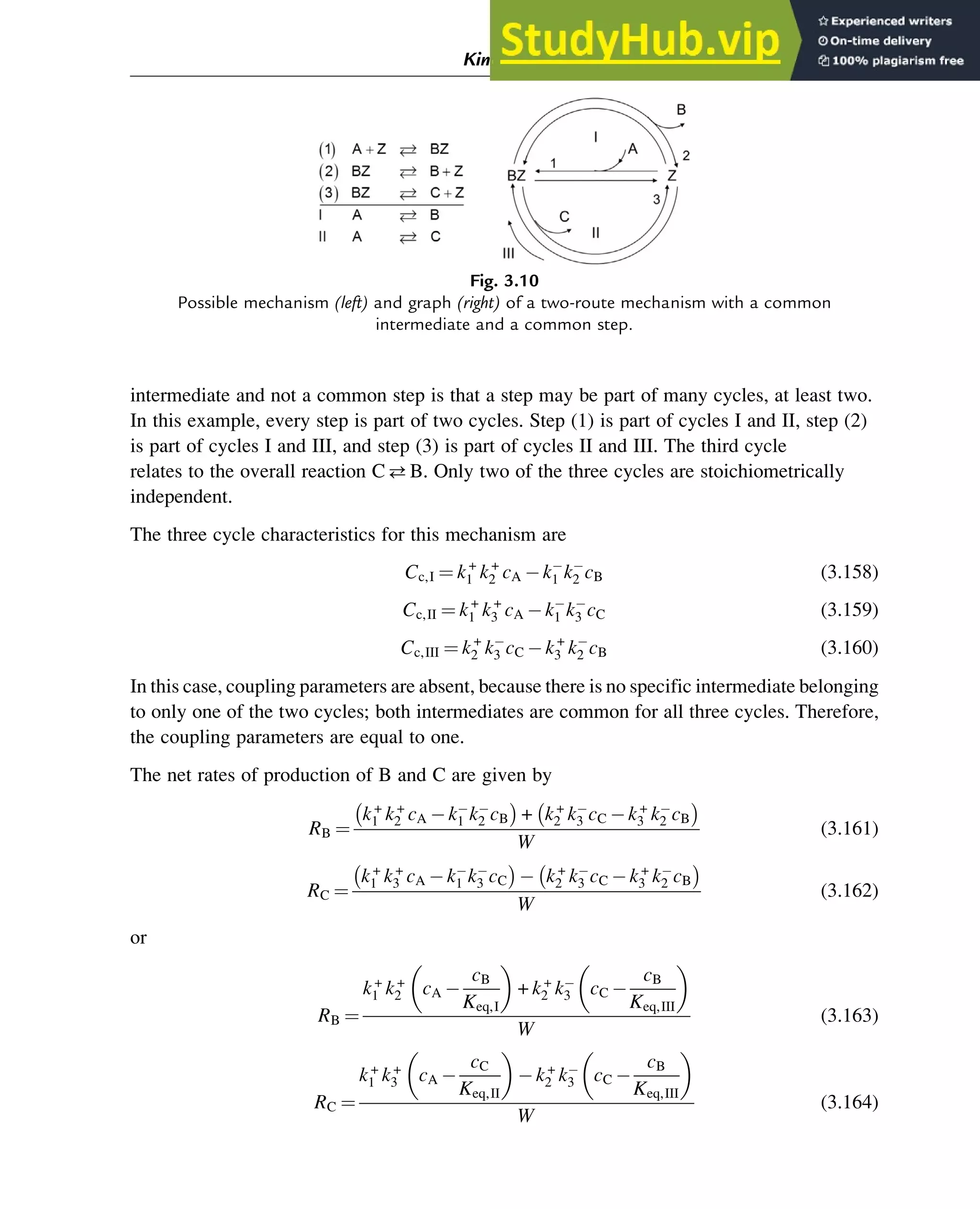
85, 329–397.
Constales, D., Yablonsky, G.S., Marin, G.B., 2013. Intersections and coincidences in chemical kinetics: linear two-
step reversible—irreversible reaction mechanism. Comput. Math. Appl. 65, 1614–1624.
Gleaves, J.T., Ebner, J.R., Kuechler, T.C., 1988. Temporal analysis of products (TAP)—a unique catalyst evaluation
system with submillisecond time resolution. Catal. Rev. Sci. Eng. 30, 49–116.
Gleaves, J.T., Yablonskii, G.S., Phanawadee, P., Schuurman, Y., 1997. TAP-2: an interrogative kinetics approach.
Appl. Catal. A 160, 55–88.
Gorban, A.N., Karlin, I.V., 2005. Invariant Manifolds for Physical and Chemical Kinetics. Springer, New York.
Gorban, A.N., Radulescu, O., 2008. Dynamic and static limitation in multiscale reaction networks, revisited.
In: Marin, G.B., West, D.H., Yablonsky, G.S. (Eds.), Advances in Chemical Engineering—Mathematics in
Chemical Engineering and Kinetics, vol. 34. Elsevier, London, pp. 103–173.
Gorban, A.N., Radulescu, O., Zinovyev, A.Y., 2010. Asymptotology of chemical reaction networks. Chem. Eng.
Sci. 65, 2310–2324.
Kozuch, S., Martin, J.M.L., 2011. The rate-determining step is dead. Long live the rate-determining state!
ChemPhysChem 12, 1413–1418.
Kruskal, M.D., 1963. Asymptotology. In: Dobrot, S. (Ed.), Mathematical Models in Physical Sciences. Prentice
Hall, Englewood Cliffs, NJ, pp. 17–48.
Kuo, J.C.W., Wei, J., 1969. Lumping analysis in monomolecular reaction systems. Analysis of approximately
lumpable system. Ind. Eng. Chem. Fundam. 8, 124–133.
Maas, U., Pope, S.B., 1992. Simplifying chemical kinetics: intrinsic low-dimensional manifolds in composition
space. Combust. Flame 88, 239–264.
Marin, G.B., Yablonsky, G.S., 2011. Kinetics of Chemical Reactions—Decoding Complexity. Wiley-VCH,
Weinheim, Germany.
Vasil’eva, A.B., Butuzov, V.F., 1973. Asymptotic Expansions of the Solutions of Singularly Perturbed Equations.
Nauka, Moscow.
Wei, J., Kuo, J.C.W., 1969. A lumping analysis in monomolecular reaction systems. Analysis of exactly lumpable
systems. Ind. Eng. Chem. Fundam. 8, 114–123.
Wei, J., Prater, C.D., 1962. The structure and analysis of complex reaction systems. In: Eley, D.D. (Ed.), Advances in
Catalysis. Academic Press, New York, pp. 203–392.
102 Chapter 4
Yablonskii, G.S., Bykov, V.I., Gorban, A.N., Elokhin, V.I., 1991. Kinetic models of catalytic reactions.
In: Comprehensive Chemical Kinetics. vol. 32. Elsevier, Amsterdam.
Yablonsky, G.S., Constales, D., Marin, G.B., 2010. Coincidences in chemical kinetics: surprising news about simple
reactions. Chem. Eng. Sci. 65, 2325–2332.
Yablonsky, G.S., Mareels, I.M.Y., Lazman, M., 2003. The principle of critical simplification in chemical kinetics.
Chem. Eng. Sci. 58, 4833–4842.
Physicochemical Principles of Simplification of Complex Models 103
CHAPTER 5
Physicochemical Devices and Reactors
5.1 Introduction
Diffusion has a history in science of more than one and a half century (Philibert, 2005, 2006).
Driven by the experimental observation of the German chemist Johann Döbereiner in 1823
that hydrogen gas diffuses faster than air, in the late 1820s and early 1830s the Scottish
chemist Thomas Graham performed a systematic study on diffusion in gases and found that the
rate of gas diffusion is inversely proportional to the square root of its molecular mass
(Sherwood et al., 1971). The following milestones of diffusion theory and experiment can be
distinguished:
• Fick’s laws of diffusion (Fick, 1855a,b, 1995)
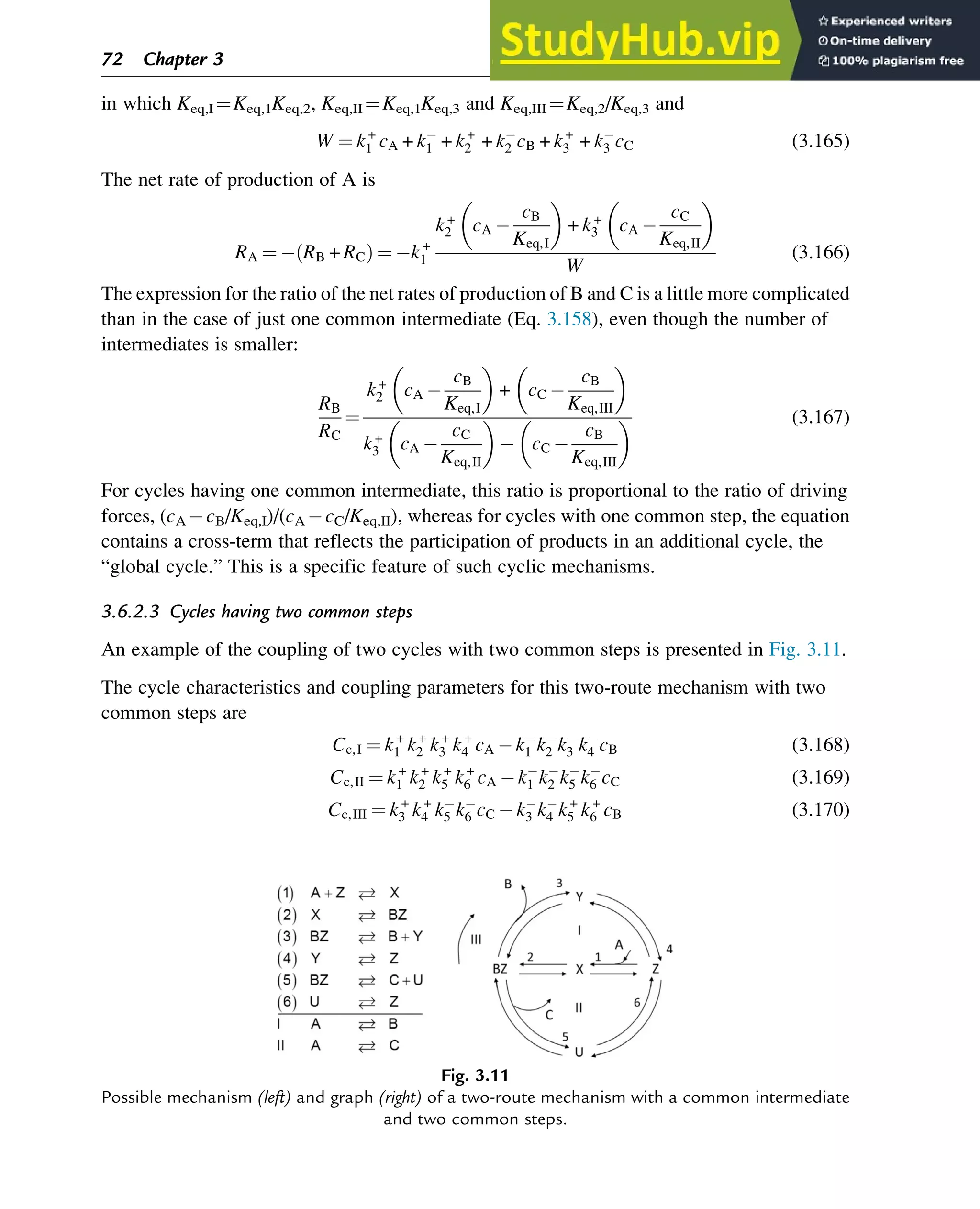
• Maxwell’s theory of diffusion in gases (1860s)
• Einstein’s theory of Brownian motion (Einstein, 1905)
• Knudsen diffusion in diluted gases discovered by Martin Knudsen (Knudsen, 1909, 1934;
Feres and Yablonsky, 2004)
• Onsager’s linear phenomenology with diffusion considered within the general context of
linear nonequilibrium thermodynamics (Onsager, 1931a,b)
• Teorell’s approach of the diffusion of ions through membranes (Teorell, 1935, 1937;
Gorban et al., 2011)
• Prigogine’s theory of “dissipative structures” generated by a combination of nonlinear
chemical reactions and diffusion processes (Glansdorff and Prigogine, 1971; Nicolis and
Prigogine, 1977)
In studies of heterogeneous systems, in particular those of gas-solid catalytic processes,
attention was particularly paid to the interplay between diffusion and reaction in porous catalyst
pellets. In 1939, Thiele introduced a dimensionless number, the Thiele modulus, to characterize
this complex diffusion-reaction process in a porous medium (Thiele, 1939). The Thiele
modulus quantifies the ratio of the reaction rate to the diffusion rate. Significant progress in the
fundamental understanding of diffusion and adsorption in zeolites was achieved due to
Kärger and Ruthven, whose book (Kärger and Ruthven, 1992) is considered by many to be
the best contribution to the field of zeolite science and technology.
Keil (1999) authored a comprehensive review of theoretical and experimental studies in the field
of heterogeneous catalysis. Excellent books and review articles devoted to mathematical
Advanced Data Analysis and Modelling in Chemical Engineering. http://dx.doi.org/10.1016/B978-0-444-59485-3.00005-9
# 2017 Elsevier B.V. All rights reserved.
105
diffusion and diffusion-reaction problems, in particular in porous media, have been published
(see, for example Aris, 1975a,b; Crank, 1980; Vasquez, 2006; Gorban et al., 2011).
Summing up, diffusion-reaction problems have been popular topics in physical chemistry and
in chemical and biochemical engineering for over one and a half century.
5.2 Basic Equations of Diffusion Systems
5.2.1 Fick’s Laws
The basic equation of diffusion is Fick’s first law. In accordance with this law, the diffusive
flux (for ideal mixtures) is proportional to the negative concentration gradient, in
multidimensional form:
J ¼ Dgrad c ¼ Drc (5.1)
where J is the diffusive flux vector, D is the diffusion coefficient, c is the concentration, and r
is the del or nabla operator, which in three dimensions (x, y, z) is expressed as
r ¼ @=@x,@=@y,@=@z
ð Þ. According to Fick’s second law, the time derivative of the
concentration is the negative of the flux divergence:
@c
@t
¼ divJ ¼ DΔc (5.2)
where the Laplace operator Δ ¼ r2
Interestingly, Fick introduced this law using an analogy with Fourier’s law for heat
transfer. So, Fick’s law for mass transfer was coined after Fourier’s law for heat transfer and
not before.
5.2.2 Einstein’s Mobility and Stokes Friction
Within Einstein’s microscopic theory of motion of diluted particles in liquid systems, the
diffusion coefficient is proportional to the absolute temperature:
D ¼ mkBT (5.3)
where kB ¼ Rg=NA is Boltzmann’s constant, with Rg the universal gas constant and NA
Avogadro’s number, T is the absolute temperature and m is the so-called particle mobility,
which equals the inverse of the Stokes friction coefficient f. The simplest case is a spherical
particle with radius rp in a Newtonian liquid with dynamic viscosity η:
m ¼
1
f
¼
1
6πrpη
(5.4)
106 Chapter 5
Eqs. (5.3) and (5.4) combined represent the Stokes-Einstein diffusion coefficient:
D ¼
kBT
6πrpη
(5.5)
Under a constant external force Fe, the velocity of the particle population equals mFe.
5.2.3 Knudsen Diffusion and Diffusion in Nonporous Solids
For gas-solid systems with a low gas density in which gas molecules diffuse through long
narrow pores, the mean free path of the molecules is much larger than the pore diameter. In this
type of diffusion, so-called Knudsen diffusion, the transport properties are essentially
determined by collisions of the gas molecules with the pore walls rather than by collisions
with other gas molecules. Based on the kinetic theory of gases, in the Knudsen approach
all rebounds are assumed to be governed by the cosine law of reflection. In a straight cylindrical
pore of diameter dpore, the Knudsen diffusion coefficient DK,i for component i with molecular
mass Mi is given by
DK,i ¼
dpore
3
ffiffiffiffiffiffiffiffiffiffiffi
8RgT
πMi
r
for
λ
dpore
 5 (5.6)
with λ the mean free path.
In solid bodies, the diffusion coefficient can be estimated using the Arrhenius dependence
(Dushman and Langmuir, 1922)
D ¼ D0 exp
Ea
RgT
 
(5.7)
with Ea the activation energy.
5.2.4 Onsager’s Approach
Within Onsager’s theory (1931a,b), for multicomponent diffusion the flux of the ith
component is given by the famous reciprocity relationship:
Ji ¼
X
j
LijXj (5.8)
where Lij (¼Lji) are the so-called phenomenological coefficients that are part of the Onsager
matrix L and Xj is the matrix of generalized thermodynamic forces (eg, a temperature,
pressure, or chemical potential gradient). For pure diffusion, the jth thermodynamic force is
the negative space gradient of the jth chemical potential μj, divided by the absolute temperature
T. In ideal systems
Physicochemical Devices and Reactors 107
μj ¼ RgT ln
cj
cj,eq
(5.9)
where cj,eq are equilibrium concentrations. Linearization near equilibrium yields
Xj ¼
1
T
grad μj ¼
Rg
cj,eq
grad cj (5.10)
so
Ji ¼
X
j
Lij
Rg
cj,eq
grad cj ¼
X
j
Lij
Rg
cj,eq
rcj (5.11)
and
@ci
@t
¼ divJi ¼ Rg
X
j
Lij
Δcj
cj,eq
(5.12)
Onsager’s approach, by definition, is valid in the vicinity of equilibrium, and deviations of
cj from cj,eq are assumed to be small. The symmetry of the Onsager matrix, Lij ¼ Lji,
follows from the principle of microreversibility (see the classical monograph by de Groot
and Mazur, 1962).
5.2.5 Teorell’s Approach
The mobility-based concept used by Einstein was further applied by Teorell (Teorell, 1935,
1937), who constructed a theory on the diffusion of ions through membranes in aqueous
solutions of univalent strong electrolytes (also see Gorban et al., 2011). Teorell assumed the
solutions to be ideal and homogeneous on both sides of the membrane. The essence of his
approach is captured in the following equation:
Flux ¼ mobility
ð Þ concentration
ð Þ forceperkilogramion
ð Þ (5.13)
The force consists of two parts: (i) a diffusion force caused by a concentration gradient and
(ii) an electrostatic force, caused by an electric potential gradient. With these two parts,
Teorell’s equation for the flux can be written as
J ¼ mc RgT
1
c
dc
dx
+ q
dφ
dx
 
(5.14)
where q is the charge and φ is the electric potential.
It sometimes is convenient to represent the diffusion part of the force in a different way, with ceq
as reference equilibrium concentration (Gorban et al., 2011):
RgT
1
c
dc
dx
¼ RgT
d ln
c
ceq
 
dx
(5.15)
108 Chapter 5
5.2.6 Nonlinear Diffusion Models
Gorban et al. (1980, 1986) proposed a model for surface diffusion of chemical species, which
was later extended by Gorban and Sargsyan (1986). Different versions of this approach have
been presented in the excellent paper by Gorban et al. (2011), in which an extended review is
combined with many original results on these topics:
• mass-action law of diffusion
• mass action cell-jump formalism
• continuous diffusion equation
• generalized mass-action law for diffusion (thermodynamic approach)
Conceptually, the nonlinear mass-action law for surface diffusion can be introduced as follows.
A system contains different surface species with concentrations Γ1,Γ2,…,ΓNint
. Empty sites
with concentration Γ0 are considered to be surface species as well. The sum of all surface
concentrations, including those of the empty sites, is assumed to be constant, that is, the total
amount of catalytic sites is conserved:
X
Nint
j¼0
Γj ¼ Γt ¼ constant (5.16)
In a jump model of the surface diffusion process, this process is considered to proceed by
jumplike substance exchange between different locations on the surface. Gorban et al. (1980)
used this model for modeling of the oxidation of carbon monoxide over a platinum catalyst.
One step of this reaction involves the reversible exchange of an adsorbed carbon monoxide
molecule with the neighboring empty site:
PtCO + Pt  Pt + PtCO (5.17)
For the diffusive flux of species Aj (j¼1, …, Nint), the jump model gives
Jj ¼ Dj zrΓj Γjrz
 
(5.18)
Consequently, the corresponding diffusion equation is
@Γj
@t
¼ divJj ¼ Dj zrΓj Γjrz
 
(5.19)
As a result of the conservation law for the active catalyst sites, the concentration of empty
catalyst sites is equal to
Γ0 ¼ Γt
X
Nint
j¼1
Γj (5.20)
Physicochemical Devices and Reactors 109
and the system of Nint diffusion equations can be presented as
Jj ¼ Dj Γt
X
Nint
j¼1
Γj
!
rΓj + Γjr
X
Nint
j¼1
Γj
!
 #
(5.21)
@Γj
@t
¼ Dj Γt
X
Nint
j¼1
Γj
!
ΔΓj + ΓjΔ
X
Nint
j¼1
Γj
!
 #
(5.22)
This system can be generalized under the assumption that all surface species can be
exchanged with their closest neighbors by jump processes:
Jj ¼
X
k
Djk ΓkrΓj ΓjrΓk
 
(5.23)
@Γj
@t
¼
X
k
Djk ΓkrΓj ΓjrΓk
 
(5.24)
5.3 Temporal Analysis of Products Reactor: A Basic Reactor-Diffusion
System
5.3.1 Introduction
The temporal analysis of products (TAP) reactor is an experimental device for the systematic study
of gas-solid diffusion-reaction systems. The TAP reactor can serve various purposes, such as
• precise characterization of diffusion properties and activity of solid materials.
• determination of the mechanism of gas-solid reactions over solid material, in particular
the mechanism of heterogeneous catalytic reactions.
• formulation of recommendations on improved design of active materials and modification
of operating regimes of industrial reactors.
The TAP reactor was created by John T. Gleaves in 1988 (Gleaves et al., 1988) and later
modified (Gleaves et al., 1997). The TAP reactor has found a variety of applications in
many areas of chemical kinetics and chemical engineering. The first 20 years of TAP
application has been reflected by the special review of “Catalysis Today” (Kondratenko and
Perez-Ramı́rez, 2007) and three other reviews (Berger et al., 2008; Gleaves et al., 2010;
Yablonsky et al., 2005).
5.3.2 Typical TAP Reactor Configurations
Fig. 5.1 shows a typical TAP reactor system. It can be used for performing a battery of kinetic
experiments, both transient and steady state, in a wide range of pressures (from 10 7
to
250 kPa) and temperatures (from 200 to 1200 K).
110 Chapter 5
However, the specific features of the TAP system are demonstrated in pulse-response
experiments under vacuum conditions in the Knudsen-diffusion regime, in which the diffusion
process is well defined. This means that—unlike the molecular diffusion coefficient—the
Knudsen diffusion coefficient does not depend on the composition of the gas mixture.
The diffusivity then is calculated as
Deff,i ¼
εb
τb
DK,i ¼
dpore
3
ffiffiffiffiffiffiffiffiffiffiffi
8RgT
πMi
r
(5.25)
with
dpore ¼
2
3
εb
1 εb
ð Þ
dp (5.26)
where Deff is the effective diffusion coefficient of the gas, εb is the bed voidage, τb is the
tortuosity of the bed, and dp is the diameter of the catalyst pellet.
Pulse intensities in vacuum experiments range from 1013
to 1017
molecules per pulse with a
pulse width of 250 μs and a pulse frequency of between 0.1 and 50 pulses per second. Such a
spectrum of time resolution is unique among kinetic methods. Possible experiments include
high-speed pulsing, both single-pulse and multipulse response, steady-state isotopic
transient kinetic analysis (SSITKA), temperature-programmed desorption (TPD), and
temperature-programmed reaction (TPR).
Fig. 5.1
Schematic of a TAP reactor coupled to a time-of-flight mass spectrometer. Reprinted from Gleaves, J. T.,
Yablonsky, G., Zheng, X., Fushimi, R., Mills, P.L., 2010. Temporal analysis of products (TAP)—recent advances
in technology for kinetic analysis of multi-component catalysts. J. Mol. Catal. A: Chem. 315, 108–134,
Copyright (2010), with permission from Elsevier.
Physicochemical Devices and Reactors 111
5.3.2.1 Three-zone TAP reactor
The most common TAP microreactor is the three-zone TAP reactor (Fig. 5.2). In this
reactor the active catalyst zone is sandwiched between two inert zones, which consist of
packed beds of inert particles, typically quartz.
In the three-zone TAP reactor, it is difficult to maintain a uniform profile of the catalyst surface
composition because of the gas concentration gradient, which is the driving force for the
diffusion transport in the reactor. This nonuniformity of the catalyst surface composition
becomes significant particularly in multipulse experiments.
5.3.2.2 Thin-zone TAP reactor
The thin-zone TAP reactor (TZTR) configuration (Fig. 5.3) was a proposal by Shekhtman et al.
(1999). In a TZTR, the thickness of the catalyst zone is made very small compared to the
total length of the reactor. Thus, the change of the gas concentration across the thin catalyst zone is
Diffusion zone I Diffusion zone II
Catalyst zone
Lin
Lcat
Fig. 5.3
Thin-zone TAP reactor. Reprinted from Shekhtman, S.O., Yablonsky, G.S., Chen, S., Gleaves, J.T., 1999.
Thin-zone TAP-reactor—theory and application. Chem. Eng. Sci. 54, 4371–4378, Copyright (1999), with
permission from Elsevier.
Fig. 5.2
Three-zone TAP reactor with quadrupole mass spectrometer; Lzone 1 ¼Lzone 2 ¼Lzone 3. Reprinted from
Shekhtman, S.O., Yablonsky, G.S., Chen, S., Gleaves, J.T., 1999. Thin-zone TAP-reactor—theory and application.
Chem. Eng. Sci. 54, 4371–4378, Copyright (1999), with permission from Elsevier.
112 Chapter 5
negligible and the catalyst composition can be considered to be uniform. In the thin-zone TAP
approach, it is possible to separate chemical reaction from the well-defined Knudsen-diffusion
process. Another advantage of the TZTR is that the catalyst zone can be more easily maintained at
isothermal conditions than the catalyst zone in the conventional three-zone TAP reactor.
5.3.2.3 Single-particle TAP reactor
Zheng et al. (2008) reported results of atmospheric and vacuum pulse-response experiments
on the catalytic oxidation of carbon monoxide. The catalyst sample used was a single
polycrystalline platinum particle with a diameter of 400 μm, which was placed in a microreactor
bed containing about 100,000 inert particles with diameters between 210 and 250 μm (Fig. 5.4).
Fig. 5.4
(A) Schematic of TAP single-particle microreactor configuration. A Pt particle with a diameter of
400 μm is located in a sea of inert quartz particles with diameters between 210 and 250 μm; (B) image
comparing a 400 μm Pt particle to a pencil point; (C) SEM image showing the complex surface
structure of a polycrystalline Pt particle; (D) Larger magnification (15,000) of the particle shown
in (C), which demonstrates that the surface is nonporous. Reprinted from Zheng, X., Gleaves, J.T.,
Yablonsky, G.S., Brownscombe, T., Gaffney, A., Clark, M., Han, S., 2008. Needle in a haystack catalysis. Appl.
Catal. A 341, 86–92, Copyright (2008), with permission from Elsevier.
Physicochemical Devices and Reactors 113
This TAP single-particle microreactor is a further modification of the TZTR. The particle
occupies less than 0.3% of the cross-sectional area of the TAP reactor, so the catalyst zone can be
considered as a point source. Temperature and/or concentration gradients across the catalyst zone
can be assumed to be negligible. Nevertheless, the conversion achieved in this single-particle
microreactor is high because of the nature of the diffusion-reaction process.
5.3.3 Main Principles of TAP
The three main principles of TAP are
• well-defined Knudsen diffusion as a measuring stick for the characterization of chemical
activity.
• insignificant change of the solid material during a single-pulse experiment and controlled
change during a series of pulses.
• uniformity of the surface composition of the solid material across the active zone.
The first and second principles were formulated early on, in the pioneering paper by Gleaves
et al. (1988) and further developed by Shekhtman et al. (1999). As mentioned, in TAP
experiments, transport occurs in a well-defined diffusion regime, known as the Knudsen
regime, the characteristics of which are independent of the gas composition. Such diffusion
transport serves as a measuring stick for extracting kinetic information. During a pulse
experiment, in the Knudsen regime a typical pulse contains 1013
molecules or approximately
10 10
mol. As an example, with a catalyst sample having a surface area of 104
m2
kg 1
, a single
pulse would address only 1/106
part of the total surface of 10 4
kg sample. If the active
surface area is a realistic fraction (say, more than 0.1%) of the total surface area, a single
pulse will have a negligible effect on the active catalyst surface. Whenever the number of
reactant molecules is significantly smaller than the number of active catalyst sites, the catalytic
system is in nearly the same state before and after the experiment. This type of experiment
performed in the TAP reactor is referred to as a state-defining experiment (SDE).
For distinguishing a SDE, the following experimental criteria can be used:
• insignificant change in the pulse response of a reactant or product during a series of pulses
• independence of the shape of a pulse-response curve on the pulse intensity
The first criterion implies that the reactivity of the catalyst surface does not change from pulse
to pulse. This criterion can be applied to an irreversible process such as the reduction of a
metal oxide catalyst by a hydrocarbon. The second criterion implies that the number of
molecules in the input pulse is sufficiently small for a minor change of this number not to
influence the shape of the exit flow response.
SDEs provide kinetic parameters corresponding to a given catalyst state. For example, in the
case of the irreversible transformation of a hydrocarbon on a metal oxide catalyst, the
114 Chapter 5
corresponding kinetic coefficient depends on the state of the metal oxide surface and, in
particular, on its oxidation state.
In a state-altering experiment (SAE), a multipulse procedure is performed. A large number
of pulses are injected and the reactant and product responses are monitored. By performing
TAP multipulse experiments, the interaction of a gas component with the surface at different
catalyst compositions can be studied. State-defining and state-altering experiments can be
performed in sequence. In this so-called interrogative cycle, a given catalyst state is probed
using SDEs involving different gas molecules. Next, a SAE is performed, resulting in a new
catalyst state. This state is probed again by different types of gas molecules in SDEs. The
goal of this procedure, for which Gleaves et al. (1997) coined the term “interrogative kinetics,”
is to systematically probe a variety of different catalyst states and to understand how one state
evolves into another.
The third basic principle of TAP, that of uniformity of the surface composition across the
active zone, proposed by Shekhtman et al. (1999), has to be considered an absolute
necessity in TAP studies because kinetic information corresponding to a certain catalyst
composition cannot be obtained directly if nonuniform catalyst states are probed.
We consider the TAP reactor as a basic kinetic device for systematic studies of reaction-diffusion
systems. In this chapter, we are going to (i) present and analyze models of different TAP
configurations with a focus on their possibilities with respect to characterizing active materials
and unraveling complex mechanisms, and (ii) demonstrate relationships between TAP models
and other basic reactor models, that is, models for the ideal continuous stirred-tank reactor
(CSTR), batch reactor (BR) and plug-flow reactor (PFR). In some situations, the TZTR can be
considered a simple building block for constructing the various models.
5.4 TAP Modeling on the Laplace and Time Domain: Theory
5.4.1 The Laplace Transform
The first step in the successful analysis of TAP experiments is to abstract from the
detailed physical model to obtain a practical equivalent mathematical formulation
including only the apparent physical parameters.
For the one-dimensional model this amounts to
εb
@c
@t
¼ Deff
@2
c
@x2
kac (5.27)
Now we are facing the difficulty that this partial differential equation (PDE) is imposed on
continuous domains in time and space, in fact on t0 (all positive values of time) and on
0xL (all x coordinates inside a zone of constant apparent εb,Deff and ka in the reactor). Note
Physicochemical Devices and Reactors 115
that we exclude the boundary values t¼0, x¼0, and x¼L from these domains because the
derivatives @=@t and @2
=@x2
are only directly defined for interior points.
Our task is now to reduce this differential equation to mathematical structures that can
be expressed finitely. Two steps are required for this: (i) reducing the time dependence to
the Laplace domain and (ii) integrating the relation expressed in x over the domain 0xL.
The switch to the Laplace domain is realized as follows: when f is a function of at most
exponential growth, so
f t
ð Þ
j j  C1 exp C2t
ð Þ for t  t0 (5.28)
with C1 and C2 real values and f a continuous function at least on separate intervals, the
Laplace transform L{f} is defined through the integral equation
L f
f g s
ð Þ ¼
ð + 1
0
e st
f t
ð Þdt (5.29)
where s denotes the Laplace variable, a value in the complex plane. From the assumed estimate,
Eq. (5.28), of jf(t)j in terms of an exponential, it can be shown that L{f} is an analytical
function of s defined at least over the half-plane Re(s)C2.
The Laplace transform is an exceptionally useful computational technique because the
equivalents of calculus operations in the Laplace domain are straightforward algebraic ones.
5.4.2 Key Results
The first key result in the present case is that the Laplace transform of a derivative with respect
to t is readily expressed in terms of L{f}, namely
L f0
f g ¼ sL f
f g f 0
ð Þ (5.30)
as follows directly from applying the definition, Eq. (5.28), and integrating by parts:
ð + 1
0
e st
f0
t
ð Þdt ¼ e st
f t
ð Þj
+ 1
0
ð + 1
0
e st
ð Þ
0
f t
ð Þdt
¼ 0 f 0
ð Þ + s
ð + 1
0
e st
f t
ð Þdt ¼ sL f
f g f 0
ð Þ
(5.31)
This allows us to get rid of the time derivative @=@t on the left-hand side of Eq. (5.27). The term
@2
=@x2
is not affected by the Laplace transform in t, so that
L
@2
f
@x2
 
¼
@2
@x2
L f
f g (5.32)
The second key result is that the Laplace transform uniquely simplifies accounting for different
solicitations of a linear system over time. If the response of a system L f
f g ¼ g to g(t) is f(t)
116 Chapter 5
and the system is autonomous, it will respond to g t τ
ð Þ by f t τ
ð Þ when a time shift occurs.1
Consequently, if we know the response f0(t) to a Dirac delta solicitation L f0
f g ¼ δ t
ð Þ, and
writing g(t) as a superposition of Dirac delta expressions:
g t
ð Þ ¼
ð + 1
0
g τ
ð Þδ t τ
ð Þdτ (5.33)
the solution f to L f
f g ¼ g is given by
f t
ð Þ ¼
ð + 1
0
g τ
ð Þf0 t τ
ð Þdτ (5.34)
as a result of linearity. This expression is so useful in practice that it is studied in its own right.
It is called the convolution product of g and f0, g*f0. Note that since both factors in the
convolution product are assumed to be causal, the integral can also be written as
ð + 1
1
⋯ or
ðt
0
⋯
without affecting its value. Calculating such convolution integrals might seem arduous but
luckily the Laplace transform simplifies this considerably. If we write the definition
of L{f*g} as
L f*g
f g ¼
ð + 1
0
e st
f*g
ð Þ t
ð Þdt ¼
ð + 1
1
e st
f*g
ð Þ t
ð Þdt ¼
ð + 1
1
e st
ð + 1
1
f τ
ð Þg t τ
ð Þdτdt (5.35)
and exchange the order of integrals while reworking e st
¼ e sτ
e s t τ
ð Þ
, then Eq. (5.35)
simplifies to
L f*g
f g ¼
ð + 1
1
e sτ
f τ
ð Þdτ
ð + 1
1
e su
g u
ð Þdu ¼ L f
f g
ð Þ L g
f g
ð Þ (5.36)
that is, the Laplace transform of a (complicated) convolution is a (simple) product. This also
means that systems of linear equations with convolution products, which would be difficult
to analyze in the time domain, transform to systems of linear equations including ordinary
products, for which the many resources of linear algebra are readily available.
We now apply these results to the problem at hand. After Laplace transformation with
respect to t, the PDE becomes
εb sL c
f g
ð Þ 0 ¼ Deff
@2
L c
f g
@x2
kaL c
f g (5.37)
in which only derivatives with respect to the variable x remain, so that this is actually an
ordinary differential equation (ODE). Furthermore, this ODE is linear with constant
coefficients and homogeneous: from a basic analysis we know that its solutions can be written
1
Note that all functions considered here are supposed to be causal, that is, their values vanish for all t0.
Physicochemical Devices and Reactors 117
as linear combinations of exponential terms exp(λx) where λ 2 ℂ must be chosen such that
both sides of Eq. (5.36) are identical. Substitution leads to the characteristic equation
εbs ¼ Deffλ2
ka (5.38)
with roots
λ ¼ 
ffiffiffiffiffiffiffiffiffiffiffiffiffiffi
ffi
εbs + ka
Deff
r
(5.39)
In general, s is allowed to be any complex value of sufficiently large real part for the defining
integral of the Laplace transform to exist. In practice, however, due to the properties of
analytic functions of complex variables, one can always assume that s is actually real, and large
positive. All results obtained under these assumptions are guaranteed to be valid generally
for all s in a right complex half-plane, but in cases such as these the positivity assumption brings
the benefit that the square root in Eq. (5.39) need not be specified for nonreal or negative
values of its argument. Similarly, although for εbs ¼ ka there is a complication due to the
coincidence of the two characteristic roots (since then λ+ ¼ λ ¼ 0), this case does not require
further analysis.
Summarizing, the general solution of Eq. (5.37) can be expressed as
L c
f g ¼ C1 exp x
ffiffiffiffiffiffiffiffiffiffiffiffiffiffi
ffi
εbs + ka
Deff
r
 
+ C2 exp x
ffiffiffiffiffiffiffiffiffiffiffiffiffiffi
ffi
εbs + ka
Deff
r
 
(5.40)
where C1 and C2 are constants for x (but typically will depend on s and other parameters). This
establishes the general framework within which the actual solution will necessarily fit.
To obtain results that are generally valid and can be used as computational building blocks
for models with an arbitrary composition of zones, we now turn to the special boundary
condition that expresses the physical contact between successive zones in the reactor (see
Fig. 5.5). These contact or interface conditions are to be determined from a combination of
physical insight and experimental results.
Fig. 5.5
Schematic of a five-zone TAP reactor. Each zone has its own length Li
and parameters εb,i,ka,i and Deff,i.
118 Chapter 5
The first condition is that there is no jump in concentration, that is, c x 0
ð Þ ¼ c x + 0
ð Þ
everywhere, specifically at x values where two neighboring zones touch.
The second condition is similar, but applies to the diffusive flux, which is given by
J ¼ Deff
@c
@x
(5.41)
so J x 0
ð Þ ¼ J x + 0
ð Þ everywhere, specifically at x values where two neighboring zones touch. At
these points, however, Deff need not be equal on both sides. For instance, in the schematic of
Fig.5.5thereis noreason why Deff,1 shouldequalDeff,2 or why Deff,2 shouldequalDeff,3, and so on;
each zone may consist of a different material with unique properties. Consequently, the equality
Deff,i
@c
@x
 
left
¼ Deff,i 1
@c
@x
 
right
(5.42)
entails that the derivative @c=@x will show a jump at the interfaces between the zones.
Taking fully into account these jumps in material characteristics in a multizone model in the
time domain is a pain; again the Laplace transform comes to the rescue and delivers
computational elegance. In order to clarify this, we briefly return to our solution in the Laplace
domain for a single zone, and express the concentration and flux values to the left of this zone in
terms of the values to its right. The linearity of the equations guarantees that one can write
L c
f g
L J
f g left
¼
M11 M12
M21 M22
L c
f g
L J
f g right
(5.43)
for certain matrix entries Mij. In particular,
M11
M21
¼
L c
f g
L J
f g left
when
L c
f g
L J
f g right
¼
1
0
(5.44)
Expressing this in the general solution gives
L c
f g ¼ cosh L
ffiffiffiffiffiffiffiffiffiffiffiffiffiffi
ffi
εbs + ka
Deff
r
 
(5.45)
and
L J
f g ¼
ffiffiffiffiffiffiffiffiffiffiffiffiffiffiffiffiffiffiffiffiffiffiffiffiffiffi
εbs + ka
ð ÞDeff
p
sinh L
ffiffiffiffiffiffiffiffiffiffiffiffiffiffi
ffi
εbs + ka
Deff
r
 
(5.46)
Similarly,
M12
M22
¼
L c
f g
L J
f g left
when
L c
f g
L J
f g right
¼
0
1
(5.47)
Physicochemical Devices and Reactors 119
which from the general solution leads to
L c
f g ¼
sinh L
ffiffiffiffiffiffiffiffiffiffiffiffiffiffi
ffi
εbs + ka
Deff
r
 
ffiffiffiffiffiffiffiffiffiffiffiffiffiffiffiffiffiffiffiffiffiffiffiffiffiffi
εbs + ka
ð ÞDeff
p (5.48)
and
L J
f g ¼ cosh L
ffiffiffiffiffiffiffiffiffiffiffiffiffiffi
ffi
εbs + ka
Deff
r
 
(5.49)
Written in more compact form, in the Laplace domain a zone corresponds to a matrix equation
L c
f g
L J
f g left
¼ M s, εb, ka, Deff, L
ð Þ
L c
f g
L J
f g right
(5.50)
where the zone transfer matrix M is given by
M ¼
cosh u
sinh u
w
wsinh u cosh u
2
4
3
5; u ¼ L
ffiffiffiffiffiffiffiffiffiffiffiffiffi
εb + ka
Deff
r
; w ¼
ffiffiffiffiffiffiffiffiffiffiffiffiffiffiffiffiffiffiffiffiffiffiffiffi
εb + ka
ð ÞDeff
p
(5.51)
Notice that the determinant of M, det M¼1 as cosh2
u sinh2
u ¼ 1.
If, for instance, a TAP reactor consists of two adjacent zones, combining the zone transfer
matrices leads to
L c
f g
L J
f g inlet
¼ M1 s1, εb,1, ka,1, Deff,1, L1
ð ÞM2 s2, εb,2, ka,2, Deff,2, L2
ð Þ
|fflfflfflfflfflfflfflfflfflfflfflfflfflfflfflfflfflfflfflfflfflfflfflfflfflfflfflfflfflfflfflfflfflfflfflfflfflfflfflfflfflfflfflfflfflfflffl{zfflfflfflfflfflfflfflfflfflfflfflfflfflfflfflfflfflfflfflfflfflfflfflfflfflfflfflfflfflfflfflfflfflfflfflfflfflfflfflfflfflfflfflfflfflfflffl}
global transfer matrix
L c
f g
L J
f g outlet
(5.52)
so that the global transfer matrix, linking the inlet and outlet concentration and flux values,
is the product of these zone transfer matrices, ordered left to right, M1Μ2. If the reactor consists
of three zones, the global transfer matrix is given by M1M2M3, etc. In general, we will express
the global transfer matrix in terms of its elements as
M ¼
P11 P12
P21 P22
(5.53)
Nowthisglobaltransfermatrixcanbeusedtoexpresstheboundaryconditionsattheinletandoutlet
of the reactor. We assume that at t¼0 at the inlet a sharp pulse of gas is injected into the system.
Physically this means that Jinlet t
ð Þ ¼ δ t 0+
ð Þ. We also assume that the vacuum at the outlet is
perfect, that is, coutlet t
ð Þ ¼ 0. Our interest lies with the outlet flux, Joutlet, which is observed
experimentally. In the Laplace domain, keeping only the second equation in the matrix system
yields
120 Chapter 5
L Jinlet
f g ¼ P21L coutlet
f g
|fflfflfflfflffl{zfflfflfflfflffl}
¼0
+ P22L Joutlet
f g (5.54)
so that
L Joutlet
f g ¼
1
P22
(5.55)
which is the fundamental result of TAP reactor theory. It means that to completely analyze
a multizone reactor setup in the Laplace domain, it suffices to form the zone transfer
matrices, to multiply these matrices to obtain the global transfer matrix, and then take the
value of the P22 component in the result.
5.5 TAP Modeling on the Laplace and Time Domain: Examples
5.5.1 Moment Definitions
Moments are experimental characteristics of the outlet flux that can readily be obtained in
closed form from their Laplace transforms. Since L f
f g s
ð Þ ¼
ð + 1
0
e st
f t
ð Þdt (Eq. 5.29),
the so-called zeroth moment is
M0 ¼ L f
f g 0
ð Þ ¼
ð + 1
0
f t
ð Þdt (5.56)
the first moment is
M1 ¼
@L
@s
f
f g 0
ð Þ ¼
ð + 1
0
tf t
ð Þdt (5.57)
and so on. The nth moment is
Mn ¼ 1
ð Þn @n
L
@sn
f
f g 0
ð Þ ¼
ð + 1
0
tn
f t
ð Þdt (5.58)
5.5.2 One-Zone Reactor, Diffusion Only
For a one-zone TAP reactor with diffusion only, the global transfer matrix can be written as
(with symbol * for complicated irrelevant entries)
M ¼
P11 P12
P21 P22
¼
 
 cosh L
ffiffiffiffiffiffiffiffi
εbs
Deff
r
 
2
6
4
3
7
5 (5.59)
Physicochemical Devices and Reactors 121
so
L Joutlet
f g ¼
1
cosh L
ffiffiffiffiffiffiffiffi
εbs
Deff
r
  (5.60)
In this case, the zeroth moment is M0 ¼ 1 (all molecules pulsed in also leave the reactor since there
is no reaction, ka ¼ 0) and M1 ¼
L2
εb
2Deff
. The average residence time, which is given by M1/M0,
therefore equals
1
2
εbL2
Deff
, a typical characteristic time for a diffusion process taking place with
diffusivity Deff over a length L. The Laplace transform L{Joutlet} therefore is a generating function
for the moments of the outlet time distribution. It also coincides with the so-called characteristic
function of the distribution if we set s ¼ iω, ωinℝ. An alternative interpretation does not
consider L{Joutlet} but its natural logarithm: in general we know from statistics that near s ¼ 0,
ln L Joutlet
f g ¼ ln M0
s
1!
C1 +
s2
2!
C2
s3
3!
C3 + ⋯ (5.61)
where the coefficients Ci are the so-called cumulants of the distribution: C1 is the average,
M1/M0, C2 the variance, M2=M0 M1=M0
ð Þ2
, C3 a skewness, and so on. These cumulants help
describe the outlet flux as a distribution of particle “escape times.” Note that all moments and
cumulants can be obtained exactly from the specifications of the reactor and the computation of
the global transfer matrix described in Section 5.4. No discretization in time or space is
involved; the results are mathematically exact.
The results in the Laplace domain can also be used to obtain results in the time domain. To this
end, we first note that setting s ¼ iω, with ω the Fourier frequency, in the Laplace transform
definition yields
L f
f g iω
ð Þ ¼
ð + 1
0
e iωt
f t
ð Þdt ¼
ð + 1
1
e iωt
f t
ð Þdt ¼ F f
f g ω
ð Þ (5.62)
(the second step relying on the causal nature of f), so that the Fourier transform of f is readily
obtained by this substitution. Now a very fast and robust numerical algorithm, aptly called
the Fast Fourier Transform, is available for computing from a suitable sample of F{f}(ω)
values a corresponding set of f(tk) values in time.
A further method to return from the Laplace domain to the time domain is based on a
special type of series expansion; in the present case expanding
1
cosh x
¼
X
+ 1
n¼0
1
ð Þn
2n + 1
ð Þπ
x2 + n + 1
2
 2
π2
(5.63)
for x ¼ L
ffiffiffiffiffiffiffiffi
εbs
Deff
r
leads to
122 Chapter 5
L Joutlet
f g ¼
X
+ 1
n¼0
1
ð Þn
2n + 1
ð Þπ
L2
εb
Deff
s + n + 1
2
 2
π2
(5.64)
Since
L exp
n +
1
2
 2
π2
Deff
L2εb
t
0
B
B
B
@
1
C
C
C
A
8


:
9


=


;
¼
1
s +
n + 1
2
 2
π2
Deff
L2εb
(5.65)
it follows from Eq. (5.64) that
Joutlet ¼
πDeff
L2εb
X
+ 1
n¼0
1
ð Þn
2n + 1
ð Þexp
n +
1
2
 2
π2
Deff
L2εb
t
0
B
B
B
@
1
C
C
C
A
(5.66)
where the argument to the exponential function rapidly becomes very negative with increasing
n. In this case, a different expansion yields
1
cosh x
¼
2
ex + e x
¼ 2 e x
e 3x
+ e 5x
e 7x
+ ⋯
 
(5.67)
so that
Joutlet ¼ L
ffiffiffiffiffiffiffiffiffiffiffiffiffiffi
εb
πDefft3
r X
+ 1
n¼0
1
ð Þn
2n + 1
ð Þexp
L2
εb n +
1
2
 2
Defft
0
B
B
B
@
1
C
C
C
A
(5.68)
5.5.3 One-Zone Reactor, Irreversible Adsorption
In the case of irreversible adsorption, the only difference from the diffusion-only case is that
εbs + ka replaces εbs in the expressions, that is, s must be replaced with s + ka=εb. Consequently,
Joutlet
ð Þka6¼0 ¼ e
ka
εb
t
Joutlet
ð Þka¼0 (5.69)
and the expressions in the time domain follow at once.
When the moments are concerned, M0 no longer equals 1 but becomes
Physicochemical Devices and Reactors 123
M0 ¼
1
cosh L
ffiffiffiffiffiffiffiffi
ka
Deff
r
   1 (5.70)
meaning that only part of the injected gas leaves the reactor without being adsorbed. The
conversion then equals 1 M0 and increases with increasing ka. Often a new dimensionless
quantity φ ¼ L
ffiffiffiffiffiffiffiffi
ka
Deff
r
is introduced to restrain the size of the expressions. The average residence
time of gas molecules leaving the reactor is then given by
M1
M0
¼
tanh φ
φ
|fflfflffl{zfflfflffl}
reaction

εbL2
2Deff
|ffl{zffl}
diffusion
(5.71)
and is always smaller than the pure diffusion time: the molecules that escape are faster on
average and thereby avoid adsorption.
5.5.4 One-Zone Reactor, Reversible Adsorption
The case of reversible adsorption has not yet been considered, but the flexibility of the analysis
in the Laplace domain will allow us to reduce the problem to a known case as follows.
The original PDE (Eq. 5.27) now includes a desorption term:
εb
@c
@t
¼ Deff
@2
c
@x2
kac + kdccatθ (5.72)
where θ(x,t) is the so-called fractional surface coverage of adsorbed species. This coverage
satisfies a differential equation of its own:
@θ
@t
¼
ka
ccat
c kdθ (5.73)
The resulting set of equations may be solved in the time domain by setting
c ¼
ccat
ka
@θ
@t
+ kdθ
 
(5.74)
and substitution in Eq. (5.72), but this would give rise to awkward terms of the form @θ3
=@x2
@t
in the final equation. We observe, however, that in the Laplace domain the equation for θ is
readily solved (assuming initial zero coverage):
s L θ
f g 0
ð Þ ¼
ka
ccat
L c
f g kdL θ
f g (5.75)
124 Chapter 5
so
L θ
f g ¼
ka
ccat s + kd
ð Þ
L c
f g (5.76)
Substituting Eq. (5.76) in the Laplace-transformed PDE for c yields
εb sL c
f g 0
ð Þ ¼ Deff
@2
L c
f g
@x2
ka
kakd
s + kd
 
L c
f g
¼ Deff
@2
L c
f g
@x2
ska
s + kd
L c
f g
(5.77)
Thus, ka merely has to be replaced with the expression
ska
s + kd
throughout, which for kd ¼ 0
clearly simplifies properly to ka. The interface and boundary conditions only involve the
diffusional parameter Deff and are independent of ka. Consequently, the zone transfer matrix is
still of the form
M ¼
cosh u
sinh u
w
wsinh u cosh u
0
@
1
A (5.78)
but now the more general expressions
u ¼ L
ffiffiffiffiffiffiffiffiffiffiffiffiffiffiffiffiffiffiffiffiffiffiffiffiffiffiffiffiffiffiffiffiffi
εbs + kas= s + kd
ð Þ
Deff
s
(5.79)
and
w ¼
ffiffiffiffiffiffiffiffiffiffiffiffiffiffiffiffiffiffiffiffiffiffiffiffiffiffiffiffiffiffiffiffiffiffiffiffiffiffiffiffiffiffiffiffi
εbs + ska= s + kd
ð Þ
ð ÞDeff
p
(5.80)
apply instead.
The essential value L{Joutlet} is still given by 1/P22, so that for a single-zone reactor with
reversible adsorption
L Joutlet
f g ¼
1
cosh L
ffiffiffiffiffiffiffiffiffiffiffiffiffiffiffiffiffiffiffiffiffiffiffiffiffiffiffiffiffiffiffiffiffi
εbs + ska= s + kd
ð Þ
Deff
r
  (5.81)
where M0 ¼ 1 (all gas molecules eventually escape from a reactor in which a reversible reaction
takes place) and the average residence time is
M1
M0
¼
1
2
L2
Deff
εb +
ka
kd
 
(5.82)
Physicochemical Devices and Reactors 125
The average residence time is the sum of the diffusional value and a reversible reaction
time component of retardation. The results in the time domain are no longer obtainable from
a simple shift in s; the roots of the denominator follow from a quadratic equation in s (see
Gleaves et al., 1988 for details). The Fast Fourier technique remains though.
5.5.5 Three-Zone Reactor
Multiplying the three zone transfer matrices for P22 yields an expression that includes the
sum of four products of hyperbolic functions, which is a little long but is easily obtained
exactly using computer algebra. In a three-zone reactor, the middle zone typically is the
only reactive zone. In the reversible case, M0 ¼ 1 as always and
M1
M0
¼
1
2
εb,1L2
1
Deff,1
1 + 2
L2
L1
Deff,1
Deff,2
+ 2
L3
L1
Deff,1
Deff,3
zfflfflfflfflfflfflfflfflfflfflfflfflfflfflfflfflffl}|fflfflfflfflfflfflfflfflfflfflfflfflfflfflfflfflffl{
backmixing
0
B
B
@
1
C
C
A
+
1
2
εb,2 +
ka
kd
 
L2
2
Deff,2
1 + 2
L3
L2
Deff,2
Deff,3
zfflfflfflfflffl}|fflfflfflfflffl{
backmixing
0
B
B
@
1
C
C
A +
1
2
εb,3L2
3
Deff,3
(5.83)
in which the time contributions of the successive zones are split up, showing the presence of
backmixing terms in the first and second zone components.
In the irreversible case (kd ¼ 0), the zeroth moment is given by
M0 ¼
1
cosh φ +
L3
L2
Deff,2
Deff,3
φ sinh φ
|fflfflfflfflfflfflfflfflfflfflfflffl{zfflfflfflfflfflfflfflfflfflfflfflffl}
backmixing
(5.84)
which is always less than the one-zone result due to backmixing from the third zone to
the second.
5.5.6 Reactive Thin Zones
The previous results illustrate how irreversible adsorption leads to the survival of
hyperbolic functions in the expressions obtained. This can be avoided by making the reactive
zone very thin. If we let L2 ! 0 in the three-zone reactor results, the contribution of the second
zone will of course disappear entirely; but if we simultaneously increase ka so that the product
kaL2 remains fixed and finite, an interesting phenomenon arises: the zone transfer matrix tends
to the nontrivial result
126 Chapter 5
M ¼
1 0
kaL2 1
(5.85)
In the time domain this means that
cleft ¼ cright ¼ c; Jleft ¼ kaL2c
|fflffl{zfflffl}
reaction rate
+ Jright (5.86)
The zeroth moment no longer contains hyperbolic functions:
M0 ¼
1
1 +
kaL2
ð ÞL3
Deff,3
(5.87)
In the reversible case, the matrix tends to
M ¼
1 0
s kaL2
ð Þ
s + kd
1
2
4
3
5 (5.88)
since the reverse reaction is not affected by the limit in the zone length L2.
5.5.7 Other Thin Zones
5.5.7.1 Capacity and resistor zones
The reactive thin zone is the one most frequently encountered in the literature, but several other
ones are mathematically possible. The first is obtained by letting kd increase in the thin
reactive zone but in such a way that kaL2/kd remains finite. Then the matrix tends to
M ¼
1 0
s
ka
kd
L2
 
1
2
4
3
5 (5.89)
which, in analogy with electrical networks, we dub a capacity zone. In the time domain, this
means that
cleft t
ð Þ ¼ cright t
ð Þ ¼
kd
kaL2
 ðt
0
Jleft Jright
 
dτ
|fflfflfflfflfflfflfflfflfflfflfflfflffl{zfflfflfflfflfflfflfflfflfflfflfflfflffl}
uptake
(5.90)
A different limit does not require any reaction (ka ¼ kd ¼ 0) but lets L2 approach zero while
L2/Deff remains fixed and finite. In this case the matrix tends to
M ¼
1
L2
Deff
0 1
2
4
3
5 (5.91)
Physicochemical Devices and Reactors 127
and in the time domain
Jleft ¼ Jright; cleft ¼
L2
Deff
Jleft
right
+ cright (5.92)
which, in analogy with electrical networks, we dub a thin resistor zone. It is a “concentrated
diffusive element.”
5.5.7.2 Generalized boundary conditions
The standard boundary condition at the outlet is coutlet ¼ 0. In fact, this is an ideal limit of a
prescribed velocity v at the outlet: Joutlet ¼ vcoutlet; as v ! + 1, this tends to coutlet ¼ 0, since
Joutlet must remain finite. A remarkable fact is that this outlet condition can be reduced to the
standard one by adding a thin resistor zone: if cextra ¼ 0, Joutlet ¼ Jextra and
coutlet ¼
1
v
Joutlet
extra
+ cextra
⎴
¼0
we indeed obtain Joutlet ¼ vcoutlet, the generalized outlet condition, by
multiplying the global transfer matrix to the right by
1
1
v
0 1
2
4
3
5, so that its (2,2) element is
1
v
P21 + P22 and
L Joutlet
f g ¼
1
1
v
P21 + P22
(5.93)
Similarly, different inlet conditions have been proposed, where instead of Jinlet ¼ δ t 0+
ð Þ a
premixing zone of length δ is considered, in which the concentration is determined by the
injection flux, amounting to
δ
dcpre-mix
dt
¼ Jinlet Jpre-mix (5.94)
so that in the Laplace domain
sδL cpre-mix ¼ Jinlet L Jpre-mix (5.95)
which represents a thin capacity zone of matrix
1 0
sδ 1
. Accordingly, to take into account this
model of a premixing zone, it suffices to multiply the global transfer matrix to the left with this
matrix; the result’s (2,2) element then reads sδP12 + P22 and the outlet flux is corrected to
L Joutlet
f g ¼
1
sδP21 + P22
(5.96)
128 Chapter 5
If both corrections are applied simultaneously, the outlet flux becomes
L Joutlet
f g ¼
1
sδ
v
P11 + sδP12 +
1
v
P21 + P22
(5.97)
5.6 Multiresponse TAP Theory
Up to now we have always considered a single gas of concentration c, possibly in combination
with a single fractional coverage θ. The experimental capability of a TAP machine does,
however, allow for the measurement of different gases with concentrations ci, some of which
might not even have been injected at all but are produced in the TAP reactor. The model’s
partial and ordinary differential equations must be generalized accordingly. To do this, we will
switch to a vector c of gas concentrations and to a vector θ of fractional coverages of surface
species (not necessarily of the same dimension). The diffusion-reaction equation now becomes
εb
@c
@t
¼ Deff
@2
c
@x2
KGGc + ccatKGSθ (5.98)
and
@θ
@t
¼
KSG
ccat
c KSSθ (5.99)
where εb and Deff are diagonal matrices of the zone characteristics, KGG is a matrix of gas
reaction impact on gases (typically diagonal when only adsorption occurs), KSS is a matrix of
the impact of surface species reactions on surface species, and KGS and KSG represent kinetic
links between gases and surface species and vice versa. For the simple example of a reversible
reaction in a one-gas context, KGG ¼ ka
½ Š, KGS ¼ kd
½ Š, KSG ¼ ka
½ Š and KSS ¼ kd
½ Š. In a more
complex example, the overall reaction AB, proceeding by elementary steps
A + Z
!


ka,1
kd,1
AZ
!


k+
k
BZ
!


kd,2
ka,2
B + Z, these matrices are given by
KGG ¼
ka,1 0
0 ka,2
, KGS ¼
kd,1 0
0 kd,2
, KSG ¼
ka,1 0
0 ka,2
and KSS ¼
kd,1 k
k+
kd,2
:
Applying the Laplace transform first to the equations for the fractional surface coverage
assuming zero initial coverage yields
s L θ
f g 0
ð Þ ¼
KSG
ccat
L c
f g KSSL θ
f g (5.100)
so that
s + KSS
ð ÞL θ
f g ¼
KSG
ccat
L c
f g (5.101)
Physicochemical Devices and Reactors 129
or
L θ
f g ¼ s + KSS
ð Þ 1 KSG
ccat
L c
f g (5.102)
Substituting Eq. (5.102) into the PDE, Eq. (5.98) after Laplace transform leads to
εbsL c
f g ¼ Deff
@2
L c
f g
@x2
KGGL c
f g + KGS s + KSS
ð Þ 1
KSGL c
f g (5.103)
so that
Deff
@2
L c
f g
@x2
¼ εbs + KGG KGS s + KSS
ð Þ 1
KSG
 
L c
f g ¼ KS s
ð ÞL c
f g (5.104)
Now we can write this equation as a system in L{c} and L{J}:
@
@x
L c
f g
L J
f g
¼
0 D 1
eff
KS s
ð Þ 0
 #
L c
f g
L J
f g
 #
(5.105)
so that, integrating in x from 0 to L,
L c
f g
L J
f g left
¼ exp
0 D 1
eff
KS s
ð Þ 0
 #
L
!
L c
f g
L J
f g right
(5.106)
The calculation of the exponential will in practice require the determination of its eigenvalues.
Since
0 D 1
eff L
KS s
ð ÞL 0
 #2
¼
D 1
eff KS s
ð ÞL2
0
0 KS s
ð ÞD 1
eff L2
 #
(5.107)
and
exp x
ð Þ ¼
sinh
ffiffiffiffiffi
x2
p
ffiffiffiffi
ffi
x2
p x + cosh
ffiffiffiffiffi
x2
p
(5.108)
it follows that
exp
0 D 1
eff
KS s
ð Þ 0
 #
¼
cosh
ffiffiffiffiffiffiffiffiffiffiffiffiffiffiffiffiffiffiffiffiffiffi
D 1
eff KS s
ð ÞL
q
0
0 cosh
ffiffiffiffiffiffiffiffiffiffiffiffiffiffiffiffiffiffiffiffiffiffi
KS s
ð ÞD 1
eff L
q
2
6
4
3
7
5
+
0 D 1
eff
KS s
ð Þ 0
 #
sinh
ffiffiffiffiffiffiffiffiffiffiffiffiffiffiffiffiffiffiffiffiffiffi
D 1
eff KS s
ð ÞL
q
ffiffiffiffiffiffiffiffiffiffiffiffiffiffiffiffiffiffiffiffi
D 1
eff KS s
ð Þ
q 0
0
sinh
ffiffiffiffiffiffiffiffiffiffiffiffiffiffiffiffiffiffiffiffiffiffi
KS s
ð ÞD 1
eff L
q
ffiffiffiffiffiffiffiffiffiffiffiffiffiffiffiffiffiffiffiffi
KS s
ð ÞD 1
eff
q
2
6
6
6
6
6
6
6
6
4
3
7
7
7
7
7
7
7
7
5
(5.109)
130 Chapter 5
where all results on KS s
ð ÞD 1
eff can be readily obtained from the flux on D 1
eff KS by the
congruence relationship
f KS s
ð ÞD 1
eff
 
¼ Defff D 1
eff KS s
ð Þ
 
D 1
eff (5.110)
This halves the computational work required.
Of course, if each gas lives separately in the reactor and all matrices, especially KS(s), are
diagonal, the comprehensive matrix with all gases will not offer new information. The
nontrivial cases occur when adsorbed gases transform from one species to another, so that KSS
holds the kinetic information of the surface reaction system and KS(s) is no longer diagonal.
For the inlet concentration, δ t 0+
ð Þ is no longer sufficiently general because different gases
might be injected in different quantities and even at different times. Therefore, we define a
vector of inlet fluxes J(t) such that
KS s
ð ÞD 1
eff
 
¼ Deff
@c
@x


x¼inlet
¼ J t
ð Þ (5.111)
The zone transfer matrices will include all gases and their fluxes, so will be of dimension
2Ng
 
 2Ng
 
, and the global transfer matrix obtained as their product will have the same size,
to be split up as
P11 P12
P21 P22
as before, with each Pij an Ng Ng matrix. The outlet condition can
remain c ¼ 0.
From the lower block of equations, we then obtain
L J
f g ¼ P21  0 + P22L Joutlet
f g (5.112)
and thus
L Joutlet
f g ¼ P 1
22 L J
f g (5.113)
which is a clear generalization of the one-gas result.
Again, thin zones can be introduced. The resistor zones are of the form
1 v 1
0 1
where v is a
diagonal matrix of formal velocities, so that
cleft ¼ cright + v 1
Jleft
right
(5.114)
The active zones in their simplest form can be represented as
1 0
KaL 1
where L ! 0 but so that
all elements of KaL remain fixed and finite, and Ka is a diagonal matrix of reversible adsorption
coefficients. However, the active zone can also exhibit much more complex surface reaction
Physicochemical Devices and Reactors 131
schemes. Generalizing the
ska
s + kd
result of the one-gas reversible adsorption to the case where
K(s)L remains finite as L ! 0, so that the zone transfer matrix tends to
1 0
K s
ð ÞL 1
.
As a special case, taking a further limit, kd ! + 1, leads to capacity zones of the form
1 0
kaL
kd
 
s 1
2
4
3
5. The treatment of alternative boundary conditions (inlet premixing zone,
prescribed outlet velocity) is then readily generalized.
As an example, for the reaction sequence A + Z
!


ka,1
kd,1
AZ
!


k+
k
BZ
!


kd,2
ka,2
B + Z the key result is
1
MBA
¼ 1 +
Deff,A3
Deff,B3
k
k+
kd,1
ka,1
ka,2
kd,2
+
Deff,A3
L2L3
k kd,1 + kd,1kd,2 + kd,2k+
kd,2k+ ka,1
(5.115)
The result for
1
MAB
is similar but with the roles of A and B switched. Furthermore,
MAA ¼ 1 MBA; MBB ¼ 1 MBA (5.116)
As always in such model problems, it is possible to interpret the separate contributions to
these expressions in a more physical manner in terms of equilibrium coefficients and
characteristic times of diffusion.
5.7 The Y Procedure: Inverse Problem Solving in TAP Reactors
The TAP theory developed up to now is linear and explains the many advantages of the
Laplace-domain technique where obtaining exact and interpretable expressions is concerned. In
the special case of TZTRs, it is possible to drop the requirement of linearity of the reaction and
to reconstruct, purely from observed outlet fluxes, the temporal evolution of the concentrations
and reaction rate in the thin reaction zones, without any a priori assumption of its linearity. The
method used is called the Y procedure, in reference to the Cyrillic letter Я, an inverted R, for
rate, which by a happy coincidence is also the first letter of the Roman surname of its inventor,
G.S. Yablonsky. We consider the three-zone, TZTR (see Fig. 5.6), and write out the equations
obtained from the zone transfer matrices as follows.
Fig. 5.6
Schematic of three-zone, thin-zone TAP reactor.
132 Chapter 5
In the left zone, the inlet flux satisfies
L Jinlet
f g ¼ v1s1L cm
f g + c1L Jleft
f g (5.117)
so that
L Jleft
f g ¼
L Jinlet
f g v1s1L cm
f g
c1
(5.118)
In the thin reaction zone, the rate of consumption R satisfies
L2L R
f g ¼ L Jleft
f g L Jright (5.119)
by a balance argument.
In the right zone,
cm ¼ c3  0 +
s3
v3
L Joutlet
f g (5.120)
and
Jright ¼ v3s3  0 + c3L Joutlet
f g (5.121)
Substituting Eqs. (5.118), (5.120), and (5.121) in Eq. (5.119) yields
c1L2L R
f g ¼ L Jinlet
f g c1c3 +
v1
v3
s1s3
 
L Joutlet
f g
¼ c1c3 +
v1
v3
s1s3
 
L Joutlet, diff
f g L Joutlet
f g
ð Þ
(5.122)
where Joutlet,diff denotes the outlet flux that would be produced in the absence of reaction, by a
diffusion system only. This equation shows how, in principle and for exactly known data, R can
be recovered. Note that on the left-hand side of the equation, R is multiplied with L2, so that the
effects will diminish as L2 becomes too small, unless a similar limiting sequence is used as in
the modeling of the linear thin zone, where although L2 ! 0, KaL remains fixed and finite.
Furthermore, c1L2R is obtained from a difference between two fluxes, where the relative error
can be amplified due to near cancellation of terms if the effect of the thin zone is not sufficiently
marked. Finally, the factors that occur have a net amplifying influence on higher frequencies, as
can be seen when analyzing the case s ¼ iω for the Fourier transform analogue of the Laplace-
domain equation. In practice, a damping factor must be inserted to prevent the experimental
magnification (asymptotically of type exp λ
ffiffiffiffi
ω
p
 
) of high-frequency error components.
Nevertheless, state-of-the-art TAP machines can perform the Y procedure reliably, with the
most limiting difficulty being the interference of the electrical mains with the measurements, at
their characteristic frequency of 50 or 60 Hz.
Physicochemical Devices and Reactors 133
5.8 Two- and Three-Dimensional Modeling
Up to now we have considered the diffusion-reaction equation only in a one-dimensional spatial
setting. If a correct formulation is to be given in space, the second derivative term @2
c=@x2
must
be replaced by the Laplacian @2
c=@x2
+ @2
c=@y2
+ @2
c=@z2
¼ Δc, taking into account the
diffusion along all three coordinate axes, and Eq. (5.27) generalizes to
εb
@c
@t
¼ DeffΔc kac (5.123)
Clearly, this equation needs to be completed with boundary conditions corresponding to the
cylindrical shape of the TAP reactor. This requires the use of cylindrical coordinates (r,θ,z)
instead of the Cartesian coordinates (x,y,z). Note that the cylindrical z coordinate is
longitudinal and corresponds to the Cartesian x coordinate used so far. Substituting the
coordinate transformation equations and applying the chain rule we obtain the following
expression for the Laplacian in cylindrical coordinates:
Δc ¼
1
r
@
@r
r
@c
@r
 
+
1
r2
@2
c
@θ2
+
@2
c
@z2
(5.124)
In what follows, it is assumed that the TAP reactor cylinder has a radius R0. The
boundary condition at r¼R (ie, the cylinder’s mantle) is that no flux can escape it; since
the diffusive flow is given by the gradient of c this boundary condition can be written as
@c
@r


r¼R
¼ 0 (5.125)
The other boundary conditions (at the inlet, at the outlet, and at the interfaces between
successive zones) remain the same as for the one-dimensional model. Solving Eq. (5.123)
may seem exhausting, but the application of a standard mathematical technique, namely
separation of variables, is very helpful. To understand its working, first consider that a
function of several variables f(x,y,z) can always be expanded in a local Taylor series, for
example, near (0,0,0) as
f x, y, z
ð Þ ¼ a000 + a100x + a010y + a001z + a200x + a110xy
+ a020y2
+ a011yz + a101xz + a002z2
+ ⋯
(5.126)
under suitable smoothness assumptions. This is a kind of “infinite” degree polynomial with
building blocks that are expressions of the form xm
yn
zp
with m,n,p 2 ℕ. Now we could try
to substitute an expression (5.126) for the unknown function c in Eq. (5.123) and group like
terms together, but in practice this would lead to an infinitely intricate set of equations in
the unknown coefficients amnp(t) and their derivatives. Since we are aiming at true,
mathematical solutions (as opposed to more numerical approximations), this is not
acceptable. The road to success for the present problem lies in a suitable generalization of
Eq. (5.126), while retaining one crucial property: we want to find special solutions of
134 Chapter 5
Eq. (5.123) for which the spatial dependency splits into three independent factors, each
handling one of the three spatial coordinates r,θ,z. Hence, we wish to seek solutions of
Eq. (5.123) that can be represented as (typically infinite) sums of products f1(z)f2(r)f3(θ)
multiplied by a coefficient that may depend on time. We will choose f1,f2, and f3 in such a
way that the representation makes geometric sense and that the PDE becomes almost
trivial to solve.
5.8.1 The Two-Dimensional Case
For clarity of exposition, we will first assume that c is not dependent on the angle θ, but only on
the longitudinal coordinate z and the transversal distance to the cylinder’s axis, r. The PDE,
Eq. (5.123), then reads
εb
@c
@t
¼ Deff
1
r
@
@r
r
@c
@r
 
+
@2
c
@z2
 
kac (5.127)
and we wish to find solutions of the form c ¼ a t
ð Þf1 z
ð Þf2 r
ð Þ. Only the term
1
r
@
@r
r
@c
@r
 
+
@2
c
@z2
shows a dependence on r, so if we can coax c so that it is merely a multiple of c itself, the
dependence on r will be removed entirely. This requires that
1
r
@
@r
r
@c
@r
 
¼ μc (5.128)
for some constant μ; substituting a(t)f1(z)f2(r) in this equation and simplifying yields
1
r
d
dr
rf2 r
ð Þ
ð Þ ¼ μf2 r
ð Þ (5.129)
since a(t) and f1(z), which can be assumed not to vanish in an identical manner, cancel out. The
resulting ODE for f2(r) has the general solution
f2 r
ð Þ ¼ C1J0
ffiffiffiffiffiffiffi
μ
p
r
 
+ C2Y0
ffiffiffiffiffiffiffi
μ
p
r
 
(5.130)
where J0 and Y0 are so-called Bessel functions, special functions from mathematical analysis
that cannot be expressed finitely in terms of functions such as logarithms or trigonometric
functions. Inspecting the graphs of these functions (they are readily available in numerical
and computer algebra packages), it can be seen that Y0 is singular (tends to infinity) as r ! 0,
whereas J0 remains finite. Since our candidate functions serve to represent physical
concentrations, it is clear that we will have to set c2 ¼ 0 in this and work only with J0. It is
also convenient here to write λ for
ffiffiffiffiffiffiffi
μ
p
so that f2 r
ð Þ ¼ J0 λr
ð Þ will lead to
εb
@c
@t
¼ Deff
@2
c
@z2
ka + Deffλ2
 
c (5.131)
Physicochemical Devices and Reactors 135
where c ¼ a t
ð Þf1 z
ð Þf2 r
ð Þ as before. To determine λ, the new boundary condition, Eq. (5.125),
comes in most usefully:
@
@r
a t
ð Þf1 z
ð Þf2 r
ð Þ
ð Þ ¼ a t
ð Þf1 z
ð Þf0
2 r
ð Þ (5.132)
hence the requirement is that J0
0 λR
ð Þ ¼ 0. Fig. 5.7 shows a plot of J0
0
(x) as a function of x. Roots
occur at values λ0 ¼ 0, λ1 ¼ 3:831705970, λ2 ¼ 7:015586670, and so on for an infinity of
possible values. The corresponding values of λ are then
λ0
R
,
λ1
R
,
λ2
R
,⋯ and the PDE
corresponding to λk (k¼0, 1, 2, …) is
εb
@c
@t
¼ Deff
@2
c
@z2
ka +
Deff
R2
λ2
k
 
c (5.133)
The remarkable fact about this equation is that it is identical to the one-dimensional PDE,
Eq. (5.27), except that ka, the adsorption rate coefficient, is increased with a term
equal to
Deffλ2
k
R2
.
The interpretation of this fact is as follows: when considering the 2D-solution to Eq. (5.123) for
which
f2 r
ð Þ ¼ J0
λkr
R
 
(5.134)
Fig. 5.7
Graph of Bessel function J0
0
versus x with roots λk.
136 Chapter 5
the rate coefficient of the forward reaction increases by a “pseudoreaction” term
λ2
μ
τr
, where
τr ¼
R2
Deff
is a transversal diffusion characteristic term, and λk is the corresponding root of J0
0
(x),
the kth one when counting 0 as λ0.
Physically, the origin of this effect is that the diffusion reduces the solution with k¼1, 2, … (the
ones that are not identically constant) ever more rapidly as k increases. This is no coincidence as
our simplifying requirement that
1
r
@
@r
r
@c
@r
 
¼ μc already expresses that the left-hand side,
representing transversal diffusion (up to a constant factor Deff), reduces to the right-hand
side, a linear term typical of a first-order reaction. For each k separately, the PDE (Eq. 5.133)
can be treated using zone transfer matrices just as before, except that the pseudoreaction term
must be added to the adsorption rate coefficient ka. When inert zones are to be modeled, the
same coefficient must be added to their value of ka ¼0, so that in the model an inert zone
formally becomes a zone of irreversible adsorption in the k¼1, 2, … components of the
two-dimensional model. The results of the analysis in the Laplace domain then carry through,
including the closed-form expression in the time domain that can be found in some cases.
5.8.2 The Three-Dimensional Case
Reuse of the previous results is a recurring theme in mathematical modeling, and one that will
again apply to the three-dimensional versus the two-dimensional case much in the way that the
two-dimensional case has been reduced to the one-dimensional case in the previous subsection.
In the three-dimensional case, we must allow for a dependence factor f3(θ) in the product
c ¼ a t
ð Þf1 z
ð Þf2 r
ð Þf3 θ
ð Þ, where θ is the transversal polar coordinate. Since θ is an angle, there are
no “boundary” conditions as such, but we need periodicity, viz. f3 θ + 2π
ð Þ ¼ f3 θ
ð Þ (in radians).
The diffusional term
1
r2
@2
c
@θ2
now has to be reduced as much as possible: we cannot make r
disappear from this term, but we want to reduce the second derivate
@2
c
@θ2
to a multiple of c, that
is, we wish that f00
3 θ
ð Þ ¼ vf3 θ
ð Þ for some constant v. The general solution of this ODE is
f3 θ
ð Þ ¼ C1 cos
ffiffiffiffiffiffi
v
p
θ
 
+ C2 sin
ffiffiffiffiffiffi
v
p
θ
 
(5.135)
and it is clear that periodicity can only be obtained if
ffiffiffiffiffiffi
v
p
is some integer n, so
v ¼ n2
n ¼ 0,1,2,…
ð Þ. The case n¼0 is the one where there is no dependence on θ, which
is the one that has been treated in the previous subsection. We now assume that n¼1, 2, …
to include a dependence on θ. If c ¼ a t
ð Þf1 z
ð Þf2 r
ð Þf3 θ
ð Þ as before, with such an f3, after
expansion of @=@r Eq. (5.123) reads
Physicochemical Devices and Reactors 137
εb
@c
@t
¼ Deff
@2
c
@r2
+
1
r
@c
@r
n2
r2
c
|fflfflfflfflfflfflfflfflfflfflfflffl{zfflfflfflfflfflfflfflfflfflfflfflffl}
r part
+
@2
c
@z2
|{z}
z part
0
B
B
@
1
C
C
A kac (5.136)
so that our f2 will have to be picked correctly to simplify the whole of the r part, that is,
f00
2 ¼
1
r
f0
2
n2
r2
f2 ¼ μf2 (5.137)
where compared to the two-dimensional case, the new term is
n2
r2
f2. This ODE has the general
solution given by
f2 r
ð Þ ¼ C1Jn
ffiffiffiffiffiffiffi
μ
p
r
 
+ C2Yn
ffiffiffiffiffiffiffi
μ
p
r
 
(5.138)
where Jn and Yn are Bessel functions of order n (n¼1, 2, …). Again, the mathematical
definitions are such that Yn diverges as its argument tends to 0, but that Jn remains finite. For
each n the analysis can be carried out as in the two-dimensional case, with Jn replacing J0 and
the roots λn,k of J0
n x
ð Þ ¼ 0 replacing the λk.
The contribution of pseudoreactions then leads to
εb
@c
@t
¼ Deff
@2
c
@z2
ka +
Deff
R2
λ2
n,k
 
c (5.139)
which again reduces to the one-dimensional PDE.
5.8.3 Summary
The general three-dimensional solution of the TAP PDE, Eq. (5.123), is the superposition of the
following components:
• the one-dimensional solution cI(z,t) of the one-dimensional equation:
εb
@cI
@t
¼ Deff
@2
cI
@z2
kacI (5.140)
• the two-dimensional solution cII z, t
ð ÞJ0 λk
r
R
 
with λk the kth root of J0
0
(k¼1, 2, …) and cII
satisfying
εb
@cII
@t
¼ Deff
@2
cII
@z2
ka +
Deff
R2
λ2
k
 
cII (5.141)
• the three-dimensional solution cIII z, t
ð ÞJn λn,k
r
R
 
with λn,k the kth root of Jn
0
(x) (n¼1, 2, …,
k¼1, 2, …) and cIII satisfying
138 Chapter 5
εb
@cIII
@t
¼ Deff
@2
cIII
@z2
ka +
Deff
R2
λ2
n,k
 
cIII (5.142)
All of the PDEs in z and t obtained this way can be treated separately using the zone transfer
matrix symbolism.
In Constales et al. (2001b) these results have been applied to typical temporal experimental
data from a TAP procedure to show that for a TAP reactor with an aspect ratio L/R larger
than ten, all two- and three-dimensional effects can be neglected, as was to be expected
considering the size of the pseudoreaction terms
Deff
R2
λ2
n,k. This may seem like a negative
result, but it is a very important one to fully justify the TAP reactor design, which aims at
the closest possible approximation of the one-dimensional linear case; the possibility of
using exact results for two- and three-dimensional models is an extra bonus.
More generally, the methodology that was used here in a practical way—separation of variables
to reduce transversal diffusion to formal reaction, reduction of two and three dimensions to one
dimension—can be generalized to other reactor configurations, such as nonideal PFRs and
cascades of CSTRs and also to more complex arrangements.
5.8.4 Radial Diffusion in Two and Three Dimensions
The zone transfer matrix calculated in the Laplace domain for a single zone in the
one-dimensional model exactly expresses its behavior as a component of any system built
from such a zone, not only as part of a TAP reactor. We now study what happens if we were to
consider concentric situations in two and three dimensions instead. Let d denote the dimension
(d¼1, 2, or 3). Then the spatial PDE, Eq. (5.123), takes the following form for radial situations
εb
@c
@t
¼ Deff
@2
c
@r2
+
d 1
r
@c
@r
 
kac (5.143)
This corresponds to the one-dimensional case for d¼1. In its zone transfer matrix, the cosh and
sinh functions occurred naturally considering the formal boundary conditions
Lc
LJ
¼
1
0
and
0
1
, respectively. The new term
d 1
r
@c
@r
in Eq. (5.143) affects its solution in the Laplace
domain: instead of the cosh and sinh functions, we find
C1r1
d
2Id
2 1
ffiffiffiffiffiffiffiffiffiffiffiffiffiffi
ffi
εbs + ka
Deff
r
r
 
+ C2r1
d
2Kd
2 1
ffiffiffiffiffiffiffiffiffiffiffiffiffiffi
ffi
εbs + ka
Deff
r
r
 
(5.144)
where I and K are the so-called modified Bessel functions of order d/2 1. The case d¼1 can be
recovered from this using special properties of I 1/2 and K 1/2, but for other values of d the
Physicochemical Devices and Reactors 139
Bessel symbols are unavoidable. To make the first formal boundary condition, we need L{c} to
be proportional to
g ¼
r1
d
2Id
2 1
ffiffiffiffiffiffiffiffiffiffiffiffiffiffi
ffi
εbs + ka
Deff
r
r
 
d
dr
r1
d
2Id
2 1
ffiffiffiffiffiffiffiffiffiffi
εbs + ka
Deff
q
r
 
 
r¼r2
r1
d
2Kd
2 1
ffiffiffiffiffiffiffiffiffiffiffiffiffiffi
ffi
εbs + ka
Deff
r
r
 
d
dr
r1
d
2Kd
2 1
ffiffiffiffiffiffiffiffiffiffi
εbs + ka
Deff
q
r
 
 
r¼r2
(5.145)
so that @g=@r at r2 simplifies to 1 1¼0.
Then
gjr¼r1
gjr¼r2
satisfies the formal boundary conditions and is the (1,1) entry of the zone transfer
matrix. Subsequently, the (2,1) entry is found by deriving this with respect to r1 and multiplying
by Deff to calculate the diffusive flux.
Similarly,
h ¼
r1
d
2Id
2 1
ffiffiffiffiffiffiffiffiffiffiffiffiffiffi
ffi
εbs + ka
Deff
r
r
 
r1
d
2Id
2 1
ffiffiffiffiffiffiffiffiffiffiffiffiffiffi
ffi
εbs + ka
Deff
r
r
 
 
r¼r2
r1
d
2Kd
2 1
ffiffiffiffiffiffiffiffiffiffiffiffiffiffi
ffi
εbs + ka
Deff
r
r
 
r1
d
2Kd
2 1
ffiffiffiffiffiffiffiffiffiffiffiffiffiffi
ffi
εbs + ka
Deff
r
r
 
 
r¼r2
(5.146)
will yield h¼0 at r¼r2 so that
hjr¼r1
Deffh0
jr¼r2
will be the (1,2) entry of the matrix and
h0
jr¼r1
h0jr¼r2
its
(2,2) entry.
A more compact way of determining the transfer function is based on the general solution,
Eq. (5.144), in matrix terms
f
Deff
@f
@r
 #
¼ r1
d
2M r
ð Þ
C1
C2
(5.147)
with
M r
ð Þ ¼
Id
2 1
ffiffiffiffiffiffiffiffiffiffiffiffiffiffi
ffi
εbs + ka
Deff
r
r
 
Kd
2 1
ffiffiffiffiffiffiffiffiffiffiffiffiffiffi
ffi
εbs + ka
Deff
r
r
 
ffiffiffiffiffiffiffiffiffiffiffiffiffiffiffiffiffiffiffiffiffiffiffiffiffiffi
Deff εbs + ka
ð Þ
p
Id
2 1
ffiffiffiffiffiffiffiffiffiffiffiffiffiffi
ffi
εbs + ka
Deff
r
r
 
ffiffiffiffiffiffiffiffiffiffiffiffiffiffiffiffiffiffiffiffiffiffiffiffiffiffi
Deff εbs + ka
ð Þ
p
Kd
2 1
ffiffiffiffiffiffiffiffiffiffiffiffiffiffi
ffi
εbs + ka
Deff
r
r
 
2
6
6
6
4
3
7
7
7
5
(5.148)
Then,
f
Deff
@f
@r
 #
r¼r1
¼ M r1
ð ÞM 1
r2
ð Þ
|fflfflfflfflfflfflfflfflfflfflffl{zfflfflfflfflfflfflfflfflfflfflffl}
zone transfer matrix
f
Deff
@f
@r
 #
r¼r2
(5.149)
140 Chapter 5
As an example, for d¼3, working out the (2,2) element of the zone transfer matrix of
Eq. (5.149) leads to
P22 ¼
r2
r1
cosh
ffiffiffiffiffiffiffiffi
εbs
Deff
r
r2 r1
ð Þ
 
 
+
sinh
ffiffiffiffiffiffiffiffi
εbs
Deff
r
r2 r1
ð Þ
 
r1
ffiffiffiffiffiffiffiffi
εbs
Deff
r (5.150)
so that the distribution of diffusing particles injected at r¼r1 that reach r¼r2 has this element
1/P22 as Laplace transform, up to the factor r2
2
/r1
2
to take into account the relative surface of
the spheres at r¼r1 and r¼r2:
1
P22
r2
2
r2
1
¼ 1
1
6
εb r2 r1
ð Þ2
Deff
2r1 + r2
ð Þ
|fflfflfflfflfflfflfflfflfflfflfflfflfflfflfflfflfflffl{zfflfflfflfflfflfflfflfflfflfflfflfflfflfflfflfflfflffl}
residence time
s + ⋯ (5.151)
In the special case where r1 ! 0, we find
1
P22
r2
2
r2
1
!
ffiffiffiffiffiffiffiffi
εbs
Deff
r
r2
sinh
ffiffiffiffiffiffiffiffi
εbs
Deff
r
r2
  (5.152)
If, for instance, one is simulating a diffusing particle inside an intricate domain and the ball
with radius r2 centered at the particle’s position is completely contained in this domain, a
random jump to the ball’s surface can be taken after a time generated by the random
variable whose Laplace transform is given by Eq. (5.152). The cumulative distribution of
Eq. (5.152) in the case
ffiffiffiffiffiffiffiffi
εb
Deff
r
r2
 
¼ 1 can be obtained from the inverse Laplace technique
illustrated in the TAP case and equals
2
ffiffiffiffi
πt
p
X
+ 1
k¼0
exp
k + 1
2
 2
t
!
(5.153)
5.9 TAP Variations
5.9.1 Infinite Exit Zone
Now, we further illustrate the flexibility of the transfer matrix method to calculate the effect of
replacing the vacuum exit by an infinite zone of fixed characteristics εb,Deff and ka. We
consider Joutlet to be the flux at the exit of the reactor, which coincides with the entry of the
infinite zone (see Fig. 5.8).
Physicochemical Devices and Reactors 141
The general solution of the diffusion equation in the Laplace domain,
εb sL c
f g
ð Þ ¼ Deff
@2
L c
f g
@x2
kaL c
f g (5.154)
is given by
L c
f g ¼ C1 exp x
ffiffiffiffiffiffiffiffiffiffiffiffiffiffi
ffi
εbs + ka
Deff
r
 
+ C2 exp x
ffiffiffiffiffiffiffiffiffiffiffiffiffiffi
ffi
εbs + ka
Deff
r
 
(5.155)
When facing an infinite zone that extends into x ! + 1, only the first term in this expansion
remains finite. We must therefore force the solution to be expressible in the first term only.
For this, we merely have to calculate its diffusive flux,
Deff
@
@x
exp x
ffiffiffiffiffiffiffiffiffiffiffiffiffiffi
ffi
εbs + ka
Deff
r
 
¼
ffiffiffiffiffiffiffiffiffiffiffiffiffiffiffiffiffiffiffiffiffiffiffiffiffiffi
εbs + ka
ð ÞDeff
p
x
ffiffiffiffiffiffiffiffiffiffiffiffiffiffi
ffi
εbs + ka
Deff
r
 
(5.156)
so that the requirement simplifies to
Joutlet ¼
ffiffiffiffiffiffiffiffiffiffiffiffiffiffiffiffiffiffiffiffiffiffiffiffiffiffi
εbs + ka
ð ÞDeff
p
coutlet (5.157)
This is similar to the outlet condition Joutlet ¼ vcoutlet for a prescribed outlet velocity v, except
that its role is played by the expression
ffiffiffiffiffiffiffiffiffiffiffiffiffiffiffiffiffiffiffiffiffiffiffiffiffiffi
εbs + ka
ð ÞDeff
p
, which is a function of the Laplace
variable s. Proceeding as usual to extract Joutlet from the global transfer matrix,

Jinlet
¼
P11 P12
P21 P22
Joutlet
ffiffiffiffiffiffiffiffiffiffiffiffiffiffiffiffiffiffiffiffiffiffiffiffiffiffi
εbs + ka
ð ÞDeff
p
Joutlet
2
4
3
5 (5.158)
leads to the closed-form expression
Joutlet ¼
1
P22 +
P21
ffiffiffiffiffiffiffiffiffiffiffiffiffiffiffiffiffiffiffiffiffiffiffiffiffiffi
εbs + ka
ð ÞDeff
p
(5.159)
where the denominator includes, along with the usual P22 term, a term
P21
ffiffiffiffiffiffiffiffiffiffiffiffiffiffiffiffiffiffiffiffiffiffiffiffiffiffi
εbs + ka
ð ÞDeff
p , which
represents backmixing from the infinite zone into the TAP reactor. As a check, consider the
case of a single-zone reactor with the same characteristics as the infinite zone. Then
Fig. 5.8
Schematic of TAP reactor with infinite exit zone.
142 Chapter 5
Joutlet ¼
1
cosh L
ffiffiffiffiffiffiffiffiffiffiffiffiffiffi
ffi
εbs + ka
Deff
r
 
+
ffiffiffiffiffiffiffiffiffiffiffiffiffiffiffiffiffiffiffiffiffiffiffiffiffiffi
εbs + ka
ð ÞDeff
p
sinh L
ffiffiffiffiffiffiffiffiffiffiffiffiffiffi
ffi
εbs + ka
Deff
r
 
ffiffiffiffiffiffiffiffiffiffiffiffiffiffiffiffiffiffiffiffiffiffiffiffiffiffi
εbs + ka
ð ÞDeff
p
¼ exp L
ffiffiffiffiffiffiffiffiffiffiffiffiffiffi
ffi
εbs + ka
Deff
r
 
(5.160)
as could have been expected from the uniformity of the reactor. Now
ln Joutlet ¼
ffiffiffiffiffiffiffiffiffi
kaL2
Deff
s
1
2
εbL
ffiffiffiffiffiffiffiffiffiffiffiffi
kaDeff
p s + ⋯ ¼
ffiffiffiffiffiffiffiffiffi
DaII
p 1
2
εbL2
Deff
 
1
ffiffiffiffiffiffiffiffiffi
DaII
p
|fflfflfflfflfflfflfflfflfflfflfflffl{zfflfflfflfflfflfflfflfflfflfflfflffl}
residence time
s + ⋯ (5.161)
where DaII ¼
kaL2
Deff
is the second Damköhler number.
5.9.2 Internal Injection
If a TAP reactor is run with the injection point not at the “left” end, but internal to the
cylinder, the formulation of the transfer matrix leads to further elegant equations. We write
Pij for the global transfer matrix elements of the reactor to the left of the injection point
and Qij for the elements to the right of this point (see Fig. 5.9).
Expressing all relationships as usual in the Laplace domain gives
L c1
f g
0
¼
P11 P12
P21 P22
L cinj
L Jleft
f g
(5.162)
L cinj
L Jright
¼
Q11 Q12
Q21 Q22
0
L Joutlet
f g
(5.163)
Fig. 5.9
Schematic of TAP reactor with internal injection.
Physicochemical Devices and Reactors 143
and
L Jinj ¼ L Jright ¼ L Jleft
f g (5.164)
Solving this set of five equalities for the unknowns: c1,cinj,Jleft,Jright, and Joutlet, for the outlet
flux yields
L Joutlet
f g ¼
L Jinj
Q22 +
P21Q12
P22
(5.165)
where the denominator again includes a backmixing term.
A variation of this occurs when the “left” side of the reactor is not closed, but open to the
vacuum exterior; instead of J1 being equal to zero and c1 to be determined, then c1 equals zero
and J1 is to be determined from
0
L J1
f g
¼
P11 P12
P21 P22
L cinj
L Jleft
f g
, (5.166)
The expression for the outlet flux then is given by
L Joutlet
f g ¼
L Jinj
Q22 +
P11Q12
P12
(5.167)
To get a feel for the different implications of these two results, let us assume that both reactor
parts are inert with such characteristics, s, that
P11 P12
P21 P22
¼
Q11 Q12
Q21 Q22
¼
cosh
ffiffi
s
p sinh
ffiffi
s
p
ffiffi
s
p
ffiffi
s
p
sinh
ffiffi
s
p
cosh
ffiffi
s
p
2
6
4
3
7
5 (5.168)
Then with the assumption that Jinj ¼1 the “left-closed” equation, Eq. (5.165), yields
L Joutlet
f g ¼
1
cosh
ffiffi
s
p
+
sinh2
ffiffi
s
p
cosh
ffiffi
s
p
¼
cosh
ffiffi
s
p
cosh 2
ffiffi
s
p
ð Þ
¼ 1
3
2
s + ⋯ (5.169)
while the “left-open” equation, Eq. (5.167), results in
L Joutlet
f g ¼
1
cosh
ffiffi
s
p
+
cosh
ffiffi
s
p sinh
ffiffi
s
p
ffiffi
s
p
sinh
ffiffi
s
p
ffiffi
s
p
¼
1
2cosh
ffiffi
s
p
ð Þ
¼
1
2
1
1
4
s + ⋯
 
(5.170)
144 Chapter 5
So, in the first case, all molecules exit to the right with an average residence time of 3/2,
while in the second case, only half of the molecules exit to the right with an average
residence time of 1/4.
5.9.3 Nonideal Plug-Flow Reactor via Transfer Matrix
In a nonideal PFR, besides transport by convection some diffusion occurs in the axial direction.
For such a reactor, a model equation of the form
εb
@c
@t
¼ Deff
@2
c
@x2
v
@c
@x
kac (5.171)
is obtained. Its treatment mimics the TAP case, but presents some additional computational
complexity. A Laplace transform of Eq. (5.171) yields
εbsL c
f g ¼ Deff
@2
L c
f g
@x2
v
@L c
f g
@x
kaL c
f g (5.172)
Now we need the solutions to the characteristic equation of this ODE in space:
Deffλ2
+ vλ ka + εs
ð Þ ¼ 0 (5.173)
with roots
λ ¼
1
2Deff
v
ffiffiffiffiffiffiffiffiffiffiffiffiffiffiffiffiffiffiffiffiffiffiffiffiffiffiffiffiffiffiffiffiffiffiffiffiffi
v2 4Deff εbs + ka
ð Þ
p
 
(5.174)
The transfer matrix must now take into account the presence of the convective term in the flux
expression
J ¼ vc Deff
@c
@x
(5.175)
The first column of the transfer matrix for a reactor zone of length L with characteristics εb,Deff,
and v is calculated from a linear superposition of exp λ L x
ð Þ
ð Þ that has zero flux and unit
concentration at x ¼ L. This is readily seen to be
exp λ+ L x
ð Þ
ð Þ
v + Deffλ+
exp λ L x
ð Þ
ð Þ
v + Deffλ
1
v + Deffλ+
1
v + Deffλ
(5.176)
Similarly, the second column is obtained from a linear combination that has a concentration of
zero and a flux of one at x ¼ L:
exp λ+ L x
ð Þ
ð Þ exp λ L x
ð Þ
ð Þ
v + Deffλ+
ð Þ v + Deffλ
ð Þ
(5.177)
Physicochemical Devices and Reactors 145
After working out the details, the zone transfer matrix is given by
eλ+ L
v + Deffλ+
eλ L
v + Deffλ
1
v + Deffλ+
1
v + Deffλ
eλ+ L
eλ L
Deff λ+ λ
ð Þ
eλ+ L
eλ L
1
v + Deffλ+
1
v + Deffλ
v + Deffλ+
ð Þeλ+ L
v + Deffλ
ð Þeλ L
Deff λ+ λ
ð Þ
2
6
6
6
6
6
6
6
6
6
6
4
3
7
7
7
7
7
7
7
7
7
7
5
(5.178)
The technique of building the global transfer matrix is the same as for TAP reactors, but
the boundary conditions are typically generalized to J ¼ vc, that is, no diffusive flux
at the outlet. This is the condition studied before in a generalized outlet condition for TAP
reactors and leads to an outlet flux of the form
Joutlet ¼
1
P22 +
P21
v
(5.179)
5.10 Piecewise Linear Characteristics
5.10.1 Introduction
In our treatment of TAP reactors using the transfer function, so far we have always
assumed that the characteristics εb, Deff, and ka are constant in each separate zone. In practice,
if these were to exhibit a continuous dependence on the longitudinal coordinate x, this
could be approximated by slicing the domain up and selecting average values of the
characteristics in each resulting slice. The availability of computer algebra software has brought
a wealth of special functions from advanced mathematics within reach of less specialized
scientists, and in this respect it is useful to note that closed-form solutions exist even for piecewise
linear characteristics (linear in each zone). For instance, the linear characteristic PDE
εb +e
εbx
ð ÞsL c
f g ¼
@
@x
Deff + e
Deffx
 @L c
f g
@x
 
ka + e
kax
 
(5.180)
has a general closed-form solution that can be expressed in terms of the functions
exp
ffiffiffiffiffiffiffiffiffiffiffiffiffiffiffi
e
εbs + e
ka
e
Deff
s
x
0
@
1
A
M
U
( )
1
2
1
Deff e
εbs + e
ka
 
e
Deff εbs + ka
ð Þ
e
D
3=2
eff
ffiffiffiffiffiffiffiffiffiffiffiffiffiffiffi
e
εbs + e
ka
q
0
B
@
1
C
A,1,2
ffiffiffiffiffiffiffiffiffiffiffiffiffiffiffi
e
εbs + e
ka
q
e
D
3=2
eff
Deff + e
Deffx
 
0
B
@
1
C
A
(5.181)
146 Chapter 5
where m and u denote Kummer’s function M(μ,ν,z) and Tricomi’s function U(μ,ν,z), solutions
of Kummer’s ordinary differential equation
z
d2
y
dz2
+ ν z
ð Þ
dy
dz
μy ¼ 0 (5.182)
These results are presumably not directly useful for practical applications, except maybe to
check the accuracy of software developed for modeling variable-characteristic reactors
mathematically by providing an exact theoretical value independently.
5.10.2 Conical Reactors
For reactors that are not cylindrical but conical, equations can still be established for the case
with piecewise-constant characteristics. The diffusion equation is a mass balance that must
now take into account the shape and the fact that the surface area of a transversal slice is
proportional to x2
for a conical reactor. Between x and x+dx, the gas content is εbx2
dxc(x),
while the diffusive flux at x is given by x2
Deff
@c x
ð Þ
@x
and the reaction loss in the volume
considered is x2
dx kac x
ð Þ. Hence,
εbx2 @c
@t
¼ Deff
@
@x
x2 @c
@x
 
kax2
c (5.183)
which after rearrangement becomes
εb
@c
@t
¼ Deff
1
x2
@
@x
x2 @c
@x
 
kac (5.184)
This is the three-dimensional radial equation presented before, but reduced to the cone in its
domain. The general solution is constructed from
exp 
ffiffiffiffiffiffiffiffiffiffiffiffiffiffi
ffi
εbs + ka
Deff
r
x
 
x
and the transfer matrix
can be calculated accordingly.
5.10.3 Surface Diffusion
The treatment of surface diffusion can be reduced formally to the multiresponse case as follows.
Assume that the vector with fractional surface coverages θ satisfies the equation
@θ
@t
¼ Dθ
@2
θ
@x2
+ reactionterms (5.185)
Then for the zone under consideration, this is a gas-type reaction-diffusion equation and θ can
be incorporated formally into the vector c of gas concentrations and its diffusive flux,
Physicochemical Devices and Reactors 147
Jθ ¼ Dθ
@θ
@t
, can be incorporated into the vector of gas fluxes. Nevertheless, then the problem
arises that the coverages θ are restricted to the zone considered and cannot diffuse into
neighboring zones. If we establish the transfer matrix with the fractional surface coverages and
diffusive fluxes of the surface intermediates incorporated in the vectors of the gas
concentrations and gas fluxes, after rearrangement of the concentrations and fluxes from the
order c,θ,Jc,Jθ to the order c,Jc,θ,Jθ, a matrix relationship of the form
d
q e k
a b g
l m n
c
Jc
Jq
q
c
Jc
Jq
left right
= ð5:186Þ
is obtained. Our task is then to set Jθ ¼ 0 both left and right and to eliminate θ on both sides
so as to obtain a transfer function in c and Jc only, which can then be plugged into the product of
transfer matrices constituting the global transfer matrix. From the last row, it follows that
0 ¼ λ
c
Jc right
+ μθright + ν  0 (5.187)
so that
θright ¼ μ 1
λ
c
Jc right
(5.188)
From the two top rows, we find
c
Jc left
¼ α
c
Jc right
+ βθright ¼ α βμ 1
λ
 
|fflfflfflfflfflfflfflfflffl{zfflfflfflfflfflfflfflfflffl}
transfer matrix
c
Jc right
(5.189)
5.10.4 Independence of the Final Profile of Catalyst Surface Coverage
The general theory of TAP experiments is linear because the device itself and its use of
pulse experiments causing an insignificant change to the solid material’s surface were
designed with a simple linear model in mind. Under some circumstances, however, exact
mathematical results can also be obtained for nonlinear model equations, albeit only at t ¼ + 1.
The plainest example of this is the irreversible adsorption reaction A + Z ! AZ, where Z
denotes an active catalyst site. The rate of this elementary reaction is given by
r ¼ kacANZ (5.190)
which in the linear model is represented as
r ¼ kaNZ
ð ÞcA ¼ ka,appcA (5.191)
148 Chapter 5
because it is assumed that the total number of molecules in each pulse is negligible
compared to the number of active catalyst sites, NZ involved. If this assumption is not
made, and if the law of mass action is applied, the “time” rate expression must be proportional
to θZcA or 1 θAZ
ð ÞcA, with θZ ¼ NZ= NZ + NAZ
ð Þ
ð the fractional surface coverage with free
active catalyst sites, θAZ ¼ NAZ= NZ + NAZ
ð Þ
ð the fractional surface coverage with adsorbed A,
and θZ + θAZ ¼ 1. The model set of PDEs then reads
εb
@cA
@t
¼ Deff
@2
cA
@x2
ka 1 θAZ
ð ÞcA
ccat
@θAZ
@t
¼ ka 1 θAZ
ð ÞcA
8


:
(5.192)
This is of second order and cannot be solved in terms of Laplace transforms because the
product θAZcA cannot be expressed conveniently in terms of θAZ and cA when transformed to
the Laplace domain. Nevertheless, the second equation can be rearranged,
1
1 θAZ
ð Þ
@θAZ
@t
¼
ka
ccat
cA (5.193)
and then integrated (assuming θAZ 0
ð Þ ¼ 0):
ln 1 θAZ
ð Þ ¼
ka
ccat
ðt
0
cAdt (5.194)
or, solving for θAZ as a function of t:
θAZ ¼ 1 exp
ka
ccat
ðt
0
cAdt
 
(5.195)
The integral
ðt
0
cAdt is the area beneath the curve of cA from 0 to t. This does not help
much for finite t, but for t ¼ + 1 we can use it for substitution in the time integral of both
sides of the equations for @cA=@t:
εb
ð + 1
0
@cA
@t
dt
|fflfflfflfflfflfflffl{zfflfflfflfflfflfflffl}
¼cA + 1
ð Þ cA 0
ð Þ
¼0 0¼0
¼ Deff
@2
@x2
ð + 1
0
cAdt ccat
ð + 1
0
ka
ccat
1 θAZ
ð ÞcA
|fflfflfflfflfflfflfflfflfflfflffl{zfflfflfflfflfflfflfflfflfflfflffl}
@θAZ
@t
dt (5.196)
Writing M(x) for the dimensionless expression
ka
ccat
ðt
0
cAdt and then using Eq. (5.195), we obtain
0 ¼
Deff
ka
d2
M
dx2
θAZ + 1
ð Þ ¼
Deff
ka
d2
M
dx2
1 exp M
ð Þ
ð Þ (5.197)
This ODE for M(x) can be integrated using the standard method of introducing an auxiliary
expression V(x) for
dM
dx
and rewriting
d2
M
dx2
¼
dV
dx
as
dV
dM
 

dM
dx
 
¼ V
dV
dM
.
Physicochemical Devices and Reactors 149
Then we integrate the equation obtained by this substitution in Eq. (5.197),
Deff
ka
V
dV
dM
¼ 1 exp M
ð Þ (5.198)
to obtain
1
2
Deff
ka
V2
Vl
2
 
¼ M + exp M
ð Þ Ml + exp Ml
ð Þ
ð Þ (5.199)
where Ml and Vl denote the values of M(x) and V(x) at the left side of the zone. In the case of a
single-zone reactor, the diffusive flux JA,inlet ¼ Deff
@cA
@x


inlet
is prescribed, and integrating
from 0 to + 1 yields
ka
ccat
ð + 1
0
Jinletdt ¼ DeffVl (5.200)
from which the value of Vl can be obtained. Solving for V ¼
dM
dx
gives
dM
dx
¼
ffiffiffiffiffiffiffiffiffiffiffiffiffiffiffiffiffiffiffiffiffiffiffiffiffiffiffiffiffiffiffiffiffiffiffiffiffiffiffiffiffiffiffiffiffiffiffiffiffiffiffiffiffiffiffiffiffiffiffiffiffiffiffiffiffiffiffiffiffiffiffiffiffiffiffiffiffiffiffiffiffiffiffiffiffiffiffiffiffi
Vl
2
+
2ka
Deff
M + exp M
ð Þ Ml + exp Ml
ð Þ
ð Þ
ð Þ
r
(5.201)
so that
ðMl
M x
ð Þ
dM
ffiffiffiffiffiffiffiffiffiffiffiffiffiffiffiffiffiffiffiffiffiffiffiffiffiffiffiffiffiffiffiffiffiffiffiffiffiffiffiffiffiffiffiffiffiffiffiffiffiffiffiffiffiffiffiffiffiffiffiffiffiffiffiffiffiffiffiffiffiffiffiffiffiffiffiffiffiffiffiffiffiffiffiffiffiffiffiffiffi
Vl
2
+
2ka
Deff
M + exp M
ð Þ Ml + exp Ml
ð Þ
ð Þ
ð Þ
r ¼ x (5.202)
This equation clearly holds for x ¼ 0 where M x
ð Þ ¼ Ml, and considering the outlet of the reactor
at x ¼ L where cA ¼ 0 and thus M ¼ 0,
ðMl
0
dM
ffiffiffiffiffiffiffiffiffiffiffiffiffiffiffiffiffiffiffiffiffiffiffiffiffiffiffiffiffiffiffiffiffiffiffiffiffiffiffiffiffiffiffiffiffiffiffiffiffiffiffiffiffiffiffiffiffiffiffiffiffiffiffiffiffiffiffiffiffiffiffiffiffiffiffiffiffiffiffiffiffiffiffiffiffiffiffiffiffi
Vl
2
+
2ka
Deff
M + exp M
ð Þ Ml + exp Ml
ð Þ
ð Þ
ð Þ
r ¼ L (5.203)
is the equation that allows us to determine Ml. This explicit solution is somewhat intricate,
but the essential property is that when the integral from t ¼ 0 to + 1 is considered, an
ODE is obtained that determines M(x) and hence θ x, + 1
ð Þ uniquely with boundary
conditions that depend only on the total amount
ð + 1
0
Jinletdt pulsed in. It is exceptional for
such properties to hold; if we were to model, for instance, two competing adsorption
reactions, A + Z1 ! AZ1 and A + Z2 ! AZ2, or if further reactions occurred after
adsorption, for example, A + Z ! AZ ! BZ, the final profile of the catalyst coverage
would be dependent not only on the total amount injected but also on the evolution of
Jinlet(t) in time. The key properties that lead to a dependence on the total amount injected
are only that:
150 Chapter 5
• at any position, the final catalytic composition is defined uniquely by the integral amount of
gas concentration at that position, that is, θj(x) is a function of M(x);
• the integral amount of gas concentration is defined uniquely by the total amount of
molecules admitted, that is, that M(x) satisfies the ODE where Jinlet only enters through the
value
ð + 1
0
Jinletdt.
For more detailed numerical and exact results of this type, refer to Constales et al. (2015) and
Phanawadee et al. (2013).
5.11 First- and Second-Order Nonideality Corrections in the Modeling
of Thin-Zone TAP Reactors
5.11.1 Thin-Zone TAP Reactor
Consider a three-zone TAP reactor in which an irreversible (adsorption) reaction occurs,
and for which the middle zone is intended to be thin (the TZTR). The transfer matrix M1
for the first zone is given by
M1 ¼
cosh L1
ffiffiffiffiffiffiffiffiffiffiffi
εb,1s
Deff,1
r
  sinh L1
ffiffiffiffiffiffiffiffiffiffiffi
εb,1s
Deff,1
r !
ffiffiffiffiffiffiffiffiffiffiffiffiffiffiffiffiffiffiffiffi
εb,1Deff,1s
p
ffiffiffiffiffiffiffiffiffiffiffiffiffiffiffiffiffiffiffiffi
εb,1Deff,1s
p
sinh L1
ffiffiffiffiffiffiffiffiffiffiffi
εb,1s
Deff,1
r
 
cosh L1
ffiffiffiffiffiffiffiffiffiffiffi
εb,1s
Deff,1
r
 
2
6
6
6
6
6
6
6
4
3
7
7
7
7
7
7
7
5
(5.204)
The transfer matrix for the third zone, M3, is similar to this matrix but with subscripts “3”
instead of “1.” The second zone’s transfer matrix, M2, takes into account the adsorption rate
coefficient and is given by
M2 ¼
cosh L2
ffiffiffiffiffiffiffiffiffiffiffiffiffiffiffiffiffiffiffiffiffiffiffiffiffi
εb,2s +
κ
L2
 
Deff,2
v
u
u
u
t
0
B
B
B
@
1
C
C
C
A
sinh L2
ffiffiffiffiffiffiffiffiffiffiffiffiffiffiffiffiffiffiffiffiffiffiffiffiffi
εb,2s +
κ
L2
 
Deff,2
v
u
u
u
t
0
B
B
B
@
1
C
C
C
A
ffiffiffiffiffiffiffiffiffiffiffiffiffiffiffiffiffiffiffiffiffiffiffiffiffiffiffiffiffiffiffiffiffiffiffi
εb,2s +
κ
L2
 
Deff,2
s
ffiffiffiffiffiffiffiffiffiffiffiffiffiffiffiffiffiffiffiffiffiffiffiffiffiffiffiffiffiffiffiffiffiffiffi
εb,2s +
κ
L2
 
Deff,2
s
sinh L2
ffiffiffiffiffiffiffiffiffiffiffiffiffiffiffiffiffiffiffiffiffiffiffiffiffi
εb,2s +
κ
L2
 
Deff,2
v
u
u
u
t
0
B
B
B
@
1
C
C
C
A
cosh L2
ffiffiffiffiffiffiffiffiffiffiffiffiffiffiffiffiffiffiffiffiffiffiffiffiffi
εb,2s +
κ
L2
 
Deff,2
v
u
u
u
t
0
B
B
B
@
1
C
C
C
A
2
6
6
6
6
6
6
6
6
6
6
6
6
6
6
6
6
6
6
6
4
3
7
7
7
7
7
7
7
7
7
7
7
7
7
7
7
7
7
7
7
5
(5.205)
Physicochemical Devices and Reactors 151
where κ (in m s 1
) represents a reactivity parameter of the ideal thin zone that is being
approximated (see Constales et al., 2001a for details). We are interested in the limit L2 ! 0,
which is the TZTR case. In this limit
lim
L2!0
M2 ¼
1 0
κ 1
(5.206)
In the Laplace domain, the observed outlet flux can be calculated from
J3 ¼
1
M1M2M3
ð Þ22
(5.207)
and in the TZTR limit we have
1
JTZTR
¼ cosh L1
ffiffiffiffiffiffiffiffiffiffiffi
εb,1s
Deff,1
r
 
cosh L3
ffiffiffiffiffiffiffiffiffiffiffi
εb,3s
Deff,3
r
 
+
ffiffiffiffiffiffiffiffiffiffiffiffiffiffiffiffiffiffi
εb,1Deff,1
εb,3Deff,3
r
sinh L1
ffiffiffiffiffiffiffiffiffiffiffi
εb,1s
Deff,1
r
 
sinh L3
ffiffiffiffiffiffiffiffiffiffiffi
εb,3s
Deff,3
r
 
+
κ
ffiffiffiffiffiffiffiffiffiffiffiffiffiffiffiffiffiffiffiffi
εb,3Deff,3s
p cosh L1
ffiffiffiffiffiffiffiffiffiffiffi
εb,1s
Deff,1
r
 
sinh L3
ffiffiffiffiffiffiffiffiffiffiffi
εb,3s
Deff,3
r
 
(5.208)
As L2 ! 0, J3 ! JTZTR with JTZTR J3 ¼ O L2
ð Þ, but unfortunately, due to the absence of a term
proportional to
ffiffi
s
p
sinh L1
ffiffiffiffiffiffiffiffiffiffiffi
εb,1s
Deff,1
r
 
cosh L3
ffiffiffiffiffiffiffiffiffiffiffi
εb,3s
Deff,3
r
 
(5.209)
the parameters of the limit TZTR (L1, etc.) proportionally to L2 cannot be corrected so as to
ensure a faster O(L2
2
) approach of the limit.
In practice, this relates to the question of what to do with the nonzero thickness of the
middle zone: should it just be ignored or should it be split up and one half added to L1 and
the other to L3? From our asymptotic viewpoint where L2 ! 0, neither of these choices will
improve the convergence of the approximation qualitatively, simply because a TZTR is
too coarse an approximation of a real three-zone reactor with a relatively thin active zone.
This has motivated the introduction of the thin-sandwiched TAP reactor (TSTR), an ideal
reactor offering a far superior approximation from the asymptotic viewpoint, while retaining
the property of concentration uniformity in the reactive zone that is essential for application of
the Y procedure (see Yablonsky et al., 2002).
5.11.2 Thin-Sandwiched TAP Reactor Matrix Modeling
Consider an inert zone whose thickness Li will conceptually be decreasing to zero, while
keeping Deff proportional to Li with proportionality factor 1/ρ (where ρ is a “diffusional
resistance”). The corresponding transfer matrix will then tend to the limit
152 Chapter 5
1 ρ
0 1
(5.210)
as Li ! 0. This is called a “thin resistor zone” (see also Section 5.5.7).
A TSTR consists of inert first and last zones, just like a TZTR, but the middle zone is no
longer merely a thin reactive zone, but a “sandwich” consisting of a thin reactive zone between
two thin resistor zones (in this case, of equal diffusional resistance values ρ, because we wish
to retain the symmetry of the middle zone). The transfer matrix of this TSTR is given by
1 ρ
0 1
1 ρ
κ 1
1 ρ
0 1
(5.211)
and its corresponding outlet flux is represented by
1
JTSTR
¼ 1 + κρ
ð Þcosh L1
ffiffiffiffiffiffiffiffiffiffiffi
εb,1s
Deff,1
r
 
cosh L3
ffiffiffiffiffiffiffiffiffiffiffi
εb,3s
Deff,3
r
 
+ 1 + κρ
ð Þ
ffiffiffiffiffiffiffiffiffiffiffiffiffiffiffiffiffiffi
εb,1Deff,1
εb,3Deff,3
s
sinh L1
ffiffiffiffiffiffiffiffiffiffiffi
εb,1s
Deff,1
r
 
sinh L3
ffiffiffiffiffiffiffiffiffiffiffi
εb,3s
Deff,3
r
 
+
κ
ffiffiffiffiffiffiffiffiffiffiffiffiffiffiffiffiffiffiffiffi
εb,3Deff,3s
p cosh L1
ffiffiffiffiffiffiffiffiffiffiffi
εb,1s
Deff,1
r
 
sinh L3
ffiffiffiffiffiffiffiffiffiffiffi
εb,3s
Deff,3
r
 
+ ρ 2 + κρ
ð Þ
ffiffiffiffiffiffiffiffiffiffiffiffiffiffiffiffiffiffi
εb,1Deff,1
p
sinh L1
ffiffiffiffiffiffiffiffiffiffiffi
εb,1s
Deff,1
r
 
cosh L3
ffiffiffiffiffiffiffiffiffiffiffi
εb,3s
Deff,3
r
 
:
(5.212)
The fourth term in this expression will enable us to approximate the TSTR limit with the
discrepancy reduced to O(L2
2
).
In a first-order approximation, the values corrected with O(L2) are:
^
L1 ¼ L1 +
εb,2
εb,1
εb,1Deff,1
εb,1Deff,1 + εb,3Deff,3
L2 (5.213)
^
L3 ¼ L3 +
εb,2
εb,3
εb,3Deff,3
εb,1Deff,1 + εb,3Deff,3
L2 (5.214)
^
κ ¼ κ +
κ2
6Deff,2
L2 (5.215)
^
ρ ¼ 1
2εb,2Deff,2
εb,1Deff,1 + εb,3Deff,3
 
L2
2Deff,2
(5.216)
These values will ensure an O(L2
2
) discrepancy between the TZTR with parameters L1, etc., and
the TSTR with parameters L1, etc.
Physicochemical Devices and Reactors 153
There is considerable freedom in choosing which parameters to correct, but this choice appears
the most justified because the value κ here only affects ^
κ and not ρ or the other TSTR
parameters. Note also that the equations for ^
L1 and ^
L3 amount to a weighted doling out of the
“void length” εb,2L2 over the void lengths of the inert zones, εb,1L1 and εb,3L3, with weights
εb,1Deff,1 and εb,3Deff,3. It is possible for ^
ρ to be negative, which would not be physically
meaningful if a single zone were considered, but is no problem here for the modeling of a
complete TSTR.
In general, no second-order correction can ensure O(L2
3
) convergence, but in the special case
where εb,1Deff,1 ¼ εb,3Deff,3 (most notably, whenever the first and last zones have the same
physical characteristics, even if their lengths differ), some terms in the general solution’s
second derivative with respect to L2 at 0 vanish, and then the corrected values (after elimination
of Deff,3) will ensure an O(L2
3
) discrepancy between the three-zone TAP reactor and the TSTR
reactor. Note that all parameters are now influenced by κ:
^
L1 ¼ L1 +
εb,2
εb,1
L2 +
1
εb,1
3
εb,2Deff,2
εb,1Deff,1
2
 
εb,2κL2
2
24Deff,2
(5.217)
^
L3 ¼ L1 +
εb,2
εb,3
L2 +
1
εb,3
3
εb,2Deff,2
εb,1Deff,1
2
 
εb,2κL2
2
24Deff,2
(5.218)
^
κ ¼ κ +
κ2
6Deff,2
L2 +
κ3
120D2
eff,2
L2
2 (5.219)
^
ρ ¼ 1
εb,2Deff,2
εb,1Deff,1
 
L2
2Deff,2
1 2
εb,2Deff,2
εb,1Deff,1
+ 3
εb,2Deff,2
εb,1Deff,1
 2
!
κL2
2
24D2
eff,2
(5.220)
Nomenclature
ccat catalyst concentration (mol m 3
)
ci concentration of component i (mol m 3
)
D diffusion coefficient (m2
s 1
)
D0 preexponential factor (m2
s 1
)
Deff effective diffusion coefficient (m2
s 1
)
DK Knudsen diffusion coefficient (m2
s 1
)
dp diameter of catalyst pellet (m)
dpore pore diameter (m)
Ea activation energy (J mol 1
)
Fe external force (kg m s 2
)
f Stokes’s friction coefficient (kg s 1
)
I, K modified Bessel functions
154 Chapter 5
J diffusive flux vector (mol m 2
s 1
)
J0 Bessel function
ka adsorption rate coefficient (s 1
)
kB Boltzmann’s constant (J K 1
)
kd desorption rate coefficient (s 1
)
L reactor length (m)
Li length of zone i (m)
Mi molecular mass of component i (kg mol 1
)
Mn nth moment
m particle mobility (s k g 1
)
NA Avogadro’s number (mol)
Nint total number of intermediates (–)
NZ number of active catalyst sites (–)
q charge (C)
R cylinder radius (m)
R net rate of production (mol m 3
s 1
)
Rg universal gas constant (J mol 1
K 1
)
r transversal distance to cylinder’s axis (m)
r rate of reaction (mol m–3
s–1
)
rp particle radius (m)
s Laplace variable (s 1
)
T temperature (K)
t time (s)
v velocity (m s 1
)
Xj jth thermodynamic force (depends)
x distance from reactor inlet (m)
x, y, z Cartesian coordinates (m)
Y0 Bessel function
z longitudinal coordinate (m)
Greek symbols
Γj concentration of surface intermediate j (mol mcat
2
)
δ length of premixing zone (m)
εb bed voidage (–)
θ angle in cylindrical coordinate system
θj fractional surface coverage with component j (–)
η dynamic viscosity of liquid (kg m 1
s 1
)
κ reactivity parameter (m s 1
)
λ mean free path (m)
μ constant in Eq. (5.128) (–)
Physicochemical Devices and Reactors 155
μj chemical potential of component j (J mol 1
)
τ time shift (s)
τb tortuosity of bed (–)
φ electric potential (J C 1
)
Subscripts
cat catalyst
eq equilibrium
g gas
t total
References
Aris, R., 1975a. The Mathematical Theory of Diffusion and Reaction in Permeable Catalysts. Vol. 1: The Theory of
the Steady State. Clarendon Press, Oxford.
Aris, R., 1975b. The Mathematical Theory of Diffusion and Reaction in Permeable Catalysts. Vol. 2: Questions of
Uniqueness, Stability and Transient Behaviour. Clarendon Press, Oxford.
Berger, R.J., Kapteijn, F., Moulijn, J.A., et al., 2008. Dynamic methods for catalytic kinetics. Appl. Catal. A
342, 3–28.
Constales, D., Yablonsky, G.S., Marin, G.B., Gleaves, J.T., 2001a. Multi-zone TAP-reactors theory and application:
I. The global transfer matrix equation. Chem. Eng. Sci. 56, 133–149.
Constales, D., Yablonsky, G.S., Marin, G.B., Gleaves, J.T., 2001b. Multi-zone TAP-reactors theory and application:
II. The three-dimensional theory. Chem. Eng. Sci. 56, 1913–1923.
Constales, D., Yablonsky, G.S., Phanawadee, P., Pongboutr, N., Limtrakul, J., Marin, G.B., 2015. When the final
catalyst activity profile depends only on the total amount of admitted substance: theoretical proof. AIChE J.
61, 31–34.
Crank, J., 1980. The Mathematics of Diffusion, second ed. Oxford University Press, London.
de Groot, S.R., Mazur, P., 1962. Nonequilibrium Thermodynamics. NorthHolland, Amsterdam.
Dushman, S., Langmuir, L., 1922. The diffusion coefficient in solids and its temperature coefficient. Phys. Rev.
20, 113.
Einstein, A., 1905. Über die von der molekularkinetischen Theorie der Wärme geforderte Bewegung von in
ruhenden Flüssigkeiten suspendierten Teilchen. Ann. Phys. 322, 549–560.
Feres, R., Yablonsky, G., 2004. Knudsen’s cosine law and random billiards. Chem. Eng. Sci. 59, 1541–1556.
Fick, A., 1855a. Über diffusion. Ann. Phys. 170, 59–86.
Fick, A., 1855b. V. On liquid diffusion. Philos. Mag. Ser. 4 10, 30–39.
Fick, A., 1995. On liquid diffusion. J. Membr. Sci. 100, 33–38. Reprinted from Fick, A. (1855a).
Glansdorff, P., Prigogine, I., 1971. Thermodynamic Theory of Structure, Stability, and Fluctuations. Wiley,
New York, NY.
Gleaves, J.T., Ebner, J.R., Kuechler, T.C., 1988. Temporal analysis of products (TAP)—a unique catalyst evaluation
system with submillisecond time resolution. Catal. Rev. Sci. Eng. 30, 49–116.
Gleaves, J.T., Yablonskii, G.S., Phanawadee, P., Schuurman, Y., 1997. TAP-2: an interrogative kinetics approach.
Appl. Catal. A 160, 55–88.
Gleaves, J.T., Yablonsky, G., Zheng, X., Fushimi, R., Mills, P.L., 2010. Temporal analysis of products (TAP)—
recent advances in technology for kinetic analysis of multi-component catalysts. J. Mol. Catal. A Chem.
315, 108–134.
Gorban, A.N., Bykov, V.I., Yablonskii, G.S., 1980. Macroscopic clusters induced by diffusion in catalytic oxidation
reactions. Chem. Eng. Sci. 35, 2351–2352.
Gorban, A.N., Bykov, V.I., Yablonskii, G.S., 1986. Essays on Chemical Relaxation. Nauka, Novosibirsk.
156 Chapter 5
Gorban, A.N., Sargsyan, H.P., 1986. Mass action law for nonlinear multicomponent diffusion and relations between
its coefficients. Kinet. Catal. 27, 527.
Gorban, A.N., Sargsyan, H.P., Wahab, H.A., 2011. Quasichemical models of multicomponent nonlinear diffusion.
Math. Model. Nat. Phenom. 6, 184–262.
Kärger, J., Ruthven, D.M., 1992. Diffusion in Zeolites and Other Microporous Solids. Wiley, New York, NY.
Keil, F., 1999. Diffusion und Chemische Reaktionen in der Gas/Feststoff-Katalyse. Springer, Berlin.
Knudsen, M., 1909. Die Gesetze der Molekularströmung und der inneren Reibungsströmung der Gase durch Röhren.
Ann. Phys. 333, 75–130.
Knudsen, M., 1934. The Kinetic Theory of Gases: Some Modern Aspects. Methuen, London.
Kondratenko, E.V., Perez-Ramı́rez, J., 2007. The TAP Reactor in Catalysis: Recent Advances in Theory and
Practice. Catal. Today 121, 159–281.
Marin, G.B., Yablonsky, G.S., 2011. Kinetics of Chemical Reactions—Decoding Complexity. Wiley-VCH,
Weinheim.
Nicolis, G., Prigogine, I., 1977. Self-Organization in Non-Equilibrium Systems: From Dissipative Structures to
Order Through Fluctuations. Wiley, New York, NY.
Onsager, L., 1931a. Reciprocal relations in irreversible processes. I. Phys. Rev. 37, 405–426.
Onsager, L., 1931b. Reciprocal relations in irreversible processes. II. Phys. Rev. 38, 2265–2279.
Phanawadee, P., Pongboutr, N., Yablonsky, G.S., Constales, D., Jarungmanorom, C., Soikham, W., Limtrakul, J.,
2013. Independence of active substance profiles from the pulse response experimental procedure. AIChE J.
59, 3574–3577.
Philibert, J., 2005. One and a half century of diffusion: Fick, Einstein, before and beyond. Diffus. Fundam.
2, 1.1–1.10.
Philibert, J., 2006. One and a half century of diffusion: Fick, Einstein, before and beyond. Diffus. Fundam.
4, 6.1–6.19.
Shekhtman, S.O., Yablonsky, G.S., Chen, S., Gleaves, J.T., 1999. Thin-zone TAP-reactor—theory and application.
Chem. Eng. Sci. 54, 4371–4378.
Sherwood, J.N., Chadwick, A.V., Muir, W.M., et al., 1971. Diffusion Processes: Proceedings of the Thomas Graham
Memorial Symposium, University of Strathclyde. Gordon and Breach, London.
Teorell, T., 1935. Studies on the “diffusion effect” upon ionic distribution. I. Some theoretical considerations. Proc.
Natl. Acad. Sci. U. S. A. 21, 152–161.
Teorell, T., 1937. Studies on the “diffusion effect” upon ionic distribution. II. Experiments on ionic accumulation.
J. Gen. Physiol. 21, 107–122.
Thiele, E.W., 1939. Relation between catalytic activity and size of particle. Ind. Eng. Chem. 31, 916–920.
Vasquez, J.L., 2006. The Porous Medium Equations: Mathematical Theory. Oxford University Press, Oxford.
Yablonsky, G.S., Constales, D., Gleaves, J.T., 2002. Multi-scale problems in the quantitative characterization of
complex catalytic materials. Syst. Anal. Model. Simul. 42, 1143–1166.
Yablonsky, G.S., Olea, M., Marin, G.B., 2005. Temporal analysis of products: basic principles, applications, and
theory. J. Catal. 216, 120–134.
Zheng, X., Gleaves, J.T., Yablonsky, G.S., Brownscombe, T., Gaffney, A., Clark, M., Han, S., 2008. Needle in a
haystack catalysis. Appl. Catal. A 341, 86–92.
Physicochemical Devices and Reactors 157
CHAPTER 6
Thermodynamics
6.1 Introduction
6.1.1 Thermodynamic Systems
Thermodynamics is the science concerned with the study of the relations between temperature,
heat, work, and the energy content of a system at equilibrium. A system is something that can
be distinguished from the surrounding medium. In thermodynamics, the main types of systems
defined are isolated, closed, and open systems. An isolated system is a system in which there
isnoexchange ofheatandmatterwiththesurroundings.Inaclosedsystem,thereisnoexchange of
matter with the surroundings, but heat exchange generally does occur. In an open system,
exchange of matter with the surroundings takes place and heat exchange may occur or not.
Certainly, these definitions are idealizations of real situations.
Expensive chemicals are often produced in small amounts using closed systems. For example,
reactors in the pharmaceutical industry (eg, for the production of drugs) are typically
closed systems (batch reactors). On the other hand, relatively cheap bulk chemicals, such
as ammonia and methanol, are usually produced in open systems (continuous-flow reactors) in
the presence of a solid catalyst bed (fixed-bed reactors). Rigorously, these gas-solid
catalytic reactors can be considered to be semiopen systems because there is exchange between
the gas-phase reactants and products with the surroundings, but the catalyst stays in the
reactor. However, in some reactor types, the catalyst moves through the reactor along with
the reactants, for example, in the methanol-to-propylene process using a so-called moving-
bed reactor.
Obviously, a closed system can be considered as a particular case of an open system, that is, an
open system without exchange of matter between the system and the surroundings.
For closed systems, idealized interactions with the surroundings can be of different types. The
most important ideal thermodynamic processes are
• isothermal processes: occur at constant temperature
• isobaric processes: occur at constant pressure
• isochoric processes: occur at constant volume
Advanced Data Analysis and Modelling in Chemical Engineering. http://dx.doi.org/10.1016/B978-0-444-59485-3.00006-0
# 2017 Elsevier B.V. All rights reserved.
159
Thermodynamic systems may be ideal or nonideal. An ideal thermodynamic system can be
defined as a system in which molecule sizes can be considered to be negligible and in which
interactions between molecules—repulsion or attraction—can be neglected. In a nonideal
thermodynamic system such interactions have to be taken into account.
6.1.2 Thermodynamic State Functions
Thermodynamic state functions are characteristics of a system that only depend on its
current state. They do not depend on the history of the system, that is, on the way in which the
system achieved that particular state. Typical state functions that are used in chemistry and
chemical engineering are
• mass
• chemical composition
• pressure
• volume
• temperature
• energy
 enthalpy
 internal energy
 Gibbs free energy
• entropy
Changes in state functions depend only on their initial and final values and are independent of
the path between them. In contrast, the final values of heat and work depend on the specific path
between the two states. These characteristics are process quantities and not state functions.
Excellent textbooks with detailed information on thermodynamic functions are those by Smith
et al. (2005) and Atkins (2010).
Relationships between state functions are called equations of state. An example is the
relationship between the temperature, pressure, and volume at a given amount of substance:
f p, V, T
ð Þ ¼ 0 (6.1)
where p is the absolute pressure, V is the volume, and T is the absolute temperature. One of the
simplest equations of state is the ideal gas law, which is valid under the assumption that there
is no interaction (attraction or repulsion) between molecules,
pV ¼ nRgT or f p, V, T
ð Þ ¼ pV nRgT ¼ 0 (6.2)
160 Chapter 6
where n ¼
X
Nc
i¼1
ni is the total number of moles in the system with ni the number of moles of
component i and Rg is the universal gas constant.
In nonideal systems, interactions between molecules cannot be neglected. Furthermore, the
sizes of the molecules must be taken into account. Two of the most popular equations of state
for nonideal systems are the Van der Waals equation and the Redlich-Kwong equation.
The key thermodynamic characteristic of a component i in a mixture is its chemical potential,
defined as
μi ¼
@G
@ni
 
T,p, nj6¼i
(6.3)
where G is the total Gibbs free energy of the mixture. In an ideal gas mixture, the chemical
potential is expressed as
μi ¼ μo
i + RgT ln
ni
n
¼ μo
i + RgT ln
pi
po
(6.4)
where μi
o
is the chemical potential of component i at standard conditions (po
¼1 bar), which is
independent of the composition, and pi is the partial pressure of component i. The first equality
in Eq. (6.4) is true for any ideal thermodynamic system, moreover it may be used as the
definition of an ideal system (Gorban et al., 2006). Examples of other ideal systems are an ideal
solution, an ideal adsorbed layer (substances adsorbed on the surface of a solid phase), and an
ideal plasma.
The chemical potential must satisfy the following conditions (Yablonskii et al., 1991):
• the condition of symmetry:
@μi
@nj
¼
@μj
@ni
(6.5)
• the condition of positive values: μi  0
• the quadratic form,
X
Nc
i,j¼1
X
xi
@μi
@nj
xj (6.6)
in which xi and xj are arbitrary variables related to components i and j, is nonnegatively
determined in the real coordinate space ℝn
• the quadratic form, Eq. (6.6), is positively determined in any hyperplane with a positive
normal v (all v  0)
Thermodynamics 161
The first and second conditions ensure the existence of the thermodynamic Gibbs free energy
function or, using the mathematical term, the convex Lyapunov function for kinetic
equations. The Lyapunov function is a strictly positive function with a nonpositive derivative.
The one exception to this definition is that at the equilibrium point, the Lyapunov function
equals zero. In physicochemical sciences, the Gibbs free energy is an extremely important
Lyapunov function for understanding the stability of equilibria.
An alternative representation of the chemical potential for a component of an ideal gas
mixture is
μi c, T
ð Þ ¼ RgT ln
ci
co
+ ui CV,iT lnT + RgTδi (6.7)
where c is a vector of concentrations, co
is the standard concentration (1 kmol m 3
), ui is the
energy of the normal state of component i, CV,i is the molar heat capacity of component i at
constant volume, and δi is an arbitrary constant. Eq. (6.7) makes it possible to obtain an explicit
form for the Gibbs free energy. For example, for a thermally isolated system at constant volume
and constant internal energy U
G ¼
X
Nc
i¼1
μini ¼
X
Nc
i¼1
niRgT ln
ni
V
+ δi 1
 
CVT lnT + 1
ð Þ (6.8)
where the total heat capacity of the mixture is given by
CV ¼
X
Nc
i¼1
CV,ini (6.9)
and
CVT ¼ U
X
Nc
i¼1
uini (6.10)
The nonideal chemical potential can be expressed as
μi ¼ μo
i + RgT lnai (6.11)
where ai is the activity of component i, which is the product of the concentration and an activity
coefficient:
ai ¼ γi
ci
co
(6.12)
where the division by the standard concentration is necessary to ensure that both the activity and
the activity coefficient are dimensionless. Generally, activity coefficients γi depend on
temperature, pressure, and composition.
162 Chapter 6
In terms of the Marcelin-de Donder kinetics, the reaction rate is expressed as a function of
chemical potentials (Feinberg, 1972):
r c, T
ð Þ ¼ ro
c, T
ð Þ exp
X
i
αiμi
RgT
!
exp
X
i
βiμi
RgT
!
 #
(6.13)
where ro
(c,T) is a positive function.
In the case of an ideal gas, Eq. (6.4), the Marcelin-de Donder equations represent
traditional mass-action law kinetics with the accompanying power-law terms (polynomials).
In the case of a nonideal gas, Eq. (6.11), Marcelin-de Donder kinetics generates more complex
models, in which every term can be mixed, including power-law factors and exponential
factors.
6.1.3 Steady State and Equilibrium
Many physical and chemical processes occurring in chemical reactors determine the temporal
evolution of the reaction mixture. In an open chemical system, the steady state is a state in
which the composition and other characteristics (temperature, pressure, volume, etc.) are
considered to be constant in time. In contrast, in a nonsteady-state regime, the system
characteristics change during the time of observation.
Besides these two regimes, another regime, with a temporally periodic change of the chemical
composition (chemical oscillation or self-oscillation), may also be observed. A famous
example of this phenomenon is the Belousov-Zhabotinsky reaction. Another example of
complex kinetic behavior in open chemical systems is the occurrence of multiple steady states
due to the fact that for some components of the reaction mixture the rate of consumption and
rate of production can be balanced at more than one point. This type of behavior has become the
subject of detailed theoretical and computational analyses (Marin and Yablonsky, 2011;
Yablonskii et al., 1991). Despite the fact that there are many experimental data concerning such
complex behavior, the steady-state regime with characteristics that are constant in time still is
the most observed phenomenon.
Chemical equilibrium is a particular case of the steady state, that is, the steady state for a closed
system. For a reversible reaction consisting of a single elementary step, chemical equilibrium
means that the rate of the forward reaction is the same as the rate of the reverse reaction.
Defining the equilibrium of a complex chemical system is a little more complicated. In that
case, many different elementary steps occur in the chemical reactor, with every step consisting
of a forward and a reverse reaction. For the whole system to be at equilibrium, every
mechanistic step must be at equilibrium.
Thermodynamics 163
6.1.4 Reversibility and Irreversibility
Reversibility and irreversibility are central concepts of classical thermodynamics. Rigorously
speaking, in physics and chemistry all processes are reversible. However, for many
chemical processes the probability of the reverse process is negligible. For instance,
processes such as the combustion of coal or hydrocarbons and enzyme reactions are in fact
irreversible. On the other hand, even if the overall chemical reaction is irreversible, it always
comprises at least one reversible step. For example
• the irreversible oxidation of carbon monoxide on platinum-containing catalysts
includes the reversible adsorption of carbon monoxide.
• in accordance with the Michaelis-Menten mechanism, every enzyme reaction includes
the reversible adsorption of the enzyme, E + SES.
• every gas-phase chain reaction contains a reversible step in which radicals are
generated, for example, in the oxidation of hydrogen: H2 2H  .
Yablonsky et al. (2011b) discuss different meanings of the term “reversible.” First of all,
all processes are governed by the second law of thermodynamics in accordance with
which the entropy of an isolated system may increase or stay the same, but never decreases.
From this point of view, all processes involving entropy growth are not reversible. Second,
processes should satisfy the principle of detailed balance and the Onsager relations, based
on the requirement of microreversibility (see Section 6.1.5). From this point of view, all
processes are reversible, or better, “time-reversible.” In the last sense, one very much
related to the common sense of chemists and chemical engineers, reversibility is the
existence of inverse processes. If the transition A!B exists, then the transition B!A
also exists. This condition is significantly weaker than that of microreversibility.
Time-reversibility of irreversible processes sounds paradoxical and requires some
explanation (Yablonsky et al., 2011b). The most direct interpretation of time-reversing
is to go back in time. This means taking a solution of the dynamic equations x(t) and
checking whether x( t) is also a solution. For microscopic dynamics (the Newton or
Schr€
odinger equations), we expect this to be the case. Nonequilibrium statistical physics
combines this idea with the description of macroscopic or mesoscopic kinetics by an
ensemble of elementary processes (reactions). The microscopic reversing of time at this
level turns into “reversing of arrows”: the reaction
X
i
αiAi !
X
i
βiBi transforms into
X
i
βiBi !
X
i
αiAi and vice versa. The equilibrium ensemble should be invariant to this
transformation. This immediately leads to the concept of detailed balance: each process is
balanced by its reverse process (see Section 6.1.5). A “time-reversible kinetic process” is
an irreversible process with underlying time-reversible microdynamics.
164 Chapter 6
6.1.5 Equilibrium and Principle of Detailed Balance
The principle of detailed balance can be formulated in a simple way as follows: at equilibrium
conditions the rate of every forward reaction should be balanced by the rate of the
corresponding reverse reaction. It has to be stressed that this is not about the total reaction rate
of every chemical component in the system. The principle of detailed balance is stronger
than the statement, “for every component under equilibrium conditions the rate of its
consumption must be balanced by the rate of its production.” This principle was introduced in
1931 by Onsager (1931a,b), but in fact was known long before Onsager’s results, as it was
introduced for the Boltzmann equation in 1872 (Boltzmann, 1964). In 1901, Wegscheider
(1901) was the first to touch upon the problem of detailed balance when analyzing a particular
cyclic mechanism (A1A2; A3A4; A2 + A3A1 + A4). Wegscheider also showed that
irreversible cycles of the type A1 ! A2 ! ⋯ ! An ! A1 are impossible. He found explicit
relations between the kinetic coefficients that are generated by the principle of detailed balance.
For example, for the cyclic mechanism A1 
!


k+
1
k1
A2 
!


k+
2
k2
A3 
!


k+
3
k3
A1 the following equations
are valid in accordance with this principle:
k+
1 cA1
¼ k1 cA2
; k+
2 cA2
¼ k2 cA3
; k+
3 cA2
¼ k3 cA1
(6.14)
Multiplying these equations, one obtains
k+
1 k+
2 k+
3 ¼ k1 k2 k3 or Keq,1Keq,2Keq,3 ¼ 1 (6.15)
Einstein used this principle for the linear kinetics of emission and absorption of radiation
(Einstein, 1916).
Onsager (1931a,b) formulated his famous reciprocal relations, for which he received the
Nobel Prize in chemistry in 1968, connecting them to the principle of detailed balance.
He made an explicit reference to Wegscheider’s analysis: “chemists apply a very interesting
approach.” The connection between the principle of detailed balance and Onsager’s
reciprocal relations has been clarified by van Kampen (1973). These relations were also
extended to various types of coordinate transformations, possibly including time derivatives
and integration in time (St€
ockel, 1983). Recently, Astumian (2008) derived reciprocal relations
for nonlinear coupled transport processes between pairs of reservoirs that are energetically
coupled at mesoscopic contact points. Now, an elegant geometric framework has been
elaborated for Onsager’s relations and their generalizations (Grmela, 2002).
Onsager’s relations are widely used for extracting kinetic information about reciprocal
processes from experiments and for the validation of this information, see, for example,
Ozer and Provaznik (2005); one can measure how process A affects process B and from this
extract the reciprocal information of how process B affects process A. These relations have
Thermodynamics 165
been tested experimentally for many physical systems, but not for chemical ones. A remarkable
review by Miller (1960a,b) on the experimental verification of Onsager’s relations is still
often cited. An analysis of many phenomena (thermoelectricity, isothermal diffusion, etc.)
showed the validity of the corresponding reciprocal relations, but with respect to chemical
reactions, Miller’s point was, “The experimental studies of this phenomenon … have been
inconclusive and the question is still open from an experimental point.”
Currently, the principle of detailed balance is explained as a macroscopic form of the principle
of microscopic reversibility. As mentioned in Section 6.1.4, the microscopic reversing of
time at the kinetic level turns into the reversing of arrows in the chemical reaction equation, that
is, elementary chemical processes transform into their reverse processes.
Tolman (1938) and Boyd (1974) have described a derivation of the principle of detailed
balance from the principle of microscopic reversibility. In the presence of an external
magnetic field, it is possible that the equilibrium is not a detailed balance. De Groot and Mazur
(1962) have formulated a modification of the principle of detailed balance for this case.
6.2 Chemical Equilibrium and Optimum
6.2.1 Introduction
The understanding of chemical equilibrium and optimum problems is extremely important
from an academic and practical point of view, particularly in reactor design and control.
However, the relationship between these two problems is not well understood. Historically,
equilibrium-optimum considerations have been proclaimed in the famous Le Chatelier’s
principle. In chemistry, this principle is used to influence reversible chemical reactions. For
example, the equilibrium conversion of an exothermic reaction, that is, a reaction liberating
heat, is more favorable at lower temperature, so cooling of the reaction mixture shifts the
equilibrium to the product side. Le Chatelier’s principle is part of the curriculum of university
students in chemistry and chemical engineering. Unfortunately, the relation between this
principle and the analysis of equilibria and optima often is not presented clearly. In particular,
there is no explicit explanation of how to apply Le Chatelier’s principle, which has been
formulated for closed systems at equilibrium (so at zero value of the net overall reaction rate), to
continuous-flow reactors, in which the reaction rate certainly is not zero. This section is based
on an article by Yablonsky and Ray (2008), which aims at bridging this gap between the
concepts of equilibrium and optimum.
6.2.2 Le Chatelier’s Principle
A closed system is at chemical equilibrium when the rates of the forward and reverse reactions
are equal, so that the concentrations of reactants and products do not change over time. The
system will remain in this equilibrium state, unless something is done to disturb it. Changes that
166 Chapter 6
may disturb the system are called stresses. Le Chatelier’s principle states that when a system at
equilibrium is subjected to a stress, then the equilibrium will shift in such a way as to relieve that
stress.
Using Le Chatelier’s principle, we are able to predict the result of applying a stress to a closed
system at equilibrium and thus to manipulate a reversible reaction. The four most common
ways to apply a stress are
• adding a reactant or subtracting a product.
• changing the volume of the system.
• changing the pressure of the system.
• changing the temperature of the system.
The first three stresses do not affect the value of the equilibrium coefficient, but changing the
temperature does. The equilibrium coefficient, Keq, is constant at a given temperature,
independent of the original concentrations, reactor volume, or pressure. A very small Keq means
that a reaction is not likely to happen, while a very large Keq means that the reaction can occur
easily.
Responding to any of these four changes, the equilibrium of the system will shift. For example,
if for any reaction A + B C + D an additional amount of reactant A or B is added, the rate
of the forward reaction increases and the equilibrium shifts to the product side, C and D. Then,
as the added reactant is being consumed, the rate of the forward reaction slows. When the rates
of the forward and reverse reactions are equal again, the system has returned to a different,
equilibrium state with different concentrations of reactants and products. This is why for some
reactions, an excess of one reactant, usually the cheapest one, is used to drive the reaction to the
product side.
Changing the temperature of a system at equilibrium causes the system to attempt to relieve this
stress by shifting to the side of the reactants or products. The direction of this shift depends on
whether the forward reaction is exothermic or endothermic. Although heat is not actually a
reactant or product of the chemical reaction, it is convenient to treat it as such in the
representation of a reaction. An endothermic reaction is a reaction that consumes heat and can
be represented as
A + B + heat C + D (6.16)
The equilibrium coefficient for this reaction is defined as
Keq ¼
cCcD
cAcB
¼ exp
ΔrGo
RgT
 
(6.17)
where ΔrGo
is the standard Gibbs free energy change for this reaction.
Thermodynamics 167
Once heat is placed into the reaction equation, the direction of the equilibrium shift upon a
temperature change can be predicted. If the temperature of the system increases, the
equilibrium coefficient also increases. As a result, the system shifts to the product side, while
dissipating the heat, and the concentrations of C and D increase while those of A and B
decrease. For an exothermic reaction, by which heat is released,
A + B C + D + heat (6.18)
the effect of a temperature increase is the opposite, that is, in this case the equilibrium shifts
to the side of the reactants upon increasing the temperature. Therefore, in practice,
conversion of such reactions is limited at high temperature because of the low equilibrium
coefficient, while at low temperature it is limited by the low reaction rate coefficient,
which presents a challenge in reactor design.
Table 6.1 summarizes a number of effects of changes on a chemical equilibrium.
6.2.3 Relation Between Equilibrium and Optimum Regime
6.2.3.1 Equilibrium conversion
Consider the first-order reversible reaction AB. In a batch reactor at equilibrium conditions
r ¼ 0 ¼ k+
cA,eq k cB,eq ¼ k+
cA0 1 xA,eq
 
k cA0xA,eq (6.19)
where xA,eq is the equilibrium conversion of A.
The kinetic coefficients k+
and k are governed by the corresponding Arrhenius dependences:
k+
¼ k+
0 exp
E+
a
RgT
 
(6.20)
Table 6.1 Le Chatelier’s principle and effects of changes on a gas-phase system at
equilibrium for a reaction as written
Change Equilibrium Shifts To
Addition of reactant/product
Subtraction of reactant/product
Any reaction:
Product side/reactant side
Reactant side/product side
Pressure/volume
Increase/decrease
Decrease/increase
Different number of moles on both sides of the reaction
equation:
Side of fewer moles
Side of more moles
Increase or decrease
Equal number of moles on both sides of the reaction equation:
No effect
Temperature
Increase
Decrease
Exothermic/endothermic reaction
Reactant side/product side
Product side/reactant side
168 Chapter 6
k ¼ k0 exp
Ea
RgT
 
(6.21)
where k+
0 and k0 are the preexponential factors of the forward and reverse reactions. For an
exothermic reaction, E+
a  Ea whereas for an endothermic reaction E+
a  Ea :
Rearrangement of Eq. (6.19) yields
1 xA,eq ¼
k
k+
xA,eq ¼
xA,eq
Keq
(6.22)
Eq. (6.20) can also be written as
xA,eq ¼
Keq
1 + Keq
(6.23)
or
1
xA,eq
¼ 1 +
1
Keq
(6.24)
The effect of a temperature increase on the equilibrium coefficient and the equilibrium
conversion are shown symbolically for an exothermic and an endothermic reaction
in Table 6.2 and Fig. 6.1, which is a geometric representation of Le Chatelier’s principle.
Table 6.2 Effect of temperature increase on equilibrium coefficient and conversion
Reaction Keq 1/Keq XA,eq
Exothermic #  #
Endothermic  # 
Fig. 6.1
Geometric representation of Le Chatelier’s principle for exothermic and endothermic reactions at
equilibrium; I: left-hand side of Eq. (6.24) II, III, IV: right-hand side of Eq. (6.24).
Thermodynamics 169
In Fig. 6.1, the two bold lines represent the left-hand side and right-hand side of Eq. (6.24). The
intersection of these two lines (point P) represents the equilibrium conversion of A. For an
exothermic reaction, the slope (1/Keq) increases with increasing temperature and thus shifts
upward, resulting in a lower value of the equilibrium conversion, denoted by point Q. Similarly,
for an endothermic reaction, the equilibrium conversion increases, as shown by point R.
The dependence of the equilibrium conversion on the temperature can be characterized by the
derivative of Eq. (6.21). As
Keq ¼ Keq,0 exp
ΔrH
RgT
 
(6.25)
where Keq,0 is a preexponential factor and ΔrH is the enthalpy change of reaction with ΔrH ¼
E+
a Ea , it follows that
dxA,eq
dT
¼
Keq
ΔrH
RgT2
 
1 + Keq
 
K2
eq
ΔrH
RgT2
 
1 + Keq
 2
¼
Keq
1 + Keq
 2
ΔrH
RgT2
 
(6.26)
Clearly, the derivative
dxA,eq
dT
has the same sign as ΔrH. For an exothermic reaction, ΔrH  0, so
dxA,eq
dT
 0: Therefore, xA,eq decreases with increasing temperature. For an endothermic
reaction, ΔrH  0 and
dxA,eq
dT
 0, so the temperature-dependence of xA,eq is the opposite.
6.2.3.2 Optimum conversion in a continuous plug-flow reactor
Now let us analyze the same reaction, AB, in a continuous plug-flow reactor at optimum
conditions, which are certainly not equilibrium conditions. The overall reaction rate is given by
r ¼ k+
cA0 1 xA
ð Þ k cA0xA 6¼ 0 (6.27)
At the optimum point
dr
dT
¼ k+
cA0 1 xA,opt
  E+
a
RgT2
 
k cA0xA,opt
Ea
RgT2
 
¼ 0 (6.28)
so,
1 xA,opt ¼
1
αKeq
xA,opt (6.29)
or
xA,opt ¼
αKeq
1 + αKeq
(6.30)
170 Chapter 6
with α ¼
E+
a
Ea
.
Using simple algebraic manipulations, it can be shown that
d2
r
dT2
¼ k+
cA0
E+
a
R2
gT4
!
1
1 + αKeq
E+
a Ea
 
¼ AΔrH (6.31)
Coefficient A is obviously positive and, therefore, the sign of the second-order derivative only
depends on the sign of the enthalpy change of reaction. For an exothermic reaction ΔrH  0, so
the extremum is the maximum of the reaction rate
d2
r
dT2
 0
 
, whereas for an endothermic
reaction ΔrH  0 and the extremum is the minimum of the reaction rate
d2
r
dT2
 0
 
.
So, the conclusions for exothermic and endothermic reactions are different and thus the
strategies have to be different. For an exothermic reaction, Keq decreases with temperature. As
E+
a  Ea , α  1 , so αKeq Keq. As a result, the optimum conversion will be less than the
equilibrium conversion (see Eq. 6.30). This is shown graphically in Fig. 6.2.
The decreasing bold line represents 1 xA,eq or 1 xA,opt, the left-hand sides of Eqs. (6.22),
(6.29), while the increasing bold line represents the right-hand side of Eq. (6.22). The
intersection of these two lines corresponds to the value of the equilibrium conversion. The solid
line represents the right-hand side of Eq. (6.29). For an exothermic reaction (α1), this
line has a steeper slope (1/Keq), resulting in a lower value of xA,opt (point Q) than the equilibrium
value (point P).
Fig. 6.2
Geometric representation of the equilibrium and optimum conversion for an exothermic reaction; I:
left-hand side of Eqs. (6.24), (6.29) II: right-hand side of Eq. (6.24); III: right-hand side of Eq. (6.29).
Thermodynamics 171
For an endothermic reaction, the extremum is a minimum, which is not interesting from a
technological point of view. Therefore, in this case, the temperature policy is to use the highest
temperature possible taking into account typical limitations concerning material constraints,
catalyst stability, safety, and so on.
6.2.3.3 Relationships between equilibrium and optimum conversions
Combining Eqs. (6.23), (6.30) leads to
xA,eq
xA,opt
¼
Keq
1 + Keq
αKeq
1 + αKeq
¼
1 + αKeq
α 1 + Keq
  ¼
1
α
1
1 + Keq
 
+
Keq
1 + Keq
(6.32)
Using Eq. (6.23) again, Eq. (6.32) can be represented as
XA,eq
XA,opt
¼
1
α
1 XA,eq
 
+ XA,eq ¼
1
α
+ 1
1
α
 
XA,eq (6.33)
Based on Eqs. (6.32), (6.33), some important conclusions can be drawn:
• Since for an exothermic reaction α1, xA,eq is always larger than xA,opt.
• The higher the conversion, the closer xA,opt is to xA,eq; for xA,eq  1, xA,opt  xA,eq: At very
low equilibrium conversion, xA,eq≪1, Eq. (6.33) reduces to
xA,eq
xA,opt

1
α
(6.34)
• If E+
a ¼ Ea , so ΔrH ¼ 0 and α¼1, xA,opt ¼ xA,eq:
• At a certain temperature, the one at which ΔrG¼0 and Keq ¼1, Eq. (6.32) reduces to
xA,eq
xA,opt
¼
1 + α
2α
(6.35)
All of these conclusions can help the chemical engineer with preliminary decisions on optimum
technological regimes. In the optimization of an actual industrial reactor, one has to take into
account many other factors, in particular, the exchange of matter and heat with the
surroundings.
The effect of temperature on the equilibrium and optimum conversions of an exothermic
reaction is shown qualitatively in Fig. 6.3.
172 Chapter 6
6.2.3.4 Continuous stirred-tank reactor
The more complex case of the continuous stirred-tank reactor (CSTR) can be analyzed in a
similar way as that of the plug-flow reactor (Section 6.2.3.2). Again considering the reversible
exothermic reaction AB, the mole balance equation for component A at steady-state
conditions is
qV0cA0 qV0cA Vk+
cA + Vk cA0 cA
ð Þ ¼ 0 (6.36)
where qV0 is the volumetric flow rate entering the reactor (which in this case is equal to that
leaving the reactor), V is the reaction volume and cB ¼ cA0 cA: Introducing cA,ss ¼
cA0 1 xA,ss
ð Þ, with cA,ss and xA,ss the steady-state concentration and conversion, and the
residence time, τ¼V/qV0, Eq. (6.36) can be rewritten as
cA0xA,ss k+
τcA0 1 xA,ss
ð Þ + k τcA0xA,ss ¼ 0 (6.37)
from which it follows that
xA,ss ¼
k+
τ
1 + k+τ + k τ
(6.38)
or
xA,ss ¼
Keq
1 + Keq +
1
k τ
(6.39)
If τ!∞, the steady-state conversion reaches the equilibrium conversion (Eq. 6.23), which is
the maximum attainable conversion.
Using Eq. (6.38), with Eqs. (6.20), (6.21), it is possible to determine the conversion that relates
to the optimum temperature policy:
xA,eq
xA,opt
T
0 1 xA
Fig. 6.3
Effect of temperature on the equilibrium and optimum conversions for an exothermic reaction.
Thermodynamics 173
dxA,ss
dT
¼
k+
E+
a τ 1 + k+
τ + k τ
ð Þ k+
τ k+
E+
a τ + k Ea τ
 
RgT2 1 + k+τ + k τ
ð Þ2
¼
k+
E+
a τ + k+
k E+
a τ2
k+
k Ea τ2
RgT2 1 + k+τ + k τ
ð Þ2
¼ 0
(6.40)
so
k τ ¼
E+
a
Ea E+
a
¼
α
1 α
(6.41)
with α ¼ E+
a =Ea : Substitution of Eq. (6.41) into Eq. (6.39) yields
xA,ss,opt ¼
Keq
1 + Keq +
1 α
α
¼
αKeq
1 + αKeq
(6.42)
In fact, this is the same equation as that for the optimum conversion that was found using a
simplified analysis (Eq. 6.30). Comparison of the two values of conversion, xA,ss (Eq. 6.39) and
xA,ss,opt (Eq. 6.42 or 6.30), may yield different results, depending on the process parameters.
In order to determine the optimum temperature policy at a given residence time τ, we need
to use Eq. (6.41), (6.42) together. For known value of α, the value of k can be determined
from Eq. (6.41). Knowing the Arrhenius dependence of k (Eq. 6.21), the corresponding
temperature can be calculated. Keq at this temperature then follows from an equation like
Eq. (6.17). Finally, xA,ss,opt follows from Eq. (6.42). Eq. (6.42) can be used directly to determine
the optimum steady-state conversion if the temperature, and thus Keq, is known. The
residence time required for this conversion can then be calculated from Eq. (6.41).
6.2.4 Summary
The analysis presented here can be used for many reversible reactions, see Tables 6.3 and 6.4.
A number of industrial reactions of these types with corresponding equilibrium data can also be
found in Fogler (2005) and Schmidt (1998).
Table 6.3 Elementary reactions
Molecularity of Forward Reaction Elementary Step
Unimolecular AProducts
Bimolecular 2AProducts
A + BProducts
Termolecular 3AProducts
2A + BProducts
A + B + CProducts
Autocatalytic A + B2B
A + 2B2B + D
174 Chapter 6
6.3 Is It Possible to Overshoot an Equilibrium?
6.3.1 Introduction
This section is based on original results obtained by Gorban (1979, 1981, 2013), Gorban et al.
(2006), and Yablonskii et al. (1991). Gorban (1984) gave a detailed explanation of the theory of
thermodynamic constraints and the effect on overshooting an equilibrium. His first paper on
domains of attainability and thermodynamically admissible paths appeared in 1979 and a
physicochemical interpretation of this phenomenon was published in 1982 (Gorban, 2013).
Kaganovich et al. (2005, 2006, 2007, 2010) applied these ideas to the analysis of energy
problems. Shinnar (1988), Shinnar and Feng (1985), and Vuddagiri et al. (2000) also analyzed
the influence of thermodynamic constraints on the dynamic behavior of complex chemical
systems. Shinnar and Feng (1985) explained a theory on thermodynamic constraints using
simple examples and demonstrated how to apply this theory in the design of reactors (Shinnar,
1988). Vuddagiri et al. (2000) also attempted to apply thermodynamic constraints to simple
chemical systems.
6.3.2 Mass-Action Law and Overshooting an Equilibrium
This section presents basic knowledge for understanding the problem of overshooting an
equilibrium in a complex chemical system in which many reactions occur. An elementary
reaction step in such a system can be described by the general equation
Σαi  Ai 
!


k+
k
Σβi  Bi (6.43)
where Ai and Bi are reactants and products with αi and βi the absolute values of their
stoichiometric coefficients, which represent the number of molecules participating in the
reaction. In accordance with the mass-action law, the rates of the forward and reverse reactions
are expressed as
r+
¼ k+
T
ð ÞΠcαi
Ai
(6.44)
r ¼ k T
ð ÞΠc
βi
Bi
(6.45)
Table 6.4 Examples of processes with single overall reaction
Reaction type Example
AB c-C4H8 t-C4H8
2AB 2NO2 N2O4
3AB 3C2H2 C6H6
A + BC NO2 + NON2O3
A + BC + D CO + H2OCO2 + H2
2A + BC 2NO + O2N2O4
Thermodynamics 175
where cAi and cBi are the concentrations of reactants and products. The kinetic coefficients
k+
(T) and k (T) are governed by Arrhenius dependences. The maximum number of different
kinetic coefficients is 2Ns, where Ns is the number of elementary steps, that is, pairs of
elementary forward and corresponding reverse reactions. As described in Section 6.1.5, not
all kinetic coefficients are independent. The dependences are governed by the principle of
detailed balance: for any T there is a set of equilibrium concentrations ceq such that for any
elementary step
r+
eq cAi,eq, T
 
¼ req cBi,eq, T
 
(6.46)
Understanding the possibility of overshooting a chemical equilibrium is based on the properties
of the Gibbs free energy of a chemical system, which can be represented as
G ¼ RgT
X
Nc
i¼1
ci ln
ci
ci,eq
1
 
(6.47)
with G expressed in J m 3
.
During the course of a reaction at constant volume and temperature, in line with the second law
of thermodynamics, the Gibbs free energy decreases monotonously.
According to the mass-action law, a complex chemical transformation can be described by a set
of ordinary differential equations,
dci
dt
¼
X
Ns
s¼1
βs αs
ð Þrs c, T
ð Þ (6.48)
It has been shown that for such a mass-action-law system, the Gibbs free energy changes in time
as follows:
dG
dt
¼ RgT
X
Ns
s¼1
r+
s rs
 
ln
r+
s
rs
 0 (6.49)
The inequality is obvious: for any positive a and b, a b
ð Þ lna lnb
ð Þ  0 because the natural
logarithm is an increasing function. From Eqs. (6.48), (6.49), it follows that the Gibbs free
energy is a Lyapunov-like function, see Gorban (1984) and Yablonskii et al. (1991).
6.3.3 Example of Equilibrium Overshoot: Isomerization
The analysis in Section 6.2 demonstrated that both the steady-state conversion and the optimum
conversion in open chemical reaction systems (continuous-flow reactors) are always lower than
the equilibrium conversion in closed chemical systems (batch reactors).
176 Chapter 6
Now the question arises whether it is possible to overshoot the equilibrium during a
nonsteady-state chemical reaction, and if so, then how far? Stated more generally, what is
prohibited in the course of a chemical process?
Consider a batch reactor initially containing only component A. Then, conversion of A to B
starts and the formed B is converted back to A. The temperature and volume of the reaction
mixture are assumed to be constant. Let us assume that A and B are isomers and that their
equilibrium concentrations are equal, that is, at equilibrium, there is 50% A and 50% B.
One may wonder whether it is possible for the amount of B to become larger than 50% of the
total on the way to this equilibrium. The obvious answer is, “No!” If concentrations of A and B
become equal, their values do not change any more. At this point, the rate of the forward
reaction is balanced by the rate of the reverse reaction and the concentrations will remain
constant in time. This is an example of a one-dimensional system with two components (A
and B) and one mass balance (cA +cB ¼constant). One coordinate, say cA, completely describes
the state of the system at fixed temperature and volume. It is impossible to overshoot the
equilibrium for a one-dimensional system, in which the concentration trajectories are just lines.
A rigorous mathematical statement can be formulated as follows: If a reaction mixture consists
of only two isomers, A1 and A2, the system moves toward the equilibrium, never overshooting
it. The concentrations cA1
t
ð Þ and cA2
t
ð Þ approach the equilibrium concentrations cA1,eq and
cA2,eq monotonically without ever exceeding these concentrations. The type of dynamic
trajectory is not arbitrary, but is governed by thermodynamic functions of the chemical
composition, such as the Gibbs free energy function G, which decrease monotonously in time.
Such a limitation on dynamic trajectories is eliminated if there are more than two chemical
components in the system.
Imagine that an additional component, C, takes part in the reaction. In this case, the answer
to the question of whether it is possible to overshoot the equilibrium is: “Yes!” However,
then another question arises: “How much can this equilibrium be overshot?” Let us assume that
A, B, and C are isomers again and that at equilibrium their amounts are equal (each 33% of the
total amount). Also assume that all transformations are possible (so A can be converted to B and
to C, B to A and C, and C to A and B). For this system overshooting of the
equilibrium is possible, provided that there are no limitations on the detailed mechanism of
chemical transformations. Then, if the reactor initially contains 100% A, the concentration of B
may overshoot its equilibrium concentration, but may not exceed a certain boundary (77% of
the total amount).
Let us assume that there are n isomers, A1,…, An, in our system, which is closed and is
assumed to be ideal. At these conditions, G decreases in time (Eq. 6.47): G(c(t1))G(c(t2)) for
t1 t2, where c(t) is a vector of concentrations at time t. Obviously, for t0 G(c(t0))G(c(t)),
but this is not the only requirement on the possible values of the concentrations.
Thermodynamics 177
In the one-dimensional case, there are two isomers and one mass-conservation law
(cA1
+ cA1
¼ constant). The state space is divided into two parts by the equilibrium
concentration ceq, and ci(t0) and ci(t) with tt0 are always on the same side of the equilibrium.
If cA1
t0
ð Þ  cA1,eq, then cA2
t0
ð Þ  cA2,eq and the nonsteady-state concentrations meet the
following inequalities: cA1
t
ð Þ  cA1,eq and cA2
t
ð Þ  cA2,eq, while if cA1
t0
ð Þ  cA1,eq,
cA2
t0
ð Þ  cA2,eq, cA1
t
ð Þ  cA1,eq, and cA2
t
ð Þ  cA2,eq: If the number of different isomers in the
system is larger than two, we need to analyze the thermodynamically admissible paths of the
system in order to find the constraints. These paths are continuous curves cAi
t
ð Þ with t0 for
which
• cAi
t
ð Þ  0 for all t  0:
• the mass-conservation constraint is:
X
Nc
i¼1
cAi
t
ð Þ ¼ ct ¼ constant.
• G cAi
t
ð Þ
ð Þ is a monotonically decreasing function.
At the given conditions, a transition from point c(0)
to point c(1)
is thermodynamically
admissible if there is a thermodynamically admissible reaction path for which c t0
ð Þ ¼ c 0
ð Þ
and
c t
ð Þ ¼ c 1
ð Þ
at some time t0. Otherwise the transition is thermodynamically prohibited. For
studying the thermodynamically prohibited paths, it is useful to analyze the level sets of the
function G given by equations G(c)¼g¼constant. At some critical value of g, g0, these level
sets become disconnected.
We will illustrate this graphically for a two-dimensional system with three isomers, simplifying
the problem as much as possible. Let us assume that all three equilibrium concentrations
are equal: cA1,eq ¼ cA2,eq ¼ cA3,eq ¼ ceq: Clearly, cA1
+ cA2
+ cA3
¼ ct ¼ 3ceq: At a given value
of the equilibrium concentration, the state of this system is described by a point located in an
equilateral triangle, see Fig. 6.4A, for which cA1
+ cA2
+ cA3
¼ ct and cAi
 0:
The height of the triangle is ct. It is easy to show that the length of every side of the triangle
equals
2
ffiffiffi
3
p ct: Every vertex (A1, A2, A3) represents a state in which only one isomer is present,
(A) (B) (C)
Fig. 6.4
Chemical system with three isomers: (A) coordinates in balance triangle (simplex); (B) levels of the
Gibbs free energy G; (C) domain of inaccessibility in the vicinity of A1; point X, Y, and Z denote
two-component mixtures with equal concentrations (ct/2) of both components;
X : cA1
¼ cA3
; Y : cA1
¼ cA2
; Z : cA2
¼ cA3
:
178 Chapter 6
while every side represents a two-component state. The concentration of an isomer Ai is the
length of the line perpendicular to the side opposite its vertex Ai, measured from a point inside
the triangle. Fig. 6.4B shows the level sets of the function G(c)¼g, Eq. (6.47). Conditional
minimums of G(c), g0, are achieved on the sides of the triangle. Since cA1,eq ¼ cA2,eq ¼ cA3,eq ¼
ceq ¼ ct=3, these minimums are located on the centers of the sides and are equal for all sides:
g0
¼ RgTct ln
3
2
 
1 (6.50)
If g is close to G(ceq), G ceq
 
 g  g0, the level set G(c)¼g is connected. If g becomes larger
than the minimum of G(c) on the sides of the triangle, g0, but remains less than the maximum G(c),
gmax, which is reached at the vertices, the corresponding level set G(c)¼g consists of three
connected parts (Fig. 6.4B). Arcs of the level sets of G(c) that connect the centers of the sides
generate impassable thermodynamic boundaries that cannot be crossed from the inside, that is,
a thermodynamically admissible path cannot go from values G c
ð Þ  g0 to values G c
ð Þ  g0:
This impossibility of crossing the thermodynamic boundary in a two-dimensional system with
two independent chemical components is very similar to the impossibility of overshooting
the equilibrium of a one-dimensional system with one independent chemical component.
The balance triangle can be divided into four domains (Fig. 6.4C): three curvilinear triangles
A1XY, A2YZ, and A3XZ, and the domain G(c)g0. One side of every curvilinear triangle is
part of the curve G(c)¼g0. Any inner point of such a triangle cannot be connected with a similar
point of another curvilinear triangle by a thermodynamically permissible path. This is even
impossible in case G(c(0)
)G(c(1)
), because on the way from c(0)
to c(1)
, the trajectory
inevitably intersects one of the arcs of the curve G(c)¼g0. The permissibility of trajectories
inside the triangles and in the domain G(c)g0 is determined by the inequality G(c(0)
)
G(c(1)
). Assuming that one of the following conditions is fulfilled:
• both c(0)
and c(1)
are located in the same curvilinear triangle A1XY, A2YZ, or A3XZ,
• c(0)
is located in one of the curvilinear triangles and c(1)
belongs to the domain G(c)g0,
• G(c(0)
)g0 and G(c(1)
)g0,
a transition from c(0)
to c(1)
is thermodynamically permissible if and only if G(c(0)
)G(c(1)
).
Transitions from one curvilinear triangle to another are prohibited. Thus, it can be concluded
that all permissible trajectories are covered by these three conditions.
As mentioned earlier, near every vertex, there is a domain, namely the adjacent curvilinear
triangle with G c
ð Þ  g0, that is inaccessible from the inside, where G c
ð Þ  g0, see Fig. 6.4C. An
interesting question then arises: how closely can this vertex, say A1, be approached if the initial
state is given and the initial concentrations are c
0
ð Þ
A1
,c
0
ð Þ
A2
, and c
0
ð Þ
A3
? In order to solve this problem,
we have to find sup c(1)
, the upper value of all states c(1)
, where c(1)
, with concentrations
c
1
ð Þ
A1
,c
1
ð Þ
A2
, c
1
ð Þ
A3
, is a state that can be accessed from c(0)
. From the geometrical point of view
(Fig. 6.4B), it is clear that sup c(1)
has to be determined as follows:
Thermodynamics 179
• If c(0)
is located in the triangle A1XY or in the domain G(c(0)
)g0, sup c
1
ð Þ
A1
is a maximum
cA1
on the level set G(c)¼G(c(0)
).
• If c(0)
is located in A2YZ or A3XZ, sup c
1
ð Þ
A1
is a maximum cA1
on the level set G(c)¼g0.
In order to determine sup c(1)
at a given value of c(0)
, we have to find the indicated maximums and
apply analytical criteria to determine to which domain point c(0)
belongs. These criteria are that
• c(0)
is located in the domain G(c)g0 if and only if G c 0
ð Þ
 
 g0.
• c(0)
is located in the triangle A1XY if and only if c
0
ð Þ
A1

ct
2
,G c 0
ð Þ
 
 g0:
• c(0)
is located in the triangle A2YZ if and only if c
0
ð Þ
A2

ct
2
,G c 0
ð Þ
 
 g0:
• c(0)
is located in the triangle A3XZ if and only if c
0
ð Þ
A3

ct
2
,G c 0
ð Þ
 
 g0:
Formally, the criterion for determining in which part of the triangle A1A2A3 a point is located,
is presented as follows: the curvilinear triangle A1XY includes points for which G(c)g0.
From the point of symmetry, it is obvious that max c, on the level set of G(c)¼g, is
achieved on the line cA2
¼ cA3
¼ ct cA1
ð Þ=2: Points of intersection of this line with the level
set G(c)¼g are determined based on the equation
cA1
ln
cA1
ceq
 
+ ct cA1
ð Þ ln
ct cA1
2ceq
 
ct ¼
g
RgT
(6.51)
The dependence
cA1
ceq
on
g
ceq
based on Eq. (6.51) is presented in Fig. 6.5A.
Using Eq. (6.51) it is possible to find the dependence of sup
c
1
ð Þ
A1
ceq
on
G c 0
ð Þ
 
c
+ 3, see Fig. 6.5B.
For G c 0
ð Þ
 
 g0, this dependence is determined uniquely. If G c 0
ð Þ
 
 g0, two scenarios are
possible:
1 1
(A) (B)
1 1
ceq
cA1
ceq
g0
cA1
ceq
g
c
G c
(0)
ceq
cA1
2
ct
(1)
(0)
sup

cA1
2
ct
(0)

+ 3
+ 3
Fig. 6.5
(A) Solutions of Eq. (6.51); (B) two branches of the dependence of sup c
1
ð Þ
A1
on G(c(0)
).
180 Chapter 6
• If c
0
ð Þ
A1

ct
2
, that is, c(0)
is located in A2YZ or A3XZ, supc
1
ð Þ
A1
is equal to the maximum of cA1
on the line G c
ð Þ ¼ g0, see the lower branch of the dependence in Fig. 6.5B.
• If c
0
ð Þ
A1

ct
2
, the dependence of supc
1
ð Þ
A1
on G(c0
) is determined using Eq. (6.51), see the upper
branch of the dependence in Fig. 6.5B.
In a one-dimensional chemical system with two isomers and equilibrium concentrations
cA1,eq ¼ cA2,eq (so the equilibrium coefficient equals one), the impossibility of overshooting the
equilibrium can be formulated as follows: if c
0
ð Þ
A1

ct
2
, c
1
ð Þ
A1

ct
2
: For the two-dimensional
chemical system with three isomers, which we analyzed in detail, a similar statement can be
made, although the numerical values are different: if c
0
ð Þ
A1

ct
2
, c
1
ð Þ
A1
 0:773ct: The value
0.773ct is an approximate solution of Eq. (6.51) at g ¼ g0:
6.3.4 Requirements Related to the Mechanism of a Complex Chemical Reaction
Thermodynamic limitations on kinetic paths are determined only by the list of reactants and
products, the equilibrium composition, and the function G, see Eq. (6.47). These limitations are
valid even if the assumed reaction steps have no physicochemical meaning, for example, in the
reaction 11A1 + 12A2 23A3: Reducing the list of possible elementary steps to a rational one,
the number of possible paths may be dramatically reduced in comparison with the number of
thermodynamically admissible paths.
Let us start our analysis of a chemical system with three isomers by considering three possible
mechanisms (Fig. 6.6):
(1) A1 A2, A2 A3 (Fig. 6.6A)
(2) A1 A2, A1 A3 (Fig. 6.6B)
(3) A1 A2, A2 A3, A3 A1 (Fig. 6.6C)
Mechanism 3 is a combination of mechanisms 1 and 2. As before, we assume the equilibrium
concentrations to be equal: cA1,eq ¼ cA2,eq ¼ cA3,eq ¼ ceq ¼ ct=3: Each step is characterized by a
specific geometrical surface along which the forward reaction rate is balanced by the reverse
reaction rate. In our example, this surface is reduced to a line. Equilibrium lines divide the
triangle A1A2A3 into sections in which the direction of each reaction—forward or reverse—is
determined uniquely (see Fig. 6.6). Step A1 A2 shifts along the line A3 ¼constant toward the
equilibrium line A1 A2. The other steps shift toward their own equilibria in a similar way. For
a reaction mechanism consisting of only one step, the system would move along the equilibrium
line for that step. For multistep reactions, a possible direction of movement is a linear
combination with positive coefficients of leading vectors of the corresponding steps. A set of
Thermodynamics 181
such combinations inside each section forms an angle of possible directions of movement, as
shown in Fig. 6.6 for different mechanisms of complex reactions.
A smooth curve c(t) is a thermodynamically admissible path of the reaction if
• cAi
t
ð Þ  0 for any t0, i¼1,2,3,
• cA1
t
ð Þ + cA2
t
ð Þ + cA3
t
ð Þ ¼ ct ¼ constant,
• a tangent vector
dcA1
dt
,
dcA2
dt
,
dcA3
dt
 
belongs to the angle of possible directions that
corresponds to the point cA1
, cA2
, cA3
ð Þ:
The function G(c(t)) decreases monotonically along these paths.
In the course of a reaction, the transition from composition c(0)
to composition c(1)
is allowed if
and only if an admissible path exists for which c(t0)¼c(0)
and c(t)¼c(1)
for some t0.
Generally, for a given initial state c(0)
, a set of compositions c(1)
can be constructed for which
the transition from c(0)
to c(1)
is admissible.
Fig. 6.6A–C shows sets of admissible states M starting from initial state c
0
ð Þ
A1
¼ c
0
ð Þ
A2
¼ 0, c
0
ð Þ
A3
¼ ct
for different reaction mechanisms. For the two-step mechanisms A1 A2,A2 A3 and
A1 A2,A1 A3 (Fig. 6.6A and B), the set M coincides with M0, while for the three-step
mechanism A1 A2, A2 A3, A3 A1 (Fig. 6.6C) the set M is considerably larger. For the
(A) (B)
(C) (D)
Fig. 6.6
Compositions accessible from A3. Boundaries of domains M are represented by fat lines and
equilibrium lines are represented by thin lines. The angles of possible directions are also shown.
Mechanisms of the reactions are (A) A1 A2, A2 A3; (B) A1 A2, A1 A3; (C) A1 A2,
A2 A3, A3 A1; (D) A1A2, A1A3, A1 + A22A3:
182 Chapter 6
two-step mechanism A1 A2, A2 A3 the value of c
1
ð Þ
A1
does not exceed ceq ¼ ct=3
(Fig. 6.6A). For mechanisms A1 A2, A1 A3 (Fig. 6.6B) and A1 A2, A2 A3, A3 A1
(Fig. 6.6C) the value of c
1
ð Þ
A1
can become larger than ceq, but does not exceed ct/2, which is a
situation similar to the one-dimensional case.
It can be demonstrated how it is possible to overshoot the equilibrium for the system with three
isomers by modifying the reaction mechanism so as to eliminate the prohibition of overshooting
the equilibrium. This can be done by adding the nonlinear step A1 + A22A3 to the two-step
mechanism A1 A2, A1 A3. Then, the equilibrium curve is given by the equation
cA1,eqcA2,eq ¼ c2
A3,eq: Because of the stoichiometry of the step A1 + A22A3, the composition
moves along a line parallel to the bisector of the angle A3, see Fig. 6.6D. The leading vector has
components (1, 1, 2). The maximum value of c
1
ð Þ
A1
for the initial conditions c
0
ð Þ
A1
¼ c
0
ð Þ
A2
¼ 0 and
c
0
ð Þ
A3
¼ ct is determined by the admissible path that consists of two rectilinear parts:
(1) movement from c(0)
to the point cA1
¼ cA3
¼ ct=2, cA2
¼ 0 along the line cA2
¼ 0
(2) movement from the point cA1
¼ cA3
¼ ct=2, cA2
¼ 0 along the line parallel to the bisector
of angle A3 to the equilibrium line of the step A1 + A22A3
This path can be interpreted as follows: steps A1 A3 and A1 + A22A3 become equilibrated.
At the final point, cA1
¼ ct
11
ffiffiffiffiffi
13
p
12
 
¼ 0:616ct and this value is larger than that at the
equilibrium point, ceq ¼ ct=3: Therefore, overshooting the equilibrium is possible for a
mechanism including a nonlinear step, in this case A1 + A22A3, in which interaction between
different components takes place.
In conclusion, for every specific mechanism of a complex chemical reaction, the sets of
admissible paths and the sets of admissible states are smaller than the corresponding sets of
thermodynamically admissible paths and states. According to the second law of
thermodynamics, a perpetual motion machine is impossible. However, overshooting of the
chemical equilibrium during the course of a reaction may be possible for some reaction
mechanisms starting from certain initial conditions. The extent of this overshoot can be
estimated based on the Gibbs free energy levels and known values of mole balances and can be
used for distinguishing mechanisms. Kaganovich et al. (2006) have used this approach for
industrial applications in energetic processes. For more detailed information on the theory and
practice of overshooting an equilibrium, see Gorban (1984, 2013) and Gorban et al. (2006).
6.4 Equilibrium Relationships for Nonequilibrium Chemical Dependences
6.4.1 Introduction
In presenting the foundations of physical chemistry, the basic difference between equilibrium
chemical thermodynamics and chemical kinetics is always stressed. A typical problem in
equilibrium thermodynamics is calculating the composition of a chemical mixture reacting in a
Thermodynamics 183
closed system for an infinitely long time. It does not consider time. In contrast, chemical
kinetics is the science of the evolution of a chemical mixture with time. Some results of
theoretical chemical kinetics are related to features of nonsteady-state kinetic behavior. These
results have been obtained from thermodynamic principles, especially from the principle of
detailed balance:
• uniqueness and stability of the equilibrium in any closed system, see Zel’dovich (1938) and
the analysis by Yablonskii et al. (1991)
• absence of damped oscillations near the point of detailed balance (Wei and Prater, 1962;
Yablonskii et al., 1991)
• limitations on the kinetic relaxation from the initial conditions. For example, based on a
known set of equilibrium coefficients that determine the equilibrium composition, one can
find a forbidden domain of compositions that is impossible to reach from the initial
conditions (Gorban, 1984; Gorban et al., 1982, 2006).
The present dogma of physical chemistry holds that it is impossible to find an expression for
any nonsteady-state chemical system based on its description at equilibrium conditions, except
for some relations describing the behavior in the linear vicinity of equilibrium, see for example,
Boudart (1968). Recently, however, Yablonsky et al. (2011a, 2011b) and Constales et al. (2011,
2012, 2015) have obtained new equilibrium-type relations for certain nonsteady-state chemical
systems. These results, which we will discuss in this and subsequent sections, have been
achieved for linear reaction systems, with a general proof, and for some nonlinear ones. Based
on these results, equilibrium thermodynamic relationships can be considered not only as a
description of the final point of the temporal evolution, but also as inherent characteristics of the
dynamic picture. In this section, we present an analysis of a number of linear examples, using
models of chemical kinetics based on the mass-action law. Processes described by these models
occur in closed nonsteady-state chemical systems with perfect mixing (ideal batch reactors) and
in open steady-state chemical systems without radial gradients (ideal plug-flow reactors
(PFRs)). The model description of the ideal PFR is identical to that of the batch reactor, but with
the astronomic time t replaced by the residence time τ.
6.4.2 Dual Experiments
In this and subsequent sections, a type of thought experiment is described that leads to a new
type of chemical time invariance. For the single reversible reaction AB, the value of this
invariance, BA(t)/AB(t), is the equilibrium coefficient. It is constructed based on data of
nonequilibrium experiments performed starting from different extreme initial conditions of the
reacting mixture, called “dual experiments.” In the case of the reaction AB, this involves two
separate experiments, one taking place in a reactor primed with substance A only, and one in a
reactor primed with substance B only. In both cases, the concentrations of A and B are
monitored and particular attention is paid to the dependencies of “B produced from A” and “A
produced from B.” The following notation is used: AA(t) for the temporal normalized
184 Chapter 6
concentration (cA/ct) dependence of A given the initial condition A, B
ð Þ ¼ 1, 0
ð Þ, that is,
initially only A is present, with normalized concentration 1. Similarly, BA(t) is the
concentration of B for the same initial condition and AB(t) and BB(t) are the normalized
concentrations of A and B for the initial condition A, B
ð Þ ¼ 0, 1
ð Þ: Some relatively simple linear
examples are presented here.
Example 6.1
For a single first-order reversible reaction,
A
!


k+
k
B, (6.52)
the kinetic model is given by
dcA
dt
¼
dcB
dt
¼ k+
cA + k cB (6.53)
cA + cB ¼ ct ,
cA
ct
+
cB
ct
¼ A + B ¼ 1 (6.54)
Then for t  0, we can write:
AA t
ð Þ ¼
k + k+
exp k+
+ k
ð Þt
ð Þ
k+ + k
(6.55)
BA t
ð Þ ¼
k+
1 exp k+
+ k
ð Þt
ð Þ
ð Þ
k+ + k
(6.56)
AB t
ð Þ ¼
k 1 exp k+
+ k
ð Þt
ð Þ
ð Þ
k+ + k
(6.57)
BB t
ð Þ ¼
k+
+ k exp k+
+ k
ð Þt
ð Þ
k+ + k
(6.58)
Comparing BA(t) and AB(t), it is clear that their ratio is constant:
BA t
ð Þ
AB t
ð Þ
¼
k+
k
¼ Keq (6.59)
Remarkably, this ratio holds at any moment in time t  0 and not merely in the limit t ! ∞: Other
simple relationships for this reaction are
AA t
ð Þ + BB t
ð Þ ¼ 1 + exp k+
+ k
ð Þt
ð Þ (6.60)
and
AA t
ð Þ Aeq
BB t
ð Þ Beq
¼ Keq (6.61)
where the normalized equilibrium concentrations of A and B are given by
Aeq ¼
k
k+ + k
¼
1
1 + Keq
(6.62)
and
Beq ¼
k+
k+ + k
¼
Keq
1 + Keq
(6.63)
Thermodynamics 185
Example 6.2
In the case of two consecutive first-order reactions, the first being reversible and the second
irreversible,
A!

k+
1
k1
B!
k+
2
C (6.64)
using the Laplace domain techniques, we can define the following analytical expressions for the
roots of the characteristic equation:
λp,m ¼
k+
1 + k1 + k+
2 
ffiffiffiffiffiffiffiffiffiffiffiffiffiffiffiffiffiffiffiffiffiffiffiffiffiffiffiffiffiffiffiffiffiffiffiffiffiffiffiffiffiffiffiffiffiffi
k+
1 + k1 + k+
2
ð Þ2
4k+
1 k+
2
q
2
(6.65)
where subscripts p and m denote the roots with respectively the plus and minus sign, and verify
that (see Appendix) λp  k+
2  λm  0 and λp  k+
1  λm  0: We then can write
AA t
ð Þ ¼
λp k+
2 λm
 
exp λmt
ð Þ + λm λp k+
2
 
exp λpt
 
k+
2 λp λm
  (6.66)
BA t
ð Þ ¼
k+
1 exp λmt
ð Þ exp λpt
 
 
λp λm
(6.67)
CA t
ð Þ ¼ 1
λp exp λmt
ð Þ λm exp λpt
 
 
λp λm
(6.68)
AB t
ð Þ ¼
k1 exp λmt
ð Þ exp λpt
 
 
λp λm
(6.69)
BB t
ð Þ ¼
λm λp k+
2
 
exp λmt
ð Þ + λp k+
2 λm
 
exp λpt
 
k+
2 λp λm
  (6.70)
CB t
ð Þ ¼ 1
λp k+
2
 
exp λmt
ð Þ + k+
2 λm
 
exp λpt
 
 
λp λm
(6.71)
The ratio BA(t)/AB(t) again equals the equilibrium coefficient, Keq,1 ¼ k+
1 =k1 : Also, it is easy show
that
AA t
ð Þ + BB t
ð Þ ¼ exp λpt
 
+ exp λmt
ð Þ (6.72)
Example 6.3
For the cycle of three reversible first-order reactions,
A!

k+
1
k1
B!

k+
2
k2
C!

k+
3
k3
A, (6.73)
in the Laplace domain we can define the symbols
σ1 ¼ k+
1 + k1 + k+
2 + k2 + k+
3 + k3 (6.74)
σ2 ¼ k+
1 k+
2 + k+
2 k+
3 + k+
3 k+
1 + k+
1 k2 + k+
2 k3 + k+
3 k1 + k1 k3 + k2 k1 + k3 k2 (6.75)
186 Chapter 6
and
Δ s
ð Þ ¼ s s2
+ σ1s + σ2
 
(6.76)
Then the transformed normalized concentrations AA(t), BA(t) and AB(t) are given by
L AA
f g s
ð Þ ¼
s2
+ k1 + k+
3 + k+
2 + k2
 
+ s k1 k+
3 + k1 k2 + k+
2 k+
3
 
Δ s
ð Þ
(6.77)
L BA
f g s
ð Þ ¼
k+
1 s + k+
1 k+
3 + k+
1 k2 + k2 k3
 
Δ s
ð Þ
(6.78)
L AB
f g s
ð Þ ¼
k1 s + k1 k+
3 + k1 k2 + k+
2 k+
3
 
Δ s
ð Þ
(6.79)
and the ratio of the latter two is
L BA
f g s
ð Þ
L AB
f g s
ð Þ
¼
k+
1 s + k+
1 k+
3 + k+
1 k2 + k2 k3
 
k1 s + k1 k+
3 + k1 k2 + k+
2 k+
3
ð Þ
¼
k+
1
k1
1
1
1 + k1
k+
1 k+
3 + k+
1 k2 + k2 k3 + sk+
1
k+
1 k+
2 k+
3 k1 k2 k3
0
B
B
@
1
C
C
A ¼
k+
1
k1
¼ Keq,1
(6.80)
where the Onsager relationship, k+
1 k+
2 k+
3 ¼ k1 k2 k3 , was used in the final step. Thus, for all s, the
ratio of L{BA}(s) to L{AB}(s) is fixed and equal to Keq,1. Since the inverse Laplace transform is
linear, the same ratio holds in the time domain:
BA t
ð Þ
AB t
ð Þ
¼
k+
1
k1
¼ Keq,1 (6.81)
Similarly,
CB t
ð Þ
BC t
ð Þ
¼
k+
2
k2
¼ Keq,2 (6.82)
and
AC t
ð Þ
CA t
ð Þ
¼
k+
3
k3
¼ Keq,3 (6.83)
It is also possible to show that
AA t
ð Þ + BB t
ð Þ + CC t
ð Þ ¼ 1 + exp λpt
 
+ exp λmt
ð Þ (6.84)
As an example, Fig. 6.7 shows the time dependence of the concentration ratios BA(t)/AA(t) and
BB(t)/AB(t) and the time-invariant ratio BA(t)/AB(t) for the isomerization of butenes analyzed
by Wei and Prater (1962), which can be represented by Eq. (6.73) where A¼cis-2-butene,
B¼1-butene, and C¼trans-2-butene.
Thermodynamics 187
This behavior is typical of all examples given here: if the initial normalized concentrations of the
system are A, B, C
ð Þ ¼ 1, 0, 0
ð Þ, the ratio BA/AA first increases from zero, eventually reaching the
equilibrium value. Note that for these parameters BA/AA slightly overshoots the limit value.
Similarly, when starting from A, B, C
ð Þ ¼ 0, 1, 0
ð Þ, the corresponding ratio BB/AB decreases from
+∞ and eventually reaches the same limit value, namely the equilibrium ratio. Surprisingly
though, the ratio BA/AB is equal to the equilibrium value for all times t  0:
Example 6.4
For the cycle of four reversible first-order reactions,
A!

k+
1
k1
B!

k+
2
k2
C!

k+
3
k3
D!

k+
4
k4
A, (6.85)
the expressions become more complex, but verifying that in this case the fixed equilibrium ratios
also hold is straightforward given the Onsager relation, k+
1 k+
2 k+
3 k+
4 ¼ k1 k2 k3 k4 :
Again Eq. (6.81) holds and similar equations for CB/BC, DC/CD, and AD/DA. Furthermore,
CA t
ð Þ
AC t
ð Þ
¼
k+
1 k+
2
k1 k2
¼ Keq,1Keq,2 (6.86)
and
0
0 0.05 0.1 0.15
Time (s)
0.2 0.25 0.3 0.35
BA/AA
BB/AB
BA/AB
0.2
Ratio
of
concentrations
B/A
0.4
0.6
0.8
1
Fig. 6.7
Time dependence of BA/AA and BB/AB and the time-invariant BA/AB for the isomerization
of butenes analyzed by Wei and Prater (1962, Eq. 129); A¼cis-2-butene, B¼1-butene;
the relative values of the rate coefficients are k+
1 ¼ 4:623; k+
2 ¼ 3:724; k+
3 ¼ 3:371; k1 ¼ 10:344;
k2 ¼ 1:000; k3 ¼ 5:616s 1
: Reprinted from Yablonsky, G.S., Constales, D., Marin, G.B., 2011a.
Equilibrium relationships for nonequilibrium chemical dependences. Chem. Eng. Sci. 66, 111–114.
Copyright (2011), with permission from Elsevier.
188 Chapter 6
DB t
ð Þ
BD t
ð Þ
¼ Keq,2Keq,3 (6.87)
In addition, similar to Eq. (6.83), we now have
AA t
ð Þ + BB t
ð Þ + CC t
ð Þ + DD t
ð Þ ¼ 1 + exp λ1t
ð Þ + exp λ2t
ð Þ + exp λ3t
ð Þ (6.88)
6.5 Generalization. Symmetry Relations and Principle
of Detailed Balance
6.5.1 Introduction
The equilibrium relationships for nonequilibrium chemical dependencies described in
Section 6.4 are directly related to Onsager’s famous reciprocal relations. In fact, such relations
already had been introduced in the 19th century by Thomson (now Lord Kelvin) and
Helmholtz, but Onsager (1931a,b) developed the background and generalizations to these
reciprocal relations. In his influential papers, Onsager also mentioned the close connection
between these relations and the detailed balancing of elementary processes: at equilibrium,
each elementary process should be balanced by its reverse process.
According to Onsager’s work, the fluxes near chemical equilibrium are linear functions of
potentials and the reciprocal relations state that the matrix of coefficients of these functions is
symmetric. It is impossible to measure these coefficients directly. In order to find them, the
inverse problem of chemical kinetics, which is often ill posed, needs to be solved. Sometimes it
is possible though to find them directly in what we call dual experiments.
Here we will demonstrate how general reciprocal relations between measurable quantities can
be formulated. These relations between kinetic curves use the symmetry of the so-called
propagator in the entropic scalar product. A dual experiment is defined for each ideal kinetic
experiment. For this dual experiment, the initial data and the observables are different
(their positions are exchanged), but the result of the measurement is essentially the same
function of time.
6.5.2 Symmetry Between Observables and Initial Data
In the original form of Onsager’s relations, the vector of thermodynamic fluxes J and the vector
of thermodynamic forces F are connected by a matrix L that is symmetric in the standard scalar
product:
J ¼ LF; Lij ¼ Lji (6.89)
Thermodynamics 189
The vector F is the gradient of the corresponding thermodynamic potential:
Fi ¼
@Φ
@xi
(6.90)
where Fi is the ith thermodynamic force and xi is any variable with respect to component i. For
isolated systems, Φ is the entropy.
For finite-dimensional systems, such as in chemical kinetics, the dynamics satisfy linear kinetic
equations or kinetic equations linearized near the equilibrium:
dc
dt
¼ kc (6.91)
where c is a column vector containing the concentrations of Nc reacting chemical components
and k is a matrix of kinetic coefficients with
kij ¼
X
l
Lil
@2
Φ
@cicj ceq
(6.92)
that is,
k ¼ L D2
Φ
 
ceq
(6.93)
This matrix is not symmetric but the product D2
Φ
 
ceq
k ¼ D2
Φ
 
ceq
L D2
Φ
 
ceq
is symmetric
and thus k is symmetric in the entropic scalar product
a kb
j
h iΦ ka b
j
h iΦ (6.94)
where
a b
j
h iΦ ¼
X
i,j
aij
@2
Φ
@cicj ceq
bj (6.95)
Generalizations to spatially distributed systems in which transport processes occur,
inhomogeneous equilibria and nonisotropic and non-Euclidian spaces can also be made (see
Yablonsky et al. 2011b).
Real functions of symmetric operators are also symmetric. In particular, the propagator exp(kt)
is symmetric. Therefore, we can formulate reciprocal relations between kinetic curves as
symmetry relations between observables and initial data (the observables-initial data
symmetry). Because these relations do not include fluxes and time derivatives, they are more
robust.
190 Chapter 6
As a result of the function exp(kt) being symmetric, Onsager’s relations, Eq. (6.94), directly
imply that
a exp kt
ð Þb
j
h iΦ exp kt
ð Þa b
j
h iΦ (6.96)
The expression
c t
ð Þ ¼ exp kt
ð Þb (6.97)
is a solution to the kinetic equations (6.91) with initial conditions c 0
ð Þ ¼ b: The left-hand side of
Eq. (6.96) represents the result of an experiment in which we prepare an initial state c 0
ð Þ ¼ b,
start the process from this state, and measure hajc(t)i, the scalar product of vector a on a state c.
On the right-hand side of Eq. (6.96), the positions and roles of b and a have been exchanged: we
start from the initial condition c 0
ð Þ ¼ a and measure hbjc(t)i. The result is the same function of
time. This exchange of the initial state and the observed state transforms an ideal experiment
into another ideal experiment. The left- and the right-hand sides of Eq. (6.96) represent different
experimental situations with identical results.
We consider a general network of linear monomolecular first-order reversible reactions,
AiAi + 1 with i¼1, 2, …, Nc. This network is represented as a directed graph (Yablonskii
et al., 1991) with nodes corresponding to components Ai (i¼1, 2, …, Nc). The kinetic equations
have the standard form
dcAi
dt
¼
X
Nc
i¼1
ki + 1!icAi + 1
ki!i + 1cAi
ð Þ (6.98)
where cAi
are the concentrations of components Ai and ki!i+1 and ki!i+1 0 are the reaction
rate coefficients for respectively the reactions Ai !Ai+1 and Ai+1 !Ai.
The principle of detailed balance (time-reversibility, see Section 6.1.4) means that there exists a
positive vector of equilibrium concentrations, cAi,eq  0, such that for all i
ki + 1!icAi + 1,eq ¼ ki!i + 1cAi,eq (6.99)
The following conditions are necessary and sufficient for the existence of such an equilibrium:
• Reversibility (in the sense that if transition A!B exists, then transition B!A also exists):
if ki!i+1 0 then ki!i+1 0;
• For any cycle A1A2⋯ANc
A1, the product of the rate coefficients of the forward
reactions is equal to the product of the rate coefficients of the reverse reactions:
Y
Nc
i¼1
ki!i + 1 ¼
Y
Nc
i¼1
ki + 1!i (6.100)
where kNc + 1!Nc
¼ k1!Nc
: This is the Wegscheider relation (Wegscheider, 1901).
Thermodynamics 191
It is sufficient to consider a finite number of basic cycles in Eq. (6.100) (Yablonskii
et al., 1991).
The entropic scalar product for the free entropy is
a b
j
h iΦ ¼
X
i
aAi
bAi
cAi,eq
(6.101)
Let ca
(t) be a solution of Eq. (6.98) with initial condition ca
0
ð Þ ¼ a: Then the reciprocal
relations, Eq. (6.96), for linear systems with detailed balance take the form
X
i
bAi
ca
Ai
t
ð Þ
cAi,eq
¼
X
i
aAi
cb
Ai
t
ð Þ
cAi,eq
(6.102)
We now compare two experimental situations:
(1) A process starts with only Aq and we measure the concentration of Ar. The result is ca
Ar
t
ð Þ
(How much Ar is produced from the initial Aq?).
(2) A process starts with only Ar and we measure the concentration of Aq. The result is cb
Aq
t
ð Þ
(How much Aq is produced from the initial Ar?).
The results of this dual experiment are connected by the equality
ca
Ar
t
ð Þ
cAr,eq
¼
cb
Aq
t
ð Þ
cAq,eq
(6.103)
It is much more straightforward to experimentally check these relations between kinetic curves
than it is to check the original Onsager relations between kinetic coefficients. Specific examples
of such relations have been presented in the Section 6.4 and in Yablonsky et al. (2011a).
For many real chemical and biochemical processes some of the elementary reaction steps are
virtually irreversible. For these processes, the microreversibility conditions (see Section 6.1.4)
are not applicable directly. Nevertheless, such systems may be considered as limits of systems
with detailed balance with some of the kinetic coefficients tending to zero if and only if (1) the
reversible part of the system satisfies the principle of detailed balance and (2) the irreversible
reactions are not included in oriented cyclic pathways. This is a weak form of detailed balance
without the necessary existence of a positive equilibrium. See Yablonsky et al. (2011b) for
more detailed information.
6.5.3 Experimental Evidence
The validity of the reciprocal relations was shown by Yablonsky et al. (2011b) using the
technique of Temporal Analysis of Products (TAP) developed by Gleaves in 1988 (Gleaves
et al., 1988; see Chapter 5). The reactor used was a so-called thin-zone TAP reactor (TZTR), in
192 Chapter 6
which a thin catalyst zone is packed between two inert zones. The reaction studied is part of the
reversible water-gas shift reaction, H2O + COH2 + CO2, taking place over an iron oxide
catalyst.
In a TZTR, diffusion in the inert zones on both sides of the thin catalyst zone must be accounted
for. The Knudsen regime in these zones guarantees linear behavior, so that the resulting outlet
fluxes can be expressed in terms of convolutions. Switching to the Laplace domain greatly
facilitates the analysis, and it can be proven that the following equality holds in terms of the exit
flux of B given a unit inlet pulse of A, JBA
, and the exit flux of A given a unit inlet pulse of B,
JAB
:
Keq ¼
cosh
ffiffiffiffiffiffiffiffiffiffi
sτ1,A
p
  ffiffiffiffiffiffiffiffi
τ3,B
p
sinh
ffiffiffiffiffiffiffiffiffiffi
sτ3,B
p
 
L JBA
f g
cosh
ffiffiffiffiffiffiffiffiffiffi
sτ1,B
p
  ffiffiffiffiffiffiffiffi
τ3,A
p
sinh
ffiffiffiffiffiffiffiffiffiffi
sτ3,A
p
 
L JAB
f g
(6.104)
where τi,G ¼
εiL2
i
Deff,G
with εi the void fraction of zone i, Li its length, and Deff,G the effective
diffusivity of gas G (A or B) with A denoting CO and B CO2. In the Fourier domain, the results
of Fig. 6.8 are obtained. The real and imaginary parts of the right-hand side of Eq. (6.104) are
plotted, with error bars corresponding to three times the standard deviation estimated from
resampling the exit flux measurements 10,000 times using their principal error components.
Ideally, all imaginary values should be zero and zero indeed is within all the confidence
intervals. Furthermore, the smallest error in the real parts occurs for the second frequency,
1
Imag
Real
0.5
1.5
0
0 2 4
Frequency (Hz)
K
eq
(−)
6 8 10
–0.5
Fig. 6.8
Real and imaginary parts of Fourier domain result values for the “B from A to A from B” ratio
(Eq. 6.104), as a function of the frequency f in Hz (so that ω¼2πf, s¼iω). The error bars were
obtained from 10,000 resampled measurements. From Yablonsky, G.S., Gorban, A.N., Constales, D.,
Galvita, V.V., Marin, G.B., 2011b. Reciprocal relations between kinetic curves. Europhys. Lett. 93,
20004–20007. Copyright (2011), with permission.
Thermodynamics 193
2.2 Hz. The confidence interval at this frequency lies well within the others, providing
confirmation that the same value for all frequencies is obtained (within experimental error).
Summarizing, this experimental result can be considered as one of few straightforward proofs
of the validity of Onsager’s reciprocal relations for chemical reactions.
6.5.4 Concluding Remarks
The operator, exp(kt), is symmetric in the entropic scalar product. This enables the formulation
of symmetry relations between observables and initial data, which can be validated without
differentiation of empirical curves and are, in that sense, more robust and closer to direct
measurements than the classical Onsager relations. In chemical kinetics, there is an elegant
form of symmetry between “A produced from B” and “B produced from A”: their ratio is equal
to the equilibrium coefficient of the reaction AB and does not change in time. The symmetry
relations between observables and initial data have a rich variety of realizations, which makes
direct experimental verification possible. This symmetry also provides the possibility of
extracting additional experimental information about the detailed reaction mechanism through
dual experiments. The symmetry relations are applicable to all systems with microreversibility.
6.6 Predicting Kinetic Dependences Based on Symmetry and Balance
6.6.1 Introduction
In this section a strategy is described for predicting the temporal evolution of a complex
chemical reaction that is described by a linear model, based on known equilibrium coefficients
and selected known temporal concentration dependences. Such a model may relate to a linear
mechanism, for example, a set of monomolecular reactions.
Sections 6.4 and 6.5 were devoted to a new type of relations between kinetic dependences that
are obtained from the symmetrical initial conditions during the course of a so-called dual
experiment. This result is the consequence of Onsager’s reciprocity for linear (or linearized)
kinetics of the type dc=dt ¼ kc (Eq. 6.91) with k symmetric in the entropic scalar product given
by a kb
j
h iΦ ka b
j
h iΦ (Eq. 6.94) if isothermal and isobaric conditions are assumed.
This form of Onsager’s reciprocity implies that the time shift operator, exp(kt), which generates
reciprocal relations between kinetic curves, is also symmetric. Obviously, the next step is to
address the following questions (Constales et al., 2015):
• Is it possible to find all transient dependences based on a known equilibrium composition or
on known equilibrium coefficients using this approach?
• How many kinetic dependences do we have to determine for this purpose in addition to the
equilibrium coefficients?
194 Chapter 6
• How can the unknown kinetic dependences be determined based on the ones
already known?
• Is this procedure always successful?
In this section, some of these questions are answered.
6.6.2 Theoretical Model
We start from the linear kinetic model of Eq. (6.91):
dc
dt
¼ kc (6.105)
which is related to a system of monomolecular reversible first-order reactions, AiAi + 1 with
i ¼ 1,2,⋯,Nc: Every nondiagonal element of the kinetic matrix is the rate coefficient of
a reaction. For example, the element (1,2) represents the rate coefficient k12 of the reaction
A1 ! A2: As a result of mass conservation, each column of the matrix must sum to zero, so that
the diagonal element in each column contains minus the sum of all rate coefficients that are
not on the diagonal. For example, the element (2,2) contains the value k2!1 + k2!3 + ⋯k2!Nc
ð Þ:
The two main properties of the kinetic model are the mass balance for the concentrations,
X
Nc
i¼1
cAi
¼ ct or
X
Nc
i¼1
Ai ¼ 1 (6.106)
and the symmetry of the kinetic operator k,
Y
Nc
i¼1
ki!i + 1 ¼
Y
Nc
i¼1
ki + 1!i or
Y
Nc
i¼1
Keq,i!i + 1 ¼ 1 (6.107)
The mass balance can be used to verify that all participating components had been identified
and accounted for in the model.
6.6.3 Matrix of Experimental Curves
Mathematically, the fact that the symmetry of the kinetic operator k determines symmetry
relationships between observed experimental dependences is based on the fact that entire
functions of symmetric operators are also symmetric, which means that the characteristic
exp(kt), the propagator, is also symmetric. The propagator coincides with the matrix of
Thermodynamics 195
observed experimental curves. For example, for a system consisting of three components
(Nc ¼3), A, B, and C, with reactions ABCA, this matrix is the 33 matrix
AA(t)
BA(t)
CA(t)
AB(t)
BB(t)
CB(t)
AC(t)
BC(t)
CC(t)
ð6:108Þ
with the same initial components in the columns and the same products in the rows. For
example, AA(t) denotes the dependence of the normalized concentration of component A,
starting from pure species A, BA(t) that of B starting from A, and so on. In the general case of Nc
components, the propagator matrix is an Nc Nc matrix of similar form. The symmetry of this
matrix for the entropic scalar product h.j.i means that, for example,
BA t
ð Þ ¼ AB t
ð Þ
Beq
Aeq
¼ AB t
ð ÞKeq,AB (6.109)
Together with the balance requirement
A t
ð Þ + B t
ð Þ + C t
ð Þ ¼ Aeq + Beq + Ceq ¼ 1 (6.110)
this can be directly applied to the problem of predicting the transient regime from arbitrary
initial conditions based on the known equilibrium composition and a limited amount of
transient information. If, for example, in this case AB(t), AC(t), and BC(t) (shown framed in
Eq. 6.108) are known, we can first use symmetry to determine their counterparts, BA(t),CA(t),
and CB(t) using Eq. (6.109) and equivalents thereof, and then the remaining three concentration
dependences can be found from the balance equations
AA t
ð Þ ¼ 1 BA t
ð Þ CA t
ð Þ (6.111)
BB t
ð Þ ¼ 1 AB t
ð Þ CB t
ð Þ (6.112)
cC t
ð Þ ¼ 1 AC t
ð Þ BC t
ð Þ (6.113)
To illustrate this approach for the prediction of kinetic dependences, we will use the mechanism
of the isomerization of butenes over a pure alumina catalyst analyzed by Wei and Prater
(1962, p. 257) , see Example 6.3 in Section 6.4. Let us assume that the three equilibrium
coefficients are known, together with the three dependences AB(t), AC(t), and BC(t) (framed in
Eq. 6.108). Fig. 6.9 shows how symmetry is used to determine BA(t) from AB(t). Similarly,
CA(t) can be obtained from AC(t) using symmetry. Then AA(t) follows from BA(t) and CA(t)
using the balance equation (6.111).
196 Chapter 6
A similar procedure is used to determine the two remaining dependences, BB(t) and CC(t).
All dependences have been plotted in Fig. 6.10. The concentration dependences AA(t), AB(t), and
AC(t), all tend to Aeq and similar statements can be made for the concentrations of B and C.
0
0.05
0 0.1
Time (s)
0.2 0.3 0.4 0.5
BA
AB
0.1
0.15
Normalized
concentration
0.2
0.25
0.3
0.35
0.4
Fig. 6.9
Dependences AB(t) assumed known and BA t
ð Þ ¼ AB t
ð ÞKeq,AB obtained from symmetry;
Keq,AB ¼ 0:4469. Reprinted from Constales, D., Yablonsky, G.S., Marin, G.B., 2015. Predicting kinetic
dependences and closing the balance: Wei and Prater revisited. Chem. Eng. Sci. 123, 328–333. Copyright (2015),
with permission from Elsevier.
0
0 0.1
Time (s)
0.2 0.3 0.4 0.5
AA
AB
BB
BA
AC
CB
BC
CC
CA
Ceq
Aeq
Beq
0.2
Normalized
concentration
0.4
0.6
0.8
1
Fig. 6.10
Dependences AB(t), AC (t), and BC (t) that are assumed known; their counterparts BA(t), CA(t),
and CB(t) that are obtained by symmetry; and the diagonal element dependences AA(t), BB(t) ,and CC
(t) that are obtained from the balance equation. Reprinted from Constales, D., Yablonsky, G.S., Marin, G.
B., 2015. Predicting kinetic dependences and closing the balance: Wei and Prater revisited. Chem. Eng. Sci. 123,
328–333. Copyright (2015), with permission from Elsevier.
Thermodynamics 197
6.6.4 General Considerations
Now we are ready to answer the questions posed in the beginning of this section. In general,
when Nc components are involved, the upper triangle of concentration dependences in the
matrix of experimental curves contains all AiAi + 1
t
ð Þ with 1  i  Nc, which means there are
Nc Nc 1
ð Þ=2 elements in this upper triangle. For instance, for Nc ¼ 3, there are three elements
in the upper triangle: A1A2
,A1A3
, and A2A3
(or AB, AC, and BC in our example). From these
elements, their counterparts (BA, CA, and CB) in the lower triangle of the matrix can be uniquely
determined using symmetries. Then in each column, all elements except the diagonal ones (AA,
BB, and CC) are known. These can now be determined using balance. Consequently, the
concentration dependences in the upper triangle are a basis for all matrix elements.
For other sets of Nc Nc 1
ð Þ=2 elements, we need to investigate whether these too can be used
as a basis. Clearly, two symmetric elements cannot occur in such a set simultaneously, nor
can all elements in one column or in one row be part of the same basis. For Nc ¼ 3, the following
sets of three elements with none in the lower triangle, fail to be a basis:
⎡ ⎤ ⎡ ⎤
⎡ ⎤
⎢ ⎥ ⎢ ⎥
⎢ ⎥
⎢ ⎥ ⎢ ⎥
⎢ ⎥
⎢ ⎥ ⎢ ⎥
⎢ ⎥
⎢ ⎥ ⎢ ⎥
⎣  ⎣  ⎣ 
For the second selection, this is due to the fact that the (3,2) entry is determined from the (2,3)
element through symmetry and also independently by the balance of the second column.
Therefore, the selected elements are not independent and thus do not form a basis. The other
nonlower-triangle sets are bases, and in most cases this is easy to prove by applying
symmetry and balance; such cases are trivial. However, the set of diagonal elements is also
a basis, but a nontrivial one. If we use this basis to express, for example, the elements AB(t) and
BA(t), we obtain
2Beq AB t
ð Þ Aeq
 
¼ 2Aeq BA t
ð Þ Beq
 
¼ Ceq CC t
ð Þ Ceq
 
Aeq AB t
ð Þ Aeq
 
Beq BA t
ð Þ Beq
 
(6.114)
Constales et al. (2015) have analyzed each case for Nc ¼ 3 using Maple to solve the system of
linear equations expressing symmetry and balance. Finding a solution means that the chosen set
is a basis. Among the 20 ¼
6
3
 
possible choices, there are three nonbases (listed previously)
198 Chapter 6
and thus 17 bases. A similar exhaustive search for Nc ¼ 4 involves 210 ¼
10
6
 
candidates.
Table 6.5 summarizes results for a system containing from two to six components.
6.6.5 Checking Model Completeness
6.6.5.1 Closing the mass balance
In many cases, closing the mass balance of a multicomponent chemical system is a challenge
for the experimental chemist. This is caused by the difficulty that the measured
concentrations of some reaction components, typically those present in small amounts, are
rather inaccurate and often irreproducible being overloaded with experimental errors. The
results of the present analysis provide an interesting method of closing the mass balance, based
on measurements of only one or a few reaction components in several experiments. We
illustrate this procedure for a mixture of three components (Nc ¼ 3) using the data of Wei and
Prater (1962) as previously, and adding a 2% normally distributed experimental error to the
calculated concentration dependences, sampled at 0.01 conventional time intervals. The goal
then is to obtain a linear equation,
AA + αAB + βAC ¼ γ (6.115)
where α and β are weights of experimental dependences and γ is the total normalized
concentration (a balance constant) to be determined. The true values of these parameters are
α ¼ Aeq=Beq ¼ Keq,AB, β ¼ Aeq=Ceq ¼ Keq,AC, and γ ¼ 1: These parameters can easily be
calculated from the values of AA(t),AB(t), and AC(t) at three or more different moments in time,
applying a least-squares method to a system of linear equations. For the example plotted in
Fig. 6.11, the results obtained are α¼0.4135, β¼1.703, and γ ¼0.9980. Comparing these
values with the true values: α¼0.4469, β¼1.666, and γ ¼1.000, the usefulness of the
procedure is clearly established, proving that the mass balance can be closed effectively based
on the measurement of the concentration of a single component during a small number of
experiments.
Table 6.5 Bases for concentration dependences in systems containing Nc components
(Constales et al., 2015)
Nc Candidates Bases Nontrivial
2 3 3 0
3 20 17 1
4 210 141 16
5 3003 1548 252
6 54,264 21,169 4362
Thermodynamics 199
6.6.5.2 Completeness test
Closing of mass balances is one way of checking the completeness of a model. However, the
following independent test can also be used for linear models. It is based on the fact that
the trace of an entire function of a matrix is equal to the sum of its eigenvalues, f λ1
ð Þ + ⋯f λNc
ð Þ:
In our case, the trace tr(t) of the matrix exp(kt) is then necessarily equal to the sum of all
exponential decays corresponding to the eigenvalues of k with coefficients 1, that is,
tr t
ð Þ ¼
X
Nc
i¼1
exp λit
ð Þ (6.116)
For example, for Nc ¼ 3,
tr t
ð Þ ¼ cAA
t
ð Þ + cBB
t
ð Þ + cCC
t
ð Þ
|fflfflfflfflfflfflfflfflfflfflfflfflfflfflfflfflfflffl{zfflfflfflfflfflfflfflfflfflfflfflfflfflfflfflfflfflffl}
T1
¼ 1 + eλ1t
+ eλ2t
|fflfflfflfflfflfflfflffl{zfflfflfflfflfflfflfflffl}
T2
(6.117)
We try and fit γ 1 + eλ1t
+ eλ2t
 
to experimental data obtained for the sum cAA
t
ð Þ + cBB
t
ð Þ + cCC
t
ð Þ
through the parameters γ, λ1, and λ2. A successful fit for the example from Wei and Prater
(1962) with Nc ¼ 3 is shown in Fig. 6.12. If the normalized concentrations do not add up to the
balance value of one (see Eq. 6.106), this means that one or more components have not been
accounted for.
We can thus distinguish two tests involving the trace. The preliminary test, T1, is used to
confirm that the ratio tr 0
ð Þ=tr +∞
ð Þ equals Nc, so that there is no visible deficit. The stronger
0
0 0.1
Time (s)
0.2 0.3 0.4 0.5
AA
AB
AC
AA,exp
AB,exp
AC,exp
0.2
Normalized
concentration
0.4
0.6
0.8
1
Fig. 6.11
Example of closing the balance: simulated data of observed values of AA(t), AB(t) ,and AC(t)
with normally distributed errors. Reprinted from Constales, D., Yablonsky, G.S., Marin, G.B., 2015.
Predicting kinetic dependences and closing the balance: Wei and Prater revisited. Chem. Eng. Sci. 123, 328–333,
Copyright (2015), with permission from Elsevier.
200 Chapter 6
test, T2, is then used to determine whether the trace can be fitted sufficiently well by a sum of
exponentials with real rate coefficients. The following can be stated about these tests:
• If the system is complete, there can be no balance deficit that can be attributed to
unobserved components, hence T1 must be fulfilled, whether the system is linear or not.
• If the system is linear and there is detailed balance, T2 must be fulfilled since the principle of
detailed balance implies that all eigenvalues are real.
• If the system is linear, but there is no detailed balance, some eigenvalues may be nonreal
complex and then T2 fails, but this is not necessarily the case.
• If the system is linear and incomplete, T1 will certainly fail, as will the stronger test T2.
• If the system is nonlinear and complete, T1 will hold, but it is uncertain whether T2 will hold.
• If the system is nonlinear and incomplete, the validity of both T1 and T2 is questionable.
Table 6.6 summarizes the interpretation of tests T1 and T2.
Table 6.6 Summary of the validity of the tests T1 and T2
System
T1 T2
tr 0
ð Þ
tr +∞
ð Þ
¼ Nc
tr t
ð Þ ¼
X
Nc
i¼1
exp λit
ð Þ, λi  0
Linear, complete, detailed balance + +
Linear, complete, no detailed balance + ?
Linear, incomplete
Nonlinear, complete + ?
Nonlinear, incomplete ? ?
Note: +, pass; , fail; ?, pass or fail.
0
0 0.1
Time (s)
0.2 0.3
Fit
Data
0.4 0.5
0.5
Normalized
concentration
1
1.5
2
2.5
3
Fig. 6.12
Successful completeness test for Nc ¼3. Reprinted from Constales, D., Yablonsky, G.S., Marin, G.B., 2015.
Predicting kinetic dependences and closing the balance: Wei and Prater revisited. Chem. Eng. Sci. 123,
328–333, Copyright (2015), with permission from Elsevier.
Thermodynamics 201
6.6.6 Concluding Remarks
The strategy for predicting the temporal evolution of a complex chemical reaction described in
this section is based on the application of mass balances and symmetry relations between
concentration dependences, starting from extreme initial values of the concentrations. The
results obtained may be very useful for advanced analysis of complex chemical reactions and
can be applied to the analysis of linear models of reversible reactions in plug-flow reactors
and in the linear vicinity of nonlinear complex reversible reactions both in batch reactors
(closed systems) and in plug-flow reactors. They can also be applied to the analysis of
pseudomonomolecular models of the Langmuir-Hinshelwood-Hougen-Watson type for
reversible reactions.
6.7 Symmetry Relations for Nonlinear Reactions
6.7.1 Introduction
The previous sections were devoted to linear reaction models. In this section, we present an
analysis of nonlinear reactions that was performed by Constales et al. (2012).
For the general single reversible reaction
X
i
αiAi
!


X
i
βiBi (6.118)
where Ai are reactants, Bi are products, and αi and βi are the absolute values of their
stoichiometric coefficients, the following well-known stoichiometric relationship holds:
1
α1
dcA1
dt
¼
1
α2
dcA2
dt
¼ ⋯ ¼
1
β1
dcB1
dt
¼
1
β2
dcB2
dt
¼ ⋯ (6.119)
There are only six possible single reaction types with first- or second-order kinetics and these
are listed below together with their so-called kinetic balances, which readily follow from
Eq. (6.119):
• First-first order:
AB A + B ¼ 1
• Second-first order:
2A
!

B A + 2B ¼ 1
A + B
!

C A + B + 2C ¼ 1 B A ¼ Δ
202 Chapter 6
• Second-second order:
2A
!

2B A + B ¼ 1
A + B
!

2C A + B + C ¼ 1 B A ¼ Δ
A + B
!

C + D A + B + C + D ¼ 1 B A ¼ Δleft
D C ¼ Δright
In this list, reactions that can be obtained by renaming the components participating in the
reactions or by reversing the reactions are omitted from the list. For example, there is no
reaction AB + C in the list because this is a variation of A + BC: A, B, C, and D represent
the normalized concentrations of components A, B, C, and D. The symbol Δ denotes the
constant difference between two normalized concentrations.
6.7.2 Single Reversible Reactions
6.7.2.1 First-first order: AB
This type of reaction, a simple example of which is the isomerization reaction
cis-C4H8 trans-C4H8, was analyzed in Section 6.4.2, Example 6.1, Eqs. (6.55)–(6.63).
Using AA ¼ 1 BA and Aeq ¼ 1 Beq, Eq. (6.61) can be rewritten as
BA t
ð Þ Beq ¼ Keq BB t
ð Þ Beq
 
(6.120)
with
Keq ¼
k+
k
¼
BA t
ð Þ
AB t
ð Þ
(6.121)
Thus, plotting BA(t) versus BB(t) yields a straight line with slope Keq from BB, BA
ð Þ ¼ 1, 0
ð Þ to
BB, BA
ð Þ ¼ Beq, Beq
 
: In particular, at all times the lower deviation, Beq BA t
ð Þ
 
is Keq
times the upper deviation, BB t
ð Þ Beq
 
(see Fig. 6.13). This and subsequent plots can be
interpreted as special phase trajectories for dual experiments.
6.7.2.2 Second-first order: 2AB
Examples of this type of reaction are the dimerization reaction 2CH3 C2H6 and association
reactions 2HH2, 2OO2 and 2OHH2O2. The kinetic balance for this type of reaction
is A t
ð Þ + 2B t
ð Þ ¼ 1: In order to reach the equilibrium concentrations, both dual experiments
must start from the same absolute amount of matter. Hence, the first experiment starts from
reactant A: (A,B)¼(1,0) and the second from the product B: (A,B)¼(0,1/2). The concentration
of the product will be diluted. However, the total mass will be the same because the
molecular mass of B is twice that of A. In both cases, the kinetic balance is fulfilled.
Thermodynamics 203
The nonlinear differential equation for component A in normalized form is
dA
dt
¼ 2k+
A2
t
ð Þ + k 1 A t
ð Þ
ð Þ (6.122)
which can be solved by quadratures (see Constales et al., 2012). The solutions for the
normalized concentrations as a function of time then are
AA t
ð Þ ¼
ffiffiffiffiffiffiffiffiffiffiffiffiffiffiffiffi
8Keq + 1
p
+ tanh
k+
t
2
ffiffiffiffiffiffiffiffiffiffiffiffiffiffiffiffi
8Keq + 1
p
 
ffiffiffiffiffiffiffiffiffiffiffiffiffiffiffiffi
8Keq + 1
p
+ 4Keq + 1
 
tanh
k+
t
2
ffiffiffiffiffiffiffiffiffiffiffiffiffiffiffiffi
8Keq + 1
p
  (6.123)
BA t
ð Þ ¼
2Keq tanh
k+
t
2
ffiffiffiffiffiffiffiffiffiffiffiffiffiffiffiffi
8Keq + 1
p
 
ffiffiffiffiffiffiffiffiffiffiffiffiffiffiffiffi
8Keq + 1
p
+ 4Keq + 1
 
tanh
k+
t
2
ffiffiffiffiffiffiffiffiffiffiffiffiffiffiffiffi
8Keq + 1
p
  (6.124)
AB t
ð Þ ¼
2tanh
k+
t
2
ffiffiffiffiffiffiffiffiffiffiffiffiffiffiffiffi
8Keq + 1
p
 
ffiffiffiffiffiffiffiffiffiffiffiffiffiffiffiffi
8Keq + 1
p
+ tanh
k+
t
2
ffiffiffiffiffiffiffiffiffiffiffiffiffiffiffiffi
8Keq + 1
p
  (6.125)
0
0
0.2
16.0
8.0
4.0
2.0
1.0
0.5
0.25
0.125
0.4
0.6
0.8
1
0.2 0.4 0.6 0.8 1
BB
B
A
Keq
Fig. 6.13
Trajectories BA versus BB for the reaction AB for different values of Keq. Reprinted from Constales,
D., Yablonsky, G.S., Marin, G.B., 2012. Thermodynamic time invariants for dual kinetic
experiments: nonlinear single reactions and more. Chem. Eng. Sci. 73, 20–29, Copyright (2012), with permission
from Elsevier.
204 Chapter 6
The equilibrium coefficient can then be expressed as
Keq ¼
BA t
ð Þ
AA t
ð ÞAB t
ð Þ
(6.126)
Furthermore,
Beq ¼
1
2
ffiffiffiffiffiffiffiffiffiffiffiffiffiffiffiffi
8Keq + 1
p
1
ffiffiffiffiffiffiffiffiffiffiffiffiffiffiffiffi
8Keq + 1
p
+ 1
(6.127)
and if we plot BA(t) versus BB t
ð Þ ¼ 1 AB t
ð Þ
ð Þ=2 the curves lie on a branch of a rectangular
hyperbola with axes parallel to the coordinate axes, the horizontal one being BA ¼
1
2
with the
center at BB, BA
ð Þ ¼ Beq +
1
ffiffiffiffiffiffiffiffiffiffiffiffiffiffiffiffi
8Keq + 1
p
1
,Beq +
1
ffiffiffiffiffiffiffiffiffiffiffiffiffiffiffiffi
8Keq + 1
p
+ 1
!
, from the point (1,0) to
(Beq,Beq). In particular, for large t the lower deviation Beq BA t
ð Þ
 
is 2Beq times the upper
deviation, BB Beq
 
(see Fig. 6.14).
0
0
0.1
16.0
8.0
4.0
2.0
1.0
0.5
0.25
0.125
0.2
0.3
0.4
0.5
0.1 0.2 0.3 0.4 0.5
BB
B
A
Keq
Fig. 6.14
Trajectories BA versus BB for the reaction 2AB for different values of Keq. Reprinted from Constales,
D., Yablonsky, G.S., Marin, G.B., 2012. Thermodynamic time invariants for dual kinetic
experiments: nonlinear single reactions and more. Chem. Eng. Sci. 73, 20–29, Copyright (2012), with permission
from Elsevier.
Thermodynamics 205
6.7.2.3 Second-second order: 2A2B
Examples of this type of reaction are second-order isomerization reactions. The kinetic balance
is A t
ð Þ + B t
ð Þ ¼ 1, which is the same balance as for the first-order reaction AB and offers
no difficulties regarding the initial values: (1,0) and (0,1). The differential equation for
component A in normalized form,
dA
dt
¼ 2k+
A2
t
ð Þ + 2k 1 A t
ð Þ
ð Þ2
(6.128)
can be reduced in quadratures, so that
AA t
ð Þ ¼
1
1 +
ffiffiffiffiffiffiffi
Keq
p
tanh 2t
ffiffiffiffiffiffiffiffiffiffi
k+k
p
  (6.129)
BA t
ð Þ ¼
ffiffiffiffiffiffiffi
Keq
p
tanh 2t
ffiffiffiffiffiffiffiffiffiffi
k+k
p
 
1 +
ffiffiffiffiffiffiffi
Keq
p
tanh 2t
ffiffiffiffiffiffiffiffiffiffi
k+k
p
  (6.130)
AB t
ð Þ ¼
ffiffiffiffiffiffiffi
1
Keq
s
tanh 2t
ffiffiffiffiffiffiffiffiffiffi
k+k
p
 
1 +
ffiffiffiffiffiffiffi
1
Keq
s
tanh 2t
ffiffiffiffiffiffiffiffiffiffi
k+k
p
 
(6.131)
BB t
ð Þ ¼
1
1 +
ffiffiffiffiffiffiffi
1
Keq
s
tanh 2t
ffiffiffiffiffiffiffiffiffiffi
k+k
p
 
(6.132)
Consequently,
Keq ¼
BA t
ð ÞBB t
ð Þ
AA t
ð ÞAB t
ð Þ
(6.133)
With
Beq ¼
ffiffiffiffiffiffiffi
Keq
p
1 +
ffiffiffiffiffiffiffi
Keq
p (6.134)
and plotting BA(t) versus BB(t), these curves lie on a branch of a rectangular hyperbola with axes
parallel to the coordinate axes and center at BB, BA
ð Þ ¼
Keq
Keq 1
,
Keq
Keq 1
 
,
BA t
ð Þ
Keq
Keq 1
 
BB t
ð Þ
Keq
Keq 1
 
¼
Keq
Keq 1
 2
(6.135)
206 Chapter 6
from BB, BA
ð Þ ¼ 1, 0
ð Þ to (Beq,Beq). In particular, for large t, the lower deviation Beq BA t
ð Þ
 
equals the upper deviation BB t
ð Þ Beq
 
(see Fig. 6.15).
6.7.2.4 Second-first order: A + BC
An example of this type of reaction is O + HOH: In this case, two balances must be satisfied:
the kinetic balance, A t
ð Þ + B t
ð Þ + 2C t
ð Þ ¼ 1, as before, but also the balance expressing the
difference B t
ð Þ A t
ð Þ, which is constant during the reaction. Without loss of generality, we
assume that A  B (A is the reactant with the smallest concentration) and we can write
B t
ð Þ ¼ A t
ð Þ + Δ:
The essential difference of this reaction compared to the ones described earlier, is that now
the forward reaction involves two different components, resulting in a specific feature of
the dual experiments, namely that the same reactant has to be chosen as the one with the
smallest concentration in both experiments. To determine the trajectories of the experimental
curves
0
0
0.2
16.0
8.0
4.0
2.0
1.0
0.5
0.25
0.125
0.4
0.6
0.8
1
0.2 0.4 0.6 0.8 1
BB
B
A
Keq
Fig. 6.15
Trajectories BA versus BB for the reaction 2A2B for different values of Keq. Reprinted from Constales,
D., Yablonsky, G.S., Marin, G.B., 2012. Thermodynamic time invariants for dual kinetic
experiments: nonlinear single reactions and more. Chem. Eng. Sci. 73, 20–29, Copyright (2012), with permission
from Elsevier.
Thermodynamics 207
• both experiments must involve the same total amount of A, B, and C;
• each of the dual experiments must start from the maximum possible value of A in case of the
trajectory starting from A (and B), and the maximum possible value of C when starting
from C;
• the Δ values of both experiments must be the same.
These requirements together are essential for tuning the dual experiments to obtain an elegant
result.
Thus, for the trajectory starting from A, the maximum initial concentration of A that satisfies
B A ¼ Δ is chosen. Together with the kinetic balance, this concentration can be determined to
be 1 Δ
ð Þ=2: The maximum initial concentration of C that satisfies both balances is also
1 Δ
ð Þ=2: Thus the initial compositions are,
• starting from A: AA 0
ð Þ,BA 0
ð Þ,CA 0
ð Þ
ð Þ ¼ 1 Δ
ð Þ=2, 1 + Δ
ð Þ=2,0
ð Þ
• starting from C: AC 0
ð Þ,BC 0
ð Þ,CC 0
ð Þ
ð Þ ¼ 0,Δ, 1 Δ
ð Þ=2
ð Þ
In both experiments the value of Δ is the same, BA AA ¼ BC AC ¼ Δ: Furthermore, in both
experiments the total concentration is the same, A + B + 2C ¼ 1, so that there is full consistency
between the dual experiments. In the special case that Δ is zero, the reactant composition is
stoichiometric, A ¼ B, which leads to an elegant time invariance in the form
Keq ¼
CA t
ð Þ
AC t
ð ÞBA t
ð Þ
(6.136)
6.7.2.5 Second-second order: A + B2C
An example of this type of reaction is H + HO22OH: In this case again, two balances must be
satisfied: the kinetic balance, A t
ð Þ + B t
ð Þ + C t
ð Þ ¼ 1 and B t
ð Þ A t
ð Þ ¼ Δ: Again we assume that
A is the reactant with the smallest concentration, resulting in the following extreme initial
conditions for the dual experiments:
• starting from A: AA 0
ð Þ,BA 0
ð Þ,CA 0
ð Þ
ð Þ ¼ 1 Δ
ð Þ=2, 1 + Δ
ð Þ=2,0
ð Þ
• starting from C: AC 0
ð Þ,BC 0
ð Þ,CC 0
ð Þ
ð Þ ¼ 0, Δ, 1 Δ
ð Þ
ð Þ
Reduction to quadratures leads to the time invariance
Keq ¼
CA t
ð ÞCC t
ð Þ
AC t
ð ÞBA t
ð Þ
(6.137)
6.7.2.6 Second-second order: A + BC + D
An example of this type of reaction is O3 + OHHO2 + O2: Besides the kinetic balance,
A t
ð Þ + B t
ð Þ + C t
ð Þ + D t
ð Þ ¼ 1, there are now two supplementary balances, in the form of constant
208 Chapter 6
concentration differences, one on the left side of the reaction equation and one on the right side.
Without loss of generality, A and C are assumed to be the reactants with the smallest
concentration on the left and the right, so A  B and C  D: Then, with Δleft
and Δright
the
constant concentration differences, B t
ð Þ ¼ A t
ð Þ + Δleft
and D t
ð Þ ¼ C t
ð Þ + Δright
, with the special
stoichiometric case for Δleft
¼ Δright
¼ 0: In this case, the extreme initial conditions are
• AA 0
ð Þ,BA 0
ð Þ,CA 0
ð Þ,DA 0
ð Þ
ð Þ ¼ 1 Δleft
Δright
 
=2, 1 + Δleft
Δright
 
=2,0,Δright
 
,
starting without C present.
• AC 0
ð Þ,BC 0
ð Þ,CC 0
ð Þ,DC 0
ð Þ
ð Þ ¼ 0, Δleft
, 1 Δleft
Δright
 
=2, 1 Δleft
+ Δright
 
=2
 
,
starting without A present.
The time invariance obtained by reduction to quadratures is
Keq ¼
CA t
ð ÞDC t
ð Þ
AC t
ð ÞBA t
ð Þ
(6.138)
Fig. 6.16 illustrates the validity of this result showing plots of all concentration curves present
in Eq. (6.152). All these trajectories change with time, but Eq. (6.138) is invariant. Comparing
this equation with Eq. (6.121), we can interpret
DC t
ð Þ
BA t
ð Þ
as a correction factor.
0
0 0.1
Time (s)
0.2 0.3 0.4 0.5
CA
DC
AC
BA
0.1
Normalized
concentration
0.2
0.3
0.4
0.5
0.6
(CADC)/(ACBA)
Fig. 6.16
Trajectories CA, DC, AC, and BA versus time and the invariance (CADC)/(ACBA) for the reaction
A + BC + D; k+
¼ 2s 1
; k ¼ 10s 1
; Δleft
¼ 0:3; Δright
¼ 0:2: Reprinted from Constales, D., Yablonsky,
G.S., Marin, G.B., 2012. Thermodynamic time invariants for dual kinetic experiments: nonlinear single reactions
and more. Chem. Eng. Sci. 73, 20–29, Copyright (2012), with permission from Elsevier.
Thermodynamics 209
6.7.3 Two-Step Reaction Mechanisms
6.7.3.1 Catalytic reaction mechanism
The simplest catalytic reaction mechanism is the Temkin-Boudart mechanism, which is a
single-route mechanism consisting of two reversible steps
A + Z!

k+
1
k1
AZ (6.139)
AZ!

k+
2
k2
B + Z (6.140)
and can be used to represent the overall reaction AB (eg, an isomerization reaction). Here A
and B are the gaseous reactant and product of the reaction, and Z and AZ are catalytic surface
intermediates. Z represents a free active site and AZ represents adsorbed A. This mechanism is
linear, that is, in any reaction only one surface intermediate participates. For the concentration
of the surface intermediates, the site balance holds: ΓZ + ΓAZ ¼ Γt:
Under the assumption of quasi steady state (see Chapter 4), the rate of generation of every
surface intermediate is approximately equal to its rate of consumption, and the concentrations
of the intermediates can be eliminated from the kinetic equations describing the temporal
evolution of this reaction system, which can then be written in normalized form as (see
Section 3.6)
dA
dt
¼
dB
dt
¼
k+
1 k+
2 A t
ð Þ k1 k2 B t
ð Þ
k+
1 A t
ð Þ + k+
2 + k1 + k2 B t
ð Þ
(6.141)
with kinetic balance A t
ð Þ + B t
ð Þ ¼ 1,
k+
1
k1
¼ Keq,1,
k+
2
k2
¼ Keq,2, Keq,1Keq,2 ¼ Keq and L ¼
k1
k2
.
The following invariant equation can be obtained (see Constales et al., 2012):
1
AB t
ð Þ + BA t
ð Þ
ln
1
BA t
ð Þ
Beq
1
AB t
ð Þ
Aeq
0
B
B
@
1
C
C
A ¼
1 + Keq
 
Keq,1L 1
 
Keq,2 + L
 
1 + Keq,1 + Keq
  (6.142)
where Aeq ¼
1
1 + Keq
and Beq ¼
Keq
1 + Keq
:
Fig. 6.17 illustrates this result. The function on the left-hand side of Eq. (6.142) is constant in
time even though the concentrations vary. As a special case, when Keq,1L ¼ 1, that is, when
k+
1 ¼ k2 , the right-hand side vanishes and the linear case is recovered. Using Eq. (6.142), the
dependence BA(t) can be calculated knowing the dependence AB(t).
210 Chapter 6
6.7.3.2 Two-step mechanism, triple experiment
For the two-step mechanism A + B
!


k+
1
k1
C
!


k+
2
k2
D, Constales et al. (2012) considered a triple
experiment consisting of three trajectories, defined using the principle of maximum initial
concentration:
• the A trajectory: AA 0
ð Þ,BA 0
ð Þ,CA 0
ð Þ,DA 0
ð Þ
ð Þ ¼ 1 Δ
ð Þ=2, 1 + Δ
ð Þ=2,0,0
ð Þ
• the C trajectory: AC 0
ð Þ,BC 0
ð Þ,CC 0
ð Þ,DC 0
ð Þ
ð Þ ¼ 0,Δ, 1 Δ
ð Þ=2,0
ð Þ
• the D trajectory: AD 0
ð Þ,BD 0
ð Þ,CD 0
ð Þ,DD 0
ð Þ
ð Þ ¼ 0,Δ,0, 1 Δ
ð Þ=2
ð Þ
The kinetic equations in normalized form are
dA
dt
¼ k+
1 A t
ð ÞB t
ð Þ + k1 C t
ð Þ (6.143)
dB
dt
¼ k+
1 A t
ð ÞB t
ð Þ + k1 C t
ð Þ (6.144)
dC
dt
¼ k+
1 A t
ð ÞB t
ð Þ k1 + k+
2
 
C t
ð Þ + k2 D t
ð Þ (6.145)
dD
dt
¼ k+
2 C t
ð Þ k2 D t
ð Þ (6.146)
0
0 0.2
Time (s)
0.4 0.6 0.8 1 1.2 1.4
AB
BA
0.2
Normalized
concentration
0.4
0.6
0.8
1
1.2
In((1-BA/Beq)/(1-AB/Aeq))/(AB/BA)
Fig. 6.17
Trajectories AB and BA for the reaction mechanism A + Z
!


k+
1
k1
AZ,AZ
!


k+
2
k2
B + Z along with the
left-hand side of Eq. (6.142); k+
1 ¼ 8s 1
; k1 ¼ 4s 1
; k+
2 ¼ 4s 1
; k2 ¼ 1s 1
: Reprinted from Constales,
D., Yablonsky, G.S., Marin, G.B., 2012. Thermodynamic time invariants for dual kinetic
experiments: nonlinear single reactions and more. Chem. Eng. Sci. 73, 20–29, Copyright (2012), with permission
from Elsevier.
Thermodynamics 211
Considering the first reaction, A + B
!


k+
1
k1
C, separately, the thermodynamic time variance is
CA t
ð Þ
AC t
ð ÞBA t
ð Þ
¼ Keq,1 (6.147)
Equation (6.147) is also valid for this same reaction as part of the two-step complex reaction in
the domain of large time values, near the equilibrium of the complex reaction, as a result
of the principle of detailed balance. Intuitively, this same relationship has to be valid in the
domain of small time values in which the influence of the second reaction is insignificant.
This can be checked using power series solutions to the kinetic equations, by successive
derivation and substitution of initial values. Retaining the first two nonzero terms in the power
series, Constales et al. (2012) found that
CA t
ð Þ ¼
k+
1 1 Δ2
 
4
t
k+
1 1 Δ2
 
k+
1 + k1 + k+
2
 
8
t2
+ ⋯ (6.148)
AC t
ð Þ ¼
k1 1 Δ
ð Þ
2
t
k1 1 Δ
ð Þ k+
1 Δ + k1 + k+
2
 
8
t2
+ ⋯ (6.149)
BA t
ð Þ ¼
1 + Δ
2
k+
1 1 Δ2
 
4
t + ⋯ (6.150)
and thus
CA t
ð Þ
AC t
ð ÞBA t
ð Þ
¼
k+
1
k1
k+
1
 2
k+
2 1 Δ
ð Þ
12k1
t2
+ ⋯ (6.151)
which clearly tends to
k+
1
k1
¼ Keq,1 as t ! 0, confirming the initial assumption.
The expression for Keq,1 can be improved by correcting for the second term in Eq. (6.151).
Constales et al. (2012) also developed power series expansions for DA(t),AD(t),CD(t) and DC(t),
which they used, together with the power series of Eqs. (6.148), (6.149), to deduce a power
series expansion of the Onsager-like quotient:
DA t
ð ÞCD t
ð ÞAC t
ð Þ
AD t
ð ÞDC t
ð ÞCA t
ð Þ
¼ 1 +
k+
1 1 Δ
ð Þ
6
t + ⋯ (6.152)
For small t, the quotient in Eq. (6.152) is close to one. For large t, both the numerator and
the denominator tend to Deq(t)Ceq(t)Aeq(t) so the quotient also tends to one. Now Eq. (6.152)
can be used to correct the second term in Eq. (6.151), relying on the additional power series
expansion
212 Chapter 6
AA t
ð Þ ¼
1 Δ
ð Þ
2
k+
1 1 Δ2
 
4
t + ⋯ (6.153)
to obtain
3
2
DC t
ð Þ
AC t
ð ÞAA t
ð Þ
DA t
ð ÞCD t
ð ÞAC t
ð Þ
AD t
ð ÞDC t
ð ÞCA t
ð Þ
1
 2
¼
k+
1
 2
k+
2 1 Δ
ð Þ
12k1
t2
+ ⋯ (6.154)
Combination of Eq. (6.154) with Eq. (6.151) then yields the following expression:
Keq,1 ¼
CA t
ð Þ
AC t
ð ÞBA t
ð Þ
+
3
2
DC t
ð Þ
AC t
ð ÞAD t
ð Þ
DA t
ð ÞCD t
ð ÞAC t
ð Þ
AD t
ð ÞDC t
ð ÞCA t
ð Þ
1
 2
(6.155)
The domain of validity of these approximations has yet to be determined. Constales et al. (2012)
hypothesized that such results hold for general reaction systems. Fig. 6.18 shows plots of
the trajectories CA(t),AC(t), and BA(t) and the right-hand side of Eq. (6.155) with only the first
term and with two terms.
0
0 2
Time (s)
4 6 8 10 12 14
CA
AC
BA
0.2
Normalized
concentration
0.4
0.6
0.8
1
1.2
1.4 (First term)/Keq,1
(First two terms)/Keq,1
Fig. 6.18
Trajectories CA, AC, and BA versus time and estimate of the ratio CA/(ACBAKeq,1), first term in
Eq. (6.155) and its first-order correction (first two terms in Eq. 6.155) for the reaction sequence
A + BCD; k+
1 ¼ 1s 1
; k1 ¼ 0:2s 1
; k+
2 ¼ 0:5s 1
; k2 ¼ 0:2s 1
and Δ¼0.1). Reprinted from
Constales, D., Yablonsky, G.S., Marin, G.B., 2012. Thermodynamic time invariants for dual kinetic
experiments: nonlinear single reactions and more. Chem. Eng. Sci. 73, 20–29, Copyright (2012), with permission
from Elsevier.
Thermodynamics 213
6.7.4 Physicochemical Meaning of New Invariances and Their Novelty
Table 6.7 summarizes the results of all reactions discussed in this section.
6.7.4.1 Constraints on dual experiments
There are two important requirements for performing dual experiments. First, the initial
conditions have to meet the fundamental requirement that for both experiments the values of the
equilibrium concentrations are the same. Therefore, both dual experiments must start with
the same amounts of atoms of each type, and thus with the same total mass.
Second, the initial conditions must have extreme values within the given balances. For
reversible reactions with one type of reactant and one type of product, for example, AB and
2AB, one of the dual experiments is performed starting from pure A and the other
Table 6.7 Time invariances for the reactions considered
Reaction Invariance
A!

k+
k
B Keq ¼
k+
k
¼
BA t
ð Þ
AB t
ð Þ
2A!

k+
k
B Keq ¼
k+
k
¼
BA t
ð Þ
AA t
ð ÞAB t
ð Þ
2A!

k+
k
2B Keq ¼
k+
k
¼
BA t
ð ÞBB t
ð Þ
AA t
ð ÞAB t
ð Þ
A!

k+
1
k1
B; 2A!

k+
2
k2
2B k1
k2
¼
2 K2
eqAA t
ð ÞAB t
ð Þ BA t
ð ÞBB t
ð Þ
 
KeqAB t
ð Þ BA t
ð Þ
A + B!

k+
k
C B A ¼ Δ  0
ð Þ Keq ¼
k+
k
¼
CA t
ð Þ
AC t
ð ÞBA t
ð Þ
A + B!

k+
k
2C B A ¼ Δ  0
ð Þ Keq ¼
k+
k
¼
CA t
ð ÞCC t
ð Þ
AC t
ð ÞBA t
ð Þ
A + B!

k+
k
C + D B A ¼ Δleft
;D C ¼ Δright
 0
 
Keq ¼
k+
k
¼
CA t
ð ÞDC t
ð Þ
AC t
ð ÞBA t
ð Þ
A + Z!

k+
1
k1
AZ
!


k+
2
k2
B + Z
with quasi-steady state assumed for AZ.
1 + Keq
 
Keq,1L 1
 
Keq,2 + L
 
1 + Keq,1 + Keq
 
¼
1
AB t
ð ÞBA t
ð Þ
ln
1
BA t
ð Þ
Beq
1
AB t
ð Þ
Aeq
0
B
B
B
@
1
C
C
C
A
214 Chapter 6
starting from pure B. For nonlinear reversible reactions with two types of reactants and one or
two types of products (A + BC, A + B2C, A + BC + DÞ, the initial difference between
the reactant concentrations must be the same. For example, if we start one dual experiment for
the reaction A + BC from a mixture of A and B with B in excess, Δ ¼ B A, with BA,
then in the dual experiment starting from C, this same concentration difference Δ has to be
maintained. Therefore, the initial conditions of this second experiment must be A¼0, B¼Δ, so
C¼1 Δ. Other initial concentration differences are given in Table 6.7.
6.7.4.2 Kinetic fingerprints
Based on the theoretical results presented in this section, Constales et al. (2012) have derived
kinetic fingerprints for distinguishing between the types of reversible reactions. This could be
done because every reaction is characterized by a specific time invariance, which has the
appearance of an equilibrium coefficient (see Table 6.7).
Special phase trajectories can also be used for distinguishing between reaction types. For the
reaction AB, a linear dependence is found between the trajectories BA(t) and BB(t) (see
Fig. 6.13). For the reactions 2AB and 2A2B (see Figs. 6.14 and 6.15), the dependence is
no longer linear, but in each case the curves form a family of conic sections, so that the
coincidence of data points with one of them is a fingerprint of the corresponding reaction. The
two families are highly distinct. For example, inspection of their tangent near equilibrium
provides a downward angle of 45 degrees as a fingerprint for the reaction 2A2B.
Using phase trajectories for distinguishing between reactions is more visual in nature, while the
tests of the equilibrium coefficients are more numerical, but they are essentially equivalent.
6.7.5 Concluding Remarks
The construction of thermodynamic time invariances may offer an interesting tool in
distinguishing between different reaction types by comparing relationships between observed
temporal concentration dependences with the equations summarized in Table 6.7.
The example of temporal behavior of a single-route catalytic reaction shows promising results.
Apparently, many results obtained for single-route two-step catalytic reactions can be
transferred into results for single-route reactions with a linear mechanism under the assumption
of a quasi-steady-state kinetic regime regarding the surface intermediates.
The results obtained for an example of a multistep reaction with a nonlinear step,
A + BCD, show that we are still at the beginning of revealing the time invariances for
nonlinear mechanisms. What is known now is that the combination of temporal concentration
dependences obtained during a pair of dual experiments can be approximated in terms of a
power series expansion with the first term being the equilibrium coefficient. However, the
domain of validity of these approximations is yet to be determined.
Thermodynamics 215
Appendix
The kinetic model for the mechanism of Example 6.2 in Section 6.4.2, A
!


k+
1
k1
B
!
k+
2
C, can be
written as
dcA
dt
¼ k+
1 cA + k1 cB (A6.1)
dcB
dt
¼ k+
cA k1 cB k+
2 cB (A6.2)
cC ¼ 1 cA cB (A6.3)
Using the Laplace transform we can write
L cA
ð Þ cA0 ¼ k+
1 L cA
ð Þ + k1 L cB
ð Þ (A6.4)
L cB
ð Þ cB0 ¼ k+
1 L cA
ð Þ k1 L cB
ð Þ k+
2 L cB
ð Þ (A6.5)
L cC
ð Þ cA0 ¼
1
s
L cA
ð Þ L cB
ð Þ (A6.6)
Then,
L cA
ð Þ ¼
k1 + k+
2 + s
 
cA0 + k1 cB0
D s
ð Þ
(A6.7)
L cB
ð Þ ¼
k+
1 cA0 + k+
1 + s
 
cB0
D s
ð Þ
(A6.8)
where D(s) is the characteristic polynomial,
D s
ð Þ ¼ δ2
+ k+
1 + k1 + k+
2
 
s + k+
1 k+
2 ¼ s + λp
 
s + λm
ð Þ (A6.9)
with characteristic roots
λp,λm ¼
k+
1 + k1 + k+
2
 

ffiffiffiffiffiffiffiffiffiffiffiffiffiffiffiffiffiffiffiffiffiffiffiffiffiffiffiffiffiffiffiffiffiffiffiffiffiffiffiffiffiffiffiffiffiffiffi
k+
1 + k1 + k+
2
 2
4k+
1 k+
2
q
2
(A6.10)
The term k+
1 + k1 + k+
2
 2
4k+
1 k+
2 ¼ k+
1 + k1 k+
2
 2
+ 4k1 k+
2 is always positive so both λp and
λm are real.
Fig. A6.1 shows the dependence of the characteristic polynomial, D(s), on the Laplace
variable s.
216 Chapter 6
If s ¼ k+
2 , the characteristic polynomial becomes
D s
ð Þ ¼ k+
2
 2
+ k+
1 + k1 + k+
2
 
k+
2
 
+ k+
1 k+
2 ¼ k1 k+
2  0 (A6.11)
Hence, λm  k+
2  λp: Also, λp ¼ k+
1 + k1 + k+
2 λm
 
 k+
1 and λpλm ¼ k+
1 k+
2 : Hence,
λm ¼
k+
1 k+
2
λp
,but since λp  k+
2 this implies that λm 
k+
1 k+
2
k+
2
¼ k+
1 :
Obviously, λp  k+
2  λm and λp  k+
1  λm: Therefore, we have justified our statements related
to Example 6.2 in Section 6.4.2.
Nomenclature
A coefficient in Eq. (6.31)
AA, AB normalized concentration of A starting from resp. A, B
ai activity of component i
c column vector of concentrations (mol m 3
)
ci concentration of component i (mol m 3
)
CV total heat capacity of mixture at constant volume (J K 1
)
CV,i molar heat capacity of component i at constant volume (J mol 1
K 1
)
Deff,G effective diffusivity of gas (G m2
s 1
)
Ea activation energy (J mol 1
)
Fi ith thermodynamic force
G Gibbs free energy (J or J m 3
)
△rG Gibbs free energy change of reaction (J mol 1
)
△rH enthalpy change of reaction (J mol 1
)
J thermodynamic flux (mol m 2
s 1
)
Keq equilibrium coefficient (depends)
k column vector of kinetic coefficients (first order) (s 1
)
k kinetic coefficient (first order) (s 1
)
Li length of zone i (m)
s
D(s)
−k2
+
−lp −lm
Fig. A6.1
Dependence of characteristic polynomial D(s) on s.
Thermodynamics 217
Nc number of components
Ns number of elementary steps
n total number of moles in a system (mol)
ni number of moles of component i (mol)
p pressure (total) (Pa)
pi partial pressure of component i (Pa)
qV volumetric flow rate (m3
s 1
)
Rg universal gas constant (J mol 1
K 1
)
r reaction rate for a homogeneous reaction (mol m 3
s 1
)
T temperature (K)
t time (s)
U internal energy (J)
ui energy of the normal state of component i (J mol 1
)
V volume (m3
)
v normal vector
(x,y,z) homogeneous coordinates
xi conversion of component i
xi, xj any variable with respect to component i, j (depends)
Greek Symbols
α Ea
+
/Ea
αi absolute value of stoichiometric coefficient of reactant Ai
βi stoichiometric coefficient of product Bi
γi activity coefficient
Δ difference between normalized concentrations
δi arbitrary constant
εi void fraction of zone i
λ eigenvalue
μi chemical potential of component i (J mol 1
)
τ residence time (s)
τi residence time for zone i (s)
Φ thermodynamic potential
Subscripts
0 initial
eq equilibrium
opt optimum
s step
ss steady state
t total
218 Chapter 6
Superscripts
+ of forward reaction
of reverse reaction
o standard conditions
References
Astumian, R.D., 2008. Reciprocal relations for nonlinear coupled transport. Phys. Rev. Lett. 101, 046802.
Atkins, P.W., 2010. The Laws of Thermodynamics: A Very Short Introduction. Oxford University Press, Oxford.
Boltzmann, L., 1964. Lectures on Gas Theory. University of California Press, Berkeley, CA.
Boudart, M., 1968. Kinetics of Chemical Processes. Prentice-Hall, Englewood Cliffs, NJ.
Boyd, R.K., 1974. Detailed balance in chemical kinetics as a consequence of microscopic reversibility. J. Chem.
Phys. 60, 1214–1222.
Constales, D., Yablonsky, G.S., Galvita, V., Marin, G.B., 2011. Thermodynamic time-invariants: theory of TAP
pulse-response experiments. Chem. Eng. Sci. 66, 4683–4689.
Constales, D., Yablonsky, G.S., Marin, G.B., 2012. Thermodynamic time invariants for dual kinetic experiments:
nonlinear single reactions and more. Chem. Eng. Sci. 73, 20–29.
Constales, D., Yablonsky, G.S., Marin, G.B., 2015. Predicting kinetic dependences and closing the balance: Wei and
Prater revisited. Chem. Eng. Sci. 123, 328–333.
de Groot, S.R., Mazur, P., 1962. Nonequilibrium Thermodynamics. North-Holland, Amsterdam.
Einstein, A., 1916. Strahlungs-Emission und -Absorption nach der Quantentheorie. Verh. Dtsch. Phys. Ges.
18, 318–323.
Feinberg, M., 1972. On chemical kinetics of a certain class. Arch. Ration. Mech. Anal. 46, 1–41.
Fogler, H.S., 2005. Elements of Chemical Reaction Engineering, fourth ed. Prentice Hall, Upper Saddle River, NJ.
Gleaves, J.T., Ebner, J.R., Kuechler, T.C., 1988. Temporal analysis of products (TAP)—a unique catalyst evaluation
system with submillisecond time resolution. Catal. Rev. Sci. Eng. 30, 49–116.
Gorban, A.N., 1979. Invariant sets for kinetic equations. React. Kinet. Catal. Lett. 10, 187–190.
Gorban, A.N., 1984. Equilibrium Encircling: Equations of Chemical Kinetics and Their Thermodynamic Analysis.
Nauka, Novosibirsk.
Gorban, A., 2013. Thermodynamic tree: the space of admissible paths. SIAM J. Appl. Dyn. Syst. 12, 246–278.
Gorban, A.N., Yablonskii, G.S., Bykov, V.I., 1982. Path to equilibrium. Int. Chem. Eng. 22, 368–375.
Gorban, A.N., Kaganovich, B.M., Filippov, S.I., et al., 2006. Thermodynamic Equilibria and Extrema. Analysis of
Attainability Regions and Partial Equilibrium. Springer, New York, NY.
Grmela, M., 2002. Reciprocity relations in thermodynamics. Physica A 309, 304–328.
Kaganovich, B.M., Kuchmenko, E.V., Shamansky, V.A., Shirkalin, I.A., 2005. Thermodynamic modeling of phase
transitions in multicomponent systems. Izv. Ross. Akad. Nauk. Energ. 2, 114–121 (in Russian).
Kaganovich, B.M., Keiko, A.V., Shamansky, V.A., Shirkalin, I.A., 2006. Description of non-equilibrium processes
in energy problems by equilibrium thermodynamics. Izv. Ross. Akad. Nauk. Energ. 2, 64–75 (in Russian).
Kaganovich, B.M., Keiko, A.V., Shamansky, V.A., 2007. Equilibrium Thermodynamic Modeling of Dissipative
Macroscopic Systems. Melentiev Institute of Energy Systems, Irkutsk (in Russian).
Kaganovich, B.M., Keiko, A.V., Shamansky, V.A., 2010. Equilibrium thermodynamic modeling of dissipative
macroscopic systems. In: West, D.H., Yablonsky, G.S. (Eds.), Advances in Chemical Engineering.
In: Thermodynamics and Kinetics of Complex Systems, vol. 39. Academic Press, New York, NY, pp. 1–74.
Marin, G.B., Yablonsky, G.S., 2011. Kinetics of Chemical Reactions—Decoding Complexity. Wiley-VCH,
Weinheim.
Miller, D.G., 1960a. Errata—“Thermodynamics of irreversible processes. The experimental verification of the
Onsager reciprocal relations” Chem. Rev. 60, 593.
Miller, D.G., 1960b. Thermodynamics of irreversible processes. The experimental verification of the Onsager
reciprocal relations. Chem. Rev. 60, 15–37.
Onsager, L., 1931a. Reciprocal relations in irreversible processes. I. Phys. Rev. 37, 405–426.
Thermodynamics 219
Onsager, L., 1931b. Reciprocal relations in irreversible processes. II. Phys. Rev. 38, 2265–2279.
Ozer, M., Provaznik, I., 2005. A comparative tool for the validity of rate kinetics in ion channels by Onsager
reciprocity theorem. J. Theor. Biol. 233, 237–243.
Schmidt, L.D., 1998. The Engineering of Chemical Reactions. Oxford University Press, Oxford.
Shinnar, R., 1988. Thermodynamic analysis in chemical process and reactor design. Chem. Eng. Sci. 43, 2303–2318.
Shinnar, R., Feng, C.A., 1985. Structure of complex catalytic reactions: thermodynamic constraints on kinetic
modeling and catalyst evaluation. Ind. Eng. Chem. Res. 24, 153–170.
Smith, J.M., Van Ness, H.C., Abbott, M.M., 2005. Introduction to Chemical Engineering Thermodynamics, seventh
ed. McGraw-Hill, New York, NY.
St€
ockel, H., 1983. Linear and nonlinear generalizations of Onsager’s reciprocity relations. Treatment of an example
of chemical reaction kinetics. Fortschr. Phys. 31, 165–184.
Tolman, R.C., 1938. The Principles of Statistical Mechanics. Oxford University Press, Oxford.
van Kampen, N.G., 1973. Nonlinear irreversible processes. Physica 67, 1–22.
Vuddagiri, S.R., Hall, K.R., Eubank, Ph.T., 2000. Dynamic modeling of reaction pathways on the Gibbs energy
surface. Ind. Eng. Chem. Fundam. 39, 508–517.
Wegscheider, R., 1901. €
Uber simultane Gleichgewichte und die Beziehungen zwischen Thermodynamik und
Reactionskinetik homogener Systeme. Monatsh. Chem. 22, 849–906.
Wei, J., Prater, C.D., 1962. The structure and analysis of complex reaction systems. In: Eley, D.D. (Ed.), Advances in
Catalysis. Academic Press, New York, NY, pp. 203–392.
Yablonskii, G.S., Bykov, V.I., Gorban, A.N., et al., 1991. Kinetic models of catalytic reactions. Comprehensive
Chemical Kinetics, vol. 32 Elsevier, Amsterdam.
Yablonsky, G., Ray, A., 2008. Equilibrium and optimum: how to kill two birds with one stone. IJCRE 6, A36.
Yablonsky, G.S., Constales, D., Marin, G.B., 2011a. Equilibrium relationships for non-equilibrium chemical
dependences. Chem. Eng. Sci. 66, 111–114.
Yablonsky, G.S., Gorban, A.N., Constales, D., Galvita, V.V., Marin, G.B., 2011b. Reciprocal relations between
kinetic curves. Europhy. Lett. 93, 20004–20007.
Zel’dovich, Ya.B., 1938. Proof of a unique solution to the mass action law. Zh. Tekh. Fiz. 11, 685–687 (in Russian).
220 Chapter 6
CHAPTER 7
Stability of Chemical Reaction Systems
7.1 Stability—General concept
7.1.1 Introduction
The concept of stability is extremely important for a wide variety of dynamical systems,
ranging from purely mathematical to natural and social systems. Physical and engineering
systems, such as chemical reaction systems, are usually designed to operate at an equilibrium
state (closed systems) or steady state (open systems), which must be stable for successful
operation. This stability depends on whether a small perturbation is damped, leading to a
stable state, or amplified, which results in an unstable state. Typically, the simple mechanical
analogy of the ball on top of a hill or at the bottom of a valley is used to clarify the stability
concept (Fig. 7.1). The system in Fig. 7.1A is considered to be unstable because after only
a very small perturbation, the ball lying on top of the hill will continue to move away from
its original position. If the ball is initially at the bottom of a valley and the hills surrounding
the valley are infinitely high (Fig. 7.1B), upon any perturbation the ball will oscillate
around its original position eventually coming to a halt at the bottom of the valley. This
corresponds to “global” stability. In the case of a finite height of the hills (Fig. 7.1C and D),
the ball will return to its original position upon a small perturbation, but if the perturbation
reaches a certain threshold value, the ball will slip over the hill to the next valley. This is “local”
stability.
(A) (B) (C) (D)
Fig. 7.1
Instability and stability. The system is (A) unstable; (B) globally stable; (C) locally stable with small
perturbation; (D) locally stable with perturbation beyond the threshold value.
Advanced Data Analysis and Modelling in Chemical Engineering. http://dx.doi.org/10.1016/B978-0-444-59485-3.00007-2
# 2017 Elsevier B.V. All rights reserved.
221
7.1.2 Non-Steady-State Models
The dynamic behavior of chemical reaction systems is described in terms of non-steady-state
models, which in their simplest form are sets of ordinary differential equations of the type
dc
dt
¼ f c, k
ð Þ (7.1)
in which c is a vector of concentrations and k is a vector of kinetic parameters. The space of
vectors c is the phase space of Eq. (7.1), the space in which all possible states of the
reaction system are represented with every possible state corresponding to one unique point.
The points are specified by the state variables c1,c2,…,cNc
, where Nc is the number of
components present in the chemical reaction mixture. In the case of a nonisothermal system,
this set of equations has to be supplemented with an equation of the type
dT
dt
¼ f c, k, h
ð Þ (7.2)
where h are heat parameters of the model, that is, heat capacities, heat-transfer coefficients, and
heats of reaction.
Eq. (7.1) has only one solution, c(t, k, c0), for any nonnegative initial condition c(0, k, c0)¼c0,
which is natural for chemical kinetics. The changing state of the system with time traces a
path c(t, k, c0) at fixed k and c0 and t 2 [0, 1] through the phase space and is called a phase
trajectory. A phase trajectory represents the set of chemical compositions of the reaction
mixture that can be reached from a particular initial condition.
From a physicochemical point of view, we are only interested in positive trajectories, which in
mathematics are called “semitrajectories.” However, in some cases, values of c(t, k, c0) on
negative trajectories with t 2 [ 1, 0] and whole trajectories with t 2 [ 1,1] are informative
regarding the behavior in the physicochemically relevant (positive) concentration domain.
As Eq. (7.1) for each initial condition has only one, unique solution, every point in the phase
space is passed by one and only one of the phase trajectories, which neither cross one another
nor merge.
A family of phase trajectories starting from different initial states is called a phase diagram or
phase portrait. A phase portrait graphically shows how the system moves from the initial
states and reveals important aspects of the dynamics of the system. Certain phase portraits
display one or more attractors, which are long-term stable sets of states toward which a system
tends to evolve (is attracted) dynamically, from a wide variety of initial conditions,
the basin of attraction. The simplest type of attractor is a so-called rest point. This is a
point for which the derivatives of all the state variables are zero:
dc
dt
¼ f c, k
ð Þ ¼ 0 (7.3)
222 Chapter 7
In mathematics this is also called a fixed point, an equilibrium point, a stationary point, or a
singular point. If the system is placed in such a point, it will remain there if not disturbed:
c t, k, c0
ð Þc0 (7.4)
For a closed chemical system, that is, a system without exchange of matter with the
environment, the rest point is termed the equilibrium point, the equilibrium state, or just
equilibrium, with concentration vector ceq. For an open chemical system, in which there is
exchange of matter, the rest point is termed the steady state, with corresponding concentration
vector css. Since a closed system is a particular case of an open system, equilibrium is a
particular case of steady state.
A special mathematical problem is that of determining the number of rest points. Rest points
can be classified as internal with all variables nonzero or as boundary with at least one
variable equal to zero. In a closed chemical system, the internal rest point is unique. Zel’dovich
(1938) provided the first version of the proof of this uniqueness. Gorban (1980) analyzed
the boundary equilibrium points in a closed chemical system. For an open chemical system,
isothermal or nonisothermal, multiple internal steady states may exist.
Besides the rest points, there are trajectories that reflect the movement of a chemical system to
the rest point or around it. Some of these trajectories, called limit cycles, are closed and represent a
mathematical image of oscillations, to or from which all trajectories nearby will converge or
diverge. In the case of convergence, the limit cycle is a periodic attractor. The term “limit cycle”
refers to the cyclical behavior. In a nonlinear system, limit cycles describe the amplitudes and
periods of self-oscillations, which have been observed experimentally in many chemical systems.
In the mathematical theory of dynamical systems, the more general concept of ω-limit sets has
been developed. These ω-limit sets help in gaining an overall understanding of how a
dynamical system behaves, particularly in the long term, by providing an asymptotic
description of the dynamics. An ω-limit set combines a set of rest points with a set of specific
phase trajectories, particularly trajectories around the rest points. In the simplest case, the
ω-limit set ω(k, c0) consists of just a rest point.
The obvious advantage of a qualitative analysis of differential equations is that it can be used for
sketching phase portraits without actually solving the equations. It is very useful in the analysis
of many nonlinear models if no analytical solution can be obtained and the capabilities of
computational methods are limited.
An important problem in the qualitative analysis of nonlinear systems is elucidating the
structure of the ω-limit sets. Unfortunately, no general method exists yet for solving this
problem. Until the 1960s, only two cases had been studied extensively:
• systems with many linear variables and/or a few nonlinear variables, but near the rest point
• nonlinear systems with only two variables
Stability of Chemical Reaction Systems 223
In 1963, Lorenz (Lorenz, 1963), driven by the wish to understand the foundations of weather
forecasting, presented the following seemingly simple set of ordinary differential equations
dx
dt
¼ σ y x
ð Þ
dy
dt
¼ ρx xz y
dz
dt
¼ xy βz
8


:
(7.5)
where x, y, and z are variables and σ, ρ, and β are parameters.
This model with only three variables, whose only nonlinearities are xy and xz, exhibited
dynamic behavior of unexpected complexity (Fig. 7.2). It was especially surprising that
this deterministic model was able to generate chaotic oscillations. The corresponding limit
set was called the “Lorenz attractor” and limit sets of similar type are called “strange
attractors.” Trajectories within a strange attractor appear to hop around randomly but,
in fact, are organized by a very complex type of stable order, which keeps the system
within certain ranges.
Although the Lorenz model is not a model of chemical kinetics, there is some similarity; in both
model types the right-hand side is of the polynomial type with first- and second-order terms. In
this chapter, we will present results of the analysis of a nonlinear model—also with three
variables—the “catalytic oscillator” model.
7.1.3 Local Stability—Rigorous Definition
Let c(t, k, c0) be a solution of Eqs. (7.3) and (7.4). This solution is called Lyapunov stable if for
any infinitesimal perturbation ε0, values of δ0 exist such that the inequality
c0 ~
c0
j j  δ (7.6)
results in
c t, k, c0
ð Þ c t, k, ~
c0
ð Þ
j j  ε (7.7)
Here, c0 and ~
c0 are sets of initial concentrations (t¼0) in, respectively, the unperturbed and the
perturbed case. The solution c(t,k,c0) is called asymptotically stable if it is Lyapunov stable and
a value of δ exists such that the inequality of Eq. (7.7) results in
lim
t!1
c t, k, c0
ð Þ c t, k, ~
c0
ð Þ
j j ! 0 (7.8)
so all systems starting out near c0 converge to c0.
224 Chapter 7
This definition is related to a phase trajectory and as a rest point is a particular type of phase
trajectory, this definition also applies to rest points. A rest point is Lyapunov stable if for
any εc 0 a value of δ0 exists such that after a deviation from this point within δ, the system
remains close to it, within the value of εc, for a long period of time. A rest point is
asymptotically stable if it is Lyapunov stable and values of δ0 exist such that after a deviation
from this point within δ, the system approaches the rest point at t!1.
7.1.4 Analysis of Local Stability
7.1.4.1 Procedure
For the analysis of local Lyapunov stability of rest points, a traditional and very reliable ritual
exists, which in fact is an extension of the approach demonstrated in Section 3.6.2.
This ritual is a combination of a number of steps:
1. Linearization of the system
a. Introducing new variables ξ ¼ c ~
c that are equal to the deviation of the current
concentration from the rest point
b. Expressing Eq. (7.1) as a function of ξ
(A)
(B) (C)
y
x
Fig. 7.2
Examples of ω-limit sets; (A) rest point, (B) limit cycle, (C) Lorenz attractor (projection on the (x, y)
plane; σ ¼ 10, ρ ¼ 30, β ¼ 8/3). Reprinted from Yablonskii, G.S., Bykov, V.I., Gorban, A.N., Elokhin, V.I.,
1991. Kinetic models of catalytic reactions. In: Compton, R.G. (Ed.), Comprehensive Chemical Kinetics,
vol. 32. Elsevier, Amsterdam, Copyright (1991), with permission from Elsevier.
Stability of Chemical Reaction Systems 225
c. Expanding the right-hand side of Eq. (7.1) into a series over the powers of ξ and
discarding the nonlinear terms
The linearized system obtained can be represented as
dξ
dt
¼ Jξ (7.9)
where J is the matrix of partial derivatives, the so-called Jacobian:
J ¼
@f c, k
ð Þ
@c


c¼~
c
(7.10)
2. Derivation of the characteristic equation
det J λI
ð Þ ¼ 0 (7.11)
where I is the unit matrix and λ are the characteristic roots.
3. Analysis of the roots of the characteristic equation
The stability of the rest points of Eq. (7.1) depends on the roots of the characteristic
equation, Eq. (7.11). The rest point is asymptotically stable if the real parts of all of the roots of
Eq. (7.11) are negative, and unstable if the real part of at least one of the roots is positive.
If some roots are purely imaginary and the others have a negative real part, the rest point of
Eq. (7.1) is Lyapunov stable but not asymptotically stable.
7.1.4.2 Analysis of local stability in a system with two variables
We will illustrate the procedure described above with an example of a model with two
variables:
dc1
dt
¼ f1 c1, c2
ð Þ
dc2
dt
¼ f2 c1, c2
ð Þ
8


:
(7.12)
This set of equations can be linearized by introducing the variables ξ1 ¼ c1 ~
c1 and ξ2 ¼ c2 ~
c2,
resulting in
dξ1
dt
¼ a11ξ1 + a12ξ2
dξ2
dt
¼ a21ξ1 + a22ξ2
8


:
(7.13)
where the matrix of the coefficients is
J ¼
a11 a12
a21 a22
 
(7.14)
226 Chapter 7
with
a11 ¼
@f1 c1, c2
ð Þ
@c1


~
c
; a12 ¼
@f1 c1, c2
ð Þ
@c2


~
c
a21 ¼
@f2 c1, c2
ð Þ
@c1


~
c
; a22 ¼
@f2 c1, c2
ð Þ
@c2


~
c
(7.15)
The solution of Eq. (7.13) is of the form
ξ1 ¼ Aeλt
ξ2 ¼ Beλt

(7.16)
Substitution of Eq. (7.16) into Eq. (7.13) and division by eλt
yields
λA ¼ a11A + a12B (7.17)
λB ¼ a21A + a22B (7.18)
Rearranging Eq. (7.18) we can express coefficient B in terms of A:
B ¼ A
λ a11
a12
(7.19)
and after substitution of Eq. (7.19) into Eq. (7.17) and rearrangement, we obtain
λ2
a11 + a22
ð Þλ + a11a22 a12a21
ð Þ ¼ 0 (7.20)
This is the characteristic equation which in the form of Eq. (7.11) can be written as
a11 λ a12
a21 a22 λ
 
¼ 0 (7.21)
Solving Eq. (7.20) yields
λ1,2 ¼
a11 + a22
2

ffiffiffiffiffiffiffiffiffiffiffiffiffiffiffiffiffiffiffiffiffiffiffiffiffiffiffiffiffiffiffiffiffiffiffiffiffiffiffiffiffiffiffiffiffiffiffiffiffiffiffiffiffiffiffiffiffiffi
a11 + a22
2
 2
+ a12a21 a11a22
r
(7.22)
It is important to stress that the characteristic roots can be estimated based on the matrix of
coefficients of the linearized system, Eq. (7.14). The sum of the characteristic roots is equal to
the sum of the diagonal elements of this matrix, the trace,
λ1 + λ2 ¼ a11 + a22 ¼ Tr J
ð Þ (7.23)
and their product is equal to its determinant:
λ1λ2 ¼ a11a22 a12a21 ¼ det J
ð Þ (7.24)
which is the free term in the characteristic equation, Eq. (7.20). These summation and
multiplication rules always hold for linear systems.
Stability of Chemical Reaction Systems 227
According to the theory of linear differential equations, the complete solution of Eq. (7.13) can
be found to be
ξ1 ¼ b11eλ1t
+ b12eλ2t
ξ2 ¼ b21eλ1t
+ b22eλ2t

(7.25)
with coefficients bij determined by the initial conditions.
(A)
v
x2
x1
v
v
u
−
v
v
u
(B) (C)
(D)
(G)
(E) (F)
(J)
(H) (I)
Fig. 7.3
Types of rest points on the plane. (A), (B), (C) stable nodes; (D), (E), (F) unstable nodes; (G)
saddle point; (H) stable focus; (I) unstable focus; (J) center; line u:
ξ1
ξ2
¼
b11
b21
, line v:
ξ1
ξ2
¼
b12
b22
.
Adapted from Yablonskii, G.S., Bykov, V.I., Gorban, A.N., Elokhin, V.I., 1991. Kinetic models of catalytic
reactions. In: Compton, R.G. (Ed.), Comprehensive Chemical Kinetics, vol. 32. Elsevier, Amsterdam, Copyright
(1991), with permission from Elsevier.
228 Chapter 7
The characteristic roots determine not only the local stability of the rest point but also the nature
of the dynamics near this point. Fig. 7.3 (Yablonskii et al., 1991) shows different types of
rest points.
Let us now analyze the linearized equation, Eq. (7.13). For this purpose we will consider
two cases: (i) the roots of the characteristic equation are real and (ii) these roots are imaginary.
Real roots
In the case of real roots, there are a number of possible situations:
1. If λ1, λ2 0 and λ1 6¼λ2, ξ1 and ξ2 both are sums of exponents decreasing with time.
Therefore, the rest point is a stable node. The nature of the trajectories near a stable node
is illustrated in Fig. 7.3A for λ1 λ2. The straight lines u and v are specified, respectively,
by the equations
ξ1
ξ2
¼
b11
b21
(7.26)
and
ξ1
ξ2
¼
b12
b22
(7.27)
2. In the case that λ1 ¼λ2 ¼λ0, there are two possibilities. The first is that the matrix of
coefficients can be reduced to the form
J ¼
a11 a12
a21 a22
 
¼
λ 1
0 λ
 
(7.28)
by linear transformation of variables. In that case
ξ1 ¼ b11eλt
+ b12teλt
ξ2 ¼ b21eλt
+ b22teλt

(7.29)
and the nature of the trajectories is as shown in Fig. 7.3B, where v is again specified by
Eq. (7.27).
The second possibility is that the matrix of coefficients of the system represented by
Eq. (7.13) is a diagonal one:
J ¼
a11 a12
a21 a22
 
¼
λ 0
0 λ
 
(7.30)
Then the solution is of the form of Eq. (7.16) and the trajectories behave as shown in
Fig. 7.3C. In both cases, the rest point is a stable node.
3. If λ1, λ2 0 and λ1 λ2, the phase trajectories extend far from the rest point. This is an
unstable node (Fig. 7.3D).
4. If λ1 ¼λ2 ¼λ0, the direction of motion is reversed compared with case 2.
The phase trajectories extend far from the rest points, which are unstable nodes
(Fig. 7.3E and F).
Stability of Chemical Reaction Systems 229
5. If the roots are of different signs, for example, λ1 0 and λ2 0, ξ1 and ξ2 both are sums of
exponents with different signs. The rest point is unstable, since with time the term with the
positive exponent becomes predominant. Such a rest point is shown in Fig. 7.3G and is
called a saddle point. A saddle point can be reached, but via two trajectories only.
Therefore, rigorously speaking it should be treated as semistable.
Imaginary roots
For analyzing the case where there are imaginary roots, we must transform Eq. (7.13) into a
second-order equation. Differentiating the first equation and eliminating ξ2 yields
d2
ξ1
dt2
+ 2φ
dξ1
dt
+ ω2
0ξ1 ¼ 0, (7.31)
where 2φ¼a11 +a22 and ω0
2
¼ a11a22 a12a21. Eq. (7.22) can now be written as follows:
λ1,2 ¼ φ
ffiffiffiffiffiffiffiffiffiffiffiffiffiffiffi
φ2 ω2
0
q
(7.32)
As these roots have imaginary parts, ω2
0 φ2
¼ ω2
 0 and
λ1,2 ¼ φiω (7.33)
It can be shown readily that the solution of Eq. (7.31) is of the form
ξ1 ¼ e φt
b1 cosωt + b2 sinωt
ð Þ (7.34)
Now there are three possible situations:
1. If φ0, the solution of Eq. (7.34) is an image of damped oscillations. The phase trajectories
are converging spirals and the rest point is called a stable focus (Fig. 7.3H).
2. If φ0, the phase trajectories are diverging spirals and the rest point is called an unstable
focus (Fig. 7.3I).
3. If φ¼0, the solution is related to undamped oscillations with a frequency ω. The phase
trajectories are concentric circles (Fig. 7.3J) and the rest point is called a center. This is a
very sensitive rest point; even in the case of very small variations of the parameters, the
phase portrait changes. In contrast, for nonsensitive rest points, the phase portrait is not
affected by small parameter variations.
7.1.5 Global Dynamics
Now let us define the global stability of rest points. The rest point c0 is called a global
asymptotically stable rest point within the phase space D if it is Lyapunov stable and for any
condition d0 2 D the solution c(t,k,d0) approaches c0 at t!1. An analysis of the problem of
230 Chapter 7
global stability is much more difficult than that of local stability. In most cases, global stability
can be proved by using a properly selected function called the Lyapunov function.
If a mathematical model has a Lyapunov function, this means that the rest point is stable. Let us
consider the function V(c1, c2, …) having first-order partial derivatives @V/@ci, which can
be treated as derivatives of the solution of Eq. (7.1):
dV c t
ð Þ
ð Þ
dt
¼
X
i
@V
@ci
dci
dt
¼
X
i
@V
@ci
fi c, k
ð Þ (7.35)
Intuitively, the physical meaning of the Lyapunov function V(c) in dissipative systems is that of
an energy, for example the Gibbs free energy, negative entropy, or mechanical energy.
In practice, various different stabilities are applied, but we will discuss only one version of a
method based on the Lyapunov function. Let dV c
ð Þ=dt  0 and only at the rest point under
consideration dV c
ð Þ=dt ¼ 0: Then, the minimum, V(c)¼V(c)min, occurs at the rest point 
c and
for some εV(c)min the set specified by the inequality V(c0)ε, with c0 a set of initial
conditions, is finite. Thus, for any set of initial conditions, the solution of Eq. (7.1) is
lim
t!1
c t, k, c0
ð Þ ¼
c (7.36)
In a closed physicochemical system, the Lyapunov function is the Gibbs free energy. The rest
point of such a system, that is, equilibrium or steady state, is unique and stable.
7.2 Thermodynamic Lyapunov Functions
7.2.1 Introduction
Special attention has to be paid to thermodynamic Lyapunov functions (Gorban, 1984). Basic
variables describing a chemical state are amounts of components i, which can be expressed as
amount of substance, ni, or concentration, ci. If the chemical system is homogeneous, the
conditions are fixed and the equation of state is known, all system characteristics can be
expressed using the vector of amounts of substance, n, and some constant parameters, for
example
• isothermal isochoric conditions: n, T, V
• isothermal isobaric conditions: n, T, p
• thermally isolated systems at isochoric conditions: n, U, V
• thermally isolated systems at isobaric conditions: n, p, H
The enthalpy H is given by H¼U+pV, with U the internal energy, p the total pressure, and V
the total volume.
Stability of Chemical Reaction Systems 231
As discussed previously, every elementary step s is characterized by its rate:
rs c, T
ð Þ ¼ r+
s c, T
ð Þ rs c, T
ð Þ (7.37)
where r+
s c, T
ð Þ and rs c, T
ð Þ are the rates of, respectively, the forward and the reverse reaction:
r+
s c, T
ð Þ ¼ k+
s T
ð Þ
Y
i
cαsi
i (7.38)
r+
s c, T
ð Þ ¼ ks T
ð Þ
Y
i
c
βsi
i (7.39)
with αsi and βsi the partial reaction orders. Eqs. (7.38) and (7.39) are traditional mass-action-law
equations. The rate coefficients are given by the Arrhenius equation:
k+
s T
ð Þ ¼ k+
s0Tn+
s exp
E+
a,s
RgT
(7.40)
ks T
ð Þ ¼ ks0Tns exp
Ea,s
RgT
(7.41)
where E+
a,s and Ea,s are the activation energies of the forward and the reverse reaction, k+
s0 and
ks0 are the preexponential factors, and Tn+
s and Tns are factors describing the temperature
dependences of the preexponential factors.
Every component i is characterized by its chemical potential μi, which is an intensive
characteristic, that is, it is independent on the volume of the system. The function μi(c,T)
is defined within the domain T  0, ci  0, cj  0, j 6¼ i and has derivatives in the
same domain. At points where ci ¼0, this function typically has a logarithmic peculiarity,
for ci ! 0, μi ! 1 (similar to ln ci). For any positive T and ci, the following condition
holds:
rs c, T
ð Þ
X
i
γsiμi c, T
ð Þ  0 (7.42)
where γsi ¼ βsi αsi is the stoichiometric coefficient of component i in step s. The rate of step s
only equals zero at such positive values of T and ci for which
X
i
γsiμi c, T
ð Þ ¼ 0 (7.43)
Equations of chemical kinetics can be written as
dn
dt
¼ V
X
s
γsrs c, T
ð Þ (7.44)
The fact that chemical potentials meet requirements (7.43) and (7.44) has many consequences.
232 Chapter 7
The first is a version of the principle of detailed balance. Assuming that at some condition
c ¼ ceq, T ¼ Teq, the following equality is fulfilled:
r1 ceq, Teq ¼ r2 ceq, Teq ¼ ⋯ ¼ rκ ceq, Teq ¼ 0:
If the stoichiometric vector γκ + 1 is a linear combination of γ1,…,γκ, then rs ceq, Teq ¼ 0: The
point (ceq,Teq) at which the rates of all steps equal zero is a point of the detailed balance.
If for a given reaction mechanism, the vectors γs are linearly independent, the rest point of
Eq. (7.43) is a point of the detailed balance. Adding a new step with a stoichiometric vector
that is a linear combination of the stoichiometric vectors of the original mechanism does
not change the point of the detailed balance. This is a very important property of a closed
chemical system.
If all of the chemical potentials are multiplied with the same positive function f(c,T), the
conditions of Eqs. (7.42) and (7.43) will still be valid. In this case, a pseudopotential μi
0
arises
instead of the potential.
Based on Eqs. (7.42) and (7.43), a generalized kinetic law can be constructed:
rs c, T
ð Þ ¼ ro
s c, T
ð Þ exp
X
i
αi~
μi
!
exp
X
i
βi~
μi
!
 #
(7.45)
where ro
(c,T) is an arbitrary positive kinetic function and ~
μi ¼
μi
RgT
is the dimensionless
potential or pseudopotential. Eq. (7.45) is commonly known as the Marcelin-de Donder
equation and the characteristic ai ¼ exp ~
μi
ð Þ is termed the activity. For ideal systems, this
activity is equal to the concentration. In that case, the Marcelin-de Donder expression is
transformed to the mass-action law.
7.2.2 Dissipativity of Thermodynamic Lyapunov Functions
In an isolated system (U, V¼constant), the entropy S(n,U,V) increases in the course of any
chemical step:
rs c, T
ð Þ
X
i
γsi
@S
@ni
 0 (7.46)
For the regimes defined in Section 7.2.1, a thermodynamic Lyapunov function, Lx, can be
constructed, for example
@Lx n
ð Þ
@ni constants
¼
μi c, T
ð Þ
RgT
¼ ~
μi c, T
ð Þ (7.47)
We will use the basic thermodynamic equation
dU + pdV TdS
X
i
μidni ¼ 0 (7.48)
Stability of Chemical Reaction Systems 233
and rewrite it as
X
i
~
μidni ¼
1
RgT
dU +
p
RgT
dV
1
Rg
dS (7.49)
The corresponding thermodynamic Lyapunov function Lx(n,U,T) at constant V and T can be
found from
dLV,T ¼
1
RgT
dU +
p
RgT
dV
1
Rg
dS
V,T
(7.50)
The function
LV,T ¼
U TS
RgT
¼
A
RgT
(7.51)
meets the condition of Eq. (7.50). Here A ¼ U TS is the Helmholtz free energy.
For studying systems at constant pressure, Eq. (7.49) has to be rewritten using the enthalpy
H ¼ U + pV. Then
dH ¼ dU + pdV + Vdp (7.52)
and substitution of Eq. (7.52) in Eq. (7.49) yields
X
i
~
μidni ¼
1
RgT
dH +
V
RgT
dp
1
Rg
dS (7.53)
For an isobaric thermally isolated system Lp,H(n,p,H)
dLp,H ¼
1
RgT
dH +
V
RgT
dp
1
Rg
dS
p,H
(7.54)
The function meeting this condition is
Lp,H ¼
S
Rg
(7.55)
This is the same state function as LU,V.
Eq. (7.54) for constant p and T leads to
Lp,T ¼
H TS
RgT
¼
G
RgT
(7.56)
Here G ¼ H TS is the Gibbs free energy function.
234 Chapter 7
For any classical conditions, the derivative of the thermodynamic Lyapunov function will be
presented as follows:
dLx
dt
¼ V
X
s
r+
s rs ln
r+
s
rs
(7.57)
It has been proposed to apply this characteristic to the analysis of complex chemical reactions
(Bykov et al., 1977; Dimitrov et al., 1977). Using Eq. (7.57), it is possible to calculate the
contribution of a step s to the whole rate of change of the thermodynamic Lyapunov function,
for instance the Gibbs free energy rate of change. This characteristic together with the
calculated contribution of step s to the complete rates of change of the components have been
used for the simplification of complex reaction mechanisms (Bykov et al., 1977), in particular
the mechanism for the homogeneous oxidation of hydrogen (Dimitrov et al., 1977; Dimitrov,
1982). Gorban (1984) has analyzed the thermodynamic Lyapunov functions in detail.
In addition to considering Lyapunov functions, it is also useful to investigate so-called
ω-invariant sets. A set S in the phase space is called ω-invariant if for any solution of Eq. (7.3)
c(t0) lies within S, that is, c t0
ð Þ 2 S: It then follows that c t0
ð Þ 2 S for any tt0. This ω-invariant
set is a kind of ‘bag’; once entered, the solution will not leave this bag.
7.2.3 Chemical Oscillations
Isothermal chemical oscillations discovered by Belousov and Zhabotinsky became a sensation
in chemistry in the 1950–1970s. At that time, oscillations were well known in physics, in
mechanical pendula, and in electronic circuits, but not in chemistry. In the field of chemical
engineering too a big interest was expressed in new ideas of non-steady-state technology.
How can oscillations, in particular chemical oscillations, be explained within the mathematical
dynamic theory? Unfortunately, there is still no rigorous theory for distinguishing
multidimensional models of self-sustained oscillations. A typical strategy is first finding the
models and parametric domains in which these oscillations do not exist. For instance, according
to the so-called Poincaré-Bendixson criterion (which is only valid for systems with two
variables), if the sum
a11 + a22 ¼
@f1 c1, c2
ð Þ
@c1
+
@f2 c1, c2
ð Þ
@c2
(7.58)
for Eq. (7.12) does not change sign in a certain region of the phase plane, this region does not
contain closed phase trajectories, which are the phase trajectories related to oscillations.
Furthermore, the closed phase trajectories around center-type rest points (Fig. 7.3J) do not
represent self-sustained oscillations, since these trajectories are highly sensitive to the system
parameters and initial conditions.
Stability of Chemical Reaction Systems 235
A typical mathematical model for self-sustained oscillations is the stable limit cycle, which can
be defined as an isolated closed phase trajectory with its inner and outer sides approximated by
spiral-shaped trajectories. One can say that a stable limit cycle is a mathematical image of a
self-sustained oscillation. Just as there is no general mathematical theory of oscillations, a
general theory of limit cycles does not exist, although many efficient approaches or, rather,
recipes have been proposed for finding them. The most popular is determining the cases in
which the rest point is unique and unstable. For physicochemical reasons, a phase trajectory
reflecting a change of chemical composition cannot go to infinity because of the law of
mass conservation. At the same time, this phase trajectory cannot reach the rest point because it
is unstable. This is a typical scenario by which self-sustained oscillations (stable limit
cycles) arise.
The generation of self-sustained oscillations is a particular case of bifurcation. The term
“bifurcation” is often used in connection with the mathematical study of dynamical systems.
It denotes a sudden qualitative change in the behavior of a system upon the smooth
variation of a parameter, the so-called bifurcation parameter, and is applied to the point of
the fundamental reconstruction of the phase portrait where the bifurcation parameter attains
its critical value. The simplest examples of bifurcation are the appearance of a new rest point
in the phase space, the loss of the rest-point stability, and the appearance of a new limit
cycle. Bifurcation relates to physicochemical phenomena such as “ignition” and “extinction,”
that is, a jump-like transition from one steady state to another one, the appearance of
oscillations, or a chaotic regime, and so on.
It is important to stress that an ideal model of such nonlinear (or critical) phenomena must
reflect the main presented facts and, at the same time, must not be too complex. Such a model
can be selected from the large collection of models that can be found in literature.
7.3 Multiplicity of Steady States in Nonisothermal Systems
7.3.1 Introduction
Experimental evidence of the existence of multiple steady states was found in the 1930s by
Semenov and Zel’dovich and by Frank-Kamenetskii (1969), who described these results in
detail in his classical monograph. Multiple steady states were first observed in combustion
processes. The simplest model for describing multiple steady states was developed for a
nonisothermal continuous stirred-tank reactor (CSTR), taking into account chemical, thermal,
and transport processes occurring simultaneously. The basic explanation for this phenomenon
is that the rate of heat generation (Qhg) increases exponentially with increasing temperature,
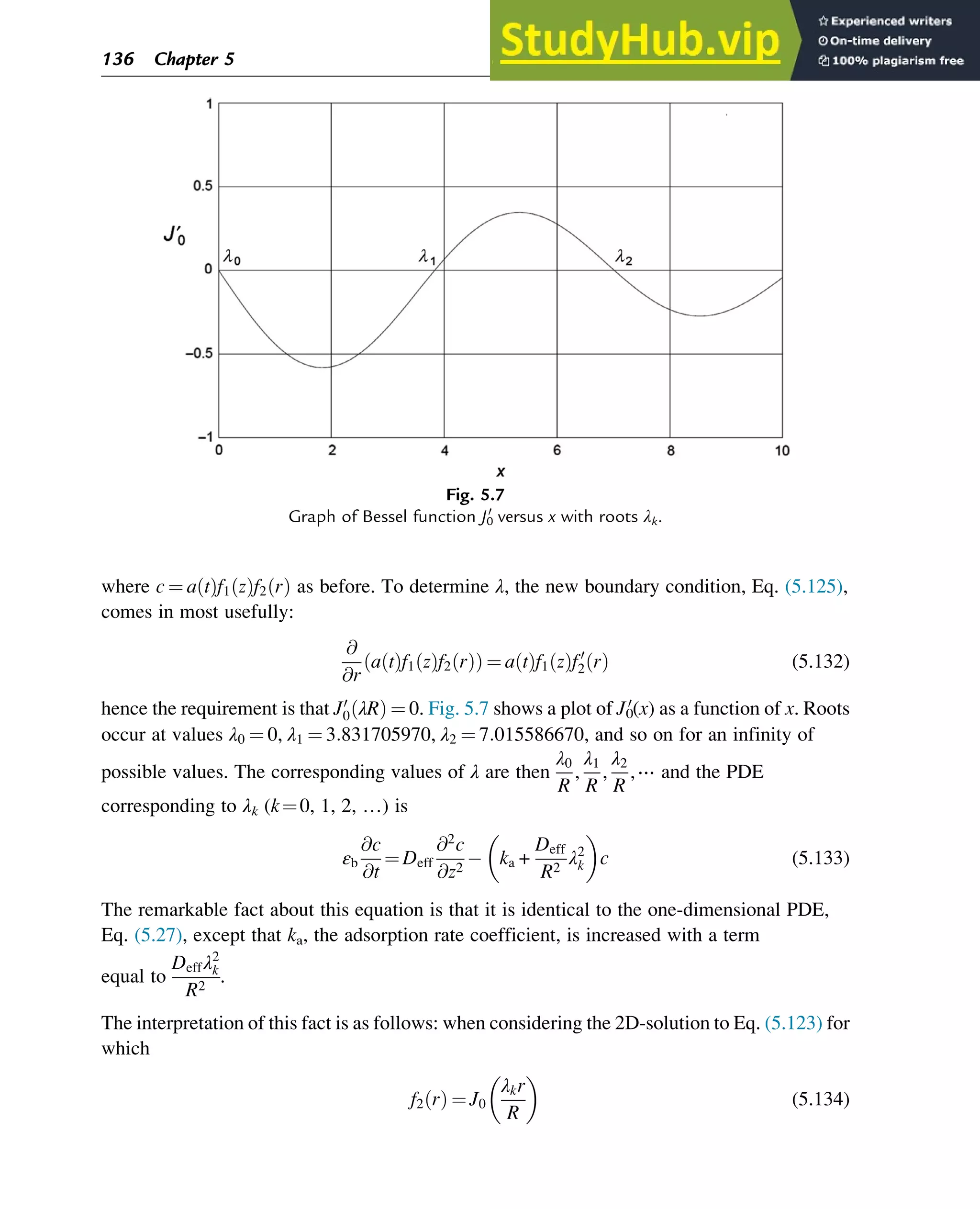
whereas the rate of heat removal (Qhr) shows a linear dependence (see Fig. 7.4). Therefore, both
rates may be equal at more than one temperature, resulting in multiple steady states.
236 Chapter 7
The Qhr1 line represents the situation in which only a small amount of heat is generated by the
reaction so that the temperature of the reaction mixture, and thus the steady-state conversion, is
low. In contrast, if the rate of heat generation by the reaction is so large that the Qrg curve
crosses the Qhr3 line, the reaction temperature is so high that the steady-state conversion will be
complete. In the intermediate situation, represented by the Qhr2 line, there are three possible
steady states, points A, B, and C. However, point B is an unstable steady state; if the
temperature only drops slightly below the steady-state temperature, the rate of heat generation
by the reaction is smaller than the rate of heat removal, resulting in a further temperature
decrease until the steady state represented by point A is reached. Similarly, in the case of a small
temperature rise, the temperature will continue to increase until point C is reached.
7.3.2 Mathematical Model of the Nonisothermal CSTR
A model of a nonisothermal CSTR in which an irreversible first-order reaction, A!B, takes
place can be formulated as follows (Frank-Kamenetskii, 1969; Bykov and Tsybenova, 2011):
Vr
dcA
dt
¼ Vrk T
ð ÞcA + qV cA0 cA
ð Þ (7.59)
cpρVr
dT
dt
¼ ΔrH
ð ÞVrk T
ð ÞcA + cpρqV T0 T
ð Þ + hAr Tw T
ð Þ (7.60)
where cA is the reactant concentration, T and Tw are the temperatures of the reaction mixture
and the reactor wall, k T
ð Þ ¼ k0 exp Ea=RgT is the reaction rate coefficient, Vr is the
reaction volume, qV is the volumetric flow rate, ρ and cp are the density and specific heat
Fig. 7.4
Dependence of the rate of heat generation Qhg and the rate of heat removal Qhr on the reaction
temperature in a CSTR at three different wall temperatures with Tw1 Tw2 Tw3. Certain Qhr
lines can intersect the Qhg curve in as much as three different points (A, B and C).
Stability of Chemical Reaction Systems 237
capacity at constant pressure of the reaction mixture, ΔrH
ð Þ is the heat of reaction, Ar is the
reactor surface area available for heat exchange, and h is the heat-transfer coefficient.
This set of two equations contains many kinetic, geometric, and thermal parameters. The phase
variables of this system are the reactant concentration and the temperature. We can
introduce the following dimensionless parameters (Frank-Kamenetskii, 1969):
T* ¼
1
hAr + cpρqV
hArT0 + cpρqVTw ; α* ¼
hAr + cpρqV
Ar
(7.61)
Da ¼
Vr
qV
k T0
ð Þ (7.62)
Se ¼
ΔrH
ð Þρ
α* Ar=Vr
ð Þ
Ea
Rg T*
ð Þ2
k0 exp
Ea
RgT
(7.63)
β ¼
ΔrH
ð ÞcA0
cpρT0
; γ ¼
Ea
RgT0
(7.64)
x ¼
cA0 cA
cA0
; y ¼
Ea
RgT2
T T*
ð Þ (7.65)
t* ¼ k0t exp
Ea
RgT*
(7.66)
where x is the conversion, Da is the (first) Damköhler number, and Se is the Semenov number.
We assume that the inlet conditions are the same as the initial conditions:
cA 0
ð Þ ¼ cA0; cpρqV T0 T 0
ð Þ
ð Þ ¼ hAr T 0
ð Þ Tw
ð Þ (7.67)
Using the dimensionless parameters, for an exothermic first-order reaction, this model can
be written as
dx
dt*
¼ 1 x
ð Þexp
y
1 + βy
x
Da
¼ f1 x, y
ð Þ (7.68)
γ
dy
dt*
¼ 1 x
ð Þexp
y
1 + βy
y
Se
¼ f2 x, y
ð Þ (7.69)
The steady-state values can be found by putting dx/dt* and dy/dt* equal to zero:
1 x
ð Þexp
y
1 + βy
x
Da
¼ 0 (7.70)
1 x
ð Þexp
y
1 + βy
y
Se
¼ 0 (7.71)
238 Chapter 7
from which it follows that
x ¼
Da
Se
y ¼ νy (7.72)
Substituting Eq. (7.72) into Eq. (7.71) yields the following nonlinear equation in y:
1 νy
ð Þexp
y
1 + βy
¼
y
Se
(7.73)
Equality (7.73) is an equation of steady states in which the left-hand side represents heat
removal,
Qhr y
ð Þ ¼ 1 νy
ð Þexp
y
1 + βy
¼ 1 νy
ð Þe y
ð Þ (7.74)
and the right-hand side represents heat generation.
Qhg y
ð Þ ¼
y
Se
(7.75)
Solutions of Eq. (7.73) can be studied using a Semenov diagram, which reflects the
dependences of the rate of heat generation and the rate of heat removal on the temperature.
This diagram is similar to the dependence shown in Fig. 7.4, but with dimensionless
coordinates. The points of intersection of Qhr(y) and Qhg(y) in Eq. (7.73) determine the
temperature of the steady state; knowing this temperature, the corresponding steady-state
conversion can be calculated using Eq. (7.72).
The condition
1
Se
¼
dQhg y
ð Þ
dy

dQhr y
ð Þ
dy
(7.76)
is necessary and sufficient for uniqueness of the steady state. This condition means that the rate
of heat removal must be higher than that of heat generation.
7.3.3 Types of Stability of the Steady State
The type of stability of a steady state can be determined from the roots of the characteristic
polynomial:
λ2
a11 + a22
ð Þλ + a11a22 a12a21 ¼ λ2
σλ + Δ ¼ 0 (7.77)
where the elements of the Jacobian matrix J are given by
a11 ¼
@f1
@x
¼ e y
ð Þ
1
Da
(7.78)
Stability of Chemical Reaction Systems 239
a12 ¼
@f1
@y
¼
1 x
ð Þe y
ð Þ
1 + βy
ð Þ2
(7.79)
a21 ¼
@f2
@x
¼
e y
ð Þ
γ
(7.80)
a22 ¼
@f2
@y
¼
1 x
ð Þe y
ð Þ
1 + βy
ð Þ2
1
γSe
(7.81)
with f1 and f2 given by, respectively, Eqs. (7.68) and (7.69).
The roots of the characteristic polynomial, Eq. (7.77), are expressed through its coefficients:
λ1,2 ¼
σ
2

ffiffiffiffiffiffiffiffiffiffiffiffiffi
σ2
4
Δ
r
(7.82)
The parametric dependences of the steady states are solutions of the equation
F y
ð Þ ¼ Qhr y
ð Þ Qhg y
ð Þ ¼ 0 (7.83)
which can be written as
F y, Da, Se, β
ð Þ ¼ 0 (7.84)
Then the expressions for the parameters as a function of y can be found:
β ¼
1
ln y= Se Day
ð Þ
½ Š
1
y
(7.85)
Se ¼ Da +
1
e y
ð Þ
y (7.86)
Da ¼
Se
y
1
e y
ð Þ
(7.87)
and
ν ¼
Da
Se
¼
1
y
1
e y
ð ÞSe
(7.88)
Subsequently, the dimensionless temperature y is determined as a function of the parameter ν.
The boundary between the domain with one steady state and the domain with three steady states
is called the line of multiplicity, LΔ Δ ¼ 0
ð Þ For finding this dependence in the plane (Da, Se), we
need to solve the set of equations
f1 x, y, Da, Se
ð Þ ¼ 0 (7.89)
f2 x, y, Da, Se
ð Þ ¼ 0 (7.90)
Δ y, Da, Se
ð Þ ¼ 0 (7.91)
where Δ is determined using elements of the Jacobian matrix.
240 Chapter 7
Combining Eq. (7.84) and Eqs. (7.89)–(7.91), we obtain the equation for the multiplicity line in
the plane (Da,Se),
LΔ Da, Se
ð Þ :
Da y
ð Þ ¼
y 1 + βy
ð Þ2
1 + βy
ð Þ2
e y
ð Þ
Se y, Da
ð Þ ¼ Da +
1
e y
ð Þ
y
8


:
(7.92)
Lines of multiplicity for other parameter planes can be found in a similar way. For the plane
(Se, ν),
LΔ Se, ν
ð Þ :
Se y
ð Þ ¼
y2
1 + βy
ð Þ2
e y
ð Þ
ν y, Se
ð Þ ¼
1
y
1
e y
ð ÞSe
8


:
(7.93)
Lines of neutrality, Lσ σ ¼ 0
ð Þ, determine the type of stability of a steady state. In order to find
Lσ, the following equations need to be solved:
F y, Da, Se
ð Þ ¼ 0 (7.94)
σ y, Da, Se
ð Þ ¼ 0 (7.95)
Simultaneously solving Eqs. (7.94), (7.95), and (7.85)–(7.88) will explicitly yield different
lines Lσ.
Lσ Se, ν
ð Þ :
Se y
ð Þ ¼
Da y 1 + βy
ð Þ2
 
γ 1 + βy
ð Þ2
Dae y
ð Þ + 1
ð Þ
ν y, Se
ð Þ ¼
1
y
1
e y
ð ÞSe
8


:
(7.96)
Lσ Da, Se
ð Þ :
Da y
ð Þ ¼
a y
ð Þ
ffiffiffiffiffiffiffiffiffiffiffiffiffiffiffiffiffiffi
a2 y
ð Þ 1
p
e y
ð Þ
; a y
ð Þ ¼
1
2γ 1 + βy
ð Þ2
1
2γy
1
Se y, Da
ð Þ ¼ Da +
1
e y
ð Þ
y
8


:
(7.97)
Lσ γ, Da
ð Þ :
γ y, Da
ð Þ ¼
Dae y
ð Þ y 1 + βy
ð Þ2
 
y 1 + βy
ð Þ2
Dae y
ð Þ + 1
ð Þ2
Da y
ð Þ ¼
Se
y
1
e y
ð Þ
8


:
(7.98)
Stability of Chemical Reaction Systems 241
Lσ γ, Se
ð Þ :
γ y, Se
ð Þ ¼
e y
ð ÞSe y
ð Þ y 1 + βy
ð Þ2
 
e y
ð ÞSe 1 + βy
ð Þ
ð Þ2
Se y, Da
ð Þ ¼ Da +
1
e y
ð Þ
y
8


:
(7.99)
Lσ γ, β
ð Þ :
γ y, β
ð Þ ¼
Dae y
ð Þ y 1 + βy
ð Þ2
 
y 1 + βy
ð Þ2
Dae y
ð Þ + 1
ð Þ2
β y
ð Þ ¼
1
ln y= Se Day
ð Þ
½ Š
1
y
8


:
(7.100)
Lσ γ, ν
ð Þ :
γ y, ν
ð Þ ¼
νe y
ð Þ y 1 + βy
ð Þ2
 
y 1 + βy
ð Þ2
Dae y
ð Þ + 1
ð Þ2
ν y, Se
ð Þ ¼
1
y
1
See y
ð Þ
8


:
(7.101)
The line of multiplicity and the line of neutrality together form a parametric portrait. In
this portrait, parametric domains with a different number of steady states that differ by their
stability as well can be distinguished. In the current model, the complete parametric portrait
consists of six domains. Furthermore, six types of phase portraits can be distinguished,
corresponding to six parametric portrait domains. The first domain (I) is characterized by a
unique stable steady state. This behavior is observed at low and high temperatures. The second
domain (II) relates to a unique unstable steady state. This is a domain of oscillations. The
domains III, IV, and V all have three steady states. Domain III has one unstable steady state
at low temperature and two stable steady states at high temperature. Domains IV and V
both have one stable and one unstable steady state. Finally, domain VI has three steady
states, one of which is stable and two are unstable. In this domain, oscillations are also
observed.
7.4 Multiplicity of Steady States in Isothermal Heterogeneous Catalytic
Systems
7.4.1 Historical Background
Multiplicity of steady states not only occurs in nonisothermal systems. In the 1950s and 1960s,
this phenomenon was found in many isothermal heterogeneous catalytic oxidation systems
such as the platinum-catalyzed oxidation of hydrogen and carbon monoxide.
242 Chapter 7
Currently, a vast amount of information on the occurrence of multiple steady states in
heterogeneous catalysis has been accumulated. Different values of the reaction rate can
correspond to the same composition of the reaction mixture or to the same temperature.
Typically, multiplicity of steady states is accompanied by hysteresis, a term derived from the
Greek word meaning “lagging behind.” A characteristic mark of hysteresis is that the output—
here the reaction rate—forms a loop, which can be oriented clockwise or counterclockwise.
Hysteresis causes the reaction rate to jump up or fall down, signifying, respectively, ignition
and extinction of the reaction. Fig. 7.5 shows some examples of kinetic dependences involving
hysteresis.
Liljenroth (1918) was the first to describe a nonlinear phenomenon in heterogeneous catalysis.
He studied the platinum-catalyzed oxidation of ammonia and analyzed the stability of the
steady state of this process. Apparently, Davies (1934) was the first to systematically
observe nonlinear phenomena and to point out the chemical nature of the rate hysteresis. In
the 1950s, Boreskov and colleagues (Boreskov et al., 1953; Kharkovskaya et al., 1959) studied
the oxidation of hydrogen over metal catalysts and found that in a certain range of reaction
parameters, very different values of the steady-state reaction rate corresponded with the
same gas composition. These data were obtained at isothermal conditions. For more historical
information on multiplicity of steady states, see Yablonskii et al. (1991) and Marin and
Yablonsky (2011).
Fig. 7.5
Examples of kinetic dependences with a multiplicity of steady states. Solid lines correspond to
stable branches of the reaction rate, dashed lines to unstable branches; (A), (B) r versus T;
(C) r versus p1 at constant p2; (D) r versus p2 at constant p1. (A) and (C) are examples of clockwise
hysteresis, (B) and (D) of counterclockwise hysteresis.
Stability of Chemical Reaction Systems 243
7.4.2 The Simplest Catalytic Trigger
The simplest mechanism for a catalytic reaction permitting three steady states is the
following adsorption mechanism (also called Langmuir-Hinshelwood mechanism)
involving two types of intermediates:
1
ð Þ A2 + 2Z  2AZ
2
ð Þ B + Z  BZ
3
ð Þ AZ + BZ ! AB + 2Z
(7.102)
The well-known adsorption mechanism for the oxidation of carbon monoxide over
platinum at constant partial pressures of oxygen and carbon monoxide,
1
ð Þ O2 + 2Pt  2PtO
2
ð Þ CO + Pt  PtCO
3
ð Þ PtO + PtCO ! CO2 + 2Pt
(7.103)
is an example of this type of mechanism.
Let us start our analysis by assuming all steps in the mechanism represented by Eq. (7.102)
are irreversible (Bykov et al., 1981; Bykov and Yablonskii, 1987), 1
ð Þ A2 + Z ! 2AZ;
2
ð Þ B + Z ! BZ; 3
ð Þ AZ + BZ ! AB + 2Z. Then, the steady-state model is given by
dθAZ
dt
¼ 2k+
1 pA2
1 θAZ θBZ
ð Þ2
k+
3 θAZθBZ ¼ 0 (7.104)
dθBZ
dt
¼ k+
2 pB 1 θAZ θBZ
ð Þ k+
3 θAZθBZ ¼ 0 (7.105)
where θAZ and θBZ are the normalized surface concentrations of A and B and θZ ¼ 1 θAZ
θBZ is the normalized surface concentration of free active sites Z. pA2
and pB are the
partial pressures of A2 and B and k+
1 ,k+
2 , and k+
3 are the rate coefficients of (forward) reactions
1, 2, and 3.
In our model, two boundary steady states exist: (1) θAZ ¼1 and θBZ ¼θZ ¼0, which corresponds
to complete surface coverage by component A2 (eg, oxygen) and (2) θAZ ¼θZ ¼0 and θBZ ¼1,
which corresponds to complete surface coverage by component B (eg, CO). In both cases,
the steady-state reaction rate is zero:
r ¼ 2k+
1 pA2
1 θAZ θBZ
ð Þ2
¼ k+
2 pB 1 θAZ θBZ
ð Þ ¼ k+
3 θAZθBZ ¼ 0 (7.106)
In addition to these boundary steady states, two internal steady states exist with nonzero
values of the reaction rate. These are found as follows. Subtraction of Eq. (7.105) from
Eq. (7.104) yields
2k+
1 pA2
1 θAZ θBZ
ð Þ2
k+
2 pB 1 θAZ θBZ
ð Þ ¼ 0 (7.107)
244 Chapter 7
from which it follows that
1 θAZ θBZ ¼ θZ ¼
k+
2 pB
2k+
1 pA2
(7.108)
Substitution of Eq. (7.108) in Eq. (7.106) for the steady-state reaction rate yields
r ¼
k+
2 pB
2
2k+
1 pA2
¼ k+
3 θAZθBZ (7.109)
and thus
θAZθBZ ¼
k+
2 pB
2
2k+
1 k+
3 pA2
(7.110)
Then from Eq. (7.108) it follows that
θBZ ¼ 1 θAZ
k+
2 pB
2k+
1 pA2
(7.111)
so that Eq. (7.110) can be transformed into
θAZ 1 θAZ
k+
2 pB
2k+
1 pA2
¼
k+
2 pB
2
2k+
1 k+
3 pA2
(7.112)
This quadratic equation can be written as
θ2
AZ σθAZ + Δ ¼ 0 (7.113)
with σ ¼ 1
k+
2 pB
2k+
1 pA2
andΔ ¼
k+
2 pB
2
2k+
1 k+
3 pA2
:
Then,
θAZ ¼
σ
2

ffiffiffiffiffiffiffiffiffiffiffiffiffi
σ2
4
Δ
r
(7.114)
and with Eq. (7.111) we find the same result for θBZ.
Eq. (7.114) has two solutions in the domain of values having a physical meaning
(0θAZ 1) under the condition that
1
k+
2 pB
2k+
1 pA2
2

2 k+
2 pB
2
k+
1 k+
3 pA2
(7.115)
Thus, this model has four steady states, two boundary ones and two internal ones. The two
boundary steady states (I and IV) are symmetrical and so are the two internal steady states
(II and III). Mathematically, this property is the result of the symmetry of Eqs. (7.104)
Stability of Chemical Reaction Systems 245
and (7.105) with respect to the variables θAZ and θBZ. Table 7.1 shows the characteristics
of the four steady states. It has been shown that steady states II and III are stable whereas
steady states I and IV are unstable. The steady-state reaction rates for steady states II and III
follow from the first equality of Eq. (7.109). A detailed analysis of the stability of the
steady states for this model can be found in the monographs by Yablonskii et al. (1991)
and Marin and Yablonsky (2011).
Every stable steady state is characterized by a basin of attraction, which is a set of initial
conditions—or compositions—starting from which the mixture reaches this steady state.
Clearly, unstable steady states do not have such a basin.
7.4.3 Influence of Reaction Reversibility on Hysteresis
Reversibility of one or more reaction steps of the adsorption mechanism represented by
Eq. (7.102) may significantly influence the reaction kinetics, particularly the steady-state
kinetic behavior. As a result of reversibility, the steady states corresponding to complete
coverage of the catalyst surface with surface intermediate AZ or BZ—the boundary steady
states—disappear. At certain conditions, only three internal steady states, two stable and one
unstable, exist. Fig. 7.6 shows a typical dependence of the steady-state reaction rate on the
partial pressure of component B for the adsorption mechanism with the first and second steps
being reversible and the third step irreversible. At low temperature, the reaction rate is
characterized by a multiplicity of steady-state rates; three steady-state reaction rates are
observed, two stable and one unstable (see Fig. 7.6A, curve (1), and Fig. 7.6B, curves (1)
Table 7.1 Steady-state characteristics for the reaction mechanism represented by Eq. (7.102)
Steady State Normalized Concentrations Reaction Rate r Comments
I θAZ,I ¼ 1
θBZ,I ¼ 0
θZ,I ¼ 0
0 Unstable steady state; catalyst
surface completely covered
by component A2
(intermediate AZ)
II
θAZ,II ¼
σ +
ffiffiffiffiffiffiffiffiffiffiffiffiffiffiffiffi
σ2 4Δ
p
2
θBZ,II ¼
σ
ffiffiffiffiffiffiffiffiffiffiffiffiffiffiffiffi
σ2 4Δ
p
2
θZ,II ¼ 1 σ
k+
2 pB
2
2k+
1 pA2
Stable steady state;
catalyst surface contains
intermediates AZ and BZ
and free active sites Z
III
θAZ,III ¼
σ
ffiffiffiffiffiffiffiffiffiffiffiffiffiffiffiffi
σ2 4Δ
p
2
θBZ,III ¼
σ +
ffiffiffiffiffiffiffiffiffiffiffiffiffiffiffiffi
σ2 4Δ
p
2
θZ,III ¼ 1 σ
k+
2 pB
2
2k+
1 pA2
Unstable steady state; catalyst
surface contains
intermediates AZ and BZ
and free active sites Z
IV θAZ,I ¼ 0
θBZ,I ¼ 1
θZ,I ¼ 0
0 Stable steady state; catalyst surface
completely covered by component
B (intermediate BZ)
246 Chapter 7
and (2)). Component A dominates on the upper branch and B dominates on the lower branch.
In this case, the transition from one branch to another one occurs in a dramatic way: via
extinction (from the upper branch to the lower one) or via ignition (from the lower branch to the
upper one). Finally, the multiplicity of steady states is exhibited as a counterclockwise
hysteresis for the kinetic dependence r(pB) (Fig. 7.6A, curve (1) and Fig. 7.6B, curves (1) and
(2)) and clockwise for r pA2
ð Þ (not shown). A temperature rise increases the desorption
coefficient and kills the multiplicity of steady states. The kinetic dependence is gradually
transformed into a dependence with a maximum rate (Fig. 7.6A, curve (3) and Fig. 7.6B, curve
(3)). Finally, the temperature rise causes the maximum of the reaction rate to vanish
completely (Fig. 7.6A, curve (4)).
Fig. 7.7A shows the steady-state reaction rate in the three-dimensional space. This rate is
characterized by a special point called a cusp point, a term taken from catastrophe theory
meaning a singular point of the geometric curve. Fig. 7.7B shows two curves that are loci
of turning points. The curve on the left is the locus of extinction points and can be defined
as the locus of turning points from the upper to the lower branch. The curve on the right is
the locus of ignition points and can be defined as the locus of turning points from the
lower to the upper branch.
7.4.4 Transient Characteristics and “Critical Slowing Down”
The transient characteristics, θAZ(t) and θBZ(t), of the adsorption model (Eq. (7.102)) show
different relaxation times, which can differ by orders of magnitude. The trajectories are
often characterized by fast initial motion and slow motion in the vicinity of a slow trajectory.
This slow trajectory is a simple case of the slow manifolds known in the literature
(Gorban and Karlin, 2003) and is located in the region between the two null clines dθAZ=dt ¼ 0
and dθBZ=dt ¼ 0: Both null clines are second-order curves with an axis of symmetry θAZ ¼θBZ
Fig. 7.6
Dependence of the steady-state reaction rate on pB for the adsorption mechanism represented
by Eq. (7.101) at constant values of pA2
and k+
1 ¼ k+
2 for (A) constant k1 and k2 increasing from
(1) to (4) and (B) constant k2 and k1 increasing from (1) to (3). Reprinted from Yablonskii, G.S., Bykov,
V.I., Gorban, A.N., Elokhin, V.I., 1991. Kinetic models of catalytic reactions. In: Compton, R.G. (Ed.),
Comprehensive Chemical Kinetics, vol. 32. Elsevier, Amsterdam, Copyright (1991), with permission from Elsevier.
Stability of Chemical Reaction Systems 247
on which an unstable steady state is located. In the case that a phase portrait has multiple
steady states, a trajectory may rapidly approach an unstable steady state and then slowly relax
toward one of the stable steady states (Fig. 7.8).
Fig. 7.7
Surface of the steady-state reaction rate at constant temperature for the adsorption
mechanism represented by Eq. (7.101); (A) reaction rate in the three-dimensional space;
(B) loci of turning points. Adapted from Yablonskii, G.S., Bykov, V.I., Gorban, A.N., Elokhin, V.I., 1991.
Kinetic models of catalytic reactions. In: Compton, R.G. (Ed.), Comprehensive Chemical Kinetics, vol. 32. Elsevier,
Amsterdam, Copyright (1991), with permission from Elsevier.
0.2
20
0 40
qAZ
qBZ
qAZ, qBZ
60
t (s)
80 120
0.4
0.6
0.8
1.0
t
e
e
Fig. 7.8
Example of critical slowing down for the adsorption mechanism represented by Eq. (7.102);
relaxation from the initial state θAZ 0
ð Þ ¼ 0:5;θBZ 0
ð Þ ¼ 0; ε is the vicinity of the final state and τ is the
time required to reach this vicinity. Reprinted from Yablonskii, G.S., Bykov, V.I., Gorban, A.N., Elokhin, V.I.,
1991. Kinetic models of catalytic reactions. In: Compton, R.G. (Ed.), Comprehensive Chemical Kinetics,
vol. 32. Elsevier, Amsterdam, Copyright (1991), with permission from Elsevier.
248 Chapter 7
If such critical slowing down occurs, the observed relaxation time is unexpectedly long and
considerably longer than the relaxation time corresponding to the lowest rate coefficient.
The main nontrivial explanation of this phenomenon is the following. In the region of critical
effects, one of the parameters achieves its bifurcation value while one of the characteristic roots
changes from a negative to a positive value. Experimentally, the phenomenon of very slow
relaxation toward a stable steady state has been observed in many heterogeneous catalytic
oxidation reactions (Yablonskii et al., 1991; Marin and Yablonsky, 2011). Gorban and
colleagues (Gorban and Cheresiz, 1981; Gorban and Karlin, 2003) have developed a
comprehensive mathematical theory of slow relaxation using concepts from the theory of
dynamical systems, such as and ω-limit sets.
7.4.5 General Model of the Adsorption Mechanism
In the adsorption mechanism, two gaseous reactants are adsorbed through two independent
reactions. Then the two surface intermediates interact and a gaseous product is released.
The general form of this mechanism can be represented as
1
ð Þ Am + mZ  mAZ
2
ð Þ Bn + nZ  nBZ
3
ð Þ pAZ + qBZ  ApBq + p + q
ð ÞZ
(7.116)
The kinetic model corresponding to this mechanism is given by the following set of
nonlinear differential equations:
dθAZ
dt
¼ m
k
+
1 θm
Z mk1 θm
AZ pk+
3 θp
AZθq
BZ + q
k3 θp + q
Z (7.117)
dθBZ
dt
¼ n
k
+
2 θn
Z nk2 θn
BZ qk+
3 θp
AZθq
BZ + q
k3 θp + q
Z (7.118)
with apparent parameters 
k
+
1 ¼ k+
1 pAm
, 
k
+
2 ¼ k+
2 pBn
and 
k3 ¼ k3 pApBq
and constant partial
pressures of Am, Bn and ApBq.
The nonlinearity of the model is caused by both the adsorption steps and the interaction between
surface intermediates. The corresponding set of algebraic equations
dθAZ
dt
¼ 0 and
dθBZ
dt
¼ 0
determines the number of steady states and the corresponding values of the normalized surface
concentrations. A necessary condition for the nonuniqueness of steady states is the presence
of a step in which different surface intermediates react. This result was obtained in a physically
meaningful domain of normalized surface concentrations (θZ, θAZ, θBZ 0; θZ +θAZ +θBZ ¼1).
The sufficient condition for the uniqueness of an internal steady state is the relationship
m ¼ n  p,q: (7.119)
If the condition of Eq. (7.119) is not satisfied, multiplicity of steady states is possible.
Stability of Chemical Reaction Systems 249
For the adsorption mechanism, the presence of an interaction step between different
intermediates is only one necessary condition for the occurrence of multiple steady states;
another requirement is that the reaction orders of the two adsorption steps must be different.
Consequently, competition between surface intermediates is the main factor leading to
multiplicity of steady states.
The reversibility of the adsorption steps affects the number of steady states. Analysis shows that
boundary steady states are absent if both adsorption steps are reversible. If one of the adsorption
steps is irreversible, there is one boundary steady state with the irreversibly adsorbed
intermediate occupying all active catalyst sites. If both adsorption steps are irreversible,
two boundary steady states exist, one with complete coverage of the catalyst surface by AZ
and one with complete coverage by BZ. If the reaction orders of these irreversible adsorption
steps are equal, there is a line of internal steady states connecting the two boundary steady
states. In this case, the steady state is very sensitive to the initial conditions and experimental
data may be irreproducible.
From a physicochemical point of view, elementary reactions with an overall kinetic order
of more than three can be disregarded because such reactions are impossible. Table 7.2 shows
the results of a comprehensive analysis by Yablonskii et al. (1991) of realistic adsorption
mechanisms, assuming that the interaction step between the surface intermediates is
irreversible (k3 ¼ 0) and that the stoichiometric coefficients equal either one or two and the
Table 7.2 Characteristics of “realistic” adsorption mechanisms: necessary conditions for
steady states (ss) and their number
Partial Reaction
Orders
Reversibility of Adsorption Steps
I k1 ¼ 0; k2 ¼ 0 IIa k1 ¼ 0; k2 6¼ 0 IIb k1 6¼ 0; k2 ¼ 0 III k1 6¼ 0; k2 6¼ 0
(1) m¼1; n ¼1;
p¼1; q¼1
Two ss; Line of ss
for 
k
+
1 ¼
k
+
2
One bssa
and one
issb
at 
k
+
1 
k
+
2
One bss and one iss
at 
k
+
2 
k
+
1
No bss and one iss
(2) m¼2; n ¼2;
p¼1; q¼1
Same as I.1 Same as IIa.1 Same as IIb.2 Same as III.1
(3) m¼2; n ¼2;
p¼2; q¼1
Same as I.1 but with

k
+
1 ¼ 2
k
+
2
Same as IIa.1 but
with 
k
+
1  2
k
+
2
Same as IIb.2 but
with 2
k
+
2 
k
+
1
Same as III.1
(4) m¼1; n ¼1;
p¼2; q¼1
Same as I.3 One bss and two
iss at 
k
+
1  2
k
+
2
One bss and one iss No bss and one
or three iss
(5) m¼2; n ¼1;
p¼1; q¼1
Two bss and two iss
at 2
k
+
1 
k
+
2
One bss and two
iss at 2
k
+
1 
k
+
2
One bss and one or
three iss at 2
k
+
1 
k
+
2
Same as III.4
(6) m¼2; n ¼1;
p¼2; q¼1
I.5 but with 
k
+
1 
k
+
2 IIa.5 but with

k
+
1 
k
+
2
IIb.5 but with

k
+
1 
k
+
2
Same as III.4
(7) m¼2; n ¼1;
p¼1; q¼2
I.5 but with
4
k
+
1 
k
+
2
IIa.5 but with
4
k
+
1 
k
+
2
IIb.5 but with
4
k
+
1 
k
+
2
Same as III.4
a
bss¼boundary steady state.
b
iss¼internal steady state.
250 Chapter 7
sum p+q3. These results are based on the algebraic analysis of the number of positive roots
in the interval [0,1] using Descartes’s rule of signs and Sturm’s theorem.
The main result is that real multiplicity of steady states—the existence of two internal stable
steady states and one internal unstable steady state—can be explained using one of the four
mechanisms shown in Table 7.3. If the experimentally observed steady-state reaction rate is
characterized by two different branches, and multiplicity of steady states is observed, one of
these four mechanisms can be used to interpret the data. We prefer to use mechanism B because
its steps are characterized by overall reaction orders that are not larger than two. In fact, this
mechanism is identical to the mechanism represented by Eq. (7.102), an example of which is
the adsorption mechanism for the oxidation of carbon monoxide (Eq. (7.103)). We will return
to this mechanism in Chapter 11, in which the problem of critical simplification is discussed.
7.5 Chemical Oscillations in Isothermal Systems
7.5.1 Historical Background
The discovery of isothermal chemical oscillations was one of the big scientific sensations of the
20th century. Belousov and Zhabotinsky found self-sustained oscillations in the cerium-ion
catalyzed oxidation of citric acid by bromate, now known as the Belousov-Zhabotinsky
reaction. This reaction became one of the starting points for Prigogine and his coworkers in
Brussels for studying complicated dynamic behavior of chemical mixtures that are far from
equilibrium (Prigogine and Lefever, 1968; Glansdorff and Prigogine, 1971; Nicolis and
Prigogine, 1977). They used a model with a specific type of mechanism involving autocatalytic
reactions, later named the Brusselator, for the quantitative interpretation of chemical
oscillations in isothermal systems. An autocatalytic reaction is a reaction in which at least one
of the reactants is also a product, for example, A+B!2 A. Prigogine received the 1977 Nobel
Prize in Chemistry for this work. In the early 1970s, the research by Prigogine’s group inspired
Table 7.3 Adsorption mechanisms that can explain the multiplicity of steady states
A (1) A + ZAZ
(2) B + ZBZ
(3) 2AZ + BZ ! A2B + 3Z
B (1) A2 + 2Z2AZ
(2) B + ZBZ
(3) AZ + BZ ! AB + 2Z
C (1) A2 + 2Z2AZ
(2) B + ZBZ
(3) 2AZ + BZ ! A2B + 3Z
D (1) A2 + 2Z2AZ
(2) B + ZBZ
(3) AZ + 2BZ ! AB2 + 3Z
Stability of Chemical Reaction Systems 251
Field et al. (1972) at the University of Oregon to perform a systematic and detailed
thermodynamic and kinetic analysis of the Belousov-Zhabotinsky reaction. They suggested a
detailed reaction mechanism that could explain the oscillations. Field and Noyes (1974) later
simplified this mechanism and named it the Oregonator, after Prigogine’s Brusselator.
The group of Wicke (Beusch et al., 1972a; Beusch et al., 1972b) was the first to observe
kinetic self-sustained oscillations in solid-catalyzed reactions, when studying the oxidation
of carbon monoxide over platinum-based catalysts. At certain conditions, oscillations were
observed in the production rate of carbon dioxide. Based on these experimental data,
Beusch et al. (1972b) assumed that the only factor responsible for the rate oscillations was
the complex surface-reaction mechanism and that neither external nor internal mass- or
heat-transfer limitations played a role. Slin’ko and Slin’ko (1978, 1982) performed
comprehensive experimental and theoretical investigations of kinetic self-sustained
oscillations, in particular in the oxidation of hydrogen over nickel and platinum catalysts
(see also Slin’ko and Jaeger, 1994).
Self-sustained rate oscillations have been observed in many heterogeneous catalytic reactions.
The largest amount of information on kinetic self-sustained oscillations was obtained for
the oxidation of carbon monoxide over noble metals, particularly by the group of Ertl, who
in 2007 received a Nobel Prize in Chemistry for his work regarding this phenomenon.
Other examples are the oxidation of cyclohexane (Berman and Elinek, 1979), propylene
(Sheintuch and Luss, 1981), and ethylene (Vayenas et al., 1981); the cooxidation of carbon
monoxide and 1-butene (Mukesh et al., 1982, 1983, 1984); and reactions of nitric oxide
with ammonia (Nowobilski and Takoudis, 1985), carbon monoxide (Bolten et al., 1985),
and carbon monoxide and oxygen (Regalbuto and Wolf, 1986).
7.5.2 Model of Catalytic Chemical Oscillations
Now the question is how to construct the simplest model of a chemical oscillator, in particular,
a catalytic oscillator. It is quite easy to include an autocatalytic reaction in the adsorption
mechanism, for example A+B! 2 A. The presence of an autocatalytic reaction is a typical
feature of the known Brusselator and Oregonator models that have been studied since the
1970s. Autocatalytic processes can be compared with biological processes, in which species
are able to give birth to similar species. Autocatalytic models resemble the famous
Lotka-Volterra equations (Berryman, 1992; Valentinuzzi and Kohen, 2013), also known
as the predator-prey or parasite-host equations.
Let us again consider a model with two variables, Eq. (7.12):
dc1
dt
¼ f1 c1, c2
ð Þ
dc2
dt
¼ f2 c1, c2
ð Þ
8


:
(7.12)
252 Chapter 7
In the presence of autocatalytic steps, the derivatives @f1 c1, c2
ð Þ=@c1 and @f2 c1, c2
ð Þ=@c2
can be positive in some parametric domain, whereas in the absence of autocatalytic steps
these derivatives are always negative. This results in more complicated behavior of autocatalytic
processes compared to traditional chemical processes. Thus, the mass-action-law model with
two variables and without autocatalytic steps obeys the Poincaré-Bendixson criterion:
@f1 c1, c2
ð Þ
@c1
+
@f2 c1, c2
ð Þ
@c2
 0 (7.120)
Based on this criterion, it can be concluded that two-dimensional models that do not
include autocatalytic reactions are not able to reproduce the experimentally observed
isothermal kinetic oscillations.
Seemingly, the description of catalytic oscillations at least requires a two-variable model
with autocatalytic reactions or a three-variable model without autocatalytic reactions.
Eigenberger (1978a,b) made a step toward the construction of a three-variable model by
adding a so-called buffer step (4 in the following list) to an adsorption mechanism:
1
ð Þ 2A + 2Z  2AZ
2
ð Þ B + 2Z  BZ2
3
ð Þ 2AZ + BZ2 ! 2C + 4Z
4
ð Þ B + Z  BZ
ð Þ*
(7.121)
for the overall reaction 2A+B ! 2C. In the buffer step, (BZ)* is produced, a nonreactive form
that does not participate in the main catalytic cycle.
This is a realistic model because gaseous reactants can be adsorbed in a number of forms,
some of which are nonreactive. An example is the oxidation of carbon monoxide over
platinum, which in the above mechanism translates to A¼CO, B¼O2, and C¼CO2. Although
oxygen typically adsorbs irreversibly on platinum, Eigenberger assumed step (4) to be
reversible. Based on this assumption, which was not substantiated, Eigenberger transformed
the initial model to a model similar to that for a mechanism with autocatalytic reactions, which
was studied by Prigogine and colleagues (Prigogine and Lefever, 1968; Glansdorff and
Prigogine, 1971; Nicolis and Prigogine, 1977) and found oscillations using computer
calculations.
Bykov et al. (1978) have presented a detailed analysis of the following adsorption mechanism
with buffer step (also see Yablonskii et al., 1991; Marin and Yablonsky, 2011):
1
ð Þ A2 + 2Z  2AZ
2
ð Þ B + Z  BZ
3
ð Þ AZ + BZ ! AB + 2Z
4
ð Þ B + Z  BZ
ð Þ*
(7.122)
The corresponding model for this mechanism is
dθAZ
dt
¼ 2
k
+
1 θ2
Z 2k1 θ2
AZ k+
3 θAZθBZ ¼ f1 θAZ, θBZ, θ BZ
ð Þ* (7.123)
Stability of Chemical Reaction Systems 253
dθBZ
dt
¼ 
k
+
2 θZ k2 θBZ k+
3 θAZθBZ ¼ f2 θAZ, θBZ, θ BZ
ð Þ* (7.124)
dθ BZ
ð Þ*
dt
¼ 
k
+
4 θZ k4 θ BZ
ð Þ* ¼ f3 θAZ, θBZ, θ BZ
ð Þ* (7.125)
with 
k
+
1 ¼ k+
1 pA2
, 
k
+
2 ¼ k+
2 pB and 
k
+
4 ¼ k+
4 pB:
The steady states for this model can be determined from the set of algebraic equations
f1 θAZ, θBZ, θ BZ
ð Þ* ¼ f2 θAZ, θBZ, θ BZ
ð Þ* ¼ f3 θAZ, θBZ, θ BZ
ð Þ* ¼ 0 (7.126)
By expressing f1 ¼f2 ¼0 in implicit form, we obtain θAZ, θBZ, and θZ as functions of θ(BZ)*.
From Eq. (7.126), it follows that
θZ θ BZ
ð Þ* ¼
k4

k
+
4
θ BZ
ð Þ* ¼ αθ BZ
ð Þ* (7.127)
The steady states correspond to the points of intersection of this straight line with the curve θZ ¼
θZ θ BZ
ð Þ* in the plane (θZ,θ(BZ)*). This curve is plotted in accordance with the solutions of
f1 θAZ, θBZ, θ BZ
ð Þ* ¼ f2 θAZ, θBZ, θ BZ
ð Þ* ¼ 0 with respect to θAZ and θBZ, which are the
steady states of the model representing the three-step adsorption mechanism (steps (1)–(3) of
Eq. (7.122)). For this three-step submechanism, a parametric domain can be distinguished
in which three different steady states exist. In this domain, the curve θZ ¼ θZ θ BZ
ð Þ* has a
typical S-shaped form, see Fig. 7.9.
Fig. 7.9
Normalized steady-state concentration of free active sites Z as a function of the normalized steady-
state concentration of the “buffer” intermediate (BZ)*, curve θZ ¼ θZ θ BZ
ð Þ* . The straight lines
represent Eq. (7.127); α ¼ k4 =
k
+
4 with α+
 α  α : Intersections of the dependences represents the
(unstable) steady states θZ,ss. Reprinted from Yablonskii, G.S., Bykov, V.I., Gorban, A.N., Elokhin, V.I., 1991.
Kinetic models of catalytic reactions. In: Compton, R.G. (Ed.), Comprehensive Chemical Kinetics, vol. 32. Elsevier,
Amsterdam, Copyright (1991), with permission from Elsevier.
254 Chapter 7
The reduced set of equations for the time derivatives of θAZ and θBZ, Eqs. (7.123) and (7.124),
with not three but two variables, in which θ(BZ)* is regarded as a parameter, is a catalytic
trigger. For this system, a unique steady state is stable. If there are three steady states, the two
outer steady states are stable and the middle steady state is unstable.
The complete set of equations with three variables, Eqs. (7.123)–(7.125), including the
buffer step, may have a unique unstable solution. In view of the Poincaré-Bendixson theorem,
this is a necessary and sufficient condition for the occurrence of oscillations. For this set of
equations, the solution is considered to be in the so-called reaction simplex S:
S θAZ, θBZ, θ BZ
ð Þ* : θAZ  0, θBZ  0, θ BZ
ð Þ*  0, θAZ + θBZ + θ BZ
ð Þ*  1 (7.128)
Let θAZ,ss, θBZ,ss, θ BZ
ð Þ*,ss ¼ θss
ð Þ be the steady-state solution of the set of equations,
Eqs. (7.123)–(7.125). For this system, the characteristic equation is
λ3
+ σλ2
+ δλ + Δ ¼ 0 (7.129)
where σ ¼ Tr(J), δ¼a11 +a22 +a33 ¼Tr(adjJ), and Δ¼ det J. J¼[aij] (i, j¼1, 2, 3) is
the matrix of the corresponding linearized set of equations at the steady state; a11, a22, and a33 are
the principal minors of matrix J; and adjJ is the adjoint of J. The values of the nonpositive
roots λ1 and λ2 of matrix J are determined by the relationship between σ, δ, and Δ, with σ 0.
It can be shown (Yablonskii et al., 1991) that a necessary and sufficient condition for the
instability of the steady state is that δ is negative. For δ¼0, the parameters are at their critical
values, that is, the value for which the real parts of the characteristic roots λ1 and λ2 change sign.
When the parameters for reaction steps (1)–(3) are properly chosen, a parametric domain
for step (4) can be found that results in a unique unstable steady state, resulting in oscillation
(see Fig. 7.10). Comparison with Fig. 7.9 shows that the oscillations are observed in the
domain close to the hysteresis in the curve θZ(θ(BZ)*). The shape of the limit cycles in Fig. 7.10
very much depends on the values of 
k
+
4 and k4 . The lower these values, the closer the shape of
0.3
(A) (B)
0
0.1
0.2
0.3
0.5 0.7 0.3
0.3
0.5
0.7
0.5
q(BZ)* q(BZ)*
qAZ
qZ
Fig. 7.10
Examples of limit cycles on (A) (θ(BZ)*, θZ) and (B) (θ(BZ)*, θAZ) phase-space projections. Reprinted from
Yablonskii, G.S., Bykov, V.I., Gorban, A.N., Elokhin, V.I., 1991. Kinetic models of catalytic reactions. In: Compton,
R.G. (Ed.), Comprehensive Chemical Kinetics, vol. 32. Elsevier, Amsterdam, Copyright (1991), with permission
from Elsevier.
Stability of Chemical Reaction Systems 255
the limit cycle to the hysteresis in the curve θZ(θ(BZ)*). The corresponding self-sustained
oscillations of the reaction rate are shown in Fig. 7.11.
On increasing 
k
+
4 to the limit value 
k
+
4 *, the frequency of the oscillations increases, while
the amplitude remains nearly constant. At 
k
+
4  
k
+
4 *, the oscillations vanish jump-like and
the system enters the stable steady state. Thus, the four-step mechanism with a buffer step,
Eq. (7.122), described by Eqs. (7.123)–(7.125) can be termed the simplest catalytic oscillator
based on mass-action-law assumptions.
A computational and qualitative analysis of a number of modifications of the four-step
mechanism and the corresponding model shows that three factors are of importance with
respect to the occurrence of self-sustained oscillations:
(1) The presence of a nonlinear step such as AZ+BZ!AB+2Z, that is, the interaction
between different surface intermediates. This step is responsible for nonlinear phenomena
such as multiplicity of steady states, rate oscillations, and discontinuities in kinetic
dependences (see Yablonskii et al., 1991; Marin and Yablonsky, 2011).
(2) The presence of a buffer step, which is responsible for slow motion.
(3) Reversibility of at least one step, eg, A+Z  AZ.
One of the basic types of self-sustained oscillations in chemical kinetics is relaxation oscillation.
This term usually means the occurrence of self-sustained oscillations whose period can be
divided into several parts corresponding to slow and fast changes of the process characteristics.
The simplest model for describing relaxation oscillation was proposed by Gol’dshtein et al.
(1986). This model is based on the combination of a two-step mechanism and a buffer step:
1
ð Þ A + Z  AZ
2
ð Þ AZ + 2Z ! A + 3Z
3
ð Þ Z  Z
ð Þ*
(7.130)
where the second step is autocatalytic and (Z)* is a nonreactive surface substance formed in
the buffer step.
100
0.1
0.2
300
r (s−1
)
t (s)
500
Fig. 7.11
Self-sustained oscillations of the reaction rate; the dashed line marks the value of the reaction rate at
the unstable steady state. Reprinted from Yablonskii, G.S., Bykov, V.I., Gorban, A.N., Elokhin, V.I., 1991.
Kinetic models of catalytic reactions. In: Compton, R.G. (Ed.), Comprehensive Chemical Kinetics, vol. 32. Elsevier,
Amsterdam, Copyright (1991), with permission from Elsevier.
256 Chapter 7
The model corresponding to this mechanism is
dθZ
dt
¼ 
k
+
1 θZ + k1 + k+
2 θ2
Z 1 θ Z
ð Þ* θZ k+
3 θZ + k3 θ Z
ð Þ* ¼ f1 θZ, θ Z
ð Þ* (7.131)
dθ Z
ð Þ*
dt
¼ k+
3 θZ k3 θ Z
ð Þ* ¼ f2 θZ, θ Z
ð Þ* (7.132)
The buffer step (3) is assumed to be slow, so k+
3 ,k3 ≪k+
1 ,k1 ,k+
2 : The ratio k+
3 =k+
1 is a
small parameter in this model. The fast variable is θZ, while θ(Z)* is the slow one.
All three factors mentioned above are present in this simple autocatalytic model.
7.6 General Procedure for Parametric Analysis
We are going to describe a general procedure for the parametric analysis of a typical chemical
dynamical system based on the examples presented in this chapter. This procedure has also
been laid out in detail by Bykov and Tsybenova (2011) and Bykov et al. (2015). The studied
process occurs at external conditions that are characterized by a number of parameters.
These parameters relate to the system of ordinary differential equations
dxi
dt
¼ fi x1,⋯xi,⋯xn,P1,⋯Pj,⋯Pm (7.133)
where xi are phase variables (concentrations and temperature) and Pj are parameters, such
as reactor volume and inlet and initial concentrations and temperature.
The first step of the parametric analysis of Eq. (7.133) is the determination of its steady states,
which are solutions of the algebraic set of equations
fi x1,⋯xi,⋯xn,P1,⋯Pj,⋯Pm ¼ 0 (7.134)
In some situations, the solution of Eq. (7.134) can be obtained explicitly,
xi ¼ φi P1,⋯Pj,⋯Pm (7.135)
but generally this is impossible and the parametric dependences have to be found by using some
kind of computational procedure.
There are cases in which the set of steady-state equations can be transformed to one equation:
f x,P1⋯Pj,⋯Pm ¼ 0 (7.136)
in which x is one of the phase variables. This nonlinear equation may have several steady states
and, in this domain, a hysteresis of the steady-state dependences on the parameters may be
observed.
Stability of Chemical Reaction Systems 257
The second step in this procedure is a study of the stability of the steady state(s). To this
end, the Jacobian matrix J has to be formulated with elements
aij ¼
@fi
@xj
xss
ð Þ (7.137)
where xss is the steady-state variable. The stability of a steady state is determined by the
properties of the eigen roots λi i ¼ 1,…,n
ð Þ of the Jacobian matrix. If all λi have nonzero
real parts, the steady state is “robust.” Its stability depends on the sign of Re(λi).
The most important part of this analysis is determining the parametric dependences
φi P1⋯Pj,⋯Pm : In some cases, based on Eq. (7.135) the following explicit dependence
can be written:
Pj ¼ ηi x
ð Þ; j ¼ 1,⋯,m (7.138)
where x is the same variable as in Eq. (7.136).
As a result, a function
x ¼ φ Pj (7.139)
can be found, which is the reversal of the unknown parametric dependence.
Varying one of the parameters, for example, P1, one can find its bifurcational value at
which the number of steady states and their stability change. Varying a second parameter,
for example, P2, bifurcation curves as functions of P1 and P2 can be plotted. For the
two-dimensional case, there are two main bifurcational dependences (also see Section 7.3.3):
• the line of multiplicity of steady states, LΔ;
• the line of neutrality, Lσ.
The stability of a steady state is determined by the eigen roots of the second-order
characteristic equation:
λ2
σλ + Δ ¼ 0 (7.140)
where σ ¼ a11 + a22 and Δ ¼ a11a22 a12a21:
Let us now choose two parameters, P1 and P2, and determine LΔ and Lσ in the plane of
these parameters. The boundaries of the domain of multiplicity are defined as solutions
of the set of equations
f x, P1, P2
ð Þ ¼ 0
Δ x, P1, P2
ð Þ ¼ 0

(7.141)
258 Chapter 7
In many cases, taking into account Eq. (7.138), Eq. (7.141) can be formulated as
P2 ¼ ξ2 x
ð Þ
P1 ¼ ξ1 x,ξ2 x
ð Þ
ð Þ

(7.142)
It is possible to determine the parametric portrait of the system by analyzing the mutual
rearrangement of the lines LΔ and Lσ on the plane (P1, P2). The number of steady states
and their stability can be estimated using this parametric portrait.
The phase portraits of the model represented by Eq. (7.133) provide us with useful information
on the dynamic behavior of this model. These phase portraits are calculated by numerical
integration for a given set of parameters at different initial conditions. Every parametric
domain, which is determined by the mutual rearrangement of the lines LΔ and Lσ, relates
to a special type of phase portrait. For a model with two variables, it is possible to
present all types of phase portraits. However, for many models with three variables, the number
of phase portraits is enormous and the corresponding classification of phase trajectories is
quite difficult.
Typically, temporal dependences xi ¼ xi t,P1,⋯Pj,⋯Pm are computed for the set of
ordinary differential equations, Eq. (7.133) with a given set of parameters. Technical
difficulties are usually related to the “stiffness” of the system.
Let us analyze the set of nonlinear equations
F x, P
ð Þ ¼ 0 (7.143)
where F is a vector-function, x is a vector of variables, and P is a parameter. Eq. (7.143)
determines the implicit dependence
x ¼ x P
ð Þ (7.144)
and the main goal of a parametric analysis is to determine this dependence.
Nonlinear sets of equations are usually solved using iterative methods based on parameter
continuation. For a particular parameter value P0, a mapping is repeatedly applied to an initial
guess x0. If the method converges, and is consistent, then in the limit the iteration approaches
a solution of F x, P0
ð Þ ¼ 0. A general scheme of the method of parameter continuation is the
following: substitution of Eq. (7.143) into Eq. (7.144) and taking the derivative yields
J
dx
dP
+
@F
@P
¼ 0 (7.145)
where J is the Jacobian matrix,
J ¼
@F x, P
ð Þ
@x
(7.146)
Stability of Chemical Reaction Systems 259
Using Eq. (7.144) taken as a set of linear equations with respect to dx/dP, one can write
equations of change along the parameter:
dx
dP
¼ J 1 @F
@P
(7.147)
The parametric dependence x(P) is a solution of the set of ordinary differential equations,
Eq. (7.147) at a given set of initial conditions x(P0)¼x0.
At the bifurcation points of the system, Eq. (7.142), the Jacobian matrix becomes singular.
Hence, for numerical integration of Eq. (7.147), a parameterization procedure along the curve
x(P) can be used in the corresponding space of dimension dim(x+1). This integration requires
the use of special methods, in particular, methods based on the calculation of the Jacobian
matrix. In this case, we have to find the partial derivatives
@
@x
J 1 @F
@x
, which creates
additional problems. The set of equations, Eq. (7.147), is written on the basis of the solution,
Eq. (7.145), for example using the Gauss method regarding
dx
dP
: When solving Eq. (7.147), the
accuracy of the initial conditions is very important. Generally, the computer realization of the
parameter-continuation method is quite complicated. The degree of this complexity depends on
the number of variables in Eq. (7.143). Because these numerical calculations are typically
carried out with fixed, limited precision, additional considerations relating to floating-point
accuracy arise, and the difficulties are exacerbated precisely at the most interesting points of the
calculations.
Let us analyze the particular case in which the set of equations, Eq. (7.145), can be formulated
as just one equation,
f x, P
ð Þ ¼ 0 (7.148)
where f is not a vector function but a scalar function and x is the only variable. Differentiation of
the identity f x P
ð Þ,P
ð Þ ¼ 0 leads to
dx
dP
¼
@f
@P
@x
@f
(7.149)
or
dP
dx
¼
@f
@x
@P
@f
(7.150)
The parametric dependence P(x) is the reversal of x(P). They can be found by numerical
integration of Eq. (7.149) or (7.150).
At the turning points,
@f
@x
¼ 0 or
@f
@P
¼ 0, so the condition
260 Chapter 7
@f
@P
@x
@f


  1 (7.151)
has to be fulfilled to make a choice to move along either P or x.
For numerical integration, Eq. (7.149) or (7.150) is chosen depending on the condition of
Eq. (7.151). The advantages of this modified method of parameter continuation for the scalar
equation, Eq. (7.148) are obvious. In this case, it is not necessary to calculate the matrix, which
is the inverse of the Jacobian matrix.
The transformation of the original set of equations to just one equation is not always
possible. Let us analyze another case, in which the original set is transformed into a set of
two equations:
f1 x, y, P
ð Þ ¼ 0
f2 x, y, P
ð Þ ¼ 0

(7.152)
where x and y are variables and f1 and f2 are nonlinear scalar functions. Eq. (7.152) implicitly
determines the following dependences:
x ¼ x P
ð Þ
y ¼ y P
ð Þ

(7.153)
One of the goals of the parametric analysis of Eq. (7.152) is to determine the functions
represented by Eq. (7.153). Substitution of Eq. (7.153) into Eq. (7.152) and differentiation of
the resulting identities yields
@f1
@x
dx
dP
+
@f1
@y
dy
dP
+
@f1
@P
¼ 0
@f2
@x
dx
dP
+
@f2
@y
dy
dP
+
@f2
@P
¼ 0
8


:
(7.154)
Defining
Δ ¼
@f1
@x
@f1
@y
@f2
@x
@f2
@y
2
6
6
6
4
3
7
7
7
5
, Δ1 ¼
@f1
@P
@f1
@y
@f2
@P
@f2
@y
2
6
6
6
4
3
7
7
7
5
, Δ2 ¼
@f1
@x
@f1
@P
@f2
@x
@f2
@P
2
6
6
4
3
7
7
5,
Eq. (7.155) can be written as
dx
dP
¼
Δ1
Δ
dy
dP
¼
Δ2
Δ
8


:
(7.155)
Stability of Chemical Reaction Systems 261
The initial conditions are x(P0)¼x0 and y(P0)¼y0. At the turning points of the curve described
by Eq. (7.152), one of the determinants Δ, Δ1, and Δ2 equals zero. Hence, in addition to
Eq. (7.155), two sets of differential equations can be analyzed:
dP
dx
¼
Δ
Δ1
dy
dx
¼
Δ2
Δ1
8


:
(7.156)
and
dx
dy
¼
Δ1
Δ2
dP
dy
¼
Δ
Δ2
8


:
(7.157)
Therefore, movement along the line of the parametric dependence Eq. (7.153) can be realized
by the integration of one of three sets of equations: Eq. (7.154), Eq. (7.156), or Eq. (7.157).
Three different situations can be distinguished. If Δ1
j j  Δ
j j and Δ2
j j  Δ
j j, P is chosen as
a parameter and Eq. (7.155) is integrated; if Δ
j j  Δ1
j j and Δ2
j j  Δ1
j j, the parameter is x
and Eq. (7.156) is integrated; finally, if Δ
j j  Δ2
j j and Δ1
j j  Δ2
j j, the parameter is y and
Eq. (7.157) is integrated. We always choose the path of the largest denominator. These criteria
can be applied when all variables and all parameters have commensurate variations.
The method described is one possible modification of the parameter-continuation method.
Nomenclature
Ar reactor surface available for heat exchange (m2
)
c vector of concentrations (mol m 3
)
ci concentration of component i (mol m 3
)
cp specific heat capacity at constant pressure (J mol 1
K 1
)
D phase space (mol m 3
)
Da (first) Damköhler number (–)
d element of phase space (mol m 3
)
Ea activation energy (J mol 1
)
H enthalpy (J)
ΔrH enthalpy change of reaction (J mol 1
)
k reaction rate coefficient ((m3
mol 1
)n
s 1
)
k0 preexponential factor (same as k)
n amount of substance (mol)
Pi parameter i (varies)
p pressure (Pa)
262 Chapter 7
p partial pressure of component i (Pa)
Qhg rate of heat generation (J s 1
)
Qhr rate of heat removal (J s 1
)
qV volumetric flow rate (m3
s 1
)
Rg universal gas constant (J mol 1
K 1
)
r reaction rate (s 1
)
Se Semenov number (–)
T temperature (K)
t time (s)
t* new time scale¼(ε/Γt)t (mol 1
mcat
2
s)
U internal energy (J)
V volume (m3
)
V(x) Lyapunov function (varies)
Vr volume of reaction mixture (m3
)
x conversion (–)
x,y,z variables (varies)
Greek symbols
β dimensionless number (–)
δ value of concentration upon perturbation (mol m 3
)
ε concentration perturbation (mol m 3
)
εc boundary on deviation in concentration (mol m 3
)
θj normalized concentration of surface intermediate j (–)
λ characteristic root (s 1
)
μi chemical potential of component i (J mol 1
)
ν ratio Da/Se (–)
ξ deviation of the concentration ~
c from the rest point (mol m 3
)
ρ fluid density (mol m 3
)
τss relaxation time (s)
Subscripts
0 initial
eq equilibrium
i component i
j surface intermediate j
min minimum
s step
ss steady state
Stability of Chemical Reaction Systems 263
Superscripts
+ forward reaction
reverse reaction
αsi partial order of forward reaction of step s in reactant i
βsi partial order of reverse reaction of step s in product i
γβsi βsi αsi
References
Berman, A.D., Elinek, A.V., 1979. On dynamics of homogeneous-heterogeneous reactions. Dokl. Akad. Nauk.
SSSR 248, 643–647.
Berryman, A.A., 1992. The orgins and evolution of predator-prey theory. Ecology 73, 1530–1535.
Beusch, H., Fieguth, P., Wicke, E., 1972a. Thermisch und kinetisch verursachte Instabilitäten im Reaktionsverhalten
einzelner Katalysatorkörner. Chem. Ing. Techn. 44, 445–451.
Beusch, H., Fieguth, P., Wicke, E., 1972b. Unstable behavior of chemical reactions of single catalyst particles. Adv.
Chem. Ser. 109, 615–621.
Bolten, H., Hahn, Th., LeRoux, J., Lintz, H.-G., 1985. Bistability of the reaction rate in the oxidation of carbon
monoxide by nitrogen monoxide on polycrystalline platinum. Surf. Sci. 160, L529–L532.
Boreskov, G.K., Slin’ko, M.G., Filippova, A.G., 1953. Catalytic activity of nickel, palladium, and platinum in
hydrogen oxidation. Dokl. Akad. Nauk SSSR 92, 353–355.
Bykov, V.I., Serafimov, L.A., Tsybenova, S.B., 2015. Emergency starting regimes of a continuous stirred tank
reactor. Theor. Found Chem. Eng. 49, 361–369.
Bykov, V.I., Tsybenova, S.B., 2011. Non-linear Models of Chemical Kinetics. Krasand, Moscow.
Bykov, V.I., Yablonskii, G.S., 1987. Steady-state multiplicity in heterogeneous catalytic reactions. Int. Chem. Eng.
21, 142–154.
Bykov, V.I., Yablonskii, G.S., Akramov, T.A., Slin’ko, M.G., 1977. The rate of the free energy decrease in the
course of the complex chemical reaction. Dokl. Akad. Nauk. USSR 234, 621–634.
Bykov, V.I., Yablonskii, G.S., Elokhin, V.I., 1981. Steady state multiplicity of the kinetic model of CO oxidation
reaction. Surf. Sci. Lett. 107, L334–L338.
Bykov, V.I., Yablonskii, G.S., Kim, V.F., 1978. One simple model for kinetic autooscillations in the catalytic
reaction of CO oxidation. Dokl. Akad. Nauk SSSR 242, 637–639.
Davies, W., 1934. The rate of heating of wires by surface combustion. Philos. Mag. 17, 233–251.
Dimitrov, V.I., 1982. Simple Kinetics. Nauka, Novosibirsk.
Dimitrov, V.I., Bykov, V.I., Yablonskii, G.S., 1977. On Characteristics of Complex Chemical Reactions. Nauka,
Moscow. pp. 565–570 (in Russian).
Eigenberger, G., 1978a. Kinetic instabilities in heterogeneously catalyzed reactions—I: Rate multiplicity with
Langmuir-type kinetics. Chem. Eng. Sci. 33, 1255–1261.
Eigenberger, G., 1978b. Kinetic instabilities in heterogeneously catalyzed reactions—II: Oscillatory instabilities
with Langmuir-type kinetics. Chem. Eng. Sci. 33, 1263–1268.
Field, R.J., Körös, E., Noyes, R.M., 1972. Oscillations in chemical systems. 2. Thorough analysis of temporal
oscillation in bromate-cerium-malonic acid system. J. Am. Soc. 94, 8649–8664.
Field, R.J., Noyes, R.M., 1974. Oscillations in chemical systems. IV. Limit cycle behavior in a model of a real
chemical reaction. J. Chem. Phys. 60, 1877–1884.
Frank-Kamenetskii, D.A., 1969. Diffusion and Heat Transfer in Chemical Kinetics. Plenum Press, New York.
Glansdorff, P., Prigogine, I., 1971. Thermodynamic Theory of Structure, Stability, and Fluctuations. Wiley,
New York.
Gol’dshtein, V.M., Sobolev, V.A., Yablonskii, G.S., 1986. Relaxation self-oscillations in chemical kinetics:
A model, conditions for realization. Chem. Eng. Sci. 41, 2761–2766.
264 Chapter 7
Gorban, A.N., 1980. On the problem of boundary equilibrium points. React. Kinet. Catal. Lett. 15, 315–319.
Gorban, A.N., 1984. Equilibrium Encircling: Equations of Chemical Kinetics and their Thermodynamic Analysis.
Nauka, Novosibirsk.
Gorban, A.N., Cheresiz, V.M., 1981. Slow relaxations of dynamical systems and bifurcations of ω-limit sets. Dokl.
Akad. Nauk SSSR 261, 1050–1054.
Gorban, A.N., Karlin, I.V., 2003. Method of invariant manifold for chemical kinetics. Chem. Eng. Sci.
58, 4751–4768.
Kharkovskaya, E.N., Boreskov, G.K., Slin’ko, M.G., 1959. Dokl. Akad. Nauk SSSR 127, 145–148.
Liljenroth, F.G., 1918. Starting and stability phenomena of ammonia-oxidation and similar reactions. Chem. Met.
Eng. 19, 287–293.
Lorenz, E.N., 1963. Deterministic nonperiodic flow. J. Atmos. Sci. 20, 130–141.
Marin, G.B., Yablonsky, G.S., 2011. Kinetics of Chemical Reactions—Decoding Complexity. Wiley-VCH,
Weinheim, Germany.
Mukesh, D., Cutlip, M.C., Goodman, M., Kenney, C.N., Morton, W., 1982. The stability and oscillations of carbon
monoxide oxidation over platinum supported catalyst. Effect of butene. Chem. Eng. Sci. 37, 1807–1810.
Mukesh, D., Kenney, C.N., Morton, W., 1983. Concentration oscillations of carbon monoxide, oxygen and 1-butene
over a platinum supported catalyst. Chem. Eng. Sci. 38, 69–77.
Mukesh, D., Morton, W., Kenney, C.N., Cutlip, M.B., 1984. Island models and the catalytic oxidation of carbon
monoxide and carbon monoxide-olefin mixtures. Surf. Sci. 138, 237–257.
Nicolis, G., Prigogine, I., 1977. Self-Organization in Nonequilibrium Systems. Wiley-Interscience, New York.
Nowobilski, P., Takoudis, C.G., 1985. Reaction between nitric oxide and ammonia on polycrystalline Pt: A
mathematical model of rate oscillations. Chem. Eng. Sci. 40, 1751–1757.
Prigogine, I., Lefever, R., 1968. Symmetry breaking instabilities in dissipative systems. II. J. Chem. Phys.
48, 1695–1700.
Regalbuto, J., Wolf, E.E., 1986. FTIR studies of self-sustained oscillations during the CO-NO-O2 reaction on
Pt/SiO2 catalysts. Chem. Eng. Commun. 41, 315–326.
Sheintuch, M., Luss, D., 1981. Reaction rate oscillations during propylene oxidation on platinum. J. Catal.
68, 245–248.
Slin’ko, M.G., Slin’ko, M.M., 1978. Self-oscillations of heterogeneous catalytic reaction rates. Catal. Rev. Sci. Eng.
17, 119–153.
Slin’ko, M.M., Jaeger, N.I., 1994. Oscillatory Heterogeneous Catalytic Systems. Elsevier, Amsterdam.
Slin’ko, M.M., Slin’ko, M.G., 1982. Rate oscillations in heterogeneous catalyzed reactions. Kinet. Katal.
23, 1421–1428.
Valentinuzzi, M.E., Kohen, A.J., 2013. The mathemization of biology and medicine. IEEE Pulse, 50–56.
Vayenas, C.G., Georgakis, C., Michaels, J., Tormo, J., 1981. The role of PtOx in the isothermal rate oscillations of
ethylene oxidation on platinum. J. Catal. 67, 348–361.
Yablonskii, G.S., Bykov, V.I., Gorban, A.N., Elokhin, V.I., 1991. Kinetic models of catalytic reactions.
In: Compton, R.G. (Ed.), Comprehensive Chemical Kinetics, vol. 32. Elsevier, Amsterdam.
Zel’dovich, Ya.B., 1938. Proof of a unique solution to the mass action law. Zh. Tekh. Fiz. 11, 685–687 (in Russian).
Stability of Chemical Reaction Systems 265
CHAPTER 8
Optimization of Multizone Configurations
In this chapter, the problem of optimization of multizone configurations will be dealt with.
When talking about a zone, we consider a thin active zone in which perfect mixing is assumed.
Typically, thin catalyst zones are used in temporal analysis of products (TAP) studies, but other
types of experiments involving thin active zones are also conceivable.
Thin active zones are separated by inactive transport zones. Here we consider transport to be
purely diffusional, and the inactive zone to be purely diffusive. We also assume that the
diffusion coefficient does not depend on the gas composition.
8.1 Reactor Model
For gas-solid systems studied under high-vacuum conditions, we assume Knudsen flow,
and the diffusion coefficient depends only on the temperature and the molar mass of the gas.
In our model, we assume that every active zone is kinetically identical under the assumption of
first-order kinetics. Every active zone has the same adsorption rate coefficient ka and the same
thickness ΔLz, so
kaΔLz ¼ κ ¼ constant (8.1)
We also assume that for every inactive diffusion zone, the effective diffusion coefficient Deff is
the same. We apply the general model of the TAP reactor as a system of partial differential
equations (see Chapter 5). In the Laplace domain, each zone is represented by a zone transfer
matrix (Constales et al., 2006). The thin zone of activity κ corresponds to the matrix:
A ¼
1 0
κ 1
 
(8.2)
and the inactive diffusion zone of length Li corresponds to the matrix:
B ¼
cosh Li
ffiffiffiffiffiffiffiffi
εbs
Deff
r
  sinh Li
ffiffiffiffiffiffiffiffi
εbs
Deff
r
 
ffiffiffiffiffiffiffiffiffiffiffiffiffiffi
εbsDeff
p
ffiffiffiffiffiffiffiffiffiffiffiffiffiffi
εbsDeff
p
sinh Li
ffiffiffiffiffiffiffiffi
εbs
Deff
r
 
cosh Li
ffiffiffiffiffiffiffiffi
εbs
Deff
r
 
2
6
6
6
6
6
4
3
7
7
7
7
7
5
(8.3)
where εb is the bed voidage, that is, the fraction of the bed volume that is occupied by the voids.
Advanced Data Analysis and Modelling in Chemical Engineering. http://dx.doi.org/10.1016/B978-0-444-59485-3.00008-4
# 2017 Elsevier B.V. All rights reserved.
267
The goal of our analysis is to calculate and then optimize the conversion of a chemical
transformation. For this, only the zeroth moment of the outlet flux is required, which can be
obtained by setting s ¼ 0 in the Laplace transform. Consequently, we only need Eq. (8.3)
with s ¼ 0:
Bs¼0 ¼
1
Li
Deff
0 1
2
4
3
5 (8.4)
To combine the active zone with the subsequent inactive diffusion zone, we multiply matrix
A with Bs¼0:
ABs¼0 ¼
1
Li
Deff
κ 1 +
κLi
Deff
2
6
4
3
7
5 (8.5)
For representing the entire reactor, we have to multiply all matrices from left to right for
i ¼ 1,…,Nz, with Nz the total number of active zones. Then the expression for the zeroth
moment M0,
1
M0
¼
1
1 X
(8.6)
with X the reactant conversion, is determined by the (2,2) element of the resulting matrix.
For Nz ¼ 1,
1
M0
¼ 1 +
κ
Deff
L1 (8.7)
For Nz ¼ 2,
1
M0
¼ 1 +
κ
Deff
L1 + 2L2
ð Þ +
κ
Deff
 2
L1L2 (8.8)
For Nz ¼ 3,
1
M0
¼ 1 +
κ
Deff
L1 + 2L2 + 3L3
ð Þ +
κ
Deff
 2
L1L2 + 2L1L3 + 2L2L3
ð Þ +
κ
Deff
 3
L1L2L3 (8.9)
In general form, for Nz zones,
1
M0
¼ 1 +
X
Nz
i¼1
κ
Deff
 i X
1j1⋯jiNz
Lj1
Lj2
,…, Lji
j1
Y
i
k¼2
jk jk 1
ð Þ (8.10)
where the term “1” represents
κ
Deff
 0
.
268 Chapter 8
In these equations, Li is the distance between active zone i and active zone i+1, or the distance
between active zone i and the reactor exit, if i is the last zone or if there is only a single
active zone, that is, the active zone with zone number Nz.
8.2 Maximizing the Conversion
Now, what are the conditions for a maximum conversion? First, note that maximizing the
conversion is equivalent to maximizing 1/M0 (see Eq. 8.6), since this is a strictly increasing
function over the interval 0  X  1. In general, we must therefore maximize Eq. (8.10) for all
choices L1  0,L2  0,…,LNz
 0 such that L1 + L2 + ⋯ + LNz
¼ L, is the total length of the
reactor. This analysis can be performed in two extreme cases: (1) κ is very small (but positive)
and (2) κ is very large (but finite).
(1) In the case of very small κ, all terms involving κ2
, κ3
, and so on may be neglected, so the
expression for 1/M0 simplifies to
1
M0
¼ 1 +
κ
Deff
L1 + 2L2 + ⋯ + NzLNz
ð Þ (8.11)
Since L1 + L2 + ⋯ + LNz
¼ L, the largest value of 1/M0 is achieved by setting
L1 ¼ L2 ¼ ⋯ ¼ LNz 1 ¼ 0 and LNz
¼ L. Thus, we combine all active zones into one active
zone and place this at the very entrance of the reactor.
(2) For very large κ, all terms except the one involving κNz
may be neglected, and the
expression for 1/M0 simplifies to
1
M0
¼
κ
Deff
 Nz
L1L2,…,LNz
(8.12)
and the largest value of 1/M0 is achieved by setting L1 ¼ L2 ¼ ⋯ ¼ LNz
¼
L
Nz
. This is a
property of arithmetic and geometric means of L1,…,LNz
. These means are equal only if
L1 ¼ L2 ¼ ⋯ ¼ LNz
.
In all these equations, the thickness of the active catalyst zone, ΔLz, is considered to be
negligible compared with the length of the reactor: this value is implemented into the value of
the adsorption rate coefficient, κ ¼ kaΔLz.
Both optimal configurations are shown in Fig. 8.1.
For the physicochemical interpretation of Eq. (8.10), representing a cascade of thin active
catalyst zones, it makes sense to compare this equation with the equation for a cascade of
imaginary continuous stirred-tank reactors (CSTRs). Each imaginary CSTR in this cascade is
assumed to have the same conversion as a unitary reactor consisting of one active zone and a
Optimization of Multizone Configurations 269
corresponding inactive diffusion zone. The zeroth moment of the first (or one) imaginary CSTR
then is given by Eq. (8.7).
For Nz ¼ 2,
1
M0
¼ 1 +
κ
Deff
L1 + L2
ð Þ +
κ
Deff
 2
L1L2 (8.13)
For Nz ¼ 3,
1
M0
¼ 1 +
κ
Deff
L1 + L2 + L3
ð Þ +
κ
Deff
 2
L1L2 + L1L3 + 2L2L3
ð Þ +
κ
Deff
 3
L1L2L3 (8.14)
and for the entire cascade
1
M0
¼
Y
Nz
i¼1
1 +
κ
Deff
Li
 
¼
X
Nz
i¼1
κ
Deff
 i X
1j1⋯jiNz
Lj1
Lj2
,…, Lji
(8.15)
which is the same as Eq. (8.10) but without the factor j1
Y
i
k¼2
jk jk 1
ð Þ. In fact, this factor is the
main distinguishing feature of thin-zone configurations, which, in contrast with the cascade of
CSTRs, include diffusion zones. This factor can therefore be attributed to the backmixing
phenomenon, which is specific for diffusion zones and absent in a cascade of CSTRs.
Based on Eq. (8.15), it is easy to show that the optimal configuration of a cascade of imaginary
CSTRs is one with equal distances between these CSTRs, independent of whether κ is small or
large. This is very different from the case analyzed previously, in which a unitary reactor
consists of an active zone and a diffusion zone.
8.3 Optimal Positions of Thin Active Zones
In the case of one active thin zone, its optimal position is at the very entrance of the reactor, and
the conversion will be governed by Eq. (8.7), with L1 ¼ L as the total length of the reactor.
Fig. 8.1
Optimum configuration of active catalyst zones for (A) a low-activity catalyst (small κ)
and (B) a high-activity catalyst (large κ); L1 ¼ L2 ¼ L3 ¼ L4 ¼ L5 ¼ L=5.
270 Chapter 8
If there are two active thin zones, we have to maximize Eq. (8.8) to determine the optimal
position of the zones subject to the constraints L1  0, L2  0, and L1 + L2 ¼ L. If we disregard
conditions L1  0 and L2  0, the maximum conversion is obtained for
L1 ¼
1
2
L
Deff
κ
 
or L1 ¼
L
2
1
1
Da
 
(8.16)
and
L2 ¼
1
2
L +
Deff
κ
 
or L2 ¼
L
2
1 +
1
Da
 
(8.17)
where Da ¼
κL
Deff
, the second Damköhler number (actually DaII), which is the ratio of the
reaction rate to the diffusion rate. Obviously, both L1 and L2 tend to reach L/2 for sufficiently
large Da. The physical meaning of Eqs. (8.16), (8.17) is that Da must be larger than one.
Otherwise, the maximum conversion is reached for L1 ¼ 0 and L2 ¼ L, that is, all of the catalyst
is placed at the very entrance of the reactor.
For the situation that there are three active thin zones, we need to maximize Eq. (8.9) with
constraints L1  0, L2  0, L3  0 and L1 + L2 + L3 ¼ L. If the catalyst activity is low so κ is small,
all zones have to be attached and placed at the very entrance of the reactor
L1 ¼ 0, L2 ¼ 0, L3 ¼ L
ð Þ. By setting L1 ¼ 0 in Eq. (8.9), we obtain conditions for the detachment
of the second zone and from these we can determine the optimal position of the second zone:
L2 ¼
1
2
L
Deff
2κ
 
or L2 ¼
L
2
1
1
2Da
 
(8.18)
and
L3 ¼
1
2
L +
Deff
2κ
 
or L3 ¼
L
2
1 +
1
2Da
 
(8.19)
So, the detachment of the second zone occurs when Da ¼
1
2
. Finally, maximizing Eq. (8.9)
without considerations about the inequalities Li  0 for the zone lengths, we obtain the solution
L1 ¼
L
6
1
7
Da
+ a
 
(8.20)
L2 ¼
L
3
2 +
4
Da
a
 
(8.21)
L3 ¼ L L1 L2 ¼
L
6
1
1
Da
+ a
 
(8.22)
with a ¼
ffiffiffiffiffiffiffiffiffiffiffiffiffiffiffiffiffiffiffiffiffiffiffiffiffiffi
1 +
10
Da
+
13
Da2
r
.
Optimization of Multizone Configurations 271
8.4 Numerical Experiments in Computing Optimal Active Zone
Configurations
For convenience, let us assume that L ¼ 1 and Deff ¼ 1, so Da ¼
κL
Deff
¼ κ. Fig. 8.2 shows
numerically computed optimal configurations for numbers of active zones ranging from Nz ¼ 2
to Nz ¼ 7. The horizontal axis represents the Damköhler number Da (¼ κ) and the vertical axis
represents the ratio Li/L for i ¼ 1,…,Nz, the dimensionless distance between the successive
active zones or between the last zone and the reactor outlet.
For Nz ¼ 2 and Nz ¼ 3, Fig. 8.2A and B, we recover the results from the previous rigorous
analysis: for small values of Da, all Li equal zero, except LNz
which equals one. This means that
for small values of Da, the optimal configuration of zones is one in which all zones are as close
as possible to the reactor inlet.
For Nz ¼ 2, L1 stops being zero and detaches when Da becomes equal to one. For Da  1, the
optimal configuration, therefore, consists of the first active zone always at the reactor inlet
and the second zone at some distance L1 from the reactor inlet (with L1  0). As the value
of Da tends to 1, L1 tends from 0 to L/2 and L2 tends from L to L/2, which is the limit value of
the optimal configuration. At all values of Da, L1  L2.
For Nz ¼ 3, the theoretical analysis is also confirmed. In this case, the configuration with
all zones as close as possible to the reactor inlet is optimal for Da1/2. At Da¼1/2, L2
detaches and up to Da¼3/2 the optimal configuration has two active zones as close as possible
to the reactor inlet and the third at a distance L2 from the inlet. When Da¼3/2, L1 detaches
and for all values Da3/2 the optimal configuration consists of three separate active zones:
the first zone at the reactor inlet, the second at a distance L1, and the third at a distance L2
from the first zone. As Da ! 1, the three distances tend to L/3 and in the limit the optimal
zone configuration again is one with equal distances between the zones. Again, at all values of
Da, L1  L2  L3.
In the case of four active zones, Nz ¼ 4, L3, L2, and L1 successively detach as Da increases (see
Fig. 8.2C). Remarkably, L1 detaches exactly at the point where L2 and L3 become equal.
Furthermore, the equality of L2 and L3 is preserved for all values of Da larger than two. This means
that at Da  2, the optimal configuration consists of four separate active zones: the first zone is
always at the inlet of the reactor, the distance L1 between the first and second zone is smallest,
the distances L2 and L3 between, respectively, the second and third zone and the third and
fourth zone are equal and larger than L1, and the distance L4 between the fourth zone and the
reactor outlet is largest: L1  L2 ¼ L3  L4. Again, when Da ! 1, all Li tend to the same value, in
this case L/4.
So far, every new case with a different number of zones was characterized by the manifestation
of a new phenomenon. This also happens for N ¼ 5. Fig. 8.2D shows the successive
detachment of L4, L3, L2, and L1 with increasing value of Da. Again, detachment coincides
272 Chapter 8
1
0.8
0.6
0.4
0.2
0
1 2 4 5
3
Da Da
(A) (B)
1
0.8
0.6
0.4
0.2
0
1 2 4 5
3
1
0.8
0.6
0.4
0.2
0
1 2 4 5
3
Da Da
(C) (D)
1
0.8
0.6
0.4
0.2
0
1 2 4 5
3
1
0.8
0.6
0.4
0.2
0
1 2 4 5
3
Da Da
(E) (F)
1
0.8
0.6
0.4
0.2
0
1 2 4 5
3
Fig. 8.2
Dependence of the zone configuration on Da for (A) Nz ¼ 2, (B) Nz ¼ 3, (C) Nz ¼ 4, (D) Nz ¼ 5, (E)
Nz ¼ 6, and (F) Nz ¼ 7. In all figures the topmost line represents LNz
, and of the other lines the
rightmost (bottom line) represents L1, the one to its left L2, etc.
Optimization of Multizone Configurations 273
with merging: the detachment of L2 coincides with the merging of L3 and L4 and then the
detachment of L1 coincides with the merging of L2 with the merged L3 and L4 (“triple
merging”).
For Nz ¼ 6 and Nz ¼ 7, Figs. 8.2E and F show similar properties of successive detachments
coinciding with mergers. From this observation, we can conjecture that the general
structure of optimal zone configurations for more than one active zone Nz  2
ð Þ is the
following:
• At the inlet of the reactor there is at least one active zone, which can be a combination of a
number of zones.
• The remaining part of the reactor must have one of the following configurations:
– a single active zone some distance from the reactor inlet
– two separate active zones inside the reactor with the distance between two successive
zones increasing along the reactor
– three or more, say q, active zones inside the reactor. In this case, there is a group of q
zones with equal distances between them.
With increasing Da, the zones become more equally distributed over the reactor.
8.5 Equidistant Configurations of the Active Zones
First, in the design of configurations in which the distances between the active zones are
all equal, the first zone always has to be placed at the very entrance of the reactor. This may be
technically infeasible because of problems with the injection device or requirements such
as isothermicity and uniformity of flow. In such cases, a free space before the first active
zone is required. However, in our analysis, we do not include the length of this free space in the
value of L, which therefore still represents the usable reactor length.
8.5.1 General Equation
The question may arise as to why it is necessary to put the first active zone at the very
entrance of the reactor. The answer is that in accordance with Eq. (8.10) we would like to
maximize L1,L2,…,LNz
while at the same time fitting all zones into the total reactor length L,
that is,
X
Li ¼ L1 + L2 + ⋯ + LNz
 L. Now, if this sum were smaller than L, all Li could be
stretched a little and the value of 1/M0 from Eq. (8.10) would increase. Therefore, the maximum
value of 1/M0 is achieved if the sum of the distances strictly equals L (so is not smaller than L)
and thus the first zone must be placed at the very entrance of the reactor.
Let us now derive a general equation for configurations in which the distances between the thin
active zones are equal. For simplicity we again set L¼1 and Deff ¼1.
274 Chapter 8
Each active zone can be represented by a matrix:
A ¼
1 0
Da 1
 
(8.23)
and each inactive zone by a matrix:
Β ¼
1
1
Nz
0 1
2
4
3
5 (8.24)
The square root of matrix B is
ffiffiffiffi
Β
p
¼
1
1
2Nz
0 1
2
4
3
5 (8.25)
with inverse
ffiffiffiffi
Β
p
  1
¼
1
1
2Nz
0 1
2
4
3
5 (8.26)
The value of 1/M0 is given by the (2,2) element of the matrix ΑΒ
ð ÞNz
.
For Nz ¼ 1, a sequence of transformations leads to
AB ¼ A
ffiffiffiffi
Β
p ffiffiffiffi
Β
p
¼
ffiffiffiffi
Β
p
  1 ffiffiffiffi
Β
p
A
ffiffiffiffi
Β
p
  ffiffiffiffi
Β
p
(8.27)
which is an obvious identity.
Similarly, for Nz ¼ 2:
AB
ð Þ2
¼ AB  AB ¼
ffiffiffiffi
Β
p 1 ffiffiffiffi
Β
p
A
ffiffiffiffi
Β
p
  ffiffiffiffi
Β
p ffiffiffiffi
Β
p
  1 ffiffiffiffi
Β
p
A
ffiffiffiffi
Β
p
  ffiffiffiffi
Β
p
¼
ffiffiffiffi
Β
p 1 ffiffiffiffi
Β
p
A
ffiffiffiffi
Β
p 2 ffiffiffiffi
Β
p (8.28)
and for Nz ¼ 3:
AB
ð Þ3
¼ AB
ð Þ2
 AB ¼
ffiffiffiffi
Β
p 1 ffiffiffiffi
Β
p
A
ffiffiffiffi
Β
p 2 ffiffiffiffi
Β
p ffiffiffiffi
Β
p 1 ffiffiffiffi
Β
p
A
ffiffiffiffi
Β
p
  ffiffiffiffi
Β
p
¼
ffiffiffiffi
Β
p 1 ffiffiffiffi
Β
p
A
ffiffiffiffi
Β
p 3 ffiffiffiffi
Β
p (8.29)
The generalized equation for Nz thin active zones is
AB
ð ÞNz
¼
ffiffiffiffi
Β
p
  1 ffiffiffiffi
Β
p
A
ffiffiffiffi
Β
p
 Nz ffiffiffiffi
Β
p
(8.30)
Optimization of Multizone Configurations 275
Using Eqs. (8.23), (8.25), we obtain
Q ¼
ffiffiffiffi
Β
p
A
ffiffiffiffi
Β
p
¼
1 +
Da
2Nz
1
2Nz
2 +
Da
2Nz
 
Da 1 +
Da
2Nz
0
B
B
@
1
C
C
A (8.31)
In this matrix, the (1,1) element is equal to the (2,2) element and larger than 1. The determinant
of this matrix is given by
Δ ¼ 1 +
Da
2Nz
 2
Da
2Nz
2 +
Da
2Nz
 
¼ 1 (8.32)
Based on the elements of matrix Q (Eq. 8.31), we can define parameters α and β as follows:
α ¼ arcosh Q11
ð Þ ¼ arcosh 1 +
Da
2Nz
 
(8.33)
β ¼
Da
sinh α
(8.34)
In terms of these parameters, matrix Q becomes
Q ¼
cosh α
sinh α
β
β sinh α cosh α
2
4
3
5 (8.35)
and its determinant is given by
Δ ¼ cosh2
α sinh2
α (8.36)
In order to calculate AB
ð ÞNz
for different values of Nz, matrix Q must be raised to a power Nz.
For Nz ¼ 2, this leads to
Q2
¼
cosh α
sinh α
β
β sinh α cosh α
2
4
3
5 cosh α
sinh α
β
β sinh α cosh α
2
4
3
5 (8.37)
and in accordance with the rules of matrix multiplication:
Q2
¼
cosh2
α + sinh2
α
cosh α sinh α
β
+
sinh α cosh α
β
β sinh α cosh α + β sinh α cosh α sinh2
α + cosh2
α
2
4
3
5
¼
cosh 2α
sinh 2α
β
β sinh 2α cosh 2α
2
4
3
5
(8.38)
276 Chapter 8
For Nz ¼ 3:
Q3
¼
cosh 2α
sinh 2α
β
β sinh 2α cosh 2α
2
4
3
5 cosh α
sinh α
β
β sinh α cosh α
2
4
3
5 ¼
cosh 3α
sinh 3α
β
β sinh 3α cosh 3α
2
4
3
5 (8.39)
In generalized form:
QNz
¼
cosh Nzα
sinh Nzα
β
β sinh Nzα cosh Nzα
2
4
3
5 (8.40)
This general result can be established rigorously by induction.
As shown previously, Eqs. (8.30), (8.31),
AB
ð ÞNz
¼
ffiffiffiffi
Β
p
  1
QNz
ffiffiffiffi
Β
p
(8.41)
Substituting the equations for
ffiffiffiffi
Β
p 1
,QNz
, and
ffiffiffiffi
Β
p
, we find the matrix:
AB
ð ÞNz
¼
cosh Nzα
β
2Nz
sinh Nzα
sinh Nzα
β
1
β2
4N2
z
 
β sinh Nzα cosh Nzα +
β
2Nz
sinh Nzα
2
6
6
4
3
7
7
5 (8.42)
For calculating 1/M0, we only need the (2,2) element. With β ¼
Da
sinh α
(Eq. 8.34),
1
M0
¼ cosh Nzα +
Da
2Nz
sinh Nzα
sinh α
(8.43)
with α ¼ arcosh 1 +
Da
2Nz
 
(Eq. 8.33).
In the mathematical theory of orthogonal polynomials, the expression
Tn x
ð Þ ¼ cosh n arcosh x
ð Þ (8.44)
is known as a Chebyshev polynomial of the first kind of degree n, and the expression
Un 1 x
ð Þ ¼
sinh n arcosh x
ð Þ
sinh arcosh x
ð Þ
(8.45)
is known as a Chebyshev polynomial of the second kind of degree (n 1). Consequently, the
result in Eq. (8.43) can be rewritten as
1
M0
¼ TNz
1 +
Da
2Nz
 
+
Da
2Nz
UNz 1 1 +
Da
2Nz
 
(8.46)
Thus, the conversion is a polynomial function of degree Nz of the parameter
Da
2Nz
.
Optimization of Multizone Configurations 277
8.5.2 Influence of Da on Conversion Characteristics With Increasing Number
of Thin Zones
We can use Eq. (8.46) to analyze the influence of Da on the conversion characteristics for a
given number of equally spaced thin zones, Nz.
For Nz ¼ 1,
1
M0
¼ 1 + Da (8.47)
Thus, with Eq. (8.6),
1
M0
1 ¼
X
1 X
¼ Da (8.48)
This is a direct confirmation of the validity of our result.
For Nz ¼ 2,
1
M0
¼ 1 +
3
2
Da +
1
4
Da2
(8.49)
and
1
M0
1 ¼
X
1 X
¼
3
2
Da 1 +
1
6
Da
 
(8.50)
which is always larger than Da and even larger than 1.5 Da. It can be less than 2 Da if Da2.
Otherwise it is larger than 2 Da.
For Nz ¼ 3,
1
M0
¼ 1 + 2Da +
5
9
Da2
+
1
27
Da3
(8.51)
so
1
M0
1 ¼
X
1 X
¼ 2Da 1 +
1
6
Da
 
1 +
1
9
Da
 
(8.52)
which is always larger than 2 Da but only exceeds 3 Da for Da 
3
2
ffiffiffiffiffi
37
p 15
2
 1:62.
In generalized form, the expression for 1/M0 is a finite series expansion:
1
M0
¼
X
Nz
i¼0
1
2i!
ð Þ
Nz + i
ð Þ!
Nz i
ð Þ!
Dai
Ni
z
¼ 1 +
1
2!
Nz + 1
ð Þ!
Nz 1
ð Þ!
Da
Nz
+
1
4!
Nz + 2
ð Þ!
Nz 2
ð Þ!
Da2
N2
z
+
1
6!
Nz + 3
ð Þ!
Nz 3
ð Þ!
Da3
N3
z
+ ⋯
(8.53)
278 Chapter 8
For Nz ¼ 2, Eq. (8.53) becomes
1
M0
¼ 1 +
1
2!
3!
1!
Da
2
+
1
4!
4!
0!
Da2
4
¼ 1 +
3
2
Da +
1
4
Da2
(8.54)
the same result as obtained earlier (Eq. 8.49).
Based on this analysis, a reasonable conclusion is that increasing the number of thin active
zones for a certain value of Da results in a higher value of the apparent kinetic parameter
X
1 X
.
This value always exceeds
Nz + 1
2
Da. However, only at a sufficiently large value of Da can it
exceed NzDa. Using Eq. (8.43), an asymptotic expression can be found for Nz ! 1:
1
M0
¼
1
2
exp
ffiffiffiffiffiffiffiffiffiffiffi
NzDa
p
1 + O
1
ffiffiffiffiffi
Nz
p
 
 
(8.55)
where 1 + O
1
ffiffiffiffiffi
Nz
p
 
is the order of error.
The expression
1
M0
¼
1
2
exp
ffiffiffiffiffiffiffiffiffiffiffi
NzDa
p
can be related to the result for the one-zone reactor in which
a single irreversible reaction (adsorption) takes place (see Chapter 5). For this reactor, L Joutlet
f g
is given by Eq. (5.56) with εbs replaced with εbs + ka:
L Joutlet
f g ¼
1
cosh L
ffiffiffiffiffiffiffiffiffiffiffiffiffiffi
ffi
εbs + ka
Deff
r
  (8.56)
and
1
M0
¼ cosh L
ffiffiffiffiffiffiffiffi
ka
Deff
r
 

1
2
exp L
ffiffiffiffiffiffiffiffi
ka
Deff
r
 
(8.57)
So, an infinite series of equidistant active zones merges into a single continuous one-
zone reactor.
8.5.3 Activity for One Zone: Shadowing or Cooperation?
Let us now relate the “apparent coefficient”
X
1 X
to the number of active zones to determine
the activity per zone, that is

ka ¼
1
Nz
X
1 X
¼
1
Nz
1
M0
1
 
(8.58)
Eq. (8.43) gives a general expression for 1/M0. From this expression, it follows that for
Nz ¼ 1, 
ka ¼ Da. A thorough analysis shows that there are only three scenarios:
(1) When Da  2, the value of 
ka increases with increasing Nz.
Optimization of Multizone Configurations 279
(2) When Da ¼ 2, 
ka ¼ Da for both Nz ¼ 1 and Nz ¼ 2 and then increases with
increasing Nz.
(3) When Da  2, the value of 
ka initially decreases with increasing Nz, until some minimum
value. This domain can be considered as the domain of “shadowing,” in which the
apparent coefficient is less than the intrinsic coefficient. In the other domains—domains
of cooperation—the apparent coefficient only increases.
In all cases, the following asymptotic relationship holds

ka 
exp
ffiffiffiffiffiffiffiffiffiffiffi
NzDa
p
2Nz
(8.59)
8.5.4 Comparison of Model Reactors
We can refine this analysis comparing different cases with cascades of three model reactors,
namely CSTRs, plug-flow reactors (PFRs), and TAP reactors (including thin-zone TAP
reactors), for which the models are presented in Chapters 3 and 5. All results of our analysis are
given in Table 8.1.
In Case A, the catalyst mass of every reactor (or every zone for the multizone TAP reactor) is
fixed. As the number of reactors (Nr) or zones (Nz) increases, N ! + 1,
1
M0
¼
1
1 X
approaches
+ 1 as well, but in different ways for the three types of reactors: for the CSTR as an
exponential function of N with base 1 + Da
ð Þ and for the PFR as an exponential function of
N with base exp(Da). For the TAP reactor, it is a rather complicated function of the
Damköhler number, but still of exponential growth in N.
Obviously, the PFR dependence on Da increases faster than the CSTR dependence and the
conversion in the PFR is larger than that in the CSTR: “forced propagation is more
efficient than local mixing only.” In particular, our rigorous analysis shows that the TAP
dependence lies in between those of the CSTR and the PFR.
In Case B, the total residence time of the cascade of reactors is kept constant. Let us distribute
this total over our reactors (see Fig. 8.3, Case B). For the CSTR, the residence time of
every reactor is τ/N, so DaN ¼ Da=N, where τ and Da relate to the residence time and
Damköhler number of the cascade of reactors/zones and DaN is the Damköhler number for
reactor/zone N. Hence, in the second column of Table 8.1, Da is replaced with Da/N. Then,
for the CSTR in the limit of N ! + 1, 1 +
Da
N
 N
becomes equal to exp(Da), which is identical
to the result obtained for the PFR in Case B. This could be expected from the fact that a PFR can
be conceived as a cascade of infinitesimal CSTRs. Finally, in Case B the asymptotic analysis of
280 Chapter 8
Table 8.1 Expression for
1
M0
¼
1
1 X
for three types of model reactors
Case A Case B Case C
CSTR 1 + Da
ð ÞN
! 1 as N ! 1
1 +
Da
N
 N
! exp Da
ð Þ 1 +
Da
N2
 2
! 1 as N ! 1
PFR exp Da
ð ÞN
! 1 as N ! 1 exp(Da)
exp
Da
N
 
! 1 as N ! 1
TAP
1
2
1 +
Da
2
+ a
 N
 1 + b
ð Þ +
1
2
1 +
Da
2
a
 N
 1 b
ð Þ
with
a ¼
ffiffiffiffiffiffiffiffiffiffiffiffiffiffiffiffiffiffiffiffiffiffiffiffiffiffiffi
2 +
Da
2
 
Da
2
s
; b ¼
1
ffiffiffiffiffiffiffiffiffiffiffiffiffiffi
1 +
4
Da
r
1
2
1 +
Da
2N
+ a
 N
 1 + b
ð Þ +
1
2
1 +
Da
2N
a
 N
 1 b
ð Þ

1
2
exp
ffiffiffiffiffiffiffiffiffiffi
NDa
p
! 1 as N ! 1
with
a ¼
ffiffiffiffiffiffiffiffiffiffiffiffiffiffiffiffiffiffiffiffiffiffiffiffiffiffiffi
2 +
Da
2N
 
Da
2N
s
; b ¼
1
ffiffiffiffiffiffiffiffiffiffiffiffiffiffi
1 +
4N
Da
r
1
2
1 +
Da
2N2
+ a
 N
 1 + b
ð Þ +
1
2
1 +
Da
2N2
a
 N
 1 b
ð Þ ! cosh
ffiffiffiffiffiffi
Da
p
as N ! 1
with
a ¼
ffiffiffiffiffiffiffiffiffiffiffiffiffiffiffiffiffiffiffiffiffiffiffiffiffiffiffiffiffiffiffi
2 +
Da
2N2
 
Da
2N2
s
; b ¼
1
ffiffiffiffiffiffiffiffiffiffiffiffiffiffiffiffi
1 +
4N2
Da
r
Optimization
of
Multizone
Configurations
281
the expressions for the TAP reactor shows that it tends to infinity as
1
2
exp
ffiffiffiffiffiffiffiffiffi
NDa
p
. Put in a
simple way, one can say that the PFR is a limit case of a cascade of CSTRs, but the TAP reactor
is essentially different. The limit conversion (as N ! + 1) in the TAP reactor will always be
larger than the conversion in both the CSTR and the PFR due to the backmixing, which is of
diffusional origin. This is an important conceptual statement, which is formulated under the
assumption of the same total residence time in all three reactor configurations.
For Case C, the distribution of residence times over the reactors is different (see Fig. 8.3,
Case C). We will treat this case based on the concept of the TAP reactor. The residence time in
an active zone for the TAP reactor is
ΔLzLi
Deff
, with ΔLz the thickness of the active catalyst
zone and Li the thickness of the inert zone, or rather the distance between two active zones.
We now replace ΔLz with ΔLz/N and Li with Li/N so
Dazone ¼

ka
Deff
ΔLz
N
 
Li
N
 
¼
Da
N2
(8.60)
For the CSTR and the PFR we could understand our virtual procedure in Case C as catalyst
“diluting” down to “nothing” at the limit N ! + 1. Consequently, in this limit, the conversion
vanishes and
1
M0
¼
1
1 X
! 1.
Fig. 8.3
Distribution of residence times for different types of reactors (Table 8.1, columns B and C).
282 Chapter 8
For the TAP reactor in Case C, the phenomenon of diffusion provides backmixing, so that the
conversion at the limit N ! + 1 will be finite and nonzero:
1
M0
¼
1
1 X
¼ cosh
ffiffiffiffiffiffi
Da
p
(8.61)
so
X ¼ 1 M0 ¼ 1
1
cosh
ffiffiffiffiffiffi
Da
p (8.62)
Nomenclature
A matrix for active zone
a constant in Eqs. (8.20)–(8.22)
B matrix for inactive zone
Deff effective diffusion coefficient (m2
s 1
Da Damköhler number
J flux (mol 2
s 1
)
ka adsorption rate coefficient (s 1
)
k̄a adsorption rate coefficient per zone (s 1
)
L length of reactor (m)
ΔLz thickness of zone (m)
Li distance between zones i 1 and i (m)
M matrix
M0 zeroth moment
N total number of reactors or thin zones
Nr total number of reactors
Nz total number of active zones
Q matrix
s variable of Laplace transform (s 1
)
Tn(x) Chebyshev polynomial of the first kind of order n
Un(x) Chebyshev polynomial of the second kind of order n
X conversion
Greek symbols
α parameter in matrix Q
β parameter in matrix Q
Δ determinant
εb bed voidage
κ kaΔL (m s 1
)
τ residence time (s)
Optimization of Multizone Configurations 283
Subscripts
0 initial
outlet at reactor outlet
z active thin zone
Reference
Constales, D., Shekhtman, S.O., Yablonsky, G.S., Marin, G.B., Gleaves, J.T., 2006. Multi-zone TAP-reactors theory
and application IV. Ideal and non-ideal boundary conditions. Chem. Eng. Sci. 61, 1878–1891.
284 Chapter 8
CHAPTER 9
Experimental Data Analysis: Data
Processing and Regression
9.1 The Least-Squares Criterion
The least-squares criterion for estimating the parameters in mathematical models,
S β
ð Þ ¼ εT
ε!
β
min (9.1)
for models that are linear in the parameters can be easily mathematically elaborated toward the
following parameter estimate vector (Stewart and Caracotsios, 2008):
b ¼ XT
X
 1
XT
y (9.2)
The criterion as defined in Eq. (9.1) is, evidently, not limited to linear models. For nonlinear
models, however, in general form it is written as
y ¼ f x, β
ð Þ + ε (9.3)
The sum of the squares of the experimental errors:
S β
ð Þ ¼
X
n
i¼1
yi f xi, β
ð Þ
ð Þ2
(9.4)
or
S β
ð Þ ¼ yf β
ð Þ
k k2
(9.5)
with vector function
f : β 7!
f x1,β
ð Þ
f x2,β
ð Þ
⋮
f xn,β
ð Þ
2
6
6
6
6
6
4
3
7
7
7
7
7
5
(9.6)
is not a quadratic function in the parameters. Consequently, the set of normal equations
is not linear and thus possibly has more than one solution. One of these solutions
Advanced Data Analysis and Modelling in Chemical Engineering. http://dx.doi.org/10.1016/B978-0-444-59485-3.00009-6
# 2017 Elsevier B.V. All rights reserved.
285
corresponds to the global minimum of the objective function in Eq. (9.4), while possible other
solutions correspond to local minima. One could attempt solving the set of normal equations
numerically, but this meets with great technical difficulties. Therefore, one usually opts for
direct minimization of the sum of squares, Eq. (9.4), with respect to β.
9.2 The Newton-Gauss Algorithm
The Newton-Gauss method consists of linearizing the model equation using a Taylor series
expansion around a set of initial parameter values b0, also called preliminary estimates,
whereby only the first-order partial derivatives are consider
f b0 + Δb
ð Þ  f b0
ð Þ + J0  Δb (9.7)
with J0 the np Jacobian matrix:
J0 ¼
@f
@β1
x1, b0
ð Þ …
@f
@βp
x1, b0
ð Þ
⋮ ⋱ ⋮
@f
@β1
xn, b0
ð Þ …
@f
@βp
xn, b0
ð Þ
2
6
6
6
6
6
6
4
3
7
7
7
7
7
7
5
(9.8)
The linear theory is applicable to this linearized model. The set of linearized observation
equations is
yf b0
ð Þ ¼ J0  Δb + ε (9.9)
As the elements in the Jacobian J0 depend on the location b in the parameter space and
therefore reflect local properties, a single application of the linear algorithm does not yield the
optimal parameter estimates. These are determined by successive approximations:
Δbk + 1 ¼ JT
k Jk
 1
JT
k yf bk
ð Þ
ð Þ (9.10)
bk + 1 ¼ bk + Δbk + 1 (9.11)
In each step of the Newton-Gauss procedure, the model function f is approximated by its
first-order Taylor series around a tentative set of parameter estimates. The linear
regression theory then yields a new set of parameter estimates. The Newton-Gauss procedure
assumes that these stay within the region in which the first-order Taylor series gives a
sufficiently good approximation of f. If this is the case every time, then it is proved that the
Newton-Gauss method converges quadratically. If not, then neglecting the higher-order
Taylor terms can lead to an undesired systematic increase of the residual sum of squares, so
that the algorithm diverges.
286 Chapter 9
9.3 Search Methods From Optimization Theory
The Newton-Gauss method assumes that with good approximation, f can be assumed to be
linear over the full length of every parameter step. It is also possible, however, to search for the
minimum of the objective function, Eq. (9.4), numerically without having to make such an
assumption by using algorithms derived from optimization theory. The price that these methods
pay for their better robustness, compared to the Newton-Gauss method, is a slower rate of
convergence. In what follows, the reader can briefly get acquainted with some methods
from optimization theory. The methods discussed in Sections 9.3.1 and 9.3.2 are direct
methods: they require only the calculation of objective-function values. The method discussed
in Section 9.3.3 is a gradient method, which in addition requires the calculation of the
partial derivatives of the objective function with respect to the parameters.
9.3.1 Univariate Search
In each step of the univariate search method, p1 parameters of the previous estimate
vector remain fixed, while a minimum of the objective function is searched for by varying only
the remaining parameter over a predetermined range. Starting from the initial parameter
vector b0, in p steps all parameters are optimized in a fixed order, after which this process
is repeated until each additional decrease of the objective function becomes negligible.
Fig. 9.1 illustrates this for the case of two parameters. Through a univariate search, the
b2
b1
Fig. 9.1
Univariate search in the case of two parameters, β1 and β2. The contours of the objective function and
the successive parameter estimates are shown. As every time one parameter is kept constant, one
always searches parallel to one of the parameter axes.
Experimental Data Analysis: Data Processing and Regression 287
multivariable optimization problem is split up into optimization problems with only one
parameter, for which one has the disposal of efficient numerical methods from optimization
theory. In view of the desired short total calculation time, it is advantageous to choose relatively
inaccurate but fast methods. A disadvantage is that toward the end the algorithm has the
propensity to only slowly oscillate toward the minimum. This is illustrated well in Fig. 9.1.
9.3.2 The Rosenbrock Method
In contrast with algorithms using univariate search, the Rosenbrock method is a so-called
acceleration method, which makes the direction and/or the distance (in this case both) of
the parameter jumps dependent on the degree of success of the previous parameter jumps.
With p parameters, the algorithm proceeds as follows:
(1) In the Euclidean parameter space choose an orthonormal basis {e1
(1)
,e2
(1)
,…,ep
(1)
} and a set
of step sizes {s1,s2,…,sp}. Usually, for ei
(j)
the unit vectors according to the parameter
axes are chosen. Tentatively, define b as the initial parameter vector b0. Further choose
two numbers α and β, with α  1 and 0  β  1: Usually, α ¼ 3 and β ¼ 0:5 are chosen. Go
to step (2) with j ¼ 1:
(2) (At stage j). For i going from 1 to p, take steps of size si in the directions ei
(j)
.
Every time a step is successful, in other words if S b + sie
j
ð Þ
i
 
 S b
ð Þ, take b + sie
j
ð Þ
i as new
parameter estimate b. Now, in a second cycle, again search all directions ei
(j)
, but
with adjusted step sizes. If during the last cycle the last step in direction ei
(j)
was successful,
then the corresponding step size is taken a factor α larger. If not, then the step size is
multiplied by β: Thus, the step is taken in the other direction and is smaller. Repeat
the search cycle until every search direction ei
(j)
has yielded at least one success and
one failure. Then calculate the numbers dk as the sum of all successful steps in the
direction of ei
(j)
. If
Xp
k¼1
d2
k is below a predetermined limit, then consider the optimization
as finished with b as the optimum. If not, go to step (3).
(3) (At stage j). Define vectors {v1
(j)
,v2
(j)
,…,vp
(j)
} as follows:
v
j
ð Þ
i ¼
X
p
k¼i
dke
j
ð Þ
k (9.12)
v1
(j)
defines the first search direction at the next stage j + 1: According to the definition, of
all vectors vi
(j)
,v1
(j)
is influenced most by the previously successfully taken steps. v1
(j)
thus
represents the future search direction with the greatest probability. For the vectors v1
(j)
, this
probability decreases fast as a function of i.
Define the orthonormal basis e
j + 1
ð Þ
1 , e
j + 1
ð Þ
2 , …, e j + 1
ð Þ
p
n o
for the next search stage as
e
j + 1
ð Þ
i ¼
d
j
ð Þ
i
d
j
ð Þ
i


(9.13)
288 Chapter 9
with the vectors di
(j)
found from the v1
(j)
through a Gram-Schmidt orthogonalization
procedure:
d
j
ð Þ
1 ¼ v
j
ð Þ
1
d
j
ð Þ
2 ¼ v
j
ð Þ
2  v
j
ð Þ
2  e
j + 1
ð Þ
1
 
e
j + 1
ð Þ
1
d
j
ð Þ
3 ¼ v
j
ð Þ
3  v
j
ð Þ
3  e
j + 1
ð Þ
1
 
e
j + 1
ð Þ
1  v
j
ð Þ
3  e
j + 1
ð Þ
2
 
e
j + 1
ð Þ
2
⋮
d j
ð Þ
p ¼ v
j
ð Þ
p 
X
p1
i¼1
v
j
ð Þ
3  e
j + 1
ð Þ
i
 
e
j + 1
ð Þ
i
(9.14)
As the orthogonal directions are derived from those of v1
(j)
,v2
(j)
,…,vp
(j)
in order of
succession, e
j + 1
ð Þ
1 represents the probable most interesting search direction, e
j + 1
ð Þ
2 the
second most interesting search direction, and so on. Now return to step (2), and raise j by 1.
Fig. 9.2 illustrates the Rosenbrock method for a model with two parameters. Because the
algorithm attempts searching along the axis of a valley of the objective function S, many
evaluations of S can be omitted compared with, for example, the algorithm with univariate
F
b1
b2
E
D
C
B
A
Fig. 9.2
The Rosenbrock method applied to the objective function of a regression analysis with a model
consisting of two parameters, β1 and β2. The figure shows the first stage of the optimization.
This stage goes from A to E through B and D, with C and F as rejected points. The step sizes are equal
and the optimization directions for this first stage have been taken parallel to the parameter axes.
This is indicated with the small coordinate system in A. The small coordinate system in E shows
the optimization directions for the second stage. The first direction is a continuation of AE
!
, the
second is perpendicular to this direction.
Experimental Data Analysis: Data Processing and Regression 289
search. A problem with this algorithm is that it may become very slow if one or more step sizes
si are chosen much too small or much too large, so that these must first be increased
or decreased several times in each stage.
9.3.3 The Gradient Method
The gradient method, also called steepest descent or steepest ascent method, depending on
whether one searches for a minimum or a maximum, is based on the following observation: if it
is possible to calculate the partial derivatives of the objective function S with respect to the
parameters, or discrete approximations thereof, then for each parameter vector β, it can be
calculated along which direction S(b) changes fastest. This direction is given by the reverse of
the gradient of S in b:
rS β
ð Þ ¼ 
@S
@β1
β
ð Þ
@S
@β2
β
ð Þ
⋮
@S
@βp
β
ð Þ
2
6
6
6
6
6
6
6
6
6
6
4
3
7
7
7
7
7
7
7
7
7
7
5
(9.15)
From the initial estimate b0 of the parameter vector, this direction is searched for a minimum. In
this minimum, a new direction of steepest decent is chosen, and so on. In symbols
bk + 1 ¼ bk sminrS bk
ð Þ (9.16)
with smin defined as the positive parameter s for which the minimum of S bk srS bk
ð Þ
ð Þ is
attained. As already mentioned in Section 9.3.1, efficient numerical methods exist for
solving such a one-dimensional optimization problem. If this is done with high accuracy, then
it is clear that successive directions of greatest decrease will be quasiperpendicular to each
other. The gradient method seems optimal in the sense that each time one searches in the
direction of steepest descent. One should realize, however, that this steepest descent often is
only very locally valid. Consider, for example, the situation in Fig. 9.3, where S has a long,
narrow valley. The gradient method will zigzag down, whereby many evaluations of S and its
gradient are required. In order to prevent this problem, Booth (1955) suggested shortening
every four successive steps by one-tenth and only take every fifth step completely. Since the
angles between the successive optimization directions need no longer be perpendicular to each
other, the axes of a narrow valley of S can be followed better, and thus convergence to the
solution is achieved faster. Fig. 9.3 illustrates this.
290 Chapter 9
9.4 The Levenberg-Marquardt Compromise
In Section 9.2, the method of Newton-Gauss has been presented as a method with fast
convergence, but low robustness; convergence is ensured only if f behaves quasilinearly as
a function of the parameter vector β over the full length of each parameter step. If one is
sufficiently close to the solution, then the parameter steps still to be taken will be
sufficiently short, so that the previously mentioned condition is fulfilled. In this case, the
Newton-Gauss method can be employed advantageously to rapidly reach the solution. In
practice, the initial parameter vector b0 will usually be too far removed from the solution.
At the beginning, one should resort to the more robust, but more slowly converging
methods from optimization theory presented in Section 9.3. Levenberg (1944) suggested an
algorithm that, at the start of the regression, searches through the gradient of the objective
function S, but later gradually changes over to the Newton-Gauss algorithm. This algorithm
was rediscovered and popularized by Marquardt (1963), working as a statistician at
DuPont. Today, the Levenberg-Marquardt algorithm is the algorithm of choice for nonlinear
regression.
As with the Newton-Gauss method, f is linearized around a tentative parameter vector b0:
f b0 + Δb
ð Þ  f b0
ð Þ + J0Δb (9.17)
b1
b2
B
A
D
E
F D⬘
C⬘
F⬘
E⬘
C
B⬘
Fig. 9.3
The gradient method applied to the objective function of a regression analysis with a model consisting
of two parameters, β1 and β2. The initial estimates are represented by point A. From there, it goes
zigzag to B, C, D, E, F, and further (indicated by dots). The method using Booth’s modification evolves
faster to the minimum: from A to B0
, C0
, D0
, E0
, F0
, and further (indicated by filled squares).
Experimental Data Analysis: Data Processing and Regression 291
A special feature of the Levenberg-Marquardt algorithm is that the step size is determined
beforehand. If it is chosen sufficiently small, then the risk of leaving the region in which
the linear approximation holds is eliminated a priori. It is attempted to minimize the (estimated)
residual sum of squares
yf bk + Δbk + 1
ð Þ
k k2
 yf bk
ð ÞJkΔbk + 1
k k2
(9.18)
under the condition
Δbk + 1
k k2
¼ s2
k + 1 (9.19)
with step size sk + 1 sufficiently small. This is a constrained-extreme problem, which can be
solved with the Lagrange multiplier method. A minimum of the Lagrange function Lk + 1,
defined as
Lk + 1 : Δbk + 1,λ
ð Þ7! yf bk
ð ÞJkΔbk + 1
k k2
+ λk + 1 Δbk + 1
k k2
s2
k + 1
 
(9.20)
is searched for.
The function value can be rewritten as
Lk + 1 Δbk + 1,λk + 1
ð Þ ¼ yf bk
ð Þ
ð ÞT
yf bk
ð Þ
ð Þ2ΔbT
k + 1JT
k yf bk
ð Þ
ð Þ
+ ΔbT
k + 1JT
k JkΔbk + 1 + λk + 1 ΔbT
k + 1Δbk + 1 s2
k + 1
  (9.21)
Setting the partial derivatives with respect to the parameter increments and the multiplier λ
equal to zero gives, in matrix form,
0 ¼ JT
k yf bk
ð Þ
ð Þ + JT
k JkΔbk + 1 + λk + 1Δbk + 1 (9.22)
and
0 ¼ Δbk + 1
k k2
s2
k + 1 (9.23)
The first equation can be rewritten as
JT
k Jk + λk + 1Ιp
 
Δbk + 1 ¼ JT
k yf bk
ð Þ
ð Þ (9.24)
Solved for Δbk + 1 this gives
Δbk + 1 ¼ JT
k Jk + λk + 1Ιp
 1
JT
k yf bk
ð Þ
ð Þ (9.25)
Because the matrix Jk
T
Jk is symmetric, it can be diagonalized by an orthonormal basis
transformation:
ST
k JT
k JkSk ¼ Dk (9.26)
with Dk a diagonal matrix and
292 Chapter 9
ST
k Sk ¼ Ip (9.27)
so that
JT
k Jk ¼ SkDkST
k (9.28)
The diagonal elements of Dk are the eigenvalues of Jk
T
Jk, which are strictly positive
because Jk
T
Jk is positive definite. Substitution of Eq. (9.28) into Eq. (9.24) and premultiplication
with Sk
T
gives
Dk + λk + 1Ip
 
ST
k Δbk + 1 ¼ vk (9.29)
with
vk ¼ ST
k JT
k yf bk
ð Þ
ð Þ (9.30)
Solving for Δbk + 1, taking into account Eq. (9.27), gives
Δbk + 1 ¼ Sk Dk + λk + 1Ip
 1
vk (9.31)
This allows finding an expression for s2
k + 1 from Eq. (9.23):
s2
k + 1 ¼ vT
k Dk + λk + 1Ip
 2
h i1
vk (9.32)
or, with ηk,1,ηk,2,…,ηk,p the strictly positive eigenvalues of Jk
T
Jk,
s2
k + 1 ¼
X
p
i¼1
v2
k, i
ηk, i + λk + 1
 2
(9.33)
From this equation, it appears that sk + 1 evolves strictly descending as a function of the
multiplier λk + 1, provided that this is kept positive. It is preferred to preserve λk + 1 at the expense
of the step size sk + 1, knowing that the latter, although a priori unknown, is inversely
proportional to λk + 1: For the same tentative set of parameter estimates, one thus limits the step
size more when λk + 1 is taken larger. Therefore, the larger λk + 1, the more cautiously one
proceeds during the optimization. At the start of a regression analysis, when one is still far from
the solution, it is thus necessary to work with a large λk + 1: After that, however, λk + 1 is
systematically reduced as one approaches the solution more closely. How this is done exactly
is somewhat arbitrary. Not only the size but also the direction of the parameter steps is changed.
In the immediate vicinity of the solution, finally λk + 1 is set equal to zero. It is interesting to look
at the two limiting cases, λk + 1 ! + 1 and λk + 1 ¼ 0:
With λk + 1 ! + 1, the parameter step Δbk + 1, according to Eq. (9.25), becomes
proportional to JT
k yf bk
ð Þ
ð Þ: One can easily verify that the direction of this vector is opposite
Experimental Data Analysis: Data Processing and Regression 293
to the gradient of the objective function S in bk. At the start of the regression, the
parameter estimate thus moves in the direction of the fastest decrease of the residual sum of
squares. With λk + 1 ¼ 0, Eq. (9.25) is reduced to Eq. (9.10). At the end of the regression,
one thus applies the Newton-Gauss algorithm. This explains a popular interpretation of the
Levenberg-Marquardt algorithm as a compromise between the robust gradient method and the
fast Newton-Gauss method.
9.5 Initial Estimates
As mentioned previously, the Newton-Gauss method converges very fast if the initial values b0
can be chosen close to the optimum. Now the problem is that of obtaining good initial
estimates. Naturally, no general techniques exist for this, for the location of the optimum is
precisely what one is going to search for. Inspection of some types of current models can
nevertheless indicate in which direction one can look for solving the problem of the initial
estimates.
9.5.1 Power-Law Models for the Reaction Rate Equation
The rate equations of catalytic reactions of the type
A + B ! products (9.34)
may be expressed in the form of power-law equations:
r ¼ kpm
Apn
B (9.35)
Incidentally, this type of kinetic equation also acts as an empirical model of order (m, n)
for a homogeneous noncatalytic reaction. Taking the natural logarithm of both sides of
Eq. (9.35) gives
ln r ¼ ln k + m ln pA + n ln pB (9.36)
which is a linear relation in ln k, m, and n and thus is of the type
E y
ð Þ ¼ α0 + α1x1 + α2x2 (9.37)
to which the theory of linear regression is applicable, resulting in initial estimates for
ln k, m, and n.
9.5.2 Arrhenius Equation
The temperature dependence of the rate coefficient is of the well-known exponential type
k ¼ k0 exp 
Ea
RgT
 
(9.38)
294 Chapter 9
in which Ea is the activation energy and k0 the preexponential factor. For adsorption equilibrium
coefficients, an analogous relation holds
Ki ¼ exp 
ΔHi
RgT
 
exp
ΔSi
Rg
 
(9.39)
in which ΔHi and ΔSi are the enthalpy and the entropy of adsorption of reaction component i.
Taking the natural logarithm of both sides of the Arrhenius equation, Eq. (9.38) gives
ln k ¼ ln k0 
Ea
Rg
1
T
(9.40)
which again is a relation of the type
E y
ð Þ ¼ α0 + α1x1 (9.41)
A graph in which ln k is plotted as a function of 1/T (see Fig. 9.4) should give a linear relation if
the model is correct. From this relation, estimates follow for the slope of the best fitting straight
line, Ea/Rg, and its intercept, ln k0.
Naturally, estimates for k0 and Ea (or for ΔHi and ΔSi) can be obtained more accurately by
linear regression based on Eq. (9.40):
X
NT
j¼1
ln kj  ln k0 
Ea
Rg
1
Tj
 
 
2
!
k0,Ea
min (9.42)
in which NT represents the number of temperature levels at which experiments were performed.
Drawing of the graph as suggested in Fig. 9.4 is nevertheless a preceding necessity:
representing the data in a graph in such a way that a linear relation must be obtained if
the assumptions made are correct, cannot be matched by any other technique for the verification
of these assumptions. In the present domain, it concerns the assumptions that underlay the
reaction mechanism giving rise to the rate equation used.
1/T
In
k
Fig. 9.4
Arrhenius diagram displaying the linear dependence of the rate coefficient with respect to the inverse
temperature.
Experimental Data Analysis: Data Processing and Regression 295
9.5.3 Rate Laws for Heterogeneously Catalyzed Reactions
A typical Langmuir-Hinshelwood-Hougen-Watson model for the reversible gas-phase reaction
AR+S taking place on a solid catalyst is given by
r ¼
k KA pA 
pRpS
Keq
 
1 + KApA + KRpR + KSpS
ð Þ2
(9.43)
where Keq ¼ KA=KRKS. This model can be transformed into:
ffiffiffiffiffiffiffiffiffiffiffiffiffiffiffiffiffiffiffiffiffiffiffiffiffiffiffi
pA 
pRpS
Keq
 
r
v
u
u
u
t
¼
1
ffiffiffiffiffiffiffiffiffi
kKA
p +
KA
ffiffiffiffiffiffiffiffiffi
kKA
p pA +
KR
ffiffiffiffiffiffiffiffiffi
kKA
p pR +
KS
ffiffiffiffiffiffiffiffiffi
kKA
p pS + ε
0
 
(9.44)
which is a linear equation of the type
E y
ð Þ ¼ α0 + α1x1 + α2x2 + α3x3 (9.45)
On the basis of Eq. (9.44), very accurate preliminary estimates for the parameters k, KA, KR, and
KS can be obtained by simple linear regression. These parameters can be used with great
advantage for nonlinear regression on the basis of the reaction rate equation as such.
Another possible transformation is given by
ffiffiffi
1
r
r
¼
1
ffiffiffiffiffiffiffiffiffiffi
k KA
p
1
ffiffiffiffiffiffiffi
DF
p +
KA
ffiffiffiffiffiffiffiffiffiffi
k KA
p
1
ffiffiffiffiffiffiffi
DF
p pA +
KR
ffiffiffiffiffiffiffiffiffiffi
k KA
p
1
ffiffiffiffiffiffiffi
DF
p pR +
KS
ffiffiffiffiffiffiffiffiffiffi
k KA
p
1
ffiffiffiffiffiffiffi
DF
p pS + ε
0
 
(9.46)
whereby DF represents the driving force pA 
pRpS
Keq
 
: Eq. (9.46) is a linear equation without
constant term
E y
ð Þ ¼ α1x1 + α2x2 + α3x3 + α4x4 (9.47)
It is important to notice that the estimates for the groups
1
ffiffiffiffiffiffiffiffiffi
kKA
p ,
KA
ffiffiffiffiffiffiffiffiffi
kKA
p ,
KR
ffiffiffiffiffiffiffiffiffi
kKA
p , and
KS
ffiffiffiffiffiffiffiffiffi
kKA
p ,
that are obtained from the rearranged forms, Eqs. (9.44) and (9.46), by means of linear regression
are different: the least-squares criterion is different for both. In general form, this can be written as
X
n
i¼1
ϕ yi; xi
ð Þ
X
p
j¼1
ςj xi
ð Þαj
 
!2
!
α
min (9.48)
Here ςj(xi) are the “new independent variables” and αj are the combinations of the model
parameters β on the right-hand side of the rearranged equations. The new independent
variables ςj(xi) are the independent variables xi themselves, as in the case of rearrangement
Eq. (9.44), or somewhat more complicated combinations in several to all independent variables,
such as in rearrangement Eq. (9.46). The parameter ϕ groups the operations that must be
296 Chapter 9
performed to obtain the numerical value of the new dependent variable. In the first
rearrangement, this new dependent variable is a combination of the original dependent variable,
namely the reaction rate, and the input values of the independent variables, namely the
partial pressures. In the second rearrangement, the new dependent variable is a function only of
the original dependent variable. Consequently, it is clear that both forms of the rearranged
rate equation give rise to different numerical values for the estimates.
The described—and obvious—modifications of the nonlinear rate equation that are used to
arrive at a form that is linear in the groups α of the true parameters β and on the basis of which
estimates for the groups α are obtained using simple linear regression, should always be
considered as a preamble to a regression of the real, measured dependent variable; two
important objections can be raised against the procedures described above.
The first objection is purely from the point of view of the nonoptimal fit of the model to the
measured data: as not the dependent variable y as such was confronted with the model, but
only a function ϕ(yi;xi) derived from y, the obtained parameter estimates make the best possible
model predictions for the function ϕ and not for the dependent variable y. This is obvious from
the previous discussion with respect to the rearrangements ϕ(yi;xi) and ςj(xi)αj that produce
numerically different estimates. The best possible estimates, that is, those estimates that fit the
model to the measured data in the strictest way, can therefore only be obtained on the basis of
the criterion:
X
ri  ^
ri
ð Þ2
! min (9.49)
supposing that the reaction rate indeed is the true dependent variable that is observed as such.
The second objection is from a statistical point of view and is of a more fundamental nature. The
rearrangement of the nonlinear model f(x,β) to
X
ςj xi
ð Þαj is possible only if the additively
occurring experimental error ε is first neglected and afterward, artificially a new error ε0
is
added to the rearranged equation in an additive way. The questions that now arise, and cannot
easily be answered, are first whether this operation is allowed, and second whether the new,
transformed error ε0
obeys the general preconceived assumptions, namely:
ε0
 N 0, In, σ02
 
(9.50)
If this were not the case, the reliability of all tests developed would be questionable. Even
worse, the tests would be worthless!
Suppose that the condition of Eq. (9.50) still would be properly fulfilled. The test results are
thus reliable, but, in view of the rearranged form of the model on which they are based
(eg, Eq. 9.46), relate to
1
ffiffiffiffiffiffiffiffiffiffi
k KA
p ,
KA
ffiffiffiffiffiffiffiffiffiffi
k KA
p ,
KR
ffiffiffiffiffiffiffiffiffiffi
k KA
p , and
KS
ffiffiffiffiffiffiffiffiffiffi
k KA
p , and not to the estimates for k, KA,
KR, and KS themselves! The latter can be calculated from the former by application of the rule
Experimental Data Analysis: Data Processing and Regression 297
with respect to the propagation of uncertainty. The uncertainty associated with the
component factors a of a function naturally propagates itself on this function. The resulting
uncertainty on this function can be approximated by using a Taylor series expansion
whereby all partial derivatives of second and higher order are neglected:
bi ¼ f a1, a2, …, ap
 
ffi f a10, a20, …, ap0
 
+
X
p
j¼1
@f
@αj


α¼a
aj aj0
 
(9.51)
and applying the propagation rule to the variance on a linear function of multiple random
variables:
var bi
ð Þ ffi
X
p
j¼1
@f
@αj
 2
var aj
 
+ 2
X
p1
i¼1
X
p
j¼i + 1
@f
@αi
@f
@αj
cov ai, aj
 
(9.52)
For rearrangements of Hougen-Watson models, that is, rearranged forms of type (9.44) or
(9.46), the functions f(a1, a2,…, ap) can rather generally be represented by simple power-law
functions of usually only two component factors, for example:
k ¼ f ai, aj
 
¼ am
i an
j (9.53)
Similar equations can be written for KA, KR, and KS. The aj always are the groups of
parameters that figure on the right-hand side of the rearranged equation. Moreover, the powers
m and n in Eq. (9.53) are often limited to the values 1 and 1. For example, for the
rearrangement of Eq. (9.44):
k ¼ f
1
ffiffiffiffiffiffiffiffiffiffi
k KA
p ,
KA
ffiffiffiffiffiffiffiffiffiffi
k KA
p
 
¼
1
1
ffiffiffiffiffiffiffiffiffiffi
k KA
p
KA
ffiffiffiffiffiffiffiffiffiffi
k KA
p
¼ a1
1 a1
2 (9.54)
and
KA ¼ f0 1
ffiffiffiffiffiffiffiffiffiffi
k KA
p ,
KA
ffiffiffiffiffiffiffiffiffiffi
k KA
p
 
¼
KA
ffiffiffiffiffiffiffiffiffiffi
k KA
p
1
ffiffiffiffiffiffiffiffiffiffi
k KA
p
¼ a1
1 a2 (9.55)
It then follows that
var KA
ð Þ ¼ var a1
1 a2
 
¼
X
2
j¼1
@f
@αj
 2
var aj
 
+ 2
@ a1
1 a2
 
@a1
@ a1
1 a2
 
@a2
cov a1, a2
ð Þ (9.56)
or
var KA
ð Þ ¼
a2
a2
1
 2
var a1
ð Þ +
1
a1
 2
var a2
ð Þ2
a2
a3
1
cov a1, a2
ð Þ (9.57)
298 Chapter 9
and analogously:
var k
ð Þ ¼
1
a2
1a2
 2
var a1
ð Þ +
1
a1a2
2
 2
var a2
ð Þ + 2
1
a3
1a3
2
cov a1, a2
ð Þ (9.58)
9.6 Properties of the Estimating Vector
The properties of the parameter estimates of linear models are no longer valid exactly for the
estimates of nonlinear parameters, for the optimal estimates cannot be expressed as linear
combinations of the observation outcomes. The estimating vector is not multidimensional
normally distributed. Its distribution is not even known! The true covariance matrix and the
joint confidence region of the parameter estimates are approximated by the expression obtained
in the case of linear model regression:
V b
ð Þ ¼ XT
X
 1
σ2
(9.59)
and
bβ
ð ÞT
XT
X bβ
ð Þ ¼ ps2
F p,np;1α
ð Þ (9.60)
where the matrix X is replaced by the matrix J, defined in Eq. (9.8) but evaluated at the
converged optimal estimates b with s2
given by
s2
¼
Xn
i¼1
yi f xi, b
ð Þ
ð Þ2
np
(9.61)
Thus
^
V b
ð Þ ffi JT
J
 1
s2
(9.62)
and
bβ
ð ÞT
JT
J bβ
ð Þ ¼ ps2
F p,np;1α
ð Þ ¼ δ (9.63)
The proofs of Eqs. (9.59) and (9.60) explicitly rely on the linear character of the model.
The above relations are thus only correct under the same conditions. Therefore, one speaks of
the joint confidence region under linear assumptions. If the model is not linear in its
parameters, the surface in the parameter space defined by Eq. (9.63) no longer is a contour
of constant residual sums of squares. Although the probability level is correct, the
contour itself has only been approximated. This property provides a qualitative measure of
the degree of nonlinearity of the model; it is rather simple to determine the coordinates of
Experimental Data Analysis: Data Processing and Regression 299
the points of intersection of the ellipsoid surface, Eq. (9.63), with its principal axes by
canonical reduction. These points of intersection represent the most important combinations
of parameter values, as these are the combinations that are closest to or farthest away from
the optimum set b, but still just qualify as plausible estimates, see Figure 9.5. In these points,
denoted as b1l, b1h, b2l and b2h, with l referring to the lower end of the interval and h to the
higher end, S(β) can be calculated and compared with the value resulting from the definition
of the joint confidence region:
S β
ð Þ ¼ S b
ð Þ 1 +
p
np
F p,np;1α
ð Þ
 
(9.64)
If Eq. (9.63) approximates the joint confidence region well, in other words, if the model is only
weakly nonlinear, the deviations will not be too large. Instead of determining the
approximating joint confidence region at an exact probability level using Eq. (9.63), the exact
joint confidence region can also be evaluated using Eq. (9.64). This construction consists of
determining parameter combinations β that obey Eq. (9.64) and that must be sufficiently
large in number and must be spread over the entire region in order to be able to draw the
contours sufficiently precise. Now, however, the probability level is only approximating
because the distribution of the parameter estimates is not known. The shape of this exact
confidence region again is a qualitative indication of the degree of nonlinearity of the model.
The contour will no longer take on the purely ellipsoid shape but will deviate from this
shape more strongly according as the model shows stronger nonlinearities (Fig. 9.5). The
contours S(β) show obliqueness and usually take the shape of a banana. They are asymmetric
with respect to b.
b1
b2
b2
b1
(A) (B)
b1
b2
b1
b2
b1l b2l
b2h
b1h
Fig. 9.5
Verification of linear behavior. (A) Differences between the values of the objective function calculated
directly with the nonlinear model at the points of intersection with the ellipsoid indicate how
pronounced the nonlinearity of the model is; (B) Oblique, exact contour calculated directly with
the nonlinear model versus ellipsoid-shaped approximating contour calculated based on the linear
approximation of the model.
300 Chapter 9
9.7 Temperature Dependence of the Kinetic Parameters k and Ki
The dependence on the temperature of the rate coefficients and adsorption equilibrium
coefficients is well known and given by Eqs. (9.38) and (9.39). A technique for obtaining initial,
though rough, estimates for the parameters k0 and Ea or ΔH and ΔS has already been explained
in Section 9.5.2. Of course, it is better to perform the regression formally on the basis of
criterion (9.42), or even better, because the logarithmic transformation is not applied, on the
basis of
X
NT
j¼1
kj k0 exp
Ea
Rg
1
Tj
 
 2
!
k0,Ea
min (9.65)
Nevertheless, the above approach again does not yield the best possible values for the
parameters k0 and Ea or ΔH and ΔS and thus the model does not fit the data in the best possible
way. The determination of k0 and Ea or ΔH and ΔS has not been carried out on the basis
of criterion (9.49) with the real measured variable, but on the basis of criterion (9.65),
which leans on derived data, in this case the point estimates for kj obtained by processing of
the data for each temperature separately. A correct analysis consists in simultaneously fitting all
data to the model. To this end, the temperature dependence of the parameters should be
incorporated in the model explicitly. Parameters k and Ki are then replaced by their functional
temperature dependence, Eq. (9.38) or (9.39). The temperature is included in the set of
independent variables. In other words, the correct criterion that was used in the analysis of
the data for each temperature, Eq. (9.66), is extended to Eq. (9.67), whereby each parameter k,
Ki, … gives rise to two parameters in the criterion (9.67):
X
n
i¼1
ri  ^
ri k, Ki, …;
W
F, pt
 
 2
!
k,Ki,…
min (9.66)
X
n
i¼1
ri  ^
ri k0,Ea,ΔH,ΔS,…;
W
F, pt,T
 
 2
!
k0,Ea,ΔH,ΔS,…
min (9.67)
It should be mentioned that, however useful, highly desirable, and necessary this analysis may
be, it forces the parameters to obey the Arrhenius relation even though this relation may not be
valid in the case studied. Deviations from the Arrhenius relation can be caused by the
occurrence of significant internal diffusion limitations in part of the temperature range
investigated or by the use of an inadequate model. An analysis for each temperature, for
example, can reveal these internal diffusion limitations through a kink in the Arrhenius plot. By
forcing the relations (9.38) or (9.39) upon the parameters, however, the possible occurrence of
such a bend is naturally prevented. Therefore, it is absolutely necessary to always perform an
analysis of the data for each temperature before carrying out the nonisothermal analysis. The
estimates following from this analysis then also allow calculating accurate preliminary
Experimental Data Analysis: Data Processing and Regression 301
estimates for k0 and Ea or ΔH en ΔS using Eq. (9.65) and analogous criteria for the adsorption
equilibrium coefficients. This can result in a fast convergence of the nonisothermal analysis.
The analysis for each temperature does not always yield handsome linear Arrhenius relations
in a graph of ln k versus 1/T, especially not for the adsorption equilibrium coefficients.
One of the causes for this often is the high correlation between the rate coefficient k and the
adsorption equilibrium coefficients Ki, resulting in small deviations in k being compensated
by much larger deviations in Ki. Furthermore, the model also appears to be much less
sensitive to Ki than to k, which seems rather logical in view of the structure of a
Langmuir-Hinshelwood rate equation. This is all the more reason for performing the
complete nonisothermal analysis. However, introducing the exponential relations (9.38) and
(9.39) causes an even greater correlation than the one already existing between k and Ki,
namely the one between k0 and Ea or between ΔH and ΔS. This correlation frequently is 0.99
or higher, which gives rise to convergence difficulties or at least very slow progress in the
optimization process. The fundamental reason is the very limited range over which the
temperature can be varied in practice in a chemical process: a range of 100 K can rarely be
realized, because at the lower limit the reaction does not proceed sufficiently fast to be
measured, while at the upper limit complete conversion is achieved, irrespective of the values
of the other independent variables. In order to eliminate these convergence difficulties as
much as possible, in all circumstances it is recommended to perform the following
substitution, also called reparametrization:
k ¼ k0 exp 
Ea
RgT
 
¼ k0 exp 
Ea
RgTave
 
exp 
Ea
Rg
1
T

1
Tave
 
 
(9.68)
or
k ¼ k0 exp 
Ea
Rg
1
T

1
Tave
 
 
(9.69)
9.8 Genetic Algorithms
Genetic algorithms form a modern alternative to the regression methods described in the
previous sections. They minimize the residual sum of squares in a heuristic way that is inspired
by Darwin’s theory of evolution and genetics. They differ from the classical regression methods
in three respects. Genetic algorithms:
• operate with a population of estimating vectors instead of a single estimating vector
• do not operate with these estimating vectors as such, but with codes thereof, called
chromosomes
• use probabilistic transition rules instead of deterministic ones
302 Chapter 9
Genetic algorithms are not based on initial estimates for each parameter, but on intervals in
which these parameters are supposed to lie. At the start of the algorithm, for each parameter
an entirely random selection is made from its interval. Each selection is then converted
into a code of fixed length: a sequence of genes. These genes all have a certain number of
possible values, called alleles. Usually, coding consists of nothing more than the binary
notation of all parameter values. In this binary code, each bit position then is a gene with “0”
and “1” as alleles. The codes of the separate parameters are arranged in a fixed order. The result
is a chromosome. The whole procedure, starting from a random selection for each of the
parameters, is subsequently repeated 2N1 times, so that finally a population of 2N
chromosomes is obtained. Fig. 9.6 shows an example.
Each chromosome in the population is given a score, which reflects how successful the
corresponding set of parameter values is with respect to the optimization problem. For the
present optimization problem, the minimization of the objective function S, an obvious choice
is to take as score the opposite of the function value below S. Subsequently, 2N chromosomes
are randomly selected from the population. The probability that a chromosome is selected is
taken proportional to the score of the chromosome. On average, successful chromosomes will
be selected multiple times at the expense of less-successful chromosomes, which are not
retained. This is in accordance with the Darwinist principle of survival of the fittest. In other
words, the selected chromosomes will now, as it were, reproduce themselves. To this end, the
chromosomes are randomly paired. Each pair will give rise to two new chromosomes. Hereby,
the chromosomes will be crossed with a probability that is to be determined beforehand. Again
randomly, a location of crossing is chosen. This location divides both chromosomes of the pair
into two parts: one part that will be exchanged during the propagation and one part that will not.
If no crossing occurs, then the two new chromosomes will be copies of the original ones.
Fig. 9.7 illustrates a crossing for two pairs of chromosomes from Fig. 9.6.
Once the new generation of chromosomes has been formed, a mutation mechanism comes into
operation; in the chromosomes, a number of genes are modified in a completely arbitrary
manner. Typically, however, this modification concerns only one gene to a thousand, so
0
=
=
=
=
C1
b1 b2
C2
C3
C4
011011010
0101100100
1001001110
1101100101
0010110101
0010100111
0110111011
1001001100
Fig. 9.6
A population of four chromosomes, C1, C2, C3, and C4, each consisting of binary coded values for two
parameters, β1 and β2.
Experimental Data Analysis: Data Processing and Regression 303
mutation is of secondary importance compared to selection and crossing. In contrast, in nature
mutation is important to avoid certain potentially useful genetic material being lost.
Analogously, mutation is applied in genetic algorithms in order not to “forget” certain regions
of the parameter space during optimization. Besides selection, crossing, and mutation,
sometimes other biologically inspired evolutionary mechanisms are applied in genetic
algorithms. Nevertheless, it is already possible to build an effective program with the three
mechanisms mentioned above. After mutation, the propagation cycle can start again, beginning
with the selection of the chromosomes that will propagate. The cycle is repeated a large number
of times, whereby the population is becoming increasingly successful with respect to the
optimization problem. Hereby, the chromosomes will approximate the optimal chromosome
increasingly better. The corresponding estimating vector then is the solution of the optimization
problem.
Nomenclature
b vector of parameter estimates
b0 set of initial parameter values or preliminary estimates
Ci chromosome i
Dk diagonal matrix
dk elements of diagonal matrix
di
(j)
vector of optimal search direction in orthonormal basis
DF driving force
E(y) dependent variable in independent equation
Ea activation energy (J mol1
)
ei
(j)
vector of orthonormal basis
F(m,n;α) F value at the α probability level with m degrees of freedom in the numerator and n
degrees of freedom in the denominator
f model function
ΔHi adsorption enthalpy of component i (J mol1
)
0110100111
1101100101
0110111011
1101100101
0010111011
1001001110
0010100111
1001001110
1001001100
1101100100
0110111011
1101100101
0110111011
0101100101
1001001100
0101100100
=
′
=
=
′
=
=
′
=
=
′
=
C4
C4
C3
C3
C2
C4
C1
C2
Fig. 9.7
From a population of four, the chromosomes C2, C3, and C4 were chosen to propagate, the last of
which two times. C2 and C4, and C3 and C4 were randomly paired. For both pairs, a location of
crossing was chosen arbitrarily. The result is the new generation of chromosomes C1
0
, C2
0
, C3
0
, and C4
0
.
304 Chapter 9
J0 Jacobian matrix containing the derivatives of the nonlinear model with respect to
the model parameters
j counter
Keq equilibrium coefficient for reaction converting m reactants into n products (Pan  m
)
Ki adsorption equilibrium coefficient of component i (Pa1
)
k reaction rate coefficient for reaction of order n ((mol m3
)n1
s1
or
(mol kgcat
1
)n
s1
)
k0 preexponential factor, same as k
I unit matrix
L Lagrange function
N(0,Inσ02
) normal distribution with zero average and constant variance
NT number of temperature levels
n total number of experiments
p number of parameters (and steps in univariate method)
pi parameter i
pi partial pressure of component i (Pa)
pt total pressure (Pa)
Rg universal gas constant (J mol1
K1
)
r reaction rate (mol m3
s1
)
ri actual reaction rate (mol m3
s1
)
r
^
i estimated reaction rate (mol m3
s1
)
S objective function
S(β) sum of squares of the residuals between the experimental observations and the
model simulations
s step size
ΔSi adsorption entropy of component i (J mol1
K1
)
T temperature (K)
V(b) true covariance matrix
V
^(b) approximate covariance matrix
vi
(j)
vector of optimal search direction
W/F ratio of catalyst weight to molar flow rate (kg mol1
s1
)
X matrix of the independent variables
xi independent variable
yi dependent variable
y vector of the dependent variables
Greek symbols
α positive number in Rosenbrock method
α parameter group vector
Experimental Data Analysis: Data Processing and Regression 305
β negative number in Rosenbrock method
β parameter vector
Δb estimated adjustment of the parameter estimates in a single iteration
δ contour value of the objective function
ε experimental error
ε vector of experimental errors
ηk,i eigenvalues of Jk
T
Jk
λ multiplier
σ experimental standard deviation
ςj(xi) new independent variables
ϕ group of operations
Subscripts
0 initial
0
transformed
Superscripts
m, n exponents in power-law equation
References
Booth, A.D., 1955. Numerical Methods. Butterworth, London.
Levenberg, K., 1944. A method for the solution of certain non-linear problems in least squares. Q. Appl. Math.
2, 164–168.
Marquardt, D.W., 1963. An algorithm for least-squares estimation of nonlinear parameters. J. Soc. Ind. Appl. Math.
11, 431–441.
Stewart, W.E., Caracotsios, M., 2008. Computer-Aided Modeling of Reactive Systems. Wiley, New York, NY.
306 Chapter 9
CHAPTER 10
Polymers: Design and Production
10.1 Introduction
This chapter provides an overview of the most frequently applied numerical methods for
the simulation of polymerization processes, that is, the calculation of the polymer
microstructure as a function of monomer conversion and process conditions such as the
temperature and initial concentrations. It is important to note that such simulations allow one to
optimize the macroscopic polymer properties and to influence the polymer processability
and final polymer product application range. Both deterministic and stochastic modeling
techniques are discussed. In deterministic modeling techniques, time variation is seen as a
continuous and predictable process, whereas in stochastic modeling techniques, a random-walk
process is assumed instead.
It should be emphasized that from a mathematical point of view, polymerization processes are
inherently complicated, since many species of various chain lengths not only are involved but also
are characterized by a wide range of intrinsic and/or apparent rate coefficients on the microscale
(kchem/app ¼10 4
–106
m3
mol 1
s 1
; Asua, 2007; D’hooge et al., 2013). During a typical
polymerization process, the viscosity of the reaction mixture may increase by several orders of
magnitude(Achilias,2007)andthusreactionscharacterizedbyasufficientlyhighintrinsicchemical
reactivity can become diffusion controlled. In such cases, the diffusivity of the reactants determines
the observed reaction rate, leading to apparent polymerization kinetics. A large number of model
parameters have thus to be determined to ensure areliable simulation of the polymer microstructure.
The numerical methods are illustrated for chain-growth polymerizations, which are
mechanistically the most important group of polymerization processes. According to the
chain-growth polymerization mechanism, polymer chains are formed via three successive
steps: (1) chain initiation, in which the first active center (radical, anion, or cation) is formed
and the growth of the chain is initiated; (2) propagation, during which the chain grows by
the successive addition of monomers containing carbon-carbon double bonds to the active
center at the end of the chain; (3) termination, in which the growth is stopped by either
neutralization or transfer of the active center. Via these three steps, macrospecies with a chain
length of up to 105
(or even 106
) are typically formed on the timescale of (milli) seconds,
leading to the necessity to calculate chain length distributions (CLDs) or at least average CLD
Advanced Data Analysis and Modelling in Chemical Engineering. http://dx.doi.org/10.1016/B978-0-444-59485-3.00010-2
# 2017 Elsevier B.V. All rights reserved.
307
characteristics. A first distinction has to be made between “living” and “dead” macromolecules
(Fig. 10.1). The former group represents macrospecies having an active center (eg, radical
or organometallic species; light gray sphere in Fig. 10.1), whereas the latter group
corresponds to macrospecies without an active center forming the polymer product (only dark
gray spheres).
Moreover, in chain-growth copolymerizations, which involve the polymerization of two or
more comonomers, different comonomer sequences have to be tracked by chain length, as
illustrated in Fig. 10.2, for simplicity considering only well-defined monomer sequences
(Matyaszewski et al., 2012). This clearly complicates the mathematical description of the
polymerization kinetics. In addition, if different CLDs can be obtained by type of active center
leading to an observed CLD that is a superposition of individual CLDs, the computational cost
increases further (Soares and Hamielec, 1995).
Another increase in modeling complexity is obtained when it is also desired to track the
presence, type, and location of branches in the polymer molecules (Fig. 10.3). Accounting
Fig. 10.1
Definition of (A) “living” and (B) “dead” macromolecules in chain-growth polymerizations. Dark gray
sphere, monomer unit; light gray sphere, monomer unit with active center.
Fig. 10.2
Examples of well-defined monomer sequences (Matyaszewski et al., 2012): (A) block copolymer
chain, (B) linear gradient copolymer chain, (C) graft copolymer chain with all arms having the same
chain length, different shades of gray (light or dark) correspond to different comonomer types.
Fig. 10.3
Increasing degree of branching of polymer molecules leads to greater model complexity;
only homopolymers are shown.
308 Chapter 10
for such topological aspects is important as these codetermine the macroscopic properties,
such as the density and crystallinity, and the processability of the polymer (Konkolewicz
et al., 2011).
Further mathematical complications arise depending on the polymerization method applied,
which can be either homogeneous or heterogeneous. For homogeneous polymerization, that is,
bulk and solution polymerization, simulations of large reactors require accounting for mixing
and/or heat transport phenomena on the macroscale (Meyer and Keurentjes, 2005; Roudsari
et al., 2013). In particular, local hot spots, which are unwanted for process control, may be
invoked. For heterogeneous polymerization, a distinction can be made between
polymerizations conducted in a dispersed medium (eg, suspension or emulsion polymerization)
and polymerizations performed using solid catalysts (eg, Ziegler-Natta catalysts or supported
metallocenes). In both cases, not only the CLD has to be tracked but also the particle size
distribution (PSD). Control over this PSD at the mesoscale is important for downstream
operations as it is directly related to the polymer rheology and thus the final polymer
application. In particular, for Ziegler-Natta catalyzed polymerizations, it has been indicated
that radial concentration and temperature gradients along the growing polymer particles cannot
be ignored, as mass and heat transfer limitations can be very pronounced (McKenna and
Soares, 2001).
Hence, for a given polymerization reactor configuration ideally every species present should be
tracked spatially as a function of the polymerization time taking into account its diffusivity,
chemical reactivity, and the possible segregation of polymer particles. In practice, this approach
is characterized by a too high computational cost, explaining the development of mathematical
models in which a simplification with respect to the description of the hydrodynamics, the
multiphase character, and/or the involved chemical reactions is made. The validity of such
model reductions is strongly related to the studied polymerization process and the purpose of
the mathematical model. For example, for pure on-line reactor control, it can suffice to
consider only the main polymerization reactions. This allows a reliable calculation of the
polymerization rate and the number/mass average chain length (xn/m) as a function of the
polymerization time (Richards and Congalidis, 2006). Another example of model
simplification relates to the modeling of suspension polymerization processes in which the
polymerization reaction occurs in monomer droplets of different sizes (50–500 μm; Asua,
2007). For the simulation of the polymerization kinetics, it can be assumed that such droplets
behave as “bulk reactors” and one droplet of average size can be considered for the calculation
of the overall conversion, average chain length, and content of structural defects as a
function of the polymerization time (De Roo et al., 2005; Kotoulas and Kiparissides, 2006).
In parallel, the evolution of the monomer droplet size distribution (MDSD), which after
monomer removal eventually results in a PSD, can be obtained using coalescence and breaking
coefficients that are linked only with the polymerization kinetics through overall
polymerization characteristics, such as the overall monomer conversion (Kotoulas and
Kiparissides, 2006). A third example of simplification is the use of pseudohomogeneous
Polymers: Design and Production 309
models to describe polymerizations with solid catalysts, that is, the homogeneous equations are
used but with adapted coefficients to mimic the heterogeneous aspect (Asua, 2007).
In what follows, first attention is focused on deterministic and stochastic modeling techniques
applied at the microscale. Such models can be selected in case the aforementioned meso- and
macroscale phenomena can be neglected or in case the local concentrations and local
temperature are known. It is shown that the highest level of detail is obtained with more
advanced numerical techniques albeit at the expense of an increase in computational cost.
Furthermore, it is explained how macroscale effects can be included in the kinetic modeling
technique and it is indicated to which extent the mathematical treatment can be adapted to
accurately describe heterogeneous polymerizations in dispersed media, including a brief
explanation of the relevance of the interaction of micro- and mesoscale effects. Finally, the main
mathematical techniques for modeling heterogeneously catalyzed polymerizations are briefly
highlighted, focusing again on the interaction between the micro- and mesoscale. The discussion
is complementary to earlier work presented by Asua (2007) and Meyer and Keurentjes (2005)
and includes a significant update with respect to the calculation of the polymer microstructure
and PSD, made possible by the availability of more advanced computer technologies.
10.2 Microscale Modeling Techniques
This section is an overview of the most important deterministic and stochastic modeling
techniques to obtain the polymer microstructure as a function of monomer conversion and
polymerization conditions at the microscale. It is assumed that, for this scale, the bulk
concentrations and temperature are known. The simplest case is the simulation of a batch
polymerization reactor on laboratory scale with perfect macromixing and isothermicity
implying a reactor with spatial homogeneity of the bulk concentrations and temperature.
10.2.1 Deterministic Modeling Techniques
Within the deterministic modeling techniques, a first distinction can be made between
numerical methods enabling the simulation of only averages of the CLD as a function of
monomer conversion, that is, the method of moments, and methods enabling the simulation of
the full CLD, that is, the full CLD methods. In what follows, the main aspects of these methods
are discussed in detail. For illustration purposes, it is assumed that only two populations of
macrospecies, namely the living and dead polymer molecules (Fig. 10.1), exist and that only a
limited number of chain-growth polymerization reactions can take place.
10.2.1.1 Method of moments
In the method of moments, the CLD is represented by a discrete number of sth (s0) order
averages (Achilias and Kiparissides, 1988; Zhu, 1999):
310 Chapter 10
xs ¼
X
i
is
Ri
½ Š + Pi
½ Š
ð Þ
X
i
is 1
Ri
½ Š + Pi
½ Š
ð Þ
(10.1)
in which [Ri] is the concentration of living polymer molecules with chain length i, and [Pi]
is the concentration of dead polymer molecules with chain length i. The calculation is
typically limited to the first, second, and third average (x1, x2, and x3). These first three averages
are also known as the number-, mass-, and z-average chain length (xn/m/z), as illustrated in
Fig. 10.4.
The relative position of these three averages allows assessment of the broadness of the CLD
without its explicit calculation:
Dn ¼
xm
xn
(10.2)
Dm ¼
xz
xm
(10.3)
For values of Dn and Dm close to one, the CLD is narrow, whereas for values higher than 1.5, the
CLD is classified as broad. Typically only Dn, referred to as the polydispersity index or
dispersity, is used as a measure of the broadness of the CLD (Gilbert et al., 2009).
From Eq. (10.1), it follows that to calculate xs (s¼1, 2, 3), the following moments (0s0
3)
have to be known:
λs0 ¼
X
i
is0
Ri
½ Š (10.4)
0.1
0.08
0.06
0.04
0.02
0
0 20 40
Chain length (–)
Number
fraction
(–)
60 80 100
Fig. 10.4
Representation of the number CLD (diamonds) via three averages (Eq. 10.1); s¼1, 2, 3 or n, m, z
(squares; left to right); simplified case of a maximum chain length of 100.
Polymers: Design and Production 311
μs0 ¼
X
i
is0
Pi
½ Š (10.5)
in which λs0 and μs0 represent the s0
th moment of the population of living and dead
polymer molecules. Note that for s0
equal to zero, the total population concentrations are
obtained. The moments λs0 and μs0 (0s0
3) at a given polymerization time t can be obtained
by integration of the following equations:
dλs0
dt
¼
X
i
is0 d Ri
½ Š
dt
(10.6)
dμs0
dt
¼
X
i
is0 d Pi
½ Š
dt
(10.7)
These moment equations are typically integrated by linear multistep methods, such as the
Adams method and the backward differentiation formula (Petzold, 1983). The right-hand sides
of Eqs. (10.6), (10.7) are directly related to the selected reaction scheme. As an example,
Scheme 10.1 shows the main reaction steps for a simplified chain-growth radical
polymerization.
As termination mode, termination by disproportionation has been selected. A perfect chain
initiation is also considered, which implies no use of an initiator efficiency (Moad and
Solomon, 2006). The dependency of the rate coefficients on the chain length is neglected
as well. For this scheme, the following equations can be derived, assuming that all dead
polymer products can be lumped (k3a ¼k3b ¼k3) and volume effects due to a difference in
density between monomer and polymer can be ignored:
Ri + Rj
Ri + Rj Pi
H
+ Pj
=
Pi
=
+ Pi
H
Ri + M
R0 + M
I2 2R0
R1
Ri +1
k1
k2
k3a
k3b
k2
(i j)
Scheme 10.1
Basic reaction scheme to illustrate the derivation of the moment equations (Eqs. 10.8–10.11).
I2, initiator; R0, initiator fragment; M, monomer; Ri, living polymer molecule with chain length i;
Pi, dead polymer molecule with chain length i; k1/2/3a/3b, rate coefficient for dissociation/
propagation/termination (with intrinsic or apparent chain length dependencies ignored).
For termination by disproportionation of polymer molecules with different chain lengths two reaction
paths (a and b) are shown as chemically two end-groups are possible for P.
312 Chapter 10
dλs0
dt
¼ k3λ0λs0 + k2 M
½ Š R0
½ Š +
k2 M
½ Šλ0 s0
¼ 1
ð Þ
k2 M
½ Šλ0 + 2k2 M
½ Šλ1 s0
¼ 2
ð Þ
k2 M
½ Šλ0 + 3k2 M
½ Šλ1 + 3k2 M
½ Šλ2 s0
¼ 3
ð Þ
8


:
(10.8)
dμs0
dt
¼ k3λ0λs0 (10.9)
d M
½ Š
dt
¼ k2 M
½ Š R0
½ Š k2 M
½ Šλ0 (10.10)
d R0
½ Š
dt
¼ 2k1 I2
½ Š k2 M
½ Š R0
½ Š (10.11)
In these equations, only [M] and [I2] have a nonzero value at t¼0. In particular, Eq. (10.10)
allows for the calculation of the monomer conversion profile without the interference of
higher order moments.
In case the reactions in Scheme 10.1 are assumed to be dependent on the chain length, k2 and k3
have to be replaced by population-weighted rate coefficients defined as
 k2,s ¼
X
i
is
k2,i Ri
½ Š
X
i
is
Ri
½ Š
(10.12)
 k3,s  ¼
X
i,j
is
k3,ij Ri
½ Š Rj
 
X
i,j
is
Ri
½ Š Rj
  (10.13)
in which k2,i and k3,ij are the corresponding (apparent) chain length dependent rate coefficients
(with k3,ij ¼2k3a,ij). However, in the classical method of moments, no assessment of the
individual concentrations of the living macromolecules is performed and the dependency on the
chain length is either ignored or the population-weighted rate coefficients are calculated
based on overall polymerization characteristics (eg, the polymer mass fraction).
It should be noted that for termination by recombination (Fig. 10.5A), inherently an error is
introduced regarding its contribution in the classical moment equations. For the individual
living polymer continuity equations, it can be derived that the contribution of termination by
recombination is
d Ri
½ Š
dt
¼ ⋯ 2ktc,ii Ri
½ Š2
X
j i6¼j
ð Þ
ktc,ij Ri
½ Š Rj
 
(10.14)
in which ktc,ii and ktc,ij (i6¼j) are the homo- and cross-termination rate coefficients.
Polymers: Design and Production 313
Note that due to factor two in Eq. (10.14), additional rate coefficients have to be formally
introduced to derive the moment equations:
d Ri
 
dt
¼ ⋯
X
j
k*
tc,ij Ri
 
Rj
h i
k*
tc,ii ¼ 2ktc,ii; k*
tc,ij ¼ ktc,ij for i 6¼ j
 
(10.15)
This manipulation allows one to write:
dλs0
dt
¼ ⋯  ktc,s0
 λ0λs0 ⋯ (10.16)
in which the population-weighted rate coefficient is defined as
 ktc,s0
¼
X
i,j
is0
k*
tc,ij Ri
 
Rj
h i
X
i,j
is0
Ri
 
Rj
h i (10.17)
Since in the classical method of moments, no explicit calculation of the individual
concentrations is performed, the manipulation introduced previously disappears when writing
down the final classical moment equation, explaining the inherent error for this reaction:
dλs0
dt
¼ ⋯ ktcλ0λs0 ⋯ (10.18)
Furthermore, closure terms have to be included for the moment equations in case chain
transfer to dead polymer (Fig. 10.5B) is included as reaction possibility (rate coefficient: ktp).
Such terms are needed as this reaction leads to a contribution in the sth order moment equation
that depends on the (s+1)th order moment of the dead polymer molecules, as the reactivity
is linked to the number of monomer units in the dead polymer chain and not to the concentration
of this chain:
d Pi
 
dt
¼ ⋯
X
j
ktp,ij Rj
h i
i Pi
 
+ … (10.19)
Fig. 10.5
Termination by (A) recombination and (B) chain transfer to dead polymer. Dark gray spheres,
monomer unit; light gray sphere, monomer unit with active center.
314 Chapter 10
dμs0
dt
¼ ⋯  ktp,s0
 λ0μs0 + 1 ⋯ (10.20)
in which the population-weighted rate coefficient is defined as
 ktp,s0
¼
X
i,j
is0
+ 1
ktp,ij Pi
 
Rj
h i
X
i,j
is0
+ 1
Pi
 
Rj
h i (10.21)
In many kinetic studies, the Hulburt and Katz (Baltsas et al., 1996; Hulburt and Katz, 1964;
Pladis and Kiparissides, 1998) approximation is selected as closure method while considering
only moment equations up to the second order:
μ3 ¼
μ2
μ0μ1
2μ2μ0 μ1
2
 
(10.22)
10.2.1.2 Full CLD methods
Within the full CLD methods, a distinction can be made based on the discretization of the chain
length range, whether the quasi-steady-state approximation (QSSA) is applied for intermediate
reactive species at some stage in the numerical procedure or whether moments are used for
benchmark purposes. A discretization of the chain length range to simulate CLDs is necessary
as otherwise too stiff systems of differential equations, and too high storage capacities and
computational times result. Linear multistep methods (Petzold, 1983) are frequently used to
integrate the obtained continuity equations after discretization of the chain length range.
The most important full CLD methods are the extended methods of moments, such as the
probability generating function method and coarse-graining-based techniques; the fixed
pivot method; and the discrete weighted Galerkin formulation. In what follows, the most
important aspects of these methods are highlighted.
10.2.1.2.1 Extended method of moments
In the extended method of moments, a CLD is reconstructed based on calculated moments, as
introduced above. The simplest way is a predefined mass CLD, such as the two-parameter
Wesslau distribution (Pladis and Kiparissides, 1988):
mi ¼
1
ffiffiffiffiffiffiffiffiffiffiffiffiffi
2πσ2i2
p exp
lni lnp1
ð Þ2
2σ2
!
(10.23)
in which mi is the mass fraction of polymer molecules with chain length i and the parameters p1
and σ are directly linked with the sth order moments:
Polymers: Design and Production 315
p1 ¼
μ2
μ0
0:5
exp σ2
 
¼
μ0μ2
μ1
2
(10.24)
A more advanced method is the inverse (discrete) Laplace transformation (or probability
generating function [pgf]) method (Asteasuain et al., 2002a,b, 2004). In this method, the
CLD is reconstructed from the integrated moment equations, as illustrated in Fig. 10.6.
A number and mass probability are first introduced for the living polymer molecules:
P0,R i
ð Þ ¼
Ri
 
λ0
(10.25)
P1,R i
ð Þ ¼
i Ri
 
λ1
(10.26)
Similarly, for the dead polymer molecules, a number and mass probability are defined
P0,P i
ð Þ ¼
Pi
 
μ0
(10.27)
Fig. 10.6
Principle of Laplace transformations (or probability generating function (pgf) method) to reconstruct
the CLD based on the moment equations. k, vector with rate coefficients; [A], vector with
concentrations of nonmacromolecules; Δt, time step for integration; CLD, chain length distribution;
G, transformed z-variable.
316 Chapter 10
P1,P i
ð Þ ¼
i Pi
 
μ1
(10.28)
These four probabilities are subsequently used in number/mass pgfs (a¼0,1 and Y¼R, P) of
the transformed (complex) z-variable:
Ga,Y z
ð Þ ¼
X
i
zi
Pa,Y i
ð Þ (10.29)
Hence, in case these pgfs are obtained for a given range of (complex) z-values, the CLD
can be reconstructed via an appropriate Laplace inversion method. The z-based pgfs needed for
this inversion are obtained by deriving the right-hand sides of
d λ0G0,Y z
ð Þ
ð Þ
dt
and
d λ1G1,Y z
ð Þ
ð Þ
dt
(10.30)
followed by their integration using the moments as obtained by integration of the moment
equations in parallel. For example, the contribution of termination by recombination
(Fig. 10.5A) to the mass pgf can be derived as follows:
d Ri
 
dt
¼ ⋯
X
j
k*
tc,ij Ri
 
Rj
h i
⋯ (10.31)
dλ1
X
i
zi
i Ri
 
=λ1
 
dt
¼ ⋯ λ1
X
j
Rj
h iX
i
k*
tc,ijzi
i Ri
 
λ1
d λ1G1,R
ð Þ
dt
¼ … ktcλ0 λ1G1,R
ð Þ
(10.32)
where in the last step the chain length dependency of the population-weighted rate
coefficient is ignored, which means a classical method of moments is applied. Similarly,
a z-dependent term results for the chain initiation step (Step 2 in Scheme 10.1):
d R1
 
dt
¼ … + k2 M
½ Š R0
½ Š ⋯ (10.33)
d λ1G1,R
ð Þ
dt
¼ ⋯ + zk2 M
½ Š R0
½ Š ⋯ (10.34)
Alternatively, a reconstruction can be performed using the correct moment equations, that is,
including explicit population-weighted rate coefficients (cf. Eqs. (10.8)–(10.11) corrected
with Eqs. (10.12), (10.13); Bentein et al., 2011). Each time, step convergence is required
Polymers: Design and Production 317
between the averages of the CLD as obtained with these “correct” moment equations using
fixed but updated population-weighted apparent rate coefficients per time step and the averages
as obtained based on the reconstructed CLD in a parallel solver. In this parallel solver, for the
calculation of the concentrations of part of the individual species, the QSSA is applied and an
iterative solution strategy is selected. In particular, for controlled radical polymerizations
(CRP), this method has proven to be successful. Fig. 10.7 shows the principle of this solution
strategy for an important CRP process, namely nitroxide-mediated polymerization (NMP;
Scheme 10.2; Malmström and Hawker, 1998).
Fig. 10.7
Principle of the extended method of moments applied for NMP using “correct” moment
equations (solver 1) and requiring convergence for the resulting CLD averages and those obtained via
iterative integration of the set of differential algebraic equations using the QSSA for the living
species and keeping the continuity equations for the dormant macrospecies (solver 2). [A], vector
with concentrations of nonmacromolecules; [C]: vector with all concentrations; k, vector
with population-weighted (apparent) rate coefficients; k, vector with all individual (apparent)
rate coefficients; kA, vector with all (apparent) rate coefficients for reactions involving only
nonmacromolecules; f and g, functions; Δt, time step for the integration (Bentein et al., 2011).
318 Chapter 10
In NMP, living macrospecies can be temporarily trapped by a nitroxide species X resulting in
the formation of dormant macrospecies (RiX), which are the targeted polymer molecules for
CRP, in contrast with the typical dead polymer product P in other chain-growth
polymerizations. For a sufficiently fast deactivation (kdeact; Scheme 10.2), this dormant state is
favored and the contribution of dead polymer molecules is minimized. This favoritism is
enhanced as X does not undergo self-termination.
With the additional s0
th (s0
0) order moments for the dormant species defined as
τs0 ¼
X
i
is0
RiX
½ Š (10.35)
it can be seen in Fig. 10.7 that for the iterative solver (solver 2) the QSSA is applied for the living
species but not for the dormant species for which the original continuity equations are kept.
Convergence can be obtained for the averages as typically a quasi-equilibrium is obtained
between the dormant and living species strongly favoring the dormant state (Bentein et al., 2011;
Matyjaszwski and Xia, 2001). For a very broad chain length domain, coarse graining (Russell,
1994) can be considered to reduce the number of equations for the iterative solution strategy,
explaining why this alternative approach is often classified as a coarse-graining based extended
method of moments. However, for an accurate simulation of the polymerization kinetics, still
individual contributions are recommended for small chain lengths (200) (Bentein et al., 2011).
10.2.1.2.2 Fixed pivot method
In the fixed pivot method, which is a population balance method, the chain length domain is
divided into Nmax (typically 50) intervals, which are fixed during the integration but can be
R0X
Ri + M
R0 + X
Ri + X
Ri + 1
Pi +j
Ri X
Ri + Rj
kact
ktc
kdeact
kact
kdeact
k2
Scheme 10.2
Principle of controlled radical polymerization (CRP) exemplified via nitroxide-mediated
polymerization (NMP). X, nitroxide; Ri, living polymer molecule; Pi+j, dead polymer molecule; RiX,
dormant polymer molecule; i, chain length; R0X, NMP initiator; kact, activation; kdeact, deactivation;
k2, propagation; ktc, termination by recombination (Fig. 10.5A) (Malmström and Hawker, 1998); for
simplicity the activation/deactivation rate coefficients of the initiator species are assumed the same as
those for the macrospecies.
Polymers: Design and Production 319
chosen to be of a different size (Butté et al., 2002; Kumar and Ramkrishna, 1996). Typically the
size variation is of a logarithmic nature in order to accurately capture the contributions of
macrospecies with a small chain length.
Each interval Nk (k¼1,…, Nmax) is characterized by only one chain length belonging to
that interval, that is, the characteristic chain length or pivot ik (see Fig. 10.8). In other words, the
total concentration of, for example, dead polymer molecules in Nk is the product of the
concentration of dead polymer molecules with that particular chain length and the interval size
Δk. The continuity equations are integrated only per interval leading to an overall reduction of
the number of equations to be considered. For the living and dead polymer molecules, the
symbols [Rk
*] and [Pk
*] (k¼1,…, Nmax) are typically used to denote the corresponding overall
concentrations.
In the simplest case, chain transfer to the monomer (Scheme 10.3, rate coefficient: ktrM) is
considered and a contribution to the continuity equation for [Rk
*] can be derived directly, as the
reactants and products belong to the same interval:
d R*
k
 
dt
¼ ktrM R*
k
h i
M
½ Š + … (10.36)
However, for certain reactions only particular chain lengths belonging to other intervals
contribute to the population balance for a given interval. For example, for a product of
termination by recombination belonging to the interval k, the macroradical chain lengths im
and il (with m and l the corresponding intervals) have to be identified and a reverse lever
rule has to be applied (cf. Fig. 10.9):
d P*
k
 
dt
¼ … + ktc
X
imax,k
i¼1
X
il + im¼i
il¼1
Apivot i
ð Þ
R*
m
 
Δm
R*
l
 
Δl
(10.37)
Ri + M Pi + R0
ktrM
Scheme 10.3
Chain transfer to monomer.
Fig. 10.8
Division of the chain length range for the fixed pivot method; each interval can be of a
different size (Δk) but the sizes are fixed during the integration; typically a logarithmic scale is used; gray
spheres represent the pivot elements.
320 Chapter 10
in which imax,k is the longest chain length for the interval k and Apivot(i) is a function defined as
Apivot i
ð Þ ¼
i ik 1
ik ik 1
ik 1  i  ik
ik + 1 i
ik + 1 ik
ik  i  ik + 1
0 otherwise
8


:
(10.38)
10.2.1.2.3 Discrete weighted Galerkin formulation
In the discrete weighted Galerkin formulation, the CLD is represented by an expansion
in basis functions until a truncated value (Ntr) (Budde and Wulkow, 1991; Iedema et al., 2003;
Wulkow, 1996). For example, for the dead polymer this implies that the CLD at time t is
given by
Pi t
ð Þ ¼ ψ i; q
ð Þ
X
Ntr
k
ak t; q
ð Þlk i; q
ð Þ with i  0 (10.39)
in which ψ is a positive weight function, q is a parameter ak (k¼1,…, Ntr) are expansion
coefficients and lk (k¼1,…, Ntr) are the basis functions, which are orthogonal with respect
to a weight function ψ:
X
i
lj i; q
ð Þ lk i; q
ð Þψ i; q
ð Þ ¼ γkδjk (10.40)
in which δjk is the Dirac delta function and γk an orthogonality factor.
Typically the Schulz-Flory weight function (Eq. 10.41) is used and discrete Laguerre
polynomials (Eqs. 10.42, 10.43) are used as basis functions.
ψ i; q
ð Þ ¼ 1 q
ð Þqi 1
0  q  1 i  0 (10.41)
k + 1
ð Þlk + 1 i; q
ð Þ ¼ k + 1
ð Þq + k 1 q
ð Þ i 1
ð Þ
½ Šlk i; q
ð Þ kρlk 1 i; q
ð Þ (10.42)
l 1 ¼ 0, l0 ¼ 1, and γk ¼ qk
(10.43)
Fig. 10.9
Representation of termination by recombination leading to product with a chain length i belonging to
the interval k of the fixed pivot method chain length domain range; the intervals of the reactants are l
and m with pivot chain lengths il and im. As the considered chain length i is closer to the pivot ik than
to the pivot ik 1 the contribution of the termination product to the interval k is larger (Eq. 10.38);
light gray spheres represent pivot elements; dark gray spheres represent chain lengths related to
terminating radicals.
Polymers: Design and Production 321
The expansion coefficients are determined via substitution and application of the
orthogonality relation. For example, if the time dependency of the polymerization kinetics
(denoted here with 0
) can be described by
Pi
0
t
ð Þ ¼ B0
Pi t
ð Þ (10.44)
with B0
a representative matrix, it can be derived (Budde and Wulkow, 1991) that
γja0
j t
ð Þ ¼ Ψ i
ð Þ
X
k
aki t
ð Þ lj,B0
lk
 
(10.45)
with the inner product of two functions f and g defined as
f, g
ð Þ ¼
X
i
f i
ð Þg i
ð Þψ i
ð Þ (10.46)
10.2.2 Stochastic Modeling Techniques
In contrast to deterministic modeling techniques, stochastic modeling techniques do not
require the numerical integration of a set of coupled differential equations to simulate chemical
kinetics but only require stochastic executions of discrete events. Two important stochastic
techniques are the Gillespie-based kinetic Monte Carlo (kMC) and the Tobita-based Monte
Carlo technique, which are both addressed in this section. In general, full CLDs are directly
obtained with stochastic modeling approaches as long as a sufficiently high resolution, that is, a
sufficiently large initial number of molecules, is selected.
10.2.2.1 Gillespie-based kMC technique
The most frequently applied kMC algorithm to study polymerization processes is that developed
by Gillespie (1977). In this algorithm, different species are tracked in a representative
microscopic-scale homogeneousvolume V (eg, 10 20
m3
) and reactions are selected ina discrete
manner via stochastic time steps. For each reaction (ν¼1,…, Nr with Nr the total number of
reactions), a Monte Carlo (MC) reaction probability Pν
MC
is first defined:
Pv
MC
¼
rMC
ν
X
Nr
ν¼1
rMC
ν
(10.47)
in which rν
MC
is the “MC rate of reaction ν” expressed per second.
As in the kMC technique the reactions are represented discretely the reaction rates must thus
be converted from macroscopic values, which are in general on a per volume basis, to stochastic
rates on the basis of the total number of molecules within the scaled reaction volume. In order to
do so, the macroscopic concentrations ([Cm]; m¼1,…, Nsp; with Nsp the number of different
types of species) must be converted into a total number of molecules Nm within V:
322 Chapter 10
Nm ¼ Cm
½ ŠNAV (10.48)
in which NA is Avogadro’s number. Depending on the order of the reaction, either first or
second, the rate coefficients (kν; ν¼1,…, Nr) are converted accordingly:
firstorder : kMC
ν ¼ kν (10.49)
secondorder : kMC
ν ¼
bkν
NAV
(10.50)
in which the value of b is one for a reaction between different species and two for a reaction
between identical species.
The stochastic time interval between reactions (τMC
) is determined as follows (with r1 a random
number uniformly distributed between 0 and 1):
τMC
¼
ln r1
ð Þ
X
Nr
v¼1
rMC
v
(10.51)
The reaction to be executed, μMC
, is chosen by selecting a second random number, r2, uniformly
distributed between 0 and 1, for which the following equation holds
X
μMC
1
ν¼1
rMC
ν  r2 
X
μMC
ν¼1
rMC
ν (10.52)
The principle of this cumulative-based selection is illustrated in Fig. 10.10. It can be
clearly seen that, via this criterion, reactions characterized by a high reaction probability are
favored to be executed more intensively. For polymerization reactions, however, Nr is very
Fig. 10.10
Principle of the random selection of a reaction based on cumulative reaction probabilities
(Eq. 10.52); for macromolecular reactions in an additional step the involved chain lengths are
selected; here the random number r2 is 0.7: reaction 4 is selected.
Polymers: Design and Production 323
large (105
) as apparent chain length dependent rate coefficients result, mainly due to
diffusional limitations. Therefore “lumped” kMC reaction rates are used in practice so that a
limited number of reaction types is obtained. In an additional step, the macrospecies involved
are selected by generating extra numbers.
For example, for Scheme 10.1, only four reaction channels remain with the following “lumped”
kMC reaction rates:
rMC
1 ¼ kMC
1 NI2
(10.53)
rMC
2 ¼ kMC
2 NR0
NM (10.54)
rMC
3 ¼ kMC
2  Nλ0
NM (10.55)
rMC
4 ¼ kMC
3  Nλ0
Nλ0
(10.56)
in which  kMC
2  and  kMC
3  are MC population-weighted rate coefficients, which are
typically updated only at distinct monomer conversions.
It is important to realize that the total simulation time is related to the selected volume V.
Depending on the complexity of the reaction scheme and the requirement to accurately
calculate not only the average properties but also the concentrations of nonabundant species, a
high computational cost may result. The simulation time can be reduced, however, by
implementing search and reaction execution algorithms based on binary tree structures and
using the overall kMC rates and not the reaction probabilities, that is, skipping the
normalization (Van Steenberge et al., 2011).
The principle of a binary tree operation, as originally explored by Chaffey-Millar et al. (2007),
is shown in Fig. 10.11 considering for simplicity only oligomeric species with a maximum
Fig. 10.11
Example of the use of a binary tree for the random selection of the chain length i* (here 3) of
the nth (here 12th) macrospecies of a radical CLD when the radicals are ranked in order of increasing
chain length from left to right. Random number is 0.60; 0.60*20¼12; from bottom row the
CLD can be constructed.
324 Chapter 10
chain length of eight. The top of the binary tree is denoted as the “root” node, whereas the
bottom of the binary tree consists of the so-called leaf nodes. In every layer the nodes are
connected in pairs. In Fig. 10.11, the ith leaf node contains the number of living
macrospecies with chain length i. It is further supposed that random number generation requires
that the 12th macrospecies (if ranked according to increasing chain length) reacts. Clearly,
due to the binary character of the tree, a fast identification of this species is obtained by
following the light gray arrows. For completeness it is mentioned here that for the calculation of
chemical composition CLDs so-called composite binary trees have been introduced (Van
Steenberge et al., 2011) in which, for a given chain length (thus a given leaf node in Fig. 10.11),
a subtree is introduced of which the root node is the previous leaf node and information is
stored for the chemical composition (eg, the number of comonomer units of a certain type or the
number of branches).
It should be further stressed that a more detailed level of the calculation of the polymer
structure results in case the kMC reaction event history is also stored. For growing
macrospecies, this implies the use of matrices to show comonomer sequences and branching
points. The principle of this matrix-based method is illustrated in Fig. 10.12 for a
copolymerization leading to a linear copolymer. The complete polymer microstructure can
be obtained after removal of nonpropagating reaction events. Based on this information,
derivative properties can be calculated, which allows one to obtain the quality of the
polymer microstructure with respect to a targeted microstructure (TM). In particular, such
calculations have been performed to determine the linear gradient (Van Steenberge et al., 2012)
and diblock (Toloza Porras et al., 2013) quality of linear copolymers obtained through CRP
via an average linear gradient deviation and an average block deviation value. In general
form, an average structural deviation, SD, can be calculated
 SD ¼
X
Nc
z¼1
SD z
ð Þ (10.57)
in which SD(z) is the deviation of the zth chain of the Nc chains tracked with respect to the
TM in case the same chain length is considered and Nc is sufficiently large so that a
representative kMC sample is obtained. For anSDof zero, a perfect match is obtained.
The individual SD(z) (z¼1,…, Nc) terms are obtained by evaluating the minimum of the
following four values (Van Steenberge et al., 2012):
SD1 ¼
X
Nc
z¼1
1
2
SA y, z
ð Þ SA,TM,B to A y, z
ð Þ
j j + SB y, z
ð Þ SB,TM,B to A y, z
ð Þ
j j
i2
(10.58)
SD2 ¼
X
Nc
z¼1
1
2
SA y, z
ð Þ SA,TM,A to B y, z
ð Þ
j j + SB y, z
ð Þ SB,TM,A to B y, z
ð Þ
j j
i2
(10.59)
Polymers: Design and Production 325
SD0
1 ¼
X
Nc
z¼1
1
2
S0
A y, z
ð Þ S0
A,TM,B to A y, z
ð Þ + S0
B y, z
ð Þ S0
B,TM,B to A y, z
ð Þ
i2
(10.60)
SD0
2 ¼
X
Nc
z¼1
1
2
S0
A y, z
ð Þ S0
A,TM,A to B y, z
ð Þ + S0
B y, z
ð Þ S0
B,TM,A to B y, z
ð Þ
i2
(10.61)
in which Sx(y,z) is the cumulative number of monomer units of types x at position y in chain z
(chain length: i) of the kMC sample as counted from left to right, Sx,TM,r(y,z) is the
cumulative number of monomer units of type x at position y of the targeted chain in the
direction r (always defined from left to right) with the same length as the considered chain z,
Fig. 10.12
Principe of Gillespie based kinetic Monte Carlo technique for the simulation of the reaction event
history shown (Van Steenberge et al., 2012) for an NMP copolymerization (Scheme 10.2); removal of
nonpropagation events allows retrieval of the comonomer sequences per chain; i,j, chain lengths if
macrospecies are involved; for simplicity no termination reaction events are shown.
326 Chapter 10
and Sx
0
(y,z) and S0
x,TM,r(y,z) are the corresponding cumulative functions when counting
from right to left. Four evaluations are needed to treat both monomer types on the same basis
and to account for the possibility that the chains are not ordered a priori.
10.2.2.2 Tobita-based MC technique
For branched polymers, the matrix-based kMC approach discussed previously can be extended
by adding additional rows for the composition of the individual branches and storing the
connection points. However, for highly branched polymers this requires very high storage
capacities and intensive coding efforts. Alternatively, the Tobita-based MC technique (Meyer
and Keurentjes, 2005; Tobita, 1993) can be applied to assess the topology of the polymer.
With this technique, the polymer topology is reconstructed a posteriori from building blocks
that are generated via different random numbers. In this section, the basic steps of the
calculation are discussed. This technique is reliable, however, only in case apparent kinetics are
of minor importance.
In a first step, the so-called birth conversion x* is sampled at which an initial zeroth-order
building block (label 0) is generated taking into account the maximum conversion, xmax,
reached. In a second step, the chain length i* of this block is obtained by random selection,
typically following the Flory mass CLD (Tobita, 1993):
mi ¼
i
xn
exp
i
xn
(10.62)
in which mi is the mass fraction of polymer chains with chain length i. The average chain
length xn is determined via the ratio of the reaction rates leading to chain growth and those
leading to termination. The concentrations involved are assessed based on the conversion
selected (eg, via moment equations or pseudoanalytical expressions).
In a third step, for the selected building block, the number of branching points (Nbr) is
determined via sampling based on a binominal distribution (Meyer and Keurentjes, 2005):
p Nbr
ð Þ ¼
i
Nbr
ρNbr
br ρi Nbr
br (10.63)
in which ρbr is a predefined branching probability. Assuming chain transfer to polymer as the
dominant branching point creator, the following expression has been proposed for ρbr:
ρbr ¼
ktp
kp
ln
1 x*
1 i
(10.64)
in which ktp and kp are the transfer to polymer and propagation rate coefficients.
In a fourth step, the birth conversions as well as the lengths have to be selected for these
branches. To obey physical boundaries, the conversion interval [x*, xmax] has to be considered
Polymers: Design and Production 327
for the selection of each additional birth conversion x**. The following conditional probability
distribution function, which inherently reflects a higher branching density at higher
conversions, has been proposed to retrieve x**:
p xx* x*
j
ð Þ ¼
ln
1 x*
1 x**
ln
1 x*
1 i
(10.65)
The corresponding length l** (still label 0) is obtained via sampling based on
p l**
ð Þ ¼
l**
ln
exp
l**
ln
(10.66)
with ln a characteristic length. In a fifth step, it is determined whether this building block
(with its possible branches) is connected to an earlier building block (at conversion x***
between 0 and x*), which relates to the relative importance of the chain transfer to polymer
reaction. If random selection based on the corresponding probability reveals that a
connection has to be made, the birth conversion and the length (Eq. 10.64) of this additional
branch, which is still given a label 0, are determined.
Subsequently, the number of branches (Eq. 10.63) and lengths (Eq. 10.66) of this “older”
building block are sampled. For these branches, the label is changed from 0 to 1 to emphasize
the transition to another building block. A similar approach is followed as for the branches of
the zeroth-building block. The algorithm stops if no older building blocks and new branches
are selected.
10.3 Macroscale Modeling Techniques
In general, the continuity equations of the reaction components depend on the selected reactor
configuration. Industrial-scale polymerizations are commonly carried out in batch, tubular,
or continuous stirred-tank reactors. Usually, relatively simple reactor models are used and
thus ideal flow patterns in the reactor (eg, without backmixing) and isothermal temperature
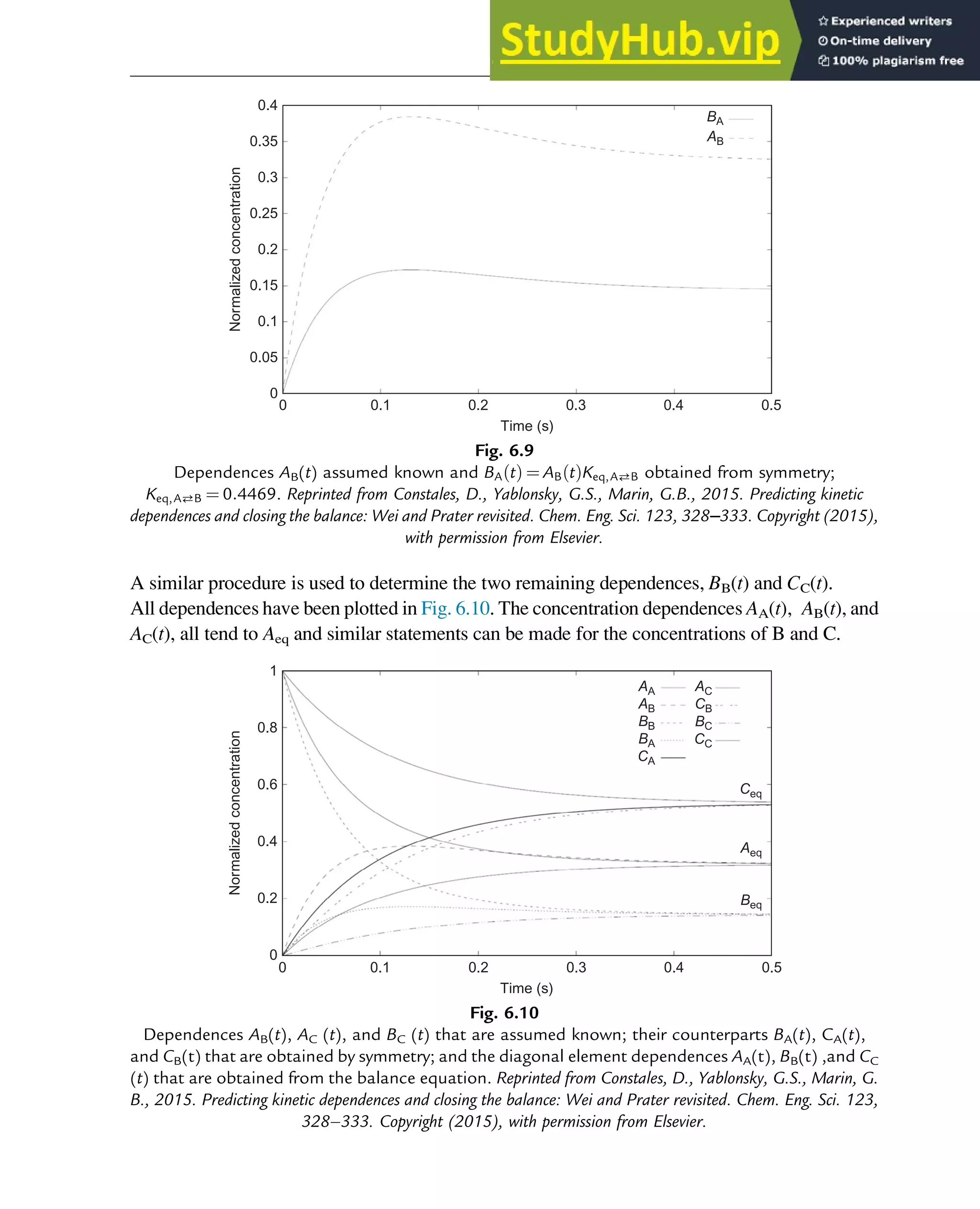
profiles are assumed. Deviations from the ideal flow pattern and from spatial isothermicity
can lead, however, to significantly different local kinetics resulting in different local apparent
rates and thus in different reactor averaged apparent rates as compared to those predicted
assuming an ideal flow pattern and isothermicity.
The simplest way to model nonideal flow patterns and temperature profiles is to divide the
reactor into a discrete number of compartments and include exchange/recycle streams
between the compartments (Topalos et al., 1996; Zhang and Ray, 1997). For each compartment,
a kinetic scheme is applied and the conversion profile and the polymer properties are
obtained from averaging the properties of each compartment with respect to their size.
328 Chapter 10
An important first “compartment model” is based on the division of each compartment into
a discrete number of perfectly mixed segments. For example, in Fig. 10.13, for each
compartment of an industrial-scale reactor for a polymerization process still in nondispersed
medium, two small perfectly mixed segments and one large perfectly mixed segment are
considered. The small segments reflect imperfect mixing (eg, of the initiator) and temperature
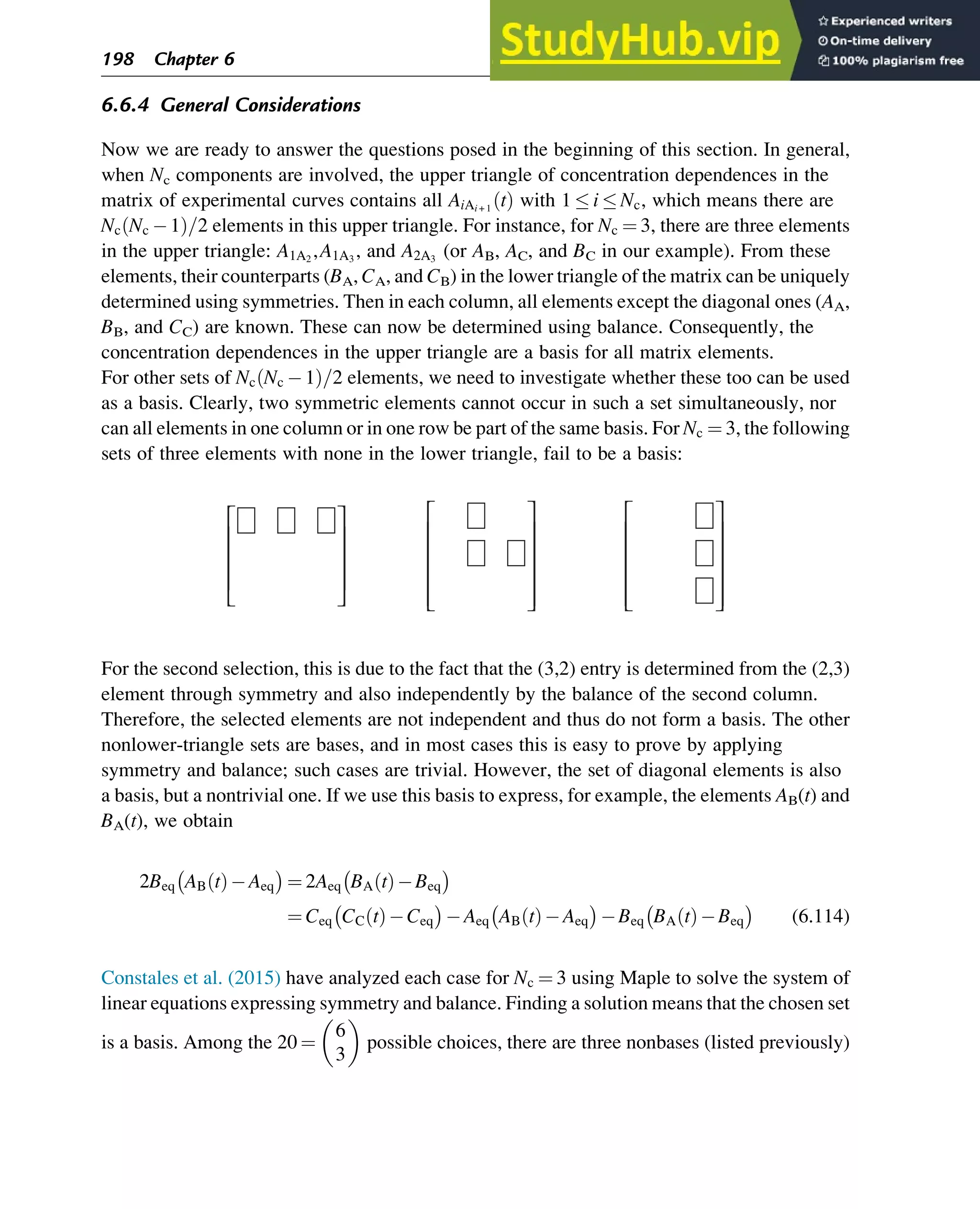
gradients (eg, hot spots) at the inlet, whereas the large segment reflects the bulk zone of the
compartment with an internal recycle to both small segments.
Denoting the volume of the kth segment as Vi,k, qVi,k as its exit volumetric flow rate, RMi,k as
the corresponding net monomer production rate, [M]i,k as the monomer concentration, fl as
the lth recycle rate from the third segment, and qV0 as the volumetric feed flow rate with
monomer concentration [M]0, the following continuity equations can be written down for
the monomer in each segment k of a compartment i:
Vi,1
d M
½ Ši,1
dt
¼ M
½ Š0qV0 + M
½ Ši 1,3qVi 1,3 + f1 M
½ Ši,3qVi,3 + RMi,1Vi,1 M
½ Ši,1qVi,1 (10.67)
Vi,2
d M
½ Ši,2
dt
¼ M
½ Ši,1qVi,1 + f2 M
½ Ši,3qVi,3 + RMi,2Vi,2 M
½ Ši,2qVi,2 (10.68)
Vi,3
d M
½ Ši,3
dt
¼ M
½ Ši,2qVi,2 + RMi,3Vi,3 f1 M
½ Ši,3qVi,3 f2 M
½ Ši,3qVi,3 (10.69)
in which it is assumed that the volumetric flow rates are balanced:
qVi,1 ¼ qV0 + qVi 1,3 + f1qVi,3 (10.70)
qVi,2 ¼ qVi,1 + f2qVi,3 (10.71)
1 + f1 + f2
ð ÞqVi,3 ¼ qVi,2 (10.72)
Fig. 10.13
Example of a compartment model with three perfectly mixed segments (two small and one large)
to account for macromixing; Vi,k, volume of segment k in compartment i; qVi,k, exit volumetric flow
rate for segment k in compartment i; qV0, volumetric feed flow rate; fl, recycle ratio (l¼1,2); subscript
V in the flow rates is not shown in order not to overload the figure.
Polymers: Design and Production 329
Analogously, overall sth order moment equations can be written down. For example,
assuming that no reaction occurs in the feed, the total concentration of dead polymer in the
first segment of compartment i follows from
Vi,1
dμ0i,1
dt
¼ μ0i 1,3qVi 1,3 + f1qVi,3μ0i,3 + Rμ0i,1
Vi,1 μ0i,1qVi,1 (10.73)
in which μ0i,1 and Rμ0i,1
are the zeroth-order moment for the dead polymer molecules and the
corresponding net production rate in segment 1 of compartment i. The net production rates
can be calculated with the method of moments, as explained previously, assuming a given
reaction scheme per segment. In addition, a temperature variation can be accounted for.
Taking again the first segment, from an energy balance it follows that
ρcp
dTi,1
dt
Vi,1 ¼ Q0 + Qi 1,3 + f1Qi,3 + Qri,1 Qi,1 (10.74)
inwhichTi,1 isthetemperatureofthefirstsegmentofcompartmenti,ρ,andcp arethecorresponding
density and specific heat capacity at constant pressure, and the subscript “r” is used to distinguish
the net heat production by reaction from the flow contribution terms. The reaction term is given by
Q0
i,1,r ¼ ΔrH
ð Þkp M
½ Ši,1λ0,i,1Vi,1 (10.75)
in which ΔrH is the propagation reaction enthalpy and λ0i,1 is the zeroth-order moment of the
living polymer molecules. Note that it is assumed that the generated heat is only due to
propagation. The energy flow terms are proportional to the temperature of the flow while
taking into account the contributions of the monomer and the polymer to obtain the correct
density and specific heat capacity.
A second important compartment model comprises compartments consisting of a perfectly mixed
segment and a plug-flow segment, which in turn can be represented by a series of perfectly
mixed segments (see Fig. 10.14). This compartment model is selected in case segregation is
important. Equations analogous to those for the compartment model of Fig. 10.13 can be derived.
Instead of using compartment models, the flow pattern in the reactor also can be calculated via
computational fluid dynamics (CFD). However, when using CFD, relatively small reaction
networks are often used to reduce the computational cost. An exception is gas-phase
polymerization, such as the production of low-density polyethylene). For more details on
the application of CFD calculations for polymerization processes, the reader is referred to Asua
and De La Cal (1991), Fox (1996), Kolhapure and Fox (1999), and Pope (2000).
10.4 Extension Toward Heterogeneous Polymerization in Dispersed Media
This section pays attention to the standard modeling tools to simulate the polymer micro
structure for polymerizations in dispersed media for which mesoscale phenomena are also
relevant. In such polymerizations, a surfactant is present so that a dispersed phase can be
330 Chapter 10
formed and the polymer product consists of polymer particles. A distinction can be made
between suspension and emulsion polymerization. In suspension polymerization, large
monomer droplets (50–500 μm; Asua, 2007) are the reaction locus, whereas in emulsion
polymerization, different reaction loci can be identified and the segregated entities are much
smaller (50–1000 nm; Asua, 2007).
10.4.1 Suspension Polymerization
For suspension polymerization, the polymerizing droplets are so large that it can be safely
assumed that the kinetics are the same for every droplet and thus the microkinetic modeling
tools introduced previously can be directly applied for one droplet to obtain the evolution
of the CLD and its averages with conversion.
In addition, the PSD (or MDSD) can be calculated analogously by replacing the variable i by its
diameter dp or volume Vp. Most commonly, the fixed pivot technique has been applied
while dividing the reactor into two compartments, an impeller and a circulation compartment,
Fig. 10.14
Example of a compartment model with one perfectly mixed segment and one plug-flow segment to
account for macromixing; the plug-flow segment can be represented by a series of perfectly mixed
segments (here three); Vi,k, volume of segment k in compartment i; qVi,k, exit volumetric flow rate for
segment k in compartment i; qV0, volumetric feed flow rate; f1,k, recycle ratio; in the figure subscript V
has been omitted.
Polymers: Design and Production 331
as shown in Fig. 10.15 (Alexopoulos and Kiparissides, 2005). This distinction is made to
account for the different turbulence intensity in the direct environment of the impeller and the
region away from the impeller, that is, to account for macroscale effects. Such a simplification
is justified, at least as a first approximation, based on CFD simulations of the flow pattern in
batch reactors with an impeller (Alexopoulos et al., 2002).
For each compartment, a population balance is derived as basis for the further
discretization according to the selected pivot elements along the Vp axis and using number
density functions nimp(V,t) and ncirc(V,t) for the impeller and circulation compartments.
These density functions are defined such that nimp(V,t)dV and ncirc(V,t)dV are the numbers of
droplets per unit volume of the impeller and circulation compartments with a volume in the
interval [V, V+dV].
For the impeller compartment with a volume, Vimp, nimp(V,t) can be obtained based on the
following nonlinear integrodifferential equation:
@nimp V, t
ð Þ
δt
¼
ðVmax
V
β U, V
ð Þu U
ð Þg U
ð Þnimp U, t
ð ÞdU
+
1
2
ðV
0
k V U,U
ð Þnimp V U,t
ð Þnimp U, t
ð ÞdU
nimp V, t
ð Þ
ðVmax
0
k V, U
ð Þnimp U, t
ð ÞdU g V
ð Þnimp V, t
ð Þ
+
qV,e
Vimp
ncirc V, t
ð Þ nimp V, t
ð Þ
 
¼ PBrhs
imp
(10.76)
The first term of the population balance, PBimp
rhs
, relates to the formation of droplets with a volume
in the interval [V, V+dV] by breakage of droplets with a larger volume (maximally Vmax). In this
term, the mesoscale parameter g(U) is the breakage coefficient for a droplet with a volume U,
u(U) is the number of droplets formed upon breakage of a droplet with a volume U (typically
two), and β(U,V) reflects the probability that a droplet with a volume U breaks into a droplet
with a volume V. The second term represents the formation of droplets in the volume interval [V,
Fig. 10.15
Compartment model to calculate the evolution of the monomer droplet size distribution (MDSD) in a
suspension polymerization; Vimp/circ, volume of impeller/circulation compartment.
332 Chapter 10
V+dV] by coalescence of two smaller droplets, with the mesoscale parameter k(U,V) the
coalescence coefficient of droplets with a volume of U and V. The third and fourth terms represent
the disappearance of droplets by, respectively, coalescence and breakage, while the last term
expresses the exchange of droplets between the two compartments with qV,e as exchange flow
rate. The analogous nonlinear integrodifferential equation for the circulation compartment can
be obtained by interchanging the subscripts “imp” and “circ” in Eq. (10.76). The mesoscale
parameters are typically obtained by correlations that can depend on the microscale properties via
a dependence on, for instance, the monomer conversion (Asua, 2007).
In practice, the continuous nimp(V,t) function is represented via delta functions:
nimp V, t
ð Þ ¼
X
Nmax
k¼1
N*
imp,k t
ð Þδ V xk
ð Þ (10.77)
in which Nimp,k
* is the contribution to the density function for the droplets in the interval k.
Integration per grid interval of Eq. (10.76) gives
ðVi + 1
Vi
@nimp V, t
ð Þ
@t
dV ¼
ðVi + 1
Vi
PBrhs
imp dV (10.78)
For the left-hand side of this equation, it follows that
ðVi + 1
Vi
@nimp V, t
ð Þ
@t
dV ¼
@
@t
ðVi + 1
Vi
XNmax
k¼1
N*
imp,k t
ð Þδ V xk
ð ÞdV
¼
@
@t
X
Nmax
k¼1
ðVi + 1
Vi
N*
imp,k t
ð Þδ V xk
ð ÞdV ¼
d
dt
N*
imp,k t
ð Þ
(10.79)
Similarly, for each coalescence/breakage term of the right-hand side mathematical
manipulations can be performed. For example, for the positive coalescence contribution
we can write
ðVi + 1
Vi
1
2
ðVx
0
k V U,U
ð Þnr V U,t
ð Þnimp U, t
ð ÞdUdV ¼
1
2
ðVi + 1
Vi
argdV (10.80)
while demanding that this contribution can be related to neighboring pivot volumes:
ðVi + 1
Vi
argdV ¼
ðxi
xi 1
b V, xi
ð ÞargdV +
ðxi + 1
xi
a V, xi
ð ÞargdV (10.81)
in which the functions a and b follow again from the reverse lever rule (see also the CLD
part of the fixed pivot technique):
a V, xi
ð Þ ¼
xi + 1 V
xi + 1 xi
(10.82)
Polymers: Design and Production 333
b V, xi
ð Þ ¼
V xi 1
xi xi 1
(10.83)
For the first term of the right-hand side of Eq. (10.81), substitution of Eq. (10.77) leads to
ðxi
xi 1
b V, xi
ð ÞargdV ¼
ðxi
xi 1
b V, xi
ð Þ
ðVx
0
k V U,U
ð Þ
X
Nmax
j¼1
N*
imp, j t
ð Þδ V U xj
 X
Nmax
l¼1
N*
imp, j t
ð Þδ U xl
ð ÞdUdV
(10.84)
Taking into account the definition of the delta function for the integration of U and the
maximum limit of V following simplification can be made
ðxi
xi 1
b V, xi
ð ÞargdV ¼
ðxi
xi 1
b V, xi
ð Þ
X
i
l¼1
k V xl,xl
ð Þ
X
Nmax
j¼1
δ V xl xj
 
N*
imp, j t
ð ÞN*
imp,l t
ð ÞdV
(10.85)
Subsequently, considering the definition of the delta function for the integration of V and the
integration limits, it can be derived that
ðxi + 1
xi
b V, xi
ð ÞargdV ¼
X
jl
xi 1xj + xlxi
b xj + xl,xi
 
k xj, xl
 
N*
imp, j t
ð ÞN*
imp,l t
ð Þ (10.86)
Analogously, for the second term of the right-hand side of Eq. (10.81), it follows that
ðxi + 1
xi
a V, xi
ð ÞargdV ¼
X
jl
xixj + xlxi + 1
a xj + xl,xi
 
k xj, xl
 
N*
imp, j t
ð ÞN*
imp,l t
ð Þ (10.87)
In general, Eq. (10.76) can thus be transformed into
dN*
imp,i t
ð Þ
dt
¼ f N*
imp,1, …, N*
circ,1, …
 
(10.88)
which allows for an efficient calculation of the evolution of the MDSD also taking into account
the analogous set of continuity equations for the impeller region.
10.4.2 Emulsion Polymerization
The main classes of emulsion polymerization are macro-, micro-, and miniemulsion
polymerization (Asua and De La Cal, 1991; Cunningham, 2008; Zetterlund et al., 2008).
In macroemulsion polymerization, a relatively high surfactant concentration is present so that
many small empty (or monomer-swollen) micelles can be formed besides large monomer
droplets (Fig. 10.16). Initiation typically occurs in the water phase and after a few
propagation steps, the resulting living macromolecule enters a micelle, as the micelles have a
much higher surface area than the monomer droplets. This entering process is known as
334 Chapter 10
heterogeneous nucleation and transforms micelles into polymer particles, which are fed with
fresh monomer from the large monomer droplets. In addition, new living macromolecules
can enter the polymer particles or species can exit and reenter. This results in a very
complex polymerization process. A further complication is that the monomer diffusivity in
the aqueous phase also plays a role, and at one point the monomer reservoirs become
depleted.
From a mathematical point of view, limiting cases of macroemulsion polymerization are
mini- and microemulsion polymerizations. In miniemulsion polymerization, only small
monomer droplets are present and these are also the main reaction locus. In microemulsion
polymerization, the monomer droplets are also small and, in principle, reaction can take
place in the monomer droplets as well as in the micelles and polymer particles. An important
feature of a microemulsion is that it is thermodynamically stable, whereas the other
emulsion types are only kinetically stable. However, if monomer is added very slowly and a
small amount of surfactant is present, polymer particles gradually swell starting from a
micelle population only. Thus, the emulsion polymerizations differ with respect to the
populations present, but in all cases the latex obtained consists of segregated entities with a size
at least one order of magnitude smaller than in suspension polymerization. In the most
Fig. 10.16
The existence of three populations in a macroemulsion process: (i) (monomer-swollen) micelles,
(ii) polymer particles, and (iii) large monomer droplets; only heterogeneous nucleation leading to
transformation of micelles into polymer particles is considered (shown here with the entry of R2
formed after two propagation steps with I); I2, water soluble initiator; large arrow represents
monomer diffusion towards polymer particle.
Polymers: Design and Production 335
complicated situation, monomer droplets, monomer-swollen micelles, and polymer particles
are present simultaneously, and initiation and propagation can occur in the continuous
water phase and in the oil phase.
The kinetic behavior in each segregated entity can be different in view of the random nature of
exit and entry phenomena and the nanometer scale of these identities, that is, a deviation
from bulk kinetics (“one big droplet”) is to be expected. Hence, for emulsion polymerization,
it is crucial to track the number of low-abundant (radical) species per segregated entity, as
compartmentalization of radical species may influence the overall kinetics and thus the
development of the polymer microstructure. If u radical types are present, this implies the
calculation of the number of segregated entities characterized by u indices, with each index
reflecting the discrete presence of one radical type.
In this section, the concept of compartmentalization is illustrated by assuming the presence of
one segregated entity, which for simplicity is referred to as a polymer particle. Macroscale
effects are also neglected for simplicity. The number of polymer particles Np is taken to be
constant, as well as the particle diameter dp and particle volume Vp. A distinction is made
between the calculation of the polymerization rate and the CLD characteristics as a function
of polymerization time, on the one hand, and a free radical polymerization (FRP) and CRP
(NMP) reaction scheme on the other hand.
10.4.2.1 Calculation of polymerization rate
A crucial distribution for the polymerization rate is the radical number distribution, which
describes the number of polymer particles with a given number of radicals (Np(n), n0). The
average number of free radicals per polymer particle is defined by (Asua, 2007)
Ri,p + Rj,p
Ri,p + Mp
Pi,p + Pj,p
Ri + 1,p
Ri,p
R0,w
I2,w 2R0,w
R0,p
R0,w
k1
kexit
k2
k3
kentry
Scheme 10.4
Simplified FRP reaction scheme for the calculation of the polymerization rate in a simplified
macroemulsion process consisting of polymer particles only; the initiator efficiency is assumed to be
100%; w, water phase; p, polymer particle.
336 Chapter 10
n ¼
X1
n¼0
nNp n
ð Þ
X
1
n¼0
Np n
ð Þ
(10.89)
The polymerization rate with respect to the total volume of the reactor Vr is subsequently
given by
rp ¼ k2 M
½ Šp

nNp
NAVr
(10.90)
in which [M]p is the monomer concentration per particle, which is assumed to be known, and k2
is the propagation rate coefficient (Scheme 10.4).
In case it is assumed that radical initiation occurs in the water phase and radicals can only enter
(absorb), exit (desorb), propagate, and terminate by disproportionation (Scheme 10.4), and
chain length dependencies can be neglected, Np(n) can be calculated using the so-called
Smith-Ewart (Smith and Ewart, 1948) equations (n0):
dNp n
ð Þ
dt
¼ 1 δ n
ð Þ
ð Þkentry Rw
½ ŠNp n + 1
ð Þ + kexit n + 1
ð ÞNp n + 1
ð Þ
+
kto
NAVp
n + 2
ð Þ n + 1
ð Þ Np n + 2
ð Þ kentry Rw
½ ŠNp n
ð Þ
kexitnNp n
ð Þ
kto
NAVp
n n 1
ð ÞNp n
ð Þ
(10.91)
d Rw
½ Š
dt
¼ 2kdis I2w
½ Š + kexit
n
Np
NAVw
2ktw Rw
½ Š2
kentry Rw
½ Š
Np
NAVw
(10.92)
d I2w
½ Š
dt
¼ kdis I2w
½ Š (10.93)
where kentry is the entry or absorption coefficient, kexit is the exit or desorption coefficient, kdis is
the dissociation rate coefficient, and kto/w is the termination rate coefficient in the oil/water
phase. Furthermore, Vw is the volume of the water phase, [I2w] is the concentration of
conventional radical initiator I2 in the water phase, and [Rw] is the total concentration of
radicals in the water phase.
Note that in order to solve Eqs. (10.91)–(10.93), the concentrations of nonradical
components in the individual particles do not have to be known. In contrast, for CRP these
concentrations do have to be known and multidimensional Smith-Ewart equations are needed to
accurately describe the polymerization kinetics. Based on Scheme 10.2 with an oil-soluble
NMP initiator R0X, it follows that if a differentiation is made between the number of NMP
initiator radicals n0, the number of macroradicals n (as before), and the number of nitroxide
Polymers: Design and Production 337
persistent species nX per polymer particle, the following contribution results for the activation
of the NMP initiator (Bentein et al., 2012):
dNp n0,n,nX
ð Þ
dt
¼ NAVpkact R0X
½ Šp Np n0 1,n,nX 1
ð Þ Np n0,n,nX
ð Þ
 
(10.94)
in which the NMP initiator radical (R0X) concentration is assumed to be the same for each
polymer particle. The actual value of this concentration is adapted per time step based on all
polymer particles and subsequent uniformization over all polymer particles:
d R0X
½ Šp
dt
¼
X
n0,n,nx
kdeact
Np NAVp
 2
n0nxNp n0,n,nX
ð Þ kact R0X
½ Šp (10.95)
As for the microscale models, typically linear multistep methods are used for the numerical
integration of the obtained set of equations. Alternatively, a kMC approach can be selected.
10.4.2.2 Calculation of average chain length characteristics
Theoretically, the description of the evolution of the CLD for an emulsion polymerization
process is complex as not only the number of radicals has to be tracked per particle but also the
chain lengths of these radicals. For FRP, however, the computational effort can be reduced
in case a so-called zero-one system is obtained, in which the polymer particles either contain
no radicals or only one radical at a given time.
In general, for emulsion polymerizations, mostly only average characteristics of the CLDs are
assessed implying the approximate calculation of higher order moments starting from the
zeroth-order moments as obtained based on the calculation of the polymerization rate
(Eq. 10.90). Typically the moments are expressed as the total amount of moles for all
polymer particles together and not as a concentration (per particle). In this chapter, the
superscript 0
is used to stress this change in dimension to moles. For example, for the NMP case
(Scheme 10.2 with oil-soluble NMP initiator), the zeroth-order moment on an overall
molar basis for the macroradical population is directly given by (Smith and Ewart, 1948)
λ0
0 ¼ 
n
Np
NA
(10.96)
Assuming semibulk kinetics, the following equation contributions result for the change of
the overall number of moles of radicals with a chain length i considering activation and
termination by disproportionation as reaction possibilities (Smith and Ewart, 1948):
dnRi
dt
¼ kactnRiX ktd Ri
½ Špλ0
0 + … (10.97)
in which nRi
and nRiX are the total number of moles of radicals and dormant species with
chain length i. Applying a QSSA, the higher order moment equations (on an overall molar
basis) can be rewritten as follows:
338 Chapter 10
λ0
1 ¼
kactτ0
1 + …
ktdλ0
0 + …
(10.98)
λ0
2 ¼
kactτ0
2 + …
ktdλ0
0 + …
(10.99)
For the dormant and dead polymer molecules, the higher moment equations also have to be
written on an overall molar basis but no QSSA can be applied.
10.5 Extension Toward Heterogeneous Polymerization With Solid Catalysts
Besides polymerization in dispersed media as described in Section 10.4, another form of
heterogeneous polymerization involves the use of a solid catalyst. The most commonly
known examples are Ziegler-Natta and Phillips catalysts for the production of polyethylene
products (Tobita and Yanase, 2007). In this section, the most frequently applied modeling
approaches for the calculation of the polymer microstructure in such polymerization
processes are highlighted, neglecting macroscale effects for simplicity. For a more detailed
description, the reader is referred to Asua (2007) and Tobita and Yanase (2007).
Inthesimplestcase,themassCLDofaheterogeneouspolymerization,whichisdefinedasthemass
fraction of polymer molecules with a given chain length i, is represented by a weighted sum
over different Flory distributions (Flory, 1953), each corresponding to one type of catalyst site:
mi ¼
X
Nd
j¼1
mj,CLD
i
x2
n, j
exp
i
xn, j
(10.100)
in which Nd is the number of types of catalyst sites and mj,CLD is the mass fraction of the
CLD for the jth catalyst site and with number average chain length xn,j. In practice, the
individual average chain lengths are determined via regression to experimental data of the total
CLD. Note that this method can be seen as an extended method of moments in which the
CLD is reconstructed based on the individual number average chain lengths.
For copolymerizations, the Flory distribution is extended to the so-called Stockmayer
distribution (Soares and McKenna, 2012; Stockmayer, 1945). For a single CLD for a
copolymerization involving the comonomers A and B, the corresponding copolymer
composition CLD is defined by
mi,y ¼
i
x2
n
exp
i
xn
ffiffiffiffiffiffiffiffi
i
2πκ
r
exp
iy2
2κ
(10.101)
with
y ¼ FpA Finst
pA (10.102)
Polymers: Design and Production 339
κ ¼ Finst
pA 1 Finst
pA
  ffiffiffiffiffiffiffiffiffiffiffiffiffiffiffiffiffiffiffiffiffiffiffiffiffiffiffiffiffiffiffiffiffiffiffiffiffiffiffiffiffiffiffiffiffiffiffiffiffiffiffiffiffiffiffiffiffiffiffi
1 4Finst
pA 1 Finst
pA
 
1 rArB
ð Þ
r
(10.103)
in which FpA
inst
is the instantaneous composition based on the propagation rates using the
comonomer feed concentrations, FpA is the composition of a given polymer chain (in terms of the
mole fraction of A units in the copolymer), and rA and rB are the monomer reactivity ratios:
rA ¼
kpAA
kpAB
(10.104)
rB ¼
kpBB
kpBA
(10.105)
in which kpM1M2
is the propagation rate coefficient for the addition of a living macrospecies
ending in a monomer unit M1 to a monomer of type M2.
The following distribution has been proposed for a single CLD in case long-chain branches can
be formed (Asua, 2007):
m i, zbr
ð Þ ¼
1
2zbr + 1
ð Þ!
i2zbr + 1 1
xn
ð Þ2zbr + 1
exp
i
xn
(10.106)
with zbr the number of long-chain branches considered. For a zbr equal to zero, the Flory
distribution is obtained.
More recently, so-called multigrain models have been developed (Asua, 2007; Tobita and
Yanase, 2007) to describe polymerizations with solid catalysts in a more detailed manner,
including a clear link between the micro- and mesoscale. In such models, the polymer
growth and the possibility to form radial concentration and temperature gradients are accounted
for. The catalyst particle is seen as an agglomeration of macrograins, which in turn are
composed of micrograins, as depicted in Fig. 10.17. The catalyst sites are assumed to be present
at the surface of the catalyst particle.
First, the monomer concentration profile in the macrograin (Ma[rmac,t]) can be calculated based on
εp
@ Mmac
½ Š
@t
¼
1
r2
mac
@
@rmac
Deff,Mr2
mac
@ Mmac
½ Š
@rmac
RM,mic (10.107)
in which the particles are assumed to be spherical, εp is the porosity, rmac is the radial position with
respect to the center of the macrograin, RM,mic is the monomer disappearance rate toward the
micrograins, and Deff,M is the effective monomer diffusion coefficient, as defined by
Deff,M ¼
Db,Mεp
τp
(10.108)
in which Db,M is the bulk monomer diffusivity and τp is the tortuosity of the catalyst particle.
340 Chapter 10
As initial condition, it is typically assumed that the concentration profile is constant:
Mmac
½ Š rmac, 0
ð Þ ¼ Mmac
½ Š0 (10.109)
Furthermore, the following boundary conditions can be used:
@ Mmac
½ Š
@rmac
0, t
ð Þ ¼ 0 (10.110)
Deff,M
@ Mmac
½ Š
@rmac
Rmac, t
ð Þ ¼ ktf Mb
½ Š Mmac
½ Š
ð Þ (10.111)
in which Rmac is the radius of the macrograin, ktf is a mass transfer coefficient, and [Mb] is the
bulk monomer concentration.
For the micrograins, the analogous equation is
@ Mmic
½ Š
@t
¼
1
r2
mic
@
@rmic
Dp,Mr2
mic
@ Mmic
½ Š
@rmic
(10.112)
in which rmic is the radial position with respect to the microparticle center, Dp,M is the
diffusivity of the monomer in the polymer layer around the microparticle of radius Rmic and
original size Rc (surface location). Dp,M is given by the ratio of the diffusivity of the monomer in
the amorphous phase and a correction factor for the presence of crystallites. The following
boundary conditions are used:
Mmic
½ Š Rmic, t
ð Þ ¼ Meq
 
(10.113)
4πR2
cDp,M
@ Mmic
½ Š
@rmic
Rc, t
ð Þ ¼
4
3
πR3
cRV
M,mic (10.114)
Fig. 10.17
Principle of a multigrain model for the description of radial temperature and concentration gradients
in heterogeneous polymerizations with solid catalysts. A macrograin (radius Rmac) consists of
micrograins (radius Rmic with polymer layer, Rc without polymer layer) in concentric layers surrounded
by the gas phase.
Polymers: Design and Production 341
in which RM,mic
V
is the monomer consumption rate per unit volume of micrograin particle, which
is linked to the microkinetics, and [Mmic]eq is the equilibrium concentration, which can be
linked to the macrograin concentration through a partition coefficient. As initial condition,
again a constant profile is typically selected:
Mmic
½ Š rmic, 0
ð Þ ¼ Mmic
½ Š0 (10.115)
For the temperature profile, analogous equations can be derived (Asua, 2007; Tobita and
Yanase, 2007).
10.6 Conclusions
Several numerical tools have been developed and successfully applied to model the polymer
microstructure as a function of monomer conversion and process conditions. In this chapter,
these tools have been reviewed and applied to model the polymer microstructure for both
radical and catalytic chain-growth polymerizations, which are mechanistically the most
important polymerization processes. Attention is focused both on the accurate simulation of the
CLD and the PSD, following a multiscale modeling approach. The numerical tools
discussed can be applied also for step-growth polymerizations provided that the model
parameters are available or can be determined experimentally.
A main distinction has been made between deterministic and stochastic modeling techniques.
A further distinction has been proposed based on the scale for which the mathematical
model must be derived (eg, micro-, meso-, and/or macroscale). Notably, the complexity of the
model approach depends on the desired model output. Detailed microstructural information
is only accessible using advanced modeling tools but these are associated with an increase high
in computational cost. The advanced models allow one to directly relate macroscopic
properties to the polymer synthesis procedure and, thus, to broaden the application market
for polymer products, based on a fundamental understanding of the polymerization kinetics
and their link with polymer processing.
Nomenclature
A, B comonomer type
Apivot function predefined by Eq. (10.38)
arg short notation for part of population balance to obtain nimp/circ(V,t)
ak kth expansion coefficient for Galerkin formulation
B0
representative matrix for polymerization kinetics
cp specific heat capacity at constant pressure (J kg 1
K 1
)
Db,M bulk monomer diffusivity (m2
s 1
)
Deff,M effective monomer diffusion coefficient (m2
s 1
)
Dp,M diffusivity of the monomer in the polymer layer (m2
s 1
)
342 Chapter 10
FpA
inst
instantaneous copolymer composition (mole fraction of A units)
FpA composition of copolymer chain (mole fraction of A units)
fl lth recycle ratio
Ga,Y pgf (a¼0,1: number, mass; Y: R, P: macromolecule type) of the transformed
(complex) z variable
g(U) breakage coefficient for a droplet with volume U (s 1
)
i, j chain length
i* randomly selected chain length
ik kth pivot chain length
k vector with rate coefficients (dependent on reaction order)
k(U,V) coalescence coefficient of droplets with volumes U and V (m3
s 1
)
k* adjusted rate coefficient to allow for derivation of moment equations involving
termination by recombination (m3
mol 1
s 1
)
kact activation rate coefficient in NMP (s 1
)
kapp apparent rate coefficient (dependent on reaction order)
kchem intrinsic rate coefficient (dependent on reaction order)
kr rate coefficient for reaction r (dependent on reaction order)
ktf mass transfer coefficient (m s 1
)
kν “macroscopic” rate coefficient for reaction channel ν (dependent on
reaction order)
kν
MC
“kinetic MC rate coefficient” for reaction channel ν (s 1
)
l** length of branch (Tobita-based MC)
lk basis functions for Galerkin formulation
ln characteristic length of branch (Tobita-based MC)
mi mass fraction of polymer chains with chain length i; if also index y: relates to
copolymer composition CLD
mj,CLD mass fraction of the CLD for the jth catalyst site
NA Avogadro’s number (mol 1
)
Nbr number of branching points/branches
Nc number of tracked chains for matrix-based kinetic MC
Nimp,k contribution to the density function for the interval k of the droplet size domain
for the fixed pivot method (m 6
)
Nk kth chain length domain for the fixed pivot method
Nm number of molecules for mth species type in kinetic MC simulations in V
Np number of polymer particles
Np(n) number of polymer particles with n radicals
Np(n0,n,nX) number of polymer particles with n0 initiator radicals, n radicals, and nX nitroxide
radicals
Nr number of reactions for kinetic MC simulations
Nsp number of different species
Polymers: Design and Production 343
Ntr truncation number for Galerkin formulation
n number of macroradicals per polymer particle
n0 number of NMP initiator radicals per polymer particle
nRi
overall amount of radicals with chain length i (mol)
nRiX overall amount of dormant species with chain length i (mol)
nX number of nitroxide persistent species per polymer particle
ncirc(V,t) number density function for circulation compartment (m 6
)
nimp(V,t) number density function for impeller compartment (m 6
)
n̄ average number of free radicals per polymer particle
P dead species
Pa,Y pgf (a¼0,1: number, mass; Y: R, P: type of macromolecule)
Pν
MC
MC reaction probability for reaction channel ν
PBimp
rhs
right-hand side of population balance for impeller compartment
p(xx*│x) conditional probability for branching density (Tobita-based MC)
p1 parameter in the Wesslau distribution
Qri,k heat produced by reaction for segment k in compartment i (W)
Qi,k heat contribution via exit flow from segment k in compartment i (W)
Q0 heat contribution via feed flow (W)
q parameter in Schulz-Flory weight function for Galerkin formulation
qV,e exchange flow rate (m3
s 1
)
qVi,k volumetric exit flow rate for segment k in compartment i (m3
s 1
)
qV0 volumetric feed flow rate (m3
s 1
)
Rc radius of microparticle without polymer layer (m)
RMi,k net monomer production rate for segment k in compartment i (mol m 3
s 1
)
Rmac radius of macrograin (m)
Rmic radius of micrograin with polymer layer (m)
Rμ0,i,k net production rate of dead polymer for segment k in compartment i
(mol m 3
s 1
)
RM,mic monomer disappearance rate toward the micrograins per unit volume of
macrograin (mol m 3
s 1
)
RM,mic
V
monomer consumption rate per unit volume of micrograin (mol m 3
s 1
)
r1, r 2 random numbers for kinetic MC simulations
rA, rB reactivity ratios for propagation in copolymerization
rmac radial position with respect to the center of macrograin (m)
rmic radial position with respect to center of micrograin (m)
rp polymerization rate per unit volume of reactor (mol m 3
s 1
)
rv
MC
MC reaction rate for reaction channel ν
SD(z) structural deviation of chain z with respect to TM; minimum of four contributions
SDk (k¼1,…, 4)
Sx(y,z) cumulative number of monomer units of type x at position y in chain z (chain
length: i) of the kMC sample as counted from “left to right”
344 Chapter 10
Sx,TM,r(y,z) cumulative number of monomer units of type x at position y of the targeted chain
in the direction r (always defined from “left to right”) with the same length as the
considered chain z as counted from “left to right”
Sx
0
(y,z) cumulative number of monomer units of type x at position y in chain z (chain
length: i) of the kMC sample as counted from “right to left”
S0
x,TM,r(y,z) cumulative number of monomer units of type x at position y of the targeted chain
in the direction r (always defined from “left to right”) with the same length as the
considered chain z as counted from “right to left”
T temperature (K)
U volume of droplet (m3
)
u(U) number of droplets formed upon breakage of a droplet with volume U
V volume (m3
)
Vmax indicates border of size domain for droplets in fixed pivot method (m3
)
Vp particle volume (m3
)
Vr reactor volume (m3
)
X nitroxide
xs sth order average chain length; s¼1, 2, 3 or n, m, z
x* birth conversion (Tobita-based MC)
x** birth conversion of branch (Tobita-based MC)
x*** birth conversion for branch created in an earlier stage
y parameter for Stockmayer distribution
z complex variable (pgf method) or chain number (matrix-based kinetic MC)
zbr number of long-chain branches
[A] concentration of nonmacromolecule A (mol m 3
)
[I2] concentration of radical initiator (mol m 3
)
[M] concentration of monomer (mol m 3
)
[Pi] concentration of dead polymer chain with chain length i (mol m 3
)
[Pk
*] concentration of dead polymer chains in the chain length domain k
(mol m 3
)
[R0] concentration of (NMP) initiator radical (mol m 3
)
[Ri] concentration of living polymer chain with chain length i (mol m 3
)
[RiX] concentration of dormant polymer chain with chain length i (mol m 3
)
[Rk
*] concentration of living polymer chains in the chain length domain k
(mol m 3
)
[Rw] total concentration of radicals in the water phase (mol m 3
)
k,s sth order population-weighted rate coefficient (mol m 3
s 1
)
SD average structural deviation
Greek symbols
β(U,V) probability that a droplet with a volume U breaks into a droplet with a volume V
γ orthogonality factor
Polymers: Design and Production 345
ΔrH enthalpy change of reaction (J mol 1
)
Δk size of kth chain length domain in fixed pivot method
Δt time step (s)
δ Dirac delta function
εp porosity of catalyst particle
κ parameter for Stockmayer distribution
μ,λ,τ moments for dead, living, and dormant macrospecies (mol m 3
)
μ0
,λ0
,τ0
rescaled moments for dead, living, and dormant macrospecies for all polymer
particles (mol)
μMC
MC reaction channel
ρ density (kg m 3
)
ρbr predefined branching probability
σ parameter in the Wesslau distribution
τMC
MC time step (s)
τp tortuosity of catalyst particle
Subscripts
0 initial/feed (compartment model)
b bulk
act activation
circ circulation
d FRP in emulsion: desorption
deact deactivation; 0 if NMP initiator related
dis dissociation
entry denotes entry of radicals in polymer particles
eq equilibrium
exit denotes exit of radicals from polymer particles
i,k segment k of compartment i
imp impeller
k domain k
mac macrograin
max maximum
mic micrograin
o oil phase
p particle
p propagation
n,m,z number, mass, z order for average of CLD
s0
order
tc termination by recombination
td termination by disproportionation
346 Chapter 10
tp (chain) transfer to polymer
trM chain transfer to monomer
w water phase
Superscripts
MC Monte Carlo
Abbreviations
CFD computational fluid dynamics
CLD chain length distribution
CRP controlled radical polymerization
FRP free radical polymerization
NMP nitroxide-mediated polymerization
MC Monte Carlo
MDSD monomer droplet size distribution
PSD particle size distribution
pgf probability generating function
QSSA quasi-steady-state approximation
TM targeted microstructure
Acknowledgments
This work is supported by the Long Term Structural Methusalem Funding by the Flemish
government and the Interuniversity Attraction Poles Programme—Belgian State—Belgian
Science Policy. D.R.D. acknowledges the Fund for Scientific Research Flanders (FWO)
through a postdoctoral fellowship.
References
Achilias, D.S., 2007. A review of modeling of diffusion controlled polymerization reactions. Macromol. Theory
Simul. 16, 319–347.
Achilias, D., Kiparissides, C., 1988. Modeling of diffusion-controlled free-radical polymerization reactions. J. Appl.
Polym. Sci. 35, 1303–1323.
Alexopoulos, A.H., Kiparissides, C., 2005. Part II: dynamic evolution of the particle size distribution in particulate
processes undergoing simultaneous particle nucleation, growth and aggregation. Chem. Eng. Sci.
60, 4157–4169.
Alexopoulos, A.H., Maggioris, D., Kiparissides, C., 2002. CFD analysis of turbulence non-homogeneity in mixing
vessels: a two-compartment model. Chem. Eng. Sci. 57, 1735–1752.
Asteasuain, M., Sarmoria, C., Brandolin, A., 2002a. Recovery of molecular weight distributions from transformed
domains. Part I. Application of pgf to mass balances describing reactions involving free radicals. Polymer
43, 2513–2527.
Polymers: Design and Production 347
Asteasuain, M., Sarmoria, C., Brandolin, A., 2002b. Recovery of molecular weight distributions from transformed
domains. Part II. Application of numerical inversion methods. Polymer 43, 2529–2541.
Asteasuain, M., Sarmoria, C., Brandolin, A., 2004. Molecular weight distributions in styrene polymerization with
asymmetric bifunctional initiators. Polymer 45, 321–335.
Asua, J.M., 2007. Polymer Reaction Engineering. Blackwell Publishing, Oxford.
Asua, J.M., De La Cal, J.C., 1991. Entry and exit rate coefficients in emulsion polymerization of styrene. J. Appl.
Polym. Sci. 42, 1869–1877.
Baltsas, A., Achilias, D.S., Kiparissides, C., 1996. A theoretical investigation of the production of branched
copolymers in continuous stirred tank reactors. Macromol. Theory Simul. 5, 477–497.
Bentein, L., D’hooge, D.R., Reyniers, M.F., Marin, G.B., 2011. Kinetic modeling as a tool to understand and
improve the nitroxide mediated polymerization of styrene. Macromol. Theory Simul. 20, 238–265.
Bentein, L., D’hooge, D.R., Reyniers, M.-F., Marin, G.B., 2012. Kinetic modeling of miniemulsion nitroxide
mediated polymerization of styrene: effect of particle diameter and nitroxide partitioning up to high conversion.
Polymer 53, 681–693.
Budde, U., Wulkow, M., 1991. Computation of molecular weight distributions for free-radical polymerization
systems. Chem. Eng. Sci. 46, 497–508.
Butté, A., Storti, G., Morbidelli, M., 2002. Evaluation of the chain length distribution in free-radical polymerization,
1. Bulk polymerization. Macromol. Theory Simul. 11, 22–36.
Chaffey-Millar, H., Stewart, D., Chakravarty, M.M.T., Keller, G., Barner-Kowollik, C., 2007. A parallelised high
performance Monte Carlo simulation approach for complex polymerisation kinetics. Macromol. Theory Simul.
16, 575–592.
Cunningham, M.F., 2008. Controlled/living radical polymerization in aqueous dispersed systems. Prog. Polym. Sci.
24, 365–398.
De Roo, T., Wieme, J., Heynderickx, G.J., Marin, G.B., 2005. Estimation of intrinsic rate coefficients in vinyl
chloride suspension polymerization. Polymer 45, 8340–8354.
D’hooge, D.R., Reyniers, M.F., Marin, G.B., 2013. The crucial role of diffusional limitations in controlled radical
polymerization. Macromol. React. Eng. 7, 362–379.
Flory, P.L., 1953. Principles of Polymer Chemistry. Cornell University Press, Ithaca, NY.
Fox, R.O., 1996. Computational methods for turbulent reacting flows in chemical process industry. Rev. Inst. Franç.
Pétrole 51, 215–243.
Gilbert, R.G., Hess, M., Jenkins, A.D., Jones, R.G., Kratochvil, P., Stepto, R.F.T., 2009. Dispersity in polymer
science. Pure Appl. Chem. 81, 351–353.
Gillespie, D.T., 1977. Exact stochastic simulation of coupled chemical reactions. J. Phys. Chem. 81, 2340–2361.
Hulburt, H.M., Katz, S., 1964. Some problems in particle technology. A statistical mechanical formulation. Chem.
Eng. Sci. 19, 555–574.
Iedema, P.D., Grcev, S., Hoefsloot, H.C.J., 2003. Molecular weight distribution modeling of radical polymerization
in a CSTR with long chain branching through transfer to polymer and terminal double bond (TDB) propagation.
Macromolecules 36, 458–476.
Kolhapure, N.H., Fox, R.O., 1999. CFD analysis of micromixing effects on polymerization in tubular low-density
polyethylene reactors. Chem. Eng. Sci. 54, 3233–3242.
Konkolewicz, D., Sosnowski, S., D’hooge, D.R., Szymanski, R., Reyniers, M.F., Marin, G.B., Matyjaszewski, K.,
2011. Origin of the difference between branching in acrylates polymerization under controlled and free radical
conditions: a computational study of competitive processes. Macromolecules 44, 8361–8373.
Kotoulas, C., Kiparissides, C., 2006. A generalized population balance model for the prediction of particle size
distribution in suspension polymerization reactors. Chem. Eng. Sci. 61, 332–346.
Kumar, S., Ramkrishna, D., 1996. On the solution of population balance equations by discretization—I. A fixed
pivot technique. Chem. Eng. Sci. 51, 1311–1332.
Malmström, E.E., Hawker, C.J., 1998. Macromolecular engineering via ‘living’ free radical polymerizations.
Macromol. Chem. Phys. 199, 923–935.
348 Chapter 10
Matyaszewski, K., Sumerlin, B.S., Tsarevsky, N.V., 2012. Progress in Controlled Radical Polymerization: Materials
and Applications. American Chemical Society, Washington, DC.
Matyjaszwski, K., Xia, J., 2001. Atom transfer radical polymerization. Chem. Rev. 101, 2921–2990.
McKenna, T.F., Soares, J.P.B., 2001. Single particle modeling for olefin polymerization on supported catalysts: a
review and proposals for future developments. Chem. Eng. Sci. 56, 3931–3949.
Meyer, T., Keurentjes, J., 2005. Handbook of Polymer Reaction Engineering, vol. 1. Wiley-VCH, Weinheim.
Moad, G., Solomon, D.H., 2006. The Chemistry of Radical Polymerization, second ed. Elsevier, Oxford.
Petzold, L.R., 1983. Automatic selection of methods for solving stiff and nonstiff systems of ordinary differential
equations. SIAM J. Sci. Stat. Comput. 4, 136–148.
Pladis, P., Kiparissides, C., 1988. A comprehensive model for the calculation of molecular weight long-chain
branching distribution in free-radical polymerizations. Chem. Eng. Sci. 53, 3315–3333.
Pladis, P., Kiparissides, C., 1999. Dynamic modeling of multizone, multifeed high-pressure LDPE autoclaves.
J. Appl. Polym. Sci. 73, 2327–2348.
Pope, S.B., 2000. Turbulent Flows. Cambridge University Press, Cambridge.
Richards, J.R., Congalidis, J.P., 2006. Measurement and control of polymerization reactors. Comput. Chem. Eng.
30, 1447–1463.
Roudsari, S.F., Ein-Mozaffari, F., Dhib, R., 2013. Use of CFD in modeling MMA solution polymerization in a
CSTR. Chem. Eng. J. 219, 429–442.
Russell, G.T., 1994. On exact and approximate methods of calculating an overall termination rate coefficient from
chain length dependent termination rate coefficients. Macromol. Theory Simul. 3, 439–468.
Smith, W.V., Ewart, R.H., 1948. Kinetics of emulsion polymerization. Chem. Phys. 16, 592–599.
Soares, J.P.B., Hamielec, A.E., 1995. Deconvolution of chain-length distributions of linear polymers made by
multiple-site-type catalysts. Polymer 36, 2257–22263.
Soares, J.P.B., McKenna, T.F., 2012. Polyolefin Reaction Engineering. Wiley-VCH, Weinheim.
Stockmayer, W.H.J., 1945. Distribution of chain lengths and compositions in copolymers. Chem. Phys. 13, 199–207.
Tobita, H., 1993. Molecular weight distribution in free radical polymerization with long-chain branching. J. Polym.
Sci. B Polym. Phys. 31, 1363–1371.
Tobita, H., Yanase, F., 2007. Monte Carlo simulation of controlled/living radical polymerization in emulsified
systems. Macromol. Theory Simul. 16, 476–488.
Toloza Porras, C., D’hooge, D.R., Van Steenberge, P.H.M., Reyniers, M.F., Marin, G.B., 2013. A theoretical
exploration of the potential of ICAR ATRP for one- and two-pot synthesis of well-defined diblock copolymers.
Macromol. React. Eng. 7, 311–326.
Topalos, E., Pladis, P., Kiparissides, C., Goossens, I., 1996. Dynamic modeling and steady-state multiplicity in high-
pressure multizone LDPE autoclaves. Chem. Eng. Sci. 51, 2461–2470.
Van Steenberge, P.H.M., Vandenbergh, J., D’hooge, D.R., Reyniers, M.F., Adriaensens, P.J., Lutsen, L.,
Vanderzande, D.J.M., Marin, G.B., 2011. Kinetic Monte Carlo modeling of the sulfinyl precursor route for poly
(p-phenylene vinylene) synthesis. Macromolecules 44, 8716–8726.
Van Steenberge, P.H.M., D’hooge, D.R., Wang, Y., Zhong, M., Reyniers, M.F., Konkolewicz, D.,
Matyjaszewski, K., Marin, G.B., 2012. Linear gradient quality of ATRP copolymers. Macromolecules
45, 8519–8531.
Wulkow, M., 1996. The simulation of molecular weight distributions in polyreaction kinetics by discrete Galerkin
methods. Macromol. Theory Simul. 5, 393–416.
Zetterlund, P.B., Kagawa, Y., Okubo, M., 2008. Controlled/living radical polymerization in dispersed systems.
Chem. Rev. 108, 3747–3794.
Zhang, S.X., Ray, W.H., 1997. Modeling of imperfect mixing and its effects on polymer properties. AIChE J.
43, 1265–1277.
Zhu, S., 1999. Modeling of molecular weight development in atom transfer radical polymerization. Macromol.
Theory Simul. 8, 29–37.
Polymers: Design and Production 349
CHAPTER 11
Advanced Theoretical Analysis
in Chemical Engineering
Computer Algebra and Symbolic Calculations
11.1 Critical Simplification
The principle of critical simplification was first explained by Yablonsky et al. (Yablonskii
and Lazman, 1996; Yablonsky et al., 2003) using the catalytic oxidation reaction as an
example. The authors presented a dramatic simplification of the kinetic model for this reaction
at critical conditions relating to bifurcation points. In this section, results obtained by
Gol’dshtein et al. (2015) are also used.
11.1.1 Model of the Adsorption Mechanism
The simplest mechanism for interpreting critical phenomena in heterogeneous catalysis is
the Langmuir adsorption mechanism, also referred to as the Langmuir-Hinshelwood
mechanism. This mechanism includes three elementary steps: (1) adsorption of one type of gas
molecule on a catalyst active site; (2) adsorption of a different type of gas molecule on another
active site; (3) reaction between these two adsorbed species. For the oxidation of carbon
monoxide on platinum, this mechanism can be written as follows:
1
ð Þ 2Pt + O2  2PtO
2
ð Þ Pt + CO  PtCO
3
ð Þ PtO + PtCO ! 2Pt + CO2
(11.1)
where Pt is a free active platinum site and PtO and PtCO are platinum sites with adsorbed
oxygen and carbon monoxide. The adsorption steps, (1) and (2), are usually reversible,
although oxygen adsorption can be considered to be irreversible at low to moderate
temperatures.
Advanced Data Analysis and Modelling in Chemical Engineering. http://dx.doi.org/10.1016/B978-0-444-59485-3.00011-4
# 2017 Elsevier B.V. All rights reserved.
351
The kinetic model related to this adsorption mechanism with irreversible adsorption of oxygen
can be presented as
dx
dt
¼ 2r+
1 r+
3
dy
dt
¼ r+
2 r2 r+
3
dz
dt
¼ 2r+
1 r+
2 + r2 + 2r+
3
8


:
(11.2)
where x, y, and z are the normalized surface concentrations of respectively adsorbed oxygen and
carbon monoxide and of free active sites: x ¼ θPtO,y ¼ θPtCO,z ¼ θPt; r+
1 ,r+
2 andr+
3 are rates of
the forward reactions and r2 is the rate of reverse reaction (2) in Eq. (11.1) (r1 ¼ r3 ¼ 0). The
reaction rates correspond to the mass-action law: r+
1 ¼ 2k+
1 pO2
z2
,r+
2 ¼ 2k+
2 pCOz,r2 ¼ k2 y,r+
3 ¼
k+
3 xy, where k
+=
1,2,3 are the kinetic coefficients of the reactions and pO2
and pCO are the partial
pressures of oxygen and carbon monoxide. The third row in Eq. (11.2) is a linear combination of
the first and second rows.
In addition, the law of mass conservation holds regarding the total normalized surface
concentration of platinum sites:
x + y + z ¼ 1 (11.3)
Therefore, the model can be reduced to
dx
dt
¼ 2k+
1 pO2
1 x y
ð Þ2
k+
3 xy
dy
dt
¼ k+
2 pCO 1 x y
ð Þ k2 y k+
3 xy
8


:
(11.4)
From the corresponding steady-state model
dx
dt
¼ 0;
dy
dt
¼ 0
 
, it follows that
2k+
1 pO2
1 x y
ð Þ2
k+
3 xy ¼ 0
k+
2 pCO 1 x y
ð Þ k2 y k+
3 xy ¼ 0
(
(11.5)
The partial pressures pO2
and pCO are considered to be parameters of our model with pO2
constant and pO2
≫pCO while the steady-state rate dependence on the gas-phase composition is
assumed to be monoparametric: r ¼ f pCO
ð Þ.
The set of equations, Eq. (11.5) has one obvious boundary steady-state solution:
x ¼ 1;y ¼ 0;z ¼ 0, that is, all active Pt sites are occupied by adsorbed oxygen. In order to
determine other steady states, we can transform the equations as follows:
352 Chapter 11
2k+
1 pO2
k+
3
 2
x3
+ 2k+
1 pO2
k+
3
 2
4k+
1 pO2
k2 k+
3 k+
3
 2
k+
2 pCO
h i
x2
+ 4k+
1 pO2
k2 k+
3 2k+
1 pO2
k2
 2
k2 k+
3 k+
2 pCO
h i
x + 2k+
1 pO2
k2
 2
¼ 0
(11.6)
This is a cubic equation in the variable x, the normalized surface concentration of adsorbed
oxygen. The corresponding value of y, the normalized surface concentration of adsorbed carbon
monoxide, can be calculated from Eq. (11.5).
In a typical Langmuir adsorption mechanism. the elementary reaction between two
adsorbed species is very fast. In this case, such a fast reaction occurs between adsorbed oxygen
and adsorbed carbon monoxide, that is, k+
3 ≫k+
1 pO2
, k+
2 pCO, k2 . Consequently, we can
introduce a small parameter ε ¼ 1=k+
3 and write the discriminant of Eq. (11.6) in the following
form:
Δ ¼ 2k+
1 pO2
+ k+
2 pCO
 2
k2
 2
8k+
1 pO2
k2 + 2k+
2 pCOk2 + k+
2
 2
p2
CO
h i
ε4k+
1 pO2
24 k+
1
 2
p2
O2
k2
 2
+ k+
2 pCO k+
2 pCO + k2
 
2 k+
2
 2
p2
CO + 2k+
2 pCOk2 k2
 2
h i
n
2k+
1 pO2
k2 10k+
2 p2
CO + k+
2 pCOk2 + k2
 2
h io
ε2
4k+
1 p2
O2
k+
2
 2
p2
CO k2
 2
k2
 2
+ 8 k+
2
 2
p2
CO + 8k2 3k+
1 pO2
+ k+
2 pCO
 
h i
ε3
32 k+
1
 3
p3
O2
k+
2
 2
p2
CO k2
 4
:
(11.7)
In the zero approximation, ε ¼ 0, the expression for the discriminant becomes a very simple
product of two terms:
Δ ¼ k+
2 pCO 2k+
1 pO2
 2
k2
 2
8k+
1 pO2
k2 + 2k+
2 pCOk2 + k+
2
 2
p2
CO
h i
(11.8)
The corresponding quantities
B1 ¼ 1
k+
2 pCO
2k+
1 pO2
(11.9)
and
B2 ¼ k2
 2
8k+
1 pO2
k2 + 2k+
2 pCOk2 + k+
2
 2
p2
CO (11.10)
will be used as bifurcation parameters. A bifurcation occurs if B1 ¼ 0 or B2 ¼ 0. If B1 ¼ B2 ¼ 0
then the corresponding bifurcation has maximum complexity (Gol’dshtein et al., 2015).
Computer Algebra and Symbolic Calculations 353
11.1.2 Transformation of the Langmuir System to a Slow-Fast System
In the example of the oxidation of carbon monoxide, the rate of the fast reaction, k+
3 xy, is present
in both equations in Eq. (11.4). The original system does not have any fast-slow division in the
(x,y) coordinate system. In accordance with the main concepts of the theory of singularly
perturbed vector fields (Bykov et al., 2006, 2008), it is possible to construct another orthogonal
coordinate system where the original model becomes a slow-fast one. In the case of the model
of the adsorption mechanism, this transformation involves only a simple rotation. We use the
following orthogonal coordinate transformation:
u ¼
x y
ffiffiffi
2
p
v ¼
x + y
ffiffiffi
2
p
8


:
(11.11)
Expressed in the new coordinates, the system has the form
du
dt
¼
ffiffiffi
2
p
k+
1 pO2
1
ffiffiffi
2
p
v
 2 k+
2
ffiffiffi
2
p pCO 1
ffiffiffi
2
p
 
v +
k2
2
v u
ð Þ
ε
dv
dt
¼
u2
v2
ffiffiffi
2
p +
ε
2
ffiffiffi
2
p 4k+
1 pO2
1
ffiffiffi
2
p
u
 2
+ 2k+
2 pCO 1
ffiffiffi
2
p
v
  ffiffiffi
2
p
k2 v u
ð Þ
8


:
(11.12)
with small parameter ε ¼ 1=k+
3 .
This is a standard slow-fast system (singularly perturbed system) that combines singular and
regular perturbations in the second equation; the singular perturbation induces the small
parameter ε before the time derivative of v and this same small parameter, caused by the regular
perturbation, appears before the second term on the right-hand side.
11.1.3 Zero Approximation for Singular Perturbation
Now, all the tools of the standard singular perturbation theory can be applied to the analysis of
the system. These tools include its decomposition to slow and fast subsystems and reduction of
the near steady-state dynamics to dynamics on invariant slow manifolds (slow curves in the
present model). The zero approximation, ε¼0 (k+
3 ! ∞), of the slow invariant curve is given
by setting ε
dv
dt
¼ 0, yielding the following equation for the slow curve
u2
v2
+
ε
2
4k+
1 pO2
1
ffiffiffi
2
p
u
 2
+ 2k+
2 pCO 1
ffiffiffi
2
p
v
  ffiffiffi
2
p
k2 v u
ð Þ ¼ 0 (11.13)
Then, putting ε¼0 for the regular perturbation simplifies the analysis of steady states
dramatically. The approximation of the slow curve is now given by
u2
v2
¼ 0 (11.14)
354 Chapter 11
This curve has two branches, u + v ¼ 0 and u v ¼ 0, or in the original coordinates, x ¼ 0 and
y ¼ 0, that is, there is no adsorbed oxygen or carbon monoxide present on the catalyst surface.
Both branches of the slow invariant curve are stable. The two branches have an intersection
point (0,0), which is definitely not a steady-state point of the original system. Therefore, around
this point a more accurate approximation is necessary.
11.1.4 First Approximation for Singular Perturbation
The zero approximation, ε ¼ 0, is not informative at the intersection point (0,0) of the two
branches u ¼ v and u ¼ v so the first approximation of the slow curve must be calculated (see
Fig. 11.1):
u2
v2
+ ε 2k+
1 pO2
1
ffiffiffi
2
p
 2 v u
v
+ k+
2 pCO 1
ffiffiffi
2
p
v
 2 u + v
v
¼ 0 (11.15)
We will now analyze the vicinity of the point of intersection (0,0). The first bifurcation
parameter in this approximation is
B1,1 ¼ 1
k+
2 pCO
2k+
1 pO2
 2
ε
2 k+
2
 2
p2
CO
k+
1 pO2
(11.16)
The system has two, three, or four steady states depending on this bifurcation parameter. If
B1,1 ¼ 0, there are three steady states: (0,1), (1,0), and
1
2
ffiffiffiffiffiffiffiffiffiffiffiffiffiffiffiffiffiffiffiffiffiffiffiffi
ε
2 k+
2
 2
p2
CO
k+
1 pO2
s
,
1
2
ffiffiffiffiffiffiffiffiffiffiffiffiffiffiffiffiffiffiffiffiffiffiffiffi
ε
2 k+
2
 2
p2
CO
k+
1 pO2
s
0
@
1
A.
The third steady state belongs to the ε-vicinity of (0,0). As ε ! 0, this point disappears from the
vicinity of (0,0) and this steady state disappears for B1,1  0.
v
u
0
Fig. 11.1
Schematic of the system dynamics. Solid line: zero approximation of slow manifold; dashed line: first
approximation of slow manifold.
Computer Algebra and Symbolic Calculations 355
In the invariant domain, the following inequality holds:
2k+
1 pO2
1
ffiffiffi
2
p
 2 v u
v
+ k+
2 pCO 1
ffiffiffi
2
p
v
 2 u + v
v
 0 (11.17)
From this inequality, we can conclude that there exist nontrivial steady states inside the
invariant domain. If B1,1 ¼ 0, two nontrivial steady states merge, resulting in one steady state, a
saddle node. If the initial conditions satisfy the inequality xy, all trajectories attract to the
point (0,1). If, on the other hand, the initial condition satisfies the inequality xy, all
trajectories attract to the point
1
2
ffiffiffiffiffiffiffiffiffiffiffiffiffiffiffiffiffiffiffiffiffiffiffiffi
ε
2 k+
2
 2
p2
CO
k+
1 pO2
s
,
1
2
ffiffiffiffiffiffiffiffiffiffiffiffiffiffiffiffiffiffiffiffiffiffiffiffi
ε
2 k+
2
 2
p2
CO
k+
1 pO2
s
0
@
1
A.
If B1 ¼ 0 and B2 ¼ 0, the situation is more complex and the standard asymptotic analysis is not
applicable at these conditions. Actually, this is a more interesting case because this bifurcation
point is the point of maximum bifurcational complexity (MBC). At the same time, it is the point
where critical simplification is observed and the following relationship between the kinetic
parameters is obtained:
2k+
1 pO2
¼ k+
2 pCO ¼ k2 (11.18)
11.1.5 Bifurcation Parameters
For the branch u v ¼ 0 (or y ¼ 0), the bifurcation parameter, B1, is given by Eq. (11.9). There
are only one or two steady states on this branch. The first is (1,0) and does not depend on B1. The
second steady state is 1
k+
2 pCO
2k+
1 pO2
,0
 
. If B1  0, this steady state is stable. If B1  0, the steady
state does not belong to the invariant domain U, that is, it has no physical meaning there. At the
bifurcation point B1 ¼ 0, so
k+
2 pCO ¼ 2k+
1 pO2
(11.19)
This equation is an example of critical simplification. At the bifurcation point, the kinetic
parameters k+
1 pO2
and k+
2 pCO are interdependent. Knowing, for example, the partial pressures of
carbon monoxide and oxygen at the bifurcation point and the adsorption coefficient of carbon
monoxide (k+
2 ), we can determine the adsorption coefficient of oxygen (k+
1 ).
A change of sign of B1 from positive to negative corresponds to extinction. For the branch
u + v ¼ 0 (or x ¼ 0), the bifurcation parameter, B2, is given by Eq. (11.10). The bifurcation
parameters B1 and B2 are not independent. By a simple calculation, we obtain
B2 ¼ k2
 2
+ 2k2 k+
2 pCO 4k+
1 pO2
B1
 
+ k+
2
 2
p2
CO
¼ k+
2 pCO k2
 2
8k2 k+
1 pO2
B1
(11.20)
356 Chapter 11
From this relation, it follows that if B1  0, then B2  0 and if B1 ¼ 0, then
B2 ¼ k+
2 pCO k2
 2
 0.
The situation B1  0, B2  0 is not possible.
There are zero, one, or two steady states on this branch, depending on the sign of B2. If B2  0,
there are no steady states; if B2 ¼ 0, there is one steady state; and if B2  0, there are two steady
states with x¼0. Thus, at the bifurcation point B2 ¼ 0, a functional relation exists between the
parameters k+
1 pO2
,k+
2 pCO and k1 . This is another critical simplification. A change of sign of B2
from positive to negative corresponds to ignition.
11.1.6 Calculation of Reaction Rates
Steady-state reaction rates can be calculated on both branches of the slow curve taking into
account the following relationships:
r3 ¼ r+
3 ¼ 2r+
1 ¼ 2r1 (11.21)
r3 ¼ r+
3 ¼ r+
2 r2 ¼ r2 (11.22)
Then the steady-state rate of the overall reaction equals
r ¼ r3 ¼ r2 ¼ 2r1 (11.23)
We use the following standard representation of the steady-state coordinates xss and yss, based
on the regular perturbation theory: xss, yss
ð Þ ¼ x0 + εx1 + ⋯,y0 + εy1 + ⋯
ð Þ. Thus,
r3 ¼ k+
3 xssyss ¼
1
ε
x0 + εx1 + ⋯
ð Þ y0 + εy1 + ⋯
ð Þ (11.24)
In the zero approximation, ε ¼ 0, x0 ¼ 0 or y0 ¼ 0, so r3 ¼ x1y0 or r3 ¼ x0y1.
11.1.6.1 First branch of the slow curve
In this case, no carbon monoxide is adsorbed on the catalyst surface, so y ¼ 0. At the first steady
state, (1,0), the reaction rate equals zero. The second steady state, 1
k+
2 pCO
2k+
1 pO2
,0
 
, exists for
B1  0 and in this steady state the rates of the elementary reactions are:
r+
1 ¼
k+
2
 2
p2
CO
4k+
1 pO2
(11.25)
r+
2 ¼
k+
2
 2
p2
CO
2k+
1 pO2
(11.26)
Computer Algebra and Symbolic Calculations 357
r2 ¼ 0 (11.27)
r+
3 ¼ 2r+
1 ¼
k+
2
 2
p2
CO
2k+
1 pO2
(11.28)
Clearly, the reaction rate of the overall reaction, Eq. (11.23) is indeed given by
r ¼ r3 ¼ r2 ¼ 2r1 ¼
k+
2
 2
p2
CO
2k+
1 pO2
(11.29)
In this approximation—the first regular approximation (x0 + εx1)—the rate of the reverse
reaction of the second step, r2 , is zero. Therefore, on this branch, all steps of the detailed
mechanism can be considered to be irreversible. A more accurate approximation would yield a
positive but sufficiently small rate for this elementary reaction.
11.1.6.2 Second branch of the slow curve
In this case, no oxygen is adsorbed on the catalyst surface, so x ¼ 0. For B2  0, on this branch
two steady states exist: 0,1
k+
2 pCO + k2 
ffiffiffiffiffi
B2
p
4k+
1 pO2
 
. The corresponding rates of the elementary
reactions are:
r+
1 ¼ k+
1 pO2
k+
2 pCO + k2 
ffiffiffiffiffi
B2
p
4k+
1 pO2
 2
(11.30)
r+
2 ¼ k+
2 pCO
k+
2 pCO + k2 
ffiffiffiffiffi
B2
p
4k+
1 pO2
 
(11.31)
r2 ¼ k2 1
k+
2 pCO + k2 
ffiffiffiffiffi
B2
p
4k+
1 pO2
 
(11.32)
r+
3 ¼ 2k+
1 pO2
k+
2 pCO + k2 
ffiffiffiffiffi
B2
p
4k+
1 pO2
 2
(11.33)
Also for this branch, r ¼ r3 ¼ r2 ¼ 2r1, so Eq. (11.23) is valid again.
11.1.6.3 Reaction rates at bifurcation points
We define the bifurcation points as follows (see Fig. 11.2):
A: extinction point with reaction rate rA
B: after-extinction point with reaction rate rB
C: ignition point with reaction rate rC
D: after-ignition point with reaction rate rD
358 Chapter 11
At the first bifurcation point, extinction point A, B1 ¼ 0 and the rates of the elementary reactions
for the branch y ¼ 0 are
r+
1 ¼ k+
1 pO2
(11.34)
r+
2 ¼ 2k+
1 pO2
(11.35)
r2 ¼ 0 (11.36)
r+
3 ¼ 2k+
1 pO2
(11.37)
and the overall reaction rate is
rA ¼ r3 ¼ r2 ¼ 2r1 ¼ 2k+
1 pO2
(11.38)
After this bifurcation, the system jumps to the stable steady state on the branch x ¼ 0. On this
branch, the bifurcation condition B1 ¼ 0 is fulfilled at the reaction rate
r ¼ 2k+
1 pO2
k+
2 pCO + k2
ffiffiffiffiffi
B2
p
4k+
1 pO2
 2
after the extinction point. Thus, the reaction rate rB after the
extinction point is given by
rB ¼
k2
 2
2k+
1 pO2
(11.39)
The relation between the reaction rates at the extinction point and the after-extinction point is
then obviously given by
rArB ¼ k2
 2
(11.40)
Partial pressure of CO
B
C
Reaction
rate
D
A
Fig. 11.2
Multiple steady states; reaction rate versus pCO; irreversible adsorption of O2 and reversible
adsorption of CO; (A) extinction point; (B) after-extinction point; (C) ignition point;
(D) after-ignition point.
Computer Algebra and Symbolic Calculations 359
At the second bifurcation point, ignition point C, B2 ¼ 0, so k+
2 pCO + k2
 2
¼ 8k2 k+
1 pO2
and the
rates of the elementary reactions for the branch x ¼ 0 are
r+
1 ¼
k2
2
(11.41)
r+
2 ¼
k+
2 pCO
4k+
1 pO2
k+
2 pCO + k2
 
¼
k+
2 pCO
4k+
1 pO2
ffiffiffiffiffiffiffiffiffiffiffiffiffiffiffiffiffiffiffi
8k+
1 pO2
k2
p
(11.42)
r2 ¼
k2
4k+
1 pO2
4k+
1 pO2
k+
2 pCO + k2
 
¼
k2
4k+
1 pO2
4k+
1 pO2
ffiffiffiffiffiffiffiffiffiffiffiffiffiffiffiffiffiffiffi
8k+
1 pO2
k2
p
 
(11.43)
r+
3 ¼ 2r+
1 ¼ k2 (11.44)
and the overall reaction rate is
rC ¼ r3 ¼ r2 ¼ 2r1 ¼ k2 (11.45)
After this bifurcation, the system jumps to the stable steady state D, the after-ignition point, on
the branch y ¼ 0. The rate of the overall reaction at point D is
rD ¼
k+
2
 2
p2
CO
2k+
1 pO2
(11.46)
Then
rCrD ¼
k2 k+
2
 2
p2
CO
2k+
1 pO2
(11.47)
At the bifurcation point of maximum complexity, B1 ¼ B2 ¼ 0, a further simplification for the
reaction rate is
r ¼ k+
2 pCO ¼ k2 ¼ 2k+
1 pO2
(11.48)
From Eq. (11.48), it follows that
pCO ¼
k2
k+
2
¼
1
Keq,2
(11.49)
with Keq,2 the equilibrium coefficient of the carbon monoxide adsorption step. This is a critical
value of the carbon monoxide partial pressure, on the boundary of two critical phenomena,
ignition and extinction. As the equilibrium coefficient is a function of temperature, this critical
value of pCO also depends on the temperature.
360 Chapter 11
The partial pressure of carbon monoxide at the extinction and ignition points can be determined
as follows. Extinction:
pCO,ext ¼
2k+
1 pO2
k+
2
(11.50)
Ignition:
pCO,ign ¼
ffiffiffiffiffiffiffiffiffiffiffiffiffiffiffiffiffiffiffi
8k2 k+
1 pO2
p
k2
k+
2
¼ 2
ffiffiffiffiffiffiffiffiffiffiffiffiffiffiffiffiffiffiffiffiffiffiffiffi
2k+
1 pO2
k+
2
1
Keq,2
s
1
Keq,2
¼ 2
ffiffiffiffiffiffiffiffiffiffi
1
Keq,2
s
ffiffiffiffiffiffiffiffiffiffiffiffiffi
pCO,ext
p 1
2
ffiffiffiffiffiffiffiffiffiffi
Keq,2
p
! (11.51)
11.1.7 Dynamics
11.1.7.1 Stability analysis
Fig. 11.3 shows the dynamics for different values of the bifurcation parameters.
An analysis of the stability of the steady states of the carbon monoxide oxidation system shows
that for B1  0 and B2  0 (Fig. 11.3A), the steady states (1,0) and 0,1
k+
2 pCO + k2 +
ffiffiffiffiffi
B2
p
4k+
1 pO2
 
are saddle points while the steady states 1
k+
2 pCO
2k+
1 pO2
,0
 
and 0,1
k+
2 pCO + k2
ffiffiffiffiffi
B2
p
4k+
1 pO2
 
are
stable nodes. All trajectories are attracted to the latter node for initial conditions satisfying the
inequality
x  y 1 +
k+
2 pCO + k2
ffiffiffiffiffi
B2
p
4k+
1 pO2
(11.52)
while for any other initial conditions all trajectories are attracted to the former node.
For B1  0 and B2  0 (Fig. 11.3B), there are two steady states on the branch y ¼ 0 and none on
the branch x ¼ 0 Therefore, all trajectories are attracted to the node 1
k+
2 pCO
2k+
1 pO2
,0
 
.
For B1  0 and B2  0 (Fig. 11.3C), the only steady state is 0,1
k+
2 pCO + k2 +
ffiffiffiffiffi
B2
p
4k+
1 pO2
 
and as
this state does not belong to the invariant domain U, there are just two singular points. The first,
(1,0), is a saddle point, while the second, 0,1
k+
2 pCO + k2
ffiffiffiffiffi
B2
p
4k+
1 pO2
 
, is a stable node. All
trajectories are attracted to this node.
Computer Algebra and Symbolic Calculations 361
0.8
(A)
(B)
(C)
0.6
0.4
0.2
0
0.8
0.6
0.4
0.2
0
0.8
0.6
0.4
0.2
0
–0.75 –0.5 –0.25 0 0.25 0.5 0.75
–0.75 –0.5 –0.25 0 0.25 0.5 0.75
–0.75 –0.5 –0.25 0 0.25 0.5 0.75
Fig. 11.3
Dynamics of the system for (A) B1 0, B2 0; (B) B1 0, B2 0; (C) B1 0, B2 0. Solid line: zero
approximation (ε¼0) of slow manifold; dashed line: first approximation of slow manifold; gray dots:
steady states; arrows: system trajectories. From Gol’dshtein, V., Krapivnik, N., Yablonsky, G., 2015.
About bifurcational parametric simplification. Math. Model. Nat. Pheno. 10, 168–185. Copyright 2015, with
permission from EDP Sciences; http://www.mmnp-journal.org/.
362 Chapter 11
In conclusion, if B2  0 and the sign of B1 changes from positive to negative, the rate of the
overall reaction decreases dramatically (compare Fig. 11.3A and C), signifying that B1 ¼0
corresponds to the extinction point. Similarly, if B1  0 and the sign B2 changes from positive to
negative, the overall reaction rate jumps from small to large values (compare Fig. 11.3A and B),
indicating that B2 ¼0 is the ignition point. The point of maximum bifurcation complexity
represents the coincidence of ignition and extinction points.
11.1.7.2 Physicochemical meaning of bifurcation parameters and bifurcation conditions
In explaining the physicochemical meaning of the bifurcation parameters and conditions, we
will follow Chapter 9 of the book by Marin and Yablonsky (2011).
The condition B1 ¼0 is equivalent to
zss ¼
k+
2 pCO
2k+
1 pO2
¼ 1 (11.53)
for the corresponding steady state, that is, the entire catalyst surface is empty at steady state.
Therefore, the bifurcation parameter B1 defined in Eq. (11.9) determines the difference between
the total normalized concentration of catalytic sites (unity) and the steady-state concentration of
empty catalytic sites (zss), 1 zss.
The condition B2 ¼0 can be reformulated in terms of the parameter H:
H ¼
k+
2 pCO + k2
 2
8k+
1 pO2
k2
(11.54)
The condition B2 ¼0 is equivalent to H¼1.
As shown in the previous analysis, the condition B1 ¼0 determines the extinction point, while
the condition B2 ¼0 (or H¼1) determines the ignition point.
Let us now discuss the conditions of the ignition phenomenon in more detail. At the ignition
point, the rate of the overall reaction equals
r ¼ k2 ¼ 2k+
1 pO2
z2
ss (11.55)
Thus, at ignition
z2
ss ¼
k2
2k+
1 pO2
(11.56)
Now suppose that in our system only the reversible carbon monoxide adsorption step occurs,
that is, the reversible interaction between gaseous carbon monoxide and empty catalyst sites.
Then at equilibrium, which also is the steady state,
k+
2 pCOzeq ¼ k2 yeq (11.57)
Computer Algebra and Symbolic Calculations 363
With yeq + zeq ¼ 1, Eq. (11.57) can be rewritten as
zeq ¼
k2
k+
2 pCO + k2
¼
1
Keq,2pCO + 1
(11.58)
The condition H¼1 can be transformed as follows:
1
H
¼
8k+
1 pO2
k2
k+
2 pCO + k2
 2
¼ 1 (11.59)
so that
4 k2
 2
k+
2 pCO + k2
 2
¼
k2
2k+
1 pO2
(11.60)
Thus, with Eqs. (11.56), (11.58) it follows that
zss ¼ 2zeq (11.61)
This means that at the ignition point, the steady-state surface concentration of empty catalyst
sites is double that of the equilibrium concentration. Before ignition, the steady-state
concentration of adsorbed oxygen, xss, is very low. Therefore, the approximate surface
concentration of adsorbed carbon monoxide in the vicinity of the ignition point is
yss ¼ 1 zss ¼ 1 2zeq (11.62)
At the extinction point, the surface composition is x ¼ 0, y ¼ 0, z ¼ 1. At the point of maximum
bifurcational complexity, where both B1 ¼0 and H¼1 are satisfied, two critical phenomena,
ignition and extinction, merge. In this situation, all catalyst sites are empty, that is, z ¼ 1. From
the other side,
zss ¼ 2zeq ¼
2
Keq,2pCO + 1
(11.63)
Therefore,
2
Keq,2pCO + 1
¼ 1 (11.64)
and
Keq,2pCO ¼ 1 (11.65)
The same equation can be obtained by taking into account that at this point of maximum
bifurcation complexity the rate of ignition equals the rate of extinction,
rign ¼ rext (11.66)
364 Chapter 11
so
k2 ¼ k+
2 pCO (11.67)
which can be considered as a special condition of the parametric balance and after
rearrangement is the same equation as Eq. (11.65), a rather interesting equation. It can be
considered as a twisted classical adsorption equation. It also offers a unique opportunity to
check the value of the equilibrium coefficient based on the experimentally observed partial
pressure of carbon monoxide at the point of MBC:
Keq,2 ¼
1
pCO, MBC
(11.68)
It should be noted that the reaction rate at the ignition and extinction points are ill-observed
values, whereas the reaction rates at the after-ignition and after-extinction points, rD and rB, are
well-observed values. Assuming that the critical values of the partial carbon monoxide pressure
(pCO,ign and pCO,ext) are well-observed, the ratio of the rates,
rext
rign
¼
rA
rC
, can be easily estimated
from the known ratio
rD
rB
as follows. The reaction rates at extinction point A and ignition point C
are given by:
rA ¼ 2k+
1 pO2
¼ k+
2 pCO,ext (11.69)
rC ¼ k2 (11.70)
so
rA
rC
¼
k+
2 pCO,ext
k2
¼ Keq,2pCO,ext (11.71)
The reaction rates at after-extinction point B and after-ignition point D are given by:
rB ¼
k2
 2
2k+
1 pO2
¼
k2
 2
k+
2 pCO,ext
(11.72)
and
rD ¼
k+
2
 2
p2
CO,ign
2k+
1 pO2
¼
k+
2
 2
p2
CO,ign
k+
2 pCO,ext
(11.73)
so
rD
rB
¼
k+
2
 2
k2
 2
p2
CO,ign , Keq,2 ¼
ffiffiffiffiffi
rD
rB
r
1
pCO,ign
(11.74)
Computer Algebra and Symbolic Calculations 365
From Eq. (11.71), (11.74), it follows that
rA
rC
¼
ffiffiffiffiffi
rD
rB
r
pCO,ext
pCO,ign
(11.75)
rext
rign
¼
rA
rC
¼ Keq,2pCO,ext ¼
ffiffiffiffiffi
rD
rB
r
pCO,ext
pCO,ign
(11.76)
11.1.8 An Attempt at Generalization
The example of critical simplification analyzed in this chapter may serve as a good subject for
some generalization. Let us assume that in our system there are three independent variables
(chemical concentrations), one mass conservation balance, and one infinitely fast reaction
between two surface species. As usual, our system is governed by the mass-action law and there
is no question of autocatalysis. In this case, the steady-state value of one variable will be zero
(or rather, negligible) and the dynamics of the system will be two-dimensional. Consequently,
critical simplification will be observed for this system as well.
11.2 “Kinetic Dance”: One Step Forward—One Step Back
11.2.1 History
Relaxation methods in chemical kinetics were proposed by Manfred Eigen in the 1950s (Eigen,
1954). The main methodology and mathematical idea of such methods is an analysis of
transient regimes, so-called relaxation, that is, the behavior of chemical systems perturbed near
equilibrium. In 1967, Eigen, together with Norrish and Porter, received the Nobel Prize in
Chemistry for their theoretical development of this method and its application, in particular to
acid-base neutralization reactions. Before that, these reactions were considered to be
“immeasurably fast,” and Eigen’s Nobel lecture was aptly titled “Immeasurably Fast
Reactions.”
Eigen’s ideas also sparked an interest in relaxation studies in heterogeneous catalysis. Bennett
(1967) proposed relaxation experiments for continuous stirred-tank reactors (CSTRs). An
experimental implementation was performed some years later by Kobayashi and Kobayashi
(1972a–c) and by Yang et al. (1973).
Vast information on nonsteady-state (dynamic) methods of studying heterogeneous catalytic
reactions was presented in reviews by Kobayashi and Kobayashi (1974), Bennett (1976, 2000),
Bennett et al. (1972), and Berger et al. (2008).
For almost 50 years of nonsteady-state relaxation in the field of heterogeneous catalysis,
different experimental and theoretical procedures have been tested, and a huge amount of
366 Chapter 11
results have been accumulated. A variety of experimental set-ups, such as batch and semi-batch
reactors, CSTRs and plug-flow reactors (PFRs) have been used with different modes of
operation, for example, step- or pulse-response techniques, cyclic feeding, steady-state isotopic
transient kinetic analysis, the tapered element oscillating microbalance method for measuring
the mass change of a sample bed, and so on.
In this battery of nonsteady-state devices and approaches, the temporal analysis of products
(TAP) approach occupies a special place. Originally created by John Gleaves in 1988 (Gleaves
et al., 1988) and modified in 1997 (Gleaves et al., 1997), TAP has found applications in many
areas of chemical kinetics and chemical engineering. The TAP method provides unique
information on the nonsteady-state catalyst state under conditions of insignificant change of the
catalyst composition. Using the thin-zone TAP reactor configuration (Gleaves et al., 1997), this
approach allows extracting nonsteady-state kinetic information (reaction rate data) without any
a priori assumption on the kinetic model, which is similar to the use of a CSTR model for
extracting steady-state kinetic information.
All of the methods mentioned here have proven their effectiveness and exhibited their
limitations. Still, this area invites novel ideas to be tested.
11.2.2 Experimental Procedures
Before studying nonideal reactors and other generalizations, we will first analyze two types of
ideal chemical reactors, the CSTR and the PFR. We will assume that:
• the reactions occur under isothermal conditions;
• the kinetic model is linear, so all reactions are first order or pseudo-first order;
• the flow rate is constant.
In the analysis of both reactor models, special attention will be paid to the following
characteristics: the initial, inlet, and steady-state composition of the reacting mixture (or just the
initial, inlet, and steady-state concentrations of one reactant).
For both reactor types, we describe experimental procedures that are sequences of different
experiments. The first procedure is a parallel one and has to be performed in two separate
reactors, RI and RII. Both reactors, which have an identical construction and are filled with the
same amount of the same catalyst, are fed with a gas mixture of the same initial concentration,
cin, and are then allowed to reach the steady state. Ideally, in both reactors the same steady state
concentration, css, will be achieved. Next, the inlet concentration of the first reactor is
instantaneously changed to cin +Δ and the response, c+
t
ð Þ, is measured. Similarly, the inlet
concentration of the second reactor is instantaneously changed from the same cin to cin Δ and
the response, c t
ð Þ, is also measured. The parallel procedure is presented qualitatively in
Fig. 11.4.
Computer Algebra and Symbolic Calculations 367
The second procedure is a sequential one (see Fig. 11.5) and consists of three experiments
(A, B, and C). During experiment A, a mixture at steady state is prepared. In this experiment, we
can use a chosen inlet and arbitrary initial concentration, cA,in and cA0. After some time, the
steady-state concentration, cA,ss, is achieved as a result of experiment A. Then this steady-state
concentration is used as initial concentration for experiment B: cB0 ¼cA,ss. Then the inlet
concentration for this experiment is chosen as follows: cB,in ¼cA,in +Δ. Then during this
transient experiment, c+
t
ð Þ is monitored until a new steady state is reached with concentration
cB,ss. Similarly, for experiment C, the initial concentration is the steady-state concentration of
experiment B, cC0 ¼cB,ss, while now the inlet concentration is set equal of that of experiment A,
cC,in ¼cA,in. Then in a new transient experiment c+,0
t
ð Þ is measured until a new steady-state
concentration, cC,ss, is achieved, which will equal cA,ss.
We will show that for the parallel procedure in the linear case
c+
t
ð Þ + c t
ð Þ ¼ 2css (11.77)
which is constant in time and does not depend on the perturbation Δ.
c (x,0) arbitrary
c (0,t) = cin
t → + ∞
t → + ∞
t → + ∞
c (x,0) = css (x)
c (0,t) = cin + ∆
c (x,0) = css (x)
c (0,t) = cin – ∆
css (x)
css (x) + ∆ss (x)
css (x) – ∆ss (x)
observe
c+
(x,t)
c–
(x,t)
observe
RII:
RI :
RI, RII :
Fig. 11.4
Parallel experimental procedure.
t → + ∞
t → + ∞
t → + ∞
observe
Experiment A:
Experiment B:
Experiment C:
c+
(x,t)
c+0
(x,t)
observe
css (x)
css (x) + ∆ss (x)
css (x)
c (x,0) arbitrary
c (0,t) = cin
c (x,0) = css (x)
c (0,t) = cin + ∆
c (x,0) = css (x) + ∆ss (x)
c (0,t) = cin
Fig. 11.5
Sequential experimental procedure.
368 Chapter 11
For the sequential procedure, we will show that in the linear case
c+
t
ð Þ + c+,0
t
ð Þ ¼ constant (11.78)
but the constant does depend on the perturbation Δ.
11.2.2.1 Ideal CSTR
The differential mass balance equation for the CSTR is
dc t
ð Þ
dt
¼
cin c t
ð Þ
τ
kc t
ð Þ (11.79)
with initial condition c t ¼ 0
ð Þ ¼ c0.
The unique solution of Eq. (11.79) is
c t
ð Þ ¼
cin
1 + kτ
+ e k +
1
τ
 
t
c0
cin
1 + kτ
 
(11.80)
As t ! + ∞, this solution tends to
c ¼
cin
1 + kτ
¼ css (11.81)
which is independent on c0. The general equation, Eq. (11.80), can be applied to all experiments
performed in an ideal CSTR.
11.2.2.1.1 Parallel procedure
Applying Eq. (11.80) to the first reactor (RI) in the parallel procedure, we find that
c+
t
ð Þ ¼
cin + Δ
1 + kτ
+ e k +
1
τ
 
t cin
1 + kτ
cin + Δ
1 + kτ
 
¼
cin + Δ Δe k +
1
τ
 
t
1 + kτ
(11.82)
Similarly, for the second reactor (RII),
c t
ð Þ ¼
cin Δ + Δe k +
1
τ
 
t
1 + kτ
(11.83)
Consequently,
c+
t
ð Þ + c t
ð Þ ¼
2cin
1 + kτ
¼ 2css (11.84)
Computer Algebra and Symbolic Calculations 369
11.2.2.1.2 Sequential procedure
Since for experiment B cB,in ¼cA,in +Δ¼cin +Δ, applying Eq. (11.80) leads to
c+
t
ð Þ ¼
cin
1 + kτ
+ 1 e k +
1
τ
 
t
 
Δ
1 + kτ
¼
cin + Δ Δe k +
1
τ
 
t
1 + kτ
(11.85)
The steady-state concentration for this experiment is
cB,ss ¼
cin + Δ
1 + kτ
(11.86)
This concentration is taken as the initial concentration for experiment C and the inlet
concentration is the inlet concentration of experiment A, so the corresponding solution is
c+0
t
ð Þ ¼
cin
1 + kτ
+ e k +
1
τ
 
t Δ
1 + kτ
¼
cin + Δe k +
1
τ
 
t
1 + kτ
(11.87)
Adding expressions (11.85) and (11.87) yields
c+
t
ð Þ + c+0
t
ð Þ ¼
2cin + Δ
1 + kτ
(11.88)
In the sequential procedure, the combination of experiments A and B is the same as the
experiment in the first reactor in the parallel procedure. The c+
t
ð Þ dependence is given by the
same equation, Eq. (11.82) (or Eq. 11.85) and the steady-state concentration for both
experimental procedures is given by Eq. (11.86).
The difference between the results obtained by the parallel and the sequential procedure is
that for the latter the sum of the trajectories is constant but depends on the perturbation
value Δ (Eq. 11.88). For the parallel procedure, such a dependence is absent (Eq. 11.84).
Furthermore, the dependence of the sum of the concentration trajectories on experiment A can
be eliminated by running two sequential procedures with opposite values of Δ (“back-to-
back”). Writing c t
ð Þ and c 0
t
ð Þ for the concentrations during the second sequential procedure
we obtain
c t
ð Þ + c 0
t
ð Þ ¼
2cin Δ
1 + kτ
(11.89)
and adding Eqs. (11.88), (11.89) then yields
c+
t
ð Þ + c+0
t
ð Þ + c t
ð Þ + c 0
t
ð Þ ¼
4cin
1 + kτ
¼ 4css, (11.90)
which is independent on Δ.
370 Chapter 11
11.2.2.2 Ideal PFR
We are now going to prove the same result for the PFR. The differential mass balance equation
for the PFR is
@c
@t
+ v
@c
@x
¼ kc (11.91)
where c 0, t
ð Þ ¼ cin is the boundary condition, v is the linear velocity, and x is the longitudinal
position in the reactor. The steady-state concentration profile corresponding to the given
boundary condition does not depend on initial concentration values and can be calculated by
setting
@c
@t
¼ 0 in Eq. (11.91):
v
@css
@x
¼ kcss (11.92)
with boundary condition css x ¼ 0
ð Þ ¼ cin.
The unique solution of Eq. (11.92) is given by
css x
ð Þ ¼ cine
kx
v (11.93)
This concentration profile is the initial condition for performing an experiment in which c+
x, t
ð Þ
is observed. Increasing cin to cin +Δ leads to the following response:
c+
x, t
ð Þ ¼ e
kx
v cin + ΔH t
x
v
 
 
(11.94)
where H is the Heaviside function. The steady-state concentration achieved in this
experiment is
c+
ss x
ð Þ ¼ e
kx
v cin + Δ
ð Þ (11.95)
In the sequential procedure, this concentration profile is used as the initial condition for another
experiment (experiment C), in which the inlet concentration is restored to its initial value, cin,
and the dependence c+0
x, t
ð Þ is observed:
c+0
x, t
ð Þ ¼ e
kx
v cin + ΔH
x
v
t
 
 
(11.96)
Adding Eqs. (11.94), (11.96) yields
c+
x, t
ð Þ + c+0
x, t
ð Þ ¼ e
kx
v 2cin + Δ
ð Þ (11.97)
which is independent on time, but does depend on Δ.
Computer Algebra and Symbolic Calculations 371
Experiments in which c x, t
ð Þ and c 0
x, t
ð Þ are observed, can be described by similar equations
as Eqs. (11.94)–(11.97) but with Δ replaced with ( Δ). The equivalent of Eq. (11.97) then is
c x, t
ð Þ + c 0
x, t
ð Þ ¼ e
kx
v 2cin Δ
ð Þ (11.98)
and the sum of Eqs. (11.97), (11.98) equals
c+
x, t
ð Þ + c+0
x, t
ð Þ + c x, t
ð Þ + c 0
x, t
ð Þ ¼ 4cine
kx
v (11.99)
This is the result of a four-step procedure consisting of two two-step sequential procedures. It is
remarkable that the sum of four terms in Eq. (11.99) neither depends on time nor on Δ. This
latter fact is also valid for the parallel procedure in the PFR since in this case
c+
x, t
ð Þ + c x, t
ð Þ ¼ 2cine
kx
v (11.100)
11.2.2.3 Nonideal PFR
In the case of a nonideal PFR, Eq. (11.91) becomes
@c
@t
¼ D
@2
c
@x2
v
@c
@x
kc ¼ ~
L c
ð Þ (11.101)
where D is the diffusion coefficient and ~
L c
ð Þ is a linear operator of c acting on the spatial
coordinate only. Eq. (11.101) is the generalized form for which we will prove similar results as
for the ideal PFR.
Again, the first step is to determine the steady-state solution css(x) of Eq. (11.101) with a
prescribed cin. This means solving
~
L css
ð Þ ¼ 0 (11.102)
with css x ¼ 0
ð Þ ¼ cin.
We also need to define Δss(x) as the solution of the equations
~
L Δss
ð Þ ¼ 0 (11.103)
with Δss x ¼ 0
ð Þ ¼ Δ.
In this case, c+
x, t
ð Þ will satisfy three equations:
@c+
x, t
ð Þ
@t
¼ ~
L c+
x, t
ð Þ
ð Þ
c+
0, t
ð Þ ¼ cin + Δ
c+
x, 0
ð Þ ¼ css x
ð Þ
8


:
(11.104)
372 Chapter 11
The steady-state concentration reached by c+
x, t
ð Þ will be css x
ð Þ + Δss x
ð Þ. Consequently,
c+0
x, t
ð Þ will satisfy
@c+0
x, t
ð Þ
@t
¼ ~
L c+0
x, t
ð Þ
 
c+0
0, t
ð Þ ¼ cin
c+0
x, 0
ð Þ ¼ css x
ð Þ + Δss x
ð Þ
8


:
(11.105)
Adding Eqs. (11.104), (11.105) with c+
x, t
ð Þ + c+0
x, t
ð Þ ¼ w x, t
ð Þ yields
@w
@t
¼ ~
L w
ð Þ
w 0, t
ð Þ ¼ 2cin + Δ
w x, 0
ð Þ ¼ 2css x
ð Þ + Δss x
ð Þ
8


:
(11.106)
From Eqs. (11.102), (11.103) it is clear that w x, t
ð Þ ¼ 2css x
ð Þ + Δss x
ð Þ is the solution of
Eq. (11.106). This proves that for the nonideal PFR and any generalization, c+
x, t
ð Þ + c+0
x, t
ð Þ is
independent of time.
11.2.3 Concluding Remarks
The new nonsteady-state procedures described here, namely parallel and sequential procedures,
may find wide application for many purposes:
• They open a perspective for performing a new class of controlled nonsteady-state kinetic
experiments, which can be termed “joint kinetic experiments.”
• They enable distinguishing linear processes from nonlinear ones experimentally; presently
this differentiation is made only statistically using model discrimination.
• Under the assumption of linearity it becomes possible to predict or estimate
a transient regime, say c t
ð Þ based on a known steady-state concentration and known
symmetrical transient regime, c+
t
ð Þ.
11.3 Intersections and Coincidences
11.3.1 Introduction
A rigorous mathematical analysis, in particular an analysis using computer algebra
methods, offers opportunities not only to describe different observed phenomena, but also to
pose new problems. These problems are related to new questions that do not necessarily lend
themselves directly to simple solutions, but we hope can prove valuable in practice and
interesting from a theoretical viewpoint.
Computer Algebra and Symbolic Calculations 373
In Chapter 6, we explained the concept of time invariances obtained in dual (or reciprocal)
kinetic experiments. Such experiments can be performed in batch reactors or TAP reactors and
start from special, reciprocal, initial conditions. This results in certain mixed quotientlike
functions of selected nonsteady-state normalized concentrations from both experiments always
being equal to the equilibrium coefficient of the reaction, during the whole course of the
temporal experiment, that is, not only at the end, when equilibrium conditions are reached.
Examples of such quotientlike functions are presented in Chapter 6. In this section, two new
patterns will be presented, namely intersections and coincidences.
An intersection of two temporal concentrations, for instance cA(t) and cB(t), means that
these concentrations can be considered equal at some point in time, that is, cA t
ð Þ ¼ cB t
ð Þ. It is a
well-known mathematical fact that phase trajectories do not intersect or merge; nevertheless,
the temporal trajectories may well intersect. A special case is osculation, in which not only the
concentrations but also the temporal slopes coincide: cA t
ð Þ ¼ cB t
ð Þ and dcA t
ð Þ=dt ¼ dcB t
ð Þ=dt.
A coincidence in time means that at least two special events occur at the same point in
time, while the occurrence of two special events at the same value of concentrations represents
a coincidence in value. For example, the maximum of a concentration dependence may
coincide with the point at which this dependence intersects with another concentration
dependence; or the intersection between three concentration dependences may occur at the
same moment in time providing a triple intersection.
11.3.2 Two-Step Consecutive Mechanism With Two Irreversible Steps
11.3.2.1 Kinetic model and maximum concentration of B
Consecutive reaction mechanisms are well-known basic mechanisms in chemical kinetics.
The simplest example of such a reaction scheme is A!
k1
B!
k2
C. Its kinetic model is represented
as follows
dcA
dt
¼ k1cA (11.107)
dcB
dt
¼ k1cA k2cB (11.108)
dcC
dt
¼ k2cB (11.109)
with cA, cB, and cC the concentrations of A, B, and C and k1 and k2 the rate coefficients of the
first and second reaction, which are of the Arrhenius type:
ki ¼ ki, 0 exp
Eai
RgT
 
(11.110)
374 Chapter 11
The solution of this set of equations in the case that cC0 and cB0 equal zero can be found in many
popular textbooks. If the reaction takes place in a batch reactor or PFR τ and k1 6¼ k2 the solution
in terms of the normalized concentrations is given by
A ¼ exp k1t
ð Þ (11.111)
B ¼ k1
exp k1t
ð Þ exp k2t
ð Þ
k2 k1
(11.112)
C ¼ 1
k2 exp k1t
ð Þ k1 exp k2t
ð Þ
k2 k1
(11.113)
and
A + B + C ¼
cA
cA0
+
cB
cA0
+
cC
cA0
¼ 1; t  0 (11.114)
In the case that k1 ¼ k2, the solution is less straightforward but it can be obtained by direct
solution or using the Laplace domain, see also Yablonsky et al. (2010):
A ¼ exp k1t
ð Þ (11.115)
B ¼ k1texp k1t
ð Þ (11.116)
C ¼ 1 1 + k1t
ð Þexp k1t
ð Þ (11.117)
The consecutive reaction mechanism is characterized by a maximum in the concentration of
intermediate B (in contrast with the parallel mechanism A!B, A!C), which can be found by
equating the time derivative of B to zero. For k1 6¼ k2, the maximum normalized concentration
of B is given by
Bmax ¼
k2
k1
  k2
k1 k2 ¼ ρ
ρ
1 ρ (11.118)
Fig. 11.6 shows this normalized maximum concentration as a function of the ratio of the rate
coefficients, ρ.
The time at which the maximum occurs for k1 6¼ k2 is given by
tB,max ¼
ln
k2
k1
 
k2 k1
¼
lnk2 lnk1
k2 k1
(11.119)
The physical requirement that tB,max 0 is always satisfied because the natural logarithm is a
monotone increasing function, so the sign of the numerator is always the same as that of the
denominator, resulting in a positive quotient.
Computer Algebra and Symbolic Calculations 375
In the case that ρ¼1 (so k1 ¼k2), a rather remarkable but not widely known expression for the
maximum concentration of B holds (Kubasov, 2004; Yablonsky et al., 2010), which Yablonsky
et al. called the Euler point E:
Bmax ¼ e 1
; tB,max ¼
1
k1
¼
1
k2
(11.120)
11.3.2.2 Concentration patterns and comparison of rate coefficients
The normalized concentration of A at tB,max can be calculated from Eq. (11.111) and equals
ρ1= ρ 1
ð Þ
for k1 6¼ k2 and e 1
¼ Bmax
ð Þ for k1 ¼ k2, and thus
Bmax ¼ A tB,max
ð Þ
ð Þρ
(11.121)
Consequently, if k1 ¼ k2, the concentrations of A and B at tB,max are equal; if k1  k2, the
concentration of B exceeds that of A; and if k1  k2, the concentration of B is smaller than that
of A. Looking at experimental dependencies with these patterns, and assuming the consecutive
reaction mechanism, we immediately obtain an indication of the relative values of k1 and k2.
The question now arises whether a temperature can be chosen such that some predetermined
value of ρ is obtained, and more specifically a value of ρ corresponding to the Euler point.
Solving the Arrhenius expressions (11.110) for k1 and k2 in terms of this target value, ~
ρ, yields
the following formal expression for the temperature:
T~
ρ ¼
1
Rg
Ea1 Ea2
ln ~
ρk1,0=k2,0
ð Þ
¼
1
Rg
Ea1 Ea2
ln~
ρk1,0 lnk2,0
(11.122)
0
0
0.2
0.4
B
max
(–)
0.6
0.8
1
1 2 3 4 5 6
r (–)
7 8 9 10
Fig. 11.6
Plot of Bmax as a function of the ratio of rate coefficients, ρ.
376 Chapter 11
A necessary condition for this expression to have physicochemical meaning is that it must
be positive, so either Ea1  Ea2 and ~
ρk1,0  k2,0 or Ea1  Ea2 and ~
ρk1,0  k2,0. In addition, for the
Eulerpointtobeobservableatrealistictemperatures(100–500 K)therearelimitsonthevaluesof
the Arrhenius parameters,typically 0.01k1,0/k2,0 100and Ea1 Ea2
j j  20kJ=mol(Yablonsky
et al., 2010). For an order of magnitude of the ratio k1,0/k2,0 of 10, the difference between the
activation energies has to be of the order of 10 kJ/mol, which is a realistic value.
11.3.2.3 Intersections of temporal concentration curves
For the consecutive reaction A!B!C two types of trajectories are studied: (i) phase
trajectories in the complete variable (concentration) space and (ii) temporal trajectories of
each variable separately. Phase trajectories neither intersect nor merge, but temporal
trajectories may or may not intersect. At a point of intersection, the concentrations of two or
three reaction components are equal. Yablonsky et al. (2010) performed an analysis of the
theoretically possible types of temporal concentration intersections and the conditions of their
occurrence.
11.3.2.3.1 Intersection of A and B curves, of A and C curves and of B and C curves
The time of intersection of the normalized concentrations of A and B can be found by equating
Eqs. (11.111), (11.112) and solving for t
tA¼B ¼
ln
k1
2k1 k2
 
k2 k1
¼
lnk1 ln 2k1 k2
ð Þ
k1 2k1 k2
ð Þ
(11.123)
We can now distinguish the following cases for k1 6¼ k2:
(1) Single intersection at finite time
For k2 2k1 and k1 6¼ k2 there is a single intersection at finite time (eg, Fig. 11.7A).
The value of the normalized concentrations at the intersection is given by
A ¼ B ¼ 2 ρ
ð Þ
1
ρ 1 ρ  0, ρ 6¼ 1 (11.124)
If k2 !0, tA¼B !
ln2
k1
and the corresponding concentrations A ¼ B !
1
2
.
(2) For k1 ¼k2, Eqs. (11.115), (11.116) must be used and in this case also a single
intersection occurs, at the Euler point, where tA¼B ¼tB,max and the concentrations of A and
B are given by Eq. (11.120) (Fig. 11.7B).
(3) Intersection achieved at time+∞
If k2 !2k1, tA¼B ! + ∞ and the corresponding concentrations A ¼ B ! 0 (Fig. 11.7C).
(4) No intersection
For k2 2k1 there is no intersection of the concentrations of A and B (Fig. 11.7D).
Computer Algebra and Symbolic Calculations 377
(5) Multiple nonosculating intersections
This situation is not physically possible because the equality A ¼ B has only one solution,
Eq. (11.123).
(6) Osculating intersection
It is physically impossible for an osculating intersection to occur as the system
A ¼ B,dA=dt ¼ dB=dt has no finite solutions.
This analysis can be used to test a hypothesis about the type of mechanism: if more than
one intersection of the concentration curves A and B is observed, this implies that the
consecutive reaction scheme A!B!C cannot be valid, and a more complex mechanism is
needed. If, on the other hand, there is only one intersection, the consecutive scheme is likely
and the fact that an intersection is indeed observed directly implies that k2 2k1.
0
0 1 2 3 4 5
Time (s)
(A) (B)
(C) (D)
Norm.
concnetration
(−)
6 7 8 9 10 0 1 2 3 4 5
Time (s)
6 7 8 9 10
0 1 2 3 4 5
Time (s)
6 7 8 9 10 0 1 2 3 4 5
Time (s)
6 7 8 9 10
0.2
0.4
0.6
0.8
1
0
Norm.
concnetration
(−)
0.2
0.4
0.6
0.8
1
0
Norm.
concnetration
(−)
0.2
0.4
0.6
0.8
1
0
Norm.
concnetration
(−)
0.2
0.4
0.6
0.8
1
A
B
C
A
B
C
A
B
C
A
B
C
Fig. 11.7
Possible types of intersections between A and B as a function of time for different ratios of the rate
coefficient. (A) Acme point, ρ¼0.5; (B) Euler point, ρ¼1; (C) osculation point, ρ¼2; (D) triad
point, ρ¼3.
378 Chapter 11
As mentioned in the previous section, at certain values of k1 and k2, namely for k2 2k1, the
concentration curves of A and B as a function of time do not intersect. However, there
always is a point of intersection of curves A and C and of curves B and C, called an unavoidable
intersection.
For the intersection of A and C, the normalized concentration A with 0A1 solves one of the
following equations:
Aρ
+ A 1 2ρ
ð Þ + ρ 1
ð Þ ¼ 0 ρ 6¼ 1 (11.125)
or
A lnA 2A + 1 ¼ 0 ρ ¼ 1 (11.126)
For determining the intersection of B and C, the normalized concentration A solves
2Aρ
A 1 + ρ
ð Þ + ρ 1
ð Þ ¼ 0 ρ 6¼ 1 (11.127)
or
2A lnA A + 1 ¼ 0 ρ ¼ 1 (11.128)
Then it follows that B¼C¼(1 A)/2.
When ρ 6¼ 1 is a sufficiently simple integer or fraction, Eqs. (11.125), (11.127) can be solved
exactly. The solutions of Eqs. (11.126), (11.128) can be obtained by using the Lambert
function, see Yablonsky et al. (2010).
In all cases, the time of intersection is readily obtained as
tint ¼
1
k1
ln
1
A
(11.129)
11.3.2.3.2 Intersection of dA/dt and dB/dt and of dB/dt and dC/dt curves
Equating the derivatives of Eqs. (11.111), (11.112) and solving for t yields
tA0
¼B0 ¼
1
k2 k1
ln
k2
2k1 k2
¼ 2
lnk2 ln 2k1 k2
ð Þ
ð Þ
k2 2k1 k2
ð Þ
(11.130)
which is well defined for k2 2k1, or ρ2, and positive, and has the remarkable property that
tA0
¼B0 ¼ tB,max + tA¼B (11.131)
Similarly, we obtain
tB0
¼C0 ¼
1
k2 k1
ln
2k2
k1 + k2
¼
ln2k2 ln k1 + k2
ð Þ
2k2 k1 + k2
ð Þ
(11.132)
At the Euler point, the corresponding values are tA0
¼B0 ¼ 2=k1 and tB0!C0
¼ 1=2k1.
Computer Algebra and Symbolic Calculations 379
11.3.2.4 Special points
During their analysis, Yablonsky et al. (2010) found a number of special points, which they
named Acme, Golden, Euler, Lambert, Osculation, and Triad (AGELOT) points. Table 11.1
summarizes some characteristics of these points. For more details see Yablonsky et al. (2010).
The Acme point occurs at ρ¼1/2, see Fig. 11.7A. Some remarkable properties of this point are
the following:
• B reaches its maximum value (of 1/2) at the point where A and C intersect;
• at the point of intersection of B and C, dA=dt ¼ dB=dt, so the upward slope of C at this point
equals twice the downward slope of B;
• a remarkable additivity property for the times of intersection exists: tA¼B +tA¼C ¼tB¼C;
• the values of A at tA¼B and B at tB¼C are the same.
Table 11.1 Special points and their characteristics
Point ρ5k2/k1
A5B A5C B5C Bmax
tA5B tA5C tB5C tB,max
Acme 1/2 4/9 1/4 4/9 ½
1
k1
ln
9
4
1
k1
ln4
1
k1
ln9
1
k1
ln4
Goldena
1/ϕ¼0.618034 3 ϕ
ð Þ ϕ2
0:270633 0.422003 ϕ ϕ
ϕ2
ln 3 ϕ
ð Þ
k1
1:306989
k1
1:857946
k1
ϕ lnϕ
k1
Euler 1 1
e
0.317844 0.357665 1
e
1
k1
¼
1
k2
1:146193
k1
1:256431
k1
1
k1
¼
1
k2
Lambert 1.1739824… 1/3 1/3 1/3 0.38800
ln3
k1
ln3
k1
ln3
k1
0:9219423
k1
Osculationa
2 0 1
ϕ2 ¼ 2 ϕ
1/4 1/4
+∞ 2 lnϕ
k1
ln2
k1
ln2
k1
Triada
3 –
ffiffiffi
2
p
1 1 ϕ=2
ffiffiffi
3
p
=9
ln
ffiffiffi
2
p
+ 1
 
k1
lnϕ
k1
ln3
2k1
a
ϕ denotes the golden ratio,
ffiffiffi
5
p
+ 1
 
=2 ¼ 1:618034.
380 Chapter 11
At the Acme point, Eqs. (11.115)–(11.117) can be rewritten for all times t as
A ¼ exp k1t
ð Þ ¼
ffiffiffi
A
p
 2
, B ¼ 2
ffiffiffi
A
p
1
ffiffiffi
A
p
 
, C ¼ 1
ffiffiffi
A
p
 2
. Thus, for every set of
concentrations (A, B, C), there also is a point on the trajectory with the concentration values of A
and B interchanged, that is, the phase portrait of the trajectory is symmetrical. Consequently,
if we were to base time on B (instead of on A or, equivalently, C, as is more usual), each
value B would correspond to two real times t1 and t2, with (A(t1),B(t1),C(t1)) equal to
(C(t2),B(t2),A(t2)).
The most interesting feature of the Euler point (Fig. 11.7B), at which ρ¼1, is that the maximum
value of B (1/e) is reached at its point of intersection with A.
It is possible for all three concentrations to be equal at the same time, that is A¼B¼C¼1/3.
The condition required for achieving this is what Yablonsky et al. (2010) call the Lambert point
ratio ρL, the value of which can be determined to be 1.1739824….
At the osculation point, ρ¼2. Experimentally, we are better able to observe peak and
intersection values than osculation at infinity, because tail analysis can be marred by
experimental error.
We can also consider the angle of intersection between concentration curves, but this only
makes sense when both axes are commensurate, as can be obtained, for instance, by replacing
time by C. If t is the time of intersection, then the angle of intersection, γ, is given by the
difference between angles α and β
tanγ ¼ tan α β
ð Þ ¼
tanα tanβ
1 + tanαtanβ
¼
A0
C0
B0
C0
 
1
1 +
A0
B0
C02
(11.133)
with α and β the angles between the horizontal axis and the tangents to respectively the A versus
C curve and the B versus C curve.
Simplification and adding absolute value signs to obtain a geometrically meaningful angle
between 0 and 90 degrees then leads to
tanγ ¼
ρ ρ 2
ð Þ
ρ2 + ρ 1
(11.134)
So-called orthogonal intersection occurs for an infinite value of this tangent, that is, for
ρ ¼
ffiffiffi
5
p
1
 
=2 ¼ 1=ϕ, the inverse of the golden ratio, which Yablonsky et al. (2010) call the
golden point.
The triad point occurs at ρ¼3 (see Fig. 11.7D). At this point, A and B do not intersect
at all.
Computer Algebra and Symbolic Calculations 381
11.3.2.5 Sequence of times and of values of Bmax and at intersections
For different parametric domains (D1–D5), that is, for different values of ρ, the sequences
(T1–T5) of the times at which the maximum in B and the intersections occur is different,
while the sequences of concentration values (V1–V5) are also different, as summarized
qualitatively in Tables 11.2 and 11.3. Confronting the experimental data with these lists of
possibilities, we may draw conclusions on the validity of the kinetic model relating to the
proposed reaction scheme.
A change of sequence indicates a point of intersection between curves. For example, in
Table 11.2, between D1 and D2, the values A¼C and Bmax change position, so these curves
intersect at the Acme point with ρ¼0.5 the final value of domain D1 and the starting value of
D2. Note that the same value sequence is obtained for the intervals 1/2ρ1 and
1ρ1.17…. This is due to the osculation at the Euler point of the A¼B and Bmax curves. A
special point is that where the A¼C and Bmax value curves intersect, namely at the unique value
of ρ that satisfies the transcendental equation
ρρ= ρ 1
ð Þ
+
1 ρ ρ
1 ρ
¼ 2 (11.135)
This value is ρ¼1.197669.
Tables 11.2 and 11.3 present all possible scenarios of observed characteristics of transient
behavior in terms of the times of intersection and their values. The relation between time
sequences T1–T5 and the value sequences V1–V5 is not always one to one.
Table 11.2 Qualitative list of possible sequences in time
Domain ρ Time Order (Earliest to Latest Time)
D1: 0ρ1/2 T1: A¼B, A¼C, Bmax, B¼C
D2: 1/2ρ1 T2: A¼B, Bmax, A¼C, B¼C
D3: 1ρ1.17… T3: Bmax, A¼B, A¼C, B¼C
D4: 1.17…ρ2 T4: Bmax, B¼C, A¼C, A¼B
D5: 2ρ T5: B¼C, Bmax, A¼C, no A¼B
Table 11.3 Qualitative list of possible sequences of concentration values
Domain ρ Time Order (Smallest to Largest Value)
D1: 0ρ1/2 V1: A¼C, A¼B, B¼C, Bmax
D2: 1/2ρ1 V2: A¼C, B¼C, A¼B, Bmax
D3: 1ρ1.17… V3: A¼C, B¼C, A¼B, Bmax
D4a: 1.17…ρ1.19… V4: A¼B, B¼C, A¼C, Bmax
D4b: 1.19…ρ2 V4: A¼B, B¼C, Bmax, A¼C
D5: 2ρ V5: B¼C, Bmax, A¼C, no A¼B
382 Chapter 11
T1 is related to V1, T2 to V2, and T3 to V2, as well. T3 is also related to V3 or V4, domain
D4 being split in two subdomains D4a and D4b corresponding to V3 and V4, respectively.
Finally, T5 is related to V5. In fact, D4a is only a tiny domain (2% relative size), which may
be hard to observe. The total amount of possible permutations of times and of values is
24+6¼30 each (24 if A¼B occurs, 6 otherwise), there are 2424+66¼612 joint
possibilities, of which surprisingly only six actually occur.
The equations for consecutive reactions presented in the literature are correct. In some
textbooks, expressions for tB,max are given. However, no classification and understanding is
given of special points and the regimes and scenarios of behavior governed by these points.
Consequently, the illustrations are sometimes wrong, showing impossible sequences of times at
which intersections occur, for example, B¼C, Bmax, A¼C, A¼B or Bmax, B¼C, A¼C.
Furthermore, in some cases, the illustrations unintentionally correspond to special points,
especially the Euler and Acme points, without being acknowledged as such.
The mistake most often found, however, is the identification of the second exponent being
dominant as a quasi-steady state. This is the result of failing to understand that there are only
two extreme cases of domination in this reaction, that is, domination of the first exponent or
domination of the second exponent, see Eq. (11.112), and the other exponent has nothing
to do with a quasi-steady-state regime. The first regime, in which k1 is very large compared
to k2, can be considered as the B!C regime, and the second regime, in which k2 is very
large, as A!C.
11.3.2.6 Applications
This analysis, first presented by Yablonsky et al. (2010), can significantly improve our ability to
distinguish between different reaction mechanisms. Previously, the observation of a maximum
concentration of B in a reaction starting from A and involving B and C was considered to
be a sufficient indication for distinguishing the consecutive scheme A!B!C from the
parallel one, A!B, A!C. Now, based on a number of possible types of intersection, we can
falsify the assumption of the consecutive scheme (and propose a more complicated alternative)
or justify it and deduce certain additional information regarding the rate coefficients.
This analysis can, for example, be applied to multistep radioactive decay reactions and to
isomerization reactions. In such multistep processes, every step is by definition a first-order
process. An example of multistep radioactive decay is the Actinium series (see Lederer et al.,
1968), in which 211
Bi alpha-decays to 207
Tl, which beta-decays to 207
Pb with respective
half-lives of 2.14 and 4.77 min. Therefore, in this two-step consecutive process, k2/
k1 ¼ρ¼2.14/4.77¼0.449, very close to the Acme point. Similarly, in the Radium series,
214
Pb beta-decays to 214
Bi, which beta-decays to 214
Po, which then alpha-decays very
rapidly (with a half-life of only 0.16 ms) to 201
Pb. This multistep decay can be closely
approximated by two steps, the first with a half-life of 27 min, the second with a half-life
Computer Algebra and Symbolic Calculations 383
of 20 min. The corresponding ratio of rate coefficients is ρ¼27/20¼1.35, which is between the
Lambert and the osculation points.
11.3.2.7 Experimental error
When investigating a reactor set-up in practice, measurements will be affected by experimental
error. For instance, determining the intersection between two curves may be done through
linear interpolation by first identifying two data points (t1, c1) and (t2, c2) on one curve, and two
(t1
0
, c1
0
) and (t2
0
, c2
0
) on another, such that the two line segments defined by these data points
will intersect. This intersection is then defined by t¼Dt/D1 and c¼ Dc/D1, where
D1 ¼
t1 t2 0 0 1 0
c1 c2 0 0 0 1
1 1 0 0 0 0
0 0 t0
1 t0
2 1 0
0 0 c0
1 c0
2 0 1
0 0 1 1 0 0
(11.136)
and
Dt ¼
t1 t2 0 0 0 0
c1 c2 0 0 1 0
1 1 0 0 0 1
0 0 t0
1 t0
2 0 0
0 0 c0
1 c0
2 1 0
0 0 1 1 0 1
, Dc ¼
t1 t2 0 0 1 0
c1 c2 0 0 0 0
1 1 0 0 0 1
0 0 t0
1 t0
2 1 0
0 0 c0
1 c0
2 0 0
0 0 1 1 0 1
(11.137)
Since determinants are multilinear, a straightforward application of error analysis is to
propagate estimates on the time and concentration errors through these equations, whether
using a statistical or an interval approach.
Experimental errors can lead to a false value or obscure the true value of a maximum. Typically,
one would then fit a least-squares parabola through sufficient data points and estimate the
maximum from it.
More generally, one may wish to make maximum use of the information provided by all
the data points. This can readily be done by fitting the exact solution to the data via the
parameters k1 and k2, ideally taking into account a full statistical description including repeat
experiments, estimated (co)variances, and so on. If the resulting residues show no persistence
of systematic errors (which may require substantial correction efforts), the nonlinear
384 Chapter 11
least-squares method will yield aggregate estimates of the standard deviations σ1,2 and
correlation r on the values of the rate coefficients, which can then be propagated through all
equations to determine, for example, confidence intervals for the identification of special
points. In particular, the corresponding variance of ρ is given by
σ2
ρ ¼
k2
1σ2
2 + k2
2σ2
1 2rk1k2σ1σ2
k4
1
(11.138)
11.3.3 Two-Step Consecutive Mechanism With One Reversible and One
Irreversible Step
11.3.3.1 Kinetic model
The two-step consecutive mechanism represented by A
k+
1
k1
B!
k2
C is widely used in chemical
kinetics, for example, as a model for a complex reaction with a rate-limiting step or quasi
equilibrium. The kinetic model for this reaction scheme is represented as follows:
dcA
dt
¼ k+
1 cA + k1 cjB (11.139)
dcB
dt
¼ k+
1 cA k1 + k2
 
cB (11.140)
dcC
dt
¼ k2cB (11.141)
with k+
1 and k1 the rate coefficients of the forward and reverse reaction of the first step and k2
the rate coefficient of the second step.
Constales et al. (2013) have studied the intersections, coincidences, and reciprocal
symmetries of this reaction scheme. They considered two trajectories, defined by extreme
initial conditions to ensure reciprocity: a trajectory starting from A with (A0, B0, C0)¼(1, 0, 0)
and a trajectory starting from B with (A0, B0, C0)¼(0, 1, 0).
The kinetic model has three eigenvalues, one of which equals zero while the other two are
given by
λp,m ¼
k+
1 + k1 + k2 
ffiffiffiffiffiffiffiffiffiffiffiffiffiffiffiffiffiffiffiffiffiffiffiffiffiffiffiffiffiffiffiffiffiffiffiffiffiffiffiffiffiffiffiffiffiffi
k+
1 + k1 + k2
 2
4k+
1 k2
q
2
(11.142)
where subscripts p and m denote the roots with respectively the plus and minus signs.
The values of these roots can be shown to satisfy λp  k2  λm  0 (see Appendix A in
Chapter 6). The exact solutions for the trajectories corresponding to the dual experiments are
given by
Computer Algebra and Symbolic Calculations 385
AA t
ð Þ ¼
λp k2 λm
ð Þexp λmt
ð Þ + λm λp k2
 
exp λpt
 
k2 λp λm
  (11.143)
BA t
ð Þ ¼
λpλm exp λmt
ð Þ exp λpt
 
 
k2 λp λm
  (11.144)
CA t
ð Þ ¼ 1
λp exp λmt
ð Þ λm exp λpt
 
 
λp λm
(11.145)
AB t
ð Þ ¼
λp k2
 
k2 λm
ð Þ exp λmt
ð Þ exp λpt
 
 
k2 λp λm
  (11.146)
BB t
ð Þ ¼
λm λp λ2
 
exp λmt
ð Þ + λp k2 λm
ð Þexp λpt
 
k2 λp λm
  (11.147)
CB t
ð Þ ¼ 1
λp k2
 
exp λmt
ð Þ + k2 λm
ð Þexp λpt
 
 
λp λm
(11.148)
11.3.3.2 Maxima and intersections
We consider the curves AA(t), BA(t), CA(t), AB(t), BB(t), and CB(t), their maxima and their
intersections. It is intuitively clear, and easy to show from the explicit solution, that AA(t) and
BB(t) are monotonically decreasing functions with a maximum at t¼0, and that CA(t) and CB(t)
are monotonically increasing functions for which the maximum is reached at t¼+∞. A
nontrivial maximum of the concentration dependence AB always exists, and this maximum
always occurs at the same time as that of BA, which is one of the fingerprints of this consecutive
mechanism. Furthermore, since the proportion between BA and AB is always fixed (at
Keq,1 ¼ k+
1 =k1 ) for t0 (see Section 6.4), these dependences also reach their maximum at the
same time, and they either have the same value at t¼0 only (for k+
1 6¼ k1 ) or have identical
values for all t0 (for k+
1 ¼ k1 ).
In order to determine the conditions for the existence of intersections between concentration
curves, the explicit equations, Eqs. (11.143)–(11.148) can be analyzed in detail. As an example,
the time at which AA ¼BA follows from equating Eqs. (11.143), (11.144), which yields
t ¼
1
λp λm
ln
2
k2
λp
2
k2
λm
(11.149)
As λp  k2  λm  0 the numerator in the natural logarithm is larger than one for all values of k2
and is larger than the denominator. Thus, in order for intersection to occur, the only requirement
386 Chapter 11
is that the denominator be positive, so k2=λm  2, which leads to the condition that k+
1 k1
k2=2  0 (see Constales et al., 2013).
The 15 intersections that are possible, in principle, for the reaction scheme A
k+
1
k1
B!
k2
C are listed
in Table 11.4. Of these, seven always occur, four never occur, and four occur conditionally,
depending on simple inequalities involving the rate coefficients. Based on these
inequalities, seven domains can be distinguished, as listed in Table 11.5, where the first three
rows define which inequalities hold for these domains and the next four rows list whether
or not the given equality occurs in a certain domain.
The existence of maxima and intersections can be presented as a set of obligations (always),
prohibitions (never), and prescriptions (sometimes, according to rules). This set can be
useful for validating mechanisms and determining parametric domains.
Table 11.4 Possible intersections of concentration curves and conditions for their occurrence
Intersection Condition
AA ¼AB Never, only at t¼+∞
AA ¼BA k+
1 k1 k2=2  0
AA ¼BB Never, only at t¼0 and t¼+∞
AA ¼CA Always
AA ¼CB Always
AB ¼BA Never, only at t¼0 and t¼+∞ for k+
1 6¼ k1 ; at all t for k+
1 ¼ k1
AB ¼BB k+
1 k1 k2=2  0
AB ¼CB k1 k2  0
BA ¼BB Always
BA ¼CA Always
BA ¼CB k+
1 k2  0
BB ¼CB Always
CA ¼AB Always
CA ¼BB Always
CA ¼CB Never, only at t¼0 and t¼+∞
Table 11.5 Domains for the occurrence of intersections of concentration curves
D1 D2 D3 D4 D5 D6 D7
k+
1 k1 k2=2  0 + + +
k+
1 k2  0 + + + +
k1 k2  0 + + +
AA ¼AB + + +
AB ¼BB + + + +
AB ¼CB + + +
BA ¼CB + + +
Computer Algebra and Symbolic Calculations 387
11.3.3.3 Ordering domains and coincidences
Each maximum concentration and each intersection of concentration curves is characterized
by a time and a concentration value. When two of these times, or two of these concentration
values, coincide for different events, there is a coincidence. Constales et al. (2013) have
calculated all different ordering domains of intersections and maxima, both in time and in
value, and ordered all possible pairs (132) of these coincidences in tables and graphically
represented their relations. This revealed a surprising richness of the coincidence structure, and
gave rise to a very intricate puzzle of subdomains defined by a unique combination of
existence and ordering of intersections and maxima.
Fig. 11.8 shows a few examples, which are discussed in more detail below.
The equilateral triangles represent triples (k+
1 ,k1 ,k2) in barycentric coordinates; the left
vertex represents pure k+
1 , that is (1, 0, 0), the right vertex pure k1 , that is (0, 1, 0), and the top
vertex represents pure k2, that is (0, 0, 1). The color coding used in the figures is as
follows: if both events exist and the left concentration or time mentioned in the caption is
smaller, the point is blue, but if the right is smaller, it is yellow. Dark blue means that the
left-side event alone exists, and dark yellow that the right-side event alone exists. Black
means that neither side exists. Although some cases look similar, they are all different when
inspected at sufficient magnification. The case A!B!C studied by Yablonsky et al. (2010)
corresponds to k1 ¼ 0, that is, the top-left side of the equilateral triangle. Similarly, quasi-
equilibrium of the first reaction corresponds to very small k2, that is, the bottom side of the
equilateral triangle.
(A) (B) (C) (D)
(E) (F) (G) (H)
Fig. 11.8
Curvilinear cases (A) tAA¼CA
,tAB,max ; (B) AA ¼BA, BA ¼CB; (C) AB ¼BB, AB ¼CB; (D) AB ¼BB, AB ¼CA;
(E) AA ¼CB, BA ¼BB; (F) AA ¼CA, BA ¼BB; (G) tBB¼CB
,tAB,max ; (H) BB ¼CB, AB,max.
388 Chapter 11
Fig. 11.8A shows the curvilinear case of the coincidence between the time of intersection
tAA¼CA
and the time of maximum tAB,max . The coloring of this figure is mostly blue (grey), with a
small yellow (white) domain near the left-bottom vertex. The top-left side of the triangle
corresponds to the irreversible case studied by Yablonsky et al. (2010). Visually we can identify
the boundary between yellow and blue on that side as k2 ¼ k+
1 =2. When the size of subdomains
is very different, as in this case, the ordering of the intersections is a strong tool for identifying
the parameters when they are part of the small subdomain.
Fig. 11.8B shows the curvilinear case of the coincidence of the concentration value at
intersection AA ¼BA with that at the other intersection, BA ¼CB. Five different domains occurs,
because all possible cases arise, depending on the relative values of the parameters: (1) in the
top right domain, neither intersection exists; (2) in the bottom right domain, only intersection
AA ¼BA, and (3) in the appr. middle left, only intersection BA ¼CB; (4) finally in the bottom left
and appr. middle left domain, the concentration AA ¼BA has the smaller value, while (5) in the
remaining domain the concentration BA ¼CB is smallest.
There is an interesting checkered domain shape, showing that two different inequalities are at
the origin of the ordering cases. The intersection point between the cross-shaped blue and
yellow subdomains is a special point of the reaction mechanism, an intersection of
coincidence curves. Such points are of great importance in characterizing all subdomains
defined by full sets of orderings. Qualitatively similar results are shown in Fig. 11.8C and D
but for quite different intersections.
Fig. 11.8E–H exhibit domains that are separated by nearly straight curves, which indicates that
the solutions to the corresponding equations are close to a simple linear relationship, but do not
quite coincide with it.
The kinetic behavior of complex chemical reactions may, in some temporal or parametric
domains, be approximated by AB ! C, or by an evolution of such simple mechanisms: first
AB ! C, then CD ! E, and so on. The discovered patterns can be used for recognizing
submechanisms, and for estimating their parameter values and the evolution of the
submechanisms. Generally, such properties of simple linear and nonlinear systems in fact
reflect their unexpected complexity. Constales et al. (2013) have proposed to use a special term
for defining this phenomenon: simplexity.
11.3.4 Concluding Remarks
A similar analysis can be applied to other reaction mechanism, such as parallel
irreversible first-order reactions A!B and A!C, a triangle of reversible first-order reactions
and simple models with nonlinear dependencies. The results obtained for the temporal changes of
concentrations can be directly applied to steady-state PFR models, with the astronomic time
replaced by the space time or residence time τ. Similar analyses can also be done for CSTRs.
Computer Algebra and Symbolic Calculations 389
An interesting opportunity for the application of these models is provided by thermodesorption
and thermogravimetry problems, which both consist of a sequence of linear processes,
respectively a change of temperature and a loss of weight with time.
As the systems considered grow more complex, the number of intersection and maximum
points and the number o sequences of such points will grow rapidly: polynomially for the
former, combinatorially for the latter. This increasing complexity can to some extent be
matched by automated methods. Ultimately, we expect unifying properties to emerge. Indeed,
we believe that the analysis of intersections and coincidences presents a source of vast
information on new families of patterns for distinguishing mechanisms and parametric
domains, and might even find applications outside the domain of chemical kinetics.
Previously, from the point of the intensive studying of nonlinear behavior (see Chapter 7), by
default it was considered that the properties of simple kinetic models, in particular linear kinetic
models of many reactions and models of single nonlinear first- second-, and third-order
reactions, are completely known from the literature and therefore there is nothing interesting in
studying these models. This was our opinion as well, until recent results regarding simple linear
models and some nonlinear models of single reactions were revealed (Yablonsky et al., 2010,
2011a,b).Three classes of models have been discovered:
• time invariances observed in dual kinetic experiments
• intersections of kinetic dependences
• coincidences of special events like two intersections, an intersection, and a concentration
maximum, and so on
All these patterns, which have been discussed in this chapter and in Chapter 6 in detail, can be
used for many purposes, such as testing the validity of an assumed reaction scheme and its
corresponding model and estimating parameters of a kinetic model based on the occurrence of
patterns and predicting concentration dependences. This approach can be termed pattern
kinetics or event-based kinetics. It is interesting that there is a remarkable resemblance between
our patterns of coincidences, and the abstract and conceptual art of, for instance, Felix De
Boeck and Sol LeWitt.
Nomenclature
A, B, C normalized concentrations of A, B, C ( )
AA, AB normalized concentration of A starting from resp. A, B ( )
B1, B2 bifurcation parameters
ci concentration of component i (mol/m3
)
D diffusion coefficient (m2
/s)
390 Chapter 11
D1,c,t determinants
Ea activation energy (J/mol)
H parameter
H heaviside function
Keq equilibrium coefficient ( )
ki rate coefficient of reaction i (s 1
)
ki,0 preexponential factor for reaction i (s 1
)
L
~
linear operator
pi partial pressure of component i (Pa)
Rg universal gas constant (J/mol/K)
R reaction rate (s 1
)
rs rate of elementary step s (s 1
)
T temperature (K)
T time (s)
u, v new coordinates, defined by Eq. (11.11) ( )
v velocity (m/s)
x distance from reactor inlet (m)
x, y, z normalized/fractional surface concentrations ( )
Greek Symbols
α angle between the horizontal axis and the tangent to the A versus C curve
β angle between the horizontal axis and the tangent to the B versus C curve
γ angle of intersection, given by the difference between angles α and β
Δ discriminant
Δ concentration perturbation (mol/m3
)
E small parameter (s)
θj fractional surface coverage of intermediate j ( )
λ eigenvalue
ρ ratio of rate coefficients k2/k1 ( )
σ variance
τ space time (s)
ϕ golden ratio, ½(√5+1) ( )
Subscripts
0 initial
eq equilibrium
ext extinction
Computer Algebra and Symbolic Calculations 391
ign ignition
in inlet
m root with minus sign
max maximum
MBC point of maximum bifurcational complexity
p root with plus sign
ss steady state
Superscripts
+ of forward reaction
+ change to higher concentration
of reverse reaction
change to lower concentration
References
Bennett, C.O., 1967. A dynamic method for the study of heterogeneous catalytic kinetics. AICHE J. 13, 890–895.
Bennett, C.O., 1976. The transient method and elementary steps in heterogeneous catalysis. Catal. Rev. 13, 121–148.
Bennett, C.O., 2000. Experiments and processes in the transient regime for heterogeneous catalysis. In: Haag, W.O.,
Gates, B., Kn€
ozinger, H. (Eds.), Advances in Catalysis. Elsevier Sciences, Dordrecht, pp. 329–416.
Bennett, C.O., Cutlip, M.B., Yang, C.C., 1972. Grandientless reactors and transient methods in heterogeneous
catalysis. Chem. Eng. Sci. 27, 2255–2264.
Berger, R.J., Kapteijn, F., Moulijn, J.A., et al., 2008. Dynamic methods for catalytic kinetics. Appl. Catal. A
342, 3–28.
Bykov, V.I., Goldfarb, I., Gol’dshtein, V.M., 2006. Singularly perturbed vector fields. J. Phys. Conf. Ser. 55, 28.
Bykov, V., Gol’dshtein, V., Maas, U., 2008. Simple global reduction technique based on decomposition approach.
Combust. Theor. Model. 12, 389–405.
Constales, D., Yablonsky, G.S., Marin, G.B., 2013. Intersections and coincidences in chemical kinetics: linear
two-step reversible-irreversible reaction mechanism. Comput. Math. Appl. 65, 1614–1624.
Eigen, M., 1954. €
Uber die Kinetik sehr schnell verlaufender Ionenreaktionen in w€
asseriger L€
osung. Z. Phys. Chem.
N.F. 1, 176–200.
Gleaves, J.T., Ebner, J.R., Kuechler, T.C., 1988. Temporal analysis of products (TAP)—a unique catalyst evaluation
system with submillisecond time resolution. Catal. Rev. Sci. Eng. 30, 49–116.
Gleaves, J.T., Yablonskii, G.S., Phanawadee, P., Schuurman, Y., 1997. TAP-2: an interrogative kinetics approach.
Appl. Catal. A 160, 55–88.
Gol’dshtein, V., Krapivnik, N., Yablonsky, G., 2015. About bifurcational parametric simplification. Math. Model.
Nat. Pheno. 10, 168–185.
Kobayashi, M., Kobayashi, H., 1972a. Application of transient response method to the study of heterogeneous
catalysis: I. Nature of catalytically active oxygen on manganese dioxide for the oxidation of carbon monoxide at
low temperatures. J. Catal. 27, 100–107.
Kobayashi, M., Kobayashi, H., 1972b. Application of transient response method to the study of heterogeneous
catalysis: II. Mechanism of catalytic oxidation of carbon monoxide on manganese dioxide. J. Catal.
27, 108–113.
Kobayashi, M., Kobayashi, H., 1972c. Application of transient response method to the study of heterogeneous
catalysis: III. Simulation of carbon monoxide oxidation under an unsteady state. J. Catal. 27, 114–119.
392 Chapter 11
Kobayashi, H., Kobayashi, M., 1974. Transient response method in heterogeneous catalysis. Catal. Rev. Sci. Eng.
10, 139–176.
Kubasov, A.A., 2004. Chemical Kinetics and Catalysis. Part I. Phenomenological Kinetics. Moscow University
Publishing, Moscow.
Lederer, C.M., Hollander, J.M., Perlman, I., 1968. Table of Isotopes, sixth ed. Wiley, New York.
Marin, G.B., Yablonsky, G.S., 2011. Kinetics of Chemical Reactions—Decoding Complexity. Wiley-VCH,
Weinheim.
Yablonskii, G.S., Lazman, M.Z., 1996. New correlations to analyze isothermal critical phenomena in heterogeneous
catalysis reactions (“Critical simplification”, “hysteresis thermodynamics”). React. Kinet. Catal. Lett.
59, 145–150.
Yablonsky, G.S., Mareels, I.M.Y., Lazman, M., 2003. The principle of critical simplification in chemical kinetics.
Chem. Eng. Sci. 58, 4833–4842.
Yablonsky, G.S., Constales, D., Marin, G.B., 2010. Coincidences in chemical kinetics: surprising news about single
reactions. Chem. Eng. Sci. 65, 6065–6076.
Yablonsky, G.S., Constales, D., Marin, G.B., 2011a. Equilibrium relationships for nonequilibrium chemical
dependencies. Chem. Eng. Sci. 66, 111–114.
Yablonsky, G.S., Gorban, A.N., Constales, D., Galvita, V.V., Marin, G.B., 2011b. Reciprocal relations between
kinetic curves. Europhys. Lett. 93, 2004–2007.
Yang, C.C., Cutlip, M.B., Bennett, C.O., 1973. A study of nitrous oxide decomposition on nickel oxide by a dynamic
method. In: Proceedings of 5th Congress on Catalysis, Palm Beach.
Computer Algebra and Symbolic Calculations 393
Index
Note: Page numbers followed by f indicate figures, t indicate tables, and s indicate schemes.
A
Acme, Golden, Euler, Lambert,
Osculation, and Triad
(AGELOT) points, 380, 380t
Adsorption
irreversible, 123–124
mechanism, 244, 248f, 249–251,
250–251t, 351–353
(see also Langmuir-
Hinshelwood adsorption
mechanism)
reversible, 124–126
Arrhenius equation, 294–295, 295f
Augmented molecular matrix,
20–21, 30t
Augmented stoichiometric matrix,
24–26
enthalpy change and equilibrium
coefficients, 26
key and nonkey reactions, 25–26
reduced row echelon form
(RREF) of, 25, 31t
Average chain length
characteristics, 338–339
B
Batch reactor (BR), 35–36, 37f,
42–43
Belousov-Zhabotinsky reaction,
163, 251–252
Bifurcation parameters, 356–357,
363–366
Bifurcation theory, 4–5
Bipartite graph
of complex reaction, 73–78
irreversible reaction, 74f
oxidation of CO on Pt, 76f
reaction mechanism, 76f
reversible reaction, 75f
BR. See Batch reactor (BR)
C
Catalytic chemical oscillation
model, 252–257
Catalytic reaction
mechanism, 210
single-route, 67–68
Chemical equilibrium and optimum,
166–174
Chemical kinetics
law, 2–3
relaxation methods, 366
Chemical kinetics, simplification in,
88–101
based on abundance, 89–90
defined, 83–84
and experimental observations,
98–100
lumping analysis, 100–101
quasi-equilibrium approximation,
92–94
quasi-steady-state
approximation, 94–98
rate-limiting step approximation,
90–92
Chemical oscillation
in isothermal system, 251–257
model, catalytic, 252–257
Chemical reaction, 221
complex, 181–183
dynamic behavior of, 222
kinetic experiment, 39
Chemical thermodynamics,
159–166
equilibrium and principle of
detailed balance, 165–166
reversibility and irreversibility, 164
steady state and equilibrium, 163
Chemistry and mathematics, 1–2
historical aspects, 2–3
new trends, 3–5
Coincidences, 373–390
Completeness test, 200–201, 201f
Complex reaction
bipartite graph of, 73–78, 74–77f
chemical, 181–183
vs. elementary reaction, 55–56
steady-state equation for, 62–68
Computational fluid dynamics
(CFD), 330
Conical reactors, 147
Consecutive reaction mechanisms,
374–375
Continuous-flow reactor, 35–36
Continuous stirred-tank reactor
(CSTR), 4–5, 40–41, 43,
173–174, 236, 237f, 269–270,
367, 369–370
mathematical model of
nonisothermal, 237–239
Cramer’s rule, 64, 66
Critical simplification
adsorption mechanism, 351–353
bifurcation parameters, 356–357
dynamics, 361–366
generalization, 366
principle, 351
reaction rates, 357–361
singular perturbation, zero
approximation for, 354–355
slow-fast system, 354
395
Cross rule, 1, 1s
CSTR. See Continuous stirred-tank
reactor (CSTR)
D
Damk€
ohler number, 38, 41,
142–143, 237–238, 271–272,
280–282
Detailed balance principle,
165–166, 189–194
Deterministic modeling techniques,
310–322
Diffusion
multicomponent, 107–108
in nonporous solids, 107
one-zone reactor, 121–123
radial, 139–141
surface, 147–148
Diffusion model
nonlinear, 109–110
reaction, 83–84
Diffusion system equation,
106–110, 129
Diffusion theory, 105
Discrete weighted Galerkin
formulation. See Galerkin
method
Distributed models, 38–39
Dynamic behavior, of chemical
reaction system, 222
E
Einstein’s mobility, 106–107
Elementary reaction, 174t
vs. complex reaction, 55–56
definition of, 45–46
Elements
balance,molecularmatrixto,12–21
combination of two groups of,
20–21
fixed ratio of, 17–18
Eley-Rideal mechanism, 76f, 77f,
74–77
Emulsion polymerization, 334–339
Enthalpy change, 26
Enzyme-catalyzed reactions, 61
Equilibrium, 165–181
conversion, 168–170, 169t, 171f,
172, 173f
vs. optimum regime, 168–174
Equilibrium coefficient, 26, 167
Estimating vector, 112
Event-based kinetics, 390
Experimental errors, 384–385
Extended method of moments,
315–319
F
Fick’s first law, 38, 106
Fick’s second law, 106
Fixed pivot method, 319–321
Full CLD methods, 315–322
G
Galerkin method, 321–322
Gas-phase chain reaction, 86
Gas-solid catalytic system, 86,
105, 107
Genetic algorithms, 302–304,
303–304f
Gibbs free energy, 162, 176
Gillespie-based kinetic Monte Carlo
(kMC) algorithm, 322–327,
326f
Gradient method, 290, 291f
Graph theory, 61–79
applications, 62–68
trees in, 65–68, 66f
H
Heisenberg’s matrix mechanics, 3
Heterogeneous catalysis, 62–63
isothermal, 242–251
Heterogeneously catalyzed
reactions
rate laws for, 296–299
Heterogeneous polymerization
dispersed media, 330–339
solid catalysts, 339–342
Heterogeneous reaction system,
47–48, 105
Homogeneous reaction, 46–47, 48t
Horiuti numbers, 26–30
Hysteresis, 243f, 246–247
I
Ideal reactor, 39–42
net rate of production in, 45t
with solid catalyst, 42–44
Ideal thermodynamic system, 160
Impact mechanism. See Eley-Rideal
mechanism
Instability and stability, 221f
Intersections, 373–390
Isomerization reaction, 23, 58,
64–65, 65–66f, 79, 176–181,
178f, 203, 206, 383–384
characteristic equation, 79
dynamics of, 58–61
King-Altman graph of, 65f
mechanism of, 65f
K
Kinetic coupling, 68–73
Kinetic experiments, 35
chemical reaction, 39
ideal reactors, 39–42
kinetic data analysis, 35–36
material balances, 36–45
reactors for, 35–36, 37f
requirements of experimental
information, 36
transport in reactors, 37–39
Kinetic parameters, temperature
dependence of, 301–302
Knudsen diffusion, 107, 114, 267
coefficient, 111
L
Langmuir-Hinshelwood
mechanism, 74–77, 74–77f,
351
Langmuir-Hinshelwood-Hougen-
Watson (LHHW) kinetics, 53f,
53–55, 244, 296
Laplace transform, 115–116
Least-squares criterion, 285–286
Le Chatelier’s principle, 166–168,
168t, 169f
Levenberg-Marquardt compromise
method, 291–294
LHHW kinetics. See Langmuir-
Hinshelwood-Hougen-Watson
(LHHW) kinetics
Linear algebra, 2
Local stability analysis, 224–225
chemical oscillations, 235–236
global dynamics, 230–231
imaginary roots, 230
396 Index
procedure, 225–226
real roots, 229
in system with two variables,
226–230
Lumped model, 38–39
Lyapunov function, 162
thermodynamic, 231–236
M
Macroscale modeling techniques,
328–330
Marcelin-de Donder kinetics, 163
Mass-action law, 46–47, 175–176
for surface diffusion, 109
Mass balance, 199, 200f
Matrix
definition, 9
molecular, 11–21
stoichiometric, 21–26
Matrix modeling, TAP reactor,
152–154
Matrix, molecular, 11–12
application of, 12–21
augmented, 20–21
Mendeleev’s periodic table, 3
Method of moments, 310–315
Michaelis-Menten model, 87–88
Microscale modeling techniques,
310–328
Molecular matrix, 11–12
application of, 12–21
augmented, 20–21
Moving bed reactor, 159
Multigrain models, 340, 341f
Multiple reaction
irreversible and reversible, 57f
vs. single reaction, 55, 56f
Multiplicity of steady states,
236–251, 243f, 251t
Multiresponse TAP theory,
129–132
Multiroute mechanism
steady-state kinetic equation for,
68–73, 69f, 71–72f
Multizone configurations,
optimization of, 267–283
N
Newton-Gauss algorithm, 286
Nonisothermal system
multiplicity of steady states in,
236–242
Nonlinear diffusion model, 109–110
Nonlinear reactions
symmetry relations for, 202–215
time invariances for, 214t
Non-steady-state kinetic behavior,
38–39, 58, 78, 83, 222–224
O
ODE. See Ordinary differential
equation (ODE)
One active thin zone, 270
One-zone reactor
diffusion, 121–123
irreversible adsorption, 123–124
reversible adsorption, 124–126
Onsager’s approach, 107–108
Optimal active zone configurations
equidistant configurations,
274–283
numerical experiments, 272–274
Optimum, 166–174
conversion, 170–172, 171f, 173f
Optimum regime vs. equilibrium,
168–174
Ordinary differential equation
(ODE), 58–61, 117–118
Orthogonal intersection, 381
Oscillation, chemical
in isothermal system, 251–257
model, catalytic, 252–257
P
Parallel experimental procedure,
367, 368f, 369
Parametric analysis procedure,
257–262
Partial differential equation (PDE),
115–116
temporal analysis of products,
138–139
Pattern kinetics, 390
PDE. See Partial differential
equation (PDE)
Periodic table, Mendeleev, 3
PFR. See Plug-flow reactor (PFR)
Physicochemical assumptions,
84–88
combining assumptions, 87–88
on experimental procedure, 87
on reactions and parameters,
85–86
on substances, 84–85
on transport-reaction
characteristics, 86–87
Plug-flow reactor (PFR), 36, 41–43,
367, 371–372
differential, 42
nonideal, 145–146, 372–373
optimum conversion in
continuous, 170–172
steady-state, 42
Poincar
e-Bendixson theorem,
252–253, 255
Polymerization rate, 336–338
Power-law equations, 294
Power-law test
multiple reactions, 57f
single reaction, 57f
Pseudo-steady state (PSS). See
Quasi-steady state (QSS)
Pulse reactor, 35–36
Python, reduced row echelon form
(RREF) in, 31–33
Q
Quasi-equilibrium approximation,
92–94
Quasi-steady-state (QSS)
approximation, 94–98
assumption, 85, 210
R
Radial diffusion
in two and three dimensions,
139–141
Reaction rates, 357–361
bifurcation points, 358–361
Reaction reversibility
influence on hysteresis, 246–247
Reactor. See also specific types of
reactor
batch, 35–36, 37f
conical, 147
continuous stirred-tank, 40–41
ideal, 39–44, 45t
for kinetic experiments, 35–36,
37f
moving bed, 159
Index 397
Reactor (Continued)
plug-flow, 41–42
transport in, 37–39
Reactor-diffusion system, 110–115
Reactor model, 267–269, 280–283
Reduced Row Echelon Form
(RREF), 13, 15f, 18, 25f
augmented molecular matrix, 30t
augmented stoichiometric matrix,
25, 31t
characteristics, 30–31t
in Python, 31–33
Reversible adsorption, one-zone
reactor, 124–126
Reversible first-order reaction,
186–187
Reversible reaction, 50–52
bipartite graph, 75f
first-first order, 203, 204f
first-order, 185–187
with Langmuir-Hinshelwood-
Hougen-Watson kinetics, 53–55
second-first order, 203–205, 205f,
207–208
second-second order, 206–209,
207f
single, 203–209
Rosenbrock method, 288–290, 289f
RREF. See Reduced Row Echelon
Form (RREF)
S
SAE. See State-altering experiment
(SAE)
Schr€
odinger’s equation, 3
SDE. See State-defining experiment
(SDE)
Semibatch reactor, 35–36
Sequential experimental procedure,
368, 368f, 370
Simplification, defined, 83–84
Simplification in chemical kinetics,
88–101
based on abundance, 89–90
defined, 83–84
and experimental observations,
98–100
lumping analysis, 100–101
quasi-equilibrium approximation,
92–94
quasi-steady-state
approximation, 94–98
rate-limiting step approximation,
90–92
Single-particle TAP reactor,
113–114, 113f
Single reaction
vs. multiple reaction, 55, 56f
power-law test for, 57f
Singular perturbation, zero
approximation for, 354–355
Slow-fast system, 354
Solid catalyst, ideal reactor with,
42–44
Solid-catalyzed reaction, 38
Stability, 221–231
instability and, 221f
local, 224–230
of steady state, 239–242
Stability analysis, 361–363
State-altering experiment
(SAE), 115
State-defining experiment (SDE),
114–115
Steady-state(s)
in isothermal heterogeneous
catalytic systems, 242–251
kinetic model, 62–63
multiplicity of, 236–251, 243f,
251t
in nonisothermal system,
236–242
plug-flow reactor, 42
for reaction mechanism, 246t
reaction rate, 83, 247, 247–248f
stability of, 239–242
Steady-state equation, 64–65
for complex reaction, 62–68
for multiroute mechanism,
68–73, 69f, 71–72f
Steady-state reaction rates, 357
Stochastic modeling techniques,
322–328
Stockmayer distribution, 339–340
Stoichiometric matrix, 21–26
Stoichiometric matrix, augmented,
24–26
enthalpy change and equilibrium
coefficients, 26
key and nonkey reactions, 25–26
reduced row echelon form
(RREF) of, 25, 31t
Stoichiometry, 45–50
elementary reaction, 45–46
elementary vs. complex reaction,
55–56
heterogeneous reaction, 47–48
homogeneous reaction, 46–47,
48t
rate expressions for single
reactions, 49
reaction rate vs. net rate of
production, 49–50
single vs. multiple reaction,
55, 56f
Stokes friction, 106–107
Surface diffusion, 147–148
Suspension polymerization, 331–334
Symmetry relations
for nonlinear reactions, 202–215
between observables and initial
data, 189–192
T
TAP. See Temporal analysis of
products (TAP)
Temkin-Boudart mechanism,
62–63, 62t, 210
Temporal analysis of products
(TAP), 44, 84, 110–115, 132,
267, 280–283, 367
capacity zone, 127
configuration, 110–114, 111f
five-zone, 118f
generalized boundary conditions,
128–129
infinite exit zone, 141–143
internal injection, 143–145, 143f
inverse problem solving in,
132–133
on Laplace and time domain,
115–129
matrix modeling, 152–154
method, 5
moment definitions, 115–121
multiresponse, 129–132
nonideal plug-flow reactor via
transfer matrix, 145–146
one-zone reactor, diffusion,
121–123
398 Index
one-zone reactor, irreversible
adsorption, 123–124
one-zone reactor, reversible
adsorption, 124–126
partial differential equation
(PDE), 138–139
principles, 114–115
reactive thin zones, 126–127
reactor, 5
resistor zone, 128
single-particle, 113–114, 113f
theory, 148–149
thin-zone, 112–113, 112f
three-zone, 112, 112f
three-zone reactor, 126
Teorell’s approach, 108
Thermodynamic Lyapunov
function, 231–236
dissipativity of, 233–235
Thermodynamics, chemical,
159–166
equilibrium and principle of
detailed balance, 165–166
reversibility and irreversibility,
164
steady state and equilibrium,
163
Thermodynamic state function,
160–163
Thermodynamic system, 159–160
ideal, 160
Thin-sandwiched TAP reactor
(TSTR) matrix modeling,
152–154
Thin-zone TAP reactor (TZTR),
44–45, 112–113, 112f, 132,
132f, 151–152, 192–194
Three-dimensional modeling,
134–141
Three-zone reactor, 126
Three-zone TAP reactor, 112, 112f
Tobita-based Monte Carlo
technique, 327–328
Transfer matrix
global, 120–122, 131, 145–146
zone, 120, 125–126, 140, 146
TSTR matrix modeling. See
Thin-sandwiched TAP reactor
(TSTR) matrix modeling
Two-dimensional modeling, 134–141
Two-step consecutive mechanism
one reversible and one
irreversible step, 385–389
two irreversible steps, 374–385
TZTR. See Thin-zone TAP reactor
(TZTR)
U
Univariate search method, 287–288,
287f
W
Water-gas shift (WGS) reaction,
62–63, 62t, 192–193
Wegscheider’s analysis, 165
Y
Y procedure, 132–133
Index 399
Advanced Data Analysis and Modelling in Chemical Engineering.pdf

Advanced Data Analysis and Modelling in Chemical Engineering.pdf

  • 2.
    Advanced Data Analysisand Modelling in Chemical Engineering
  • 3.
    Advanced Data Analysisand Modelling in Chemical Engineering Denis Constales Gregory S. Yablonsky Dagmar R. D’hooge Joris W. Thybaut Guy B. Marin AMSTERDAM • BOSTON • HEIDELBERG • LONDON • NEW YORK • OXFORD PARIS • SAN DIEGO • SAN FRANCISCO • SINGAPORE • SYDNEY • TOKYO
  • 4.
    Elsevier Radarweg 29, POBox 211, 1000 AE Amsterdam, Netherlands The Boulevard, Langford Lane, Kidlington, Oxford OX5 1GB, United Kingdom 50 Hampshire Street, 5th Floor, Cambridge, MA 02139, United States # 2017 Elsevier B.V. All rights reserved. No part of this publication may be reproduced or transmitted in any form or by any means, electronic or mechanical, including photocopying, recording, or any information storage and retrieval system, without permission in writing from the publisher. Details on how to seek permission, further information about the Publisher’s permissions policies and our arrangements with organizations such as the Copyright Clearance Center and the Copyright Licensing Agency, can be found at our website: www.elsevier.com/permissions. This book and the individual contributions contained in it are protected under copyright by the Publisher (other than as may be noted herein). Notices Knowledge and best practice in this field are constantly changing. As new research and experience broaden our understanding, changes in research methods, professional practices, or medical treatment may become necessary. Practitioners and researchers must always rely on their own experience and knowledge in evaluating and using any information, methods, compounds, or experiments described herein. In using such information or methods they should be mindful of their own safety and the safety of others, including parties for whom they have a professional responsibility. To the fullest extent of the law, neither the Publisher nor the authors, contributors, or editors, assume any liability for any injury and/or damage to persons or property as a matter of products liability, negligence or otherwise, or from any use or operation of any methods, products, instructions, or ideas contained in the material herein. Library of Congress Cataloging-in-Publication Data A catalog record for this book is available from the Library of Congress British Library Cataloguing-in-Publication Data A catalogue record for this book is available from the British Library ISBN: 978-0-444-59485-3 For information on all Elsevier publications visit our website at https://www.elsevier.com/ Publisher: John Fedor Acquisition Editor: Kostas Marinakis Editorial Project Manager: Sarah Watson Production Project Manager: Anitha Sivaraj Cover Designer: Maia Cruz Ines Typeset by SPi Global, India
  • 5.
    Preface This book iswritten by Denis Constales, Dagmar D’hooge, Joris Thybaut, and Guy Marin from Ghent University (Belgium) and Gregory Yablonsky from St. Louis University (United States), who has been affiliated with Ghent University as a visiting professor for more than 15 years. During that period, we have been working toward the development of a center of chemico-mathematical collaboration, organizing, among other things, the workshops and conferences related to “Mathematics in Chemical Kinetics and Chemical (Bio) Engineering” (MACKiE). More generally, we have attempted to contribute to the integration of “Science-Technology-Engineering-Mathematics” (STEM). Our book is a first consolidation of our efforts in this respect. It is about advanced data analysis and modeling in chemical engineering. We dare to use the term “advanced,” as we aim to help the reader to increase the level of understanding of the physicochemical phenomena relevant for the field of chemical engineering using effective mathematical models and tools. This does not mean that these models have to be complex, but rather that the complexity of a mathematical model and the corresponding tools have to be optimal. Also, we would like to stress that, in our opinion, the role of mathematics is not limited to that of servant of all masters, a tireless and beautiful Cinderella, but that it provides an inexhaustible source of powerful concepts, both theoretical and experimental. Our Team Denis Constales is associate professor at the Department of Mathematical Analysis in the faculty of Engineering and Architecture of Ghent University. He obtained his doctorate there and specialized in applied mathematics, with specific research interest in special functions, integral transforms, and the application of computer algebra techniques. Gregory S. Yablonsky is professor at St. Louis University. He is a representative of the Soviet-Russian catalytic school, being a postdoctoral student of Mikhail Slin’ko and having collaborated with Georgii Boreskov. He also was a member of the Siberian chemico-mathematical team together with Valerii Bykov, Alexander Gorban, and Vladimir Elokhin. He gained international experience working in many universities of the world, xiii
  • 6.
    including St. Louis,United States; Ghent, Belgium; Singapore; Belfast, N. Ireland, United Kingdom. Dagmar R. D’hooge is assistant professor in Polymer Reaction Engineering and Industrial Processing of Polymers at Ghent University. He is a member of the Laboratory for Chemical Technology and associate member of the Department of Textiles. He was a visiting researcher in the Matyjaszewski Polymer Group at Carnegie Mellon University (Pittsburgh, United States) and the Macromolecular Chemistry Group at Karlsruhe Institute of Technology (Germany). His research focuses on the development and application of multiscale modeling platforms for designing industrial-scale polymerization processes and polymer processing units for both conventional and high-tech polymeric materials. Joris W. Thybaut is full professor in Catalytic Reaction Engineering at the Laboratory for Chemical Technology at Ghent University. After obtaining his PhD on single-event microkinetic modeling of hydrocracking and hydrogenation, he went to the Institut des Recherches sur la Catalyse (Lyon, France) for a postdoc on high throughput experimentation. Today, he investigates rational catalyst and reactor design for the processing of conventional and, more particularly, alternative feedstocks. Guy B. Marin is senior full professor in Catalytic Reaction Engineering and is head of the Laboratory for Chemical Technology at Ghent University. He was educated in the tradition of the thermodynamic and kinetic school of the Low Countries as well as of the American school, with Michel Boudart as a postdoctoral adviser, and benefited from the Dutch school of catalysis. The investigation of chemical kinetics, aimed at the modeling and design of chemical processes and products all the way from molecule up to full scale, constitutes the core of his research. The authors abbreviated the title of this book to ADAMICE, which can suggest several phonetic associations, the most primordial of which refers to Adam. It is quite symbolic that Adam’s name in Hebrew shares an etymology with clay and blood, both of which are catalytic substrates in chemistry and biochemistry. Maybe we can think of Adam as the first ever model, and a very advanced model, too. We gratefully acknowledge the outstanding skills, tireless activity, patience, and understanding of our editing aide, Mrs Annelies van Diepen. xiv Preface
  • 7.
    CHAPTER 1 Introduction 1.1 Chemistryand Mathematics: Why They Need Each Other Chemistry needs mathematics. Mathematics needs chemistry. Since the Dark Ages, in chemistry, or alchemy as it was called then, the so-called cross rule was well known for answering questions regarding the preparation of solutions of a certain desired concentration. This rule is not needed to answer simple questions, like which ratio of 100% alcohol and pure water must be mixed to prepare a 50% alcohol solution: 50:50. For more complicated questions, however, such as how to prepare a 30% alcohol solution from two solutions with concentrations of 90% and 10% alcohol, the cross rule comes in handy (see Scheme 1.1A). The rule works as follows. Write the desired concentration in the middle and the input concentrations on the left. Then calculate the difference between the number on the top left (90) and the one in the middle (30), and then write that number in the bottom right (60). Then write the difference between the number on the bottom left (10) and the one in the middle (30) in the top right (20). From this it follows that the solutions need to be mixed in a ratio of 20:60¼1:3. Scheme 1.1B shows the cross rule in generalized form, with α>γ >β. Now, how can we prove this rule? Our procedure should meet the requirement: aα + bβ ¼ γ (1.1) where α and β are known concentrations of solutions I and II and γ is the concentration of the desired solution III. The constants a and b are the parts of solutions I and II that are needed for preparing solution III. Obviously, the balance equation a + b ¼ 1 or b ¼ 1 a or a + b ¼ 100% ð Þ (1.2) 90 20 =30 −10 g−b a−g 60 =90 −30 30 10 (B) (A) a b γ → → → → → → → → Scheme 1.1 Cross rule: (A) example and (B) generalized form. Advanced Data Analysis and Modelling in Chemical Engineering. http://dx.doi.org/10.1016/B978-0-444-59485-3.00001-1 # 2017 Elsevier B.V. All rights reserved. 1
  • 8.
    must hold. SubstitutingEq. (1.2) into Eq. (1.1) yields aα + 1 a ð Þβ ¼ γ (1.3) from which follows that a ¼ γ β α β (1.4) Consequently, b ¼ 1 a ¼ 1 γ β α β ¼ α γ α β (1.5) and the ratio is given by a : b ¼ γ β α β : α γ α β ¼ γ β ð Þ : α γ ð Þ (1.6) which is the cross rule. Thus, mathematics is needed for solving typical problems of chemistry. Such problems are solved in every chemical laboratory, every pharmacy, and even in most kitchens. To do so, in this case we are using what is known as linear algebra. Mathematics needs chemistry too, not only for demonstrating its power and usefulness but also for formulating new mathematical problems. 1.2 Chemistry and Mathematics: Historical Aspects A mutual attraction between mathematics and chemistry was growing gradually during the 18th, 19th, and 20th centuries. Antoine Lavoisier’s law of the conservation of mass and John Dalton’s law of multiple proportions could not have been discovered without precise weight measurements. Chemistry transformed into a quantitative science, and Lavoisier and Dalton became pioneers of chemical stoichiometry. From another side, Arthur Cayley, the creator of the theory of matrices, applied his theory to the study of chemical isomers in the 1860s and 1870s. Since the mid-19th century, various new concepts of physical chemistry, in particular laws of chemical kinetics, have been developed. A few examples are • the mass-action law by Guldberg and Waage. • the “normal classification of reactions” by van’t Hoff. • the temperature dependence of the reaction rate by Arrhenius. • electrochemical relationships by Nernst. • quasi-steady-state principle by Chapman and Bodenstein. • theory of chain reactions by Semenov and Hinshelwood. • model for the growth of microorganisms by Monod. 2 Chapter 1
  • 9.
    All these principleshave been proposed based on the solid mathematical foundation of algebraic and differential equations. Moreover, the greatest chemical achievement, Mendeleev’s periodic table, was created using a detailed critical review of quantitative data, first of all, the atomic masses of known elements. A legend says that after the presentation of his table in 1869, Mendeleev was asked, “Why did you categorize the elements based on their mass and not on their first letter?” In fact, the mass of an element is not a chemical property; it is not its ability to react with other substances, nor its likeliness to explode, and it is not even a smell. So the number of an element in Mendeleev’s periodic table remained very formal—just a number, the element’s place in the table—until, in 1913, Moseley discovered a mathematical relationship between the wavelength of X-rays emitted by an element and its atom number. This discovery was a great step in the understanding that the number of the element in the periodic table is equal to the number of electrons (and the number of protons) belonging to a single atom of this element. During the “Sturm-und-Drang” quantum period of the 1920s, Heisenberg’s matrix mechanics and Schrödinger’s equation have been established as “very mathematized” cornerstones of the rigorous theory of elementary chemical processes, which changed the field of chemistry dramatically. Finally, in the 20th century, researchers discovered many critical chemical phenomena. In the first half of the century, these were mainly of a nonisothermal nature (Semenov, Bodenstein, Hinshelwood), while in the second half they concerned isothermal phenomena, in particular oscillating reactions (Belousov, Zhabotinsky, Prigogine, Ertl). In the 1950–60s special attention was paid to studying very fast reactions by the relaxation technique (Eigen). All reaction and reaction-diffusion nonsteady-state data have been interpreted based on the dynamic theories proposed by prominent mathematicians of this century, including Poincaré and Lyapunov, Andronov, Hopf, and Lorenz. 1.3 Chemistry and Mathematics: New Trends A new period of the interaction between chemistry and mathematics was shaped out by the computer revolution of the 1950–60s. Making a general statement about the difference between the classical and contemporary scientific situations, one can carefully say that • The classical situation was characterized by a search for general scientific laws. Albert Einstein described the discovery of these new laws as “a flight from the miracle”: “The development of this world of thoughts is in a certain sense a continuous flight from the miracle.” • The focus of the contemporary scientific situation has changed. From the epoch of the great scientific revolutions we have moved to the epoch of the intellectual devices, mostly computers, from the Divine Plan to a collection of models. Introduction 3
  • 10.
    This type ofdivision had to be made carefully: never say “never” and a period of great scientific discoveries may still lie ahead. Nevertheless, chemistry and chemical engineering have been much influenced by the computer revolution, which is still ongoing. Apparently, this has been a strong additional factor for the shaping of the new discipline “mathematical chemistry.” Although this term was used previously by Lomenosov in the 18th century, the systematic development of this area only started in the 1950s. At this time, Neal Amundson and Rutherford Aris published the first papers and books describing the corresponding mathematical models in much detail and creating the foundation of the discipline (Aris, 1965, 1969, 1975; Aris and Amundson, 1958a,b,c). Presently, a whole battery of efficient computational methods has been developed for modeling chemical systems at different levels (nano-, micro-, meso-, and macrolevel). We are now able to cover a variety of chemical aspects using an enormous number of available methods, such as • computational chemistry, in particular methods based on density functional theory. • computational chemical kinetics, in particular CHEMKIN software and various “stiff” methods of solving sets of ordinary and partial differential equations. • computational fluid dynamics. • sophisticated statistical methods. From the other side, during this period many rigorous theoretical results in mathematical chemistry have been obtained, especially in the area of chemical dynamics. Wei and Prater (1962) developed a concept of “lumping,” presenting a general result for first-order mass action-law systems. Many results have been obtained at the boundary between chemical thermodynamics and chemical kinetics. In 1972, Horn and Jackson (1972) posed the problem of searching the relationships between the structure of the detailed mechanism and its kinetic behavior. This theory was developed further in the 1970s and 1980s by Yablonsky et al. (Gorban et al., 1986; Yablonskii et al., 1983, 1991) and independently by Feinberg (1987, 1989), Clarke (1974), and Ivanova (1979). Horn (1964) was the first to pose the problem of attainable regions for chemical processes. In the 1970s, Gorban constructed a theory of “thermodynamically unattainable” regions, that is, regions that are impossible to reach from certain initial conditions (Glansdorff and Prigogine, 1971; Gorban, 1984). For more details on this chenucogeometric theory based on thermodynamic Lyapunov functions (see Gorban, 1984; Yablonsky et al., 1991). Theoretical breakthroughs in the understanding of chemical critical phenomena (multiplicity, oscillations, waves) were achieved by different groups of chemists. The Belgian school of irreversible thermodynamics (Prigogine and Nicolis) provided insight into the origin of these phenomena based on the concepts of the “thermodynamic stability criterion” and “dissipative structure” (Glansdorff and Prigogine, 1971; Nicolis and Prigogine, 1977; Prigogine, 1967). The group led by Aris (Minneapolis, Minnesota, USA) presented a uniquely scrupulous study of the dynamic properties of the nonisothermal continuous stirred-tank reactor (CSTR) based on bifurcation theory (Farr and Aris, 1986). The first part of this paper’s title, “Yet who 4 Chapter 1
  • 11.
    would have thoughtthe old man to have had so much blood in him?” is a quotation from Shakespeare’s Macbeth. Finally, Ertl and coworkers (Berlin, Germany) constructed a theoretical model of kinetic oscillations in the oxidation of carbon monoxide over platinum (Ertl et al., 1982; Ertl, 2007), which may be called the “Mona Lisa of heterogeneous catalysis” as it has been an attractive object of catalysis studies for a long time. The model developed by Ertl et al. (1982) describes many peculiarities of this reaction, including surface waves. Two recent trends in mathematical chemistry are model reduction and chemical calculus. In model reduction, two approaches are popular: manifold analysis (Maas and Pope, 1992) and so-called asymptotology of chemical reaction networks (Gorban et al., 2010), which is a generalization of the concept of a rate-limiting step. The chemical calculus approach, which was created in collaboration between Washington University in St. Louis, Missouri (USA) and Ghent University (Belgium), is focused on precise catalyst characterization using pulse-response data generated in a temporal analysis of products (TAP) reactor (Constales et al., 2001; Gleaves et al., 1988, 1997; Yablonsky et al., 2007). With the TAP method, during an experiment the change of the catalyst composition as a result of a gas pulse is insignificant. At present, chemical calculus can be considered as a mathematical basis for precise nonsteady-state characterization of the chemical activity of solid materials. For a critical review of theoretical results, see Marin and Yablonsky (2011). Despite evident progress in the development of both computational and theoretical areas, there still are only a few achievements that can be considered as fruits of synergy between the essential physicochemical understanding, a rigorous mathematical analysis and efficient computing. When we talk about “advanced data analysis,” the adjective “advanced” means an attempt to achieve this unachievable ideal. From this point of view, our book is such an attempt. In every chapter, we try to present different constituents of the modeling of chemical systems, such as a physicochemical model framework, some aspects of data analysis including primary data analysis, and rigorous results obtained by mathematical analysis. The term “advanced” may also relate to a new, high level of physicochemical understanding and it does not necessarily entail a more complex model. In many situations, “to understand” means “to simplify” and we are not afraid to present simple but essential knowledge. Finally, to be “advanced” means to be able to pose new practical and theoretical questions and answer them. Formulating new questions is extremely important for the progress of our science, which is still, as chemists say, “in statu nascendi.” 1.4 Structure of This Book and Its Building Blocks Now we are going to briefly discuss the contents of this book, explaining its logic and reasoning. Chapters 2–8 are organized as a sequence of building blocks: “chemical composition”—“complex chemical reaction”—“chemical reactor.” Chapter 9 complements Introduction 5
  • 12.
    these chapters, providinginformation about model discrimination and parameter estimation methods. Chapter 10 deals with specific problems of modeling polymerization processes and Chapter 11 describes advanced theoretical analysis focusing on computer algebra. Next, a more detailed, chapter-by-chapter description of the book follows. In Chapter 2, a new original approach is presented based on a new unified C-matrix, which generates three main matrices of chemical systems representing both chemical composition and complex chemical transformation. These three matrices are the molecular matrix, the stoichiometric matrix, and the matrix of Horiuti numbers, and the original algorithm is derived in this chapter. In Chapter 3, the theoretical “minimum minimarum” is explained. This toolbox serves the primary analysis of data of chemical transformations and the construction of typical kinetic models, both steady-state and nonsteady-state. In the course of the primary analysis, the reaction rate is extracted from the observed net rate of production of a chemical component. Although the procedure is rather simple, its understanding is not trivial. Using methods from graph theory, it is explained which part of the kinetic description is influenced by the complexity of the detailed reaction mechanism and which part is not. This is an important step in the so-called “gray-box” approach, which is widely applied in chemical engineering modeling. As the title of Chapter 4 suggests, this chapter lays out physicochemical principles of simplifications of complex models, that is, assumptions on quasi-equilibrium and quasi-steady- state, assumptions on the abundance of some chemical components, and the assumption of a rate- limiting step. These principles are systematically used in the primary analysis of complex models. Chapter 5 is devoted to the basic reactor models used in chemical engineering: the batch reactor, the CSTR, the plug-flow reactor, and the TAP reactor with its modification, the thin-zone TAP reactor. Special attention is paid to the reaction-diffusion reactor, the detailed analysis of which opens up wide perspectives for the understanding of different types of reactors, such as catalytic, membrane and biological reactors. Chapter 6 reflects on new areas and problems at the boundary of chemical thermodynamics and chemical kinetics, that is, estimating features of kinetic behavior based on thermodynamic characteristics. New methods of chemico-geometric analysis are described. Recently found, original, equilibrium relationships between nonequilibrium data, which can be observed in special experiments with symmetrical initial conditions, are theoretically analyzed in detail for different types of chemical reactors. The known problem of kinetic control versus thermodynamic control is explained in a new way. Chapter 7 is about stability and bifurcations. Typical catalytic mechanisms and corresponding models for the interpretation of complex dynamic behavior, in particular multiplicity of steady states and oscillations, are presented. 6 Chapter 1
  • 13.
    Chapter 8 providesoriginal results for optimal configurations of multizone reaction-diffusion reactors, and compares these with results for a cascade of reactors known from the literature. Chapter 9 offers a classical toolbox of model discrimination and parameter identification methods. Such methods are constantly modified and they are a “golden treasure” to every modeler. Chapter 10 provides a formal apparatus, in particular integrodifferential equations, for describing the physicochemical properties of polymers and their complex transformations. Finally, the focus of Chapter 11 is on advanced methods of theoretical analysis, especially computer algebra. Most of the results presented in this chapter, that is, critical simplification, the analytical criteria for distinguishing nonlinear from linear behavior, are original. Summarizing, the building of mathematical chemistry has not been completed. This book covers only a number of selected rooms of this structure. It is not easy to live in a building that has been only partly completed, but there is no alternative, and generally in science this is a typical story. In addition, in many countries of the Near East where rainfall is scarce, it is customary for families to move into new houses long before all rooms have been prepared. So, we are moving… References Aris, R., 1965. Introduction to the Analysis of Chemical Reactors. Prentice-Hall, Englewood Cliffs, NJ. Aris, R., 1969. Elementary Chemical Reactor Analysis. Prentice-Hall, Englewood Cliffs, NJ. Aris, R., 1975. The Mathematical Theory of Diffusion and Reaction in Permeable Catalysts. Clarendon Press, Oxford. Aris, R., Amundson, N.R., 1958a. An analysis of chemical reactor stability and control-I: the possibility of local control, with perfect or imperfect control mechanisms. Chem. Eng. Sci. 7, 121–131. Aris, R., Amundson, N.R., 1958b. An analysis of chemical reactor stability and control-II: the evolution of proportional control. Chem. Eng. Sci. 7, 132–147. Aris, R., Amundson, N.R., 1958c. An analysis of chemical reactor stability and control-III: the principles of programming reactor calculations. Some extensions. Chem. Eng. Sci. 7, 148–155. Clarke, B.L., 1974. Stability analysis of a model reaction network using graph theory. J. Chem. Phys. 60, 1493–1501. Constales, D., Yablonsky, G.S., Marin, G.B., Gleaves, J.T., 2001. Multi-zone TAP-reactors theory and application: I. The global transfer matrix equation. Chem. Eng. Sci. 56, 133–149. Ertl, G., (2007). Reactions at surfaces: from atoms to complexity, Nobel Lecture, December 8. Ertl, G., Norton, P.R., Rüstig, J., 1982. Kinetic oscillations in the platinum-catalyzed oxidation of CO. Phys. Rev. Lett. 49, 177–180. Farr, W.W., Aris, R., 1986. Yet who would have thought the old man to have had so much blood in him? Reflections on the multiplicity of steady states of the stirred tank reactor. Chem. Eng. Sci. 41, 1385–1402. Feinberg, M., 1987. Chemical reaction network structure and the stability of complex isothermal reactors—I. The deficiency zero and deficiency one theorems. Chem. Eng. Sci. 42, 2229–2268. Feinberg, M., 1989. Necessary and sufficient conditions for detailed balancing in mass action systems of arbitrary complexity. Chem. Eng. Sci. 44, 1819–1827. Glansdorff, P., Prigogine, I., 1971. Thermodynamic Theory of Structure, Stability, and Fluctuations. Wiley, London. Gleaves, J.T., Ebner, J.R., Kuechler, T.C., 1988. Temporal analysis of products (TAP)—a unique catalyst evaluation system with submillisecond time resolution. Catal. Rev. Sci. Eng. 30, 49–116. Introduction 7
  • 14.
    Gleaves, J.T., Yablonskii,G.S., Phanawadee, P., Schuurman, Y., 1997. TAP-2: an interrogative kinetics approach. Appl. Catal. A 160, 55–88. Gorban, A.N., 1984. Equilibrium Encircling: Equations of Chemical Kinetics and Their Thermodynamic Analysis. Nauka, Novosibirsk. Gorban, A.N., Bykov, V.I., Yablonskii, G.S., 1986. Thermodynamic function analogue for reactions proceeding without interaction of various substances. Chem. Eng. Sci. 41, 2739–2745. Gorban, A.N., Radulescu, O., Zinovyev, A.Y., 2010. Asymptotology of chemical reaction networks. Chem. Eng. Sci. 65, 2310–2324. Horn, F.J.M., 1964. Attainable and Non-Attainable Regions in Chemical Reaction Technique. In: Proceedings of the third European Symposium on Chemical Reaction Engineering. Pergamon Press, London, pp. 1–10. Horn, F., Jackson, R., 1972. General mass action kinetics. Arch. Rat. Mech. Anal. 47, 81–116. Ivanova, A.N., 1979. Conditions of uniqueness of steady state related to the structure of the reaction mechanism. Kinet. Katal. 20, 1019–1023 (in Russian). Maas, U., Pope, S.B., 1992. Simplifying chemical kinetics: intrinsic low-dimensional manifolds in composition space. Combust. Flame 88, 239–264. Marin, G.B., Yablonsky, G.S., 2011. Kinetics of Chemical Reactions—Decoding Complexity. Wiley-VCH, Weinheim. Nicolis, G., Prigogine, I., 1977. Self-Organization in Non-Equilibrium Systems: From Dissipative Structures to Order Through Fluctuations. Wiley, New York, NY. Prigogine, I., 1967. Introduction to Thermodynamics of Irreversible Processes, third ed. Wiley-Interscience, New York, NY. Wei, J., Prater, C.D., 1962. The structure and analysis of complex reaction systems. In: Eley, D.D. (Ed.), Advances in Catalysis. Academic Press, New York, NY, pp. 203–392. Yablonskii, G.S., Bykov, V.I., Gorban, A.N., 1983. Kinetic Models of Catalytic Reactions. Nauka, Novosibirsk. Yablonskii, G.S., Bykov, V.I., Gorban, A.N., Elokhin, V.I., 1991. Kinetic Models of Catalytic Reactions. Comprehensive Chemical Kinetics, vol. 32. Elsevier, Amsterdam. Yablonsky, G.S., Constales, D., Shekhtman, S.O., Gleaves, J.T., 2007. The Y-procedure: how to extract the chemical transformation rate from reaction-diffusion data with no assumption on the kinetic model. Chem. Eng. Sci. 62, 6754–6767. 8 Chapter 1
  • 15.
    CHAPTER 2 Chemical Compositionand Structure: Linear Algebra 2.1 Introduction The following questions often arise in the practice of chemical engineering: • Given a set of components of known atomic composition, establish which of them are key to determine, together with the element balances, the amounts of all others. Furthermore, find a way of generating all possible reactions involving these components. This will be addressed by the augmented molecular matrix, introduced in Section 2.2. • Given a set of reactions, determine which of these are key to describing all other reactions as combinations of this set and how to do this. Also determine which additional balances appear and which thermodynamic characteristics (enthalpy change, equilibrium coefficient) are dependent. This will be addressed by the augmented stoichiometric matrix, introduced in Section 2.3. • For a set of reactions involving intermediates, which typically cannot be measured, determine the overall reactions, that is, the ones not involving such intermediates, and find the numbers by which these can be written as combinations of the given reactions (the so-called Horiuti numbers). This will be addressed by augmenting a specially crafted stoichiometric matrix, as explained in Section 2.4. What is a matrix? It is a square or rectangular array of numbers or expressions, placed between parentheses, for example: 1 3 7 2 4 3 (2.1) In this case there are two rows and three columns, and we call this a 23 matrix, mentioning first the number of rows and then the number of columns. There can be no empty spaces left in the matrix. Matrices are widely used in engineering to represent a variety of mathematical objects and relationships. We will gradually introduce them, in close connection with the requirements from chemistry and engineering that justify their use. Let us start with chemical reactions. A statement such as 2H2 + O2 ! 2H2O (2.2) Advanced Data Analysis and Modelling in Chemical Engineering. http://dx.doi.org/10.1016/B978-0-444-59485-3.00002-3 # 2017 Elsevier B.V. All rights reserved. 9
  • 16.
    describes a chemicalprocess, a reaction, that consumes two molecules of hydrogen gas, H2, and one molecule of oxygen gas, O2, to produce two molecules of water, H2O. Such a reaction does not actually occur as the collision of the three gas molecules involved, but rather as a complicated, not yet fully elucidated set of reaction steps. Nevertheless, Eq. (2.2) describes the overall reaction and can readily be tested experimentally: two moles of hydrogen and one mole of oxygen are transformed into two moles of water. The statement in Eq. (2.2) implies that all H2 and O2 should be completely transformed into H2O so that no H2 or O2 should be left. Thus, Eq. (2.2) is a falsifiable statement, and therefore scientific. If we ignore the direction of the arrow in Eq. (2.2), it can be viewed as an equality of sorts: 2H2 + O2≜2H2O (2.3) where “≜”denotes the equality of all atom counts on both sides. This is not an absolute equality: O2 and 2H2 together are not the same as 2H2O, but they are amenable to transformation into each other. Eq. (2.3) can be rewritten as 2H2 O2 + 2H2O≜zero (2.4) By convention, the terms that originate from the left-hand side, the reactants, are assigned a negative sign, and the products are assigned a positive sign. Maybe we could associate this equation to a (13) matrix? The matrix 2 1 2 ½ Š (2.5) would be the most natural choice, but since the meaning of the columns (H2, O2, and H2O) would be lost, we introduce a typographical convention for indicating the meaning of the columns: H2 O2 H2O 2 1 2 ½ Š (2.6) Note that the chemical symbols in Eq. (2.6) are hints, not part of the matrix! Another reaction might occur between the same reactants, namely the synthesis of hydrogen peroxide: H2 + O2 ! H2O2 (2.7) This reaction can be represented by the matrix: H2 O2 H2O2 1 1 1 ½ Š (2.8) 10 Chapter 2
  • 17.
    and it islogical to represent the system of both reactions, Eqs. (2.2), (2.7), by the 24 matrix: H2 O2 H2O H2O2 2 1 2 0 1 1 0 1 (2.9) Note that for this matrix the rows are not labeled. We could add more hints by adding the names of the reaction products to the left of the matrix, as in H2 O2 H2O H2O2 H2O H2O2 2 1 2 0 1 1 0 1 (2.10) but initially we will consider the rows of this stoichiometric matrix as merely stoichiometric information: how many molecules of reactants (negative entries) produce how many molecules of products (positive entries)? Components that do not occur in a particular reaction have a zero entry in that row. Reactions are the building blocks of a chemical description, but before we can handle them more formally, we must also express how each component combines its constituent elements. This is done in the molecular matrix. 2.2 The Molecular Matrix and Augmented Molecular Matrix 2.2.1 The Molecular Matrix For every component present in the reaction mixture under consideration, its elemental composition must be specified in order to verify that all elements are properly preserved. The most convenient and complete way of specifying the elemental composition is by a matrix in which the columns correspond to the elements, with possibly one column reserved for electric charge, and the rows signify the different molecules, ions, radicals, and so forth, that are being considered. This is called the molecular matrix M. For instance, for a mixture consisting of H2, CH4, C2H6, and C2H4, the molecular matrix is given by C H M ¼ H2 CH4 C2H6 C2H4 0 2 1 4 2 6 2 4 2 6 6 6 4 3 7 7 7 5 (2.11) Based on this molecular matrix, the molar masses of the components can be determined from the atomic masses of the elements. For instance, the molar mass of C2H6 is two times the atomic mass of C plus six times that of H. To express such relationships in a very compact manner, mathematicians have devised a special way of multiplying matrices: the Chemical Composition and Structure: Linear Algebra 11
  • 18.
    atomic masses ofthe elements can be grouped in a column vector mA (in this case consisting of two rows), mA ¼ H C 1:008 12 (2.12) and the molar masses of the components can go in a 41 column vector mM: mM ¼ H2 CH4 C2H6 C2H4 2:016 16:032 30:048 28:032 2 6 6 6 4 3 7 7 7 5 (2.13) Then in compact form, mM ¼MmA. In general, a product of two matrices B and C is defined only if the number of columns of B equals the number of rows of C, and the product P¼BC will have the number of rows of B and the number of columns of C. A general entry Pij of P is then given by definition as a sum of products of entries of row i of B and entries of column j of C: Pij ¼ Bi1C1j + Bi2C2j + ⋯ + BipCpj (2.14) where p is the number of columns of B (and rows of C). Furthermore, when a set of mathematical objects ν1,ν2,…,νn can be multiplied by real numbers ai and the sum of the products satisfies the equation a1ν1 + a2ν2 + ⋯ + anνn ¼ 0, where not all real numbers a1,a2,…,an are zero, they are said to be linearly dependent, otherwise they are called linearly independent. For instance, the equations x + y ¼ 5 and x y ¼ 9 are linearly independent, but if we add the equation x ¼ 7, they become dependent, since x + y ¼ 5 plus x y ¼ 9 minus twice x ¼ 7 yields 0¼0. A set of linearly independent objects that is maximal, that is, to which no object can be added without losing linear independence, is called a basis. In the previous example, x + y ¼ 5 by itself is not a basis since x y ¼ 9 can be added to it without losing linear independence, but the set of these two equations does form a basis since no third equation can be added to this set independently. 2.2.2 Application of the Molecular Matrix to Element Balances In practice, it is often crucial to calculate the balance for each of the elements present in the components of a mixture. Now the questions arise how many of these balances are independent and which amounts can be deduced from other ones given the element balance values. To solve this problem in a systematic way, a certain ordering of the components must be chosen; typically, the best known or most easily measured components should be listed first. Then the molecular matrix can be augmented by adding a unit matrix, 12 Chapter 2
  • 19.
    that is, amatrix with ones on the main diagonal and zeros elsewhere, to its right. For the molecular matrix represented by Eq. (2.11), we obtain Ct Ht H2 CH4 C2H6 C2H4 H2 CH4 C2H6 C2H4 0 2 1 0 0 0 1 4 0 1 0 0 2 6 0 0 1 0 2 4 0 0 0 1 2 6 6 6 4 3 7 7 7 5 (2.15) This matrix is best interpreted as a form of double bookkeeping as used in accounting: in the first two columns, the counts of the elements C and H, now called Ct and Ht, for total C and H, are tallied (debit); in the next four columns, the components are figured (credit). An augmented molecular matrix can be transformed to a Reduced Row Echelon Form or RREF. This method is essential to all matrix transformations in this chapter. The idea behind the RREF is that we work from the first column all the way to the rightmost one. For each column we determine whether it is possible to eliminate it by finding a nonzero entry, or pivot, in a row that has not been considered before. If not, we skip to the next column. If a pivot is found, we use it to eliminate all other entries in that row. We also move the pivot row up as far as possible. We cannot tell in advance where all the pivots will be found; we must find them one by one since the elimination procedure can change zero entries into nonzero ones and vice versa. In general, we also do not know in advance how many pivots will be found. However, in the special case of a matrix augmented with a unit matrix, we do know that their number will be equal to the number of rows. As an example, consider the augmented matrix for a mixture consisting of H2, CH4, C2H6, and C2H4 given by Eq. (2.15). In order to find the RREF, we start with the first column and find a nonzero entry in the second row. We move this second row up to the first position: Ct Ht H2 CH4 C2H6 C2H4 1 4 0 1 0 0 0 2 1 0 0 0 2 6 0 0 1 0 2 4 0 0 0 1 2 6 6 6 4 3 7 7 7 5 (2.16) The pivot is in bold. Note that the hints labeling the rows are absent, since their identity will not be preserved during the reduction of the matrix. Next, we use the first row to eliminate all other entries of the first column. The second row requires no action since the value there is already zero. We subtract twice the first row from the third row, changing the matrix to Chemical Composition and Structure: Linear Algebra 13
  • 20.
    Ct Ht H2CH4 C2H6 C2H4 1 4 0 1 0 0 0 2 1 0 0 0 0 2 0 2 1 0 2 4 0 0 0 1 2 6 6 6 4 3 7 7 7 5 (2.17) Similarly, we subtract twice the first row from the fourth row, resulting in Ct Ht H2 CH4 C2H6 C2H4 1 4 0 1 0 0 0 2 1 0 0 0 0 2 0 2 1 0 0 4 0 2 0 1 2 6 6 6 4 3 7 7 7 5 (2.18) Now we tackle the second column. The first row has already been assigned a pivot, so we do not consider it for elimination purposes. In the second row, we find a nonzero value, 2, by which we divide the entries in this row: Ct Ht H2 CH4 C2H6 C2H4 1 4 0 1 0 0 0 1 1=2 0 0 0 0 2 0 2 1 0 0 4 0 2 0 1 2 6 6 6 6 4 3 7 7 7 7 5 (2.19) Now we use this second row for the elimination of the entries in the other rows of the second column, including the first row. So we subtract four times the second row from the first, add twice the second row to the third, and add four times the second row to the fourth. The result of these operations is Ct Ht H2 CH4 C2H6 C2H4 1 0 2 1 0 0 0 1 1=2 0 0 0 0 0 1 2 1 0 0 0 2 2 0 1 2 6 6 6 6 4 3 7 7 7 7 5 (2.20) When looking at the third column to find a pivot, we do not consider the first and second rows because they have already been assigned pivots. We do, however, find a suitable entry, 1, in the third row and use this as a pivot. We add twice the third row to the first, subtract half of it from the second, and subtract twice the third row from the fourth. 14 Chapter 2
  • 21.
    This results in CtHt H2 CH4 C2H6 C2H4 1 0 0 3 2 0 0 1 0 1 1=2 0 0 0 1 2 1 0 0 0 0 2 2 1 2 6 6 6 4 3 7 7 7 5 (2.21) Finally, in the fourth column we do not consider the first three rows, because they already have pivots, but find a nonzero value in the fourth row, 2, and choose it as a pivot. First we divide the entries in the fourth row by this value, Ct Ht H2 CH4 C2H6 C2H4 1 0 0 3 2 0 0 1 0 1 1=2 0 0 0 1 2 1 0 0 0 0 1 1 1=2 2 6 6 6 4 3 7 7 7 5 (2.22) and then add three times the fourth row to the first, subtract it once from the second, and add it twice to the third: Ct Ht H2 CH4 C2H6 C2H4 1 0 0 0 1 3=2 0 1 0 0 1=2 1=2 0 0 1 0 1 1 0 0 0 1 1 1=2 2 6 6 6 4 3 7 7 7 5 (2.23) We have now obtained the RREF. Fig. 2.1 shows a map of this matrix indicating the subareas. Fig. 2.1 Map of subareas in the RREF of Eq. (2.23). Chemical Composition and Structure: Linear Algebra 15
  • 22.
    Because the molecularmatrix was augmented with a unit matrix, the pivot columns together form a unit submatrix indicating the key elements and key components. Key elements of a certain chemical mixture are those the amounts of which cannot be determined from the amounts of other elements; key components are those the amounts of which, together with the amounts of the key elements, uniquely determine the amounts of the other, nonkey components. Every row has a pivot; the first two rows have pivots in element columns and are related to pseudoreactions in which precisely one atom of the element is “created” as the result of a transformation of components. Contrary to ordinary chemical reactions, there is no balance of the pivotal element in these pseudoreactions, but instead an excess of a single atom in the products. For instance, the first row in Eq. (2.23) represents the pseudoreaction C2H6 3/2 C2H4 with an excess of one C atom in the product: reactants and products contain two and three C atoms, respectively. Similarly, the pseudoreaction in the second row, 1/2 C2H4 1/2 C2H6, has an excess of one H atom (two H atoms in reactants, three in products). The pivots of the third and fourth rows are not elements but the components H2 and CH4. They represent the reactions C2H6H2 + C2H4, in which a single unit of H2 is formed, and C2H6CH4 + 1=2 C2H4, in which a single unit of CH4 is formed. These rows corresponding to reactions form a stoichiometric basis for all reactions involving the components considered. The first four columns are pivot columns, in which only entries 1 occur as pivots and all other entries are zero. The fifth and sixth columns have no pivot, and correspond to components that are not key. Their amounts can be deduced from the element balances and the key components. The coefficients can be read off at once in the columns, which were obtained from the pseudoreactions and reactions. In the fifth column, the amount of C2H6 equals nC2H6 ¼ nCt + 1=2nHt nH2 nCH4 (2.24) and in the sixth, the amount of C2H4 equals nC2H4 ¼ 3=2nCt 1=2nHt + nH2 + 1=2nCH4 (2.25) In this example, if we assume that nC2H4 can be written as a linear combination: nC2H4 ¼ αnCt + βnHt + γnH2 + δnCH4 (2.26) and consider the effect of the first pseudoreaction, C2H6 3/2C2H4, in which C is “created” and H2 and CH4 do not participate, nCt increases by 1, nC2H4 by 3/2, and nHt , nH2 , and nCH4 are not affected. Consequently, α must equal 3/2. In the same way, β, γ, and δ are determined uniquely by the second, third, and fourth pseudoreactions and reactions. 16 Chapter 2
  • 23.
    Summarizing, to analyzethe element balances (1) list the elements and components present in the order of decreasing ease of measurement. (2) form the molecular matrix by entering the number of atoms of an element for each component in its own row. (3) augment this matrix by adding a unit matrix to its right. (4) perform the operations resulting in the RREF. Then, in the result: (1) every row is still stoichiometrically valid. (2) every pivot column corresponds to a value that must be known, either that of an element balance or of a key component. (3) every nonpivot column corresponds to an unknown value that can be deduced from the pivots using the matrix coefficients in that column. (4) the rows for which all elemental entries are zero form the basis of stoichiometrically possible reactions. Because the matrix is augmented with a unit matrix, the total number of pivot columns always equals the number of rows, which is also the number of components. It also equals the number of key elements plus the number of key components. The number of key elements can be less than the total number of elements, when some element columns have no pivot. Example 2.1 Fixed Ratio of Elements Consider a mixture consisting of the isomers c-C4H8, t-C4H8, and the dimer C8H16. In order to determine which are the key elements, and the key and nonkey components, we first construct the molecular matrix as C H c-C4H8 t-C4H8 C8H16 4 8 4 8 8 16 2 6 4 3 7 5 (2.27) We augment it to the matrix: Ct Ht c-C4H8 t-C4H8 C8H16 4 8 1 0 0 4 8 0 1 0 8 16 0 0 1 2 6 4 3 7 5 (2.28) Chemical Composition and Structure: Linear Algebra 17
  • 24.
    with RREF Ct Htc-C4H8 t-C4H8 C8H16 1 2 0 0 1=8 0 0 1 0 1=2 0 0 0 1 1=2 2 6 4 3 7 5 (2.29) An unusual event occurs here: the second column, even though elemental, has no pivot. It therefore contains a nonkey element, and we can read from it that Ht is twice Ct in all components of the mixture. Next, c-C4H8 and t-C4H8 are the two key components, and the amount of C8H16 is always given by nC8H16 ¼ 1=8nCt 1=2nc-C4H8 1=2nt-C4H8 (2.30) The general result that can be derived from this example is the fundamental equation: Number of key components ¼ number of components number of key elements (2.31) The number of key components is thus a property of the reaction mixture, but the key components actually chosen depend on the ordering: the components listed first will be chosen to be key components. This is why it is useful to orderthe components by decreasing easeof measurement, so that the components whose values can be measuredmore easily will be selected as key components. The RREF method is completely mechanical, so it requires no insight and when performed correctly will always give the same result: even though different nonzero entries might be chosen as pivots in its course, the final result will always be the same. Conceptually, the RREF means that given an ordering of variables, we try and eliminate all possible (pivot) variables when they can be expressed in terms of other variables that come later in the ordering. Verifying that the element balances hold is an essential way of making sure that no components were overlooked. Then the determination of the key components is not arbitrary, since it only depends on knowing the composition of the mixture of all participating components. Example 2.2 Different Order of Components Rework the example with the molecular matrix given by Eq. (2.11), but now with the reverse order of components. Solution: The new molecular matrix is C H C2H4 C2H6 CH4 H2 2 4 2 6 1 4 0 2 2 6 6 6 4 3 7 7 7 5 (2.32) 18 Chapter 2
  • 25.
    After augmentation witha unit matrix, this matrix becomes Ct Ht C2H4 C2H6 CH4 H2 2 4 1 0 0 0 2 6 0 1 0 0 1 4 0 0 1 0 0 2 0 0 0 1 2 6 6 6 6 6 4 3 7 7 7 7 7 5 (2.33) Its RREF is readily computed to be Ct Ht C2H4 C2H6 CH4 H2 1 0 0 0 1 2 0 1 0 0 0 1=2 0 0 1 0 2 2 0 0 0 1 2 1 2 6 6 6 6 6 4 3 7 7 7 7 7 5 (2.34) so that now the key components are C2H4 and C2H6 (because they come earlier in the ordering). The basic reactions are C2H4 + 2H22CH4 and C2H6 + H22CH4. The amounts of the nonkey components work out to nCH4 ¼ nCt 2nC2H4 2nC2H6 (2.35) and nH2 ¼ 2nCt + 1=2nHt + 2nC2H4 + nC2H6 (2.36) Example 2.3 Mixture Containing a One-Atom Molecule Calculate the balances for a mixture containing the molecules C (atomic carbon), CO, CO2, and O2. Solution: The fact that atomic carbon also occurs among the components does not require any special treatment; only the usual care must be taken to distinguish the Ct elemental column from the C atomic carbon column. The molecular matrix is C O C CO CO2 O2 1 0 1 1 1 2 0 2 2 6 6 6 6 6 4 3 7 7 7 7 7 5 (2.37) Chemical Composition and Structure: Linear Algebra 19
  • 26.
    and after augmentation, CtOt C CO CO2 O2 1 0 1 0 0 0 1 1 0 1 0 0 1 2 0 0 1 0 0 2 0 0 0 1 2 6 6 6 6 4 3 7 7 7 7 5 (2.38) Its RREF is then Ct Ot C CO CO2 O2 1 0 0 0 1 1 0 1 0 0 0 1=2 0 0 1 0 1 1 0 0 0 1 1 1=2 2 6 6 6 6 4 3 7 7 7 7 5 (2.39) The key components are C and CO (as dictated by the order of components) and the amount of the nonkey components can be calculated from nCO2 ¼ nCt nC nCO (2.40) and nO2 ¼ nCt + 1=2nOt + nC + 1=2nCO (2.41) Example 2.4 Combination of Two Groups of Elements Consider the components acetylene (C2H2), hydrochloric acid (HCl), and vinyl chloride (C2H3Cl). Determine the key components and balances. Solution: The augmented molecular matrix is Ct Ht Clt C2H2 HCl C2H3Cl 2 2 0 1 0 0 0 1 1 0 1 0 2 3 1 0 0 1 2 6 4 3 7 5 (2.42) with RREF Ct Ht Clt C2H2 HCl C2H3Cl 1 0 1 0 3=2 1=2 0 1 1 0 1 0 0 0 0 1 1 1 2 6 4 3 7 5 (2.43) so that C and H are the independent elements and Cl is dependent according to nClt ¼ nCt + nHt (2.44) 20 Chapter 2
  • 27.
    In this case,C2H2 is the only key component because C2H3Cl is a combination of the two groups of elements C2H2 and HCl. The amounts of the nonkey components are nHCl ¼ 3=2nCt + nHt + n C2H2 (2.45) and n C2H3Cl ¼ 1=2nCt n C2H2 (2.46) 2.2.3 Remarks The method indicated in this section works equally well for ions and radicals, ionic or not. In the case of negative ions, the excess electrons must be specified as well, since electrons are distinct from all elements; similarly, in the case of positive ions, the deficit in electrons must be indicated. This will ensure that charge is always properly preserved. When different isotopes of an element occur, they must be counted separately along with the different components they occur in. Sometimes unconventional “elements” such as active catalyst sites are used. Sometimes subcomponents can be used as pseudoelements (water in hydrates, building blocks of polymers, amino acids). 2.3 The Stoichiometric Matrix In general, a stoichiometric matrix represents a set of reactions involving given components. The columns of this matrix correspond to the different components, the rows correspond to the different reactions, and the entries are stoichiometric coefficients, which by convention are negative for the reactants and positive for the products. In Section 2.2, we have shown how the molecular matrix, when augmented with a unit matrix and converted to the corresponding RREF, yields a basis for all stoichiometrically acceptable reactions. In reality, however, many of these reactions may be chemically impossible. Therefore, a special stoichiometric matrix can be considered, in which only selected reactions occur. 2.3.1 Application of the Stoichiometric Matrix to Reactions Consider the set of reactions 2H2 + O22H2O (2.47) H2 + O2H2O2 (2.48) Chemical Composition and Structure: Linear Algebra 21
  • 28.
    which is representedby the stoichiometric matrix S H2 O2 H2O H2O2 2 1 2 0 1 1 0 1 (2.49) while the molecular matrix M of the components that participate in these reactions is H O H2 O2 H2O H2O2 2 0 0 2 2 1 2 2 2 6 6 6 6 4 3 7 7 7 7 5 (2.50) If we wish to verify, for instance, that hydrogen atoms are conserved by the first reaction, Eq. (2.47), we must count them in every term on either side, and then subtract these values: there are four hydrogen atoms on both sides and subtraction yields zero. An equivalent but mathematically more elegant method is to use the entries of the stoichiometric matrix and the molecular matrix as follows: we read 2 for the coefficient of H2 in the first row of the stoichiometric matrix and multiply by 2, the number of H atoms in H2 as indicated by the molecular matrix, and so on. The result is then ( 2)(2)+( 1)(0)+(2)(2)+(0)(2)¼0, which by definition is precisely the entry (1,1) of the product of the stoichiometric and molecular matrices SM. Similarly, the entry (ij) of that product expresses the difference in atom counts of element j in reaction i. Consequently, we can express the balance of all reactions for all elements compactly as the zero matrix with all entries zero: SM ¼ 0 (2.51) It is useful to compute the RREF of a stoichiometric matrix because the pivots will reveal the key components, and the nonpivot columns will reveal the balances obeyed by the nonkey components. In this example, the RREF equals H2 O2 H2O H2O2 1 0 2 1 0 1 2 2 # (2.52) so that the key components are H2 and O2, and the relationships are read off in the nonpivot columns, 3 and 4, as ΔnH2O ¼ 2ΔnH2 + 2ΔnO2 (2.53) and ΔnH2O2 ¼ ΔnH2 2ΔnO2 (2.54) 22 Chapter 2
  • 29.
    where Δ indicatesthat we are expressing the changes in amounts that are caused by these reactions. Example 2.5 Effect of the Reactions Chosen Returning to the molecules c-C4H8, t-C4H8, and the dimer C8H16 of Example 2.2, we can propose the reactions c-C4H8 + t-C4H8C8H16 (2.55) and c-C4H8t-C4H8 (2.56) which are represented by the stoichiometric matrix c-C4H8 t-C4H8 C8H16 1 1 1 1 1 0 (2.57) with RREF c-C4H8 t-C4H8 C8H16 1 0 1=2 0 1 1=2 (2.58) so that c-C4H8 and t-C4H8 are key components, and the balance in the nonpivot column reads Δn C8H16 ¼ 1=2Δn c-C4H8 1=2Δn t-C4H8 (2.59) If, however, we retain only the first reaction, overlooking the second, isomerization reaction, the stoichiometric matrix is c-C4H8 t-C4H8 C8H16 1 1 1 ½ Š (2.60) with RREF c-C4H8 t-C4H8 C8H16 1 1 1 ½ Š (2.61) Then there is only one key component, c-C4H8, and the nonpivot columns indicate the balances Δn t-C4H8 ¼ Δn c-C4H8 (2.62) and Δn C8H16 ¼ Δn c-C4H8 (2.63) Comparing this use of the stoichiometric matrix to that of the molecular matrix (Section 2.2), we observe the following: • When considering the molecular matrix, the element balances (Ct, Ht, etc.) provide us with absolute values. In the current setting of reactions, we can state facts only about changes in the number of molecules of the components, not about their total amounts. Chemical Composition and Structure: Linear Algebra 23
  • 30.
    • Because thestoichiometric matrix may contain fewer reactions than the ones generated by the molecular matrix, there may be more balances and fewer key components in the stoichiometric matrix than in the molecular matrix. • The determination of key components from the stoichiometric matrix depends on more choices than in the case of the molecular matrix, since it involves selecting specific reactions. Therefore, the result of this procedure may be different. • Again, since the components listed later tend to be expressed in terms of the ones listed earlier, the order of listing should be according to decreasing ease of measurement. In this application, the stoichiometric matrix was not augmented, and we cannot tell by which linear combination of the original reactions the final result was obtained. Sometimes it is useful to keep track of the original reactions, for example when thermodynamic data such as enthalpy changes are required or for the calculation of equilibrium coefficients. 2.3.2 The Augmented Stoichiometric Matrix Adding the hypothetical reaction 2H2O + O22H2O2 (2.64) to the previous system, Eqs. (2.47), (2.48), results in the stoichiometric matrix H2 O2 H2O H2O2 S ¼ 2 1 2 0 1 1 0 1 0 1 2 2 2 6 4 3 7 5 (2.65) Augmenting this matrix with a unit matrix H2 O2 H2O H2O2 R1 R2 R3 2 1 2 0 1 0 0 1 1 0 1 0 1 0 0 1 2 2 0 0 1 2 4 3 5 (2.66) eventually results in the following RREF: H2 O2 H2O H2O2 R1 R2 R3 R0 1 R0 2 R0 3 1 0 2 1 0 1 1 0 1 2 2 0 0 1 0 0 0 0 1 2 1 2 4 3 5 (2.67) Fig. 2.2 shows a map of this matrix indicating the subareas. Every row represents a reaction, possibly a zero reaction, in which there are no reactants or products. Here this is the case for R3 0 , for which the coefficients are read off the third row in the columns representing the reactions: (1)R1 +( 2)R2 +(1)R3, where R1, R2, and R3 represent the reactions in, respectively, Eqs. (2.47), (2.48), (2.64). This produces the zero reaction R3 0 . The first row in the 24 Chapter 2
  • 31.
    reaction columns ofthe RREF corresponds to the reaction R1 0 , 2H2OH2 + H2O2, obtained by the combination (0)R1 +( 1)R2 +(1)R3. The second row corresponds to the reaction R2 0 , 2H2O2O2 + 2H2O, obtained by the combination (0)R1 +(0)R2 +( 1)R3. The reaction columns in the RREF can be interpreted as follows. If we assign a rate to each of the original reactions, r1 for R1, etc., and similarly rates r1 0 for R1 0 , etc., for the new set of reactions, the problem solved by these reaction columns is how to express the original rates ri in terms of the new ones, ri 0 ; for instance, the column R2 indicates that r2 ¼ 1 ð Þr0 1 + 0 ð Þr0 2 + 2 ð Þr0 3. 2.3.2.1 How to find the key and nonkey reactions TheRREFoftheaugmentedstoichiometricmatrixindicatesthateveryreactionwithapivotinits column can be written as a linear combination of nonpivot reactions. All entries to the left of the pivot are necessarily zero, so that the row containing the pivot must represent a zero reaction, that is, the pivot reaction added to the reactions to its right multiplied by their entries,yieldszero.Hence,thepivotreactionitselfisminusthesumofthesemultipliedreactions, and dependent on them. In this example, since R3 0 is the zero reaction and R1 is the corresponding pivot column, from (1)R1 + 2 ð ÞR2 + 1 ð ÞR3 ¼ R0 3 ¼ 0, it follows that R1 ¼(2)R2 +( 1)R3. Contrary to the key components, which occur in pivot columns, the reactions in pivot columns are the nonkey ones. In the present example, the second and third reactions are key (nonpivot) and the first is nonkey (pivot). As before, the ordering of the reactions will influence the choice of key and nonkey reactions, and the earlier a reaction occurs in the ordering, the more likely it is not to be a key reaction. Again, we can count the number of pivot columns in two ways: on the one hand, because the matrix was augmented with a unit matrix, it equals the number of reactions. On the other hand, each pivot column either corresponds to a key component or to a nonkey reaction. Consequently, Numberof keycomponents + numberof nonkeyreactions ¼ numberof reactions (2.68) Fig. 2.2 Map of subareas in the RREF of Eq. (2.67). Chemical Composition and Structure: Linear Algebra 25
  • 32.
    Subtracting the numberof nonkey reactions from both sides yields the fundamental equality Number of keycomponents ¼ number of keyreactions (2.69) In this example, these numbers are both equal to two; H2 and O2 are the key components, and R2 and R3 are the key reactions. The number of balances equals the number of nonkey components as indicated before. They are caused by the reactions, not by element balances. The coefficients by which to multiply the change of the amounts of the key components are read off on the column as before. 2.3.2.2 Enthalpy change and equilibrium coefficients The RREF can also be used to find the enthalpy change of the reactions given in the rows: if ΔrH1 is the enthalpy change of reaction R1, etc., then the enthalpy change of the reaction in the first row of the RREF, 2H2OH2 + 2H2O2, is ΔrH2 +ΔrH3 and that of the reaction in the second row, 2H2O2O2 + 2H2O, is ΔrH3. The last row, which represents a zero reaction, must have an enthalpy change of zero, so that 0¼ΔrH1 2ΔrH2 +ΔrH3. The latter is an example of how the value of the enthalpy change of a reaction in a pivot column can be written in terms of the values of subsequent columns, in this case ΔrH1 ¼2ΔrH2 ΔrH3. This example also illustrates that it is useful to list the reactions with lesser-known thermodynamic properties first. A similar reasoning can be applied to the logarithms of the equilibrium coefficients Keq,1, etc. The equilibrium coefficient of the first reduced reaction must equal Keq,3/Keq,2, that of the second 1/Keq,3, and that of the third, zero reaction leads to 1 ¼ Keq,1Keq,3=K2 eq,2, or in solved-for form, Keq,1 ¼ K2 eq,2=Keq,3. In general, the entries in a nonpivot reaction row are (with changed sign) the exponents in the product expression for the corresponding equilibrium coefficient. 2.4 Horiuti Numbers During modeling of catalytic reactions, often unmeasured quantities enter the equations, for example when surface intermediates are considered. In such cases, one would like to know which are the overall reactions and how many of these reactions are independent. The overall reaction is obtained by multiplying the reactions with certain coefficients, the so-called Horiuti numbers σ, and then adding the results. Consider the following set of reactions: Z + H2OZO + H2 (2.70) 26 Chapter 2
  • 33.
    ZO + COZ+ CO2 (2.71) where Z is a symbolic element denoting an active catalyst site. What is/are the overall reaction(s)? Again, this problem can be readily solved by using the RREF. Until now, we have stressed that in choosing the order of components occurring in the molecular matrix and in the stoichiometric matrix, it is advisable to list them in order of decreasing ease of measure, so that the components that are difficult to measure can then be expressed in terms of those that are easier to measure. However, in the Horiuti setting, the purpose is not to express the short-lived intermediates (in this case ZO and Z), which are difficult or even impossible to measure, in terms of the long- lived components (H2, H2O, CO, and CO2), but to find relations between the long-lived components that do not involve the intermediates at all. That is why, in this setting, in order to eliminate the intermediates using an RREF of the stoichiometric matrix, the intermediates must be listed first, not last: Z ZO H2 H2O CO CO2 1 1 1 1 0 0 1 1 0 0 1 1 (2.72) Again we augment this matrix with a unit matrix to keep track of the original reactions: Z ZO H2 H2O CO CO2 R1 R2 1 1 1 1 0 0 1 0 1 1 0 0 1 1 0 1 (2.73) The RREF of this matrix is Z ZO H2 H2O CO CO2 R1 R2 1 1 0 0 1 1 0 1 0 0 1 1 1 1 1 1 (2.74) The rows in which all intermediates have zero entries provide a basis of the overall reactions. Note that if no such rows occur, there is no overall reaction because intermediates are always involved. There can be several different overall reactions; and the same overall reaction may be found by two different sets of Horiuti numbers, but in that case their difference will produce a zero overall reaction 00, which will show up as such in the RREF. In the present case, we ignore the first row but consider the second: H2O + COH2 + CO2, which is the overall reaction. its Horiuti numbers are the coefficients affecting the original reactions R1 and R2 in that row, that is, 1 and 1. If we bundle these numbers in a so-called Horiuti matrix, σ, and consider only the intermediate part Sint of the stoichiometric matrix S, Chemical Composition and Structure: Linear Algebra 27
  • 34.
    Z ZO σ ¼ R1 R2 1 1 ; Sint ¼ R1 R2 1 1 1 1 (2.75) then we have the remarkable matrix product property that σT Sint ¼0. Here σT denotes the transpose of σ, that is, the matrix obtained by interchanging the rows and columns of σ, so that here R1 R2 σT ¼ 1 1 ½ Š (2.76) Example 2.6 Reaction With Three Intermediates Consider the set of reactions: 2Z + O22ZO (2.77) Z + COZCO (2.78) ZO + COZ + CO2 (2.79) ZO + ZCO2Z + CO2 (2.80) Determine the overall reaction(s) and Horiuti numbers. Solution: The augmented matrix is Z ZO ZCO O2 CO CO2 R1 R2 R3 R4 2 2 0 1 0 0 1 0 0 0 1 0 1 0 1 0 0 1 0 0 1 1 0 0 1 1 0 0 1 0 2 1 1 0 0 1 0 0 0 1 2 6 6 6 4 3 7 7 7 5 (2.81) with RREF Z ZO ZCO O2 CO CO2 R1 R2 R3 R4 1 0 1 0 1 0 0 0 1 1 0 1 1 0 2 1 0 0 2 1 0 0 0 1 2 2 1 0 2 0 0 0 0 0 0 0 0 1 1 1 2 6 6 6 4 3 7 7 7 5 (2.82) The first two rows are discarded, since the intermediates occur in these rows, but the third and fourth are kept. The overall reactions are 2CO22CO + O2 and the zero reaction; the respective Horiuti numbers are 1, 0, 2, 0 and 0, 1, 1, 1, and the Horiuti matrix is given by σ ¼ R1 R2 R3 R4 1 0 0 1 2 1 0 1 2 6 6 6 4 3 7 7 7 5 (2.83) 28 Chapter 2
  • 35.
    Fig. 2.3 showsa map of the RREF represented by Eq. (2.82) indicating the subareas. In practice, the Horiuti numbers of the zero overall reaction are not considered as such, but indicate the freedom that remains in choosing a set of Horiuti numbers: any linear combination of zero-reaction Horiuti numbers can be added to or subtracted from those of any overall reaction. For instance, subtracting them from the overall ones in this case yields 1, 1, 1, 1, or, equivalently, 1, 1, 1, 1 for the reverse overall reaction. Such a set of values is visually more pleasing but cannot be expected to be favored by a mechanical procedure such as the RREF procedure, which instead tries to eliminate as many entries as possible (in all pivot columns corresponding to reactions). Example 2.7 Two Types of Active Sites Consider the set of reactions: A + Z1AZ1 (2.84) B + Z2BZ2 (2.85) AZ1 + BZ2AB + Z1 + Z2 (2.86) Determine the overall reaction(s) and Horiuti numbers. Solution: The augmented matrix is Z1 Z2 AZ1 BZ2 A B AB R1 R2 R3 1 0 1 0 1 0 0 1 0 0 0 1 0 1 0 1 0 0 1 0 1 1 1 1 0 0 1 0 0 1 2 6 4 3 7 5 (2.87) The RREF of this matrix is Z1 Z2 AZ1 BZ2 A B AB R1 R2 R3 1 0 1 0 0 1 1 0 1 1 0 1 0 1 0 1 0 0 1 0 0 0 0 0 1 1 1 1 1 1 2 6 4 3 7 5 (2.88) Fig. 2.3 Map of subareas in the RREF of Eq. (2.83). Chemical Composition and Structure: Linear Algebra 29
  • 36.
    We consider onlythe third row, and read out the overall reaction as ABA + B with Horiuti numbers 1, 1, 1. In practice, these numbers would be more likely reported equivalently as 1, 1, 1 for the reverse reaction, A + BAB. This is also the form that would have been obtained if the component AB had been listed before A and B instead of after them. 2.5 Summary Tables 2.1 and 2.2 summarize the characteristic features of the RREFs of the augmented molecular matrix and the augmented stoichiometric matrix. In any case, the number of key components equals the number of key reactions. If fewer reactions are retained, there will be fewer key components due to surplus balances. The following relations hold Numberof keycomponents of molecular matrix ¼ numberof components numberof key elements Numberof key componentsof stoichiometric matrix numberof keycomponentsof molecular matrix Numberof key componentsof stoichiometricmatrix ¼ numberof key reactionsof stoichiometricmatrix Table 2.1 Characteristics of the RREF of the augmented molecular matrix Column/Row Entry Comment Column Pivot element Key (or independent) element Nonpivot element Nonkey (or dependent) element Read column for coefficients Pivot component Key component Nonpivot component Nonkey component Read column for coefficients expressing amounts Row With element pivot Pseudoreaction using nonkey components to create a single atom of that element With component pivot Pseudoreaction producing that component and nonkey components from nonkey components By retaining only the rows with component pivots and discarding the element columns, the most general stoichiometric matrix for the given set of components is obtained 30 Chapter 2
  • 37.
    The construction ofthe augmented stoichiometric matrix to determine the Horiuti numbers has the same general properties in the RREF. Furthermore, the rows not involving any intermediates are of special interest, since they correspond to the overall reactions and exhibit the Horiuti numbers in the augmented columns. In addition, a Horiuti matrix can be constructed as part of the general analysis of the augmented stoichiometric matrix. The equilibrium coefficient of each overall reaction is then given by the product of the equilibrium coefficients of the elementary reactions raised to powers given by the Horiuti numbers. Appendix. The RREF in Python Software for computing the RREF of a matrix is readily available in computer algebra packages. For completeness, here we list a script that offers the same functionality, but works in the popular open-source package Python: #!/usr/bin/python # -*- coding: utf-8 -*- # These^^first two lines are comments geared towards Unix implementations # We need the fractions package for its fast greatest common divisor implementation import fractions # rref(a) where a is a matrix represented as a Python list of lists of integers # will return the RREF of a def rref(a): Table 2.2 Characteristics of the RREF of the augmented stoichiometric matrix Column/Row Entry Comment Column Pivot component Key component Nonpivot component Nonkey component Read column for coefficients Pivot reaction Nonkey reaction Read rest of row for coefficients, changing the sign Nonpivot reaction Key reaction Row With component pivot Basic reaction to create one unit of that component without participation of any other component With reaction pivot Zero reaction combination of the reactions given Chemical Composition and Structure: Linear Algebra 31
  • 38.
    # The numberof rows m is the number of lists in the list m ¼ len(a) # The number of columns n is obtained from the first list; we assume but do not check # that all lists in a have this same length n ¼ len(a[1]) # Initially, no rows have been completed in the sense of having a pivot rowsdone ¼ 0 # And no columns have been done either; but we traverse the n columns to work on them # in this for loop for columnsdone in range(n): # Ignoring the rows that were done, we look for a nonzero entry in column i i ¼ rowsdone while i m and a[i][columnsdone] ¼¼ 0: i ¼ i + 1 # Did we find one? if i m: # Yes, we found a nonzero entry; if it is not yet in uppermost position… if i ! ¼ rowsdone: # … we move it up to there for j in range(n): t ¼ a[i][j] a[i][j] ¼ a[rowsdone][j] a[rowsdone][j] ¼ t # Now the nonzero entry is in pivot position we use it to zero all other entries in its column: for i in range(m): # … we do not zero the pivot itself if i ! ¼ rowsdone: # … but all other entries in its column by multiplying with these coefficients f and g 32 Chapter 2
  • 39.
    f ¼ a[rowsdone][columnsdone] g¼ a[i][columnsdone] # … this loop handles the linear combination for j in range(n): a[i][j] ¼ a[i][j] * f - a[rowsdone][j] * g # … now we normalize the results by calculating their greatest common divisor, h h ¼ 0 for j in range(n): h ¼ fractions.gcd(h, a[i][j]) # … and if it is nonzero, divide by it if h ! ¼ 0: for j in range(n): a[i][j] ¼ a[i][j] / h # … this completes the work and we register the new row as being completed rowsdone ¼ rowsdone + 1 Summarizing: the matrix is assumed to be given as a list of lists of integers. Its dimensions m and n are obtained from this representation, and then the code successively inspects each of the columns to see if it contains a pivot. Because all arithmetic is exact using the built-in unlimited precision integers of Python, the greatest common divisor of every new row is eliminated along the way. Whenever a pivot is found in a column, a new pivot row has been found and the number of rows done is increased accordingly. Finally, the matrix a has been modified to be in RREF form. Nomenclature Symbols ai real number ΔrHi enthalpy change of reaction i (J mol 1 ) Keq,i equilibrium coefficient of reaction i M molecular matrix mA column vector of atomic masses (kg mol 1 ) mM column of molar masses (kg mol 1 ) ni amount of component i (mol) Chemical Composition and Structure: Linear Algebra 33
  • 40.
    Pi,j entry ofmatrix P Ri referring to reaction i R0 i referring to “new” reaction i ri rate of reaction i (depends) r0 i rate of “new” reaction i (depends) S stoichiometric matrix Sint stoichiometric matrix of intermediates x variable y variable Greek symbols Δ change νi mathematical object σ Horiuti matrix σ Horiuti number Subscripts t total Superscripts T transpose Further Reading Aris, R., 1965. Introduction to the Analysis of Chemical Reactors. Prentice-Hall, Englewood Cliffs, NJ, 317 p. Aris, R., 1969. Elementary Chemical Reactor Analysis. Prentice-Hall, Englewood Cliffs, NJ, 352 p. Erdi, P., Toth, J., 1989. Mathematical Models of Chemical Reactions: Theory and Application of Deterministic and Stochastic Models. Manchester University Press, Manchester, UK, 267 p. Smith, W.R., Missen, R.W., 1997. Using Mathematica and Maple to obtain chemical equations. J. Chem. Educ. 74, 1369–1371. 34 Chapter 2
  • 41.
    CHAPTER 3 Complex Reactions:Kinetics and Mechanisms – Ordinary Differential Equations – Graph Theory 3.1 Primary Analysis of Kinetic Data 3.1.1 Introduction Kinetic experiments are experiments in which the change of chemical composition of the reacting mixture is monitored in time and/or as a function of the various parameters of the system, in particular the inlet or initial chemical composition, temperature, catalyst state, and so on. The main paradigm of contemporary chemical kinetics is the following: a chemical reaction is complex and consists of a set of elementary reactions for which the kinetic laws are assumed to be known. Kinetic analysis focuses on revealing this set of reactions and developing the corresponding mathematical model, that, is the kinetic model. The goals of the primary analysis of kinetic data are • extracting the rates (rates of change of reacting components, rates of reactions, etc.) based on the data obtained from kinetic experiments, especially concentration measurements. • determining the coherency or incoherency between the observed kinetic dependences, and categorizing the dependences of the “rate parameters”. • proposing primary assumptions on the kinetic model and its mathematical description. The procedures for pursuing these goals depend on the type of kinetic experiments. 3.1.2 Types of Reactors for Kinetic Experiments Kinetic experiments are performed in various types of chemical reactors, which can be classified as either open or closed, depending on whether or not there is exchange of matter with the surroundings. This classification was taken from classical thermodynamics. Closed reactors can exchange energy with the surroundings, but they cannot exchange matter, while open reactors can exchange either matter and energy or only matter. In chemical kinetics and engineering, a closed reactor is better known as a batch reactor; an open reactor as a Advanced Data Analysis and Modelling in Chemical Engineering. http://dx.doi.org/10.1016/B978-0-444-59485-3.00003-5 # 2017 Elsevier B.V. All rights reserved. 35
  • 42.
    continuous-flow reactor. Therealso exist semiopen (or semiclosed) reactors, commonly known as semibatch reactors. In these reactors only some type of material is exchanged with the surroundings. Another type of reactor is the pulse reactor. In this type of reactor a small quantity of a chemical substance is injected into the reactor. 3.1.3 Requirements of the Experimental Information The primary information about chemical transformations is obtained by the measurement of the chemical composition, that is, concentration measurements. The chemical processes occurring are complex and do not consist only of chemical reactions but also of physical phenomena, such as mass and heat transport. The major goal of chemical kinetic studies is to extract intrinsic kinetic information related to complex chemical reactions. Therefore, the transport regime in the reactor has to be well defined and its mathematical description has to be reliable. A typical strategy in kinetic experiments is the minimization of the effects of mass and heat transport on the rate of change of the chemical composition. In accordance with this, a kinetic experiment ideally has to fulfill two main requirements: isothermicity of the active zone and uniformity of the chemical composition, which can be accomplished by, for example, perfect mixing within the reaction zone. A kinetic experiment should usually be performed under (near) isothermal conditions. However, the temperature may be changed between two experiments. Temperature gradients across the reactor can be minimized in various ways, for example by intensive heat exchange between the reactor and the surroundings, by dilution of the reactive medium, or by its rapid recirculation. Uniformity of the chemical composition at reactor scale is achieved by intensive mixing using special mixing devices. Internal mixing can be achieved by using impellers, external mixing by the use of recirculation pumps. Both isothermicity of the active zone and uniformity of the chemical composition can also be attained in reactors in which the reaction zone is very small, for example in differential plug-flow reactors (PFRs), shallow beds, and so on. 3.2 Material Balances: Extracting the Net Rate of Production For any chemical component in any chemical reactor, the material balance can be presented qualitatively as follows: temporalchangeof amountof component ¼ transportchange + changeduetoreaction (3.1) in which the temporal change of the amount of a component, often termed accumulation, is its change with respect to time at a fixed position; the transport change is the change caused by flow through the reactor; and the reaction change is the change caused by chemical reaction. Eq. (3.1) can be used as a basis for the classification and qualitative description of 36 Chapter 3
  • 43.
    different types ofreactors for kinetic studies. Fig. 3.1 shows schematic representations of a number of reactor types. In reactors operating at steady state, the temporal change of the concentration of component i is zero, dci/dt¼0, while in non-steady-state operation, dci/dt6¼0. Equations with a zero derivative dci/dt are algebraic models and equations with a nonzero derivative are differential models of chemical processes. 3.2.1 Transport in Reactors In laboratory reactors, a well-defined transport regime can be used as a “measuring stick” for extracting the intrinsic kinetic dependences. Examples of well-defined transport regimes are pure convection and pure diffusion. For convection, the molar flow rate Fi of component i is determined as the product of its concentration ci and the total volumetric flow rate qV: Fi ¼ qVci (3.2) For diffusion, in the simplest case, the molar flow rate is determined in accordance with Fick’s first law, which in one spatial dimension is: Fi ¼ DiA @ci @z (3.3) where Di is the diffusion coefficient, A is the cross-sectional area of the reactor available for fluid flow, and z is the axial reactor coordinate. (A) (B) (C) (D) (E) (F) (G) (H) Feed Product Feed Product Recycle Feed Product Feed Product Catalyst zone Catalyst zone Inert zone Fig. 3.1 Reactors for kinetic experiments: (A) batch reactor; (B) continuous stirred-tank reactor; (C) continuous-flow reactor with recirculation; (D) plug-flow reactor; (E) differential plug-flow reactor; (F) convectional pulse reactor; (G) diffusional pulse reactor or TAP reactor; and (H) thin-zone TAP reactor. Kinetics and Mechanisms of Complex Reactions 37
  • 44.
    Quite often theimportance of transport phenomena has to be assessed at different scales, that of the reactor being the largest. Characteristic times for transport by convection and diffusion are given by Eqs. (3.4), (3.5). τconv: ¼ V qV ¼ L u (3.4) τdiff: ¼ A Di (3.5) In Eq. (3.4), V is the reaction volume, L is the reactor length, and u is the superficial fluid velocity. The so-called first Damk€ ohler number, DaI, is defined as the ratio of the chemical reaction rate to the rate of convective mass transport (both with unit s 1 ) or equivalently as the ratio of the characteristic time for convective mass transport to that for chemical reaction (both with unit s). DaI ¼ τconv: τreaction (3.6) For a first-order reaction, with reaction rate coefficient k, DaI ¼ τconv: 1=k ¼ kτconv: (3.7) The second Damk€ ohler number, DaII, is defined as the ratio of the characteristic time for diffusive mass transport to that for chemical reaction. In solid-catalyzed reactions, the scale of the catalyst pellets also has to be considered. The influence of inter- and intraparticle transport on the reaction rate has to be eliminated experimentally and/or estimated quantitatively prior to the kinetic experiments. In perfectly mixed convectional reactors, the “transport change” can be represented as the difference of convectional molar flow rates, qV0ci0 qVci, or as qV0 ci0 ci ð Þ if qV ¼ qV0: In purely diffusional reactors, the “transport change” in the simplest case can be represented as the difference between diffusional flow rates in and out, Fi0 and Fi. Both flow rates are written in accordance with Fick’s first law: Fi0 ¼ DiA @ci @z z ; Fi ¼ DiA @ci @z z + Δz (3.8) Then, Fi0 Fi ¼ DiA @ci @z z DiA @ci @z z + Δz ¼ DiA @2 ci @z2 Δz (3.9) Non-steady-state models in which only ordinary derivatives of the type dc/dt and dc/dz occur, that is, models consisting of ordinary differential equations, are termed lumped models. 38 Chapter 3
  • 45.
    Non-steady-state models inwhich partial derivatives such as @c/@t, @c/@z, @2 c/@z2 , etc., occur, that is, models containing partial differential equations, are termed distributed models. 3.2.2 Change Due to the Chemical Reaction—Conversion In chemical kinetics and chemical engineering, the concept of fractional conversion, or simply conversion, is widely used. The conversion Xi of component i is defined as Xi ¼ Fi0 Fi Fi0 ; Fi ¼ Fi0 1 Xi ð Þ (3.10) or, when the reaction volume is constant, as Xi ¼ ci0 ci ci0 ; ci ¼ ci0 1 Xi ð Þ (3.11) Xi is dimensionless and varies between 0 and 1. For a first-order reaction, the reaction rate can be expressed as r ¼ kci ¼ kci0 1 Xi ð Þ (3.12) with k the reaction rate coefficient (s 1 ), which depends on the temperature (see Section 3.3.2). 3.2.3 Ideal Reactors (Homogeneous) In chemical kinetics, four basic reactor concepts are used: • batch reactor (BR) • continuous stirred-tank reactor (CSTR) • plug-flow reactor (PFR) • temporal analysis of products (TAP) reactor Reactors can be considered ideal if the conditions of flow and mixing are perfect, that is, not hampered by phenomena such as dispersion, short-circuiting, or dead spaces. Well-defined convectional transport is used in the BR, the CSTR, and the PFR. These reactors can be used for both homogeneous and heterogeneous reactions. The PFR is usually used for solid-catalyzed, gas-phase reactions, while in BRs and CSTRs generally at least one liquid phase is present. Well-defined diffusional transport is used in the TAP reactor for studying heterogeneous catalytic reactions. This reactor is discussed in Section 3.2.4. First, let us analyze ideal reactors of constant reaction volume in which a stoichiometrically single reaction takes place without explicitly taking into account the presence of a solid catalyst, that is, we are assuming the reaction is not catalyzed or is homogeneously catalyzed. Kinetics and Mechanisms of Complex Reactions 39
  • 46.
    Reaction rates rare all expressed in moles per unit of reaction volume per second. If solid catalysts are involved, it is more convenient to express reaction rates per unit mass (rW) or unit surface area (rS) of catalyst. 3.2.3.1 The batch reactor In an ideal BR, that is, a non-steady-state closed reactor with perfect mixing, the transport term is absent and Eq. (3.1) becomes temporal changeof amountof component ¼ changedue toreaction (3.13) By definition, the BR is a non-steady-state reactor. The simplest mathematical model for the temporal change of the concentration of component i in a BR of constant reaction volume is dci dt ¼ Ri ¼ νir (3.14) where Ri is the net rate of production of component i per unit reaction volume, νi is the stoichiometric coefficient, and r is the reaction rate. The convention is to assign negative stoichiometric coefficients to reactants and positive coefficients to products. Thus, Ri is also negative for reactants and positive for products. BRs can be operated in two modes: • The reaction is performed in the gas phase. The volume of the reaction mixture is considered to be constant and equal to the reactor volume. The pressure of the reaction mixture may change as a function of reactant conversion. • The reaction is performed in the liquid phase. The volume of the reaction mixture may change as a function of reactant conversion. The pressure is typically constant. 3.2.3.2 The continuous stirred-tank reactor A CSTR is an open reactor with perfect mixing (a gradientless reactor) and convective flow only. Mixing can be achieved by both internal and external recirculation. The material balance for any component in a non-steady-state CSTR can be written as dci dt ¼ Ri + Fi0 Fi V (3.15) Obviously, a BR is a particular case of a CSTR, in which there is no exchange of matter between the reactor and the surroundings, so Fi ¼ Fi0 ¼ 0. Typically, CSTR experiments are performed in the steady-state regime, that is, dci/dt¼0. At steady state, the net rate of production of component i can be determined from 40 Chapter 3
  • 47.
    Ri ¼ Fi0 Fi V ¼ qV0ci0qVci V (3.16) If qV ¼ qV0, Eq. (3.16) can be expressed as Ri ¼ qV0 ci0 ci ð Þ V ¼ ci0 ci τ (3.17) where τ¼V/qV0 is the space time. It is called space time because its definition involves a spatial variable, V, which distinguishes it from the astronomic time. Space time corresponds to the average residence time in an isothermal CSTR. In the steady-state CSTR, the net rate of production is equal to the difference between the outlet and inlet concentrations divided by the space time. In terms of conversion, see Eqs. (3.10), (3.11), for a first-order reaction, Eq. (3.17) can be written as k 1 Xi ð Þ ¼ Xi τ (3.18) or Xi ¼ kτ 1 + kτ (3.19) The term kτ, also known as the first Damk€ ohler number, DaI, that is, the ratio of the time scale for transport from inlet to outlet of the reactor to the time scale of the reaction (see also Section 3.2.1), is the main characteristic of the CSTR. For large kτ (≫1) conversion is complete, Xi ¼1. If kτ is small (≪1), Xi kτ. Knowing the conversion, an apparent first-order rate coefficient can be determined: k ¼ Xi 1 Xi 1 τ (3.20) 3.2.3.3 The plug-flow reactor In an ideal PFR, axial diffusion effects are neglected. It is also assumed that perfect uniformity is achieved in the radial direction, which is the direction perpendicular to that of the flow. This is relatively easy to achieve in tubular reactors with a high large length-to-diameter ratio, the so-called aspect ratio. The composition of the fluid phase varies along the reactor, so the material balance for any component of the reaction mixture must be established for a differential element: dV dci dt ¼ RidV qVdci (3.21) More rigorously, Eq. (3.21) can be written as a partial differential equation: dV @ci @t ¼ RidV qV @ci @z dz (3.22) Kinetics and Mechanisms of Complex Reactions 41
  • 48.
    Using qV ¼uAand dV¼Adz, Eq. (3.22) can be written as @ci @t ¼ Ri u @ci @z (3.23) or @ci @t + @ci @τ ¼ Ri (3.24) with τ¼z/u. At steady state, when @ci/@t¼0, the model equation for an ideal PFR can be expressed by the ordinary differential equation dci dτ ¼ Ri (3.25) which remarkably is almost identical to the expression for a BR, Eq. (3.14). The only difference is the meaning of the term “time” used. In the model for the BR, the time is the time of the experimental observation or “astronomic time,” whereas the time in the model for the PFR is the space time, τ. To obtain the net rate of production, we have to find the derivative in Eq. (3.25) based on experimental data. For a steady-state PFR, the longitudinal concentration profile is usually difficult to measure, and the measured characteristic is the gas-phase concentration at the reactor exit. For any given reactor length, the space time will change by systematically increasing or decreasing the flow rate. This is the so-called differential method of analyzing PFR data. In practice, however, the experimental error is rather large because net rates of production of components cannot be measured directly, in contrast with the CSTR data analysis. In some cases, a so-called differential PFR model is used. The differential PFR can be considered as a hybrid between a CSTR and an ordinary PFR, with conversions sufficiently small not to affect the reaction rate. This model can be applied to reactors with a thin active zone or a high feed flow rate or both. In a differential PFR, the reaction zone can be assumed to be perfectly mixed. The concentrations inside the reaction zone can be taken as the inlet or outlet concentration or as the average of these two concentrations. For a differential PFR, Eq. (3.25) is reduced to Eq. (3.17). 3.2.4 Ideal Reactors With Solid Catalyst 3.2.4.1 The batch reactor The equivalent of Eq. (3.14) for a BR containing a solid catalyst is 1 ρcat εb 1 εb dci dt ¼ RW,i ¼ νirW (3.26) 42 Chapter 3
  • 49.
    where RW,i isthe net rate of production of component i per unit mass of catalyst, rW is the reaction rate per unit mass of catalyst, ρcat is the density of the catalyst pellet, and εb is the void fraction of the catalyst bed. The void fraction is the ratio of the fluid volume to that of the total reactor volume, Vf/V¼Vf/(Vf +Vcat). Typical values are between 0.4 and 0.46 (Ergun, 1952). 3.2.4.2 The continuous stirred-tank reactor In the case of a CSTR with a solid catalyst, the material balance for component i, Eq. (3.15), can be written as 1 ρcat εb 1 εb dci dt ¼ RW,i + Fi0 Fi Wcat (3.27) with Wcat the mass of catalyst in the reactor. The net rate of production of component i at steady state, that is, dci/dt¼0, can be determined from RW,i ¼ Fi0 Fi Wcat (3.28) With Xi ¼ Fi0 Fi Fi0 (3.29) we obtain RW,i ¼ Fi0Xi Wcat (3.30) where Wcat/Fi0 is also often referred to as the space time. 3.2.4.3 The plug-flow reactor For the PFR with a solid catalyst, the equivalent of Eq. (3.21) is 1 ρcat εb 1 εb dWcat dci dt ¼ RW,idWcat dFi (3.31) At steady state, that is, dci/dt¼0, RW,i ¼ dFi dWcat ¼ qV dci dWcat (3.32) or RW,i ¼ Fi0dXi dWcat ¼ dXi d Wcat=Fi0 ð Þ (3.33) Kinetics and Mechanisms of Complex Reactions 43
  • 50.
    3.2.4.4 The temporalanalysis of products reactor The TAP reactor, created by John Gleaves in 1988, typically contains a fixed catalyst bed. A small amount of a chemical substance is injected into the reactor during a small time interval. In a conventional pulse reactor, the substance is pulsed into an inert steady carrier-gas stream. The relaxation of the outlet composition following the perturbation by this pulse provides information about the reaction kinetics. In the TAP reactor, no carrier-gas stream is used and the substance is pulsed directly into the reactor. Transport occurs by diffusion only, in particular by well-defined Knudsen diffusion. The Knudsen diffusion coefficient does not depend on the composition of the reacting gas mixture. In a thin-zone TAP reactor (TZTR), the catalyst is located within a narrow zone only, similar to the differential PFR. The net rate of production of component i in the catalyst zone of the TZTR is the difference between two diffusional flow rates at the boundaries of the thin active zone divided by the mass of catalyst in the reactor: RW,i ¼ Fi0 t ð Þ Fi t ð Þ Wcat (3.34) To some extent this is analogous to the case of the steady-state differential PFR and the steady- state CSTR, but in these reactors the net rate of production is given by the difference between convectional flow rates. In industry, pulse regimes are used in a number of adsorption/desorption processes, in particular in swing adsorption processes in which gaseous components are separated from a mixture of gases under pressure based on a difference in affinity for the adsorbent material. 3.2.5 Summary The conceptual material balance equation, Eq. (3.1), is often written as temporal changeof amountof component ¼ flow in flowout + reactionchange (3.35) In a BR, the “flow in” and “flow out” terms are absent, while in a CSTR, both flow terms are present. In a PFR, both flow terms are present too, but “flow in flow out” is presented in differential form. In pulse reactors, initially there is only the “flow in” term, while later there is only the “flow out” term. The conceptual difference between the different methods of measuring the net rate of production is presented in Table 3.1. Experimentally, these three types of rate measurement differ regarding both the reactor construction and the extraction of the value of Ri. Technically, the PFR is the simplest reactor for measuring steady-state data, but the differential method of analyzing PFR data is a quite complicated experimental procedure. The CSTR has an advantage over the BR and PFR regarding the accuracy of the estimated rate: the rate in a CSTR 44 Chapter 3
  • 51.
    can be determineddirectly from the difference between the inlet and outlet concentrations, see Eq. (3.16), whereas the rate in a BR or PFR must be determined from the concentration derivative, leading to a larger experimental error. The TZTR has great potential for extracting detailed non-steady-state kinetic information. Statistical problems in kinetic analysis will be discussed in Chapter 9. 3.3 Stoichiometry: Extracting the Reaction Rate From the Net Rate of Production 3.3.1 Complexity and Mechanism: Definition of Elementary Reactions Most chemical reactions are complex in nature. They proceed through a so-called reaction mechanism or, equivalently, detailed mechanism, or just mechanism that consists of a number of steps, referred to as elementary steps. Each elementary step comprises a forward and a reverse elementary reaction. Rigorously, every step and every overall reaction is reversible but in reality many steps and overall reactions can be considered to be irreversible. An elementary reaction takes place exactly as written and elementary reaction is characterized by one energetic barrier. The rate of an elementary reaction can be defined as the number of elementary acts of chemical transformation per unit volume of the reaction mixture (or per unit catalyst surface area, etc.) per unit time. Ifanelementary reactioninvolves one reactantmolecule (A!B), it isclassified as a unimolecular reaction or a first-order reaction. If two molecules take part in the reaction (eg, 2A!B or A+B!C), the reaction is called bimolecular or second order. With the participation of three molecules (3A!B, or 2A+B!C), the reaction is said to be termolecular or third order. The simultaneous interaction of more than three reactant molecules in one elementary reaction is believed to be highly improbable and even termolecular reactions are very rare. Table 3.1 Determining the net rate of production in ideal reactors Reactor Homogeneous Heterogeneous BR (non-steady-state) Ri ¼ dci dt RW,i∝ dci dt CSTR (steady state) Ri ¼ Fi0 Fi V ¼ qV0ci0 qV ci V At constant qV: Ri ¼ ci0 ci τ ;τ ¼ V qV0 RW,i ¼ Fi0 Fi Wcat PFR (steady state) Ri ¼ dci dτ ;τ ¼ z u RW,i ¼ dFi dWcat TZTR Not applicable RW,i ¼ Fi0 t ð Þ Fi t ð Þ Wcat Kinetics and Mechanisms of Complex Reactions 45
  • 52.
    Examples of monomolecularor first-order reactions are OH ! O + H (3.36) and HO2 ! OH + O (3.37) The rates of these reactions are r ¼ kcOH and r ¼ kcHO2, respectively. The reactions 2OH ! H2O2 (3.38) and H2 + O2 ! 2OH (3.39) are bimolecular or second order with rates r ¼ kc2 OH and r ¼ kcH2 cO2 , respectively. The reaction 2NO + O2 ! 2NO2 (3.40) is one of the few examples of a termolecular or third order reaction, with r ¼ kc2 NOcO2 . As a rule, in elementary reactions, reactants and products are different. An example of an exception to this rule is one of the steps in the thermal dissociation of hydrogen: H + H2 ! 3H (3.41) In the forward reaction of this step, one of the reactants (radical H) is also the product of the reaction. This is an example of a so-called autocatalytic reaction. 3.3.2 Homogeneous Reactions: Mass-Action Law The rate of an elementary step is determined by the difference between the rates of the forward and the reverse reactions: r ¼ r+ r (3.42) where r, r+ , and r are the rate of the step, the rate of the forward reaction and the rate of the reverse reaction, respectively. An elementary step can be described by X αiAi ƒ ƒ! ƒ ƒ k+ k X βiBi (3.43) where Ai and Bi are reactants and products with αi and βi the absolute values of their stoichiometric coefficients, and k+ and k are the rate coefficients for the forward and reverse 46 Chapter 3
  • 53.
    reactions. In additionto the mentioned limitations on the values of αi and βi (for elementary reactions these coefficients equal one, or two, or, rarely three), the sums of the coefficients αi and βi must also not be larger than three. The dependence of the rates of the forward and reverse reactions on the concentrations of reactants is expressed in terms of the mass-action law as r+ ¼ k+ cα1 A1 cα2 A2 ⋯ ¼ k+ Πcαi Ai (3.44) r ¼ k c β1 B1 c β2 B2 ⋯ ¼ k Πc βi Bi (3.45) where cAi and cBi are the concentrations of reactants and products. Mass-action-law equations for elementary reactions can be considered as particular cases of power-law relationships. These semiempirical equations characterize actual experimental kinetic dependences for many reactions. Unlike for elementary reactions, the coefficients αi and βi in power-law equations may have values other than one, two, or three, including zero and fractional values, and may be positive or negative. The rate coefficients determine the reaction rates of the forward and the reverse reaction at unitary values of reactant concentrations. They are governed by the Arrhenius dependences and increase exponentially with inverse absolute temperature: k+ ¼ k+ 0 exp E+ a RgT (3.46) k ¼ k0 exp Ea RgT (3.47) Here k+ 0 and k0 are the pre-exponential factors, E+ a and Ea are the activation energies, Rg is the universal gas constant, and T is the absolute temperature. The ratio of the rate coefficients of the forward and reverse reaction determines the equilibrium coefficient Keq: k+ k ¼ Keq (3.48) At constant pressure, the difference between the activation energies for the forward and reverse reaction determines the reaction enthalpy: ΔrH ¼ E+ a Ea (3.49) For an exothermic reaction, that is, a reaction in which heat is released, ΔrH0. For an endothermic reaction, in which heat is consumed, ΔrH0. Table 3.2 shows orders of magnitude of the kinetic parameters for first-order reactions. The pre-exponential factor for a monomolecular reaction is about 1013 s 1 . 3.3.3 Heterogeneous Reactions In the case of solid-catalyzed gas-phase reactions, reactants in elementary steps can be gaseous components or surface intermediates. Any chemical step that involves a catalyst can be written as Kinetics and Mechanisms of Complex Reactions 47
  • 54.
    X αiAi + X αjXj ƒƒ! ƒƒ k+ k X βiBi+ X βjYj (3.50) where Ai and Bi are reactants and products in the gas phase with αi and βi the absolute values of their stoichiometric coefficients and Xj and Yj are surface intermediates with αj and βj the absolute values of their stoichiometric coefficients. Typically, Eq. (3.50) is of the form αA + X αjXj ƒƒ! ƒƒ k+ k βB + X βjYj (3.51) Moreover, α and β are either one or zero, because in an elementary catalytic reaction only one molecule from the gas phase reacts (eg, CH4 +Z!CH2Z+H2) or none at all (eg, CHOHZ!COZ+H2). The rates of the forward and reverse reactions can be written analogously to Eqs. (3.44), (3.45): r+ S ¼ k+ Πcαi Ai Πθ αj Xj (3.52) rS ¼ k Πc βi Bi Πθ βj Yj (3.53) in which αi and βi are either zero or one and αj 2 if αi ¼1, αj 3 if αi ¼0, βj 2 if βi ¼1 and βj 3 if βi ¼0. r+ S and rS are the forward and reverse reaction rates per unit catalyst surface area. The θXj and θYj are the normalized surface concentrations or fractional surface coverages of surface intermediates Xj and Yj: θXj ¼ ΓXj Γt ; θYj ¼ ΓYj Γt (3.54) with ΓXj and ΓYj the surface concentrations of intermediates Xj and Yj and Γt the total concentration of surface intermediates, including free active sites. The total concentration of active sites can be determined in separate experiments such as adsorption experiments or multipulse response experiments under high-vacuum conditions. In the case of solid-catalyzed liquid-phase reactions, reactants in elementary steps can be bulk liquid components or intermediates on the catalyst surface. The reaction may occur within a thin liquid film on the catalyst surface. Table 3.2 Orders of magnitude of the kinetic parameters for first-order homogeneous reactions Reaction Type Rate Coefficient k (s21 ) Reaction Type Activation Energy Ea (kJ mol21 ) Slow 10 3 –10 2 Low 20 Moderate 10 2 –10 Moderate 20–130 Fast 10 High 130 48 Chapter 3
  • 55.
    3.3.4 Rate Expressionsfor Single Reactions: Stoichiometry For a homogeneous reaction system without exchange of matter with the surrounding medium, the rate of a stoichiometrically single reaction, either elementary or complex, can be expressed as r ¼ 1 αiV dnAi dt ¼ 1 βiV dnBi dt (3.55) Here nAi and nBi are the number of moles of reactants and products. For a heterogeneously catalyzed reaction in a closed system, the reaction rate can be expressed as, for instance, rS ¼ 1 αiScat dnAi dt ¼ 1 βiScat dnBi dt (3.56) Here Scat is the catalyst surface area and the rate rS is the rate per unit catalyst surface area. The reaction rate can also be expressed per unit volume of catalyst, rV, or per unit mass of catalyst rW. These rates can be transformed easily into each other: rS ¼ Vcat Scat rV ¼ Vcatρcat Scat rW ¼ Wcat Scat rW (3.57) For chemical processes without a change in the number of moles during the course of the reaction, the reaction rate takes the traditional form: r ¼ 1 αi dcAi dt ¼ 1 βi dcBi dt (3.58) Similarly, the rate of a solid-catalyzed reaction can then be written as rS ¼ Vf αiScat dcAi dt ¼ Vf βiScat dcBi dt (3.59) 3.3.5 Relationships Between Reaction Rate and Net Rate of Production When interpreting information from kinetic measurements one should take into account that there is a difference between the measured value of the net rate of production of component i, Ri, and the reaction rate, r. For a single stoichiometric reaction step, the relationship between r and Ri can be expressed as follows: r ¼ Ri νi or Ri ¼ νir (3.60) where νi is the stoichiometric coefficient of component i. For example, the reaction rate for the elementary step AB is given by Kinetics and Mechanisms of Complex Reactions 49
  • 56.
    r ¼ r+ r¼ k+ cA k cB (3.61) Now, r ¼ RA νA ¼ RB νB ¼ RA 1 ¼ RB 1 ) r ¼ RA ¼ RB (3.62) For the elementary step 2A + B3C, r ¼ r+ r ¼ k+ c2 AcB k c3 C (3.63) and r ¼ RA 2 ¼ RB ¼ RC 3 or RA ¼ 2r, RB ¼ r, RC ¼ 3r (3.64) In the case that a component is participating in multiple reactions, Ri is a linear combination of the rates in which this component is consumed or formed in the steps taking place, rs. The coefficients in this linear combination are the stoichiometric coefficients νis of the component in each of the steps: Ri ¼ X s ris ¼ X s νisrs (3.65) Both the net rate of production and the reaction rate are used in many further data processing procedures, such as the determination of rate coefficients k, pre-exponential factors k0, activation energies Ea, kinetic orders, and so on. The definitions of these rates have to be carefully distinguished. The net rate of production of a component is an experimentally observed characteristic. It is the change of the number of moles of a component per unit volume of reactor (or catalyst surface, volume, or mass) per unit time. The reaction rate r can be introduced only after a reaction equation has been assumed with the corresponding stoichiometric coefficients. Then, the value of the reaction rate can be calculated based on the assumed stoichiometric reaction equation. This is an important conceptual difference between the experimentally observed net rate of production and the calculated reaction rate, which is a result of our interpretation. The main methodological lesson is: Do not mix experimental measurements and their interpretation. 3.4 Distinguishing Kinetic Dependences Based on Patterns and Fingerprints 3.4.1 Single Reactions 3.4.1.1 Irreversible reaction Consider a BR in which a single irreversible reaction A!B takes place. The mathematical model for this reaction is the ordinary differential equation 50 Chapter 3
  • 57.
    dcA dt ¼ RA ¼r (3.66) An obvious fingerprint of the irreversible reaction is that given sufficient time the final conversion of the reactants is complete. The kinetic expression can be written as r ¼ kcn A ¼ kcn A0 1 XA ð Þn (3.67) where n is an apparent reaction order. One can distinguish the apparent order n based on the change of concentration in time. A useful concept here is the “half-life,” the time during which the reactant concentration is reduced to half its initial value. (1) First-order reaction, r¼kcA. Solving the differential equation (3.66) with the first-order rate expression leads to ln cA ¼ ln cA0 kt or ln cA0 cA ¼ kt (3.68) The result is a linear dependence “ln cA versus t.” A plot of ln cA as a function of time t gives as straight line with slope k. The half-life, t1/2, at which cA ¼cA0/2, is then given by t1=2 ¼ ln 2 k 0:693 k (3.69) The half-life for this reaction does not depend on the initial concentration of A. (2) Second-order reaction, r¼kcA 2 . Solving Eq. (3.66) gives 1 cA ¼ 1 cA0 + kt (3.70) A linear dependence “(1/cA) versus t” is obtained. The slope of the straight line obtained is k. In this case, the half-life is inversely proportional to the initial concentration: t1=2 ¼ 1 kcA0 (3.71) (3) Zero-order reaction, r¼k. A linear dependence “cA versus t” is observed: cA ¼ cA0 kt (3.72) Kinetics and Mechanisms of Complex Reactions 51
  • 58.
    The slope ofthe resulting straight line is k. In this case, the half-life is proportional to the initial concentration: t1=2 ¼ cA0 2k (3.73) (4) nth order reaction, r ¼ kcn A, 0n1 A linear dependence “(1/cA)(n 1) versus t” is obtained: 1 cA n 1 ð Þ ¼ 1 cA0 n 1 ð Þ + n 1 ð Þkt (3.74) Fig. 3.2 illustrates the dependence of the reaction rate on the reactant concentration for zero-, first-, and second-order reactions. 3.4.1.2 Reversible reaction For a first-order reversible reaction AB, r¼r+ r ¼k+ cA k cB, where k+ and k are the rate coefficients of the forward and reverse reaction. In accordance with the law of mass conservation, assuming the reactor initially only contains A, cA +cB ¼cA0. At equilibrium, the solution of Eq. (3.66) is cA cA,eq ¼ cA0 cA,eq exp k+ + k ð Þt ð Þ (3.75) where the equilibrium concentration of A is given by cA,eq ¼ k k+ + k cA0 ¼ 1 Keq + 1 cA0 (3.76) Fig. 3.2 Typical dependences of the reaction rate on the reactant concentration: (A) zero order; (B) first order; and (C) second order. In all cases the rate coefficient equals one. 52 Chapter 3
  • 59.
    with equilibrium coefficientKeq ¼k+ /k . At t1/2, substitution of the first part of Eq. (3.76) in Eq. (3.75) with cA ¼cA0/2 leads to k+ k 2 k+ + k ð Þ ¼ k+ k+ + k exp k+ + k ð Þt1=2 (3.77) or, after rearrangement, 2k+ k+ k ¼ exp k+ + k ð Þt1=2 (3.78) from which the half-life can be determined to be t1=2 ¼ 1 k+ + k ln 2Keq Keq 1 (3.79) An obvious fingerprint of a reversible reaction is that the final conversion of the reactants is not complete, cA,final ¼cA,eq 6¼0. It is interesting to note that for both the irreversible reaction A!B and the reversible reaction AB, at the point of intersection of the concentrations of reactant A and product B as a function of time, cA ¼cB ¼cA0/2. This is the simple consequence of the material balance cA +cB ¼cA0. The intersection point is at the half-time point t1/2. 3.4.1.3 Reversible reaction with Langmuir-Hinshelwood-Hougen-Watson kinetics In many cases, kinetic data are characterized by a well-distinguished plateau, see Fig. 3.3. Such data are described by an equation of the Langmuir-Hinshelwood-Hougen-Watson (LHHW) type: r ¼ k+ f + cr ð Þ k f cp X l kl Y i cpli i ¼ k+ f + cr ð Þ f cp Keq X l kl Y i cpli i (3.80) or, Fig. 3.3 Typical dependences of the reaction rate on the reactant concentration for LHHW kinetics. Kinetics and Mechanisms of Complex Reactions 53
  • 60.
    r ¼ f + cr ðÞ f cp Keq X l kl Y i cpli i (3.81) Here, cr and cp are sets of reactant and product concentrations; kl are apparent kinetic parameters of the steady-state kinetic description, kl (¼ kl/k+ ) are modified kinetic parameters, and pli is a positive integer. The numerator in these equations is often referred to as the driving force, while the denominator may be termed the “kinetic resistance.” For an irreversible overall reaction, Eq. (3.80) becomes: r ¼ f + cr ð Þ X l kl Y i cpli i (3.82) This equation, the Langmuir-Hinshelwood equation, was first proposed by Langmuir and Hinshelwood in the 1920–30s for solid-catalyzed gas-phase reactions under the assumption that adsorption and desorption rates are high compared with rates of other chemical transformations on the catalyst surface. In this model, adsorption-desorption steps are considered to be at equilibrium. Later, Hougen, and Watson proposed a similar equation, the Hougen-Watson equation, for a reversible catalytic reaction, again under the assumption that the adsorption-desorption steps are at equilibrium. In the 1970–80s, Yablonsky et al. demonstrated that the LHHW equation can be used far beyond the equilibrium assumption. For details see Yablonskii et al. (1991) and Marin and Yablonsky (2011). It was shown that the typical kinetic descriptions of Eqs. (3.80), (3.81) have interesting properties related to the level of the detailed mechanism: • The numerator can be constructed based on the overall reaction only. This numerator does not depend on the complexity of the reaction mechanism. • The denominator, that is, the kinetic resistance, reflects the complexity of the reaction mechanism. • In the denominator, every term is a monomial of concentrations. Every such term corresponds to some path for producing a particular intermediate. The reactions of this path involve gaseous reactants and products, the concentrations of which are incorporated in this term. • The kinetic parameters of the kinetic description, kl and kl, are exponential functions of the temperature or a sum of such functions. It was also shown (Lazman and Yablonsky, 2008) that the LHHW equation can even be applied to problems “far from equilibrium” as a “thermodynamic branch” of a more complicated 54 Chapter 3
  • 61.
    description. In fact,the LHHW equation is a particular case of the so-called kinetic polynomial, which is an implicit representation, f(r,c,T)¼0, and not the traditional explicit one, r¼f(c,T) (see Chapter 9 in Marin and Yablonsky, 2011). In some situations, the kinetic descriptions of Eqs. (3.80), (3.81) can be even more simplified. Considering that the reaction rate can be determined from experimental data and that for an irreversible reaction the value of f + (cr) is known and that for a reversible reaction the value of f + (cr) f (cp)/Keq, is known, the kinetic resistance can be determined. Using this resistance in a description of steady-state kinetic data can be advantageous because in contrast with the original LHHW equation, this equation is linear regarding the estimated coefficients kl. 3.4.2 Distinguishing Between Single and Multiple Reactions In a single reaction (elementary or complex), the relation between the net rates of production of the reactants and products is given by the stoichiometric coefficients of the reaction, which are integers. Stoichiometric equations for “real” complex reactions are free of this limitation. For example, for the oxidation reaction of ethylene oxide, the stoichiometric equation is 2C2H4O + 5O2 ! 4CO2 + 4H2O (3.83) and the ratios of the net rates of production of C2H4O, O2, CO2, and H2O are 2: 5:4:4. This reaction is a single one but not an elementary one. If measured net rates of production do not correspond to a single stoichiometric relationship, there is not a single reaction, but multiple reactions occur. For example, the oxidation of ethylene to ethylene oxide involves three reactions: 2C2H4 + O2 ! 2C2H4O (3.84) C2H4 + 3O2 ! 2CO2 + 2H2O (3.85) and oxidation of the formed ethylene oxide, reaction (3.83). Proportional relationships between the net rates of production of all participating reactants and products, that is, C2H4, O2, C2H4O, CO2, and H2O, are not observed. 3.4.3 Distinguishing Between Elementary and Complex Reactions There are two fingerprints of complex reactions in comparison with elementary ones: • Integer stoichiometric coefficients As mentioned above, for complex reactions the stoichiometric coefficients may be larger than three, in contrast with those for elementary reactions. Kinetics and Mechanisms of Complex Reactions 55
  • 62.
    The limitation thatthe sum of these coefficients in each reaction, forward or reverse, must not be larger than three, is also absent for complex reactions. • Kinetic orders For complex reactions, the reaction rate cannot be described by mass-action law dependences, see Eqs. (3.44), (3.45), with stoichiometric coefficients αi and βi and their sum 3. Furthermore, if the rate coefficients of Eqs. (3.44), (3.45) are not governed by Arrhenius exponential dependences on the temperature, Eqs. (3.46), (3.47), this can also be considered as a fingerprint of a complex reaction. A reaction is not necessarily elementary if only one of the limitations mentioned above is true. For example, many reactions in which one, two, or three molecules are participating are not elementary. Furthermore, in some cases the kinetic law of a complex reaction may be approximated by the kinetic mass-action law of an elementary reaction. Kinetic orders of single reactions, apparent or true, can be found based on patterns presented by Eqs. (3.68), (3.70), (3.72). 3.4.4 Summary of Strategy A typical strategy of distinguishing the kinetic dependences based on kinetic fingerprints and patterns is presented in Figs. 3.4–3.6. Fig. 3.4 Distinguishing between single and multiple reactions and between irreversible and reversible reactions. 56 Chapter 3
  • 63.
    Fig. 3.5 Power-law testfor single reactions. Fig. 3.6 Distinguishing between irreversible and reversible multiple reactions and power-law test. Kinetics and Mechanisms of Complex Reactions 57
  • 64.
    3.5 Ordinary DifferentialEquations The non-steady-state (dynamic) behavior of chemical reactions is described in terms of differential equations of the type dc dt ¼ f c, k ð Þ (3.86) in which c is a vector of concentrations and k is a vector of kinetic parameters. The space of vectors c is the phase space of Eq. (3.86). Its points are specified by coordinates c1,c2,…,cNc . The set of points in the phase space is the set of all possible states of the chemical reaction mixture. The phase space can be the complete vector space but also only a certain part. In chemical kinetics, variables are either concentrations or quantities of chemical components in the mixture. Their values cannot be negative. Eq. (3.86) describes the temporal evolution of a chemical reaction mixture. Typically, this evolution occurs from an initial state to a final state, which may be stable or unstable. In physical chemistry, such a state is termed the equilibrium state or just equilibrium for a closed chemical system, that is, a system that does not exchange matter with its surroundings. For an open chemical system, which is characterized by the exchange of matter with the surroundings, this state is termed the steady state. Since a closed system is a particular case of an open system, the equilibrium state is a particular case of the steady state. Usually the right-hand side of Eq. (3.89) does not explicitly contain the time variable t. In that case, we refer to the chemical reaction mixture as autonomous. Three methods exist for studying non-steady-state behavior: • change in time t • change of parameters k • change of a concentration with respect to others These methods correspond to changes of position in the dynamic space (c, t), the parametric space (c, k), and the phase space, respectively. We will now analyze the dynamics of a catalytic isomerization reaction, AB, for which the detailed mechanism is the following: 1 ð Þ A + ZAZ 2 ð Þ AZBZ 3 ð Þ BZB + Z (3.87) For this reaction mechanism, Eq. (3.86) can be written out for the reactant, product, and intermediates: dcA dt ¼ Scat Vf 1 r1 1 r1cA + 0 r2 + 0 r3 ð Þ + qV0 cA0 cA ð Þ Vf (3.88) 58 Chapter 3
  • 65.
    dcB dt ¼ Scat Vf 0 r1+ 0 r2 + 1 r3 + 1 r3cB ð Þ + qV0 cB0 cB ð Þ Vf (3.89) where r1, r2, and r3 are the rates of steps 1, 2, and 3. dθZ dt ¼ 1 r1 + 0 r2 + 1 r3 ¼ r1 + r3 (3.90) dθBZ dt ¼ 0 r1 + 1 r2 1 r3 ¼ r2 r3 (3.91) Also, X i ci ¼ cA + cB ¼ ct ¼ constant and X j θj ¼ θZ + θAZ + θBZ ¼ 1. The rates of the steps can be expressed as r1 ¼ r+ 1 r1 ¼ k+ 1 cA θZ k1 θAZ (3.92) r2 ¼ r+ 2 r2 ¼ k+ 2 θAZ k2 θBZ (3.93) r3 ¼ r+ 3 r3 ¼ k+ 3 θBZ k3 cB θZ (3.94) where r+ 1 , r+ 2 , and r+ 3 are the reaction rates of the forward reactions with rate coefficients k+ 1 , k+ 2 , and k+ 3 and r1 , r2 , and r3 are the reaction rates of the reverse reactions with rate coefficients k1 , k2 , and k3 . Assuming that the concentrations of the gaseous components are constant, the non-steady-state model of surface transformations can be written as dθZ dt ¼ k+ 1 cA θZ + k1 θAZ + k+ 3 θBZ k3 cB θZ (3.95) dθAZ dt ¼ k+ 1 cA θZ k1 θAZ k+ 2 θAZ + k2 θBZ (3.96) dθBZ dt ¼ k+ 2 θAZ k2 θBZ k+ 3 θBZ + k3 cB θZ (3.97) The solution to this model is of the exponential form: θZ ¼ αeλt (3.98) θAZ ¼ βeλt (3.99) θBZ ¼ γeλt (3.100) where λ is a set of characteristic roots, or eigenvalues. We then obtain: λαeλt ¼ k+ 1 cA αeλt + k1 βeλt + k+ 3 γeλt k3 cB αeλt (3.101) Kinetics and Mechanisms of Complex Reactions 59
  • 66.
    λβeλt ¼ k+ 1 cA αeλt k1βeλt k+ 2 βeλt + k2 γeλt (3.102) λγeλt ¼ k+ 2 βeλt k2 γeλt k+ 3 γeλt + k3 cB αeλt (3.103) Dividing by eλt and rearranging, yields α k+ 1 cA + k3 cB + λ + βk1 + γk+ 3 ¼ 0 (3.104) α k+ 1 cA β k1 + k+ 2 + λ + γk2 ¼ 0 (3.105) α k3 cB + βk+ 2 γ k+ 3 + k2 + λ ¼ 0 (3.106) The set of Eqs. (3.104)–(3.106) can be represented as a matrix. Elements of its columns have factors α, β, and γ, respectively. Dividing the elements by these factors we obtain k+ 1 cA + k3 cB + λ k1 k+ 3 k+ 1 cA k1 + k+ 2 + λ k2 k3 cB k+ 2 k+ 3 + k2 + λ 2 6 6 4 3 7 7 5 ¼ 0 (3.107) This is the characteristic equation for this isomerization mechanism and its corresponding model. The determinant of the matrix of Eq. (3.107) is k+ 1 cA + k3 cB + λ k1 + k+ 2 + λ k2 k+ 2 k+ 3 + k2 + λ k1 k+ 1 cA k2 k3 cB k+ 3 + k2 + λ + k+ 3 k+ 1 cA k1 + k+ 2 + λ k3 cB k+ 2 ¼ 0 (3.108) from which it follows that 0 ¼ λ2 + λ k+ 1 cA + k+ 2 + k+ 3 + k1 + k2 + k3 cB + k+ 1 k+ 2 + k+ 1 k+ 3 + k+ 1 k2 cA + k+ 2 k3 + k1 k3 + k2 k3 cB + k+ 2 k+ 3 + k+ 3 k1 + k1 k2 g (3.109) From Eq. (3.109) we obtain three characteristic roots, λ0, λ1, and λ2: λ0 ¼ 0 λ1 + λ2 ¼ k+ 1 cA + k+ 2 + k+ 3 + k1 + k2 + k3 cB λ1λ2 ¼ k+ 1 k+ 2 + k+ 1 k+ 3 + k+ 1 k2 cA + k+ 2 k3 + k1 k3 + k2 k3 cB + k+ 2 k+ 3 + k+ 3 k1 + k1 k2 8 : (3.110) Since one of the characteristic roots is zero, a solution of the set of equations (3.95)–(3.97) can be written as θZ t ð Þ ¼ θZ,ss + α1 eλ1t + α2 eλ2t (3.111) 60 Chapter 3
  • 67.
    θAZ t ð Þ¼ θAZ,ss + β1 eλ1t + β2 eλ2t (3.112) θBZ t ð Þ ¼ θBZ,ss + γ1 eλ1t + γ2 eλ2t (3.113) where θZ,ss, θAZ,ss, and θBZ,ss are the steady-state normalized concentrations of free active sites and surface intermediates. At t!1, the concentrations of the surface intermediates reach these steady-state values. If all steps of the mechanism would be irreversible, this would yield the following characteristic roots: λ1 + λ2 ¼ k+ 1 cA + k+ 2 + k+ 3 λ1λ2 ¼ k+ 1 cA k+ 2 + k+ 3 + k+ 2 k+ 3 ( (3.114) It has to be stressed that the characteristic roots determining the relaxation to the steady state are not rate coefficients but rather complicated functions of rate coefficients. The linear model has a unique positive solution. It is possible to show (see, eg, Yablonskii et al., 1991, p. 126), that the roots have negative real values or complex values with a negative real part (λ0). Complex roots are related to damped oscillations. Therefore, the relaxation process may lead to a single steady state with possibly damped oscillations. However, in reality the influence of the imaginary part of the roots will be insignificant and the damped oscillations will not be observable. 3.6 Graph Theory in Chemical Kinetics and Chemical Engineering 3.6.1 Introduction Methods of mathematical graph theory have found wide applications in different areas of chemistry and chemical engineering. A graph is a set of points, nodes, connected by lines, edges. A graph can include cycles, which are finite sequences of graph edges with the same beginning and end node. It can correspond to, for instance, an electrical diagram, a representation of a railway network, a sequence of events, or, most relevant here, the mechanism of a complex chemical reaction. Since the 1950s, graph methods have been widely used for representing complex networks of chemical reactions and deriving rate equations of complex reactions. King and Altman (1956) were the first to use these methods for representing enzyme-catalyzed reactions. In such reactions, typically all elementary reactions, forward and reverse, involve only one molecule of any intermediate. Therefore, mechanisms for enzyme-catalyzed reactions belong to the class of linear reaction mechanisms. These mechanisms generate a set of linear differential equations as a non-steady-state model, and a steady-state solution of this model is obtained by the solution of the corresponding system of linear algebraic equations. Kinetics and Mechanisms of Complex Reactions 61
  • 68.
    In the methodologyused by King and Altman (1956), the intermediates in the reaction mechanism are the nodes of the graph and the reactions are the edges. The direction of the reactions is indicated by arrows on the edges. Such graphs depict only a sequence of intermediate transformations from node to node. Nonintermediates, that is, reactants and products, participating in the elementary reactions may be indicated by placing their symbol at an arrow arriving at or leaving from an edge. The amounts of these nonintermediates are considered to be constant during the reaction. 3.6.2 Derivation of a Steady-State Equation for a Complex Reaction Using Graph Theory Let us explain one of the most efficient applications of graph theory in chemistry. A steady-state kinetic model for intermediate j can be represented by the following equation: fc θ1, θ2, …, θj, …, θNint + fg θ1, θ2, …, θk, …, θNint ð Þ ¼ 0 (3.115) where fc and fg are the kinetic dependences characterizing the consumption and generation of intermediate j, and θj is the normalized concentration of intermediate j. Typically, we do not consider an intermediate j to be involved in its production, that is, no autocatalysis occurs. Therefore, j6¼k in fg and the generation term does not depend on the concentration of intermediate j. In the general case, the model of Eq. (3.115) is nonlinear in the concentrations of the intermediates, while for linear mechanisms, that is, mechanisms in which all elementary reactions involve only one molecule of an intermediate, Eq. (3.115) is obviously linear. 3.6.2.1 Example: Two-step Temkin-Boudart mechanism In heterogeneous catalysis, the simplest mechanism of a catalytic cycle is the two-step Temkin- Boudart mechanism. A particular case of this mechanism is the two-step mechanism of the water-gas shift (WGS) reaction (see Table 3.3). Table 3.4 shows a general representation of the Table 3.4 General representation of the Temkin-Boudart mechanism σ (1) A + ZAZ 1 (2) AZ + BAB + Z 1 A + BAB Table 3.3 Representation of the water-gas shift reaction σ (1) H2O + ZH2 + OZ 1 (2) OZ + COZ + CO2 1 H2O + COH2 + CO2 62 Chapter 3
  • 69.
    Temkin-Boudart mechanism. Catalyticintermediate Z is consumed in the first reaction and produced in the second one, while intermediate AZ (or OZ in the WGS mechanism) is produced in the first reaction and consumed in the second. Multiplying these reactions by the corresponding Horiuti numbers σ, which here equal one, and adding them, yields the overall reaction. The steady-state kinetic model of the general Temkin-Boudart mechanism is written in accordance with the mass-action law as Z : k+ 1 cA θZ + k1 θAZ + k+ 2 cB θAZ k2 cAB θZ ¼ 0 (3.116) AZ : k+ 1 cA θZ k1 θAZ k+ 2 cB θAZ + k2 cAB θZ ¼ 0 (3.117) The total normalized concentration of active sites must obey the active site balance: θZ + θAZ ¼ 1 (3.118) In Eqs. (3.116), (3.117), the coefficients in parentheses are “apparent” rate coefficients (Balandin, 1964) or “frequencies” (Schwab, 1982). These coefficients contain the rate coefficients of the reactions and the concentrations of reactants or products, which are considered to be constant. In graph theory, these coefficients are termed the weights of the edges or reaction weights w. We distinguish between the weights of the forward and reverse reactions, w+ s and ws . The reaction weight is equal to the reaction rate at unitary concentrations of the reacting intermediate, that is, the rate divided by the concentration of the intermediate. The reaction weight equals a rate coefficient multiplied by the concentration of a gaseous component if it this component participates in the reaction. In all our considerations, it is assumed that no or only one gas molecule participates in an elementary reaction. The set of Eqs. (3.116)–(3.118) can easily be solved for θZ and θAZ. Substituting the obtained expressions for θZ and θAZ in the expressions for the rates of the two steps of the overall reaction, r1 ¼ r+ 1 r1 ¼ k+ 1 cA θZ k1 θAZ ¼ w+ 1 θZ w1 θAZ (3.119) and r2 ¼ r+ 2 r2 ¼ k+ 2 cA θAZ k2 cAB θZ ¼ w+ 2 θAZ w2 θZ (3.120) we obtain r1 ¼ r2 ¼ r ¼ w+ 1 w+ 2 w1 w2 w+ 1 + w+ 2 + w1 + w2 (3.121) The outcome r1 ¼ r2 ¼ ⋯ ¼ r is true for any reaction that proceeds via a single-route mechanism. At steady state, the rates of all elementary steps are equal and also equal to the rate of the overall reaction. There is a simple analogy from hydrodynamics illustrating this: if the flow through a closed pipeline system consisting of a set of different tubes is at steady state, the flow rate in any section of the pipeline is the same. Kinetics and Mechanisms of Complex Reactions 63
  • 70.
    3.6.2.2 General steady-statekinetic equations The general form of a set of steady-state kinetic equations for a linear mechanism can be represented by W c ð Þθ ¼ 0 (3.122) where c is the column vector of the concentrations of reactants and products participating in the overall reaction, θ is the column vector of the normalized concentrations of the intermediates, and W(c) is the matrix of reaction weights: W c ð Þ ¼ w11 w12 ⋯ w1n w21 w22 ⋯ w2n ⋯ ⋯ ⋯ ⋯ wn1 wn2 ⋯ wnn 2 6 6 6 6 4 3 7 7 7 7 5 (3.123) In addition, the law of active site conservation must be fulfilled, in general dimensionless form: X Nint j¼1 θj ¼ 1 (3.124) The linear set of equations, Eq. (3.122), is typically solved using the well-known Cramer’s rule. For a set of equations represented as Aθ ¼ b (3.125) Cramer’s rule states that θj ¼ det Aj det A ð Þ (3.126) where Aj is the matrix formed by replacing the jth column of A by the column vector b. In our case, Eq. (3.122) has to be analyzed in combination with the linear balance of surface intermediates, Eq. (3.124). King and Altman (1956) used Cramer’s rule as the basis for their pioneering graph approach. They modified it and found a relationship for the steady-state concentrations of intermediates. Later, Volkenstein and Goldstein (1966a,b) found a qualitative analogy between the King-Altman relationship and Mason’s rule known in electrical engineering (Mason, 1953, 1956). They described the use of this rule for many biochemical reactions. A rigorous derivation of Mason’s rule for kinetic equations is described in Yevstignejev and Yablonskii (1979). Details can be found in Yablonskii et al. (1983, 1991). As already mentioned, the nodes of a graph are the catalytic reaction intermediates and the edges are the elementary reactions. The reaction weights are defined as w+ s ¼ r+ s θ+ j ; ws ¼ rs θj (3.127) 64 Chapter 3
  • 71.
    where θ+ j andθj are the normalized concentrations of the intermediates reacting in respectively the forward and reverse reaction. As an example, in the model isomerization reaction shown in Fig. 3.7, these weights are given by w+ 1 ¼ r+ 1 θZ ¼ k+ 1 cAθZ θZ ¼ k+ 1 cA; w1 ¼ r1 θAZ ¼ k1 θAZ θAZ ¼ k1 (3.128) w+ 2 ¼ r+ 2 θAZ ¼ k+ 2 θAZ θAZ ¼ k+ 2 ; w2 ¼ r2 θBZ ¼ k2 θBZ θBZ ¼ k2 (3.129) w+ 3 ¼ r+ 3 θBZ ¼ k+ 3 θBZ θBZ ¼ k+ 3 ; w3 ¼ r3 θZ ¼ k3 cBθZ θZ ¼ k3 cB (3.130) 3.6.2.3 Trees in graph theory Now it is time to introduce a more complicated concept of graph theory, that of trees. A tree is any sequence of graph edges containing no cycles. In fact, a tree can relate to any combination of reactions. A spanning tree, or maximum tree, is a sequence of graph edges containing no cycles and joining all nodes of the graph. In order to create cycles, it is sufficient to add more edges. In accordance with this definition, a spanning tree cannot contain (1) two reactions starting from the same intermediate (eg, 1 and +2, or +1 and 3) or (2) two reactions of the same step (eg, +1 and 1). The physicochemical meaning of the spanning tree is as follows: it is the sequence of transformations through which a certain intermediate is formed from all other intermediates. Such a tree is called a node spanning tree. Fig. 3.8 shows all spanning trees for the graph of the isomerization reaction of Fig. 3.7. It can be easily shown that every node is characterized by three spanning trees and that their total number is 32 ¼9. Three types of spanning trees can be distinguished in Fig. 3.8: forward spanning trees generated by a sequence of forward reactions, Fig. 3.8A; reverse spanning trees generated by a sequence of reverse reactions, Fig. 3.8B; and combined spanning trees generated by a sequence of both forward and reverse reactions, Fig. 3.8C. For a single-route reaction with Nint intermediates (nodes), there are Ns steps (edges), each consisting of a forward and a reverse reaction, and Nint ¼Ns ¼N. The total number of spanning trees is N2 . There are N forward spanning trees and N reverse spanning trees, while the number of combined spanning trees is N(N 2)¼N2 2N. The spanning tree weight is equal to the product of the weights of the Fig. 3.7 Mechanism (left) and King-Altman graph (right) of the model isomerization reaction. Kinetics and Mechanisms of Complex Reactions 65
  • 72.
    edges being partof the tree. For example, the weight of the first tree in Fig. 3.8, WZ,1, equals the product w+ 2 w+ 3 . Then the total weights of the node spanning trees are given by WZ ¼ WZ,1 + WZ,2 + WZ,3 ¼ w+ 2 w+ 3 + w1 w2 + w+ 3 w1 (3.131) WAZ ¼ WAZ,1 + WAZ,2 + WAZ,3 ¼ w+ 1 w+ 3 + w2 w3 + w+ 1 w2 (3.132) WBZ ¼ WBZ,1 + WBZ,2 + WBZ,3 ¼ w+ 1 w+ 2 + w1 w3 + w+ 2 w3 (3.133) The total weight of all spanning trees of the graph in Fig. 3.7 is defined by W ¼ WZ + WAZ + WBZ (3.134) There is a simple analogy between Cramer’s rule and the relationship based on the graph-theory approach: det A ð Þ ¼ W (3.135) det Aj ¼ Wj (3.136) Here Wj is the total weight of spanning trees for node j and W is the total weight of all spanning trees of the graph: W ¼ X Nint j¼1 Wj (3.137) Thus, in view of Eq. (3.126): θj ¼ Wj W (3.138) Fig. 3.8 Spanning trees of the model isomerization reaction of Fig. 3.7: (A) forward; (B) reverse; and (C) combined. 66 Chapter 3
  • 73.
    Note that thisequation is valid for any dependence of the weights on the concentrations of the gaseous components. From the known expressions for the concentrations of the intermediates, we can easily determine the rate of any reaction. This is straightforward for linear mechanisms, but problems arise for nonlinear mechanisms. For our isomerization mechanism, the steady-state rates of all steps are equal and equal to the rate of consumption of A and to the rate of production of B. For example, r ¼ k+ 2 θAZ k2 θBZ ¼ w+ 2 θAZ w2 θBZ (3.139) With Eq. (3.138), this yields r ¼ w+ 2 WAZ W w2 WBZ W ¼ w+ 2 WAZ w2 WBZ W (3.140) Substitution of Eqs. (3.131)–(133) after rearrangement leads to: r ¼ w+ 1 w+ 2 w+ 3 w1 w2 w3 w+ 2 w+ 3 + w1 w2 + w+ 3 w1 + w+ 1 w+ 3 + w2 w3 + w+ 1 w2 + w+ 1 w+ 2 + w1 w3 + w+ 2 w3 (3.141) Then, after substituting Eqs. (3.128)–(130) and rearranging, we obtain: r ¼ k+ 1 k+ 2 k+ 3 cA k1 k2 k3 cB k+ 1 cA k+ 2 + k+ 3 + k2 + k3 cB k+ 2 + k1 + k2 + k+ 2 k+ 3 + k1 k2 + k+ 3 k1 (3.142) This equation shows the first important lesson on how and to what extent the structure of the steady-state overall equation reflects the details of the mechanism. The numerator can be written as k+ cA k cB with k+ ¼ k+ 1 k+ 2 k+ 3 and k ¼ k1 k2 k3 . In this form it relates to the overall reaction AB obtained by adding the reactions of the detailed mechanism multiplied by the Horiuti numbers, in this case all equal to one. It is interesting that this numerator is absolutely independent of the mechanistic details. Irrespective of the number of assumed intermediates and reactions in our single-route linear mechanism, the numerator of the steady-state kinetic equation always corresponds to the rate law of the overall reaction, as if this were an elementary reaction obeying the mass-action law. A simple “graph recipe” for deriving the steady-state rate equation of a single-route catalytic reaction is the following: • construct a graph of the complex reaction. • write the weight Wj of each reaction (edge), that is, the rate of the reaction divided by the normalized concentration of the intermediate participating in the reaction. • for every intermediate (node) find the spanning trees by which the intermediate is produced from all others, the so-called node spanning trees. • find the weight of every node spanning tree, which is the product of the weights of the reactions that are included in this tree. • find the sum of weights of all node spanning trees Wj. Kinetics and Mechanisms of Complex Reactions 67
  • 74.
    • find thetotal weight of all spanning trees of the graph W, Eq. (3.137); • find the steady-state normalized concentrations of the free active sites and intermediates in accordance with Cramer’s rule, Eq. (3.138); • Find the steady-state reaction rate of any step; • write the steady-state reaction rate in one of the following forms: r ¼ k+ f + cr ð Þ k f cp W (3.143) r ¼ k+ f + cr ð Þ f cp Keq X l kl Y i cpli i (3.144) r ¼ f + cr ð Þ f cp Keq X l kl Y i cpli i (3.145) Since for a single-route mechanism the numerator of the rate does not depend on the details of the mechanism, it can be written directly based on the overall reaction according to the mass-action law. In such a “fast” derivation of the steady-state rate equation, steps (7) and (8) are omitted. 3.6.3 Derivation of Steady-State Kinetic Equations for Multiroute Mechanisms: Kinetic Coupling In accordance with the theory developed by Yablonskii et al. (1991) for the analysis of multiroute linear mechanisms, the steady-state rate of step s is written as follows: rs ¼ X i Cc,siκi W (3.146) where Cc,si is the cycle characteristic and κi is the coupling parameter of the ith cycle that includes step s. This coupling parameter can be presented as follows. Every selected cycle that includes step s has common nodes with other cycles. Every cycle is characterized by the spanning trees of other cycles, that is, acyclic sequences of transformations through which the common intermediates are formed from other intermediates of other cycles. Then, the weight of a spanning tree is equal to the product of the weights of the edges being part of this tree. Also, every common node is characterized by its coupling parameter: the total weight of all spanning trees for this node, which is the sum of all corresponding spanning trees. 68 Chapter 3
  • 75.
    The coupling parameterof the ith cycle is the product of the coupling parameters of different common nodes. Similar to a single-route reaction, in the general case the net rate of production of a given component equals the sum of the rates of all steps in which this component is involved. Equation (3.146) reflects two nontrivial kinetic features of cycle coupling that are characteristic for multiroute mechanisms: • All cycles including a certain step are taken into account, not just one cycle, as expressed in the numerator. • the influence of other cycles on the one considered is reflected by the coupling parameter κi. For single-route mechanisms this coupling parameter is absent. Two types of coupling exist: (i) cycles having a common intermediate but not a common step and (ii) cycles having one or more common steps. See Marin and Yablonsky (2011) and Yablonskii et al. (1991) for further details. 3.6.3.1 Cycles having a common intermediate An example of cycles having a common intermediate is shown in Fig. 3.9. In this case, every step is part of only one cycle; steps (1) and (2) are part of cycle I and steps (3) and (4) are part of cycle II. The cycle characteristics related to the two cycles are Cc,I ¼ k+ 1 k+ 2 cA k1 k2 cB (3.147) Cc,II ¼ k+ 3 k+ 4 cA k3 k4 cC (3.148) For cycle I, the coupling parameter is equal to the total weight of the spanning trees of cycle II leading to the common intermediate Z: κI ¼ k3 + k+ 4 (3.149) Similarly, for cycle II, the coupling parameter is equal to the total weight of the spanning trees of cycle I leading to the common intermediate Z: κII ¼ k1 + k+ 2 (3.150) Fig. 3.9 Possible mechanism (left) and graph (right) of a two-route mechanism with a common intermediate. Kinetics and Mechanisms of Complex Reactions 69
  • 76.
    The total weightof all spanning trees is W ¼ k+ 1 cA + k1 + k+ 2 + k2 cB k3 + k+ 4 + k+ 3 cA + k3 + k+ 4 + k4 cC k1 + k+ 2 (3.151) The reaction rates for the two cycles can be obtained by substitution of Eqs. (3.147)–(3.150) into Eq. (3.146): rI ¼ r1 ¼ r2 ¼ k+ 1 k+ 2 cA k1 k2 cB W k3 + k+ 4 (3.152) rII ¼ r3 ¼ r4 ¼ k+ 3 k+ 4 cA k3 k4 cC W k1 + k+ 2 (3.153) The ratio of the net rates of production of B and C can be expressed as RB RC ¼ rI rII ¼ k+ 1 k+ 2 cA k1 k2 cB k+ 3 k+ 4 cA k3 k4 cC κI κII ¼ cA cB Keq,I cA cC Keq,II κ T ð Þ (3.154) in which Keq,I ¼Keq,1Keq,2, Keq,II ¼Keq,3Keq,4, and κ T ð Þ ¼ k+ 1 k+ 2 k+ 3 k+ 4 k3 + k+ 4 k1 + k+ 2 . In this case, the parameter κ depends only on the temperature, but it may also depend on concentrations, κ c, T ð Þ for more complex mechanisms. The net rate of production of A is RA ¼ RB + RC ð Þ ¼ k+ 1 k+ 2 cA cB Keq,I k3 + k+ 4 + k+ 3 k+ 4 cA cC Keq,II k1 + k+ 2 W (3.155) The selectivities to B and C are given by SB ¼ RB RB + RC ¼ k+ 1 k+ 2 cA cB Keq,I k3 + k+ 4 k+ 1 k+ 2 cA cB Keq,I k3 + k+ 4 + k+ 3 k+ 4 cA cC Keq,II k1 + k+ 2 (3.156) and SC ¼ RC RB + RC ¼ 1 SB (3.157) 3.6.3.2 Cycles having a common step As an example of the coupling of two cycles with a common step, we consider the reaction mechanism shown in Fig. 3.10. The main difference with a cycle with only a common 70 Chapter 3
  • 77.
    intermediate and nota common step is that a step may be part of many cycles, at least two. In this example, every step is part of two cycles. Step (1) is part of cycles I and II, step (2) is part of cycles I and III, and step (3) is part of cycles II and III. The third cycle relates to the overall reaction CB. Only two of the three cycles are stoichiometrically independent. The three cycle characteristics for this mechanism are Cc,I ¼ k+ 1 k+ 2 cA k1 k2 cB (3.158) Cc,II ¼ k+ 1 k+ 3 cA k1 k3 cC (3.159) Cc,III ¼ k+ 2 k3 cC k+ 3 k2 cB (3.160) In this case, coupling parameters are absent, because there is no specific intermediate belonging to only one of the two cycles; both intermediates are common for all three cycles. Therefore, the coupling parameters are equal to one. The net rates of production of B and C are given by RB ¼ k+ 1 k+ 2 cA k1 k2 cB + k+ 2 k3 cC k+ 3 k2 cB W (3.161) RC ¼ k+ 1 k+ 3 cA k1 k3 cC k+ 2 k3 cC k+ 3 k2 cB W (3.162) or RB ¼ k+ 1 k+ 2 cA cB Keq,I + k+ 2 k3 cC cB Keq,III W (3.163) RC ¼ k+ 1 k+ 3 cA cC Keq,II k+ 2 k3 cC cB Keq,III W (3.164) Fig. 3.10 Possible mechanism (left) and graph (right) of a two-route mechanism with a common intermediate and a common step. Kinetics and Mechanisms of Complex Reactions 71
  • 78.
    in which Keq,I¼Keq,1Keq,2, Keq,II ¼Keq,1Keq,3 and Keq,III ¼Keq,2/Keq,3 and W ¼ k+ 1 cA + k1 + k+ 2 + k2 cB + k+ 3 + k3 cC (3.165) The net rate of production of A is RA ¼ RB + RC ð Þ ¼ k+ 1 k+ 2 cA cB Keq,I + k+ 3 cA cC Keq,II W (3.166) The expression for the ratio of the net rates of production of B and C is a little more complicated than in the case of just one common intermediate (Eq. 3.158), even though the number of intermediates is smaller: RB RC ¼ k+ 2 cA cB Keq,I + cC cB Keq,III k+ 3 cA cC Keq,II cC cB Keq,III (3.167) For cycles having one common intermediate, this ratio is proportional to the ratio of driving forces, (cA cB/Keq,I)/(cA cC/Keq,II), whereas for cycles with one common step, the equation contains a cross-term that reflects the participation of products in an additional cycle, the “global cycle.” This is a specific feature of such cyclic mechanisms. 3.6.2.3 Cycles having two common steps An example of the coupling of two cycles with two common steps is presented in Fig. 3.11. The cycle characteristics and coupling parameters for this two-route mechanism with two common steps are Cc,I ¼ k+ 1 k+ 2 k+ 3 k+ 4 cA k1 k2 k3 k4 cB (3.168) Cc,II ¼ k+ 1 k+ 2 k+ 5 k+ 6 cA k1 k2 k5 k6 cC (3.169) Cc,III ¼ k+ 3 k+ 4 k5 k6 cC k3 k4 k+ 5 k+ 6 cB (3.170) Fig. 3.11 Possible mechanism (left) and graph (right) of a two-route mechanism with a common intermediate and two common steps. 72 Chapter 3
  • 79.
    For constructing thecoupling parameter for cycle I, intermediates of cycle II that are not part of cycle I must be connected with the common intermediates Z and BZ. There is only one intermediate, U, that is part of only cycle II, and the goal is to connect it to cycle I. Thus, the coupling parameter of cycle I is equal to the total weight of the spanning trees κI ¼ k5 cC + k+ 6 (3.171) Similarly, the coupling parameter of cycle II is given by κII ¼ k3 cB + k+ 4 (3.172) and the coupling parameter of cycle III is given by κIII ¼ k+ 2 + k1 (3.173) 3.6.2.4 Different types of coupling between cycles Comparing different types of multiroute mechanisms, it must be emphasized that there is a big difference between (i) cycles having common intermediates and (ii) cycles having common steps. Every step of cycles of type (i) is only part of one cycle, and the reaction rate of this step is described by a kinetic equation that is similar to the rate equation of a single-route mechanism. Just as the single-route reaction rate, this rate can be expressed as the difference between the forward and reverse reaction rates. What is important regarding cycles of type (i) is that the presence of other cycles quantitatively influences the reaction rate of the selected cycle, the reaction route rate. However, at a given temperature, other cycles cannot change the direction of the overall reaction corresponding to the selected cycle. In cycles of type (ii), a step of one cycle is also part of other cycles and the reaction rate of this step is a linear combination of multiple reaction route rates. As a result, this reaction rate cannot be represented by the difference between a forward and reverse reaction rate. Other cycles influence the reaction rate of the selected step not only quantitatively but qualitatively as well. Indeed, other cycles can change the direction of the overall reaction corresponding to the selected cycle. This is the main difference between multiroute mechanisms of types (i) and (ii). Many examples of deriving such equations using graph theory can be found in the books by Yablonskii et al. (1991) and Marin and Yablonsky (2011). 3.6.4 Bipartite Graphs of Complex Reactions Bipartite graphs for presenting complex mechanisms of chemical reactions have been proposed by Vol’pert (1972) and Hudyaev and Vol’pert (1985). These graphs contain nodes of two types: type X nodes corresponding to components Xi (i¼1, 2, …, N) and type R nodes ascribed to Kinetics and Mechanisms of Complex Reactions 73
  • 80.
    the elementary forwardreaction r+ s and reverse reaction rs (s¼1, 2, …, Ns) belonging to step s. Therefore, reversible steps are part of two edges. Edges connect reaction nodes and nodes of components taking part in the reaction. A reaction step can be represented by the following general equation: X i αiXi X i βiXi (3.174) An edge is oriented from a component Xi to a reaction r+ = s if Xi is converted (αi 6¼0) and from a reaction r+ = s to Xi if Xi is produced (βi 6¼0). The stoichiometric coefficient αi is the number of edges from component Xi to reaction r+ = s and βi is the number of edges from reaction r+ = s to Xi. Figs. 3.12 and 3.13 show some of the simplest examples of bipartite graphs. A more complicated example is the oxidation of CO over Pt. Two typical mechanisms exist for this reaction: (i) the Eley-Rideal or impact mechanism and (ii) the Langmuir- Hinshelwood or adsorption mechanism. The Eley-Rideal mechanism does not involve any interaction between catalytic intermediates; one component from the gas phase, in this case oxygen, adsorbs on the catalyst surface forming a surface intermediate, and another component from the gas phase, in this case carbon monoxide, reacts with this surface intermediate: 1 ð ÞO2 + 2Pt2PtO (3.175) 2 ð ÞCO + PtO ! CO2 + Pt (3.176) Fig. 3.12 Examples of simple bipartite graphs for irreversible reactions: (A) acyclic mechanism and (B) cyclic mechanism. 74 Chapter 3
  • 81.
    In the Langmuir-Hinshelwoodmechanism, two gaseous components, in this case oxygen and carbon monoxide, adsorb on the catalyst, and one step (step (3)) involves the interaction between the two different intermediates: 1 ð ÞO2 + 2Pt2PtO (3.177) 2 ð ÞCO + PtPtCO (3.178) 3 ð ÞPtO + PtCO ! 2Pt + CO2 (3.179) Assuming the concentration of gaseous components is constant, which is a typical assumption in studying kinetic models of non-steady-state solid-catalyzed reactions, the mechanisms can be presented as sequences of transformations of the surface intermediates. For the Eley-Rideal mechanism, these are the following: 1 ð Þ2Pt2PtO (3.180) 2 ð ÞPtO ! Pt (3.181) Fig. 3.13 Examples of simple bipartite graphs for reversible reactions. Kinetics and Mechanisms of Complex Reactions 75
  • 82.
    The transformations ofintermediates for the Langmuir-Hinshelwood mechanism are 1 ð Þ2Pt2PtO (3.182) 2 ð ÞPt PtCO (3.183) 3 ð ÞPtO + PtCO ! 2Pt (3.184) Fig. 3.14 shows the corresponding graphs for both mechanisms. In the analysis of bipartite graphs, the concept of cycles is crucial. The simplest class of reaction mechanisms is that with bipartite graphs that do not contain cycles (see Fig. 3.12A). These reaction mechanisms are called acyclic mechanisms and can be represented in general form as: X1 ! X2 ! ⋯ ! Xn (3.185) Obviously, this mechanism does not represent a catalytic reaction. Mechanisms for catalytic reactions always contain cycles. These cycles are oriented, that is, the direction of all edges in a cycle is the same and the end of the ith edge is the beginning of the (i+1)th edge. Some graph cycles may be nonoriented. Fig. 3.15 shows the bipartite graph for the two-step reaction mechanism 1 ð ÞX1 ! X2 (3.186) 2 ð ÞX1 + X2 ! X3 (3.187) Fig. 3.14 Bipartite graphs for the oxidation of CO on Pt: (A) Eley-Rideal mechanism and (B) Langmuir-Hinshelwood mechanism. Fig. 3.15 Bipartite graph for the reaction mechanism X1 !X2; X1 +X2 !X3. 76 Chapter 3
  • 83.
    This graph containsa nonoriented cycle: edges starting from X1 have opposite directions and edges ending at r2 are directed toward each other. Bipartite graphs for the Eley-Rideal and Langmuir-Hinshelwood mechanisms contain both oriented and nonoriented cycles (see Figs. 3.16 and 3.17). The structure of graphs of complex reactions is very important for the analysis of chemical dynamics. The absence of oriented cycles indicates relatively simple dynamic behavior. Clarke (1980) and Ivanova (Ivanova, 1979; Ivanova and Tarnopolskii, 1979) used bipartite graphs for Fig. 3.16 Cycles for the oxidation of CO on Pt via the Eley-Rideal mechanism. Fig. 3.17 Cycles for the oxidation of CO on Pt via the Langmuir-Hinshelwood mechanism. Kinetics and Mechanisms of Complex Reactions 77
  • 84.
    the stability analysisof complex catalytic reactions, in particular to verify whether some critical phenomena, such as kinetic multiplicity of steady states and rate oscillations, can be explained within a given kinetic model. Using cycles, the characteristic equation for nonlinear detailed mechanisms can be constructed. Then, the eigenvalues of this equation, especially their signs, are analyzed. Based on this analysis, conclusions regarding the stability of the dynamic behavior can be drawn. 3.6.5 Graphs for Analyzing Relaxation: General Form of the Characteristic Polynomial A non-steady-state kinetic model of a complex catalytic reaction with a linear mechanism can be formulated as dθ dt ¼ W c ð Þθ (3.188) where c is a set of measured (observed) concentrations of gaseous components, θ is a set of nonmeasured (unobserved) normalized concentrations of intermediates, and W(c) is the matrix of the reaction weights. In addition, the law of active site conservation, Eq. (3.124), must be fulfilled. Eq. (3.188) is the non-steady-state kinetic model of the transformation of catalytic intermediates assuming that the concentrations of the observed components are constant. The solution of Eq. (3.188) is of the form θj t ð Þ ¼ X Nint 1 i¼0 Cji exp λit ð Þ j ¼ 1,…,Nint (3.189) where λi are the roots (or eigenvalues) of the characteristic polynomial P(λ), and Cji are constants. The characteristic polynomial of a square matrix A ¼ aij of order n is called the determinant for the set of linear equations X n k¼1 aik δikλ ð Þxk ¼ 0 i ¼ 1,2,…,n (3.190) where λ is a scalar and δik is the Kronecker delta function, δik ¼ 1 ifi ¼ k 0 ifi 6¼ k (3.191) The characteristic polynomial P(λ) can be written as P λ ð Þ ¼ 1 ð Þn λn d1λn 1 + d2λn 2 d3λn 3 ⋯ + 1 ð Þn dn (3.192) EvstigneevandYablonskii(1982)haveproventhatthecoefficientofλk withktheexponentialfactor for the characteristic polynomial P(λ) equals the sum of the weights of all the k spanning trees of the reaction graph if k6¼0 and equals zero if k¼0. A k spanning tree for graph G(x,y) is called an 78 Chapter 3
  • 85.
    unconnected partial graph1 containingall the nodes, that is, a set of rooted trees (“rooted forest”), all edges of which are directed toward the roots, that is, the given graph points x. A rooted tree can be degenerated, which means it consists of only one point. When speaking of trees, spanning trees, andgraphs,weimplythattheyareoriented.Theweightofthespanningtreeistheproductofweights of its edges. The weight of a degenerated component is assumed to be equal to unity. Relationships for different coefficients are the following: • k¼1. The coefficient at λ is equal to the sum of all the principal minors of order (n–1). It was proven that in terms of graph theory every minor of this type equals the sum of the weights of spanning trees entering the point x. • 1kn – 1. The coefficient at λk equals the sum of the principal minors of order (n–k). Every term corresponds to an n-point graph without cycles and having k components. • k¼n–1. The coefficient at λk equals the trace of the matrix W(c), that is, the sum of all elements on the main diagonal of the matrix, which are the reaction weights. • k¼n. The coefficient at λk equals the weight of the empty n-point graph having no points. By definition, its weight is unity. As an example, for the catalytic isomerization reaction AB with the mechanism given by Eq. (3.87), the reaction weights are given by w+ 1 ¼ k+ 1 cA; w1 ¼ k1 ; w+ 2 ¼ k+ 2 ; w2 ¼ k2 ; w+ 3 ¼ k+ 3 ; w3 ¼ k3 cB. The graph corresponding to this mechanism is shown in Fig. 3.4. The characteristic equation is λ2 + d1λ + d2 ¼ 0 (3.193) The coefficient d1 is the sum of the weights of all reaction weights: d1 ¼ k+ 1 cA + k1 + k+ 2 + k2 + k+ 3 + k3 cB (3.194) The free term d2 is given by d2 ¼ k+ 1 cAk+ 2 + k+ 1 cAk+ 3 + k+ 2 k+ 3 + k1 k2 + k2 k3 cB + k3 k1 cB + k+ 1 k2 cA + k+ 2 k3 cB + k+ 3 k1 (3.195) If all steps are irreversible, these coefficients are reduced to d1 ¼ k+ 1 cA + k+ 2 + k+ 3 (3.196) d2 ¼ k+ 1 cA k+ 2 + k+ 3 + k+ 2 k+ 3 (3.197) In accordance with Vieta’s formulas, the roots of the characteristic polynomial can be determined from its coefficients. In this example, λ1 + λ2 ¼ d1 (3.198) λ1λ2 ¼ d2 (3.199) 1 H(y,v), with yx and vu, is a partial graph of the graph G(x,u). Kinetics and Mechanisms of Complex Reactions 79
  • 86.
    Nomenclature A cross-sectional area(m2 ) Cc,si cycle characteristic for cycle i containing step s ci concentration of component i (mol m 3 ) Di diffusion coefficient of component i (m2 s 1 ) di coefficients in characteristic equation Ea activation energy (J mol 1 ) Fi molar flow rate of component i (mol s 1 ) ΔrH enthalpy change of reaction (J mol 1 ) Keq equilibrium coefficient (–) k reaction rate coefficient ((mol m 3 )(1 n) s 1 ) k0 pre-exponential factor (same as k) N number (–) nAi number of moles of reactant i (mol) nBi number of moles of product i (mol) P(λ) characteristic polynomial p pressure (Pa) qV volumetric flow rate (m3 s 1 ) Rg universal gas constant (J mol 1 K 1 ) Ri net rate of production of component i (mol m 3 s 1 ) r reaction rate for a homogeneous reaction (mol m 3 s 1 ) rS reaction rate per unit surface area of catalyst (mol mcat 2 s 1 ) rV reaction rate per unit volume of catalyst (mol mcat 3 s 1 ) rW reaction rate per unit mass of catalyst (mol kgcat 2 s 1 ) Scat catalyst surface area (mcat 2 ) Si selectivity to component i (–) T temperature (K) t time (s) u superficial fluid velocity (m s 1 ) V reaction volume (m3 ) W weight of spanning tree Wcat mass of catalyst in the reactor (kgcat) w reaction weight (mol mcat 2 s 1 ) xi conversion of component i (–) z axial reactor coordinate (m) Greek symbols αi absolute value of stoichiometric coefficient of reactant Ai (–) αj absolute value of stoichiometric coefficient of intermediate Xj (–) βi stoichiometric coefficient of product Bi (–) 80 Chapter 3
  • 87.
    βj stoichiometric coefficientof intermediate Yj (–) δik Kronecker delta (–) ε small parameter (–) εb void fraction of catalyst bed (m3 f m 3 ) κi coupling parameter for cycle i containing step s ΓXj concentration of surface intermediate Xj (mol mcat 2 ) Γt total concentration of surface intermediates (mol mcat 2 ) λ characteristic root, eigenvalue θXj normalized concentration of surface intermediate Xj (–) νi stoichiometric coefficient of component i (–) ρcat catalyst density (kgcat mcat 3 ) σ Horiuti number (–) τ characteristic time (s) τ space time (s) Subscripts 0 initial, inlet cat catalyst eq equilibrium f fluid int intermediate s step Superscripts + of forward reaction of reverse reaction αi partial order of reaction in reactant Ai αj partial order of reaction in intermediate Xj βi partial order of reaction in product Bi βj partial order of reaction in intermediate Yj n (apparent) reaction order References Balandin, A.A., 1964. Catalysis and Chemical Kinetics. Academic Press, New York. Clarke, B.L., 1980. Stability of complex reaction networks. In: Prigogine, I., Rice, S.A. (Eds.), Advances in Chemical Physics. Wiley, New York, pp. 1–215. Ergun, S., 1952. Fluid flow through packed columns. CEP 48, 89–94. Evstigneev, V.A., Yablonskii, G.S., 1982. Structured form of the characteristic equation of a complex chemical reaction (linear case). Theor. Exp. Chem. 18, 99–103. Hudyaev, S.I., Vol’pert, A.I., 1985. Analysis in Classes of Discontinuous Functions and Equations of Mathematical Physics. Martinus Nijhoff Publishers, Dordrecht, The Netherlands. Kinetics and Mechanisms of Complex Reactions 81
  • 88.
    Ivanova, A.N., 1979.Conditions of uniqueness of steady state related to the structure of the reaction mechanism. Kinet. Katal. 20, 1019–1023 (in Russian). Ivanova, A.N., Tarnopolskii, B.L., 1979. On computer determining the critical regions in kinetic systems. Kinet. Katal. 20, 1541–1548 (in Russian). King, E.L., Altman, C., 1956. A schematic method of deriving the rate laws for enzyme-catalyzed reactions. J. Phys. Chem. 60, 1375–1378. Lazman, M.Z., Yablonsky, G.S., 2008. Overall reaction rate equation of single route catalytic reaction. In: Marin, G.B., West, D., Yablonsky, G.S. (Eds.), Advances in Chemical Engineering. Elsevier, Amsterdam, pp. 47–102. Marin, G.B., Yablonsky, G.S., 2011. Kinetics of Chemical Reactions—Decoding Complexity. Wiley-VCH. Mason, S.J., 1953. Feedback theory—some properties of signal flow graphs. Proc. Inst. Radio Eng. 41, 1144–1156. Mason, S.J., 1956. Feedback theory—further properties of signal flow graphs. Proc. Inst. Radio Eng. 44, 920–926. Schwab, G.M., 1982. Development of kinetic aspects in catalysis research. Crit. Rev. Solid State Mater. Sci. 10, 331–347. Vol’pert, A.I., 1972. Differential equations on graphs. Math. USSR Sb. 17, 571–582. Volkenstein, M.V., Goldstein, B.N., 1966a. A new method for solving the problems of the stationary kinetics of enzymological reactions. Biochim. Biophys. Acta 115, 471–477. Volkenstein, M.V., Goldstein, B.N., 1966b. Method for derivation of enzyme kinetics equations. Biokhimiya 31, 541–547 (in Russian). Yablonskii, G.S., Bykov, V.I., Gorban, A.N., 1983. Kinetic Models of Catalytic Reactions. Nauka, Novosibirsk. Yablonskii, G.S., Bykov, V.I., Gorban, A.N., Elokhin, V.I., 1991. Kinetic Models of Catalytic Reactions. Comprehensive Chemical Kinetics, vol. 32. Elsevier, Amsterdam. Yevstignejev, V.A., Yablonskii, G.S., 1979. On one fundamental correlation of steady-state catalytic kinetics. Kinet. Katal. 20, 1549–1555. 82 Chapter 3
  • 89.
    CHAPTER 4 Physicochemical Principlesof Simplification of Complex Models 4.1 Introduction In chemical reactors an enormous variety of possible regimes, both steady state and non-steady state (transient) can be observed. Steady-state reaction rates can be characterized by maxima and hystereses. Non-steady-state kinetic dependences may exhibit many phenomena of complex behavior, such as “fast” and “slow” domains, ignition and extinction, oscillations and chaotic behavior. These phenomena can be even more complex when taking into account transport processes in three-dimensional media. In this case, waves and different spatial structures can be generated. For explaining these features and applying this knowledge to industrial or biochemical processes, models of complex chemical processes have to be simplified. Simplification not only is a means for the easy and efficient analysis of complex chemical reactions and processes, but also is a necessary step in understanding their behavior. In many cases, “to understand” means “to simplify.” Now the main question is: “Which reaction or set of reactions is responsible for the observed kinetic characteristics?” The answer to this question very much depends on the details of the reaction mechanism and on the temporal domain that we are interested in. Frequently, simplification is defined as a reduction of the “original” set of system factors (processes, variables, and parameters) to the “essential” set for revealing the behavior of the system, observed through real or virtual (computer) experiments. Every simplification has to be correct. As a basis of simplification, many physicochemical and mathematical principles/methods/approaches, or their efficient combination, are used, such as fundamental laws of mass conservation and energy conservation, the dissipation principle, and the principle of detailed equilibrium. Based on these concepts, many advanced methods of simplification of complex chemical models have been developed (Marin and Yablonsky, 2011; Yablonskii et al., 1991). In the mathematical sense, simplification can be defined as “model reduction,” that is, the rigorous or approximate representation of complex models by simpler ones. For example, in a certain domain of parameters or times, a model of partial differential equations (“diffusion- reaction” model) is approximated by a model of differential equations, or a model of differential equations is approximated by a model of algebraic equations, and so on. Advanced Data Analysis and Modelling in Chemical Engineering. http://dx.doi.org/10.1016/B978-0-444-59485-3.00004-7 # 2017 Elsevier B.V. All rights reserved. 83
  • 90.
    See Gorban etal. (2010), Gorban and Karlin (2005), Gorban and Radulescu (2008), and Maas and Pope (1992). In this chapter, both a set of physicochemical conceptual assumptions used in model simplification and a set of mathematical tools for this purpose are presented. First, we are going to explain physicochemical concepts of simplifications using models of chemical transformations. In this case, the transport processes are considered to be fast, and the models consist of ordinary differential equations (non-steady-state processes) or algebraic equations (steady-state processes). 4.2 Physicochemical Assumptions Typically, assumptions are made on substances, on reactions and their parameters, on transport- reaction characteristics, and on experimental procedures. 4.2.1 Assumptions on Substances (1) Abundance of some substances in comparison with others, so their amount/concentration can be assumed to be constant in the course of the process, either steady- or non-steady- state. For example, in aqueous-phase reactions, the water concentration is often taken as a parameter in kinetic reaction models. (2) Insignificant change of some substance amount/concentration in comparison with its initial amount/concentration during a non-steady-state process. For example, in pulse-response experiments under vacuum conditions in a temporal analysis of products (TAP) reactor, the total number of active sites on the catalyst surface is much larger than the amount of gas molecules injected in one pulse. Therefore, the concentration of active catalyst sites may be assumed to remain equal during a pulse experiment. (3) Dramatic increase of the concentration/temperature at the very beginning of a process in a batch reactor or at the inlet of a continuous-flow reactor, typically by a delta function or step function. (4) Complete conversion of some substances in time during the process or at the very end (the final section) of the chemical reactor. (5) Gaussian distribution of the chemical composition regarding some physicochemical properties, for example, the molecular weight of polymers. (6) Assumptions on intermediates of complex chemical reactions: (a) Frequently, the concentrations of many intermediates are very small compared to the concentrations of others. At the limit, only one intermediate dominates. For heterogeneous catalysis, Boudart introduced the term “most abundant reaction 84 Chapter 4
  • 91.
    intermediate” (mari), whichis the only important surface intermediate on the catalyst surface under reaction conditions. (b) Some intermediates can be considered to be in a quasi-steady state (QSS) or pseudo- steady state (PSS), see Sections 4.2.2 (assumption (5)) and 4.3.5 for a more detailed explanations. Here, a word on the prefixes “pseudo” and “quasi.” In literature, they are both used interchangeably to mean “sort of,” but in fact have somewhat different meanings. “Pseudo” is from Greek, meaning false or not real(ly), and is typically used for situations where deception is deliberate. “Quasi” is from Latin, meaning almost, as if, or as it were. It is often used to describe something that for the most part but not completely behaves like something else. Hence, we prefer to use quasi to describe this type of (non-)steady state. 4.2.2 Assumptions on Reactions and Their Parameters (1) Assumption of irreversibility of reaction steps. Either all reaction steps are irreversible (strong irreversibility), or some reaction steps are irreversible (weak reversibility). Rigorously speaking, all reaction steps are reversible. If the rate of the forward reaction is much larger than that of the reverse reaction, we consider the reaction step to be irreversible. If in a sequence of steps, say in a heterogeneous catalytic cycle, at least one step is irreversible, the overall reaction can be considered to be irreversible. (2) Assumption of “rate-limiting or rate-determining step.” In a sequence of reaction steps, there usually are fast steps and slow steps. The kinetic parameters of the slow steps are much smaller than those of the fast steps, reversible or irreversible, and kinetic dependences are governed by these small parameters. If there is only a single slow step, this is called the rate-limiting or rate-determining step. However, this is not a rigorous definition of the rate-limiting-step concept, which remains a subject of permanent fierce discussions (Gorban et al., 2010; Gorban and Radulescu, 2008; Kozuch and Martin, 2011). In their paper, Kozuch and Martin express a provocative opinion on this subject. (3) Assumption of “quasiequilibrium” or “fast equilibrium.” If in a sequence of steps both the forward and reverse reactions of some reversible steps are much faster than other reaction steps, the assumption can be made that the forward and reverse reactions of such fast steps occur at approximately equal rates, that is, they are at equilibrium. Typically, this assumption is justified by the fact that the kinetic parameters of these fast steps are much larger than the kinetic parameters of the other, slow steps. For many chemical systems, the assumption of quasiequilibrium is complimentary to the assumption of a rate-limiting step; if one step is considered to be rate limiting, other, reversible steps can be assumed to be at equilibrium. (4) “Quasi-steady-state” assumption. This assumption relates to reaction intermediates whose rate of change follows the time evolution of the concentrations of other species. According Physicochemical Principles of Simplification of Complex Models 85
  • 92.
    to the QSSassumption, the rates of production and consumption of intermediates are approximately equal so their net rate of production is approximately equal to zero. The QSS assumption is typically used in the following situations: (a) Gas-phase chain reactions (eg, oxidation reactions) are propagated by free radicals, that is, species having an unpaired electron (H, O, OH, etc.). The kinetic parameters of reactions in which these short-lived, highly reactive free radicals participate are much larger than the kinetic parameters of reactions involving other species. Their concentration in the QSS is necessarily small. (b) Gas-solid catalytic reactions occur through catalytic surface intermediates. These are not necessarily short-lived but their concentrations are much smaller than the concentrations of reactants and products of the overall reaction. Therefore, the kinetic dependences of the surface intermediates are governed by the concentrations of the gaseous species. A similar reasoning holds for enzyme-catalyzed biochemical reactions, in which the number of active enzyme sites is small compared to the number of substrate and product molecules. (5) Assumption of equality or similarity of chemical activity. Based on a preliminary analysis, some groups of species with identical or similar chemical functions or activities can be distinguished, for example, a family of hydrocarbons of similar activity can be represented by just one hydrocarbon. This is the so-called lumping procedure (see also Section 4.3.8). (6) Additional assumptions on parameters: (a) Assumption of equality of parameters of some steps. For example, kinetic parameters of some adsorption steps or even coefficients of all irreversible reactions are equal. (b) Assumption of “fast step.” The kinetic parameter of a certain step is assumed to be much larger than the kinetic parameters of other steps. (c) Assumption regarding the hierarchy of kinetic parameters. For example, in catalytic reactions adsorption coefficients are usually much larger than the kinetic parameters of reactions between different surface intermediates. (7) Principle of critical simplification. In accordance with this principle (Yablonsky et al., 2003), the behavior near critical points, for instance ignition or extinction points in catalytic combustion reactions, is governed by the kinetic parameters of only one reaction—adsorption for ignition and desorption for extinction—which is not necessarily the rate-limiting one. 4.2.3 Assumptions on Transport-Reaction Characteristics (1) Assumption of continuity of flow. When a fluid is in motion, it must move in such a way that mass is conserved. 86 Chapter 4
  • 93.
    (2) Assumption ofuniformity of chemical composition and/or temperature and/or gas pressure in a chemical reactor. (3) Assumptionoftransportlimitation,thatis,anassumptionunderwhichamodelonlycomprising transport can be used (fast reaction and slow transport, in particular diffusion limitation). (4) Assumption of kinetic limitation, that is, an assumption under which a model only including reaction can be used (fast advection or fast diffusion and slow reaction, kinetic limitation). These assumptions are analyzed in detail in Chapter 5, which is devoted to transport-reaction problems. Special attention has to be paid to boundary and initial conditions in transport- reaction problems because these conditions reflect the physical realization of processes. 4.2.4 Assumptions on Experimental Procedures (1) Assumption of insignificant change of the system characteristics during an experiment involving a small perturbation of the system: a state-defining experiment. (2) Assumption of controlled change of the system characteristics during an experiment: a state-altering experiment. (3) Assumption of instantaneous change: instantaneous injection of a reactant into a chemical reactor. (4) Assumption of linear change of the controlled parameter: a linear temperature increase in the course of thermodesorption. 4.2.5 Combining Assumptions It should be noted that some physicochemical assumptions are overlapping and some are complimentary. For example, assuming that some steps are fast automatically means assuming that other steps are slow. In the simplest case—the two-step mechanism—the assumption of a fast first step is identical to the assumption of a rate-limiting second step. Assumptions on the abundance of species and rate-limiting steps can be made both for reversible and irreversible reaction steps. In contrast, the quasiequilibrium assumption cannot be applied to a set of reaction steps that are all reversible. Sometimes many assumptions, not just one or two, are used for the development of a model. An example is the Michaelis-Menten model, which is well known in biocatalysis. In this model, for which the mechanism is shown in Fig. 4.1, the total amount of Fig. 4.1 Mechanism of enzyme reaction. Physicochemical Principles of Simplification of Complex Models 87
  • 94.
    active enzyme sitesis much smaller than the amounts of liquid-phase substrate (S) and product (P). Because of that, QSS behavior of the enzyme species (free enzyme E and substrate-bound enzyme ES) is observed. It is assumed that (1) the first step (E + SES) is reversible, while the second step (ES ! P + E) is irreversible (2) the kinetic parameters of the first step are much larger than those of the second step, that is, the first step is fast and the second step is slow. Therefore, there are two simultaneous assumptions: the assumption of quasiequilibrium of the first step and the assumption that the second step is rate limiting. 4.3 Mathematical Concepts of Simplification in Chemical Kinetics 4.3.1 Introduction In modeling, it is not enough to present assumptions or simplifications expressed in a verbal way. Physicochemical assumptions have to be translated into the language of mathematics. In 1963, Kruskal (1963) introduced a special term for this activity, “asymptotology.” See Gorban et al. (2010) for a detailed analysis. Mathematical models have to be developed based on assumptions with clear physicochemical basis. Every physicochemical assumption has a domain of its correct application, and this domain has to be validated. Typically, this is done using the full model that includes the partial model the validity of which is tested. The partial model is generated asymptotically from the full model and the correctness of this asymptotic procedure has to be proven (Gorban and Radulescu, 2008). As stressed by Gorban et al. (2010) “often we do not know the rate constants for complex networks, and kinetics that is ruled by orderings rather than by exact values of rate constants may be very useful.” A mathematical analysis founded on the basic laws of physics, in particular laws of thermodynamics, may provide us with an understanding of “tricks” of which the physicochemical meaning was previously unclear or even with a formulation of new fundamental concepts. For example, the meaning of the QSS assumption introduced in chemistry at the very beginning of the 20th century was clarified only about 50 years after using the mathematical theory of singular perturbations and, even now, this knowledge is not sufficiently widespread. The lumping procedure, a commonly used approach to reduce the number of chemical species and reactions to be handled by grouping together species having similar chemical functions or activities into one pseudocomponent or lump, was theoretically grounded and realized by Wei and Prater (1962) and Wei and Kuo (1969). Complex chemical behavior that was discovered in chemical systems in the 1950–70s, 88 Chapter 4
  • 95.
    such as bistability,oscillations, chaotic behavior, and so forth, has been understood only by transferring and adapting the concepts of the mathematical dynamic theory (stability, bifurcation, catastrophes, chaos, etc.). Maas and Pope (1992) efficiently used the mathematical technique of manifolds for understanding combustion processes. At the same time, many mathematical tools applied to chemical problems are still remaining “purely mathematical” not having a special chemical content, such as many methods of statistical analysis and sensitivity analysis. The process of conceptual interaction between chemical sciences and mathematics is still continuing and will never be finished. We will now present an analysis of different types of simplifications. 4.3.2 Simplification Based on Abundance This simplification (assumption (1) in Section 4.2.1) assumes that the concentration of at least one species is much larger than that of others. For example, in models of many reactions in aqueous solutions, the water concentration is considered to be constant. Similarly, in reactions in which precipitation occurs, the concentration of the solid phase is taken as the constant. These constant values are incorporated into the kinetic coefficients. In typical heterogeneous gas-solid reactions, the amount of reacting gas molecules is assumed to be much larger than the total amount of active catalyst sites. In this case, the concentration of the abundant gaseous species is included in the reaction rate coefficient as a constant (apparent kinetic coefficient). This simplifies the reaction model and often results in a linear model. Thus, for a surface catalytic process at steady state, the rate of adsorption for the reaction A+Z!AZ can be expressed as rads ¼ kadscA ð ÞθZ ¼ wadsθZ (4.1) Here, θZ is the normalized surface concentration of free active sites, which changes during the course of the surface reaction, and cA is the constant concentration of the gaseous species A. Parameters kads and wads are the adsorption rate coefficient and the apparent adsorption rate coefficient or weight, respectively. In contrast, in vacuum pulse-response experiments, also known as TAP experiments, the amount of gas molecules injected is much smaller than the total amount of active catalyst sites (Gleaves et al., 1988, 1997; Marin and Yablonsky, 2011) and the change in the normalized surface concentration of free active sites is insignificant. Hence, the reaction can be presented as follows: rads ¼ kadsθZ ð ÞcA ¼ k0 adscA (4.2) Physicochemical Principles of Simplification of Complex Models 89
  • 96.
    and in thiscase the apparent adsorption rate coefficient, kads 0 , includes the concentration of free active sites as a parameter and not the concentration of the gaseous reactant. Obviously, models (1) and (2) are linear, although for different reasons and in different ways: model (1) is linear regarding the concentration of free active sites and model (2) is linear regarding the concentration of the gaseous reactant. 4.3.3 Rate-Limiting Step Approximation This approximation is based on assumption (2) in Section 4.2.2. The common opinion is that for not too complicated mechanisms peculiarities of transition regimes can be comprehended in detail. For example, for the sequence of two irreversible first-order reactions Aƒ ƒ! k1 Bƒ ƒ! k2 C (4.3) starting from pure A (no B or C present), the exact solutions for the concentrations of A, B, and C as a function of time in a batch reactor (or in a plug-flow reactor with t replaced by τ) are cA ¼ cA0 ek1t (4.4) cB ¼ cA0 k1 k2 k1 ek1t ek2t (4.5) cC ¼ cA0 cA cB ¼ cA0 1 k2 k2 k1 ek1t k1 k1 k2 ek2t (4.6) A remarkable feature of reaction sequence Eq. (4.3) is a maximum in the concentration of B. Typically, there is a large difference between the magnitudes of the kinetic parameters k1 and k2 of the two steps, and two periods in temporal dependences are distinguished: (1) a short initial period governed by the kinetic parameter of the fast step and (2) a long relaxation period, which is determined by the kinetic parameter of the slow step. If k2 ≫k1 (Fig. 4.2), the relaxation dependence during the short initial period is governed by the large kinetic parameter, k2. The concentration maximum can be achieved very fast. During this initial period, cB cA0 cA. Then, during the second, long, period, the relaxation dependence and, especially, the tail dynamics are governed by the small kinetic parameter k1 because the exponential ek2t vanishes. During this period, cC cA0 cA and cB k1=k2 ð ÞcA. The ratio of the concentrations of B and A then equals k1/(k2 k1), or just (k1/k2), since k2 ≫k1. In this case, the rate-limiting step is the first one. Since the expression cB ¼(k1/k2)cA relates to the maximum concentration of B, this regime can be termed a “quasi-maximum” regime or even a “quasi-steady-state” regime, if the concentration of A changes very slowly. See subsequent text for a more detailed definition of the QSS regime. 90 Chapter 4
  • 97.
    If, on theother hand, k1 ≫k2 (Fig. 4.3) during the initial period the relaxation is governed by the large parameter, k1. After that the exponential term ek1t vanishes and the long relaxation dependence and the tail dynamics depend on the small kinetic parameter, k2; the rate-limiting step is the second one. In contrast with the previous case, the ratio of the concentrations of B and A during the second period is not constant, but approaches infinity with cA ¼ 0 and cC ¼ cA0 cB. Gorban and colleagues (Gorban et al., 2010; Gorban and Radulescu, 2008) developed a general theory of limitation in chemical reaction networks. The main new concept of this theory is an acyclic “dominant mechanism,” which is distinguished within the complex mechanism. The opinion that for a not too complicated mechanism peculiarities of transition regimes can be Fig. 4.3 Concentration dependences for the consecutive mechanism Aƒ ƒ! k1 Bƒ ƒ! k2 C; k1 ¼ 10s1 ; k2 ¼ 1s1 . Fig. 4.2 Concentration dependences for the consecutive mechanism Aƒ ƒ! k1 Bƒ ƒ! k2 C; k1 ¼ 1s1 ; k2 ¼ 10s1 . Physicochemical Principles of Simplification of Complex Models 91
  • 98.
    comprehended in detailis true for the rate-limiting step approximation. Nevertheless, recently it was found that the mechanism of two consecutive irreversible reactions (4.3), one of the simplest in chemical kinetics, may exhibit an amazing variety of properties, in particular coincidences of different peculiarities of transition regimes such as double and triple intersections, extrema, and oscillation (Yablonsky et al., 2010). Mathematically, this can be explained by the interplay of the two exponential dependences that form part of the solution. 4.3.4 Quasi-equilibrium Approximation The quasi-equilibrium approximation is based on assumption (3) in Section 4.2.2. One or more steps of the overall reaction are considered to be at equilibrium if their kinetic parameters, both forward and reverse, are much larger than the kinetic parameters of other steps. An example is the reaction sequence Aƒ ƒ! ƒ ƒ k+ 1 k 1 Bƒ ƒ! k2 C (4.7) with k+ 1 ,k 1 ≫k2 and starting from pure A. Fig. 4.4 shows the exact solutions for the concentrations of A, B, and C as a function of time. In this case, it is easy to show that two transient periods can be observed: (1) A short initial period at the end of which an equilibrium (or rather a quasiequilibrium) of the first step is established, where the reaction rate of the forward reaction is approximately equal to the rate of the reverse reaction: r+ 1 r 1 (During this initial period, hardly any C is formed and cB cA0 cA.). Fig. 4.4 Concentration dependences for the consecutive mechanism Aƒ ƒ! ƒ ƒ k+ 1 k 1 Bƒ ƒ! k2 C; k+ 1 ¼ 20s1 ; k 1 ¼ 10s1 ; k2 ¼ 2s1 . 92 Chapter 4
  • 99.
    (2) A longquasiequilibrium period with initial concentrations that are the final concentrations of the initial period. At the end of the initial period, cB Keq,1cA (4.8) where Keq,1 ¼ k+ 1 =k 1 is the equilibrium coefficient of the first step. Assuming that the concentration of C is negligible, cA + cB ¼ cA0. Then, the final concentrations of A and B after the initial period can be approximated by cA ¼ cA0 1 1 + Keq,1 (4.9) and cB ¼ cA0 Keq,1 1 + Keq,1 (4.10) These concentrations are taken as the initial concentrations for the second, quasi-equilibrium period, for which the kinetic dependence is quite simple: dcB dt ¼ k2cB (4.11) Integrating Eq. (4.11) with the initial condition Eq. (4.10), yields cB ¼ cA0 Keq,1 1 + Keq,1 ek2t (4.12) Then, cA ¼ cA0 1 1 + Keq,1 ek2t (4.13) and cB cA ¼ Keq,1 (4.14) Relationship Eq. (4.14) is approximately fulfilled within the quasiequilibrium domain. The physicochemical meaning of this approximation is that in spite of the temporal change, the concentration ratio of some components in the mixture, in this example A and B, is governed by the equilibrium coefficient of the fast first step (see Eqs. 4.9, 4.10). However, the absolute concentration change in time is caused by the small kinetic parameter of the slow second step, see Eqs. (4.12), (4.13). Physicochemical Principles of Simplification of Complex Models 93
  • 100.
    Constales et al.(2013) have described a wide variety of kinetic dependences that correspond to this two-step mechanism in which the first step is reversible. 4.3.5 Quasi-Steady-State Approximation Every simplification has its own region of validity and this region has to be estimated at least qualitatively. The QSS approximation, which is based on assumption (5) in Section 4.2.2, is the simplification that is the most applied and the least understood. It can be called “the most complicated simplification.” Despite the fact that this approximation has been in use since the 1910s, its physicochemical and mathematical meanings are still not well understood within the chemical community. Therefore, it makes sense to analyze a number of aspects of this approximation and illustrate the analysis with some examples. First of all, the QSS is not a steady state; it is a special type of non-steady state. The popular version of the QSS approximation can be formulated as follows: During a chemical process, the concentrations of both species present in large amounts, usually the controllable and observed species, and species present in small amounts (intermediates such as radicals and surface intermediates), usually the uncontrollable and unobserved species, change in time. In the QSS approximation, the concentrations of the intermediates become functions of the concentrations of the observed abundant species; they “adapt” to the concentrations of the observed species as if they were steady-state concentrations. The two-step consecutive reaction, Aƒ ƒ! ƒ ƒ k+ 1 k 1 Bƒ ƒ! k2 C, can be used as the simplest example of QSS behavior. Let the kinetic parameters of the reactions in which B is consumed (k 1 and k2) be much larger than the kinetic parameter of the reaction in which B is formed (k+ 1 ). Fig. 4.5 shows an example of an exact solution for this situation. It can be proved that the QSS concentration of B can be approximated closely by the following asymptotic relationship: cB ¼ k+ 1 k 1 + k2 cA (4.15) As the parametric ratio is small k+ 1 ≪k 1 ,k2 , B can be considered as a reactive molecule (eg, a free radical) with a very small concentration that follows the concentration of A. Thus, in this simple example, three simplifications come together: (1) The first step is rate limiting. (2) In some temporal domain, an invariance is observed, where the ratio of the concentrations of B and A is approximately constant. (3) Simultaneously this invariance is a fingerprint of the QSS. Obviously, there is a similarity between the quasi-equilibrium relationship, Eq. (4.8), and the QSS relationship, Eq. (4.15). Both phenomena are caused by a difference in the magnitude of 94 Chapter 4
  • 101.
    the kinetic parameters.However, the physical meaning of these approximations is different. Relationship Eq. (4.8) reflects the fact that both forward and reverse reactions of the first step are fast, while Eq. (4.15) is a consequence of the fact that the rate of consumption of B is fast. 4.3.6 Mathematical Status of the Quasi-Steady-State Approximation In previous sections, different simplifications and approximations have been introduced using first-order reactions involving linear models as examples. In many real situations, kinetic models corresponding to different physicochemical systems are nonlinear. As mentioned earlier, two typical scenarios where the QSS approximation can be used are gas- or liquid-phase reactions with free radicals as intermediates and catalytic or biocatalytic reactions involving catalytic surface intermediates or substrate-enzyme complexes. Within the traditional mathematical procedure for dealing with these intermediates, three steps can be distinguished: (1) Write the non-steady-state model, that is, a set of ordinary differential equations for both the observed species and the unobserved intermediates. (2) Replace the differential equations for the intermediates with the corresponding algebraic equations by setting their rates of production equal to their rates of consumption, so that the net rate of production is zero, which, in the case of catalytic surface intermediates, translates into putting: dθj dt ¼ 0 (4.16) where θj is the normalized concentration of surface intermediate j, and then solving these equations, such that the concentrations of intermediates are expressed as a function of the Fig. 4.5 Concentration dependences for the consecutive mechanism Aƒ ƒ! ƒ ƒ k+ 1 k 1 Bƒ ƒ! k2 C; k+ 1 ¼ 2s1 ; k 1 ¼ 10s1 ; k2 ¼ 20s1 . Physicochemical Principles of Simplification of Complex Models 95
  • 102.
    concentrations of theobserved species and the temperature. In fact, solving this set of equations is fairly easy for linear models corresponding to linear mechanisms, but for nonlinear models this may not be so simple. (3) Finally, construct expressions for the reaction rates of the observed species in terms of the reactant and product concentrations of the overall reaction only. The idea to set the net rate of production of an intermediate equal to zero has its origins in the early 1900s and is almost always attributed to Bodenstein (1913). The QSS approximation is still the most popular approach for dealing with systems of complex chemical reactions involving radicals or (bio)catalysts. A complex reaction mechanism consisting of a combination of subsystems related to the observed variables x and unobserved variables y can be described by the following general model: dx dt ¼ f x, y ð Þ dy dt ¼ g x, y ð Þ 8 : (4.17) The subsystems in Eq. (4.17) are called subsystems of “slow” and “fast” motion, respectively. The mathematical validity of the steady-state approximation can be illustrated by scaling the original set of equations and writing it in dimensionless form as d x dτ ¼ f x, y ð Þ ε d y dτ ¼ g x, y ð Þ 8 : (4.18) in which ε is the so-called small parameter (ε≪1). At the limit ε!0, Eq. (4.18) transforms into the so-called degenerated set of equations. d x dτ ¼ f x, y ð Þ 0 ’ g x, y ð Þ 8 : (4.19) The solution of the fast subsystem g x, y ð Þ ¼ 0 will yield a fast variable vector y as a function of the slow variable vector x. Tikhonov’s theorem provides conditions for which the solution of Eq. (4.18) approaches that of the degenerated set of equations, Eq. (4.19) (Vasil’eva and Butuzov, 1973). Let y¼yss(x) be a continuous and continuously differentiable solution of g x, y ð Þ ¼ 0 in a certain domain X with x2X and y¼yss(x) is an asymptotically stable global solution of the subsystem of fast motion, y(t)!yss(x) at t!1. Then, if the solution x¼x(t) of the degenerated system Eq. (4.19) remains in the X domain at 0ttfinal, for any t0 0, the 96 Chapter 4
  • 103.
    solution of theoriginal set of equations [x(t), yss(x(t))] at ε!0 approaches that of the degenerated system uniformly on the segment [t0, tfinal]. The functions x(t) for the original and degenerated systems approach each other uniformly throughout the segment [0, tfinal]. This statement can be presented qualitatively in a simpler way: The solution of the original system approaches the solution of the degenerated system if the subsystem of fast motion g x, y ð Þ ¼ 0 has a stable solution and the initial conditions are “attracted” by this solution. Different actual systems generate the small parameter ε in different ways. For example, in homogeneous chain reactions, the small parameter is a ratio of rate coefficients. It arises because the reactions in which free radicals, which are unstable and thus are short-lived, participate are much faster than the other reactions. In heterogeneous gas-solid catalytic systems, the small parameter is the ratio of the total amount of surface intermediates nt,int to the total amount of reacting gas molecules nt,g present in the reactor: ε ¼ nt,int nt,g ¼ ΓtScat ctVg (4.20) with Γt the total concentration of surface intermediates, Scat the catalyst surface, ct the total concentration of gas molecules, and Vg the gas volume. In contrast to free radicals, surface intermediates may be relatively long-lived. Yablonskii et al. (1991) have indicated different scenarios for reaching QSS regimes in such systems. If ε!0 and the system of fast motion has a unique and asymptotically stable global steady state at every fixed yi, we can apply Tikhonov’s theorem and, starting from a certain value of ε, use a QSS approximation. Summing up the theoretical analysis of the QSS problem, we can distinguish two types of behavior: • A QSS caused by a difference in kinetic parameters (rate-parametric QSS). • A QSS caused by a difference in mass balances of species (mass-balance QSS), that is, a large difference in mass balances between gaseous or liquid reactants and products on the one side, and substrate-enzyme complexes or catalytic surface intermediates on the other. An example of the rate-parametric QSS has been presented in Section 4.3.5 using the two-step consecutive reaction (4.7), Aƒ ƒ! ƒ ƒ k+ 1 k 1 Bƒ ƒ! k2 C. Many examples of the mass-balance QSS are presented by Yablonskii et al. (1991), in particular for a typical two-step catalytic mechanism: (1) A + ZAZ and (2) AZB + Z. See also the corresponding analysis in the excellent review on asymptotology by Gorban et al. (2010). Physicochemical Principles of Simplification of Complex Models 97
  • 104.
    Two difficulties arelinked with the use of the QSS approximation in heterogeneous catalytic reactions. The first is both pedagogical and theoretical: This approximation is an example of the right result obtained based on the wrong assumption, namely that dθj/dt¼0. This is impossible for the fast surface intermediates. However, εdθj/dt0 is true and the rates of consumption of the surface intermediates are approximately equal to their rates of production. The second difficulty is that as far as we know, despite over 100 years of QSS approximation, its domain of validity for non-steady-state catalytic reactions has never been investigated systematically based on experimental data and comparing them with different models, both non-steady-state models and QSS models. 4.3.7 Simplifications and Experimental Observations Summing up our analysis of all mentioned simplifications, the following problem can be posed: “How, based on simple experimental observations, can we distinguish which reaction is rate limiting and which is not, which reaction is irreversible and which is reversible, and, finally, which regime is established, a quasiequilibrium or QSS or just a regime with a rate-limiting step?” Answering these questions gives a primary diagnosis of the mechanism of a specific complex reaction. In fact, in the case of the relatively simple reaction, Aƒ ƒ! ƒ ƒ k+ 1 k 1 Bƒ ƒ! k2 C, some answers to these questions are overlapping. Attention has to be paid first to the data obtained in the course of the long (slow) period. The following scenarios are possible: • B is observed in negligible quantities. Thus, the approximate balance relation cA + cC cA0 is maintained. This means that step 1 is rate limiting and irreversible or virtually irreversible and step 2 is fast, so in effect the overall reaction A!C occurs (Fig. 4.2). • A is observed in negligible quantities. Thus, the approximate balance relation is cB + cC cA0. This means that step 1 is fast and irreversible or virtually irreversible and step 2 is rate limiting (Fig. 4.3). In effect the overall reaction B!C occurs. Furthermore, the ratio of the concentrations of B and A, cB/cA, is not constant but approaches infinity after a short time. This is an additional argument in favor of the first step being irreversible and fast and the second step being slow. • A and B are observed in relatively large quantities during the slow period. Their concentrations are changing, but the ratio of the concentrations of B and A is approximately constant (Fig. 4.4). Based on these observations, one can conclude that step 1 is fast and reversible and step 2 is rate limiting. The balance relation has the form: cA + cB + cC ¼ cA0 cA 1 + K1,eq + cC. • During the slow period the concentration of B is negligible. A and C are both observed, but the rates of their change are relatively small (Fig. 4.5). It can be concluded that step 1 is rate limiting and step 2 is fast. The balance relation has the following 98 Chapter 4
  • 105.
    approximate form: cA+ cC cA0. In this case, the concentration of component B is characterized by QSS behavior regarding component A. These features are reflected in Tables 4.1 and 4.2. The corresponding decision tree is presented in Fig. 4.6 as a sequence of Yes-No tests followed by the corresponding conclusions. The following physicochemical considerations have to be taken into account in discussions on the similarities and differences of asymptotic regimes: • All these regimes are provoked by large differences in certain properties of the reactions and processes involved, for example, differences in kinetic parameters or mass balances or both. • In an asymptotic analysis, the time evolution of absolute values of concentrations is studied and linked to certain reaction features, such as a rate-limiting step, and species, for example highly reactive intermediates with kinetic parameters that are much larger than those of other species. • At the same time, it is interesting to monitor the time evolution of concentration ratios, which for some asymptotic regimes can be invariances (unchanging ratios of kinetic parameters). If the parameters represent equilibrium coefficients, these in variances can be termed “thermodynamic invariances.” Table 4.1 Regimes for the reaction Aƒ ƒ! k1 Bƒ ƒ! k2 C k1 ≪k2 k1 ≫k2 First, fast period k2 dominates cB cA0 cA k1 dominates cB cA0 cA Second, slow period k1 dominates cB cA k1 k2 cC cA0 cA k2 dominates cB cA ! 1 cC cA0 cA Regime characteristic First step rate limiting during slow period; quasi-maximum or QSS regime Second step rate limiting; limiting regime Table 4.2 Regimes for the reaction Aƒ ƒ! ƒ ƒ k+ 1 k 1 Bƒ ƒ! k2 C k2,k 1 ≫k+ 1 k+ 1 ,k 1 ≫k2 First, fast period k2,k 1 dominate k+ 1 ,k 1 dominate cB cA0 cA Second, slow period k+ 1 dominates cB cA k+ 1 k 1 + k2 k2 dominates cB cA Keq,1 Regime characteristic First step rate limiting; QSS of B Quasiequilibrium of the first step Physicochemical Principles of Simplification of Complex Models 99
  • 106.
    Finally, it hasto be noted that typically fast and slow regimes occur in kinetic behavior. In addition, the concept of the “turning point” (domain), which defines the transition between these two regimes, has to be introduced. Typically, the fast period is determined by the fast step(s), but strictly speaking the position of the turning point in time is determined by the fast parameters. The slow period is the obvious period of rate limitation. However, as a rule this limitation is accompanied by other phenomena such as quasi-equilibrium or QSS. 4.3.8 Lumping Analysis In their classical paper, Wei and Prater (1962) introduced a so-called lumping procedure. They showed that for systems in which only monomolecular or pseudo-monomolecular reactions occur, a linear combination exists of concentrations that change in time independently. These linear combinations or “pseudocomponents” correspond to the left eigenvectors (row vectors) l of a kinetic matrix K as follows. If lK¼λl, then Fig. 4.6 Decision tree for reaction AB ! C. 100 Chapter 4
  • 107.
    d l, c ðÞ=dt ¼ l, c h iλ, where the standard inner product.1 hl,ci is the concentration of a pseudocomponent. Wei and Prater also established a specially designed experiment for identifying these pseudocomponents. The results obtained by Wei and Prater gave rise to a question: “How do we lump components into suitable pseudocomponents with proper accuracy?” Wei and Kuo determined conditions for exact (Wei and Kuo, 1969) and approximate (Kuo and Wei, 1969) lumping for monomolecular and pseudo-monomolecular reaction systems. They showed that under certain conditions, a large monomolecular system could be modeled well by a lower-order system. Nomenclature ci concentration of component i (mol m3 ) K kinetic matrix Keq equilibrium coefficient (depends) k reaction rate coefficient (first-order reaction) (s1 ) kads adsorption rate coefficient (s1 ) kads 0 apparent adsorption rate coefficient (s1 ) l left eigenvector of kinetic matrix K (–) nt,g total amount of reacting molecules in the gas phase (mol) nt,int total amount of surface intermediates (mol) r reaction rate for a homogeneous reaction (mol m3 s1 ) rads rate of adsorption (mol m3 s1 ) Scat catalyst surface area (mcat 2 ) t time (s) Vg gas volume (m3 ) wads apparent adsorption coefficient, weight (mol m3 s1 ) x observed variable x dimensionless observed variable (–) y unobserved variable y dimensionless unobserved variable (–) Greek symbols ε small parameter (–) Γt total concentration of surface intermediates ( mol mcat 2 ) λ eigenvalue (–) 1 The inner product of two vectors having the same dimensionality is denoted here as xT y and yields a scalar: xT y ¼ X n i¼1 xiyi ¼ yT x. It is also referred to as the scalar product or dot product and denoted by xy. Physicochemical Principles of Simplification of Complex Models 101
  • 108.
    θj normalized concentrationof surface intermediate j (–) τ dimensionless time (–) Subscripts 0 initial, inlet eq equilibrium g gas int intermediate ss steady state t total Superscripts + of forward reaction of reverse reaction References Bodenstein, M., 1913. Eine Theorie der photochemischen Reaktionsgeschwindigkeiten. Z. Phys. Chem. (Leipzig) 85, 329–397. Constales, D., Yablonsky, G.S., Marin, G.B., 2013. Intersections and coincidences in chemical kinetics: linear two- step reversible—irreversible reaction mechanism. Comput. Math. Appl. 65, 1614–1624. Gleaves, J.T., Ebner, J.R., Kuechler, T.C., 1988. Temporal analysis of products (TAP)—a unique catalyst evaluation system with submillisecond time resolution. Catal. Rev. Sci. Eng. 30, 49–116. Gleaves, J.T., Yablonskii, G.S., Phanawadee, P., Schuurman, Y., 1997. TAP-2: an interrogative kinetics approach. Appl. Catal. A 160, 55–88. Gorban, A.N., Karlin, I.V., 2005. Invariant Manifolds for Physical and Chemical Kinetics. Springer, New York. Gorban, A.N., Radulescu, O., 2008. Dynamic and static limitation in multiscale reaction networks, revisited. In: Marin, G.B., West, D.H., Yablonsky, G.S. (Eds.), Advances in Chemical Engineering—Mathematics in Chemical Engineering and Kinetics, vol. 34. Elsevier, London, pp. 103–173. Gorban, A.N., Radulescu, O., Zinovyev, A.Y., 2010. Asymptotology of chemical reaction networks. Chem. Eng. Sci. 65, 2310–2324. Kozuch, S., Martin, J.M.L., 2011. The rate-determining step is dead. Long live the rate-determining state! ChemPhysChem 12, 1413–1418. Kruskal, M.D., 1963. Asymptotology. In: Dobrot, S. (Ed.), Mathematical Models in Physical Sciences. Prentice Hall, Englewood Cliffs, NJ, pp. 17–48. Kuo, J.C.W., Wei, J., 1969. Lumping analysis in monomolecular reaction systems. Analysis of approximately lumpable system. Ind. Eng. Chem. Fundam. 8, 124–133. Maas, U., Pope, S.B., 1992. Simplifying chemical kinetics: intrinsic low-dimensional manifolds in composition space. Combust. Flame 88, 239–264. Marin, G.B., Yablonsky, G.S., 2011. Kinetics of Chemical Reactions—Decoding Complexity. Wiley-VCH, Weinheim, Germany. Vasil’eva, A.B., Butuzov, V.F., 1973. Asymptotic Expansions of the Solutions of Singularly Perturbed Equations. Nauka, Moscow. Wei, J., Kuo, J.C.W., 1969. A lumping analysis in monomolecular reaction systems. Analysis of exactly lumpable systems. Ind. Eng. Chem. Fundam. 8, 114–123. Wei, J., Prater, C.D., 1962. The structure and analysis of complex reaction systems. In: Eley, D.D. (Ed.), Advances in Catalysis. Academic Press, New York, pp. 203–392. 102 Chapter 4
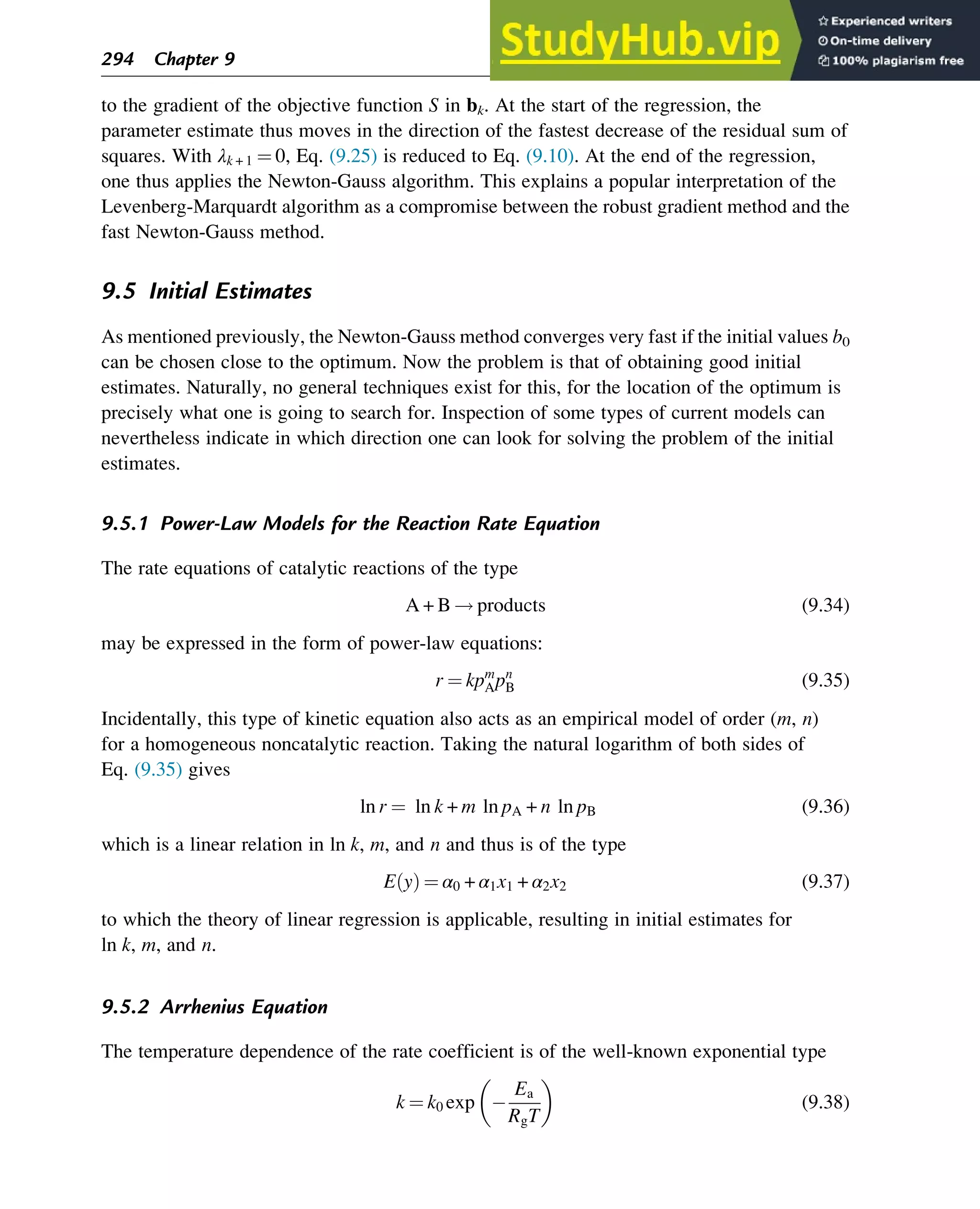
  • 109.
    Yablonskii, G.S., Bykov,V.I., Gorban, A.N., Elokhin, V.I., 1991. Kinetic models of catalytic reactions. In: Comprehensive Chemical Kinetics. vol. 32. Elsevier, Amsterdam. Yablonsky, G.S., Constales, D., Marin, G.B., 2010. Coincidences in chemical kinetics: surprising news about simple reactions. Chem. Eng. Sci. 65, 2325–2332. Yablonsky, G.S., Mareels, I.M.Y., Lazman, M., 2003. The principle of critical simplification in chemical kinetics. Chem. Eng. Sci. 58, 4833–4842. Physicochemical Principles of Simplification of Complex Models 103
  • 110.
    CHAPTER 5 Physicochemical Devicesand Reactors 5.1 Introduction Diffusion has a history in science of more than one and a half century (Philibert, 2005, 2006). Driven by the experimental observation of the German chemist Johann Döbereiner in 1823 that hydrogen gas diffuses faster than air, in the late 1820s and early 1830s the Scottish chemist Thomas Graham performed a systematic study on diffusion in gases and found that the rate of gas diffusion is inversely proportional to the square root of its molecular mass (Sherwood et al., 1971). The following milestones of diffusion theory and experiment can be distinguished: • Fick’s laws of diffusion (Fick, 1855a,b, 1995) • Maxwell’s theory of diffusion in gases (1860s) • Einstein’s theory of Brownian motion (Einstein, 1905) • Knudsen diffusion in diluted gases discovered by Martin Knudsen (Knudsen, 1909, 1934; Feres and Yablonsky, 2004) • Onsager’s linear phenomenology with diffusion considered within the general context of linear nonequilibrium thermodynamics (Onsager, 1931a,b) • Teorell’s approach of the diffusion of ions through membranes (Teorell, 1935, 1937; Gorban et al., 2011) • Prigogine’s theory of “dissipative structures” generated by a combination of nonlinear chemical reactions and diffusion processes (Glansdorff and Prigogine, 1971; Nicolis and Prigogine, 1977) In studies of heterogeneous systems, in particular those of gas-solid catalytic processes, attention was particularly paid to the interplay between diffusion and reaction in porous catalyst pellets. In 1939, Thiele introduced a dimensionless number, the Thiele modulus, to characterize this complex diffusion-reaction process in a porous medium (Thiele, 1939). The Thiele modulus quantifies the ratio of the reaction rate to the diffusion rate. Significant progress in the fundamental understanding of diffusion and adsorption in zeolites was achieved due to Kärger and Ruthven, whose book (Kärger and Ruthven, 1992) is considered by many to be the best contribution to the field of zeolite science and technology. Keil (1999) authored a comprehensive review of theoretical and experimental studies in the field of heterogeneous catalysis. Excellent books and review articles devoted to mathematical Advanced Data Analysis and Modelling in Chemical Engineering. http://dx.doi.org/10.1016/B978-0-444-59485-3.00005-9 # 2017 Elsevier B.V. All rights reserved. 105
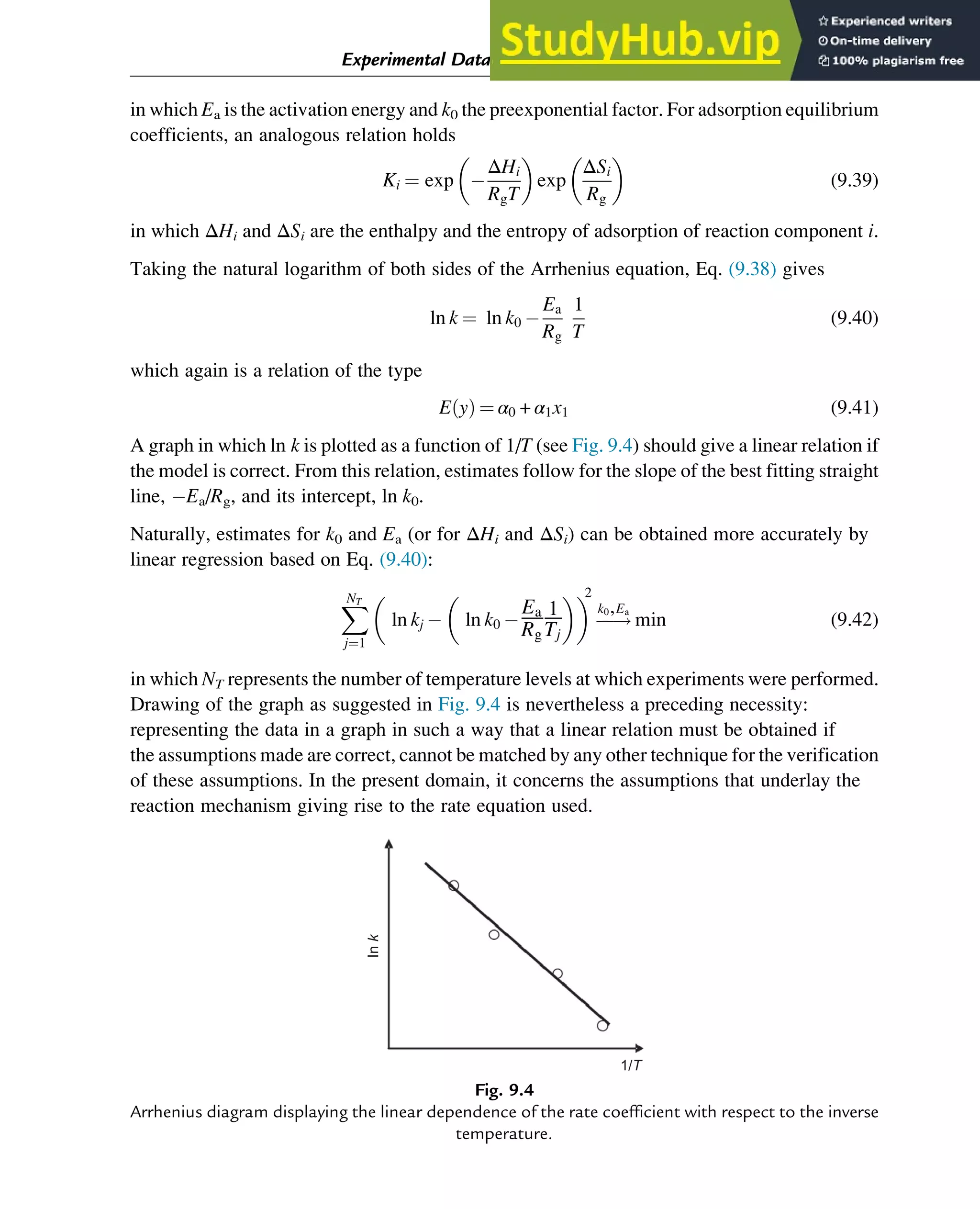
  • 111.
    diffusion and diffusion-reactionproblems, in particular in porous media, have been published (see, for example Aris, 1975a,b; Crank, 1980; Vasquez, 2006; Gorban et al., 2011). Summing up, diffusion-reaction problems have been popular topics in physical chemistry and in chemical and biochemical engineering for over one and a half century. 5.2 Basic Equations of Diffusion Systems 5.2.1 Fick’s Laws The basic equation of diffusion is Fick’s first law. In accordance with this law, the diffusive flux (for ideal mixtures) is proportional to the negative concentration gradient, in multidimensional form: J ¼ Dgrad c ¼ Drc (5.1) where J is the diffusive flux vector, D is the diffusion coefficient, c is the concentration, and r is the del or nabla operator, which in three dimensions (x, y, z) is expressed as r ¼ @=@x,@=@y,@=@z ð Þ. According to Fick’s second law, the time derivative of the concentration is the negative of the flux divergence: @c @t ¼ divJ ¼ DΔc (5.2) where the Laplace operator Δ ¼ r2 Interestingly, Fick introduced this law using an analogy with Fourier’s law for heat transfer. So, Fick’s law for mass transfer was coined after Fourier’s law for heat transfer and not before. 5.2.2 Einstein’s Mobility and Stokes Friction Within Einstein’s microscopic theory of motion of diluted particles in liquid systems, the diffusion coefficient is proportional to the absolute temperature: D ¼ mkBT (5.3) where kB ¼ Rg=NA is Boltzmann’s constant, with Rg the universal gas constant and NA Avogadro’s number, T is the absolute temperature and m is the so-called particle mobility, which equals the inverse of the Stokes friction coefficient f. The simplest case is a spherical particle with radius rp in a Newtonian liquid with dynamic viscosity η: m ¼ 1 f ¼ 1 6πrpη (5.4) 106 Chapter 5
  • 112.
    Eqs. (5.3) and(5.4) combined represent the Stokes-Einstein diffusion coefficient: D ¼ kBT 6πrpη (5.5) Under a constant external force Fe, the velocity of the particle population equals mFe. 5.2.3 Knudsen Diffusion and Diffusion in Nonporous Solids For gas-solid systems with a low gas density in which gas molecules diffuse through long narrow pores, the mean free path of the molecules is much larger than the pore diameter. In this type of diffusion, so-called Knudsen diffusion, the transport properties are essentially determined by collisions of the gas molecules with the pore walls rather than by collisions with other gas molecules. Based on the kinetic theory of gases, in the Knudsen approach all rebounds are assumed to be governed by the cosine law of reflection. In a straight cylindrical pore of diameter dpore, the Knudsen diffusion coefficient DK,i for component i with molecular mass Mi is given by DK,i ¼ dpore 3 ffiffiffiffiffiffiffiffiffiffiffi 8RgT πMi r for λ dpore 5 (5.6) with λ the mean free path. In solid bodies, the diffusion coefficient can be estimated using the Arrhenius dependence (Dushman and Langmuir, 1922) D ¼ D0 exp Ea RgT (5.7) with Ea the activation energy. 5.2.4 Onsager’s Approach Within Onsager’s theory (1931a,b), for multicomponent diffusion the flux of the ith component is given by the famous reciprocity relationship: Ji ¼ X j LijXj (5.8) where Lij (¼Lji) are the so-called phenomenological coefficients that are part of the Onsager matrix L and Xj is the matrix of generalized thermodynamic forces (eg, a temperature, pressure, or chemical potential gradient). For pure diffusion, the jth thermodynamic force is the negative space gradient of the jth chemical potential μj, divided by the absolute temperature T. In ideal systems Physicochemical Devices and Reactors 107
  • 113.
    μj ¼ RgTln cj cj,eq (5.9) where cj,eq are equilibrium concentrations. Linearization near equilibrium yields Xj ¼ 1 T grad μj ¼ Rg cj,eq grad cj (5.10) so Ji ¼ X j Lij Rg cj,eq grad cj ¼ X j Lij Rg cj,eq rcj (5.11) and @ci @t ¼ divJi ¼ Rg X j Lij Δcj cj,eq (5.12) Onsager’s approach, by definition, is valid in the vicinity of equilibrium, and deviations of cj from cj,eq are assumed to be small. The symmetry of the Onsager matrix, Lij ¼ Lji, follows from the principle of microreversibility (see the classical monograph by de Groot and Mazur, 1962). 5.2.5 Teorell’s Approach The mobility-based concept used by Einstein was further applied by Teorell (Teorell, 1935, 1937), who constructed a theory on the diffusion of ions through membranes in aqueous solutions of univalent strong electrolytes (also see Gorban et al., 2011). Teorell assumed the solutions to be ideal and homogeneous on both sides of the membrane. The essence of his approach is captured in the following equation: Flux ¼ mobility ð Þ concentration ð Þ forceperkilogramion ð Þ (5.13) The force consists of two parts: (i) a diffusion force caused by a concentration gradient and (ii) an electrostatic force, caused by an electric potential gradient. With these two parts, Teorell’s equation for the flux can be written as J ¼ mc RgT 1 c dc dx + q dφ dx (5.14) where q is the charge and φ is the electric potential. It sometimes is convenient to represent the diffusion part of the force in a different way, with ceq as reference equilibrium concentration (Gorban et al., 2011): RgT 1 c dc dx ¼ RgT d ln c ceq dx (5.15) 108 Chapter 5
  • 114.
    5.2.6 Nonlinear DiffusionModels Gorban et al. (1980, 1986) proposed a model for surface diffusion of chemical species, which was later extended by Gorban and Sargsyan (1986). Different versions of this approach have been presented in the excellent paper by Gorban et al. (2011), in which an extended review is combined with many original results on these topics: • mass-action law of diffusion • mass action cell-jump formalism • continuous diffusion equation • generalized mass-action law for diffusion (thermodynamic approach) Conceptually, the nonlinear mass-action law for surface diffusion can be introduced as follows. A system contains different surface species with concentrations Γ1,Γ2,…,ΓNint . Empty sites with concentration Γ0 are considered to be surface species as well. The sum of all surface concentrations, including those of the empty sites, is assumed to be constant, that is, the total amount of catalytic sites is conserved: X Nint j¼0 Γj ¼ Γt ¼ constant (5.16) In a jump model of the surface diffusion process, this process is considered to proceed by jumplike substance exchange between different locations on the surface. Gorban et al. (1980) used this model for modeling of the oxidation of carbon monoxide over a platinum catalyst. One step of this reaction involves the reversible exchange of an adsorbed carbon monoxide molecule with the neighboring empty site: PtCO + Pt Pt + PtCO (5.17) For the diffusive flux of species Aj (j¼1, …, Nint), the jump model gives Jj ¼ Dj zrΓj Γjrz (5.18) Consequently, the corresponding diffusion equation is @Γj @t ¼ divJj ¼ Dj zrΓj Γjrz (5.19) As a result of the conservation law for the active catalyst sites, the concentration of empty catalyst sites is equal to Γ0 ¼ Γt X Nint j¼1 Γj (5.20) Physicochemical Devices and Reactors 109
  • 115.
    and the systemof Nint diffusion equations can be presented as Jj ¼ Dj Γt X Nint j¼1 Γj ! rΓj + Γjr X Nint j¼1 Γj ! # (5.21) @Γj @t ¼ Dj Γt X Nint j¼1 Γj ! ΔΓj + ΓjΔ X Nint j¼1 Γj ! # (5.22) This system can be generalized under the assumption that all surface species can be exchanged with their closest neighbors by jump processes: Jj ¼ X k Djk ΓkrΓj ΓjrΓk (5.23) @Γj @t ¼ X k Djk ΓkrΓj ΓjrΓk (5.24) 5.3 Temporal Analysis of Products Reactor: A Basic Reactor-Diffusion System 5.3.1 Introduction The temporal analysis of products (TAP) reactor is an experimental device for the systematic study of gas-solid diffusion-reaction systems. The TAP reactor can serve various purposes, such as • precise characterization of diffusion properties and activity of solid materials. • determination of the mechanism of gas-solid reactions over solid material, in particular the mechanism of heterogeneous catalytic reactions. • formulation of recommendations on improved design of active materials and modification of operating regimes of industrial reactors. The TAP reactor was created by John T. Gleaves in 1988 (Gleaves et al., 1988) and later modified (Gleaves et al., 1997). The TAP reactor has found a variety of applications in many areas of chemical kinetics and chemical engineering. The first 20 years of TAP application has been reflected by the special review of “Catalysis Today” (Kondratenko and Perez-Ramı́rez, 2007) and three other reviews (Berger et al., 2008; Gleaves et al., 2010; Yablonsky et al., 2005). 5.3.2 Typical TAP Reactor Configurations Fig. 5.1 shows a typical TAP reactor system. It can be used for performing a battery of kinetic experiments, both transient and steady state, in a wide range of pressures (from 10 7 to 250 kPa) and temperatures (from 200 to 1200 K). 110 Chapter 5
  • 116.
    However, the specificfeatures of the TAP system are demonstrated in pulse-response experiments under vacuum conditions in the Knudsen-diffusion regime, in which the diffusion process is well defined. This means that—unlike the molecular diffusion coefficient—the Knudsen diffusion coefficient does not depend on the composition of the gas mixture. The diffusivity then is calculated as Deff,i ¼ εb τb DK,i ¼ dpore 3 ffiffiffiffiffiffiffiffiffiffiffi 8RgT πMi r (5.25) with dpore ¼ 2 3 εb 1 εb ð Þ dp (5.26) where Deff is the effective diffusion coefficient of the gas, εb is the bed voidage, τb is the tortuosity of the bed, and dp is the diameter of the catalyst pellet. Pulse intensities in vacuum experiments range from 1013 to 1017 molecules per pulse with a pulse width of 250 μs and a pulse frequency of between 0.1 and 50 pulses per second. Such a spectrum of time resolution is unique among kinetic methods. Possible experiments include high-speed pulsing, both single-pulse and multipulse response, steady-state isotopic transient kinetic analysis (SSITKA), temperature-programmed desorption (TPD), and temperature-programmed reaction (TPR). Fig. 5.1 Schematic of a TAP reactor coupled to a time-of-flight mass spectrometer. Reprinted from Gleaves, J. T., Yablonsky, G., Zheng, X., Fushimi, R., Mills, P.L., 2010. Temporal analysis of products (TAP)—recent advances in technology for kinetic analysis of multi-component catalysts. J. Mol. Catal. A: Chem. 315, 108–134, Copyright (2010), with permission from Elsevier. Physicochemical Devices and Reactors 111
  • 117.
    5.3.2.1 Three-zone TAPreactor The most common TAP microreactor is the three-zone TAP reactor (Fig. 5.2). In this reactor the active catalyst zone is sandwiched between two inert zones, which consist of packed beds of inert particles, typically quartz. In the three-zone TAP reactor, it is difficult to maintain a uniform profile of the catalyst surface composition because of the gas concentration gradient, which is the driving force for the diffusion transport in the reactor. This nonuniformity of the catalyst surface composition becomes significant particularly in multipulse experiments. 5.3.2.2 Thin-zone TAP reactor The thin-zone TAP reactor (TZTR) configuration (Fig. 5.3) was a proposal by Shekhtman et al. (1999). In a TZTR, the thickness of the catalyst zone is made very small compared to the total length of the reactor. Thus, the change of the gas concentration across the thin catalyst zone is Diffusion zone I Diffusion zone II Catalyst zone Lin Lcat Fig. 5.3 Thin-zone TAP reactor. Reprinted from Shekhtman, S.O., Yablonsky, G.S., Chen, S., Gleaves, J.T., 1999. Thin-zone TAP-reactor—theory and application. Chem. Eng. Sci. 54, 4371–4378, Copyright (1999), with permission from Elsevier. Fig. 5.2 Three-zone TAP reactor with quadrupole mass spectrometer; Lzone 1 ¼Lzone 2 ¼Lzone 3. Reprinted from Shekhtman, S.O., Yablonsky, G.S., Chen, S., Gleaves, J.T., 1999. Thin-zone TAP-reactor—theory and application. Chem. Eng. Sci. 54, 4371–4378, Copyright (1999), with permission from Elsevier. 112 Chapter 5
  • 118.
    negligible and thecatalyst composition can be considered to be uniform. In the thin-zone TAP approach, it is possible to separate chemical reaction from the well-defined Knudsen-diffusion process. Another advantage of the TZTR is that the catalyst zone can be more easily maintained at isothermal conditions than the catalyst zone in the conventional three-zone TAP reactor. 5.3.2.3 Single-particle TAP reactor Zheng et al. (2008) reported results of atmospheric and vacuum pulse-response experiments on the catalytic oxidation of carbon monoxide. The catalyst sample used was a single polycrystalline platinum particle with a diameter of 400 μm, which was placed in a microreactor bed containing about 100,000 inert particles with diameters between 210 and 250 μm (Fig. 5.4). Fig. 5.4 (A) Schematic of TAP single-particle microreactor configuration. A Pt particle with a diameter of 400 μm is located in a sea of inert quartz particles with diameters between 210 and 250 μm; (B) image comparing a 400 μm Pt particle to a pencil point; (C) SEM image showing the complex surface structure of a polycrystalline Pt particle; (D) Larger magnification (15,000) of the particle shown in (C), which demonstrates that the surface is nonporous. Reprinted from Zheng, X., Gleaves, J.T., Yablonsky, G.S., Brownscombe, T., Gaffney, A., Clark, M., Han, S., 2008. Needle in a haystack catalysis. Appl. Catal. A 341, 86–92, Copyright (2008), with permission from Elsevier. Physicochemical Devices and Reactors 113
  • 119.
    This TAP single-particlemicroreactor is a further modification of the TZTR. The particle occupies less than 0.3% of the cross-sectional area of the TAP reactor, so the catalyst zone can be considered as a point source. Temperature and/or concentration gradients across the catalyst zone can be assumed to be negligible. Nevertheless, the conversion achieved in this single-particle microreactor is high because of the nature of the diffusion-reaction process. 5.3.3 Main Principles of TAP The three main principles of TAP are • well-defined Knudsen diffusion as a measuring stick for the characterization of chemical activity. • insignificant change of the solid material during a single-pulse experiment and controlled change during a series of pulses. • uniformity of the surface composition of the solid material across the active zone. The first and second principles were formulated early on, in the pioneering paper by Gleaves et al. (1988) and further developed by Shekhtman et al. (1999). As mentioned, in TAP experiments, transport occurs in a well-defined diffusion regime, known as the Knudsen regime, the characteristics of which are independent of the gas composition. Such diffusion transport serves as a measuring stick for extracting kinetic information. During a pulse experiment, in the Knudsen regime a typical pulse contains 1013 molecules or approximately 10 10 mol. As an example, with a catalyst sample having a surface area of 104 m2 kg 1 , a single pulse would address only 1/106 part of the total surface of 10 4 kg sample. If the active surface area is a realistic fraction (say, more than 0.1%) of the total surface area, a single pulse will have a negligible effect on the active catalyst surface. Whenever the number of reactant molecules is significantly smaller than the number of active catalyst sites, the catalytic system is in nearly the same state before and after the experiment. This type of experiment performed in the TAP reactor is referred to as a state-defining experiment (SDE). For distinguishing a SDE, the following experimental criteria can be used: • insignificant change in the pulse response of a reactant or product during a series of pulses • independence of the shape of a pulse-response curve on the pulse intensity The first criterion implies that the reactivity of the catalyst surface does not change from pulse to pulse. This criterion can be applied to an irreversible process such as the reduction of a metal oxide catalyst by a hydrocarbon. The second criterion implies that the number of molecules in the input pulse is sufficiently small for a minor change of this number not to influence the shape of the exit flow response. SDEs provide kinetic parameters corresponding to a given catalyst state. For example, in the case of the irreversible transformation of a hydrocarbon on a metal oxide catalyst, the 114 Chapter 5
  • 120.
    corresponding kinetic coefficientdepends on the state of the metal oxide surface and, in particular, on its oxidation state. In a state-altering experiment (SAE), a multipulse procedure is performed. A large number of pulses are injected and the reactant and product responses are monitored. By performing TAP multipulse experiments, the interaction of a gas component with the surface at different catalyst compositions can be studied. State-defining and state-altering experiments can be performed in sequence. In this so-called interrogative cycle, a given catalyst state is probed using SDEs involving different gas molecules. Next, a SAE is performed, resulting in a new catalyst state. This state is probed again by different types of gas molecules in SDEs. The goal of this procedure, for which Gleaves et al. (1997) coined the term “interrogative kinetics,” is to systematically probe a variety of different catalyst states and to understand how one state evolves into another. The third basic principle of TAP, that of uniformity of the surface composition across the active zone, proposed by Shekhtman et al. (1999), has to be considered an absolute necessity in TAP studies because kinetic information corresponding to a certain catalyst composition cannot be obtained directly if nonuniform catalyst states are probed. We consider the TAP reactor as a basic kinetic device for systematic studies of reaction-diffusion systems. In this chapter, we are going to (i) present and analyze models of different TAP configurations with a focus on their possibilities with respect to characterizing active materials and unraveling complex mechanisms, and (ii) demonstrate relationships between TAP models and other basic reactor models, that is, models for the ideal continuous stirred-tank reactor (CSTR), batch reactor (BR) and plug-flow reactor (PFR). In some situations, the TZTR can be considered a simple building block for constructing the various models. 5.4 TAP Modeling on the Laplace and Time Domain: Theory 5.4.1 The Laplace Transform The first step in the successful analysis of TAP experiments is to abstract from the detailed physical model to obtain a practical equivalent mathematical formulation including only the apparent physical parameters. For the one-dimensional model this amounts to εb @c @t ¼ Deff @2 c @x2 kac (5.27) Now we are facing the difficulty that this partial differential equation (PDE) is imposed on continuous domains in time and space, in fact on t0 (all positive values of time) and on 0xL (all x coordinates inside a zone of constant apparent εb,Deff and ka in the reactor). Note Physicochemical Devices and Reactors 115
  • 121.
    that we excludethe boundary values t¼0, x¼0, and x¼L from these domains because the derivatives @=@t and @2 =@x2 are only directly defined for interior points. Our task is now to reduce this differential equation to mathematical structures that can be expressed finitely. Two steps are required for this: (i) reducing the time dependence to the Laplace domain and (ii) integrating the relation expressed in x over the domain 0xL. The switch to the Laplace domain is realized as follows: when f is a function of at most exponential growth, so f t ð Þ j j C1 exp C2t ð Þ for t t0 (5.28) with C1 and C2 real values and f a continuous function at least on separate intervals, the Laplace transform L{f} is defined through the integral equation L f f g s ð Þ ¼ ð + 1 0 e st f t ð Þdt (5.29) where s denotes the Laplace variable, a value in the complex plane. From the assumed estimate, Eq. (5.28), of jf(t)j in terms of an exponential, it can be shown that L{f} is an analytical function of s defined at least over the half-plane Re(s)C2. The Laplace transform is an exceptionally useful computational technique because the equivalents of calculus operations in the Laplace domain are straightforward algebraic ones. 5.4.2 Key Results The first key result in the present case is that the Laplace transform of a derivative with respect to t is readily expressed in terms of L{f}, namely L f0 f g ¼ sL f f g f 0 ð Þ (5.30) as follows directly from applying the definition, Eq. (5.28), and integrating by parts: ð + 1 0 e st f0 t ð Þdt ¼ e st f t ð Þj + 1 0 ð + 1 0 e st ð Þ 0 f t ð Þdt ¼ 0 f 0 ð Þ + s ð + 1 0 e st f t ð Þdt ¼ sL f f g f 0 ð Þ (5.31) This allows us to get rid of the time derivative @=@t on the left-hand side of Eq. (5.27). The term @2 =@x2 is not affected by the Laplace transform in t, so that L @2 f @x2 ¼ @2 @x2 L f f g (5.32) The second key result is that the Laplace transform uniquely simplifies accounting for different solicitations of a linear system over time. If the response of a system L f f g ¼ g to g(t) is f(t) 116 Chapter 5
  • 122.
    and the systemis autonomous, it will respond to g t τ ð Þ by f t τ ð Þ when a time shift occurs.1 Consequently, if we know the response f0(t) to a Dirac delta solicitation L f0 f g ¼ δ t ð Þ, and writing g(t) as a superposition of Dirac delta expressions: g t ð Þ ¼ ð + 1 0 g τ ð Þδ t τ ð Þdτ (5.33) the solution f to L f f g ¼ g is given by f t ð Þ ¼ ð + 1 0 g τ ð Þf0 t τ ð Þdτ (5.34) as a result of linearity. This expression is so useful in practice that it is studied in its own right. It is called the convolution product of g and f0, g*f0. Note that since both factors in the convolution product are assumed to be causal, the integral can also be written as ð + 1 1 ⋯ or ðt 0 ⋯ without affecting its value. Calculating such convolution integrals might seem arduous but luckily the Laplace transform simplifies this considerably. If we write the definition of L{f*g} as L f*g f g ¼ ð + 1 0 e st f*g ð Þ t ð Þdt ¼ ð + 1 1 e st f*g ð Þ t ð Þdt ¼ ð + 1 1 e st ð + 1 1 f τ ð Þg t τ ð Þdτdt (5.35) and exchange the order of integrals while reworking e st ¼ e sτ e s t τ ð Þ , then Eq. (5.35) simplifies to L f*g f g ¼ ð + 1 1 e sτ f τ ð Þdτ ð + 1 1 e su g u ð Þdu ¼ L f f g ð Þ L g f g ð Þ (5.36) that is, the Laplace transform of a (complicated) convolution is a (simple) product. This also means that systems of linear equations with convolution products, which would be difficult to analyze in the time domain, transform to systems of linear equations including ordinary products, for which the many resources of linear algebra are readily available. We now apply these results to the problem at hand. After Laplace transformation with respect to t, the PDE becomes εb sL c f g ð Þ 0 ¼ Deff @2 L c f g @x2 kaL c f g (5.37) in which only derivatives with respect to the variable x remain, so that this is actually an ordinary differential equation (ODE). Furthermore, this ODE is linear with constant coefficients and homogeneous: from a basic analysis we know that its solutions can be written 1 Note that all functions considered here are supposed to be causal, that is, their values vanish for all t0. Physicochemical Devices and Reactors 117
  • 123.
    as linear combinationsof exponential terms exp(λx) where λ 2 ℂ must be chosen such that both sides of Eq. (5.36) are identical. Substitution leads to the characteristic equation εbs ¼ Deffλ2 ka (5.38) with roots λ ¼ ffiffiffiffiffiffiffiffiffiffiffiffiffiffi ffi εbs + ka Deff r (5.39) In general, s is allowed to be any complex value of sufficiently large real part for the defining integral of the Laplace transform to exist. In practice, however, due to the properties of analytic functions of complex variables, one can always assume that s is actually real, and large positive. All results obtained under these assumptions are guaranteed to be valid generally for all s in a right complex half-plane, but in cases such as these the positivity assumption brings the benefit that the square root in Eq. (5.39) need not be specified for nonreal or negative values of its argument. Similarly, although for εbs ¼ ka there is a complication due to the coincidence of the two characteristic roots (since then λ+ ¼ λ ¼ 0), this case does not require further analysis. Summarizing, the general solution of Eq. (5.37) can be expressed as L c f g ¼ C1 exp x ffiffiffiffiffiffiffiffiffiffiffiffiffiffi ffi εbs + ka Deff r + C2 exp x ffiffiffiffiffiffiffiffiffiffiffiffiffiffi ffi εbs + ka Deff r (5.40) where C1 and C2 are constants for x (but typically will depend on s and other parameters). This establishes the general framework within which the actual solution will necessarily fit. To obtain results that are generally valid and can be used as computational building blocks for models with an arbitrary composition of zones, we now turn to the special boundary condition that expresses the physical contact between successive zones in the reactor (see Fig. 5.5). These contact or interface conditions are to be determined from a combination of physical insight and experimental results. Fig. 5.5 Schematic of a five-zone TAP reactor. Each zone has its own length Li and parameters εb,i,ka,i and Deff,i. 118 Chapter 5
  • 124.
    The first conditionis that there is no jump in concentration, that is, c x 0 ð Þ ¼ c x + 0 ð Þ everywhere, specifically at x values where two neighboring zones touch. The second condition is similar, but applies to the diffusive flux, which is given by J ¼ Deff @c @x (5.41) so J x 0 ð Þ ¼ J x + 0 ð Þ everywhere, specifically at x values where two neighboring zones touch. At these points, however, Deff need not be equal on both sides. For instance, in the schematic of Fig.5.5thereis noreason why Deff,1 shouldequalDeff,2 or why Deff,2 shouldequalDeff,3, and so on; each zone may consist of a different material with unique properties. Consequently, the equality Deff,i @c @x left ¼ Deff,i 1 @c @x right (5.42) entails that the derivative @c=@x will show a jump at the interfaces between the zones. Taking fully into account these jumps in material characteristics in a multizone model in the time domain is a pain; again the Laplace transform comes to the rescue and delivers computational elegance. In order to clarify this, we briefly return to our solution in the Laplace domain for a single zone, and express the concentration and flux values to the left of this zone in terms of the values to its right. The linearity of the equations guarantees that one can write L c f g L J f g left ¼ M11 M12 M21 M22 L c f g L J f g right (5.43) for certain matrix entries Mij. In particular, M11 M21 ¼ L c f g L J f g left when L c f g L J f g right ¼ 1 0 (5.44) Expressing this in the general solution gives L c f g ¼ cosh L ffiffiffiffiffiffiffiffiffiffiffiffiffiffi ffi εbs + ka Deff r (5.45) and L J f g ¼ ffiffiffiffiffiffiffiffiffiffiffiffiffiffiffiffiffiffiffiffiffiffiffiffiffiffi εbs + ka ð ÞDeff p sinh L ffiffiffiffiffiffiffiffiffiffiffiffiffiffi ffi εbs + ka Deff r (5.46) Similarly, M12 M22 ¼ L c f g L J f g left when L c f g L J f g right ¼ 0 1 (5.47) Physicochemical Devices and Reactors 119
  • 125.
    which from thegeneral solution leads to L c f g ¼ sinh L ffiffiffiffiffiffiffiffiffiffiffiffiffiffi ffi εbs + ka Deff r ffiffiffiffiffiffiffiffiffiffiffiffiffiffiffiffiffiffiffiffiffiffiffiffiffiffi εbs + ka ð ÞDeff p (5.48) and L J f g ¼ cosh L ffiffiffiffiffiffiffiffiffiffiffiffiffiffi ffi εbs + ka Deff r (5.49) Written in more compact form, in the Laplace domain a zone corresponds to a matrix equation L c f g L J f g left ¼ M s, εb, ka, Deff, L ð Þ L c f g L J f g right (5.50) where the zone transfer matrix M is given by M ¼ cosh u sinh u w wsinh u cosh u 2 4 3 5; u ¼ L ffiffiffiffiffiffiffiffiffiffiffiffiffi εb + ka Deff r ; w ¼ ffiffiffiffiffiffiffiffiffiffiffiffiffiffiffiffiffiffiffiffiffiffiffiffi εb + ka ð ÞDeff p (5.51) Notice that the determinant of M, det M¼1 as cosh2 u sinh2 u ¼ 1. If, for instance, a TAP reactor consists of two adjacent zones, combining the zone transfer matrices leads to L c f g L J f g inlet ¼ M1 s1, εb,1, ka,1, Deff,1, L1 ð ÞM2 s2, εb,2, ka,2, Deff,2, L2 ð Þ |fflfflfflfflfflfflfflfflfflfflfflfflfflfflfflfflfflfflfflfflfflfflfflfflfflfflfflfflfflfflfflfflfflfflfflfflfflfflfflfflfflfflfflfflfflfflffl{zfflfflfflfflfflfflfflfflfflfflfflfflfflfflfflfflfflfflfflfflfflfflfflfflfflfflfflfflfflfflfflfflfflfflfflfflfflfflfflfflfflfflfflfflfflfflffl} global transfer matrix L c f g L J f g outlet (5.52) so that the global transfer matrix, linking the inlet and outlet concentration and flux values, is the product of these zone transfer matrices, ordered left to right, M1Μ2. If the reactor consists of three zones, the global transfer matrix is given by M1M2M3, etc. In general, we will express the global transfer matrix in terms of its elements as M ¼ P11 P12 P21 P22 (5.53) Nowthisglobaltransfermatrixcanbeusedtoexpresstheboundaryconditionsattheinletandoutlet of the reactor. We assume that at t¼0 at the inlet a sharp pulse of gas is injected into the system. Physically this means that Jinlet t ð Þ ¼ δ t 0+ ð Þ. We also assume that the vacuum at the outlet is perfect, that is, coutlet t ð Þ ¼ 0. Our interest lies with the outlet flux, Joutlet, which is observed experimentally. In the Laplace domain, keeping only the second equation in the matrix system yields 120 Chapter 5
  • 126.
    L Jinlet f g¼ P21L coutlet f g |fflfflfflfflffl{zfflfflfflfflffl} ¼0 + P22L Joutlet f g (5.54) so that L Joutlet f g ¼ 1 P22 (5.55) which is the fundamental result of TAP reactor theory. It means that to completely analyze a multizone reactor setup in the Laplace domain, it suffices to form the zone transfer matrices, to multiply these matrices to obtain the global transfer matrix, and then take the value of the P22 component in the result. 5.5 TAP Modeling on the Laplace and Time Domain: Examples 5.5.1 Moment Definitions Moments are experimental characteristics of the outlet flux that can readily be obtained in closed form from their Laplace transforms. Since L f f g s ð Þ ¼ ð + 1 0 e st f t ð Þdt (Eq. 5.29), the so-called zeroth moment is M0 ¼ L f f g 0 ð Þ ¼ ð + 1 0 f t ð Þdt (5.56) the first moment is M1 ¼ @L @s f f g 0 ð Þ ¼ ð + 1 0 tf t ð Þdt (5.57) and so on. The nth moment is Mn ¼ 1 ð Þn @n L @sn f f g 0 ð Þ ¼ ð + 1 0 tn f t ð Þdt (5.58) 5.5.2 One-Zone Reactor, Diffusion Only For a one-zone TAP reactor with diffusion only, the global transfer matrix can be written as (with symbol * for complicated irrelevant entries) M ¼ P11 P12 P21 P22 ¼ cosh L ffiffiffiffiffiffiffiffi εbs Deff r 2 6 4 3 7 5 (5.59) Physicochemical Devices and Reactors 121
  • 127.
    so L Joutlet f g¼ 1 cosh L ffiffiffiffiffiffiffiffi εbs Deff r (5.60) In this case, the zeroth moment is M0 ¼ 1 (all molecules pulsed in also leave the reactor since there is no reaction, ka ¼ 0) and M1 ¼ L2 εb 2Deff . The average residence time, which is given by M1/M0, therefore equals 1 2 εbL2 Deff , a typical characteristic time for a diffusion process taking place with diffusivity Deff over a length L. The Laplace transform L{Joutlet} therefore is a generating function for the moments of the outlet time distribution. It also coincides with the so-called characteristic function of the distribution if we set s ¼ iω, ωinℝ. An alternative interpretation does not consider L{Joutlet} but its natural logarithm: in general we know from statistics that near s ¼ 0, ln L Joutlet f g ¼ ln M0 s 1! C1 + s2 2! C2 s3 3! C3 + ⋯ (5.61) where the coefficients Ci are the so-called cumulants of the distribution: C1 is the average, M1/M0, C2 the variance, M2=M0 M1=M0 ð Þ2 , C3 a skewness, and so on. These cumulants help describe the outlet flux as a distribution of particle “escape times.” Note that all moments and cumulants can be obtained exactly from the specifications of the reactor and the computation of the global transfer matrix described in Section 5.4. No discretization in time or space is involved; the results are mathematically exact. The results in the Laplace domain can also be used to obtain results in the time domain. To this end, we first note that setting s ¼ iω, with ω the Fourier frequency, in the Laplace transform definition yields L f f g iω ð Þ ¼ ð + 1 0 e iωt f t ð Þdt ¼ ð + 1 1 e iωt f t ð Þdt ¼ F f f g ω ð Þ (5.62) (the second step relying on the causal nature of f), so that the Fourier transform of f is readily obtained by this substitution. Now a very fast and robust numerical algorithm, aptly called the Fast Fourier Transform, is available for computing from a suitable sample of F{f}(ω) values a corresponding set of f(tk) values in time. A further method to return from the Laplace domain to the time domain is based on a special type of series expansion; in the present case expanding 1 cosh x ¼ X + 1 n¼0 1 ð Þn 2n + 1 ð Þπ x2 + n + 1 2 2 π2 (5.63) for x ¼ L ffiffiffiffiffiffiffiffi εbs Deff r leads to 122 Chapter 5
  • 128.
    L Joutlet f g¼ X + 1 n¼0 1 ð Þn 2n + 1 ð Þπ L2 εb Deff s + n + 1 2 2 π2 (5.64) Since L exp n + 1 2 2 π2 Deff L2εb t 0 B B B @ 1 C C C A 8 : 9 = ; ¼ 1 s + n + 1 2 2 π2 Deff L2εb (5.65) it follows from Eq. (5.64) that Joutlet ¼ πDeff L2εb X + 1 n¼0 1 ð Þn 2n + 1 ð Þexp n + 1 2 2 π2 Deff L2εb t 0 B B B @ 1 C C C A (5.66) where the argument to the exponential function rapidly becomes very negative with increasing n. In this case, a different expansion yields 1 cosh x ¼ 2 ex + e x ¼ 2 e x e 3x + e 5x e 7x + ⋯ (5.67) so that Joutlet ¼ L ffiffiffiffiffiffiffiffiffiffiffiffiffiffi εb πDefft3 r X + 1 n¼0 1 ð Þn 2n + 1 ð Þexp L2 εb n + 1 2 2 Defft 0 B B B @ 1 C C C A (5.68) 5.5.3 One-Zone Reactor, Irreversible Adsorption In the case of irreversible adsorption, the only difference from the diffusion-only case is that εbs + ka replaces εbs in the expressions, that is, s must be replaced with s + ka=εb. Consequently, Joutlet ð Þka6¼0 ¼ e ka εb t Joutlet ð Þka¼0 (5.69) and the expressions in the time domain follow at once. When the moments are concerned, M0 no longer equals 1 but becomes Physicochemical Devices and Reactors 123
  • 129.
    M0 ¼ 1 cosh L ffiffiffiffiffiffiffiffi ka Deff r 1 (5.70) meaning that only part of the injected gas leaves the reactor without being adsorbed. The conversion then equals 1 M0 and increases with increasing ka. Often a new dimensionless quantity φ ¼ L ffiffiffiffiffiffiffiffi ka Deff r is introduced to restrain the size of the expressions. The average residence time of gas molecules leaving the reactor is then given by M1 M0 ¼ tanh φ φ |fflfflffl{zfflfflffl} reaction εbL2 2Deff |ffl{zffl} diffusion (5.71) and is always smaller than the pure diffusion time: the molecules that escape are faster on average and thereby avoid adsorption. 5.5.4 One-Zone Reactor, Reversible Adsorption The case of reversible adsorption has not yet been considered, but the flexibility of the analysis in the Laplace domain will allow us to reduce the problem to a known case as follows. The original PDE (Eq. 5.27) now includes a desorption term: εb @c @t ¼ Deff @2 c @x2 kac + kdccatθ (5.72) where θ(x,t) is the so-called fractional surface coverage of adsorbed species. This coverage satisfies a differential equation of its own: @θ @t ¼ ka ccat c kdθ (5.73) The resulting set of equations may be solved in the time domain by setting c ¼ ccat ka @θ @t + kdθ (5.74) and substitution in Eq. (5.72), but this would give rise to awkward terms of the form @θ3 =@x2 @t in the final equation. We observe, however, that in the Laplace domain the equation for θ is readily solved (assuming initial zero coverage): s L θ f g 0 ð Þ ¼ ka ccat L c f g kdL θ f g (5.75) 124 Chapter 5
  • 130.
    so L θ f g¼ ka ccat s + kd ð Þ L c f g (5.76) Substituting Eq. (5.76) in the Laplace-transformed PDE for c yields εb sL c f g 0 ð Þ ¼ Deff @2 L c f g @x2 ka kakd s + kd L c f g ¼ Deff @2 L c f g @x2 ska s + kd L c f g (5.77) Thus, ka merely has to be replaced with the expression ska s + kd throughout, which for kd ¼ 0 clearly simplifies properly to ka. The interface and boundary conditions only involve the diffusional parameter Deff and are independent of ka. Consequently, the zone transfer matrix is still of the form M ¼ cosh u sinh u w wsinh u cosh u 0 @ 1 A (5.78) but now the more general expressions u ¼ L ffiffiffiffiffiffiffiffiffiffiffiffiffiffiffiffiffiffiffiffiffiffiffiffiffiffiffiffiffiffiffiffiffi εbs + kas= s + kd ð Þ Deff s (5.79) and w ¼ ffiffiffiffiffiffiffiffiffiffiffiffiffiffiffiffiffiffiffiffiffiffiffiffiffiffiffiffiffiffiffiffiffiffiffiffiffiffiffiffiffiffiffiffi εbs + ska= s + kd ð Þ ð ÞDeff p (5.80) apply instead. The essential value L{Joutlet} is still given by 1/P22, so that for a single-zone reactor with reversible adsorption L Joutlet f g ¼ 1 cosh L ffiffiffiffiffiffiffiffiffiffiffiffiffiffiffiffiffiffiffiffiffiffiffiffiffiffiffiffiffiffiffiffiffi εbs + ska= s + kd ð Þ Deff r (5.81) where M0 ¼ 1 (all gas molecules eventually escape from a reactor in which a reversible reaction takes place) and the average residence time is M1 M0 ¼ 1 2 L2 Deff εb + ka kd (5.82) Physicochemical Devices and Reactors 125
  • 131.
    The average residencetime is the sum of the diffusional value and a reversible reaction time component of retardation. The results in the time domain are no longer obtainable from a simple shift in s; the roots of the denominator follow from a quadratic equation in s (see Gleaves et al., 1988 for details). The Fast Fourier technique remains though. 5.5.5 Three-Zone Reactor Multiplying the three zone transfer matrices for P22 yields an expression that includes the sum of four products of hyperbolic functions, which is a little long but is easily obtained exactly using computer algebra. In a three-zone reactor, the middle zone typically is the only reactive zone. In the reversible case, M0 ¼ 1 as always and M1 M0 ¼ 1 2 εb,1L2 1 Deff,1 1 + 2 L2 L1 Deff,1 Deff,2 + 2 L3 L1 Deff,1 Deff,3 zfflfflfflfflfflfflfflfflfflfflfflfflfflfflfflfflffl}|fflfflfflfflfflfflfflfflfflfflfflfflfflfflfflfflffl{ backmixing 0 B B @ 1 C C A + 1 2 εb,2 + ka kd L2 2 Deff,2 1 + 2 L3 L2 Deff,2 Deff,3 zfflfflfflfflffl}|fflfflfflfflffl{ backmixing 0 B B @ 1 C C A + 1 2 εb,3L2 3 Deff,3 (5.83) in which the time contributions of the successive zones are split up, showing the presence of backmixing terms in the first and second zone components. In the irreversible case (kd ¼ 0), the zeroth moment is given by M0 ¼ 1 cosh φ + L3 L2 Deff,2 Deff,3 φ sinh φ |fflfflfflfflfflfflfflfflfflfflfflffl{zfflfflfflfflfflfflfflfflfflfflfflffl} backmixing (5.84) which is always less than the one-zone result due to backmixing from the third zone to the second. 5.5.6 Reactive Thin Zones The previous results illustrate how irreversible adsorption leads to the survival of hyperbolic functions in the expressions obtained. This can be avoided by making the reactive zone very thin. If we let L2 ! 0 in the three-zone reactor results, the contribution of the second zone will of course disappear entirely; but if we simultaneously increase ka so that the product kaL2 remains fixed and finite, an interesting phenomenon arises: the zone transfer matrix tends to the nontrivial result 126 Chapter 5
  • 132.
    M ¼ 1 0 kaL21 (5.85) In the time domain this means that cleft ¼ cright ¼ c; Jleft ¼ kaL2c |fflffl{zfflffl} reaction rate + Jright (5.86) The zeroth moment no longer contains hyperbolic functions: M0 ¼ 1 1 + kaL2 ð ÞL3 Deff,3 (5.87) In the reversible case, the matrix tends to M ¼ 1 0 s kaL2 ð Þ s + kd 1 2 4 3 5 (5.88) since the reverse reaction is not affected by the limit in the zone length L2. 5.5.7 Other Thin Zones 5.5.7.1 Capacity and resistor zones The reactive thin zone is the one most frequently encountered in the literature, but several other ones are mathematically possible. The first is obtained by letting kd increase in the thin reactive zone but in such a way that kaL2/kd remains finite. Then the matrix tends to M ¼ 1 0 s ka kd L2 1 2 4 3 5 (5.89) which, in analogy with electrical networks, we dub a capacity zone. In the time domain, this means that cleft t ð Þ ¼ cright t ð Þ ¼ kd kaL2 ðt 0 Jleft Jright dτ |fflfflfflfflfflfflfflfflfflfflfflfflffl{zfflfflfflfflfflfflfflfflfflfflfflfflffl} uptake (5.90) A different limit does not require any reaction (ka ¼ kd ¼ 0) but lets L2 approach zero while L2/Deff remains fixed and finite. In this case the matrix tends to M ¼ 1 L2 Deff 0 1 2 4 3 5 (5.91) Physicochemical Devices and Reactors 127
  • 133.
    and in thetime domain Jleft ¼ Jright; cleft ¼ L2 Deff Jleft right + cright (5.92) which, in analogy with electrical networks, we dub a thin resistor zone. It is a “concentrated diffusive element.” 5.5.7.2 Generalized boundary conditions The standard boundary condition at the outlet is coutlet ¼ 0. In fact, this is an ideal limit of a prescribed velocity v at the outlet: Joutlet ¼ vcoutlet; as v ! + 1, this tends to coutlet ¼ 0, since Joutlet must remain finite. A remarkable fact is that this outlet condition can be reduced to the standard one by adding a thin resistor zone: if cextra ¼ 0, Joutlet ¼ Jextra and coutlet ¼ 1 v Joutlet extra + cextra ⎴ ¼0 we indeed obtain Joutlet ¼ vcoutlet, the generalized outlet condition, by multiplying the global transfer matrix to the right by 1 1 v 0 1 2 4 3 5, so that its (2,2) element is 1 v P21 + P22 and L Joutlet f g ¼ 1 1 v P21 + P22 (5.93) Similarly, different inlet conditions have been proposed, where instead of Jinlet ¼ δ t 0+ ð Þ a premixing zone of length δ is considered, in which the concentration is determined by the injection flux, amounting to δ dcpre-mix dt ¼ Jinlet Jpre-mix (5.94) so that in the Laplace domain sδL cpre-mix ¼ Jinlet L Jpre-mix (5.95) which represents a thin capacity zone of matrix 1 0 sδ 1 . Accordingly, to take into account this model of a premixing zone, it suffices to multiply the global transfer matrix to the left with this matrix; the result’s (2,2) element then reads sδP12 + P22 and the outlet flux is corrected to L Joutlet f g ¼ 1 sδP21 + P22 (5.96) 128 Chapter 5
  • 134.
    If both correctionsare applied simultaneously, the outlet flux becomes L Joutlet f g ¼ 1 sδ v P11 + sδP12 + 1 v P21 + P22 (5.97) 5.6 Multiresponse TAP Theory Up to now we have always considered a single gas of concentration c, possibly in combination with a single fractional coverage θ. The experimental capability of a TAP machine does, however, allow for the measurement of different gases with concentrations ci, some of which might not even have been injected at all but are produced in the TAP reactor. The model’s partial and ordinary differential equations must be generalized accordingly. To do this, we will switch to a vector c of gas concentrations and to a vector θ of fractional coverages of surface species (not necessarily of the same dimension). The diffusion-reaction equation now becomes εb @c @t ¼ Deff @2 c @x2 KGGc + ccatKGSθ (5.98) and @θ @t ¼ KSG ccat c KSSθ (5.99) where εb and Deff are diagonal matrices of the zone characteristics, KGG is a matrix of gas reaction impact on gases (typically diagonal when only adsorption occurs), KSS is a matrix of the impact of surface species reactions on surface species, and KGS and KSG represent kinetic links between gases and surface species and vice versa. For the simple example of a reversible reaction in a one-gas context, KGG ¼ ka ½ Š, KGS ¼ kd ½ Š, KSG ¼ ka ½ Š and KSS ¼ kd ½ Š. In a more complex example, the overall reaction AB, proceeding by elementary steps A + Z ! ka,1 kd,1 AZ ! k+ k BZ ! kd,2 ka,2 B + Z, these matrices are given by KGG ¼ ka,1 0 0 ka,2 , KGS ¼ kd,1 0 0 kd,2 , KSG ¼ ka,1 0 0 ka,2 and KSS ¼ kd,1 k k+ kd,2 : Applying the Laplace transform first to the equations for the fractional surface coverage assuming zero initial coverage yields s L θ f g 0 ð Þ ¼ KSG ccat L c f g KSSL θ f g (5.100) so that s + KSS ð ÞL θ f g ¼ KSG ccat L c f g (5.101) Physicochemical Devices and Reactors 129
  • 135.
    or L θ f g¼ s + KSS ð Þ 1 KSG ccat L c f g (5.102) Substituting Eq. (5.102) into the PDE, Eq. (5.98) after Laplace transform leads to εbsL c f g ¼ Deff @2 L c f g @x2 KGGL c f g + KGS s + KSS ð Þ 1 KSGL c f g (5.103) so that Deff @2 L c f g @x2 ¼ εbs + KGG KGS s + KSS ð Þ 1 KSG L c f g ¼ KS s ð ÞL c f g (5.104) Now we can write this equation as a system in L{c} and L{J}: @ @x L c f g L J f g ¼ 0 D 1 eff KS s ð Þ 0 # L c f g L J f g # (5.105) so that, integrating in x from 0 to L, L c f g L J f g left ¼ exp 0 D 1 eff KS s ð Þ 0 # L ! L c f g L J f g right (5.106) The calculation of the exponential will in practice require the determination of its eigenvalues. Since 0 D 1 eff L KS s ð ÞL 0 #2 ¼ D 1 eff KS s ð ÞL2 0 0 KS s ð ÞD 1 eff L2 # (5.107) and exp x ð Þ ¼ sinh ffiffiffiffiffi x2 p ffiffiffiffi ffi x2 p x + cosh ffiffiffiffiffi x2 p (5.108) it follows that exp 0 D 1 eff KS s ð Þ 0 # ¼ cosh ffiffiffiffiffiffiffiffiffiffiffiffiffiffiffiffiffiffiffiffiffiffi D 1 eff KS s ð ÞL q 0 0 cosh ffiffiffiffiffiffiffiffiffiffiffiffiffiffiffiffiffiffiffiffiffiffi KS s ð ÞD 1 eff L q 2 6 4 3 7 5 + 0 D 1 eff KS s ð Þ 0 # sinh ffiffiffiffiffiffiffiffiffiffiffiffiffiffiffiffiffiffiffiffiffiffi D 1 eff KS s ð ÞL q ffiffiffiffiffiffiffiffiffiffiffiffiffiffiffiffiffiffiffiffi D 1 eff KS s ð Þ q 0 0 sinh ffiffiffiffiffiffiffiffiffiffiffiffiffiffiffiffiffiffiffiffiffiffi KS s ð ÞD 1 eff L q ffiffiffiffiffiffiffiffiffiffiffiffiffiffiffiffiffiffiffiffi KS s ð ÞD 1 eff q 2 6 6 6 6 6 6 6 6 4 3 7 7 7 7 7 7 7 7 5 (5.109) 130 Chapter 5
  • 136.
    where all resultson KS s ð ÞD 1 eff can be readily obtained from the flux on D 1 eff KS by the congruence relationship f KS s ð ÞD 1 eff ¼ Defff D 1 eff KS s ð Þ D 1 eff (5.110) This halves the computational work required. Of course, if each gas lives separately in the reactor and all matrices, especially KS(s), are diagonal, the comprehensive matrix with all gases will not offer new information. The nontrivial cases occur when adsorbed gases transform from one species to another, so that KSS holds the kinetic information of the surface reaction system and KS(s) is no longer diagonal. For the inlet concentration, δ t 0+ ð Þ is no longer sufficiently general because different gases might be injected in different quantities and even at different times. Therefore, we define a vector of inlet fluxes J(t) such that KS s ð ÞD 1 eff ¼ Deff @c @x x¼inlet ¼ J t ð Þ (5.111) The zone transfer matrices will include all gases and their fluxes, so will be of dimension 2Ng 2Ng , and the global transfer matrix obtained as their product will have the same size, to be split up as P11 P12 P21 P22 as before, with each Pij an Ng Ng matrix. The outlet condition can remain c ¼ 0. From the lower block of equations, we then obtain L J f g ¼ P21 0 + P22L Joutlet f g (5.112) and thus L Joutlet f g ¼ P 1 22 L J f g (5.113) which is a clear generalization of the one-gas result. Again, thin zones can be introduced. The resistor zones are of the form 1 v 1 0 1 where v is a diagonal matrix of formal velocities, so that cleft ¼ cright + v 1 Jleft right (5.114) The active zones in their simplest form can be represented as 1 0 KaL 1 where L ! 0 but so that all elements of KaL remain fixed and finite, and Ka is a diagonal matrix of reversible adsorption coefficients. However, the active zone can also exhibit much more complex surface reaction Physicochemical Devices and Reactors 131
  • 137.
    schemes. Generalizing the ska s+ kd result of the one-gas reversible adsorption to the case where K(s)L remains finite as L ! 0, so that the zone transfer matrix tends to 1 0 K s ð ÞL 1 . As a special case, taking a further limit, kd ! + 1, leads to capacity zones of the form 1 0 kaL kd s 1 2 4 3 5. The treatment of alternative boundary conditions (inlet premixing zone, prescribed outlet velocity) is then readily generalized. As an example, for the reaction sequence A + Z ! ka,1 kd,1 AZ ! k+ k BZ ! kd,2 ka,2 B + Z the key result is 1 MBA ¼ 1 + Deff,A3 Deff,B3 k k+ kd,1 ka,1 ka,2 kd,2 + Deff,A3 L2L3 k kd,1 + kd,1kd,2 + kd,2k+ kd,2k+ ka,1 (5.115) The result for 1 MAB is similar but with the roles of A and B switched. Furthermore, MAA ¼ 1 MBA; MBB ¼ 1 MBA (5.116) As always in such model problems, it is possible to interpret the separate contributions to these expressions in a more physical manner in terms of equilibrium coefficients and characteristic times of diffusion. 5.7 The Y Procedure: Inverse Problem Solving in TAP Reactors The TAP theory developed up to now is linear and explains the many advantages of the Laplace-domain technique where obtaining exact and interpretable expressions is concerned. In the special case of TZTRs, it is possible to drop the requirement of linearity of the reaction and to reconstruct, purely from observed outlet fluxes, the temporal evolution of the concentrations and reaction rate in the thin reaction zones, without any a priori assumption of its linearity. The method used is called the Y procedure, in reference to the Cyrillic letter Я, an inverted R, for rate, which by a happy coincidence is also the first letter of the Roman surname of its inventor, G.S. Yablonsky. We consider the three-zone, TZTR (see Fig. 5.6), and write out the equations obtained from the zone transfer matrices as follows. Fig. 5.6 Schematic of three-zone, thin-zone TAP reactor. 132 Chapter 5
  • 138.
    In the leftzone, the inlet flux satisfies L Jinlet f g ¼ v1s1L cm f g + c1L Jleft f g (5.117) so that L Jleft f g ¼ L Jinlet f g v1s1L cm f g c1 (5.118) In the thin reaction zone, the rate of consumption R satisfies L2L R f g ¼ L Jleft f g L Jright (5.119) by a balance argument. In the right zone, cm ¼ c3 0 + s3 v3 L Joutlet f g (5.120) and Jright ¼ v3s3 0 + c3L Joutlet f g (5.121) Substituting Eqs. (5.118), (5.120), and (5.121) in Eq. (5.119) yields c1L2L R f g ¼ L Jinlet f g c1c3 + v1 v3 s1s3 L Joutlet f g ¼ c1c3 + v1 v3 s1s3 L Joutlet, diff f g L Joutlet f g ð Þ (5.122) where Joutlet,diff denotes the outlet flux that would be produced in the absence of reaction, by a diffusion system only. This equation shows how, in principle and for exactly known data, R can be recovered. Note that on the left-hand side of the equation, R is multiplied with L2, so that the effects will diminish as L2 becomes too small, unless a similar limiting sequence is used as in the modeling of the linear thin zone, where although L2 ! 0, KaL remains fixed and finite. Furthermore, c1L2R is obtained from a difference between two fluxes, where the relative error can be amplified due to near cancellation of terms if the effect of the thin zone is not sufficiently marked. Finally, the factors that occur have a net amplifying influence on higher frequencies, as can be seen when analyzing the case s ¼ iω for the Fourier transform analogue of the Laplace- domain equation. In practice, a damping factor must be inserted to prevent the experimental magnification (asymptotically of type exp λ ffiffiffiffi ω p ) of high-frequency error components. Nevertheless, state-of-the-art TAP machines can perform the Y procedure reliably, with the most limiting difficulty being the interference of the electrical mains with the measurements, at their characteristic frequency of 50 or 60 Hz. Physicochemical Devices and Reactors 133
  • 139.
    5.8 Two- andThree-Dimensional Modeling Up to now we have considered the diffusion-reaction equation only in a one-dimensional spatial setting. If a correct formulation is to be given in space, the second derivative term @2 c=@x2 must be replaced by the Laplacian @2 c=@x2 + @2 c=@y2 + @2 c=@z2 ¼ Δc, taking into account the diffusion along all three coordinate axes, and Eq. (5.27) generalizes to εb @c @t ¼ DeffΔc kac (5.123) Clearly, this equation needs to be completed with boundary conditions corresponding to the cylindrical shape of the TAP reactor. This requires the use of cylindrical coordinates (r,θ,z) instead of the Cartesian coordinates (x,y,z). Note that the cylindrical z coordinate is longitudinal and corresponds to the Cartesian x coordinate used so far. Substituting the coordinate transformation equations and applying the chain rule we obtain the following expression for the Laplacian in cylindrical coordinates: Δc ¼ 1 r @ @r r @c @r + 1 r2 @2 c @θ2 + @2 c @z2 (5.124) In what follows, it is assumed that the TAP reactor cylinder has a radius R0. The boundary condition at r¼R (ie, the cylinder’s mantle) is that no flux can escape it; since the diffusive flow is given by the gradient of c this boundary condition can be written as @c @r r¼R ¼ 0 (5.125) The other boundary conditions (at the inlet, at the outlet, and at the interfaces between successive zones) remain the same as for the one-dimensional model. Solving Eq. (5.123) may seem exhausting, but the application of a standard mathematical technique, namely separation of variables, is very helpful. To understand its working, first consider that a function of several variables f(x,y,z) can always be expanded in a local Taylor series, for example, near (0,0,0) as f x, y, z ð Þ ¼ a000 + a100x + a010y + a001z + a200x + a110xy + a020y2 + a011yz + a101xz + a002z2 + ⋯ (5.126) under suitable smoothness assumptions. This is a kind of “infinite” degree polynomial with building blocks that are expressions of the form xm yn zp with m,n,p 2 ℕ. Now we could try to substitute an expression (5.126) for the unknown function c in Eq. (5.123) and group like terms together, but in practice this would lead to an infinitely intricate set of equations in the unknown coefficients amnp(t) and their derivatives. Since we are aiming at true, mathematical solutions (as opposed to more numerical approximations), this is not acceptable. The road to success for the present problem lies in a suitable generalization of Eq. (5.126), while retaining one crucial property: we want to find special solutions of 134 Chapter 5
  • 140.
    Eq. (5.123) forwhich the spatial dependency splits into three independent factors, each handling one of the three spatial coordinates r,θ,z. Hence, we wish to seek solutions of Eq. (5.123) that can be represented as (typically infinite) sums of products f1(z)f2(r)f3(θ) multiplied by a coefficient that may depend on time. We will choose f1,f2, and f3 in such a way that the representation makes geometric sense and that the PDE becomes almost trivial to solve. 5.8.1 The Two-Dimensional Case For clarity of exposition, we will first assume that c is not dependent on the angle θ, but only on the longitudinal coordinate z and the transversal distance to the cylinder’s axis, r. The PDE, Eq. (5.123), then reads εb @c @t ¼ Deff 1 r @ @r r @c @r + @2 c @z2 kac (5.127) and we wish to find solutions of the form c ¼ a t ð Þf1 z ð Þf2 r ð Þ. Only the term 1 r @ @r r @c @r + @2 c @z2 shows a dependence on r, so if we can coax c so that it is merely a multiple of c itself, the dependence on r will be removed entirely. This requires that 1 r @ @r r @c @r ¼ μc (5.128) for some constant μ; substituting a(t)f1(z)f2(r) in this equation and simplifying yields 1 r d dr rf2 r ð Þ ð Þ ¼ μf2 r ð Þ (5.129) since a(t) and f1(z), which can be assumed not to vanish in an identical manner, cancel out. The resulting ODE for f2(r) has the general solution f2 r ð Þ ¼ C1J0 ffiffiffiffiffiffiffi μ p r + C2Y0 ffiffiffiffiffiffiffi μ p r (5.130) where J0 and Y0 are so-called Bessel functions, special functions from mathematical analysis that cannot be expressed finitely in terms of functions such as logarithms or trigonometric functions. Inspecting the graphs of these functions (they are readily available in numerical and computer algebra packages), it can be seen that Y0 is singular (tends to infinity) as r ! 0, whereas J0 remains finite. Since our candidate functions serve to represent physical concentrations, it is clear that we will have to set c2 ¼ 0 in this and work only with J0. It is also convenient here to write λ for ffiffiffiffiffiffiffi μ p so that f2 r ð Þ ¼ J0 λr ð Þ will lead to εb @c @t ¼ Deff @2 c @z2 ka + Deffλ2 c (5.131) Physicochemical Devices and Reactors 135
  • 141.
    where c ¼a t ð Þf1 z ð Þf2 r ð Þ as before. To determine λ, the new boundary condition, Eq. (5.125), comes in most usefully: @ @r a t ð Þf1 z ð Þf2 r ð Þ ð Þ ¼ a t ð Þf1 z ð Þf0 2 r ð Þ (5.132) hence the requirement is that J0 0 λR ð Þ ¼ 0. Fig. 5.7 shows a plot of J0 0 (x) as a function of x. Roots occur at values λ0 ¼ 0, λ1 ¼ 3:831705970, λ2 ¼ 7:015586670, and so on for an infinity of possible values. The corresponding values of λ are then λ0 R , λ1 R , λ2 R ,⋯ and the PDE corresponding to λk (k¼0, 1, 2, …) is εb @c @t ¼ Deff @2 c @z2 ka + Deff R2 λ2 k c (5.133) The remarkable fact about this equation is that it is identical to the one-dimensional PDE, Eq. (5.27), except that ka, the adsorption rate coefficient, is increased with a term equal to Deffλ2 k R2 . The interpretation of this fact is as follows: when considering the 2D-solution to Eq. (5.123) for which f2 r ð Þ ¼ J0 λkr R (5.134) Fig. 5.7 Graph of Bessel function J0 0 versus x with roots λk. 136 Chapter 5
  • 142.
    the rate coefficientof the forward reaction increases by a “pseudoreaction” term λ2 μ τr , where τr ¼ R2 Deff is a transversal diffusion characteristic term, and λk is the corresponding root of J0 0 (x), the kth one when counting 0 as λ0. Physically, the origin of this effect is that the diffusion reduces the solution with k¼1, 2, … (the ones that are not identically constant) ever more rapidly as k increases. This is no coincidence as our simplifying requirement that 1 r @ @r r @c @r ¼ μc already expresses that the left-hand side, representing transversal diffusion (up to a constant factor Deff), reduces to the right-hand side, a linear term typical of a first-order reaction. For each k separately, the PDE (Eq. 5.133) can be treated using zone transfer matrices just as before, except that the pseudoreaction term must be added to the adsorption rate coefficient ka. When inert zones are to be modeled, the same coefficient must be added to their value of ka ¼0, so that in the model an inert zone formally becomes a zone of irreversible adsorption in the k¼1, 2, … components of the two-dimensional model. The results of the analysis in the Laplace domain then carry through, including the closed-form expression in the time domain that can be found in some cases. 5.8.2 The Three-Dimensional Case Reuse of the previous results is a recurring theme in mathematical modeling, and one that will again apply to the three-dimensional versus the two-dimensional case much in the way that the two-dimensional case has been reduced to the one-dimensional case in the previous subsection. In the three-dimensional case, we must allow for a dependence factor f3(θ) in the product c ¼ a t ð Þf1 z ð Þf2 r ð Þf3 θ ð Þ, where θ is the transversal polar coordinate. Since θ is an angle, there are no “boundary” conditions as such, but we need periodicity, viz. f3 θ + 2π ð Þ ¼ f3 θ ð Þ (in radians). The diffusional term 1 r2 @2 c @θ2 now has to be reduced as much as possible: we cannot make r disappear from this term, but we want to reduce the second derivate @2 c @θ2 to a multiple of c, that is, we wish that f00 3 θ ð Þ ¼ vf3 θ ð Þ for some constant v. The general solution of this ODE is f3 θ ð Þ ¼ C1 cos ffiffiffiffiffiffi v p θ + C2 sin ffiffiffiffiffiffi v p θ (5.135) and it is clear that periodicity can only be obtained if ffiffiffiffiffiffi v p is some integer n, so v ¼ n2 n ¼ 0,1,2,… ð Þ. The case n¼0 is the one where there is no dependence on θ, which is the one that has been treated in the previous subsection. We now assume that n¼1, 2, … to include a dependence on θ. If c ¼ a t ð Þf1 z ð Þf2 r ð Þf3 θ ð Þ as before, with such an f3, after expansion of @=@r Eq. (5.123) reads Physicochemical Devices and Reactors 137
  • 143.
    εb @c @t ¼ Deff @2 c @r2 + 1 r @c @r n2 r2 c |fflfflfflfflfflfflfflfflfflfflfflffl{zfflfflfflfflfflfflfflfflfflfflfflffl} r part + @2 c @z2 |{z} zpart 0 B B @ 1 C C A kac (5.136) so that our f2 will have to be picked correctly to simplify the whole of the r part, that is, f00 2 ¼ 1 r f0 2 n2 r2 f2 ¼ μf2 (5.137) where compared to the two-dimensional case, the new term is n2 r2 f2. This ODE has the general solution given by f2 r ð Þ ¼ C1Jn ffiffiffiffiffiffiffi μ p r + C2Yn ffiffiffiffiffiffiffi μ p r (5.138) where Jn and Yn are Bessel functions of order n (n¼1, 2, …). Again, the mathematical definitions are such that Yn diverges as its argument tends to 0, but that Jn remains finite. For each n the analysis can be carried out as in the two-dimensional case, with Jn replacing J0 and the roots λn,k of J0 n x ð Þ ¼ 0 replacing the λk. The contribution of pseudoreactions then leads to εb @c @t ¼ Deff @2 c @z2 ka + Deff R2 λ2 n,k c (5.139) which again reduces to the one-dimensional PDE. 5.8.3 Summary The general three-dimensional solution of the TAP PDE, Eq. (5.123), is the superposition of the following components: • the one-dimensional solution cI(z,t) of the one-dimensional equation: εb @cI @t ¼ Deff @2 cI @z2 kacI (5.140) • the two-dimensional solution cII z, t ð ÞJ0 λk r R with λk the kth root of J0 0 (k¼1, 2, …) and cII satisfying εb @cII @t ¼ Deff @2 cII @z2 ka + Deff R2 λ2 k cII (5.141) • the three-dimensional solution cIII z, t ð ÞJn λn,k r R with λn,k the kth root of Jn 0 (x) (n¼1, 2, …, k¼1, 2, …) and cIII satisfying 138 Chapter 5
  • 144.
    εb @cIII @t ¼ Deff @2 cIII @z2 ka + Deff R2 λ2 n,k cIII (5.142) All of the PDEs in z and t obtained this way can be treated separately using the zone transfer matrix symbolism. In Constales et al. (2001b) these results have been applied to typical temporal experimental data from a TAP procedure to show that for a TAP reactor with an aspect ratio L/R larger than ten, all two- and three-dimensional effects can be neglected, as was to be expected considering the size of the pseudoreaction terms Deff R2 λ2 n,k. This may seem like a negative result, but it is a very important one to fully justify the TAP reactor design, which aims at the closest possible approximation of the one-dimensional linear case; the possibility of using exact results for two- and three-dimensional models is an extra bonus. More generally, the methodology that was used here in a practical way—separation of variables to reduce transversal diffusion to formal reaction, reduction of two and three dimensions to one dimension—can be generalized to other reactor configurations, such as nonideal PFRs and cascades of CSTRs and also to more complex arrangements. 5.8.4 Radial Diffusion in Two and Three Dimensions The zone transfer matrix calculated in the Laplace domain for a single zone in the one-dimensional model exactly expresses its behavior as a component of any system built from such a zone, not only as part of a TAP reactor. We now study what happens if we were to consider concentric situations in two and three dimensions instead. Let d denote the dimension (d¼1, 2, or 3). Then the spatial PDE, Eq. (5.123), takes the following form for radial situations εb @c @t ¼ Deff @2 c @r2 + d 1 r @c @r kac (5.143) This corresponds to the one-dimensional case for d¼1. In its zone transfer matrix, the cosh and sinh functions occurred naturally considering the formal boundary conditions Lc LJ ¼ 1 0 and 0 1 , respectively. The new term d 1 r @c @r in Eq. (5.143) affects its solution in the Laplace domain: instead of the cosh and sinh functions, we find C1r1 d 2Id 2 1 ffiffiffiffiffiffiffiffiffiffiffiffiffiffi ffi εbs + ka Deff r r + C2r1 d 2Kd 2 1 ffiffiffiffiffiffiffiffiffiffiffiffiffiffi ffi εbs + ka Deff r r (5.144) where I and K are the so-called modified Bessel functions of order d/2 1. The case d¼1 can be recovered from this using special properties of I 1/2 and K 1/2, but for other values of d the Physicochemical Devices and Reactors 139
  • 145.
    Bessel symbols areunavoidable. To make the first formal boundary condition, we need L{c} to be proportional to g ¼ r1 d 2Id 2 1 ffiffiffiffiffiffiffiffiffiffiffiffiffiffi ffi εbs + ka Deff r r d dr r1 d 2Id 2 1 ffiffiffiffiffiffiffiffiffiffi εbs + ka Deff q r r¼r2 r1 d 2Kd 2 1 ffiffiffiffiffiffiffiffiffiffiffiffiffiffi ffi εbs + ka Deff r r d dr r1 d 2Kd 2 1 ffiffiffiffiffiffiffiffiffiffi εbs + ka Deff q r r¼r2 (5.145) so that @g=@r at r2 simplifies to 1 1¼0. Then gjr¼r1 gjr¼r2 satisfies the formal boundary conditions and is the (1,1) entry of the zone transfer matrix. Subsequently, the (2,1) entry is found by deriving this with respect to r1 and multiplying by Deff to calculate the diffusive flux. Similarly, h ¼ r1 d 2Id 2 1 ffiffiffiffiffiffiffiffiffiffiffiffiffiffi ffi εbs + ka Deff r r r1 d 2Id 2 1 ffiffiffiffiffiffiffiffiffiffiffiffiffiffi ffi εbs + ka Deff r r r¼r2 r1 d 2Kd 2 1 ffiffiffiffiffiffiffiffiffiffiffiffiffiffi ffi εbs + ka Deff r r r1 d 2Kd 2 1 ffiffiffiffiffiffiffiffiffiffiffiffiffiffi ffi εbs + ka Deff r r r¼r2 (5.146) will yield h¼0 at r¼r2 so that hjr¼r1 Deffh0 jr¼r2 will be the (1,2) entry of the matrix and h0 jr¼r1 h0jr¼r2 its (2,2) entry. A more compact way of determining the transfer function is based on the general solution, Eq. (5.144), in matrix terms f Deff @f @r # ¼ r1 d 2M r ð Þ C1 C2 (5.147) with M r ð Þ ¼ Id 2 1 ffiffiffiffiffiffiffiffiffiffiffiffiffiffi ffi εbs + ka Deff r r Kd 2 1 ffiffiffiffiffiffiffiffiffiffiffiffiffiffi ffi εbs + ka Deff r r ffiffiffiffiffiffiffiffiffiffiffiffiffiffiffiffiffiffiffiffiffiffiffiffiffiffi Deff εbs + ka ð Þ p Id 2 1 ffiffiffiffiffiffiffiffiffiffiffiffiffiffi ffi εbs + ka Deff r r ffiffiffiffiffiffiffiffiffiffiffiffiffiffiffiffiffiffiffiffiffiffiffiffiffiffi Deff εbs + ka ð Þ p Kd 2 1 ffiffiffiffiffiffiffiffiffiffiffiffiffiffi ffi εbs + ka Deff r r 2 6 6 6 4 3 7 7 7 5 (5.148) Then, f Deff @f @r # r¼r1 ¼ M r1 ð ÞM 1 r2 ð Þ |fflfflfflfflfflfflfflfflfflfflffl{zfflfflfflfflfflfflfflfflfflfflffl} zone transfer matrix f Deff @f @r # r¼r2 (5.149) 140 Chapter 5
  • 146.
    As an example,for d¼3, working out the (2,2) element of the zone transfer matrix of Eq. (5.149) leads to P22 ¼ r2 r1 cosh ffiffiffiffiffiffiffiffi εbs Deff r r2 r1 ð Þ + sinh ffiffiffiffiffiffiffiffi εbs Deff r r2 r1 ð Þ r1 ffiffiffiffiffiffiffiffi εbs Deff r (5.150) so that the distribution of diffusing particles injected at r¼r1 that reach r¼r2 has this element 1/P22 as Laplace transform, up to the factor r2 2 /r1 2 to take into account the relative surface of the spheres at r¼r1 and r¼r2: 1 P22 r2 2 r2 1 ¼ 1 1 6 εb r2 r1 ð Þ2 Deff 2r1 + r2 ð Þ |fflfflfflfflfflfflfflfflfflfflfflfflfflfflfflfflfflffl{zfflfflfflfflfflfflfflfflfflfflfflfflfflfflfflfflfflffl} residence time s + ⋯ (5.151) In the special case where r1 ! 0, we find 1 P22 r2 2 r2 1 ! ffiffiffiffiffiffiffiffi εbs Deff r r2 sinh ffiffiffiffiffiffiffiffi εbs Deff r r2 (5.152) If, for instance, one is simulating a diffusing particle inside an intricate domain and the ball with radius r2 centered at the particle’s position is completely contained in this domain, a random jump to the ball’s surface can be taken after a time generated by the random variable whose Laplace transform is given by Eq. (5.152). The cumulative distribution of Eq. (5.152) in the case ffiffiffiffiffiffiffiffi εb Deff r r2 ¼ 1 can be obtained from the inverse Laplace technique illustrated in the TAP case and equals 2 ffiffiffiffi πt p X + 1 k¼0 exp k + 1 2 2 t ! (5.153) 5.9 TAP Variations 5.9.1 Infinite Exit Zone Now, we further illustrate the flexibility of the transfer matrix method to calculate the effect of replacing the vacuum exit by an infinite zone of fixed characteristics εb,Deff and ka. We consider Joutlet to be the flux at the exit of the reactor, which coincides with the entry of the infinite zone (see Fig. 5.8). Physicochemical Devices and Reactors 141
  • 147.
    The general solutionof the diffusion equation in the Laplace domain, εb sL c f g ð Þ ¼ Deff @2 L c f g @x2 kaL c f g (5.154) is given by L c f g ¼ C1 exp x ffiffiffiffiffiffiffiffiffiffiffiffiffiffi ffi εbs + ka Deff r + C2 exp x ffiffiffiffiffiffiffiffiffiffiffiffiffiffi ffi εbs + ka Deff r (5.155) When facing an infinite zone that extends into x ! + 1, only the first term in this expansion remains finite. We must therefore force the solution to be expressible in the first term only. For this, we merely have to calculate its diffusive flux, Deff @ @x exp x ffiffiffiffiffiffiffiffiffiffiffiffiffiffi ffi εbs + ka Deff r ¼ ffiffiffiffiffiffiffiffiffiffiffiffiffiffiffiffiffiffiffiffiffiffiffiffiffiffi εbs + ka ð ÞDeff p x ffiffiffiffiffiffiffiffiffiffiffiffiffiffi ffi εbs + ka Deff r (5.156) so that the requirement simplifies to Joutlet ¼ ffiffiffiffiffiffiffiffiffiffiffiffiffiffiffiffiffiffiffiffiffiffiffiffiffiffi εbs + ka ð ÞDeff p coutlet (5.157) This is similar to the outlet condition Joutlet ¼ vcoutlet for a prescribed outlet velocity v, except that its role is played by the expression ffiffiffiffiffiffiffiffiffiffiffiffiffiffiffiffiffiffiffiffiffiffiffiffiffiffi εbs + ka ð ÞDeff p , which is a function of the Laplace variable s. Proceeding as usual to extract Joutlet from the global transfer matrix, Jinlet ¼ P11 P12 P21 P22 Joutlet ffiffiffiffiffiffiffiffiffiffiffiffiffiffiffiffiffiffiffiffiffiffiffiffiffiffi εbs + ka ð ÞDeff p Joutlet 2 4 3 5 (5.158) leads to the closed-form expression Joutlet ¼ 1 P22 + P21 ffiffiffiffiffiffiffiffiffiffiffiffiffiffiffiffiffiffiffiffiffiffiffiffiffiffi εbs + ka ð ÞDeff p (5.159) where the denominator includes, along with the usual P22 term, a term P21 ffiffiffiffiffiffiffiffiffiffiffiffiffiffiffiffiffiffiffiffiffiffiffiffiffiffi εbs + ka ð ÞDeff p , which represents backmixing from the infinite zone into the TAP reactor. As a check, consider the case of a single-zone reactor with the same characteristics as the infinite zone. Then Fig. 5.8 Schematic of TAP reactor with infinite exit zone. 142 Chapter 5
  • 148.
    Joutlet ¼ 1 cosh L ffiffiffiffiffiffiffiffiffiffiffiffiffiffi ffi εbs+ ka Deff r + ffiffiffiffiffiffiffiffiffiffiffiffiffiffiffiffiffiffiffiffiffiffiffiffiffiffi εbs + ka ð ÞDeff p sinh L ffiffiffiffiffiffiffiffiffiffiffiffiffiffi ffi εbs + ka Deff r ffiffiffiffiffiffiffiffiffiffiffiffiffiffiffiffiffiffiffiffiffiffiffiffiffiffi εbs + ka ð ÞDeff p ¼ exp L ffiffiffiffiffiffiffiffiffiffiffiffiffiffi ffi εbs + ka Deff r (5.160) as could have been expected from the uniformity of the reactor. Now ln Joutlet ¼ ffiffiffiffiffiffiffiffiffi kaL2 Deff s 1 2 εbL ffiffiffiffiffiffiffiffiffiffiffiffi kaDeff p s + ⋯ ¼ ffiffiffiffiffiffiffiffiffi DaII p 1 2 εbL2 Deff 1 ffiffiffiffiffiffiffiffiffi DaII p |fflfflfflfflfflfflfflfflfflfflfflffl{zfflfflfflfflfflfflfflfflfflfflfflffl} residence time s + ⋯ (5.161) where DaII ¼ kaL2 Deff is the second Damköhler number. 5.9.2 Internal Injection If a TAP reactor is run with the injection point not at the “left” end, but internal to the cylinder, the formulation of the transfer matrix leads to further elegant equations. We write Pij for the global transfer matrix elements of the reactor to the left of the injection point and Qij for the elements to the right of this point (see Fig. 5.9). Expressing all relationships as usual in the Laplace domain gives L c1 f g 0 ¼ P11 P12 P21 P22 L cinj L Jleft f g (5.162) L cinj L Jright ¼ Q11 Q12 Q21 Q22 0 L Joutlet f g (5.163) Fig. 5.9 Schematic of TAP reactor with internal injection. Physicochemical Devices and Reactors 143
  • 149.
    and L Jinj ¼L Jright ¼ L Jleft f g (5.164) Solving this set of five equalities for the unknowns: c1,cinj,Jleft,Jright, and Joutlet, for the outlet flux yields L Joutlet f g ¼ L Jinj Q22 + P21Q12 P22 (5.165) where the denominator again includes a backmixing term. A variation of this occurs when the “left” side of the reactor is not closed, but open to the vacuum exterior; instead of J1 being equal to zero and c1 to be determined, then c1 equals zero and J1 is to be determined from 0 L J1 f g ¼ P11 P12 P21 P22 L cinj L Jleft f g , (5.166) The expression for the outlet flux then is given by L Joutlet f g ¼ L Jinj Q22 + P11Q12 P12 (5.167) To get a feel for the different implications of these two results, let us assume that both reactor parts are inert with such characteristics, s, that P11 P12 P21 P22 ¼ Q11 Q12 Q21 Q22 ¼ cosh ffiffi s p sinh ffiffi s p ffiffi s p ffiffi s p sinh ffiffi s p cosh ffiffi s p 2 6 4 3 7 5 (5.168) Then with the assumption that Jinj ¼1 the “left-closed” equation, Eq. (5.165), yields L Joutlet f g ¼ 1 cosh ffiffi s p + sinh2 ffiffi s p cosh ffiffi s p ¼ cosh ffiffi s p cosh 2 ffiffi s p ð Þ ¼ 1 3 2 s + ⋯ (5.169) while the “left-open” equation, Eq. (5.167), results in L Joutlet f g ¼ 1 cosh ffiffi s p + cosh ffiffi s p sinh ffiffi s p ffiffi s p sinh ffiffi s p ffiffi s p ¼ 1 2cosh ffiffi s p ð Þ ¼ 1 2 1 1 4 s + ⋯ (5.170) 144 Chapter 5
  • 150.
    So, in thefirst case, all molecules exit to the right with an average residence time of 3/2, while in the second case, only half of the molecules exit to the right with an average residence time of 1/4. 5.9.3 Nonideal Plug-Flow Reactor via Transfer Matrix In a nonideal PFR, besides transport by convection some diffusion occurs in the axial direction. For such a reactor, a model equation of the form εb @c @t ¼ Deff @2 c @x2 v @c @x kac (5.171) is obtained. Its treatment mimics the TAP case, but presents some additional computational complexity. A Laplace transform of Eq. (5.171) yields εbsL c f g ¼ Deff @2 L c f g @x2 v @L c f g @x kaL c f g (5.172) Now we need the solutions to the characteristic equation of this ODE in space: Deffλ2 + vλ ka + εs ð Þ ¼ 0 (5.173) with roots λ ¼ 1 2Deff v ffiffiffiffiffiffiffiffiffiffiffiffiffiffiffiffiffiffiffiffiffiffiffiffiffiffiffiffiffiffiffiffiffiffiffiffiffi v2 4Deff εbs + ka ð Þ p (5.174) The transfer matrix must now take into account the presence of the convective term in the flux expression J ¼ vc Deff @c @x (5.175) The first column of the transfer matrix for a reactor zone of length L with characteristics εb,Deff, and v is calculated from a linear superposition of exp λ L x ð Þ ð Þ that has zero flux and unit concentration at x ¼ L. This is readily seen to be exp λ+ L x ð Þ ð Þ v + Deffλ+ exp λ L x ð Þ ð Þ v + Deffλ 1 v + Deffλ+ 1 v + Deffλ (5.176) Similarly, the second column is obtained from a linear combination that has a concentration of zero and a flux of one at x ¼ L: exp λ+ L x ð Þ ð Þ exp λ L x ð Þ ð Þ v + Deffλ+ ð Þ v + Deffλ ð Þ (5.177) Physicochemical Devices and Reactors 145
  • 151.
    After working outthe details, the zone transfer matrix is given by eλ+ L v + Deffλ+ eλ L v + Deffλ 1 v + Deffλ+ 1 v + Deffλ eλ+ L eλ L Deff λ+ λ ð Þ eλ+ L eλ L 1 v + Deffλ+ 1 v + Deffλ v + Deffλ+ ð Þeλ+ L v + Deffλ ð Þeλ L Deff λ+ λ ð Þ 2 6 6 6 6 6 6 6 6 6 6 4 3 7 7 7 7 7 7 7 7 7 7 5 (5.178) The technique of building the global transfer matrix is the same as for TAP reactors, but the boundary conditions are typically generalized to J ¼ vc, that is, no diffusive flux at the outlet. This is the condition studied before in a generalized outlet condition for TAP reactors and leads to an outlet flux of the form Joutlet ¼ 1 P22 + P21 v (5.179) 5.10 Piecewise Linear Characteristics 5.10.1 Introduction In our treatment of TAP reactors using the transfer function, so far we have always assumed that the characteristics εb, Deff, and ka are constant in each separate zone. In practice, if these were to exhibit a continuous dependence on the longitudinal coordinate x, this could be approximated by slicing the domain up and selecting average values of the characteristics in each resulting slice. The availability of computer algebra software has brought a wealth of special functions from advanced mathematics within reach of less specialized scientists, and in this respect it is useful to note that closed-form solutions exist even for piecewise linear characteristics (linear in each zone). For instance, the linear characteristic PDE εb +e εbx ð ÞsL c f g ¼ @ @x Deff + e Deffx @L c f g @x ka + e kax (5.180) has a general closed-form solution that can be expressed in terms of the functions exp ffiffiffiffiffiffiffiffiffiffiffiffiffiffiffi e εbs + e ka e Deff s x 0 @ 1 A M U ( ) 1 2 1 Deff e εbs + e ka e Deff εbs + ka ð Þ e D 3=2 eff ffiffiffiffiffiffiffiffiffiffiffiffiffiffiffi e εbs + e ka q 0 B @ 1 C A,1,2 ffiffiffiffiffiffiffiffiffiffiffiffiffiffiffi e εbs + e ka q e D 3=2 eff Deff + e Deffx 0 B @ 1 C A (5.181) 146 Chapter 5
  • 152.
    where m andu denote Kummer’s function M(μ,ν,z) and Tricomi’s function U(μ,ν,z), solutions of Kummer’s ordinary differential equation z d2 y dz2 + ν z ð Þ dy dz μy ¼ 0 (5.182) These results are presumably not directly useful for practical applications, except maybe to check the accuracy of software developed for modeling variable-characteristic reactors mathematically by providing an exact theoretical value independently. 5.10.2 Conical Reactors For reactors that are not cylindrical but conical, equations can still be established for the case with piecewise-constant characteristics. The diffusion equation is a mass balance that must now take into account the shape and the fact that the surface area of a transversal slice is proportional to x2 for a conical reactor. Between x and x+dx, the gas content is εbx2 dxc(x), while the diffusive flux at x is given by x2 Deff @c x ð Þ @x and the reaction loss in the volume considered is x2 dx kac x ð Þ. Hence, εbx2 @c @t ¼ Deff @ @x x2 @c @x kax2 c (5.183) which after rearrangement becomes εb @c @t ¼ Deff 1 x2 @ @x x2 @c @x kac (5.184) This is the three-dimensional radial equation presented before, but reduced to the cone in its domain. The general solution is constructed from exp ffiffiffiffiffiffiffiffiffiffiffiffiffiffi ffi εbs + ka Deff r x x and the transfer matrix can be calculated accordingly. 5.10.3 Surface Diffusion The treatment of surface diffusion can be reduced formally to the multiresponse case as follows. Assume that the vector with fractional surface coverages θ satisfies the equation @θ @t ¼ Dθ @2 θ @x2 + reactionterms (5.185) Then for the zone under consideration, this is a gas-type reaction-diffusion equation and θ can be incorporated formally into the vector c of gas concentrations and its diffusive flux, Physicochemical Devices and Reactors 147
  • 153.
    Jθ ¼ Dθ @θ @t ,can be incorporated into the vector of gas fluxes. Nevertheless, then the problem arises that the coverages θ are restricted to the zone considered and cannot diffuse into neighboring zones. If we establish the transfer matrix with the fractional surface coverages and diffusive fluxes of the surface intermediates incorporated in the vectors of the gas concentrations and gas fluxes, after rearrangement of the concentrations and fluxes from the order c,θ,Jc,Jθ to the order c,Jc,θ,Jθ, a matrix relationship of the form d q e k a b g l m n c Jc Jq q c Jc Jq left right = ð5:186Þ is obtained. Our task is then to set Jθ ¼ 0 both left and right and to eliminate θ on both sides so as to obtain a transfer function in c and Jc only, which can then be plugged into the product of transfer matrices constituting the global transfer matrix. From the last row, it follows that 0 ¼ λ c Jc right + μθright + ν 0 (5.187) so that θright ¼ μ 1 λ c Jc right (5.188) From the two top rows, we find c Jc left ¼ α c Jc right + βθright ¼ α βμ 1 λ |fflfflfflfflfflfflfflfflffl{zfflfflfflfflfflfflfflfflffl} transfer matrix c Jc right (5.189) 5.10.4 Independence of the Final Profile of Catalyst Surface Coverage The general theory of TAP experiments is linear because the device itself and its use of pulse experiments causing an insignificant change to the solid material’s surface were designed with a simple linear model in mind. Under some circumstances, however, exact mathematical results can also be obtained for nonlinear model equations, albeit only at t ¼ + 1. The plainest example of this is the irreversible adsorption reaction A + Z ! AZ, where Z denotes an active catalyst site. The rate of this elementary reaction is given by r ¼ kacANZ (5.190) which in the linear model is represented as r ¼ kaNZ ð ÞcA ¼ ka,appcA (5.191) 148 Chapter 5
  • 154.
    because it isassumed that the total number of molecules in each pulse is negligible compared to the number of active catalyst sites, NZ involved. If this assumption is not made, and if the law of mass action is applied, the “time” rate expression must be proportional to θZcA or 1 θAZ ð ÞcA, with θZ ¼ NZ= NZ + NAZ ð Þ ð the fractional surface coverage with free active catalyst sites, θAZ ¼ NAZ= NZ + NAZ ð Þ ð the fractional surface coverage with adsorbed A, and θZ + θAZ ¼ 1. The model set of PDEs then reads εb @cA @t ¼ Deff @2 cA @x2 ka 1 θAZ ð ÞcA ccat @θAZ @t ¼ ka 1 θAZ ð ÞcA 8 : (5.192) This is of second order and cannot be solved in terms of Laplace transforms because the product θAZcA cannot be expressed conveniently in terms of θAZ and cA when transformed to the Laplace domain. Nevertheless, the second equation can be rearranged, 1 1 θAZ ð Þ @θAZ @t ¼ ka ccat cA (5.193) and then integrated (assuming θAZ 0 ð Þ ¼ 0): ln 1 θAZ ð Þ ¼ ka ccat ðt 0 cAdt (5.194) or, solving for θAZ as a function of t: θAZ ¼ 1 exp ka ccat ðt 0 cAdt (5.195) The integral ðt 0 cAdt is the area beneath the curve of cA from 0 to t. This does not help much for finite t, but for t ¼ + 1 we can use it for substitution in the time integral of both sides of the equations for @cA=@t: εb ð + 1 0 @cA @t dt |fflfflfflfflfflfflffl{zfflfflfflfflfflfflffl} ¼cA + 1 ð Þ cA 0 ð Þ ¼0 0¼0 ¼ Deff @2 @x2 ð + 1 0 cAdt ccat ð + 1 0 ka ccat 1 θAZ ð ÞcA |fflfflfflfflfflfflfflfflfflfflffl{zfflfflfflfflfflfflfflfflfflfflffl} @θAZ @t dt (5.196) Writing M(x) for the dimensionless expression ka ccat ðt 0 cAdt and then using Eq. (5.195), we obtain 0 ¼ Deff ka d2 M dx2 θAZ + 1 ð Þ ¼ Deff ka d2 M dx2 1 exp M ð Þ ð Þ (5.197) This ODE for M(x) can be integrated using the standard method of introducing an auxiliary expression V(x) for dM dx and rewriting d2 M dx2 ¼ dV dx as dV dM dM dx ¼ V dV dM . Physicochemical Devices and Reactors 149
  • 155.
    Then we integratethe equation obtained by this substitution in Eq. (5.197), Deff ka V dV dM ¼ 1 exp M ð Þ (5.198) to obtain 1 2 Deff ka V2 Vl 2 ¼ M + exp M ð Þ Ml + exp Ml ð Þ ð Þ (5.199) where Ml and Vl denote the values of M(x) and V(x) at the left side of the zone. In the case of a single-zone reactor, the diffusive flux JA,inlet ¼ Deff @cA @x inlet is prescribed, and integrating from 0 to + 1 yields ka ccat ð + 1 0 Jinletdt ¼ DeffVl (5.200) from which the value of Vl can be obtained. Solving for V ¼ dM dx gives dM dx ¼ ffiffiffiffiffiffiffiffiffiffiffiffiffiffiffiffiffiffiffiffiffiffiffiffiffiffiffiffiffiffiffiffiffiffiffiffiffiffiffiffiffiffiffiffiffiffiffiffiffiffiffiffiffiffiffiffiffiffiffiffiffiffiffiffiffiffiffiffiffiffiffiffiffiffiffiffiffiffiffiffiffiffiffiffiffiffiffiffiffi Vl 2 + 2ka Deff M + exp M ð Þ Ml + exp Ml ð Þ ð Þ ð Þ r (5.201) so that ðMl M x ð Þ dM ffiffiffiffiffiffiffiffiffiffiffiffiffiffiffiffiffiffiffiffiffiffiffiffiffiffiffiffiffiffiffiffiffiffiffiffiffiffiffiffiffiffiffiffiffiffiffiffiffiffiffiffiffiffiffiffiffiffiffiffiffiffiffiffiffiffiffiffiffiffiffiffiffiffiffiffiffiffiffiffiffiffiffiffiffiffiffiffiffi Vl 2 + 2ka Deff M + exp M ð Þ Ml + exp Ml ð Þ ð Þ ð Þ r ¼ x (5.202) This equation clearly holds for x ¼ 0 where M x ð Þ ¼ Ml, and considering the outlet of the reactor at x ¼ L where cA ¼ 0 and thus M ¼ 0, ðMl 0 dM ffiffiffiffiffiffiffiffiffiffiffiffiffiffiffiffiffiffiffiffiffiffiffiffiffiffiffiffiffiffiffiffiffiffiffiffiffiffiffiffiffiffiffiffiffiffiffiffiffiffiffiffiffiffiffiffiffiffiffiffiffiffiffiffiffiffiffiffiffiffiffiffiffiffiffiffiffiffiffiffiffiffiffiffiffiffiffiffiffi Vl 2 + 2ka Deff M + exp M ð Þ Ml + exp Ml ð Þ ð Þ ð Þ r ¼ L (5.203) is the equation that allows us to determine Ml. This explicit solution is somewhat intricate, but the essential property is that when the integral from t ¼ 0 to + 1 is considered, an ODE is obtained that determines M(x) and hence θ x, + 1 ð Þ uniquely with boundary conditions that depend only on the total amount ð + 1 0 Jinletdt pulsed in. It is exceptional for such properties to hold; if we were to model, for instance, two competing adsorption reactions, A + Z1 ! AZ1 and A + Z2 ! AZ2, or if further reactions occurred after adsorption, for example, A + Z ! AZ ! BZ, the final profile of the catalyst coverage would be dependent not only on the total amount injected but also on the evolution of Jinlet(t) in time. The key properties that lead to a dependence on the total amount injected are only that: 150 Chapter 5
  • 156.
    • at anyposition, the final catalytic composition is defined uniquely by the integral amount of gas concentration at that position, that is, θj(x) is a function of M(x); • the integral amount of gas concentration is defined uniquely by the total amount of molecules admitted, that is, that M(x) satisfies the ODE where Jinlet only enters through the value ð + 1 0 Jinletdt. For more detailed numerical and exact results of this type, refer to Constales et al. (2015) and Phanawadee et al. (2013). 5.11 First- and Second-Order Nonideality Corrections in the Modeling of Thin-Zone TAP Reactors 5.11.1 Thin-Zone TAP Reactor Consider a three-zone TAP reactor in which an irreversible (adsorption) reaction occurs, and for which the middle zone is intended to be thin (the TZTR). The transfer matrix M1 for the first zone is given by M1 ¼ cosh L1 ffiffiffiffiffiffiffiffiffiffiffi εb,1s Deff,1 r sinh L1 ffiffiffiffiffiffiffiffiffiffiffi εb,1s Deff,1 r ! ffiffiffiffiffiffiffiffiffiffiffiffiffiffiffiffiffiffiffiffi εb,1Deff,1s p ffiffiffiffiffiffiffiffiffiffiffiffiffiffiffiffiffiffiffiffi εb,1Deff,1s p sinh L1 ffiffiffiffiffiffiffiffiffiffiffi εb,1s Deff,1 r cosh L1 ffiffiffiffiffiffiffiffiffiffiffi εb,1s Deff,1 r 2 6 6 6 6 6 6 6 4 3 7 7 7 7 7 7 7 5 (5.204) The transfer matrix for the third zone, M3, is similar to this matrix but with subscripts “3” instead of “1.” The second zone’s transfer matrix, M2, takes into account the adsorption rate coefficient and is given by M2 ¼ cosh L2 ffiffiffiffiffiffiffiffiffiffiffiffiffiffiffiffiffiffiffiffiffiffiffiffiffi εb,2s + κ L2 Deff,2 v u u u t 0 B B B @ 1 C C C A sinh L2 ffiffiffiffiffiffiffiffiffiffiffiffiffiffiffiffiffiffiffiffiffiffiffiffiffi εb,2s + κ L2 Deff,2 v u u u t 0 B B B @ 1 C C C A ffiffiffiffiffiffiffiffiffiffiffiffiffiffiffiffiffiffiffiffiffiffiffiffiffiffiffiffiffiffiffiffiffiffiffi εb,2s + κ L2 Deff,2 s ffiffiffiffiffiffiffiffiffiffiffiffiffiffiffiffiffiffiffiffiffiffiffiffiffiffiffiffiffiffiffiffiffiffiffi εb,2s + κ L2 Deff,2 s sinh L2 ffiffiffiffiffiffiffiffiffiffiffiffiffiffiffiffiffiffiffiffiffiffiffiffiffi εb,2s + κ L2 Deff,2 v u u u t 0 B B B @ 1 C C C A cosh L2 ffiffiffiffiffiffiffiffiffiffiffiffiffiffiffiffiffiffiffiffiffiffiffiffiffi εb,2s + κ L2 Deff,2 v u u u t 0 B B B @ 1 C C C A 2 6 6 6 6 6 6 6 6 6 6 6 6 6 6 6 6 6 6 6 4 3 7 7 7 7 7 7 7 7 7 7 7 7 7 7 7 7 7 7 7 5 (5.205) Physicochemical Devices and Reactors 151
  • 157.
    where κ (inm s 1 ) represents a reactivity parameter of the ideal thin zone that is being approximated (see Constales et al., 2001a for details). We are interested in the limit L2 ! 0, which is the TZTR case. In this limit lim L2!0 M2 ¼ 1 0 κ 1 (5.206) In the Laplace domain, the observed outlet flux can be calculated from J3 ¼ 1 M1M2M3 ð Þ22 (5.207) and in the TZTR limit we have 1 JTZTR ¼ cosh L1 ffiffiffiffiffiffiffiffiffiffiffi εb,1s Deff,1 r cosh L3 ffiffiffiffiffiffiffiffiffiffiffi εb,3s Deff,3 r + ffiffiffiffiffiffiffiffiffiffiffiffiffiffiffiffiffiffi εb,1Deff,1 εb,3Deff,3 r sinh L1 ffiffiffiffiffiffiffiffiffiffiffi εb,1s Deff,1 r sinh L3 ffiffiffiffiffiffiffiffiffiffiffi εb,3s Deff,3 r + κ ffiffiffiffiffiffiffiffiffiffiffiffiffiffiffiffiffiffiffiffi εb,3Deff,3s p cosh L1 ffiffiffiffiffiffiffiffiffiffiffi εb,1s Deff,1 r sinh L3 ffiffiffiffiffiffiffiffiffiffiffi εb,3s Deff,3 r (5.208) As L2 ! 0, J3 ! JTZTR with JTZTR J3 ¼ O L2 ð Þ, but unfortunately, due to the absence of a term proportional to ffiffi s p sinh L1 ffiffiffiffiffiffiffiffiffiffiffi εb,1s Deff,1 r cosh L3 ffiffiffiffiffiffiffiffiffiffiffi εb,3s Deff,3 r (5.209) the parameters of the limit TZTR (L1, etc.) proportionally to L2 cannot be corrected so as to ensure a faster O(L2 2 ) approach of the limit. In practice, this relates to the question of what to do with the nonzero thickness of the middle zone: should it just be ignored or should it be split up and one half added to L1 and the other to L3? From our asymptotic viewpoint where L2 ! 0, neither of these choices will improve the convergence of the approximation qualitatively, simply because a TZTR is too coarse an approximation of a real three-zone reactor with a relatively thin active zone. This has motivated the introduction of the thin-sandwiched TAP reactor (TSTR), an ideal reactor offering a far superior approximation from the asymptotic viewpoint, while retaining the property of concentration uniformity in the reactive zone that is essential for application of the Y procedure (see Yablonsky et al., 2002). 5.11.2 Thin-Sandwiched TAP Reactor Matrix Modeling Consider an inert zone whose thickness Li will conceptually be decreasing to zero, while keeping Deff proportional to Li with proportionality factor 1/ρ (where ρ is a “diffusional resistance”). The corresponding transfer matrix will then tend to the limit 152 Chapter 5
  • 158.
    1 ρ 0 1 (5.210) asLi ! 0. This is called a “thin resistor zone” (see also Section 5.5.7). A TSTR consists of inert first and last zones, just like a TZTR, but the middle zone is no longer merely a thin reactive zone, but a “sandwich” consisting of a thin reactive zone between two thin resistor zones (in this case, of equal diffusional resistance values ρ, because we wish to retain the symmetry of the middle zone). The transfer matrix of this TSTR is given by 1 ρ 0 1 1 ρ κ 1 1 ρ 0 1 (5.211) and its corresponding outlet flux is represented by 1 JTSTR ¼ 1 + κρ ð Þcosh L1 ffiffiffiffiffiffiffiffiffiffiffi εb,1s Deff,1 r cosh L3 ffiffiffiffiffiffiffiffiffiffiffi εb,3s Deff,3 r + 1 + κρ ð Þ ffiffiffiffiffiffiffiffiffiffiffiffiffiffiffiffiffiffi εb,1Deff,1 εb,3Deff,3 s sinh L1 ffiffiffiffiffiffiffiffiffiffiffi εb,1s Deff,1 r sinh L3 ffiffiffiffiffiffiffiffiffiffiffi εb,3s Deff,3 r + κ ffiffiffiffiffiffiffiffiffiffiffiffiffiffiffiffiffiffiffiffi εb,3Deff,3s p cosh L1 ffiffiffiffiffiffiffiffiffiffiffi εb,1s Deff,1 r sinh L3 ffiffiffiffiffiffiffiffiffiffiffi εb,3s Deff,3 r + ρ 2 + κρ ð Þ ffiffiffiffiffiffiffiffiffiffiffiffiffiffiffiffiffiffi εb,1Deff,1 p sinh L1 ffiffiffiffiffiffiffiffiffiffiffi εb,1s Deff,1 r cosh L3 ffiffiffiffiffiffiffiffiffiffiffi εb,3s Deff,3 r : (5.212) The fourth term in this expression will enable us to approximate the TSTR limit with the discrepancy reduced to O(L2 2 ). In a first-order approximation, the values corrected with O(L2) are: ^ L1 ¼ L1 + εb,2 εb,1 εb,1Deff,1 εb,1Deff,1 + εb,3Deff,3 L2 (5.213) ^ L3 ¼ L3 + εb,2 εb,3 εb,3Deff,3 εb,1Deff,1 + εb,3Deff,3 L2 (5.214) ^ κ ¼ κ + κ2 6Deff,2 L2 (5.215) ^ ρ ¼ 1 2εb,2Deff,2 εb,1Deff,1 + εb,3Deff,3 L2 2Deff,2 (5.216) These values will ensure an O(L2 2 ) discrepancy between the TZTR with parameters L1, etc., and the TSTR with parameters L1, etc. Physicochemical Devices and Reactors 153
  • 159.
    There is considerablefreedom in choosing which parameters to correct, but this choice appears the most justified because the value κ here only affects ^ κ and not ρ or the other TSTR parameters. Note also that the equations for ^ L1 and ^ L3 amount to a weighted doling out of the “void length” εb,2L2 over the void lengths of the inert zones, εb,1L1 and εb,3L3, with weights εb,1Deff,1 and εb,3Deff,3. It is possible for ^ ρ to be negative, which would not be physically meaningful if a single zone were considered, but is no problem here for the modeling of a complete TSTR. In general, no second-order correction can ensure O(L2 3 ) convergence, but in the special case where εb,1Deff,1 ¼ εb,3Deff,3 (most notably, whenever the first and last zones have the same physical characteristics, even if their lengths differ), some terms in the general solution’s second derivative with respect to L2 at 0 vanish, and then the corrected values (after elimination of Deff,3) will ensure an O(L2 3 ) discrepancy between the three-zone TAP reactor and the TSTR reactor. Note that all parameters are now influenced by κ: ^ L1 ¼ L1 + εb,2 εb,1 L2 + 1 εb,1 3 εb,2Deff,2 εb,1Deff,1 2 εb,2κL2 2 24Deff,2 (5.217) ^ L3 ¼ L1 + εb,2 εb,3 L2 + 1 εb,3 3 εb,2Deff,2 εb,1Deff,1 2 εb,2κL2 2 24Deff,2 (5.218) ^ κ ¼ κ + κ2 6Deff,2 L2 + κ3 120D2 eff,2 L2 2 (5.219) ^ ρ ¼ 1 εb,2Deff,2 εb,1Deff,1 L2 2Deff,2 1 2 εb,2Deff,2 εb,1Deff,1 + 3 εb,2Deff,2 εb,1Deff,1 2 ! κL2 2 24D2 eff,2 (5.220) Nomenclature ccat catalyst concentration (mol m 3 ) ci concentration of component i (mol m 3 ) D diffusion coefficient (m2 s 1 ) D0 preexponential factor (m2 s 1 ) Deff effective diffusion coefficient (m2 s 1 ) DK Knudsen diffusion coefficient (m2 s 1 ) dp diameter of catalyst pellet (m) dpore pore diameter (m) Ea activation energy (J mol 1 ) Fe external force (kg m s 2 ) f Stokes’s friction coefficient (kg s 1 ) I, K modified Bessel functions 154 Chapter 5
  • 160.
    J diffusive fluxvector (mol m 2 s 1 ) J0 Bessel function ka adsorption rate coefficient (s 1 ) kB Boltzmann’s constant (J K 1 ) kd desorption rate coefficient (s 1 ) L reactor length (m) Li length of zone i (m) Mi molecular mass of component i (kg mol 1 ) Mn nth moment m particle mobility (s k g 1 ) NA Avogadro’s number (mol) Nint total number of intermediates (–) NZ number of active catalyst sites (–) q charge (C) R cylinder radius (m) R net rate of production (mol m 3 s 1 ) Rg universal gas constant (J mol 1 K 1 ) r transversal distance to cylinder’s axis (m) r rate of reaction (mol m–3 s–1 ) rp particle radius (m) s Laplace variable (s 1 ) T temperature (K) t time (s) v velocity (m s 1 ) Xj jth thermodynamic force (depends) x distance from reactor inlet (m) x, y, z Cartesian coordinates (m) Y0 Bessel function z longitudinal coordinate (m) Greek symbols Γj concentration of surface intermediate j (mol mcat 2 ) δ length of premixing zone (m) εb bed voidage (–) θ angle in cylindrical coordinate system θj fractional surface coverage with component j (–) η dynamic viscosity of liquid (kg m 1 s 1 ) κ reactivity parameter (m s 1 ) λ mean free path (m) μ constant in Eq. (5.128) (–) Physicochemical Devices and Reactors 155
  • 161.
    μj chemical potentialof component j (J mol 1 ) τ time shift (s) τb tortuosity of bed (–) φ electric potential (J C 1 ) Subscripts cat catalyst eq equilibrium g gas t total References Aris, R., 1975a. The Mathematical Theory of Diffusion and Reaction in Permeable Catalysts. Vol. 1: The Theory of the Steady State. Clarendon Press, Oxford. Aris, R., 1975b. The Mathematical Theory of Diffusion and Reaction in Permeable Catalysts. Vol. 2: Questions of Uniqueness, Stability and Transient Behaviour. Clarendon Press, Oxford. Berger, R.J., Kapteijn, F., Moulijn, J.A., et al., 2008. Dynamic methods for catalytic kinetics. Appl. Catal. A 342, 3–28. Constales, D., Yablonsky, G.S., Marin, G.B., Gleaves, J.T., 2001a. Multi-zone TAP-reactors theory and application: I. The global transfer matrix equation. Chem. Eng. Sci. 56, 133–149. Constales, D., Yablonsky, G.S., Marin, G.B., Gleaves, J.T., 2001b. Multi-zone TAP-reactors theory and application: II. The three-dimensional theory. Chem. Eng. Sci. 56, 1913–1923. Constales, D., Yablonsky, G.S., Phanawadee, P., Pongboutr, N., Limtrakul, J., Marin, G.B., 2015. When the final catalyst activity profile depends only on the total amount of admitted substance: theoretical proof. AIChE J. 61, 31–34. Crank, J., 1980. The Mathematics of Diffusion, second ed. Oxford University Press, London. de Groot, S.R., Mazur, P., 1962. Nonequilibrium Thermodynamics. NorthHolland, Amsterdam. Dushman, S., Langmuir, L., 1922. The diffusion coefficient in solids and its temperature coefficient. Phys. Rev. 20, 113. Einstein, A., 1905. Über die von der molekularkinetischen Theorie der Wärme geforderte Bewegung von in ruhenden Flüssigkeiten suspendierten Teilchen. Ann. Phys. 322, 549–560. Feres, R., Yablonsky, G., 2004. Knudsen’s cosine law and random billiards. Chem. Eng. Sci. 59, 1541–1556. Fick, A., 1855a. Über diffusion. Ann. Phys. 170, 59–86. Fick, A., 1855b. V. On liquid diffusion. Philos. Mag. Ser. 4 10, 30–39. Fick, A., 1995. On liquid diffusion. J. Membr. Sci. 100, 33–38. Reprinted from Fick, A. (1855a). Glansdorff, P., Prigogine, I., 1971. Thermodynamic Theory of Structure, Stability, and Fluctuations. Wiley, New York, NY. Gleaves, J.T., Ebner, J.R., Kuechler, T.C., 1988. Temporal analysis of products (TAP)—a unique catalyst evaluation system with submillisecond time resolution. Catal. Rev. Sci. Eng. 30, 49–116. Gleaves, J.T., Yablonskii, G.S., Phanawadee, P., Schuurman, Y., 1997. TAP-2: an interrogative kinetics approach. Appl. Catal. A 160, 55–88. Gleaves, J.T., Yablonsky, G., Zheng, X., Fushimi, R., Mills, P.L., 2010. Temporal analysis of products (TAP)— recent advances in technology for kinetic analysis of multi-component catalysts. J. Mol. Catal. A Chem. 315, 108–134. Gorban, A.N., Bykov, V.I., Yablonskii, G.S., 1980. Macroscopic clusters induced by diffusion in catalytic oxidation reactions. Chem. Eng. Sci. 35, 2351–2352. Gorban, A.N., Bykov, V.I., Yablonskii, G.S., 1986. Essays on Chemical Relaxation. Nauka, Novosibirsk. 156 Chapter 5
  • 162.
    Gorban, A.N., Sargsyan,H.P., 1986. Mass action law for nonlinear multicomponent diffusion and relations between its coefficients. Kinet. Catal. 27, 527. Gorban, A.N., Sargsyan, H.P., Wahab, H.A., 2011. Quasichemical models of multicomponent nonlinear diffusion. Math. Model. Nat. Phenom. 6, 184–262. Kärger, J., Ruthven, D.M., 1992. Diffusion in Zeolites and Other Microporous Solids. Wiley, New York, NY. Keil, F., 1999. Diffusion und Chemische Reaktionen in der Gas/Feststoff-Katalyse. Springer, Berlin. Knudsen, M., 1909. Die Gesetze der Molekularströmung und der inneren Reibungsströmung der Gase durch Röhren. Ann. Phys. 333, 75–130. Knudsen, M., 1934. The Kinetic Theory of Gases: Some Modern Aspects. Methuen, London. Kondratenko, E.V., Perez-Ramı́rez, J., 2007. The TAP Reactor in Catalysis: Recent Advances in Theory and Practice. Catal. Today 121, 159–281. Marin, G.B., Yablonsky, G.S., 2011. Kinetics of Chemical Reactions—Decoding Complexity. Wiley-VCH, Weinheim. Nicolis, G., Prigogine, I., 1977. Self-Organization in Non-Equilibrium Systems: From Dissipative Structures to Order Through Fluctuations. Wiley, New York, NY. Onsager, L., 1931a. Reciprocal relations in irreversible processes. I. Phys. Rev. 37, 405–426. Onsager, L., 1931b. Reciprocal relations in irreversible processes. II. Phys. Rev. 38, 2265–2279. Phanawadee, P., Pongboutr, N., Yablonsky, G.S., Constales, D., Jarungmanorom, C., Soikham, W., Limtrakul, J., 2013. Independence of active substance profiles from the pulse response experimental procedure. AIChE J. 59, 3574–3577. Philibert, J., 2005. One and a half century of diffusion: Fick, Einstein, before and beyond. Diffus. Fundam. 2, 1.1–1.10. Philibert, J., 2006. One and a half century of diffusion: Fick, Einstein, before and beyond. Diffus. Fundam. 4, 6.1–6.19. Shekhtman, S.O., Yablonsky, G.S., Chen, S., Gleaves, J.T., 1999. Thin-zone TAP-reactor—theory and application. Chem. Eng. Sci. 54, 4371–4378. Sherwood, J.N., Chadwick, A.V., Muir, W.M., et al., 1971. Diffusion Processes: Proceedings of the Thomas Graham Memorial Symposium, University of Strathclyde. Gordon and Breach, London. Teorell, T., 1935. Studies on the “diffusion effect” upon ionic distribution. I. Some theoretical considerations. Proc. Natl. Acad. Sci. U. S. A. 21, 152–161. Teorell, T., 1937. Studies on the “diffusion effect” upon ionic distribution. II. Experiments on ionic accumulation. J. Gen. Physiol. 21, 107–122. Thiele, E.W., 1939. Relation between catalytic activity and size of particle. Ind. Eng. Chem. 31, 916–920. Vasquez, J.L., 2006. The Porous Medium Equations: Mathematical Theory. Oxford University Press, Oxford. Yablonsky, G.S., Constales, D., Gleaves, J.T., 2002. Multi-scale problems in the quantitative characterization of complex catalytic materials. Syst. Anal. Model. Simul. 42, 1143–1166. Yablonsky, G.S., Olea, M., Marin, G.B., 2005. Temporal analysis of products: basic principles, applications, and theory. J. Catal. 216, 120–134. Zheng, X., Gleaves, J.T., Yablonsky, G.S., Brownscombe, T., Gaffney, A., Clark, M., Han, S., 2008. Needle in a haystack catalysis. Appl. Catal. A 341, 86–92. Physicochemical Devices and Reactors 157
  • 163.
    CHAPTER 6 Thermodynamics 6.1 Introduction 6.1.1Thermodynamic Systems Thermodynamics is the science concerned with the study of the relations between temperature, heat, work, and the energy content of a system at equilibrium. A system is something that can be distinguished from the surrounding medium. In thermodynamics, the main types of systems defined are isolated, closed, and open systems. An isolated system is a system in which there isnoexchange ofheatandmatterwiththesurroundings.Inaclosedsystem,thereisnoexchange of matter with the surroundings, but heat exchange generally does occur. In an open system, exchange of matter with the surroundings takes place and heat exchange may occur or not. Certainly, these definitions are idealizations of real situations. Expensive chemicals are often produced in small amounts using closed systems. For example, reactors in the pharmaceutical industry (eg, for the production of drugs) are typically closed systems (batch reactors). On the other hand, relatively cheap bulk chemicals, such as ammonia and methanol, are usually produced in open systems (continuous-flow reactors) in the presence of a solid catalyst bed (fixed-bed reactors). Rigorously, these gas-solid catalytic reactors can be considered to be semiopen systems because there is exchange between the gas-phase reactants and products with the surroundings, but the catalyst stays in the reactor. However, in some reactor types, the catalyst moves through the reactor along with the reactants, for example, in the methanol-to-propylene process using a so-called moving- bed reactor. Obviously, a closed system can be considered as a particular case of an open system, that is, an open system without exchange of matter between the system and the surroundings. For closed systems, idealized interactions with the surroundings can be of different types. The most important ideal thermodynamic processes are • isothermal processes: occur at constant temperature • isobaric processes: occur at constant pressure • isochoric processes: occur at constant volume Advanced Data Analysis and Modelling in Chemical Engineering. http://dx.doi.org/10.1016/B978-0-444-59485-3.00006-0 # 2017 Elsevier B.V. All rights reserved. 159
  • 164.
    Thermodynamic systems maybe ideal or nonideal. An ideal thermodynamic system can be defined as a system in which molecule sizes can be considered to be negligible and in which interactions between molecules—repulsion or attraction—can be neglected. In a nonideal thermodynamic system such interactions have to be taken into account. 6.1.2 Thermodynamic State Functions Thermodynamic state functions are characteristics of a system that only depend on its current state. They do not depend on the history of the system, that is, on the way in which the system achieved that particular state. Typical state functions that are used in chemistry and chemical engineering are • mass • chemical composition • pressure • volume • temperature • energy enthalpy internal energy Gibbs free energy • entropy Changes in state functions depend only on their initial and final values and are independent of the path between them. In contrast, the final values of heat and work depend on the specific path between the two states. These characteristics are process quantities and not state functions. Excellent textbooks with detailed information on thermodynamic functions are those by Smith et al. (2005) and Atkins (2010). Relationships between state functions are called equations of state. An example is the relationship between the temperature, pressure, and volume at a given amount of substance: f p, V, T ð Þ ¼ 0 (6.1) where p is the absolute pressure, V is the volume, and T is the absolute temperature. One of the simplest equations of state is the ideal gas law, which is valid under the assumption that there is no interaction (attraction or repulsion) between molecules, pV ¼ nRgT or f p, V, T ð Þ ¼ pV nRgT ¼ 0 (6.2) 160 Chapter 6
  • 165.
    where n ¼ X Nc i¼1 niis the total number of moles in the system with ni the number of moles of component i and Rg is the universal gas constant. In nonideal systems, interactions between molecules cannot be neglected. Furthermore, the sizes of the molecules must be taken into account. Two of the most popular equations of state for nonideal systems are the Van der Waals equation and the Redlich-Kwong equation. The key thermodynamic characteristic of a component i in a mixture is its chemical potential, defined as μi ¼ @G @ni T,p, nj6¼i (6.3) where G is the total Gibbs free energy of the mixture. In an ideal gas mixture, the chemical potential is expressed as μi ¼ μo i + RgT ln ni n ¼ μo i + RgT ln pi po (6.4) where μi o is the chemical potential of component i at standard conditions (po ¼1 bar), which is independent of the composition, and pi is the partial pressure of component i. The first equality in Eq. (6.4) is true for any ideal thermodynamic system, moreover it may be used as the definition of an ideal system (Gorban et al., 2006). Examples of other ideal systems are an ideal solution, an ideal adsorbed layer (substances adsorbed on the surface of a solid phase), and an ideal plasma. The chemical potential must satisfy the following conditions (Yablonskii et al., 1991): • the condition of symmetry: @μi @nj ¼ @μj @ni (6.5) • the condition of positive values: μi 0 • the quadratic form, X Nc i,j¼1 X xi @μi @nj xj (6.6) in which xi and xj are arbitrary variables related to components i and j, is nonnegatively determined in the real coordinate space ℝn • the quadratic form, Eq. (6.6), is positively determined in any hyperplane with a positive normal v (all v 0) Thermodynamics 161
  • 166.
    The first andsecond conditions ensure the existence of the thermodynamic Gibbs free energy function or, using the mathematical term, the convex Lyapunov function for kinetic equations. The Lyapunov function is a strictly positive function with a nonpositive derivative. The one exception to this definition is that at the equilibrium point, the Lyapunov function equals zero. In physicochemical sciences, the Gibbs free energy is an extremely important Lyapunov function for understanding the stability of equilibria. An alternative representation of the chemical potential for a component of an ideal gas mixture is μi c, T ð Þ ¼ RgT ln ci co + ui CV,iT lnT + RgTδi (6.7) where c is a vector of concentrations, co is the standard concentration (1 kmol m 3 ), ui is the energy of the normal state of component i, CV,i is the molar heat capacity of component i at constant volume, and δi is an arbitrary constant. Eq. (6.7) makes it possible to obtain an explicit form for the Gibbs free energy. For example, for a thermally isolated system at constant volume and constant internal energy U G ¼ X Nc i¼1 μini ¼ X Nc i¼1 niRgT ln ni V + δi 1 CVT lnT + 1 ð Þ (6.8) where the total heat capacity of the mixture is given by CV ¼ X Nc i¼1 CV,ini (6.9) and CVT ¼ U X Nc i¼1 uini (6.10) The nonideal chemical potential can be expressed as μi ¼ μo i + RgT lnai (6.11) where ai is the activity of component i, which is the product of the concentration and an activity coefficient: ai ¼ γi ci co (6.12) where the division by the standard concentration is necessary to ensure that both the activity and the activity coefficient are dimensionless. Generally, activity coefficients γi depend on temperature, pressure, and composition. 162 Chapter 6
  • 167.
    In terms ofthe Marcelin-de Donder kinetics, the reaction rate is expressed as a function of chemical potentials (Feinberg, 1972): r c, T ð Þ ¼ ro c, T ð Þ exp X i αiμi RgT ! exp X i βiμi RgT ! # (6.13) where ro (c,T) is a positive function. In the case of an ideal gas, Eq. (6.4), the Marcelin-de Donder equations represent traditional mass-action law kinetics with the accompanying power-law terms (polynomials). In the case of a nonideal gas, Eq. (6.11), Marcelin-de Donder kinetics generates more complex models, in which every term can be mixed, including power-law factors and exponential factors. 6.1.3 Steady State and Equilibrium Many physical and chemical processes occurring in chemical reactors determine the temporal evolution of the reaction mixture. In an open chemical system, the steady state is a state in which the composition and other characteristics (temperature, pressure, volume, etc.) are considered to be constant in time. In contrast, in a nonsteady-state regime, the system characteristics change during the time of observation. Besides these two regimes, another regime, with a temporally periodic change of the chemical composition (chemical oscillation or self-oscillation), may also be observed. A famous example of this phenomenon is the Belousov-Zhabotinsky reaction. Another example of complex kinetic behavior in open chemical systems is the occurrence of multiple steady states due to the fact that for some components of the reaction mixture the rate of consumption and rate of production can be balanced at more than one point. This type of behavior has become the subject of detailed theoretical and computational analyses (Marin and Yablonsky, 2011; Yablonskii et al., 1991). Despite the fact that there are many experimental data concerning such complex behavior, the steady-state regime with characteristics that are constant in time still is the most observed phenomenon. Chemical equilibrium is a particular case of the steady state, that is, the steady state for a closed system. For a reversible reaction consisting of a single elementary step, chemical equilibrium means that the rate of the forward reaction is the same as the rate of the reverse reaction. Defining the equilibrium of a complex chemical system is a little more complicated. In that case, many different elementary steps occur in the chemical reactor, with every step consisting of a forward and a reverse reaction. For the whole system to be at equilibrium, every mechanistic step must be at equilibrium. Thermodynamics 163
  • 168.
    6.1.4 Reversibility andIrreversibility Reversibility and irreversibility are central concepts of classical thermodynamics. Rigorously speaking, in physics and chemistry all processes are reversible. However, for many chemical processes the probability of the reverse process is negligible. For instance, processes such as the combustion of coal or hydrocarbons and enzyme reactions are in fact irreversible. On the other hand, even if the overall chemical reaction is irreversible, it always comprises at least one reversible step. For example • the irreversible oxidation of carbon monoxide on platinum-containing catalysts includes the reversible adsorption of carbon monoxide. • in accordance with the Michaelis-Menten mechanism, every enzyme reaction includes the reversible adsorption of the enzyme, E + SES. • every gas-phase chain reaction contains a reversible step in which radicals are generated, for example, in the oxidation of hydrogen: H2 2H . Yablonsky et al. (2011b) discuss different meanings of the term “reversible.” First of all, all processes are governed by the second law of thermodynamics in accordance with which the entropy of an isolated system may increase or stay the same, but never decreases. From this point of view, all processes involving entropy growth are not reversible. Second, processes should satisfy the principle of detailed balance and the Onsager relations, based on the requirement of microreversibility (see Section 6.1.5). From this point of view, all processes are reversible, or better, “time-reversible.” In the last sense, one very much related to the common sense of chemists and chemical engineers, reversibility is the existence of inverse processes. If the transition A!B exists, then the transition B!A also exists. This condition is significantly weaker than that of microreversibility. Time-reversibility of irreversible processes sounds paradoxical and requires some explanation (Yablonsky et al., 2011b). The most direct interpretation of time-reversing is to go back in time. This means taking a solution of the dynamic equations x(t) and checking whether x( t) is also a solution. For microscopic dynamics (the Newton or Schr€ odinger equations), we expect this to be the case. Nonequilibrium statistical physics combines this idea with the description of macroscopic or mesoscopic kinetics by an ensemble of elementary processes (reactions). The microscopic reversing of time at this level turns into “reversing of arrows”: the reaction X i αiAi ! X i βiBi transforms into X i βiBi ! X i αiAi and vice versa. The equilibrium ensemble should be invariant to this transformation. This immediately leads to the concept of detailed balance: each process is balanced by its reverse process (see Section 6.1.5). A “time-reversible kinetic process” is an irreversible process with underlying time-reversible microdynamics. 164 Chapter 6
  • 169.
    6.1.5 Equilibrium andPrinciple of Detailed Balance The principle of detailed balance can be formulated in a simple way as follows: at equilibrium conditions the rate of every forward reaction should be balanced by the rate of the corresponding reverse reaction. It has to be stressed that this is not about the total reaction rate of every chemical component in the system. The principle of detailed balance is stronger than the statement, “for every component under equilibrium conditions the rate of its consumption must be balanced by the rate of its production.” This principle was introduced in 1931 by Onsager (1931a,b), but in fact was known long before Onsager’s results, as it was introduced for the Boltzmann equation in 1872 (Boltzmann, 1964). In 1901, Wegscheider (1901) was the first to touch upon the problem of detailed balance when analyzing a particular cyclic mechanism (A1A2; A3A4; A2 + A3A1 + A4). Wegscheider also showed that irreversible cycles of the type A1 ! A2 ! ⋯ ! An ! A1 are impossible. He found explicit relations between the kinetic coefficients that are generated by the principle of detailed balance. For example, for the cyclic mechanism A1 ! k+ 1 k1 A2 ! k+ 2 k2 A3 ! k+ 3 k3 A1 the following equations are valid in accordance with this principle: k+ 1 cA1 ¼ k1 cA2 ; k+ 2 cA2 ¼ k2 cA3 ; k+ 3 cA2 ¼ k3 cA1 (6.14) Multiplying these equations, one obtains k+ 1 k+ 2 k+ 3 ¼ k1 k2 k3 or Keq,1Keq,2Keq,3 ¼ 1 (6.15) Einstein used this principle for the linear kinetics of emission and absorption of radiation (Einstein, 1916). Onsager (1931a,b) formulated his famous reciprocal relations, for which he received the Nobel Prize in chemistry in 1968, connecting them to the principle of detailed balance. He made an explicit reference to Wegscheider’s analysis: “chemists apply a very interesting approach.” The connection between the principle of detailed balance and Onsager’s reciprocal relations has been clarified by van Kampen (1973). These relations were also extended to various types of coordinate transformations, possibly including time derivatives and integration in time (St€ ockel, 1983). Recently, Astumian (2008) derived reciprocal relations for nonlinear coupled transport processes between pairs of reservoirs that are energetically coupled at mesoscopic contact points. Now, an elegant geometric framework has been elaborated for Onsager’s relations and their generalizations (Grmela, 2002). Onsager’s relations are widely used for extracting kinetic information about reciprocal processes from experiments and for the validation of this information, see, for example, Ozer and Provaznik (2005); one can measure how process A affects process B and from this extract the reciprocal information of how process B affects process A. These relations have Thermodynamics 165
  • 170.
    been tested experimentallyfor many physical systems, but not for chemical ones. A remarkable review by Miller (1960a,b) on the experimental verification of Onsager’s relations is still often cited. An analysis of many phenomena (thermoelectricity, isothermal diffusion, etc.) showed the validity of the corresponding reciprocal relations, but with respect to chemical reactions, Miller’s point was, “The experimental studies of this phenomenon … have been inconclusive and the question is still open from an experimental point.” Currently, the principle of detailed balance is explained as a macroscopic form of the principle of microscopic reversibility. As mentioned in Section 6.1.4, the microscopic reversing of time at the kinetic level turns into the reversing of arrows in the chemical reaction equation, that is, elementary chemical processes transform into their reverse processes. Tolman (1938) and Boyd (1974) have described a derivation of the principle of detailed balance from the principle of microscopic reversibility. In the presence of an external magnetic field, it is possible that the equilibrium is not a detailed balance. De Groot and Mazur (1962) have formulated a modification of the principle of detailed balance for this case. 6.2 Chemical Equilibrium and Optimum 6.2.1 Introduction The understanding of chemical equilibrium and optimum problems is extremely important from an academic and practical point of view, particularly in reactor design and control. However, the relationship between these two problems is not well understood. Historically, equilibrium-optimum considerations have been proclaimed in the famous Le Chatelier’s principle. In chemistry, this principle is used to influence reversible chemical reactions. For example, the equilibrium conversion of an exothermic reaction, that is, a reaction liberating heat, is more favorable at lower temperature, so cooling of the reaction mixture shifts the equilibrium to the product side. Le Chatelier’s principle is part of the curriculum of university students in chemistry and chemical engineering. Unfortunately, the relation between this principle and the analysis of equilibria and optima often is not presented clearly. In particular, there is no explicit explanation of how to apply Le Chatelier’s principle, which has been formulated for closed systems at equilibrium (so at zero value of the net overall reaction rate), to continuous-flow reactors, in which the reaction rate certainly is not zero. This section is based on an article by Yablonsky and Ray (2008), which aims at bridging this gap between the concepts of equilibrium and optimum. 6.2.2 Le Chatelier’s Principle A closed system is at chemical equilibrium when the rates of the forward and reverse reactions are equal, so that the concentrations of reactants and products do not change over time. The system will remain in this equilibrium state, unless something is done to disturb it. Changes that 166 Chapter 6
  • 171.
    may disturb thesystem are called stresses. Le Chatelier’s principle states that when a system at equilibrium is subjected to a stress, then the equilibrium will shift in such a way as to relieve that stress. Using Le Chatelier’s principle, we are able to predict the result of applying a stress to a closed system at equilibrium and thus to manipulate a reversible reaction. The four most common ways to apply a stress are • adding a reactant or subtracting a product. • changing the volume of the system. • changing the pressure of the system. • changing the temperature of the system. The first three stresses do not affect the value of the equilibrium coefficient, but changing the temperature does. The equilibrium coefficient, Keq, is constant at a given temperature, independent of the original concentrations, reactor volume, or pressure. A very small Keq means that a reaction is not likely to happen, while a very large Keq means that the reaction can occur easily. Responding to any of these four changes, the equilibrium of the system will shift. For example, if for any reaction A + B C + D an additional amount of reactant A or B is added, the rate of the forward reaction increases and the equilibrium shifts to the product side, C and D. Then, as the added reactant is being consumed, the rate of the forward reaction slows. When the rates of the forward and reverse reactions are equal again, the system has returned to a different, equilibrium state with different concentrations of reactants and products. This is why for some reactions, an excess of one reactant, usually the cheapest one, is used to drive the reaction to the product side. Changing the temperature of a system at equilibrium causes the system to attempt to relieve this stress by shifting to the side of the reactants or products. The direction of this shift depends on whether the forward reaction is exothermic or endothermic. Although heat is not actually a reactant or product of the chemical reaction, it is convenient to treat it as such in the representation of a reaction. An endothermic reaction is a reaction that consumes heat and can be represented as A + B + heat C + D (6.16) The equilibrium coefficient for this reaction is defined as Keq ¼ cCcD cAcB ¼ exp ΔrGo RgT (6.17) where ΔrGo is the standard Gibbs free energy change for this reaction. Thermodynamics 167
  • 172.
    Once heat isplaced into the reaction equation, the direction of the equilibrium shift upon a temperature change can be predicted. If the temperature of the system increases, the equilibrium coefficient also increases. As a result, the system shifts to the product side, while dissipating the heat, and the concentrations of C and D increase while those of A and B decrease. For an exothermic reaction, by which heat is released, A + B C + D + heat (6.18) the effect of a temperature increase is the opposite, that is, in this case the equilibrium shifts to the side of the reactants upon increasing the temperature. Therefore, in practice, conversion of such reactions is limited at high temperature because of the low equilibrium coefficient, while at low temperature it is limited by the low reaction rate coefficient, which presents a challenge in reactor design. Table 6.1 summarizes a number of effects of changes on a chemical equilibrium. 6.2.3 Relation Between Equilibrium and Optimum Regime 6.2.3.1 Equilibrium conversion Consider the first-order reversible reaction AB. In a batch reactor at equilibrium conditions r ¼ 0 ¼ k+ cA,eq k cB,eq ¼ k+ cA0 1 xA,eq k cA0xA,eq (6.19) where xA,eq is the equilibrium conversion of A. The kinetic coefficients k+ and k are governed by the corresponding Arrhenius dependences: k+ ¼ k+ 0 exp E+ a RgT (6.20) Table 6.1 Le Chatelier’s principle and effects of changes on a gas-phase system at equilibrium for a reaction as written Change Equilibrium Shifts To Addition of reactant/product Subtraction of reactant/product Any reaction: Product side/reactant side Reactant side/product side Pressure/volume Increase/decrease Decrease/increase Different number of moles on both sides of the reaction equation: Side of fewer moles Side of more moles Increase or decrease Equal number of moles on both sides of the reaction equation: No effect Temperature Increase Decrease Exothermic/endothermic reaction Reactant side/product side Product side/reactant side 168 Chapter 6
  • 173.
    k ¼ k0exp Ea RgT (6.21) where k+ 0 and k0 are the preexponential factors of the forward and reverse reactions. For an exothermic reaction, E+ a Ea whereas for an endothermic reaction E+ a Ea : Rearrangement of Eq. (6.19) yields 1 xA,eq ¼ k k+ xA,eq ¼ xA,eq Keq (6.22) Eq. (6.20) can also be written as xA,eq ¼ Keq 1 + Keq (6.23) or 1 xA,eq ¼ 1 + 1 Keq (6.24) The effect of a temperature increase on the equilibrium coefficient and the equilibrium conversion are shown symbolically for an exothermic and an endothermic reaction in Table 6.2 and Fig. 6.1, which is a geometric representation of Le Chatelier’s principle. Table 6.2 Effect of temperature increase on equilibrium coefficient and conversion Reaction Keq 1/Keq XA,eq Exothermic # # Endothermic # Fig. 6.1 Geometric representation of Le Chatelier’s principle for exothermic and endothermic reactions at equilibrium; I: left-hand side of Eq. (6.24) II, III, IV: right-hand side of Eq. (6.24). Thermodynamics 169
  • 174.
    In Fig. 6.1,the two bold lines represent the left-hand side and right-hand side of Eq. (6.24). The intersection of these two lines (point P) represents the equilibrium conversion of A. For an exothermic reaction, the slope (1/Keq) increases with increasing temperature and thus shifts upward, resulting in a lower value of the equilibrium conversion, denoted by point Q. Similarly, for an endothermic reaction, the equilibrium conversion increases, as shown by point R. The dependence of the equilibrium conversion on the temperature can be characterized by the derivative of Eq. (6.21). As Keq ¼ Keq,0 exp ΔrH RgT (6.25) where Keq,0 is a preexponential factor and ΔrH is the enthalpy change of reaction with ΔrH ¼ E+ a Ea , it follows that dxA,eq dT ¼ Keq ΔrH RgT2 1 + Keq K2 eq ΔrH RgT2 1 + Keq 2 ¼ Keq 1 + Keq 2 ΔrH RgT2 (6.26) Clearly, the derivative dxA,eq dT has the same sign as ΔrH. For an exothermic reaction, ΔrH 0, so dxA,eq dT 0: Therefore, xA,eq decreases with increasing temperature. For an endothermic reaction, ΔrH 0 and dxA,eq dT 0, so the temperature-dependence of xA,eq is the opposite. 6.2.3.2 Optimum conversion in a continuous plug-flow reactor Now let us analyze the same reaction, AB, in a continuous plug-flow reactor at optimum conditions, which are certainly not equilibrium conditions. The overall reaction rate is given by r ¼ k+ cA0 1 xA ð Þ k cA0xA 6¼ 0 (6.27) At the optimum point dr dT ¼ k+ cA0 1 xA,opt E+ a RgT2 k cA0xA,opt Ea RgT2 ¼ 0 (6.28) so, 1 xA,opt ¼ 1 αKeq xA,opt (6.29) or xA,opt ¼ αKeq 1 + αKeq (6.30) 170 Chapter 6
  • 175.
    with α ¼ E+ a Ea . Usingsimple algebraic manipulations, it can be shown that d2 r dT2 ¼ k+ cA0 E+ a R2 gT4 ! 1 1 + αKeq E+ a Ea ¼ AΔrH (6.31) Coefficient A is obviously positive and, therefore, the sign of the second-order derivative only depends on the sign of the enthalpy change of reaction. For an exothermic reaction ΔrH 0, so the extremum is the maximum of the reaction rate d2 r dT2 0 , whereas for an endothermic reaction ΔrH 0 and the extremum is the minimum of the reaction rate d2 r dT2 0 . So, the conclusions for exothermic and endothermic reactions are different and thus the strategies have to be different. For an exothermic reaction, Keq decreases with temperature. As E+ a Ea , α 1 , so αKeq Keq. As a result, the optimum conversion will be less than the equilibrium conversion (see Eq. 6.30). This is shown graphically in Fig. 6.2. The decreasing bold line represents 1 xA,eq or 1 xA,opt, the left-hand sides of Eqs. (6.22), (6.29), while the increasing bold line represents the right-hand side of Eq. (6.22). The intersection of these two lines corresponds to the value of the equilibrium conversion. The solid line represents the right-hand side of Eq. (6.29). For an exothermic reaction (α1), this line has a steeper slope (1/Keq), resulting in a lower value of xA,opt (point Q) than the equilibrium value (point P). Fig. 6.2 Geometric representation of the equilibrium and optimum conversion for an exothermic reaction; I: left-hand side of Eqs. (6.24), (6.29) II: right-hand side of Eq. (6.24); III: right-hand side of Eq. (6.29). Thermodynamics 171
  • 176.
    For an endothermicreaction, the extremum is a minimum, which is not interesting from a technological point of view. Therefore, in this case, the temperature policy is to use the highest temperature possible taking into account typical limitations concerning material constraints, catalyst stability, safety, and so on. 6.2.3.3 Relationships between equilibrium and optimum conversions Combining Eqs. (6.23), (6.30) leads to xA,eq xA,opt ¼ Keq 1 + Keq αKeq 1 + αKeq ¼ 1 + αKeq α 1 + Keq ¼ 1 α 1 1 + Keq + Keq 1 + Keq (6.32) Using Eq. (6.23) again, Eq. (6.32) can be represented as XA,eq XA,opt ¼ 1 α 1 XA,eq + XA,eq ¼ 1 α + 1 1 α XA,eq (6.33) Based on Eqs. (6.32), (6.33), some important conclusions can be drawn: • Since for an exothermic reaction α1, xA,eq is always larger than xA,opt. • The higher the conversion, the closer xA,opt is to xA,eq; for xA,eq 1, xA,opt xA,eq: At very low equilibrium conversion, xA,eq≪1, Eq. (6.33) reduces to xA,eq xA,opt 1 α (6.34) • If E+ a ¼ Ea , so ΔrH ¼ 0 and α¼1, xA,opt ¼ xA,eq: • At a certain temperature, the one at which ΔrG¼0 and Keq ¼1, Eq. (6.32) reduces to xA,eq xA,opt ¼ 1 + α 2α (6.35) All of these conclusions can help the chemical engineer with preliminary decisions on optimum technological regimes. In the optimization of an actual industrial reactor, one has to take into account many other factors, in particular, the exchange of matter and heat with the surroundings. The effect of temperature on the equilibrium and optimum conversions of an exothermic reaction is shown qualitatively in Fig. 6.3. 172 Chapter 6
  • 177.
    6.2.3.4 Continuous stirred-tankreactor The more complex case of the continuous stirred-tank reactor (CSTR) can be analyzed in a similar way as that of the plug-flow reactor (Section 6.2.3.2). Again considering the reversible exothermic reaction AB, the mole balance equation for component A at steady-state conditions is qV0cA0 qV0cA Vk+ cA + Vk cA0 cA ð Þ ¼ 0 (6.36) where qV0 is the volumetric flow rate entering the reactor (which in this case is equal to that leaving the reactor), V is the reaction volume and cB ¼ cA0 cA: Introducing cA,ss ¼ cA0 1 xA,ss ð Þ, with cA,ss and xA,ss the steady-state concentration and conversion, and the residence time, τ¼V/qV0, Eq. (6.36) can be rewritten as cA0xA,ss k+ τcA0 1 xA,ss ð Þ + k τcA0xA,ss ¼ 0 (6.37) from which it follows that xA,ss ¼ k+ τ 1 + k+τ + k τ (6.38) or xA,ss ¼ Keq 1 + Keq + 1 k τ (6.39) If τ!∞, the steady-state conversion reaches the equilibrium conversion (Eq. 6.23), which is the maximum attainable conversion. Using Eq. (6.38), with Eqs. (6.20), (6.21), it is possible to determine the conversion that relates to the optimum temperature policy: xA,eq xA,opt T 0 1 xA Fig. 6.3 Effect of temperature on the equilibrium and optimum conversions for an exothermic reaction. Thermodynamics 173
  • 178.
    dxA,ss dT ¼ k+ E+ a τ 1+ k+ τ + k τ ð Þ k+ τ k+ E+ a τ + k Ea τ RgT2 1 + k+τ + k τ ð Þ2 ¼ k+ E+ a τ + k+ k E+ a τ2 k+ k Ea τ2 RgT2 1 + k+τ + k τ ð Þ2 ¼ 0 (6.40) so k τ ¼ E+ a Ea E+ a ¼ α 1 α (6.41) with α ¼ E+ a =Ea : Substitution of Eq. (6.41) into Eq. (6.39) yields xA,ss,opt ¼ Keq 1 + Keq + 1 α α ¼ αKeq 1 + αKeq (6.42) In fact, this is the same equation as that for the optimum conversion that was found using a simplified analysis (Eq. 6.30). Comparison of the two values of conversion, xA,ss (Eq. 6.39) and xA,ss,opt (Eq. 6.42 or 6.30), may yield different results, depending on the process parameters. In order to determine the optimum temperature policy at a given residence time τ, we need to use Eq. (6.41), (6.42) together. For known value of α, the value of k can be determined from Eq. (6.41). Knowing the Arrhenius dependence of k (Eq. 6.21), the corresponding temperature can be calculated. Keq at this temperature then follows from an equation like Eq. (6.17). Finally, xA,ss,opt follows from Eq. (6.42). Eq. (6.42) can be used directly to determine the optimum steady-state conversion if the temperature, and thus Keq, is known. The residence time required for this conversion can then be calculated from Eq. (6.41). 6.2.4 Summary The analysis presented here can be used for many reversible reactions, see Tables 6.3 and 6.4. A number of industrial reactions of these types with corresponding equilibrium data can also be found in Fogler (2005) and Schmidt (1998). Table 6.3 Elementary reactions Molecularity of Forward Reaction Elementary Step Unimolecular AProducts Bimolecular 2AProducts A + BProducts Termolecular 3AProducts 2A + BProducts A + B + CProducts Autocatalytic A + B2B A + 2B2B + D 174 Chapter 6
  • 179.
    6.3 Is ItPossible to Overshoot an Equilibrium? 6.3.1 Introduction This section is based on original results obtained by Gorban (1979, 1981, 2013), Gorban et al. (2006), and Yablonskii et al. (1991). Gorban (1984) gave a detailed explanation of the theory of thermodynamic constraints and the effect on overshooting an equilibrium. His first paper on domains of attainability and thermodynamically admissible paths appeared in 1979 and a physicochemical interpretation of this phenomenon was published in 1982 (Gorban, 2013). Kaganovich et al. (2005, 2006, 2007, 2010) applied these ideas to the analysis of energy problems. Shinnar (1988), Shinnar and Feng (1985), and Vuddagiri et al. (2000) also analyzed the influence of thermodynamic constraints on the dynamic behavior of complex chemical systems. Shinnar and Feng (1985) explained a theory on thermodynamic constraints using simple examples and demonstrated how to apply this theory in the design of reactors (Shinnar, 1988). Vuddagiri et al. (2000) also attempted to apply thermodynamic constraints to simple chemical systems. 6.3.2 Mass-Action Law and Overshooting an Equilibrium This section presents basic knowledge for understanding the problem of overshooting an equilibrium in a complex chemical system in which many reactions occur. An elementary reaction step in such a system can be described by the general equation Σαi Ai ! k+ k Σβi Bi (6.43) where Ai and Bi are reactants and products with αi and βi the absolute values of their stoichiometric coefficients, which represent the number of molecules participating in the reaction. In accordance with the mass-action law, the rates of the forward and reverse reactions are expressed as r+ ¼ k+ T ð ÞΠcαi Ai (6.44) r ¼ k T ð ÞΠc βi Bi (6.45) Table 6.4 Examples of processes with single overall reaction Reaction type Example AB c-C4H8 t-C4H8 2AB 2NO2 N2O4 3AB 3C2H2 C6H6 A + BC NO2 + NON2O3 A + BC + D CO + H2OCO2 + H2 2A + BC 2NO + O2N2O4 Thermodynamics 175
  • 180.
    where cAi andcBi are the concentrations of reactants and products. The kinetic coefficients k+ (T) and k (T) are governed by Arrhenius dependences. The maximum number of different kinetic coefficients is 2Ns, where Ns is the number of elementary steps, that is, pairs of elementary forward and corresponding reverse reactions. As described in Section 6.1.5, not all kinetic coefficients are independent. The dependences are governed by the principle of detailed balance: for any T there is a set of equilibrium concentrations ceq such that for any elementary step r+ eq cAi,eq, T ¼ req cBi,eq, T (6.46) Understanding the possibility of overshooting a chemical equilibrium is based on the properties of the Gibbs free energy of a chemical system, which can be represented as G ¼ RgT X Nc i¼1 ci ln ci ci,eq 1 (6.47) with G expressed in J m 3 . During the course of a reaction at constant volume and temperature, in line with the second law of thermodynamics, the Gibbs free energy decreases monotonously. According to the mass-action law, a complex chemical transformation can be described by a set of ordinary differential equations, dci dt ¼ X Ns s¼1 βs αs ð Þrs c, T ð Þ (6.48) It has been shown that for such a mass-action-law system, the Gibbs free energy changes in time as follows: dG dt ¼ RgT X Ns s¼1 r+ s rs ln r+ s rs 0 (6.49) The inequality is obvious: for any positive a and b, a b ð Þ lna lnb ð Þ 0 because the natural logarithm is an increasing function. From Eqs. (6.48), (6.49), it follows that the Gibbs free energy is a Lyapunov-like function, see Gorban (1984) and Yablonskii et al. (1991). 6.3.3 Example of Equilibrium Overshoot: Isomerization The analysis in Section 6.2 demonstrated that both the steady-state conversion and the optimum conversion in open chemical reaction systems (continuous-flow reactors) are always lower than the equilibrium conversion in closed chemical systems (batch reactors). 176 Chapter 6
  • 181.
    Now the questionarises whether it is possible to overshoot the equilibrium during a nonsteady-state chemical reaction, and if so, then how far? Stated more generally, what is prohibited in the course of a chemical process? Consider a batch reactor initially containing only component A. Then, conversion of A to B starts and the formed B is converted back to A. The temperature and volume of the reaction mixture are assumed to be constant. Let us assume that A and B are isomers and that their equilibrium concentrations are equal, that is, at equilibrium, there is 50% A and 50% B. One may wonder whether it is possible for the amount of B to become larger than 50% of the total on the way to this equilibrium. The obvious answer is, “No!” If concentrations of A and B become equal, their values do not change any more. At this point, the rate of the forward reaction is balanced by the rate of the reverse reaction and the concentrations will remain constant in time. This is an example of a one-dimensional system with two components (A and B) and one mass balance (cA +cB ¼constant). One coordinate, say cA, completely describes the state of the system at fixed temperature and volume. It is impossible to overshoot the equilibrium for a one-dimensional system, in which the concentration trajectories are just lines. A rigorous mathematical statement can be formulated as follows: If a reaction mixture consists of only two isomers, A1 and A2, the system moves toward the equilibrium, never overshooting it. The concentrations cA1 t ð Þ and cA2 t ð Þ approach the equilibrium concentrations cA1,eq and cA2,eq monotonically without ever exceeding these concentrations. The type of dynamic trajectory is not arbitrary, but is governed by thermodynamic functions of the chemical composition, such as the Gibbs free energy function G, which decrease monotonously in time. Such a limitation on dynamic trajectories is eliminated if there are more than two chemical components in the system. Imagine that an additional component, C, takes part in the reaction. In this case, the answer to the question of whether it is possible to overshoot the equilibrium is: “Yes!” However, then another question arises: “How much can this equilibrium be overshot?” Let us assume that A, B, and C are isomers again and that at equilibrium their amounts are equal (each 33% of the total amount). Also assume that all transformations are possible (so A can be converted to B and to C, B to A and C, and C to A and B). For this system overshooting of the equilibrium is possible, provided that there are no limitations on the detailed mechanism of chemical transformations. Then, if the reactor initially contains 100% A, the concentration of B may overshoot its equilibrium concentration, but may not exceed a certain boundary (77% of the total amount). Let us assume that there are n isomers, A1,…, An, in our system, which is closed and is assumed to be ideal. At these conditions, G decreases in time (Eq. 6.47): G(c(t1))G(c(t2)) for t1 t2, where c(t) is a vector of concentrations at time t. Obviously, for t0 G(c(t0))G(c(t)), but this is not the only requirement on the possible values of the concentrations. Thermodynamics 177
  • 182.
    In the one-dimensionalcase, there are two isomers and one mass-conservation law (cA1 + cA1 ¼ constant). The state space is divided into two parts by the equilibrium concentration ceq, and ci(t0) and ci(t) with tt0 are always on the same side of the equilibrium. If cA1 t0 ð Þ cA1,eq, then cA2 t0 ð Þ cA2,eq and the nonsteady-state concentrations meet the following inequalities: cA1 t ð Þ cA1,eq and cA2 t ð Þ cA2,eq, while if cA1 t0 ð Þ cA1,eq, cA2 t0 ð Þ cA2,eq, cA1 t ð Þ cA1,eq, and cA2 t ð Þ cA2,eq: If the number of different isomers in the system is larger than two, we need to analyze the thermodynamically admissible paths of the system in order to find the constraints. These paths are continuous curves cAi t ð Þ with t0 for which • cAi t ð Þ 0 for all t 0: • the mass-conservation constraint is: X Nc i¼1 cAi t ð Þ ¼ ct ¼ constant. • G cAi t ð Þ ð Þ is a monotonically decreasing function. At the given conditions, a transition from point c(0) to point c(1) is thermodynamically admissible if there is a thermodynamically admissible reaction path for which c t0 ð Þ ¼ c 0 ð Þ and c t ð Þ ¼ c 1 ð Þ at some time t0. Otherwise the transition is thermodynamically prohibited. For studying the thermodynamically prohibited paths, it is useful to analyze the level sets of the function G given by equations G(c)¼g¼constant. At some critical value of g, g0, these level sets become disconnected. We will illustrate this graphically for a two-dimensional system with three isomers, simplifying the problem as much as possible. Let us assume that all three equilibrium concentrations are equal: cA1,eq ¼ cA2,eq ¼ cA3,eq ¼ ceq: Clearly, cA1 + cA2 + cA3 ¼ ct ¼ 3ceq: At a given value of the equilibrium concentration, the state of this system is described by a point located in an equilateral triangle, see Fig. 6.4A, for which cA1 + cA2 + cA3 ¼ ct and cAi 0: The height of the triangle is ct. It is easy to show that the length of every side of the triangle equals 2 ffiffiffi 3 p ct: Every vertex (A1, A2, A3) represents a state in which only one isomer is present, (A) (B) (C) Fig. 6.4 Chemical system with three isomers: (A) coordinates in balance triangle (simplex); (B) levels of the Gibbs free energy G; (C) domain of inaccessibility in the vicinity of A1; point X, Y, and Z denote two-component mixtures with equal concentrations (ct/2) of both components; X : cA1 ¼ cA3 ; Y : cA1 ¼ cA2 ; Z : cA2 ¼ cA3 : 178 Chapter 6
  • 183.
    while every siderepresents a two-component state. The concentration of an isomer Ai is the length of the line perpendicular to the side opposite its vertex Ai, measured from a point inside the triangle. Fig. 6.4B shows the level sets of the function G(c)¼g, Eq. (6.47). Conditional minimums of G(c), g0, are achieved on the sides of the triangle. Since cA1,eq ¼ cA2,eq ¼ cA3,eq ¼ ceq ¼ ct=3, these minimums are located on the centers of the sides and are equal for all sides: g0 ¼ RgTct ln 3 2 1 (6.50) If g is close to G(ceq), G ceq g g0, the level set G(c)¼g is connected. If g becomes larger than the minimum of G(c) on the sides of the triangle, g0, but remains less than the maximum G(c), gmax, which is reached at the vertices, the corresponding level set G(c)¼g consists of three connected parts (Fig. 6.4B). Arcs of the level sets of G(c) that connect the centers of the sides generate impassable thermodynamic boundaries that cannot be crossed from the inside, that is, a thermodynamically admissible path cannot go from values G c ð Þ g0 to values G c ð Þ g0: This impossibility of crossing the thermodynamic boundary in a two-dimensional system with two independent chemical components is very similar to the impossibility of overshooting the equilibrium of a one-dimensional system with one independent chemical component. The balance triangle can be divided into four domains (Fig. 6.4C): three curvilinear triangles A1XY, A2YZ, and A3XZ, and the domain G(c)g0. One side of every curvilinear triangle is part of the curve G(c)¼g0. Any inner point of such a triangle cannot be connected with a similar point of another curvilinear triangle by a thermodynamically permissible path. This is even impossible in case G(c(0) )G(c(1) ), because on the way from c(0) to c(1) , the trajectory inevitably intersects one of the arcs of the curve G(c)¼g0. The permissibility of trajectories inside the triangles and in the domain G(c)g0 is determined by the inequality G(c(0) ) G(c(1) ). Assuming that one of the following conditions is fulfilled: • both c(0) and c(1) are located in the same curvilinear triangle A1XY, A2YZ, or A3XZ, • c(0) is located in one of the curvilinear triangles and c(1) belongs to the domain G(c)g0, • G(c(0) )g0 and G(c(1) )g0, a transition from c(0) to c(1) is thermodynamically permissible if and only if G(c(0) )G(c(1) ). Transitions from one curvilinear triangle to another are prohibited. Thus, it can be concluded that all permissible trajectories are covered by these three conditions. As mentioned earlier, near every vertex, there is a domain, namely the adjacent curvilinear triangle with G c ð Þ g0, that is inaccessible from the inside, where G c ð Þ g0, see Fig. 6.4C. An interesting question then arises: how closely can this vertex, say A1, be approached if the initial state is given and the initial concentrations are c 0 ð Þ A1 ,c 0 ð Þ A2 , and c 0 ð Þ A3 ? In order to solve this problem, we have to find sup c(1) , the upper value of all states c(1) , where c(1) , with concentrations c 1 ð Þ A1 ,c 1 ð Þ A2 , c 1 ð Þ A3 , is a state that can be accessed from c(0) . From the geometrical point of view (Fig. 6.4B), it is clear that sup c(1) has to be determined as follows: Thermodynamics 179
  • 184.
    • If c(0) islocated in the triangle A1XY or in the domain G(c(0) )g0, sup c 1 ð Þ A1 is a maximum cA1 on the level set G(c)¼G(c(0) ). • If c(0) is located in A2YZ or A3XZ, sup c 1 ð Þ A1 is a maximum cA1 on the level set G(c)¼g0. In order to determine sup c(1) at a given value of c(0) , we have to find the indicated maximums and apply analytical criteria to determine to which domain point c(0) belongs. These criteria are that • c(0) is located in the domain G(c)g0 if and only if G c 0 ð Þ g0. • c(0) is located in the triangle A1XY if and only if c 0 ð Þ A1 ct 2 ,G c 0 ð Þ g0: • c(0) is located in the triangle A2YZ if and only if c 0 ð Þ A2 ct 2 ,G c 0 ð Þ g0: • c(0) is located in the triangle A3XZ if and only if c 0 ð Þ A3 ct 2 ,G c 0 ð Þ g0: Formally, the criterion for determining in which part of the triangle A1A2A3 a point is located, is presented as follows: the curvilinear triangle A1XY includes points for which G(c)g0. From the point of symmetry, it is obvious that max c, on the level set of G(c)¼g, is achieved on the line cA2 ¼ cA3 ¼ ct cA1 ð Þ=2: Points of intersection of this line with the level set G(c)¼g are determined based on the equation cA1 ln cA1 ceq + ct cA1 ð Þ ln ct cA1 2ceq ct ¼ g RgT (6.51) The dependence cA1 ceq on g ceq based on Eq. (6.51) is presented in Fig. 6.5A. Using Eq. (6.51) it is possible to find the dependence of sup c 1 ð Þ A1 ceq on G c 0 ð Þ c + 3, see Fig. 6.5B. For G c 0 ð Þ g0, this dependence is determined uniquely. If G c 0 ð Þ g0, two scenarios are possible: 1 1 (A) (B) 1 1 ceq cA1 ceq g0 cA1 ceq g c G c (0) ceq cA1 2 ct (1) (0) sup cA1 2 ct (0) + 3 + 3 Fig. 6.5 (A) Solutions of Eq. (6.51); (B) two branches of the dependence of sup c 1 ð Þ A1 on G(c(0) ). 180 Chapter 6
  • 185.
    • If c 0 ðÞ A1 ct 2 , that is, c(0) is located in A2YZ or A3XZ, supc 1 ð Þ A1 is equal to the maximum of cA1 on the line G c ð Þ ¼ g0, see the lower branch of the dependence in Fig. 6.5B. • If c 0 ð Þ A1 ct 2 , the dependence of supc 1 ð Þ A1 on G(c0 ) is determined using Eq. (6.51), see the upper branch of the dependence in Fig. 6.5B. In a one-dimensional chemical system with two isomers and equilibrium concentrations cA1,eq ¼ cA2,eq (so the equilibrium coefficient equals one), the impossibility of overshooting the equilibrium can be formulated as follows: if c 0 ð Þ A1 ct 2 , c 1 ð Þ A1 ct 2 : For the two-dimensional chemical system with three isomers, which we analyzed in detail, a similar statement can be made, although the numerical values are different: if c 0 ð Þ A1 ct 2 , c 1 ð Þ A1 0:773ct: The value 0.773ct is an approximate solution of Eq. (6.51) at g ¼ g0: 6.3.4 Requirements Related to the Mechanism of a Complex Chemical Reaction Thermodynamic limitations on kinetic paths are determined only by the list of reactants and products, the equilibrium composition, and the function G, see Eq. (6.47). These limitations are valid even if the assumed reaction steps have no physicochemical meaning, for example, in the reaction 11A1 + 12A2 23A3: Reducing the list of possible elementary steps to a rational one, the number of possible paths may be dramatically reduced in comparison with the number of thermodynamically admissible paths. Let us start our analysis of a chemical system with three isomers by considering three possible mechanisms (Fig. 6.6): (1) A1 A2, A2 A3 (Fig. 6.6A) (2) A1 A2, A1 A3 (Fig. 6.6B) (3) A1 A2, A2 A3, A3 A1 (Fig. 6.6C) Mechanism 3 is a combination of mechanisms 1 and 2. As before, we assume the equilibrium concentrations to be equal: cA1,eq ¼ cA2,eq ¼ cA3,eq ¼ ceq ¼ ct=3: Each step is characterized by a specific geometrical surface along which the forward reaction rate is balanced by the reverse reaction rate. In our example, this surface is reduced to a line. Equilibrium lines divide the triangle A1A2A3 into sections in which the direction of each reaction—forward or reverse—is determined uniquely (see Fig. 6.6). Step A1 A2 shifts along the line A3 ¼constant toward the equilibrium line A1 A2. The other steps shift toward their own equilibria in a similar way. For a reaction mechanism consisting of only one step, the system would move along the equilibrium line for that step. For multistep reactions, a possible direction of movement is a linear combination with positive coefficients of leading vectors of the corresponding steps. A set of Thermodynamics 181
  • 186.
    such combinations insideeach section forms an angle of possible directions of movement, as shown in Fig. 6.6 for different mechanisms of complex reactions. A smooth curve c(t) is a thermodynamically admissible path of the reaction if • cAi t ð Þ 0 for any t0, i¼1,2,3, • cA1 t ð Þ + cA2 t ð Þ + cA3 t ð Þ ¼ ct ¼ constant, • a tangent vector dcA1 dt , dcA2 dt , dcA3 dt belongs to the angle of possible directions that corresponds to the point cA1 , cA2 , cA3 ð Þ: The function G(c(t)) decreases monotonically along these paths. In the course of a reaction, the transition from composition c(0) to composition c(1) is allowed if and only if an admissible path exists for which c(t0)¼c(0) and c(t)¼c(1) for some t0. Generally, for a given initial state c(0) , a set of compositions c(1) can be constructed for which the transition from c(0) to c(1) is admissible. Fig. 6.6A–C shows sets of admissible states M starting from initial state c 0 ð Þ A1 ¼ c 0 ð Þ A2 ¼ 0, c 0 ð Þ A3 ¼ ct for different reaction mechanisms. For the two-step mechanisms A1 A2,A2 A3 and A1 A2,A1 A3 (Fig. 6.6A and B), the set M coincides with M0, while for the three-step mechanism A1 A2, A2 A3, A3 A1 (Fig. 6.6C) the set M is considerably larger. For the (A) (B) (C) (D) Fig. 6.6 Compositions accessible from A3. Boundaries of domains M are represented by fat lines and equilibrium lines are represented by thin lines. The angles of possible directions are also shown. Mechanisms of the reactions are (A) A1 A2, A2 A3; (B) A1 A2, A1 A3; (C) A1 A2, A2 A3, A3 A1; (D) A1A2, A1A3, A1 + A22A3: 182 Chapter 6
  • 187.
    two-step mechanism A1A2, A2 A3 the value of c 1 ð Þ A1 does not exceed ceq ¼ ct=3 (Fig. 6.6A). For mechanisms A1 A2, A1 A3 (Fig. 6.6B) and A1 A2, A2 A3, A3 A1 (Fig. 6.6C) the value of c 1 ð Þ A1 can become larger than ceq, but does not exceed ct/2, which is a situation similar to the one-dimensional case. It can be demonstrated how it is possible to overshoot the equilibrium for the system with three isomers by modifying the reaction mechanism so as to eliminate the prohibition of overshooting the equilibrium. This can be done by adding the nonlinear step A1 + A22A3 to the two-step mechanism A1 A2, A1 A3. Then, the equilibrium curve is given by the equation cA1,eqcA2,eq ¼ c2 A3,eq: Because of the stoichiometry of the step A1 + A22A3, the composition moves along a line parallel to the bisector of the angle A3, see Fig. 6.6D. The leading vector has components (1, 1, 2). The maximum value of c 1 ð Þ A1 for the initial conditions c 0 ð Þ A1 ¼ c 0 ð Þ A2 ¼ 0 and c 0 ð Þ A3 ¼ ct is determined by the admissible path that consists of two rectilinear parts: (1) movement from c(0) to the point cA1 ¼ cA3 ¼ ct=2, cA2 ¼ 0 along the line cA2 ¼ 0 (2) movement from the point cA1 ¼ cA3 ¼ ct=2, cA2 ¼ 0 along the line parallel to the bisector of angle A3 to the equilibrium line of the step A1 + A22A3 This path can be interpreted as follows: steps A1 A3 and A1 + A22A3 become equilibrated. At the final point, cA1 ¼ ct 11 ffiffiffiffiffi 13 p 12 ¼ 0:616ct and this value is larger than that at the equilibrium point, ceq ¼ ct=3: Therefore, overshooting the equilibrium is possible for a mechanism including a nonlinear step, in this case A1 + A22A3, in which interaction between different components takes place. In conclusion, for every specific mechanism of a complex chemical reaction, the sets of admissible paths and the sets of admissible states are smaller than the corresponding sets of thermodynamically admissible paths and states. According to the second law of thermodynamics, a perpetual motion machine is impossible. However, overshooting of the chemical equilibrium during the course of a reaction may be possible for some reaction mechanisms starting from certain initial conditions. The extent of this overshoot can be estimated based on the Gibbs free energy levels and known values of mole balances and can be used for distinguishing mechanisms. Kaganovich et al. (2006) have used this approach for industrial applications in energetic processes. For more detailed information on the theory and practice of overshooting an equilibrium, see Gorban (1984, 2013) and Gorban et al. (2006). 6.4 Equilibrium Relationships for Nonequilibrium Chemical Dependences 6.4.1 Introduction In presenting the foundations of physical chemistry, the basic difference between equilibrium chemical thermodynamics and chemical kinetics is always stressed. A typical problem in equilibrium thermodynamics is calculating the composition of a chemical mixture reacting in a Thermodynamics 183
  • 188.
    closed system foran infinitely long time. It does not consider time. In contrast, chemical kinetics is the science of the evolution of a chemical mixture with time. Some results of theoretical chemical kinetics are related to features of nonsteady-state kinetic behavior. These results have been obtained from thermodynamic principles, especially from the principle of detailed balance: • uniqueness and stability of the equilibrium in any closed system, see Zel’dovich (1938) and the analysis by Yablonskii et al. (1991) • absence of damped oscillations near the point of detailed balance (Wei and Prater, 1962; Yablonskii et al., 1991) • limitations on the kinetic relaxation from the initial conditions. For example, based on a known set of equilibrium coefficients that determine the equilibrium composition, one can find a forbidden domain of compositions that is impossible to reach from the initial conditions (Gorban, 1984; Gorban et al., 1982, 2006). The present dogma of physical chemistry holds that it is impossible to find an expression for any nonsteady-state chemical system based on its description at equilibrium conditions, except for some relations describing the behavior in the linear vicinity of equilibrium, see for example, Boudart (1968). Recently, however, Yablonsky et al. (2011a, 2011b) and Constales et al. (2011, 2012, 2015) have obtained new equilibrium-type relations for certain nonsteady-state chemical systems. These results, which we will discuss in this and subsequent sections, have been achieved for linear reaction systems, with a general proof, and for some nonlinear ones. Based on these results, equilibrium thermodynamic relationships can be considered not only as a description of the final point of the temporal evolution, but also as inherent characteristics of the dynamic picture. In this section, we present an analysis of a number of linear examples, using models of chemical kinetics based on the mass-action law. Processes described by these models occur in closed nonsteady-state chemical systems with perfect mixing (ideal batch reactors) and in open steady-state chemical systems without radial gradients (ideal plug-flow reactors (PFRs)). The model description of the ideal PFR is identical to that of the batch reactor, but with the astronomic time t replaced by the residence time τ. 6.4.2 Dual Experiments In this and subsequent sections, a type of thought experiment is described that leads to a new type of chemical time invariance. For the single reversible reaction AB, the value of this invariance, BA(t)/AB(t), is the equilibrium coefficient. It is constructed based on data of nonequilibrium experiments performed starting from different extreme initial conditions of the reacting mixture, called “dual experiments.” In the case of the reaction AB, this involves two separate experiments, one taking place in a reactor primed with substance A only, and one in a reactor primed with substance B only. In both cases, the concentrations of A and B are monitored and particular attention is paid to the dependencies of “B produced from A” and “A produced from B.” The following notation is used: AA(t) for the temporal normalized 184 Chapter 6
  • 189.
    concentration (cA/ct) dependenceof A given the initial condition A, B ð Þ ¼ 1, 0 ð Þ, that is, initially only A is present, with normalized concentration 1. Similarly, BA(t) is the concentration of B for the same initial condition and AB(t) and BB(t) are the normalized concentrations of A and B for the initial condition A, B ð Þ ¼ 0, 1 ð Þ: Some relatively simple linear examples are presented here. Example 6.1 For a single first-order reversible reaction, A ! k+ k B, (6.52) the kinetic model is given by dcA dt ¼ dcB dt ¼ k+ cA + k cB (6.53) cA + cB ¼ ct , cA ct + cB ct ¼ A + B ¼ 1 (6.54) Then for t 0, we can write: AA t ð Þ ¼ k + k+ exp k+ + k ð Þt ð Þ k+ + k (6.55) BA t ð Þ ¼ k+ 1 exp k+ + k ð Þt ð Þ ð Þ k+ + k (6.56) AB t ð Þ ¼ k 1 exp k+ + k ð Þt ð Þ ð Þ k+ + k (6.57) BB t ð Þ ¼ k+ + k exp k+ + k ð Þt ð Þ k+ + k (6.58) Comparing BA(t) and AB(t), it is clear that their ratio is constant: BA t ð Þ AB t ð Þ ¼ k+ k ¼ Keq (6.59) Remarkably, this ratio holds at any moment in time t 0 and not merely in the limit t ! ∞: Other simple relationships for this reaction are AA t ð Þ + BB t ð Þ ¼ 1 + exp k+ + k ð Þt ð Þ (6.60) and AA t ð Þ Aeq BB t ð Þ Beq ¼ Keq (6.61) where the normalized equilibrium concentrations of A and B are given by Aeq ¼ k k+ + k ¼ 1 1 + Keq (6.62) and Beq ¼ k+ k+ + k ¼ Keq 1 + Keq (6.63) Thermodynamics 185
  • 190.
    Example 6.2 In thecase of two consecutive first-order reactions, the first being reversible and the second irreversible, A! k+ 1 k1 B! k+ 2 C (6.64) using the Laplace domain techniques, we can define the following analytical expressions for the roots of the characteristic equation: λp,m ¼ k+ 1 + k1 + k+ 2 ffiffiffiffiffiffiffiffiffiffiffiffiffiffiffiffiffiffiffiffiffiffiffiffiffiffiffiffiffiffiffiffiffiffiffiffiffiffiffiffiffiffiffiffiffiffi k+ 1 + k1 + k+ 2 ð Þ2 4k+ 1 k+ 2 q 2 (6.65) where subscripts p and m denote the roots with respectively the plus and minus sign, and verify that (see Appendix) λp k+ 2 λm 0 and λp k+ 1 λm 0: We then can write AA t ð Þ ¼ λp k+ 2 λm exp λmt ð Þ + λm λp k+ 2 exp λpt k+ 2 λp λm (6.66) BA t ð Þ ¼ k+ 1 exp λmt ð Þ exp λpt λp λm (6.67) CA t ð Þ ¼ 1 λp exp λmt ð Þ λm exp λpt λp λm (6.68) AB t ð Þ ¼ k1 exp λmt ð Þ exp λpt λp λm (6.69) BB t ð Þ ¼ λm λp k+ 2 exp λmt ð Þ + λp k+ 2 λm exp λpt k+ 2 λp λm (6.70) CB t ð Þ ¼ 1 λp k+ 2 exp λmt ð Þ + k+ 2 λm exp λpt λp λm (6.71) The ratio BA(t)/AB(t) again equals the equilibrium coefficient, Keq,1 ¼ k+ 1 =k1 : Also, it is easy show that AA t ð Þ + BB t ð Þ ¼ exp λpt + exp λmt ð Þ (6.72) Example 6.3 For the cycle of three reversible first-order reactions, A! k+ 1 k1 B! k+ 2 k2 C! k+ 3 k3 A, (6.73) in the Laplace domain we can define the symbols σ1 ¼ k+ 1 + k1 + k+ 2 + k2 + k+ 3 + k3 (6.74) σ2 ¼ k+ 1 k+ 2 + k+ 2 k+ 3 + k+ 3 k+ 1 + k+ 1 k2 + k+ 2 k3 + k+ 3 k1 + k1 k3 + k2 k1 + k3 k2 (6.75) 186 Chapter 6
  • 191.
    and Δ s ð Þ¼ s s2 + σ1s + σ2 (6.76) Then the transformed normalized concentrations AA(t), BA(t) and AB(t) are given by L AA f g s ð Þ ¼ s2 + k1 + k+ 3 + k+ 2 + k2 + s k1 k+ 3 + k1 k2 + k+ 2 k+ 3 Δ s ð Þ (6.77) L BA f g s ð Þ ¼ k+ 1 s + k+ 1 k+ 3 + k+ 1 k2 + k2 k3 Δ s ð Þ (6.78) L AB f g s ð Þ ¼ k1 s + k1 k+ 3 + k1 k2 + k+ 2 k+ 3 Δ s ð Þ (6.79) and the ratio of the latter two is L BA f g s ð Þ L AB f g s ð Þ ¼ k+ 1 s + k+ 1 k+ 3 + k+ 1 k2 + k2 k3 k1 s + k1 k+ 3 + k1 k2 + k+ 2 k+ 3 ð Þ ¼ k+ 1 k1 1 1 1 + k1 k+ 1 k+ 3 + k+ 1 k2 + k2 k3 + sk+ 1 k+ 1 k+ 2 k+ 3 k1 k2 k3 0 B B @ 1 C C A ¼ k+ 1 k1 ¼ Keq,1 (6.80) where the Onsager relationship, k+ 1 k+ 2 k+ 3 ¼ k1 k2 k3 , was used in the final step. Thus, for all s, the ratio of L{BA}(s) to L{AB}(s) is fixed and equal to Keq,1. Since the inverse Laplace transform is linear, the same ratio holds in the time domain: BA t ð Þ AB t ð Þ ¼ k+ 1 k1 ¼ Keq,1 (6.81) Similarly, CB t ð Þ BC t ð Þ ¼ k+ 2 k2 ¼ Keq,2 (6.82) and AC t ð Þ CA t ð Þ ¼ k+ 3 k3 ¼ Keq,3 (6.83) It is also possible to show that AA t ð Þ + BB t ð Þ + CC t ð Þ ¼ 1 + exp λpt + exp λmt ð Þ (6.84) As an example, Fig. 6.7 shows the time dependence of the concentration ratios BA(t)/AA(t) and BB(t)/AB(t) and the time-invariant ratio BA(t)/AB(t) for the isomerization of butenes analyzed by Wei and Prater (1962), which can be represented by Eq. (6.73) where A¼cis-2-butene, B¼1-butene, and C¼trans-2-butene. Thermodynamics 187
  • 192.
    This behavior istypical of all examples given here: if the initial normalized concentrations of the system are A, B, C ð Þ ¼ 1, 0, 0 ð Þ, the ratio BA/AA first increases from zero, eventually reaching the equilibrium value. Note that for these parameters BA/AA slightly overshoots the limit value. Similarly, when starting from A, B, C ð Þ ¼ 0, 1, 0 ð Þ, the corresponding ratio BB/AB decreases from +∞ and eventually reaches the same limit value, namely the equilibrium ratio. Surprisingly though, the ratio BA/AB is equal to the equilibrium value for all times t 0: Example 6.4 For the cycle of four reversible first-order reactions, A! k+ 1 k1 B! k+ 2 k2 C! k+ 3 k3 D! k+ 4 k4 A, (6.85) the expressions become more complex, but verifying that in this case the fixed equilibrium ratios also hold is straightforward given the Onsager relation, k+ 1 k+ 2 k+ 3 k+ 4 ¼ k1 k2 k3 k4 : Again Eq. (6.81) holds and similar equations for CB/BC, DC/CD, and AD/DA. Furthermore, CA t ð Þ AC t ð Þ ¼ k+ 1 k+ 2 k1 k2 ¼ Keq,1Keq,2 (6.86) and 0 0 0.05 0.1 0.15 Time (s) 0.2 0.25 0.3 0.35 BA/AA BB/AB BA/AB 0.2 Ratio of concentrations B/A 0.4 0.6 0.8 1 Fig. 6.7 Time dependence of BA/AA and BB/AB and the time-invariant BA/AB for the isomerization of butenes analyzed by Wei and Prater (1962, Eq. 129); A¼cis-2-butene, B¼1-butene; the relative values of the rate coefficients are k+ 1 ¼ 4:623; k+ 2 ¼ 3:724; k+ 3 ¼ 3:371; k1 ¼ 10:344; k2 ¼ 1:000; k3 ¼ 5:616s 1 : Reprinted from Yablonsky, G.S., Constales, D., Marin, G.B., 2011a. Equilibrium relationships for nonequilibrium chemical dependences. Chem. Eng. Sci. 66, 111–114. Copyright (2011), with permission from Elsevier. 188 Chapter 6
  • 193.
    DB t ð Þ BDt ð Þ ¼ Keq,2Keq,3 (6.87) In addition, similar to Eq. (6.83), we now have AA t ð Þ + BB t ð Þ + CC t ð Þ + DD t ð Þ ¼ 1 + exp λ1t ð Þ + exp λ2t ð Þ + exp λ3t ð Þ (6.88) 6.5 Generalization. Symmetry Relations and Principle of Detailed Balance 6.5.1 Introduction The equilibrium relationships for nonequilibrium chemical dependencies described in Section 6.4 are directly related to Onsager’s famous reciprocal relations. In fact, such relations already had been introduced in the 19th century by Thomson (now Lord Kelvin) and Helmholtz, but Onsager (1931a,b) developed the background and generalizations to these reciprocal relations. In his influential papers, Onsager also mentioned the close connection between these relations and the detailed balancing of elementary processes: at equilibrium, each elementary process should be balanced by its reverse process. According to Onsager’s work, the fluxes near chemical equilibrium are linear functions of potentials and the reciprocal relations state that the matrix of coefficients of these functions is symmetric. It is impossible to measure these coefficients directly. In order to find them, the inverse problem of chemical kinetics, which is often ill posed, needs to be solved. Sometimes it is possible though to find them directly in what we call dual experiments. Here we will demonstrate how general reciprocal relations between measurable quantities can be formulated. These relations between kinetic curves use the symmetry of the so-called propagator in the entropic scalar product. A dual experiment is defined for each ideal kinetic experiment. For this dual experiment, the initial data and the observables are different (their positions are exchanged), but the result of the measurement is essentially the same function of time. 6.5.2 Symmetry Between Observables and Initial Data In the original form of Onsager’s relations, the vector of thermodynamic fluxes J and the vector of thermodynamic forces F are connected by a matrix L that is symmetric in the standard scalar product: J ¼ LF; Lij ¼ Lji (6.89) Thermodynamics 189
  • 194.
    The vector Fis the gradient of the corresponding thermodynamic potential: Fi ¼ @Φ @xi (6.90) where Fi is the ith thermodynamic force and xi is any variable with respect to component i. For isolated systems, Φ is the entropy. For finite-dimensional systems, such as in chemical kinetics, the dynamics satisfy linear kinetic equations or kinetic equations linearized near the equilibrium: dc dt ¼ kc (6.91) where c is a column vector containing the concentrations of Nc reacting chemical components and k is a matrix of kinetic coefficients with kij ¼ X l Lil @2 Φ @cicj ceq (6.92) that is, k ¼ L D2 Φ ceq (6.93) This matrix is not symmetric but the product D2 Φ ceq k ¼ D2 Φ ceq L D2 Φ ceq is symmetric and thus k is symmetric in the entropic scalar product a kb j h iΦ ka b j h iΦ (6.94) where a b j h iΦ ¼ X i,j aij @2 Φ @cicj ceq bj (6.95) Generalizations to spatially distributed systems in which transport processes occur, inhomogeneous equilibria and nonisotropic and non-Euclidian spaces can also be made (see Yablonsky et al. 2011b). Real functions of symmetric operators are also symmetric. In particular, the propagator exp(kt) is symmetric. Therefore, we can formulate reciprocal relations between kinetic curves as symmetry relations between observables and initial data (the observables-initial data symmetry). Because these relations do not include fluxes and time derivatives, they are more robust. 190 Chapter 6
  • 195.
    As a resultof the function exp(kt) being symmetric, Onsager’s relations, Eq. (6.94), directly imply that a exp kt ð Þb j h iΦ exp kt ð Þa b j h iΦ (6.96) The expression c t ð Þ ¼ exp kt ð Þb (6.97) is a solution to the kinetic equations (6.91) with initial conditions c 0 ð Þ ¼ b: The left-hand side of Eq. (6.96) represents the result of an experiment in which we prepare an initial state c 0 ð Þ ¼ b, start the process from this state, and measure hajc(t)i, the scalar product of vector a on a state c. On the right-hand side of Eq. (6.96), the positions and roles of b and a have been exchanged: we start from the initial condition c 0 ð Þ ¼ a and measure hbjc(t)i. The result is the same function of time. This exchange of the initial state and the observed state transforms an ideal experiment into another ideal experiment. The left- and the right-hand sides of Eq. (6.96) represent different experimental situations with identical results. We consider a general network of linear monomolecular first-order reversible reactions, AiAi + 1 with i¼1, 2, …, Nc. This network is represented as a directed graph (Yablonskii et al., 1991) with nodes corresponding to components Ai (i¼1, 2, …, Nc). The kinetic equations have the standard form dcAi dt ¼ X Nc i¼1 ki + 1!icAi + 1 ki!i + 1cAi ð Þ (6.98) where cAi are the concentrations of components Ai and ki!i+1 and ki!i+1 0 are the reaction rate coefficients for respectively the reactions Ai !Ai+1 and Ai+1 !Ai. The principle of detailed balance (time-reversibility, see Section 6.1.4) means that there exists a positive vector of equilibrium concentrations, cAi,eq 0, such that for all i ki + 1!icAi + 1,eq ¼ ki!i + 1cAi,eq (6.99) The following conditions are necessary and sufficient for the existence of such an equilibrium: • Reversibility (in the sense that if transition A!B exists, then transition B!A also exists): if ki!i+1 0 then ki!i+1 0; • For any cycle A1A2⋯ANc A1, the product of the rate coefficients of the forward reactions is equal to the product of the rate coefficients of the reverse reactions: Y Nc i¼1 ki!i + 1 ¼ Y Nc i¼1 ki + 1!i (6.100) where kNc + 1!Nc ¼ k1!Nc : This is the Wegscheider relation (Wegscheider, 1901). Thermodynamics 191
  • 196.
    It is sufficientto consider a finite number of basic cycles in Eq. (6.100) (Yablonskii et al., 1991). The entropic scalar product for the free entropy is a b j h iΦ ¼ X i aAi bAi cAi,eq (6.101) Let ca (t) be a solution of Eq. (6.98) with initial condition ca 0 ð Þ ¼ a: Then the reciprocal relations, Eq. (6.96), for linear systems with detailed balance take the form X i bAi ca Ai t ð Þ cAi,eq ¼ X i aAi cb Ai t ð Þ cAi,eq (6.102) We now compare two experimental situations: (1) A process starts with only Aq and we measure the concentration of Ar. The result is ca Ar t ð Þ (How much Ar is produced from the initial Aq?). (2) A process starts with only Ar and we measure the concentration of Aq. The result is cb Aq t ð Þ (How much Aq is produced from the initial Ar?). The results of this dual experiment are connected by the equality ca Ar t ð Þ cAr,eq ¼ cb Aq t ð Þ cAq,eq (6.103) It is much more straightforward to experimentally check these relations between kinetic curves than it is to check the original Onsager relations between kinetic coefficients. Specific examples of such relations have been presented in the Section 6.4 and in Yablonsky et al. (2011a). For many real chemical and biochemical processes some of the elementary reaction steps are virtually irreversible. For these processes, the microreversibility conditions (see Section 6.1.4) are not applicable directly. Nevertheless, such systems may be considered as limits of systems with detailed balance with some of the kinetic coefficients tending to zero if and only if (1) the reversible part of the system satisfies the principle of detailed balance and (2) the irreversible reactions are not included in oriented cyclic pathways. This is a weak form of detailed balance without the necessary existence of a positive equilibrium. See Yablonsky et al. (2011b) for more detailed information. 6.5.3 Experimental Evidence The validity of the reciprocal relations was shown by Yablonsky et al. (2011b) using the technique of Temporal Analysis of Products (TAP) developed by Gleaves in 1988 (Gleaves et al., 1988; see Chapter 5). The reactor used was a so-called thin-zone TAP reactor (TZTR), in 192 Chapter 6
  • 197.
    which a thincatalyst zone is packed between two inert zones. The reaction studied is part of the reversible water-gas shift reaction, H2O + COH2 + CO2, taking place over an iron oxide catalyst. In a TZTR, diffusion in the inert zones on both sides of the thin catalyst zone must be accounted for. The Knudsen regime in these zones guarantees linear behavior, so that the resulting outlet fluxes can be expressed in terms of convolutions. Switching to the Laplace domain greatly facilitates the analysis, and it can be proven that the following equality holds in terms of the exit flux of B given a unit inlet pulse of A, JBA , and the exit flux of A given a unit inlet pulse of B, JAB : Keq ¼ cosh ffiffiffiffiffiffiffiffiffiffi sτ1,A p ffiffiffiffiffiffiffiffi τ3,B p sinh ffiffiffiffiffiffiffiffiffiffi sτ3,B p L JBA f g cosh ffiffiffiffiffiffiffiffiffiffi sτ1,B p ffiffiffiffiffiffiffiffi τ3,A p sinh ffiffiffiffiffiffiffiffiffiffi sτ3,A p L JAB f g (6.104) where τi,G ¼ εiL2 i Deff,G with εi the void fraction of zone i, Li its length, and Deff,G the effective diffusivity of gas G (A or B) with A denoting CO and B CO2. In the Fourier domain, the results of Fig. 6.8 are obtained. The real and imaginary parts of the right-hand side of Eq. (6.104) are plotted, with error bars corresponding to three times the standard deviation estimated from resampling the exit flux measurements 10,000 times using their principal error components. Ideally, all imaginary values should be zero and zero indeed is within all the confidence intervals. Furthermore, the smallest error in the real parts occurs for the second frequency, 1 Imag Real 0.5 1.5 0 0 2 4 Frequency (Hz) K eq (−) 6 8 10 –0.5 Fig. 6.8 Real and imaginary parts of Fourier domain result values for the “B from A to A from B” ratio (Eq. 6.104), as a function of the frequency f in Hz (so that ω¼2πf, s¼iω). The error bars were obtained from 10,000 resampled measurements. From Yablonsky, G.S., Gorban, A.N., Constales, D., Galvita, V.V., Marin, G.B., 2011b. Reciprocal relations between kinetic curves. Europhys. Lett. 93, 20004–20007. Copyright (2011), with permission. Thermodynamics 193
  • 198.
    2.2 Hz. Theconfidence interval at this frequency lies well within the others, providing confirmation that the same value for all frequencies is obtained (within experimental error). Summarizing, this experimental result can be considered as one of few straightforward proofs of the validity of Onsager’s reciprocal relations for chemical reactions. 6.5.4 Concluding Remarks The operator, exp(kt), is symmetric in the entropic scalar product. This enables the formulation of symmetry relations between observables and initial data, which can be validated without differentiation of empirical curves and are, in that sense, more robust and closer to direct measurements than the classical Onsager relations. In chemical kinetics, there is an elegant form of symmetry between “A produced from B” and “B produced from A”: their ratio is equal to the equilibrium coefficient of the reaction AB and does not change in time. The symmetry relations between observables and initial data have a rich variety of realizations, which makes direct experimental verification possible. This symmetry also provides the possibility of extracting additional experimental information about the detailed reaction mechanism through dual experiments. The symmetry relations are applicable to all systems with microreversibility. 6.6 Predicting Kinetic Dependences Based on Symmetry and Balance 6.6.1 Introduction In this section a strategy is described for predicting the temporal evolution of a complex chemical reaction that is described by a linear model, based on known equilibrium coefficients and selected known temporal concentration dependences. Such a model may relate to a linear mechanism, for example, a set of monomolecular reactions. Sections 6.4 and 6.5 were devoted to a new type of relations between kinetic dependences that are obtained from the symmetrical initial conditions during the course of a so-called dual experiment. This result is the consequence of Onsager’s reciprocity for linear (or linearized) kinetics of the type dc=dt ¼ kc (Eq. 6.91) with k symmetric in the entropic scalar product given by a kb j h iΦ ka b j h iΦ (Eq. 6.94) if isothermal and isobaric conditions are assumed. This form of Onsager’s reciprocity implies that the time shift operator, exp(kt), which generates reciprocal relations between kinetic curves, is also symmetric. Obviously, the next step is to address the following questions (Constales et al., 2015): • Is it possible to find all transient dependences based on a known equilibrium composition or on known equilibrium coefficients using this approach? • How many kinetic dependences do we have to determine for this purpose in addition to the equilibrium coefficients? 194 Chapter 6
  • 199.
    • How canthe unknown kinetic dependences be determined based on the ones already known? • Is this procedure always successful? In this section, some of these questions are answered. 6.6.2 Theoretical Model We start from the linear kinetic model of Eq. (6.91): dc dt ¼ kc (6.105) which is related to a system of monomolecular reversible first-order reactions, AiAi + 1 with i ¼ 1,2,⋯,Nc: Every nondiagonal element of the kinetic matrix is the rate coefficient of a reaction. For example, the element (1,2) represents the rate coefficient k12 of the reaction A1 ! A2: As a result of mass conservation, each column of the matrix must sum to zero, so that the diagonal element in each column contains minus the sum of all rate coefficients that are not on the diagonal. For example, the element (2,2) contains the value k2!1 + k2!3 + ⋯k2!Nc ð Þ: The two main properties of the kinetic model are the mass balance for the concentrations, X Nc i¼1 cAi ¼ ct or X Nc i¼1 Ai ¼ 1 (6.106) and the symmetry of the kinetic operator k, Y Nc i¼1 ki!i + 1 ¼ Y Nc i¼1 ki + 1!i or Y Nc i¼1 Keq,i!i + 1 ¼ 1 (6.107) The mass balance can be used to verify that all participating components had been identified and accounted for in the model. 6.6.3 Matrix of Experimental Curves Mathematically, the fact that the symmetry of the kinetic operator k determines symmetry relationships between observed experimental dependences is based on the fact that entire functions of symmetric operators are also symmetric, which means that the characteristic exp(kt), the propagator, is also symmetric. The propagator coincides with the matrix of Thermodynamics 195
  • 200.
    observed experimental curves.For example, for a system consisting of three components (Nc ¼3), A, B, and C, with reactions ABCA, this matrix is the 33 matrix AA(t) BA(t) CA(t) AB(t) BB(t) CB(t) AC(t) BC(t) CC(t) ð6:108Þ with the same initial components in the columns and the same products in the rows. For example, AA(t) denotes the dependence of the normalized concentration of component A, starting from pure species A, BA(t) that of B starting from A, and so on. In the general case of Nc components, the propagator matrix is an Nc Nc matrix of similar form. The symmetry of this matrix for the entropic scalar product h.j.i means that, for example, BA t ð Þ ¼ AB t ð Þ Beq Aeq ¼ AB t ð ÞKeq,AB (6.109) Together with the balance requirement A t ð Þ + B t ð Þ + C t ð Þ ¼ Aeq + Beq + Ceq ¼ 1 (6.110) this can be directly applied to the problem of predicting the transient regime from arbitrary initial conditions based on the known equilibrium composition and a limited amount of transient information. If, for example, in this case AB(t), AC(t), and BC(t) (shown framed in Eq. 6.108) are known, we can first use symmetry to determine their counterparts, BA(t),CA(t), and CB(t) using Eq. (6.109) and equivalents thereof, and then the remaining three concentration dependences can be found from the balance equations AA t ð Þ ¼ 1 BA t ð Þ CA t ð Þ (6.111) BB t ð Þ ¼ 1 AB t ð Þ CB t ð Þ (6.112) cC t ð Þ ¼ 1 AC t ð Þ BC t ð Þ (6.113) To illustrate this approach for the prediction of kinetic dependences, we will use the mechanism of the isomerization of butenes over a pure alumina catalyst analyzed by Wei and Prater (1962, p. 257) , see Example 6.3 in Section 6.4. Let us assume that the three equilibrium coefficients are known, together with the three dependences AB(t), AC(t), and BC(t) (framed in Eq. 6.108). Fig. 6.9 shows how symmetry is used to determine BA(t) from AB(t). Similarly, CA(t) can be obtained from AC(t) using symmetry. Then AA(t) follows from BA(t) and CA(t) using the balance equation (6.111). 196 Chapter 6
  • 201.
    A similar procedureis used to determine the two remaining dependences, BB(t) and CC(t). All dependences have been plotted in Fig. 6.10. The concentration dependences AA(t), AB(t), and AC(t), all tend to Aeq and similar statements can be made for the concentrations of B and C. 0 0.05 0 0.1 Time (s) 0.2 0.3 0.4 0.5 BA AB 0.1 0.15 Normalized concentration 0.2 0.25 0.3 0.35 0.4 Fig. 6.9 Dependences AB(t) assumed known and BA t ð Þ ¼ AB t ð ÞKeq,AB obtained from symmetry; Keq,AB ¼ 0:4469. Reprinted from Constales, D., Yablonsky, G.S., Marin, G.B., 2015. Predicting kinetic dependences and closing the balance: Wei and Prater revisited. Chem. Eng. Sci. 123, 328–333. Copyright (2015), with permission from Elsevier. 0 0 0.1 Time (s) 0.2 0.3 0.4 0.5 AA AB BB BA AC CB BC CC CA Ceq Aeq Beq 0.2 Normalized concentration 0.4 0.6 0.8 1 Fig. 6.10 Dependences AB(t), AC (t), and BC (t) that are assumed known; their counterparts BA(t), CA(t), and CB(t) that are obtained by symmetry; and the diagonal element dependences AA(t), BB(t) ,and CC (t) that are obtained from the balance equation. Reprinted from Constales, D., Yablonsky, G.S., Marin, G. B., 2015. Predicting kinetic dependences and closing the balance: Wei and Prater revisited. Chem. Eng. Sci. 123, 328–333. Copyright (2015), with permission from Elsevier. Thermodynamics 197
  • 202.
    6.6.4 General Considerations Nowwe are ready to answer the questions posed in the beginning of this section. In general, when Nc components are involved, the upper triangle of concentration dependences in the matrix of experimental curves contains all AiAi + 1 t ð Þ with 1 i Nc, which means there are Nc Nc 1 ð Þ=2 elements in this upper triangle. For instance, for Nc ¼ 3, there are three elements in the upper triangle: A1A2 ,A1A3 , and A2A3 (or AB, AC, and BC in our example). From these elements, their counterparts (BA, CA, and CB) in the lower triangle of the matrix can be uniquely determined using symmetries. Then in each column, all elements except the diagonal ones (AA, BB, and CC) are known. These can now be determined using balance. Consequently, the concentration dependences in the upper triangle are a basis for all matrix elements. For other sets of Nc Nc 1 ð Þ=2 elements, we need to investigate whether these too can be used as a basis. Clearly, two symmetric elements cannot occur in such a set simultaneously, nor can all elements in one column or in one row be part of the same basis. For Nc ¼ 3, the following sets of three elements with none in the lower triangle, fail to be a basis: ⎡ ⎤ ⎡ ⎤ ⎡ ⎤ ⎢ ⎥ ⎢ ⎥ ⎢ ⎥ ⎢ ⎥ ⎢ ⎥ ⎢ ⎥ ⎢ ⎥ ⎢ ⎥ ⎢ ⎥ ⎢ ⎥ ⎢ ⎥ ⎣  ⎣  ⎣  For the second selection, this is due to the fact that the (3,2) entry is determined from the (2,3) element through symmetry and also independently by the balance of the second column. Therefore, the selected elements are not independent and thus do not form a basis. The other nonlower-triangle sets are bases, and in most cases this is easy to prove by applying symmetry and balance; such cases are trivial. However, the set of diagonal elements is also a basis, but a nontrivial one. If we use this basis to express, for example, the elements AB(t) and BA(t), we obtain 2Beq AB t ð Þ Aeq ¼ 2Aeq BA t ð Þ Beq ¼ Ceq CC t ð Þ Ceq Aeq AB t ð Þ Aeq Beq BA t ð Þ Beq (6.114) Constales et al. (2015) have analyzed each case for Nc ¼ 3 using Maple to solve the system of linear equations expressing symmetry and balance. Finding a solution means that the chosen set is a basis. Among the 20 ¼ 6 3 possible choices, there are three nonbases (listed previously) 198 Chapter 6
  • 203.
    and thus 17bases. A similar exhaustive search for Nc ¼ 4 involves 210 ¼ 10 6 candidates. Table 6.5 summarizes results for a system containing from two to six components. 6.6.5 Checking Model Completeness 6.6.5.1 Closing the mass balance In many cases, closing the mass balance of a multicomponent chemical system is a challenge for the experimental chemist. This is caused by the difficulty that the measured concentrations of some reaction components, typically those present in small amounts, are rather inaccurate and often irreproducible being overloaded with experimental errors. The results of the present analysis provide an interesting method of closing the mass balance, based on measurements of only one or a few reaction components in several experiments. We illustrate this procedure for a mixture of three components (Nc ¼ 3) using the data of Wei and Prater (1962) as previously, and adding a 2% normally distributed experimental error to the calculated concentration dependences, sampled at 0.01 conventional time intervals. The goal then is to obtain a linear equation, AA + αAB + βAC ¼ γ (6.115) where α and β are weights of experimental dependences and γ is the total normalized concentration (a balance constant) to be determined. The true values of these parameters are α ¼ Aeq=Beq ¼ Keq,AB, β ¼ Aeq=Ceq ¼ Keq,AC, and γ ¼ 1: These parameters can easily be calculated from the values of AA(t),AB(t), and AC(t) at three or more different moments in time, applying a least-squares method to a system of linear equations. For the example plotted in Fig. 6.11, the results obtained are α¼0.4135, β¼1.703, and γ ¼0.9980. Comparing these values with the true values: α¼0.4469, β¼1.666, and γ ¼1.000, the usefulness of the procedure is clearly established, proving that the mass balance can be closed effectively based on the measurement of the concentration of a single component during a small number of experiments. Table 6.5 Bases for concentration dependences in systems containing Nc components (Constales et al., 2015) Nc Candidates Bases Nontrivial 2 3 3 0 3 20 17 1 4 210 141 16 5 3003 1548 252 6 54,264 21,169 4362 Thermodynamics 199
  • 204.
    6.6.5.2 Completeness test Closingof mass balances is one way of checking the completeness of a model. However, the following independent test can also be used for linear models. It is based on the fact that the trace of an entire function of a matrix is equal to the sum of its eigenvalues, f λ1 ð Þ + ⋯f λNc ð Þ: In our case, the trace tr(t) of the matrix exp(kt) is then necessarily equal to the sum of all exponential decays corresponding to the eigenvalues of k with coefficients 1, that is, tr t ð Þ ¼ X Nc i¼1 exp λit ð Þ (6.116) For example, for Nc ¼ 3, tr t ð Þ ¼ cAA t ð Þ + cBB t ð Þ + cCC t ð Þ |fflfflfflfflfflfflfflfflfflfflfflfflfflfflfflfflfflffl{zfflfflfflfflfflfflfflfflfflfflfflfflfflfflfflfflfflffl} T1 ¼ 1 + eλ1t + eλ2t |fflfflfflfflfflfflfflffl{zfflfflfflfflfflfflfflffl} T2 (6.117) We try and fit γ 1 + eλ1t + eλ2t to experimental data obtained for the sum cAA t ð Þ + cBB t ð Þ + cCC t ð Þ through the parameters γ, λ1, and λ2. A successful fit for the example from Wei and Prater (1962) with Nc ¼ 3 is shown in Fig. 6.12. If the normalized concentrations do not add up to the balance value of one (see Eq. 6.106), this means that one or more components have not been accounted for. We can thus distinguish two tests involving the trace. The preliminary test, T1, is used to confirm that the ratio tr 0 ð Þ=tr +∞ ð Þ equals Nc, so that there is no visible deficit. The stronger 0 0 0.1 Time (s) 0.2 0.3 0.4 0.5 AA AB AC AA,exp AB,exp AC,exp 0.2 Normalized concentration 0.4 0.6 0.8 1 Fig. 6.11 Example of closing the balance: simulated data of observed values of AA(t), AB(t) ,and AC(t) with normally distributed errors. Reprinted from Constales, D., Yablonsky, G.S., Marin, G.B., 2015. Predicting kinetic dependences and closing the balance: Wei and Prater revisited. Chem. Eng. Sci. 123, 328–333, Copyright (2015), with permission from Elsevier. 200 Chapter 6
  • 205.
    test, T2, isthen used to determine whether the trace can be fitted sufficiently well by a sum of exponentials with real rate coefficients. The following can be stated about these tests: • If the system is complete, there can be no balance deficit that can be attributed to unobserved components, hence T1 must be fulfilled, whether the system is linear or not. • If the system is linear and there is detailed balance, T2 must be fulfilled since the principle of detailed balance implies that all eigenvalues are real. • If the system is linear, but there is no detailed balance, some eigenvalues may be nonreal complex and then T2 fails, but this is not necessarily the case. • If the system is linear and incomplete, T1 will certainly fail, as will the stronger test T2. • If the system is nonlinear and complete, T1 will hold, but it is uncertain whether T2 will hold. • If the system is nonlinear and incomplete, the validity of both T1 and T2 is questionable. Table 6.6 summarizes the interpretation of tests T1 and T2. Table 6.6 Summary of the validity of the tests T1 and T2 System T1 T2 tr 0 ð Þ tr +∞ ð Þ ¼ Nc tr t ð Þ ¼ X Nc i¼1 exp λit ð Þ, λi 0 Linear, complete, detailed balance + + Linear, complete, no detailed balance + ? Linear, incomplete Nonlinear, complete + ? Nonlinear, incomplete ? ? Note: +, pass; , fail; ?, pass or fail. 0 0 0.1 Time (s) 0.2 0.3 Fit Data 0.4 0.5 0.5 Normalized concentration 1 1.5 2 2.5 3 Fig. 6.12 Successful completeness test for Nc ¼3. Reprinted from Constales, D., Yablonsky, G.S., Marin, G.B., 2015. Predicting kinetic dependences and closing the balance: Wei and Prater revisited. Chem. Eng. Sci. 123, 328–333, Copyright (2015), with permission from Elsevier. Thermodynamics 201
  • 206.
    6.6.6 Concluding Remarks Thestrategy for predicting the temporal evolution of a complex chemical reaction described in this section is based on the application of mass balances and symmetry relations between concentration dependences, starting from extreme initial values of the concentrations. The results obtained may be very useful for advanced analysis of complex chemical reactions and can be applied to the analysis of linear models of reversible reactions in plug-flow reactors and in the linear vicinity of nonlinear complex reversible reactions both in batch reactors (closed systems) and in plug-flow reactors. They can also be applied to the analysis of pseudomonomolecular models of the Langmuir-Hinshelwood-Hougen-Watson type for reversible reactions. 6.7 Symmetry Relations for Nonlinear Reactions 6.7.1 Introduction The previous sections were devoted to linear reaction models. In this section, we present an analysis of nonlinear reactions that was performed by Constales et al. (2012). For the general single reversible reaction X i αiAi ! X i βiBi (6.118) where Ai are reactants, Bi are products, and αi and βi are the absolute values of their stoichiometric coefficients, the following well-known stoichiometric relationship holds: 1 α1 dcA1 dt ¼ 1 α2 dcA2 dt ¼ ⋯ ¼ 1 β1 dcB1 dt ¼ 1 β2 dcB2 dt ¼ ⋯ (6.119) There are only six possible single reaction types with first- or second-order kinetics and these are listed below together with their so-called kinetic balances, which readily follow from Eq. (6.119): • First-first order: AB A + B ¼ 1 • Second-first order: 2A ! B A + 2B ¼ 1 A + B ! C A + B + 2C ¼ 1 B A ¼ Δ 202 Chapter 6
  • 207.
    • Second-second order: 2A ! 2BA + B ¼ 1 A + B ! 2C A + B + C ¼ 1 B A ¼ Δ A + B ! C + D A + B + C + D ¼ 1 B A ¼ Δleft D C ¼ Δright In this list, reactions that can be obtained by renaming the components participating in the reactions or by reversing the reactions are omitted from the list. For example, there is no reaction AB + C in the list because this is a variation of A + BC: A, B, C, and D represent the normalized concentrations of components A, B, C, and D. The symbol Δ denotes the constant difference between two normalized concentrations. 6.7.2 Single Reversible Reactions 6.7.2.1 First-first order: AB This type of reaction, a simple example of which is the isomerization reaction cis-C4H8 trans-C4H8, was analyzed in Section 6.4.2, Example 6.1, Eqs. (6.55)–(6.63). Using AA ¼ 1 BA and Aeq ¼ 1 Beq, Eq. (6.61) can be rewritten as BA t ð Þ Beq ¼ Keq BB t ð Þ Beq (6.120) with Keq ¼ k+ k ¼ BA t ð Þ AB t ð Þ (6.121) Thus, plotting BA(t) versus BB(t) yields a straight line with slope Keq from BB, BA ð Þ ¼ 1, 0 ð Þ to BB, BA ð Þ ¼ Beq, Beq : In particular, at all times the lower deviation, Beq BA t ð Þ is Keq times the upper deviation, BB t ð Þ Beq (see Fig. 6.13). This and subsequent plots can be interpreted as special phase trajectories for dual experiments. 6.7.2.2 Second-first order: 2AB Examples of this type of reaction are the dimerization reaction 2CH3 C2H6 and association reactions 2HH2, 2OO2 and 2OHH2O2. The kinetic balance for this type of reaction is A t ð Þ + 2B t ð Þ ¼ 1: In order to reach the equilibrium concentrations, both dual experiments must start from the same absolute amount of matter. Hence, the first experiment starts from reactant A: (A,B)¼(1,0) and the second from the product B: (A,B)¼(0,1/2). The concentration of the product will be diluted. However, the total mass will be the same because the molecular mass of B is twice that of A. In both cases, the kinetic balance is fulfilled. Thermodynamics 203
  • 208.
    The nonlinear differentialequation for component A in normalized form is dA dt ¼ 2k+ A2 t ð Þ + k 1 A t ð Þ ð Þ (6.122) which can be solved by quadratures (see Constales et al., 2012). The solutions for the normalized concentrations as a function of time then are AA t ð Þ ¼ ffiffiffiffiffiffiffiffiffiffiffiffiffiffiffiffi 8Keq + 1 p + tanh k+ t 2 ffiffiffiffiffiffiffiffiffiffiffiffiffiffiffiffi 8Keq + 1 p ffiffiffiffiffiffiffiffiffiffiffiffiffiffiffiffi 8Keq + 1 p + 4Keq + 1 tanh k+ t 2 ffiffiffiffiffiffiffiffiffiffiffiffiffiffiffiffi 8Keq + 1 p (6.123) BA t ð Þ ¼ 2Keq tanh k+ t 2 ffiffiffiffiffiffiffiffiffiffiffiffiffiffiffiffi 8Keq + 1 p ffiffiffiffiffiffiffiffiffiffiffiffiffiffiffiffi 8Keq + 1 p + 4Keq + 1 tanh k+ t 2 ffiffiffiffiffiffiffiffiffiffiffiffiffiffiffiffi 8Keq + 1 p (6.124) AB t ð Þ ¼ 2tanh k+ t 2 ffiffiffiffiffiffiffiffiffiffiffiffiffiffiffiffi 8Keq + 1 p ffiffiffiffiffiffiffiffiffiffiffiffiffiffiffiffi 8Keq + 1 p + tanh k+ t 2 ffiffiffiffiffiffiffiffiffiffiffiffiffiffiffiffi 8Keq + 1 p (6.125) 0 0 0.2 16.0 8.0 4.0 2.0 1.0 0.5 0.25 0.125 0.4 0.6 0.8 1 0.2 0.4 0.6 0.8 1 BB B A Keq Fig. 6.13 Trajectories BA versus BB for the reaction AB for different values of Keq. Reprinted from Constales, D., Yablonsky, G.S., Marin, G.B., 2012. Thermodynamic time invariants for dual kinetic experiments: nonlinear single reactions and more. Chem. Eng. Sci. 73, 20–29, Copyright (2012), with permission from Elsevier. 204 Chapter 6
  • 209.
    The equilibrium coefficientcan then be expressed as Keq ¼ BA t ð Þ AA t ð ÞAB t ð Þ (6.126) Furthermore, Beq ¼ 1 2 ffiffiffiffiffiffiffiffiffiffiffiffiffiffiffiffi 8Keq + 1 p 1 ffiffiffiffiffiffiffiffiffiffiffiffiffiffiffiffi 8Keq + 1 p + 1 (6.127) and if we plot BA(t) versus BB t ð Þ ¼ 1 AB t ð Þ ð Þ=2 the curves lie on a branch of a rectangular hyperbola with axes parallel to the coordinate axes, the horizontal one being BA ¼ 1 2 with the center at BB, BA ð Þ ¼ Beq + 1 ffiffiffiffiffiffiffiffiffiffiffiffiffiffiffiffi 8Keq + 1 p 1 ,Beq + 1 ffiffiffiffiffiffiffiffiffiffiffiffiffiffiffiffi 8Keq + 1 p + 1 ! , from the point (1,0) to (Beq,Beq). In particular, for large t the lower deviation Beq BA t ð Þ is 2Beq times the upper deviation, BB Beq (see Fig. 6.14). 0 0 0.1 16.0 8.0 4.0 2.0 1.0 0.5 0.25 0.125 0.2 0.3 0.4 0.5 0.1 0.2 0.3 0.4 0.5 BB B A Keq Fig. 6.14 Trajectories BA versus BB for the reaction 2AB for different values of Keq. Reprinted from Constales, D., Yablonsky, G.S., Marin, G.B., 2012. Thermodynamic time invariants for dual kinetic experiments: nonlinear single reactions and more. Chem. Eng. Sci. 73, 20–29, Copyright (2012), with permission from Elsevier. Thermodynamics 205
  • 210.
    6.7.2.3 Second-second order:2A2B Examples of this type of reaction are second-order isomerization reactions. The kinetic balance is A t ð Þ + B t ð Þ ¼ 1, which is the same balance as for the first-order reaction AB and offers no difficulties regarding the initial values: (1,0) and (0,1). The differential equation for component A in normalized form, dA dt ¼ 2k+ A2 t ð Þ + 2k 1 A t ð Þ ð Þ2 (6.128) can be reduced in quadratures, so that AA t ð Þ ¼ 1 1 + ffiffiffiffiffiffiffi Keq p tanh 2t ffiffiffiffiffiffiffiffiffiffi k+k p (6.129) BA t ð Þ ¼ ffiffiffiffiffiffiffi Keq p tanh 2t ffiffiffiffiffiffiffiffiffiffi k+k p 1 + ffiffiffiffiffiffiffi Keq p tanh 2t ffiffiffiffiffiffiffiffiffiffi k+k p (6.130) AB t ð Þ ¼ ffiffiffiffiffiffiffi 1 Keq s tanh 2t ffiffiffiffiffiffiffiffiffiffi k+k p 1 + ffiffiffiffiffiffiffi 1 Keq s tanh 2t ffiffiffiffiffiffiffiffiffiffi k+k p (6.131) BB t ð Þ ¼ 1 1 + ffiffiffiffiffiffiffi 1 Keq s tanh 2t ffiffiffiffiffiffiffiffiffiffi k+k p (6.132) Consequently, Keq ¼ BA t ð ÞBB t ð Þ AA t ð ÞAB t ð Þ (6.133) With Beq ¼ ffiffiffiffiffiffiffi Keq p 1 + ffiffiffiffiffiffiffi Keq p (6.134) and plotting BA(t) versus BB(t), these curves lie on a branch of a rectangular hyperbola with axes parallel to the coordinate axes and center at BB, BA ð Þ ¼ Keq Keq 1 , Keq Keq 1 , BA t ð Þ Keq Keq 1 BB t ð Þ Keq Keq 1 ¼ Keq Keq 1 2 (6.135) 206 Chapter 6
  • 211.
    from BB, BA ðÞ ¼ 1, 0 ð Þ to (Beq,Beq). In particular, for large t, the lower deviation Beq BA t ð Þ equals the upper deviation BB t ð Þ Beq (see Fig. 6.15). 6.7.2.4 Second-first order: A + BC An example of this type of reaction is O + HOH: In this case, two balances must be satisfied: the kinetic balance, A t ð Þ + B t ð Þ + 2C t ð Þ ¼ 1, as before, but also the balance expressing the difference B t ð Þ A t ð Þ, which is constant during the reaction. Without loss of generality, we assume that A B (A is the reactant with the smallest concentration) and we can write B t ð Þ ¼ A t ð Þ + Δ: The essential difference of this reaction compared to the ones described earlier, is that now the forward reaction involves two different components, resulting in a specific feature of the dual experiments, namely that the same reactant has to be chosen as the one with the smallest concentration in both experiments. To determine the trajectories of the experimental curves 0 0 0.2 16.0 8.0 4.0 2.0 1.0 0.5 0.25 0.125 0.4 0.6 0.8 1 0.2 0.4 0.6 0.8 1 BB B A Keq Fig. 6.15 Trajectories BA versus BB for the reaction 2A2B for different values of Keq. Reprinted from Constales, D., Yablonsky, G.S., Marin, G.B., 2012. Thermodynamic time invariants for dual kinetic experiments: nonlinear single reactions and more. Chem. Eng. Sci. 73, 20–29, Copyright (2012), with permission from Elsevier. Thermodynamics 207
  • 212.
    • both experimentsmust involve the same total amount of A, B, and C; • each of the dual experiments must start from the maximum possible value of A in case of the trajectory starting from A (and B), and the maximum possible value of C when starting from C; • the Δ values of both experiments must be the same. These requirements together are essential for tuning the dual experiments to obtain an elegant result. Thus, for the trajectory starting from A, the maximum initial concentration of A that satisfies B A ¼ Δ is chosen. Together with the kinetic balance, this concentration can be determined to be 1 Δ ð Þ=2: The maximum initial concentration of C that satisfies both balances is also 1 Δ ð Þ=2: Thus the initial compositions are, • starting from A: AA 0 ð Þ,BA 0 ð Þ,CA 0 ð Þ ð Þ ¼ 1 Δ ð Þ=2, 1 + Δ ð Þ=2,0 ð Þ • starting from C: AC 0 ð Þ,BC 0 ð Þ,CC 0 ð Þ ð Þ ¼ 0,Δ, 1 Δ ð Þ=2 ð Þ In both experiments the value of Δ is the same, BA AA ¼ BC AC ¼ Δ: Furthermore, in both experiments the total concentration is the same, A + B + 2C ¼ 1, so that there is full consistency between the dual experiments. In the special case that Δ is zero, the reactant composition is stoichiometric, A ¼ B, which leads to an elegant time invariance in the form Keq ¼ CA t ð Þ AC t ð ÞBA t ð Þ (6.136) 6.7.2.5 Second-second order: A + B2C An example of this type of reaction is H + HO22OH: In this case again, two balances must be satisfied: the kinetic balance, A t ð Þ + B t ð Þ + C t ð Þ ¼ 1 and B t ð Þ A t ð Þ ¼ Δ: Again we assume that A is the reactant with the smallest concentration, resulting in the following extreme initial conditions for the dual experiments: • starting from A: AA 0 ð Þ,BA 0 ð Þ,CA 0 ð Þ ð Þ ¼ 1 Δ ð Þ=2, 1 + Δ ð Þ=2,0 ð Þ • starting from C: AC 0 ð Þ,BC 0 ð Þ,CC 0 ð Þ ð Þ ¼ 0, Δ, 1 Δ ð Þ ð Þ Reduction to quadratures leads to the time invariance Keq ¼ CA t ð ÞCC t ð Þ AC t ð ÞBA t ð Þ (6.137) 6.7.2.6 Second-second order: A + BC + D An example of this type of reaction is O3 + OHHO2 + O2: Besides the kinetic balance, A t ð Þ + B t ð Þ + C t ð Þ + D t ð Þ ¼ 1, there are now two supplementary balances, in the form of constant 208 Chapter 6
  • 213.
    concentration differences, oneon the left side of the reaction equation and one on the right side. Without loss of generality, A and C are assumed to be the reactants with the smallest concentration on the left and the right, so A B and C D: Then, with Δleft and Δright the constant concentration differences, B t ð Þ ¼ A t ð Þ + Δleft and D t ð Þ ¼ C t ð Þ + Δright , with the special stoichiometric case for Δleft ¼ Δright ¼ 0: In this case, the extreme initial conditions are • AA 0 ð Þ,BA 0 ð Þ,CA 0 ð Þ,DA 0 ð Þ ð Þ ¼ 1 Δleft Δright =2, 1 + Δleft Δright =2,0,Δright , starting without C present. • AC 0 ð Þ,BC 0 ð Þ,CC 0 ð Þ,DC 0 ð Þ ð Þ ¼ 0, Δleft , 1 Δleft Δright =2, 1 Δleft + Δright =2 , starting without A present. The time invariance obtained by reduction to quadratures is Keq ¼ CA t ð ÞDC t ð Þ AC t ð ÞBA t ð Þ (6.138) Fig. 6.16 illustrates the validity of this result showing plots of all concentration curves present in Eq. (6.152). All these trajectories change with time, but Eq. (6.138) is invariant. Comparing this equation with Eq. (6.121), we can interpret DC t ð Þ BA t ð Þ as a correction factor. 0 0 0.1 Time (s) 0.2 0.3 0.4 0.5 CA DC AC BA 0.1 Normalized concentration 0.2 0.3 0.4 0.5 0.6 (CADC)/(ACBA) Fig. 6.16 Trajectories CA, DC, AC, and BA versus time and the invariance (CADC)/(ACBA) for the reaction A + BC + D; k+ ¼ 2s 1 ; k ¼ 10s 1 ; Δleft ¼ 0:3; Δright ¼ 0:2: Reprinted from Constales, D., Yablonsky, G.S., Marin, G.B., 2012. Thermodynamic time invariants for dual kinetic experiments: nonlinear single reactions and more. Chem. Eng. Sci. 73, 20–29, Copyright (2012), with permission from Elsevier. Thermodynamics 209
  • 214.
    6.7.3 Two-Step ReactionMechanisms 6.7.3.1 Catalytic reaction mechanism The simplest catalytic reaction mechanism is the Temkin-Boudart mechanism, which is a single-route mechanism consisting of two reversible steps A + Z! k+ 1 k1 AZ (6.139) AZ! k+ 2 k2 B + Z (6.140) and can be used to represent the overall reaction AB (eg, an isomerization reaction). Here A and B are the gaseous reactant and product of the reaction, and Z and AZ are catalytic surface intermediates. Z represents a free active site and AZ represents adsorbed A. This mechanism is linear, that is, in any reaction only one surface intermediate participates. For the concentration of the surface intermediates, the site balance holds: ΓZ + ΓAZ ¼ Γt: Under the assumption of quasi steady state (see Chapter 4), the rate of generation of every surface intermediate is approximately equal to its rate of consumption, and the concentrations of the intermediates can be eliminated from the kinetic equations describing the temporal evolution of this reaction system, which can then be written in normalized form as (see Section 3.6) dA dt ¼ dB dt ¼ k+ 1 k+ 2 A t ð Þ k1 k2 B t ð Þ k+ 1 A t ð Þ + k+ 2 + k1 + k2 B t ð Þ (6.141) with kinetic balance A t ð Þ + B t ð Þ ¼ 1, k+ 1 k1 ¼ Keq,1, k+ 2 k2 ¼ Keq,2, Keq,1Keq,2 ¼ Keq and L ¼ k1 k2 . The following invariant equation can be obtained (see Constales et al., 2012): 1 AB t ð Þ + BA t ð Þ ln 1 BA t ð Þ Beq 1 AB t ð Þ Aeq 0 B B @ 1 C C A ¼ 1 + Keq Keq,1L 1 Keq,2 + L 1 + Keq,1 + Keq (6.142) where Aeq ¼ 1 1 + Keq and Beq ¼ Keq 1 + Keq : Fig. 6.17 illustrates this result. The function on the left-hand side of Eq. (6.142) is constant in time even though the concentrations vary. As a special case, when Keq,1L ¼ 1, that is, when k+ 1 ¼ k2 , the right-hand side vanishes and the linear case is recovered. Using Eq. (6.142), the dependence BA(t) can be calculated knowing the dependence AB(t). 210 Chapter 6
  • 215.
    6.7.3.2 Two-step mechanism,triple experiment For the two-step mechanism A + B ! k+ 1 k1 C ! k+ 2 k2 D, Constales et al. (2012) considered a triple experiment consisting of three trajectories, defined using the principle of maximum initial concentration: • the A trajectory: AA 0 ð Þ,BA 0 ð Þ,CA 0 ð Þ,DA 0 ð Þ ð Þ ¼ 1 Δ ð Þ=2, 1 + Δ ð Þ=2,0,0 ð Þ • the C trajectory: AC 0 ð Þ,BC 0 ð Þ,CC 0 ð Þ,DC 0 ð Þ ð Þ ¼ 0,Δ, 1 Δ ð Þ=2,0 ð Þ • the D trajectory: AD 0 ð Þ,BD 0 ð Þ,CD 0 ð Þ,DD 0 ð Þ ð Þ ¼ 0,Δ,0, 1 Δ ð Þ=2 ð Þ The kinetic equations in normalized form are dA dt ¼ k+ 1 A t ð ÞB t ð Þ + k1 C t ð Þ (6.143) dB dt ¼ k+ 1 A t ð ÞB t ð Þ + k1 C t ð Þ (6.144) dC dt ¼ k+ 1 A t ð ÞB t ð Þ k1 + k+ 2 C t ð Þ + k2 D t ð Þ (6.145) dD dt ¼ k+ 2 C t ð Þ k2 D t ð Þ (6.146) 0 0 0.2 Time (s) 0.4 0.6 0.8 1 1.2 1.4 AB BA 0.2 Normalized concentration 0.4 0.6 0.8 1 1.2 In((1-BA/Beq)/(1-AB/Aeq))/(AB/BA) Fig. 6.17 Trajectories AB and BA for the reaction mechanism A + Z ! k+ 1 k1 AZ,AZ ! k+ 2 k2 B + Z along with the left-hand side of Eq. (6.142); k+ 1 ¼ 8s 1 ; k1 ¼ 4s 1 ; k+ 2 ¼ 4s 1 ; k2 ¼ 1s 1 : Reprinted from Constales, D., Yablonsky, G.S., Marin, G.B., 2012. Thermodynamic time invariants for dual kinetic experiments: nonlinear single reactions and more. Chem. Eng. Sci. 73, 20–29, Copyright (2012), with permission from Elsevier. Thermodynamics 211
  • 216.
    Considering the firstreaction, A + B ! k+ 1 k1 C, separately, the thermodynamic time variance is CA t ð Þ AC t ð ÞBA t ð Þ ¼ Keq,1 (6.147) Equation (6.147) is also valid for this same reaction as part of the two-step complex reaction in the domain of large time values, near the equilibrium of the complex reaction, as a result of the principle of detailed balance. Intuitively, this same relationship has to be valid in the domain of small time values in which the influence of the second reaction is insignificant. This can be checked using power series solutions to the kinetic equations, by successive derivation and substitution of initial values. Retaining the first two nonzero terms in the power series, Constales et al. (2012) found that CA t ð Þ ¼ k+ 1 1 Δ2 4 t k+ 1 1 Δ2 k+ 1 + k1 + k+ 2 8 t2 + ⋯ (6.148) AC t ð Þ ¼ k1 1 Δ ð Þ 2 t k1 1 Δ ð Þ k+ 1 Δ + k1 + k+ 2 8 t2 + ⋯ (6.149) BA t ð Þ ¼ 1 + Δ 2 k+ 1 1 Δ2 4 t + ⋯ (6.150) and thus CA t ð Þ AC t ð ÞBA t ð Þ ¼ k+ 1 k1 k+ 1 2 k+ 2 1 Δ ð Þ 12k1 t2 + ⋯ (6.151) which clearly tends to k+ 1 k1 ¼ Keq,1 as t ! 0, confirming the initial assumption. The expression for Keq,1 can be improved by correcting for the second term in Eq. (6.151). Constales et al. (2012) also developed power series expansions for DA(t),AD(t),CD(t) and DC(t), which they used, together with the power series of Eqs. (6.148), (6.149), to deduce a power series expansion of the Onsager-like quotient: DA t ð ÞCD t ð ÞAC t ð Þ AD t ð ÞDC t ð ÞCA t ð Þ ¼ 1 + k+ 1 1 Δ ð Þ 6 t + ⋯ (6.152) For small t, the quotient in Eq. (6.152) is close to one. For large t, both the numerator and the denominator tend to Deq(t)Ceq(t)Aeq(t) so the quotient also tends to one. Now Eq. (6.152) can be used to correct the second term in Eq. (6.151), relying on the additional power series expansion 212 Chapter 6
  • 217.
    AA t ð Þ¼ 1 Δ ð Þ 2 k+ 1 1 Δ2 4 t + ⋯ (6.153) to obtain 3 2 DC t ð Þ AC t ð ÞAA t ð Þ DA t ð ÞCD t ð ÞAC t ð Þ AD t ð ÞDC t ð ÞCA t ð Þ 1 2 ¼ k+ 1 2 k+ 2 1 Δ ð Þ 12k1 t2 + ⋯ (6.154) Combination of Eq. (6.154) with Eq. (6.151) then yields the following expression: Keq,1 ¼ CA t ð Þ AC t ð ÞBA t ð Þ + 3 2 DC t ð Þ AC t ð ÞAD t ð Þ DA t ð ÞCD t ð ÞAC t ð Þ AD t ð ÞDC t ð ÞCA t ð Þ 1 2 (6.155) The domain of validity of these approximations has yet to be determined. Constales et al. (2012) hypothesized that such results hold for general reaction systems. Fig. 6.18 shows plots of the trajectories CA(t),AC(t), and BA(t) and the right-hand side of Eq. (6.155) with only the first term and with two terms. 0 0 2 Time (s) 4 6 8 10 12 14 CA AC BA 0.2 Normalized concentration 0.4 0.6 0.8 1 1.2 1.4 (First term)/Keq,1 (First two terms)/Keq,1 Fig. 6.18 Trajectories CA, AC, and BA versus time and estimate of the ratio CA/(ACBAKeq,1), first term in Eq. (6.155) and its first-order correction (first two terms in Eq. 6.155) for the reaction sequence A + BCD; k+ 1 ¼ 1s 1 ; k1 ¼ 0:2s 1 ; k+ 2 ¼ 0:5s 1 ; k2 ¼ 0:2s 1 and Δ¼0.1). Reprinted from Constales, D., Yablonsky, G.S., Marin, G.B., 2012. Thermodynamic time invariants for dual kinetic experiments: nonlinear single reactions and more. Chem. Eng. Sci. 73, 20–29, Copyright (2012), with permission from Elsevier. Thermodynamics 213
  • 218.
    6.7.4 Physicochemical Meaningof New Invariances and Their Novelty Table 6.7 summarizes the results of all reactions discussed in this section. 6.7.4.1 Constraints on dual experiments There are two important requirements for performing dual experiments. First, the initial conditions have to meet the fundamental requirement that for both experiments the values of the equilibrium concentrations are the same. Therefore, both dual experiments must start with the same amounts of atoms of each type, and thus with the same total mass. Second, the initial conditions must have extreme values within the given balances. For reversible reactions with one type of reactant and one type of product, for example, AB and 2AB, one of the dual experiments is performed starting from pure A and the other Table 6.7 Time invariances for the reactions considered Reaction Invariance A! k+ k B Keq ¼ k+ k ¼ BA t ð Þ AB t ð Þ 2A! k+ k B Keq ¼ k+ k ¼ BA t ð Þ AA t ð ÞAB t ð Þ 2A! k+ k 2B Keq ¼ k+ k ¼ BA t ð ÞBB t ð Þ AA t ð ÞAB t ð Þ A! k+ 1 k1 B; 2A! k+ 2 k2 2B k1 k2 ¼ 2 K2 eqAA t ð ÞAB t ð Þ BA t ð ÞBB t ð Þ KeqAB t ð Þ BA t ð Þ A + B! k+ k C B A ¼ Δ 0 ð Þ Keq ¼ k+ k ¼ CA t ð Þ AC t ð ÞBA t ð Þ A + B! k+ k 2C B A ¼ Δ 0 ð Þ Keq ¼ k+ k ¼ CA t ð ÞCC t ð Þ AC t ð ÞBA t ð Þ A + B! k+ k C + D B A ¼ Δleft ;D C ¼ Δright 0 Keq ¼ k+ k ¼ CA t ð ÞDC t ð Þ AC t ð ÞBA t ð Þ A + Z! k+ 1 k1 AZ ! k+ 2 k2 B + Z with quasi-steady state assumed for AZ. 1 + Keq Keq,1L 1 Keq,2 + L 1 + Keq,1 + Keq ¼ 1 AB t ð ÞBA t ð Þ ln 1 BA t ð Þ Beq 1 AB t ð Þ Aeq 0 B B B @ 1 C C C A 214 Chapter 6
  • 219.
    starting from pureB. For nonlinear reversible reactions with two types of reactants and one or two types of products (A + BC, A + B2C, A + BC + DÞ, the initial difference between the reactant concentrations must be the same. For example, if we start one dual experiment for the reaction A + BC from a mixture of A and B with B in excess, Δ ¼ B A, with BA, then in the dual experiment starting from C, this same concentration difference Δ has to be maintained. Therefore, the initial conditions of this second experiment must be A¼0, B¼Δ, so C¼1 Δ. Other initial concentration differences are given in Table 6.7. 6.7.4.2 Kinetic fingerprints Based on the theoretical results presented in this section, Constales et al. (2012) have derived kinetic fingerprints for distinguishing between the types of reversible reactions. This could be done because every reaction is characterized by a specific time invariance, which has the appearance of an equilibrium coefficient (see Table 6.7). Special phase trajectories can also be used for distinguishing between reaction types. For the reaction AB, a linear dependence is found between the trajectories BA(t) and BB(t) (see Fig. 6.13). For the reactions 2AB and 2A2B (see Figs. 6.14 and 6.15), the dependence is no longer linear, but in each case the curves form a family of conic sections, so that the coincidence of data points with one of them is a fingerprint of the corresponding reaction. The two families are highly distinct. For example, inspection of their tangent near equilibrium provides a downward angle of 45 degrees as a fingerprint for the reaction 2A2B. Using phase trajectories for distinguishing between reactions is more visual in nature, while the tests of the equilibrium coefficients are more numerical, but they are essentially equivalent. 6.7.5 Concluding Remarks The construction of thermodynamic time invariances may offer an interesting tool in distinguishing between different reaction types by comparing relationships between observed temporal concentration dependences with the equations summarized in Table 6.7. The example of temporal behavior of a single-route catalytic reaction shows promising results. Apparently, many results obtained for single-route two-step catalytic reactions can be transferred into results for single-route reactions with a linear mechanism under the assumption of a quasi-steady-state kinetic regime regarding the surface intermediates. The results obtained for an example of a multistep reaction with a nonlinear step, A + BCD, show that we are still at the beginning of revealing the time invariances for nonlinear mechanisms. What is known now is that the combination of temporal concentration dependences obtained during a pair of dual experiments can be approximated in terms of a power series expansion with the first term being the equilibrium coefficient. However, the domain of validity of these approximations is yet to be determined. Thermodynamics 215
  • 220.
    Appendix The kinetic modelfor the mechanism of Example 6.2 in Section 6.4.2, A ! k+ 1 k1 B ! k+ 2 C, can be written as dcA dt ¼ k+ 1 cA + k1 cB (A6.1) dcB dt ¼ k+ cA k1 cB k+ 2 cB (A6.2) cC ¼ 1 cA cB (A6.3) Using the Laplace transform we can write L cA ð Þ cA0 ¼ k+ 1 L cA ð Þ + k1 L cB ð Þ (A6.4) L cB ð Þ cB0 ¼ k+ 1 L cA ð Þ k1 L cB ð Þ k+ 2 L cB ð Þ (A6.5) L cC ð Þ cA0 ¼ 1 s L cA ð Þ L cB ð Þ (A6.6) Then, L cA ð Þ ¼ k1 + k+ 2 + s cA0 + k1 cB0 D s ð Þ (A6.7) L cB ð Þ ¼ k+ 1 cA0 + k+ 1 + s cB0 D s ð Þ (A6.8) where D(s) is the characteristic polynomial, D s ð Þ ¼ δ2 + k+ 1 + k1 + k+ 2 s + k+ 1 k+ 2 ¼ s + λp s + λm ð Þ (A6.9) with characteristic roots λp,λm ¼ k+ 1 + k1 + k+ 2 ffiffiffiffiffiffiffiffiffiffiffiffiffiffiffiffiffiffiffiffiffiffiffiffiffiffiffiffiffiffiffiffiffiffiffiffiffiffiffiffiffiffiffiffiffiffiffi k+ 1 + k1 + k+ 2 2 4k+ 1 k+ 2 q 2 (A6.10) The term k+ 1 + k1 + k+ 2 2 4k+ 1 k+ 2 ¼ k+ 1 + k1 k+ 2 2 + 4k1 k+ 2 is always positive so both λp and λm are real. Fig. A6.1 shows the dependence of the characteristic polynomial, D(s), on the Laplace variable s. 216 Chapter 6
  • 221.
    If s ¼k+ 2 , the characteristic polynomial becomes D s ð Þ ¼ k+ 2 2 + k+ 1 + k1 + k+ 2 k+ 2 + k+ 1 k+ 2 ¼ k1 k+ 2 0 (A6.11) Hence, λm k+ 2 λp: Also, λp ¼ k+ 1 + k1 + k+ 2 λm k+ 1 and λpλm ¼ k+ 1 k+ 2 : Hence, λm ¼ k+ 1 k+ 2 λp ,but since λp k+ 2 this implies that λm k+ 1 k+ 2 k+ 2 ¼ k+ 1 : Obviously, λp k+ 2 λm and λp k+ 1 λm: Therefore, we have justified our statements related to Example 6.2 in Section 6.4.2. Nomenclature A coefficient in Eq. (6.31) AA, AB normalized concentration of A starting from resp. A, B ai activity of component i c column vector of concentrations (mol m 3 ) ci concentration of component i (mol m 3 ) CV total heat capacity of mixture at constant volume (J K 1 ) CV,i molar heat capacity of component i at constant volume (J mol 1 K 1 ) Deff,G effective diffusivity of gas (G m2 s 1 ) Ea activation energy (J mol 1 ) Fi ith thermodynamic force G Gibbs free energy (J or J m 3 ) △rG Gibbs free energy change of reaction (J mol 1 ) △rH enthalpy change of reaction (J mol 1 ) J thermodynamic flux (mol m 2 s 1 ) Keq equilibrium coefficient (depends) k column vector of kinetic coefficients (first order) (s 1 ) k kinetic coefficient (first order) (s 1 ) Li length of zone i (m) s D(s) −k2 + −lp −lm Fig. A6.1 Dependence of characteristic polynomial D(s) on s. Thermodynamics 217
  • 222.
    Nc number ofcomponents Ns number of elementary steps n total number of moles in a system (mol) ni number of moles of component i (mol) p pressure (total) (Pa) pi partial pressure of component i (Pa) qV volumetric flow rate (m3 s 1 ) Rg universal gas constant (J mol 1 K 1 ) r reaction rate for a homogeneous reaction (mol m 3 s 1 ) T temperature (K) t time (s) U internal energy (J) ui energy of the normal state of component i (J mol 1 ) V volume (m3 ) v normal vector (x,y,z) homogeneous coordinates xi conversion of component i xi, xj any variable with respect to component i, j (depends) Greek Symbols α Ea + /Ea αi absolute value of stoichiometric coefficient of reactant Ai βi stoichiometric coefficient of product Bi γi activity coefficient Δ difference between normalized concentrations δi arbitrary constant εi void fraction of zone i λ eigenvalue μi chemical potential of component i (J mol 1 ) τ residence time (s) τi residence time for zone i (s) Φ thermodynamic potential Subscripts 0 initial eq equilibrium opt optimum s step ss steady state t total 218 Chapter 6
  • 223.
    Superscripts + of forwardreaction of reverse reaction o standard conditions References Astumian, R.D., 2008. Reciprocal relations for nonlinear coupled transport. Phys. Rev. Lett. 101, 046802. Atkins, P.W., 2010. The Laws of Thermodynamics: A Very Short Introduction. Oxford University Press, Oxford. Boltzmann, L., 1964. Lectures on Gas Theory. University of California Press, Berkeley, CA. Boudart, M., 1968. Kinetics of Chemical Processes. Prentice-Hall, Englewood Cliffs, NJ. Boyd, R.K., 1974. Detailed balance in chemical kinetics as a consequence of microscopic reversibility. J. Chem. Phys. 60, 1214–1222. Constales, D., Yablonsky, G.S., Galvita, V., Marin, G.B., 2011. Thermodynamic time-invariants: theory of TAP pulse-response experiments. Chem. Eng. Sci. 66, 4683–4689. Constales, D., Yablonsky, G.S., Marin, G.B., 2012. Thermodynamic time invariants for dual kinetic experiments: nonlinear single reactions and more. Chem. Eng. Sci. 73, 20–29. Constales, D., Yablonsky, G.S., Marin, G.B., 2015. Predicting kinetic dependences and closing the balance: Wei and Prater revisited. Chem. Eng. Sci. 123, 328–333. de Groot, S.R., Mazur, P., 1962. Nonequilibrium Thermodynamics. North-Holland, Amsterdam. Einstein, A., 1916. Strahlungs-Emission und -Absorption nach der Quantentheorie. Verh. Dtsch. Phys. Ges. 18, 318–323. Feinberg, M., 1972. On chemical kinetics of a certain class. Arch. Ration. Mech. Anal. 46, 1–41. Fogler, H.S., 2005. Elements of Chemical Reaction Engineering, fourth ed. Prentice Hall, Upper Saddle River, NJ. Gleaves, J.T., Ebner, J.R., Kuechler, T.C., 1988. Temporal analysis of products (TAP)—a unique catalyst evaluation system with submillisecond time resolution. Catal. Rev. Sci. Eng. 30, 49–116. Gorban, A.N., 1979. Invariant sets for kinetic equations. React. Kinet. Catal. Lett. 10, 187–190. Gorban, A.N., 1984. Equilibrium Encircling: Equations of Chemical Kinetics and Their Thermodynamic Analysis. Nauka, Novosibirsk. Gorban, A., 2013. Thermodynamic tree: the space of admissible paths. SIAM J. Appl. Dyn. Syst. 12, 246–278. Gorban, A.N., Yablonskii, G.S., Bykov, V.I., 1982. Path to equilibrium. Int. Chem. Eng. 22, 368–375. Gorban, A.N., Kaganovich, B.M., Filippov, S.I., et al., 2006. Thermodynamic Equilibria and Extrema. Analysis of Attainability Regions and Partial Equilibrium. Springer, New York, NY. Grmela, M., 2002. Reciprocity relations in thermodynamics. Physica A 309, 304–328. Kaganovich, B.M., Kuchmenko, E.V., Shamansky, V.A., Shirkalin, I.A., 2005. Thermodynamic modeling of phase transitions in multicomponent systems. Izv. Ross. Akad. Nauk. Energ. 2, 114–121 (in Russian). Kaganovich, B.M., Keiko, A.V., Shamansky, V.A., Shirkalin, I.A., 2006. Description of non-equilibrium processes in energy problems by equilibrium thermodynamics. Izv. Ross. Akad. Nauk. Energ. 2, 64–75 (in Russian). Kaganovich, B.M., Keiko, A.V., Shamansky, V.A., 2007. Equilibrium Thermodynamic Modeling of Dissipative Macroscopic Systems. Melentiev Institute of Energy Systems, Irkutsk (in Russian). Kaganovich, B.M., Keiko, A.V., Shamansky, V.A., 2010. Equilibrium thermodynamic modeling of dissipative macroscopic systems. In: West, D.H., Yablonsky, G.S. (Eds.), Advances in Chemical Engineering. In: Thermodynamics and Kinetics of Complex Systems, vol. 39. Academic Press, New York, NY, pp. 1–74. Marin, G.B., Yablonsky, G.S., 2011. Kinetics of Chemical Reactions—Decoding Complexity. Wiley-VCH, Weinheim. Miller, D.G., 1960a. Errata—“Thermodynamics of irreversible processes. The experimental verification of the Onsager reciprocal relations” Chem. Rev. 60, 593. Miller, D.G., 1960b. Thermodynamics of irreversible processes. The experimental verification of the Onsager reciprocal relations. Chem. Rev. 60, 15–37. Onsager, L., 1931a. Reciprocal relations in irreversible processes. I. Phys. Rev. 37, 405–426. Thermodynamics 219
  • 224.
    Onsager, L., 1931b.Reciprocal relations in irreversible processes. II. Phys. Rev. 38, 2265–2279. Ozer, M., Provaznik, I., 2005. A comparative tool for the validity of rate kinetics in ion channels by Onsager reciprocity theorem. J. Theor. Biol. 233, 237–243. Schmidt, L.D., 1998. The Engineering of Chemical Reactions. Oxford University Press, Oxford. Shinnar, R., 1988. Thermodynamic analysis in chemical process and reactor design. Chem. Eng. Sci. 43, 2303–2318. Shinnar, R., Feng, C.A., 1985. Structure of complex catalytic reactions: thermodynamic constraints on kinetic modeling and catalyst evaluation. Ind. Eng. Chem. Res. 24, 153–170. Smith, J.M., Van Ness, H.C., Abbott, M.M., 2005. Introduction to Chemical Engineering Thermodynamics, seventh ed. McGraw-Hill, New York, NY. St€ ockel, H., 1983. Linear and nonlinear generalizations of Onsager’s reciprocity relations. Treatment of an example of chemical reaction kinetics. Fortschr. Phys. 31, 165–184. Tolman, R.C., 1938. The Principles of Statistical Mechanics. Oxford University Press, Oxford. van Kampen, N.G., 1973. Nonlinear irreversible processes. Physica 67, 1–22. Vuddagiri, S.R., Hall, K.R., Eubank, Ph.T., 2000. Dynamic modeling of reaction pathways on the Gibbs energy surface. Ind. Eng. Chem. Fundam. 39, 508–517. Wegscheider, R., 1901. € Uber simultane Gleichgewichte und die Beziehungen zwischen Thermodynamik und Reactionskinetik homogener Systeme. Monatsh. Chem. 22, 849–906. Wei, J., Prater, C.D., 1962. The structure and analysis of complex reaction systems. In: Eley, D.D. (Ed.), Advances in Catalysis. Academic Press, New York, NY, pp. 203–392. Yablonskii, G.S., Bykov, V.I., Gorban, A.N., et al., 1991. Kinetic models of catalytic reactions. Comprehensive Chemical Kinetics, vol. 32 Elsevier, Amsterdam. Yablonsky, G., Ray, A., 2008. Equilibrium and optimum: how to kill two birds with one stone. IJCRE 6, A36. Yablonsky, G.S., Constales, D., Marin, G.B., 2011a. Equilibrium relationships for non-equilibrium chemical dependences. Chem. Eng. Sci. 66, 111–114. Yablonsky, G.S., Gorban, A.N., Constales, D., Galvita, V.V., Marin, G.B., 2011b. Reciprocal relations between kinetic curves. Europhy. Lett. 93, 20004–20007. Zel’dovich, Ya.B., 1938. Proof of a unique solution to the mass action law. Zh. Tekh. Fiz. 11, 685–687 (in Russian). 220 Chapter 6
  • 225.
    CHAPTER 7 Stability ofChemical Reaction Systems 7.1 Stability—General concept 7.1.1 Introduction The concept of stability is extremely important for a wide variety of dynamical systems, ranging from purely mathematical to natural and social systems. Physical and engineering systems, such as chemical reaction systems, are usually designed to operate at an equilibrium state (closed systems) or steady state (open systems), which must be stable for successful operation. This stability depends on whether a small perturbation is damped, leading to a stable state, or amplified, which results in an unstable state. Typically, the simple mechanical analogy of the ball on top of a hill or at the bottom of a valley is used to clarify the stability concept (Fig. 7.1). The system in Fig. 7.1A is considered to be unstable because after only a very small perturbation, the ball lying on top of the hill will continue to move away from its original position. If the ball is initially at the bottom of a valley and the hills surrounding the valley are infinitely high (Fig. 7.1B), upon any perturbation the ball will oscillate around its original position eventually coming to a halt at the bottom of the valley. This corresponds to “global” stability. In the case of a finite height of the hills (Fig. 7.1C and D), the ball will return to its original position upon a small perturbation, but if the perturbation reaches a certain threshold value, the ball will slip over the hill to the next valley. This is “local” stability. (A) (B) (C) (D) Fig. 7.1 Instability and stability. The system is (A) unstable; (B) globally stable; (C) locally stable with small perturbation; (D) locally stable with perturbation beyond the threshold value. Advanced Data Analysis and Modelling in Chemical Engineering. http://dx.doi.org/10.1016/B978-0-444-59485-3.00007-2 # 2017 Elsevier B.V. All rights reserved. 221
  • 226.
    7.1.2 Non-Steady-State Models Thedynamic behavior of chemical reaction systems is described in terms of non-steady-state models, which in their simplest form are sets of ordinary differential equations of the type dc dt ¼ f c, k ð Þ (7.1) in which c is a vector of concentrations and k is a vector of kinetic parameters. The space of vectors c is the phase space of Eq. (7.1), the space in which all possible states of the reaction system are represented with every possible state corresponding to one unique point. The points are specified by the state variables c1,c2,…,cNc , where Nc is the number of components present in the chemical reaction mixture. In the case of a nonisothermal system, this set of equations has to be supplemented with an equation of the type dT dt ¼ f c, k, h ð Þ (7.2) where h are heat parameters of the model, that is, heat capacities, heat-transfer coefficients, and heats of reaction. Eq. (7.1) has only one solution, c(t, k, c0), for any nonnegative initial condition c(0, k, c0)¼c0, which is natural for chemical kinetics. The changing state of the system with time traces a path c(t, k, c0) at fixed k and c0 and t 2 [0, 1] through the phase space and is called a phase trajectory. A phase trajectory represents the set of chemical compositions of the reaction mixture that can be reached from a particular initial condition. From a physicochemical point of view, we are only interested in positive trajectories, which in mathematics are called “semitrajectories.” However, in some cases, values of c(t, k, c0) on negative trajectories with t 2 [ 1, 0] and whole trajectories with t 2 [ 1,1] are informative regarding the behavior in the physicochemically relevant (positive) concentration domain. As Eq. (7.1) for each initial condition has only one, unique solution, every point in the phase space is passed by one and only one of the phase trajectories, which neither cross one another nor merge. A family of phase trajectories starting from different initial states is called a phase diagram or phase portrait. A phase portrait graphically shows how the system moves from the initial states and reveals important aspects of the dynamics of the system. Certain phase portraits display one or more attractors, which are long-term stable sets of states toward which a system tends to evolve (is attracted) dynamically, from a wide variety of initial conditions, the basin of attraction. The simplest type of attractor is a so-called rest point. This is a point for which the derivatives of all the state variables are zero: dc dt ¼ f c, k ð Þ ¼ 0 (7.3) 222 Chapter 7
  • 227.
    In mathematics thisis also called a fixed point, an equilibrium point, a stationary point, or a singular point. If the system is placed in such a point, it will remain there if not disturbed: c t, k, c0 ð Þc0 (7.4) For a closed chemical system, that is, a system without exchange of matter with the environment, the rest point is termed the equilibrium point, the equilibrium state, or just equilibrium, with concentration vector ceq. For an open chemical system, in which there is exchange of matter, the rest point is termed the steady state, with corresponding concentration vector css. Since a closed system is a particular case of an open system, equilibrium is a particular case of steady state. A special mathematical problem is that of determining the number of rest points. Rest points can be classified as internal with all variables nonzero or as boundary with at least one variable equal to zero. In a closed chemical system, the internal rest point is unique. Zel’dovich (1938) provided the first version of the proof of this uniqueness. Gorban (1980) analyzed the boundary equilibrium points in a closed chemical system. For an open chemical system, isothermal or nonisothermal, multiple internal steady states may exist. Besides the rest points, there are trajectories that reflect the movement of a chemical system to the rest point or around it. Some of these trajectories, called limit cycles, are closed and represent a mathematical image of oscillations, to or from which all trajectories nearby will converge or diverge. In the case of convergence, the limit cycle is a periodic attractor. The term “limit cycle” refers to the cyclical behavior. In a nonlinear system, limit cycles describe the amplitudes and periods of self-oscillations, which have been observed experimentally in many chemical systems. In the mathematical theory of dynamical systems, the more general concept of ω-limit sets has been developed. These ω-limit sets help in gaining an overall understanding of how a dynamical system behaves, particularly in the long term, by providing an asymptotic description of the dynamics. An ω-limit set combines a set of rest points with a set of specific phase trajectories, particularly trajectories around the rest points. In the simplest case, the ω-limit set ω(k, c0) consists of just a rest point. The obvious advantage of a qualitative analysis of differential equations is that it can be used for sketching phase portraits without actually solving the equations. It is very useful in the analysis of many nonlinear models if no analytical solution can be obtained and the capabilities of computational methods are limited. An important problem in the qualitative analysis of nonlinear systems is elucidating the structure of the ω-limit sets. Unfortunately, no general method exists yet for solving this problem. Until the 1960s, only two cases had been studied extensively: • systems with many linear variables and/or a few nonlinear variables, but near the rest point • nonlinear systems with only two variables Stability of Chemical Reaction Systems 223
  • 228.
    In 1963, Lorenz(Lorenz, 1963), driven by the wish to understand the foundations of weather forecasting, presented the following seemingly simple set of ordinary differential equations dx dt ¼ σ y x ð Þ dy dt ¼ ρx xz y dz dt ¼ xy βz 8 : (7.5) where x, y, and z are variables and σ, ρ, and β are parameters. This model with only three variables, whose only nonlinearities are xy and xz, exhibited dynamic behavior of unexpected complexity (Fig. 7.2). It was especially surprising that this deterministic model was able to generate chaotic oscillations. The corresponding limit set was called the “Lorenz attractor” and limit sets of similar type are called “strange attractors.” Trajectories within a strange attractor appear to hop around randomly but, in fact, are organized by a very complex type of stable order, which keeps the system within certain ranges. Although the Lorenz model is not a model of chemical kinetics, there is some similarity; in both model types the right-hand side is of the polynomial type with first- and second-order terms. In this chapter, we will present results of the analysis of a nonlinear model—also with three variables—the “catalytic oscillator” model. 7.1.3 Local Stability—Rigorous Definition Let c(t, k, c0) be a solution of Eqs. (7.3) and (7.4). This solution is called Lyapunov stable if for any infinitesimal perturbation ε0, values of δ0 exist such that the inequality c0 ~ c0 j j δ (7.6) results in c t, k, c0 ð Þ c t, k, ~ c0 ð Þ j j ε (7.7) Here, c0 and ~ c0 are sets of initial concentrations (t¼0) in, respectively, the unperturbed and the perturbed case. The solution c(t,k,c0) is called asymptotically stable if it is Lyapunov stable and a value of δ exists such that the inequality of Eq. (7.7) results in lim t!1 c t, k, c0 ð Þ c t, k, ~ c0 ð Þ j j ! 0 (7.8) so all systems starting out near c0 converge to c0. 224 Chapter 7
  • 229.
    This definition isrelated to a phase trajectory and as a rest point is a particular type of phase trajectory, this definition also applies to rest points. A rest point is Lyapunov stable if for any εc 0 a value of δ0 exists such that after a deviation from this point within δ, the system remains close to it, within the value of εc, for a long period of time. A rest point is asymptotically stable if it is Lyapunov stable and values of δ0 exist such that after a deviation from this point within δ, the system approaches the rest point at t!1. 7.1.4 Analysis of Local Stability 7.1.4.1 Procedure For the analysis of local Lyapunov stability of rest points, a traditional and very reliable ritual exists, which in fact is an extension of the approach demonstrated in Section 3.6.2. This ritual is a combination of a number of steps: 1. Linearization of the system a. Introducing new variables ξ ¼ c ~ c that are equal to the deviation of the current concentration from the rest point b. Expressing Eq. (7.1) as a function of ξ (A) (B) (C) y x Fig. 7.2 Examples of ω-limit sets; (A) rest point, (B) limit cycle, (C) Lorenz attractor (projection on the (x, y) plane; σ ¼ 10, ρ ¼ 30, β ¼ 8/3). Reprinted from Yablonskii, G.S., Bykov, V.I., Gorban, A.N., Elokhin, V.I., 1991. Kinetic models of catalytic reactions. In: Compton, R.G. (Ed.), Comprehensive Chemical Kinetics, vol. 32. Elsevier, Amsterdam, Copyright (1991), with permission from Elsevier. Stability of Chemical Reaction Systems 225
  • 230.
    c. Expanding theright-hand side of Eq. (7.1) into a series over the powers of ξ and discarding the nonlinear terms The linearized system obtained can be represented as dξ dt ¼ Jξ (7.9) where J is the matrix of partial derivatives, the so-called Jacobian: J ¼ @f c, k ð Þ @c c¼~ c (7.10) 2. Derivation of the characteristic equation det J λI ð Þ ¼ 0 (7.11) where I is the unit matrix and λ are the characteristic roots. 3. Analysis of the roots of the characteristic equation The stability of the rest points of Eq. (7.1) depends on the roots of the characteristic equation, Eq. (7.11). The rest point is asymptotically stable if the real parts of all of the roots of Eq. (7.11) are negative, and unstable if the real part of at least one of the roots is positive. If some roots are purely imaginary and the others have a negative real part, the rest point of Eq. (7.1) is Lyapunov stable but not asymptotically stable. 7.1.4.2 Analysis of local stability in a system with two variables We will illustrate the procedure described above with an example of a model with two variables: dc1 dt ¼ f1 c1, c2 ð Þ dc2 dt ¼ f2 c1, c2 ð Þ 8 : (7.12) This set of equations can be linearized by introducing the variables ξ1 ¼ c1 ~ c1 and ξ2 ¼ c2 ~ c2, resulting in dξ1 dt ¼ a11ξ1 + a12ξ2 dξ2 dt ¼ a21ξ1 + a22ξ2 8 : (7.13) where the matrix of the coefficients is J ¼ a11 a12 a21 a22 (7.14) 226 Chapter 7
  • 231.
    with a11 ¼ @f1 c1,c2 ð Þ @c1 ~ c ; a12 ¼ @f1 c1, c2 ð Þ @c2 ~ c a21 ¼ @f2 c1, c2 ð Þ @c1 ~ c ; a22 ¼ @f2 c1, c2 ð Þ @c2 ~ c (7.15) The solution of Eq. (7.13) is of the form ξ1 ¼ Aeλt ξ2 ¼ Beλt (7.16) Substitution of Eq. (7.16) into Eq. (7.13) and division by eλt yields λA ¼ a11A + a12B (7.17) λB ¼ a21A + a22B (7.18) Rearranging Eq. (7.18) we can express coefficient B in terms of A: B ¼ A λ a11 a12 (7.19) and after substitution of Eq. (7.19) into Eq. (7.17) and rearrangement, we obtain λ2 a11 + a22 ð Þλ + a11a22 a12a21 ð Þ ¼ 0 (7.20) This is the characteristic equation which in the form of Eq. (7.11) can be written as a11 λ a12 a21 a22 λ ¼ 0 (7.21) Solving Eq. (7.20) yields λ1,2 ¼ a11 + a22 2 ffiffiffiffiffiffiffiffiffiffiffiffiffiffiffiffiffiffiffiffiffiffiffiffiffiffiffiffiffiffiffiffiffiffiffiffiffiffiffiffiffiffiffiffiffiffiffiffiffiffiffiffiffiffiffiffiffiffi a11 + a22 2 2 + a12a21 a11a22 r (7.22) It is important to stress that the characteristic roots can be estimated based on the matrix of coefficients of the linearized system, Eq. (7.14). The sum of the characteristic roots is equal to the sum of the diagonal elements of this matrix, the trace, λ1 + λ2 ¼ a11 + a22 ¼ Tr J ð Þ (7.23) and their product is equal to its determinant: λ1λ2 ¼ a11a22 a12a21 ¼ det J ð Þ (7.24) which is the free term in the characteristic equation, Eq. (7.20). These summation and multiplication rules always hold for linear systems. Stability of Chemical Reaction Systems 227
  • 232.
    According to thetheory of linear differential equations, the complete solution of Eq. (7.13) can be found to be ξ1 ¼ b11eλ1t + b12eλ2t ξ2 ¼ b21eλ1t + b22eλ2t (7.25) with coefficients bij determined by the initial conditions. (A) v x2 x1 v v u − v v u (B) (C) (D) (G) (E) (F) (J) (H) (I) Fig. 7.3 Types of rest points on the plane. (A), (B), (C) stable nodes; (D), (E), (F) unstable nodes; (G) saddle point; (H) stable focus; (I) unstable focus; (J) center; line u: ξ1 ξ2 ¼ b11 b21 , line v: ξ1 ξ2 ¼ b12 b22 . Adapted from Yablonskii, G.S., Bykov, V.I., Gorban, A.N., Elokhin, V.I., 1991. Kinetic models of catalytic reactions. In: Compton, R.G. (Ed.), Comprehensive Chemical Kinetics, vol. 32. Elsevier, Amsterdam, Copyright (1991), with permission from Elsevier. 228 Chapter 7
  • 233.
    The characteristic rootsdetermine not only the local stability of the rest point but also the nature of the dynamics near this point. Fig. 7.3 (Yablonskii et al., 1991) shows different types of rest points. Let us now analyze the linearized equation, Eq. (7.13). For this purpose we will consider two cases: (i) the roots of the characteristic equation are real and (ii) these roots are imaginary. Real roots In the case of real roots, there are a number of possible situations: 1. If λ1, λ2 0 and λ1 6¼λ2, ξ1 and ξ2 both are sums of exponents decreasing with time. Therefore, the rest point is a stable node. The nature of the trajectories near a stable node is illustrated in Fig. 7.3A for λ1 λ2. The straight lines u and v are specified, respectively, by the equations ξ1 ξ2 ¼ b11 b21 (7.26) and ξ1 ξ2 ¼ b12 b22 (7.27) 2. In the case that λ1 ¼λ2 ¼λ0, there are two possibilities. The first is that the matrix of coefficients can be reduced to the form J ¼ a11 a12 a21 a22 ¼ λ 1 0 λ (7.28) by linear transformation of variables. In that case ξ1 ¼ b11eλt + b12teλt ξ2 ¼ b21eλt + b22teλt (7.29) and the nature of the trajectories is as shown in Fig. 7.3B, where v is again specified by Eq. (7.27). The second possibility is that the matrix of coefficients of the system represented by Eq. (7.13) is a diagonal one: J ¼ a11 a12 a21 a22 ¼ λ 0 0 λ (7.30) Then the solution is of the form of Eq. (7.16) and the trajectories behave as shown in Fig. 7.3C. In both cases, the rest point is a stable node. 3. If λ1, λ2 0 and λ1 λ2, the phase trajectories extend far from the rest point. This is an unstable node (Fig. 7.3D). 4. If λ1 ¼λ2 ¼λ0, the direction of motion is reversed compared with case 2. The phase trajectories extend far from the rest points, which are unstable nodes (Fig. 7.3E and F). Stability of Chemical Reaction Systems 229
  • 234.
    5. If theroots are of different signs, for example, λ1 0 and λ2 0, ξ1 and ξ2 both are sums of exponents with different signs. The rest point is unstable, since with time the term with the positive exponent becomes predominant. Such a rest point is shown in Fig. 7.3G and is called a saddle point. A saddle point can be reached, but via two trajectories only. Therefore, rigorously speaking it should be treated as semistable. Imaginary roots For analyzing the case where there are imaginary roots, we must transform Eq. (7.13) into a second-order equation. Differentiating the first equation and eliminating ξ2 yields d2 ξ1 dt2 + 2φ dξ1 dt + ω2 0ξ1 ¼ 0, (7.31) where 2φ¼a11 +a22 and ω0 2 ¼ a11a22 a12a21. Eq. (7.22) can now be written as follows: λ1,2 ¼ φ ffiffiffiffiffiffiffiffiffiffiffiffiffiffiffi φ2 ω2 0 q (7.32) As these roots have imaginary parts, ω2 0 φ2 ¼ ω2 0 and λ1,2 ¼ φiω (7.33) It can be shown readily that the solution of Eq. (7.31) is of the form ξ1 ¼ e φt b1 cosωt + b2 sinωt ð Þ (7.34) Now there are three possible situations: 1. If φ0, the solution of Eq. (7.34) is an image of damped oscillations. The phase trajectories are converging spirals and the rest point is called a stable focus (Fig. 7.3H). 2. If φ0, the phase trajectories are diverging spirals and the rest point is called an unstable focus (Fig. 7.3I). 3. If φ¼0, the solution is related to undamped oscillations with a frequency ω. The phase trajectories are concentric circles (Fig. 7.3J) and the rest point is called a center. This is a very sensitive rest point; even in the case of very small variations of the parameters, the phase portrait changes. In contrast, for nonsensitive rest points, the phase portrait is not affected by small parameter variations. 7.1.5 Global Dynamics Now let us define the global stability of rest points. The rest point c0 is called a global asymptotically stable rest point within the phase space D if it is Lyapunov stable and for any condition d0 2 D the solution c(t,k,d0) approaches c0 at t!1. An analysis of the problem of 230 Chapter 7
  • 235.
    global stability ismuch more difficult than that of local stability. In most cases, global stability can be proved by using a properly selected function called the Lyapunov function. If a mathematical model has a Lyapunov function, this means that the rest point is stable. Let us consider the function V(c1, c2, …) having first-order partial derivatives @V/@ci, which can be treated as derivatives of the solution of Eq. (7.1): dV c t ð Þ ð Þ dt ¼ X i @V @ci dci dt ¼ X i @V @ci fi c, k ð Þ (7.35) Intuitively, the physical meaning of the Lyapunov function V(c) in dissipative systems is that of an energy, for example the Gibbs free energy, negative entropy, or mechanical energy. In practice, various different stabilities are applied, but we will discuss only one version of a method based on the Lyapunov function. Let dV c ð Þ=dt 0 and only at the rest point under consideration dV c ð Þ=dt ¼ 0: Then, the minimum, V(c)¼V(c)min, occurs at the rest point c and for some εV(c)min the set specified by the inequality V(c0)ε, with c0 a set of initial conditions, is finite. Thus, for any set of initial conditions, the solution of Eq. (7.1) is lim t!1 c t, k, c0 ð Þ ¼ c (7.36) In a closed physicochemical system, the Lyapunov function is the Gibbs free energy. The rest point of such a system, that is, equilibrium or steady state, is unique and stable. 7.2 Thermodynamic Lyapunov Functions 7.2.1 Introduction Special attention has to be paid to thermodynamic Lyapunov functions (Gorban, 1984). Basic variables describing a chemical state are amounts of components i, which can be expressed as amount of substance, ni, or concentration, ci. If the chemical system is homogeneous, the conditions are fixed and the equation of state is known, all system characteristics can be expressed using the vector of amounts of substance, n, and some constant parameters, for example • isothermal isochoric conditions: n, T, V • isothermal isobaric conditions: n, T, p • thermally isolated systems at isochoric conditions: n, U, V • thermally isolated systems at isobaric conditions: n, p, H The enthalpy H is given by H¼U+pV, with U the internal energy, p the total pressure, and V the total volume. Stability of Chemical Reaction Systems 231
  • 236.
    As discussed previously,every elementary step s is characterized by its rate: rs c, T ð Þ ¼ r+ s c, T ð Þ rs c, T ð Þ (7.37) where r+ s c, T ð Þ and rs c, T ð Þ are the rates of, respectively, the forward and the reverse reaction: r+ s c, T ð Þ ¼ k+ s T ð Þ Y i cαsi i (7.38) r+ s c, T ð Þ ¼ ks T ð Þ Y i c βsi i (7.39) with αsi and βsi the partial reaction orders. Eqs. (7.38) and (7.39) are traditional mass-action-law equations. The rate coefficients are given by the Arrhenius equation: k+ s T ð Þ ¼ k+ s0Tn+ s exp E+ a,s RgT (7.40) ks T ð Þ ¼ ks0Tns exp Ea,s RgT (7.41) where E+ a,s and Ea,s are the activation energies of the forward and the reverse reaction, k+ s0 and ks0 are the preexponential factors, and Tn+ s and Tns are factors describing the temperature dependences of the preexponential factors. Every component i is characterized by its chemical potential μi, which is an intensive characteristic, that is, it is independent on the volume of the system. The function μi(c,T) is defined within the domain T 0, ci 0, cj 0, j 6¼ i and has derivatives in the same domain. At points where ci ¼0, this function typically has a logarithmic peculiarity, for ci ! 0, μi ! 1 (similar to ln ci). For any positive T and ci, the following condition holds: rs c, T ð Þ X i γsiμi c, T ð Þ 0 (7.42) where γsi ¼ βsi αsi is the stoichiometric coefficient of component i in step s. The rate of step s only equals zero at such positive values of T and ci for which X i γsiμi c, T ð Þ ¼ 0 (7.43) Equations of chemical kinetics can be written as dn dt ¼ V X s γsrs c, T ð Þ (7.44) The fact that chemical potentials meet requirements (7.43) and (7.44) has many consequences. 232 Chapter 7
  • 237.
    The first isa version of the principle of detailed balance. Assuming that at some condition c ¼ ceq, T ¼ Teq, the following equality is fulfilled: r1 ceq, Teq ¼ r2 ceq, Teq ¼ ⋯ ¼ rκ ceq, Teq ¼ 0: If the stoichiometric vector γκ + 1 is a linear combination of γ1,…,γκ, then rs ceq, Teq ¼ 0: The point (ceq,Teq) at which the rates of all steps equal zero is a point of the detailed balance. If for a given reaction mechanism, the vectors γs are linearly independent, the rest point of Eq. (7.43) is a point of the detailed balance. Adding a new step with a stoichiometric vector that is a linear combination of the stoichiometric vectors of the original mechanism does not change the point of the detailed balance. This is a very important property of a closed chemical system. If all of the chemical potentials are multiplied with the same positive function f(c,T), the conditions of Eqs. (7.42) and (7.43) will still be valid. In this case, a pseudopotential μi 0 arises instead of the potential. Based on Eqs. (7.42) and (7.43), a generalized kinetic law can be constructed: rs c, T ð Þ ¼ ro s c, T ð Þ exp X i αi~ μi ! exp X i βi~ μi ! # (7.45) where ro (c,T) is an arbitrary positive kinetic function and ~ μi ¼ μi RgT is the dimensionless potential or pseudopotential. Eq. (7.45) is commonly known as the Marcelin-de Donder equation and the characteristic ai ¼ exp ~ μi ð Þ is termed the activity. For ideal systems, this activity is equal to the concentration. In that case, the Marcelin-de Donder expression is transformed to the mass-action law. 7.2.2 Dissipativity of Thermodynamic Lyapunov Functions In an isolated system (U, V¼constant), the entropy S(n,U,V) increases in the course of any chemical step: rs c, T ð Þ X i γsi @S @ni 0 (7.46) For the regimes defined in Section 7.2.1, a thermodynamic Lyapunov function, Lx, can be constructed, for example @Lx n ð Þ @ni constants ¼ μi c, T ð Þ RgT ¼ ~ μi c, T ð Þ (7.47) We will use the basic thermodynamic equation dU + pdV TdS X i μidni ¼ 0 (7.48) Stability of Chemical Reaction Systems 233
  • 238.
    and rewrite itas X i ~ μidni ¼ 1 RgT dU + p RgT dV 1 Rg dS (7.49) The corresponding thermodynamic Lyapunov function Lx(n,U,T) at constant V and T can be found from dLV,T ¼ 1 RgT dU + p RgT dV 1 Rg dS V,T (7.50) The function LV,T ¼ U TS RgT ¼ A RgT (7.51) meets the condition of Eq. (7.50). Here A ¼ U TS is the Helmholtz free energy. For studying systems at constant pressure, Eq. (7.49) has to be rewritten using the enthalpy H ¼ U + pV. Then dH ¼ dU + pdV + Vdp (7.52) and substitution of Eq. (7.52) in Eq. (7.49) yields X i ~ μidni ¼ 1 RgT dH + V RgT dp 1 Rg dS (7.53) For an isobaric thermally isolated system Lp,H(n,p,H) dLp,H ¼ 1 RgT dH + V RgT dp 1 Rg dS p,H (7.54) The function meeting this condition is Lp,H ¼ S Rg (7.55) This is the same state function as LU,V. Eq. (7.54) for constant p and T leads to Lp,T ¼ H TS RgT ¼ G RgT (7.56) Here G ¼ H TS is the Gibbs free energy function. 234 Chapter 7
  • 239.
    For any classicalconditions, the derivative of the thermodynamic Lyapunov function will be presented as follows: dLx dt ¼ V X s r+ s rs ln r+ s rs (7.57) It has been proposed to apply this characteristic to the analysis of complex chemical reactions (Bykov et al., 1977; Dimitrov et al., 1977). Using Eq. (7.57), it is possible to calculate the contribution of a step s to the whole rate of change of the thermodynamic Lyapunov function, for instance the Gibbs free energy rate of change. This characteristic together with the calculated contribution of step s to the complete rates of change of the components have been used for the simplification of complex reaction mechanisms (Bykov et al., 1977), in particular the mechanism for the homogeneous oxidation of hydrogen (Dimitrov et al., 1977; Dimitrov, 1982). Gorban (1984) has analyzed the thermodynamic Lyapunov functions in detail. In addition to considering Lyapunov functions, it is also useful to investigate so-called ω-invariant sets. A set S in the phase space is called ω-invariant if for any solution of Eq. (7.3) c(t0) lies within S, that is, c t0 ð Þ 2 S: It then follows that c t0 ð Þ 2 S for any tt0. This ω-invariant set is a kind of ‘bag’; once entered, the solution will not leave this bag. 7.2.3 Chemical Oscillations Isothermal chemical oscillations discovered by Belousov and Zhabotinsky became a sensation in chemistry in the 1950–1970s. At that time, oscillations were well known in physics, in mechanical pendula, and in electronic circuits, but not in chemistry. In the field of chemical engineering too a big interest was expressed in new ideas of non-steady-state technology. How can oscillations, in particular chemical oscillations, be explained within the mathematical dynamic theory? Unfortunately, there is still no rigorous theory for distinguishing multidimensional models of self-sustained oscillations. A typical strategy is first finding the models and parametric domains in which these oscillations do not exist. For instance, according to the so-called Poincaré-Bendixson criterion (which is only valid for systems with two variables), if the sum a11 + a22 ¼ @f1 c1, c2 ð Þ @c1 + @f2 c1, c2 ð Þ @c2 (7.58) for Eq. (7.12) does not change sign in a certain region of the phase plane, this region does not contain closed phase trajectories, which are the phase trajectories related to oscillations. Furthermore, the closed phase trajectories around center-type rest points (Fig. 7.3J) do not represent self-sustained oscillations, since these trajectories are highly sensitive to the system parameters and initial conditions. Stability of Chemical Reaction Systems 235
  • 240.
    A typical mathematicalmodel for self-sustained oscillations is the stable limit cycle, which can be defined as an isolated closed phase trajectory with its inner and outer sides approximated by spiral-shaped trajectories. One can say that a stable limit cycle is a mathematical image of a self-sustained oscillation. Just as there is no general mathematical theory of oscillations, a general theory of limit cycles does not exist, although many efficient approaches or, rather, recipes have been proposed for finding them. The most popular is determining the cases in which the rest point is unique and unstable. For physicochemical reasons, a phase trajectory reflecting a change of chemical composition cannot go to infinity because of the law of mass conservation. At the same time, this phase trajectory cannot reach the rest point because it is unstable. This is a typical scenario by which self-sustained oscillations (stable limit cycles) arise. The generation of self-sustained oscillations is a particular case of bifurcation. The term “bifurcation” is often used in connection with the mathematical study of dynamical systems. It denotes a sudden qualitative change in the behavior of a system upon the smooth variation of a parameter, the so-called bifurcation parameter, and is applied to the point of the fundamental reconstruction of the phase portrait where the bifurcation parameter attains its critical value. The simplest examples of bifurcation are the appearance of a new rest point in the phase space, the loss of the rest-point stability, and the appearance of a new limit cycle. Bifurcation relates to physicochemical phenomena such as “ignition” and “extinction,” that is, a jump-like transition from one steady state to another one, the appearance of oscillations, or a chaotic regime, and so on. It is important to stress that an ideal model of such nonlinear (or critical) phenomena must reflect the main presented facts and, at the same time, must not be too complex. Such a model can be selected from the large collection of models that can be found in literature. 7.3 Multiplicity of Steady States in Nonisothermal Systems 7.3.1 Introduction Experimental evidence of the existence of multiple steady states was found in the 1930s by Semenov and Zel’dovich and by Frank-Kamenetskii (1969), who described these results in detail in his classical monograph. Multiple steady states were first observed in combustion processes. The simplest model for describing multiple steady states was developed for a nonisothermal continuous stirred-tank reactor (CSTR), taking into account chemical, thermal, and transport processes occurring simultaneously. The basic explanation for this phenomenon is that the rate of heat generation (Qhg) increases exponentially with increasing temperature, whereas the rate of heat removal (Qhr) shows a linear dependence (see Fig. 7.4). Therefore, both rates may be equal at more than one temperature, resulting in multiple steady states. 236 Chapter 7
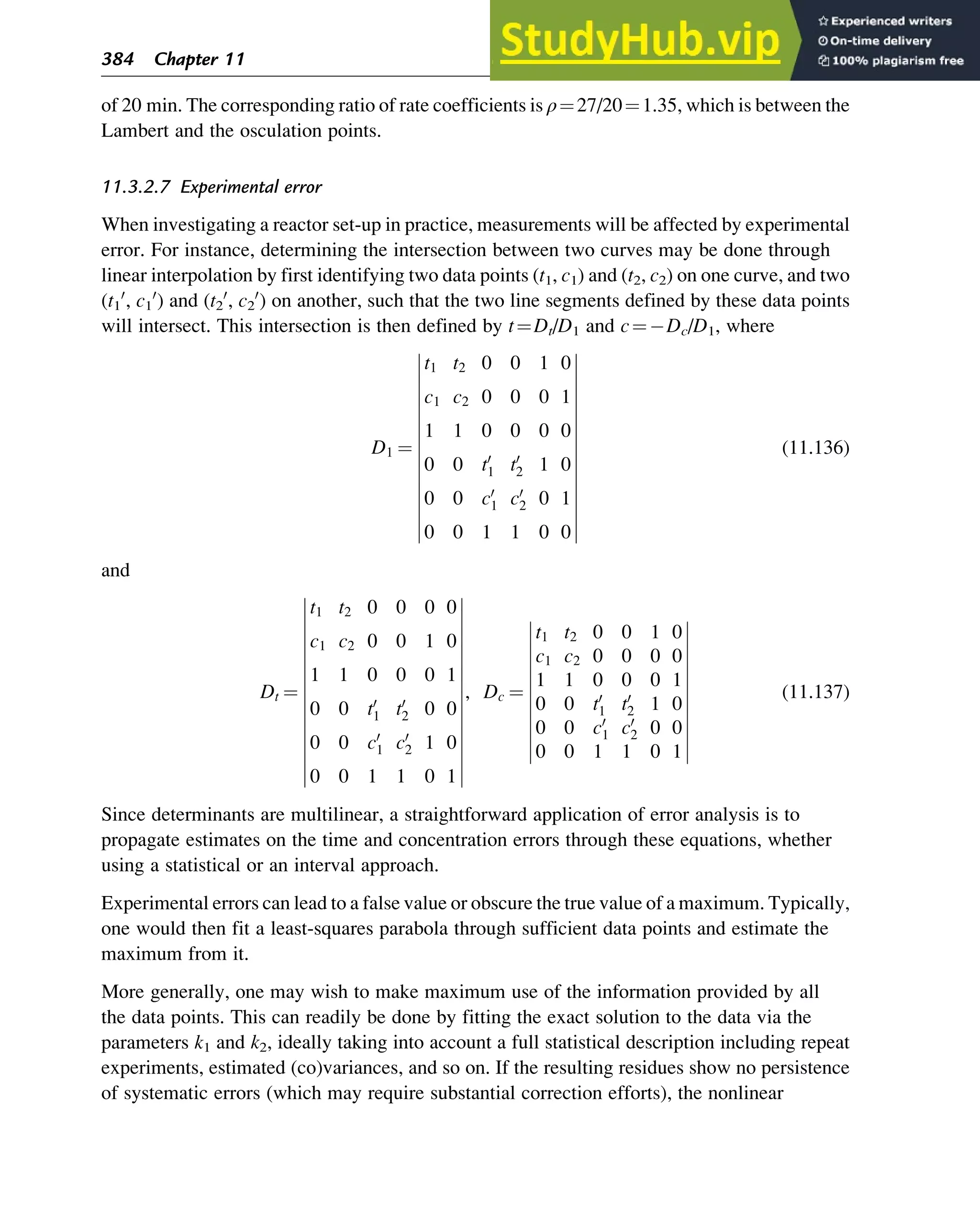
  • 241.
    The Qhr1 linerepresents the situation in which only a small amount of heat is generated by the reaction so that the temperature of the reaction mixture, and thus the steady-state conversion, is low. In contrast, if the rate of heat generation by the reaction is so large that the Qrg curve crosses the Qhr3 line, the reaction temperature is so high that the steady-state conversion will be complete. In the intermediate situation, represented by the Qhr2 line, there are three possible steady states, points A, B, and C. However, point B is an unstable steady state; if the temperature only drops slightly below the steady-state temperature, the rate of heat generation by the reaction is smaller than the rate of heat removal, resulting in a further temperature decrease until the steady state represented by point A is reached. Similarly, in the case of a small temperature rise, the temperature will continue to increase until point C is reached. 7.3.2 Mathematical Model of the Nonisothermal CSTR A model of a nonisothermal CSTR in which an irreversible first-order reaction, A!B, takes place can be formulated as follows (Frank-Kamenetskii, 1969; Bykov and Tsybenova, 2011): Vr dcA dt ¼ Vrk T ð ÞcA + qV cA0 cA ð Þ (7.59) cpρVr dT dt ¼ ΔrH ð ÞVrk T ð ÞcA + cpρqV T0 T ð Þ + hAr Tw T ð Þ (7.60) where cA is the reactant concentration, T and Tw are the temperatures of the reaction mixture and the reactor wall, k T ð Þ ¼ k0 exp Ea=RgT is the reaction rate coefficient, Vr is the reaction volume, qV is the volumetric flow rate, ρ and cp are the density and specific heat Fig. 7.4 Dependence of the rate of heat generation Qhg and the rate of heat removal Qhr on the reaction temperature in a CSTR at three different wall temperatures with Tw1 Tw2 Tw3. Certain Qhr lines can intersect the Qhg curve in as much as three different points (A, B and C). Stability of Chemical Reaction Systems 237
  • 242.
    capacity at constantpressure of the reaction mixture, ΔrH ð Þ is the heat of reaction, Ar is the reactor surface area available for heat exchange, and h is the heat-transfer coefficient. This set of two equations contains many kinetic, geometric, and thermal parameters. The phase variables of this system are the reactant concentration and the temperature. We can introduce the following dimensionless parameters (Frank-Kamenetskii, 1969): T* ¼ 1 hAr + cpρqV hArT0 + cpρqVTw ; α* ¼ hAr + cpρqV Ar (7.61) Da ¼ Vr qV k T0 ð Þ (7.62) Se ¼ ΔrH ð Þρ α* Ar=Vr ð Þ Ea Rg T* ð Þ2 k0 exp Ea RgT (7.63) β ¼ ΔrH ð ÞcA0 cpρT0 ; γ ¼ Ea RgT0 (7.64) x ¼ cA0 cA cA0 ; y ¼ Ea RgT2 T T* ð Þ (7.65) t* ¼ k0t exp Ea RgT* (7.66) where x is the conversion, Da is the (first) Damköhler number, and Se is the Semenov number. We assume that the inlet conditions are the same as the initial conditions: cA 0 ð Þ ¼ cA0; cpρqV T0 T 0 ð Þ ð Þ ¼ hAr T 0 ð Þ Tw ð Þ (7.67) Using the dimensionless parameters, for an exothermic first-order reaction, this model can be written as dx dt* ¼ 1 x ð Þexp y 1 + βy x Da ¼ f1 x, y ð Þ (7.68) γ dy dt* ¼ 1 x ð Þexp y 1 + βy y Se ¼ f2 x, y ð Þ (7.69) The steady-state values can be found by putting dx/dt* and dy/dt* equal to zero: 1 x ð Þexp y 1 + βy x Da ¼ 0 (7.70) 1 x ð Þexp y 1 + βy y Se ¼ 0 (7.71) 238 Chapter 7
  • 243.
    from which itfollows that x ¼ Da Se y ¼ νy (7.72) Substituting Eq. (7.72) into Eq. (7.71) yields the following nonlinear equation in y: 1 νy ð Þexp y 1 + βy ¼ y Se (7.73) Equality (7.73) is an equation of steady states in which the left-hand side represents heat removal, Qhr y ð Þ ¼ 1 νy ð Þexp y 1 + βy ¼ 1 νy ð Þe y ð Þ (7.74) and the right-hand side represents heat generation. Qhg y ð Þ ¼ y Se (7.75) Solutions of Eq. (7.73) can be studied using a Semenov diagram, which reflects the dependences of the rate of heat generation and the rate of heat removal on the temperature. This diagram is similar to the dependence shown in Fig. 7.4, but with dimensionless coordinates. The points of intersection of Qhr(y) and Qhg(y) in Eq. (7.73) determine the temperature of the steady state; knowing this temperature, the corresponding steady-state conversion can be calculated using Eq. (7.72). The condition 1 Se ¼ dQhg y ð Þ dy dQhr y ð Þ dy (7.76) is necessary and sufficient for uniqueness of the steady state. This condition means that the rate of heat removal must be higher than that of heat generation. 7.3.3 Types of Stability of the Steady State The type of stability of a steady state can be determined from the roots of the characteristic polynomial: λ2 a11 + a22 ð Þλ + a11a22 a12a21 ¼ λ2 σλ + Δ ¼ 0 (7.77) where the elements of the Jacobian matrix J are given by a11 ¼ @f1 @x ¼ e y ð Þ 1 Da (7.78) Stability of Chemical Reaction Systems 239
  • 244.
    a12 ¼ @f1 @y ¼ 1 x ðÞe y ð Þ 1 + βy ð Þ2 (7.79) a21 ¼ @f2 @x ¼ e y ð Þ γ (7.80) a22 ¼ @f2 @y ¼ 1 x ð Þe y ð Þ 1 + βy ð Þ2 1 γSe (7.81) with f1 and f2 given by, respectively, Eqs. (7.68) and (7.69). The roots of the characteristic polynomial, Eq. (7.77), are expressed through its coefficients: λ1,2 ¼ σ 2 ffiffiffiffiffiffiffiffiffiffiffiffiffi σ2 4 Δ r (7.82) The parametric dependences of the steady states are solutions of the equation F y ð Þ ¼ Qhr y ð Þ Qhg y ð Þ ¼ 0 (7.83) which can be written as F y, Da, Se, β ð Þ ¼ 0 (7.84) Then the expressions for the parameters as a function of y can be found: β ¼ 1 ln y= Se Day ð Þ ½ Š 1 y (7.85) Se ¼ Da + 1 e y ð Þ y (7.86) Da ¼ Se y 1 e y ð Þ (7.87) and ν ¼ Da Se ¼ 1 y 1 e y ð ÞSe (7.88) Subsequently, the dimensionless temperature y is determined as a function of the parameter ν. The boundary between the domain with one steady state and the domain with three steady states is called the line of multiplicity, LΔ Δ ¼ 0 ð Þ For finding this dependence in the plane (Da, Se), we need to solve the set of equations f1 x, y, Da, Se ð Þ ¼ 0 (7.89) f2 x, y, Da, Se ð Þ ¼ 0 (7.90) Δ y, Da, Se ð Þ ¼ 0 (7.91) where Δ is determined using elements of the Jacobian matrix. 240 Chapter 7
  • 245.
    Combining Eq. (7.84)and Eqs. (7.89)–(7.91), we obtain the equation for the multiplicity line in the plane (Da,Se), LΔ Da, Se ð Þ : Da y ð Þ ¼ y 1 + βy ð Þ2 1 + βy ð Þ2 e y ð Þ Se y, Da ð Þ ¼ Da + 1 e y ð Þ y 8 : (7.92) Lines of multiplicity for other parameter planes can be found in a similar way. For the plane (Se, ν), LΔ Se, ν ð Þ : Se y ð Þ ¼ y2 1 + βy ð Þ2 e y ð Þ ν y, Se ð Þ ¼ 1 y 1 e y ð ÞSe 8 : (7.93) Lines of neutrality, Lσ σ ¼ 0 ð Þ, determine the type of stability of a steady state. In order to find Lσ, the following equations need to be solved: F y, Da, Se ð Þ ¼ 0 (7.94) σ y, Da, Se ð Þ ¼ 0 (7.95) Simultaneously solving Eqs. (7.94), (7.95), and (7.85)–(7.88) will explicitly yield different lines Lσ. Lσ Se, ν ð Þ : Se y ð Þ ¼ Da y 1 + βy ð Þ2 γ 1 + βy ð Þ2 Dae y ð Þ + 1 ð Þ ν y, Se ð Þ ¼ 1 y 1 e y ð ÞSe 8 : (7.96) Lσ Da, Se ð Þ : Da y ð Þ ¼ a y ð Þ ffiffiffiffiffiffiffiffiffiffiffiffiffiffiffiffiffiffi a2 y ð Þ 1 p e y ð Þ ; a y ð Þ ¼ 1 2γ 1 + βy ð Þ2 1 2γy 1 Se y, Da ð Þ ¼ Da + 1 e y ð Þ y 8 : (7.97) Lσ γ, Da ð Þ : γ y, Da ð Þ ¼ Dae y ð Þ y 1 + βy ð Þ2 y 1 + βy ð Þ2 Dae y ð Þ + 1 ð Þ2 Da y ð Þ ¼ Se y 1 e y ð Þ 8 : (7.98) Stability of Chemical Reaction Systems 241
  • 246.
    Lσ γ, Se ðÞ : γ y, Se ð Þ ¼ e y ð ÞSe y ð Þ y 1 + βy ð Þ2 e y ð ÞSe 1 + βy ð Þ ð Þ2 Se y, Da ð Þ ¼ Da + 1 e y ð Þ y 8 : (7.99) Lσ γ, β ð Þ : γ y, β ð Þ ¼ Dae y ð Þ y 1 + βy ð Þ2 y 1 + βy ð Þ2 Dae y ð Þ + 1 ð Þ2 β y ð Þ ¼ 1 ln y= Se Day ð Þ ½ Š 1 y 8 : (7.100) Lσ γ, ν ð Þ : γ y, ν ð Þ ¼ νe y ð Þ y 1 + βy ð Þ2 y 1 + βy ð Þ2 Dae y ð Þ + 1 ð Þ2 ν y, Se ð Þ ¼ 1 y 1 See y ð Þ 8 : (7.101) The line of multiplicity and the line of neutrality together form a parametric portrait. In this portrait, parametric domains with a different number of steady states that differ by their stability as well can be distinguished. In the current model, the complete parametric portrait consists of six domains. Furthermore, six types of phase portraits can be distinguished, corresponding to six parametric portrait domains. The first domain (I) is characterized by a unique stable steady state. This behavior is observed at low and high temperatures. The second domain (II) relates to a unique unstable steady state. This is a domain of oscillations. The domains III, IV, and V all have three steady states. Domain III has one unstable steady state at low temperature and two stable steady states at high temperature. Domains IV and V both have one stable and one unstable steady state. Finally, domain VI has three steady states, one of which is stable and two are unstable. In this domain, oscillations are also observed. 7.4 Multiplicity of Steady States in Isothermal Heterogeneous Catalytic Systems 7.4.1 Historical Background Multiplicity of steady states not only occurs in nonisothermal systems. In the 1950s and 1960s, this phenomenon was found in many isothermal heterogeneous catalytic oxidation systems such as the platinum-catalyzed oxidation of hydrogen and carbon monoxide. 242 Chapter 7
  • 247.
    Currently, a vastamount of information on the occurrence of multiple steady states in heterogeneous catalysis has been accumulated. Different values of the reaction rate can correspond to the same composition of the reaction mixture or to the same temperature. Typically, multiplicity of steady states is accompanied by hysteresis, a term derived from the Greek word meaning “lagging behind.” A characteristic mark of hysteresis is that the output— here the reaction rate—forms a loop, which can be oriented clockwise or counterclockwise. Hysteresis causes the reaction rate to jump up or fall down, signifying, respectively, ignition and extinction of the reaction. Fig. 7.5 shows some examples of kinetic dependences involving hysteresis. Liljenroth (1918) was the first to describe a nonlinear phenomenon in heterogeneous catalysis. He studied the platinum-catalyzed oxidation of ammonia and analyzed the stability of the steady state of this process. Apparently, Davies (1934) was the first to systematically observe nonlinear phenomena and to point out the chemical nature of the rate hysteresis. In the 1950s, Boreskov and colleagues (Boreskov et al., 1953; Kharkovskaya et al., 1959) studied the oxidation of hydrogen over metal catalysts and found that in a certain range of reaction parameters, very different values of the steady-state reaction rate corresponded with the same gas composition. These data were obtained at isothermal conditions. For more historical information on multiplicity of steady states, see Yablonskii et al. (1991) and Marin and Yablonsky (2011). Fig. 7.5 Examples of kinetic dependences with a multiplicity of steady states. Solid lines correspond to stable branches of the reaction rate, dashed lines to unstable branches; (A), (B) r versus T; (C) r versus p1 at constant p2; (D) r versus p2 at constant p1. (A) and (C) are examples of clockwise hysteresis, (B) and (D) of counterclockwise hysteresis. Stability of Chemical Reaction Systems 243
  • 248.
    7.4.2 The SimplestCatalytic Trigger The simplest mechanism for a catalytic reaction permitting three steady states is the following adsorption mechanism (also called Langmuir-Hinshelwood mechanism) involving two types of intermediates: 1 ð Þ A2 + 2Z 2AZ 2 ð Þ B + Z BZ 3 ð Þ AZ + BZ ! AB + 2Z (7.102) The well-known adsorption mechanism for the oxidation of carbon monoxide over platinum at constant partial pressures of oxygen and carbon monoxide, 1 ð Þ O2 + 2Pt 2PtO 2 ð Þ CO + Pt PtCO 3 ð Þ PtO + PtCO ! CO2 + 2Pt (7.103) is an example of this type of mechanism. Let us start our analysis by assuming all steps in the mechanism represented by Eq. (7.102) are irreversible (Bykov et al., 1981; Bykov and Yablonskii, 1987), 1 ð Þ A2 + Z ! 2AZ; 2 ð Þ B + Z ! BZ; 3 ð Þ AZ + BZ ! AB + 2Z. Then, the steady-state model is given by dθAZ dt ¼ 2k+ 1 pA2 1 θAZ θBZ ð Þ2 k+ 3 θAZθBZ ¼ 0 (7.104) dθBZ dt ¼ k+ 2 pB 1 θAZ θBZ ð Þ k+ 3 θAZθBZ ¼ 0 (7.105) where θAZ and θBZ are the normalized surface concentrations of A and B and θZ ¼ 1 θAZ θBZ is the normalized surface concentration of free active sites Z. pA2 and pB are the partial pressures of A2 and B and k+ 1 ,k+ 2 , and k+ 3 are the rate coefficients of (forward) reactions 1, 2, and 3. In our model, two boundary steady states exist: (1) θAZ ¼1 and θBZ ¼θZ ¼0, which corresponds to complete surface coverage by component A2 (eg, oxygen) and (2) θAZ ¼θZ ¼0 and θBZ ¼1, which corresponds to complete surface coverage by component B (eg, CO). In both cases, the steady-state reaction rate is zero: r ¼ 2k+ 1 pA2 1 θAZ θBZ ð Þ2 ¼ k+ 2 pB 1 θAZ θBZ ð Þ ¼ k+ 3 θAZθBZ ¼ 0 (7.106) In addition to these boundary steady states, two internal steady states exist with nonzero values of the reaction rate. These are found as follows. Subtraction of Eq. (7.105) from Eq. (7.104) yields 2k+ 1 pA2 1 θAZ θBZ ð Þ2 k+ 2 pB 1 θAZ θBZ ð Þ ¼ 0 (7.107) 244 Chapter 7
  • 249.
    from which itfollows that 1 θAZ θBZ ¼ θZ ¼ k+ 2 pB 2k+ 1 pA2 (7.108) Substitution of Eq. (7.108) in Eq. (7.106) for the steady-state reaction rate yields r ¼ k+ 2 pB 2 2k+ 1 pA2 ¼ k+ 3 θAZθBZ (7.109) and thus θAZθBZ ¼ k+ 2 pB 2 2k+ 1 k+ 3 pA2 (7.110) Then from Eq. (7.108) it follows that θBZ ¼ 1 θAZ k+ 2 pB 2k+ 1 pA2 (7.111) so that Eq. (7.110) can be transformed into θAZ 1 θAZ k+ 2 pB 2k+ 1 pA2 ¼ k+ 2 pB 2 2k+ 1 k+ 3 pA2 (7.112) This quadratic equation can be written as θ2 AZ σθAZ + Δ ¼ 0 (7.113) with σ ¼ 1 k+ 2 pB 2k+ 1 pA2 andΔ ¼ k+ 2 pB 2 2k+ 1 k+ 3 pA2 : Then, θAZ ¼ σ 2 ffiffiffiffiffiffiffiffiffiffiffiffiffi σ2 4 Δ r (7.114) and with Eq. (7.111) we find the same result for θBZ. Eq. (7.114) has two solutions in the domain of values having a physical meaning (0θAZ 1) under the condition that 1 k+ 2 pB 2k+ 1 pA2 2 2 k+ 2 pB 2 k+ 1 k+ 3 pA2 (7.115) Thus, this model has four steady states, two boundary ones and two internal ones. The two boundary steady states (I and IV) are symmetrical and so are the two internal steady states (II and III). Mathematically, this property is the result of the symmetry of Eqs. (7.104) Stability of Chemical Reaction Systems 245
  • 250.
    and (7.105) withrespect to the variables θAZ and θBZ. Table 7.1 shows the characteristics of the four steady states. It has been shown that steady states II and III are stable whereas steady states I and IV are unstable. The steady-state reaction rates for steady states II and III follow from the first equality of Eq. (7.109). A detailed analysis of the stability of the steady states for this model can be found in the monographs by Yablonskii et al. (1991) and Marin and Yablonsky (2011). Every stable steady state is characterized by a basin of attraction, which is a set of initial conditions—or compositions—starting from which the mixture reaches this steady state. Clearly, unstable steady states do not have such a basin. 7.4.3 Influence of Reaction Reversibility on Hysteresis Reversibility of one or more reaction steps of the adsorption mechanism represented by Eq. (7.102) may significantly influence the reaction kinetics, particularly the steady-state kinetic behavior. As a result of reversibility, the steady states corresponding to complete coverage of the catalyst surface with surface intermediate AZ or BZ—the boundary steady states—disappear. At certain conditions, only three internal steady states, two stable and one unstable, exist. Fig. 7.6 shows a typical dependence of the steady-state reaction rate on the partial pressure of component B for the adsorption mechanism with the first and second steps being reversible and the third step irreversible. At low temperature, the reaction rate is characterized by a multiplicity of steady-state rates; three steady-state reaction rates are observed, two stable and one unstable (see Fig. 7.6A, curve (1), and Fig. 7.6B, curves (1) Table 7.1 Steady-state characteristics for the reaction mechanism represented by Eq. (7.102) Steady State Normalized Concentrations Reaction Rate r Comments I θAZ,I ¼ 1 θBZ,I ¼ 0 θZ,I ¼ 0 0 Unstable steady state; catalyst surface completely covered by component A2 (intermediate AZ) II θAZ,II ¼ σ + ffiffiffiffiffiffiffiffiffiffiffiffiffiffiffiffi σ2 4Δ p 2 θBZ,II ¼ σ ffiffiffiffiffiffiffiffiffiffiffiffiffiffiffiffi σ2 4Δ p 2 θZ,II ¼ 1 σ k+ 2 pB 2 2k+ 1 pA2 Stable steady state; catalyst surface contains intermediates AZ and BZ and free active sites Z III θAZ,III ¼ σ ffiffiffiffiffiffiffiffiffiffiffiffiffiffiffiffi σ2 4Δ p 2 θBZ,III ¼ σ + ffiffiffiffiffiffiffiffiffiffiffiffiffiffiffiffi σ2 4Δ p 2 θZ,III ¼ 1 σ k+ 2 pB 2 2k+ 1 pA2 Unstable steady state; catalyst surface contains intermediates AZ and BZ and free active sites Z IV θAZ,I ¼ 0 θBZ,I ¼ 1 θZ,I ¼ 0 0 Stable steady state; catalyst surface completely covered by component B (intermediate BZ) 246 Chapter 7
  • 251.
    and (2)). ComponentA dominates on the upper branch and B dominates on the lower branch. In this case, the transition from one branch to another one occurs in a dramatic way: via extinction (from the upper branch to the lower one) or via ignition (from the lower branch to the upper one). Finally, the multiplicity of steady states is exhibited as a counterclockwise hysteresis for the kinetic dependence r(pB) (Fig. 7.6A, curve (1) and Fig. 7.6B, curves (1) and (2)) and clockwise for r pA2 ð Þ (not shown). A temperature rise increases the desorption coefficient and kills the multiplicity of steady states. The kinetic dependence is gradually transformed into a dependence with a maximum rate (Fig. 7.6A, curve (3) and Fig. 7.6B, curve (3)). Finally, the temperature rise causes the maximum of the reaction rate to vanish completely (Fig. 7.6A, curve (4)). Fig. 7.7A shows the steady-state reaction rate in the three-dimensional space. This rate is characterized by a special point called a cusp point, a term taken from catastrophe theory meaning a singular point of the geometric curve. Fig. 7.7B shows two curves that are loci of turning points. The curve on the left is the locus of extinction points and can be defined as the locus of turning points from the upper to the lower branch. The curve on the right is the locus of ignition points and can be defined as the locus of turning points from the lower to the upper branch. 7.4.4 Transient Characteristics and “Critical Slowing Down” The transient characteristics, θAZ(t) and θBZ(t), of the adsorption model (Eq. (7.102)) show different relaxation times, which can differ by orders of magnitude. The trajectories are often characterized by fast initial motion and slow motion in the vicinity of a slow trajectory. This slow trajectory is a simple case of the slow manifolds known in the literature (Gorban and Karlin, 2003) and is located in the region between the two null clines dθAZ=dt ¼ 0 and dθBZ=dt ¼ 0: Both null clines are second-order curves with an axis of symmetry θAZ ¼θBZ Fig. 7.6 Dependence of the steady-state reaction rate on pB for the adsorption mechanism represented by Eq. (7.101) at constant values of pA2 and k+ 1 ¼ k+ 2 for (A) constant k1 and k2 increasing from (1) to (4) and (B) constant k2 and k1 increasing from (1) to (3). Reprinted from Yablonskii, G.S., Bykov, V.I., Gorban, A.N., Elokhin, V.I., 1991. Kinetic models of catalytic reactions. In: Compton, R.G. (Ed.), Comprehensive Chemical Kinetics, vol. 32. Elsevier, Amsterdam, Copyright (1991), with permission from Elsevier. Stability of Chemical Reaction Systems 247
  • 252.
    on which anunstable steady state is located. In the case that a phase portrait has multiple steady states, a trajectory may rapidly approach an unstable steady state and then slowly relax toward one of the stable steady states (Fig. 7.8). Fig. 7.7 Surface of the steady-state reaction rate at constant temperature for the adsorption mechanism represented by Eq. (7.101); (A) reaction rate in the three-dimensional space; (B) loci of turning points. Adapted from Yablonskii, G.S., Bykov, V.I., Gorban, A.N., Elokhin, V.I., 1991. Kinetic models of catalytic reactions. In: Compton, R.G. (Ed.), Comprehensive Chemical Kinetics, vol. 32. Elsevier, Amsterdam, Copyright (1991), with permission from Elsevier. 0.2 20 0 40 qAZ qBZ qAZ, qBZ 60 t (s) 80 120 0.4 0.6 0.8 1.0 t e e Fig. 7.8 Example of critical slowing down for the adsorption mechanism represented by Eq. (7.102); relaxation from the initial state θAZ 0 ð Þ ¼ 0:5;θBZ 0 ð Þ ¼ 0; ε is the vicinity of the final state and τ is the time required to reach this vicinity. Reprinted from Yablonskii, G.S., Bykov, V.I., Gorban, A.N., Elokhin, V.I., 1991. Kinetic models of catalytic reactions. In: Compton, R.G. (Ed.), Comprehensive Chemical Kinetics, vol. 32. Elsevier, Amsterdam, Copyright (1991), with permission from Elsevier. 248 Chapter 7
  • 253.
    If such criticalslowing down occurs, the observed relaxation time is unexpectedly long and considerably longer than the relaxation time corresponding to the lowest rate coefficient. The main nontrivial explanation of this phenomenon is the following. In the region of critical effects, one of the parameters achieves its bifurcation value while one of the characteristic roots changes from a negative to a positive value. Experimentally, the phenomenon of very slow relaxation toward a stable steady state has been observed in many heterogeneous catalytic oxidation reactions (Yablonskii et al., 1991; Marin and Yablonsky, 2011). Gorban and colleagues (Gorban and Cheresiz, 1981; Gorban and Karlin, 2003) have developed a comprehensive mathematical theory of slow relaxation using concepts from the theory of dynamical systems, such as and ω-limit sets. 7.4.5 General Model of the Adsorption Mechanism In the adsorption mechanism, two gaseous reactants are adsorbed through two independent reactions. Then the two surface intermediates interact and a gaseous product is released. The general form of this mechanism can be represented as 1 ð Þ Am + mZ mAZ 2 ð Þ Bn + nZ nBZ 3 ð Þ pAZ + qBZ ApBq + p + q ð ÞZ (7.116) The kinetic model corresponding to this mechanism is given by the following set of nonlinear differential equations: dθAZ dt ¼ m k + 1 θm Z mk1 θm AZ pk+ 3 θp AZθq BZ + q k3 θp + q Z (7.117) dθBZ dt ¼ n k + 2 θn Z nk2 θn BZ qk+ 3 θp AZθq BZ + q k3 θp + q Z (7.118) with apparent parameters k + 1 ¼ k+ 1 pAm , k + 2 ¼ k+ 2 pBn and k3 ¼ k3 pApBq and constant partial pressures of Am, Bn and ApBq. The nonlinearity of the model is caused by both the adsorption steps and the interaction between surface intermediates. The corresponding set of algebraic equations dθAZ dt ¼ 0 and dθBZ dt ¼ 0 determines the number of steady states and the corresponding values of the normalized surface concentrations. A necessary condition for the nonuniqueness of steady states is the presence of a step in which different surface intermediates react. This result was obtained in a physically meaningful domain of normalized surface concentrations (θZ, θAZ, θBZ 0; θZ +θAZ +θBZ ¼1). The sufficient condition for the uniqueness of an internal steady state is the relationship m ¼ n p,q: (7.119) If the condition of Eq. (7.119) is not satisfied, multiplicity of steady states is possible. Stability of Chemical Reaction Systems 249
  • 254.
    For the adsorptionmechanism, the presence of an interaction step between different intermediates is only one necessary condition for the occurrence of multiple steady states; another requirement is that the reaction orders of the two adsorption steps must be different. Consequently, competition between surface intermediates is the main factor leading to multiplicity of steady states. The reversibility of the adsorption steps affects the number of steady states. Analysis shows that boundary steady states are absent if both adsorption steps are reversible. If one of the adsorption steps is irreversible, there is one boundary steady state with the irreversibly adsorbed intermediate occupying all active catalyst sites. If both adsorption steps are irreversible, two boundary steady states exist, one with complete coverage of the catalyst surface by AZ and one with complete coverage by BZ. If the reaction orders of these irreversible adsorption steps are equal, there is a line of internal steady states connecting the two boundary steady states. In this case, the steady state is very sensitive to the initial conditions and experimental data may be irreproducible. From a physicochemical point of view, elementary reactions with an overall kinetic order of more than three can be disregarded because such reactions are impossible. Table 7.2 shows the results of a comprehensive analysis by Yablonskii et al. (1991) of realistic adsorption mechanisms, assuming that the interaction step between the surface intermediates is irreversible (k3 ¼ 0) and that the stoichiometric coefficients equal either one or two and the Table 7.2 Characteristics of “realistic” adsorption mechanisms: necessary conditions for steady states (ss) and their number Partial Reaction Orders Reversibility of Adsorption Steps I k1 ¼ 0; k2 ¼ 0 IIa k1 ¼ 0; k2 6¼ 0 IIb k1 6¼ 0; k2 ¼ 0 III k1 6¼ 0; k2 6¼ 0 (1) m¼1; n ¼1; p¼1; q¼1 Two ss; Line of ss for k + 1 ¼ k + 2 One bssa and one issb at k + 1 k + 2 One bss and one iss at k + 2 k + 1 No bss and one iss (2) m¼2; n ¼2; p¼1; q¼1 Same as I.1 Same as IIa.1 Same as IIb.2 Same as III.1 (3) m¼2; n ¼2; p¼2; q¼1 Same as I.1 but with k + 1 ¼ 2 k + 2 Same as IIa.1 but with k + 1 2 k + 2 Same as IIb.2 but with 2 k + 2 k + 1 Same as III.1 (4) m¼1; n ¼1; p¼2; q¼1 Same as I.3 One bss and two iss at k + 1 2 k + 2 One bss and one iss No bss and one or three iss (5) m¼2; n ¼1; p¼1; q¼1 Two bss and two iss at 2 k + 1 k + 2 One bss and two iss at 2 k + 1 k + 2 One bss and one or three iss at 2 k + 1 k + 2 Same as III.4 (6) m¼2; n ¼1; p¼2; q¼1 I.5 but with k + 1 k + 2 IIa.5 but with k + 1 k + 2 IIb.5 but with k + 1 k + 2 Same as III.4 (7) m¼2; n ¼1; p¼1; q¼2 I.5 but with 4 k + 1 k + 2 IIa.5 but with 4 k + 1 k + 2 IIb.5 but with 4 k + 1 k + 2 Same as III.4 a bss¼boundary steady state. b iss¼internal steady state. 250 Chapter 7
  • 255.
    sum p+q3. Theseresults are based on the algebraic analysis of the number of positive roots in the interval [0,1] using Descartes’s rule of signs and Sturm’s theorem. The main result is that real multiplicity of steady states—the existence of two internal stable steady states and one internal unstable steady state—can be explained using one of the four mechanisms shown in Table 7.3. If the experimentally observed steady-state reaction rate is characterized by two different branches, and multiplicity of steady states is observed, one of these four mechanisms can be used to interpret the data. We prefer to use mechanism B because its steps are characterized by overall reaction orders that are not larger than two. In fact, this mechanism is identical to the mechanism represented by Eq. (7.102), an example of which is the adsorption mechanism for the oxidation of carbon monoxide (Eq. (7.103)). We will return to this mechanism in Chapter 11, in which the problem of critical simplification is discussed. 7.5 Chemical Oscillations in Isothermal Systems 7.5.1 Historical Background The discovery of isothermal chemical oscillations was one of the big scientific sensations of the 20th century. Belousov and Zhabotinsky found self-sustained oscillations in the cerium-ion catalyzed oxidation of citric acid by bromate, now known as the Belousov-Zhabotinsky reaction. This reaction became one of the starting points for Prigogine and his coworkers in Brussels for studying complicated dynamic behavior of chemical mixtures that are far from equilibrium (Prigogine and Lefever, 1968; Glansdorff and Prigogine, 1971; Nicolis and Prigogine, 1977). They used a model with a specific type of mechanism involving autocatalytic reactions, later named the Brusselator, for the quantitative interpretation of chemical oscillations in isothermal systems. An autocatalytic reaction is a reaction in which at least one of the reactants is also a product, for example, A+B!2 A. Prigogine received the 1977 Nobel Prize in Chemistry for this work. In the early 1970s, the research by Prigogine’s group inspired Table 7.3 Adsorption mechanisms that can explain the multiplicity of steady states A (1) A + ZAZ (2) B + ZBZ (3) 2AZ + BZ ! A2B + 3Z B (1) A2 + 2Z2AZ (2) B + ZBZ (3) AZ + BZ ! AB + 2Z C (1) A2 + 2Z2AZ (2) B + ZBZ (3) 2AZ + BZ ! A2B + 3Z D (1) A2 + 2Z2AZ (2) B + ZBZ (3) AZ + 2BZ ! AB2 + 3Z Stability of Chemical Reaction Systems 251
  • 256.
    Field et al.(1972) at the University of Oregon to perform a systematic and detailed thermodynamic and kinetic analysis of the Belousov-Zhabotinsky reaction. They suggested a detailed reaction mechanism that could explain the oscillations. Field and Noyes (1974) later simplified this mechanism and named it the Oregonator, after Prigogine’s Brusselator. The group of Wicke (Beusch et al., 1972a; Beusch et al., 1972b) was the first to observe kinetic self-sustained oscillations in solid-catalyzed reactions, when studying the oxidation of carbon monoxide over platinum-based catalysts. At certain conditions, oscillations were observed in the production rate of carbon dioxide. Based on these experimental data, Beusch et al. (1972b) assumed that the only factor responsible for the rate oscillations was the complex surface-reaction mechanism and that neither external nor internal mass- or heat-transfer limitations played a role. Slin’ko and Slin’ko (1978, 1982) performed comprehensive experimental and theoretical investigations of kinetic self-sustained oscillations, in particular in the oxidation of hydrogen over nickel and platinum catalysts (see also Slin’ko and Jaeger, 1994). Self-sustained rate oscillations have been observed in many heterogeneous catalytic reactions. The largest amount of information on kinetic self-sustained oscillations was obtained for the oxidation of carbon monoxide over noble metals, particularly by the group of Ertl, who in 2007 received a Nobel Prize in Chemistry for his work regarding this phenomenon. Other examples are the oxidation of cyclohexane (Berman and Elinek, 1979), propylene (Sheintuch and Luss, 1981), and ethylene (Vayenas et al., 1981); the cooxidation of carbon monoxide and 1-butene (Mukesh et al., 1982, 1983, 1984); and reactions of nitric oxide with ammonia (Nowobilski and Takoudis, 1985), carbon monoxide (Bolten et al., 1985), and carbon monoxide and oxygen (Regalbuto and Wolf, 1986). 7.5.2 Model of Catalytic Chemical Oscillations Now the question is how to construct the simplest model of a chemical oscillator, in particular, a catalytic oscillator. It is quite easy to include an autocatalytic reaction in the adsorption mechanism, for example A+B! 2 A. The presence of an autocatalytic reaction is a typical feature of the known Brusselator and Oregonator models that have been studied since the 1970s. Autocatalytic processes can be compared with biological processes, in which species are able to give birth to similar species. Autocatalytic models resemble the famous Lotka-Volterra equations (Berryman, 1992; Valentinuzzi and Kohen, 2013), also known as the predator-prey or parasite-host equations. Let us again consider a model with two variables, Eq. (7.12): dc1 dt ¼ f1 c1, c2 ð Þ dc2 dt ¼ f2 c1, c2 ð Þ 8 : (7.12) 252 Chapter 7
  • 257.
    In the presenceof autocatalytic steps, the derivatives @f1 c1, c2 ð Þ=@c1 and @f2 c1, c2 ð Þ=@c2 can be positive in some parametric domain, whereas in the absence of autocatalytic steps these derivatives are always negative. This results in more complicated behavior of autocatalytic processes compared to traditional chemical processes. Thus, the mass-action-law model with two variables and without autocatalytic steps obeys the Poincaré-Bendixson criterion: @f1 c1, c2 ð Þ @c1 + @f2 c1, c2 ð Þ @c2 0 (7.120) Based on this criterion, it can be concluded that two-dimensional models that do not include autocatalytic reactions are not able to reproduce the experimentally observed isothermal kinetic oscillations. Seemingly, the description of catalytic oscillations at least requires a two-variable model with autocatalytic reactions or a three-variable model without autocatalytic reactions. Eigenberger (1978a,b) made a step toward the construction of a three-variable model by adding a so-called buffer step (4 in the following list) to an adsorption mechanism: 1 ð Þ 2A + 2Z 2AZ 2 ð Þ B + 2Z BZ2 3 ð Þ 2AZ + BZ2 ! 2C + 4Z 4 ð Þ B + Z BZ ð Þ* (7.121) for the overall reaction 2A+B ! 2C. In the buffer step, (BZ)* is produced, a nonreactive form that does not participate in the main catalytic cycle. This is a realistic model because gaseous reactants can be adsorbed in a number of forms, some of which are nonreactive. An example is the oxidation of carbon monoxide over platinum, which in the above mechanism translates to A¼CO, B¼O2, and C¼CO2. Although oxygen typically adsorbs irreversibly on platinum, Eigenberger assumed step (4) to be reversible. Based on this assumption, which was not substantiated, Eigenberger transformed the initial model to a model similar to that for a mechanism with autocatalytic reactions, which was studied by Prigogine and colleagues (Prigogine and Lefever, 1968; Glansdorff and Prigogine, 1971; Nicolis and Prigogine, 1977) and found oscillations using computer calculations. Bykov et al. (1978) have presented a detailed analysis of the following adsorption mechanism with buffer step (also see Yablonskii et al., 1991; Marin and Yablonsky, 2011): 1 ð Þ A2 + 2Z 2AZ 2 ð Þ B + Z BZ 3 ð Þ AZ + BZ ! AB + 2Z 4 ð Þ B + Z BZ ð Þ* (7.122) The corresponding model for this mechanism is dθAZ dt ¼ 2 k + 1 θ2 Z 2k1 θ2 AZ k+ 3 θAZθBZ ¼ f1 θAZ, θBZ, θ BZ ð Þ* (7.123) Stability of Chemical Reaction Systems 253
  • 258.
    dθBZ dt ¼ k + 2 θZk2 θBZ k+ 3 θAZθBZ ¼ f2 θAZ, θBZ, θ BZ ð Þ* (7.124) dθ BZ ð Þ* dt ¼ k + 4 θZ k4 θ BZ ð Þ* ¼ f3 θAZ, θBZ, θ BZ ð Þ* (7.125) with k + 1 ¼ k+ 1 pA2 , k + 2 ¼ k+ 2 pB and k + 4 ¼ k+ 4 pB: The steady states for this model can be determined from the set of algebraic equations f1 θAZ, θBZ, θ BZ ð Þ* ¼ f2 θAZ, θBZ, θ BZ ð Þ* ¼ f3 θAZ, θBZ, θ BZ ð Þ* ¼ 0 (7.126) By expressing f1 ¼f2 ¼0 in implicit form, we obtain θAZ, θBZ, and θZ as functions of θ(BZ)*. From Eq. (7.126), it follows that θZ θ BZ ð Þ* ¼ k4 k + 4 θ BZ ð Þ* ¼ αθ BZ ð Þ* (7.127) The steady states correspond to the points of intersection of this straight line with the curve θZ ¼ θZ θ BZ ð Þ* in the plane (θZ,θ(BZ)*). This curve is plotted in accordance with the solutions of f1 θAZ, θBZ, θ BZ ð Þ* ¼ f2 θAZ, θBZ, θ BZ ð Þ* ¼ 0 with respect to θAZ and θBZ, which are the steady states of the model representing the three-step adsorption mechanism (steps (1)–(3) of Eq. (7.122)). For this three-step submechanism, a parametric domain can be distinguished in which three different steady states exist. In this domain, the curve θZ ¼ θZ θ BZ ð Þ* has a typical S-shaped form, see Fig. 7.9. Fig. 7.9 Normalized steady-state concentration of free active sites Z as a function of the normalized steady- state concentration of the “buffer” intermediate (BZ)*, curve θZ ¼ θZ θ BZ ð Þ* . The straight lines represent Eq. (7.127); α ¼ k4 = k + 4 with α+ α α : Intersections of the dependences represents the (unstable) steady states θZ,ss. Reprinted from Yablonskii, G.S., Bykov, V.I., Gorban, A.N., Elokhin, V.I., 1991. Kinetic models of catalytic reactions. In: Compton, R.G. (Ed.), Comprehensive Chemical Kinetics, vol. 32. Elsevier, Amsterdam, Copyright (1991), with permission from Elsevier. 254 Chapter 7
  • 259.
    The reduced setof equations for the time derivatives of θAZ and θBZ, Eqs. (7.123) and (7.124), with not three but two variables, in which θ(BZ)* is regarded as a parameter, is a catalytic trigger. For this system, a unique steady state is stable. If there are three steady states, the two outer steady states are stable and the middle steady state is unstable. The complete set of equations with three variables, Eqs. (7.123)–(7.125), including the buffer step, may have a unique unstable solution. In view of the Poincaré-Bendixson theorem, this is a necessary and sufficient condition for the occurrence of oscillations. For this set of equations, the solution is considered to be in the so-called reaction simplex S: S θAZ, θBZ, θ BZ ð Þ* : θAZ 0, θBZ 0, θ BZ ð Þ* 0, θAZ + θBZ + θ BZ ð Þ* 1 (7.128) Let θAZ,ss, θBZ,ss, θ BZ ð Þ*,ss ¼ θss ð Þ be the steady-state solution of the set of equations, Eqs. (7.123)–(7.125). For this system, the characteristic equation is λ3 + σλ2 + δλ + Δ ¼ 0 (7.129) where σ ¼ Tr(J), δ¼a11 +a22 +a33 ¼Tr(adjJ), and Δ¼ det J. J¼[aij] (i, j¼1, 2, 3) is the matrix of the corresponding linearized set of equations at the steady state; a11, a22, and a33 are the principal minors of matrix J; and adjJ is the adjoint of J. The values of the nonpositive roots λ1 and λ2 of matrix J are determined by the relationship between σ, δ, and Δ, with σ 0. It can be shown (Yablonskii et al., 1991) that a necessary and sufficient condition for the instability of the steady state is that δ is negative. For δ¼0, the parameters are at their critical values, that is, the value for which the real parts of the characteristic roots λ1 and λ2 change sign. When the parameters for reaction steps (1)–(3) are properly chosen, a parametric domain for step (4) can be found that results in a unique unstable steady state, resulting in oscillation (see Fig. 7.10). Comparison with Fig. 7.9 shows that the oscillations are observed in the domain close to the hysteresis in the curve θZ(θ(BZ)*). The shape of the limit cycles in Fig. 7.10 very much depends on the values of k + 4 and k4 . The lower these values, the closer the shape of 0.3 (A) (B) 0 0.1 0.2 0.3 0.5 0.7 0.3 0.3 0.5 0.7 0.5 q(BZ)* q(BZ)* qAZ qZ Fig. 7.10 Examples of limit cycles on (A) (θ(BZ)*, θZ) and (B) (θ(BZ)*, θAZ) phase-space projections. Reprinted from Yablonskii, G.S., Bykov, V.I., Gorban, A.N., Elokhin, V.I., 1991. Kinetic models of catalytic reactions. In: Compton, R.G. (Ed.), Comprehensive Chemical Kinetics, vol. 32. Elsevier, Amsterdam, Copyright (1991), with permission from Elsevier. Stability of Chemical Reaction Systems 255
  • 260.
    the limit cycleto the hysteresis in the curve θZ(θ(BZ)*). The corresponding self-sustained oscillations of the reaction rate are shown in Fig. 7.11. On increasing k + 4 to the limit value k + 4 *, the frequency of the oscillations increases, while the amplitude remains nearly constant. At k + 4 k + 4 *, the oscillations vanish jump-like and the system enters the stable steady state. Thus, the four-step mechanism with a buffer step, Eq. (7.122), described by Eqs. (7.123)–(7.125) can be termed the simplest catalytic oscillator based on mass-action-law assumptions. A computational and qualitative analysis of a number of modifications of the four-step mechanism and the corresponding model shows that three factors are of importance with respect to the occurrence of self-sustained oscillations: (1) The presence of a nonlinear step such as AZ+BZ!AB+2Z, that is, the interaction between different surface intermediates. This step is responsible for nonlinear phenomena such as multiplicity of steady states, rate oscillations, and discontinuities in kinetic dependences (see Yablonskii et al., 1991; Marin and Yablonsky, 2011). (2) The presence of a buffer step, which is responsible for slow motion. (3) Reversibility of at least one step, eg, A+Z AZ. One of the basic types of self-sustained oscillations in chemical kinetics is relaxation oscillation. This term usually means the occurrence of self-sustained oscillations whose period can be divided into several parts corresponding to slow and fast changes of the process characteristics. The simplest model for describing relaxation oscillation was proposed by Gol’dshtein et al. (1986). This model is based on the combination of a two-step mechanism and a buffer step: 1 ð Þ A + Z AZ 2 ð Þ AZ + 2Z ! A + 3Z 3 ð Þ Z Z ð Þ* (7.130) where the second step is autocatalytic and (Z)* is a nonreactive surface substance formed in the buffer step. 100 0.1 0.2 300 r (s−1 ) t (s) 500 Fig. 7.11 Self-sustained oscillations of the reaction rate; the dashed line marks the value of the reaction rate at the unstable steady state. Reprinted from Yablonskii, G.S., Bykov, V.I., Gorban, A.N., Elokhin, V.I., 1991. Kinetic models of catalytic reactions. In: Compton, R.G. (Ed.), Comprehensive Chemical Kinetics, vol. 32. Elsevier, Amsterdam, Copyright (1991), with permission from Elsevier. 256 Chapter 7
  • 261.
    The model correspondingto this mechanism is dθZ dt ¼ k + 1 θZ + k1 + k+ 2 θ2 Z 1 θ Z ð Þ* θZ k+ 3 θZ + k3 θ Z ð Þ* ¼ f1 θZ, θ Z ð Þ* (7.131) dθ Z ð Þ* dt ¼ k+ 3 θZ k3 θ Z ð Þ* ¼ f2 θZ, θ Z ð Þ* (7.132) The buffer step (3) is assumed to be slow, so k+ 3 ,k3 ≪k+ 1 ,k1 ,k+ 2 : The ratio k+ 3 =k+ 1 is a small parameter in this model. The fast variable is θZ, while θ(Z)* is the slow one. All three factors mentioned above are present in this simple autocatalytic model. 7.6 General Procedure for Parametric Analysis We are going to describe a general procedure for the parametric analysis of a typical chemical dynamical system based on the examples presented in this chapter. This procedure has also been laid out in detail by Bykov and Tsybenova (2011) and Bykov et al. (2015). The studied process occurs at external conditions that are characterized by a number of parameters. These parameters relate to the system of ordinary differential equations dxi dt ¼ fi x1,⋯xi,⋯xn,P1,⋯Pj,⋯Pm (7.133) where xi are phase variables (concentrations and temperature) and Pj are parameters, such as reactor volume and inlet and initial concentrations and temperature. The first step of the parametric analysis of Eq. (7.133) is the determination of its steady states, which are solutions of the algebraic set of equations fi x1,⋯xi,⋯xn,P1,⋯Pj,⋯Pm ¼ 0 (7.134) In some situations, the solution of Eq. (7.134) can be obtained explicitly, xi ¼ φi P1,⋯Pj,⋯Pm (7.135) but generally this is impossible and the parametric dependences have to be found by using some kind of computational procedure. There are cases in which the set of steady-state equations can be transformed to one equation: f x,P1⋯Pj,⋯Pm ¼ 0 (7.136) in which x is one of the phase variables. This nonlinear equation may have several steady states and, in this domain, a hysteresis of the steady-state dependences on the parameters may be observed. Stability of Chemical Reaction Systems 257
  • 262.
    The second stepin this procedure is a study of the stability of the steady state(s). To this end, the Jacobian matrix J has to be formulated with elements aij ¼ @fi @xj xss ð Þ (7.137) where xss is the steady-state variable. The stability of a steady state is determined by the properties of the eigen roots λi i ¼ 1,…,n ð Þ of the Jacobian matrix. If all λi have nonzero real parts, the steady state is “robust.” Its stability depends on the sign of Re(λi). The most important part of this analysis is determining the parametric dependences φi P1⋯Pj,⋯Pm : In some cases, based on Eq. (7.135) the following explicit dependence can be written: Pj ¼ ηi x ð Þ; j ¼ 1,⋯,m (7.138) where x is the same variable as in Eq. (7.136). As a result, a function x ¼ φ Pj (7.139) can be found, which is the reversal of the unknown parametric dependence. Varying one of the parameters, for example, P1, one can find its bifurcational value at which the number of steady states and their stability change. Varying a second parameter, for example, P2, bifurcation curves as functions of P1 and P2 can be plotted. For the two-dimensional case, there are two main bifurcational dependences (also see Section 7.3.3): • the line of multiplicity of steady states, LΔ; • the line of neutrality, Lσ. The stability of a steady state is determined by the eigen roots of the second-order characteristic equation: λ2 σλ + Δ ¼ 0 (7.140) where σ ¼ a11 + a22 and Δ ¼ a11a22 a12a21: Let us now choose two parameters, P1 and P2, and determine LΔ and Lσ in the plane of these parameters. The boundaries of the domain of multiplicity are defined as solutions of the set of equations f x, P1, P2 ð Þ ¼ 0 Δ x, P1, P2 ð Þ ¼ 0 (7.141) 258 Chapter 7
  • 263.
    In many cases,taking into account Eq. (7.138), Eq. (7.141) can be formulated as P2 ¼ ξ2 x ð Þ P1 ¼ ξ1 x,ξ2 x ð Þ ð Þ (7.142) It is possible to determine the parametric portrait of the system by analyzing the mutual rearrangement of the lines LΔ and Lσ on the plane (P1, P2). The number of steady states and their stability can be estimated using this parametric portrait. The phase portraits of the model represented by Eq. (7.133) provide us with useful information on the dynamic behavior of this model. These phase portraits are calculated by numerical integration for a given set of parameters at different initial conditions. Every parametric domain, which is determined by the mutual rearrangement of the lines LΔ and Lσ, relates to a special type of phase portrait. For a model with two variables, it is possible to present all types of phase portraits. However, for many models with three variables, the number of phase portraits is enormous and the corresponding classification of phase trajectories is quite difficult. Typically, temporal dependences xi ¼ xi t,P1,⋯Pj,⋯Pm are computed for the set of ordinary differential equations, Eq. (7.133) with a given set of parameters. Technical difficulties are usually related to the “stiffness” of the system. Let us analyze the set of nonlinear equations F x, P ð Þ ¼ 0 (7.143) where F is a vector-function, x is a vector of variables, and P is a parameter. Eq. (7.143) determines the implicit dependence x ¼ x P ð Þ (7.144) and the main goal of a parametric analysis is to determine this dependence. Nonlinear sets of equations are usually solved using iterative methods based on parameter continuation. For a particular parameter value P0, a mapping is repeatedly applied to an initial guess x0. If the method converges, and is consistent, then in the limit the iteration approaches a solution of F x, P0 ð Þ ¼ 0. A general scheme of the method of parameter continuation is the following: substitution of Eq. (7.143) into Eq. (7.144) and taking the derivative yields J dx dP + @F @P ¼ 0 (7.145) where J is the Jacobian matrix, J ¼ @F x, P ð Þ @x (7.146) Stability of Chemical Reaction Systems 259
  • 264.
    Using Eq. (7.144)taken as a set of linear equations with respect to dx/dP, one can write equations of change along the parameter: dx dP ¼ J 1 @F @P (7.147) The parametric dependence x(P) is a solution of the set of ordinary differential equations, Eq. (7.147) at a given set of initial conditions x(P0)¼x0. At the bifurcation points of the system, Eq. (7.142), the Jacobian matrix becomes singular. Hence, for numerical integration of Eq. (7.147), a parameterization procedure along the curve x(P) can be used in the corresponding space of dimension dim(x+1). This integration requires the use of special methods, in particular, methods based on the calculation of the Jacobian matrix. In this case, we have to find the partial derivatives @ @x J 1 @F @x , which creates additional problems. The set of equations, Eq. (7.147), is written on the basis of the solution, Eq. (7.145), for example using the Gauss method regarding dx dP : When solving Eq. (7.147), the accuracy of the initial conditions is very important. Generally, the computer realization of the parameter-continuation method is quite complicated. The degree of this complexity depends on the number of variables in Eq. (7.143). Because these numerical calculations are typically carried out with fixed, limited precision, additional considerations relating to floating-point accuracy arise, and the difficulties are exacerbated precisely at the most interesting points of the calculations. Let us analyze the particular case in which the set of equations, Eq. (7.145), can be formulated as just one equation, f x, P ð Þ ¼ 0 (7.148) where f is not a vector function but a scalar function and x is the only variable. Differentiation of the identity f x P ð Þ,P ð Þ ¼ 0 leads to dx dP ¼ @f @P @x @f (7.149) or dP dx ¼ @f @x @P @f (7.150) The parametric dependence P(x) is the reversal of x(P). They can be found by numerical integration of Eq. (7.149) or (7.150). At the turning points, @f @x ¼ 0 or @f @P ¼ 0, so the condition 260 Chapter 7
  • 265.
    @f @P @x @f 1(7.151) has to be fulfilled to make a choice to move along either P or x. For numerical integration, Eq. (7.149) or (7.150) is chosen depending on the condition of Eq. (7.151). The advantages of this modified method of parameter continuation for the scalar equation, Eq. (7.148) are obvious. In this case, it is not necessary to calculate the matrix, which is the inverse of the Jacobian matrix. The transformation of the original set of equations to just one equation is not always possible. Let us analyze another case, in which the original set is transformed into a set of two equations: f1 x, y, P ð Þ ¼ 0 f2 x, y, P ð Þ ¼ 0 (7.152) where x and y are variables and f1 and f2 are nonlinear scalar functions. Eq. (7.152) implicitly determines the following dependences: x ¼ x P ð Þ y ¼ y P ð Þ (7.153) One of the goals of the parametric analysis of Eq. (7.152) is to determine the functions represented by Eq. (7.153). Substitution of Eq. (7.153) into Eq. (7.152) and differentiation of the resulting identities yields @f1 @x dx dP + @f1 @y dy dP + @f1 @P ¼ 0 @f2 @x dx dP + @f2 @y dy dP + @f2 @P ¼ 0 8 : (7.154) Defining Δ ¼ @f1 @x @f1 @y @f2 @x @f2 @y 2 6 6 6 4 3 7 7 7 5 , Δ1 ¼ @f1 @P @f1 @y @f2 @P @f2 @y 2 6 6 6 4 3 7 7 7 5 , Δ2 ¼ @f1 @x @f1 @P @f2 @x @f2 @P 2 6 6 4 3 7 7 5, Eq. (7.155) can be written as dx dP ¼ Δ1 Δ dy dP ¼ Δ2 Δ 8 : (7.155) Stability of Chemical Reaction Systems 261
  • 266.
    The initial conditionsare x(P0)¼x0 and y(P0)¼y0. At the turning points of the curve described by Eq. (7.152), one of the determinants Δ, Δ1, and Δ2 equals zero. Hence, in addition to Eq. (7.155), two sets of differential equations can be analyzed: dP dx ¼ Δ Δ1 dy dx ¼ Δ2 Δ1 8 : (7.156) and dx dy ¼ Δ1 Δ2 dP dy ¼ Δ Δ2 8 : (7.157) Therefore, movement along the line of the parametric dependence Eq. (7.153) can be realized by the integration of one of three sets of equations: Eq. (7.154), Eq. (7.156), or Eq. (7.157). Three different situations can be distinguished. If Δ1 j j Δ j j and Δ2 j j Δ j j, P is chosen as a parameter and Eq. (7.155) is integrated; if Δ j j Δ1 j j and Δ2 j j Δ1 j j, the parameter is x and Eq. (7.156) is integrated; finally, if Δ j j Δ2 j j and Δ1 j j Δ2 j j, the parameter is y and Eq. (7.157) is integrated. We always choose the path of the largest denominator. These criteria can be applied when all variables and all parameters have commensurate variations. The method described is one possible modification of the parameter-continuation method. Nomenclature Ar reactor surface available for heat exchange (m2 ) c vector of concentrations (mol m 3 ) ci concentration of component i (mol m 3 ) cp specific heat capacity at constant pressure (J mol 1 K 1 ) D phase space (mol m 3 ) Da (first) Damköhler number (–) d element of phase space (mol m 3 ) Ea activation energy (J mol 1 ) H enthalpy (J) ΔrH enthalpy change of reaction (J mol 1 ) k reaction rate coefficient ((m3 mol 1 )n s 1 ) k0 preexponential factor (same as k) n amount of substance (mol) Pi parameter i (varies) p pressure (Pa) 262 Chapter 7
  • 267.
    p partial pressureof component i (Pa) Qhg rate of heat generation (J s 1 ) Qhr rate of heat removal (J s 1 ) qV volumetric flow rate (m3 s 1 ) Rg universal gas constant (J mol 1 K 1 ) r reaction rate (s 1 ) Se Semenov number (–) T temperature (K) t time (s) t* new time scale¼(ε/Γt)t (mol 1 mcat 2 s) U internal energy (J) V volume (m3 ) V(x) Lyapunov function (varies) Vr volume of reaction mixture (m3 ) x conversion (–) x,y,z variables (varies) Greek symbols β dimensionless number (–) δ value of concentration upon perturbation (mol m 3 ) ε concentration perturbation (mol m 3 ) εc boundary on deviation in concentration (mol m 3 ) θj normalized concentration of surface intermediate j (–) λ characteristic root (s 1 ) μi chemical potential of component i (J mol 1 ) ν ratio Da/Se (–) ξ deviation of the concentration ~ c from the rest point (mol m 3 ) ρ fluid density (mol m 3 ) τss relaxation time (s) Subscripts 0 initial eq equilibrium i component i j surface intermediate j min minimum s step ss steady state Stability of Chemical Reaction Systems 263
  • 268.
    Superscripts + forward reaction reversereaction αsi partial order of forward reaction of step s in reactant i βsi partial order of reverse reaction of step s in product i γβsi βsi αsi References Berman, A.D., Elinek, A.V., 1979. On dynamics of homogeneous-heterogeneous reactions. Dokl. Akad. Nauk. SSSR 248, 643–647. Berryman, A.A., 1992. The orgins and evolution of predator-prey theory. Ecology 73, 1530–1535. Beusch, H., Fieguth, P., Wicke, E., 1972a. Thermisch und kinetisch verursachte Instabilitäten im Reaktionsverhalten einzelner Katalysatorkörner. Chem. Ing. Techn. 44, 445–451. Beusch, H., Fieguth, P., Wicke, E., 1972b. Unstable behavior of chemical reactions of single catalyst particles. Adv. Chem. Ser. 109, 615–621. Bolten, H., Hahn, Th., LeRoux, J., Lintz, H.-G., 1985. Bistability of the reaction rate in the oxidation of carbon monoxide by nitrogen monoxide on polycrystalline platinum. Surf. Sci. 160, L529–L532. Boreskov, G.K., Slin’ko, M.G., Filippova, A.G., 1953. Catalytic activity of nickel, palladium, and platinum in hydrogen oxidation. Dokl. Akad. Nauk SSSR 92, 353–355. Bykov, V.I., Serafimov, L.A., Tsybenova, S.B., 2015. Emergency starting regimes of a continuous stirred tank reactor. Theor. Found Chem. Eng. 49, 361–369. Bykov, V.I., Tsybenova, S.B., 2011. Non-linear Models of Chemical Kinetics. Krasand, Moscow. Bykov, V.I., Yablonskii, G.S., 1987. Steady-state multiplicity in heterogeneous catalytic reactions. Int. Chem. Eng. 21, 142–154. Bykov, V.I., Yablonskii, G.S., Akramov, T.A., Slin’ko, M.G., 1977. The rate of the free energy decrease in the course of the complex chemical reaction. Dokl. Akad. Nauk. USSR 234, 621–634. Bykov, V.I., Yablonskii, G.S., Elokhin, V.I., 1981. Steady state multiplicity of the kinetic model of CO oxidation reaction. Surf. Sci. Lett. 107, L334–L338. Bykov, V.I., Yablonskii, G.S., Kim, V.F., 1978. One simple model for kinetic autooscillations in the catalytic reaction of CO oxidation. Dokl. Akad. Nauk SSSR 242, 637–639. Davies, W., 1934. The rate of heating of wires by surface combustion. Philos. Mag. 17, 233–251. Dimitrov, V.I., 1982. Simple Kinetics. Nauka, Novosibirsk. Dimitrov, V.I., Bykov, V.I., Yablonskii, G.S., 1977. On Characteristics of Complex Chemical Reactions. Nauka, Moscow. pp. 565–570 (in Russian). Eigenberger, G., 1978a. Kinetic instabilities in heterogeneously catalyzed reactions—I: Rate multiplicity with Langmuir-type kinetics. Chem. Eng. Sci. 33, 1255–1261. Eigenberger, G., 1978b. Kinetic instabilities in heterogeneously catalyzed reactions—II: Oscillatory instabilities with Langmuir-type kinetics. Chem. Eng. Sci. 33, 1263–1268. Field, R.J., Körös, E., Noyes, R.M., 1972. Oscillations in chemical systems. 2. Thorough analysis of temporal oscillation in bromate-cerium-malonic acid system. J. Am. Soc. 94, 8649–8664. Field, R.J., Noyes, R.M., 1974. Oscillations in chemical systems. IV. Limit cycle behavior in a model of a real chemical reaction. J. Chem. Phys. 60, 1877–1884. Frank-Kamenetskii, D.A., 1969. Diffusion and Heat Transfer in Chemical Kinetics. Plenum Press, New York. Glansdorff, P., Prigogine, I., 1971. Thermodynamic Theory of Structure, Stability, and Fluctuations. Wiley, New York. Gol’dshtein, V.M., Sobolev, V.A., Yablonskii, G.S., 1986. Relaxation self-oscillations in chemical kinetics: A model, conditions for realization. Chem. Eng. Sci. 41, 2761–2766. 264 Chapter 7
  • 269.
    Gorban, A.N., 1980.On the problem of boundary equilibrium points. React. Kinet. Catal. Lett. 15, 315–319. Gorban, A.N., 1984. Equilibrium Encircling: Equations of Chemical Kinetics and their Thermodynamic Analysis. Nauka, Novosibirsk. Gorban, A.N., Cheresiz, V.M., 1981. Slow relaxations of dynamical systems and bifurcations of ω-limit sets. Dokl. Akad. Nauk SSSR 261, 1050–1054. Gorban, A.N., Karlin, I.V., 2003. Method of invariant manifold for chemical kinetics. Chem. Eng. Sci. 58, 4751–4768. Kharkovskaya, E.N., Boreskov, G.K., Slin’ko, M.G., 1959. Dokl. Akad. Nauk SSSR 127, 145–148. Liljenroth, F.G., 1918. Starting and stability phenomena of ammonia-oxidation and similar reactions. Chem. Met. Eng. 19, 287–293. Lorenz, E.N., 1963. Deterministic nonperiodic flow. J. Atmos. Sci. 20, 130–141. Marin, G.B., Yablonsky, G.S., 2011. Kinetics of Chemical Reactions—Decoding Complexity. Wiley-VCH, Weinheim, Germany. Mukesh, D., Cutlip, M.C., Goodman, M., Kenney, C.N., Morton, W., 1982. The stability and oscillations of carbon monoxide oxidation over platinum supported catalyst. Effect of butene. Chem. Eng. Sci. 37, 1807–1810. Mukesh, D., Kenney, C.N., Morton, W., 1983. Concentration oscillations of carbon monoxide, oxygen and 1-butene over a platinum supported catalyst. Chem. Eng. Sci. 38, 69–77. Mukesh, D., Morton, W., Kenney, C.N., Cutlip, M.B., 1984. Island models and the catalytic oxidation of carbon monoxide and carbon monoxide-olefin mixtures. Surf. Sci. 138, 237–257. Nicolis, G., Prigogine, I., 1977. Self-Organization in Nonequilibrium Systems. Wiley-Interscience, New York. Nowobilski, P., Takoudis, C.G., 1985. Reaction between nitric oxide and ammonia on polycrystalline Pt: A mathematical model of rate oscillations. Chem. Eng. Sci. 40, 1751–1757. Prigogine, I., Lefever, R., 1968. Symmetry breaking instabilities in dissipative systems. II. J. Chem. Phys. 48, 1695–1700. Regalbuto, J., Wolf, E.E., 1986. FTIR studies of self-sustained oscillations during the CO-NO-O2 reaction on Pt/SiO2 catalysts. Chem. Eng. Commun. 41, 315–326. Sheintuch, M., Luss, D., 1981. Reaction rate oscillations during propylene oxidation on platinum. J. Catal. 68, 245–248. Slin’ko, M.G., Slin’ko, M.M., 1978. Self-oscillations of heterogeneous catalytic reaction rates. Catal. Rev. Sci. Eng. 17, 119–153. Slin’ko, M.M., Jaeger, N.I., 1994. Oscillatory Heterogeneous Catalytic Systems. Elsevier, Amsterdam. Slin’ko, M.M., Slin’ko, M.G., 1982. Rate oscillations in heterogeneous catalyzed reactions. Kinet. Katal. 23, 1421–1428. Valentinuzzi, M.E., Kohen, A.J., 2013. The mathemization of biology and medicine. IEEE Pulse, 50–56. Vayenas, C.G., Georgakis, C., Michaels, J., Tormo, J., 1981. The role of PtOx in the isothermal rate oscillations of ethylene oxidation on platinum. J. Catal. 67, 348–361. Yablonskii, G.S., Bykov, V.I., Gorban, A.N., Elokhin, V.I., 1991. Kinetic models of catalytic reactions. In: Compton, R.G. (Ed.), Comprehensive Chemical Kinetics, vol. 32. Elsevier, Amsterdam. Zel’dovich, Ya.B., 1938. Proof of a unique solution to the mass action law. Zh. Tekh. Fiz. 11, 685–687 (in Russian). Stability of Chemical Reaction Systems 265
  • 270.
    CHAPTER 8 Optimization ofMultizone Configurations In this chapter, the problem of optimization of multizone configurations will be dealt with. When talking about a zone, we consider a thin active zone in which perfect mixing is assumed. Typically, thin catalyst zones are used in temporal analysis of products (TAP) studies, but other types of experiments involving thin active zones are also conceivable. Thin active zones are separated by inactive transport zones. Here we consider transport to be purely diffusional, and the inactive zone to be purely diffusive. We also assume that the diffusion coefficient does not depend on the gas composition. 8.1 Reactor Model For gas-solid systems studied under high-vacuum conditions, we assume Knudsen flow, and the diffusion coefficient depends only on the temperature and the molar mass of the gas. In our model, we assume that every active zone is kinetically identical under the assumption of first-order kinetics. Every active zone has the same adsorption rate coefficient ka and the same thickness ΔLz, so kaΔLz ¼ κ ¼ constant (8.1) We also assume that for every inactive diffusion zone, the effective diffusion coefficient Deff is the same. We apply the general model of the TAP reactor as a system of partial differential equations (see Chapter 5). In the Laplace domain, each zone is represented by a zone transfer matrix (Constales et al., 2006). The thin zone of activity κ corresponds to the matrix: A ¼ 1 0 κ 1 (8.2) and the inactive diffusion zone of length Li corresponds to the matrix: B ¼ cosh Li ffiffiffiffiffiffiffiffi εbs Deff r sinh Li ffiffiffiffiffiffiffiffi εbs Deff r ffiffiffiffiffiffiffiffiffiffiffiffiffiffi εbsDeff p ffiffiffiffiffiffiffiffiffiffiffiffiffiffi εbsDeff p sinh Li ffiffiffiffiffiffiffiffi εbs Deff r cosh Li ffiffiffiffiffiffiffiffi εbs Deff r 2 6 6 6 6 6 4 3 7 7 7 7 7 5 (8.3) where εb is the bed voidage, that is, the fraction of the bed volume that is occupied by the voids. Advanced Data Analysis and Modelling in Chemical Engineering. http://dx.doi.org/10.1016/B978-0-444-59485-3.00008-4 # 2017 Elsevier B.V. All rights reserved. 267
  • 271.
    The goal ofour analysis is to calculate and then optimize the conversion of a chemical transformation. For this, only the zeroth moment of the outlet flux is required, which can be obtained by setting s ¼ 0 in the Laplace transform. Consequently, we only need Eq. (8.3) with s ¼ 0: Bs¼0 ¼ 1 Li Deff 0 1 2 4 3 5 (8.4) To combine the active zone with the subsequent inactive diffusion zone, we multiply matrix A with Bs¼0: ABs¼0 ¼ 1 Li Deff κ 1 + κLi Deff 2 6 4 3 7 5 (8.5) For representing the entire reactor, we have to multiply all matrices from left to right for i ¼ 1,…,Nz, with Nz the total number of active zones. Then the expression for the zeroth moment M0, 1 M0 ¼ 1 1 X (8.6) with X the reactant conversion, is determined by the (2,2) element of the resulting matrix. For Nz ¼ 1, 1 M0 ¼ 1 + κ Deff L1 (8.7) For Nz ¼ 2, 1 M0 ¼ 1 + κ Deff L1 + 2L2 ð Þ + κ Deff 2 L1L2 (8.8) For Nz ¼ 3, 1 M0 ¼ 1 + κ Deff L1 + 2L2 + 3L3 ð Þ + κ Deff 2 L1L2 + 2L1L3 + 2L2L3 ð Þ + κ Deff 3 L1L2L3 (8.9) In general form, for Nz zones, 1 M0 ¼ 1 + X Nz i¼1 κ Deff i X 1j1⋯jiNz Lj1 Lj2 ,…, Lji j1 Y i k¼2 jk jk 1 ð Þ (8.10) where the term “1” represents κ Deff 0 . 268 Chapter 8
  • 272.
    In these equations,Li is the distance between active zone i and active zone i+1, or the distance between active zone i and the reactor exit, if i is the last zone or if there is only a single active zone, that is, the active zone with zone number Nz. 8.2 Maximizing the Conversion Now, what are the conditions for a maximum conversion? First, note that maximizing the conversion is equivalent to maximizing 1/M0 (see Eq. 8.6), since this is a strictly increasing function over the interval 0 X 1. In general, we must therefore maximize Eq. (8.10) for all choices L1 0,L2 0,…,LNz 0 such that L1 + L2 + ⋯ + LNz ¼ L, is the total length of the reactor. This analysis can be performed in two extreme cases: (1) κ is very small (but positive) and (2) κ is very large (but finite). (1) In the case of very small κ, all terms involving κ2 , κ3 , and so on may be neglected, so the expression for 1/M0 simplifies to 1 M0 ¼ 1 + κ Deff L1 + 2L2 + ⋯ + NzLNz ð Þ (8.11) Since L1 + L2 + ⋯ + LNz ¼ L, the largest value of 1/M0 is achieved by setting L1 ¼ L2 ¼ ⋯ ¼ LNz 1 ¼ 0 and LNz ¼ L. Thus, we combine all active zones into one active zone and place this at the very entrance of the reactor. (2) For very large κ, all terms except the one involving κNz may be neglected, and the expression for 1/M0 simplifies to 1 M0 ¼ κ Deff Nz L1L2,…,LNz (8.12) and the largest value of 1/M0 is achieved by setting L1 ¼ L2 ¼ ⋯ ¼ LNz ¼ L Nz . This is a property of arithmetic and geometric means of L1,…,LNz . These means are equal only if L1 ¼ L2 ¼ ⋯ ¼ LNz . In all these equations, the thickness of the active catalyst zone, ΔLz, is considered to be negligible compared with the length of the reactor: this value is implemented into the value of the adsorption rate coefficient, κ ¼ kaΔLz. Both optimal configurations are shown in Fig. 8.1. For the physicochemical interpretation of Eq. (8.10), representing a cascade of thin active catalyst zones, it makes sense to compare this equation with the equation for a cascade of imaginary continuous stirred-tank reactors (CSTRs). Each imaginary CSTR in this cascade is assumed to have the same conversion as a unitary reactor consisting of one active zone and a Optimization of Multizone Configurations 269
  • 273.
    corresponding inactive diffusionzone. The zeroth moment of the first (or one) imaginary CSTR then is given by Eq. (8.7). For Nz ¼ 2, 1 M0 ¼ 1 + κ Deff L1 + L2 ð Þ + κ Deff 2 L1L2 (8.13) For Nz ¼ 3, 1 M0 ¼ 1 + κ Deff L1 + L2 + L3 ð Þ + κ Deff 2 L1L2 + L1L3 + 2L2L3 ð Þ + κ Deff 3 L1L2L3 (8.14) and for the entire cascade 1 M0 ¼ Y Nz i¼1 1 + κ Deff Li ¼ X Nz i¼1 κ Deff i X 1j1⋯jiNz Lj1 Lj2 ,…, Lji (8.15) which is the same as Eq. (8.10) but without the factor j1 Y i k¼2 jk jk 1 ð Þ. In fact, this factor is the main distinguishing feature of thin-zone configurations, which, in contrast with the cascade of CSTRs, include diffusion zones. This factor can therefore be attributed to the backmixing phenomenon, which is specific for diffusion zones and absent in a cascade of CSTRs. Based on Eq. (8.15), it is easy to show that the optimal configuration of a cascade of imaginary CSTRs is one with equal distances between these CSTRs, independent of whether κ is small or large. This is very different from the case analyzed previously, in which a unitary reactor consists of an active zone and a diffusion zone. 8.3 Optimal Positions of Thin Active Zones In the case of one active thin zone, its optimal position is at the very entrance of the reactor, and the conversion will be governed by Eq. (8.7), with L1 ¼ L as the total length of the reactor. Fig. 8.1 Optimum configuration of active catalyst zones for (A) a low-activity catalyst (small κ) and (B) a high-activity catalyst (large κ); L1 ¼ L2 ¼ L3 ¼ L4 ¼ L5 ¼ L=5. 270 Chapter 8
  • 274.
    If there aretwo active thin zones, we have to maximize Eq. (8.8) to determine the optimal position of the zones subject to the constraints L1 0, L2 0, and L1 + L2 ¼ L. If we disregard conditions L1 0 and L2 0, the maximum conversion is obtained for L1 ¼ 1 2 L Deff κ or L1 ¼ L 2 1 1 Da (8.16) and L2 ¼ 1 2 L + Deff κ or L2 ¼ L 2 1 + 1 Da (8.17) where Da ¼ κL Deff , the second Damköhler number (actually DaII), which is the ratio of the reaction rate to the diffusion rate. Obviously, both L1 and L2 tend to reach L/2 for sufficiently large Da. The physical meaning of Eqs. (8.16), (8.17) is that Da must be larger than one. Otherwise, the maximum conversion is reached for L1 ¼ 0 and L2 ¼ L, that is, all of the catalyst is placed at the very entrance of the reactor. For the situation that there are three active thin zones, we need to maximize Eq. (8.9) with constraints L1 0, L2 0, L3 0 and L1 + L2 + L3 ¼ L. If the catalyst activity is low so κ is small, all zones have to be attached and placed at the very entrance of the reactor L1 ¼ 0, L2 ¼ 0, L3 ¼ L ð Þ. By setting L1 ¼ 0 in Eq. (8.9), we obtain conditions for the detachment of the second zone and from these we can determine the optimal position of the second zone: L2 ¼ 1 2 L Deff 2κ or L2 ¼ L 2 1 1 2Da (8.18) and L3 ¼ 1 2 L + Deff 2κ or L3 ¼ L 2 1 + 1 2Da (8.19) So, the detachment of the second zone occurs when Da ¼ 1 2 . Finally, maximizing Eq. (8.9) without considerations about the inequalities Li 0 for the zone lengths, we obtain the solution L1 ¼ L 6 1 7 Da + a (8.20) L2 ¼ L 3 2 + 4 Da a (8.21) L3 ¼ L L1 L2 ¼ L 6 1 1 Da + a (8.22) with a ¼ ffiffiffiffiffiffiffiffiffiffiffiffiffiffiffiffiffiffiffiffiffiffiffiffiffiffi 1 + 10 Da + 13 Da2 r . Optimization of Multizone Configurations 271
  • 275.
    8.4 Numerical Experimentsin Computing Optimal Active Zone Configurations For convenience, let us assume that L ¼ 1 and Deff ¼ 1, so Da ¼ κL Deff ¼ κ. Fig. 8.2 shows numerically computed optimal configurations for numbers of active zones ranging from Nz ¼ 2 to Nz ¼ 7. The horizontal axis represents the Damköhler number Da (¼ κ) and the vertical axis represents the ratio Li/L for i ¼ 1,…,Nz, the dimensionless distance between the successive active zones or between the last zone and the reactor outlet. For Nz ¼ 2 and Nz ¼ 3, Fig. 8.2A and B, we recover the results from the previous rigorous analysis: for small values of Da, all Li equal zero, except LNz which equals one. This means that for small values of Da, the optimal configuration of zones is one in which all zones are as close as possible to the reactor inlet. For Nz ¼ 2, L1 stops being zero and detaches when Da becomes equal to one. For Da 1, the optimal configuration, therefore, consists of the first active zone always at the reactor inlet and the second zone at some distance L1 from the reactor inlet (with L1 0). As the value of Da tends to 1, L1 tends from 0 to L/2 and L2 tends from L to L/2, which is the limit value of the optimal configuration. At all values of Da, L1 L2. For Nz ¼ 3, the theoretical analysis is also confirmed. In this case, the configuration with all zones as close as possible to the reactor inlet is optimal for Da1/2. At Da¼1/2, L2 detaches and up to Da¼3/2 the optimal configuration has two active zones as close as possible to the reactor inlet and the third at a distance L2 from the inlet. When Da¼3/2, L1 detaches and for all values Da3/2 the optimal configuration consists of three separate active zones: the first zone at the reactor inlet, the second at a distance L1, and the third at a distance L2 from the first zone. As Da ! 1, the three distances tend to L/3 and in the limit the optimal zone configuration again is one with equal distances between the zones. Again, at all values of Da, L1 L2 L3. In the case of four active zones, Nz ¼ 4, L3, L2, and L1 successively detach as Da increases (see Fig. 8.2C). Remarkably, L1 detaches exactly at the point where L2 and L3 become equal. Furthermore, the equality of L2 and L3 is preserved for all values of Da larger than two. This means that at Da 2, the optimal configuration consists of four separate active zones: the first zone is always at the inlet of the reactor, the distance L1 between the first and second zone is smallest, the distances L2 and L3 between, respectively, the second and third zone and the third and fourth zone are equal and larger than L1, and the distance L4 between the fourth zone and the reactor outlet is largest: L1 L2 ¼ L3 L4. Again, when Da ! 1, all Li tend to the same value, in this case L/4. So far, every new case with a different number of zones was characterized by the manifestation of a new phenomenon. This also happens for N ¼ 5. Fig. 8.2D shows the successive detachment of L4, L3, L2, and L1 with increasing value of Da. Again, detachment coincides 272 Chapter 8
  • 276.
    1 0.8 0.6 0.4 0.2 0 1 2 45 3 Da Da (A) (B) 1 0.8 0.6 0.4 0.2 0 1 2 4 5 3 1 0.8 0.6 0.4 0.2 0 1 2 4 5 3 Da Da (C) (D) 1 0.8 0.6 0.4 0.2 0 1 2 4 5 3 1 0.8 0.6 0.4 0.2 0 1 2 4 5 3 Da Da (E) (F) 1 0.8 0.6 0.4 0.2 0 1 2 4 5 3 Fig. 8.2 Dependence of the zone configuration on Da for (A) Nz ¼ 2, (B) Nz ¼ 3, (C) Nz ¼ 4, (D) Nz ¼ 5, (E) Nz ¼ 6, and (F) Nz ¼ 7. In all figures the topmost line represents LNz , and of the other lines the rightmost (bottom line) represents L1, the one to its left L2, etc. Optimization of Multizone Configurations 273
  • 277.
    with merging: thedetachment of L2 coincides with the merging of L3 and L4 and then the detachment of L1 coincides with the merging of L2 with the merged L3 and L4 (“triple merging”). For Nz ¼ 6 and Nz ¼ 7, Figs. 8.2E and F show similar properties of successive detachments coinciding with mergers. From this observation, we can conjecture that the general structure of optimal zone configurations for more than one active zone Nz 2 ð Þ is the following: • At the inlet of the reactor there is at least one active zone, which can be a combination of a number of zones. • The remaining part of the reactor must have one of the following configurations: – a single active zone some distance from the reactor inlet – two separate active zones inside the reactor with the distance between two successive zones increasing along the reactor – three or more, say q, active zones inside the reactor. In this case, there is a group of q zones with equal distances between them. With increasing Da, the zones become more equally distributed over the reactor. 8.5 Equidistant Configurations of the Active Zones First, in the design of configurations in which the distances between the active zones are all equal, the first zone always has to be placed at the very entrance of the reactor. This may be technically infeasible because of problems with the injection device or requirements such as isothermicity and uniformity of flow. In such cases, a free space before the first active zone is required. However, in our analysis, we do not include the length of this free space in the value of L, which therefore still represents the usable reactor length. 8.5.1 General Equation The question may arise as to why it is necessary to put the first active zone at the very entrance of the reactor. The answer is that in accordance with Eq. (8.10) we would like to maximize L1,L2,…,LNz while at the same time fitting all zones into the total reactor length L, that is, X Li ¼ L1 + L2 + ⋯ + LNz L. Now, if this sum were smaller than L, all Li could be stretched a little and the value of 1/M0 from Eq. (8.10) would increase. Therefore, the maximum value of 1/M0 is achieved if the sum of the distances strictly equals L (so is not smaller than L) and thus the first zone must be placed at the very entrance of the reactor. Let us now derive a general equation for configurations in which the distances between the thin active zones are equal. For simplicity we again set L¼1 and Deff ¼1. 274 Chapter 8
  • 278.
    Each active zonecan be represented by a matrix: A ¼ 1 0 Da 1 (8.23) and each inactive zone by a matrix: Β ¼ 1 1 Nz 0 1 2 4 3 5 (8.24) The square root of matrix B is ffiffiffiffi Β p ¼ 1 1 2Nz 0 1 2 4 3 5 (8.25) with inverse ffiffiffiffi Β p 1 ¼ 1 1 2Nz 0 1 2 4 3 5 (8.26) The value of 1/M0 is given by the (2,2) element of the matrix ΑΒ ð ÞNz . For Nz ¼ 1, a sequence of transformations leads to AB ¼ A ffiffiffiffi Β p ffiffiffiffi Β p ¼ ffiffiffiffi Β p 1 ffiffiffiffi Β p A ffiffiffiffi Β p ffiffiffiffi Β p (8.27) which is an obvious identity. Similarly, for Nz ¼ 2: AB ð Þ2 ¼ AB AB ¼ ffiffiffiffi Β p 1 ffiffiffiffi Β p A ffiffiffiffi Β p ffiffiffiffi Β p ffiffiffiffi Β p 1 ffiffiffiffi Β p A ffiffiffiffi Β p ffiffiffiffi Β p ¼ ffiffiffiffi Β p 1 ffiffiffiffi Β p A ffiffiffiffi Β p 2 ffiffiffiffi Β p (8.28) and for Nz ¼ 3: AB ð Þ3 ¼ AB ð Þ2 AB ¼ ffiffiffiffi Β p 1 ffiffiffiffi Β p A ffiffiffiffi Β p 2 ffiffiffiffi Β p ffiffiffiffi Β p 1 ffiffiffiffi Β p A ffiffiffiffi Β p ffiffiffiffi Β p ¼ ffiffiffiffi Β p 1 ffiffiffiffi Β p A ffiffiffiffi Β p 3 ffiffiffiffi Β p (8.29) The generalized equation for Nz thin active zones is AB ð ÞNz ¼ ffiffiffiffi Β p 1 ffiffiffiffi Β p A ffiffiffiffi Β p Nz ffiffiffiffi Β p (8.30) Optimization of Multizone Configurations 275
  • 279.
    Using Eqs. (8.23),(8.25), we obtain Q ¼ ffiffiffiffi Β p A ffiffiffiffi Β p ¼ 1 + Da 2Nz 1 2Nz 2 + Da 2Nz Da 1 + Da 2Nz 0 B B @ 1 C C A (8.31) In this matrix, the (1,1) element is equal to the (2,2) element and larger than 1. The determinant of this matrix is given by Δ ¼ 1 + Da 2Nz 2 Da 2Nz 2 + Da 2Nz ¼ 1 (8.32) Based on the elements of matrix Q (Eq. 8.31), we can define parameters α and β as follows: α ¼ arcosh Q11 ð Þ ¼ arcosh 1 + Da 2Nz (8.33) β ¼ Da sinh α (8.34) In terms of these parameters, matrix Q becomes Q ¼ cosh α sinh α β β sinh α cosh α 2 4 3 5 (8.35) and its determinant is given by Δ ¼ cosh2 α sinh2 α (8.36) In order to calculate AB ð ÞNz for different values of Nz, matrix Q must be raised to a power Nz. For Nz ¼ 2, this leads to Q2 ¼ cosh α sinh α β β sinh α cosh α 2 4 3 5 cosh α sinh α β β sinh α cosh α 2 4 3 5 (8.37) and in accordance with the rules of matrix multiplication: Q2 ¼ cosh2 α + sinh2 α cosh α sinh α β + sinh α cosh α β β sinh α cosh α + β sinh α cosh α sinh2 α + cosh2 α 2 4 3 5 ¼ cosh 2α sinh 2α β β sinh 2α cosh 2α 2 4 3 5 (8.38) 276 Chapter 8
  • 280.
    For Nz ¼3: Q3 ¼ cosh 2α sinh 2α β β sinh 2α cosh 2α 2 4 3 5 cosh α sinh α β β sinh α cosh α 2 4 3 5 ¼ cosh 3α sinh 3α β β sinh 3α cosh 3α 2 4 3 5 (8.39) In generalized form: QNz ¼ cosh Nzα sinh Nzα β β sinh Nzα cosh Nzα 2 4 3 5 (8.40) This general result can be established rigorously by induction. As shown previously, Eqs. (8.30), (8.31), AB ð ÞNz ¼ ffiffiffiffi Β p 1 QNz ffiffiffiffi Β p (8.41) Substituting the equations for ffiffiffiffi Β p 1 ,QNz , and ffiffiffiffi Β p , we find the matrix: AB ð ÞNz ¼ cosh Nzα β 2Nz sinh Nzα sinh Nzα β 1 β2 4N2 z β sinh Nzα cosh Nzα + β 2Nz sinh Nzα 2 6 6 4 3 7 7 5 (8.42) For calculating 1/M0, we only need the (2,2) element. With β ¼ Da sinh α (Eq. 8.34), 1 M0 ¼ cosh Nzα + Da 2Nz sinh Nzα sinh α (8.43) with α ¼ arcosh 1 + Da 2Nz (Eq. 8.33). In the mathematical theory of orthogonal polynomials, the expression Tn x ð Þ ¼ cosh n arcosh x ð Þ (8.44) is known as a Chebyshev polynomial of the first kind of degree n, and the expression Un 1 x ð Þ ¼ sinh n arcosh x ð Þ sinh arcosh x ð Þ (8.45) is known as a Chebyshev polynomial of the second kind of degree (n 1). Consequently, the result in Eq. (8.43) can be rewritten as 1 M0 ¼ TNz 1 + Da 2Nz + Da 2Nz UNz 1 1 + Da 2Nz (8.46) Thus, the conversion is a polynomial function of degree Nz of the parameter Da 2Nz . Optimization of Multizone Configurations 277
  • 281.
    8.5.2 Influence ofDa on Conversion Characteristics With Increasing Number of Thin Zones We can use Eq. (8.46) to analyze the influence of Da on the conversion characteristics for a given number of equally spaced thin zones, Nz. For Nz ¼ 1, 1 M0 ¼ 1 + Da (8.47) Thus, with Eq. (8.6), 1 M0 1 ¼ X 1 X ¼ Da (8.48) This is a direct confirmation of the validity of our result. For Nz ¼ 2, 1 M0 ¼ 1 + 3 2 Da + 1 4 Da2 (8.49) and 1 M0 1 ¼ X 1 X ¼ 3 2 Da 1 + 1 6 Da (8.50) which is always larger than Da and even larger than 1.5 Da. It can be less than 2 Da if Da2. Otherwise it is larger than 2 Da. For Nz ¼ 3, 1 M0 ¼ 1 + 2Da + 5 9 Da2 + 1 27 Da3 (8.51) so 1 M0 1 ¼ X 1 X ¼ 2Da 1 + 1 6 Da 1 + 1 9 Da (8.52) which is always larger than 2 Da but only exceeds 3 Da for Da 3 2 ffiffiffiffiffi 37 p 15 2 1:62. In generalized form, the expression for 1/M0 is a finite series expansion: 1 M0 ¼ X Nz i¼0 1 2i! ð Þ Nz + i ð Þ! Nz i ð Þ! Dai Ni z ¼ 1 + 1 2! Nz + 1 ð Þ! Nz 1 ð Þ! Da Nz + 1 4! Nz + 2 ð Þ! Nz 2 ð Þ! Da2 N2 z + 1 6! Nz + 3 ð Þ! Nz 3 ð Þ! Da3 N3 z + ⋯ (8.53) 278 Chapter 8
  • 282.
    For Nz ¼2, Eq. (8.53) becomes 1 M0 ¼ 1 + 1 2! 3! 1! Da 2 + 1 4! 4! 0! Da2 4 ¼ 1 + 3 2 Da + 1 4 Da2 (8.54) the same result as obtained earlier (Eq. 8.49). Based on this analysis, a reasonable conclusion is that increasing the number of thin active zones for a certain value of Da results in a higher value of the apparent kinetic parameter X 1 X . This value always exceeds Nz + 1 2 Da. However, only at a sufficiently large value of Da can it exceed NzDa. Using Eq. (8.43), an asymptotic expression can be found for Nz ! 1: 1 M0 ¼ 1 2 exp ffiffiffiffiffiffiffiffiffiffiffi NzDa p 1 + O 1 ffiffiffiffiffi Nz p (8.55) where 1 + O 1 ffiffiffiffiffi Nz p is the order of error. The expression 1 M0 ¼ 1 2 exp ffiffiffiffiffiffiffiffiffiffiffi NzDa p can be related to the result for the one-zone reactor in which a single irreversible reaction (adsorption) takes place (see Chapter 5). For this reactor, L Joutlet f g is given by Eq. (5.56) with εbs replaced with εbs + ka: L Joutlet f g ¼ 1 cosh L ffiffiffiffiffiffiffiffiffiffiffiffiffiffi ffi εbs + ka Deff r (8.56) and 1 M0 ¼ cosh L ffiffiffiffiffiffiffiffi ka Deff r 1 2 exp L ffiffiffiffiffiffiffiffi ka Deff r (8.57) So, an infinite series of equidistant active zones merges into a single continuous one- zone reactor. 8.5.3 Activity for One Zone: Shadowing or Cooperation? Let us now relate the “apparent coefficient” X 1 X to the number of active zones to determine the activity per zone, that is ka ¼ 1 Nz X 1 X ¼ 1 Nz 1 M0 1 (8.58) Eq. (8.43) gives a general expression for 1/M0. From this expression, it follows that for Nz ¼ 1, ka ¼ Da. A thorough analysis shows that there are only three scenarios: (1) When Da 2, the value of ka increases with increasing Nz. Optimization of Multizone Configurations 279
  • 283.
    (2) When Da¼ 2, ka ¼ Da for both Nz ¼ 1 and Nz ¼ 2 and then increases with increasing Nz. (3) When Da 2, the value of ka initially decreases with increasing Nz, until some minimum value. This domain can be considered as the domain of “shadowing,” in which the apparent coefficient is less than the intrinsic coefficient. In the other domains—domains of cooperation—the apparent coefficient only increases. In all cases, the following asymptotic relationship holds ka exp ffiffiffiffiffiffiffiffiffiffiffi NzDa p 2Nz (8.59) 8.5.4 Comparison of Model Reactors We can refine this analysis comparing different cases with cascades of three model reactors, namely CSTRs, plug-flow reactors (PFRs), and TAP reactors (including thin-zone TAP reactors), for which the models are presented in Chapters 3 and 5. All results of our analysis are given in Table 8.1. In Case A, the catalyst mass of every reactor (or every zone for the multizone TAP reactor) is fixed. As the number of reactors (Nr) or zones (Nz) increases, N ! + 1, 1 M0 ¼ 1 1 X approaches + 1 as well, but in different ways for the three types of reactors: for the CSTR as an exponential function of N with base 1 + Da ð Þ and for the PFR as an exponential function of N with base exp(Da). For the TAP reactor, it is a rather complicated function of the Damköhler number, but still of exponential growth in N. Obviously, the PFR dependence on Da increases faster than the CSTR dependence and the conversion in the PFR is larger than that in the CSTR: “forced propagation is more efficient than local mixing only.” In particular, our rigorous analysis shows that the TAP dependence lies in between those of the CSTR and the PFR. In Case B, the total residence time of the cascade of reactors is kept constant. Let us distribute this total over our reactors (see Fig. 8.3, Case B). For the CSTR, the residence time of every reactor is τ/N, so DaN ¼ Da=N, where τ and Da relate to the residence time and Damköhler number of the cascade of reactors/zones and DaN is the Damköhler number for reactor/zone N. Hence, in the second column of Table 8.1, Da is replaced with Da/N. Then, for the CSTR in the limit of N ! + 1, 1 + Da N N becomes equal to exp(Da), which is identical to the result obtained for the PFR in Case B. This could be expected from the fact that a PFR can be conceived as a cascade of infinitesimal CSTRs. Finally, in Case B the asymptotic analysis of 280 Chapter 8
  • 284.
    Table 8.1 Expressionfor 1 M0 ¼ 1 1 X for three types of model reactors Case A Case B Case C CSTR 1 + Da ð ÞN ! 1 as N ! 1 1 + Da N N ! exp Da ð Þ 1 + Da N2 2 ! 1 as N ! 1 PFR exp Da ð ÞN ! 1 as N ! 1 exp(Da) exp Da N ! 1 as N ! 1 TAP 1 2 1 + Da 2 + a N 1 + b ð Þ + 1 2 1 + Da 2 a N 1 b ð Þ with a ¼ ffiffiffiffiffiffiffiffiffiffiffiffiffiffiffiffiffiffiffiffiffiffiffiffiffiffiffi 2 + Da 2 Da 2 s ; b ¼ 1 ffiffiffiffiffiffiffiffiffiffiffiffiffiffi 1 + 4 Da r 1 2 1 + Da 2N + a N 1 + b ð Þ + 1 2 1 + Da 2N a N 1 b ð Þ 1 2 exp ffiffiffiffiffiffiffiffiffiffi NDa p ! 1 as N ! 1 with a ¼ ffiffiffiffiffiffiffiffiffiffiffiffiffiffiffiffiffiffiffiffiffiffiffiffiffiffiffi 2 + Da 2N Da 2N s ; b ¼ 1 ffiffiffiffiffiffiffiffiffiffiffiffiffiffi 1 + 4N Da r 1 2 1 + Da 2N2 + a N 1 + b ð Þ + 1 2 1 + Da 2N2 a N 1 b ð Þ ! cosh ffiffiffiffiffiffi Da p as N ! 1 with a ¼ ffiffiffiffiffiffiffiffiffiffiffiffiffiffiffiffiffiffiffiffiffiffiffiffiffiffiffiffiffiffiffi 2 + Da 2N2 Da 2N2 s ; b ¼ 1 ffiffiffiffiffiffiffiffiffiffiffiffiffiffiffiffi 1 + 4N2 Da r Optimization of Multizone Configurations 281
  • 285.
    the expressions forthe TAP reactor shows that it tends to infinity as 1 2 exp ffiffiffiffiffiffiffiffiffi NDa p . Put in a simple way, one can say that the PFR is a limit case of a cascade of CSTRs, but the TAP reactor is essentially different. The limit conversion (as N ! + 1) in the TAP reactor will always be larger than the conversion in both the CSTR and the PFR due to the backmixing, which is of diffusional origin. This is an important conceptual statement, which is formulated under the assumption of the same total residence time in all three reactor configurations. For Case C, the distribution of residence times over the reactors is different (see Fig. 8.3, Case C). We will treat this case based on the concept of the TAP reactor. The residence time in an active zone for the TAP reactor is ΔLzLi Deff , with ΔLz the thickness of the active catalyst zone and Li the thickness of the inert zone, or rather the distance between two active zones. We now replace ΔLz with ΔLz/N and Li with Li/N so Dazone ¼ ka Deff ΔLz N Li N ¼ Da N2 (8.60) For the CSTR and the PFR we could understand our virtual procedure in Case C as catalyst “diluting” down to “nothing” at the limit N ! + 1. Consequently, in this limit, the conversion vanishes and 1 M0 ¼ 1 1 X ! 1. Fig. 8.3 Distribution of residence times for different types of reactors (Table 8.1, columns B and C). 282 Chapter 8
  • 286.
    For the TAPreactor in Case C, the phenomenon of diffusion provides backmixing, so that the conversion at the limit N ! + 1 will be finite and nonzero: 1 M0 ¼ 1 1 X ¼ cosh ffiffiffiffiffiffi Da p (8.61) so X ¼ 1 M0 ¼ 1 1 cosh ffiffiffiffiffiffi Da p (8.62) Nomenclature A matrix for active zone a constant in Eqs. (8.20)–(8.22) B matrix for inactive zone Deff effective diffusion coefficient (m2 s 1 Da Damköhler number J flux (mol 2 s 1 ) ka adsorption rate coefficient (s 1 ) k̄a adsorption rate coefficient per zone (s 1 ) L length of reactor (m) ΔLz thickness of zone (m) Li distance between zones i 1 and i (m) M matrix M0 zeroth moment N total number of reactors or thin zones Nr total number of reactors Nz total number of active zones Q matrix s variable of Laplace transform (s 1 ) Tn(x) Chebyshev polynomial of the first kind of order n Un(x) Chebyshev polynomial of the second kind of order n X conversion Greek symbols α parameter in matrix Q β parameter in matrix Q Δ determinant εb bed voidage κ kaΔL (m s 1 ) τ residence time (s) Optimization of Multizone Configurations 283
  • 287.
    Subscripts 0 initial outlet atreactor outlet z active thin zone Reference Constales, D., Shekhtman, S.O., Yablonsky, G.S., Marin, G.B., Gleaves, J.T., 2006. Multi-zone TAP-reactors theory and application IV. Ideal and non-ideal boundary conditions. Chem. Eng. Sci. 61, 1878–1891. 284 Chapter 8
  • 288.
    CHAPTER 9 Experimental DataAnalysis: Data Processing and Regression 9.1 The Least-Squares Criterion The least-squares criterion for estimating the parameters in mathematical models, S β ð Þ ¼ εT ε! β min (9.1) for models that are linear in the parameters can be easily mathematically elaborated toward the following parameter estimate vector (Stewart and Caracotsios, 2008): b ¼ XT X 1 XT y (9.2) The criterion as defined in Eq. (9.1) is, evidently, not limited to linear models. For nonlinear models, however, in general form it is written as y ¼ f x, β ð Þ + ε (9.3) The sum of the squares of the experimental errors: S β ð Þ ¼ X n i¼1 yi f xi, β ð Þ ð Þ2 (9.4) or S β ð Þ ¼ yf β ð Þ k k2 (9.5) with vector function f : β 7! f x1,β ð Þ f x2,β ð Þ ⋮ f xn,β ð Þ 2 6 6 6 6 6 4 3 7 7 7 7 7 5 (9.6) is not a quadratic function in the parameters. Consequently, the set of normal equations is not linear and thus possibly has more than one solution. One of these solutions Advanced Data Analysis and Modelling in Chemical Engineering. http://dx.doi.org/10.1016/B978-0-444-59485-3.00009-6 # 2017 Elsevier B.V. All rights reserved. 285
  • 289.
    corresponds to theglobal minimum of the objective function in Eq. (9.4), while possible other solutions correspond to local minima. One could attempt solving the set of normal equations numerically, but this meets with great technical difficulties. Therefore, one usually opts for direct minimization of the sum of squares, Eq. (9.4), with respect to β. 9.2 The Newton-Gauss Algorithm The Newton-Gauss method consists of linearizing the model equation using a Taylor series expansion around a set of initial parameter values b0, also called preliminary estimates, whereby only the first-order partial derivatives are consider f b0 + Δb ð Þ f b0 ð Þ + J0 Δb (9.7) with J0 the np Jacobian matrix: J0 ¼ @f @β1 x1, b0 ð Þ … @f @βp x1, b0 ð Þ ⋮ ⋱ ⋮ @f @β1 xn, b0 ð Þ … @f @βp xn, b0 ð Þ 2 6 6 6 6 6 6 4 3 7 7 7 7 7 7 5 (9.8) The linear theory is applicable to this linearized model. The set of linearized observation equations is yf b0 ð Þ ¼ J0 Δb + ε (9.9) As the elements in the Jacobian J0 depend on the location b in the parameter space and therefore reflect local properties, a single application of the linear algorithm does not yield the optimal parameter estimates. These are determined by successive approximations: Δbk + 1 ¼ JT k Jk 1 JT k yf bk ð Þ ð Þ (9.10) bk + 1 ¼ bk + Δbk + 1 (9.11) In each step of the Newton-Gauss procedure, the model function f is approximated by its first-order Taylor series around a tentative set of parameter estimates. The linear regression theory then yields a new set of parameter estimates. The Newton-Gauss procedure assumes that these stay within the region in which the first-order Taylor series gives a sufficiently good approximation of f. If this is the case every time, then it is proved that the Newton-Gauss method converges quadratically. If not, then neglecting the higher-order Taylor terms can lead to an undesired systematic increase of the residual sum of squares, so that the algorithm diverges. 286 Chapter 9
  • 290.
    9.3 Search MethodsFrom Optimization Theory The Newton-Gauss method assumes that with good approximation, f can be assumed to be linear over the full length of every parameter step. It is also possible, however, to search for the minimum of the objective function, Eq. (9.4), numerically without having to make such an assumption by using algorithms derived from optimization theory. The price that these methods pay for their better robustness, compared to the Newton-Gauss method, is a slower rate of convergence. In what follows, the reader can briefly get acquainted with some methods from optimization theory. The methods discussed in Sections 9.3.1 and 9.3.2 are direct methods: they require only the calculation of objective-function values. The method discussed in Section 9.3.3 is a gradient method, which in addition requires the calculation of the partial derivatives of the objective function with respect to the parameters. 9.3.1 Univariate Search In each step of the univariate search method, p1 parameters of the previous estimate vector remain fixed, while a minimum of the objective function is searched for by varying only the remaining parameter over a predetermined range. Starting from the initial parameter vector b0, in p steps all parameters are optimized in a fixed order, after which this process is repeated until each additional decrease of the objective function becomes negligible. Fig. 9.1 illustrates this for the case of two parameters. Through a univariate search, the b2 b1 Fig. 9.1 Univariate search in the case of two parameters, β1 and β2. The contours of the objective function and the successive parameter estimates are shown. As every time one parameter is kept constant, one always searches parallel to one of the parameter axes. Experimental Data Analysis: Data Processing and Regression 287
  • 291.
    multivariable optimization problemis split up into optimization problems with only one parameter, for which one has the disposal of efficient numerical methods from optimization theory. In view of the desired short total calculation time, it is advantageous to choose relatively inaccurate but fast methods. A disadvantage is that toward the end the algorithm has the propensity to only slowly oscillate toward the minimum. This is illustrated well in Fig. 9.1. 9.3.2 The Rosenbrock Method In contrast with algorithms using univariate search, the Rosenbrock method is a so-called acceleration method, which makes the direction and/or the distance (in this case both) of the parameter jumps dependent on the degree of success of the previous parameter jumps. With p parameters, the algorithm proceeds as follows: (1) In the Euclidean parameter space choose an orthonormal basis {e1 (1) ,e2 (1) ,…,ep (1) } and a set of step sizes {s1,s2,…,sp}. Usually, for ei (j) the unit vectors according to the parameter axes are chosen. Tentatively, define b as the initial parameter vector b0. Further choose two numbers α and β, with α 1 and 0 β 1: Usually, α ¼ 3 and β ¼ 0:5 are chosen. Go to step (2) with j ¼ 1: (2) (At stage j). For i going from 1 to p, take steps of size si in the directions ei (j) . Every time a step is successful, in other words if S b + sie j ð Þ i S b ð Þ, take b + sie j ð Þ i as new parameter estimate b. Now, in a second cycle, again search all directions ei (j) , but with adjusted step sizes. If during the last cycle the last step in direction ei (j) was successful, then the corresponding step size is taken a factor α larger. If not, then the step size is multiplied by β: Thus, the step is taken in the other direction and is smaller. Repeat the search cycle until every search direction ei (j) has yielded at least one success and one failure. Then calculate the numbers dk as the sum of all successful steps in the direction of ei (j) . If Xp k¼1 d2 k is below a predetermined limit, then consider the optimization as finished with b as the optimum. If not, go to step (3). (3) (At stage j). Define vectors {v1 (j) ,v2 (j) ,…,vp (j) } as follows: v j ð Þ i ¼ X p k¼i dke j ð Þ k (9.12) v1 (j) defines the first search direction at the next stage j + 1: According to the definition, of all vectors vi (j) ,v1 (j) is influenced most by the previously successfully taken steps. v1 (j) thus represents the future search direction with the greatest probability. For the vectors v1 (j) , this probability decreases fast as a function of i. Define the orthonormal basis e j + 1 ð Þ 1 , e j + 1 ð Þ 2 , …, e j + 1 ð Þ p n o for the next search stage as e j + 1 ð Þ i ¼ d j ð Þ i d j ð Þ i (9.13) 288 Chapter 9
  • 292.
    with the vectorsdi (j) found from the v1 (j) through a Gram-Schmidt orthogonalization procedure: d j ð Þ 1 ¼ v j ð Þ 1 d j ð Þ 2 ¼ v j ð Þ 2 v j ð Þ 2 e j + 1 ð Þ 1 e j + 1 ð Þ 1 d j ð Þ 3 ¼ v j ð Þ 3 v j ð Þ 3 e j + 1 ð Þ 1 e j + 1 ð Þ 1 v j ð Þ 3 e j + 1 ð Þ 2 e j + 1 ð Þ 2 ⋮ d j ð Þ p ¼ v j ð Þ p X p1 i¼1 v j ð Þ 3 e j + 1 ð Þ i e j + 1 ð Þ i (9.14) As the orthogonal directions are derived from those of v1 (j) ,v2 (j) ,…,vp (j) in order of succession, e j + 1 ð Þ 1 represents the probable most interesting search direction, e j + 1 ð Þ 2 the second most interesting search direction, and so on. Now return to step (2), and raise j by 1. Fig. 9.2 illustrates the Rosenbrock method for a model with two parameters. Because the algorithm attempts searching along the axis of a valley of the objective function S, many evaluations of S can be omitted compared with, for example, the algorithm with univariate F b1 b2 E D C B A Fig. 9.2 The Rosenbrock method applied to the objective function of a regression analysis with a model consisting of two parameters, β1 and β2. The figure shows the first stage of the optimization. This stage goes from A to E through B and D, with C and F as rejected points. The step sizes are equal and the optimization directions for this first stage have been taken parallel to the parameter axes. This is indicated with the small coordinate system in A. The small coordinate system in E shows the optimization directions for the second stage. The first direction is a continuation of AE ! , the second is perpendicular to this direction. Experimental Data Analysis: Data Processing and Regression 289
  • 293.
    search. A problemwith this algorithm is that it may become very slow if one or more step sizes si are chosen much too small or much too large, so that these must first be increased or decreased several times in each stage. 9.3.3 The Gradient Method The gradient method, also called steepest descent or steepest ascent method, depending on whether one searches for a minimum or a maximum, is based on the following observation: if it is possible to calculate the partial derivatives of the objective function S with respect to the parameters, or discrete approximations thereof, then for each parameter vector β, it can be calculated along which direction S(b) changes fastest. This direction is given by the reverse of the gradient of S in b: rS β ð Þ ¼ @S @β1 β ð Þ @S @β2 β ð Þ ⋮ @S @βp β ð Þ 2 6 6 6 6 6 6 6 6 6 6 4 3 7 7 7 7 7 7 7 7 7 7 5 (9.15) From the initial estimate b0 of the parameter vector, this direction is searched for a minimum. In this minimum, a new direction of steepest decent is chosen, and so on. In symbols bk + 1 ¼ bk sminrS bk ð Þ (9.16) with smin defined as the positive parameter s for which the minimum of S bk srS bk ð Þ ð Þ is attained. As already mentioned in Section 9.3.1, efficient numerical methods exist for solving such a one-dimensional optimization problem. If this is done with high accuracy, then it is clear that successive directions of greatest decrease will be quasiperpendicular to each other. The gradient method seems optimal in the sense that each time one searches in the direction of steepest descent. One should realize, however, that this steepest descent often is only very locally valid. Consider, for example, the situation in Fig. 9.3, where S has a long, narrow valley. The gradient method will zigzag down, whereby many evaluations of S and its gradient are required. In order to prevent this problem, Booth (1955) suggested shortening every four successive steps by one-tenth and only take every fifth step completely. Since the angles between the successive optimization directions need no longer be perpendicular to each other, the axes of a narrow valley of S can be followed better, and thus convergence to the solution is achieved faster. Fig. 9.3 illustrates this. 290 Chapter 9
  • 294.
    9.4 The Levenberg-MarquardtCompromise In Section 9.2, the method of Newton-Gauss has been presented as a method with fast convergence, but low robustness; convergence is ensured only if f behaves quasilinearly as a function of the parameter vector β over the full length of each parameter step. If one is sufficiently close to the solution, then the parameter steps still to be taken will be sufficiently short, so that the previously mentioned condition is fulfilled. In this case, the Newton-Gauss method can be employed advantageously to rapidly reach the solution. In practice, the initial parameter vector b0 will usually be too far removed from the solution. At the beginning, one should resort to the more robust, but more slowly converging methods from optimization theory presented in Section 9.3. Levenberg (1944) suggested an algorithm that, at the start of the regression, searches through the gradient of the objective function S, but later gradually changes over to the Newton-Gauss algorithm. This algorithm was rediscovered and popularized by Marquardt (1963), working as a statistician at DuPont. Today, the Levenberg-Marquardt algorithm is the algorithm of choice for nonlinear regression. As with the Newton-Gauss method, f is linearized around a tentative parameter vector b0: f b0 + Δb ð Þ f b0 ð Þ + J0Δb (9.17) b1 b2 B A D E F D⬘ C⬘ F⬘ E⬘ C B⬘ Fig. 9.3 The gradient method applied to the objective function of a regression analysis with a model consisting of two parameters, β1 and β2. The initial estimates are represented by point A. From there, it goes zigzag to B, C, D, E, F, and further (indicated by dots). The method using Booth’s modification evolves faster to the minimum: from A to B0 , C0 , D0 , E0 , F0 , and further (indicated by filled squares). Experimental Data Analysis: Data Processing and Regression 291
  • 295.
    A special featureof the Levenberg-Marquardt algorithm is that the step size is determined beforehand. If it is chosen sufficiently small, then the risk of leaving the region in which the linear approximation holds is eliminated a priori. It is attempted to minimize the (estimated) residual sum of squares yf bk + Δbk + 1 ð Þ k k2 yf bk ð ÞJkΔbk + 1 k k2 (9.18) under the condition Δbk + 1 k k2 ¼ s2 k + 1 (9.19) with step size sk + 1 sufficiently small. This is a constrained-extreme problem, which can be solved with the Lagrange multiplier method. A minimum of the Lagrange function Lk + 1, defined as Lk + 1 : Δbk + 1,λ ð Þ7! yf bk ð ÞJkΔbk + 1 k k2 + λk + 1 Δbk + 1 k k2 s2 k + 1 (9.20) is searched for. The function value can be rewritten as Lk + 1 Δbk + 1,λk + 1 ð Þ ¼ yf bk ð Þ ð ÞT yf bk ð Þ ð Þ2ΔbT k + 1JT k yf bk ð Þ ð Þ + ΔbT k + 1JT k JkΔbk + 1 + λk + 1 ΔbT k + 1Δbk + 1 s2 k + 1 (9.21) Setting the partial derivatives with respect to the parameter increments and the multiplier λ equal to zero gives, in matrix form, 0 ¼ JT k yf bk ð Þ ð Þ + JT k JkΔbk + 1 + λk + 1Δbk + 1 (9.22) and 0 ¼ Δbk + 1 k k2 s2 k + 1 (9.23) The first equation can be rewritten as JT k Jk + λk + 1Ιp Δbk + 1 ¼ JT k yf bk ð Þ ð Þ (9.24) Solved for Δbk + 1 this gives Δbk + 1 ¼ JT k Jk + λk + 1Ιp 1 JT k yf bk ð Þ ð Þ (9.25) Because the matrix Jk T Jk is symmetric, it can be diagonalized by an orthonormal basis transformation: ST k JT k JkSk ¼ Dk (9.26) with Dk a diagonal matrix and 292 Chapter 9
  • 296.
    ST k Sk ¼Ip (9.27) so that JT k Jk ¼ SkDkST k (9.28) The diagonal elements of Dk are the eigenvalues of Jk T Jk, which are strictly positive because Jk T Jk is positive definite. Substitution of Eq. (9.28) into Eq. (9.24) and premultiplication with Sk T gives Dk + λk + 1Ip ST k Δbk + 1 ¼ vk (9.29) with vk ¼ ST k JT k yf bk ð Þ ð Þ (9.30) Solving for Δbk + 1, taking into account Eq. (9.27), gives Δbk + 1 ¼ Sk Dk + λk + 1Ip 1 vk (9.31) This allows finding an expression for s2 k + 1 from Eq. (9.23): s2 k + 1 ¼ vT k Dk + λk + 1Ip 2 h i1 vk (9.32) or, with ηk,1,ηk,2,…,ηk,p the strictly positive eigenvalues of Jk T Jk, s2 k + 1 ¼ X p i¼1 v2 k, i ηk, i + λk + 1 2 (9.33) From this equation, it appears that sk + 1 evolves strictly descending as a function of the multiplier λk + 1, provided that this is kept positive. It is preferred to preserve λk + 1 at the expense of the step size sk + 1, knowing that the latter, although a priori unknown, is inversely proportional to λk + 1: For the same tentative set of parameter estimates, one thus limits the step size more when λk + 1 is taken larger. Therefore, the larger λk + 1, the more cautiously one proceeds during the optimization. At the start of a regression analysis, when one is still far from the solution, it is thus necessary to work with a large λk + 1: After that, however, λk + 1 is systematically reduced as one approaches the solution more closely. How this is done exactly is somewhat arbitrary. Not only the size but also the direction of the parameter steps is changed. In the immediate vicinity of the solution, finally λk + 1 is set equal to zero. It is interesting to look at the two limiting cases, λk + 1 ! + 1 and λk + 1 ¼ 0: With λk + 1 ! + 1, the parameter step Δbk + 1, according to Eq. (9.25), becomes proportional to JT k yf bk ð Þ ð Þ: One can easily verify that the direction of this vector is opposite Experimental Data Analysis: Data Processing and Regression 293
  • 297.
    to the gradientof the objective function S in bk. At the start of the regression, the parameter estimate thus moves in the direction of the fastest decrease of the residual sum of squares. With λk + 1 ¼ 0, Eq. (9.25) is reduced to Eq. (9.10). At the end of the regression, one thus applies the Newton-Gauss algorithm. This explains a popular interpretation of the Levenberg-Marquardt algorithm as a compromise between the robust gradient method and the fast Newton-Gauss method. 9.5 Initial Estimates As mentioned previously, the Newton-Gauss method converges very fast if the initial values b0 can be chosen close to the optimum. Now the problem is that of obtaining good initial estimates. Naturally, no general techniques exist for this, for the location of the optimum is precisely what one is going to search for. Inspection of some types of current models can nevertheless indicate in which direction one can look for solving the problem of the initial estimates. 9.5.1 Power-Law Models for the Reaction Rate Equation The rate equations of catalytic reactions of the type A + B ! products (9.34) may be expressed in the form of power-law equations: r ¼ kpm Apn B (9.35) Incidentally, this type of kinetic equation also acts as an empirical model of order (m, n) for a homogeneous noncatalytic reaction. Taking the natural logarithm of both sides of Eq. (9.35) gives ln r ¼ ln k + m ln pA + n ln pB (9.36) which is a linear relation in ln k, m, and n and thus is of the type E y ð Þ ¼ α0 + α1x1 + α2x2 (9.37) to which the theory of linear regression is applicable, resulting in initial estimates for ln k, m, and n. 9.5.2 Arrhenius Equation The temperature dependence of the rate coefficient is of the well-known exponential type k ¼ k0 exp Ea RgT (9.38) 294 Chapter 9
  • 298.
    in which Eais the activation energy and k0 the preexponential factor. For adsorption equilibrium coefficients, an analogous relation holds Ki ¼ exp ΔHi RgT exp ΔSi Rg (9.39) in which ΔHi and ΔSi are the enthalpy and the entropy of adsorption of reaction component i. Taking the natural logarithm of both sides of the Arrhenius equation, Eq. (9.38) gives ln k ¼ ln k0 Ea Rg 1 T (9.40) which again is a relation of the type E y ð Þ ¼ α0 + α1x1 (9.41) A graph in which ln k is plotted as a function of 1/T (see Fig. 9.4) should give a linear relation if the model is correct. From this relation, estimates follow for the slope of the best fitting straight line, Ea/Rg, and its intercept, ln k0. Naturally, estimates for k0 and Ea (or for ΔHi and ΔSi) can be obtained more accurately by linear regression based on Eq. (9.40): X NT j¼1 ln kj ln k0 Ea Rg 1 Tj 2 ! k0,Ea min (9.42) in which NT represents the number of temperature levels at which experiments were performed. Drawing of the graph as suggested in Fig. 9.4 is nevertheless a preceding necessity: representing the data in a graph in such a way that a linear relation must be obtained if the assumptions made are correct, cannot be matched by any other technique for the verification of these assumptions. In the present domain, it concerns the assumptions that underlay the reaction mechanism giving rise to the rate equation used. 1/T In k Fig. 9.4 Arrhenius diagram displaying the linear dependence of the rate coefficient with respect to the inverse temperature. Experimental Data Analysis: Data Processing and Regression 295
  • 299.
    9.5.3 Rate Lawsfor Heterogeneously Catalyzed Reactions A typical Langmuir-Hinshelwood-Hougen-Watson model for the reversible gas-phase reaction AR+S taking place on a solid catalyst is given by r ¼ k KA pA pRpS Keq 1 + KApA + KRpR + KSpS ð Þ2 (9.43) where Keq ¼ KA=KRKS. This model can be transformed into: ffiffiffiffiffiffiffiffiffiffiffiffiffiffiffiffiffiffiffiffiffiffiffiffiffiffiffi pA pRpS Keq r v u u u t ¼ 1 ffiffiffiffiffiffiffiffiffi kKA p + KA ffiffiffiffiffiffiffiffiffi kKA p pA + KR ffiffiffiffiffiffiffiffiffi kKA p pR + KS ffiffiffiffiffiffiffiffiffi kKA p pS + ε 0 (9.44) which is a linear equation of the type E y ð Þ ¼ α0 + α1x1 + α2x2 + α3x3 (9.45) On the basis of Eq. (9.44), very accurate preliminary estimates for the parameters k, KA, KR, and KS can be obtained by simple linear regression. These parameters can be used with great advantage for nonlinear regression on the basis of the reaction rate equation as such. Another possible transformation is given by ffiffiffi 1 r r ¼ 1 ffiffiffiffiffiffiffiffiffiffi k KA p 1 ffiffiffiffiffiffiffi DF p + KA ffiffiffiffiffiffiffiffiffiffi k KA p 1 ffiffiffiffiffiffiffi DF p pA + KR ffiffiffiffiffiffiffiffiffiffi k KA p 1 ffiffiffiffiffiffiffi DF p pR + KS ffiffiffiffiffiffiffiffiffiffi k KA p 1 ffiffiffiffiffiffiffi DF p pS + ε 0 (9.46) whereby DF represents the driving force pA pRpS Keq : Eq. (9.46) is a linear equation without constant term E y ð Þ ¼ α1x1 + α2x2 + α3x3 + α4x4 (9.47) It is important to notice that the estimates for the groups 1 ffiffiffiffiffiffiffiffiffi kKA p , KA ffiffiffiffiffiffiffiffiffi kKA p , KR ffiffiffiffiffiffiffiffiffi kKA p , and KS ffiffiffiffiffiffiffiffiffi kKA p , that are obtained from the rearranged forms, Eqs. (9.44) and (9.46), by means of linear regression are different: the least-squares criterion is different for both. In general form, this can be written as X n i¼1 ϕ yi; xi ð Þ X p j¼1 ςj xi ð Þαj !2 ! α min (9.48) Here ςj(xi) are the “new independent variables” and αj are the combinations of the model parameters β on the right-hand side of the rearranged equations. The new independent variables ςj(xi) are the independent variables xi themselves, as in the case of rearrangement Eq. (9.44), or somewhat more complicated combinations in several to all independent variables, such as in rearrangement Eq. (9.46). The parameter ϕ groups the operations that must be 296 Chapter 9
  • 300.
    performed to obtainthe numerical value of the new dependent variable. In the first rearrangement, this new dependent variable is a combination of the original dependent variable, namely the reaction rate, and the input values of the independent variables, namely the partial pressures. In the second rearrangement, the new dependent variable is a function only of the original dependent variable. Consequently, it is clear that both forms of the rearranged rate equation give rise to different numerical values for the estimates. The described—and obvious—modifications of the nonlinear rate equation that are used to arrive at a form that is linear in the groups α of the true parameters β and on the basis of which estimates for the groups α are obtained using simple linear regression, should always be considered as a preamble to a regression of the real, measured dependent variable; two important objections can be raised against the procedures described above. The first objection is purely from the point of view of the nonoptimal fit of the model to the measured data: as not the dependent variable y as such was confronted with the model, but only a function ϕ(yi;xi) derived from y, the obtained parameter estimates make the best possible model predictions for the function ϕ and not for the dependent variable y. This is obvious from the previous discussion with respect to the rearrangements ϕ(yi;xi) and ςj(xi)αj that produce numerically different estimates. The best possible estimates, that is, those estimates that fit the model to the measured data in the strictest way, can therefore only be obtained on the basis of the criterion: X ri ^ ri ð Þ2 ! min (9.49) supposing that the reaction rate indeed is the true dependent variable that is observed as such. The second objection is from a statistical point of view and is of a more fundamental nature. The rearrangement of the nonlinear model f(x,β) to X ςj xi ð Þαj is possible only if the additively occurring experimental error ε is first neglected and afterward, artificially a new error ε0 is added to the rearranged equation in an additive way. The questions that now arise, and cannot easily be answered, are first whether this operation is allowed, and second whether the new, transformed error ε0 obeys the general preconceived assumptions, namely: ε0 N 0, In, σ02 (9.50) If this were not the case, the reliability of all tests developed would be questionable. Even worse, the tests would be worthless! Suppose that the condition of Eq. (9.50) still would be properly fulfilled. The test results are thus reliable, but, in view of the rearranged form of the model on which they are based (eg, Eq. 9.46), relate to 1 ffiffiffiffiffiffiffiffiffiffi k KA p , KA ffiffiffiffiffiffiffiffiffiffi k KA p , KR ffiffiffiffiffiffiffiffiffiffi k KA p , and KS ffiffiffiffiffiffiffiffiffiffi k KA p , and not to the estimates for k, KA, KR, and KS themselves! The latter can be calculated from the former by application of the rule Experimental Data Analysis: Data Processing and Regression 297
  • 301.
    with respect tothe propagation of uncertainty. The uncertainty associated with the component factors a of a function naturally propagates itself on this function. The resulting uncertainty on this function can be approximated by using a Taylor series expansion whereby all partial derivatives of second and higher order are neglected: bi ¼ f a1, a2, …, ap ffi f a10, a20, …, ap0 + X p j¼1 @f @αj α¼a aj aj0 (9.51) and applying the propagation rule to the variance on a linear function of multiple random variables: var bi ð Þ ffi X p j¼1 @f @αj 2 var aj + 2 X p1 i¼1 X p j¼i + 1 @f @αi @f @αj cov ai, aj (9.52) For rearrangements of Hougen-Watson models, that is, rearranged forms of type (9.44) or (9.46), the functions f(a1, a2,…, ap) can rather generally be represented by simple power-law functions of usually only two component factors, for example: k ¼ f ai, aj ¼ am i an j (9.53) Similar equations can be written for KA, KR, and KS. The aj always are the groups of parameters that figure on the right-hand side of the rearranged equation. Moreover, the powers m and n in Eq. (9.53) are often limited to the values 1 and 1. For example, for the rearrangement of Eq. (9.44): k ¼ f 1 ffiffiffiffiffiffiffiffiffiffi k KA p , KA ffiffiffiffiffiffiffiffiffiffi k KA p ¼ 1 1 ffiffiffiffiffiffiffiffiffiffi k KA p KA ffiffiffiffiffiffiffiffiffiffi k KA p ¼ a1 1 a1 2 (9.54) and KA ¼ f0 1 ffiffiffiffiffiffiffiffiffiffi k KA p , KA ffiffiffiffiffiffiffiffiffiffi k KA p ¼ KA ffiffiffiffiffiffiffiffiffiffi k KA p 1 ffiffiffiffiffiffiffiffiffiffi k KA p ¼ a1 1 a2 (9.55) It then follows that var KA ð Þ ¼ var a1 1 a2 ¼ X 2 j¼1 @f @αj 2 var aj + 2 @ a1 1 a2 @a1 @ a1 1 a2 @a2 cov a1, a2 ð Þ (9.56) or var KA ð Þ ¼ a2 a2 1 2 var a1 ð Þ + 1 a1 2 var a2 ð Þ2 a2 a3 1 cov a1, a2 ð Þ (9.57) 298 Chapter 9
  • 302.
    and analogously: var k ðÞ ¼ 1 a2 1a2 2 var a1 ð Þ + 1 a1a2 2 2 var a2 ð Þ + 2 1 a3 1a3 2 cov a1, a2 ð Þ (9.58) 9.6 Properties of the Estimating Vector The properties of the parameter estimates of linear models are no longer valid exactly for the estimates of nonlinear parameters, for the optimal estimates cannot be expressed as linear combinations of the observation outcomes. The estimating vector is not multidimensional normally distributed. Its distribution is not even known! The true covariance matrix and the joint confidence region of the parameter estimates are approximated by the expression obtained in the case of linear model regression: V b ð Þ ¼ XT X 1 σ2 (9.59) and bβ ð ÞT XT X bβ ð Þ ¼ ps2 F p,np;1α ð Þ (9.60) where the matrix X is replaced by the matrix J, defined in Eq. (9.8) but evaluated at the converged optimal estimates b with s2 given by s2 ¼ Xn i¼1 yi f xi, b ð Þ ð Þ2 np (9.61) Thus ^ V b ð Þ ffi JT J 1 s2 (9.62) and bβ ð ÞT JT J bβ ð Þ ¼ ps2 F p,np;1α ð Þ ¼ δ (9.63) The proofs of Eqs. (9.59) and (9.60) explicitly rely on the linear character of the model. The above relations are thus only correct under the same conditions. Therefore, one speaks of the joint confidence region under linear assumptions. If the model is not linear in its parameters, the surface in the parameter space defined by Eq. (9.63) no longer is a contour of constant residual sums of squares. Although the probability level is correct, the contour itself has only been approximated. This property provides a qualitative measure of the degree of nonlinearity of the model; it is rather simple to determine the coordinates of Experimental Data Analysis: Data Processing and Regression 299
  • 303.
    the points ofintersection of the ellipsoid surface, Eq. (9.63), with its principal axes by canonical reduction. These points of intersection represent the most important combinations of parameter values, as these are the combinations that are closest to or farthest away from the optimum set b, but still just qualify as plausible estimates, see Figure 9.5. In these points, denoted as b1l, b1h, b2l and b2h, with l referring to the lower end of the interval and h to the higher end, S(β) can be calculated and compared with the value resulting from the definition of the joint confidence region: S β ð Þ ¼ S b ð Þ 1 + p np F p,np;1α ð Þ (9.64) If Eq. (9.63) approximates the joint confidence region well, in other words, if the model is only weakly nonlinear, the deviations will not be too large. Instead of determining the approximating joint confidence region at an exact probability level using Eq. (9.63), the exact joint confidence region can also be evaluated using Eq. (9.64). This construction consists of determining parameter combinations β that obey Eq. (9.64) and that must be sufficiently large in number and must be spread over the entire region in order to be able to draw the contours sufficiently precise. Now, however, the probability level is only approximating because the distribution of the parameter estimates is not known. The shape of this exact confidence region again is a qualitative indication of the degree of nonlinearity of the model. The contour will no longer take on the purely ellipsoid shape but will deviate from this shape more strongly according as the model shows stronger nonlinearities (Fig. 9.5). The contours S(β) show obliqueness and usually take the shape of a banana. They are asymmetric with respect to b. b1 b2 b2 b1 (A) (B) b1 b2 b1 b2 b1l b2l b2h b1h Fig. 9.5 Verification of linear behavior. (A) Differences between the values of the objective function calculated directly with the nonlinear model at the points of intersection with the ellipsoid indicate how pronounced the nonlinearity of the model is; (B) Oblique, exact contour calculated directly with the nonlinear model versus ellipsoid-shaped approximating contour calculated based on the linear approximation of the model. 300 Chapter 9
  • 304.
    9.7 Temperature Dependenceof the Kinetic Parameters k and Ki The dependence on the temperature of the rate coefficients and adsorption equilibrium coefficients is well known and given by Eqs. (9.38) and (9.39). A technique for obtaining initial, though rough, estimates for the parameters k0 and Ea or ΔH and ΔS has already been explained in Section 9.5.2. Of course, it is better to perform the regression formally on the basis of criterion (9.42), or even better, because the logarithmic transformation is not applied, on the basis of X NT j¼1 kj k0 exp Ea Rg 1 Tj 2 ! k0,Ea min (9.65) Nevertheless, the above approach again does not yield the best possible values for the parameters k0 and Ea or ΔH and ΔS and thus the model does not fit the data in the best possible way. The determination of k0 and Ea or ΔH and ΔS has not been carried out on the basis of criterion (9.49) with the real measured variable, but on the basis of criterion (9.65), which leans on derived data, in this case the point estimates for kj obtained by processing of the data for each temperature separately. A correct analysis consists in simultaneously fitting all data to the model. To this end, the temperature dependence of the parameters should be incorporated in the model explicitly. Parameters k and Ki are then replaced by their functional temperature dependence, Eq. (9.38) or (9.39). The temperature is included in the set of independent variables. In other words, the correct criterion that was used in the analysis of the data for each temperature, Eq. (9.66), is extended to Eq. (9.67), whereby each parameter k, Ki, … gives rise to two parameters in the criterion (9.67): X n i¼1 ri ^ ri k, Ki, …; W F, pt 2 ! k,Ki,… min (9.66) X n i¼1 ri ^ ri k0,Ea,ΔH,ΔS,…; W F, pt,T 2 ! k0,Ea,ΔH,ΔS,… min (9.67) It should be mentioned that, however useful, highly desirable, and necessary this analysis may be, it forces the parameters to obey the Arrhenius relation even though this relation may not be valid in the case studied. Deviations from the Arrhenius relation can be caused by the occurrence of significant internal diffusion limitations in part of the temperature range investigated or by the use of an inadequate model. An analysis for each temperature, for example, can reveal these internal diffusion limitations through a kink in the Arrhenius plot. By forcing the relations (9.38) or (9.39) upon the parameters, however, the possible occurrence of such a bend is naturally prevented. Therefore, it is absolutely necessary to always perform an analysis of the data for each temperature before carrying out the nonisothermal analysis. The estimates following from this analysis then also allow calculating accurate preliminary Experimental Data Analysis: Data Processing and Regression 301
  • 305.
    estimates for k0and Ea or ΔH en ΔS using Eq. (9.65) and analogous criteria for the adsorption equilibrium coefficients. This can result in a fast convergence of the nonisothermal analysis. The analysis for each temperature does not always yield handsome linear Arrhenius relations in a graph of ln k versus 1/T, especially not for the adsorption equilibrium coefficients. One of the causes for this often is the high correlation between the rate coefficient k and the adsorption equilibrium coefficients Ki, resulting in small deviations in k being compensated by much larger deviations in Ki. Furthermore, the model also appears to be much less sensitive to Ki than to k, which seems rather logical in view of the structure of a Langmuir-Hinshelwood rate equation. This is all the more reason for performing the complete nonisothermal analysis. However, introducing the exponential relations (9.38) and (9.39) causes an even greater correlation than the one already existing between k and Ki, namely the one between k0 and Ea or between ΔH and ΔS. This correlation frequently is 0.99 or higher, which gives rise to convergence difficulties or at least very slow progress in the optimization process. The fundamental reason is the very limited range over which the temperature can be varied in practice in a chemical process: a range of 100 K can rarely be realized, because at the lower limit the reaction does not proceed sufficiently fast to be measured, while at the upper limit complete conversion is achieved, irrespective of the values of the other independent variables. In order to eliminate these convergence difficulties as much as possible, in all circumstances it is recommended to perform the following substitution, also called reparametrization: k ¼ k0 exp Ea RgT ¼ k0 exp Ea RgTave exp Ea Rg 1 T 1 Tave (9.68) or k ¼ k0 exp Ea Rg 1 T 1 Tave (9.69) 9.8 Genetic Algorithms Genetic algorithms form a modern alternative to the regression methods described in the previous sections. They minimize the residual sum of squares in a heuristic way that is inspired by Darwin’s theory of evolution and genetics. They differ from the classical regression methods in three respects. Genetic algorithms: • operate with a population of estimating vectors instead of a single estimating vector • do not operate with these estimating vectors as such, but with codes thereof, called chromosomes • use probabilistic transition rules instead of deterministic ones 302 Chapter 9
  • 306.
    Genetic algorithms arenot based on initial estimates for each parameter, but on intervals in which these parameters are supposed to lie. At the start of the algorithm, for each parameter an entirely random selection is made from its interval. Each selection is then converted into a code of fixed length: a sequence of genes. These genes all have a certain number of possible values, called alleles. Usually, coding consists of nothing more than the binary notation of all parameter values. In this binary code, each bit position then is a gene with “0” and “1” as alleles. The codes of the separate parameters are arranged in a fixed order. The result is a chromosome. The whole procedure, starting from a random selection for each of the parameters, is subsequently repeated 2N1 times, so that finally a population of 2N chromosomes is obtained. Fig. 9.6 shows an example. Each chromosome in the population is given a score, which reflects how successful the corresponding set of parameter values is with respect to the optimization problem. For the present optimization problem, the minimization of the objective function S, an obvious choice is to take as score the opposite of the function value below S. Subsequently, 2N chromosomes are randomly selected from the population. The probability that a chromosome is selected is taken proportional to the score of the chromosome. On average, successful chromosomes will be selected multiple times at the expense of less-successful chromosomes, which are not retained. This is in accordance with the Darwinist principle of survival of the fittest. In other words, the selected chromosomes will now, as it were, reproduce themselves. To this end, the chromosomes are randomly paired. Each pair will give rise to two new chromosomes. Hereby, the chromosomes will be crossed with a probability that is to be determined beforehand. Again randomly, a location of crossing is chosen. This location divides both chromosomes of the pair into two parts: one part that will be exchanged during the propagation and one part that will not. If no crossing occurs, then the two new chromosomes will be copies of the original ones. Fig. 9.7 illustrates a crossing for two pairs of chromosomes from Fig. 9.6. Once the new generation of chromosomes has been formed, a mutation mechanism comes into operation; in the chromosomes, a number of genes are modified in a completely arbitrary manner. Typically, however, this modification concerns only one gene to a thousand, so 0 = = = = C1 b1 b2 C2 C3 C4 011011010 0101100100 1001001110 1101100101 0010110101 0010100111 0110111011 1001001100 Fig. 9.6 A population of four chromosomes, C1, C2, C3, and C4, each consisting of binary coded values for two parameters, β1 and β2. Experimental Data Analysis: Data Processing and Regression 303
  • 307.
    mutation is ofsecondary importance compared to selection and crossing. In contrast, in nature mutation is important to avoid certain potentially useful genetic material being lost. Analogously, mutation is applied in genetic algorithms in order not to “forget” certain regions of the parameter space during optimization. Besides selection, crossing, and mutation, sometimes other biologically inspired evolutionary mechanisms are applied in genetic algorithms. Nevertheless, it is already possible to build an effective program with the three mechanisms mentioned above. After mutation, the propagation cycle can start again, beginning with the selection of the chromosomes that will propagate. The cycle is repeated a large number of times, whereby the population is becoming increasingly successful with respect to the optimization problem. Hereby, the chromosomes will approximate the optimal chromosome increasingly better. The corresponding estimating vector then is the solution of the optimization problem. Nomenclature b vector of parameter estimates b0 set of initial parameter values or preliminary estimates Ci chromosome i Dk diagonal matrix dk elements of diagonal matrix di (j) vector of optimal search direction in orthonormal basis DF driving force E(y) dependent variable in independent equation Ea activation energy (J mol1 ) ei (j) vector of orthonormal basis F(m,n;α) F value at the α probability level with m degrees of freedom in the numerator and n degrees of freedom in the denominator f model function ΔHi adsorption enthalpy of component i (J mol1 ) 0110100111 1101100101 0110111011 1101100101 0010111011 1001001110 0010100111 1001001110 1001001100 1101100100 0110111011 1101100101 0110111011 0101100101 1001001100 0101100100 = ′ = = ′ = = ′ = = ′ = C4 C4 C3 C3 C2 C4 C1 C2 Fig. 9.7 From a population of four, the chromosomes C2, C3, and C4 were chosen to propagate, the last of which two times. C2 and C4, and C3 and C4 were randomly paired. For both pairs, a location of crossing was chosen arbitrarily. The result is the new generation of chromosomes C1 0 , C2 0 , C3 0 , and C4 0 . 304 Chapter 9
  • 308.
    J0 Jacobian matrixcontaining the derivatives of the nonlinear model with respect to the model parameters j counter Keq equilibrium coefficient for reaction converting m reactants into n products (Pan m ) Ki adsorption equilibrium coefficient of component i (Pa1 ) k reaction rate coefficient for reaction of order n ((mol m3 )n1 s1 or (mol kgcat 1 )n s1 ) k0 preexponential factor, same as k I unit matrix L Lagrange function N(0,Inσ02 ) normal distribution with zero average and constant variance NT number of temperature levels n total number of experiments p number of parameters (and steps in univariate method) pi parameter i pi partial pressure of component i (Pa) pt total pressure (Pa) Rg universal gas constant (J mol1 K1 ) r reaction rate (mol m3 s1 ) ri actual reaction rate (mol m3 s1 ) r ^ i estimated reaction rate (mol m3 s1 ) S objective function S(β) sum of squares of the residuals between the experimental observations and the model simulations s step size ΔSi adsorption entropy of component i (J mol1 K1 ) T temperature (K) V(b) true covariance matrix V ^(b) approximate covariance matrix vi (j) vector of optimal search direction W/F ratio of catalyst weight to molar flow rate (kg mol1 s1 ) X matrix of the independent variables xi independent variable yi dependent variable y vector of the dependent variables Greek symbols α positive number in Rosenbrock method α parameter group vector Experimental Data Analysis: Data Processing and Regression 305
  • 309.
    β negative numberin Rosenbrock method β parameter vector Δb estimated adjustment of the parameter estimates in a single iteration δ contour value of the objective function ε experimental error ε vector of experimental errors ηk,i eigenvalues of Jk T Jk λ multiplier σ experimental standard deviation ςj(xi) new independent variables ϕ group of operations Subscripts 0 initial 0 transformed Superscripts m, n exponents in power-law equation References Booth, A.D., 1955. Numerical Methods. Butterworth, London. Levenberg, K., 1944. A method for the solution of certain non-linear problems in least squares. Q. Appl. Math. 2, 164–168. Marquardt, D.W., 1963. An algorithm for least-squares estimation of nonlinear parameters. J. Soc. Ind. Appl. Math. 11, 431–441. Stewart, W.E., Caracotsios, M., 2008. Computer-Aided Modeling of Reactive Systems. Wiley, New York, NY. 306 Chapter 9
  • 310.
    CHAPTER 10 Polymers: Designand Production 10.1 Introduction This chapter provides an overview of the most frequently applied numerical methods for the simulation of polymerization processes, that is, the calculation of the polymer microstructure as a function of monomer conversion and process conditions such as the temperature and initial concentrations. It is important to note that such simulations allow one to optimize the macroscopic polymer properties and to influence the polymer processability and final polymer product application range. Both deterministic and stochastic modeling techniques are discussed. In deterministic modeling techniques, time variation is seen as a continuous and predictable process, whereas in stochastic modeling techniques, a random-walk process is assumed instead. It should be emphasized that from a mathematical point of view, polymerization processes are inherently complicated, since many species of various chain lengths not only are involved but also are characterized by a wide range of intrinsic and/or apparent rate coefficients on the microscale (kchem/app ¼10 4 –106 m3 mol 1 s 1 ; Asua, 2007; D’hooge et al., 2013). During a typical polymerization process, the viscosity of the reaction mixture may increase by several orders of magnitude(Achilias,2007)andthusreactionscharacterizedbyasufficientlyhighintrinsicchemical reactivity can become diffusion controlled. In such cases, the diffusivity of the reactants determines the observed reaction rate, leading to apparent polymerization kinetics. A large number of model parameters have thus to be determined to ensure areliable simulation of the polymer microstructure. The numerical methods are illustrated for chain-growth polymerizations, which are mechanistically the most important group of polymerization processes. According to the chain-growth polymerization mechanism, polymer chains are formed via three successive steps: (1) chain initiation, in which the first active center (radical, anion, or cation) is formed and the growth of the chain is initiated; (2) propagation, during which the chain grows by the successive addition of monomers containing carbon-carbon double bonds to the active center at the end of the chain; (3) termination, in which the growth is stopped by either neutralization or transfer of the active center. Via these three steps, macrospecies with a chain length of up to 105 (or even 106 ) are typically formed on the timescale of (milli) seconds, leading to the necessity to calculate chain length distributions (CLDs) or at least average CLD Advanced Data Analysis and Modelling in Chemical Engineering. http://dx.doi.org/10.1016/B978-0-444-59485-3.00010-2 # 2017 Elsevier B.V. All rights reserved. 307
  • 311.
    characteristics. A firstdistinction has to be made between “living” and “dead” macromolecules (Fig. 10.1). The former group represents macrospecies having an active center (eg, radical or organometallic species; light gray sphere in Fig. 10.1), whereas the latter group corresponds to macrospecies without an active center forming the polymer product (only dark gray spheres). Moreover, in chain-growth copolymerizations, which involve the polymerization of two or more comonomers, different comonomer sequences have to be tracked by chain length, as illustrated in Fig. 10.2, for simplicity considering only well-defined monomer sequences (Matyaszewski et al., 2012). This clearly complicates the mathematical description of the polymerization kinetics. In addition, if different CLDs can be obtained by type of active center leading to an observed CLD that is a superposition of individual CLDs, the computational cost increases further (Soares and Hamielec, 1995). Another increase in modeling complexity is obtained when it is also desired to track the presence, type, and location of branches in the polymer molecules (Fig. 10.3). Accounting Fig. 10.1 Definition of (A) “living” and (B) “dead” macromolecules in chain-growth polymerizations. Dark gray sphere, monomer unit; light gray sphere, monomer unit with active center. Fig. 10.2 Examples of well-defined monomer sequences (Matyaszewski et al., 2012): (A) block copolymer chain, (B) linear gradient copolymer chain, (C) graft copolymer chain with all arms having the same chain length, different shades of gray (light or dark) correspond to different comonomer types. Fig. 10.3 Increasing degree of branching of polymer molecules leads to greater model complexity; only homopolymers are shown. 308 Chapter 10
  • 312.
    for such topologicalaspects is important as these codetermine the macroscopic properties, such as the density and crystallinity, and the processability of the polymer (Konkolewicz et al., 2011). Further mathematical complications arise depending on the polymerization method applied, which can be either homogeneous or heterogeneous. For homogeneous polymerization, that is, bulk and solution polymerization, simulations of large reactors require accounting for mixing and/or heat transport phenomena on the macroscale (Meyer and Keurentjes, 2005; Roudsari et al., 2013). In particular, local hot spots, which are unwanted for process control, may be invoked. For heterogeneous polymerization, a distinction can be made between polymerizations conducted in a dispersed medium (eg, suspension or emulsion polymerization) and polymerizations performed using solid catalysts (eg, Ziegler-Natta catalysts or supported metallocenes). In both cases, not only the CLD has to be tracked but also the particle size distribution (PSD). Control over this PSD at the mesoscale is important for downstream operations as it is directly related to the polymer rheology and thus the final polymer application. In particular, for Ziegler-Natta catalyzed polymerizations, it has been indicated that radial concentration and temperature gradients along the growing polymer particles cannot be ignored, as mass and heat transfer limitations can be very pronounced (McKenna and Soares, 2001). Hence, for a given polymerization reactor configuration ideally every species present should be tracked spatially as a function of the polymerization time taking into account its diffusivity, chemical reactivity, and the possible segregation of polymer particles. In practice, this approach is characterized by a too high computational cost, explaining the development of mathematical models in which a simplification with respect to the description of the hydrodynamics, the multiphase character, and/or the involved chemical reactions is made. The validity of such model reductions is strongly related to the studied polymerization process and the purpose of the mathematical model. For example, for pure on-line reactor control, it can suffice to consider only the main polymerization reactions. This allows a reliable calculation of the polymerization rate and the number/mass average chain length (xn/m) as a function of the polymerization time (Richards and Congalidis, 2006). Another example of model simplification relates to the modeling of suspension polymerization processes in which the polymerization reaction occurs in monomer droplets of different sizes (50–500 μm; Asua, 2007). For the simulation of the polymerization kinetics, it can be assumed that such droplets behave as “bulk reactors” and one droplet of average size can be considered for the calculation of the overall conversion, average chain length, and content of structural defects as a function of the polymerization time (De Roo et al., 2005; Kotoulas and Kiparissides, 2006). In parallel, the evolution of the monomer droplet size distribution (MDSD), which after monomer removal eventually results in a PSD, can be obtained using coalescence and breaking coefficients that are linked only with the polymerization kinetics through overall polymerization characteristics, such as the overall monomer conversion (Kotoulas and Kiparissides, 2006). A third example of simplification is the use of pseudohomogeneous Polymers: Design and Production 309
  • 313.
    models to describepolymerizations with solid catalysts, that is, the homogeneous equations are used but with adapted coefficients to mimic the heterogeneous aspect (Asua, 2007). In what follows, first attention is focused on deterministic and stochastic modeling techniques applied at the microscale. Such models can be selected in case the aforementioned meso- and macroscale phenomena can be neglected or in case the local concentrations and local temperature are known. It is shown that the highest level of detail is obtained with more advanced numerical techniques albeit at the expense of an increase in computational cost. Furthermore, it is explained how macroscale effects can be included in the kinetic modeling technique and it is indicated to which extent the mathematical treatment can be adapted to accurately describe heterogeneous polymerizations in dispersed media, including a brief explanation of the relevance of the interaction of micro- and mesoscale effects. Finally, the main mathematical techniques for modeling heterogeneously catalyzed polymerizations are briefly highlighted, focusing again on the interaction between the micro- and mesoscale. The discussion is complementary to earlier work presented by Asua (2007) and Meyer and Keurentjes (2005) and includes a significant update with respect to the calculation of the polymer microstructure and PSD, made possible by the availability of more advanced computer technologies. 10.2 Microscale Modeling Techniques This section is an overview of the most important deterministic and stochastic modeling techniques to obtain the polymer microstructure as a function of monomer conversion and polymerization conditions at the microscale. It is assumed that, for this scale, the bulk concentrations and temperature are known. The simplest case is the simulation of a batch polymerization reactor on laboratory scale with perfect macromixing and isothermicity implying a reactor with spatial homogeneity of the bulk concentrations and temperature. 10.2.1 Deterministic Modeling Techniques Within the deterministic modeling techniques, a first distinction can be made between numerical methods enabling the simulation of only averages of the CLD as a function of monomer conversion, that is, the method of moments, and methods enabling the simulation of the full CLD, that is, the full CLD methods. In what follows, the main aspects of these methods are discussed in detail. For illustration purposes, it is assumed that only two populations of macrospecies, namely the living and dead polymer molecules (Fig. 10.1), exist and that only a limited number of chain-growth polymerization reactions can take place. 10.2.1.1 Method of moments In the method of moments, the CLD is represented by a discrete number of sth (s0) order averages (Achilias and Kiparissides, 1988; Zhu, 1999): 310 Chapter 10
  • 314.
    xs ¼ X i is Ri ½ Š+ Pi ½ Š ð Þ X i is 1 Ri ½ Š + Pi ½ Š ð Þ (10.1) in which [Ri] is the concentration of living polymer molecules with chain length i, and [Pi] is the concentration of dead polymer molecules with chain length i. The calculation is typically limited to the first, second, and third average (x1, x2, and x3). These first three averages are also known as the number-, mass-, and z-average chain length (xn/m/z), as illustrated in Fig. 10.4. The relative position of these three averages allows assessment of the broadness of the CLD without its explicit calculation: Dn ¼ xm xn (10.2) Dm ¼ xz xm (10.3) For values of Dn and Dm close to one, the CLD is narrow, whereas for values higher than 1.5, the CLD is classified as broad. Typically only Dn, referred to as the polydispersity index or dispersity, is used as a measure of the broadness of the CLD (Gilbert et al., 2009). From Eq. (10.1), it follows that to calculate xs (s¼1, 2, 3), the following moments (0s0 3) have to be known: λs0 ¼ X i is0 Ri ½ Š (10.4) 0.1 0.08 0.06 0.04 0.02 0 0 20 40 Chain length (–) Number fraction (–) 60 80 100 Fig. 10.4 Representation of the number CLD (diamonds) via three averages (Eq. 10.1); s¼1, 2, 3 or n, m, z (squares; left to right); simplified case of a maximum chain length of 100. Polymers: Design and Production 311
  • 315.
    μs0 ¼ X i is0 Pi ½ Š(10.5) in which λs0 and μs0 represent the s0 th moment of the population of living and dead polymer molecules. Note that for s0 equal to zero, the total population concentrations are obtained. The moments λs0 and μs0 (0s0 3) at a given polymerization time t can be obtained by integration of the following equations: dλs0 dt ¼ X i is0 d Ri ½ Š dt (10.6) dμs0 dt ¼ X i is0 d Pi ½ Š dt (10.7) These moment equations are typically integrated by linear multistep methods, such as the Adams method and the backward differentiation formula (Petzold, 1983). The right-hand sides of Eqs. (10.6), (10.7) are directly related to the selected reaction scheme. As an example, Scheme 10.1 shows the main reaction steps for a simplified chain-growth radical polymerization. As termination mode, termination by disproportionation has been selected. A perfect chain initiation is also considered, which implies no use of an initiator efficiency (Moad and Solomon, 2006). The dependency of the rate coefficients on the chain length is neglected as well. For this scheme, the following equations can be derived, assuming that all dead polymer products can be lumped (k3a ¼k3b ¼k3) and volume effects due to a difference in density between monomer and polymer can be ignored: Ri + Rj Ri + Rj Pi H + Pj = Pi = + Pi H Ri + M R0 + M I2 2R0 R1 Ri +1 k1 k2 k3a k3b k2 (i j) Scheme 10.1 Basic reaction scheme to illustrate the derivation of the moment equations (Eqs. 10.8–10.11). I2, initiator; R0, initiator fragment; M, monomer; Ri, living polymer molecule with chain length i; Pi, dead polymer molecule with chain length i; k1/2/3a/3b, rate coefficient for dissociation/ propagation/termination (with intrinsic or apparent chain length dependencies ignored). For termination by disproportionation of polymer molecules with different chain lengths two reaction paths (a and b) are shown as chemically two end-groups are possible for P. 312 Chapter 10
  • 316.
    dλs0 dt ¼ k3λ0λs0 +k2 M ½ Š R0 ½ Š + k2 M ½ Šλ0 s0 ¼ 1 ð Þ k2 M ½ Šλ0 + 2k2 M ½ Šλ1 s0 ¼ 2 ð Þ k2 M ½ Šλ0 + 3k2 M ½ Šλ1 + 3k2 M ½ Šλ2 s0 ¼ 3 ð Þ 8 : (10.8) dμs0 dt ¼ k3λ0λs0 (10.9) d M ½ Š dt ¼ k2 M ½ Š R0 ½ Š k2 M ½ Šλ0 (10.10) d R0 ½ Š dt ¼ 2k1 I2 ½ Š k2 M ½ Š R0 ½ Š (10.11) In these equations, only [M] and [I2] have a nonzero value at t¼0. In particular, Eq. (10.10) allows for the calculation of the monomer conversion profile without the interference of higher order moments. In case the reactions in Scheme 10.1 are assumed to be dependent on the chain length, k2 and k3 have to be replaced by population-weighted rate coefficients defined as k2,s ¼ X i is k2,i Ri ½ Š X i is Ri ½ Š (10.12) k3,s ¼ X i,j is k3,ij Ri ½ Š Rj X i,j is Ri ½ Š Rj (10.13) in which k2,i and k3,ij are the corresponding (apparent) chain length dependent rate coefficients (with k3,ij ¼2k3a,ij). However, in the classical method of moments, no assessment of the individual concentrations of the living macromolecules is performed and the dependency on the chain length is either ignored or the population-weighted rate coefficients are calculated based on overall polymerization characteristics (eg, the polymer mass fraction). It should be noted that for termination by recombination (Fig. 10.5A), inherently an error is introduced regarding its contribution in the classical moment equations. For the individual living polymer continuity equations, it can be derived that the contribution of termination by recombination is d Ri ½ Š dt ¼ ⋯ 2ktc,ii Ri ½ Š2 X j i6¼j ð Þ ktc,ij Ri ½ Š Rj (10.14) in which ktc,ii and ktc,ij (i6¼j) are the homo- and cross-termination rate coefficients. Polymers: Design and Production 313
  • 317.
    Note that dueto factor two in Eq. (10.14), additional rate coefficients have to be formally introduced to derive the moment equations: d Ri dt ¼ ⋯ X j k* tc,ij Ri Rj h i k* tc,ii ¼ 2ktc,ii; k* tc,ij ¼ ktc,ij for i 6¼ j (10.15) This manipulation allows one to write: dλs0 dt ¼ ⋯ ktc,s0 λ0λs0 ⋯ (10.16) in which the population-weighted rate coefficient is defined as ktc,s0 ¼ X i,j is0 k* tc,ij Ri Rj h i X i,j is0 Ri Rj h i (10.17) Since in the classical method of moments, no explicit calculation of the individual concentrations is performed, the manipulation introduced previously disappears when writing down the final classical moment equation, explaining the inherent error for this reaction: dλs0 dt ¼ ⋯ ktcλ0λs0 ⋯ (10.18) Furthermore, closure terms have to be included for the moment equations in case chain transfer to dead polymer (Fig. 10.5B) is included as reaction possibility (rate coefficient: ktp). Such terms are needed as this reaction leads to a contribution in the sth order moment equation that depends on the (s+1)th order moment of the dead polymer molecules, as the reactivity is linked to the number of monomer units in the dead polymer chain and not to the concentration of this chain: d Pi dt ¼ ⋯ X j ktp,ij Rj h i i Pi + … (10.19) Fig. 10.5 Termination by (A) recombination and (B) chain transfer to dead polymer. Dark gray spheres, monomer unit; light gray sphere, monomer unit with active center. 314 Chapter 10
  • 318.
    dμs0 dt ¼ ⋯ ktp,s0 λ0μs0 + 1 ⋯ (10.20) in which the population-weighted rate coefficient is defined as ktp,s0 ¼ X i,j is0 + 1 ktp,ij Pi Rj h i X i,j is0 + 1 Pi Rj h i (10.21) In many kinetic studies, the Hulburt and Katz (Baltsas et al., 1996; Hulburt and Katz, 1964; Pladis and Kiparissides, 1998) approximation is selected as closure method while considering only moment equations up to the second order: μ3 ¼ μ2 μ0μ1 2μ2μ0 μ1 2 (10.22) 10.2.1.2 Full CLD methods Within the full CLD methods, a distinction can be made based on the discretization of the chain length range, whether the quasi-steady-state approximation (QSSA) is applied for intermediate reactive species at some stage in the numerical procedure or whether moments are used for benchmark purposes. A discretization of the chain length range to simulate CLDs is necessary as otherwise too stiff systems of differential equations, and too high storage capacities and computational times result. Linear multistep methods (Petzold, 1983) are frequently used to integrate the obtained continuity equations after discretization of the chain length range. The most important full CLD methods are the extended methods of moments, such as the probability generating function method and coarse-graining-based techniques; the fixed pivot method; and the discrete weighted Galerkin formulation. In what follows, the most important aspects of these methods are highlighted. 10.2.1.2.1 Extended method of moments In the extended method of moments, a CLD is reconstructed based on calculated moments, as introduced above. The simplest way is a predefined mass CLD, such as the two-parameter Wesslau distribution (Pladis and Kiparissides, 1988): mi ¼ 1 ffiffiffiffiffiffiffiffiffiffiffiffiffi 2πσ2i2 p exp lni lnp1 ð Þ2 2σ2 ! (10.23) in which mi is the mass fraction of polymer molecules with chain length i and the parameters p1 and σ are directly linked with the sth order moments: Polymers: Design and Production 315
  • 319.
    p1 ¼ μ2 μ0 0:5 exp σ2 ¼ μ0μ2 μ1 2 (10.24) A more advanced method is the inverse (discrete) Laplace transformation (or probability generating function [pgf]) method (Asteasuain et al., 2002a,b, 2004). In this method, the CLD is reconstructed from the integrated moment equations, as illustrated in Fig. 10.6. A number and mass probability are first introduced for the living polymer molecules: P0,R i ð Þ ¼ Ri λ0 (10.25) P1,R i ð Þ ¼ i Ri λ1 (10.26) Similarly, for the dead polymer molecules, a number and mass probability are defined P0,P i ð Þ ¼ Pi μ0 (10.27) Fig. 10.6 Principle of Laplace transformations (or probability generating function (pgf) method) to reconstruct the CLD based on the moment equations. k, vector with rate coefficients; [A], vector with concentrations of nonmacromolecules; Δt, time step for integration; CLD, chain length distribution; G, transformed z-variable. 316 Chapter 10
  • 320.
    P1,P i ð Þ¼ i Pi μ1 (10.28) These four probabilities are subsequently used in number/mass pgfs (a¼0,1 and Y¼R, P) of the transformed (complex) z-variable: Ga,Y z ð Þ ¼ X i zi Pa,Y i ð Þ (10.29) Hence, in case these pgfs are obtained for a given range of (complex) z-values, the CLD can be reconstructed via an appropriate Laplace inversion method. The z-based pgfs needed for this inversion are obtained by deriving the right-hand sides of d λ0G0,Y z ð Þ ð Þ dt and d λ1G1,Y z ð Þ ð Þ dt (10.30) followed by their integration using the moments as obtained by integration of the moment equations in parallel. For example, the contribution of termination by recombination (Fig. 10.5A) to the mass pgf can be derived as follows: d Ri dt ¼ ⋯ X j k* tc,ij Ri Rj h i ⋯ (10.31) dλ1 X i zi i Ri =λ1 dt ¼ ⋯ λ1 X j Rj h iX i k* tc,ijzi i Ri λ1 d λ1G1,R ð Þ dt ¼ … ktcλ0 λ1G1,R ð Þ (10.32) where in the last step the chain length dependency of the population-weighted rate coefficient is ignored, which means a classical method of moments is applied. Similarly, a z-dependent term results for the chain initiation step (Step 2 in Scheme 10.1): d R1 dt ¼ … + k2 M ½ Š R0 ½ Š ⋯ (10.33) d λ1G1,R ð Þ dt ¼ ⋯ + zk2 M ½ Š R0 ½ Š ⋯ (10.34) Alternatively, a reconstruction can be performed using the correct moment equations, that is, including explicit population-weighted rate coefficients (cf. Eqs. (10.8)–(10.11) corrected with Eqs. (10.12), (10.13); Bentein et al., 2011). Each time, step convergence is required Polymers: Design and Production 317
  • 321.
    between the averagesof the CLD as obtained with these “correct” moment equations using fixed but updated population-weighted apparent rate coefficients per time step and the averages as obtained based on the reconstructed CLD in a parallel solver. In this parallel solver, for the calculation of the concentrations of part of the individual species, the QSSA is applied and an iterative solution strategy is selected. In particular, for controlled radical polymerizations (CRP), this method has proven to be successful. Fig. 10.7 shows the principle of this solution strategy for an important CRP process, namely nitroxide-mediated polymerization (NMP; Scheme 10.2; Malmström and Hawker, 1998). Fig. 10.7 Principle of the extended method of moments applied for NMP using “correct” moment equations (solver 1) and requiring convergence for the resulting CLD averages and those obtained via iterative integration of the set of differential algebraic equations using the QSSA for the living species and keeping the continuity equations for the dormant macrospecies (solver 2). [A], vector with concentrations of nonmacromolecules; [C]: vector with all concentrations; k, vector with population-weighted (apparent) rate coefficients; k, vector with all individual (apparent) rate coefficients; kA, vector with all (apparent) rate coefficients for reactions involving only nonmacromolecules; f and g, functions; Δt, time step for the integration (Bentein et al., 2011). 318 Chapter 10
  • 322.
    In NMP, livingmacrospecies can be temporarily trapped by a nitroxide species X resulting in the formation of dormant macrospecies (RiX), which are the targeted polymer molecules for CRP, in contrast with the typical dead polymer product P in other chain-growth polymerizations. For a sufficiently fast deactivation (kdeact; Scheme 10.2), this dormant state is favored and the contribution of dead polymer molecules is minimized. This favoritism is enhanced as X does not undergo self-termination. With the additional s0 th (s0 0) order moments for the dormant species defined as τs0 ¼ X i is0 RiX ½ Š (10.35) it can be seen in Fig. 10.7 that for the iterative solver (solver 2) the QSSA is applied for the living species but not for the dormant species for which the original continuity equations are kept. Convergence can be obtained for the averages as typically a quasi-equilibrium is obtained between the dormant and living species strongly favoring the dormant state (Bentein et al., 2011; Matyjaszwski and Xia, 2001). For a very broad chain length domain, coarse graining (Russell, 1994) can be considered to reduce the number of equations for the iterative solution strategy, explaining why this alternative approach is often classified as a coarse-graining based extended method of moments. However, for an accurate simulation of the polymerization kinetics, still individual contributions are recommended for small chain lengths (200) (Bentein et al., 2011). 10.2.1.2.2 Fixed pivot method In the fixed pivot method, which is a population balance method, the chain length domain is divided into Nmax (typically 50) intervals, which are fixed during the integration but can be R0X Ri + M R0 + X Ri + X Ri + 1 Pi +j Ri X Ri + Rj kact ktc kdeact kact kdeact k2 Scheme 10.2 Principle of controlled radical polymerization (CRP) exemplified via nitroxide-mediated polymerization (NMP). X, nitroxide; Ri, living polymer molecule; Pi+j, dead polymer molecule; RiX, dormant polymer molecule; i, chain length; R0X, NMP initiator; kact, activation; kdeact, deactivation; k2, propagation; ktc, termination by recombination (Fig. 10.5A) (Malmström and Hawker, 1998); for simplicity the activation/deactivation rate coefficients of the initiator species are assumed the same as those for the macrospecies. Polymers: Design and Production 319
  • 323.
    chosen to beof a different size (Butté et al., 2002; Kumar and Ramkrishna, 1996). Typically the size variation is of a logarithmic nature in order to accurately capture the contributions of macrospecies with a small chain length. Each interval Nk (k¼1,…, Nmax) is characterized by only one chain length belonging to that interval, that is, the characteristic chain length or pivot ik (see Fig. 10.8). In other words, the total concentration of, for example, dead polymer molecules in Nk is the product of the concentration of dead polymer molecules with that particular chain length and the interval size Δk. The continuity equations are integrated only per interval leading to an overall reduction of the number of equations to be considered. For the living and dead polymer molecules, the symbols [Rk *] and [Pk *] (k¼1,…, Nmax) are typically used to denote the corresponding overall concentrations. In the simplest case, chain transfer to the monomer (Scheme 10.3, rate coefficient: ktrM) is considered and a contribution to the continuity equation for [Rk *] can be derived directly, as the reactants and products belong to the same interval: d R* k dt ¼ ktrM R* k h i M ½ Š + … (10.36) However, for certain reactions only particular chain lengths belonging to other intervals contribute to the population balance for a given interval. For example, for a product of termination by recombination belonging to the interval k, the macroradical chain lengths im and il (with m and l the corresponding intervals) have to be identified and a reverse lever rule has to be applied (cf. Fig. 10.9): d P* k dt ¼ … + ktc X imax,k i¼1 X il + im¼i il¼1 Apivot i ð Þ R* m Δm R* l Δl (10.37) Ri + M Pi + R0 ktrM Scheme 10.3 Chain transfer to monomer. Fig. 10.8 Division of the chain length range for the fixed pivot method; each interval can be of a different size (Δk) but the sizes are fixed during the integration; typically a logarithmic scale is used; gray spheres represent the pivot elements. 320 Chapter 10
  • 324.
    in which imax,kis the longest chain length for the interval k and Apivot(i) is a function defined as Apivot i ð Þ ¼ i ik 1 ik ik 1 ik 1 i ik ik + 1 i ik + 1 ik ik i ik + 1 0 otherwise 8 : (10.38) 10.2.1.2.3 Discrete weighted Galerkin formulation In the discrete weighted Galerkin formulation, the CLD is represented by an expansion in basis functions until a truncated value (Ntr) (Budde and Wulkow, 1991; Iedema et al., 2003; Wulkow, 1996). For example, for the dead polymer this implies that the CLD at time t is given by Pi t ð Þ ¼ ψ i; q ð Þ X Ntr k ak t; q ð Þlk i; q ð Þ with i 0 (10.39) in which ψ is a positive weight function, q is a parameter ak (k¼1,…, Ntr) are expansion coefficients and lk (k¼1,…, Ntr) are the basis functions, which are orthogonal with respect to a weight function ψ: X i lj i; q ð Þ lk i; q ð Þψ i; q ð Þ ¼ γkδjk (10.40) in which δjk is the Dirac delta function and γk an orthogonality factor. Typically the Schulz-Flory weight function (Eq. 10.41) is used and discrete Laguerre polynomials (Eqs. 10.42, 10.43) are used as basis functions. ψ i; q ð Þ ¼ 1 q ð Þqi 1 0 q 1 i 0 (10.41) k + 1 ð Þlk + 1 i; q ð Þ ¼ k + 1 ð Þq + k 1 q ð Þ i 1 ð Þ ½ Šlk i; q ð Þ kρlk 1 i; q ð Þ (10.42) l 1 ¼ 0, l0 ¼ 1, and γk ¼ qk (10.43) Fig. 10.9 Representation of termination by recombination leading to product with a chain length i belonging to the interval k of the fixed pivot method chain length domain range; the intervals of the reactants are l and m with pivot chain lengths il and im. As the considered chain length i is closer to the pivot ik than to the pivot ik 1 the contribution of the termination product to the interval k is larger (Eq. 10.38); light gray spheres represent pivot elements; dark gray spheres represent chain lengths related to terminating radicals. Polymers: Design and Production 321
  • 325.
    The expansion coefficientsare determined via substitution and application of the orthogonality relation. For example, if the time dependency of the polymerization kinetics (denoted here with 0 ) can be described by Pi 0 t ð Þ ¼ B0 Pi t ð Þ (10.44) with B0 a representative matrix, it can be derived (Budde and Wulkow, 1991) that γja0 j t ð Þ ¼ Ψ i ð Þ X k aki t ð Þ lj,B0 lk (10.45) with the inner product of two functions f and g defined as f, g ð Þ ¼ X i f i ð Þg i ð Þψ i ð Þ (10.46) 10.2.2 Stochastic Modeling Techniques In contrast to deterministic modeling techniques, stochastic modeling techniques do not require the numerical integration of a set of coupled differential equations to simulate chemical kinetics but only require stochastic executions of discrete events. Two important stochastic techniques are the Gillespie-based kinetic Monte Carlo (kMC) and the Tobita-based Monte Carlo technique, which are both addressed in this section. In general, full CLDs are directly obtained with stochastic modeling approaches as long as a sufficiently high resolution, that is, a sufficiently large initial number of molecules, is selected. 10.2.2.1 Gillespie-based kMC technique The most frequently applied kMC algorithm to study polymerization processes is that developed by Gillespie (1977). In this algorithm, different species are tracked in a representative microscopic-scale homogeneousvolume V (eg, 10 20 m3 ) and reactions are selected ina discrete manner via stochastic time steps. For each reaction (ν¼1,…, Nr with Nr the total number of reactions), a Monte Carlo (MC) reaction probability Pν MC is first defined: Pv MC ¼ rMC ν X Nr ν¼1 rMC ν (10.47) in which rν MC is the “MC rate of reaction ν” expressed per second. As in the kMC technique the reactions are represented discretely the reaction rates must thus be converted from macroscopic values, which are in general on a per volume basis, to stochastic rates on the basis of the total number of molecules within the scaled reaction volume. In order to do so, the macroscopic concentrations ([Cm]; m¼1,…, Nsp; with Nsp the number of different types of species) must be converted into a total number of molecules Nm within V: 322 Chapter 10
  • 326.
    Nm ¼ Cm ½ŠNAV (10.48) in which NA is Avogadro’s number. Depending on the order of the reaction, either first or second, the rate coefficients (kν; ν¼1,…, Nr) are converted accordingly: firstorder : kMC ν ¼ kν (10.49) secondorder : kMC ν ¼ bkν NAV (10.50) in which the value of b is one for a reaction between different species and two for a reaction between identical species. The stochastic time interval between reactions (τMC ) is determined as follows (with r1 a random number uniformly distributed between 0 and 1): τMC ¼ ln r1 ð Þ X Nr v¼1 rMC v (10.51) The reaction to be executed, μMC , is chosen by selecting a second random number, r2, uniformly distributed between 0 and 1, for which the following equation holds X μMC 1 ν¼1 rMC ν r2 X μMC ν¼1 rMC ν (10.52) The principle of this cumulative-based selection is illustrated in Fig. 10.10. It can be clearly seen that, via this criterion, reactions characterized by a high reaction probability are favored to be executed more intensively. For polymerization reactions, however, Nr is very Fig. 10.10 Principle of the random selection of a reaction based on cumulative reaction probabilities (Eq. 10.52); for macromolecular reactions in an additional step the involved chain lengths are selected; here the random number r2 is 0.7: reaction 4 is selected. Polymers: Design and Production 323
  • 327.
    large (105 ) asapparent chain length dependent rate coefficients result, mainly due to diffusional limitations. Therefore “lumped” kMC reaction rates are used in practice so that a limited number of reaction types is obtained. In an additional step, the macrospecies involved are selected by generating extra numbers. For example, for Scheme 10.1, only four reaction channels remain with the following “lumped” kMC reaction rates: rMC 1 ¼ kMC 1 NI2 (10.53) rMC 2 ¼ kMC 2 NR0 NM (10.54) rMC 3 ¼ kMC 2 Nλ0 NM (10.55) rMC 4 ¼ kMC 3 Nλ0 Nλ0 (10.56) in which kMC 2 and kMC 3 are MC population-weighted rate coefficients, which are typically updated only at distinct monomer conversions. It is important to realize that the total simulation time is related to the selected volume V. Depending on the complexity of the reaction scheme and the requirement to accurately calculate not only the average properties but also the concentrations of nonabundant species, a high computational cost may result. The simulation time can be reduced, however, by implementing search and reaction execution algorithms based on binary tree structures and using the overall kMC rates and not the reaction probabilities, that is, skipping the normalization (Van Steenberge et al., 2011). The principle of a binary tree operation, as originally explored by Chaffey-Millar et al. (2007), is shown in Fig. 10.11 considering for simplicity only oligomeric species with a maximum Fig. 10.11 Example of the use of a binary tree for the random selection of the chain length i* (here 3) of the nth (here 12th) macrospecies of a radical CLD when the radicals are ranked in order of increasing chain length from left to right. Random number is 0.60; 0.60*20¼12; from bottom row the CLD can be constructed. 324 Chapter 10
  • 328.
    chain length ofeight. The top of the binary tree is denoted as the “root” node, whereas the bottom of the binary tree consists of the so-called leaf nodes. In every layer the nodes are connected in pairs. In Fig. 10.11, the ith leaf node contains the number of living macrospecies with chain length i. It is further supposed that random number generation requires that the 12th macrospecies (if ranked according to increasing chain length) reacts. Clearly, due to the binary character of the tree, a fast identification of this species is obtained by following the light gray arrows. For completeness it is mentioned here that for the calculation of chemical composition CLDs so-called composite binary trees have been introduced (Van Steenberge et al., 2011) in which, for a given chain length (thus a given leaf node in Fig. 10.11), a subtree is introduced of which the root node is the previous leaf node and information is stored for the chemical composition (eg, the number of comonomer units of a certain type or the number of branches). It should be further stressed that a more detailed level of the calculation of the polymer structure results in case the kMC reaction event history is also stored. For growing macrospecies, this implies the use of matrices to show comonomer sequences and branching points. The principle of this matrix-based method is illustrated in Fig. 10.12 for a copolymerization leading to a linear copolymer. The complete polymer microstructure can be obtained after removal of nonpropagating reaction events. Based on this information, derivative properties can be calculated, which allows one to obtain the quality of the polymer microstructure with respect to a targeted microstructure (TM). In particular, such calculations have been performed to determine the linear gradient (Van Steenberge et al., 2012) and diblock (Toloza Porras et al., 2013) quality of linear copolymers obtained through CRP via an average linear gradient deviation and an average block deviation value. In general form, an average structural deviation, SD, can be calculated SD ¼ X Nc z¼1 SD z ð Þ (10.57) in which SD(z) is the deviation of the zth chain of the Nc chains tracked with respect to the TM in case the same chain length is considered and Nc is sufficiently large so that a representative kMC sample is obtained. For anSDof zero, a perfect match is obtained. The individual SD(z) (z¼1,…, Nc) terms are obtained by evaluating the minimum of the following four values (Van Steenberge et al., 2012): SD1 ¼ X Nc z¼1 1 2 SA y, z ð Þ SA,TM,B to A y, z ð Þ j j + SB y, z ð Þ SB,TM,B to A y, z ð Þ j j i2 (10.58) SD2 ¼ X Nc z¼1 1 2 SA y, z ð Þ SA,TM,A to B y, z ð Þ j j + SB y, z ð Þ SB,TM,A to B y, z ð Þ j j i2 (10.59) Polymers: Design and Production 325
  • 329.
    SD0 1 ¼ X Nc z¼1 1 2 S0 A y,z ð Þ S0 A,TM,B to A y, z ð Þ + S0 B y, z ð Þ S0 B,TM,B to A y, z ð Þ i2 (10.60) SD0 2 ¼ X Nc z¼1 1 2 S0 A y, z ð Þ S0 A,TM,A to B y, z ð Þ + S0 B y, z ð Þ S0 B,TM,A to B y, z ð Þ i2 (10.61) in which Sx(y,z) is the cumulative number of monomer units of types x at position y in chain z (chain length: i) of the kMC sample as counted from left to right, Sx,TM,r(y,z) is the cumulative number of monomer units of type x at position y of the targeted chain in the direction r (always defined from left to right) with the same length as the considered chain z, Fig. 10.12 Principe of Gillespie based kinetic Monte Carlo technique for the simulation of the reaction event history shown (Van Steenberge et al., 2012) for an NMP copolymerization (Scheme 10.2); removal of nonpropagation events allows retrieval of the comonomer sequences per chain; i,j, chain lengths if macrospecies are involved; for simplicity no termination reaction events are shown. 326 Chapter 10
  • 330.
    and Sx 0 (y,z) andS0 x,TM,r(y,z) are the corresponding cumulative functions when counting from right to left. Four evaluations are needed to treat both monomer types on the same basis and to account for the possibility that the chains are not ordered a priori. 10.2.2.2 Tobita-based MC technique For branched polymers, the matrix-based kMC approach discussed previously can be extended by adding additional rows for the composition of the individual branches and storing the connection points. However, for highly branched polymers this requires very high storage capacities and intensive coding efforts. Alternatively, the Tobita-based MC technique (Meyer and Keurentjes, 2005; Tobita, 1993) can be applied to assess the topology of the polymer. With this technique, the polymer topology is reconstructed a posteriori from building blocks that are generated via different random numbers. In this section, the basic steps of the calculation are discussed. This technique is reliable, however, only in case apparent kinetics are of minor importance. In a first step, the so-called birth conversion x* is sampled at which an initial zeroth-order building block (label 0) is generated taking into account the maximum conversion, xmax, reached. In a second step, the chain length i* of this block is obtained by random selection, typically following the Flory mass CLD (Tobita, 1993): mi ¼ i xn exp i xn (10.62) in which mi is the mass fraction of polymer chains with chain length i. The average chain length xn is determined via the ratio of the reaction rates leading to chain growth and those leading to termination. The concentrations involved are assessed based on the conversion selected (eg, via moment equations or pseudoanalytical expressions). In a third step, for the selected building block, the number of branching points (Nbr) is determined via sampling based on a binominal distribution (Meyer and Keurentjes, 2005): p Nbr ð Þ ¼ i Nbr ρNbr br ρi Nbr br (10.63) in which ρbr is a predefined branching probability. Assuming chain transfer to polymer as the dominant branching point creator, the following expression has been proposed for ρbr: ρbr ¼ ktp kp ln 1 x* 1 i (10.64) in which ktp and kp are the transfer to polymer and propagation rate coefficients. In a fourth step, the birth conversions as well as the lengths have to be selected for these branches. To obey physical boundaries, the conversion interval [x*, xmax] has to be considered Polymers: Design and Production 327
  • 331.
    for the selectionof each additional birth conversion x**. The following conditional probability distribution function, which inherently reflects a higher branching density at higher conversions, has been proposed to retrieve x**: p xx* x* j ð Þ ¼ ln 1 x* 1 x** ln 1 x* 1 i (10.65) The corresponding length l** (still label 0) is obtained via sampling based on p l** ð Þ ¼ l** ln exp l** ln (10.66) with ln a characteristic length. In a fifth step, it is determined whether this building block (with its possible branches) is connected to an earlier building block (at conversion x*** between 0 and x*), which relates to the relative importance of the chain transfer to polymer reaction. If random selection based on the corresponding probability reveals that a connection has to be made, the birth conversion and the length (Eq. 10.64) of this additional branch, which is still given a label 0, are determined. Subsequently, the number of branches (Eq. 10.63) and lengths (Eq. 10.66) of this “older” building block are sampled. For these branches, the label is changed from 0 to 1 to emphasize the transition to another building block. A similar approach is followed as for the branches of the zeroth-building block. The algorithm stops if no older building blocks and new branches are selected. 10.3 Macroscale Modeling Techniques In general, the continuity equations of the reaction components depend on the selected reactor configuration. Industrial-scale polymerizations are commonly carried out in batch, tubular, or continuous stirred-tank reactors. Usually, relatively simple reactor models are used and thus ideal flow patterns in the reactor (eg, without backmixing) and isothermal temperature profiles are assumed. Deviations from the ideal flow pattern and from spatial isothermicity can lead, however, to significantly different local kinetics resulting in different local apparent rates and thus in different reactor averaged apparent rates as compared to those predicted assuming an ideal flow pattern and isothermicity. The simplest way to model nonideal flow patterns and temperature profiles is to divide the reactor into a discrete number of compartments and include exchange/recycle streams between the compartments (Topalos et al., 1996; Zhang and Ray, 1997). For each compartment, a kinetic scheme is applied and the conversion profile and the polymer properties are obtained from averaging the properties of each compartment with respect to their size. 328 Chapter 10
  • 332.
    An important first“compartment model” is based on the division of each compartment into a discrete number of perfectly mixed segments. For example, in Fig. 10.13, for each compartment of an industrial-scale reactor for a polymerization process still in nondispersed medium, two small perfectly mixed segments and one large perfectly mixed segment are considered. The small segments reflect imperfect mixing (eg, of the initiator) and temperature gradients (eg, hot spots) at the inlet, whereas the large segment reflects the bulk zone of the compartment with an internal recycle to both small segments. Denoting the volume of the kth segment as Vi,k, qVi,k as its exit volumetric flow rate, RMi,k as the corresponding net monomer production rate, [M]i,k as the monomer concentration, fl as the lth recycle rate from the third segment, and qV0 as the volumetric feed flow rate with monomer concentration [M]0, the following continuity equations can be written down for the monomer in each segment k of a compartment i: Vi,1 d M ½ Ši,1 dt ¼ M ½ Š0qV0 + M ½ Ši 1,3qVi 1,3 + f1 M ½ Ši,3qVi,3 + RMi,1Vi,1 M ½ Ši,1qVi,1 (10.67) Vi,2 d M ½ Ši,2 dt ¼ M ½ Ši,1qVi,1 + f2 M ½ Ši,3qVi,3 + RMi,2Vi,2 M ½ Ši,2qVi,2 (10.68) Vi,3 d M ½ Ši,3 dt ¼ M ½ Ši,2qVi,2 + RMi,3Vi,3 f1 M ½ Ši,3qVi,3 f2 M ½ Ši,3qVi,3 (10.69) in which it is assumed that the volumetric flow rates are balanced: qVi,1 ¼ qV0 + qVi 1,3 + f1qVi,3 (10.70) qVi,2 ¼ qVi,1 + f2qVi,3 (10.71) 1 + f1 + f2 ð ÞqVi,3 ¼ qVi,2 (10.72) Fig. 10.13 Example of a compartment model with three perfectly mixed segments (two small and one large) to account for macromixing; Vi,k, volume of segment k in compartment i; qVi,k, exit volumetric flow rate for segment k in compartment i; qV0, volumetric feed flow rate; fl, recycle ratio (l¼1,2); subscript V in the flow rates is not shown in order not to overload the figure. Polymers: Design and Production 329
  • 333.
    Analogously, overall sthorder moment equations can be written down. For example, assuming that no reaction occurs in the feed, the total concentration of dead polymer in the first segment of compartment i follows from Vi,1 dμ0i,1 dt ¼ μ0i 1,3qVi 1,3 + f1qVi,3μ0i,3 + Rμ0i,1 Vi,1 μ0i,1qVi,1 (10.73) in which μ0i,1 and Rμ0i,1 are the zeroth-order moment for the dead polymer molecules and the corresponding net production rate in segment 1 of compartment i. The net production rates can be calculated with the method of moments, as explained previously, assuming a given reaction scheme per segment. In addition, a temperature variation can be accounted for. Taking again the first segment, from an energy balance it follows that ρcp dTi,1 dt Vi,1 ¼ Q0 + Qi 1,3 + f1Qi,3 + Qri,1 Qi,1 (10.74) inwhichTi,1 isthetemperatureofthefirstsegmentofcompartmenti,ρ,andcp arethecorresponding density and specific heat capacity at constant pressure, and the subscript “r” is used to distinguish the net heat production by reaction from the flow contribution terms. The reaction term is given by Q0 i,1,r ¼ ΔrH ð Þkp M ½ Ši,1λ0,i,1Vi,1 (10.75) in which ΔrH is the propagation reaction enthalpy and λ0i,1 is the zeroth-order moment of the living polymer molecules. Note that it is assumed that the generated heat is only due to propagation. The energy flow terms are proportional to the temperature of the flow while taking into account the contributions of the monomer and the polymer to obtain the correct density and specific heat capacity. A second important compartment model comprises compartments consisting of a perfectly mixed segment and a plug-flow segment, which in turn can be represented by a series of perfectly mixed segments (see Fig. 10.14). This compartment model is selected in case segregation is important. Equations analogous to those for the compartment model of Fig. 10.13 can be derived. Instead of using compartment models, the flow pattern in the reactor also can be calculated via computational fluid dynamics (CFD). However, when using CFD, relatively small reaction networks are often used to reduce the computational cost. An exception is gas-phase polymerization, such as the production of low-density polyethylene). For more details on the application of CFD calculations for polymerization processes, the reader is referred to Asua and De La Cal (1991), Fox (1996), Kolhapure and Fox (1999), and Pope (2000). 10.4 Extension Toward Heterogeneous Polymerization in Dispersed Media This section pays attention to the standard modeling tools to simulate the polymer micro structure for polymerizations in dispersed media for which mesoscale phenomena are also relevant. In such polymerizations, a surfactant is present so that a dispersed phase can be 330 Chapter 10
  • 334.
    formed and thepolymer product consists of polymer particles. A distinction can be made between suspension and emulsion polymerization. In suspension polymerization, large monomer droplets (50–500 μm; Asua, 2007) are the reaction locus, whereas in emulsion polymerization, different reaction loci can be identified and the segregated entities are much smaller (50–1000 nm; Asua, 2007). 10.4.1 Suspension Polymerization For suspension polymerization, the polymerizing droplets are so large that it can be safely assumed that the kinetics are the same for every droplet and thus the microkinetic modeling tools introduced previously can be directly applied for one droplet to obtain the evolution of the CLD and its averages with conversion. In addition, the PSD (or MDSD) can be calculated analogously by replacing the variable i by its diameter dp or volume Vp. Most commonly, the fixed pivot technique has been applied while dividing the reactor into two compartments, an impeller and a circulation compartment, Fig. 10.14 Example of a compartment model with one perfectly mixed segment and one plug-flow segment to account for macromixing; the plug-flow segment can be represented by a series of perfectly mixed segments (here three); Vi,k, volume of segment k in compartment i; qVi,k, exit volumetric flow rate for segment k in compartment i; qV0, volumetric feed flow rate; f1,k, recycle ratio; in the figure subscript V has been omitted. Polymers: Design and Production 331
  • 335.
    as shown inFig. 10.15 (Alexopoulos and Kiparissides, 2005). This distinction is made to account for the different turbulence intensity in the direct environment of the impeller and the region away from the impeller, that is, to account for macroscale effects. Such a simplification is justified, at least as a first approximation, based on CFD simulations of the flow pattern in batch reactors with an impeller (Alexopoulos et al., 2002). For each compartment, a population balance is derived as basis for the further discretization according to the selected pivot elements along the Vp axis and using number density functions nimp(V,t) and ncirc(V,t) for the impeller and circulation compartments. These density functions are defined such that nimp(V,t)dV and ncirc(V,t)dV are the numbers of droplets per unit volume of the impeller and circulation compartments with a volume in the interval [V, V+dV]. For the impeller compartment with a volume, Vimp, nimp(V,t) can be obtained based on the following nonlinear integrodifferential equation: @nimp V, t ð Þ δt ¼ ðVmax V β U, V ð Þu U ð Þg U ð Þnimp U, t ð ÞdU + 1 2 ðV 0 k V U,U ð Þnimp V U,t ð Þnimp U, t ð ÞdU nimp V, t ð Þ ðVmax 0 k V, U ð Þnimp U, t ð ÞdU g V ð Þnimp V, t ð Þ + qV,e Vimp ncirc V, t ð Þ nimp V, t ð Þ ¼ PBrhs imp (10.76) The first term of the population balance, PBimp rhs , relates to the formation of droplets with a volume in the interval [V, V+dV] by breakage of droplets with a larger volume (maximally Vmax). In this term, the mesoscale parameter g(U) is the breakage coefficient for a droplet with a volume U, u(U) is the number of droplets formed upon breakage of a droplet with a volume U (typically two), and β(U,V) reflects the probability that a droplet with a volume U breaks into a droplet with a volume V. The second term represents the formation of droplets in the volume interval [V, Fig. 10.15 Compartment model to calculate the evolution of the monomer droplet size distribution (MDSD) in a suspension polymerization; Vimp/circ, volume of impeller/circulation compartment. 332 Chapter 10
  • 336.
    V+dV] by coalescenceof two smaller droplets, with the mesoscale parameter k(U,V) the coalescence coefficient of droplets with a volume of U and V. The third and fourth terms represent the disappearance of droplets by, respectively, coalescence and breakage, while the last term expresses the exchange of droplets between the two compartments with qV,e as exchange flow rate. The analogous nonlinear integrodifferential equation for the circulation compartment can be obtained by interchanging the subscripts “imp” and “circ” in Eq. (10.76). The mesoscale parameters are typically obtained by correlations that can depend on the microscale properties via a dependence on, for instance, the monomer conversion (Asua, 2007). In practice, the continuous nimp(V,t) function is represented via delta functions: nimp V, t ð Þ ¼ X Nmax k¼1 N* imp,k t ð Þδ V xk ð Þ (10.77) in which Nimp,k * is the contribution to the density function for the droplets in the interval k. Integration per grid interval of Eq. (10.76) gives ðVi + 1 Vi @nimp V, t ð Þ @t dV ¼ ðVi + 1 Vi PBrhs imp dV (10.78) For the left-hand side of this equation, it follows that ðVi + 1 Vi @nimp V, t ð Þ @t dV ¼ @ @t ðVi + 1 Vi XNmax k¼1 N* imp,k t ð Þδ V xk ð ÞdV ¼ @ @t X Nmax k¼1 ðVi + 1 Vi N* imp,k t ð Þδ V xk ð ÞdV ¼ d dt N* imp,k t ð Þ (10.79) Similarly, for each coalescence/breakage term of the right-hand side mathematical manipulations can be performed. For example, for the positive coalescence contribution we can write ðVi + 1 Vi 1 2 ðVx 0 k V U,U ð Þnr V U,t ð Þnimp U, t ð ÞdUdV ¼ 1 2 ðVi + 1 Vi argdV (10.80) while demanding that this contribution can be related to neighboring pivot volumes: ðVi + 1 Vi argdV ¼ ðxi xi 1 b V, xi ð ÞargdV + ðxi + 1 xi a V, xi ð ÞargdV (10.81) in which the functions a and b follow again from the reverse lever rule (see also the CLD part of the fixed pivot technique): a V, xi ð Þ ¼ xi + 1 V xi + 1 xi (10.82) Polymers: Design and Production 333
  • 337.
    b V, xi ðÞ ¼ V xi 1 xi xi 1 (10.83) For the first term of the right-hand side of Eq. (10.81), substitution of Eq. (10.77) leads to ðxi xi 1 b V, xi ð ÞargdV ¼ ðxi xi 1 b V, xi ð Þ ðVx 0 k V U,U ð Þ X Nmax j¼1 N* imp, j t ð Þδ V U xj X Nmax l¼1 N* imp, j t ð Þδ U xl ð ÞdUdV (10.84) Taking into account the definition of the delta function for the integration of U and the maximum limit of V following simplification can be made ðxi xi 1 b V, xi ð ÞargdV ¼ ðxi xi 1 b V, xi ð Þ X i l¼1 k V xl,xl ð Þ X Nmax j¼1 δ V xl xj N* imp, j t ð ÞN* imp,l t ð ÞdV (10.85) Subsequently, considering the definition of the delta function for the integration of V and the integration limits, it can be derived that ðxi + 1 xi b V, xi ð ÞargdV ¼ X jl xi 1xj + xlxi b xj + xl,xi k xj, xl N* imp, j t ð ÞN* imp,l t ð Þ (10.86) Analogously, for the second term of the right-hand side of Eq. (10.81), it follows that ðxi + 1 xi a V, xi ð ÞargdV ¼ X jl xixj + xlxi + 1 a xj + xl,xi k xj, xl N* imp, j t ð ÞN* imp,l t ð Þ (10.87) In general, Eq. (10.76) can thus be transformed into dN* imp,i t ð Þ dt ¼ f N* imp,1, …, N* circ,1, … (10.88) which allows for an efficient calculation of the evolution of the MDSD also taking into account the analogous set of continuity equations for the impeller region. 10.4.2 Emulsion Polymerization The main classes of emulsion polymerization are macro-, micro-, and miniemulsion polymerization (Asua and De La Cal, 1991; Cunningham, 2008; Zetterlund et al., 2008). In macroemulsion polymerization, a relatively high surfactant concentration is present so that many small empty (or monomer-swollen) micelles can be formed besides large monomer droplets (Fig. 10.16). Initiation typically occurs in the water phase and after a few propagation steps, the resulting living macromolecule enters a micelle, as the micelles have a much higher surface area than the monomer droplets. This entering process is known as 334 Chapter 10
  • 338.
    heterogeneous nucleation andtransforms micelles into polymer particles, which are fed with fresh monomer from the large monomer droplets. In addition, new living macromolecules can enter the polymer particles or species can exit and reenter. This results in a very complex polymerization process. A further complication is that the monomer diffusivity in the aqueous phase also plays a role, and at one point the monomer reservoirs become depleted. From a mathematical point of view, limiting cases of macroemulsion polymerization are mini- and microemulsion polymerizations. In miniemulsion polymerization, only small monomer droplets are present and these are also the main reaction locus. In microemulsion polymerization, the monomer droplets are also small and, in principle, reaction can take place in the monomer droplets as well as in the micelles and polymer particles. An important feature of a microemulsion is that it is thermodynamically stable, whereas the other emulsion types are only kinetically stable. However, if monomer is added very slowly and a small amount of surfactant is present, polymer particles gradually swell starting from a micelle population only. Thus, the emulsion polymerizations differ with respect to the populations present, but in all cases the latex obtained consists of segregated entities with a size at least one order of magnitude smaller than in suspension polymerization. In the most Fig. 10.16 The existence of three populations in a macroemulsion process: (i) (monomer-swollen) micelles, (ii) polymer particles, and (iii) large monomer droplets; only heterogeneous nucleation leading to transformation of micelles into polymer particles is considered (shown here with the entry of R2 formed after two propagation steps with I); I2, water soluble initiator; large arrow represents monomer diffusion towards polymer particle. Polymers: Design and Production 335
  • 339.
    complicated situation, monomerdroplets, monomer-swollen micelles, and polymer particles are present simultaneously, and initiation and propagation can occur in the continuous water phase and in the oil phase. The kinetic behavior in each segregated entity can be different in view of the random nature of exit and entry phenomena and the nanometer scale of these identities, that is, a deviation from bulk kinetics (“one big droplet”) is to be expected. Hence, for emulsion polymerization, it is crucial to track the number of low-abundant (radical) species per segregated entity, as compartmentalization of radical species may influence the overall kinetics and thus the development of the polymer microstructure. If u radical types are present, this implies the calculation of the number of segregated entities characterized by u indices, with each index reflecting the discrete presence of one radical type. In this section, the concept of compartmentalization is illustrated by assuming the presence of one segregated entity, which for simplicity is referred to as a polymer particle. Macroscale effects are also neglected for simplicity. The number of polymer particles Np is taken to be constant, as well as the particle diameter dp and particle volume Vp. A distinction is made between the calculation of the polymerization rate and the CLD characteristics as a function of polymerization time, on the one hand, and a free radical polymerization (FRP) and CRP (NMP) reaction scheme on the other hand. 10.4.2.1 Calculation of polymerization rate A crucial distribution for the polymerization rate is the radical number distribution, which describes the number of polymer particles with a given number of radicals (Np(n), n0). The average number of free radicals per polymer particle is defined by (Asua, 2007) Ri,p + Rj,p Ri,p + Mp Pi,p + Pj,p Ri + 1,p Ri,p R0,w I2,w 2R0,w R0,p R0,w k1 kexit k2 k3 kentry Scheme 10.4 Simplified FRP reaction scheme for the calculation of the polymerization rate in a simplified macroemulsion process consisting of polymer particles only; the initiator efficiency is assumed to be 100%; w, water phase; p, polymer particle. 336 Chapter 10
  • 340.
    n ¼ X1 n¼0 nNp n ðÞ X 1 n¼0 Np n ð Þ (10.89) The polymerization rate with respect to the total volume of the reactor Vr is subsequently given by rp ¼ k2 M ½ Šp nNp NAVr (10.90) in which [M]p is the monomer concentration per particle, which is assumed to be known, and k2 is the propagation rate coefficient (Scheme 10.4). In case it is assumed that radical initiation occurs in the water phase and radicals can only enter (absorb), exit (desorb), propagate, and terminate by disproportionation (Scheme 10.4), and chain length dependencies can be neglected, Np(n) can be calculated using the so-called Smith-Ewart (Smith and Ewart, 1948) equations (n0): dNp n ð Þ dt ¼ 1 δ n ð Þ ð Þkentry Rw ½ ŠNp n + 1 ð Þ + kexit n + 1 ð ÞNp n + 1 ð Þ + kto NAVp n + 2 ð Þ n + 1 ð Þ Np n + 2 ð Þ kentry Rw ½ ŠNp n ð Þ kexitnNp n ð Þ kto NAVp n n 1 ð ÞNp n ð Þ (10.91) d Rw ½ Š dt ¼ 2kdis I2w ½ Š + kexit n Np NAVw 2ktw Rw ½ Š2 kentry Rw ½ Š Np NAVw (10.92) d I2w ½ Š dt ¼ kdis I2w ½ Š (10.93) where kentry is the entry or absorption coefficient, kexit is the exit or desorption coefficient, kdis is the dissociation rate coefficient, and kto/w is the termination rate coefficient in the oil/water phase. Furthermore, Vw is the volume of the water phase, [I2w] is the concentration of conventional radical initiator I2 in the water phase, and [Rw] is the total concentration of radicals in the water phase. Note that in order to solve Eqs. (10.91)–(10.93), the concentrations of nonradical components in the individual particles do not have to be known. In contrast, for CRP these concentrations do have to be known and multidimensional Smith-Ewart equations are needed to accurately describe the polymerization kinetics. Based on Scheme 10.2 with an oil-soluble NMP initiator R0X, it follows that if a differentiation is made between the number of NMP initiator radicals n0, the number of macroradicals n (as before), and the number of nitroxide Polymers: Design and Production 337
  • 341.
    persistent species nXper polymer particle, the following contribution results for the activation of the NMP initiator (Bentein et al., 2012): dNp n0,n,nX ð Þ dt ¼ NAVpkact R0X ½ Šp Np n0 1,n,nX 1 ð Þ Np n0,n,nX ð Þ (10.94) in which the NMP initiator radical (R0X) concentration is assumed to be the same for each polymer particle. The actual value of this concentration is adapted per time step based on all polymer particles and subsequent uniformization over all polymer particles: d R0X ½ Šp dt ¼ X n0,n,nx kdeact Np NAVp 2 n0nxNp n0,n,nX ð Þ kact R0X ½ Šp (10.95) As for the microscale models, typically linear multistep methods are used for the numerical integration of the obtained set of equations. Alternatively, a kMC approach can be selected. 10.4.2.2 Calculation of average chain length characteristics Theoretically, the description of the evolution of the CLD for an emulsion polymerization process is complex as not only the number of radicals has to be tracked per particle but also the chain lengths of these radicals. For FRP, however, the computational effort can be reduced in case a so-called zero-one system is obtained, in which the polymer particles either contain no radicals or only one radical at a given time. In general, for emulsion polymerizations, mostly only average characteristics of the CLDs are assessed implying the approximate calculation of higher order moments starting from the zeroth-order moments as obtained based on the calculation of the polymerization rate (Eq. 10.90). Typically the moments are expressed as the total amount of moles for all polymer particles together and not as a concentration (per particle). In this chapter, the superscript 0 is used to stress this change in dimension to moles. For example, for the NMP case (Scheme 10.2 with oil-soluble NMP initiator), the zeroth-order moment on an overall molar basis for the macroradical population is directly given by (Smith and Ewart, 1948) λ0 0 ¼ n Np NA (10.96) Assuming semibulk kinetics, the following equation contributions result for the change of the overall number of moles of radicals with a chain length i considering activation and termination by disproportionation as reaction possibilities (Smith and Ewart, 1948): dnRi dt ¼ kactnRiX ktd Ri ½ Špλ0 0 + … (10.97) in which nRi and nRiX are the total number of moles of radicals and dormant species with chain length i. Applying a QSSA, the higher order moment equations (on an overall molar basis) can be rewritten as follows: 338 Chapter 10
  • 342.
    λ0 1 ¼ kactτ0 1 +… ktdλ0 0 + … (10.98) λ0 2 ¼ kactτ0 2 + … ktdλ0 0 + … (10.99) For the dormant and dead polymer molecules, the higher moment equations also have to be written on an overall molar basis but no QSSA can be applied. 10.5 Extension Toward Heterogeneous Polymerization With Solid Catalysts Besides polymerization in dispersed media as described in Section 10.4, another form of heterogeneous polymerization involves the use of a solid catalyst. The most commonly known examples are Ziegler-Natta and Phillips catalysts for the production of polyethylene products (Tobita and Yanase, 2007). In this section, the most frequently applied modeling approaches for the calculation of the polymer microstructure in such polymerization processes are highlighted, neglecting macroscale effects for simplicity. For a more detailed description, the reader is referred to Asua (2007) and Tobita and Yanase (2007). Inthesimplestcase,themassCLDofaheterogeneouspolymerization,whichisdefinedasthemass fraction of polymer molecules with a given chain length i, is represented by a weighted sum over different Flory distributions (Flory, 1953), each corresponding to one type of catalyst site: mi ¼ X Nd j¼1 mj,CLD i x2 n, j exp i xn, j (10.100) in which Nd is the number of types of catalyst sites and mj,CLD is the mass fraction of the CLD for the jth catalyst site and with number average chain length xn,j. In practice, the individual average chain lengths are determined via regression to experimental data of the total CLD. Note that this method can be seen as an extended method of moments in which the CLD is reconstructed based on the individual number average chain lengths. For copolymerizations, the Flory distribution is extended to the so-called Stockmayer distribution (Soares and McKenna, 2012; Stockmayer, 1945). For a single CLD for a copolymerization involving the comonomers A and B, the corresponding copolymer composition CLD is defined by mi,y ¼ i x2 n exp i xn ffiffiffiffiffiffiffiffi i 2πκ r exp iy2 2κ (10.101) with y ¼ FpA Finst pA (10.102) Polymers: Design and Production 339
  • 343.
    κ ¼ Finst pA1 Finst pA ffiffiffiffiffiffiffiffiffiffiffiffiffiffiffiffiffiffiffiffiffiffiffiffiffiffiffiffiffiffiffiffiffiffiffiffiffiffiffiffiffiffiffiffiffiffiffiffiffiffiffiffiffiffiffiffiffiffiffi 1 4Finst pA 1 Finst pA 1 rArB ð Þ r (10.103) in which FpA inst is the instantaneous composition based on the propagation rates using the comonomer feed concentrations, FpA is the composition of a given polymer chain (in terms of the mole fraction of A units in the copolymer), and rA and rB are the monomer reactivity ratios: rA ¼ kpAA kpAB (10.104) rB ¼ kpBB kpBA (10.105) in which kpM1M2 is the propagation rate coefficient for the addition of a living macrospecies ending in a monomer unit M1 to a monomer of type M2. The following distribution has been proposed for a single CLD in case long-chain branches can be formed (Asua, 2007): m i, zbr ð Þ ¼ 1 2zbr + 1 ð Þ! i2zbr + 1 1 xn ð Þ2zbr + 1 exp i xn (10.106) with zbr the number of long-chain branches considered. For a zbr equal to zero, the Flory distribution is obtained. More recently, so-called multigrain models have been developed (Asua, 2007; Tobita and Yanase, 2007) to describe polymerizations with solid catalysts in a more detailed manner, including a clear link between the micro- and mesoscale. In such models, the polymer growth and the possibility to form radial concentration and temperature gradients are accounted for. The catalyst particle is seen as an agglomeration of macrograins, which in turn are composed of micrograins, as depicted in Fig. 10.17. The catalyst sites are assumed to be present at the surface of the catalyst particle. First, the monomer concentration profile in the macrograin (Ma[rmac,t]) can be calculated based on εp @ Mmac ½ Š @t ¼ 1 r2 mac @ @rmac Deff,Mr2 mac @ Mmac ½ Š @rmac RM,mic (10.107) in which the particles are assumed to be spherical, εp is the porosity, rmac is the radial position with respect to the center of the macrograin, RM,mic is the monomer disappearance rate toward the micrograins, and Deff,M is the effective monomer diffusion coefficient, as defined by Deff,M ¼ Db,Mεp τp (10.108) in which Db,M is the bulk monomer diffusivity and τp is the tortuosity of the catalyst particle. 340 Chapter 10
  • 344.
    As initial condition,it is typically assumed that the concentration profile is constant: Mmac ½ Š rmac, 0 ð Þ ¼ Mmac ½ Š0 (10.109) Furthermore, the following boundary conditions can be used: @ Mmac ½ Š @rmac 0, t ð Þ ¼ 0 (10.110) Deff,M @ Mmac ½ Š @rmac Rmac, t ð Þ ¼ ktf Mb ½ Š Mmac ½ Š ð Þ (10.111) in which Rmac is the radius of the macrograin, ktf is a mass transfer coefficient, and [Mb] is the bulk monomer concentration. For the micrograins, the analogous equation is @ Mmic ½ Š @t ¼ 1 r2 mic @ @rmic Dp,Mr2 mic @ Mmic ½ Š @rmic (10.112) in which rmic is the radial position with respect to the microparticle center, Dp,M is the diffusivity of the monomer in the polymer layer around the microparticle of radius Rmic and original size Rc (surface location). Dp,M is given by the ratio of the diffusivity of the monomer in the amorphous phase and a correction factor for the presence of crystallites. The following boundary conditions are used: Mmic ½ Š Rmic, t ð Þ ¼ Meq (10.113) 4πR2 cDp,M @ Mmic ½ Š @rmic Rc, t ð Þ ¼ 4 3 πR3 cRV M,mic (10.114) Fig. 10.17 Principle of a multigrain model for the description of radial temperature and concentration gradients in heterogeneous polymerizations with solid catalysts. A macrograin (radius Rmac) consists of micrograins (radius Rmic with polymer layer, Rc without polymer layer) in concentric layers surrounded by the gas phase. Polymers: Design and Production 341
  • 345.
    in which RM,mic V isthe monomer consumption rate per unit volume of micrograin particle, which is linked to the microkinetics, and [Mmic]eq is the equilibrium concentration, which can be linked to the macrograin concentration through a partition coefficient. As initial condition, again a constant profile is typically selected: Mmic ½ Š rmic, 0 ð Þ ¼ Mmic ½ Š0 (10.115) For the temperature profile, analogous equations can be derived (Asua, 2007; Tobita and Yanase, 2007). 10.6 Conclusions Several numerical tools have been developed and successfully applied to model the polymer microstructure as a function of monomer conversion and process conditions. In this chapter, these tools have been reviewed and applied to model the polymer microstructure for both radical and catalytic chain-growth polymerizations, which are mechanistically the most important polymerization processes. Attention is focused both on the accurate simulation of the CLD and the PSD, following a multiscale modeling approach. The numerical tools discussed can be applied also for step-growth polymerizations provided that the model parameters are available or can be determined experimentally. A main distinction has been made between deterministic and stochastic modeling techniques. A further distinction has been proposed based on the scale for which the mathematical model must be derived (eg, micro-, meso-, and/or macroscale). Notably, the complexity of the model approach depends on the desired model output. Detailed microstructural information is only accessible using advanced modeling tools but these are associated with an increase high in computational cost. The advanced models allow one to directly relate macroscopic properties to the polymer synthesis procedure and, thus, to broaden the application market for polymer products, based on a fundamental understanding of the polymerization kinetics and their link with polymer processing. Nomenclature A, B comonomer type Apivot function predefined by Eq. (10.38) arg short notation for part of population balance to obtain nimp/circ(V,t) ak kth expansion coefficient for Galerkin formulation B0 representative matrix for polymerization kinetics cp specific heat capacity at constant pressure (J kg 1 K 1 ) Db,M bulk monomer diffusivity (m2 s 1 ) Deff,M effective monomer diffusion coefficient (m2 s 1 ) Dp,M diffusivity of the monomer in the polymer layer (m2 s 1 ) 342 Chapter 10
  • 346.
    FpA inst instantaneous copolymer composition(mole fraction of A units) FpA composition of copolymer chain (mole fraction of A units) fl lth recycle ratio Ga,Y pgf (a¼0,1: number, mass; Y: R, P: macromolecule type) of the transformed (complex) z variable g(U) breakage coefficient for a droplet with volume U (s 1 ) i, j chain length i* randomly selected chain length ik kth pivot chain length k vector with rate coefficients (dependent on reaction order) k(U,V) coalescence coefficient of droplets with volumes U and V (m3 s 1 ) k* adjusted rate coefficient to allow for derivation of moment equations involving termination by recombination (m3 mol 1 s 1 ) kact activation rate coefficient in NMP (s 1 ) kapp apparent rate coefficient (dependent on reaction order) kchem intrinsic rate coefficient (dependent on reaction order) kr rate coefficient for reaction r (dependent on reaction order) ktf mass transfer coefficient (m s 1 ) kν “macroscopic” rate coefficient for reaction channel ν (dependent on reaction order) kν MC “kinetic MC rate coefficient” for reaction channel ν (s 1 ) l** length of branch (Tobita-based MC) lk basis functions for Galerkin formulation ln characteristic length of branch (Tobita-based MC) mi mass fraction of polymer chains with chain length i; if also index y: relates to copolymer composition CLD mj,CLD mass fraction of the CLD for the jth catalyst site NA Avogadro’s number (mol 1 ) Nbr number of branching points/branches Nc number of tracked chains for matrix-based kinetic MC Nimp,k contribution to the density function for the interval k of the droplet size domain for the fixed pivot method (m 6 ) Nk kth chain length domain for the fixed pivot method Nm number of molecules for mth species type in kinetic MC simulations in V Np number of polymer particles Np(n) number of polymer particles with n radicals Np(n0,n,nX) number of polymer particles with n0 initiator radicals, n radicals, and nX nitroxide radicals Nr number of reactions for kinetic MC simulations Nsp number of different species Polymers: Design and Production 343
  • 347.
    Ntr truncation numberfor Galerkin formulation n number of macroradicals per polymer particle n0 number of NMP initiator radicals per polymer particle nRi overall amount of radicals with chain length i (mol) nRiX overall amount of dormant species with chain length i (mol) nX number of nitroxide persistent species per polymer particle ncirc(V,t) number density function for circulation compartment (m 6 ) nimp(V,t) number density function for impeller compartment (m 6 ) n̄ average number of free radicals per polymer particle P dead species Pa,Y pgf (a¼0,1: number, mass; Y: R, P: type of macromolecule) Pν MC MC reaction probability for reaction channel ν PBimp rhs right-hand side of population balance for impeller compartment p(xx*│x) conditional probability for branching density (Tobita-based MC) p1 parameter in the Wesslau distribution Qri,k heat produced by reaction for segment k in compartment i (W) Qi,k heat contribution via exit flow from segment k in compartment i (W) Q0 heat contribution via feed flow (W) q parameter in Schulz-Flory weight function for Galerkin formulation qV,e exchange flow rate (m3 s 1 ) qVi,k volumetric exit flow rate for segment k in compartment i (m3 s 1 ) qV0 volumetric feed flow rate (m3 s 1 ) Rc radius of microparticle without polymer layer (m) RMi,k net monomer production rate for segment k in compartment i (mol m 3 s 1 ) Rmac radius of macrograin (m) Rmic radius of micrograin with polymer layer (m) Rμ0,i,k net production rate of dead polymer for segment k in compartment i (mol m 3 s 1 ) RM,mic monomer disappearance rate toward the micrograins per unit volume of macrograin (mol m 3 s 1 ) RM,mic V monomer consumption rate per unit volume of micrograin (mol m 3 s 1 ) r1, r 2 random numbers for kinetic MC simulations rA, rB reactivity ratios for propagation in copolymerization rmac radial position with respect to the center of macrograin (m) rmic radial position with respect to center of micrograin (m) rp polymerization rate per unit volume of reactor (mol m 3 s 1 ) rv MC MC reaction rate for reaction channel ν SD(z) structural deviation of chain z with respect to TM; minimum of four contributions SDk (k¼1,…, 4) Sx(y,z) cumulative number of monomer units of type x at position y in chain z (chain length: i) of the kMC sample as counted from “left to right” 344 Chapter 10
  • 348.
    Sx,TM,r(y,z) cumulative numberof monomer units of type x at position y of the targeted chain in the direction r (always defined from “left to right”) with the same length as the considered chain z as counted from “left to right” Sx 0 (y,z) cumulative number of monomer units of type x at position y in chain z (chain length: i) of the kMC sample as counted from “right to left” S0 x,TM,r(y,z) cumulative number of monomer units of type x at position y of the targeted chain in the direction r (always defined from “left to right”) with the same length as the considered chain z as counted from “right to left” T temperature (K) U volume of droplet (m3 ) u(U) number of droplets formed upon breakage of a droplet with volume U V volume (m3 ) Vmax indicates border of size domain for droplets in fixed pivot method (m3 ) Vp particle volume (m3 ) Vr reactor volume (m3 ) X nitroxide xs sth order average chain length; s¼1, 2, 3 or n, m, z x* birth conversion (Tobita-based MC) x** birth conversion of branch (Tobita-based MC) x*** birth conversion for branch created in an earlier stage y parameter for Stockmayer distribution z complex variable (pgf method) or chain number (matrix-based kinetic MC) zbr number of long-chain branches [A] concentration of nonmacromolecule A (mol m 3 ) [I2] concentration of radical initiator (mol m 3 ) [M] concentration of monomer (mol m 3 ) [Pi] concentration of dead polymer chain with chain length i (mol m 3 ) [Pk *] concentration of dead polymer chains in the chain length domain k (mol m 3 ) [R0] concentration of (NMP) initiator radical (mol m 3 ) [Ri] concentration of living polymer chain with chain length i (mol m 3 ) [RiX] concentration of dormant polymer chain with chain length i (mol m 3 ) [Rk *] concentration of living polymer chains in the chain length domain k (mol m 3 ) [Rw] total concentration of radicals in the water phase (mol m 3 ) k,s sth order population-weighted rate coefficient (mol m 3 s 1 ) SD average structural deviation Greek symbols β(U,V) probability that a droplet with a volume U breaks into a droplet with a volume V γ orthogonality factor Polymers: Design and Production 345
  • 349.
    ΔrH enthalpy changeof reaction (J mol 1 ) Δk size of kth chain length domain in fixed pivot method Δt time step (s) δ Dirac delta function εp porosity of catalyst particle κ parameter for Stockmayer distribution μ,λ,τ moments for dead, living, and dormant macrospecies (mol m 3 ) μ0 ,λ0 ,τ0 rescaled moments for dead, living, and dormant macrospecies for all polymer particles (mol) μMC MC reaction channel ρ density (kg m 3 ) ρbr predefined branching probability σ parameter in the Wesslau distribution τMC MC time step (s) τp tortuosity of catalyst particle Subscripts 0 initial/feed (compartment model) b bulk act activation circ circulation d FRP in emulsion: desorption deact deactivation; 0 if NMP initiator related dis dissociation entry denotes entry of radicals in polymer particles eq equilibrium exit denotes exit of radicals from polymer particles i,k segment k of compartment i imp impeller k domain k mac macrograin max maximum mic micrograin o oil phase p particle p propagation n,m,z number, mass, z order for average of CLD s0 order tc termination by recombination td termination by disproportionation 346 Chapter 10
  • 350.
    tp (chain) transferto polymer trM chain transfer to monomer w water phase Superscripts MC Monte Carlo Abbreviations CFD computational fluid dynamics CLD chain length distribution CRP controlled radical polymerization FRP free radical polymerization NMP nitroxide-mediated polymerization MC Monte Carlo MDSD monomer droplet size distribution PSD particle size distribution pgf probability generating function QSSA quasi-steady-state approximation TM targeted microstructure Acknowledgments This work is supported by the Long Term Structural Methusalem Funding by the Flemish government and the Interuniversity Attraction Poles Programme—Belgian State—Belgian Science Policy. D.R.D. acknowledges the Fund for Scientific Research Flanders (FWO) through a postdoctoral fellowship. References Achilias, D.S., 2007. A review of modeling of diffusion controlled polymerization reactions. Macromol. Theory Simul. 16, 319–347. Achilias, D., Kiparissides, C., 1988. Modeling of diffusion-controlled free-radical polymerization reactions. J. Appl. Polym. Sci. 35, 1303–1323. Alexopoulos, A.H., Kiparissides, C., 2005. Part II: dynamic evolution of the particle size distribution in particulate processes undergoing simultaneous particle nucleation, growth and aggregation. Chem. Eng. Sci. 60, 4157–4169. Alexopoulos, A.H., Maggioris, D., Kiparissides, C., 2002. CFD analysis of turbulence non-homogeneity in mixing vessels: a two-compartment model. Chem. Eng. Sci. 57, 1735–1752. Asteasuain, M., Sarmoria, C., Brandolin, A., 2002a. Recovery of molecular weight distributions from transformed domains. Part I. Application of pgf to mass balances describing reactions involving free radicals. Polymer 43, 2513–2527. Polymers: Design and Production 347
  • 351.
    Asteasuain, M., Sarmoria,C., Brandolin, A., 2002b. Recovery of molecular weight distributions from transformed domains. Part II. Application of numerical inversion methods. Polymer 43, 2529–2541. Asteasuain, M., Sarmoria, C., Brandolin, A., 2004. Molecular weight distributions in styrene polymerization with asymmetric bifunctional initiators. Polymer 45, 321–335. Asua, J.M., 2007. Polymer Reaction Engineering. Blackwell Publishing, Oxford. Asua, J.M., De La Cal, J.C., 1991. Entry and exit rate coefficients in emulsion polymerization of styrene. J. Appl. Polym. Sci. 42, 1869–1877. Baltsas, A., Achilias, D.S., Kiparissides, C., 1996. A theoretical investigation of the production of branched copolymers in continuous stirred tank reactors. Macromol. Theory Simul. 5, 477–497. Bentein, L., D’hooge, D.R., Reyniers, M.F., Marin, G.B., 2011. Kinetic modeling as a tool to understand and improve the nitroxide mediated polymerization of styrene. Macromol. Theory Simul. 20, 238–265. Bentein, L., D’hooge, D.R., Reyniers, M.-F., Marin, G.B., 2012. Kinetic modeling of miniemulsion nitroxide mediated polymerization of styrene: effect of particle diameter and nitroxide partitioning up to high conversion. Polymer 53, 681–693. Budde, U., Wulkow, M., 1991. Computation of molecular weight distributions for free-radical polymerization systems. Chem. Eng. Sci. 46, 497–508. Butté, A., Storti, G., Morbidelli, M., 2002. Evaluation of the chain length distribution in free-radical polymerization, 1. Bulk polymerization. Macromol. Theory Simul. 11, 22–36. Chaffey-Millar, H., Stewart, D., Chakravarty, M.M.T., Keller, G., Barner-Kowollik, C., 2007. A parallelised high performance Monte Carlo simulation approach for complex polymerisation kinetics. Macromol. Theory Simul. 16, 575–592. Cunningham, M.F., 2008. Controlled/living radical polymerization in aqueous dispersed systems. Prog. Polym. Sci. 24, 365–398. De Roo, T., Wieme, J., Heynderickx, G.J., Marin, G.B., 2005. Estimation of intrinsic rate coefficients in vinyl chloride suspension polymerization. Polymer 45, 8340–8354. D’hooge, D.R., Reyniers, M.F., Marin, G.B., 2013. The crucial role of diffusional limitations in controlled radical polymerization. Macromol. React. Eng. 7, 362–379. Flory, P.L., 1953. Principles of Polymer Chemistry. Cornell University Press, Ithaca, NY. Fox, R.O., 1996. Computational methods for turbulent reacting flows in chemical process industry. Rev. Inst. Franç. Pétrole 51, 215–243. Gilbert, R.G., Hess, M., Jenkins, A.D., Jones, R.G., Kratochvil, P., Stepto, R.F.T., 2009. Dispersity in polymer science. Pure Appl. Chem. 81, 351–353. Gillespie, D.T., 1977. Exact stochastic simulation of coupled chemical reactions. J. Phys. Chem. 81, 2340–2361. Hulburt, H.M., Katz, S., 1964. Some problems in particle technology. A statistical mechanical formulation. Chem. Eng. Sci. 19, 555–574. Iedema, P.D., Grcev, S., Hoefsloot, H.C.J., 2003. Molecular weight distribution modeling of radical polymerization in a CSTR with long chain branching through transfer to polymer and terminal double bond (TDB) propagation. Macromolecules 36, 458–476. Kolhapure, N.H., Fox, R.O., 1999. CFD analysis of micromixing effects on polymerization in tubular low-density polyethylene reactors. Chem. Eng. Sci. 54, 3233–3242. Konkolewicz, D., Sosnowski, S., D’hooge, D.R., Szymanski, R., Reyniers, M.F., Marin, G.B., Matyjaszewski, K., 2011. Origin of the difference between branching in acrylates polymerization under controlled and free radical conditions: a computational study of competitive processes. Macromolecules 44, 8361–8373. Kotoulas, C., Kiparissides, C., 2006. A generalized population balance model for the prediction of particle size distribution in suspension polymerization reactors. Chem. Eng. Sci. 61, 332–346. Kumar, S., Ramkrishna, D., 1996. On the solution of population balance equations by discretization—I. A fixed pivot technique. Chem. Eng. Sci. 51, 1311–1332. Malmström, E.E., Hawker, C.J., 1998. Macromolecular engineering via ‘living’ free radical polymerizations. Macromol. Chem. Phys. 199, 923–935. 348 Chapter 10
  • 352.
    Matyaszewski, K., Sumerlin,B.S., Tsarevsky, N.V., 2012. Progress in Controlled Radical Polymerization: Materials and Applications. American Chemical Society, Washington, DC. Matyjaszwski, K., Xia, J., 2001. Atom transfer radical polymerization. Chem. Rev. 101, 2921–2990. McKenna, T.F., Soares, J.P.B., 2001. Single particle modeling for olefin polymerization on supported catalysts: a review and proposals for future developments. Chem. Eng. Sci. 56, 3931–3949. Meyer, T., Keurentjes, J., 2005. Handbook of Polymer Reaction Engineering, vol. 1. Wiley-VCH, Weinheim. Moad, G., Solomon, D.H., 2006. The Chemistry of Radical Polymerization, second ed. Elsevier, Oxford. Petzold, L.R., 1983. Automatic selection of methods for solving stiff and nonstiff systems of ordinary differential equations. SIAM J. Sci. Stat. Comput. 4, 136–148. Pladis, P., Kiparissides, C., 1988. A comprehensive model for the calculation of molecular weight long-chain branching distribution in free-radical polymerizations. Chem. Eng. Sci. 53, 3315–3333. Pladis, P., Kiparissides, C., 1999. Dynamic modeling of multizone, multifeed high-pressure LDPE autoclaves. J. Appl. Polym. Sci. 73, 2327–2348. Pope, S.B., 2000. Turbulent Flows. Cambridge University Press, Cambridge. Richards, J.R., Congalidis, J.P., 2006. Measurement and control of polymerization reactors. Comput. Chem. Eng. 30, 1447–1463. Roudsari, S.F., Ein-Mozaffari, F., Dhib, R., 2013. Use of CFD in modeling MMA solution polymerization in a CSTR. Chem. Eng. J. 219, 429–442. Russell, G.T., 1994. On exact and approximate methods of calculating an overall termination rate coefficient from chain length dependent termination rate coefficients. Macromol. Theory Simul. 3, 439–468. Smith, W.V., Ewart, R.H., 1948. Kinetics of emulsion polymerization. Chem. Phys. 16, 592–599. Soares, J.P.B., Hamielec, A.E., 1995. Deconvolution of chain-length distributions of linear polymers made by multiple-site-type catalysts. Polymer 36, 2257–22263. Soares, J.P.B., McKenna, T.F., 2012. Polyolefin Reaction Engineering. Wiley-VCH, Weinheim. Stockmayer, W.H.J., 1945. Distribution of chain lengths and compositions in copolymers. Chem. Phys. 13, 199–207. Tobita, H., 1993. Molecular weight distribution in free radical polymerization with long-chain branching. J. Polym. Sci. B Polym. Phys. 31, 1363–1371. Tobita, H., Yanase, F., 2007. Monte Carlo simulation of controlled/living radical polymerization in emulsified systems. Macromol. Theory Simul. 16, 476–488. Toloza Porras, C., D’hooge, D.R., Van Steenberge, P.H.M., Reyniers, M.F., Marin, G.B., 2013. A theoretical exploration of the potential of ICAR ATRP for one- and two-pot synthesis of well-defined diblock copolymers. Macromol. React. Eng. 7, 311–326. Topalos, E., Pladis, P., Kiparissides, C., Goossens, I., 1996. Dynamic modeling and steady-state multiplicity in high- pressure multizone LDPE autoclaves. Chem. Eng. Sci. 51, 2461–2470. Van Steenberge, P.H.M., Vandenbergh, J., D’hooge, D.R., Reyniers, M.F., Adriaensens, P.J., Lutsen, L., Vanderzande, D.J.M., Marin, G.B., 2011. Kinetic Monte Carlo modeling of the sulfinyl precursor route for poly (p-phenylene vinylene) synthesis. Macromolecules 44, 8716–8726. Van Steenberge, P.H.M., D’hooge, D.R., Wang, Y., Zhong, M., Reyniers, M.F., Konkolewicz, D., Matyjaszewski, K., Marin, G.B., 2012. Linear gradient quality of ATRP copolymers. Macromolecules 45, 8519–8531. Wulkow, M., 1996. The simulation of molecular weight distributions in polyreaction kinetics by discrete Galerkin methods. Macromol. Theory Simul. 5, 393–416. Zetterlund, P.B., Kagawa, Y., Okubo, M., 2008. Controlled/living radical polymerization in dispersed systems. Chem. Rev. 108, 3747–3794. Zhang, S.X., Ray, W.H., 1997. Modeling of imperfect mixing and its effects on polymer properties. AIChE J. 43, 1265–1277. Zhu, S., 1999. Modeling of molecular weight development in atom transfer radical polymerization. Macromol. Theory Simul. 8, 29–37. Polymers: Design and Production 349
  • 353.
    CHAPTER 11 Advanced TheoreticalAnalysis in Chemical Engineering Computer Algebra and Symbolic Calculations 11.1 Critical Simplification The principle of critical simplification was first explained by Yablonsky et al. (Yablonskii and Lazman, 1996; Yablonsky et al., 2003) using the catalytic oxidation reaction as an example. The authors presented a dramatic simplification of the kinetic model for this reaction at critical conditions relating to bifurcation points. In this section, results obtained by Gol’dshtein et al. (2015) are also used. 11.1.1 Model of the Adsorption Mechanism The simplest mechanism for interpreting critical phenomena in heterogeneous catalysis is the Langmuir adsorption mechanism, also referred to as the Langmuir-Hinshelwood mechanism. This mechanism includes three elementary steps: (1) adsorption of one type of gas molecule on a catalyst active site; (2) adsorption of a different type of gas molecule on another active site; (3) reaction between these two adsorbed species. For the oxidation of carbon monoxide on platinum, this mechanism can be written as follows: 1 ð Þ 2Pt + O2 2PtO 2 ð Þ Pt + CO PtCO 3 ð Þ PtO + PtCO ! 2Pt + CO2 (11.1) where Pt is a free active platinum site and PtO and PtCO are platinum sites with adsorbed oxygen and carbon monoxide. The adsorption steps, (1) and (2), are usually reversible, although oxygen adsorption can be considered to be irreversible at low to moderate temperatures. Advanced Data Analysis and Modelling in Chemical Engineering. http://dx.doi.org/10.1016/B978-0-444-59485-3.00011-4 # 2017 Elsevier B.V. All rights reserved. 351
  • 354.
    The kinetic modelrelated to this adsorption mechanism with irreversible adsorption of oxygen can be presented as dx dt ¼ 2r+ 1 r+ 3 dy dt ¼ r+ 2 r2 r+ 3 dz dt ¼ 2r+ 1 r+ 2 + r2 + 2r+ 3 8 : (11.2) where x, y, and z are the normalized surface concentrations of respectively adsorbed oxygen and carbon monoxide and of free active sites: x ¼ θPtO,y ¼ θPtCO,z ¼ θPt; r+ 1 ,r+ 2 andr+ 3 are rates of the forward reactions and r2 is the rate of reverse reaction (2) in Eq. (11.1) (r1 ¼ r3 ¼ 0). The reaction rates correspond to the mass-action law: r+ 1 ¼ 2k+ 1 pO2 z2 ,r+ 2 ¼ 2k+ 2 pCOz,r2 ¼ k2 y,r+ 3 ¼ k+ 3 xy, where k += 1,2,3 are the kinetic coefficients of the reactions and pO2 and pCO are the partial pressures of oxygen and carbon monoxide. The third row in Eq. (11.2) is a linear combination of the first and second rows. In addition, the law of mass conservation holds regarding the total normalized surface concentration of platinum sites: x + y + z ¼ 1 (11.3) Therefore, the model can be reduced to dx dt ¼ 2k+ 1 pO2 1 x y ð Þ2 k+ 3 xy dy dt ¼ k+ 2 pCO 1 x y ð Þ k2 y k+ 3 xy 8 : (11.4) From the corresponding steady-state model dx dt ¼ 0; dy dt ¼ 0 , it follows that 2k+ 1 pO2 1 x y ð Þ2 k+ 3 xy ¼ 0 k+ 2 pCO 1 x y ð Þ k2 y k+ 3 xy ¼ 0 ( (11.5) The partial pressures pO2 and pCO are considered to be parameters of our model with pO2 constant and pO2 ≫pCO while the steady-state rate dependence on the gas-phase composition is assumed to be monoparametric: r ¼ f pCO ð Þ. The set of equations, Eq. (11.5) has one obvious boundary steady-state solution: x ¼ 1;y ¼ 0;z ¼ 0, that is, all active Pt sites are occupied by adsorbed oxygen. In order to determine other steady states, we can transform the equations as follows: 352 Chapter 11
  • 355.
    2k+ 1 pO2 k+ 3 2 x3 +2k+ 1 pO2 k+ 3 2 4k+ 1 pO2 k2 k+ 3 k+ 3 2 k+ 2 pCO h i x2 + 4k+ 1 pO2 k2 k+ 3 2k+ 1 pO2 k2 2 k2 k+ 3 k+ 2 pCO h i x + 2k+ 1 pO2 k2 2 ¼ 0 (11.6) This is a cubic equation in the variable x, the normalized surface concentration of adsorbed oxygen. The corresponding value of y, the normalized surface concentration of adsorbed carbon monoxide, can be calculated from Eq. (11.5). In a typical Langmuir adsorption mechanism. the elementary reaction between two adsorbed species is very fast. In this case, such a fast reaction occurs between adsorbed oxygen and adsorbed carbon monoxide, that is, k+ 3 ≫k+ 1 pO2 , k+ 2 pCO, k2 . Consequently, we can introduce a small parameter ε ¼ 1=k+ 3 and write the discriminant of Eq. (11.6) in the following form: Δ ¼ 2k+ 1 pO2 + k+ 2 pCO 2 k2 2 8k+ 1 pO2 k2 + 2k+ 2 pCOk2 + k+ 2 2 p2 CO h i ε4k+ 1 pO2 24 k+ 1 2 p2 O2 k2 2 + k+ 2 pCO k+ 2 pCO + k2 2 k+ 2 2 p2 CO + 2k+ 2 pCOk2 k2 2 h i n 2k+ 1 pO2 k2 10k+ 2 p2 CO + k+ 2 pCOk2 + k2 2 h io ε2 4k+ 1 p2 O2 k+ 2 2 p2 CO k2 2 k2 2 + 8 k+ 2 2 p2 CO + 8k2 3k+ 1 pO2 + k+ 2 pCO h i ε3 32 k+ 1 3 p3 O2 k+ 2 2 p2 CO k2 4 : (11.7) In the zero approximation, ε ¼ 0, the expression for the discriminant becomes a very simple product of two terms: Δ ¼ k+ 2 pCO 2k+ 1 pO2 2 k2 2 8k+ 1 pO2 k2 + 2k+ 2 pCOk2 + k+ 2 2 p2 CO h i (11.8) The corresponding quantities B1 ¼ 1 k+ 2 pCO 2k+ 1 pO2 (11.9) and B2 ¼ k2 2 8k+ 1 pO2 k2 + 2k+ 2 pCOk2 + k+ 2 2 p2 CO (11.10) will be used as bifurcation parameters. A bifurcation occurs if B1 ¼ 0 or B2 ¼ 0. If B1 ¼ B2 ¼ 0 then the corresponding bifurcation has maximum complexity (Gol’dshtein et al., 2015). Computer Algebra and Symbolic Calculations 353
  • 356.
    11.1.2 Transformation ofthe Langmuir System to a Slow-Fast System In the example of the oxidation of carbon monoxide, the rate of the fast reaction, k+ 3 xy, is present in both equations in Eq. (11.4). The original system does not have any fast-slow division in the (x,y) coordinate system. In accordance with the main concepts of the theory of singularly perturbed vector fields (Bykov et al., 2006, 2008), it is possible to construct another orthogonal coordinate system where the original model becomes a slow-fast one. In the case of the model of the adsorption mechanism, this transformation involves only a simple rotation. We use the following orthogonal coordinate transformation: u ¼ x y ffiffiffi 2 p v ¼ x + y ffiffiffi 2 p 8 : (11.11) Expressed in the new coordinates, the system has the form du dt ¼ ffiffiffi 2 p k+ 1 pO2 1 ffiffiffi 2 p v 2 k+ 2 ffiffiffi 2 p pCO 1 ffiffiffi 2 p v + k2 2 v u ð Þ ε dv dt ¼ u2 v2 ffiffiffi 2 p + ε 2 ffiffiffi 2 p 4k+ 1 pO2 1 ffiffiffi 2 p u 2 + 2k+ 2 pCO 1 ffiffiffi 2 p v ffiffiffi 2 p k2 v u ð Þ 8 : (11.12) with small parameter ε ¼ 1=k+ 3 . This is a standard slow-fast system (singularly perturbed system) that combines singular and regular perturbations in the second equation; the singular perturbation induces the small parameter ε before the time derivative of v and this same small parameter, caused by the regular perturbation, appears before the second term on the right-hand side. 11.1.3 Zero Approximation for Singular Perturbation Now, all the tools of the standard singular perturbation theory can be applied to the analysis of the system. These tools include its decomposition to slow and fast subsystems and reduction of the near steady-state dynamics to dynamics on invariant slow manifolds (slow curves in the present model). The zero approximation, ε¼0 (k+ 3 ! ∞), of the slow invariant curve is given by setting ε dv dt ¼ 0, yielding the following equation for the slow curve u2 v2 + ε 2 4k+ 1 pO2 1 ffiffiffi 2 p u 2 + 2k+ 2 pCO 1 ffiffiffi 2 p v ffiffiffi 2 p k2 v u ð Þ ¼ 0 (11.13) Then, putting ε¼0 for the regular perturbation simplifies the analysis of steady states dramatically. The approximation of the slow curve is now given by u2 v2 ¼ 0 (11.14) 354 Chapter 11
  • 357.
    This curve hastwo branches, u + v ¼ 0 and u v ¼ 0, or in the original coordinates, x ¼ 0 and y ¼ 0, that is, there is no adsorbed oxygen or carbon monoxide present on the catalyst surface. Both branches of the slow invariant curve are stable. The two branches have an intersection point (0,0), which is definitely not a steady-state point of the original system. Therefore, around this point a more accurate approximation is necessary. 11.1.4 First Approximation for Singular Perturbation The zero approximation, ε ¼ 0, is not informative at the intersection point (0,0) of the two branches u ¼ v and u ¼ v so the first approximation of the slow curve must be calculated (see Fig. 11.1): u2 v2 + ε 2k+ 1 pO2 1 ffiffiffi 2 p 2 v u v + k+ 2 pCO 1 ffiffiffi 2 p v 2 u + v v ¼ 0 (11.15) We will now analyze the vicinity of the point of intersection (0,0). The first bifurcation parameter in this approximation is B1,1 ¼ 1 k+ 2 pCO 2k+ 1 pO2 2 ε 2 k+ 2 2 p2 CO k+ 1 pO2 (11.16) The system has two, three, or four steady states depending on this bifurcation parameter. If B1,1 ¼ 0, there are three steady states: (0,1), (1,0), and 1 2 ffiffiffiffiffiffiffiffiffiffiffiffiffiffiffiffiffiffiffiffiffiffiffiffi ε 2 k+ 2 2 p2 CO k+ 1 pO2 s , 1 2 ffiffiffiffiffiffiffiffiffiffiffiffiffiffiffiffiffiffiffiffiffiffiffiffi ε 2 k+ 2 2 p2 CO k+ 1 pO2 s 0 @ 1 A. The third steady state belongs to the ε-vicinity of (0,0). As ε ! 0, this point disappears from the vicinity of (0,0) and this steady state disappears for B1,1 0. v u 0 Fig. 11.1 Schematic of the system dynamics. Solid line: zero approximation of slow manifold; dashed line: first approximation of slow manifold. Computer Algebra and Symbolic Calculations 355
  • 358.
    In the invariantdomain, the following inequality holds: 2k+ 1 pO2 1 ffiffiffi 2 p 2 v u v + k+ 2 pCO 1 ffiffiffi 2 p v 2 u + v v 0 (11.17) From this inequality, we can conclude that there exist nontrivial steady states inside the invariant domain. If B1,1 ¼ 0, two nontrivial steady states merge, resulting in one steady state, a saddle node. If the initial conditions satisfy the inequality xy, all trajectories attract to the point (0,1). If, on the other hand, the initial condition satisfies the inequality xy, all trajectories attract to the point 1 2 ffiffiffiffiffiffiffiffiffiffiffiffiffiffiffiffiffiffiffiffiffiffiffiffi ε 2 k+ 2 2 p2 CO k+ 1 pO2 s , 1 2 ffiffiffiffiffiffiffiffiffiffiffiffiffiffiffiffiffiffiffiffiffiffiffiffi ε 2 k+ 2 2 p2 CO k+ 1 pO2 s 0 @ 1 A. If B1 ¼ 0 and B2 ¼ 0, the situation is more complex and the standard asymptotic analysis is not applicable at these conditions. Actually, this is a more interesting case because this bifurcation point is the point of maximum bifurcational complexity (MBC). At the same time, it is the point where critical simplification is observed and the following relationship between the kinetic parameters is obtained: 2k+ 1 pO2 ¼ k+ 2 pCO ¼ k2 (11.18) 11.1.5 Bifurcation Parameters For the branch u v ¼ 0 (or y ¼ 0), the bifurcation parameter, B1, is given by Eq. (11.9). There are only one or two steady states on this branch. The first is (1,0) and does not depend on B1. The second steady state is 1 k+ 2 pCO 2k+ 1 pO2 ,0 . If B1 0, this steady state is stable. If B1 0, the steady state does not belong to the invariant domain U, that is, it has no physical meaning there. At the bifurcation point B1 ¼ 0, so k+ 2 pCO ¼ 2k+ 1 pO2 (11.19) This equation is an example of critical simplification. At the bifurcation point, the kinetic parameters k+ 1 pO2 and k+ 2 pCO are interdependent. Knowing, for example, the partial pressures of carbon monoxide and oxygen at the bifurcation point and the adsorption coefficient of carbon monoxide (k+ 2 ), we can determine the adsorption coefficient of oxygen (k+ 1 ). A change of sign of B1 from positive to negative corresponds to extinction. For the branch u + v ¼ 0 (or x ¼ 0), the bifurcation parameter, B2, is given by Eq. (11.10). The bifurcation parameters B1 and B2 are not independent. By a simple calculation, we obtain B2 ¼ k2 2 + 2k2 k+ 2 pCO 4k+ 1 pO2 B1 + k+ 2 2 p2 CO ¼ k+ 2 pCO k2 2 8k2 k+ 1 pO2 B1 (11.20) 356 Chapter 11
  • 359.
    From this relation,it follows that if B1 0, then B2 0 and if B1 ¼ 0, then B2 ¼ k+ 2 pCO k2 2 0. The situation B1 0, B2 0 is not possible. There are zero, one, or two steady states on this branch, depending on the sign of B2. If B2 0, there are no steady states; if B2 ¼ 0, there is one steady state; and if B2 0, there are two steady states with x¼0. Thus, at the bifurcation point B2 ¼ 0, a functional relation exists between the parameters k+ 1 pO2 ,k+ 2 pCO and k1 . This is another critical simplification. A change of sign of B2 from positive to negative corresponds to ignition. 11.1.6 Calculation of Reaction Rates Steady-state reaction rates can be calculated on both branches of the slow curve taking into account the following relationships: r3 ¼ r+ 3 ¼ 2r+ 1 ¼ 2r1 (11.21) r3 ¼ r+ 3 ¼ r+ 2 r2 ¼ r2 (11.22) Then the steady-state rate of the overall reaction equals r ¼ r3 ¼ r2 ¼ 2r1 (11.23) We use the following standard representation of the steady-state coordinates xss and yss, based on the regular perturbation theory: xss, yss ð Þ ¼ x0 + εx1 + ⋯,y0 + εy1 + ⋯ ð Þ. Thus, r3 ¼ k+ 3 xssyss ¼ 1 ε x0 + εx1 + ⋯ ð Þ y0 + εy1 + ⋯ ð Þ (11.24) In the zero approximation, ε ¼ 0, x0 ¼ 0 or y0 ¼ 0, so r3 ¼ x1y0 or r3 ¼ x0y1. 11.1.6.1 First branch of the slow curve In this case, no carbon monoxide is adsorbed on the catalyst surface, so y ¼ 0. At the first steady state, (1,0), the reaction rate equals zero. The second steady state, 1 k+ 2 pCO 2k+ 1 pO2 ,0 , exists for B1 0 and in this steady state the rates of the elementary reactions are: r+ 1 ¼ k+ 2 2 p2 CO 4k+ 1 pO2 (11.25) r+ 2 ¼ k+ 2 2 p2 CO 2k+ 1 pO2 (11.26) Computer Algebra and Symbolic Calculations 357
  • 360.
    r2 ¼ 0(11.27) r+ 3 ¼ 2r+ 1 ¼ k+ 2 2 p2 CO 2k+ 1 pO2 (11.28) Clearly, the reaction rate of the overall reaction, Eq. (11.23) is indeed given by r ¼ r3 ¼ r2 ¼ 2r1 ¼ k+ 2 2 p2 CO 2k+ 1 pO2 (11.29) In this approximation—the first regular approximation (x0 + εx1)—the rate of the reverse reaction of the second step, r2 , is zero. Therefore, on this branch, all steps of the detailed mechanism can be considered to be irreversible. A more accurate approximation would yield a positive but sufficiently small rate for this elementary reaction. 11.1.6.2 Second branch of the slow curve In this case, no oxygen is adsorbed on the catalyst surface, so x ¼ 0. For B2 0, on this branch two steady states exist: 0,1 k+ 2 pCO + k2 ffiffiffiffiffi B2 p 4k+ 1 pO2 . The corresponding rates of the elementary reactions are: r+ 1 ¼ k+ 1 pO2 k+ 2 pCO + k2 ffiffiffiffiffi B2 p 4k+ 1 pO2 2 (11.30) r+ 2 ¼ k+ 2 pCO k+ 2 pCO + k2 ffiffiffiffiffi B2 p 4k+ 1 pO2 (11.31) r2 ¼ k2 1 k+ 2 pCO + k2 ffiffiffiffiffi B2 p 4k+ 1 pO2 (11.32) r+ 3 ¼ 2k+ 1 pO2 k+ 2 pCO + k2 ffiffiffiffiffi B2 p 4k+ 1 pO2 2 (11.33) Also for this branch, r ¼ r3 ¼ r2 ¼ 2r1, so Eq. (11.23) is valid again. 11.1.6.3 Reaction rates at bifurcation points We define the bifurcation points as follows (see Fig. 11.2): A: extinction point with reaction rate rA B: after-extinction point with reaction rate rB C: ignition point with reaction rate rC D: after-ignition point with reaction rate rD 358 Chapter 11
  • 361.
    At the firstbifurcation point, extinction point A, B1 ¼ 0 and the rates of the elementary reactions for the branch y ¼ 0 are r+ 1 ¼ k+ 1 pO2 (11.34) r+ 2 ¼ 2k+ 1 pO2 (11.35) r2 ¼ 0 (11.36) r+ 3 ¼ 2k+ 1 pO2 (11.37) and the overall reaction rate is rA ¼ r3 ¼ r2 ¼ 2r1 ¼ 2k+ 1 pO2 (11.38) After this bifurcation, the system jumps to the stable steady state on the branch x ¼ 0. On this branch, the bifurcation condition B1 ¼ 0 is fulfilled at the reaction rate r ¼ 2k+ 1 pO2 k+ 2 pCO + k2 ffiffiffiffiffi B2 p 4k+ 1 pO2 2 after the extinction point. Thus, the reaction rate rB after the extinction point is given by rB ¼ k2 2 2k+ 1 pO2 (11.39) The relation between the reaction rates at the extinction point and the after-extinction point is then obviously given by rArB ¼ k2 2 (11.40) Partial pressure of CO B C Reaction rate D A Fig. 11.2 Multiple steady states; reaction rate versus pCO; irreversible adsorption of O2 and reversible adsorption of CO; (A) extinction point; (B) after-extinction point; (C) ignition point; (D) after-ignition point. Computer Algebra and Symbolic Calculations 359
  • 362.
    At the secondbifurcation point, ignition point C, B2 ¼ 0, so k+ 2 pCO + k2 2 ¼ 8k2 k+ 1 pO2 and the rates of the elementary reactions for the branch x ¼ 0 are r+ 1 ¼ k2 2 (11.41) r+ 2 ¼ k+ 2 pCO 4k+ 1 pO2 k+ 2 pCO + k2 ¼ k+ 2 pCO 4k+ 1 pO2 ffiffiffiffiffiffiffiffiffiffiffiffiffiffiffiffiffiffiffi 8k+ 1 pO2 k2 p (11.42) r2 ¼ k2 4k+ 1 pO2 4k+ 1 pO2 k+ 2 pCO + k2 ¼ k2 4k+ 1 pO2 4k+ 1 pO2 ffiffiffiffiffiffiffiffiffiffiffiffiffiffiffiffiffiffiffi 8k+ 1 pO2 k2 p (11.43) r+ 3 ¼ 2r+ 1 ¼ k2 (11.44) and the overall reaction rate is rC ¼ r3 ¼ r2 ¼ 2r1 ¼ k2 (11.45) After this bifurcation, the system jumps to the stable steady state D, the after-ignition point, on the branch y ¼ 0. The rate of the overall reaction at point D is rD ¼ k+ 2 2 p2 CO 2k+ 1 pO2 (11.46) Then rCrD ¼ k2 k+ 2 2 p2 CO 2k+ 1 pO2 (11.47) At the bifurcation point of maximum complexity, B1 ¼ B2 ¼ 0, a further simplification for the reaction rate is r ¼ k+ 2 pCO ¼ k2 ¼ 2k+ 1 pO2 (11.48) From Eq. (11.48), it follows that pCO ¼ k2 k+ 2 ¼ 1 Keq,2 (11.49) with Keq,2 the equilibrium coefficient of the carbon monoxide adsorption step. This is a critical value of the carbon monoxide partial pressure, on the boundary of two critical phenomena, ignition and extinction. As the equilibrium coefficient is a function of temperature, this critical value of pCO also depends on the temperature. 360 Chapter 11
  • 363.
    The partial pressureof carbon monoxide at the extinction and ignition points can be determined as follows. Extinction: pCO,ext ¼ 2k+ 1 pO2 k+ 2 (11.50) Ignition: pCO,ign ¼ ffiffiffiffiffiffiffiffiffiffiffiffiffiffiffiffiffiffiffi 8k2 k+ 1 pO2 p k2 k+ 2 ¼ 2 ffiffiffiffiffiffiffiffiffiffiffiffiffiffiffiffiffiffiffiffiffiffiffiffi 2k+ 1 pO2 k+ 2 1 Keq,2 s 1 Keq,2 ¼ 2 ffiffiffiffiffiffiffiffiffiffi 1 Keq,2 s ffiffiffiffiffiffiffiffiffiffiffiffiffi pCO,ext p 1 2 ffiffiffiffiffiffiffiffiffiffi Keq,2 p ! (11.51) 11.1.7 Dynamics 11.1.7.1 Stability analysis Fig. 11.3 shows the dynamics for different values of the bifurcation parameters. An analysis of the stability of the steady states of the carbon monoxide oxidation system shows that for B1 0 and B2 0 (Fig. 11.3A), the steady states (1,0) and 0,1 k+ 2 pCO + k2 + ffiffiffiffiffi B2 p 4k+ 1 pO2 are saddle points while the steady states 1 k+ 2 pCO 2k+ 1 pO2 ,0 and 0,1 k+ 2 pCO + k2 ffiffiffiffiffi B2 p 4k+ 1 pO2 are stable nodes. All trajectories are attracted to the latter node for initial conditions satisfying the inequality x y 1 + k+ 2 pCO + k2 ffiffiffiffiffi B2 p 4k+ 1 pO2 (11.52) while for any other initial conditions all trajectories are attracted to the former node. For B1 0 and B2 0 (Fig. 11.3B), there are two steady states on the branch y ¼ 0 and none on the branch x ¼ 0 Therefore, all trajectories are attracted to the node 1 k+ 2 pCO 2k+ 1 pO2 ,0 . For B1 0 and B2 0 (Fig. 11.3C), the only steady state is 0,1 k+ 2 pCO + k2 + ffiffiffiffiffi B2 p 4k+ 1 pO2 and as this state does not belong to the invariant domain U, there are just two singular points. The first, (1,0), is a saddle point, while the second, 0,1 k+ 2 pCO + k2 ffiffiffiffiffi B2 p 4k+ 1 pO2 , is a stable node. All trajectories are attracted to this node. Computer Algebra and Symbolic Calculations 361
  • 364.
    0.8 (A) (B) (C) 0.6 0.4 0.2 0 0.8 0.6 0.4 0.2 0 0.8 0.6 0.4 0.2 0 –0.75 –0.5 –0.250 0.25 0.5 0.75 –0.75 –0.5 –0.25 0 0.25 0.5 0.75 –0.75 –0.5 –0.25 0 0.25 0.5 0.75 Fig. 11.3 Dynamics of the system for (A) B1 0, B2 0; (B) B1 0, B2 0; (C) B1 0, B2 0. Solid line: zero approximation (ε¼0) of slow manifold; dashed line: first approximation of slow manifold; gray dots: steady states; arrows: system trajectories. From Gol’dshtein, V., Krapivnik, N., Yablonsky, G., 2015. About bifurcational parametric simplification. Math. Model. Nat. Pheno. 10, 168–185. Copyright 2015, with permission from EDP Sciences; http://www.mmnp-journal.org/. 362 Chapter 11
  • 365.
    In conclusion, ifB2 0 and the sign of B1 changes from positive to negative, the rate of the overall reaction decreases dramatically (compare Fig. 11.3A and C), signifying that B1 ¼0 corresponds to the extinction point. Similarly, if B1 0 and the sign B2 changes from positive to negative, the overall reaction rate jumps from small to large values (compare Fig. 11.3A and B), indicating that B2 ¼0 is the ignition point. The point of maximum bifurcation complexity represents the coincidence of ignition and extinction points. 11.1.7.2 Physicochemical meaning of bifurcation parameters and bifurcation conditions In explaining the physicochemical meaning of the bifurcation parameters and conditions, we will follow Chapter 9 of the book by Marin and Yablonsky (2011). The condition B1 ¼0 is equivalent to zss ¼ k+ 2 pCO 2k+ 1 pO2 ¼ 1 (11.53) for the corresponding steady state, that is, the entire catalyst surface is empty at steady state. Therefore, the bifurcation parameter B1 defined in Eq. (11.9) determines the difference between the total normalized concentration of catalytic sites (unity) and the steady-state concentration of empty catalytic sites (zss), 1 zss. The condition B2 ¼0 can be reformulated in terms of the parameter H: H ¼ k+ 2 pCO + k2 2 8k+ 1 pO2 k2 (11.54) The condition B2 ¼0 is equivalent to H¼1. As shown in the previous analysis, the condition B1 ¼0 determines the extinction point, while the condition B2 ¼0 (or H¼1) determines the ignition point. Let us now discuss the conditions of the ignition phenomenon in more detail. At the ignition point, the rate of the overall reaction equals r ¼ k2 ¼ 2k+ 1 pO2 z2 ss (11.55) Thus, at ignition z2 ss ¼ k2 2k+ 1 pO2 (11.56) Now suppose that in our system only the reversible carbon monoxide adsorption step occurs, that is, the reversible interaction between gaseous carbon monoxide and empty catalyst sites. Then at equilibrium, which also is the steady state, k+ 2 pCOzeq ¼ k2 yeq (11.57) Computer Algebra and Symbolic Calculations 363
  • 366.
    With yeq +zeq ¼ 1, Eq. (11.57) can be rewritten as zeq ¼ k2 k+ 2 pCO + k2 ¼ 1 Keq,2pCO + 1 (11.58) The condition H¼1 can be transformed as follows: 1 H ¼ 8k+ 1 pO2 k2 k+ 2 pCO + k2 2 ¼ 1 (11.59) so that 4 k2 2 k+ 2 pCO + k2 2 ¼ k2 2k+ 1 pO2 (11.60) Thus, with Eqs. (11.56), (11.58) it follows that zss ¼ 2zeq (11.61) This means that at the ignition point, the steady-state surface concentration of empty catalyst sites is double that of the equilibrium concentration. Before ignition, the steady-state concentration of adsorbed oxygen, xss, is very low. Therefore, the approximate surface concentration of adsorbed carbon monoxide in the vicinity of the ignition point is yss ¼ 1 zss ¼ 1 2zeq (11.62) At the extinction point, the surface composition is x ¼ 0, y ¼ 0, z ¼ 1. At the point of maximum bifurcational complexity, where both B1 ¼0 and H¼1 are satisfied, two critical phenomena, ignition and extinction, merge. In this situation, all catalyst sites are empty, that is, z ¼ 1. From the other side, zss ¼ 2zeq ¼ 2 Keq,2pCO + 1 (11.63) Therefore, 2 Keq,2pCO + 1 ¼ 1 (11.64) and Keq,2pCO ¼ 1 (11.65) The same equation can be obtained by taking into account that at this point of maximum bifurcation complexity the rate of ignition equals the rate of extinction, rign ¼ rext (11.66) 364 Chapter 11
  • 367.
    so k2 ¼ k+ 2pCO (11.67) which can be considered as a special condition of the parametric balance and after rearrangement is the same equation as Eq. (11.65), a rather interesting equation. It can be considered as a twisted classical adsorption equation. It also offers a unique opportunity to check the value of the equilibrium coefficient based on the experimentally observed partial pressure of carbon monoxide at the point of MBC: Keq,2 ¼ 1 pCO, MBC (11.68) It should be noted that the reaction rate at the ignition and extinction points are ill-observed values, whereas the reaction rates at the after-ignition and after-extinction points, rD and rB, are well-observed values. Assuming that the critical values of the partial carbon monoxide pressure (pCO,ign and pCO,ext) are well-observed, the ratio of the rates, rext rign ¼ rA rC , can be easily estimated from the known ratio rD rB as follows. The reaction rates at extinction point A and ignition point C are given by: rA ¼ 2k+ 1 pO2 ¼ k+ 2 pCO,ext (11.69) rC ¼ k2 (11.70) so rA rC ¼ k+ 2 pCO,ext k2 ¼ Keq,2pCO,ext (11.71) The reaction rates at after-extinction point B and after-ignition point D are given by: rB ¼ k2 2 2k+ 1 pO2 ¼ k2 2 k+ 2 pCO,ext (11.72) and rD ¼ k+ 2 2 p2 CO,ign 2k+ 1 pO2 ¼ k+ 2 2 p2 CO,ign k+ 2 pCO,ext (11.73) so rD rB ¼ k+ 2 2 k2 2 p2 CO,ign , Keq,2 ¼ ffiffiffiffiffi rD rB r 1 pCO,ign (11.74) Computer Algebra and Symbolic Calculations 365
  • 368.
    From Eq. (11.71),(11.74), it follows that rA rC ¼ ffiffiffiffiffi rD rB r pCO,ext pCO,ign (11.75) rext rign ¼ rA rC ¼ Keq,2pCO,ext ¼ ffiffiffiffiffi rD rB r pCO,ext pCO,ign (11.76) 11.1.8 An Attempt at Generalization The example of critical simplification analyzed in this chapter may serve as a good subject for some generalization. Let us assume that in our system there are three independent variables (chemical concentrations), one mass conservation balance, and one infinitely fast reaction between two surface species. As usual, our system is governed by the mass-action law and there is no question of autocatalysis. In this case, the steady-state value of one variable will be zero (or rather, negligible) and the dynamics of the system will be two-dimensional. Consequently, critical simplification will be observed for this system as well. 11.2 “Kinetic Dance”: One Step Forward—One Step Back 11.2.1 History Relaxation methods in chemical kinetics were proposed by Manfred Eigen in the 1950s (Eigen, 1954). The main methodology and mathematical idea of such methods is an analysis of transient regimes, so-called relaxation, that is, the behavior of chemical systems perturbed near equilibrium. In 1967, Eigen, together with Norrish and Porter, received the Nobel Prize in Chemistry for their theoretical development of this method and its application, in particular to acid-base neutralization reactions. Before that, these reactions were considered to be “immeasurably fast,” and Eigen’s Nobel lecture was aptly titled “Immeasurably Fast Reactions.” Eigen’s ideas also sparked an interest in relaxation studies in heterogeneous catalysis. Bennett (1967) proposed relaxation experiments for continuous stirred-tank reactors (CSTRs). An experimental implementation was performed some years later by Kobayashi and Kobayashi (1972a–c) and by Yang et al. (1973). Vast information on nonsteady-state (dynamic) methods of studying heterogeneous catalytic reactions was presented in reviews by Kobayashi and Kobayashi (1974), Bennett (1976, 2000), Bennett et al. (1972), and Berger et al. (2008). For almost 50 years of nonsteady-state relaxation in the field of heterogeneous catalysis, different experimental and theoretical procedures have been tested, and a huge amount of 366 Chapter 11
  • 369.
    results have beenaccumulated. A variety of experimental set-ups, such as batch and semi-batch reactors, CSTRs and plug-flow reactors (PFRs) have been used with different modes of operation, for example, step- or pulse-response techniques, cyclic feeding, steady-state isotopic transient kinetic analysis, the tapered element oscillating microbalance method for measuring the mass change of a sample bed, and so on. In this battery of nonsteady-state devices and approaches, the temporal analysis of products (TAP) approach occupies a special place. Originally created by John Gleaves in 1988 (Gleaves et al., 1988) and modified in 1997 (Gleaves et al., 1997), TAP has found applications in many areas of chemical kinetics and chemical engineering. The TAP method provides unique information on the nonsteady-state catalyst state under conditions of insignificant change of the catalyst composition. Using the thin-zone TAP reactor configuration (Gleaves et al., 1997), this approach allows extracting nonsteady-state kinetic information (reaction rate data) without any a priori assumption on the kinetic model, which is similar to the use of a CSTR model for extracting steady-state kinetic information. All of the methods mentioned here have proven their effectiveness and exhibited their limitations. Still, this area invites novel ideas to be tested. 11.2.2 Experimental Procedures Before studying nonideal reactors and other generalizations, we will first analyze two types of ideal chemical reactors, the CSTR and the PFR. We will assume that: • the reactions occur under isothermal conditions; • the kinetic model is linear, so all reactions are first order or pseudo-first order; • the flow rate is constant. In the analysis of both reactor models, special attention will be paid to the following characteristics: the initial, inlet, and steady-state composition of the reacting mixture (or just the initial, inlet, and steady-state concentrations of one reactant). For both reactor types, we describe experimental procedures that are sequences of different experiments. The first procedure is a parallel one and has to be performed in two separate reactors, RI and RII. Both reactors, which have an identical construction and are filled with the same amount of the same catalyst, are fed with a gas mixture of the same initial concentration, cin, and are then allowed to reach the steady state. Ideally, in both reactors the same steady state concentration, css, will be achieved. Next, the inlet concentration of the first reactor is instantaneously changed to cin +Δ and the response, c+ t ð Þ, is measured. Similarly, the inlet concentration of the second reactor is instantaneously changed from the same cin to cin Δ and the response, c t ð Þ, is also measured. The parallel procedure is presented qualitatively in Fig. 11.4. Computer Algebra and Symbolic Calculations 367
  • 370.
    The second procedureis a sequential one (see Fig. 11.5) and consists of three experiments (A, B, and C). During experiment A, a mixture at steady state is prepared. In this experiment, we can use a chosen inlet and arbitrary initial concentration, cA,in and cA0. After some time, the steady-state concentration, cA,ss, is achieved as a result of experiment A. Then this steady-state concentration is used as initial concentration for experiment B: cB0 ¼cA,ss. Then the inlet concentration for this experiment is chosen as follows: cB,in ¼cA,in +Δ. Then during this transient experiment, c+ t ð Þ is monitored until a new steady state is reached with concentration cB,ss. Similarly, for experiment C, the initial concentration is the steady-state concentration of experiment B, cC0 ¼cB,ss, while now the inlet concentration is set equal of that of experiment A, cC,in ¼cA,in. Then in a new transient experiment c+,0 t ð Þ is measured until a new steady-state concentration, cC,ss, is achieved, which will equal cA,ss. We will show that for the parallel procedure in the linear case c+ t ð Þ + c t ð Þ ¼ 2css (11.77) which is constant in time and does not depend on the perturbation Δ. c (x,0) arbitrary c (0,t) = cin t → + ∞ t → + ∞ t → + ∞ c (x,0) = css (x) c (0,t) = cin + ∆ c (x,0) = css (x) c (0,t) = cin – ∆ css (x) css (x) + ∆ss (x) css (x) – ∆ss (x) observe c+ (x,t) c– (x,t) observe RII: RI : RI, RII : Fig. 11.4 Parallel experimental procedure. t → + ∞ t → + ∞ t → + ∞ observe Experiment A: Experiment B: Experiment C: c+ (x,t) c+0 (x,t) observe css (x) css (x) + ∆ss (x) css (x) c (x,0) arbitrary c (0,t) = cin c (x,0) = css (x) c (0,t) = cin + ∆ c (x,0) = css (x) + ∆ss (x) c (0,t) = cin Fig. 11.5 Sequential experimental procedure. 368 Chapter 11
  • 371.
    For the sequentialprocedure, we will show that in the linear case c+ t ð Þ + c+,0 t ð Þ ¼ constant (11.78) but the constant does depend on the perturbation Δ. 11.2.2.1 Ideal CSTR The differential mass balance equation for the CSTR is dc t ð Þ dt ¼ cin c t ð Þ τ kc t ð Þ (11.79) with initial condition c t ¼ 0 ð Þ ¼ c0. The unique solution of Eq. (11.79) is c t ð Þ ¼ cin 1 + kτ + e k + 1 τ t c0 cin 1 + kτ (11.80) As t ! + ∞, this solution tends to c ¼ cin 1 + kτ ¼ css (11.81) which is independent on c0. The general equation, Eq. (11.80), can be applied to all experiments performed in an ideal CSTR. 11.2.2.1.1 Parallel procedure Applying Eq. (11.80) to the first reactor (RI) in the parallel procedure, we find that c+ t ð Þ ¼ cin + Δ 1 + kτ + e k + 1 τ t cin 1 + kτ cin + Δ 1 + kτ ¼ cin + Δ Δe k + 1 τ t 1 + kτ (11.82) Similarly, for the second reactor (RII), c t ð Þ ¼ cin Δ + Δe k + 1 τ t 1 + kτ (11.83) Consequently, c+ t ð Þ + c t ð Þ ¼ 2cin 1 + kτ ¼ 2css (11.84) Computer Algebra and Symbolic Calculations 369
  • 372.
    11.2.2.1.2 Sequential procedure Sincefor experiment B cB,in ¼cA,in +Δ¼cin +Δ, applying Eq. (11.80) leads to c+ t ð Þ ¼ cin 1 + kτ + 1 e k + 1 τ t Δ 1 + kτ ¼ cin + Δ Δe k + 1 τ t 1 + kτ (11.85) The steady-state concentration for this experiment is cB,ss ¼ cin + Δ 1 + kτ (11.86) This concentration is taken as the initial concentration for experiment C and the inlet concentration is the inlet concentration of experiment A, so the corresponding solution is c+0 t ð Þ ¼ cin 1 + kτ + e k + 1 τ t Δ 1 + kτ ¼ cin + Δe k + 1 τ t 1 + kτ (11.87) Adding expressions (11.85) and (11.87) yields c+ t ð Þ + c+0 t ð Þ ¼ 2cin + Δ 1 + kτ (11.88) In the sequential procedure, the combination of experiments A and B is the same as the experiment in the first reactor in the parallel procedure. The c+ t ð Þ dependence is given by the same equation, Eq. (11.82) (or Eq. 11.85) and the steady-state concentration for both experimental procedures is given by Eq. (11.86). The difference between the results obtained by the parallel and the sequential procedure is that for the latter the sum of the trajectories is constant but depends on the perturbation value Δ (Eq. 11.88). For the parallel procedure, such a dependence is absent (Eq. 11.84). Furthermore, the dependence of the sum of the concentration trajectories on experiment A can be eliminated by running two sequential procedures with opposite values of Δ (“back-to- back”). Writing c t ð Þ and c 0 t ð Þ for the concentrations during the second sequential procedure we obtain c t ð Þ + c 0 t ð Þ ¼ 2cin Δ 1 + kτ (11.89) and adding Eqs. (11.88), (11.89) then yields c+ t ð Þ + c+0 t ð Þ + c t ð Þ + c 0 t ð Þ ¼ 4cin 1 + kτ ¼ 4css, (11.90) which is independent on Δ. 370 Chapter 11
  • 373.
    11.2.2.2 Ideal PFR Weare now going to prove the same result for the PFR. The differential mass balance equation for the PFR is @c @t + v @c @x ¼ kc (11.91) where c 0, t ð Þ ¼ cin is the boundary condition, v is the linear velocity, and x is the longitudinal position in the reactor. The steady-state concentration profile corresponding to the given boundary condition does not depend on initial concentration values and can be calculated by setting @c @t ¼ 0 in Eq. (11.91): v @css @x ¼ kcss (11.92) with boundary condition css x ¼ 0 ð Þ ¼ cin. The unique solution of Eq. (11.92) is given by css x ð Þ ¼ cine kx v (11.93) This concentration profile is the initial condition for performing an experiment in which c+ x, t ð Þ is observed. Increasing cin to cin +Δ leads to the following response: c+ x, t ð Þ ¼ e kx v cin + ΔH t x v (11.94) where H is the Heaviside function. The steady-state concentration achieved in this experiment is c+ ss x ð Þ ¼ e kx v cin + Δ ð Þ (11.95) In the sequential procedure, this concentration profile is used as the initial condition for another experiment (experiment C), in which the inlet concentration is restored to its initial value, cin, and the dependence c+0 x, t ð Þ is observed: c+0 x, t ð Þ ¼ e kx v cin + ΔH x v t (11.96) Adding Eqs. (11.94), (11.96) yields c+ x, t ð Þ + c+0 x, t ð Þ ¼ e kx v 2cin + Δ ð Þ (11.97) which is independent on time, but does depend on Δ. Computer Algebra and Symbolic Calculations 371
  • 374.
    Experiments in whichc x, t ð Þ and c 0 x, t ð Þ are observed, can be described by similar equations as Eqs. (11.94)–(11.97) but with Δ replaced with ( Δ). The equivalent of Eq. (11.97) then is c x, t ð Þ + c 0 x, t ð Þ ¼ e kx v 2cin Δ ð Þ (11.98) and the sum of Eqs. (11.97), (11.98) equals c+ x, t ð Þ + c+0 x, t ð Þ + c x, t ð Þ + c 0 x, t ð Þ ¼ 4cine kx v (11.99) This is the result of a four-step procedure consisting of two two-step sequential procedures. It is remarkable that the sum of four terms in Eq. (11.99) neither depends on time nor on Δ. This latter fact is also valid for the parallel procedure in the PFR since in this case c+ x, t ð Þ + c x, t ð Þ ¼ 2cine kx v (11.100) 11.2.2.3 Nonideal PFR In the case of a nonideal PFR, Eq. (11.91) becomes @c @t ¼ D @2 c @x2 v @c @x kc ¼ ~ L c ð Þ (11.101) where D is the diffusion coefficient and ~ L c ð Þ is a linear operator of c acting on the spatial coordinate only. Eq. (11.101) is the generalized form for which we will prove similar results as for the ideal PFR. Again, the first step is to determine the steady-state solution css(x) of Eq. (11.101) with a prescribed cin. This means solving ~ L css ð Þ ¼ 0 (11.102) with css x ¼ 0 ð Þ ¼ cin. We also need to define Δss(x) as the solution of the equations ~ L Δss ð Þ ¼ 0 (11.103) with Δss x ¼ 0 ð Þ ¼ Δ. In this case, c+ x, t ð Þ will satisfy three equations: @c+ x, t ð Þ @t ¼ ~ L c+ x, t ð Þ ð Þ c+ 0, t ð Þ ¼ cin + Δ c+ x, 0 ð Þ ¼ css x ð Þ 8 : (11.104) 372 Chapter 11
  • 375.
    The steady-state concentrationreached by c+ x, t ð Þ will be css x ð Þ + Δss x ð Þ. Consequently, c+0 x, t ð Þ will satisfy @c+0 x, t ð Þ @t ¼ ~ L c+0 x, t ð Þ c+0 0, t ð Þ ¼ cin c+0 x, 0 ð Þ ¼ css x ð Þ + Δss x ð Þ 8 : (11.105) Adding Eqs. (11.104), (11.105) with c+ x, t ð Þ + c+0 x, t ð Þ ¼ w x, t ð Þ yields @w @t ¼ ~ L w ð Þ w 0, t ð Þ ¼ 2cin + Δ w x, 0 ð Þ ¼ 2css x ð Þ + Δss x ð Þ 8 : (11.106) From Eqs. (11.102), (11.103) it is clear that w x, t ð Þ ¼ 2css x ð Þ + Δss x ð Þ is the solution of Eq. (11.106). This proves that for the nonideal PFR and any generalization, c+ x, t ð Þ + c+0 x, t ð Þ is independent of time. 11.2.3 Concluding Remarks The new nonsteady-state procedures described here, namely parallel and sequential procedures, may find wide application for many purposes: • They open a perspective for performing a new class of controlled nonsteady-state kinetic experiments, which can be termed “joint kinetic experiments.” • They enable distinguishing linear processes from nonlinear ones experimentally; presently this differentiation is made only statistically using model discrimination. • Under the assumption of linearity it becomes possible to predict or estimate a transient regime, say c t ð Þ based on a known steady-state concentration and known symmetrical transient regime, c+ t ð Þ. 11.3 Intersections and Coincidences 11.3.1 Introduction A rigorous mathematical analysis, in particular an analysis using computer algebra methods, offers opportunities not only to describe different observed phenomena, but also to pose new problems. These problems are related to new questions that do not necessarily lend themselves directly to simple solutions, but we hope can prove valuable in practice and interesting from a theoretical viewpoint. Computer Algebra and Symbolic Calculations 373
  • 376.
    In Chapter 6,we explained the concept of time invariances obtained in dual (or reciprocal) kinetic experiments. Such experiments can be performed in batch reactors or TAP reactors and start from special, reciprocal, initial conditions. This results in certain mixed quotientlike functions of selected nonsteady-state normalized concentrations from both experiments always being equal to the equilibrium coefficient of the reaction, during the whole course of the temporal experiment, that is, not only at the end, when equilibrium conditions are reached. Examples of such quotientlike functions are presented in Chapter 6. In this section, two new patterns will be presented, namely intersections and coincidences. An intersection of two temporal concentrations, for instance cA(t) and cB(t), means that these concentrations can be considered equal at some point in time, that is, cA t ð Þ ¼ cB t ð Þ. It is a well-known mathematical fact that phase trajectories do not intersect or merge; nevertheless, the temporal trajectories may well intersect. A special case is osculation, in which not only the concentrations but also the temporal slopes coincide: cA t ð Þ ¼ cB t ð Þ and dcA t ð Þ=dt ¼ dcB t ð Þ=dt. A coincidence in time means that at least two special events occur at the same point in time, while the occurrence of two special events at the same value of concentrations represents a coincidence in value. For example, the maximum of a concentration dependence may coincide with the point at which this dependence intersects with another concentration dependence; or the intersection between three concentration dependences may occur at the same moment in time providing a triple intersection. 11.3.2 Two-Step Consecutive Mechanism With Two Irreversible Steps 11.3.2.1 Kinetic model and maximum concentration of B Consecutive reaction mechanisms are well-known basic mechanisms in chemical kinetics. The simplest example of such a reaction scheme is A! k1 B! k2 C. Its kinetic model is represented as follows dcA dt ¼ k1cA (11.107) dcB dt ¼ k1cA k2cB (11.108) dcC dt ¼ k2cB (11.109) with cA, cB, and cC the concentrations of A, B, and C and k1 and k2 the rate coefficients of the first and second reaction, which are of the Arrhenius type: ki ¼ ki, 0 exp Eai RgT (11.110) 374 Chapter 11
  • 377.
    The solution ofthis set of equations in the case that cC0 and cB0 equal zero can be found in many popular textbooks. If the reaction takes place in a batch reactor or PFR τ and k1 6¼ k2 the solution in terms of the normalized concentrations is given by A ¼ exp k1t ð Þ (11.111) B ¼ k1 exp k1t ð Þ exp k2t ð Þ k2 k1 (11.112) C ¼ 1 k2 exp k1t ð Þ k1 exp k2t ð Þ k2 k1 (11.113) and A + B + C ¼ cA cA0 + cB cA0 + cC cA0 ¼ 1; t 0 (11.114) In the case that k1 ¼ k2, the solution is less straightforward but it can be obtained by direct solution or using the Laplace domain, see also Yablonsky et al. (2010): A ¼ exp k1t ð Þ (11.115) B ¼ k1texp k1t ð Þ (11.116) C ¼ 1 1 + k1t ð Þexp k1t ð Þ (11.117) The consecutive reaction mechanism is characterized by a maximum in the concentration of intermediate B (in contrast with the parallel mechanism A!B, A!C), which can be found by equating the time derivative of B to zero. For k1 6¼ k2, the maximum normalized concentration of B is given by Bmax ¼ k2 k1 k2 k1 k2 ¼ ρ ρ 1 ρ (11.118) Fig. 11.6 shows this normalized maximum concentration as a function of the ratio of the rate coefficients, ρ. The time at which the maximum occurs for k1 6¼ k2 is given by tB,max ¼ ln k2 k1 k2 k1 ¼ lnk2 lnk1 k2 k1 (11.119) The physical requirement that tB,max 0 is always satisfied because the natural logarithm is a monotone increasing function, so the sign of the numerator is always the same as that of the denominator, resulting in a positive quotient. Computer Algebra and Symbolic Calculations 375
  • 378.
    In the casethat ρ¼1 (so k1 ¼k2), a rather remarkable but not widely known expression for the maximum concentration of B holds (Kubasov, 2004; Yablonsky et al., 2010), which Yablonsky et al. called the Euler point E: Bmax ¼ e 1 ; tB,max ¼ 1 k1 ¼ 1 k2 (11.120) 11.3.2.2 Concentration patterns and comparison of rate coefficients The normalized concentration of A at tB,max can be calculated from Eq. (11.111) and equals ρ1= ρ 1 ð Þ for k1 6¼ k2 and e 1 ¼ Bmax ð Þ for k1 ¼ k2, and thus Bmax ¼ A tB,max ð Þ ð Þρ (11.121) Consequently, if k1 ¼ k2, the concentrations of A and B at tB,max are equal; if k1 k2, the concentration of B exceeds that of A; and if k1 k2, the concentration of B is smaller than that of A. Looking at experimental dependencies with these patterns, and assuming the consecutive reaction mechanism, we immediately obtain an indication of the relative values of k1 and k2. The question now arises whether a temperature can be chosen such that some predetermined value of ρ is obtained, and more specifically a value of ρ corresponding to the Euler point. Solving the Arrhenius expressions (11.110) for k1 and k2 in terms of this target value, ~ ρ, yields the following formal expression for the temperature: T~ ρ ¼ 1 Rg Ea1 Ea2 ln ~ ρk1,0=k2,0 ð Þ ¼ 1 Rg Ea1 Ea2 ln~ ρk1,0 lnk2,0 (11.122) 0 0 0.2 0.4 B max (–) 0.6 0.8 1 1 2 3 4 5 6 r (–) 7 8 9 10 Fig. 11.6 Plot of Bmax as a function of the ratio of rate coefficients, ρ. 376 Chapter 11
  • 379.
    A necessary conditionfor this expression to have physicochemical meaning is that it must be positive, so either Ea1 Ea2 and ~ ρk1,0 k2,0 or Ea1 Ea2 and ~ ρk1,0 k2,0. In addition, for the Eulerpointtobeobservableatrealistictemperatures(100–500 K)therearelimitsonthevaluesof the Arrhenius parameters,typically 0.01k1,0/k2,0 100and Ea1 Ea2 j j 20kJ=mol(Yablonsky et al., 2010). For an order of magnitude of the ratio k1,0/k2,0 of 10, the difference between the activation energies has to be of the order of 10 kJ/mol, which is a realistic value. 11.3.2.3 Intersections of temporal concentration curves For the consecutive reaction A!B!C two types of trajectories are studied: (i) phase trajectories in the complete variable (concentration) space and (ii) temporal trajectories of each variable separately. Phase trajectories neither intersect nor merge, but temporal trajectories may or may not intersect. At a point of intersection, the concentrations of two or three reaction components are equal. Yablonsky et al. (2010) performed an analysis of the theoretically possible types of temporal concentration intersections and the conditions of their occurrence. 11.3.2.3.1 Intersection of A and B curves, of A and C curves and of B and C curves The time of intersection of the normalized concentrations of A and B can be found by equating Eqs. (11.111), (11.112) and solving for t tA¼B ¼ ln k1 2k1 k2 k2 k1 ¼ lnk1 ln 2k1 k2 ð Þ k1 2k1 k2 ð Þ (11.123) We can now distinguish the following cases for k1 6¼ k2: (1) Single intersection at finite time For k2 2k1 and k1 6¼ k2 there is a single intersection at finite time (eg, Fig. 11.7A). The value of the normalized concentrations at the intersection is given by A ¼ B ¼ 2 ρ ð Þ 1 ρ 1 ρ 0, ρ 6¼ 1 (11.124) If k2 !0, tA¼B ! ln2 k1 and the corresponding concentrations A ¼ B ! 1 2 . (2) For k1 ¼k2, Eqs. (11.115), (11.116) must be used and in this case also a single intersection occurs, at the Euler point, where tA¼B ¼tB,max and the concentrations of A and B are given by Eq. (11.120) (Fig. 11.7B). (3) Intersection achieved at time+∞ If k2 !2k1, tA¼B ! + ∞ and the corresponding concentrations A ¼ B ! 0 (Fig. 11.7C). (4) No intersection For k2 2k1 there is no intersection of the concentrations of A and B (Fig. 11.7D). Computer Algebra and Symbolic Calculations 377
  • 380.
    (5) Multiple nonosculatingintersections This situation is not physically possible because the equality A ¼ B has only one solution, Eq. (11.123). (6) Osculating intersection It is physically impossible for an osculating intersection to occur as the system A ¼ B,dA=dt ¼ dB=dt has no finite solutions. This analysis can be used to test a hypothesis about the type of mechanism: if more than one intersection of the concentration curves A and B is observed, this implies that the consecutive reaction scheme A!B!C cannot be valid, and a more complex mechanism is needed. If, on the other hand, there is only one intersection, the consecutive scheme is likely and the fact that an intersection is indeed observed directly implies that k2 2k1. 0 0 1 2 3 4 5 Time (s) (A) (B) (C) (D) Norm. concnetration (−) 6 7 8 9 10 0 1 2 3 4 5 Time (s) 6 7 8 9 10 0 1 2 3 4 5 Time (s) 6 7 8 9 10 0 1 2 3 4 5 Time (s) 6 7 8 9 10 0.2 0.4 0.6 0.8 1 0 Norm. concnetration (−) 0.2 0.4 0.6 0.8 1 0 Norm. concnetration (−) 0.2 0.4 0.6 0.8 1 0 Norm. concnetration (−) 0.2 0.4 0.6 0.8 1 A B C A B C A B C A B C Fig. 11.7 Possible types of intersections between A and B as a function of time for different ratios of the rate coefficient. (A) Acme point, ρ¼0.5; (B) Euler point, ρ¼1; (C) osculation point, ρ¼2; (D) triad point, ρ¼3. 378 Chapter 11
  • 381.
    As mentioned inthe previous section, at certain values of k1 and k2, namely for k2 2k1, the concentration curves of A and B as a function of time do not intersect. However, there always is a point of intersection of curves A and C and of curves B and C, called an unavoidable intersection. For the intersection of A and C, the normalized concentration A with 0A1 solves one of the following equations: Aρ + A 1 2ρ ð Þ + ρ 1 ð Þ ¼ 0 ρ 6¼ 1 (11.125) or A lnA 2A + 1 ¼ 0 ρ ¼ 1 (11.126) For determining the intersection of B and C, the normalized concentration A solves 2Aρ A 1 + ρ ð Þ + ρ 1 ð Þ ¼ 0 ρ 6¼ 1 (11.127) or 2A lnA A + 1 ¼ 0 ρ ¼ 1 (11.128) Then it follows that B¼C¼(1 A)/2. When ρ 6¼ 1 is a sufficiently simple integer or fraction, Eqs. (11.125), (11.127) can be solved exactly. The solutions of Eqs. (11.126), (11.128) can be obtained by using the Lambert function, see Yablonsky et al. (2010). In all cases, the time of intersection is readily obtained as tint ¼ 1 k1 ln 1 A (11.129) 11.3.2.3.2 Intersection of dA/dt and dB/dt and of dB/dt and dC/dt curves Equating the derivatives of Eqs. (11.111), (11.112) and solving for t yields tA0 ¼B0 ¼ 1 k2 k1 ln k2 2k1 k2 ¼ 2 lnk2 ln 2k1 k2 ð Þ ð Þ k2 2k1 k2 ð Þ (11.130) which is well defined for k2 2k1, or ρ2, and positive, and has the remarkable property that tA0 ¼B0 ¼ tB,max + tA¼B (11.131) Similarly, we obtain tB0 ¼C0 ¼ 1 k2 k1 ln 2k2 k1 + k2 ¼ ln2k2 ln k1 + k2 ð Þ 2k2 k1 + k2 ð Þ (11.132) At the Euler point, the corresponding values are tA0 ¼B0 ¼ 2=k1 and tB0!C0 ¼ 1=2k1. Computer Algebra and Symbolic Calculations 379
  • 382.
    11.3.2.4 Special points Duringtheir analysis, Yablonsky et al. (2010) found a number of special points, which they named Acme, Golden, Euler, Lambert, Osculation, and Triad (AGELOT) points. Table 11.1 summarizes some characteristics of these points. For more details see Yablonsky et al. (2010). The Acme point occurs at ρ¼1/2, see Fig. 11.7A. Some remarkable properties of this point are the following: • B reaches its maximum value (of 1/2) at the point where A and C intersect; • at the point of intersection of B and C, dA=dt ¼ dB=dt, so the upward slope of C at this point equals twice the downward slope of B; • a remarkable additivity property for the times of intersection exists: tA¼B +tA¼C ¼tB¼C; • the values of A at tA¼B and B at tB¼C are the same. Table 11.1 Special points and their characteristics Point ρ5k2/k1 A5B A5C B5C Bmax tA5B tA5C tB5C tB,max Acme 1/2 4/9 1/4 4/9 ½ 1 k1 ln 9 4 1 k1 ln4 1 k1 ln9 1 k1 ln4 Goldena 1/ϕ¼0.618034 3 ϕ ð Þ ϕ2 0:270633 0.422003 ϕ ϕ ϕ2 ln 3 ϕ ð Þ k1 1:306989 k1 1:857946 k1 ϕ lnϕ k1 Euler 1 1 e 0.317844 0.357665 1 e 1 k1 ¼ 1 k2 1:146193 k1 1:256431 k1 1 k1 ¼ 1 k2 Lambert 1.1739824… 1/3 1/3 1/3 0.38800 ln3 k1 ln3 k1 ln3 k1 0:9219423 k1 Osculationa 2 0 1 ϕ2 ¼ 2 ϕ 1/4 1/4 +∞ 2 lnϕ k1 ln2 k1 ln2 k1 Triada 3 – ffiffiffi 2 p 1 1 ϕ=2 ffiffiffi 3 p =9 ln ffiffiffi 2 p + 1 k1 lnϕ k1 ln3 2k1 a ϕ denotes the golden ratio, ffiffiffi 5 p + 1 =2 ¼ 1:618034. 380 Chapter 11
  • 383.
    At the Acmepoint, Eqs. (11.115)–(11.117) can be rewritten for all times t as A ¼ exp k1t ð Þ ¼ ffiffiffi A p 2 , B ¼ 2 ffiffiffi A p 1 ffiffiffi A p , C ¼ 1 ffiffiffi A p 2 . Thus, for every set of concentrations (A, B, C), there also is a point on the trajectory with the concentration values of A and B interchanged, that is, the phase portrait of the trajectory is symmetrical. Consequently, if we were to base time on B (instead of on A or, equivalently, C, as is more usual), each value B would correspond to two real times t1 and t2, with (A(t1),B(t1),C(t1)) equal to (C(t2),B(t2),A(t2)). The most interesting feature of the Euler point (Fig. 11.7B), at which ρ¼1, is that the maximum value of B (1/e) is reached at its point of intersection with A. It is possible for all three concentrations to be equal at the same time, that is A¼B¼C¼1/3. The condition required for achieving this is what Yablonsky et al. (2010) call the Lambert point ratio ρL, the value of which can be determined to be 1.1739824…. At the osculation point, ρ¼2. Experimentally, we are better able to observe peak and intersection values than osculation at infinity, because tail analysis can be marred by experimental error. We can also consider the angle of intersection between concentration curves, but this only makes sense when both axes are commensurate, as can be obtained, for instance, by replacing time by C. If t is the time of intersection, then the angle of intersection, γ, is given by the difference between angles α and β tanγ ¼ tan α β ð Þ ¼ tanα tanβ 1 + tanαtanβ ¼ A0 C0 B0 C0 1 1 + A0 B0 C02 (11.133) with α and β the angles between the horizontal axis and the tangents to respectively the A versus C curve and the B versus C curve. Simplification and adding absolute value signs to obtain a geometrically meaningful angle between 0 and 90 degrees then leads to tanγ ¼ ρ ρ 2 ð Þ ρ2 + ρ 1 (11.134) So-called orthogonal intersection occurs for an infinite value of this tangent, that is, for ρ ¼ ffiffiffi 5 p 1 =2 ¼ 1=ϕ, the inverse of the golden ratio, which Yablonsky et al. (2010) call the golden point. The triad point occurs at ρ¼3 (see Fig. 11.7D). At this point, A and B do not intersect at all. Computer Algebra and Symbolic Calculations 381
  • 384.
    11.3.2.5 Sequence oftimes and of values of Bmax and at intersections For different parametric domains (D1–D5), that is, for different values of ρ, the sequences (T1–T5) of the times at which the maximum in B and the intersections occur is different, while the sequences of concentration values (V1–V5) are also different, as summarized qualitatively in Tables 11.2 and 11.3. Confronting the experimental data with these lists of possibilities, we may draw conclusions on the validity of the kinetic model relating to the proposed reaction scheme. A change of sequence indicates a point of intersection between curves. For example, in Table 11.2, between D1 and D2, the values A¼C and Bmax change position, so these curves intersect at the Acme point with ρ¼0.5 the final value of domain D1 and the starting value of D2. Note that the same value sequence is obtained for the intervals 1/2ρ1 and 1ρ1.17…. This is due to the osculation at the Euler point of the A¼B and Bmax curves. A special point is that where the A¼C and Bmax value curves intersect, namely at the unique value of ρ that satisfies the transcendental equation ρρ= ρ 1 ð Þ + 1 ρ ρ 1 ρ ¼ 2 (11.135) This value is ρ¼1.197669. Tables 11.2 and 11.3 present all possible scenarios of observed characteristics of transient behavior in terms of the times of intersection and their values. The relation between time sequences T1–T5 and the value sequences V1–V5 is not always one to one. Table 11.2 Qualitative list of possible sequences in time Domain ρ Time Order (Earliest to Latest Time) D1: 0ρ1/2 T1: A¼B, A¼C, Bmax, B¼C D2: 1/2ρ1 T2: A¼B, Bmax, A¼C, B¼C D3: 1ρ1.17… T3: Bmax, A¼B, A¼C, B¼C D4: 1.17…ρ2 T4: Bmax, B¼C, A¼C, A¼B D5: 2ρ T5: B¼C, Bmax, A¼C, no A¼B Table 11.3 Qualitative list of possible sequences of concentration values Domain ρ Time Order (Smallest to Largest Value) D1: 0ρ1/2 V1: A¼C, A¼B, B¼C, Bmax D2: 1/2ρ1 V2: A¼C, B¼C, A¼B, Bmax D3: 1ρ1.17… V3: A¼C, B¼C, A¼B, Bmax D4a: 1.17…ρ1.19… V4: A¼B, B¼C, A¼C, Bmax D4b: 1.19…ρ2 V4: A¼B, B¼C, Bmax, A¼C D5: 2ρ V5: B¼C, Bmax, A¼C, no A¼B 382 Chapter 11
  • 385.
    T1 is relatedto V1, T2 to V2, and T3 to V2, as well. T3 is also related to V3 or V4, domain D4 being split in two subdomains D4a and D4b corresponding to V3 and V4, respectively. Finally, T5 is related to V5. In fact, D4a is only a tiny domain (2% relative size), which may be hard to observe. The total amount of possible permutations of times and of values is 24+6¼30 each (24 if A¼B occurs, 6 otherwise), there are 2424+66¼612 joint possibilities, of which surprisingly only six actually occur. The equations for consecutive reactions presented in the literature are correct. In some textbooks, expressions for tB,max are given. However, no classification and understanding is given of special points and the regimes and scenarios of behavior governed by these points. Consequently, the illustrations are sometimes wrong, showing impossible sequences of times at which intersections occur, for example, B¼C, Bmax, A¼C, A¼B or Bmax, B¼C, A¼C. Furthermore, in some cases, the illustrations unintentionally correspond to special points, especially the Euler and Acme points, without being acknowledged as such. The mistake most often found, however, is the identification of the second exponent being dominant as a quasi-steady state. This is the result of failing to understand that there are only two extreme cases of domination in this reaction, that is, domination of the first exponent or domination of the second exponent, see Eq. (11.112), and the other exponent has nothing to do with a quasi-steady-state regime. The first regime, in which k1 is very large compared to k2, can be considered as the B!C regime, and the second regime, in which k2 is very large, as A!C. 11.3.2.6 Applications This analysis, first presented by Yablonsky et al. (2010), can significantly improve our ability to distinguish between different reaction mechanisms. Previously, the observation of a maximum concentration of B in a reaction starting from A and involving B and C was considered to be a sufficient indication for distinguishing the consecutive scheme A!B!C from the parallel one, A!B, A!C. Now, based on a number of possible types of intersection, we can falsify the assumption of the consecutive scheme (and propose a more complicated alternative) or justify it and deduce certain additional information regarding the rate coefficients. This analysis can, for example, be applied to multistep radioactive decay reactions and to isomerization reactions. In such multistep processes, every step is by definition a first-order process. An example of multistep radioactive decay is the Actinium series (see Lederer et al., 1968), in which 211 Bi alpha-decays to 207 Tl, which beta-decays to 207 Pb with respective half-lives of 2.14 and 4.77 min. Therefore, in this two-step consecutive process, k2/ k1 ¼ρ¼2.14/4.77¼0.449, very close to the Acme point. Similarly, in the Radium series, 214 Pb beta-decays to 214 Bi, which beta-decays to 214 Po, which then alpha-decays very rapidly (with a half-life of only 0.16 ms) to 201 Pb. This multistep decay can be closely approximated by two steps, the first with a half-life of 27 min, the second with a half-life Computer Algebra and Symbolic Calculations 383
  • 386.
    of 20 min.The corresponding ratio of rate coefficients is ρ¼27/20¼1.35, which is between the Lambert and the osculation points. 11.3.2.7 Experimental error When investigating a reactor set-up in practice, measurements will be affected by experimental error. For instance, determining the intersection between two curves may be done through linear interpolation by first identifying two data points (t1, c1) and (t2, c2) on one curve, and two (t1 0 , c1 0 ) and (t2 0 , c2 0 ) on another, such that the two line segments defined by these data points will intersect. This intersection is then defined by t¼Dt/D1 and c¼ Dc/D1, where D1 ¼ t1 t2 0 0 1 0 c1 c2 0 0 0 1 1 1 0 0 0 0 0 0 t0 1 t0 2 1 0 0 0 c0 1 c0 2 0 1 0 0 1 1 0 0 (11.136) and Dt ¼ t1 t2 0 0 0 0 c1 c2 0 0 1 0 1 1 0 0 0 1 0 0 t0 1 t0 2 0 0 0 0 c0 1 c0 2 1 0 0 0 1 1 0 1 , Dc ¼ t1 t2 0 0 1 0 c1 c2 0 0 0 0 1 1 0 0 0 1 0 0 t0 1 t0 2 1 0 0 0 c0 1 c0 2 0 0 0 0 1 1 0 1 (11.137) Since determinants are multilinear, a straightforward application of error analysis is to propagate estimates on the time and concentration errors through these equations, whether using a statistical or an interval approach. Experimental errors can lead to a false value or obscure the true value of a maximum. Typically, one would then fit a least-squares parabola through sufficient data points and estimate the maximum from it. More generally, one may wish to make maximum use of the information provided by all the data points. This can readily be done by fitting the exact solution to the data via the parameters k1 and k2, ideally taking into account a full statistical description including repeat experiments, estimated (co)variances, and so on. If the resulting residues show no persistence of systematic errors (which may require substantial correction efforts), the nonlinear 384 Chapter 11
  • 387.
    least-squares method willyield aggregate estimates of the standard deviations σ1,2 and correlation r on the values of the rate coefficients, which can then be propagated through all equations to determine, for example, confidence intervals for the identification of special points. In particular, the corresponding variance of ρ is given by σ2 ρ ¼ k2 1σ2 2 + k2 2σ2 1 2rk1k2σ1σ2 k4 1 (11.138) 11.3.3 Two-Step Consecutive Mechanism With One Reversible and One Irreversible Step 11.3.3.1 Kinetic model The two-step consecutive mechanism represented by A k+ 1 k1 B! k2 C is widely used in chemical kinetics, for example, as a model for a complex reaction with a rate-limiting step or quasi equilibrium. The kinetic model for this reaction scheme is represented as follows: dcA dt ¼ k+ 1 cA + k1 cjB (11.139) dcB dt ¼ k+ 1 cA k1 + k2 cB (11.140) dcC dt ¼ k2cB (11.141) with k+ 1 and k1 the rate coefficients of the forward and reverse reaction of the first step and k2 the rate coefficient of the second step. Constales et al. (2013) have studied the intersections, coincidences, and reciprocal symmetries of this reaction scheme. They considered two trajectories, defined by extreme initial conditions to ensure reciprocity: a trajectory starting from A with (A0, B0, C0)¼(1, 0, 0) and a trajectory starting from B with (A0, B0, C0)¼(0, 1, 0). The kinetic model has three eigenvalues, one of which equals zero while the other two are given by λp,m ¼ k+ 1 + k1 + k2 ffiffiffiffiffiffiffiffiffiffiffiffiffiffiffiffiffiffiffiffiffiffiffiffiffiffiffiffiffiffiffiffiffiffiffiffiffiffiffiffiffiffiffiffiffiffi k+ 1 + k1 + k2 2 4k+ 1 k2 q 2 (11.142) where subscripts p and m denote the roots with respectively the plus and minus signs. The values of these roots can be shown to satisfy λp k2 λm 0 (see Appendix A in Chapter 6). The exact solutions for the trajectories corresponding to the dual experiments are given by Computer Algebra and Symbolic Calculations 385
  • 388.
    AA t ð Þ¼ λp k2 λm ð Þexp λmt ð Þ + λm λp k2 exp λpt k2 λp λm (11.143) BA t ð Þ ¼ λpλm exp λmt ð Þ exp λpt k2 λp λm (11.144) CA t ð Þ ¼ 1 λp exp λmt ð Þ λm exp λpt λp λm (11.145) AB t ð Þ ¼ λp k2 k2 λm ð Þ exp λmt ð Þ exp λpt k2 λp λm (11.146) BB t ð Þ ¼ λm λp λ2 exp λmt ð Þ + λp k2 λm ð Þexp λpt k2 λp λm (11.147) CB t ð Þ ¼ 1 λp k2 exp λmt ð Þ + k2 λm ð Þexp λpt λp λm (11.148) 11.3.3.2 Maxima and intersections We consider the curves AA(t), BA(t), CA(t), AB(t), BB(t), and CB(t), their maxima and their intersections. It is intuitively clear, and easy to show from the explicit solution, that AA(t) and BB(t) are monotonically decreasing functions with a maximum at t¼0, and that CA(t) and CB(t) are monotonically increasing functions for which the maximum is reached at t¼+∞. A nontrivial maximum of the concentration dependence AB always exists, and this maximum always occurs at the same time as that of BA, which is one of the fingerprints of this consecutive mechanism. Furthermore, since the proportion between BA and AB is always fixed (at Keq,1 ¼ k+ 1 =k1 ) for t0 (see Section 6.4), these dependences also reach their maximum at the same time, and they either have the same value at t¼0 only (for k+ 1 6¼ k1 ) or have identical values for all t0 (for k+ 1 ¼ k1 ). In order to determine the conditions for the existence of intersections between concentration curves, the explicit equations, Eqs. (11.143)–(11.148) can be analyzed in detail. As an example, the time at which AA ¼BA follows from equating Eqs. (11.143), (11.144), which yields t ¼ 1 λp λm ln 2 k2 λp 2 k2 λm (11.149) As λp k2 λm 0 the numerator in the natural logarithm is larger than one for all values of k2 and is larger than the denominator. Thus, in order for intersection to occur, the only requirement 386 Chapter 11
  • 389.
    is that thedenominator be positive, so k2=λm 2, which leads to the condition that k+ 1 k1 k2=2 0 (see Constales et al., 2013). The 15 intersections that are possible, in principle, for the reaction scheme A k+ 1 k1 B! k2 C are listed in Table 11.4. Of these, seven always occur, four never occur, and four occur conditionally, depending on simple inequalities involving the rate coefficients. Based on these inequalities, seven domains can be distinguished, as listed in Table 11.5, where the first three rows define which inequalities hold for these domains and the next four rows list whether or not the given equality occurs in a certain domain. The existence of maxima and intersections can be presented as a set of obligations (always), prohibitions (never), and prescriptions (sometimes, according to rules). This set can be useful for validating mechanisms and determining parametric domains. Table 11.4 Possible intersections of concentration curves and conditions for their occurrence Intersection Condition AA ¼AB Never, only at t¼+∞ AA ¼BA k+ 1 k1 k2=2 0 AA ¼BB Never, only at t¼0 and t¼+∞ AA ¼CA Always AA ¼CB Always AB ¼BA Never, only at t¼0 and t¼+∞ for k+ 1 6¼ k1 ; at all t for k+ 1 ¼ k1 AB ¼BB k+ 1 k1 k2=2 0 AB ¼CB k1 k2 0 BA ¼BB Always BA ¼CA Always BA ¼CB k+ 1 k2 0 BB ¼CB Always CA ¼AB Always CA ¼BB Always CA ¼CB Never, only at t¼0 and t¼+∞ Table 11.5 Domains for the occurrence of intersections of concentration curves D1 D2 D3 D4 D5 D6 D7 k+ 1 k1 k2=2 0 + + + k+ 1 k2 0 + + + + k1 k2 0 + + + AA ¼AB + + + AB ¼BB + + + + AB ¼CB + + + BA ¼CB + + + Computer Algebra and Symbolic Calculations 387
  • 390.
    11.3.3.3 Ordering domainsand coincidences Each maximum concentration and each intersection of concentration curves is characterized by a time and a concentration value. When two of these times, or two of these concentration values, coincide for different events, there is a coincidence. Constales et al. (2013) have calculated all different ordering domains of intersections and maxima, both in time and in value, and ordered all possible pairs (132) of these coincidences in tables and graphically represented their relations. This revealed a surprising richness of the coincidence structure, and gave rise to a very intricate puzzle of subdomains defined by a unique combination of existence and ordering of intersections and maxima. Fig. 11.8 shows a few examples, which are discussed in more detail below. The equilateral triangles represent triples (k+ 1 ,k1 ,k2) in barycentric coordinates; the left vertex represents pure k+ 1 , that is (1, 0, 0), the right vertex pure k1 , that is (0, 1, 0), and the top vertex represents pure k2, that is (0, 0, 1). The color coding used in the figures is as follows: if both events exist and the left concentration or time mentioned in the caption is smaller, the point is blue, but if the right is smaller, it is yellow. Dark blue means that the left-side event alone exists, and dark yellow that the right-side event alone exists. Black means that neither side exists. Although some cases look similar, they are all different when inspected at sufficient magnification. The case A!B!C studied by Yablonsky et al. (2010) corresponds to k1 ¼ 0, that is, the top-left side of the equilateral triangle. Similarly, quasi- equilibrium of the first reaction corresponds to very small k2, that is, the bottom side of the equilateral triangle. (A) (B) (C) (D) (E) (F) (G) (H) Fig. 11.8 Curvilinear cases (A) tAA¼CA ,tAB,max ; (B) AA ¼BA, BA ¼CB; (C) AB ¼BB, AB ¼CB; (D) AB ¼BB, AB ¼CA; (E) AA ¼CB, BA ¼BB; (F) AA ¼CA, BA ¼BB; (G) tBB¼CB ,tAB,max ; (H) BB ¼CB, AB,max. 388 Chapter 11
  • 391.
    Fig. 11.8A showsthe curvilinear case of the coincidence between the time of intersection tAA¼CA and the time of maximum tAB,max . The coloring of this figure is mostly blue (grey), with a small yellow (white) domain near the left-bottom vertex. The top-left side of the triangle corresponds to the irreversible case studied by Yablonsky et al. (2010). Visually we can identify the boundary between yellow and blue on that side as k2 ¼ k+ 1 =2. When the size of subdomains is very different, as in this case, the ordering of the intersections is a strong tool for identifying the parameters when they are part of the small subdomain. Fig. 11.8B shows the curvilinear case of the coincidence of the concentration value at intersection AA ¼BA with that at the other intersection, BA ¼CB. Five different domains occurs, because all possible cases arise, depending on the relative values of the parameters: (1) in the top right domain, neither intersection exists; (2) in the bottom right domain, only intersection AA ¼BA, and (3) in the appr. middle left, only intersection BA ¼CB; (4) finally in the bottom left and appr. middle left domain, the concentration AA ¼BA has the smaller value, while (5) in the remaining domain the concentration BA ¼CB is smallest. There is an interesting checkered domain shape, showing that two different inequalities are at the origin of the ordering cases. The intersection point between the cross-shaped blue and yellow subdomains is a special point of the reaction mechanism, an intersection of coincidence curves. Such points are of great importance in characterizing all subdomains defined by full sets of orderings. Qualitatively similar results are shown in Fig. 11.8C and D but for quite different intersections. Fig. 11.8E–H exhibit domains that are separated by nearly straight curves, which indicates that the solutions to the corresponding equations are close to a simple linear relationship, but do not quite coincide with it. The kinetic behavior of complex chemical reactions may, in some temporal or parametric domains, be approximated by AB ! C, or by an evolution of such simple mechanisms: first AB ! C, then CD ! E, and so on. The discovered patterns can be used for recognizing submechanisms, and for estimating their parameter values and the evolution of the submechanisms. Generally, such properties of simple linear and nonlinear systems in fact reflect their unexpected complexity. Constales et al. (2013) have proposed to use a special term for defining this phenomenon: simplexity. 11.3.4 Concluding Remarks A similar analysis can be applied to other reaction mechanism, such as parallel irreversible first-order reactions A!B and A!C, a triangle of reversible first-order reactions and simple models with nonlinear dependencies. The results obtained for the temporal changes of concentrations can be directly applied to steady-state PFR models, with the astronomic time replaced by the space time or residence time τ. Similar analyses can also be done for CSTRs. Computer Algebra and Symbolic Calculations 389
  • 392.
    An interesting opportunityfor the application of these models is provided by thermodesorption and thermogravimetry problems, which both consist of a sequence of linear processes, respectively a change of temperature and a loss of weight with time. As the systems considered grow more complex, the number of intersection and maximum points and the number o sequences of such points will grow rapidly: polynomially for the former, combinatorially for the latter. This increasing complexity can to some extent be matched by automated methods. Ultimately, we expect unifying properties to emerge. Indeed, we believe that the analysis of intersections and coincidences presents a source of vast information on new families of patterns for distinguishing mechanisms and parametric domains, and might even find applications outside the domain of chemical kinetics. Previously, from the point of the intensive studying of nonlinear behavior (see Chapter 7), by default it was considered that the properties of simple kinetic models, in particular linear kinetic models of many reactions and models of single nonlinear first- second-, and third-order reactions, are completely known from the literature and therefore there is nothing interesting in studying these models. This was our opinion as well, until recent results regarding simple linear models and some nonlinear models of single reactions were revealed (Yablonsky et al., 2010, 2011a,b).Three classes of models have been discovered: • time invariances observed in dual kinetic experiments • intersections of kinetic dependences • coincidences of special events like two intersections, an intersection, and a concentration maximum, and so on All these patterns, which have been discussed in this chapter and in Chapter 6 in detail, can be used for many purposes, such as testing the validity of an assumed reaction scheme and its corresponding model and estimating parameters of a kinetic model based on the occurrence of patterns and predicting concentration dependences. This approach can be termed pattern kinetics or event-based kinetics. It is interesting that there is a remarkable resemblance between our patterns of coincidences, and the abstract and conceptual art of, for instance, Felix De Boeck and Sol LeWitt. Nomenclature A, B, C normalized concentrations of A, B, C ( ) AA, AB normalized concentration of A starting from resp. A, B ( ) B1, B2 bifurcation parameters ci concentration of component i (mol/m3 ) D diffusion coefficient (m2 /s) 390 Chapter 11
  • 393.
    D1,c,t determinants Ea activationenergy (J/mol) H parameter H heaviside function Keq equilibrium coefficient ( ) ki rate coefficient of reaction i (s 1 ) ki,0 preexponential factor for reaction i (s 1 ) L ~ linear operator pi partial pressure of component i (Pa) Rg universal gas constant (J/mol/K) R reaction rate (s 1 ) rs rate of elementary step s (s 1 ) T temperature (K) T time (s) u, v new coordinates, defined by Eq. (11.11) ( ) v velocity (m/s) x distance from reactor inlet (m) x, y, z normalized/fractional surface concentrations ( ) Greek Symbols α angle between the horizontal axis and the tangent to the A versus C curve β angle between the horizontal axis and the tangent to the B versus C curve γ angle of intersection, given by the difference between angles α and β Δ discriminant Δ concentration perturbation (mol/m3 ) E small parameter (s) θj fractional surface coverage of intermediate j ( ) λ eigenvalue ρ ratio of rate coefficients k2/k1 ( ) σ variance τ space time (s) ϕ golden ratio, ½(√5+1) ( ) Subscripts 0 initial eq equilibrium ext extinction Computer Algebra and Symbolic Calculations 391
  • 394.
    ign ignition in inlet mroot with minus sign max maximum MBC point of maximum bifurcational complexity p root with plus sign ss steady state Superscripts + of forward reaction + change to higher concentration of reverse reaction change to lower concentration References Bennett, C.O., 1967. A dynamic method for the study of heterogeneous catalytic kinetics. AICHE J. 13, 890–895. Bennett, C.O., 1976. The transient method and elementary steps in heterogeneous catalysis. Catal. Rev. 13, 121–148. Bennett, C.O., 2000. Experiments and processes in the transient regime for heterogeneous catalysis. In: Haag, W.O., Gates, B., Kn€ ozinger, H. (Eds.), Advances in Catalysis. Elsevier Sciences, Dordrecht, pp. 329–416. Bennett, C.O., Cutlip, M.B., Yang, C.C., 1972. Grandientless reactors and transient methods in heterogeneous catalysis. Chem. Eng. Sci. 27, 2255–2264. Berger, R.J., Kapteijn, F., Moulijn, J.A., et al., 2008. Dynamic methods for catalytic kinetics. Appl. Catal. A 342, 3–28. Bykov, V.I., Goldfarb, I., Gol’dshtein, V.M., 2006. Singularly perturbed vector fields. J. Phys. Conf. Ser. 55, 28. Bykov, V., Gol’dshtein, V., Maas, U., 2008. Simple global reduction technique based on decomposition approach. Combust. Theor. Model. 12, 389–405. Constales, D., Yablonsky, G.S., Marin, G.B., 2013. Intersections and coincidences in chemical kinetics: linear two-step reversible-irreversible reaction mechanism. Comput. Math. Appl. 65, 1614–1624. Eigen, M., 1954. € Uber die Kinetik sehr schnell verlaufender Ionenreaktionen in w€ asseriger L€ osung. Z. Phys. Chem. N.F. 1, 176–200. Gleaves, J.T., Ebner, J.R., Kuechler, T.C., 1988. Temporal analysis of products (TAP)—a unique catalyst evaluation system with submillisecond time resolution. Catal. Rev. Sci. Eng. 30, 49–116. Gleaves, J.T., Yablonskii, G.S., Phanawadee, P., Schuurman, Y., 1997. TAP-2: an interrogative kinetics approach. Appl. Catal. A 160, 55–88. Gol’dshtein, V., Krapivnik, N., Yablonsky, G., 2015. About bifurcational parametric simplification. Math. Model. Nat. Pheno. 10, 168–185. Kobayashi, M., Kobayashi, H., 1972a. Application of transient response method to the study of heterogeneous catalysis: I. Nature of catalytically active oxygen on manganese dioxide for the oxidation of carbon monoxide at low temperatures. J. Catal. 27, 100–107. Kobayashi, M., Kobayashi, H., 1972b. Application of transient response method to the study of heterogeneous catalysis: II. Mechanism of catalytic oxidation of carbon monoxide on manganese dioxide. J. Catal. 27, 108–113. Kobayashi, M., Kobayashi, H., 1972c. Application of transient response method to the study of heterogeneous catalysis: III. Simulation of carbon monoxide oxidation under an unsteady state. J. Catal. 27, 114–119. 392 Chapter 11
  • 395.
    Kobayashi, H., Kobayashi,M., 1974. Transient response method in heterogeneous catalysis. Catal. Rev. Sci. Eng. 10, 139–176. Kubasov, A.A., 2004. Chemical Kinetics and Catalysis. Part I. Phenomenological Kinetics. Moscow University Publishing, Moscow. Lederer, C.M., Hollander, J.M., Perlman, I., 1968. Table of Isotopes, sixth ed. Wiley, New York. Marin, G.B., Yablonsky, G.S., 2011. Kinetics of Chemical Reactions—Decoding Complexity. Wiley-VCH, Weinheim. Yablonskii, G.S., Lazman, M.Z., 1996. New correlations to analyze isothermal critical phenomena in heterogeneous catalysis reactions (“Critical simplification”, “hysteresis thermodynamics”). React. Kinet. Catal. Lett. 59, 145–150. Yablonsky, G.S., Mareels, I.M.Y., Lazman, M., 2003. The principle of critical simplification in chemical kinetics. Chem. Eng. Sci. 58, 4833–4842. Yablonsky, G.S., Constales, D., Marin, G.B., 2010. Coincidences in chemical kinetics: surprising news about single reactions. Chem. Eng. Sci. 65, 6065–6076. Yablonsky, G.S., Constales, D., Marin, G.B., 2011a. Equilibrium relationships for nonequilibrium chemical dependencies. Chem. Eng. Sci. 66, 111–114. Yablonsky, G.S., Gorban, A.N., Constales, D., Galvita, V.V., Marin, G.B., 2011b. Reciprocal relations between kinetic curves. Europhys. Lett. 93, 2004–2007. Yang, C.C., Cutlip, M.B., Bennett, C.O., 1973. A study of nitrous oxide decomposition on nickel oxide by a dynamic method. In: Proceedings of 5th Congress on Catalysis, Palm Beach. Computer Algebra and Symbolic Calculations 393
  • 396.
    Index Note: Page numbersfollowed by f indicate figures, t indicate tables, and s indicate schemes. A Acme, Golden, Euler, Lambert, Osculation, and Triad (AGELOT) points, 380, 380t Adsorption irreversible, 123–124 mechanism, 244, 248f, 249–251, 250–251t, 351–353 (see also Langmuir- Hinshelwood adsorption mechanism) reversible, 124–126 Arrhenius equation, 294–295, 295f Augmented molecular matrix, 20–21, 30t Augmented stoichiometric matrix, 24–26 enthalpy change and equilibrium coefficients, 26 key and nonkey reactions, 25–26 reduced row echelon form (RREF) of, 25, 31t Average chain length characteristics, 338–339 B Batch reactor (BR), 35–36, 37f, 42–43 Belousov-Zhabotinsky reaction, 163, 251–252 Bifurcation parameters, 356–357, 363–366 Bifurcation theory, 4–5 Bipartite graph of complex reaction, 73–78 irreversible reaction, 74f oxidation of CO on Pt, 76f reaction mechanism, 76f reversible reaction, 75f BR. See Batch reactor (BR) C Catalytic chemical oscillation model, 252–257 Catalytic reaction mechanism, 210 single-route, 67–68 Chemical equilibrium and optimum, 166–174 Chemical kinetics law, 2–3 relaxation methods, 366 Chemical kinetics, simplification in, 88–101 based on abundance, 89–90 defined, 83–84 and experimental observations, 98–100 lumping analysis, 100–101 quasi-equilibrium approximation, 92–94 quasi-steady-state approximation, 94–98 rate-limiting step approximation, 90–92 Chemical oscillation in isothermal system, 251–257 model, catalytic, 252–257 Chemical reaction, 221 complex, 181–183 dynamic behavior of, 222 kinetic experiment, 39 Chemical thermodynamics, 159–166 equilibrium and principle of detailed balance, 165–166 reversibility and irreversibility, 164 steady state and equilibrium, 163 Chemistry and mathematics, 1–2 historical aspects, 2–3 new trends, 3–5 Coincidences, 373–390 Completeness test, 200–201, 201f Complex reaction bipartite graph of, 73–78, 74–77f chemical, 181–183 vs. elementary reaction, 55–56 steady-state equation for, 62–68 Computational fluid dynamics (CFD), 330 Conical reactors, 147 Consecutive reaction mechanisms, 374–375 Continuous-flow reactor, 35–36 Continuous stirred-tank reactor (CSTR), 4–5, 40–41, 43, 173–174, 236, 237f, 269–270, 367, 369–370 mathematical model of nonisothermal, 237–239 Cramer’s rule, 64, 66 Critical simplification adsorption mechanism, 351–353 bifurcation parameters, 356–357 dynamics, 361–366 generalization, 366 principle, 351 reaction rates, 357–361 singular perturbation, zero approximation for, 354–355 slow-fast system, 354 395
  • 397.
    Cross rule, 1,1s CSTR. See Continuous stirred-tank reactor (CSTR) D Damk€ ohler number, 38, 41, 142–143, 237–238, 271–272, 280–282 Detailed balance principle, 165–166, 189–194 Deterministic modeling techniques, 310–322 Diffusion multicomponent, 107–108 in nonporous solids, 107 one-zone reactor, 121–123 radial, 139–141 surface, 147–148 Diffusion model nonlinear, 109–110 reaction, 83–84 Diffusion system equation, 106–110, 129 Diffusion theory, 105 Discrete weighted Galerkin formulation. See Galerkin method Distributed models, 38–39 Dynamic behavior, of chemical reaction system, 222 E Einstein’s mobility, 106–107 Elementary reaction, 174t vs. complex reaction, 55–56 definition of, 45–46 Elements balance,molecularmatrixto,12–21 combination of two groups of, 20–21 fixed ratio of, 17–18 Eley-Rideal mechanism, 76f, 77f, 74–77 Emulsion polymerization, 334–339 Enthalpy change, 26 Enzyme-catalyzed reactions, 61 Equilibrium, 165–181 conversion, 168–170, 169t, 171f, 172, 173f vs. optimum regime, 168–174 Equilibrium coefficient, 26, 167 Estimating vector, 112 Event-based kinetics, 390 Experimental errors, 384–385 Extended method of moments, 315–319 F Fick’s first law, 38, 106 Fick’s second law, 106 Fixed pivot method, 319–321 Full CLD methods, 315–322 G Galerkin method, 321–322 Gas-phase chain reaction, 86 Gas-solid catalytic system, 86, 105, 107 Genetic algorithms, 302–304, 303–304f Gibbs free energy, 162, 176 Gillespie-based kinetic Monte Carlo (kMC) algorithm, 322–327, 326f Gradient method, 290, 291f Graph theory, 61–79 applications, 62–68 trees in, 65–68, 66f H Heisenberg’s matrix mechanics, 3 Heterogeneous catalysis, 62–63 isothermal, 242–251 Heterogeneously catalyzed reactions rate laws for, 296–299 Heterogeneous polymerization dispersed media, 330–339 solid catalysts, 339–342 Heterogeneous reaction system, 47–48, 105 Homogeneous reaction, 46–47, 48t Horiuti numbers, 26–30 Hysteresis, 243f, 246–247 I Ideal reactor, 39–42 net rate of production in, 45t with solid catalyst, 42–44 Ideal thermodynamic system, 160 Impact mechanism. See Eley-Rideal mechanism Instability and stability, 221f Intersections, 373–390 Isomerization reaction, 23, 58, 64–65, 65–66f, 79, 176–181, 178f, 203, 206, 383–384 characteristic equation, 79 dynamics of, 58–61 King-Altman graph of, 65f mechanism of, 65f K Kinetic coupling, 68–73 Kinetic experiments, 35 chemical reaction, 39 ideal reactors, 39–42 kinetic data analysis, 35–36 material balances, 36–45 reactors for, 35–36, 37f requirements of experimental information, 36 transport in reactors, 37–39 Kinetic parameters, temperature dependence of, 301–302 Knudsen diffusion, 107, 114, 267 coefficient, 111 L Langmuir-Hinshelwood mechanism, 74–77, 74–77f, 351 Langmuir-Hinshelwood-Hougen- Watson (LHHW) kinetics, 53f, 53–55, 244, 296 Laplace transform, 115–116 Least-squares criterion, 285–286 Le Chatelier’s principle, 166–168, 168t, 169f Levenberg-Marquardt compromise method, 291–294 LHHW kinetics. See Langmuir- Hinshelwood-Hougen-Watson (LHHW) kinetics Linear algebra, 2 Local stability analysis, 224–225 chemical oscillations, 235–236 global dynamics, 230–231 imaginary roots, 230 396 Index
  • 398.
    procedure, 225–226 real roots,229 in system with two variables, 226–230 Lumped model, 38–39 Lyapunov function, 162 thermodynamic, 231–236 M Macroscale modeling techniques, 328–330 Marcelin-de Donder kinetics, 163 Mass-action law, 46–47, 175–176 for surface diffusion, 109 Mass balance, 199, 200f Matrix definition, 9 molecular, 11–21 stoichiometric, 21–26 Matrix modeling, TAP reactor, 152–154 Matrix, molecular, 11–12 application of, 12–21 augmented, 20–21 Mendeleev’s periodic table, 3 Method of moments, 310–315 Michaelis-Menten model, 87–88 Microscale modeling techniques, 310–328 Molecular matrix, 11–12 application of, 12–21 augmented, 20–21 Moving bed reactor, 159 Multigrain models, 340, 341f Multiple reaction irreversible and reversible, 57f vs. single reaction, 55, 56f Multiplicity of steady states, 236–251, 243f, 251t Multiresponse TAP theory, 129–132 Multiroute mechanism steady-state kinetic equation for, 68–73, 69f, 71–72f Multizone configurations, optimization of, 267–283 N Newton-Gauss algorithm, 286 Nonisothermal system multiplicity of steady states in, 236–242 Nonlinear diffusion model, 109–110 Nonlinear reactions symmetry relations for, 202–215 time invariances for, 214t Non-steady-state kinetic behavior, 38–39, 58, 78, 83, 222–224 O ODE. See Ordinary differential equation (ODE) One active thin zone, 270 One-zone reactor diffusion, 121–123 irreversible adsorption, 123–124 reversible adsorption, 124–126 Onsager’s approach, 107–108 Optimal active zone configurations equidistant configurations, 274–283 numerical experiments, 272–274 Optimum, 166–174 conversion, 170–172, 171f, 173f Optimum regime vs. equilibrium, 168–174 Ordinary differential equation (ODE), 58–61, 117–118 Orthogonal intersection, 381 Oscillation, chemical in isothermal system, 251–257 model, catalytic, 252–257 P Parallel experimental procedure, 367, 368f, 369 Parametric analysis procedure, 257–262 Partial differential equation (PDE), 115–116 temporal analysis of products, 138–139 Pattern kinetics, 390 PDE. See Partial differential equation (PDE) Periodic table, Mendeleev, 3 PFR. See Plug-flow reactor (PFR) Physicochemical assumptions, 84–88 combining assumptions, 87–88 on experimental procedure, 87 on reactions and parameters, 85–86 on substances, 84–85 on transport-reaction characteristics, 86–87 Plug-flow reactor (PFR), 36, 41–43, 367, 371–372 differential, 42 nonideal, 145–146, 372–373 optimum conversion in continuous, 170–172 steady-state, 42 Poincar e-Bendixson theorem, 252–253, 255 Polymerization rate, 336–338 Power-law equations, 294 Power-law test multiple reactions, 57f single reaction, 57f Pseudo-steady state (PSS). See Quasi-steady state (QSS) Pulse reactor, 35–36 Python, reduced row echelon form (RREF) in, 31–33 Q Quasi-equilibrium approximation, 92–94 Quasi-steady-state (QSS) approximation, 94–98 assumption, 85, 210 R Radial diffusion in two and three dimensions, 139–141 Reaction rates, 357–361 bifurcation points, 358–361 Reaction reversibility influence on hysteresis, 246–247 Reactor. See also specific types of reactor batch, 35–36, 37f conical, 147 continuous stirred-tank, 40–41 ideal, 39–44, 45t for kinetic experiments, 35–36, 37f moving bed, 159 Index 397
  • 399.
    Reactor (Continued) plug-flow, 41–42 transportin, 37–39 Reactor-diffusion system, 110–115 Reactor model, 267–269, 280–283 Reduced Row Echelon Form (RREF), 13, 15f, 18, 25f augmented molecular matrix, 30t augmented stoichiometric matrix, 25, 31t characteristics, 30–31t in Python, 31–33 Reversible adsorption, one-zone reactor, 124–126 Reversible first-order reaction, 186–187 Reversible reaction, 50–52 bipartite graph, 75f first-first order, 203, 204f first-order, 185–187 with Langmuir-Hinshelwood- Hougen-Watson kinetics, 53–55 second-first order, 203–205, 205f, 207–208 second-second order, 206–209, 207f single, 203–209 Rosenbrock method, 288–290, 289f RREF. See Reduced Row Echelon Form (RREF) S SAE. See State-altering experiment (SAE) Schr€ odinger’s equation, 3 SDE. See State-defining experiment (SDE) Semibatch reactor, 35–36 Sequential experimental procedure, 368, 368f, 370 Simplification, defined, 83–84 Simplification in chemical kinetics, 88–101 based on abundance, 89–90 defined, 83–84 and experimental observations, 98–100 lumping analysis, 100–101 quasi-equilibrium approximation, 92–94 quasi-steady-state approximation, 94–98 rate-limiting step approximation, 90–92 Single-particle TAP reactor, 113–114, 113f Single reaction vs. multiple reaction, 55, 56f power-law test for, 57f Singular perturbation, zero approximation for, 354–355 Slow-fast system, 354 Solid catalyst, ideal reactor with, 42–44 Solid-catalyzed reaction, 38 Stability, 221–231 instability and, 221f local, 224–230 of steady state, 239–242 Stability analysis, 361–363 State-altering experiment (SAE), 115 State-defining experiment (SDE), 114–115 Steady-state(s) in isothermal heterogeneous catalytic systems, 242–251 kinetic model, 62–63 multiplicity of, 236–251, 243f, 251t in nonisothermal system, 236–242 plug-flow reactor, 42 for reaction mechanism, 246t reaction rate, 83, 247, 247–248f stability of, 239–242 Steady-state equation, 64–65 for complex reaction, 62–68 for multiroute mechanism, 68–73, 69f, 71–72f Steady-state reaction rates, 357 Stochastic modeling techniques, 322–328 Stockmayer distribution, 339–340 Stoichiometric matrix, 21–26 Stoichiometric matrix, augmented, 24–26 enthalpy change and equilibrium coefficients, 26 key and nonkey reactions, 25–26 reduced row echelon form (RREF) of, 25, 31t Stoichiometry, 45–50 elementary reaction, 45–46 elementary vs. complex reaction, 55–56 heterogeneous reaction, 47–48 homogeneous reaction, 46–47, 48t rate expressions for single reactions, 49 reaction rate vs. net rate of production, 49–50 single vs. multiple reaction, 55, 56f Stokes friction, 106–107 Surface diffusion, 147–148 Suspension polymerization, 331–334 Symmetry relations for nonlinear reactions, 202–215 between observables and initial data, 189–192 T TAP. See Temporal analysis of products (TAP) Temkin-Boudart mechanism, 62–63, 62t, 210 Temporal analysis of products (TAP), 44, 84, 110–115, 132, 267, 280–283, 367 capacity zone, 127 configuration, 110–114, 111f five-zone, 118f generalized boundary conditions, 128–129 infinite exit zone, 141–143 internal injection, 143–145, 143f inverse problem solving in, 132–133 on Laplace and time domain, 115–129 matrix modeling, 152–154 method, 5 moment definitions, 115–121 multiresponse, 129–132 nonideal plug-flow reactor via transfer matrix, 145–146 one-zone reactor, diffusion, 121–123 398 Index
  • 400.
    one-zone reactor, irreversible adsorption,123–124 one-zone reactor, reversible adsorption, 124–126 partial differential equation (PDE), 138–139 principles, 114–115 reactive thin zones, 126–127 reactor, 5 resistor zone, 128 single-particle, 113–114, 113f theory, 148–149 thin-zone, 112–113, 112f three-zone, 112, 112f three-zone reactor, 126 Teorell’s approach, 108 Thermodynamic Lyapunov function, 231–236 dissipativity of, 233–235 Thermodynamics, chemical, 159–166 equilibrium and principle of detailed balance, 165–166 reversibility and irreversibility, 164 steady state and equilibrium, 163 Thermodynamic state function, 160–163 Thermodynamic system, 159–160 ideal, 160 Thin-sandwiched TAP reactor (TSTR) matrix modeling, 152–154 Thin-zone TAP reactor (TZTR), 44–45, 112–113, 112f, 132, 132f, 151–152, 192–194 Three-dimensional modeling, 134–141 Three-zone reactor, 126 Three-zone TAP reactor, 112, 112f Tobita-based Monte Carlo technique, 327–328 Transfer matrix global, 120–122, 131, 145–146 zone, 120, 125–126, 140, 146 TSTR matrix modeling. See Thin-sandwiched TAP reactor (TSTR) matrix modeling Two-dimensional modeling, 134–141 Two-step consecutive mechanism one reversible and one irreversible step, 385–389 two irreversible steps, 374–385 TZTR. See Thin-zone TAP reactor (TZTR) U Univariate search method, 287–288, 287f W Water-gas shift (WGS) reaction, 62–63, 62t, 192–193 Wegscheider’s analysis, 165 Y Y procedure, 132–133 Index 399