Graph Databases on
the Edge
Presented by: William McKnight
“#1 Global Influencer in Data Warehousing” Onalytica
President, McKnight Consulting Group
An Inc. 5000 Company in 2018 and 2017
@williammcknight
www.mcknightcg.com
(214) 514-1444
Second Thursday of Every Month, at 2:00 ET
•
•
•
•
•
•
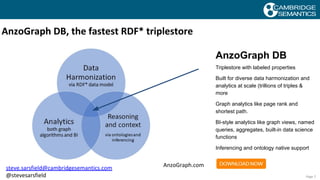
AnzoGraph DB
Triplestore with labeled properties
Built for diverse data harmonization and
analytics at scale (trillions of triples &
more
Graph analytics like page rank and
shortest path.
BI-style analytics like graph views, named
queries, aggregates, built-in data science
functions
Inferencing and ontology native support
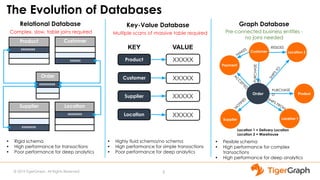
XXXXXX
XXXXXXXX
XXXXXXXX
XXXXXXXX
XXXXXXXXX
KEY VALUE
XXXXX
Order
Prod
uct
Product
XXXXX
XXXXX
XXXXX Location 1
2
3
4
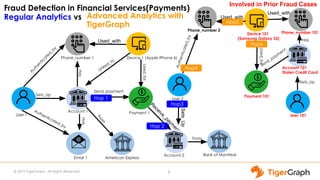
Used_with
R
eceive_paym
ent
Sets_Up
Used_with
Used_with
Involved in Prior Fraud Cases
5
Graph Databases on
the Edge
Presented by: William McKnight
“#1 Global Influencer in Data Warehousing” Onalytica
President, McKnight Consulting Group
An Inc. 5000 Company in 2018 and 2017
@williammcknight
www.mcknightcg.com
(214) 514-1444
Second Thursday of Every Month, at 2:00 ET
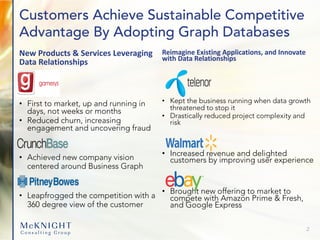
Customers Achieve Sustainable Competitive
Advantage By Adopting Graph Databases
New Products & Services Leveraging
Data Relationships
• First to market, up and running in
days, not weeks or months
• Reduced churn, increasing
engagement and uncovering fraud
• Achieved new company vision
centered around Business Graph
• Leapfrogged the competition with a
360 degree view of the customer
Reimagine Existing Applications, and Innovate
with Data Relationships
• Kept the business running when data growth
threatened to stop it
• Drastically reduced project complexity and
risk
• Increased revenue and delighted
customers by improving user experience
• Brought new offering to market to
compete with Amazon Prime & Fresh,
and Google Express
2
Graph Growth Ahead
“The application of graph processing and graph DBMSs will
grow at 100 percent annually through 2022 to continuously
accelerate data preparation and enable more complex and
adaptive data science.”
“Graph analytics will grow in the next few years due to the
need to ask complex questions across complex data, which is
not always practical or even possible at scale using SQL
queries.”
source - February 2019 press release by Gartner - https://www.gartner.com/en/newsroom/press-releases/2019-02-18-gartner-
identifies-top-10-data-and-analytics-technolo
3
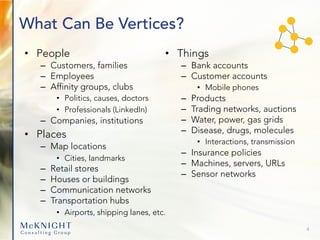
What Can Be Vertices?
• Things
– Bank accounts
– Customer accounts
• Mobile phones
– Products
– Trading networks, auctions
– Water, power, gas grids
– Disease, drugs, molecules
• Interactions, transmission
– Insurance policies
– Machines, servers, URLs
– Sensor networks
4
• People
– Customers, families
– Employees
– Affinity groups, clubs
• Politics, causes, doctors
• Professionals (LinkedIn)
– Companies, institutions
• Places
– Map locations
• Cities, landmarks
– Retail stores
– Houses or buildings
– Communication networks
– Transportation hubs
• Airports, shipping lanes, etc.
What Can be Edges?
• People
– Relationships
– Ideas, preferences
– Email, phone calls, SMS, IM
– Collaborations
• Places
– Roads, routes, railways
– Water, power, gas,
pipelines, telephone lines
– Anything with GPS
coordinates
• Things
– Events
– Money, transactions
– Purchases
– Pressure, temperature
– Diseases
– Contraband
– URLs
– Phone calls
– Citations
– Weights, scores
– Timestamps
5
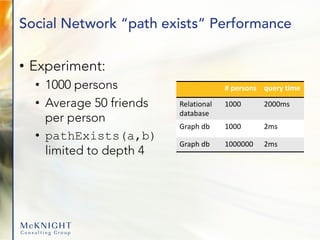
Social Network “path exists” Performance
• Experiment:
• 1000 persons
• Average 50 friends
per person
• pathExists(a,b)
limited to depth 4
# persons query time
Relational
database
1000 2000ms
Graph db 1000 2ms
Graph db 1000000 2ms
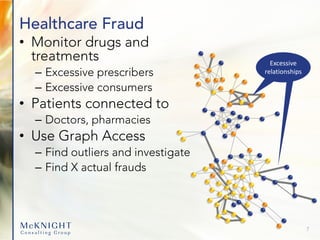
Excessive
relationships
Healthcare Fraud
• Monitor drugs and
treatments
– Excessive prescribers
– Excessive consumers
• Patients connected to
– Doctors, pharmacies
• Use Graph Access
– Find outliers and investigate
– Find X actual frauds
7
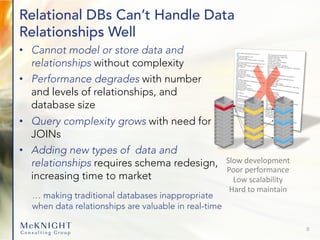
Relational DBs Can’t Handle Data
Relationships Well
• Cannot model or store data and
relationships without complexity
• Performance degrades with number
and levels of relationships, and
database size
• Query complexity grows with need for
JOINs
• Adding new types of data and
relationships requires schema redesign,
increasing time to market
8
Slow development
Poor performance
Low scalability
Hard to maintain
… making traditional databases inappropriate
when data relationships are valuable in real-time
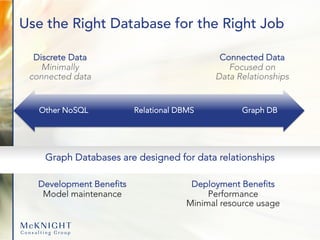
Discrete Data
Minimally
connected data
Graph Databases are designed for data relationships
Use the Right Database for the Right Job
Other NoSQL Relational DBMS Graph DB
Connected Data
Focused on
Data Relationships
Development Benefits
Model maintenance
Deployment Benefits
Performance
Minimal resource usage
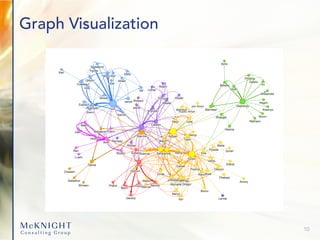
Graph Visualization
10
Graph Algorithms
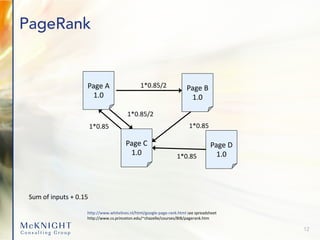
PageRank
12
Page A
1.0
Page C
1.0
Page B
1.0
Page D
1.0
1*0.85/2
1*0.85/2
1*0.85
1*0.85
1*0.85
Sum of inputs + 0.15
http://www.whitelines.nl/html/google-page-rank.html see spreadsheet
http://www.cs.princeton.edu/~chazelle/courses/BIB/pagerank.htm
+0.150
page D +0.850
page B +0.850
page A +0.425
C Total 2.275
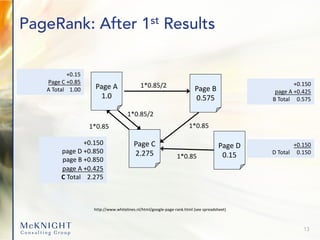
PageRank: After 1st Results
Page A
1.0
Page C
2.275
Page B
0.575
Page D
0.15
+0.150
page A +0.425
B Total 0.575
+0.15
Page C +0.85
A Total 1.00
+0.150
D Total 0.150
1*0.85/2
1*0.85/2
1*0.85
1*0.85
1*0.85
http://www.whitelines.nl/html/google-page-rank.html (see spreadsheet)
13
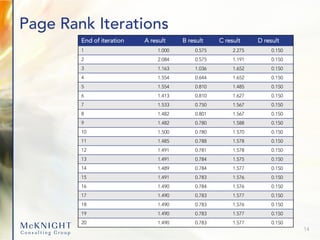
Page Rank Iterations
14
End of iteration A result B result C result D result
1 1.000 0.575 2.275 0.150
2 2.084 0.575 1.191 0.150
3 1.163 1.036 1.652 0.150
4 1.554 0.644 1.652 0.150
5 1.554 0.810 1.485 0.150
6 1.413 0.810 1.627 0.150
7 1.533 0.750 1.567 0.150
8 1.482 0.801 1.567 0.150
9 1.482 0.780 1.588 0.150
10 1.500 0.780 1.570 0.150
11 1.485 0.788 1.578 0.150
12 1.491 0.781 1.578 0.150
13 1.491 0.784 1.575 0.150
14 1.489 0.784 1.577 0.150
15 1.491 0.783 1.576 0.150
16 1.490 0.784 1.576 0.150
17 1.490 0.783 1.577 0.150
18 1.490 0.783 1.576 0.150
19 1.490 0.783 1.577 0.150
20 1.490 0.783 1.577 0.150
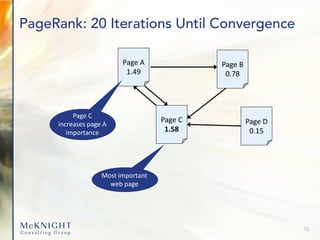
PageRank: 20 Iterations Until Convergence
Page A
1.49
Page C
1.58
Page B
0.78
Page D
0.15
Most important
web page
Page C
increases page A
importance
15
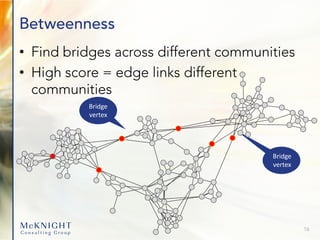
Betweenness
• Find bridges across different communities
• High score = edge links different
communities
Bridge
vertex
Bridge
vertex
16
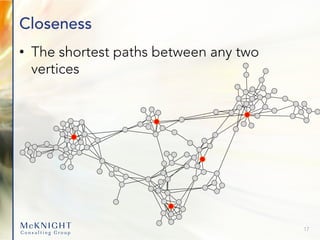
Closeness
• The shortest paths between any two
vertices
17
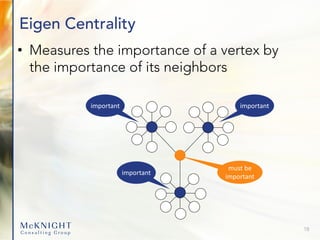
Eigen Centrality
• Measures the importance of a vertex by
the importance of its neighbors
importantimportant
important
must be
important
18
Clustering Coefficient: Cascading Churn
19
If two people churn,
what is the likelihood
others will?
The two churners affect
the central influencer
Finally: All contacts churn.
Individual-focused model
underestimates churn by 6X.
SELECT *
FROM LocalClusteringCoefficient(
ON Calls as edges
PARTITION BY caller_from
ON caller_from as vertices
PARTITION BY caller_id
targetKey(caller_to')
directed('f')
degreeRange('[3:]')
accumulate('personId')
);
Loopy Belief Propagation
• Loopy belief works by peer-pressure
– Node X gets a final belief value by listening to
its neighbors
– Nodes with known values propagate through
the graph
• Adjacent nodes send message saying
“update your beliefs”
– Based on priors, conditional probabilities, and
evidence
• Keep passing messages until a stable belief
state is reached
See https://www.ics.uci.edu/~welling/teaching/ICS279/GBP-vision.pdf
20
Great Questions for Graph Databases
• In what order did a specific set of related events
happen?
• Are there patterns of events in our data that seem
to be related by time?
• How far apart in a (social or physical) network are
two “actors” and how strong is their relationship?
• What are the identifiable social groups and what are
the general patterns of such groups?
• How important is any given “actor” in any given
network and event?
• What type of messages emanate from a specific
area?
21
How to Identify a Graph Workload
• Workload is identified by “network,
hierarchy, tree, ancestry, structure” words
• You are planning to use relational
performance tricks
• Your queries will be about pathing
• You are limiting queries by their complexity
• You are looking for “non-obvious” patterns
in the data
22
Graph Modeling
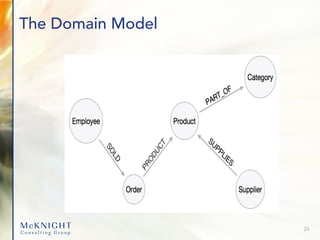
The Domain Model
24
Actions
Model actions depending on what you want
as vertices
(Bill)-[:SENT]->(email)-[:TO]->(Jim)
OR
(Bill)-[:EMAILED]->(Jim)
25
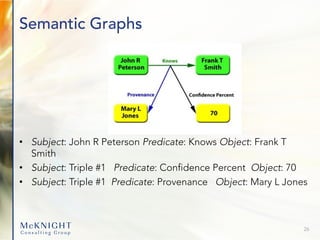
Semantic Graphs
• Subject: John R Peterson Predicate: Knows Object: Frank T
Smith
• Subject: Triple #1 Predicate: Confidence Percent Object: 70
• Subject: Triple #1 Predicate: Provenance Object: Mary L Jones
26
Triple Store
• A triple is a data entity composed of
subject-predicate-object
– "Bob is 35”
– "Bob knows Fred”
– “William likes running”
27
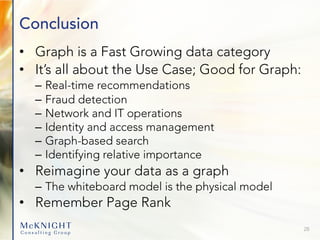
Conclusion
• Graph is a Fast Growing data category
• It’s all about the Use Case; Good for Graph:
– Real-time recommendations
– Fraud detection
– Network and IT operations
– Identity and access management
– Graph-based search
– Identifying relative importance
• Reimagine your data as a graph
– The whiteboard model is the physical model
• Remember Page Rank
28
Graph Databases on
the Edge
Presented by: William McKnight
“#1 Global Influencer in Data Warehousing” OnAlytica
President, McKnight Consulting Group
An Inc. 5000 Company in 2018 and 2017
@williammcknight
www.mcknightcg.com
(214) 514-1444
Second Thursday of Every Month, at 2:00 ET

ADV Slides: Graph Databases on the Edge

  • 1.
    Graph Databases on theEdge Presented by: William McKnight “#1 Global Influencer in Data Warehousing” Onalytica President, McKnight Consulting Group An Inc. 5000 Company in 2018 and 2017 @williammcknight www.mcknightcg.com (214) 514-1444 Second Thursday of Every Month, at 2:00 ET
  • 4.
  • 8.
    AnzoGraph DB Triplestore withlabeled properties Built for diverse data harmonization and analytics at scale (trillions of triples & more Graph analytics like page rank and shortest path. BI-style analytics like graph views, named queries, aggregates, built-in data science functions Inferencing and ontology native support
  • 10.
  • 11.
  • 12.
  • 13.
  • 15.
    Graph Databases on theEdge Presented by: William McKnight “#1 Global Influencer in Data Warehousing” Onalytica President, McKnight Consulting Group An Inc. 5000 Company in 2018 and 2017 @williammcknight www.mcknightcg.com (214) 514-1444 Second Thursday of Every Month, at 2:00 ET
  • 16.
    Customers Achieve SustainableCompetitive Advantage By Adopting Graph Databases New Products & Services Leveraging Data Relationships • First to market, up and running in days, not weeks or months • Reduced churn, increasing engagement and uncovering fraud • Achieved new company vision centered around Business Graph • Leapfrogged the competition with a 360 degree view of the customer Reimagine Existing Applications, and Innovate with Data Relationships • Kept the business running when data growth threatened to stop it • Drastically reduced project complexity and risk • Increased revenue and delighted customers by improving user experience • Brought new offering to market to compete with Amazon Prime & Fresh, and Google Express 2
  • 17.
    Graph Growth Ahead “Theapplication of graph processing and graph DBMSs will grow at 100 percent annually through 2022 to continuously accelerate data preparation and enable more complex and adaptive data science.” “Graph analytics will grow in the next few years due to the need to ask complex questions across complex data, which is not always practical or even possible at scale using SQL queries.” source - February 2019 press release by Gartner - https://www.gartner.com/en/newsroom/press-releases/2019-02-18-gartner- identifies-top-10-data-and-analytics-technolo 3
  • 18.
    What Can BeVertices? • Things – Bank accounts – Customer accounts • Mobile phones – Products – Trading networks, auctions – Water, power, gas grids – Disease, drugs, molecules • Interactions, transmission – Insurance policies – Machines, servers, URLs – Sensor networks 4 • People – Customers, families – Employees – Affinity groups, clubs • Politics, causes, doctors • Professionals (LinkedIn) – Companies, institutions • Places – Map locations • Cities, landmarks – Retail stores – Houses or buildings – Communication networks – Transportation hubs • Airports, shipping lanes, etc.
  • 19.
    What Can beEdges? • People – Relationships – Ideas, preferences – Email, phone calls, SMS, IM – Collaborations • Places – Roads, routes, railways – Water, power, gas, pipelines, telephone lines – Anything with GPS coordinates • Things – Events – Money, transactions – Purchases – Pressure, temperature – Diseases – Contraband – URLs – Phone calls – Citations – Weights, scores – Timestamps 5
  • 20.
    Social Network “pathexists” Performance • Experiment: • 1000 persons • Average 50 friends per person • pathExists(a,b) limited to depth 4 # persons query time Relational database 1000 2000ms Graph db 1000 2ms Graph db 1000000 2ms
  • 21.
    Excessive relationships Healthcare Fraud • Monitordrugs and treatments – Excessive prescribers – Excessive consumers • Patients connected to – Doctors, pharmacies • Use Graph Access – Find outliers and investigate – Find X actual frauds 7
  • 22.
    Relational DBs Can’tHandle Data Relationships Well • Cannot model or store data and relationships without complexity • Performance degrades with number and levels of relationships, and database size • Query complexity grows with need for JOINs • Adding new types of data and relationships requires schema redesign, increasing time to market 8 Slow development Poor performance Low scalability Hard to maintain … making traditional databases inappropriate when data relationships are valuable in real-time
  • 23.
    Discrete Data Minimally connected data GraphDatabases are designed for data relationships Use the Right Database for the Right Job Other NoSQL Relational DBMS Graph DB Connected Data Focused on Data Relationships Development Benefits Model maintenance Deployment Benefits Performance Minimal resource usage
  • 24.
  • 25.
  • 26.
    PageRank 12 Page A 1.0 Page C 1.0 PageB 1.0 Page D 1.0 1*0.85/2 1*0.85/2 1*0.85 1*0.85 1*0.85 Sum of inputs + 0.15 http://www.whitelines.nl/html/google-page-rank.html see spreadsheet http://www.cs.princeton.edu/~chazelle/courses/BIB/pagerank.htm
  • 27.
    +0.150 page D +0.850 pageB +0.850 page A +0.425 C Total 2.275 PageRank: After 1st Results Page A 1.0 Page C 2.275 Page B 0.575 Page D 0.15 +0.150 page A +0.425 B Total 0.575 +0.15 Page C +0.85 A Total 1.00 +0.150 D Total 0.150 1*0.85/2 1*0.85/2 1*0.85 1*0.85 1*0.85 http://www.whitelines.nl/html/google-page-rank.html (see spreadsheet) 13
  • 28.
    Page Rank Iterations 14 Endof iteration A result B result C result D result 1 1.000 0.575 2.275 0.150 2 2.084 0.575 1.191 0.150 3 1.163 1.036 1.652 0.150 4 1.554 0.644 1.652 0.150 5 1.554 0.810 1.485 0.150 6 1.413 0.810 1.627 0.150 7 1.533 0.750 1.567 0.150 8 1.482 0.801 1.567 0.150 9 1.482 0.780 1.588 0.150 10 1.500 0.780 1.570 0.150 11 1.485 0.788 1.578 0.150 12 1.491 0.781 1.578 0.150 13 1.491 0.784 1.575 0.150 14 1.489 0.784 1.577 0.150 15 1.491 0.783 1.576 0.150 16 1.490 0.784 1.576 0.150 17 1.490 0.783 1.577 0.150 18 1.490 0.783 1.576 0.150 19 1.490 0.783 1.577 0.150 20 1.490 0.783 1.577 0.150
  • 29.
    PageRank: 20 IterationsUntil Convergence Page A 1.49 Page C 1.58 Page B 0.78 Page D 0.15 Most important web page Page C increases page A importance 15
  • 30.
    Betweenness • Find bridgesacross different communities • High score = edge links different communities Bridge vertex Bridge vertex 16
  • 31.
    Closeness • The shortestpaths between any two vertices 17
  • 32.
    Eigen Centrality • Measuresthe importance of a vertex by the importance of its neighbors importantimportant important must be important 18
  • 33.
    Clustering Coefficient: CascadingChurn 19 If two people churn, what is the likelihood others will? The two churners affect the central influencer Finally: All contacts churn. Individual-focused model underestimates churn by 6X. SELECT * FROM LocalClusteringCoefficient( ON Calls as edges PARTITION BY caller_from ON caller_from as vertices PARTITION BY caller_id targetKey(caller_to') directed('f') degreeRange('[3:]') accumulate('personId') );
  • 34.
    Loopy Belief Propagation •Loopy belief works by peer-pressure – Node X gets a final belief value by listening to its neighbors – Nodes with known values propagate through the graph • Adjacent nodes send message saying “update your beliefs” – Based on priors, conditional probabilities, and evidence • Keep passing messages until a stable belief state is reached See https://www.ics.uci.edu/~welling/teaching/ICS279/GBP-vision.pdf 20
  • 35.
    Great Questions forGraph Databases • In what order did a specific set of related events happen? • Are there patterns of events in our data that seem to be related by time? • How far apart in a (social or physical) network are two “actors” and how strong is their relationship? • What are the identifiable social groups and what are the general patterns of such groups? • How important is any given “actor” in any given network and event? • What type of messages emanate from a specific area? 21
  • 36.
    How to Identifya Graph Workload • Workload is identified by “network, hierarchy, tree, ancestry, structure” words • You are planning to use relational performance tricks • Your queries will be about pathing • You are limiting queries by their complexity • You are looking for “non-obvious” patterns in the data 22
  • 37.
  • 38.
  • 39.
    Actions Model actions dependingon what you want as vertices (Bill)-[:SENT]->(email)-[:TO]->(Jim) OR (Bill)-[:EMAILED]->(Jim) 25
  • 40.
    Semantic Graphs • Subject:John R Peterson Predicate: Knows Object: Frank T Smith • Subject: Triple #1 Predicate: Confidence Percent Object: 70 • Subject: Triple #1 Predicate: Provenance Object: Mary L Jones 26
  • 41.
    Triple Store • Atriple is a data entity composed of subject-predicate-object – "Bob is 35” – "Bob knows Fred” – “William likes running” 27
  • 42.
    Conclusion • Graph isa Fast Growing data category • It’s all about the Use Case; Good for Graph: – Real-time recommendations – Fraud detection – Network and IT operations – Identity and access management – Graph-based search – Identifying relative importance • Reimagine your data as a graph – The whiteboard model is the physical model • Remember Page Rank 28
  • 43.
    Graph Databases on theEdge Presented by: William McKnight “#1 Global Influencer in Data Warehousing” OnAlytica President, McKnight Consulting Group An Inc. 5000 Company in 2018 and 2017 @williammcknight www.mcknightcg.com (214) 514-1444 Second Thursday of Every Month, at 2:00 ET